JP7127084B2 - Heat-resistant inorganic fiber soluble in physiological saline - Google Patents
Heat-resistant inorganic fiber soluble in physiological saline Download PDFInfo
- Publication number
- JP7127084B2 JP7127084B2 JP2020086529A JP2020086529A JP7127084B2 JP 7127084 B2 JP7127084 B2 JP 7127084B2 JP 2020086529 A JP2020086529 A JP 2020086529A JP 2020086529 A JP2020086529 A JP 2020086529A JP 7127084 B2 JP7127084 B2 JP 7127084B2
- Authority
- JP
- Japan
- Prior art keywords
- mass
- less
- inorganic fiber
- heat resistance
- content
- Prior art date
- Legal status (The legal status is an assumption and is not a legal conclusion. Google has not performed a legal analysis and makes no representation as to the accuracy of the status listed.)
- Active
Links
Landscapes
- Glass Compositions (AREA)
- Inorganic Fibers (AREA)
Description
本発明は、生理食塩水への溶解性があり、且つ1300℃以上の高い耐熱性を有する無機繊維に関する。 TECHNICAL FIELD The present invention relates to inorganic fibers that are soluble in physiological saline and have high heat resistance of 1300° C. or higher.
繊維状の形態を有する無機物からなる無機繊維のうち、セラミック系無機繊維は軽量で扱いやすく、耐熱性にも優れるため、主に耐火や断熱を目的とした工業材料として様々な分野で多岐にわたって使用されている。また、セラミック系無機繊維は様々な形状に加工することができ、ブランケット、ボード、ペーパー、ブロックなどの定形物、スラリー状、練り物状などの不定形物の形態に加工される。 Among inorganic fibers made of fibrous inorganic substances, ceramic inorganic fibers are lightweight, easy to handle, and have excellent heat resistance. It is In addition, the ceramic inorganic fibers can be processed into various shapes, such as blankets, boards, papers and blocks, and irregular shapes such as slurries and pastes.
上記セラミック系無機繊維のうち、特にシリカ及びアルミナを主成分とし、耐熱性が1260℃程度の人造鉱物繊維であるセラミックファイバーが知られている。セラミックファイバーは、アスベストの代替品として使用されてきたが、人体に吸入されることで健康障害が起こる可能性が指摘されている。そこで、生理食塩水に可溶で且つセラミックファイバーと同水準の耐熱性を有する無機繊維が求められている。すなわち、人体に吸入しても体液により溶解するのであれば健康障害を起こしにくいと考えられるので、体液である生理食塩水に対する溶解性が高い無機繊維の需要が高まっており、その研究開発がすすめられている。 Among the ceramic-based inorganic fibers, ceramic fibers, which are artificial mineral fibers containing silica and alumina as main components and having a heat resistance of about 1260° C., are known. Ceramic fibers have been used as a substitute for asbestos, but it has been pointed out that inhalation into the human body may cause health problems. Therefore, there is a demand for inorganic fibers that are soluble in physiological saline and have the same level of heat resistance as ceramic fibers. In other words, even if it is inhaled into the human body, if it dissolves in body fluids, it is thought that it is unlikely to cause health problems. It is
例えば特許文献1及び特許文献2には、SiO2を主成分とし、更にアルカリ土類金属酸化物であるMgO、CaO、及びSrOを含む無機繊維であって、これらアルカリ土類金属酸化物の含有量を制御することによって生理食塩水に可溶にすると共に、セラミックファイバーと同水準の耐熱性(1260℃)を含有する生体溶解性の無機繊維が開示されている。 For example, Patent Document 1 and Patent Document 2 disclose inorganic fibers containing SiO 2 as a main component and alkaline earth metal oxides MgO, CaO, and SrO, which contain these alkaline earth metal oxides. A biosoluble inorganic fiber is disclosed which is made soluble in physiological saline by controlling the amount and which contains the same level of heat resistance (1260° C.) as ceramic fiber.
近年、各種産業においてより高い温度で熱処理を行う場合が増えており、また、セラミック系無機繊維の用途も広がっている。そのため、セラミック系無機繊維には前述した生理食塩水への溶解性を有し、且つ1260℃よりも高温での耐熱性が求められている。本発明はかかる事情に鑑みてなされたものであり、生理食塩水に可溶な生体溶解性を有し、且つ1300℃以上の耐熱性を有する無機繊維を提供することを目的としている。 In recent years, the use of heat treatment at higher temperatures is increasing in various industries, and the applications of ceramic inorganic fibers are also expanding. Therefore, ceramic-based inorganic fibers are required to have the aforementioned solubility in physiological saline and heat resistance at temperatures higher than 1260°C. The present invention has been made in view of such circumstances, and an object of the present invention is to provide an inorganic fiber that is biosoluble in physiological saline and has heat resistance of 1300° C. or higher.
上記目的を達成するため、本発明者は無機繊維の成分や組成を様々に変えてそれらの耐熱性及び生体溶解性について鋭意研究をすすめた結果、シリカを主成分とする無機繊維中に、アルカリ土類金属酸化物、複数種類のアルカリ金属酸化物、及びアルミナを含有させると共に、該アルミナに対する該複数種類のアルカリ金属酸化物の比率を所定の範囲内に制御することによって、優れた耐熱性と生体溶解性とを併せ持つ無機繊維が得られることを見出し、本発明を完成させるに至った。 In order to achieve the above object, the present inventors conducted intensive research on the heat resistance and biosolubility of inorganic fibers by changing the components and compositions of the inorganic fibers. By containing an earth metal oxide, a plurality of types of alkali metal oxides, and alumina, and controlling the ratio of the plurality of types of alkali metal oxides to the alumina within a predetermined range, excellent heat resistance and The inventors have found that an inorganic fiber having both biosolubility can be obtained, and have completed the present invention.
すなわち、本発明に係る耐熱性無機繊維は、SiO2を70質量%以上80質量%以下含有し、MgOを17質量%以上25質量%以下含有し、SrOを0質量%を超え2質量%以下含有し、Al2O3を2質量%を超え3質量%以下含有し、CaOを1質量%以下含有し、Li2O、Na2O、及びK2Oを各々0.04質量%以上含有する無機繊維であって、該Li2O、Na2O、及びK2Oの合計含有率が0.3質量%以上1質量%以下であり、Li2O、Na2O、及びK2Oの合計モル数をAl2O3モル数で除したモル比(Li2O+Na2O+K2O)/Al2O3が0.3以上0.7以下であることを特徴としている。 That is, the heat-resistant inorganic fiber according to the present invention contains 70% by mass or more and 80% by mass or less of SiO 2 , contains 17% by mass or more and 25% by mass or less of MgO, and more than 0% by mass and 2% by mass or less of SrO. contains more than 2% by mass and 3% by mass or less of Al 2 O 3 , contains 1% by mass or less of CaO, and contains 0.04% by mass or more of each of Li 2 O, Na 2 O, and K 2 O Inorganic fibers having a total content of Li 2 O, Na 2 O, and K 2 O of 0.3% by mass or more and 1% by mass or less, and containing Li 2 O, Na 2 O, and K 2 O The molar ratio (Li 2 O+Na 2 O+K 2 O)/Al 2 O 3 obtained by dividing the total number of moles of by the number of moles of Al 2 O 3 is 0.3 or more and 0.7 or less.
本発明によれば、1300℃以上の耐熱性と優れた生体溶解性とを併せ持った無機繊維を提供することができる。 According to the present invention, it is possible to provide an inorganic fiber having both heat resistance of 1300° C. or more and excellent biosolubility.
以下、本発明に係る生理食塩水に可溶な耐熱性無機繊維の実施形態について説明する。この本発明の実施形態の耐熱性無機繊維は、必須成分として、主成分のシリカ(SiO2)と、アルカリ土類金属酸化物のMgO及びSrOと、アルカリ金属酸化物のLi2O、Na2O及びK2Oと、アルミナ(Al2O3)とを含んでいる。この耐熱性無機繊維は、ブランケット、ボード、ペーパー、ブロック等の定形物、スラリー状、練り物状などの不定形物の形態で主に断熱材として使用される。 Hereinafter, embodiments of the heat-resistant inorganic fiber soluble in physiological saline according to the present invention will be described. The heat-resistant inorganic fiber of this embodiment of the present invention includes, as essential components, silica (SiO 2 ) as a main component, alkaline earth metal oxides MgO and SrO, and alkali metal oxides Li 2 O and Na 2 It contains O and K 2 O and alumina (Al 2 O 3 ). The heat-resistant inorganic fibers are mainly used as heat insulating materials in the form of fixed shapes such as blankets, boards, papers and blocks, and irregular shapes such as slurries and pastes.
上記無機繊維中における上記必須成分の含有率は、SiO2が70質量%以上80質量%以下であり、MgOが17質量%以上25質量%以下であり、SrOが0質量%を超え2質量%以下であり、Al2O3が2質量%を超え3質量%以下であり、CaOが1質量%以下であり、Li2O、Na2O及びK2Oが各々0.04質量%以上であって且つこれらLi2O、Na2O及びK2Oの合計含有率が0.3質量%以上1質量%以下である。更に、これらLi2O、Na2O及びK2Oの合計モル数を上記Al2O3のモル数で除したモル比(Li2O+Na2O+K2O)/Al2O3が0.3以上0.7以下である。 The content of the essential components in the inorganic fiber is SiO 2 is 70% by mass or more and 80% by mass or less, MgO is 17% by mass or more and 25% by mass or less, and SrO is more than 0% by mass and 2% by mass. Al 2 O 3 is more than 2% by mass and 3% by mass or less, CaO is 1% by mass or less, and Li 2 O, Na 2 O and K 2 O are each 0.04% by mass or more and the total content of these Li 2 O, Na 2 O and K 2 O is 0.3% by mass or more and 1% by mass or less. Furthermore, the molar ratio obtained by dividing the total number of moles of Li 2 O, Na 2 O and K 2 O by the number of moles of Al 2 O 3 (Li 2 O + Na 2 O + K 2 O)/Al 2 O 3 is 0.3 0.7 or less.
上記組成を有する無機繊維は、1300℃以上の耐熱性と優れた生体溶解性とを併せ持つ特徴を有している。ここで、無機繊維がT℃の耐熱性を有する又は耐熱温度T℃とは、後述するように欧州規格のEN-1091に準拠して該無機繊維を雰囲気温度T℃で24時間加熱したときの加熱線収縮率が4%を超えない場合と定義する。また、無機繊維が優れた生体溶解性を有するとは、後述するように該無機繊維の生理食塩水への溶解速度定数が、閾値として定めた100ng/cm2・h以上である場合と定義する。 The inorganic fiber having the above composition is characterized by having both heat resistance of 1300° C. or more and excellent biosolubility. Here, the inorganic fiber has a heat resistance of T ° C. or a heat resistance temperature of T ° C. is the temperature when the inorganic fiber is heated at an ambient temperature of T ° C. for 24 hours in accordance with European standard EN-1091 as described later. It is defined as the case where the heating wire shrinkage does not exceed 4%. In addition, the inorganic fiber having excellent biosolubility is defined as the case where the dissolution rate constant of the inorganic fiber in physiological saline is 100 ng/cm 2 ·h or more, which is defined as a threshold value, as described later. .
上記のSiO2の含有率が70質量%未満では所望の耐熱性が得られにくくなり、逆に80質量%を超えると優れた生体溶解性が得られにくくなる。上記MgOの含有率が17質量%未満では優れた生体溶解性が得られにくくなり、逆に25質量%を超えると所望の耐熱性が得られにくくなる。上記SrOが含まれることでより生体溶解性が向上するが、2質量%を超えると所望の耐熱性が得られにくくなる。上記Al2O3の含有率が2質量%を超え3質量%の範囲内で含まれることによって、後述するアルカリアルミノシリケート結晶を生成することができ、無機繊維の耐熱性を向上させることができる。Al2O3の含有率が2質量%未満ではアルカリアルミノシリケート結晶を十分に生成できなくなり、逆に3質量%を超えると生体溶解性が低下するおそれがある。 If the content of SiO 2 is less than 70% by mass, it becomes difficult to obtain the desired heat resistance, and conversely, if it exceeds 80% by mass, it becomes difficult to obtain excellent biosolubility. If the MgO content is less than 17% by mass, excellent biosolubility is difficult to obtain, and if it exceeds 25% by mass, desired heat resistance is difficult to obtain. The inclusion of SrO improves the biosolubility, but if it exceeds 2% by mass, it becomes difficult to obtain the desired heat resistance. When the Al 2 O 3 content is in the range of more than 2% by mass and 3% by mass, alkali aluminosilicate crystals, which will be described later, can be generated, and the heat resistance of the inorganic fiber can be improved. . If the content of Al 2 O 3 is less than 2% by mass, sufficient alkali aluminosilicate crystals cannot be formed, and if it exceeds 3% by mass, the biosolubility may decrease.
また、アルカリ金属酸化物としての上記Li2O、Na2O及びK2Oを、上記の含有率で無機繊維に含有させることによって、該無機繊維の耐熱性を高めることができる。すなわち、主成分のシリカに加えてアルカリ金属酸化物を含有する無機繊維は、800℃以上に加熱されたときに結晶化、軟化、及び繊維同士の融着といった現象が起こり、該無機繊維の構造体に収縮が生ずる。しかしながら、これら3つの現象は必ずしも同時に起こるわけではない。 In addition, by including Li 2 O, Na 2 O, and K 2 O as alkali metal oxides in the inorganic fibers at the above-described content rates, the heat resistance of the inorganic fibers can be enhanced. That is, inorganic fibers containing an alkali metal oxide in addition to silica as a main component undergo phenomena such as crystallization, softening, and fusion between fibers when heated to 800° C. or higher. Contractions occur in the body. However, these three phenomena do not necessarily occur simultaneously.
そこで、本発明の実施形態の無機繊維は、上記したようにLi2O、Na2O及びK2Oの3種類のアルカリ金属酸化物を上記の条件で含有させることで上記の3つの現象のバランスを制御しており、これにより無機繊維全体として収縮を抑えている。具体的にはLi2O、Na2O及びK2Oの3種類のアルカリ金属酸化物を、各々0.04質量%以上含有させ且つこれらの合計含有量を0.3質量%以上1質量%以下にすると共に、これらアルカリ金属酸化物の合計モル数をアルミナのモル数で除したモル比を0.3以上0.7以下の範囲にする。 Therefore, the inorganic fiber of the embodiment of the present invention contains three kinds of alkali metal oxides of Li 2 O, Na 2 O and K 2 O under the above conditions as described above, thereby preventing the above three phenomena. The balance is controlled, thereby suppressing the shrinkage of the inorganic fiber as a whole. Specifically, the three types of alkali metal oxides, Li 2 O, Na 2 O and K 2 O, are each contained in an amount of 0.04% by mass or more, and the total content thereof is 0.3% by mass or more and 1% by mass. In addition, the molar ratio obtained by dividing the total number of moles of these alkali metal oxides by the number of moles of alumina is set within the range of 0.3 or more and 0.7 or less.
かかる条件の下で3種類のアルカリ金属酸化物を無機繊維に含有させることで、これら3種類のアルカリ金属酸化物が各々アルミナ及びシリカを伴って生成するアルカリアルミノシリケート結晶を、加熱昇温時に順番に結晶化させることができる。これにより、広い温度範囲で無機繊維の軟化を抑制することができる。上記3種類のアルカリ金属酸化物の各々の含有率が0.04質量%未満であったり、合計含有率が0.3質量%未満であったりした場合は、上記の収縮抑制の効果がほとんど得られなくなる。逆に上記の合計含有率が1質量%を超えると所望の耐熱性が得られにくくなる。 By allowing the inorganic fiber to contain three types of alkali metal oxides under these conditions, alkali aluminosilicate crystals formed by these three types of alkali metal oxides with alumina and silica, respectively, are sequentially formed during heating. can be crystallized to As a result, softening of the inorganic fibers can be suppressed over a wide temperature range. When the content of each of the three types of alkali metal oxides is less than 0.04% by mass, or the total content is less than 0.3% by mass, the above shrinkage suppression effect is hardly obtained. will not be Conversely, if the above total content exceeds 1% by mass, it becomes difficult to obtain the desired heat resistance.
上記のアルミナに対するアルカリ金属酸化物のモル比である(Li2O+Na2O+K2O)/Al2O3が0.3より小さいと、上記結晶化が十分に起こる前に軟化が生じるため、結果的に無機繊維全体としての収縮が大きくなる。逆に、上記アルミナに対するアルカリ金属酸化物のモル比が0.7より大きいと、シリカとアルカリ金属酸化物とからなる低融点化合物の発生量が増加することで、繊維同士の融着が増加し、結果的に無機繊維全体としての収縮が大きくなる。 If the molar ratio of alkali metal oxides to alumina (Li 2 O + Na 2 O + K 2 O)/Al 2 O 3 is less than 0.3, softening occurs before sufficient crystallization occurs, resulting in In general, the shrinkage of the inorganic fibers as a whole increases. Conversely, if the molar ratio of the alkali metal oxide to the alumina is greater than 0.7, the amount of the low-melting-point compound composed of silica and the alkali metal oxide increases, resulting in increased fusion between the fibers. As a result, the shrinkage of the inorganic fiber as a whole is increased.
本発明の実施形態の無機繊維は、アルカリ土類金属酸化物のカルシア(CaO)を1質量%以下の範囲で含有してもよい。カルシア(CaO)はマグネシア(MgO)とほぼ同様の特性を有しているので、CaOを含有させることで無機繊維の生体溶解性を高めることができる。但し、CaOの含有率が1質量%を超えると、無機繊維の耐熱性が低下するおそれがある。 The inorganic fiber of the embodiment of the present invention may contain calcia (CaO), which is an alkaline earth metal oxide, in a range of 1% by mass or less. Since calcia (CaO) has almost the same properties as magnesia (MgO), the inclusion of CaO can increase the biosolubility of inorganic fibers. However, if the content of CaO exceeds 1% by mass, the heat resistance of the inorganic fibers may deteriorate.
上記した本発明の実施形態の無機繊維は、一般的なスピニング法やブローイング法で作製することができる。スピニング法は、上記の含有率となるように配合した複数種類の原料を混合し、得られた混合物を電気炉に導入して溶融することで溶融体とし、これを炉底から流出させて高速で回転するローターの遠心力で繊維化する方法である。一方、ブローイング法は上記の炉底から流出させた溶融体を高圧空気又は水蒸気で吹き飛ばして繊維化する方法である。 The inorganic fiber of the embodiment of the present invention described above can be produced by a general spinning method or blowing method. In the spinning method, a plurality of types of raw materials are mixed so as to have the above-mentioned content, and the resulting mixture is introduced into an electric furnace and melted to form a melt, which is flown out from the bottom of the furnace to produce a high-speed It is a method of fiberization by the centrifugal force of a rotor rotating at On the other hand, the blowing method is a method in which the molten material discharged from the bottom of the furnace is blown off with high-pressure air or steam to form fibers.
上記方法で作製されたバルク(原綿)状の繊維は、マット状に集綿され、必要に応じて減摩剤(潤滑油)を添加した後、ニードリングによりブランケット状に加工される。なお、上記のニードリング前に添加した減摩剤は、加熱処理により除去することができる。加熱炉等の断熱材の用途に使用する場合は、上記のブランケット状の無機繊維をアコーディオン状に折り畳み、金属製の支持具と一体化させたブロックの形態に加工することが一般的である。 The bulk (raw cotton) fiber produced by the above method is collected in a mat shape, added with an antifriction agent (lubricating oil) if necessary, and processed into a blanket by needling. The anti-friction agent added before needling can be removed by heat treatment. When used as a heat insulating material for heating furnaces, etc., it is common to fold the blanket-like inorganic fiber into an accordion shape and process it into a block shape integrated with a metal support.
上記の定形物のほか、スラリー状や練り物状(ペースト状)の不定形物に加工されることもある。スラリー状の無機繊維は、上記バルク状の無機繊維に無機バインダー及び適量の水を添加して混合することで作製することができる。一方、練り物状の無機繊維は、上記バルク状の無機繊維に無機バインダー及び必要に応じて増粘剤等の添加物を添加して混練することにより作製することができる。上記のスラリー状の無機繊維は、更に真空吸引又はプレスにより脱水する湿式成形法により、ボード状やペーパー状の定形物に成形することができる。 In addition to the above fixed shapes, they may be processed into slurry-like or pasty-like amorphous products. Slurry inorganic fibers can be produced by adding an inorganic binder and an appropriate amount of water to the bulk inorganic fibers and mixing them. On the other hand, the paste-like inorganic fiber can be produced by adding an inorganic binder and, if necessary, an additive such as a thickening agent to the bulk inorganic fiber, and kneading the mixture. The above-mentioned slurry-like inorganic fibers can be further formed into a board-like or paper-like shaped article by a wet forming method in which dehydration is performed by vacuum suction or pressing.
SiO2、MgO、CaO、SrO、Al2O3、Li2O、Na2O、及びK2Oを様々な配合割合で混合し、スピニング法により試料1~22のブランケット状の無機繊維を作製した。得られたブランケット状の無機繊維の化学成分を蛍光X線分析法及びICP質量分析法(Inductively Coupled Plasma Mass Spectrometry)により測定した。更に下記に示すように、加熱線収縮率により耐熱性を評価し、生理食塩水に対する単位表面積当たりの溶解速度により生体溶解性を評価した。 SiO 2 , MgO, CaO, SrO, Al 2 O 3 , Li 2 O, Na 2 O, and K 2 O are mixed in various mixing ratios, and blanket-like inorganic fibers of samples 1 to 22 are produced by a spinning method. did. The chemical components of the obtained blanket-like inorganic fibers were measured by fluorescent X-ray analysis and ICP mass spectrometry (Inductively Coupled Plasma Mass Spectrometry). Furthermore, as shown below, the heat resistance was evaluated by heating linear shrinkage, and the biosolubility was evaluated by the dissolution rate per unit surface area in physiological saline.
(耐熱性の評価)
EUROPEAN STANDARD EN-1091(Insulating Refractory Products-Part1:Terminology Classification and Methods of Test for High Temperature Insulation Wool Products)に従い、24時間加熱後の加熱線収縮率を測定し、加熱線収縮率が4%を超えない最大の加熱温度を求め、得られた最高温度を50℃毎の幅で分類した耐熱温度で耐熱性を評価した。
(Evaluation of heat resistance)
According to EUROPEAN STANDARD EN-1091 (Insulating Refractory Products-Part 1: Terminology Classification and Methods of Test for High Temperature Insulation Wool Products), the heating wire shrinkage rate after heating for 24 hours is measured, and the heating wire shrinkage rate does not exceed 4%. The maximum heating temperature was determined, and the heat resistance was evaluated by classifying the obtained maximum temperature into a range of 50°C.
(生体溶解性の評価)
粉砕した各試料の無機繊維2gを、別々に用意した300gの生理食塩水中に浸漬させて液温40℃に維持して48時間温浴させた後、該生理食塩水から取り出してろ過及び乾燥し、該温浴前からの質量減少率から溶解度(単位時間当たりの溶出量)を測定した。この溶解度は繊維の表面積の違いによる影響が出ると考えられるため、以下の方法で表面積を求めて単位表面当たりに換算した。
(Evaluation of biosolubility)
2 g of the pulverized inorganic fiber of each sample was immersed in 300 g of separately prepared physiological saline, maintained at a liquid temperature of 40 ° C. and warmed for 48 hours, then removed from the physiological saline, filtered and dried. The solubility (elution amount per unit time) was measured from the mass reduction rate from before the hot bath. Since this solubility is considered to be affected by the difference in the surface area of the fibers, the surface area was determined by the following method and converted to per unit surface.
すなわち、サンプリングした各試料を走査電子顕微鏡SEMで撮像することで得たSEM画像内において、任意の200本の無機繊維を各々測定して得た任意の部位の幅を算術平均して求めた平均繊維径と、任意の100本の無機繊維を各々測定して得た端から端までの直線距離を算術平均して求めた平均繊維長とを用いて無機繊維1本当たりの平均表面積を求め、更に該SEM画像から推定した単位体積中の無機繊維の本数及び予め測定しておいた無機繊維のかさ密度から各試料の単位質量当たりの表面積を求めた。この表面積に基づいて単位表面積・単位時間当たりの溶出量である溶解速度定数k(単位:ng/cm2・h)に換算した。そして、溶解速度定数kが100ng/cm2・hを閾値に定め、この閾値以上を「可」と評価し、この閾値未満を「不可」と評価した。 That is, in the SEM image obtained by imaging each sampled sample with a scanning electron microscope SEM, the average obtained by arithmetically averaging the widths of arbitrary parts obtained by measuring each of arbitrary 200 inorganic fibers Obtaining the average surface area per inorganic fiber using the fiber diameter and the average fiber length obtained by arithmetically averaging the linear distance from end to end obtained by measuring each of 100 arbitrary inorganic fibers, Further, the surface area per unit mass of each sample was obtained from the number of inorganic fibers per unit volume estimated from the SEM image and the bulk density of the inorganic fibers previously measured. Based on this surface area, it was converted into a dissolution rate constant k (unit: ng/cm 2 ·h), which is the amount of elution per unit surface area per unit time. Then, a dissolution rate constant k of 100 ng/cm 2 ·h was set as a threshold value, and values equal to or greater than this threshold value were evaluated as “fair”, and values less than this threshold value were evaluated as “impossible”.
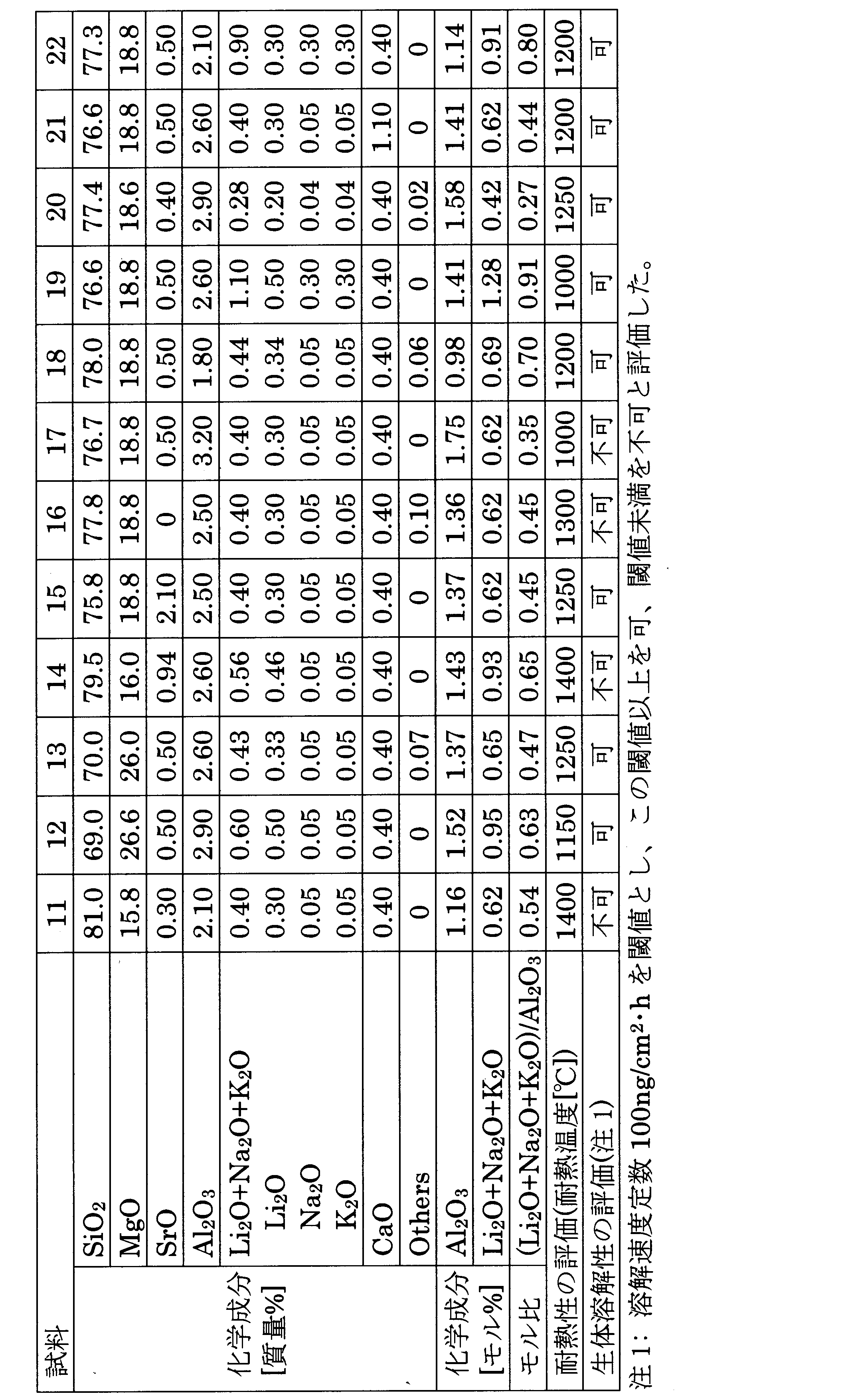
上記にて評価した試料1~22の無機繊維の評価結果を化学成分及びアルミナに対するアルカリ金属酸化物のモル比と併せて下記表1及び表2に示す。なお、表1は、本発明の要件を満たす実施例としての試料1~10の無機繊維の結果であり、表2は本発明の要件を満たしていない比較例としての試料11~22の無機繊維の結果である。 The evaluation results of the inorganic fibers of Samples 1 to 22 evaluated above are shown in Tables 1 and 2 below, together with the chemical components and the molar ratio of alkali metal oxide to alumina. Table 1 shows the results of the inorganic fibers of Samples 1 to 10 as examples that satisfy the requirements of the present invention, and Table 2 shows the inorganic fibers of Samples 11 to 22 as comparative examples that do not meet the requirements of the present invention. is the result of

上記表1から分かるように、本発明の実施例の試料1~10は、いずれもSiO2の含有率が70質量%以上80質量%以下の範囲内、MgOの含有率が17質量%以上25質量%以下の範囲内、SrOの含有率が0質量%を超え2質量%以下の範囲内、Al2O3の含有率が2質量%を超え3質量%以下の範囲内であり、CaOの含有率が1質量%以下であり、Li2O、Na2O、及びK2Oの含有率が各々0.04質量%以上であって、これら合計の含有率であるLi2O+Na2O+K2Oが0.3質量%以上1質量%以下の範囲内であり、かつ、Li2O+Na2O+K2OのAl2O3に対するモル比(Li2O+Na2O+K2O)/Al2O3が0.3以上0.7以下の範囲内であるため、本発明の要件を満たしており、よって耐熱性の評価では、耐熱温度が全て基準値の1300℃以上であった。また、生体溶解性の評価では、溶解速度定数が100ng/cm2・h以上あり、全て「可」であった。 As can be seen from Table 1 above, Samples 1 to 10 of Examples of the present invention all have a SiO 2 content of 70% by mass or more and 80% by mass or less, and a MgO content of 17% by mass or more and 25% by mass. % by mass or less, the content of SrO is in the range of more than 0% by mass and 2% by mass or less, the content of Al 2 O 3 is in the range of more than 2% by mass to 3% by mass or less, and the content of CaO is The content is 1% by mass or less, the contents of Li 2 O, Na 2 O, and K 2 O are each 0.04% by mass or more, and the total content is Li 2 O + Na 2 O + K 2 O is in the range of 0.3% by mass or more and 1% by mass or less, and the molar ratio of Li 2 O + Na 2 O + K 2 O to Al 2 O 3 (Li 2 O + Na 2 O + K 2 O)/Al 2 O 3 is Since it is in the range of 0.3 or more and 0.7 or less, it satisfies the requirements of the present invention. In addition, in the biosolubility evaluation, the dissolution rate constant was 100 ng/cm 2 ·h or more, and all of them were "fair".
一方、比較例の試料11は、SiO2の含有率が81質量%であったため、溶解速度定数が100ng/cm2・h未満になり、生体溶解性の評価が「不可」であった。比較例の試料12は、SiO2の含有率が69質量%であったため、耐熱性評価において、加熱線収縮率が大きくなって耐熱温度が1150℃になり、基準値の1300℃より低くなった。 On the other hand, Sample 11 of Comparative Example had a SiO 2 content of 81% by mass, so the dissolution rate constant was less than 100 ng/cm 2 ·h, and the biosolubility was evaluated as "improper". Sample 12 of the comparative example had a SiO 2 content of 69% by mass, so in the heat resistance evaluation, the heating wire shrinkage rate increased and the heat resistant temperature reached 1150 ° C., which was lower than the reference value of 1300 ° C. .
比較例の試料13は、MgOの含有率が26質量%であったため、耐熱性評価において、加熱線収縮率が大きくなって耐熱温度が1250℃になり、基準値の1300℃より低くなった。比較例の試料14は、MgOの含有率が16質量%であったため、溶解速度定数が100ng/cm2・h未満になり、生体溶解性の評価が「不可」であった。 Since Sample 13 of Comparative Example had a MgO content of 26% by mass, in the heat resistance evaluation, the heating wire shrinkage rate increased and the heat resistance temperature reached 1250°C, which was lower than the reference value of 1300°C. Sample 14 of the comparative example had a MgO content of 16% by mass, so the dissolution rate constant was less than 100 ng/cm 2 ·h, and the biosolubility was evaluated as "improper".
比較例の試料15は、SrOの含有率が2.1質量%であったため、耐熱性評価において、加熱線収縮率が大きくなって耐熱温度が1250℃になり、基準値の1300℃より低くなった。比較例の試料16は、SrOの含有率が0質量%であったため、溶解速度定数が100ng/cm2・h未満になり、生体溶解性の評価が「不可」であった。 Sample 15 of the comparative example had a SrO content of 2.1% by mass, so in the heat resistance evaluation, the heating wire shrinkage rate increased and the heat resistance temperature reached 1250°C, which is lower than the reference value of 1300°C. rice field. Sample 16 of the comparative example had a SrO content of 0% by mass, so the dissolution rate constant was less than 100 ng/cm 2 ·h, and the biosolubility was evaluated as "improper".
比較例の試料17は、Al2O3の含有率が3.2質量%であったため、耐熱性評価において、加熱線収縮率が大きくなって耐熱温度が1000℃になり、基準値の1300℃より低くなり、更に溶解速度定数が100ng/cm2・h未満になり、生体溶解性の評価が「不可」であった。比較例の試料18は、Al2O3の含有率が1.8質量%であったため、耐熱性評価において、加熱線収縮率が大きくなって耐熱温度が1200℃になり、基準値の1300℃より低くなった。 Sample 17 of the comparative example had an Al 2 O 3 content of 3.2% by mass, so in the heat resistance evaluation, the heating wire shrinkage rate increased and the heat resistance temperature reached 1000 ° C., and the reference value of 1300 ° C. Furthermore, the dissolution rate constant was less than 100 ng/cm 2 ·h, and the biosolubility was evaluated as "improper". Sample 18 of the comparative example had an Al 2 O 3 content of 1.8% by mass, so in the heat resistance evaluation, the heating wire shrinkage rate increased and the heat resistance temperature reached 1200 ° C., which was lower than the standard value of 1300 ° C. got lower.
比較例の試料19は、Li2O、Na2O、及びK2Oの合計含有率が1.1質量%であったため、耐熱性評価において、加熱線収縮率が大きくなって耐熱温度が1000℃になり、基準値の1300℃より低くなった。比較例の試料20は、Li2O、Na2O、及びK2Oの含有率が0.28質量%であったため、耐熱性評価において、加熱線収縮率が大きくなって耐熱温度が1250℃になり、基準値の1300℃より低くなった。 Sample 19 of Comparative Example had a total content of Li 2 O, Na 2 O, and K 2 O of 1.1% by mass. °C, lower than the standard value of 1300 °C. Sample 20 of Comparative Example had a content of Li 2 O, Na 2 O, and K 2 O of 0.28% by mass. , which is lower than the standard value of 1300°C.
比較例の試料21は、CaOの含有率が1.1質量%であったため、耐熱性評価において、加熱線収縮率が大きくなって耐熱温度が1200℃になり、基準値の1300℃より低くなった。 Sample 21 of the comparative example had a CaO content of 1.1% by mass, so in the heat resistance evaluation, the heating wire shrinkage rate increased and the heat resistant temperature reached 1200 ° C., which was lower than the reference value of 1300 ° C. rice field.
比較例の試料22は、Li2O+Na2O+K2OのAl2O3に対するモル比(Li2O+Na2O+K2O)/Al2O3が0.8であったため、耐熱性評価において、加熱線収縮率が大きくなって耐熱温度が1200℃になり、基準値の1300℃より低くなった。 In Comparative Example Sample 22, the molar ratio of Li 2 O + Na 2 O + K 2 O to Al 2 O 3 (Li 2 O + Na 2 O + K 2 O)/Al 2 O 3 was 0.8. The linear shrinkage rate increased and the heat resistance temperature reached 1200°C, which was lower than the standard value of 1300°C.
上記に示す如く、本発明の要件を全て満たす実施例の試料1~10の無機繊維は優れた耐熱性と優れた生体溶解性を有しているのに対して、本発明の要件の少なくともいずれかを満たしていない比較例の試料11~22の無機繊維は、耐熱性又は生体溶解性が実施例の無機繊維に比べて劣っていた。 As shown above, the inorganic fibers of Samples 1 to 10 of Examples that satisfy all the requirements of the present invention have excellent heat resistance and excellent biosolubility, whereas at least any of the requirements of the present invention are satisfied. The inorganic fibers of Samples 11 to 22 of Comparative Examples, which did not satisfy (1), were inferior to the inorganic fibers of Examples in terms of heat resistance and biosolubility.
Claims (4)
A heat insulating material in the form of a fixed or amorphous material using the inorganic fiber according to any one of claims 1 to 3.
Priority Applications (1)
| Application Number | Priority Date | Filing Date | Title |
|---|---|---|---|
| JP2020086529A JP7127084B2 (en) | 2020-05-18 | 2020-05-18 | Heat-resistant inorganic fiber soluble in physiological saline |
Applications Claiming Priority (1)
| Application Number | Priority Date | Filing Date | Title |
|---|---|---|---|
| JP2020086529A JP7127084B2 (en) | 2020-05-18 | 2020-05-18 | Heat-resistant inorganic fiber soluble in physiological saline |
Publications (2)
| Publication Number | Publication Date |
|---|---|
| JP2021181383A JP2021181383A (en) | 2021-11-25 |
| JP7127084B2 true JP7127084B2 (en) | 2022-08-29 |
Family
ID=78606971
Family Applications (1)
| Application Number | Title | Priority Date | Filing Date |
|---|---|---|---|
| JP2020086529A Active JP7127084B2 (en) | 2020-05-18 | 2020-05-18 | Heat-resistant inorganic fiber soluble in physiological saline |
Country Status (1)
| Country | Link |
|---|---|
| JP (1) | JP7127084B2 (en) |
Citations (5)
| Publication number | Priority date | Publication date | Assignee | Title |
|---|---|---|---|---|
| WO2012132327A1 (en) | 2011-03-30 | 2012-10-04 | ニチアス株式会社 | Inorganic fibrous paper, and method and equipment for manufacturing same |
| WO2012132329A1 (en) | 2011-03-31 | 2012-10-04 | ニチアス株式会社 | Inorganic-fiber based paper and method for manufacturing same |
| JP2013243071A (en) | 2012-05-22 | 2013-12-05 | Nichias Corp | Heating device |
| JP2013245408A (en) | 2012-05-23 | 2013-12-09 | Nichias Corp | Buffer material made of inorganic fibrous paper and method for producing the same |
| JP2013245115A (en) | 2012-05-23 | 2013-12-09 | Nichias Corp | Buffer material comprising inorganic fibrous paper, and method and facility for producing the same |
-
2020
- 2020-05-18 JP JP2020086529A patent/JP7127084B2/en active Active
Patent Citations (5)
| Publication number | Priority date | Publication date | Assignee | Title |
|---|---|---|---|---|
| WO2012132327A1 (en) | 2011-03-30 | 2012-10-04 | ニチアス株式会社 | Inorganic fibrous paper, and method and equipment for manufacturing same |
| WO2012132329A1 (en) | 2011-03-31 | 2012-10-04 | ニチアス株式会社 | Inorganic-fiber based paper and method for manufacturing same |
| JP2013243071A (en) | 2012-05-22 | 2013-12-05 | Nichias Corp | Heating device |
| JP2013245408A (en) | 2012-05-23 | 2013-12-09 | Nichias Corp | Buffer material made of inorganic fibrous paper and method for producing the same |
| JP2013245115A (en) | 2012-05-23 | 2013-12-09 | Nichias Corp | Buffer material comprising inorganic fibrous paper, and method and facility for producing the same |
Also Published As
| Publication number | Publication date |
|---|---|
| JP2021181383A (en) | 2021-11-25 |
Similar Documents
| Publication | Publication Date | Title |
|---|---|---|
| RU2303574C2 (en) | Inorganic fibers soluble in saline solution | |
| CN106458716B (en) | Inorganic fibers with improved shrinkage and strength | |
| EP2692946B1 (en) | Inorganic-fiber based paper and method for manufacturing same | |
| AU2011353458B2 (en) | Bio-soluble inorganic fiber | |
| KR20190047744A (en) | Bio-soluble inorganic fiber | |
| JP2014228035A (en) | Fireproof heat insulation material and manufacturing method | |
| CN113582536A (en) | Preparation method and preparation system of soluble mineral fiber blanket | |
| JP2018199879A (en) | Inorganic fiber molded body | |
| ES1290829U (en) | Inorganic fibers for thermal insulation (Machine-translation by Google Translate, not legally binding) | |
| JP6554269B2 (en) | Method for producing biosoluble inorganic fiber | |
| JP7127084B2 (en) | Heat-resistant inorganic fiber soluble in physiological saline | |
| CN105431389A (en) | heat resistant inorganic fiber | |
| CN103392033B (en) | Inorganic fiber | |
| CN107002295A (en) | Inorfil with improved shrinkage factor and intensity | |
| JP2014196878A (en) | Fireproof heat insulation material and its manufacturing method | |
| JP5087709B1 (en) | Inorganic fiber shaped body and method for adjusting hardness thereof | |
| CN101528623B (en) | Inorganic fiber | |
| JP5166598B1 (en) | Highly flexible inorganic fiber shaped body | |
| WO2002012146A1 (en) | Bonded fibrous materials | |
| JPH045770B2 (en) | ||
| CN104395513A (en) | Heat-resistant inorganic fiber | |
| CN117888235A (en) | Soluble ceramic fiber and preparation method thereof | |
| JP2009149473A (en) | Fixed shaped refractory brick with spalling resistance and erosion resistance, method for producing the same, and fire-proofing wall | |
| HK1231036A1 (en) | Inorganic fiber with improved shrinkage and strength | |
| JP2014028709A (en) | Si/Al/Ca-CONTAINING INORGANIC FIBER |
Legal Events
| Date | Code | Title | Description |
|---|---|---|---|
| A621 | Written request for application examination |
Free format text: JAPANESE INTERMEDIATE CODE: A621 Effective date: 20220323 |
|
| A871 | Explanation of circumstances concerning accelerated examination |
Free format text: JAPANESE INTERMEDIATE CODE: A871 Effective date: 20220323 |
|
| TRDD | Decision of grant or rejection written | ||
| A977 | Report on retrieval |
Free format text: JAPANESE INTERMEDIATE CODE: A971007 Effective date: 20220722 |
|
| A01 | Written decision to grant a patent or to grant a registration (utility model) |
Free format text: JAPANESE INTERMEDIATE CODE: A01 Effective date: 20220726 |
|
| A61 | First payment of annual fees (during grant procedure) |
Free format text: JAPANESE INTERMEDIATE CODE: A61 Effective date: 20220817 |
|
| R150 | Certificate of patent or registration of utility model |
Ref document number: 7127084 Country of ref document: JP Free format text: JAPANESE INTERMEDIATE CODE: R150 |
|
| R250 | Receipt of annual fees |
Free format text: JAPANESE INTERMEDIATE CODE: R250 |