JP7058552B2 - Thermosetting epoxy resin composition, fiber reinforced thermosetting epoxy resin composition, and cured product - Google Patents
Thermosetting epoxy resin composition, fiber reinforced thermosetting epoxy resin composition, and cured product Download PDFInfo
- Publication number
- JP7058552B2 JP7058552B2 JP2018096654A JP2018096654A JP7058552B2 JP 7058552 B2 JP7058552 B2 JP 7058552B2 JP 2018096654 A JP2018096654 A JP 2018096654A JP 2018096654 A JP2018096654 A JP 2018096654A JP 7058552 B2 JP7058552 B2 JP 7058552B2
- Authority
- JP
- Japan
- Prior art keywords
- epoxy resin
- resin composition
- group
- mass
- thermosetting epoxy
- Prior art date
- Legal status (The legal status is an assumption and is not a legal conclusion. Google has not performed a legal analysis and makes no representation as to the accuracy of the status listed.)
- Active
Links
Landscapes
- Reinforced Plastic Materials (AREA)
- Compositions Of Macromolecular Compounds (AREA)
- Epoxy Resins (AREA)
Description
本発明は、熱硬化性エポキシ樹脂組成物、繊維強化熱硬化性エポキシ樹脂組成物、及び硬化物に関する。 The present invention relates to a thermosetting epoxy resin composition, a fiber reinforced thermosetting epoxy resin composition, and a cured product.
従来から、熱硬化性エポキシ樹脂は、機械強度に優れるといった特性を有しており、例えば、自動車や航空機の筐体、各種部材をはじめ、様々な構造体用途において利用されている(例えば、特許文献1、2参照)。 Conventionally, thermosetting epoxy resins have characteristics such as excellent mechanical strength, and are used in various structural applications such as automobiles, aircraft housings, and various members (for example, patents). See Documents 1 and 2).
また、熱硬化性エポキシ樹脂を強化繊維に含浸させた構成からなる繊維強化複合材料に対する提案、例えば、低粘度でありながら、得られる硬化物において、機械強度、耐熱性、及び耐湿熱性に優れた特性を発現できる繊維強化複合材料に関する提案がなされており、当該硬化物による成形品がエンジンなどの構造部品や電線コア材等に用いられている(例えば、特許文献3参照)。 Further, there is a proposal for a fiber-reinforced composite material having a structure in which a reinforced fiber is impregnated with a thermosetting epoxy resin. A proposal has been made for a fiber-reinforced composite material capable of exhibiting properties, and a molded product made of the cured product is used for structural parts such as an engine, an electric wire core material, and the like (see, for example, Patent Document 3).
しかしながら、上記特許文献1~3に開示されている技術においては、エポキシ樹脂組成物や繊維強化複合材料を、特に送電線ケーブルの芯材の材料として用いた場合を想定すると、送電時の発熱に十分に耐え得る耐熱性や耐久性の観点からは未だ十分な特性を有しているとは言えず、また、送電線ケーブルの芯材の製造時における液だれ防止の観点からは検討がなされておらず、ケーブルとしての十分な厚みを確保するという観点において、特性が不十分であるという問題を有している。 However, in the techniques disclosed in Patent Documents 1 to 3, assuming that an epoxy resin composition or a fiber-reinforced composite material is used as a material for a core material of a power transmission line cable, heat generation during power transmission is generated. It cannot be said that it has sufficient characteristics from the viewpoint of heat resistance and durability that can withstand it sufficiently, and it has been studied from the viewpoint of preventing dripping during the manufacture of the core material of the transmission line cable. However, there is a problem that the characteristics are insufficient from the viewpoint of ensuring a sufficient thickness as a cable.
そこで本発明においては、熱硬化性エポキシ樹脂組成物の粘度と、その硬化物のTgを、それぞれ所定の範囲に特定することによって、特に、送電線ケーブルの芯材の材料として用いた場合に、送電時の発熱に十分に耐え得る耐熱性が得られ、かつケーブルの芯材の製造時において液だれ防止性に優れており、ケーブルとしての十分な厚みを確保することが可能な熱硬化性エポキシ樹脂組成物を提供することを目的とする。 Therefore, in the present invention, by specifying the viscosity of the thermosetting epoxy resin composition and the Tg of the cured product in predetermined ranges, particularly when the material is used as the core material of the power transmission line cable. Thermosetting epoxy that has sufficient heat resistance to withstand heat generation during power transmission, has excellent dripping prevention properties during the manufacture of cable cores, and can secure sufficient thickness as a cable. It is an object of the present invention to provide a resin composition.
本発明者らは、上述した従来技術の問題点に関し鋭意検討を行った結果、エポキシ樹脂と、硬化剤とを含有する熱硬化性エポキシ樹脂組成物において、粘度及び上記熱硬化性エポキシ樹脂組成物の硬化物のガラス転移温度(Tg)を所定の範囲に特定することにより、上述した従来技術の課題が解決できることを見出し、本発明を完成するに至った。 As a result of diligent studies on the above-mentioned problems of the prior art, the present inventors have found that the thermosetting epoxy resin composition containing the epoxy resin and the curing agent has a viscosity and the thermosetting epoxy resin composition. By specifying the glass transition temperature (Tg) of the cured product in the above-mentioned range within a predetermined range, it has been found that the above-mentioned problems of the prior art can be solved, and the present invention has been completed.
すなわち、本発明は、以下のとおりである。
〈1〉エポキシ樹脂と、硬化剤と、
を含み、
粘度が200~4000mPa・sであり、
硬化物のガラス転移温度(Tg)が236℃~250℃である、熱硬化性エポキシ樹脂組成物。
〈2〉上記エポキシ樹脂が、
成分(A-1):25℃で液状のエポキシ樹脂と、
成分(A-2):軟化点が50℃以上のエポキシ樹脂と、
を含む、〈1〉項に記載の熱硬化性エポキシ樹脂組成物。
〈3〉上記エポキシ樹脂が、フィラー系添加剤を含有する、〈1〉又は〈2〉項に記載の熱硬化性エポキシ樹脂組成物。
〈4〉上記硬化剤が、酸無水物及び/又はアミン系化合物を含む、〈1〉~〈3〉項のいずれか一項に記載の熱硬化性エポキシ樹脂組成物。
〈5〉上記成分(A-1)が、脂環式エポキシを含む、〈2〉~〈4〉項のいずれか一項に記載の熱硬化性エポキシ樹脂組成物。
〈6〉上記成分(A-2)が、下記の構造式(1)で表される構造を含むエポキシ樹脂を含む、〈2〉~〈5〉項のいずれか一に記載の熱硬化性エポキシ樹脂組成物:
That is, the present invention is as follows.
<1> Epoxy resin, curing agent,
Including
It has a viscosity of 200 to 4000 mPa · s and has a viscosity of 200 to 4000 mPa · s.
A thermosetting epoxy resin composition having a glass transition temperature (Tg) of a cured product of 236 ° C to 250 ° C.
<2> The above epoxy resin is
Ingredient (A-1): Epoxy resin liquid at 25 ° C and
Component (A-2): Epoxy resin with a softening point of 50 ° C or higher,
The thermosetting epoxy resin composition according to <1>.
<3> The thermosetting epoxy resin composition according to <1> or <2>, wherein the epoxy resin contains a filler-based additive.
<4> The thermosetting epoxy resin composition according to any one of <1> to <3>, wherein the curing agent contains an acid anhydride and / or an amine compound.
<5> The thermosetting epoxy resin composition according to any one of <2> to <4>, wherein the component (A-1) contains an alicyclic epoxy.
<6> The thermosetting epoxy according to any one of <2> to <5>, wherein the component (A-2) contains an epoxy resin containing a structure represented by the following structural formula (1). Resin composition:

(式中、R1とR2は、独立的に単結合又は二価の連結基を表す。)
〈7〉上記成分(A-1)と、上記成分(A-2)との合計質量に対し、上記成分(A-1)の質量割合が30質量%~99質量%である、〈2〉~〈6〉項のいずれか一に記載の熱硬化性エポキシ樹脂組成物。
〈8〉〈1〉~〈7〉項のいずれか一に記載の熱硬化性エポキシ樹脂組成物と、
繊維材料と、
を含み、
上記繊維材料が、ガラス繊維材料、炭素繊維材料、及びアラミド繊維材料からなる群より選ばれる少なくとも一つの繊維材料である、繊維強化熱硬化性エポキシ樹脂組成物。
〈9〉〈1〉~〈7〉項のいずれか一に記載の熱硬化性エポキシ樹脂組成物と、
繊維材料と、
を含み、
上記繊維材料が、ガラス繊維材料、炭素繊維材料、及アラミド繊維材料からなる群より選ばれる少なくとも一つの繊維材料である、繊維強化熱硬化性エポキシ樹脂組成物の硬化物。
(In the formula, R 1 and R 2 independently represent a single bond or a divalent linking group.)
<7> The mass ratio of the component (A-1) to the total mass of the component (A-1) and the component (A-2) is 30% by mass to 99% by mass, <2>. The thermosetting epoxy resin composition according to any one of <6>.
<8> The thermosetting epoxy resin composition according to any one of <1> to <7>.
Textile material and
Including
A fiber-reinforced thermosetting epoxy resin composition, wherein the fiber material is at least one fiber material selected from the group consisting of a glass fiber material, a carbon fiber material, and an aramid fiber material.
<9> The thermosetting epoxy resin composition according to any one of <1> to <7>.
Textile material and
Including
A cured product of a fiber-reinforced thermosetting epoxy resin composition, wherein the fiber material is at least one fiber material selected from the group consisting of a glass fiber material, a carbon fiber material, and an aramid fiber material.
本発明によれば、耐熱性に優れ、成形時の液だれ防止性に優れた熱硬化性エポキシ樹脂組成物が得られる。 According to the present invention, a thermosetting epoxy resin composition having excellent heat resistance and excellent dripping prevention property during molding can be obtained.
以下、本発明を実施するための形態(以下、単に「本実施形態」という。)について詳細に説明する。以下の本実施形態は、本発明を説明するための例示であり、本発明を以下の内容に限定する趣旨ではない。本発明は、その要旨の範囲内で適宜に変形して実施できる。 Hereinafter, embodiments for carrying out the present invention (hereinafter, simply referred to as “the present embodiment”) will be described in detail. The following embodiments are examples for explaining the present invention, and are not intended to limit the present invention to the following contents. The present invention can be appropriately modified and carried out within the scope of the gist thereof.
《熱硬化性エポキシ樹脂組成物》
本実施形態の熱硬化性エポキシ樹脂組成物は、
エポキシ樹脂と、硬化剤と、
を含み、
その粘度が200~4000mPa・sであり、
その硬化物のガラス転移温度(Tg)が236℃~250℃である。
<< Thermosetting epoxy resin composition >>
The thermosetting epoxy resin composition of the present embodiment is
Epoxy resin, hardener,
Including
Its viscosity is 200-4000 mPa · s, and it has a viscosity of 200 to 4000 mPa · s.
The glass transition temperature (Tg) of the cured product is 236 ° C to 250 ° C.
本実施形態においては、特定の粘度範囲と特定のTg範囲とを組合せて採用することにより、耐熱性及び成型時の液だれ防止性に優れた樹脂組成物を実現する。このような優れた樹脂組成物が実現されるメカニズムについては、詳細は明らかではないが、適度な分子間相互作用を持ったポリマー鎖が硬化時にも適度な分子運動性を持つことによって、硬化前の含浸性に優れることはもとより、硬化物成形体にした際に加えられる様々な外力に対して良好な吸収性(弾性率)を実現し、ひいては壊れにくく、耐熱性に優れた硬化物成形体が実現されているものと推察される。 In the present embodiment, by adopting a combination of a specific viscosity range and a specific Tg range, a resin composition having excellent heat resistance and dripping prevention property during molding is realized. The mechanism by which such an excellent resin composition is realized is not clear in detail, but the polymer chain having an appropriate intermolecular interaction has an appropriate molecular motility even at the time of curing, so that the polymer chain has an appropriate molecular motility before curing. In addition to being excellent in impregnation property, it realizes good absorption (elastic modulus) against various external forces applied when it is made into a cured product molded product, and by extension, it is hard to break and has excellent heat resistance. Is presumed to have been realized.
本実施形態の熱硬化性エポキシ樹脂組成物の硬化物のガラス転移温度(Tg)が、236℃以上、238℃以上、又は240℃以上であり、250℃以下、248℃以下、246℃以下、又は245℃以下である。このガラス転移温度は、236℃~250℃であり、好ましくは240℃~250℃である。 The glass transition temperature (Tg) of the cured product of the thermosetting epoxy resin composition of the present embodiment is 236 ° C. or higher, 238 ° C. or higher, or 240 ° C. or higher, 250 ° C. or lower, 248 ° C. or lower, 246 ° C. or lower, Or it is 245 ° C. or lower. The glass transition temperature is 236 ° C to 250 ° C, preferably 240 ° C to 250 ° C.
本実施形態の熱硬化性エポキシ樹脂組成物の粘度は、200mPa・s以上、300mPa・s、400mPa・s、又は500Pa・s以上であり、4000mPa・s以下、3000mPa・s以下、2000mPa・s以下、又は1500mPa・s以下である。 The viscosity of the thermosetting epoxy resin composition of the present embodiment is 200 mPa · s or more, 300 mPa · s, 400 mPa · s, or 500 Pa · s or more, and 4000 mPa · s or less, 3000 mPa · s or less, 2000 mPa · s or less. , Or 1500 mPa · s or less.
この粘度は、良好な引抜成型性を確保する観点から、200mPa・s~4000mPa・sであり、好ましくは200mPa・s~3000mPa・sであり、好ましくは200mPa・s~2000mPa・s、より好ましくは300mPa・s~1500mPa・sである。 This viscosity is 200 mPa · s to 4000 mPa · s, preferably 200 mPa · s to 3000 mPa · s, preferably 200 mPa · s to 2000 mPa · s, more preferably 200 mPa · s to 2000 mPa · s, from the viewpoint of ensuring good pultrusion formability. It is 300 mPa · s to 1500 mPa · s.
また、この粘度は、良好な含浸性を確保する観点から、500mPa・s~3000mPa・sであり、好ましくは1400mPa・s~3500mPa・s、より好ましくは2000mPa・s~3000mPa・sである。 Further, this viscosity is 500 mPa · s to 3000 mPa · s, preferably 1400 mPa · s to 3500 mPa · s, and more preferably 2000 mPa · s to 3000 mPa · s from the viewpoint of ensuring good impregnation property.
粘度を調整する方法としては、主に使用するエポキシ樹脂と硬化剤、特に、酸無水物硬化剤で調整することができる。高分子のエポキシ樹脂を用いると粘度は上昇し、一方、低分子のエポキシ樹脂を用いることで粘度を低下させることができる。Tgの向上は、使用するエポキシ樹脂を適切に選定することで達成することが可能であり、多官能のエポキシ樹脂や分子構造中に剛直な構造を有しているエポキシ樹脂を使用することで、硬化物のTgを向上させることができる。なお、エポキシ樹脂及び硬化剤に関しては、下記にそれらの詳細を示している。 As a method for adjusting the viscosity, it can be adjusted mainly with an epoxy resin and a curing agent, particularly an acid anhydride curing agent. The viscosity can be increased by using a high molecular weight epoxy resin, while the viscosity can be decreased by using a low molecular weight epoxy resin. The improvement of Tg can be achieved by appropriately selecting the epoxy resin to be used, and by using a polyfunctional epoxy resin or an epoxy resin having a rigid structure in the molecular structure, it is possible to achieve the improvement. The Tg of the cured product can be improved. The details of the epoxy resin and the curing agent are shown below.
〈エポキシ樹脂〉
本実施形態の熱硬化性エポキシ樹脂組成物は、エポキシ樹脂を含有する。本実施形態の熱硬化性エポキシ樹脂組成物に含まれるエポキシ樹脂とは、分子内にエポキシ基を2個以上含む高分子化合物及び/又はそのエポキシ基の開環反応によって生成する合成樹脂をいう。
<Epoxy resin>
The thermosetting epoxy resin composition of the present embodiment contains an epoxy resin. The epoxy resin contained in the thermosetting epoxy resin composition of the present embodiment means a polymer compound containing two or more epoxy groups in the molecule and / or a synthetic resin produced by a ring-opening reaction of the epoxy groups.
エポキシ樹脂としては、各種公知のものを適宜選択して用いることができ、以下に限定されるものではないが、例えば、ビスフェノールA型エポキシ樹脂、ビスフェノールF型エポキシ樹脂、ビスフェノールS型エポキシ樹脂、ヒンダトイン型エポキシ樹脂、ビフェニル型エポキシ樹脂、脂環式エポキシ樹脂、トリフェニルメタン型エポキシ樹脂、フェノールノボラック型エポキシ樹脂、クレゾールノボラック型エポキシ樹脂、ナフトールノボラック型エポキシ樹脂、ビスAノボラック型エポキシ樹脂、ジシクロペンタジエン/フェノールエポキシ樹脂、脂環式アミンエポキシ樹脂、脂肪族エポキシ樹脂、脂肪族アミンエポキシ樹脂等、及びこれらの組み合わせが挙げられる。 As the epoxy resin, various known ones can be appropriately selected and used, and the epoxy resin is not limited to the following, and is not limited to, for example, bisphenol A type epoxy resin, bisphenol F type epoxy resin, bisphenol S type epoxy resin, and hindatin. Type epoxy resin, biphenyl type epoxy resin, alicyclic epoxy resin, triphenylmethane type epoxy resin, phenol novolac type epoxy resin, cresol novolac type epoxy resin, naphthol novolac type epoxy resin, bis A novolak type epoxy resin, dicyclopentadiene / Phenolic epoxy resin, alicyclic amine epoxy resin, aliphatic epoxy resin, aliphatic amine epoxy resin and the like, and combinations thereof can be mentioned.
エポキシ樹脂は、好適な粘度を達成する観点から、(A-1)25℃で液状のエポキシ樹脂(以下、(A-1)エポキシ樹脂、成分(A-1)と記載する場合がある。)と、(A-2)軟化点が50℃以上のエポキシ樹脂(以下、(A-2)エポキシ樹脂、成分(A-2)と記載する場合がある。)を含有することが好ましい。
(成分(A-1)のエポキシ樹脂:25℃で液状のエポキシ樹脂)
(A-1)25℃で液状のエポキシ樹脂を採用した熱硬化性エポキシ樹脂組成物は、高い含侵性を発揮することができる。
From the viewpoint of achieving a suitable viscosity, the epoxy resin may be referred to as (A-1) an epoxy resin liquid at 25 ° C. (hereinafter, may be referred to as (A-1) epoxy resin, component (A-1)). And, it is preferable to contain (A-2) an epoxy resin having a softening point of 50 ° C. or higher (hereinafter, may be referred to as (A-2) epoxy resin or component (A-2)).
(Epoxy resin of component (A-1): Epoxy resin liquid at 25 ° C)
(A-1) A thermosetting epoxy resin composition using an epoxy resin liquid at 25 ° C. can exhibit high invasiveness.
なお、(A-1)エポキシ樹脂における「25℃で液状」とは、120℃以上で2時間加熱した後、25℃まで冷却し、その後25℃に保った場合において、25℃になってから2時間以内にE型粘度計で測定したときの粘度(25℃での粘度)が30000Pa・s以下であることをいう。 The term "liquid at 25 ° C." in the (A-1) epoxy resin means that after heating at 120 ° C. or higher for 2 hours, cooling to 25 ° C., and then keeping the temperature at 25 ° C., the temperature reaches 25 ° C. It means that the viscosity (viscosity at 25 ° C.) measured with an E-type viscometer within 2 hours is 30,000 Pa · s or less.
成分(A-1)のエポキシ樹脂としては、各種公知のものを適宜選択して用いることができ、以下に限定されるものではないが、例えば、ビスフェノールA型エポキシ樹脂、ビスフェノールF型エポキシ樹脂、脂環式エポキシ樹脂、脂肪族エポキシ樹脂、ジシクロペンタジエン/フェノールエポキシ樹脂、アミノフェノール型エポキシ樹脂、脂環式アミンエポキシ樹脂、脂肪族アミンエポキシ樹脂等、及びこれらの組み合わせが挙げられる。 As the epoxy resin of the component (A-1), various known ones can be appropriately selected and used, and the epoxy resin is not limited to the following, but for example, bisphenol A type epoxy resin, bisphenol F type epoxy resin, and the like. Examples thereof include alicyclic epoxy resin, aliphatic epoxy resin, dicyclopentadiene / phenol epoxy resin, aminophenol type epoxy resin, alicyclic amine epoxy resin, aliphatic amine epoxy resin, and combinations thereof.
特に、酸無水物を配合した場合に、高いTgを達成する観点から、成分(A-1)のエポキシ樹脂としては、脂環式エポキシ樹脂が好ましい。 In particular, an alicyclic epoxy resin is preferable as the epoxy resin of the component (A-1) from the viewpoint of achieving a high Tg when an acid anhydride is blended.
成分(A-1)は、より良い含浸性を確保する観点から、成分(A-1)と成分(A-2)との合計質量に対し、30~99質量%であることが好ましく、40~99質量%であることがより好ましく、50~70質量%であることがさらに好ましい。
(成分(A-2)のエポキシ樹脂:軟化点が50℃以上のエポキシ樹脂)
(A-2)軟化点が50℃以上であるエポキシ樹脂を使用すると、繊維含浸後のBステージ化(半硬化)する前に液だれも起こりにくくなるため、品質のブレが少なくなる。
The component (A-1) is preferably 30 to 99% by mass, preferably 40 to 99% by mass, based on the total mass of the component (A-1) and the component (A-2) from the viewpoint of ensuring better impregnation property. It is more preferably to 99% by mass, and even more preferably 50 to 70% by mass.
(Epoxy resin of component (A-2): Epoxy resin having a softening point of 50 ° C. or higher)
(A-2) When an epoxy resin having a softening point of 50 ° C. or higher is used, dripping is less likely to occur before B-stage (semi-curing) after fiber impregnation, so that quality fluctuation is reduced.
なお、(A-2)エポキシ樹脂における「軟化点が50℃以上」とは、メトラートレド社製軟化点測定装置(DP-60)で測定したときの軟化点が50℃以上であることをいう。 In addition, (A-2) "softening point of 50 ° C. or higher" in the epoxy resin means that the softening point of the epoxy resin is 50 ° C. or higher when measured by the softening point measuring device (DP-60) manufactured by METTLER TOLEDO. ..
成分(A-2)のエポキシ樹脂は、下記構造式(1)で表される構造を含むエポキシ樹脂であることが好ましい。 The epoxy resin of the component (A-2) is preferably an epoxy resin containing a structure represented by the following structural formula (1).

(構造式(1)中、R1とR2は、独立的に単結合又は二価の連結基を表す)
これにより、硬化物に成形した後の耐熱性や強靭化といった物性が、向上し、かつ絶縁抵抗値変化等の電気特性の向上が見込めるため、電線被覆としての長期使用が可能となる。
(In structural formula (1), R 1 and R 2 independently represent a single bond or a divalent linking group).
As a result, physical properties such as heat resistance and toughness after molding into a cured product are expected to be improved, and electrical characteristics such as a change in insulation resistance value are expected to be improved, so that long-term use as an electric wire coating is possible.
構造式(1)中のR1は、単結合又は二価の連結基であり、二価の連結基は、以下に限定されないが、例えば、ビフェニル類、ビスフェノールA類、ビスフェノールF類、ビスフェノールAF類、ビスフェノールAC類、ビスフェノールS類、フェノールノボラック類及びクレゾールノボラック類からなる群より選択される1種以上の骨格を含んでいてもよく、これらの骨格は置換基を有していてもよい。 R 1 in the structural formula (1) is a single-bonded or divalent linking group, and the divalent linking group is not limited to the following, but is not limited to, for example, biphenyls, bisphenol A, bisphenol F, and bisphenol AF. It may contain one or more skeletons selected from the group consisting of bisphenol ACs, bisphenol Ss, phenol novolacs and cresol novolacs, and these skeletons may have substituents.
構造式式(1)中のR2は、単結合又は二価の連結基であり、二価の連結基としては、以下に限定されないが、例えば、アルキレン基又はアリーレン基等が挙げられ、これらの基は置換されているものも含む。 R 2 in the structural formula (1) is a single bond or a divalent linking group, and the divalent linking group is not limited to the following, and examples thereof include an alkylene group and an arylene group. The groups of are also those that have been substituted.
ここで「アルキレン基」とは、「アルキル基」から任意の位置の水素原子をさらに1個除いて誘導される二価の基を意味し、以下に限定されないが、例えば、メチレン基、エチレン基、メチルエチレン基、エチルエチレン基、1,1-ジメチルエチレン基、1,2-ジメチルエチレン基、トリメチレン基、1-メチルトリメチレン基、2-メチルトリメチレン基、テトラメチレン基等が挙げられ、好ましくは、メチレン基、エチレン基、メチルエチレン基、1,1-ジメチルエチレン基、トリメチレン基等が挙げられる。 Here, the "alkylene group" means a divalent group derived by removing one hydrogen atom at an arbitrary position from the "alkyl group", and is not limited to, for example, a methylene group or an ethylene group. , Methylethylene group, ethylethylene group, 1,1-dimethylethylene group, 1,2-dimethylethylene group, trimethylene group, 1-methyltrimethylene group, 2-methyltrimethylene group, tetramethylene group and the like. Preferred examples include a methylene group, an ethylene group, a methylethylene group, a 1,1-dimethylethylene group, a trimethylene group and the like.
また「アリーレン基」とは、「アリール基」から、任意の位置の水素原子をさらに1個除いて誘導される二価の基を意味する。 Further, the "arylene group" means a divalent group derived by removing one hydrogen atom at an arbitrary position from the "aryl group".
R2で示される置換されていてもよいアルキレン基及びアリーレン基は、置換可能な位置において、一又は複数の置換基で置換されていてもよい。かかる置換基としては、例えば、ハロゲン原子(例えば、フッ素原子、塩素原子)、炭素数1~6のアルキル基(例えば、メチル基、エチル基、プロピル基、イソプロピル基、ブチル基、イソブチル基、sec-ブチル基、tert-ブチル基、ペンチル基、ヘキシル基)、アリール基(例えば、フェニル基、ナフチル基)、アラルキル基(例えば、ベンジル基、フェネチル基)、アルコキシ基(例えば、メトキシ基、エトキシ基)等が挙げられる。 The substituted alkylene group and arylene group represented by R2 may be substituted with one or more substituents at substitutable positions. Examples of such a substituent include a halogen atom (for example, a fluorine atom and a chlorine atom) and an alkyl group having 1 to 6 carbon atoms (for example, a methyl group, an ethyl group, a propyl group, an isopropyl group, a butyl group, an isobutyl group and sec. -Butyl group, tert-butyl group, pentyl group, hexyl group), aryl group (eg, phenyl group, naphthyl group), aralkyl group (eg, benzyl group, phenethyl group), alkoxy group (eg, methoxy group, ethoxy group) ) Etc. can be mentioned.
R2は、イソホロン、ベンゼン、トルエン、ジフェニルメタン及びナフタレンのいずれか1つに由来する二価の連結基、ヘキサメチレン基並びに-(CH2-C6H4)n-(ポリメチレンポリフェニレンポリフェニル骨格を有する基)(ただし、nは2~6の整数であって、一分子中にこれが複数ある場合には、各々同一であっても異なっていてもよい)からなる群より選択されることが好ましい。R2がこれらの基を有することで、熱に対する安定性がより向上する傾向にある。 R2 is a divalent linking group derived from any one of isophorone, benzene, toluene, diphenylmethane and naphthalene, a hexamethylene group and-( CH2 - C6H4 ) n- (polymethylenepolyphenylenepolyphenyl skeleton). (However, n is an integer of 2 to 6 and may be the same or different if there are a plurality of them in one molecule). preferable. By having these groups in R 2 , the stability against heat tends to be further improved.
成分(A-2)の質量割合は、成分(A-1)と成分(A-2)との合計質量に対し、1~70質量%であることが好ましく、1~60質量%であることがより好ましく、30~50質量%であることがさらに好ましい。 The mass ratio of the component (A-2) is preferably 1 to 70% by mass, preferably 1 to 60% by mass, based on the total mass of the component (A-1) and the component (A-2). Is more preferable, and 30 to 50% by mass is further preferable.
成分(A-2)の質量割合が1質量%以上であれば、成分(A-2)を含む熱硬化性エポキシ樹脂組成物の硬化物の、高い耐熱性及び高い機械物性を達成できるため好ましい。 When the mass ratio of the component (A-2) is 1% by mass or more, it is preferable because high heat resistance and high mechanical characteristics of the cured product of the thermosetting epoxy resin composition containing the component (A-2) can be achieved. ..
成分(A-2)の質量割合が70質量%以下であれば、破壊靱性が高く、ボイドの無い成形品を容易に得ることができるため好ましい。 When the mass ratio of the component (A-2) is 70% by mass or less, it is preferable because the fracture toughness is high and a molded product without voids can be easily obtained.
〈硬化剤〉
本実施形態の熱硬化性エポキシ樹脂組成物は、硬化剤を含有する。硬化剤は、エポキシ樹脂との配合によってこの配合物を硬化し得るものであれば、特に限定されない。
<Curing agent>
The thermosetting epoxy resin composition of the present embodiment contains a curing agent. The curing agent is not particularly limited as long as it can cure this formulation by blending with an epoxy resin.
硬化剤としては、特に限定されないが、例えば、アミン系硬化剤、フェノール系硬化剤、酸無水物系硬化剤、潜在性硬化剤等、及びこれらの組み合わせが挙げられる。 The curing agent is not particularly limited, and examples thereof include amine-based curing agents, phenol-based curing agents, acid anhydride-based curing agents, latent curing agents, and combinations thereof.
アミン系硬化剤としては、以下に限定されないが、例えば、脂肪族アミン、芳香族アミン等のアミン系化合物が挙げられる。 Examples of the amine-based curing agent include, but are not limited to, amine-based compounds such as aliphatic amines and aromatic amines.
脂肪族アミンとしては、以下に限定されないが、例えば、ジエチレントリアミン、トリエチレンテトラアミン、テトラエチレンペンタミン、m-キシレンジアミン、トリメチルへキサメチレンジアミン、2-メチルペンタメチレンジアミン、イソフォロンジアミン、1,3-ビスアミノメチルシクロヘキサン、ビス(4-アミノシクロヘキシル)メタン、ノルボルネンジアミン、1,2-ジアミノシクロヘキサン、1,8-ジアザビシクロ(5,4,0)ウンデセン-7(DBU)等、及びこれらの組み合わせが挙げられる。 The aliphatic amine is not limited to the following, and is, for example, diethylenetriamine, triethylenetetraamine, tetraethylenepentamine, m-xylene diamine, trimethylhexamethylenediamine, 2-methylpentamethylenediamine, isophoronediamine, 1, 3-Bisaminomethylcyclohexane, bis (4-aminocyclohexyl) methane, norbornene diamine, 1,2-diaminocyclohexane, 1,8-diazabicyclo (5,4,0) undecene-7 (DBU), etc., and combinations thereof. Can be mentioned.
芳香族アミンとしては、以下に限定されないが、例えば、ジアミノジフェニルメタン、m-フェニレンジアミン、ジアミノジフェニルスルホン、ジエチルトルエンジアミン、トリメチレンビス(4-アミノベンゾエート)、ポリテトラメチレンオキシド-ジ-p-アミノベンゾエート等、及びこれらの組み合わせが挙げられる。 The aromatic amine is not limited to the following, and is, for example, diaminodiphenylmethane, m-phenylenediamine, diaminodiphenyl sulfone, diethyltoluenediamine, trimethylenebis (4-aminobenzoate), polytetramethylene oxide-di-p-amino. Examples thereof include benzoate and the like, and combinations thereof.
フェノール系硬化剤としては、以下に限定されないが、例えば、フェノールノボラック樹脂、クレゾールノボラック樹脂、フェノールアラルキル樹脂、クレゾールアラルキル樹脂、ナフトールアラルキル樹脂、ビフェニル変性フェノール樹脂、ビフェニル変性フェノールアラルキル樹脂、ジシクロペンタジエン変性フェノール樹脂、アミノトリアジン変性フェノール樹脂、ナフトールノボラック樹脂、ナフトール-フェノール共縮合ノボラック樹脂、ナフトール-クレゾール共縮合ノボラック樹脂、アリルアクリルフェノール樹脂等、及びこれらの組み合わせが挙げられる。 The phenol-based curing agent is not limited to the following, and is, for example, phenol novolac resin, cresol novolak resin, phenol aralkyl resin, cresol aralkyl resin, naphthol aralkyl resin, biphenyl-modified phenol resin, biphenyl-modified phenol aralkyl resin, dicyclopentadiene-modified. Examples thereof include phenol resin, aminotriazine-modified phenol resin, naphthol novolak resin, naphthol-phenol cocondensation novolak resin, naphthol-cresol cocondensation novolak resin, allyl acrylic phenol resin, and combinations thereof.
酸無水物としては、以下に限定されないが、例えば、無水フタル酸、無水トリメリット酸、無水ピロメリット酸、無水マレイン酸、テトラヒドロ無水フタル酸、メチルテトラヒドロ無水フタル酸、無水メチルナジック酸、ヘキサヒドロ無水フタル酸、及びメチルヘキサヒドロ無水フタル酸等の酸無水物が挙げられる。 The acid anhydride is not limited to, but is not limited to, for example, phthalic anhydride, trimellitic anhydride, pyromellitic anhydride, maleic anhydride, tetrahydrophthalic anhydride, methyltetrahydrophthalic anhydride, methylnadic anhydride, and hexahydrophthalic anhydride. Examples thereof include phthalic acid and acid anhydrides such as methylhexahydrophthalic anhydride.
本実施形態のエポキシ樹脂組成物中の硬化剤は、酸無水物(酸無水物系硬化剤)であることが粘度の観点から好ましい。さらに、酸無水物の硬化反応は高温で早いため、製造時間の短縮も可能となる。 The curing agent in the epoxy resin composition of the present embodiment is preferably an acid anhydride (acid anhydride-based curing agent) from the viewpoint of viscosity. Furthermore, since the curing reaction of acid anhydride is fast at high temperature, the production time can be shortened.
潜在性硬化剤としては、特に限定されないが、例えば、イミダゾール系潜在性硬化剤やアミンアダクトをマイクロカプセル化したもの等が挙げられる。 The latent curing agent is not particularly limited, and examples thereof include imidazole-based latent curing agents and those in which amine adduct is microencapsulated.
マイクロカプセル型の潜在性硬化剤は、コアと、このコアの表面を被覆するシェルとを含有する硬化剤であって、コアがエポキシ樹脂用硬化剤、例えばアミンアダクト及び/又はイミダゾール化合物を含み、シェルが、有機高分子及び無機化合物の少なくとも一方を含有する。マイクロカプセル型硬化剤において、コアが、イミダゾール化合物を含有することが好ましい。 A microcapsule-type latent curing agent is a curing agent containing a core and a shell covering the surface of the core, wherein the core contains an epoxy resin curing agent such as an amine adduct and / or an imidazole compound. The shell contains at least one of an organic polymer and an inorganic compound. In the microcapsule type curing agent, it is preferable that the core contains an imidazole compound.
シェルの含有量は、コアの含有量100質量部に対し、0.01~100質量部であることが好ましい。この範囲において優れた貯蔵安定性と硬化性を両立させることができる。含有量は、より好ましくは0.1~80質量部であり、さらに好ましくは1~60質量部であり、一層好ましくは5~50質量部である。 The content of the shell is preferably 0.01 to 100 parts by mass with respect to 100 parts by mass of the core content. In this range, both excellent storage stability and curability can be achieved. The content is more preferably 0.1 to 80 parts by mass, further preferably 1 to 60 parts by mass, and even more preferably 5 to 50 parts by mass.
有機高分子としてはセルロース等の天然高分子や合成樹脂等が挙げられる。これらの中でも貯蔵安定性、硬化時のシェルの破壊しやすさ,及び硬化物の物性の均一性の観点から合成樹脂が好ましい。 Examples of the organic polymer include natural polymers such as cellulose and synthetic resins. Among these, synthetic resins are preferable from the viewpoints of storage stability, easiness of breaking the shell during curing, and uniformity of physical properties of the cured product.
合成樹脂としては、エポキシ樹脂、アクリル樹脂、ポリエステル樹脂、フェノール樹脂、ポリエチレン樹脂、ナイロン樹脂、ポリスチレン樹脂、ウレア樹脂、ウレタン樹脂、及びこれらの混合物や共重合体が挙げられる。中でも、フェノール樹脂、モノ又は多価アルコールとモノ又は多価イソシアネートの付加生成物であるウレタン系樹脂、ウレア結合、ウレタン結合、及びビュレット結合を同時に2種以上有する重合体、アミン系化合物とエポキシ樹脂との反応生成物、及びこれらの混合物や共重合体が好ましい。該アミン系化合物は、通常の一級や2級のアミノ基を有する化合物でもよいし、イソシアネート化合物を水で分解させてアミノ基に変性したものでもよい。 Examples of the synthetic resin include epoxy resin, acrylic resin, polyester resin, phenol resin, polyethylene resin, nylon resin, polystyrene resin, urea resin, urethane resin, and mixtures and copolymers thereof. Among them, a phenol resin, a polymer having two or more kinds of urea bond, urethane bond, and burette bond at the same time, a urethane resin which is an addition product of a mono or polyhydric alcohol and a mono or polyhydric isocyanate, an amine compound and an epoxy resin. Reaction products with, and mixtures and copolymers thereof are preferred. The amine-based compound may be a compound having a normal primary or secondary amino group, or an isocyanate compound may be decomposed with water and modified to an amino group.
また、無機化合物としては、酸化ホウ素、ホウ酸エステル等のホウ素化合物、二酸化珪素、酸化カルシウム等が挙げられる。これらの中でも、膜の安定性と加熱時の破壊しやすさの観点から、酸化ホウ素が好ましい。 Examples of the inorganic compound include boron compounds such as boron oxide and boric acid ester, silicon dioxide, calcium oxide and the like. Among these, boron oxide is preferable from the viewpoint of film stability and easiness of breaking during heating.
シェルは、低温硬化性、硬化物の物性の均一性の観点から合成樹脂であることが好ましい。 The shell is preferably a synthetic resin from the viewpoint of low temperature curability and uniformity of physical properties of the cured product.
シェルがモノ又は多価アルコールとモノ又は多価イソシアネートの付加生成物であるウレタン系樹脂、ウレア結合、ウレタン結合、及びビュレット結合を同時に2種以上有する重合体、アミン系化合物とエポキシ樹脂との反応生成物、及びこれらの混合物や共重合体である場合には、波数1630~1680cm-1の赤外線を吸収する結合基(x)と波数1680~1725cm-1の赤外線を吸収する結合基(y)を少なくともその表面に有するものが、貯蔵安定性と反応性のバランスの観点から好ましい。 Reaction of urethane-based resin, urea bond, urethane bond, and bullet bond, which is an addition product of mono or polyhydric alcohol with mono or polyhydric isocyanate, polymer having two or more kinds of shell at the same time, amine-based compound and epoxy resin. In the case of a product, or a mixture or a copolymer thereof, a bonding group (x) that absorbs infrared rays having a wave number of 1630 to 1680 cm -1 and a bonding group (y) that absorbs infrared rays having a wave number of 1680 to 1725 cm -1 . Is preferable from the viewpoint of the balance between storage stability and reactivity.
上記結合基(x)及び結合基(y)の赤外線吸収は、フーリエ変換式赤外分光光度計(以下、「FT-IR」という。)を用いて測定することができる。また、結合基(x)及び/又は結合基(y)がイミダゾール化合物含有マイクロカプセル化組成物の少なくとも表面(即ち、シェル)に有することは、顕微FT-IRを用いて測定することができる。結合基(x)のうち、特に有用なものとして、ウレア結合を挙げることができる。結合基(y)のうち、特に有用なものとして、ビュレット結合を挙げることができる。このウレア結合、ビュレット結合を有するものは、イソシアネート化合物と活性水素化合物の反応により生成される反応生成物である。 The infrared absorption of the binding group (x) and the binding group (y) can be measured using a Fourier transform infrared spectrophotometer (hereinafter referred to as “FT-IR”). Further, the presence of the binding group (x) and / or the binding group (y) on at least the surface (that is, the shell) of the imidazole compound-containing microencapsulation composition can be measured using microscopic FT-IR. Among the bonding groups (x), a urea bond can be mentioned as a particularly useful one. Among the bonding groups (y), a burette bond can be mentioned as a particularly useful one. Those having a urea bond and a bullet bond are reaction products produced by the reaction of an isocyanate compound and an active hydrogen compound.
上記結合基(x)の代表であるウレア結合や、及び結合基(y)の代表であるビュレット結合を生成するために用いられるイソシアネート化合物としては、1分子中に1個以上のイソシアネート基を有する化合物であればよいが、好ましくは1分子中に2個以上のイソシアネート基を有する化合物である。好ましいイソシアネートとしては、脂肪族ジイソシアネート、脂環式ジイソシアネート、芳香族ジイソシアネート、低分子トリイソシアネート、ポリイソシアネートを挙げることができる。 The isocyanate compound used to generate a urea bond, which is a representative of the binding group (x), and a burette bond, which is a representative of the binding group (y), has one or more isocyanate groups in one molecule. It may be a compound, but a compound having two or more isocyanate groups in one molecule is preferable. Preferred isocyanates include aliphatic diisocyanates, alicyclic diisocyanates, aromatic diisocyanates, low molecular weight triisocyanates, and polyisocyanates.
脂肪族ジイソシアネートの例としては、エチレンジイソシアネート、プロピレンジイソシアネート、ブチレンジイソシアネート、ヘキサメチレンジイソシアネート、トリメチルヘキサメチレンジイソシアネート等を挙げることができる。 Examples of the aliphatic diisocyanate include ethylene diisocyanate, propylene diisocyanate, butylene diisocyanate, hexamethylene diisocyanate, and trimethylhexamethylene diisocyanate.
脂環式ジイソシアネートの例としては、イソホロンジイソシアネート、4-4’-ジシクロヘキシルメタンジイソシアネート、ノルボルナンジイソシアネート、1,4-イソシアナトシクロヘキサン、1,3-ビス(イソシアナトメチル)-シクロヘキサン、1,3-ビス(2-イソシアナトプロピル-2イル)-シクロヘキサン等を挙げることができる。 Examples of alicyclic diisocyanates include isophorone diisocyanate, 4-4'-dicyclohexylmethane diisocyanate, norbornane diisocyanate, 1,4-isocyanatocyclohexane, 1,3-bis (isocyanatomethyl) -cyclohexane, and 1,3-bis. (2-Isocyanatopropyl-2-yl) -cyclohexane and the like can be mentioned.
芳香族ジイソシアネートの例としては、トリレンジイソシアネート、4,4’-ジフェニルメタンジイソシアネート、キシレンジイソシアネート、1,5-ナフタレンジイソシアネート等を挙げることができる。低分子トリイソシアネートの例としては、1,6,11-ウンデカントリイソシアネート、1,8-ジイソシアネート-4-イソシアネートメチルオクタン、1,3,6-ヘキサメチレントリイソシアネート、2,6-ジイソシアナトヘキサン酸-2-イソシアナトエチル、2,6-ジイソシアナトヘキサン酸-1-メチル-2-イソシアネートエチル等の脂肪族トリイソシアネート化合物、トリシクロヘキシルメタントリイソシアネート、ビシクロヘプタントリイソシアネート等の脂環式トリイソシアネート化合物、トリフェニルメタントリイソシアネート、トリス(イソシアネートフェニル)チオホスフェート等の芳香族トリイソシアネート化合物等を挙げることができる。 Examples of the aromatic diisocyanate include tolylene diisocyanate, 4,4'-diphenylmethane diisocyanate, xylene diisocyanate, 1,5-naphthalene diisocyanate and the like. Examples of low molecular weight triisocyanates include 1,6,11-undecantryisocyanate, 1,8-diisocyanate-4-isocyanatemethyloctane, 1,3,6-hexamethylenetriisocyanate, and 2,6-diisocyanatohexane. Alicyclic triisocyanate compounds such as acid-2-isocyanatoethyl, 2,6-diisocyanatohexanoic acid-1-methyl-2-isocyanate ethyl, tricyclohexylmethane triisocyanate, bicycloheptane triisocyanate and the like. Examples thereof include aromatic triisocyanate compounds such as isocyanate compounds, triphenylmethane triisocyanate, and tris (isocyanatephenyl) thiophosphate.
ポリイソシアネートとしては、ポリメチレンポリフェニルポリイソシアネートや上記ジイソシアネート、低分子トリイソシアネートより誘導されるポリイソシアネートが挙げられる。上記ジイソシアネート、トリイソシアネートより誘導されるポリイソシアネートとしては、イソシアヌレート型ポリイソシアネート、ビュレット型ポリイソシアネート、ウレタン型ポリイソシアネート、アロハネート型ポリイソシアネート、カルボジイミド型ポリイソシアネート等がある。これらイソシアネート化合物は併用して用いることができる。 Examples of the polyisocyanate include polymethylene polyphenyl polyisocyanate, the above diisocyanate, and polyisocyanate derived from a small molecule triisocyanate. Examples of the polyisocyanate derived from the diisocyanate and triisocyanate include isocyanurate-type polyisocyanate, bullet-type polyisocyanate, urethane-type polyisocyanate, alohanate-type polyisocyanate, and carbodiimide-type polyisocyanate. These isocyanate compounds can be used in combination.
結合基(x)の代表であるウレア結合、及び結合基(y)の代表であるビュレット結合を生成させるための活性水素化合物としては、水、1分子中に1個以上の第1級及び/又は第2級アミノ基を有する化合物、1分子中に1個以上の水酸基を有する化合物が例示される。これらは併用してもよい。これらの中で、水、及び1分子中に1個以上の水酸基を有する化合物が好ましい。 Examples of the active hydrogen compound for forming a urea bond, which is a representative of the binding group (x), and a buretto bond, which is a representative of the binding group (y), are water, and one or more primary and / or primary compounds in one molecule. Alternatively, a compound having a secondary amino group and a compound having one or more hydroxyl groups in one molecule are exemplified. These may be used together. Among these, water and a compound having one or more hydroxyl groups in one molecule are preferable.
1分子中に1個以上の第1級及び/又は第2級アミノ基を有する化合物としては、脂肪族アミン、脂環式アミン、芳香族アミンを使用することができる。 Aliphatic amines, alicyclic amines, and aromatic amines can be used as the compound having one or more primary and / or secondary amino groups in one molecule.
脂肪族アミンの例としては、メチルアミン、エチルアミン、プロピルアミン、ブチルアミン、ジブチルアミン等のアルキルアミン。エチレンジアミン、プロピレンジアミン、ブチレンジアミン、ヘキサメチレンジアミン等のアルキレンジアミン。ジエチレントリアミン、トリエチレンテトラミン、テトラエチレンペンタミン等のポリアルキレンポリアミン、ポリオキシプロピレンジアミン、ポリオキシエチレンジアミン等のポリオキシアルキレンポリアミン類等を挙げることができる。 Examples of aliphatic amines are alkylamines such as methylamine, ethylamine, propylamine, butylamine and dibutylamine. Alkylenediamines such as ethylenediamine, propylenediamine, butylenediamine and hexamethylenediamine. Examples thereof include polyalkylene polyamines such as diethylenetriamine, triethylenetetramine and tetraethylenepentamine, and polyoxyalkylene polyamines such as polyoxypropylenediamine and polyoxyethylenediamine.
脂環式アミンの例としては、シクロプロピルアミン、シクロブチルアミン、シクロペンチルアミン、シクロヘキシルアミン、イソホロンジアミン等を挙げることができる。芳香族アミンとしては、アニリン、トルイジン、ベンジルアミン、ナフチルアミン、ジアミノジフェニルメタン、ジアミノジフェニルスルホン等を挙げることができる。 Examples of the alicyclic amine include cyclopropylamine, cyclobutylamine, cyclopentylamine, cyclohexylamine, isophoronediamine and the like. Examples of the aromatic amine include aniline, toluidine, benzylamine, naphthylamine, diaminodiphenylmethane, diaminodiphenyl sulfone and the like.
活性水素化合物として用いられる1分子中に1個以上の水酸基を有する化合物としては、アルコール化合物とフェノール化合物が挙げられる。アルコール化合物としては、メチルアルコール、プロピルアルコール、ブチルアルコール、アミルアルコール、ヘキシルアルコール、ヘプチルアルコール、オクチルアルコール、ノニルアルコール、デシルアルコール、ウンデシルアルコール、ラウリルアルコール、ドテシルアルコール、ステアリルアルコール、エイコシルアルコール、アリルアルコール、クロチルアルコール、プロパルギルアルコール、シクロペンタノール、シクロヘキサノール、ベンジルアルコール、シンナミルアルコール、エチレングリコールモノメチルエーテル、エチレングリコールモノエチルエーテル、エチレングリコールモノエチルエーテル、ジエチレングリコールモノブチル等のモノアルコール類、エチレングリコール、ポリエチレングリコール、プロピレングリコール、ポリプロピレングリコール、1,3-ブタンジオール、1,4-ブタンジオール、水添ビスフェノールA、ネオペンチルグリコール、グリセリン、トリメチロールプロパン、ペンタエリスリトール等の多価アルコール類を挙げることができる。また、1分子中に1個以上のエポキシ基を有する化合物と、1分子中に1個以上の水酸基、カルボキシル基、第1級又は第2級アミノ基、メルカプト基を有する化合物との反応により得られる2級水酸基を1分子中に2個以上有する化合物も多価アルコール類として例示される。これらのアルコール化合物においては、第1級、第2級、又は第3級アルコールのいずれでもよい。フェノール化合物としては、石炭酸、クレゾール、キシレノール、カルバクロール、モチール、ナフトール等のモノフェノール類、カテコール、レゾルシン、ヒドロキノン、ビスフェノールA、ビスフェノールF、ピロガロール、フロログルシン等の多価フェノール類を挙げることができる。これら1分子中に1個以上の水酸基を有する化合物としては、多価アルコール類や多価フェノール類等が好ましい。多価アルコール類が更に好ましい。 Examples of the compound having one or more hydroxyl groups in one molecule used as an active hydrogen compound include alcohol compounds and phenol compounds. Alcohol compounds include methyl alcohol, propyl alcohol, butyl alcohol, amyl alcohol, hexyl alcohol, heptyl alcohol, octyl alcohol, nonyl alcohol, decyl alcohol, undecyl alcohol, lauryl alcohol, dotecil alcohol, stearyl alcohol, eikosyl alcohol, Monoalcohols such as allyl alcohol, crotyl alcohol, propargyl alcohol, cyclopentanol, cyclohexanol, benzyl alcohol, cinnamyl alcohol, ethylene glycol monomethyl ether, ethylene glycol monoethyl ether, ethylene glycol monoethyl ether, diethylene glycol monobutyl, etc. Polyhydric alcohols such as ethylene glycol, polyethylene glycol, propylene glycol, polypropylene glycol, 1,3-butanediol, 1,4-butanediol, hydrogenated bisphenol A, neopentyl glycol, glycerin, trimethylolpropane, pentaerythritol, etc. Can be mentioned. Further, it is obtained by reacting a compound having one or more epoxy groups in one molecule with a compound having one or more hydroxyl groups, a carboxyl group, a primary or secondary amino group, and a mercapto group in one molecule. Compounds having two or more secondary hydroxyl groups in one molecule are also exemplified as polyhydric alcohols. These alcohol compounds may be either primary, secondary or tertiary alcohols. Examples of the phenol compound include monophenols such as coalic acid, cresol, xylenol, carbachlor, motil and naphthol, and polyhydric phenols such as catechol, resorcin, hydroquinone, bisphenol A, bisphenol F, pyrogallol and fluoroglucolcin. As the compound having one or more hydroxyl groups in one molecule, polyhydric alcohols, polyhydric phenols and the like are preferable. Multivalent alcohols are more preferred.
シェルにおいて、結合基(x)は、1~1000meq/kgの範囲の濃度であることが好ましい。また、結合基(y)は、1~1~1000meq/kgの範囲の濃度であることが好ましい。 In the shell, the linking group (x) preferably has a concentration in the range of 1 to 1000 meq / kg. The concentration of the binding group (y) is preferably in the range of 1 to 1 to 1000 meq / kg.
ここでいう濃度はコアの単位質量に対する結合基の濃度である。結合基(x)の濃度が1meq/kg以上とすることで、機械的剪断力に対して高い耐性を有するカプセル型硬化剤を得ることができる。また、1000meq/kg以下とすることで、高い硬化性を得ることができる。より好ましい結合基(x)の濃度範囲は10~300meq/kgである。 The concentration here is the concentration of the binding group with respect to the unit mass of the core. When the concentration of the binding group (x) is 1 meq / kg or more, a capsule-type curing agent having high resistance to mechanical shearing force can be obtained. Further, by setting the content to 1000 meq / kg or less, high curability can be obtained. A more preferable concentration range of the binding group (x) is 10 to 300 meq / kg.
結合基(y)の濃度が1meq/kg以上とすることで、機械的剪断力に対して高い耐性を有するカプセル型硬化剤を得ることができる。また、1000meq/kg以下とすることで、高い硬化性を得ることができる。より好ましい結合基(y)の範囲は10~200meq/kgである。 When the concentration of the binding group (y) is 1 meq / kg or more, a capsule-type curing agent having high resistance to mechanical shearing force can be obtained. Further, by setting the content to 1000 meq / kg or less, high curability can be obtained. The more preferable range of the binding group (y) is 10 to 200 meq / kg.
また、シェルは、イソシアネート化合物から誘導される有機高分子を主成分として含有し、波数が1730~1755cm-1の赤外線を吸収する結合基(z)を更に有することが好ましい。結合基(z)の赤外線吸収についても、フーリエ変換式赤外分光光度計(FT-IR)を用いて測定することができる。また、結合基(z)がイミダゾール化合物を主成分とするコアの少なくとも表面に有することは、顕微FT-IRを用いて測定することができる。 Further, it is preferable that the shell further contains a linking group (z) containing an organic polymer derived from an isocyanate compound as a main component and absorbing infrared rays having a wave number of 1730 to 1755 cm -1 . The infrared absorption of the coupling group (z) can also be measured using a Fourier transform infrared spectrophotometer (FT-IR). Further, the presence of the binding group (z) on at least the surface of the core containing the imidazole compound as a main component can be measured by using microscopic FT-IR.
この結合基(z)のうち、特に有用なものは、ウレタン結合である。このウレタン結合は、イソシアネート化合物と1分子中に1個以上の水酸基を有する化合物との反応により生成される。ここで用いられるイソシアネート化合物としては、ウレア結合、ビュレット結合を生成するために用いられるイソシアネート化合物が使用できる。 Among the bonding groups (z), a particularly useful one is a urethane bond. This urethane bond is generated by a reaction between an isocyanate compound and a compound having one or more hydroxyl groups in one molecule. As the isocyanate compound used here, an isocyanate compound used for forming a urea bond or a burette bond can be used.
結合基(z)の代表であるウレタン結合を生成するために用いられる1分子中に1個以上の水酸基を有する化合物としては、脂肪族飽和アルコール、脂肪族不飽和アルコール、脂肪式アルコール、芳香族アルコール等のアルコール化合物、フェノール化合物を用いることができる。脂肪族アルコールとしては、メチルアルコール、プロピルアルコール、ブチルアルコール、アミルアルコール、ヘキシルアルコール、ヘプチルアルコール、オクチルアルコール、ノニルアルコール、デシルアルコール、ウンデシルアルコール、ラウリルアルコール、ドテシルアルコール、ステアリルアルコール、エイコシルアルコール等のモノアルコール類;エチレングリコールモノメチルエーテル、エチレングリコールモノエチルエーテル、エチレングリコールモノブチルエーテル、エチレングリコールモノヘキシルエーテル等のエチレングリコールモノアルキルエーテル類;エチレングリコール、ポリエチレングリコール、プロピレングリコール、ポリプロピレングリコール、1,3-ブタンジオール、ネオペンチルグリコール等の4価アルコール類;グリセリン、トリメチロール、プロパン等の3価アルコール類;ペンタエリスリトール等の4価アルコール類を挙げることができる。脂肪族不飽和アルコールとしては、アリルアルコール、クロチルアルコール、プロパルギルアルコール等を挙げることができる。脂環式アルコールとしては、シクロペンタノール、シクロヘキサノール、シクロヘキサンジメタノール等を挙げることができる。芳香族アルコールとしては、ベンジルアルコール、シンナミルアルコール等のモノアルコール類を挙げることができる。これらのアルコールにおいては、第1級、第2級、又は第3級アルコールのいずれでもよい。また、1分子中に1個以上のエポキシ基を有する化合物と、1分子中に1個以上の水酸基、カルボキシル基、第1級又は第2級アミノ基、メルカプト基を有する化合物との反応により得られる2級水酸基を1分子中に1個以上有する化合物もアルコール化合物として用いることができる。フェノール化合物としては、石炭酸、クレゾール、キシレノール、カルバクロール、モチール、ナフトール等の1価フェノール、カテコール、レゾルシン、ヒドロキノン、ビスフェノールA、ビスフェノールF等の2価フェノール、ピロガロール、フロログルシン等の3価フェノールを挙げることができる。これら1分子中に1個以上の水酸基を有する化合物として好ましいのは、2価以上の水酸基を有するアルコール化合物又はフェノール化合物である。 Compounds having one or more hydroxyl groups in one molecule used to form a urethane bond, which is a representative of the bonding group (z), include aliphatic saturated alcohols, aliphatic unsaturated alcohols, aliphatic alcohols, and aromatics. Alcohol compounds such as alcohol and phenol compounds can be used. The aliphatic alcohols include methyl alcohol, propyl alcohol, butyl alcohol, amyl alcohol, hexyl alcohol, heptyl alcohol, octyl alcohol, nonyl alcohol, decyl alcohol, undecyl alcohol, lauryl alcohol, dotecil alcohol, stearyl alcohol, and eicosyl alcohol. Monoalcohols such as; ethylene glycol monomethyl ether, ethylene glycol monoethyl ether, ethylene glycol monobutyl ether, ethylene glycol monohexyl ether and the like; ethylene glycol monoalkyl ethers; ethylene glycol, polyethylene glycol, propylene glycol, polypropylene glycol, 1, Tetrahydric alcohols such as 3-butanediol and neopentylglycol; trihydric alcohols such as glycerin, trimethylol and propane; tetrahydric alcohols such as pentaerythritol can be mentioned. Examples of the aliphatic unsaturated alcohol include allyl alcohol, crotyl alcohol, propargyl alcohol and the like. Examples of the alicyclic alcohol include cyclopentanol, cyclohexanol, cyclohexanedimethanol and the like. Examples of aromatic alcohols include monoalcohols such as benzyl alcohol and cinnamyl alcohol. These alcohols may be either primary, secondary or tertiary alcohols. Further, it is obtained by reacting a compound having one or more epoxy groups in one molecule with a compound having one or more hydroxyl groups, a carboxyl group, a primary or secondary amino group, and a mercapto group in one molecule. A compound having one or more secondary hydroxyl groups in one molecule can also be used as an alcohol compound. Examples of the phenol compound include monovalent phenols such as coal acid, cresol, xylenol, carbachlor, motil and naphthol, divalent phenols such as catechol, resorcin, hydroquinone, bisphenol A and bisphenol F, and trivalent phenols such as pyrogallol and fluoroglucolcin. be able to. The preferred compound having one or more hydroxyl groups in one molecule is an alcohol compound or a phenol compound having two or more valent hydroxyl groups.
シェルの結合基(z)の好ましい濃度範囲は、1~200meq/kgである。ここでいう濃度はシェルの単位質量に対する結合基の濃度である。結合基(z)の濃度が1meq/kg以上とすることで、機械的剪断力に対して高い耐性を有するシェルを形成することができる。また、200meq/kg以下とすることで、高い硬化性を得ることができる。さらに好ましい結合基(z)の濃度範囲は、5~100meq/kgである。結合基(x)、結合基(y)及び結合基(z)の濃度の定量は、特許文献3に開示された方法で行うことができる。 The preferred concentration range for the shell binding group (z) is 1 to 200 meq / kg. The concentration here is the concentration of the binding group with respect to the unit mass of the shell. By setting the concentration of the binding group (z) to 1 meq / kg or more, it is possible to form a shell having high resistance to mechanical shearing force. Further, by setting the content to 200 meq / kg or less, high curability can be obtained. A more preferable concentration range of the binding group (z) is 5 to 100 meq / kg. The concentration of the binding group (x), the binding group (y) and the binding group (z) can be quantified by the method disclosed in Patent Document 3.
シェルの結合基(x)、結合基(y)及び結合基(z)の存在域の合計厚みは、平均層厚で5~1000nmが好ましい。5nm以上で貯蔵安定性が得られ、1000nm以下で、実用的な硬化性が得られる。ここでいう層の厚みは、透過型電子顕微鏡により測定することができる。特に好ましいイミダゾール化合物を主成分とするコア表面の結合基の合計厚みは、平均層厚で10~100nmである。 The total thickness of the region where the binding group (x), the binding group (y) and the binding group (z) are present in the shell is preferably an average layer thickness of 5 to 1000 nm. Storage stability is obtained at 5 nm or more, and practical curability is obtained at 1000 nm or less. The thickness of the layer referred to here can be measured by a transmission electron microscope. The total thickness of the bonding groups on the surface of the core containing a particularly preferable imidazole compound as a main component is 10 to 100 nm in average layer thickness.
シェルに対する結合基の比は、質量比(結合基/シェル)で100/1~100/100である。この範囲において貯蔵安定性と硬化性が両立する。好ましくは100/2~100/80、より好ましくは100/5~100/60、一層好ましくは100/10~100/50である。 The ratio of the binding group to the shell is 100/1 to 100/100 in terms of mass ratio (binding group / shell). In this range, both storage stability and curability are compatible. It is preferably 100/2 to 100/80, more preferably 100/5 to 100/60, and even more preferably 100/10 to 100/50.
シェルに結合基を存在させる方法としては、(1)結合基の成分を溶解させてシェルを分散させた分散媒中で、結合基の成分の溶解度を下げることにより、シェルに結合基を析出させる方法、(2)シェルを分散させた分散媒中で結合基の形成反応を行い、イミダゾール化合物を主成分とするシェルに結合基を析出させる方法、(3)シェルを反応の場として、そこで結合基を生成させる方法等が挙げられる。これらの中で、(2)及び(3)の方法が反応と被覆を同時に行うことができるため、好ましい。 The methods for allowing the binding group to exist in the shell are as follows: (1) In a dispersion medium in which the component of the binding group is dissolved and the shell is dispersed, the solubility of the component of the binding group is lowered to precipitate the binding group in the shell. Method, (2) a method of forming a binding group in a dispersion medium in which a shell is dispersed, and precipitating a binding group in a shell containing an imidazole compound as a main component, (3) using the shell as a reaction field and binding there. Examples thereof include a method of generating a group. Among these, the methods (2) and (3) are preferable because the reaction and the coating can be carried out at the same time.
溶媒としては、例えば、ベンゼン、トルエン、キシレン、シクロヘキサン、ミネラルスピリット、ナフサ等の炭化水素類;アセトン、メチルエチルケトン、メチルイソブチルケトン等のケトン類;酢酸エチル、酢酸-n-ブチル、プロピレングリコールモノメチルエチルエーテルアセテート等のエステル類;メタノール、イソプロパノール、n-ブタノール、ブチルセロソルブ、ブチルカルビトール等のアルコール類;水、等が挙げられる。可塑剤としては、フタル酸ジブチル、フタル酸ジ(2-エチルヘキシシル)等のフタル酸ジエステル系、アジピン酸ジ(2-エチルヘキシシル)等の脂肪族二塩基酸エステル系、リン酸トリクレジル等のリン酸トリエステル系、ポリエチレングリコールエステル等のグリコールエステル系等が挙げられる。樹脂類としては、例えば、シリコーン樹脂類、エポキシ樹脂類、フェノール樹脂類等が挙げられる。 Examples of the solvent include hydrocarbons such as benzene, toluene, xylene, cyclohexane, mineral spirit, and naphtha; ketones such as acetone, methyl ethyl ketone, and methyl isobutyl ketone; ethyl acetate, acetic acid-n-butyl, and propylene glycol monomethyl ethyl ether. Esters such as acetate; alcohols such as methanol, isopropanol, n-butanol, butyl cellosolve, butyl carbitol; water, and the like. Examples of the plasticizer include phthalic acid diesters such as dibutyl phthalate and di (2-ethylhexyl) phthalate, aliphatic dibasic acid esters such as di (2-ethylhexyl) adipate, and triphosphates such as tricresyl phosphate. Examples thereof include ester type and glycol ester type such as polyethylene glycol ester. Examples of the resins include silicone resins, epoxy resins, phenol resins and the like.
結合基でシェルを被覆する方法において、分散媒として使用できるエポキシ樹脂としては、例えば、ビスフェノールA、ビスフェノールF、ビスフェノールAD、ビスフェノールS、テトラメチルビスフェノールA、テトラメチルビスフェノールF、テトラメチルビスフェノールAD、テトラメチルビスフェノールS、テトラブロモビスフェノールA、テトラクロロビスフェノールA、テトラフルオロビスフェノールA等のビスフェノール類をグリシジル化したビスフェノール型エポキシ樹脂;ビフェノール、ジヒドロキシナフタレン、ジヒドロキシベンゼン、9,9-ビス(4-ヒドロキシフェニル)フルオレン等のその他の2価フェノール類をグリシジル化したエポキシ樹脂;1,1,1-トリス(4-ヒドロキシフェニル)メタン、4,4-(1-(4-(1-(4-ヒドロキシフェニル)-1-メチルエチル)フェニル)エチリデン)ビスフェノール等のトリスフェノール類をグリシジル化したエポキシ樹脂;1,1,2,2,-テトラキス(4-ヒドロキシフェニル)エタン等のテトラキスフェノール類をグリシジル化したエポキシ樹脂;フェノールノボラック、クレゾールノボラック、ビスフェノールAノボラック、臭素化フェノールノボラック、臭素化ビスフェノールAノボラック等のノボラック類をグリシジル化したノボラック型エポキシ樹脂等;多価フェノール類をグリシジル化したエポキシ樹脂、グリセリンやポリエチレングリコール等の多価アルコールをグリシジル化した脂肪族エーテル型エポキシ樹脂;p-オキシ安息香酸、β-オキシナフトエ酸等のヒドロキシカルボン酸をグリシジル化したエーテルエステル型エポキシ樹脂;フタル酸、テレフタル酸のようなポリカルボン酸をグリシジル化したエステル型エポキシ樹脂;4,4-ジアミノジフェニルメタンやm-アミノフェノール等のアミン化合物のグリシジル化物やトリグリシジルイソシアヌレート等のアミン型エポキシ樹脂等のグリシジル型エポキシ樹脂と、3,4-エポキシシクロヘキシルメチル-3’,4’-エポキシシクロヘキサンカルボキシレート等の脂環族エポキサイド等が挙げられる。 Examples of the epoxy resin that can be used as a dispersion medium in the method of coating the shell with a binding group include bisphenol A, bisphenol F, bisphenol AD, bisphenol S, tetramethyl bisphenol A, tetramethyl bisphenol F, tetramethyl bisphenol AD, and tetra. Bisphenol-type epoxy resin obtained by glycidylating bisphenols such as methylbisphenol S, tetrabromobisphenol A, tetrachlorobisphenol A, and tetrafluorobisphenol A; biphenol, dihydroxynaphthalene, dihydroxybenzene, 9,9-bis (4-hydroxyphenyl). Epoxy resin obtained by glycidylating other dihydric phenols such as fluorene; 1,1,1-tris (4-hydroxyphenyl) methane, 4,4- (1- (4- (1- (4-hydroxyphenyl)) Epoxy resin obtained by glycidylizing trisphenols such as -1-methylethyl) phenyl) etylidene) bisphenol; Resins: Novolak-type epoxy resins obtained by glycidylizing novolaks such as phenol novolak, cresol novolak, bisphenol A novolak, brominated phenol novolak, brominated bisphenol A novolak; epoxy resins obtained by glycidylizing polyvalent phenols, glycerin and polyethylene. An aliphatic ether type epoxy resin obtained by glycidylizing a polyhydric alcohol such as glycol; an ether ester type epoxy resin obtained by glycidylizing a hydroxycarboxylic acid such as p-oxybenzoic acid and β-oxynaphthoic acid; such as phthalic acid and terephthalic acid. Ester-type epoxy resin obtained by glycidylating a polycarboxylic acid; a glycidyl compound such as an amine compound such as 4,4-diaminodiphenylmethane or m-aminophenol, or an amine-type epoxy resin such as triglycidyl isocyanurate, Examples thereof include alicyclic epoxisides such as 3,4-epoxycyclohexylmethyl-3', 4'-epoxycyclohexanecarboxylate and the like.
それらの中で、エポキシ樹脂組成物の貯蔵安定性が高いので、グリシジル型エポキシ樹脂が好ましく、より好ましくは、硬化物の接着性や耐熱性が優れるため多価フェノール類をグリシジル化したエポキシ樹脂であり、更に好ましくはビスフェノールAをグリシジル化したエポキシ樹脂、ビスフェノールFをグリシジル化したエポキシ樹脂、ジヒドロキシナフタレンをグリシジル化したエポキシ樹脂が好ましい。 Among them, the glycidyl type epoxy resin is preferable because the epoxy resin composition has high storage stability, and more preferably, the epoxy resin obtained by glycidylating polyhydric phenols because the cured product has excellent adhesiveness and heat resistance. More preferably, an epoxy resin obtained by glycidylizing bisphenol A, an epoxy resin obtained by glycidylizing bisphenol F, and an epoxy resin obtained by glycidylizing dihydroxynaphthalene are preferable.
シェルを反応の場として、そこで結合基を生成させる方法において、イソシアネート化合物と活性水素化合物の反応は、通常、-10℃~150℃の温度範囲で、10分~12時間の反応時間で行われる。 In a method in which a shell is used as a reaction field to generate a binding group, the reaction between an isocyanate compound and an active hydrogen compound is usually carried out in a temperature range of −10 ° C. to 150 ° C. and a reaction time of 10 minutes to 12 hours. ..
イソシアネート化合物と活性水素化合物との当量比は、特に制限は無いが通常、イソシアネート化合物中のイソシアネート基と活性水素化合物中の活性水素との当量比が1:0.1~1:1000の範囲で用いられる。 The equivalent ratio of the isocyanate compound to the active hydrogen compound is not particularly limited, but usually, the equivalent ratio of the isocyanate group in the isocyanate compound to the active hydrogen in the active hydrogen compound is in the range of 1: 0.1 to 1: 1000. Used.
シェルとして、コアとエポキシ樹脂との反応から得られる反応生成物を用いる場合、前記反応は、通常0℃~150℃、好ましくは10℃~100℃の温度範囲で、1~168時間、好ましくは2時間~72時間の反応時間で行われ、分散媒中で行なうこともできる。分散媒としては、溶媒、可塑剤等が例示される。また、エポキシ樹脂自体を分散媒として用いることもできる。この場合、マスターバッチ型硬化剤におけるエポキシ樹脂と、シェル形成反応に用いるエポキシ樹脂は、同じエポキシ樹脂であってもよい。 When a reaction product obtained from the reaction of the core and the epoxy resin is used as the shell, the reaction is usually carried out in a temperature range of 0 ° C. to 150 ° C., preferably 10 ° C. to 100 ° C. for 1 to 168 hours, preferably. The reaction time is from 2 hours to 72 hours, and it can also be carried out in a dispersion medium. Examples of the dispersion medium include a solvent and a plasticizer. Further, the epoxy resin itself can also be used as a dispersion medium. In this case, the epoxy resin in the masterbatch type curing agent and the epoxy resin used in the shell forming reaction may be the same epoxy resin.
溶媒としては、例えば、ベンゼン、トルエン、キシレン、シクロヘキサン、ミネラルスピリット、ナフサ等の炭化水素類;アセトン、メチルエチルケトン、メチルイソブチルケトン等のケトン類;酢酸エチル、酢酸-n-ブチル、プロピレングリコールモノメチルエチルエーテルアセテート等のエステル類;メタノール、イソプロパノール、n-ブタノール、ブチルセロソルブ、ブチルカルビトール等のアルコール類;水、等が挙げられる。可塑剤としては、フタル酸ジブチル、フタル酸ジ(2-エチルヘキシシル)等のフタル酸ジエステル系、アジピン酸ジ(2-エチルヘキシシル)等の脂肪族二塩基酸エステル系、リン酸トリクレジル等のリン酸トリエステル系、ポリエチレングリコールエステル等のグリコールエステル系等が挙げられる。 Examples of the solvent include hydrocarbons such as benzene, toluene, xylene, cyclohexane, mineral spirit, and naphtha; ketones such as acetone, methyl ethyl ketone, and methyl isobutyl ketone; ethyl acetate, acetic acid-n-butyl, and propylene glycol monomethyl ethyl ether. Esters such as acetate; alcohols such as methanol, isopropanol, n-butanol, butyl cellosolve, butyl carbitol; water, and the like. Examples of the plasticizer include phthalic acid diesters such as dibutyl phthalate and di (2-ethylhexyl) phthalate, aliphatic dibasic acid esters such as di (2-ethylhexyl) adipate, and triphosphates such as tricresyl phosphate. Examples thereof include ester type and glycol ester type such as polyethylene glycol ester.
コアとシェル形成反応に用いるエポキシ樹脂とを反応させる時の質量比は、特に制限は無いが通常、「コアの質量/エポキシ樹脂の質量」が1000:1~1:10000の範囲であればよく、好ましくは100:1~1:100の範囲である。 The mass ratio when the core and the epoxy resin used for the shell forming reaction are reacted is not particularly limited, but usually, the “core mass / epoxy resin mass” may be in the range of 1000: 1 to 1: 10000. , Preferably in the range of 100: 1 to 1: 100.
シェルとして、コアとエポキシ樹脂との反応により得られる反応生成物を用いる場合、シェルでコアを被覆する方法としては、(a)シェル成分を溶解させてコアを分散させた分散媒中で、シェル成分の溶解度を下げることによりコアの表面にシェルを析出させる方法、(b)コアを分散させた分散媒中でシェルの形成反応を行い、コアの表面にシェルを析出させる方法、あるいは(c)コアの表面を反応の場として、そこでシェルを生成させる方法等が挙げられる。これらの中でも(b)及び(c)の方法が、反応と被覆を同時に行うことができるため、好ましい。 When a reaction product obtained by the reaction of the core and the epoxy resin is used as the shell, the method of coating the core with the shell is as follows: (a) In a dispersion medium in which the shell component is dissolved and the core is dispersed, the shell is used. A method of precipitating a shell on the surface of the core by lowering the solubility of the components, (b) a method of forming a shell in a dispersion medium in which the core is dispersed, and a method of precipitating the shell on the surface of the core, or (c). Examples thereof include a method in which the surface of the core is used as a reaction field and a shell is generated there. Among these, the methods (b) and (c) are preferable because the reaction and the coating can be carried out at the same time.
本実施の形態のコアの表面を被覆するシェルの厚みは、平均層厚で5~1000nmが好ましい。5nm以上で貯蔵安定性が得られ、1000nm以下で、実用的な硬化性が得られる。ここでいう層の厚みは、透過型電子顕微鏡により観察される。特に好ましいシェルの厚みは、平均層厚で50~700nmである。 The thickness of the shell covering the surface of the core of the present embodiment is preferably an average layer thickness of 5 to 1000 nm. Storage stability is obtained at 5 nm or more, and practical curability is obtained at 1000 nm or less. The thickness of the layer referred to here is observed by a transmission electron microscope. A particularly preferable shell thickness is an average layer thickness of 50 to 700 nm.
シェル形成反応に用いるエポキシ樹脂については、本実施の形態の目的とする効果を損なわない範囲内において特に制限されない。そのようなエポキシ樹脂としては、例えば、ビスフェノールA、ビスフェノールF、ビスフェノールAD、ビスフェノールS、テトラメチルビスフェノールA、テトラメチルビスフェノールF、テトラメチルビスフェノールAD、テトラメチルビスフェノールS、テトラブロモビスフェノールA、テトラクロロビスフェノールA、テトラフルオロビスフェノールA等のビスフェノール類をグリシジル化したビスフェノール型エポキシ樹脂;ビフェノール、9,9-ビス(4-ヒドロキシフェニル)フルオレン等のその他の2価フェノール類をグリシジル化したエポキシ樹脂;1,1,1-トリス(4-ヒドロキシフェニル)メタン、4,4-(1-(4-(1-(4-ヒドロキシフェニル)-1-メチルエチル)フェニル)エチリデン)ビスフェノール等のトリスフェノール類をグリシジル化したエポキシ樹脂;1,1,2,2,-テトラキス(4-ヒドロキシフェニル)エタン等のテトラキスフェノール類をグリシジル化したエポキシ樹脂;フェノールノボラック、クレゾールノボラック、ビスフェノールAノボラック、臭素化フェノールノボラック、臭素化ビスフェノールAノボラック等のノボラック類をグリシジル化したノボラック型エポキシ樹脂等;多価フェノール類をグリシジル化したエポキシ樹脂、グリセリンやポリエチレングリコール等の多価アルコールをグリシジル化した脂肪族エーテル型エポキシ樹脂;p-オキシ安息香酸、β-オキシナフトエ酸等のヒドロキシカルボン酸をグリシジル化したエーテルエステル型エポキシ樹脂;フタル酸、テレフタル酸のようなポリカルボン酸をグリシジル化したエステル型エポキシ樹脂;4,4-ジアミノジフェニルメタンやm-アミノフェノール等のアミン化合物のグリシジル化物やトリグリシジルイソシアヌレート等のアミン型エポキシ樹脂等のグリシジル型エポキシ樹脂と、3,4-エポキシシクロヘキシルメチル-3’,4’-エポキシシクロヘキサンカルボキシレート等の脂環族エポキサイド等が挙げられる。 The epoxy resin used for the shell forming reaction is not particularly limited as long as the desired effect of the present embodiment is not impaired. Examples of such epoxy resins include bisphenol A, bisphenol F, bisphenol AD, bisphenol S, tetramethyl bisphenol A, tetramethyl bisphenol F, tetramethyl bisphenol AD, tetramethyl bisphenol S, tetrabromo bisphenol A, and tetrachlorobisphenol. A, bisphenol-type epoxy resin obtained by glycidylizing bisphenols such as tetrafluorobisphenol A; epoxy resin obtained by glycidylizing other divalent phenols such as biphenol, 9,9-bis (4-hydroxyphenyl) fluorene; 1, Glycidyl for trisphenols such as 1,1-tris (4-hydroxyphenyl) methane and 4,4- (1- (4- (1- (4-hydroxyphenyl) -1-methylethyl) phenyl) ethylidene) bisphenol Epoxy resin made by glycidylating tetrakisphenols such as 1,1,2,2, -tetrakis (4-hydroxyphenyl) ethane; phenol novolac, cresol novolak, bisphenol A novolak, brominated phenol novolak, bromine. Novolak-type epoxy resin obtained by glycidylizing novolaks such as bisphenol A novolak; epoxy resin obtained by glycidylizing polyvalent phenols, aliphatic ether-type epoxy resin obtained by glycidylizing polyvalent alcohols such as glycerin and polyethylene glycol; p -Ether ester-type epoxy resin obtained by glycidylizing hydroxycarboxylic acids such as oxybenzoic acid and β-oxynaphthoic acid; ester-type epoxy resin obtained by glycidylizing polycarboxylic acids such as phthalic acid and terephthalic acid; 4,4-diamino Glycidyl-type epoxy resins such as glycidylates of amine compounds such as diphenylmethane and m-aminophenol and amine-type epoxy resins such as triglycidyl isocyanurate, and 3,4-epoxycyclohexylmethyl-3', 4'-epoxycyclohexanecarboxylate. Etc., such as alicyclic epoxiside.
これらエポキシ樹脂は単独で使用しても併用してもよい。 These epoxy resins may be used alone or in combination.
シェル形成反応に用いるエポキシ樹脂の全塩素量は、特に限定されないが、2500ppm以下が好ましい。より好ましくは2000ppm以下であり、より好ましくは1500ppm以下であり、さらに好ましくは800ppm以下であり、よりさらに好ましくは400ppm以下であり、よりさらに好ましくは180ppm以下であり、よりさらに好ましくは100ppm以下であり、よりさらに好ましくは80ppm以下であり、よりさらに好ましくは50ppm以下である。 The total amount of chlorine in the epoxy resin used for the shell formation reaction is not particularly limited, but is preferably 2500 ppm or less. It is more preferably 2000 ppm or less, more preferably 1500 ppm or less, still more preferably 800 ppm or less, still more preferably 400 ppm or less, still more preferably 180 ppm or less, still more preferably 100 ppm or less. , More preferably 80 ppm or less, and even more preferably 50 ppm or less.
全塩素量が2500ppm以下であることにより、硬化性と貯蔵安定性のバランスの高いエポキシ樹脂組成物を得ることができる。全塩素量はJIS K-7243-3に準拠した方法で測定することができる。 When the total amount of chlorine is 2500 ppm or less, an epoxy resin composition having a high balance between curability and storage stability can be obtained. The total amount of chlorine can be measured by a method according to JIS K-7243-3.
また、シェル形成反応のコントロールを容易にするためにはシェル形成反応に用いるエポキシ樹脂の全塩素量は、重量換算で0.01ppm以上が好ましい。より好ましくは0.02ppm以上であり、より好ましくは0.05ppm以上であり、より好ましくは0.1ppm以上であり、より好ましくは0.2ppm以上であり、さらに好ましくは0.5ppm以上である。全塩素量が0.1ppm以上であることにより、シェル形成反応が硬化剤表面で効率よく行われ、貯蔵安定性に優れたシェルを得ることができる。 Further, in order to facilitate control of the shell forming reaction, the total chlorine amount of the epoxy resin used in the shell forming reaction is preferably 0.01 ppm or more in terms of weight. It is more preferably 0.02 ppm or more, more preferably 0.05 ppm or more, more preferably 0.1 ppm or more, still more preferably 0.2 ppm or more, still more preferably 0.5 ppm or more. When the total amount of chlorine is 0.1 ppm or more, the shell forming reaction is efficiently performed on the surface of the curing agent, and a shell having excellent storage stability can be obtained.
イミダゾール化合物は、好ましくは10℃以上で固体であり、結晶性又は非晶性である。上記結晶性の固体であるとは、示差熱分析により10℃/分で昇温した際に、融解による吸熱ピークが観測されることを意味する。イミダゾール化合物は、上記吸熱ピークのピークトップである融点が10℃以上である。また、上記10℃以上で固体であり、非晶性であるとは、直径9.55mm、重さ3.5gの金属球を化合物面に48時間設置した場合、化合物面に該金属球の痕跡が残る温度が10℃未満であることをいう。 The imidazole compound is preferably solid at 10 ° C. or higher and is crystalline or amorphous. The crystalline solid means that an endothermic peak due to melting is observed when the temperature is raised at 10 ° C./min by differential thermal analysis. The imidazole compound has a melting point of 10 ° C. or higher, which is the peak top of the endothermic peak. Further, the above-mentioned solid and amorphous at 10 ° C. or higher means that when a metal sphere having a diameter of 9.55 mm and a weight of 3.5 g is placed on the compound surface for 48 hours, a trace of the metal sphere is placed on the compound surface. It means that the remaining temperature is less than 10 ° C.
イミダゾール化合物は、好ましくは25℃以上で固体の形態であり、結晶性の形態であることが好ましい。さらに好ましくは、融点が25℃以上、250℃以下である結晶性固体の形態である。 The imidazole compound is preferably in a solid form at 25 ° C. or higher, and preferably in a crystalline form. More preferably, it is in the form of a crystalline solid having a melting point of 25 ° C. or higher and 250 ° C. or lower.
イミダゾール化合物が10℃以上で固体の形態を有する場合には、エポキシ樹脂との配合する際や、所望の形状に成形するまでの間の粘度の急激な上昇が一層抑制され、良好な潜在性を示す傾向にある。 When the imidazole compound has a solid form at 10 ° C. or higher, a rapid increase in viscosity during compounding with an epoxy resin or until molding into a desired shape is further suppressed, and good potential is obtained. It tends to show.
また、融点が250℃以下である結晶性固体の場合には、80℃以上の温度での硬化性がより優れるだけでなく、130℃以下の温度での硬化速度がより速い傾向にある。 Further, in the case of a crystalline solid having a melting point of 250 ° C. or lower, not only the curability at a temperature of 80 ° C. or higher is more excellent, but also the curing rate at a temperature of 130 ° C. or lower tends to be faster.
イミダゾール化合物(例えば、粉末状であり後述するコアシェル型のコアを構成するイミダゾール化合物)は、例えば、0.1~100μmの粒径を有する粒子をイミダゾール化合物中に10質量%以上含む。「粉末状」とは、最大粒径が2mm以下であり、例えば、目開きが2mm以下の篩で通過した状態のものをいう。 The imidazole compound (for example, the imidazole compound which is in the form of powder and constitutes a core-shell type core described later) contains, for example, 10% by mass or more of particles having a particle size of 0.1 to 100 μm in the imidazole compound. The “powder” means a state in which the maximum particle size is 2 mm or less and, for example, the particles have passed through a sieve having an opening of 2 mm or less.
イミダゾール化合物の最大粒径は、2mm以下であることが好ましく、500μm以下であることがより好ましく、100μm以下であることが更に好ましい。最大粒径が2mm以下であると、エポキシ樹脂に配合して硬化物を得た際に、硬化物の成分が均一に硬化する傾向にある。 The maximum particle size of the imidazole compound is preferably 2 mm or less, more preferably 500 μm or less, and even more preferably 100 μm or less. When the maximum particle size is 2 mm or less, the components of the cured product tend to be uniformly cured when the cured product is obtained by blending with the epoxy resin.
上記粒径及び全体の粒径分布は、市販の乾式の粒子径分布測定装置を用いて測定できる。例えば、日本レーザー社製のレーザー回折式粒子径分布測定装置HELOS/BF-Mを用いて乾式法による測定により、粒径及び全体の粒径分布を測定できる。 The particle size and the overall particle size distribution can be measured using a commercially available dry particle size distribution measuring device. For example, the particle size and the overall particle size distribution can be measured by a dry method using a laser diffraction type particle size distribution measuring device HELOS / BF-M manufactured by Nippon Laser Co., Ltd.
以下では、上述したイミダゾール化合物の製造方法について説明する。 Hereinafter, the method for producing the above-mentioned imidazole compound will be described.
イミダゾール化合物の製造方法は、イミダゾール化合物を合成する工程と、所望の粒径に粉砕する粉末化工程と、を少なくとも有する。必要に応じて該化合物の精製工程、粒子の分級工程、各粒径の粒子の再配合工程を更に有してもよい。イミダゾール化合物は、特開昭64-66172号公報、特開2000-290260号公報に記載されている公知の方法により製造することもできる。 The method for producing an imidazole compound includes at least a step of synthesizing the imidazole compound and a powdering step of pulverizing the imidazole compound to a desired particle size. If necessary, it may further include a step of purifying the compound, a step of classifying particles, and a step of remixing particles of each particle size. The imidazole compound can also be produced by a known method described in JP-A-64-66172 and JP-A-2000-290260.
尿素結合を有するイミダゾール化合物の製造方法に関して説明する。 A method for producing an imidazole compound having a urea bond will be described.
尿素結合を有するイミダゾール化合物は、好ましくは、アミノ基含有イミダゾール化合物と、イソシアネート基を有する化合物と、から合成される。また、例えば、アミノ基を含有するイミダゾリン化合物とイソシアネート基を有する化合物とを反応させ、後工程で脱水素反応によりイミダゾリン部位をイミダゾール構造とすることにより、イミダゾール化合物を合成しても構わない。 The imidazole compound having a urea bond is preferably synthesized from an amino group-containing imidazole compound and a compound having an isocyanate group. Further, for example, an imidazole compound may be synthesized by reacting an imidazoline compound containing an amino group with a compound having an isocyanate group and forming the imidazoline moiety into an imidazole structure by a dehydrogenation reaction in a subsequent step.
潜在性硬化剤としては、市販品を用いることもでき、具体的には、「PN23」、「PN40」、「PN-H」といったアミキュアシリーズ(味の素ファインテクノ社製)や「HX-3088」、「HX-3941」、「HX-3742」、「HX-3722」、「HXA3792」といったノバキュアシリーズ(旭化成社製)が挙げられる。 Commercially available products can also be used as the latent curing agent. Specifically, the Amicure series (manufactured by Ajinomoto Fine Techno Co., Ltd.) such as "PN23", "PN40", and "PN-H" and "HX-3088" , "HX-3941", "HX-3742", "HX-3722", "HXA3792" and other Novacure series (manufactured by Asahi Kasei Corporation).
上述した硬化剤は、1種単独で用いてもよいし、2種以上を併用してもよい。2種以上を併用する場合は、一部が「硬化剤」として働き、残部が「硬化促進剤」として働く場合もある。 The above-mentioned curing agent may be used alone or in combination of two or more. When two or more kinds are used in combination, a part may act as a "curing agent" and the rest may act as a "curing accelerator".
なお、硬化剤とは、熱や光によりエポキシ樹脂と反応し、架橋していく機能を有するものをいい、硬化促進剤とは、主には、それ自身はエポキシ樹脂と反応しないが、エポキシ樹脂と硬化剤との反応を起こりやすくする機能を有するものをいう。 The curing agent has a function of reacting with the epoxy resin by heat or light and cross-linking, and the curing accelerator mainly does not react with the epoxy resin by itself, but the epoxy resin. It has a function of facilitating the reaction between the resin and the curing agent.
本実施形態の熱硬化性エポキシ樹脂組成物中の硬化剤の含有量は、特に限定されないが、エポキシ樹脂成分の合計を100質量部としたときに、2質量部以上、3質量部以上、4質量部以上、5質量部以上、6質量部以上、7質量部以上、又は10質量部以上でよく、60質量部以下、55質量部以下、50質量部以下、又は45質量部以下でよい。この含有量は、好ましくは2~60質量部であり、より好ましくは3~55質量部であり、さらに好ましくは4~50質量部である。 The content of the curing agent in the thermosetting epoxy resin composition of the present embodiment is not particularly limited, but when the total of the epoxy resin components is 100 parts by mass, 2 parts by mass or more and 3 parts by mass or more, 4 It may be 60 parts by mass or more, 5 parts by mass or more, 6 parts by mass or more, 7 parts by mass or more, or 10 parts by mass or more, and may be 60 parts by mass or less, 55 parts by mass or less, 50 parts by mass or less, or 45 parts by mass or less. This content is preferably 2 to 60 parts by mass, more preferably 3 to 55 parts by mass, and further preferably 4 to 50 parts by mass.
硬化剤の含有量を上記範囲内とする場合には、熱硬化性エポキシ樹脂組成物の反応性、機械的特性、耐熱性等がより向上する傾向にある。 When the content of the curing agent is within the above range, the reactivity, mechanical properties, heat resistance and the like of the thermosetting epoxy resin composition tend to be further improved.
〈フィラー系添加剤〉
本実施形態の熱硬化性エポキシ樹脂組成物は、フィラー系添加剤を含有してよく、これにより、熱硬化性エポキシ樹脂組成物のガラス転移温度(Tg)をより向上させることができる。ガラス転移温度を向上できる理由は、何らの論理に束縛されるものではないが、強度を向上させることのできるフィラー系添加剤を、硬化物中に均一に分散させることでガラス転移点を向上させることができたためと考えられる。特に、上記の成分(A-1)及び成分(A-2)と、このフィラー系添加剤との組み合わせによって、適度な粘度を達成しつつ、より高いTgを達成することができる。
<Filler-based additive>
The thermosetting epoxy resin composition of the present embodiment may contain a filler-based additive, whereby the glass transition temperature (Tg) of the thermosetting epoxy resin composition can be further improved. The reason why the glass transition temperature can be improved is not bound by any logic, but the glass transition point is improved by uniformly dispersing the filler-based additive capable of improving the strength in the cured product. It is probable that it was possible. In particular, by combining the above components (A-1) and (A-2) with this filler-based additive, higher Tg can be achieved while achieving an appropriate viscosity.
フィラー系添加剤の形態は、特に限定されないが、粒子の形態でよい。 The form of the filler-based additive is not particularly limited, but may be the form of particles.
フィラー系添加剤の材料は、特に限定されないが、シリカ(SiO2)、ジルコニア(ZrO2)、アルミナ(Al2O3)、又はチタニア(TiO2)でよい。フィラー系添加剤の材料は、これらの中でもシリカが好ましい。 The material of the filler-based additive is not particularly limited, but may be silica (SiO 2 ), zirconia (ZrO 2 ), alumina (Al 2 O 3 ), or titania (TIO 2 ). Among these, silica is preferable as the material of the filler-based additive.
フィラー系添加剤としては、その表面が親水性基を有するもの、及びその表面が疎水性基を有するものを挙げることができる。 Examples of the filler-based additive include those having a hydrophilic group on the surface thereof and those having a hydrophobic group on the surface thereof.
その表面が親水性基を有するフィラー系添加剤は、特に限定されないが、上記フィラー系添加剤の材料の表面を処理したものでよい。具体的には、フィラー系添加剤としては、「AEROSIL 50」、「AEROSIL 130」、「AEROSIL 200」、及び「AEROSIL 380(日本アエロジル社製)を挙げることができる。 The filler-based additive whose surface has a hydrophilic group is not particularly limited, but may be one obtained by treating the surface of the material of the filler-based additive. Specifically, examples of the filler-based additive include "AEROSIL 50", "AEROSIL 130", "AEROSIL 200", and "AEROSIL 380 (manufactured by Nippon Aerosil Co., Ltd.)".
その表面が疎水性基を有するフィラー系添加剤は、特に限定されないが、上記フィラー系添加剤の材料の表面を処理したものでよい。具体的には、フィラー系添加剤としては、「AEROSIL VP RX380 S」、「AEROSIL RX 300-5」、「AEROSIL RY 300」、「AEROSIL R 976 S」、「AEROSIL VP RX380 S」、「AEROSIL R 106」、「AEROSIL R 805」(日本アエロジル社製)を挙げることができる。 The filler-based additive whose surface has a hydrophobic group is not particularly limited, but may be one obtained by treating the surface of the material of the filler-based additive. Specifically, the filler-based additives include "AEROSIL VP RX 380 S", "AEROSIL RX 300-5", "AEROSIL RY 300", "AEROSIL R 976 S", "AEROSIL VP RX 380 S", and "AEROSIL R". 106 ”and“ AEROSIL R 805 ”(manufactured by Aerosil Japan) can be mentioned.
フィラー系添加剤としては、熱硬化性エポキシ樹脂組成物の硬化物において、特に高いTgを達成する観点から、その表面が親水性基を有するものが好ましい。何らの論理に束縛されることを意図しないが、Tgが向上する理由は、その表面に親水性基を有するフィラー添加剤を用いることによって、これが、熱硬化性エポキシ樹脂組成物中の微量な水分と相互作用を生じ、フィラー系添加剤の分散性が向上して、均一で安定性の高い硬化物を得られるためと考えられる。 As the filler-based additive, a cured product of a thermosetting epoxy resin composition having a hydrophilic group on its surface is preferable from the viewpoint of achieving a particularly high Tg. Although not intended to be bound by any logic, the reason why Tg is improved is that by using a filler additive having a hydrophilic group on its surface, this is a trace amount of water in the thermosetting epoxy resin composition. It is considered that this is because the dispersibility of the filler-based additive is improved and a uniform and highly stable cured product can be obtained.
フィラー系添加剤の比表面積は、特に限定されないが、50m2/g以上、100m2/g以上、150m2/g以上、又は200m2/g以上でよく、2000m2/g以下、1000m2/g以下、900m2/g以下、800m2/g以下、700m2/g以下、600m2/g以下、500m2/g以下、又は400m2/g以下でよい。フィラー系添加剤の比表面積が大きいほど、熱硬化性エポキシ樹脂組成物の粘度が低下する傾向がある。 The specific surface area of the filler-based additive is not particularly limited, but may be 50 m 2 / g or more, 100 m 2 / g or more, 150 m 2 / g or more, or 200 m 2 / g or more, 2000 m 2 / g or less, 1000 m 2 / /. It may be g or less, 900 m 2 / g or less, 800 m 2 / g or less, 700 m 2 / g or less, 600 m 2 / g or less, 500 m 2 / g or less, or 400 m 2 / g or less. The larger the specific surface area of the filler-based additive, the lower the viscosity of the thermosetting epoxy resin composition tends to be.
フィラー系添加剤の含有量としては、特に限定されないが、エポキシ樹脂及び硬化剤の合計100質量部に対して、0.5質量部以上、1.0質量部以上、又は1.5質量部以上でよく、20質量部以下、10質量部以下、7.5質量部以下、5.0質量部以下、4.5質量部以下、4.0質量部以下、3.5質量部以下、2.5質量部以下、又は2.0質量部以下でよい。また、この含有量としては、0.5質量部~20質量部が好ましく、0.5質量部~10質量部が好ましく、1.0質量部~10質量部が好ましく、1.0質量部~5質量部が好ましく、3.0質量部~5.0質量部が好ましい。この含有量が多いと、Tgを向上できる傾向にある。 The content of the filler-based additive is not particularly limited, but is 0.5 parts by mass or more, 1.0 part by mass or more, or 1.5 parts by mass or more with respect to 100 parts by mass of the total of the epoxy resin and the curing agent. 20 parts by mass or less, 10 parts by mass or less, 7.5 parts by mass or less, 5.0 parts by mass or less, 4.5 parts by mass or less, 4.0 parts by mass or less, 3.5 parts by mass or less, 2. It may be 5 parts by mass or less, or 2.0 parts by mass or less. The content thereof is preferably 0.5 parts by mass to 20 parts by mass, preferably 0.5 parts by mass to 10 parts by mass, preferably 1.0 part by mass to 10 parts by mass, and 1.0 part by mass to 5 parts by mass is preferable, and 3.0 parts by mass to 5.0 parts by mass is preferable. When this content is high, Tg tends to be improved.
〈その他の添加剤〉
本実施形態の熱硬化性エポキシ樹脂組成物には、さらに、任意の成分として、トリブロック共重合体や、それ以外の熱可塑性樹脂、熱可塑性エラストマー及びエラストマーからなる群から選ばれた1種以上の添加剤(以下「任意の添加剤」と称す)を含有していてもよい。
<Other additives>
The thermosetting epoxy resin composition of the present embodiment further includes at least one selected from the group consisting of a triblock copolymer, other thermoplastic resins, thermoplastic elastomers, and elastomers as optional components. (Hereinafter referred to as "arbitrary additive") may be contained.
これらの任意の添加剤は、本実施形態の熱硬化性エポキシ樹脂組成物の粘弾性を変化させて、粘度、貯蔵弾性率及びチキソトロープ性を適正化する役割があるだけでなく、本実施形態の熱硬化性エポキシ樹脂組成物の硬化物の破壊靭性を向上させる。 These optional additives not only have a role of changing the viscoelasticity of the thermosetting epoxy resin composition of the present embodiment to optimize the viscosity, the storage modulus and the thixotropic property, but also of the present embodiment. Improves the breaking toughness of the cured product of the thermosetting epoxy resin composition.
任意の添加剤として用いられる熱可塑性樹脂、熱可塑性エラストマー及びエラストマーは、1種のみを単独で使用してもよいし2種以上を併用してもよい。 As the thermoplastic resin, thermoplastic elastomer and elastomer used as arbitrary additives, only one type may be used alone, or two or more types may be used in combination.
また、上記任意の添加剤は、エポキシ樹脂成分中に溶解していてもよいし、微粒子、長繊維、短繊維、織物、不織布、メッシュ、パルプ等の形状で本実施形態の熱硬化性エポキシ樹脂組成物中に含まれていてもよい。 Further, the above-mentioned optional additive may be dissolved in the epoxy resin component, or may be in the form of fine particles, long fibers, short fibers, woven fabric, non-woven fabric, mesh, pulp, etc., and is the thermosetting epoxy resin of the present embodiment. It may be contained in the composition.
上記任意の添加剤が、微粒子、長繊維、短繊維、織物、不織布、メッシュ、パルプ等の形状で含まれていると、本実施形態の熱硬化性エポキシ樹脂組成物を繊維材料に含浸させたプリプレグを積層して繊維強化プラスチックを作製する場合に、層間剥離を抑制することができるので好ましい。 When the above-mentioned optional additive is contained in the form of fine particles, long fibers, short fibers, woven fabric, non-woven fabric, mesh, pulp, etc., the fiber material is impregnated with the thermosetting epoxy resin composition of the present embodiment. When a fiber-reinforced plastic is produced by laminating prepregs, delamination can be suppressed, which is preferable.
上記熱可塑性樹脂としては、主鎖に、炭素-炭素結合、アミド結合、イミド結合、エステル結合、エーテル結合、カーボネート結合、ウレタン結合、尿素結合、チオエーテル結合、スルホン結合、イミダゾール結合、及びカルボニル結合からなる群から選ばれた少なくとも1つの結合を有する熱可塑性樹脂が好ましく用いられる。 The thermoplastic resin includes carbon-carbon bonds, amide bonds, imide bonds, ester bonds, ether bonds, carbonate bonds, urethane bonds, urea bonds, thioether bonds, sulfone bonds, imidazole bonds, and carbonyl bonds in the main chain. A thermoplastic resin having at least one bond selected from the group is preferably used.
より具体的には、例えば、ポリアクリレート、ポリアミド、ポリアラミド、ポリエステル、ポリカーボネート、ポリフェニレンスルフィド、ポリベンズイミダゾール、ポリイミド、ポリエーテルイミド、ポリスルホン、及びポリエーテルスルホンのようなエンジニアリングプラスチックに属する熱可塑性樹脂が挙げられる。中でも、耐熱性に優れることから、ポリイミド、ポリエーテルイミド、ポリスルホン、及びポリエーテルスルホン等が特に好ましく使用される。 More specifically, for example, thermoplastic resins belonging to engineering plastics such as polyacrylate, polyamide, polyaramid, polyester, polycarbonate, polyphenylene sulfide, polybenzimidazole, polyimide, polyetherimide, polysulfone, and polyethersulfone. Be done. Among them, polyimide, polyetherimide, polysulfone, polyethersulfone and the like are particularly preferably used because of their excellent heat resistance.
また、これらの熱可塑性樹脂がエポキシ樹脂との反応性官能基を有することは、本実施形態の熱硬化性エポキシ樹脂組成物の硬化物の破壊靭性向上及び耐環境性維持の観点から好ましい。エポキシ樹脂との好ましい反応性を有する官能基としては、カルボキシル基、アミノ基及び水酸基等が挙げられる。 Further, it is preferable that these thermoplastic resins have a reactive functional group with the epoxy resin from the viewpoint of improving the breaking toughness of the cured product of the thermosetting epoxy resin composition of the present embodiment and maintaining the environmental resistance. Examples of the functional group having a preferable reactivity with the epoxy resin include a carboxyl group, an amino group and a hydroxyl group.
《繊維強化熱硬化性エポキシ樹脂組成物》
本実施形態の熱硬化性エポキシ樹脂組成物は、繊維材料と組み合わせて、繊維強化熱硬化性エポキシ樹脂組成物を構成することができる。また、この繊維強化熱硬化性エポキシ樹脂組成物を硬化することにより、所定の硬化物、成形品が得られる。
<< Fiber-reinforced thermosetting epoxy resin composition >>
The thermosetting epoxy resin composition of the present embodiment can be combined with a fiber material to form a fiber-reinforced thermosetting epoxy resin composition. Further, by curing this fiber-reinforced thermosetting epoxy resin composition, a predetermined cured product and a molded product can be obtained.
本実施形態に用いられる繊維材料の形態に限定はなく、例えば、トウ、クロス、チョップドファイバー、連続繊維を一方向に引き揃えた形態、連続繊維を経緯にして織物とした形態、トウを一方向に引き揃え横糸補助糸で保持した形態、複数枚の一方向の強化繊維のシートを異なる方向に重ねて補助糸でステッチして留めマルチアキシャルワープニットとした形態、また、強化繊維を不織布とした形態等が挙げられる。中でも連続繊維を一方向に引き揃えた形態、連続繊維を経緯にして織物とした形態、トウを一方向に引き揃え横糸補助糸で保持した形態、また複数枚の一方向の強化繊維のシートを異なる方向に重ねて補助糸でステッチして留めマルチアキシャルワープニットとした形態が好ましい。硬化物の強度発現の観点からは、連続繊維を一方向に引き揃えた形態がさらに好ましい。 The form of the fiber material used in this embodiment is not limited, and for example, a tow, a cloth, a chopped fiber, a form in which continuous fibers are aligned in one direction, a form in which continuous fibers are used as a woven fabric, and a toe in one direction. A form held by a weft auxiliary thread, a form in which multiple sheets of unidirectional reinforcing fiber are stacked in different directions and stitched with an auxiliary thread to form a multi-axial warp knit, and a non-woven fabric is used as the reinforcing fiber. The form and the like can be mentioned. Among them, a form in which continuous fibers are aligned in one direction, a form in which continuous fibers are used as warp and weft to form a woven fabric, a form in which tows are aligned in one direction and held by weft auxiliary threads, and a plurality of sheets of unidirectional reinforcing fibers are available. A form of multi-axial warp knit that is laminated in different directions and stitched with an auxiliary thread is preferable. From the viewpoint of developing the strength of the cured product, a form in which continuous fibers are aligned in one direction is more preferable.
繊維材料を構成する材料には制限が無く、例えば、炭素繊維、黒鉛繊維、ガラス繊維、有機繊維、ボロン繊維、スチール繊維等を使用することができる。特に、ガラス繊維、炭素繊維、アラミド繊維又はそれらの混合物が強度や軽量化への寄与が高いので好ましく、炭素繊維は、比弾性率が良好のためより好ましい。 The material constituting the fiber material is not limited, and for example, carbon fiber, graphite fiber, glass fiber, organic fiber, boron fiber, steel fiber and the like can be used. In particular, glass fiber, carbon fiber, aramid fiber or a mixture thereof is preferable because it contributes to strength and weight reduction, and carbon fiber is more preferable because it has a good specific elastic modulus.
本実施形態の熱硬化性エポキシ樹脂組成物を用いて繊維強化熱硬化性エポキシ樹脂組成物を製造する方法にも制限はなく、以下に限定されないが、例えば、オートクレーブ法、真空バッグ法、フィラメントワインディング法、プルトリュージョン法、レジントランスファーモールディング(RTM)法等の公知の成形方法を採用することができる。 The method for producing a fiber-reinforced thermosetting epoxy resin composition using the thermosetting epoxy resin composition of the present embodiment is also not limited to the following, and is not limited to, for example, an autoclave method, a vacuum bag method, and filament winding. A known molding method such as a method, a plutolution method, or a resin transfer molding (RTM) method can be adopted.
なお、上述した各種パラメータについては、特に断りの無い限り、後述する実施例の測定方法に準じて測定される。 Unless otherwise specified, the various parameters described above are measured according to the measurement method of the examples described later.
以下、実施例により本発明を具体的に説明するが、本発明はこれらの実施例により何ら限定されるものではない。 Hereinafter, the present invention will be specifically described with reference to Examples, but the present invention is not limited to these Examples.
なお、下記表1における成分の含有量は、いずれも質量部である。 The contents of the components in Table 1 below are all parts by mass.
実施例、比較例においては、各種特性は以下の方法により測定した。 In Examples and Comparative Examples, various characteristics were measured by the following methods.
《測定方法》
〈(1)粘度〉
熱硬化性エポキシ樹脂組成物の粘度(mPa・s)は、エポキシ樹脂混合物を一旦120℃で2時間加熱した後、酸無水物硬化剤を加え、ノンバブリングニーダー(自転公転式攪拌機、THINKY社製AR-250)を用いて、撹拌モード3分:自転/公転=800rpm/2000rpm、脱泡モード2分:自転/公転=60rpm/2200rpmの条件で混合した後、さらに酸無水物の触媒を添加し、再度ノンバブリングニーダーで撹拌した後、レオメータ(HAKKE MARS III Thermo SCIENTIFIC社製)のステージに載せ、40℃まで冷却し、40℃になってから10分後の粘度を測定した。
"Measuring method"
<(1) Viscosity>
The viscosity (mPa · s) of the thermosetting epoxy resin composition is such that the epoxy resin mixture is once heated at 120 ° C. for 2 hours, then an acid anhydride curing agent is added, and a non-babbling kneader (rotating and revolving stirrer, manufactured by THINKY) is added. Using AR-250), after mixing under the conditions of stirring mode 3 minutes: rotation / revolution = 800 rpm / 2000 rpm, defoaming mode 2 minutes: rotation / revolution = 60 rpm / 2200 rpm, an acid anhydride catalyst is further added. After stirring again with a non-babbling kneader, the mixture was placed on a stage of a rheometer (manufactured by HAKKE MARS III Thermo SCIENTIFIC), cooled to 40 ° C., and the viscosity was measured 10 minutes after the temperature reached 40 ° C.
〈(2)ガラス転移温度(Tg)及び貯蔵弾性率〉
熱硬化性エポキシ樹脂組成物の硬化物のガラス転移温度(Tg)(℃)を、動的粘弾性測定装置RSA-G2(TA Instruments社製)を用い、長さ20mm×幅10mm×厚さ2mmの試験片を、5℃/分で昇温させ、貯蔵弾性率(MPa)と損失弾性率(MPa)を測定し、そのtanδが最大となる温度として求めた。Tgが236℃以上であるものを、高耐熱性に優れるものとする。
<(2) Glass transition temperature (Tg) and storage elastic modulus>
The glass transition temperature (Tg) (° C.) of the cured product of the thermosetting epoxy resin composition was measured using a dynamic elastic modulus measuring device RSA-G2 (manufactured by TA Instruments) in a length of 20 mm, a width of 10 mm, and a thickness of 2 mm. The test piece was heated at 5 ° C./min, and the storage elastic modulus (MPa) and the loss elastic modulus (MPa) were measured and determined as the temperature at which the tan δ was maximized. Those having a Tg of 236 ° C. or higher are considered to have excellent high heat resistance.
〈(3)壊れにくさ〉
熱硬化性エポキシ樹脂組成物の硬化物のサンプル(長さ30mm×幅30mm×厚さ2mm)を、ホットプレート上で270℃に加熱し、おもり落下試験を行い、下記により評価を行った。
<(3) Difficult to break>
A sample (length 30 mm × width 30 mm × thickness 2 mm) of the cured product of the thermosetting epoxy resin composition was heated to 270 ° C. on a hot plate, a weight drop test was performed, and the evaluation was performed as follows.
表面に亀裂が入ったもの・・・×
表面に凹みが観察されたもの・・・○
外観にほぼ変化のなかったもの・・・◎
Those with cracks on the surface ... ×
A dent was observed on the surface ... ○
There was almost no change in appearance ... ◎
〈(4)繊維材料への含浸性試験〉
熱硬化性エポキシ樹脂組成物を、40℃で、繊維材料:2cm×5cm(東レ株式会社製の炭素繊維織物「トレカクロスCO-6363」(登録商標)(目付198g/m2))に含浸塗布し、引き上げたのち、25℃で3分間放置し、繊維材料に付着した熱硬化性エポキシ樹脂組成物の質量を測定し(n2で測定し、その平均)、以下の基準により評価した。
樹脂組成物の質量が:
1.5g以上2.5g未満・・・○
1.5g未満・・・×
2.5g以上・・・△
<(4) Impregnation test in fiber material>
The thermosetting epoxy resin composition is impregnated and applied to a fiber material: 2 cm x 5 cm (carbon fiber woven fabric "Trecacross CO-6363" (registered trademark) (grain 198 g / m 2 ) manufactured by Toray Co., Ltd.) at 40 ° C. Then, after pulling up, the mixture was allowed to stand at 25 ° C. for 3 minutes, and the mass of the thermosetting epoxy resin composition adhering to the fiber material was measured (measured with n2 and the average thereof) and evaluated according to the following criteria.
The mass of the resin composition is:
1.5g or more and less than 2.5g ... ○
Less than 1.5g ... ×
2.5g or more ... △
《熱硬化性エポキシ樹脂組成物の材料》
〈エポキシ樹脂〉
BE186EL(長春社製商品名):ビスフェノールA型エポキシ樹脂
2021P(ダイセル株式会社社製商品名):脂環式エポキシ樹脂
AER4004(旭化成株式会社社製商品名):イソシアネート変性エポキシ樹脂
jER604(三菱化学株式会社社製商品名):ジアミノジフェニルメタン型エポキシ樹脂
HP-4710(DIC株式会社社製商品名):ジナフタレン型エポキシ樹脂
VG3101(株式会社プリンテック社製商品名):高耐熱3官能エポキシ樹脂
〈硬化剤〉
MHAC-P(日立化成株式会社社製商品名):酸無水物
HN-5500(日立化成株式会社社製商品名):酸無水物
HX-3088(旭化成株式会社社製商品名):イミダゾール系潜在性硬化剤
DBU(富士フィルム和光純薬株式会社製商品名):ジアザビシクロウンデセン
〈フィラー系添加剤〉
AEROSIL 380(日本アエロジル社製):フィラー系添加剤
AEROSIL VP RX380 S(日本アエロジル社製):フィラー系添加剤
AEROSIL RX 300-5(日本アエロジル社製):フィラー系添加剤
AEROSIL RY 300(日本アエロジル社製):フィラー系添加剤
AEROSIL R 976 S(日本アエロジル社製):フィラー系添加剤
AEROSIL VP RX380 S(日本アエロジル社製):フィラー系添加剤
<< Material of thermosetting epoxy resin composition >>
<Epoxy resin>
BE186EL (trade name manufactured by Choharu Co., Ltd.): Bisphenol A type epoxy resin 2021P (trade name manufactured by Daicel Co., Ltd.): Alicyclic epoxy resin AER4004 (trade name manufactured by Asahi Kasei Co., Ltd.): isocyanate-modified epoxy resin jER604 (Mitsubishi Chemical Corporation) Company product name): Diaminodiphenylmethane type epoxy resin HP-4710 (DIC Co., Ltd. product name): Ginaphthalene type epoxy resin VG3101 (Printec Co., Ltd. product name): High heat resistance trifunctional epoxy resin <curing Agent>
MHAC-P (Product name manufactured by Hitachi Kasei Co., Ltd.): Acid anhydride HN-5500 (Product name manufactured by Hitachi Kasei Co., Ltd.): Acid anhydride HX-3088 (Product name manufactured by Asahi Kasei Co., Ltd.): Imidazole-based latent Sexual curing agent DBU (trade name manufactured by Fuji Film Wako Pure Chemical Industries, Ltd.): Diazabicycloundecene <filler-based additive>
AEROSIL 380 (manufactured by Japan Aerosil): Filler-based additive AEROSIL VP RX380 S (manufactured by Japan Aerosil): Filler-based additive AEROSIL RX 300-5 (manufactured by Japan Aerosil): Filler-based additive AEROSIL RY 300 (Japan Aerosil) AEROSIL R 976 S (manufactured by Nippon Aerosil): Filler-based additive AEROSIL VP RX380 S (manufactured by Nippon Aerosil): Filler-based additive
《実施例及び比較例》
表1に記載の組成により、熱硬化性エポキシ樹脂組成物を製造し、(1)及び(4)の評価を行った。製造条件は以下のとおりである。
<< Examples and Comparative Examples >>
A thermosetting epoxy resin composition was produced according to the composition shown in Table 1 and evaluated in (1) and (4). The manufacturing conditions are as follows.
樹脂をいれたアルミ皿を40度のホットプレート上に置いた。樹脂質量は10~20g程度とした。そこに酸無水物を入れ、竹串で2分撹拌した。撹拌後、触媒(DBUやHX-3742)を加え、更に竹串で2分撹拌した。最後に、上記の「自転公転式撹拌機」で撹拌した。 An aluminum dish containing resin was placed on a hot plate at 40 degrees. The resin mass was about 10 to 20 g. Acid anhydride was put there, and it was stirred with a bamboo skewer for 2 minutes. After stirring, a catalyst (DBU or HX-3742) was added, and the mixture was further stirred with a bamboo skewer for 2 minutes. Finally, the mixture was stirred with the above-mentioned "rotational revolution type stirrer".
また、表1及び2に記載の熱硬化性エポキシ樹脂組成物を140℃で0.5時間予備加熱し、220℃で2.5時間で本硬化処理を行って硬化させ、熱硬化性エポキシ樹脂組成物の硬化物を作製し、硬化物評価(2及び3)を行った。 Further, the thermosetting epoxy resin compositions shown in Tables 1 and 2 are preheated at 140 ° C. for 0.5 hours, and the main curing treatment is performed at 220 ° C. for 2.5 hours to cure the thermosetting epoxy resin. A cured product of the composition was prepared, and the cured product was evaluated (2 and 3).

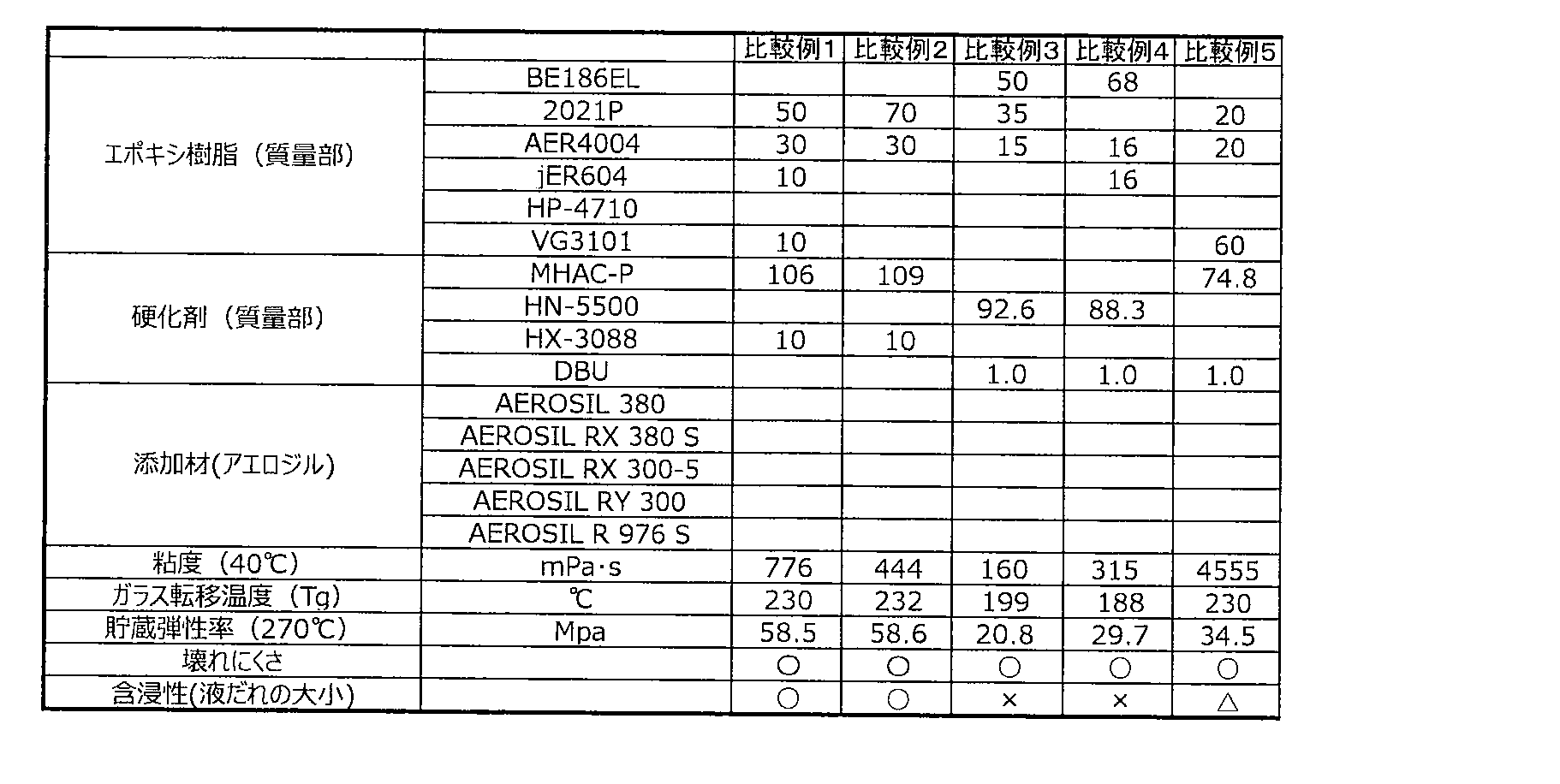
本発明の熱硬化性エポキシ樹脂組成物は、自動車、電気・電子機器、建築用の部材等の各種用途のための材料として好適に使用することができる。 The thermosetting epoxy resin composition of the present invention can be suitably used as a material for various applications such as automobiles, electric / electronic devices, and building members.
特に、本発明の熱硬化性エポキシ樹脂組成物は、送電線の芯材として好適に使用することができる。 In particular, the thermosetting epoxy resin composition of the present invention can be suitably used as a core material for a power transmission line.
Claims (4)
前記エポキシ樹脂が、
成分(A-1):25℃で液状のエポキシ樹脂と、
成分(A-2):軟化点が50℃以上のエポキシ樹脂と、を含み、
前記成分(A-1)が、脂環式エポキシ樹脂を含み、
前記成分(A-2)が、下記の構造式(1)で表される構造を含むエポキシ樹脂を含み、
前記硬化剤が、酸無水物を含み、
レオメータを用いて測定される40℃での粘度が200~4000mPa・sであり、
貯蔵弾性率測定により得られる貯蔵弾性率と損失弾性率の値から求められるtanδが最大となる、硬化物のガラス転移温度(Tg)が236℃~250℃である、熱硬化性エポキシ樹脂組成物。

The epoxy resin
Ingredient (A-1): Epoxy resin liquid at 25 ° C and
Component (A-2): Contains an epoxy resin having a softening point of 50 ° C. or higher.
The component (A-1) contains an alicyclic epoxy resin, and the component (A-1) contains an alicyclic epoxy resin.
The component (A-2) contains an epoxy resin containing a structure represented by the following structural formula (1).
The curing agent contains acid anhydride and contains
The viscosity at 40 ° C. measured using a rheometer is 200-4000 mPa · s.
A thermosetting epoxy resin composition having a glass transition temperature (Tg) of a cured product of 236 ° C. to 250 ° C., which maximizes tan δ obtained from the values of storage elastic modulus and loss elastic modulus obtained by measuring the storage elastic modulus . ..
繊維材料と、
を含み、
前記繊維材料が、ガラス繊維材料、炭素繊維材料、及びアラミド繊維材料からなる群より選ばれる少なくとも一つの繊維材料である、繊維強化熱硬化性エポキシ樹脂組成物。 The thermosetting epoxy resin composition according to claim 1 or 2 ,
Textile material and
Including
A fiber-reinforced thermosetting epoxy resin composition, wherein the fiber material is at least one fiber material selected from the group consisting of a glass fiber material, a carbon fiber material, and an aramid fiber material.
繊維材料と、
を含み、
前記繊維材料が、ガラス繊維材料、炭素繊維材料、及アラミド繊維材料からなる群より選ばれる少なくとも一つの繊維材料である、繊維強化熱硬化性エポキシ樹脂組成物の硬化物。 The thermosetting epoxy resin composition according to claim 1 or 2 ,
Textile material and
Including
A cured product of a fiber-reinforced thermosetting epoxy resin composition, wherein the fiber material is at least one fiber material selected from the group consisting of a glass fiber material, a carbon fiber material, and an aramid fiber material.
Priority Applications (1)
| Application Number | Priority Date | Filing Date | Title |
|---|---|---|---|
| JP2018096654A JP7058552B2 (en) | 2018-05-18 | 2018-05-18 | Thermosetting epoxy resin composition, fiber reinforced thermosetting epoxy resin composition, and cured product |
Applications Claiming Priority (1)
| Application Number | Priority Date | Filing Date | Title |
|---|---|---|---|
| JP2018096654A JP7058552B2 (en) | 2018-05-18 | 2018-05-18 | Thermosetting epoxy resin composition, fiber reinforced thermosetting epoxy resin composition, and cured product |
Publications (2)
| Publication Number | Publication Date |
|---|---|
| JP2019199587A JP2019199587A (en) | 2019-11-21 |
| JP7058552B2 true JP7058552B2 (en) | 2022-04-22 |
Family
ID=68612922
Family Applications (1)
| Application Number | Title | Priority Date | Filing Date |
|---|---|---|---|
| JP2018096654A Active JP7058552B2 (en) | 2018-05-18 | 2018-05-18 | Thermosetting epoxy resin composition, fiber reinforced thermosetting epoxy resin composition, and cured product |
Country Status (1)
| Country | Link |
|---|---|
| JP (1) | JP7058552B2 (en) |
Families Citing this family (2)
| Publication number | Priority date | Publication date | Assignee | Title |
|---|---|---|---|---|
| WO2021235480A1 (en) | 2020-05-21 | 2021-11-25 | 株式会社ダイセル | Curable epoxy composition for rotatory electric machine |
| JP7720178B2 (en) * | 2021-06-18 | 2025-08-07 | 旭化成株式会社 | Epoxy resin composition and epoxy resin composition product |
Citations (2)
| Publication number | Priority date | Publication date | Assignee | Title |
|---|---|---|---|---|
| JP2009029925A (en) | 2007-07-26 | 2009-02-12 | Asahi Kasei Chemicals Corp | Epoxy resin composition |
| JP2014111696A (en) | 2012-12-05 | 2014-06-19 | Hitachi Chemical Co Ltd | Thermosetting resin composition, prepreg using the same, laminate, and multilayer printed wiring board |
-
2018
- 2018-05-18 JP JP2018096654A patent/JP7058552B2/en active Active
Patent Citations (2)
| Publication number | Priority date | Publication date | Assignee | Title |
|---|---|---|---|---|
| JP2009029925A (en) | 2007-07-26 | 2009-02-12 | Asahi Kasei Chemicals Corp | Epoxy resin composition |
| JP2014111696A (en) | 2012-12-05 | 2014-06-19 | Hitachi Chemical Co Ltd | Thermosetting resin composition, prepreg using the same, laminate, and multilayer printed wiring board |
Also Published As
| Publication number | Publication date |
|---|---|
| JP2019199587A (en) | 2019-11-21 |
Similar Documents
| Publication | Publication Date | Title |
|---|---|---|
| US7005185B2 (en) | Quick cure carbon fiber reinforced epoxy resin | |
| JP4583373B2 (en) | Curing agent for epoxy resin and epoxy resin composition | |
| JP4811532B2 (en) | Epoxy resin composition for fiber reinforced composite material, prepreg and fiber reinforced composite material | |
| JP5804222B1 (en) | Carbon fiber reinforced composite and prepreg | |
| JP4753934B2 (en) | Latent curing agent for epoxy resin and epoxy resin composition | |
| JP4326524B2 (en) | Capsule type curing agent and composition | |
| JP6903897B2 (en) | Epoxy resin composition, articles using it, prepregs and fiber reinforced plastics | |
| US20120164455A1 (en) | Epoxy Resin System Containing Insoluble and Partially Soluble or Swellable Toughening Particles for Use in Prepreg and Structural Component Applications | |
| JP6441632B2 (en) | Production method of epoxy resin | |
| JP5468853B2 (en) | Composite material | |
| JPWO2016067736A1 (en) | Epoxy resin composition, cured resin, prepreg and fiber reinforced composite material | |
| TW201842018A (en) | Prepreg and carbon fiber-reinforced composite material | |
| EP3763774A1 (en) | Prepreg and carbon-fiber-reinforced composite material | |
| CN111295406A (en) | Epoxy resin composition and hardened product thereof | |
| US20240376291A1 (en) | Epoxy resin composition, film, method for producing film, and cured products | |
| JP2010116521A (en) | Method for producing epoxy resin | |
| JP2019199587A (en) | Thermosetting epoxy resin composition, fiber-reinforced thermosetting epoxy resin composition, and cured product | |
| JP7589492B2 (en) | Towpreg and fiber reinforced composites | |
| JP2016084372A (en) | Prepreg and fiber reinforced plastic | |
| JP6389469B2 (en) | Epoxy composition | |
| JP5468819B2 (en) | Epoxy resin composition and prepreg using the same as matrix resin | |
| JP7692732B2 (en) | Epoxy resin composition, epoxy resin adhesive, and epoxy resin cured product | |
| CN110204859A (en) | Heat-curable epoxy resin composition, fiber-reinforced thermosetting property composition epoxy resin and solidfied material | |
| JP2004204186A (en) | Epoxy resin composition | |
| JP2019112483A (en) | Carbonate resin composition for carbon fiber-reinforced composite material, prepreg and carbon fiber-reinforced composite material |
Legal Events
| Date | Code | Title | Description |
|---|---|---|---|
| A621 | Written request for application examination |
Free format text: JAPANESE INTERMEDIATE CODE: A621 Effective date: 20210326 |
|
| RD03 | Notification of appointment of power of attorney |
Free format text: JAPANESE INTERMEDIATE CODE: A7423 Effective date: 20210326 |
|
| A131 | Notification of reasons for refusal |
Free format text: JAPANESE INTERMEDIATE CODE: A131 Effective date: 20211116 |
|
| A601 | Written request for extension of time |
Free format text: JAPANESE INTERMEDIATE CODE: A601 Effective date: 20220106 |
|
| A521 | Request for written amendment filed |
Free format text: JAPANESE INTERMEDIATE CODE: A523 Effective date: 20220310 |
|
| TRDD | Decision of grant or rejection written | ||
| A01 | Written decision to grant a patent or to grant a registration (utility model) |
Free format text: JAPANESE INTERMEDIATE CODE: A01 Effective date: 20220331 |
|
| A61 | First payment of annual fees (during grant procedure) |
Free format text: JAPANESE INTERMEDIATE CODE: A61 Effective date: 20220412 |
|
| R150 | Certificate of patent or registration of utility model |
Ref document number: 7058552 Country of ref document: JP Free format text: JAPANESE INTERMEDIATE CODE: R150 |