JP7055152B2 - Polycarbonate-polydiorganosiloxane copolymer, its resin composition, and its production method. - Google Patents
Polycarbonate-polydiorganosiloxane copolymer, its resin composition, and its production method. Download PDFInfo
- Publication number
- JP7055152B2 JP7055152B2 JP2019560601A JP2019560601A JP7055152B2 JP 7055152 B2 JP7055152 B2 JP 7055152B2 JP 2019560601 A JP2019560601 A JP 2019560601A JP 2019560601 A JP2019560601 A JP 2019560601A JP 7055152 B2 JP7055152 B2 JP 7055152B2
- Authority
- JP
- Japan
- Prior art keywords
- group
- carbon atoms
- polydiorganosiloxane
- copolymer
- weight
- Prior art date
- Legal status (The legal status is an assumption and is not a legal conclusion. Google has not performed a legal analysis and makes no representation as to the accuracy of the status listed.)
- Active
Links
Images


Classifications
-
- C—CHEMISTRY; METALLURGY
- C08—ORGANIC MACROMOLECULAR COMPOUNDS; THEIR PREPARATION OR CHEMICAL WORKING-UP; COMPOSITIONS BASED THEREON
- C08G—MACROMOLECULAR COMPOUNDS OBTAINED OTHERWISE THAN BY REACTIONS ONLY INVOLVING UNSATURATED CARBON-TO-CARBON BONDS
- C08G64/00—Macromolecular compounds obtained by reactions forming a carbonic ester link in the main chain of the macromolecule
- C08G64/18—Block or graft polymers
- C08G64/186—Block or graft polymers containing polysiloxane sequences
-
- C—CHEMISTRY; METALLURGY
- C08—ORGANIC MACROMOLECULAR COMPOUNDS; THEIR PREPARATION OR CHEMICAL WORKING-UP; COMPOSITIONS BASED THEREON
- C08G—MACROMOLECULAR COMPOUNDS OBTAINED OTHERWISE THAN BY REACTIONS ONLY INVOLVING UNSATURATED CARBON-TO-CARBON BONDS
- C08G77/00—Macromolecular compounds obtained by reactions forming a linkage containing silicon with or without sulfur, nitrogen, oxygen or carbon in the main chain of the macromolecule
- C08G77/42—Block-or graft-polymers containing polysiloxane sequences
- C08G77/448—Block-or graft-polymers containing polysiloxane sequences containing polycarbonate sequences
-
- C—CHEMISTRY; METALLURGY
- C08—ORGANIC MACROMOLECULAR COMPOUNDS; THEIR PREPARATION OR CHEMICAL WORKING-UP; COMPOSITIONS BASED THEREON
- C08L—COMPOSITIONS OF MACROMOLECULAR COMPOUNDS
- C08L69/00—Compositions of polycarbonates; Compositions of derivatives of polycarbonates
-
- C—CHEMISTRY; METALLURGY
- C08—ORGANIC MACROMOLECULAR COMPOUNDS; THEIR PREPARATION OR CHEMICAL WORKING-UP; COMPOSITIONS BASED THEREON
- C08F—MACROMOLECULAR COMPOUNDS OBTAINED BY REACTIONS ONLY INVOLVING CARBON-TO-CARBON UNSATURATED BONDS
- C08F2/00—Processes of polymerisation
- C08F2/12—Polymerisation in non-solvents
- C08F2/14—Organic medium
-
- C—CHEMISTRY; METALLURGY
- C08—ORGANIC MACROMOLECULAR COMPOUNDS; THEIR PREPARATION OR CHEMICAL WORKING-UP; COMPOSITIONS BASED THEREON
- C08K—Use of inorganic or non-macromolecular organic substances as compounding ingredients
- C08K3/00—Use of inorganic substances as compounding ingredients
- C08K3/01—Use of inorganic substances as compounding ingredients characterized by their specific function
- C08K3/016—Flame-proofing or flame-retarding additives
-
- C—CHEMISTRY; METALLURGY
- C08—ORGANIC MACROMOLECULAR COMPOUNDS; THEIR PREPARATION OR CHEMICAL WORKING-UP; COMPOSITIONS BASED THEREON
- C08K—Use of inorganic or non-macromolecular organic substances as compounding ingredients
- C08K3/00—Use of inorganic substances as compounding ingredients
- C08K3/02—Elements
- C08K3/08—Metals
-
- C—CHEMISTRY; METALLURGY
- C08—ORGANIC MACROMOLECULAR COMPOUNDS; THEIR PREPARATION OR CHEMICAL WORKING-UP; COMPOSITIONS BASED THEREON
- C08K—Use of inorganic or non-macromolecular organic substances as compounding ingredients
- C08K5/00—Use of organic ingredients
- C08K5/0008—Organic ingredients according to more than one of the "one dot" groups of C08K5/01 - C08K5/59
- C08K5/005—Stabilisers against oxidation, heat, light, ozone
-
- C—CHEMISTRY; METALLURGY
- C08—ORGANIC MACROMOLECULAR COMPOUNDS; THEIR PREPARATION OR CHEMICAL WORKING-UP; COMPOSITIONS BASED THEREON
- C08K—Use of inorganic or non-macromolecular organic substances as compounding ingredients
- C08K5/00—Use of organic ingredients
- C08K5/0008—Organic ingredients according to more than one of the "one dot" groups of C08K5/01 - C08K5/59
- C08K5/0066—Flame-proofing or flame-retarding additives
-
- C—CHEMISTRY; METALLURGY
- C08—ORGANIC MACROMOLECULAR COMPOUNDS; THEIR PREPARATION OR CHEMICAL WORKING-UP; COMPOSITIONS BASED THEREON
- C08K—Use of inorganic or non-macromolecular organic substances as compounding ingredients
- C08K5/00—Use of organic ingredients
- C08K5/36—Sulfur-, selenium-, or tellurium-containing compounds
- C08K5/41—Compounds containing sulfur bound to oxygen
- C08K5/42—Sulfonic acids; Derivatives thereof
-
- C—CHEMISTRY; METALLURGY
- C08—ORGANIC MACROMOLECULAR COMPOUNDS; THEIR PREPARATION OR CHEMICAL WORKING-UP; COMPOSITIONS BASED THEREON
- C08K—Use of inorganic or non-macromolecular organic substances as compounding ingredients
- C08K5/00—Use of organic ingredients
- C08K5/49—Phosphorus-containing compounds
-
- C—CHEMISTRY; METALLURGY
- C08—ORGANIC MACROMOLECULAR COMPOUNDS; THEIR PREPARATION OR CHEMICAL WORKING-UP; COMPOSITIONS BASED THEREON
- C08L—COMPOSITIONS OF MACROMOLECULAR COMPOUNDS
- C08L83/00—Compositions of macromolecular compounds obtained by reactions forming in the main chain of the macromolecule a linkage containing silicon with or without sulfur, nitrogen, oxygen or carbon only; Compositions of derivatives of such polymers
- C08L83/10—Block- or graft-copolymers containing polysiloxane sequences
-
- C—CHEMISTRY; METALLURGY
- C09—DYES; PAINTS; POLISHES; NATURAL RESINS; ADHESIVES; COMPOSITIONS NOT OTHERWISE PROVIDED FOR; APPLICATIONS OF MATERIALS NOT OTHERWISE PROVIDED FOR
- C09D—COATING COMPOSITIONS, e.g. PAINTS, VARNISHES OR LACQUERS; FILLING PASTES; CHEMICAL PAINT OR INK REMOVERS; INKS; CORRECTING FLUIDS; WOODSTAINS; PASTES OR SOLIDS FOR COLOURING OR PRINTING; USE OF MATERIALS THEREFOR
- C09D183/00—Coating compositions based on macromolecular compounds obtained by reactions forming in the main chain of the macromolecule a linkage containing silicon, with or without sulfur, nitrogen, oxygen, or carbon only; Coating compositions based on derivatives of such polymers
- C09D183/10—Block or graft copolymers containing polysiloxane sequences
-
- C—CHEMISTRY; METALLURGY
- C08—ORGANIC MACROMOLECULAR COMPOUNDS; THEIR PREPARATION OR CHEMICAL WORKING-UP; COMPOSITIONS BASED THEREON
- C08G—MACROMOLECULAR COMPOUNDS OBTAINED OTHERWISE THAN BY REACTIONS ONLY INVOLVING UNSATURATED CARBON-TO-CARBON BONDS
- C08G77/00—Macromolecular compounds obtained by reactions forming a linkage containing silicon with or without sulfur, nitrogen, oxygen or carbon in the main chain of the macromolecule
- C08G77/04—Polysiloxanes
Landscapes
- Chemical & Material Sciences (AREA)
- Chemical Kinetics & Catalysis (AREA)
- Organic Chemistry (AREA)
- Health & Medical Sciences (AREA)
- Medicinal Chemistry (AREA)
- Polymers & Plastics (AREA)
- Life Sciences & Earth Sciences (AREA)
- Engineering & Computer Science (AREA)
- Materials Engineering (AREA)
- Wood Science & Technology (AREA)
- Polyesters Or Polycarbonates (AREA)
- Compositions Of Macromolecular Compounds (AREA)
- Silicon Polymers (AREA)
Description
本発明は、ポリカーボネート-ポリジオルガノシロキサン共重合体(以下「PC-POS共重合体」と略することがある)または樹脂組成物、および該樹脂組成物の製造方法に関するものである。さらに詳細には、優れた耐衝撃性、特に極低温下での耐衝撃性および耐薬品性を具備するPC-POS共重合体または樹脂組成物、および該樹脂組成物の製造方法に関する。 The present invention relates to a polycarbonate-polydiorganosiloxane copolymer (hereinafter sometimes abbreviated as "PC-POS copolymer") or a resin composition, and a method for producing the resin composition. More specifically, the present invention relates to a PC-POS copolymer or resin composition having excellent impact resistance, particularly impact resistance and chemical resistance at extremely low temperatures, and a method for producing the resin composition.
ポリカーボネートは、耐衝撃性に優れ、高い耐熱性を有するので、光学部品、電気・電子機器分野、自動車分野において幅広く使用されている。更に、昨今の用途分野拡大に対応するため、ビスフェノールA(以下BPAと略称)などの一般的なモノマー原料に各種の共重合モノマー単位を導入した共重合ポリカーボネートの開発が進められている。中でも、BPAとポリジオルガノシロキサンコモノマーからなるPC-POS共重合体は難燃性や耐衝撃性に優れることが知られており、多くの文献が開示されている(特許文献1~3)。 Polycarbonate has excellent impact resistance and high heat resistance, and is therefore widely used in the fields of optical components, electrical and electronic equipment, and automobiles. Furthermore, in order to respond to the recent expansion of application fields, the development of copolymerized polycarbonate in which various copolymerized monomer units are introduced into a general monomer raw material such as bisphenol A (hereinafter abbreviated as BPA) is underway. Among them, a PC-POS copolymer composed of BPA and a polydiorganosiloxane comonomer is known to have excellent flame retardancy and impact resistance, and many documents have been disclosed (Patent Documents 1 to 3).
PC-POS共重合体の耐衝撃性、特に低温下での耐衝撃性を改善する方法として、用いるポリジオルガノシロキサン構造中の鎖長に着目し、鎖長の長いポリジオルガノシロキサンを用いる方法が開示されている(特許文献4~5)。 As a method for improving the impact resistance of the PC-POS copolymer, particularly the impact resistance at low temperatures, a method using a polydiorganosiloxane having a long chain length is disclosed, focusing on the chain length in the polydiorganosiloxane structure used. (Patent Documents 4 to 5).
また、特許文献6には、成形品中で形成されるシロキサンドメインサイズに着目し、光線透過率の相違する2種類のPC-POS共重合体を適当に配合することによって一定の透明性と耐衝撃性を両立する方法が開示されている。 Further, in Patent Document 6, paying attention to the siloxane domain size formed in the molded product, constant transparency and resistance are obtained by appropriately blending two types of PC-POS copolymers having different light transmittances. A method of achieving both impact resistance is disclosed.
特許文献7には、鎖長の長いポリジオルガノシロキサンおよび鎖長の短いポリジオルガノシロキサンを原料としたPC-POS共重合体を含む樹脂組成物の製造方法が開示され、同様に一定の透明性と耐衝撃性を両立した例が示されている。 Patent Document 7 discloses a method for producing a resin composition containing a PC-POS copolymer made from a polydiorganosiloxane having a long chain length and a polydiorganosiloxane having a short chain length as raw materials. An example of both impact resistance is shown.
しかしながら、これまでのPC-POS共重合体あるいはPC-POS共重合体を含む樹脂組成物は、いずれも耐衝撃性、特に高緯度圏や山岳部などの高所地まで想定した極低温下での耐衝撃性における性能は不十分であり、さらに高い耐薬品性、塗装耐久性まで両立させたPC-POS共重合体あるいPC-POS共重合体を含む樹脂組成物は得ることができていない。 However, all of the conventional PC-POS copolymers or resin compositions containing the PC-POS copolymer have impact resistance, especially at extremely low temperatures assuming high altitude areas such as high latitudes and mountainous areas. The performance in impact resistance is insufficient, and a resin composition containing a PC-POS copolymer or a PC-POS copolymer that has both high chemical resistance and coating durability has not been obtained. ..
また、PC-POS共重合体単体では、UL規格94に基づくV-0といった高度な難燃性を得ることは出来ない。そこで高い難燃性を得る為にこのPC-POS共重合体に難燃剤を配合する方法がある(特許文献2及び8)。しかし、これらの方法では薄肉難燃性は十分であるとは言えない。一方、ポリテトラフルオロエチレン粒子と難燃剤とをポリカーボネートに添加する方法が知られている(特許文献9及び10)。しかしながらこれらの文献には、ポリカーボネート樹脂として特定のPC-POS共重合体を選択することで、非常に高い難燃性と低温衝撃特性が得られることについては記載されていない。
Further, the PC-POS copolymer alone cannot obtain a high flame retardancy such as V-0 based on UL standard 94. Therefore, in order to obtain high flame retardancy, there is a method of blending a flame retardant with this PC-POS copolymer (
本発明の目的は、優れた耐衝撃性、特に極低温下での耐衝撃性および耐薬品性を具備するポリカーボネート-ポリジオルガノシロキサン共重合またはその樹脂組成物を提供することにある。 An object of the present invention is to provide a polycarbonate-polydiorganosiloxane copolymer or a resin composition thereof having excellent impact resistance, particularly impact resistance and chemical resistance at extremely low temperatures.
本発明者らはこの目的を達成せんとして鋭意研究を重ねた結果、下記構成によって、上記課題を解決することができることを見出し本発明に到達した。 As a result of diligent research to achieve this object, the present inventors have found that the above problems can be solved by the following configuration, and arrived at the present invention.
《構成1》
ポリカーボネート-ポリジオルガノシロキサン共重合体と、随意のポリカーボネート樹脂とを含む前記共重合体又はその樹脂組成物であって、
前記共重合体が、(A-1)ポリカーボネートブロック、及び(A-2)ポリジオルガノシロキサンブロックを含み、
前記(A-2)ポリジオルガノシロキサンブロックが、前記共重合体又はその樹脂組成物中に、2.5~8.0重量%で含有されており、かつ
以下の(i)及び(ii)を満たす、前記共重合体又はその樹脂組成物:
(i)前記共重合体又はその樹脂組成物の電子線顕微鏡を用いた断面観察像において、850nm四方(722,500nm2)の領域に最大長径が80nm以上のドメインが1~20個存在すること;及び
(ii)平均ドメインサイズが30~100nmであること。<< Configuration 1 >>
The copolymer or a resin composition thereof containing a polycarbonate-polydiorganosiloxane copolymer and an optional polycarbonate resin.
The copolymer contains (A-1) polycarbonate block and (A-2) polydiorganosiloxane block.
The (A-2) polydiorganosiloxane block is contained in the copolymer or the resin composition thereof in an amount of 2.5 to 8.0% by weight, and the following (i) and (ii) are contained. The copolymer or resin composition thereof to be satisfied:
(I) In a cross-sectional observation image of the copolymer or its resin composition using an electron beam microscope, 1 to 20 domains having a maximum major axis of 80 nm or more are present in a region of 850 nm square (722,500 nm 2 ). And (ii) the average domain size is 30-100 nm.
《構成2》
前記(A-1)ポリカーボネートブロックが、下記一般式[1]で表される、構成1に記載の共重合体又はその樹脂組成物:

The copolymer according to composition 1 or a resin composition thereof, wherein the polycarbonate block (A-1) is represented by the following general formula [1]:
《構成3》
前記(A-2)ポリジオルガノシロキサンブロックが、下記一般式[3]で表される、構成2に記載の共重合体又はその樹脂組成物:

The copolymer according to
《構成4》
さらに以下の(iii)を満たす、構成1~3のいずれか一項に記載の共重合体又はその樹脂組成物:
(iii)前記共重合体又はその樹脂組成物の電子線顕微鏡を用いた断面観察像において、5枚の試料切片のいずれにも、850nm四方(722,500nm2)の領域に最大長径が400nm以上のドメインが存在しないこと。<< Composition 4 >>
The copolymer or resin composition thereof according to any one of configurations 1 to 3, which further satisfies the following (iii):
(Iii) In a cross-sectional observation image of the copolymer or its resin composition using an electron beam microscope, each of the five sample sections has a maximum major axis of 400 nm or more in a region of 850 nm square (722,500 nm 2 ). Domain does not exist.
《構成5》
粘度平均分子量が11,000~30,000である、構成1~4のいずれか一項に記載の共重合体又はその樹脂組成物。<< Configuration 5 >>
The copolymer or resin composition thereof according to any one of configurations 1 to 4, which has a viscosity average molecular weight of 11,000 to 30,000.
《構成6》
前記(A-1)ポリカーボネートブロックが、2,2-ビス(4-ヒドロキシフェニル)プロパンより誘導されており、かつ
前記(A-2)ポリジオルガノシロキサンブロックが、(2-アリルフェノール)末端ポリジオルガノシロキサン、又は(2-メトキシ-4-アリルフェノール)末端ポリジオルガノシロキサンより誘導されている、
構成1~5のいずれか一項に記載の共重合体又はその樹脂組成物。<< Composition 6 >>
The (A-1) polycarbonate block is derived from 2,2-bis (4-hydroxyphenyl) propane, and the (A-2) polydiorganosiloxane block is a (2-allylphenol) -terminated polydiorgano. Derived from siloxane or (2-methoxy-4-allylphenol) -terminated polycarbonate siloxane,
The copolymer or resin composition thereof according to any one of configurations 1 to 5.
《構成7》
100~1重量%の前記共重合体と、0~99重量%の前記ポリカーボネート樹脂とを含む、構成1~6のいずれか一項に記載の共重合体又はその樹脂組成物。<< Composition 7 >>
The copolymer or resin composition thereof according to any one of configurations 1 to 6, which comprises 100 to 1% by weight of the copolymer and 0 to 99% by weight of the polycarbonate resin.
《構成8》
前記ポリカーボネート樹脂が、下記一般式[1]で表される、構成7に記載の樹脂組成物:
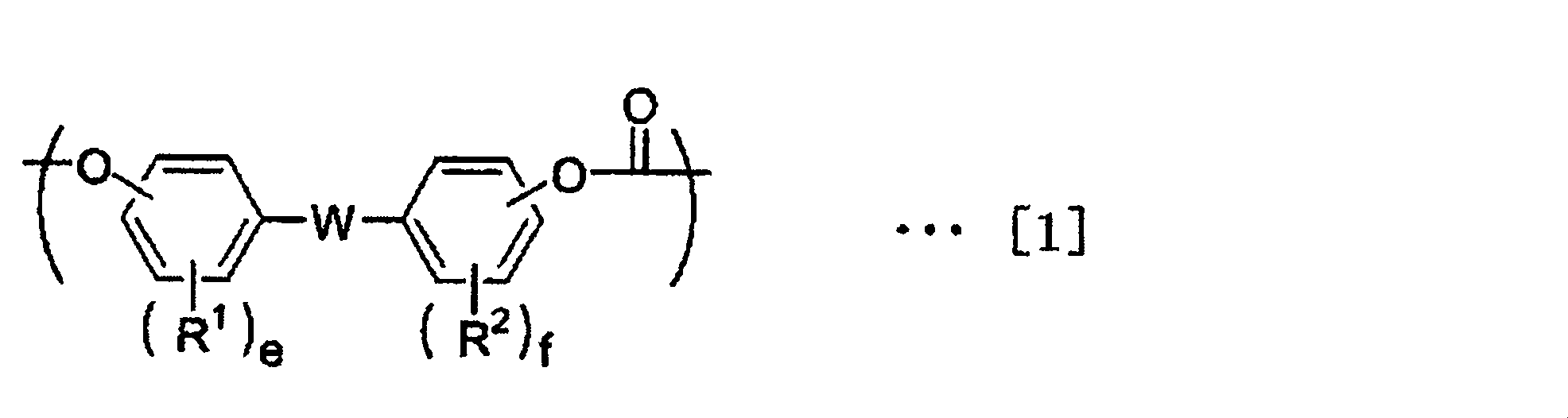

The resin composition according to composition 7, wherein the polycarbonate resin is represented by the following general formula [1]:
《構成9》
構成1~8のいずれか一項に記載の共重合体又はその樹脂組成物と、前記共重合体又はその樹脂組成物100質量部に対して、0.001~20重量部の(B)難燃剤とを含有する、樹脂組成物。<< Composition 9 >>
(B) Difficulty of 0.001 to 20 parts by weight with respect to 100 parts by mass of the copolymer or the resin composition thereof according to any one of the configurations 1 to 8 and the copolymer or the resin composition thereof. A resin composition containing a flame retardant.
《構成10》
前記(B)難燃剤が、金属塩系難燃剤及び/又は有機リン系難燃剤である、構成9に記載の樹脂組成物。<< Configuration 10 >>
The resin composition according to composition 9, wherein the flame retardant (B) is a metal salt-based flame retardant and / or an organic phosphorus-based flame retardant.
《構成11》
(C)含フッ素滴下防止剤及び/又は(D)紫外線吸収剤をさらに含む、構成9又は10に記載の樹脂組成物。<< Configuration 11 >>
The resin composition according to composition 9 or 10, further comprising (C) a fluorine-containing dripping inhibitor and / or (D) an ultraviolet absorber.
《構成12》
構成1~7のいずれか一項に記載の共重合体又はその樹脂組成物、又は構成8~11に記載の樹脂組成物から形成された、成形品。<< Configuration 12 >>
A molded product formed from the copolymer according to any one of configurations 1 to 7 or a resin composition thereof, or the resin composition according to configurations 8 to 11.
《構成13》
ASTM D1003(ISO13468)に基づいて測定された厚み2mmの成形品の全光線透過率が80%以下である、構成12に記載の成形品。<< Composition 13 >>
The molded product according to Configuration 12, wherein the total light transmittance of the molded product having a thickness of 2 mm measured based on ASTM D1003 (ISO13468) is 80% or less.
《構成14》
以下の工程(a)及び(b)を含む、構成3に記載の共重合体又は樹脂組成物の製造方法:
(a)水に不溶性の有機溶媒とアルカリ水溶液との混合液中において、下記式[4]で表される二価フェノール(I)とホスゲンとを反応させ、末端クロロホーメート基を有するカーボネートオリゴマーを含有する溶液を調製すること

(b)次いで、該溶液を撹拌しながら、下記式[5]で表されるヒドロキシアリール末端ポリジオルガノシロキサン(II)を加え、ヒドロキシアリール末端ポリジオルガノシロキサン(II)とカーボネートオリゴマーとを界面重合させること

ここで、式[4]および式[5]で表される二価フェノール総量1モル当たり、水に不溶性の有機溶媒を、8モル以上11モル未満で使用すること。<< Composition 14 >>
The method for producing a copolymer or resin composition according to
(A) A carbonate oligomer having a terminal chlorohomate group by reacting divalent phenol (I) represented by the following formula [4] with phosgene in a mixed solution of an organic solvent insoluble in water and an alkaline aqueous solution. To prepare a solution containing
Here, the organic solvent insoluble in water is used in an amount of 8 mol or more and less than 11 mol per 1 mol of the total amount of divalent phenol represented by the formula [4] and the formula [5].
《構成15》
式[4]および式[5]で表わされる二価フェノールの総量1モルあたり、水に不溶性の有機溶媒を8モル以上9.5モル未満として界面重縮合反応を開始した後、さらに水に不溶性の有機溶媒を式[4]および式[5]で表される二価フェノールの総量1モル当たり2モル以上添加する、構成14に記載の製造方法。<< Composition 15 >>
After starting the interfacial polycondensation reaction with 8 mol or more and less than 9.5 mol of the organic solvent insoluble in water per 1 mol of the total amount of the dihydric phenol represented by the formula [4] and the formula [5], it is further insoluble in water. The production method according to composition 14, wherein 2 mol or more of the organic solvent of the above is added per 1 mol of the total amount of the dihydric phenol represented by the formula [4] and the formula [5].
本発明のPC-POS共重合体またはその樹脂組成物は、優れた耐衝撃性、特に極低温下での耐衝撃性および耐薬品性を具備し、またさらに高い塗装耐久性も具備するためその奏する産業上の効果は格別である。 The PC-POS copolymer of the present invention or a resin composition thereof has excellent impact resistance, particularly impact resistance and chemical resistance at extremely low temperatures, and also has high coating durability. The industrial effect it produces is exceptional.
以下、本発明をさらに詳しく説明する。
《ポリカーボネート共重合体または樹脂組成物》
本発明のPC-POS共重合体は、(A-1)ポリカーボネートブロックと、(A-2)ポリジオルガノシロキサンブロックとを含む。また、本発明の樹脂組成物は、上記の共重合体を含む樹脂組成物であり、好ましくはPC-POS共重合体100~1重量%とポリカーボネート樹脂0~99重量%からなる。ここで、本発明の共重合体又はその樹脂組成物は、(A-2)ポリジオルガノシロキサンブロックの含有量が、2.5~8.0重量%であり、以下の(i)及び(ii)を満たす:
(i)電子線顕微鏡を用いた樹脂組成物断面観察像において、850nm四方(722,500nm2)の領域に最大長径が80nm以上のドメインが1~20個存在すること;及び
(ii)平均ドメインサイズが30~100nmであること。Hereinafter, the present invention will be described in more detail.
<< Polycarbonate copolymer or resin composition >>
The PC-POS copolymer of the present invention contains (A-1) a polycarbonate block and (A-2) a polydiorganosiloxane block. The resin composition of the present invention is a resin composition containing the above-mentioned copolymer, and is preferably composed of 100 to 1% by weight of the PC-POS copolymer and 0 to 99% by weight of the polycarbonate resin. Here, the copolymer of the present invention or the resin composition thereof has a content of (A-2) polydiorganosiloxane block of 2.5 to 8.0% by weight, and has the following (i) and (ii). ) Satisfies:
(I) In the cross-sectional observation image of the resin composition using an electron beam microscope, 1 to 20 domains having a maximum major axis of 80 nm or more are present in a region of 850 nm square (722,500 nm 2 ); and (ii) average domain. The size should be 30-100 nm.
本発明者らは、ポリジオルガノシロキサンと、末端クロロホーメート基を有するカーボネートオリゴマーとを、従来で行われてきていなかったような非常に高い濃度で溶媒中で反応させることによって、PC-POS共重合体に、特定の平均サイズのドメインを形成しながら、80nm以上の粗大ドメインを形成させることができることを見出し、またこのようなドメインの分散状態が、PC-POS共重合体の耐衝撃性(特に極低温下での耐衝撃性)等に非常に有利となることを見出した。 The present inventors have combined PC-POS by reacting a polydiorganosiloxane with a carbonate oligomer having a terminal chlorohomate group in a solvent at a very high concentration, which has not been performed in the past. We have found that it is possible to form a coarse domain of 80 nm or more in a polymer while forming a domain of a specific average size, and the dispersed state of such a domain is the impact resistance of the PC-POS copolymer ( In particular, it has been found to be extremely advantageous in terms of impact resistance at extremely low temperatures).
なお、本明細書においては、PC-POS共重合体と、ポリカーボネート樹脂との組み合わせを、A成分と略称する場合がある。 In this specification, the combination of the PC-POS copolymer and the polycarbonate resin may be abbreviated as the A component.
〈ポリカーボネート-ポリジオルガノシロキサン(PC-POS)共重合体〉
本発明において、PC-POS共重合体は、(A-1)ポリカーボネートブロックと、(A-2)ポリジオルガノシロキサンブロックとを含み、好ましくは式[1]の(A-1)ポリカーボネートブロックおよび式[3]の(A-2)ポリジオルガノシロキサンブロックを含有する。<Polycarbonate-polydiorganosiloxane (PC-POS) copolymer>
In the present invention, the PC-POS copolymer contains (A-1) a polycarbonate block and (A-2) a polydiorganosiloxane block, preferably the (A-1) polycarbonate block of the formula [1] and the formula. It contains the (A-2) polycarbonate siloxane block of [3].
〈PC-POS共重合体-(A-1)ポリカーボネートブロック〉
本発明において、(A-1)ポリカーボネートブロックは、PC-POS共重合体において含まれるポリカーボネート系の部分であり、特にその種類は限定されない。例えば、そのようなポリカーボネート系の部分は、芳香族ポリカーボネート系の部分であってもよい。<PC-POS copolymer- (A-1) polycarbonate block>
In the present invention, the (A-1) polycarbonate block is a polycarbonate-based portion contained in the PC-POS copolymer, and the type thereof is not particularly limited. For example, such a polycarbonate-based portion may be an aromatic polycarbonate-based portion.
例えば、(A-1)ポリカーボネートブロックは、下記式[1]で表される。

ハロゲン原子として、フッ素原子、塩素原子、臭素原子等が挙げられる。炭素原子数1~18のアルキル基として、メチル基、エチル基、プロピル基、ブチル基、ペンチル基、ヘキシル基、ヘプチル基、オクチル基、ノニル基、デシル基、ドデシル基、テトラデシル基等が挙げられる。好ましくは炭素原子数1~6のアルキル基である。炭素原子数1~18のアルコキシ基として、メトキシ基、エトキシ基、プロポキシ基、ブトキシ基、ペントキシ基、ヘキトキシ基、オクトキシ基、等が挙げられる。炭素原子数1~6のアルキル基が好ましい。 Examples of the halogen atom include a fluorine atom, a chlorine atom, a bromine atom and the like. Examples of the alkyl group having 1 to 18 carbon atoms include a methyl group, an ethyl group, a propyl group, a butyl group, a pentyl group, a hexyl group, a heptyl group, an octyl group, a nonyl group, a decyl group, a dodecyl group and a tetradecyl group. .. It is preferably an alkyl group having 1 to 6 carbon atoms. Examples of the alkoxy group having 1 to 18 carbon atoms include a methoxy group, an ethoxy group, a propoxy group, a butoxy group, a pentoxy group, a hexoxy group, an octoxy group and the like. Alkyl groups having 1 to 6 carbon atoms are preferable.
炭素原子数6~20のシクロアルキル基として、シクロヘキシル基、シクロオクチル基等が挙げられる。炭素原子数6~12のシクロアルキル基が好ましい。炭素原子数6~20のシクロアルコキシ基として、好ましくはシクロヘキシルオキシ基、シクロオクチルオキシ基等が挙げられる。炭素原子数6~12のシクロアルキル基が好ましい。 Examples of the cycloalkyl group having 6 to 20 carbon atoms include a cyclohexyl group and a cyclooctyl group. A cycloalkyl group having 6 to 12 carbon atoms is preferable. Examples of the cycloalkoxy group having 6 to 20 carbon atoms include a cyclohexyloxy group and a cyclooctyloxy group. A cycloalkyl group having 6 to 12 carbon atoms is preferable.
炭素原子数2~10のアルケニル基として、メテニル基、エテニル基、プロペニル基、ブテニル基、ペンテニル基等が挙げられる。炭素原子数1~6のアルキル基が好ましい。 Examples of the alkenyl group having 2 to 10 carbon atoms include a metenyl group, an ethenyl group, a propenyl group, a butenyl group, a pentenyl group and the like. Alkyl groups having 1 to 6 carbon atoms are preferable.
炭素原子数6~14のアリール基として、フェニル基、ナフチル基等挙げられる。炭素原子数6~14のアリールオキシ基として、フェニルオキシ基、ナフチルオキシ基等が挙げられる。炭素原子数7~20のアラルキル基として、ベンジル基、フェニルエチル基等が挙げられる。炭素原子数7~20のアラルキルオキシ基として、ベンジルオキシ基、フェニルエチルオキシ基等が挙げられる。 Examples of the aryl group having 6 to 14 carbon atoms include a phenyl group and a naphthyl group. Examples of the aryloxy group having 6 to 14 carbon atoms include a phenyloxy group and a naphthyloxy group. Examples of the aralkyl group having 7 to 20 carbon atoms include a benzyl group and a phenylethyl group. Examples of the aralkyloxy group having 7 to 20 carbon atoms include a benzyloxy group and a phenylethyloxy group.
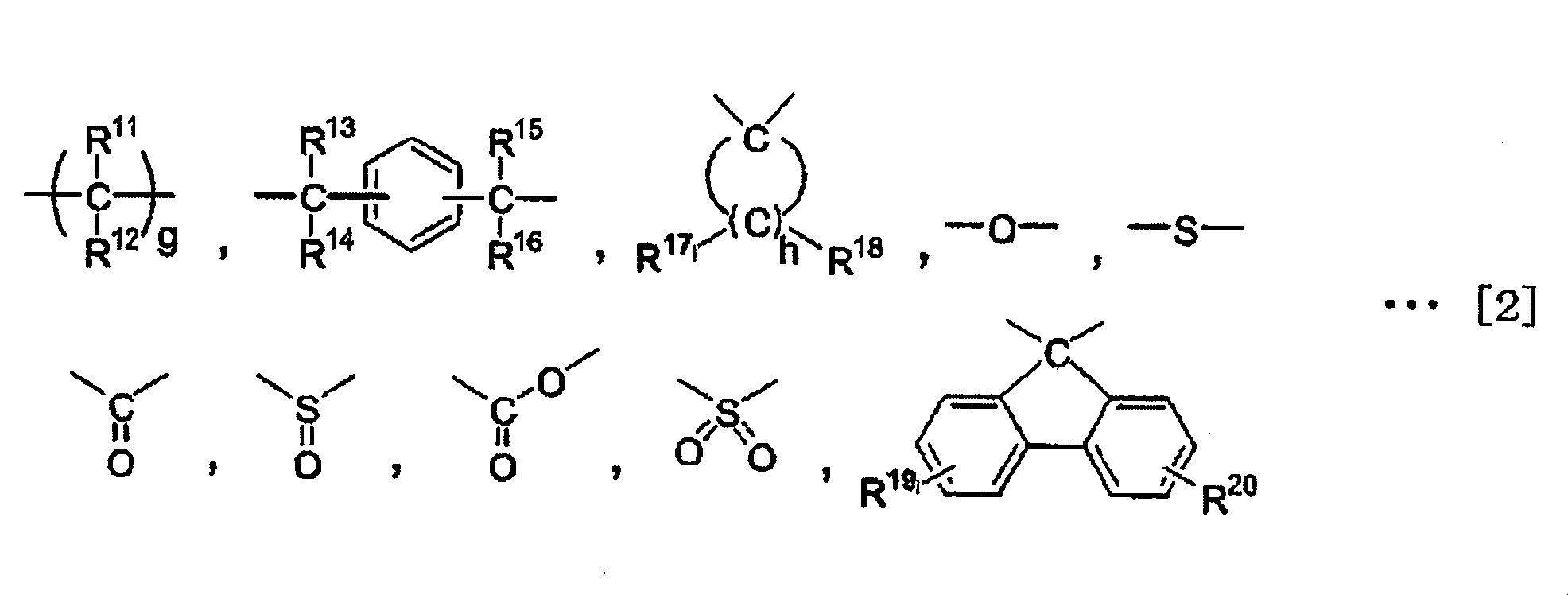
eおよびfは夫々独立に1~4の整数である。
Wは、単結合もしくは下記式[2]で表される基からなる群より選ばれる少なくとも一つの基である。)e and f are each independently an integer of 1 to 4.
W is at least one group selected from the group consisting of a single bond or a group represented by the following formula [2]. )

炭素原子数1~18のアルキル基として、メチル基、エチル基、プロピル基、ブチル基、ペンチル基、ヘキシル基、ヘプチル基、オクチル基、ノニル基、デシル基、ドデシル基等が挙げられる。好ましくは炭素原子数1~6のアルキル基である。 Examples of the alkyl group having 1 to 18 carbon atoms include a methyl group, an ethyl group, a propyl group, a butyl group, a pentyl group, a hexyl group, a heptyl group, an octyl group, a nonyl group, a decyl group and a dodecyl group. It is preferably an alkyl group having 1 to 6 carbon atoms.
炭素原子数6~14のアリール基として、フェニル基、ナフチル基等が挙げられる。これらは置換されていてもよい。置換基として、メチル基、エチル基、プロピル基、ブチル基などの炭素原子数1~6のアルキル基が挙げられる。炭素原子数7~20のアラルキル基として、ベンジル基、フェニルエチル基等が挙げられる。 Examples of the aryl group having 6 to 14 carbon atoms include a phenyl group and a naphthyl group. These may be substituted. Examples of the substituent include an alkyl group having 1 to 6 carbon atoms such as a methyl group, an ethyl group, a propyl group and a butyl group. Examples of the aralkyl group having 7 to 20 carbon atoms include a benzyl group and a phenylethyl group.
R19およびR20は夫々独立して、水素原子、ハロゲン原子、炭素原子数1~18のアルキル基、炭素原子数1~10のアルコキシ基、炭素原子数6~20のシクロアルキル基、炭素原子数6~20のシクロアルコキシ基、炭素原子数2~10のアルケニル基、炭素原子数6~14のアリール基、炭素原子数6~10のアリールオキシ基、炭素原子数7~20のアラルキル基、炭素原子数7~20のアラルキルオキシ基、ニトロ基、アルデヒド基、シアノ基およびカルボキシル基からなる群から選ばれる基を表す。複数ある場合はそれらは同一でも異なっていても良い。R 19 and R 20 are independently hydrogen atom, halogen atom, alkyl group having 1 to 18 carbon atoms, alkoxy group having 1 to 10 carbon atoms, cycloalkyl group having 6 to 20 carbon atoms, and carbon atom. Cycloalkoxy group with 6 to 20, alkoxy group with 2 to 10 carbon atoms, aryl group with 6 to 14 carbon atoms, aryloxy group with 6 to 10 carbon atoms, aralkyl group with 7 to 20 carbon atoms, Represents a group selected from the group consisting of an aryloxy group, a nitro group, an aldehyde group, a cyano group and a carboxyl group having 7 to 20 carbon atoms. If there are multiple, they may be the same or different.
ハロゲン原子として、フッ素原子、塩素原子、臭素原子等が挙げられる。炭素原子数1~18のアルキル基として、メチル基、エチル基、プロピル基、ブチル基、ペンチル基、ヘキシル基、ヘプチル基、オクチル基、ノニル基、デシル基、ドデシル基、テトラデシル基等が挙げられる。好ましくは炭素原子数1~6のアルキル基である。炭素原子数1~10のアルコキシ基として、メトキシ基、エトキシ基、プロポキシ基、ブトキシ基、ペントキシ基等が挙げられる。炭素原子数1~6のアルキル基が好ましい。 Examples of the halogen atom include a fluorine atom, a chlorine atom, a bromine atom and the like. Examples of the alkyl group having 1 to 18 carbon atoms include a methyl group, an ethyl group, a propyl group, a butyl group, a pentyl group, a hexyl group, a heptyl group, an octyl group, a nonyl group, a decyl group, a dodecyl group and a tetradecyl group. .. It is preferably an alkyl group having 1 to 6 carbon atoms. Examples of the alkoxy group having 1 to 10 carbon atoms include a methoxy group, an ethoxy group, a propoxy group, a butoxy group, a pentoxy group and the like. Alkyl groups having 1 to 6 carbon atoms are preferable.
炭素原子数6~20のシクロアルキル基として、シクロヘキシル基、シクロオクチル基等が挙げられる。炭素原子数6~12のシクロアルキル基が好ましい。炭素原子数6~20のシクロアルコキシ基として、シクロヘキシルオキシ基、シクロオクチル基等が挙げられる。炭素原子数6~12のシクロアルキル基が好ましい。 Examples of the cycloalkyl group having 6 to 20 carbon atoms include a cyclohexyl group and a cyclooctyl group. A cycloalkyl group having 6 to 12 carbon atoms is preferable. Examples of the cycloalkoxy group having 6 to 20 carbon atoms include a cyclohexyloxy group and a cyclooctyl group. A cycloalkyl group having 6 to 12 carbon atoms is preferable.
炭素原子数2~10のアルケニル基として、メテニル基、エテニル基、プロペニル基、ブテニル基、ペンテニル基等が挙げられる。炭素原子数1~6のアルキル基が好ましい。 Examples of the alkenyl group having 2 to 10 carbon atoms include a metenyl group, an ethenyl group, a propenyl group, a butenyl group, a pentenyl group and the like. Alkyl groups having 1 to 6 carbon atoms are preferable.
炭素原子数6~14のアリール基として、フェニル基、ナフチル基等挙げられる。炭素原子数6~14のアリールオキシ基として、フェニルオキシ基、ナフチルオキシ基等が挙げられる。炭素原子数7~20のアラルキル基として、ベンジル基、フェニルエチル基等が挙げられる。炭素原子数7~20のアラルキルオキシ基として、ベンジルオキシ基、フェニルエチルオキシ基等が挙げられる。 Examples of the aryl group having 6 to 14 carbon atoms include a phenyl group and a naphthyl group. Examples of the aryloxy group having 6 to 14 carbon atoms include a phenyloxy group and a naphthyloxy group. Examples of the aralkyl group having 7 to 20 carbon atoms include a benzyl group and a phenylethyl group. Examples of the aralkyloxy group having 7 to 20 carbon atoms include a benzyloxy group and a phenylethyloxy group.
gは1~10の整数、好ましくは1~6の整数である。hは4~7の整数、好ましくは4~5の整数である。
式[1]で表されるポリカーボネートブロックは、2,2-ビス(4-ヒドロキシフェニル)プロパンより誘導されたブロックであることが好ましい。g is an integer of 1 to 10, preferably an integer of 1 to 6. h is an integer of 4 to 7, preferably an integer of 4 to 5.
The polycarbonate block represented by the formula [1] is preferably a block derived from 2,2-bis (4-hydroxyphenyl) propane.
ポリカーボネートブロックの長さは、式[1]の繰り返し単位の平均数で、好ましくは10~100、より好ましくは30~100、さらに好ましくは50~70である。 The length of the polycarbonate block is the average number of repeating units of the formula [1], preferably 10 to 100, more preferably 30 to 100, and even more preferably 50 to 70.
ポリカーボネートブロックの含有量、特に式[1]で表されるポリカーボネートブロックの含有量は、共重合体の全重量を基準にして、好ましくは50~99.9重量%、より好ましくは70~99.5重量%、さらに好ましくは80~99.0重量%である。 The content of the polycarbonate block, particularly the content of the polycarbonate block represented by the formula [1], is preferably 50 to 99.9% by weight, more preferably 70 to 99% by weight, based on the total weight of the copolymer. It is 5% by weight, more preferably 80 to 99.0% by weight.
〈PC-POS共重合体-(A-2)ポリジオルガノシロキサンブロック〉
本発明の共重合体は、ポリジオルガノシロキサンブロックを含み、その共重合体または樹脂組成物中でのポリジオルガノシロキサンブロックの含有量は、2.5~8.0重量%である。<PC-POS copolymer- (A-2) polydiorganosiloxane block>
The copolymer of the present invention contains a polydiorganosiloxane block, and the content of the polydiorganosiloxane block in the copolymer or the resin composition is 2.5 to 8.0% by weight.
例えば、ポリジオルガノシロキサンブロックは、下記式[3]で表される。
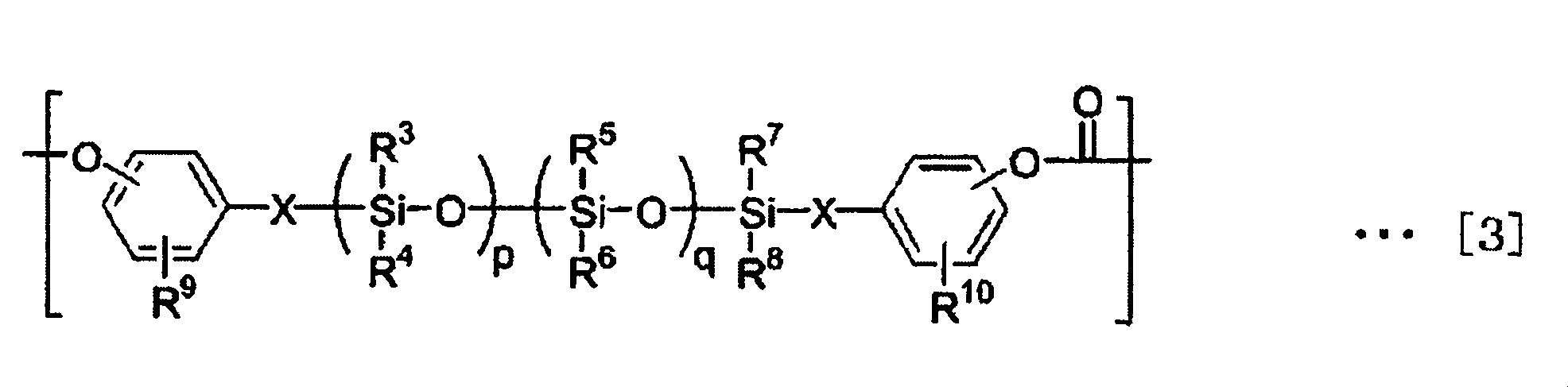
炭素数1~12のアルキル基として、メチル基、エチル基、プロピル基、ブチル基、ペンチル基、ヘキシル基、ヘプチル基、オクチル基、ノニル基、デシル基、ドデシル基等が挙げられる。好ましくは炭素原子数1~6のアルキル基である。炭素数6~12の置換若しくは無置換のアリール基として、フェニル基、ナフチル基等が挙げられる。置換基としてメチル基、エチル基、プロピル基、ブチル基、ペンチル基、ヘキシル基などの炭素数1~12のアルキル基が挙げられる。R3、R4、R5、R6、R7、R8がメチル基であることが好ましい。
R9およびR10は夫々独立して、水素原子、ハロゲン原子、炭素原子数1~10のアルキル基、炭素原子数1~10のアルコキシ基である。Examples of the alkyl group having 1 to 12 carbon atoms include a methyl group, an ethyl group, a propyl group, a butyl group, a pentyl group, a hexyl group, a heptyl group, an octyl group, a nonyl group, a decyl group and a dodecyl group. It is preferably an alkyl group having 1 to 6 carbon atoms. Examples of the substituted or unsubstituted aryl group having 6 to 12 carbon atoms include a phenyl group and a naphthyl group. Examples of the substituent include an alkyl group having 1 to 12 carbon atoms such as a methyl group, an ethyl group, a propyl group, a butyl group, a pentyl group and a hexyl group. It is preferable that R 3 , R 4 , R 5 , R 6 , R 7 , and R 8 are methyl groups.
R 9 and R 10 are independent hydrogen atoms, halogen atoms, alkyl groups having 1 to 10 carbon atoms, and alkoxy groups having 1 to 10 carbon atoms.
ハロゲン原子として、フッ素原子、塩素原子、臭素原子等が挙げられる。炭素原子数1~10のアルキル基として、メチル基、エチル基、プロピル基、ブチル基、ペンチル基、ヘキシル基、ヘプチル基、オクチル基、ノニル基、デシル基、ドデシル基等が挙げられる。好ましくは炭素原子数1~6のアルキル基である。炭素原子数1~10のアルコキシ基として、メトキシ基、エトキシ基、プロポキシ基、ブトキシ基、ペントキシ基、ヘキソキシ基、ヘプトキシ基、オクトキシ基、等が挙げられる。好ましくは炭素原子数1~6のアルキルコキシ基である。 Examples of the halogen atom include a fluorine atom, a chlorine atom, a bromine atom and the like. Examples of the alkyl group having 1 to 10 carbon atoms include a methyl group, an ethyl group, a propyl group, a butyl group, a pentyl group, a hexyl group, a heptyl group, an octyl group, a nonyl group, a decyl group and a dodecyl group. It is preferably an alkyl group having 1 to 6 carbon atoms. Examples of the alkoxy group having 1 to 10 carbon atoms include a methoxy group, an ethoxy group, a propoxy group, a butoxy group, a pentoxy group, a hexoxy group, a heptoxy group, an octoxy group and the like. It is preferably an alkylcoxy group having 1 to 6 carbon atoms.
pは自然数であり、qは0または自然数であり、平均鎖長p+qは30~100の自然数である。平均鎖長p+qは、好ましくは35~90、より好ましくは50~70である。pは好ましくは35~90、より好ましくは50~70である。
qは好ましくは0~80、より好ましくは0~50である。p is a natural number, q is 0 or a natural number, and the average chain length p + q is a natural number of 30-100. The average chain length p + q is preferably 35 to 90, more preferably 50 to 70. p is preferably 35 to 90, more preferably 50 to 70.
q is preferably 0 to 80, more preferably 0 to 50.
平均鎖長p+qが、30~100であれば、低温における耐衝撃性と耐薬品性が十分に得られ、下限より小さい場合は十分な極低温耐衝撃性が発現せず、また、上限より大きい場合は、外観(色ムラ、剥離不良)が悪化する。 When the average chain length p + q is 30 to 100, sufficient impact resistance and chemical resistance at low temperature can be obtained, and when it is smaller than the lower limit, sufficient ultra-low temperature impact resistance is not exhibited and larger than the upper limit. In that case, the appearance (color unevenness, poor peeling) deteriorates.
Xは、炭素数2~8の二価脂肪族基である。二価脂肪族基として、炭素数2~8のアルキレン基が挙げられる。アルキレン基としてエチレン基、トリメチレン基、テトラメチレン基等が挙げられる。 X is a divalent aliphatic group having 2 to 8 carbon atoms. Examples of the divalent aliphatic group include an alkylene group having 2 to 8 carbon atoms. Examples of the alkylene group include an ethylene group, a trimethylene group and a tetramethylene group.
上記式[3]で表されるポリジオルガノシロキサンブロックが(2-アリルフェノール)末端ポリジオルガノシロキサン、もしくは(2-メトキシ-4-アリルフェノール)末端ポリジオルガノシロキサンより誘導されたブロックであることが好ましい。即ち、式[3]においてXがトリメチレン基でR9およびR10が水素原子であるか、もしくはXがトリメチレン基でR9およびR10がメトキシ基であることが好ましい。It is preferable that the polydiorganosiloxane block represented by the above formula [3] is a block derived from a (2-allylphenol) -terminated polydiorganosiloxane or a (2-methoxy-4-allylphenol) -terminated polydiorganosiloxane. .. That is, in the formula [3], it is preferable that X is a trimethylene group and R 9 and R 10 are hydrogen atoms, or X is a trimethylene group and R 9 and R 10 are methoxy groups.
上述のとおり、本発明の共重合体または樹脂組成物中でのポリジオルガノシロキサンブロックの含有量は、2.5~8.0重量%であるものの、PC-POS共重合体が本発明の樹脂組成物に含有される場合に、そのPC-POS共重合体には、この範囲とは異なる含有量でポリジオルガノシロキサンブロックを有していることができる。ポリジオルガノシロキサンブロックの含有量、特に上記[3]で表されるポリジオルガノシロキサンブロックの含有量は、PC-POS共重合体の全重量を基準にして、例えば、3.0~30.0重量%、3.5~20.0重量%、又は4.0~15.0重量%であってもよい。さらに、PC-POS共重合体が本発明の樹脂組成物に含有される場合に、PC-POS共重合体を、4.0~70.0重量%、8.0~60.0重量%、10.0~30.0重量%、又は12.0~25.0重量%であってもよい。このような範囲であれば、極大なドメイン形成が可能であり低温耐衝撃を発現することができ、また、乳化状態を形成できるため重合反応を行うことができ、かつガラス転移温度が適切であるため造粒が可能など、製造面での利点を有する。 As described above, the content of the polydiorganosiloxane block in the copolymer or resin composition of the present invention is 2.5 to 8.0% by weight, but the PC-POS copolymer is the resin of the present invention. When contained in the composition, the PC-POS copolymer may have a polydiorganosiloxane block with a content different from this range. The content of the polydiorganosiloxane block, particularly the content of the polydiorganosiloxane block represented by the above [3], is, for example, 3.0 to 30.0 by weight based on the total weight of the PC-POS copolymer. %, 3.5 to 20.0% by weight, or 4.0 to 15.0% by weight. Further, when the PC-POS copolymer is contained in the resin composition of the present invention, the PC-POS copolymer is contained in an amount of 4.0 to 70.0% by weight, 8.0 to 60.0% by weight, and the like. It may be 10.0 to 30.0% by weight, or 12.0 to 25.0% by weight. Within such a range, maximum domain formation is possible, low-temperature impact resistance can be exhibited, an emulsified state can be formed, so that a polymerization reaction can be carried out, and the glass transition temperature is appropriate. Therefore, it has advantages in terms of manufacturing, such as being able to granulate.
共重合体の粘度平均分子量は、好ましくは5.0×10³~3.5×10⁴、より好ましくは1.0×10⁴~2.5×10⁴、更に好ましくは1.2×10⁴~2.0×10⁴、特に好ましくは1.5×10⁴~1.8×10⁴である。共重合体の粘度平均分子量が、下限未満では、多くの分野において実用上の機械的強度が得られにくく、また混合するポリカーボネート樹脂などとの溶融粘度差が大きいために混練性が悪化し、上限を超えると、溶融粘度が高く、概して高い成形加工温度を必要とするため、樹脂の熱劣化などの不具合や製造時の水洗工程における分離不良による生産性低下を招きやすい。The viscosity average molecular weight of the copolymer is preferably 5.0 × 10 3 to 3.5 × 10 4 , more preferably 1.0 × 10 4 to 2.5 × 10 4 , and even more preferably 1.2 × 10. 4 to 2.0 × 10 4 , particularly preferably 1.5 × 10 4 to 1.8 × 10 4 . If the viscosity average molecular weight of the copolymer is less than the lower limit, it is difficult to obtain practical mechanical strength in many fields, and the difference in melt viscosity with the polycarbonate resin to be mixed is large, so that the kneadability deteriorates and the upper limit is reached. If it exceeds the above, the melt viscosity is high and a high molding processing temperature is generally required, so that problems such as thermal deterioration of the resin and poor separation in the water washing process at the time of manufacturing tend to cause a decrease in productivity.
〈ポリカーボネート樹脂〉
本発明の樹脂組成物において随意に含有されるポリカーボネート樹脂は、本発明の有利な効果を与えることができればその種類は特に限定されない。ポリカーボネート樹脂は、例えば上述のような(A-2)ポリジオルガノシロキサンブロックを含まず、(A-1)ポリカーボネートブロックからなるポリカーボネートであってもよく、また、ポリカーボネート樹脂は、下記一般式[4]で表される二価フェノール(I)から誘導されてもよい。例えば、該二価フェノールとして、例えば、4,4’-ジヒドロキシビフェニル、ビス(4-ヒドロキシフェニル)メタン、1,1-ビス(4-ヒドロキシフェニル)エタン、1,1-ビス(4-ヒドロキシフェニル)-1-フェニルエタン、2,2-ビス(4-ヒドロキシフェニル)プロパン、2,2-ビス(4-ヒドロキシ-3-メチルフェニル)プロパン、1,1-ビス(4-ヒドロキシフェニル)-3,3,5-トリメチルシクロヘキサン、2,2-ビス(4-ヒドロキシ-3,3’-ビフェニル)プロパン、2,2-ビス(4-ヒドロキシ-3-イソプロピルフェニル)プロパン、2,2-ビス(3-t-ブチル-4-ヒドロキシフェニル)プロパン、2,2-ビス(4-ヒドロキシフェニル)ブタン、2,2-ビス(4-ヒドロキシフェニル)オクタン、2,2-ビス(3-ブロモ-4-ヒドロキシフェニル)プロパン、2,2-ビス(3,5-ジメチル-4-ヒドロキシフェニル)プロパン、2,2-ビス(3-シクロヘキシル-4-ヒドロキシフェニル)プロパン、1,1-ビス(3-シクロヘキシル-4-ヒドロキシフェニル)シクロヘキサン、ビス(4-ヒドロキシフェニル)ジフェニルメタン、9,9-ビス(4-ヒドロキシフェニル)フルオレン、9,9-ビス(4-ヒドロキシ-3-メチルフェニル)フルオレン、1,1-ビス(4-ヒドロキシフェニル)シクロヘキサン、1,1-ビス(4-ヒドロキシフェニル)シクロペンタン、4,4’-ジヒドロキシジフェニルエ-テル、4,4’-ジヒドロキシ-3,3’-ジメチルジフェニルエ-テル、4,4’-スルホニルジフェノール、4,4’-ジヒドロキシジフェニルスルホキシド、4,4’-ジヒドロキシジフェニルスルフィド、2,2’-ジメチル-4,4’-スルホニルジフェノール、4,4’-ジヒドロキシ-3,3’-ジメチルジフェニルスルホキシド、4,4’-ジヒドロキシ-3,3’-ジメチルジフェニルスルフィド、2,2’-ジフェニル-4,4’-スルホニルジフェノール、4,4’-ジヒドロキシ-3,3’-ジフェニルジフェニルスルホキシド、4,4’-ジヒドロキシ-3,3’-ジフェニルジフェニルスルフィド、1,3-ビス{2-(4-ヒドロキシフェニル)プロピル}ベンゼン、1,4-ビス{2-(4-ヒドロキシフェニル)プロピル}ベンゼン、1,4-ビス(4-ヒドロキシフェニル)シクロヘキサン、1,3-ビス(4-ヒドロキシフェニル)シクロヘキサン、4,8-ビス(4-ヒドロキシフェニル)トリシクロ[5.2.1.02,6]デカン、4,4’-(1,3-アダマンタンジイル)ジフェノール、1,3-ビス(4-ヒドロキシフェニル)-5,7-ジメチルアダマンタン等が挙げられる。<Polycarbonate resin>
The type of the polycarbonate resin optionally contained in the resin composition of the present invention is not particularly limited as long as it can provide the advantageous effects of the present invention. The polycarbonate resin does not contain, for example, the (A-2) polydiorganosiloxane block as described above, and may be a polycarbonate composed of the (A-1) polycarbonate block, and the polycarbonate resin may be a polycarbonate having the following general formula [4]. It may be derived from the divalent phenol (I) represented by. For example, the divalent phenol includes, for example, 4,4'-dihydroxybiphenyl, bis (4-hydroxyphenyl) methane, 1,1-bis (4-hydroxyphenyl) ethane, 1,1-bis (4-hydroxyphenyl). ) -1-Phenylethane, 2,2-bis (4-hydroxyphenyl) propane, 2,2-bis (4-hydroxy-3-methylphenyl) propane, 1,1-bis (4-hydroxyphenyl) -3 , 3,5-trimethylcyclohexane, 2,2-bis (4-hydroxy-3,3'-biphenyl) propane, 2,2-bis (4-hydroxy-3-isopropylphenyl) propane, 2,2-bis (4,2-bis (4-hydroxy-3-isopropylphenyl) propane) 3-t-butyl-4-hydroxyphenyl) propane, 2,2-bis (4-hydroxyphenyl) butane, 2,2-bis (4-hydroxyphenyl) octane, 2,2-bis (3-bromo-4) -Hydroxyphenyl) propane, 2,2-bis (3,5-dimethyl-4-hydroxyphenyl) propane, 2,2-bis (3-cyclohexyl-4-hydroxyphenyl) propane, 1,1-bis (3-) Cyclohexyl-4-hydroxyphenyl) cyclohexane, bis (4-hydroxyphenyl) diphenylmethane, 9,9-bis (4-hydroxyphenyl) fluorene, 9,9-bis (4-hydroxy-3-methylphenyl) fluorene, 1, 1-bis (4-hydroxyphenyl) cyclohexane, 1,1-bis (4-hydroxyphenyl) cyclopentane, 4,4'-dihydroxydiphenylether, 4,4'-dihydroxy-3,3'-dimethyldiphenyl Ether, 4,4'-sulfonyl diphenol, 4,4'-dihydroxydiphenyl sulfoxide, 4,4'-dihydroxydiphenyl sulfide, 2,2'-dimethyl-4,4'-sulfonyldiphenol, 4,4 '-Dihydroxy-3,3'-dimethyldiphenyl sulfoxide, 4,4'-dihydroxy-3,3'-dimethyldiphenylsulfide, 2,2'-diphenyl-4,4'-sulfonyldiphenol, 4,4'- Dihydroxy-3,3'-diphenyldiphenylsulfoxide, 4,4'-dihydroxy-3,3'-diphenyldiphenylsulfide, 1,3-bis {2- (4-hydroxyphenyl) propyl} benzene, 1,4-bis {2- (4-Hydroxyphenyl) propyl} benzene, 1,4-bis (4-hydroxyphenyl) cyclo Hexane, 1,3-bis (4-hydroxyphenyl) cyclohexane, 4,8-bis (4-hydroxyphenyl) tricyclo [5.2.1.02,6] decane, 4,4'-(1,3-_) Adamantane diyl) diphenol, 1,3-bis (4-hydroxyphenyl) -5,7-dimethyladamantan and the like can be mentioned.
なかでも、1,1-ビス(4-ヒドロキシフェニル)-1-フェニルエタン、2,2-ビス(4-ヒドロキシフェニル)プロパン、2,2-ビス(4-ヒドロキシ-3-メチルフェニル)プロパン、1,1-ビス(4-ヒドロキシフェニル)シクロヘキサン、1,1-ビス(4-ヒドロキシフェニル)-3,3,5-トリメチルシクロヘキサン、4,4’-スルホニルジフェノール、2,2’-ジメチル-4,4’-スルホニルジフェノール、9,9-ビス(4-ヒドロキシ-3-メチルフェニル)フルオレン、1,3-ビス{2-(4-ヒドロキシフェニル)プロピル}ベンゼン、1,4-ビス{2-(4-ヒドロキシフェニル)プロピル}ベンゼンが好ましく、殊に2,2-ビス(4-ヒドロキシフェニル)プロパン、1,1-ビス(4-ヒドロキシフェニル)シクロヘキサン(BPZ)、4,4’-スルホニルジフェノール、9,9-ビス(4-ヒドロキシ-3-メチルフェニル)フルオレンが好ましい。中でも強度に優れ、良好な耐久性を有する2,2-ビス(4-ヒドロキシフェニル)プロパンが最も好適である。また、これらは単独または二種以上組み合わせて用いてもよい。 Among them, 1,1-bis (4-hydroxyphenyl) -1-phenylethane, 2,2-bis (4-hydroxyphenyl) propane, 2,2-bis (4-hydroxy-3-methylphenyl) propane, 1,1-bis (4-hydroxyphenyl) cyclohexane, 1,1-bis (4-hydroxyphenyl) -3,3,5-trimethylcyclohexane, 4,4'-sulfonyldiphenol, 2,2'-dimethyl- 4,4'-sulfonyldiphenol, 9,9-bis (4-hydroxy-3-methylphenyl) fluorene, 1,3-bis {2- (4-hydroxyphenyl) propyl} benzene, 1,4-bis { 2- (4-Hydroxyphenyl) propyl} benzene is preferred, especially 2,2-bis (4-hydroxyphenyl) propane, 1,1-bis (4-hydroxyphenyl) cyclohexane (BPZ), 4,4'-. Sulfonyldiphenol, 9,9-bis (4-hydroxy-3-methylphenyl) fluorene is preferred. Of these, 2,2-bis (4-hydroxyphenyl) propane, which has excellent strength and good durability, is most suitable. Moreover, these may be used individually or in combination of 2 or more types.
〈共重合体および樹脂組成物の組成〉
本発明の共重合体および樹脂組成物は、PC-POS共重合体100~1重量%とポリカーボネート0~99重量%からなる。<Composition of copolymer and resin composition>
The copolymer and resin composition of the present invention are composed of 100 to 1% by weight of a PC-POS copolymer and 0 to 99% by weight of polycarbonate.
本発明におけるポリジオルガノシロキサンブロックの含有量は、樹脂組成物(特に、樹脂組成物の樹脂重量のみ)を基準として、2.5~8.0wt%であり、3.0~7.0wt%が好ましく、3.5~6.5wt%がより好ましい。下限より少ない場合は、十分な極低温耐衝撃性が発現せず、また、上限より多い場合は、外観(色ムラ、剥離不良)の悪化、剛性低下、ガラス転移温度低下、熱曲げ耐性低下など物性面で劣る。 The content of the polydiorganosiloxane block in the present invention is 2.5 to 8.0 wt% and 3.0 to 7.0 wt% based on the resin composition (particularly, only the resin weight of the resin composition). It is preferably 3.5 to 6.5 wt%, more preferably 3.5 to 6.5 wt%. If it is less than the lower limit, sufficient ultra-low temperature impact resistance will not be exhibited, and if it is more than the upper limit, the appearance (color unevenness, poor peeling) will deteriorate, the rigidity will decrease, the glass transition temperature will decrease, and the thermal bending resistance will decrease. Inferior in terms of physical properties.
上記の樹脂組成物の粘度平均分子量は、11,000~30,000が好ましく、12,000~25,000がより好ましい。11,000より小さい場合は、十分な低温耐衝撃性が発現せず、また、上限値より大きい場合は、溶液粘度増加による生産性低下や成形流動性不足などが生じる。 The viscosity average molecular weight of the above resin composition is preferably 11,000 to 30,000, more preferably 12,000 to 25,000. If it is smaller than 11,000, sufficient low-temperature impact resistance is not exhibited, and if it is larger than the upper limit, productivity decreases due to an increase in solution viscosity and insufficient molding fluidity occurs.
〈ポリジオルガノシロキサンのドメインサイズ〉
本発明におけるPC-POS共重合体は、ポリカーボネートポリマーのマトリックス中にポリジオルガノシロキサンドメインが分散した凝集構造を有する。<Domain size of polydiorganosiloxane>
The PC-POS copolymer in the present invention has an aggregated structure in which polydiorganosiloxane domains are dispersed in a matrix of a polycarbonate polymer.
なお、本発明におけるポリジオルガノシロキサンドメインとは、ポリカーボネートのマトリックス中に分散したポリジオルガノシロキサンを主成分とするドメインをいい、他の成分を含んでもよい。上述の如く、ポリジオルガノシロキサンドメインは、マトリックスたるポリカーボネートとの相分離により構造が形成されることから、必ずしも単一の成分から構成されない。 The polydiorganosiloxane domain in the present invention refers to a domain containing polydiorganosiloxane dispersed in a matrix of polycarbonate as a main component, and may contain other components. As described above, the polydiorganosiloxane domain is not necessarily composed of a single component because the structure is formed by phase separation from the matrix polycarbonate.
本発明において、電子線顕微鏡(以下TEMと称することがある)を用いた共重合体又はその樹脂組成物の断面観察像において、850nm四方(722,500nm2)の領域に最大長径が80nm以上ポリジオルガノシロキサンドメインが1~20個存在し、好ましくは2~20、さらに好ましくは4~20、もっとも好ましくは5~20個存在することである。最大長径が80nm以上ポリジオルガノシロキサンドメインが1つもない場合は十分な極低温耐衝撃性が発現せず、20個以上ある場合は、外観が悪化し(色ムラ、剥離不良)、また極低温衝撃性も低下する。さらに本発明において、最大長径が400nm以上ポリジオルガノシロキサンドメインが、5枚の試料切片のいずれにも、850nm四方(722,500nm2)の領域に1つも存在しないことが好ましい。ドメインの平均サイズが30~100nmの範囲である場合には、最大長径が400nm以上ポリジオルガノシロキサンドメインは存在しないが、これが1つ以上存在する場合は、外観(色ムラ、剥離不良)と耐薬品性の両方が低下する傾向にある。また、これらの範囲外である場合には、難燃性についても悪化する場合がある。In the present invention, in a cross-sectional observation image of a copolymer or a resin composition thereof using an electron beam microscope (hereinafter sometimes referred to as TEM), a polydi having a maximum major axis of 80 nm or more in a region of 850 nm square (722,500 nm 2 ). There are 1 to 20 organosiloxane domains, preferably 2 to 20, more preferably 4 to 20, and most preferably 5 to 20. When the maximum major axis is 80 nm or more, sufficient ultra-low temperature impact resistance is not exhibited when there is no polydiorganosiloxane domain, and when there are 20 or more, the appearance deteriorates (color unevenness, peeling failure), and ultra-low temperature impact. Sex also declines. Further, in the present invention, it is preferable that no polydiorganosiloxane domain having a maximum major axis of 400 nm or more is present in the region of 850 nm square (722,500 nm 2 ) in any of the five sample sections. When the average size of the domain is in the range of 30 to 100 nm, there is no polydiorganosiloxane domain with a maximum major axis of 400 nm or more, but when one or more of them are present, the appearance (color unevenness, poor peeling) and chemical resistance Both sexes tend to decline. In addition, if it is out of these ranges, the flame retardancy may be deteriorated.
また、本発明におけるポリジオルガノシロキサンドメインの平均サイズは、30~100nm又は45nm超100nm以下であり、好ましくは40~80nm、より好ましくは50~70nmである。 The average size of the polydiorganosiloxane domain in the present invention is 30 to 100 nm or more than 45 nm and 100 nm or less, preferably 40 to 80 nm, and more preferably 50 to 70 nm.
かかる平均サイズの下限は、好ましくは、30nmであり、より好ましくは、40nmであり、特に好ましくは、50nmである。かかる平均サイズの上限は、好ましくは100nm、より好ましくは、80nm、特に好ましくは、70nmである。かかる範囲の下限未満では、耐衝撃性や耐薬品性が十分に発揮されず、かかる範囲の上限を超えると外観が悪化し(色ムラ、剥離不良)、耐薬品性も低下する。 The lower limit of the average size is preferably 30 nm, more preferably 40 nm, and particularly preferably 50 nm. The upper limit of the average size is preferably 100 nm, more preferably 80 nm, and particularly preferably 70 nm. If it is less than the lower limit of such a range, impact resistance and chemical resistance are not sufficiently exhibited, and if it exceeds the upper limit of such a range, the appearance is deteriorated (color unevenness, peeling failure), and the chemical resistance is also lowered.
本発明における共重合体成形品のポリジオルガノシロキサンドメインの最大長径は、電子線顕微鏡を用いた850nm四方(722,500nm2)の樹脂組成物断面観察像において評価される。The maximum major axis of the polydiorganosiloxane domain of the copolymer molded product in the present invention is evaluated in a cross-sectional observation image of a resin composition of 850 nm square (722,500 nm 2 ) using an electron beam microscope.
本発明における共重合体成形品のポリジオルガノシロキサンドメインの平均ドメインサイズとは、個々のドメインサイズの数平均を意味する。 The average domain size of the polydiorganosiloxane domain of the copolymer molded product in the present invention means the number average of the individual domain sizes.
本発明において、用いる用語「ドメインの最大長径」、「平均ドメインサイズ」は射出成形により形成される厚み4.0mmの成形片から薄片切片を切り出し、TEMにより観察した測定値を示す。 In the present invention, the terms "maximum major axis of domain" and "average domain size" used indicate a measured value obtained by cutting a thin section from a molded piece having a thickness of 4.0 mm formed by injection molding and observing it by TEM.
具体的には、射出成形により作製した幅10mm、長さ80mm、厚み4.0mmの成形片を用いて成形片のゲートから15mmの箇所をミクロトームを用いて室温で薄片切片を切り出し、TEMにより倍率20,000倍で観察を行い、得られたTEM写真を画像解析ソフトWin ROOF Ver.6.6(三谷商事(株))を用いて粒子解析を行い、試料薄片中のポリジオルガノシロキサンドメインの平均サイズおよび粒径分布(頻度分布)を得た。ここで各ドメインのサイズとして最大長径(粒子の外側輪郭線上の任意の2点を、その間の長さが最大になるように選んだ時の長さ)を利用した。5枚の試料切片で同様の解析を行い、その平均値を各試料の値としたものである。 Specifically, using a molded piece having a width of 10 mm, a length of 80 mm, and a thickness of 4.0 mm produced by injection molding, a thin section is cut out at room temperature at a position 15 mm from the gate of the molded piece using a microtome, and a magnification is obtained by TEM. Observation was performed at a magnification of 20,000, and the obtained TEM photograph was used in the image analysis software Win ROOF Ver. Particle analysis was performed using 6.6 (Mitani Shoji Co., Ltd.) to obtain the average size and particle size distribution (frequency distribution) of the polydiorganosiloxane domain in the sample flakes. Here, the maximum major axis (the length when any two points on the outer contour line of the particle are selected so that the length between them is maximized) is used as the size of each domain. The same analysis was performed on five sample sections, and the average value was taken as the value of each sample.
(ポリジオルガノシロキサン)
本発明においては、特定の平均鎖長のポリジオルガノシロキサンを原料として用いる。すなわち、下記一般式[5]で表されるヒドロキシアリール末端ポリジオルガノシロキサン(II)で表され、かつ、平均鎖長p+qは、30~100であり、35~90が好ましく、50~70がより好ましい。(Polydiorganosiloxane)
In the present invention, polydiorganosiloxane having a specific average chain length is used as a raw material. That is, it is represented by the hydroxyaryl-terminated polydiorganosiloxane (II) represented by the following general formula [5], and the average chain length p + q is 30 to 100, preferably 35 to 90, more preferably 50 to 70. preferable.

平均鎖長p+qが30より小さい場合は、十分な極低温耐衝撃性が発現せず、また、上限値より大きい場合は、外観が悪化する(色ムラ、剥離不良)。また、かかる特定の鎖長範囲を満足するために異なる2種類またはそれ以上の、平均鎖長p+qを有するヒドロキシアリール末端ポリジオルガノシロキサン(II)原料を混合して調製しても良い。その場合、平均鎖長p+qが1以上60未満のポリジオルガノシロキサン(X-1)かつ、平均鎖長p+qが60以上200以下のポリジオルガノシロキサン(X-2)とを原料として用いる。ポリジオルガノシロキサン原料の混合調製の方法としては、末端をヒドロキシアリール変性させた適当なポリジオルガノシロキサン原料同士を混合する方法でも、末端をヒドロキシアリール変性させる前の適当な平均鎖長を有するポリジオルガノシロキサン前駆体同士を予め混合した後に、末端をヒドロキシアリール変性させる方法のどちらでも良い。該ポリジオルガノシロキサン原料と、二価フェノール及びポリカーボネート前駆体とを反応させて得られるPC-POS共重合体におけるポリジオルガノシロキサンブロックの平均鎖長p+qは、上記した通り好ましくは30~100、より好ましくは35~90、さらに好ましくは50~70となる。該平均鎖長p+qは核磁気共鳴(NMR)測定により算出される。 When the average chain length p + q is smaller than 30, sufficient ultra-low temperature impact resistance is not exhibited, and when it is larger than the upper limit, the appearance deteriorates (color unevenness, peeling failure). Further, in order to satisfy such a specific chain length range, two or more different types of hydroxyaryl-terminated polydiorganosiloxane (II) raw materials having an average chain length p + q may be mixed and prepared. In that case, a polydiorganosiloxane (X-1) having an average chain length p + q of 1 or more and less than 60 and a polydiorganosiloxane (X-2) having an average chain length p + q of 60 or more and 200 or less are used as raw materials. As a method for mixing and preparing polydiorganosiloxane raw materials, a method of mixing appropriate polydiorganosiloxane raw materials having hydroxyaryl-modified ends can also be used, as well as polydiorganosiloxane having an appropriate average chain length before hydroxyaryl-denaturing the ends. Either of the methods of premixing the precursors with each other and then denaturing the terminal with hydroxyaryl may be used. The average chain length p + q of the polydiorganosiloxane block in the PC-POS copolymer obtained by reacting the polydiorganosiloxane raw material with a dihydric phenol and a polycarbonate precursor is preferably 30 to 100, more preferably 30 to 100, as described above. Is 35 to 90, more preferably 50 to 70. The average chain length p + q is calculated by nuclear magnetic resonance (NMR) measurement.
上記ポリジオルガノシロキサン(X-1)とポリジオルガノシロキサン(X-2)と混合する場合は、(X-1):(X-2)質量比=1:99~99:1の割合で用いることが好ましく、より好ましくは10:90~90:10の割合で用いる。 When mixing the polydiorganosiloxane (X-1) and the polydiorganosiloxane (X-2), use at a ratio of (X-1) :( X-2) mass ratio = 1: 99 to 99: 1. Is preferable, and more preferably, it is used in a ratio of 10:90 to 90:10.
ポリジオルガノシロキサン原料として、上記ポリジオルガノシロキサン(X-1)と(X-2)とを予め配合して得られるポリジオルガノシロキサン(X)を用いることがより好ましく、この配合比は、上述した(X-1):(X-2)質量比と同様に、好ましくは質量比1:99~99:1であり、より好ましくは10:90~90:10である。 As the polydiorganosiloxane raw material, it is more preferable to use polydiorganosiloxane (X) obtained by preliminarily blending the above-mentioned polydiorganosiloxane (X-1) and (X-2), and the blending ratio is described above ( Similar to the X-1): (X-2) mass ratio, the mass ratio is preferably 1:99 to 99: 1, and more preferably 10:90 to 90:10.
予め配合する場合は、上記ポリジオルガノシロキサン(X-1)の平均鎖長p+qの下限は、好ましくは1以上であり、より好ましくは20以上であり、さらに好ましくは30以上であり、上限は、好ましくは60未満であり、より好ましくは50未満であり、さらに好ましくは45未満である。上記ポリジオルガノシロキサン(X-2)の平均鎖長p+qの下限は、好ましくは60以上であり、より好ましくは70以上であり、さらに好ましくは90以上であり、上限は、好ましくは200以下であり、より好ましくは100以下である。一般式[5]で表されるヒドロキシアリール末端ポリジオルガノシロキサン(II)としては、例えば次に示すような化合物が好適に用いられる。 When premixed, the lower limit of the average chain length p + q of the polydiorganosiloxane (X-1) is preferably 1 or more, more preferably 20 or more, still more preferably 30 or more, and the upper limit is. It is preferably less than 60, more preferably less than 50, and even more preferably less than 45. The lower limit of the average chain length p + q of the polydiorganosiloxane (X-2) is preferably 60 or more, more preferably 70 or more, further preferably 90 or more, and the upper limit is preferably 200 or less. , More preferably 100 or less. As the hydroxyaryl-terminated polydiorganosiloxane (II) represented by the general formula [5], for example, the following compounds are preferably used.
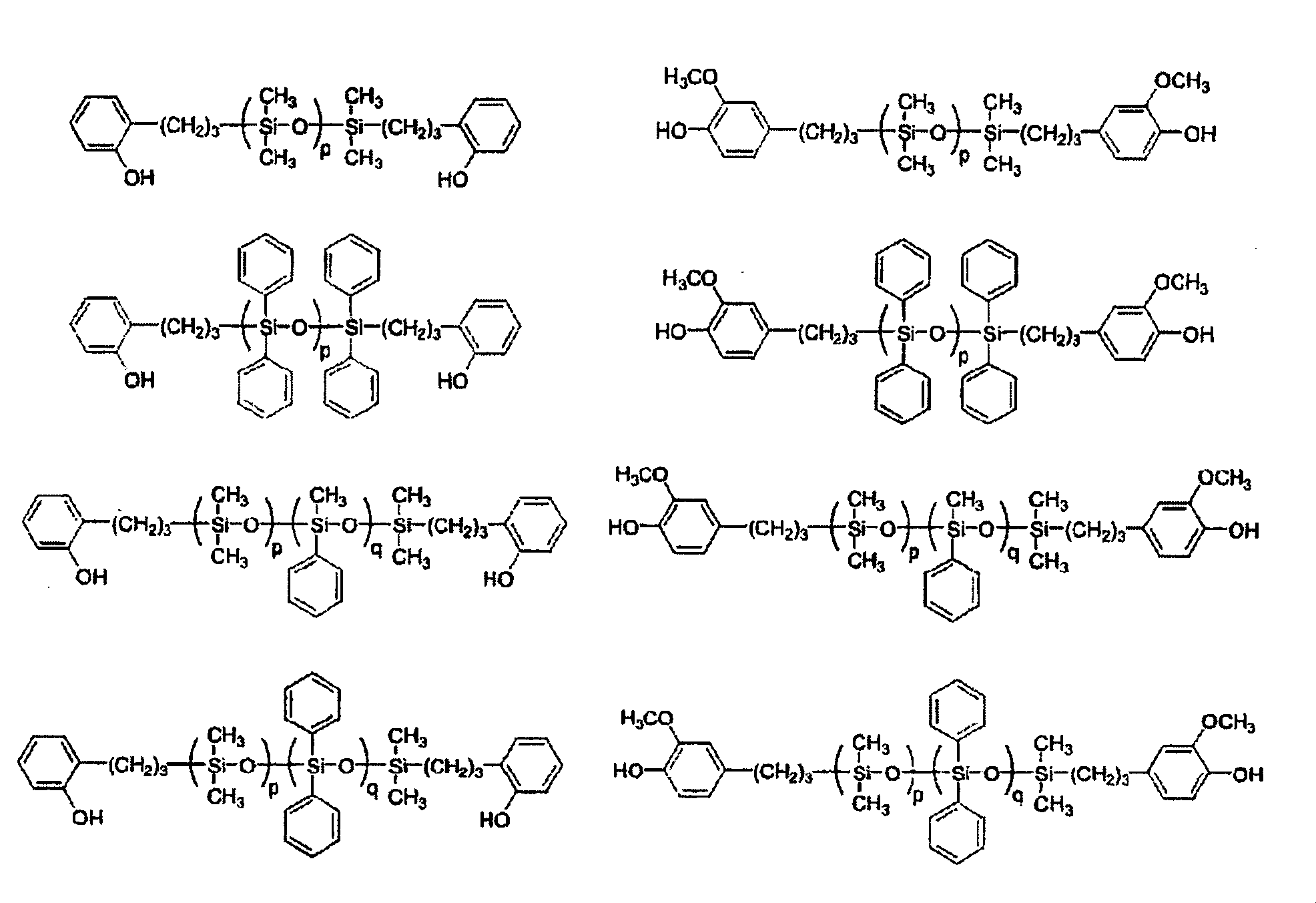
ヒドロキシアリール末端ポリジオルガノシロキサン(II)は、オレフィン性の不飽和炭素-炭素結合を有するフェノール類であり、好適にはビニルフェノール、2-アリルフェノール、イソプロペニルフェノール、2-メトキシ-4-アリルフェノールを所定の重合度を有するポリシロキサン鎖の末端に、ハイドロシリレーション反応させることにより容易に製造される。なかでも、(2-アリルフェノール)末端ポリジオルガノシロキサン、(2-メトキシ-4-アリルフェノール)末端ポリジオルガノシロキサンが好ましく、殊に(2-アリルフェノール)末端ポリジメチルシロキサン、(2-メトキシ-4-アリルフェノール)末端ポリジメチルシロキサンが好ましい。 The hydroxyaryl-terminated polydiorganosiloxane (II) is a phenol having an olefinic unsaturated carbon-carbon bond, and is preferably vinylphenol, 2-allylphenol, isopropenylphenol, 2-methoxy-4-allylphenol. Is easily produced by subjecting to a hydrosyllation reaction at the end of a polysiloxane chain having a predetermined degree of polymerization. Of these, (2-allylphenol) -terminated polydiorganosiloxane and (2-methoxy-4-allylphenol) -terminated polydiorganosiloxane are preferable, and (2-allylphenol) -terminated polydimethylsiloxane and (2-methoxy-4) are particularly preferable. -Allylphenol) -terminated polydimethylsiloxane is preferred.
《PC-POS共重合体の製造方法》
本発明におけるPC-POS共重合体は、工程(a)および工程(b)により製造することができる。<< Production method of PC-POS copolymer >>
The PC-POS copolymer in the present invention can be produced by the steps (a) and (b).
なお、本明細書において、「二価フェノール(I)」等は、ポリカーボネートブロックをもたらすことができる前駆体であり、「二価フェノール(II)」等は、ポリジオルガノシロキサンブロックをもたらすことができる前駆体である。 In the present specification, "divalent phenol (I)" and the like are precursors that can bring about a polycarbonate block, and "divalent phenol (II)" and the like can bring about a polydiorganosiloxane block. It is a precursor.
〈工程(a)〉
工程(a)は、水に不溶性の有機溶媒とアルカリ水溶液との混合液中において、下記式[4]で表わされる二価フェノール(I)とホスゲンとを反応させ、末端クロロホーメート基を有するカーボネートオリゴマーを含有する溶液を調製する工程である。<Step (a)>
In the step (a), the divalent phenol (I) represented by the following formula [4] is reacted with phosgene in a mixed solution of an organic solvent insoluble in water and an alkaline aqueous solution, and has a terminal chlorohomate group. This is a step of preparing a solution containing a carbonate oligomer.

式[4]で表される二価フェノール(I)としては、例えば、1,1-ビス(4-ヒドロキシフェニル)-1-フェニルエタン、2,2-ビス(4-ヒドロキシフェニル)プロパン、2,2-ビス(4-ヒドロキシ-3-メチルフェニル)プロパン、1,1-ビス(4-ヒドロキシフェニル)シクロヘキサン、1,1-ビス(4-ヒドロキシフェニル)-3,3,5-トリメチルシクロヘキサン、4,4’-スルホニルジフェノール、2,2’-ジメチル-4,4’-スルホニルジフェノール、9,9-ビス(4-ヒドロキシ-3-メチルフェニル)フルオレン、1,3-ビス{2-(4-ヒドロキシフェニル)プロピル}ベンゼン、および1,4-ビス{2-(4-ヒドロキシフェニル)プロピル}ベンゼンが好ましい。 Examples of the dihydric phenol (I) represented by the formula [4] include 1,1-bis (4-hydroxyphenyl) -1-phenylethane, 2,2-bis (4-hydroxyphenyl) propane, and 2 , 2-bis (4-hydroxy-3-methylphenyl) propane, 1,1-bis (4-hydroxyphenyl) cyclohexane, 1,1-bis (4-hydroxyphenyl) -3,3,5-trimethylcyclohexane, 4,4'-sulfonyldiphenol, 2,2'-dimethyl-4,4'-sulfonyldiphenol, 9,9-bis (4-hydroxy-3-methylphenyl) fluorene, 1,3-bis {2- (4-Hydroxyphenyl) propyl} benzene and 1,4-bis {2- (4-hydroxyphenyl) propyl} benzene are preferred.
殊に2,2-ビス(4-ヒドロキシフェニル)プロパン、1,1-ビス(4-ヒドロキシフェニル)シクロヘキサン(BPZ)、4,4’-スルホニルジフェノール、および9,9-ビス(4-ヒドロキシ-3-メチルフェニル)フルオレンが好ましい。中でも強度に優れ、良好な耐久性を有する2,2-ビス(4-ヒドロキシフェニル)プロパンが最も好適である。また、これらは単独または二種以上組み合わせて用いてもよい。 In particular 2,2-bis (4-hydroxyphenyl) propane, 1,1-bis (4-hydroxyphenyl) cyclohexane (BPZ), 4,4'-sulfonyldiphenol, and 9,9-bis (4-hydroxy). -3-Methylphenyl) Fluorene is preferred. Of these, 2,2-bis (4-hydroxyphenyl) propane, which has excellent strength and good durability, is most suitable. Moreover, these may be used individually or in combination of 2 or more types.
本発明のPC-POS共重合体の製造方法としては、80nm以上の粗大ドメインを形成させるためにポリジオルガノシロキサンを高濃度で、末端クロロホーメート基を有するカーボネートオリゴマーと反応させることが効果的で、それによってシロキサンブロツクの含有量が少ない領域で従来にない分散状態を発現させることができる。 As a method for producing the PC-POS copolymer of the present invention, it is effective to react polydiorganosiloxane at a high concentration with a carbonate oligomer having a terminal chlorohomate group in order to form a coarse domain of 80 nm or more. As a result, it is possible to develop an unprecedented dispersed state in a region where the content of the siloxane block is low.
さらに上述した通り、特定の平均鎖長のポリジオルガノシロキサンを原料として用い、ヒドロキシアリール末端ポリジオルガノシロキサン(II)は1種のみを用いてもよく、また、2種以上を用いてもよい。 Further, as described above, a polydiorganosiloxane having a specific average chain length may be used as a raw material, and only one type of hydroxyaryl-terminated polydiorganosiloxane (II) may be used, or two or more types may be used.
具体的には、下記一般式[5]で表されるヒドロキシアリール末端ポリジオルガノシロキサン(II)で表され、かつ、平均鎖長p+qが30~100となる原料を用いる。また、かかる特定の鎖長範囲を満足するために異なる2種類またはそれ以上の、平均鎖長p+qを有するヒドロキシアリール末端ポリジオルガノシロキサン(II)原料を混合して使用しても良い。 Specifically, a raw material represented by the hydroxyaryl-terminated polydiorganosiloxane (II) represented by the following general formula [5] and having an average chain length p + q of 30 to 100 is used. Further, in order to satisfy such a specific chain length range, two or more different hydroxyaryl-terminated polydiorganosiloxane (II) raw materials having an average chain length p + q may be mixed and used.
その場合には、平均鎖長p+qが1以上60未満のポリジオルガノシロキサン(X-1)と、平均鎖長p+qが60以上200以下のポリジオルガノシロキサン(X-2)とを原料として用いること、あるいは、末端をヒドロキシアリール変性させる前の適当な平均鎖長を有するポリジオルガノシロキサン前駆体同士を予め混合した後に、末端をヒドロキシアリール変性させて得られた原料を用いることが好ましい。 In that case, a polydiorganosiloxane (X-1) having an average chain length p + q of 1 or more and less than 60 and a polydiorganosiloxane (X-2) having an average chain length p + q of 60 or more and 200 or less are used as raw materials. Alternatively, it is preferable to use a raw material obtained by premixing polydiorganosiloxane precursors having an appropriate average chain length before hydroxyaryl modification at the ends and then hydroxyaryl modification at the ends.
さらに、カーボネート前駆体及び二価フェノールと反応させる前に、前記ポリジオルガノシロキサン(X-1)と前記ポリジオルガノシロキサン(X-2)とを予め配合しても良く、あらかじめ配合せずに並行して反応溶液へ投入、または(X-1)および(X-2)を分割して逐次的に反応溶液へ投入してカーボネート前駆体及び二価フェノールと反応させても良い。 Further, the polydiorganosiloxane (X-1) and the polydiorganosiloxane (X-2) may be pre-blended before the reaction with the carbonate precursor and the dihydric phenol, and the polydiorganosiloxane (X-2) may be blended in parallel without pre-blending. It may be added to the reaction solution, or (X-1) and (X-2) may be divided and sequentially added to the reaction solution to react with the carbonate precursor and the divalent phenol.
より好ましくは、前記ポリジオルガノシロキサン(X-1)を反応溶液へ投入した後、前記ポリジオルガノシロキサン(X-2)を反応溶液へ投入して、カーボネート前駆体及び二価フェノールと反応させることが、製造工程設備簡略化による効率化・コスト効果、および耐衝撃性向上に寄与する80nm以上のドメイン形成に有利な面で望ましい。 More preferably, after the polydiorganosiloxane (X-1) is added to the reaction solution, the polydiorganosiloxane (X-2) can be added to the reaction solution to react with the carbonate precursor and the divalent phenol. It is desirable in terms of efficiency and cost effectiveness by simplifying the manufacturing process equipment, and advantageous for domain formation of 80 nm or more, which contributes to improvement of impact resistance.
前記ポリジオルガノシロキサン(X-2)を最後に単独で入れることで、ポリマー鎖への平均鎖長の大きなポリジオルガノシロキサンブロックの局所導入が進みやすく、80nm以上のドメイン形成に有利に働くと考えられる。いずれの場合においても、ヒドロキシアリール末端ポリジオルガノシロキサン(II)は可能な限り時間をかけずに反応溶液に投入するのが望ましく、一度に投入することが好ましい。 It is considered that by adding the polydiorganosiloxane (X-2) alone at the end, the local introduction of the polydiorganosiloxane block having a large average chain length into the polymer chain is facilitated, which is advantageous for domain formation of 80 nm or more. .. In any case, it is desirable to add the hydroxyaryl-terminated polydiorganosiloxane (II) to the reaction solution in the shortest possible time, and it is preferable to add it all at once.
ヒドロキシアリール末端ポリジオルガノシロキサン(II)をより高濃度状態で反応させることでポリマー鎖への平均鎖長の大きなポリジオルガノシロキサンブロックの局所導入が進みやすく、80nm以上のドメイン形成に有利に働くと考えられる。原料として用いるポリジオルガノシロキサン(X-1)と(X-2)との質量比は上述した通りであり、カーボネート前駆体及び二価フェノールについては後述する。 By reacting the hydroxyaryl-terminated polydiorganosiloxane (II) at a higher concentration, the local introduction of the polydiorganosiloxane block having a large average chain length into the polymer chain is likely to proceed, which is considered to be advantageous for domain formation of 80 nm or more. Be done. The mass ratio of polydiorganosiloxane (X-1) and (X-2) used as a raw material is as described above, and the carbonate precursor and divalent phenol will be described later.
そして、80nm以上の粗大ドメインを形成させるためには、本発明のPC-POS共重合体を得る界面重縮合法において、[4]および式[5]で表される二価フェノールの総量1モル当たり水に不溶性の有機溶媒は、8モル以上11モル未満が好ましく、8~9.5モルがより好ましい。 Then, in order to form a coarse domain of 80 nm or more, in the interfacial polycondensation method for obtaining the PC-POS copolymer of the present invention, the total amount of dihydric phenol represented by [4] and the formula [5] is 1 mol. The amount of the organic solvent insoluble in water is preferably 8 mol or more and less than 11 mol, more preferably 8 to 9.5 mol.
ここで、該二価フェノールの総量とは、ボリカーボネートの原料であるビスフェノールとポリジオルガノシロキサンモノマーとの合計量を意味する。 Here, the total amount of the divalent phenol means the total amount of bisphenol, which is a raw material of borage carbonate, and polydiorganosiloxane monomer.
また、該不溶性の有機溶媒量とは、触媒を添加して重縮合反応を開始した時点までに用いた合計量であり、ポリカーボネートオリゴマーの製造時に使用した量、ポリジオルガノシロキサンモノマーおよび末端停止剤の溶解に使用した量、界面重縮合反応時の乳化状態を調整するため追加する量の合計量である。 The amount of the insoluble organic solvent is the total amount used up to the time when the catalyst was added and the polycondensation reaction was started, and the amount used in the production of the polycarbonate oligomer, the polydiorganosiloxane monomer and the terminal terminator. The total amount used for dissolution and the amount added to adjust the emulsified state during the intercondensation reaction.
本発明のPC-POS共重合体を得る界面重縮合法において、[4]および式[5]で表される二価フェノールの総量1モル当たり水に不溶性の有機溶媒が、下限未満の場合は重合時の乳化状態悪化によりポリマー品質が低下し、また溶液粘度が高過ぎるため生産性も低下、上限を超えた場合は、80nm以上のドメイン形成が不十分であり極低温耐衝撃性が発現しない。さらに、かかるカーボネート前駆体及び二価フェノールとポリジオルガノシロキサンの反応進行後、すぐに水に不溶性の有機溶媒を添加してもよい。具体的には用いたポリジオルガノシロキサンのうち、反応溶液中の未反応のポリジオルガノシロキサンの比率が10%以下となったところで、水に不溶性の有機溶媒を式[4]および式[5]で表される二価フェノールの総量1モル当たり2モル以上添加することが望ましい。これにより、十分な反応進行度を確保しつつ、高濃度化によるポリマー成分の析出リスクも抑えることが可能である。 In the interfacial polycondensation method for obtaining the PC-POS copolymer of the present invention, when the amount of the organic solvent insoluble in water per 1 mol of the total amount of the divalent phenol represented by [4] and [5] is less than the lower limit The quality of the polymer deteriorates due to the deterioration of the emulsified state during polymerization, and the productivity also decreases because the solution viscosity is too high. .. Further, an organic solvent insoluble in water may be added immediately after the reaction of the carbonate precursor and the divalent phenol with the polydiorganosiloxane. Specifically, when the ratio of unreacted polydiorganosiloxane in the reaction solution to the polydiorganosiloxane used was 10% or less, a water-insoluble organic solvent was used in the formulas [4] and [5]. It is desirable to add 2 mol or more per 1 mol of the total amount of the represented divalent phenol. As a result, it is possible to suppress the risk of precipitation of polymer components due to high concentration while ensuring a sufficient degree of reaction progress.
また、本発明の製造方法の妨げにならない範囲で、上記二価フェノール(I)、ヒドロキシアリール末端ポリジオルガノシロキサン(II)以外の他のコモノマーを共重合体の全重量に対して10重量%以下の範囲で併用することもできる。 Further, to the extent that it does not interfere with the production method of the present invention, 10% by weight or less of other comonomer other than the above divalent phenol (I) and hydroxyaryl-terminated polydiorganosiloxane (II) is added to the total weight of the copolymer. It can also be used together within the range of.
本発明の製造方法においては、あらかじめ水に不溶性の有機溶媒とアルカリ水溶液との混合液中における二価フェノール(I)と炭酸エステル形成性化合物の反応により末端クロロホルメート基を有するオリゴマーを含む混合溶液を調製する。 In the production method of the present invention, a mixture containing an oligomer having a terminal chloroformate group by the reaction of the dihydric phenol (I) and the carbonic acid ester-forming compound in a mixed solution of an organic solvent insoluble in water and an alkaline aqueous solution in advance. Prepare the solution.
二価フェノール(I)のオリゴマーを生成するにあたり、本発明の方法に用いられる二価フェノール(I)の全量を一度にオリゴマーにしてもよく、又は、その一部を後添加モノマーとして後段の界面重縮合反応に反応原料として添加してもよい。後添加モノマーとは、後段の重縮合反応を速やかに進行させるために加えるものであり、必要のない場合には敢えて加える必要はない。 In producing the oligomer of divalent phenol (I), the entire amount of divalent phenol (I) used in the method of the present invention may be used as an oligomer at one time, or a part thereof may be used as a post-added monomer at the subsequent interface. It may be added as a reaction raw material to the polycondensation reaction. The post-added monomer is added in order to rapidly proceed with the polycondensation reaction in the subsequent stage, and it is not necessary to dare to add it when it is not necessary.
このオリゴマー生成反応の方式は特に限定はされないが、通常、酸結合剤の存在下、溶媒中で行う方式が好適である。 The method of this oligomer-forming reaction is not particularly limited, but a method performed in a solvent in the presence of an acid binder is usually preferable.
炭酸エステル形成性化合物の使用割合は、反応の化学量論比(当量)を考慮して適宜調整すればよい。また、ホスゲン等のガス状の炭酸エステル形成性化合物を使用する場合、これを反応系に吹き込む方法が好適に採用できる。 The ratio of the carbonic acid ester-forming compound to be used may be appropriately adjusted in consideration of the stoichiometric ratio (equivalent) of the reaction. Further, when a gaseous carbonic acid ester-forming compound such as phosgene is used, a method of blowing it into the reaction system can be preferably adopted.
前記酸結合剤としては、例えば、水酸化ナトリウム、水酸化カリウム等のアルカリ金属水酸化物、炭酸ナトリウム、炭酸カリウム等のアルカリ金属炭酸塩、ピリジン等の有機塩基あるいはこれらの混合物などが用いられる。 As the acid binder, for example, alkali metal hydroxides such as sodium hydroxide and potassium hydroxide, alkali metal carbonates such as sodium carbonate and potassium carbonate, organic bases such as pyridine, and mixtures thereof are used.
酸結合剤の使用割合も、上記同様に、反応の化学量論比(当量)を考慮して適宜定めればよい。具体的には、オリゴマーの形成に使用する二価フェノール(I)のモル数(通常1モルは2当量に相当)に対して2当量若しくはこれより若干過剰量の酸結合剤を用いることが好ましい。 Similarly to the above, the ratio of the acid binder used may be appropriately determined in consideration of the stoichiometric ratio (equivalent) of the reaction. Specifically, it is preferable to use 2 equivalents or a slightly excess amount of the acid binder with respect to the number of moles of divalent phenol (I) used for forming the oligomer (usually 1 mol corresponds to 2 equivalents). ..
前記溶媒としては、公知のポリカーボネートの製造に使用されるものなど各種の反応に不活性な溶媒を1種単独であるいは混合溶媒として使用すればよい。代表的な例としては、例えば、キシレン等の炭化水素溶媒、塩化メチレン、クロロベンゼンをはじめとするハロゲン化炭化水素溶媒などが挙げられる。特に塩化メチレン等のハロゲン化炭化水素溶媒が好適に用いられる。 As the solvent, a solvent inert to various reactions such as those used for producing a known polycarbonate may be used alone or as a mixed solvent. Typical examples include hydrocarbon solvents such as xylene, halogenated hydrocarbon solvents such as methylene chloride and chlorobenzene, and the like. In particular, a halogenated hydrocarbon solvent such as methylene chloride is preferably used.
オリゴマー生成の反応圧力は特に制限はなく、常圧、加圧、減圧のいずれでもよいが、通常常圧下で反応を行うことが有利である。反応温度は-20~50℃の範囲から選ばれ、多くの場合、重合に伴い発熱するので、水冷又は氷冷することが望ましい。反応時間は他の条件に左右され一概に規定できないが、通常、0.2~10時間で行われる。 The reaction pressure for forming the oligomer is not particularly limited and may be normal pressure, pressurization or reduced pressure, but it is usually advantageous to carry out the reaction under normal pressure. The reaction temperature is selected from the range of −20 to 50 ° C., and in many cases, heat is generated with the polymerization, so it is desirable to cool with water or ice. The reaction time depends on other conditions and cannot be unconditionally defined, but is usually 0.2 to 10 hours.
オリゴマー生成反応のpH範囲は、公知の界面反応条件と同様であり、pHは常に10以上に調製される。 The pH range of the oligomer-forming reaction is the same as that of known interfacial reaction conditions, and the pH is always adjusted to 10 or more.
本発明はこのようにして、末端クロロホルメート基を有する二価フェノール(I)のオリゴマーを含む混合溶液を得た後、該混合溶液を攪拌しながら前記ヒドロキシアリール末端ポリジオルガノシロキサン(II)を二価フェノール(I)に加え、該ヒドロキシアリール末端ポリジオルガノシロキサン(II)と該オリゴマーを界面重縮合させることによりPC-POS共重合体を得る。 In the present invention, after obtaining a mixed solution containing an oligomer of divalent phenol (I) having a terminal chloroformate group in this way, the hydroxyaryl-terminal polydiorganosiloxane (II) is prepared while stirring the mixed solution. A PC-POS copolymer is obtained by supercondensing the hydroxyaryl-terminated polydiorganosiloxane (II) with the oligomer in addition to the divalent phenol (I).
界面重縮合反応を行うにあたり、酸結合剤を反応の化学量論比(当量)を考慮して適宜追加してもよい。酸結合剤としては、例えば、水酸化ナトリウム、水酸化カリウム等のアルカリ金属水酸化物、炭酸ナトリウム、炭酸カリウム等のアルカリ金属炭酸塩、ピリジン等の有機塩基あるいはこれらの混合物などが用いられる。具体的には、使用するヒドロキシアリール末端ポリジオルガノシロキサン(II)、又は上記の如く二価フェノール(I)の一部を後添加モノマーとしてこの反応段階に添加する場合には、後添加分の二価フェノール(I)とヒドロキシアリール末端ポリジオルガノシロキサン(II)との合計モル数(通常1モルは2当量に相当)に対して2当量若しくはこれより過剰量のアルカリを用いることが好ましい。 In carrying out the interfacial polycondensation reaction, an acid binder may be added as appropriate in consideration of the stoichiometric ratio (equivalent) of the reaction. As the acid binder, for example, alkali metal hydroxides such as sodium hydroxide and potassium hydroxide, alkali metal carbonates such as sodium carbonate and potassium carbonate, organic bases such as pyridine, and mixtures thereof are used. Specifically, when a part of the hydroxyaryl-terminated polydiorganosiloxane (II) to be used or a divalent phenol (I) as described above is added as a post-addition monomer to this reaction step, the post-addition amount is two. It is preferable to use 2 equivalents or an excess amount of alkali with respect to the total number of moles of the valent phenol (I) and the hydroxyaryl-terminated polydiorganosiloxane (II) (usually 1 mol corresponds to 2 equivalents).
二価フェノール(I)のオリゴマーとヒドロキシアリール末端ポリジオルガノシロキサン(II)との界面重縮合反応による重縮合は、上記混合液を激しく攪拌することにより行われる。 Polycondensation by the interfacial polycondensation reaction between the oligomer of divalent phenol (I) and the hydroxyaryl-terminated polydiorganosiloxane (II) is performed by vigorously stirring the above mixture.
かかる重合反応においては、末端停止剤或いは分子量調節剤が通常使用される。末端停止剤としては一価のフェノール性水酸基を有する化合物が挙げられ、通常のフェノール、p-tert-ブチルフェノール、p-クミルフェノール、トリブロモフェノールなどの他に、長鎖アルキルフェノール、脂肪族カルボン酸クロライド、脂肪族カルボン酸、ヒドロキシ安息香酸アルキルエステル、ヒドロキシフェニルアルキル酸エステル、アルキルエーテルフェノールなどが例示される。その使用量は用いる全ての二価フェノール系化合物100モルに対して、100~0.5モル、好ましくは50~2モルの範囲であり、二種以上の化合物を併用することも当然に可能である。 In such a polymerization reaction, a terminal terminator or a molecular weight modifier is usually used. Examples of the terminal terminator include compounds having a monovalent phenolic hydroxyl group, and in addition to ordinary phenols, p-tert-butylphenols, p-cumylphenols, tribromophenols, etc., long-chain alkylphenols and aliphatic carboxylic acids Examples thereof include chloride, aliphatic carboxylic acid, hydroxybenzoic acid alkyl ester, hydroxyphenyl alkyl acid ester, and alkyl ether phenol. The amount used is in the range of 100 to 0.5 mol, preferably 50 to 2 mol, with respect to 100 mol of all the divalent phenolic compounds used, and it is naturally possible to use two or more kinds of compounds in combination. be.
重縮合反応を促進するために、トリエチルアミンのような第三級アミン又は第四級アンモニウム塩などの触媒を添加してもよい。 A catalyst such as a tertiary amine such as triethylamine or a quaternary ammonium salt may be added to promote the polycondensation reaction.
かかる重合反応の反応時間は、未反応ポリジオルガノシロキサン成分を低減するためには比較的長くする必要がある。好ましくは30分以上、更に好ましくは50分以上である。一方、長時間の反応溶液の撹拌によってポリマーの析出が発生し得るため、好ましくは180分以下、更に好ましくは90分以下である。 The reaction time of such a polymerization reaction needs to be relatively long in order to reduce the unreacted polydiorganosiloxane component. It is preferably 30 minutes or longer, more preferably 50 minutes or longer. On the other hand, since precipitation of the polymer may occur by stirring the reaction solution for a long time, it is preferably 180 minutes or less, more preferably 90 minutes or less.
所望に応じ、亜硫酸ナトリウム、ハイドロサルファイドなどの酸化防止剤を少量添加してもよい。 If desired, a small amount of an antioxidant such as sodium sulfite or hydrosulfide may be added.
また、本発明の共重合体は、分岐化剤を上記の二価フェノール系化合物と併用して分岐化共重合体とすることができる。かかる分岐共重合体に使用される三官能以上の多官能性芳香族化合物としては、フロログルシン、フロログルシド、または4,6-ジメチル-2,4,6-トリス(4-ヒドロキジフェニル)ヘプテン-2、2,4,6-トリメチル-2,4,6-トリス(4-ヒドロキシフェニル)ヘプタン、1,3,5-トリス(4-ヒドロキシフェニル)ベンゼン、1,1,1-トリス(4-ヒドロキシフェニル)エタン、1,1,1-トリス(3,5-ジメチル-4-ヒドロキシフェニル)エタン、2,6-ビス(2-ヒドロキシ-5-メチルベンジル)-4-メチルフェノール、4-{4-[1,1-ビス(4-ヒドロキシフェニル)エチル]ベンゼン}-α,α-ジメチルベンジルフェノール等のトリスフェノール、テトラ(4-ヒドロキシフェニル)メタン、ビス(2,4-ジヒドロキシフェニル)ケトン、1,4-ビス(4,4-ジヒドロキシトリフェニルメチル)ベンゼン、またはトリメリット酸、ピロメリット酸、ベンゾフェノンテトラカルボン酸およびこれらの酸クロライド等が挙げられ、中でも1,1,1-トリス(4-ヒドロキシフェニル)エタン、1,1,1-トリス(3,5-ジメチル-4-ヒドロキシフェニル)エタンが好ましく、特に1,1,1-トリス(4-ヒドロキシフェニル)エタンが好ましい。 Further, the copolymer of the present invention can be made into a branched copolymer by using a branching agent in combination with the above-mentioned divalent phenolic compound. Examples of the trifunctional or higher polyfunctional aromatic compound used in such a branched copolymer include fluoroglucolcin, fluorogluside, or 4,6-dimethyl-2,4,6-tris (4-hydrochidiphenyl) heptene-2, 2,4,6-trimethyl-2,4,6-tris (4-hydroxyphenyl) heptane, 1,3,5-tris (4-hydroxyphenyl) benzene, 1,1,1-tris (4-hydroxyphenyl) ) Etan, 1,1,1-tris (3,5-dimethyl-4-hydroxyphenyl) ethane, 2,6-bis (2-hydroxy-5-methylbenzyl) -4-methylphenol, 4- {4- [1,1-bis (4-hydroxyphenyl) ethyl] benzene} -α, trisphenol such as α-dimethylbenzylphenol, tetra (4-hydroxyphenyl) methane, bis (2,4-dihydroxyphenyl) ketone, 1 , 4-Bis (4,4-dihydroxytriphenylmethyl) benzene, or trimellitic acid, pyromellitic acid, benzophenone tetracarboxylic acid and their acid chlorides, among others 1,1,1-tris (4-1,1-tris). Hydroxyphenyl) ethane and 1,1,1-tris (3,5-dimethyl-4-hydroxyphenyl) ethane are preferable, and 1,1,1-tris (4-hydroxyphenyl) ethane is particularly preferable.
反応圧力は、減圧、常圧、加圧のいずれでも可能であるが、通常は、常圧若しくは反応系の自圧程度で好適に行い得る。反応温度は-20~50℃の範囲から選ばれ、多くの場合、重合に伴い発熱するので、水冷又は氷冷することが望ましい。反応時間は反応温度等の他の条件によって異なるので一概に規定はできないが、通常、0.5~10時間で行われる。 The reaction pressure can be reduced pressure, normal pressure, or pressurization, but usually, normal pressure or the self-pressure of the reaction system can be preferably used. The reaction temperature is selected from the range of −20 to 50 ° C., and in many cases, heat is generated with the polymerization, so it is desirable to cool with water or ice. Since the reaction time varies depending on other conditions such as the reaction temperature, it cannot be unconditionally specified, but it is usually carried out in 0.5 to 10 hours.
場合により、得られたポリカーボネート共重合体に適宜物理的処理(混合、分画など)及び/又は化学的処理(ポリマー反応、架橋処理、部分分解処理など)を施して所望の還元粘度[ηSP/c]のポリカーボネート共重合体として取得することもできる。In some cases, the obtained polycarbonate copolymer is appropriately subjected to physical treatment (mixing, fractionation, etc.) and / or chemical treatment (polymer reaction, cross-linking treatment, partial decomposition treatment, etc.) to obtain a desired reduced viscosity [η SP . / C] can also be obtained as a polycarbonate copolymer.
得られた反応生成物(粗生成物)は公知の分離精製法等の各種の後処理を施して、所望の純度(精製度)のPC-POS共重合体として回収することができる。 The obtained reaction product (crude product) can be recovered as a PC-POS copolymer having a desired purity (degree of purification) by subjecting various post-treatments such as known separation and purification methods.
また、本発明のPC-POS共重合体は、本発明の効果を損なわない範囲で通常のポリカーボネート樹脂組成物に配合される各種の難燃剤、強化充填材、添加剤を配合することができる。 Further, the PC-POS copolymer of the present invention can contain various flame retardants, reinforcing fillers and additives which are blended in a normal polycarbonate resin composition as long as the effects of the present invention are not impaired.
〈B成分:難燃剤〉
本発明のB成分として使用される難燃剤としては従来、熱可塑性樹脂、特に芳香族ポリカーボネート樹脂の難燃剤として知られる各種の化合物が適用できるが、より好適には、(b1)有機金属塩系難燃剤(例えば有機スルホン酸アルカリ(土類)金属塩、ホウ酸金属塩系難燃剤、および錫酸金属塩系難燃剤など、(b2)有機リン系難燃剤(例えば、モノホスフェート化合物、ホスフェートオリゴマー化合物ホスホネートオリゴマー化合物、ホスホニトリルオリゴマー化合物、およびホスホン酸アミド化合物など)、(b3)シリコーン化合物からなるシリコーン系難燃剤である。尚、難燃剤として使用される化合物の配合は難燃性の向上のみならず、各化合物の性質に基づき、例えば帯電防止性、流動性、剛性、および熱安定性の向上などがもたらされる。<B component: flame retardant>
As the flame retardant used as the component B of the present invention, various compounds known as flame retardants of thermoplastic resins, particularly aromatic polycarbonate resins, can be applied, but more preferably (b1) an organic metal salt system. (B2) Organic phosphorus flame retardants (eg, monophosphate compounds, phosphate oligomers) such as flame retardants (eg, organic sulfonic acid alkali (earth) metal salts, borate metal salt flame retardants, and tin acid metal salt flame retardants). Compound A silicone-based flame retardant consisting of a phosphonate oligomer compound, a phosphonitrile oligomer compound, a phosphonic acid amide compound, etc.), and (b3) a silicone compound. The compound used as the flame retardant only improves flame retardancy. However, based on the properties of each compound, for example, improvements in antistatic properties, fluidity, rigidity, and thermal stability are brought about.
B成分の含有量はA成分100重量部に対し、0.001~20重量部であり、好ましくは0.01~15重量部、より好ましくは0.05~10重量部である。B成分の含有量が0.001重量部未満の場合、難燃性を維持できず、20重量部を超えた場合、耐衝撃性および難燃性が満足できない。 The content of the B component is 0.001 to 20 parts by weight, preferably 0.01 to 15 parts by weight, and more preferably 0.05 to 10 parts by weight with respect to 100 parts by weight of the A component. If the content of the B component is less than 0.001 part by weight, the flame retardancy cannot be maintained, and if it exceeds 20 parts by weight, the impact resistance and the flame retardancy cannot be satisfied.
〈難燃剤-有機金属塩系難燃剤〉
有機金属塩系難燃剤は、耐熱性がほぼ維持される点で有利である。本発明において最も有利に使用される有機金属塩系難燃剤は、スルホン酸アルカリ(土類)金属塩である。その中でも好ましいのはフッ素置換有機スルホン酸のアルカリ(土類)金属塩であり、特に好ましいのはパーフルオロアルキル基を有するスルホン酸のアルカリ(土類)金属塩である。ここでパーフルオロアルキル基の炭素数は、1~18の範囲が好ましく、1~10の範囲がより好ましく、更に好ましくは1~8の範囲である。<Flame Retardant-Organometallic Salt Flame Retardant>
Organometallic salt flame retardants are advantageous in that heat resistance is almost maintained. The organic metal salt flame retardant used most advantageously in the present invention is an alkali sulfonic acid (earth) metal salt. Among them, an alkali (earth) metal salt of a fluorine-substituted organic sulfonic acid is preferable, and an alkali (earth) metal salt of a sulfonic acid having a perfluoroalkyl group is particularly preferable. Here, the number of carbon atoms of the perfluoroalkyl group is preferably in the range of 1 to 18, more preferably in the range of 1 to 10, and even more preferably in the range of 1 to 8.
フッ素置換有機スルホン酸アルカリ(土類)金属塩の金属イオンを構成する金属は、アルカリ金属あるいはアルカリ土類金属であり、アルカリ金属としてはリチウム、ナトリウム、カリウム、ルビジウムおよびセシウムが挙げられ、アルカリ土類金属としては、ベリリウム、マグネシウム、カルシウム、ストロンチウムおよびバリウムが挙げられる。より好適にはアルカリ金属である。したがって好適な有機金属塩系難燃剤は、パーフルオロアルキルスルホン酸アルカリ金属塩である。かかるアルカリ金属の中でも、透明性の要求がより高い場合にはルビジウムおよびセシウムが好適である一方、これらは汎用的でなくまた精製もし難いことから、結果的にコストの点で不利となる場合がある。一方、コストや難燃性の点で有利であるがリチウムおよびナトリウムは逆に透明性の点で不利な場合がある。これらを勘案してパーフルオロアルキルスルホン酸アルカリ金属塩中のアルカリ金属を使い分けることができるが、いずれの点においても特性のバランスに優れたパーフルオロアルキルスルホン酸カリウム塩が最も好適である。かかるカリウム塩と他のアルカリ金属からなるパーフルオロアルキルスルホン酸アルカリ金属塩とを併用することもできる。 The metal constituting the metal ion of the fluorine-substituted organic sulfonic acid alkali (earth) metal salt is an alkali metal or an alkaline earth metal, and examples of the alkali metal include lithium, sodium, potassium, rubidium and cesium, and alkaline soil. Metals include beryllium, magnesium, calcium, strontium and barium. More preferably, it is an alkali metal. Therefore, a suitable organic metal salt flame retardant is a perfluoroalkyl sulfonic acid alkali metal salt. Among such alkali metals, rubidium and cesium are suitable when the demand for transparency is higher, but they are not versatile and difficult to purify, which may result in a cost disadvantage. be. On the other hand, although it is advantageous in terms of cost and flame retardancy, lithium and sodium may be disadvantageous in terms of transparency. In consideration of these, the alkali metal in the perfluoroalkyl sulfonic acid alkali metal salt can be used properly, but in all respects, the perfluoroalkyl sulfonic acid potassium salt having an excellent balance of characteristics is most preferable. It is also possible to use such a potassium salt in combination with a perfluoroalkylsulfonic acid alkali metal salt composed of another alkali metal.
かかるパーフルオロアルキルスルホン酸アルカリ金属塩としては、トリフルオロメタンスルホン酸カリウム、パーフルオロブタンスルホン酸カリウム、パーフルオロヘキサンスルホン酸カリウム、パーフルオロオクタンスルホン酸カリウム、ペンタフルオロエタンスルホン酸ナトリウム、パーフルオロブタンスルホン酸ナトリウム、パーフルオロオクタンスルホン酸ナトリウム、トリフルオロメタンスルホン酸リチウム、パーフルオロブタンスルホン酸リチウム、パーフルオロヘプタンスルホン酸リチウム、トリフルオロメタンスルホン酸セシウム、パーフルオロブタンスルホン酸セシウム、パーフルオロオクタンスルホン酸セシウム、パーフルオロヘキサンスルホン酸セシウム、パーフルオロブタンスルホン酸ルビジウム、およびパーフルオロヘキサンスルホン酸ルビジウム等が挙げられ、これらは1種もしくは2種以上を併用して使用することができる。これらの中で特にパーフルオロブタンスルホン酸カリウムが好ましい。 Examples of such perfluoroalkylsulfonic acid alkali metal salts include potassium trifluoromethanesulfonate, potassium perfluorobutanesulfonate, potassium perfluorohexanesulfonate, potassium perfluorooctanesulfonate, sodium pentafluoroethanesulfonate, and perfluorobutanesulfon. Sodium acid, sodium perfluorooctane sulfonate, lithium trifluoromethanesulfonate, lithium perfluorobutane sulfonate, lithium perfluoroheptane sulfonate, cesium trifluoromethanesulfonate, cesium perfluorobutane sulfonate, cesium perfluorooctane sulfonate, Examples thereof include cesium perfluorohexanesulfonate, rubidium perfluorobutane sulfonate, rubidium perfluorohexanesulfonate, and the like, and these can be used alone or in combination of two or more. Of these, potassium perfluorobutanesulfonate is particularly preferable.
上記の有機金属塩系難燃剤はイオンクロマトグラフィー法により測定した弗化物イオンの含有量が好ましくは50ppm以下、より好ましくは20ppm以下、更に好ましくは10ppm以下である。弗化物イオンの含有量が低いほど、難燃性や耐光性が良好となる。弗化物イオンの含有量の下限は実質的に0とすることも可能であるが、精製工数と効果との兼ね合いから実用的には0.2ppm程度が好ましい。かかる弗化物イオンの含有量のパーフルオロアルキルスルホン酸アルカリ金属塩は例えば次のように精製される。パーフルオロアルキルスルホン酸アルカリ金属塩を、該金属塩の2~10重量倍のイオン交換水に、40~90℃(より好適には60~85℃)の範囲において溶解させる。該パーフルオロアルキルスルホン酸アルカリ金属塩は、パーフルオロアルキルスルホン酸をアルカリ金属の炭酸塩または水酸化物で中和する方法、もしくはパーフルオロアルキルスルホニルフルオライドをアルカリ金属の炭酸塩または水酸化物で中和する方法により(より好適には後者の方法により)生成される。また該イオン交換水は、特に好適には電気抵抗値が18MΩ・cm以上である水である。金属塩を溶解した液を上記温度下で0.1~3時間、より好適には0.5~2.5時間撹拌する。その後該液を0~40℃、より好適に10~35℃の範囲に冷却する。冷却により結晶が析出する。析出した結晶をろ過によって取り出す。これにより好適な精製されたパーフルオロアルキルスルホン酸アルカリ金属塩が製造される。
The above-mentioned organic metal salt flame retardant has a fluoride ion content of preferably 50 ppm or less, more preferably 20 ppm or less, still more preferably 10 ppm or less as measured by an ion chromatography method. The lower the content of fluoride ions, the better the flame retardancy and light resistance. The lower limit of the fluoride ion content can be substantially 0, but practically about 0.2 ppm is preferable from the viewpoint of the balance between the purification man-hours and the effect. The perfluoroalkyl sulfonic acid alkali metal salt having such a fluoride ion content is purified as follows, for example. The perfluoroalkylsulfonic acid alkali metal salt is dissolved in ion-exchanged
難燃剤としてフッ素置換有機スルホン酸アルカリ(土類)金属塩を使用する場合、その配合量は、A成分100重量部に対して、好ましくは0.01~1.0重量部、より好ましくは0.05~0.8重量部、更に好ましくは0.08~0.6重量部である。かかる好ましい範囲であるほどフッ素置換有機スルホン酸アルカリ(土類)金属塩の配合により期待される効果(例えば難燃性や帯電防止性など)が発揮される。 When a fluorine-substituted organic sulfonic acid alkali (earth) metal salt is used as the flame retardant, the blending amount thereof is preferably 0.01 to 1.0 part by weight, more preferably 0 with respect to 100 parts by weight of the A component. It is 0.05 to 0.8 parts by weight, more preferably 0.08 to 0.6 parts by weight. The more preferable the range, the more the expected effect (for example, flame retardancy, antistatic property, etc.) is exhibited by blending the fluorine-substituted organic sulfonic acid alkali (earth) metal salt.
フッ素置換有機スルホン酸アルカリ(土類)金属塩以外の有機金属塩系難燃剤としては、フッ素原子を含有しない有機スルホン酸の金属塩が好適である。該金属塩としては、例えば脂肪族スルホン酸のアルカリ金属塩、脂肪族スルホン酸のアルカリ土類金属塩、芳香族スルホン酸のアルカリ金属塩、および芳香族スルホン酸のアルカリ土類金属塩等(いずれもフッ素原子を含有しない)が挙げられる。 As the organic metal salt-based flame retardant other than the fluorine-substituted organic sulfonic acid alkali (earth) metal salt, a metal salt of an organic sulfonic acid containing no fluorine atom is suitable. Examples of the metal salt include an alkali metal salt of an aliphatic sulfonic acid, an alkaline earth metal salt of an aliphatic sulfonic acid, an alkali metal salt of an aromatic sulfonic acid, an alkaline earth metal salt of an aromatic sulfonic acid, and the like (either Also does not contain a fluorine atom).
脂肪族スルホン酸金属塩の好ましい例としては、アルキルスルホン酸アルカリ(土類)金属塩を挙げることができ、これらは1種もしくは2種以上を併用して使用することができる(ここで、アルカリ(土類)金属塩の表記は、アルカリ金属塩、アルカリ土類金属塩のいずれも含む意味で使用する)。かかるアルキルスルホン酸アルカリ(土類)金属塩に使用するアルカンスルホン酸の好ましい例としては、メタンスルホン酸、エタンスルホン酸、プロパンスルホン酸、ブタンスルホン酸、メチルブタンスルホン酸、ヘキサンスルホン酸、へプタンスルホン酸、オクタンスルホン酸等が挙げられ、これらは1種もしくは2種以上を併用して使用することができる。 Preferred examples of the aliphatic sulfonic acid metal salt include an alkyl sulfonic acid alkali (earth) metal salt, which can be used alone or in combination of two or more (here, alkali). (Earth) The notation of metal salt is used to mean that both alkali metal salt and alkaline earth metal salt are included). Preferred examples of the alkane sulfonic acid used for such an alkyl sulfonic acid alkali (earth) metal salt are methane sulfonic acid, ethane sulfonic acid, propane sulfonic acid, butane sulfonic acid, methyl butane sulfonic acid, hexane sulfonic acid, and heptane. Examples thereof include sulfonic acid and octane sulfonic acid, and these can be used alone or in combination of two or more.
芳香族スルホン酸アルカリ(土類)金属塩に使用する芳香族スルホン酸としては、モノマー状またはポリマー状の芳香族サルファイドのスルホン酸、芳香族カルボン酸およびエステルのスルホン酸、モノマー状またはポリマー状の芳香族エーテルのスルホン酸、芳香族スルホネートのスルホン酸、モノマー状またはポリマー状の芳香族スルホン酸、モノマー状またはポリマー状の芳香族スルホンスルホン酸、芳香族ケトンのスルホン酸、複素環式スルホン酸、芳香族スルホキサイドのスルホン酸、芳香族スルホン酸のメチレン型結合による縮合体からなる群から選ばれた少なくとも1種の酸を挙げることができ、これらは1種もしくは2種以上を併用して使用することができる。 Aromatic sulfonic acid The aromatic sulfonic acid used for the alkali (earth) metal salt is a monomeric or polymer-like aromatic sulfate sulfonic acid, an aromatic carboxylic acid and ester sulfonic acid, a monomer-like or polymer-like sulfonic acid. Aromatic ether sulfonic acid, aromatic sulfonate sulfonic acid, monomeric or polymer aromatic sulfonic acid, monomeric or polymer aromatic sulfonic acid, aromatic ketone sulfonic acid, heterocyclic sulfonic acid, Examples thereof include at least one acid selected from the group consisting of aromatic sulfoxide sulfonic acid and a condensate of aromatic sulfonic acid methylene type bond, and these may be used alone or in combination of two or more. be able to.
芳香族スルホン酸アルカリ(土類)金属塩の具体例としては、例えばジフェニルサルファイド-4,4’-ジスルホン酸ジナトリウム、ジフェニルサルファイド-4,4’-ジスルホン酸ジカリウム、5-スルホイソフタル酸カリウム、5-スルホイソフタル酸ナトリウム、ポリエチレンテレフタル酸ポリスルホン酸ポリナトリウム、1-メトキシナフタレン-4-スルホン酸カルシウム、4-ドデシルフェニルエーテルジスルホン酸ジナトリウム、ポリ(2,6-ジメチルフェニレンオキシド)ポリスルホン酸ポリナトリウム、ポリ(1,3-フェニレンオキシド)ポリスルホン酸ポリナトリウム、ポリ(1,4-フェニレンオキシド)ポリスルホン酸ポリナトリウム、ポリ(2,6-ジフェニルフェニレンオキシド)ポリスルホン酸ポリカリウム、ポリ(2-フルオロ-6-ブチルフェニレンオキシド)ポリスルホン酸リチウム、ベンゼンスルホネートのスルホン酸カリウム、ベンゼンスルホン酸ナトリウム、ベンゼンスルホン酸ストロンチウム、ベンゼンスルホン酸マグネシウム、p-ベンゼンジスルホン酸ジカリウム、ナフタレン-2,6-ジスルホン酸ジカリウム、ビフェニル-3,3’-ジスルホン酸カルシウム、ジフェニルスルホン-3-スルホン酸ナトリウム、ジフェニルスルホン-3-スルホン酸カリウム、ジフェニルスルホン-3,3’-ジスルホン酸ジカリウム、ジフェニルスルホン-3,4’-ジスルホン酸ジカリウムな、α,α,α-トリフルオロアセトフェノン-4-スルホン酸ナトリウム、ベンゾフェノン-3,3’-ジスルホン酸ジカリウム、チオフェン-2,5-ジスルホン酸ジナトリウム、チオフェン-2,5-ジスルホン酸ジカリウム、チオフェン-2,5-ジスルホン酸カルシウム、ベンゾチオフェンスルホン酸ナトリウム、ジフェニルスルホキサイド-4-スルホン酸カリウム、ナフタレンスルホン酸ナトリウムのホルマリン縮合物、およびアントラセンスルホン酸ナトリウムのホルマリン縮合物などを挙げることができる。 Specific examples of the aromatic sulfonic acid alkali (earth) metal salt include, for example, diphenylsulfide-4,4'-disodium disulfonate, diphenylsulfide-4,4'-dipotassium disulfonate, potassium 5-sulfoisophthalate, and the like. Sodium 5-sulfoisophthalate, polysodium polyethyleneterephthalate polysulfonate, 1-methoxynaphthalene-4-calchonate calcium, 4-dodecylphenyl ether disulphonate disodium, poly (2,6-dimethylphenylene oxide) polysulphonate polysulfate , Poly (1,3-phenylene oxide) polysulfonate polysodium, poly (1,4-phenylene oxide) polysulfonate polysodium, poly (2,6-diphenylphenylene oxide) polysulphonate polypotassium, poly (2-fluoro- 6-Butylphenylene oxide) Lithium polysulfonate, potassium sulfonate benzenesulfonate, sodium benzenesulfonate, strontium benzenesulfonate, magnesium benzenesulfonate, dipotassium p-benzenedisulfonate, naphthalene-2,6-dipotassium disulfonate, biphenyl -3,3'-calcium disulfonic acid, sodium diphenylsulfon-3-sulfonate, potassium diphenylsulfon-3-sulfonate, diphenylsulfon-3,3'-dipotassium disulfonate, diphenylsulfon-3,4'-disulfonic acid Dipotassium, α, α, α-trifluoroacetophenone-4-sodium sulfonate, benzophenone-3,3'-dipotassium disulfonate, disophene-2,5-dissulfonate, dipotassium thiophene-2,5-disulfonate , Calcium thiophene-2,5-disulfonate, sodium benzothiophene sulfonate, potassium diphenylsulfoxide-4-sulfonate, formalin condensate of sodium naphthalene sulfonate, formalin condensate of sodium anthracene sulfonate, etc. Can be done.
フッ素原子を含有しない有機スルホン酸の金属塩の中でも、芳香族スルホン酸アルカリ(土類)金属塩が好ましく、特にカリウム塩が好適である。難燃剤としてかかる芳香族スルホン酸アルカリ(土類)金属塩を配合する場合、その含有量は、A成分100重量部に対して、好ましくは0.01~1重量部であり、より好ましくは0.05~0.8重量部、更に好ましくは0.08~0.6重量部である。 Among the metal salts of organic sulfonic acid containing no fluorine atom, an aromatic sulfonic acid alkali (earth) metal salt is preferable, and a potassium salt is particularly preferable. When such an aromatic sulfonic acid alkali (earth) metal salt is blended as a flame retardant, the content thereof is preferably 0.01 to 1 part by weight, more preferably 0, with respect to 100 parts by weight of the A component. It is 0.05 to 0.8 parts by weight, more preferably 0.08 to 0.6 parts by weight.
〈難燃剤-有機リン系難燃剤〉
本発明の有機リン系難燃剤としては、ホスフェート化合物、特にアリールホスフェート化合物が好適である。かかるホスフェート化合物は難燃性の向上に効果的であり、かつホスフェート化合物は可塑化効果があるため、耐熱性の低下はあるものの、本発明の樹脂組成物の成形加工性を高められる点で有利である。かかるホスフェート化合物は、従来難燃剤として公知の各種ホスフェート化合物が使用できるが、より好適には特に下記一般式[6]で表される1種または2種以上のホスフェート化合物を挙げることができる。<Flame Retardant-Organophosphorus Flame Retardant>
As the organophosphorus flame retardant of the present invention, a phosphate compound, particularly an aryl phosphate compound, is suitable. Since the phosphate compound is effective in improving flame retardancy and the phosphate compound has a plasticizing effect, it is advantageous in that the molding processability of the resin composition of the present invention can be improved, although the heat resistance is lowered. Is. As such a phosphate compound, various phosphate compounds conventionally known as flame retardants can be used, and more preferably, one or more kinds of phosphate compounds represented by the following general formula [6] can be mentioned.

上記式[6]のホスフェート化合物は、異なるn数を有する化合物の混合物であってもよく、かかる混合物の場合、平均のn数は好ましくは0.5~1.5、より好ましくは0.8~1.2、更に好ましくは0.95~1.15、特に好ましくは1~1.14の範囲である。
The phosphate compound of the above formula [6] may be a mixture of compounds having different n numbers, and in the case of such a mixture, the average n number is preferably 0.5 to 1.5, more preferably 0.8. It is in the range of ~ 1.2, more preferably 0.95 to 1.15, and particularly preferably 1 to 1.14.
上記式[6]のYを誘導する二価フェノールの好適な具体例としては、レゾルシノール、ビスフェノールA、およびジヒドロキシジフェニルで、中でも好ましくはレゾルシノール、ビスフェノールAである。 Preferable specific examples of the divalent phenol that induces Y in the above formula [6] are resorcinol, bisphenol A, and dihydroxydiphenyl, and among them, resorcinol and bisphenol A are preferable.
上記式[6]のR21、R22、R23、およびR24を誘導する一価フェノールの好適な具体例としては、フェノール、クレゾール、キシレノール、2,6-ジメチルフェノールで、中でも好ましくはフェノール、および2,6-ジメチルフェノールである。Preferable specific examples of the monovalent phenol that induces R 21 , R 22 , R 23 , and R 24 of the above formula [6] are phenol, cresol, xylenol, and 2,6-dimethylphenol, and among them, phenol is preferable. , And 2,6-dimethylphenol.
上記式[6]のホスフェート化合物の具体例としては、トリフェニルホスフェートおよびトリ(2,6-キシリル)ホスフェートなどのモノホスフェート化合物、並びにレゾルシノールビスジ(2,6-キシリル)ホスフェート)を主体とするホスフェートオリゴマー、4,4-ジヒドロキシジフェニルビス(ジフェニルホスフェート)を主体とするホスフェートオリゴマー、およびビスフェノールAビス(ジフェニルホスフェート)を主体とするリン酸エステルオリゴマーが好適で、中でもレゾルシノールビスジ(2,6-キシリル)ホスフェート)を主体とするホスフェートオリゴマー、4,4-ジヒドロキシジフェニルビス(ジフェニルホスフェート)を主体とするホスフェートオリゴマー、およびビスフェノールAビス(ジフェニルホスフェート)を主体とするリン酸エステルオリゴマーが好ましい。 Specific examples of the phosphate compound of the above formula [6] include monophosphate compounds such as triphenyl phosphate and tri (2,6-kisilyl) phosphate, and resorcinol bisdi (2,6-kisilyl) phosphate). Phosphate oligomers, phosphate oligomers mainly composed of 4,4-dihydroxydiphenylbis (diphenylphosphate), and phosphate ester oligomers mainly composed of bisphenol A bis (diphenylphosphate) are preferable, among which resorcinol bisdi (2,6- Phosphate oligomers mainly composed of xsilyl) phosphate), phosphate oligomers mainly composed of 4,4-dihydroxydiphenylbis (diphenylphosphate), and phosphoric acid ester oligomers mainly composed of bisphenol A bis (diphenylphosphate) are preferable.
他の有機リン系難燃剤としてはホスファゼンがあげられる。ホスファゼンは分子中にリン原子と窒素原子とを含有することにより、樹脂組成物に難燃性を付与することができる。ホスファゼンは、ハロゲン原子を含まず、分子中にホスファゼン構造を持つ化合物であれば特に限定されない。ここでいうホスファゼン構造とは、式:-P(R)=N-[式中、Rは有機基]で表される構造を表す。ホスファゼン化合物は一般式[7]、[8]で表される。 Another organophosphorus flame retardant is phosphazene. Phosphazene can impart flame retardancy to the resin composition by containing a phosphorus atom and a nitrogen atom in the molecule. Phosphazene is not particularly limited as long as it does not contain a halogen atom and has a phosphazene structure in the molecule. The phosphazene structure referred to here represents a structure represented by the formula: -P (R) = N- [in the formula, R is an organic group]. The phosphazene compound is represented by the general formulas [7] and [8].


上記式[7]、[8]中、R25、R26、R27、およびR28で表されるハロゲン原子を含まない有機基としては、例えば、アルコキシ基、フェニル基、アミノ基、アリル基等が挙げられる。
その中でも、下記一般式[9]で表される環状フェノキシホスファゼンが好ましい。
In the above formulas [7] and [8], examples of the halogen atom-free organic group represented by R 25 , R 26 , R 27 , and R 28 include an alkoxy group, a phenyl group, an amino group, and an allyl group. And so on.
Among them, cyclic phenoxyphosphazene represented by the following general formula [9] is preferable.

〈難燃剤-シリコーン系難燃剤〉
本発明のシリコーン化合物は本発明の目的である難燃性や透明性を得ることができれば特に限定されないが、芳香族基を有するシリコーン化合物が好ましく、さらに25℃における粘度が300cSt以下であることが好ましい。粘度が高くなると成形品の透明性が低下する場合がある。さらにシリコーン化合物が効率的に難燃効果を発揮するためには、燃焼過程における分散状態が重要である。かかる分散状態を決定する重要な因子として粘度が挙げられる。これは、燃焼過程においてシリコーン化合物があまりにも揮発しやすい場合、すなわち、粘度が低すぎるシリコーン化合物の場合には、燃焼時に系内に残っているシリコーンが希薄であるため、燃焼時に均一なシリコーンのストラクチャーを形成することが困難となるためと考えられるかかる観点より、25℃における粘度は10~300cStがより好ましく、さらに好ましくは15~200cSt、最も好ましくは20~170cStである。<Flame Retardant-Silicone Flame Retardant>
The silicone compound of the present invention is not particularly limited as long as it can obtain the flame retardancy and transparency which are the objects of the present invention, but a silicone compound having an aromatic group is preferable, and the viscosity at 25 ° C. is 300 cSt or less. preferable. As the viscosity increases, the transparency of the molded product may decrease. Further, in order for the silicone compound to efficiently exert a flame-retardant effect, the dispersed state in the combustion process is important. Viscosity is an important factor in determining such a dispersed state. This is because when the silicone compound is too volatile in the combustion process, that is, when the viscosity of the silicone compound is too low, the silicone remaining in the system during combustion is thin, so that the silicone is uniform during combustion. From such a viewpoint that it is considered that it becomes difficult to form a structure, the viscosity at 25 ° C. is more preferably 10 to 300 cSt, still more preferably 15 to 200 cSt, and most preferably 20 to 170 cSt.
シリコーン化合物が有する芳香族基はシリコーン原子に結合しているものであり、ポリカーボネートとの相溶性向上や透明性維持に寄与しており、燃焼時の炭化皮膜形成にも有利であることから難燃効果の発現にも寄与している。芳香族基を有しない場合は成形品の透明性が得られにくく、高度な難燃性を得ることも困難となる傾向がある。 The aromatic group of the silicone compound is bonded to the silicone atom, which contributes to the improvement of compatibility with polycarbonate and the maintenance of transparency, and is also advantageous for forming a carbonized film during combustion, so that it is flame-retardant. It also contributes to the manifestation of the effect. When it does not have an aromatic group, it tends to be difficult to obtain transparency of the molded product, and it tends to be difficult to obtain a high degree of flame retardancy.
本発明のシリコーン化合物は好ましくはSi-H基を含有するシリコーン化合物であることが好ましい。特に、分子中にSi-H基および芳香族基を含有するシリコーン化合物であって、
(1)Si-H基が含まれる量(Si-H量)が0.1~1.2mol/100g
(2)下記一般式[10]で示される芳香族基が含まれる割合(芳香族基量)が10~70重量%、かつThe silicone compound of the present invention is preferably a silicone compound containing a Si—H group. In particular, it is a silicone compound containing a Si—H group and an aromatic group in the molecule.
(1) The amount containing the Si—H group (Si—H amount) is 0.1 to 1.2 mol / 100 g.
(2) The proportion (aromatic group amount) containing the aromatic group represented by the following general formula [10] is 10 to 70% by weight, and

(3)平均重合度が3~150
であるシリコーン化合物の中から選択される少なくとも一種以上のシリコーン化合物であることがより好ましい。
さらに好ましくは、Si-H基含有単位として、下記一般式[11]および[12]で示される構成単位のうち、少なくとも一種以上の式で示される構成単位を含むシリコーン化合物の中から選択される少なくとも一種以上のシリコーン化合物である。(3) Average degree of polymerization is 3 to 150
It is more preferable that the silicone compound is at least one selected from the silicone compounds.
More preferably, the Si—H group-containing unit is selected from the silicone compounds containing at least one of the structural units represented by the following general formulas [11] and [12]. At least one type of silicone compound.


より好ましくは、Mを1官能性シロキサン単位、Dを2官能性シロキサン単位、Tを3官能性シロキサン単位とするとき、MD単位またはMDT単位からなるシリコーン化合物である。
More preferably, it is a silicone compound composed of MD units or MDT units when M is a monofunctional siloxane unit, D is a bifunctional siloxane unit, and T is a trifunctional siloxane unit.
上記一般式[11]、[12]および[13]で示される構成単位のZ1~Z8、および一般式[10]のXにおけるヘテロ原子含有官能基を有しても良い炭素数1~20の炭化水素基としては、メチル基、エチル基、プロピル基、ブチル基、ヘキシル基、デシル基等のアルキル基、シクロヘキシル基等のシクロアルキル基、ビニル基、アリル基等のアルケニル基、フェニル基、トリル基等のアリール基およびアラルキル基を挙げることができ、さらにこれらの基はエポキシ基、カルボキシル基、無水カルボン酸基、アミノ基、およびメルカプト基などの各種官能基を含むものであってもよい。さらに好ましくは炭素数1~8のアルキル基、アルケニル基またはアリール基であり、特にはメチル基、エチル基、プロピル基等の炭素数1~4のアルキル基、ビニル基、またはフェニル基が好ましい。The structural units represented by the general formulas [11], [12] and [13] may have Z1 to Z8 , and the heteroatomic - containing functional group in X of the general formula [10] may have 1 to 1 to carbon atoms. Examples of the hydrocarbon group of 20 include an alkyl group such as a methyl group, an ethyl group, a propyl group, a butyl group, a hexyl group and a decyl group, a cycloalkyl group such as a cyclohexyl group, an alkenyl group such as a vinyl group and an allyl group, and a phenyl group. , Aryl groups such as tolyl groups and aralkyl groups, even if these groups contain various functional groups such as epoxy group, carboxyl group, anhydrous carboxylic acid group, amino group and mercapto group. good. More preferably, it is an alkyl group having 1 to 8 carbon atoms, an alkenyl group or an aryl group, and particularly preferably an alkyl group having 1 to 4 carbon atoms such as a methyl group, an ethyl group or a propyl group, a vinyl group or a phenyl group.
前記一般式[11]および[12]で示される構成単位のうち、少なくとも一種以上の式で示される構成単位を含むシリコーン化合物において、複数のシロキサン結合の繰返し単位を有する場合は、それらはランダム共重合、ブロック共重合、テーパード共重合のいずれの形態を取ることも可能である。 Among the structural units represented by the general formulas [11] and [12], when the silicone compound containing at least one structural unit represented by the formula has a plurality of repeating units of siloxane bond, they are randomly copolymerized. It can take any form of polymerization, block copolymerization, or tapered copolymerization.
本発明においては、好ましいSi-H基を含有するシリコーン化合物については、シリコーン化合物中のSi-H量を0.1~1.2mol/100gの範囲とすることが好ましい。Si-H量が0.1~1.2mol/100gの範囲にあることで、燃焼時にシリコーンのストラクチャーの形成が容易となる。さらに好ましくはSi-H量が0.1~1.0mol/100gの範囲、最も好ましくは0.2~0.6mol/100gの範囲にあるシリコーン化合物である。Si-H量が少ないとシリコーンのストラクチャー形成が困難となり、Si-H量が多いと組成物の熱安定性が低下する。なお、ここでシリコーンのストラクチャーとは、シリコーン化合物相互の反応、または樹脂とシリコーンとの反応により生成する網状構造をさす。 In the present invention, for a silicone compound containing a preferable Si—H group, the amount of Si—H in the silicone compound is preferably in the range of 0.1 to 1.2 mol / 100 g. When the amount of Si—H is in the range of 0.1 to 1.2 mol / 100 g, it becomes easy to form a silicone structure during combustion. A silicone compound having a Si—H amount in the range of 0.1 to 1.0 mol / 100 g, most preferably 0.2 to 0.6 mol / 100 g. When the amount of Si—H is small, it becomes difficult to form the structure of silicone, and when the amount of Si—H is large, the thermal stability of the composition is lowered. Here, the structure of silicone refers to a network structure formed by a reaction between silicone compounds or a reaction between a resin and silicone.
また、ここで言うSi-H基量とは、シリコーン化合物100gあたりに含まれるSi-H構造のモル数を言うが、これはアルカリ分解法により、シリコーン化合物の単位重量当たり発生した水素ガスの体積を測定することにより求めることができる。例えば、25℃においてシリコーン化合物1g当たり122mlの水素ガスが発生した場合、下記計算式により、Si-H量は0.5mol/100gとなる。
122×273/(273+25)÷22400×100≒0.5
本発明のシリコーン化合物としては、シリコーン化合物中の芳香族基量は10~70重量%であることが好ましい。さらに好ましくは芳香族基量が15~60重量%の範囲、最も好ましくは25~55重量%の範囲にあるシリコーン化合物である。シリコーン化合物中の芳香族基量が10重量%より少ないとシリコーン化合物が偏在して分散不良となり、外観不良となる場合がある。芳香族基量が70重量%より多いとシリコーン化合物自体の分子の剛直性が高くなるためやはり偏在して分散不良となり、外観不良となる場合がある。Further, the Si—H group amount referred to here refers to the number of moles of the Si—H structure contained in 100 g of the silicone compound, which is the volume of hydrogen gas generated per unit weight of the silicone compound by the alkaline decomposition method. Can be obtained by measuring. For example, when 122 ml of hydrogen gas is generated per 1 g of the silicone compound at 25 ° C., the amount of Si—H is 0.5 mol / 100 g according to the following calculation formula.
122 × 273 / (273 + 25) ÷ 22400 × 100 ≒ 0.5
As the silicone compound of the present invention, the amount of aromatic groups in the silicone compound is preferably 10 to 70% by weight. More preferably, it is a silicone compound having an aromatic group content in the range of 15 to 60% by weight, most preferably 25 to 55% by weight. If the amount of aromatic groups in the silicone compound is less than 10% by weight, the silicone compound may be unevenly distributed, resulting in poor dispersion and poor appearance. If the amount of the aromatic group is more than 70% by weight, the rigidity of the molecule of the silicone compound itself becomes high, so that the silicone compound itself is unevenly distributed, resulting in poor dispersion and poor appearance.
なお、ここで芳香族基量とは、シリコーン化合物において、前述した一般式[10]で示される芳香族基が含まれる割合のことを言い、下記計算式によって求めることができる。
芳香族基量=〔A/M〕×100(重量%)
ここで、上記式におけるA、Mはそれぞれ以下の数値を表す。
A=シリコーン化合物1分子中に含まれる、全ての一般式[10]で示される芳香族基部分の合計分子量
M=シリコーン化合物の分子量
さらに本発明に使用されるシリコーン化合物は、25℃における屈折率が1.40~1.60の範囲にあることが望ましい。さらに好ましくは屈折率が1.42~1.59の範囲であり、最も好ましくは、1.44~1.59の範囲にあるシリコーン化合物である。屈折率が上記範囲内にある場合、芳香族ポリカーボネート中にシリコーン化合物が微分散することで、より白濁の少ない染色性の良好な樹脂組成物が提供される。Here, the aromatic group amount refers to the proportion of the silicone compound containing the aromatic group represented by the above-mentioned general formula [10], and can be obtained by the following calculation formula.
Aromatic group amount = [A / M] x 100 (% by weight)
Here, A and M in the above formula represent the following numerical values, respectively.
A = Total molecular weight of all aromatic group portions represented by the general formula [10] contained in one molecule of the silicone compound M = Molecular weight of the silicone compound Further, the silicone compound used in the present invention has a refractive index at 25 ° C. Is preferably in the range of 1.40 to 1.60. More preferably, it is a silicone compound having a refractive index in the range of 1.42 to 1.59, and most preferably a silicone compound in the range of 1.44 to 1.59. When the refractive index is within the above range, the silicone compound is finely dispersed in the aromatic polycarbonate to provide a resin composition having less white turbidity and better dyeability.
さらに本発明に使用されるシリコーン化合物は、105℃/3時間における加熱減量法による揮発量が18%以下であることが好適である。さらに好ましくは揮発量が10%以下であるシリコーン化合物である。揮発量が18%より大きいと本発明の樹脂組成物を押出してペレット化を行う際に、樹脂からの揮発物の量が多くなる問題が生じ、さらに、成形品中に生じる気泡が多くなりやすいという問題がある。 Further, the silicone compound used in the present invention preferably has a volatilization amount of 18% or less by the heating weight loss method at 105 ° C./3 hours. More preferably, it is a silicone compound having a volatile amount of 10% or less. If the volatile amount is larger than 18%, there arises a problem that the amount of volatile matter from the resin increases when the resin composition of the present invention is extruded and pelletized, and further, the number of bubbles generated in the molded product tends to increase. There is a problem.
使用されるシリコーン化合物としては、上記の条件を満たすものであれば直鎖状であっても分岐構造を持つものであっても良く、Si-H基を分子構造中の側鎖、末端、分岐点の何れか、または複数の部位に有する各種の化合物を用いることが可能である。 The silicone compound used may be linear or have a branched structure as long as it satisfies the above conditions, and the Si—H group may be side chain, terminal, or branched in the molecular structure. It is possible to use various compounds having at any one of the points or at a plurality of sites.
一般的に分子中にSi-H基を含有するシリコーン化合物の構造は、以下に示す4種類のシロキサン単位を任意に組み合わせることによって構成される。
M単位:(CH3)3SiO1/2、H(CH3)2SiO1/2、H2(CH3)SiO1/2、(CH3)2(CH2=CH)SiO1/2、(CH3)2(C6H5)SiO1/2、(CH3)(C6H5)(CH2=CH)SiO1/2等の1官能性シロキサン単位
D単位:(CH3)2SiO、H(CH3)SiO、H2SiO、H(C6H5)SiO、(CH3)(CH2=CH)SiO、(C6H5)2SiO等の2官能性シロキサン単位
T単位:(CH3)SiO3/2、(C3H7)SiO3/2、HSiO3/2、(CH2=CH)SiO3/2、(C6H5)SiO3/2等の3官能性シロキサン単位
Q単位:SiO2で示される4官能性シロキサン単位
本発明において使用されるSi-H基を含有するシリコーン化合物の構造は、具体的には、示性式としてDn、Tp、MmDn、MmTp、MmQq、MmDnTp、MmDnQq、MmTpQq、MmDnTpQq、DnTp、DnQq、DnTpQqが挙げられる。この中で好ましいシリコーン化合物の構造は、MmDn、MmTp、MmDnTp、MmDnQqであり、さらに好ましい構造は、MmDnまたはMmDnTpである。
(上記示性式中の係数m、n、p、qは各シロキサン単位の重合度を表す整数である。またm、n、p、qのいずれかが2以上の数値である場合、その係数の付いたシロキサン単位は、結合する水素原子やヘテロ原子含有官能基を有しても良い炭素数1~20の炭化水素基が異なる2種以上のシロキサン単位とすることができる。)
ここで、各示性式における係数の合計がシリコーン化合物の平均重合度となる。本発明においては、この平均重合度を3~150の範囲とすることが好ましく、より好ましくは4~80の範囲、さらに好ましくは5~60の範囲である。重合度が3より小さい場合、シリコーン化合物自体の揮発性が高くなるため、このシリコーン化合物を配合した樹脂組成物の加工時において樹脂からの揮発分が多くなりやすいという問題がある。重合度が150より大きい場合、このシリコーン化合物を配合した樹脂組成物における難燃性や透明性が不十分となりやすい。なお、上記のシリコーン化合物は、それぞれ単独で用いてもよく、2種以上を組合せて用いてもよい。Generally, the structure of a silicone compound containing a Si—H group in a molecule is composed of an arbitrary combination of the following four types of siloxane units.
M unit: (CH 3 ) 3 SiO 1/2 , H (CH 3 ) 2 SiO 1/2 , H 2 (CH 3 ) SiO 1/2 , (CH 3 ) 2 (CH 2 = CH) SiO 1/2 , (CH 3 ) 2 (C 6 H 5 ) SiO 1/2 , (CH 3 ) (C 6 H 5 ) (CH 2 = CH) SiO 1/2 , etc. 1 functional siloxane unit D unit: (CH 3 ) ) 2 SiO, H (CH 3 ) SiO, H 2 SiO, H (C 6 H 5 ) SiO, (CH 3 ) (CH 2 = CH) SiO, (C 6 H 5 ) 2 SiO and other bifunctional siloxanes Unit T Unit: (CH 3 ) SiO 3/2 , (C 3 H 7 ) SiO 3/2 , HSiO 3/2 , (CH 2 = CH) SiO 3/2 , (C 6 H 5 ) SiO 3/2 Trifunctional siloxane unit Q unit: 4-functional siloxane unit represented by SiO 2. The structure of the Si—H group-containing silicone compound used in the present invention is specifically, as a demonstrative formula, D n . , T p , M m D n , M m T p , M m Q q , M m D n T p , M m D n Q q , M m T p Q q , M m D n T p Q q , D Examples thereof include n T p , D n Q q , and D n T p Q q . Among them, the preferable structures of the silicone compounds are M m D n , M m T p , M m D n T p , M m D n Q q , and more preferable structures are M m D n or M m D n . It is T p .
(The coefficients m, n, p, and q in the above formula are integers representing the degree of polymerization of each siloxane unit. When any one of m, n, p, and q is a numerical value of 2 or more, the coefficients are The siloxane unit with the mark may be two or more types of siloxane units having different hydrocarbon groups having 1 to 20 carbon atoms, which may have a hydrogen atom to be bonded or a heteroatom-containing functional group.)
Here, the sum of the coefficients in each of the specific formulas is the average degree of polymerization of the silicone compound. In the present invention, the average degree of polymerization is preferably in the range of 3 to 150, more preferably in the range of 4 to 80, and even more preferably in the range of 5 to 60. When the degree of polymerization is less than 3, the volatility of the silicone compound itself becomes high, so that there is a problem that the volatile content from the resin tends to increase during processing of the resin composition containing this silicone compound. When the degree of polymerization is greater than 150, the flame retardancy and transparency of the resin composition containing this silicone compound tend to be insufficient. The above silicone compounds may be used alone or in combination of two or more.
このようなSi-H結合を有するシリコーン化合物は、それ自体従来公知の方法によって製造することができる。例えば、目的とするシリコーン化合物の構造に従い、相当するオルガノクロロシラン類を共加水分解し、副生する塩酸や低沸分を除去することによって目的物を得ることができる。また、分子中にSi-H結合や一般式[10]で示される芳香族基、その他のヘテロ原子含有官能基を有しても良い炭素数1~20の炭化水素基を有するシリコーンオイル、環状シロキサンやアルコキシシラン類を出発原料とする場合には、塩酸、硫酸、メタンスルホン酸等の酸触媒を使用し、場合によって加水分解のための水を添加して、重合反応を進行させた後、使用した酸触媒や低沸分を同様に除去することによって、目的とするシリコーン化合物を得ることができる。 Such a silicone compound having a Si—H bond can be produced by a conventionally known method per se. For example, according to the structure of the target silicone compound, the corresponding organochlorosilanes can be co-hydrolyzed to remove by-produced hydrochloric acid and low boiling point to obtain the target product. Further, a silicone oil having a hydrocarbon group having 1 to 20 carbon atoms, which may have a Si—H bond, an aromatic group represented by the general formula [10], or another heteroatom-containing functional group in the molecule, is cyclic. When siloxane or alkoxysilanes are used as starting materials, an acid catalyst such as hydrochloric acid, sulfuric acid, or methanesulfonic acid is used, and in some cases, water for hydrolysis is added to allow the polymerization reaction to proceed. The desired silicone compound can be obtained by similarly removing the used acid catalyst and low boiling point.
さらに、Si-H基を含有するシリコーン化合物が下記の構造式で示されるシロキサン単位 M、MH、D、DH 、Dφ2、T、Tφ (ただし M:(CH3)3SiO1/2MH:H(CH3)2SiO1/2D:(CH3)2SiODH:H(CH3)SiODφ2:(C6H5)2SiT:(CH3)SiO3/2Tφ:(C6H5)SiO3/2)を有しており、1分子あたりに有する各シロキサン単位の平均数をそれぞれm、mh、d、dh、dp2、t、tpとした場合、下記関係式のすべてを満足することが好ましい。
2 ≦ m+mh ≦ 40
0.35 ≦ d+dh+dp2 ≦ 148
0 ≦ t+tp ≦ 38
0.35 ≦ mh+dh ≦ 110
この範囲を外れると本発明の樹脂組成物において良好な難燃性と優れた透明性を同時に達成することが困難となり、場合によってはSi-H基を含有するシリコーン化合物の製造が困難となる。Further, the silicone compound containing a Si—H group has a siloxane unit M, MH , D, DH , D φ2 , T, T φ (where M: (CH 3 ) 3 SiO 1 / ) represented by the following structural formula. 2 MH : H (CH 3 ) 2 SiO 1/2 D: (CH 3 ) 2 SiOD H : H (CH 3 ) SiOD φ2 :( C 6 H 5 ) 2 SiT: (CH 3 ) SiO 3/2 T φ : (C 6 H 5 ) SiO 3/2 ), and the average number of each siloxane unit per molecule is m, m h , d, d h , d p2 , t, t p , respectively. If so, it is preferable to satisfy all of the following relational expressions.
2 ≤ m + m h ≤ 40
0.35 ≤ d + d h + d p2 ≤ 148
0 ≤ t + tp ≤ 38
0.35 ≤ m h + d h ≤ 110
If it is out of this range, it becomes difficult to achieve good flame retardancy and excellent transparency at the same time in the resin composition of the present invention, and in some cases, it becomes difficult to produce a silicone compound containing a Si—H group.
本発明で使用されるシリコーン化合物の含有量はA成分100重量部に対して好ましくは0.1~7重量部であり、より好ましくは0.1~4重量部、さらに好ましくは0.1~2重量部、最も好ましくは0.1~1重量部である。含有量が多すぎると樹脂の耐熱性が低下し、加工時にガスが発生しやすくなるという問題あり、少なすぎると難燃性が発揮されないという問題がある。 The content of the silicone compound used in the present invention is preferably 0.1 to 7 parts by weight, more preferably 0.1 to 4 parts by weight, and further preferably 0.1 to 0.1 parts by weight with respect to 100 parts by weight of the A component. 2 parts by weight, most preferably 0.1 to 1 part by weight. If the content is too large, the heat resistance of the resin is lowered, and there is a problem that gas is likely to be generated during processing. If the content is too small, there is a problem that flame retardancy is not exhibited.
〈C成分:含フッ素滴下防止剤〉
本発明の樹脂組成物は、含フッ素滴下防止剤(C成分)を含有していることが好ましい。この含フッ素滴下防止剤の含有により、成形品の物性を損なうことなく、良好な難燃性を達成することができる。<C component: Fluorine-containing dripping inhibitor>
The resin composition of the present invention preferably contains a fluorine-containing dripping inhibitor (C component). By containing this fluorine-containing dripping inhibitor, good flame retardancy can be achieved without impairing the physical properties of the molded product.
含フッ素滴下防止剤としては、フィブリル形成能を有する含フッ素ポリマーを挙げることができ、かかるポリマーとしてはポリテトラフルオロエチレン、テトラフルオロエチレン系共重合体(例えば、テトラフルオロエチレン/ヘキサフルオロプロピレン共重合体、など)、米国特許第4379910号公報に示されるような部分フッ素化ポリマー、フッ素化ジフェノールから製造されるポリカーボネート樹脂などを挙げることができる。中でも好ましくはポリテトラフルオロエチレン(以下PTFEと称することがある)である。 Examples of the fluoropolymer dripping inhibitor include fluoropolymers having a fibril-forming ability, and examples of such polymers include polytetrafluoroethylene and tetrafluoroethylene-based copolymers (for example, tetrafluoroethylene / hexafluoropropylene copolymer weight). (Combination, etc.), partially fluorinated polymers as shown in US Pat. No. 4,379,910, polycarbonate resins made from fluorinated diphenols, and the like. Of these, polytetrafluoroethylene (hereinafter sometimes referred to as PTFE) is preferable.
フィブリル形成能を有するPTFEの分子量は極めて高い分子量を有し、せん断力などの外的作用によりPTFE同士を結合して繊維状になる傾向を示すものである。その分子量は、標準比重から求められる数平均分子量において100万~1000万、より好ましく200万~900万である。かかるPTFEは、固体形状の他、水性分散液形態のものも使用可能である。またかかるフィブリル形成能を有するPTFEは樹脂中での分散性を向上させ、さらに良好な難燃性および機械的特性を得るために他の樹脂との混合形態のPTFE混合物を使用することも可能である。 The molecular weight of PTFE having a fibril-forming ability has an extremely high molecular weight, and exhibits a tendency to bond PTFE to each other to form a fibrous form due to an external action such as shearing force. The molecular weight is 1 million to 10 million, more preferably 2 million to 9 million in the number average molecular weight obtained from the standard specific gravity. As the PTFE, not only a solid form but also an aqueous dispersion form can be used. Further, the PTFE having such a fibril-forming ability improves the dispersibility in the resin, and it is also possible to use a PTFE mixture in a mixed form with another resin in order to obtain better flame retardancy and mechanical properties. be.
かかるフィブリル形成能を有するPTFEの市販品としては例えば三井・デュポンフロロケミカル(株)のテフロン(登録商標)6J、ダイキン工業(株)のポリフロンMPA FA500およびF-201Lなどを挙げることができる。PTFEの水性分散液の市販品としては、旭アイシーアイフロロポリマーズ(株)製のフルオンAD-1、AD-936、ダイキン工業(株)製のフルオンD-1およびD-2、三井・デュポンフロロケミカル(株)製のテフロン(登録商標)30Jなどを代表として挙げることができる。 Examples of commercially available PTFE products having such a fibril-forming ability include Teflon (registered trademark) 6J of Mitsui-DuPont Fluorochemical Co., Ltd., Polyflon MPA FA500 and F-201L of Daikin Industries, Ltd. and the like. Commercially available aqueous dispersions of PTFE include Fluon AD-1, AD-936 manufactured by Asahi Icy Fluoropolymers Co., Ltd., Fluon D-1 and D-2 manufactured by Daikin Industries, Ltd., and Mitsui DuPont Fluoro. Teflon (registered trademark) 30J manufactured by Chemical Co., Ltd. can be mentioned as a representative.
混合形態のPTFEとしては、(1)PTFEの水性分散液と有機重合体の水性分散液または溶液とを混合し共沈殿を行い共凝集混合物を得る方法(特開昭60-258263号公報、特開昭63-154744号公報などに記載された方法)、(2)PTFEの水性分散液と乾燥した有機重合体粒子とを混合する方法(特開平4-272957号公報に記載された方法)、(3)PTFEの水性分散液と有機重合体粒子溶液を均一に混合し、かかる混合物からそれぞれの媒体を同時に除去する方法(特開平06-220210号公報、特開平08-188653号公報などに記載された方法)、(4)PTFEの水性分散液中で有機重合体を形成する単量体を重合する方法(特開平9-95583号公報に記載された方法)、および(5)PTFEの水性分散液と有機重合体分散液を均一に混合後、さらに該混合分散液中でビニル系単量体を重合し、その後混合物を得る方法(特開平11-29679号などに記載された方法)により得られたものが使用できる。これら混合形態のPTFEの市販品としては、三菱レイヨン(株)の「メタブレン A3800」(商品名)、およびGEスペシャリティーケミカルズ社製「BLENDEX B449」(商品名)などを挙げることができる。 As the mixed form of PTFE, (1) a method of mixing an aqueous dispersion of PTFE and an aqueous dispersion or solution of an organic polymer and co-precipitating to obtain a coaggregating mixture (Japanese Patent Laid-Open No. 60-258263, Japanese Patent Application Laid-Open No. 60-258263). (Method described in Japanese Patent Application Laid-Open No. 63-154744), (2) Method of mixing an aqueous dispersion of PTFE and dried organic polymer particles (method described in Japanese Patent Application Laid-Open No. 4-272957). (3) A method of uniformly mixing an aqueous dispersion of PTFE and an organic polymer particle solution and simultaneously removing each medium from such a mixture (Japanese Patent Laid-Open No. 06-220210, JP-A-08-188653, etc.). (4) A method for polymerizing a monomer forming an organic polymer in an aqueous dispersion of PTFE (method described in JP-A-9-95583), and (5) an aqueous solution of PTFE. By a method of uniformly mixing a dispersion and an organic polymer dispersion, further polymerizing a vinyl-based monomer in the mixed dispersion, and then obtaining a mixture (method described in JP-A-11-29679). The obtained one can be used. Examples of commercially available products of these mixed forms of PTFE include "Metabrene A3800" (trade name) manufactured by Mitsubishi Rayon Co., Ltd. and "BLENDEX B449" (trade name) manufactured by GE Specialty Chemicals.
混合形態におけるPTFEの割合としては、PTFE混合物100重量%中、PTFEが1~60重量%が好ましく、より好ましくは5~55重量%である。PTFEの割合がかかる範囲にある場合は、PTFEの良好な分散性を達成することができる。なお、上記C成分の割合は正味の滴下防止剤の量を示し、混合形態のPTFEの場合には、正味のPTFE量を示す。 The proportion of PTFE in the mixed form is preferably 1 to 60% by weight, more preferably 5 to 55% by weight, based on 100% by weight of the PTFE mixture. When the proportion of PTFE is in such a range, good dispersibility of PTFE can be achieved. The ratio of the C component indicates the net amount of the anti-dripping agent, and in the case of the mixed form of PTFE, it indicates the net amount of PTFE.
C成分の含有量は、A成分100重量部に対し、好ましくは0.01~5重量部、より好ましくは0.05~1.5重量部、さらに好ましくは0.1~1重量部である。滴下防止剤が上記範囲を超えて少なすぎる場合には難燃性が不十分となる場合がある。一方、滴下防止剤が上記範囲を超えて多すぎる場合にはPTFEが成形品表面に析出し外観不良となる場合があるばかりでなく、樹脂組成物のコストアップに繋がり好ましくない。 The content of the C component is preferably 0.01 to 5 parts by weight, more preferably 0.05 to 1.5 parts by weight, and further preferably 0.1 to 1 part by weight with respect to 100 parts by weight of the A component. .. If the amount of the anti-dripping agent exceeds the above range and is too small, the flame retardancy may be insufficient. On the other hand, if the amount of the anti-dripping agent exceeds the above range and is too large, PTFE may be deposited on the surface of the molded product and the appearance may be poor, which is not preferable because it leads to an increase in the cost of the resin composition.
〈D成分:紫外線吸収剤〉
本発明のD成分として使用される紫外線吸収剤としては、具体的にはベンゾフェノン系では、例えば、2,4-ジヒドロキシベンゾフェノン、2-ヒドロキシ-4-メトキシベンゾフェノン、2-ヒドロキシ-4-オクトキシベンゾフェノン、2-ヒドロキシ-4-ベンジロキシベンゾフェノン、2-ヒドロキシ-4-メトキシ-5-スルホキシベンゾフェノン、2,2’-ジヒドロキシ-4-メトキシベンゾフェノン、2,2’,4,4’-テトラヒドロキシベンゾフェノン、2,2’-ジヒドロキシ-4,4’-ジメトキシベンゾフェノン、2,2’-ジヒドロキシ-4,4’-ジメトキシ-5-ソジウムスルホキシベンゾフェノン、ビス(5-ベンゾイル-4-ヒドロキシ-2-メトキシフェニル)メタン、2-ヒドロキシ-4-n-ドデシルオキシベンソフェノン、および2-ヒドロキシ-4-メトキシ-2’-カルボキシベンゾフェノンなどが例示される。紫外線吸収剤としては、具体的に、ベンゾトリアゾール系では、例えば、2-(2-ヒドロキシ-5-メチルフェニル)ベンゾトリアゾ-ル、2-(2-ヒドロキシ-5-tert-オクチルフェニル)ベンゾトリアゾ-ル、2-(2-ヒドロキシ-3,5-ジクミルフェニル)フェニルベンゾトリアゾール、2-(2-ヒドロキシ-3-tert-ブチル-5-メチルフェニル)-5-クロロベンゾトリアゾール、2,2’-メチレンビス[4-(1,1,3,3-テトラメチルブチル)-6-(2H-ベンゾトリアゾール-2-イル)フェノール]、2-(2-ヒドロキシ-3,5-ジ-tert-ブチルフェニル)ベンゾトリアゾ-ル、2-(2-ヒドロキシ-3,5-ジ-tert-ブチルフェニル)-5-クロロベンゾトリアゾール、2-(2-ヒドロキシ-3,5-ジ-tert-アミルフェニル)ベンゾトリアゾ-ル、2-(2-ヒドロキシ-5-tert-オクチルフェニル)ベンゾトリアゾ-ル、2-(2-ヒドロキシ-5-tert-ブチルフェニル)ベンゾトリアゾ-ル、2-(2-ヒドロキシ-4-オクトキシフェニル)ベンゾトリアゾ-ル、2,2’-メチレンビス(4-クミル-6-ベンゾトリアゾールフェニル)、2,2’-p-フェニレンビス(1,3-ベンゾオキサジン-4-オン)、および2-[2-ヒドロキシ-3-(3,4,5,6-テトラヒドロフタルイミドメチル)-5-メチルフェニル]ベンゾトリアゾ-ル、並びに2-(2’-ヒドロキシ-5-メタクリロキシエチルフェニル)-2H-ベンゾトリアゾールと該モノマーと共重合可能なビニル系モノマーとの共重合体や2-(2’―ヒドロキシ-5-アクリロキシエチルフェニル)―2H―ベンゾトリアゾールと該モノマーと共重合可能なビニル系モノマーとの共重合体などの2-ヒドロキシフェニル-2H-ベンゾトリアゾール骨格を有する重合体などが例示される。紫外線吸収剤は、具体的に、ヒドロキシフェニルトリアジン系では、例えば、2-(4,6-ジフェニル-1,3,5-トリアジン-2-イル)-5-ヘキシルオキシフェノール、2-(4,6-ジフェニル-1,3,5-トリアジン-2-イル)-5-メチルオキシフェノール、2-(4,6-ジフェニル-1,3,5-トリアジン-2-イル)-5-エチルオキシフェノール、2-(4,6-ジフェニル-1,3,5-トリアジン-2-イル)-5-プロピルオキシフェノール、および2-(4,6-ジフェニル-1,3,5-トリアジン-2-イル)-5-ブチルオキシフェノールなどが例示される。さらに2-(4,6-ビス(2,4-ジメチルフェニル)-1,3,5-トリアジン-2-イル)-5-ヘキシルオキシフェノールなど、上記例示化合物のフェニル基が2,4-ジメチルフェニル基となった化合物が例示される。紫外線吸収剤は、具体的に環状イミノエステル系では、例えば2,2’-p-フェニレンビス(3,1-ベンゾオキサジン-4-オン)、2,2’-m-フェニレンビス(3,1-ベンゾオキサジン-4-オン)、および2,2’-p,p’-ジフェニレンビス(3,1-ベンゾオキサジン-4-オン)などが例示される。また紫外線吸収剤としては、具体的にシアノアクリレート系では、例えば1,3-ビス-[(2’-シアノ-3’,3’-ジフェニルアクリロイル)オキシ]-2,2-ビス[(2-シアノ-3,3-ジフェニルアクリロイル)オキシ]メチル)プロパン、および1,3-ビス-[(2-シアノ-3,3-ジフェニルアクリロイル)オキシ]ベンゼンなどが例示される。さらに上記紫外線吸収剤は、ラジカル重合が可能な単量体化合物の構造をとることにより、かかる紫外線吸収性単量体および/または光安定性単量体と、アルキル(メタ)アクリレートなどの単量体とを共重合したポリマー型の紫外線吸収剤であってもよい。前記紫外線吸収性単量体としては、(メタ)アクリル酸エステルのエステル置換基中にベンゾトリアゾール骨格、ベンゾフェノン骨格、トリアジン骨格、環状イミノエステル骨格、およびシアノアクリレート骨格を含有する化合物が好適に例示される。前記の中でも紫外線吸収能の点においてはベンゾトリアゾール系およびヒドロキシフェニルトリアジン系が好ましく、耐熱性や色相の点では、環状イミノエステル系およびシアノアクリレート系が好ましい。具体的には例えばケミプロ化成(株)「ケミソーブ79」、BASFジャパン(株)「チヌビン234」などが挙げられる。前記紫外線吸収剤は単独であるいは2種以上の混合物で用いてもよい。<D component: UV absorber>
Specific examples of the benzophenone-based agent used as the D component of the present invention include 2,4-dihydroxybenzophenone, 2-hydroxy-4-methoxybenzophenone, and 2-hydroxy-4-octoxybenzophenone. , 2-Hydroxy-4-benzyloxybenzophenone, 2-hydroxy-4-methoxy-5-sulfoxybenzophenone, 2,2'-dihydroxy-4-methoxybenzophenone, 2,2', 4,4'-tetrahydroxybenzophenone , 2,2'-Dihydroxy-4,4'-dimethoxybenzophenone, 2,2'-dihydroxy-4,4'-dimethoxy-5-sodium sulfoxybenzophenone, bis (5-benzoyl-4-hydroxy-2- Examples thereof include methoxyphenyl) methane, 2-hydroxy-4-n-dodecyloxybenzophenone, and 2-hydroxy-4-methoxy-2'-carboxybenzophenone. Specific examples of the ultraviolet absorber include 2- (2-hydroxy-5-methylphenyl) benzotriazole and 2- (2-hydroxy-5-tert-octylphenyl) benzotriazole in the benzotriazole system. , 2- (2-Hydroxy-3,5-dicumylphenyl) phenylbenzotriazole, 2- (2-hydroxy-3-tert-butyl-5-methylphenyl) -5-chlorobenzotriazole, 2,2'- Methylenebis [4- (1,1,3,3-tetramethylbutyl) -6- (2H-benzotriazole-2-yl) phenol], 2- (2-hydroxy-3,5-di-tert-butylphenyl) ) Benzotriazole, 2- (2-hydroxy-3,5-di-tert-butylphenyl) -5-chlorobenzotriazole, 2- (2-hydroxy-3,5-di-tert-amylphenyl) benzotriazo- , 2- (2-Hydroxy-5-tert-octylphenyl) benzotriazole, 2- (2-hydroxy-5-tert-butylphenyl) benzotriazole, 2- (2-hydroxy-4-octoxyphenyl) ) Benzotriazol, 2,2'-methylenebis (4-cumyl-6-benzotriazolephenyl), 2,2'-p-phenylenebis (1,3-benzoxazine-4-one), and 2- [2 -Hydroxy-3- (3,4,5,6-tetrahydrophthalimidemethyl) -5-methylphenyl] benzotriazole, and 2- (2'-hydroxy-5-methacryloxyethylphenyl) -2H-benzotriazole Copolymerization of the monomer with a copolymerizable vinyl-based monomer or 2- (2'-hydroxy-5-acryloxyethylphenyl) -2H-benzotriazole with a vinyl-based monomer copolymerizable with the monomer Examples thereof include polymers having a 2-hydroxyphenyl-2H-benzotriazole skeleton such as polymers. Specifically, in the hydroxyphenyltriazine system, the ultraviolet absorber is, for example, 2- (4,6-diphenyl-1,3,5-triazine-2-yl) -5-hexyloxyphenol, 2- (4, 6-Diphenyl-1,3,5-triazine-2-yl) -5-methyloxyphenol, 2- (4,6-diphenyl-1,3,5-triazine-2-yl) -5-ethyloxyphenol , 2- (4,6-diphenyl-1,3,5-triazine-2-yl) -5-propyloxyphenol, and 2- (4,6-diphenyl-1,3,5-triazine-2-yl) )-5-Butyloxyphenol and the like are exemplified. Further, the phenyl group of the above-exemplified compound such as 2- (4,6-bis (2,4-dimethylphenyl) -1,3,5-triazine-2-yl) -5-hexyloxyphenol is 2,4-dimethyl. A compound that has become a phenyl group is exemplified. Specific examples of the ultraviolet absorber include 2,2'-p-phenylenebis (3,1-benzoxazine-4-one) and 2,2'-m-phenylenebis (3,1) in the cyclic iminoester system. -Benzoxazine-4-one), 2,2'-p, p'-diphenylenebis (3,1-benzoxazine-4-one) and the like are exemplified. As the ultraviolet absorber, specifically, in the case of cyanoacrylate, for example, 1,3-bis-[(2'-cyano-3', 3'-diphenylacryloyl) oxy] -2,2-bis [(2-2-bis]. Examples thereof include cyano-3,3-diphenylacryloyl) oxy] methyl) propane and 1,3-bis-[(2-cyano-3,3-diphenylacryloyl) oxy] benzene. Further, the above-mentioned ultraviolet absorber has a structure of a monomer compound capable of radical polymerization, so that such an ultraviolet-absorbing monomer and / or a photostable monomer and a single amount such as an alkyl (meth) acrylate are used. It may be a polymer-type ultraviolet absorber that is copolymerized with a body. As the ultraviolet-absorbing monomer, a compound containing a benzotriazole skeleton, a benzophenone skeleton, a triazine skeleton, a cyclic imino ester skeleton, and a cyanoacrylate skeleton in the ester substituent of the (meth) acrylic acid ester is preferably exemplified. The skeleton. Among the above, benzotriazole-based and hydroxyphenyltriazine-based are preferable in terms of ultraviolet absorption ability, and cyclic iminoester-based and cyanoacrylate-based are preferable in terms of heat resistance and hue. Specific examples thereof include ChemiPro Kasei Co., Ltd. "Chemisorb 79" and BASF Japan Ltd. "Chinubin 234". The ultraviolet absorber may be used alone or in a mixture of two or more kinds.
D成分の含有量は、樹脂成分100重量部に対して、好ましくは0.01~3重量部、より好ましくは0.01~1重量部、さらに好ましくは0.05~1重量部、特に好ましくは0.05~0.5重量部である。含有量が0.01重量部未満の場合は耐候性が充分でなく、3重量部を超えると難燃性が充分でなくなる場合がある。 The content of the D component is preferably 0.01 to 3 parts by weight, more preferably 0.01 to 1 part by weight, still more preferably 0.05 to 1 part by weight, particularly preferably, with respect to 100 parts by weight of the resin component. Is 0.05 to 0.5 parts by weight. If the content is less than 0.01 parts by weight, the weather resistance is not sufficient, and if it exceeds 3 parts by weight, the flame retardancy may not be sufficient.
〈E成分:その他の添加剤〉
(e1)リン系安定剤
リン系安定剤としては、亜リン酸、リン酸、亜ホスホン酸、ホスホン酸およびこれらのエステル、並びに第3級ホスフィンなどが例示される。<E component: other additives>
(E1) Phosphorus Stabilizer Examples of the phosphorus stabilizer include phosphoric acid, phosphoric acid, subphosphonic acid, phosphoric acid and esters thereof, and tertiary phosphine.
具体的にはホスファイト化合物としては、例えば、トリフェニルホスファイト、トリス(ノニルフェニル)ホスファイト、トリデシルホスファイト、トリオクチルホスファイト、トリオクタデシルホスファイト、ジデシルモノフェニルホスファイト、ジオクチルモノフェニルホスファイト、ジイソプロピルモノフェニルホスファイト、モノブチルジフェニルホスファイト、モノデシルジフェニルホスファイト、モノオクチルジフェニルホスファイト、トリス(ジエチルフェニル)ホスファイト、トリス(ジ-iso-プロピルフェニル)ホスファイト、トリス(ジ-n-ブチルフェニル)ホスファイト、トリス(2,4-ジ-tert-ブチルフェニル)ホスファイト、トリス(2,6-ジ-tert-ブチルフェニル)ホスファイト、ジステアリルペンタエリスリトールジホスファイト、ビス(2,4-ジ-tert-ブチルフェニル)ペンタエリスリトールジホスファイト、ビス(2,6-ジ-tert-ブチル-4-メチルフェニル)ペンタエリスリトールジホスファイト、ビス(2,6-ジ-tert-ブチル-4-エチルフェニル)ペンタエリスリトールジホスファイト、ビス{2,4-ビス(1-メチル-1-フェニルエチル)フェニル}ペンタエリスリトールジホスファイト、フェニルビスフェノールAペンタエリスリトールジホスファイト、ビス(ノニルフェニル)ペンタエリスリトールジホスファイト、およびジシクロヘキシルペンタエリスリトールジホスファイトなどが挙げられる。 Specifically, examples of the phosphite compound include triphenylphosphite, tris (nonylphenyl) phosphite, tridecylphosphite, trioctylphosphite, trioctadecylphosphite, didecylmonophenylphosphite, and dioctylmonophenyl. Phenylphosphite, diisopropylmonophenylphosphite, monobutyldiphenylphosphite, monodecyldiphenylphosphite, monooctyldiphenylphosphite, tris (diethylphenyl) phosphite, tris (di-iso-propylphenyl) phosphite, tris (di-iso-propylphenyl) -N-butylphenyl) phosphite, tris (2,4-di-tert-butylphenyl) phosphite, tris (2,6-di-tert-butylphenyl) phosphite, distearylpentaerythritol diphosphite, bis (2,4-di-tert-butylphenyl) pentaerythritol diphosphite, bis (2,6-di-tert-butyl-4-methylphenyl) pentaerythritol diphosphite, bis (2,6-di-tert) -Butyl-4-ethylphenyl) pentaerythritol diphosphite, bis {2,4-bis (1-methyl-1-phenylethyl) phenyl} pentaerythritol diphosphite, phenylbisphenol A pentaerythritol diphosphite, bis ( Nonylphenyl) pentaerythritol diphosphite, dicyclohexylpentaerythritol diphosphite and the like.
更に他のホスファイト化合物としては二価フェノール類と反応し環状構造を有するものも使用できる。例えば、2,2’-メチレンビス(4,6-ジ-tert-ブチルフェニル)(2,4-ジ-tert-ブチルフェニル)ホスファイト、2,2’-メチレンビス(4,6-ジ-tert-ブチルフェニル)(2-tert-ブチル-4-メチルフェニル)ホスファイト、および2,2-メチレンビス(4,6-ジ-tert-ブチルフェニル)オクチルホスファイトなどが例示される。 Further, as another phosphite compound, a compound that reacts with divalent phenols and has a cyclic structure can also be used. For example, 2,2'-methylenebis (4,6-di-tert-butylphenyl) (2,4-di-tert-butylphenyl) phosphite, 2,2'-methylenebis (4,6-di-tert-). Examples thereof include butylphenyl) (2-tert-butyl-4-methylphenyl) phosphite, and 2,2-methylenebis (4,6-di-tert-butylphenyl) octylphosphite.
ホスフェート化合物としては、トリブチルホスフェート、トリメチルホスフェート、トリクレジルホスフェート、トリフェニルホスフェート、トリクロルフェニルホスフェート、トリエチルホスフェート、ジフェニルクレジルホスフェート、ジフェニルモノオルソキセニルホスフェート、トリブトキシエチルホスフェート、ジブチルホスフェート、ジオクチルホスフェート、ジイソプロピルホスフェートなどを挙げることができ、好ましくはトリフェニルホスフェート、トリメチルホスフェートである。 Examples of the phosphate compound include tributyl phosphate, trimethyl phosphate, tricresyl phosphate, triphenyl phosphate, trichlorophenyl phosphate, triethyl phosphate, diphenyl cresyl phosphate, diphenyl monoorthoxenyl phosphate, tributoxyethyl phosphate, dibutyl phosphate, and dioctyl phosphate. Examples thereof include diisopropyl phosphate, preferably triphenyl phosphate and trimethyl phosphate.
ホスホナイト化合物としては、テトラキス(2,4-ジ-tert-ブチルフェニル)-4,4’-ビフェニレンジホスホナイト、テトラキス(2,4-ジ-tert-ブチルフェニル)-4,3’-ビフェニレンジホスホナイト、テトラキス(2,4-ジ-tert-ブチルフェニル)-3,3’-ビフェニレンジホスホナイト、テトラキス(2,6-ジ-tert-ブチルフェニル)-4,4’-ビフェニレンジホスホナイト、テトラキス(2,6-ジ-tert-ブチルフェニル)-4,3’-ビフェニレンジホスホナイト、テトラキス(2,6-ジ-tert-ブチルフェニル)-3,3’-ビフェニレンジホスホナイト、ビス(2,4-ジ-tert-ブチルフェニル)-4-フェニル-フェニルホスホナイト、ビス(2,4-ジ-tert-ブチルフェニル)-3-フェニル-フェニルホスホナイト、ビス(2,6-ジ-n-ブチルフェニル)-3-フェニル-フェニルホスホナイト、ビス(2,6-ジ-tert-ブチルフェニル)-4-フェニル-フェニルホスホナイト、ビス(2,6-ジ-tert-ブチルフェニル)-3-フェニル-フェニルホスホナイト等があげられ、テトラキス(ジ-tert-ブチルフェニル)-ビフェニレンジホスホナイト、ビス(ジ-tert-ブチルフェニル)-フェニル-フェニルホスホナイトが好ましく、テトラキス(2,4-ジ-tert-ブチルフェニル)-ビフェニレンジホスホナイト、ビス(2,4-ジ-tert-ブチルフェニル)-フェニル-フェニルホスホナイトがより好ましい。かかるホスホナイト化合物は上記アルキル基が2以上置換したアリール基を有するホスファイト化合物との併用可能であり好ましい。 Examples of the phosphonite compound include tetrakis (2,4-di-tert-butylphenyl) -4,4'-biphenylenediphosphonite and tetrakis (2,4-di-tert-butylphenyl) -4,3'-biphenylenedi. Phosphonite, tetrakis (2,4-di-tert-butylphenyl) -3,3'-biphenylenediphosphonite, tetrakis (2,6-di-tert-butylphenyl) -4,4'-biphenylenediphosphonite , Tetrakiss (2,6-di-tert-butylphenyl) -4,3'-biphenylenediphosphonite, tetrakis (2,6-di-tert-butylphenyl) -3,3'-biphenylenediphosphonite, bis (2,4-di-tert-butylphenyl) -4-phenyl-phenylphosphonite, bis (2,4-di-tert-butylphenyl) -3-phenyl-phenylphosphonite, bis (2,6-di) -N-butylphenyl) -3-phenyl-phenylphosphonite, bis (2,6-di-tert-butylphenyl) -4-phenyl-phenylphosphonite, bis (2,6-di-tert-butylphenyl) Examples thereof include -3-phenyl-phenylphosphonite, tetrakis (di-tert-butylphenyl) -biphenylenediphosphonite, bis (di-tert-butylphenyl) -phenyl-phenylphosphonite, and tetrakis (2, 4-Di-tert-butylphenyl) -biphenylenediphosphonite and bis (2,4-di-tert-butylphenyl) -phenyl-phenylphosphonite are more preferred. Such a phosphonite compound can be used in combination with a phosphite compound having an aryl group in which the above alkyl group is substituted by 2 or more, and is preferable.
ホスホネイト化合物としては、ベンゼンホスホン酸ジメチル、ベンゼンホスホン酸ジエチル、およびベンゼンホスホン酸ジプロピル等が挙げられる。 Examples of the phosphonate compound include dimethyl benzenephosphonate, diethyl benzenephosphonate, dipropyl benzenephosphonate and the like.
第3級ホスフィンとしては、トリエチルホスフィン、トリプロピルホスフィン、トリブチルホスフィン、トリオクチルホスフィン、トリアミルホスフィン、ジメチルフェニルホスフィン、ジブチルフェニルホスフィン、ジフェニルメチルホスフィン、ジフェニルオクチルホスフィン、トリフェニルホスフィン、トリ-p-トリルホスフィン、トリナフチルホスフィン、およびジフェニルベンジルホスフィンなどが例示される。特に好ましい第3級ホスフィンは、トリフェニルホスフィンである。 Examples of tertiary phosphine include triethylphosphine, tripropylphosphine, tributylphosphine, trioctylphosphine, triamylphosphine, dimethylphenylphosphine, dibutylphenylphosphine, diphenylmethylphosphine, diphenyloctylphosphine, triphenylphosphine, and tri-p-tolyl. Examples thereof include phosphine, trinaphthylphosphine, and diphenylbenzylphosphine. A particularly preferred tertiary phosphine is triphenylphosphine.
上記リン系安定剤は、1種のみならず2種以上を混合して用いることができる。上記リン系安定剤の中でも、ホスホナイト化合物もしくは下記一般式[14]で表されるホスファイト化合物が好ましい。 The phosphorus-based stabilizer can be used not only by one type but also by mixing two or more types. Among the phosphorus-based stabilizers, a phosphonite compound or a phosphite compound represented by the following general formula [14] is preferable.

上記の如く、ホスホナイト化合物としてはテトラキス(2,4-ジ-tert-ブチルフェニル)-ビフェニレンジホスホナイトが好ましく、該ホスホナイトを主成分とする安定剤は、Sandostab P-EPQ(商標、Clariant社製)およびIrgafos P-EPQ(商標、CIBA SPECIALTY CHEMICALS社製)として市販されておりいずれも利用できる。
As described above, the phosphonite compound is preferably tetrakis (2,4-di-tert-butylphenyl) -biphenylenediphosphonite, and the stabilizer containing the phosphonite as a main component is Sandostab P-EPQ (trademark, manufactured by Clariant). ) And Irgafos P-EPQ (trademark, manufactured by CIBA SPECIALTY CHEMICALS), both of which can be used.
また上記式[14]の中でもより好適なホスファイト化合物は、ジステアリルペンタエリスリトールジホスファイト、ビス(2,4-ジ-tert-ブチルフェニル)ペンタエリスリトールジホスファイト、ビス(2,6-ジ-tert-ブチル-4-メチルフェニル)ペンタエリスリトールジホスファイト、およびビス{2,4-ビス(1-メチル-1-フェニルエチル)フェニル}ペンタエリスリトールジホスファイトである。 Further, more suitable phosphite compounds in the above formula [14] are distearyl pentaerythritol diphosphite, bis (2,4-di-tert-butylphenyl) pentaerythritol diphosphite, and bis (2,6-di). -Tert-Butyl-4-methylphenyl) pentaerythritol diphosphite, and bis {2,4-bis (1-methyl-1-phenylethyl) phenyl} pentaerythritol diphosphite.
ジステアリルペンタエリスリトールジホスファイトは、アデカスタブPEP-8(商標、旭電化工業(株)製)、JPP681S(商標、城北化学工業(株)製)として市販されておりいずれも利用できる。ビス(2,4-ジ-tert-ブチルフェニル)ペンタエリスリトールジホスファイトは、アデカスタブPEP-24G(商標、旭電化工業(株)製)、Alkanox P-24(商標、Great Lakes社製)、Ultranox P626(商標、GE Specialty Chemicals社製)、Doverphos S-9432(商標、Dover Chemical社製)、並びにIrgaofos126および126FF(商標、CIBA SPECIALTY CHEMICALS社製)などとして市販されておりいずれも利用できる。ビス(2,6-ジ-tert-ブチル-4-メチルフェニル)ペンタエリスリトールジホスファイトはアデカスタブPEP-36(商標、旭電化工業(株)製)として市販されており容易に利用できる。またビス{2,4-ビス(1-メチル-1-フェニルエチル)フェニル}ペンタエリスリトールジホスファイトは、アデカスタブPEP-45(商標、旭電化工業(株)製)、およびDoverphos S-9228(商標、Dover Chemical社製)として市販されておりいずれも利用できる。 Distearyl pentaerythritol diphosphite is commercially available as Adecastab PEP-8 (trademark, manufactured by Asahi Denka Kogyo Co., Ltd.) and JPP681S (trademark, manufactured by Johoku Chemical Industry Co., Ltd.), and both can be used. Bis (2,4-di-tert-butylphenyl) pentaerythritol diphosphite is Adecastab PEP-24G (trademark, manufactured by Asahi Denka Kogyo Co., Ltd.), Alkanox P-24 (trademark, manufactured by Great Lakes), Ultranox. P626 (trademark, manufactured by GE Specialty Chemicals), Doverphos S-9432 (trademark, manufactured by Dover Chemicals), and Irgaofos 126 and 126FF (trademark, manufactured by CIBA SPECIALTY CHEMICALS) are commercially available. Bis (2,6-di-tert-butyl-4-methylphenyl) pentaerythritol diphosphite is commercially available as Adecastab PEP-36 (trademark, manufactured by Asahi Denka Kogyo Co., Ltd.) and can be easily used. Bis {2,4-bis (1-methyl-1-phenylethyl) phenyl} pentaerythritol diphosphite is Adecastab PEP-45 (trademark, manufactured by Asahi Denka Kogyo Co., Ltd.) and Doverphos S-9228 (trademark). , Made by Dover Chemical), and any of them can be used.
(e2)ヒンダードフェノール系酸化防止剤
ヒンダードフェノール化合物としては、通常樹脂に配合される各種の化合物が使用できる。かかるヒンダードフェノール化合物としては、例えば、α-トコフェロール、ブチルヒドロキシトルエン、シナピルアルコール、ビタミンE、オクタデシル-3-(3,5-ジ-tert-ブチル-4-ヒドロキシフェニル)プロピオネート、2-tert-ブチル-6-(3’-tert-ブチル-5’-メチル-2’-ヒドロキシベンジル)-4-メチルフェニルアクリレート、2,6-ジ-tert-ブチル-4-(N,N-ジメチルアミノメチル)フェノール、3,5-ジ-tert-ブチル-4-ヒドロキシベンジルホスホネートジエチルエステル、2,2’-メチレンビス(4-メチル-6-tert-ブチルフェノール)、2,2’-メチレンビス(4-エチル-6-tert-ブチルフェノール)、4,4’-メチレンビス(2,6-ジ-tert-ブチルフェノール)、2,2’-メチレンビス(4-メチル-6-シクロヘキシルフェノール)、2,2’-ジメチレン-ビス(6-α-メチル-ベンジル-p-クレゾール)、2,2’-エチリデン-ビス(4,6-ジ-tert-ブチルフェノール)、2,2’-ブチリデン-ビス(4-メチル-6-tert-ブチルフェノール)、4,4’-ブチリデンビス(3-メチル-6-tert-ブチルフェノール)、トリエチレングリコール-N-ビス-3-(3-tert-ブチル-4-ヒドロキシ-5-メチルフェニル)プロピオネート、1,6-へキサンジオールビス[3-(3,5-ジ-tert-ブチル-4-ヒドロキシフェニル)プロピオネート]、ビス[2-tert-ブチル-4-メチル6-(3-tert-ブチル-5-メチル-2-ヒドロキシベンジル)フェニル]テレフタレート、3,9-ビス{2-[3-(3-tert-ブチル-4-ヒドロキシ-5-メチルフェニル)プロピオニルオキシ]-1,1,-ジメチルエチル}-2,4,8,10-テトラオキサスピロ[5,5]ウンデカン、4,4’-チオビス(6-tert-ブチル-m-クレゾール)、4,4’-チオビス(3-メチル-6-tert-ブチルフェノール)、2,2’-チオビス(4-メチル-6-tert-ブチルフェノール)、ビス(3,5-ジ-tert-ブチル-4-ヒドロキシベンジル)スルフィド、4,4’-ジ-チオビス(2,6-ジ-tert-ブチルフェノール)、4,4’-トリ-チオビス(2,6-ジ-tert-ブチルフェノール)、2,2-チオジエチレンビス-[3-(3,5-ジ-tert-ブチル-4-ヒドロキシフェニル)プロピオネート]、2,4-ビス(n-オクチルチオ)-6-(4-ヒドロキシ-3,5-ジ-tert-ブチルアニリノ)-1,3,5-トリアジン、N,N’-ヘキサメチレンビス-(3,5-ジ-tert-ブチル-4-ヒドロキシヒドロシンナミド)、N,N’-ビス[3-(3,5-ジ-tert-ブチル-4-ヒドロキシフェニル)プロピオニル]ヒドラジン、1,1,3-トリス(2-メチル-4-ヒドロキシ-5-tert-ブチルフェニル)ブタン、1,3,5-トリメチル-2,4,6-トリス(3,5-ジ-tert-ブチル-4-ヒドロキシベンジル)ベンゼン、トリス(3,5-ジ-tert-ブチル-4-ヒドロキシフェニル)イソシアヌレート、トリス(3,5-ジ-tert-ブチル-4-ヒドロキシベンジル)イソシアヌレート、1,3,5-トリス(4-tert-ブチル-3-ヒドロキシ-2,6-ジメチルベンジル)イソシアヌレート、1,3,5-トリス2[3(3,5-ジ-tert-ブチル-4-ヒドロキシフェニル)プロピオニルオキシ]エチルイソシアヌレート、テトラキス[メチレン-3-(3,5-ジ-tert-ブチル-4-ヒドロキシフェニル)プロピオネート]メタン、トリエチレングリコール-N-ビス-3-(3-tert-ブチル-4-ヒドロキシ-5-メチルフェニル)プロピオネート、トリエチレングリコール-N-ビス-3-(3-tert-ブチル-4-ヒドロキシ-5-メチルフェニル)アセテート、3,9-ビス[2-{3-(3-tert-ブチル-4-ヒドロキシ-5-メチルフェニル)アセチルオキシ}-1,1-ジメチルエチル]-2,4,8,10-テトラオキサスピロ[5,5]ウンデカン、テトラキス[メチレン-3-(3-tert-ブチル-4-ヒドロキシ-5-メチルフェニル)プロピオネート]メタン、1,3,5-トリメチル-2,4,6-トリス(3-tert-ブチル-4-ヒドロキシ-5-メチルベンジル)ベンゼン、およびトリス(3-tert-ブチル-4-ヒドロキシ-5-メチルベンジル)イソシアヌレートなどが例示される。(E2) Hindered Phenolic Antioxidant As the hindered phenol compound, various compounds usually blended in a resin can be used. Examples of such hindered phenol compounds include α-tocopherol, butyl hydroxytoluene, cinapyl alcohol, vitamin E, octadecyl-3- (3,5-di-tert-butyl-4-hydroxyphenyl) propionate, and 2-tert. -Butyl-6- (3'-tert-butyl-5'-methyl-2'-hydroxybenzyl) -4-methylphenyl acrylate, 2,6-di-tert-butyl-4- (N, N-dimethylamino) Methyl) phenol, 3,5-di-tert-butyl-4-hydroxybenzylphosphonate diethyl ester, 2,2'-methylenebis (4-methyl-6-tert-butylphenol), 2,2'-methylenebis (4-ethyl) -6-tert-butylphenol), 4,4'-methylenebis (2,6-di-tert-butylphenol), 2,2'-methylenebis (4-methyl-6-cyclohexylphenol), 2,2'-dimethylene- Bis (6-α-methyl-benzyl-p-cresol), 2,2'-ethylidene-bis (4,6-di-tert-butylphenol), 2,2'-butylidene-bis (4-methyl-6-) tert-butylphenol), 4,4'-butylidenebis (3-methyl-6-tert-butylphenol), triethylene glycol-N-bis-3- (3-tert-butyl-4-hydroxy-5-methylphenyl) propionate , 1,6-Hexanediol bis [3- (3,5-di-tert-butyl-4-hydroxyphenyl) propionate], bis [2-tert-butyl-4-methyl6- (3-tert-butyl) -5-Methyl-2-hydroxybenzyl) phenyl] terephthalate, 3,9-bis {2- [3- (3-tert-butyl-4-hydroxy-5-methylphenyl) propionyloxy] -1,1,- Dimethylethyl} -2,4,8,10-tetraoxaspiro [5,5] undecane, 4,4'-thiobis (6-tert-butyl-m-cresol), 4,4'-thiobis (3-methyl) -6-tert-butylphenol), 2,2'-thiobis (4-methyl-6-tert-butylphenol), bis (3,5-di-tert-butyl-4-hydroxybenzyl) sulfide, 4,4'- Di-thiobis (2,6-di-tert-butylphenol), 4,4'-tri-thiobis (2,6-di-tert-butylpheno) Le), 2,2-thiodiethylenebis- [3- (3,5-di-tert-butyl-4-hydroxyphenyl) propionate], 2,4-bis (n-octylthio) -6- (4-hydroxy) -3,5-di-tert-butylanilino) -1,3,5-triazine, N, N'-hexamethylenebis- (3,5-di-tert-butyl-4-hydroxyhydrocinnamide), N, N'-bis [3- (3,5-di-tert-butyl-4-hydroxyphenyl) propionyl] hydrazine, 1,1,3-tris (2-methyl-4-hydroxy-5-tert-butylphenyl) Butane, 1,3,5-trimethyl-2,4,6-tris (3,5-di-tert-butyl-4-hydroxybenzyl) benzene, tris (3,5-di-tert-butyl-4-hydroxy) Phenyl) isocyanurate, tris (3,5-di-tert-butyl-4-hydroxybenzyl) isocyanurate, 1,3,5-tris (4-tert-butyl-3-hydroxy-2,6-dimethylbenzyl) Isocyanurate, 1,3,5-tris2 [3 (3,5-di-tert-butyl-4-hydroxyphenyl) propionyloxy] ethyl isocyanurate, tetrakis [methylene-3- (3,5-di-tert) -Butyl-4-hydroxyphenyl) propionate] methane, triethylene glycol-N-bis-3- (3-tert-butyl-4-hydroxy-5-methylphenyl) propionate, triethylene glycol-N-bis-3- (3-tert-Butyl-4-hydroxy-5-methylphenyl) acetate, 3,9-bis [2- {3- (3-tert-butyl-4-hydroxy-5-methylphenyl) acetyloxy} -1 , 1-dimethylethyl] -2,4,8,10-tetraoxaspiro [5,5] undecane, tetrakis [methylene-3- (3-tert-butyl-4-hydroxy-5-methylphenyl) propionate] methane , 1,3,5-trimethyl-2,4,6-tris (3-tert-butyl-4-hydroxy-5-methylbenzyl) benzene, and tris (3-tert-butyl-4-hydroxy-5-methyl) Benzyl) isocyanurate and the like are exemplified.
上記化合物の中でも、本発明においてはテトラキス[メチレン-3-(3-tert-ブチル-4-ヒドロキシ-5-メチルフェニル)プロピオネート]メタン、オクタデシル-3-(3,5-ジ-tert-ブチル-4-ヒドロキシフェニル)プロピオネート、および3,9-ビス[2-{3-(3-t-ブチル-4-ヒドロキシ-5-メチルフェニル)プロピオニルオキシ}-1,1-ジメチルエチル]-2,4,8,10-テトラオキサスピロ[5,5]ウンデカンが好ましく利用される。特に3,9-ビス[2-{3-(3-t-ブチル-4-ヒドロキシ-5-メチルフェニル)プロピオニルオキシ}-1,1-ジメチルエチル]-2,4,8,10-テトラオキサスピロ[5,5]ウンデカンが好ましい。上記ヒンダードフェノール系酸化防止剤は、単独でまたは2種以上を組合せて使用することができる。 Among the above compounds, in the present invention, tetrakis [methylene-3- (3-tert-butyl-4-hydroxy-5-methylphenyl) propionate] methane, octadecyl-3- (3,5-di-tert-butyl-) 4-Hydroxyphenyl) propionate, and 3,9-bis [2- {3- (3-t-butyl-4-hydroxy-5-methylphenyl) propionyloxy} -1,1-dimethylethyl] -2,4 , 8,10-Tetraoxaspiro [5,5] undecane is preferably used. In particular, 3,9-bis [2- {3- (3-t-butyl-4-hydroxy-5-methylphenyl) propionyloxy} -1,1-dimethylethyl] -2,4,8,10-tetraoxa Spiro [5,5] undecane is preferred. The above-mentioned hindered phenolic antioxidant can be used alone or in combination of two or more.
リン系安定剤およびヒンダードフェノール系酸化防止剤はいずれかが配合されることが好ましく、これらの併用は更に好ましい。リン系安定剤およびヒンダードフェノール系酸化防止剤の含有量はA成分100重量部に対し、好ましくは0.001~3重量部、より好ましくは0.005~2重量部、さらに好ましくは0.01~1重量部である。併用の場合はA成分100重量部に対し、0.01~0.3重量部のリン系安定剤および0.01~0.3重量部のヒンダードフェノール系酸化防止剤が配合されることがより好ましい。 It is preferable that either a phosphorus-based stabilizer or a hindered phenol-based antioxidant is blended, and the combined use of these is even more preferable. The content of the phosphorus-based stabilizer and the hindered phenol-based antioxidant is preferably 0.001 to 3 parts by weight, more preferably 0.005 to 2 parts by weight, still more preferably 0. It is 01 to 1 part by weight. In the case of combined use, 0.01 to 0.3 parts by weight of a phosphorus-based stabilizer and 0.01 to 0.3 parts by weight of a hindered phenol-based antioxidant may be blended with 100 parts by weight of A component. More preferred.
(e3)離型剤
本発明の樹脂組成物には、その成形時の生産性向上や成形品の歪みの低減を目的として、更に離型剤を配合することが好ましい。かかる離型剤としては公知のものが使用できる。例えば、飽和脂肪酸エステル、不飽和脂肪酸エステル、ポリオレフィン系ワックス(ポリエチレンワックス、1-アルケン重合体など。酸変性などの官能基含有化合物で変性されているものも使用できる)、シリコーン化合物、フッ素化合物(ポリフルオロアルキルエーテルに代表されるフッ素オイルなど)、パラフィンワックス、蜜蝋などを挙げることができる。中でも好ましい離型剤として脂肪酸エステルが挙げられる。かかる脂肪酸エステルは、脂肪族アルコールと脂肪族カルボン酸とのエステルである。かかる脂肪族アルコールは1価アルコールであっても2価以上の多価アルコールであってもよい。また該アルコールの炭素数としては、3~32の範囲、より好適には5~30の範囲である。かかる一価アルコールとしては、例えばドデカノール、テトラデカノール、ヘキサデカノール、オクタデカノール、エイコサノール、テトラコサノール、セリルアルコール、およびトリアコンタノールなどが例示される。かかる多価アルコールとしては、ペンタエリスリトール、ジペンタエリスリトール、トリペンタエリスリトール、ポリグリセロール(トリグリセロール~ヘキサグリセロール)、ジトリメチロールプロパン、キシリトール、ソルビトール、およびマンニトールなどが挙げられる。本発明の脂肪酸エステルにおいては多価アルコールがより好ましい。(E3) Mold Release Agent It is preferable to further add a mold release agent to the resin composition of the present invention for the purpose of improving productivity at the time of molding and reducing distortion of the molded product. As such a mold release agent, a known one can be used. For example, saturated fatty acid esters, unsaturated fatty acid esters, polyolefin waxes (polyethylene wax, 1-alkene polymer, etc. those modified with functional group-containing compounds such as acid modification can also be used), silicone compounds, fluorine compounds ( Fluorooil represented by polyfluoroalkyl ether), paraffin wax, beeswax and the like can be mentioned. Among them, a fatty acid ester is mentioned as a preferable release agent. Such fatty acid esters are esters of fatty alcohols and aliphatic carboxylic acids. The aliphatic alcohol may be a monohydric alcohol or a divalent or higher polyhydric alcohol. The carbon number of the alcohol is in the range of 3 to 32, more preferably in the range of 5 to 30. Examples of such monohydric alcohols include dodecanol, tetradecanol, hexadecanol, octadecanol, eicosanol, tetracosanol, ceryl alcohol, triacanthanol and the like. Examples of such polyhydric alcohols include pentaerythritol, dipentaerythritol, tripentaerythritol, polyglycerol (triglycerol to hexaglycerol), trimethylolpropane, xylitol, sorbitol, and mannitol. In the fatty acid ester of the present invention, a polyhydric alcohol is more preferable.
一方、脂肪族カルボン酸は炭素数3~32であることが好ましく、特に炭素数10~22の脂肪族カルボン酸が好ましい。該脂肪族カルボン酸としては、例えばデカン酸、ウンデカン酸、ドデカン酸、トリデカン酸、テトラデカン酸、ペンタデカン酸、ヘキサデカン酸(パルミチン酸)、ヘプタデカン酸、オクタデカン酸(ステアリン酸)、ノナデカン酸、ベヘン酸、イコサン酸、およびドコサン酸などの飽和脂肪族カルボン酸、並びにパルミトレイン酸、オレイン酸、リノール酸、リノレン酸、エイコセン酸、エイコサペンタエン酸、およびセトレイン酸などの不飽和脂肪族カルボン酸を挙げることができる。上記の中でも脂肪族カルボン酸は、炭素原子数14~20であるものが好ましい。なかでも飽和脂肪族カルボン酸が好ましい。特にステアリン酸およびパルミチン酸が好ましい。 On the other hand, the aliphatic carboxylic acid preferably has 3 to 32 carbon atoms, and particularly preferably an aliphatic carboxylic acid having 10 to 22 carbon atoms. Examples of the aliphatic carboxylic acid include decanoic acid, undecanoic acid, dodecanoic acid, tridecanoic acid, tetradecanoic acid, pentadecanoic acid, hexadecanoic acid (palmitic acid), heptadecanoic acid, octadecanoic acid (stearic acid), nonadecanoic acid and bechenic acid. Saturated aliphatic carboxylic acids such as icosanoic acid and docosanoic acid, and unsaturated aliphatic carboxylic acids such as palmitoleic acid, oleic acid, linoleic acid, linolenic acid, eicosenoic acid, eicosapentaenoic acid, and sethalic acid can be mentioned. .. Among the above, the aliphatic carboxylic acid preferably has 14 to 20 carbon atoms. Of these, saturated aliphatic carboxylic acids are preferable. Particularly stearic acid and palmitic acid are preferred.
ステアリン酸やパルミチン酸など上記の脂肪族カルボン酸は通常、牛脂や豚脂などに代表される動物性油脂およびパーム油やサンフラワー油に代表される植物性油脂などの天然油脂類から製造されるため、これらの脂肪族カルボン酸は、通常炭素原子数の異なる他のカルボン酸成分を含む混合物である。したがって本発明の脂肪酸エステルの製造においてもかかる天然油脂類から製造され、他のカルボン酸成分を含む混合物の形態からなる脂肪族カルボン酸、殊にステアリン酸やパルミチン酸が好ましく使用される。 The above-mentioned aliphatic carboxylic acids such as stearic acid and palmitic acid are usually produced from animal fats and oils such as beef tallow and pork fat and natural fats and oils such as palm oil and sunflower oil. Therefore, these aliphatic carboxylic acids are usually mixtures containing other carboxylic acid components having different carbon atoms. Therefore, also in the production of the fatty acid ester of the present invention, an aliphatic carboxylic acid, particularly stearic acid or palmitic acid, which is produced from such natural fats and oils and is in the form of a mixture containing other carboxylic acid components, is preferably used.
本発明の脂肪酸エステルは、部分エステルおよび全エステル(フルエステル)のいずれであってもよい。しかしながら部分エステルでは通常水酸基価が高くなり高温時の樹脂の分解などを誘発しやすいことから、より好適にはフルエステルである。本発明の脂肪酸エステルにおける酸価は、熱安定性の点から好ましく20以下、より好ましくは4~20の範囲、更に好ましくは4~12の範囲である。尚、酸価は実質的に0を取り得る。また脂肪酸エステルの水酸基価は、0.1~30の範囲がより好ましい。更にヨウ素価は、10以下が好ましい。尚、ヨウ素価は実質的に0を取り得る。これらの特性はJIS K 0070に規定された方法により求めることができる。 The fatty acid ester of the present invention may be either a partial ester or a total ester (full ester). However, a partial ester usually has a high hydroxyl value and easily induces decomposition of the resin at high temperatures, so that it is more preferably a full ester. The acid value of the fatty acid ester of the present invention is preferably 20 or less, more preferably 4 to 20, and even more preferably 4 to 12 from the viewpoint of thermal stability. The acid value can be substantially 0. The hydroxyl value of the fatty acid ester is more preferably in the range of 0.1 to 30. Further, the iodine value is preferably 10 or less. The iodine value can be substantially 0. These characteristics can be obtained by the method specified in JIS K 0070.
離型剤の含有量は、A成分100重量部に対し、好ましくは0.005~2重量部、より好ましくは0.01~1重量部、更に好ましくは0.05~0.5重量部である。かかる範囲においては、樹脂組成物は良好な離型性および離ロール性を有する。特にかかる量の脂肪酸エステルは良好な色相を損なうことなく良好な離型性および離ロール性を有する難燃性樹脂組成物を提供する。 The content of the release agent is preferably 0.005 to 2 parts by weight, more preferably 0.01 to 1 part by weight, and further preferably 0.05 to 0.5 part by weight with respect to 100 parts by weight of the component A. be. In such a range, the resin composition has good releasability and releasability. In particular, such an amount of fatty acid ester provides a flame-retardant resin composition having good releasability and releasability without impairing good hue.
(e4)その他の熱安定剤
本発明の難燃性樹脂組成物には、上記のリン系安定剤およびヒンダードフェノール系酸化防止剤以外の他の熱安定剤を配合することもできる。かかるその他の熱安定剤は、これらの安定剤および酸化防止剤のいずれかと併用されることが好ましく、特に両者と併用されることが好ましい。かかる他の熱安定剤としては、例えば3-ヒドロキシ-5,7-ジ-tert-ブチル-フラン-2-オンとo-キシレンとの反応生成物に代表されるラクトン系安定剤(かかる安定剤の詳細は特開平7-233160号公報に記載されている)が好適に例示される。かかる化合物はIrganox HP-136(商標、CIBA SPECIALTY CHEMICALS社製)として市販され、該化合物を利用できる。更に該化合物と各種のホスファイト化合物およびヒンダードフェノール化合物を混合した安定剤が市販されている。例えば上記社製のIrganox HP-2921が好適に例示される。本発明においてもかかる予め混合された安定剤を利用することもできる。ラクトン系安定剤の配合量は、A成分100重量部に対し、好ましくは0.0005~0.05重量部、より好ましくは0.001~0.03重量部である。(E4) Other Heat Stabilizers The flame-retardant resin composition of the present invention may contain other heat stabilizers other than the above-mentioned phosphorus-based stabilizers and hindered phenol-based antioxidants. Such other heat stabilizers are preferably used in combination with either of these stabilizers and antioxidants, and particularly preferably in combination with both. Examples of such other heat stabilizers include lactone-based stabilizers represented by reaction products of 3-hydroxy-5,7-di-tert-butyl-furan-2-one and o-xylene (such stabilizers). The details of the above are described in Japanese Patent Application Laid-Open No. 7-233160). Such a compound is commercially available as Irganox HP-136 (trademark, manufactured by CIBA SPECIALTY CHEMICALS), and the compound can be used. Further, stabilizers obtained by mixing the compound with various phosphite compounds and hindered phenol compounds are commercially available. For example, Irganox HP-2921 manufactured by the above-mentioned company is preferably exemplified. Also in the present invention, such a premixed stabilizer can be used. The blending amount of the lactone-based stabilizer is preferably 0.0005 to 0.05 parts by weight, more preferably 0.001 to 0.03 parts by weight, based on 100 parts by weight of the A component.
またその他の安定剤としては、ペンタエリスリトールテトラキス(3-メルカプトプロピオネート)、ペンタエリスリトールテトラキス(3-ラウリルチオプロピオネート)、およびグリセロール-3-ステアリルチオプロピオネートなどのイオウ含有安定剤が例示される。かかる安定剤は、樹脂組成物が回転成形に適用される場合に特に有効である。かかるイオウ含有安定剤の配合量は、A成分100重量部に対し、好ましくは0.001~0.1重量部、より好ましくは0.01~0.08重量部である。 Other stabilizers include sulfur-containing stabilizers such as pentaerythritol tetrakis (3-mercaptopropionate), pentaerythritol tetrakis (3-laurylthiopropionate), and glycerol-3-stearylthiopropionate. Illustrated. Such stabilizers are particularly effective when the resin composition is applied to rotary molding. The blending amount of the sulfur-containing stabilizer is preferably 0.001 to 0.1 parts by weight, more preferably 0.01 to 0.08 parts by weight, based on 100 parts by weight of the A component.
(e5)染顔料
本発明の樹脂組成物は更に各種の染顔料を含有し多様な意匠性を発現する成形品を提供できる。本発明で使用する染顔料としては、ペリレン系染料、クマリン系染料、チオインジゴ系染料、アンスラキノン系染料、チオキサントン系染料、紺青等のフェロシアン化物、ペリノン系染料、キノリン系染料、キナクリドン系染料、ジオキサジン系染料、イソインドリノン系染料、およびフタロシアニン系染料などを挙げることができる。更に本発明の樹脂組成物はメタリック顔料を配合してより良好なメタリック色彩を得ることもできる。メタリック顔料としては、アルミ粉が好適である。また、蛍光増白剤やそれ以外の発光をする蛍光染料を配合することにより、発光色を生かした更に良好な意匠効果を付与することができる。(E5) Dyeing Pigment The resin composition of the present invention can further provide a molded product containing various dyeing pigments and exhibiting various design properties. The dyes used in the present invention include perylene dyes, coumarin dyes, thioindigo dyes, anthracinone dyes, thioxanthone dyes, ferrocyanides such as navy blue, perinone dyes, quinoline dyes, and quinacridone dyes. Examples thereof include dioxazine dyes, isoindolinone dyes, and phthalocyanine dyes. Further, the resin composition of the present invention can also be blended with a metallic pigment to obtain a better metallic color. Aluminum powder is suitable as the metallic pigment. Further, by blending a fluorescent whitening agent or a fluorescent dye that emits light other than that, a better design effect that makes the best use of the emitted color can be imparted.
(e6)蛍光増白剤
本発明の樹脂組成物において蛍光増白剤は、樹脂等の色調を白色あるいは青白色に改善するために用いられるものであれば特に制限はなく、例えばスチルベン系、ベンズイミダゾール系、ベンズオキサゾール系、ナフタルイミド系、ローダミン系、クマリン系、オキサジン系化合物等が挙げられる。具体的には例えばCI Fluorescent Brightener 219:1や、イーストマンケミカル社製EASTOBRITE OB-1や昭和化学(株)製「ハッコールPSR」、などを挙げることができる。ここで蛍光増白剤は、光線の紫外部のエネルギーを吸収し、このエネルギーを可視部に放射する作用を有するものである。蛍光増白剤の含有量は樹脂成分100重量部に対して、0.001~0.1重量部が好ましく、より好ましくは0.001~0.05重量部である。0.1重量部を超えても該組成物の色調の改良効果は小さい。(E6) Fluorescent whitening agent In the resin composition of the present invention, the fluorescent whitening agent is not particularly limited as long as it is used to improve the color tone of the resin or the like to white or bluish white, and is, for example, stilbene-based or benz. Examples thereof include imidazole-based, benzoxazole-based, naphthalimide-based, rhodamine-based, coumarin-based, and oxazine-based compounds. Specific examples thereof include CI Fluorescent Fluorescent 219: 1, Eastman Chemical Company's EASTOBRITE OB-1, and Showa Kagaku Co., Ltd.'s "Hackor PSR". Here, the fluorescent whitening agent has an action of absorbing the ultraviolet energy of light rays and radiating this energy to the visible portion. The content of the fluorescent whitening agent is preferably 0.001 to 0.1 parts by weight, more preferably 0.001 to 0.05 parts by weight, based on 100 parts by weight of the resin component. Even if it exceeds 0.1 parts by weight, the effect of improving the color tone of the composition is small.
(e7)熱線吸収能を有する化合物
本発明の樹脂組成物は熱線吸収能を有する化合物を含有することができる。かかる化合物としてはフタロシアニン系近赤外線吸収剤、ATO、ITO、酸化イリジウムおよび酸化ルテニウム、酸化イモニウム、酸化チタンなどの金属酸化物系近赤外線吸収剤、ホウ化ランタン、ホウ化セリウムおよびホウ化タングステンなどの金属ホウ化物系や酸化タングステン系近赤外線吸収剤などの近赤外吸収能に優れた各種の金属化合物、ならびに炭素フィラーが好適に例示される。かかるフタロシアニン系近赤外線吸収剤としてはたとえば三井化学(株)製MIR-362が市販され容易に入手可能である。炭素フィラーとしてはカーボンブラック、グラファイト(天然、および人工のいずれも含む)およびフラーレンなどが例示され、好ましくはカーボンブラックおよびグラファイトである。これらは単体または2種以上を併用して使用することができる。フタロシアニン系近赤外線吸収剤の含有量は、樹脂成分100重量部を基準として0.0005~0.2重量部が好ましく、0.0008~0.1重量部がより好ましく、0.001~0.07重量部がさらに好ましい。金属酸化物系近赤外線吸収剤、金属ホウ化物系近赤外線吸収剤および炭素フィラーの含有量は、本発明の樹脂組成物中、0.1~200ppm(重量割合)の範囲が好ましく、0.5~100ppmの範囲がより好ましい。(E7) Compound having heat ray absorbing ability The resin composition of the present invention can contain a compound having heat ray absorbing ability. Such compounds include phthalocyanine-based near-infrared absorbers, metal oxide-based near-infrared absorbers such as ATO, ITO, iridium oxide and ruthenium oxide, imonium oxide, titanium oxide, lanthanum borate, cerium boride and tungsten boride. Various metal compounds having excellent near-infrared absorbing ability such as metal boride-based and tungsten oxide-based near-infrared absorbing agents, and carbon fillers are preferably exemplified. As such a phthalocyanine-based near-infrared absorber, for example, MIR-362 manufactured by Mitsui Chemicals, Inc. is commercially available and easily available. Examples of the carbon filler include carbon black, graphite (including both natural and artificial) and fullerenes, and carbon black and graphite are preferable. These can be used alone or in combination of two or more. The content of the phthalocyanine-based near-infrared absorber is preferably 0.0005 to 0.2 parts by weight, more preferably 0.0008 to 0.1 parts by weight, and 0.001 to 0. 07 parts by weight is more preferable. The content of the metal oxide-based near-infrared ray absorber, the metal boride-based near-infrared ray absorber, and the carbon filler is preferably in the range of 0.1 to 200 ppm (weight ratio) in the resin composition of the present invention, and is 0.5. The range of ~ 100 ppm is more preferable.
(e8)光拡散剤
本発明の樹脂組成物には、光拡散剤を配合して光拡散効果を付与することができる。かかる光拡散剤としては高分子微粒子、炭酸カルシウムの如き低屈折率の無機微粒子、およびこれらの複合物等が例示される。かかる高分子微粒子は、既にポリカーボネート樹脂の光拡散剤として公知の微粒子である。より好適には粒径数μmのアクリル架橋粒子およびポリオルガノシルセスキオキサンに代表されるシリコーン架橋粒子などが例示される。光拡散剤の形状は球形、円盤形、柱形、および不定形などが例示される。かかる球形は、完全球である必要はなく変形しているものを含み、かかる柱形は立方体を含む。好ましい光拡散剤は球形であり、その粒径は均一であるほど好ましい。光拡散剤の含有量は、樹脂成分100重量部を基準として好ましくは0.005~20重量部、より好ましくは0.01~10重量部、更に好ましくは0.01~3重量部である。尚、光拡散剤は2種以上を併用することができる。(E8) Light Diffusing Agent The resin composition of the present invention may be blended with a light diffusing agent to impart a light diffusing effect. Examples of such a light diffusing agent include polymer fine particles, inorganic fine particles having a low refractive index such as calcium carbonate, and composites thereof. Such polymer fine particles are already known as light diffusing agents for polycarbonate resins. More preferably, acrylic crosslinked particles having a particle size of several μm, silicone crosslinked particles typified by polyorganosylsesquioxane, and the like are exemplified. The shape of the light diffusing agent is exemplified by a spherical shape, a disk shape, a pillar shape, an amorphous shape, and the like. Such a sphere includes a deformed one that does not have to be a perfect sphere, and such a pillar shape includes a cube. The preferred light diffusing agent is spherical, and it is preferable that the particle size is uniform. The content of the light diffusing agent is preferably 0.005 to 20 parts by weight, more preferably 0.01 to 10 parts by weight, still more preferably 0.01 to 3 parts by weight, based on 100 parts by weight of the resin component. Two or more kinds of light diffusing agents can be used in combination.
(e9)光高反射用白色顔料
本発明の樹脂組成物には、光高反射用白色顔料を配合して光反射効果を付与することができる。かかる白色顔料としては二酸化チタン(特にシリコーンなど有機表面処理剤により処理された二酸化チタン)顔料が特に好ましい。かかる光高反射用白色顔料の含有量は、樹脂成分100重量部を基準として3~30重量部が好ましく、8~25重量部がより好ましい。尚、光高反射用白色顔料は2種以上を併用することができる。(E9) White Pigment for High Light Reflection The resin composition of the present invention may be blended with a white pigment for high light reflection to impart a light reflection effect. As such a white pigment, a titanium dioxide (particularly titanium dioxide treated with an organic surface treatment agent such as silicone) pigment is particularly preferable. The content of the white pigment for high light reflection is preferably 3 to 30 parts by weight, more preferably 8 to 25 parts by weight, based on 100 parts by weight of the resin component. Two or more kinds of white pigments for high light reflection can be used in combination.
(e10)帯電防止剤
本発明の樹脂組成物には、帯電防止性能が求められる場合があり、かかる場合帯電防止剤を含むことが好ましい。かかる帯電防止剤としては、例えば(1)ドデシルベンゼンスルホン酸ホスホニウム塩に代表されるアリールスルホン酸ホスホニウム塩、およびアルキルスルホン酸ホスホニウム塩などの有機スルホン酸ホスホニウム塩、並びにテトラフルオロホウ酸ホスホニウム塩の如きホウ酸ホスホニウム塩が挙げられる。該ホスホニウム塩の含有量は、樹脂成分100重量部に対し、5重量部以下が適切であり、好ましくは0.05~5重量部、より好ましくは1~3.5重量部、更に好ましくは1.5~3重量部の範囲である。帯電防止剤としては例えば、(2)有機スルホン酸リチウム、有機スルホン酸ナトリウム、有機スルホン酸カリウム、有機スルホン酸セシウム、有機スルホン酸ルビジウム、有機スルホン酸カルシウム、有機スルホン酸マグネシウム、および有機スルホン酸バリウムなどの有機スルホン酸アルカリ(土類)金属塩が挙げられる。かかる金属塩は前述のとおり、難燃剤としても使用される。かかる金属塩は、より具体的には例えばドデシルベンゼンスルホン酸の金属塩やパーフルオロアルカンスルホン酸の金属塩などが例示される。有機スルホン酸アルカリ(土類)金属塩の含有量は樹脂成分100重量部を基準として、0.5重量部以下が適切であり、好ましくは0.001~0.3重量部、より好ましくは0.005~0.2重量部である。特にカリウム、セシウム、およびルビジウムなどのアルカリ金属塩が好適である。(E10) Antistatic Agent The resin composition of the present invention may be required to have antistatic performance, and in such cases, it is preferable to include an antistatic agent. Examples of such antistatic agents include (1) an aryl sulfonic acid phosphonium salt typified by dodecylbenzene sulfonic acid phosphonium salt, an organic sulfonic acid phosphonium salt such as an alkyl sulfonic acid phosphonium salt, and a tetrafluoroborate phosphonium salt. Examples include phosphonium borate salt. The content of the phosphonium salt is preferably 5 parts by weight or less, preferably 0.05 to 5 parts by weight, more preferably 1 to 3.5 parts by weight, still more preferably 1 part by weight with respect to 100 parts by weight of the resin component. It is in the range of 5 to 3 parts by weight. Examples of the antistatic agent include (2) lithium organic sulfonate, sodium organic sulfonate, potassium organic sulfonate, cesium organic sulfonate, rubidium organic sulfonate, calcium organic sulfonate, magnesium sulfonate, and barium organic sulfonate. Examples include organic sulfonic acid alkali (earth) metal salts such as. As described above, such a metal salt is also used as a flame retardant. More specifically, examples of such a metal salt include a metal salt of dodecylbenzene sulfonic acid and a metal salt of perfluoroalkane sulfonic acid. The content of the organic sulfonic acid alkali (earth) metal salt is preferably 0.5 parts by weight or less, preferably 0.001 to 0.3 parts by weight, and more preferably 0, based on 100 parts by weight of the resin component. It is .005 to 0.2 parts by weight. Alkali metal salts such as potassium, cesium, and rubidium are particularly suitable.
帯電防止剤としては、例えば(3)アルキルスルホン酸アンモニウム塩、およびアリールスルホン酸アンモニウム塩などの有機スルホン酸アンモニウム塩が挙げられる。該アンモニウム塩は樹脂成分100重量部を基準として、0.05重量部以下が適切である。帯電防止剤としては、例えば(4)ポリエーテルエステルアミドの如きポリ(オキシアルキレン)グリコール成分をその構成成分として含有するポリマーが挙げられる。該ポリマーは樹脂成分100重量部を基準として5重量部以下が適切である。 Examples of the antistatic agent include (3) an ammonium alkyl sulfonic acid salt and an ammonium organic sulfonic acid salt such as an ammonium aryl sulfonic acid salt. It is appropriate that the ammonium salt is 0.05 parts by weight or less based on 100 parts by weight of the resin component. Examples of the antistatic agent include polymers containing a poly (oxyalkylene) glycol component such as (4) polyether ester amide as a component thereof. It is appropriate that the polymer is 5 parts by weight or less based on 100 parts by weight of the resin component.
(e11)充填材
本発明の樹脂組成物には、強化フィラーとして公知の各種充填材を配合することができる。かかる充填材としては、各種の繊維状充填材、板状充填材、および粒状充填材が利用できる。ここで、繊維状充填材はその形状が繊維状(棒状、針状、またはその軸が複数の方向に伸びた形状をいずれも含む)であり、板状充填材はその形状が板状(表面に凹凸を有するものや、板が湾曲を有するものを含む)である充填材である。粒状充填材は、不定形状を含むこれら以外の形状の充填材である。上記繊維状や板状の形状は充填材の形状観察より明らかな場合が多いが、例えばいわゆる不定形との差異としては、そのアスペクト比が3以上であるものは繊維状や板状といえる。(E11) Filler The resin composition of the present invention can be blended with various known fillers as reinforced fillers. As such a filler, various fibrous fillers, plate-like fillers, and granular fillers can be used. Here, the fibrous filler has a fibrous shape (including a rod-like shape, a needle-like shape, or a shape in which the axis extends in a plurality of directions), and the plate-like filler has a plate-like shape (surface). (Including those having irregularities and those having curved plates). The granular filler is a filler having a shape other than these, including an indefinite shape. The fibrous or plate-like shape is often clear from the shape observation of the filler, but for example, the difference from the so-called amorphous shape is that the fibrous or plate-like shape having an aspect ratio of 3 or more can be said to be fibrous or plate-like.
板状充填材としては、ガラスフレーク、タルク、マイカ、カオリン、メタルフレーク、カーボンフレーク、およびグラファイト、並びにこれらの充填剤に対して例えば金属や金属酸化物などの異種材料を表面被覆した板状充填材などが好ましく例示される。その粒径は0.1~300μmの範囲が好ましい。かかる粒径は、10μm程度までの領域は液相沈降法の1つであるX線透過法で測定された粒子径分布のメジアン径(D50)による値をいい、10~50μmの領域ではレーザー回折・散乱法で測定された粒子径分布のメジアン径(D50)による値をいい、50~300μmの領域では振動式篩分け法による値である。かかる粒径は樹脂組成物中での粒径である。板状充填材は、各種のシラン系、チタネート系、アルミネート系、およびジルコネート系などのカップリング剤で表面処理されてもよく、またオレフィン系樹脂、スチレン系樹脂、アクリル系樹脂、ポリエステル系樹脂、エポキシ系樹脂、およびウレタン系樹脂などの各種樹脂や高級脂肪酸エステルなどにより集束処理されるか、または圧縮処理された造粒物であってもよい。 Plate-like fillers include glass flakes, talc, mica, kaolin, metal flakes, carbon flakes, and graphite, as well as plate-like fillers in which different materials such as metals and metal oxides are surface-coated on these fillers. Materials and the like are preferably exemplified. The particle size is preferably in the range of 0.1 to 300 μm. Such a particle size refers to a value based on the median diameter (D50) of the particle size distribution measured by the X-ray transmission method, which is one of the liquid phase precipitation methods, in the region up to about 10 μm, and laser diffraction in the region of 10 to 50 μm. -The value by the median diameter (D50) of the particle size distribution measured by the scattering method, and is the value by the vibration type sieving method in the region of 50 to 300 μm. Such a particle size is the particle size in the resin composition. The plate-like filler may be surface-treated with various silane-based, titanate-based, aluminate-based, and zirconate-based coupling agents, and may be surface-treated, and may be olefin-based resin, styrene-based resin, acrylic-based resin, or polyester-based resin. , An epoxy-based resin, various resins such as a urethane-based resin, a higher fatty acid ester, or the like, or the granulated product which has been focused or compressed.
繊維状充填材は、その繊維径が0.1~20μmの範囲が好ましい。繊維径の上限は13μmがより好ましく、10μmが更に好ましい。一方繊維径の下限は1μmが好ましい。ここでいう繊維径とは数平均繊維径を指す。尚、かかる数平均繊維径は、成形品を溶剤に溶解するかもくしは樹脂を塩基性化合物で分解した後に採取される残渣、およびるつぼで灰化を行った後に採取される灰化残渣を走査電子顕微鏡観察した画像から算出される値である。かかる繊維状充填材としては、例えば、ガラスファイバー、扁平断面ガラス繊維、ガラスミルドファイバー、カーボンファイバー、カーボンミルドファイバー、メタルファイバー、アスベスト、ロックウール、セラミックファイバー、スラグファイバー、チタン酸カリウムウィスカー、ボロンウィスカー、ホウ酸アルミニウムウィスカー、炭酸カルシウムウィスカー、酸化チタンウィスカー、ワラストナイト、ゾノトライト、パリゴルスカイト(アタパルジャイト)、およびセピオライトなどの繊維状無機充填材、アラミド繊維、ポリイミド繊維およびポリベンズチアゾール繊維などの耐熱有機繊維に代表される繊維状耐熱有機充填材、並びにこれらの充填剤に対して例えば金属や金属酸化物などの異種材料を表面被覆した繊維状充填材などが例示される。異種材料を表面被覆した充填材としては、例えば金属コートガラスファイバー、金属コートガラスフレーク、酸化チタンコートガラスフレーク、および金属コートカーボンファイバーなどが例示される。異種材料の表面被覆の方法としては特に限定されるものではなく、例えば公知の各種メッキ法(例えば、電解メッキ、無電解メッキ、溶融メッキなど)、真空蒸着法、イオンプレーティング法、CVD法(例えば熱CVD、MOCVD、プラズマCVDなど)、PVD法、およびスパッタリング法などを挙げることができる。ここで繊維状充填材とは、アスペクト比が3以上、好ましくは5以上、より好ましくは10以上である繊維状の充填材をいう。アスペクト比の上限は10,000程度であり、好ましくは200である。かかる充填材のアスペクト比は樹脂組成物中での値である。また扁平断面ガラス繊維とは、繊維断面の長径の平均値が10~50μm、好ましくは15~40μm、より好ましくは20~35μmで長径と短径の比(長径/短径)の平均値が1.5~8、好ましくは2~6、更に好ましくは2.5~5であるガラス繊維である。繊維状充填材も上記板状充填材と同様に各種のカップリング剤で表面処理されてもよく、各種の樹脂などにより集束処理され、また圧縮処理により造粒されてもよい。かかる充填材の含有量は、樹脂成分100重量部を基準として200重量部以下が好ましく、より好ましくは100重量部以下、更に好ましくは50重量部以下、特に好ましくは30重量部以下である。 The fibrous filler preferably has a fiber diameter in the range of 0.1 to 20 μm. The upper limit of the fiber diameter is more preferably 13 μm, further preferably 10 μm. On the other hand, the lower limit of the fiber diameter is preferably 1 μm. The fiber diameter here refers to a number average fiber diameter. The number average fiber diameter is obtained by scanning the residue collected after decomposing the molded product in a solvent or the resin with a basic compound, and the ashing residue collected after ashing in a pot. It is a value calculated from an image observed with an electron microscope. Examples of such fibrous fillers include glass fiber, flat cross-section glass fiber, glass milled fiber, carbon fiber, carbon milled fiber, metal fiber, asbestos, rock wool, ceramic fiber, slag fiber, potassium titanate whisker, and boron whisker. , Aluminum borate whisker, Calcium carbonate whisker, Titanium oxide whisker, Wallastnite, Zonotolite, Parisolskite (atapaljite), and fibrous inorganic fillers such as sepiolite, heat resistant organic fibers such as aramid fiber, polyimide fiber and polybenzthiazole fiber. Examples thereof include a fibrous heat-resistant organic filler typified by the above, and a fibrous filler in which a different material such as a metal or a metal oxide is surface-coated with respect to these fillers. Examples of the filler surface-coated with different materials include metal-coated glass fibers, metal-coated glass flakes, titanium oxide-coated glass flakes, and metal-coated carbon fibers. The method of surface coating of different materials is not particularly limited, and for example, various known plating methods (for example, electrolytic plating, electroless plating, hot-dip plating, etc.), vacuum vapor deposition method, ion plating method, CVD method (for example). For example, thermal CVD, MOCVD, plasma CVD, etc.), PVD method, sputtering method and the like can be mentioned. Here, the fibrous filler means a fibrous filler having an aspect ratio of 3 or more, preferably 5 or more, and more preferably 10 or more. The upper limit of the aspect ratio is about 10,000, preferably 200. The aspect ratio of the filler is a value in the resin composition. Further, the flat cross-section glass fiber has an average value of the major axis of the fiber cross section of 10 to 50 μm, preferably 15 to 40 μm, more preferably 20 to 35 μm, and the average value of the ratio of the major axis to the minor axis (major axis / minor axis) is 1. The glass fiber is .5 to 8, preferably 2 to 6, and more preferably 2.5 to 5. The fibrous filler may be surface-treated with various coupling agents like the above-mentioned plate-shaped filler, may be focused with various resins, or may be granulated by compression treatment. The content of the filler is preferably 200 parts by weight or less, more preferably 100 parts by weight or less, still more preferably 50 parts by weight or less, and particularly preferably 30 parts by weight or less, based on 100 parts by weight of the resin component.
(e12)他の樹脂やエラストマー
本発明の樹脂組成物には、A成分の樹脂成分の一部に代えて、他の樹脂やエラストマーを本発明の効果を発揮する範囲において、少割合使用することもできる。他の樹脂やエラストマーの配合量はA成分との合計100重量%中、好ましくは20重量%以下、より好ましくは10重量%以下、更に好ましくは5重量%以下である。かかる他の樹脂としては、例えばポリエチレンテレフタレート、ポリブチレンテレフタレート等のポリエステル樹脂、ポリアミド樹脂、ポリイミド樹脂、ポリエーテルイミド樹脂、ポリウレタン樹脂、シリコーン樹脂、ポリフェニレンエーテル樹脂、ポリフェニレンスルフィド樹脂、ポリスルホン樹脂、ポリメタクリレート樹脂、フェノール樹脂、エポキシ樹脂等の樹脂が挙げられる。また、エラストマーとしては、例えばイソブチレン/イソプレンゴム、スチレン/ブタジエンゴム、エチレン/プロピレンゴム、アクリル系エラストマー、ポリエステル系エラストマー、ポリアミド系エラストマー、コアシェル型のエラストマーであるMBS(メタクリル酸メチル/スチレン/ブタジエン)ゴム、MB(メタクリル酸メチル/ブタジエン)ゴム、MAS(メタクリル酸メチル/アクリロニトリル/スチレン)ゴム等が挙げられる。(E12) Other Resins and Elastomers In the resin composition of the present invention, instead of a part of the resin component of the component A, another resin or elastomer shall be used in a small proportion within the range in which the effect of the present invention is exhibited. You can also. The blending amount of the other resin or elastomer is preferably 20% by weight or less, more preferably 10% by weight or less, still more preferably 5% by weight or less, based on 100% by weight of the total with the component A. Examples of such other resins include polyester resins such as polyethylene terephthalate and polybutylene terephthalate, polyamide resins, polyimide resins, polyetherimide resins, polyurethane resins, silicone resins, polyphenylene ether resins, polyphenylene sulfide resins, polysulfone resins, and polymethacrylate resins. , Phenolic resin, epoxy resin and other resins. Examples of the elastomer include isobutylene / isoprene rubber, styrene / butadiene rubber, ethylene / propylene rubber, acrylic elastomer, polyester elastomer, polyamide elastomer, and MBS (methyl methacrylate / styrene / butadiene) which is a core-shell type elastomer. Examples thereof include rubber, MB (methyl methacrylate / butadiene) rubber, and MAS (methyl methacrylate / acrylonitrile / styrene) rubber.
(e13)その他の添加剤
本発明の樹脂組成物には、その他の流動改質剤、抗菌剤、流動パラフィンの如き分散剤、光触媒系防汚剤およびフォトクロミック剤などを配合することができる。(E13) Other Additives The resin composition of the present invention may contain other flow modifiers, antibacterial agents, dispersants such as liquid paraffin, photocatalytic antifouling agents, photochromic agents and the like.
<樹脂組成物の製造について>
本発明の樹脂組成物を製造するには、任意の方法が採用される。例えばA成分、B成分および任意に他の成分をそれぞれV型ブレンダー、ヘンシェルミキサー、メカノケミカル装置、押出混合機などの予備混合手段を用いて充分に混合した後、必要に応じて押出造粒器やブリケッティングマシーンなどにより造粒を行い、その後ベント式二軸ルーダーに代表される溶融混練機で溶融混練、およびペレタイザー等の機器によりペレット化する方法が挙げられる。<Manufacturing of resin composition>
Any method is adopted for producing the resin composition of the present invention. For example, the A component, the B component, and optionally other components are sufficiently mixed using a premixing means such as a V-type blender, a Henschel mixer, a mechanochemical device, and an extrusion mixer, and then an extrusion granulator is used as necessary. A method of granulating with a briquetting machine or the like, then melt-kneading with a melt-kneader typified by a bent type twin-screw ruder, and pelletizing with a device such as a pelletizer can be mentioned.
本発明におけるPC-POS共重合体は、単軸押出機、二軸押出機の如き押出機を用いて、溶融混練することによりペレット化することができる。かかるペレットを作製するにあたり、上記各種難燃剤、強化充填剤、添加剤を配合することもできる。 The PC-POS copolymer in the present invention can be pelletized by melt-kneading using an extruder such as a single-screw extruder or a twin-screw extruder. In producing such pellets, the above-mentioned various flame retardants, strengthening fillers and additives can also be blended.
<成形品の製造>
本発明の樹脂組成物は通常かかるペレットを射出成形して成形品を得ることができる。かかる射出成形においては、通常のコールドランナー方式の成形法だけでなく、ランナーレスを可能とするホットランナーによって製造することも可能である。また射出成形においても、通常の成形方法だけでなくガスアシスト射出成形、射出圧縮成形、超高速射出成形、射出プレス成形、二色成形、サンドイッチ成形、インモールドコーティング成形、インサート成形、発泡成形(超臨界流体を利用するものを含む)、急速加熱冷却金型成形、断熱金型成形および金型内再溶融成形、並びにこれらの組合せからなる成形法等を使用することができる。さらに樹脂組成物から形成された成形品には、各種の表面処理を行うことが可能である。表面処理としては、加飾塗装、ハードコート、撥水・撥油コート、親水コート、紫外線吸収コート、赤外線吸収コート、電磁波吸収コート、発熱コート、帯電防止コート、制電コート、導電コート、並びにメタライジング(メッキ、化学蒸着(CVD)、物理蒸着(PVD)、溶射など)などの各種の表面処理を行うことができる。<Manufacturing of molded products>
In the resin composition of the present invention, such pellets are usually injection-molded to obtain a molded product. In such injection molding, it is possible to manufacture by a hot runner that enables runner-less as well as the usual cold runner type molding method. Also in injection molding, not only ordinary molding methods, but also gas assisted injection molding, injection compression molding, ultra-high speed injection molding, injection press molding, two-color molding, sandwich molding, in-mold coating molding, insert molding, foam molding (ultra). (Including those using a critical fluid), rapid heating and cooling mold molding, heat insulating mold molding and in-mold remelt molding, and a molding method consisting of a combination thereof can be used. Further, the molded product formed from the resin composition can be subjected to various surface treatments. Surface treatments include decorative coating, hard coat, water / oil repellent coat, hydrophilic coat, ultraviolet absorption coat, infrared absorption coat, electromagnetic wave absorption coat, heat generation coat, antistatic coat, antistatic coat, conductive coat, and meta. Various surface treatments such as rising (plating, chemical vapor deposition (CVD), physical vapor deposition (PVD), thermal spraying, etc.) can be performed.
本発明におけるPC-POS共重合体は、通常前記の如く製造されたペレットを射出成形して各種製品を製造することができる。更にペレットを経由することなく、押出機で溶融混練された樹脂を直接シート、フィルム、異型押出成形品、ダイレクトブロー成形品、および射出成形品にすることも可能である。 The PC-POS copolymer in the present invention can usually produce various products by injection molding the pellets produced as described above. Further, it is also possible to directly convert the resin melt-kneaded by the extruder into a sheet, a film, a profile extrusion molded product, a direct blow molded product, and an injection molded product without passing through pellets.
かかる射出成形においては、通常の成形方法だけでなく、適宜目的に応じて、射出圧縮成形、射出プレス成形、ガスアシスト射出成形、発泡成形(超臨界流体の注入によるものを含む)、インサート成形、インモールドコーティング成形、断熱金型成形、急速加熱冷却金型成形、二色成形、サンドイッチ成形、および超高速射出成形などの射出成形法を用いて成形品を得ることができる。これら各種成形法の利点は既に広く知られるところである。また成形はコールドランナー方式およびホットランナー方式のいずれも選択することができる。 In such injection molding, not only ordinary molding methods, but also injection compression molding, injection press molding, gas-assisted injection molding, foam molding (including those by injecting supercritical fluid), insert molding, and insert molding, depending on the intended purpose. Molded products can be obtained using injection molding methods such as in-mold coating molding, heat insulating mold molding, rapid heating and cooling mold molding, two-color molding, sandwich molding, and ultra-high speed injection molding. The advantages of these various molding methods are already widely known. In addition, either a cold runner method or a hot runner method can be selected for molding.
また本発明におけるPC-POS共重合体は、押出成形により各種異形押出成形品、シート、およびフィルムなどの形で利用することもできる。またシート、フィルムの成形にはインフレーション法や、カレンダー法、キャスティング法なども使用可能である。さらに特定の延伸操作をかけることにより熱収縮チューブとして成形することも可能である。また本発明のPC-POS共重合体を回転成形やブロー成形などにより成形品とすることも可能である。 Further, the PC-POS copolymer in the present invention can also be used in the form of various deformed extruded products, sheets, films and the like by extrusion molding. Inflation method, calendar method, casting method, etc. can also be used for forming sheets and films. Further, it can be molded as a heat-shrinkable tube by applying a specific stretching operation. Further, the PC-POS copolymer of the present invention can be made into a molded product by rotary molding, blow molding or the like.
更に本発明において、PC-POS共重合体からなる成形品には、各種の表面処理を行うことが可能である。ここでいう表面処理とは、蒸着(物理蒸着、化学蒸着など)、メッキ(電気メッキ、無電解メッキ、溶融メッキなど)、塗装、コーティング、印刷などの樹脂成形品の表層上に新たな層を形成させるものであり、通常のポリカーボネート樹脂に用いられる方法が適用できる。表面処理としては、具体的には、ハードコート、撥水・撥油コート、紫外線吸収コート、赤外線吸収コート、並びにメタライジング(蒸着など)などの各種の表面処理が例示される。 Further, in the present invention, various surface treatments can be applied to a molded product made of a PC-POS copolymer. Surface treatment here means a new layer on the surface layer of resin molded products such as thin-film deposition (physical vapor deposition, chemical vapor deposition, etc.), plating (electroplating, electroless plating, hot-dip plating, etc.), painting, coating, printing, etc. It is formed, and the method used for ordinary polycarbonate resin can be applied. Specific examples of the surface treatment include various surface treatments such as hard coat, water / oil repellent coat, ultraviolet absorption coat, infrared absorption coat, and metallizing (vapor deposition, etc.).
《PC-POS共重合体またはその樹脂組成物の特性値》
〈極低温衝撃強度〉
本発明の共重合体及びその組成物は、ISO179に準拠して-30℃に冷却した試験片のノッチ付シャルピー衝撃強度を測定した値が、好ましくは30kJ/m2以上、40kJ/m2以上、50kJ/m2以上であり、又は60kJ/m2以上である。<< Characteristic values of PC-POS copolymer or its resin composition >>
<Ultra-low temperature impact strength>
For the copolymer and its composition of the present invention, the measured values of the notched charmy impact strength of the test piece cooled to −30 ° C. in accordance with ISO179 are preferably 30 kJ / m 2 or more and 40 kJ / m 2 or more. , 50 kJ / m 2 or more, or 60 kJ / m 2 or more.
また、-50℃に冷却した試験片のノッチ付シャルピー衝撃強度を測定した値が、好ましくは40kJ/m2以上であり、より好ましくは50kJ/m2以上である。
また、-60℃に冷却した試験片のノッチ付シャルピー衝撃強度を測定した値が、好ましくは30kJ/m2以上であり、より好ましくは、35kJ/m2以上である。また、-75℃に冷却した試験片のノッチ付シャルピー衝撃強度を測定した値が、好ましくは22kJ/m2以上であり、より好ましくは、30kJ/m2以上である。The measured value of the notched Charpy impact strength of the test piece cooled to −50 ° C. is preferably 40 kJ / m 2 or more, and more preferably 50 kJ / m 2 or more.
The measured value of the notched Charpy impact strength of the test piece cooled to −60 ° C. is preferably 30 kJ / m 2 or more, and more preferably 35 kJ / m 2 or more. The measured value of the notched Charpy impact strength of the test piece cooled to −75 ° C. is preferably 22 kJ / m 2 or more, and more preferably 30 kJ / m 2 or more.
ノッチ付シャルピー衝撃強度を測定した値が、それぞれの適当な範囲未満であると、極寒冷地向けの屋外構造部材や各種筐体部材、自動車関連部品においては、適用が難しい。 If the measured value of the Charpy impact strength with notch is less than the appropriate range for each, it is difficult to apply it to outdoor structural members, various housing members, and automobile-related parts for extremely cold regions.
〈塗装耐薬衝撃強度〉
本発明の共重合体及びその樹脂組成物は、所定の塗装後ISO179に準拠して-30℃に冷却した試験片のノッチ付シャルピー衝撃強度を測定した値が、好ましくは40kJ/m2以上であり、より好ましくは45kJ/m2以上である。また、所定の塗装後ISO179に準拠して-50℃に冷却した試験片のノッチ付シャルピー衝撃強度を測定した値が、好ましくは10kJ/m2以上であり、より好ましくは20kJ/m2以上、さらに好ましくは、30kJ/m2以上である。<Painting chemical resistance impact strength>
The copolymer of the present invention and the resin composition thereof have a value obtained by measuring the notched charmy impact strength of a test piece cooled to −30 ° C. after a predetermined coating in accordance with ISO179, preferably 40 kJ / m 2 or more. Yes, more preferably 45 kJ / m 2 or more. Further, the measured value of the notched Charpy impact strength of the test piece cooled to −50 ° C. after a predetermined coating in accordance with ISO179 is preferably 10 kJ / m 2 or more, more preferably 20 kJ / m 2 or more. More preferably, it is 30 kJ / m 2 or more.
上記の範囲未満であると、極寒冷地向けの屋外構造部材や各種筐体部材、自動車関連部品においては、適用が難しい。 If it is less than the above range, it is difficult to apply it to outdoor structural members, various housing members, and automobile-related parts for extremely cold regions.
〈透明性及び外観〉
本発明の共重合体及びその樹脂組成物は、3段型プレートの厚み2.0mm部における全光線透過率とヘイズを日本電飾工業(株)製 Haze Meter NDH 2000を用い、ASTM D1003に準拠し測定した全光線透過率の値が、好ましくは80%以下であり、より好ましくは55%以下である。また、得られた3段型プレートの外観は、筋状の外観不良、マーブル調外観不良、黄変・黒変外観不良、表面剥離、色ムラ・透過ムラなどの不良が顕著ではないことを特徴とし、好ましくは上記外観不良が見られるが、軽微または不良発生率が50%未満であり、より好ましくは、特に目立った外観不良が見られない。特に、透明性および外観が、上記の範囲以上である場合は、外観不良率が高く生産性の低下や外装材としての適用に耐えない。<Transparency and appearance>
The copolymer of the present invention and its resin composition are based on ASTM D1003 using Haze Meter NDH 2000 manufactured by Nippon Denshoku Kogyo Co., Ltd. for the total light transmittance and haze in the 2.0 mm thick portion of the three-stage plate. The value of the total light transmittance measured is preferably 80% or less, more preferably 55% or less. In addition, the appearance of the obtained three-stage plate is characterized in that defects such as streaky appearance defects, marble-like appearance defects, yellowing / blackening appearance defects, surface peeling, color unevenness / transmission unevenness, etc. are not remarkable. However, the above-mentioned poor appearance is preferably observed, but the minor or defective occurrence rate is less than 50%, and more preferably, no particularly noticeable poor appearance is observed. In particular, when the transparency and appearance are equal to or more than the above ranges, the appearance defect rate is high and the productivity is lowered and the application as an exterior material cannot be tolerated.
〈耐薬品性〉
本発明の共重合体及びその組成物は、下記耐薬試験において、好ましくは試験片に1~3mm程度の微細なクラックのみが入る程度であり、より好ましくは、目視外観上の変化がない。本発明のポリカーボネート-ポリジオルガノシロキサン共重合を含む樹脂組成物を用い、射出成形で得られた幅10mm、長さ80mm、全長150、厚み4mmのISOダンベル形引張試験片を120℃で90分間熱処理したのち、図1記載の3点曲げ治具に固定し、成形片中心部に0.4%の歪を印加した。印加部にさらし小片を被せ、アルカリ性洗剤無リンフォワード(株式会社シーバイエス)原液0.5mLを塗布したのち、40℃に保温した恒温槽内で24時間保持した。取出した成形片の薬液暴露部の外観を評価した。<chemical resistance>
In the following chemical resistance test, the copolymer of the present invention and the composition thereof preferably have only fine cracks of about 1 to 3 mm in the test piece, and more preferably, there is no change in visual appearance. Using the resin composition containing the polycarbonate-polydiorganosiloxane copolymer of the present invention, an ISO dumbbell-shaped tensile test piece having a width of 10 mm, a length of 80 mm, a total length of 150, and a thickness of 4 mm obtained by injection molding is heat-treated at 120 ° C. for 90 minutes. Then, it was fixed to the three-point bending jig shown in FIG. 1, and a strain of 0.4% was applied to the central portion of the molded piece. The application part was covered with a small piece of bleached powder, 0.5 mL of an alkaline detergent-free phosphorus forward (Seabyes Co., Ltd.) undiluted solution was applied, and then the mixture was kept in a constant temperature bath kept at 40 ° C. for 24 hours. The appearance of the chemical-exposed part of the removed molded piece was evaluated.
特に、耐薬品性が上記の範囲を満たさない場合は、アルカリや洗剤暴露や洗浄が想定される用途への適用が難しい。 In particular, when the chemical resistance does not meet the above range, it is difficult to apply it to applications where exposure to alkalis or detergents or cleaning is expected.
〈剪断粘度〉
本発明の共重合体及びその組成物は、ISO11443(JIS K 7199)に準拠し、キャピラリー型レオメーター(東洋精機製作所(株)製 キャピログラフ1D)を使用し、キャピラリーとして東洋精機製作所(株)製 キャピラリー型式EF(径:1.0mm、長さ:10.01mm、L/D:10)を用いて、炉体温度300℃で、剪断速度1.22×103sec-1における剪断粘度の値が、50~400Pa・sであり、より好ましくは150~350Pa・s、特に好ましくは200~300Pa・sである。かかる好適な範囲の下限以上であれば、多くの分野において実用上の機械的強度が得られ、かかる上限以下であれば射出成形において十分な樹脂流動性が確保できるため、幅広い製品設計仕様に対応することが可能となる。<Shear viscosity>
The copolymer of the present invention and its composition conform to ISO11443 (JIS K 7199), use a capillary type reometer (capillary graph 1D manufactured by Toyo Seiki Seisakusho Co., Ltd.), and are manufactured by Toyo Seiki Seisakusho Co., Ltd. as a capillary. Using a capillary type EF (diameter: 1.0 mm, length: 10.01 mm, L / D: 10), the value of shear viscosity at a shear rate of 1.22 × 10 3 sec -1 at a furnace body temperature of 300 ° C. However, it is 50 to 400 Pa · s, more preferably 150 to 350 Pa · s, and particularly preferably 200 to 300 Pa · s. If it is above the lower limit of the suitable range, practical mechanical strength can be obtained in many fields, and if it is below the upper limit, sufficient resin fluidity can be secured in injection molding, so that it corresponds to a wide range of product design specifications. It becomes possible to do.
〈用途〉
本発明の共重合体及びその樹脂組成物は、良好な低温耐衝撃性および薄肉難燃性を有することから、極寒冷地向けの屋外構造部材や各種筐体部材、自動車関連部品の材料に好適に利用される。また、各種電子・電気機器部品、カメラ部品、OA機器部品、精密機械部品、機械部品、車両部品、その他農業資材、搬送容器、遊戯具および雑貨などの各種用途に有用であり、その奏する産業上の効果は格別である。<Use>
Since the copolymer of the present invention and its resin composition have good low-temperature impact resistance and thin-walled flame retardancy, they are suitable as materials for outdoor structural members, various housing members, and automobile-related parts for extremely cold regions. Used for. In addition, it is useful for various applications such as various electronic and electrical equipment parts, camera parts, OA equipment parts, precision machine parts, machine parts, vehicle parts, other agricultural materials, transport containers, play equipment and miscellaneous goods. The effect of is exceptional.
以下に本発明を実施例によりさらに詳しく説明するが、これらは本発明を限定するものではない。特記しない限り、実施例中の部は重量部であり、%は重量%である。なお、評価は下記の方法に従った。 Hereinafter, the present invention will be described in more detail with reference to Examples, but these are not limited to the present invention. Unless otherwise specified, the parts in the examples are parts by weight, and% is by weight%. The evaluation was performed according to the following method.
《評価方法》
(1)粘度平均分子量(Mv)
次式にて算出される比粘度(ηSP)を20℃で塩化メチレン100mlにポリカーボネート樹脂ペレット0.7gを溶解した溶液からオストワルド粘度計を用いて求め、
比粘度(ηSP)=(t-t0)/t0
[t0は塩化メチレンの落下秒数、tは試料溶液の落下秒数]
求められた比粘度(ηSP)から次の数式により粘度平均分子量Mvを算出した。
ηSP/c=[η]+0.45×[η]2 c (但し[η]は極限粘度)
[η]=1.23×10⁻⁴Mv0.83
c=0.7"Evaluation methods"
(1) Viscosity average molecular weight (Mv)
The specific viscosity (ηSP) calculated by the following formula was obtained from a solution prepared by dissolving 0.7 g of polycarbonate resin pellets in 100 ml of methylene chloride at 20 ° C. using an Ostwald viscometer.
Specific viscosity (ηSP) = (tt 0 ) / t 0
[T 0 is the number of seconds for methylene chloride to fall, and t is the number of seconds for the sample solution to fall]
The viscosity average molecular weight Mv was calculated from the obtained specific viscosity (ηSP) by the following formula.
ηSP / c = [η] +0.45 × [η] 2 c (However, [η] is the limit viscosity)
[Η] = 1.23 × 10 -4 Mv 0.83
c = 0.7
(2)ポリジオルガノシロキサン成分含有量およびポリジオルガノシロキサン平均繰返し数(p+q)
日本電子株式会社製NMR JNM-AL400を用い、PC-POS共重合体の1H-NMRスペクトルを測定し、二価フェノール(I)由来のピークの積分比とヒドロキシアリール末端ポリジオルガノシロキサン(II)由来のピークの積分比を比較することにより算出した。同様に、ヒドロキシアリール末端由来のピークの積分比とポリジオルガノシロキサン由来のピークの積分比を比較することにより平均鎖長p+qを算出した。(2) Polydiorganosiloxane component content and polydiorganosiloxane average repetition rate (p + q)
Using NMR JNM-AL400 manufactured by JEOL Ltd., the 1H-NMR spectrum of the PC-POS copolymer was measured, and the integral ratio of the peak derived from divalent phenol (I) and the hydroxyaryl-terminated polydiorganosiloxane (II) were derived. It was calculated by comparing the integral ratios of the peaks of. Similarly, the average chain length p + q was calculated by comparing the integral ratio of the peak derived from the hydroxyaryl terminal with the integral ratio of the peak derived from polydiorganosiloxane.
(3)全光線透過率およびヘイズ
ペレットを120℃で5時間熱風乾燥した後、射出成形機(日本製鋼所(株)製,JSW J-75EIII)を用いて、成形温度290℃、金型温度80℃、成形サイクル50秒にて、幅50mm、長さ90mm、厚みがゲート側から3.0mm(長さ20mm)、2.0mm(長さ45mm)、1.0mm(長さ25mm)であり、算術平均粗さ(Ra)が0.03μmである3段型プレートを成形した。
かかる3段型プレートの厚み2.0mm部における全光線透過率とヘイズを日本電飾工業(株)製 Haze Meter NDH 2000を用い、ASTM D1003に準拠し測定した。(3) Total light transmittance and haze After drying the pellets with hot air at 120 ° C for 5 hours, a molding temperature of 290 ° C and a mold temperature are used using an injection molding machine (JSW J-75EIII, manufactured by Japan Steel Works, Ltd.). At 80 ° C. and a molding cycle of 50 seconds, the width is 50 mm, the length is 90 mm, and the thickness is 3.0 mm (length 20 mm), 2.0 mm (length 45 mm), 1.0 mm (length 25 mm) from the gate side. , A three-stage plate having an arithmetic average roughness (Ra) of 0.03 μm was formed.
The total light transmittance and haze in the 2.0 mm thick portion of the three-stage plate were measured using Haze Meter NDH 2000 manufactured by Nippon Denshoku Kogyo Co., Ltd. in accordance with ASTM D1003.
(4)成形片目視外観
上記(3)で得られた3段プレートにおいて、目視での外観評価を行う。外観異常としては、筋状の外観不良、マーブル調外観不良、黄変・黒変外観不良、表面剥離、色ムラ・透過ムラなどが挙げられ、それぞれの有無・程度を元に評価した。
◎:特に目立った外観不良が見られない。
〇:上記外観不良が見られるが、軽微または不良発生率が50%未満である。
×:上記外観不良が顕著に表れており、使用が困難なレベルである。(4) Visual appearance of the molded piece The appearance of the three-stage plate obtained in (3) above is visually evaluated. Examples of the appearance abnormality included streaky appearance defect, marble-like appearance defect, yellowing / blackening appearance defect, surface peeling, color unevenness / transmission unevenness, etc., and were evaluated based on the presence / absence and degree of each.
⊚: No noticeable appearance defects are seen.
◯: The above-mentioned appearance defects are observed, but the occurrence rate of minor or defects is less than 50%.
X: The above-mentioned poor appearance is remarkable, and it is a level that is difficult to use.
(5)低温衝撃性評価(ノッチ付シャルピー衝撃強度)
ペレットを120℃で5時間熱風乾燥した後、射出成形後(日本製鋼所(株)製、 JSW J-75EIII)を用いて、成形温度290℃、金型温度80℃、成形サイクル40秒にて幅10mm、長さ80mm、厚みが4.0mmの成形片を作成した。ISO179に準拠して試験片厚み4mmで-30℃、-50℃、-60℃、-75℃に冷却した試験片のノッチ付シャルピー衝撃強度を測定した。(5) Low temperature impact evaluation (Charpy impact strength with notch)
After the pellets are hot air dried at 120 ° C. for 5 hours, after injection molding (JSW J-75EIII manufactured by Japan Steel Works, Ltd.), the molding temperature is 290 ° C., the mold temperature is 80 ° C., and the molding cycle is 40 seconds. A molded piece having a width of 10 mm, a length of 80 mm, and a thickness of 4.0 mm was prepared. According to ISO179, the notched Charpy impact strength of the test piece cooled to −30 ° C., −50 ° C., −60 ° C., and −75 ° C. with the test piece thickness of 4 mm was measured.
(6)塗装耐薬衝撃性評価(ノッチ付シャルピー衝撃強度)ISO179に準拠して、上記(5)で得られた成形片にノッチを作製し、かかるノッチ面にアスペンラッカースプレー(クリヤ)((株)アサヒペン製)を吹き付け塗装を行った。均等に塗装がなされるよう、成形片とスプレー噴射口を20cm離した状態で1秒間吹き付け、1分間待ち、これを合計3回繰返して重ね塗りした。塗装後の成形片は室温にて24時間乾燥させた。かかる試験片を-30℃、-50℃に冷却し、ISO179に準拠しノッチ付シャルピー衝撃強度を測定した。 (6) Coating chemical impact resistance evaluation (Charpy impact strength with notch) In accordance with ISO179, a notch is made in the molded piece obtained in (5) above, and aspen lacquer spray (clear) (Co., Ltd.) is applied to the notch surface. ) Asahipen) was sprayed and painted. The molded piece and the spray injection port were separated from each other by 20 cm for 1 second, waited for 1 minute, and repeated 3 times in total so that the coating was evenly applied. The molded piece after painting was dried at room temperature for 24 hours. The test piece was cooled to −30 ° C. and −50 ° C., and the notched Charpy impact strength was measured in accordance with ISO179.
(7)剪断粘度
ISO11443(JIS K 7199)に準拠し、キャピラリー型レオメーター(東洋精機製作所(株)製 キャピログラフ1D)を使用し、キャピラリーとして東洋精機製作所(株)製 キャピラリー型式EF(径:1.0mm、長さ:10.01mm、L/D:10)を用いて、炉体温度300℃で、剪断速度1.22×103sec-1における剪断粘度を求めた。得られたペレットを120℃で5時間熱風乾燥したものをサンプルとして用いた。(7) Shear viscosity Based on ISO11443 (JIS K 7199), a capillary type reometer (Capillary Graph 1D manufactured by Toyo Seiki Seisakusho Co., Ltd.) is used, and a capillary type EF (diameter: 1) manufactured by Toyo Seiki Seisakusho Co., Ltd. is used as the capillary. Using 0.0 mm, length: 10.01 mm, L / D: 10), the shear viscosity at a shear rate of 1.22 × 10 3 sec -1 was determined at a furnace body temperature of 300 ° C. The obtained pellet was dried with hot air at 120 ° C. for 5 hours and used as a sample.
(8)ポリジオルガノシロキサンドメインの平均サイズおよび粒径分布
上記(5)で得られた成形片のゲートから15mm、側端部より5mmの交点の深さ2mmの部分をミクロトーム(Leica Microsystems社製 EM UC6)を用いて樹脂の流動方向に対して垂直に切削することにより超薄切片を作成し、グリッド(日本電子株式会社製 EM FINE GRID No.2632 F-200-CU 100PC/CA)に付着させ、日本電子株式会社製TEM JEM-2100を用いて加速電圧200kVで観察した。観察倍率は20,000倍とした。
得られた顕微鏡写真を画像解析ソフトWin ROOF Ver.6.6(三谷商事(株))を用いて粒子解析を行い、試料薄片中のポリジオルガノシロキサンドメインの平均サイズおよび粒径分布(頻度分布)を得た。ここで各ドメインのサイズとして最大長径(粒子の外側輪郭線上の任意の2点を、その間の長さが最大になるように選んだ時の長さ)を利用した。5枚の試料切片で同様の解析を行い、その平均値を各試料の値とした。(8) Average size and particle size distribution of polydiorganosiloxane domain The portion 15 mm from the gate of the molded piece obtained in (5) above and 5 mm from the side end at a depth of 2 mm at the intersection is a microtome (EM manufactured by Leica Microsystems). An ultrathin section is prepared by cutting perpendicular to the flow direction of the resin using UC6) and attached to a grid (EM FINE GRID No. 2632 F-200-CU 100PC / CA manufactured by JEOL Ltd.). , TEM JEM-2100 manufactured by JEOL Ltd. was used for observation at an acceleration voltage of 200 kV. The observation magnification was 20,000 times.
The obtained micrograph was used in the image analysis software Win ROOF Ver. Particle analysis was performed using 6.6 (Mitani Shoji Co., Ltd.) to obtain the average size and particle size distribution (frequency distribution) of the polydiorganosiloxane domain in the sample flakes. Here, the maximum major axis (the length when any two points on the outer contour line of the particle are selected so that the length between them is maximized) is used as the size of each domain. The same analysis was performed on 5 sample sections, and the average value was taken as the value of each sample.
(9)耐薬品性評価(3点曲げ試験)
得られたペレットを120℃で5時間熱風乾燥した後、射出成形機(日本製鋼所(株)製,JSW J-75EIII)を用いて、成形温度290℃、金型温度80℃、成形サイクル50秒にて中央部の幅10mm、長さ80mm、全長150、厚み4mmのISOダンベル形引張試験片(タイプA)を成形した。得られた成形片を120℃で90分間熱処理したのち、図3記載の3点曲げ治具に固定し、成形片中心部に0.4%の歪を印加した。印加部にさらし小片を被せ、アルカリ性洗剤無リンフォワード((株)シーバイエス)原液0.5mLを塗布したのち、40℃に保温した恒温槽内で24時間保持した。取出した成形片の薬液暴露部の外観を評価した。
◎:目視外観上の変化はない
〇:微細なクラック(長さ1以上3mm未満)のみである。
△:クラック(長さ3以上7mm未満)がある。
×:大きなクラック(長さ7mm以上)が複数ある、または破断に至っている。(9) Chemical resistance evaluation (3-point bending test)
The obtained pellets are hot-air dried at 120 ° C. for 5 hours, and then using an injection molding machine (JSW J-75EIII, manufactured by Japan Steel Works, Ltd.), the molding temperature is 290 ° C., the mold temperature is 80 ° C., and the molding cycle is 50. An ISO dumbbell type tensile test piece (type A) having a width of 10 mm, a length of 80 mm, a total length of 150, and a thickness of 4 mm was formed in seconds. The obtained molded piece was heat-treated at 120 ° C. for 90 minutes, fixed to the three-point bending jig shown in FIG. 3, and a strain of 0.4% was applied to the central portion of the molded piece. The application part was covered with a small piece of bleached powder, 0.5 mL of an alkaline detergent-free phosphorus forward (Seabyes Co., Ltd.) undiluted solution was applied, and then the mixture was kept in a constant temperature bath kept at 40 ° C. for 24 hours. The appearance of the chemical-exposed part of the removed molded piece was evaluated.
⊚: No change in visual appearance 〇: Only fine cracks (length 1 or more and less than 3 mm).
Δ: There are cracks (
X: There are a plurality of large cracks (length 7 mm or more), or the pieces are broken.
(10)難燃性
ペレット120℃で5時間熱風乾燥した後、射出成形機を用いて、成形温度300℃、金型温度80℃、成形サイクル40秒にて、UL試験片(幅13mm×長さ125mm×厚さ1.0または1.5mm)を作製した。得られたUL試験片を用いて、UL94に従い、V試験を実施した。(10) After drying with hot air at 120 ° C. for flame-retardant pellets for 5 hours, a UL test piece (width 13 mm × length) was used at a molding temperature of 300 ° C., a mold temperature of 80 ° C., and a molding cycle of 40 seconds using an injection molding machine. 125 mm x 1.0 or 1.5 mm thick). Using the obtained UL test piece, a V test was carried out according to UL94.
《原料》
[両末端フェノール変性ポリジオルガノシロキサン]
実施例および比較例では、ポリジオルガノシロキサン構造を有する二価フェノール(II)として下記構造のポリジオルガノシロキサン化合物を使用した。
(II)-1:p+q=35(信越化学工業(株)製 KF-2201);
(II)-2:p+q=65(信越化学工業(株)製 X-22-1822);
(II)-3:p+q=87(信越化学工業(株)製 KF-2102);
(II)-4:特許2662310号公報記載の2-アリルフェノール末端変性ポリジオルガノシロキサンの製造法に準拠し合成した、p+q=200の2-アリルフェノール末端変性ポリジメチルシロキサン;
(II)-5:特許2662310号公報記載の2-アリルフェノール末端変性ポリジオルガノシロキサンの製造法に準拠し合成した、p+q=800の2-アリルフェノール末端変性ポリジメチルシロキサン。"material"
[Both-terminal phenol-modified polydiorganosiloxane]
In Examples and Comparative Examples, a polydiorganosiloxane compound having the following structure was used as the divalent phenol (II) having a polydiorganosiloxane structure.
(II) -1: p + q = 35 (KF-2201 manufactured by Shin-Etsu Chemical Co., Ltd.);
(II) -2: p + q = 65 (X-22-1822 manufactured by Shin-Etsu Chemical Co., Ltd.);
(II) -3: p + q = 87 (KF-2102 manufactured by Shin-Etsu Chemical Co., Ltd.);
(II) -4: 2-allylphenol-terminated polydimethylsiloxane having p + q = 200 synthesized in accordance with the method for producing 2-allylphenol-terminated polydiorganosiloxane described in Japanese Patent No. 2662310;
(II) -5: 2-allylphenol-terminated polydimethylsiloxane having p + q = 800 synthesized in accordance with the method for producing 2-allylphenol-terminated polydiorganosiloxane described in Japanese Patent No. 2662310.
上記、ジメチルシロキサン単位の平均繰返し数p+qの値は1H-NMR測定にて評価した。 The above-mentioned value of the average number of repetitions p + q of the dimethylsiloxane unit was evaluated by 1H-NMR measurement.
実験A:PC-POS共重合体の評価 Experiment A: Evaluation of PC-POS copolymer
《製造例》
[PC-POS共重合体の製造]
(PC-POS-1の製造法)
温度計、撹拌機、還流冷却器付き反応器にイオン交換水17590部、25%水酸化ナトリウム水溶液6883部を入れ、一般式[4]で表される二価フェノール(I)として2,2-ビス(4-ヒドロキシフェニル)プロパン(ビスフェノールA)3748部(16.41モル)、およびハイドロサルファイト7.5部を溶解した後、塩化メチレン11246部(二価フェノール総量に対して8モル当量)を加え、撹拌下16~24℃でホスゲン1900部を70分要して吹き込んだ。25%水酸化ナトリウム水溶液1324部、p-tert-ブチルフェノール149部を塩化メチレン1342部(二価フェノール総量に対して0.96モル当量)に溶解した溶液を加え、攪拌しながら一般式[5]で表される二価フェノール(II)として上記KF-2201 198部(0.064モル)を塩化メチレン100部(二価フェノール総量に対して0.07モル当量)に溶解した溶液を加え、次いで、KF-2102 463部(0.064モル)を塩化メチレン230部(二価フェノール総量に対して0.16モル当量)に溶解した溶液を加えて乳化状態とした後、再度激しく撹拌した。かかる攪拌下、反応液が26℃の状態でトリエチルアミン4.2部を加え、その15分後に塩化メチレン2795部(二価フェノール総量に対して2モル当量)を加え、温度26~31℃においてトリエチルアミンを添加後から1時間撹拌を続けて反応を終了した。反応終了後有機相を分離し、塩化メチレンで希釈して水洗した後塩酸酸性にして水洗し、水相の導電率がイオン交換水と殆ど同じになったところで温水を張ったニーダーに投入して、攪拌しながら塩化メチレンを蒸発し、PC-POS共重合体のパウダーを得た。脱水後、熱風循環式乾燥機により120℃で12時間乾燥した。得られたPC-POS共重合体の粘度平均分子量は16,100、ポリジオルガノシロキサン成分含有量(POS含有量)は12.5wt%であった。<< Manufacturing example >>
[Manufacturing of PC-POS copolymer]
(Manufacturing method of PC-POS-1)
17590 parts of ion-exchanged water and 6883 parts of a 25% sodium hydroxide aqueous solution are placed in a thermometer, a stirrer, and a reactor with a reflux cooler, and 2,2- as dihydric phenol (I) represented by the general formula [4]. After dissolving 3748 parts (16.41 mol) of bis (4-hydroxyphenyl) propane (bisphenol A) and 7.5 parts of hydrosulfite, 11246 parts of methylene chloride (8 mol equivalent to the total amount of divalent phenol). Was added, and 1900 parts of bisphenol was blown in at 16 to 24 ° C. under stirring for 70 minutes. A solution prepared by dissolving 1324 parts of a 25% aqueous sodium hydroxide solution and 149 parts of p-tert-butylphenol in 1342 parts of methylene chloride (0.96 molar equivalent with respect to the total amount of divalent phenol) was added, and the general formula [5] was stirred. As the divalent phenol (II) represented by, a solution prepared by dissolving 198 parts (0.064 mol) of KF-2201 in 100 parts of methylene chloride (0.07 mol equivalent with respect to the total amount of divalent phenol) was added, and then the solution was added. , 463 parts (0.064 mol) of KF-2102 was dissolved in 230 parts of methylene chloride (0.16 mol equivalent with respect to the total amount of divalent phenol) to make it emulsified, and then vigorously stirred again. Under such stirring, 4.2 parts of triethylamine was added while the reaction solution was at 26 ° C., and 15 minutes later, 2795 parts of methylene chloride (2 molar equivalents based on the total amount of divalent phenol) was added, and triethylamine was added at a temperature of 26 to 31 ° C. After the addition, stirring was continued for 1 hour to complete the reaction. After completion of the reaction, the organic phase is separated, diluted with methylene chloride, washed with water, acidified with hydrochloric acid and washed with water, and when the conductivity of the aqueous phase becomes almost the same as that of ion-exchanged water, it is poured into a kneader filled with warm water. Methylene chloride was evaporated with stirring to obtain a powder of PC-POS copolymer. After dehydration, it was dried at 120 ° C. for 12 hours by a hot air circulation type dryer. The obtained PC-POS copolymer had a viscosity average molecular weight of 16,100 and a polydiorganosiloxane component content (POS content) of 12.5 wt%.
(PC-POS-2の製造法)
塩化メチレン13354部(二価フェノール総量に対して9.5モル当量)を加えたこと、トリエチルアミン4.2部を加えてから15分後の塩化メチレンを加えなかったこと以外は、PC-POS-1の製造法と同様にした。得られたPC-POS共重合体の粘度平均分子量は15,900、ポリジオルガノシロキサン成分含有量は12.5wt%であった。(Manufacturing method of PC-POS-2)
PC-POS-, except that 13354 parts of methylene chloride (9.5 mol equivalents relative to the total amount of divalent phenol) was added and 4.2 parts of triethylamine was not added and methylene chloride was not added 15 minutes later. It was the same as the manufacturing method of 1. The obtained PC-POS copolymer had a viscosity average molecular weight of 15,900 and a polydiorganosiloxane component content of 12.5 wt%.
(PC-POS-3の製造法)
一般式[5]で表される二価フェノール(II)として上記X-22-1822 661部(0.128モル)を塩化メチレン356部(二価フェノール総量に対して0.25モル当量)に溶解した溶液を加えたこと以外は、PC-POS-1の製造法と同様にした。得られたPC-POS共重合体の粘度平均分子量は16,000、ポリジオルガノシロキサン成分含有量は12.5wt%であった。(Manufacturing method of PC-POS-3)
As the divalent phenol (II) represented by the general formula [5], 661 parts (0.128 mol) of the above X-22-1822 was added to 356 parts of methylene chloride (0.25 mol equivalent with respect to the total amount of divalent phenol). The procedure was the same as for the production of PC-POS-1 except that the dissolved solution was added. The obtained PC-POS copolymer had a viscosity average molecular weight of 16,000 and a polydiorganosiloxane component content of 12.5 wt%.
(PC-POS-4の製造法)
一般式[5]で表される二価フェノール(II)として上記KF-2201 66部(0.021モル)を塩化メチレン33部(二価フェノール総量に対して0.02モル当量)に溶解した溶液を加え、次いで、KF-2102 154部(0.021モル)を塩化メチレン77部(二価フェノール総量に対して0.06モル当量)に溶解した溶液を加えたこと、p-tert-ブチルフェノール99部を塩化メチレン891部(二価フェノール総量に対して0.64モル当量)に溶解した溶液を加えたこと以外は、PC-POS-1の製造法と同様にした。得られたPC-POS共重合体の粘度平均分子量は20,000、ポリジオルガノシロキサン成分含有量は4.4wt%であった。(Manufacturing method of PC-POS-4)
As the divalent phenol (II) represented by the general formula [5], 66 parts (0.021 mol) of KF-2201 was dissolved in 33 parts of methylene chloride (0.02 mol equivalent with respect to the total amount of divalent phenol). A solution was added, then a solution of 154 parts (0.021 mol) of KF-2102 dissolved in 77 parts of methylene chloride (0.06 eq relative to total divalent phenol) was added, p-tert-butylphenol. The same method as for the production of PC-POS-1 was carried out except that a solution prepared by dissolving 99 parts in 891 parts of methylene chloride (0.64 molar equivalent with respect to the total amount of divalent phenol) was added. The obtained PC-POS copolymer had a viscosity average molecular weight of 20,000 and a polydiorganosiloxane component content of 4.4 wt%.
(PC-POS-5の製造法)
一般式[5]で表される二価フェノール(II)として上記KF-2102 661部(0.091モル)を塩化メチレン356部(二価フェノール総量に対して0.25モル当量)に溶解した溶液を加えたこと以外は、PC-POS-1の製造法と同様にした。得られたPC-POS共重合体の粘度平均分子量は16,000、ポリジオルガノシロキサン成分含有量は12.6wt%であった。(Manufacturing method of PC-POS-5)
As the divalent phenol (II) represented by the general formula [5], 661 parts (0.091 mol) of KF-2102 was dissolved in 356 parts of methylene chloride (0.25 mol equivalent with respect to the total amount of divalent phenol). The procedure was the same as for the production of PC-POS-1 except that the solution was added. The obtained PC-POS copolymer had a viscosity average molecular weight of 16,000 and a polydiorganosiloxane component content of 12.6 wt%.
(PC-POS-6の製造法)
一般式[5]で表される二価フェノール(II)として上記KF-2102 220部(0.030モル)を塩化メチレン119部(二価フェノール総量に対して0.09モル当量)に溶解した溶液を加えたこと以外は、PC-POS-4の製造法と同様にした。得られたPC-POS共重合体の粘度平均分子量は19,500、ポリジオルガノシロキサン成分含有量は4.5wt%であった。(Manufacturing method of PC-POS-6)
As the dihydric phenol (II) represented by the general formula [5], 220 parts (0.030 mol) of KF-2102 was dissolved in 119 parts of methylene chloride (0.09 mol equivalent with respect to the total amount of divalent phenol). The procedure was the same as that for PC-POS-4 except that the solution was added. The obtained PC-POS copolymer had a viscosity average molecular weight of 19,500 and a polydiorganosiloxane component content of 4.5 wt%.
(PC-POS-7の製造法)
一般式[5]で表される二価フェノール(II)として上記KF-2201 397部(0.128モル)を塩化メチレン214部(二価フェノール総量に対して0.15モル当量)に溶解した溶液を加え、次いで、KF-2102 264部(0.037モル)を塩化メチレン142部(二価フェノール総量に対して0.10モル当量)に溶解した溶液を加えたこと以外は、PC-POS-2の製造法と同様にした。得られたPC-POS共重合体の粘度平均分子量は16,000、ポリジオルガノシロキサン成分含有量は12.5wt%であった。(Manufacturing method of PC-POS-7)
As the divalent phenol (II) represented by the general formula [5], 397 parts (0.128 mol) of KF-2201 was dissolved in 214 parts of methylene chloride (0.15 mol equivalent with respect to the total amount of divalent phenol). PC-POS except that the solution was added and then the solution was added in which 264 parts (0.037 mol) of KF-2102 was dissolved in 142 parts of methylene chloride (0.10 mol equivalent relative to the total amount of divalent phenol). It was the same as the manufacturing method of -2. The obtained PC-POS copolymer had a viscosity average molecular weight of 16,000 and a polydiorganosiloxane component content of 12.5 wt%.
(PC-POS-8の製造法)
一般式[5]で表される二価フェノール(II)として上記KF-2201 529部(0.171モル)を塩化メチレン285部(二価フェノール総量に対して0.20モル当量)に溶解した溶液を加え、次いで、KF-2102 132部(0.018モル)を塩化メチレン71部(二価フェノール総量に対して0.05モル当量)に溶解した溶液を加えたこと以外は、PC-POS-2の製造法と同様にした。得られたPC-POS共重合体の粘度平均分子量は16,000、ポリジオルガノシロキサン成分含有量は12.4wt%であった。(Manufacturing method of PC-POS-8)
As the divalent phenol (II) represented by the general formula [5], 529 parts (0.171 mol) of KF-2201 was dissolved in 285 parts of methylene chloride (0.20 mol equivalent with respect to the total amount of divalent phenol). PC-POS except that the solution was added and then the solution was added in which 132 parts (0.018 mol) of KF-2102 was dissolved in 71 parts of methylene chloride (0.05 mol equivalent relative to the total amount of divalent phenol). It was the same as the manufacturing method of -2. The obtained PC-POS copolymer had a viscosity average molecular weight of 16,000 and a polydiorganosiloxane component content of 12.4 wt%.
(PC-POS-9の製造法)
一般式[5]で表される二価フェノール(II)として上記KF-2201 661部(0.213モル)を塩化メチレン356部(二価フェノール総量に対して0.25モル当量)に溶解した溶液を加えたこと以外は、PC-POS-2の製造法と同様にした。得られたPC-POS共重合体の粘度平均分子量は16,000、ポリジオルガノシロキサン成分含有量は12.5wt%であった。(Manufacturing method of PC-POS-9)
As the dihydric phenol (II) represented by the general formula [5], 661 parts (0.213 mol) of KF-2201 was dissolved in 356 parts of methylene chloride (0.25 mol equivalent with respect to the total amount of divalent phenol). The procedure was the same as that for PC-POS-2 except that the solution was added. The obtained PC-POS copolymer had a viscosity average molecular weight of 16,000 and a polydiorganosiloxane component content of 12.5 wt%.
(PC-POS-10の製造法)
塩化メチレン19680部(二価フェノール総量に対して14モル当量)を加えたこと、トリエチルアミン4.2部を加えてから15分後の塩化メチレンを加えなかったこと以外は、PC-POS-1の製造法と同様にした。得られたPC-POS共重合体の粘度平均分子量は15,800、ポリジオルガノシロキサン成分含有量は12.5wt%であった。(Manufacturing method of PC-POS-10)
PC-POS-1 except that 19680 parts of methylene chloride (14 mol equivalents relative to the total amount of divalent phenol) was added, and methylene chloride was not added 15 minutes after the addition of 4.2 parts of triethylamine. Same as the manufacturing method. The obtained PC-POS copolymer had a viscosity average molecular weight of 15,800 and a polydiorganosiloxane component content of 12.5 wt%.
(PC-POS-11の製造法)
一般式[5]で表される二価フェノール(II)として上記KF-2201 440部(0.142モル)を塩化メチレン237部(二価フェノール総量に対して0.17モル当量)に溶解した溶液を加えたこと以外は、PC-POS-9の製造法と同様にした。得られたPC-POS共重合体の粘度平均分子量は16,000、ポリジオルガノシロキサン成分含有量は8.4wt%であった。(Manufacturing method of PC-POS-11)
As the dihydric phenol (II) represented by the general formula [5], 440 parts (0.142 mol) of KF-2201 was dissolved in 237 parts of methylene chloride (0.17 mol equivalent with respect to the total amount of divalent phenol). The procedure was the same as that for PC-POS-9 except that the solution was added. The obtained PC-POS copolymer had a viscosity average molecular weight of 16,000 and a polydiorganosiloxane component content of 8.4 wt%.
(PC-POS-12の製造法)
一般式[5]で表される二価フェノール(II)として上記シロキサン繰返し数p+qが200のもの220部(0.015モル)を使用したこと、塩化メチレン19546部(二価フェノール総量に対して14モル当量)を加えたこと、トリエチルアミン4.2部を加えてから15分後の塩化メチレンを加えなかったこと以外は、PC-POS-6の製造法と同様にした。得られたPC-POS共重合体の粘度平均分子量は20,100、ポリジオルガノシロキサン成分含有量は4.6wt%であった。(Manufacturing method of PC-POS-12)
As the dihydric phenol (II) represented by the general formula [5], 220 parts (0.015 mol) of the above siloxane repetition number p + q of 200 was used, and 19546 parts of methylene chloride (relative to the total amount of divalent phenol). The procedure was the same as that for PC-POS-6, except that (14 molar equivalents) was added and methylene chloride was not added 15 minutes after the addition of 4.2 parts of triethylamine. The obtained PC-POS copolymer had a viscosity average molecular weight of 20,100 and a polydiorganosiloxane component content of 4.6 wt%.
(PC-POS-13の製造法)
一般式[5]で表される二価フェノール(II)として上記シロキサン繰返し数p+qが800のもの 661部(0.011モル)を塩化メチレン356部(二価フェノール総量に対して0.26モル当量)に溶解した溶液を加えたこと以外は、PC-POS-1の製造法と同様にした。得られたPC-POS共重合体の粘度平均分子量は15,700、ポリジオルガノシロキサン成分含有量は12.8wt%であった。(Manufacturing method of PC-POS-13)
As the divalent phenol (II) represented by the general formula [5], 661 parts (0.011 mol) of the above siloxane repetition number p + q of 800 is 356 parts (0.011 mol) of methylene chloride (0.26 mol with respect to the total amount of divalent phenol). The same method as for the production of PC-POS-1 was carried out except that the solution dissolved in (equivalent) was added. The obtained PC-POS copolymer had a viscosity average molecular weight of 15,700 and a polydiorganosiloxane component content of 12.8 wt%.
(PC-POS-14の製造法)
WO2011/013846号公報記載の実施例7の製造条件を元に製造したPC-POS共重合体。温度計、撹拌機、還流冷却器付き反応器にイオン交換水21592部、48.5%水酸化ナトリウム水溶液3675部を入れ、一般式[4]で表される二価フェノール(I)として2,2-ビス(4-ヒドロキシフェニル)プロパン(ビスフェノールA)3880部(17.00モル)、およびハイドロサルファイト7.6部を溶解した後、塩化メチレン14565部(二価フェノール総量に対して10モル当量)を加え、撹拌下22~30℃でホスゲン1900部を60分要して吹き込んだ。塩化メチレン7283部(二価フェノール総量に対して5モル当量)を加え48.5%水酸化ナトリウム水溶液1131部、p-tert-ブチルフェノール108部を塩化メチレン800部(二価フェノール総量に対して0.55モル当量)に溶解した溶液を加え、攪拌しながら一般式[5]で表される二価フェノール(II)として上記KF-2201 205部(0.067モル)を塩化メチレン800部(二価フェノール総量に対して0.55モル当量)に溶解した溶液を二価フェノール(II)が二価フェノール(I)に対して0.0004モル当量/minとなる速度で加えて乳化状態とした後、再度激しく撹拌した。かかる攪拌下、反応液が26℃の状態でトリエチルアミン4.3部を加えて温度26~31℃において1時間撹拌を続けて反応を終了した。反応終了後有機相を分離し、塩化メチレンで希釈して水洗した後塩酸酸性にして水洗し、水相の導電率がイオン交換水と殆ど同じになったところで温水を張ったニーダーに投入して、攪拌しながら塩化メチレンを蒸発し、PC-POS共重合体のパウダーを得た。脱水後、熱風循環式乾燥機により120℃で12時間乾燥した。得られたPC-POS共重合体の粘度平均分子量は19,400、ポリジオルガノシロキサン成分含有量は4.2wt%であった。(Manufacturing method of PC-POS-14)
A PC-POS copolymer produced based on the production conditions of Example 7 described in WO2011 / 013846. 21592 parts of ion-exchanged water and 3675 parts of a 48.5% sodium hydroxide aqueous solution are placed in a thermometer, a stirrer, and a reactor with a reflux cooler, and the dihydric phenol (I) represented by the general formula [4] is 2, After dissolving 3880 parts (17.00 mol) of 2-bis (4-hydroxyphenyl) propane (bisphenol A) and 7.6 parts of hydrosulfite, 14565 parts of methylene chloride (10 mol with respect to the total amount of divalent phenol). Equivalent amount) was added, and 1900 parts of bisphenol was blown in at 22 to 30 ° C. with stirring for 60 minutes. Add 7283 parts of methylene chloride (5 eq to total divalent phenol) to add 1131 parts of 48.5% sodium hydroxide aqueous solution and 108 parts of p-tert-butylphenol to 800 parts of methylene chloride (0 to total divalent phenol). Add the solution dissolved in (.55 molar equivalents), and add 205 parts (0.067 mol) of KF-2201 as the divalent phenol (II) represented by the general formula [5] while stirring to 800 parts (2) methylene chloride. A solution dissolved in 0.55 molar equivalent to the total amount of valent phenol was added at a rate of 0.0004 molar equivalent / min of the divalent phenol (II) to the divalent phenol (I) to obtain an emulsified state. After that, it was stirred vigorously again. Under such stirring, 4.3 parts of triethylamine was added while the reaction solution was at 26 ° C., and stirring was continued at a temperature of 26 to 31 ° C. for 1 hour to complete the reaction. After completion of the reaction, the organic phase is separated, diluted with methylene chloride, washed with water, acidified with hydrochloric acid and washed with water, and when the conductivity of the aqueous phase becomes almost the same as that of ion-exchanged water, it is poured into a kneader filled with warm water. Methylene chloride was evaporated with stirring to obtain a powder of PC-POS copolymer. After dehydration, it was dried at 120 ° C. for 12 hours by a hot air circulation type dryer. The obtained PC-POS copolymer had a viscosity average molecular weight of 19,400 and a polydiorganosiloxane component content of 4.2 wt%.
(PC-POS-15)
商用化されたシロキサン-含有ポリカーボネート(Sabic社製のレキサンEXL1414、シロキサン含量:3.5重量%)の物性を測定し、下記表1、2に記載した。(PC-POS-15)
The physical characteristics of the commercialized siloxane-containing polycarbonate (Lexan EXL1414 manufactured by Sabic, siloxane content: 3.5% by weight) were measured and shown in Tables 1 and 2 below.
(PC-POS-16)
商用化されたシロキサン-含有ポリカーボネート(出光社製のタフロンネオAG1950、シロキサン含量:5.0重量%)の物性を測定し、下記表1、2に記載した。(PC-POS-16)
The physical characteristics of the commercially available siloxane-containing polycarbonate (Taflon Neo AG 1950 manufactured by Idemitsu Kosan, siloxane content: 5.0% by weight) were measured and shown in Tables 1 and 2 below.
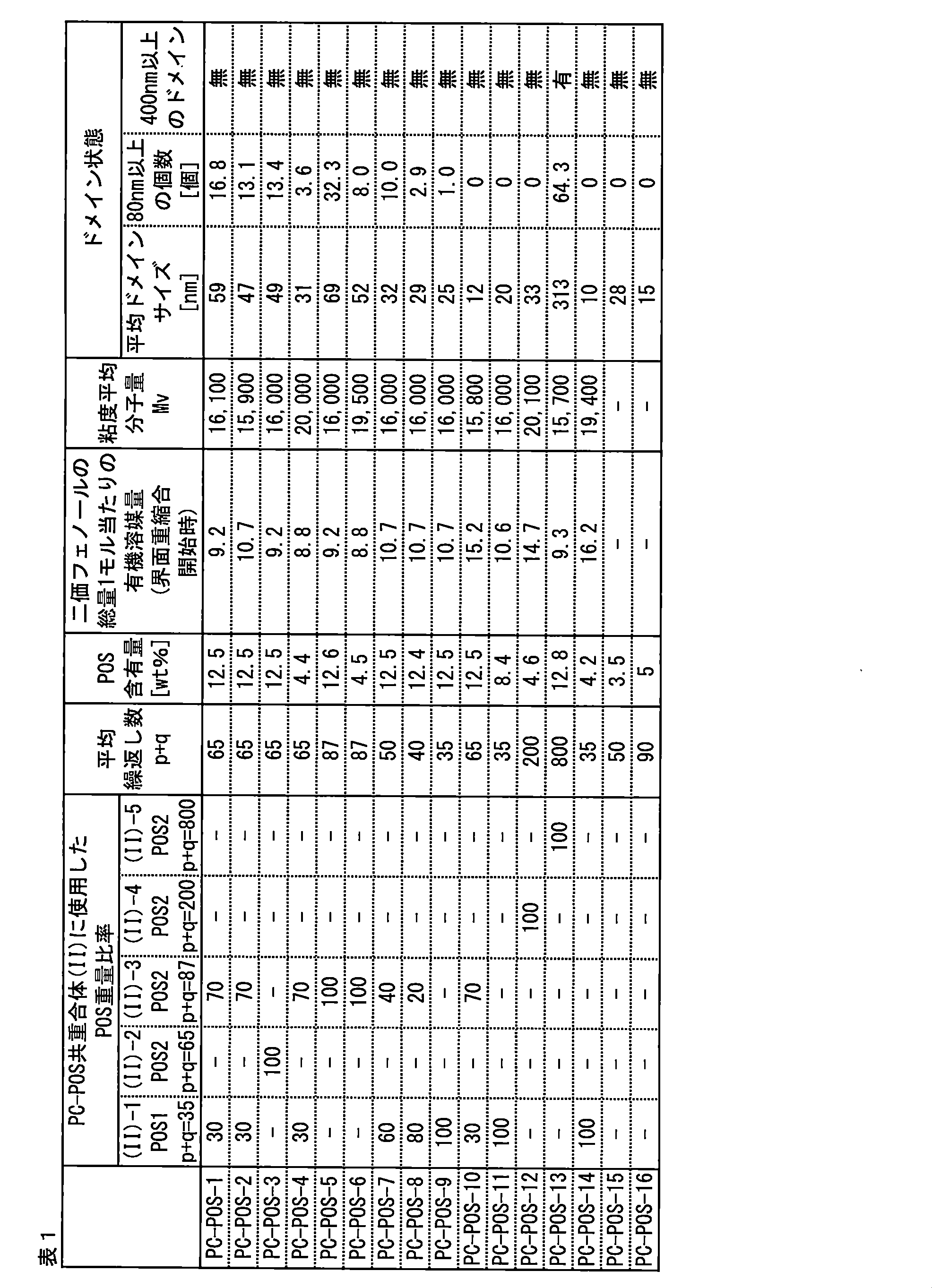
(PC-1)
2,2-ビス(4-ヒドロキシフェニル)プロパンを繰返し骨格とする溶液粘度分子量23,900の直鎖状芳香族ポリカーボネート樹脂パウダー(帝人(株)製パンライトL-1250WP)。(PC-1)
A linear aromatic polycarbonate resin powder having a solution viscosity molecular weight of 23,900 and having 2,2-bis (4-hydroxyphenyl) propane as a repeating skeleton (Panlite L-1250WP manufactured by Teijin Limited).
[PC-POS共重合体を含む樹脂組成物の製造]
[実施例1]
製造例で得られたPC-POS-1 33重量%とPC-1 67重量%、のポリカーボネート樹脂100重量部に対し、トリス(2,4-ジ-tert-ブチルフェニル)ホスファイト(BASF(株)製:イルガフォス168)を300ppmとなるように混合した後、ベント式二軸押出機(テクノベル(株)製,KZW15-25MG)を用いて、吐出量2.5kg/h、スクリュー回転数200rpmであり、押出温度は第1供給口からダイス部分まで270℃で溶融混練してペレット化した。そして、得られたペレットを120℃で5時間熱風乾燥した後、射出成形機(日本製鋼所(株)製、JSW J-75EIII)を用いて、成形温度290℃、金型温度80℃、成形サイクル40秒にて幅10mm、長さ80mm、厚みが4.0mmの成形片を成形した。作製した射出成形片を得た。該試験片のシロキサン含有量は4.2重量%、平均シロキサン繰り返し数(p+q)は65、粘度平均分子量Mvは、21,200であった。さらに、得られた試験片を用いて、ポリジオルガノシロキサンドメインサイズおよび粒径分布、-30℃、-50℃、-60℃、-75℃のノッチ付シャルピー衝撃値および塗装後の耐衝撃性、目視外観、透過率・ヘイズ、3点曲げ試験による耐薬品性を評価した。評価結果を表2に示す。[Manufacturing of resin composition containing PC-POS copolymer]
[Example 1]
Tris (2,4-di-tert-butylphenyl) phosphite (BASF, Inc.) was added to 100 parts by weight of the polycarbonate resin of PC-POS-1 33% by weight and PC-1 67% by weight obtained in the production example. ): After mixing Ilgafos 168) to 300 ppm, use a vent type twin-screw extruder (Technobel Co., Ltd., KZW15-25MG) with a discharge rate of 2.5 kg / h and a screw rotation speed of 200 rpm. The extrusion temperature was 270 ° C. from the first supply port to the die portion, and the mixture was melt-kneaded and pelletized. Then, the obtained pellets are dried with hot air at 120 ° C. for 5 hours, and then molded using an injection molding machine (JSW J-75EIII manufactured by Japan Steel Works, Ltd.) at a molding temperature of 290 ° C. and a mold temperature of 80 ° C. A molded piece having a width of 10 mm, a length of 80 mm, and a thickness of 4.0 mm was molded in a cycle of 40 seconds. The prepared injection molded piece was obtained. The siloxane content of the test piece was 4.2% by weight, the average siloxane repetition rate (p + q) was 65, and the viscosity average molecular weight Mv was 21,200. Furthermore, using the obtained test piece, polydiorganosiloxane domain size and particle size distribution, notched Charpy impact values at -30 ° C, -50 ° C, -60 ° C, and -75 ° C and impact resistance after painting, The visual appearance, transmittance / haze, and chemical resistance by a three-point bending test were evaluated. The evaluation results are shown in Table 2.
[実施例2~10並びに比較例1~8及び11]
用いるPC-POS共重合体の種類及び/又はブレンドの重量比を変更したことした以外は、実施例1と同様に実施例2~10及び比較例1~8の樹脂組成物を製造し、そして実施例1と同様の評価を行った。その結果を表2に記載した。[Examples 2 to 10 and Comparative Examples 1 to 8 and 11]
The resin compositions of Examples 2 to 10 and Comparative Examples 1 to 8 were produced in the same manner as in Example 1 except that the type of PC-POS copolymer used and / or the weight ratio of the blend was changed. The same evaluation as in Example 1 was performed. The results are shown in Table 2.
[比較例9]
PC-POS-15を120℃で5時間熱風乾燥した後、射出成形機(日本製鋼所(株)製、JSW J-75EIII)を用いて、成形温度290℃、金型温度80℃、成形サイクル40秒にて幅10mm、長さ80mm、厚みが4.0mmの成形片を成形した。作製した射出成形片を得た。得られた試験片を用いて、ポリジオルガノシロキサンドメインサイズおよび粒径分布、-30℃、-50℃、-60℃、-75℃のノッチ付シャルピー衝撃値および塗装後の耐衝撃性、目視外観、透過率・ヘイズ、3点曲げ試験による耐薬品性を評価した。評価結果を表2に示す。[Comparative Example 9]
After hot air drying of PC-POS-15 at 120 ° C for 5 hours, a molding temperature of 290 ° C, a mold temperature of 80 ° C, and a molding cycle are used using an injection molding machine (JSW J-75EIII, manufactured by Japan Steel Works, Ltd.). A molded piece having a width of 10 mm, a length of 80 mm, and a thickness of 4.0 mm was molded in 40 seconds. The prepared injection molded piece was obtained. Using the obtained test piece, polydiorganosiloxane domain size and particle size distribution, notched Charpy impact values at -30 ° C, -50 ° C, -60 ° C, and -75 ° C, impact resistance after painting, and visual appearance. , Transmittance / haze, and chemical resistance by 3-point bending test were evaluated. The evaluation results are shown in Table 2.
[比較例10]
PC-POS-15をPC-POS-16に変更した以外は、比較例9と同様の操作を行い、同様の評価を行った。その結果を表2に記載した。[Comparative Example 10]
The same operation as in Comparative Example 9 was performed except that PC-POS-15 was changed to PC-POS-16, and the same evaluation was performed. The results are shown in Table 2.

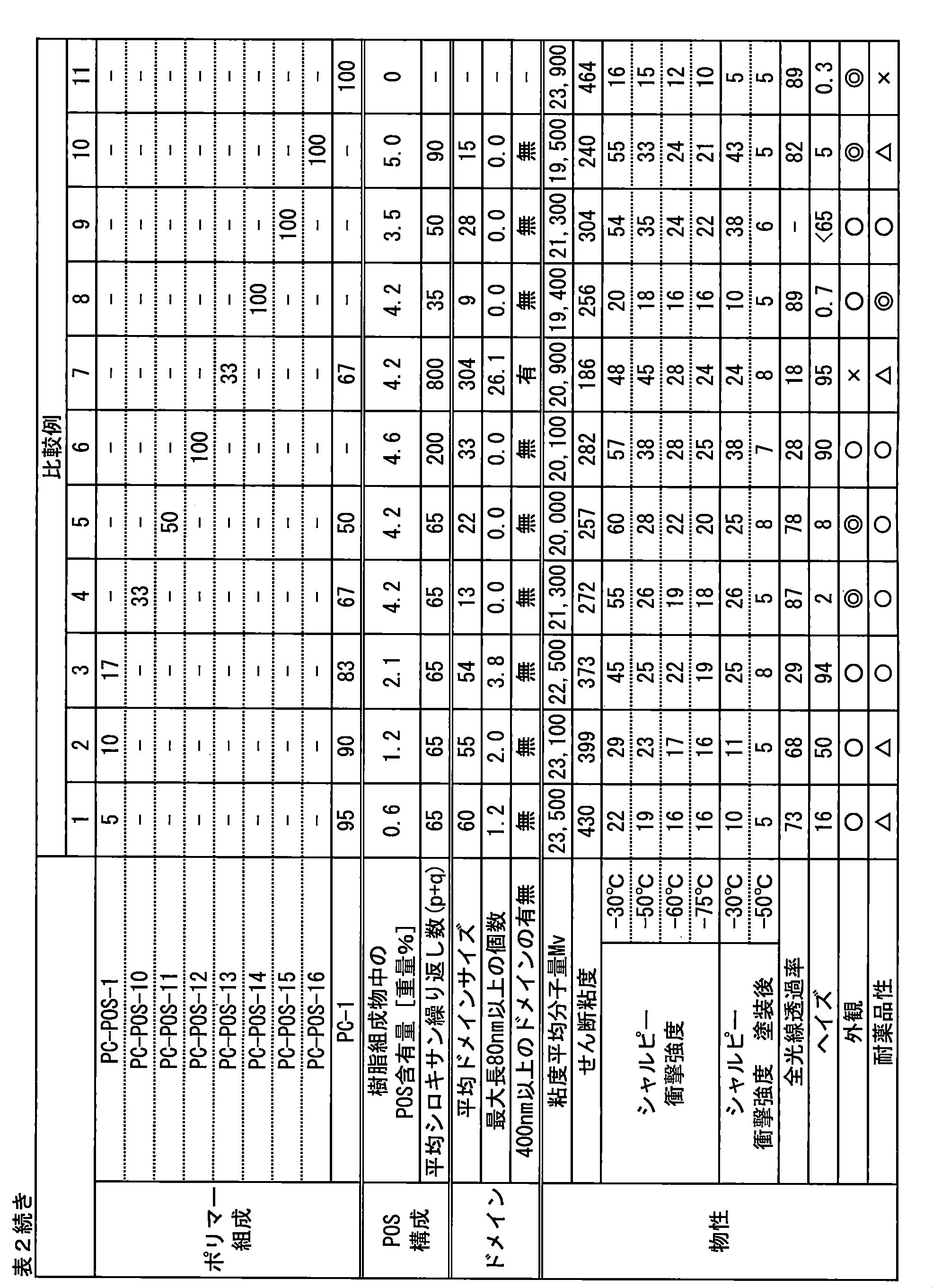
実験B:難燃剤を含む樹脂組成物の評価 Experiment B: Evaluation of resin composition containing flame retardant
(A成分:PC-POS共重合体)
PC-POS共重合体として、実験Aで用いた各種のPC-POS共重合体を用いた。(Component A: PC-POS copolymer)
As the PC-POS copolymer, various PC-POS copolymers used in Experiment A were used.
(B成分:難燃剤)
B-1:パーフルオロブタンスルホン酸カリウム塩(大日本インキ化学工業(株)製メガファックF-114P(商品名))
B-2:ビスフェノールAビス(ジフェニルホスフェート)を主成分とするリン酸エステル(大八化学工業(株)製CR-741(商品名))
B-3:環状フェノキシホスファゼン(大塚化学(株)製SPB-100(商品名))(B component: flame retardant)
B-1: Potassium perfluorobutane sulfonic acid salt (Megafuck F-114P (trade name) manufactured by Dainippon Ink and Chemicals Co., Ltd.)
B-2: Bisphenol A Phosphate ester containing bis (diphenyl phosphate) as the main component (CR-741 (trade name) manufactured by Daihachi Chemical Industry Co., Ltd.)
B-3: Cyclic phenoxyphosphazene (SPB-100 (trade name) manufactured by Otsuka Chemical Co., Ltd.)
(C成分:滴下防止剤)
C-1:該ポリテトラフルオロエチレン系混合体は、乳化重合法で製造されたポリテトラフルオロエチレンアクリル系共重合体からなる混合物(ポリテトラフルオロエチレン含有量50重量%)(三菱レイヨン(株)製:メタブレンA3750(商品名))(C component: anti-dripping agent)
C-1: The polytetrafluoroethylene-based mixture is a mixture consisting of a polytetrafluoroethylene acrylic copolymer produced by an emulsification polymerization method (polytetrafluoroethylene content 50% by weight) (Mitsubishi Rayon Co., Ltd.). Made by: Metabrene A3750 (trade name))
(D成分:紫外線吸収剤)
D-1:紫外線吸収剤(BASF製:TINUVIN 234(商品名))(D component: UV absorber)
D-1: UV absorber (BASF: TINUVIN 234 (trade name))
(その他の成分)
SL900:脂肪酸エステル系離型剤(理研ビタミン(株)製;リケマールSL900(商品名))
irg1076:フェノール系熱安定剤(Ciba Specialty Chemicals K.K.製;IRGANOX1076(商品名))
irg168:リン系熱安定剤(Ciba Specialty Chemicals K.K.製;IRGANOX1076(商品名))(Other ingredients)
SL900: Fatty acid ester-based mold release agent (manufactured by RIKEN Vitamin Co., Ltd .; Rikemar SL900 (trade name))
irg1076: Phenolic heat stabilizer (manufactured by Ciba Specialty Chemicals KK; IRGANOX1076 (trade name))
irg168: Phosphorus-based heat stabilizer (manufactured by Ciba Specialty Chemicals KK; IRGANOX 1076 (trade name))
[樹脂組成物の製造]
[実施例11~20、参考例1、及び比較例12~18]
表3および表4に示す組成でA~D成分および各種添加剤を計量して、ブレンダーを用いて均一に混合し、ベント式二軸押出機を用いて溶融混練してペレットを得た。使用する各種添加剤は、それぞれ配合量の10~100倍の濃度を目安に予めポリカーボネート樹脂との予備混合物を作成した後、ブレンダーによる全体の混合を行った。ベント式二軸押出機は(株)神戸製鋼所KTX-30(径30mmφ)を使用した。シリンダ-温度およびダイス温度が280℃、スクリュー回転数150rpm、吐出量20kg/h、ベント吸引度が3kPaの条件でストランドを押出し、水浴において冷却した後ペレタイザーでストランドカットを行い、ペレット化した。各種評価結果を表3および表4に示す。[Manufacturing of resin composition]
[Examples 11 to 20, Reference Example 1, and Comparative Examples 12 to 18]
The components A to D and various additives having the compositions shown in Tables 3 and 4 were weighed, mixed uniformly using a blender, and melt-kneaded using a bent twin-screw extruder to obtain pellets. For the various additives to be used, a premix with the polycarbonate resin was prepared in advance with a concentration of 10 to 100 times the blending amount as a guide, and then the whole was mixed by a blender. As the vent type twin-screw extruder, Kobe Steel, Ltd. KTX-30 (diameter 30 mmφ) was used. Strands were extruded under the conditions of a cylinder-temperature and a die temperature of 280 ° C., a screw rotation speed of 150 rpm, a discharge rate of 20 kg / h, and a vent suction degree of 3 kPa, cooled in a water bath, and then strand-cut with a pelletizer to pelletize. The results of various evaluations are shown in Tables 3 and 4.


上記表から明らかなように実施例11~20の組成物は40kJ/m2を超える良好な低温耐衝撃性および1.5mmV-2またはV-0の薄肉難燃性を有する事が分かる。これに対し、B成分を含まない参考例1は難燃性が不十分である。A成分中のポリオルガノシロキサンブロックの含有量が2.5重量%よりも少ない比較例12は低温耐衝撃性が劣る。A成分中のポリオルガノシロキサンブロックの含有量が8.0重量%よりも多い比較例13や最大長80nm以上のドメイン個数が20個以上である比較例6は外観不良が発生し、難燃性に劣る。最大長80nm以上のドメインを含まない比較例14、15、17は低温耐衝撃性が劣る。ポリカーボネート-ポリジオルガノシロキサン共重合体を含まない比較例18は低温耐衝撃性が劣る。As is clear from the above table, it can be seen that the compositions of Examples 11 to 20 have good low temperature impact resistance of more than 40 kJ / m 2 and thin-walled flame retardancy of 1.5 mm V-2 or V-0. On the other hand, Reference Example 1 which does not contain the B component has insufficient flame retardancy. Comparative Example 12 in which the content of the polyorganosiloxane block in the component A is less than 2.5% by weight is inferior in low temperature impact resistance. Comparative Example 13 in which the content of the polyorganosiloxane block in the component A is more than 8.0% by weight and Comparative Example 6 in which the number of domains having a maximum length of 80 nm or more is 20 or more have poor appearance and are flame-retardant. Inferior to. Comparative Examples 14, 15 and 17 which do not include a domain having a maximum length of 80 nm or more are inferior in low temperature impact resistance. Comparative Example 18 containing no polycarbonate-polydiorganosiloxane copolymer is inferior in low temperature impact resistance.
[実施例21~22、比較例19~23]
表5に示す組成でB成分のB-2を除くA~D成分および各種添加剤を計量して、ブレンダーを用いて均一に混合し、混合物をベント式二軸押出機の第1供給口から供給し、溶融混練してペレットを得た。使用する各種添加剤は、それぞれ配合量の10~100倍の濃度を目安に予めポリカーボネート樹脂との予備混合物を作成した後、ブレンダーによる全体の混合を行った。B成分のB-2は、80℃に加熱した状態で液注装置(富士テクノ工業(株)製HYM-JS-08)を用いてシリンダー途中の第3供給口(第1供給口とベント排気口との間に位置)から、各々所定の割合になるよう押出機に供給した。ベント式二軸押出機は(株)日本製鋼所TEX30α-38.5BW-3V(径30mmφ)を使用した。シリンダ-温度およびダイス温度が280℃、スクリュー回転数150rpm、吐出量20kg/h、ベントの真空度3kPaの条件でストランドを押出し、水浴において冷却した後ペレタイザーでストランドカットを行い、ペレット化した。各種評価結果を表5に示す。[Examples 21 to 22, Comparative Examples 19 to 23]
In the composition shown in Table 5, components A to D excluding B-2 of component B and various additives are weighed, mixed uniformly using a blender, and the mixture is dispensed from the first supply port of the vent type twin-screw extruder. It was fed and melt-kneaded to obtain pellets. For the various additives to be used, a premix with the polycarbonate resin was prepared in advance with a concentration of 10 to 100 times the blending amount as a guide, and then the whole was mixed by a blender. B-2 of component B is heated to 80 ° C. using a liquid injection device (HYM-JS-08 manufactured by Fuji Techno Industry Co., Ltd.) and the third supply port (first supply port and vent exhaust) in the middle of the cylinder. From the position between the mouth and the mouth), each was supplied to the extruder in a predetermined ratio. As the vent type twin-screw extruder, Japan Steel Works, Ltd. TEX30α-38.5BW-3V (diameter 30 mmφ) was used. The strands were extruded under the conditions of a cylinder-temperature and a die temperature of 280 ° C., a screw rotation speed of 150 rpm, a discharge rate of 20 kg / h, and a vent vacuum degree of 3 kPa, cooled in a water bath, and then strand-cut with a pelletizer to pelletize. Table 5 shows the results of various evaluations.

上記表から明らかなように実施例21および22の組成物は良好な低温耐衝撃性および1.0mmV-0の薄肉難燃性を有する事が分かる。A成分中のポリオルガノシロキサンブロック含有量が2.5重量%よりも少ない比較例19、平均ドメインサイズが30nmよりも小さい比較例21、22は低温耐衝撃性が劣る。B成分が過剰である比較例20は低温耐衝撃性および難燃性に劣る。ポリカーボネート-ポリジオルガノシロキサン共重合体を含まない比較例23は低温耐衝撃性が劣る。 As is clear from the above table, it can be seen that the compositions of Examples 21 and 22 have good low temperature impact resistance and thin wall flame retardancy of 1.0 mmV-0. Comparative Example 19 in which the polyorganosiloxane block content in the component A is less than 2.5% by weight, and Comparative Examples 21 and 22 having an average domain size smaller than 30 nm are inferior in low temperature impact resistance. Comparative Example 20 in which the B component is excessive is inferior in low temperature impact resistance and flame retardancy. Comparative Example 23, which does not contain the polycarbonate-polydiorganosiloxane copolymer, is inferior in low temperature impact resistance.
[実施例23~25、比較例24~26]
表6に示す組成でA~D成分および各種添加剤を計量して、ブレンダーを用いて均一に混合し、ベント式二軸押出機を用いて溶融混練してペレットを得た。使用する各種添加剤は、それぞれ配合量の10~100倍の濃度を目安に予めポリカーボネート樹脂との予備混合物を作成した後、ブレンダーによる全体の混合を行った。ベント式二軸押出機は(株)神戸製鋼所KTX-30(径30mmφ)を使用した。シリンダ-温度およびダイス温度が280℃、スクリュー回転数150rpm、吐出量20kg/h、ベント吸引度が3kPaの条件でストランドを押出し、水浴において冷却した後ペレタイザーでストランドカットを行い、ペレット化した。各種評価結果を表6に示す。[Examples 23 to 25, Comparative Examples 24 to 26]
The components A to D and various additives were weighed according to the composition shown in Table 6, mixed uniformly using a blender, and melt-kneaded using a bent twin-screw extruder to obtain pellets. For the various additives to be used, a premix with the polycarbonate resin was prepared in advance with a concentration of 10 to 100 times the blending amount as a guide, and then the whole was mixed by a blender. As the vent type twin-screw extruder, Kobe Steel, Ltd. KTX-30 (diameter 30 mmφ) was used. The strands were extruded under the conditions of a cylinder-temperature and a die temperature of 280 ° C., a screw rotation speed of 150 rpm, a discharge rate of 20 kg / h, and a vent suction degree of 3 kPa, cooled in a water bath, and then strand-cut with a pelletizer to pelletize. Table 6 shows the results of various evaluations.

上記表から明らかなように実施例23~25の組成物は良好な低温耐衝撃性および1.0mmV-0の薄肉難燃性を有する事が分かる。A成分中のポリオルガノシロキサンブロック含有量が2.5重量%よりも少ない比較例24、平均ドメインサイズが30nmよりも小さい比較例25、ポリカーボネート-ポリジオルガノシロキサン共重合体を含まない比較例26は低温耐衝撃性が劣る。 As is clear from the above table, it can be seen that the compositions of Examples 23 to 25 have good low temperature impact resistance and thin wall flame retardancy of 1.0 mmV-0. Comparative Example 24 in which the polyorganosiloxane block content in the component A is less than 2.5% by weight, Comparative Example 25 in which the average domain size is smaller than 30 nm, and Comparative Example 26 containing no polycarbonate-polydiorganosiloxane copolymer are Poor low temperature impact resistance.
本発明の共重合体又はその樹脂組成物を用いることにより、極低温でも高い衝撃性能を有しつつ、塗装後の衝撃耐久性や耐薬品性も両立していることが認められる。 By using the copolymer of the present invention or the resin composition thereof, it is recognized that the copolymer has high impact performance even at extremely low temperatures, and also has both impact durability and chemical resistance after coating.
本発明において得られる共重合体又はその樹脂組成物は、優れた極低温衝撃性および耐薬品性を具備し、またさらに、高い塗装耐久性も具備するため、光学部品、電気・電子機器分野、自動車・航空機などの輸送・モビリティ分野において幅広く使用することができる。中でも、高緯度圏や山岳部、上空などの極寒冷環境や高温熱処理、薬品処理など厳しい環境にさらされることが想定される各種ハウジング成形品で実用性が高い。 Since the copolymer obtained in the present invention or a resin composition thereof has excellent ultra-low temperature impact resistance and chemical resistance, and also has high coating durability, the field of optical components, electrical and electronic equipment, etc. It can be widely used in the fields of transportation and mobility such as automobiles and aircraft. Among them, various housing molded products that are expected to be exposed to extremely cold environments such as high latitudes, mountainous areas, and the sky, high temperature heat treatment, and chemical treatment are highly practical.
1 y:たわみ量(mm)
2 h:試験片厚み(4mm)
3 L:測定幅(150mm)1 y: Deflection amount (mm)
2 h: Test piece thickness (4 mm)
3 L: Measurement width (150 mm)
Claims (11)
(A-1)ポリカーボネートブロック、及び(A-2)ポリジオルガノシロキサンブロックを含み、
前記(A-1)ポリカーボネートブロックが、下記一般式[1]で表され:


前記(A-2)ポリジオルガノシロキサンブロックが、下記一般式[3]で表され:

前記(A-2)ポリジオルガノシロキサンブロックが、前記共重合体中に、2.5~8.0重量%で含有されており、かつ
以下の(i)及び(ii)を満たす、前記共重合体:
(i)前記共重合体の電子線顕微鏡を用いた断面観察像において、850nm四方(722,500nm2)の領域に最大長径が80nm以上のポリジオルガノシロキサンドメインが1~20個存在すること;及び
(ii)ポリジオルガノシロキサンドメインの平均ドメインサイズが30~100nmであること、
ここで、ドメインの最大長径及び平均ドメインサイズは、前記共重合体の射出成形により形成された成形片から切り出した薄片切片を電子線顕微鏡(TEM)により観察し、得られたTEM写真を画像解析ソフトWin ROOF Ver.6.6を用いて粒子解析を行うことにより得られた測定値である。 Polycarbonate-polydiorganosiloxane copolymer,
Includes (A-1) Polycarbonate Block and (A-2) Polydiorganosiloxane Block
The polycarbonate block (A-1) is represented by the following general formula [1]:
The (A-2) polydiorganosiloxane block is represented by the following general formula [3]:
The copolymer containing the (A-2) polydiorganosiloxane block in an amount of 2.5 to 8.0% by weight and satisfying the following (i) and (ii). Combined:
(I) In the cross-sectional observation image of the copolymer using an electron beam microscope, 1 to 20 polydiorganosiloxane domains having a maximum major axis of 80 nm or more are present in a region of 850 nm square (722,500 nm 2 ); (Ii) The average domain size of the polydiorganosiloxane domain is 30 to 100 nm.
Here, the maximum major axis and the average domain size of the domain are determined by observing a thin section cut out from a molded piece formed by injection molding of the copolymer with an electron beam microscope (TEM) and image-analyzing the obtained TEM photograph. Soft Win ROOF Ver. It is a measured value obtained by performing particle analysis using 6.6 .
(iii)前記共重合体の電子線顕微鏡を用いた断面観察像において、5枚の試料切片のいずれにも、850nm四方(722,500nm2)の領域に最大長径が400nm以上のポリジオルガノシロキサンドメインが存在しないこと。 The copolymer according to claim 1, further satisfying the following (iii):
(Iii) In the cross-sectional observation image of the copolymer using an electron beam microscope, a polydiorganosiloxane domain having a maximum major axis of 400 nm or more in a region of 850 nm square (722,500 nm 2 ) in any of the five sample sections. Does not exist.
前記(A-2)ポリジオルガノシロキサンブロックが、(2-アリルフェノール)末端ポリジオルガノシロキサン、又は(2-メトキシ-4-アリルフェノール)末端ポリジオルガノシロキサンより誘導されている、
請求項1~3のいずれか一項に記載の共重合体。 The (A-1) polycarbonate block is derived from 2,2-bis (4-hydroxyphenyl) propane, and the (A-2) polydiorganosiloxane block is a (2-allylphenol) -terminated polydiorgano. Derived from siloxane or (2-methoxy-4-allylphenol) -terminated polycarbonate siloxane,
The copolymer according to any one of claims 1 to 3.
(a)水に不溶性の有機溶媒とアルカリ水溶液との混合液中において、下記式[4]で表される二価フェノール(I)とホスゲンとを反応させ、末端クロロホーメート基を有するカーボネートオリゴマーを含有する溶液を調製すること

(b)次いで、該溶液を撹拌しながら、下記式[5]で表されるヒドロキシアリール末端ポリジオルガノシロキサン(II)を加え、ヒドロキシアリール末端ポリジオルガノシロキサン(II)とカーボネートオリゴマーとを界面重合させること
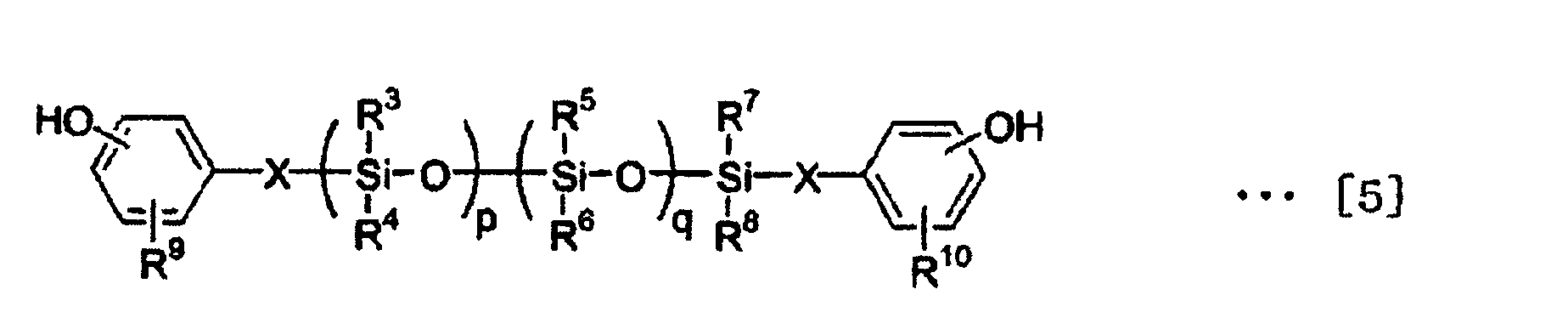
ここで、式[4]および式[5]で表される二価フェノール総量1モル当たり、水に不溶性の有機溶媒を、8モル以上11モル未満で使用すること。 The method for producing a copolymer according to claim 1, which comprises the following steps (a) and (b):
(A) A carbonate oligomer having a terminal chlorohomate group by reacting divalent phenol (I) represented by the following formula [4] with phosgene in a mixed solution of an organic solvent insoluble in water and an alkaline aqueous solution. To prepare a solution containing
Here, the organic solvent insoluble in water is used in an amount of 8 mol or more and less than 11 mol per 1 mol of the total amount of divalent phenol represented by the formula [4] and the formula [5].
Priority Applications (1)
| Application Number | Priority Date | Filing Date | Title |
|---|---|---|---|
| JP2021127783A JP7254126B2 (en) | 2017-12-21 | 2021-08-03 | Polycarbonate-polydiorganosiloxane copolymer, its resin composition, and its production method |
Applications Claiming Priority (5)
| Application Number | Priority Date | Filing Date | Title |
|---|---|---|---|
| JP2017245048 | 2017-12-21 | ||
| JP2017245048 | 2017-12-21 | ||
| JP2018058148 | 2018-03-26 | ||
| JP2018058148 | 2018-03-26 | ||
| PCT/JP2018/047367 WO2019124556A1 (en) | 2017-12-21 | 2018-12-21 | Polycarbonate-polydiorganosiloxane copolymer, resin composition of polycarbonate-polydiorganosiloxane copolymer, and production method for resin composition of polycarbonate-polydiorganosiloxane copolymer |
Related Child Applications (1)
| Application Number | Title | Priority Date | Filing Date |
|---|---|---|---|
| JP2021127783A Division JP7254126B2 (en) | 2017-12-21 | 2021-08-03 | Polycarbonate-polydiorganosiloxane copolymer, its resin composition, and its production method |
Publications (2)
| Publication Number | Publication Date |
|---|---|
| JPWO2019124556A1 JPWO2019124556A1 (en) | 2020-10-22 |
| JP7055152B2 true JP7055152B2 (en) | 2022-04-15 |
Family
ID=66994748
Family Applications (2)
| Application Number | Title | Priority Date | Filing Date |
|---|---|---|---|
| JP2019560601A Active JP7055152B2 (en) | 2017-12-21 | 2018-12-21 | Polycarbonate-polydiorganosiloxane copolymer, its resin composition, and its production method. |
| JP2021127783A Active JP7254126B2 (en) | 2017-12-21 | 2021-08-03 | Polycarbonate-polydiorganosiloxane copolymer, its resin composition, and its production method |
Family Applications After (1)
| Application Number | Title | Priority Date | Filing Date |
|---|---|---|---|
| JP2021127783A Active JP7254126B2 (en) | 2017-12-21 | 2021-08-03 | Polycarbonate-polydiorganosiloxane copolymer, its resin composition, and its production method |
Country Status (7)
| Country | Link |
|---|---|
| US (1) | US11414523B2 (en) |
| EP (1) | EP3730534B1 (en) |
| JP (2) | JP7055152B2 (en) |
| KR (1) | KR102321244B1 (en) |
| CN (1) | CN111386298B (en) |
| TW (1) | TWI788490B (en) |
| WO (1) | WO2019124556A1 (en) |
Families Citing this family (14)
| Publication number | Priority date | Publication date | Assignee | Title |
|---|---|---|---|---|
| JP2019052323A (en) * | 2018-12-27 | 2019-04-04 | 日東紡績株式会社 | Glass fiber reinforced resin molded product |
| ES2933516T3 (en) * | 2019-04-02 | 2023-02-09 | Covestro Deutschland Ag | Siloxane-containing block co-polycarbonates with a small domain size |
| TWI875883B (en) | 2019-12-06 | 2025-03-11 | 日商出光興產股份有限公司 | Polycarbonate-polyorganosiloxane copolymer and resin composition containing the copolymer |
| TWI792048B (en) * | 2020-08-26 | 2023-02-11 | 大陸商漢達精密電子(昆山)有限公司 | High-fluidity and flame-retardant polycarbonate material and the products thereof |
| JP7619814B2 (en) * | 2021-02-02 | 2025-01-22 | 帝人株式会社 | Polycarbonate resin composition and molded article |
| US20240117184A1 (en) * | 2021-02-02 | 2024-04-11 | Teijin Limited | Polycarbonate resin composition and molded article |
| JP7656436B2 (en) * | 2021-02-09 | 2025-04-03 | 帝人株式会社 | Transparent antibacterial polycarbonate resin composition and molded article thereof |
| JP7622506B2 (en) * | 2021-03-26 | 2025-01-28 | 三菱ケミカル株式会社 | Copolymeric polycarbonate resin composition, molded article, and method for producing copolymeric polycarbonate resin |
| JP7670531B2 (en) * | 2021-04-06 | 2025-04-30 | 帝人株式会社 | Polycarbonate resin composition and molded article |
| JPWO2022260076A1 (en) * | 2021-06-09 | 2022-12-15 | ||
| US20240239962A1 (en) * | 2021-06-09 | 2024-07-18 | Idemitsu Kosan Co.,Ltd. | Polycarbonate resin composition and molded article |
| KR102700995B1 (en) * | 2021-10-29 | 2024-09-02 | 주식회사 삼양사 | Thermoplastic resin composition of Terrazzo texture with enhanced impact resistance and molded article comprising the same |
| CN114196001B (en) * | 2022-01-11 | 2023-09-19 | 万华化学集团股份有限公司 | A polycarbonate-polyorganosiloxane copolymer, manufacturing method and resin composition containing the copolymer |
| JP7761500B2 (en) * | 2022-01-28 | 2025-10-28 | 帝人株式会社 | Polycarbonate resin composition and molded article |
Citations (8)
| Publication number | Priority date | Publication date | Assignee | Title |
|---|---|---|---|---|
| JP2006523243A (en) | 2003-02-21 | 2006-10-12 | ゼネラル・エレクトリック・カンパニイ | Translucent thermoplastic resin composition, method for producing the same, and molded product |
| JP2011046913A (en) | 2009-07-29 | 2011-03-10 | Teijin Chem Ltd | Polycarbonate-polydiorganosiloxane copolymer |
| JP2011159340A (en) | 2010-01-29 | 2011-08-18 | Teijin Chem Ltd | Resin stamper |
| JP2011173989A (en) | 2010-02-24 | 2011-09-08 | Teijin Chem Ltd | Method for producing polycarbonate/polydiorganosiloxane copolymer |
| WO2013073709A1 (en) | 2011-11-17 | 2013-05-23 | 帝人化成株式会社 | Resin composition having light guiding properties, and light-guiding molded article and planar light source made from same |
| JP2014080496A (en) | 2012-10-16 | 2014-05-08 | Teijin Ltd | Polycarbonate-polydiorganosiloxane copolymer and manufacturing method thereof |
| JP2015163722A (en) | 2013-12-10 | 2015-09-10 | 出光興産株式会社 | Polycarbonate-polyorganosiloxane copolymer and method for producing the same |
| WO2016088861A1 (en) | 2014-12-02 | 2016-06-09 | 帝人株式会社 | Polycarbonate resin composition and molded article comprising same |
Family Cites Families (28)
| Publication number | Priority date | Publication date | Assignee | Title |
|---|---|---|---|---|
| US4379910A (en) | 1980-12-31 | 1983-04-12 | General Electric Co. | Flame retardant aromatic polycarbonate compositions made from fluorinated diphenols |
| DE3420002A1 (en) | 1984-05-29 | 1985-12-05 | Bayer Ag, 5090 Leverkusen | POLYMER POWDER COMPOSITIONS CONTAINING TETRAFLUORETHYLENE POLYMER |
| US4753994A (en) | 1986-12-02 | 1988-06-28 | Mobay Corporation | Flame retardant polycarbonate compositions |
| JP2662310B2 (en) | 1989-07-07 | 1997-10-08 | 出光石油化学株式会社 | Polycarbonate-polydimethylsiloxane copolymer and method for producing the same |
| KR970002664B1 (en) | 1989-07-07 | 1997-03-07 | 이데미쓰 세끼유 가가꾸 가부시끼가이샤 | Polycarbonate-Polydimethylsiloxane Interpolymer and Method for Producing the Same |
| EP0483510A3 (en) | 1990-10-31 | 1992-09-02 | General Electric Company | Polycarbonate compositions with improved appearance and flammability characteristics |
| EP0522751B1 (en) | 1991-07-01 | 1998-04-01 | General Electric Company | Polycarbonate-polysiloxane block copolymers |
| EP0524731B1 (en) | 1991-07-01 | 2002-03-13 | General Electric Company | Polymer blends of polycarbonate-polysiloxane block copolymers with polycarbonates and polyestercarbonate copolymers |
| JPH05189975A (en) | 1992-01-16 | 1993-07-30 | Mitsubishi Electric Corp | Random access memory |
| CA2108411A1 (en) | 1992-11-17 | 1994-05-18 | Wie-Hin Pan | Method of dispersing solid additives in polymeric resins |
| CH686306A5 (en) | 1993-09-17 | 1996-02-29 | Ciba Geigy Ag | 3-aryl-benzofuranones as stabilizers. |
| JPH08188653A (en) | 1995-01-10 | 1996-07-23 | General Electric Co <Ge> | Method for dispersing solid additives in polymers and products obtained thereby |
| FR2733504A1 (en) | 1995-04-28 | 1996-10-31 | Gen Elec Plastics Abs Euro Bv | NEW POLYMERIC ALLOYS BASED ON POLYMERISATE INCLUDING PATTERNS OF TETRAFLUOROETHYLENE DERIVATIVES, MANUFACTURING PROCESS, ARTICLES OBTAINED FROM SUCH ALLOYS AND USE OF THESE ALLOYS IN POLYMERIC COMPOSITIONS |
| JP3272985B2 (en) | 1996-07-31 | 2002-04-08 | 三菱レイヨン株式会社 | Method for producing mixed powder containing polytetrafluoroethylene |
| JP4146175B2 (en) | 2002-06-27 | 2008-09-03 | 出光興産株式会社 | Polycarbonate resin composition and molded product |
| JP2005263908A (en) | 2004-03-17 | 2005-09-29 | Sumitomo Dow Ltd | Flame-retardant polycarbonate resin composition |
| US6969745B1 (en) * | 2004-06-30 | 2005-11-29 | General Electric Company | Thermoplastic compositions |
| JP4988293B2 (en) | 2006-10-19 | 2012-08-01 | 帝人化成株式会社 | Aromatic polycarbonate resin composition |
| JP5301811B2 (en) * | 2007-11-14 | 2013-09-25 | 帝人株式会社 | Polycarbonate resin composition |
| WO2011013846A1 (en) | 2009-07-29 | 2011-02-03 | 帝人化成株式会社 | Polycarbonate/polydiorganosiloxane copolymer |
| JP5684470B2 (en) * | 2009-11-11 | 2015-03-11 | 帝人株式会社 | Thermoplastic resin composition |
| JP5852797B2 (en) | 2011-05-30 | 2016-02-03 | 出光興産株式会社 | Polycarbonate resin composition for battery pack and battery pack |
| US9732219B2 (en) * | 2011-12-02 | 2017-08-15 | Teijin Limited | Flame-retardant resin composition comprising a polycarbonate-polydiorganosiloxane copolymer resin and molded article thereof |
| KR102023227B1 (en) * | 2012-03-21 | 2019-11-25 | 데이진 가부시키가이샤 | Light-diffusible resin composition |
| CN104334641A (en) * | 2012-06-07 | 2015-02-04 | 帝人株式会社 | Resin composition having light-guiding ability, and light guide plate and surface light source body comprising same |
| JP6196072B2 (en) | 2013-05-29 | 2017-09-13 | 帝人株式会社 | Resin composition for decorative molding |
| KR102270558B1 (en) | 2014-01-30 | 2021-06-29 | 코베스트로 도이칠란트 아게 | Polysiloxane-polycarbonate block cocondensates with improved rheological properties |
| JP6495669B2 (en) * | 2015-01-28 | 2019-04-03 | 帝人株式会社 | Flame retardant polycarbonate resin composition |
-
2018
- 2018-12-21 EP EP18890638.2A patent/EP3730534B1/en active Active
- 2018-12-21 US US16/956,041 patent/US11414523B2/en active Active
- 2018-12-21 KR KR1020207015107A patent/KR102321244B1/en not_active Expired - Fee Related
- 2018-12-21 WO PCT/JP2018/047367 patent/WO2019124556A1/en not_active Ceased
- 2018-12-21 JP JP2019560601A patent/JP7055152B2/en active Active
- 2018-12-21 TW TW107146507A patent/TWI788490B/en active
- 2018-12-21 CN CN201880076044.9A patent/CN111386298B/en active Active
-
2021
- 2021-08-03 JP JP2021127783A patent/JP7254126B2/en active Active
Patent Citations (8)
| Publication number | Priority date | Publication date | Assignee | Title |
|---|---|---|---|---|
| JP2006523243A (en) | 2003-02-21 | 2006-10-12 | ゼネラル・エレクトリック・カンパニイ | Translucent thermoplastic resin composition, method for producing the same, and molded product |
| JP2011046913A (en) | 2009-07-29 | 2011-03-10 | Teijin Chem Ltd | Polycarbonate-polydiorganosiloxane copolymer |
| JP2011159340A (en) | 2010-01-29 | 2011-08-18 | Teijin Chem Ltd | Resin stamper |
| JP2011173989A (en) | 2010-02-24 | 2011-09-08 | Teijin Chem Ltd | Method for producing polycarbonate/polydiorganosiloxane copolymer |
| WO2013073709A1 (en) | 2011-11-17 | 2013-05-23 | 帝人化成株式会社 | Resin composition having light guiding properties, and light-guiding molded article and planar light source made from same |
| JP2014080496A (en) | 2012-10-16 | 2014-05-08 | Teijin Ltd | Polycarbonate-polydiorganosiloxane copolymer and manufacturing method thereof |
| JP2015163722A (en) | 2013-12-10 | 2015-09-10 | 出光興産株式会社 | Polycarbonate-polyorganosiloxane copolymer and method for producing the same |
| WO2016088861A1 (en) | 2014-12-02 | 2016-06-09 | 帝人株式会社 | Polycarbonate resin composition and molded article comprising same |
Also Published As
| Publication number | Publication date |
|---|---|
| EP3730534B1 (en) | 2021-11-10 |
| US11414523B2 (en) | 2022-08-16 |
| JP7254126B2 (en) | 2023-04-07 |
| EP3730534A1 (en) | 2020-10-28 |
| KR20200068737A (en) | 2020-06-15 |
| EP3730534A4 (en) | 2021-02-24 |
| WO2019124556A1 (en) | 2019-06-27 |
| TWI788490B (en) | 2023-01-01 |
| KR102321244B1 (en) | 2021-11-02 |
| US20210108033A1 (en) | 2021-04-15 |
| CN111386298B (en) | 2023-01-13 |
| CN111386298A (en) | 2020-07-07 |
| TW201930408A (en) | 2019-08-01 |
| JP2021169630A (en) | 2021-10-28 |
| JPWO2019124556A1 (en) | 2020-10-22 |
Similar Documents
| Publication | Publication Date | Title |
|---|---|---|
| JP7254126B2 (en) | Polycarbonate-polydiorganosiloxane copolymer, its resin composition, and its production method | |
| TWI683867B (en) | Polycarbonate resin composition and its molded product | |
| JP5684548B2 (en) | Glass fiber reinforced resin composition | |
| CN101434743B (en) | Flame retardant polycarbonate resin composition with excellent antistatic property | |
| CN101824213B (en) | Flame retardant polycarbonate resin composition | |
| JP6181394B2 (en) | Thermoplastic resin composition and molded article thereof | |
| JP2022087564A (en) | Polycarbonate resin composition and circuit molded article for communication instrument | |
| JP6224331B2 (en) | Thermoplastic resin composition and molded article thereof | |
| JP7670532B2 (en) | Polycarbonate resin composition and molded article thereof | |
| JP7044595B2 (en) | Thermoplastic resin composition | |
| JP7670531B2 (en) | Polycarbonate resin composition and molded article | |
| JP6991003B2 (en) | Reinforced polycarbonate resin composition | |
| JP6820776B2 (en) | Thermal caulking conjugate | |
| JP7761500B2 (en) | Polycarbonate resin composition and molded article | |
| JP7619814B2 (en) | Polycarbonate resin composition and molded article | |
| JP2024113873A (en) | Polycarbonate resin composition and molded article | |
| JP2021121651A (en) | Thermoplastic resin composition | |
| JP7656436B2 (en) | Transparent antibacterial polycarbonate resin composition and molded article thereof | |
| JP6843703B2 (en) | Thermal caulking conjugate | |
| JP7440306B2 (en) | Polycarbonate resin composition and molded product thereof | |
| JP6956538B2 (en) | Reinforced polycarbonate resin composition | |
| WO2021085384A1 (en) | Polycarbonate resin composition and molded object thereof | |
| JP6377980B2 (en) | Thermoplastic resin composition and molded article thereof | |
| JP2025074423A (en) | Polycarbonate resin composition and molded article made thereof | |
| JP2024034738A (en) | Polycarbonate resin composition and molded products made from it |
Legal Events
| Date | Code | Title | Description |
|---|---|---|---|
| A621 | Written request for application examination |
Free format text: JAPANESE INTERMEDIATE CODE: A621 Effective date: 20200311 |
|
| A131 | Notification of reasons for refusal |
Free format text: JAPANESE INTERMEDIATE CODE: A131 Effective date: 20210406 |
|
| A601 | Written request for extension of time |
Free format text: JAPANESE INTERMEDIATE CODE: A601 Effective date: 20210602 |
|
| A521 | Request for written amendment filed |
Free format text: JAPANESE INTERMEDIATE CODE: A523 Effective date: 20210803 |
|
| A131 | Notification of reasons for refusal |
Free format text: JAPANESE INTERMEDIATE CODE: A131 Effective date: 20211005 |
|
| A521 | Request for written amendment filed |
Free format text: JAPANESE INTERMEDIATE CODE: A523 Effective date: 20211201 |
|
| TRDD | Decision of grant or rejection written | ||
| A01 | Written decision to grant a patent or to grant a registration (utility model) |
Free format text: JAPANESE INTERMEDIATE CODE: A01 Effective date: 20220308 |
|
| A61 | First payment of annual fees (during grant procedure) |
Free format text: JAPANESE INTERMEDIATE CODE: A61 Effective date: 20220405 |
|
| R150 | Certificate of patent or registration of utility model |
Ref document number: 7055152 Country of ref document: JP Free format text: JAPANESE INTERMEDIATE CODE: R150 |