JP7041069B2 - Catalysts and methods for producing aromatic hydrocarbons by directly converting syngas - Google Patents
Catalysts and methods for producing aromatic hydrocarbons by directly converting syngas Download PDFInfo
- Publication number
- JP7041069B2 JP7041069B2 JP2018549456A JP2018549456A JP7041069B2 JP 7041069 B2 JP7041069 B2 JP 7041069B2 JP 2018549456 A JP2018549456 A JP 2018549456A JP 2018549456 A JP2018549456 A JP 2018549456A JP 7041069 B2 JP7041069 B2 JP 7041069B2
- Authority
- JP
- Japan
- Prior art keywords
- zsm
- catalyst
- axis
- metal oxide
- catalyst component
- Prior art date
- Legal status (The legal status is an assumption and is not a legal conclusion. Google has not performed a legal analysis and makes no representation as to the accuracy of the status listed.)
- Active
Links
Classifications
-
- B—PERFORMING OPERATIONS; TRANSPORTING
- B01—PHYSICAL OR CHEMICAL PROCESSES OR APPARATUS IN GENERAL
- B01J—CHEMICAL OR PHYSICAL PROCESSES, e.g. CATALYSIS OR COLLOID CHEMISTRY; THEIR RELEVANT APPARATUS
- B01J35/00—Catalysts, in general, characterised by their form or physical properties
- B01J35/19—Catalysts containing parts with different compositions
-
- B—PERFORMING OPERATIONS; TRANSPORTING
- B01—PHYSICAL OR CHEMICAL PROCESSES OR APPARATUS IN GENERAL
- B01J—CHEMICAL OR PHYSICAL PROCESSES, e.g. CATALYSIS OR COLLOID CHEMISTRY; THEIR RELEVANT APPARATUS
- B01J21/00—Catalysts comprising the elements, oxides, or hydroxides of magnesium, boron, aluminium, carbon, silicon, titanium, zirconium, or hafnium
- B01J21/005—Spinels
-
- B—PERFORMING OPERATIONS; TRANSPORTING
- B01—PHYSICAL OR CHEMICAL PROCESSES OR APPARATUS IN GENERAL
- B01J—CHEMICAL OR PHYSICAL PROCESSES, e.g. CATALYSIS OR COLLOID CHEMISTRY; THEIR RELEVANT APPARATUS
- B01J21/00—Catalysts comprising the elements, oxides, or hydroxides of magnesium, boron, aluminium, carbon, silicon, titanium, zirconium, or hafnium
- B01J21/06—Silicon, titanium, zirconium or hafnium; Oxides or hydroxides thereof
-
- B—PERFORMING OPERATIONS; TRANSPORTING
- B01—PHYSICAL OR CHEMICAL PROCESSES OR APPARATUS IN GENERAL
- B01J—CHEMICAL OR PHYSICAL PROCESSES, e.g. CATALYSIS OR COLLOID CHEMISTRY; THEIR RELEVANT APPARATUS
- B01J21/00—Catalysts comprising the elements, oxides, or hydroxides of magnesium, boron, aluminium, carbon, silicon, titanium, zirconium, or hafnium
- B01J21/06—Silicon, titanium, zirconium or hafnium; Oxides or hydroxides thereof
- B01J21/066—Zirconium or hafnium; Oxides or hydroxides thereof
-
- B—PERFORMING OPERATIONS; TRANSPORTING
- B01—PHYSICAL OR CHEMICAL PROCESSES OR APPARATUS IN GENERAL
- B01J—CHEMICAL OR PHYSICAL PROCESSES, e.g. CATALYSIS OR COLLOID CHEMISTRY; THEIR RELEVANT APPARATUS
- B01J23/00—Catalysts comprising metals or metal oxides or hydroxides, not provided for in group B01J21/00
- B01J23/005—Spinels
-
- B—PERFORMING OPERATIONS; TRANSPORTING
- B01—PHYSICAL OR CHEMICAL PROCESSES OR APPARATUS IN GENERAL
- B01J—CHEMICAL OR PHYSICAL PROCESSES, e.g. CATALYSIS OR COLLOID CHEMISTRY; THEIR RELEVANT APPARATUS
- B01J23/00—Catalysts comprising metals or metal oxides or hydroxides, not provided for in group B01J21/00
- B01J23/06—Catalysts comprising metals or metal oxides or hydroxides, not provided for in group B01J21/00 of zinc, cadmium or mercury
-
- B—PERFORMING OPERATIONS; TRANSPORTING
- B01—PHYSICAL OR CHEMICAL PROCESSES OR APPARATUS IN GENERAL
- B01J—CHEMICAL OR PHYSICAL PROCESSES, e.g. CATALYSIS OR COLLOID CHEMISTRY; THEIR RELEVANT APPARATUS
- B01J23/00—Catalysts comprising metals or metal oxides or hydroxides, not provided for in group B01J21/00
- B01J23/16—Catalysts comprising metals or metal oxides or hydroxides, not provided for in group B01J21/00 of arsenic, antimony, bismuth, vanadium, niobium, tantalum, polonium, chromium, molybdenum, tungsten, manganese, technetium or rhenium
- B01J23/24—Chromium, molybdenum or tungsten
- B01J23/26—Chromium
-
- B—PERFORMING OPERATIONS; TRANSPORTING
- B01—PHYSICAL OR CHEMICAL PROCESSES OR APPARATUS IN GENERAL
- B01J—CHEMICAL OR PHYSICAL PROCESSES, e.g. CATALYSIS OR COLLOID CHEMISTRY; THEIR RELEVANT APPARATUS
- B01J23/00—Catalysts comprising metals or metal oxides or hydroxides, not provided for in group B01J21/00
- B01J23/16—Catalysts comprising metals or metal oxides or hydroxides, not provided for in group B01J21/00 of arsenic, antimony, bismuth, vanadium, niobium, tantalum, polonium, chromium, molybdenum, tungsten, manganese, technetium or rhenium
- B01J23/32—Manganese, technetium or rhenium
- B01J23/34—Manganese
-
- B—PERFORMING OPERATIONS; TRANSPORTING
- B01—PHYSICAL OR CHEMICAL PROCESSES OR APPARATUS IN GENERAL
- B01J—CHEMICAL OR PHYSICAL PROCESSES, e.g. CATALYSIS OR COLLOID CHEMISTRY; THEIR RELEVANT APPARATUS
- B01J23/00—Catalysts comprising metals or metal oxides or hydroxides, not provided for in group B01J21/00
- B01J23/70—Catalysts comprising metals or metal oxides or hydroxides, not provided for in group B01J21/00 of the iron group metals or copper
- B01J23/76—Catalysts comprising metals or metal oxides or hydroxides, not provided for in group B01J21/00 of the iron group metals or copper combined with metals, oxides or hydroxides provided for in groups B01J23/02 - B01J23/36
- B01J23/84—Catalysts comprising metals or metal oxides or hydroxides, not provided for in group B01J21/00 of the iron group metals or copper combined with metals, oxides or hydroxides provided for in groups B01J23/02 - B01J23/36 with arsenic, antimony, bismuth, vanadium, niobium, tantalum, polonium, chromium, molybdenum, tungsten, manganese, technetium or rhenium
- B01J23/889—Manganese, technetium or rhenium
- B01J23/8892—Manganese
-
- B—PERFORMING OPERATIONS; TRANSPORTING
- B01—PHYSICAL OR CHEMICAL PROCESSES OR APPARATUS IN GENERAL
- B01J—CHEMICAL OR PHYSICAL PROCESSES, e.g. CATALYSIS OR COLLOID CHEMISTRY; THEIR RELEVANT APPARATUS
- B01J29/00—Catalysts comprising molecular sieves
- B01J29/04—Catalysts comprising molecular sieves having base-exchange properties, e.g. crystalline zeolites
- B01J29/06—Crystalline aluminosilicate zeolites; Isomorphous compounds thereof
- B01J29/40—Crystalline aluminosilicate zeolites; Isomorphous compounds thereof of the pentasil type, e.g. types ZSM-5, ZSM-8 or ZSM-11, as exemplified by patent documents US3702886, GB1334243 and US3709979, respectively
-
- B—PERFORMING OPERATIONS; TRANSPORTING
- B01—PHYSICAL OR CHEMICAL PROCESSES OR APPARATUS IN GENERAL
- B01J—CHEMICAL OR PHYSICAL PROCESSES, e.g. CATALYSIS OR COLLOID CHEMISTRY; THEIR RELEVANT APPARATUS
- B01J29/00—Catalysts comprising molecular sieves
- B01J29/04—Catalysts comprising molecular sieves having base-exchange properties, e.g. crystalline zeolites
- B01J29/06—Crystalline aluminosilicate zeolites; Isomorphous compounds thereof
- B01J29/40—Crystalline aluminosilicate zeolites; Isomorphous compounds thereof of the pentasil type, e.g. types ZSM-5, ZSM-8 or ZSM-11, as exemplified by patent documents US3702886, GB1334243 and US3709979, respectively
- B01J29/405—Crystalline aluminosilicate zeolites; Isomorphous compounds thereof of the pentasil type, e.g. types ZSM-5, ZSM-8 or ZSM-11, as exemplified by patent documents US3702886, GB1334243 and US3709979, respectively containing rare earth elements, titanium, zirconium, hafnium, zinc, cadmium, mercury, gallium, indium, thallium, tin or lead
-
- B—PERFORMING OPERATIONS; TRANSPORTING
- B01—PHYSICAL OR CHEMICAL PROCESSES OR APPARATUS IN GENERAL
- B01J—CHEMICAL OR PHYSICAL PROCESSES, e.g. CATALYSIS OR COLLOID CHEMISTRY; THEIR RELEVANT APPARATUS
- B01J29/00—Catalysts comprising molecular sieves
- B01J29/04—Catalysts comprising molecular sieves having base-exchange properties, e.g. crystalline zeolites
- B01J29/06—Crystalline aluminosilicate zeolites; Isomorphous compounds thereof
- B01J29/40—Crystalline aluminosilicate zeolites; Isomorphous compounds thereof of the pentasil type, e.g. types ZSM-5, ZSM-8 or ZSM-11, as exemplified by patent documents US3702886, GB1334243 and US3709979, respectively
- B01J29/42—Crystalline aluminosilicate zeolites; Isomorphous compounds thereof of the pentasil type, e.g. types ZSM-5, ZSM-8 or ZSM-11, as exemplified by patent documents US3702886, GB1334243 and US3709979, respectively containing iron group metals, noble metals or copper
- B01J29/44—Noble metals
-
- B—PERFORMING OPERATIONS; TRANSPORTING
- B01—PHYSICAL OR CHEMICAL PROCESSES OR APPARATUS IN GENERAL
- B01J—CHEMICAL OR PHYSICAL PROCESSES, e.g. CATALYSIS OR COLLOID CHEMISTRY; THEIR RELEVANT APPARATUS
- B01J29/00—Catalysts comprising molecular sieves
- B01J29/04—Catalysts comprising molecular sieves having base-exchange properties, e.g. crystalline zeolites
- B01J29/06—Crystalline aluminosilicate zeolites; Isomorphous compounds thereof
- B01J29/40—Crystalline aluminosilicate zeolites; Isomorphous compounds thereof of the pentasil type, e.g. types ZSM-5, ZSM-8 or ZSM-11, as exemplified by patent documents US3702886, GB1334243 and US3709979, respectively
- B01J29/48—Crystalline aluminosilicate zeolites; Isomorphous compounds thereof of the pentasil type, e.g. types ZSM-5, ZSM-8 or ZSM-11, as exemplified by patent documents US3702886, GB1334243 and US3709979, respectively containing arsenic, antimony, bismuth, vanadium, niobium tantalum, polonium, chromium, molybdenum, tungsten, manganese, technetium or rhenium
-
- B—PERFORMING OPERATIONS; TRANSPORTING
- B01—PHYSICAL OR CHEMICAL PROCESSES OR APPARATUS IN GENERAL
- B01J—CHEMICAL OR PHYSICAL PROCESSES, e.g. CATALYSIS OR COLLOID CHEMISTRY; THEIR RELEVANT APPARATUS
- B01J35/00—Catalysts, in general, characterised by their form or physical properties
- B01J35/40—Catalysts, in general, characterised by their form or physical properties characterised by dimensions, e.g. grain size
-
- B—PERFORMING OPERATIONS; TRANSPORTING
- B01—PHYSICAL OR CHEMICAL PROCESSES OR APPARATUS IN GENERAL
- B01J—CHEMICAL OR PHYSICAL PROCESSES, e.g. CATALYSIS OR COLLOID CHEMISTRY; THEIR RELEVANT APPARATUS
- B01J35/00—Catalysts, in general, characterised by their form or physical properties
- B01J35/40—Catalysts, in general, characterised by their form or physical properties characterised by dimensions, e.g. grain size
- B01J35/45—Nanoparticles
-
- B—PERFORMING OPERATIONS; TRANSPORTING
- B01—PHYSICAL OR CHEMICAL PROCESSES OR APPARATUS IN GENERAL
- B01J—CHEMICAL OR PHYSICAL PROCESSES, e.g. CATALYSIS OR COLLOID CHEMISTRY; THEIR RELEVANT APPARATUS
- B01J35/00—Catalysts, in general, characterised by their form or physical properties
- B01J35/50—Catalysts, in general, characterised by their form or physical properties characterised by their shape or configuration
- B01J35/54—Bars or plates
-
- B—PERFORMING OPERATIONS; TRANSPORTING
- B01—PHYSICAL OR CHEMICAL PROCESSES OR APPARATUS IN GENERAL
- B01J—CHEMICAL OR PHYSICAL PROCESSES, e.g. CATALYSIS OR COLLOID CHEMISTRY; THEIR RELEVANT APPARATUS
- B01J35/00—Catalysts, in general, characterised by their form or physical properties
- B01J35/60—Catalysts, in general, characterised by their form or physical properties characterised by their surface properties or porosity
- B01J35/64—Pore diameter
- B01J35/643—Pore diameter less than 2 nm
-
- B—PERFORMING OPERATIONS; TRANSPORTING
- B01—PHYSICAL OR CHEMICAL PROCESSES OR APPARATUS IN GENERAL
- B01J—CHEMICAL OR PHYSICAL PROCESSES, e.g. CATALYSIS OR COLLOID CHEMISTRY; THEIR RELEVANT APPARATUS
- B01J35/00—Catalysts, in general, characterised by their form or physical properties
- B01J35/60—Catalysts, in general, characterised by their form or physical properties characterised by their surface properties or porosity
- B01J35/64—Pore diameter
- B01J35/647—2-50 nm
-
- B—PERFORMING OPERATIONS; TRANSPORTING
- B01—PHYSICAL OR CHEMICAL PROCESSES OR APPARATUS IN GENERAL
- B01J—CHEMICAL OR PHYSICAL PROCESSES, e.g. CATALYSIS OR COLLOID CHEMISTRY; THEIR RELEVANT APPARATUS
- B01J35/00—Catalysts, in general, characterised by their form or physical properties
- B01J35/60—Catalysts, in general, characterised by their form or physical properties characterised by their surface properties or porosity
- B01J35/64—Pore diameter
- B01J35/651—50-500 nm
-
- B—PERFORMING OPERATIONS; TRANSPORTING
- B01—PHYSICAL OR CHEMICAL PROCESSES OR APPARATUS IN GENERAL
- B01J—CHEMICAL OR PHYSICAL PROCESSES, e.g. CATALYSIS OR COLLOID CHEMISTRY; THEIR RELEVANT APPARATUS
- B01J35/00—Catalysts, in general, characterised by their form or physical properties
- B01J35/60—Catalysts, in general, characterised by their form or physical properties characterised by their surface properties or porosity
- B01J35/66—Pore distribution
- B01J35/695—Pore distribution polymodal
-
- B—PERFORMING OPERATIONS; TRANSPORTING
- B01—PHYSICAL OR CHEMICAL PROCESSES OR APPARATUS IN GENERAL
- B01J—CHEMICAL OR PHYSICAL PROCESSES, e.g. CATALYSIS OR COLLOID CHEMISTRY; THEIR RELEVANT APPARATUS
- B01J37/00—Processes, in general, for preparing catalysts; Processes, in general, for activation of catalysts
- B01J37/0009—Use of binding agents; Moulding; Pressing; Powdering; Granulating; Addition of materials ameliorating the mechanical properties of the product catalyst
- B01J37/0027—Powdering
- B01J37/0036—Grinding
-
- B—PERFORMING OPERATIONS; TRANSPORTING
- B01—PHYSICAL OR CHEMICAL PROCESSES OR APPARATUS IN GENERAL
- B01J—CHEMICAL OR PHYSICAL PROCESSES, e.g. CATALYSIS OR COLLOID CHEMISTRY; THEIR RELEVANT APPARATUS
- B01J37/00—Processes, in general, for preparing catalysts; Processes, in general, for activation of catalysts
- B01J37/04—Mixing
-
- C—CHEMISTRY; METALLURGY
- C07—ORGANIC CHEMISTRY
- C07C—ACYCLIC OR CARBOCYCLIC COMPOUNDS
- C07C1/00—Preparation of hydrocarbons from one or more compounds, none of them being a hydrocarbon
- C07C1/02—Preparation of hydrocarbons from one or more compounds, none of them being a hydrocarbon from oxides of a carbon
- C07C1/04—Preparation of hydrocarbons from one or more compounds, none of them being a hydrocarbon from oxides of a carbon from carbon monoxide with hydrogen
- C07C1/0425—Catalysts; their physical properties
- C07C1/043—Catalysts; their physical properties characterised by the composition
-
- C—CHEMISTRY; METALLURGY
- C07—ORGANIC CHEMISTRY
- C07C—ACYCLIC OR CARBOCYCLIC COMPOUNDS
- C07C15/00—Cyclic hydrocarbons containing only six-membered aromatic rings as cyclic parts
-
- B—PERFORMING OPERATIONS; TRANSPORTING
- B01—PHYSICAL OR CHEMICAL PROCESSES OR APPARATUS IN GENERAL
- B01J—CHEMICAL OR PHYSICAL PROCESSES, e.g. CATALYSIS OR COLLOID CHEMISTRY; THEIR RELEVANT APPARATUS
- B01J21/00—Catalysts comprising the elements, oxides, or hydroxides of magnesium, boron, aluminium, carbon, silicon, titanium, zirconium, or hafnium
- B01J21/02—Boron or aluminium; Oxides or hydroxides thereof
- B01J21/04—Alumina
-
- B—PERFORMING OPERATIONS; TRANSPORTING
- B01—PHYSICAL OR CHEMICAL PROCESSES OR APPARATUS IN GENERAL
- B01J—CHEMICAL OR PHYSICAL PROCESSES, e.g. CATALYSIS OR COLLOID CHEMISTRY; THEIR RELEVANT APPARATUS
- B01J2229/00—Aspects of molecular sieve catalysts not covered by B01J29/00
- B01J2229/10—After treatment, characterised by the effect to be obtained
- B01J2229/20—After treatment, characterised by the effect to be obtained to introduce other elements in the catalyst composition comprising the molecular sieve, but not specially in or on the molecular sieve itself
-
- B—PERFORMING OPERATIONS; TRANSPORTING
- B01—PHYSICAL OR CHEMICAL PROCESSES OR APPARATUS IN GENERAL
- B01J—CHEMICAL OR PHYSICAL PROCESSES, e.g. CATALYSIS OR COLLOID CHEMISTRY; THEIR RELEVANT APPARATUS
- B01J2235/00—Indexing scheme associated with group B01J35/00, related to the analysis techniques used to determine the catalysts form or properties
- B01J2235/30—Scanning electron microscopy; Transmission electron microscopy
-
- C—CHEMISTRY; METALLURGY
- C07—ORGANIC CHEMISTRY
- C07C—ACYCLIC OR CARBOCYCLIC COMPOUNDS
- C07C2523/00—Catalysts comprising metals or metal oxides or hydroxides, not provided for in group C07C2521/00
- C07C2523/06—Catalysts comprising metals or metal oxides or hydroxides, not provided for in group C07C2521/00 of zinc, cadmium or mercury
-
- C—CHEMISTRY; METALLURGY
- C07—ORGANIC CHEMISTRY
- C07C—ACYCLIC OR CARBOCYCLIC COMPOUNDS
- C07C2523/00—Catalysts comprising metals or metal oxides or hydroxides, not provided for in group C07C2521/00
- C07C2523/16—Catalysts comprising metals or metal oxides or hydroxides, not provided for in group C07C2521/00 of arsenic, antimony, bismuth, vanadium, niobium, tantalum, polonium, chromium, molybdenum, tungsten, manganese, technetium or rhenium
- C07C2523/24—Chromium, molybdenum or tungsten
- C07C2523/26—Chromium
-
- C—CHEMISTRY; METALLURGY
- C07—ORGANIC CHEMISTRY
- C07C—ACYCLIC OR CARBOCYCLIC COMPOUNDS
- C07C2523/00—Catalysts comprising metals or metal oxides or hydroxides, not provided for in group C07C2521/00
- C07C2523/16—Catalysts comprising metals or metal oxides or hydroxides, not provided for in group C07C2521/00 of arsenic, antimony, bismuth, vanadium, niobium, tantalum, polonium, chromium, molybdenum, tungsten, manganese, technetium or rhenium
- C07C2523/32—Manganese, technetium or rhenium
- C07C2523/34—Manganese
-
- C—CHEMISTRY; METALLURGY
- C07—ORGANIC CHEMISTRY
- C07C—ACYCLIC OR CARBOCYCLIC COMPOUNDS
- C07C2529/00—Catalysts comprising molecular sieves
- C07C2529/04—Catalysts comprising molecular sieves having base-exchange properties, e.g. crystalline zeolites, pillared clays
- C07C2529/06—Crystalline aluminosilicate zeolites; Isomorphous compounds thereof
- C07C2529/40—Crystalline aluminosilicate zeolites; Isomorphous compounds thereof of the pentasil type, e.g. types ZSM-5, ZSM-8 or ZSM-11
-
- C—CHEMISTRY; METALLURGY
- C07—ORGANIC CHEMISTRY
- C07C—ACYCLIC OR CARBOCYCLIC COMPOUNDS
- C07C2529/00—Catalysts comprising molecular sieves
- C07C2529/04—Catalysts comprising molecular sieves having base-exchange properties, e.g. crystalline zeolites, pillared clays
- C07C2529/06—Crystalline aluminosilicate zeolites; Isomorphous compounds thereof
- C07C2529/40—Crystalline aluminosilicate zeolites; Isomorphous compounds thereof of the pentasil type, e.g. types ZSM-5, ZSM-8 or ZSM-11
- C07C2529/42—Crystalline aluminosilicate zeolites; Isomorphous compounds thereof of the pentasil type, e.g. types ZSM-5, ZSM-8 or ZSM-11 containing iron group metals, noble metals or copper
- C07C2529/44—Noble metals
-
- C—CHEMISTRY; METALLURGY
- C07—ORGANIC CHEMISTRY
- C07C—ACYCLIC OR CARBOCYCLIC COMPOUNDS
- C07C2529/00—Catalysts comprising molecular sieves
- C07C2529/04—Catalysts comprising molecular sieves having base-exchange properties, e.g. crystalline zeolites, pillared clays
- C07C2529/06—Crystalline aluminosilicate zeolites; Isomorphous compounds thereof
- C07C2529/40—Crystalline aluminosilicate zeolites; Isomorphous compounds thereof of the pentasil type, e.g. types ZSM-5, ZSM-8 or ZSM-11
- C07C2529/48—Crystalline aluminosilicate zeolites; Isomorphous compounds thereof of the pentasil type, e.g. types ZSM-5, ZSM-8 or ZSM-11 containing arsenic, antimony, bismuth, vanadium, niobium, tantalum, polonium, chromium, molybdenum, tungsten, manganese, technetium or rhenium
-
- Y—GENERAL TAGGING OF NEW TECHNOLOGICAL DEVELOPMENTS; GENERAL TAGGING OF CROSS-SECTIONAL TECHNOLOGIES SPANNING OVER SEVERAL SECTIONS OF THE IPC; TECHNICAL SUBJECTS COVERED BY FORMER USPC CROSS-REFERENCE ART COLLECTIONS [XRACs] AND DIGESTS
- Y02—TECHNOLOGIES OR APPLICATIONS FOR MITIGATION OR ADAPTATION AGAINST CLIMATE CHANGE
- Y02P—CLIMATE CHANGE MITIGATION TECHNOLOGIES IN THE PRODUCTION OR PROCESSING OF GOODS
- Y02P20/00—Technologies relating to chemical industry
- Y02P20/50—Improvements relating to the production of bulk chemicals
- Y02P20/52—Improvements relating to the production of bulk chemicals using catalysts, e.g. selective catalysts
Landscapes
- Chemical & Material Sciences (AREA)
- Organic Chemistry (AREA)
- Chemical Kinetics & Catalysis (AREA)
- Engineering & Computer Science (AREA)
- Materials Engineering (AREA)
- Crystallography & Structural Chemistry (AREA)
- General Chemical & Material Sciences (AREA)
- Oil, Petroleum & Natural Gas (AREA)
- Catalysts (AREA)
- Organic Low-Molecular-Weight Compounds And Preparation Thereof (AREA)
- Nanotechnology (AREA)
- Production Of Liquid Hydrocarbon Mixture For Refining Petroleum (AREA)
- Dispersion Chemistry (AREA)
- Low-Molecular Organic Synthesis Reactions Using Catalysts (AREA)
Description
本発明は、合成ガスからの芳香族炭化水素の合成技術を包含し、特に、合成ガスの直接変換を経由して芳香族炭化水素を合成するための触媒及び方法に関する。 The present invention includes techniques for synthesizing aromatic hydrocarbons from syngas, and in particular relates to catalysts and methods for synthesizing aromatic hydrocarbons via direct conversion of syngas.
背景
ベンゼン環構造を含有する炭化水素を指す芳香族炭化水素は、ベンゼン、トルエン、キシレン、エチルベンゼンなどを主に含む基礎製品及び基礎原料の1つであり、かつ、化学繊維、プラスチック、ゴム及び他の化学製品の生産に広く使用されている。近年、世界ではポリエステルの生産が継続的に拡大しており、PTA(テレフタル酸)及びPX(p-キシレン)に対する需要が急速に高まっている。
Background Aromatic hydrocarbons, which refer to hydrocarbons containing a benzene ring structure, are one of basic products and basic raw materials mainly containing benzene, toluene, xylene, ethylbenzene, etc., and are made of chemical fibers, plastics, rubber and others. Widely used in the production of chemical products. In recent years, the production of polyester has been continuously expanding in the world, and the demand for PTA (terephthalic acid) and PX (p-xylene) is rapidly increasing.
従来、芳香族化合物は、石油から生産することができる。石油からの芳香族化合物の生産には2つの技術経路がある。第一の経路は、ナフサ接触改質を包含し、そして、その後、複合混合物からの抽出によって芳香族化合物が得られる。第二の経路:熱分解ガソリンを水素化し、そして、価値の低い芳香族炭化水素を抽出し、次いで、これを付加価値の高い芳香族化合物生産へと変換する。石油経路から芳香族化合物を生産するための技術は、成熟しているが、熱力学的平衡によって制限されており、芳香族化合物生産におけるPX含量は低い。したがって、原料及びエネルギー消費の喪失を低減し、ひいては石油経路を経由したPXの生産コストを低減するために、さらなる処理及び濃縮が吸着分離又は結晶化分離を通して必要とされている。芳香族炭化水素の生産のための原料の別の供給源は、石炭である。石炭化学技術(石炭ガス化、石炭コークス化、石炭液化などを含む)を石油化学技術、例えばトルエン及びメタノールのメチル化を経由したPXの生産技術と組み合わせることによって、芳香族化合物を生産することができる。石油精製業の発展に伴って、石油を原料として使用した芳香族炭化水素の割合が徐々に増加しており、中国以外では98%超を占め、中国では85%超を占めている。近年、中国における芳香族炭化水素の生産能力は、大幅に増加しており、ある特定の規模に達したが、まだ実際の市場の需要を満たすことができない。芳香族化合物及びエチレンは、中国における石油及び化学産業の2つの最も重要な製品であり、これを使用して、ポリエチレン、ポリプロペン、スチレン、ポリエステル及びナイロンなどの様々な他の重要な化学物質及び高分子を製造することができる。2004年以前、中国ではベンゼン川下製品の低い生産能力に起因して、製品はその需要を基本的には満たすことができ、いくつかの製品は輸出されている。しかしながら、中国におけるベンゼン川下製品の生産能力は、ここ2年急速に、とりわけ、スチレン、フェノール、アニリン、シクロヘキサノンなどの生産装置の大規模建設と共に増加しており、ベンゼン市場の需要は著しく増加している。それ故、中国は、ベンゼンの輸出国から純輸入国へと変化している。数年以内に、中国のベンゼンは、川下市場の需要を満たさなくなるであろうと予想されている。中国にとって、石油以外の資源からの新たな芳香族炭化水素の合成技術を開発することが、特に「石炭埋蔵量は豊富であるが石油及び天然ガスが欠乏している」という現在のエネルギー供給状況下では非常に重要である。メタノール及びジメチルエーテルを経由した又は合成ガスを経由した芳香族化合物の合成技術は、石炭からのBTX生産の新たな技術経路を直接切り開く。それは、中国における芳香族炭化水素の不十分な供給とメタノールの過剰生産能力との間の矛盾を効果的に取り除くことができ、有望な可能性を有する。 Traditionally, aromatic compounds can be produced from petroleum. There are two technological routes to the production of aromatic compounds from petroleum. The first pathway involves naphtha catalytic reforming, and then extraction from the complex mixture gives the aromatic compound. Second route: Pyrolysis gasoline is hydrogenated and low value aromatic hydrocarbons are extracted and then converted into high value aromatic compound production. Techniques for producing aromatic compounds from petroleum pathways are mature but limited by thermodynamic equilibrium and have low PX content in aromatic compound production. Therefore, further processing and enrichment is required through adsorption separation or crystallization separation to reduce the loss of raw material and energy consumption and thus the production cost of PX via petroleum pathways. Another source of raw material for the production of aromatic hydrocarbons is coal. Aromatic compounds can be produced by combining coal chemical technology (including coal gasification, coal coking, coal liquefaction, etc.) with petrochemical technology, such as PX production technology via methylation of toluene and methanol. can. With the development of the petroleum refinery industry, the proportion of aromatic hydrocarbons using petroleum as a raw material is gradually increasing, accounting for more than 98% outside China and more than 85% in China. In recent years, the production capacity of aromatic hydrocarbons in China has increased significantly and reached a certain scale, but still cannot meet the actual market demand. Aromatic compounds and ethylene are the two most important products of the petroleum and chemical industry in China, using them with various other important chemicals such as polyethylene, polypropene, styrene, polyester and nylon and high. Mole can be produced. Prior to 2004, due to the low production capacity of benzene downstream products in China, the products could basically meet their demand and some products were exported. However, the production capacity of downstream benzene products in China has increased rapidly over the last two years, especially with the large-scale construction of production equipment for styrene, phenol, aniline, cyclohexanone, etc., and the demand for the benzene market has increased significantly. There is. Therefore, China is changing from an exporter of benzene to a net importer. Within a few years, China's benzene is not expected to meet the demands of downstream markets. For China, developing new technologies for synthesizing aromatic hydrocarbons from resources other than oil is the current energy supply situation, especially that "coal reserves are abundant but oil and natural gas are scarce." Very important below. The technique of synthesizing aromatic compounds via methanol and dimethyl ether or via syngas directly opens new technological pathways for BTX production from coal. It has promising potential as it can effectively eliminate the contradiction between the inadequate supply of aromatic hydrocarbons and the overcapacity of methanol in China.
メタノール又はジメチルエーテルの触媒反応によって芳香族炭化水素を合成する技術が調査されており、そして、それは、パイロットプラント試験まで実証されている。しかしながら、この技術は、複数の反応工程を必要とする。最初に、合成ガスがメタノール又はジメチルエーテルなどへと変換される。次いで、メタノール又はジメチルエーテルがいわゆるMTAプロセスを介して芳香族化合物へと変換される。このプロセスでは、合成ガス中のH2/CO比は、メタノール合成について2とする。合成ガスが石炭ガス化に由来し、そして、H2/COの割合が一般に0.5~1である場合、H2/COの割合は、高いエネルギー消費及び高い水消費プロセスである水-気体シフトプロセスによって、2に調整されなければならない。加えて、その技術は、メタノール市場の変動に影響を受けやすい。Fe/MnO-ZnZSM-5を使用した合成ガスの直接変換を介して芳香族炭化水素をおそらく合成できると報告されており、これは、フィッシャー・トロプシュ(Fischer-Tropsch)反応を介して合成ガスを軽質オレフィン中間体へ、次いで、ゼオライト上で芳香族化合物へ変換した。それは、より高い亜鉛含量が芳香族炭化水素生成物の形成を有利にし、気相の低炭素炭化水素の形成を低減することを示した。しかしながら、そのプロセスにおける芳香族化合物の選択性は低く、わずか約53%であった(Chinese Journal of Catalysis, 2002, 23, Vol.4, 333-335)。また、芳香族化合物の合成についてFe-Pd/HZSM-5も研究された。340℃の温度、8.62MPaの圧力及び3000h-1の空間速度下で、CO変換は75.7%に達したが、液相生成物における芳香族化合物の選択性はわずか32.0%であった(Energy Fuels, 2014, 28, 2027-2034)。また、Pd/SiO2+HZSM-5又はH-モルデナイト触媒を使用し、メタノールからの経路を経由して芳香族化合物を合成した。生成物分布及び収率に対する異なる反応条件の影響が議論された。また、芳香族化合物の選択性はわずか約50%と低く、そして、生成物は、主にテトラメチルベンゼン及びペンタメチレンである(Journal of Catalysis, 1984, 87, 136-143)。それ故、中国における芳香族化合物の不十分な供給を緩和するために、合成ガスから芳香族化合物を高い選択性で合成する技術を開発することが特に急がれる。 Techniques for synthesizing aromatic hydrocarbons by catalytic reaction with methanol or dimethyl ether have been investigated and have been demonstrated up to pilot plant tests. However, this technique requires multiple reaction steps. First, syngas is converted to methanol, dimethyl ether, etc. Methanol or dimethyl ether is then converted to aromatic compounds via a so-called MTA process. In this process, the H2 / CO ratio in syngas is 2 for methanol synthesis. If the syngas is derived from coal gasification and the H 2 / CO ratio is generally 0.5-1, the H 2 / CO ratio is a water-gas, which is a high energy consumption and high water consumption process. It must be adjusted to 2 by the shift process. In addition, the technology is susceptible to fluctuations in the methanol market. It has been reported that aromatic hydrocarbons can probably be synthesized via direct conversion of syngas using Fe / MnO-ZnZSM-5, which produces syngas via the Fischer-Tropsch reaction. It was converted to a light olefin intermediate and then to an aromatic compound on zeolite. It was shown that higher zinc content favored the formation of aromatic hydrocarbon products and reduced the formation of low carbon hydrocarbons in the gas phase. However, the selectivity of aromatic compounds in the process was low, only about 53% (Chinese Journal of Catalysis, 2002, 23, Vol.4, 333-335). Fe-Pd / HZSM-5 was also studied for the synthesis of aromatic compounds. At a temperature of 340 ° C., a pressure of 8.62 MPa and a space velocity of 3000 h -1 , the CO conversion reached 75.7%, but the selectivity of aromatic compounds in the liquid phase product was only 32.0%. There was (Energy Fuels, 2014, 28, 2027-2034). In addition, Pd / SiO 2 + HZSM-5 or H-mordenite catalyst was used to synthesize aromatic compounds via a route from methanol. The effects of different reaction conditions on product distribution and yield were discussed. Also, the selectivity of aromatic compounds is as low as only about 50%, and the products are mainly tetramethylbenzene and pentamethylene (Journal of Catalysis, 1984, 87, 136-143). Therefore, in order to alleviate the insufficient supply of aromatic compounds in China, it is particularly urgent to develop a technique for synthesizing aromatic compounds from syngas with high selectivity.
上記問題を考慮して、本発明は、合成ガスの直接変換を経由して芳香族炭化水素を合成するための触媒及び方法を提供する。 In view of the above problems, the present invention provides catalysts and methods for synthesizing aromatic hydrocarbons via direct conversion of syngas.
本発明は、以下の通り記載される: The present invention is described as follows:
触媒は、成分A+Bからなる複合触媒であり、触媒成分A及び触媒成分Bを機械的混合様式で配合することによって形成される。触媒Aの活性成分は、活性金属酸化物であり;そして、触媒Bは、ZSM-5ゼオライト及び金属修飾ZSM-5の1つ又は両方である。活性金属酸化物は、MnO、MnCr2O4、MnAl2O4、MnZrO4、ZnO、ZnCr2O4及びZnAl2O4の1つ以上であり;好ましくは、活性金属酸化物は、MnO、MnCr2O4、MnAl2O4及びMnZrO4の1つ以上である。 The catalyst is a composite catalyst composed of components A + B, and is formed by blending the catalyst component A and the catalyst component B in a mechanical mixing mode. The active ingredient of catalyst A is an active metal oxide; and catalyst B is one or both of ZSM-5 zeolite and metal modified ZSM-5. The active metal oxide is one or more of MnO, MnCr 2 O 4 , MnAl 2 O 4 , MnZrO 4 , ZnO, ZnCr 2 O 4 and ZnAl 2 O 4 ; preferably, the active metal oxide is MnO, One or more of MnCr 2 O 4 , MnAl 2 O 4 , and MnZrO 4 .
触媒成分Aの活性金属酸化物粒子の幾何学的中心と触媒成分Bの粒子の幾何学的中心との間隔は、5nm~4mm、好ましくは5nm~1mm、より好ましくは5nm~500μmである。 The distance between the geometric center of the active metal oxide particles of the catalyst component A and the geometric center of the particles of the catalyst component B is 5 nm to 4 mm, preferably 5 nm to 1 mm, and more preferably 5 nm to 500 μm.
触媒成分A及び触媒成分B中の活性成分の質量比は、0.1~20倍、好ましくは0.3~5の範囲内である。 The mass ratio of the active ingredient in the catalyst component A and the catalyst component B is 0.1 to 20 times, preferably in the range of 0.3 to 5.
触媒成分Aは、分散剤を含み;分散剤は、Al2O3、Cr2O3、ZrO2及びTiO2の1つ又は2つであり;活性金属酸化物が分散剤中に分散され;そして、触媒成分A中の分散剤の含量は、0.05~90wt%であり、そして、残りは、活性金属酸化物である。 The catalyst component A comprises a dispersant; the dispersant is one or two of Al 2 O 3 , Cr 2 O 3 , ZrO 2 and TiO 2 ; the active metal oxide is dispersed in the dispersant; The content of the dispersant in the catalyst component A is 0.05 to 90 wt%, and the rest is the active metal oxide.
活性金属酸化物は、5~30nmのサイズを有する酸化物粒子から構成され、そして、金属酸化物の表面上、粒子の表面から粒子の内部方向へ0.3nmの距離内に大量の酸素空孔が存在し、酸素原子のモル量は、酸化物中の酸素原子の理論化学量論の80%未満であり;好ましくは、酸素原子は、酸化物の理論化学量論の80%~10%、より好ましくは60~10%、最も好ましくは50~10%であり;表面酸素空孔の含量は、以下の通り定義される:100%-理論上の酸素の化学量論量中の表面酸素原子の百分率;そして、したがって、対応する酸素空孔濃度は、好ましくは20~90%、より好ましくは40~90%、最も好ましくは50~90%である。 The active metal oxide is composed of oxide particles having a size of 5 to 30 nm, and a large amount of oxygen vacancies on the surface of the metal oxide, within a distance of 0.3 nm from the surface of the particles toward the inside of the particles. Is present and the molar amount of oxygen atom is less than 80% of the theoretical chemotherapeutic theory of the oxygen atom in the oxide; preferably, the oxygen atom is 80% to 10% of the theoretical chemotherapeutic theory of the oxide. More preferably 60-10%, most preferably 50-10%; the content of surface oxygen vacancies is defined as follows: 100% -surface oxygen atoms in the theoretical amount of chemistry of oxygen. And therefore, the corresponding oxygen vacancies concentration is preferably 20-90%, more preferably 40-90%, most preferably 50-90%.
好ましい活性金属酸化物の調製手順は、以下の通りである:オレイン酸、ヘキサメチレンテトラミン、エチレンジアミン、アンモニア、ヒドラジン水和物などのエッチング剤の1つ以上から採用されるエッチング剤の溶液に金属酸化物を浸漬し;上記懸濁液を100~150℃、好ましくは120~140℃で30~90分間加熱し;次いで、懸濁物質を取り出し洗浄及び濾過にかけ、大量の表面酸素空孔を有する活性金属酸化物材料を得て;次いで、濾過した物質を、不活性ガス又は不活性ガスと還元雰囲気とのガス混合物である雰囲気中で乾燥及び還元し、ここで、不活性雰囲気中のガスがN2、He及びArの1つ以上であり;還元雰囲気がH2及びCOの1つ以上であり;ガス混合物中の還元ガスに対する不活性ガスの体積比が100/10~0/100であり;処理時間が0.5~5時間であり;そして、処理温度が20~500℃、好ましくは200~400℃である。 The procedure for preparing a preferred active metal oxide is as follows: Metal oxidation to a solution of the etchant adopted from one or more of the etchants such as oleic acid, hexamethylenetetramine, ethylenediamine, ammonia, hydrazine hydrate. Immerse the material; heat the suspension at 100-150 ° C, preferably 120-140 ° C for 30-90 minutes; then remove the suspended material and wash and filter it for activity with a large amount of surface oxygen vacancies. A metal oxide material is obtained; the filtered material is then dried and reduced in an atmosphere of an inert gas or a gas mixture of an inert gas and a reducing atmosphere, where the gas in the inert atmosphere is N. 2. One or more of He and Ar; the reducing atmosphere is one or more of H 2 and CO; the volume ratio of the inert gas to the reducing gas in the gas mixture is 100/10 to 0/100; The treatment time is 0.5-5 hours; and the treatment temperature is 20-500 ° C, preferably 200-400 ° C.
ZSM-5のアルミナに対するシリカのモル比(SiO2/Al2O3)は、20~1000、好ましくは150~800、より好ましくは300~800である。 The molar ratio of silica to alumina of ZSM-5 (SiO 2 / Al 2 O 3 ) is 20 to 1000, preferably 150 to 800, and more preferably 300 to 800.
ZSM-5ゼオライトは、走査型電子顕微鏡によって観察することができる六角柱シート又は楕円体粒子又はパイ形状粒子の1つ以上を巨視的に提示する。ZSM-5は、蓄積されたZSM-5粒子によって形成される。 The ZSM-5 zeolite macroscopically presents one or more of the hexagonal column sheets or ellipsoidal particles or pie-shaped particles that can be observed with a scanning electron microscope. ZSM-5 is formed by the accumulated ZSM-5 particles.
ZSM-5ゼオライトは、マクロ細孔、メソ細孔及びミクロ細孔を含む多段階の階層的細孔構造を有し;マクロ細孔の比表面積及びメソ細孔の比表面積は、総比表面積の5~25%、好ましくは5~15%を占め;ミクロ細孔の比表面積は、40~90%、好ましくは40~70%を占める。ミクロ細孔は、2nm未満の直径を有する細孔チャネルであり;メソ細孔は、2nm~50nmの直径を有する細孔チャネルであり;マクロ細孔は、50nmより大きい直径を有する細孔チャネルである; ZSM-5 zeolite has a multi-step hierarchical pore structure containing macropores, mesopores and micropores; the specific surface area of the macropores and the specific surface area of the mesopores is the total specific surface area. It occupies 5-25%, preferably 5-15%; the specific surface area of the micropores occupies 40-90%, preferably 40-70%. Micropores are pore channels with diameters less than 2 nm; mesopores are pore channels with diameters of 2 nm to 50 nm; macropores are pore channels with diameters greater than 50 nm. be;
ZSM-5結晶は、チャネルが規則的に並んだ典型的なMFI構造を示すミクロ細孔構造を有し;ZSM-5ゼオライトのミクロ細孔は、ZSM-5結晶中に位置し;そして、メソ細孔及びマクロ細孔は不規則であり、積層された結晶によって形成される。 The ZSM-5 crystal has a micropore structure showing a typical MFI structure with regularly arranged channels; the micropores of the ZSM-5 zeolite are located in the ZSM-5 crystal; and meso. The pores and macropores are irregular and are formed by laminated crystals.
シート構造は、六角柱シートであり;(010)表面は、六角形を提示し;6つの側面は、等しいか又は等しくなく;MFI構造の(100)表面に垂直な軸は、「a」軸であり;(010)表面に垂直な軸は、「b」軸であり、その長さ又は厚さは、上部と下部の六角形の末端表面間の距離に対応し;「a」軸及び「b」軸に同時に垂直である軸は、「c」軸であり;「b」軸の厚さは、30~500nmであり;「a」軸の長さは、500~1500nmであり;「c」軸の長さは、500~2000nmであり;好ましくは、「b」軸の厚さは、30~200nmである。 The sheet structure is a hexagonal column sheet; the (010) surface presents a hexagon; the six sides are equal or unequal; the axis perpendicular to the (100) surface of the MFI structure is the "a" axis. (010) The axis perpendicular to the surface is the "b" axis, the length or thickness of which corresponds to the distance between the upper and lower hexagonal end surfaces; the "a" axis and " The axis that is perpendicular to the "b" axis at the same time is the "c" axis; the thickness of the "b" axis is 30-500 nm; the length of the "a" axis is 500-1500 nm; "c". The length of the "axis" is 500-2000 nm; preferably the thickness of the "b" axis is 30-200 nm.
楕円形状のZSM-5結晶は、1つの長軸と2つの短軸を有し、それぞれ、500nm~10μm、500nm~5μm及び500nm~5μmのサイズである。 The elliptical ZSM-5 crystal has one major axis and two minor axes, with sizes of 500 nm to 10 μm, 500 nm to 5 μm, and 500 nm to 5 μm, respectively.
パイ形状のZSM-5ゼオライトは、中国将棋の駒又は中国太鼓の形状と似た形状を示し;上部の末端表面及び下部の末端表面は、平面であり;2つの末端表面及びその断面は、円形又は楕円形表面であり;側壁表面は、外側に突き出ているか突き出ていない弓形状を提示し、すなわち、断面の面積は、それらの2つの末端表面の面積よりも大きいか又は等しく;「b」軸の長さ又は厚さは、上部の末端表面と下部の末端表面の距離であり、30~500nmの範囲であり;「a」軸の長さは、100~800nmであり;「c」軸の長さは、500~800nmであり;好ましくは、「b」軸の厚さは、30~200nmである。 The pie-shaped ZSM-5 zeolite shows a shape similar to that of a Chinese shogi piece or Chinese drum; the upper and lower end surfaces are flat; the two end surfaces and their cross sections are circular. Or an oval surface; the sidewall surface presents an outwardly protruding or non-protruding bow shape, i.e., the area of the cross section is greater than or equal to the area of their two end surfaces; "b" The length or thickness of the axis is the distance between the upper and lower end surfaces and ranges from 30 to 500 nm; the length of the "a" axis is 100 to 800 nm; the "c" axis. The length of the "b" axis is 500 to 800 nm; preferably the thickness of the "b" axis is 30 to 200 nm.
金属修飾ZSM-5は、Zn、Ga、Sn、Mn、Ag及びZrの1つ又は2つによって修飾されたZSM-5であり;そして、修飾金属の総含量は、0.5~2wt.%である。 The metal-modified ZSM-5 is ZSM-5 modified with one or two of Zn, Ga, Sn, Mn, Ag and Zr; and the total content of the modified metal is 0.5-2 wt.%. Is.
機械的混合は、以下の方法の1つ以上を採用する:機械的撹拌、ボールミリング、ロッキングベッド混合及び機械的粉砕。 Mechanical mixing employs one or more of the following methods: mechanical agitation, ball milling, locking bed mixing and mechanical grinding.
合成ガスの直接変換を経由した芳香族炭化水素の合成法は、供給原料として合成ガスを使用し、固定床又は移動床反応器で操作される。採用される触媒は、上記の触媒である。 The method for synthesizing aromatic hydrocarbons via direct conversion of syngas uses syngas as a feedstock and is operated in a fixed bed or mobile bed reactor. The catalyst adopted is the above-mentioned catalyst.
合成ガスの圧力は、0.1~6MPaであり;反応温度は、300~600℃であり、好ましくは、反応温度は、400~600℃であり;そして、空間速度は、500~8000h-1である。 The pressure of the syngas is 0.1-6 MPa; the reaction temperature is 300-600 ° C, preferably the reaction temperature is 400-600 ° C; and the space velocity is 500-8000 h -1 . Is.
反応のための合成ガス中のH2/COの体積比は、0.2~3.5、好ましくは0.3~2である。 The volume ratio of H 2 / CO in the synthetic gas for the reaction is 0.2 to 3.5, preferably 0.3 to 2.
合成ガスの1工程直接変換を経由した芳香族炭化水素の合成のために、二官能性複合触媒が使用される。全ての炭化水素生成物における芳香族炭化水素の選択性は、50~85%、好ましくは64~85%である一方で、メタン副生成物の選択性は、15%未満、好ましくは10%未満、より好ましくは5%未満である。 A bifunctional composite catalyst is used for the synthesis of aromatic hydrocarbons via one-step direct conversion of syngas. The selectivity of aromatic hydrocarbons in all hydrocarbon products is 50-85%, preferably 64-85%, while the selectivity of methane by-products is less than 15%, preferably less than 10%. , More preferably less than 5%.
本発明は、以下の利点を有する: The present invention has the following advantages:
1.従来のメタノールを経由した芳香族炭化水素の合成技術(略してMTA)とは異なり、本発明は、合成ガスの1工程直接変換を経由した芳香族炭化水素の合成技術を提供する。 1. 1. Unlike the conventional technique for synthesizing aromatic hydrocarbons via methanol (MTA for short), the present invention provides a technique for synthesizing aromatic hydrocarbons via one-step direct conversion of syngas.
2.本特許における複合触媒は、調製するのが簡単かつ容易であり、温和な調製条件で済む。反応プロセスは、極めて高い生成物収率及び選択性を有し、芳香族化合物の選択性は50~85%、好ましくは64~85%に達する一方で、メタン副生成物の選択性は、非常に低く(<15%)、好ましくは<10%、より好ましくは<5%である。本発明は、工業適用への大きな可能性を有する。 2. 2. The composite catalyst in the present patent is simple and easy to prepare, and requires mild preparation conditions. The reaction process has extremely high product yields and selectivity, with aromatic compound selectivity reaching 50-85%, preferably 64-85%, while methane by-product selectivity is very high. It is very low (<15%), preferably <10%, and more preferably <5%. The present invention has great potential for industrial application.
3.本特許におけるZSM-5ゼオライトは、ナノ構造のシート又は楕円又はパイの形状を有し;そして、触媒Aと触媒Bとの間の間隔は、適時の拡散及び反応中間体の変換に好都合であり、副反応及び二次反応が回避され、その結果として芳香族炭化水素の選択性が増強される。 3. 3. The ZSM-5 zeolite in this patent has a nanostructured sheet or oval or pie shape; and the spacing between catalyst A and catalyst B is favorable for timely diffusion and conversion of reaction intermediates. , Side reactions and secondary reactions are avoided, resulting in enhanced selectivity for aromatic hydrocarbons.
詳細な説明
本発明は、実施態様によって以降さらに説明されるが、その実施態様によって本発明の特許請求の範囲は限定されない。その一方で、その実施態様は、目的を達成するためのいくつかの条件を与えるだけで、目的を達成するためにその条件が満たされなければならないことを意味するわけではない。
Detailed Description The present invention will be further described by the embodiments, but the embodiments do not limit the scope of the claims of the present invention. On the other hand, the embodiment merely provides some conditions for achieving the purpose, and does not mean that the conditions must be satisfied in order to achieve the purpose.
実施態様1
I.触媒A成分の調製
(I)エッチング法を経由した極性表面を有するZnO材料の合成:
(1)Zn(NO3)2・6H2O 0.446g(1.5mmol)を量り取り;NaOH0.480g(12mmol)を量り取り;脱イオン水30mlを量り取り、容器に加え;0.5時間を超える期間撹拌して、溶液を均一に混合し;20時間の反応時間で温度を160℃に上げ;沈殿物を分解して酸化亜鉛にし;室温まで自然に冷まし;反応液を遠心分離して、遠心分離した沈殿物を収集し;そして、脱イオン水で2回洗浄してZnO酸化物を得る;
Embodiment 1
I. Preparation of catalyst A component (I) Synthesis of ZnO material having a polar surface via an etching method:
(1) Weigh Zn (NO 3 ) 2.6H 2 O 0.446 g (1.5 mmol); weigh 0.480 g (12 mmol) of NaOH; weigh 30 ml of deionized water and add to the container; 0.5 Stir for over time to mix the solution uniformly; raise the temperature to 160 ° C. with a reaction time of 20 hours; decompose the precipitate into zinc oxide; allow it to cool naturally to room temperature; centrifuge the reaction. And the centrifuged precipitate is collected; and washed twice with deionized water to obtain ZnO oxide;
(2)エッチング剤とZnO酸化物とを、周囲温度で均一に超音波混合し;ZnO酸化物をエッチング剤の溶液に浸漬し;そして、エッチング剤及び酸化亜鉛によって錯体形成又は直接還元反応を起こし;上記懸濁液を加熱し;次いで、取り出し洗浄及び濾過にかけて、大量の表面酸素空孔を有する活性なナノZnO材料を得る。 (2) The etching agent and ZnO oxide are uniformly ultrasonically mixed at an ambient temperature; the ZnO oxide is immersed in a solution of the etching agent; and a complex formation or a direct reduction reaction is caused by the etching agent and zinc oxide. The suspension is heated; then removed, washed and filtered to obtain an active nanoZnO material with a large amount of surface oxygen pores.
表1では:触媒とエッチング剤の質量比は、1:3である。オレイン酸とヘキサメチレンテトラミンの質量比は、溶媒なしで1:1である。オレイン酸とヒドラジン水和物の質量比は、溶媒なしで95:5である。特定の処理条件は、以下の表1に示されている通り、温度、処理時間及び雰囲気の種類を含む。 In Table 1: The mass ratio of catalyst to etchant is 1: 3. The mass ratio of oleic acid to hexamethylenetetramine is 1: 1 without solvent. The mass ratio of oleic acid to hydrazine hydrate is 95: 5 without solvent. Specific treatment conditions include temperature, treatment time and type of atmosphere, as shown in Table 1 below.
(3)乾燥するか又は乾燥及び還元する: (3) Dry or dry and reduce:
上記で得られた生成物を遠心分離又は濾過し、生成物を脱イオン水で洗浄した後、生成物を、不活性ガス又は不活性ガスと還元雰囲気とのガス混合物である雰囲気中で乾燥するか又は乾燥及び還元し、ここで、不活性ガスがN2及びCOの1つ以上であり、ガス混合物中の還元ガスに対する不活性ガスの体積比は、100/10~0/100であり、乾燥及び還元の温度は350℃であり、そして、時間は4時間である。表面上に豊富な酸素空孔を有するZnO材料が得られる。試料及びその調製条件を以下の表1に示す。表面上の酸素空孔は、以下の通り定義される:100%-理論上の酸化物中の酸素の化学量論量に対する表面酸素原子の百分率。 The product obtained above is centrifuged or filtered, the product is washed with deionized water, and then the product is dried in an inert gas or an atmosphere which is a gas mixture of the inert gas and a reducing atmosphere. Or dried and reduced, where the inert gas is one or more of N 2 and CO, and the volume ratio of the inert gas to the reduced gas in the gas mixture is 100/10 to 0/100. The drying and reducing temperature is 350 ° C. and the time is 4 hours. A ZnO material having abundant oxygen pores on the surface can be obtained. The samples and their preparation conditions are shown in Table 1 below. Oxygen vacancies on the surface are defined as follows: 100% -percentage of surface oxygen atoms to the stoichiometric amount of oxygen in the theoretical oxide.

表面酸素空孔は、粒子のまさに表面から粒子の内部方向への距離範囲が0.3nm内の触媒表面上の酸素空孔である。表面酸素空孔は、以下の通り定義される:100%-理論上の酸化物中の酸素の化学量論量に対する表面酸素原子の百分率。 Surface oxygen vacancies are oxygen vacancies on the catalyst surface within a distance range of 0.3 nm from the very surface of the particle to the inside of the particle. Surface oxygen vacancies are defined as follows: 100% -percentage of surface oxygen atoms to the stoichiometric amount of oxygen in the theoretical oxide.
参考例として、工程(2)でエッチングせずに表面上の酸素空孔を有さないZnO9を調製し;そして、金属Zn10は、完全に還元されているZn試料である。 As a reference example, in step (2), ZnO9 having no oxygen pores on the surface was prepared without etching; and the metal Zn10 is a completely reduced Zn sample.
(II)エッチング法による極性表面を有するMnO材料の合成:調製プロセスは、上記ZnOの場合と同じである。違いは、Znの前駆体が、硝酸マンガン、塩化マンガン及び酢酸マンガンの1つ(ここでは硝酸マンガン)である対応するMnの前駆体に交換されていることである。 (II) Synthesis of MnO material having a polar surface by an etching method: The preparation process is the same as in the case of ZnO described above. The difference is that the precursor of Zn is replaced with the precursor of the corresponding Mn, which is one of manganese nitrate, manganese chloride and manganese acetate (here manganese nitrate).
エッチングプロセスは、上記(I)の工程(2)と同じであり、そして、乾燥又は乾燥及び還元のプロセスは、上記(I)の工程(3)における生成物ZnO3、ZnO5及びZnO8の調製プロセスと同じである。多数の表面酸素空孔を有する触媒を合成する。表面酸素空孔は、67%、29%及び27%である。 The etching process is the same as step (2) of (I) above, and the drying or drying and reducing process is the same as the process of preparing the products ZnO3, ZnO5 and ZnO8 in step (3) of (I) above. It is the same. Synthesize catalysts with a large number of surface oxygen pores. Surface oxygen pores are 67%, 29% and 27%.
対応する生成物は、MnO1~3と定義される。 The corresponding products are defined as MnO1-3.
(III)高い表面積及び高い表面エネルギーを有するナノZnCr2O4、ZnAl2O4、MnCr2O4、MnAl2O4及びMnZrO4スピネルの合成:
スピネルの化学組成に従って、対応する硝酸塩、硝酸亜鉛、硝酸アルミニウム、硝酸クロム及び硝酸マンガンを前駆体として選択し、そして、前駆体と尿素とを水中にて室温で混合し;上記の混合液を熟成させ(aging);次いで、混合液を取り出し洗浄、濾過及び乾燥にかけ;そして、得られた固体を空気雰囲気下で焼成して、(110)結晶面方位に沿って成長するスピネル酸化物を得る。試料をまた、エッチング法によって処理して、多数の表面酸素空孔を有する触媒を合成する。エッチングプロセス及び処理後プロセスは、上記(I)の工程(2)及び工程(3)と同じである。試料は、大きな表面積及び多くの表面欠陥を有し、合成ガスの変換を触媒するために適用することができる。
(III) Synthesis of nano-ZnCr 2 O 4 , ZnAl 2 O 4 , MnCr 2 O 4 , MnAl 2 O 4 and MnZrO 4 spinels with high surface area and high surface energy:
Corresponding nitrate, zinc nitrate, aluminum nitrate, chromium nitrate and manganese nitrate are selected as precursors according to the chemical composition of the spinel, and the precursor and urea are mixed in water at room temperature; the above mixture is aged. The mixture is then removed and washed, filtered and dried; and the resulting solid is fired in an air atmosphere to give (110) spinel oxide that grows along the crystal plane orientation. The sample is also treated by etching to synthesize a catalyst with a large number of surface oxygen pores. The etching process and the post-treatment process are the same as the steps (2) and (3) of (I) above. The sample has a large surface area and many surface defects and can be applied to catalyze the conversion of syngas.
試料及びその調製条件を以下の表2に列挙する。同様に、表面酸素空孔は、以下の通り定義される:100%-理論上の酸化物中の酸素の化学量論量に対する表面酸素原子の百分率。 The samples and their preparation conditions are listed in Table 2 below. Similarly, surface oxygen vacancies are defined as follows: 100% -percentage of surface oxygen atoms to the stoichiometric amount of oxygen in the theoretical oxide.
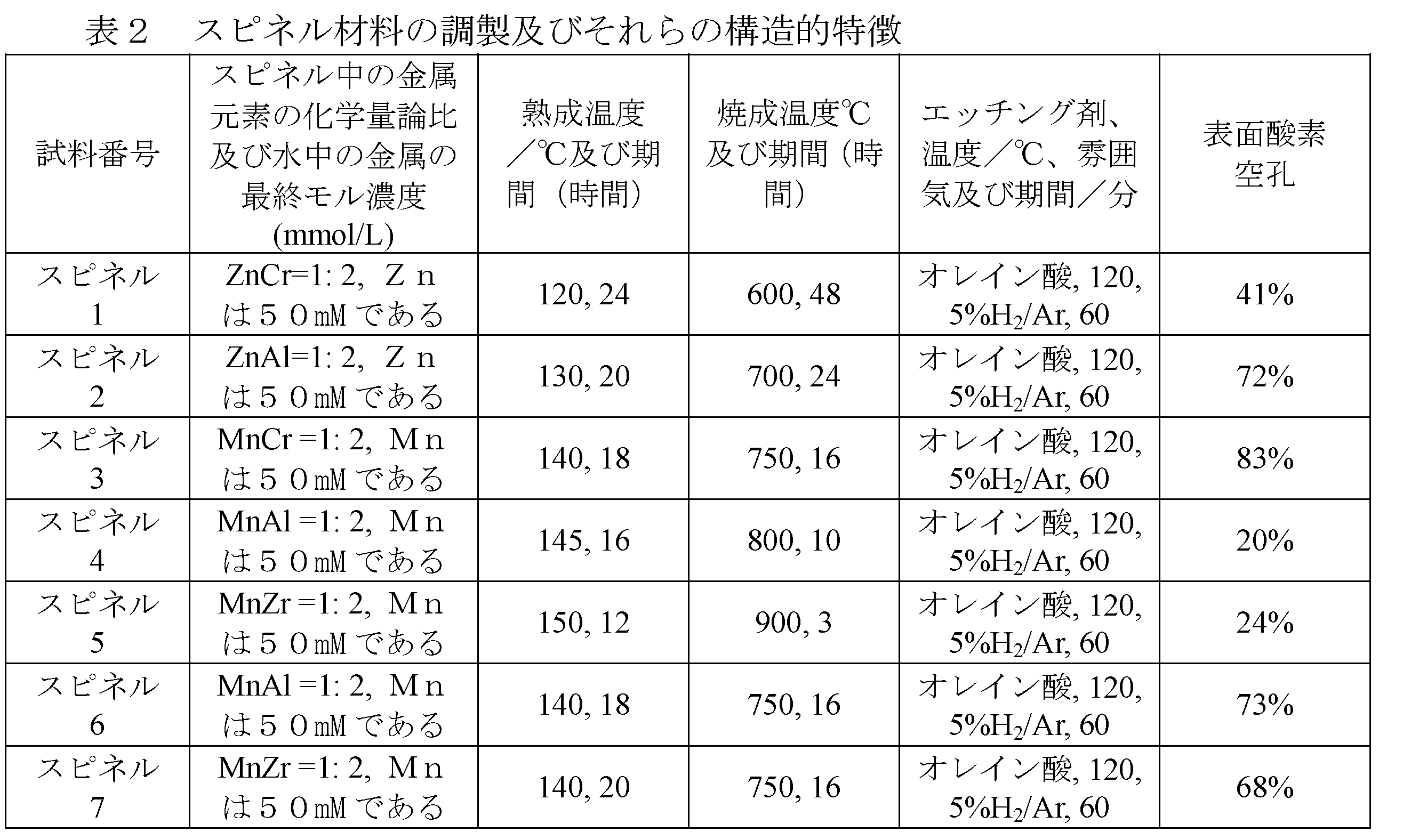
(IV)活性金属酸化物が分散されたCr2O3、Al2O3又はZrO2
Cr2O3、Al2O3又はZrO2を、活性金属酸化物のための担体又は分散剤として使用する。そのような分散された活性金属酸化物を、Cr2O3、Al2O3又はZrO2を担体とすることによる沈殿析出法を通して調製する。分散されたZnOの調製を一例として挙げると、市販のCr2O3、Al2O3又はZrO2担体を事前に溶液に分散させ、次いで、酢酸亜鉛、硝酸亜鉛、硫酸亜鉛及び他のZn前駆体の1つ以上を原料とし、室温で混合された水酸化ナトリウム、重炭酸アンモニウム、炭酸アンモニウム及び重炭酸ナトリウムの1つ以上を使用して金属成分を沈殿させる。本明細書において、硝酸亜鉛及び水酸化ナトリウムを一例として挙げると、反応液中のZn2+のモル濃度は、0.067Mであり;Zn2+と沈殿剤のモル分率の比は、1:8であってよく;次いで、熟成を160℃で24時間実行して、ZnO酸化物が分散された担体Cr2O3、Al2O3又はZrO2を得て、そして、触媒A中の分散剤の含量は、0.1wt%、10wt%及び90wt%である。
(IV) Cr 2 O 3 , Al 2 O 3 or ZrO 2 in which an active metal oxide is dispersed.
Cr 2 O 3 , Al 2 O 3 or ZrO 2 is used as a carrier or dispersant for the active metal oxide. Such dispersed active metal oxides are prepared through a precipitation precipitation method using Cr 2O 3 , Al 2 O 3 or ZrO 2 as a carrier. Taking the preparation of dispersed ZnO as an example, a commercially available Cr 2O 3 , Al 2 O 3 or ZrO 2 carrier is pre-dispersed in a solution, followed by zinc acetate, zinc nitrate, zinc sulfate and other Zn precursors. Metal components are precipitated using one or more of the body as a raw material and one or more of sodium hydroxide, ammonium bicarbonate, ammonium carbonate and sodium bicarbonate mixed at room temperature. Taking zinc nitrate and sodium hydroxide as examples in the present specification, the molar concentration of Zn 2+ in the reaction solution is 0.067 M; the ratio of the molar fraction of Zn 2+ to the precipitant is 1: 8. The aging may then be performed at 160 ° C. for 24 hours to obtain the ZnO oxide-dispersed carrier Cr 2 O 3 , Al 2 O 3 or ZrO 2 , and the dispersant in catalyst A. The content of is 0.1 wt%, 10 wt% and 90 wt%.
エッチングプロセスは、上記(I)の工程(2)における生成物ZnO3、ZnO5及びZnO8の調製プロセスと同じである。多数の表面酸素空孔を有する触媒を調製する。表面酸素空孔は、それぞれ、65%、30%及び25%である。処理後プロセスは、上記(I)の工程(3)と同じである。 The etching process is the same as the process for preparing the products ZnO3, ZnO5 and ZnO8 in the step (2) of the above (I). Prepare a catalyst with a large number of surface oxygen pores. Surface oxygen vacancies are 65%, 30% and 25%, respectively. The post-treatment process is the same as the step (3) of the above (I).
上から下までの対応する生成物を分散酸化物1~3と表示する。 The corresponding products from top to bottom are labeled as Dispersed Oxides 1-3.
同じ方法を使用して、MnO酸化物が分散されたCr2O3、Al2O3又はZrO2を得る。ここで、触媒A中の分散剤の含量は、5wt%、30wt%及び60wt%である。表面酸素空孔は、それぞれ、62%、27%及び28%である。上から下までの対応する生成物を分散酸化物4~6と表示する。 The same method is used to obtain Cr 2 O 3 , Al 2 O 3 or ZrO 2 in which MnO oxide is dispersed. Here, the content of the dispersant in the catalyst A is 5 wt%, 30 wt% and 60 wt%. Surface oxygen vacancies are 62%, 27% and 28%, respectively. The corresponding products from top to bottom are labeled as Dispersed Oxides 4-6.
II.触媒B成分(ZSM-5)の調製:
(I)シート様ZSM-5ゼオライト
以下の物質のモル比に従ったシート様ZSM-5ゼオライトの調製:
II. Preparation of catalyst B component (ZSM-5):
(I) Sheet-like ZSM-5 Zeolite Preparation of Sheet-like ZSM-5 Zeolite according to the molar ratio of the following substances:
Si源を、TEOS、シリカゾル及びホワイトカーボンブラックの1つ以上から選択し;そして、アルミニウム源を、メタアルミン酸ナトリウム、Al(OH)3、AlOOH及びアルミニウムイソプロポキシドの1つ以上から選択する。 The Si source is selected from one or more of TEOS, silica sol and white carbon black; and the aluminum source is selected from one or more of sodium metaaluminate, Al (OH) 3 , AlOOH and aluminum isopropoxide.
尿素は、最初に「b」軸に吸収されるので、「b」軸の方向の結晶の成長が阻害される。結晶は、最初に、「a」軸及び「c」軸に沿って成長し、したがってシートの形式でZSM-5を形成する。 Urea is first absorbed by the "b" axis, thus inhibiting crystal growth in the "b" axis direction. Crystals first grow along the "a" and "c" axes, thus forming ZSM-5 in the form of sheets.
調製手順は、以下である:アルミニウム源を水に溶解し;ケイ素源、テンプレート剤(水酸化テトラプロピルアンモニウム TPAOH)及び尿素を連続して加え;撹拌して均一な溶液を得て、次いで、それを水熱反応器に入れて水熱反応させ;その後、得られた生成物を水で洗浄し;そして、最後に空気雰囲気下で6時間焼成してテンプレート剤を除去し、したがってシートのZSM-5が得られ、ここで、ZSM-5シートの厚さは、10~200nmであり、そして、メソ細孔及びマクロ細孔がZSM-5中に共存する。 The preparation procedure is as follows: Dissolve the aluminum source in water; continuously add the silicon source, template agent (tetrapropylammonium hydroxide TPAOH) and urea; stir to obtain a uniform solution, then it. Was placed in a hydrothermal reactor for hydrothermal reaction; then the resulting product was washed with water; and finally fired in an air atmosphere for 6 hours to remove the template agent and thus the ZSM- of the sheet. 5 is obtained, where the thickness of the ZSM-5 sheet is 10-200 nm, and mesopores and macropores coexist in ZSM-5.
試料、それらの調製条件及びその構造的特徴を以下の表3に列挙する。 The samples, their preparation conditions and their structural features are listed in Table 3 below.

金属Zn、Ga、Sn、Mn、Ag及びZrによって修飾されたシート様ZSM-5の調製手順は、以下である:調製手順は、上記(I)の生成物シート1の手順と同じであり;違いは、以下である:ZSM-5の調製を完了してテンプレート剤を焼成除去した後、所望の量のZn(NO3)2、Ga(NO3)3、Sn(NO3)2、Mn(NO3)2、AgNO3及びZr(NO3)2の1つを脱イオン水に溶解し、これを初期含浸によってZSM-5上に3時間導き;そして、110℃で乾燥させた後、ZSM-5を空気雰囲気下にて600℃で6時間焼成する。修飾金属の総含量は、それぞれ、0.5wt.%、1wt.%、0.5wt.%、2wt.%、1wt.%及び2wt.%である。得られたゼオライトは、試料シート1の場合と同じ寸法及び同じシリカ/アルミナ比を有する。 The procedure for preparing the sheet-like ZSM-5 modified with the metals Zn, Ga, Sn, Mn, Ag and Zr is as follows: The procedure is the same as the procedure for product sheet 1 in (I) above; The differences are as follows: After completing the preparation of ZSM-5 and removing the template agent by firing, the desired amount of Zn (NO 3 ) 2 , Ga (NO 3 ) 3 , Sn (NO 3 ) 2 , Mn. (NO 3 ) 2 , AgNO 3 and one of Zr (NO 3 ) 2 were dissolved in deionized water and led onto ZSM-5 by initial impregnation for 3 hours; and after drying at 110 ° C. ZSM-5 is fired at 600 ° C. for 6 hours in an air atmosphere. The total content of the modified metal is 0.5wt.%, 1wt.%, 0.5wt.%, 2wt.%, 1wt.% And 2wt.%, Respectively. The obtained zeolite has the same dimensions and the same silica / alumina ratio as in the case of sample sheet 1.
対応する生成物は、シート5~10として定義される。 The corresponding product is defined as Sheets 5-10.
(II)楕円形状ZSM-5
核生成及び成長のプロセスにおいてテンプレート剤がない場合、結晶は熱力学的に最も安定な回転楕円構造へと成長する。静止状態下の結晶化の間の重力及び質量移動の影響のため、「a」軸、「b」軸及び「c」軸の方向の結晶の成長速度は、一貫性がない。それ故、楕円形状のZSM-5が形成される。
(II) Elliptical shape ZSM-5
In the absence of template agents in the process of nucleation and growth, crystals grow into the most thermodynamically stable rotating elliptical structure. Due to the effects of gravity and mass transfer during crystallization under rest, the growth rates of crystals in the "a", "b" and "c" axes are inconsistent. Therefore, an elliptical ZSM-5 is formed.
手順は、以下の通り記載される: The procedure is described as follows:
最初に、2つの溶液A及びBを調製し、ここで、溶液Aは、以下の成分を含有する:撹拌によって均一に混合されたNaOH+シリカゾル+H2O; First, two solutions A and B are prepared, where solution A contains the following components: NaOH + silica sol + H 2 O uniformly mixed by stirring;
溶液Bは、以下の成分を含有する:均一に混合され撹拌されたNaAlO2+H2O; Solution B contains the following components: uniformly mixed and agitated NaAlO 2 + H 2 O;
次に、溶液Bを溶液Aに液滴添加し;滴下速度は、1分当たり2滴であり;溶液Bを滴下し、同時に均一に撹拌し;次いで、溶液Bを水熱反応器に移動させて、水熱反応を実行し、テンプレート剤なしで静止状態下にて結晶化に供して、そして、最後に空気雰囲気下にて600℃で6時間焼成し、したがって楕円体ZSM-5が得られる。メソ細孔及びマクロ細孔が楕円体ZSM-5中に共存する。 The solution B is then added droplets to the solution A; the dripping rate is 2 drops per minute; the solution B is added dropwise and simultaneously uniformly stirred; then the solution B is moved to a hydrothermal reactor. The hydrothermal reaction is carried out, subjected to crystallization in a stationary state without a template agent, and finally fired in an air atmosphere at 600 ° C. for 6 hours, thus obtaining elliptic ZSM-5. .. Mesopores and macropores coexist in the ellipsoid ZSM-5.
試料及びその調製条件を以下の表4に示す。 The samples and their preparation conditions are shown in Table 4 below.

金属Zn、Ga、Sn、Mn、Ag及びZrによって修飾された楕円体ZSM-5の調製手順は、以下である:調製手順は、上記(II)の生成物楕円体1の手順と同じであり;違いは、以下である:テンプレート剤なしでZSM-5の調製を完了してテンプレート剤を焼き出した後、Zn(NO3)2、Ga(NO3)3、Sn(NO3)2、Mn(NO3)2、AgNO3及びZr(NO3)2の1つを所望の量に従って脱イオン水に溶解し、これを初期含浸によってZSM-5上に4時間導き;そして、110℃で乾燥させた後、ZSM-5を空気中にて630℃で4時間焼成する。修飾金属の含量は、それぞれ、0.5wt.%、1wt.%、0.5wt.%、2wt.%、1wt.%及び2wt.%である。得られたゼオライトは、楕円体1の場合と同じ寸法及び同じシリカ/アルミナ比を有する。 The procedure for preparing the ellipsoid ZSM-5 modified with the metals Zn, Ga, Sn, Mn, Ag and Zr is as follows: The procedure for preparation is the same as the procedure for the product ellipsoid 1 in (II) above. The differences are as follows: After completing the preparation of ZSM-5 without the template agent and baking out the template agent, Zn (NO 3 ) 2 , Ga (NO 3 ) 3 , Sn (NO 3 ) 2 , One of Mn (NO 3 ) 2 , AgNO 3 and Zr (NO 3 ) 2 was dissolved in deionized water according to the desired amount and led onto ZSM-5 by initial impregnation for 4 hours; and at 110 ° C. After drying, ZSM-5 is fired in air at 630 ° C. for 4 hours. The content of the modified metal is 0.5wt.%, 1wt.%, 0.5wt.%, 2wt.%, 1wt.% And 2wt.%, Respectively. The resulting zeolite has the same dimensions and the same silica / alumina ratio as for ellipsoid 1.
得られた生成物を楕円体4~9と表示する。 The resulting product is labeled as ellipsoids 4-9.
(III)パイ形状のZSM-5
以下の手順に従うパイ形状のZSM-5の調製:
(III) Pie-shaped ZSM-5
Preparation of pie-shaped ZSM-5 according to the following procedure:
Si源を、TEOS及びシリカゾルの1つ又は両方から選択し;そして、アルミニウム源を、メタアルミン酸ナトリウム、Al(OH)3及びAlOOHの1つ以上から選択する。 The Si source is selected from one or both of TEOS and silica sol; and the aluminum source is selected from one or more of sodium metaaluminate, Al (OH) 3 and AlOOH.
テンプレートとしてTPAOHと共に静止状態下で結晶化させて、パイ形状のZSM-5結晶を得る。結晶成長の初期段階に、ナノシートの形状の結晶が形成される。大きなH2O/SiO2比及び結晶周囲の比較的低いテンプレート剤の濃度のために、結晶は、パイ形状に連続的に成長するための十分な空間を有する。 Crystallize in a stationary state with TPAOH as a template to obtain pie-shaped ZSM-5 crystals. In the early stages of crystal growth, nanosheet-shaped crystals are formed. Due to the large H 2 O / SiO 2 ratio and the relatively low concentration of template agent around the crystal, the crystal has sufficient space for continuous growth in a pie shape.
手順は、以下である:TPAOHをケイ素源に加え、次いで、ある特定量のH2Oを加えて溶液Aを得て;溶液Aを水浴中にて80℃で24時間撹拌し;アルミニウム源をNaOH溶液に溶解して溶液Bを調製し;溶液Bを溶液Aに液滴添加し;次いで、3時間撹拌し;その後、得られた溶液をステンレス製反応器に移動させて2日間結晶化させ;そして、水で洗浄した後、空気中にて560℃で5時間焼成して、テンプレート剤を焼き出す。 The procedure is as follows: TPAOH is added to the silicon source, then a certain amount of H2O is added to obtain solution A; solution A is stirred in a water bath at 80 ° C. for 24 hours; aluminum source. Dissolve in NaOH solution to prepare solution B; add solution B droplets to solution A; then stir for 3 hours; then transfer the resulting solution to a stainless steel reactor and crystallize for 2 days. Then, after washing with water, the template agent is baked in air at 560 ° C. for 5 hours.
試料及びその調製条件を以下の表5に示す。 The samples and their preparation conditions are shown in Table 5 below.

金属Zn、Ga、Sn、Mn、Ag及びZrによって修飾されたパイ形状のZSM-5の調製手順は、以下である:調製手順は、上記(III)のパイ1についての手順と同じであり;違いは、以下である:パイ形状のZSM-5の調製を完了してテンプレート剤を焼き出した後、所望の量のZn(NO3)2、Ga(NO3)3、Sn(NO3)2、Mn(NO3)2、AgNO3及びZr(NO3)2の1つを脱イオン水に溶解し、これを初期含浸によってZSM-5上に4時間導き;そして、110℃で乾燥させた後、ZSM-5を空気中にて500℃で4時間焼成する。修飾金属の含量は、それぞれ、0.5wt.%、1wt.%、0.5wt.%、2wt.%、1wt.%及び2wt.%である。得られたゼオライトは、パイ1の場合と同じ寸法及び同じシリカ/アルミナ比を有する。 The procedure for preparing the pie-shaped ZSM-5 modified with the metals Zn, Ga, Sn, Mn, Ag and Zr is as follows: The procedure is the same as for pie 1 in (III) above; The differences are as follows: After completing the preparation of the pie-shaped ZSM-5 and baking the template agent, the desired amount of Zn (NO 3 ) 2 , Ga (NO 3 ) 3 , Sn (NO 3 ) 2 , Mn (NO 3 ) 2 , AgNO 3 and Zr (NO 3 ) 2 are dissolved in deionized water and led onto ZSM-5 by initial impregnation for 4 hours; and dried at 110 ° C. After that, ZSM-5 is fired in air at 500 ° C. for 4 hours. The content of the modified metal is 0.5wt.%, 1wt.%, 0.5wt.%, 2wt.%, 1wt.% And 2wt.%, Respectively. The resulting zeolite has the same dimensions and the same silica / alumina ratio as for pie 1.
得られた試料をパイ4~9と表示する。 The obtained sample is labeled as pie 4-9.
III.触媒の調製
触媒成分A及び触媒成分Bを必要な比で容器に加え、そして、材料及び/又は容器の速い移動処理に供して、押出力、衝撃力、せん断力及び摩擦力の1つ以上を発生させて、容器内部の材料に分離、粉砕、均一混合などをもたらし;温度及び処理雰囲気を変えることによって、力学的エネルギー、熱エネルギー及び化学エネルギーを相互変換し、それによって異なる成分間の相互作用をさらに増強することができる。
III. Preparation of catalysts Catalyst component A and catalyst component B are added to the container in the required ratios and subjected to rapid transfer processing of the material and / or container to generate one or more of the push force, impact force, shear force and frictional force. Generate and bring about separation, grinding, uniform mixing, etc. in the material inside the container; by changing the temperature and treatment atmosphere, the mechanical energy, thermal energy and chemical energy are interconverted, thereby the interaction between different components. Can be further enhanced.
機械的混合プロセスでは、混合温度を20~100℃として設定することができ、そして、機械的混合プロセスを特定の雰囲気中で又は直接空気中で実行することができる。雰囲気は、以下の1つ以上である:a)窒素及び/又は不活性ガス;b)混合ガス中の水素の体積比が5~50%である、水素、窒素及び/又は不活性ガスの混合ガス;c)混合ガス中の一酸化炭素の体積比が5~20%である、一酸化炭素、窒素及び/又は不活性ガスの混合ガス;並びにd)混合ガス中の酸素の体積比が5~20%である、酸素、窒素及び/又は不活性ガスの混合ガス。不活性ガスは、ヘリウム、アルゴン及びネオンの1つ以上である。 In the mechanical mixing process, the mixing temperature can be set as 20-100 ° C., and the mechanical mixing process can be performed in a specific atmosphere or directly in the air. The atmosphere is one or more of: a) nitrogen and / or inert gas; b) mixture of hydrogen, nitrogen and / or inert gas with a volume ratio of hydrogen in the mixed gas of 5-50%. Gas; c) a mixed gas of carbon monoxide, nitrogen and / or an inert gas having a volume ratio of carbon monoxide in the mixed gas of 5 to 20%; and d) a volume ratio of oxygen in the mixed gas of 5. A mixed gas of oxygen, nitrogen and / or an inert gas, which is -20%. The inert gas is one or more of helium, argon and neon.
機械的撹拌:触媒成分A及び触媒成分Bを撹拌棒と共に撹拌タンク中で混合し;そして、撹拌時間(5分~120分)及び撹拌速度(30~300r/分)を制御することによって、触媒成分A及び触媒成分Bの混合度及び相対距離を調節する。 Mechanical stirring: Catalyst component A and catalyst component B are mixed with a stirring rod in a stirring tank; and the catalyst is controlled by controlling the stirring time (5 to 120 minutes) and the stirring rate (30 to 300 r / min). The mixing degree and relative distance of the component A and the catalyst component B are adjusted.
ボールミリング:研磨材料及び触媒を使用することによって粉砕タンク中で高速で回転させ;そして、触媒に対して強い衝撃力及びミリングをもたらして、触媒成分A及び触媒成分Bを分散及び混合する効果を達成する。研磨材料(ステンレス、メノウ及び石英であることができ;そして、サイズ範囲は、5mm~15mmである)と触媒の比(質量比範囲は、20~100:1)を制御して、触媒の粒径及び相対距離を調節する。 Ball milling: Rotating at high speed in a grinding tank by using a polishing material and catalyst; and providing a strong impact force and milling on the catalyst to provide the effect of dispersing and mixing catalyst component A and catalyst component B. Achieve. The catalyst grains are controlled by controlling the ratio of the abrasive material (which can be stainless steel, agate and quartz; and the size range is 5 mm to 15 mm) to the catalyst (mass ratio range is 20 to 100: 1). Adjust the diameter and relative distance.
振動盤混合:触媒成分A及び触媒成分Bを予混合して、触媒を容器に入れ;振動盤の往復揺動又は円周方向揺動を制御することによって触媒成分A及び触媒成分Bの混合を実現し;そして、揺動速度(範囲:1~70r/分)及び時間(範囲:5分~120分)を調節することによって、均一混合を実現して相対距離を調節する。 Vibration board mixing: The catalyst component A and the catalyst component B are premixed and the catalyst is placed in a container; the catalyst component A and the catalyst component B are mixed by controlling the reciprocating swing or the circumferential swing of the vibration board. Realized; and by adjusting the rocking speed (range: 1-70 r / min) and time (range: 5 min-120 min), uniform mixing is achieved and the relative distance is adjusted.
機械的粉砕:触媒成分A及び触媒成分Bを予混合して、触媒を容器に入れ;そして、ある特定の圧力下(範囲:5kg~20kg)、相対運動を行い、粉砕によって混合して(速度範囲:30~300r/分)、触媒成分の粒径及び相対距離を調節する効果及び均一混合を実現する効果を達成する。 Mechanical grinding: Catalyst component A and catalyst component B are premixed, the catalyst is placed in a container; and under certain pressure (range: 5 kg to 20 kg), relative motion is performed and mixed by grinding (velocity). Range: 30-300 r / min), the effect of adjusting the particle size and relative distance of the catalyst components and the effect of achieving uniform mixing are achieved.
試料、調製条件及び構造的特徴を以下の表6に示す。 The samples, preparation conditions and structural features are shown in Table 6 below.


触媒反応の例
固定床反応を一例として挙げるが、触媒はまた移動床反応器にも適用可能である。装置は、質量流量制御器及びオンライン生成物分析クロマトグラフィーを備えている(反応器の排ガスは、クロマトグラフィーの計量バルブと直接連結されており、したがって周期的でリアルタイムのサンプリング及び分析が達成されよう)。
Examples of Catalytic Reactions Although fixed bed reactions are given as an example, catalysts are also applicable to mobile bed reactors. The instrument is equipped with a mass flow controller and online product analysis chromatography (reactor emissions are directly linked to the chromatographic metering valve, so periodic, real-time sampling and analysis may be achieved. ).
本発明の上記の触媒2gを固定床反応器に入れる。反応器中の空気をArで置換し;次いで、温度をH2雰囲気中で300℃に上げ、次いで、合成ガス(H2/COモル比=0.2~3.5)をその中に供給する。合成ガスの圧力は、0.1~6MPaである。温度を300~600℃の反応温度まで上げ、そして、供給ガスの空間速度を500~8000ml/g/hの範囲で制御する。オンラインクロマトグラフィーを使用して、生成物をモニタリング及び分析する。 2 g of the above catalyst of the present invention is placed in a fixed bed reactor. The air in the reactor was replaced with Ar; then the temperature was raised to 300 ° C. in an H2 atmosphere and then syngas ( H2 / CO molar ratio = 0.2-3.5 ) was supplied therein. do. The pressure of the synthetic gas is 0.1 to 6 MPa. The temperature is raised to a reaction temperature of 300-600 ° C. and the air velocity of the supplied gas is controlled in the range of 500-8000 ml / g / h. The product is monitored and analyzed using online chromatography.
反応温度、圧力、空間速度及び合成ガスのH2/COモル比を変化させることによって、触媒性能を変化させることができる。全ての炭化水素における芳香族炭化水素(ベンゼン、トルエン、キシレン、トリメチルベンゼン及び他の芳香族化合物を含む)の選択性は、50%~85%の高さであり、そして、COの変換は10%~60%である。金属酸化物の水素化活性は高くないので、メタンの大量生産が回避される。メタンの選択性は低く、ここで、メタン、C2-4炭化水素及びC5+長い炭素鎖の炭化水素についての全体の選択性は、15%~50%である。 The catalytic performance can be varied by varying the reaction temperature, pressure, space velocity and H 2 / CO molar ratio of the synthetic gas. The selectivity of aromatic hydrocarbons (including benzene, toluene, xylene, trimethylbenzene and other aromatic compounds) in all hydrocarbons is as high as 50% -85%, and the conversion of CO is 10. % To 60%. Since the hydrogenation activity of metal oxides is not high, mass production of methane is avoided. The selectivity of methane is low, where the overall selectivity for methane, C 2-4 hydrocarbons and C 5 + long carbon chain hydrocarbons is 15% -50%.
表7は、いくつかの触媒の適用及びそれらの触媒性能データを列挙する。 Table 7 lists the applications of several catalysts and their catalyst performance data.


参考例1で採用される触媒は、金属ZnCo+触媒成分Aの楕円体1である。Zn/Coのモル比=1/1。ZnCo/ZSM-5の質量比=1/1。他のパラメーター及び混合プロセスは、触媒Cの場合と同じである。 The catalyst used in Reference Example 1 is an ellipsoid 1 of metal ZnCo + catalyst component A. Zn / Co molar ratio = 1/1. Mass ratio of ZnCo / ZSM-5 = 1/1. Other parameters and mixing process are the same as for catalyst C.
参考例2で採用される触媒は、シート2試料と組み合わされた表面酸素空孔のないTiO2である。他のパラメーター及び混合プロセスは、触媒Cの場合と同じである。 The catalyst used in Reference Example 2 is TiO 2 without surface oxygen vacancies combined with the Sheet 2 sample. Other parameters and mixing process are the same as for catalyst C.
参考例3で採用される触媒中のゼオライトは、Nankai University Catalyst Companyから購入した市販のミクロ細孔ZSM-5であり、ここで、シリカアルミナ比は30であり、これはZnO2と組み合わされる。 The zeolite in the catalyst used in Reference Example 3 is a commercially available micropore ZSM-5 purchased from Nankai University Catalyst Company, where the silica-alumina ratio is 30, which is combined with ZnO2.
参考例4で採用される触媒は、金属酸化物とゼオライト成分との間の距離が5mmであるという特徴を有する。全ての他のパラメーター及び混合プロセスは、触媒Cの場合と同じである。 The catalyst used in Reference Example 4 is characterized in that the distance between the metal oxide and the zeolite component is 5 mm. All other parameters and mixing process are the same as for catalyst C.
参考例5で採用される触媒は、金属酸化物成分がゼオライトの細孔チャネル中に位置しており、かつ細孔チャネルと密接に接触しているという特徴を有する。全ての他のパラメーターなどは、触媒Cの場合と同じである。 The catalyst adopted in Reference Example 5 is characterized in that the metal oxide component is located in the pore channel of zeolite and is in close contact with the pore channel. All other parameters and the like are the same as in the case of catalyst C.
参考例6で採用される触媒は、ゼオライト成分が楕円形状を有するが、粒径が10~20μmであるという特徴を有する。全ての他のパラメーター及び混合プロセスは、触媒Cの場合と同じである。 The catalyst used in Reference Example 6 has a zeolite component having an elliptical shape, but has a characteristic that the particle size is 10 to 20 μm. All other parameters and mixing process are the same as for catalyst C.
参考例7で採用される触媒は、ゼオライト成分がシートの形状を有するが、粒径が5μmであり「b」軸の厚さが700nmであるという特徴を有する。全ての他のパラメーター及び混合プロセスは、触媒Cの場合と同じである。 The catalyst adopted in Reference Example 7 is characterized in that the zeolite component has the shape of a sheet, but the particle size is 5 μm and the thickness of the “b” axis is 700 nm. All other parameters and mixing process are the same as for catalyst C.
参考例8で採用される触媒は、触媒成分AがZnO9、成分Bがシート1であるという特徴を有する。 The catalyst adopted in Reference Example 8 has a feature that the catalyst component A is ZnO9 and the component B is sheet 1.
参考例9では、成分AはZn10であり、そして、成分Bはパイ1である。 In Reference Example 9, component A is Zn10 and component B is pie 1.
上記表から、好ましい触媒成分Aと触媒成分Bの比0.3~5、好ましい酸素空孔の量40~90、好ましいゼオライトのシリカ/アルミナ比150~800、より好ましい比300~800、好ましい「b」軸の厚さ30~200nm及び成分Aと成分Bとの間の好ましい距離5nm~1mmを含む、重要である一連の複合触媒のパラメーターが存在する。これらの好ましいパラメーターが同時に満たされるときだけ、高いCO変換及び芳香族炭化水素の高い選択性を実現することができる。 From the above table, the ratio of the preferred catalyst component A to the catalyst component B is 0.3 to 5, the preferable amount of oxygen pores is 40 to 90, the silica / alumina ratio of the preferred zeolite is 150 to 800, and the more preferable ratio is 300 to 800. There is a set of important composite catalyst parameters that include a "b" axis thickness of 30-200 nm and a preferred distance of 5 nm-1 mm between component A and component B. Only when these preferred parameters are met at the same time can high CO conversion and high selectivity of aromatic hydrocarbons be achieved.
さらなる説明は、以下の通り説明される: Further explanation is given as follows:
表7の触媒I、J、R及びP1について、触媒成分Aの酸素空孔の量は高く、触媒成分Bのゼオライトの「b」軸は短く、シリカ/アルミナ比は高く、そして、AとBとの間の距離、及びA/Bの質量比は適切であり、そして、上記因子は、好ましい範囲内である。それ故、芳香族炭化水素についての選択性は高く、65%より大きい。 For catalysts I, J, R and P1 in Table 7, the amount of oxygen pores in catalyst component A is high, the "b" axis of the zeolite of catalyst component B is short, the silica / alumina ratio is high, and A and B. The distance between and the mass ratio of A / B is appropriate, and the above factors are within the preferred range. Therefore, the selectivity for aromatic hydrocarbons is high, greater than 65%.
対照的に、表7の触媒Qについて、触媒成分Aの表面酸素空孔の量は高く、触媒B成分はシート1のゼオライトであり、そして、シリカ/アルミナ比、「b」軸の厚さ及びA/Bの質量比は全て好ましい範囲内であるが、成分Aと成分Bとの間の距離は2mmとあまりに離れており、好ましい範囲内ではない。それ故、所望の芳香族炭化水素の選択性は低く、54.2%である。 In contrast, for catalyst Q in Table 7, the amount of surface oxygen pores in catalyst component A is high, the catalyst B component is the zeolite of sheet 1, and the silica / alumina ratio, the thickness of the "b" axis and The mass ratios of A / B are all within the preferable range, but the distance between the component A and the component B is too far, 2 mm, which is not within the preferable range. Therefore, the selectivity of the desired aromatic hydrocarbon is low, 54.2%.
さらに、実施態様S1~S7の比較は、上記パラメーターの全てが特許請求の範囲に定義される好ましい範囲に入るとき、Mn酸化物を含有する触媒が高温度でZn酸化物系触媒よりも高い活性を示すことを示す。高温度は、400℃~600℃の間の温度を指す。 Further, in the comparison of embodiments S1 to S7, when all of the above parameters fall within the preferred range defined in the claims, the catalyst containing Mn oxide has higher activity than the Zn oxide-based catalyst at high temperature. Is shown. High temperature refers to a temperature between 400 ° C and 600 ° C.
本発明の請求項1に定義される触媒を、合成ガスの1工程直接変換を経由した芳香族化合物の合成に使用できること、並びに、芳香族化合物の選択性が50~85%に達し得る一方で、副生成物であるメタンの選択性が非常に低く15%未満であることが分かる。特定の構造パラメーター、触媒及び反応条件が好ましい範囲内に入るとき、高い温度条件下でさえ、芳香族化合物について60%の選択性、さらには65%以上の選択性を実現することができる。 While the catalyst defined in claim 1 of the present invention can be used for the synthesis of aromatic compounds via one-step direct conversion of syngas, the selectivity of aromatic compounds can reach 50-85%. It can be seen that the selectivity of methane, which is a by-product, is very low, less than 15%. When certain structural parameters, catalysts and reaction conditions fall within the preferred range, 60% selectivity for aromatic compounds, even 65% or more selectivity can be achieved, even under high temperature conditions.
Claims (8)
該触媒は、成分A+Bからなる複合触媒であり、触媒成分A及び触媒成分Bを機械的混合様式で配合することによって形成され、
触媒成分Aの活性成分が活性金属酸化物であり;
触媒成分Bが、ZSM-5ゼオライト及び金属修飾ZSM-5の1つ又は両方であり;
前記活性金属酸化物がMnO、MnCr2O4、MnAl2O4 、ZnO、ZnCr2O4及びZnAl2O4のうちの1つ以上であり;
前記活性金属酸化物が酸化物結晶粒子から構成され、該活性金属酸化物の表面上、酸素空孔が存在し、
ZSM-5のアルミナに対するシリカのモル比(SiO2/Al2O3)が20~1000であり;
ZSM-5ゼオライトが、走査型電子顕微鏡によって観察することができる六角柱シート又は楕円体粒子又はパイ形状粒子の1つ以上を巨視的に提示し;
ZSM-5が蓄積されたZSM-5結晶粒子によって形成され;
ZSM-5ゼオライトが、マクロ細孔、メソ細孔及びミクロ細孔を含む多段階の階層的細孔構造を有し;
マクロ細孔の比表面積及びメソ細孔の比表面積が総比表面積の5~25%を占め;
ミクロ細孔の比表面積が40~90%を占め;
ミクロ細孔が2nm未満の直径を有する細孔チャネルであり;
メソ細孔が2~50nmの直径を有する細孔チャネルであり;
マクロ細孔が50nmより大きい直径を有する細孔チャネルであり;
ZSM-5結晶が、チャネルが規則的に並んだ典型的なMFI構造を示すミクロ細孔構造を有し;
ZSM-5ゼオライトのミクロ細孔がZSM-5結晶粒子中に位置し;そして、
メソ細孔及びマクロ細孔が不規則であり、積層された結晶粒子によって形成される、触媒。 A catalyst for producing aromatic hydrocarbons by directly converting syngas,
The catalyst is a composite catalyst composed of components A + B, and is formed by blending catalyst component A and catalyst component B in a mechanical mixing mode.
The active ingredient of catalyst component A is an active metal oxide;
The catalyst component B is one or both of the ZSM-5 zeolite and the metal modified ZSM-5;
The active metal oxide is one or more of MnO, MnCr 2 O 4 , MnAl 2 O 4 , ZnO, ZnCr 2 O 4 and ZnAl 2 O 4 .
The active metal oxide is composed of oxide crystal particles, and oxygen vacancies are present on the surface of the active metal oxide.
The molar ratio of silica to alumina of ZSM-5 (SiO 2 / Al 2 O 3 ) is 20-1000;
The ZSM-5 zeolite macroscopically presents one or more of the hexagonal column sheets or ellipsoidal particles or pie-shaped particles that can be observed with a scanning electron microscope;
ZSM-5 is formed by the accumulated ZSM-5 crystal particles;
ZSM-5 zeolite has a multi-step hierarchical pore structure containing macropores, mesopores and micropores;
The specific surface area of macropores and mesopores occupy 5-25% of the total specific surface area;
The specific surface area of the micropores occupies 40-90%;
Micropores are pore channels with diameters less than 2 nm;
Mesopores are pore channels with a diameter of 2-50 nm;
Macropores are pore channels with diameters greater than 50 nm;
ZSM-5 crystals have a micropore structure that exhibits a typical MFI structure with regularly aligned channels;
Micropores of ZSM-5 zeolite are located in the ZSM-5 crystal particles; and
A catalyst in which mesopores and macropores are irregular and are formed by laminated crystalline particles.
ZMS-5のシート構造が六角柱シートであり;
(010)表面が六角形を提示し;
6つの側面が等しいか又は等しくなく;
MFI構造の(100)表面に垂直な軸が「a」軸であり;
(010)表面に垂直な軸が「b」軸であり、その長さが上部と下部の六角形の末端表面間の距離に対応し;
「a」軸及び「b」軸に同時に垂直である軸が「c」軸であり;
「b」軸の長さが30~500nmであり;
「a」軸の長さが500~1500nmであり;
「c」軸の長さが500~2000nmであり;
(ii)
楕円形状のZSM-5結晶粒子が1つの長軸と2つの短軸を有し、それぞれ、500nm~10μm、500nm~5μm及び500nm~5μmの長さであり;
(iii)
パイ形状のZSM-5結晶粒子が中国将棋の駒又は中国太鼓の形状と似た形状を示し;
上部の末端表面及び下部の末端表面が平面であり;
2つの末端表面及びその断面が円形又は楕円形表面であり;
側壁表面が外側に突き出ているか突き出ていない弓形状を提示し、すなわち、断面の面積がそれらの2つの末端表面の面積よりも大きいか又は等しく;
「b」軸の長さが上部の末端表面と下部の末端表面の距離であり、30~500nmの範囲であり;
「a」軸の長さが100~800nmであり;
「c」軸の長さが500~800nmである、請求項1に記載の触媒。 (I)
The seat structure of ZMS-5 is a hexagonal column seat;
(010) The surface presents a hexagon;
Six sides are equal or unequal;
The axis perpendicular to the (100) surface of the MFI structure is the "a"axis;
(010) The axis perpendicular to the surface is the "b" axis, the length of which corresponds to the distance between the upper and lower hexagonal end surfaces;
The axis that is perpendicular to the "a" and "b" axes at the same time is the "c"axis;
The length of the "b" axis is 30-500 nm;
The length of the "a" axis is 500-1500 nm;
The length of the "c" axis is 500-2000 nm;
(Ii)
The elliptical ZSM-5 crystal particles have one major axis and two minor axes, with lengths of 500 nm to 10 μm, 500 nm to 5 μm and 500 nm to 5 μm, respectively;
(Iii)
The pie-shaped ZSM-5 crystal particles show a shape similar to that of a Chinese shogi piece or Chinese drum;
The upper end surface and the lower end surface are flat;
The two terminal surfaces and their cross sections are circular or elliptical surfaces;
It presents a bow shape with the side wall surface protruding outwards or not, i.e., the area of the cross section is greater than or equal to the area of their two end surfaces;
The length of the "b" axis is the distance between the upper end surface and the lower end surface, in the range of 30-500 nm;
The length of the "a" axis is 100-800 nm;
The catalyst according to claim 1 , wherein the length of the "c" axis is 500 to 800 nm.
修飾金属の総含量が0.5~2重量%である、請求項1に記載の触媒。 The metal-modified ZSM-5 is ZSM-5 modified with one or two of Zn, Ga, Sn, Mn, Ag and Zr; and
The catalyst according to claim 1 , wherein the total content of the modified metal is 0.5 to 2% by weight.
採用される触媒が請求項1に記載の触媒である、方法。 A method of synthesizing aromatic hydrocarbons via direct conversion of syngas, using syngas as a feedstock, operated in a fixed bed or mobile bed reactor; and
The method according to claim 1 , wherein the catalyst adopted is the catalyst according to claim 1.
反応温度が300~600℃であり;そして、
空間速度が500~8000h-1である、請求項4に記載の方法。 The pressure of the synthetic gas is 0.1-6 MPa;
The reaction temperature is 300-600 ° C; and
The method according to claim 4 , wherein the space velocity is 500 to 8000 h -1 .
該触媒は、成分A+Bからなる複合触媒であり、触媒成分A及び触媒成分Bを機械的混合様式で配合することによって形成され、
触媒成分Aの活性成分が活性金属酸化物であり;
触媒成分Bが、ZSM-5ゼオライト及び金属修飾ZSM-5の1つ又は両方であり;
前記活性金属酸化物がMnO、MnCr 2 O 4 、MnAl 2 O 4 、ZnO、ZnCr 2 O 4 及びZnAl 2 O 4 のうちの1つ以上であり;
以下の工程:
(a)1つ以上のエッチング剤の溶液に金属酸化物を浸漬する工程;
(b)上記懸濁液を100~150℃で加熱する工程;次いで、
(c)懸濁物質を取り出し洗浄及び濾過にかけ、大量の表面酸素空孔を有する活性金属酸化物材料を得る工程;次いで、
(d)濾過した物質を、不活性ガス又は不活性ガスと還元雰囲気とのガス混合物である雰囲気中で乾燥及び還元する工程、を含み、
ここで、不活性雰囲気中のガスがN2、He及びArの1つ以上であり;
還元雰囲気がH2及びCOの1つ以上であり;
ガス混合物中の還元ガスに対する不活性ガスの体積比が100/10~0/100であり;
処理時間が0.5~5時間であり;そして、
処理温度が20~500℃である、活性金属酸化物の調製方法。 A method for preparing an active metal oxide for use as a catalyst component A of a catalyst for producing an aromatic hydrocarbon by directly converting a synthetic gas .
The catalyst is a composite catalyst composed of components A + B, and is formed by blending catalyst component A and catalyst component B in a mechanical mixing mode.
The active ingredient of catalyst component A is an active metal oxide;
The catalyst component B is one or both of the ZSM-5 zeolite and the metal modified ZSM-5;
The active metal oxide is one or more of MnO, MnCr 2 O 4 , MnAl 2 O 4 , ZnO, ZnCr 2 O 4 and ZnAl 2 O 4 ;
The following steps:
(A) A step of immersing a metal oxide in a solution of one or more etching agents;
(B) Step of heating the suspension at 100-150 ° C; then
(C) A step of removing suspended solids and subjecting them to washing and filtration to obtain an active metal oxide material having a large amount of surface oxygen pores; then.
(D) The step of drying and reducing the filtered substance in an atmosphere which is an inert gas or a gas mixture of the inert gas and a reducing atmosphere is included.
Here, the gas in the inert atmosphere is one or more of N2 , He and Ar;
The reducing atmosphere is one or more of H 2 and CO;
The volume ratio of the inert gas to the reducing gas in the gas mixture is 100/10 to 0/100;
The processing time is 0.5-5 hours; and
A method for preparing an active metal oxide having a treatment temperature of 20 to 500 ° C.
Applications Claiming Priority (3)
| Application Number | Priority Date | Filing Date | Title |
|---|---|---|---|
| CN201610397763.3 | 2016-06-07 | ||
| CN201610397763.3A CN107469857B (en) | 2016-06-07 | 2016-06-07 | A kind of catalyst and method for directly converting synthesis gas to produce aromatic hydrocarbons |
| PCT/CN2016/089725 WO2017210954A1 (en) | 2016-06-07 | 2016-07-12 | Catalyst and method for manufacturing aromatic hydrocarbon by directly converting synthesis gas |
Publications (2)
| Publication Number | Publication Date |
|---|---|
| JP2019513541A JP2019513541A (en) | 2019-05-30 |
| JP7041069B2 true JP7041069B2 (en) | 2022-03-23 |
Family
ID=60578341
Family Applications (1)
| Application Number | Title | Priority Date | Filing Date |
|---|---|---|---|
| JP2018549456A Active JP7041069B2 (en) | 2016-06-07 | 2016-07-12 | Catalysts and methods for producing aromatic hydrocarbons by directly converting syngas |
Country Status (8)
| Country | Link |
|---|---|
| US (1) | US10618855B2 (en) |
| EP (1) | EP3466911A4 (en) |
| JP (1) | JP7041069B2 (en) |
| CN (1) | CN107469857B (en) |
| RU (1) | RU2711415C1 (en) |
| SA (1) | SA518392257B1 (en) |
| WO (1) | WO2017210954A1 (en) |
| ZA (1) | ZA201806105B (en) |
Families Citing this family (31)
| Publication number | Priority date | Publication date | Assignee | Title |
|---|---|---|---|---|
| WO2019000381A1 (en) * | 2017-06-30 | 2019-01-03 | 华电煤业集团有限公司 | System and method for preparing aromatics by using syngas |
| CN109939723B (en) * | 2018-01-26 | 2021-06-01 | 中国科学院大连化学物理研究所 | A kind of catalyst and method for producing ethylene by direct conversion of synthesis gas |
| CN109939728B (en) | 2018-01-26 | 2020-08-14 | 中国科学院大连化学物理研究所 | A kind of supported catalyst and method for directly converting synthesis gas to light olefins |
| CN110385141B (en) * | 2018-04-20 | 2021-05-04 | 武汉大学 | Composite catalyst for directly preparing aromatic hydrocarbon from synthesis gas and preparation method thereof |
| CN110496640B (en) * | 2018-05-17 | 2022-09-06 | 中国科学院大连化学物理研究所 | Catalyst for synthesizing paraxylene and preparation method and application thereof |
| CN110496639B (en) * | 2018-05-17 | 2022-05-27 | 中国科学院大连化学物理研究所 | Catalyst for aromatic hydrocarbon synthesis and preparation method and application thereof |
| KR102162250B1 (en) * | 2018-10-30 | 2020-10-06 | 한국화학연구원 | Method for Preparing Monocyclic Aromatics by Using the Same and Catalyst for Preparing Monocyclic Aromatics |
| CN109384245A (en) * | 2018-11-30 | 2019-02-26 | 中国科学院大连化学物理研究所 | A kind of macropore-micropore composite S ilicalite-1 molecule sieve and its synthetic method |
| CN111346671B (en) * | 2018-12-21 | 2023-03-24 | 中国科学院大连化学物理研究所 | Catalyst and method for preparing low aromatic hydrocarbon liquid fuel by directly converting synthesis gas |
| CN111346666B (en) * | 2018-12-21 | 2023-02-03 | 中国科学院大连化学物理研究所 | Catalyst and method for preparing liquid fuel with high aromatic hydrocarbon content by directly converting synthesis gas |
| US11331658B2 (en) * | 2019-03-27 | 2022-05-17 | Exxonmobil Chemical Patents Inc. | Transalkylation start-up processes for supported precious metal catalyst |
| CN110201709A (en) * | 2019-06-17 | 2019-09-06 | 华东理工大学 | The composite catalyst and preparation method of synthesis gas high level aromatic hydrocarbons directly processed and application |
| CN112108179A (en) * | 2019-06-21 | 2020-12-22 | 中国科学院大连化学物理研究所 | Catalyst for preparing aromatic hydrocarbon by directly converting synthesis gas and preparation and application thereof |
| CN112691697A (en) * | 2019-10-23 | 2021-04-23 | 中国石油化工股份有限公司 | Synthetic gas conversion coupling catalyst and application thereof |
| CN112774724B (en) * | 2019-11-04 | 2022-04-19 | 中国科学院大连化学物理研究所 | Catalyst and preparation method and application thereof |
| CN110694677A (en) * | 2019-11-11 | 2020-01-17 | 湘潭大学 | Catalyst for efficiently synthesizing p-xylene through methanol shape-selective aromatization |
| CN111729672A (en) * | 2019-12-11 | 2020-10-02 | 中国科学院深圳先进技术研究院 | A kind of molybdenum dioxide catalyst modified on the surface of fully decomposed water and its preparation method and use |
| CN111377432B (en) * | 2020-03-24 | 2021-07-20 | 中国科学院化学研究所 | A method for preparing layered nano-carbon material by coal solvent heat treatment |
| CN111420701B (en) * | 2020-04-08 | 2023-05-26 | 中国科学院上海高等研究院 | Catalyst for preparing aromatics from synthesis gas and its application |
| CN111514928B (en) * | 2020-04-29 | 2022-09-20 | 陕西延长石油(集团)有限责任公司 | A kind of catalyst and method for preparing ethylbenzene by one-step method of synthesis gas and benzene |
| CN114433196B (en) | 2020-10-20 | 2023-07-04 | 中国石油化工股份有限公司 | Monolithic catalyst, preparation method and application thereof in synthesis gas conversion reaction |
| CN114588902A (en) * | 2020-12-04 | 2022-06-07 | 中国科学院大连化学物理研究所 | A catalyst for converting synthesis gas to aromatic hydrocarbons, preparation method and application thereof |
| CN114733560B (en) * | 2021-01-07 | 2024-04-02 | 国家能源投资集团有限责任公司 | Composite catalyst, preparation method and application thereof, and method for preparing aromatic hydrocarbon by one-step method from synthesis gas |
| CN115850004B (en) * | 2021-09-24 | 2025-04-18 | 中国科学院大连化学物理研究所 | A method for preparing p-xylene |
| CN115888705B (en) * | 2021-09-30 | 2026-07-24 | 中国石油化工股份有限公司 | A polycyclic aromatic hydrocarbon hydrogenation catalyst, its preparation method and application |
| CN115055175B (en) * | 2022-06-16 | 2023-05-16 | 南京大学 | Preparation method of defect-state zinc oxide nano-sheet catalyst for alcoholysis of PET |
| CN117943105A (en) * | 2022-10-27 | 2024-04-30 | 中国石油化工股份有限公司 | Ammoxidation catalyst and application, and synthesis method of aromatic nitrile |
| CN115646538B (en) * | 2022-11-08 | 2024-04-16 | 中国矿业大学 | Encapsulation bimetal constructed b-axial ZSM-5 molecular sieve and application thereof in catalyzing MTA reaction |
| WO2024203963A1 (en) | 2023-03-24 | 2024-10-03 | 日本製鉄株式会社 | Catalyst for producing p-xylene, method for producing catalyst for producing p-xylene, and method for producing p-xylene |
| CN117943085B (en) * | 2023-12-15 | 2026-04-21 | 常州大学 | A method for preparing and applying cobalt-based catalysts derived from MOFs. |
| WO2026096583A1 (en) * | 2024-10-29 | 2026-05-07 | Basf Se | Catalyst compositions includng active lewis acid-base pairs for cracking, and hydrogenation or dehdyrogenation reactions |
Citations (6)
| Publication number | Priority date | Publication date | Assignee | Title |
|---|---|---|---|---|
| JP2003513058A (en) | 1999-11-03 | 2003-04-08 | エクソンモービル・ケミカル・パテンツ・インク | Selective methylation of para-xylene using fuel syngas |
| JP2004321924A (en) | 2003-04-24 | 2004-11-18 | Toyota Central Res & Dev Lab Inc | Water gas shift reaction catalyst |
| JP2004339517A (en) | 2003-05-17 | 2004-12-02 | Haldor Topsoe As | Method for converting oxygenates to hydrocarbons and compositions used therefor |
| JP2007508140A (en) | 2003-10-14 | 2007-04-05 | イー・アイ・デュポン・ドウ・ヌムール・アンド・カンパニー | Chromium oxide compositions containing zinc, their preparation, and their use as catalysts and catalyst precursors |
| JP2010537938A (en) | 2007-09-07 | 2010-12-09 | イエフペ | Amorphous silicon-containing material with hierarchical porosity |
| JP2011184572A (en) | 2010-03-09 | 2011-09-22 | Jx Nippon Oil & Energy Corp | Process for producing aromatic compound |
Family Cites Families (23)
| Publication number | Priority date | Publication date | Assignee | Title |
|---|---|---|---|---|
| US4096163A (en) * | 1975-04-08 | 1978-06-20 | Mobil Oil Corporation | Conversion of synthesis gas to hydrocarbon mixtures |
| US4180516A (en) * | 1977-08-18 | 1979-12-25 | Mobil Oil Corporation | Conversion of synthesis gas to aromatic hydrocarbons |
| NL8005952A (en) | 1980-10-30 | 1982-05-17 | Shell Int Research | PROCESS FOR PREPARING HYDROCARBONS. |
| JPS5845109A (en) * | 1981-09-09 | 1983-03-16 | Res Assoc Petroleum Alternat Dev<Rapad> | Crystalline aluminosilicate zeolite and its manufacture |
| AU562665B2 (en) * | 1982-05-04 | 1987-06-18 | Cosmo Oil Company Ltd | Crystalline metal silicates |
| CN1040993C (en) * | 1991-08-05 | 1998-12-02 | 中国石油化工总公司 | Preparation method of zinc-containing zeolite catalyst for hydrocarbon aromatization resistant to zinc loss |
| RU2089533C1 (en) * | 1994-07-04 | 1997-09-10 | Конструкторско-технологический институт каталитических и адсорбционных процессов на цеолитах "Цеосит" СО РАН | Method of preparing hydrocarbon gasolene fractions |
| US5865988A (en) | 1995-07-07 | 1999-02-02 | Mobil Oil Corporation | Hydrocarbon upgrading process |
| JP3905948B2 (en) * | 1996-04-18 | 2007-04-18 | 山陽石油化学株式会社 | High silica zeolite catalyst |
| WO1999003949A1 (en) * | 1997-07-15 | 1999-01-28 | Phillips Petroleum Company | High stability zeolite catalyst composition and hydrocarbon conversion process |
| CN1100124C (en) * | 2000-08-30 | 2003-01-29 | 中国石油化工股份有限公司 | Aromatizing catalyst for light hydrocarbon and its preparing process |
| RU2333033C1 (en) * | 2007-05-29 | 2008-09-10 | Институт Катализа Им. Г.К. Борескова Сибирского Отделения Российской Академии Наук | Catalyst, method of preparation same and method for obtaining aromatic hydrocarbons |
| CN101422743B (en) * | 2008-11-27 | 2010-09-01 | 中国科学院山西煤炭化学研究所 | A catalyst for directly synthesizing aromatics from synthesis gas, its preparation method and application |
| US7943673B2 (en) * | 2008-12-10 | 2011-05-17 | Chevron U.S.A. Inc. | Process for conversion of synthesis gas to hydrocarbons using a zeolite-methanol catalyst system |
| DE102009055987B4 (en) * | 2009-11-20 | 2018-10-18 | Schott Ag | Spinel opto-ceramics |
| US20110257452A1 (en) * | 2010-04-20 | 2011-10-20 | Fina Technology, Inc. | Regenerable Composite Catalysts for Hydrocarbon Aromatization |
| KR101345097B1 (en) * | 2010-08-11 | 2013-12-26 | 고려대학교 산학협력단 | Novel manganese oxide nanopaticle and contrast agent comprising the same |
| CN103508828A (en) * | 2012-06-30 | 2014-01-15 | 中国科学院大连化学物理研究所 | Method used for preparing ethane and propane from synthetic gas |
| CN104117383B (en) * | 2013-04-23 | 2016-12-28 | 上海碧科清洁能源技术有限公司 | ZSM 5 molecular sieve catalyst that a kind of manganese is modified and its preparation method and application |
| CN104557369B (en) * | 2013-10-28 | 2017-08-11 | 中国石油化工股份有限公司 | The method of aromatization of methanol |
| US9809758B2 (en) * | 2014-07-24 | 2017-11-07 | Exxonmobil Chemical Patents Inc. | Production of xylenes from syngas |
| CN105566047A (en) | 2014-10-13 | 2016-05-11 | 中国科学院大连化学物理研究所 | Method for anaerobic preparation of ethylene directly through catalytic conversion of methane by metal doped molecular sieve |
| RU2568117C1 (en) * | 2014-12-12 | 2015-11-10 | Открытое акционерное общество "Газпромнефть - Московский НПЗ" (ОАО "Газпромнефть - МНПЗ") | Method of preparing catalyst for aromatising light paraffins |
-
2016
- 2016-06-07 CN CN201610397763.3A patent/CN107469857B/en active Active
- 2016-07-12 JP JP2018549456A patent/JP7041069B2/en active Active
- 2016-07-12 EP EP16904405.4A patent/EP3466911A4/en not_active Withdrawn
- 2016-07-12 US US16/081,748 patent/US10618855B2/en active Active
- 2016-07-12 WO PCT/CN2016/089725 patent/WO2017210954A1/en not_active Ceased
- 2016-07-12 RU RU2018133164A patent/RU2711415C1/en active
-
2018
- 2018-08-22 SA SA518392257A patent/SA518392257B1/en unknown
- 2018-09-12 ZA ZA2018/06105A patent/ZA201806105B/en unknown
Patent Citations (6)
| Publication number | Priority date | Publication date | Assignee | Title |
|---|---|---|---|---|
| JP2003513058A (en) | 1999-11-03 | 2003-04-08 | エクソンモービル・ケミカル・パテンツ・インク | Selective methylation of para-xylene using fuel syngas |
| JP2004321924A (en) | 2003-04-24 | 2004-11-18 | Toyota Central Res & Dev Lab Inc | Water gas shift reaction catalyst |
| JP2004339517A (en) | 2003-05-17 | 2004-12-02 | Haldor Topsoe As | Method for converting oxygenates to hydrocarbons and compositions used therefor |
| JP2007508140A (en) | 2003-10-14 | 2007-04-05 | イー・アイ・デュポン・ドウ・ヌムール・アンド・カンパニー | Chromium oxide compositions containing zinc, their preparation, and their use as catalysts and catalyst precursors |
| JP2010537938A (en) | 2007-09-07 | 2010-12-09 | イエフペ | Amorphous silicon-containing material with hierarchical porosity |
| JP2011184572A (en) | 2010-03-09 | 2011-09-22 | Jx Nippon Oil & Energy Corp | Process for producing aromatic compound |
Non-Patent Citations (6)
| Title |
|---|
| ERENA, J. et al.,Study of Physical Mixtures of Cr2O3-ZnO and ZSM-5 Catalysts for the Transformation of Syngas into Liquid Hydrocarbons,Industrial & Engineering Chemistry Research,米国,ACS Publications,1998年03月13日,Vol.37,pp.1211-1219 |
| GE, T. et al.,On the Mesoporogen-Free Synthesis of Single-Crystalline Hierarchically Structured ZSM-5 zeolites in a Quasi-Solid-State System,Chemistry A European Journal,ドイツ,Wiley,2016年04月23日,Vol.22,pp.7895-7905 |
| GUAN, N. et al.,Development of catalysts for the production of aromatics from syngas,Catalysis Today,NL,Elsevier,1996年,Vol.30,pp.207-213 |
| MOUSAVI, Z. et al.,Scientific Reports,英国,2016年02月01日,Vol.6,20071 |
| 多羅間 公雄,有機合成化学協会誌,日本,1958年,Vol.16, No.9,pp.443-446 |
| 大石 昌嗣 ほか,熱測定,日本,2007年,Vol.34, No.5,pp.206-213 |
Also Published As
| Publication number | Publication date |
|---|---|
| EP3466911A4 (en) | 2020-01-22 |
| CN107469857A (en) | 2017-12-15 |
| WO2017210954A1 (en) | 2017-12-14 |
| JP2019513541A (en) | 2019-05-30 |
| EP3466911A1 (en) | 2019-04-10 |
| SA518392257B1 (en) | 2021-11-30 |
| US20190031575A1 (en) | 2019-01-31 |
| RU2711415C1 (en) | 2020-01-17 |
| ZA201806105B (en) | 2025-01-29 |
| US10618855B2 (en) | 2020-04-14 |
| CN107469857B (en) | 2020-12-01 |
Similar Documents
| Publication | Publication Date | Title |
|---|---|---|
| CN107469857B (en) | A kind of catalyst and method for directly converting synthesis gas to produce aromatic hydrocarbons | |
| RU2736729C1 (en) | Catalyst and method of direct conversion of synthesis gas for producing low-carbon olefins | |
| US10960387B2 (en) | Catalyst and method for direct conversion of syngas to light olefins | |
| CN107661774B (en) | A kind of catalyst and method for direct conversion of synthesis gas to produce light olefins | |
| EP0099715B1 (en) | Catalyst composition, method for its production and its use in the production of hydrocarbons from synthesis gas | |
| CN107774302B (en) | A catalyst and a method for directly converting synthesis gas to liquid fuel and co-producing low-carbon olefins | |
| WO2008116104A1 (en) | A precursor of a catalytic structure, a catalytic structure, a method of fabricating the same, and a system and a method for using the same | |
| CN108940355B (en) | A kind of alkali-modified catalyst and method for producing ethylene by hydrogenation of carbon monoxide | |
| CN109745965B (en) | A kind of catalyst containing CeZr oxide and method for directly converting carbon monoxide hydrogenation into light olefins | |
| CN108970638A (en) | A kind of method that catalyst directly converts preparing liquid fuel co-producing light olefins with synthesis gas | |
| CN111346666B (en) | Catalyst and method for preparing liquid fuel with high aromatic hydrocarbon content by directly converting synthesis gas | |
| CN112973779A (en) | Post-treatment method of ZSM-22 molecular sieve and application of post-treatment method in preparation of liquid fuel by synthesis gas one-step method | |
| CN107661773B (en) | A catalyst and a method for directly converting synthesis gas to liquid fuel and co-producing low-carbon olefins | |
| US11097253B2 (en) | Catalyst and method for preparing liquid fuel and light olefins by direct conversion of syngas | |
| CN108568311B (en) | A kind of catalyst and method for producing ethylene by direct conversion of synthesis gas | |
| CN108927132A (en) | A kind of method of bifunctional catalyst and co hydrogenation ethylene | |
| CN111111757A (en) | Monolithic catalyst, preparation method and use method thereof | |
| RU2749513C1 (en) | Organic base-modified composite catalyst and method for synthesis of ethylene by hydrogenation of carbon monoxide | |
| JP2020506858A (en) | Molecular sieve SSZ-108, its synthesis and use | |
| CN112973775B (en) | Catalyst containing MCM-22 molecular sieve and application thereof in liquid fuel preparation by synthesis gas one-step method | |
| CN111111751A (en) | Multi-component catalyst, preparation method and application thereof | |
| KR20250017897A (en) | Catalyst for producing aromatic hydrocarbons, manufacturing method thereof, and method for producing aromatic hydrocarbons using the same | |
| CN111097494A (en) | Multi-component composite catalyst and preparation method thereof | |
| JP2024035495A (en) | Catalyst and method for producing the same, and method for producing liquid fuel | |
| CN120132892A (en) | Catalyst and method for directly converting synthesis gas into liquid fuel |
Legal Events
| Date | Code | Title | Description |
|---|---|---|---|
| A621 | Written request for application examination |
Free format text: JAPANESE INTERMEDIATE CODE: A621 Effective date: 20180920 |
|
| A131 | Notification of reasons for refusal |
Free format text: JAPANESE INTERMEDIATE CODE: A131 Effective date: 20190910 |
|
| A601 | Written request for extension of time |
Free format text: JAPANESE INTERMEDIATE CODE: A601 Effective date: 20191205 |
|
| A521 | Request for written amendment filed |
Free format text: JAPANESE INTERMEDIATE CODE: A523 Effective date: 20200121 |
|
| A131 | Notification of reasons for refusal |
Free format text: JAPANESE INTERMEDIATE CODE: A131 Effective date: 20200526 |
|
| A601 | Written request for extension of time |
Free format text: JAPANESE INTERMEDIATE CODE: A601 Effective date: 20200821 |
|
| A601 | Written request for extension of time |
Free format text: JAPANESE INTERMEDIATE CODE: A601 Effective date: 20201014 |
|
| A521 | Request for written amendment filed |
Free format text: JAPANESE INTERMEDIATE CODE: A523 Effective date: 20201119 |
|
| A131 | Notification of reasons for refusal |
Free format text: JAPANESE INTERMEDIATE CODE: A131 Effective date: 20210323 |
|
| A521 | Request for written amendment filed |
Free format text: JAPANESE INTERMEDIATE CODE: A523 Effective date: 20210608 |
|
| A02 | Decision of refusal |
Free format text: JAPANESE INTERMEDIATE CODE: A02 Effective date: 20210629 |
|
| A521 | Request for written amendment filed |
Free format text: JAPANESE INTERMEDIATE CODE: A523 Effective date: 20211029 |
|
| C60 | Trial request (containing other claim documents, opposition documents) |
Free format text: JAPANESE INTERMEDIATE CODE: C60 Effective date: 20211029 |
|
| C11 | Written invitation by the commissioner to file amendments |
Free format text: JAPANESE INTERMEDIATE CODE: C11 Effective date: 20211116 |
|
| A911 | Transfer to examiner for re-examination before appeal (zenchi) |
Free format text: JAPANESE INTERMEDIATE CODE: A911 Effective date: 20211206 |
|
| C21 | Notice of transfer of a case for reconsideration by examiners before appeal proceedings |
Free format text: JAPANESE INTERMEDIATE CODE: C21 Effective date: 20211207 |
|
| TRDD | Decision of grant or rejection written | ||
| A01 | Written decision to grant a patent or to grant a registration (utility model) |
Free format text: JAPANESE INTERMEDIATE CODE: A01 Effective date: 20220208 |
|
| A61 | First payment of annual fees (during grant procedure) |
Free format text: JAPANESE INTERMEDIATE CODE: A61 Effective date: 20220310 |
|
| R150 | Certificate of patent or registration of utility model |
Ref document number: 7041069 Country of ref document: JP Free format text: JAPANESE INTERMEDIATE CODE: R150 |
|
| R250 | Receipt of annual fees |
Free format text: JAPANESE INTERMEDIATE CODE: R250 |
|
| R250 | Receipt of annual fees |
Free format text: JAPANESE INTERMEDIATE CODE: R250 |