JP7039552B2 - Semiconductor devices, manufacturing methods for semiconductor devices, and electronic devices - Google Patents
Semiconductor devices, manufacturing methods for semiconductor devices, and electronic devices Download PDFInfo
- Publication number
- JP7039552B2 JP7039552B2 JP2019502497A JP2019502497A JP7039552B2 JP 7039552 B2 JP7039552 B2 JP 7039552B2 JP 2019502497 A JP2019502497 A JP 2019502497A JP 2019502497 A JP2019502497 A JP 2019502497A JP 7039552 B2 JP7039552 B2 JP 7039552B2
- Authority
- JP
- Japan
- Prior art keywords
- transistor
- layer
- insulating layer
- film
- semiconductor device
- Prior art date
- Legal status (The legal status is an assumption and is not a legal conclusion. Google has not performed a legal analysis and makes no representation as to the accuracy of the status listed.)
- Active
Links
Images






Classifications
-
- H—ELECTRICITY
- H10—SEMICONDUCTOR DEVICES; ELECTRIC SOLID-STATE DEVICES NOT OTHERWISE PROVIDED FOR
- H10D—INORGANIC ELECTRIC SEMICONDUCTOR DEVICES
- H10D30/00—Field-effect transistors [FET]
- H10D30/01—Manufacture or treatment
- H10D30/021—Manufacture or treatment of FETs having insulated gates [IGFET]
- H10D30/0223—Manufacture or treatment of FETs having insulated gates [IGFET] having source and drain regions or source and drain extensions self-aligned to sides of the gate
- H10D30/0227—Manufacture or treatment of FETs having insulated gates [IGFET] having source and drain regions or source and drain extensions self-aligned to sides of the gate having both lightly-doped source and drain extensions and source and drain regions self-aligned to the sides of the gate, e.g. lightly-doped drain [LDD] MOSFET or double-diffused drain [DDD] MOSFET
-
- H—ELECTRICITY
- H10—SEMICONDUCTOR DEVICES; ELECTRIC SOLID-STATE DEVICES NOT OTHERWISE PROVIDED FOR
- H10D—INORGANIC ELECTRIC SEMICONDUCTOR DEVICES
- H10D86/00—Integrated devices formed in or on insulating or conducting substrates, e.g. formed in silicon-on-insulator [SOI] substrates or on stainless steel or glass substrates
- H10D86/01—Manufacture or treatment
-
- H—ELECTRICITY
- H10—SEMICONDUCTOR DEVICES; ELECTRIC SOLID-STATE DEVICES NOT OTHERWISE PROVIDED FOR
- H10D—INORGANIC ELECTRIC SEMICONDUCTOR DEVICES
- H10D87/00—Integrated devices comprising both bulk components and either SOI or SOS components on the same substrate
-
- H—ELECTRICITY
- H10—SEMICONDUCTOR DEVICES; ELECTRIC SOLID-STATE DEVICES NOT OTHERWISE PROVIDED FOR
- H10F—INORGANIC SEMICONDUCTOR DEVICES SENSITIVE TO INFRARED RADIATION, LIGHT, ELECTROMAGNETIC RADIATION OF SHORTER WAVELENGTH OR CORPUSCULAR RADIATION
- H10F39/00—Integrated devices, or assemblies of multiple devices, comprising at least one element covered by group H10F30/00, e.g. radiation detectors comprising photodiode arrays
- H10F39/011—Manufacture or treatment of image sensors covered by group H10F39/12
- H10F39/014—Manufacture or treatment of image sensors covered by group H10F39/12 of CMOS image sensors
-
- H—ELECTRICITY
- H10—SEMICONDUCTOR DEVICES; ELECTRIC SOLID-STATE DEVICES NOT OTHERWISE PROVIDED FOR
- H10F—INORGANIC SEMICONDUCTOR DEVICES SENSITIVE TO INFRARED RADIATION, LIGHT, ELECTROMAGNETIC RADIATION OF SHORTER WAVELENGTH OR CORPUSCULAR RADIATION
- H10F39/00—Integrated devices, or assemblies of multiple devices, comprising at least one element covered by group H10F30/00, e.g. radiation detectors comprising photodiode arrays
- H10F39/10—Integrated devices
-
- H—ELECTRICITY
- H10—SEMICONDUCTOR DEVICES; ELECTRIC SOLID-STATE DEVICES NOT OTHERWISE PROVIDED FOR
- H10F—INORGANIC SEMICONDUCTOR DEVICES SENSITIVE TO INFRARED RADIATION, LIGHT, ELECTROMAGNETIC RADIATION OF SHORTER WAVELENGTH OR CORPUSCULAR RADIATION
- H10F39/00—Integrated devices, or assemblies of multiple devices, comprising at least one element covered by group H10F30/00, e.g. radiation detectors comprising photodiode arrays
- H10F39/10—Integrated devices
- H10F39/12—Image sensors
-
- H—ELECTRICITY
- H10—SEMICONDUCTOR DEVICES; ELECTRIC SOLID-STATE DEVICES NOT OTHERWISE PROVIDED FOR
- H10F—INORGANIC SEMICONDUCTOR DEVICES SENSITIVE TO INFRARED RADIATION, LIGHT, ELECTROMAGNETIC RADIATION OF SHORTER WAVELENGTH OR CORPUSCULAR RADIATION
- H10F39/00—Integrated devices, or assemblies of multiple devices, comprising at least one element covered by group H10F30/00, e.g. radiation detectors comprising photodiode arrays
- H10F39/80—Constructional details of image sensors
- H10F39/803—Pixels having integrated switching, control, storage or amplification elements
- H10F39/8037—Pixels having integrated switching, control, storage or amplification elements the integrated elements comprising a transistor
-
- H—ELECTRICITY
- H10—SEMICONDUCTOR DEVICES; ELECTRIC SOLID-STATE DEVICES NOT OTHERWISE PROVIDED FOR
- H10P—GENERIC PROCESSES OR APPARATUS FOR THE MANUFACTURE OR TREATMENT OF DEVICES COVERED BY CLASS H10
- H10P90/00—Preparation of wafers not covered by a single main group of this subclass, e.g. wafer reinforcement
- H10P90/19—Preparing inhomogeneous wafers
- H10P90/1904—Preparing vertically inhomogeneous wafers
- H10P90/1906—Preparing SOI wafers
-
- H—ELECTRICITY
- H10—SEMICONDUCTOR DEVICES; ELECTRIC SOLID-STATE DEVICES NOT OTHERWISE PROVIDED FOR
- H10W—GENERIC PACKAGES, INTERCONNECTIONS, CONNECTORS OR OTHER CONSTRUCTIONAL DETAILS OF DEVICES COVERED BY CLASS H10
- H10W10/00—Isolation regions in semiconductor bodies between components of integrated devices
- H10W10/01—Manufacture or treatment
- H10W10/011—Manufacture or treatment of isolation regions comprising dielectric materials
- H10W10/014—Manufacture or treatment of isolation regions comprising dielectric materials using trench refilling with dielectric materials, e.g. shallow trench isolations
-
- H—ELECTRICITY
- H10—SEMICONDUCTOR DEVICES; ELECTRIC SOLID-STATE DEVICES NOT OTHERWISE PROVIDED FOR
- H10W—GENERIC PACKAGES, INTERCONNECTIONS, CONNECTORS OR OTHER CONSTRUCTIONAL DETAILS OF DEVICES COVERED BY CLASS H10
- H10W10/00—Isolation regions in semiconductor bodies between components of integrated devices
- H10W10/01—Manufacture or treatment
- H10W10/061—Manufacture or treatment using SOI processes together with lateral isolation, e.g. combinations of SOI and shallow trench isolations
-
- H—ELECTRICITY
- H10—SEMICONDUCTOR DEVICES; ELECTRIC SOLID-STATE DEVICES NOT OTHERWISE PROVIDED FOR
- H10W—GENERIC PACKAGES, INTERCONNECTIONS, CONNECTORS OR OTHER CONSTRUCTIONAL DETAILS OF DEVICES COVERED BY CLASS H10
- H10W10/00—Isolation regions in semiconductor bodies between components of integrated devices
- H10W10/10—Isolation regions comprising dielectric materials
- H10W10/17—Isolation regions comprising dielectric materials formed using trench refilling with dielectric materials, e.g. shallow trench isolations
-
- H—ELECTRICITY
- H10—SEMICONDUCTOR DEVICES; ELECTRIC SOLID-STATE DEVICES NOT OTHERWISE PROVIDED FOR
- H10W—GENERIC PACKAGES, INTERCONNECTIONS, CONNECTORS OR OTHER CONSTRUCTIONAL DETAILS OF DEVICES COVERED BY CLASS H10
- H10W10/00—Isolation regions in semiconductor bodies between components of integrated devices
- H10W10/10—Isolation regions comprising dielectric materials
- H10W10/181—Semiconductor-on-insulator [SOI] isolation regions, e.g. buried oxide regions of SOI wafers
-
- H—ELECTRICITY
- H10—SEMICONDUCTOR DEVICES; ELECTRIC SOLID-STATE DEVICES NOT OTHERWISE PROVIDED FOR
- H10D—INORGANIC ELECTRIC SEMICONDUCTOR DEVICES
- H10D62/00—Semiconductor bodies, or regions thereof, of devices having potential barriers
- H10D62/10—Shapes, relative sizes or dispositions of the regions of the semiconductor bodies; Shapes of the semiconductor bodies
- H10D62/13—Semiconductor regions connected to electrodes carrying current to be rectified, amplified or switched, e.g. source or drain regions
- H10D62/149—Source or drain regions of field-effect devices
- H10D62/151—Source or drain regions of field-effect devices of IGFETs
-
- H—ELECTRICITY
- H10—SEMICONDUCTOR DEVICES; ELECTRIC SOLID-STATE DEVICES NOT OTHERWISE PROVIDED FOR
- H10D—INORGANIC ELECTRIC SEMICONDUCTOR DEVICES
- H10D62/00—Semiconductor bodies, or regions thereof, of devices having potential barriers
- H10D62/80—Semiconductor bodies, or regions thereof, of devices having potential barriers characterised by the materials
- H10D62/83—Semiconductor bodies, or regions thereof, of devices having potential barriers characterised by the materials being Group IV materials, e.g. B-doped Si or undoped Ge
- H10D62/834—Semiconductor bodies, or regions thereof, of devices having potential barriers characterised by the materials being Group IV materials, e.g. B-doped Si or undoped Ge further characterised by the dopants
-
- H—ELECTRICITY
- H10—SEMICONDUCTOR DEVICES; ELECTRIC SOLID-STATE DEVICES NOT OTHERWISE PROVIDED FOR
- H10D—INORGANIC ELECTRIC SEMICONDUCTOR DEVICES
- H10D64/00—Electrodes of devices having potential barriers
- H10D64/01—Manufacture or treatment
- H10D64/013—Manufacture or treatment of electrodes having a conductor capacitively coupled to a semiconductor by an insulator
- H10D64/01302—Manufacture or treatment of electrodes having a conductor capacitively coupled to a semiconductor by an insulator the insulator being formed after the semiconductor body, the semiconductor being silicon
- H10D64/01304—Manufacture or treatment of electrodes having a conductor capacitively coupled to a semiconductor by an insulator the insulator being formed after the semiconductor body, the semiconductor being silicon characterised by the conductor
- H10D64/01306—Manufacture or treatment of electrodes having a conductor capacitively coupled to a semiconductor by an insulator the insulator being formed after the semiconductor body, the semiconductor being silicon characterised by the conductor the conductor comprising a layer of silicon contacting the insulator, e.g. polysilicon
-
- H—ELECTRICITY
- H10—SEMICONDUCTOR DEVICES; ELECTRIC SOLID-STATE DEVICES NOT OTHERWISE PROVIDED FOR
- H10D—INORGANIC ELECTRIC SEMICONDUCTOR DEVICES
- H10D64/00—Electrodes of devices having potential barriers
- H10D64/60—Electrodes characterised by their materials
- H10D64/66—Electrodes having a conductor capacitively coupled to a semiconductor by an insulator, e.g. MIS electrodes
- H10D64/661—Electrodes having a conductor capacitively coupled to a semiconductor by an insulator, e.g. MIS electrodes the conductor comprising a layer of silicon contacting the insulator, e.g. polysilicon having vertical doping variation
-
- H—ELECTRICITY
- H10—SEMICONDUCTOR DEVICES; ELECTRIC SOLID-STATE DEVICES NOT OTHERWISE PROVIDED FOR
- H10D—INORGANIC ELECTRIC SEMICONDUCTOR DEVICES
- H10D64/00—Electrodes of devices having potential barriers
- H10D64/60—Electrodes characterised by their materials
- H10D64/66—Electrodes having a conductor capacitively coupled to a semiconductor by an insulator, e.g. MIS electrodes
- H10D64/68—Electrodes having a conductor capacitively coupled to a semiconductor by an insulator, e.g. MIS electrodes characterised by the insulator, e.g. by the gate insulator
- H10D64/691—Electrodes having a conductor capacitively coupled to a semiconductor by an insulator, e.g. MIS electrodes characterised by the insulator, e.g. by the gate insulator comprising metallic compounds, e.g. metal oxides or metal silicates
-
- H—ELECTRICITY
- H10—SEMICONDUCTOR DEVICES; ELECTRIC SOLID-STATE DEVICES NOT OTHERWISE PROVIDED FOR
- H10P—GENERIC PROCESSES OR APPARATUS FOR THE MANUFACTURE OR TREATMENT OF DEVICES COVERED BY CLASS H10
- H10P14/00—Formation of materials, e.g. in the shape of layers or pillars
- H10P14/60—Formation of materials, e.g. in the shape of layers or pillars of insulating materials
- H10P14/63—Formation of materials, e.g. in the shape of layers or pillars of insulating materials characterised by the formation processes
- H10P14/6326—Deposition processes
- H10P14/6328—Deposition from the gas or vapour phase
- H10P14/6334—Deposition from the gas or vapour phase using decomposition or reaction of gaseous or vapour phase compounds, i.e. chemical vapour deposition
-
- H—ELECTRICITY
- H10—SEMICONDUCTOR DEVICES; ELECTRIC SOLID-STATE DEVICES NOT OTHERWISE PROVIDED FOR
- H10P—GENERIC PROCESSES OR APPARATUS FOR THE MANUFACTURE OR TREATMENT OF DEVICES COVERED BY CLASS H10
- H10P14/00—Formation of materials, e.g. in the shape of layers or pillars
- H10P14/60—Formation of materials, e.g. in the shape of layers or pillars of insulating materials
- H10P14/63—Formation of materials, e.g. in the shape of layers or pillars of insulating materials characterised by the formation processes
- H10P14/6326—Deposition processes
- H10P14/6328—Deposition from the gas or vapour phase
- H10P14/6334—Deposition from the gas or vapour phase using decomposition or reaction of gaseous or vapour phase compounds, i.e. chemical vapour deposition
- H10P14/6336—Deposition from the gas or vapour phase using decomposition or reaction of gaseous or vapour phase compounds, i.e. chemical vapour deposition in the presence of a plasma [PECVD]
-
- H—ELECTRICITY
- H10—SEMICONDUCTOR DEVICES; ELECTRIC SOLID-STATE DEVICES NOT OTHERWISE PROVIDED FOR
- H10P—GENERIC PROCESSES OR APPARATUS FOR THE MANUFACTURE OR TREATMENT OF DEVICES COVERED BY CLASS H10
- H10P14/00—Formation of materials, e.g. in the shape of layers or pillars
- H10P14/60—Formation of materials, e.g. in the shape of layers or pillars of insulating materials
- H10P14/69—Inorganic materials
- H10P14/692—Inorganic materials composed of oxides, glassy oxides or oxide-based glasses
- H10P14/6921—Inorganic materials composed of oxides, glassy oxides or oxide-based glasses containing silicon
- H10P14/69215—Inorganic materials composed of oxides, glassy oxides or oxide-based glasses containing silicon the material being a silicon oxide, e.g. SiO2
-
- H—ELECTRICITY
- H10—SEMICONDUCTOR DEVICES; ELECTRIC SOLID-STATE DEVICES NOT OTHERWISE PROVIDED FOR
- H10P—GENERIC PROCESSES OR APPARATUS FOR THE MANUFACTURE OR TREATMENT OF DEVICES COVERED BY CLASS H10
- H10P14/00—Formation of materials, e.g. in the shape of layers or pillars
- H10P14/60—Formation of materials, e.g. in the shape of layers or pillars of insulating materials
- H10P14/69—Inorganic materials
- H10P14/692—Inorganic materials composed of oxides, glassy oxides or oxide-based glasses
- H10P14/6938—Inorganic materials composed of oxides, glassy oxides or oxide-based glasses the material containing at least one metal element, e.g. metal oxides, metal oxynitrides or metal oxycarbides
- H10P14/6939—Inorganic materials composed of oxides, glassy oxides or oxide-based glasses the material containing at least one metal element, e.g. metal oxides, metal oxynitrides or metal oxycarbides characterised by the metal
- H10P14/69392—Inorganic materials composed of oxides, glassy oxides or oxide-based glasses the material containing at least one metal element, e.g. metal oxides, metal oxynitrides or metal oxycarbides characterised by the metal the material containing hafnium, e.g. HfO2
-
- H—ELECTRICITY
- H10—SEMICONDUCTOR DEVICES; ELECTRIC SOLID-STATE DEVICES NOT OTHERWISE PROVIDED FOR
- H10P—GENERIC PROCESSES OR APPARATUS FOR THE MANUFACTURE OR TREATMENT OF DEVICES COVERED BY CLASS H10
- H10P14/00—Formation of materials, e.g. in the shape of layers or pillars
- H10P14/60—Formation of materials, e.g. in the shape of layers or pillars of insulating materials
- H10P14/69—Inorganic materials
- H10P14/694—Inorganic materials composed of nitrides
- H10P14/6943—Inorganic materials composed of nitrides containing silicon
- H10P14/69433—Inorganic materials composed of nitrides containing silicon the material being a silicon nitride not containing oxygen, e.g. SixNy or SixByNz
-
- H—ELECTRICITY
- H10—SEMICONDUCTOR DEVICES; ELECTRIC SOLID-STATE DEVICES NOT OTHERWISE PROVIDED FOR
- H10P—GENERIC PROCESSES OR APPARATUS FOR THE MANUFACTURE OR TREATMENT OF DEVICES COVERED BY CLASS H10
- H10P50/00—Etching of wafers, substrates or parts of devices
- H10P50/20—Dry etching; Plasma etching; Reactive-ion etching
- H10P50/28—Dry etching; Plasma etching; Reactive-ion etching of insulating materials
- H10P50/282—Dry etching; Plasma etching; Reactive-ion etching of insulating materials of inorganic materials
- H10P50/283—Dry etching; Plasma etching; Reactive-ion etching of insulating materials of inorganic materials by chemical means
-
- H—ELECTRICITY
- H10—SEMICONDUCTOR DEVICES; ELECTRIC SOLID-STATE DEVICES NOT OTHERWISE PROVIDED FOR
- H10P—GENERIC PROCESSES OR APPARATUS FOR THE MANUFACTURE OR TREATMENT OF DEVICES COVERED BY CLASS H10
- H10P50/00—Etching of wafers, substrates or parts of devices
- H10P50/73—Etching of wafers, substrates or parts of devices using masks for insulating materials
-
- H—ELECTRICITY
- H10—SEMICONDUCTOR DEVICES; ELECTRIC SOLID-STATE DEVICES NOT OTHERWISE PROVIDED FOR
- H10P—GENERIC PROCESSES OR APPARATUS FOR THE MANUFACTURE OR TREATMENT OF DEVICES COVERED BY CLASS H10
- H10P95/00—Generic processes or apparatus for manufacture or treatments not covered by the other groups of this subclass
- H10P95/06—Planarisation of inorganic insulating materials
- H10P95/062—Planarisation of inorganic insulating materials involving a dielectric removal step
Landscapes
- Metal-Oxide And Bipolar Metal-Oxide Semiconductor Integrated Circuits (AREA)
- Thin Film Transistor (AREA)
- Solid State Image Pick-Up Elements (AREA)
- Element Separation (AREA)
Description
本開示は、耐圧電圧の異なる複数のトランジスタを備えた半導体装置およびその製造方法並びに電子機器に関する。 The present disclosure relates to a semiconductor device including a plurality of transistors having different withstand voltage, a manufacturing method thereof, and an electronic device.
近年、医療応用や3次元イメージング等を目的として、さまざまな機能を有するイメージセンサが開発されている。このようなイメージセンサでは、耐圧電圧の異なるトランジスタが搭載されている。例えば、SPAD(Single Photon Avalanche Diode)を用いた測距イメージセンサでは、例えば1V程度以下の電圧で動作する先端トランジスタ(例えばFD(Fully Depleted)-SOIトランジスタ)と、例えば数十V以上の高電圧を受けられるトランジスタ(高耐圧トランジスタ)とが用いられている。前者は、例えばロジック回路に用いられており、後者は、フォトンカウンティングセンサに用いられている。これら耐圧電圧の異なるトランジスタは、通常、異なる基板に形成されている。 In recent years, image sensors having various functions have been developed for medical applications, three-dimensional imaging, and the like. In such an image sensor, transistors having different withstand voltage are mounted. For example, in a ranging image sensor using a SPAD (Single Photon Avalanche Diode), for example, a tip transistor (for example, an FD (Fully Depleted) -SOI transistor) that operates at a voltage of about 1 V or less and a high voltage of several tens of V or more, for example. A transistor (high voltage transistor) that can receive is used. The former is used in logic circuits, for example, and the latter is used in photon counting sensors. These transistors having different withstand voltages are usually formed on different substrates.
これに対して、例えば、特許文献1,2では、耐圧電圧の異なるトランジスタを同一基板上に設けた半導体装置が開示されている。特許文献1に記載の半導体装置では、高耐圧トランジスタは、SOI基板の半導体層上に設けられている。特許文献2に記載の半導体装置では、高耐圧トランジスタは、SOI基板のシリコン基板層上に設けられており、埋め込み酸化膜をゲート絶縁膜として用いている。
On the other hand, for example,
ところで、数十V以上の高電圧を受けられる高耐圧トランジスタでは、信頼線の観点から、ゲート絶縁膜は約50nm以上の膜厚が求められる。 By the way, in a high voltage transistor capable of receiving a high voltage of several tens of volts or more, the gate insulating film is required to have a film thickness of about 50 nm or more from the viewpoint of a reliable wire.
耐圧電圧の異なるトランジスタを同一基板上に有し、高い信頼性を備えた半導体装置および半導体装置の製造方法並びに電子機器を提供することが望ましい。 It is desirable to provide a semiconductor device having transistors having different withstand voltage on the same substrate and having high reliability, a method for manufacturing the semiconductor device, and an electronic device.
本開示の一実施形態の半導体装置は、シリコン基板層、第1の絶縁層、および半導体層がこの順に積層されたSOI基板と、半導体層上に設けられた第1のトランジスタと、シリコン基板層上に設けられ、第1のトランジスタよりも高耐圧な第2のトランジスタと、第1のトランジスタと第2のトランジスタとの間に設けられた素子分離膜とを備えたものであり、素子分離膜は、半導体層および第1の絶縁層を貫通してシリコン基板層内に達する開口に埋設された第2の絶縁層によって構成され、第2の絶縁層の一部は、第2のトランジスタのゲート絶縁膜を構成している。 The semiconductor device of one embodiment of the present disclosure includes an SOI substrate in which a silicon substrate layer, a first insulating layer, and a semiconductor layer are laminated in this order, a first transistor provided on the semiconductor layer, and a silicon substrate layer. It is provided with a second transistor provided above and having a higher withstand voltage than the first transistor, and an element separation film provided between the first transistor and the second transistor. Is composed of a second insulating layer embedded in an opening that penetrates the semiconductor layer and the first insulating layer and reaches into the silicon substrate layer, and a part of the second insulating layer is a gate of the second transistor. It constitutes an insulating film.
本開示の一実施形態の半導体装置の製造方法は、シリコン基板層、第1の絶縁層、および半導体層がこの順に積層されたSOI基板に、半導体層および第1の絶縁層を貫通してシリコン基板層内に達する開口を形成し、開口内に第2の絶縁層を埋設して素子分離膜を形成し、半導体層上に第1のトランジスタを形成し、第2の絶縁層の一部をゲート絶縁膜とし、素子分離膜を間にして、第1のトランジスタより高耐圧な第2のトランジスタをシリコン基板上に形成する。 In the method for manufacturing a semiconductor device according to an embodiment of the present disclosure, a silicon substrate layer, a first insulating layer, and an SOI substrate in which the semiconductor layers are laminated in this order penetrate the semiconductor layer and the first insulating layer to silicon. An opening that reaches the inside of the substrate layer is formed, a second insulating layer is embedded in the opening to form an element separation film, a first transistor is formed on the semiconductor layer, and a part of the second insulating layer is formed. A second transistor having a higher withstand voltage than the first transistor is formed on a silicon substrate with a gate insulating film and an element separation film in between.
本開示の一実施形態の電子機器は、上記本開示の一実施形態の半導体装置を備えたものである。 The electronic device according to the embodiment of the present disclosure is provided with the semiconductor device according to the embodiment of the present disclosure.
本開示の一実施形態の半導体装置および一実施形態の半導体装置の製造方法並びに一実施形態の電子機器では、第1のトランジスタと、第1のトランジスタよりも高耐圧な第2のトランジスタを有するSOI基板に、SOI基板を構成する半導体層および第1の絶縁層を貫通し、シリコン基板層まで達する開口を設け、この開口を第2の絶縁層によって埋設して素子分離膜を形成した。さらに、第2の絶縁層の一部を、第2のトランジスタのゲート絶縁膜として用いるようにした。これにより、より高耐圧な第2のトランジスタのゲート絶縁膜の厚みを十分に確保することが可能となる。 In the semiconductor device of the present disclosure, the method of manufacturing the semiconductor device of the embodiment, and the electronic device of the embodiment, an SOI having a first transistor and a second transistor having a higher withstand voltage than the first transistor. The substrate was provided with an opening that penetrated the semiconductor layer and the first insulating layer constituting the SOI substrate and reached the silicon substrate layer, and this opening was embedded by the second insulating layer to form an element separation film. Further, a part of the second insulating layer is used as the gate insulating film of the second transistor. This makes it possible to sufficiently secure the thickness of the gate insulating film of the second transistor having a higher withstand voltage.
本開示の一実施形態の半導体装置および一実施形態の半導体装置の製造方法並びに一実施形態の電子機器によれば、SOI基板を構成する第1の絶縁層よりも膜厚の厚い素子分離膜を設け、その素子分離膜を構成する第2の絶縁層の一部を、高耐圧な第2のトランジスタのゲート絶縁膜として用いるようにしたので、SOI基板上に、十分な耐圧性能を有する第2のトランジスタを形成することが可能となる。よって、耐圧電圧の異なるトランジスタを同一基板上に有し、高い信頼性を備えた半導体装置およびこれを備えた電子機器を提供することが可能となる。 According to the semiconductor device of the present disclosure, the method of manufacturing the semiconductor device of the embodiment, and the electronic device of the embodiment, the element separation film having a thickness thicker than that of the first insulating layer constituting the SOI substrate is formed. Since a part of the second insulating layer constituting the element separation film is used as the gate insulating film of the second transistor having high withstand voltage, the second insulating layer having sufficient withstand voltage performance is provided on the SOI substrate. It is possible to form a transistor of. Therefore, it is possible to provide a semiconductor device having transistors having different withstand voltage on the same substrate and having high reliability and an electronic device equipped with the semiconductor device.
なお、ここに記載された効果は必ずしも限定されるものではなく、本開示中に記載されたいずれの効果であってもよい。 The effects described here are not necessarily limited, and may be any of the effects described in the present disclosure.
以下、本開示における実施の形態について、図面を参照して詳細に説明する。なお、説明は以下の順序で行う。
1.第1の実施の形態(BOX層よりも膜厚の厚い素子分離膜を形成し、その一部を高耐圧トランジスタのゲート絶縁膜とした例)
1-1.半導体装置の構成
1-2.半導体装置の製造方法
1-3.作用・効果
2.第2の実施の形態(レジスト膜のみでゲート電極を形成する例)
3.変形例
3-1.変形例1(素子分離膜部分とゲート絶縁膜部分とで深さの異なる開口を設けた例)
3-2.変形例2(第1の実施の形態の変形例)
3-3.変形例3(第2の実施の形態の変形例)
4.適用例Hereinafter, embodiments of the present disclosure will be described in detail with reference to the drawings. The explanation will be given in the following order.
1. 1. The first embodiment (an example in which an element separation membrane having a film thickness thicker than that of the BOX layer is formed and a part thereof is used as a gate insulating film of a high withstand voltage transistor).
1-1. Configuration of semiconductor devices 1-2. Manufacturing method of semiconductor device 1-3. Action /
3. 3. Modification example 3-1. Modification 1 (Example in which openings having different depths are provided in the element separation membrane portion and the gate insulating film portion)
3-2. Modification 2 (Modification of the first embodiment)
3-3. Modification 3 (Modification of the second embodiment)
4. Application example
<1.第1の実施の形態>
図1は、本開示の第1の実施の形態に係る半導体装置(半導体装置1)の断面構成を表したものである。半導体装置1は、同一基板上に、耐圧電圧の異なるトランジスタ(第1のトランジスタおよび第2のトランジスタ)を有するものであり、例えば、SPAD(Single Photon Avalanche Diode)を用いた測距イメージセンサやマイクロコンピュータ等に用いられるものである。半導体装置1は、例えば22nm世代以降の先端トランジスタ(トランジスタ10)と、例えば数十V以上の高電圧を受けられるトランジスタ(トランジスタ20)がSOI基板11上に混載されたものである。SOI基板11は、シリコン基板層12、絶縁層13(第1の絶縁層)および半導体層14がこの順に積層されたものである。本実施の形態では、トランジスタ10は、SOI基板11を構成する半導体層14上に設けられ、トランジスタ20は、SOI基板11を構成するシリコン基板層12上に設けられている。トランジスタ10とトランジスタ20との間には、絶縁層13よりもY軸方向の膜厚(以下、単に厚みという)が厚い素子分離膜21Aが設けられており、素子分離膜21Aを構成する絶縁層21(例えば、図3C参照)の一部がトランジスタ20のゲート絶縁膜21Bとして用いられた構成を有する。<1. First Embodiment>
FIG. 1 shows a cross-sectional configuration of a semiconductor device (semiconductor device 1) according to the first embodiment of the present disclosure. The semiconductor device 1 has transistors (first transistor and second transistor) having different withstand voltage on the same substrate, and is, for example, a distance measuring image sensor or a micro using a SPAD (Single Photon Avalanche Diode). It is used for computers and the like. In the semiconductor device 1, for example, an advanced transistor (transistor 10) of the 22 nm generation or later and a transistor (transistor 20) capable of receiving a high voltage of, for example, several tens of volts or more are mounted on the
(1-1.半導体装置の構成)
半導体装置1は、上記のように、SOI基板11上に、素子分離膜21Aを間に、先端トランジスタであるトランジスタ10と、例えば数十V以上の高電圧を受けられるトランジスタ20とが設けられた構成を有する。(1-1. Configuration of semiconductor device)
As described above, the semiconductor device 1 is provided with a
SOI基板11は、バルクシリコンからなるシリコン基板層12上に絶縁層13および半導体層14がこの順に積層されたものである。絶縁層13は、いわゆるBOX層と呼ばれるものであり、例えば20nm以下のシリコン酸化膜(SiO2膜)により構成されている。半導体層14は、例えば6nm以下のシリコン単結晶層により構成されている。The
トランジスタ10は、上記のように、22nm世代以降の先端トランジスタであり、例えば完全空乏型シリコン・オン・インシュレータ(FD-SOI)トランジスタである。トランジスタ10は、プレーナ型のトランジスタ構造を有する。トランジスタ10は、半導体層14上にゲート電極15を有する。なお、ゲート電極15と半導体層14との間には、図示していないが、例えば酸化ハフニウム(HfO2)等よりなるゲート絶縁膜が設けられている。ゲート電極15の側面には、例えば窒化シリコン膜よりなるサイドウォール16が設けられている。ゲート電極15に対向する半導体層14には、チャネル領域14Cが設けられている。チャネル領域14Cの両側には、不純物が拡散してなるソース領域14Sおよびドレイン領域14Dが設けられている。一例として、トランジスタ10がNMOSトランジスタである場合には、ソース領域14Sおよびドレイン領域14Dには、例えばイオン注入ドーズ量1E18~19/cm2のリン(P)が拡散される。トランジスタ10が例えばPMOSトランジスタである場合には、ソース領域14Sおよびドレイン領域14Dには、例えば1E18~19/cm2のホウ素(B)が拡散される。As described above, the
トランジスタ20は、上記のように、例えば十数V~20V以上の高電圧を受けられる、いわゆる高耐圧トランジスタである。トランジスタ20は、シリコン・プレーナ型のトランジスタであり、例えば、ゲート電極22と、シリコン基板層12上に設けられたソース領域23Sおよびドレイン領域23Dと、シリコン基板層12とゲート電極22との間に設けられたゲート絶縁膜21Bとを有している。
As described above, the
ゲート電極22は、シリコン基板層12上に設けられている。但し、ゲート電極22とシリコン基板層12との間には、上記のように、ゲート絶縁膜21Bが設けられている。このゲート絶縁膜21Bは、例えばSiO2膜等よりなり、その厚み(W2)は、SOI基板11のBOX層(絶縁層13)の厚み(W1)よりも厚い。ゲート電極22の側面には、例えば窒化シリコンよりなるサイドウォール24が設けられている。なお、サイドウォール24は、シリコン基板層12上に設けられており、ゲート電極22およびゲート絶縁膜21Bの側面に連続して形成されている。The
ソース領域23Sおよびドレイン領域23Dは、ゲート電極22と対向するチャネル領域の両側に、不純物がシリコン基板層12に拡散してなるものである。ソース領域23Sおよびドレイン領域23Dは、例えば、不純物の拡散濃度の高い高濃度拡散領域12Aと、高濃度拡散領域12Aの周囲に設けられ、高濃度拡散領域12Aよりも不純物の拡散濃度の低い低濃度拡散領域12Bとから構成されている。高濃度拡散領域12Aおよび低濃度拡散領域12Bは、例えば以下の構成を有する。例えばトランジスタ20がNMOSトランジスタである場合には、高濃度拡散領域12Aには、例えばイオン注入ドーズ量1E17~18/cm2のリン(P)が拡散されており、低濃度拡散領域12Bには、例えば1E14~15/cm2のリン(P)が拡散されている。また、例えばトランジスタ20が例えばPMOSトランジスタである場合には、高濃度拡散領域12Aには、例えば1E17~18/cm2のホウ素(B)が拡散されており、低濃度拡散領域12Bには、例えば1E14~15/cm2のホウ素(B)が拡散されている。The
素子分離膜21Aは、トランジスタ10とトランジスタ20との間に設けられた、例えばSiO2よりなるものである。素子分離膜21Aの厚みは、SOI基板11のBOX層(絶縁層13)よりも厚い。素子分離膜21Aは、詳細は後述するが、例えば、SOI基板11の半導体層14および絶縁層13を貫通すると共に、底面がシリコン基板層12内に存在する開口12Hを埋設する絶縁層21(第2の絶縁層)によって構成されたものである。また、素子分離膜21Aの底面の一部には、シリコン基板層12に突出する凸部21Xが設けられている。この凸部21Xは、先端トランジスタ(トランジスタ10)と高耐圧トランジスタ(トランジスタ20)とが十分に離れて配置されている(例えば10μm以上)場合には必ずしも設ける必要はない。但し、例えば先端トランジスタおよび高耐圧トランジスタをSOI基板上に複数設け、複数の高耐圧トランジスタ(トランジスタ20)が隣接配置された場合には、その間に設けられる素子分離膜21Aの底面に上記凸部21Xを設けることが好ましい。これにより、高耐圧トランジスタ間の絶縁性が向上し、高耐圧トランジスタ間の距離を、例えば1μmに近接して配置できるようになり、チップ面積を縮小化することが可能となる。The
絶縁層21は、例えば図5Cに示したように、開口21H1および開口21H2によって分割されており、開口21Hによって分割された絶縁層21が素子分離膜21Aを構成している。また、開口21H1および開口21H2によって分割された絶縁層21がトランジスタ20のゲート絶縁膜21Bを構成している。なお、本実施の形態では、絶縁層21を開口21H1および開口21H2によって3つに分割した例を示したが、これに限らない。例えば開口21H1によって2つに分割し、一方を素子分離膜21Aとして、他方をゲート絶縁膜21Bとして用いるようにしてもよい。但し、上記のように、SOI基板11上に複数のトランジスタを設ける場合には、本実施の形態のように3つに分割することで、残りの絶縁層21の部分を、隣りに配置されたトランジスタとの素子分離膜として用いることができる。
As shown in FIG. 5C, for example, the insulating
(1-2.半導体装置の製造方法)
本実施の形態の半導体装置1は、例えば、次のようにして製造することができる。(1-2. Manufacturing method of semiconductor device)
The semiconductor device 1 of the present embodiment can be manufactured, for example, as follows.
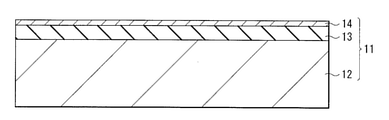
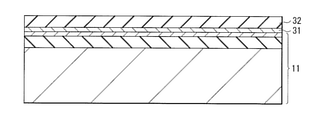
まず、図2Aに示したように、シリコン基板層12、絶縁層13および半導体層14がこの順に積層されたSOI基板11を用意する。続いて、図2Bに示したように、SOI基板11上(具体的には、半導体層14の表面)に、例えば熱酸化により、例えば1nmの酸化膜31を形成したのち、酸化膜31上に、例えばLPCVD(Low Pressure Chemical Vapor Deposition)法を用いて、例えば30nmの窒化シリコン膜(SiN膜)32を形成する。
First, as shown in FIG. 2A, an
次に、図2Cに示したように、SiN膜32上にレジスト膜33を形成したのち、パターニングして開口33Hを形成する。続いて、図2Dに示したように、例えばエッチング法により、凸部21Xとなる、シリコン基板層12内に到達する開口11Hを形成する。
Next, as shown in FIG. 2C, the resist
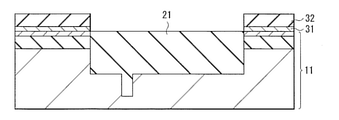
次に、レジスト膜33を除去したのち、図3Aに示したように、SiN膜32上に、開口11Hを含む開口34Hを有するレジスト膜34をパターニングする。続いて、図3Bに示したように、例えばエッチング法により、シリコン基板層12内に到達する開口12Hを形成する。次に、図3Cに示したように、レジスト膜34を除去したのち、例えばHDP-CVD(High-Density Plasma Chemical Vapor Deposition)法を用いて、開口12Hに、例えば酸化シリコン膜(SiO2膜、絶縁層21)を埋設する。続いて、例えばCMP(Chemical Mechanical Polishing)法により、絶縁層21の表面を平坦化する。Next, after removing the resist
次に、図4Aに示したように、例えばウェットエッチング法を用いて絶縁層21をエッチングして任意の厚さに調整する。本実施の形態では、例えば半導体層14と同一面を形成する厚みまでエッチングする。続いて、図4Bに示したように、SiN膜32および酸化膜31を除去したのち、図示していないが、SOI基板11上の全面に、例えばトランジスタ10のゲート絶縁膜となる、例えばハフニウム酸化膜(HfO2膜)を、例えば2nmの厚みで形成する。次に、図4Cに示したように、SOI基板11の半導体層14および絶縁層21上(実際には、HfO2膜上)に、例えばCVD法を用いてポリシリコン(Si)膜15Aを成膜する。なお、ポリSi膜15Aを形成する際には、HfO2膜がトランジスタ10の形成領域のみにパターニングされていてもよいが、HfO2膜の有無は、トランジスタ20の特性に特に影響がないため、SOI基板11の全面に形成された状態でもよい。Next, as shown in FIG. 4A, the insulating
続いて、図5Aに示したように、ポリSi膜15A上に、例えばCVD法を用いてSiN膜35を成膜したのち、SiN膜35上にレジスト膜36をパターニングする。次に、図5Bに示したように、例えばエッチング法によりSiN膜35およびポリSi膜15Aをエッチングする。これにより、トランジスタ10およびトランジスタ20のゲート電極15,22がHfO2膜上に一括で形成される。続いて、レジスト膜36を除去したのち、SOI基板11上に、トランジスタ20のゲート電極22を含む開口を有するレジスト膜37をパターニングする。次に、図5Cに示したように、例えばエッチング法を用いて、レジスト膜37の開口内の絶縁層21をエッチングする。このときゲート電極22上のSiN膜35がエッチングマスクとなり、絶縁層21には、開口21H1および開口21H2が形成される。これにより、絶縁層21は、3つに分割され、ゲート電極22の下方の絶縁層21はトランジスタ20のゲート絶縁膜21Bとなり、トランジスタ10側に分割された絶縁層21は、トランジスタ10とトランジスタ20とを電気的に分離する素子分離膜21Aとなる。続いて、レジスト膜37を除去する。Subsequently, as shown in FIG. 5A, a
次に、トランジスタ10のゲート電極15の両側の半導体層14に、例えばイオン注入法を用いて、ソース領域14Sおよびドレイン領域14Dを形成したのち、図6Aに示したように、開口21H1,21H2内のシリコン基板層12に、例えばイオン注入法を用いて低濃度拡散領域12Bを形成する。続いて、例えばCVD法を用いて例えばSiN膜を成膜したのち、エッチバックを行いトランジスタ10のゲート電極15の側面およびトランジスタ20のゲート電極22およびゲート絶縁膜21Bの連続する側面にサイドウォール16,24をそれぞれ形成する。このとき、開口21H1,21H2を構成する素子分離膜21Aの側面およびゲート絶縁膜21Bを挟んだ反対側の絶縁層21の側面にも、サイドウォール24と同様の形状を有するSiN膜が形成される。次に、開口21H1,21H2内のシリコン基板層12に、例えばイオン注入法を用いて高濃度拡散領域12Aを形成する。このとき、サイドウォール24および素子分離膜21Aの側面およびゲート絶縁膜21Bを挟んだ反対側の絶縁層21の側面に形成されたSiN膜がマスクとなって、高濃度拡散領域12Aは、先に形成した低濃度拡散領域12Bの内部に形成される。これにより、図1に示した半導体装置1が完成する。
Next, the
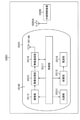
なお、本実施の形態の半導体装置1は、上記のように、例えば測距イメージセンサ等に用いられる。例えば図17に示した撮像装置4では、図1に示した半導体装置1上に光電変換部を有する画素部50が配設される。画素部50には、複数の単位画素Pがマトリクス上に配置されており、例えば、単位画素Pにそれぞれ、トランジスタ10およびトランジスタ20が配設される。その場合には、図6Bに示したように、半導体装置1上に、例えばシリコン酸化膜やリンやボロンを含んだシリコン酸化膜等からなる層間絶縁層41を例えばCVD法を用いて形成したのち、層間絶縁層41内に、コンタクトプラグP1,P2,P3,P4,P5,P6を形成する。コンタクトプラグP1,P2,P3,P4,P5,P6の一端は、図6Bに示したように、それぞれトランジスタ10のゲート電極15、ソース領域14Sおよびドレイン領域14D、トランジスタ20のゲート電極22、ソース領域23Sおよびドレイン領域23Dと電気的に接続されている。他端は、単位画素Pの所定の部位に接続されている。
As described above, the semiconductor device 1 of the present embodiment is used, for example, for a distance measuring image sensor or the like. For example, in the
(1-3.作用・効果)
同一基板上に耐圧電圧の異なるトランジスタを設ける場合、一般的には、マルチオキサイドプロセスを用いて低電圧動作トランジスタおよび高電圧動作トランジスタのゲート絶縁膜を作り分けている。具体的には、まず、図7Aに示したようにシリコン基板101を厚膜酸化してSiO2膜102を形成したのち、図7Bに示したように、所定の領域(例えば低電圧動作トランジスタを形成する領域)のSiO2膜102を除去する。こののち、図7Cに示したようにシリコン基板101を薄膜酸化することで、シリコン基板101上に異なる厚みのSiO2膜102が形成される。(1-3. Action / effect)
When transistors having different withstand voltage are provided on the same substrate, generally, a multi-oxide process is used to make separate gate insulating films for low-voltage operating transistors and high-voltage operating transistors. Specifically, first, as shown in FIG. 7A, the
ところで、例えばSPADを用いた測距イメージセンサでは、前述したように、例えば22nm世代以降の先端トランジスタ(例えば、FD-SOIトランジスタ)と、数十V以上の高電圧を受けられるトランジスタ(高耐圧トランジスタ)とが用いられている。FD-SOIトランジスタは、シリコン基板上に絶縁層(BOX層)を介して薄いSi層が設けられたSOI基板に形成されている。高耐圧トランジスタを、上記方法を用いてこのSOI基板上に混載しようとした場合、厚膜酸化時にSi層が全て酸化されてしまう。 By the way, in a ranging image sensor using, for example, SPAD, as described above, for example, a tip transistor (for example, FD-SOI transistor) of 22 nm generation or later and a transistor (high voltage transistor) that can receive a high voltage of several tens of volts or more. ) And are used. The FD-SOI transistor is formed on an SOI substrate in which a thin Si layer is provided on a silicon substrate via an insulating layer (BOX layer). When a high withstand voltage transistor is mixedly mounted on this SOI substrate by using the above method, the Si layer is completely oxidized during the thick film oxidation.
また、前述したように、SOI基板のBOX層を高耐圧トランジスタのゲート絶縁膜として用いる方法が考えられている。しかしながら、数十V以上の高電圧を受けられる高耐圧トランジスタでは、信頼性の観点から、ゲート絶縁膜は例えば50nm以上の厚みが求められており、通常20nm程度のBOX層では、高耐圧トランジスタのゲート絶縁膜としては耐圧不足となる。そこで、BOX層の厚みを厚く(例えば50nm程度)することも考えられるが、その場合には、FD-SOIトランジスタで行われているバックバイアス制御ができなくなってしまう。 Further, as described above, a method of using the BOX layer of the SOI substrate as the gate insulating film of the high withstand voltage transistor is considered. However, in a high withstand voltage transistor that can receive a high voltage of several tens of volts or more, the gate insulating film is required to have a thickness of, for example, 50 nm or more from the viewpoint of reliability. Normally, a BOX layer of about 20 nm is required to have a high withstand voltage transistor. The withstand voltage is insufficient for the gate insulating film. Therefore, it is conceivable to increase the thickness of the BOX layer (for example, about 50 nm), but in that case, the back bias control performed by the FD-SOI transistor cannot be performed.
この他、LOCOS(local oxidation of silicon)法を用いてBOX層を部分的に厚膜化する方法が考えられる。しかしながら、LOCOS法を用いてBOX層を厚膜化した場合、その近傍は局所的熱酸化による堆積膨張が生じ、SOI基板の表面には段差が形成される。ところで、微細化が進んだ半導体装置では、リソグラフィ工程における焦点深度(Depth Of Focus;DOF)は小さくなる。このため、リソグラフィ工程により形成されたレジスト膜の線幅にばらつきが生じやすくなり、このばらつきを抑制するためには、レジスト膜を形成する下地の段差は小さくすることが望ましい。これに対して、LOCOS法の局所的熱酸化によって生じるSOI基板の表面の段差は、レジスト膜の線幅のばらつきの一因となる。 In addition, a method of partially thickening the BOX layer by using the LOCOS (local oxidation of silicon) method can be considered. However, when the BOX layer is thickened by using the LOCOS method, sedimentary expansion occurs due to local thermal oxidation in the vicinity thereof, and a step is formed on the surface of the SOI substrate. By the way, in a semiconductor device with advanced miniaturization, the depth of focus (DOF) in the lithography process becomes small. Therefore, the line width of the resist film formed by the lithography process tends to vary, and in order to suppress this variation, it is desirable to reduce the step of the substrate on which the resist film is formed. On the other hand, the step on the surface of the SOI substrate caused by the local thermal oxidation of the LOCOS method contributes to the variation in the line width of the resist film.
本実施の形態では、SOI基板11に、素子分離膜21Aとして、SOI基板11を構成する半導体層14および絶縁層13を貫通し、シリコン基板層12まで達する開口12Hを形成し、その開口12Hに絶縁層21を埋設し、その一部を高耐圧トランジスタ(トランジスタ20)のゲート絶縁膜21Bとして用いるようにした。絶縁層21の厚みは、開口12Hの深さを調整することで任意に設定することができる。これにより、先端トランジスタであるトランジスタ10の動作や、製造工程に影響を与えることなく、高耐圧なトランジスタ20のゲート絶縁膜21Bの厚みを十分に確保することが可能となる。
In the present embodiment, the
以上、本実施の形態の半導体装置1では、FD-SOIトランジスタであるトランジスタ10と、高耐圧トランジスタであるトランジスタ20との間に、SOI基板11を構成する絶縁層13よりも膜厚の大きな素子分離膜21Aを設け、その素子分離膜21Aを構成する絶縁層21の一部を、トランジスタ20のゲート絶縁膜として用いるようにした。具体的には、SOI基板11に、半導体層14および絶縁層13を貫通し、シリコン基板層12内まで達する開口12Hを設け、その開口12Hを絶縁層21で埋設し、この絶縁層21を分割して、一方を素子分離膜21Aとして、他方をトランジスタ20のゲート絶縁膜として用いるようにした。これにより、高耐圧トランジスタであるトランジスタ20のゲート絶縁膜として、十分な耐圧性能を有するゲート絶縁膜21Bが形成される。よって、耐圧電圧の異なるトランジスタを同一基板上に有し、高い信頼性を備えた半導体装置1を提供することが可能となる。
As described above, in the semiconductor device 1 of the present embodiment, an element having a thickness larger than that of the insulating
また、素子分離膜21Aの底面に、シリコン基板層12に突出する凸部21Xを設けるようにしたので、トランジスタ10とトランジスタ20との間の電気的な絶縁性が向上し、トランジスタ10とトランジスタ20との距離を削減することが可能となる。また、複数のトランジスタ20が隣接配置される場合には、その間に凸部21Xを設けることにより、トランジスタ20間の距離を削減することが可能となる。よって、チップ面積を縮小化することが可能となる。
Further, since the
以下、本開示の第2の実施の形態および変形例1~3について説明する。なお、上記第1の実施の形態と同一の構成要素については同一の符号を付し説明を省略する。 Hereinafter, the second embodiment of the present disclosure and the modified examples 1 to 3 will be described. The same components as those in the first embodiment are designated by the same reference numerals, and the description thereof will be omitted.
<2.第2の実施の形態>
図8A~8Bは、本開示の第2の実施の形態に係る半導体装置1の製造方法の他の例を模式的に表したものである。<2. Second Embodiment>
8A to 8B schematically show another example of the manufacturing method of the semiconductor device 1 according to the second embodiment of the present disclosure.
本実施の形態の製造方法では、上記第1の実施の形態において説明した方法を用いて、図8Aに示したように、SOI基板11上にポリSi膜15Aを形成したのち、図8Bに示したように、SiN膜35を形成することなく、Si膜15A上にレジスト膜36をパターニングする。続いて、図8Cに示したように、レジスト膜36をマスクとして、ポリSi膜15Aをエッチングし、トランジスタ10のゲート電極15およびトランジスタ20のゲート電極22を形成する。こののち、レジスト膜36を除去する。次に、図8Dに示したように、SOI基板11の半導体層14および絶縁層21上に、レジスト膜38をパターニングしたのち、第1の実施の形態と同様の方法を用いて絶縁層21をエッチングする。これにより、絶縁層21内に開口21H1および開口21H2が形成され、絶縁層21が3つに分割される。以降、第1の実施の形態と同様の方法を用いることにより、図1に示した半導体装置1が完成する。
In the manufacturing method of the present embodiment, as shown in FIG. 8A, the poly-
本実施の形態では、開口21H1および開口21H2を形成する絶縁層21のエッチングの際のマスクとなるSiN膜35を形成することなく、半導体装置1を形成するようにした。これにより、上記第1の実施の形態における半導体装置1の製造方法と比較して、製造工程数を削減することが可能となる。
In the present embodiment, the semiconductor device 1 is formed without forming the
<3.変形例>
(3-1.変形例1)
図9は、本開示の変形例1に係る半導体装置(半導体装置2)の断面構成を表したものである。本変形例の半導体装置2は、複数(ここでは、3種)の深さを有する開口12Hを形成し、底面に段差を有する絶縁層21を設けたものである。具体的には、第1の実施の形態において説明した凸部21Xを挟んで、素子分離膜21Aがゲート絶縁膜21Bよりも厚くなるようにした。このように、素子分離膜21Aおよびゲート絶縁膜21Bの厚みは、適宜調整することができる。<3. Modification example>
(3-1. Modification 1)
FIG. 9 shows a cross-sectional configuration of the semiconductor device (semiconductor device 2) according to the first modification of the present disclosure. In the
(3-2.変形例2)
図10A~図14Cは、上記第1の実施の形態の変形例としての半導体装置(半導体装置3、図14C参照)の製造方法を表したものである。本変形例の半導体装置3は、トランジスタ10およびトランジスタ20が、SOI基板11上に複数(本変形例では、それぞれ2個ずつ、トランジスタ10X,10Yおよびトランジスタ20X,20Y)設けられたものである。このような半導体装置3は、例えば、次のようにして製造することができる。(3-2. Modification 2)
10A to 14C show a method of manufacturing a semiconductor device (
まず、例えば、第1の実施の形態と同様の方法を用いて、SOI基板11上に酸化膜31およびSiN膜32を形成する。続いて、図10Aに示したように、SiN膜32上にレジスト膜33を形成したのち、パターニングして、例えば4つの開口33H1~33H4を形成する。続いて、図10Bに示したように、例えばエッチング法により、シリコン基板層12内に到達する開口11H1~11H4を形成する。次に、レジスト膜33を除去したのち、図10Cに示したように、SiN膜32上に、トランジスタ20X,20Yの形成領域20Rに開口を有するレジスト膜34をパターニングする。
First, for example, the
次に、図11Aに示したように、例えばエッチング法により、シリコン基板層12内に到達する開口12Hを形成する。続いて、レジスト膜34を除去したのち、図11Bに示したように、例えばHDP-CVD法を用いて開口11H1,11H2内および開口11H3,11H4を含む開口12H内並びにSiN膜32上に、例えばSiO2膜(絶縁層21)を成膜する。次に、図11Cに示したように、例えばCMP法により、絶縁層21の表面を平坦化する。これにより、最終的に隣接配置されるトランジスタ10X,10Yおよびトランジスタ20X,20Yをそれぞれ電気的に絶縁する凸部21X1,21X2,21X3,21X4が形成される。Next, as shown in FIG. 11A, the
続いて、図12Aに示したように、例えばウェットエッチング法を用いて絶縁層21を任意の厚さに調整したのち、SiN膜32および酸化膜31を除去する。次に、第1の実施の形態と同様に、図示していないが、SOI基板11上の全面に、例えばトランジスタ10のゲート絶縁膜となる、例えばHfO2膜を、例えば2nmの厚みで形成したのち、図12Bに示したように、例えばCVD法を用いてポリシリコン(Si)膜15AおよびSiN膜35をこの順に成膜する。続いて、図12Cに示したように、SiN膜35上にレジスト膜36をパターニングする。Subsequently, as shown in FIG. 12A, the insulating
次に、図13Aに示したように、例えばエッチング法により、レジスト膜36をマスクとしてSiN膜35およびポリSi膜15Aをエッチングする。これにより、トランジスタ10X,10Yおよびトランジスタ20X,20Yのゲート電極15X,15Y,22X,22Yが一括で形成される。続いて、レジスト膜36を除去したのち、図13Bに示したように、SOI基板11の半導体層14および絶縁層21上にレジスト膜37をパターニングする。次に、例えばエッチング法を用いて、絶縁層21をエッチングする。このとき、レジスト膜37と共に、ゲート電極22上のSiN膜35がエッチングマスクとなり、開口21H1,21H2,21H3,21H4が形成される。これにより、開口12H内の絶縁層21は、5つに分割され、それぞれ、トランジスタ20X,20Yのゲート絶縁膜21B1,21B2、トランジスタ10とトランジスタ20とを電気的に分離する素子分離膜21A、トランジスタ20Xとトランジスタ20Yとの間を電気的に絶縁する素子分離膜(絶縁膜21B3)および例えば、図示していないがトランジスタ20Yのトランジスタ20Xとは反対側に別のトランジスタが形成された際の素子分離膜(絶縁膜21B4)となる。続いて、図13Cに示したように、レジスト膜37および各ゲート電極15X,15Y,22X,22Y上に設けられたSiN膜35を除去する。
Next, as shown in FIG. 13A, the
次に、トランジスタ10X,10Yの両側の半導体層14に、例えばイオン注入法を用いて、ソース領域14S1,14S2およびドレイン領域14D1,14D2を形成する。こののち、図14Aに示したように、トランジスタ10X,10Yを含む半導体層14上および素子分離膜21A上にレジスト膜39を形成する。続いて、開口21H1,21H2および開口21H3,21H4内のシリコン基板層12に、例えばイオン注入法を用いて、それぞれ低濃度拡散領域12B1,12B2を形成する。次に、レジスト膜39を除去したのち、図14Bに示したように、例えばCVD法を用いて例えばSiN膜を成膜し、エッチバックを行いてトランジスタ10X,10Yのゲート電極15X,15Yの側面およびトランジスタ20X,20Yのゲート電極22Xとゲート絶縁膜21B1およびゲート電極22Yとゲート絶縁膜21B2の連続する側面にサイドウォール16,24をそれぞれ形成する。このとき、素子分離膜21Aおよび各トランジスタ間の素子分離膜となる絶縁膜21B3,21B4の側面にもサイドウォールと同様の形状を有するSiN膜が形成される。続いて、再度、トランジスタ10X,10Yを含む半導体層14上および素子分離膜21A上にレジスト膜40を形成する。次に、図14Cに示したように、開口21H1,21H2,21H3,21H4内のシリコン基板層12に例えばイオン注入法を用いて高濃度拡散領域12A1,12A2を形成する。このとき、サイドウォール24と、素子分離膜21Aおよび絶縁膜21B3,21B4の側面に形成されるSiN膜とがマスクとなって、高濃度拡散領域12A1,12A2は、先に形成した低濃度拡散領域12B1,12B2の内部に形成される。最後に、レジスト膜40を除去することにより、隣り合うトランジスタ10Xとトランジスタ10Yとの間、トランジスタ10Yとトランジスタ20Xとの間、トランジスタ20Xとトランジスタ20Yとの間にそれぞれ凸部21X1,21X2,21X3,21X4を有する半導体装置3が完成する。
Next, the source regions 14S1, 14S2 and the drain regions 14D1, 14D2 are formed on the semiconductor layers 14 on both sides of the
なお、ここでは、トランジスタ10Yとトランジスタ20Xとの間に2つの凸部21X2,21X3を設けた例を示したが、先端トランジスタ(トランジスタ10Y)と高耐圧トランジスタ(トランジスタ20X)との間には、少なくとも凸部の先端がより深い位置にある凸部21X3を形成すれば、凸部21X2は省略してもかまわない。
Here, an example in which two convex portions 21X2 and 21X3 are provided between the
(3-3.変形例3)
図15A~図16Bは、上記第2の実施の形態の変形例としての半導体装置3の製造方法を表したものである。本変形例では、半導体装置3は、例えば次のようにして製造することができる。(3-3. Modification 3)
15A to 16B show a method of manufacturing a
まず、変形例1と同様の方法を用いて、凸部21X1,21X2,21X3,21X4を形成したのち、図15Aに示したように、SOI基板11の半導体層14および絶縁層21上(実際には、HfO2膜上)に、例えばCVD法を用いてポリシリコン(Si)膜15Aを成膜する。続いて、図15Bに示したように、Si膜15A上にレジスト膜36をパターニングする。続いて、図15Cに示したように、レジスト膜36をマスクとしてポリSi膜15Aをエッチングし、それぞれ、トランジスタ10X,10Yのゲート電極15X,15Yおよびトランジスタ20X,20Yのゲート電極22X,22Yを形成する。First, the convex portions 21X1, 21, 11X2, 21X3, 21X4 are formed by the same method as in the first modification, and then, as shown in FIG. 15A, on the
次に、レジスト膜36を除去したのち、SOI基板11の半導体層14および絶縁層21上に、レジスト膜38をパターニングしたのち、第1の実施の形態と同様の方法を用いて絶縁層21をエッチングし、図16Bに示したように、開口21H1,21H2,21H3,21H4を形成する。以降、変形例1と同様の方法を用いることにより、図14Cに示した半導体装置3が完成する。
Next, after removing the resist
<4.適用例>
(適用例1)
図17は、上記第1の実施の形態(または変形例)に示した半導体装置(半導体装置1,2)を備えた撮像素子を各単位画素Pに用いた撮像装置(撮像装置4)の全体構成を表したものである。この撮像装置4は、CMOSイメージセンサであり、例えば、SOI基板11上に、撮像エリアとしての画素部50を有すると共に、この画素部50の周辺領域に、例えば、行走査部131、水平選択部133、列走査部134およびシステム制御部132からなる周辺回路部130を有している。<4. Application example>
(Application example 1)
FIG. 17 shows the entire image pickup device (imaging device 4) in which the image pickup device provided with the semiconductor devices (semiconductor devices 1 and 2) shown in the first embodiment (or modification) is used for each unit pixel P. It shows the composition. The
画素部50は、例えば、行列状に2次元配置された複数の単位画素P(撮像素子に相当)を有している。この単位画素Pには、例えば、画素行ごとに画素駆動線Lread(具体的には行選択線およびリセット制御線)が配線され、画素列ごとに垂直信号線Lsigが配線されている。画素駆動線Lreadは、画素からの信号読み出しのための駆動信号を伝送するものである。画素駆動線Lreadの一端は、行走査部131の各行に対応した出力端に接続されている。
The
行走査部131は、シフトレジスタやアドレスデコーダ等によって構成され、画素部50の各単位画素Pを、例えば、行単位で駆動する画素駆動部である。行走査部131によって選択走査された画素行の各単位画素Pから出力される信号は、垂直信号線Lsigの各々を通して水平選択部133に供給される。水平選択部133は、垂直信号線Lsigごとに設けられたアンプや水平選択スイッチ等によって構成されている。
The
列走査部134は、シフトレジスタやアドレスデコーダ等によって構成され、水平選択部133の各水平選択スイッチを走査しつつ順番に駆動するものである。この列走査部134による選択走査により、垂直信号線Lsigの各々を通して伝送される各画素の信号が順番に水平信号線135に出力され、当該水平信号線135を通してSOI基板11の外部へ伝送される。
The
行走査部131、水平選択部133、列走査部134および水平信号線135からなる回路部分は、SOI基板11上に直に形成されていてもよいし、あるいは外部制御ICに配設されたものであってもよい。また、それらの回路部分は、ケーブル等により接続された他の基板に形成されていてもよい。
The circuit portion including the
システム制御部132は、SOI基板11の外部から与えられるクロックや、動作モードを指令するデータ等を受け取り、また、撮像装置4の内部情報等のデータを出力するものである。システム制御部132はさらに、各種のタイミング信号を生成するタイミングジェネレータを有し、当該タイミングジェネレータで生成された各種のタイミング信号を基に行走査部131、水平選択部133および列走査部134等の周辺回路の駆動制御を行う。
The system control unit 132 receives a clock given from the outside of the
(適用例2)
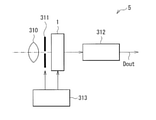
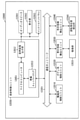
上記撮像装置4は、例えば、デジタルスチルカメラやビデオカメラ等のカメラシステムや、撮像機能を有する携帯電話等、撮像機能を備えたあらゆるタイプの電子機器に適用することができる。図18に、その一例として、電子機器5(カメラ)の概略構成を示す。この電子機器5は、例えば、静止画または動画を撮影可能なビデオカメラであり、撮像装置4と、光学系(光学レンズ)310と、シャッタ装置311と、撮像装置4およびシャッタ装置311を駆動する駆動部313と、信号処理部312とを有する。(Application example 2)
The
光学系310は、被写体からの像光(入射光)を撮像装置4の画素部50へ導くものである。この光学系310は、複数の光学レンズから構成されていてもよい。シャッタ装置311は、撮像装置4への光照射期間および遮光期間を制御するものである。駆動部313は、撮像装置4の転送動作およびシャッタ装置311のシャッタ動作を制御するものである。信号処理部312は、撮像装置4から出力された信号に対し、各種の信号処理を行うものである。信号処理後の映像信号Doutは、メモリ等の記憶媒体に記憶されるか、あるいは、モニタ等に出力される。
The
更に、上記撮像装置4は、下記電子機器(カプセル型内視鏡10100および車両等の移動体)にも適用することが可能である。
Further, the
(適用例3)
<体内情報取得システムへの応用例>
図19は、本開示に係る技術(本技術)が適用され得る、カプセル型内視鏡を用いた患者の体内情報取得システムの概略的な構成の一例を示すブロック図である。(Application example 3)
<Example of application to internal information acquisition system>
FIG. 19 is a block diagram showing an example of a schematic configuration of a patient's internal information acquisition system using a capsule endoscope to which the technique according to the present disclosure (the present technique) can be applied.
体内情報取得システム10001は、カプセル型内視鏡10100と、外部制御装置10200とから構成される。
The in-vivo
カプセル型内視鏡10100は、検査時に、患者によって飲み込まれる。カプセル型内視鏡10100は、撮像機能および無線通信機能を有し、患者から自然排出されるまでの間、胃や腸等の臓器の内部を蠕動運動等によって移動しつつ、当該臓器の内部の画像(以下、体内画像ともいう)を所定の間隔で順次撮像し、その体内画像についての情報を体外の外部制御装置10200に順次無線送信する。
The
外部制御装置10200は、体内情報取得システム10001の動作を統括的に制御する。また、外部制御装置10200は、カプセル型内視鏡10100から送信されてくる体内画像についての情報を受信し、受信した体内画像についての情報に基づいて、表示装置(図示せず)に当該体内画像を表示するための画像データを生成する。
The
体内情報取得システム10001では、このようにして、カプセル型内視鏡10100が飲み込まれてから排出されるまでの間、患者の体内の様子を撮像した体内画像を随時得ることができる。
In the in-vivo
カプセル型内視鏡10100と外部制御装置10200の構成および機能についてより詳細に説明する。
The configuration and function of the
カプセル型内視鏡10100は、カプセル型の筐体10101を有し、その筐体10101内には、光源部10111、撮像部10112、画像処理部10113、無線通信部10114、給電部10115、電源部10116、および制御部10117が収納されている。
The capsule-
光源部10111は、例えばLED(light emitting diode)等の光源から構成され、撮像部10112の撮像視野に対して光を照射する。
The
撮像部10112は、撮像素子、および当該撮像素子の前段に設けられる複数のレンズからなる光学系から構成される。観察対象である体組織に照射された光の反射光(以下、観察光という)は、当該光学系によって集光され、当該撮像素子に入射する。撮像部10112では、撮像素子において、そこに入射した観察光が光電変換され、その観察光に対応する画像信号が生成される。撮像部10112によって生成された画像信号は、画像処理部10113に提供される。
The
画像処理部10113は、CPU(Central Processing Unit)やGPU(Graphics Processing Unit)等のプロセッサによって構成され、撮像部10112によって生成された画像信号に対して各種の信号処理を行う。画像処理部10113は、信号処理を施した画像信号を、RAWデータとして無線通信部10114に提供する。
The
無線通信部10114は、画像処理部10113によって信号処理が施された画像信号に対して変調処理等の所定の処理を行い、その画像信号を、アンテナ10114Aを介して外部制御装置10200に送信する。また、無線通信部10114は、外部制御装置10200から、カプセル型内視鏡10100の駆動制御に関する制御信号を、アンテナ10114Aを介して受信する。無線通信部10114は、外部制御装置10200から受信した制御信号を制御部10117に提供する。
The
給電部10115は、受電用のアンテナコイル、当該アンテナコイルに発生した電流から電力を再生する電力再生回路、および昇圧回路等から構成される。給電部10115では、いわゆる非接触充電の原理を用いて電力が生成される。
The
電源部10116は、二次電池によって構成され、給電部10115によって生成された電力を蓄電する。図19では、図面が煩雑になることを避けるために、電源部10116からの電力の供給先を示す矢印等の図示を省略しているが、電源部10116に蓄電された電力は、光源部10111、撮像部10112、画像処理部10113、無線通信部10114、および制御部10117に供給され、これらの駆動に用いられ得る。
The
制御部10117は、CPU等のプロセッサによって構成され、光源部10111、撮像部10112、画像処理部10113、無線通信部10114、および、給電部10115の駆動を、外部制御装置10200から送信される制御信号に従って適宜制御する。
The
外部制御装置10200は、CPU,GPU等のプロセッサ、又はプロセッサとメモリ等の記憶素子が混載されたマイクロコンピュータ若しくは制御基板等で構成される。外部制御装置10200は、カプセル型内視鏡10100の制御部10117に対して制御信号を、アンテナ10200Aを介して送信することにより、カプセル型内視鏡10100の動作を制御する。カプセル型内視鏡10100では、例えば、外部制御装置10200からの制御信号により、光源部10111における観察対象に対する光の照射条件が変更され得る。また、外部制御装置10200からの制御信号により、撮像条件(例えば、撮像部10112におけるフレームレート、露出値等)が変更され得る。また、外部制御装置10200からの制御信号により、画像処理部10113における処理の内容や、無線通信部10114が画像信号を送信する条件(例えば、送信間隔、送信画像数等)が変更されてもよい。
The
また、外部制御装置10200は、カプセル型内視鏡10100から送信される画像信号に対して、各種の画像処理を施し、撮像された体内画像を表示装置に表示するための画像データを生成する。当該画像処理としては、例えば現像処理(デモザイク処理)、高画質化処理(帯域強調処理、超解像処理、NR(Noise reduction)処理および/又は手ブレ補正処理等)、並びに/又は拡大処理(電子ズーム処理)等、各種の信号処理を行うことができる。外部制御装置10200は、表示装置の駆動を制御して、生成した画像データに基づいて撮像された体内画像を表示させる。あるいは、外部制御装置10200は、生成した画像データを記録装置(図示せず)に記録させたり、印刷装置(図示せず)に印刷出力させてもよい。
Further, the
以上、本開示に係る技術が適用され得る体内情報取得システムの一例について説明した。本開示に係る技術は、以上説明した構成のうち、例えば、撮像部10112に適用され得る。これにより、精細な術部画像を得ることができるため、検査の精度が向上する。
The above is an example of an in-vivo information acquisition system to which the technology according to the present disclosure can be applied. The technique according to the present disclosure can be applied to, for example, the
(適用例4)
<移動体への応用例>
本開示に係る技術(本技術)は、様々な製品へ応用することができる。例えば、本開示に係る技術は、自動車、電気自動車、ハイブリッド電気自動車、自動二輪車、自転車、パーソナルモビリティ、飛行機、ドローン、船舶、ロボット等のいずれかの種類の移動体に搭載される装置として実現されてもよい。(Application example 4)
<Application example to mobile>
The technology according to the present disclosure (the present technology) can be applied to various products. For example, the technology according to the present disclosure is realized as a device mounted on a moving body of any kind such as an automobile, an electric vehicle, a hybrid electric vehicle, a motorcycle, a bicycle, a personal mobility, an airplane, a drone, a ship, and a robot. You may.
図20は、本開示に係る技術が適用され得る移動体制御システムの一例である車両制御システムの概略的な構成例を示すブロック図である。 FIG. 20 is a block diagram showing a schematic configuration example of a vehicle control system, which is an example of a mobile control system to which the technique according to the present disclosure can be applied.
車両制御システム12000は、通信ネットワーク12001を介して接続された複数の電子制御ユニットを備える。図20に示した例では、車両制御システム12000は、駆動系制御ユニット12010、ボディ系制御ユニット12020、車外情報検出ユニット12030、車内情報検出ユニット12040、および統合制御ユニット12050を備える。また、統合制御ユニット12050の機能構成として、マイクロコンピュータ12051、音声画像出力部12052、および車載ネットワークI/F(interface)12053が図示されている。
The
駆動系制御ユニット12010は、各種プログラムにしたがって車両の駆動系に関連する装置の動作を制御する。例えば、駆動系制御ユニット12010は、内燃機関又は駆動用モータ等の車両の駆動力を発生させるための駆動力発生装置、駆動力を車輪に伝達するための駆動力伝達機構、車両の舵角を調節するステアリング機構、および、車両の制動力を発生させる制動装置等の制御装置として機能する。
The drive
ボディ系制御ユニット12020は、各種プログラムにしたがって車体に装備された各種装置の動作を制御する。例えば、ボディ系制御ユニット12020は、キーレスエントリシステム、スマートキーシステム、パワーウィンドウ装置、あるいは、ヘッドランプ、バックランプ、ブレーキランプ、ウィンカー又はフォグランプ等の各種ランプの制御装置として機能する。この場合、ボディ系制御ユニット12020には、鍵を代替する携帯機から発信される電波又は各種スイッチの信号が入力され得る。ボディ系制御ユニット12020は、これらの電波又は信号の入力を受け付け、車両のドアロック装置、パワーウィンドウ装置、ランプ等を制御する。
The body
車外情報検出ユニット12030は、車両制御システム12000を搭載した車両の外部の情報を検出する。例えば、車外情報検出ユニット12030には、撮像部12031が接続される。車外情報検出ユニット12030は、撮像部12031に車外の画像を撮像させるとともに、撮像された画像を受信する。車外情報検出ユニット12030は、受信した画像に基づいて、人、車、障害物、標識又は路面上の文字等の物体検出処理又は距離検出処理を行ってもよい。
The vehicle outside
撮像部12031は、光を受光し、その光の受光量に応じた電気信号を出力する光センサである。撮像部12031は、電気信号を画像として出力することもできるし、測距の情報として出力することもできる。また、撮像部12031が受光する光は、可視光であっても良いし、赤外線等の非可視光であっても良い。
The
車内情報検出ユニット12040は、車内の情報を検出する。車内情報検出ユニット12040には、例えば、運転者の状態を検出する運転者状態検出部12041が接続される。運転者状態検出部12041は、例えば運転者を撮像するカメラを含み、車内情報検出ユニット12040は、運転者状態検出部12041から入力される検出情報に基づいて、運転者の疲労度合い又は集中度合いを算出してもよいし、運転者が居眠りをしていないかを判別してもよい。
The in-vehicle
マイクロコンピュータ12051は、車外情報検出ユニット12030又は車内情報検出ユニット12040で取得される車内外の情報に基づいて、駆動力発生装置、ステアリング機構又は制動装置の制御目標値を演算し、駆動系制御ユニット12010に対して制御指令を出力することができる。例えば、マイクロコンピュータ12051は、車両の衝突回避あるいは衝撃緩和、車間距離に基づく追従走行、車速維持走行、車両の衝突警告、又は車両のレーン逸脱警告等を含むADAS(Advanced Driver Assistance System)の機能実現を目的とした協調制御を行うことができる。
The
また、マイクロコンピュータ12051は、車外情報検出ユニット12030又は車内情報検出ユニット12040で取得される車両の周囲の情報に基づいて駆動力発生装置、ステアリング機構又は制動装置等を制御することにより、運転者の操作に拠らずに自律的に走行する自動運転等を目的とした協調制御を行うことができる。
Further, the
また、マイクロコンピュータ12051は、車外情報検出ユニット12030で取得される車外の情報に基づいて、ボディ系制御ユニット12020に対して制御指令を出力することができる。例えば、マイクロコンピュータ12051は、車外情報検出ユニット12030で検知した先行車又は対向車の位置に応じてヘッドランプを制御し、ハイビームをロービームに切り替える等の防眩を図ることを目的とした協調制御を行うことができる。
Further, the
音声画像出力部12052は、車両の搭乗者又は車外に対して、視覚的又は聴覚的に情報を通知することが可能な出力装置へ音声および画像のうちの少なくとも一方の出力信号を送信する。図20の例では、出力装置として、オーディオスピーカ12061、表示部12062およびインストルメントパネル12063が例示されている。表示部12062は、例えば、オンボードディスプレイおよびヘッドアップディスプレイの少なくとも一つを含んでいてもよい。
The audio-
図21は、撮像部12031の設置位置の例を示す図である。
FIG. 21 is a diagram showing an example of the installation position of the
図21では、撮像部12031として、撮像部12101,12102,12103,12104,12105を有する。
In FIG. 21, as the
撮像部12101,12102,12103,12104,12105は、例えば、車両12100のフロントノーズ、サイドミラー、リアバンパ、バックドアおよび車室内のフロントガラスの上部等の位置に設けられる。フロントノーズに備えられる撮像部12101および車室内のフロントガラスの上部に備えられる撮像部12105は、主として車両12100の前方の画像を取得する。サイドミラーに備えられる撮像部12102,12103は、主として車両12100の側方の画像を取得する。リアバンパ又はバックドアに備えられる撮像部12104は、主として車両12100の後方の画像を取得する。車室内のフロントガラスの上部に備えられる撮像部12105は、主として先行車両又は、歩行者、障害物、信号機、交通標識又は車線等の検出に用いられる。
The
なお、図21には、撮像部12101ないし12104の撮影範囲の一例が示されている。撮像範囲12111は、フロントノーズに設けられた撮像部12101の撮像範囲を示し、撮像範囲12112,12113は、それぞれサイドミラーに設けられた撮像部12102,12103の撮像範囲を示し、撮像範囲12114は、リアバンパ又はバックドアに設けられた撮像部12104の撮像範囲を示す。例えば、撮像部12101ないし12104で撮像された画像データが重ね合わせられることにより、車両12100を上方から見た俯瞰画像が得られる。
Note that FIG. 21 shows an example of the photographing range of the
撮像部12101ないし12104の少なくとも1つは、距離情報を取得する機能を有していてもよい。例えば、撮像部12101ないし12104の少なくとも1つは、複数の撮像素子からなるステレオカメラであってもよいし、位相差検出用の画素を有する撮像素子であってもよい。
At least one of the
例えば、マイクロコンピュータ12051は、撮像部12101ないし12104から得られた距離情報を基に、撮像範囲12111ないし12114内における各立体物までの距離と、この距離の時間的変化(車両12100に対する相対速度)を求めることにより、特に車両12100の進行路上にある最も近い立体物で、車両12100と略同じ方向に所定の速度(例えば、0km/h以上)で走行する立体物を先行車として抽出することができる。さらに、マイクロコンピュータ12051は、先行車の手前に予め確保すべき車間距離を設定し、自動ブレーキ制御(追従停止制御も含む)や自動加速制御(追従発進制御も含む)等を行うことができる。このように運転者の操作に拠らずに自律的に走行する自動運転等を目的とした協調制御を行うことができる。
For example, the
例えば、マイクロコンピュータ12051は、撮像部12101ないし12104から得られた距離情報を元に、立体物に関する立体物データを、2輪車、普通車両、大型車両、歩行者、電柱等その他の立体物に分類して抽出し、障害物の自動回避に用いることができる。例えば、マイクロコンピュータ12051は、車両12100の周辺の障害物を、車両12100のドライバが視認可能な障害物と視認困難な障害物とに識別する。そして、マイクロコンピュータ12051は、各障害物との衝突の危険度を示す衝突リスクを判断し、衝突リスクが設定値以上で衝突可能性がある状況であるときには、オーディオスピーカ12061や表示部12062を介してドライバに警報を出力することや、駆動系制御ユニット12010を介して強制減速や回避操舵を行うことで、衝突回避のための運転支援を行うことができる。
For example, the
撮像部12101ないし12104の少なくとも1つは、赤外線を検出する赤外線カメラであってもよい。例えば、マイクロコンピュータ12051は、撮像部12101ないし12104の撮像画像中に歩行者が存在するか否かを判定することで歩行者を認識することができる。かかる歩行者の認識は、例えば赤外線カメラとしての撮像部12101ないし12104の撮像画像における特徴点を抽出する手順と、物体の輪郭を示す一連の特徴点にパターンマッチング処理を行って歩行者か否かを判別する手順によって行われる。マイクロコンピュータ12051が、撮像部12101ないし12104の撮像画像中に歩行者が存在すると判定し、歩行者を認識すると、音声画像出力部12052は、当該認識された歩行者に強調のための方形輪郭線を重畳表示するように、表示部12062を制御する。また、音声画像出力部12052は、歩行者を示すアイコン等を所望の位置に表示するように表示部12062を制御してもよい。
At least one of the
以上、第1,第2の実施の形態および変形例1~3を挙げて説明したが、本開示内容はこれらの実施の形態等に限定されず、種々の変形が可能である。 Although the first and second embodiments and modifications 1 to 3 have been described above, the contents of the present disclosure are not limited to these embodiments and the like, and various modifications are possible.
なお、本開示の半導体装置およびその製造方法並びに電子機器は、以下のような構成であってもよい。
(1)
シリコン基板層、第1の絶縁層、および半導体層がこの順に積層されたSOI基板と、
前記半導体層上に設けられた第1のトランジスタと、
前記シリコン基板層上に設けられ、前記第1のトランジスタよりも高耐圧な第2のトランジスタと、
前記第1のトランジスタと前記第2のトランジスタとの間に設けられた素子分離膜とを備え、
前記素子分離膜は、前記半導体層および前記第1の絶縁層を貫通して前記シリコン基板層内に達する開口に埋設された第2の絶縁層によって構成され、
前記第2の絶縁層の一部は、前記第2のトランジスタのゲート絶縁膜を構成している
半導体装置。
(2)
前記第2の絶縁層の積層方向の厚みは、前記第1の絶縁層よりも厚い、前記(1)に記載の半導体装置。
(3)
前記素子分離膜は、前記シリコン基板層内に突出する凸部を有する、前記(1)または(2)に記載の半導体装置。
(4)
前記第1のトランジスタは、完全空乏型のトランジスタである、前記(1)乃至(3)のうちのいずれかに記載の半導体装置。
(5)
前記第1のトランジスタのゲート電極と、前記第2のトランジスタのゲート電極とは、同一層に形成されている、前記(1)乃至(4)のうちのいずれかに記載の半導体装置。
(6)
シリコン基板層、第1の絶縁層、および半導体層がこの順に積層されたSOI基板に、前記半導体層および前記第1の絶縁層を貫通して前記シリコン基板層内に達する開口を形成し、
前記開口内に第2の絶縁層を埋設して素子分離膜を形成し、
前記半導体層上に第1のトランジスタを形成し、
前記第2の絶縁層の一部をゲート絶縁膜とし、前記素子分離膜を間にして、前記第1のトランジスタより高耐圧な第2のトランジスタを前記シリコン基板層上に形成する
半導体装置の製造方法。
(7)
前記第2の絶縁層を形成したのち、前記半導体層および前記第2の絶縁層上に、前記第1のトランジスタのゲート電極および前記第2のトランジスタのゲート電極を一括で形成する、前記(6)に記載の半導体装置の製造方法。
(8)
前記SOI基板に前記開口を形成する前に、前記開口の形成領域内に、前期シリコン基板層側へ突出する凸部を形成する、前記(6)または(7)に記載の半導体装置の製造方法。
(9)
前記第1のトランジスタのゲート電極および前記第2のトランジスタのゲート電極を形成したのち、前記第2のトランジスタを分離して前記素子分離膜および前記第2のトランジスタのゲート絶縁膜を形成する、前記(7)または(8)に記載の半導体装置の製造方法。
(10)
半導体装置を備え、
前記半導体装置は、
シリコン基板層、第1の絶縁層、および半導体層がこの順に積層されたSOI基板と、
前記半導体層上に設けられた第1のトランジスタと、
前記シリコン基板層上に設けられた第2のトランジスタと、
前記第1のトランジスタと前記第2のトランジスタとの間に設けられた素子分離膜とを備え、
前記素子分離膜は、前記半導体層および前記第1の絶縁層を貫通して前記シリコン基板層内に達する開口に埋設された第2の絶縁層によって構成され、
前記第2の絶縁層の一部は、前記第2のトランジスタのゲート絶縁膜を構成している
電子機器。The semiconductor device, the manufacturing method thereof, and the electronic device of the present disclosure may have the following configurations.
(1)
An SOI substrate in which a silicon substrate layer, a first insulating layer, and a semiconductor layer are laminated in this order,
The first transistor provided on the semiconductor layer and
A second transistor provided on the silicon substrate layer and having a higher withstand voltage than the first transistor,
A device separation membrane provided between the first transistor and the second transistor is provided.
The element separation membrane is composed of the semiconductor layer and a second insulating layer embedded in an opening that penetrates the first insulating layer and reaches the inside of the silicon substrate layer.
A part of the second insulating layer is a semiconductor device constituting the gate insulating film of the second transistor.
(2)
The semiconductor device according to (1), wherein the thickness of the second insulating layer in the stacking direction is thicker than that of the first insulating layer.
(3)
The semiconductor device according to (1) or (2) above, wherein the element separation membrane has a convex portion protruding into the silicon substrate layer.
(4)
The semiconductor device according to any one of (1) to (3) above, wherein the first transistor is a completely depleted transistor.
(5)
The semiconductor device according to any one of (1) to (4) above, wherein the gate electrode of the first transistor and the gate electrode of the second transistor are formed in the same layer.
(6)
The SOI substrate in which the silicon substrate layer, the first insulating layer, and the semiconductor layer are laminated in this order is formed with an opening that penetrates the semiconductor layer and the first insulating layer and reaches the inside of the silicon substrate layer.
A second insulating layer is embedded in the opening to form an element separation film.
A first transistor is formed on the semiconductor layer,
Manufacture of a semiconductor device in which a part of the second insulating layer is a gate insulating film and a second transistor having a higher withstand voltage than the first transistor is formed on the silicon substrate layer with the element separation membrane in between. Method.
(7)
After forming the second insulating layer, the gate electrode of the first transistor and the gate electrode of the second transistor are collectively formed on the semiconductor layer and the second insulating layer (6). ). The method for manufacturing a semiconductor device.
(8)
The method for manufacturing a semiconductor device according to (6) or (7) above, wherein a convex portion projecting toward the silicon substrate layer in the early stage is formed in the region where the opening is formed before the opening is formed in the SOI substrate. ..
(9)
After forming the gate electrode of the first transistor and the gate electrode of the second transistor, the second transistor is separated to form the element separation membrane and the gate insulating film of the second transistor. The method for manufacturing a semiconductor device according to (7) or (8).
(10)
Equipped with semiconductor devices,
The semiconductor device is
An SOI substrate in which a silicon substrate layer, a first insulating layer, and a semiconductor layer are laminated in this order,
The first transistor provided on the semiconductor layer and
A second transistor provided on the silicon substrate layer and
A device separation membrane provided between the first transistor and the second transistor is provided.
The element separation membrane is composed of the semiconductor layer and a second insulating layer embedded in an opening that penetrates the first insulating layer and reaches the inside of the silicon substrate layer.
A part of the second insulating layer is an electronic device constituting the gate insulating film of the second transistor.
本出願は、日本国特許庁において2017年3月3日に出願された日本特許出願番号2017-040702号を基礎として優先権を主張するものであり、この出願の全ての内容を参照によって本出願に援用する。 This application claims priority on the basis of Japanese Patent Application No. 2017-040702 filed on March 3, 2017 at the Japan Patent Office, and this application is made by referring to all the contents of this application. Invite to.
当業者であれば、設計上の要件や他の要因に応じて、種々の修正、コンビネーション、サブコンビネーション、および変更を想到し得るが、それらは添付の請求の範囲やその均等物の範囲に含まれるものであることが理解される。 Those skilled in the art may conceive various modifications, combinations, sub-combinations, and changes, depending on design requirements and other factors, which are included in the claims and their equivalents. It is understood that it is a person skilled in the art.
Claims (10)
前記半導体層上に設けられた第1のトランジスタと、
前記シリコン基板層上に設けられ、前記第1のトランジスタよりも高耐圧な第2のトランジスタと、
前記第1のトランジスタと前記第2のトランジスタとの間に設けられた素子分離膜とを備え、
前記素子分離膜は、前記半導体層および前記第1の絶縁層を貫通して前記シリコン基板層内に達する開口に埋設された第2の絶縁層によって構成され、
前記第2の絶縁層の一部は、前記第2のトランジスタのゲート絶縁膜を構成している
半導体装置。An SOI substrate in which a silicon substrate layer, a first insulating layer, and a semiconductor layer are laminated in this order,
The first transistor provided on the semiconductor layer and
A second transistor provided on the silicon substrate layer and having a higher withstand voltage than the first transistor,
A device separation membrane provided between the first transistor and the second transistor is provided.
The element separation membrane is composed of the semiconductor layer and a second insulating layer embedded in an opening that penetrates the first insulating layer and reaches the inside of the silicon substrate layer.
A part of the second insulating layer is a semiconductor device constituting the gate insulating film of the second transistor.
前記開口内に第2の絶縁層を埋設して素子分離膜を形成し、
前記半導体層上に第1のトランジスタを形成し、
前記第2の絶縁層の一部をゲート絶縁膜とし、前記素子分離膜を間にして、前記第1のトランジスタより高耐圧な第2のトランジスタを前記シリコン基板層上に形成する
半導体装置の製造方法。The SOI substrate in which the silicon substrate layer, the first insulating layer, and the semiconductor layer are laminated in this order is formed with an opening that penetrates the semiconductor layer and the first insulating layer and reaches the inside of the silicon substrate layer.
A second insulating layer is embedded in the opening to form an element separation film.
A first transistor is formed on the semiconductor layer,
Manufacture of a semiconductor device in which a part of the second insulating layer is a gate insulating film and a second transistor having a higher withstand voltage than the first transistor is formed on the silicon substrate layer with the element separation membrane in between. Method.
前記半導体装置は、
シリコン基板層、第1の絶縁層、および半導体層がこの順に積層されたSOI基板と、
前記半導体層上に設けられた第1のトランジスタと、
前記シリコン基板層上に設けられた第2のトランジスタと、
前記第1のトランジスタと前記第2のトランジスタとの間に設けられた素子分離膜とを備え、
前記素子分離膜は、前記半導体層および前記第1の絶縁層を貫通して前記シリコン基板層内に達する開口に埋設された第2の絶縁層によって構成され、
前記第2の絶縁層の一部は、前記第2のトランジスタのゲート絶縁膜を構成している
電子機器。Equipped with semiconductor devices,
The semiconductor device is
An SOI substrate in which a silicon substrate layer, a first insulating layer, and a semiconductor layer are laminated in this order,
The first transistor provided on the semiconductor layer and
A second transistor provided on the silicon substrate layer and
A device separation membrane provided between the first transistor and the second transistor is provided.
The element separation membrane is composed of the semiconductor layer and a second insulating layer embedded in an opening that penetrates the first insulating layer and reaches the inside of the silicon substrate layer.
A part of the second insulating layer is an electronic device constituting the gate insulating film of the second transistor.
Applications Claiming Priority (3)
| Application Number | Priority Date | Filing Date | Title |
|---|---|---|---|
| JP2017040702 | 2017-03-03 | ||
| JP2017040702 | 2017-03-03 | ||
| PCT/JP2018/001143 WO2018159126A1 (en) | 2017-03-03 | 2018-01-17 | Semiconductor device, method for manufacturing semiconductor device, and electronic device |
Publications (2)
| Publication Number | Publication Date |
|---|---|
| JPWO2018159126A1 JPWO2018159126A1 (en) | 2019-12-26 |
| JP7039552B2 true JP7039552B2 (en) | 2022-03-22 |
Family
ID=63370372
Family Applications (1)
| Application Number | Title | Priority Date | Filing Date |
|---|---|---|---|
| JP2019502497A Active JP7039552B2 (en) | 2017-03-03 | 2018-01-17 | Semiconductor devices, manufacturing methods for semiconductor devices, and electronic devices |
Country Status (4)
| Country | Link |
|---|---|
| US (1) | US10991723B2 (en) |
| JP (1) | JP7039552B2 (en) |
| DE (1) | DE112018001136T5 (en) |
| WO (1) | WO2018159126A1 (en) |
Families Citing this family (4)
| Publication number | Priority date | Publication date | Assignee | Title |
|---|---|---|---|---|
| CN111009540B (en) * | 2019-12-09 | 2023-12-15 | 上海微阱电子科技有限公司 | A CMOS image sensor structure and manufacturing method |
| CN114256346A (en) * | 2020-09-21 | 2022-03-29 | 上海华力集成电路制造有限公司 | FDSOI device structure and preparation method thereof |
| JP7358410B2 (en) * | 2021-01-22 | 2023-10-10 | キヤノン株式会社 | Photoelectric conversion device and photodetection system |
| WO2025004580A1 (en) * | 2023-06-26 | 2025-01-02 | ソニーセミコンダクタソリューションズ株式会社 | Solid-state imaging device |
Citations (9)
| Publication number | Priority date | Publication date | Assignee | Title |
|---|---|---|---|---|
| WO2011111754A1 (en) | 2010-03-09 | 2011-09-15 | 大学共同利用機関法人 高エネルギー加速器研究機構 | Semiconductor device and method for manufacturing semiconductor device |
| WO2012132219A1 (en) | 2011-03-29 | 2012-10-04 | ルネサスエレクトロニクス株式会社 | Semiconductor device and manufacturing method for same |
| JP2013105982A (en) | 2011-11-16 | 2013-05-30 | Renesas Electronics Corp | Semiconductor device and semiconductor device manufacturing method |
| JP2013105981A (en) | 2011-11-16 | 2013-05-30 | Renesas Electronics Corp | Semiconductor device |
| JP2013118317A (en) | 2011-12-05 | 2013-06-13 | Renesas Electronics Corp | Semiconductor device and method for manufacturing the same |
| JP2014143269A (en) | 2013-01-23 | 2014-08-07 | Renesas Electronics Corp | Method of manufacturing semiconductor device |
| JP2014236097A (en) | 2013-05-31 | 2014-12-15 | ルネサスエレクトロニクス株式会社 | Semiconductor device and manufacturing method of the same |
| JP2016004845A (en) | 2014-06-13 | 2016-01-12 | ルネサスエレクトロニクス株式会社 | Semiconductor device and manufacturing method thereof |
| JP2016122773A (en) | 2014-12-25 | 2016-07-07 | ルネサスエレクトロニクス株式会社 | Semiconductor device and fabrication method of the same |
Family Cites Families (4)
| Publication number | Priority date | Publication date | Assignee | Title |
|---|---|---|---|---|
| JP2006324415A (en) | 2005-05-18 | 2006-11-30 | Toshiba Corp | Semiconductor wafer, semiconductor device, and method of manufacturing semiconductor device |
| JP4787709B2 (en) | 2006-09-28 | 2011-10-05 | Okiセミコンダクタ株式会社 | Semiconductor device and manufacturing method of semiconductor device |
| US9716138B1 (en) * | 2016-03-21 | 2017-07-25 | Globalfoundries Inc. | Devices and methods for dynamically tunable biasing to backplates and wells |
| US9893157B1 (en) * | 2017-01-09 | 2018-02-13 | Globalfoundries Inc. | Structures with contact trenches and isolation trenches |
-
2018
- 2018-01-17 JP JP2019502497A patent/JP7039552B2/en active Active
- 2018-01-17 US US16/482,417 patent/US10991723B2/en active Active
- 2018-01-17 DE DE112018001136.4T patent/DE112018001136T5/en active Pending
- 2018-01-17 WO PCT/JP2018/001143 patent/WO2018159126A1/en not_active Ceased
Patent Citations (9)
| Publication number | Priority date | Publication date | Assignee | Title |
|---|---|---|---|---|
| WO2011111754A1 (en) | 2010-03-09 | 2011-09-15 | 大学共同利用機関法人 高エネルギー加速器研究機構 | Semiconductor device and method for manufacturing semiconductor device |
| WO2012132219A1 (en) | 2011-03-29 | 2012-10-04 | ルネサスエレクトロニクス株式会社 | Semiconductor device and manufacturing method for same |
| JP2013105982A (en) | 2011-11-16 | 2013-05-30 | Renesas Electronics Corp | Semiconductor device and semiconductor device manufacturing method |
| JP2013105981A (en) | 2011-11-16 | 2013-05-30 | Renesas Electronics Corp | Semiconductor device |
| JP2013118317A (en) | 2011-12-05 | 2013-06-13 | Renesas Electronics Corp | Semiconductor device and method for manufacturing the same |
| JP2014143269A (en) | 2013-01-23 | 2014-08-07 | Renesas Electronics Corp | Method of manufacturing semiconductor device |
| JP2014236097A (en) | 2013-05-31 | 2014-12-15 | ルネサスエレクトロニクス株式会社 | Semiconductor device and manufacturing method of the same |
| JP2016004845A (en) | 2014-06-13 | 2016-01-12 | ルネサスエレクトロニクス株式会社 | Semiconductor device and manufacturing method thereof |
| JP2016122773A (en) | 2014-12-25 | 2016-07-07 | ルネサスエレクトロニクス株式会社 | Semiconductor device and fabrication method of the same |
Also Published As
| Publication number | Publication date |
|---|---|
| JPWO2018159126A1 (en) | 2019-12-26 |
| US20200035710A1 (en) | 2020-01-30 |
| US10991723B2 (en) | 2021-04-27 |
| WO2018159126A1 (en) | 2018-09-07 |
| DE112018001136T5 (en) | 2019-11-21 |
Similar Documents
| Publication | Publication Date | Title |
|---|---|---|
| US11495628B2 (en) | Solid-state imaging element and electronic equipment | |
| JPWO2019093150A1 (en) | Image sensor, electronic equipment | |
| CN110662986B (en) | Light receiving element and electronic device | |
| JP7558164B2 (en) | Solid-state imaging device and method for manufacturing the same | |
| WO2018180574A1 (en) | Solid-state imaging device and electronic apparatus | |
| US11605625B2 (en) | Semiconductor device and manufacturing method therefor, solid-state imaging element, and electronic equipment | |
| US12453195B2 (en) | Solid-state imaging device | |
| US20230170360A1 (en) | Imaging apparatus and electronic device | |
| KR20240058850A (en) | Light detection device, manufacturing method and electronic device for light detection device | |
| JP2017126738A (en) | Light receiving element, method for manufacturing light receiving element, imaging element, and electronic device | |
| US20250221070A1 (en) | Imaging device and semiconductor device | |
| US10991723B2 (en) | Semiconductor device, method of manufacturing semiconductor device, and electronic apparatus | |
| WO2021124974A1 (en) | Imaging device | |
| CN117203769A (en) | Semiconductor device, manufacturing method of semiconductor device, and electronic equipment | |
| WO2019181466A1 (en) | Imaging element and electronic device | |
| WO2017122537A1 (en) | Light receiving element, method for manufacturing light receiving element, image capturing element and electronic device | |
| US20260075976A1 (en) | Photodetection device and electronic apparatus | |
| US20250006753A1 (en) | Semiconductor device and imaging apparatus | |
| US20220376128A1 (en) | Imaging device and electronic apparatus | |
| KR20230156324A (en) | solid-state imaging device | |
| WO2024034411A1 (en) | Semiconductor device and manufacturing method thereof | |
| TW202447946A (en) | Camera equipment and electronic equipment | |
| WO2023119840A1 (en) | Imaging element, method for manufacturing imaging element, and electronic device | |
| WO2025004580A1 (en) | Solid-state imaging device |
Legal Events
| Date | Code | Title | Description |
|---|---|---|---|
| A621 | Written request for application examination |
Free format text: JAPANESE INTERMEDIATE CODE: A621 Effective date: 20201211 |
|
| TRDD | Decision of grant or rejection written | ||
| A01 | Written decision to grant a patent or to grant a registration (utility model) |
Free format text: JAPANESE INTERMEDIATE CODE: A01 Effective date: 20220208 |
|
| A61 | First payment of annual fees (during grant procedure) |
Free format text: JAPANESE INTERMEDIATE CODE: A61 Effective date: 20220309 |
|
| R150 | Certificate of patent or registration of utility model |
Ref document number: 7039552 Country of ref document: JP Free format text: JAPANESE INTERMEDIATE CODE: R150 |