JP7030833B2 - Polyisocyanate compositions, paint compositions and coatings - Google Patents
Polyisocyanate compositions, paint compositions and coatings Download PDFInfo
- Publication number
- JP7030833B2 JP7030833B2 JP2019549314A JP2019549314A JP7030833B2 JP 7030833 B2 JP7030833 B2 JP 7030833B2 JP 2019549314 A JP2019549314 A JP 2019549314A JP 2019549314 A JP2019549314 A JP 2019549314A JP 7030833 B2 JP7030833 B2 JP 7030833B2
- Authority
- JP
- Japan
- Prior art keywords
- group
- polyisocyanate composition
- mass
- polyisocyanate
- less
- Prior art date
- Legal status (The legal status is an assumption and is not a legal conclusion. Google has not performed a legal analysis and makes no representation as to the accuracy of the status listed.)
- Active
Links
- AHWDQDMGFXRVFB-UHFFFAOYSA-N CN(C(N(C)C(N1C)=O)=O)C1=O Chemical compound CN(C(N(C)C(N1C)=O)=O)C1=O AHWDQDMGFXRVFB-UHFFFAOYSA-N 0.000 description 1
- XEFDXVWNHLICRX-UHFFFAOYSA-N CN(C(N1C)=O)C1=O Chemical compound CN(C(N1C)=O)C1=O XEFDXVWNHLICRX-UHFFFAOYSA-N 0.000 description 1
- UOLKUOBCZVAOEZ-UHFFFAOYSA-N CNC(N(C)C(NC)=O)=O Chemical compound CNC(N(C)C(NC)=O)=O UOLKUOBCZVAOEZ-UHFFFAOYSA-N 0.000 description 1
Classifications
-
- C—CHEMISTRY; METALLURGY
- C08—ORGANIC MACROMOLECULAR COMPOUNDS; THEIR PREPARATION OR CHEMICAL WORKING-UP; COMPOSITIONS BASED THEREON
- C08G—MACROMOLECULAR COMPOUNDS OBTAINED OTHERWISE THAN BY REACTIONS ONLY INVOLVING UNSATURATED CARBON-TO-CARBON BONDS
- C08G18/00—Polymeric products of isocyanates or isothiocyanates
- C08G18/02—Polymeric products of isocyanates or isothiocyanates of isocyanates or isothiocyanates only
-
- C—CHEMISTRY; METALLURGY
- C08—ORGANIC MACROMOLECULAR COMPOUNDS; THEIR PREPARATION OR CHEMICAL WORKING-UP; COMPOSITIONS BASED THEREON
- C08G—MACROMOLECULAR COMPOUNDS OBTAINED OTHERWISE THAN BY REACTIONS ONLY INVOLVING UNSATURATED CARBON-TO-CARBON BONDS
- C08G18/00—Polymeric products of isocyanates or isothiocyanates
- C08G18/06—Polymeric products of isocyanates or isothiocyanates with compounds having active hydrogen
- C08G18/70—Polymeric products of isocyanates or isothiocyanates with compounds having active hydrogen characterised by the isocyanates or isothiocyanates used
- C08G18/72—Polyisocyanates or polyisothiocyanates
- C08G18/73—Polyisocyanates or polyisothiocyanates acyclic
-
- C—CHEMISTRY; METALLURGY
- C08—ORGANIC MACROMOLECULAR COMPOUNDS; THEIR PREPARATION OR CHEMICAL WORKING-UP; COMPOSITIONS BASED THEREON
- C08G—MACROMOLECULAR COMPOUNDS OBTAINED OTHERWISE THAN BY REACTIONS ONLY INVOLVING UNSATURATED CARBON-TO-CARBON BONDS
- C08G18/00—Polymeric products of isocyanates or isothiocyanates
- C08G18/06—Polymeric products of isocyanates or isothiocyanates with compounds having active hydrogen
- C08G18/70—Polymeric products of isocyanates or isothiocyanates with compounds having active hydrogen characterised by the isocyanates or isothiocyanates used
- C08G18/72—Polyisocyanates or polyisothiocyanates
- C08G18/77—Polyisocyanates or polyisothiocyanates having heteroatoms in addition to the isocyanate or isothiocyanate nitrogen and oxygen or sulfur
- C08G18/78—Nitrogen
- C08G18/79—Nitrogen characterised by the polyisocyanates used, these having groups formed by oligomerisation of isocyanates or isothiocyanates
-
- C—CHEMISTRY; METALLURGY
- C09—DYES; PAINTS; POLISHES; NATURAL RESINS; ADHESIVES; COMPOSITIONS NOT OTHERWISE PROVIDED FOR; APPLICATIONS OF MATERIALS NOT OTHERWISE PROVIDED FOR
- C09D—COATING COMPOSITIONS, e.g. PAINTS, VARNISHES OR LACQUERS; FILLING PASTES; CHEMICAL PAINT OR INK REMOVERS; INKS; CORRECTING FLUIDS; WOODSTAINS; PASTES OR SOLIDS FOR COLOURING OR PRINTING; USE OF MATERIALS THEREFOR
- C09D175/00—Coating compositions based on polyureas or polyurethanes; Coating compositions based on derivatives of such polymers
- C09D175/04—Polyurethanes
Landscapes
- Chemical & Material Sciences (AREA)
- Organic Chemistry (AREA)
- Health & Medical Sciences (AREA)
- Chemical Kinetics & Catalysis (AREA)
- Medicinal Chemistry (AREA)
- Polymers & Plastics (AREA)
- Life Sciences & Earth Sciences (AREA)
- Engineering & Computer Science (AREA)
- Materials Engineering (AREA)
- Wood Science & Technology (AREA)
- Polyurethanes Or Polyureas (AREA)
- Paints Or Removers (AREA)
Description
本発明は、ポリイソシアネート組成物、塗料組成物及び塗膜に関する。
本願は、2017年10月20日に日本に出願された、特願2017-203752号、特願2017-203753号、特願2017-203754号、及び特願2017-203755号と、2017年11月10日に日本に出願された特願2017-217815号に基づき優先権を主張し、その内容をここに援用する。The present invention relates to polyisocyanate compositions, coating compositions and coatings.
This application is filed in Japan on October 20, 2017, with Japanese Patent Application No. 2017-203752, Japanese Patent Application No. 2017-203753, Japanese Patent Application No. 2017-203754, and Japanese Patent Application No. 2017-203755, and November 2017. Claim the priority based on Japanese Patent Application No. 2017-217815 filed in Japan on the 10th, and use the contents here.
ポリイソシアネートを硬化剤とするウレタン系塗料組成物は、得られる塗膜の耐薬品性、可撓性、耐候性等が優れているため、自動車、建築内外装、家電等の塗料として広く用いられている。その中でも、脂肪族ジイソシアネートから誘導されるポリイソシアネートから得られる塗膜は無黄変という特徴がある。さらに、イソシアヌレート型ポリイソシアネートは、耐候性、耐薬品性の塗膜物性に優れることが知られており、これらの性能が要求される分野に使用されている。
イソシアヌレート型ポリイソシアネートに関する先行文献として、例えば、特許文献1には、ポリイソシアネート組成物中のリン濃度を一定の範囲に制御することで、湿気安定性に優れるポリイソシアネート組成物が開示されている。
また、特許文献2、3には、組成物中の構成成分とその構成比率を特定することで、低粘度で、貯蔵時における1,6-ヘキサメチレンジイソシアネート(以下、「HDI」と略記する、あるいは、1,6-ジイソシアナトヘキサンと称する場合がある。)の発生が少ないポリイソシアネート組成物が開示されている。
さらに、特許文献4には、モノアルコールとHDIとをまず反応させ、ウレタン体を生成後、イソシアヌレート化させる方法が開示されている。これにより、高固形分、低粘度、低極性有機溶剤希釈性を有するポリイソシアネート組成物が得られることが開示されている。Urethane-based paint compositions using polyisocyanate as a curing agent are widely used as paints for automobiles, interior and exterior of buildings, home appliances, etc. because the obtained coating film has excellent chemical resistance, flexibility, weather resistance, etc. ing. Among them, the coating film obtained from the polyisocyanate derived from the aliphatic diisocyanate is characterized by non-yellowing. Further, isocyanurate-type polyisocyanates are known to have excellent weather resistance and chemical resistance to coating films, and are used in fields where these performances are required.
As prior documents relating to isocyanurate-type polyisocyanates, for example, Patent Document 1 discloses a polyisocyanate composition having excellent moisture stability by controlling the phosphorus concentration in the polyisocyanate composition within a certain range. ..
Further, in Patent Documents 2 and 3, by specifying the constituent components in the composition and their constituent ratios, 1,6-hexamethylene diisocyanate (hereinafter, abbreviated as "HDI") having a low viscosity and at the time of storage is abbreviated. Alternatively, a polyisocyanate composition with less generation of 1,6-diisocyanatohexane) is disclosed.
Further, Patent Document 4 discloses a method in which a monoalcohol and HDI are first reacted to form a urethane body and then isocyanurate. It is disclosed that a polyisocyanate composition having a high solid content, a low viscosity, and a low polar organic solvent dilutability can be obtained.
一方で、HDIを含む脂肪族ジイソシアネートから誘導された、イソシアヌレート基を有するポリイソシアネートを含むポリイソシアネート組成物は、耐候性に加え耐熱性にも優れるため、従来から、各種用途に幅広く使用されている。
また、近年、地球環境保護の高まりから、硬化剤として使用されるポリイソシアネート組成物の低粘度化に向けた技術開発が盛んに行われている(例えば、特許文献5~8参照)。これは、ポリイソシアネート組成物を低粘度化することにより、塗料組成物に使用される有機溶剤の使用量を低減できるためである。
ところが、有機溶剤を低減させるハイソリッド塗料及び無溶剤塗料では、使用する溶剤量が減少することから、溶剤による塗装済層への染み込みが低下し、リコート時の密着性が低下する傾向がある。また、一般的に、低粘度化のため、使用されるポリオールの分子量も低下することにより、架橋密度が低下することになり、塗膜としての各種耐久性(塩水噴霧耐久性、耐汚染性)が低下する傾向がある。On the other hand, a polyisocyanate composition containing a polyisocyanate having an isocyanurate group, which is derived from an aliphatic diisocyanate containing HDI, has been widely used in various applications because it has excellent heat resistance as well as weather resistance. There is.
Further, in recent years, due to the increase in protection of the global environment, technological development for lowering the viscosity of the polyisocyanate composition used as a curing agent has been actively carried out (see, for example, Patent Documents 5 to 8). This is because the amount of the organic solvent used in the coating composition can be reduced by reducing the viscosity of the polyisocyanate composition.
However, in high-solid paints and solvent-free paints that reduce the amount of organic solvents, the amount of solvent used is reduced, so that the penetration of the solvent into the painted layer is reduced, and the adhesion at the time of recoating tends to be lowered. In addition, in general, due to the low viscosity, the molecular weight of the polyol used is also lowered, so that the crosslink density is lowered, and various durability as a coating film (salt spray durability, stain resistance). Tends to decrease.
ところで、HDIを含む脂肪族ジイソシアネートから誘導された、イソシアヌレート基を有するポリイソシアネートを含むポリイソシアネート組成物の中でも、ビュレット基を有するポリイソシアネートを含むポリイソシアネート組成物は、優れた耐候性及び耐熱性に加え、各種基材との密着性、特に各種金属や極性の高い樹脂基材との密着性に優れるため、幅広く使用されている。そのため、ビュレット基を有するポリイソシアネート組成物に関する技術開発が多く実施されてきた(例えば、特許文献9~17参照)。 By the way, among the polyisocyanate compositions containing a polyisocyanate having an isocyanurate group derived from an aliphatic diisocyanate containing HDI, the polyisocyanate composition containing a polyisocyanate having a bullet group has excellent weather resistance and heat resistance. In addition, it is widely used because it has excellent adhesion to various substrates, especially to various metals and highly polar resin substrates. Therefore, many technological developments on polyisocyanate compositions having a burette group have been carried out (see, for example, Patent Documents 9 to 17).
しかし、一般に、ビュレット基を有するポリイソシアネートを含むポリイソシアネート組成物は、イソシアヌレート基を有するポリイソシアネートを含むポリイソシアネート組成物と比較して、製造後、貯蔵時にジイソシアネートモノマーが増加し、ジイソシアネート由来の臭気等が課題とされてきた。この課題を解決すべく、最近、25℃貯蔵時のジイソシアネートモノマーの増加が少ないビュレット基を有するポリイソシアネートを含むポリイソシアネート組成物が開発されている(例えば、特許文献18~19参照)。 However, in general, a polyisocyanate composition containing a polyisocyanate having a buretto group has an increased amount of diisocyanate monomer during production and storage as compared with a polyisocyanate composition containing a polyisocyanate having an isocyanurate group, and is derived from diisocyanate. Odor and the like have been an issue. In order to solve this problem, recently, a polyisocyanate composition containing a polyisocyanate having a burette group with a small increase in diisocyanate monomer when stored at 25 ° C. has been developed (see, for example, Patent Documents 18 to 19).
一方で、近年の地球環境保護の高まりや労働安全衛生等の観点から、溶剤系塗料として利用されている2液ウレタン塗料組成物の水系化が望まれている。例えば、ポリイソシアネート中にノニオン親水性基を導入する方法により、水への分散性を可能にしている(例えば、特許文献20及び21参照)。 On the other hand, from the viewpoint of increasing protection of the global environment and occupational safety and health in recent years, it is desired to make the two-component urethane paint composition used as a solvent-based paint water-based. For example, a method of introducing a nonionic hydrophilic group into a polyisocyanate enables dispersibility in water (see, for example, Patent Documents 20 and 21).
また、ポリイソシアネート組成物は、ポリオールと常温で架橋塗膜を形成する。一液型の焼付塗料用には、メラミン系硬化剤が広く使用されているが、近年、メラミン系硬化剤を使用した場合にホルマリンが発生することが指摘されている。そのため、地球環境、安全、衛生等の観点から、ポリイソシアネート組成物中のイソシアネート基を加熱により解離するブロック剤によってブロックされたブロックポリイソシアネートを含むブロックポリイソシアネート組成物が注目されている。 Further, the polyisocyanate composition forms a crosslinked coating film with the polyol at room temperature. Melamine-based curing agents are widely used for one-component baking paints, but in recent years, it has been pointed out that formalin is generated when melamine-based curing agents are used. Therefore, from the viewpoints of the global environment, safety, hygiene and the like, a blocked polyisocyanate composition containing a blocked polyisocyanate blocked by a blocking agent that dissociates the isocyanate group in the polyisocyanate composition by heating has attracted attention.
比較的低温で架橋塗膜を形成することが可能なブロックポリイソシアネート組成物としては、例えば、ピラゾール系化合物をブロック剤として用いたブロックポリイソシアネート組成物(例えば、特許文献22参照)等が挙げられる。また、例えば、ピラゾール系化合物及びオキシム系化合物をブロック剤として用いてブロック化した、脂肪族イソシアネート及び脂環族イソシアネートからなる群より選択される1種以上のイソシアネートを含むブロックイソシアネート組成物(例えば、特許文献23参照)等が挙げられる。 Examples of the blocked polyisocyanate composition capable of forming a crosslinked coating film at a relatively low temperature include a blocked polyisocyanate composition using a pyrazole-based compound as a blocking agent (see, for example, Patent Document 22). .. Further, for example, a blocked isocyanate composition containing one or more isocyanates selected from the group consisting of aliphatic isocyanates and alicyclic isocyanates, which are blocked by using a pyrazole-based compound and an oxime-based compound as a blocking agent (for example,). Patent Document 23) and the like.
しかし、特許文献1~4に記載の技術では、得られたポリイソシアネート組成物の貯蔵時のHDI発生量、色度安定性、及び、粘度安定性の点で、未だ改良の余地があった。 However, in the techniques described in Patent Documents 1 to 4, there is still room for improvement in terms of the amount of HDI generated during storage, the chromaticity stability, and the viscosity stability of the obtained polyisocyanate composition.
特許文献5、6に記載されている技術を用いることにより、低粘度のポリイソシアネート組成物を得ることは可能であるが、これらの技術で得られるポリイソシアネート組成物は、架橋性が低く、また、これらのポリイソシアネート組成物は、貯蔵時にジイソシアネートモノマー濃度が増加する傾向がある。そのため、使用用途が制限されているという問題を有している。
さらに、一般に、ハイソリッド塗料及び無溶剤塗料に、低粘度のポリイソシアネート組成物を使用した場合、塗膜となった場合の各種耐久性(塩水噴霧時耐久性、耐汚染性)が不足し、改善が望まれている。特許文献7、8に記載のポリイソシアネート組成物においても、塗膜としての各種耐久性(塩水噴霧耐久性、耐汚染性)が不足する場合があった。Although it is possible to obtain a low-viscosity polyisocyanate composition by using the techniques described in Patent Documents 5 and 6, the polyisocyanate composition obtained by these techniques has low crosslinkability and also has low crosslinkability. , These polyisocyanate compositions tend to increase the concentration of diisocyanate monomers during storage. Therefore, there is a problem that the usage is limited.
Further, in general, when a low-viscosity polyisocyanate composition is used for a high-solid paint and a solvent-free paint, various durability (durability at the time of salt spray spraying, stain resistance) in the case of a coating film is insufficient. Improvement is desired. Even in the polyisocyanate compositions described in Patent Documents 7 and 8, various durability (salt spray durability, stain resistance) as a coating film may be insufficient.
また、特許文献18、19に記載の技術では、25℃での貯蔵時のジイソシアネートの増加を評価しているが、夏場又は塗装された後は、より高温にさらされる場合がある。そのため、50℃程度の高温条件で貯蔵された後、又は、塗装され、更にエージングされた後でも、ジイソシアネートモノマーの増加が少ないビュレット基を有するポリイソシアネートを含むポリイソシアネート組成物が望まれていた。 Further, although the techniques described in Patent Documents 18 and 19 evaluate the increase in diisocyanate during storage at 25 ° C., they may be exposed to a higher temperature in the summer or after painting. Therefore, a polyisocyanate composition containing a polyisocyanate having a burette group with a small increase in diisocyanate monomer has been desired even after being stored under high temperature conditions of about 50 ° C., or after being painted and further aged.
また、特許文献20又は21に記載のポリイソシアネート組成物は、組成物内にジイソシアネートが多く残留するため、塗膜の硬度や耐水性が悪くなる懸念があった。 Further, in the polyisocyanate composition described in Patent Document 20 or 21, since a large amount of diisocyanate remains in the composition, there is a concern that the hardness and water resistance of the coating film deteriorate.
また、ブロックポリイソシアネート組成物を使用した塗膜において、直射日光が当たる用途、高温高湿度下で使用される用途においては、高温等の過酷な条件での耐薬品性(耐酸性、耐ガソホール性)が必須とされる。しかしながら、従来のブロックポリイソシアネート組成物を使用した塗膜では、それら特性が不足する場合があった。 Further, in a coating film using a block polyisocyanate composition, chemical resistance (acid resistance, gasohol resistance) under harsh conditions such as high temperature is used in applications exposed to direct sunlight and in high temperature and high humidity. ) Is required. However, a coating film using a conventional blocked polyisocyanate composition may lack these properties.
本発明は、上記事情に鑑みてなされたものであって、第1の実施態様において、HDI由来の臭気が抑制され、色度安定性及び粘度安定性が良好なポリイソシアネート組成物を提供する。また、上記ポリイソシアネート組成物を含み、溶剤希釈性が良好な塗料組成物を提供する。また、上記塗料組成物を含み、耐薬品性に優れた塗膜を提供する。 The present invention has been made in view of the above circumstances, and in the first embodiment, it provides a polyisocyanate composition in which the odor derived from HDI is suppressed and the chromaticity stability and the viscosity stability are good. Further, a coating composition containing the above polyisocyanate composition and having good solvent dilutability is provided. Further, a coating film containing the above coating composition and having excellent chemical resistance is provided.
また、第2の実施態様において、低粘度であり、且つ、リコート密着性、塩水噴霧時耐久性及び耐汚染性に優れた塗膜を形成可能なポリイソシアネート組成物及び該ポリイソシアネート組成物を含む塗料組成物を提供する。また、リコート密着性、塩水噴霧時耐久性及び耐汚染性に優れた塗膜を提供する。 Further, in the second embodiment, the polyisocyanate composition and the polyisocyanate composition capable of forming a coating film having low viscosity and excellent in recoat adhesion, durability at the time of spraying with salt water and stain resistance are included. A coating composition is provided. Further, the present invention provides a coating film having excellent recoat adhesion, durability at the time of salt spraying, and stain resistance.
また、第3の実施態様において、ジイソシアネートモノマー由来の臭気が少なく、基材との密着性及び耐汚染性に優れた塗膜を形成可能なポリイソシアネート組成物及び該ポリイソシアネート組成物を含む塗料組成物を提供する。また、ジイソシアネートモノマー由来の臭気が少なく、基材との密着性及び耐汚染性に優れた塗膜を提供する。 Further, in the third embodiment, a polyisocyanate composition having less odor derived from the diisocyanate monomer and capable of forming a coating film having excellent adhesion to a substrate and stain resistance, and a coating composition containing the polyisocyanate composition. Provide things. Further, the present invention provides a coating film having less odor derived from a diisocyanate monomer and having excellent adhesion to a substrate and stain resistance.
また、第4の実施形態において、硬度及び耐水性に優れた硬化物が得られるポリイソシアネート組成物を提供する。 Further, in the fourth embodiment, there is provided a polyisocyanate composition capable of obtaining a cured product having excellent hardness and water resistance.
また、第5の実施態様において、高温条件における耐酸性及び耐ガソホール性に優れた塗膜が得られるブロックポリイソシアネート組成物を提供する。また、上記ブロックポリイソシアネート組成物を用いた塗料組成物及び塗膜を提供する。 Further, in the fifth embodiment, there is provided a blocked polyisocyanate composition capable of obtaining a coating film having excellent acid resistance and gasohol resistance under high temperature conditions. Further, a coating composition and a coating film using the above-mentioned blocked polyisocyanate composition are provided.
すなわち、本発明は、以下の態様を含む。
(1) 50℃で製造時点から1か月間貯蔵する場合に、以下の1)~3)に示す条件を満たすポリイソシアネート組成物。
1)貯蔵前のポリイソシアネート組成物中の1,6-ヘキサメチレンジイソシアネート含有量が0.001質量%以上0.05質量%以下である。
2)貯蔵後のポリイソシアネート組成物中の1,6-ヘキサメチレンジイソシアネート含有量が0.001質量%以上0.1質量%以下である。
3)貯蔵前後のポリイソシアネート組成物中の1,6-ヘキサメチレンジイソシアネート含有量の差が、0.08質量%以下である。
That is, the present invention includes the following aspects.
(1) A polyisocyanate composition that satisfies the conditions shown in 1) to 3) below when stored at 50 ° C. for one month from the time of manufacture .
1) The content of 1,6-hexamethylene diisocyanate in the polyisocyanate composition before storage is 0.001% by mass or more and 0.05% by mass or less.
2) The content of 1,6-hexamethylene diisocyanate in the polyisocyanate composition after storage is 0.001% by mass or more and 0.1% by mass or less.
3) The difference in the content of 1,6-hexamethylene diisocyanate in the polyisocyanate composition before and after storage is 0.08% by mass or less.
(2) ポリイソシアネート組成物の粘度が、1000mPa・s以上5000mPa・s以下である上記(1)に記載のポリイソシアネート組成物。
(3) 上記(1)又は(2)に記載のポリイソシアネート組成物を含む塗料組成物。
(4) 上記(3)に記載の塗料組成物により形成された塗膜。
( 2) The polyisocyanate composition according to (1) above, wherein the viscosity of the polyisocyanate composition is 1000 mPa · s or more and 5000 mPa · s or less.
( 3 ) A coating composition containing the polyisocyanate composition according to ( 1 ) or (2) above.
( 4 ) A coating film formed by the coating composition according to ( 3 ) above.
(5) 1,6-ヘキサメチレンジイソシアネートを含む脂肪族ジイソシアネートから誘導された、イソシアヌレート基を有するポリイソシアネートを含み、
ポリイソシアネート組成物の総質量に対する、数平均分子量が700以下の成分の比率が、70質量%以上であり、且つ、
上記条件2)において、貯蔵後のポリイソシアネート組成物中のHDI含有量が0.01質量%以上0.1質量%以下である、上記(1)に記載のポリイソシアネート組成物。
(6) 上記(5)に記載のポリイソシアネート組成物と、
水酸基価が10mgKOH/g以上200mgKOH/g以下であるアクリルポリオール、及び、水酸基価が10mgKOH/g以上200mgKOH/g以下であるポリエステルポリオールのうち少なくとも一つと、
を含む塗料組成物。
(7) 上記(6)に記載の塗料組成物により形成された塗膜。
( 5 ) Containing a polyisocyanate having an isocyanurate group derived from an aliphatic diisocyanate containing 1,6-hexamethylene diisocyanate,
The ratio of the components having a number average molecular weight of 700 or less to the total mass of the polyisocyanate composition is 70% by mass or more, and
The polyisocyanate composition according to (1) above, wherein the HDI content in the polyisocyanate composition after storage under the above condition 2) is 0.01% by mass or more and 0.1% by mass or less.
( 6 ) With the polyisocyanate composition described in ( 5 ) above,
At least one of an acrylic polyol having a hydroxyl value of 10 mgKOH / g or more and 200 mgKOH / g or less, and a polyester polyol having a hydroxyl value of 10 mgKOH / g or more and 200 mgKOH / g or less.
A paint composition containing.
( 7 ) A coating film formed by the coating composition according to ( 6 ) above.
(8) 1,6-ヘキサメチレンジイソシアネートを含む脂肪族ジイソシアネートから誘導された、イソシアヌレート基とビュレット基を有するポリイソシアネートを含み、
イソシアヌレート基のモル量をA、ウレトジオン基のモル量をB、イミノオキサジアジンジオン基のモル量をC、及び、ビュレット基のモル量をDとした場合に、D/(A+B+C+D)が0.50以上である、上記(1)に記載のポリイソシアネート組成物。
(9) 上記条件1)において、貯蔵前のポリイソシアネート組成物中の1,6-ヘキサメチレンジイソシアネート含有量が0.02質量%超0.05質量%以下であり、且つ、
上記条件2)において、貯蔵後のポリイソシアネート組成物中の1,6-ヘキサメチレンジイソシアネート含有量が0.05質量%超0.1質量%以下である、上記(8)に記載のポリイソシアネート組成物。
(10) 上記(8)又は(9)に記載のポリイソシアネート組成物と、
水酸基価が10mgKOH/g以上200mgKOH/g以下であるアクリルポリオール、及び、水酸基価が10mgKOH/g以上200mgKOH/g以下であるポリエステルポリオールのうち少なくとも一つと、
を含む塗料組成物。
(11) 上記(10)に記載の塗料組成物により形成された塗膜。
( 8 ) A polyisocyanate having an isocyanurate group and a burette group derived from an aliphatic diisocyanate containing 1,6-hexamethylene diisocyanate.
When the molar amount of the isocyanate group is A, the molar amount of the uretdione group is B, the molar amount of the iminooxadiazinedione group is C, and the molar amount of the bullet group is D, D / (A + B + C + D) is 0. The polyisocyanate composition according to (1) above, which is .50 or more.
(9) Under the above condition 1), the content of 1,6-hexamethylene diisocyanate in the polyisocyanate composition before storage is more than 0.02% by mass and 0.05% by mass or less, and
The polyisocyanate composition according to (8) above, wherein the 1,6-hexamethylene diisocyanate content in the polyisocyanate composition after storage under the above condition 2) is more than 0.05% by mass and 0.1% by mass or less. thing.
( 10 ) With the polyisocyanate composition according to ( 8 ) or (9) above,
At least one of an acrylic polyol having a hydroxyl value of 10 mgKOH / g or more and 200 mgKOH / g or less, and a polyester polyol having a hydroxyl value of 10 mgKOH / g or more and 200 mgKOH / g or less.
A paint composition containing.
( 11 ) A coating film formed by the coating composition according to ( 10 ) above.
(12) 1,6-ヘキサメチレンジイソシアネートを含むジイソシアネート及び下記一般式(IV-I)で示されるポリイソシアネートを含み、50℃で製造時点から1か月間貯蔵する場合に、以下の1)~3)に示す条件を満たすポリイソシアネート組成物。
1)貯蔵前のポリイソシアネート組成物中のジイソシアネートの含有量が0.002質量%以上0.1質量%以下である;
2)貯蔵後のポリイソシアネート組成物中の上記ジイソシアネートの含有量が0.002質量%以上0.1質量%以下である;
3)貯蔵前後のポリイソシアネート組成物中の上記ジイソシアネートの含有量の差が、0.01質量%以下である。
(12) When a diisocyanate containing 1,6-hexamethylene diisocyanate and a polyisocyanate represented by the following general formula (IV-I) are contained and stored at 50 ° C. for one month from the time of manufacture , the following 1) to 3 A polyisocyanate composition that satisfies the conditions shown in).
1) The content of diisocyanate in the polyisocyanate composition before storage is 0.002% by mass or more and 0.1% by mass or less;
2) The content of the diisocyanate in the polyisocyanate composition after storage is 0.002% by mass or more and 0.1% by mass or less;
3) The difference in the content of the diisocyanate in the polyisocyanate composition before and after storage is 0.01% by mass or less.

上記一般式(IV-I)中、R11は、脂肪族ジイソシアネート及び脂環族イソシアネートからなる群により選ばれる1種以上のジイソシアネートから誘導されたポリイソシアネートのイソシアネート基を除く残基である。X11は、活性水素基及び親水性基を有する化合物の活性水素基を除く残基である。Y11は、イソシアネート基と上記活性水素基との結合構造である。(n11+n12)は2以上10以下の整数である。n11及びn12はいずれも0ではない。n11/(n11+n12)×100は、1以上50以下である。
(13) 上記活性水素基及び親水性基を有する化合物が、アニオン性化合物、カチオン性化合物及びノニオン性化合物からなる群より選ばれる1種以上である上記(12)に記載のポリイソシアネート組成物。
(14) 上記活性水素基及び親水性基を有する化合物が、上記アニオン性化合物であり、
上記アニオン性化合物が、カルボン酸基を有する化合物、リン酸基を有する化合物及びスルホン酸基を有する化合物からなる群より選ばれる1種以上である、上記(13)に記載のポリイソシアネート組成物。
(15) 上記アニオン性化合物が、上記スルホン酸基を有する化合物であり、
上記スルホン酸基を有する化合物が、水酸基を有するスルホン酸及びアミノ基を有するスルホン酸からなる群より選ばれる1種以上である、上記(14)に記載のポリイソシアネート組成物。
(16) 上記活性水素基及び親水性基を有する化合物が、上記カチオン性化合物であり、
上記カチオン性化合物が、アミノ基を有する化合物であり、アニオン基を有する化合物で中和されたものである上記(13)に記載のポリイソシアネート組成物。
(17) 上記活性水素基及び親水性基を有する化合物が、上記ノニオン性化合物であり、
上記ノニオン性化合物が、下記一般式(IV-II)で示されるポリアルキレングリコールエーテルである上記(13)に記載のポリイソシアネート組成物。
In the above general formula (IV-I), R 11 is a residue excluding the isocyanate group of the polyisocyanate derived from one or more diisocyanates selected from the group consisting of aliphatic diisocyanates and alicyclic isocyanates. X 11 is a residue excluding the active hydrogen group of the compound having an active hydrogen group and a hydrophilic group. Y 11 has a bonded structure of an isocyanate group and the active hydrogen group. (N11 + n12) is an integer of 2 or more and 10 or less. Neither n11 nor n12 is 0. n11 / (n11 + n12) × 100 is 1 or more and 50 or less.
( 13 ) The polyisocyanate composition according to ( 12 ) above, wherein the compound having an active hydrogen group and a hydrophilic group is at least one selected from the group consisting of an anionic compound, a cationic compound and a nonionic compound.
( 14 ) The compound having the active hydrogen group and the hydrophilic group is the anionic compound.
The polyisocyanate composition according to ( 13 ) above, wherein the anionic compound is at least one selected from the group consisting of a compound having a carboxylic acid group, a compound having a phosphoric acid group, and a compound having a sulfonic acid group.
( 15 ) The anionic compound is a compound having a sulfonic acid group.
The polyisocyanate composition according to ( 14 ) above, wherein the compound having a sulfonic acid group is at least one selected from the group consisting of a sulfonic acid having a hydroxyl group and a sulfonic acid having an amino group.
( 16 ) The compound having the active hydrogen group and the hydrophilic group is the cationic compound.
The polyisocyanate composition according to ( 13 ) above, wherein the cationic compound is a compound having an amino group and neutralized with a compound having an anionic group.
( 17 ) The compound having the active hydrogen group and the hydrophilic group is the nonionic compound.
The polyisocyanate composition according to ( 13 ) above, wherein the nonionic compound is a polyalkylene glycol ether represented by the following general formula (IV-II).

上記一般式(IV-II)中、R21は、炭素数1以上4以下のアルキレン基である。R22は、炭素数1以上8以下のアルキル基である。n21は3以上30以下の整数である。
(18) 上記ポリイソシアネートがイソシアヌレート基及びアロファネート基を有し、
上記ポリイソシアネート組成物中のイソシアネート基及びアロファネート基の合計モル量に対するイソシアヌレート基のモル量の比率(イソシアヌレート基/(イソシアヌレート+アロファネート基)が0.80以上0.99未満である、上記(12)~(17)のいずれか一項に記載のポリイソシアネート組成物。
(19) 上記(12)~(18)のいずれか一項に記載のポリイソシアネート組成物及び水を含む塗料組成物。
(20) 上記(19)に記載の塗料組成物により形成された硬化物。
In the above general formula (IV-II), R 21 is an alkylene group having 1 or more and 4 or less carbon atoms. R 22 is an alkyl group having 1 or more carbon atoms and 8 or less carbon atoms. n21 is an integer of 3 or more and 30 or less.
( 18 ) The polyisocyanate has an isocyanurate group and an allophanate group, and the polyisocyanate has an isocyanurate group and an allophanate group.
The ratio of the molar amount of the isocyanurate group to the total molar amount of the isocyanate group and the allophanate group in the polyisocyanate composition (isocyanurate group / (isocyanurate + allophanate group) is 0.80 or more and less than 0.99, the above. The polyisocyanate composition according to any one of ( 12 ) to ( 17 ).
( 19 ) The polyisocyanate composition according to any one of ( 12 ) to ( 18 ) above and a coating composition containing water.
( 20 ) A cured product formed by the coating composition according to ( 19 ) above.
本発明の第1の実施形態のポリイソシアネート組成物は、イソシアヌレート型ポリイソシアネートを含み、HDI由来の臭気が抑制され、粘度安定性及び色度安定性に優れる。また、本発明の第1の実施形態の塗料組成物は、上記ポリイソシアネート組成物を塗料用硬化剤として含み、溶剤希釈性が良好である。また、本発明の第1の実施形態の塗膜は、上記塗料組成物から得られ、耐薬品性が良好である。 The polyisocyanate composition of the first embodiment of the present invention contains an isocyanurate-type polyisocyanate, suppresses the odor derived from HDI, and is excellent in viscosity stability and chromaticity stability. Further, the coating composition of the first embodiment of the present invention contains the above polyisocyanate composition as a curing agent for coating materials, and has good solvent dilutability. Further, the coating film of the first embodiment of the present invention is obtained from the above coating composition and has good chemical resistance.
本発明の第2の実施形態のポリイソシアネート組成物は、低粘度であり、且つ、リコート密着性、塩水噴霧時耐久性及び耐汚染性に優れた塗膜を形成することができる。本発明の第2の実施形態の塗料組成物は、上記ポリイソシアネート組成物を含み、リコート密着性、塩水噴霧時耐久性及び耐汚染性に優れた塗膜を形成することができる。本発明の第2の実施形態の塗膜は、リコート密着性、塩水噴霧時耐久性及び耐汚染性に優れている。 The polyisocyanate composition of the second embodiment of the present invention can form a coating film having a low viscosity and excellent recoat adhesion, durability at the time of salt spraying, and stain resistance. The coating composition of the second embodiment of the present invention contains the above-mentioned polyisocyanate composition, and can form a coating film having excellent recoat adhesion, durability at the time of salt spraying, and stain resistance. The coating film of the second embodiment of the present invention is excellent in recoat adhesion, durability at the time of salt spraying, and stain resistance.
本発明の第3の実施形態のポリイソシアネート組成物によれば、ジイソシアネートモノマー由来の臭気が少なく、基材との密着性及び耐汚染性に優れた塗膜を形成することができる。本発明の第3の実施形態の塗料組成物は、上記ポリイソシアネート組成物を含み、ジイソシアネートモノマー由来の臭気が少なく、基材との密着性及び耐汚染性に優れた塗膜を形成することができる。本発明の第3の実施形態の塗膜は、ジイソシアネートモノマー由来の臭気が少なく、基材との密着性及び耐汚染性に優れている。 According to the polyisocyanate composition of the third embodiment of the present invention, it is possible to form a coating film having less odor derived from the diisocyanate monomer and having excellent adhesion to a substrate and stain resistance. The coating composition of the third embodiment of the present invention contains the above polyisocyanate composition, has less odor derived from the diisocyanate monomer, and can form a coating film having excellent adhesion to a substrate and stain resistance. can. The coating film of the third embodiment of the present invention has little odor derived from the diisocyanate monomer, and is excellent in adhesion to a substrate and stain resistance.
本発明の第4の実施形態のポリイソシアネート組成物及び水系塗料組成物によれば、硬度及び耐水性に優れた硬化物が得られる。上記態様の硬化物は、硬度及び耐水性に優れている。 According to the polyisocyanate composition and the water-based coating composition of the fourth embodiment of the present invention, a cured product having excellent hardness and water resistance can be obtained. The cured product of the above aspect is excellent in hardness and water resistance.
本発明の第5の実施形態のブロックポリイソシアネート組成物によれば、高温条件における耐酸性及び耐ガソホール性に優れた塗膜を得ることができる。上記実施形態の塗料組成物は、上記ブロックポリイソシアネート組成物を含み、高温条件における耐酸性及び耐ガソホール性に優れた塗膜を得ることができる。上記実施形態の塗膜は、上記塗料組成物を含み、高温条件における耐酸性及び耐ガソホール性が良好である。 According to the blocked polyisocyanate composition of the fifth embodiment of the present invention, a coating film having excellent acid resistance and gasohol resistance under high temperature conditions can be obtained. The coating composition of the above-described embodiment contains the above-mentioned blocked polyisocyanate composition, and a coating film having excellent acid resistance and gasohol resistance under high temperature conditions can be obtained. The coating film of the above embodiment contains the above coating composition and has good acid resistance and gasohol resistance under high temperature conditions.
以下、本発明を実施するための形態(以下、単に「本実施形態」という。)について詳細に説明する。以下の本実施形態は、本発明を説明するための例示であり、本発明を以下の内容に限定する趣旨ではない。本発明は、その要旨の範囲内で適宜に変形して実施できる。 Hereinafter, embodiments for carrying out the present invention (hereinafter, simply referred to as “the present embodiment”) will be described in detail. The following embodiments are examples for explaining the present invention, and are not intended to limit the present invention to the following contents. The present invention can be appropriately modified and carried out within the scope of the gist thereof.
なお、本明細書において、「ポリイソシアネート」とは、1つ以上のイソシアネート基(-NCO)を有する化合物が複数結合した反応物を意味する。なお、ポリイソシアネートを構成する1つ以上のイソシアネート基(-NCO)を有する化合物1分子を単量体(モノマー)と称する場合がある。 In addition, in this specification, "polyisocyanate" means a reaction product in which a plurality of compounds having one or more isocyanate groups (-NCO) are bonded. In addition, one molecule of a compound having one or more isocyanate groups (-NCO) constituting polyisocyanate may be referred to as a monomer (monomer).
本明細書において、「(メタ)アクリル」はメタクリルとアクリルとを包含し、「(メタ)アクリレート」はメタクリレートとアクリレートとを包含するものとする。 In the present specification, "(meth) acrylic" includes methacrylic and acrylic, and "(meth) acrylate" includes methacrylate and acrylate.
本発明のポリイソシアネート組成物は、50℃で1か月間貯蔵する場合に、以下の1)及び2)に示す条件を満たす。
1)貯蔵前のポリイソシアネート組成物中の1,6-ヘキサメチレンジイソシアネート(以下、「HDI」と略記する場合がある。1,6-ジイソシアナトヘキサンと称する場合もある。)含有量が、貯蔵前のポリイソシアネート組成物の総質量に対して、0.001質量%以上0.1質量%以下(好ましくは0.01質量%以上0.1質量%以下、より好ましくは0.02質量%以上0.1質量%以下)である。
2)貯蔵後のポリイソシアネート組成物中のHDI含有量が、貯蔵後のポリイソシアネート組成物の総質量に対して、0.001質量%以上0.1質量%以下(好ましくは0.01質量%以上0.1質量%以下、より好ましくは0.02質量%以上0.1質量%以下)である。
ここで、「貯蔵前」とは、ポリイソシアネート組成物の製造直後を意味し、「貯蔵後」とは、50℃でポリイソシアネート組成物を1か月間貯蔵し終えた時点を意味する。The polyisocyanate composition of the present invention satisfies the conditions shown in 1) and 2) below when stored at 50 ° C. for 1 month.
1) The content of 1,6-hexamethylene diisocyanate (hereinafter, abbreviated as "HDI", sometimes referred to as 1,6-diisocyanatohexane) in the polyisocyanate composition before storage is 0.001% by mass or more and 0.1% by mass or less (preferably 0.01% by mass or more and 0.1% by mass or less, more preferably 0.02% by mass) with respect to the total mass of the polyisocyanate composition before storage. More than 0.1% by mass or less).
2) The HDI content in the polyisocyanate composition after storage is 0.001% by mass or more and 0.1% by mass or less (preferably 0.01% by mass) with respect to the total mass of the polyisocyanate composition after storage. 0.1% by mass or less, more preferably 0.02% by mass or more and 0.1% by mass or less).
Here, "before storage" means immediately after the production of the polyisocyanate composition, and "after storage" means the time when the polyisocyanate composition has been stored at 50 ° C. for one month.
貯蔵前及び貯蔵後のHDI含有量を上記上限値以下とすることで、刺激を伴うようなHDI由来の臭気がより効果的に抑制され、ポリイソシアネート組成物の粘度安定性、色度安定性、溶剤希釈性、及び、得られる塗膜の耐薬品性をより優れたものとすることができる。
本実施形態のポリイソシアネート組成物中のHDI含有量は、通常ガスクロマトグラフィーにより測定されるが、イソシアヌレート構造体が主体のポリイソシアネート組成物の場合はゲルパーミエーションクロマトグラフィーで測定してもよい。By setting the HDI content before and after storage to the above upper limit or less, the odor derived from HDI that causes irritation is more effectively suppressed, and the viscosity stability and chromaticity stability of the polyisocyanate composition are adjusted. The solvent dilutability and the chemical resistance of the obtained coating film can be further improved.
The HDI content in the polyisocyanate composition of the present embodiment is usually measured by gas chromatography, but in the case of a polyisocyanate composition mainly composed of an isocyanurate structure, it may be measured by gel permeation chromatography. ..
本実施形態のポリイソシアネート組成物の貯蔵前のHDI含有量(初期HDI含有量)及び、50℃で1か月間貯蔵後のHDI含有量は、ポリイソシアネート組成物の合成後の薄膜蒸留条件及び加熱条件を組み合わせることで、上記の適切な範囲に制御することができる。 The HDI content (initial HDI content) of the polyisocyanate composition of the present embodiment before storage and the HDI content after storage at 50 ° C. for 1 month are the thin film distillation conditions and heating after the synthesis of the polyisocyanate composition. By combining the conditions, it is possible to control within the above-mentioned appropriate range.
次に、本発明の第1の実施形態のポリイソシアネート組成物について説明する。
<<ポリイソシアネート組成物(第1の実施形態)>>
本発明の第1の実施形態のポリイソシアネート組成物は、イソシアヌレート基を有するポリイソシアネート(以下、「イソシアヌレート型ポリイソシアネート」と称する場合がある)を含む。
「イソシアヌレート基」とは、ジイソシアネートモノマー3分子からなるポリイソシアネート由来の官能基であり、下記式(I-I)で示される基である。Next, the polyisocyanate composition of the first embodiment of the present invention will be described.
<< Polyisocyanate composition (first embodiment) >>
The polyisocyanate composition of the first embodiment of the present invention contains a polyisocyanate having an isocyanurate group (hereinafter, may be referred to as "isocyanurate type polyisocyanate").
The "isocyanurate group" is a functional group derived from polyisocyanate composed of three diisocyanate monomers, and is a group represented by the following formula (I).

<ポリイソシアネート>
[イソシアヌレート型ポリイソシアネート]
イソシアヌレート型ポリイソシアネートは、1,6-ヘキサメチレンジイソシアネート(HDI)を含む脂肪族ジイソシアネートモノマーから誘導される反応物である。具体的には、ジイソシアネートモノマーを、イソシアヌレート化触媒及び助触媒としてのアルコールを使用して、反応させることでイソシアヌレート型ポリイソシアネートが得られる。<Polyisocyanate>
[Isocyanurate type polyisocyanate]
The isocyanurate-type polyisocyanate is a reaction product derived from an aliphatic diisocyanate monomer containing 1,6-hexamethylene diisocyanate (HDI). Specifically, an isocyanurate-type polyisocyanate can be obtained by reacting a diisocyanate monomer with an isocyanurate-forming catalyst and an alcohol as a co-catalyst.
本実施形態のポリイソシアネート組成物は、HDIを含むジイソシアネートモノマーを原料として用いて、該イソシアヌレート型ポリイソシアネートを合成及び精製する際に、後述の実施例に示すように、薄膜蒸留条件及び加熱処理条件を組み合わせることで、ポリイソシアネート組成物中のHDI含有量及び貯蔵時に発生するHDI含有量を特定の範囲となるように制御することができる。 The polyisocyanate composition of the present embodiment uses a diisocyanate monomer containing HDI as a raw material, and when synthesizing and purifying the isocyanurate-type polyisocyanate, as shown in Examples described later, thin film distillation conditions and heat treatment are performed. By combining the conditions, the HDI content in the polyisocyanate composition and the HDI content generated during storage can be controlled to be within a specific range.
イソシアヌレート型ポリイソシアネートの製造に用いられるジイソシアネートモノマーとしては、HDIが使用されるが、HDI以外の脂肪族ジイソシアネート及び/又は脂環族ジイソシアネート等を組み合わせて用いてもよい。 Although HDI is used as the diisocyanate monomer used for producing the isocyanurate-type polyisocyanate, an aliphatic diisocyanate other than HDI and / or an alicyclic diisocyanate may be used in combination.
HDI以外の脂肪族ジイソシアネートとしては、炭素数4以上30以下のものが好ましい。脂肪族ジイソシアネートとして具体的には、例えば、1,4-テトラメチレンジイソシアネート、1,5-ペンタメチレンジイソシアネート、、2,2,4-トリメチル-1,6-ヘキサメチレンジイソシアネート、リジンジイソシアネート等が挙げられる。 As the aliphatic diisocyanate other than HDI, those having 4 or more and 30 or less carbon atoms are preferable. Specific examples of the aliphatic diisocyanate include 1,4-tetramethylene diisocyanate, 1,5-pentamethylene diisocyanate, 2,2,4-trimethyl-1,6-hexamethylene diisocyanate, and lysine diisocyanate. ..
脂環族ジイソシアネートとしては炭素数8以上30以下のものが好ましい。脂環族ジイソシアネートとして具体的には、例えば、イソホロンジイソシアネート(以下、「IPDI」と称する)、1,3-ビス(イソシアネートメチル)-シクロヘキサン、4,4’-ジシクロヘキシルメタンジイソシアネート、ノルボルネンジイソシアネート、水添キシリレンジイソシアネート等が挙げられ、これらの中でも、IPDIが好ましい。 The alicyclic diisocyanate preferably has 8 or more carbon atoms and 30 or less carbon atoms. Specific examples of the alicyclic diisocyanate include isophorone diisocyanate (hereinafter referred to as “IPDI”), 1,3-bis (isocyanatemethyl) -cyclohexane, 4,4′-dicyclohexylmethane diisocyanate, norbornene diisocyanate, and hydrogenated product. Examples thereof include xylylene diisocyanate, and among these, IPDI is preferable.
イソシアヌレート型ポリイソシアネートの製造に用いられるイソシアヌレート化触媒としては、例えば、脂肪酸のナトリウム塩、カリウム塩、4級アンモニウム塩等が挙げられる。
脂肪酸としては、例えば、酢酸、プロピオン酸、酪酸、吉草酸、カプロン酸、ヘプタン酸、カプリル酸、ペラルゴン酸、カプリン酸、ラウリン酸、ミリスチン酸、パルミチン酸、ステアリン酸等が挙げられる。また、これら脂肪酸は直鎖状であってもよく、分岐鎖状であってもよい。
4級アンモニウムとしては、例えば、テトラメチルアンモニウム、テトラブチルアンモニウム、ブチルトリメチルアンモニウム、ベンジルトリメチルアンモニウム、ジベンジルジメチルアンモニウム、フェニルトリメチルアンモニウム等が挙げられる。Examples of the isocyanurate-forming catalyst used for producing the isocyanurate-type polyisocyanate include sodium salts, potassium salts, quaternary ammonium salts and the like of fatty acids.
Examples of the fatty acid include acetic acid, propionic acid, butyric acid, valeric acid, caproic acid, heptanic acid, caprylic acid, pelargonic acid, capric acid, lauric acid, myristic acid, palmitic acid, stearic acid and the like. Further, these fatty acids may be linear or branched chain.
Examples of the quaternary ammonium include tetramethylammonium, tetrabutylammonium, butyltrimethylammonium, benzyltrimethylammonium, dibenzyldimethylammonium, phenyltrimethylammonium and the like.
イソシアヌレート化触媒の使用量は、助触媒及び溶剤の使用量により異なるが、通常、HDIの質量に対して、0.001質量%以上0.05質量%以下とすることができる。 The amount of the isocyanurate-forming catalyst used varies depending on the amount of the co-catalyst and the solvent used, but is usually 0.001% by mass or more and 0.05% by mass or less with respect to the mass of HDI.
助触媒としてのアルコールとしては、例えば、フェノール性ヒドロキシ化合物、アルコール性ヒドロキシ化合物を用いることができる。これによって、イソシアヌレート化反応はさらに容易に進行する。
フェノール性ヒドロキシ化合物としては、例えば、フェノール、クレゾール、トリメチルフェノール等が挙げられる。
アルコール性ヒドロキシ化合物としては、例えば、直鎖状アルコール、分岐鎖状アルコール、環状アルコール、多価アルコール等が挙げられる。
直鎖状アルコールとしては、例えば、メタノール、エタノール、プロパノール、n-ブタノール、1-ヘキサノール等が挙げられる。
分岐鎖状アルコールとしては、例えば、イソブタノール、2-エチルヘキサノール等が挙げられる。
環状アルコールとしては、例えば、シクロヘキサノール等が挙げられる。
多価アルコールとしては、例えば、エチレングリコール等が挙げられる。As the alcohol as the co-catalyst, for example, a phenolic hydroxy compound or an alcoholic hydroxy compound can be used. Thereby, the isocyanurate-forming reaction proceeds more easily.
Examples of the phenolic hydroxy compound include phenol, cresol, trimethylphenol and the like.
Examples of the alcoholic hydroxy compound include linear alcohols, branched chain alcohols, cyclic alcohols, polyhydric alcohols and the like.
Examples of the linear alcohol include methanol, ethanol, propanol, n-butanol, 1-hexanol and the like.
Examples of the branched chain alcohol include isobutanol, 2-ethylhexanol and the like.
Examples of the cyclic alcohol include cyclohexanol and the like.
Examples of the polyhydric alcohol include ethylene glycol.
アルコールの使用量は、本実施形態のポリイソシアネート組成物に含まれるポリイソシアネートのアロファネート基の存在量と相関がある。アルコールの使用量は、HDIに対して、質量比で500ppm以上30000ppm以下が好ましい。アルコールの使用量を上記上限値以下とすることで、最終的な本実施形態のポリイソシアネート組成物に含まれるポリイソシアネートのイソシアヌレート基の存在比率が適度に保たれ、耐候性及び耐薬品性がより良好となる。一方、アルコールの使用量を上記下限値以上とすることで、反応速度がより高く保たれ、経済性の面でより良好な生産性となる。 The amount of alcohol used correlates with the abundance of allophanate groups of polyisocyanate contained in the polyisocyanate composition of the present embodiment. The amount of alcohol used is preferably 500 ppm or more and 30,000 ppm or less in terms of mass ratio with respect to HDI. By setting the amount of alcohol used to be equal to or less than the above upper limit, the abundance ratio of the isocyanurate group of the polyisocyanate contained in the final polyisocyanate composition of the present embodiment is appropriately maintained, and the weather resistance and chemical resistance are improved. It will be better. On the other hand, by setting the amount of alcohol used to be equal to or higher than the above lower limit, the reaction rate can be kept higher, and the productivity becomes better in terms of economy.
イソシアヌレート型ポリイソシアネートの製造において、アルコールの添加タイミングとしては、イソシアヌレート化反応中にアルコールが反応系中に存在するように添加されていればよい。具体的には、イソシアヌレート化反応前、イソシアヌレート化触媒と同時、及び、イソシアヌレート化触媒添加終了後ヌレート化反応進行中、のいずれのタイミングで添加してもよい。また、上記タイミングのうち、いずれかひとつのタイミングでのみ添加してもよいし、すべてのタイミングで添加してもよい。アルコールの添加方法は、一括添加及び連続添加のいずれでもよい。ただし、反応及び発熱の制御等の観点から、イソシアヌレート化反応進行中のアルコール添加に関しては、連続添加が好ましい。イソシアヌレート化反応前のアルコール添加に関しては、経済性の面で一括添加が好ましい。 In the production of the isocyanurate-type polyisocyanate, the timing of adding the alcohol may be such that the alcohol is present in the reaction system during the isocyanurate-forming reaction. Specifically, it may be added at any timing before the isocyanurate-forming reaction, at the same time as the isocyanurate-forming catalyst, or after the addition of the isocyanurate-forming catalyst is completed and the nurateization reaction is in progress. Further, it may be added at only one of the above timings, or may be added at all timings. The method of adding alcohol may be either batch addition or continuous addition. However, from the viewpoint of controlling the reaction and heat generation, continuous addition is preferable for the addition of alcohol during the isocyanurate conversion reaction. Regarding the addition of alcohol before the isocyanurate-forming reaction, batch addition is preferable from the viewpoint of economy.
イソシアヌレート化反応温度は70℃以下であることが好ましく、30℃以上65℃以下がより好ましい。イソシアヌレート化反応温度を上記上限値以下とすることで、色度のよりよいポリイソシアネートを得ることができる。一方、イソシアヌレート化反応温度を上記下限値以上とすることで、反応速度がより適度に保たれ、経済性の面でより良好な生産性となる。 The isocyanurate-forming reaction temperature is preferably 70 ° C. or lower, more preferably 30 ° C. or higher and 65 ° C. or lower. By setting the isocyanurate-forming reaction temperature to the above upper limit value or less, a polyisocyanate having better chromaticity can be obtained. On the other hand, when the isocyanurate-forming reaction temperature is set to the above lower limit value or more, the reaction rate is maintained more appropriately, and the productivity becomes better in terms of economy.
反応時間は、触媒量、助触媒であるアルコールの量及び添加方法、並びに、反応温度等によっても異なるが、通常、1時間以上6時間以下とすることができる。 The reaction time varies depending on the amount of catalyst, the amount of alcohol as a co-catalyst, the method of addition, the reaction temperature and the like, but is usually 1 hour or more and 6 hours or less.
イソシアヌレート化の進行にともなうイソシアネート基の含有量(NCO%)の低下は、滴定分析によって測定できるので、所定のNCO%になった時に反応を停止すればよい。
反応停止時のNCO%によって、イソシアヌレート型ポリイソシアネートのNCO%、粘度等を自由に変更できる。Since the decrease in the isocyanate group content (NCO%) with the progress of isocyanurate formation can be measured by titration analysis, the reaction may be stopped when the predetermined NCO% is reached.
The NCO%, viscosity, etc. of the isocyanurate-type polyisocyanate can be freely changed depending on the NCO% when the reaction is stopped.
反応停止剤としては、酸性化合物を用いることができる。酸性化合物としては、例えば、塩酸、リン酸、リン酸ジメチル、リン酸ジエチル、リン酸ジブチル、リン酸ジ2-エチルヘキシル、リン酸ジシクロヘキシル、P-トルエンスルホン酸、ベンゼンスルホン酸、アルキルベンゼンスルホン酸、アセチルクロライド、ベンゾイルクロライド等が挙げられる。また、これら酸性化合物の類似化合物を用いてもよい。 An acidic compound can be used as the reaction terminator. Examples of the acidic compound include hydrochloric acid, phosphoric acid, dimethyl phosphate, diethyl phosphate, dibutyl phosphate, di2-ethylhexyl phosphate, dicyclohexyl phosphate, P-toluenesulfonic acid, benzenesulfonic acid, alkylbenzenesulfonic acid and acetyl. Examples thereof include chloride and benzoyl chloride. Further, a compound similar to these acidic compounds may be used.
反応停止剤の使用量としては、イソシアヌレート化触媒中のカルボン酸含有量1モルに対して、0.5倍モル量以上10倍モル量以下とすることができ、1倍モル量以上8倍モル量以下であることが好ましい。原料であるジイソシアネートモノマーと、反応で生成したポリイソシアネートの混合溶液に可溶性の反応停止剤を使用する場合には、イソシアヌレート化触媒中のカルボン酸含有量1モルに対して、1倍モル量前後とすることができ、不溶性の反応停止剤を使用する場合には、イソシアヌレート化触媒中のカルボン酸含有量1モルに対して、2倍モル量以上8倍モル量以下とすることができる。 The amount of the reaction terminator used can be 0.5 times or more and 10 times or less with respect to 1 mol of the carboxylic acid content in the isocyanurate-forming catalyst, and can be 1 times or more and 8 times or more. It is preferably less than or equal to the molar amount. When a soluble reaction terminator is used in the mixed solution of the diisocyanate monomer as a raw material and the polyisocyanate produced by the reaction, the amount is about 1 times the molar amount with respect to 1 mol of the carboxylic acid content in the isocyanurate conversion catalyst. When an insoluble reaction terminator is used, the content of the carboxylic acid in the isocyanurate-forming catalyst can be 2 times or more and 8 times or less with respect to 1 mol.
反応停止剤投入後、停止反応を完全にするために加熱養生を行ってもよい。加熱養生する場合、その温度は、80℃以上150℃以下が好ましく、80℃以上130℃以下がより好ましく、90℃以上120℃以下がさらに好ましい。温度が上記上限値以下であることにより、得られるイソシアヌレート型ポリイソシアネートを含有するポリイソシアネート組成物中の1-ナイロン体の減少をより抑制することができ、さらに、色度の低下、及び、イソシアヌレート型ポリイソシアネートの多量化の進行による高粘度化をより抑制することができる。温度が上記下限値以上であることにより、停止反応により生成する塩の成長をより早くでき、特に不溶性の塩を形成する触媒と反応停止剤との組み合わせの場合には、ろ別可能な大きさの塩をより形成させることができるため、経済性の面でより良好な生産性となる。 After adding the reaction terminator, heat curing may be performed to complete the terminator reaction. In the case of heat curing, the temperature is preferably 80 ° C. or higher and 150 ° C. or lower, more preferably 80 ° C. or higher and 130 ° C. or lower, and further preferably 90 ° C. or higher and 120 ° C. or lower. When the temperature is not more than the above upper limit, the decrease of the 1-nylon body in the obtained polyisocyanate-type polyisocyanate-containing polyisocyanate composition can be further suppressed, and further, the decrease in chromaticity and the decrease in chromaticity can be suppressed. It is possible to further suppress the increase in viscosity due to the progress of the increase in the amount of isocyanurate-type polyisocyanate. When the temperature is equal to or higher than the above lower limit, the salt produced by the termination reaction can grow faster, and in the case of a combination of a catalyst forming an insoluble salt and a reaction terminator, the size can be filtered. Since the salt of the salt can be formed more, the productivity becomes better in terms of economy.
加熱養生の時間は、温度により最適な時間が異なるが、10分以上120分以下とすることができ、10分以上90分以下であることが好ましく、10分以上60分以下であることがより好ましい。温度にもよるが、時間が上記上限値以下であることにより、着色、及び、ポリイソシアネートのさらなる多量化による高粘度化をより抑制することができる。時間が上記下限値以上であることにより、塩の形成及び成長をより十分なものとすることができ、不溶性の塩の場合、ろ別による分離をより容易にすることができる。 The optimum heating time varies depending on the temperature, but it can be 10 minutes or more and 120 minutes or less, preferably 10 minutes or more and 90 minutes or less, and more preferably 10 minutes or more and 60 minutes or less. preferable. Although it depends on the temperature, when the time is not more than the above upper limit value, it is possible to further suppress the coloring and the increase in viscosity due to the further increase in the amount of polyisocyanate. When the time is equal to or more than the above lower limit, the formation and growth of the salt can be made more sufficient, and in the case of an insoluble salt, the separation by filtration can be made easier.
一般に、ジイソシアネートモノマー3分子以上からなる三量体以上の多環生成物がポリイソシアネート組成物中に多く存在すると、粘度や硬度等物性上の問題の他に、溶剤との相容性が低下して白濁を生ずる。そのため、蒸留後の反応生成物の溶液中のイソシアネート基の含有量(NCO%)が20質量%前後となるように、上記反応停止剤を用いて反応を調整することができる。 In general, when a large amount of a trimer or more polycyclic product composed of three or more diisocyanate monomers is present in a polyisocyanate composition, in addition to problems in physical properties such as viscosity and hardness, compatibility with a solvent is lowered. Causes cloudiness. Therefore, the reaction can be adjusted by using the above-mentioned reaction terminator so that the content (NCO%) of isocyanate groups in the solution of the reaction product after distillation is about 20% by mass.
生成物中のHDI含有量はガスクロマトグラフィーにより測定できる。また、生成物中の三量体の含有量は、液体クロマトグラフィーにより分子量504付近に明確に現われるので、これを定量することができる。また、イソシアヌレート基の含有量は赤外線吸収スペクトルにより1680cm-1に明確な吸収が現われるので、これを定量することができる。
生成物中の多環化合物の含有量も、三量体と同様の方法により定量することができる。
また、生成物中の二量体の含有量は、赤外吸収スペクトルにより1780cm-1に明確な吸収が現われるので、これを定量することができる。The HDI content in the product can be measured by gas chromatography. Moreover, since the content of the trimer in the product clearly appears in the vicinity of the molecular weight 504 by liquid chromatography, this can be quantified. In addition, the content of the isocyanate group can be quantified because a clear absorption appears at 1680 cm -1 according to the infrared absorption spectrum.
The content of the polycyclic compound in the product can also be quantified by the same method as for the trimer.
In addition, the content of the dimer in the product can be quantified because a clear absorption appears at 1780 cm -1 according to the infrared absorption spectrum.
また、イソシアヌレート型ポリイソシアネートの製造方法としては、HDIの一部をウレタン化したポリオール付加体を用いて、上記と同じ条件下でイソシアヌレート化を行うことも好ましい方法として例示できる。 Further, as a method for producing an isocyanurate-type polyisocyanate, it can be exemplified as a preferable method to carry out isocyanurate formation under the same conditions as described above by using a polyol adduct obtained by urethanizing a part of HDI.
ポリオール付加体を生成させるウレタン化反応は、公知の方法を用いて行えばよい。具体的には、まず、HDI中へポリオールを添加し、反応温度は100℃以下とすることができ、70℃以上90℃以下とすることが好ましく、反応時間は約2時間とすることができる。これにより、ポリオール付加体を得ることができる。反応温度が上記上限値以下であることにより、得られる生成物の着色及び副反応をより抑制することができる。 The urethanization reaction for producing the polyol adduct may be carried out by using a known method. Specifically, first, a polyol is added to HDI, the reaction temperature can be 100 ° C. or lower, preferably 70 ° C. or higher and 90 ° C. or lower, and the reaction time can be about 2 hours. .. This makes it possible to obtain a polyol adduct. When the reaction temperature is not more than the above upper limit, coloring and side reactions of the obtained product can be further suppressed.
ウレタン化に用いるポリオールとしては、数平均分子量が3000以下の2官能又は3官能ポリオールが好ましい。ポリオールとして具体的には、例えば、ジオール(2価アルコール)、トリオール(3価アルコール)、ポリエステルポリオール、ポリエーテルポリオール等が挙げられる。 As the polyol used for urethanization, a bifunctional or trifunctional polyol having a number average molecular weight of 3000 or less is preferable. Specific examples of the polyol include diols (dihydric alcohols), triols (trihydric alcohols), polyester polyols, and polyether polyols.
2価のアルコールとしては、例えば、エチレングリコール、ジエチレングリコール、1,3-ブタンジオール(以下、「1,3-BG」と略記する場合がある)、1,4-ブタンジオール、プロピレングリコール、ジプロピレングリコール、ネオペンチルグリコール、1,6-ヘキサングリコール(以下、「1,6-HG」と略記する場合がある)等が挙げられる。 Examples of the divalent alcohol include ethylene glycol, diethylene glycol, 1,3-butanediol (hereinafter, may be abbreviated as "1,3-BG"), 1,4-butanediol, propylene glycol, and dipropylene. Glycol, neopentyl glycol, 1,6-hexaneglycol (hereinafter, may be abbreviated as "1,6-HG") and the like can be mentioned.
3価アルコールとしては、例えば、グリセロール、トリメチロールエタン、トリメチロールプロパン等が挙げられる。 Examples of the trihydric alcohol include glycerol, trimethylolethane, trimethylolpropane and the like.
これらポリオールは、単独で用いてもよく、2種以上を組み合わせて用いてもよい。 These polyols may be used alone or in combination of two or more.
上記製造方法により得られたイソシアヌレート型ポリイソシアネートをそのまま本実施形態のポリイソシアネート組成物として用いてもよく、イソシアヌレート型ポリイソシアネートを精製して用いてもよい。中でも、製造面での簡便性から、上記製造方法により得られたイソシアヌレート型ポリイソシアネートをそのまま本実施形態のポリイソシアネート組成物として用いることが好ましい。 The isocyanurate-type polyisocyanate obtained by the above production method may be used as it is as the polyisocyanate composition of the present embodiment, or the isocyanurate-type polyisocyanate may be purified and used. Above all, from the viewpoint of simplicity in terms of production, it is preferable to use the isocyanurate-type polyisocyanate obtained by the above production method as it is as the polyisocyanate composition of the present embodiment.
本実施形態のポリイソシアネート組成物中のHDI含有量は、50℃で1か月間貯蔵する場合に、以下の1a)、2a)、及び3)の条件を満たすことが好ましく、更に、以下の1b)条件を満たすことがより好ましい。
1a)貯蔵前のポリイソシアネート組成物中のHDI含有量は、0.01質量%以上0.1質量%以下である;
2a)貯蔵後のポリイソシアネート組成物中のHDI含有量は、0.01質量%以上0.1質量%以下である;
3)貯蔵前後のポリイソシアネート組成物中のHDI含有量の差(以下、「ΔHDI」と称する場合がある)は、0.08質量%以下である。
1b)貯蔵前のポリイソシアネート組成物中のHDI含有量は、0.01質量%以上0.08質量%以下である。The HDI content in the polyisocyanate composition of the present embodiment preferably satisfies the following conditions 1a), 2a), and 3) when stored at 50 ° C. for one month, and further, the following 1b. ) Satisfy the conditions.
1a) The HDI content in the polyisocyanate composition before storage is 0.01% by mass or more and 0.1% by mass or less;
2a) The HDI content in the polyisocyanate composition after storage is 0.01% by mass or more and 0.1% by mass or less;
3) The difference in the HDI content in the polyisocyanate composition before and after storage (hereinafter, may be referred to as “ΔHDI”) is 0.08% by mass or less.
1b) The HDI content in the polyisocyanate composition before storage is 0.01% by mass or more and 0.08% by mass or less.
貯蔵前のポリイソシアネート組成物中のHDI含有量の上限値は、0.1質量%であり、0.08質量%がより好ましく、0.05質量%がよりさらに好ましい。
また、貯蔵後のポリイソシアネート組成物中のHDI含有量の上限値は、0.1質量%である。The upper limit of the HDI content in the polyisocyanate composition before storage is 0.1% by mass, more preferably 0.08% by mass, still more preferably 0.05% by mass.
The upper limit of the HDI content in the polyisocyanate composition after storage is 0.1% by mass.
さらに、ΔHDIの上限値は、0.08質量%が好ましく、0.06質量%がさらに好ましい。 Further, the upper limit of ΔHDI is preferably 0.08% by mass, more preferably 0.06% by mass.
貯蔵前及び貯蔵後のHDI含有量、並びに、ΔHDIを上記上限値以下とすることで、刺激を伴うようなHDI由来の臭気がより効果的に抑制され、ポリイソシアネート組成物の粘度安定性、色度安定性、溶剤希釈性、及び、得られる塗膜の耐薬品性をより優れたものとすることができる。 By setting the HDI content before and after storage and ΔHDI to the above upper limit or less, the odor derived from HDI that causes irritation is more effectively suppressed, and the viscosity stability and color of the polyisocyanate composition are suppressed. It is possible to improve the degree stability, the solvent dilutability, and the chemical resistance of the obtained coating film.
本実施形態のポリイソシアネート組成物中のHDI含有量は、後述の実施例に記載の方法を用いて、測定することができる。 The HDI content in the polyisocyanate composition of this embodiment can be measured by using the method described in Examples described later.
本実施形態のポリイソシアネート組成物の貯蔵前のHDI含有量(初期HDI含有量)、50℃で1か月間貯蔵した後のHDI含有量、及び、ΔHDIは、ポリイソシアネート組成物の合成後の薄膜蒸留条件及び加熱条件を組み合わせることで、上記の適切な範囲に制御することができる。 The HDI content (initial HDI content) of the polyisocyanate composition of the present embodiment before storage, the HDI content after storage at 50 ° C. for 1 month, and ΔHDI are thin films after synthesis of the polyisocyanate composition. By combining distillation conditions and heating conditions, it can be controlled within the above-mentioned appropriate range.
(薄膜蒸留工程)
薄膜蒸留工程は、高沸成分からの低沸成分の分離効率を高めるための工程である。具体的な対策法としては、例えば、流量を少なくし滞留時間を延ばす、蒸留時の温度を高くする、ワイパー回転数を高くする、蒸留回数を増やす等の対策が考えられ、いずれの方法を選択しても構わない。中でも、熱履歴を小さくし、分離効率を高める目的から、蒸留回数を増やす方法が好ましい。蒸留回数としては、1回以上5回以下が好ましい。(Thin film distillation process)
The thin film distillation step is a step for increasing the separation efficiency of the low boiling component from the high boiling component. As specific countermeasures, for example, measures such as reducing the flow rate to extend the residence time, increasing the temperature during distillation, increasing the wiper rotation speed, and increasing the number of distillations can be considered, and which method is selected. It doesn't matter. Above all, a method of increasing the number of distillations is preferable for the purpose of reducing the heat history and increasing the separation efficiency. The number of distillations is preferably 1 or more and 5 or less.
(加熱処理工程)
また、本実施形態のポリイソシアネート組成物は、初期HDI含有量を低減させるだけではなく、50℃で1か月間貯蔵した後のHDI含有量を少ない量で維持することが望まれている。そのため、加熱処理工程を行うことが好ましい。(Heat treatment process)
Further, it is desired that the polyisocyanate composition of the present embodiment not only reduces the initial HDI content but also maintains the HDI content in a small amount after being stored at 50 ° C. for one month. Therefore, it is preferable to perform a heat treatment step.
加熱処理温度の下限値としては、60℃が好ましく、80℃がより好ましく、100℃がさらに好ましく、110℃が特に好ましい。
加熱処理温度の上限値としては、200℃が好ましく、180℃がより好ましく、160℃がさらに好ましく、150℃が特に好ましい。
加熱処理温度は、60℃以上200℃以下が好ましく、80℃以上180℃以下がより好ましく、100℃以上160℃以下がさらに好ましく、110℃以上150℃以下が特に好ましい。
加熱処理温度を上記下限値以上とすることにより、加熱処理工程時間をより短時間とすることができ、上記上限値以下とすることで、ポリイソシアネート組成物の着色をより抑制することができる。As the lower limit of the heat treatment temperature, 60 ° C. is preferable, 80 ° C. is more preferable, 100 ° C. is further preferable, and 110 ° C. is particularly preferable.
As the upper limit of the heat treatment temperature, 200 ° C. is preferable, 180 ° C. is more preferable, 160 ° C. is further preferable, and 150 ° C. is particularly preferable.
The heat treatment temperature is preferably 60 ° C. or higher and 200 ° C. or lower, more preferably 80 ° C. or higher and 180 ° C. or lower, further preferably 100 ° C. or higher and 160 ° C. or lower, and particularly preferably 110 ° C. or higher and 150 ° C. or lower.
By setting the heat treatment temperature to the above lower limit value or more, the heat treatment step time can be shortened, and by setting the heat treatment temperature to the above upper limit value or less, coloring of the polyisocyanate composition can be further suppressed.
また、加熱処理時間の下限値は、0.2時間が好ましく、0.5時間がより好ましく、0.7時間がさらに好ましく、1.0時間が特に好ましい。
加熱処理時間の上限値は、6時間が好ましく、5時間がより好ましく、4時間がさらに好ましく、3時間が特に好ましい。
加熱処理時間は、0.2時間以上6時間以下が好ましく、0.5時間以上5時間以下がより好ましく、0.7時間以上4時間以下がさらに好ましく、1.0時間以上3時間以下が特に好ましい。The lower limit of the heat treatment time is preferably 0.2 hours, more preferably 0.5 hours, still more preferably 0.7 hours, and particularly preferably 1.0 hour.
The upper limit of the heat treatment time is preferably 6 hours, more preferably 5 hours, still more preferably 4 hours, and particularly preferably 3 hours.
The heat treatment time is preferably 0.2 hours or more and 6 hours or less, more preferably 0.5 hours or more and 5 hours or less, further preferably 0.7 hours or more and 4 hours or less, and particularly preferably 1.0 hour or more and 3 hours or less. preferable.
また、加熱処理工程は、ポリイソシアネート組成物の着色抑制、及び、ΔHDIの削減等の観点から、窒素雰囲気下、又は、減圧下で実施することが好ましく、減圧下で実施することがより好ましい。 Further, the heat treatment step is preferably carried out under a nitrogen atmosphere or under reduced pressure, and more preferably under reduced pressure, from the viewpoint of suppressing coloration of the polyisocyanate composition and reducing ΔHDI.
また、ポリイソシアネートのジイソシアネートモノマーへの分解を抑制するため、加熱処理工程の後、薄膜蒸留工程を実施し、ジイソシアネートモノマー濃度を下げた後、再度加熱処理工程を行い、次いで、再度、薄膜蒸留工程を行うことが好ましい。 Further, in order to suppress the decomposition of the polyisocyanate into the diisocyanate monomer, a thin film distillation step is carried out after the heat treatment step, the diisocyanate monomer concentration is lowered, the heat treatment step is carried out again, and then the thin film distillation step is carried out again. It is preferable to do.
上記の処理を行うことで、初期HDI含有量をより低く抑えつつ、50℃で1か月間貯蔵した後のHDI含有量もより低減することができる。 By performing the above treatment, the HDI content after storage at 50 ° C. for one month can be further reduced while keeping the initial HDI content lower.
上記加熱処理工程と上記薄膜蒸留工程とはセットで行うことが好ましい。また、最後に行う薄膜蒸留工程における温度は、製造直後のHDI含有量をより低く抑える観点で、直前の加熱処理工程での加熱処理温度より低い温度とすることが好ましい。 It is preferable that the heat treatment step and the thin film distillation step are performed as a set. Further, the temperature in the final thin film distillation step is preferably set to a temperature lower than the heat treatment temperature in the immediately preceding heat treatment step from the viewpoint of keeping the HDI content immediately after production lower.
上記加熱処理工程と上記薄膜蒸留工程とによる制御方法を組み合わせることで、初期HDI含有量、50℃で1か月間貯蔵した後のHDI含有量、及び、ΔHDIを適切な範囲に制御することができる。これにより、50℃で1か月間貯蔵した時の色度安定性及び粘度安定性が良好なポリイソシアネート組成物が得られる。また、ポリイソシアネート組成物を塗料化する際に、溶剤希釈時の濁りを抑制することができる。さらに、該塗料組成物から得られる塗膜の耐薬品性を良好なものとすることができる。 By combining the control method by the heat treatment step and the thin film distillation step, the initial HDI content, the HDI content after storage at 50 ° C. for 1 month, and ΔHDI can be controlled in an appropriate range. .. As a result, a polyisocyanate composition having good chromaticity stability and viscosity stability when stored at 50 ° C. for 1 month can be obtained. Further, when the polyisocyanate composition is made into a paint, turbidity at the time of solvent dilution can be suppressed. Further, the chemical resistance of the coating film obtained from the coating composition can be improved.
[その他のポリイソシアネート]
本実施形態のポリイソシアネート組成物に含まれるポリイソシアネートは、イソシアヌレート基に加えて、ウレトジオン基、イミノオキサジアジンジオン基及びアロファネート基からなる群より選ばれる少なくとも1種を有していてもよい。[Other polyisocyanates]
The polyisocyanate contained in the polyisocyanate composition of the present embodiment may have at least one selected from the group consisting of a uretdione group, an iminooxadiazinedione group and an allophanate group in addition to the isocyanurate group. ..
「ウレトジオン基」とは、ジイソシアネートモノマー2分子からなるポリイソシアネート由来の官能基であり、下記式(I-II)で示される基である。 The "uretdione group" is a polyisocyanate-derived functional group composed of two molecules of a diisocyanate monomer, and is a group represented by the following formula (I-II).
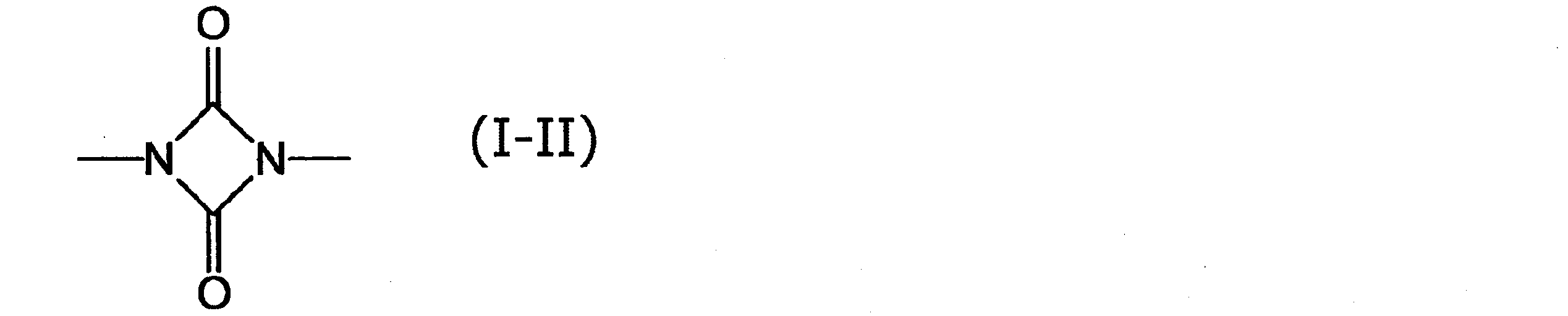
「イミノオキサジアジンジオン基」とは、ジイソシアネートモノマー3分子からなるポリイソシアネート由来の官能基であり、下記式(I-III)で示される基である。 The "iminooxadiazinedione group" is a polyisocyanate-derived functional group composed of three diisocyanate monomers, and is a group represented by the following formula (I-III).

「アロファネート基」とは、アルコールの水酸基とイソシアネート基とから形成される官能基であり、下記式(I-IV)で示される基である。 The "alofanate group" is a functional group formed from a hydroxyl group of an alcohol and an isocyanate group, and is a group represented by the following formula (I-IV).

(ウレトジオン基を有するポリイソシアネート)
ウレトジオン基を有するポリイソシアネート(ウレトジオン基含有ポリイソシアネート)は、ウレトジオン化反応触媒を用いることにより得られる。(Polyisocyanate having a uretdione group)
A polyisocyanate having a uretdione group (a polyisocyanate containing a uretdione group) can be obtained by using a uretdione reaction catalyst.
ウレトジオン化反応触媒としては、以下に限定されないが、例えば、トリアルキルホスフィン、トリス(ジアルキルアミノ)ホスフィン、シクロアルキルホスフィン等の第3ホスフィンが挙げられる。
トリアルキルホスフィンとしては、例えば、トリ-n-ブチルホスフィン、トリ-n-オクチルホスフィン等が挙げられる。
トリス(ジアルキルアミノ)ホスフィンとしては、例えば、トリス-(ジメチルアミノ)ホスフィンなどのトリス(ジアルキルアミノ)ホスフィン等が挙げられる。
シクロアルキルホスフィンとしては、例えば、シクロヘキシル-ジ-n-ヘキシルホスフィン等が挙げられる。
これらの化合物の多くは、同時にイソシアヌレート化反応も促進し、ウレトジオン基含有ポリイソシアネートに加えて、イソシアヌレート型ポリイソシアネートを生成する。Examples of the uretdione reaction catalyst include, but are not limited to, a third phosphine such as trialkylphosphine, tris (dialkylamino) phosphine, and cycloalkylphosphine.
Examples of the trialkylphosphine include tri-n-butylphosphine and tri-n-octylphosphine.
Examples of the tris (dialkylamino) phosphine include tris (dialkylamino) phosphine such as tris- (dimethylamino) phosphine.
Examples of the cycloalkylphosphine include cyclohexyl-di-n-hexylphosphine.
Many of these compounds also promote the isocyanurate-forming reaction to produce isocyanurate-type polyisocyanates in addition to uretdione group-containing polyisocyanates.
所望の収率となった時点で、リン酸、パラトルエンスルホン酸メチル等のウレトジオン化反応触媒の失活剤を添加してウレトジオン化反応を停止する。 When the desired yield is reached, a deactivating agent for the uretdioneization reaction catalyst such as phosphoric acid and methyl paratoluenesulfonate is added to stop the uretdioneization reaction.
上述したウレトジオン化反応触媒の使用量は、原料であるジイソシアネートに対して、質量比で10ppm以上10000ppm以下であることが好ましく、10ppm以上1000ppm以下であることがより好ましく、10ppm以上500ppm以下であることがさらに好ましい。 The amount of the above-mentioned uretdione reaction catalyst used is preferably 10 ppm or more and 10000 ppm or less, more preferably 10 ppm or more and 1000 ppm or less, and 10 ppm or more and 500 ppm or less in terms of mass ratio with respect to the diisocyanate as a raw material. Is even more preferable.
ウレトジオン化の反応温度の下限値は、20℃であることが好ましく、25℃であることがより好ましく、30℃であることがさらに好ましく、35℃であることが特に好ましい。
ウレトジオン化の反応温度の上限値は、120℃であることが好ましく、110℃であることがより好ましく、100℃であることがさらに好ましく、90℃であることが特に好ましい。
ウレトジオン化の反応温度は、20℃以上120℃以下であることが好ましく、25℃以上110℃以下であることがより好ましく、30℃以上100℃以下であることがさらに好ましく、35℃以上90℃以下であることが特に好ましい。
ウレトジオン化の反応温度が上記上限値以下であることにより、着色等の得られるポリイソシアネート組成物の特性変化がより効果的に防止できる。The lower limit of the reaction temperature for uretdione formation is preferably 20 ° C, more preferably 25 ° C, further preferably 30 ° C, and particularly preferably 35 ° C.
The upper limit of the reaction temperature for uretdione formation is preferably 120 ° C, more preferably 110 ° C, further preferably 100 ° C, and particularly preferably 90 ° C.
The reaction temperature for uretdione formation is preferably 20 ° C. or higher and 120 ° C. or lower, more preferably 25 ° C. or higher and 110 ° C. or lower, further preferably 30 ° C. or higher and 100 ° C. or lower, and 35 ° C. or higher and 90 ° C. The following is particularly preferable.
When the reaction temperature for uretdione formation is not more than the above upper limit value, it is possible to more effectively prevent changes in the characteristics of the obtained polyisocyanate composition such as coloring.
また、上記ウレトジオン化反応触媒を用いることなく、ジイソシアネートモノマーを加熱することでウレトジオン基含有ポリイソシアネートを得ることもできる。
上記ウレトジオン化反応触媒を用いない場合、ジイソシアネートモノマーの加熱温度の下限値としては、120℃が好ましく、130℃がより好ましく、140℃がさらに好ましく、145℃が特に好ましい。
ジイソシアネートモノマーの加熱温度の上限値は、180℃が好ましく、175℃がより好ましく、170℃がさらに好ましく、165℃が特に好ましい。
ジイソシアネートモノマーの加熱温度は、120℃以上180℃以下が好ましく、130℃以上175℃以下がより好ましく、140℃以上170℃以下がさらに好ましく、145℃以上165℃以下が特に好ましい。Further, it is also possible to obtain a uretdione group-containing polyisocyanate by heating the diisocyanate monomer without using the above-mentioned uretdione reaction catalyst.
When the above-mentioned uretdione reaction catalyst is not used, the lower limit of the heating temperature of the diisocyanate monomer is preferably 120 ° C., more preferably 130 ° C., still more preferably 140 ° C., and particularly preferably 145 ° C.
The upper limit of the heating temperature of the diisocyanate monomer is preferably 180 ° C., more preferably 175 ° C., further preferably 170 ° C., and particularly preferably 165 ° C.
The heating temperature of the diisocyanate monomer is preferably 120 ° C. or higher and 180 ° C. or lower, more preferably 130 ° C. or higher and 175 ° C. or lower, further preferably 140 ° C. or higher and 170 ° C. or lower, and particularly preferably 145 ° C. or higher and 165 ° C. or lower.
上記ウレトジオン化反応触媒を用いない場合、加熱時間の下限値は、0.2時間が好ましく、0.4時間がより好ましく、0.6時間がさらに好ましく、0.8時間が特に好ましく、1.0時間が最も好ましい。
加熱時間の上限値は、8時間が好ましく、6時間がより好ましく、4時間がさらに好ましく、3時間が特に好ましく、2時間が最も好ましい。
加熱時間は、0.2時間以上8時間以下が好ましく、0.4時間以上6時間以下がより好ましく、0.6時間以上4時間以下がさらに好ましく、0.8時間以上3時間以下が特に好ましく、1.0時間以上2時間以下が最も好ましい。
加熱時間を上記下限値以上とすることで、より低粘度とするできることができ、上記上限値以下とすることで、ポリイソシアネート自体の着色をより抑制することができる。When the above-mentioned uretdione reaction catalyst is not used, the lower limit of the heating time is preferably 0.2 hours, more preferably 0.4 hours, further preferably 0.6 hours, and particularly preferably 0.8 hours. 0 hours is most preferred.
The upper limit of the heating time is preferably 8 hours, more preferably 6 hours, still more preferably 4 hours, particularly preferably 3 hours, and most preferably 2 hours.
The heating time is preferably 0.2 hours or more and 8 hours or less, more preferably 0.4 hours or more and 6 hours or less, further preferably 0.6 hours or more and 4 hours or less, and particularly preferably 0.8 hours or more and 3 hours or less. , 1.0 hour or more and 2 hours or less is most preferable.
By setting the heating time to the above lower limit value or more, the viscosity can be further lowered, and by setting it to the above upper limit value or less, the coloring of the polyisocyanate itself can be further suppressed.
ウレトジオン化反応触媒を使用せずに、本実施形態のポリイソシアネート組成物を得る場合、加熱のみによるウレトジオン化反応と前述したイソシアヌレート化反応が終了した後、未反応ジイソシアネートモノマー濃度の低減、得られたポリイソシアネート組成物の貯蔵後の分子量変化率の低減、及び、高温焼付時の黄変性の低減等の観点から、未反応ジイソシアネートモノマーを除去することが好ましい。 When the polyisocyanate composition of the present embodiment is obtained without using the uretdione formation reaction catalyst, the concentration of the unreacted diisocyanate monomer is reduced after the uretdione formation reaction and the above-mentioned isocyanurate-forming reaction are completed only by heating. From the viewpoint of reducing the rate of change in molecular weight of the polyisocyanate composition after storage and reducing yellowing during high-temperature baking, it is preferable to remove the unreacted diisocyanate monomer.
(イミノオキサジアジンジオン基を有するポリイソシアネート)
イミノオキサジアジンジオン基を有するポリイソシアネート(イミノオキサジアジンジオン基含有ポリイソシアネート)は、イミノオキサジアジンジオン化反応触媒を用いることにより得られる。(Polyisocyanate having iminooxadiazinedione group)
The polyisocyanate having an iminooxadiazinedione group (iminooxadiazinedione group-containing polyisocyanate) can be obtained by using an iminooxadiazine dioneization reaction catalyst.
イミノオキサジアジンジオン化触媒としては、以下が例示される。
(1)一般式M[Fn]、又は、一般式M[Fn(HF)m]で表される(ポリ)フッ化水素(上記式中、m及びnは、m/n>0の関係を満たす整数である。Mはn荷電カチオン(混合物)又は合計でn価の1個以上のラジカルである。)
(1)の化合物((ポリ)フッ化水素)として具体的には、例えば、テトラメチルアンモニウムフルオリド水和物、テトラエチルアンモニウムフルオリド等が挙げられる。Examples of the iminooxadiazine diionization catalyst include the following.
(1) (Poly) hydrogen fluoride represented by the general formula M [F n ] or the general formula M [F n (HF) m ] (in the above formula, m and n are m / n> 0. An integer that satisfies the relationship. M is an n-charged cation (mixture) or one or more radicals with a total n-valence.)
Specific examples of the compound ((poly) hydrogen fluoride) of (1) include tetramethylammonium fluoride hydrate and tetraethylammonium fluoride.
(2)一般式R1-CR’2-C(O)O-、又は、一般式R2=CR’-C(O)O-で表される化合物と、第4級アンモニウムカチオン、又は、第4級ホスホニウムカチオンとからなる化合物。(式中、R1及びR2は、必要に応じて分岐状、環状、及び/又は不飽和の炭素数1~30のパーフルオロアルキル基であり、R’は同一又は異なって、水素原子、炭素数1~20のアルキル基、及びアリール基からなる群から選択され、必要に応じてヘテロ原子を含有する。)
(2)の化合物として具体的には、例えば、3,3,3-トリフルオロカルボン酸;4,4,4,3,3-ペンタフルオロブタン酸;5,5,5,4,4,3,3-ヘプタフルオロペンタン酸;3,3-ジフルオロプロパ-2-エン酸等が挙げられる。(2) A compound represented by the general formula R 1 -CR'2 - C (O) O- or general formula R 2 = CR'-C (O) O-, and a quaternary ammonium cation or a quaternary ammonium cation. A compound consisting of a quaternary phosphonium cation. (In the formula, R 1 and R 2 are branched, cyclic, and / or unsaturated perfluoroalkyl groups having 1 to 30 carbon atoms as needed, and R'is the same or different, hydrogen atom, It is selected from the group consisting of an alkyl group having 1 to 20 carbon atoms and an aryl group, and contains a hetero atom as necessary.)
Specifically, as the compound of (2), for example, 3,3,3-trifluorocarboxylic acid; 4,4,4,3,3-pentafluorobutanoic acid; 5,5,5,4,4,3 , 3-Heptafluoropentanoic acid; 3,3-difluoropropa-2-enoic acid and the like.
イミノオキサジアジンジオン化触媒の使用量の下限値は、特に限定されないが、反応性等の観点から、原料であるHDIに対して、質量比で、5ppmが好ましく、10ppmがより好ましく、20ppmがさらに好ましい。
イミノオキサジアジンジオン化触媒の使用量の上限値は、生成物の着色及び変色の抑制や反応制御等の観点から、原料であるHDIに対して、質量比で、5000ppmが好ましく、2000ppmがより好ましく、500ppmがさらに好ましい。
イミノオキサジアジンジオン化触媒の使用量は、原料であるHDIに対して、質量比で、5ppm以上5000ppm以下であることが好ましく、10ppm以上2000ppm以下がより好ましく、20ppm以上500ppm以下がさらに好ましい。The lower limit of the amount of the iminooxadiazine diionization catalyst used is not particularly limited, but from the viewpoint of reactivity and the like, the mass ratio is preferably 5 ppm, more preferably 10 ppm, and 20 ppm with respect to the raw material HDI. More preferred.
The upper limit of the amount of the iminooxadiazine diionization catalyst used is preferably 5000 ppm, more preferably 2000 ppm, based on the HDI as a raw material, from the viewpoint of suppressing coloration and discoloration of the product and controlling the reaction. It is preferable, and 500 ppm is more preferable.
The amount of the iminooxadiazine diionization catalyst used is preferably 5 ppm or more and 5000 ppm or less, more preferably 10 ppm or more and 2000 ppm or less, and further preferably 20 ppm or more and 500 ppm or less in terms of mass ratio with respect to the raw material HDI.
イミノオキサジアジンジオン化の反応温度の下限値は、特に限定されないが、反応速度等の観点から、40℃が好ましく、50℃がより好ましく、60℃がさらに好ましい。
イミノオキサジアジンジオン化の反応温度の上限値は、生成物の着色及び変色の抑制等の観点から、150℃が好ましく、120℃がより好ましく、110℃がさらに好ましい。
イミノオキサジアジンジオン化の反応温度は、40℃以上150℃以下が好ましく、50℃以上120℃以下がより好ましく、60℃以上110℃以下がさらに好ましい。The lower limit of the reaction temperature for iminooxadiazinedione formation is not particularly limited, but is preferably 40 ° C., more preferably 50 ° C., and even more preferably 60 ° C. from the viewpoint of reaction rate and the like.
The upper limit of the reaction temperature for iminooxadiazine dioneization is preferably 150 ° C., more preferably 120 ° C., and even more preferably 110 ° C. from the viewpoint of suppressing coloration and discoloration of the product.
The reaction temperature for iminooxadiazine dioneization is preferably 40 ° C. or higher and 150 ° C. or lower, more preferably 50 ° C. or higher and 120 ° C. or lower, and even more preferably 60 ° C. or higher and 110 ° C. or lower.
イミノオキサジアジンジオン化反応が所望のイミノオキサジアジンジオン基含有量に達した時点で、イミノオキサジアジンジオン化反応を停止させることができる。イミノオキサジアジンジオン化反応は、例えば、リン酸、酸性リン酸エステル、硫酸、塩酸、スルホン酸化合物等の酸性化合物を反応液に添加することで、停止することができる。これにより、イミノオキサジアジンジオン化反応触媒を中和、熱分解、又は、化学分解等により不活性化される。反応停止後、必要があれば、ろ過を行う。 When the iminooxadiazine dioneization reaction reaches the desired iminooxadiazine dione group content, the iminooxadiazine dioneization reaction can be stopped. The iminooxadiazine diionization reaction can be stopped by adding an acidic compound such as phosphoric acid, acidic phosphoric acid ester, sulfuric acid, hydrochloric acid, or sulfonic acid compound to the reaction solution. As a result, the iminooxadiazine diionization reaction catalyst is inactivated by neutralization, thermal decomposition, chemical decomposition, or the like. After stopping the reaction, if necessary, perform filtration.
(アロファネート基を有するポリイソシアネート)
アロファネート基を有するポリイソシアネート(アロファネート基含有ポリイソシアネート)は、HDIにアルコール化合物等を併用し、アロファネート化反応触媒を用いることにより得られる。(Polyisocyanate having an allophanate group)
A polyisocyanate having an allophanate group (polyisocyanate containing an allophanate group) can be obtained by using an alcohol compound or the like in combination with HDI and using an allophanate reaction catalyst.
アロファネート基含有ポリイソシアネートの製造に用いられるアルコール化合物としては、以下に限定されないが、炭素、水素及び酸素のみで形成されるアルコールが好ましい。また、アルコール化合物は数平均分子量が200以下であることが好ましい。 The alcohol compound used for producing the allophanate group-containing polyisocyanate is not limited to the following, but an alcohol formed only of carbon, hydrogen and oxygen is preferable. Further, the alcohol compound preferably has a number average molecular weight of 200 or less.
アルコール化合物としては、例えば、モノアルコール、ジアルコール等が挙げられる。
モノアルコールとしては、例えば、メタノール、エタノール、プロパノール、ブタノール、ペンタノール、ヘキサノール、ヘプタノール、オクタノール、ノナノール等が挙げられる。
ジアルコールとしては、例えば、エチレングリコール、1,3-ブタンジオール、ネオペンチルグリコール、2-エチルヘキサンジオール等が挙げられる。
これらアルコール化合物は、単独で用いてもよく、2種以上を併用してもよい。
中でも、アルコール化合物としては、モノアルコールが好ましい。Examples of the alcohol compound include monoalcohol and dialcohol.
Examples of the monoalcohol include methanol, ethanol, propanol, butanol, pentanol, hexanol, heptanol, octanol, nonanol and the like.
Examples of the dialcohol include ethylene glycol, 1,3-butanediol, neopentyl glycol, 2-ethylhexanediol and the like.
These alcohol compounds may be used alone or in combination of two or more.
Among them, monoalcohol is preferable as the alcohol compound.
アルコール化合物の使用量は、以下に限定されないが、HDIのイソシアネート基とアルコール化合物の水酸基とのモル比で10/1以上1000/1以下であることが好ましく、100/1以上1000/1以下であることがより好ましい。上記下限値以上であることで、得られるポリイソシアネートにおいて、イソシアネート基平均数をより適切な数確保することができる。 The amount of the alcohol compound used is not limited to the following, but is preferably 10/1 or more and 1000/1 or less, and 100/1 or more and 1000/1 or less in terms of the molar ratio of the isocyanate group of HDI to the hydroxyl group of the alcohol compound. It is more preferable to have. When it is at least the above lower limit value, a more appropriate number of isocyanate groups can be secured in the obtained polyisocyanate.
アロファネート化反応触媒としては、以下に限定されないが、例えば、錫、鉛、亜鉛、ビスマス、ジルコニウム、ジルコニル等のアルキルカルボン酸塩等が挙げられる。
錫のアルキルカルボン酸塩(有機錫化合物)としては、例えば、2-エチルヘキサン酸錫、ジブチル錫ジラウレート等が挙げられる。
鉛のアルキルカルボン酸塩(有機鉛化合物)としては、例えば、2-エチルヘキサン酸鉛等が挙げられる。
亜鉛のアルキルカルボン酸塩(有機亜鉛化合物)としては、例えば、2-エチルヘキサン酸亜鉛等が挙げられる。
ビスマスのアルキルカルボン酸塩としては、例えば、2-エチルヘキサン酸ビスマス等が挙げられる。
ジルコニウムのアルキルカルボン酸塩としては、例えば、2-エチルヘキサン酸ジルコニウム等が挙げられる。
ジルコニルのアルキルカルボン酸塩としては、例えば、2-エチルヘキサン酸ジルコニル等が挙げられる。Examples of the allophanate formation reaction catalyst include, but are not limited to, alkyl carboxylates such as tin, lead, zinc, bismuth, zirconium, and zirconyl.
Examples of the tin alkylcarboxylic acid salt (organic tin compound) include tin 2-ethylhexanoate and dibutyltin dilaurate.
Examples of the lead alkylcarboxylate (organolead compound) include lead 2-ethylhexanoate.
Examples of the alkylcarboxylate (organozinc compound) of zinc include zinc 2-ethylhexanoate and the like.
Examples of the alkylcarboxylic acid salt of bismuth include bismuth 2-ethylhexanoate.
Examples of the alkylcarboxylate of zirconium include zirconium 2-ethylhexanoate.
Examples of the alkylcarboxylate of zirconyl include zirconyl 2-ethylhexanoate.
所望の収率となった時点で、リン酸、パラトルエンスルホン酸メチル等のアロファネート化反応触媒の失活剤を添加して、アロファネート化反応を停止することができる。 When the desired yield is reached, a deactivating agent for the allophanation reaction catalyst such as phosphoric acid and methyl paratoluenesulfonate can be added to terminate the allophanization reaction.
上記アロファネート化反応触媒の使用量は、原料であるジイソシアネートに対して、質量比で、10ppm以上10000ppm以下が好ましく、10ppm以上1000ppm以下がより好ましく、10ppm以上500ppm以下がさらに好ましい。 The amount of the allophanation reaction catalyst used is preferably 10 ppm or more and 10000 ppm or less, more preferably 10 ppm or more and 1000 ppm or less, and further preferably 10 ppm or more and 500 ppm or less in terms of mass ratio with respect to the diisocyanate as a raw material.
アロファネート化の反応温度の下限値は、60℃が好ましく、70℃がより好ましく、80℃がさらに好ましく、90℃が特に好ましい。
アロファネート化の反応温度の上限値は、160℃が好ましく、155℃がより好ましく、150℃がさらに好ましく、145℃が特に好ましい。
アロファネート化の反応温度は、60℃以上160℃以下が好ましく、70℃以上155℃以下がより好ましく、80℃以上150℃以下がさらに好ましく、90℃以上145℃以下が特に好ましい。
アロファネート化反応温度が上記上限値以下であることにより、得られるポリイソシアネートの着色等の特性変化をより効果的に防止できる。The lower limit of the reaction temperature for allophanation is preferably 60 ° C, more preferably 70 ° C, further preferably 80 ° C, and particularly preferably 90 ° C.
The upper limit of the reaction temperature for allophanation is preferably 160 ° C, more preferably 155 ° C, still more preferably 150 ° C, and particularly preferably 145 ° C.
The reaction temperature for allophanate formation is preferably 60 ° C. or higher and 160 ° C. or lower, more preferably 70 ° C. or higher and 155 ° C. or lower, further preferably 80 ° C. or higher and 150 ° C. or lower, and particularly preferably 90 ° C. or higher and 145 ° C. or lower.
When the allophanate reaction temperature is not more than the above upper limit value, it is possible to more effectively prevent changes in characteristics such as coloring of the obtained polyisocyanate.
反応時間の下限値は、0.2時間が好ましく、0.4時間がより好ましく、0.6時間がさらに好ましく、0.8時間が特に好ましく、1.0時間が最も好ましい。
反応時間の上限値は、8時間以下が好ましく、6時間がより好ましく、4時間がさらに好ましく、3時間が特に好ましく、2時間が最も好ましい。
アロファネート化の反応時間は0.2時間以上8時間以下が好ましく、0.4時間以上6時間以下がより好ましく、0.6時間以上4時間以下がさらに好ましく、0.8時間以上3時間以下が特に好ましく、1.0時間以上2時間以下が最も好ましい。
アロファネート化の反応時間を上記下限値以上とすることで、より低粘度とするできることができ、上記上限値以下とすることで、ポリイソシアネート自体の着色をより抑制することができる。The lower limit of the reaction time is preferably 0.2 hours, more preferably 0.4 hours, still more preferably 0.6 hours, particularly preferably 0.8 hours, and most preferably 1.0 hours.
The upper limit of the reaction time is preferably 8 hours or less, more preferably 6 hours, still more preferably 4 hours, particularly preferably 3 hours, and most preferably 2 hours.
The reaction time for allophanate formation is preferably 0.2 hours or more and 8 hours or less, more preferably 0.4 hours or more and 6 hours or less, further preferably 0.6 hours or more and 4 hours or less, and 0.8 hours or more and 3 hours or less. It is particularly preferable, and most preferably 1.0 hour or more and 2 hours or less.
By setting the reaction time for allophanate formation to the above lower limit value or more, the viscosity can be further lowered, and by setting it to the above upper limit value or less, the coloring of the polyisocyanate itself can be further suppressed.
また、上記イソシアヌレート化反応触媒をアロファネート化反応触媒として用いることができる。上記イソシアヌレート化反応触媒を用いて、アロファネート化反応を行う場合、イソシアヌレート型ポリイソシアネートも同時に生成させる。中でも、経済面から生産性の向上等の観点から、アロファネート化反応触媒として、上記イソシアヌレート化反応触媒を用い、アロファネート化反応とイソシアヌレート反応とを行うことが好ましい。 Further, the isocyanurate-forming reaction catalyst can be used as an allophanate-forming reaction catalyst. When the allophanate reaction is carried out using the above-mentioned isocyanurate-forming reaction catalyst, isocyanurate-type polyisocyanate is also produced at the same time. Above all, from the viewpoint of improving productivity from the economical point of view, it is preferable to use the above-mentioned isocyanurate-forming reaction catalyst as the allophanate-forming reaction catalyst to carry out the allophanate-forming reaction and the isocyanurate-forming reaction.
上記イソシアヌレート化反応、及び、上記ウレトジオン化反応はそれぞれを逐次行うこともできるし、並行して行うこともできる。 The isocyanurate-forming reaction and the uretdione-forming reaction can be carried out sequentially or in parallel.
また、アロファネート化反応を伴う場合には、製造工程を簡略化できるため、イソシアヌレート化反応とアロファネート化反応を並行して先行させ、次いで、ウレトジオン化反応を行うことが好ましい。 Further, when an allophanate-forming reaction is involved, it is preferable to precede the isocyanurate-forming reaction and the allophanation-forming reaction in parallel, and then carry out the uretdione-forming reaction, because the production process can be simplified.
アロファネート化反応は、所望のアロファネート基含有量に達した時点で、停止させることができる。 The allophanate formation reaction can be stopped when the desired allophanate group content is reached.
アロファネート化反応は、以下に限定されないが、例えば、リン酸、酸性リン酸エステル、硫酸、塩酸、スルホン酸化合物等の酸性化合物を反応液に添加することで、停止することができる。これにより、アロファネート化反応触媒を中和、熱分解、又は、化学分解等により不活性化させることができる。反応停止後、必要があれば、ろ過を行う。 The allophanate formation reaction is not limited to the following, but can be stopped by adding an acidic compound such as phosphoric acid, acidic phosphoric acid ester, sulfuric acid, hydrochloric acid, or sulfonic acid compound to the reaction solution. As a result, the allophanate reaction catalyst can be inactivated by neutralization, thermal decomposition, chemical decomposition, or the like. After stopping the reaction, if necessary, perform filtration.
<<塗料組成物(第1の実施形態)>>
上記第1の実施形態のポリイソシアネート組成物は、塗料組成物の硬化剤等として好適に用いることができる。
本発明の第1の実施形態の塗料組成物は、上記ポリイソシアネート組成物を含有する。<< Paint composition (first embodiment) >>
The polyisocyanate composition of the first embodiment can be suitably used as a curing agent or the like for a coating composition.
The coating composition of the first embodiment of the present invention contains the above-mentioned polyisocyanate composition.
<樹脂成分>
本実施形態の塗料組成物は、更に、主剤として樹脂成分を含有する。該樹脂成分としては、特に限定されないが、イソシアネート基との反応性を有する活性水素を分子内に2個以上有する化合物を含有することが好ましい。<Resin component>
The coating composition of the present embodiment further contains a resin component as a main agent. The resin component is not particularly limited, but preferably contains a compound having two or more active hydrogens having reactivity with an isocyanate group in the molecule.
活性水素を分子内に2個以上有する化合物としては、以下に限定されないが、例えば、ポリオール、ポリアミン、ポリチオール等が挙げられる。中でも、活性水素を分子内に2個以上有する化合物としては、ポリオールが好ましい。ポリオールとしては、以下に限定されないが、例えば、ポリエステルポリオール、ポリエーテルポリオール、アクリルポリオール、ポリオレフィンポリオール、フッ素ポリオール等が挙げられる。 Examples of the compound having two or more active hydrogens in the molecule include, but are not limited to, polyols, polyamines, polythiols and the like. Among them, a polyol is preferable as a compound having two or more active hydrogens in the molecule. Examples of the polyol include, but are not limited to, polyester polyols, polyether polyols, acrylic polyols, polyolefin polyols, fluorine polyols, and the like.
本実施形態の塗料組成物は、溶剤ベース、水系ベース、無溶剤系のいずれにも使用可能である。 The coating composition of the present embodiment can be used for any of solvent-based, water-based, and solvent-free.
溶剤ベースの塗料組成物とする場合には、例えば、まず、活性水素を分子内に2個以上有する化合物を含有する樹脂、又は、その溶剤希釈物に、必要に応じて他の樹脂、触媒、顔料、レベリング剤、酸化防止剤、紫外線吸収剤、光安定剤、可塑剤、界面活性剤等のその他添加剤を加えたものを調製する。次いで、本実施形態のポリイソシアネート組成物を硬化剤として添加し、必要に応じて、更に溶剤を添加して、粘度を調整する。次いで、手攪拌、又は、マゼラー等の攪拌機器を用いて攪拌することによって、溶剤ベースの塗料組成物を得ることができる。 In the case of a solvent-based coating composition, for example, first, a resin containing a compound having two or more active hydrogens in the molecule, or a solvent diluted product thereof, and other resins, catalysts, if necessary, are used. Prepare a product to which other additives such as pigments, leveling agents, antioxidants, ultraviolet absorbers, light stabilizers, plasticizers, and surfactants are added. Next, the polyisocyanate composition of the present embodiment is added as a curing agent, and if necessary, a solvent is further added to adjust the viscosity. Then, the solvent-based coating composition can be obtained by stirring by hand or using a stirring device such as Magellar.
水系ベースの塗料組成物とする場合には、例えば、まず、活性水素を分子内に2個以上有する化合物を含有する樹脂の水分散体、又は、その水溶液に、必要に応じて他の樹脂、触媒、顔料、レベリング剤、酸化防止剤、紫外線吸収剤、光安定剤、可塑剤、界面活性剤等のその他添加剤を加えたものを調製する。次いで、本実施形態のポリイソシアネート組成物を硬化剤として添加し、必要に応じて、水や溶剤を更に添加する。次いで、攪拌機器を用いて強制攪拌することによって、水系ベースの塗料組成物を得ることができる。 In the case of an aqueous-based coating composition, for example, first, an aqueous dispersion of a resin containing a compound having two or more active hydrogens in the molecule, or an aqueous solution thereof, and other resins as needed. Prepare a product to which other additives such as a catalyst, a pigment, a leveling agent, an antioxidant, an ultraviolet absorber, a light stabilizer, a plasticizer, and a surfactant are added. Next, the polyisocyanate composition of the present embodiment is added as a curing agent, and if necessary, water or a solvent is further added. Then, by forcibly stirring using a stirring device, a water-based coating composition can be obtained.
[ポリエステルポリオール]
ポリエステルポリオールは、例えば、二塩基酸の単独又は2種類以上の混合物と、多価アルコールの単独又は2種類以上の混合物とを、縮合反応させることによって得ることができる。[Polyester polyol]
The polyester polyol can be obtained, for example, by subjecting a dibasic acid alone or a mixture of two or more kinds to a condensation reaction with a polyhydric alcohol alone or a mixture of two or more kinds.
上記二塩基酸としては、例えば、コハク酸、アジピン酸、ダイマー酸、無水マレイン酸、無水フタル酸、イソフタル酸、テレフタル酸、1,4-シクロヘキサンジカルボン酸等のカルボン酸等が挙げられる。 Examples of the dibasic acid include carboxylic acids such as succinic acid, adipic acid, dimer acid, maleic anhydride, phthalic acid anhydride, isophthalic acid, terephthalic acid, and 1,4-cyclohexanedicarboxylic acid.
上記多価アルコールとしては、例えば、エチレングリコール、プロピレングリコール、ジエチレングリコール、1,4-ブタンジオール、ネオペンチルグリコール、1,6-ヘキサンジオール、トリメチルペンタンジオール、シクロヘキサンジオール、トリメチロールプロパン、グリセリン、ペンタエリスリトール、2-メチロールプロパンジオール、エトキシ化トリメチロールプロパン等が挙げられる。 Examples of the polyhydric alcohol include ethylene glycol, propylene glycol, diethylene glycol, 1,4-butanediol, neopentyl glycol, 1,6-hexanediol, trimethylpentanediol, cyclohexanediol, trimethylolpropane, glycerin, and pentaerythritol. , 2-Methylolpropanediol, ethoxylated trimethylolpropane and the like.
ポリエステルポリオールの具体的な製造方法としては、例えば、上記の成分を混合し、約160~220℃で加熱することによって、縮合反応を行うことができる。
又は、例えば、ε-カプロラクトン等のラクトン類を、多価アルコールを用いて開環重合して得られるようなポリカプロラクトン類等もポリエステルポリオールとして用いることができる。As a specific method for producing a polyester polyol, for example, the condensation reaction can be carried out by mixing the above components and heating at about 160 to 220 ° C.
Alternatively, for example, polycaprolactones obtained by ring-opening polymerization of lactones such as ε-caprolactone using a polyhydric alcohol can also be used as the polyester polyol.
上述の製造方法で得られたポリエステルポリオールは、芳香族ジイソシアネート、脂肪族ジイソシアネート、脂環族ジイソシアネート、及びこれらから得られる化合物等を用いて変性させることができる。中でも、得られる塗膜の耐候性及び耐黄変性等の観点から、ポリエステルポリオールは、脂肪族ジイソシアネート、脂環族ジイソシアネート、及びこれらから得られる化合物を用いて変性させることが好ましい。 The polyester polyol obtained by the above-mentioned production method can be modified with aromatic diisocyanates, aliphatic diisocyanates, alicyclic diisocyanates, compounds obtained from these, and the like. Above all, from the viewpoint of weather resistance and yellowing resistance of the obtained coating film, it is preferable to modify the polyester polyol with an aliphatic diisocyanate, an alicyclic diisocyanate, and a compound obtained from these.
本実施形態の塗料組成物が水分量の多い溶剤を含む場合には、ポリエステルポリオール中の二塩基酸等に由来する一部のカルボン酸を残存させておき、アミン、アンモニア等の塩基で中和することで、ポリエステルポリオールを水溶性又は水分散性の樹脂とすることができる。 When the coating composition of the present embodiment contains a solvent having a large amount of water, a part of the carboxylic acid derived from the dibasic acid or the like in the polyester polyol is left and neutralized with a base such as amine or ammonia. By doing so, the polyester polyol can be made into a water-soluble or water-dispersible resin.
[ポリエーテルポリオール]
ポリエーテルポリオールは、例えば、以下の(1)~(3)のいずれかの方法等を用いて得ることができる。[Polyether polyol]
The polyether polyol can be obtained, for example, by using any of the following methods (1) to (3).
(1)触媒を使用して、アルキレンオキシドの単独又は混合物を、多価ヒドロキシ化合物の単独又は混合物に、ランダム又はブロック付加して、ポリエーテルポリオール類を得る方法。
上記触媒としては、例えば、水酸化物(リチウム、ナトリウム、カリウム等)、強塩基性触媒(アルコラート、アルキルアミン等)、複合金属シアン化合物錯体(金属ポルフィリン、ヘキサシアノコバルト酸亜鉛錯体等)等が挙げられる。
上記アルキレンオキシドとしては、例えば、エチレンオキシド、プロピレンオキシド、ブチレンオキシド、シクロヘキセンオキシド、スチレンオキシド等が挙げられる。(1) A method of randomly or blocking addition of a alkylene oxide alone or a mixture to a polyvalent hydroxy compound alone or a mixture using a catalyst to obtain polyether polyols.
Examples of the catalyst include hydroxides (lithium, sodium, potassium, etc.), strong basic catalysts (alcolate, alkylamine, etc.), complex metal cyanide compound complexes (metal porphyrin, hexacyanocobalate zinc complex, etc.) and the like. Be done.
Examples of the alkylene oxide include ethylene oxide, propylene oxide, butylene oxide, cyclohexene oxide, and styrene oxide.
(2)ポリアミン化合物にアルキレンオキシドを反応させて、ポリエーテルポリオール類を得る方法。
上記ポリアミン化合物としては、例えば、エチレンジアミン類等が挙げられる。
上記アルキレンオキシドとしては、方法(1)で例示されたものと同様のものが挙げられる。(2) A method for obtaining polyether polyols by reacting a polyamine compound with an alkylene oxide.
Examples of the polyamine compound include ethylenediamines.
Examples of the alkylene oxide include those similar to those exemplified in the method (1).
(3)(1)又は(2)で得られたポリエーテルポリオール類を媒体としてアクリルアミド等を重合して、いわゆるポリマーポリオール類を得る方法。 (3) A method for obtaining so-called polymer polyols by polymerizing acrylamide or the like using the polyether polyols obtained in (1) or (2) as a medium.
上記方法(1)で使用される多価ヒドロキシ化合物としては、例えば、以下の(i)~(vi)に示すものが挙げられる。 Examples of the multivalent hydroxy compound used in the above method (1) include those shown in the following (i) to (vi).
(i)ジグリセリン、ジトリメチロールプロパン、ペンタエリスリトール、ジペンタエリスリトール等。
(ii)エリトリトール、D-トレイトール、L-アラビニトール、リビトール、キシリトール、ソルビトール、マンニトール、ガラクチトール、ラムニトール等の糖アルコール系化合物。
(iii)アラビノース、リボース、キシロース、グルコース、マンノース、ガラクトース、フルクトース、ソルボース、ラムノース、フコース、リボデソース等の単糖類。
(iv)トレハロース、ショ糖、マルトース、セロビオース、ゲンチオビオース、ラクトース、メリビオース等の二糖類。
(v)ラフィノース、ゲンチアノース、メレチトース等の三糖類。
(vi)スタキオース等の四糖類。(I) Diglycerin, ditrimethylolpropane, pentaerythritol, dipentaerythritol, etc.
(Ii) Sugar alcohol compounds such as erythritol, D-threitol, L-arabinitol, ribitol, xylitol, sorbitol, mannitol, galactitol, and ramnitol.
(Iii) Monosaccharides such as arabinose, ribose, xylose, glucose, mannose, galactose, fructose, sorbose, rhamnose, fucose, and ribodesource.
(Iv) Disaccharides such as trehalose, sucrose, maltose, cellobiose, gentiobiose, lactose, and melibiose.
(V) Trisaccharides such as raffinose, gentianose, and meletitose.
(Vi) A tetrasaccharide such as stachyose.
[アクリルポリオール]
アクリルポリオールは、例えば、一分子中に1個以上の活性水素を有する重合性モノマーのみを重合させる、又は、一分子中に1個以上の活性水素を有する重合性モノマーと、必要に応じて、当該重合性モノマーと共重合可能な他のモノマーとを、共重合させることによって得ることができる。[Acrylic polyol]
The acrylic polyol may, for example, polymerize only a polymerizable monomer having one or more active hydrogens in one molecule, or may have a polymerizable monomer having one or more active hydrogens in one molecule, if necessary. It can be obtained by copolymerizing the polymerizable monomer with another copolymerizable monomer.
上記一分子中に1個以上の活性水素を有する重合性モノマーとしては、例えば、以下の(i)~(vi)に示すものが挙げられる。これらを単独で用いてもよく、2種類以上を組み合わせて用いてもよい。
(i)アクリル酸-2-ヒドロキシエチル、アクリル酸-2-ヒドロキシプロピル、アクリル酸-2-ヒドロキシブチル等の活性水素を有するアクリル酸エステル類。
(ii)メタクリル酸-2-ヒドロキシエチル、メタクリル酸-2-ヒドロキシプロピル、メタクリル酸-2-ヒドロキシブチル、メタクリル酸-3-ヒドロキシプロピル、メタクリル酸-4-ヒドロキシブチル等の活性水素を有するメタクリル酸エステル類。
(iii)グリセリンやトリメチロールプロパン等のトリオールの(メタ)アクリル酸モノエステル等の多価活性水素を有する(メタ)アクリル酸エステル類。
(iv)ポリエーテルポリオール類(例えば、ポリエチレングリコール、ポリプロピレングリコール、ポリブチレングリコール等)と上記の活性水素を有する(メタ)アクリル酸エステル類とのモノエーテル。
(v)グリシジル(メタ)アクリレートと一塩基酸(例えば、酢酸、プロピオン酸、p-tert-ブチル安息香酸等)との付加物。
(vi)上記の活性水素を有する(メタ)アクリル酸エステル類の活性水素にラクトン類(例えば、ε-カプロラクタム、γ-バレロラクトン等)を開環重合させることにより得られる付加物。Examples of the polymerizable monomer having one or more active hydrogens in one molecule include those shown in the following (i) to (vi). These may be used alone or in combination of two or more.
(I) Acrylic acid esters having active hydrogen such as -2-hydroxyethyl acrylate, -2-hydroxypropyl acrylate, and -2-hydroxybutyl acrylate.
(Ii) Methacrylic acid having active hydrogen such as -2-hydroxyethyl methacrylate, -2-hydroxypropyl methacrylate, -2-hydroxybutyl methacrylate, -3-hydroxypropyl methacrylate, -4-hydroxybutyl methacrylate and the like. Esters.
(Iii) (Meta) acrylic acid esters having polyvalent active hydrogen such as triol (meth) acrylic acid monoesters such as glycerin and trimethylolpropane.
(Iv) Monoether of polyether polyols (for example, polyethylene glycol, polypropylene glycol, polybutylene glycol, etc.) and the above-mentioned (meth) acrylic acid esters having active hydrogen.
(V) An adduct of glycidyl (meth) acrylate and a monobasic acid (eg, acetic acid, propionic acid, p-tert-butylbenzoic acid, etc.).
(Vi) An adduct obtained by ring-opening polymerization of lactones (for example, ε-caprolactam, γ-valerolactone, etc.) with the active hydrogen of the (meth) acrylic acid esters having the above active hydrogen.
上記重合性モノマーと共重合可能な他のモノマーとしては、例えば、以下の(i)~(iv)に示すものが挙げられる。これらを単独で用いてもよく、2種類以上を組み合わせて用いてもよい。
(i)アクリル酸メチル、アクリル酸エチル、アクリル酸イソプロピル、アクリル酸-n-ブチル、アクリル酸-2-エチルヘキシル、メタクリル酸メチル、メタクリル酸エチル、メタクリル酸イソプロピル、メタクリル酸-n-ブチル、メタクリル酸イソブチル、メタクリル酸-n-ヘキシル、メタクリル酸シクロヘキシル、メタクリル酸ラウリル、メタクリル酸グリシジル等の(メタ)アクリル酸エステル類。
(ii)アクリル酸、メタクリル酸、マレイン酸、イタコン酸等)、不飽和アミド類(アクリルアミド、N-メチロールアクリルアミド、ジアセトンアクリルアミド等の不飽和カルボン酸類。
(iii)ビニルトリメトキシシラン、ビニルメチルジメトキシシラン、γ-(メタ)アクリロプロピルトリメトキシシラン等の加水分解性シリル基を有するビニルモノマー類。
(iv)スチレン、ビニルトルエン、酢酸ビニル、アクリルニトリル、フマル酸ジブチル等のその他の重合性モノマー。Examples of other monomers copolymerizable with the polymerizable monomer include those shown in the following (i) to (iv). These may be used alone or in combination of two or more.
(I) Methyl acrylate, ethyl acrylate, isopropyl acrylate, -n-butyl acrylate, -2-ethylhexyl acrylate, methyl methacrylate, ethyl methacrylate, isopropyl methacrylate, -n-butyl methacrylate, methacrylic acid. (Meta) acrylic acid esters such as isobutyl, methacrylic acid-n-hexyl, cyclohexyl methacrylate, lauryl methacrylate, glycidyl methacrylate.
(Ii) Acrylic acid, methacrylic acid, maleic acid, itaconic acid, etc.), unsaturated amides (acrylamide, N-methylol acrylamide, diacetone acrylamide, and other unsaturated carboxylic acids.
(Iii) Vinyl monomers having a hydrolyzable silyl group such as vinyltrimethoxysilane, vinylmethyldimethoxysilane, and γ- (meth) acrylopropyltrimethoxysilane.
(Iv) Other polymerizable monomers such as styrene, vinyltoluene, vinyl acetate, acrylonitrile, dibutyl fumarate and the like.
アクリルポリオールの具体的な製造方法としては、例えば、上記のモノマーを、公知の過酸化物やアゾ化合物等のラジカル重合開始剤の存在下で溶液重合し、必要に応じて有機溶剤等で希釈することによって、アクリルポリオールを得ることができる。 As a specific method for producing an acrylic polyol, for example, the above-mentioned monomer is solution-polymerized in the presence of a known radical polymerization initiator such as a peroxide or an azo compound, and diluted with an organic solvent or the like as necessary. Thereby, an acrylic polyol can be obtained.
本実施形態の塗料組成物が水分量の多い溶剤を含む場合には、上記のモノマーを溶液重合し、水層に転換する方法や乳化重合などの公知の方法で製造することができる。その場合、アクリル酸、メタアクリル酸等のカルボン酸含有モノマーやスルホン酸含有モノマー等の酸性部分を、アミンやアンモニアで中和することによって、アクリルポリオールに水溶性又は水分散性を付与することができる。 When the coating composition of the present embodiment contains a solvent having a large amount of water, it can be produced by a known method such as a method of solution-polymerizing the above-mentioned monomer and converting it into an aqueous layer or an emulsion polymerization. In that case, it is possible to impart water solubility or water dispersibility to the acrylic polyol by neutralizing an acidic portion such as a carboxylic acid-containing monomer such as acrylic acid or methacrylic acid or a sulfonic acid-containing monomer with an amine or ammonia. can.
[ポリオレフィンポリオール]
ポリオレフィンポリオールとしては、例えば、水酸基を2個以上有するポリブタジエン、水酸基を2個以上有する水素添加ポリブタジエン、水酸基を2個以上有するポリイソプレン、水酸基を2個以上有する水素添加ポリイソプレン等が挙げられる。
また、ポリオレフィンポリオールの統計的1分子が持つ水酸基数(以下、「水酸基平均数」と称する場合がある)は、2以上であることが好ましい。[Polyolefin polyol]
Examples of the polyolefin polyol include polybutadiene having two or more hydroxyl groups, hydrogenated polybutadiene having two or more hydroxyl groups, polyisoprene having two or more hydroxyl groups, and hydrogenated polyisoprene having two or more hydroxyl groups.
Further, the number of hydroxyl groups (hereinafter, may be referred to as “average number of hydroxyl groups”) of one statistical molecule of the polyolefin polyol is preferably 2 or more.
[フッ素ポリオール]
本明細書において、「フッ素ポリオール」とは、分子内にフッ素を含むポリオールを意味する。フッ素ポリオールとして具体的には、例えば、特開昭57-34107号公報(参考文献1)、特開昭61-275311号公報(参考文献2)等で開示されているフルオロオレフィン、シクロビニルエーテル、ヒドロキシアルキルビニルエーテル、モノカルボン酸ビニルエステル等の共重合体等が挙げられる。[Fluorine polyol]
As used herein, the term "fluorine polyol" means a polyol containing fluorine in the molecule. Specific examples of the fluoropolypolymer include fluoroolefins, cyclovinyl ethers, and hydroxys disclosed in JP-A-57-34107 (Reference 1), JP-A-61-275311 (Reference 2), and the like. Examples thereof include copolymers such as alkyl vinyl ether and monocarboxylic acid vinyl ester.
[ポリオールの水酸基価及び酸価]
ポリオールの水酸基価の下限値は、10mgKOH/gが好ましく、20mgKOH/gがより好ましく、30mgKOH/gがさらに好ましい。
ポリオールの水酸基価の上限値は、200mgKOH/gが好ましく、180mgKOH/gがより好ましく、160mgKOH/gがさらに好ましい。
ポリオールの水酸基価は、10mgKOH/g以上200mgKOH/g以下が好ましく、20mgKOH/g以上180mgKOH/g以下がより好ましく、30mgKOH/g以上160mgKOH/g以下がさらに好ましい。
ポリオールの水酸基価が上記下限値以上であることにより、本実施形態の塗料組成物から得られる塗膜の耐薬品性をより向上させることができる。
ポリオールの水酸基価が上記上限値以下であることにより、ポリイソシアネート組成物との混合後のポットライフをより向上させることができる。
なお、一般に、「ポットライフ」とは、塗料、接着剤等の組成物において、主剤と硬化剤とを混合して組成物を調製後、硬化前の組成物としての性能を確保している時間を意味する。可使時間ともいう。[Hydroxy group value and acid value of polyol]
The lower limit of the hydroxyl value of the polyol is preferably 10 mgKOH / g, more preferably 20 mgKOH / g, and even more preferably 30 mgKOH / g.
The upper limit of the hydroxyl value of the polyol is preferably 200 mgKOH / g, more preferably 180 mgKOH / g, and even more preferably 160 mgKOH / g.
The hydroxyl value of the polyol is preferably 10 mgKOH / g or more and 200 mgKOH / g or less, more preferably 20 mgKOH / g or more and 180 mgKOH / g or less, and further preferably 30 mgKOH / g or more and 160 mgKOH / g or less.
When the hydroxyl value of the polyol is at least the above lower limit value, the chemical resistance of the coating film obtained from the coating composition of the present embodiment can be further improved.
When the hydroxyl value of the polyol is not more than the above upper limit value, the pot life after mixing with the polyisocyanate composition can be further improved.
In general, "pot life" is the time during which a composition such as a paint or an adhesive is mixed with a main agent and a curing agent to prepare a composition, and then the performance as a composition before curing is ensured. Means. Also called pot life.
ポリオールの酸価は0mgKOH/g以上30mgKOH/g以下であることが好ましい。 The acid value of the polyol is preferably 0 mgKOH / g or more and 30 mgKOH / g or less.
水酸基価及び酸価は、JIS K1557に準拠して測定することができる。 The hydroxyl value and acid value can be measured according to JIS K1557.
中でも、本実施形態の塗料組成物に含まれるポリオールとしては、耐候性、耐薬品性、及び、硬度の観点から、アクリルポリオールが好ましい。又は、機械強度、及び、耐油性の観点から、ポリエステルポリオールが好ましい。 Among them, as the polyol contained in the coating composition of the present embodiment, an acrylic polyol is preferable from the viewpoint of weather resistance, chemical resistance, and hardness. Alternatively, a polyester polyol is preferable from the viewpoint of mechanical strength and oil resistance.
すなわち、本実施形態の塗料組成物は、上記実施形態のポリイソシアネート組成物と、水酸基価が10mgKOH/g以上200mgKOH/g以下であるアクリルポリオール、及び、水酸基価が10mgKOH/g以上200mgKOH/g以下であるポリエステルポリオールのうち少なくとも一つと、を含むことが好ましい。 That is, the coating composition of the present embodiment contains the polyisocyanate composition of the above embodiment, an acrylic polyol having a hydroxyl value of 10 mgKOH / g or more and 200 mgKOH / g or less, and a hydroxyl value of 10 mgKOH / g or more and 200 mgKOH / g or less. It is preferable to contain at least one of the polyester polyols which are.
[NCO/OH]
上記活性水素を分子内に2個以上有する化合物の水酸基に対する、上記実施形態のポリイソシアネート組成物のイソシアネート基のモル比(NCO/OH)は、0.2以上5.0以下が好ましく、0.4以上3.0がより好ましく、0.5以上2.0以下がさらに好ましい。
NCO/OHが上記下限値以上であると、より強靱な塗膜が得られる傾向にある。一方、NCO/OHが上記上限値以下であると、塗膜の平滑性がより向上する傾向にある。[NCO / OH]
The molar ratio (NCO / OH) of the isocyanate group of the polyisocyanate composition of the above embodiment to the hydroxyl group of the compound having two or more active hydrogens in the molecule is preferably 0.2 or more and 5.0 or less, preferably 0. 4 or more and 3.0 are more preferable, and 0.5 or more and 2.0 or less are further preferable.
When NCO / OH is at least the above lower limit value, a tougher coating film tends to be obtained. On the other hand, when NCO / OH is not more than the above upper limit value, the smoothness of the coating film tends to be further improved.
<その他添加剤>
本実施形態の塗料組成物は、上記ポリイソシアネート組成物及び上記樹脂成分に加えて、必要に応じて、完全アルキル型、メチロール型アルキル、イミノ基型アルキル等のメラミン系硬化剤を含有してもよい。
また、上記活性水素を分子内に2個以上有する化合物、上記実施形態のポリイソシアネート組成物、及び、本実施形態の塗料組成物は、いずれも、有機溶剤を含有してもよい。<Other additives>
In addition to the polyisocyanate composition and the resin component, the coating composition of the present embodiment may contain a melamine-based curing agent such as a fully alkyl-type, a methylol-type alkyl, or an imino-based alkyl, if necessary. good.
Further, the compound having two or more active hydrogens in the molecule, the polyisocyanate composition of the above embodiment, and the coating composition of the present embodiment may all contain an organic solvent.
有機溶剤としては、特に限定されないが、水酸基及びイソシアネート基と反応する官能基を有していないことが好ましく、ポリイソシアネート組成物と十分に相溶することが好ましい。このような有機溶剤としては、以下に限定されないが、例えば、一般に塗料溶剤として用いられているエステル化合物、エーテル化合物、ケトン化合物、芳香族化合物、エチレングリコールジアルキルエーテル系の化合物、ポリエチレングリコールジカルボキシレート系の化合物、炭化水素系溶剤、芳香族系溶剤等が挙げられる。 The organic solvent is not particularly limited, but preferably does not have a functional group that reacts with a hydroxyl group and an isocyanate group, and is preferably sufficiently compatible with the polyisocyanate composition. Such organic solvents are not limited to the following, but are, for example, ester compounds, ether compounds, ketone compounds, aromatic compounds, ethylene glycol dialkyl ether compounds, and polyethylene glycol dicarboxylates that are generally used as paint solvents. Examples thereof include based compounds, hydrocarbon solvents, aromatic solvents and the like.
上記活性水素を分子内に2個以上有する化合物、上記実施形態のポリイソシアネート組成物、及び、本実施形態の塗料組成物は、いずれも、その目的や用途に応じて、本実施形態の所望の効果を損なわない範囲で、硬化促進用の触媒、顔料、レベリング剤、酸化防止剤、紫外線吸収剤、光安定剤、可塑剤、界面活性剤等の当該技術分野で使用されている各種添加剤を混合して使用することもできる。 The compound having two or more active hydrogens in the molecule, the polyisocyanate composition of the above embodiment, and the coating composition of the present embodiment are all desired according to the purpose and use of the present embodiment. Various additives used in the art such as catalysts for promoting curing, pigments, leveling agents, antioxidants, ultraviolet absorbers, light stabilizers, plasticizers, surfactants, etc., as long as the effects are not impaired. It can also be mixed and used.
硬化促進用の触媒の例としては、以下に限定されないが、例えば、金属塩、3級アミン類等が挙げられる。
金属塩としては、例えば、ジブチルスズジラウレート、2-エチルヘキサン酸スズ、2-エチルヘキサン酸亜鉛、コバルト塩等が挙げられる。
3級アミン類としては、例えば、トリエチルアミン、ピリジン、メチルピリジン、ベンジルジメチルアミン、N,N-ジメチルシクロヘキシルアミン、N-メチルピペリジン、ペンタメチルジエチレントリアミン、N,N’-エンドエチレンピペラジン、N,N’-ジメチルピペラジン等が挙げられる。Examples of the catalyst for accelerating curing include, but are not limited to, metal salts, tertiary amines and the like.
Examples of the metal salt include dibutyltin dilaurate, tin 2-ethylhexanoate, zinc 2-ethylhexanoate, and a cobalt salt.
Examples of tertiary amines include triethylamine, pyridine, methylpyridine, benzyldimethylamine, N, N-dimethylcyclohexylamine, N-methylpiperidine, pentamethyldiethylenetriamine, N, N'-endethylenepiperazine, N, N'. -Includes dimethylpiperazine and the like.
顔料としては、例えば、酸化チタン、カーボンブラック、インジゴ、キナクリドン、パールマイカ等が挙げられる。 Examples of the pigment include titanium oxide, carbon black, indigo, quinacridone, pearl mica and the like.
レベリング剤としては、特に限定されないが、例えば、シリコーン、エアロジル、ワックス、ステアリン酸塩、ポリシロキサン等が挙げられる。 The leveling agent is not particularly limited, and examples thereof include silicone, aerosil, wax, stearate, and polysiloxane.
酸化防止剤、紫外線吸収剤、及び、光安定剤としては、例えば、燐酸若しくは亜燐酸の脂肪族、芳香族又はアルキル基置換芳香族エステルや次亜燐酸誘導体、リン化合物、フェノール系誘導体(特に、ヒンダードフェノール化合物)、イオウを含む化合物、スズ系化合物等が挙げられる。これらを単独で含有してもよく、2種以上含有してもよい。
リン化合物としては、例えば、フェニルホスホン酸、フェニルホスフィン酸、ジフェニルホスホン酸、ポリホスホネート、ジアルキルペンタエリスリトールジホスファイト、ジアルキルビスフェノールAジホスファイト等が挙げられる。
イオウを含む化合物としては、例えば、チオエーテル系化合物、ジチオ酸塩系化合物、メルカプトベンズイミダゾール系化合物、チオカルバニリド系化合物、チオジプロピオン酸エステル等が挙げられる。
スズ系化合物としては、例えば、スズマレート、ジブチルスズモノオキシド等が挙げられる。Examples of the antioxidant, the ultraviolet absorber, and the light stabilizer include phosphoric acid or an aliphatic of phosphoric acid, an aromatic or an alkyl group-substituted aromatic ester, a hypophosphite derivative, a phosphorus compound, and a phenolic derivative (particularly,). Hindered phenol compounds), compounds containing sulfur, tin compounds and the like can be mentioned. These may be contained alone or two or more kinds may be contained.
Examples of the phosphorus compound include phenylphosphonic acid, phenylphosphinic acid, diphenylphosphonic acid, polyphosphonate, dialkylpentaerythritol diphosphite, dialkylbisphenol A diphosphite and the like.
Examples of the sulfur-containing compound include thioether-based compounds, dithioate-based compounds, mercaptobenzimidazole-based compounds, thiocarbanilide-based compounds, and thiodipropionic acid esters.
Examples of the tin-based compound include tinmalate, dibutyltin monooxide and the like.
可塑剤としては、特に限定されないが、例えば、フタル酸エステル類、燐酸エステル類、脂肪酸エステル類、ピロメリット酸エステル、エポキシ系可塑剤、ポリエーテル系可塑剤、液状ゴム、非芳香族系パラフィンオイルが挙げられる。
フタル酸エステル類としては、例えば、ジオクチルフタレート、ジブチルフタレート、ジエチルフタレート、ブチルベンジルフタレート、ジ-2-エチルヘキシルフタレート、ジイソデシルフタレート、ジウンデシルフタレート、ジイソノニルフタレート等が挙げられる。
燐酸エステル類としては、例えば、トリクレジルホスフェート、トリエチルホスフェート、トリブチルホスフェート、トリ-2-エチルヘキシルホスフェート、トリメチルヘキシルホスフェート、トリス-クロロエチルホスフェート、トリス-ジクロロプロピルホスフェート等が挙げられる。
脂肪酸エステル類としては、例えば、トリメリット酸オクチルエステル、トリメリット酸イソデシルエステル、トリメリット酸エステル類、ジペンタエリスリトールエステル類、ジオクチルアジペート、ジメチルアジペート、ジ-2-エチルヘキシルアゼレート、ジオクチルアゼレート、ジオクチルセバケート、ジ-2-エチルヘキシルセバケート、メチルアセチルリシノケート等が挙げられる。
ピロメリット酸エステルとしては、例えば、ピロメリット酸オクチルエステル等が挙げられる。
エポキシ系可塑剤としては、例えば、エポキシ化大豆油、エポキシ化アマニ油、エポキシ化脂肪酸アルキルエステル等が挙げられる。
ポリエーテル系可塑剤としては、例えば、アジピン酸エーテルエステル、ポリエーテル等が挙げられる。
液状ゴムとしては、例えば、液状NBR、液状アクリルゴム、液状ポリブタジエン等が挙げられる。The plasticizer is not particularly limited, but for example, phthalates, phosphate esters, fatty acid esters, pyromellitic acid esters, epoxy plasticizers, polyether plasticizers, liquid rubbers, non-aromatic paraffin oils. Can be mentioned.
Examples of phthalates include dioctylphthalate, dibutylphthalate, diethylphthalate, butylbenzylphthalate, di-2-ethylhexylphthalate, diisodecylphthalate, diundecylphthalate, diisononylphthalate and the like.
Examples of the phosphoric acid esters include tricresyl phosphate, triethyl phosphate, tributyl phosphate, tri-2-ethylhexyl phosphate, trimethylhexyl phosphate, tris-chloroethyl phosphate, tris-dichloropropyl phosphate and the like.
Examples of fatty acid esters include trimellitic acid octyl ester, trimellitic acid isodecyl ester, trimellitic acid ester, dipentaerythritol ester, dioctyl adipate, dimethyl adipate, di-2-ethylhexyl azelate, and dioctyl azelate. , Dioctyl sebacate, di-2-ethylhexyl sebacate, methyl acetyl lysinocate and the like.
Examples of the pyromellitic acid ester include pyromellitic acid octyl ester and the like.
Examples of the epoxidized plasticizer include epoxidized soybean oil, epoxidized flax oil, and epoxidized fatty acid alkyl esters.
Examples of the polyether plasticizer include adipic acid ether ester and polyether.
Examples of the liquid rubber include liquid NBR, liquid acrylic rubber, liquid polybutadiene and the like.
界面活性剤としては、例えば、公知のアニオン界面活性剤、カチオン界面活性剤、両性界面活性剤等が挙げられる。 Examples of the surfactant include known anionic surfactants, cationic surfactants, amphoteric surfactants and the like.
<用途>
本実施形態の塗料組成物は、以下に限定されないが、例えば、金属(鋼板、表面処理鋼板等)、プラスチック、木材、フィルム、無機材料等の素材に対するプライマーや上中塗り塗料として有用である。また、防錆鋼板を含むプレコートメタル、自動車塗装等に美粧性、耐候性、耐酸性、防錆性、耐チッピング性等を付与するための塗料としても有用である。さらに、接着剤、粘着剤、エラストマー、フォーム、表面処理剤等のウレタン原料としても有用である。<Use>
The coating composition of the present embodiment is not limited to the following, but is useful as a primer for materials such as metal (steel plate, surface-treated steel plate, etc.), plastic, wood, film, inorganic material, etc., and as an intermediate coating paint. It is also useful as a paint for imparting cosmetic properties, weather resistance, acid resistance, rust resistance, chipping resistance, etc. to pre-coated metals including rust-preventive steel sheets, automobile coatings, and the like. Further, it is also useful as a urethane raw material for adhesives, pressure-sensitive adhesives, elastomers, foams, surface treatment agents and the like.
<<塗膜(第1の実施形態)>>
本発明の第1の実施形態の塗膜は、上記第1の実施形態の塗料組成物から形成されたものである。本実施形態の塗膜は、上記実施形態の塗料組成物を、例えば、ロール塗装、カーテンフロー塗装、スプレー塗装、ベル塗装、静電塗装等により塗装し、硬化することにより得られる。そのため、本実施形態の塗膜は、常に、安定した品質を発現し、且つ、耐薬品性に優れている。<< Coating film (first embodiment) >>
The coating film of the first embodiment of the present invention is formed from the coating composition of the first embodiment. The coating film of the present embodiment is obtained by applying the coating composition of the above embodiment by, for example, roll coating, curtain flow coating, spray coating, bell coating, electrostatic coating, or the like and curing. Therefore, the coating film of the present embodiment always exhibits stable quality and is excellent in chemical resistance.
<<ポリイソシアネート組成物(第2の実施形態)>>
次に、本発明の第2の実施形態のポリイソシアネート組成物について説明する。上記第1の実施形態と同様の方法については記載を省略する場合がある。
本発明の第2の実施形態のポリイソシアネート組成物は、イソシアヌレート型ポリイソシアネートを含む。なお、「イソシアヌレート」は、第1の実施形態で記載の通りであり、イソシアヌレート3量体と称する場合がある。<< Polyisocyanate composition (second embodiment) >>
Next, the polyisocyanate composition of the second embodiment of the present invention will be described. The description of the same method as that of the first embodiment may be omitted.
The polyisocyanate composition of the second embodiment of the present invention contains an isocyanurate type polyisocyanate. The "isocyanurate" is as described in the first embodiment, and may be referred to as an isocyanurate trimer.
本実施形態のポリイソシアネート組成物中において、数平均分子量が700以下の成分の比率の下限値は、70質量%であり、72質量%が好ましく、74質量%がより好ましく、76質量%がより更に好ましい。
数平均分子量が700以下の成分の比率の上限値は90質量%が好ましく、86質量%がより好ましく、82質量%がさらに好ましい。
本実施形態のポリイソシアネート組成物中の数平均分子量が700以下の成分の比率は、70質量%以上90質量%以下が好ましく、72質量%86質量%以下がより好ましく、74質量%82質量%以下がさらに好ましく、76質量%82質量%以下が特に好ましい。
数平均分子量700以下の成分の比率は、ゲルパーミエーションクロマトグラフィー(以下、「GPC」と略記する場合がある。)により測定することができる。In the polyisocyanate composition of the present embodiment, the lower limit of the ratio of the components having a number average molecular weight of 700 or less is 70% by mass, preferably 72% by mass, more preferably 74% by mass, and more preferably 76% by mass. More preferred.
The upper limit of the ratio of the components having a number average molecular weight of 700 or less is preferably 90% by mass, more preferably 86% by mass, and even more preferably 82% by mass.
The ratio of the components having a number average molecular weight of 700 or less in the polyisocyanate composition of the present embodiment is preferably 70% by mass or more and 90% by mass or less, more preferably 72% by mass or 86% by mass, and 74% by mass to 82% by mass. The following is more preferable, and 76% by mass and 82% by mass or less are particularly preferable.
The ratio of components having a number average molecular weight of 700 or less can be measured by gel permeation chromatography (hereinafter, may be abbreviated as "GPC").
具体的には、貯蔵後のポリイソシアネート組成物中のHDI含有量の下限値は、0.01質量%が好ましく、0.02質量%がより好ましく、0.03質量%がさらに好ましい。
貯蔵後のポリイソシアネート組成物中のHDI含有量の上限値は、0.10質量%である。
貯蔵後のポリイソシアネート組成物中のHDI含有量は、0.01質量%以上0.1質量%以下が好ましく、0.02質量%以上0.1質量%以下がより好ましく、0.03質量%以上0.1質量%以下がよりさらに好ましい。Specifically, the lower limit of the HDI content in the polyisocyanate composition after storage is preferably 0.01% by mass, more preferably 0.02% by mass, still more preferably 0.03% by mass.
The upper limit of the HDI content in the polyisocyanate composition after storage is 0.10% by mass.
The HDI content in the polyisocyanate composition after storage is preferably 0.01% by mass or more and 0.1% by mass or less, more preferably 0.02% by mass or more and 0.1% by mass or less, and 0.03% by mass. More preferably 0.1% by mass or less.
本実施形態のポリイソシアネート組成物は、上記構成を有するため、低粘度であり、且つ、リコート密着性、塩水噴霧時耐久性及び耐汚染性に優れた塗膜を形成することができる。 Since the polyisocyanate composition of the present embodiment has the above-mentioned structure, it is possible to form a coating film having a low viscosity and excellent recoat adhesion, durability at the time of salt spraying, and stain resistance.
<ポリイソシアネート>
[イソシアヌレート型ポリイソシアネート]
本実施形態のポリイソシアネート組成物に含まれるイソシアヌレート型ポリイソシアネートは、第1の実施形態と同様に、HDIを含む脂肪族ジイソシアネートモノマーから誘導される反応物である。
イソシアヌレート型ポリイソシアネートの製造に用いられるジイソシアネートモノマーとしては、HDIが用いられるが、例えば、第1の実施形態と同様に、脂肪族ジイソシアネート及び/又は脂環族ジイソシアネート等をHDIと組み合わせて用いることができる。<Polyisocyanate>
[Isocyanurate type polyisocyanate]
The isocyanurate-type polyisocyanate contained in the polyisocyanate composition of the present embodiment is a reaction product derived from an aliphatic diisocyanate monomer containing HDI, as in the first embodiment.
HDI is used as the diisocyanate monomer used for producing the isocyanurate-type polyisocyanate. For example, an aliphatic diisocyanate and / or an alicyclic diisocyanate may be used in combination with the HDI as in the first embodiment. Can be done.
本実施形態のポリイソシアネート組成物中のイソシアヌレート3量体の含有量は特に限定されないが、ポリイソシアネート組成物中の総固形分に対して55質量%以上95質量%以下が好ましく、60質量%以上95質量%以下がより好ましい。
イソシアヌレート3量体の含有量が上記下限値以上であることにより、本実施形態のポリイソシアネート組成物の粘度をより低減できる。一方、イソシアヌレート3量体の含有量が上記上限値以下であることにより、本実施形態のポリイソシアネート組成物の収率をより高くすることができる。
イソシアヌレート3量体の含有量は、GPCにより測定することができる。The content of the isocyanurate trimer in the polyisocyanate composition of the present embodiment is not particularly limited, but is preferably 55% by mass or more and 95% by mass or less, preferably 60% by mass, based on the total solid content in the polyisocyanate composition. More preferably, it is 95% by mass or less.
When the content of the isocyanurate trimer is at least the above lower limit value, the viscosity of the polyisocyanate composition of the present embodiment can be further reduced. On the other hand, when the content of the isocyanurate trimer is not more than the above upper limit value, the yield of the polyisocyanate composition of the present embodiment can be further increased.
The content of the isocyanate trimer can be measured by GPC.
[その他ポリイソシアネート]
本実施形態のポリイソシアネート組成物に含まれるポリイソシアネートは、上記第1の実施形態と同様に、イソシアヌレート基に加えて、ウレトジオン基、イミノオキサジアジンジオン基及びアロファネート基からなる群より選ばれる少なくとも1種を有していてもよい。[Other polyisocyanates]
The polyisocyanate contained in the polyisocyanate composition of the present embodiment is selected from the group consisting of a uretdione group, an iminooxadiazinedione group and an allophanate group in addition to the isocyanurate group, as in the first embodiment. It may have at least one kind.
(ウレトジオン基)
本実施形態のポリイソシアネート組成物において、ウレトジオン基/イソシアヌレート基のモル比率の下限値は、0.01が好ましく、0.15がより好ましく、0.2がさらに好ましく、0.3が特に好ましい。
ウレトジオン基/イソシアヌレート基のモル比率の上限値は、0.5が好ましく、0.45がより好ましく、0.4がさらに好ましく、0.38が特に好ましい。
ウレトジオン基/イソシアヌレート基のモル比率は、0.01以上0.5以下が好ましく、0.15以上0.45以下がより好ましく、0.2以上0.4以下がさらに好ましく、0.3以上0.38以下が特に好ましい。
ウレトジオン基/イソシアヌレート基のモル比率が上記下限値以上であることにより、本実施形態のポリイソシアネート組成物の粘度をより低下させることができる。一方、ウレトジオン基/イソシアヌレート基のモル比率が上記上限値以下であることにより、架橋性をより向上させることができる。
ウレトジオン基/イソシアヌレート基のモル比率は、13C-NMRの測定によって求めることができる。具体的には、後述する実施例に記載の方法に準じて測定することができる。(Uletzion group)
In the polyisocyanate composition of the present embodiment, the lower limit of the molar ratio of the uretdione group / isocyanurate group is preferably 0.01, more preferably 0.15, further preferably 0.2, and particularly preferably 0.3. ..
The upper limit of the molar ratio of the uretdione group / isocyanurate group is preferably 0.5, more preferably 0.45, further preferably 0.4, and particularly preferably 0.38.
The molar ratio of the uretdione group / isocyanurate group is preferably 0.01 or more and 0.5 or less, more preferably 0.15 or more and 0.45 or less, further preferably 0.2 or more and 0.4 or less, and 0.3 or more. 0.38 or less is particularly preferable.
When the molar ratio of the uretdione group / isocyanurate group is at least the above lower limit value, the viscosity of the polyisocyanate composition of the present embodiment can be further lowered. On the other hand, when the molar ratio of the uretdione group / isocyanurate group is not more than the above upper limit value, the crosslinkability can be further improved.
The molar ratio of uretdione group / isocyanurate group can be determined by 13 C-NMR measurement. Specifically, the measurement can be performed according to the method described in Examples described later.
ウレトジオン基/イソシアヌレート基のモル比率を、上記範囲に制御する方法としては、例えば、以下の(1)又は(2)方法が挙げられる。
(1)HDIのイソシアヌレート化反応を実施した後、触媒を失活させる。次いで、140℃以上160℃以下程度(好ましくは、145℃以上165℃以下)の温度、数時間程度(好ましくは、1時間以上3時間以下)反応させる。これにより、ウレトジオン基/イソシアヌレート基のモル比率を、上記範囲に制御することができる。
(2)HDIのイソシアヌレート化反応を実施し、第1のポリイソシアネート組成物を得る。次いで、第3ホスフィン等のウレトジオン化触媒を添加する。次いで、20℃以上80℃以下程度の温度で、数時間以上数十時間以下程度、反応させて、第2のポリイソシアネート組成物を得る。次いで、第1のポリイソシアネート組成物に、第2のポリイソシアネート組成物を一部混合される。これにより、ウレトジオン基/イソシアヌレート基のモル比率を、上記範囲に制御することができる。
中でも、入手の容易さ等の観点から、上記(1)に示す方法が好ましい。Examples of the method for controlling the molar ratio of the uretdione group / isocyanurate group within the above range include the following methods (1) or (2).
(1) After carrying out the isocyanurate-forming reaction of HDI, the catalyst is inactivated. Then, the reaction is carried out at a temperature of 140 ° C. or higher and 160 ° C. or lower (preferably 145 ° C. or higher and 165 ° C. or lower) for several hours (preferably 1 hour or longer and 3 hours or lower). Thereby, the molar ratio of the uretdione group / isocyanurate group can be controlled within the above range.
(2) The isocyanurate-forming reaction of HDI is carried out to obtain a first polyisocyanate composition. Then, a uretdioneization catalyst such as a third phosphine is added. Then, the reaction is carried out at a temperature of about 20 ° C. or higher and 80 ° C. or lower for several hours or more and several tens of hours or less to obtain a second polyisocyanate composition. Next, the second polyisocyanate composition is partially mixed with the first polyisocyanate composition. Thereby, the molar ratio of the uretdione group / isocyanurate group can be controlled within the above range.
Above all, the method shown in (1) above is preferable from the viewpoint of easy availability.
(イミノオキサジアジンジオン基)
イミノオキサジアジンジオン基/イソシアヌレート基のモル比率は、後述する実施例に記載する方法により測定することができる。
イミノオキサジアジンジオン基/イソシアヌレート基のモル比率を、制御する方法としては、例えば、以下の(1)又は(2)方法が挙げられる。
(1)HDIのイソシアヌレート化反応を実施した後、触媒を失活させる。次いで、140℃以上160℃以下程度の温度で、数時間程度反応させる。これにより、イミノオキサジアジンジオン基/イソシアヌレート基のモル比率を制御することができる。
(2)HDIに対し、1-ブチルホスホラン等のヘテロ環含有リン系化合物を触媒とし、20℃以上80℃以下程度の温度で、数時間以上数十時間以下程度、反応させて、第2のポリイソシアネート組成物を得る。次いで、(1)で得たポリイソシアネート組成物に、第2のポリイソシアネート組成物を一部混合される。これにより、イミノオキサジアジンジオン基/イソシアヌレート基のモル比率を制御することができる。(Iminooxadiazinedione group)
The molar ratio of iminooxadiazinedione group / isocyanate group can be measured by the method described in Examples described later.
Examples of the method for controlling the molar ratio of the iminooxadiazinedione group / isocyanurate group include the following methods (1) or (2).
(1) After carrying out the isocyanurate-forming reaction of HDI, the catalyst is inactivated. Then, the reaction is carried out at a temperature of 140 ° C. or higher and 160 ° C. or lower for several hours. Thereby, the molar ratio of iminooxadiazinedione group / isocyanurate group can be controlled.
(2) The second reaction is carried out with HDI using a heterocyclic phosphorus-containing compound such as 1-butylphosphorane as a catalyst at a temperature of 20 ° C. or higher and 80 ° C. or lower for several hours or more and several tens of hours or less. To obtain the polyisocyanate composition of. Next, a second polyisocyanate composition is partially mixed with the polyisocyanate composition obtained in (1). Thereby, the molar ratio of iminooxadiazinedione group / isocyanurate group can be controlled.
(アロファネート基)
本実施形態のポリイソシアネート組成物におけるイソシアヌレート基のモル量をA、ウレトジオン基のモル量をB、イミノオキサジアジンジオン基のモル量をC、アロファネート基のモル量をEとする場合に、A/(A+B+C+E)は、特に制限はないが、0.1以上が好ましく、0.25以上がより好ましく、0.4以上がさらに好ましく、0.5以上が特に好ましい。
A/(A+B+C+E)は、13C-NMRの測定によって求めることができる。具体的には、後述する実施例に記載の方法に準じて測定することができる。(Alofanate group)
When the molar amount of the isocyanurate group in the polyisocyanate composition of the present embodiment is A, the molar amount of the uretdione group is B, the molar amount of the iminooxadiazinedione group is C, and the molar amount of the allophanate group is E. A / (A + B + C + E) is not particularly limited, but is preferably 0.1 or more, more preferably 0.25 or more, further preferably 0.4 or more, and particularly preferably 0.5 or more.
A / (A + B + C + E) can be determined by 13 C-NMR measurement. Specifically, the measurement can be performed according to the method described in Examples described later.
(その他の基)
また、本実施形態のポリイソシアネート組成物に含まれるポリイソシアネートは、上記官能基以外に、ウレタン基、ウレア基、ビュレット基、カルボジイミド基等を有してもよい。(Other groups)
Further, the polyisocyanate contained in the polyisocyanate composition of the present embodiment may have a urethane group, a urea group, a bullet group, a carbodiimide group and the like in addition to the above functional groups.
<粘度>
本実施形態のポリイソシアネート組成物の25℃における粘度の下限値は、100mPa・sが好ましく、140mPa・sがより好ましく、180mPa・sがさらに好ましく、200mPa・sが特に好ましく、220mPa・sが最も好ましい。
粘度の上限値は、1500mPa・sが好ましく、1000mPa・sがより好ましく、800mPa・sがさらに好ましく、700mPa・sが特に好ましく、600mPa・sが最も好ましい。
本実施形態のポリイソシアネート組成物の25℃における粘度は、100mPa・s以上1500mPa・s以下が好ましく、140mPa・s以上1000mPa・s以下がより好ましく、180mPa・s以上800mPa・s以下がさらに好ましく、200mPa・s以上700mPa・s以下がよりさらに好ましく、220mPa・s以上600mPa・s以下がより更に好ましい。
粘度が上記下限値以上であることにより、本実施形態のポリイソシアネート組成物の架橋性をより向上させることができる。一方、粘度が上記上限値以下であることにより、本実施形態のポリイソシアネート組成物を使用した塗料組成物の固形分濃度をより高くできる。
粘度は、不揮発性分を99.5質量%以上に精製したポリイソシアネート組成物を、E型粘度計(トキメック社製)を用いることによって測定することができる。具体的には、後述する実施例に記載の方法により測定することができる。<Viscosity>
The lower limit of the viscosity of the polyisocyanate composition of the present embodiment at 25 ° C. is preferably 100 mPa · s, more preferably 140 mPa · s, further preferably 180 mPa · s, particularly preferably 200 mPa · s, and most preferably 220 mPa · s. preferable.
The upper limit of the viscosity is preferably 1500 mPa · s, more preferably 1000 mPa · s, further preferably 800 mPa · s, particularly preferably 700 mPa · s, and most preferably 600 mPa · s.
The viscosity of the polyisocyanate composition of the present embodiment at 25 ° C. is preferably 100 mPa · s or more and 1500 mPa · s or less, more preferably 140 mPa · s or more and 1000 mPa · s or less, and further preferably 180 mPa · s or more and 800 mPa · s or less. More preferably 200 mPa · s or more and 700 mPa · s or less, and even more preferably 220 mPa · s or more and 600 mPa · s or less.
When the viscosity is at least the above lower limit value, the crosslinkability of the polyisocyanate composition of the present embodiment can be further improved. On the other hand, when the viscosity is not more than the above upper limit value, the solid content concentration of the coating composition using the polyisocyanate composition of the present embodiment can be further increased.
The viscosity can be measured by using an E-type viscometer (manufactured by Tokimec Co., Ltd.) for a polyisocyanate composition obtained by purifying the non-volatile content to 99.5% by mass or more. Specifically, it can be measured by the method described in Examples described later.
<イソシアネート基の含有率(NCO含有率)>
本実施形態のポリイソシアネート組成物のイソシアネート基の含有率(NCO含有率)の下限値は、21質量%が好ましく、21.5質量%がより好ましく、22.0質量%がさらに好ましい。
NCO含有率の上限値は、25質量%が好ましく、24質量%がより好ましく、23.7質量%がさらに好ましい。
本実施形態のポリイソシアネート組成物のNCO含有率は、21質量%以上25質量%以下が好ましく、21.5質量%以上24質量%以下がより好ましく、22.0質量%以上23.7質量%以下がさらに好ましく、22.0質量%以上23.0質量%以下がより更に好ましい。
NCO含有率が上記下限値以上であることにより、得られる塗膜の硬度等の塗膜物性をより良好とすることができる。一方、NCO含有率が上記上限値以下であることにより、本実施形態のポリイソシアネート組成物の収率をより高くすることができる。
NCO含有率は、本実施形態のポリイソシアネート組成物のイソシアネート基を過剰の2Nアミンで中和した後、1N塩酸による逆滴定によって求めることができる。
なお、NCO含有率は、本実施形態のポリイソシアネート組成物の固形分に対する値である。また、ポリイソシアネート組成物の固形分は、後述の実施例に示す不揮発分の測定方法に準じて測定することができる。<Isocyanate group content (NCO content)>
The lower limit of the isocyanate group content (NCO content) of the polyisocyanate composition of the present embodiment is preferably 21% by mass, more preferably 21.5% by mass, and even more preferably 22.0% by mass.
The upper limit of the NCO content is preferably 25% by mass, more preferably 24% by mass, and even more preferably 23.7% by mass.
The NCO content of the polyisocyanate composition of the present embodiment is preferably 21% by mass or more and 25% by mass or less, more preferably 21.5% by mass or more and 24% by mass or less, and 22.0% by mass or more and 23.7% by mass. The following is even more preferable, and 22.0% by mass or more and 23.0% by mass or less are even more preferable.
When the NCO content is at least the above lower limit value, the physical properties of the coating film such as the hardness of the obtained coating film can be further improved. On the other hand, when the NCO content is not more than the above upper limit, the yield of the polyisocyanate composition of the present embodiment can be further increased.
The NCO content can be determined by neutralizing the isocyanate group of the polyisocyanate composition of the present embodiment with an excess of 2N amine and then back titrating with 1N hydrochloric acid.
The NCO content is a value with respect to the solid content of the polyisocyanate composition of the present embodiment. Further, the solid content of the polyisocyanate composition can be measured according to the method for measuring the non-volatile content shown in Examples described later.
<イソシアネート基平均数(NCO基平均数)>
本実施形態のポリイソシアネート組成物中のイソシアネート基平均数(NCO基平均数)の下限値は、2.3が好ましく、2.5がより好ましく、2.7がさらに好ましい。
NCO基平均数の上限値は、4.0が好ましく、3.8がより好ましく、3.5がさらに好ましく、3.2が特に好ましい。
本実施形態のポリイソシアネート組成物のNCO基平均数は、2.3以上4.0以下が好ましく、2.5以上3.8以下がより好ましく、2.7以上3.5以下がさらに好ましく、2.7以上3.2以下が特に好ましい。
NCO基平均数が上記下限値以上であることにより、本実施形態のポリイソシアネート組成物の架橋性をより向上させることができる。一方、NCO基平均数が上記上限値以下であることにより、本実施形態のポリイソシアネート組成物をより低粘度とすることができる。<Average number of isocyanate groups (average number of NCO groups)>
The lower limit of the average number of isocyanate groups (average number of NCO groups) in the polyisocyanate composition of the present embodiment is preferably 2.3, more preferably 2.5, and even more preferably 2.7.
The upper limit of the average number of NCO groups is preferably 4.0, more preferably 3.8, still more preferably 3.5, and particularly preferably 3.2.
The average number of NCO groups in the polyisocyanate composition of the present embodiment is preferably 2.3 or more and 4.0 or less, more preferably 2.5 or more and 3.8 or less, still more preferably 2.7 or more and 3.5 or less. 2.7 or more and 3.2 or less are particularly preferable.
When the average number of NCO groups is at least the above lower limit, the crosslinkability of the polyisocyanate composition of the present embodiment can be further improved. On the other hand, when the average number of NCO groups is not more than the above upper limit value, the polyisocyanate composition of the present embodiment can have a lower viscosity.
本実施形態のポリイソシアネート組成物のイソシアネート基平均数は以下の式(II-A)により、算出することができる。
NCO基平均数=(ポリイソシアネート数平均分子量×NCO含有率×0.01)/42 ・・・(II-A)The average number of isocyanate groups in the polyisocyanate composition of this embodiment can be calculated by the following formula (II-A).
Average number of NCO groups = (average molecular weight of polyisocyanate number x NCO content x 0.01) / 42 ... (II-A)
<数平均分子量>
本実施形態のポリイソシアネート組成物中の固形分の数平均分子量の下限値は、400が好ましく、430がより好ましく、460がさらに好ましく、480が特に好ましい。
数平均分子量の上限値は、1000が好ましく、800がより好ましく、700がさらに好ましく、600が特に好ましい。
本実施形態のポリイソシアネート組成物中の固形分の数平均分子量は、400以上1,000以下が好ましく、430以上800以下がより好ましく、460以上700以下がさらに好ましく、480以上600以下が特に好ましい。
数平均分子量が上記下限値以上であることで、得られるポリイソシアネート組成物の収率がより向上する傾向にある。一方、数平均分子量が上記上限値以下であることで、得られる塗膜の光沢がより向上する傾向にある。
数平均分子量は、GPCによってポリスチレン基準の数平均分子量を求めることができる。<Number average molecular weight>
The lower limit of the number average molecular weight of the solid content in the polyisocyanate composition of the present embodiment is preferably 400, more preferably 430, still more preferably 460, and particularly preferably 480.
The upper limit of the number average molecular weight is preferably 1000, more preferably 800, further preferably 700, and particularly preferably 600.
The number average molecular weight of the solid content in the polyisocyanate composition of the present embodiment is preferably 400 or more and 1,000 or less, more preferably 430 or more and 800 or less, further preferably 460 or more and 700 or less, and particularly preferably 480 or more and 600 or less. ..
When the number average molecular weight is at least the above lower limit, the yield of the obtained polyisocyanate composition tends to be further improved. On the other hand, when the number average molecular weight is not more than the above upper limit value, the gloss of the obtained coating film tends to be further improved.
The number average molecular weight can be determined by GPC based on polystyrene.
<<ポリイソシアネート組成物の製造方法(第2の実施形態)>>
次に、本発明の第2の実施形態のポリイソシアネート組成物の製造方法について説明する。上記第1の実施形態と同様の工程については記載を省略する場合がある。<< Method for Producing Polyisocyanate Composition (Second Embodiment) >>
Next, a method for producing the polyisocyanate composition according to the second embodiment of the present invention will be described. The description of the same process as that of the first embodiment may be omitted.
<イソシアヌレート型ポリイソシアネートの製造方法>
イソシアヌレート型ポリイソシアネートは、第1の実施形態と同様に、ジイソシアネートモノマーを、イソシアヌレート化触媒及び助触媒としてのアルコールを使用して、反応させることでイソシアヌレート型ポリイソシアネートが得られる。<Manufacturing method of isocyanurate type polyisocyanate>
The isocyanurate-type polyisocyanate can be obtained by reacting a diisocyanate monomer with an isocyanurate-forming catalyst and an alcohol as a co-catalyst, as in the first embodiment.
<ウレトジオン基を有するポリイソシアネートの製造方法>
ウレトジオン基を有するポリイソシアネート(ウレトジオン基含有ポリイソシアネート)は、第1の実施形態と同様に、ウレトジオン化反応触媒を用いることにより得られる。<Method for producing polyisocyanate having uretdione group>
The polyisocyanate having a uretdione group (uretdione group-containing polyisocyanate) can be obtained by using a uretdione reaction catalyst as in the first embodiment.
<イミノオキサジアジンジオン基を有するポリイソシアネートの製造方法>
イミノオキサジアジンジオン基を有するポリイソシアネート(イミノオキサジアジンジオン基含有ポリイソシアネート)は、第1の実施形態と同様に、イミノオキサジアジンジオン化反応触媒を用いることにより得られる。<Method for producing polyisocyanate having iminooxadiazinedione group>
The polyisocyanate having an iminooxadiazinedione group (iminooxadiazinedione group-containing polyisocyanate) can be obtained by using an iminooxadiazine dioneization reaction catalyst as in the first embodiment.
<アロファネート基を有するポリイソシアネート>
アロファネート基を有するポリイソシアネート(アロファネート基含有ポリイソシアネート)は、第1の実施形態と同様に、HDIにアルコール化合物等を併用し、アロファネート化反応触媒を用いることにより得られる。<Polyisocyanate having an allophanate group>
The polyisocyanate having an allophanate group (alofanate group-containing polyisocyanate) can be obtained by using an alcohol compound or the like in combination with HDI and using an allophanate reaction catalyst as in the first embodiment.
<収率>
本実施形態のポリイソシアネート組成物中において、数平均分子量700以下の成分の比率を上記範囲に制御するために、収率の下限値は、5質量%が好ましく、10質量%がより好ましく、15質量%がさらに好ましい。
収率の上限値は、40質量%が好ましく、35質量%がより好ましく、30質量%がさらに好ましい。
収率は、5質量%以上40質量%以下が好ましく、10質量%以上35質量%以下がより好ましく、15質量%以上30質量%以下がさらに好ましい。
収率が上記下限値以上であることで、生産性をより向上することができる。一方、収率が上記上限値以下であることで、数平均分子量700以下の成分の比率をより高くすることができる。<Yield>
In the polyisocyanate composition of the present embodiment, in order to control the ratio of the components having a number average molecular weight of 700 or less within the above range, the lower limit of the yield is preferably 5% by mass, more preferably 10% by mass, and 15%. %% by mass is more preferred.
The upper limit of the yield is preferably 40% by mass, more preferably 35% by mass, and even more preferably 30% by mass.
The yield is preferably 5% by mass or more and 40% by mass or less, more preferably 10% by mass or more and 35% by mass or less, and further preferably 15% by mass or more and 30% by mass or less.
When the yield is at least the above lower limit, the productivity can be further improved. On the other hand, when the yield is not more than the above upper limit value, the ratio of the components having a number average molecular weight of 700 or less can be further increased.
また、数平均分子量700以下の成分の比率を上記範囲に制御するため、本実施形態のポリイソシアネート組成物は、ウレトジオン基及びアロファネート基を有するポリイソシアネートを含むことが好ましい。 Further, in order to control the ratio of the components having a number average molecular weight of 700 or less within the above range, the polyisocyanate composition of the present embodiment preferably contains a polyisocyanate having a uretdione group and an allophanate group.
<薄膜蒸留工程及び加熱処理工程>
反応停止直後の反応液は、通常、未反応のHDI等のジイソシアネートモノマーを含むため、これを薄膜蒸発缶、抽出等で除去することが好ましい。
本実施形態のポリイソシアネート組成物は、50℃で1か月間貯蔵する場合に、貯蔵後のHDI含有量を上記上限値以下に制御するために、通常の薄膜蒸留を1回以上4回以下行うことができ、薄膜蒸留及び加熱処理を各々2回以上4回以下繰り返して行うことが好ましい。<Thin film distillation process and heat treatment process>
Since the reaction solution immediately after the reaction is stopped usually contains an unreacted diisocyanate monomer such as HDI, it is preferable to remove it by a thin film evaporation can, extraction or the like.
When the polyisocyanate composition of the present embodiment is stored at 50 ° C. for one month, ordinary thin film distillation is performed once or more and four times or less in order to control the HDI content after storage to the above upper limit value or less. It is preferable that the thin film distillation and the heat treatment are repeated 2 times or more and 4 times or less, respectively.
[薄膜蒸留工程]
薄膜蒸留工程は、高沸成分からの低沸成分の分離効率を高めるための工程であり、第1の実施形態と同様の方法で実施される。
[加熱処理工程]
また、本実施形態のポリイソシアネート組成物を50℃で1か月間貯蔵する場合、貯蔵前のHDI含有量(以下、「初期HDI含有量」と称する場合がある。)を低減させるだけではなく、貯蔵後のHDI含有量を少ない量で維持することが望まれている。そのため、第1の実施形態と同様の方法で加熱処理工程を行うことが好ましい。[Thin film distillation process]
The thin film distillation step is a step for increasing the separation efficiency of the low boiling component from the high boiling component, and is carried out in the same manner as in the first embodiment.
[Heat treatment process]
Further, when the polyisocyanate composition of the present embodiment is stored at 50 ° C. for one month, it not only reduces the HDI content before storage (hereinafter, may be referred to as “initial HDI content”), but also reduces it. It is desired to maintain the HDI content after storage in a small amount. Therefore, it is preferable to carry out the heat treatment step by the same method as in the first embodiment.
また、第1の実施形態と同様に、ポリイソシアネートのジイソシアネートモノマーへの分解を抑制するため、加熱処理工程の後、薄膜蒸留工程を実施し、ジイソシアネートモノマー濃度を下げた後、再度加熱処理工程を行い、その後、再度、薄膜蒸留工程を行うことが好ましい。
上記の処理を行うことで、初期HDI含有量をより低く抑えつつ、50℃で1か月間貯蔵した後のHDI含有量もより低減することができる。Further, as in the first embodiment, in order to suppress the decomposition of the polyisocyanate into the diisocyanate monomer, a thin film distillation step is carried out after the heat treatment step, the diisocyanate monomer concentration is lowered, and then the heat treatment step is performed again. It is preferable to carry out the thin film distillation step again.
By performing the above treatment, the HDI content after storage at 50 ° C. for one month can be further reduced while keeping the initial HDI content lower.
なお、本実施形態のポリイソシアネート組成物中の初期HDI含有量は、0.10質量%以下であり、0.08質量%以下がより好ましく、0.06質量%以下がよりさらに好ましく、0.05質量%以下が特に好ましい。
初期HDI含有量を上記上限値以下とすることで、本実施形態のポリイソシアネート組成物の毒性をより低減でき、安全性をより向上させることができる。The initial HDI content in the polyisocyanate composition of the present embodiment is 0.10% by mass or less, more preferably 0.08% by mass or less, still more preferably 0.06% by mass or less, and 0. 05% by mass or less is particularly preferable.
By setting the initial HDI content to the above upper limit value or less, the toxicity of the polyisocyanate composition of the present embodiment can be further reduced, and the safety can be further improved.
<<塗料組成物(第2の実施形態)>>
本発明の第2の実施形態のポリイソシアネート組成物は、上記第1の実施形態と同様に、塗料組成物の硬化剤等として好適に用いることができる。
本実施形態の塗料組成物は、上記第2の実施形態のポリイソシアネート組成物を含有する。<< Paint composition (second embodiment) >>
The polyisocyanate composition of the second embodiment of the present invention can be suitably used as a curing agent or the like for a coating composition, similarly to the first embodiment.
The coating composition of the present embodiment contains the polyisocyanate composition of the second embodiment.
<樹脂成分>
本実施形態の塗料組成物は、更に、主剤として樹脂成分を含有する。該樹脂成分としては、特に限定されないが、上記第1の実施形態と同様のものが用いられる。<Resin component>
The coating composition of the present embodiment further contains a resin component as a main agent. The resin component is not particularly limited, but the same as that of the first embodiment is used.
本実施形態の塗料組成物は、上記第1の実施形態と同様に、溶剤ベース、水系ベース、無溶剤系のいずれにも使用可能である。 The coating composition of the present embodiment can be used in any of solvent-based, water-based, and solvent-free systems, as in the first embodiment.
<その他添加剤>
本実施形態の塗料組成物は、上記ポリイソシアネート組成物及び上記樹脂成分に加えて、必要に応じて、上記第1の実施形態と同様に、完全アルキル型、メチロール型アルキル、イミノ基型アルキル等のメラミン系硬化剤を含有してもよい。
また、上記第2の実施形態のポリイソシアネート組成物及び塗料組成物は、いずれも、有機溶剤を含有してもよい。
有機溶剤としては、特に限定されないが、上記第1の実施形態と同様のものを用いることができる。<Other additives>
In addition to the polyisocyanate composition and the resin component, the coating composition of the present embodiment may be, as required, a completely alkyl type, a methylol type alkyl, an imino-based alkyl, or the like, as in the first embodiment. May contain a melamine-based curing agent.
In addition, the polyisocyanate composition and the coating composition of the second embodiment may both contain an organic solvent.
The organic solvent is not particularly limited, but the same solvent as in the first embodiment can be used.
上記第2の実施形態のポリイソシアネート組成物及び塗料組成物は、いずれも、その目的や用途に応じて、本実施形態の所望の効果を損なわない範囲で、上記第1の実施形態と同様に、硬化促進用の触媒、顔料、レベリング剤、酸化防止剤、紫外線吸収剤、光安定剤、可塑剤、界面活性剤等の当該技術分野で使用されている各種添加剤を混合して使用することもできる。 Both the polyisocyanate composition and the coating composition of the second embodiment are the same as those of the first embodiment, depending on the purpose and use thereof, as long as the desired effects of the present embodiment are not impaired. , Curing accelerating catalysts, pigments, leveling agents, antioxidants, UV absorbers, light stabilizers, plasticizers, surfactants, and other additives used in the relevant technical field are mixed and used. You can also.
<用途>
本実施形態の塗料組成物は、以下に限定されないが、例えば、金属(鋼板、表面処理鋼板等)、プラスチック、木材、フィルム、無機材料等の素材に対するプライマーや上中塗り塗料として有用である。また、防錆鋼板を含むプレコートメタル、自動車塗装等に美粧性、耐候性、耐酸性、防錆性、耐チッピング性等を付与するための塗料としても有用である。さらに、接着剤、粘着剤、エラストマー、フォーム、表面処理剤等のウレタン原料としても有用である。<Use>
The coating composition of the present embodiment is not limited to the following, but is useful as a primer for materials such as metals (steel plates, surface-treated steel plates, etc.), plastics, wood, films, inorganic materials, etc., and as an intermediate coating paint. It is also useful as a paint for imparting cosmetic properties, weather resistance, acid resistance, rust resistance, chipping resistance, etc. to pre-coated metals including rust-preventive steel sheets, automobile coatings, and the like. Further, it is also useful as a urethane raw material for adhesives, pressure-sensitive adhesives, elastomers, foams, surface treatment agents and the like.
<<塗膜(第2の実施形態)>>
本実施形態の塗膜は、上記第2の実施形態の塗料組成物から形成されたものである。本実施形態の塗膜は、上記第2の実施形態の塗料組成物を、例えば、ロール塗装、カーテンフロー塗装、スプレー塗装、ベル塗装、静電塗装等により塗装し、硬化することにより得られる。そのため、本実施形態の塗膜は、常に、安定した品質を発現し、且つ、リコート密着性、塩水噴霧時耐久性及び耐汚染性に優れている。<< Coating film (second embodiment) >>
The coating film of the present embodiment is formed from the coating composition of the second embodiment. The coating film of the present embodiment is obtained by applying the coating composition of the second embodiment by, for example, roll coating, curtain flow coating, spray coating, bell coating, electrostatic coating, or the like and curing. Therefore, the coating film of the present embodiment always exhibits stable quality, and is excellent in recoat adhesion, durability at the time of salt spraying, and stain resistance.
<<ポリイソシアネート組成物(第3の実施形態)>>
次に、本発明の第3の実施形態のポリイソシアネート組成物について説明する。
上記第1及び/又は第2の実施形態と同様の構成については、その説明を省略する場合がある。
本実施形態のポリイソシアネート組成物は、HDIを含む脂肪酸ジイソシアネートから誘導されたポリイソシアネートを含む。<< Polyisocyanate composition (third embodiment) >>
Next, the polyisocyanate composition of the third embodiment of the present invention will be described.
The description of the same configuration as that of the first and / or the second embodiment may be omitted.
The polyisocyanate composition of the present embodiment contains a polyisocyanate derived from a fatty acid diisocyanate containing HDI.
本実施形態のポリイソシアネート組成物は、イソシアヌレート基のモル量をA、ウレトジオン基のモル量をB、イミノオキサジアジンジオン基のモル量をC、ビュレット基のモル量をDとした場合の、D/(A+B+C+D)が0.50以上であることが好ましい。 In the polyisocyanate composition of the present embodiment, the molar amount of the isocyanurate group is A, the molar amount of the uretdione group is B, the molar amount of the iminooxadiazinedione group is C, and the molar amount of the bullet group is D. , D / (A + B + C + D) is preferably 0.50 or more.
上記官能基のモル量は、13C-NMRを用いて測定し、求めることができる。具体的には、後述する実施例に記載の方法に準じて測定することができる。The molar amount of the functional group can be measured and determined using 13 C-NMR. Specifically, the measurement can be performed according to the method described in Examples described later.
本実施形態のポリイソシアネート組成物は、上記構成を有するため、基材との密着性及び耐汚染性に優れる塗膜を形成することができる。 Since the polyisocyanate composition of the present embodiment has the above-mentioned structure, it is possible to form a coating film having excellent adhesion to a substrate and stain resistance.
また、本実施形態のポリイソシアネート組成物は、50℃で1か月間貯蔵した場合での、貯蔵後のポリイソシアネート組成物中のHDI含有量の下限値は、0.01質量%が好ましく、0.02質量%がより好ましく、0.03質量%がさらに好ましい。
貯蔵後のポリイソシアネート組成物中のHDI含有量の上限値は、0.10質量%である。
本実施形態のポリイソシアネート組成物中のHDI含有量は、後述する実施例に記載の方法により測定することができる。Further, the lower limit of the HDI content in the polyisocyanate composition after storage of the polyisocyanate composition of the present embodiment at 50 ° C. for 1 month is preferably 0.01% by mass, preferably 0. 0.02% by mass is more preferable, and 0.03% by mass is further preferable.
The upper limit of the HDI content in the polyisocyanate composition after storage is 0.10% by mass.
The HDI content in the polyisocyanate composition of this embodiment can be measured by the method described in Examples described later.
<ポリイソシアネート>
本実施形態のポリイソシアネート組成物に含まれるポリイソシアネートは、HDIを含む脂肪族ジイソシアネートモノマーから誘導される反応物である。<Polyisocyanate>
The polyisocyanate contained in the polyisocyanate composition of the present embodiment is a reaction product derived from an aliphatic diisocyanate monomer containing HDI.
(ジイソシアネートモノマー)
ポリイソシアネートの製造に用いられるジイソシアネートモノマーとしては、HDIが用いられるが、例えば、HDI以外の脂肪族ジイソシアネート、及び/又は、脂環族ジイソシアネート等をHDIと組み合わせて用いることができる。
脂肪族ジイソシアネートとしては、炭素数4以上30以下のものが好ましく、第1の実施形態と同様のものが挙げられる。
脂環族ジイソシアネートとしては炭素数8以上30以下のものが好ましく、第1の実施形態と同様のものが挙げられる。(Diisocyanate monomer)
As the diisocyanate monomer used for producing a polyisocyanate, HDI is used. For example, an aliphatic diisocyanate other than HDI and / or an alicyclic diisocyanate can be used in combination with HDI.
The aliphatic diisocyanate preferably has 4 or more and 30 or less carbon atoms, and examples thereof include the same as those in the first embodiment.
The alicyclic diisocyanate preferably has 8 or more carbon atoms and 30 or less carbon atoms, and examples thereof include the same as those in the first embodiment.
本実施形態のポリイソシアネート組成物に含まれるポリイソシアネートは、ビュレット基を有する。
なお、「ビュレット基」とは、ジイソシアネートモノマー3分子とビュレット化剤とからなるポリイソシアネート由来の官能基であり、下記式(III-I)で示される基である。The polyisocyanate contained in the polyisocyanate composition of the present embodiment has a burette group.
The "burette group" is a polyisocyanate-derived functional group composed of three molecules of a diisocyanate monomer and a burette agent, and is a group represented by the following formula (III-I).
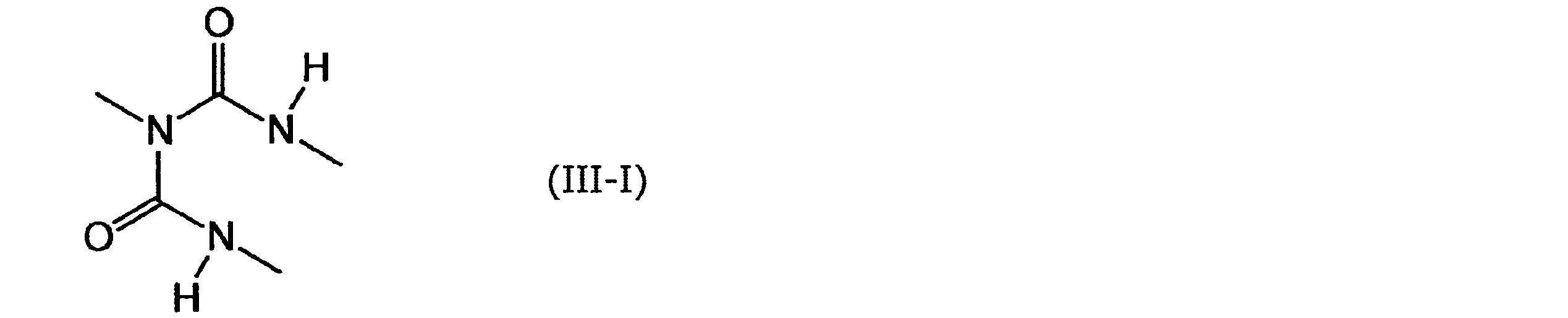
また、本実施形態のポリイソシアネート組成物に含まれるポリイソシアネートは、ビュレット基に加えて、イソシアヌレート基、ウレトジオン基及びイミノオキサジアジンジオン基からなる群より選ばれる少なくとも1種を有するポリイソシアネートを含んでいてもよい。
また、本実施形態のポリイソシアネート組成物に含まれるポリイソシアネートは、上記官能基以外に、アロファネート基、ウレタン基、ウレア基、カルボジイミド基等を有してもよい。Further, the polyisocyanate contained in the polyisocyanate composition of the present embodiment is a polyisocyanate having at least one selected from the group consisting of an isocyanurate group, a uretdione group and an iminooxadiazinedione group in addition to a burette group. It may be included.
Further, the polyisocyanate contained in the polyisocyanate composition of the present embodiment may have an allophanate group, a urethane group, a urea group, a carbodiimide group and the like in addition to the above functional groups.
<粘度>
本実施形態のポリイソシアネート組成物の25℃における粘度の下限値は、300mPa・sが好ましく、500mPa・sがより好ましく、1000mPa・sがさらに好ましく、1500mPa・sが特に好ましく、2000mPa・sが最も好ましい。
粘度の上限値は、15000mPa・sが好ましく、12000mPa・sがより好ましく、10000mPa・sがさらに好ましく、7000mPa・sが特に好ましく、5000mPa・sが最も好ましい。
本実施形態のポリイソシアネート組成物の25℃における粘度は、300mPa・s以上15000mPa・以下が好ましく、500mPa・s以上12000mPa・s以下がより好ましく、1000mPa・s以上10000mPa・s以下がさらに好ましく、1500mPa・s以上7000mPa・s以下が特に好ましく、2000mPa・s以上5000mPa・s以下が最も好ましい。
粘度が上記下限値以上であることにより、本実施形態のポリイソシアネート組成物の架橋性をより向上させることができる。一方、粘度が上記上限値以下であることにより、本実施形態のポリイソシアネート組成物を使用した塗料組成物の固形分濃度をより高くできる。<Viscosity>
The lower limit of the viscosity of the polyisocyanate composition of the present embodiment at 25 ° C. is preferably 300 mPa · s, more preferably 500 mPa · s, further preferably 1000 mPa · s, particularly preferably 1500 mPa · s, and most preferably 2000 mPa · s. preferable.
The upper limit of the viscosity is preferably 15,000 mPa · s, more preferably 12,000 mPa · s, further preferably 10,000 mPa · s, particularly preferably 7,000 mPa · s, and most preferably 5000 mPa · s.
The viscosity of the polyisocyanate composition of the present embodiment at 25 ° C. is preferably 300 mPa · s or more and 15,000 mPa · s or less, more preferably 500 mPa · s or more and 12000 mPa · s or less, further preferably 1000 mPa · s or more and 10,000 mPa · s or less, 1500 mPa · s or less. -S or more and 7,000 mPa · s or less are particularly preferable, and 2000 mPa · s or more and 5000 mPa · s or less are most preferable.
When the viscosity is at least the above lower limit value, the crosslinkability of the polyisocyanate composition of the present embodiment can be further improved. On the other hand, when the viscosity is not more than the above upper limit value, the solid content concentration of the coating composition using the polyisocyanate composition of the present embodiment can be further increased.
粘度は、不揮発性分を99.5質量%以上に精製したポリイソシアネート組成物を、E型粘度計(トキメック社製)を用いることによって測定することができる。具体的には、後述する実施例に記載の方法により測定することができる。 The viscosity can be measured by using an E-type viscometer (manufactured by Tokimec Co., Ltd.) for a polyisocyanate composition obtained by purifying the non-volatile content to 99.5% by mass or more. Specifically, it can be measured by the method described in Examples described later.
<イソシアネート基の含有率(NCO含有率)>
本実施形態のポリイソシアネート組成物のイソシアネート基の含有率(NCO含有率)の下限値は、20質量%が好ましく、21質量%がより好ましく、21.5質量%がさらに好ましく、22質量%が特に好ましい。
NCO含有率の上限値は、25質量%が好ましく、24質量%がより好ましく、23.7質量%がさらに好ましい。
すなわち、本実施形態のポリイソシアネート組成物のNCO含有率は、20質量%以上25質量%以下が好ましく、21質量%以上24質量%以下がより好ましく、21.5質量%以上23.7質量%以下がさらに好ましく、22質量%以上23.7質量%以下が特に好ましい。
NCO含有率が上記下限値以上であることにより、得られる塗膜の硬度等の塗膜物性をより良好とすることができる。一方、NCO含有率が上記上限値以下であることにより、本実施形態のポリイソシアネート組成物の収率をより高くすることができる。
NCO含有率は、第2の実施形態と同様の方法で求めることができる。<Isocyanate group content (NCO content)>
The lower limit of the isocyanate group content (NCO content) of the polyisocyanate composition of the present embodiment is preferably 20% by mass, more preferably 21% by mass, further preferably 21.5% by mass, and 22% by mass. Especially preferable.
The upper limit of the NCO content is preferably 25% by mass, more preferably 24% by mass, and even more preferably 23.7% by mass.
That is, the NCO content of the polyisocyanate composition of the present embodiment is preferably 20% by mass or more and 25% by mass or less, more preferably 21% by mass or more and 24% by mass or less, and 21.5% by mass or more and 23.7% by mass. The following is more preferable, and 22% by mass or more and 23.7% by mass or less are particularly preferable.
When the NCO content is at least the above lower limit value, the physical properties of the coating film such as the hardness of the obtained coating film can be further improved. On the other hand, when the NCO content is not more than the above upper limit, the yield of the polyisocyanate composition of the present embodiment can be further increased.
The NCO content can be determined by the same method as in the second embodiment.
<イソシアネート基平均数(NCO基平均数)>
本実施形態のポリイソシアネート組成物中のイソシアネート基平均数(NCO基平均数)の下限値は、2.3が好ましく、2.5がより好ましく、2.7がさらに好ましい。
NCO基平均数の上限値は、4.0が好ましく、3.8がより好ましく、3.5がさらに好ましく、3.2が特に好ましい。
本実施形態のポリイソシアネート組成物のNCO基平均数は、2.3以上4.0以下が好ましく、2.5以上3.8以下がより好ましく、2.7以上3.5以下がさらに好ましく、2.7以上3.2以下が特に好ましい。
NCO基平均数が上記下限値以上であることにより、本実施形態のポリイソシアネート組成物の架橋性をより向上させることができる。一方、NCO基平均数が上記上限値以下であることにより、本実施形態のポリイソシアネート組成物をより低粘度とすることができる。
本実施形態のポリイソシアネート組成物のイソシアネート基平均数は第2の実施形態と同様の方法で、算出することができる。<Average number of isocyanate groups (average number of NCO groups)>
The lower limit of the average number of isocyanate groups (average number of NCO groups) in the polyisocyanate composition of the present embodiment is preferably 2.3, more preferably 2.5, and even more preferably 2.7.
The upper limit of the average number of NCO groups is preferably 4.0, more preferably 3.8, still more preferably 3.5, and particularly preferably 3.2.
The average number of NCO groups in the polyisocyanate composition of the present embodiment is preferably 2.3 or more and 4.0 or less, more preferably 2.5 or more and 3.8 or less, still more preferably 2.7 or more and 3.5 or less. 2.7 or more and 3.2 or less are particularly preferable.
When the average number of NCO groups is at least the above lower limit, the crosslinkability of the polyisocyanate composition of the present embodiment can be further improved. On the other hand, when the average number of NCO groups is not more than the above upper limit value, the polyisocyanate composition of the present embodiment can have a lower viscosity.
The average number of isocyanate groups in the polyisocyanate composition of the present embodiment can be calculated by the same method as in the second embodiment.
<数平均分子量>
本実施形態のポリイソシアネート組成物中の固形分の数平均分子量の下限値は、400が好ましく、430がより好ましく、460がさらに好ましく、480が特に好ましい。
数平均分子量の上限値は、1000が好ましく、800がより好ましく、700がさらに好ましく、600が特に好ましい。
本実施形態のポリイソシアネート組成物中の固形分の数平均分子量は、400以上1,000以下が好ましく、430以上800以下がより好ましく、460以上700以下がさらに好ましく、480以上600以下が特に好ましい。
数平均分子量が上記下限値以上であることで、得られるポリイソシアネート組成物の収率がより向上する傾向にある。一方、数平均分子量が上記上限値以下であることで、得られる塗膜の光沢がより向上する傾向にある。
数平均分子量は、GPCによってポリスチレン基準の数平均分子量を求めることができる。<Number average molecular weight>
The lower limit of the number average molecular weight of the solid content in the polyisocyanate composition of the present embodiment is preferably 400, more preferably 430, still more preferably 460, and particularly preferably 480.
The upper limit of the number average molecular weight is preferably 1000, more preferably 800, further preferably 700, and particularly preferably 600.
The number average molecular weight of the solid content in the polyisocyanate composition of the present embodiment is preferably 400 or more and 1,000 or less, more preferably 430 or more and 800 or less, further preferably 460 or more and 700 or less, and particularly preferably 480 or more and 600 or less. ..
When the number average molecular weight is at least the above lower limit, the yield of the obtained polyisocyanate composition tends to be further improved. On the other hand, when the number average molecular weight is not more than the above upper limit value, the gloss of the obtained coating film tends to be further improved.
The number average molecular weight can be determined by GPC based on polystyrene.
<<ポリイソシアネート組成物の製造方法(第3の実施形態)>>
次に、第3の実施形態のポリイソシアネート組成物の製造方法について説明する。第1及び/又は第2の実施形態と同様の方法についてはその記載を省略する場合がある。
本実施形態のポリイソシアネート組成物は、原料として、少なくともHDIを用いる。<< Method for Producing Polyisocyanate Composition (Third Embodiment) >>
Next, a method for producing the polyisocyanate composition of the third embodiment will be described. The description of the same method as that of the first and / or the second embodiment may be omitted.
The polyisocyanate composition of the present embodiment uses at least HDI as a raw material.
本実施形態のポリイソシアネート組成物は、イソシアネート基から誘導されるビュレット基を形成するビュレット化反応を必須とする。また、場合により、イソシアヌレート基を形成するイソシアヌレート化反応、ウレトジオン基を形成するウレトジオン化反応、及び、イミノオキサジアジンジオン基を形成するイミノオキサジアジンジオン化反応を、それぞれ逐次、又は、そのいくつかを並行して、過剰のジイソシアネートモノマー存在下で行う。さらに、反応終了後、未反応のジイソシアネートモノマーを除去することにより、本実施形態のポリイソシアネート組成物を得られる。 The polyisocyanate composition of the present embodiment requires a burette-forming reaction to form a burette group derived from an isocyanate group. In addition, depending on the case, an isocyanurate-forming reaction for forming an isocyanurate group, a uretdione-forming reaction for forming a uretdione group, and an iminooxadiazine-dione-forming reaction for forming an iminooxadiazinedione group are sequentially or sequentially performed. Some of them are done in parallel in the presence of excess diisocyanate monomer. Further, after the reaction is completed, the unreacted diisocyanate monomer is removed to obtain the polyisocyanate composition of the present embodiment.
又は、ビュレット基含有ポリイソシアネートに、他の上記3反応を別々に実施させたものを混合することによっても得られる。 Alternatively, it can also be obtained by mixing a burette group-containing polyisocyanate with the other three reactions carried out separately.
中でも、本実施形態のポリイソシアネート組成物の製造方法としては、入手の容易さから、上記3反応をそれぞれ逐次行う、又は、そのいくつかを並行して実施する方法が好ましい。 Above all, as a method for producing the polyisocyanate composition of the present embodiment, a method in which each of the above three reactions is sequentially carried out or some of them are carried out in parallel is preferable because of easy availability.
さらに、副原料として、アルキルモノアルコール、アルキルジオール等のアルコール化合物等も併用することができる。 Further, as an auxiliary raw material, an alcohol compound such as an alkyl monoalcohol or an alkyl diol can also be used in combination.
<ビュレット基を有するポリイソシアネートの製造方法>
ビュレット基を有するポリイソシアネート(ビュレット基含有ポリイソシアネート)はジイソシアネートモノマーとビュレット化剤とを反応させて得ることができる。<Method for producing polyisocyanate having burette group>
A polyisocyanate having a burette group (a burette group-containing polyisocyanate) can be obtained by reacting a diisocyanate monomer with a burette agent.
[ビュレット化剤]
ビュレット化剤としては、例えば、水、1価の第3級アルコール、蟻酸、硫化水素、有機第1モノアミン、有機第1ジアミン等を挙げられる。[Burette agent]
Examples of the burette agent include water, monohydric tertiary alcohol, formic acid, hydrogen sulfide, organic primary monoamine, organic primary diamine and the like.
ビュレット化反応は、ビュレット化剤1モルに対して、ジイソシアネートモノマー3モル以上とすることができ、5モル以上が好ましく、5モル以上40モル以下がより好ましい。 The burette-forming reaction can be carried out in an amount of 3 mol or more of the diisocyanate monomer with respect to 1 mol of the burette agent, preferably 5 mol or more, and more preferably 5 mol or more and 40 mol or less.
[溶剤]
ビュレット化反応の際に溶剤を用いることができる。
溶剤は、ジイソシアネートモノマーと水等のビュレット化剤とを溶解し、反応条件下で均一相を形成できるものを用いることができる。溶剤は、均一相を形成するのに必要な量が添加することができる。これにより、ポリ尿素等の副生成物の生成を抑制できる。
また、溶剤としては、水等のビュレット化剤が適度な溶解度を示す溶剤であることが好ましい。これにより、溶剤の添加量を削減することができ、反応終了後に、溶剤を分離し、容易に回収することができる。具体的には、溶剤に対する水等のビュレット化剤の溶解度が0.5%以上であることが好ましい。[solvent]
A solvent can be used during the burette reaction.
As the solvent, a solvent capable of dissolving a diisocyanate monomer and a burette agent such as water to form a uniform phase under reaction conditions can be used. The solvent can be added in an amount required to form a uniform phase. This can suppress the production of by-products such as polyurea.
Further, the solvent is preferably a solvent in which a burette agent such as water exhibits an appropriate solubility. As a result, the amount of the solvent added can be reduced, and after the reaction is completed, the solvent can be separated and easily recovered. Specifically, the solubility of a burette agent such as water in a solvent is preferably 0.5% or more.
また、溶剤の沸点は、未反応ジイソシアネート等の回収分離を考慮すると、原料であるジイソシアネートモノマーの沸点より低いことが好ましい。 Further, the boiling point of the solvent is preferably lower than the boiling point of the diisocyanate monomer as a raw material in consideration of recovery and separation of unreacted diisocyanate and the like.
溶剤として具体的には、例えば、エチレングリコール系溶剤、リン酸系トリエステル等が挙げられる。 Specific examples of the solvent include ethylene glycol-based solvents and phosphoric acid-based triesters.
エチレングリコール系溶剤として好ましいものは、例えば、エチレングリコールモノメチルエーテルアセテート、エチレングリコールモノエチルエーテルアセテート、エチレングリコールジアセテート、ジエチレングリコールジメチルエーテル等が挙げられる。これらエチレングリコール系溶剤は単独で用いてもよく、2種以上を混合して用いてもよい。 Preferred examples of the ethylene glycol solvent include ethylene glycol monomethyl ether acetate, ethylene glycol monoethyl ether acetate, ethylene glycol diacetate, and diethylene glycol dimethyl ether. These ethylene glycol-based solvents may be used alone or in combination of two or more.
リン酸系トリエステルとして好ましいものは、例えば、リン酸トリメチル、リン酸トリエチル、リン酸トリプロピル、リン酸トリブチル等が挙げられる。これらリン酸系トリエステルは単独で用いてもよく、2種以上を混合して用いてもよい。中でも、リン酸系トリエステルとしては、リン酸トリメチル又はリン酸トリエチルが好ましい。 Preferred phosphoric acid-based triesters include, for example, trimethyl phosphate, triethyl phosphate, tripropyl phosphate, tributyl phosphate and the like. These phosphoric acid-based triesters may be used alone or in combination of two or more. Among them, as the phosphoric acid-based triester, trimethyl phosphate or triethyl phosphate is preferable.
エチレングリコール系溶剤及びリン酸系トリエステルを併用する場合に、その混合比率(エチレングリコール系溶剤/リン酸系トリエステル)は、質量比で、3/7以上9/1以下とすることができる。 When an ethylene glycol-based solvent and a phosphoric acid-based triester are used in combination, the mixing ratio (ethylene glycol-based solvent / phosphoric acid-based triester) can be 3/7 or more and 9/1 or less in terms of mass ratio. ..
溶剤の使用量は、原料であるジイソシアネートモノマー及び溶剤の総質量に対して、20質量%以上50質量%以下とすることができる。 The amount of the solvent used can be 20% by mass or more and 50% by mass or less with respect to the total mass of the diisocyanate monomer as a raw material and the solvent.
また、場合により、特開平8-225511号公報(特許文献8)に例示されるOH-酸性化合物を添加することもできる。 Further, depending on the case, an OH-acidic compound exemplified in JP-A-8-225511 (Patent Document 8) can be added.
[反応条件]
反応温度は70℃以上200℃以下とすることができ、90℃以上180℃以下が好ましい。[Reaction conditions]
The reaction temperature can be 70 ° C. or higher and 200 ° C. or lower, preferably 90 ° C. or higher and 180 ° C. or lower.
これらの反応は、バッチ法で行ってもよく、連続法で行ってもよい。中でも、生産性等から、連続法が好ましい。特に、特公昭62-41496号公報(特許文献5)で開示されている連続的製造法が好ましい。この連続的製造法では、まず、ジイソシアネートモノマーとビュレット化剤との反応を攪拌均質下に反応を行う。次いで、得られた反応生成物をパイプリアクターに導き、該パイプリアクター中押出し流れ下で反応を進行せしめることで、ビュレット基含有ポリイソシアネートを得ることができる。 These reactions may be carried out by a batch method or a continuous method. Above all, the continuous method is preferable from the viewpoint of productivity and the like. In particular, the continuous production method disclosed in Japanese Patent Publication No. 62-41496 (Patent Document 5) is preferable. In this continuous production method, first, the reaction between the diisocyanate monomer and the burette agent is carried out under stirring and homogenization. Then, the obtained reaction product is guided to a pipe reactor, and the reaction is allowed to proceed under an extrusion flow in the pipe reactor, whereby a burette group-containing polyisocyanate can be obtained.
<イソシアヌレート基を有するポリイソシアネートの製造方法>
イソシアヌレート基を有するポリイソシアネート(イソシアヌレート基含有ポリイソシアネート)は、ジイソシアネートモノマーを、イソシアヌレート化触媒を使用して、反応させることで得られる。<Method for producing polyisocyanate having isocyanurate group>
A polyisocyanate having an isocyanurate group (isocyanurate group-containing polyisocyanate) is obtained by reacting a diisocyanate monomer with an isocyanurate-forming catalyst.
イソシアヌレート基を有するポリイソシアネートの好ましい製造方法としては、例えば、原料であるHDIにイソシアヌレート化触媒を添加し、所定の重合度に到達するまで反応を進行させた後、必要に応じて未反応のHDIを除去することによってイソシアヌレート基含有ポリイソシアネートを得る方法が挙げられる。 As a preferable method for producing a polyisocyanate having an isocyanurate group, for example, an isocyanurate-forming catalyst is added to HDI as a raw material, the reaction is allowed to proceed until a predetermined degree of polymerization is reached, and then unreacted as necessary. A method of obtaining an isocyanurate group-containing polyisocyanate by removing the HDI of the above can be mentioned.
ジイソシアネートモノマーからイソシアヌレート基含有ポリイソシアネートを誘導する場合は、通常、イソシアヌレート化反応触媒を用いる。 When deriving an isocyanurate group-containing polyisocyanate from a diisocyanate monomer, an isocyanurate-forming reaction catalyst is usually used.
イソシアヌレート化反応触媒としては塩基性を有するものが好ましい。このようなイソシアヌレート化反応触媒としては、具体的には、以下の1)~7)に示すものが挙げられる。 As the isocyanurate-forming reaction catalyst, one having basicity is preferable. Specific examples of such an isocyanurate-forming reaction catalyst include those shown in 1) to 7) below.
1)テトラアルキルアンモニウムのヒドロオキシド又は有機弱酸塩。
上記テトラアルキルアンモニウムとしては、例えば、テトラメチルアンモニウム、テトラエチルアンモニウム等が挙げられる。
上記塩を形成する有機弱酸としては、例えば、酢酸、カプリン酸等が挙げられる。1) Hydrooxide or organic weak acid salt of tetraalkylammonium.
Examples of the tetraalkylammonium include tetramethylammonium and tetraethylammonium.
Examples of the organic weak acid forming the salt include acetic acid and capric acid.
2)ヒドロキシアルキルアンモニウムのヒドロオキシド又は有機弱酸塩。
上記ヒドロキシアルキルアンモニウムとしては、例えば、トリメチルヒドロキシプロピルアンモニウム、トリメチルヒドロキシエチルアンモニウム、トリエチルヒドロキシプロピルアンモニウム、トリエチルヒドロキシエチルアンモニウム等が挙げられる。
上記塩を形成する有機弱酸としては、例えば、酢酸、カプリン酸等が挙げられる。2) Hydrooxide or organic weak acid salt of hydroxyalkylammonium.
Examples of the hydroxyalkylammonium include trimethylhydroxypropylammonium, trimethylhydroxyethylammonium, triethylhydroxypropylammonium, triethylhydroxyethylammonium and the like.
Examples of the organic weak acid forming the salt include acetic acid and capric acid.
3)アルキルカルボン酸の金属塩。
上記アルキルカルボン酸としては、例えば、酢酸、カプロン酸、オクチル酸、ミリスチン酸等が挙げられる。
上記塩を形成する金属としては、例えば、錫、亜鉛、鉛、ナトリウム、カリウム等が挙げられる。3) A metal salt of an alkylcarboxylic acid.
Examples of the alkylcarboxylic acid include acetic acid, caproic acid, octyl acid, myristic acid and the like.
Examples of the metal forming the salt include tin, zinc, lead, sodium, potassium and the like.
4)ナトリウム、カリウム等の金属アルコラート。
5)ヘキサメチルジシラザン等のアミノシリル基含有化合物。
6)マンニッヒ塩基類。
7)第3級アミン類とエポキシ化合物との併用。4) Metallic alcoholates such as sodium and potassium.
5) Aminosilyl group-containing compound such as hexamethyldisilazane.
6) Mannich bases.
7) Combined use of tertiary amines and epoxy compounds.
中でも、イソシアヌレート化反応触媒としては、触媒効率の観点から、上記1)、2)又は3)が好ましく、上記1)の有機弱酸塩がより好ましい。 Among them, as the isocyanurate-forming reaction catalyst, the above 1), 2) or 3) is preferable, and the organic weak acid salt of the above 1) is more preferable, from the viewpoint of catalyst efficiency.
イソシアヌレート化触媒の使用量は、溶剤等の使用量により異なるが、ポリイソシアネートの原料として用いるHDIの質量に対して、10質量ppm以上1000質量ppm以下が好ましく、10質量ppm以上500質量ppm以下がより好ましく、10質量ppm以上100質量ppm以下がさらに好ましい。 The amount of the isocyanurate-forming catalyst used varies depending on the amount of solvent used, but is preferably 10% by mass or more and 1000% by mass or less, preferably 10% by mass or more and 500% by mass or less, with respect to the mass of HDI used as a raw material for polyisocyanate. Is more preferable, and 10 mass ppm or more and 100 mass ppm or less are further preferable.
イソシアヌレート化反応温度の下限値は、50℃が好ましく、54℃がより好ましく、57℃がさらに好ましく、60℃が特に好ましい。
イソシアヌレート化反応温度の上限値は、120℃が好ましく、100℃がより好ましく、90℃がさらに好ましく、80℃が特に好ましい。
イソシアヌレート化反応温度は、50℃以上120℃以下が好ましい。54℃以上100℃以下がより好ましく、57℃以上90℃以下がさらに好ましく、60℃以上80℃以下が特に好ましい。
イソシアヌレート化反応温度が上記上限値以下であることにより、ポリイソシアネート組成物の着色等の特性変化がより効果的に防止できる。The lower limit of the isocyanurate-forming reaction temperature is preferably 50 ° C., more preferably 54 ° C., even more preferably 57 ° C., and particularly preferably 60 ° C.
The upper limit of the isocyanurate-forming reaction temperature is preferably 120 ° C., more preferably 100 ° C., even more preferably 90 ° C., and particularly preferably 80 ° C.
The isocyanurate-forming reaction temperature is preferably 50 ° C. or higher and 120 ° C. or lower. It is more preferably 54 ° C. or higher and 100 ° C. or lower, further preferably 57 ° C. or higher and 90 ° C. or lower, and particularly preferably 60 ° C. or higher and 80 ° C. or lower.
When the isocyanurate-forming reaction temperature is not more than the above upper limit value, it is possible to more effectively prevent changes in characteristics such as coloring of the polyisocyanate composition.
イソシアヌレート化反応が所望の重合度に達した時点で、イソシアヌレート化反応を停止させる。イソシアヌレート化反応は、以下に限定されないが、例えば、リン酸、酸性リン酸エステル、硫酸、塩酸、スルホン酸化合物等の酸性化合物を反応液に添加することで停止できる。これにより、イソシアヌレート化反応触媒を中和、熱分解、又は、化学分解等により不活性化させることができる。
反応停止後、必要があれば、濾過を行う。When the isocyanurate-forming reaction reaches the desired degree of polymerization, the isocyanurate-forming reaction is stopped. The isocyanurate-forming reaction is not limited to the following, but can be stopped by adding an acidic compound such as phosphoric acid, acidic phosphoric acid ester, sulfuric acid, hydrochloric acid, or sulfonic acid compound to the reaction solution. Thereby, the isocyanurate-forming reaction catalyst can be inactivated by neutralization, thermal decomposition, chemical decomposition, or the like.
After stopping the reaction, if necessary, perform filtration.
<ウレトジオン基を有するポリイソシアネートの製造方法>
ウレトジオン基を有するポリイソシアネート(ウレトジオン基含有ポリイソシアネート)は、第1の実施形態と同様の方法により得られる。<Method for producing polyisocyanate having uretdione group>
The polyisocyanate having a uretdione group (uretdione group-containing polyisocyanate) can be obtained by the same method as in the first embodiment.
<イミノオキサジアジンジオン基を有するポリイソシアネートの製造方法>
イミノオキサジアジンジオン基を有するポリイソシアネート(イミノオキサジアジンジオン基含有ポリイソシアネート)も、第1の実施形態と同様の方法により得られる。<Method for producing polyisocyanate having iminooxadiazinedione group>
A polyisocyanate having an iminooxadiazinedione group (iminooxadiazinedione group-containing polyisocyanate) can also be obtained by the same method as in the first embodiment.
本実施形態のポリイソシアネート組成物は、上述したように、イソシアヌレート基のモル量をA、ウレトジオン基のモル量をB、イミノオキサジアジンジオン基のモル量をC、ビュレット基のモル量をDとした場合に、D/(A+B+C+D)が0.50以上であることが好ましい。 In the polyisocyanate composition of the present embodiment, as described above, the molar amount of the isocyanurate group is A, the molar amount of the uretdione group is B, the molar amount of the iminooxadiazidinedione group is C, and the molar amount of the bullet group is When it is set to D, it is preferable that D / (A + B + C + D) is 0.50 or more.
例えば、以下の(1)又は(2)の製造方法を行うことでポリイソシアネート組成物における上記比率を制御することができる。 For example, the above ratio in the polyisocyanate composition can be controlled by performing the following production method (1) or (2).
(1)まず、ビュレット化反応の前後に、ぞれぞれの触媒を添加することで、イソシアヌレート化、ウレトジオン化、及び、イミノオキサジアジンジオン化反応を実施する。次いで、必要であれば、反応停止剤を使用し、反応を停止した後、精製によりジイソシアネートモノマーを除去することで、ポリイソシアネート組成物を得ることができる。 (1) First, isocyanurate-forming, uretdione-forming, and iminooxadiazine-dione-forming reactions are carried out by adding each catalyst before and after the burette-forming reaction. Then, if necessary, a reaction terminator is used to stop the reaction, and then the diisocyanate monomer is removed by purification to obtain a polyisocyanate composition.
(2)まず、ビュレット化反応し、精製によりジイソシアネートモノマーを除去した第1のポリイソシアネートを製造する。次いで、ビュレット化反応以外の反応を実施し、精製によりジイソシアネートモノマーを除去した第2のポリイソシアネートを製造する。次いで、精製した第1のポリイソシアネートと第2のポリイソシアネートとを、所定比率で混合することで、ポリイソシアネート組成物を得ることができる。 (2) First, a burette-forming reaction is carried out to produce a first polyisocyanate from which the diisocyanate monomer has been removed by purification. Next, a reaction other than the burette formation reaction is carried out to produce a second polyisocyanate from which the diisocyanate monomer has been removed by purification. Then, the purified first polyisocyanate and the second polyisocyanate are mixed at a predetermined ratio to obtain a polyisocyanate composition.
<薄膜蒸留工程及び加熱処理工程>
反応停止直後の反応液は、通常、未反応のHDI等のジイソシアネートモノマーを含むため、これを薄膜蒸発缶、抽出等で除去することが好ましい。
本実施形態のポリイソシアネート組成物は、50℃で1か月間貯蔵する場合に、貯蔵後のHDI含有量を上記上限値以下に制御するために、通常の薄膜蒸留を1回以上5回以下行うことができ、薄膜蒸留及び加熱処理を行うことが好ましく、薄膜蒸留及び加熱処理を各々4~5回繰り返すことがより好ましい。<Thin film distillation process and heat treatment process>
Since the reaction solution immediately after the reaction is stopped usually contains an unreacted diisocyanate monomer such as HDI, it is preferable to remove it by a thin film evaporation can, extraction or the like.
When the polyisocyanate composition of the present embodiment is stored at 50 ° C. for 1 month, ordinary thin film distillation is performed once or more and 5 times or less in order to control the HDI content after storage to the above upper limit value or less. It is preferable to carry out thin film distillation and heat treatment, and it is more preferable to repeat thin film distillation and heat treatment 4 to 5 times each.
[薄膜蒸留工程]
薄膜蒸留工程は、第1及び/又は第2の実施形態と同様の方法で実施することができる。[Thin film distillation process]
The thin film distillation step can be carried out in the same manner as in the first and / or second embodiment.
[加熱処理工程]
また、本実施形態のポリイソシアネート組成物を50℃で1か月間貯蔵する場合、貯蔵前のHDI含有量(以下、「初期HDI含有量」と称する場合がある。)を低減させるだけではなく、貯蔵後のHDI含有量を少ない量で維持することが望まれている。そのため、第1及び/又は第2の実施形態と同様の方法で加熱処理工程を行うことが好ましい。[Heat treatment process]
Further, when the polyisocyanate composition of the present embodiment is stored at 50 ° C. for one month, it not only reduces the HDI content before storage (hereinafter, may be referred to as “initial HDI content”), but also reduces it. It is desired to maintain the HDI content after storage in a small amount. Therefore, it is preferable to carry out the heat treatment step by the same method as in the first and / or second embodiment.
なお、本実施形態のポリイソシアネート組成物中の初期HDI含有量は、0.10質量%以下であり、0.08質量%以下が好ましく、0.06質量%以下がさらに好ましく、0.05質量%以下がより更に好ましい。
初期HDI含有量を上記上限値以下とすることで、本実施形態のポリイソシアネート組成物の毒性をより低減でき、安全性をより向上させることができる。The initial HDI content in the polyisocyanate composition of the present embodiment is 0.10% by mass or less, preferably 0.08% by mass or less, further preferably 0.06% by mass or less, and 0.05% by mass. % Or less is even more preferable.
By setting the initial HDI content to the above upper limit value or less, the toxicity of the polyisocyanate composition of the present embodiment can be further reduced, and the safety can be further improved.
<<塗料組成物(第3の実施形態)>>
本発明の第3の実施形態のポリイソシアネート組成物は、上記第1及び/又は第2の実施形態と同様に、塗料組成物の硬化剤等として好適に用いることができる。
本実施形態の塗料組成物は、上記第3の実施形態のポリイソシアネート組成物を含有する。<< Paint composition (third embodiment) >>
The polyisocyanate composition of the third embodiment of the present invention can be suitably used as a curing agent or the like for a coating composition, similarly to the first and / or second embodiments.
The coating composition of the present embodiment contains the polyisocyanate composition of the third embodiment.
<樹脂成分>
本実施形態の塗料組成物は、更に、主剤として樹脂成分を含有する。該樹脂成分としては、特に限定されないが、上記第1及び/又は第2の実施形態と同様のものが用いられる。<Resin component>
The coating composition of the present embodiment further contains a resin component as a main agent. The resin component is not particularly limited, but the same as that of the first and / or the second embodiment is used.
本実施形態の塗料組成物は、上記第1及び/又は第2の実施形態と同様に、溶剤ベース、水系ベース、無溶剤系のいずれにも使用可能である。 The coating composition of the present embodiment can be used for any of solvent-based, water-based, and solvent-free systems, as in the first and / or second embodiments.
<その他添加剤>
本実施形態の塗料組成物は、上記ポリイソシアネート組成物及び上記樹脂成分に加えて、必要に応じて、上記第1及び/又は第2の実施形態と同様に、完全アルキル型、メチロール型アルキル、イミノ基型アルキル等のメラミン系硬化剤を含有してもよい。
また、上記第3の実施形態のポリイソシアネート組成物及び塗料組成物は、いずれも、有機溶剤を含有してもよい。
有機溶剤としては、特に限定されないが、上記第1及び/又は第2の実施形態と同様のものを用いることができる。<Other additives>
In addition to the polyisocyanate composition and the resin component, the coating composition of the present embodiment is, if necessary, a completely alkyl type, a methylol type alkyl, as in the first and / or the second embodiment. It may contain a melamine-based curing agent such as imino-based alkyl.
In addition, the polyisocyanate composition and the coating composition of the third embodiment may both contain an organic solvent.
The organic solvent is not particularly limited, but the same as the first and / or the second embodiment can be used.
上記第3の実施形態のポリイソシアネート組成物及び塗料組成物は、いずれも、その目的や用途に応じて、本実施形態の所望の効果を損なわない範囲で、上記第1及び/又は第2の実施形態と同様に、硬化促進用の触媒、顔料、レベリング剤、酸化防止剤、紫外線吸収剤、光安定剤、可塑剤、界面活性剤等の当該技術分野で使用されている各種添加剤を混合して使用することもできる。 The polyisocyanate composition and the coating composition of the third embodiment are both the first and / or the second, depending on the purpose and use thereof, as long as the desired effects of the present embodiment are not impaired. Similar to the embodiment, various additives used in the art such as a catalyst for promoting curing, a pigment, a leveling agent, an antioxidant, an ultraviolet absorber, a light stabilizer, a plasticizer, and a surfactant are mixed. Can also be used.
<用途>
本実施形態の塗料組成物は、以下に限定されないが、例えば、金属(鋼板、表面処理鋼板等)、プラスチック、木材、フィルム、無機材料等の素材に対するプライマーや上中塗り塗料として有用である。また、防錆鋼板を含むプレコートメタル、自動車塗装等に美粧性、耐候性、耐酸性、防錆性、耐チッピング性等を付与するための塗料としても有用である。さらに、接着剤、粘着剤、エラストマー、フォーム、表面処理剤等のウレタン原料としても有用である。<Use>
The coating composition of the present embodiment is not limited to the following, but is useful as a primer for materials such as metal (steel plate, surface-treated steel plate, etc.), plastic, wood, film, inorganic material, etc., and as an intermediate coating paint. It is also useful as a paint for imparting cosmetic properties, weather resistance, acid resistance, rust resistance, chipping resistance, etc. to pre-coated metals including rust-preventive steel sheets, automobile coatings, and the like. Further, it is also useful as a urethane raw material for adhesives, pressure-sensitive adhesives, elastomers, foams, surface treatment agents and the like.
<<塗膜(第3の実施形態)>>
本実施形態の塗膜は、上記第3の実施形態の塗料組成物から形成されたものである。本実施形態の塗膜は、上記第3の実施形態の塗料組成物を、例えば、ロール塗装、カーテンフロー塗装、スプレー塗装、ベル塗装、静電塗装等により塗装し、硬化することにより得られる。そのため、本実施形態の塗膜は、常に、安定した品質を発現し、且つ、ジイソシアネートモノマー由来の臭気が少なく、且つ、密着性及び耐汚染性に優れている。<< Coating film (third embodiment) >>
The coating film of the present embodiment is formed from the coating composition of the third embodiment. The coating film of the present embodiment is obtained by applying the coating composition of the third embodiment by, for example, roll coating, curtain flow coating, spray coating, bell coating, electrostatic coating, or the like and curing. Therefore, the coating film of the present embodiment always exhibits stable quality, has less odor derived from the diisocyanate monomer, and is excellent in adhesion and stain resistance.
<<ポリイソシアネート組成物(第4の実施形態)>>
次に、本発明の第4の実施形態のポリイソシアネート組成物について説明する。
上記第1、第2及び/又は第3の実施形態と同様の構成については、その説明を省略する場合がある。
本実施形態のポリイソシアネート組成物は、HDIを含むジイソシアネート及び下記一般式(IV-I)で示されるポリイソシアネート(以下、「ポリイソシアネート(IV-I)」と称する場合がある)を含む。<< Polyisocyanate composition (fourth embodiment) >>
Next, the polyisocyanate composition of the fourth embodiment of the present invention will be described.
The description of the same configurations as those of the first, second and / or third embodiments may be omitted.
The polyisocyanate composition of the present embodiment contains a diisocyanate containing HDI and a polyisocyanate represented by the following general formula (IV-I) (hereinafter, may be referred to as "polyisocyanate (IV-I)").

上記一般式(IV-I)中、R11は、脂肪族ジイソシアネート及び脂環族イソシアネートからなる群により選ばれる1種以上のジイソシアネートから誘導されたポリイソシアネートのイソシアネート基を除く残基である。X11は、活性水素基及び親水性基を有する化合物の活性水素基を除く残基である。Y11は、イソシアネート基と上記活性水素基との結合構造である。(n11+n12)は2以上10以下の整数である。n11及びn12はいずれも0ではない。n11/(n11+n12)×100は、1以上50以下である。In the above general formula (IV-I), R 11 is a residue excluding the isocyanate group of the polyisocyanate derived from one or more diisocyanates selected from the group consisting of aliphatic diisocyanates and alicyclic isocyanates. X 11 is a residue excluding the active hydrogen group of the compound having an active hydrogen group and a hydrophilic group. Y 11 has a bonded structure of an isocyanate group and the active hydrogen group. (N11 + n12) is an integer of 2 or more and 10 or less. Neither n11 nor n12 is 0. n11 / (n11 + n12) × 100 is 1 or more and 50 or less.
本実施形態のポリイソシアネート組成物に含まれるポリイソシアネート(IV-I)は、イソシアネート基の一部が活性水素基及び親水性基を有する化合物によって変性された親水性ポリイソシアネートである。 The polyisocyanate (IV-I) contained in the polyisocyanate composition of the present embodiment is a hydrophilic polyisocyanate in which a part of the isocyanate group is modified with a compound having an active hydrogen group and a hydrophilic group.
本実施形態におけるポリイソシアネート組成物において、活性水素基及び親水性基を有する化合物によって変性されたポリイソシアネートの割合(変性率)は、原料のポリイソイソシアネートのイソシアネート基100モル量に対して、イソシアネート基と反応して結合した活性水素基及び親水性基を有する化合物の活性水素基の割合である。また、変性率は、上記一般式(IV-I)中のn11及びn12から、{n11/(n11+n12)×100}で算出される値である。 In the polyisocyanate composition of the present embodiment, the ratio (modification rate) of the polyisocyanate modified with the compound having an active hydrogen group and a hydrophilic group is isocyanate with respect to 100 mol of the isocyanate group of the raw material polyisoisocyanate. It is the ratio of the active hydrogen group of the compound having an active hydrogen group and a hydrophilic group bonded by reacting with a group. The denaturation rate is a value calculated from n11 and n12 in the above general formula (IV-I) by {n11 / (n11 + n12) × 100}.
上記変性率の下限値は、1モル%が好ましく、2モル%がより好ましく、3モル%がさらに好ましく、4モル%が特に好ましい。
一方、上記変性率の上限値は、50モル%が好ましく、40モル%がより好ましく、35モル%がさらに好ましく、30モル%が特に好ましい。
上記変性率は、1モル%以上50モル%以下が好ましく、2モル%以上40モル%以下がより好ましく、3モル%以上35モル%以下がさらに好ましく、4モル%以上30モル%以下が特に好ましい。
変性率が上記下限値以上であることにより、本実施形態のポリイソシアネート組成物の水分散性がより優れる。一方、変性率が上記上限値以下であることにより、得られる硬化物の耐水性がより優れる。
変性率は、後述する実施例に記載する方法により、測定及び算出することができる。The lower limit of the modification rate is preferably 1 mol%, more preferably 2 mol%, still more preferably 3 mol%, and particularly preferably 4 mol%.
On the other hand, the upper limit of the modification rate is preferably 50 mol%, more preferably 40 mol%, further preferably 35 mol%, and particularly preferably 30 mol%.
The modification rate is preferably 1 mol% or more and 50 mol% or less, more preferably 2 mol% or more and 40 mol% or less, further preferably 3 mol% or more and 35 mol% or less, and particularly preferably 4 mol% or more and 30 mol% or less. preferable.
When the modification rate is at least the above lower limit, the water dispersibility of the polyisocyanate composition of the present embodiment is more excellent. On the other hand, when the modification rate is not more than the above upper limit value, the water resistance of the obtained cured product is more excellent.
The denaturation rate can be measured and calculated by the method described in Examples described later.
また、本実施形態のポリイソシアネート組成物に含まれるジイソシアネートは、ポリイソシアネート(IV-I)に用いられるポリイソシアネート前駆体の製造時に発生する未反応の原料ジイソシアネートである。 Further, the diisocyanate contained in the polyisocyanate composition of the present embodiment is an unreacted raw material diisocyanate generated during the production of the polyisocyanate precursor used for polyisocyanate (IV-I).
本実施形態のポリイソシアネート組成物中のジイソシアネートの含有量の下限値は、0.002質量%が好ましく、0.005質量%がより好ましく、0.01質量%がさらに好ましく、0.02質量%が特に好ましい。
一方、本実施形態のポリイソシアネート組成物中のジイソシアネートの含有量の上限値は、0.1質量%である。The lower limit of the diisocyanate content in the polyisocyanate composition of the present embodiment is preferably 0.002% by mass, more preferably 0.005% by mass, further preferably 0.01% by mass, and 0.02% by mass. Is particularly preferable.
On the other hand, the upper limit of the content of diisocyanate in the polyisocyanate composition of the present embodiment is 0.1% by mass.
さらに、本実施形態のポリイソシアネート組成物を50℃、1ヶ月間貯蔵する場合に、貯蔵後のポリイソシアネート組成物中のジイソシアネートの含有量の下限値は、0.002質量%が好ましく、0.005質量%がより好ましく、0.01質量%がさらに好ましく、0.02質量%が特に好ましい。
一方、貯蔵後のポリイソシアネート組成物中のジイソシアネートの含有量の上限値は、0.10質量%である。
本実施形態のポリイソシアネート組成物中のジイソシアネートの含有量は、GPCにより測定することができる。Further, when the polyisocyanate composition of the present embodiment is stored at 50 ° C. for 1 month, the lower limit of the diisocyanate content in the polyisocyanate composition after storage is preferably 0.002% by mass, and 0. 005% by mass is more preferable, 0.01% by mass is further preferable, and 0.02% by mass is particularly preferable.
On the other hand, the upper limit of the diisocyanate content in the polyisocyanate composition after storage is 0.10% by mass.
The content of diisocyanate in the polyisocyanate composition of the present embodiment can be measured by GPC.
本実施形態のポリイソシアネート組成物は、上記構成であることにより、優れた硬度及び耐水性の硬化物を得ることができる。 The polyisocyanate composition of the present embodiment has the above-mentioned structure, so that a cured product having excellent hardness and water resistance can be obtained.
本実施形態のポリイソシアネート組成物の各構成成分について、以下に詳細を説明する。
<ポリイソシアネート(IV-I)>
ポリイソシアネート(IV-I)は、下記一般式(IV-I)で示されるポリイソシアネートである。具体的には、ポリイソシアネート(IV-I)は、ポリイソシアネート前駆体と活性水素基及び親水性基を有する化合物とから得られる反応物である。Each component of the polyisocyanate composition of the present embodiment will be described in detail below.
<Polyisocyanate (IV-I)>
The polyisocyanate (IV-I) is a polyisocyanate represented by the following general formula (IV-I). Specifically, polyisocyanate (IV-I) is a reaction product obtained from a polyisocyanate precursor and a compound having an active hydrogen group and a hydrophilic group.

一般式(IV-I)中、R11は、脂肪族ジイソシアネート及び脂環族イソシアネートからなる群により選ばれる1種以上のジイソシアネートから誘導されたポリイソシアネートのイソシアネート基を除く残基である。X11は、活性水素基及び親水性基を有する化合物の活性水素基を除く残基である。Y11は、イソシアネート基と上記活性水素基との結合構造である。(n11+n12)は2以上10以下の整数である。n11及びn12はいずれも0ではない。n11/(n11+n12)×100は、1以上50以下である。In the general formula (IV-I), R 11 is a residue of the polyisocyanate derived from one or more diisocyanates selected from the group consisting of aliphatic diisocyanates and alicyclic isocyanates, excluding the isocyanate group. X 11 is a residue excluding the active hydrogen group of the compound having an active hydrogen group and a hydrophilic group. Y 11 has a bonded structure of an isocyanate group and the active hydrogen group. (N11 + n12) is an integer of 2 or more and 10 or less. Neither n11 nor n12 is 0. n11 / (n11 + n12) × 100 is 1 or more and 50 or less.
[ポリイソシアネート前駆体]
上記一般式(IV-I)中、R11は、ポリイソシアネート前駆体のイソシアネート基を除く残基である。[Polyisocyanate precursor]
In the above general formula (IV-I), R 11 is a residue excluding the isocyanate group of the polyisocyanate precursor.
ポリイソシアネート(IV-I)の製造に用いられるポリイソシアネート前駆体としては、HDIを含むジイソシアネート化合物から誘導されたものであることが好ましい。HDIを含むジイソシアネート化合物は、HDI以外の脂肪族ポリイソシアネーオ及び/又は脂環族ポリイソシアネーオを含んでいてもよい。 The polyisocyanate precursor used in the production of polyisocyanate (IV-I) is preferably derived from a diisocyanate compound containing HDI. The diisocyanate compound containing HDI may contain an aliphatic polyisocyaneo and / or an alicyclic polyisocyaneo other than HDI.
HDI以外の脂肪族ジイソシアネートとしては、以下のものに限定されないが、例えば、1,4-ジイソシアナトブタン、1,5-ジイソシアナトペンタン、エチル(2,6-ジイソシアナト)ヘキサノエート、1,9-ジイソシアナトノナン、1,12-ジイソシアナトドデカン、2,2,4-又は2,4,4-トリメチル-1、6-ジイソシアナトヘキサン等が挙げられる。 Aliphatic diisocyanates other than HDI are not limited to the following, but are, for example, 1,4-diisocyanatobutane, 1,5-diisocyanatopentane, ethyl (2,6-diisocyanato) hexanoate, 1,9. -Diisocyanatononane, 1,12-diisocyanatododecane, 2,2,4- or 2,4,4-trimethyl-1,6-diisocyanatohexane and the like can be mentioned.
脂環族ジイソシアネートとしては、以下のものに限定されないが、例えば、1,3-又は1,4-ビス(イソシアナトメチル)シクロヘキサン(以下、「水添XDI」と称する)、1,3-又は1,4-ジイソシアナトシクロヘキサン、3,5,5-トリメチル1-イソシアナト-3-(イソシアナトメチル)シクロヘキサン(以下、「IPDI」と称する)、4-4’-ジイソシアナト-ジシクロヘキシルメタン(以下、「水添MDI」と称する)、2,5-又は2,6-ジイソシアナトメチルノルボルナン等が挙げられる。これらの中でも、IPDI、水添XDI又は水添MDIが好ましい。 The alicyclic diisocyanate is not limited to the following, but is, for example, 1,3- or 1,4-bis (isocyanatomethyl) cyclohexane (hereinafter referred to as "hydrogenated XDI"), 1,3- or. 1,4-Diisocyanatocyclohexane, 3,5,5-trimethyl1-isocyanato-3- (isocyanatomethyl) cyclohexane (hereinafter referred to as "IPDI"), 4-4'-diisocyanato-dicyclohexylmethane (hereinafter referred to as "IPDI"). (Referred to as "hydrogenated MDI"), 2,5- or 2,6-diisocyanatomethylnorbornane and the like. Among these, IPDI, hydrogenated XDI or hydrogenated MDI are preferable.
ポリイソシアネート(IV-I)の製造に用いられるポリイソシアネート前駆体としては、以下のものに限定されないが、例えば、下記式(IV-III)~(IV-XI)で表される基を有するポリイソシアネート化合物等が挙げられる。すなわち、ポリイソシアネート(IV-I)において、R11としては、例えば、下記式(IV-III)~(IV-XI)で表される基等が挙げられる。The polyisocyanate precursor used for producing the polyisocyanate (IV-I) is not limited to the following, but is, for example, a poly having a group represented by the following formulas (IV-III) to (IV-XI). Examples thereof include isocyanate compounds. That is, in the polyisocyanate (IV-I), examples of R 11 include groups represented by the following formulas (IV-III) to (IV-XI).
下記式(IV-III)で表される基(以下、「基(IV-III)」と称する場合がある)を有するポリイソシアネート化合物は、2つのイソシアネート基を環化二量化して得られるウレトジオン基(基(IV-III))を有するポリイソシアネート化合物である。 A polyisocyanate compound having a group represented by the following formula (IV-III) (hereinafter, may be referred to as “group (IV-III)”) is a uretdione obtained by cyclizing and dimerizing two isocyanate groups. It is a polyisocyanate compound having a group (group (IV-III)).

下記式(IV-IV)で表される基(以下、「基(IV-IV)」と称する場合がある)を有するポリイソシアネート化合物は、3つのイソシアネート基を環化三量化して得られるイソシアヌレート基(基(IV-IV))を有するポリイソシアネート化合物である。 A polyisocyanate compound having a group represented by the following formula (IV-IV) (hereinafter, may be referred to as “group (IV-IV)”) is an isocyanate obtained by cyclizing and triquantizing three isocyanate groups. It is a polyisocyanate compound having a nurate group (group (IV-IV)).

下記式(IV-V)で表される基(以下、「基(IV-V)」と称する場合がある)を有するポリイソシアネート化合物は、イミノオキサジアジンジオン基(基(IV-V))を有するポリイソシアネート化合物である。 The polyisocyanate compound having a group represented by the following formula (IV-V) (hereinafter, may be referred to as “group (IV-V)”) is an iminooxadiazinedione group (group (IV-V)). It is a polyisocyanate compound having.

下記式(IV-VI)で表される基(以下、「基(IV-VI)」と称する場合がある)を有するポリイソシアネート化合物は、3つのイソシアネート基と1つの水分子とを反応させて得られるビュレット基(基(IV-VI))を有するポリイソシアネート化合物である。 A polyisocyanate compound having a group represented by the following formula (IV-VI) (hereinafter, may be referred to as "group (IV-VI)") is obtained by reacting three isocyanate groups with one water molecule. It is a polyisocyanate compound having a buretto group (group (IV-VI)) obtained.
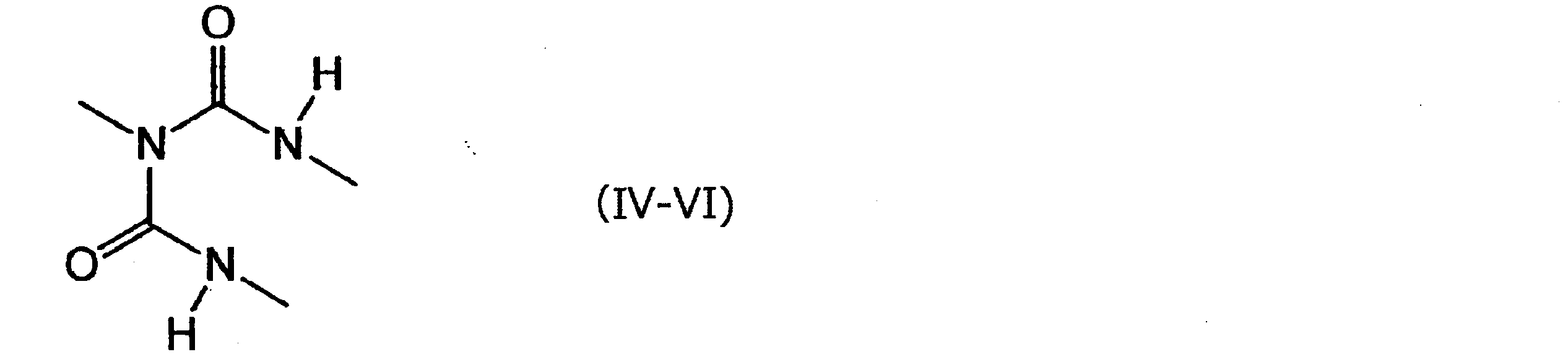
下記式(IV-VII)で表される基(以下、「基(IV-VII)」と称する場合がある)を有するポリイソシアネート化合物は、2つのイソシアネート基と1分子の二酸化炭素とを反応させて得られるオキサダイアジントリオン基(基(IV-VII))を有するポリイソシアネート化合物である。 A polyisocyanate compound having a group represented by the following formula (IV-VII) (hereinafter, may be referred to as "group (IV-VII)") reacts two isocyanate groups with one molecule of carbon dioxide. It is a polyisocyanate compound having an oxadiazine trione group (group (IV-VII)) obtained.

下記式(IV-VIII)で表される基(以下、「基(IV-VIII)」と称する場合がある)を有するポリイソシアネート化合物は、1つのイソシアネート基と1つの水酸基とを反応させて得られるウレタン基(基(IV-VIII))を複数有するポリイソシアネート化合物である。 A polyisocyanate compound having a group represented by the following formula (IV-VIII) (hereinafter, may be referred to as "group (IV-VIII)") is obtained by reacting one isocyanate group with one hydroxyl group. It is a polyisocyanate compound having a plurality of urethane groups (groups (IV-VIII)).

下記式(IV-IX)で表される基(以下、「基(IV-IX)」と称する場合がある)を有するポリイソシアネート化合物は、2つのイソシアネート基と1つの水酸基とを反応させて得られるアロファネート基(基(IV-IX))を有するポリイソシアネート化合物である。 A polyisocyanate compound having a group represented by the following formula (IV-IX) (hereinafter, may be referred to as "group (IV-IX)") is obtained by reacting two isocyanate groups with one hydroxyl group. It is a polyisocyanate compound having an allophanate group (group (IV-IX)).

下記式(IV-X)で表される基(以下、「基(IV-X)」と称する場合がある)を有するポリイソシアネート化合物は、1つのイソシアネート基と1つのカルボキシル基とを反応させて得られるアシル尿素(ウレア)基(基(IV-X))を有するポリイソシアネート化合物である。 A polyisocyanate compound having a group represented by the following formula (IV-X) (hereinafter, may be referred to as "group (IV-X)") is obtained by reacting one isocyanate group with one carboxyl group. It is a polyisocyanate compound having an acylurea (urea) group (group (IV-X)) obtained.

下記式(IV-XI)で表される基(以下、「基(IV-XI)」と称する場合がある)を有するポリイソシアネート化合物は、1つのイソシアネート基と1つの1級又は2級アミンとを反応させて得られる尿素(ウレア)基(基(IV-XI))を有するポリイソシアネート化合物である。 A polyisocyanate compound having a group represented by the following formula (IV-XI) (hereinafter, may be referred to as “group (IV-XI)”) includes one isocyanate group and one primary or secondary amine. It is a polyisocyanate compound having a urea (urea) group (group (IV-XI)) obtained by reacting with.

(イソシアヌレート基/(イソシアヌレート基+アロファネート基))
本実施形態のポリイソシアネート組成物に含まれるポリイソシアネート(IV-I)がイソシアヌレート基及びアロファネート基を有する場合、上記ポリイソシアネート組成物のイソシアネート基及びアロファネート基の合計モル量に対するイソシアヌレート基のモル量の比率(イソシアヌレート基/(イソシアヌレート+アロファネート基)は0.80以上0.99未満であることが好ましい。(Isocyanurate group / (isocyanurate group + allophanate group))
When the polyisocyanate (IV-I) contained in the polyisocyanate composition of the present embodiment has an isocyanurate group and an allophanate group, the molar amount of the isocyanurate group with respect to the total molar amount of the isocyanate group and the allophanate group of the polyisocyanate composition. The amount ratio (isocyanurate group / (isocyanurate + allophanate group) is preferably 0.80 or more and less than 0.99.
(ポリイソシアネート前駆体の粘度)
本実施形態のポリイソシアネート前駆体の25℃における粘度の下限値は、10mPa・sが好ましく、30mPa・sがよりに好ましく、50mPa・sがさらに好ましい。
一方、本実施形態のポリイソシアネート前駆体の25℃における粘度の上限値は、10,000mPa・sが好ましく、9,000mPa・sがより好ましく、8,000mPa・sがさらに好ましい。
本実施形態のポリイソシアネート前駆体の25℃における粘度は、10mPa・s以上10,000mPa・s以下が好ましく、30mPa・s以上9,000mPa・s以下がよりに好ましく、50mPa・s以上8,000mPa・s以下がさらに好ましい。
粘度は、E型粘度計(トキメック社製)を用いて、測定することができる。(Viscosity of polyisocyanate precursor)
The lower limit of the viscosity of the polyisocyanate precursor of the present embodiment at 25 ° C. is preferably 10 mPa · s, more preferably 30 mPa · s, still more preferably 50 mPa · s.
On the other hand, the upper limit of the viscosity of the polyisocyanate precursor of the present embodiment at 25 ° C. is preferably 10,000 mPa · s, more preferably 9,000 mPa · s, and even more preferably 8,000 mPa · s.
The viscosity of the polyisocyanate precursor of the present embodiment at 25 ° C. is preferably 10 mPa · s or more and 10,000 mPa · s or less, more preferably 30 mPa · s or more and 9,000 mPa · s or less, and 50 mPa · s or more and 8,000 mPa. -S or less is more preferable.
The viscosity can be measured using an E-type viscometer (manufactured by Tokimec).
[活性水素基及び親水性基を有する化合物]
上記一般式(IV-I)中、X11は、活性水素基及び親水性基を有する化合物の活性水素基を除く残基である。また、Y11は、イソシアネート基と上記活性水素基との結合構造である。活性水素基及び親水性基を有する化合物において、活性水素基及び親水性基の種類は同一であってもよく、異なっていてもよい。活性水素基及び親水性基の同一である場合、当該官能基を2つ以上有することが好ましい。[Compounds with active hydrogen groups and hydrophilic groups]
In the above general formula (IV-I), X 11 is a residue excluding the active hydrogen group and the active hydrogen group of the compound having a hydrophilic group. Further, Y 11 has a bonded structure of an isocyanate group and the active hydrogen group. In the compound having an active hydrogen group and a hydrophilic group, the types of the active hydrogen group and the hydrophilic group may be the same or different. When the active hydrogen group and the hydrophilic group are the same, it is preferable to have two or more of the functional groups.
ポリイソシアネート(IV-I)の製造に用いられる活性水素基及び親水性基を有する化合物は、特に限定されないが、アニオン性化合物、カチオン性化合物、及び、ノニオン性化合物からなる群より選ばれる1種以上であることが好ましい。また、上記アニオン性化合物、カチオン性化合物、及び、ノニオン性化合物は、各々独立に、ポリイソシアネート組成物が含むイソシアネート基と反応させるために、活性水素基を含有していることが好ましい。活性水素基としては、特に限定されないが、例えば、水酸基、アミノ基、メルカプト基、カルボキシ基等が挙げられる。また、親水性基としては、特別な限定はなく、例えば、アニオン性基、カチオン性基、ノニオン性基等が挙げられる。 The compound having an active hydrogen group and a hydrophilic group used for producing polyisocyanate (IV-I) is not particularly limited, but is one selected from the group consisting of an anionic compound, a cationic compound, and a nonionic compound. The above is preferable. Further, it is preferable that the anionic compound, the cationic compound, and the nonionic compound each independently contain an active hydrogen group in order to react with the isocyanate group contained in the polyisocyanate composition. The active hydrogen group is not particularly limited, and examples thereof include a hydroxyl group, an amino group, a mercapto group, and a carboxy group. The hydrophilic group is not particularly limited, and examples thereof include an anionic group, a cationic group, and a nonionic group.
また、Y11としては、例えば、イソシアネート基と上記例示した活性水素基との結合構造が挙げられる。
具体的には、イソシアネート基と活性水素基との結合構造としては、例えば、イソシアネート基と水酸基とが反応して得られる結合構造としては、ウレタン基(-NH-CO-O-)が挙げられる。
例えば、イソシアネート基とアミノ基とが反応して得られる結合構造としては、ウレア基(-NH-CO-NH-)が挙げられる。
例えば、イソシアネート基とメルカプト基とが反応して得られる結合構造としては、チオウレタン基(-NH-CO-S-)が挙げられる。
例えば、イソシアネート基とカルボキシ基とが反応して得られる結合構造としては、アミド基(-NH-CO-)が挙げられる。Further, as Y 11 , for example, a bonded structure of an isocyanate group and the active hydrogen group exemplified above can be mentioned.
Specifically, as the bonding structure of the isocyanate group and the active hydrogen group, for example, the bonding structure obtained by reacting the isocyanate group and the hydroxyl group includes a urethane group (-NH-CO-O-). ..
For example, a urea group (-NH-CO-NH-) can be mentioned as a bonding structure obtained by reacting an isocyanate group and an amino group.
For example, as a bonding structure obtained by reacting an isocyanate group and a mercapto group, a thiourethane group (-NH-CO-S-) can be mentioned.
For example, an amide group (-NH-CO-) can be mentioned as a bond structure obtained by reacting an isocyanate group and a carboxy group.
(アニオン性化合物)
アニオン性化合物は、特に限定されないが、カルボン酸基を含有する化合物、リン酸基を含有する化合物、及び、スルホン酸基を含有する化合物からなる群より選ばれる1種以上であることが好ましい。(Anionic compound)
The anionic compound is not particularly limited, but is preferably one or more selected from the group consisting of a compound containing a carboxylic acid group, a compound containing a phosphoric acid group, and a compound containing a sulfonic acid group.
・カルボン酸基を含有する化合物
カルボン酸基を含有する化合物としては、特に限定されないが、例えば、モノヒドロキシカルボン酸、ポリヒドロキシカルボン酸等の水酸基を含有するカルボン酸が挙げられる。-Compounds containing a carboxylic acid group Examples of the compound containing a carboxylic acid group include, but are not limited to, carboxylic acids containing a hydroxyl group such as monohydroxycarboxylic acid and polyhydroxycarboxylic acid.
モノヒドロキシカルボン酸としては、例えば、1-ヒドロキシ酢酸、3-ヒドロキシプロパン酸、12-ヒドロキシ-9-オクタデカン酸、ヒドロキシピバル酸、乳酸等が挙げられる。 Examples of the monohydroxycarboxylic acid include 1-hydroxyacetic acid, 3-hydroxypropanoic acid, 12-hydroxy-9-octadecanoic acid, hydroxypivalic acid, lactic acid and the like.
ポリヒドロキシカルボン酸としては、例えば、ジメチロール酢酸、2,2-ジメチロール酪酸、2,2-ジメチロールペンタン酸、ジヒドロキシコハク酸、ジメチロールプロピオン酸等が挙げられる。 Examples of the polyhydroxycarboxylic acid include dimethylolacetic acid, 2,2-dimethylolbutyric acid, 2,2-dimethylolpentanoic acid, dihydroxysuccinic acid, dimethylolpropionic acid and the like.
中でも、カルボン酸基を含有する化合物としては、ヒドロキシピバル酸又はジメチロールプロピオン酸が好ましい。 Among them, hydroxypivalic acid or dimethylolpropionic acid is preferable as the compound containing a carboxylic acid group.
・リン酸基を含有する化合物
リン酸基を含有する化合物としては、特に限定されないが、例えば、酸性リン酸エステル、酸性亜リン酸エステル、酸性次亜リン酸エステル、特定のポリエーテルホスホネート(例えば、RHODAFAC(登録商標)の商品名で市販されているもの(ソルベイ日華株式会社))等が挙げられる。中でも、リン酸基を含有する化合物としては、酸性リン酸エステルが好ましい。-A compound containing a phosphoric acid group The compound containing a phosphoric acid group is not particularly limited, and is, for example, an acidic phosphoric acid ester, an acidic subphosphate ester, an acidic hypophobic acid ester, or a specific polyether phosphonate (for example,). , Which is commercially available under the trade name of RHODAFAC (registered trademark) (Solbay Nikka Co., Ltd.)) and the like. Among them, as the compound containing a phosphoric acid group, an acidic phosphoric acid ester is preferable.
本実施形態のポリイソシアネート組成物中のリン原子の含有率の下限値は、ポリイソシアネート組成物の総質量に対して、0.03質量%が好ましく、0.05質量%がより好ましく、0.1質量%がさらに好ましい。
一方、本実施形態のポリイソシアネート組成物中のリン原子の含有率の上限値は、ポリイソシアネート組成物の総質量に対して、6.0質量%が好ましく、3.0質量%がより好ましく、1.0質量%がさらに好ましい。
本実施形態のポリイソシアネート組成物中のリン原子の含有率は、ポリイソシアネート組成物の総質量に対して、0.03質量%以上6.0質量%以下が好ましく、0.05質量%以上3.0質量%以下がより好ましく、0.1質量%以上1.0質量%以下がさらに好ましい。
本実施形態のポリイソシアネート組成物中のリン原子の含有率が上記下限値以上であることで界面張力が下がり、より良好な水分散性を示す傾向にある。一方、リン原子の含有率が上記上限値以下であることで、架橋に使用されるイソシアネート基が多くなることに起因して、塗膜物性がより良好となる傾向にある。The lower limit of the content of phosphorus atoms in the polyisocyanate composition of the present embodiment is preferably 0.03% by mass, more preferably 0.05% by mass, and 0. 1% by mass is more preferable.
On the other hand, the upper limit of the content of phosphorus atoms in the polyisocyanate composition of the present embodiment is preferably 6.0% by mass, more preferably 3.0% by mass, based on the total mass of the polyisocyanate composition. 1.0% by mass is more preferable.
The content of phosphorus atoms in the polyisocyanate composition of the present embodiment is preferably 0.03% by mass or more and 6.0% by mass or less, and 0.05% by mass or more and 3) with respect to the total mass of the polyisocyanate composition. It is more preferably 0.0% by mass or less, and further preferably 0.1% by mass or more and 1.0% by mass or less.
When the content of phosphorus atoms in the polyisocyanate composition of the present embodiment is at least the above lower limit, the interfacial tension is lowered, and there is a tendency to show better water dispersibility. On the other hand, when the content of phosphorus atoms is not more than the above upper limit, the physical properties of the coating film tend to be better due to the increase in isocyanate groups used for crosslinking.
本実施形態のポリイソシアネート組成物中のリン原子の含有率を上記範囲に制御する方法としては、以下のものに限定されないが、例えば、上記リン酸基を含有する化合物とポリイソシアネート前駆体との配合比を調整する方法等が挙げられる。
また、本実施形態のポリイソシアネート組成物中のリン原子の含有率は、後述の実施例に記載する方法により測定することができる。The method for controlling the content of phosphorus atoms in the polyisocyanate composition of the present embodiment is not limited to the following, but for example, the above-mentioned compound containing a phosphoric acid group and a polyisocyanate precursor are used. Examples thereof include a method of adjusting the compounding ratio.
In addition, the content of phosphorus atoms in the polyisocyanate composition of this embodiment can be measured by the method described in Examples described later.
・スルホン酸基を含有する化合物
スルホン酸基を含有する化合物としては、特に限定されないが、例えば、水酸基を含有するスルホン酸、アミノ基を含有するスルホン酸等が挙げられる。-Compounds containing a sulfonic acid group Examples of the compound containing a sulfonic acid group include, but are not limited to, a sulfonic acid containing a hydroxyl group and a sulfonic acid containing an amino group.
水酸基を含有するスルホン酸としては、例えば、2-ヒドロキシエタンスルホン酸、3-ヒドロキシプロパンスルホン酸、4-ヒドロキシブタンスルホン酸、5-ヒドロキシペンタンスルホン酸、6-ヒドロキシヘキサンスルホン酸、ヒドロキシベンゼンスルホン酸、ヒドロキシ(メチル)ベンゼンスルホン酸、4-(2-ヒドロキシエチル)-1-ピペラジンエタンスルホン酸、4-(2-ヒドロキシエチル)-1-ピペラジンプロパンスルホン酸、2-ヒドロキシ-3-モルホリノプロパンスルホン酸、特定のポリエーテルスルホネート(例えば、Tegomer(登録商標)の商品名で市販されているもの(The Goldschmidt AG,Essen,ドイツ))等が挙げられる。 Examples of the sulfonic acid containing a hydroxyl group include 2-hydroxyethanesulfonic acid, 3-hydroxypropanesulfonic acid, 4-hydroxybutanesulfonic acid, 5-hydroxypentanesulfonic acid, 6-hydroxyhexanesulfonic acid and hydroxybenzenesulfonic acid. , Hydroxy (methyl) benzene sulfonic acid, 4- (2-hydroxyethyl) -1-piperazin ethane sulfonic acid, 4- (2-hydroxyethyl) -1-piperazin propane sulfonic acid, 2-hydroxy-3-morpholino propane sulfonic acid Examples include acids, specific polyether sulfonates (eg, those commercially available under the trade name of Tegomer® (The Goldschmidt AG, Essen, Germany)) and the like.
アミノ基を含有するスルホン酸としては、例えば、2-アミノエタンスルホン酸、2-メチルアミノエタンスルホン酸、2-(シクロヘキシルアミノ)- エタンスルホン酸、3-(シクロヘキシルアミノ)-プロパンスルホン酸、4-アミノトルエン-2-スルホン酸、5-アミノトルエン-2-スルホン酸、2-アミノナフタレン-4-スルホン酸、4-アミノベンゼンスルホン酸、3-アミノベンゼンスルホン酸等が挙げられる。 Examples of the sulfonic acid containing an amino group include 2-aminoethanesulfonic acid, 2-methylaminoethanesulfonic acid, 2- (cyclohexylamino) -ethanesulfonic acid, 3- (cyclohexylamino) -propanesulfonic acid, and 4 -Aminotoluene-2-sulfonic acid, 5-aminotoluene-2-sulfonic acid, 2-aminonaphthalene-4-sulfonic acid, 4-aminobenzenesulfonic acid, 3-aminobenzenesulfonic acid and the like can be mentioned.
中でも、スルホン酸基を含有する化合物としては、2-ヒドロキシエタンスルホン酸、3-ヒドロキシプロパンスルホン酸、ヒドロキシベンゼンスルホン酸、ヒドロキシ(メチル)ベンゼンスルホン酸、2-(シクロヘキシルアミノ)-エタンスルホン酸、又は、3-(シクロヘキシルアミノ)-プロパンスルホン酸が好ましい。 Among them, the compounds containing a sulfonic acid group include 2-hydroxyethanesulfonic acid, 3-hydroxypropanesulfonic acid, hydroxybenzenesulfonic acid, hydroxy (methyl) benzenesulfonic acid, 2- (cyclohexylamino) -ethanesulfonic acid, and the like. Alternatively, 3- (cyclohexylamino) -propanesulfonic acid is preferable.
本実施形態のポリイソシアネート組成物中の硫黄原子の含有率の下限値は、ポリイソシアネート組成物の総質量に対して、0.03質量%が好ましく、0.05質量%がより好ましく、0.1質量%がさらに好ましい。
一方、本実施形態のポリイソシアネート組成物中の硫黄原子の含有率の上限値は、ポリイソシアネート組成物の総質量に対して、6.0質量%が好ましく、3.0質量%がより好ましく、1.0質量%がさらに好ましい。
本実施形態のポリイソシアネート組成物中の硫黄原子の含有率は、ポリイソシアネート組成物の総質量に対して、0.03質量%以上6.0質量%以下が好ましく、0.05質量%以上3.0質量%以下がより好ましく、0.1質量%以上1.0質量%以下がさらに好ましい。
本実施形態のポリイソシアネート組成物中の硫黄原子の含有率が上記下限値以上であることで界面張力が下がり、より良好な水分散性を示す傾向にある。一方、硫黄原子の含有率が上記上限値以下であることで、架橋に使用されるイソシアネート基が多くなることに起因して、塗膜物性がより良好となる傾向にある。The lower limit of the sulfur atom content in the polyisocyanate composition of the present embodiment is preferably 0.03% by mass, more preferably 0.05% by mass, and 0. 1% by mass is more preferable.
On the other hand, the upper limit of the sulfur atom content in the polyisocyanate composition of the present embodiment is preferably 6.0% by mass, more preferably 3.0% by mass, based on the total mass of the polyisocyanate composition. 1.0% by mass is more preferable.
The content of sulfur atoms in the polyisocyanate composition of the present embodiment is preferably 0.03% by mass or more and 6.0% by mass or less, and 0.05% by mass or more and 3) with respect to the total mass of the polyisocyanate composition. It is more preferably 0.0% by mass or less, and further preferably 0.1% by mass or more and 1.0% by mass or less.
When the content of sulfur atoms in the polyisocyanate composition of the present embodiment is at least the above lower limit, the interfacial tension is lowered, and there is a tendency to show better water dispersibility. On the other hand, when the content of sulfur atoms is not more than the above upper limit, the physical properties of the coating film tend to be better due to the increase in isocyanate groups used for crosslinking.
本実施形態のポリイソシアネート組成物中の硫黄原子の含有率を上記範囲に制御する方法としては、以下のものに限定されないが、例えば、上記スルホン酸基を含有する化合物とポリイソシアネート前駆体との配合比を調整する方法等が挙げられる。
また、本実施形態のポリイソシアネート組成物中の硫黄原子の含有率は、後述の実施例に記載する方法により測定することができる。The method for controlling the content of sulfur atoms in the polyisocyanate composition of the present embodiment is not limited to the following, but for example, the compound containing a sulfonic acid group and the polyisocyanate precursor are used. Examples thereof include a method of adjusting the compounding ratio.
Further, the content of sulfur atoms in the polyisocyanate composition of the present embodiment can be measured by the method described in Examples described later.
・中和剤
アニオン性化合物のカルボン酸基、リン酸基、スルホン酸基等のアニオン基は、無機塩基や有機アミン化合物で中和されていることが好ましい。無機塩基としては、例えば、アルカリ金属、アルカリ土類金属、その他の金属、アンモニア等が挙げられる。-Neutralizing agent Anionic groups such as carboxylic acid group, phosphoric acid group and sulfonic acid group of the anionic compound are preferably neutralized with an inorganic base or an organic amine compound. Examples of the inorganic base include alkali metals, alkaline earth metals, other metals, ammonia and the like.
アルカリ金属としては、例えば、リチウム、ナトリウム、カリウム、ルビジウム、セシウム等が挙げられる。 Examples of the alkali metal include lithium, sodium, potassium, rubidium, cesium and the like.
アルカリ土類金属としては、例えば、マグネシウム、カルシウム、ストロンチウム、バリウム等が挙げられる。 Examples of the alkaline earth metal include magnesium, calcium, strontium, barium and the like.
その他の金属としては、例えば、マンガン、鉄、コバルト、ニッケル、銅、亜鉛、銀、カドミウム、鉛、アルミニウム等が挙げられる。 Examples of other metals include manganese, iron, cobalt, nickel, copper, zinc, silver, cadmium, lead, aluminum and the like.
有機アミン化合物としては、例えば、直鎖状脂肪族炭化水素基を有する第三級アミン類、分岐鎖状脂肪族炭化水素基を有する第三級アミン類、直鎖及び分岐鎖の混合脂肪族炭化水素基を有する第三級アミン類、環状脂肪族炭化水素基を有する第三級アミン類、芳香環炭化水素基を有する第三級アミン類、環状アミン類等が挙げられる。これら有機アミン化合物は、1種を単独で用いてもよく、2種以上を混合して用いてもよい。 Examples of the organic amine compound include tertiary amines having a linear aliphatic hydrocarbon group, tertiary amines having a branched aliphatic hydrocarbon group, and mixed aliphatic hydrocarbons of linear and branched chains. Examples thereof include tertiary amines having a hydrogen group, tertiary amines having a cyclic aliphatic hydrocarbon group, tertiary amines having an aromatic ring hydrocarbon group, cyclic amines and the like. One of these organic amine compounds may be used alone, or two or more thereof may be mixed and used.
直鎖状脂肪族炭化水素基を有する第三級アミン類しては、例えば、トリメチルアミン、トリエチルアミン、トリプロピルアミン、トリブチルアミン、トリオクチルアミン、トリラウリルアミン、トリトリデシルアミン、トリステアリルアミン等が挙げられる。 Examples of tertiary amines having a linear aliphatic hydrocarbon group include trimethylamine, triethylamine, tripropylamine, tributylamine, trioctylamine, trilaurylamine, tritridecylamine, tristearylamine and the like. ..
分岐鎖状脂肪族炭化水素基を有する第三級アミン類としては、例えば、トリイソプロピルアミン、トリイソブチルアミン、トリ-2-エチルヘキシルアミン、トリ分岐トリデシルアミン等が挙げられる。 Examples of tertiary amines having a branched-chain aliphatic hydrocarbon group include triisopropylamine, triisobutylamine, tri-2-ethylhexylamine, tribranched tridecylamine and the like.
直鎖及び分岐鎖の混合脂肪族炭化水素基を有する第三級アミン類としては、例えば、N,N-ジメチルエチルアミン、N,N-ジメチルプロピルアミン、N,N-ジメチルイソプロピルアミン、N,N-ジメチルブチルアミン、N,N-ジメチルイソブチルアミン、N,N-ジメチルオクチルアミン、N,N-ジメチル-2-エチルヘキシルアミン、N,N-ジメチルラウリルアミン、N,N-ジメチル(分岐)トリデシルアミン、N,N-ジメチルステアリルアミン、N,N-ジエチルブチルアミン、N,N-ジエチルヘキシルアミン、N,N-ジエチルオクチルアミン、N,N-ジエチル-2-エチルヘキシルアミン、N,N-ジエチルラウリルアミン、N,N-ジイソプロピルメチルアミン、N,N-ジイソプロピルエチルアミン、N,N-ジイソプロピルブチルアミン、N,N-ジイソプロピル-2-エチルヘキシルアミン等が挙げられる。 Examples of tertiary amines having a mixed aliphatic hydrocarbon group of linear and branched chains include N, N-dimethylethylamine, N, N-dimethylpropylamine, N, N-dimethylisopropylamine, N, N. -Dimethylbutylamine, N, N-dimethylisobutylamine, N, N-dimethyloctylamine, N, N-dimethyl-2-ethylhexylamine, N, N-dimethyllaurylamine, N, N-dimethyl (branched) tridecylamine , N, N-dimethylstearylamine, N, N-diethylbutylamine, N, N-diethylhexylamine, N, N-diethyloctylamine, N, N-diethyl-2-ethylhexylamine, N, N-diethyllaurylamine , N, N-diisopropylmethylamine, N, N-diisopropylethylamine, N, N-diisopropylbutylamine, N, N-diisopropyl-2-ethylhexylamine and the like.
環状脂肪族炭化水素基を有する第三級アミン類としては、例えば、N,N-ジメチルシクロヘキシルアミン、N,N-ジエチルベンジルアミン、N,N-ジエチルシクロヘキシルアミン、N,N-ジシクロヘキシルメチルアミン、N,N-ジシクロヘキシルエチルアミン、トリシクロヘキシルアミン等が挙げられる。 Examples of tertiary amines having a cyclic aliphatic hydrocarbon group include N, N-dimethylcyclohexylamine, N, N-diethylbenzylamine, N, N-diethylcyclohexylamine, N, N-dicyclohexylmethylamine, and the like. Examples thereof include N, N-dicyclohexylethylamine and tricyclohexylamine.
芳香環炭化水素基を有する第三級アミン類としては、例えば、N,N-ジメチルベンジルアミン、N,N-ジエチルベンジルアミン、N,N-ジベンジルメチルアミン、トリベンジルアミン、N,N-ジメチル-4-メチルベンジルアミン、N,N-ジメチルフェニルアミン、N,N-ジエチルフェニルアミン、N,N-ジフェニルメチルアミン等が挙げられる。 Examples of tertiary amines having an aromatic ring hydrocarbon group include N, N-dimethylbenzylamine, N, N-diethylbenzylamine, N, N-dibenzylmethylamine, tribenzylamine, N, N-. Examples thereof include dimethyl-4-methylbenzylamine, N, N-dimethylphenylamine, N, N-diethylphenylamine, N, N-diphenylmethylamine and the like.
環状アミン類としては、例えば、N-メチルピロリジン、N-エチルピロリジン、N-プロピルピロリジン、N-ブチルピロリジン、N-メチルピペリジン、N-エチルピペリジン、N-プロピルピペリジン、N-ブチルピペリジン、N-メチルモルホリン、N-エチルモルホリン、N-プロピルモルホリン、N-ブチルモルホリン、N-sec-ブチルモルホリン、N-tert-ブチルモルホリン、N-イソブチルモルホリン、キヌクリジン等が挙げられる。 Examples of the cyclic amines include N-methylpyrrolidin, N-ethylpyrrolidin, N-propylpyrrolidin, N-butylpyrrolidin, N-methylpiperidine, N-ethylpiperidine, N-propylpiperidine, N-butylpiperidine, N-. Examples thereof include methyl morpholine, N-ethyl morpholine, N-propyl morpholine, N-butyl morpholine, N-sec-butyl morpholine, N-tert-butyl morpholine, N-isobutyl morpholine and piperidine.
中でも、有機アミン化合物としては、炭素数5以上30以下の第三級のアミン類であることが好ましい。好ましい有機アミン化合物として具体的には、例えば、トリエチルアミン、トリプロピルアミン、トリブチルアミン、トリオクチルアミン、トリラウリルアミン、トリデシルアミン、トリイソプロピルアミン、トリイソブチルアミン、トリ-2-エチルヘキシルアミン、トリ分岐トリデシルアミン、N,N-ジメチルプロピルアミン、N,N-ジメチルイソプロピルアミン、N,N-ジメチルブチルアミン、N,N-ジメチルイソブチルアミン、N,N-ジメチルオクチルアミン、N,N-ジメチル-2-エチルヘキシルアミン、N,N-ジメチルラウリルアミン、N,N-ジメチル(分岐)トリデシルアミン、N,N-ジメチルステアリルアミン、N,N-ジエチルブチルアミン、N,N-ジエチルヘキシルアミン、N,N-ジエチルオクチルアミン、N,N-ジエチル-2-エチルヘキシルアミン、N,N-ジエチルラウリルアミン、N,N-ジイソプロピルメチルアミン、N,N-ジイソプロピルエチルアミン、N,N-ジメチルシクロヘキシルアミン、N,N-ジエチルシクロヘキシルアミン、N,N-ジシクロヘキシルメチルアミン、N,N-ジシクロヘキシルエチルアミン、N,N-ジメチルベンジルアミン、N,N-ジエチルベンジルアミン、N,N-ジベンジルメチルアミン、トリベンジルアミン、N,N-ジメチルフェニルアミン、N,N-ジエチルフェニルアミン、N,N-ジフェニルメチルアミン、N-メチルピペリジン、N-エチルピペリジン、N-メチルモルホリン、N-エチルモルホリン、キヌクリジン、ピリジン、及び、キノリンからなる群より選ばれる1種以上が挙げられる。 Among them, the organic amine compound is preferably a tertiary amine having 5 or more and 30 or less carbon atoms. Specific preferred organic amine compounds include, for example, triethylamine, tripropylamine, tributylamine, trioctylamine, trilaurylamine, tridecylamine, triisopropylamine, triisobutylamine, tri-2-ethylhexylamine, tribranched. Tridecylamine, N, N-dimethylpropylamine, N, N-dimethylisopropylamine, N, N-dimethylbutylamine, N, N-dimethylisobutylamine, N, N-dimethyloctylamine, N, N-dimethyl-2 -Ethylhexylamine, N, N-dimethyllaurylamine, N, N-dimethyl (branched) tridecylamine, N, N-dimethylstearylamine, N, N-diethylbutylamine, N, N-diethylhexylamine, N, N -Diethyloctylamine, N, N-diethyl-2-ethylhexylamine, N, N-dipropyllaurylamine, N, N-diisopropylmethylamine, N, N-diisopropylethylamine, N, N-dimethylcyclohexylamine, N, N -Diethylcyclohexylamine, N, N-dicyclohexylmethylamine, N, N-dicyclohexylethylamine, N, N-dimethylbenzylamine, N, N-diethylbenzylamine, N, N-dibenzylmethylamine, tribenzylamine, N , N-dimethylphenylamine, N, N-diethylphenylamine, N, N-diphenylmethylamine, N-methylpiperidine, N-ethylpiperidine, N-methylmorpholin, N-ethylmorpholin, quinuclidine, pyridine, and quinoline. One or more species selected from the group consisting of.
本実施形態のポリイソシアネート組成物は、ポリイソシアネート前駆体の水分散性を向上させるために、活性水素基及び親水性基を有する化合物で変性を行い、上記ポリイソシアネート(IV-I)を得る。このとき、活性水素基及び親水性基を有する化合物により変性する割合を高くしすぎないことにより、塗膜物性(硬度、耐水性)の低下を抑制できる傾向にある。すなわち、アニオン性化合物は乳化力が高いため、少量を用いてポリイソシアネート前駆体を変性させることで、高い乳化効果を得ることができる。 The polyisocyanate composition of the present embodiment is modified with a compound having an active hydrogen group and a hydrophilic group in order to improve the water dispersibility of the polyisocyanate precursor to obtain the above polyisocyanate (IV-I). At this time, the deterioration of the physical characteristics (hardness, water resistance) of the coating film tends to be suppressed by not increasing the rate of modification by the compound having an active hydrogen group and a hydrophilic group too high. That is, since the anionic compound has a high emulsifying power, a high emulsifying effect can be obtained by modifying the polyisocyanate precursor with a small amount.
ポリイソシアネート前駆体と上記アニオン性化合物とを反応させる方法として、以下のものに限定されないが、例えば、ポリイソシアネート前駆体が有する末端イソシアネート基と、上記アニオン性化合物が有する活性水素基とを反応させる方法が挙げられる。 The method for reacting the polyisocyanate precursor with the anionic compound is not limited to the following, but for example, the terminal isocyanate group of the polyisocyanate precursor is reacted with the active hydrogen group of the anionic compound. The method can be mentioned.
(カチオン性化合物)
カチオン性化合物としては、特に限定されないが、例えば、ジメチルエタノールアミン、ジエチルエタノールアミン、ジエタノールアミン、メチルジエタノールアミン、N,N-ジメチルアミノヘキサノール、N,N-ジメチルアミノエトキシエタノール、N,N-ジメチルアミノエトキシエトキシエタノール、N,N,N‘-トリメチルアミノエチルエタノールアミン、N-メチル-N-(ジメチルアミノプロピル)アミノエタノール等の水酸基を含有するアミン化合物が挙げられる。また、ポリイソシアネート前駆体のイソシアネート基と結合したアミン化合物の第三級アミノ基(カチオン型親水基)は、硫酸ジメチル、硫酸ジエチル等でさらに四級化することもできる。(Cationic compound)
The cationic compound is not particularly limited, and is, for example, dimethylethanolamine, diethylethanolamine, diethanolamine, methyldiethanolamine, N, N-dimethylaminohexanol, N, N-dimethylaminoethoxyethanol, N, N-dimethylaminoethoxy. Examples thereof include amine compounds containing a hydroxyl group such as ethoxyethanol, N, N, N'-trimethylaminoethylethanolamine and N-methyl-N- (dimethylaminopropyl) aminoethanol. Further, the tertiary amino group (cationic hydrophilic group) of the amine compound bonded to the isocyanate group of the polyisocyanate precursor can be further quaternized with dimethyl sulfate, diethyl sulfate or the like.
中でも、カチオン性化合物としては、ジメチルエタノールアミン、ジエチルエタノールアミン、N,N-ジメチルアミノヘキサノール、N,N-ジメチルアミノエトキシエタノール、又は、N,N-ジメチルアミノエトキシエトキシエタノールが好ましい。 Among them, as the cationic compound, dimethylethanolamine, diethylethanolamine, N, N-dimethylaminohexanol, N, N-dimethylaminoethoxyethanol, or N, N-dimethylaminoethoxyethoxyethanol is preferable.
カチオン性化合物の第三級アミノ基は、アニオン基を有する化合物で中和されていることが好ましい。このアニオン基としては、特に限定されないが、例えば、カルボキシ基、スルホン酸基、燐酸基、ハロゲン基、硫酸基等が挙げられる。
上記カルボキシル基を有する化合物としては、特に限定されないが、例えば、蟻酸、酢酸、プロピオン酸、酪酸、乳酸等が挙げられる。
上記スルホン基を有する化合物としては、特に限定されないが、例えば、エタンスルホン酸等が挙げられる。
上記燐酸基を有する化合物としては、特に限定されないが、例えば、燐酸、酸性燐酸エステル等が挙げられる。
上記ハロゲン基を有する化合物としては、特に限定されないが、例えば、塩酸等が挙げられる。
上記硫酸基を有する化合物としては特に限定されないが、例えば、硫酸等が挙げられる。
中でも、アニオン基を有する化合物としては、カルボキシル基を1つ有する化合物が好ましく、酢酸、プロピオン酸又は酪酸がより好ましい。The tertiary amino group of the cationic compound is preferably neutralized with a compound having an anionic group. The anionic group is not particularly limited, and examples thereof include a carboxy group, a sulfonic acid group, a phosphoric acid group, a halogen group, and a sulfate group.
The compound having a carboxyl group is not particularly limited, and examples thereof include formic acid, acetic acid, propionic acid, butyric acid, and lactic acid.
The compound having a sulfone group is not particularly limited, and examples thereof include ethanesulfonic acid.
The compound having a phosphoric acid group is not particularly limited, and examples thereof include phosphoric acid and acidic phosphoric acid esters.
The compound having a halogen group is not particularly limited, and examples thereof include hydrochloric acid and the like.
The compound having a sulfuric acid group is not particularly limited, and examples thereof include sulfuric acid and the like.
Among them, as the compound having an anionic group, a compound having one carboxyl group is preferable, and acetic acid, propionic acid or butyric acid is more preferable.
(ノニオン性化合物)
ノニオン性化合物としては、特に限定されないが、例えば、ポリアルキレングリコールアルキルエーテル等が挙げられる。このポリアルキレングリコールアルキルエーテルは、下記一般式(IV-II)で表される化合物(以下、「ポリアルキレングリコールアルキルエーテル(IV-II)」と称する場合がある)である。(Nonionic compound)
The nonionic compound is not particularly limited, and examples thereof include polyalkylene glycol alkyl ethers and the like. This polyalkylene glycol alkyl ether is a compound represented by the following general formula (IV-II) (hereinafter, may be referred to as "polyalkylene glycol alkyl ether (IV-II)").

上記一般式(IV-II)中、R21は、炭素数1以上4以下のアルキレン基である。R22は、炭素数1以上8以下のアルキル基である。n21は3以上30以下の整数である。In the above general formula (IV-II), R 21 is an alkylene group having 1 or more and 4 or less carbon atoms. R 22 is an alkyl group having 1 or more carbon atoms and 8 or less carbon atoms. n21 is an integer of 3 or more and 30 or less.
・R21
R21は、炭素数1以上4以下のアルキレン基である。複数あるR21は、同一であってもよく、異なっていてもよい。中でも、製造しやすさから、複数あるR21は、同一であることが好ましい。
R21におけるアルキレン基としては、例えば、メチレン基、エチレン基、トリメチレン基、テトラメチレン基等が挙げられる。
中でも、R21としては、親水性付与の観点から、炭素数2であるエチレン基が好ましい。・ R 21
R 21 is an alkylene group having 1 or more and 4 or less carbon atoms. The plurality of R 21s may be the same or different. Above all, it is preferable that a plurality of R 21s are the same because of ease of manufacture.
Examples of the alkylene group in R 21 include a methylene group, an ethylene group, a trimethylene group, a tetramethylene group and the like.
Among them, the R 21 is preferably an ethylene group having 2 carbon atoms from the viewpoint of imparting hydrophilicity.
・R22
R22は、炭素数1以上8以下のアルキル基である。R22の炭素数は、1以上4以下が好ましく、1がより好ましい。
R22におけるアルキル基としては、例えば、メチル基、エチル基、プロピル基、イソプロピル基、ブチル基、イソブチル基、tert-ブチル基等が挙げられる。
中でも、R22としては、親水性付与の観点から、炭素数1であるメチル基が好ましい。・ R 22
R 22 is an alkyl group having 1 or more carbon atoms and 8 or less carbon atoms. The carbon number of R 22 is preferably 1 or more and 4 or less, and more preferably 1.
Examples of the alkyl group in R 22 include a methyl group, an ethyl group, a propyl group, an isopropyl group, a butyl group, an isobutyl group, a tert-butyl group and the like.
Among them, as R 22 , a methyl group having 1 carbon atom is preferable from the viewpoint of imparting hydrophilicity.
・n21
n21は、アルキレングリコール繰り返し単位の平均数である。n21は、ポリイソシアネート組成物の水分散性と主剤への分散性との観点から、3.0以上20以下が好ましく、3.5以上16以下がより好ましく、4.0以上12以下がさらに好ましい。
n21が上記下限値以上であると、乳化力が増すため分散性がより向上する傾向にあり、上記上限値以下であると、粘度上昇を防ぐため、より容易に分散することができる傾向にある。・ N21
n21 is the average number of alkylene glycol repeating units. From the viewpoint of water dispersibility and dispersibility in the main agent of the polyisocyanate composition, n21 is preferably 3.0 or more and 20 or less, more preferably 3.5 or more and 16 or less, and further preferably 4.0 or more and 12 or less. ..
When n21 is at least the above lower limit value, the emulsifying power is increased and the dispersibility tends to be further improved, and when n21 is at least the above upper limit value, the viscosity tends to be prevented from increasing and the dispersion tends to be easier. ..
ポリアルキレングリコールアルキルエーテル(IV-II)は、1種単独で、又は、n21が異なるものを2種以上組み合わせて使用することができる。
ポリアルキレングリコールアルキルエーテルのアルキレングリコール繰り返し単位の平均数n21は、NMR法により測定することができる。The polyalkylene glycol alkyl ether (IV-II) can be used alone or in combination of two or more having different n21.
The average number n21 of the alkylene glycol repeating unit of the polyalkylene glycol alkyl ether can be measured by the NMR method.
好ましいポリアルキレングリコールアルキルエーテル(IV-II)としては、例えば、ポリエチレングリコール(モノ)メチルエーテル、ポリ(エチレン、プロピレン)グリコール(モノ)メチルエーテル、ポリエチレングリコール(モノ)エチルエーテル等が挙げられる。
中でも、ポリアルキレングリコールアルキルエーテル(IV-II)としては、親水性付与の観点から、ポリエチレングリコール(モノ)メチルエーテルが好ましい。Preferred polyalkylene glycol alkyl ethers (IV-II) include, for example, polyethylene glycol (mono) methyl ether, poly (ethylene, propylene) glycol (mono) methyl ether, polyethylene glycol (mono) ethyl ether and the like.
Among them, as the polyalkylene glycol alkyl ether (IV-II), polyethylene glycol (mono) methyl ether is preferable from the viewpoint of imparting hydrophilicity.
ノニオン性化合物として用いられるポリアルキレングリコールアルキルエーテルが有する水酸基の数は、本実施形態のポリイソシアネート組成物の粘度をより低くする観点から、1つが好ましい。 The number of hydroxyl groups contained in the polyalkylene glycol alkyl ether used as the nonionic compound is preferably one from the viewpoint of lowering the viscosity of the polyisocyanate composition of the present embodiment.
本実施形態におけるポリイソシアネート組成物において、活性水素基及び親水性基を有する化合物に由来する構造(X11及びY11)の含有率の下限値は、ポリイソシアネート組成物の総質量に対して、0.5質量%が好ましく、2質量%がより好ましく、3質量%がさらに好ましく、5質量%が特に好ましい。
一方、本実施形態におけるポリイソシアネート組成物において、活性水素基及び親水性基を有する化合物に由来する構造(X11及びY11)の含有率の上限値は、ポリイソシアネート組成物の総質量に対して、50質量%が好ましく、40質量%がより好ましく、35質量%がさらに好ましく、30質量%が特に好ましい。
本実施形態におけるポリイソシアネート組成物において、活性水素基及び親水性基を有する化合物に由来する構造(X11及びY11)の含有率は、0.5質量%以上50質量%以下が好ましく、2質量%以上40質量%以下がより好ましく、3質量%以上35質量%以下がさらに好ましく、5質量%以上30質量%以下が特に好ましい。In the polyisocyanate composition of the present embodiment, the lower limit of the content of the structures (X 11 and Y 11 ) derived from the compound having an active hydrogen group and a hydrophilic group is the lower limit value with respect to the total mass of the polyisocyanate composition. 0.5% by mass is preferable, 2% by mass is more preferable, 3% by mass is further preferable, and 5% by mass is particularly preferable.
On the other hand, in the polyisocyanate composition of the present embodiment, the upper limit of the content of the structures (X 11 and Y 11 ) derived from the compound having an active hydrogen group and a hydrophilic group is the upper limit value with respect to the total mass of the polyisocyanate composition. Therefore, 50% by mass is preferable, 40% by mass is more preferable, 35% by mass is further preferable, and 30% by mass is particularly preferable.
In the polyisocyanate composition of the present embodiment, the content of the structures (X 11 and Y 11 ) derived from the compound having an active hydrogen group and a hydrophilic group is preferably 0.5% by mass or more and 50% by mass or less, 2 More preferably, it is more preferably mass% or more and 40% by mass or less, further preferably 3% by mass or more and 35% by mass or less, and particularly preferably 5% by mass or more and 30% by mass or less.
本実施形態におけるポリイソシアネート組成物において、活性水素基及び親水性基を有する化合物に由来する構造(X11及びY11)の含有率が上記下限値以上であることにより、ポリイソシアネート組成物の水分散性がより良好なものとなる。一方、活性水素基及び親水性基を有する化合物に由来する構造(X11及びY11)の含有率が上記上限値以下であることにより、得られる塗膜の乾燥性及び耐水性がより良好なものとなる。In the polyisocyanate composition of the present embodiment, the content of the structure (X 11 and Y 11 ) derived from the compound having an active hydrogen group and a hydrophilic group is at least the above lower limit, so that the water of the polyisocyanate composition is water. The dispersibility becomes better. On the other hand, when the content of the structures (X 11 and Y 11 ) derived from the compound having an active hydrogen group and a hydrophilic group is not more than the above upper limit, the drying property and water resistance of the obtained coating film are better. It becomes a thing.
特に、一般式(IV-I)において、X11がポリアルキレングリコールアルキルエーテルの活性水素基(水酸基)を除く残基であり、且つ、Y11がイソシアネート基と活性水素基(水酸基)との結合構造(ウレタン基)である場合、本実施形態のポリイソシアネート組成物中のX11及びY11の合計含有率は、ポリイソシアネート組成物の総質量に対して、0.5質量%以上50質量%以下が好ましい。X11及びY11の合計含有率が上記範囲であることにより、架橋に使用されるイソシアネート基がより多くなり、塗膜物性(外観、硬度、表面乾燥性、及び、耐水性)、並びに、湿気安定性がより良好となる傾向にある。In particular, in the general formula (IV-I), X 11 is a residue excluding the active hydrogen group (hydroxyl group) of the polyalkylene glycol alkyl ether, and Y 11 is a bond between the isocyanate group and the active hydrogen group (hydroxyl group). In the case of a structure (urethane group), the total content of X 11 and Y 11 in the polyisocyanate composition of the present embodiment is 0.5% by mass or more and 50% by mass with respect to the total mass of the polyisocyanate composition. The following is preferable. When the total content of X 11 and Y 11 is in the above range, more isocyanate groups are used for crosslinking, and the physical characteristics of the coating film (appearance, hardness, surface dryness, and water resistance) and moisture are present. It tends to be more stable.
X11の含有率を上記範囲に制御する方法としては、以下のものに限定されないが、例えば、上記ポリアルキレングリコールアルキルエーテル(IV-II)とポリイソシアネート前駆体との配合比を調整する方法が挙げられる。The method for controlling the content of X 11 within the above range is not limited to the following, but for example, a method for adjusting the compounding ratio of the polyalkylene glycol alkyl ether (IV-II) and the polyisocyanate precursor is used. Can be mentioned.
<ポリイソシアネート組成物の粘度>
本実施形態のポリイソシアネート組成物の25℃における粘度の下限値は、特に制限を受けないが、硬化性の点で、10mPa・sが好ましく、30mPa・sがより好ましく、50mPa・sがさらに好ましい。
本実施形態のポリイソシアネート組成物の25℃における粘度の上限値は、特に制限を受けないが、水分散性の点で、15,000mPa・sが好ましく、14,000mPa・sがより好ましく、13,000mPa・sがさらに好ましい。
本実施形態のポリイソシアネート組成物の25℃における粘度は、10mPa・s以上15,000mPa・s以下が好ましく、30mPa・s以上14,000mPa・s以下がより好ましく、50mPa・s以上13,000mPa・s以下がさらに好ましい。
粘度は、E型粘度計(トキメック社製)によって測定することができる。<Viscosity of polyisocyanate composition>
The lower limit of the viscosity of the polyisocyanate composition of the present embodiment at 25 ° C. is not particularly limited, but is preferably 10 mPa · s, more preferably 30 mPa · s, and even more preferably 50 mPa · s in terms of curability. ..
The upper limit of the viscosity of the polyisocyanate composition of the present embodiment at 25 ° C. is not particularly limited, but is preferably 15,000 mPa · s, more preferably 14,000 mPa · s, and 13 in terms of water dispersibility. 000 mPa · s is more preferable.
The viscosity of the polyisocyanate composition of the present embodiment at 25 ° C. is preferably 10 mPa · s or more and 15,000 mPa · s or less, more preferably 30 mPa · s or more and 14,000 mPa · s or less, and 50 mPa · s or more and 13,000 mPa · s. It is more preferably s or less.
The viscosity can be measured with an E-type viscometer (manufactured by Tokimec).
<ポリイソシアネート組成物の平均NCO基数>
本実施形態のポリイソシアネート組成物における1分子あたりの平均NCO基数(平均官能基数)の下限値は、2.0が好ましく、2.3がより好ましく、2.5がさらに好ましい。
一方、本実施形態のポリイソシアネート組成物における1分子あたりの平均NCO基数(平均官能基数)の上限値は、6.0が好ましく、5.5がより好ましく、5.0がさらに好ましい。
本実施形態のポリイソシアネート組成物における1分子あたりの平均NCO基数(平均官能基数)は、2.0以上6.0以下が好ましく、2.3以上5.5以下がより好ましく、2.5以上5.0以下がさらに好ましい。
ポリイソシアネート組成物の平均NCO基数は、後述の実施例に記載の方法を用いて、測定することができる。<Average number of NCO groups in polyisocyanate composition>
The lower limit of the average number of NCO groups (average number of functional groups) per molecule in the polyisocyanate composition of the present embodiment is preferably 2.0, more preferably 2.3, and even more preferably 2.5.
On the other hand, the upper limit of the average number of NCO groups (average number of functional groups) per molecule in the polyisocyanate composition of the present embodiment is preferably 6.0, more preferably 5.5, and even more preferably 5.0.
The average number of NCO groups (average number of functional groups) per molecule in the polyisocyanate composition of the present embodiment is preferably 2.0 or more and 6.0 or less, more preferably 2.3 or more and 5.5 or less, and 2.5 or more. 5.0 or less is more preferable.
The average number of NCO groups in the polyisocyanate composition can be measured by using the method described in Examples described later.
<<ポリイソシアネート組成物の製造方法(第4の実施形態)>>
本実施形態のポリイソシアネート組成物を製造する方法としては、ポリイソシアネート前駆体と活性水素基及び親水性基を有する化合物とを反応させる反応工程を備える方法が挙げられる。この方法としては、下記に限定されないが、例えば、ポリイソシアネート前駆体が有する末端イソシアネート基と、活性水素基及び親水性基を有する化合物が有する活性水素基とを反応させる方法が挙げられる。<< Method for Producing Polyisocyanate Composition (Fourth Embodiment) >>
Examples of the method for producing the polyisocyanate composition of the present embodiment include a method comprising a reaction step of reacting the polyisocyanate precursor with a compound having an active hydrogen group and a hydrophilic group. Examples of this method include, but are not limited to, a method of reacting a terminal isocyanate group of a polyisocyanate precursor with an active hydrogen group of a compound having an active hydrogen group and a hydrophilic group.
本実施形態のポリイソシアネート組成物を製造する方法として、具体的には、例えば、以下の1)~3)に示す方法等が挙げられる。
1)未反応の原料ジイソシアネートの含有量が0.01質量%以上0.3質量%以下であるポリイソシアネート前駆体、及び、活性水素基及び親水性基を有する化合物を反応させる方法。
2)未反応の原料ジイソシアネートの含有量が任意のポリイソシアネート前駆体、及び、活性水素基及び親水性基を有する化合物を反応させ、さらに精製して未反応の原料ジイソシアネートを除去する方法。
3)1)の工程の後に、更に、2)を組み合わせる方法。
中でも、本実施形態のポリイソシアネート組成物を製造する方法としては、製造工程の簡便性の点で、上記1)の方法が好ましい。Specific examples of the method for producing the polyisocyanate composition of the present embodiment include the methods shown in 1) to 3) below.
1) A method for reacting a polyisocyanate precursor having an unreacted raw material diisocyanate content of 0.01% by mass or more and 0.3% by mass or less, and a compound having an active hydrogen group and a hydrophilic group.
2) A method in which a polyisocyanate precursor having an arbitrary content of unreacted raw material diisocyanate and a compound having an active hydrogen group and a hydrophilic group are reacted and further purified to remove unreacted raw material diisocyanate.
3) A method of further combining 2) after the step of 1).
Above all, as the method for producing the polyisocyanate composition of the present embodiment, the method 1) above is preferable from the viewpoint of the simplicity of the production process.
上記反応工程において、反応温度や反応時間は、反応の進行に応じて適宜決められるが、反応温度は0℃以上150℃以下が好ましく、反応時間は0.5時間以上48時間以下が好ましい。 In the above reaction step, the reaction temperature and the reaction time are appropriately determined according to the progress of the reaction, but the reaction temperature is preferably 0 ° C. or higher and 150 ° C. or lower, and the reaction time is preferably 0.5 hour or longer and 48 hours or lower.
また、反応工程において、場合により公知の触媒を使用してもよい。
触媒として、具体的には、有機スズ化合物、有機亜鉛化合物、有機チタン化合物、有機ジルコニウム化合物、第三級アミン類、ジアミン類が挙げられる。これら触媒は単独又は混合して使用してもよい。Further, in the reaction step, a known catalyst may be used in some cases.
Specific examples of the catalyst include organic tin compounds, organic zinc compounds, organic titanium compounds, organic zirconium compounds, tertiary amines, and diamines. These catalysts may be used alone or in combination.
有機スズ化合物としては、例えば、オクタン酸スズ、2-エチル-1-ヘキサン酸スズ、エチルカプロン酸スズ、ラウリン酸スズ、パルミチン酸スズ、ジブチルスズオキシド、ジブチルスズジクロライド、ジブチルスズジアセテート、ジブチルスズジマレート、ジブチルスズジラウレート、ジオクチルスズジアセテート、ジオクチルスズジラウレート等が挙げられる。 Examples of the organic tin compound include tin octanate, tin 2-ethyl-1-hexanoate, tin ethylcaproate, tin laurate, tin palmitate, dibutyltin oxide, dibutyltin dichloride, dibutyltin diacetate, dibutyltin zimarate, and dibutyltin. Examples thereof include dilaurate, dioctyltin diacetate, and dioctyltin dilaurate.
有機亜鉛化合物としては、例えば、塩化亜鉛、オクタン酸亜鉛、2-エチル-1-ヘキサン酸亜鉛、2-エチルカプロン酸亜鉛、ステアリン酸亜鉛、ナフテン酸亜鉛、アセチルアセトン酸亜鉛等が挙げられる。 Examples of the organic zinc compound include zinc chloride, zinc octanate, zinc 2-ethyl-1-hexaneate, zinc 2-ethylcaproate, zinc stearate, zinc naphthenate, zinc acetylacetate and the like.
第三級アミン類としては、例えば、トリエチルアミン、トリブチルアミン、N,N-ジイソプロピルエチルアミン、N,N-ジメチルエタノールアミン等が挙げられる。 Examples of the tertiary amines include triethylamine, tributylamine, N, N-diisopropylethylamine, N, N-dimethylethanolamine and the like.
ジアミン類としては、例えば、トリエチレンジアミン、テトラメチルエチレンジアミン、1,4-ジアザビシクロ[2.2.2]オクタン等が挙げられる。 Examples of the diamines include triethylenediamine, tetramethylethylenediamine, 1,4-diazabicyclo [2.2.2] octane and the like.
本実施形態のポリイソシアネート組成物の製造方法において、溶剤を使用してもよく、使用しなくてもよい。本実施形態のポリイソシアネート組成物の製造方法に用いられる溶剤は、親水性溶剤でもよく、疎水性溶剤でもよい。 In the method for producing a polyisocyanate composition of the present embodiment, a solvent may or may not be used. The solvent used in the method for producing the polyisocyanate composition of the present embodiment may be a hydrophilic solvent or a hydrophobic solvent.
疎水性溶剤としては、例えば、ミネラルスピリット、ソルベントナフサ、LAWS(Low Aromatic White Spirit)、HAWS(High Aromatic White Spirit)、トルエン、キシレン、シクロヘキサン、エステル類、ケトン類が挙げられる。これら疎水性溶剤は単独又は混合して使用することができる。 Examples of the hydrophobic solvent include mineral spirit, solvent naphtha, LAWS (Low Aromatic White Spirit), HAWS (High Aromatic White Spirit), toluene, xylene, cyclohexane, esters, and ketones. These hydrophobic solvents can be used alone or in combination.
エステル類としては、例えば、酢酸エチル、酢酸ブチル等が挙げられる。 Examples of the esters include ethyl acetate, butyl acetate and the like.
ケトン類としては、例えば、アセトン、メチルエチルケトン、メチルイソブチルケトン、シクロヘキサノン等が挙げられる。 Examples of the ketones include acetone, methyl ethyl ketone, methyl isobutyl ketone, cyclohexanone and the like.
親水性溶剤として、例えば、アルコール類、エーテル類、エーテルアルコール類のエステル類が挙げられる。これら親水性溶剤は単独又は混合して使用することができる。 Examples of the hydrophilic solvent include alcohols, ethers, and esters of ether alcohols. These hydrophilic solvents can be used alone or in combination.
アルコール類としては、例えば、メタノール、エタノール、プロパノール、イソプロパノール、2-エチルヘキサノール等が挙げられる。 Examples of alcohols include methanol, ethanol, propanol, isopropanol, 2-ethylhexanol and the like.
エーテル類としては、例えば、ジエチレングリコールジメチルエーテル、ジエチレングリコールジエチルエーテル、ジエチレングリコールジブチルエーテル、ジプロピレングリコールジメチルエーテル等が挙げられる。 Examples of the ethers include diethylene glycol dimethyl ether, diethylene glycol diethyl ether, diethylene glycol dibutyl ether, dipropylene glycol dimethyl ether and the like.
エーテルアルコール類のエステル類としては、例えば、エチレングリコールモノメチルエーテルアセテート、エチレングリコールモノエチルエーテルアセテート、エチレングリコールモノブチルエーテルアセテート、ジエチレングリコールモノエチルエーテルアセテート、ジエチレングリコールモノブチルエーテルアセテート、プロピレングリコールモノエチルエーテルアセテート、プロピレングリコールモノメチルエーテルアセテート、ジプロピレングリコールモノメチルエーテルアセテート等が挙げられる。 Examples of ethers of ether alcohols include ethylene glycol monomethyl ether acetate, ethylene glycol monoethyl ether acetate, ethylene glycol monobutyl ether acetate, diethylene glycol monoethyl ether acetate, diethylene glycol monobutyl ether acetate, propylene glycol monoethyl ether acetate, and propylene glycol. Examples thereof include monomethyl ether acetate and dipropylene glycol monomethyl ether acetate.
本実施形態のポリイソシアネート組成物の製造方法において、上記ポリイソシアネート前駆体と上記活性水素基及び親水性基を有する化合物とに加えて、酸化防止剤、光安定剤、重合禁止剤、及び、界面活性剤からなる群より選ばれる1種以上を更に添加してもよい。 In the method for producing a polyisocyanate composition of the present embodiment, in addition to the polyisocyanate precursor and the compound having an active hydrogen group and a hydrophilic group, an antioxidant, a light stabilizer, a polymerization inhibitor, and a surfactant are used. One or more selected from the group consisting of activators may be further added.
酸化防止剤、光安定剤、及び、重合禁止剤としては、例えば、燐酸若しくは亜燐酸の脂肪族、芳香族又はアルキル基置換芳香族エステルや次亜燐酸誘導体、リン化合物、フェノール系誘導体(特に、ヒンダードフェノール化合物)、イオウを含む化合物、スズ系化合物等が挙げられる。これらを単独で含有してもよく、2種以上含有してもよい。 Examples of antioxidants, photostabilizers, and polymerization inhibitors include phosphoric acid or aliphatic, aromatic or alkyl group-substituted aromatic esters, hypophosphite derivatives, phosphorus compounds, and phenolic derivatives (particularly,). Hindered phenol compounds), compounds containing sulfur, tin compounds and the like can be mentioned. These may be contained alone or two or more kinds may be contained.
リン化合物としては、例えば、フェニルホスホン酸、フェニルホスフィン酸、ジフェニルホスホン酸、ポリホスホネート、ジアルキルペンタエリスリトールジホスファイト、ジアルキルビスフェノールAジホスファイト等が挙げられる。 Examples of the phosphorus compound include phenylphosphonic acid, phenylphosphinic acid, diphenylphosphonic acid, polyphosphonate, dialkylpentaerythritol diphosphite, dialkylbisphenol A diphosphite and the like.
イオウを含む化合物としては、例えば、チオエーテル系化合物、ジチオ酸塩系化合物、メルカプトベンズイミダゾール系化合物、チオカルバニリド系化合物、チオジプロピオン酸エステル等が挙げられる。 Examples of the sulfur-containing compound include thioether-based compounds, dithioate-based compounds, mercaptobenzimidazole-based compounds, thiocarbanilide-based compounds, and thiodipropionic acid esters.
スズ系化合物としては、例えば、スズマレート、ジブチルスズモノオキシド等が挙げられる。 Examples of the tin-based compound include tinmalate, dibutyltin monooxide and the like.
界面活性剤としては、例えば、公知のアニオン界面活性剤、カチオン界面活性剤、両性界面活性剤等が挙げられる。 Examples of the surfactant include known anionic surfactants, cationic surfactants, amphoteric surfactants and the like.
<用途>
本実施形態のポリイソシアネート組成物は、塗料組成物の硬化剤として好適に用いることができる。該塗料組成物は、特に限定されず、有機溶剤系の塗料組成物としても、水を主とする媒体中に塗膜形成成分である樹脂類が溶解又は分散している水系塗料組成物としてしてもよい。中でも、本実施形態のポリイソシアネート組成物は、有機溶剤の使用量低減の観点から、水系塗料組成物の硬化剤として用いることが好ましい。<Use>
The polyisocyanate composition of the present embodiment can be suitably used as a curing agent for a coating composition. The coating composition is not particularly limited, and even as an organic solvent-based coating composition, it is a water-based coating composition in which resins which are coating film forming components are dissolved or dispersed in a medium mainly containing water. You may. Above all, the polyisocyanate composition of the present embodiment is preferably used as a curing agent for a water-based coating composition from the viewpoint of reducing the amount of organic solvent used.
<<水系塗料組成物(第4の実施形態)>>
本発明の第4の実施形態の塗料組成物は、上記第4の実施形態のポリイソシアネート組成物と、水と、を含む水系塗料組成物である。<< Water-based paint composition (fourth embodiment) >>
The coating composition of the fourth embodiment of the present invention is a water-based coating composition containing the polyisocyanate composition of the fourth embodiment and water.
本実施形態の水系塗料組成物は、例えば、建築用塗料、自動車用塗料、自動車補修用塗料、プラスチック用塗料、粘着剤、接着剤、建材、家庭用水系塗料、その他樹脂剤、シーリング剤、インキ、注型材、エラストマー、フォーム、プラスチック原料、繊維処理剤等に使用することができる。 The water-based paint composition of the present embodiment is, for example, a building paint, an automobile paint, an automobile repair paint, a plastic paint, an adhesive, an adhesive, a building material, a household water-based paint, other resin agents, a sealing agent, and an ink. , Can be used for casting materials, elastomers, foams, plastic raw materials, fiber treatment agents, etc.
<主剤>
上記水系塗料組成物は、樹脂類を主剤として更に含むことができる。当該樹脂類として、特に限定されないが、例えば、アクリル樹脂類、ポリエステル樹脂類、ポリエーテル樹脂類、エポキシ樹脂類、フッ素樹脂類、ポリウレタン樹脂類、ポリ塩化ビニリデン共重合体、ポリ塩化ビニル共重合体、酢酸ビニル共重合体、アクリロニトリルブタジエン共重合体、ポリブタジエン共重合体、及び、スチレンブタジエン共重合体等が挙げられる。
中でも、主剤の樹脂類としては、アクリル樹脂類又はポリエステル樹脂類が好ましい。<Main agent>
The water-based coating composition may further contain resins as a main component. The resins are not particularly limited, and are, for example, acrylic resins, polyester resins, polyether resins, epoxy resins, fluororesins, polyurethane resins, polyvinylidene chloride copolymers, and polyvinyl chloride copolymers. , Vinyl acetate copolymer, acrylonitrile butadiene copolymer, polybutadiene copolymer, styrene butadiene copolymer and the like.
Among them, acrylic resins or polyester resins are preferable as the main resin.
[アクリル樹脂類]
アクリル樹脂類としては、特に限定されないが、例えば、(メタ)アクリル酸エステル類、活性水素を持つ(メタ)アクリル酸エステル類、不飽和カルボン酸類、不飽和アミド類、その他の重合性モノマー類を単独又は2種以上の混合物を重合させて得られるアクリル樹脂類が挙げられる。[Acrylic resins]
The acrylic resin is not particularly limited, and examples thereof include (meth) acrylic acid esters, (meth) acrylic acid esters having active hydrogen, unsaturated carboxylic acids, unsaturated amides, and other polymerizable monomers. Examples thereof include acrylic resins obtained by polymerizing a single substance or a mixture of two or more kinds.
(メタ)アクリル酸エステル類としては、例えば、(メタ)アクリル酸メチル、(メタ)アクリル酸エチル、(メタ)アクリル酸イソプロピル、(メタ)アクリル酸-n-ブチル、(メタ)アクリル酸-2-エチルヘキシル、(メタ)アクリル酸ラウリル等が挙げられる。 Examples of (meth) acrylic acid esters include methyl (meth) acrylate, ethyl (meth) acrylate, isopropyl (meth) acrylate, -n-butyl (meth) acrylate, and (meth) acrylate-2. -Ethylhexyl, lauryl (meth) acrylate and the like can be mentioned.
活性水素を持つ(メタ)アクリル酸エステル類としては、例えば、(メタ)アクリル酸-2-ヒドロキシエチル、(メタ)アクリル酸-2-ヒドロキシプロピル、(メタ)アクリル酸-2-ヒドロキシブチル、(メタ)アクリル酸-3-ヒドロキシプロピル、(メタ)アクリル酸-4-ヒドロキシブチル等が挙げられる。 Examples of (meth) acrylic acid esters having active hydrogen include (meth) acrylic acid-2-hydroxyethyl, (meth) acrylic acid-2-hydroxypropyl, and (meth) acrylic acid-2-hydroxybutyl, (. Examples thereof include -3-hydroxypropyl (meth) acrylate and -4-hydroxybutyl (meth) acrylate.
不飽和カルボン酸類としては、例えば、アクリル酸、メタクリル酸、マレイン酸、イタコン酸等が挙げられる。 Examples of unsaturated carboxylic acids include acrylic acid, methacrylic acid, maleic acid, itaconic acid and the like.
不飽和アミド類としては、例えば、アクリルアミド、N-メチロールアクリルアミド、ジアセトンアクリルアミド等が挙げられる。 Examples of unsaturated amides include acrylamide, N-methylol acrylamide, diacetone acrylamide and the like.
その他の重合性モノマー類としては、例えば、メタクリル酸グリシジル、スチレン、ビニルトルエン、酢酸ビニル、アクリロニトリル、フマル酸ジブチル、p-スチレンスルホン酸、アリルスルホコハク酸等が挙げられる。 Examples of other polymerizable monomers include glycidyl methacrylate, styrene, vinyltoluene, vinyl acetate, acrylonitrile, dibutyl fumarate, p-styrene sulfonic acid, and allyl sulfosuccinic acid.
重合方法としては、乳化重合が一般的であるが、懸濁重合、分散重合、又は、溶液重合でも製造できる。乳化重合では段階的に重合することもできる。 Emulsion polymerization is generally used as the polymerization method, but suspension polymerization, dispersion polymerization, or solution polymerization can also be used. In emulsion polymerization, it can also be polymerized step by step.
[ポリエステル樹脂類]
ポリエステル樹脂類としては、例えば、二塩基酸の単独又は2種類以上の混合物と、多価アルコールの単独又は2種類以上の混合物とを、縮合反応させることによって得ることができる。[Polyester resins]
The polyester resins can be obtained, for example, by subjecting a dibasic acid alone or a mixture of two or more kinds to a condensation reaction with a polyhydric alcohol alone or a mixture of two or more kinds.
上記二塩基酸としては、例えば、コハク酸、アジピン酸、ダイマー酸、無水マレイン酸、無水フタル酸、イソフタル酸、テレフタル酸、1,4-シクロヘキサンジカルボン酸等のカルボン酸等が挙げられる。 Examples of the dibasic acid include carboxylic acids such as succinic acid, adipic acid, dimer acid, maleic anhydride, phthalic acid anhydride, isophthalic acid, terephthalic acid, and 1,4-cyclohexanedicarboxylic acid.
上記多価アルコールとしては、例えば、エチレングリコール、プロピレングリコール、ジエチレングリコール、1,4-ブタンジオール、ネオペンチルグリコール、1,6-ヘキサンジオール、トリメチルペンタンジオール、シクロヘキサンジオール、トリメチロールプロパン、グリセリン、ペンタエリスリトール、2-メチロールプロパンジオール、エトキシ化トリメチロールプロパン等が挙げられる。 Examples of the polyhydric alcohol include ethylene glycol, propylene glycol, diethylene glycol, 1,4-butanediol, neopentyl glycol, 1,6-hexanediol, trimethylpentanediol, cyclohexanediol, trimethylolpropane, glycerin, and pentaerythritol. , 2-Methylolpropanediol, ethoxylated trimethylolpropane and the like.
ポリエステルポリオールの具体的な製造方法としては、例えば、上記の成分を混合し、約160~220℃で加熱することによって、縮合反応を行うことができる。 As a specific method for producing a polyester polyol, for example, the condensation reaction can be carried out by mixing the above components and heating at about 160 to 220 ° C.
又は、例えば、ε-カプロラクトン等のラクトン類を、多価アルコールを用いて開環重合して得られるようなポリカプロラクトン類等もポリエステル樹脂類として用いることができる。 Alternatively, for example, polycaprolactones obtained by ring-opening polymerization of lactones such as ε-caprolactone using a polyhydric alcohol can also be used as polyester resins.
[ポリエーテル樹脂類]
ポリエーテル樹脂類は、例えば、以下の(1)~(3)のいずれかの方法等を用いて得ることができる。
(1)触媒を使用して、アルキレンオキシドの単独又は混合物を、多価ヒドロキシ化合物の単独又は混合物に、ランダム又はブロック付加して、ポリエーテル樹脂類を得る方法。
上記触媒としては、例えば、水酸化物(リチウム、ナトリウム、カリウム等)、強塩基性触媒(アルコラート、アルキルアミン等)、複合金属シアン化合物錯体(金属ポルフィリン、ヘキサシアノコバルト酸亜鉛錯体等)等が挙げられる。
上記アルキレンオキシドとしては、例えば、エチレンオキシド、プロピレンオキシド、ブチレンオキシド、シクロヘキセンオキシド、スチレンオキシド等が挙げられる。[Polyester resins]
The polyether resins can be obtained, for example, by using any of the following methods (1) to (3).
(1) A method for obtaining polyether resins by randomly or blocking addition of a alkylene oxide alone or a mixture to a polyvalent hydroxy compound alone or a mixture using a catalyst.
Examples of the catalyst include hydroxides (lithium, sodium, potassium, etc.), strong basic catalysts (alcolate, alkylamine, etc.), complex metal cyanide compound complexes (metal porphyrin, hexacyanocobalate zinc complex, etc.) and the like. Be done.
Examples of the alkylene oxide include ethylene oxide, propylene oxide, butylene oxide, cyclohexene oxide, and styrene oxide.
(2)ポリアミン化合物にアルキレンオキシドを反応させて、ポリエーテル樹脂類を得る方法。
上記ポリアミン化合物としては、例えば、エチレンジアミン類等が挙げられる。
上記アルキレンオキシドとしては、(1)で例示されたものと同様のものが挙げられる。(2) A method for obtaining polyether resins by reacting a polyamine compound with an alkylene oxide.
Examples of the polyamine compound include ethylenediamines.
Examples of the alkylene oxide include those similar to those exemplified in (1).
(3)(1)又は(2)で得られたポリエーテル樹脂類を媒体としてアクリルアミド等を重合して、いわゆるポリマーポリオール類を得る方法。 (3) A method for obtaining so-called polymer polyols by polymerizing acrylamide or the like using the polyether resins obtained in (1) or (2) as a medium.
上記多価ヒドロキシ化合物としては、例えば、以下の(i)~(vi)に示すものが挙げられる。 Examples of the multivalent hydroxy compound include those shown in the following (i) to (vi).
(i)ジグリセリン、ジトリメチロールプロパン、ペンタエリスリトール、ジペンタエリスリトール等。 (I) Diglycerin, ditrimethylolpropane, pentaerythritol, dipentaerythritol, etc.
(ii)エリトリトール、D-トレイトール、L-アラビニトール、リビトール、キシリトール、ソルビトール、マンニトール、ガラクチトール、ラムニトール等の糖アルコール系化合物。 (Ii) Sugar alcohol compounds such as erythritol, D-threitol, L-arabinitol, ribitol, xylitol, sorbitol, mannitol, galactitol, and ramnitol.
(iii)アラビノース、リボース、キシロース、グルコース、マンノース、ガラクトース、フルクトース、ソルボース、ラムノース、フコース、リボデソース等の単糖類。 (Iii) Monosaccharides such as arabinose, ribose, xylose, glucose, mannose, galactose, fructose, sorbose, rhamnose, fucose, and ribodesource.
(iv)トレハロース、ショ糖、マルトース、セロビオース、ゲンチオビオース、ラクトース、メリビオース等の二糖類。 (Iv) Disaccharides such as trehalose, sucrose, maltose, cellobiose, gentiobiose, lactose, and melibiose.
(v)ラフィノース、ゲンチアノース、メレチトース等の三糖類。 (V) Trisaccharides such as raffinose, gentianose, and meletitose.
(vi)スタキオース等の四糖類。 (Vi) A tetrasaccharide such as stachyose.
(NCO/OH)
上記樹脂類の水酸基に対する、上記実施形態のポリイソシアネート組成物のイソシアネート基のモル比(NCO/OH)は、例えば0.2以上5.0以下とすることができ、例えば0.4以上3.0とすることができ、例えば0.5以上2.0以下とすることができる。
NCO/OHが上記下限値以上であると、より強靱な塗膜が得られる傾向にある。一方、NCO/OHが上記上限値以下であると、塗膜の平滑性がより向上する傾向にある。(NCO / OH)
The molar ratio (NCO / OH) of the isocyanate group of the polyisocyanate composition of the above embodiment to the hydroxyl group of the resins can be, for example, 0.2 or more and 5.0 or less, for example, 0.4 or more. It can be 0, for example, 0.5 or more and 2.0 or less.
When NCO / OH is at least the above lower limit value, a tougher coating film tends to be obtained. On the other hand, when NCO / OH is not more than the above upper limit value, the smoothness of the coating film tends to be further improved.
[その他樹脂]
本実施形態の水系塗料組成物は、上記ポリイソシアネート組成物及び上記主剤に加えて、必要に応じて、メラミン系硬化剤、ウレタンディスパージョン、ウレタンアクリルエマルジョン等のその他樹脂を含有することができる。
これらの樹脂類は、水に乳化、分散又は溶解することが好ましい。そのために、樹脂類に含まれるカルボキシル基、スルホン基等を中和することができる。[Other resins]
In addition to the polyisocyanate composition and the main agent, the water-based paint composition of the present embodiment may contain other resins such as a melamine-based curing agent, urethane dispersion, and urethane acrylic emulsion, if necessary.
These resins are preferably emulsified, dispersed or dissolved in water. Therefore, the carboxyl group, sulfone group and the like contained in the resins can be neutralized.
(中和剤)
カルボキシル基、スルホン基等を中和するための中和剤として、具体的には、例えば、アンモニア、水溶性アミノ化合物等が挙げられる。上記水溶性アミン化合物としては、例えば、第一級アミン、第二級アミン、第三級アミン等が挙げられる。(Neutralizer)
Specific examples of the neutralizing agent for neutralizing a carboxyl group, a sulfone group and the like include ammonia and a water-soluble amino compound. Examples of the water-soluble amine compound include primary amines, secondary amines, and tertiary amines.
第一級アミンとしては、例えば、モノエタノールアミン、エチルアミン、プロピルアミン、イソプロピルアミン、ブチルアミン、エチレンジアミン、プロピレンジアミン等が挙げられる。 Examples of the primary amine include monoethanolamine, ethylamine, propylamine, isopropylamine, butylamine, ethylenediamine, propylenediamine and the like.
第二級アミンとしては、例えば、ジメチルアミン、ジエチルアミン、ジプロピルアミン、ジイソプロピルアミン、ジブチルアミン、2-エチルヘキシルアミン、メチルエタノールアミン、モルホリン等が挙げられる。 Examples of the secondary amine include dimethylamine, diethylamine, dipropylamine, diisopropylamine, dibutylamine, 2-ethylhexylamine, methylethanolamine, morpholine and the like.
第三級アミンとしては、例えば、トリエチルアミン、トリエタノールアミン、ジメチルエタノールアミン、ジエチルエタノールアミン等が挙げられる。 Examples of the tertiary amine include triethylamine, triethanolamine, dimethylethanolamine, diethylethanolamine and the like.
これら中和剤は1種単独で、又は、2種以上を組み合わせて用いることができる。
中でも、中和剤としては、第三級アミンが好ましく、トリエチルアミン又はジメチルエタノールアミンがより好ましい。These neutralizers can be used alone or in combination of two or more.
Among them, as the neutralizing agent, a tertiary amine is preferable, and triethylamine or dimethylethanolamine is more preferable.
<その他添加剤>
本実施形態の水系塗料組成物は、上記ポリイソシアネート組成物及び上記主剤に加えて、一般的に塗料に加えられる硬化促進用の触媒(架橋反応触媒)、無機顔料、有機顔料、体質顔料、シランカップリング剤、チタンカップリング剤、有機リン酸塩、有機亜リン酸塩、増粘剤、レベリング剤、チキソ化剤、消泡剤、凍結安定剤、艶消し剤、皮張り防止剤、分散剤、湿潤剤、充填剤、可塑剤、潤滑剤、還元剤、防腐剤、防黴剤、消臭剤、黄変防止剤、紫外線吸収剤、静電防止剤又は帯電調整剤、沈降防止剤等のその他添加剤を含有することができる。中でも、その他添加剤として、硬化促進用の触媒(架橋反応触媒)を含有することが好ましい。<Other additives>
In the water-based paint composition of the present embodiment, in addition to the polyisocyanate composition and the main agent, a catalyst for promoting curing (crosslinking reaction catalyst), an inorganic pigment, an organic pigment, an extender pigment, and a silane, which are generally added to the paint, are used. Coupling Agent, Titanium Coupling Agent, Organic Phosphate, Organic Subphosphate, Thickener, Leveling Agent, Tixonic Agent, Antifoaming Agent, Freeze Stabilizer, Matte Agent, Anti-Skin Agent, Dispersant , Wetting agents, fillers, plasticizers, lubricants, reducing agents, preservatives, fungicides, deodorants, anti-yellowing agents, ultraviolet absorbers, antistatic agents or charge modifiers, anti-settling agents, etc. Other additives can be contained. Above all, it is preferable to contain a catalyst for promoting curing (crosslinking reaction catalyst) as another additive.
硬化促進用の触媒(架橋反応触媒)としては、例えば、以下に限定されないが、例えば、金属塩、3級アミン類等が挙げられる。 Examples of the catalyst for promoting curing (crosslinking reaction catalyst) include, but are not limited to, metal salts, tertiary amines and the like.
金属塩としては、例えば、ジブチルスズジラウレート、2-エチルヘキサン酸スズ、2-エチルヘキサン酸亜鉛、コバルト塩等が挙げられる。 Examples of the metal salt include dibutyltin dilaurate, tin 2-ethylhexanoate, zinc 2-ethylhexanoate, and a cobalt salt.
3級アミン類としては、例えば、トリエチルアミン、ピリジン、メチルピリジン、ベンジルジメチルアミン、N,N-ジメチルシクロヘキシルアミン、N-メチルピペリジン、ペンタメチルジエチレントリアミン、N,N’-エンドエチレンピペラジン、N,N’-ジメチルピペラジン等が挙げられる。 Examples of tertiary amines include triethylamine, pyridine, methylpyridine, benzyldimethylamine, N, N-dimethylcyclohexylamine, N-methylpiperidine, pentamethyldiethylenetriamine, N, N'-endethylenepiperazine, N, N'. -Includes dimethylpiperazine and the like.
また、本実施形態の水系塗料組成物は、塗料への分散性を良くするために、更に、界面活性剤を含有することができる。
界面活性剤としては、上記「<<ポリイソシアネート組成物の製造方法(第4の実施形態)>>」において例示されたものと同様のものが挙げられる。Further, the water-based coating composition of the present embodiment may further contain a surfactant in order to improve the dispersibility in the coating material.
Examples of the surfactant include those similar to those exemplified in the above-mentioned "<< Method for producing a polyisocyanate composition (fourth embodiment) >>".
また、本実施形態の水系塗料組成物は、塗料の保存安定性を良くするために、更に、酸化防止剤、光安定剤、及び、重合禁止剤を含有することができる。
酸化防止剤、光安定剤、及び、重合禁止剤としては、上記「<<ポリイソシアネート組成物の製造方法(第4の実施形態)>>」において例示されたものと同様のものが挙げられる。Further, the water-based coating composition of the present embodiment may further contain an antioxidant, a light stabilizer, and a polymerization inhibitor in order to improve the storage stability of the coating material.
Examples of the antioxidant, the light stabilizer, and the polymerization inhibitor include the same as those exemplified in the above-mentioned "<< Method for producing a polyisocyanate composition (fourth embodiment) >>".
<<硬化物(第4の実施形態)>>
本発明の第4の実施形態の硬化物は、上記第4の実施形態の水系塗料組成物により形成されたものである。
本実施形態の硬化物としては、例えば、コーティング基材等が挙げられる。コーティグ基材は、基材と、該基材上に積層された上記水系塗料組成物により形成された塗膜とを備える。<< Cured product (fourth embodiment) >>
The cured product of the fourth embodiment of the present invention is formed by the water-based coating composition of the fourth embodiment.
Examples of the cured product of this embodiment include a coated substrate and the like. The coating base material comprises a base material and a coating film formed by the water-based coating composition laminated on the base material.
基材としては、上記水系塗料組成物を塗装できるものであれば、特に限定されない。基材として具体的には、例えば、金属、木材、ガラス、石、セラミック材料、コンクリート、硬質及び可撓性プラスチック、繊維製品、皮革製品、紙等が挙げられる。必要に応じて、基材と上記水系塗料組成物からなる層との間に、通常のプライマーからなる層を備えてもよい。 The base material is not particularly limited as long as it can be coated with the water-based paint composition. Specific examples of the base material include metals, wood, glass, stone, ceramic materials, concrete, hard and flexible plastics, textile products, leather products, paper and the like. If necessary, a layer made of ordinary primers may be provided between the base material and the layer made of the above-mentioned water-based paint composition.
コーティング基材は、例えば、基材上に、ロール塗装、カーテンフロー塗装、スプレー塗装、ベル塗装、静電塗装等により上記水系塗料組成物を塗装し、硬化することにより得られる。得られるコーティング基材は、上記水系塗料組成物からなる塗膜を備え、該塗膜は塗膜硬度及び耐水性に優れる。 The coating base material can be obtained, for example, by coating the base material with the water-based coating composition by roll coating, curtain flow coating, spray coating, bell coating, electrostatic coating, or the like, and curing the coating substrate. The obtained coating base material comprises a coating film made of the above-mentioned water-based coating composition, and the coating film is excellent in coating film hardness and water resistance.
<<ブロックポリイソシアネート組成物(第5の実施形態)>>
次に、本発明の第5の実施形態のブロックポリイソシアネート組成物について説明する。
本実施形態のブロックポリイソシアネート組成物は、ブロックポリイソシアネート及びブロックジイソシアネートを含むブロックポリイソシアネート組成物である。<< Blocked Polyisocyanate Composition (Fifth Embodiment) >>
Next, the blocked polyisocyanate composition of the fifth embodiment of the present invention will be described.
The blocked polyisocyanate composition of the present embodiment is a blocked polyisocyanate composition containing a blocked polyisocyanate and a blocked diisocyanate.
本実施形態のブロックポリイソシアネート組成物中のブロックジイソシアネートの含有量の下限値は、0.01質量%が好ましく、0.02質量%がより好ましく、0.03質量%がさらに好ましく、0.04質量%が特に好ましい。
本実施形態のブロックポリイソシアネート組成物中のブロックジイソシアネートの含有量の上限値は、0.16質量%が好ましく、0.15質量%がより好ましく、0.10質量%がより更に好ましい。
本実施形態のブロックポリイソシアネート組成物中のブロックジイソシアネートの含有量は、後述する実施例に記載のとおり、GPCにより測定することができる。
本実施形態のブロックポリイソシアネート組成物は、上記構成を有するため、高温条件における耐酸性及び耐ガソホール性に優れた塗膜を得ることができる。The lower limit of the content of the blocked diisocyanate in the blocked polyisocyanate composition of the present embodiment is preferably 0.01% by mass, more preferably 0.02% by mass, still more preferably 0.03% by mass, and 0.04. Mass% is particularly preferred.
The upper limit of the content of the blocked diisocyanate in the blocked polyisocyanate composition of the present embodiment is preferably 0.16% by mass, more preferably 0.15% by mass, still more preferably 0.10% by mass.
The content of the blocked diisocyanate in the blocked polyisocyanate composition of the present embodiment can be measured by GPC as described in Examples described later.
Since the blocked polyisocyanate composition of the present embodiment has the above-mentioned structure, it is possible to obtain a coating film having excellent acid resistance and gasohol resistance under high temperature conditions.
<ブロックポリイソシアネート>
本実施形態のブロックポリイソシアネート組成物に含まれるブロックポリイソシアネートは、ポリイソシアネート組成物に含まれるポリイソシアネートのイソシアネート基をブロック剤によりブロックしたものである。<Block polyisocyanate>
The blocked polyisocyanate contained in the blocked polyisocyanate composition of the present embodiment is obtained by blocking the isocyanate group of the polyisocyanate contained in the polyisocyanate composition with a blocking agent.
[ポリイソシアネート組成物]
ポリイソシアネート組成物に含まれるポリイソシアネートは、HDIを含むジイソシアネートモノマーから誘導される反応物であり、第1、第2、及び/又は、第3の実施形態と同様の構成については、説明を省略する場合がある。[Polyisocyanate composition]
The polyisocyanate contained in the polyisocyanate composition is a reaction product derived from a diisocyanate monomer containing HDI, and description of the same configuration as in the first, second, and / or third embodiments is omitted. May be done.
(ジイソシアネートモノマー)
ポリイソシアネートの製造に用いられるジイソシアネートモノマーとしては、HDIが用いられるが、例えば、HDI以外の脂肪族ジイソシアネート、及び/又は、脂環族ジイソシアネート等をHDIと組み合わせて用いることもできる。
脂肪族ジイソシアネートとしては、第1の実施形態と同様に炭素数4以上30以下のものが好ましい。
脂環族ジイソシアネートとしては、第1の実施形態と同様に、炭素数8以上30以下のものが好ましい。(Diisocyanate monomer)
As the diisocyanate monomer used for producing the polyisocyanate, HDI is used, but for example, an aliphatic diisocyanate other than HDI and / or an alicyclic diisocyanate can be used in combination with HDI.
As the aliphatic diisocyanate, those having 4 or more and 30 or less carbon atoms are preferable as in the first embodiment.
As the alicyclic diisocyanate, those having 8 or more carbon atoms and 30 or less carbon atoms are preferable as in the first embodiment.
ポリイソシアネート組成物に含まれるポリイソシアネートは、イソシアヌレート基を有することが好ましい。
ポリイソシアネート組成物中のイソシアヌレート3量体の含有量は、特に限定されないが、第2の実施形態と同様に、50質量%以上95質量%以下が好ましく、55質量%以上95質量%以下がより好ましく、60質量%以上95質量%以下がさらに好ましい。
ポリイソシアネート組成物中のイソシアヌレート3量体の含有量が上記下限値以上であることにより、ポリイソシアネート組成物の粘度をより低減することができる。一方、ポリイソシアネート組成物中のイソシアヌレート3量体の含有量が上記上限値以下であることにより、ポリイソシアネート組成物の収率をより高くすることができる。The polyisocyanate contained in the polyisocyanate composition preferably has an isocyanurate group.
The content of the isocyanurate trimer in the polyisocyanate composition is not particularly limited, but is preferably 50% by mass or more and 95% by mass or less, and 55% by mass or more and 95% by mass or less, as in the second embodiment. More preferably, it is more preferably 60% by mass or more and 95% by mass or less.
When the content of the isocyanurate trimer in the polyisocyanate composition is at least the above lower limit value, the viscosity of the polyisocyanate composition can be further reduced. On the other hand, when the content of the isocyanurate trimer in the polyisocyanate composition is not more than the above upper limit value, the yield of the polyisocyanate composition can be further increased.
また、ポリイソシアネート組成物に含まれるポリイソシアネートは、イソシアヌレート基に加えて、ウレトジオン基、イミノオキサジアジンジオン基及びビュレット基からなる群より選ばれる少なくとも1種を有するポリイソシアネートを含んでいてもよい。
ウレトジオン基を含むことで、本実施形態のブロックポリイソシアネート組成物の粘度をより低下させることができる。Further, the polyisocyanate contained in the polyisocyanate composition may contain, in addition to the isocyanurate group, a polyisocyanate having at least one selected from the group consisting of a uretdione group, an iminooxadiazinedione group and a burette group. good.
By including the uretdione group, the viscosity of the blocked polyisocyanate composition of the present embodiment can be further lowered.
ポリイソシアネート組成物において、イソシアヌレート基のモル量をA、ウレトジオン基のモル量をB、イミノオキサジアジンジオン基のモル量をC、及び、ビュレット基のモル量をDとする場合に、A/(A+B+C+D)は、特に制限はないが、第2の実施形態と同様に、0.1以上が好ましく、0.25以上がより好ましく、0.4以上がさらに好ましく、0.5以上が特に好ましい。 In the polyisocyanate composition, when the molar amount of the isocyanurate group is A, the molar amount of the uretdione group is B, the molar amount of the iminooxadiazinedione group is C, and the molar amount of the bullet group is D, A. / (A + B + C + D) is not particularly limited, but as in the second embodiment, 0.1 or more is preferable, 0.25 or more is more preferable, 0.4 or more is further preferable, and 0.5 or more is particularly preferable. preferable.
また、ポリイソシアネート組成物に含まれるポリイソシアネートは、第2の実施形態と同様に、上記官能基以外に、ウレタン基、ウレア基、ビュレット基、カルボジイミド基等を有してもよい。 Further, the polyisocyanate contained in the polyisocyanate composition may have a urethane group, a urea group, a bullet group, a carbodiimide group and the like in addition to the functional group as in the second embodiment.
[粘度]
ポリイソシアネート組成物の25℃における粘度の下限値は、100mPa・sが好ましく、150mPa・sがより好ましく、200mPa・sがさらに好ましく、250mPa・sが特に好ましい。
粘度の上限値は、15000mPa・sが好ましく、12000mPa・sがより好ましく、10000mPa・sがさらに好ましく、7000mPa・sが特に好ましく、5000mPa・sが最も好ましい。
ポリイソシアネート組成物の25℃における粘度は、100mPa・s以上15000mPa・以下が好ましく、150mPa・s以上12000mPa・s以下がより好ましく、200mPa・s以上10000mPa・s以下がさらに好ましく、250mPa・s以上7000mPa・s以下が特に好ましく、250mPa・s以上5000mPa・s以下が最も好ましい。
粘度が上記下限値以上であることにより、ポリイソシアネート組成物の架橋性をより向上させることができる。一方、粘度が上記上限値以下であることにより、ポリイソシアネート組成物を使用した塗料組成物の固形分濃度をより高くできる。
粘度は、第2の実施形態と同様に、測定することができる。[viscosity]
The lower limit of the viscosity of the polyisocyanate composition at 25 ° C. is preferably 100 mPa · s, more preferably 150 mPa · s, further preferably 200 mPa · s, and particularly preferably 250 mPa · s.
The upper limit of the viscosity is preferably 15,000 mPa · s, more preferably 12,000 mPa · s, further preferably 10,000 mPa · s, particularly preferably 7,000 mPa · s, and most preferably 5000 mPa · s.
The viscosity of the polyisocyanate composition at 25 ° C. is preferably 100 mPa · s or more and 15,000 mPa · s or less, more preferably 150 mPa · s or more and 12000 mPa · s or less, further preferably 200 mPa · s or more and 10,000 mPa · s or less, and 250 mPa · s or more and 7,000 mPa. -S or less is particularly preferable, and 250 mPa · s or more and 5000 mPa · s or less is most preferable.
When the viscosity is at least the above lower limit value, the crosslinkability of the polyisocyanate composition can be further improved. On the other hand, when the viscosity is not more than the above upper limit value, the solid content concentration of the coating composition using the polyisocyanate composition can be further increased.
The viscosity can be measured as in the second embodiment.
[イソシアネート基の含有率(NCO含有率)]
ポリイソシアネート組成物のイソシアネート基の含有率(NCO含有率)の下限値は、20質量%が好ましく、21質量%がより好ましく、21.5質量%がさらに好ましく、22質量%が特に好ましい。
NCO含有率の上限値は、25質量%が好ましく、24質量%がより好ましく、23.7質量%がさらに好ましい。
ポリイソシアネート組成物のNCO含有率は、20質量%以上25質量%以下が好ましく、21質量%以上24質量%以下がより好ましく、21.5質量%以上23.7質量%以下がさらに好ましく、22質量%以上23.7質量%以下が特に好ましい。
NCO含有率が上記下限値以上であることにより、得られる塗膜の硬度等の塗膜物性をより良好とすることができる。一方、NCO含有率が上記上限値以下であることにより、ポリイソシアネート組成物の収率をより高くすることができる。[Isocyanate group content (NCO content)]
The lower limit of the isocyanate group content (NCO content) of the polyisocyanate composition is preferably 20% by mass, more preferably 21% by mass, further preferably 21.5% by mass, and particularly preferably 22% by mass.
The upper limit of the NCO content is preferably 25% by mass, more preferably 24% by mass, and even more preferably 23.7% by mass.
The NCO content of the polyisocyanate composition is preferably 20% by mass or more and 25% by mass or less, more preferably 21% by mass or more and 24% by mass or less, further preferably 21.5% by mass or more and 23.7% by mass or less, 22. More than 23.7% by mass is particularly preferable.
When the NCO content is at least the above lower limit value, the physical properties of the coating film such as the hardness of the obtained coating film can be further improved. On the other hand, when the NCO content is not more than the above upper limit, the yield of the polyisocyanate composition can be further increased.
NCO含有率は、ポリイソシアネート組成物のイソシアネート基を過剰の2Nアミンで中和した後、1N塩酸による逆滴定によって求めることができる。
なお、NCO含有率は、ポリイソシアネート組成物の固形分に対する値である。また、ポリイソシアネート組成物の固形分は、後述の実施例に示す不揮発分の測定方法に準じて測定することができる。The NCO content can be determined by neutralizing the isocyanate group of the polyisocyanate composition with an excess of 2N amine and then back titrating with 1N hydrochloric acid.
The NCO content is a value with respect to the solid content of the polyisocyanate composition. Further, the solid content of the polyisocyanate composition can be measured according to the method for measuring the non-volatile content shown in Examples described later.
[イソシアネート基平均数(NCO基平均数)]
第2の実施形態と同様に、ポリイソシアネート組成物中のイソシアネート基平均数(NCO基平均数)の下限値は、2.3が好ましく、2.5がより好ましく、2.7がさらに好ましい。
また、NCO基平均数の上限値は、4.0が好ましく、3.8がより好ましく、3.5がさらに好ましく、3.2が特に好ましい。
ポリイソシアネート組成物のNCO基平均数は、2.3以上4.0以下が好ましく、2.5以上3.8以下がより好ましく、2.7以上3.5以下がさらに好ましく、2.7以上3.2以下が特に好ましい。
NCO基平均数が上記下限値以上であることにより、ポリイソシアネート組成物の架橋性をより向上させることができる。一方、NCO基平均数が上記上限値以下であることにより、ポリイソシアネート組成物をより低粘度とすることができる。
ポリイソシアネート組成物のイソシアネート基平均数は、第2の実施形態と同様に、算出することができる。[Average number of isocyanate groups (average number of NCO groups)]
Similar to the second embodiment, the lower limit of the average number of isocyanate groups (average number of NCO groups) in the polyisocyanate composition is preferably 2.3, more preferably 2.5, and even more preferably 2.7.
The upper limit of the average number of NCO groups is preferably 4.0, more preferably 3.8, still more preferably 3.5, and particularly preferably 3.2.
The average number of NCO groups in the polyisocyanate composition is preferably 2.3 or more and 4.0 or less, more preferably 2.5 or more and 3.8 or less, further preferably 2.7 or more and 3.5 or less, and 2.7 or more. 3.2 or less is particularly preferable.
When the average number of NCO groups is at least the above lower limit, the crosslinkability of the polyisocyanate composition can be further improved. On the other hand, when the average number of NCO groups is not more than the above upper limit value, the polyisocyanate composition can have a lower viscosity.
The average number of isocyanate groups in the polyisocyanate composition can be calculated in the same manner as in the second embodiment.
[数平均分子量]
第2の実施形態と同様に、ポリイソシアネート組成物中の固形分の数平均分子量の下限値は、400が好ましく、430がより好ましく、460がさらに好ましく、480が特に好ましい。
数平均分子量の上限値は、1000が好ましく、800がより好ましく、700がさらに好ましく、600が特に好ましい。
ポリイソシアネート組成物中の固形分の数平均分子量は、400以上1,000以下が好ましく、430以上800以下がより好ましく、460以上700以下がさらに好ましく、480以上600以下が特に好ましい。
数平均分子量が上記下限値以上であることで、得られるポリイソシアネート組成物の収率がより向上する傾向にある。一方、数平均分子量が上記上限値以下であることで、得られる塗膜の光沢がより向上する傾向にある。
数平均分子量は、第2の実施形態と同様に、GPCによってポリスチレン基準の数平均分子量を求めることができる。[Number average molecular weight]
Similar to the second embodiment, the lower limit of the number average molecular weight of the solid content in the polyisocyanate composition is preferably 400, more preferably 430, still more preferably 460, and particularly preferably 480.
The upper limit of the number average molecular weight is preferably 1000, more preferably 800, further preferably 700, and particularly preferably 600.
The number average molecular weight of the solid content in the polyisocyanate composition is preferably 400 or more and 1,000 or less, more preferably 430 or more and 800 or less, further preferably 460 or more and 700 or less, and particularly preferably 480 or more and 600 or less.
When the number average molecular weight is at least the above lower limit, the yield of the obtained polyisocyanate composition tends to be further improved. On the other hand, when the number average molecular weight is not more than the above upper limit value, the gloss of the obtained coating film tends to be further improved.
As for the number average molecular weight, the polystyrene-based number average molecular weight can be obtained by GPC as in the second embodiment.
[HDI含有量]
ポリイソシアネート組成物中のHDI含有量は、0.10質量%以下であり、0.05質量%以下が好ましい。
ポリイソシアネート組成物中のHDI含有量は、後述する実施例に記載の方法を用いて、測定することができる。[HDI content]
The HDI content in the polyisocyanate composition is 0.10% by mass or less, preferably 0.05% by mass or less.
The HDI content in the polyisocyanate composition can be measured using the method described in Examples described later.
<ブロックジイソシアネート>
本実施形態のブロックポリイソシアネート組成物に含まれるブロックジイソシアネートは、ポリイソシアネート組成物に含まれる未反応のジイソシアネートモノマーのイソシアネート基をブロック剤によりブロックしたものである。
ジイソシアネートモノマーとしては、上述のポリイソシアネート組成物で例示されたものが挙げられる。<Block diisocyanate>
The blocked diisocyanate contained in the blocked polyisocyanate composition of the present embodiment is obtained by blocking the isocyanate group of the unreacted diisocyanate monomer contained in the polyisocyanate composition with a blocking agent.
Examples of the diisocyanate monomer include those exemplified in the above-mentioned polyisocyanate composition.
本実施形態のブロックポリイソシアネート組成物中に含まれるブロックジイソシアネートの含有量を上記範囲とすることで、高温条件における耐酸性及び耐ガソホール性に優れた塗膜を得ることができる。 By setting the content of the blocked diisocyanate contained in the blocked polyisocyanate composition of the present embodiment within the above range, a coating film having excellent acid resistance and gasohol resistance under high temperature conditions can be obtained.
<ブロック剤>
本実施形態のブロックイソシアネート組成物は1種又は2種以上のブロック剤を含む。
ブロック剤としては、例えば、(1)ピラゾール系化合物、(2)アミン系化合物、(3)活性メチレン系化合物、(4)オキシム系化合物、(5)アルコール系化合物、(6)アルキルフェノール系化合物、(7)フェノール系化合物、(8)メルカプタン系化合物、(9)酸アミド系化合物、(10)酸イミド系化合物、(11)イミダゾール系化合物、(12)尿素系化合物、(13)イミン系化合物、(14)重亜硫酸塩、(15)トリアゾール系化合物等が挙げられる。ブロック剤としてより具体的には、以下に示すもの等が挙げられる。<Blocking agent>
The blocked isocyanate composition of the present embodiment contains one or more blocking agents.
Examples of the blocking agent include (1) pyrazole-based compounds, (2) amine-based compounds, (3) active methylene-based compounds, (4) oxime-based compounds, (5) alcohol-based compounds, and (6) alkylphenol-based compounds. (7) Phenol-based compound, (8) Mercaptan-based compound, (9) Acid amide-based compound, (10) Acidimide-based compound, (11) Imidazole-based compound, (12) Urea-based compound, (13) Immin-based compound , (14) Heavy sulfite, (15) Triazole compounds and the like. More specific examples of the blocking agent include those shown below.
(1)ピラゾール系化合物:ピラゾール、3-メチルピラゾール、3,5-ジメチルピラゾール等。 (1) Pyrazole-based compounds: pyrazole, 3-methylpyrazole, 3,5-dimethylpyrazole and the like.
(2)アミン系化合物:ジフェニルアミン、アニリン、カルバゾール、ジーn-プロピルアミン、ジイソプロピルアミン、イソプロピルエチルアミン、tert-ブチルベンジルアミン等。 (2) Amine-based compounds: diphenylamine, aniline, carbazole, din-propylamine, diisopropylamine, isopropylethylamine, tert-butylbenzylamine and the like.
(3)活性メチレン系化合物:マロン酸ジメチル、マロン酸ジエチル、マロン酸ジイソプロピル、マロン酸ジ-tert-ブチル、アセト酢酸メチル、アセト酢酸エチル、アセチルアセトン等。 (3) Active methylene compound: dimethyl malonate, diethyl malonate, diisopropyl malonate, di-tert-butyl malonic acid, methyl acetoacetate, ethyl acetoacetate, acetylacetone and the like.
(4)オキシム系化合物:ホルムアルドオキシム、アセトアルドオキシム、アセトオキシム、メチルエチルケトオキシム、シクロヘキサノンオキシム等。 (4) Oxime-based compounds: formaldehyde, acetaldoxime, acetoxime, methylethylketooxime, cyclohexanone oxime and the like.
(5)アルコール系化合物:メタノール、エタノール、2-プロパノール、n-ブタノール、sec-ブタノール、2-エチル-1-ヘキサノール、2-メトキシエタノール、2-エトカシエタノール、2-ブトキシエタノール等のアルコール類。 (5) Alcohol-based compounds: Alcohols such as methanol, ethanol, 2-propanol, n-butanol, sec-butanol, 2-ethyl-1-hexanol, 2-methoxyethanol, 2-etokashiethanol, 2-butoxyethanol and the like. ..
(6)アルキルフェノール系化合物:炭素原子数4以上のアルキル基を置換基として有するモノ及びジアルキルフェノール類。アルキルフェノール系化合物として具体的には、例えば、n-プロピルフェノール、iso-プロピルフェノール、n-ブチルフェノール、sec-ブチルフェノール、t-ブチルフェノール、n-ヘキシルフェノール、2-エチルヘキシルフェノール、n-オクチルフェノール、n-ノニルフェノール等のモノアルキルフェノール類;ジ-n-プロピルフェノール、ジイソプロピルフェノール、イソプロピルクレゾール、ジ-n-ブチルフェノール、ジ-t-ブチルフェノール、ジ-sec-ブチルフェノール、ジ-n-オクチルフェノール、ジ-2-エチルヘキシルフェノール、ジ-n-ノニルフェノール等のジアルキルフェノール類。 (6) Alkylphenol compounds: Monos and dialkylphenols having an alkyl group having 4 or more carbon atoms as a substituent. Specific examples of the alkylphenol compound include n-propylphenol, iso-propylphenol, n-butylphenol, sec-butylphenol, t-butylphenol, n-hexylphenol, 2-ethylhexylphenol, n-octylphenol, and n-nonylphenol. Monoalkylphenols such as: di-n-propylphenol, diisopropylphenol, isopropylcresol, di-n-butylphenol, di-t-butylphenol, di-sec-butylphenol, di-n-octylphenol, di-2-ethylhexylphenol, etc. Dialkylphenols such as di-n-nonylphenol.
(7)フェノール系化合物:フェノール、クレゾール、エチルフェノール、スチレン化フェノール、ヒドロキシ安息香酸エステル等。 (7) Phenolic compounds: phenol, cresol, ethylphenol, styrenated phenol, hydroxybenzoic acid ester and the like.
(8)メルカプタン系化合物:ブチルメルカプタン、ドデシルメルカプタン等。 (8) Melcaptan compounds: Butyl mercaptan, dodecyl mercaptan, etc.
(9)酸アミド系化合物:アセトアニリド、酢酸アミド、ε-カプロラクタム、δ-バレロラクタム、γ-ブチロラクタム等。 (9) Acid amide compounds: acetanilide, acetate amide, ε-caprolactam, δ-valerolactam, γ-butyrolactam and the like.
(10)酸イミド系化合物:コハク酸イミド、マレイン酸イミド等。 (10) Acid imide compound: succinimide, maleic acid imide and the like.
(11)イミダゾール系化合物:イミダゾール、2-メチルイミダゾール等。 (11) Imidazole compounds: imidazole, 2-methylimidazole and the like.
(12)尿素系化合物:尿素、チオ尿素、エチレン尿素等。 (12) Urea-based compounds: urea, thiourea, ethylene urea and the like.
(13)イミン系化合物:エチレンイミン、ポリエチレンイミン等。 (13) Imine-based compounds: ethyleneimine, polyethyleneimine, etc.
(14)重亜硫酸塩:重亜硫酸ソーダ等。 (14) Sodium bisulfite: sodium bisulfite or the like.
(15)トリアゾール系化合物:3,5-ジメチル-1,2,4-トリアゾール等。 (15) Triazole compounds: 3,5-dimethyl-1,2,4-triazole and the like.
中でも、本実施形態のブロックイソシアネート組成物は、アミン系化合物、オキシム系化合物、ピラゾール系化合物、及び、活性メチレン系化合物からなる群より選ばれる少なくとも1種を含むことが好ましい。また、中でも、低温硬化性の観点から、アミン系化合物、ピラゾール系化合物、及び、活性メチレン系化合物からなる群より選ばれる少なくとも1種を含むことがより好ましい。また、中でも、入手の容易さ、合成のしやすさ等からピラゾール系化合物を含むことが好ましい。 Above all, the blocked isocyanate composition of the present embodiment preferably contains at least one selected from the group consisting of amine-based compounds, oxime-based compounds, pyrazole-based compounds, and active methylene-based compounds. Further, among them, from the viewpoint of low temperature curability, it is more preferable to contain at least one selected from the group consisting of amine compounds, pyrazole compounds, and active methylene compounds. Further, among them, it is preferable to contain a pyrazole-based compound because of its availability, ease of synthesis, and the like.
中でも、上記ピラゾール系化合物としては、本実施形態のブロックイソシアネート組成物が奏する効果(例えば、耐酸性及び耐ガソホール性等)を実現し、且つ入手の容易性の観点から、3,5-ジメチルピラゾールが好ましい。 Among them, as the pyrazole-based compound, 3,5-dimethylpyrazole from the viewpoint of realizing the effects of the blocked isocyanate composition of the present embodiment (for example, acid resistance and gasohol resistance, etc.) and being easily available. Is preferable.
中でも、上記アミン系化合物としては、ジイソプロピルアミン又はtert-ブチルベンジルアミンが好ましい。 Among them, diisopropylamine or tert-butylbenzylamine is preferable as the amine compound.
中でも、上記活性メチレン系化合物としては、マロン酸ジエチル又はアセト酢酸エチルが好ましい。 Among them, diethyl malonate or ethyl acetoacetate is preferable as the active methylene compound.
中でも、上記オキシム系化合物としては、メチルエチルケトオキシムが好ましい。 Of these, methylethylketooxime is preferable as the oxime-based compound.
<<ブロックポリイソシアネート組成物の製造方法(第5の実施形態)>>
以下、本発明の第5の実施形態のブロックポリイソシアネート組成物の製造方法の一例を説明するが、第1、第2及び/又は第3の実施形態と同様の工程については、その説明を省略する場合がある。<< Method for Producing Block Polyisocyanate Composition (Fifth Embodiment) >>
Hereinafter, an example of a method for producing a blocked polyisocyanate composition according to a fifth embodiment of the present invention will be described, but the description thereof will be omitted for the same steps as those of the first, second and / or third embodiments. May be done.
<ポリイソシアネート組成物の製造方法>
本実施形態のブロックポリイソシアネート組成物は、原料としてポリイソシアネート組成物を用いる。また、ポリイソシアネート組成物は、原料としてジイソシアネートモノマーを用いる。ポリイソシアネート組成物の製造に用いられるジイソシアネートモノマーとしては、上述のポリイソシアネート組成物において例示されたものが挙げられる。<Manufacturing method of polyisocyanate composition>
The blocked polyisocyanate composition of the present embodiment uses a polyisocyanate composition as a raw material. Further, the polyisocyanate composition uses a diisocyanate monomer as a raw material. Examples of the diisocyanate monomer used in the production of the polyisocyanate composition include those exemplified in the above-mentioned polyisocyanate composition.
ポリイソシアネート組成物は、イソシアネート基から誘導されるイソシアヌレート基を形成するイソシアヌレート化反応を必須とする。また、場合により、イソシアヌレート基を形成するイソシアヌレート化反応、ウレトジオン基を形成するウレトジオン化反応、及び、イミノオキサジアジンジオン基を形成するイミノオキサジアジンジオン化反応を、それぞれ逐次、又は、そのいくつかを並行して、過剰のジイソシアネートモノマー存在下で行う。さらに、反応終了後、未反応のジイソシアネートモノマーを除去することにより、ポリイソシアネート組成物を得られる。 The polyisocyanate composition requires an isocyanurate-forming reaction to form an isocyanurate group derived from an isocyanate group. In addition, depending on the case, an isocyanurate-forming reaction for forming an isocyanurate group, a uretdione-forming reaction for forming a uretdione group, and an iminooxadiazine-dione-forming reaction for forming an iminooxadiazinedione group are sequentially or sequentially performed. Some of them are done in parallel in the presence of excess diisocyanate monomer. Further, after the reaction is completed, the unreacted diisocyanate monomer is removed to obtain a polyisocyanate composition.
又は、イソシアヌレート基含有ポリイソシアネートに、他の上記3反応を別々に実施させたものを混合することによっても得られる。 Alternatively, it can also be obtained by mixing an isocyanurate group-containing polyisocyanate with the other three reactions carried out separately.
中でも、ポリイソシアネート組成物の製造方法としては、入手の容易さから、上記3反応をそれぞれ逐次行う、あるいは、そのいくつかを並行して実施する方法が好ましい。 Among them, as a method for producing a polyisocyanate composition, a method in which each of the above three reactions is sequentially carried out or some of them are carried out in parallel is preferable because of easy availability.
[イソシアヌレート型ポリイソシアネートの製造方法]
イソシアヌレート型ポリイソシアネートは、第1の実施形態と同様に、ジイソシアネートモノマーを、イソシアヌレート化触媒及び助触媒としてのアルコールを使用して、反応させることでイソシアヌレート型ポリイソシアネートが得られる。[Manufacturing method of isocyanurate type polyisocyanate]
The isocyanurate-type polyisocyanate can be obtained by reacting a diisocyanate monomer with an isocyanurate-forming catalyst and an alcohol as a co-catalyst, as in the first embodiment.
[ウレトジオン基を有するポリイソシアネートの製造方法]
ウレトジオン基を有するポリイソシアネート(ウレトジオン基含有ポリイソシアネート)は、第1の実施形態と同様に、ウレトジオン化反応触媒を用いることにより得られる。[Method for producing polyisocyanate having uretdione group]
The polyisocyanate having a uretdione group (uretdione group-containing polyisocyanate) can be obtained by using a uretdione reaction catalyst as in the first embodiment.
[イミノオキサジアジンジオン基を有するポリイソシアネートの製造方法]
イミノオキサジアジンジオン基を有するポリイソシアネート(イミノオキサジアジンジオン基含有ポリイソシアネート)は、第1の実施形態と同様に、イミノオキサジアジンジオン化反応触媒を用いることにより得られる。[Method for producing polyisocyanate having iminooxadiazinedione group]
The polyisocyanate having an iminooxadiazinedione group (iminooxadiazinedione group-containing polyisocyanate) can be obtained by using an iminooxadiazine dioneization reaction catalyst as in the first embodiment.
[ビュレット基を有するポリイソシアネートの製造方法]
ビュレット基を有するポリイソシアネーは、第2の実施形態と同様に、ジイソシアネートモノマーとビュレット化剤とを反応させて得ることができる。[Method for producing polyisocyanate having burette group]
The polyisocyanate having a burette group can be obtained by reacting a diisocyanate monomer with a burette agent as in the second embodiment.
[薄膜蒸留工程及び加熱処理工程]
反応停止直後の反応液は、通常、未反応のHDI等のジイソシアネートモノマーを含むため、これを薄膜蒸発缶、抽出等で除去することが好ましい。
なお、ポリイソシアネート組成物中のHDI含有量は、0.10質量%以下であり、0.05質量%以下が好ましい。
ポリイソシアネート組成物中のHDI含有量を上記上限値以下とすることで、本実施形態のブロックポリイソシアネート組成物中のブロックジイソシアネートの含有量を上記範囲とすることができ、耐酸性及び耐ガソホール性がより優れた塗膜を得ることができる。[Thin film distillation process and heat treatment process]
Since the reaction solution immediately after the reaction is stopped usually contains an unreacted diisocyanate monomer such as HDI, it is preferable to remove it by a thin film evaporation can, extraction or the like.
The HDI content in the polyisocyanate composition is 0.10% by mass or less, preferably 0.05% by mass or less.
By setting the HDI content in the polyisocyanate composition to the above upper limit or less, the content of blocked diisocyanate in the blocked polyisocyanate composition of the present embodiment can be within the above range, and acid resistance and gasohol resistance can be obtained. Can obtain a better coating film.
ポリイソシアネート組成物中のHDI含有量を上記上限値以下に制御するために、通常の薄膜蒸留を1回以上5回以下行うことができ、薄膜蒸留及び加熱処理を行うことが好ましい。蒸留回数としては、1回以上5回以下が好ましく、3回以上5回以下がより好ましい。
また、ポリイソシアネートのジイソシアネートモノマーへの分解を抑制するため、加熱処理工程の後、薄膜蒸留工程を実施し、ジイソシアネートモノマー濃度を下げた後、再度加熱処理工程を行い、その後、再度、薄膜蒸留工程を行うことが好ましい。
上記の処理を行うことで、本実施形態のブロックポリイソシアネート組成物中のブロックジイソシアネートの含有量を上記範囲とすることができ、耐酸性及び耐ガソホール性がより優れた塗膜を得ることができる。In order to control the HDI content in the polyisocyanate composition to the above upper limit value or less, ordinary thin film distillation can be performed once or more and 5 times or less, and it is preferable to perform thin film distillation and heat treatment. The number of distillations is preferably 1 to 5 times, more preferably 3 to 5 times.
Further, in order to suppress the decomposition of polyisocyanate into diisocyanate monomers, a thin film distillation step is carried out after the heat treatment step, the diisocyanate monomer concentration is lowered, the heat treatment step is carried out again, and then the thin film distillation step is carried out again. It is preferable to do.
By performing the above treatment, the content of the blocked diisocyanate in the blocked polyisocyanate composition of the present embodiment can be within the above range, and a coating film having more excellent acid resistance and gasohol resistance can be obtained. ..
<ブロック化反応>
上記ポリイソシアネート組成物と上記ブロック剤とのブロック化反応は溶剤の存在の有無に関わらず行うことができ、ブロックポリイソシアネート組成物が得られる。
また、溶剤を用いる場合、イソシアネート基に対して不活性な溶剤を用いればよい。<Blocking reaction>
The blocking reaction between the polyisocyanate composition and the blocking agent can be carried out regardless of the presence or absence of a solvent, and a blocked polyisocyanate composition can be obtained.
When a solvent is used, a solvent that is inert to the isocyanate group may be used.
ブロック化反応に際して、有機金属塩、3級アミン系化合物、アルカリ金属のアルコラート等を触媒として用いてもよい。有機金属塩に含まれる金属としては、例えば、錫、亜鉛、鉛等が挙げられる。アルカリ金属のアルコラートに含まれるアルカリ金属としては、例えば、ナトリウム等が挙げられる。 In the blocking reaction, an organometallic salt, a tertiary amine compound, an alkali metal alcoholate or the like may be used as a catalyst. Examples of the metal contained in the organometallic salt include tin, zinc, lead and the like. Examples of the alkali metal contained in the alkali metal alcoholate include sodium and the like.
ブロック化反応は、一般に、-20℃以上150℃以下で行うことができ、30℃以上100℃以下で行うことが好ましい。
ブロック反応の温度が上記下限値以上であることにより、反応速度をより高めることができる。
一方、ブロック反応の温度が上記上限値以下であることにより、副反応をより効果的に抑制することができる。さらに、ブロック化反応中に、原料であるポリイソシアネートからのジイソシアネートモノマーの発生をより効果的に抑制し、得られるブロックポリイソシアネート組成物中のブロックジイソシアネート含有量をより低く保つことができる。The blocking reaction can generally be carried out at −20 ° C. or higher and 150 ° C. or lower, preferably 30 ° C. or higher and 100 ° C. or lower.
When the temperature of the block reaction is equal to or higher than the above lower limit, the reaction rate can be further increased.
On the other hand, when the temperature of the block reaction is not more than the above upper limit value, the side reaction can be suppressed more effectively. Further, it is possible to more effectively suppress the generation of the diisocyanate monomer from the polyisocyanate as a raw material during the blocking reaction, and to keep the blocked diisocyanate content in the obtained blocked polyisocyanate composition lower.
<<塗料組成物(第5の実施形態)>>
本発明の第5の実施形態のブロックポリイソシアネート組成物は、上記第1、第2及び/又は第3の実施形態と同様に、塗料組成物の硬化剤等として好適に用いることができる。
本実施形態の塗料組成物は、上記第5の実施形態のブロックポリイソシアネート組成物を含有する。<< Paint composition (fifth embodiment) >>
The blocked polyisocyanate composition of the fifth embodiment of the present invention can be suitably used as a curing agent or the like for a coating composition, similarly to the first, second and / or third embodiments described above.
The coating composition of the present embodiment contains the blocked polyisocyanate composition of the fifth embodiment.
<樹脂成分>
本実施形態の塗料組成物は、更に、主剤として樹脂成分を含有する。該樹脂成分としては、特に限定されないが、上記第1、第2及び/又は第3の実施形態と同様のものが用いられる。<Resin component>
The coating composition of the present embodiment further contains a resin component as a main agent. The resin component is not particularly limited, but the same as those in the first, second and / or third embodiments are used.
本実施形態の塗料組成物は、上記第1、第2及び/又は第3の実施形態と同様に、溶剤ベース、水系ベース、無溶剤系のいずれにも使用可能である。 The coating composition of the present embodiment can be used for any of solvent-based, water-based, and solvent-free systems, as in the first, second, and / or third embodiments.
<その他添加剤>
本実施形態の塗料組成物は、上記ブロックポリイソシアネート組成物及び上記樹脂成分に加えて、必要に応じて、上記第1、第2及び/又は第3の実施形態と同様に、完全アルキル型、メチロール型アルキル、イミノ基型アルキル等のメラミン系硬化剤を含有してもよい。
また、上記第5の実施形態のブロックポリイソシアネート組成物及び塗料組成物は、いずれも、有機溶剤を含有してもよい。
有機溶剤としては、特に限定されないが、上記第1、第2及び/又は第3の実施形態と同様のものを用いることができる。<Other additives>
In addition to the block polyisocyanate composition and the resin component, the coating composition of the present embodiment is, if necessary, a completely alkyl type, as in the first, second and / or third embodiments. A melamine-based curing agent such as a methylol-type alkyl or an imino-based alkyl may be contained.
In addition, the blocked polyisocyanate composition and the coating composition of the fifth embodiment may both contain an organic solvent.
The organic solvent is not particularly limited, but the same as the first, second and / or third embodiments may be used.
上記第5の実施形態のブロックポリイソシアネート組成物及び塗料組成物は、いずれも、その目的や用途に応じて、本実施形態の所望の効果を損なわない範囲で、上記第1、第2及び/又は第3の実施形態と同様に、硬化促進用の触媒、顔料、レベリング剤、酸化防止剤、紫外線吸収剤、光安定剤、可塑剤、界面活性剤等の当該技術分野で使用されている各種添加剤を混合して使用することもできる。 The blocked polyisocyanate composition and the coating composition of the fifth embodiment are both the first, second and / / of the above-mentioned 1st, 2nd and / / Alternatively, as in the third embodiment, various types used in the art such as a catalyst for promoting curing, a pigment, a leveling agent, an antioxidant, an ultraviolet absorber, a light stabilizer, a plasticizer, and a surfactant. Additives can also be mixed and used.
<用途>
本実施形態の塗料組成物は、以下に限定されないが、例えば、金属(鋼板、表面処理鋼板等)、プラスチック、木材、フィルム、無機材料等の素材に対するプライマーや上中塗り塗料として有用である。また、防錆鋼板を含むプレコートメタル、自動車塗装等に美粧性、耐候性、耐酸性、防錆性、耐チッピング性等を付与するための塗料としても有用である。さらに、接着剤、粘着剤、エラストマー、フォーム、表面処理剤等のウレタン原料としても有用である。<Use>
The coating composition of the present embodiment is not limited to the following, but is useful as a primer for materials such as metal (steel plate, surface-treated steel plate, etc.), plastic, wood, film, inorganic material, etc., and as an intermediate coating paint. It is also useful as a paint for imparting cosmetic properties, weather resistance, acid resistance, rust resistance, chipping resistance, etc. to pre-coated metals including rust-preventive steel sheets, automobile coatings, and the like. Further, it is also useful as a urethane raw material for adhesives, pressure-sensitive adhesives, elastomers, foams, surface treatment agents and the like.
<<塗膜(第5の実施形態)>>
本実施形態の塗膜は、上記第5の実施形態の塗料組成物から形成されたものである。本実施形態の塗膜は、上記第5の実施形態の塗料組成物を、例えば、ロール塗装、カーテンフロー塗装、スプレー塗装、ベル塗装、静電塗装等により塗装し、硬化することにより得られる。そのため、本実施形態の塗膜は、常に、安定した品質を発現し、高温条件における耐酸性及び耐ガソホール性に優れている。<< Coating film (fifth embodiment) >>
The coating film of the present embodiment is formed from the coating composition of the fifth embodiment. The coating film of the present embodiment is obtained by applying the coating composition of the fifth embodiment by, for example, roll coating, curtain flow coating, spray coating, bell coating, electrostatic coating, or the like and curing. Therefore, the coating film of the present embodiment always exhibits stable quality and is excellent in acid resistance and gasohol resistance under high temperature conditions.
以下に実施例により、さらに本発明を説明するが、本発明は、これに制限されるものではない。実施例及び比較例で得られたポリイソシアネート組成物の物性の測定方法、及び、評価方法を以下に示す。
但し、実施例5-1~5-3は参考例である。
The present invention will be further described below with reference to Examples, but the present invention is not limited thereto. The methods for measuring and evaluating the physical properties of the polyisocyanate compositions obtained in Examples and Comparative Examples are shown below.
However, Examples 5-1 to 5-3 are reference examples.
[物性1-1]イソシアネート基濃度(NCO%)の測定
ポリイソシアネートのイソシアネート基濃度(NCO%)は、ポリイソシアネートが含有するイソシアネート基の含有量(質量%)と定義され、以下の方法により測定した。[Physical Properties 1-1] Measurement of Isocyanate Group Concentration (NCO%) The isocyanate group concentration (NCO%) of polyisocyanate is defined as the content (mass%) of isocyanate groups contained in polyisocyanate, and is measured by the following method. did.
まず、ポリイソアシネート5~10gを精秤してトルエン20mLに溶解した。得られた溶液に2規定のn-ジブチルアミンのトルエン溶液を20mL加え、室温で15分間放置して反応を行った。反応終了後、京都電子社製APB-410型自動滴定装置を用いて、得られた反応混合液の全量を1規定塩酸で逆滴定し、反応混合物中の未反応n-ジブチルアミンの中和に要する1規定塩酸の体積(試料滴定量)を求めた。一方、ポリイソシアネートを用いないこと以外は上記と同じ操作を行い、同様に未反応n-ジブチルアミンの中和に要する1規定塩酸の体積(ブランク滴定量)を求めた。得られた試料滴定量及びブランク滴定量を用いて、以下の式(I-A)により、イソシアネート基濃度(質量%)を算出した。
イソシアネート基濃度(質量%)=[{ブランク滴定量(mL)-試料滴定量(mL)}×42/{試料質量(g)×1000}]×100 (I-A)First, 5 to 10 g of polyisoacinate was precisely weighed and dissolved in 20 mL of toluene. To the obtained solution, 20 mL of a toluene solution of 2N-dibutylamine was added, and the mixture was allowed to stand at room temperature for 15 minutes for reaction. After completion of the reaction, the entire amount of the obtained reaction mixture was back-titrated with 1N hydrochloric acid using an APB-410 type automatic titrator manufactured by Kyoto Electronics Co., Ltd. to neutralize the unreacted n-dibutylamine in the reaction mixture. The required volume of 1N hydrochloric acid (quantification of sample droplets) was determined. On the other hand, the same operation as above was carried out except that polyisocyanate was not used, and the volume of 1N hydrochloric acid required for neutralization of unreacted n-dibutylamine (blank titration quantification) was obtained in the same manner. Using the obtained sample titration and blank titration, the isocyanate group concentration (% by mass) was calculated by the following formula (IA).
Isocyanate group concentration (% by mass) = [{Blank titration (mL) -Sample titration (mL)} x 42 / {Sample mass (g) x 1000}] x 100 (IA)
[物性1-2]HDI含有量の測定
下記に記載のGPCの測定条件により、HDIの分子量に対応する保持時間を有するピークの面積を求めた。このピーク面積のクロマトグラム中の全ピークの総面積に対するパーセンテージを求め、その値をHDI含有量(質量%)とした。なお、各ポリイソシアネート組成物は、50℃で1か月間貯蔵した。貯蔵前の初期HDI含有量及び貯蔵後のHDI含有量をそれぞれ測定し、その差(ΔHDI=(貯蔵後HDI含有量)-(初期HDI含有量))を算出した。[Physical characteristics 1-2] Measurement of HDI content The area of the peak having a retention time corresponding to the molecular weight of HDI was determined from the measurement conditions of GPC described below. The percentage of this peak area to the total area of all peaks in the chromatogram was determined, and the value was taken as the HDI content (% by mass). Each polyisocyanate composition was stored at 50 ° C. for 1 month. The initial HDI content before storage and the HDI content after storage were measured, respectively, and the difference (ΔHDI = (HDI content after storage)-(initial HDI content)) was calculated.
(測定条件)
・キャリア:テトラヒドロフラン(以下、「THF」と称する場合がある)
・流速:0.6mL/min
・カラム:「TSKgel SuperH1000」、「TSKgel SuperH2000」、「TSKgel SuperH3000」(いずれも東ソー社製)のカラムシリーズを連結
・検出器:屈折計
・GPC装置:「HLC-8120GPC」(東ソー社製)(Measurement condition)
-Carrier: Tetrahydrofuran (hereinafter sometimes referred to as "THF")
・ Flow velocity: 0.6 mL / min
-Column: Connect the column series of "TSKgel SuperH1000", "TSKgel SuperH2000", "TSKgel SuperH3000" (all manufactured by Tosoh) -Detector: Refractometer-GPC device: "HLC-8120GPC" (manufactured by Tosoh)
[物性1-3]色度の測定
ロビボンド自動比色計PFXi-195を用い、ハーゼン色数(APHA)を測定した。なお、各ポリイソシアネート組成物は、50℃で1か月間貯蔵した。貯蔵前の初期色度及び貯蔵後の色度をそれぞれ測定し、その差(ΔAPHA=(貯蔵後の色度)-(初期色度))を算出した。[Physical characteristics 1-3] Measurement of chromaticity Hazen color number (APHA) was measured using a Robibond automatic colorimeter PFXi-195. Each polyisocyanate composition was stored at 50 ° C. for 1 month. The initial chromaticity before storage and the chromaticity after storage were measured, respectively, and the difference (ΔAPHA = (chromaticity after storage)-(initial chromaticity)) was calculated.
[物性1-4]粘度の測定
トキメック社製VISCONIC・ED型、E型粘度計を用い、25℃にて測定した。なお、各ポリイソシアネート組成物は、50℃で1か月間貯蔵した。貯蔵前の初期粘度及び貯蔵後の粘度をそれぞれ測定し、その差(Δ粘度=(貯蔵後の粘度)-(初期粘度))を算出した。[Physical Properties 1-4] Measurement of Viscosity Measurement was performed at 25 ° C. using a VISCONIC ED type and E type viscometer manufactured by Tokimec. Each polyisocyanate composition was stored at 50 ° C. for 1 month. The initial viscosity before storage and the viscosity after storage were measured, and the difference (Δviscosity = (viscosity after storage)-(initial viscosity)) was calculated.
[物性1-5]イソシアヌレート基の確認
まず、実施例及び比較例で得られたポリイソシアネート組成物のCDCl3溶液を調製した。次いで、得られた溶液を以下の測定条件で13C-NMR測定を行い、イソシアヌレート基を確認した。各シグナルの積分値より、イソシアヌレート基を「100」としたときの、アロファネート基、ウレトジオン基の各成分比(モル比)を算出した。[Physical characteristics 1-5] Confirmation of isocyanurate group First, a CDCl 3 solution of the polyisocyanate composition obtained in Examples and Comparative Examples was prepared. Next, the obtained solution was subjected to 13 C-NMR measurement under the following measurement conditions to confirm the isocyanurate group. From the integrated value of each signal, the component ratio (molar ratio) of the allophanate group and the uretdione group was calculated when the isocyanurate group was set to "100".
(測定条件)
・測定装置:Burker Biospin Avance600
・観測核:13C(150MHz)
・溶媒:CDCl3
・積算回数:10000回
・化学シフト基準:CDCl3(77ppm)
・各組成物の特徴的ピーク(化学シフト値)
イソシアヌレート基:148.5ppm付近の強いピーク
アロファネート基:154.0ppm付近の強いピーク
ウレトジオン基:157.3ppm付近の強いピーク(Measurement condition)
-Measuring device: Burker Biospin Avance600
・ Observation nucleus: 13 C (150 MHz)
-Solvent: CDCl 3
・ Number of integrations: 10,000 times ・ Chemical shift standard: CDCl 3 (77ppm)
-Characteristic peak (chemical shift value) of each composition
Strong peak around isocyanurate group: 148.5 ppm Strong peak around allophanate group: 154.0 ppm Strong peak around uretdione group: 157.3 ppm
[評価1-1]色度の測定及び評価(ΔAPHA判定)
物性1-3で得られたΔAPHAを以下の評価基準に基づいて評価した。
(評価基準)
○:ΔAPHAが6以上
△:ΔAPHAが5
×:ΔAPHAが4以下[Evaluation 1-1] Measurement and evaluation of chromaticity (ΔAPHA judgment)
The ΔAPHA obtained in Physical Properties 1-3 was evaluated based on the following evaluation criteria.
(Evaluation criteria)
◯: ΔAPHA is 6 or more Δ: ΔAPHA is 5
×: ΔAPHA is 4 or less
[評価1-2]粘度の評価(Δ粘度判定)
物性1-4で得られたΔ粘度を以下の評価基準に基づいて評価した。
(評価基準)
○:Δ粘度が30以下
△:Δ粘度が31以上90以下
×:Δ粘度が91以上[Evaluation 1-2] Viscosity evaluation (Δ viscosity judgment)
The Δviscosities obtained in Physical Properties 1-4 were evaluated based on the following evaluation criteria.
(Evaluation criteria)
◯: ΔViscosity is 30 or less Δ: ΔViscosity is 31 or more and 90 or less ×: ΔViscosity is 91 or more
[評価1-3]溶剤希釈時濁度(NTU)による評価(塗料の溶剤希釈性)
実施例及び比較例で得られたポリイソシアネート組成物を溶剤として酢酸ブチルに、質量比でポリイソシアネート組成物:酢酸ブチル=1:1となるように混合して、希釈液を調製した。次いで、得られた希釈液を、濁度計/色度計(HACH社製、「2100AN」(商品名))を用い、25℃、測定波長860nmで測定した。測定結果から、溶剤希釈性を以下の評価基準に基づいて評価した。[Evaluation 1-3] Evaluation by turbidity at the time of solvent dilution (NTU) (solvent dilutability of paint)
The polyisocyanate compositions obtained in Examples and Comparative Examples were mixed with butyl acetate as a solvent so that the mass ratio of the polyisocyanate composition: butyl acetate = 1: 1 to prepare a diluted solution. Next, the obtained diluted solution was measured using a turbidity meter / chromaticity meter (manufactured by HACH, "2100AN" (trade name)) at 25 ° C. and a measurement wavelength of 860 nm. From the measurement results, the solvent dilutability was evaluated based on the following evaluation criteria.
(評価基準)
○:0.4未満
△:0.4以上0.6未満
×:0.6以上(Evaluation criteria)
◯: less than 0.4 Δ: 0.4 or more and less than 0.6 ×: 0.6 or more
[評価1-4]耐薬品性試験
下記配合の塗料組成物を作製した。次いで、ガラス板上に乾燥膜厚が60~80μmとなるように得られた塗料組成物を塗装した。次いで、室温で20分間放置後、120℃で20分間焼き付けを行い、ウレタン塗膜を得た。[Evaluation 1-4] Chemical resistance test A coating composition having the following composition was prepared. Next, a coating composition obtained so as to have a dry film thickness of 60 to 80 μm was applied onto a glass plate. Then, after leaving it at room temperature for 20 minutes, it was baked at 120 ° C. for 20 minutes to obtain a urethane coating film.
(塗料組成物の配合)
・実施例及び比較例で得られたポリイソシアネート組成物
・ポリオール(Setalux1767)
・配合比率(NCO/OH=1.05)
・希釈溶剤:酢酸ブチル
・塗料固形分:50質量%(Mixing of paint composition)
-Polyisocyanate compositions obtained in Examples and Comparative Examples-Polyol (Setalux 1767)
-Mixing ratio (NCO / OH = 1.05)
・ Diluting solvent: Butyl acetate ・ Paint solid content: 50% by mass
得られたウレタン塗膜上に、メチルエチルケトンをしみこませた脱脂綿を置き30分間放置した。次いで、脱脂綿を取り除き、黒色版の上にガラス板を設置して、塗膜の外観変化(白濁の有無、つや引けの有無、タック発生の有無、膨潤の有無)を目視及び触診で評価した。評価基準を以下に示す。 Cotton wool impregnated with methyl ethyl ketone was placed on the obtained urethane coating film and left for 30 minutes. Next, cotton wool was removed, a glass plate was placed on the black plate, and changes in the appearance of the coating film (presence / absence of cloudiness, presence / absence of gloss, presence / absence of tack, presence / absence of swelling) were evaluated visually and by palpation. The evaluation criteria are shown below.
(評価基準)
○:全く変化なし
△:わずかに変化あり
×:明らかに変化あり(Evaluation criteria)
○: No change at all △: Slightly changed ×: Obviously changed
[評価1-5]貯蔵後の臭気の評価
乾燥窒素で置換されたグローブボックス内にて、50mLのガラス瓶に、ろ紙(25mm×50mm)を5枚筒状に丸めて入れた。次いで、そこに各ポリイソシアネート組成物を10mLずつ注ぎ、蓋をした。次いで、50℃で1か月間貯蔵した。貯蔵後、ふたを開けた際の臭気を、以下の評価基準に基づいて評価した。
(評価基準)
○:HDI由来の臭気を感じないもの
△:HDI由来の臭気が極わずかに感じられるもの
×:HDI由来の臭気が刺激を伴って感じられるもの[Evaluation 1-5] Evaluation of odor after storage In a glove box substituted with dry nitrogen, 5 filter papers (25 mm × 50 mm) were rolled into a 50 mL glass bottle and placed in a cylindrical shape. Then, 10 mL of each polyisocyanate composition was poured therein and a lid was put on. Then, it was stored at 50 ° C. for 1 month. After storage, the odor when the lid was opened was evaluated based on the following evaluation criteria.
(Evaluation criteria)
◯: HDI-derived odor is not felt Δ: HDI-derived odor is slightly felt ×: HDI-derived odor is felt with irritation
[実施例1-1]
温度計、撹拌機及び窒素シール管を持つ1L四ツ口ガラスフラスコにHDI100質量部を計量し、フラスコ中の空気を窒素で置換し、65℃に加温した。次いで、2-エチルヘキサノール(2-EHOH)0.35質量部を添加し、10分間攪拌を行った。次いで、カプリン酸テトラメチルアンモニウム(TMACA)を含有する5質量%のイソブタノール(i-BuOH)溶液を、TMACAの配合量が0.006質量部となるように60分間かけて添加した。反応中は、65±2℃となるように温度調整を行った。目的のNCO%となったところで、反応停止剤として85%リン酸水溶液0.012質量部を加え、100℃に昇温した。100℃に到達後、1時間撹拌を続けた。反応液は無色透明の液体であった。この反応液を細孔サイズ1μmのメンブレンフィルターでろ過して、反応残渣を分離した反応液を得た。次いで、得られた反応液を下記第1表に記載の薄膜蒸留条件及び加熱処理条件にて処理して、ポリイソシアネート組成物(PI-1)を得た。なお、加熱処理は攪拌を行いながら実施した。得られたポリイソシアネート組成物(PI-1)について、上記の方法に基づき、物性を測定し、評価を行った。結果を下記第1表に示す。[Example 1-1]
100 parts by mass of HDI was weighed in a 1 L four-necked glass flask equipped with a thermometer, a stirrer and a nitrogen seal tube, and the air in the flask was replaced with nitrogen and heated to 65 ° C. Then, 0.35 parts by mass of 2-ethylhexanol (2-EHOH) was added, and the mixture was stirred for 10 minutes. Then, a 5% by mass isobutanol (i-BuOH) solution containing tetramethylammonium caprate (TMACA) was added over 60 minutes so that the amount of TMACA was 0.006 parts by mass. During the reaction, the temperature was adjusted to 65 ± 2 ° C. When the desired NCO% was reached, 0.012 parts by mass of an 85% aqueous phosphoric acid solution was added as a reaction terminator, and the temperature was raised to 100 ° C. After reaching 100 ° C., stirring was continued for 1 hour. The reaction solution was a colorless and transparent liquid. This reaction solution was filtered through a membrane filter having a pore size of 1 μm to obtain a reaction solution from which the reaction residue was separated. Next, the obtained reaction solution was treated under the thin film distillation conditions and heat treatment conditions shown in Table 1 below to obtain a polyisocyanate composition (PI-1). The heat treatment was carried out while stirring. The physical properties of the obtained polyisocyanate composition (PI-1) were measured and evaluated based on the above method. The results are shown in Table 1 below.
[実施例1-2~1-3及び比較例1-1~1-6]
反応、停止処理及び反応液のろ過処理までは実施例1-1と同様の方法を用いて行い、得られた反応液の薄膜蒸留及び加熱処理の条件、並びに、回数を下記第1表に示す各条件に変更して、ポリイソシアネート組成物(PI-2~PI-9)を得た。得られた各ポリイソシアネート組成物(PI-2~PI-9)について、上記の方法に基づき、物性を測定し、評価を行った。結果を下記第1表に示す。[Examples 1-2 to 1-3 and Comparative Examples 1-1 to 1-6]
The reaction, termination treatment, and filtration treatment of the reaction solution were carried out using the same method as in Example 1-1, and the conditions and the number of times of the thin film distillation and heat treatment of the obtained reaction solution are shown in Table 1 below. The conditions were changed to obtain polyisocyanate compositions (PI-2 to PI-9). The physical properties of each of the obtained polyisocyanate compositions (PI-2 to PI-9) were measured and evaluated based on the above method. The results are shown in Table 1 below.


第1表から、ポリイソシアネート組成物PI-1~PI-3(実施例1-1~1-3)は、貯蔵後にHDI由来の臭気がない、又は、わずかであり、色度安定性、粘度安定性及び溶剤希釈性が良好であった。また、これらポリイソシアネート組成物から得られた塗膜は、耐薬品性も良好であった。 From Table 1, the polyisocyanate compositions PI-1 to PI-3 (Examples 1-1 to 1-3) have no or slight HDI-derived odor after storage, and have chromaticity stability and viscosity. The stability and solvent dilutability were good. Moreover, the coating film obtained from these polyisocyanate compositions also had good chemical resistance.
一方、ポリイソシアネート組成物PI-4~PI-9(比較例1-1~1-6)は、貯蔵後にHDI由来の刺激を伴った臭気があり、色度安定性、粘度安定性、溶剤希釈性及び塗膜の耐薬品性の全てが良好なものはなかった。 On the other hand, the polyisocyanate compositions PI-4 to PI-9 (Comparative Examples 1-1 to 1-6) have an odor accompanied by irritation derived from HDI after storage, and have chromaticity stability, viscosity stability, and solvent dilution. None of the properties and the chemical resistance of the coating film were good.
以上のことから、本発明の第1の実施形態のポリイソシアネート組成物は、HDI発生量が少なく、貯蔵後において刺激を伴うようなHDI由来の臭気が少なく、色度安定性、粘度安定性、溶剤希釈性及び塗膜の耐薬品性が良好であることが確かめられた。 From the above, the polyisocyanate composition of the first embodiment of the present invention has a small amount of HDI generated, a small amount of HDI-derived odor that causes irritation after storage, and has chromaticity stability and viscosity stability. It was confirmed that the solvent dilutability and the chemical resistance of the coating film were good.
[物性2-1]粘度
粘度は、E型粘度計(トキメック社製)を用いて25℃で測定した。測定に際しては、標準ローター(1°34’×R24)を用いた。回転数は、以下のとおりとした。
100rpm(128mPa・s未満の場合)
50rpm(128mPa・s以上256mPa・s未満の場合)
20rpm(256mPa・s以上640mPa・s未満の場合)
10rpm(640mPa・s以上1280mPa・s未満の場合)
5rpm(1280mPa・s以上2560mPa・s未満の場合)[Physical Properties 2-1] Viscosity The viscosity was measured at 25 ° C. using an E-type viscometer (manufactured by Tokimec Co., Ltd.). A standard rotor (1 ° 34'x R24) was used for the measurement. The number of rotations was as follows.
100 rpm (when less than 128 mPa · s)
50 rpm (when 128 mPa · s or more and less than 256 mPa · s)
20 rpm (when 256 mPa · s or more and less than 640 mPa · s)
10 rpm (when 640 mPa · s or more and less than 1280 mPa · s)
5 rpm (when 1280 mPa · s or more and less than 256 mPa · s)
[物性2-2]不揮発分
実施例及び比較例で得られたポリイソシアネート組成物の不揮発分を以下に記載の方法によって調べ、その値が98質量%以上であったものは、そのまま測定に供した。[Physical characteristics 2-2] Non-volatile content The non-volatile content of the polyisocyanate compositions obtained in Examples and Comparative Examples was examined by the method described below, and those having a value of 98% by mass or more were used as they were for measurement. did.
不揮発分は、まず、各ポリイソシアネート組成物の質量を測定した。次いで、105℃、3時間加熱し、その残存量を測定した。得られた加熱前後の質量を用いて、下記式(II-B)から不揮発分(質量%)を求めた。
不揮発分(質量%)=(加熱後のポリイソシアネート組成物の質量)/(加熱前のポリイソシアネート組成物の質量)×100 (II-B)For the non-volatile content, first, the mass of each polyisocyanate composition was measured. Then, it was heated at 105 ° C. for 3 hours, and the residual amount thereof was measured. Using the obtained mass before and after heating, the non-volatile content (mass%) was determined from the following formula (II-B).
Non-volatile content (% by mass) = (mass of polyisocyanate composition after heating) / (mass of polyisocyanate composition before heating) × 100 (II-B)
[物性2-3]イソシアネート基含有率(NCO含有率)
NCO含有率(質量%)は、測定試料中のイソシアネート基を過剰の2Nアミンで中和した後、1N塩酸による逆滴定によって求めた。[Physical characteristics 2-3] Isocyanate group content (NCO content)
The NCO content (% by mass) was determined by neutralizing the isocyanate group in the measurement sample with an excess of 2N amine and then back titrating with 1N hydrochloric acid.
[物性2-4]数平均分子量及び数平均分子量700以下の成分の比率
ポリイソシアネート組成物の数平均分子量は、下記測定条件にてGPCにより、ポリスチレン基準の数平均分子量を求めた。
(測定条件)
装置:東ソー社製「HLC-8120GPC」(商品名)
カラム:東ソー社製「TSKgel SuperH1000」(商品名)×1本
「TSKgel SuperH2000」(商品名)×1本
「TSKgel SuperH3000」(商品名)×1本
キャリア:テトラハイドロフラン(THF)
検出方法:示差屈折計
試料濃度:5wt/vol%
検出方法:視差屈折計
流出量:0.6mL/min
カラム温度:30℃[Physical characteristics 2-4] Ratio of components having a number average molecular weight and a number average molecular weight of 700 or less The number average molecular weight of the polyisocyanate composition was determined by GPC under the following measurement conditions based on polystyrene.
(Measurement condition)
Equipment: "HLC-8120GPC" manufactured by Tosoh (trade name)
Column: "TSKgel SuperH1000" (product name) manufactured by Tosoh Co., Ltd. x 1
"TSKgel SuperH2000" (product name) x 1
"TSKgel SuperH3000" (trade name) x 1 Carrier: Tetrahydrofuran (THF)
Detection method: Differential refractometer Sample concentration: 5 wt / vol%
Detection method: Parallax refractometer Outflow: 0.6 mL / min
Column temperature: 30 ° C
次いで、得られた数平均分子量を用いて、下記式(II-C)から数平均分子量700以下の成分の比率(質量%)を求めた。
数平均分子量700以下の成分の比率(質量%)
=(数平均分子量700以下の成分の質量)/(ポリイソシアネート組成物の全質量)×100 (II-C)Then, using the obtained number average molecular weight, the ratio (mass%) of the components having a number average molecular weight of 700 or less was determined from the following formula (II-C).
Ratio of components with a number average molecular weight of 700 or less (mass%)
= (Mass of component having a number average molecular weight of 700 or less) / (Total mass of polyisocyanate composition) × 100 (II-C)
[物性2-5]初期HDI含有量
まず、20mLサンプル瓶をデジタル天秤に乗せ、試料として、実施例又は比較例で調製されたポリイソシアネート組成物を約1g精秤した。次に、ニトロベンゼン(内部標準液)を0.03~0.04g加え精秤した。さらに、酢酸エチルを約9mL加えた後、蓋をしっかりしてよく混合し、サンプルを調製した。
上記サンプルを以下の条件で、ガスクロマトグラフィー分析し、HDI含有量を算出した。[Physical characteristics 2-5] Initial HDI content First, a 20 mL sample bottle was placed on a digital balance, and about 1 g of the polyisocyanate composition prepared in Example or Comparative Example was precisely weighed as a sample. Next, 0.03 to 0.04 g of nitrobenzene (internal standard solution) was added and weighed precisely. Further, after adding about 9 mL of ethyl acetate, the lid was tightly mixed well to prepare a sample.
The above sample was analyzed by gas chromatography under the following conditions, and the HDI content was calculated.
(測定条件)
装置:SHIMADZU(株)GC-8A
カラム:信和化工(株)Silicone OV-17
カラムオーブン温度:120℃
インジェクション/ディテクター温度:160℃(Measurement condition)
Equipment: SHIMADZU Co., Ltd. GC-8A
Column: Shinwa Kako Co., Ltd. Silicone OV-17
Column oven temperature: 120 ° C
Injection / detector temperature: 160 ℃
[物性2-6]イソシアヌレート基の確認
BrukerBiospin社製 Avance600(商品名)を用いた、13C-NMRの測定により、イソシアヌレート基を確認した。
具体的な測定条件は以下の通りとした。[Physical Properties 2-6] Confirmation of Isocyanurate Group The isocyanurate group was confirmed by 13 C-NMR measurement using Avance 600 (trade name) manufactured by BrukerBiospin.
The specific measurement conditions are as follows.
(測定条件)
13C-NMR装置:AVANCE600(ブルカーバイオスピン社製)
クライオプローブ:CP DUL 600S3 C/H-D-05 Z
(ブルカーバイオスピン社製)
共鳴周波数:150MHz
濃度:60wt/vol%
シフト基準:CDCl3(77ppm)
積算回数:10000回
パルスプログラム:zgpg30(プロトン完全デカップリング法、待ち時間2sec)
各組成物の特徴的ピーク(化学シフト値)
イソシアヌレート基:148.5ppm付近の強いピーク(Measurement condition)
13 C-NMR device: AVANCE600 (manufactured by Bruker Biospin)
Cryoprobe: CP DUL 600S3 C / HD-05 Z
(Made by Bruker Biospin)
Resonance frequency: 150MHz
Concentration: 60 wt / vol%
Shift criteria: CDCl 3 (77ppm)
Number of integrations: 10000 times Pulse program: zgpg30 (proton complete decoupling method, waiting time 2 sec)
Characteristic peak (chemical shift value) of each composition
Isocyanurate group: Strong peak near 148.5 ppm
[物性2-7]貯蔵後のポリイソシアネート組成物中のHDI含有量
各ポリイソシアネート組成物を窒素雰囲気下、50℃で1か月間貯蔵後、上記物性2-5に記載の測定条件のガスクロマトグラフ測定により、貯蔵後のHDI含有量を測定した。[Physical Properties 2-7] HDI Content in Polyisocyanate Composition After Storage Gas chromatograph of each polyisocyanate composition under the measurement conditions described in Physical Properties 2-5 above after storage at 50 ° C. for 1 month in a nitrogen atmosphere. By measurement, the HDI content after storage was measured.
[評価2-1]顔料分散性
1.塗料組成物の調製
アクリルポリオール(東亜合成社製、「ARUFON UH-2041」(商品名)、樹脂固形分濃度97%以上、水酸基価120mgKOH/樹脂g)と各ポリイソシアネート組成物とを、水酸基とイソシアネート基とのモル比率が1:1になるように配合した。
その後、アクリルポリオールとポリイソシアネート組成物との樹脂合計量100質量部に対し、酸化チタン(堺化学工業株式会社製、「R-62N」(商品名))を10質量部添加し、万能混合機を用いて、5分間混合し、各塗料組成物を得た。[Evaluation 2-1] Pigment dispersity 1. Preparation of paint composition Acrylic polyol (manufactured by Toa Synthetic Co., Ltd., "ARUFON UH-2041" (trade name), resin solid content concentration 97% or more, hydroxyl value 120 mgKOH / resin g) and each polyisocyanate composition are combined with a hydroxyl group. It was blended so that the molar ratio with the isocyanate group was 1: 1.
Then, 10 parts by mass of titanium oxide ("R-62N" (trade name) manufactured by Sakai Chemical Industry Co., Ltd.) was added to 100 parts by mass of the total amount of the resin of the acrylic polyol and the polyisocyanate composition, and the universal mixer was used. Was mixed for 5 minutes to obtain each coating composition.
2.塗膜の調製
得られた各塗料組成物をアルミ板に膜厚100μmとなるように塗布して、1時間自然乾燥させて塗膜を得た。2. 2. Preparation of coating film Each of the obtained coating compositions was applied to an aluminum plate to a film thickness of 100 μm and naturally dried for 1 hour to obtain a coating film.
3.顔料分散性の評価
得られた各塗膜の状態を目視で観測し、以下の評価基準に基づいて、評価した。
(評価基準)
○:顔料である酸化チタンのダマが見られないもの
△:一部に顔料である酸化チタンのダマが見られるが、実用上問題がないもの
×:全体に顔料である酸化チタンのダマが見られ、実用上問題があるもの3. 3. Evaluation of pigment dispersibility The state of each of the obtained coating films was visually observed and evaluated based on the following evaluation criteria.
(Evaluation criteria)
○: Titanium oxide lumps that are pigments are not seen △: Titanium oxide lumps that are pigments are seen in some parts, but there is no problem in practical use ×: Titanium oxide lumps that are pigments are seen as a whole And have practical problems
[評価2-2]リコート密着性
1.塗料組成物の調製
アクリルポリオール(東亜合成社製、「ARUFON UH-2041」(商品名)、脂固形分濃度97%以上、水酸基価120mgKOH/樹脂g)と各ポリイソシアネート組成物とを、水酸基とイソシアネート基とのモル比率が1:1になるように配合した。その後、アクリルポリオールとポリイソシアネート組成物との合計量100質量部に対し、酸化チタン(堺化学工業株式会社製、「R-62N」(商品名))を10質量部添加し、万能混合機を用いて、10分間混合し、各塗料組成物を得た。[Evaluation 2-2] Recoat adhesion 1. Preparation of paint composition Acrylic polyol (manufactured by Toagosei Co., Ltd., "ARUFON UH-2041" (trade name), fat solid content concentration of 97% or more, hydroxyl value 120 mgKOH / resin g) and each polyisocyanate composition are combined with a hydroxyl group. It was blended so that the molar ratio with the isocyanate group was 1: 1. Then, 10 parts by mass of titanium oxide ("R-62N" (trade name) manufactured by Sakai Chemical Industry Co., Ltd.) was added to 100 parts by mass of the total amount of the acrylic polyol and the polyisocyanate composition to prepare a universal mixer. The mixture was mixed for 10 minutes to obtain each coating composition.
2.塗膜の調製
得られた各塗料組成物を膜厚100μmとなるように、軟鋼板に塗布し、23℃で1日間乾燥させた。その後、再度、得られた各塗料組成物を膜厚100μmとなるように、塗布し、23℃で5日間乾燥させて、塗膜を得た。2. 2. Preparation of coating film Each of the obtained coating compositions was applied to a mild steel plate so as to have a film thickness of 100 μm, and dried at 23 ° C. for 1 day. Then, each of the obtained coating compositions was applied again so as to have a film thickness of 100 μm, and dried at 23 ° C. for 5 days to obtain a coating film.
3.リコート密着性の評価
得られた各塗膜の密着性試験を、JIS K5600-5-6に準じて行った。また、以下の評価基準に基づいて、評価した。
○:剥離塗膜がなかったもの
△:半分以下の剥離塗膜があったもの
×:半分以上剥離塗膜があったもの3. 3. Evaluation of recoat adhesion The adhesion test of each of the obtained coating films was carried out according to JIS K5600-5-6. In addition, the evaluation was made based on the following evaluation criteria.
◯: No peeling coating film Δ: Half or less of peeling coating film ×: Half or more of peeling coating film
[評価2-3]塩水噴霧耐久性
1.塗料組成物の調製
評価2-2の「1.」と同様の方法を用いて、各塗料組成物を得た。[Evaluation 2-3] Durability of salt spray 1. Preparation of paint composition Each paint composition was obtained by the same method as in "1." of Evaluation 2-2.
2.塗膜の調製
得られた各塗料組成物を膜厚100μmとなるように、アルミ板に塗布した。その後、23℃で1週間乾燥させて、塗膜を得た。2. 2. Preparation of coating film Each of the obtained coating compositions was applied to an aluminum plate so as to have a film thickness of 100 μm. Then, it was dried at 23 ° C. for one week to obtain a coating film.
3.塩水噴霧耐久性の評価
得られた塗膜を、複合サイクル試験機(スガ試験機製、「CYP-90」(商品名))を使用し、以下の条件のサイクルで100時間耐久試験を実施した。3. 3. Evaluation of salt spray durability The obtained coating film was subjected to a 100-hour durability test using a composite cycle tester (manufactured by Suga Test Instruments, "CYP-90" (trade name)) in a cycle under the following conditions.
(試験条件)
(1)塩水噴霧5%塩化ナトリウム水溶液を噴霧(30℃、0.5時間)→(2)湿潤95%湿度下で静置(30℃、1.5時間)→(3)熱風50℃、2時間
→(4)温風30℃、2時間
→(1)~(4)の繰り返し(約17回)(Test condition)
(1) Salt spray spray 5% sodium chloride aqueous solution (30 ° C, 0.5 hours) → (2) Stand still under wet 95% humidity (30 ° C, 1.5 hours) → (3) Hot air 50 ° C, 2 hours → (4) Warm air 30 ℃, 2 hours → Repeat (1) to (4) (about 17 times)
試験後の塗膜について、目視で、以下の評価基準に基づき、塩水噴霧耐久性を評価した。
(評価基準)
◎:クラックも光沢の低下も見られなかったもの
○:クラックの発生はないが、若干、光沢の低下が見られたもの
△:一部にクラックが発生していたもの
×:塗膜全体的にクラックが発生していたものThe durability of the salt spray was visually evaluated for the coating film after the test based on the following evaluation criteria.
(Evaluation criteria)
⊚: No cracks or decrease in gloss ○: No cracks, but slight decrease in gloss △: Partially cracked ×: Overall coating film Was cracked
[評価2-4]耐汚染性
1.塗料組成物の調製
評価2-2の「1.」と同様の方法を用いて、各塗料組成物を得た。[Evaluation 2-4] Contamination resistance 1. Preparation of paint composition Each paint composition was obtained by the same method as in "1." of Evaluation 2-2.
2.塗膜の調製
評価2-3の「2.」と同様の方法を用いて、各塗膜を得た。2. 2. Preparation of coating film Each coating film was obtained by the same method as in "2." of Evaluation 2-3.
3.耐汚染性の評価
得られた各塗膜に、市販の毛染め液を直径3cm大に付着させた。次いで、50℃で100時間保持した。次いで、から拭き、水拭き、エタノール拭き、から拭きの順で毛染め剤を拭き取り、汚染度合いを目視にて観察した。以下の評価基準に基づき、耐汚染性を評価した。
(評価基準)
◎:毛染め液の茶色が残っておらず、ほぼ変化が見られなかったもの
○:毛染め液の茶色が一部で薄く残ったもの
△:毛染め液の茶色が全体的に薄く残ったもの
×:毛染め液の茶色が全体的に強く残ったもの3. 3. Evaluation of stain resistance A commercially available hair dye was attached to each of the obtained coating films to a diameter of 3 cm. Then, it was held at 50 ° C. for 100 hours. Then, the hair dye was wiped off in the order of wiping with water, wiping with water, wiping with ethanol, and wiping with water, and the degree of contamination was visually observed. Contamination resistance was evaluated based on the following evaluation criteria.
(Evaluation criteria)
⊚: The brown color of the hair dye solution did not remain and almost no change was observed. ○: The brown color of the hair dye solution remained light in part. △: The brown color of the hair dye solution remained light overall. XX: The brown color of the hair dye remains strong overall.
[比較例2-1]ポリイソシアネート組成物PII-1の製造
撹拌機、温度計、還流冷却管、窒素吹き込み管、及び、滴下ロートを取り付けた4ツ口フラスコ内を窒素雰囲気にし、HDI 6,000g、及び、イソブタノール7.0gを仕込み、撹拌下反応器内温度を80℃で2時間保持した。次いで、イソシアヌレート化触媒トリメチル-2-メチル-2-ヒドロキシエチルアンモニウムヒドロキシドをイソブタノールで5質量%に希釈した溶液5.0gを加え、イソシアヌレート化反応を行った。次いで、反応液のNCO含有率が44.6質量%になった時点でリン酸を添加し反応を停止した。次いで、反応液を更に150℃で2時間保持した。薄膜蒸発缶を用いて、160℃、0.2Torrの条件で1回精製後、140℃、1Hrの加熱処理を行った。次いで、再度、薄膜蒸留缶を用いて、160℃、0.1Torrの条件で精製を行い、ポリイソシアネート組成物PII-1を得た。[Comparative Example 2-1] Production of Polyisocyanate Composition PII-1 The inside of a four-necked flask equipped with a stirrer, a thermometer, a reflux condenser, a nitrogen blowing tube, and a dropping funnel is made into a nitrogen atmosphere, and HDI 6, 000 g and 7.0 g of isobutanol were charged, and the temperature inside the reactor was maintained at 80 ° C. for 2 hours under stirring. Then, 5.0 g of a solution obtained by diluting the isocyanurate-forming catalyst trimethyl-2-methyl-2-hydroxyethylammonium hydroxide with isobutanol in an amount of 5% by mass was added, and an isocyanurate-forming reaction was carried out. Then, when the NCO content of the reaction solution reached 44.6% by mass, phosphoric acid was added to stop the reaction. The reaction was then held at 150 ° C. for 2 hours. Using a thin-film evaporator, purification was performed once under the conditions of 160 ° C. and 0.2 Torr, and then heat treatment was performed at 140 ° C. and 1 Hr. Then, the purification was performed again using a thin-film distillation can at 160 ° C. and 0.1 Torr to obtain a polyisocyanate composition PII-1.
得られたポリイソシアネート組成物PII-1は、不揮発分99.7質量%、粘度480mPa・s(25℃)、NCO含有率23.1質量%、初期HDI含有量0.12質量%、貯蔵後HDI含有量0.18質量%であった。また、13C-NMR測定により、イソシアヌレート基を有していることを確認した。
次いで、上記の方法に基づき、評価を行った。結果を下記第2表に示す。The obtained polyisocyanate composition PII-1 has a non-volatile content of 99.7% by mass, a viscosity of 480 mPa · s (25 ° C.), an NCO content of 23.1% by mass, an initial HDI content of 0.12% by mass, and after storage. The HDI content was 0.18% by mass. In addition, it was confirmed by 13 C-NMR measurement that it had an isocyanurate group.
Then, evaluation was performed based on the above method. The results are shown in Table 2 below.
[実施例2-1]ポリイソシアネート組成物PII-2の製造
比較例2-1で得たポリイソシアネート組成物PII-1をさらに、140℃で1時間の加熱処理を行い、再度、薄膜蒸留缶を用いて、160℃、0.1Torrの条件で精製を行い、ポリイソシアネート組成物PII-2を得た。
得られたポリイソシアネート組成物PII-2は、不揮発分99.8質量%、粘度490mPa・s(25℃)、NCO含有率23.0質量%、初期HDI含有量0.05質量%、貯蔵後HDI含有量0.08質量%であった。
次いで、上記の方法に基づき、評価を行った。結果を下記第2表に示す。[Example 2-1] Production of polyisocyanate composition PII-2 The polyisocyanate composition PII-1 obtained in Comparative Example 2-1 was further heat-treated at 140 ° C. for 1 hour, and then again in a thin-film distillation can. Was purified at 160 ° C. and 0.1 Torr to obtain a polyisocyanate composition PII-2.
The obtained polyisocyanate composition PII-2 has a non-volatile content of 99.8% by mass, a viscosity of 490 mPa · s (25 ° C.), an NCO content of 23.0% by mass, an initial HDI content of 0.05% by mass, and after storage. The HDI content was 0.08% by mass.
Then, evaluation was performed based on the above method. The results are shown in Table 2 below.
[実施例2-2]ポリイソシアネート組成物PII-3の製造
実施例2-1で得たポリイソシアネート組成物PII-2をさらに、140℃で1時間の加熱処理を行い、再度、薄膜蒸留缶を用いて、160℃、0.1Torrの条件で精製を行い、ポリイソシアネート組成物PII-3を得た。
得られたポリイソシアネート組成物PII-3は、不揮発分99.8質量%、粘度500mPa・s(25℃)、NCO含有率23.0質量%、初期HDI含有量0.03質量%、貯蔵後HDI含有量0.05質量%であった。
次いで、上記の方法に基づき、評価を行った。結果を下記第2表に示す。[Example 2-2] Production of polyisocyanate composition PII-3 The polyisocyanate composition PII-2 obtained in Example 2-1 was further heat-treated at 140 ° C. for 1 hour, and then again in a thin-film distillation can. Was purified at 160 ° C. and 0.1 Torr to obtain a polyisocyanate composition PII-3.
The obtained polyisocyanate composition PII-3 has a non-volatile content of 99.8% by mass, a viscosity of 500 mPa · s (25 ° C.), an NCO content of 23.0% by mass, an initial HDI content of 0.03% by mass, and after storage. The HDI content was 0.05% by mass.
Then, evaluation was performed based on the above method. The results are shown in Table 2 below.
[実施例2-3]ポリイソシアネート組成物PII-4の製造
実施例2-2で得たポリイソシアネート組成物PII-3をさらに、140℃で1時間の加熱処理を行い、再度、薄膜蒸留缶を用いて、160℃、0.1Torrの条件で精製を行い、ポリイソシアネート組成物PII-4を得た。
得られたポリイソシアネート組成物PII-4は、不揮発分99.8質量%、粘度500mPa・s(25℃)、NCO含有率23.0質量%、初期HDI含有量0.01質量%、貯蔵後HDI含有量0.02質量%であった。
次いで、上記の方法に基づき、評価を行った。結果を下記第2表に示す。[Example 2-3] Production of polyisocyanate composition PII-4 The polyisocyanate composition PII-3 obtained in Example 2-2 was further heat-treated at 140 ° C. for 1 hour, and then again in a thin-film distillation can. Was purified at 160 ° C. and 0.1 Torr to obtain a polyisocyanate composition PII-4.
The obtained polyisocyanate composition PII-4 has a non-volatile content of 99.8% by mass, a viscosity of 500 mPa · s (25 ° C.), an NCO content of 23.0% by mass, an initial HDI content of 0.01% by mass, and after storage. The HDI content was 0.02% by mass.
Then, evaluation was performed based on the above method. The results are shown in Table 2 below.
[比較例2-2]ポリイソシアネート組成物PII-5の製造
撹拌機、温度計、還流冷却管、窒素吹き込み管、及び、滴下ロートを取り付けた4ツ口フラスコ内を窒素雰囲気にし、HDI 6,000gを仕込み、60℃で保持した。次いで、テトラブチルホスホニウム1,2,4-トリアゾレートを2-エチルヘキサノールで10質量%に希釈した溶液を1分間に6gのペースで、1~2℃の内温上昇が確認されるまで、滴下した。次いで、反応液のNCO含有率が41.8質量%になった時点でジブチルリン酸を添加し反応を停止した。次いで、薄膜蒸発缶を用いて、160℃、0.2Torrの条件で1回精製した。次いで、140℃で1時間の加熱処理、及び、薄膜蒸留缶を用いた160℃、0.1Torr条件での精製を2回繰り返し、ポリイソシアネート組成物PII-5を得た。[Comparative Example 2-2] Production of Polyisocyanate Composition PII-5 The inside of a four-necked flask equipped with a stirrer, a thermometer, a reflux condenser, a nitrogen blowing tube, and a dropping funnel is made into a nitrogen atmosphere, and HDI 6, 000 g was charged and held at 60 ° C. Then, a solution of tetrabutylphosphonium 1,2,4-triazolate diluted to 10% by mass with 2-ethylhexanol was added dropwise at a pace of 6 g per minute until an increase in internal temperature of 1 to 2 ° C was confirmed. .. Then, when the NCO content of the reaction solution reached 41.8% by mass, dibutyl phosphate was added to stop the reaction. Then, using a thin-film evaporator, purification was performed once under the conditions of 160 ° C. and 0.2 Torr. Then, heat treatment at 140 ° C. for 1 hour and purification under 160 ° C. and 0.1 Torr conditions using a thin-film distillation can were repeated twice to obtain a polyisocyanate composition PII-5.
得られたポリイソシアネート組成物PII-5は、不揮発分99.7質量%、粘度700mPa・s(25℃)、NCO含有率21.8質量%、初期HDI含有量0.09質量%、貯蔵後HDI含有量0.24質量%であった。また、13C-NMR測定により、イソシアヌレート基を有していることを確認した。
次いで、上記の方法に基づき、評価を行った。結果を下記第2表に示す。The obtained polyisocyanate composition PII-5 has a non-volatile content of 99.7% by mass, a viscosity of 700 mPa · s (25 ° C.), an NCO content of 21.8% by mass, an initial HDI content of 0.09% by mass, and after storage. The HDI content was 0.24% by mass. In addition, it was confirmed by 13 C-NMR measurement that it had an isocyanurate group.
Then, evaluation was performed based on the above method. The results are shown in Table 2 below.
[比較例2-3]ポリイソシアネート組成物PII-6の製造
撹拌機、温度計、還流冷却管、窒素吹き込み管、及び、滴下ロートを取り付けた4ツ口フラスコ内を窒素雰囲気にし、HDI 6,000g、イソブタノール7.0gを仕込み、撹拌下反応器内温度を80℃で2時間保持した。次いで、薄イソシアヌレート化触媒トリメチル-2-メチル-2-ヒドロキシエチルアンモニウムヒドロキシドをイソブタノールで5質量%に希釈した溶液5.0gを加え、イソシアヌレート化反応を行い、反応液のNCO含有率が38.7質量%になった時点でリン酸を添加し反応を停止した。薄膜蒸発缶を用いて、160℃、0.2Torrの条件で2回精製し、ポリイソシアネート組成物PII-6を得た。[Comparative Example 2-3] Production of Polyisocyanate Composition PII-6 The inside of a four-necked flask equipped with a stirrer, a thermometer, a reflux condenser, a nitrogen blowing tube, and a dropping funnel is made into a nitrogen atmosphere, and HDI 6, 000 g and 7.0 g of isobutanol were charged, and the temperature inside the reactor was maintained at 80 ° C. for 2 hours under stirring. Next, 5.0 g of a solution obtained by diluting the dilute isocyanurate-forming catalyst trimethyl-2-methyl-2-hydroxyethylammonium hydroxide with isobutanol to 5% by mass was added to carry out an isocyanurate-forming reaction, and the NCO content of the reaction solution was obtained. When the amount reached 38.7% by mass, phosphoric acid was added and the reaction was stopped. Purification was performed twice using a thin-film evaporator under the conditions of 160 ° C. and 0.2 Torr to obtain a polyisocyanate composition PII-6.
得られたポリイソシアネート組成物PII-6は、不揮発分99.7質量%、粘度2500mPa・s(25℃)、NCO含有率21.8質量%、初期HDI含有量0.12質量%、貯蔵後HDI含有量0.19質量%であった。また、13C-NMR測定により、イソシアヌレート基を有していることを確認した。
次いで、上記の方法に基づき、評価を行った。結果を下記第2表に示す。The obtained polyisocyanate composition PII-6 has a non-volatile content of 99.7% by mass, a viscosity of 2500 mPa · s (25 ° C.), an NCO content of 21.8% by mass, an initial HDI content of 0.12% by mass, and after storage. The HDI content was 0.19% by mass. In addition, it was confirmed by 13 C-NMR measurement that it had an isocyanurate group.
Then, evaluation was performed based on the above method. The results are shown in Table 2 below.
[比較例2-4]ポリイソシアネート組成物PII-7の製造
比較例2-1で得たポリイソシアネート組成物PII-1にHDIを0.23質量%添加し、ポリイソシアネート組成物PII-7を得た。
得られたポリイソシアネート組成物PII-7は、不揮発分99.7質量%、粘度460mPa・s(25℃)、NCO含有率23.2質量%、初期HDI含有量0.35質量%、貯蔵後HDI含有量0.41質量%であった。
次いで、上記の方法に基づき、評価を行った。結果を下記第2表に示す。[Comparative Example 2-4] Production of Polyisocyanate Composition PII-7 Add 0.23% by mass of HDI to the polyisocyanate composition PII-1 obtained in Comparative Example 2-1 to add the polyisocyanate composition PII-7. Obtained.
The obtained polyisocyanate composition PII-7 has a non-volatile content of 99.7% by mass, a viscosity of 460 mPa · s (25 ° C.), an NCO content of 23.2% by mass, an initial HDI content of 0.35% by mass, and after storage. The HDI content was 0.41% by mass.
Then, evaluation was performed based on the above method. The results are shown in Table 2 below.
[比較例2-5]ポリイソシアネート組成物PII-8の製造
撹拌機、温度計、還流冷却管、窒素吹き込み管、及び、滴下ロートを取り付けた4ツ口フラスコ内を窒素雰囲気にし、HDI 6,000gを仕込み、60℃で保持した。次いで、テトラブチルホスホニウムベンゾトリアゾレートを2-エチルヘキサノールで30質量%に希釈した溶液を1分間に3gのペースで、1~2℃の内温上昇が確認されるまで、滴下した。反応液のNCO含有率が40.5質量%になった時点でジブチルリン酸を添加し反応を停止した。薄膜蒸発缶を用いて、160℃、0.2Torrの条件で2回精製後、ポリイソシアネート組成物PII-8を得た。[Comparative Example 2-5] Production of Polyisocyanate Composition PII-8 The inside of a four-necked flask equipped with a stirrer, a thermometer, a reflux condenser, a nitrogen blowing tube, and a dropping funnel is made into a nitrogen atmosphere, and HDI 6, 000 g was charged and held at 60 ° C. Then, a solution of tetrabutylphosphonium benzotriazolate diluted to 30% by mass with 2-ethylhexanol was added dropwise at a pace of 3 g per minute until an increase in internal temperature of 1 to 2 ° C. was confirmed. When the NCO content of the reaction solution reached 40.5% by mass, dibutyl phosphate was added to stop the reaction. A polyisocyanate composition PII-8 was obtained after purification twice using a thin film evaporator under the conditions of 160 ° C. and 0.2 Torr.
得られたポリイソシアネート組成物PII-8は、不揮発分99.7質量%、粘度460mPa・s(25℃)、NCO含有率22.2質量%、初期HDI含有量0.15質量%、貯蔵後HDI含有量0.40質量%であった。また、13C-NMR測定により、イソシアヌレート基を有していることを確認した。
次いで、上記の方法に基づき、評価を行った。結果を下記第2表に示す。The obtained polyisocyanate composition PII-8 has a non-volatile content of 99.7% by mass, a viscosity of 460 mPa · s (25 ° C.), an NCO content of 22.2% by mass, an initial HDI content of 0.15% by mass, and after storage. The HDI content was 0.40% by mass. In addition, it was confirmed by 13 C-NMR measurement that it had an isocyanurate group.
Then, evaluation was performed based on the above method. The results are shown in Table 2 below.

第2表から、ポリイソシアネート組成物PII-2~PII-4(実施例2-1~2-3)は、粘度を500mPa・s以下に保ちながら、リコート密着性、塩水噴霧耐久性及び耐汚染性が良好な塗膜を得た。 From Table 2, the polyisocyanate compositions PII-2 to PII-4 (Examples 2-1 to 2-3) have recoat adhesion, salt spray durability and stain resistance while maintaining the viscosity at 500 mPa · s or less. A coating film having good properties was obtained.
以上のことから、本発明の第2の実施形態のポリイソシアネート組成物は、低粘度であり、且つ、リコート密着性、塩水噴霧耐久性及び耐汚染性に優れた塗膜を形成できることが確認された。 From the above, it was confirmed that the polyisocyanate composition of the second embodiment of the present invention can form a coating film having a low viscosity and excellent recoat adhesion, salt spray durability and stain resistance. rice field.
[物性3-1]粘度
粘度は、上記物性2-1と同様の方法で、E型粘度計(トキメック社製)を用いて25℃で測定した。[Physical Properties 3-1] Viscosity The viscosity was measured at 25 ° C. using an E-type viscometer (manufactured by Tokimec Co., Ltd.) in the same manner as the above-mentioned physical properties 2-1.
[物性3-2]不揮発分
実施例及び比較例で得られたポリイソシアネート組成物の不揮発分は、上記物性2-2と同様の方法で測定し、算出した。[Physical characteristics 3-2] Non-volatile content The non-volatile content of the polyisocyanate composition obtained in Examples and Comparative Examples was measured and calculated by the same method as in Physical Properties 2-2.
[物性3-3]イソシアネート基含有率(NCO含有率)
NCO含有率(質量%)は、上記物性2-3と同様に、測定試料中のイソシアネート基を過剰の2Nアミンで中和した後、1N塩酸による逆滴定によって求めた。[Physical characteristics 3-3] Isocyanate group content (NCO content)
The NCO content (% by mass) was determined by neutralizing the isocyanate group in the measurement sample with an excess of 2N amine and then back titrating with 1N hydrochloric acid in the same manner as in the above physical properties 2-3.
[物性3-4]数平均分子量
ポリイソシアネート組成物の数平均分子量は、上記物性2-4と同様に、GPCにより、ポリスチレン基準の数平均分子量を求めた。[Physical characteristics 3-4] Number average molecular weight As for the number average molecular weight of the polyisocyanate composition, the polystyrene-based number average molecular weight was determined by GPC in the same manner as in the above physical properties 2-4.
[物性3-5]HDI含有量
初期HDI含有量は、上記物性2-5と同様に、サンプルを調製後、ガスクロマトグラフィー分析し、算出した。[Physical characteristics 3-5] HDI content The initial HDI content was calculated by gas chromatography analysis after preparing a sample in the same manner as in the above physical properties 2-5.
[物性3-6]ビュレット基、イソシアヌレート基、ウレトジオン基及びイミノオキサジアジンジオン基のモル量及びビュレット基/(イソシアヌレート基+ウレトジオン基+イミノオキサジアジンジオン基+ビュレット基)のモル比率
BrukerBiospin社製 Avance600(商品名)を用いた、13C-NMRの測定により、イソシアヌレート基のモル量(A)、ウレトジオン基のモル量(B)、イミノオキサジアジンジオン基のモル量(C)及びビュレット基のモル量(D)をそれぞれ求めた。
具体的な測定条件は以下の通りとした。[Physical properties 3-6] Molar amount of buretto group, isocyanurate group, uretdione group and iminooxadiazinedione group and molar ratio of buretto group / (isocyanurate group + uretdione group + iminooxadiazinedione group + buretto group) By 13 C-NMR measurement using Avance 600 (trade name) manufactured by BrukerBiospin, the molar amount of isocyanurate group (A), the molar amount of uretdione group (B), and the molar amount of iminooxadiazinedione group (C). ) And the molar amount (D) of the buretto group were determined respectively.
The specific measurement conditions are as follows.
(測定条件)
13C-NMR装置:AVANCE600(ブルカーバイオスピン社製)
クライオプローブ:CP DUL 600S3 C/H-D-05 Z
(ブルカーバイオスピン社製)
共鳴周波数:150MHz
濃度:60wt/vol%
シフト基準:CDCl3(77ppm)
積算回数:10000回
パルスプログラム:zgpg30(プロトン完全デカップリング法、待ち時間2sec)(Measurement condition)
13 C-NMR device: AVANCE600 (manufactured by Bruker Biospin)
Cryoprobe: CP DUL 600S3 C / HD-05 Z
(Made by Bruker Biospin)
Resonance frequency: 150MHz
Concentration: 60 wt / vol%
Shift criteria: CDCl3 (77 ppm)
Number of integrations: 10000 times Pulse program: zgpg30 (proton complete decoupling method, waiting time 2 sec)
なお、上記測定においては、以下のシグナルの積分値を、測定している炭素の数で除し、その値から各モル量を求めた。
ビュレット基:156.2ppm付近:積分値÷2
イソシアヌレート基:148.6ppm付近:積分値÷3
ウレトジオン基:157.5ppm付近:積分値÷2
イミノオキサジアジンジオン基:137.3ppm付近:積分値÷1
得られた各モル量を用いて、D/A+B+C+Dを算出した。In the above measurement, the integral value of the following signals was divided by the number of carbons being measured, and the amount of each mole was obtained from the value.
Burette group: Around 156.2 ppm: Integral value ÷ 2
Isocyanurate group: Around 148.6 ppm: Integral value ÷ 3
Uletzion group: Around 157.5 ppm: Integral value ÷ 2
Iminooxadiazinedione group: Around 137.3 ppm: Integral value ÷ 1
D / A + B + C + D was calculated using each obtained molar amount.
[物性3-7]貯蔵後のポリイソシアネート組成物中のHDI含有量
各ポリイソシアネート組成物を窒素雰囲気下、50℃で1か月間貯蔵後、上記HDI含有量の測定条件のガスクロマトグラフ測定により、貯蔵後のHDI含有量を測定した。[Physical characteristics 3-7] HDI content in the polyisocyanate composition after storage After storing each polyisocyanate composition in a nitrogen atmosphere at 50 ° C. for 1 month, the gas chromatograph measurement of the above HDI content measurement conditions was performed. The HDI content after storage was measured.
[評価3-1]顔料分散性
1.塗料組成物の調製
アクリルポリオール(Nuplex Resin社製、「Setalux1903」(商品名)、樹脂固形分濃度:75%、水酸基量:樹脂中4.5質量%)とポリイソシアネート組成物とを、水酸基とイソシアネート基とのモル比率が1:1になるように配合した。次いで、アクリルポリオール及びポリイソシアネート組成物の合計量100質量部に対し、10質量部の酸化チタン(堺化学工業株式会社製、「R-62N」(商品名))を添加し、スリーワンモーターを用いて、100回転/分で、5分間混合した。次いで、酢酸ブチルで塗料粘度がフォードカップNo.4で20秒になるように調整し、さらに100回転/分で、5分撹拌後、各塗料組成物を得た。[Evaluation 3-1] Pigment dispersibility 1. Preparation of coating composition Acrylic polyol (manufactured by Nuplex Resin, "Setalux 1903" (trade name), resin solid content concentration: 75%, hydroxyl group amount: 4.5% by mass in resin) and a polyisocyanate composition are combined with a hydroxyl group. It was blended so that the molar ratio with the isocyanate group was 1: 1. Next, 10 parts by mass of titanium oxide ("R-62N" (trade name) manufactured by Sakai Chemical Industry Co., Ltd.) was added to 100 parts by mass of the total amount of the acrylic polyol and the polyisocyanate composition, and a three-one motor was used. Then, the mixture was mixed at 100 rpm for 5 minutes. Next, with butyl acetate, the paint viscosity was No. 1 in Ford Cup. The temperature was adjusted to 20 seconds at 4, and the mixture was further stirred at 100 rpm for 5 minutes to obtain each coating composition.
2.塗膜の調製
得られた各塗料組成物をガラス板に膜厚40μmとなるように塗布して、1時間自然乾燥させて塗膜を得た。2. 2. Preparation of coating film Each of the obtained coating compositions was applied to a glass plate to a film thickness of 40 μm and naturally dried for 1 hour to obtain a coating film.
3.顔料分散性の評価
得られた各塗膜の状態を目視で観測し、以下の評価基準に基づいて、評価した。
(評価基準)
○:顔料である酸化チタンのダマが見られないもの
△:一部に顔料である酸化チタンのダマが見られるが、実用上問題がないもの
×:全体に顔料である酸化チタンのダマが見られ、実用上問題があるもの3. 3. Evaluation of Pigment Dispersibility The state of each of the obtained coating films was visually observed and evaluated based on the following evaluation criteria.
(Evaluation criteria)
○: Titanium oxide lumps that are pigments are not seen △: Titanium oxide lumps that are pigments are seen in some parts, but there is no problem in practical use ×: Titanium oxide lumps that are pigments are seen as a whole And have practical problems
[評価3-2]臭気
1.塗料組成物の調製
アクリルポリオール(Nuplex Resin社製、「Setalux1903」(商品名)、樹脂固形分濃度:75%、水酸基量:樹脂中4.5質量%)とポリイソシアネート組成物とを、水酸基とイソシアネート基とのモル比率が1:1になるように配合した。次いで、アクリルポリオール及びポリイソシアネート組成物の合計量100質量部に対し、10質量部の酸化チタン(堺化学工業株式会社製、「R-62N」(商品名))を添加し、スリーワンモーターを用いて、200回転/分で10分間混合した。次いで、酢酸ブチルで塗料粘度がフォードカップNo.4で20秒になるように調整し、さらに200回転/分で、5分撹拌後、各塗料組成物を得た。[Evaluation 3-2] Odor 1. Preparation of coating composition Acrylic polyol (manufactured by Nuplex Resin, "Setalux 1903" (trade name), resin solid content concentration: 75%, hydroxyl group amount: 4.5% by mass in resin) and a polyisocyanate composition are combined with a hydroxyl group. It was blended so that the molar ratio with the isocyanate group was 1: 1. Next, 10 parts by mass of titanium oxide ("R-62N" (trade name) manufactured by Sakai Chemical Industry Co., Ltd.) was added to 100 parts by mass of the total amount of the acrylic polyol and the polyisocyanate composition, and a three-one motor was used. Then, the mixture was mixed at 200 rpm for 10 minutes. Next, with butyl acetate, the paint viscosity was No. 1 in Ford Cup. The temperature was adjusted to 20 seconds at 4, and the mixture was further stirred at 200 rpm for 5 minutes to obtain each coating composition.
2.塗膜の調製
得られた各塗料組成物をアルミ板に膜厚40μmとなるように塗布して、23℃で24時間乾燥させて塗膜を得た。2. 2. Preparation of Coating Film Each of the obtained coating compositions was applied to an aluminum plate so as to have a film thickness of 40 μm, and dried at 23 ° C. for 24 hours to obtain a coating film.
3.臭気の評価
得られた各塗膜から25cm離れた高さから臭気を確認し、以下の評価基準に基づいて評価した。
(評価基準)
○:特に臭気を感じないもの
×:ジイソシアネートモノマー由来の刺激性の臭気がしたもの3. 3. Evaluation of odor Odor was confirmed from a height of 25 cm away from each of the obtained coating films, and evaluated based on the following evaluation criteria.
(Evaluation criteria)
◯: No particular odor ×: Stimulating odor derived from diisocyanate monomer
[評価3-3]密着性
1.塗料組成物の調製
評価3-2の「1.」と同様の方法を用いて、各塗料組成物を得た。[Evaluation 3-3] Adhesion 1. Preparation of paint composition Each paint composition was obtained by the same method as in "1." of Evaluation 3-2.
2.塗膜の調製
得られた各塗料組成物をポリアミド板(TECAMID製、品番:6natural(PA6)、5mm×50mm)に膜厚40μmとなるように塗布して、23℃で7日間乾燥させて塗膜を得た。2. 2. Preparation of coating film Each of the obtained coating compositions is applied to a polyamide plate (manufactured by TECAMID, product number: 6natural (PA6), 5 mm × 50 mm) so as to have a film thickness of 40 μm, and dried at 23 ° C. for 7 days before coating. Obtained a membrane.
3.密着性の評価
得られた各塗膜の密着性試験を、JIS K5600-5-6に準じて行った。試験結果から、以下の評価基準に基づいて評価した。
(評価基準)
○:剥離塗膜がなかったもの
△:半分以下の剥離塗膜があったもの
×:半分以上剥離塗膜があったもの3. 3. Evaluation of Adhesion The adhesion test of each of the obtained coating films was carried out according to JIS K5600-5-6. Based on the test results, evaluation was made based on the following evaluation criteria.
(Evaluation criteria)
◯: No peeling coating film Δ: Half or less of peeling coating film ×: Half or more of peeling coating film
[評価3-4]耐汚染性
1.塗料組成物の調製
評価3-2の「1.」と同様の方法を用いて、各塗料組成物を得た。[Evaluation 3-4] Contamination resistance 1. Preparation of paint composition Each paint composition was obtained by the same method as in "1." of Evaluation 3-2.
2.塗膜の調製
得られた各塗料組成物をアルミ板に膜厚40μmとなるように塗布して、23℃で1週間乾燥させて塗膜を得た。2. 2. Preparation of coating film Each of the obtained coating compositions was applied to an aluminum plate so as to have a film thickness of 40 μm, and dried at 23 ° C. for 1 week to obtain a coating film.
3.耐汚染性の評価
得られた各塗膜に、市販の毛染め液を直径3cm大に付着させた。次いで、50℃で100時間保持した。次いで、から拭き、水拭き、エタノール拭き、から拭きの順で毛染め剤を拭き取り、汚染度合いを目視にて観察した。以下の評価基準に基づき、耐汚染性を評価した。
(評価基準)
◎:毛染め液の茶色が残っておらず、ほぼ変化が見られなかったもの
○:毛染め液の茶色が一部で薄く残ったもの
△:毛染め液の茶色が全体的に薄く残ったもの
×:毛染め液の茶色が全体的に強く残ったもの3. 3. Evaluation of stain resistance A commercially available hair dye was attached to each of the obtained coating films to a diameter of 3 cm. Then, it was held at 50 ° C. for 100 hours. Then, the hair dye was wiped off in the order of wiping with water, wiping with water, wiping with ethanol, and wiping with water, and the degree of contamination was visually observed. Contamination resistance was evaluated based on the following evaluation criteria.
(Evaluation criteria)
⊚: The brown color of the hair dye solution did not remain and almost no change was observed. ○: The brown color of the hair dye solution remained light in part. △: The brown color of the hair dye solution remained light overall. XX: The brown color of the hair dye remains strong overall.
[比較例3-1]ポリイソシアネート組成物PIII-1の製造
撹拌機、温度計、還流冷却管、窒素吹き込み管、及び、滴下ロートを取り付けた4ツ口フラスコ内を窒素雰囲気にし、HDI 560g、トリメチル燐酸 120g、メチルセロソルブアセテート 120g、及び、水 7.5g(HDI/水のモル比=8)を仕込み、液温度を160℃で1時間保持した。得られた反応液を真空度5Torr、温度160℃の薄膜蒸発缶に500g/時間でフィードした。得られた4質量%の未反応ジイソシアネートモノマー(HDI)を含むポリイソシアネート組成物を、窒素雰囲気下で、液温度120℃で1時間の加熱処理を実施した。この組成物を再度、薄膜蒸発缶を用いて、160℃、0.2Torrの条件で精製を行った。この時点のHDI含有量は0.3質量%であった。さらに、120℃で1時間の加熱処理を実施し、再度、薄膜蒸発缶を用いて、160℃、0.1Torrの条件で精製を行い、ポリイソシアネート組成物PIII-1を得た。[Comparative Example 3-1] Production of Polyisocyanate Composition PIII-1 The inside of a four-necked flask equipped with a stirrer, a thermometer, a reflux condenser, a nitrogen blowing tube, and a dropping funnel is made into a nitrogen atmosphere, and HDI 560 g, 120 g of trimethylphosphoric acid, 120 g of methyl cellosolve acetate, and 7.5 g of water (HDI / molar ratio of water = 8) were charged, and the liquid temperature was maintained at 160 ° C. for 1 hour. The obtained reaction solution was fed to a thin film evaporator having a vacuum degree of 5 Torr and a temperature of 160 ° C. at 500 g / hour. The obtained polyisocyanate composition containing 4% by mass of unreacted diisocyanate monomer (HDI) was heat-treated at a liquid temperature of 120 ° C. for 1 hour under a nitrogen atmosphere. This composition was once again purified using a thin film evaporator under the conditions of 160 ° C. and 0.2 Torr. The HDI content at this point was 0.3% by weight. Further, heat treatment was carried out at 120 ° C. for 1 hour, and purification was performed again using a thin film evaporator under the conditions of 160 ° C. and 0.1 Torr to obtain a polyisocyanate composition PIII-1.
得られたポリイソシアネート組成物PIII-1は、揮発分99.7質量%、粘度1630mPa・s(25℃)、NCO含有率23.4質量%、初期HDI含有量0.17質量%、貯蔵後HDI含有量0.24質量%であった。次いで、上記の方法に基づき、評価を行った。結果を下記第3表に示す。 The obtained polyisocyanate composition PIII-1 has a volatile content of 99.7% by mass, a viscosity of 1630 mPa · s (25 ° C.), an NCO content of 23.4% by mass, an initial HDI content of 0.17% by mass, and after storage. The HDI content was 0.24% by mass. Then, evaluation was performed based on the above method. The results are shown in Table 3 below.
[比較例3-2]ポリイソシアネート組成物PIII-2の製造
比較例3-1で得たポリイソシアネート組成物PIII-1をさらに、120℃で1時間の加熱処理を行い、再度、薄膜蒸留缶を用いて、160℃、0.1Torrの条件で精製を行い、ポリイソシアネート組成物PIII-2を得た。
得られたポリイソシアネート組成物PIII-2は、不揮発分99.8質量%、粘度1650mPa・s(25℃)、NCO含有率23.3質量%、初期HDI含有量0.10質量%、貯蔵後HDI含有量0.16質量%であった。次いで、上記の方法に基づき、評価を行った。結果を下記第3表に示す。[Comparative Example 3-2] Production of Polyisocyanate Composition PIII-2 The polyisocyanate composition PIII-1 obtained in Comparative Example 3-1 was further heat-treated at 120 ° C. for 1 hour, and then again in a thin-film distillation can. Was purified at 160 ° C. and 0.1 Torr to obtain a polyisocyanate composition PIII-2.
The obtained polyisocyanate composition PIII-2 has a non-volatile content of 99.8% by mass, a viscosity of 1650 mPa · s (25 ° C.), an NCO content of 23.3% by mass, an initial HDI content of 0.10% by mass, and after storage. The HDI content was 0.16% by mass. Then, evaluation was performed based on the above method. The results are shown in Table 3 below.
[実施例3-1]ポリイソシアネート組成物PIII-3の製造
比較例3-2で得たポリイソシアネート組成物PIII-2をさらに、110℃で2時間の加熱処理を行い、再度、薄膜蒸留缶を用いて、160℃、0.1Torrの条件で精製を行い、ポリイソシアネート組成物PIII-3を得た。
得られたポリイソシアネート組成物P-3は、不揮発分99.8質量%、粘度1670mPa・s(25℃)、NCO含有率23.3質量%、初期HDI含有量0.05質量%、貯蔵後HDI含有量0.09質量%であった。次いで、上記の方法に基づき、評価を行った。結果を下記第3表に示す。[Example 3-1] Production of polyisocyanate composition PIII-3 The polyisocyanate composition PIII-2 obtained in Comparative Example 3-2 was further heat-treated at 110 ° C. for 2 hours, and then again in a thin-film distillation can. Was purified at 160 ° C. and 0.1 Torr to obtain a polyisocyanate composition PIII-3.
The obtained polyisocyanate composition P-3 has a non-volatile content of 99.8% by mass, a viscosity of 1670 mPa · s (25 ° C.), an NCO content of 23.3% by mass, an initial HDI content of 0.05% by mass, and after storage. The HDI content was 0.09% by mass. Then, evaluation was performed based on the above method. The results are shown in Table 3 below.
[実施例3-2]ポリイソシアネート組成物PIII-4の製造
実施例3-1で得たポリイソシアネート組成物PIII-3をさらに、110℃で2時間の加熱処理を行い、再度、薄膜蒸留缶を用いて、160℃、0.1Torrの条件で精製を行い、ポリイソシアネート組成物PIII-4を得た。
得られたポリイソシアネート組成物PIII-4は、不揮発分99.8質量%、粘度1680mPa・s(25℃)、NCO含有率23.3質量%、初期HDI含有量0.02質量%、貯蔵後HDI含有量0.05質量%であった。次いで、上記の方法に基づき、評価を行った。結果を下記第3表に示す。[Example 3-2] Production of polyisocyanate composition PIII-4 The polyisocyanate composition PIII-3 obtained in Example 3-1 was further heat-treated at 110 ° C. for 2 hours, and then again in a thin-film distillation can. Was purified at 160 ° C. and 0.1 Torr to obtain a polyisocyanate composition PIII-4.
The obtained polyisocyanate composition PIII-4 has a non-volatile content of 99.8% by mass, a viscosity of 1680 mPa · s (25 ° C.), an NCO content of 23.3% by mass, an initial HDI content of 0.02% by mass, and after storage. The HDI content was 0.05% by mass. Then, evaluation was performed based on the above method. The results are shown in Table 3 below.
[比較例3-3]ポリイソシアネート組成物PIII-6の製造
撹拌機、温度計、還流冷却管、窒素吹き込み管、及び、滴下ロートを取り付けた4ツ口フラスコ内を窒素雰囲気にし、HDI 6,000g、イソブタノール7.0gを仕込み、撹拌下、反応器内温度を80℃で2時間保持した。次いで、イソシアヌレート化触媒トリメチル-2-メチル-2-ヒドロキシエチルアンモニウムヒドロキシドをイソブタノールで5質量%に希釈した溶液5.0gを加え、イソシアヌレート化反応を行った。次いで、反応液のNCO含有率が44.6質量%になった時点でリン酸を添加し反応を停止した。次いで、反応液を更に150℃で2時間保持した。薄膜蒸発缶を用いて、160℃、0.2Torrの条件で1回精製した。次いで、140℃で1時間の加熱処理を行い、再度、薄膜蒸留缶を用いて、160℃、0.1Torrの条件で精製を行い、ポリイソシアネート組成物PIII-5を得た。[Comparative Example 3-3] Production of Polyisocyanate Composition PIII-6 The inside of a four-necked flask equipped with a stirrer, a thermometer, a reflux condenser, a nitrogen blowing tube, and a dropping funnel is made into a nitrogen atmosphere, and HDI 6, 000 g and 7.0 g of isobutanol were charged, and the temperature inside the reactor was maintained at 80 ° C. for 2 hours under stirring. Then, 5.0 g of a solution obtained by diluting the isocyanurate-forming catalyst trimethyl-2-methyl-2-hydroxyethylammonium hydroxide with isobutanol in an amount of 5% by mass was added, and an isocyanurate-forming reaction was carried out. Then, when the NCO content of the reaction solution reached 44.6% by mass, phosphoric acid was added to stop the reaction. The reaction was then held at 150 ° C. for 2 hours. Purification was performed once using a thin-film evaporator under the conditions of 160 ° C. and 0.2 Torr. Then, it was heat-treated at 140 ° C. for 1 hour, and purified again using a thin-film distillation can under the conditions of 160 ° C. and 0.1 Torr to obtain a polyisocyanate composition PIII-5.
得られたポリイソシアネート組成物PIII-5は、不揮発分99.7質量%、粘度480mPa・s(25℃)、NCO含有率23.1質量%、初期HDI含有量0.12質量%であった。 The obtained polyisocyanate composition PIII-5 had a non-volatile content of 99.7% by mass, a viscosity of 480 mPa · s (25 ° C.), an NCO content of 23.1% by mass, and an initial HDI content of 0.12% by mass. ..
次いで、比較例3-1で得られたポリイソシアネート組成物PIII-1とポリイソシアネート組成物PIII-5とを75:25の質量比率でブレンド混合し、ポリイソシアネート組成物ポリイソシアネート組成物PIII-6を得た。
得られたポリイソシアネート組成物PIII-6は、不揮発分99.8質量%、粘度1200mPa・s(25℃)、NCO含有率23.3質量%、初期HDI含有量0.15質量%、貯蔵後HDI含有量0.23質量%であった。次いで、上記の方法に基づき、評価を行った。結果を下記第3表に示す。Next, the polyisocyanate composition PIII-1 obtained in Comparative Example 3-1 and the polyisocyanate composition PIII-5 were blended and mixed at a mass ratio of 75:25, and the polyisocyanate composition polyisocyanate composition PIII-6 was blended and mixed. Got
The obtained polyisocyanate composition PIII-6 has a non-volatile content of 99.8% by mass, a viscosity of 1200 mPa · s (25 ° C.), an NCO content of 23.3% by mass, an initial HDI content of 0.15% by mass, and after storage. The HDI content was 0.23% by mass. Then, evaluation was performed based on the above method. The results are shown in Table 3 below.
[比較例3-4]ポリイソシアネート組成物PIII-7の製造
ポリイソシアネート組成物PIII-1及びPIII-5を40:60の質量比率でブレンド混合した以外は、比較例3-3と同様の方法を用いて、ポリイソシアネート組成物PIII-7を得た。
得られたポリイソシアネート組成物PIII-7は、不揮発分99.8質量%、粘度790mPa・s(25℃)、NCO含有率23.2質量%、初期HDI含有量0.14質量%、貯蔵後HDI含有量0.22質量%であった。次いで、上記の方法に基づき、評価を行った。結果を下記第3表に示す。[Comparative Example 3-4] Production of Polyisocyanate Composition PIII-7 The same method as in Comparative Example 3-3 except that the polyisocyanate compositions PIII-1 and PIII-5 were blended and mixed at a mass ratio of 40:60. Was used to obtain a polyisocyanate composition PIII-7.
The obtained polyisocyanate composition PIII-7 has a non-volatile content of 99.8% by mass, a viscosity of 790 mPa · s (25 ° C.), an NCO content of 23.2% by mass, an initial HDI content of 0.14% by mass, and after storage. The HDI content was 0.22% by mass. Then, evaluation was performed based on the above method. The results are shown in Table 3 below.
[比較例3-5]ポリイソシアネート組成物PIII-8の製造
比較例3-1で得たポリイソシアネート組成物PIII-1にHDIモノマーを0.18質量%添加し、ポリイソシアネート組成物PIII-8を得た。
得られたポリイソシアネート組成物PIII-8は、不揮発分99.6質量%、粘度1560mPa・s(25℃)、NCO含有率23.5質量%、初期HDI含有量0.35質量%、貯蔵後HDI含有量0.44質量%であった。次いで、上記の方法に基づき、評価を行った。結果を下記第3表に示す。[Comparative Example 3-5] Production of Polyisocyanate Composition PIII-8 To the polyisocyanate composition PIII-1 obtained in Comparative Example 3-1 by adding 0.18% by mass of an HDI monomer, the polyisocyanate composition PIII-8 was added. Got
The obtained polyisocyanate composition PIII-8 has a non-volatile content of 99.6% by mass, a viscosity of 1560 mPa · s (25 ° C.), an NCO content of 23.5% by mass, an initial HDI content of 0.35% by mass, and after storage. The HDI content was 0.44% by mass. Then, evaluation was performed based on the above method. The results are shown in Table 3 below.
[比較例3-6]ポリイソシアネート組成物PIII-9の製造
撹拌機、温度計、還流冷却管、窒素吹き込み管、及び、滴下ロートを取り付けた4ツ口フラスコ内を窒素雰囲気にし、HDI 560g、トリメチル燐酸 120g、メチルセロソルブアセテート 120g、及び、水 7.5g(HDI/水のモル比=8)を仕込み、液温度を160℃で1時間保持した。得られた反応液を真空度5Torr、温度160℃の薄膜蒸発缶に500g/時間でフィードした。得られた、4質量%の未反応ジイソシアネート(HDI)モノマーを含むポリイソシアネート組成物を、窒素雰囲気下、液温度120℃で1時間の加熱処理を実施した。この組成物を再度、薄膜蒸発缶を用いて、160℃、0.2Torrの条件で精製を行った。この時点のHDI含有量は0.3質量%であった。さらに、再度、薄膜蒸発缶を用いて、160℃、0.1Torrの条件で精製を行い、ポリイソシアネート組成物PIII-9を得た。[Comparative Example 3-6] Production of Polyisocyanate Composition PIII-9 The inside of a four-necked flask equipped with a stirrer, a thermometer, a reflux condenser, a nitrogen blowing tube, and a dropping funnel is made into a nitrogen atmosphere, and HDI 560 g, 120 g of trimethylphosphoric acid, 120 g of methyl cellosolve acetate, and 7.5 g of water (HDI / molar ratio of water = 8) were charged, and the liquid temperature was maintained at 160 ° C. for 1 hour. The obtained reaction solution was fed to a thin film evaporator having a vacuum degree of 5 Torr and a temperature of 160 ° C. at 500 g / hour. The obtained polyisocyanate composition containing 4% by mass of unreacted diisocyanate (HDI) monomer was heat-treated at a liquid temperature of 120 ° C. for 1 hour under a nitrogen atmosphere. This composition was once again purified using a thin film evaporator under the conditions of 160 ° C. and 0.2 Torr. The HDI content at this point was 0.3% by weight. Further, purification was carried out again using a thin film evaporator under the conditions of 160 ° C. and 0.1 Torr to obtain a polyisocyanate composition PIII-9.
得られたポリイソシアネート組成物PIII-9は、不揮発分99.7質量%、粘度1630mPa・s(25℃)、NCO含有率23.4質量%、初期HDI含有量0.18質量%、貯蔵後HDI含有量0.42質量%であった。次いで、上記の方法に基づき、評価を行った。結果を下記第3表に示す。 The obtained polyisocyanate composition PIII-9 has a non-volatile content of 99.7% by mass, a viscosity of 1630 mPa · s (25 ° C.), an NCO content of 23.4% by mass, an initial HDI content of 0.18% by mass, and after storage. The HDI content was 0.42% by mass. Then, evaluation was performed based on the above method. The results are shown in Table 3 below.

第3表から、ポリイソシアネート組成物PIII-3~PIII-4(実施例3-1~3-2)は、臭気が少なく、密着性が良好であり、耐汚染性が特に優れた塗膜が得られた。
以上のことから、本発明の第3の実施形態のポリイソシアネート組成物は、臭気が少なく、基材との密着性及び耐汚染性に優れた塗膜を形成できることが確認された。From Table 3, the polyisocyanate compositions PIII-3 to PIII-4 (Examples 3-1 to 3-2) have a coating film having less odor, good adhesion, and particularly excellent stain resistance. Obtained.
From the above, it was confirmed that the polyisocyanate composition of the third embodiment of the present invention has less odor and can form a coating film having excellent adhesion to a substrate and stain resistance.
[物性4-1]粘度
粘度は、上記物性2-1と同様に、E型粘度計(トキメック社製)を用いて25℃で測定した。[Physical Properties 4-1] Viscosity The viscosity was measured at 25 ° C. using an E-type viscometer (manufactured by Tokimec Co., Ltd.) in the same manner as the above-mentioned physical properties 2-1.
[物性4-2]ポリアルキレングリコールアルキルエーテルによる変性率
実施例及び比較例で得られたポリイソシアネート組成物を試料として、活性水素基及び親水性基を有する化合物であるポリアルキレングリコールアルキルエーテルによるポリイソシアネート組成物の変性率は、原料のポリイソシアネートのイソシアネート基100当量に対して、ポリアルキレングリコールアルキルエーテルによって変性された割合である。具体的な測定方法としては、液体クロマトグラフィー(LC)の220nmにおける、未変性原料イソシアネート、1変性原料イソシアネート、2変性原料イソシアネート、及び、3変性原料イソシアネートのピーク面積比からポリアルキレングリコールアルキルエーテルによる変性率(モル%)求めた。用いた装置及び条件は以下のとおりである。[Physical properties 4-2] Modification rate with polyalkylene glycol alkyl ether Using the polyisocyanate compositions obtained in Examples and Comparative Examples as samples, poly with polyalkylene glycol alkyl ether, which is a compound having an active hydrogen group and a hydrophilic group. The modification rate of the isocyanate composition is the ratio modified with the polyalkylene glycol alkyl ether to 100 equivalents of the isocyanate groups of the raw material polyisocyanate. As a specific measurement method, a polyalkylene glycol alkyl ether is used from the peak area ratios of the unmodified raw material isocyanate, the modified raw material isocyanate, the modified raw material isocyanate, and the 3-modified raw material isocyanate at 220 nm of liquid chromatography (LC). The modification rate (mol%) was determined. The equipment and conditions used are as follows.
(測定条件)
LC装置:Waters社製、UPLC(商品名)
カラム:Waters社製、ACQUITY UPLC HSS T3 1.8μm
C18 内径2.1mm×長さ50mm
流速:0.3mL/min
移動相:A=10mM酢酸アンモニウム水溶液、B=アセトニトリル
グラジェント条件:初期の移動相組成はA/B=98/2で、試料注入後Bの比率を直線的に上昇させ、10分後にA/B=0/100とした。
検出方法:フォトダイオードアレイ検出器、測定波長は220nm(Measurement condition)
LC device: Waters, UPLC (trade name)
Column: ACQUITY UPLC HSS T3 1.8 μm manufactured by Waters
C18 inner diameter 2.1 mm x length 50 mm
Flow rate: 0.3 mL / min
Mobile phase: A = 10 mM ammonium acetate aqueous solution, B = acetonitrile Granant Condition: The initial mobile phase composition is A / B = 98/2, the ratio of B is linearly increased after sample injection, and A / after 10 minutes. B = 0/100.
Detection method: photodiode array detector, measurement wavelength 220 nm
[物性4-3]NCO含有率(NCO%)
NCO含有率(質量%)は、上記物性2-3と同様に、測定試料中のイソシアネート基を過剰の2Nアミンで中和した後、1N塩酸による逆滴定によって求めた。[Physical characteristics 4-3] NCO content (NCO%)
The NCO content (% by mass) was determined by neutralizing the isocyanate group in the measurement sample with an excess of 2N amine and then back titrating with 1N hydrochloric acid in the same manner as in the above physical properties 2-3.
[物性4-4]ポリアルキレングリコールアルキルエーテルの含有率
実施例及び比較例で得られたポリイソシアネート組成物を試料として、ポリイソシアネート組成物中のポリアルキレングリコールアルキルエーテルの含有率は、NCO含有率(質量%)と、アルキレングリコール繰り返し単位n21の平均数から算出されるポリアルキレングリコールアルキルエーテルの分子量と、上記ポリアルキレングリコールアルキルエーテルの変性率(モル%)とから以下の式(i)を用いて、算出した。
含有率(質量%)=(NCO含有率)/100%/42/{100-(変性率)}×(変性率)×(ポリアルキレングリコールアルキルエーテルの数平均分子量)×100% (i)[Physical Properties 4-4] Content of Polyalkylene Glycol Alkyl Ether Using the polyisocyanate compositions obtained in Examples and Comparative Examples as samples, the content of polyalkylene glycol alkyl ether in the polyisocyanate composition is the NCO content. The following formula (i) is used from (% by mass), the molecular weight of the polyalkylene glycol alkyl ether calculated from the average number of the alkylene glycol repeating units n21, and the modification rate (mol%) of the polyalkylene glycol alkyl ether. And calculated.
Content (% by mass) = (NCO content) / 100% / 42 / {100- (modification rate)} x (modification rate) x (number average molecular weight of polyalkylene glycol alkyl ether) x 100% (i)
[物性4-5]ポリイソシアネート組成物の総質量に対するリン原子の含有率
実施例及び比較例で得られたポリイソシアネート組成物を試料として、ポリイソシアネート組成物中の、リン酸基に由来するリン原子含有率は、以下の装置及び条件を用いて誘導結合プラズマ発光分光分析法(ICP-AES)により求めた。
(測定条件)
ICP-AES装置:サーモフィッシャーサイエンティフィック株式会社製、iCAP6300Duo(商品名)
高周波出力:1150W
クーラントガス:12L/min
プラズマガス:0.5L/min
キャリアガス:0.5L/min
パージガス:0.5L/min
トーチ:横軸
検出器:CID
測定波長:180.731nm
前処理方法:試料を硫酸及び過酸化水素で分解し検液とした。[Physphorus 4-5] Phosphorus atom content relative to the total mass of the polyisocyanate composition Phosphorus derived from a phosphoric acid group in the polyisocyanate composition using the polyisocyanate compositions obtained in Examples and Comparative Examples as samples. The atomic content was determined by inductively coupled plasma emission spectroscopy (ICP-AES) using the following equipment and conditions.
(Measurement condition)
ICP-AES device: manufactured by Thermo Fisher Scientific Co., Ltd., iCAP6300Duo (trade name)
High frequency output: 1150W
Coolant gas: 12L / min
Plasma gas: 0.5 L / min
Carrier gas: 0.5 L / min
Purge gas: 0.5 L / min
Torch: Horizontal axis Detector: CID
Measurement wavelength: 180.731 nm
Pretreatment method: The sample was decomposed with sulfuric acid and hydrogen peroxide to prepare a test solution.
[物性4-6]ポリイソシアネート組成物の総質量に対する硫黄原子の含有率
実施例及び比較例で得られたポリイソシアネート組成物を試料として、ポリイソシアネート組成物中の、スルホン酸基に由来する硫黄原子含有率は、以下の装置及び条件を用いてイオンクロマトグラフィー(IC)により求めた。
(測定条件)
IC装置:サーモフィッシャーサイエンティフィック株式会社製、ICS-1500(商品名)
カラム:AS12A
移動相:2.7mmol/L Na2CO3,0.3mmol/L NaHCO3
流量:1.5mL/min
試料注入量:1mL
サプレッサー:AERS-500
検出器:電気伝導度検出器
前処理方法:試料を炉内で燃焼させ、その燃焼ガスを吸収液に吸収させた。[Physical Properties 4-6] Content of Sulfur Atoms with respect to Total Mass of Polyisocyanate Composition Using the polyisocyanate compositions obtained in Examples and Comparative Examples as samples, sulfur derived from sulfonic acid groups in the polyisocyanate composition. The atomic content was determined by ion chromatography (IC) using the following equipment and conditions.
(Measurement condition)
IC device: ICS-1500 (trade name) manufactured by Thermo Fisher Scientific Co., Ltd.
Column: AS12A
Mobile phase: 2.7 mmol / L Na 2 CO 3 , 0.3 mmol / L NaHCO 3
Flow rate: 1.5 mL / min
Sample injection volume: 1 mL
Suppressor: AERS-500
Detector: Electrical conductivity detector Pretreatment method: The sample was burned in a furnace, and the combustion gas was absorbed by the absorbent liquid.
[物性4-7]ジイソシアネート含有量
上記物性2-5と同様に、20mLサンプル瓶をデジタル天秤に乗せ、実施例及び比較例で得られたポリイソシアネート組成物を試料として、約1g精秤した。次に、ニトロベンゼン(内部標準液)を0.03~0.04g加え精秤した。さらに、酢酸エチルを約9mL加えた後、蓋をしっかりしてよく混合し、サンプルを調製した。次いで、上記調整液を以下の条件で、ガスクロマトグラフィー分析し、ジイソシアネートの分子量に対応する保持時間を有するピークの面積を求めた。このピーク面積のクロマトグラム中の全ピークの総面積に対するパーセンテージを求め、その値を初期ジイソシアネート含有量(質量%)とした。また、50℃で1か月間貯蔵した後の実施例及び比較例で得られたポリイソシアネート組成物についても、上記方法を用いて、分析及び定量し、貯蔵後ジイソシアネート含有量(質量%)を算出した。[Physical characteristics 4-7] Diisocyanate content Similar to the above physical properties 2-5, a 20 mL sample bottle was placed on a digital balance, and about 1 g of the polyisocyanate composition obtained in Examples and Comparative Examples was used as a sample and weighed precisely. Next, 0.03 to 0.04 g of nitrobenzene (internal standard solution) was added and weighed precisely. Further, after adding about 9 mL of ethyl acetate, the lid was tightly mixed well to prepare a sample. Next, the above-mentioned adjusting solution was analyzed by gas chromatography under the following conditions to determine the area of the peak having a retention time corresponding to the molecular weight of the diisocyanate. The percentage of this peak area to the total area of all peaks in the chromatogram was determined, and the value was taken as the initial diisocyanate content (% by mass). The polyisocyanate compositions obtained in Examples and Comparative Examples after storage at 50 ° C. for 1 month were also analyzed and quantified using the above method, and the diisocyanate content (% by mass) after storage was calculated. did.
(測定条件)
装置:SHIMADZU(株)GC-8A
カラム:信和化工(株)Silicone OV-17
カラムオーブン温度;120℃
インジェクション/ディテクター温度;160℃(Measurement condition)
Equipment: SHIMADZU Co., Ltd. GC-8A
Column: Shinwa Kako Co., Ltd. Silicone OV-17
Column oven temperature; 120 ° C
Injection / detector temperature; 160 ° C
[評価4-1]塗膜硬度
1.水系塗料組成物の調製
アクリルディスパージョン(Allnex社製、「SETAQUA6515」(商品名)、樹脂分濃度:45質量%、水酸基濃度:3.3質量%(樹脂基準))と、実施例及び比較例で得られたポリイソシアネート組成物とを、イソシアネート基/水酸基のモル比が1.00になるよう配合した。次いで、水で固形分45質量%になるように調整し、水系塗料組成物とした。[Evaluation 4-1] Coating film hardness 1. Preparation of water-based paint composition Acrylic dispersion (manufactured by Allnex, "SETAQUA6515" (trade name), resin concentration: 45% by mass, hydroxyl group concentration: 3.3% by mass (resin standard)), Examples and Comparative Examples. The polyisocyanate composition obtained in 1 above was blended so that the molar ratio of isocyanate groups / hydroxyl groups was 1.00. Then, the solid content was adjusted to 45% by mass with water to obtain a water-based paint composition.
2.塗膜の作製
次いで、「1.」で得られた各水系塗料組成物を用いて、ガラス板上に、厚さ50μmの塗膜を塗装し、23℃及び50%RHの雰囲気下で24時間養生して、塗膜を得た。2. 2. Preparation of coating film Next, using each of the water-based coating compositions obtained in "1.", a coating film having a thickness of 50 μm was applied onto a glass plate, and the coating film was coated at 23 ° C. and 50% RH for 24 hours. It was cured to obtain a coating film.
3.塗膜硬度の評価
次いで、得られた塗膜について、ケーニッヒ硬度計(BYK Garder社製、「Pendulum hardness tester」(商品名))を用いて、硬度を測定し、塗膜硬度を評価した。評価基準は以下のとおりとした。3. 3. Evaluation of Coating Film Hardness Next, the hardness of the obtained coating film was measured using a König hardness tester (“Pendulum hardness tester” (trade name) manufactured by BYK Garder), and the coating film hardness was evaluated. The evaluation criteria are as follows.
(評価基準)
○:ケーニッヒ硬度が50以上
△:ケーニッヒ硬度が40以上50未満
×:ケーニッヒ硬度が40未満(Evaluation criteria)
◯: König hardness is 50 or more Δ: König hardness is 40 or more and less than 50 ×: König hardness is less than 40
[評価4-2]耐水性
1.水系塗料組成物の調製
「[評価4-1]」と同様の方法を用いて、水系塗料組成物を調製した。[Evaluation 4-2] Water resistance 1. Preparation of water-based paint composition A water-based paint composition was prepared using the same method as in "[Evaluation 4-1]".
2.塗膜の作製
次いで、「1.」で得られた各水系塗料組成物を用いて、アルミ板上に、厚さ50μmの塗膜を塗装し、60℃で30分間焼成した。次いで、23℃及び50%RHの雰囲気下で24時間冷却し、塗膜を得た。2. 2. Preparation of Coating Film Next, using each of the water-based coating compositions obtained in "1.", a coating film having a thickness of 50 μm was coated on an aluminum plate and fired at 60 ° C. for 30 minutes. Then, it was cooled at 23 ° C. and 50% RH for 24 hours to obtain a coating film.
3.耐水性の評価
次いで、得られた塗膜上に直径30mmのシリコン製Oリングを載せ、その中に水を0.5g注ぎ入れた。次いで、23℃で24時間置き、表面に残った水を除いた後の塗膜の様子を観察し、耐水性を評価した。評価基準は以下のとおりとした。
(評価基準)
○:透明、ブリスターなし
△:わずかに白濁、又は、わずかにブリスターあり
×:白濁、又は、ブリスターあり3. 3. Evaluation of Water Resistance Next, a silicon O-ring having a diameter of 30 mm was placed on the obtained coating film, and 0.5 g of water was poured into the O-ring. Then, it was left at 23 ° C. for 24 hours, and the state of the coating film after removing the water remaining on the surface was observed, and the water resistance was evaluated. The evaluation criteria are as follows.
(Evaluation criteria)
◯: Transparent, no blister △: Slightly cloudy or slightly blistered ×: Slightly cloudy or blistered
[合成例4-1]HDIポリイソシアネート前駆体PIV-1の合成
撹拌機、温度計及びガス導入管を取り付けた4ツ口フラスコ内を窒素雰囲気にし、モノマーとしてHDI 500g、及び、イソブタノール0.5gを仕込み、温度を80℃、2時間保持した。次いで、イソシアヌレート化触媒ベンジルトリメチルアンモニウムヒドロキシドを50mg加え、イソシアヌレート化反応を行った。次いで、収率が12%になった時点でジブチルリン酸を添加し反応を停止した。反応液を更に120℃、15分保持し、HDIポリイソシアネート反応液を得た。得られた反応液を、薄膜蒸留装置にて、160℃×0.4Torrの条件で1回、160℃×0.1Torrの条件で2回蒸留を行い、HDIを除去し、HDIポリイソシアネート前駆体PIV-1を得た。
得られたHDIポリイソシアネート前駆体PIV-1の粘度は2,300mPa・s/25℃、NCO含有率は22.4質量%、ポリイソシアネート前駆体PIV-1中のHDI含有率は0.06質量%であった。[Synthesis Example 4-1] Synthesis of HDI polyisocyanate precursor PIV-1 The inside of a four-necked flask equipped with a stirrer, a thermometer and a gas introduction tube is made into a nitrogen atmosphere, and HDI 500 g as a monomer and isobutanol 0. 5 g was charged and the temperature was maintained at 80 ° C. for 2 hours. Then, 50 mg of an isocyanurate-forming catalyst, benzyltrimethylammonium hydroxide, was added to carry out an isocyanurate-forming reaction. Then, when the yield reached 12%, dibutyl phosphate was added and the reaction was stopped. The reaction solution was further held at 120 ° C. for 15 minutes to obtain an HDI polyisocyanate reaction solution. The obtained reaction solution was distilled once in a thin film distillation apparatus under the condition of 160 ° C. × 0.4 Torr and twice under the condition of 160 ° C. × 0.1 Torr to remove HDI and remove the HDI polyisocyanate precursor. Obtained PIV-1.
The viscosity of the obtained HDI polyisocyanate precursor PIV-1 was 2,300 mPa · s / 25 ° C., the NCO content was 22.4% by mass, and the HDI content in the polyisocyanate precursor PIV-1 was 0.06% by mass. %Met.
[合成例4-2]HDIポリイソシアネート前駆体PIV-2の合成
合成例4-1と同様の条件にてHDI反応液を得た。得られた反応液を、薄膜蒸留装置にて、160℃×0.1Torrの条件で1回蒸留を行い、HDIを除去し、HDIポリイソシアネート前駆体PIV-2を得た。
得られたHDIポリイソシアネート前駆体PIV-2の粘度は2,250mPa・s/25℃、NCO含有率は22.6質量%、ポリイソシアネート前駆体PIV-2中のHDI含有率は0.60質量%であった。[Synthesis Example 4-2] Synthesis of HDI Polyisocyanate Precursor PIV-2 An HDI reaction solution was obtained under the same conditions as in Synthesis Example 4-1. The obtained reaction solution was distilled once in a thin film distillation apparatus under the conditions of 160 ° C. × 0.1 Torr to remove HDI, and HDI polyisocyanate precursor PIV-2 was obtained.
The viscosity of the obtained HDI polyisocyanate precursor PIV-2 was 2,250 mPa · s / 25 ° C., the NCO content was 22.6% by mass, and the HDI content in the polyisocyanate precursor PIV-2 was 0.60 mass. %Met.
[実施例4-1]ポリイソシアネート組成物A-1の製造
合成例4-1と同様の装置を用いて、装置内を窒素雰囲気にし、HDIポリイソシアネート前駆体PIV-1を70質量部に、エチレングリコール繰り返し単位の平均数が9.0のポリエチレングリコールモノメチルエーテル(日本乳化剤株式会社製、「MPG-130」(商品名))30.0質量部を添加し、窒素下、100℃で4時間攪拌して反応を行った。反応終了後、ポリイソシアネート組成物A-1を得た。ポリイソシアネート組成物A-1の物性及び評価結果を以下の第4表に示す。[Example 4-1] Production of polyisocyanate composition A-1 Using the same equipment as in Synthesis Example 4-1 the inside of the equipment was made to have a nitrogen atmosphere, and the HDI polyisocyanate precursor PIV-1 was added to 70 parts by mass. Add 30.0 parts by mass of polyethylene glycol monomethyl ether (manufactured by Nippon Embroidery Co., Ltd., "MPG-130" (trade name)) having an average number of ethylene glycol repeating units of 9.0, and add 30.0 parts by mass at 100 ° C. for 4 hours under nitrogen. The reaction was carried out with stirring. After completion of the reaction, a polyisocyanate composition A-1 was obtained. The physical characteristics and evaluation results of the polyisocyanate composition A-1 are shown in Table 4 below.
[実施例4-2]ポリイソシアネート組成物A-2の製造
合成例4-1と同様の装置を用いて、装置内を窒素雰囲気にし、HDIポリイソシアネート前駆体PIV-1 80.0質量部と、エチレングリコール繰り返し単位の平均数が11.8であり、分子量550のポリエチレングリコールモノメチルエーテル(日油株式会社製、「M550」(商品名))20.0質量部と、を添加した。次いで、エチレングリコール繰り返し単位の平均数が6.0となるように調整し、窒素下、100℃で4時間攪拌して反応を行った。反応終了後、ポリイソシアネート組成物A-2を得た。ポリイソシアネート組成物A-2の物性及び評価結果を以下の第4表に示す。[Example 4-2] Production of polyisocyanate composition A-2 Using the same equipment as in Synthesis Example 4-1 the inside of the equipment was made to have a nitrogen atmosphere, and 80.0 parts by mass of the HDI polyisocyanate precursor PIV-1 was added. , 20.0 parts by mass of polyethylene glycol monomethyl ether (manufactured by Nichiyu Co., Ltd., "M550" (trade name)) having an average number of ethylene glycol repeating units of 11.8 and a molecular weight of 550 was added. Then, the average number of ethylene glycol repeating units was adjusted to 6.0, and the reaction was carried out by stirring under nitrogen at 100 ° C. for 4 hours. After completion of the reaction, a polyisocyanate composition A-2 was obtained. The physical characteristics and evaluation results of the polyisocyanate composition A-2 are shown in Table 4 below.
[実施例4-3]ポリイソシアネート組成物A-3の製造
合成例4-1と同様の装置を用いて、装置内を窒素雰囲気にし、HDIポリイソシアネート前駆体PIV-1 80.0質量部と、エチレングリコール繰り返し単位の平均数が15.0のポリエチレングリコールモノメチルエーテル(日本乳化剤株式会社製、「MPG-081」(商品名))8.0質量部と、を添加し、窒素下、100℃で4時間攪拌して反応を行った。反応終了後、ポリイソシアネート組成物A-3を得た。ポリイソシアネート組成物A-3の物性及び評価結果を以下の第4表に示す。[Example 4-3] Production of polyisocyanate composition A-3 Using the same equipment as in Synthesis Example 4-1 the inside of the equipment was made to have a nitrogen atmosphere, and 80.0 parts by mass of the HDI polyisocyanate precursor PIV-1 was added. , 8.0 parts by mass of polyethylene glycol monomethyl ether (manufactured by Nippon Embroidery Co., Ltd., "MPG-081" (trade name)) having an average number of ethylene glycol repeating units of 15.0, and added at 100 ° C. under nitrogen. The reaction was carried out with stirring for 4 hours. After completion of the reaction, a polyisocyanate composition A-3 was obtained. The physical characteristics and evaluation results of the polyisocyanate composition A-3 are shown in Table 4 below.
[実施例4-4]ポリイソシアネート組成物A-4の製造
合成例4-1と同様の装置を用いて、装置内を窒素雰囲気にし、モノブチルリン酸20gと、トリエチルアミン13.0gと、を混合し、モノブチルリン酸の一部を中和した。HDIポリイソシアネート前駆体PIV-1 1000質量部に、上記より得られたモノブチルリン酸及びトリエチルアミンの混合物(以下、「リン酸基を有する化合物」と称する場合がある)33.0質量部を添加し、窒素下、90℃で4時間攪拌して反応を行った。反応終了後、ポリイソシアネート組成物A-4を得た。ポリイソシアネート組成物A-4の物性及び評価結果を以下の第4表に示す。なお、ポリイソシアネート組成物A-4について、ICP-AESで検出されたP原子の濃度は0.31質量%であった。[Example 4-4] Production of polyisocyanate composition A-4 Using the same apparatus as in Synthesis Example 4-1 the inside of the apparatus was set to a nitrogen atmosphere, and 20 g of monobutyl phosphate and 13.0 g of triethylamine were mixed. , A part of monobutyl phosphate was neutralized. To 1000 parts by mass of the HDI polyisocyanate precursor PIV-1, 33.0 parts by mass of the mixture of monobutylphosphoric acid and triethylamine obtained above (hereinafter, may be referred to as "compound having a phosphoric acid group") was added. The reaction was carried out with stirring at 90 ° C. for 4 hours under nitrogen. After completion of the reaction, a polyisocyanate composition A-4 was obtained. The physical characteristics and evaluation results of the polyisocyanate composition A-4 are shown in Table 4 below. Regarding the polyisocyanate composition A-4, the concentration of P atoms detected by ICP-AES was 0.31% by mass.
[実施例4-5]ポリイソシアネート組成物A-5の製造
合成例4-1と同様の装置を用いて、装置内を窒素雰囲気にし、2-ヒドロキシエタンスルホン酸70質量%水溶液20質量部に、1-プロパノールを10質量部添加して撹拌して溶液を得た。更に、モル比が1となるようにトリエチルアミンを量り取り、同質量部の1-プロパノールで希釈した液を、撹拌中の上記溶液に滴下していった。滴下開始から1時間後に撹拌を止め、エバポレーターで脱水及び脱溶剤し、固形分99.0質量%の2-ヒドロキシエタンスルホン酸トリエチルアミン塩(以下、「スルホン酸基を有する化合物」と称する場合がある)を得た。次いで、ポリイソシアネート前駆体PIV-1 1000gに、上記で得られた2-ヒドロキシエタンスルホン酸トリエチルアミン塩(スルホン酸基を有する化合物)2.5g、アセトン200g、及び、ジブチルスズジラウレート0.05gを添加し、還流下、70℃で5時間攪拌して反応を行った。次いで、還流を外して、水0.3質量部を添加し、100℃で0.5時間撹拌して反応を継続した。反応終了後、ポリイソシアネート組成物A-5を得た。ポリイソシアネート組成物A-5の物性及び評価結果を以下の第4表に示す。なお、ポリイソシアネート組成物A-5について、イオンクロマトグラフィーで検出されたS原子の濃度は0.20質量%であった。[Example 4-5] Production of polyisocyanate composition A-5 Using the same equipment as in Synthesis Example 4-1 the inside of the equipment was made into a nitrogen atmosphere, and 20 parts by mass of a 70% by mass aqueous solution of 2-hydroxyethanesulfonic acid was added. , 1-propanol was added in an amount of 10 parts by mass and stirred to obtain a solution. Further, triethylamine was weighed so that the molar ratio became 1, and a solution diluted with 1-propanol in the same mass part was added dropwise to the above solution under stirring. Stirring is stopped 1 hour after the start of dropping, dehydration and dessolvation are carried out with an evaporator, and a 2-hydroxyethanesulfonic acid triethylamine salt having a solid content of 99.0% by mass (hereinafter, may be referred to as "a compound having a sulfonic acid group"). ) Was obtained. Next, 2.5 g of the 2-hydroxyethanesulfonic acid triethylamine salt (compound having a sulfonic acid group) obtained above, 200 g of acetone, and 0.05 g of dibutyltin dilaurate were added to 1000 g of the polyisocyanate precursor PIV-1. The reaction was carried out by stirring at 70 ° C. for 5 hours under reflux. Then, the reflux was removed, 0.3 parts by mass of water was added, and the mixture was stirred at 100 ° C. for 0.5 hours to continue the reaction. After completion of the reaction, a polyisocyanate composition A-5 was obtained. The physical characteristics and evaluation results of the polyisocyanate composition A-5 are shown in Table 4 below. Regarding the polyisocyanate composition A-5, the concentration of S atoms detected by ion chromatography was 0.20% by mass.
[比較例4-1]ポリイソシアネート組成物A-6の製造
実施例4-1と同様の方法を用いて、ポリイソシアネート組成物A-1を製造した。次いで、得られたポリイソシアネート組成物A-1を薄膜蒸留装置にて、160℃×0.1Torrの条件で1回蒸留を行い、HDIを除去し、ポリイソシアネート組成物A-6を得た。ポリイソシアネート組成物A-6の物性及び評価結果を以下の第4表に示す。[Comparative Example 4-1] Production of Polyisocyanate Composition A-6 Polyisocyanate composition A-1 was produced by the same method as in Example 4-1. Next, the obtained polyisocyanate composition A-1 was distilled once in a thin film distillation apparatus under the conditions of 160 ° C. × 0.1 Torr to remove HDI to obtain a polyisocyanate composition A-6. The physical characteristics and evaluation results of the polyisocyanate composition A-6 are shown in Table 4 below.
[実施例4-6]ポリイソシアネート組成物A-7の製造
実施例4-1と同様の方法を用いて、ポリイソシアネート組成物A-1を製造した。次いで、得られたポリイソシアネート組成物A-1を薄膜蒸留装置にて、160℃×0.1Torrの条件で2回蒸留を行い、HDIを除去し、ポリイソシアネート組成物A-7を得た。ポリイソシアネート組成物A-7の物性及び評価結果を以下の第4表に示す。[Example 4-6] Production of polyisocyanate composition A-7 A polyisocyanate composition A-1 was produced using the same method as in Example 4-1. Next, the obtained polyisocyanate composition A-1 was distilled twice with a thin film distillation apparatus under the conditions of 160 ° C. × 0.1 Torr to remove HDI to obtain a polyisocyanate composition A-7. The physical characteristics and evaluation results of the polyisocyanate composition A-7 are shown in Table 4 below.
[比較例4-2]ポリイソシアネート組成物A-8の製造
合成例4-1で得られたポリイソシアネート前駆体PIV-1の代わりに、合成例4-2で得られたポリイソシアネート前駆体PIV-2を用いた以外は、実施例4-1と同様の方法を用いて、ポリイソシアネート組成物A-8を得た。ポリイソシアネート組成物A-8の物性及び評価結果を以下の第4表に示す。[Comparative Example 4-2] Production of Polyisocyanate Composition A-8 The polyisocyanate precursor PIV obtained in Synthesis Example 4-2 was used instead of the polyisocyanate precursor PIV-1 obtained in Synthesis Example 4-1. The polyisocyanate composition A-8 was obtained by the same method as in Example 4-1 except that -2 was used. The physical characteristics and evaluation results of the polyisocyanate composition A-8 are shown in Table 4 below.
[比較例4-3]ポリイソシアネート組成物A-9の製造
比較例4-1と同様の方法を用いて、ポリイソシアネート組成物A-8を製造した。次いで、得られたポリイソシアネート組成物A-8を薄膜蒸留装置にて、160℃×0.1Torrの条件で1回蒸留を行い、HDIを除去し、ポリイソシアネート組成物A-9を得た。ポリイソシアネート組成物A-9の物性及び評価結果を以下の第4表に示す。[Comparative Example 4-3] Production of Polyisocyanate Composition A-9 Polyisocyanate composition A-8 was produced by the same method as in Comparative Example 4-1. Next, the obtained polyisocyanate composition A-8 was distilled once in a thin film distillation apparatus under the conditions of 160 ° C. × 0.1 Torr to remove HDI to obtain a polyisocyanate composition A-9. The physical characteristics and evaluation results of the polyisocyanate composition A-9 are shown in Table 4 below.

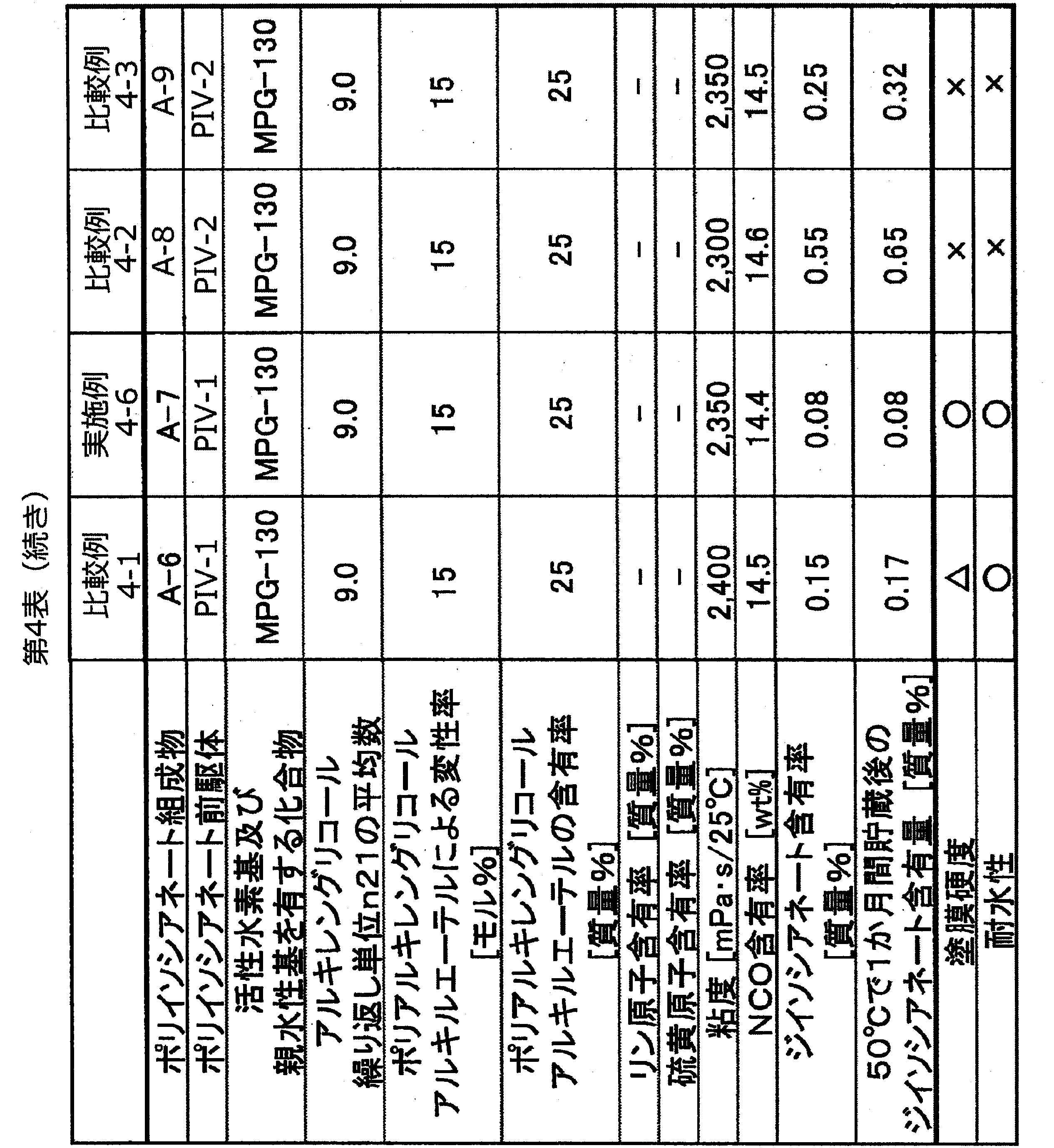
第4表から、ポリイソシアネート組成物A-1~A5及びA-7(実施例1~6)は、塗膜硬度及び耐水性に優れた塗膜が得られることが確かめられた。 From Table 4, it was confirmed that the polyisocyanate compositions A-1 to A5 and A-7 (Examples 1 to 6) could obtain a coating film having excellent coating film hardness and water resistance.
[物性5-1]粘度
粘度は、上記物性2-1と同様に、E型粘度計(トキメック社製)を用いて25℃で測定した。[Physical Properties 5-1] Viscosity The viscosity was measured at 25 ° C. using an E-type viscometer (manufactured by Tokimec Co., Ltd.) in the same manner as the above-mentioned physical properties 2-1.
[物性5-2]不揮発分
合成例例で得られたポリイソシアネート組成物の不揮発分を、上記物性2-2と同様に測定し、算出した。[Physical characteristics 5-2] Non-volatile content The non-volatile content of the polyisocyanate composition obtained in the example of synthesis was measured and calculated in the same manner as in the above physical properties 2-2.
[物性5-3]イソシアネート基含有率(NCO含有率)
NCO含有率(質量%)は、上記物性2-3と同様に、測定試料中のイソシアネート基を過剰の2Nアミンで中和した後、1N塩酸による逆滴定によって求めた。[Physical characteristics 5-3] Isocyanate group content (NCO content)
The NCO content (% by mass) was determined by neutralizing the isocyanate group in the measurement sample with an excess of 2N amine and then back titrating with 1N hydrochloric acid in the same manner as in the above physical properties 2-3.
[物性5-4]計算イソシアネート基含有率(計算NCO含有率)
各ブロックポリイソシアネート組成物について、製造時に仕込んだブロックポリイソシアネート組成物の質量、及び、上記[物性5-3]で求められたNCO含有率から、計算NCO含有率を、下記式(V-C)を用いて、算出した。
計算NCO含有率(質量%)=100×(NCO含有率)/(ブロックポリイソシアネート組成物の質量) (V-C)[Physical characteristics 5-4] Calculated isocyanate group content (calculated NCO content)
For each block polyisocyanate composition, the calculated NCO content is calculated from the mass of the block polyisocyanate composition charged at the time of manufacture and the NCO content obtained in the above [Physical Properties 5-3] by the following formula (VC). ) Was used to calculate.
Calculated NCO content (% by mass) = 100 × (NCO content) / (mass of blocked polyisocyanate composition) (VC)
[物性5-5]ポリイソシアネート組成物中のHDI含有量
ポリイソシアネート組成物中のHDI含有量は、上記物性2-5と同様に測定し、算出した。[Physical Properties 5-5] HDI Content in Polyisocyanate Composition The HDI content in the polyisocyanate composition was measured and calculated in the same manner as in the above physical properties 2-5.
[物性5-6]ブロックジイソシアネートの含有量
ブロックポリイソシアネート組成物中のブロックジイソシアネートの含有量は、下記の測定条件にて、GPCによるポリスチレン基準の数平均分子量で求めた。
(測定条件)
装置:東ソー社製「HLC-8120GPC」(商品名)
カラム:東ソー社製「TSKgel SuperH1000」(商品名)×1本
「TSKgel SuperH2000」(商品名)×1本
「TSKgel SuperH3000」(商品名)×1本
キャリアー:テトラハイドロフラン(THF)
検出方法:示差屈折計
試料濃度:5wt/vol%
検出方法:視差屈折計
流出量:0.6mL/min
カラム温度:30℃[Physical Properties 5-6] Content of Blocked Diisocyanate The content of blocked diisocyanate in the blocked polyisocyanate composition was determined by GPC based on a polystyrene-based number average molecular weight under the following measurement conditions.
(Measurement condition)
Equipment: "HLC-8120GPC" manufactured by Tosoh (trade name)
Column: "TSKgel SuperH1000" (product name) manufactured by Tosoh Co., Ltd. x 1
"TSKgel SuperH2000" (product name) x 1
"TSKgel SuperH3000" (trade name) x 1 Carrier: Tetrahydrofuran (THF)
Detection method: Differential refractometer Sample concentration: 5 wt / vol%
Detection method: Parallax refractometer Outflow: 0.6 mL / min
Column temperature: 30 ° C
[評価5-1]顔料分散性
1.塗料組成物の調製
アクリルポリオール(Nuplex Resin社製、「Setalux1903」(商品名)、樹脂固形分濃度:75%、水酸基量:樹脂中4.5質量%)とブロックポリイソシアネート組成物とを、水酸基とイソシアネート基とのモル比率が1:1になるように配合した。次いで、アクリルポリオール及びブロックポリイソシアネート組成物の合計量100質量部に対し、10質量部の銅フタロシアニンブルー顔料(大日精化社製、「シアニンブルー5206」(商品名))を添加し、スリーワンモーターを用いて、100回転/分で、5分間混合した。次いで、酢酸ブチルで塗料粘度がフォードカップNo.4で20秒になるように調整し、さらに100回転/分で、5分撹拌後、各塗料組成物を得た。[Evaluation 5-1] Pigment dispersibility 1. Preparation of paint composition Acrylic polyol (manufactured by Nuplex Resin, "Setalux 1903" (trade name), resin solid content concentration: 75%, hydroxyl group amount: 4.5% by mass in resin) and a blocked polyisocyanate composition are combined with a hydroxyl group. And the isocyanate group were blended so as to have a molar ratio of 1: 1. Next, 10 parts by mass of copper phthalocyanine blue pigment (manufactured by Dainichiseika Co., Ltd., "Cyanine Blue 5206" (trade name)) was added to 100 parts by mass of the total amount of the acrylic polyol and the blocked polyisocyanate composition, and the three-one motor was added. Was mixed at 100 rpm for 5 minutes. Next, with butyl acetate, the paint viscosity was No. 1 in Ford Cup. The temperature was adjusted to 20 seconds at 4, and the mixture was further stirred at 100 rpm for 5 minutes to obtain each coating composition.
2.塗膜の調製
得られた各塗料組成物をガラス板に膜厚40μmとなるように塗布して、1時間自然乾燥させて塗膜を得た。2. 2. Preparation of coating film Each of the obtained coating compositions was applied to a glass plate to a film thickness of 40 μm and naturally dried for 1 hour to obtain a coating film.
3.顔料分散性の評価
得られた各塗膜の状態を目視で観測し、以下の評価基準に基づいて、評価した。
(評価基準)
○:顔料のダマが見られないもの
△:一部に顔料のダマが見られるが、実用上問題がないもの
×:全体に顔料のダマが見られ、実用上問題があるもの3. 3. Evaluation of pigment dispersibility The state of each of the obtained coating films was visually observed and evaluated based on the following evaluation criteria.
(Evaluation criteria)
○: Pigment lumps are not seen △: Pigment lumps are seen in some parts, but there is no practical problem ×: Pigment lumps are seen in the whole, and there are practical problems
[評価5-2]耐酸性
1.塗料組成物の調製
アクリルポリオール(Nuplex Resin社製、「Setalux1903」(商品名)、樹脂固形分濃度:75%、水酸基量:樹脂中4.5質量%)とブロックポリイソシアネート組成物とを、水酸基とイソシアネート基とのモル比率が1:1になるように配合した。次いで、アクリルポリオール及びブロックポリイソシアネート組成物の合計量100質量部に対し、10質量部の銅フタロシアニンブルー顔料(大日精化社製、「シアニンブルー5206」(商品名))を添加し、スリーワンモーターを用いて、200回転/分で、10分間混合した。次いで、酢酸ブチルで塗料粘度がフォードカップNo.4で20秒になるように調整し、さらに200回転/分で、5分撹拌後、各塗料組成物を得た。[Evaluation 5-2] Acid resistance 1. Preparation of paint composition Acrylic polyol (manufactured by Nuplex Resin, "Setalux 1903" (trade name), resin solid content concentration: 75%, hydroxyl group amount: 4.5% by mass in resin) and a blocked polyisocyanate composition are combined with a hydroxyl group. And the isocyanate group were blended so as to have a molar ratio of 1: 1. Next, 10 parts by mass of copper phthalocyanine blue pigment (manufactured by Dainichiseika Co., Ltd., "Cyanine Blue 5206" (trade name)) was added to 100 parts by mass of the total amount of the acrylic polyol and the blocked polyisocyanate composition, and the three-one motor was added. Was mixed at 200 rpm for 10 minutes. Next, with butyl acetate, the paint viscosity was No. 1 in Ford Cup. The temperature was adjusted to 20 seconds at 4, and the mixture was further stirred at 200 rpm for 5 minutes to obtain each coating composition.
2.塗膜の調製
得られた各塗料組成物をアルミ板に膜厚30μmとなるように塗布した。次いで、130℃で30分間焼付を行い、塗膜を得た。2. 2. Preparation of coating film Each of the obtained coating compositions was applied to an aluminum plate so as to have a film thickness of 30 μm. Then, it was baked at 130 ° C. for 30 minutes to obtain a coating film.
3.耐酸性の評価
得られた各塗膜に40%硫酸水溶液0.5mLをスポットし、60℃で0.5時間保持した。次いで、塗膜表面は流水で洗い流し、乾燥後、塗膜の外観を目視で観察し、以下の評価基準に基づいて、評価した。
(評価基準)
◎:ほぼ変化が見られなかったもの
○:周りにくぼみがみられたもの
△:スポットした部分において部分的に塗膜が劣化したもの
×:スポットした部分が全体的に溶けているもの3. 3. Evaluation of Acid Resistance 0.5 mL of 40% sulfuric acid aqueous solution was spotted on each of the obtained coating films and kept at 60 ° C. for 0.5 hours. Next, the surface of the coating film was rinsed with running water, dried, and then the appearance of the coating film was visually observed and evaluated based on the following evaluation criteria.
(Evaluation criteria)
⊚: Almost no change was seen ○: A dent was seen around △: The coating film was partially deteriorated in the spotted part ×: The spotted part was totally melted
[評価5-3]耐ガソホール性
1.塗料組成物の調製
評価5-2の「1.」と同様の方法を用いて、各塗料組成物を得た。[Evaluation 5-3] Gasohol resistance 1. Preparation of paint composition Each paint composition was obtained by the same method as in "1." of Evaluation 5-2.
2.塗膜の調製
得られた各塗料組成物について、評価5-2の「2.」と同様の方法を用いて、各塗膜を得た。2. 2. Preparation of coating film For each of the obtained coating compositions, each coating film was obtained by using the same method as in "2." of Evaluation 5-2.
3.耐ガソホール性の評価
得られた各塗膜の上に、ガソリン及びメタノールの混合試験液(ガソリン/メタノール=90/10、質量比)中に浸したコットンボール(直径25mm)を置き、さらにその上に、ディスポカップを置き、40℃で30分間保持した。次いで、コットンボールを取り除き、経過時のふくれ、剥がれの塗面状態を観察し、以下の評価基準に基づいて、評価した。
(評価基準)
◎:全く異常がないもの
○:一部に膨れ、又は、剥がれが生じているもの
△:接触面の半分程度のふくれ、はがれが生じているもの
×:接触面が全体的にふくれ、剥がれが生じているもの3. 3. Evaluation of gasohol resistance A cotton ball (diameter 25 mm) immersed in a mixed test solution of gasoline and methanol (gasoline / methanol = 90/10, mass ratio) was placed on each of the obtained coating films, and further on top of it. The disposable cup was placed on the surface and held at 40 ° C. for 30 minutes. Then, the cotton ball was removed, and the state of the coated surface of swelling and peeling over time was observed, and the evaluation was made based on the following evaluation criteria.
(Evaluation criteria)
◎: No abnormality at all ○: Partially swollen or peeled △: About half of the contact surface is blistering or peeling ×: The contact surface is totally swollen or peeled What's happening
[合成例5-1]ポリイソシアネート組成物PV-1の製造
撹拌機、温度計、還流冷却管、窒素吹き込み管、及び滴下ロートを取り付けた4ツ口フラスコ内を窒素雰囲気にし、HDI600g、及び、イソブタノール0.7gを仕込み、撹拌下反応器内温度を80℃で2時間保持した。次いで、イソシアヌレート化触媒トリメチル-2-メチル-2-ヒドロキシエチルアンモニウムヒドロキシドをイソブタノールで5質量%に希釈した溶液0.5gを加え、イソシアヌレート化反応を行った。次いで、反応液のNCO含有率が44.6質量%になった時点でリン酸を添加し反応を停止した。次いで、反応液を更に150℃で2時間保持した。薄膜蒸発缶を用いて、160℃、0.2Torrの条件で1回精製後、140℃、1Hrの加熱処理を行った。次いで、再度、薄膜蒸留缶を用いて、160℃、0.1Torrの条件で精製を行い、ポリイソシアネート組成物PV-1を得た。[Synthesis Example 5-1] Production of Polyisocyanate Composition PV-1 The inside of a four-necked flask equipped with a stirrer, a thermometer, a reflux condenser, a nitrogen blowing tube, and a dropping funnel is made into a nitrogen atmosphere, and HDI 600 g and 0.7 g of isobutanol was charged, and the temperature inside the reactor was maintained at 80 ° C. for 2 hours under stirring. Then, 0.5 g of a solution obtained by diluting the isocyanurate-forming catalyst trimethyl-2-methyl-2-hydroxyethylammonium hydroxide with isobutanol in an amount of 5% by mass was added, and an isocyanurate-forming reaction was carried out. Then, when the NCO content of the reaction solution reached 44.6% by mass, phosphoric acid was added to stop the reaction. The reaction was then held at 150 ° C. for 2 hours. Using a thin-film evaporator, purification was performed once under the conditions of 160 ° C. and 0.2 Torr, and then heat treatment was performed at 140 ° C. and 1 Hr. Then, the purification was performed again using a thin-film distillation can at 160 ° C. and 0.1 Torr to obtain a polyisocyanate composition PV-1.
得られたポリイソシアネート組成物PV-1は、不揮発分99.7質量%、粘度480mPa・s(25℃)、NCO含有率23.1質量%、HDI含有量0.12質量%であった。また、13C-NMR測定により、イソシアヌレート基を有していることを確認した。The obtained polyisocyanate composition PV-1 had a non-volatile content of 99.7% by mass, a viscosity of 480 mPa · s (25 ° C.), an NCO content of 23.1% by mass, and an HDI content of 0.12% by mass. In addition, it was confirmed by 13 C-NMR measurement that it had an isocyanurate group.
[合成例5-2]ポリイソシアネート組成物PV-2の製造
合成例5-1で得たポリイソシアネート組成物PV-1をさらに、140℃で1時間の加熱処理を行い、再度、薄膜蒸留缶を用いて、160℃、0.1Torrの条件で精製を行い、ポリイソシアネート組成物PV-2を得た。
得られたポリイソシアネート組成物PV-2は、不揮発分99.8質量%、粘度490mPa・s(25℃)、NCO含有率23.0質量%、HDI含有量0.05質量%であった。[Synthesis Example 5-2] Production of Polyisocyanate Composition PV-2 The polyisocyanate composition PV-1 obtained in Synthesis Example 5-1 was further heat-treated at 140 ° C. for 1 hour, and then again in a thin-film distillation can. Was purified at 160 ° C. and 0.1 Torr to obtain a polyisocyanate composition PV-2.
The obtained polyisocyanate composition PV-2 had a non-volatile content of 99.8% by mass, a viscosity of 490 mPa · s (25 ° C.), an NCO content of 23.0% by mass, and an HDI content of 0.05% by mass.
[合成例5-3]ポリイソシアネート組成物PV-3の製造
合成例5-2で得たポリイソシアネート組成物PV-2をさらに、140℃で1時間の加熱処理を行い、再度、薄膜蒸留缶を用いて、160℃、0.1Torrの条件で精製を行い、ポリイソシアネート組成物PV-3を得た。
得られたポリイソシアネート組成物PV-3は、不揮発分99.8質量%、粘度500mPa・s(25℃)、NCO含有率23.0質量%、HDI含有量0.03質量%であった。[Synthesis Example 5-3] Production of Polyisocyanate Composition PV-3 The polyisocyanate composition PV-2 obtained in Synthesis Example 5-2 was further heat-treated at 140 ° C. for 1 hour, and then again in a thin-film distillation can. Was purified at 160 ° C. and 0.1 Torr to obtain a polyisocyanate composition PV-3.
The obtained polyisocyanate composition PV-3 had a non-volatile content of 99.8% by mass, a viscosity of 500 mPa · s (25 ° C.), an NCO content of 23.0% by mass, and an HDI content of 0.03% by mass.
[合成例5-4]ポリイソシアネート組成物PV-4の製造
合成例5-3で得たポリイソシアネート組成物PV-3をさらに、140℃で1時間の加熱処理を行い、再度、薄膜蒸留缶を用いて、160℃、0.1Torrの条件で精製を行い、ポリイソシアネート組成物PV-4を得た。
得られたポリイソシアネート組成物PV-4は、不揮発分99.8質量%、粘度490mPa・s(25℃)、NCO含有率23.0質量%、HDI含有量0.01質量%であった。[Synthesis Example 5-4] Production of Polyisocyanate Composition PV-4 The polyisocyanate composition PV-3 obtained in Synthesis Example 5-3 was further heat-treated at 140 ° C. for 1 hour, and then again in a thin-film distillation can. Was purified at 160 ° C. and 0.1 Torr to obtain a polyisocyanate composition PV-4.
The obtained polyisocyanate composition PV-4 had a non-volatile content of 99.8% by mass, a viscosity of 490 mPa · s (25 ° C.), an NCO content of 23.0% by mass, and an HDI content of 0.01% by mass.
[合成例5-5]ポリイソシアネート組成物PV-5の製造
合成例5-1で得たポリイソシアネート組成物(PV-1)100gにHDIモノマーを0.05g添加し、10分間混合して、ポリイソシアネート組成物PV-5を得た。
得られたポリイソシアネート組成物PV-5は、不揮発分99.8質量%、粘度480mPa・s(25℃)、NCO含有率23.1質量%、HDI含有量0.17質量%であった。[Synthesis Example 5-5] Production of Polyisocyanate Composition PV-5 Add 0.05 g of HDI monomer to 100 g of the polyisocyanate composition (PV-1) obtained in Synthesis Example 5-1 and mix for 10 minutes. A polyisocyanate composition PV-5 was obtained.
The obtained polyisocyanate composition PV-5 had a non-volatile content of 99.8% by mass, a viscosity of 480 mPa · s (25 ° C.), an NCO content of 23.1% by mass, and an HDI content of 0.17% by mass.
[合成例5-6]ポリイソシアネート組成物PV-6の製造
合成例5-1で得たポリイソシアネート組成物(PV-1)100gにHDIモノマーを0.10g添加し、10分間混合して、ポリイソシアネート組成物PV-6を得た。
得られたポリイソシアネート組成物PV-6は、不揮発分99.8質量%、粘度470mPa・s(25℃)、NCO含有率23.2質量%、HDI含有量0.23質量%であった。[Synthesis Example 5-6] Production of Polyisocyanate Composition PV-6 0.10 g of HDI monomer was added to 100 g of the polyisocyanate composition (PV-1) obtained in Synthesis Example 5-1 and mixed for 10 minutes. A polyisocyanate composition PV-6 was obtained.
The obtained polyisocyanate composition PV-6 had a non-volatile content of 99.8% by mass, a viscosity of 470 mPa · s (25 ° C.), an NCO content of 23.2% by mass, and an HDI content of 0.23% by mass.
[合成例5-7]ポリイソシアネート組成物PV-7の製造
合成例5-1で得たポリイソシアネート組成物(PV-1)100gにHDIモノマーを0.20g添加し、10分間混合して、ポリイソシアネート組成物PV-7を得た。
得られたポリイソシアネート組成物PV-7は、不揮発分99.8質量%、粘度460mPa・s(25℃)、NCO含有率23.2質量%、HDI含有量0.33質量%であった。[Synthesis Example 5-7] Production of Polyisocyanate Composition PV-7 Add 0.20 g of HDI monomer to 100 g of the polyisocyanate composition (PV-1) obtained in Synthesis Example 5-1 and mix for 10 minutes. A polyisocyanate composition PV-7 was obtained.
The obtained polyisocyanate composition PV-7 had a non-volatile content of 99.8% by mass, a viscosity of 460 mPa · s (25 ° C.), an NCO content of 23.2% by mass, and an HDI content of 0.33% by mass.
[合成例5-8]ポリイソシアネート組成物PV-8の製造
合成例5-1で得たポリイソシアネート組成物(PV-1)100gにHDIモノマーを0.60g添加し、10分間混合して、ポリイソシアネート組成物PV-8を得た。
得られたポリイソシアネート組成物PV-8は、不揮発分99.5質量%、粘度430mPa・s(25℃)、NCO含有率23.4質量%、HDI含有量0.62質量%であった。[Synthesis Example 5-8] Production of Polyisocyanate Composition PV-8 0.60 g of HDI monomer was added to 100 g of the polyisocyanate composition (PV-1) obtained in Synthesis Example 5-1 and mixed for 10 minutes. A polyisocyanate composition PV-8 was obtained.
The obtained polyisocyanate composition PV-8 had a non-volatile content of 99.5% by mass, a viscosity of 430 mPa · s (25 ° C.), an NCO content of 23.4% by mass, and an HDI content of 0.62% by mass.
[比較例5-1]ブロックイソシアネート組成物B-1の製造
撹拌機、温度計、還流冷却管及び窒素吹き込み管を取り付けた4ツ口フラスコ内を窒素雰囲気にし、ポリイソシアネート組成物PV-1を200g、酢酸ブチル(131g)を仕込み、温度を70℃とした。次いで、4ツ口フラスコに3,5-ジメチルピラゾール(106g、100モル%)を数回に分け添加し2時間保持した。次いで、NCO含有率0.0質量%を確認し、固形分濃度70質量%のブロックイソシアネート組成物B-1を得た。
得られたブロックイソシアネート組成物B-1は、計算NCO含有率が10.6質量%であった。次いで、上記の方法に基づき、評価を行った。結果を下記第5表に示す。[Comparative Example 5-1] Production of Blocked Isocyanate Composition B-1 The polyisocyanate composition PV-1 is prepared by creating a nitrogen atmosphere in a four-necked flask equipped with a stirrer, a thermometer, a reflux condenser and a nitrogen blowing tube. 200 g and butyl acetate (131 g) were charged, and the temperature was set to 70 ° C. Then, 3,5-dimethylpyrazole (106 g, 100 mol%) was added to the four-necked flask in several portions and held for 2 hours. Next, an NCO content of 0.0% by mass was confirmed, and a blocked isocyanate composition B-1 having a solid content concentration of 70% by mass was obtained.
The obtained blocked isocyanate composition B-1 had a calculated NCO content of 10.6% by mass. Then, evaluation was performed based on the above method. The results are shown in Table 5 below.
[比較例5-2]ブロックイソシアネート組成物B-2の製造
ポリイソシアネート組成物PV-1の代わりに、PV-5を使用した以外は比較例5-1と同様の方法を用いて、ブロックポリイソシアネート組成物B-2を得た。
得られたブロックイソシアネート組成物B-2は、計算NCO含有率が10.6質量%であった。次いで、上記の方法に基づき、評価を行った。結果を第5表に示す。[Comparative Example 5-2] Production of Blocked Isocyanate Composition B-2 Blocked poly using the same method as in Comparative Example 5-1 except that PV-5 was used instead of the polyisocyanate composition PV-1. The isocyanate composition B-2 was obtained.
The obtained blocked isocyanate composition B-2 had a calculated NCO content of 10.6% by mass. Then, evaluation was performed based on the above method. The results are shown in Table 5.
[実施例5-1]ブロックイソシアネート組成物B-3の製造
ポリイソシアネート組成物PV-1の代わりに、PV-2を使用した以外は比較例5-1と同様の方法を用いて、ブロックポリイソシアネート組成物B-3を得た。
得られたブロックイソシアネート組成物B-3は、計算NCO含有率が10.5質量%であった。次いで、上記の方法に基づき、評価を行った。結果を下記第5表に示す。[Example 5-1] Production of blocked isocyanate composition B-3 Block poly using the same method as in Comparative Example 5-1 except that PV-2 was used instead of the polyisocyanate composition PV-1. The isocyanate composition B-3 was obtained.
The obtained blocked isocyanate composition B-3 had a calculated NCO content of 10.5% by mass. Then, evaluation was performed based on the above method. The results are shown in Table 5 below.
[実施例5-2]ブロックイソシアネート組成物B-4の製造
ポリイソシアネート組成物PV-1の代わりに、PV-3を使用した以外は比較例5-1と同様の方法を用いて、ブロックポリイソシアネート組成物B-4を得た。
得られたブロックイソシアネート組成物B-4は、計算NCO含有率が10.5質量%であった。次いで、上記の方法に基づき、評価を行った。結果を下記第5表に示す。[Example 5-2] Production of blocked isocyanate composition B-4 Block poly using the same method as in Comparative Example 5-1 except that PV-3 was used instead of the polyisocyanate composition PV-1. The isocyanate composition B-4 was obtained.
The obtained blocked isocyanate composition B-4 had a calculated NCO content of 10.5% by mass. Then, evaluation was performed based on the above method. The results are shown in Table 5 below.
[実施例5-3]ブロックイソシアネート組成物B-5の製造
ポリイソシアネート組成物PV-1の代わりに、PV-4を使用した以外は比較例5-1と同様の方法を用いて、ブロックポリイソシアネート組成物B-5を得た。
得られたブロックイソシアネート組成物B-5は、計算NCO含有率が10.5質量%であった。次いで、上記の方法に基づき、評価を行った。結果を下記第5表に示す。[Example 5-3] Production of blocked isocyanate composition B-5 Block poly using the same method as in Comparative Example 5-1 except that PV-4 was used instead of the polyisocyanate composition PV-1. The isocyanate composition B-5 was obtained.
The obtained blocked isocyanate composition B-5 had a calculated NCO content of 10.5% by mass. Then, evaluation was performed based on the above method. The results are shown in Table 5 below.
[比較例5-3]ブロックイソシアネート組成物B-6の製造
ポリイソシアネート組成物PV-1の代わりに、PV-6を使用した以外は比較例5-1と同様の方法を用いて、ブロックポリイソシアネート組成物B-6を得た。
得られたブロックイソシアネート組成物B-6は、計算NCO含有率が10.6質量%であった。次いで、上記の方法に基づき、評価を行った。結果を下記第5表に示す。[Comparative Example 5-3] Production of Blocked Isocyanate Composition B-6 Blocked poly using the same method as in Comparative Example 5-1 except that PV-6 was used instead of the polyisocyanate composition PV-1. The isocyanate composition B-6 was obtained.
The obtained blocked isocyanate composition B-6 had a calculated NCO content of 10.6% by mass. Then, evaluation was performed based on the above method. The results are shown in Table 5 below.
[比較例5-4]ブロックイソシアネート組成物B-7の製造
撹拌機、温度計、還流冷却管、窒素吹き込み管、及び滴下ロートを取り付けた4ツ口フラスコ内を窒素雰囲気にし、ポリイソシアネート組成物PV-1を200g、及び、酢酸ブチルを127g仕込み、温度を70℃とした。次いで、4ツ口フラスコにメチルエチルケトオキシム(96g、100モル%)を滴下して添加し2時間保持した。次いで、NCO含有率が0.0質量%となったことを確認し、固形分濃度70質量%のブロックイソシアネート組成物B-7を得た。
得られたブロックイソシアネート組成物B-7は、計算NCO含有率が10.9質量%であった。次いで、上記の方法に基づき、評価を行った。結果を下記第5表に示す。[Comparative Example 5-4] Production of Blocked Isocyanate Composition B-7 A polyisocyanate composition is prepared by creating a nitrogen atmosphere in a four-necked flask equipped with a stirrer, a thermometer, a reflux condenser, a nitrogen blowing tube, and a dropping funnel. 200 g of PV-1 and 127 g of butyl acetate were charged, and the temperature was set to 70 ° C. Then, methyl ethyl ketooxime (96 g, 100 mol%) was added dropwise to a four-necked flask and held for 2 hours. Next, it was confirmed that the NCO content was 0.0% by mass, and a blocked isocyanate composition B-7 having a solid content concentration of 70% by mass was obtained.
The obtained blocked isocyanate composition B-7 had a calculated NCO content of 10.9% by mass. Then, evaluation was performed based on the above method. The results are shown in Table 5 below.
[比較例5-5]ブロックイソシアネート組成物B-8の製造
ポリイソシアネート組成物PV-1の代わりに、PV-7を使用した以外は比較例5-1と同様の方法を用いて、ブロックポリイソシアネート組成物B-8を得た。
得られたブロックイソシアネート組成物B-8は、計算NCO含有率が10.9質量%であった。次いで、上記の方法に基づき、評価を行った。結果を下記第5表に示す。[Comparative Example 5-5] Production of Blocked Isocyanate Composition B-8 Blocked poly using the same method as in Comparative Example 5-1 except that PV-7 was used instead of the polyisocyanate composition PV-1. The isocyanate composition B-8 was obtained.
The obtained blocked isocyanate composition B-8 had a calculated NCO content of 10.9% by mass. Then, evaluation was performed based on the above method. The results are shown in Table 5 below.
[比較例5-6]ブロックイソシアネート組成物B-9の製造
ポリイソシアネート組成物PV-1の代わりに、PV-8を使用した以外は比較例5-1と同様の方法を用いて、ブロックポリイソシアネート組成物B-9を得た。
得られたブロックイソシアネート組成物B-9は、計算NCO含有率が11.0質量%であった。次いで、上記の方法に基づき、評価を行った。結果を下記第5表に示す。[Comparative Example 5-6] Production of Blocked Isocyanate Composition B-9 Blocked poly using the same method as in Comparative Example 5-1 except that PV-8 was used instead of the polyisocyanate composition PV-1. The isocyanate composition B-9 was obtained.
The obtained blocked isocyanate composition B-9 had a calculated NCO content of 11.0% by mass. Then, evaluation was performed based on the above method. The results are shown in Table 5 below.

第5表から、ブロックポリイソシアネート組成物B-3~B-5(実施例5-1、5-2、5-3)では、40~60℃の高温下の耐酸性及び耐ガソホール性に優れた塗膜を形成できることが確かめられた。
一方、ブロックポリイソシアネート組成物B-1~B-2及びB-6~B-9(比較例5-1~5-6)では、40~60℃の高温下の耐酸性及び耐ガソホール性共に良好な塗膜は得られなかった。From Table 5, the blocked polyisocyanate compositions B-3 to B-5 (Examples 5-1, 5-2, 5-3) are excellent in acid resistance and gasohol resistance at high temperatures of 40 to 60 ° C. It was confirmed that the coating film could be formed.
On the other hand, the blocked polyisocyanate compositions B-1 to B-2 and B-6 to B-9 (Comparative Examples 5-1 to 5-6) have both acid resistance and gasohol resistance at a high temperature of 40 to 60 ° C. No good coating was obtained.
以上のことから、第5の実施形態のブロックポリイソシアネート組成物は、高温条件下での耐酸性及び耐ガソホール性が良好な塗膜を形成できることが確かめられた。 From the above, it was confirmed that the blocked polyisocyanate composition of the fifth embodiment can form a coating film having good acid resistance and gasohol resistance under high temperature conditions.
本発明の第1の実施形態において、HDI由来の臭気が抑制され、色度安定性及び粘度安定性が良好なポリイソシアネート組成物が提供される。また、当該ポリイソシアネート組成物を含み、溶剤希釈性が良好な塗料組成物が提供される。また、当該塗料組成物を含み、耐薬品性に優れた塗膜が提供される。
本発明の第2の実施形態において、低粘度であり、且つ、リコート密着性、塩水噴霧時耐久性及び耐汚染性に優れた塗膜、及び当該塗膜を形成可能とするポリイソシアネート組成物及び当該ポリイソシアネート組成物を含む塗料組成物が提供される。
本発明の第3の実施形態において、HDI由来の臭気が抑制され、基材との密着性及び耐汚染性に優れた塗膜、及び当該塗膜を形成可能とするポリイソシアネート組成物及び当該ポリイソシアネート組成物を含む塗料組成物が提供される。
本発明の第4の実施形態において、硬度及び耐水性に優れた硬化物、及び当該硬化物を形成可能とするポリイソシアネート組成物及び当該ポリイソシアネート組成物を含む水系塗料組成物が提供される。
本発明の第5の実施形態において、高温条件における耐酸性及び耐ガソホール性に優れた塗膜、及び当該塗膜を形成可能とするブロックポリイソシアネート組成物及び当該ブロックポリイソシアネート組成物を含む塗料組成物が提供される。In the first embodiment of the present invention, there is provided a polyisocyanate composition in which the odor derived from HDI is suppressed and the chromaticity stability and the viscosity stability are good. Further, a coating composition containing the polyisocyanate composition and having good solvent dilutability is provided. Further, a coating film containing the coating composition and having excellent chemical resistance is provided.
In the second embodiment of the present invention, a coating film having a low viscosity and excellent in recoat adhesion, durability at the time of salt spraying and stain resistance, and a polyisocyanate composition capable of forming the coating film and the like. A coating composition containing the polyisocyanate composition is provided.
In the third embodiment of the present invention, a coating film having an HDI-derived odor suppressed and having excellent adhesion to a substrate and stain resistance, a polyisocyanate composition capable of forming the coating film, and the poly A coating composition comprising an isocyanate composition is provided.
In the fourth embodiment of the present invention, there is provided a cured product having excellent hardness and water resistance, a polyisocyanate composition capable of forming the cured product, and a water-based coating composition containing the polyisocyanate composition.
In the fifth embodiment of the present invention, a coating film having excellent acid resistance and gashole resistance under high temperature conditions, a block polyisocyanate composition capable of forming the coating film, and a coating composition containing the block polyisocyanate composition. Things are provided.
Claims (20)
1)貯蔵前のポリイソシアネート組成物中の1,6-ヘキサメチレンジイソシアネート含有量が0.001質量%以上0.05質量%以下である;
2)貯蔵後のポリイソシアネート組成物中の1,6-ヘキサメチレンジイソシアネート含有量が0.001質量%以上0.1質量%以下である;
3)貯蔵前後のポリイソシアネート組成物中の1,6-ヘキサメチレンジイソシアネート含有量の差が、0.08質量%以下である。 A polyisocyanate composition that satisfies the conditions shown in 1) to 3) below when stored at 50 ° C. for one month from the time of manufacture .
1) The content of 1,6-hexamethylene diisocyanate in the polyisocyanate composition before storage is 0.001% by mass or more and 0.05% by mass or less;
2) The content of 1,6-hexamethylene diisocyanate in the polyisocyanate composition after storage is 0.001% by mass or more and 0.1% by mass or less;
3) The difference in the content of 1,6-hexamethylene diisocyanate in the polyisocyanate composition before and after storage is 0.08% by mass or less.
ポリイソシアネート組成物の総質量に対する、数平均分子量が700以下の成分の比率が、70質量%以上であり、且つ、
上記条件2)において、貯蔵後のポリイソシアネート組成物中の1,6-ヘキサメチレンジイソシアネート含有量が0.01質量%以上0.1質量%以下である、請求項1に記載のポリイソシアネート組成物。 Contains polyisocyanates with isocyanurate groups derived from aliphatic diisocyanates containing 1,6-hexamethylene diisocyanate.
The ratio of the components having a number average molecular weight of 700 or less to the total mass of the polyisocyanate composition is 70% by mass or more, and
The polyisocyanate composition according to claim 1, wherein the 1,6-hexamethylene diisocyanate content in the polyisocyanate composition after storage under the above condition 2) is 0.01% by mass or more and 0.1% by mass or less. ..
水酸基価が10mgKOH/g以上200mgKOH/g以下であるアクリルポリオール、及び、水酸基価が10mgKOH/g以上200mgKOH/g以下であるポリエステルポリオールのうち少なくとも一つと、
を含む塗料組成物。 The polyisocyanate composition according to claim 5 and
At least one of an acrylic polyol having a hydroxyl value of 10 mgKOH / g or more and 200 mgKOH / g or less, and a polyester polyol having a hydroxyl value of 10 mgKOH / g or more and 200 mgKOH / g or less.
A paint composition containing.
イソシアヌレート基のモル量をA、ウレトジオン基のモル量をB、イミノオキサジアジンジオン基のモル量をC、及び、ビュレット基のモル量をDとした場合に、D/(A+B+C+D)が0.50以上である、請求項1に記載のポリイソシアネート組成物。 Contains polyisocyanates with isocyanurate and burette groups derived from aliphatic diisocyanates containing 1,6-hexamethylene diisocyanate.
When the molar amount of the isocyanate group is A, the molar amount of the uretdione group is B, the molar amount of the iminooxadiazinedione group is C, and the molar amount of the bullet group is D, D / (A + B + C + D) is 0. The polyisocyanate composition according to claim 1, which is .50 or more.
上記条件2)において、貯蔵後のポリイソシアネート組成物中の1,6-ヘキサメチレンジイソシアネート含有量が0.05質量%超0.1質量%以下である、請求項8に記載のポリイソシアネート組成物。 Under the above condition 1), the content of 1,6-hexamethylene diisocyanate in the polyisocyanate composition before storage is more than 0.02% by mass and 0.05% by mass or less, and
The polyisocyanate composition according to claim 8, wherein the 1,6-hexamethylene diisocyanate content in the polyisocyanate composition after storage under the above condition 2) is more than 0.05% by mass and 0.1% by mass or less. ..
水酸基価が10mgKOH/g以上200mgKOH/g以下であるアクリルポリオール、及び、水酸基価が10mgKOH/g以上200mgKOH/g以下であるポリエステルポリオールのうち少なくとも一つと、
を含む塗料組成物。 The polyisocyanate composition according to claim 8 or 9,
At least one of an acrylic polyol having a hydroxyl value of 10 mgKOH / g or more and 200 mgKOH / g or less, and a polyester polyol having a hydroxyl value of 10 mgKOH / g or more and 200 mgKOH / g or less.
A paint composition containing.
1)貯蔵前のポリイソシアネート組成物中のジイソシアネートの含有量が0.002質量%以上0.1質量%以下である;
2)貯蔵後のポリイソシアネート組成物中の上記ジイソシアネートの含有量が0.002質量%以上0.1質量%以下である;
3)貯蔵前後のポリイソシアネート組成物中の上記ジイソシアネートの含有量の差が、0.01質量%以下である。

1) The content of diisocyanate in the polyisocyanate composition before storage is 0.002% by mass or more and 0.1% by mass or less;
2) The content of the diisocyanate in the polyisocyanate composition after storage is 0.002% by mass or more and 0.1% by mass or less;
3) The difference in the content of the diisocyanate in the polyisocyanate composition before and after storage is 0.01% by mass or less.
上記アニオン性化合物が、カルボン酸基を有する化合物、リン酸基を有する化合物及びスルホン酸基を有する化合物からなる群より選ばれる少なくとも1種である請求項13に記載のポリイソシアネート組成物。 The compound having the active hydrogen group and the hydrophilic group is the anionic compound.
The polyisocyanate composition according to claim 13, wherein the anionic compound is at least one selected from the group consisting of a compound having a carboxylic acid group, a compound having a phosphoric acid group, and a compound having a sulfonic acid group.
上記スルホン酸基を有する化合物が、水酸基を有するスルホン酸及びアミノ基を有するスルホン酸からなる群より選ばれる少なくとも1種である請求項14に記載のポリイソシアネート組成物。 The anionic compound is a compound having a sulfonic acid group.
The polyisocyanate composition according to claim 14, wherein the compound having a sulfonic acid group is at least one selected from the group consisting of a sulfonic acid having a hydroxyl group and a sulfonic acid having an amino group.
上記カチオン性化合物が、アミノ基を有する化合物であり、アニオン基を有する化合物で中和されたものである請求項13に記載のポリイソシアネート組成物。 The compound having the active hydrogen group and the hydrophilic group is the cationic compound.
The polyisocyanate composition according to claim 13, wherein the cationic compound is a compound having an amino group and neutralized with a compound having an anionic group.
上記ノニオン性化合物が、下記一般式(IV-II)で示されるポリアルキレングリコールエーテルである請求項13に記載のポリイソシアネート組成物。

The polyisocyanate composition according to claim 13, wherein the nonionic compound is a polyalkylene glycol ether represented by the following general formula (IV-II).
上記ポリイソシアネート組成物中のイソシアネート基及びアロファネート基の合計モル量に対するイソシアヌレート基のモル量の比率(イソシアヌレート基/(イソシアヌレート+アロファネート基))が0.80以上0.99未満である請求項12~17のいずれか一項に記載のポリイソシアネート組成物。 The polyisocyanate has an isocyanurate group and an allophanate group, and has
A claim that the ratio of the molar amount of the isocyanurate group to the total molar amount of the isocyanate group and the allophanate group in the polyisocyanate composition (isocyanurate group / (isocyanurate + allophanate group)) is 0.80 or more and less than 0.99. Item 2. The polyisocyanate composition according to any one of Items 12 to 17.
Applications Claiming Priority (11)
| Application Number | Priority Date | Filing Date | Title |
|---|---|---|---|
| JP2017203755 | 2017-10-20 | ||
| JP2017203753 | 2017-10-20 | ||
| JP2017203752 | 2017-10-20 | ||
| JP2017203752 | 2017-10-20 | ||
| JP2017203754 | 2017-10-20 | ||
| JP2017203755 | 2017-10-20 | ||
| JP2017203753 | 2017-10-20 | ||
| JP2017203754 | 2017-10-20 | ||
| JP2017217815 | 2017-11-10 | ||
| JP2017217815 | 2017-11-10 | ||
| PCT/JP2018/038641 WO2019078241A1 (en) | 2017-10-20 | 2018-10-17 | Polyisocyanate composition, coating material composition, and coating film |
Publications (2)
| Publication Number | Publication Date |
|---|---|
| JPWO2019078241A1 JPWO2019078241A1 (en) | 2020-04-09 |
| JP7030833B2 true JP7030833B2 (en) | 2022-03-07 |
Family
ID=66174171
Family Applications (1)
| Application Number | Title | Priority Date | Filing Date |
|---|---|---|---|
| JP2019549314A Active JP7030833B2 (en) | 2017-10-20 | 2018-10-17 | Polyisocyanate compositions, paint compositions and coatings |
Country Status (3)
| Country | Link |
|---|---|
| JP (1) | JP7030833B2 (en) |
| CN (1) | CN111201257A (en) |
| WO (1) | WO2019078241A1 (en) |
Families Citing this family (10)
| Publication number | Priority date | Publication date | Assignee | Title |
|---|---|---|---|---|
| JP2020196870A (en) * | 2019-05-28 | 2020-12-10 | 旭化成株式会社 | Aqueous two-component type cured resin composition and method for coating article |
| CN116323185B (en) * | 2020-07-30 | 2025-04-01 | 陶氏环球技术有限责任公司 | Method for packaging battery device |
| WO2022061704A1 (en) * | 2020-09-25 | 2022-03-31 | 万华化学集团股份有限公司 | Storage-stable polyisocyanate composition and preparation method therefor |
| CN114249868B (en) * | 2020-09-25 | 2023-12-19 | 万华化学集团股份有限公司 | A storage-stable polyisocyanate composition and its preparation method |
| CN114539508B (en) * | 2020-11-25 | 2023-05-30 | 万华化学集团股份有限公司 | Low-viscosity polyisocyanate composition for improving water dispersibility |
| CN115594822A (en) * | 2021-06-28 | 2023-01-13 | 万华化学集团股份有限公司(Cn) | Polyisocyanate curing agent with storage stability, preparation method and application thereof |
| CN113603529A (en) * | 2021-08-05 | 2021-11-05 | 安徽省司尔特肥业股份有限公司 | Special compound fertilizer for soybeans and preparation method thereof |
| JP2023070109A (en) * | 2021-11-05 | 2023-05-18 | 旭化成株式会社 | Block polyisocyanate composition and method for producing the same, resin composition, resin film and method for producing the same, and laminate |
| CN114057991B (en) * | 2021-12-02 | 2023-03-03 | 万华化学集团股份有限公司 | Fast-curing polyisocyanate composition and preparation method and application thereof |
| CN117820585A (en) * | 2023-12-15 | 2024-04-05 | 万华化学集团股份有限公司 | A polyisocyanate composition with high isocyanate retention rate |
Citations (3)
| Publication number | Priority date | Publication date | Assignee | Title |
|---|---|---|---|---|
| JP2011506693A (en) | 2007-12-18 | 2011-03-03 | バイエル・マテリアルサイエンス・アクチェンゲゼルシャフト | Method for producing low monomer organic polyisocyanate |
| JP2015172164A (en) | 2014-03-12 | 2015-10-01 | 旭化成ケミカルズ株式会社 | Method for producing isocyanurate type polyisocyanate composition |
| WO2017154963A1 (en) | 2016-03-09 | 2017-09-14 | 旭化成株式会社 | Polyisocyanate composition, coating composition, water-based coating composition, and coated base |
Family Cites Families (6)
| Publication number | Priority date | Publication date | Assignee | Title |
|---|---|---|---|---|
| JPS5318698A (en) * | 1976-08-03 | 1978-02-21 | Asahi Chem Ind Co Ltd | Stabilization of aliphatic polyisocyanates |
| JP2645581B2 (en) * | 1988-01-28 | 1997-08-25 | 旭化成工業株式会社 | Block polyisocyanate and coating composition containing block polyisocyanate |
| WO1997002303A1 (en) * | 1995-06-30 | 1997-01-23 | Asahi Kasei Kogyo Kabushiki Kaisha | Polyisocyanate composition having high emulsifiability and stability, and aqueous coating composition comprising the composition |
| JP3924350B2 (en) * | 1997-05-08 | 2007-06-06 | 旭化成ケミカルズ株式会社 | Water-based urethane coating composition |
| JP4761903B2 (en) * | 2005-09-22 | 2011-08-31 | 旭化成ケミカルズ株式会社 | Polyisocyanate composition and coating composition using the same as curing agent |
| JP6419197B2 (en) * | 2014-09-04 | 2018-11-07 | 旭化成株式会社 | Polyisocyanate composition, coating composition, coating film, production method thereof, and moisture stabilization method |
-
2018
- 2018-10-17 JP JP2019549314A patent/JP7030833B2/en active Active
- 2018-10-17 CN CN201880065452.4A patent/CN111201257A/en active Pending
- 2018-10-17 WO PCT/JP2018/038641 patent/WO2019078241A1/en not_active Ceased
Patent Citations (3)
| Publication number | Priority date | Publication date | Assignee | Title |
|---|---|---|---|---|
| JP2011506693A (en) | 2007-12-18 | 2011-03-03 | バイエル・マテリアルサイエンス・アクチェンゲゼルシャフト | Method for producing low monomer organic polyisocyanate |
| JP2015172164A (en) | 2014-03-12 | 2015-10-01 | 旭化成ケミカルズ株式会社 | Method for producing isocyanurate type polyisocyanate composition |
| WO2017154963A1 (en) | 2016-03-09 | 2017-09-14 | 旭化成株式会社 | Polyisocyanate composition, coating composition, water-based coating composition, and coated base |
Also Published As
| Publication number | Publication date |
|---|---|
| CN111201257A (en) | 2020-05-26 |
| JPWO2019078241A1 (en) | 2020-04-09 |
| WO2019078241A1 (en) | 2019-04-25 |
Similar Documents
| Publication | Publication Date | Title |
|---|---|---|
| JP6568996B2 (en) | Polyisocyanate composition, coating composition, water-based coating composition, and coating substrate | |
| JPWO2019078241A1 (en) | Polyisocyanate composition, coating composition and coating film | |
| CN109843953B (en) | Isocyanate composition, aqueous dispersion of isocyanate composition, method for producing the same, coating composition, and coating film | |
| CN114149564B (en) | Polyisocyanate composition, blocked polyisocyanate composition, hydrophilic polyisocyanate composition, coating composition and coating film | |
| WO2016035887A1 (en) | Polyisocyanate composition, coating composition, coating film and manufacturing method therefor, and humidity-stabilization method | |
| JP6805268B2 (en) | Polyisocyanate composition and paint composition | |
| US20160376438A1 (en) | Urea-free polyurethane dispersions | |
| JP6393122B2 (en) | Polyisocyanate composition, coating composition and coating film | |
| JP7235523B2 (en) | Polyisocyanate composition, coating composition, method for producing coating film, and coating film | |
| JP2022151826A (en) | Polyisocyanate composition, coating composition, and coating base material | |
| CN112300364B (en) | Blocked polyisocyanate composition, resin film, and laminate | |
| JP6437837B2 (en) | Polyisocyanate composition, coating composition, and coating film | |
| JP2014231599A (en) | Polyisocyanate composition and coating composition prepared using the same | |
| JP2021070820A (en) | Polyisocyanate composition, coating composition and coated substrate | |
| JP6953544B2 (en) | Polyisocyanate composition, coating composition and coating | |
| JP7858294B2 (en) | Polyisocyanate composition, aqueous coating composition, and coating substrate | |
| CN112708106B (en) | Polyisocyanate composition, coating composition and coated substrate | |
| JP7377706B2 (en) | Polyisocyanate compositions, coating compositions and coating substrates | |
| JP6445806B2 (en) | Polyisocyanate composition, coating composition and coating film | |
| CN116217886B (en) | Polyisocyanate compositions, coating compositions and coating substrates | |
| JP7629987B2 (en) | Blocked isocyanate composition, aqueous dispersion, coating composition, and coating film | |
| CN117645828B (en) | Substrate coating composition, multilayer coating laminate and method for forming multilayer coating laminate | |
| JP2019014777A (en) | Polyisocyanate composition, dilution solution of polyisocyanate composition, coating composition and coating film | |
| CN117229476A (en) | Polyisocyanate composition, blocked polyisocyanate composition, polyurethane resin composition, coating composition and coating substrate | |
| JP2022162294A (en) | Blocked polyisocyanate composition, resin composition and resin film |
Legal Events
| Date | Code | Title | Description |
|---|---|---|---|
| A621 | Written request for application examination |
Free format text: JAPANESE INTERMEDIATE CODE: A621 Effective date: 20191211 |
|
| A131 | Notification of reasons for refusal |
Free format text: JAPANESE INTERMEDIATE CODE: A131 Effective date: 20201201 |
|
| A601 | Written request for extension of time |
Free format text: JAPANESE INTERMEDIATE CODE: A601 Effective date: 20210126 |
|
| A521 | Request for written amendment filed |
Free format text: JAPANESE INTERMEDIATE CODE: A523 Effective date: 20210329 |
|
| A131 | Notification of reasons for refusal |
Free format text: JAPANESE INTERMEDIATE CODE: A131 Effective date: 20210817 |
|
| A601 | Written request for extension of time |
Free format text: JAPANESE INTERMEDIATE CODE: A601 Effective date: 20211015 |
|
| A521 | Request for written amendment filed |
Free format text: JAPANESE INTERMEDIATE CODE: A523 Effective date: 20211201 |
|
| TRDD | Decision of grant or rejection written | ||
| A01 | Written decision to grant a patent or to grant a registration (utility model) |
Free format text: JAPANESE INTERMEDIATE CODE: A01 Effective date: 20220208 |
|
| A61 | First payment of annual fees (during grant procedure) |
Free format text: JAPANESE INTERMEDIATE CODE: A61 Effective date: 20220222 |
|
| R150 | Certificate of patent or registration of utility model |
Ref document number: 7030833 Country of ref document: JP Free format text: JAPANESE INTERMEDIATE CODE: R150 |