JP6996498B2 - Antibacterial agents and antibacterial methods - Google Patents
Antibacterial agents and antibacterial methods Download PDFInfo
- Publication number
- JP6996498B2 JP6996498B2 JP2018514590A JP2018514590A JP6996498B2 JP 6996498 B2 JP6996498 B2 JP 6996498B2 JP 2018514590 A JP2018514590 A JP 2018514590A JP 2018514590 A JP2018514590 A JP 2018514590A JP 6996498 B2 JP6996498 B2 JP 6996498B2
- Authority
- JP
- Japan
- Prior art keywords
- antibacterial
- hexenal
- antibacterial agent
- compound
- present
- Prior art date
- Legal status (The legal status is an assumption and is not a legal conclusion. Google has not performed a legal analysis and makes no representation as to the accuracy of the status listed.)
- Active
Links
Classifications
-
- A—HUMAN NECESSITIES
- A01—AGRICULTURE; FORESTRY; ANIMAL HUSBANDRY; HUNTING; TRAPPING; FISHING
- A01N—PRESERVATION OF BODIES OF HUMANS OR ANIMALS OR PLANTS OR PARTS THEREOF; BIOCIDES, e.g. AS DISINFECTANTS, AS PESTICIDES OR AS HERBICIDES; PEST REPELLANTS OR ATTRACTANTS; PLANT GROWTH REGULATORS
- A01N43/00—Biocides, pest repellants or attractants, or plant growth regulators containing heterocyclic compounds
- A01N43/90—Biocides, pest repellants or attractants, or plant growth regulators containing heterocyclic compounds having two or more relevant hetero rings, condensed among themselves or with a common carbocyclic ring system
Landscapes
- Life Sciences & Earth Sciences (AREA)
- Agronomy & Crop Science (AREA)
- Pest Control & Pesticides (AREA)
- Plant Pathology (AREA)
- Health & Medical Sciences (AREA)
- Engineering & Computer Science (AREA)
- Dentistry (AREA)
- General Health & Medical Sciences (AREA)
- Wood Science & Technology (AREA)
- Zoology (AREA)
- Environmental Sciences (AREA)
- Agricultural Chemicals And Associated Chemicals (AREA)
Description
本発明は、抗菌剤および抗菌方法に関し、特には、抗菌成分の放出が可能な抗菌剤および当該抗菌剤を用いた抗菌方法に関するものである。 The present invention relates to an antibacterial agent and an antibacterial method, and more particularly to an antibacterial agent capable of releasing an antibacterial component and an antibacterial method using the antibacterial agent.
近年、抗菌作用を有する天然物として、ヘキサナール、2-ヘキセナール、3-ヘキセナールなどの炭素数6のアルデヒド化合物が注目されている(例えば、非特許文献1参照)。 In recent years, aldehyde compounds having 6 carbon atoms such as hexanal, 2-hexenal, and 3-hexenal have been attracting attention as natural products having an antibacterial effect (see, for example, Non-Patent Document 1).
そして、非特許文献1には、上記炭素数6のアルデヒド化合物、および、α-シクロデキストリンの空孔部分に上記炭素数6のアルデヒド化合物を包接してなる包接錯体が優れた抗菌効果を発揮することが開示されている。 In Non-Patent Document 1, the aldehyde compound having 6 carbon atoms and the inclusion complex obtained by inclusion the aldehyde compound having 6 carbon atoms in the pores of α-cyclodextrin exhibit excellent antibacterial effect. It is disclosed to do.
しかし、抗菌成分としてヘキサナール、2-ヘキセナールまたは3-ヘキセナールをそのままの状態で含む抗菌剤には、臭気が強く、使用し難いという点において問題があった。
また、ヘキサナール、2-ヘキセナールまたは3-ヘキセナールをそのままの状態で含む抗菌剤、並びに、ヘキサナール、2-ヘキセナールまたは3-ヘキセナールをα-シクロデキストリンで包接してなる包接錯体を用いた抗菌剤には、抗菌効果の持続性が十分ではないという点において改善の余地があった。However, an antibacterial agent containing hexanal, 2-hexenal or 3-hexenal as it is as an antibacterial component has a problem in that it has a strong odor and is difficult to use.
Further, an antibacterial agent containing hexanal, 2-hexenal or 3-hexenal as it is, and an antibacterial agent using an inclusion complex formed by inclusion of hexanal, 2-hexenal or 3-hexenal with α-cyclodextrin. There was room for improvement in that the antibacterial effect was not sufficiently sustained.
そこで、本発明は、抗菌成分としてヘキサナール、2-ヘキセナールまたは3-ヘキセナールを放出可能な抗菌剤であって、臭気が抑制され、且つ、抗菌効果の持続性に優れた抗菌剤を提供することを目的とする。
また、本発明は、上記抗菌剤を用いた抗菌方法を提供することを目的とする。Therefore, the present invention provides an antibacterial agent capable of releasing hexanal, 2-hexenal or 3-hexenal as an antibacterial component, which suppresses odor and has an excellent long-lasting antibacterial effect. The purpose.
Another object of the present invention is to provide an antibacterial method using the above antibacterial agent.
本発明者らは、上記目的を達成するために鋭意検討を行った。そして、本発明者らは、所定のアセタール化合物を含む抗菌剤が、抗菌成分としてヘキサナール、2-ヘキセナールまたは3-ヘキセナールを放出可能であり、更に、臭気が抑制されていると共に抗菌効果の持続性に優れていることを見出し、本発明を完成させた。 The present inventors have made diligent studies to achieve the above object. Then, the present inventors can release hexanal, 2-hexenal or 3-hexenal as an antibacterial component of an antibacterial agent containing a predetermined acetal compound, and further, the odor is suppressed and the antibacterial effect is sustained. We found that it was excellent in the above, and completed the present invention.
即ち、この発明は、上記課題を有利に解決することを目的とするものであり、本発明の抗菌剤は、下記一般式(I):

ここで、本発明の抗菌剤は、前記R2が、グリセリン、ペンチルグリセリルエーテル、2-エチルヘキシルグリセリルエーテル、エチレングリコール、ブタンジオール、ペンタンジオール、ヘキサンジオール、ヘプタンジオール、オクタンジオール、ノナンジオール、デカンジオール、ドデカンジオール、ブタントリオール、ペンタントリオール、ヘキサントリオール、ヘプタントリオール、オクタントリオール、ノナントリオール、デカントリオール、ドデカントリオール、マンニトール、ソルビトール、キシリトール、3-メトキシ-1,2-プロパンジオール、シクロヘキサンジオール、グリセリン酸、イノシトール、トレイトール、アラビニトール、アルブチン、サリシン、グルコース、ガラクトース、マンノース、キシロース、フルクトース、N-アセチルグルコサミン、グルコノラクトン、マルトース、セロビオース、スクロース、ラクトースおよびラクトビオン酸からなる群より選択される化合物から水酸基を2つ除いた残基であることが好ましい。R2が上述した残基であれば、臭気の発生を十分に抑制しつつ、加水分解によるヘキサナール、2-ヘキセナールまたは3-ヘキセナールの放出を容易に行うことができるからである。Here, in the antibacterial agent of the present invention, the R 2 is glycerin, pentylglyceryl ether, 2-ethylhexyl glyceryl ether, ethylene glycol, butanediol, pentandiol, hexanediol, heptanediol, octanediol, nonanediol, decanediol. , Dodecanediol, Butanetriol, Pentantriol, Hexantriol, Heptanetriol, Octanetriol, Nonantriol, Decantriol, Dodecantriol, Mannitol, Sorbitol, Xylitol, 3-methoxy-1,2-Propanediol, Cyclohexanediol, Glyceric acid , Inositol, triol, arabinitol, arbutin, salicin, glucose, galactose, mannose, xylose, fructose, N-acetylglucosamine, gluconolactone, maltose, cellobiose, sucrose, lactose and lactobionic acid. It is preferably a residue excluding two hydroxyl groups. This is because if R 2 is the residue described above, hexanal, 2-hexenal or 3-hexenal can be easily released by hydrolysis while sufficiently suppressing the generation of odor.
また、本発明の抗菌剤は、前記R2が、水酸基を2つ以上含有する天然物から水酸基を2つ除いた残基であることが好ましい。R2が上述した残基であれば、アセタール化合物の加水分解により生成するR1CHOおよびR2(OH)2の双方が天然物になるため、抗菌剤の使用時に環境に与える負荷を低減することができるからである。なお、本発明において、「天然物」とは、生物が産生可能な化合物を指す。従って、「天然物」には、生物が産生可能な化合物であれば、全合成された化合物も含まれる。Further, in the antibacterial agent of the present invention, it is preferable that the R 2 is a residue obtained by removing two hydroxyl groups from a natural product containing two or more hydroxyl groups. If R 2 is the residue described above, both R 1 CHO and R 2 (OH) 2 produced by the hydrolysis of the acetal compound become natural products, thus reducing the load on the environment when the antibacterial agent is used. Because it can be done. In the present invention, the "natural product" refers to a compound that can be produced by an organism. Therefore, the "natural product" includes a fully synthesized compound as long as it is a compound that can be produced by an organism.
更に、本発明の抗菌剤は、前記R2が、水酸基を2つ以上含有する水溶性化合物から水酸基を2つ除いた残基であることが好ましい。R2が上述した残基であれば、アセタール化合物の加水分解により生成するR2(OH)2が水溶性を有するため、抗菌剤の使用後に残留する成分を水洗により容易に除去することができるからである。なお、本発明において、「水溶性化合物」とは、水に対する溶解度が、25℃において10g/100g-H2O以上である化合物を指す。Further, in the antibacterial agent of the present invention, it is preferable that R 2 is a residue obtained by removing two hydroxyl groups from a water-soluble compound containing two or more hydroxyl groups. If R 2 is the residue described above, since R 2 (OH) 2 produced by hydrolysis of the acetal compound has water solubility, the components remaining after the use of the antibacterial agent can be easily removed by washing with water. Because. In the present invention, the "water-soluble compound" refers to a compound having a solubility in water of 10 g / 100 g-H 2 O or more at 25 ° C.
また、本発明の抗菌剤は、前記R2の炭素数が2以上であることが好ましい。R2の炭素数が2以上であれば、臭気の発生を十分に抑制することができるからである。Further, the antibacterial agent of the present invention preferably has R 2 having 2 or more carbon atoms. This is because when the carbon number of R 2 is 2 or more, the generation of odor can be sufficiently suppressed.
更に、本発明の抗菌剤は、前記R2が非置換のアミノ基を有さないことが好ましい。R2が非置換のアミノ基(-NH2)を有さないアセタール化合物は、合成が容易だからである。Further, it is preferable that the antibacterial agent of the present invention does not have an amino group in which R 2 is unsubstituted. This is because acetal compounds in which R 2 does not have an unsubstituted amino group (-NH 2 ) are easy to synthesize.
また、この発明は、上記課題を有利に解決することを目的とするものであり、本発明の抗菌方法は、上述した抗菌剤の何れかを使用し、前記アセタール化合物を加水分解する工程を含むことを特徴とする。上記一般式(I)で表されるアセタール化合物を加水分解すれば、臭気を抑制しつつ、ヘキサナール、2-ヘキセナールまたは3-ヘキセナールを徐放させて抗菌効果を持続的に得ることができる。 Further, the present invention is intended to advantageously solve the above-mentioned problems, and the antibacterial method of the present invention includes a step of hydrolyzing the acetal compound using any of the above-mentioned antibacterial agents. It is characterized by that. By hydrolyzing the acetal compound represented by the general formula (I), hexanal, 2-hexenal or 3-hexenal can be sustainedly released to continuously obtain an antibacterial effect while suppressing the odor.
本発明によれば、抗菌成分としてヘキサナール、2-ヘキセナールまたは3-ヘキセナールを放出可能であり、更に、臭気が抑制され、且つ、抗菌効果の持続性にも優れた抗菌剤を提供することができる。
また、本発明によれば、臭気を抑制しつつ、ヘキサナール、2-ヘキセナールまたは3-ヘキセナールを徐放させて抗菌効果を持続的に得ることができる。According to the present invention, it is possible to provide an antibacterial agent capable of releasing hexanal, 2-hexenal or 3-hexenal as an antibacterial component, further suppressing odor, and having an excellent duration of antibacterial effect. ..
Further, according to the present invention, the antibacterial effect can be continuously obtained by slowly releasing hexanal, 2-hexenal or 3-hexenal while suppressing the odor.
以下、本発明の実施形態について詳細に説明する。
ここで、本発明の抗菌剤は、微生物(カビおよび/または細菌)の発生、生育または増殖を抑制し得る抗菌成分として、ヘキサナール(CH3CH2CH2CH2CH2CHO)、2-ヘキセナール(CH3CH2CH2CH=CHCHO)または3-ヘキセナール(CH3CH2CH=CHCH2CHO)を放出可能なものである。そして、本発明の抗菌剤は、特に限定されることなく、例えば、抗菌加工製品を製造する際や、病院、介護施設、保育施設、食品工場、一般家庭内などにおいて各種製品に抗菌機能を付与する際に、製品の表面に塗布または散布して使用することができる。なお、本発明の抗菌剤は、抗ウィルス活性を更に有していてもよい。
また、本発明の抗菌方法は、本発明の抗菌剤を使用することを特徴とする。Hereinafter, embodiments of the present invention will be described in detail.
Here, the antibacterial agent of the present invention has hexanal (CH 3 CH 2 CH 2 CH 2 CH 2 CHO) and 2-hexenal as antibacterial components capable of suppressing the growth, growth or proliferation of microorganisms (mold and / or bacteria). It is capable of releasing (CH 3 CH 2 CH 2 CH = CHCHO) or 3-hexanal (CH 3 CH 2 CH = CHCH 2 CHO). The antibacterial agent of the present invention is not particularly limited, and for example, when manufacturing an antibacterial processed product, or imparting an antibacterial function to various products in hospitals, nursing care facilities, nursery facilities, food factories, general households, and the like. When it is used, it can be applied or sprayed on the surface of the product. The antibacterial agent of the present invention may further have antiviral activity.
Further, the antibacterial method of the present invention is characterized by using the antibacterial agent of the present invention.
(抗菌剤)
本発明の抗菌剤は、下記の一般式(I):

The antibacterial agent of the present invention has the following general formula (I):
<アセタール化合物>
本発明の抗菌剤に含まれるアセタール化合物は、上記一般式(I)で表される、環状構造を有するアセタール化合物である。そして、上記一般式(I)で表されるアセタール化合物は、加水分解により、一般式:R1CHOで表されるアルデヒド(ヘキサナール、cis-2-ヘキセナール、trans-2-ヘキセナール、cis-3-ヘキセナールまたはtrans-3-ヘキセナール)と、一般式:R2(OH)2で表される化合物(水酸基を2つ以上含有する化合物)とを生成し得る。従って、本発明の抗菌剤によれば、アセタール化合物の加水分解により抗菌成分としてヘキサナール、2-ヘキセナール(cis-2-ヘキセナールまたはtrans-2-ヘキセナール)、或いは、3-ヘキセナール(cis-3-ヘキセナールまたはtrans-3-ヘキセナール)を徐放することができるので、抗菌効果を持続的に得ることができる。また、本発明の抗菌剤によれば、臭気の強いヘキサナール、2-ヘキセナールまたは3-ヘキセナールをそのまま使用する場合と比較して、臭気を抑制することができる。なお、本発明の抗菌剤に含まれているアセタール化合物は、アルデヒドの徐放により適度な芳香を発し得るため、香料として利用することも可能である。即ち、上記一般式(I)で表されるアセタール化合物を使用すれば、当該アセタール化合物と、任意の溶媒および/または添加剤などとを含有する芳香性組成物を提供することができる。<Acetal compound>
The acetal compound contained in the antibacterial agent of the present invention is an acetal compound having a cyclic structure represented by the above general formula (I). The acetal compound represented by the above general formula (I) is hydrolyzed to aldehyde (hexanal, cis-2-hexenal, trans-2-hexenal, cis-3-) represented by the general formula: R 1 CHO. Hexanal or trans-3-hexenal) and a compound represented by the general formula: R 2 (OH) 2 (a compound containing two or more hydroxyl groups) can be produced. Therefore, according to the antibacterial agent of the present invention, hexanal, 2-hexenal (cis-2-hexenal or trans-2-hexenal), or 3-hexenal (cis-3-hexenal) or 3-hexenal (cis-3-hexenal) as an antibacterial component by hydrolysis of an acetal compound. Alternatively, trans-3-hexenal) can be released slowly, so that an antibacterial effect can be continuously obtained. Further, according to the antibacterial agent of the present invention, the odor can be suppressed as compared with the case where hexanal, 2-hexenal or 3-hexenal having a strong odor is used as it is. Since the acetal compound contained in the antibacterial agent of the present invention can emit an appropriate aroma by the sustained release of aldehyde, it can also be used as a fragrance. That is, by using the acetal compound represented by the general formula (I), it is possible to provide an aromatic composition containing the acetal compound and an arbitrary solvent and / or additive.
[アセタール化合物の構造]
ここで、任意の2価の有機基であるR2としては、特に限定されることなく、水酸基(-OH)を2つ以上含有する化合物から水酸基を2つ除いた残基が挙げられる。具体的には、R2としては、例えば、多価アルコール若しくはその誘導体から水酸基を2つ除いた残基、または、糖類若しくはその誘導体から水酸基を2つ除いた残基が挙げられる。より具体的には、R2としては、例えば、エチレングリコール、ブタンジオール、ペンタンジオール、ヘキサンジオール、シクロヘキサンジオール、ヘプタンジオール、オクタンジオール、ノナンジオール、デカンジオールおよびドデカンジオール等の2価のアルコール、グリセリン、ブタントリオール、ペンタントリオール、ヘキサントリオール、ヘプタントリオール、オクタントリオール、ノナントリオール、デカントリオールおよびドデカントリオール等の3価のアルコール、ペンチルグリセリルエーテル、2-エチルヘキシルグリセリルエーテルおよび3-メトキシ-1,2-プロパンジオール等の3価のアルコールの誘導体、グルコース、ガラクトース、マンノース、キシロース、フルクトースおよびN-アセチルグルコサミン等の単糖、マルトース、セロビオース、スクロースおよびラクトース等の二糖、アルブチンおよびサリシン等の配糖体、マンニトール、ソルビトール、キシリトール、イノシトール、トレイトールおよびアラビニトール等の糖アルコール、グリセリン酸およびラクトビオン酸等の糖酸、並びに、グルコノラクトンからなる群より選択される化合物から水酸基を2つ除いた残基が挙げられる。そして、R2が上述した化合物から水酸基を2つ除いた残基であれば、臭気の発生を十分に抑制しつつ、加水分解によるヘキサナール、2-ヘキセナールまたは3-ヘキセナールの放出を容易に行うことができる。[Structure of acetal compound]
Here, the R 2 which is an arbitrary divalent organic group is not particularly limited, and examples thereof include residues obtained by removing two hydroxyl groups from a compound containing two or more hydroxyl groups (—OH). Specifically, examples of R 2 include a residue obtained by removing two hydroxyl groups from a polyhydric alcohol or a derivative thereof, or a residue obtained by removing two hydroxyl groups from a saccharide or a derivative thereof. More specifically, R 2 includes, for example, dihydric alcohols such as ethylene glycol, butane diol, pentane diol, hexane diol, cyclohexane diol, heptane diol, octane diol, nonane diol, decane diol and dodecane diol, and glycerin. , Butantriol, pentanetriol, hexanetriol, heptanetriol, octanetriol, nonantriol, decantriol and dodecantriol and other trihydric alcohols, pentylglyceryl ether, 2-ethylhexyl glyceryl ether and 3-methoxy-1,2-propane. Derivatives of trihydric alcohols such as diols, monosaccharides such as glucose, galactose, mannose, xylose, fructose and N-acetylglucosamine, disaccharides such as maltose, cellobiose, sucrose and lactose, glycosides such as arbutin and salicin, Residues obtained by removing two hydroxyl groups from a compound selected from the group consisting of sugar alcohols such as mannitol, sorbitol, xylitol, inositol, triol and arabinitol, sugar acids such as glyceric acid and lactobionic acid, and gluconolactone. Can be mentioned. If R 2 is a residue obtained by removing two hydroxyl groups from the above-mentioned compound, hexanal, 2-hexenal or 3-hexenal can be easily released by hydrolysis while sufficiently suppressing the generation of odor. Can be done.
ここで、アセタール化合物の合成時およびアセタール化合物の加水分解時の立体障害を小さくする観点からは、R2は、下記の一般式(II)または(III):
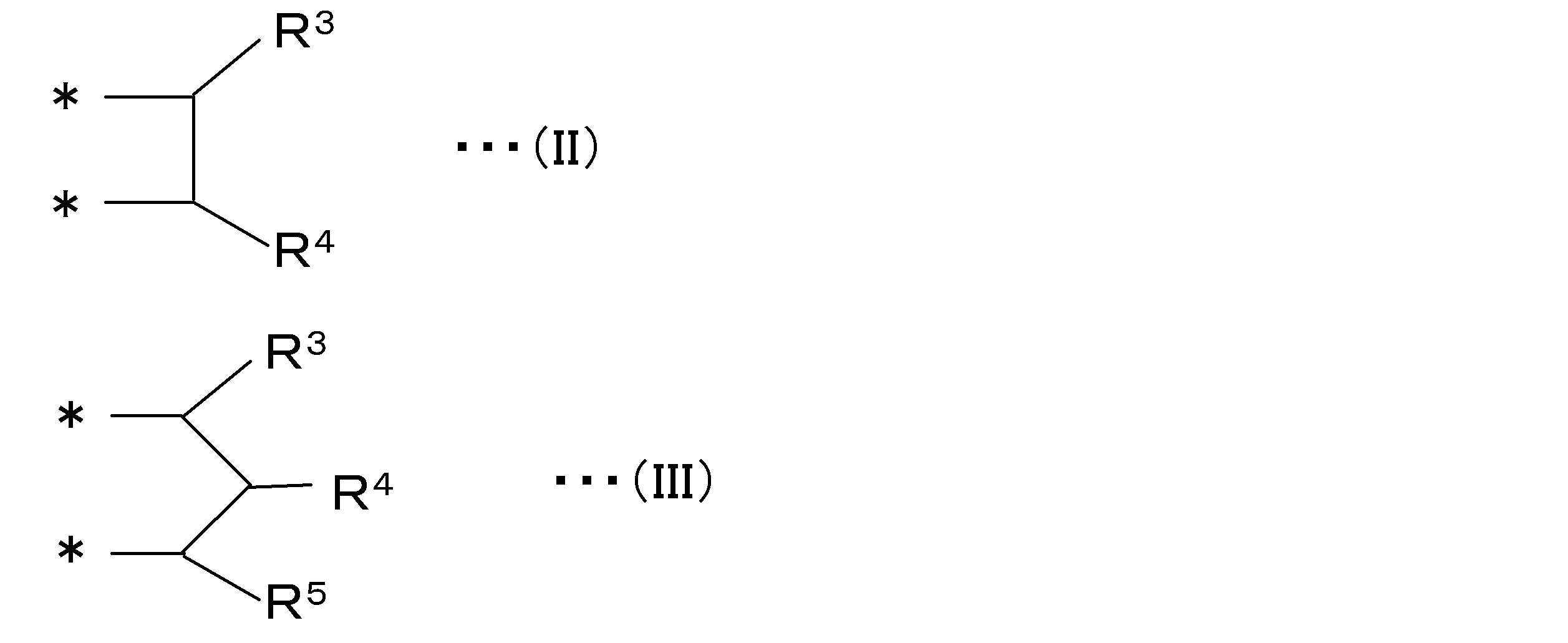
で表される基であることが好ましい。即ち、上述した化合物から水酸基を2つ除いた残基は、上記一般式(II)または(III)で表される構造を有することが好ましい。Here, from the viewpoint of reducing the steric hindrance during the synthesis of the acetal compound and the hydrolysis of the acetal compound, R 2 is expressed by the following general formula (II) or (III) :.
It is preferably a group represented by. That is, it is preferable that the residue obtained by removing two hydroxyl groups from the above-mentioned compound has a structure represented by the above general formula (II) or (III).
また、抗菌剤の使用時に環境に与える負荷を低減する観点からは、R2は、水酸基を2つ以上含有する天然物から水酸基を2つ除いた残基であることが好ましい。R2が天然物から水酸基を2つ除いた残基であれば、アセタール化合物の加水分解により生成するR1CHO(ヘキサナール、2-ヘキセナールまたは3-ヘキセナール)とR2(OH)2との双方が天然物になるので、抗菌剤の使用後に残留する成分が環境に与える負荷を低減することができる。
ここで、水酸基を2つ以上含有する天然物としては、特に限定されることなく、例えば、マンニトール、ソルビトール、キシリトール、グリセリン酸、イノシトール、アラビニトール、アルブチン、サリシン、D-グルコース、L-グルコース、D-ガラクトース、D-マンノース、D-キシロース、D-フルクトース、N-アセチル-D-グルコサミン、グルコノラクトン、D-マルトース、D-セロビオース、D-スクロース、D-ラクトース、ラクトビオン酸などが挙げられる。Further, from the viewpoint of reducing the load on the environment when the antibacterial agent is used, R 2 is preferably a residue obtained by removing two hydroxyl groups from a natural product containing two or more hydroxyl groups. If R 2 is a residue obtained by removing two hydroxyl groups from a natural product, both R 1 CHO (hexanal, 2-hexenal or 3-hexenal) and R 2 (OH) 2 produced by hydrolysis of an acetal compound are used. Since is a natural product, it is possible to reduce the load on the environment of the components remaining after the use of the antibacterial agent.
Here, the natural product containing two or more hydroxyl groups is not particularly limited, and for example, mannitol, sorbitol, xylose, glyceric acid, inositol, arabinitol, arbutin, salicin, D-glucose, L-glucose, D. -Galactos, D-mannose, D-xylose, D-fructose, N-acetyl-D-glucosamine, gluconolactone, D-martose, D-cellobiose, D-sucrose, D-lactos, lactobionic acid and the like.
更に、抗菌剤の使用後に残留する成分を容易に除去し得るようにする観点からは、R2は、水酸基を2つ以上含有する水溶性化合物から水酸基を2つ除いた残基であることが好ましい。R2が水溶性化合物から水酸基を2つ除いた残基であれば、アセタール化合物の加水分解により生成するR2(OH)2が水溶性化合物となり、抗菌剤の使用後に残留する成分を水洗により容易に除去することが可能となる。
なお、抗菌剤の使用後に残留する成分を更に容易に水洗し得るようにする観点からは、上記水溶性化合物の水に対する溶解度は、25℃において10g/100g-H2O以上であることが好ましく、15g/100g-H2O以上であることがより好ましい。また、上記水溶性化合物の水に対する溶解度は、25℃において200g/100g-H2O以下であることが好ましく、180g/100g-H2O以下であることがより好ましい。
ここで、水酸基を2つ以上含有する水溶性化合物としては、特に限定されることなく、例えば、D-グルコース(91)、D-ラクトース(21)、アルブチン(13)、グルコノラクトン(50)(カッコ内の数値は水100gに対する温度25℃での溶解度[単位:g/100g-H2O]である。)などが挙げられる。Further, from the viewpoint of making it possible to easily remove the component remaining after the use of the antibacterial agent, R 2 may be a residue obtained by removing two hydroxyl groups from a water-soluble compound containing two or more hydroxyl groups. preferable. If R 2 is a residue obtained by removing two hydroxyl groups from the water-soluble compound, R 2 (OH) 2 produced by hydrolysis of the acetal compound becomes a water-soluble compound, and the components remaining after the use of the antibacterial agent are washed with water. It can be easily removed.
From the viewpoint of making it easier to wash the components remaining after the use of the antibacterial agent, the solubility of the water-soluble compound in water is preferably 10 g / 100 g-H 2 O or more at 25 ° C. , 15 g / 100 g-H 2 O or more is more preferable. The solubility of the water-soluble compound in water is preferably 200 g / 100 g-H 2 O or less, and more preferably 180 g / 100 g-H 2 O or less at 25 ° C.
Here, the water-soluble compound containing two or more hydroxyl groups is not particularly limited, and is, for example, D-glucose (91), D-lactose (21), arbutin (13), gluconolactone (50). (The value in parentheses is the solubility [unit: g / 100 g-H 2 O] in 100 g of water at a temperature of 25 ° C.).
また、臭気の発生を十分に抑制する観点からは、R2の炭素数は、2以上であることが好ましく、6以上であることがより好ましい。R2の炭素数が上記下限値以上であれば、アセタール化合物の揮発性を低下させて、臭気の発生を十分に抑制することができる。なお、アセタール化合物およびアセタール化合物の加水分解により生成するR2(OH)2の水溶性を高める観点からは、R2の炭素数は、60以下であることが好ましく、30以下であることがより好ましい。Further, from the viewpoint of sufficiently suppressing the generation of odor, the carbon number of R 2 is preferably 2 or more, and more preferably 6 or more. When the carbon number of R 2 is at least the above lower limit value, the volatility of the acetal compound can be reduced and the generation of odor can be sufficiently suppressed. From the viewpoint of increasing the water solubility of the acetal compound and R 2 (OH) 2 produced by the hydrolysis of the acetal compound, the carbon number of R 2 is preferably 60 or less, more preferably 30 or less. preferable.
更に、R2は、非置換のアミノ基(-NH2)を有さないことが好ましい。R2が非置換のアミノ基(-NH2)を有するアセタール化合物は、合成時に副反応が起こり易く、合成し難いからである。Furthermore, R 2 preferably does not have an unsubstituted amino group (-NH 2 ). This is because an acetal compound having an amino group (−NH 2 ) in which R 2 is unsubstituted is likely to cause a side reaction during synthesis and is difficult to synthesize.
上述した中でも、本発明の抗菌剤に含まれるアセタール化合物としては、下記のアセタール化合物(1)~(6)が好ましい。これらのアセタール化合物は、ヘキサナール、2-ヘキセナールまたは3-ヘキセナールの徐放性に優れていると共に、臭気が少なく、更に、加水分解後に残留する成分(R2(OH)2)が高い水溶性および低い環境負荷の成分となるからである。また、アセタール化合物自体が水酸基を有していることでアセタール化合物の水溶性を確保できると共に、中性の水溶液中において加水分解せずに安定的に存在し得るからである。
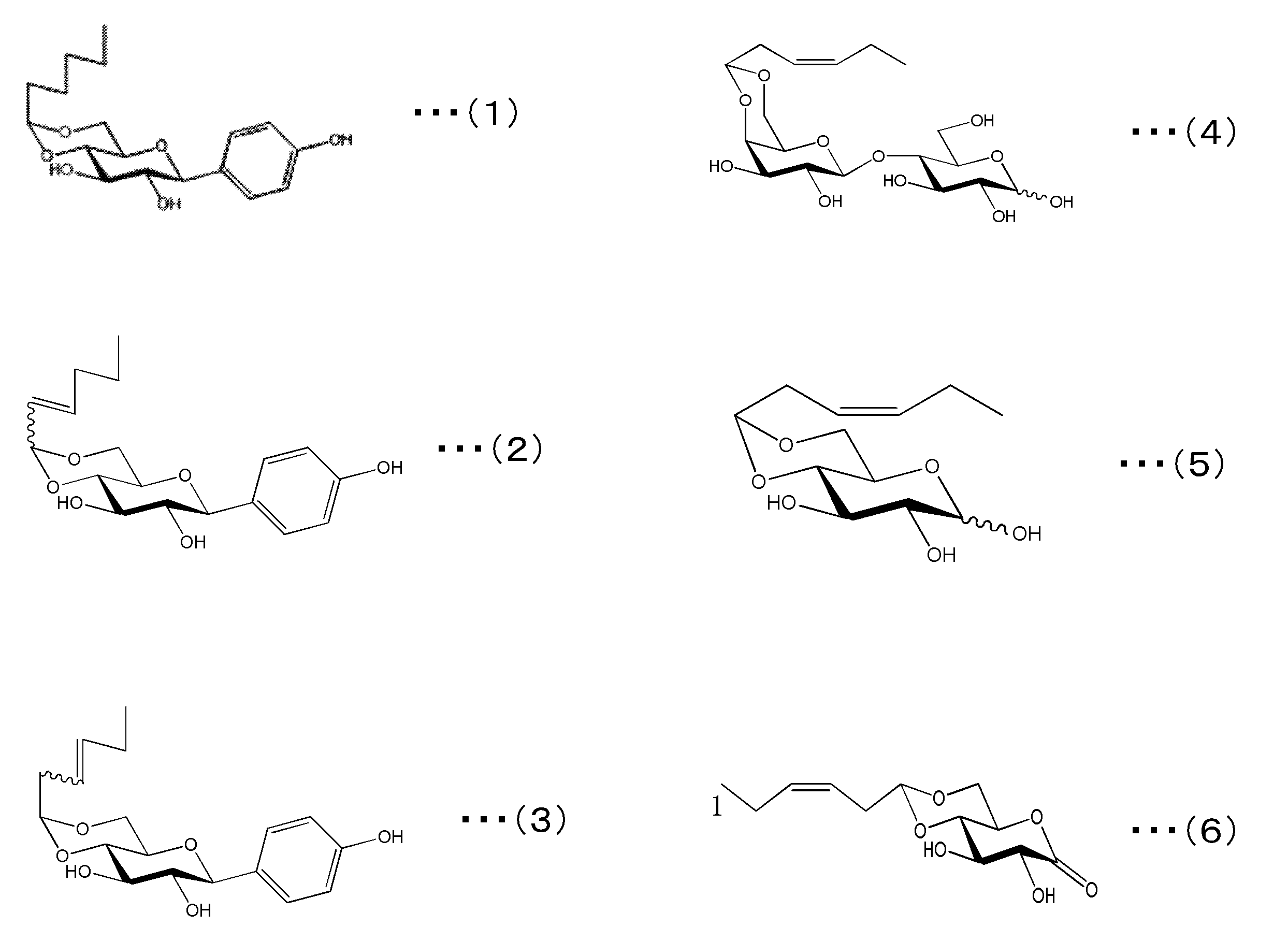
[アセタール化合物の物性]
そして、上述したアセタール化合物は、水に対する溶解度が、25℃において0.1mg/100g-H2O以上であることが好ましく、1mg/100g-H2O以上であることがより好ましく、1g/100g-H2O以上であることが更に好ましい。アセタール化合物の水に対する溶解度が上記下限値以上であれば、溶媒として水を用いた、安全性およびハンドリング性に優れる液状の抗菌剤として使用することができるからである。[Physical characteristics of acetal compounds]
The above-mentioned acetal compound preferably has a solubility in water of 0.1 mg / 100 g-H 2 O or more at 25 ° C., more preferably 1 mg / 100 g-H 2 O or more, and 1 g / 100 g. -H 2 O or more is more preferable. This is because if the solubility of the acetal compound in water is at least the above lower limit value, it can be used as a liquid antibacterial agent having excellent safety and handleability using water as a solvent.
また、上述したアセタール化合物を含む本発明の抗菌剤は、大腸菌、黄色ブドウ球菌、MRSAおよびサルモネラ菌からなる群より選択される2つ以上の菌に対するMIC(最小発育阻止濃度)が800μg/mL以下であることが好ましく、700μg/mL以下であることがより好ましい。 Further, the antibacterial agent of the present invention containing the above-mentioned acetal compound has a MIC (minimum inhibitory concentration) of 800 μg / mL or less against two or more bacteria selected from the group consisting of Escherichia coli, Staphylococcus aureus, MRSA and Salmonella. It is preferably present, and more preferably 700 μg / mL or less.
更に、上述したアセタール化合物を含む本発明の抗菌剤は、ノンエンベロームウィルスに対して、エタノール以上の不活性化能力を有することが好ましい。 Further, it is preferable that the antibacterial agent of the present invention containing the above-mentioned acetal compound has an inactivating ability higher than that of ethanol against non-envelope virus.
そして、上述したアセタール化合物は、温度25℃、湿度60%RHの条件下におけるモル半減期が、10時間以上2000時間以下であることが好ましい。 The above-mentioned acetal compound preferably has a molar half-life of 10 hours or more and 2000 hours or less under the conditions of a temperature of 25 ° C. and a humidity of 60% RH.
[アセタール化合物の含有量]
なお、本発明の抗菌剤中に含まれている上記アセタール化合物の量は、0.1質量%以上であることが好ましく、0.5質量%以上であることがより好ましく、1質量%以上であることが更に好ましく、90質量%以下であることが好ましく、50質量%以下であることがより好ましい。抗菌剤中のアセタール化合物の含有量が上記下限値以上であれば、十分に長い時間に亘って抗菌効果を発揮させることができるからである。また、抗菌剤中のアセタール化合物の含有量が上記上限値以下であれば、加水分解により放出されるヘキサナール、2-ヘキセナールまたは3-ヘキセナールの量を適度な量とし、臭気の発生を十分に抑制することができるからである。[Content of acetal compound]
The amount of the acetal compound contained in the antibacterial agent of the present invention is preferably 0.1% by mass or more, more preferably 0.5% by mass or more, and 1% by mass or more. It is more preferably 90% by mass or less, and more preferably 50% by mass or less. This is because if the content of the acetal compound in the antibacterial agent is at least the above lower limit value, the antibacterial effect can be exerted for a sufficiently long time. If the content of the acetal compound in the antibacterial agent is not more than the above upper limit, the amount of hexanal, 2-hexenal or 3-hexenal released by hydrolysis should be an appropriate amount to sufficiently suppress the generation of odor. Because it can be done.
[アセタール化合物の製造方法]
そして、上述したアセタール化合物は、特に限定されることなく、例えば、上述した一般式:R1CHOで表されるアルデヒド(ヘキサナール、cis-2-ヘキセナール、trans-2-ヘキセナール、cis-3-ヘキセナールまたはtrans-3-ヘキセナール)またはその誘導体に、酸触媒の存在下で、上述した一般式:R2(OH)2で表される化合物を縮合させることにより、調製することができる。[Method for producing acetal compound]
The above-mentioned acetal compound is not particularly limited, and for example, the above-mentioned aldehyde represented by the general formula: R 1 CHO (hexanal, cis-2-hexenal, trans-2-hexenal, cis-3-hexenal) is not particularly limited. Alternatively, it can be prepared by condensing a compound represented by the above-mentioned general formula: R 2 (OH) 2 with trans-3-hexenal) or a derivative thereof in the presence of an acid catalyst.
ここで、上述したアルデヒドの誘導体としては、例えば、酸化され易く、不安定なアルデヒドである2-ヘキセナールや3-ヘキセナールと、1価のアルコールとを縮合させてなる2-ヘキセナールジアルキルアセタールおよび3-ヘキセナールジアルキルアセタールなどが挙げられる。
また、上述した酸触媒としては、特に限定されることなく、例えば10-カンファースルホン酸などが挙げられる。
更に、上述した縮合反応は、例えばN,N-ジメチルホルムアミドなどの溶媒中で行うことができる。Here, as the above-mentioned aldehyde derivatives, for example, 2-hexenal dialkyl acetal and 3-hexenal dialkyl acetal obtained by condensing 2-hexenal or 3-hexenal, which are easily oxidized and unstable aldehydes, with a monohydric alcohol. Hexenal dialkyl acetal and the like can be mentioned.
The acid catalyst described above is not particularly limited, and examples thereof include 10-camphorsulfonic acid.
Further, the above-mentioned condensation reaction can be carried out in a solvent such as N, N-dimethylformamide.
<溶媒>
本発明の抗菌剤が任意に含有し得る溶媒としては、上述したアセタール化合物を溶解または分散可能な任意の溶媒を用いることができる。ここで、溶媒としては、特に限定されることなく、例えば、水や、エタノール等の有機溶媒が挙げられる。中でも、抗菌剤の安全性およびハンドリング性を向上させる観点からは、溶媒としては、水が好ましい。<Solvent>
As the solvent that can be arbitrarily contained by the antibacterial agent of the present invention, any solvent capable of dissolving or dispersing the above-mentioned acetal compound can be used. Here, the solvent is not particularly limited, and examples thereof include organic solvents such as water and ethanol. Above all, water is preferable as the solvent from the viewpoint of improving the safety and handleability of the antibacterial agent.
<担体>
本発明の抗菌剤が任意に含有し得る担体としては、上述したアセタール化合物を担持可能な任意の担体を用いることができる。具体的には、担体としては、特に限定されることなく、例えば、ゼオライトや活性炭などの多孔性物質、寒天やゼラチンなどのゲル状物質、濾紙等の紙、不織布および織布を用いることができる。
なお、アセタール化合物を担体に担持させる方法としては、含浸または混合分散などの既知の方法を用いることができる。<Carrier>
As the carrier that can be arbitrarily contained by the antibacterial agent of the present invention, any carrier that can support the above-mentioned acetal compound can be used. Specifically, the carrier is not particularly limited, and for example, a porous substance such as zeolite or activated carbon, a gel-like substance such as agar or gelatin, paper such as filter paper, a non-woven fabric, or a woven fabric can be used. ..
As a method for supporting the acetal compound on the carrier, a known method such as impregnation or mixed dispersion can be used.
<添加剤>
本発明の抗菌剤が任意に含有し得る添加剤としては、特に限定されることなく、例えば、界面活性剤、着色剤、粘度調整剤、酸化防止剤、pH調整剤等を挙げることができる。<Additives>
The additive that can be arbitrarily contained by the antibacterial agent of the present invention is not particularly limited, and examples thereof include a surfactant, a colorant, a viscosity regulator, an antioxidant, and a pH adjuster.
(抗菌方法)
本発明の抗菌方法は、上述した本発明の抗菌剤を用いることを特徴とし、例えば、本発明の抗菌剤に抗菌効果を発揮させて抗菌対象物を抗菌処理する際に用いられる。
なお、本発明の抗菌方法で抗菌処理される抗菌対象物は、通常はヒト以外の物であり、好ましくはヒト以外の動植物または非生物(例えば、製品)であり、より好ましくは非生物(例えば、製品)である。(Antibacterial method)
The antibacterial method of the present invention is characterized by using the above-mentioned antibacterial agent of the present invention, and is used, for example, when the antibacterial agent of the present invention exerts an antibacterial effect to treat an antibacterial object.
The antibacterial object to be antibacterial treated by the antibacterial method of the present invention is usually a non-human substance, preferably a non-human animal or plant or an abiotic component (for example, a product), and more preferably an abiotic substance (for example, a product). , Product).
そして、本発明の抗菌方法は、上述した一般式(I)で表されるアセタール化合物を加水分解する工程(加水分解工程)を含み、抗菌剤中に含まれているアセタール化合物を加水分解し、抗菌成分として上記R1CHO(ヘキサナール、2-ヘキセナールまたは3-ヘキセナール)を生成させることにより、抗菌効果を得る。The antibacterial method of the present invention includes a step of hydrolyzing the acetal compound represented by the above-mentioned general formula (I) (hydrolysis step), and hydrolyzes the acetal compound contained in the antibacterial agent. An antibacterial effect is obtained by producing the above R 1 CHO (hexanal, 2-hexenal or 3-hexenal) as an antibacterial component.
なお、ヘキサナール、2-ヘキセナールおよび3-ヘキセナールは、揮発性を有する化合物であるため、本発明の抗菌方法では、例えば、抗菌対象物に本発明の抗菌剤を直接接触させた後、或いは、抗菌対象物の周囲に本発明の抗菌剤を配置した後に加水分解工程を実施することで、抗菌対象物を抗菌することができる。 Since hexanal, 2-hexenal and 3-hexenal are volatile compounds, in the antibacterial method of the present invention, for example, after the antibacterial agent of the present invention is directly contacted with an antibacterial object, or antibacterial. By carrying out the hydrolysis step after arranging the antibacterial agent of the present invention around the object, the antibacterial object can be antibacterial.
ここで、抗菌対象物に本発明の抗菌剤を直接接触させる方法としては、特に限定されることなく、例えば、アセタール化合物を溶媒に溶解または分散させてなる液状の抗菌剤を抗菌対象物に塗布または散布し、任意に塗布または散布した抗菌剤を乾燥させる方法、および、アセタール化合物を担体に担持してなる固体状の抗菌剤を抗菌対象物に接触させる方法などが挙げられる。
また、抗菌対象物の周囲に本発明の抗菌剤を配置する方法としては、特に限定されることなく、例えば、アセタール化合物を溶媒に溶解または分散させてなる液状の抗菌剤を抗菌対象物の周囲に塗布または散布し、任意に塗布または散布した抗菌剤を乾燥させる方法、および、アセタール化合物を担体に担持してなる固体状の抗菌剤を抗菌対象物の周囲に配置する方法などが挙げられる。Here, the method for directly contacting the antibacterial agent of the present invention with the antibacterial object is not particularly limited, and for example, a liquid antibacterial agent obtained by dissolving or dispersing an acetal compound in a solvent is applied to the antibacterial object. Alternatively, a method of spraying and optionally applying or spraying the antibacterial agent to dry, a method of bringing a solid antibacterial agent carrying an acetal compound on a carrier into contact with an antibacterial object, and the like can be mentioned.
The method for arranging the antibacterial agent of the present invention around the antibacterial object is not particularly limited, and for example, a liquid antibacterial agent obtained by dissolving or dispersing an acetal compound in a solvent is placed around the antibacterial object. Examples thereof include a method of applying or spraying the antibacterial agent and optionally drying the applied or sprayed antibacterial agent, and a method of arranging a solid antibacterial agent in which an acetal compound is carried on a carrier around the antibacterial object.
また、アセタール化合物を加水分解する方法としては、特に限定されることなく、既知の加水分解方法を用いることができる。具体的には、アセタール化合物の加水分解は、例えば、抗菌剤中に含まれている水分または周囲環境中に存在する水分により自然に進行させてもよいし、抗菌剤に対して水を含む溶液を添加することにより進行させてもよい。また、アセタール化合物は、加水分解菌の存在下で加水分解させてもよい。
なお、アセタール化合物の加水分解は、必要に応じ、抗菌剤に対する酸の添加または抗菌剤のpHの調整により促進することができる。Further, the method for hydrolyzing the acetal compound is not particularly limited, and a known hydrolysis method can be used. Specifically, the hydrolysis of the acetal compound may proceed naturally by, for example, the water contained in the antibacterial agent or the water present in the surrounding environment, or a solution containing water with respect to the antibacterial agent. May be advanced by adding. Further, the acetal compound may be hydrolyzed in the presence of a hydrolyzing bacterium.
The hydrolysis of the acetal compound can be promoted by adding an acid to the antibacterial agent or adjusting the pH of the antibacterial agent, if necessary.
以下、本発明について実施例に基づき具体的に説明するが、本発明はこれら実施例に限定されるものではない。 Hereinafter, the present invention will be specifically described based on examples, but the present invention is not limited to these examples.
(化合物1の合成)
2つ口反応器に一般式:R2(OH)2で表される化合物としてのアルブチン1.0g(3.67mmol)を加え、溶媒としてのN,N-ジメチルホルムアミド(DMF)40mLに溶解させた。次いで、得られた溶液に対し、一般式:R1CHOで表されるアルデヒドとしてのヘキサナール3.67g(36.7mmol)および酸触媒としての10-カンファースルホン酸0.171g(0.734mmol)を加え、50℃にて2時間反応させた。
そして、反応終了後、飽和重曹水80mLを加え、酢酸エチル100mLで有機層を抽出した。また、抽出した有機層を無水硫酸ナトリウムで乾燥させた後、ロータリーエバポレーターで濃縮し、シリカゲルカラムクロマトグラフィー(酢酸エチル: ヘキサン=1:1(体積比))により精製することで、0.782gの白色固体を得た(収率:62.9mol%)。
なお、白色固体を核磁気共鳴(NMR)法で分析したところ、以下のアセタール化合物(化合物1)であることが確認された。

Add 1.0 g (3.67 mmol) of arbutin as a compound represented by the general formula: R 2 (OH) 2 to a two-mouth reactor and dissolve it in 40 mL of N, N-dimethylformamide (DMF) as a solvent. rice field. Then, to the obtained solution, 3.67 g (36.7 mmol) of hexanal as an aldehyde represented by the general formula: R 1 CHO and 0.171 g (0.734 mmol) of 10-camphorsulfonic acid as an acid catalyst were added. In addition, the reaction was carried out at 50 ° C. for 2 hours.
After completion of the reaction, 80 mL of saturated aqueous sodium hydrogen carbonate was added, and the organic layer was extracted with 100 mL of ethyl acetate. Further, the extracted organic layer is dried with anhydrous sodium sulfate, concentrated by a rotary evaporator, and purified by silica gel column chromatography (ethyl acetate: hexane = 1: 1 (volume ratio)) to obtain 0.782 g. A white solid was obtained (yield: 62.9 mol%).
When the white solid was analyzed by a nuclear magnetic resonance (NMR) method, it was confirmed that it was the following acetal compound (Compound 1).
(化合物2の合成)
2つ口反応器に一般式:R2(OH)2で表される化合物としてのアルブチン1.0g(3.67mmol)を加え、溶媒としてのN,N-ジメチルホルムアミド(DMF)10mLに溶解させた。次いで、得られた溶液に対し、一般式:R1CHOで表されるアルデヒドであるcis-3-ヘキセナールの誘導体としてのcis-3-ヘキセナールジエチルアセタール1.26g(7.31mmol)および酸触媒としての10-カンファースルホン酸0.171g(0.734mmol)を加え、50℃にて1時間反応させた。
そして、反応終了後、飽和重曹水80mLを加え、酢酸エチル100mLで有機層を抽出した。また、抽出した有機層を無水硫酸ナトリウムで乾燥させた後、ロータリーエバポレーターで濃縮し、シリカゲルカラムクロマトグラフィー(酢酸エチル: ヘキサン=1:1(体積比))により精製することで、0.185gの白色固体を得た(収率:13.6mol%)。
なお、白色固体を核磁気共鳴(NMR)法で分析したところ、以下のアセタール化合物(化合物2)であることが確認された。
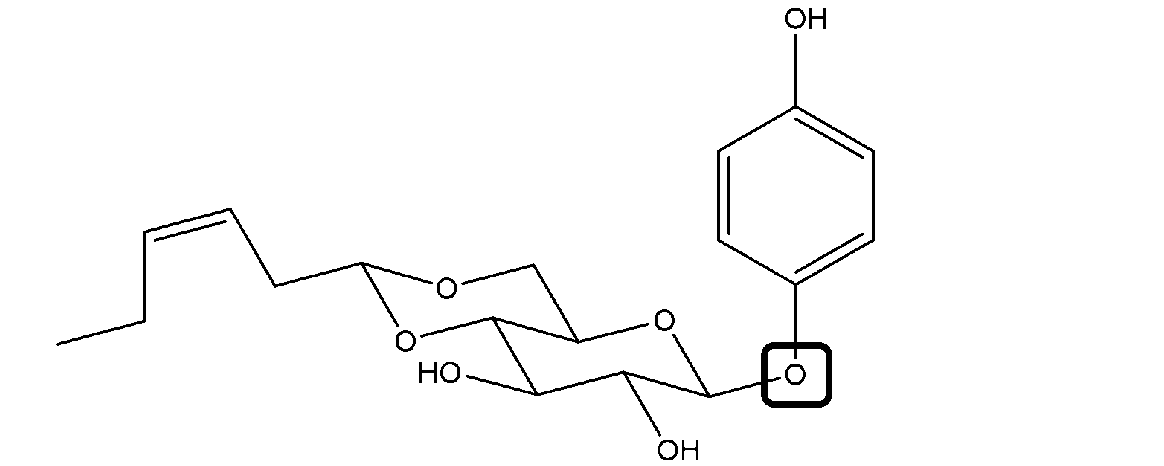
Add 1.0 g (3.67 mmol) of arbutin as a compound represented by the general formula: R 2 (OH) 2 to a two-mouth reactor and dissolve it in 10 mL of N, N-dimethylformamide (DMF) as a solvent. rice field. Then, with respect to the obtained solution, 1.26 g (7.31 mmol) of cis-3-hexenal diethyl acetal as a derivative of cis-3-hexenal, which is an aldehyde represented by the general formula: R 1 CHO, and as an acid catalyst. 0.171 g (0.734 mmol) of 10-camphorsulfonic acid was added, and the mixture was reacted at 50 ° C. for 1 hour.
After completion of the reaction, 80 mL of saturated aqueous sodium hydrogen carbonate was added, and the organic layer was extracted with 100 mL of ethyl acetate. Further, the extracted organic layer is dried with anhydrous sodium sulfate, concentrated by a rotary evaporator, and purified by silica gel column chromatography (ethyl acetate: hexane = 1: 1 (volume ratio)) to obtain 0.185 g. A white solid was obtained (yield: 13.6 mol%).
When the white solid was analyzed by a nuclear magnetic resonance (NMR) method, it was confirmed that it was the following acetal compound (Compound 2).
(実施例1)
サンプル瓶に化合物1を0.05g量りとり、エタノールを4.95g加えて溶解させた。直径40mmのろ紙(0.14g)を準備し、得られた溶液(濃度:1質量%)にろ紙を含浸させた後に乾燥する操作を繰り返し、ろ紙に化合物1を0.05g担持させた。次に、化合物1を担持させたろ紙を、直径90mmのシャーレに調製したポテトデキストロース寒天培地に密着させ、その後、クロコウジカビ、アオカビ、ケトミウム、ミロテシウムの混合胞子懸濁液を吹き付けた。そして、温度26±2℃で2週間培養し、菌糸の発育の様子を観察したところ、菌糸の発育は認められなかった。
なお、培養の前後で臭気の強さを確認したところ、培養前は臭気が認められず、培養後はアルデヒド単体と比較して程よい芳香性を発する程度であった。
抗菌性および臭気の確認結果を表1に纏めて示す。(Example 1)
0.05 g of Compound 1 was weighed in a sample bottle, and 4.95 g of ethanol was added to dissolve the compound 1. A filter paper (0.14 g) having a diameter of 40 mm was prepared, the obtained solution (concentration: 1% by mass) was impregnated with the filter paper, and then the drying operation was repeated, and 0.05 g of Compound 1 was supported on the filter paper. Next, the filter paper carrying the compound 1 was brought into close contact with a potato dextrose agar medium prepared in a petri dish having a diameter of 90 mm, and then a mixed spore suspension of Aspergillus niger, Penicillium, Ketomium, and Milotesium was sprayed. Then, when the cells were cultured at a temperature of 26 ± 2 ° C. for 2 weeks and the growth of hyphae was observed, no growth of hyphae was observed.
When the strength of the odor was confirmed before and after the culture, no odor was observed before the culture, and after the culture, the odor was moderately fragrant as compared with the aldehyde alone.
Table 1 summarizes the confirmation results of antibacterial properties and odors.
(実施例2)
化合物1に替えて化合物2を用いた以外は実施例1と同様にして化合物2を担持させたろ紙を調製し、菌糸の発育の様子を観察したところ、菌糸の発育は認められなかった。
なお、培養の前後で臭気の強さを確認したところ、培養前は臭気が認められず、培養後はアルデヒド単体と比較して程よい芳香性を発する程度であった。
抗菌性および臭気の確認結果を表1に纏めて示す。(Example 2)
A filter paper on which compound 2 was supported was prepared in the same manner as in Example 1 except that compound 2 was used instead of compound 1, and the growth of hyphae was observed. As a result, no growth of hyphae was observed.
When the strength of the odor was confirmed before and after the culture, no odor was observed before the culture, and after the culture, the odor was moderately fragrant as compared with the aldehyde alone.
Table 1 summarizes the confirmation results of antibacterial properties and odors.
(比較例1)
化合物1を使用せず、エタノールにろ紙を含浸させた後に乾燥する操作を繰り返して得たろ紙を使用した以外は実施例1と同様にして菌糸の発育の様子を観察したところ、ろ紙面積の1/3を超える範囲で菌糸の発育が観察された。
なお、培養の前後で臭気の強さを確認したところ、培養前および培養後の双方で臭気が認められなかった。
抗菌性および臭気の確認結果を表1に纏めて示す。(Comparative Example 1)
When the growth of hyphae was observed in the same manner as in Example 1 except that the filter paper obtained by repeating the operation of impregnating ethanol with the filter paper and then drying was used without using the compound 1, the filter paper area was 1 Growth of hyphae was observed in the range exceeding / 3.
When the strength of the odor was confirmed before and after the culture, no odor was observed both before and after the culture.
Table 1 summarizes the confirmation results of antibacterial properties and odors.
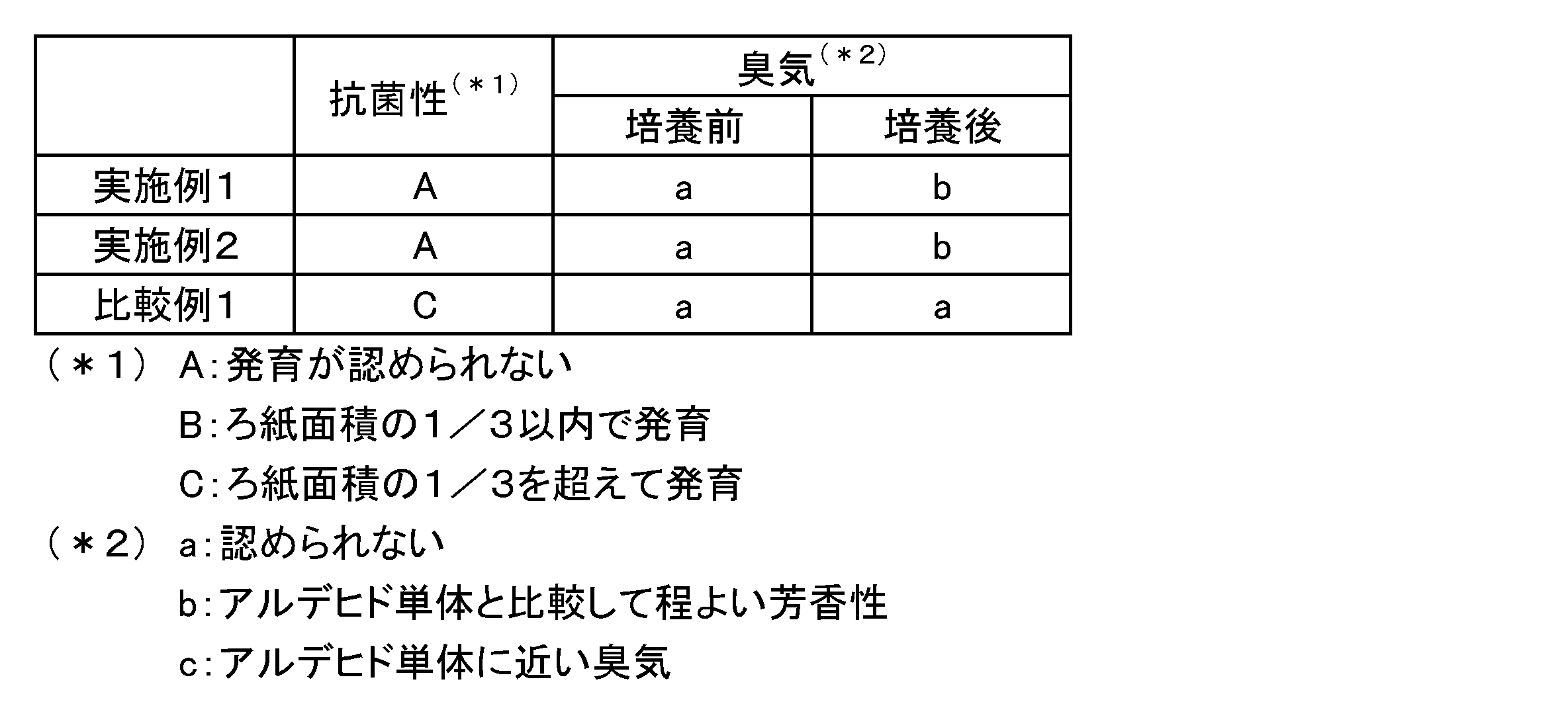
実施例1~2および比較例1より、本発明の抗菌剤によれば、臭気を抑制しつつ、抗菌効果を持続的に得ることが可能であることが分かる。 From Examples 1 and 2 and Comparative Example 1, it can be seen that the antibacterial agent of the present invention can sustainably obtain an antibacterial effect while suppressing an odor.
本発明によれば、抗菌成分としてヘキサナール、2-ヘキセナールまたは3-ヘキセナールを放出可能であり、更に、臭気が抑制され、且つ、抗菌効果の持続性にも優れた抗菌剤を提供することができる。
また、本発明によれば、臭気を抑制しつつ、ヘキサナール、2-ヘキセナールまたは3-ヘキセナールを徐放させて抗菌効果を持続的に得ることができる。According to the present invention, it is possible to provide an antibacterial agent capable of releasing hexanal, 2-hexenal or 3-hexenal as an antibacterial component, further suppressing odor, and having an excellent duration of antibacterial effect. ..
Further, according to the present invention, the antibacterial effect can be continuously obtained by slowly releasing hexanal, 2-hexenal or 3-hexenal while suppressing the odor.
Claims (2)

R1は、n-ペンチル基、1-ペンテニル基または2-ペンテニル基であり、
R2は、下記の一般式(III):
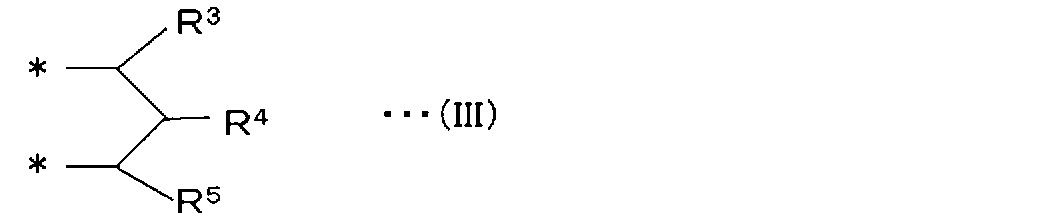
で表される基であり、かつ、アルブチンから水酸基を2つ除いた残基である。]
で表されるアセタール化合物を含む、抗菌剤。 The following general formula (I):
R 1 is an n-pentyl group, a 1-pentenyl group or a 2-pentenyl group.
R 2 is the following general formula (III):
It is a group represented by and is a residue obtained by removing two hydroxyl groups from arbutin. ]
An antibacterial agent containing an acetal compound represented by.
Applications Claiming Priority (3)
| Application Number | Priority Date | Filing Date | Title |
|---|---|---|---|
| JP2016091706 | 2016-04-28 | ||
| JP2016091706 | 2016-04-28 | ||
| PCT/JP2017/016251 WO2017188195A1 (en) | 2016-04-28 | 2017-04-24 | Antibacterial agent and antibacterial treatment method |
Publications (2)
| Publication Number | Publication Date |
|---|---|
| JPWO2017188195A1 JPWO2017188195A1 (en) | 2019-03-07 |
| JP6996498B2 true JP6996498B2 (en) | 2022-01-17 |
Family
ID=60160439
Family Applications (1)
| Application Number | Title | Priority Date | Filing Date |
|---|---|---|---|
| JP2018514590A Active JP6996498B2 (en) | 2016-04-28 | 2017-04-24 | Antibacterial agents and antibacterial methods |
Country Status (2)
| Country | Link |
|---|---|
| JP (1) | JP6996498B2 (en) |
| WO (1) | WO2017188195A1 (en) |
Families Citing this family (2)
| Publication number | Priority date | Publication date | Assignee | Title |
|---|---|---|---|---|
| KR102090101B1 (en) * | 2019-06-18 | 2020-03-17 | 주식회사 테코자임 | Oral composition for preventation or treatment of oral disease |
| JP7547785B2 (en) * | 2020-05-25 | 2024-09-10 | Toppanホールディングス株式会社 | Antibacterial Films and Packaging Materials |
Citations (4)
| Publication number | Priority date | Publication date | Assignee | Title |
|---|---|---|---|---|
| WO1995011899A1 (en) | 1993-10-25 | 1995-05-04 | Shell Internationale Research Maatschappij B.V. | Pyrimidine derivatives |
| JP2002128610A (en) | 2000-10-17 | 2002-05-09 | Kao Corp | Antibacterial and antifungal agent |
| JP2013526604A (en) | 2010-05-23 | 2013-06-24 | 高砂香料工業株式会社 | Antibacterial composition |
| JP2014534967A (en) | 2011-10-20 | 2014-12-25 | アニトックス コーポレーション | Antimicrobial formulation containing pelargonic acid |
Family Cites Families (5)
| Publication number | Priority date | Publication date | Assignee | Title |
|---|---|---|---|---|
| DD130907A1 (en) * | 1977-04-25 | 1978-05-17 | Horst Lyr | MEANS OF DAMAGING IN CROP PROTECTION AND STORAGE PROTECTION |
| JPH07187977A (en) * | 1993-12-24 | 1995-07-25 | Lion Corp | Oral composition |
| JP2001302475A (en) * | 2000-04-24 | 2001-10-31 | Lion Corp | Oral composition |
| JP5458261B2 (en) * | 2006-07-12 | 2014-04-02 | 独立行政法人国立高等専門学校機構 | Sustained release agent |
| SG139587A1 (en) * | 2006-07-28 | 2008-02-29 | Givaudan Sa | Method of using organic compounds |
-
2017
- 2017-04-24 WO PCT/JP2017/016251 patent/WO2017188195A1/en not_active Ceased
- 2017-04-24 JP JP2018514590A patent/JP6996498B2/en active Active
Patent Citations (4)
| Publication number | Priority date | Publication date | Assignee | Title |
|---|---|---|---|---|
| WO1995011899A1 (en) | 1993-10-25 | 1995-05-04 | Shell Internationale Research Maatschappij B.V. | Pyrimidine derivatives |
| JP2002128610A (en) | 2000-10-17 | 2002-05-09 | Kao Corp | Antibacterial and antifungal agent |
| JP2013526604A (en) | 2010-05-23 | 2013-06-24 | 高砂香料工業株式会社 | Antibacterial composition |
| JP2014534967A (en) | 2011-10-20 | 2014-12-25 | アニトックス コーポレーション | Antimicrobial formulation containing pelargonic acid |
Non-Patent Citations (2)
| Title |
|---|
| DUSHIN, R. G. et al.,Journal of Medicinal Chemistry,2004年,Vol. 47,pp. 3487-3490 |
| PUGACHEV, M. V. et al.,Bioorganic & Medicinal Chemistry,2013年,Vol. 21,pp. 7330-7342 |
Also Published As
| Publication number | Publication date |
|---|---|
| JPWO2017188195A1 (en) | 2019-03-07 |
| WO2017188195A1 (en) | 2017-11-02 |
Similar Documents
| Publication | Publication Date | Title |
|---|---|---|
| EP2350035B1 (en) | Reduction of hmf ethers with metal catalyst | |
| DE69534385T2 (en) | PERFECT RELEASE PERFUME AND METHOD FOR DETECTING MICROORGANISMS THROUGH THIS PERFUME | |
| JP6996498B2 (en) | Antibacterial agents and antibacterial methods | |
| EP1053989A2 (en) | Hydroxydiphenyl ether compounds | |
| CN101270032B (en) | Method for preparing 1,5-pentanediol | |
| CN114950505B (en) | Catalyst for preparing beta-phenethyl alcohol by hydrogenation of styrene oxide, and preparation method and application thereof | |
| JP2023513612A (en) | 3'-Ketoglycoside compounds for slow release of volatile alcohols | |
| JP6660391B2 (en) | Fungicidal composition containing acetal or long-chain alkylhexytan ether | |
| US20210309937A1 (en) | Process For Producing Metal Organic Frameworks | |
| KR101765802B1 (en) | Method of deodorizing 1,2-alkane diols | |
| KR20190023466A (en) | High purity 1,3-butanediol and its preparation method | |
| CN113445315A (en) | Preparation method of diphenolic acid antibacterial cotton fabric | |
| CN103030560A (en) | Catalyzing and decoloring integrated method for synthesizing environment-friendly plasticizer triethylhexyl (2-propylheptyl) citrate | |
| Rubiyanto | Heterogeneous catalytic conversion of citronellal into isopulegol and menthol: literature review | |
| EP3389731B1 (en) | Antibacterial composition containing a deoxyhexose alkyl monoacetal or monoether | |
| JPS58981A (en) | Water-soluble porphyrin derivative | |
| US6346260B1 (en) | Microbicidal active ingredients | |
| KR20240004735A (en) | Method for preparing aliphatic polyols having at least 3 hydroxy groups and a total number of carbon atoms at least 5 | |
| CN119584860A (en) | Compositions comprising biodegradable microcapsules | |
| JP6668354B2 (en) | Antimicrobial composition containing monosaccharide alkyl monoacetal or monoether isomer mixture | |
| KR20120105547A (en) | Shaped body containing carbohydrate partial esters | |
| US10183923B2 (en) | Method for synthesizing a precursor of a single dairy-lactone isomer | |
| CN113826623A (en) | Bio-based disinfectant and preparation method | |
| CN111440674A (en) | Liquid detergent with mite removing effect | |
| CN112941129B (en) | Method for synthesizing sucrose ester by catalyzing with amorphous sucrase |
Legal Events
| Date | Code | Title | Description |
|---|---|---|---|
| A621 | Written request for application examination |
Free format text: JAPANESE INTERMEDIATE CODE: A621 Effective date: 20200402 |
|
| A131 | Notification of reasons for refusal |
Free format text: JAPANESE INTERMEDIATE CODE: A131 Effective date: 20210427 |
|
| A521 | Request for written amendment filed |
Free format text: JAPANESE INTERMEDIATE CODE: A523 Effective date: 20210615 |
|
| TRDD | Decision of grant or rejection written | ||
| A01 | Written decision to grant a patent or to grant a registration (utility model) |
Free format text: JAPANESE INTERMEDIATE CODE: A01 Effective date: 20211116 |
|
| A61 | First payment of annual fees (during grant procedure) |
Free format text: JAPANESE INTERMEDIATE CODE: A61 Effective date: 20211129 |
|
| R150 | Certificate of patent or registration of utility model |
Ref document number: 6996498 Country of ref document: JP Free format text: JAPANESE INTERMEDIATE CODE: R150 |
|
| R250 | Receipt of annual fees |
Free format text: JAPANESE INTERMEDIATE CODE: R250 |
|
| R250 | Receipt of annual fees |
Free format text: JAPANESE INTERMEDIATE CODE: R250 |