JP6996419B2 - Epidermis material - Google Patents
Epidermis material Download PDFInfo
- Publication number
- JP6996419B2 JP6996419B2 JP2018098996A JP2018098996A JP6996419B2 JP 6996419 B2 JP6996419 B2 JP 6996419B2 JP 2018098996 A JP2018098996 A JP 2018098996A JP 2018098996 A JP2018098996 A JP 2018098996A JP 6996419 B2 JP6996419 B2 JP 6996419B2
- Authority
- JP
- Japan
- Prior art keywords
- skin material
- fiber
- less
- skin
- fibers
- Prior art date
- Legal status (The legal status is an assumption and is not a legal conclusion. Google has not performed a legal analysis and makes no representation as to the accuracy of the status listed.)
- Active
Links
Images

Landscapes
- Nonwoven Fabrics (AREA)
- Seats For Vehicles (AREA)
- Vehicle Step Arrangements And Article Storage (AREA)
Description
本発明は、表皮材に関する。 The present invention relates to a skin material.
自動車等の内装物品には、本革、合皮、編物、織物、不織布等が表皮として用いられている場合ある。
ところが、これらの表皮は、近赤外線の反射に対して、とりわけ優れた反射性能を有するものではない。
このため、例えば、自動車の窓ガラスから太陽光線が入射すると、太陽光の近赤外線は内装物品に多くが吸収されて、熱エネルギーとして蓄積される。よって、内装物品の温度が上昇してしまい、手で触ることが困難な程に高温となる場合もある。
また、温度が上昇した内装物品を冷却するためにエアコンが使われ、これによりエアコンの効率の低下、ひいては自動車のエネルギー消費効率が低下してしまう。
そこで、内装物品等の各種物品の温度上昇を抑制するために、表皮材について種々の検討が行われている(特許文献1参照)。
Genuine leather, synthetic leather, knitted fabrics, woven fabrics, non-woven fabrics and the like may be used as the outer skin of interior articles such as automobiles.
However, these epidermis do not have particularly excellent reflection performance with respect to the reflection of near infrared rays.
Therefore, for example, when sunlight is incident from the window glass of an automobile, most of the near infrared rays of sunlight are absorbed by the interior articles and stored as heat energy. Therefore, the temperature of the interior article may rise to such a high temperature that it is difficult to touch it by hand.
In addition, an air conditioner is used to cool an interior article whose temperature has risen, which reduces the efficiency of the air conditioner and, in turn, the energy consumption efficiency of the automobile.
Therefore, in order to suppress the temperature rise of various articles such as interior articles, various studies have been conducted on the skin material (see Patent Document 1).
しかし、従来の技術では、各種物品の温度上昇を抑制する効果は、必ずしも十分でなく、更なる性能の向上が求められていた。
また、従来技術として、近赤外線の反射率の向上のために、酸化チタン等の添加物を繊維に練り込む技術、又は酸化チタン等の添加物を繊維に担持させる技術が知られている。ところが、分割糸等の細糸を用いる場合には、添加物の練り込みが困難であるという課題や、添加物を担持させても添加物が脱落するという課題があった。
本発明は、上記実情に鑑みてなされたものであり、従来技術の課題を解決しつつ、各種物品の温度上昇を抑制することを目的とする。本発明は、以下の形態として実現することが可能である。
However, in the conventional technique, the effect of suppressing the temperature rise of various articles is not always sufficient, and further improvement in performance has been required.
Further, as a conventional technique, a technique of kneading an additive such as titanium oxide into a fiber or a technique of supporting an additive such as titanium oxide on a fiber is known in order to improve the reflectance of near infrared rays. However, when a fine yarn such as a split yarn is used, there is a problem that it is difficult to knead the additive and there is a problem that the additive falls off even if the additive is supported.
The present invention has been made in view of the above circumstances, and an object of the present invention is to suppress a temperature rise of various articles while solving the problems of the prior art. The present invention can be realized as the following forms.
〔1〕表皮材であって、
カーボンブラックを含まず、かつ単繊維径が1μmより大きく5μm以下の繊維が含まれた繊維集合体を備えており、
前記表皮材をX線CTで観察して得られた画像から、1辺が0.1~0.5mmの立方体を切り出して、前記立方体の全体の体積を100%とした場合に、前記立方体に含まれる前記単繊維径が1μmより大きく5μm以下の繊維が占有する体積の割合である体積率は3%以上20%以下であり、かつ
Z軸方向の配向テンソルが0.42以下であることを特徴とする表皮材。
[1] It is a skin material and is
It has a fiber aggregate that does not contain carbon black and contains fibers having a single fiber diameter of more than 1 μm and 5 μm or less.
When a cube having a side of 0.1 to 0.5 mm is cut out from an image obtained by observing the skin material by X-ray CT and the total volume of the cube is set to 100%, the cube is formed. The volume fraction, which is the ratio of the volume occupied by the fibers having a single fiber diameter of more than 1 μm and 5 μm or less, is 3% or more and 20% or less, and the orientation tensor in the Z-axis direction is 0.42 or less. Characteristic skin material.
〔2〕近赤外線反射性を有することを特徴とする〔1〕に記載の表皮材。 [2] The skin material according to [1], which has near-infrared ray reflectivity.
〔3〕前記繊維集合体は、編物、織物、スパンボンド不織布、メルトブロー不織布、ニードルパンチ不織布、及び植毛シートからなる群より選択される少なくとも1種であることを特徴とする〔1〕又は〔2〕のいずれか1項に記載の表皮材。 [3] The fiber aggregate is at least one selected from the group consisting of knitted fabrics, woven fabrics, spunbonded nonwoven fabrics, melt blow nonwoven fabrics, needle punched nonwoven fabrics, and flocked sheets [1] or [2]. ] The skin material according to any one of the items.
〔4〕前記単繊維径が1μmより大きく5μm以下の繊維は、合成繊維であることを特徴とする〔1〕~〔3〕のいずれか1項に記載の表皮材。 [4] The skin material according to any one of [1] to [3], wherein the fiber having a single fiber diameter of more than 1 μm and 5 μm or less is a synthetic fiber.
〔5〕自動車のドアトリムの表皮として用いられることを特徴とする〔1〕~〔4〕のいずれか1項に記載の表皮材。 [5] The skin material according to any one of [1] to [4], which is used as the skin of an automobile door trim.
〔6〕自動車のパッケージトレイの表皮として用いられることを特徴とする〔1〕~〔4〕のいずれか1項に記載の表皮材。 [6] The skin material according to any one of [1] to [4], which is used as the skin of an automobile package tray.
〔7〕自動車のシート基材の表皮として用いられることを特徴とする〔1〕~〔4〕のいずれか1項に記載の表皮材。 [7] The skin material according to any one of [1] to [4], which is used as a skin of a seat base material of an automobile.
本発明によれば、各種物品の温度上昇を抑制する表皮材を提供することができる。 According to the present invention, it is possible to provide a skin material that suppresses a temperature rise of various articles.
本発明について、本発明による典型的な実施形態の非限定的な例を挙げ、言及された複数の図面を参照しつつ以下の詳細な記述にて更に説明する。
ここで示される事項は例示的なものおよび本発明の実施形態を例示的に説明するためのものであり、本発明の原理と概念的な特徴とを最も有効に且つ難なく理解できる説明であると思われるものを提供する目的で述べたものである。この点で、本発明の根本的な理解のために必要である程度以上に本発明の構造的な詳細を示すことを意図してはおらず、図面と合わせた説明によって本発明の幾つかの形態が実際にどのように具現化されるかを当業者に明らかにするものである。 The matters shown here are for illustrative purposes and embodiments of the present invention, and are the most effective and effortless explanations for understanding the principles and conceptual features of the present invention. It is stated for the purpose of providing what seems to be. In this regard, it is not intended to show structural details of the invention beyond a certain degree necessary for a fundamental understanding of the invention, and some embodiments of the invention are provided by description in conjunction with the drawings. It is intended to clarify to those skilled in the art how it is actually realized.
以下、本発明の実施形態を詳しく説明する。なお、本明細書において、数値範囲について「~」を用いた記載では、特に断りがない限り、下限値及び上限値を含むものとする。例えば、「10~20」という記載では、下限値である「10」、上限値である「20」のいずれも含むものとする。すなわち、「10~20」は、「10以上20以下」と同じ意味である。 Hereinafter, embodiments of the present invention will be described in detail. In the present specification, the description using "-" for the numerical range includes the lower limit value and the upper limit value unless otherwise specified. For example, in the description of "10 to 20", both the lower limit value "10" and the upper limit value "20" are included. That is, "10 to 20" has the same meaning as "10 or more and 20 or less".
本実施形態の表皮材は、カーボンブラックを含まず、かつ単繊維径が1μmより大きく5μm以下の繊維が含まれた繊維集合体を備える。
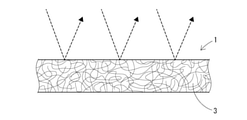
表皮材1は、図1に示すように、繊維集合体3からなるものであってもよい。
なお、表皮材1は、繊維集合体3の他に、表面に表面層を備えていてもよい。また、表皮材1は、繊維集合体3の他に、裏面に裏面層を備えていてもよい。裏面層は、例えば、バッキング層やウレタンフォーム層が好適に例示される。ここで、バッキング層は、表皮材1を補強するため、及び/又は接着剤の含侵を防ぐためのコーティング層である。
The skin material of the present embodiment includes a fiber aggregate that does not contain carbon black and contains fibers having a single fiber diameter of more than 1 μm and 5 μm or less.
As shown in FIG. 1, the
The
1.繊維
(1)カーボンブラック
本実施形態では、繊維集合体に含まれる繊維には、カーボンブラックが含まれていない。カーボンブラックが含まれると、繊維集合体の反射性能が低下するからである。
1. 1. Fiber (1) Carbon Black In the present embodiment, the fiber contained in the fiber aggregate does not contain carbon black. This is because the reflection performance of the fiber aggregate deteriorates when carbon black is contained.
(2)繊維の単繊維径
本実施形態では、繊維集合体に含まれる繊維の単繊維径は、1μmより大きく5μm以下であり、好ましくは2μm以上5μm以下である。単繊維径がこの範囲内であると、表皮材の近赤外線に対する反射性能が優れる。よって、表皮材により覆われた各種物品の温度上昇を抑制できる。
単繊維径がこの範囲内となると反射性能が優れる理由は定かではないが、単繊維径がこの範囲内となると、単繊維径が近赤外線波長と同等から数倍の領域内となり、ミー散乱と呼ばれる光の散乱現象が起きるためであると推測される。
単繊維の断面形状が丸断面以外の異形断面である場合には、外接円の直径を単繊維径とする。なお、単繊維径は、走査型電子顕微鏡で繊維の横断面を撮影することにより測定が可能である。
(2) Single fiber diameter of fiber In the present embodiment, the single fiber diameter of the fiber contained in the fiber aggregate is larger than 1 μm and 5 μm or less, preferably 2 μm or more and 5 μm or less. When the single fiber diameter is within this range, the skin material has excellent reflection performance against near infrared rays. Therefore, it is possible to suppress the temperature rise of various articles covered with the skin material.
It is not clear why the reflection performance is excellent when the single fiber diameter is within this range, but when the single fiber diameter is within this range, the single fiber diameter is within the range equal to or several times the near-infrared wavelength, and Mie scattering occurs. It is presumed that this is because a so-called light scattering phenomenon occurs.
When the cross-sectional shape of the single fiber is a modified cross section other than the round cross section, the diameter of the circumscribed circle is defined as the single fiber diameter. The single fiber diameter can be measured by photographing the cross section of the fiber with a scanning electron microscope.
(3)繊維の断面形状
単繊維径が1μmより大きく5μm以下の繊維の単糸断面形状は、特に限定されない。単糸断面形状として、丸断面、丸断面以外の異形断面が例示される。異形断面の形状としては、三角断面、四角断面、五角断面、扁平断面、楔形断面、アルファベットの各文字に類似した断面(Y型断面、C型断面、H型断面、I型断面、W型断面等)等が好適に例示される。異形断面の繊維を得る方法は、特に限定されない。例えば、〔1〕溶融紡糸時に用いる口金の形状を異形にする方法、〔2〕2種類以上のポリマーを複合紡糸して、分割することにより断面を異形にする方法がある。後者の方法により製造された繊維は、割繊糸とも呼ばれている。
本実施形態では、反射率向上の観点から、単糸断面形状としては、三角断面、扁平断面が好ましい。
なお、割繊糸を用いる場合には、予め分割した割繊糸から繊維集合体を形成してもよい。また、複数の樹脂を含む複合糸から繊維集合体の前駆体(編物、織物、又は植毛シート)を形成した後に、前駆体を化学処理して、複合糸を分割・開繊し割繊糸としてもよい。
(3) Cross-sectional shape of the fiber The cross-sectional shape of the single yarn of the fiber having a single fiber diameter of more than 1 μm and 5 μm or less is not particularly limited. Examples of the single thread cross-sectional shape include a round cross section and a deformed cross section other than the round cross section. The shapes of the irregular cross sections include triangular cross section, square cross section, pentagonal cross section, flat cross section, wedge cross section, and cross section similar to each letter of the alphabet (Y-shaped cross section, C-shaped cross section, H-shaped cross section, I-shaped cross section, W-shaped cross section. Etc.) etc. are preferably exemplified. The method for obtaining the fiber having a modified cross section is not particularly limited. For example, there are [1] a method of deforming the shape of the mouthpiece used at the time of melt spinning, and [2] a method of composite spinning two or more kinds of polymers and dividing them into a deformed cross section. The fibers produced by the latter method are also called split fiber yarns.
In the present embodiment, from the viewpoint of improving the reflectance, the single yarn cross-sectional shape is preferably a triangular cross section or a flat cross section.
When a split fiber yarn is used, a fiber aggregate may be formed from the split fiber yarn previously divided. Further, after forming a precursor (knitted fabric, woven fabric, or flocked sheet) of a fiber aggregate from a composite yarn containing a plurality of resins, the precursor is chemically treated to divide and open the composite yarn to obtain a split fiber yarn. May be good.
(4)単繊維径が1μmより大きく5μm以下でない繊維(以下、「その他の繊維」ともいう)
繊維集合体には、単繊維径が1μmより大きく5μm以下でない繊維を含んでいてもよい。但し、繊維集合体に含まれる繊維の全量を100重量部とした場合に、単繊維径が1μmより大きく5μm以下の繊維が5重量部以上含まれていることが好ましく、10重量部以上含まれていることがより好ましく、15重量部以上含まれていることが更に好ましい。単繊維径が1μmより大きく5μm以下の繊維の量がこの範囲内であると、繊維集合体の反射性能が特に優れるからである。反射性能が優れるという観点からは、繊維集合体に含まれる繊維は、単繊維径が1μmより大きく5μm以下の繊維からなることが好ましい。
(4) Fibers having a single fiber diameter larger than 1 μm and not 5 μm or less (hereinafter, also referred to as “other fibers”)
The fiber aggregate may contain fibers having a single fiber diameter of more than 1 μm and not less than 5 μm. However, when the total amount of fibers contained in the fiber aggregate is 100 parts by weight, it is preferable that 5 parts by weight or more of fibers having a single fiber diameter larger than 1 μm and 5 μm or less are contained, and 10 parts by weight or more are contained. It is more preferable that the fiber is contained in an amount of 15 parts by weight or more. This is because when the amount of fibers having a single fiber diameter larger than 1 μm and 5 μm or less is within this range, the reflection performance of the fiber aggregate is particularly excellent. From the viewpoint of excellent reflection performance, the fibers contained in the fiber aggregate are preferably composed of fibers having a single fiber diameter of more than 1 μm and 5 μm or less.
(5)繊維の材質
単繊維径が1μmより大きく5μm以下の繊維は、合成繊維、再生繊維、半合成繊維、天然繊維のいずれであってもよい。
合成繊維としては、特に限定されない。例えば、ポリエチレンテレフタレート(PET)繊維、ポリブチレンテレフタレート繊維、ポリトリメチレンテレフタレート繊維、ポリ乳酸繊維等のポリエステル系繊維;ポリアミド6繊維、ポリアミド66繊維等のポリアミド系繊維;ポリアクリル系繊維、ポリプロピレン繊維等のポリオレフィン系繊維等の各種の合成繊維を用いることができる。
これらの繊維のうちでは、汎用性が高いことから、ポリエステル系繊維(特にPET繊維)、ポリプロピレン繊維、ポリアミド6繊維が好ましい。
単繊維径が1μmより大きく5μm以下の繊維として、単一種の繊維のみならず、2種類以上の繊維を混合して用いることもできる。
なお、合成繊維は、未延伸糸でもよく、半延伸糸でもよく、これらが混合されている混合糸でもよい。
再生繊維としては、特に限定されない。例えば、セルロース系のレーヨン、精製セルロース繊維系のリヨセル等を用いることができる。レーヨンには、ポリノジック、ビスコース、キュプラレーヨン等の種類がある。
半合成繊維としては、特に限定されない。例えば、セルロース系のアセテート、たんぱく質系のプロミックス等を用いることができる。
天然繊維としては、特に限定されない。例えば、綿、麻等の植物繊維や、絹、獣毛(例えば羊毛)等の動物繊維を用いることができる。
(5) Fiber Material The fiber having a single fiber diameter larger than 1 μm and 5 μm or less may be any of synthetic fiber, regenerated fiber, semi-synthetic fiber, and natural fiber.
The synthetic fiber is not particularly limited. For example, polyester fibers such as polyethylene terephthalate (PET) fiber, polybutylene terephthalate fiber, polytrimethylene terephthalate fiber, polylactic acid fiber; polyamide fiber such as
Among these fibers, polyester fibers (particularly PET fibers), polypropylene fibers, and
As a fiber having a single fiber diameter of more than 1 μm and 5 μm or less, not only a single type of fiber but also two or more types of fibers can be mixed and used.
The synthetic fiber may be an undrawn yarn, a semi-drawn yarn, or a mixed yarn in which these are mixed.
The recycled fiber is not particularly limited. For example, cellulosic rayon, purified cellulose fiber lyocell and the like can be used. There are various types of rayon such as polynosic, viscose, and cupra rayon.
The semi-synthetic fiber is not particularly limited. For example, cellulosic acetate, protein-based promix, and the like can be used.
The natural fiber is not particularly limited. For example, plant fibers such as cotton and hemp, and animal fibers such as silk and animal hair (for example, wool) can be used.
2.繊維集合体
(1)繊維集合体の形態
繊維集合体の形態は、特に限定されない。繊維集合体は、製造容易であるという観点から、編物、織物、スパンボンド不織布、メルトブロー不織布(メルトブローン不織布)、ニードルパンチ不織布、及び植毛シートからなる群より選択される少なくとも1種であることが望ましい。
編物は、経編又は緯編のいずれであってもよい。緯編として、基本組織(平編、ゴム編、パール編)やその変化組織を例示できる。また、経編として、基本組織(デンビー編、コード編、アトラス編、鎖編)やその変化組織を例示できる。
織物の組織は特に限定されず、例えば、平織物、綾織物、朱子織物及びそれらの組み合わせ等の各種の織物とすることができる。
スパンボンド不織布は、例えば、樹脂を溶融して繊維(糸)を作り、ネット上に開繊・堆積させてウェッブを形成した後、シート状に結合させて製造される。
メルトブロー不織布は、例えば、樹脂を溶融して紡糸ノズルの周囲から噴射する高温エアにより、繊維を細くしてシート状にして製造される。
ニードルパンチ不織布は、例えば、金属製等のニードルの往復運動により、繊維相互間を交絡して製造される。
植毛シートは、例えば、シート状の基体(ベース部)に繊維を植毛して製造される。製造容易という観点から、静電植毛(フロック加工)が好適に用いられる。
2. 2. Fiber aggregate (1) Form of fiber aggregate The form of the fiber aggregate is not particularly limited. From the viewpoint of easy production, the fiber aggregate is preferably at least one selected from the group consisting of knitted fabric, woven fabric, spunbonded nonwoven fabric, melt blow nonwoven fabric (melt blown nonwoven fabric), needle punched nonwoven fabric, and flocked sheet. ..
The knit may be either a warp knit or a weft knit. As the weft, the basic structure (flat, rubber, pearl) and its changing structure can be exemplified. In addition, as the warp edition, the basic organization (Denby edition, code edition, atlas edition, chain edition) and its changing organization can be exemplified.
The structure of the woven fabric is not particularly limited, and may be, for example, various woven fabrics such as plain woven fabric, twill woven fabric, twill woven fabric, and combinations thereof.
The spunbonded nonwoven fabric is manufactured, for example, by melting a resin to form fibers (threads), opening and depositing the fibers on a net to form a web, and then bonding them in a sheet shape.
The melt-blown nonwoven fabric is manufactured, for example, by melting a resin and using high-temperature air jetted from around a spinning nozzle to thin the fibers into a sheet.
The needle punched nonwoven fabric is manufactured by entwining fibers with each other by the reciprocating motion of a needle made of metal or the like.
The flocked sheet is manufactured, for example, by flocking fibers on a sheet-shaped substrate (base portion). From the viewpoint of ease of production, electrostatic flocking (flocking) is preferably used.
(2)繊維集合体の厚み
繊維集合体の厚みは、特に限定されない。繊維集合体の厚みは、製造コストを抑え、かつ反射率を高めるとの観点から、0.1mm以上10mm以下が好ましく、0.3mm以上5mm以下がより好ましく、0.5mm以上3mm以下が更に好ましい。
(2) Thickness of fiber aggregate The thickness of the fiber aggregate is not particularly limited. The thickness of the fiber aggregate is preferably 0.1 mm or more and 10 mm or less, more preferably 0.3 mm or more and 5 mm or less, still more preferably 0.5 mm or more and 3 mm or less, from the viewpoint of suppressing the manufacturing cost and increasing the reflectance. ..
(3)繊維集合体の目付量
繊維集合体の目付量は、特に限定されない。繊維集合体の目付量は、製造コストを抑え、かつ反射率を高めるという観点から、10g/m2以上1500g/m2以下が好ましく、15g/m2以上1000g/m2以下がより好ましく、20g/m2以上500g/m2以下が更に好ましい。
(3) Metsuke amount of fiber aggregate The basis weight of fiber aggregate is not particularly limited. The basis weight of the fiber aggregate is preferably 10 g / m 2 or more and 1500 g / m 2 or less, more preferably 15 g / m 2 or more and 1000 g / m 2 or less, and more preferably 20 g, from the viewpoint of suppressing the manufacturing cost and increasing the reflectance. It is more preferably / m 2 or more and 500 g / m 2 or less.
3.表皮材
本実施形態の表皮材は、上述の繊維集合体を備えている。本実施形態では、繊維集合体の近赤外線反射性により、表皮材も近赤外線反射性を有している。
3. 3. Skin material The skin material of the present embodiment includes the above-mentioned fiber aggregate. In the present embodiment, the skin material also has near-infrared ray reflectivity due to the near-infrared ray reflectivity of the fiber aggregate.
(1)繊維が占有する体積の割合である体積率、及び配向テンソル
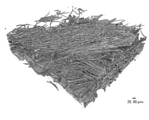
表皮材において、繊維が占有する体積の割合である体積率(以下、単に「体積率」ともいう)、及び繊維の配向状態(配向テンソル)は、次のようにして求めることができる。表皮材をさまざまな方向からX線で撮影し、コンピュータによって再構成処理を行うX線CT(Computed Tomography;コンピュータ断層撮影法)を用いて測定したデータ(例えば図3参照)から算出することができる。これにより、対象となる表皮材を非破壊で評価することができる。X線検査装置としては、例えば、(株)リガク製 nano3DXを用いることができる。解析ソフトとしては、例えば、Math2Market GmbH製 GeoDictを用いることができる。
(1) Volume fraction, which is the ratio of the volume occupied by the fiber, and the volume fraction, which is the ratio of the volume occupied by the fiber in the orientation tensor skin material (hereinafter, also simply referred to as "volume fraction"), and the orientation state of the fiber. (Orientation tensor) can be obtained as follows. It can be calculated from data (for example, see FIG. 3) measured using X-ray CT (Computed Tomography) in which the skin material is photographed with X-rays from various directions and reconstructed by a computer. .. This makes it possible to evaluate the target skin material in a non-destructive manner. As the X-ray inspection apparatus, for example, nano3DX manufactured by Rigaku Co., Ltd. can be used. As the analysis software, for example, GeoDoct manufactured by Math2Market GmbH can be used.
そして、表皮材をX線CTで観察して得られた画像から、1辺が0.1~0.5mmの立方体を切り出して、この立方体の全体の体積を100%とした場合に、立方体に含まれる単繊維径が1μmより大きく5μm以下の繊維が占有する体積の割合である体積率を求める。
この体積率は、温度上昇抑制効果の観点から、3%以上20%以下であり、4%以上18%以下が好ましく、5%以上15%以下がより好ましい。
体積率が、この範囲内であると、本実施形態の表皮材を表皮として有する物品の温度上昇が効果的に抑制される。
Then, when a cube having a side of 0.1 to 0.5 mm is cut out from an image obtained by observing the skin material by X-ray CT and the total volume of the cube is set to 100%, it becomes a cube. The volume fraction, which is the ratio of the volume occupied by the fibers having a single fiber diameter of more than 1 μm and 5 μm or less, is obtained.
From the viewpoint of the effect of suppressing temperature rise, this volume fraction is 3% or more and 20% or less, preferably 4% or more and 18% or less, and more preferably 5% or more and 15% or less.
When the volume fraction is within this range, the temperature rise of the article having the skin material of the present embodiment as the skin is effectively suppressed.
Z軸方向の配向テンソルは、互いに直交するX軸、Y軸、Z軸で決定されるファブリック(表皮材)の平面方向をXY平面、XY平面に直交する軸をZ軸としたときに、ファブリックを構成する繊維がZ軸に配向した指標である。X方向、Y方向、Z方向それぞれの数値の和が1となる。
配向テンソルは、詳細には次のように計算される。X線CTを用いて測定したデータから、三次元モデルを再構成する。この三次元モデルから、配向テンソル(Txx,Tyy,Tzz)を算出できる。なお、Txx,Tyy,Tzzは、それぞれ、X軸、Y軸、Z軸方向の配向テンソルを示す。既述のように、Txx+Tyy+Tzz=1である。また、例えば、各々の配向テンソル値が0.33のとき、ランダム配向していると評価することができる。
本実施形態おいては、Z軸方向の配向テンソルが0.42以下であり、0.37以下であることがより好ましい(Z軸方向の配向テンソルは、通常、0よりも大きい)。Z軸方向の配向テンソルが、この範囲内であると、被覆された物品の温度上昇が効果的に抑制される。
The orientation tensor in the Z-axis direction is a fabric when the plane direction of the fabric (skin material) determined by the X-axis, the Y-axis, and the Z-axis orthogonal to each other is the XY plane and the axis orthogonal to the XY plane is the Z-axis. It is an index in which the fibers constituting the above are oriented along the Z axis. The sum of the numerical values in the X direction, the Y direction, and the Z direction is 1.
The orientation tensor is calculated in detail as follows. A three-dimensional model is reconstructed from the data measured using X-ray CT. From this three-dimensional model, the orientation tensor (Txx, Ty, Tzz) can be calculated. Note that Txx, Ty, and Tzz indicate orientation tensors in the X-axis, Y-axis, and Z-axis directions, respectively. As described above, Txx + Ty + Tzz = 1. Further, for example, when each orientation tensor value is 0.33, it can be evaluated that the orientation is random.
In the present embodiment, the orientation tensor in the Z-axis direction is 0.42 or less, more preferably 0.37 or less (the orientation tensor in the Z-axis direction is usually larger than 0). When the orientation tensor in the Z-axis direction is within this range, the temperature rise of the covered article is effectively suppressed.
上記体積率、及びZ軸方向の配向テンソルの値は、次のように調整できる。例えば、織物や編物では、糸の密度の調整により調整できる。また、植毛の場合は、植毛時の繊維量や繊維長の調整、又は植毛後のアイロンによるプレス加工によって調整できる。 The volume fraction and the value of the orientation tensor in the Z-axis direction can be adjusted as follows. For example, in woven fabrics and knitted fabrics, it can be adjusted by adjusting the density of threads. In the case of flocking, it can be adjusted by adjusting the fiber amount and fiber length at the time of flocking, or by pressing after flocking with an iron.
(2)表皮材の厚み
表皮材の厚みは、特に限定されない。表皮材の厚みは、製造コストを抑え、かつ反射率を高めるとの観点から、0.1mm以上10mm以下が好ましく、0.2mm以上5mm以下がより好ましく、0.3mm以上3mm以下が更に好ましい。
(2) Thickness of the skin material The thickness of the skin material is not particularly limited. The thickness of the skin material is preferably 0.1 mm or more and 10 mm or less, more preferably 0.2 mm or more and 5 mm or less, and further preferably 0.3 mm or more and 3 mm or less, from the viewpoint of suppressing the manufacturing cost and increasing the reflectance.
4.表皮材の製造方法
表皮材の製造方法は、特に限定されない。
複数の樹脂を含む複合糸を用いて表皮材を製造する場合には、下記の方法を好適に採用することができる。
まず、複数の樹脂を含む複合糸(複合繊維)を用いて、編物、織物、又は植毛シートを形成する。その後、編物、織物、又は植毛シートに、アルカリ処理又は熱水による処理を施して、複数の樹脂の少なくとも一部の樹脂を分解又は溶解して、分解及び溶解をしない樹脂部分を残すことにより、表皮材を製造できる。この製造方法では、編物、織物、又は植毛シートを製造する際には、扱いやすい径の複合繊維を用いることができる。その後、アルカリ処理により、製造された表皮材に含まれる繊維の径を、複合繊維よりも小さくできるから、製造が簡便である。
例えば、図4で示す、複合糸10を用いることができる(KBセーレン株式会社製 ベリーマ(商品名)等)。複合糸10は、ポリエステルからなる複数のクサビ状(三角断面)の部分13と、ポリアミドからなる放射線状の部分11とを備えている。隣り合うクサビ状(三角断面)の部分13は、放射線状の部分11により分割された構造を有する。この複合糸10を集合させて前駆体(編物、織物、又は植毛シート)を予め形成し、この前駆体を化学処理して、ポリアミドの部分11を分解して、複数のクサビ状のポリエステルの部分13を残すことによって、分割・開繊して所望の繊維集合体が形成できる。
4. Method for manufacturing the skin material The method for manufacturing the skin material is not particularly limited.
When the skin material is produced using a composite yarn containing a plurality of resins, the following method can be preferably adopted.
First, a knitted fabric, a woven fabric, or a flocked sheet is formed by using a composite yarn (composite fiber) containing a plurality of resins. Then, the knitted fabric, the woven fabric, or the flocked sheet is treated with alkali or hot water to decompose or dissolve at least a part of the resins of the plurality of resins, leaving a resin portion that is not decomposed or dissolved. Can manufacture skin materials. In this production method, when producing a knitted fabric, a woven fabric, or a flocked sheet, a composite fiber having a diameter that is easy to handle can be used. After that, the diameter of the fiber contained in the produced skin material can be made smaller than that of the composite fiber by the alkaline treatment, so that the production is simple.
For example, the
5.表皮材の用途
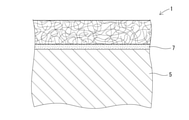
本実施形態の表皮材は、各種技術分野の物品(部品を含む)の表皮材として幅広く用いられる。図2に、物品の基材5の表面に表皮材1が固定された場合の断面図を示す。符号7は接着層を示す。表皮材1の基材5への固定方法は、接着に限定されず、公知の方法を適宜選択することができる。
本実施形態の表皮材が利用される技術分野は特に限定されない。例えば、自動車、鉄道車両等の車両、航空機、船舶、建築、アパレル等の各種産業において、表皮材が拘わる技術分野に関して好適に利用される。表皮材を用いた物品の具体例としては、ドアトリム、ルーフトリム、パッケージトレイ、座席シート等の車両用内装材、ソファ等の家具、靴、財布、衣服等の生活用品等が挙げられる。
特に、本実施形態の表皮材は、太陽光により高温になり得る物品、例えば、ドアトリム(特にアッパー部分)、パッケージトレイ、シートに好適に用いることができる。
なお、各種物品の基材の材質は、特に限定されない。材質としては、例えばポリオレフィン系樹脂が好適に用いられる。ポリオレフィン系樹脂としては、具体的には、ポリプロピレン、ポリエチレン、ポリブテン、ポリスチレン、エチレン-プロピレン共重合体、エチレン-メタクリル酸共重合体、エチレン-エチルアクリレート共重合体、エチレン・プロピレン・ジエン三元共重合体、エチレン・酢酸ビニル共重合体、ポリアミド6、ABS、ポリカーボネート等が挙げられる。また、複合材として、ガラス繊維/PP、ガラス繊維/ポリアミド6、天然繊維/PP等が挙げられる。
5. Use of skin material The skin material of this embodiment is widely used as a skin material for articles (including parts) in various technical fields. FIG. 2 shows a cross-sectional view when the
The technical field in which the skin material of the present embodiment is used is not particularly limited. For example, it is suitably used in various industries such as automobiles, railroad vehicles and other vehicles, aircraft, ships, construction, and apparel in the technical fields related to skin materials. Specific examples of articles using skin materials include vehicle interior materials such as door trims, roof trims, package trays and seats, furniture such as sofas, and daily necessities such as shoes, wallets and clothes.
In particular, the skin material of the present embodiment can be suitably used for articles that can become hot due to sunlight, such as door trims (particularly the upper portion), package trays, and sheets.
The material of the base material of various articles is not particularly limited. As the material, for example, a polyolefin resin is preferably used. Specific examples of the polyolefin resin include polypropylene, polyethylene, polybutene, polystyrene, ethylene-propylene copolymer, ethylene-methacrylic acid copolymer, ethylene-ethylacrylate copolymer, and ethylene / propylene / diene ternary. Examples thereof include polymers, polyethylene / vinyl acetate copolymers,
6.本実施形態の表皮材の作用効果
本実施形態の表皮材は、近赤外線反射性を有するから、表皮材によって被覆された各種物品の温度上昇を抑制できる。
6. Action and effect of the skin material of the present embodiment Since the skin material of the present embodiment has near-infrared ray reflectivity, it is possible to suppress the temperature rise of various articles covered with the skin material.
以下、実施例により本発明を更に具体的に説明する。なお、実験例1,2,3,4,7,8,9,10,11は実施例である。実験例5,6,12は比較例である。 Hereinafter, the present invention will be described in more detail with reference to Examples. Experimental Examples 1, 2, 3, 4, 7, 8, 9, 10, and 11 are examples. Experimental Examples 5, 6 and 12 are comparative examples.
1.表皮材における単繊維径の検討
(1)繊維が占有する体積の割合である体積率、及び配向テンソルの測定
表皮材における体積率、及び配向テンソルは、X線CT装置としての(株)リガク製 nano3DXを用いて測定した。なお、解析ソフトとしては、Math2Market GmbH製 GeoDictを用いた。
1. 1. Examination of single fiber diameter in skin material (1) Measurement of volume fraction, which is the ratio of the volume occupied by fibers, and orientation tensor The volume fraction in skin material and orientation tensor are manufactured by Rigaku Co., Ltd. as an X-ray CT device. It was measured using nano3DX. As the analysis software, GeoDict manufactured by Math2Market GmbH was used.
(2)サンプルの作製
(2-1)実験例1
静電植毛法を用いてベース部に植毛層を被着した。具体的には、ベース部に接着剤を塗布し、3万ボルト~8万ボルトの高い電圧をかけて静電気の力を利用して繊維をベース部に植え付けた後、余分な繊維を除去して表皮材を作製した。繊維には、丸断面で、単繊維径が1μmのPET繊維を用いた。なお、PET繊維は、カーボンブラックを含んでいない。
この表皮材をポリプロピレンの基材の表面に固定してサンプルとした。
(2) Preparation of sample (2-1) Experimental example 1
A flocked layer was applied to the base portion using an electrostatic flocking method. Specifically, an adhesive is applied to the base part, a high voltage of 30,000 to 80,000 volts is applied, and the fibers are planted in the base part using the force of static electricity, and then the excess fibers are removed. A skin material was prepared. As the fiber, a PET fiber having a round cross section and a single fiber diameter of 1 μm was used. The PET fiber does not contain carbon black.
This skin material was fixed to the surface of a polypropylene base material to prepare a sample.
(2-2)実験例2
繊維として、丸断面で、単繊維径が2μmのPET繊維を用いたこと以外は、実験例1と同様にしてサンプルを作製した。
(2-2) Experimental Example 2
A sample was prepared in the same manner as in Experimental Example 1 except that PET fibers having a round cross section and a single fiber diameter of 2 μm were used as the fibers.
(2-3)実験例3
繊維として、丸断面で、単繊維径が4μmのPET繊維を用いたこと以外は、実験例1と同様にしてサンプルを作製した。
(2-3) Experimental Example 3
A sample was prepared in the same manner as in Experimental Example 1 except that PET fibers having a round cross section and a single fiber diameter of 4 μm were used as the fibers.
(2-4)実験例4
繊維として、丸断面で、単繊維径が5μmのPET繊維を用いたこと以外は、実験例1と同様にしてサンプルを作製した。
(2-4) Experimental Example 4
A sample was prepared in the same manner as in Experimental Example 1 except that PET fibers having a round cross section and a single fiber diameter of 5 μm were used as the fibers.
(2-5)実験例5
繊維として、丸断面で、単繊維径が6μmのPET繊維を用いたこと以外は、実験例1と同様にしてサンプルを作製した。
(2-5) Experimental Example 5
A sample was prepared in the same manner as in Experimental Example 1 except that PET fibers having a round cross section and a single fiber diameter of 6 μm were used as the fibers.
(3)ランプ照射試験(表皮材の性能評価)
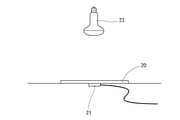
図5に示すようにサンプル20の裏面に熱電対21を配置した。そして、サンプル20の表面からレフランプ23(1000W/m2)の光を照射した。なお、この試験は、室温下で行った。
光を照射してから、観察された最高到達温度(到達温度)を評価した。最高到達温度が低い程、表皮材の性能は良好であると評価される。
(3) Lamp irradiation test (performance evaluation of skin material)
As shown in FIG. 5, the
After irradiating with light, the observed maximum temperature reached (reached temperature) was evaluated. The lower the maximum temperature reached, the better the performance of the skin material is evaluated.
(4)実験結果
実験例1~5のサンプルの体積率、及びZ軸方向の配向テンソルを測定したところ、いずれのサンプルも体積率が3%以上20%以下であり、かつZ軸方向の配向テンソルが0.42以下であることが確認された。
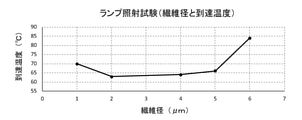
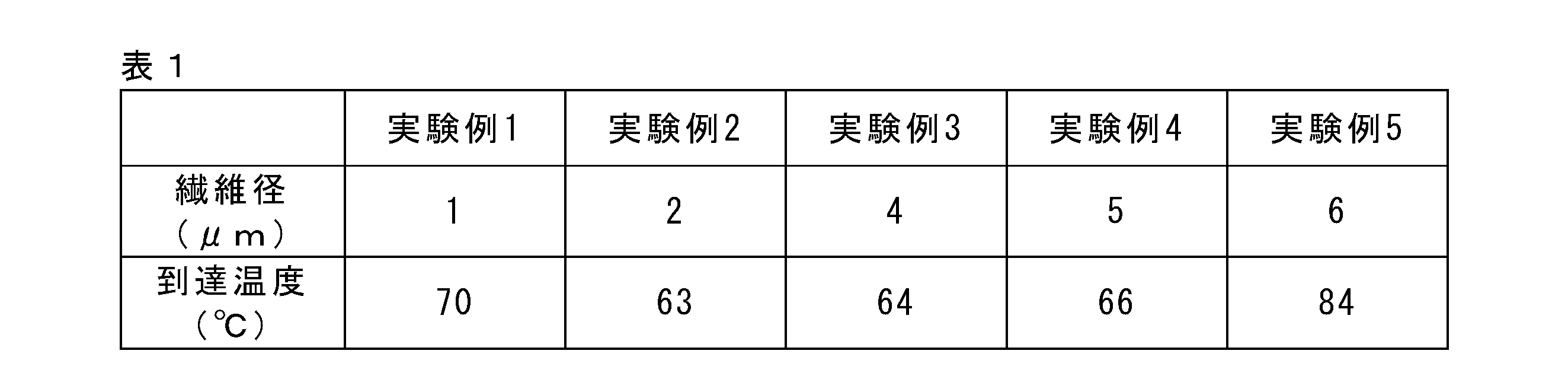
ランプ照射試験の結果を表1及び図6に示す。表1及び図6の結果から、単繊維径が1μmより大きく5μm以下の場合に、到達温度が低かった。よって、この範囲内の繊維を用いることで、サンプルの温度上昇が効果的に抑制されることが確認された。
(4) Experimental Results When the volume fractions of the samples of Experimental Examples 1 to 5 and the orientation tensors in the Z-axis direction were measured, the volume fractions of all the samples were 3% or more and 20% or less, and the orientation in the Z-axis direction. It was confirmed that the tensor was 0.42 or less.
The results of the lamp irradiation test are shown in Table 1 and FIG. From the results of Table 1 and FIG. 6, when the single fiber diameter was larger than 1 μm and 5 μm or less, the ultimate temperature was low. Therefore, it was confirmed that the temperature rise of the sample was effectively suppressed by using the fibers within this range.
2.繊維が占有する体積の割合である体積率の検討
(1)繊維が占有する体積の割合である体積率、及び配向テンソルの測定
上述の1.(1)と同様に行った。
2. 2. Examination of volume fraction, which is the ratio of the volume occupied by the fiber (1) Measurement of the volume fraction, which is the ratio of the volume occupied by the fiber, and the orientation tensor. The procedure was the same as in (1).
(2)表皮材の作製(実験例6~12)
静電植毛法を用いてベース部に植毛層を被着させた。具体的には、ベース部に接着剤を塗布し、3万ボルト~8万ボルトの高い電圧をかけて静電気の力を利用して繊維をベース部2に植え付けた後、余分な繊維を除去して表皮材を作製した。繊維には、丸断面で、単繊維径が4μmのPET繊維を用いた。なお、PET繊維は、カーボンブラックを含んでいない。
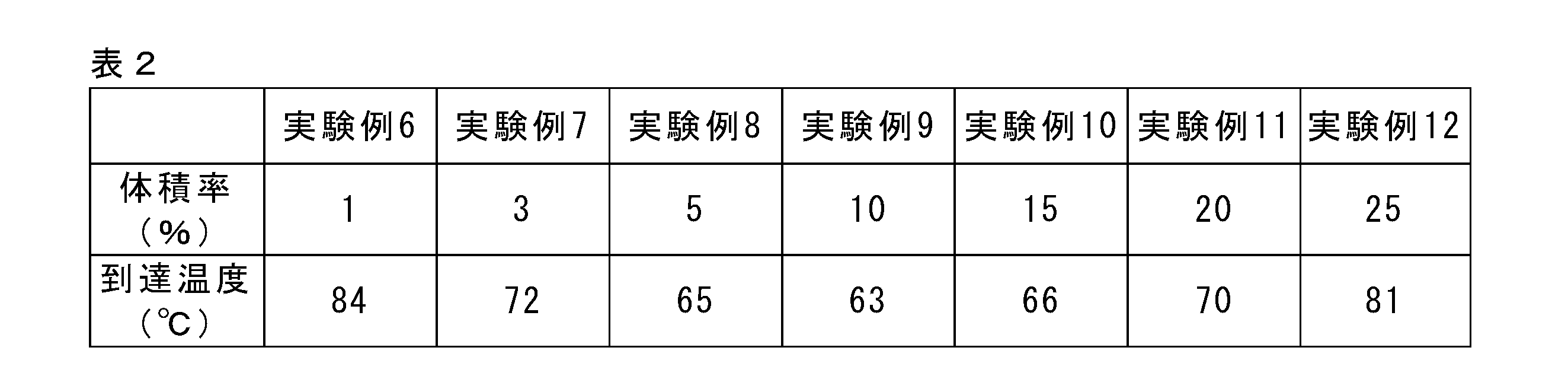
この際、植毛時の繊維量を調整し、かつ植毛後にアイロンによるプレス加工をすることで、体積率を下記表2に記載のように、1%(実験例6)、3%(実験例7)、5%(実験例8)、10%(実験例9)、15%(実験例10)、20%(実験例11)、25%(実験例12)に調整した。
そして、各表皮材をポリプロピレンの基材の表面に固定してサンプルとした。
(2) Preparation of skin material (Experimental Examples 6 to 12)
A flocked layer was applied to the base portion using an electrostatic flocking method. Specifically, an adhesive is applied to the base part, a high voltage of 30,000 to 80,000 volts is applied, and the fibers are planted in the
At this time, by adjusting the amount of fibers at the time of flocking and pressing with an iron after flocking, the volume ratio is 1% (Experimental Example 6) and 3% (Experimental Example 7) as shown in Table 2 below. ), 5% (Experimental Example 8), 10% (Experimental Example 9), 15% (Experimental Example 10), 20% (Experimental Example 11), 25% (Experimental Example 12).
Then, each skin material was fixed to the surface of a polypropylene base material to prepare a sample.
(3)ランプ照射試験(表皮材の性能評価)
上述の1.(3)と同様に行った。
(3) Lamp irradiation test (performance evaluation of skin material)
The above 1. The procedure was the same as in (3).
(4)実験結果
実験例6~12のサンプルのZ軸方向の配向テンソルを測定した。いずれのサンプルもZ軸方向の配向テンソルが0.42以下であることが確認された。
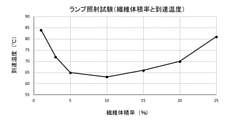
ランプ照射試験の結果を表2及び図7に示す。表2及び図7の結果から、体積率が3%以上20%以下の場合に、到達温度が低かった。よって、この範囲内の体積率とすることで、サンプルの温度上昇が効果的に抑制されることが確認された。
(4) Experimental results The orientation tensors of the samples of Experimental Examples 6 to 12 in the Z-axis direction were measured. It was confirmed that the orientation tensor in the Z-axis direction was 0.42 or less in all the samples.
The results of the lamp irradiation test are shown in Table 2 and FIG. From the results of Table 2 and FIG. 7, the ultimate temperature was low when the volume fraction was 3% or more and 20% or less. Therefore, it was confirmed that the temperature rise of the sample was effectively suppressed by setting the volume fraction within this range.
3.実験結果のまとめ
以上の実験結果から次のことが分かる。すなわち、単繊維径が1μmより大きく5μm以下の繊維が含まれ、体積率が3%以上20%以下であり、かつZ軸方向の配向テンソルが0.11以上0.42以下である表皮材は、サンプルの温度上昇が効果的に抑制されることが確認された。
3. 3. Summary of experimental results The following can be seen from the above experimental results. That is, the epidermis material containing fibers having a single fiber diameter larger than 1 μm and 5 μm or less, having a volume fraction of 3% or more and 20% or less, and having a Z-axis oriented tensor of 0.11 or more and 0.42 or less. It was confirmed that the temperature rise of the sample was effectively suppressed.
4.織物の場合
上述の実験では、表皮材は植毛シートとした。本発明者らは、表皮材が織物の場合についても実験した。織物の場合であっても、単繊維径が1μmより大きく5μm以下の繊維が含まれ、体積率が3%以上20%以下であり、かつZ軸方向の配向テンソルが0.42以下である表皮材は、サンプルの温度上昇が効果的に抑制されることが確認した。
4. In the case of woven fabric In the above experiment, the skin material was a flocked sheet. The present inventors also experimented with the case where the skin material was a woven fabric. Even in the case of a woven fabric, the epidermis contains fibers having a single fiber diameter of more than 1 μm and 5 μm or less, a volume fraction of 3% or more and 20% or less, and a Z-axis oriented tensor of 0.42 or less. It was confirmed that the material effectively suppressed the temperature rise of the sample.
前述の例は単に説明を目的とするものでしかなく、本発明を限定するものと解釈されるものではない。本発明を典型的な実施形態の例を挙げて説明したが、本発明の記述および図示において使用された文言は、限定的な文言ではなく説明的および例示的なものであると理解される。ここで詳述したように、その形態において本発明の範囲または本質から逸脱することなく、添付の特許請求の範囲内で変更が可能である。ここでは、本発明の詳述に特定の構造、材料および実施例を参照したが、本発明をここにおける開示事項に限定することを意図するものではなく、むしろ、本発明は添付の特許請求の範囲内における、機能的に同等の構造、方法、使用の全てに及ぶものとする。 The above examples are for illustration purposes only and are not to be construed as limiting the invention. Although the present invention has been described with reference to examples of typical embodiments, the wording used in the description and illustration of the invention is understood to be descriptive and exemplary rather than limited wording. As detailed herein, modifications may be made within the scope of the appended claims without departing from the scope or nature of the invention in its form. Although specific structures, materials and examples have been referred to herein in detail of the invention, it is not intended to limit the invention to the disclosures herein, but rather the invention is claimed in the accompanying claims. It shall cover all functionally equivalent structures, methods and uses within the scope.
本発明によれば、表皮材で被覆された物品の温度上昇が効果的に抑制される。特に、本発明の表皮材は、ドアトリム、ルーフトリム、パッケージトレイ、座席シート等の車両用内装材用の表皮として好適に適用できる。 According to the present invention, the temperature rise of the article covered with the skin material is effectively suppressed. In particular, the skin material of the present invention can be suitably applied as a skin for vehicle interior materials such as door trims, roof trims, package trays, and seats.
1 …表皮材
3 …繊維集合体
5 …基材
7 …接着層
10…複合糸
20…サンプル
21…熱電対
23…レフランプ
1 ...
Claims (7)
カーボンブラックを含まず、かつ単繊維径が1μmより大きく5μm以下の繊維が含まれた繊維集合体を備えており、
前記表皮材をX線CTで観察して得られた画像から、1辺が0.1~0.5mmの立方体を切り出して、前記立方体の全体の体積を100%とした場合に、前記立方体に含まれる前記単繊維径が1μmより大きく5μm以下の繊維が占有する体積の割合である体積率は3%以上20%以下であり、かつ
Z軸方向の配向テンソルが0よりも大きく0.42以下であることを特徴とする表皮材。 It is an epidermis material
It has a fiber aggregate that does not contain carbon black and contains fibers having a single fiber diameter of more than 1 μm and 5 μm or less.
When a cube having a side of 0.1 to 0.5 mm is cut out from an image obtained by observing the skin material by X-ray CT and the total volume of the cube is set to 100%, the cube is formed. The volume ratio, which is the ratio of the volume occupied by the fibers having a single fiber diameter of more than 1 μm and 5 μm or less, is 3% or more and 20% or less, and the orientation tensor in the Z-axis direction is larger than 0 and 0.42 or less. A skin material characterized by being.
Priority Applications (4)
| Application Number | Priority Date | Filing Date | Title |
|---|---|---|---|
| JP2018098996A JP6996419B2 (en) | 2018-05-23 | 2018-05-23 | Epidermis material |
| DE112019002594.5T DE112019002594T5 (en) | 2018-05-23 | 2019-05-07 | Skin material |
| PCT/JP2019/018242 WO2019225304A1 (en) | 2018-05-23 | 2019-05-07 | Skin material |
| CN201980033617.4A CN112135728B (en) | 2018-05-23 | 2019-05-07 | Surface material |
Applications Claiming Priority (1)
| Application Number | Priority Date | Filing Date | Title |
|---|---|---|---|
| JP2018098996A JP6996419B2 (en) | 2018-05-23 | 2018-05-23 | Epidermis material |
Publications (2)
| Publication Number | Publication Date |
|---|---|
| JP2019203220A JP2019203220A (en) | 2019-11-28 |
| JP6996419B2 true JP6996419B2 (en) | 2022-01-17 |
Family
ID=68726267
Family Applications (1)
| Application Number | Title | Priority Date | Filing Date |
|---|---|---|---|
| JP2018098996A Active JP6996419B2 (en) | 2018-05-23 | 2018-05-23 | Epidermis material |
Country Status (1)
| Country | Link |
|---|---|
| JP (1) | JP6996419B2 (en) |
Families Citing this family (3)
| Publication number | Priority date | Publication date | Assignee | Title |
|---|---|---|---|---|
| JP7028059B2 (en) * | 2018-05-23 | 2022-03-02 | トヨタ紡織株式会社 | Epidermis material |
| JP7767885B2 (en) * | 2021-12-07 | 2025-11-12 | トヨタ紡織株式会社 | Fabric material |
| CN115852591B (en) * | 2022-12-07 | 2024-12-13 | 哈尔滨工业大学 | A method for preparing an all-weather thermal management film with mechanically adjusted reflectivity |
Citations (6)
| Publication number | Priority date | Publication date | Assignee | Title |
|---|---|---|---|---|
| JP2003127259A (en) | 2001-10-26 | 2003-05-08 | Nissan Motor Co Ltd | Low radiation skin material |
| JP2003136618A (en) | 2001-10-31 | 2003-05-14 | Nissan Motor Co Ltd | Heat dissipating materials and vehicle interior materials |
| JP2004358664A (en) | 2003-05-30 | 2004-12-24 | Nissan Motor Co Ltd | Automotive interior skin, vehicle seat using the same, and automotive interior material |
| JP2013256720A (en) | 2012-03-12 | 2013-12-26 | Daiwabo Holdings Co Ltd | Light ray-shielding regenerated cellulose fiber, method of manufacturing the same, and fiber structure |
| JP2016172945A (en) | 2015-03-17 | 2016-09-29 | 東レ株式会社 | Ultrafine polyester fiber having convexoconcave surface, and sea-island type conjugate fiber |
| JP2017140770A (en) | 2016-02-10 | 2017-08-17 | 帝人株式会社 | Thermal barrier fabric and textile products |
Family Cites Families (1)
| Publication number | Priority date | Publication date | Assignee | Title |
|---|---|---|---|---|
| JPS56140183A (en) * | 1980-03-28 | 1981-11-02 | Takeda Chemical Industries Ltd | Flocked material |
-
2018
- 2018-05-23 JP JP2018098996A patent/JP6996419B2/en active Active
Patent Citations (6)
| Publication number | Priority date | Publication date | Assignee | Title |
|---|---|---|---|---|
| JP2003127259A (en) | 2001-10-26 | 2003-05-08 | Nissan Motor Co Ltd | Low radiation skin material |
| JP2003136618A (en) | 2001-10-31 | 2003-05-14 | Nissan Motor Co Ltd | Heat dissipating materials and vehicle interior materials |
| JP2004358664A (en) | 2003-05-30 | 2004-12-24 | Nissan Motor Co Ltd | Automotive interior skin, vehicle seat using the same, and automotive interior material |
| JP2013256720A (en) | 2012-03-12 | 2013-12-26 | Daiwabo Holdings Co Ltd | Light ray-shielding regenerated cellulose fiber, method of manufacturing the same, and fiber structure |
| JP2016172945A (en) | 2015-03-17 | 2016-09-29 | 東レ株式会社 | Ultrafine polyester fiber having convexoconcave surface, and sea-island type conjugate fiber |
| JP2017140770A (en) | 2016-02-10 | 2017-08-17 | 帝人株式会社 | Thermal barrier fabric and textile products |
Also Published As
| Publication number | Publication date |
|---|---|
| JP2019203220A (en) | 2019-11-28 |
Similar Documents
| Publication | Publication Date | Title |
|---|---|---|
| CN112135728B (en) | Surface material | |
| TWI523981B (en) | Polyester fiber and its manufacturing method and fabric and fiber product and polyester molded article | |
| JP2020157097A (en) | Absorbent article | |
| JP6775526B2 (en) | Hook-and-loop fasteners and textile products | |
| JP7582943B2 (en) | Bulky nonwoven fabric with improved compressibility and recovery | |
| EP2835460A1 (en) | Fabric and fiber product | |
| JP2019203220A (en) | Skin material | |
| CN105247119A (en) | Porous polyolefin fibers | |
| JP7028059B2 (en) | Epidermis material | |
| EP1876271A1 (en) | X-ray contrast filament, x-ray contrast covered filament, and fiber structure using said x-ray contrast filament and/or x-ray contrast covered filament | |
| JP7428091B2 (en) | Outer skin material and interior material | |
| JP2010037681A (en) | Woven or knitted fabric for clothing | |
| JP2006249610A (en) | Woven knitted fabrics and textile products with little wetting | |
| JP5890101B2 (en) | Fiber products | |
| TW200427893A (en) | Deodorant fiber structure and method for producing the same | |
| JP2022014514A (en) | Skin material and interior material | |
| JP2021091982A (en) | Fiber and fiber aggregate | |
| JP2004027409A (en) | Multilayer knitted fabric with excellent quick-drying properties | |
| JPH03124841A (en) | Synthetic fiber woven fabric and its production | |
| EP4310245B1 (en) | Artificial leather and method for manufacturing the same | |
| Hakam et al. | A Study of the Properties of Fleece Knitted Fabrics Made from Cotton and Different Types of Regenerated Cellulosic Fibers for Apparel Use | |
| JP6715679B2 (en) | Spun yarn, cloth and textile products | |
| JP2021091983A (en) | Hollow fiber and fiber aggregate | |
| KR20250100796A (en) | Artificial leather and manufacturing method therefor | |
| JP2019097869A (en) | Pile cloth, pile cloth-attached tool, and production method of pile cloth |
Legal Events
| Date | Code | Title | Description |
|---|---|---|---|
| A621 | Written request for application examination |
Free format text: JAPANESE INTERMEDIATE CODE: A621 Effective date: 20201214 |
|
| A131 | Notification of reasons for refusal |
Free format text: JAPANESE INTERMEDIATE CODE: A131 Effective date: 20210727 |
|
| A521 | Request for written amendment filed |
Free format text: JAPANESE INTERMEDIATE CODE: A523 Effective date: 20210921 |
|
| TRDD | Decision of grant or rejection written | ||
| A01 | Written decision to grant a patent or to grant a registration (utility model) |
Free format text: JAPANESE INTERMEDIATE CODE: A01 Effective date: 20211116 |
|
| A61 | First payment of annual fees (during grant procedure) |
Free format text: JAPANESE INTERMEDIATE CODE: A61 Effective date: 20211129 |
|
| R151 | Written notification of patent or utility model registration |
Ref document number: 6996419 Country of ref document: JP Free format text: JAPANESE INTERMEDIATE CODE: R151 |
|
| R250 | Receipt of annual fees |
Free format text: JAPANESE INTERMEDIATE CODE: R250 |
|
| R250 | Receipt of annual fees |
Free format text: JAPANESE INTERMEDIATE CODE: R250 |