JP6967397B2 - Graphite complex and its manufacturing method - Google Patents
Graphite complex and its manufacturing method Download PDFInfo
- Publication number
- JP6967397B2 JP6967397B2 JP2017156501A JP2017156501A JP6967397B2 JP 6967397 B2 JP6967397 B2 JP 6967397B2 JP 2017156501 A JP2017156501 A JP 2017156501A JP 2017156501 A JP2017156501 A JP 2017156501A JP 6967397 B2 JP6967397 B2 JP 6967397B2
- Authority
- JP
- Japan
- Prior art keywords
- graphite
- sample
- alkali metal
- peak top
- complex
- Prior art date
- Legal status (The legal status is an assumption and is not a legal conclusion. Google has not performed a legal analysis and makes no representation as to the accuracy of the status listed.)
- Active
Links
Images






Classifications
-
- Y—GENERAL TAGGING OF NEW TECHNOLOGICAL DEVELOPMENTS; GENERAL TAGGING OF CROSS-SECTIONAL TECHNOLOGIES SPANNING OVER SEVERAL SECTIONS OF THE IPC; TECHNICAL SUBJECTS COVERED BY FORMER USPC CROSS-REFERENCE ART COLLECTIONS [XRACs] AND DIGESTS
- Y02—TECHNOLOGIES OR APPLICATIONS FOR MITIGATION OR ADAPTATION AGAINST CLIMATE CHANGE
- Y02E—REDUCTION OF GREENHOUSE GAS [GHG] EMISSIONS, RELATED TO ENERGY GENERATION, TRANSMISSION OR DISTRIBUTION
- Y02E60/00—Enabling technologies; Technologies with a potential or indirect contribution to GHG emissions mitigation
- Y02E60/10—Energy storage using batteries
Landscapes
- Carbon And Carbon Compounds (AREA)
- Battery Electrode And Active Subsutance (AREA)
Description
本発明は黒鉛複合体、及びその製造方法に関する。 The present invention relates to a graphite complex and a method for producing the same.
黒鉛を改良して導電材料、電極材料、触媒材料、ガス貯蔵材料、リチウムイオン二次電池の負極材料、ガスケット材料などに適した新材料の開発が行われている。例えば導電性に優れた材料として黒鉛のグラフェン層間にアルカリ金属、アルカリ土類金属や金属ハロゲン化物などの侵入物質(インターカレート)を挿入した黒鉛層間化合物(Graphite Intercalation Compound:GIC)が研究されている(特許文献1、非特許文献1)。
New materials are being developed that improve graphite and are suitable for conductive materials, electrode materials, catalyst materials, gas storage materials, negative electrode materials for lithium-ion secondary batteries, gasket materials, and the like. For example, as a material with excellent conductivity, a graphite intercalation compound (GIC) in which an invading substance (intercalate) such as an alkali metal, an alkaline earth metal, or a metal halide is inserted between graphite graphene layers has been studied. (
従来提案されているGICのような黒鉛層間化合物は、空気と接触すると侵入物質の離脱や酸化などによって結晶構造が分解されてしまうため結晶構造の安定性に乏しく、例えば体積抵抗率や導電性などの各種特性に優れた材料として実用化が難しかった。 A graphite interlayer compound such as GIC, which has been conventionally proposed, has poor crystal structure stability because the crystal structure is decomposed by detachment of invading substances and oxidation when it comes into contact with air. For example, volume resistivity and conductivity, etc. It was difficult to put it into practical use as a material with excellent various properties.
本発明の目的は、結晶構造の安定性に優れた黒鉛複合体、及びその製造方法を提供することにある。 An object of the present invention is to provide a graphite complex having excellent crystal structure stability and a method for producing the same.
上記課題を解決し得た本発明とは、黒鉛とアルカリ金属との黒鉛複合体であって、X線回折分析して求められるX線回折角(2θ)26.7°〜28.0°の範囲に前記X線回折分析の最大強度のピークトップ、または2番目の強度のピークトップを有する黒鉛複合体である。 The present invention that has solved the above problems is a graphite composite of graphite and an alkali metal, and has an X-ray diffraction angle (2θ) of 26.7 ° to 28.0 ° obtained by X-ray diffraction analysis. It is a graphite composite having a peak top of the maximum intensity of the X-ray diffraction analysis or a peak top of the second intensity in the range.
また本発明は、(1)上記アルカリ金属を1.0質量%以上含有する(2)上記黒鉛複合体をラマン分光分析して求められるラマン散乱スペクトルにおいて、1590cm-1〜1610cm-1の範囲にピークトップまたは波形の変曲点を有すること、(3)上記黒鉛複合体は、更に酸素、及び/又は水素を含むこと、(4)上記アルカリ金属に対する炭素の比率(モル比)が20.0未満であること、(5)上記アルカリ金属はカリウムであることは、いずれも好ましい実施形態である。 The present invention is, (1) in the alkali metal containing not less than 1.0 wt% (2) Raman scattering spectrum obtained by the graphite composite was Raman spectroscopy, in the range of 1590cm -1 ~1610cm -1 It has a peak top or a wavy variation point, (3) the graphite composite further contains oxygen and / or hydrogen, and (4) the ratio of carbon to the alkali metal (molar ratio) is 20.0. It is a preferable embodiment that the amount is less than or (5) the alkali metal is potassium.
上記課題を解決し得た本発明に係る黒鉛複合体の製造方法は、黒鉛とアルカリ金属水酸化物とを混合し、得られた混合物を600℃以上で加熱することに要旨を有する。 The method for producing a graphite composite according to the present invention, which has solved the above problems, has a gist in that graphite and an alkali metal hydroxide are mixed and the obtained mixture is heated at 600 ° C. or higher.
また本発明の製造方法は、(1)上記アルカリ金属水酸化物が水酸化カリウムであること、(2)上記混合前の黒鉛の結晶子の大きさLcが10nm以上であることはいずれも好ましい実施態様である。 Further, in the production method of the present invention, it is preferable that (1) the alkali metal hydroxide is potassium hydroxide, and (2) the crystallite size Lc of graphite before mixing is 10 nm or more. It is an embodiment.
本発明によれば結晶構造の安定性に優れた黒鉛複合体、及びその製造方法を提供できる。したがって本発明により、例えば体積抵抗率や導電性などに優れた特性を有する材料を実用レベルで提供できる。 According to the present invention, it is possible to provide a graphite complex having excellent crystal structure stability and a method for producing the same. Therefore, according to the present invention, it is possible to provide a material having excellent properties such as volume resistivity and conductivity at a practical level.
本発明のアルカリ金属と黒鉛との黒鉛複合体(以下、「黒鉛複合体」という)をX線回折(XRD)分析すると、X線回折角(2θ)=26.7°〜28.0°の範囲(以下、「27°付近」という)にピークトップが存在する。従来の黒鉛やK−GIC等の既知の黒鉛層間化合物は上記範囲にピークトップがなく、したがって本発明の黒鉛複合体は新規な結晶構造を有する物質である。なお、黒鉛複合体はX線回折角(2θ)27°付近に存在する上記ピークトップは、X線回折分析の最大強度のピークトップ、または2番目の強度のピークトップである。またピークトップの位置は好ましくはX線回折角(2θ)=27.0°〜28.0°、より好ましくはX線回折角(2θ)=27.5°〜28.0°の範囲である。 When the graphite composite of the alkali metal and graphite of the present invention (hereinafter referred to as “graphite composite”) is analyzed by X-ray diffraction (XRD), the X-ray diffraction angle (2θ) = 26.7 ° to 28.0 °. There is a peak top in the range (hereinafter referred to as "around 27 °"). Known graphite interlayer compounds such as conventional graphite and K-GIC do not have a peak top in the above range, and therefore the graphite composite of the present invention is a substance having a novel crystal structure. The graphite complex exists near the X-ray diffraction angle (2θ) of 27 °. The peak top is the peak top of the maximum intensity of the X-ray diffraction analysis or the peak top of the second intensity. The position of the peak top is preferably in the range of X-ray diffraction angle (2θ) = 27.0 ° to 28.0 °, and more preferably X-ray diffraction angle (2θ) = 27.5 ° to 28.0 °. ..
上記特徴を有する黒鉛複合体は結晶構造の安定性に優れた特性を有する。結晶構造の安定性とは、後記安定性試験の前後でX線回折角(2θ)27°付近の最大強度のピークトップ、または2番目の強度のピークトップ(以下、単に「ピークトップ」ということがある)の位置が変化しない(±0.1°の範囲内)ことをいう。好ましくは27°付近のピークトップの半値幅も変化しない(±0.1°の範囲内)ことである。このように27°付近のピークトップの結晶構造の安定性に優れた黒鉛複合体は大気下に放置しても結晶構造が分解されない点で空気に触れた瞬間に結晶構造が分解され、ピークトップの位置が変化するK−GIC等の従来の黒鉛層間化合物よりも優れた安定性を有している。特に27°付近にピークトップを有し、且つ該ピークトップの結晶構造が安定することで例えば体積抵抗率や導電性などに優れた特性を発揮できる。なお、本実施例の安定性試験は、製造直後の測定値と製造1か月後の測定値を対比しているが、製造直後の測定値を使用することに限定されず、任意の1か月前後の測定値でもよい。また測定前後においてピークトップの位置が、上記X線回折角(2θ)26.7°〜28.0°の範囲内、好ましくは上記好適な範囲内であることをいう。 The graphite complex having the above-mentioned characteristics has excellent characteristics in the stability of the crystal structure. The stability of the crystal structure is the peak top of the maximum intensity near the X-ray diffraction angle (2θ) of 27 ° before and after the stability test described later, or the peak top of the second intensity (hereinafter, simply referred to as “peak top”). There is) position does not change (within ± 0.1 °). Preferably, the half width of the peak top near 27 ° does not change (within the range of ± 0.1 °). In this way, the graphite composite with excellent stability of the crystal structure of the peak top near 27 ° decomposes the crystal structure at the moment of contact with the air because the crystal structure is not decomposed even if it is left in the atmosphere. It has better stability than conventional graphite interlayer compounds such as K-GIC whose position changes. In particular, it has a peak top near 27 ° and the crystal structure of the peak top is stable, so that excellent characteristics such as volume resistivity and conductivity can be exhibited. In the stability test of this example, the measured value immediately after production is compared with the measured value one month after production, but the measurement value immediately after production is not limited to use, and any one is used. It may be a measured value around the month. Further, it means that the position of the peak top before and after the measurement is within the range of the X-ray diffraction angle (2θ) of 26.7 ° to 28.0 °, preferably within the above-mentioned suitable range.
また結晶構造の安定性に優れた効果を有する黒鉛複合体は、上記27°付近のピークトップの半値幅が好ましくは3.0°以下、より好ましくは1.5°以下、更に好ましくは1.0°以下である。 Further, in the graphite complex having an excellent effect on the stability of the crystal structure, the half width of the peak top near 27 ° is preferably 3.0 ° or less, more preferably 1.5 ° or less, and further preferably 1. It is 0 ° or less.
なお、本発明の黒鉛複合体をX線回折分析して求められるX線回折角(2θ)27°付近以外にもピークトップを有していてもよい。例えばピークトップ位置は、13°付近(12.0°〜14.0°)、21°付近(20.0°〜23.0°)、56°付近(55.0°〜58.0°)よりなる群から選ばれる少なくとも1または2以上に有していてもよい。 The graphite complex of the present invention may have a peak top other than the vicinity of the X-ray diffraction angle (2θ) of 27 ° obtained by X-ray diffraction analysis. For example, the peak top position is around 13 ° (12.0 ° to 14.0 °), around 21 ° (20.0 ° to 23.0 °), and around 56 ° (55.0 ° to 58.0 °). It may have at least one or two or more selected from the group consisting of.
本発明の黒鉛複合体は、ラマン分光分析して求められるラマン散乱スペクトルにおいて1590cm-1〜1610cm-1(以下、「1600cm-1付近」という)の範囲にピークトップまたは波形の変曲点を有することが好ましく、より好ましくはピークトップを有することである。上記範囲に少なくとも散乱強度の波形に変曲点を有する黒鉛複合体は優れた結晶構造の安定性を示すが、上記範囲にピークトップを有する黒鉛複合体は、優れた結晶構造の安定性に加えて良好な体積抵抗率を示す。また該ピークトップの半値幅は好ましくは50cm-1以下、より好ましくは25cm-1以下である。 The graphite composite of the present invention has a peak top or an inflection point in the range of 1590 cm -1 to 1610 cm -1 (hereinafter referred to as " around 1600 cm -1 ") in the Raman scattering spectrum obtained by Raman spectroscopy. It is preferable, and more preferably, it has a peak top. A graphite composite having an inflection point in the waveform of at least the scattering intensity in the above range shows excellent crystal structure stability, whereas a graphite composite having a peak top in the above range shows excellent crystal structure stability in addition to excellent crystal structure stability. Shows good volume resistivity. The half width of the peak top is preferably 50 cm -1 or less, more preferably 25 cm -1 or less.
また黒鉛複合体は1600cm-1付近に加えてラマン散乱スペクトルにおいて1580cm-1付近(1570cm-1〜1590cm-1未満)の範囲にもピークトップを有していてもよい。黒鉛複合体の1580cm-1付近のピークトップの強度(I1580)と1600cm-1付近のピークトップの強度(I1600)の関係は、好ましくはI1580≦I1600であり、より好ましくはI1580<I1600である。1600cm-1付近のピークトップの強度が高い程、より優れた体積抵抗率が得られる。 The graphite composite may have a peak top in the range of around 1580 cm -1 in Raman scattering spectra in addition to the vicinity of 1600 cm -1 (below 1570cm -1 ~1590cm -1). Relationship of the intensity of the peak top in the vicinity of 1580 cm -1 of the graphite composite (I 1580) and 1600 cm -1 vicinity of the peak top intensity (I 1600) is preferably I 1580 ≦ I 1600, more preferably I 1580 <I 1600 . The higher the intensity of the peak top near 1600 cm -1 , the better the volume resistivity can be obtained.
黒鉛複合体はグラフェンが積層された結晶構造をベース骨格とすることが好ましい。黒鉛複合体にはベース骨格をなす炭素以外にアルカリ金属を黒鉛複合体100質量%に対して好ましくは1.0質量%以上、より好ましくは3.0質量%以上、更に好ましくは10.0質量%以上であって、好ましくは90質量%以下、より好ましくは80質量%以下、更に好ましくは70質量%以下含有する。また黒鉛複合体は好ましくは酸素及び/又は水素、より好ましくは酸素、および水素を含有する。また黒鉛複合体には更に他の元素(例えば鉄、ケイ素、アルミニウム)が含まれていてもよいし、残部不可避不純物で構成されていてもよい。黒鉛複合体には原料等に由来する微量(例えば黒鉛複合体100質量%に対して3質量%以下)の不純物が不可避不純物として含まれていてもよい。 The graphite complex preferably has a crystal structure in which graphene is laminated as a base skeleton. In the graphite composite, an alkali metal other than carbon forming the base skeleton is preferably 1.0% by mass or more, more preferably 3.0% by mass or more, still more preferably 10.0% by mass with respect to 100% by mass of the graphite composite. % Or more, preferably 90% by mass or less, more preferably 80% by mass or less, still more preferably 70% by mass or less. The graphite complex also preferably contains oxygen and / or hydrogen, more preferably oxygen and hydrogen. Further, the graphite complex may further contain other elements (for example, iron, silicon, aluminum), or may be composed of the balance unavoidable impurities. The graphite complex may contain a trace amount of impurities derived from the raw material or the like (for example, 3% by mass or less with respect to 100% by mass of the graphite complex) as unavoidable impurities.
黒鉛複合体に含まれているアルカリ金属は黒鉛層間化合物(インターカレーション)を形成していてもよいし、形成していなくてもよい。また黒鉛複合体におけるアルカリ金属は、アルカリ金属単独、あるいは酸素、水素、炭素など任意の元素と結合していてもよい。 The alkali metal contained in the graphite complex may or may not form a graphite interlayer compound (intercalation). Further, the alkali metal in the graphite composite may be the alkali metal alone or may be bonded to any element such as oxygen, hydrogen and carbon.
黒鉛複合体中の炭素、アルカリ金属、酸素、及び水素の合計100質量%(以下、「合計100質量%」という)に占めるアルカリ金属の割合は、好ましくは5質量%以上、より好ましくは10質量%以上、更に好ましくは15質量%以上、より更に好ましくは20質量%以上、最も好ましくは25質量%以上である。アルカリ金属の割合が高くなる程、黒鉛複合体の体積抵抗率などの特性が向上する傾向にあるため、上限は特に限定されないが、好ましくは90質量%以下、より好ましくは80質量%以下、更に好ましくは70質量%以下、より更に好ましくは50質量%以下である。 The ratio of the alkali metal to the total 100% by mass (hereinafter referred to as "total 100% by mass") of carbon, alkali metal, oxygen, and hydrogen in the graphite composite is preferably 5% by mass or more, more preferably 10% by mass. % Or more, more preferably 15% by mass or more, still more preferably 20% by mass or more, and most preferably 25% by mass or more. The higher the proportion of the alkali metal, the more the characteristics such as the volume resistivity of the graphite composite tend to improve. Therefore, the upper limit is not particularly limited, but is preferably 90% by mass or less, more preferably 80% by mass or less, and further. It is preferably 70% by mass or less, and even more preferably 50% by mass or less.
黒鉛複合体中のアルカリ金属(M)に対する炭素(C)の比率([C/M]モル比)は好ましくは20.0未満、より好ましくは10.0未満、更に好ましくは5.0未満である。アルカリ金属の比率が高くなるほど結晶構造の安定性を維持しながら良好な体積抵抗率が得られる傾向にある。 The ratio of carbon (C) to alkali metal (M) in the graphite composite ([C / M] molar ratio) is preferably less than 20.0, more preferably less than 10.0, still more preferably less than 5.0. be. The higher the ratio of the alkali metal, the better the volume resistivity tends to be obtained while maintaining the stability of the crystal structure.
アルカリ金属は特に限定されないが、好ましくはカリウム、ルビジウム、セシウム、フランシウム、より好ましくはカリウムである。特にカリウムは黒鉛複合体の結晶構造の安定性向上に寄与すると共に、体積抵抗率向上に寄与するため好ましい。 The alkali metal is not particularly limited, but is preferably potassium, rubidium, cesium, francium, and more preferably potassium. In particular, potassium is preferable because it contributes to improving the stability of the crystal structure of the graphite complex and also to improving the volume resistivity.
本発明の黒鉛複合体は黒色である。特に黒鉛複合体は空気接触前後で色調が変化せず、また大気下に放置しても色調が経時変化しない。一方、K−GICであるKC8は空気に触れる前は金褐色であるが、空気に触れた瞬間に結晶構造が破壊され、色調も黒色に変色するため結晶構造の安定性が低い。またこのような色調の変化に基づいて結晶構造の安定性を確認できる。 The graphite complex of the present invention is black. In particular, the color tone of the graphite complex does not change before and after contact with air, and the color tone does not change over time even when left in the atmosphere. On the other hand, KC 8, which is a K-GIC, is golden brown before it comes into contact with air, but the crystal structure is destroyed at the moment when it comes into contact with air, and the color tone changes to black, so that the stability of the crystal structure is low. Moreover, the stability of the crystal structure can be confirmed based on such a change in color tone.
上記構成を有する本発明の黒鉛複合体は結晶構造の安定性に優れているため、導電材料、電極材料、触媒材料、ガス貯蔵材料、リチウムイオン二次電池の負極材料、ガスケット材料など様々な産業分野において利用可能である。特にアルカリ金属の割合が高い黒鉛複合体は良好な体積抵抗率を有するため、導電材料や電極材料などの用途に好適である。 Since the graphite composite of the present invention having the above structure is excellent in the stability of the crystal structure, various industries such as conductive materials, electrode materials, catalyst materials, gas storage materials, negative electrode materials for lithium ion secondary batteries, and gasket materials are used. Available in the field. In particular, a graphite composite having a high proportion of alkali metal has a good volume resistivity, and is therefore suitable for applications such as conductive materials and electrode materials.
以下、本発明の黒鉛複合体の製造方法について説明する。 Hereinafter, the method for producing a graphite complex of the present invention will be described.
本発明の黒鉛複合体の製造方法は、黒鉛とアルカリ金属水酸化物とを混合し、得られた混合物を600℃以上で加熱処理することである。アルカリ金属水酸化物は好ましくは、水酸化カリウム、水酸化ルビジウム、水酸化セシウム、および水酸化フランシウムであり、これらは単独または2以上を組み合わせて用いてもよい。より好ましくは水酸化カリウムである。水酸化カリウムを用いると黒鉛複合体からカリウムが離脱せずに残存し、歩留り率が100%を超えて高くなるため好ましい。 The method for producing a graphite composite of the present invention is to mix graphite and an alkali metal hydroxide, and heat-treat the obtained mixture at 600 ° C. or higher. Alkali metal hydroxides are preferably potassium hydroxide, rubidium hydroxide, cesium hydroxide, and francium hydroxide, which may be used alone or in combination of two or more. More preferably, it is potassium hydroxide. It is preferable to use potassium hydroxide because potassium remains without being detached from the graphite complex and the yield rate is higher than 100%.
原料として使用する黒鉛(原料黒鉛)は特に限定されず、天然黒鉛、人造黒鉛のいずれも使用可能である。天然黒鉛としては鱗片状黒鉛、塊状黒鉛、土状黒鉛、球状化黒鉛、薄片化黒鉛、膨張黒鉛、膨張化黒鉛が例示される。人造黒鉛としては各種炭素材を黒鉛化したものであり、例えば石油コークス、ピッチコークス、ピッチ系炭素繊維、木炭、砂糖炭、セルロース炭などを2500℃以上の高温で熱処理して結晶化させた黒鉛や、グラフェンシート、高配向性熱分解グラファイト(Highly oriented pyrolytic graphite:HOPG)が好ましい。 The graphite used as a raw material (raw material graphite) is not particularly limited, and either natural graphite or artificial graphite can be used. Examples of natural graphite include scaly graphite, lump graphite, earthy graphite, spheroidized graphite, flaky graphite, expanded graphite, and expanded graphite. Artificial graphite is graphitized of various carbon materials. For example, petroleum coke, pitch coke, pitch carbon fiber, charcoal, sugar charcoal, cellulose charcoal, etc. are heat-treated at a high temperature of 2500 ° C or higher to crystallize the graphite. Alternatively, graphene sheet and highly oriented pyrolytic graphite (HOPG) are preferable.
またアルカリ金属の含有割合向上の観点から結晶子群が乱層構造よりもグラフェンが積層した結晶構造を有する黒鉛が好ましい。このような黒鉛としては天然黒鉛、易黒鉛化性炭素を高温熱処理した人造黒鉛が例示される。また結晶性が高い黒鉛が好ましく、例えば鱗片状黒鉛、塊状黒鉛が好ましい。 Further, from the viewpoint of improving the content ratio of the alkali metal, graphite having a crystal structure in which graphene is laminated is preferable to a crystallite group having a disordered layer structure. Examples of such graphite include natural graphite and artificial graphite obtained by heat-treating easily graphitizable carbon at a high temperature. Further, graphite having high crystallinity is preferable, and for example, scaly graphite and lump graphite are preferable.
原料黒鉛の結晶子が大きい程、歩留り率が向上する傾向にある。原料黒鉛の結晶子の大きさLcは好ましくは10nm以上、より好ましくは50nm以上、更に好ましくは100nm以上である。原料黒鉛の結晶子が成長している程、ピークシフトが生じて上記範囲にピークトップが得られやすくなると共に、歩留り率が向上して黒鉛複合体に含まれるアルカリ金属水酸化物に由来するアルカリ金属の割合も高くなる。上限は特に限定されないが、好ましくは10000nm以下、更に好ましくは8000nm以下である。 The larger the crystallite of the raw material graphite, the higher the yield rate tends to be. The crystallite size Lc of the raw material graphite is preferably 10 nm or more, more preferably 50 nm or more, and further preferably 100 nm or more. As the crystallites of the raw material graphite grow, peak shift occurs and it becomes easier to obtain a peak top in the above range, and the yield rate improves, and the alkali derived from the alkali metal hydroxide contained in the graphite composite. The proportion of metal is also high. The upper limit is not particularly limited, but is preferably 10,000 nm or less, more preferably 8000 nm or less.
原料黒鉛のサイズ、形状は用途に応じて適宜調整すればよく、限定されない。原料黒鉛は公知の方法で破砕、選別してサイズを調整してもよいし、所定サイズの市販品を用いることもできる。例えば原料黒鉛のサイズは平均粒子径で好ましくは1μm以上、より好ましくは5μm以上、更に好ましくは10μm以上であって、好ましくは1000μm以下、より好ましくは500μm以下、更に好ましくは200μm以下、より更に好ましくは100μm以下である。また原料黒鉛としてグラフェンシートを考慮すると原料黒鉛が不定形の場合は最大径、シート状であれば1辺が好ましくは20cm以下、より好ましくは10cm以下、更に好ましくは5cm以下である。 The size and shape of the raw material graphite may be appropriately adjusted according to the intended use and is not limited. The raw material graphite may be crushed and sorted by a known method to adjust the size, or a commercially available product having a predetermined size may be used. For example, the size of the raw material graphite is preferably 1 μm or more, more preferably 5 μm or more, still more preferably 10 μm or more, preferably 1000 μm or less, more preferably 500 μm or less, still more preferably 200 μm or less, still more preferably, in terms of average particle size. Is 100 μm or less. Considering the graphene sheet as the raw material graphite, the maximum diameter is preferably 20 cm or less, more preferably 10 cm or less, still more preferably 5 cm or less on one side when the raw material graphite is irregular.
原料黒鉛とアルカリ金属水酸化物とを混合し、所定の温度で加熱することで、上記特異な結晶構造を有する黒鉛複合体が得られる。原料黒鉛とアルカリ金属水酸化物の混合方法は特に限定されない。混合は乾式混合、湿式混合のいずれでもよく、例えばボールミルやミキサー、ブレンダーなどで機械的に混合してもよいし、アルカリ金属水酸化物を水溶液として使用してもよく、その場合、加熱処理を行う前に予め水分を除去して乾燥させておくことが好ましい。 By mixing the raw material graphite and the alkali metal hydroxide and heating them at a predetermined temperature, a graphite composite having the above-mentioned peculiar crystal structure can be obtained. The method of mixing the raw material graphite and the alkali metal hydroxide is not particularly limited. The mixing may be either dry mixing or wet mixing. For example, the mixture may be mechanically mixed with a ball mill, a mixer, a blender, or the like, or an alkali metal hydroxide may be used as an aqueous solution. In that case, heat treatment is performed. It is preferable to remove water and dry the mixture in advance.
原料黒鉛とアルカリ金属水酸化物との混合比率は特に限定されないが、アルカリ金属水酸化物の比率を高めると、X線回折による上記特定範囲内に存在するピークトップの半値幅が狭くなると共に、良好な体積抵抗率が得られる。またラマンスペクトルにおいて1580cm-1付近の強度に対する1600cm-1付近の強度を高めることができる。したがってアルカリ金属水酸化物と原料黒鉛の質量比(アルカリ金属水酸化物/原料黒鉛)は好ましくは0.5以上、より好ましくは1.0以上、更に好ましくは1.5以上であって、好ましくは5.0以下、より好ましくは4.0以下、更に好ましくは3.0以下である。 The mixing ratio of the raw material graphite and the alkali metal hydroxide is not particularly limited, but if the ratio of the alkali metal hydroxide is increased, the half-price width of the peak top existing in the above specific range due to X-ray diffraction becomes narrower and the half price width becomes narrower. Good volume resistance can be obtained. Also it is possible to increase the strength in the vicinity of 1600 cm -1 to the intensity of near 1580 cm -1 in the Raman spectrum. Therefore, the mass ratio of the alkali metal hydroxide to the raw material graphite (alkali metal hydroxide / raw material graphite) is preferably 0.5 or more, more preferably 1.0 or more, still more preferably 1.5 or more, and is preferable. Is 5.0 or less, more preferably 4.0 or less, still more preferably 3.0 or less.
次に原料黒鉛とアルカリ金属水酸化物との混合物を不活性雰囲気下で加熱処理する。加熱温度が低すぎると原料黒鉛の結晶構造をほとんど変化させることができず、X線回折による上記特定範囲内にピークトップを有する黒鉛複合体を形成できない。したがって加熱温度(雰囲気温度)は600℃以上、好ましくは700℃以上、より好ましくは800℃以上であって、好ましくは1000℃以下、より好ましくは900℃以下、更に好ましくは800℃以下である。加熱過程の昇温条件は特に限定されず、例えば1℃/分〜20℃/分である。 Next, the mixture of the raw material graphite and the alkali metal hydroxide is heat-treated under an inert atmosphere. If the heating temperature is too low, the crystal structure of the raw material graphite can hardly be changed, and a graphite complex having a peak top within the above-mentioned specific range by X-ray diffraction cannot be formed. Therefore, the heating temperature (atmospheric temperature) is 600 ° C. or higher, preferably 700 ° C. or higher, more preferably 800 ° C. or higher, preferably 1000 ° C. or lower, more preferably 900 ° C. or lower, still more preferably 800 ° C. or lower. The heating conditions in the heating process are not particularly limited, and are, for example, 1 ° C./min to 20 ° C./min.
また上記加熱処理中の黒鉛の酸化を防止するために不活性雰囲気とすることが好ましい。不活性ガスとしては窒素、アルゴン、ヘリウムなどが例示される。 Further, in order to prevent the oxidation of graphite during the heat treatment, it is preferable to use an inert atmosphere. Examples of the inert gas include nitrogen, argon and helium.
上記温度域まで昇温後、当該温度で保持することで複合化が進行する。加熱保持時間は好ましくは1分以上、より好ましくは10分以上であって、好ましくは10時間以下、より好ましくは5時間以下である。 After raising the temperature to the above temperature range, the compounding proceeds by keeping the temperature at that temperature. The heat holding time is preferably 1 minute or more, more preferably 10 minutes or more, preferably 10 hours or less, and more preferably 5 hours or less.
上記加熱処理には、ロータリーキルン、流動床炉、攪拌混合炉などの各種加熱炉を用いることができる。 For the heat treatment, various heating furnaces such as a rotary kiln, a fluidized bed furnace, and a stirring and mixing furnace can be used.
加熱処理後、黒鉛複合体を酸洗浄処理してもよい。洗浄液としては、塩酸、硝酸、硫酸、リン酸、炭酸などの無機酸;ギ酸、シュウ酸、マロン酸、コハク酸、酢酸、プロピオン酸などの有機酸を含有する酸洗浄液が例示され、単独、または2種以上を併用してもよい。黒鉛複合体を形成するアルカリ金属分を残存させつつ、黒鉛複合体の表面などに付着しているアルカリ金属分やその他の不純物を除去するため、酸洗浄液の酸濃度を調整したり、酸洗浄処理を複数回行ってもよい。無機酸を使用する場合、洗浄液中の無機酸濃度は好ましくは0.1mol/L以上、より好ましくは0.2mol/L以上、さらに好ましくは0.5mol/L以上である。無機酸を用いる場合の処理条件は、例えば無機酸含有洗浄液と黒鉛複合体とを混合して、50℃〜100℃の温度で、30分間〜120分間撹拌すればよい。また有機酸を用いる場合、洗浄液中の有機酸濃度は好ましくは1.0vol%以上、より好ましくは2.0vol%以上、さらに好ましくは5.0vol%以上であり、好ましくは100vol%以下、より好ましくは80vol%以下、さらに好ましくは60vol%以下である。有機酸を用いる場合の処理条件は、例えば有機酸含有洗浄液と黒鉛複合体とを混合して、20℃〜80℃の温度で、1分間〜120分間撹拌すればよい。 After the heat treatment, the graphite complex may be acid-cleaned. Examples of the cleaning solution include inorganic acids such as hydrochloric acid, nitric acid, sulfuric acid, phosphoric acid, and carbonic acid; and acid cleaning solutions containing organic acids such as formic acid, oxalic acid, malonic acid, succinic acid, acetic acid, and propionic acid, either alone or alone. Two or more kinds may be used together. In order to remove the alkali metal content and other impurities adhering to the surface of the graphite composite while leaving the alkali metal content that forms the graphite composite, the acid concentration of the acid cleaning solution can be adjusted or the acid cleaning treatment can be performed. May be performed multiple times. When an inorganic acid is used, the concentration of the inorganic acid in the cleaning liquid is preferably 0.1 mol / L or more, more preferably 0.2 mol / L or more, still more preferably 0.5 mol / L or more. When using an inorganic acid, for example, the inorganic acid-containing cleaning solution and the graphite complex may be mixed and stirred at a temperature of 50 ° C to 100 ° C for 30 minutes to 120 minutes. When an organic acid is used, the organic acid concentration in the cleaning liquid is preferably 1.0 vol% or more, more preferably 2.0 vol% or more, still more preferably 5.0 vol% or more, preferably 100 vol% or less, more preferably 100 vol% or less. Is 80 vol% or less, more preferably 60 vol% or less. When using an organic acid, for example, the organic acid-containing cleaning solution and the graphite complex may be mixed and stirred at a temperature of 20 ° C to 80 ° C for 1 minute to 120 minutes.
酸洗浄後、黒鉛複合体に残存する酸洗浄液を除去するために必要に応じて水洗浄処理を行ってもよい。好ましくは温水洗浄処理であり、温水洗浄処理の条件は、例えば50〜100℃の温水で30〜120分間洗浄処理することである。なお、各洗浄後ろ過などで洗浄液を分離・除去することが好ましい。 After the acid cleaning, a water cleaning treatment may be performed as necessary to remove the acid cleaning liquid remaining on the graphite complex. It is preferably a hot water washing treatment, and the condition of the hot water washing treatment is, for example, a washing treatment with hot water at 50 to 100 ° C. for 30 to 120 minutes. It is preferable to separate and remove the cleaning liquid by filtration or the like after each cleaning.
洗浄処理後、必要に応じて黒鉛複合体を乾燥処理してもよい。乾燥方法は限定されず、例えば20〜200℃で、0.5時間〜24時間乾燥させることが好ましい。 After the washing treatment, the graphite complex may be dried if necessary. The drying method is not limited, and it is preferable to dry at 20 to 200 ° C. for 0.5 to 24 hours, for example.
洗浄処理後に黒鉛複合体に含まれる不純物、すなわち上記選択したアルカリ金属以外の各種金属元素含有量は黒鉛複合体に対して合計で好ましくは1000ppm以下、より好ましくは100ppm以下である。なお、不純物は全く含まないことが望ましいが、コストや技術的な困難性を考慮すると0ppm超であってもよい。 The total content of impurities contained in the graphite complex after the cleaning treatment, that is, various metal elements other than the selected alkali metal, is preferably 1000 ppm or less, more preferably 100 ppm or less, based on the graphite complex. It is desirable that no impurities are contained, but it may be more than 0 ppm in consideration of cost and technical difficulty.
本発明の黒鉛複合体のサイズは特に限定されない。したがって用途に応じたサイズとなるように所定サイズの原料黒鉛を用いてもよいし、あるいは製造過程でサイズを調整してもよい。黒鉛複合体のサイズは例えば好ましくは10μm以上であって、好ましくは10mm以下である。 The size of the graphite complex of the present invention is not particularly limited. Therefore, raw material graphite of a predetermined size may be used so as to have a size suitable for the intended use, or the size may be adjusted in the manufacturing process. The size of the graphite complex is, for example, preferably 10 μm or more, and preferably 10 mm or less.
以上、本発明の製造方法によって上記特性を満足する黒鉛複合体を得ることができる。 As described above, a graphite complex satisfying the above characteristics can be obtained by the production method of the present invention.
以下、実施例を挙げて本発明をより具体的に説明するが、本発明は下記実施例によって制限を受けるものではなく、前・後記の趣旨に適合し得る範囲で適当に変更を加えて実施することも勿論可能であり、それらはいずれも本発明の技術的範囲に包含される。 Hereinafter, the present invention will be described in more detail with reference to examples, but the present invention is not limited by the following examples, and is carried out with appropriate modifications to the extent that it can meet the purposes of the preceding and the following. Of course, they are all included in the technical scope of the present invention.
試料No.1〜7
原料黒鉛として鱗片状黒鉛(平均粒子径120μm)を用いた。原料黒鉛50gにアルカリ金属水酸化物として水酸化カリウムが表1に示す質量比(KOH/C)となるように添加、混合して混合物(原料黒鉛混合物)を得た。
Sample No. 1-7
Scaly graphite (
次いで得られた原料黒鉛混合物を加熱炉に収容して窒素雰囲気下で10℃/minで昇温し、表1に示す加熱温度、及び保持時間で加熱処理を行った。 Next, the obtained raw material graphite mixture was housed in a heating furnace, heated at 10 ° C./min under a nitrogen atmosphere, and heat-treated at the heating temperature and holding time shown in Table 1.
得られた加熱処理物を5.25質量%の塩酸(60℃)に添加して100℃で1時間加熱後、ろ過することにより塩酸洗浄を行った。塩酸洗浄処理後、60℃の温水に塩酸洗浄物を添加し、100℃で1時間加熱後、ろ過をすることにより温水洗浄を行った。温水洗浄後、大気中で乾燥させて黒鉛複合体を得た。得られた黒鉛複合体を試料No.1〜7とした。 The obtained heat-treated product was added to 5.25% by mass of hydrochloric acid (60 ° C.), heated at 100 ° C. for 1 hour, and then filtered to perform hydrochloric acid washing. After the hydrochloric acid washing treatment, the hydrochloric acid washing product was added to warm water at 60 ° C., heated at 100 ° C. for 1 hour, and then filtered to perform hot water washing. After washing with warm water, it was dried in the air to obtain a graphite complex. The obtained graphite complex was used as sample No. It was set to 1-7.
試料No.8
試料No.1で使用した原料黒鉛を試料No.8とした。
Sample No. 8
Sample No. The raw material graphite used in No. 1 was used as the sample No. It was set to 8.
試料No.9〜12
黒鉛化されていない炭素材(ニードルコークス:平均粒子径5μm)を1700℃、または2100℃で加熱処理(加熱保持時間:2時間)して得られた試料をそれぞれ試料No.9、11とした。また試料No.9、11と水酸化カリウムをKOH/C=2.0の質量比で混合した後、試料No.4と同様にして加熱処理、酸洗浄、温水洗浄した後、乾燥させて得られた試料をそれぞれ試料No.10、12とした。
Sample No. 9-12
Samples obtained by heat-treating a non-graphitized carbon material (needle coke:
<カリウム含有量>
試料を混酸分解してカリウムの含有量を測定した。具体的には有害金属測定用97%硫酸10mL、有害金属測定用60%硝酸30mLの混酸に試料0.1gを加えた後、試料が完全に融解するまで加熱し、得られた溶解液に含まれるカリウムの割合をICP発光分光分析法(Thermo Fisher Scientific社製「iCAP6000」)により測定した。結果を表2に示す。
<Potassium content>
The sample was mixed acid decomposition and the potassium content was measured. Specifically, after adding 0.1 g of a sample to a mixed acid of 97% sulfuric acid for measuring harmful metals and 30 mL of 60% nitric acid for measuring harmful metals, the sample is heated until it is completely melted and contained in the obtained solution. The proportion of potassium was measured by ICP emission spectroscopy (“iCAP6000” manufactured by Thermo Fisher Scientific). The results are shown in Table 2.
<炭素、水素、窒素、酸素含有量>
試料の有機元素分析を行い、炭素、水素、窒素の含有量を有機元素分析装置(ジェイ・サイエンス・ラボ社製MACRO CORDER JM1000HCN)を用いて測定した。また酸素含有量は各測定結果に基づいて算出(100−(C+H+N+K))した。結果を表2に示す。
<Carbon, hydrogen, nitrogen, oxygen content>
Organic elemental analysis was performed on the sample, and the carbon, hydrogen, and nitrogen contents were measured using an organic elemental analyzer (MACRO CORDER JM1000HCN manufactured by J-Science Lab). The oxygen content was calculated based on each measurement result (100- (C + H + N + K)). The results are shown in Table 2.
<歩留り>
試料No.8の質量を基準(100%)として各試料の歩留り率を算出した。結果を表2に示す。
<Yield>
Sample No. The yield rate of each sample was calculated based on the mass of 8 (100%). The results are shown in Table 2.
<X線回折分析>
X線回折装置(PANalytical社製X‘Pert PRO)に300μm以下に解砕した試料1gを充填し、試料の(002)面を下記条件でX線回折分析した。X線回折スペクトルを分析して、回折角2θのピークトップの位置とその半値幅、及び平均面間隔d(Å)を決定した。また強度が最大のピークトップを100として相対強度を算出した。
ターゲット:CuKα線
管電圧、及び電流:45kV、40mA
走査速度:4.7°/分
サンプリング幅:0.05°
発散スリット:0.5°
発散縦制限スリット:0.04rad
散乱スリット:0.5°
受光スリット:77μm
<X-ray diffraction analysis>
An X-ray diffractometer (X'Pert PRO manufactured by PANalytical) was filled with 1 g of a sample crushed to 300 μm or less, and the (002) surface of the sample was subjected to X-ray diffraction analysis under the following conditions. The X-ray diffraction spectrum was analyzed to determine the position of the peak top at the diffraction angle 2θ, its full width at half maximum, and the average plane spacing d (Å). Further, the relative intensity was calculated with the peak top having the maximum intensity as 100.
Target: CuKα wire Tube voltage and current: 45kV, 40mA
Scanning speed: 4.7 ° / min Sampling width: 0.05 °
Divergence slit: 0.5 °
Divergence vertical restriction slit: 0.04rad
Scattering slit: 0.5 °
Light receiving slit: 77 μm
<ラマン分光分析>
20kNの外力をかけペレット状に成形した試料をラマン分光分析装置(堀場製作所社製LabRAM ARAMIS)にセットしてレーザー光を照射して測定した。レーザーの照射位置を変えて10回測定し、それらの平均値を採用した。
分光器:焦点距離=380mm
検出器:分解能(1800μmのスリット幅)0.73cm-1
測定範囲:1000〜2000cm-1
レーザー出力:30mW
レーザー光の波長:532nm
照射時間:10s
積算回数:3回
照射径:1μm
ラマン散乱スペクトルからDバンド:1350cm-1付近(1320〜1360cm-1未満)、Gバンド:1580cm-1付近(1570〜1590cm-1)、および1600cm-1付近(1590〜1610cm-1)のバンドのピーク高さを求めると共に、最大ピークの半値幅を決定した。結果を表3に示す。
<Raman spectroscopy>
A sample formed into pellets by applying an external force of 20 kN was set in a Raman spectrophotometer (LabRAM ARAMIS manufactured by Horiba, Ltd.) and irradiated with laser light for measurement. The laser irradiation position was changed and the measurement was performed 10 times, and the average value thereof was adopted.
Spectrometer: Focal length = 380 mm
Detector: Resolution (slit width of 1800 μm) 0.73 cm -1
Measurement range: 1000-2000 cm -1
Laser output: 30mW
Laser light wavelength: 532 nm
Irradiation time: 10s
Cumulative number of times: 3 times Irradiation diameter: 1 μm
D band Raman scattering spectrum: 1350 cm (less than 1320~1360Cm -1) -1 vicinity, G band: 1580 cm -1 vicinity (1570~1590cm -1), and 1600cm around -1 bands of (1590~1610cm -1) The peak height was calculated and the half width of the maximum peak was determined. The results are shown in Table 3.
<体積抵抗率>
試料の体積抵抗率を粉体抵抗測定システム(三菱化学アナリテック社製、「MCP−PD51型」)を用いて測定した。試料2gをプローブシリンダー内に投入した後、プローブピストンによって試料の加圧を行い、20kNに達するまで4kN加圧する毎に体積抵抗率を測定した。測定結果から体積抵抗率(Ω・cm)とその密度(g/cm3)との関係を求めると共に12、16、20kNの3点を2次関数で近似させた一定密度(2.15g/cm3)での体積抵抗率、及びNo.8を基準として体積抵抗率減少率を算出し、表5に記載した。
<Volume resistivity>
The volume resistivity of the sample was measured using a powder resistivity measuring system (“MCP-PD51 type” manufactured by Mitsubishi Chemical Analytech Co., Ltd.). After 2 g of the sample was put into the probe cylinder, the sample was pressurized by the probe piston, and the volume resistivity was measured every time the sample was pressurized by 4 kN until it reached 20 kN. From the measurement results, the relationship between the volume resistivity (Ω · cm) and its density (g / cm 3 ) was obtained, and the constant density (2.15 g / cm) obtained by approximating the three points of 12, 16 and 20 kN with a quadratic function. Volume resistivity in 3) and No. The volume resistivity reduction rate was calculated with reference to 8, and is shown in Table 5.
<導電率>
上記体積抵抗率の逆数から導電率を算出した。
<Conductivity>
The conductivity was calculated from the reciprocal of the volume resistivity.
<混合前の原料黒鉛の結晶子の大きさLc>
試料に対し20質量%の標準シリカ(三津和化学薬品社製、純度99.9%)を混合し、上記X線回折分析と同様の手順で10°〜35°の範囲で測定した。得られた測定結果を炭素構造解析ソフトウェア(Carbon analyzaer2004 Ver.3.51A)を用いて、炭素の(002)面回折ピークより算出した結晶子サイズ(Lc)を算出した。この際、標準シリカによる補正を行った。
<Size of crystallites of raw material graphite before mixing Lc>
20% by mass of standard silica (manufactured by Mitsuwa Chemical Co., Ltd., purity 99.9%) was mixed with the sample, and the measurement was carried out in the range of 10 ° to 35 ° by the same procedure as the above X-ray diffraction analysis. Using the carbon structure analysis software (Carbon analyzaer2004 Ver.3.51A), the crystallite size (Lc) calculated from the (002) plane diffraction peak of carbon was calculated from the obtained measurement results. At this time, correction with standard silica was performed.
<水蒸気吸着等温線>
試料の水蒸気吸着等温線を蒸気吸着測定装置(マイクロトラック・ベル社製「BELSORP−max」)を用いて温度25℃で測定した。結果を図6に示す。
<Water vapor adsorption isotherm>
The steam adsorption isotherm of the sample was measured at a temperature of 25 ° C. using a steam adsorption measuring device (“BELSORP-max” manufactured by Microtrac Bell). The results are shown in FIG.
<安定性試験>
上記製造後3日以内に測定した試料No.1〜4、8のX線結晶解析結果と大気中に1ヶ月間、常温放置した後で再度X線結晶解析を行った結果とを対比して大気下での結晶構造の安定性を評価した。XRDのピーク位置のずれが±0.1°以下である場合を大気下安定性に優れると評価した。結果を表4に示す。
<Stability test>
The sample No. measured within 3 days after the above production. The stability of the crystal structure in the atmosphere was evaluated by comparing the results of X-ray crystal analysis of 1 to 4 and 8 with the results of X-ray crystal analysis again after leaving the crystal in the atmosphere for 1 month at room temperature. .. When the deviation of the peak position of XRD was ± 0.1 ° or less, it was evaluated as having excellent atmospheric stability. The results are shown in Table 4.

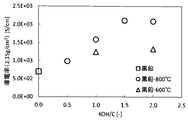
表2から次のことがわかる。水酸化カリウム混合後、800℃で加熱処理した試料No.1〜5は製造段階で水酸化カリウムの質量比(KOH/C)を高くするほど、黒鉛複合体に含まれる水酸化カリウム由来物、すなわち、カリウム、酸素、及び水素の割合が上昇した。一方、黒鉛複合体に占める水酸化カリウム由来物の割合が高くなるほど、炭素の割合は低下した。また試料No.1〜5は歩留りが上昇しており、この結果から水酸化カリウムの質量比(KOH/C)を高くすれば、炭素の消失量を上回るペースで水酸化カリウム由来物が黒鉛複合体に含有されることがわかる。また水酸化カリウムの質量比(KOH/C)を1.5以上とした試料No.3〜5は、C/K(モル比)が8未満であり、従来の黒鉛層間化合物(ステージ1構造のK−GIC(KC8))よりもカリウムの比率が高かった。そして図11からは水酸化カリウムの比率を高くする程、体積抵抗率が低下した黒鉛複合体が得られることがわかる。同様に図13からは水酸化カリウムの比率を高くする程、導電率が向上した黒鉛複合体が得られることがわかる。 The following can be seen from Table 2. After mixing with potassium hydroxide, the sample No. was heat-treated at 800 ° C. As for 1 to 5, the higher the mass ratio (KOH / C) of potassium hydroxide in the production stage, the higher the proportion of potassium hydroxide-derived substances, that is, potassium, oxygen, and hydrogen contained in the graphite complex. On the other hand, the higher the proportion of potassium hydroxide-derived substances in the graphite complex, the lower the proportion of carbon. In addition, sample No. The yields of 1 to 5 are increased, and from this result, if the mass ratio of potassium hydroxide (KOH / C) is increased, the potassium hydroxide-derived product is contained in the graphite complex at a pace exceeding the amount of carbon disappearance. You can see that. In addition, the sample No. having a mass ratio (KOH / C) of potassium hydroxide of 1.5 or more. In 3 to 5, the C / K (molar ratio) was less than 8, and the ratio of potassium was higher than that of the conventional graphite interlayer compound (K-GIC (KC 8) having a stage 1 structure). From FIG. 11, it can be seen that the higher the ratio of potassium hydroxide, the lower the volume resistivity of the graphite composite. Similarly, from FIG. 13, it can be seen that the higher the ratio of potassium hydroxide, the more the graphite composite with improved conductivity can be obtained.
一方、600℃で加熱処理した試料No.6、7はKOH/Cにおける水酸化カリウムの割合を2倍(1.0から2.0)にしても黒鉛複合体に含まれるカリウムの割合、及び歩留りが低下した。しかしながら体積抵抗率と導電率は試料No.6、7でほぼ同等の値であり、黒鉛よりも優れていた。また試料No.6、7と加熱温度が異なる試料No.2、4との比較からカリウムの割合や歩留りは加熱温度が影響していることがわかる。すなわち、加熱温度を高めると表3、表4に示す様に原料黒鉛の結晶構造が変化し、それに伴ってカリウムの割合や歩留りが変化していることがわかる。 On the other hand, the sample No. which was heat-treated at 600 ° C. In 6 and 7, even if the ratio of potassium hydroxide in KOH / C was doubled (1.0 to 2.0), the ratio of potassium contained in the graphite complex and the yield decreased. However, the volume resistivity and conductivity are the sample No. The values at 6 and 7 were almost the same, which was superior to graphite. In addition, sample No. Sample No. 6 and 7 with different heating temperatures. From the comparison with 2 and 4, it can be seen that the heating temperature affects the ratio of potassium and the yield. That is, it can be seen that when the heating temperature is increased, the crystal structure of the raw material graphite changes as shown in Tables 3 and 4, and the proportion and yield of potassium change accordingly.
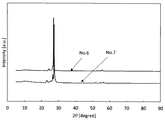
処理温度以外が同じである試料No.2、4と試料No.6、7を比べると処理温度の違いにより、黒鉛複合体に含まれるカリウムの割合や歩留り率の傾向が異なるが、表4、図1、2に示すように両者はX線回折2θが26.7〜28.0の範囲に強度が最大のピークトップを有している点で共通しており、体積抵抗率及び導電率は従来の黒鉛(試料No.8)よりも優れていた。黒鉛複合体中のK含有量が多い試料No.2、4は試料No.6、7よりも優れた体積抵抗率及び導電率を有していた。また図12、14に示すように負荷荷重を増加して黒鉛複合体の密度が高くなる程、体積抵抗率、導電性共に向上する傾向を示した。また製造時の水酸化カリウム比が同じである試料No.2と6、試料No.4と7を比べた結果、水酸化カリウム混合後の加熱温度を高くすることで27°付近のピークが広角側にシフトした黒鉛複合体が得られると共に、体積抵抗率がより一層良好な黒鉛複合体が得られることがわかる。 Sample No. which is the same except for the processing temperature. 2, 4 and sample No. Comparing 6 and 7, the tendency of the ratio of potassium contained in the graphite composite and the yield rate differs depending on the difference in the treatment temperature, but as shown in Table 4, FIGS. 1 and 2, both have an X-ray diffraction 2θ of 26. It is common in that it has a peak top with the maximum strength in the range of 7 to 28.0, and its volume resistivity and conductivity are superior to those of the conventional graphite (Sample No. 8). Sample No. with a high K content in the graphite complex. 2 and 4 are sample Nos. It had better volume resistivity and conductivity than 6 and 7. Further, as shown in FIGS. 12 and 14, as the load was increased and the density of the graphite complex increased, both the volume resistivity and the conductivity tended to improve. In addition, the sample No. having the same potassium hydroxide ratio at the time of manufacture. 2 and 6, sample No. As a result of comparing 4 and 7, a graphite complex in which the peak near 27 ° is shifted to the wide-angle side can be obtained by increasing the heating temperature after mixing potassium hydroxide, and the graphite complex has an even better volume resistivity. You can see that the body is obtained.
X線回折分析の結果を示す表4、図1、図2より次のことがわかる。まず、試料No.1〜7はいずれも試料No.8とは異なるX線回折パターンを有しており、黒鉛複合体の結晶構造は黒鉛から変化していることがわかる。特に試料No.1〜7は黒鉛の最大強度のピークトップよりも広角側(27°付近:26.7°〜28.0°の間)に最大強度のピークトップを有していた。水酸化カリウムの質量比(KOH/C)を1.5以上とし、黒鉛複合体中のK含有量が25.0質量%以上である試料No.3〜5は27°付近のピークがより一層シャープになっており、結晶子が成長していることがわかる。 The following can be seen from Table 4, FIG. 1 and FIG. 2 showing the results of X-ray diffraction analysis. First, sample No. Sample Nos. 1 to 7 are all No. It has an X-ray diffraction pattern different from that of No. 8, and it can be seen that the crystal structure of the graphite complex is different from that of graphite. Especially the sample No. 1 to 7 had the peak top of the maximum intensity on the wide-angle side (around 27 °: between 26.7 ° and 28.0 °) of the peak top of the maximum intensity of graphite. Sample No. having a mass ratio (KOH / C) of potassium hydroxide of 1.5 or more and a K content of 25.0% by mass or more in the graphite composite. In 3 to 5, the peak near 27 ° is sharper, and it can be seen that the crystallites are growing.
試料No.1〜5は黒鉛複合体中の水酸化カリウム由来物の割合が高くなるほどX線回折角(2θ)27°付近の最大強度のピークトップがよりシャープになる傾向を示すと共にX線回折角(2θ)のピークトップを27°付近、及び56°付近(55.0°〜58.0°)に有し、且つ、相対強度が27°付近>56°付近である点で一致している。また試料No.1〜5と試料No.6〜7はX線回折角(2θ)27°付近に最大強度を有すると共に、56°付近にもピークトップを有する点で共通しており、更に表1に示す様にカリウムを含む黒鉛複合体である点で共通している。 Sample No. Nos. 1 to 5 show that the peak top of the maximum intensity near the X-ray diffraction angle (2θ) of 27 ° tends to become sharper as the proportion of potassium hydroxide-derived substances in the graphite composite increases, and the X-ray diffraction angle (2θ) tends to become sharper. ) Have peak tops near 27 ° and around 56 ° (55.0 ° to 58.0 °), and the relative intensities are around 27 °> 56 °. In addition, sample No. 1 to 5 and sample No. 6 to 7 are common in that they have the maximum intensity near the X-ray diffraction angle (2θ) of 27 ° and also have a peak top near 56 °, and as shown in Table 1, a graphite complex containing potassium. It is common in that it is.
一方、試料No.10、12は原料黒鉛時の熱処理温度が低かったために黒鉛が十分に結晶化されておらず、そのため水酸化カリウムと混合して加熱処理してもX線回折角(2θ)27°付近に最大強度のピークトップ、または2番目の強度のピークトップは出現しなかった。試料No.9〜12は黒鉛の最大強度のピークトップよりも狭角側に最大強度のピークトップを有していた。また試料No.9〜12は体積抵抗率、導電率も十分ではなかった。なお、試料No.9〜12も安定性試験の前後でピークトップの位置は変化していないが、27°付近にピークトップを有していない点で、比較例に相当する。 On the other hand, sample No. In Nos. 10 and 12, graphite was not sufficiently crystallized because the heat treatment temperature at the time of raw graphite was low, so even if it was mixed with potassium hydroxide and heat-treated, the maximum X-ray diffraction angle (2θ) was around 27 °. No intensity peak top, or second intensity peak top, appeared. Sample No. Nos. 9 to 12 had the peak top of the maximum intensity on the narrow angle side of the peak top of the maximum intensity of graphite. In addition, sample No. Volume resistivity and conductivity of 9 to 12 were not sufficient. In addition, sample No. The positions of the peak tops of 9 to 12 did not change before and after the stability test, but they did not have a peak top near 27 °, which corresponds to the comparative example.
試料をラマンスペクトル分析した結果を示す表3、図3〜5から次のことがわかる。試料No.8は1600cm-1付近のピークトップはないが、試料No.1〜7は1600cm-1付近にピークトップを有していた。また水酸化カリウムの質量比(KOH/C)を高くする程、1600cm-1付近の強度が強くなり、特に試料No.3〜5では1600cm-1付近のピークトップの強度が1580cm-1付近のピークトップの強度よりも高かった。また1600cm-1付近のピークトップの強度は加熱処理温度600℃よりも800℃の方が高くなっていた。これらの結果から、加熱処理温度を高くすると共に、水酸化カリウムの質量比(KOH/C)を高くすれば、1600cm-1付近により高強度のピークトップが得られることがわかる。 The following can be seen from Table 3 and FIGS. 3 to 5 showing the results of Raman spectral analysis of the sample. Sample No. No. 8 has no peak top near 1600 cm -1, but the sample No. 1 to 7 had a peak top near 1600 cm -1. Further, the higher the mass ratio (KOH / C) of potassium hydroxide, the stronger the strength around 1600 cm -1 , and in particular, the sample No. The intensity of the peak top in the vicinity of 3-5 at 1600 cm -1 is higher than the intensity of the peak top in the vicinity of 1580 cm -1. The intensity of the peak top near 1600 cm -1 was higher at 800 ° C than at the heat treatment temperature of 600 ° C. From these results, it can be seen that if the heat treatment temperature is raised and the mass ratio (KOH / C) of potassium hydroxide is raised, a high-intensity peak top can be obtained near 1600 cm -1.
また1580cm-1付近と1600cm-1付近のピーク強度比(I1600/I1580)を示す図5からは、800℃で処理した試料No.1〜5のうち、試料No.3〜5に示す様にKOHの割合を1.5以上にすると、該強度比が100以上となり、1600cm-1付近のピークトップの強度が1580cm-1のピークトップの強度よりも高くなった。 Also from Figure 5 showing 1580 cm -1 and near 1600 cm -1 vicinity of the peak intensity ratio of the (I 1600 / I 1580), the samples were treated with 800 ° C. No. Of 1 to 5, sample No. When the ratio of KOH to 1.5 or more as shown in 3-5, it said intensity ratio becomes more than 100, the intensity of the peak top in the vicinity of 1600 cm -1 is higher than the intensity of the peak top of the 1580 cm -1.
黒鉛複合体の大気下安定性を調べた結果を示す表4から次のことがわかる。試料No.1〜7はX線回折角(2θ)27°付近のピークトップの位置が製造後と1ヶ月経過後とでほぼ同一(±0.1°以内)であり、結晶構造が維持されていることがわかる。 The following can be seen from Table 4, which shows the results of examining the atmospheric stability of the graphite complex. Sample No. In 1 to 7, the position of the peak top near the X-ray diffraction angle (2θ) of 27 ° is almost the same (within ± 0.1 °) after manufacturing and after 1 month, and the crystal structure is maintained. I understand.
黒鉛複合体の体積抵抗率を調べた結果を示す表5、図11から次のことがわかる。水酸化カリウムの質量比(KOH/C)が高い程、体積抵抗率が向上する傾向を示しており、いずれも黒鉛よりも優れた体積抵抗率を示した。また水酸化カリウム添加後の加熱温度は600℃よりも800℃の方がより優れた体積抵抗率低減効果を発揮した。体積抵抗率と密度の関係をプロットした図12においても同様の傾向を示した。 The following can be seen from Tables 5 and 11 showing the results of examining the volume resistivity of the graphite complex. The higher the mass ratio (KOH / C) of potassium hydroxide, the higher the volume resistivity tended to be, and all of them showed better volume resistivity than graphite. Further, when the heating temperature after the addition of potassium hydroxide was 800 ° C., the effect of reducing the volume resistivity was more excellent than that at 600 ° C. A similar tendency was shown in FIG. 12, which plots the relationship between volume resistivity and density.
黒鉛複合体の水蒸気吸着量を調べた結果を示す図6から次のことがわかる。黒鉛である試料No.8はほとんど吸着性を有していなかった。一方、黒鉛複合体は吸着等温線が示す様に吸着側と離脱側がほぼ一致するという特異な吸着性能を有するため、黒鉛とは構造だけでなく特性も異なることがわかる。 The following can be seen from FIG. 6, which shows the results of examining the amount of water vapor adsorbed on the graphite complex. Sample No. which is graphite. No. 8 had almost no adsorptivity. On the other hand, since the graphite complex has a peculiar adsorption performance that the adsorption side and the detachment side are almost the same as shown by the adsorption isotherm, it can be seen that not only the structure but also the characteristics are different from those of graphite.
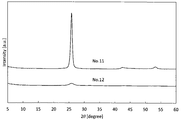
原料黒鉛として結晶化度が低い炭素材料を用いた場合について検討した結果、以下のことがわかった。図7に示す様に炭素材料を高温で処理した試料No.9(1700℃)、試料No.11(2100℃)のX線回折パターンはほぼ同じ波形であるが、試料No.8のピークトップよりも狭角側に存在していた。ピークトップの半値幅は炭素材の熱処理温度が高くなる程、シャープになる傾向を示した。図8に示す様に熱処理温度が高くなる程、結晶化度(黒鉛化度)も高くなり、層間隔Lcも広がることがわかる。また図9、10に示す様に結晶化度の低い水酸化カリウムを混合後、800℃で加熱処理した試料No.10、12は、試料No.9、11と比べて既存のピークトップの強度が著しく減少していると共に、該ピークトップの横軸方向の位置に変化はなかった。これらの結果から黒鉛化度が低い材料を使用しても新たな結晶構造は得られず、むしろ賦活の進行によって結晶構造が破壊され、黒鉛複合体は得られないことがわかる。 As a result of examining the case where a carbon material having a low crystallinity was used as the raw material graphite, the following was found. As shown in FIG. 7, the sample No. in which the carbon material was treated at a high temperature. 9 (1700 ° C.), sample No. The X-ray diffraction pattern of No. 11 (2100 ° C.) has almost the same waveform, but the sample No. It was present on the narrower angle side of the peak top of 8. The half-value width at the peak top tended to become sharper as the heat treatment temperature of the carbon material increased. As shown in FIG. 8, it can be seen that the higher the heat treatment temperature, the higher the crystallinity (graphitization degree) and the wider the layer spacing Lc. Further, as shown in FIGS. 9 and 10, the sample No. which was mixed with potassium hydroxide having a low crystallinity and then heat-treated at 800 ° C. 10 and 12 are sample Nos. The strength of the existing peak top was significantly reduced as compared with 9 and 11, and the position of the peak top in the horizontal axis direction did not change. From these results, it can be seen that a new crystal structure cannot be obtained even if a material having a low degree of graphitization is used, but rather the crystal structure is destroyed by the progress of activation and a graphite composite cannot be obtained.
表2から水酸化カリウムについて次のことがわかる。試料No.2(KOH/C=1.0)、試料No.4(KOH/C=2.0)は歩留りが100%を超えると共に、水酸化カリウムの質量比(KOH/C)が高くなる程、歩留りも向上した。また表5に示す様に試料No.2、4、はいずれも大気下での結晶構造の安定性を有している。使用するアルカリ金属水酸化物によって歩留りに違いが生じるが、試料No.2、4はいずれも優れた結晶構造安定性、及び体積抵抗に優れた効果を有し、特に試料No.2、4は導電性にも優れた効果を有している。 The following can be seen from Table 2 regarding potassium hydroxide. Sample No. 2 (KOH / C = 1.0), sample No. In 4 (KOH / C = 2.0), the yield exceeded 100%, and the higher the mass ratio of potassium hydroxide (KOH / C), the higher the yield. Further, as shown in Table 5, the sample No. Both 2 and 4 have the stability of the crystal structure in the atmosphere. Although the yield varies depending on the alkali metal hydroxide used, the sample No. Both 2 and 4 have excellent crystal structure stability and excellent effect on volume resistance, and in particular, sample No. 2 and 4 have excellent effects. 2 and 4 also have an excellent effect on conductivity.
Claims (9)
前記黒鉛複合体をラマン分光分析して求められるラマン散乱スペクトルにおいて、1590cm -1 〜1610cm -1 の範囲にピークトップまたは波形の変曲点を有する黒鉛複合体。 It is a graphite composite of graphite and alkali metal, and the peak of the maximum intensity of the X-ray diffraction analysis is in the range of the X-ray diffraction angle (2θ) of 26.7 ° to 28.0 ° obtained by the X-ray diffraction analysis. top or second peak top intensities possess, and,
In Raman scattering spectra obtained the graphite composite by Raman spectroscopic analysis, the graphite complex which have the inflection point of the peak top or waveform in a range of 1590cm -1 ~1610cm -1.
Priority Applications (1)
| Application Number | Priority Date | Filing Date | Title |
|---|---|---|---|
| JP2017156501A JP6967397B2 (en) | 2017-08-14 | 2017-08-14 | Graphite complex and its manufacturing method |
Applications Claiming Priority (1)
| Application Number | Priority Date | Filing Date | Title |
|---|---|---|---|
| JP2017156501A JP6967397B2 (en) | 2017-08-14 | 2017-08-14 | Graphite complex and its manufacturing method |
Publications (2)
| Publication Number | Publication Date |
|---|---|
| JP2019034866A JP2019034866A (en) | 2019-03-07 |
| JP6967397B2 true JP6967397B2 (en) | 2021-11-17 |
Family
ID=65636844
Family Applications (1)
| Application Number | Title | Priority Date | Filing Date |
|---|---|---|---|
| JP2017156501A Active JP6967397B2 (en) | 2017-08-14 | 2017-08-14 | Graphite complex and its manufacturing method |
Country Status (1)
| Country | Link |
|---|---|
| JP (1) | JP6967397B2 (en) |
Family Cites Families (2)
| Publication number | Priority date | Publication date | Assignee | Title |
|---|---|---|---|---|
| JPH09249407A (en) * | 1996-03-14 | 1997-09-22 | Toyota Central Res & Dev Lab Inc | Graphite composite and method for producing the same |
| JP2003321216A (en) * | 2002-04-26 | 2003-11-11 | Hitachi Powdered Metals Co Ltd | Graphite-based hydrogen storage material and method for producing the same |
-
2017
- 2017-08-14 JP JP2017156501A patent/JP6967397B2/en active Active
Also Published As
| Publication number | Publication date |
|---|---|
| JP2019034866A (en) | 2019-03-07 |
Similar Documents
| Publication | Publication Date | Title |
|---|---|---|
| JP5647435B2 (en) | Carbon nanotube and method for producing the same | |
| Chiang et al. | A novel synthesis of α-MoO3 nanobelts and the characterization | |
| JPS58145700A (en) | Method for producing silicon carbide whiskers | |
| JP2013507500A (en) | COMPOSITE MATERIAL HAVING GRAPHENE LAYER AND PRODUCTION AND USE THEREOF | |
| JP2010535148A (en) | Highly efficient method for producing exfoliated graphene | |
| JP2018531871A (en) | Method for producing Na3V2 (PO4) 2F3 particulate matter | |
| KR20140015985A (en) | Porous carbon and method for preparing the same | |
| JP3894615B2 (en) | Lithium titanate, method for producing the same, and lithium battery using the same | |
| Tang et al. | Oxidation of acetylene black by nitric acid in hermetically sealed condition | |
| JPH0413289B2 (en) | ||
| JP6967397B2 (en) | Graphite complex and its manufacturing method | |
| KR101760649B1 (en) | Metalheteroatom Functionalized Carbon Structures and the Method for Manufacturing the Same | |
| KR20240049585A (en) | Hexagonal boron nitride powder for filler | |
| DE102012213595A1 (en) | Process for the production of porous carbon | |
| KR102124951B1 (en) | Bundle-type carbon nanotube and method for preparing the same | |
| JPH0139965B2 (en) | ||
| EP4484374A2 (en) | A method to produce synthetic graphitic material | |
| JP6424476B2 (en) | Conductive material | |
| JP2020164341A (en) | Magnesium oxide and its manufacturing method | |
| JP6890947B2 (en) | Aluminum silicate complex | |
| KR20170032566A (en) | Carbon nanotubes having improved crystallinity | |
| Tamayo et al. | Characterization of polymer-derived ceramers subjected to wet-etching and the evolution of the carbon phase during thermal conversion | |
| Thakur et al. | Characterization and photoluminescence of Dy3+ doped CaTiO3 nanoparticles prepared by sol-gel method | |
| BRPI0611507A2 (en) | inorganic compounds | |
| JPS63139012A (en) | Production of graphitic material for electric cell |
Legal Events
| Date | Code | Title | Description |
|---|---|---|---|
| RD02 | Notification of acceptance of power of attorney |
Free format text: JAPANESE INTERMEDIATE CODE: A7422 Effective date: 20190123 |
|
| A621 | Written request for application examination |
Free format text: JAPANESE INTERMEDIATE CODE: A621 Effective date: 20200326 |
|
| A977 | Report on retrieval |
Free format text: JAPANESE INTERMEDIATE CODE: A971007 Effective date: 20210301 |
|
| A131 | Notification of reasons for refusal |
Free format text: JAPANESE INTERMEDIATE CODE: A131 Effective date: 20210309 |
|
| A601 | Written request for extension of time |
Free format text: JAPANESE INTERMEDIATE CODE: A601 Effective date: 20210422 |
|
| A521 | Request for written amendment filed |
Free format text: JAPANESE INTERMEDIATE CODE: A523 Effective date: 20210708 |
|
| TRDD | Decision of grant or rejection written | ||
| A01 | Written decision to grant a patent or to grant a registration (utility model) |
Free format text: JAPANESE INTERMEDIATE CODE: A01 Effective date: 20210928 |
|
| A61 | First payment of annual fees (during grant procedure) |
Free format text: JAPANESE INTERMEDIATE CODE: A61 Effective date: 20211025 |
|
| R150 | Certificate of patent or registration of utility model |
Ref document number: 6967397 Country of ref document: JP Free format text: JAPANESE INTERMEDIATE CODE: R150 |
|
| R250 | Receipt of annual fees |
Free format text: JAPANESE INTERMEDIATE CODE: R250 |
|
| R250 | Receipt of annual fees |
Free format text: JAPANESE INTERMEDIATE CODE: R250 |