JP6889893B2 - Magnetic paint composition, magnetic paint, magnetic putty and building materials using these - Google Patents
Magnetic paint composition, magnetic paint, magnetic putty and building materials using these Download PDFInfo
- Publication number
- JP6889893B2 JP6889893B2 JP2018177124A JP2018177124A JP6889893B2 JP 6889893 B2 JP6889893 B2 JP 6889893B2 JP 2018177124 A JP2018177124 A JP 2018177124A JP 2018177124 A JP2018177124 A JP 2018177124A JP 6889893 B2 JP6889893 B2 JP 6889893B2
- Authority
- JP
- Japan
- Prior art keywords
- magnetic
- powder
- coating composition
- magnetic coating
- water
- Prior art date
- Legal status (The legal status is an assumption and is not a legal conclusion. Google has not performed a legal analysis and makes no representation as to the accuracy of the status listed.)
- Active
Links
Images





Landscapes
- Paints Or Removers (AREA)
Description
本発明は、軟磁性粉を分散・含有させた磁性塗料組成物であり、永久磁石が吸着すると共に白い磁性塗料なので、建装材表面に塗布して白い磁性内装材として採用される。 The present invention is a magnetic coating composition in which soft magnetic powder is dispersed and contained, and since it is a white magnetic coating that attracts permanent magnets, it is applied to the surface of a building material and adopted as a white magnetic interior material.
建材や建装材に軟磁性を付与する技術は、軟磁性材を後から積層したり貼り付けたり、あるいは軟磁性塗料を塗装する方法の他、建材や建装材そのものに磁性を持たせる方法等がある。
さらに、軟磁性材は一般に黒い色をしていて、建材や建装材は黒い色になってしまい、内装材としては好ましく無い場合が多かった。そこで、黒い軟磁性材の上に再度塗装、又は表装シートを貼る必要があった。
The technology for imparting soft magnetism to building materials and building materials is a method of laminating or pasting soft magnetic materials later, or a method of applying soft magnetic paint, or a method of giving magnetism to building materials or building materials themselves. And so on.
Further, the soft magnetic material generally has a black color, and the building material and the building material have a black color, which is not preferable as an interior material in many cases. Therefore, it was necessary to repaint or attach a surface sheet on the black soft magnetic material.
他方で、最も一般的な軟磁性材は鉄粉であるが、安価で安定して確保できる還元鉄粉は、水分に拠って錆びるという致命傷があった。 On the other hand, the most common soft magnetic material is iron powder, but the reduced iron powder, which is inexpensive and can be stably secured, has a fatal injury that it rusts due to moisture.
例えば特許文献1に示されている様に、鉄粉を分散させた水溶性樹脂塗料の防錆は、鉄よりイオン化傾向が大きな金属を混合することが提案されている。
しかし、特許文献1は、液体の水に接した状態あるいは浸漬されるという過酷な試験を実施すると、やはり錆の発生が認められ長期な信頼性に欠ける。
For example, as shown in
However,
その塗料の色は黒く、内装材に塗布乾燥後塗装等の仕上げが無ければ、そのまま内装材として使用するには不向きであった。 The color of the paint was black, and it was unsuitable for use as an interior material as it was unless the interior material had a finish such as painting after application and drying.
上記課題に鑑み本発明は、黒色では無く白っぽい、少なくともネズミ色の軟磁性塗料であって、液体の水に接し続けるかあるいは水中に浸漬するという過酷な条件でも、錆の発生を大幅に抑えられる軟磁性水性塗料を提供する。
本発明の軟磁性塗料を壁紙や石膏ボードなどの表面に塗布すれば、磁石が吸着する白い室内壁面を確保できる。
In view of the above problems, the present invention is a soft magnetic paint that is whitish rather than black, at least murine-colored, and can significantly suppress the occurrence of rust even under harsh conditions such as continuous contact with liquid water or immersion in water. Provided is a soft magnetic water-based paint.
By applying the soft magnetic paint of the present invention to the surface of wallpaper, gypsum board, etc., a white interior wall surface to which magnets are attracted can be secured.
本発明は、酸化チタンを白色顔料として含有する水性樹脂塗料に、平均粒子径が20μm以上の鉄粉100重量部と、平均粒子径が2μm以上かつ前記鉄粉の平均粒子径の1/10以下の亜鉛粉5〜30重量部とを混合し、分散させた組成物とする。 The present invention is an aqueous resin coating material containing titanium oxide as a white pigment, the average particle diameter is 20μm or more iron powder 100 parts by weight, more average particle diameter of 2μm and 1/10 of the average particle diameter of the iron powder 5 to 30 parts by weight of the zinc powder of the above is mixed to obtain a dispersed composition.
より好ましくは、前記鉄粉の重量は水性樹脂塗料バインダーの重量の2〜5倍である。
また、鉄粉の重量が水性樹脂塗料の重量の2倍より低いと、磁性石膏層内の鉄粉の比率が低く、磁気吸着力が弱くなってしまう。
他方で、5倍より高いと相対的に樹脂バインダーの量が少なくなり、鉄粉間をつなぐバインダーとしての役割が果せなくなってしまう。
More preferably, the weight of the iron powder is 2 to 5 times the weight of the water-based resin paint binder.
Further, if the weight of the iron powder is less than twice the weight of the water-based resin paint, the ratio of the iron powder in the magnetic gypsum layer is low, and the magnetic adsorption force is weakened.
On the other hand, if it is higher than 5 times, the amount of the resin binder is relatively small, and the role as a binder for connecting the iron powders cannot be fulfilled.
前記鉄粉が還元鉄粉であることはより好ましい。還元鉄粉は安価であるとともに、その形状が本発明にとって好ましい。すなわち、粉体形状に鋭利な角が無く丸っぽいので、石膏や亜鉛粉、及び他の粉体と水とのスラリーを形成した際の流動性が良く、混合性が良く、塗布する場合にも好都合である。
さらに、還元鉄粉表面の凹凸部に樹脂バインダーが絡みつき、あるいはアンカー効果をもたらして機械的強度の確保に好都合である。
It is more preferable that the iron powder is a reduced iron powder. The reduced iron powder is inexpensive and its shape is preferable for the present invention. That is, since the powder shape has no sharp corners and is round, it has good fluidity when forming a slurry of gypsum, zinc powder, and other powders with water, and has good mixing properties. Is also convenient.
Further, the resin binder is entangled with the uneven portion on the surface of the reduced iron powder, or an anchor effect is provided, which is convenient for ensuring the mechanical strength.
前記組成物は、ハードフェライト粉、ソフトフェライト粉、四三酸化鉄粉の群から選ばれる1種又は複数の磁性粉が添加されていても良い。上述した3種類の磁性粉は、錆びることが無く、かつ永久磁石を引き付ける。そして、比較的大きな粒径の鉄粉の隙間を埋めるので、好適である。 The composition may be added with one or more magnetic powders selected from the group of hard ferrite powders, soft ferrite powders, and iron tetraoxide powders. The above-mentioned three types of magnetic powder do not rust and attract permanent magnets. It is suitable because it fills the gaps between iron powders having a relatively large particle size.
本発明の組成物は、水性樹脂塗料に亜鉛粉を加えて混合しておき、その後鉄粉を加えて混合された磁性塗料組成物がより好ましい。
また、亜鉛粉を加えた水性樹脂塗料に鉄粉を加えるに当って、大気圧より低い気圧の環境下で実施されてなる磁性樹脂塗料がより好ましい。
The composition of the present invention is more preferably a magnetic coating composition in which zinc powder is added to an aqueous resin coating material and mixed, and then iron powder is added and mixed.
Further, when iron powder is added to the water-based resin paint to which zinc powder is added, a magnetic resin paint which is carried out in an environment of a pressure lower than the atmospheric pressure is more preferable.
本発明の磁性塗料組成物に、半水石膏を添加しても良い。半水石膏は、水性樹脂塗料100重量部に対して5〜30重量部が好ましい。 Semi-hydrated gypsum may be added to the magnetic coating composition of the present invention. The amount of hemihydrate gypsum is preferably 5 to 30 parts by weight with respect to 100 parts by weight of the water-based resin paint.
半水石膏は添加・混合の最後に行なうと、作業可能な時間を最も長く確保することができる。
添加され半水石膏が再結晶して針状又は棒状の2水石膏になる際、還元鉄粉の凹凸や塗布された建装材表面の繊維や凹凸と絡んで好適である。
When hemihydrate gypsum is applied at the end of addition and mixing, the longest working time can be secured.
When the added hemihydrate gypsum is recrystallized into needle-shaped or rod-shaped dihydrate gypsum, it is suitable because it is entangled with the unevenness of the reduced iron powder and the fibers and unevenness on the surface of the applied building material.
本発明の水性軟磁性樹脂塗料を既存の壁、壁紙などの上に塗布すれば、磁石を吸着する白い壁面が完成する。
石膏ボードや合板などの建装材表面に塗布すれば、磁石を吸引する白い内装材となる。
When the water-based soft magnetic resin paint of the present invention is applied onto an existing wall, wallpaper, or the like, a white wall surface that attracts magnets is completed.
When applied to the surface of building materials such as gypsum board and plywood, it becomes a white interior material that attracts magnets.
本発明によれば、一般的な任意の建装材表面、壁面などに塗装可能な磁性塗料を提供することができる。塗装により、磁石が吸着可能な白い、少なくともネズミ色の壁面が出現する。この磁性塗料は水性であり、取り扱いが容易であり、ホルムアルデヒドの放散が無い。 According to the present invention, it is possible to provide a magnetic paint that can be applied to the surface, wall surface, or the like of any general building material. The painting reveals a white, at least murine-colored wall surface to which the magnet can be attracted. This magnetic paint is water-based, easy to handle, and does not emit formaldehyde.
本発明は、白くて磁石を吸引する軟磁性樹脂塗料組成物であって、錆に強く、建装材に塗布することでもって、そのまま内装材として使用することが可能である。
また、本発明の軟磁性樹脂塗料組成物を軟磁性水性塗料や軟磁性水性パテに含ませると、黒色では無く白っぽい、少なくともネズミ色の、錆の発生も大幅に抑えられる軟磁性水性塗料や軟磁性水性パテとなる。
The present invention is a white soft magnetic resin coating composition that attracts magnets, is resistant to rust, and can be used as it is as an interior material by being applied to a building material.
Further, when the soft magnetic resin coating composition of the present invention is contained in a soft magnetic water-based paint or a soft magnetic water-based putty, the soft magnetic water-based paint or soft is not black but whitish, at least murine-colored, and the generation of rust is significantly suppressed. It becomes a magnetic water-based putty.
本発明の軟磁性樹脂塗料組成物は、広く採用されている石膏ボード、加工木材、壁紙などの建装材に塗装することができる。
また、同様に、本発明の軟磁性樹脂塗料組成物を含む軟磁性水性塗料は、広く採用されている石膏ボード、加工木材、壁紙などの建装材に塗装することができる。
以下実施例でもって説明する。
The soft magnetic resin coating composition of the present invention can be applied to widely used building materials such as gypsum board, processed wood, and wallpaper.
Similarly, the soft magnetic water-based paint containing the soft magnetic resin paint composition of the present invention can be applied to widely used building materials such as gypsum board, processed wood, and wallpaper.
The following will be described with reference to Examples.
<実施例1>
白色顔料として酸化チタンを10〜20重量%含む白色水性樹脂塗料(株式会社アサヒペンが販売;水性多用途EX)5cc(約6グラム)に亜鉛粉(銘柄はF末。粒子径3〜5ミクロン。ハクスイテック株式会社が販売。)2グラムの割合で投入して撹拌した。その後、還元鉄粉(銘柄はDR−C2、平均粒子径は75ミクロン以上程度、DOWA IP CREATION社製)を20グラムの割合で加えて撹拌した。
以下の実施例及び比較例の各組成の数値は、実施例1と同様、何れも相対的な比率で表わすこととする。
<Example 1>
White water-based resin paint containing 10 to 20% by weight of titanium oxide as a white pigment (sold by Asahipen Corporation; water-based versatile EX) 5 cc (about 6 grams) and zinc powder (brand is F powder.
The numerical values of the compositions of the following Examples and Comparative Examples are all expressed in relative ratios as in Example 1.
次に厚紙の上に、0.3mm、0.6mm、又は0.7mm程度のクリアランスで塗り付けた。その後、室温が30〜35℃の室内で2〜3日間放置して乾燥させた。 Next, the cardboard was coated with a clearance of about 0.3 mm, 0.6 mm, or 0.7 mm. Then, it was left to dry in a room having a room temperature of 30 to 35 ° C. for 2 to 3 days.
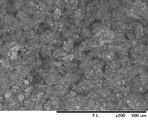
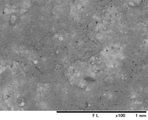
ハサミでカットした断面の電子顕微鏡写真を図1に示す。
鉄粉に樹脂塗料が絡み付き、鉄粉同士、及び紙繊維に絡み付いている。そして、小さな亜鉛粒子が散在している。
<実施例2>
An electron micrograph of a cross section cut with scissors is shown in FIG.
Resin paint is entwined with iron powder, and iron powder is entwined with each other and paper fibers. And small zinc particles are scattered.
<Example 2>
実施例1と同様の手順で各組成を混合し、厚紙の上に塗りつけてサンプルを得た。
ただし、塗料5ccに水道水を2cc加えて混合し、その後亜鉛粉2グラムを加えた。鉄粉を加えて混合後、焼き石膏(家庭化学工業社製高級工作石膏)を0.5グラム加えて混合し、比較的粘度が高い組成物を実施例1と同様に厚紙の上に塗り付けた。
Each composition was mixed in the same procedure as in Example 1 and smeared on thick paper to obtain a sample.
However, 2 cc of tap water was added to 5 cc of the paint and mixed, and then 2 g of zinc powder was added. After adding iron powder and mixing, 0.5 g of roasted gypsum (high-grade gypsum manufactured by Home Chemical Industry Co., Ltd.) is added and mixed, and a composition having a relatively high viscosity is applied onto thick paper in the same manner as in Example 1. It was.
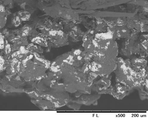
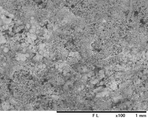
実施例1と同様に乾燥後、磁性層表面を撮影した電子顕微鏡写真を図2に示す。
実施例1と同様に、樹脂塗料が鉄粉に絡み付いて覆い、鉄粉どうしを強固につないでいる。
亜鉛粉が散在し、石膏と思われる結晶が観察できる。
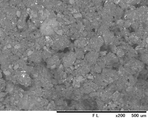
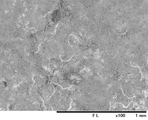
使用した亜鉛粉の電子顕微鏡写真を図3に示す。
FIG. 2 shows an electron micrograph of the surface of the magnetic layer after drying in the same manner as in Example 1.
Similar to the first embodiment, the resin paint is entwined with the iron powder to cover it, and the iron powder is firmly connected to each other.
Zinc powder is scattered and crystals that seem to be gypsum can be observed.
An electron micrograph of the zinc powder used is shown in FIG.
<比較例1>
亜鉛粉の添加を零としたこと以外は実施例1と同様にして、厚紙の上に組成物を塗り付け、乾燥した。
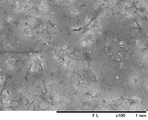
磁性層の断面の電子顕微鏡写真を図4に示す。亜鉛粉が存在しないこと以外は、実施例1の図1と同様であった。
<Comparative example 1>
The composition was applied onto thick paper and dried in the same manner as in Example 1 except that the addition of zinc powder was set to zero.
An electron micrograph of a cross section of the magnetic layer is shown in FIG. It was the same as FIG. 1 of Example 1 except that zinc powder was not present.
<比較例2>
実施例2と同様の手順で組成物を得て、厚紙の上に塗料を塗り付けた。
ただし、加える水道水は3.5ccとし、亜鉛粉はゼロとし、焼き石膏を5グラムとした。
磁性層表面の電子顕微鏡写真を図5に示す。
<Comparative example 2>
A composition was obtained in the same procedure as in Example 2, and the paint was applied onto the cardboard.
However, the amount of tap water to be added was 3.5 cc, the amount of zinc powder was zero, and the amount of grilled gypsum was 5 g.
An electron micrograph of the surface of the magnetic layer is shown in FIG.
以上の実施例1、実施例2、比較例1、及び比較例2の組成を表1に示す。 Table 1 shows the compositions of Example 1, Example 2, Comparative Example 1, and Comparative Example 2 described above.
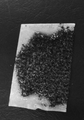
上述した実施例1、実施例2、比較例1、及び比較例2の試験片の一部を切り取り、それぞれはプラスチック製のコップに入れられた水道水の中に完全に浸漬させた。これらの試験片は、当該組成物がそれぞれ厚紙に塗り付けられ、乾燥している。
これらのコップは、室温が30〜35℃のエアコンの無い室内に放置し、錆の発生状況を肉眼で観察すると共に、一部を写真に撮った。この観察結果は表2に示している。
また、磁性層の表面の電子顕微鏡写真を撮った。
Part of the test pieces of Example 1, Example 2, Comparative Example 1 and Comparative Example 2 described above were cut out and each was completely immersed in tap water in a plastic cup. Each of these test pieces is coated with the composition on thick paper and dried.
These cups were left in a room with a room temperature of 30 to 35 ° C. without an air conditioner, and the state of rust formation was observed with the naked eye, and a part of them was photographed. The observation results are shown in Table 2.
In addition, an electron micrograph of the surface of the magnetic layer was taken.
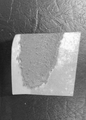
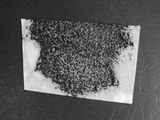
図A(a)は、実施例1のサンプルを略20時間水に浸漬した後の写真である。肉眼上全く変化が無い。他方で、図A(b)は、同条件下の比較例1のサンプルである。
同様に、図Bは実施例1の略70時間後で、よく観察すると錆が認められるが、写真では判らない。同様に図Cは比較例1の略70時間後であるが、錆は進行している。
FIG. AA is a photograph of the sample of Example 1 after being immersed in water for approximately 20 hours. There is no change to the naked eye. On the other hand, FIG. A (b) is a sample of Comparative Example 1 under the same conditions.
Similarly, FIG. B shows rust when observed closely after about 70 hours of Example 1, but it cannot be seen in the photograph. Similarly, FIG. C shows approximately 70 hours after Comparative Example 1, but rust is progressing.
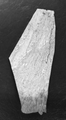
図Dは、実施例2のサンプルを略96時間浸漬させた後の写真である。肉眼上でも、写真で見ても、両方とも錆と断定できる変化は認め難い。 FIG. D is a photograph of the sample of Example 2 after being immersed for approximately 96 hours. It is difficult to see any change that can be concluded to be rust, both with the naked eye and in the photograph.
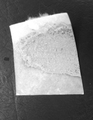
図E(a)は、実施例1の略160時間後である。一部に錆が目立ち始めている。
図E(b)は、比較例1の同様の時間後である。肉眼で見れば赤褐色の錆が全面を覆っているが、写真でもその状態が示されている。
図Fは、実施例2の、略150時間後の写真である。赤褐色の錆は殆ど目立たない。
FIG. E (a) shows approximately 160 hours after Example 1. Rust is beginning to stand out in some areas.
FIG. E (b) shows the same time after Comparative Example 1. The reddish-brown rust covers the entire surface with the naked eye, which is also shown in the photograph.
FIG. F is a photograph of Example 2 after about 150 hours. The reddish brown rust is hardly noticeable.
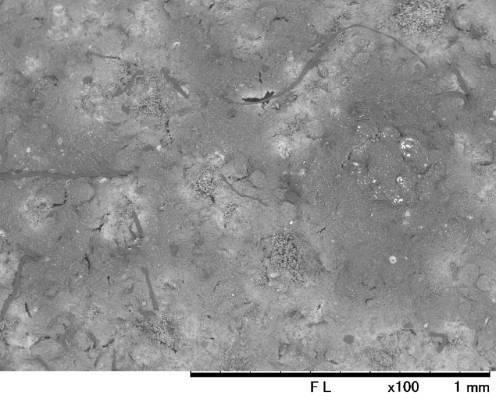
図6は、実施例1のサンプルを水道水に略160時間浸漬後の磁性層表面の電子顕微鏡写真である。磁性層表面が斑に変質していることは明らかだが、褐色の錆と考えられる部分が視野の中に数箇所以上認められる。砂状物がモクモクと盛り上がっている様に見える部分である。
図7は、実施例2のサンプルを水道水に略150時間浸漬後の磁性層表面の電子顕微鏡写真である。磁性層表面の変質は実施例1の図6より少ない。また、砂状物が盛り上がっている状態は観察されなかった。
FIG. 6 is an electron micrograph of the surface of the magnetic layer after immersing the sample of Example 1 in tap water for approximately 160 hours. It is clear that the surface of the magnetic layer has been transformed into spots, but there are several or more parts that are thought to be brown rust in the field of view. This is the part where the sandy material seems to be swelling.
FIG. 7 is an electron micrograph of the surface of the magnetic layer after immersing the sample of Example 2 in tap water for about 150 hours. The deterioration of the surface of the magnetic layer is less than that of FIG. 6 of Example 1. In addition, no swelling of sandy objects was observed.
図8は、比較例1のサンプルの略160時間浸漬後の磁性層表面の電子顕微鏡写真である。視野の大部分が砂状物の盛り上がりで覆われている。肉眼で見れば、ほぼ全域が赤褐色となっている。 FIG. 8 is an electron micrograph of the surface of the magnetic layer after immersion of the sample of Comparative Example 1 for approximately 160 hours. Most of the field of view is covered with ridges of sand. When viewed with the naked eye, almost the entire area is reddish brown.
図9は、比較例2のサンプルを、略150時間水に浸漬した後の磁性層表面の電子顕微鏡写真である。同視野の中央下段のヤヤ左の部分を5倍拡大し、撮影モードを『標準』から『影付き』へ変更した電子顕微鏡写真が図10である。図10からは、砂状物の盛り上がりが全面に広がっていることがわかる。
比較例2のサンプルの錆の発生は激しく、実施例との差があまりに大きいので比較の光学写真を撮っていないが、この電子顕微鏡写真から、最も錆び易く、錆が進行していることが明らかである。
FIG. 9 is an electron micrograph of the surface of the magnetic layer after the sample of Comparative Example 2 was immersed in water for about 150 hours. FIG. 10 is an electron micrograph in which the left part of the lower center of the same field of view is magnified 5 times and the shooting mode is changed from "standard" to "shadowed". From FIG. 10, it can be seen that the swelling of the sandy material spreads over the entire surface.
Rust was severely generated in the sample of Comparative Example 2, and the difference from the Example was too large to take a comparative optical photograph. However, from this electron micrograph, it is clear that the sample is most rusty and the rust is progressing. Is.
本発明の組成物に、ハードフェライト粉、ソフトフェライト粉、及び四三酸化鉄の群から選ばれる1種以上の磁性粉を添加しても良い。
「錆びない」という特徴に加えて、比較的大きな粒径である鉄粉間の隙間を埋めることが可能なので、好適である。
添加量は、鉄粉100重量部に対して30部以下、より好ましくは20部以下がよい。
これを越えると、金属鉄の磁気吸着力に比べて低い磁性成分が無視出来なくなり、低下してしまうからである。
One or more magnetic powders selected from the group of hard ferrite powder, soft ferrite powder, and iron tetraoxide may be added to the composition of the present invention.
In addition to the feature of "not rusting", it is suitable because it can fill the gaps between iron powders having a relatively large particle size.
The amount added is preferably 30 parts or less, more preferably 20 parts or less, based on 100 parts by weight of iron powder.
This is because if it exceeds this, the magnetic component lower than the magnetic attraction force of metallic iron cannot be ignored and decreases.
本発明の組成物は組成を加える順序が重要である。本発明では安価で安定して入手できる還元鉄粉を採用するが、還元鉄粉は表面に凹凸が多く且つ氷河のクレパスのような深く狭い空間が存在する。その部分に液体状の水が接触し満たされると、直ちに酸化反応、すなわち錆の発生が開始される。その後から鉄よりイオン化傾向が強い亜鉛が添加されても、亜鉛イオンの到達・作用が遅れるのである。
そこで、少なくとも鉄粉を添加する前に、亜鉛粉を水性塗料に添加すると良い。
In the composition of the present invention, the order in which the compositions are added is important. In the present invention, reduced iron powder that is inexpensive and stably available is used, but the reduced iron powder has many irregularities on the surface and has a deep and narrow space like a glacier crepus. As soon as the portion is contacted and filled with liquid water, an oxidation reaction, that is, rust formation, is started. Even if zinc, which has a higher ionization tendency than iron, is added after that, the arrival and action of zinc ions are delayed.
Therefore, it is advisable to add zinc powder to the water-based paint at least before adding iron powder.
鉄粉を添加するに際して、大気圧より低い気圧下、即ち減圧下で、亜鉛粉を添加済みの水性塗料に鉄粉を加えることが好ましい。
還元鉄粉の空僻などの空気が殆ど除去されるので、奥深い凹み部分にまで塗料樹脂が行き渡り、また亜鉛粉が該部分の近傍に散在することができる。
When adding the iron powder, it is preferable to add the iron powder to the water-based paint to which the zinc powder has been added under a pressure lower than the atmospheric pressure, that is, under a reduced pressure.
Since most of the air such as the empty space of the reduced iron powder is removed, the paint resin can be distributed to the deep recessed portion, and the zinc powder can be scattered in the vicinity of the portion.
半水石膏(例えば焼き石膏)を組成物に添加する場合は最後が良い。
2水石膏として再結晶を開始すると粘度が上昇し、あるいはパサパサとなり、あるいは塗布が出来なくなってしまう。そこで、半水石膏の添加は塗料として使用する直前が良い。組成物の可使時間を長くする目的で少量の薬剤を加えても良い。
The last is good when adding semi-hydrated gypsum (eg, roasted gypsum) to the composition.
2 When recrystallization is started as gypsum, the viscosity increases, it becomes dry, or it cannot be applied. Therefore, it is better to add hemihydrate gypsum just before using it as a paint. A small amount of drug may be added for the purpose of prolonging the pot life of the composition.
本発明の実施例では、市販されている白色水性樹脂塗料をベース塗料として採用した。
この塗料は、アクリル樹脂系のエマルジョン型の水性塗料であるが、本発明がこの塗料に限定されることは無い。
ただし、顔料としての酸化チタンは必須である。白さを増すために酸化チタンの添加量をふやしても良い。酸化チタンの添加量を25%から30%まで増やしても、本発明の組成物からなる磁性層の磁気吸着力の低下は少ない。
In the examples of the present invention, a commercially available white water-based resin paint was used as the base paint.
This paint is an acrylic resin-based emulsion-type water-based paint, but the present invention is not limited to this paint.
However, titanium oxide as a pigment is indispensable. The amount of titanium oxide added may be increased in order to increase the whiteness. Even if the amount of titanium oxide added is increased from 25% to 30%, the magnetic adsorption force of the magnetic layer made of the composition of the present invention does not decrease much.
本発明は、磁性塗料そのものが白いことに特徴がある。
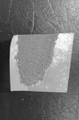
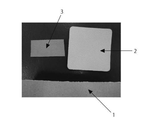
日本電色工業(株)の簡易型分光色差計NF−333で測定した、明るさを表すL*(最大は100)は、図Gの「市販の壁材1」が63.12、「市販されている他の壁材2」のL*は78.82である。「市販の壁材1」と「本発明の実施例2で作成した壁材3」を肉眼で観察し比較すると、「本発明の実施例2で作成した壁材3」は「市販の壁材1」とほぼ同じ明るさを有していた。このことから、おそらく「本発明の実施例2で作成した壁材3」のL*は「市販の壁材1」と同等の63程度と考えられる。
The present invention is characterized in that the magnetic paint itself is white.
The L * (maximum 100) indicating the brightness measured by the simple spectroscopic color difference meter NF-333 of Nippon Denshoku Kogyo Co., Ltd. is 63.12 for "commercially
本発明では還元鉄粉を採用するが、還元鉄粉の粒径が20μmより小さいと高価であり、採用出来ない。粒径が大きいことは本発明には重要では無いが、本発明の組成物を塗料として塗布した後の表面の粗さが許容される範囲を考慮して決定する。 In the present invention, reduced iron powder is used, but if the particle size of the reduced iron powder is smaller than 20 μm, it is expensive and cannot be used. Although it is not important for the present invention to have a large particle size, it is determined in consideration of a range in which the surface roughness after applying the composition of the present invention as a coating material is acceptable.
鉄粉と亜鉛粉のそれぞれの粒経、及び重量比は重要である。それは亜鉛イオンによる防錆効果が有効になるか否かを支配していると考えられる。
鉄粉と亜鉛粉とのそれぞれの総表面積の比が重要であるが、鉄粉と亜鉛粉がバインダー中に散在することも必要であると考えられる。
また、図1及び図2の視野を詳細に観察すると、亜鉛粉はランダムに分布していて、さらに局部的には濃淡がある。しかし、表2や光学写真から、防錆効果があることが判る。亜鉛粉は鉄粉の表面にのみ存在している訳では無く、見かけ上の写真での面積は鉄粉の1/10をはるかに下回っている。
The grain size and weight ratio of iron powder and zinc powder are important. It is considered that it controls whether or not the rust preventive effect of zinc ions is effective.
The ratio of the total surface area of iron powder and zinc powder is important, but it is also considered necessary that iron powder and zinc powder are scattered in the binder.
Further, when the visual fields of FIGS. 1 and 2 are observed in detail, the zinc powder is randomly distributed, and there are local shades. However, it can be seen from Table 2 and the optical photograph that it has a rust preventive effect. Zinc powder is not only present on the surface of iron powder, and its apparent area in the photograph is much smaller than 1/10 of iron powder.
実施例2の組成物は実施例1に較べて水分が略1.8倍に増え、焼き石膏が添加されている。該焼き石膏0.5グラムが再結晶する際に新たに取り込む水は理論上、約0.1グラムに過ぎない。実施例2の様に過剰な水分は、組成物の粘度を考慮して決められるが、しかし、表2から明らかな様に、実施例1に比べて明らかに防錆性が高いことがわかる。
期待した以上の防錆効果は、石膏、鉄、亜鉛、そして塗料樹脂などが何か特別な作用をもたらした結果だと考えられる。
The composition of Example 2 has approximately 1.8 times more water than that of Example 1, and roasted gypsum is added. Theoretically, only about 0.1 g of water is newly taken in when 0.5 g of the roasted gypsum is recrystallized. The excess water content as in Example 2 is determined in consideration of the viscosity of the composition, but as is clear from Table 2, it can be seen that the rust preventive property is clearly higher than that in Example 1.
The rust preventive effect beyond expectations is thought to be the result of gypsum, iron, zinc, and paint resin having some special effects.
一方、再結晶して生成する2水石膏は紙の繊維に絡み合い、そして還元鉄粉表面の凹凸に絡んで、塗料の樹脂成分共々、塗装部の機械強度を強めている。 On the other hand, the dihydrate gypsum produced by recrystallization is entangled with the fibers of the paper and entwined with the unevenness of the surface of the reduced iron powder, and together with the resin component of the paint, enhances the mechanical strength of the painted portion.
本発明の水性の磁性樹脂塗料は、コーター塗りやコテ塗りが可能である。また、パテとしての用途に採用することができる。 The water-based magnetic resin coating material of the present invention can be coated with a coater or a trowel. It can also be used as a putty.
本発明は、永久磁石を自在に吸着させることが可能な磁性表面を具備する建材・建装材に適用することができる。その磁性表面は、白く且つ錆に強い抵抗を持っている。 The present invention can be applied to a building material / building material having a magnetic surface capable of freely adsorbing a permanent magnet. Its magnetic surface is white and has a strong resistance to rust.
1 市販の壁材
2 市販されている他の壁材
3 本発明の実施例2で作成した壁材
1 Commercially
Claims (13)
The method for producing a magnetic coating composition according to claim 11 or 12, wherein the step of adding iron powder to the aqueous resin coating material mixed with zinc powder and mixing the mixture is in a reduced pressure state.
Priority Applications (1)
| Application Number | Priority Date | Filing Date | Title |
|---|---|---|---|
| JP2018177124A JP6889893B2 (en) | 2018-09-21 | 2018-09-21 | Magnetic paint composition, magnetic paint, magnetic putty and building materials using these |
Applications Claiming Priority (1)
| Application Number | Priority Date | Filing Date | Title |
|---|---|---|---|
| JP2018177124A JP6889893B2 (en) | 2018-09-21 | 2018-09-21 | Magnetic paint composition, magnetic paint, magnetic putty and building materials using these |
Publications (2)
| Publication Number | Publication Date |
|---|---|
| JP2020045465A JP2020045465A (en) | 2020-03-26 |
| JP6889893B2 true JP6889893B2 (en) | 2021-06-18 |
Family
ID=69899397
Family Applications (1)
| Application Number | Title | Priority Date | Filing Date |
|---|---|---|---|
| JP2018177124A Active JP6889893B2 (en) | 2018-09-21 | 2018-09-21 | Magnetic paint composition, magnetic paint, magnetic putty and building materials using these |
Country Status (1)
| Country | Link |
|---|---|
| JP (1) | JP6889893B2 (en) |
Families Citing this family (2)
| Publication number | Priority date | Publication date | Assignee | Title |
|---|---|---|---|---|
| JP7385871B2 (en) * | 2021-03-02 | 2023-11-24 | ニチレイマグネット株式会社 | Water-based magnetic coating composition, magnetic surface and magnetic sheet using the same |
| JP7490200B2 (en) * | 2021-03-02 | 2024-05-27 | ニチレイマグネット株式会社 | Nd magnetic powder-containing aqueous coating composition and magnetic surface and magnetic sheet using the same |
Family Cites Families (9)
| Publication number | Priority date | Publication date | Assignee | Title |
|---|---|---|---|---|
| JPS52117332A (en) * | 1976-03-26 | 1977-10-01 | Suzuka Toryo | Undercoating materials for paint* etc |
| JP2004167819A (en) * | 2002-11-19 | 2004-06-17 | Nakapen Tosoten:Kk | Magnetic matter attracting sheet and its manufacturing method |
| JP5135313B2 (en) * | 2009-10-08 | 2013-02-06 | 株式会社マグエックス | Paint, magnetic substrate coated with the paint, and method of forming a magnetized surface |
| JP5988133B2 (en) * | 2012-03-28 | 2016-09-07 | 地方独立行政法人青森県産業技術センター | Mixture for magnetically adhering paint and magnetically adhering paint |
| JP5916228B2 (en) * | 2013-01-31 | 2016-05-11 | ニチレイマグネット株式会社 | Magnetic film structure and method of manufacturing magnetic film structure |
| JP5577475B1 (en) * | 2014-03-03 | 2014-08-20 | 日本ペイント株式会社 | Water-based organic zinc-rich coating composition, antirust coating film forming method and multilayer coating film |
| JPWO2018074218A1 (en) * | 2016-10-18 | 2019-08-08 | 吉野石膏株式会社 | Gypsum building material with magnetic layer, magnetic jointing material, and method for producing gypsum building material with magnetic layer |
| CN107841177A (en) * | 2017-10-30 | 2018-03-27 | 汪涛 | A kind of conducting paint composite |
| CN107964290A (en) * | 2017-11-13 | 2018-04-27 | 青岛卓森纳生物工程有限公司 | A kind of anti-aging environmental protection coating material of high molecular nanometer |
-
2018
- 2018-09-21 JP JP2018177124A patent/JP6889893B2/en active Active
Also Published As
| Publication number | Publication date |
|---|---|
| JP2020045465A (en) | 2020-03-26 |
Similar Documents
| Publication | Publication Date | Title |
|---|---|---|
| JP5135313B2 (en) | Paint, magnetic substrate coated with the paint, and method of forming a magnetized surface | |
| EP1517062A3 (en) | High coefficient friction material with symmetrical friction modifying particles | |
| JPWO2020071051A1 (en) | Architectural surface material with magnetic layer | |
| JP2020045465A (en) | Magnetic paint composition, magnetic paint, magnetic putty, and building materials using these | |
| JP2005268630A (en) | Magnetic steel sheet with chrome-free insulation coating | |
| US10804031B2 (en) | Magnetic paint composition and uses therefor | |
| JP5916228B2 (en) | Magnetic film structure and method of manufacturing magnetic film structure | |
| EP0794980A1 (en) | Magnetic coating composition | |
| CA2977369A1 (en) | Slurry compositions for use in flame retardant and hydrophobic coatings | |
| JP7385871B2 (en) | Water-based magnetic coating composition, magnetic surface and magnetic sheet using the same | |
| JP5988133B2 (en) | Mixture for magnetically adhering paint and magnetically adhering paint | |
| JP7246642B2 (en) | White water-based magnetic paint and white magnetic sheet using the same | |
| CN108311357A (en) | A kind of simulative marble slab based on metallic plate | |
| JP3140612B2 (en) | Inorganic coating composition | |
| JP2007099832A (en) | Organic zinc rich paint composition | |
| US20030232130A1 (en) | Method of making magnetically attractive coatings | |
| JP7490200B2 (en) | Nd magnetic powder-containing aqueous coating composition and magnetic surface and magnetic sheet using the same | |
| KR101084038B1 (en) | Black water base paint composition | |
| AU2002100052A4 (en) | Paint with magnetic or magnet attracting properties | |
| JPH06329949A (en) | Inorganic coating composition | |
| JP7022966B2 (en) | Magnet sheet and magnet surface using water-based magnet paint | |
| RU2202651C2 (en) | Method of protection of surfaces of articles made from ferromagnetic materials | |
| WO1994022151A1 (en) | Composition containing iron powder as a magnetically active ingredient plus a binder | |
| US20060283989A1 (en) | Method and device for applying wall coatings | |
| JP4914015B2 (en) | Binder for diatomaceous earth and method for producing the same, coating material containing diatomaceous earth and method for producing the same |
Legal Events
| Date | Code | Title | Description |
|---|---|---|---|
| A621 | Written request for application examination |
Free format text: JAPANESE INTERMEDIATE CODE: A621 Effective date: 20200306 |
|
| A977 | Report on retrieval |
Free format text: JAPANESE INTERMEDIATE CODE: A971007 Effective date: 20201214 |
|
| A131 | Notification of reasons for refusal |
Free format text: JAPANESE INTERMEDIATE CODE: A131 Effective date: 20201222 |
|
| A521 | Request for written amendment filed |
Free format text: JAPANESE INTERMEDIATE CODE: A523 Effective date: 20210121 |
|
| TRDD | Decision of grant or rejection written | ||
| A01 | Written decision to grant a patent or to grant a registration (utility model) |
Free format text: JAPANESE INTERMEDIATE CODE: A01 Effective date: 20210514 |
|
| A61 | First payment of annual fees (during grant procedure) |
Free format text: JAPANESE INTERMEDIATE CODE: A61 Effective date: 20210514 |
|
| R150 | Certificate of patent or registration of utility model |
Ref document number: 6889893 Country of ref document: JP Free format text: JAPANESE INTERMEDIATE CODE: R150 |
|
| R250 | Receipt of annual fees |
Free format text: JAPANESE INTERMEDIATE CODE: R250 |
|
| R250 | Receipt of annual fees |
Free format text: JAPANESE INTERMEDIATE CODE: R250 |
|
| R250 | Receipt of annual fees |
Free format text: JAPANESE INTERMEDIATE CODE: R250 |