JP6869552B2 - Non-humidifying proton conductive film, its manufacturing method and fuel cell - Google Patents
Non-humidifying proton conductive film, its manufacturing method and fuel cell Download PDFInfo
- Publication number
- JP6869552B2 JP6869552B2 JP2018513087A JP2018513087A JP6869552B2 JP 6869552 B2 JP6869552 B2 JP 6869552B2 JP 2018513087 A JP2018513087 A JP 2018513087A JP 2018513087 A JP2018513087 A JP 2018513087A JP 6869552 B2 JP6869552 B2 JP 6869552B2
- Authority
- JP
- Japan
- Prior art keywords
- proton
- group
- substance
- proton conductive
- site
- Prior art date
- Legal status (The legal status is an assumption and is not a legal conclusion. Google has not performed a legal analysis and makes no representation as to the accuracy of the status listed.)
- Active
Links
Images


Classifications
-
- C—CHEMISTRY; METALLURGY
- C08—ORGANIC MACROMOLECULAR COMPOUNDS; THEIR PREPARATION OR CHEMICAL WORKING-UP; COMPOSITIONS BASED THEREON
- C08J—WORKING-UP; GENERAL PROCESSES OF COMPOUNDING; AFTER-TREATMENT NOT COVERED BY SUBCLASSES C08B, C08C, C08F, C08G or C08H
- C08J5/00—Manufacture of articles or shaped materials containing macromolecular substances
- C08J5/20—Manufacture of shaped structures of ion-exchange resins
- C08J5/22—Films, membranes or diaphragms
- C08J5/2206—Films, membranes or diaphragms based on organic and/or inorganic macromolecular compounds
- C08J5/2218—Synthetic macromolecular compounds
- C08J5/2231—Synthetic macromolecular compounds based on macromolecular compounds obtained by reactions involving unsaturated carbon-to-carbon bonds
- C08J5/2237—Synthetic macromolecular compounds based on macromolecular compounds obtained by reactions involving unsaturated carbon-to-carbon bonds containing fluorine
-
- H—ELECTRICITY
- H01—ELECTRIC ELEMENTS
- H01M—PROCESSES OR MEANS, e.g. BATTERIES, FOR THE DIRECT CONVERSION OF CHEMICAL ENERGY INTO ELECTRICAL ENERGY
- H01M8/00—Fuel cells; Manufacture thereof
- H01M8/10—Fuel cells with solid electrolytes
- H01M8/1016—Fuel cells with solid electrolytes characterised by the electrolyte material
- H01M8/1018—Polymeric electrolyte materials
- H01M8/1041—Polymer electrolyte composites, mixtures or blends
- H01M8/1044—Mixtures of polymers, of which at least one is ionically conductive
-
- C—CHEMISTRY; METALLURGY
- C08—ORGANIC MACROMOLECULAR COMPOUNDS; THEIR PREPARATION OR CHEMICAL WORKING-UP; COMPOSITIONS BASED THEREON
- C08F—MACROMOLECULAR COMPOUNDS OBTAINED BY REACTIONS ONLY INVOLVING CARBON-TO-CARBON UNSATURATED BONDS
- C08F293/00—Macromolecular compounds obtained by polymerisation on to a macromolecule having groups capable of inducing the formation of new polymer chains bound exclusively at one or both ends of the starting macromolecule
- C08F293/005—Macromolecular compounds obtained by polymerisation on to a macromolecule having groups capable of inducing the formation of new polymer chains bound exclusively at one or both ends of the starting macromolecule using free radical "living" or "controlled" polymerisation, e.g. using a complexing agent
-
- C—CHEMISTRY; METALLURGY
- C08—ORGANIC MACROMOLECULAR COMPOUNDS; THEIR PREPARATION OR CHEMICAL WORKING-UP; COMPOSITIONS BASED THEREON
- C08J—WORKING-UP; GENERAL PROCESSES OF COMPOUNDING; AFTER-TREATMENT NOT COVERED BY SUBCLASSES C08B, C08C, C08F, C08G or C08H
- C08J5/00—Manufacture of articles or shaped materials containing macromolecular substances
- C08J5/18—Manufacture of films or sheets
-
- C—CHEMISTRY; METALLURGY
- C08—ORGANIC MACROMOLECULAR COMPOUNDS; THEIR PREPARATION OR CHEMICAL WORKING-UP; COMPOSITIONS BASED THEREON
- C08J—WORKING-UP; GENERAL PROCESSES OF COMPOUNDING; AFTER-TREATMENT NOT COVERED BY SUBCLASSES C08B, C08C, C08F, C08G or C08H
- C08J5/00—Manufacture of articles or shaped materials containing macromolecular substances
- C08J5/20—Manufacture of shaped structures of ion-exchange resins
- C08J5/22—Films, membranes or diaphragms
-
- C—CHEMISTRY; METALLURGY
- C08—ORGANIC MACROMOLECULAR COMPOUNDS; THEIR PREPARATION OR CHEMICAL WORKING-UP; COMPOSITIONS BASED THEREON
- C08J—WORKING-UP; GENERAL PROCESSES OF COMPOUNDING; AFTER-TREATMENT NOT COVERED BY SUBCLASSES C08B, C08C, C08F, C08G or C08H
- C08J5/00—Manufacture of articles or shaped materials containing macromolecular substances
- C08J5/20—Manufacture of shaped structures of ion-exchange resins
- C08J5/22—Films, membranes or diaphragms
- C08J5/2206—Films, membranes or diaphragms based on organic and/or inorganic macromolecular compounds
- C08J5/2218—Synthetic macromolecular compounds
- C08J5/2231—Synthetic macromolecular compounds based on macromolecular compounds obtained by reactions involving unsaturated carbon-to-carbon bonds
-
- C—CHEMISTRY; METALLURGY
- C08—ORGANIC MACROMOLECULAR COMPOUNDS; THEIR PREPARATION OR CHEMICAL WORKING-UP; COMPOSITIONS BASED THEREON
- C08J—WORKING-UP; GENERAL PROCESSES OF COMPOUNDING; AFTER-TREATMENT NOT COVERED BY SUBCLASSES C08B, C08C, C08F, C08G or C08H
- C08J5/00—Manufacture of articles or shaped materials containing macromolecular substances
- C08J5/20—Manufacture of shaped structures of ion-exchange resins
- C08J5/22—Films, membranes or diaphragms
- C08J5/2206—Films, membranes or diaphragms based on organic and/or inorganic macromolecular compounds
- C08J5/2218—Synthetic macromolecular compounds
- C08J5/2231—Synthetic macromolecular compounds based on macromolecular compounds obtained by reactions involving unsaturated carbon-to-carbon bonds
- C08J5/2243—Synthetic macromolecular compounds based on macromolecular compounds obtained by reactions involving unsaturated carbon-to-carbon bonds obtained by introduction of active groups capable of ion-exchange into compounds of the type C08J5/2231
- C08J5/225—Synthetic macromolecular compounds based on macromolecular compounds obtained by reactions involving unsaturated carbon-to-carbon bonds obtained by introduction of active groups capable of ion-exchange into compounds of the type C08J5/2231 containing fluorine
-
- C—CHEMISTRY; METALLURGY
- C08—ORGANIC MACROMOLECULAR COMPOUNDS; THEIR PREPARATION OR CHEMICAL WORKING-UP; COMPOSITIONS BASED THEREON
- C08K—Use of inorganic or non-macromolecular organic substances as compounding ingredients
- C08K5/00—Use of organic ingredients
- C08K5/04—Oxygen-containing compounds
- C08K5/06—Ethers; Acetals; Ketals; Ortho-esters
-
- C—CHEMISTRY; METALLURGY
- C08—ORGANIC MACROMOLECULAR COMPOUNDS; THEIR PREPARATION OR CHEMICAL WORKING-UP; COMPOSITIONS BASED THEREON
- C08K—Use of inorganic or non-macromolecular organic substances as compounding ingredients
- C08K5/00—Use of organic ingredients
- C08K5/36—Sulfur-, selenium-, or tellurium-containing compounds
- C08K5/41—Compounds containing sulfur bound to oxygen
- C08K5/42—Sulfonic acids; Derivatives thereof
-
- C—CHEMISTRY; METALLURGY
- C08—ORGANIC MACROMOLECULAR COMPOUNDS; THEIR PREPARATION OR CHEMICAL WORKING-UP; COMPOSITIONS BASED THEREON
- C08L—COMPOSITIONS OF MACROMOLECULAR COMPOUNDS
- C08L101/00—Compositions of unspecified macromolecular compounds
- C08L101/02—Compositions of unspecified macromolecular compounds characterised by the presence of specified groups, e.g. terminal or pendant functional groups
- C08L101/06—Compositions of unspecified macromolecular compounds characterised by the presence of specified groups, e.g. terminal or pendant functional groups containing oxygen atoms
-
- C—CHEMISTRY; METALLURGY
- C08—ORGANIC MACROMOLECULAR COMPOUNDS; THEIR PREPARATION OR CHEMICAL WORKING-UP; COMPOSITIONS BASED THEREON
- C08L—COMPOSITIONS OF MACROMOLECULAR COMPOUNDS
- C08L101/00—Compositions of unspecified macromolecular compounds
- C08L101/12—Compositions of unspecified macromolecular compounds characterised by physical features, e.g. anisotropy, viscosity or electrical conductivity
-
- C—CHEMISTRY; METALLURGY
- C08—ORGANIC MACROMOLECULAR COMPOUNDS; THEIR PREPARATION OR CHEMICAL WORKING-UP; COMPOSITIONS BASED THEREON
- C08L—COMPOSITIONS OF MACROMOLECULAR COMPOUNDS
- C08L27/00—Compositions of homopolymers or copolymers of compounds having one or more unsaturated aliphatic radicals, each having only one carbon-to-carbon double bond, and at least one being terminated by a halogen; Compositions of derivatives of such polymers
- C08L27/22—Compositions of homopolymers or copolymers of compounds having one or more unsaturated aliphatic radicals, each having only one carbon-to-carbon double bond, and at least one being terminated by a halogen; Compositions of derivatives of such polymers modified by chemical after-treatment
-
- C—CHEMISTRY; METALLURGY
- C08—ORGANIC MACROMOLECULAR COMPOUNDS; THEIR PREPARATION OR CHEMICAL WORKING-UP; COMPOSITIONS BASED THEREON
- C08L—COMPOSITIONS OF MACROMOLECULAR COMPOUNDS
- C08L33/00—Compositions of homopolymers or copolymers of compounds having one or more unsaturated aliphatic radicals, each having only one carbon-to-carbon double bond, and only one being terminated by only one carboxyl radical, or of salts, anhydrides, esters, amides, imides or nitriles thereof; Compositions of derivatives of such polymers
- C08L33/04—Homopolymers or copolymers of esters
- C08L33/06—Homopolymers or copolymers of esters of esters containing only carbon, hydrogen and oxygen, which oxygen atoms are present only as part of the carboxyl radical
- C08L33/062—Copolymers with monomers not covered by C08L33/06
- C08L33/066—Copolymers with monomers not covered by C08L33/06 containing -OH groups
-
- H—ELECTRICITY
- H01—ELECTRIC ELEMENTS
- H01B—CABLES; CONDUCTORS; INSULATORS; SELECTION OF MATERIALS FOR THEIR CONDUCTIVE, INSULATING OR DIELECTRIC PROPERTIES
- H01B1/00—Conductors or conductive bodies characterised by the conductive materials; Selection of materials as conductors
- H01B1/04—Conductors or conductive bodies characterised by the conductive materials; Selection of materials as conductors mainly consisting of carbon-silicon compounds, carbon or silicon
-
- H—ELECTRICITY
- H01—ELECTRIC ELEMENTS
- H01M—PROCESSES OR MEANS, e.g. BATTERIES, FOR THE DIRECT CONVERSION OF CHEMICAL ENERGY INTO ELECTRICAL ENERGY
- H01M8/00—Fuel cells; Manufacture thereof
- H01M8/02—Details
-
- H—ELECTRICITY
- H01—ELECTRIC ELEMENTS
- H01M—PROCESSES OR MEANS, e.g. BATTERIES, FOR THE DIRECT CONVERSION OF CHEMICAL ENERGY INTO ELECTRICAL ENERGY
- H01M8/00—Fuel cells; Manufacture thereof
- H01M8/10—Fuel cells with solid electrolytes
-
- H—ELECTRICITY
- H01—ELECTRIC ELEMENTS
- H01M—PROCESSES OR MEANS, e.g. BATTERIES, FOR THE DIRECT CONVERSION OF CHEMICAL ENERGY INTO ELECTRICAL ENERGY
- H01M8/00—Fuel cells; Manufacture thereof
- H01M8/10—Fuel cells with solid electrolytes
- H01M8/1016—Fuel cells with solid electrolytes characterised by the electrolyte material
- H01M8/1018—Polymeric electrolyte materials
- H01M8/1041—Polymer electrolyte composites, mixtures or blends
-
- H—ELECTRICITY
- H01—ELECTRIC ELEMENTS
- H01M—PROCESSES OR MEANS, e.g. BATTERIES, FOR THE DIRECT CONVERSION OF CHEMICAL ENERGY INTO ELECTRICAL ENERGY
- H01M8/00—Fuel cells; Manufacture thereof
- H01M8/10—Fuel cells with solid electrolytes
- H01M8/1016—Fuel cells with solid electrolytes characterised by the electrolyte material
- H01M8/1018—Polymeric electrolyte materials
- H01M8/1041—Polymer electrolyte composites, mixtures or blends
- H01M8/1046—Mixtures of at least one polymer and at least one additive
- H01M8/1048—Ion-conducting additives, e.g. ion-conducting particles, heteropolyacids, metal phosphate or polybenzimidazole with phosphoric acid
-
- H—ELECTRICITY
- H01—ELECTRIC ELEMENTS
- H01M—PROCESSES OR MEANS, e.g. BATTERIES, FOR THE DIRECT CONVERSION OF CHEMICAL ENERGY INTO ELECTRICAL ENERGY
- H01M8/00—Fuel cells; Manufacture thereof
- H01M8/10—Fuel cells with solid electrolytes
- H01M8/1016—Fuel cells with solid electrolytes characterised by the electrolyte material
- H01M8/1018—Polymeric electrolyte materials
- H01M8/1069—Polymeric electrolyte materials characterised by the manufacturing processes
- H01M8/1081—Polymeric electrolyte materials characterised by the manufacturing processes starting from solutions, dispersions or slurries exclusively of polymers
-
- C—CHEMISTRY; METALLURGY
- C08—ORGANIC MACROMOLECULAR COMPOUNDS; THEIR PREPARATION OR CHEMICAL WORKING-UP; COMPOSITIONS BASED THEREON
- C08F—MACROMOLECULAR COMPOUNDS OBTAINED BY REACTIONS ONLY INVOLVING CARBON-TO-CARBON UNSATURATED BONDS
- C08F212/00—Copolymers of compounds having one or more unsaturated aliphatic radicals, each having only one carbon-to-carbon double bond, and at least one being terminated by an aromatic carbocyclic ring
- C08F212/02—Monomers containing only one unsaturated aliphatic radical
- C08F212/04—Monomers containing only one unsaturated aliphatic radical containing one ring
- C08F212/06—Hydrocarbons
- C08F212/08—Styrene
-
- C—CHEMISTRY; METALLURGY
- C08—ORGANIC MACROMOLECULAR COMPOUNDS; THEIR PREPARATION OR CHEMICAL WORKING-UP; COMPOSITIONS BASED THEREON
- C08F—MACROMOLECULAR COMPOUNDS OBTAINED BY REACTIONS ONLY INVOLVING CARBON-TO-CARBON UNSATURATED BONDS
- C08F2438/00—Living radical polymerisation
-
- C—CHEMISTRY; METALLURGY
- C08—ORGANIC MACROMOLECULAR COMPOUNDS; THEIR PREPARATION OR CHEMICAL WORKING-UP; COMPOSITIONS BASED THEREON
- C08F—MACROMOLECULAR COMPOUNDS OBTAINED BY REACTIONS ONLY INVOLVING CARBON-TO-CARBON UNSATURATED BONDS
- C08F2438/00—Living radical polymerisation
- C08F2438/03—Use of a di- or tri-thiocarbonylthio compound, e.g. di- or tri-thioester, di- or tri-thiocarbamate, or a xanthate as chain transfer agent, e.g . Reversible Addition Fragmentation chain Transfer [RAFT] or Macromolecular Design via Interchange of Xanthates [MADIX]
-
- C—CHEMISTRY; METALLURGY
- C08—ORGANIC MACROMOLECULAR COMPOUNDS; THEIR PREPARATION OR CHEMICAL WORKING-UP; COMPOSITIONS BASED THEREON
- C08J—WORKING-UP; GENERAL PROCESSES OF COMPOUNDING; AFTER-TREATMENT NOT COVERED BY SUBCLASSES C08B, C08C, C08F, C08G or C08H
- C08J2327/00—Characterised by the use of homopolymers or copolymers of compounds having one or more unsaturated aliphatic radicals, each having only one carbon-to-carbon double bond, and at least one being terminated by a halogen; Derivatives of such polymers
- C08J2327/02—Characterised by the use of homopolymers or copolymers of compounds having one or more unsaturated aliphatic radicals, each having only one carbon-to-carbon double bond, and at least one being terminated by a halogen; Derivatives of such polymers not modified by chemical after-treatment
- C08J2327/12—Characterised by the use of homopolymers or copolymers of compounds having one or more unsaturated aliphatic radicals, each having only one carbon-to-carbon double bond, and at least one being terminated by a halogen; Derivatives of such polymers not modified by chemical after-treatment containing fluorine atoms
- C08J2327/18—Homopolymers or copolymers of tetrafluoroethylene
-
- C—CHEMISTRY; METALLURGY
- C08—ORGANIC MACROMOLECULAR COMPOUNDS; THEIR PREPARATION OR CHEMICAL WORKING-UP; COMPOSITIONS BASED THEREON
- C08J—WORKING-UP; GENERAL PROCESSES OF COMPOUNDING; AFTER-TREATMENT NOT COVERED BY SUBCLASSES C08B, C08C, C08F, C08G or C08H
- C08J2327/00—Characterised by the use of homopolymers or copolymers of compounds having one or more unsaturated aliphatic radicals, each having only one carbon-to-carbon double bond, and at least one being terminated by a halogen; Derivatives of such polymers
- C08J2327/22—Characterised by the use of homopolymers or copolymers of compounds having one or more unsaturated aliphatic radicals, each having only one carbon-to-carbon double bond, and at least one being terminated by a halogen; Derivatives of such polymers modified by chemical after-treatment
-
- C—CHEMISTRY; METALLURGY
- C08—ORGANIC MACROMOLECULAR COMPOUNDS; THEIR PREPARATION OR CHEMICAL WORKING-UP; COMPOSITIONS BASED THEREON
- C08J—WORKING-UP; GENERAL PROCESSES OF COMPOUNDING; AFTER-TREATMENT NOT COVERED BY SUBCLASSES C08B, C08C, C08F, C08G or C08H
- C08J2333/00—Characterised by the use of homopolymers or copolymers of compounds having one or more unsaturated aliphatic radicals, each having only one carbon-to-carbon double bond, and only one being terminated by only one carboxyl radical, or of salts, anhydrides, esters, amides, imides, or nitriles thereof; Derivatives of such polymers
- C08J2333/04—Characterised by the use of homopolymers or copolymers of compounds having one or more unsaturated aliphatic radicals, each having only one carbon-to-carbon double bond, and only one being terminated by only one carboxyl radical, or of salts, anhydrides, esters, amides, imides, or nitriles thereof; Derivatives of such polymers esters
- C08J2333/14—Characterised by the use of homopolymers or copolymers of compounds having one or more unsaturated aliphatic radicals, each having only one carbon-to-carbon double bond, and only one being terminated by only one carboxyl radical, or of salts, anhydrides, esters, amides, imides, or nitriles thereof; Derivatives of such polymers esters of esters containing halogen, nitrogen, sulfur, or oxygen atoms in addition to the carboxy oxygen
-
- C—CHEMISTRY; METALLURGY
- C08—ORGANIC MACROMOLECULAR COMPOUNDS; THEIR PREPARATION OR CHEMICAL WORKING-UP; COMPOSITIONS BASED THEREON
- C08J—WORKING-UP; GENERAL PROCESSES OF COMPOUNDING; AFTER-TREATMENT NOT COVERED BY SUBCLASSES C08B, C08C, C08F, C08G or C08H
- C08J2355/00—Characterised by the use of homopolymers or copolymers, obtained by polymerisation reactions only involving carbon-to-carbon unsaturated bonds, not provided for in groups C08J2323/00 - C08J2353/00
-
- C—CHEMISTRY; METALLURGY
- C08—ORGANIC MACROMOLECULAR COMPOUNDS; THEIR PREPARATION OR CHEMICAL WORKING-UP; COMPOSITIONS BASED THEREON
- C08J—WORKING-UP; GENERAL PROCESSES OF COMPOUNDING; AFTER-TREATMENT NOT COVERED BY SUBCLASSES C08B, C08C, C08F, C08G or C08H
- C08J2453/00—Characterised by the use of block copolymers containing at least one sequence of a polymer obtained by reactions only involving carbon-to-carbon unsaturated bonds; Derivatives of such polymers
-
- C—CHEMISTRY; METALLURGY
- C08—ORGANIC MACROMOLECULAR COMPOUNDS; THEIR PREPARATION OR CHEMICAL WORKING-UP; COMPOSITIONS BASED THEREON
- C08J—WORKING-UP; GENERAL PROCESSES OF COMPOUNDING; AFTER-TREATMENT NOT COVERED BY SUBCLASSES C08B, C08C, C08F, C08G or C08H
- C08J2455/00—Characterised by the use of homopolymers or copolymers, obtained by polymerisation reactions only involving carbon-to-carbon unsaturated bonds, not provided for in groups C08J2423/00 - C08J2453/00
-
- H—ELECTRICITY
- H01—ELECTRIC ELEMENTS
- H01M—PROCESSES OR MEANS, e.g. BATTERIES, FOR THE DIRECT CONVERSION OF CHEMICAL ENERGY INTO ELECTRICAL ENERGY
- H01M8/00—Fuel cells; Manufacture thereof
- H01M8/10—Fuel cells with solid electrolytes
- H01M2008/1095—Fuel cells with polymeric electrolytes
-
- H—ELECTRICITY
- H01—ELECTRIC ELEMENTS
- H01M—PROCESSES OR MEANS, e.g. BATTERIES, FOR THE DIRECT CONVERSION OF CHEMICAL ENERGY INTO ELECTRICAL ENERGY
- H01M2300/00—Electrolytes
- H01M2300/0017—Non-aqueous electrolytes
- H01M2300/0065—Solid electrolytes
- H01M2300/0082—Organic polymers
-
- H—ELECTRICITY
- H01—ELECTRIC ELEMENTS
- H01M—PROCESSES OR MEANS, e.g. BATTERIES, FOR THE DIRECT CONVERSION OF CHEMICAL ENERGY INTO ELECTRICAL ENERGY
- H01M2300/00—Electrolytes
- H01M2300/0088—Composites
- H01M2300/0091—Composites in the form of mixtures
-
- Y—GENERAL TAGGING OF NEW TECHNOLOGICAL DEVELOPMENTS; GENERAL TAGGING OF CROSS-SECTIONAL TECHNOLOGIES SPANNING OVER SEVERAL SECTIONS OF THE IPC; TECHNICAL SUBJECTS COVERED BY FORMER USPC CROSS-REFERENCE ART COLLECTIONS [XRACs] AND DIGESTS
- Y02—TECHNOLOGIES OR APPLICATIONS FOR MITIGATION OR ADAPTATION AGAINST CLIMATE CHANGE
- Y02E—REDUCTION OF GREENHOUSE GAS [GHG] EMISSIONS, RELATED TO ENERGY GENERATION, TRANSMISSION OR DISTRIBUTION
- Y02E60/00—Enabling technologies; Technologies with a potential or indirect contribution to GHG emissions mitigation
- Y02E60/30—Hydrogen technology
- Y02E60/50—Fuel cells
-
- Y—GENERAL TAGGING OF NEW TECHNOLOGICAL DEVELOPMENTS; GENERAL TAGGING OF CROSS-SECTIONAL TECHNOLOGIES SPANNING OVER SEVERAL SECTIONS OF THE IPC; TECHNICAL SUBJECTS COVERED BY FORMER USPC CROSS-REFERENCE ART COLLECTIONS [XRACs] AND DIGESTS
- Y02—TECHNOLOGIES OR APPLICATIONS FOR MITIGATION OR ADAPTATION AGAINST CLIMATE CHANGE
- Y02P—CLIMATE CHANGE MITIGATION TECHNOLOGIES IN THE PRODUCTION OR PROCESSING OF GOODS
- Y02P70/00—Climate change mitigation technologies in the production process for final industrial or consumer products
- Y02P70/50—Manufacturing or production processes characterised by the final manufactured product
Landscapes
- Chemical & Material Sciences (AREA)
- Chemical Kinetics & Catalysis (AREA)
- Manufacturing & Machinery (AREA)
- Engineering & Computer Science (AREA)
- Medicinal Chemistry (AREA)
- Polymers & Plastics (AREA)
- Organic Chemistry (AREA)
- Health & Medical Sciences (AREA)
- General Chemical & Material Sciences (AREA)
- Sustainable Development (AREA)
- Life Sciences & Earth Sciences (AREA)
- Sustainable Energy (AREA)
- Electrochemistry (AREA)
- Materials Engineering (AREA)
- Inorganic Chemistry (AREA)
- Composite Materials (AREA)
- Dispersion Chemistry (AREA)
- Fuel Cell (AREA)
- Conductive Materials (AREA)
- Compositions Of Macromolecular Compounds (AREA)
Description
本発明は、無加湿系プロトン伝導膜,その製法及び燃料電池に関する。 The present invention relates to a non-humidifying proton conductive film, a method for producing the same, and a fuel cell.
燃料電池の基本パーツは、プロトン伝導性の固体電解質膜とそれを挟み込む触媒を含有した電極とから構成される。固体電解質膜としては、ナフィオン(登録商標、以下同じ)などのパーフルオロスルホン酸膜が古くから知られている。しかし、パーフルオロスルホン酸膜で高いプロトン伝導率を実現するには、加湿状態とすることが不可欠となる。そのため、燃料電池で発電する際には加湿システムを使用しなければならず、加湿システムの組み込みにより燃料電池装置全体が大きくなったり、手間やメンテナンスコストもかかってしまっていた。こうした状況から、無加湿系での発電が検討されている。近年、無加湿系プロトン伝導膜として、ポリベンゾイミダゾール/リン酸混合系が開発されている(例えば特許文献1、非特許文献1参照)。この系では、イミダゾールユニットやリン酸イオンが一時的なプロトンキャリアとしての役割をしているとされる。 The basic parts of a fuel cell consist of a proton-conducting solid electrolyte membrane and electrodes containing a catalyst that sandwiches it. As a solid electrolyte membrane, a perfluorosulfonic acid membrane such as Nafion (registered trademark, the same applies hereinafter) has been known for a long time. However, in order to achieve high proton conductivity in the perfluorosulfonic acid membrane, it is indispensable to put it in a humidified state. Therefore, when generating electricity with a fuel cell, a humidification system must be used, and the incorporation of the humidification system increases the size of the entire fuel cell device, and also requires labor and maintenance costs. Under these circumstances, power generation in a non-humidifying system is being considered. In recent years, a polybenzimidazole / phosphoric acid mixed system has been developed as a non-humidified proton conduction film (see, for example, Patent Document 1 and Non-Patent Document 1). In this system, imidazole units and phosphate ions are said to play a role as temporary proton carriers.
しかしながら、ポリベンゾイミダゾール/リン酸混合系では、発電中にリン酸分子が溶出するため、長時間使用するとプロトン伝導率が低下するという問題があった。そのため、ポリベンゾイミダゾール/リン酸混合系以外の無加湿系プロトン伝導膜の開発が望まれていた。 However, in the polybenzimidazole / phosphoric acid mixed system, since phosphoric acid molecules are eluted during power generation, there is a problem that the proton conductivity decreases when used for a long time. Therefore, it has been desired to develop a non-humidifying proton conduction film other than the polybenzimidazole / phosphoric acid mixed system.
本発明はこのような課題を解決するためになされたものであり、新規な無加湿系プロトン伝導膜を提供することを主目的とする。 The present invention has been made to solve such a problem, and an object of the present invention is to provide a novel non-humidifying proton conductive film.
本発明の無加湿系プロトン伝導膜は、無加湿な状態でプロトン伝導性を示すプロトン伝導膜であって、
ガラス転移温度又は融解温度が前記プロトン伝導膜の使用温度よりも高いガラス状又は結晶性の第1の部位と非共有結合可能な官能基を有する第2の部位とを含むポリマーと、
プロトンを放出可能で前記ポリマーの第2の部位に非共有結合可能な官能基を有するプロトン放出・結合部位(第3の部位)とプロトンに配位可能なプロトン配位部位(第4の部位)とを相互作用し合う異なる分子に別々に含むか同一分子内に含むプロトン伝導性物質と、
を備え、
前記プロトン伝導性物質の前記プロトン放出・結合部位が結合した前記第2の部位と前記プロトン伝導性物質とを含むプロトン伝導混合相のガラス転移温度は、前記プロトン伝導膜の使用温度より低く、
前記プロトン放出・結合部位は、前記ポリマーの第2の部位よりも過多に存在している、
ものである。The non-humidifying proton conductive film of the present invention is a proton conductive film that exhibits proton conductivity in a non-humidified state.
A polymer containing a glassy or crystalline first moiety having a glass transition temperature or melting temperature higher than the operating temperature of the proton conductive film and a second moiety having a non-covalently bondable functional group.
A proton release / binding site (third site) having a functional group capable of releasing a proton and having a non-covalent bond to the second site of the polymer and a proton coordination site (fourth site) capable of coordinating with a proton. Proton conductive substances that are contained separately or in the same molecule in different molecules that interact with each other,
With
The glass transition temperature of the proton conductive mixed phase containing the second site to which the proton release / binding site of the proton conductive substance is bonded and the proton conductive substance is lower than the operating temperature of the proton conductive film.
The proton release / binding site is present in excess of the second site of the polymer.
It is a thing.
本発明の無加湿系プロトン伝導膜では、第1の部位のガラス転移温度又は融解温度はプロトン伝導膜の使用温度より高く、プロトン伝導性物質のプロトン放出・結合部位に結合した第2の部位とプロトン伝導性物質とを含むプロトン伝導混合相のガラス転移温度はプロトン伝導膜の使用温度より低い。そのため、本発明の無加湿系プロトン伝導膜の使用中、第1の部位は固体状態であるのに対して第2の部位とプロトン伝導性物質とを含むプロトン伝導混合相は溶融状態(ゴム状態)であり、全体としては流動せず形状を維持するプロトン伝導性ソフトエラストマー膜となる。また、プロトン放出・結合部位はポリマーの第2の部位よりも過多に存在しているため、プロトン放出・結合部位から遊離プロトンが生じやすく、このことがプロトン伝導に大きく寄与する。更に、本発明の無加湿系プロトン伝導膜は、プロトン伝導性物質のうちプロトン配位部位が一時的なプロトンキャリアとしての役割を担いかつ高い分子運動性を示すため、無加湿状態であっても良好なプロトン伝導性を示す。 In the non-humidified proton conductive film of the present invention, the glass transition temperature or melting temperature of the first site is higher than the operating temperature of the proton conductive film, and the temperature of the first site is higher than the operating temperature of the proton conductive substance. The glass transition temperature of the proton conductive mixed phase containing the proton conductive substance is lower than the operating temperature of the proton conductive film. Therefore, during the use of the non-humidified proton conductive membrane of the present invention, the first portion is in a solid state, whereas the proton conduction mixed phase containing the second portion and the proton conductive substance is in a molten state (rubber state). ), And as a whole, it becomes a proton conductive soft elastomer membrane that does not flow and maintains its shape. In addition, since there are more proton release / binding sites than the second site of the polymer, free protons are likely to be generated from the proton release / binding sites, which greatly contributes to proton conduction. Further, in the non-humidified proton conductive film of the present invention, the proton coordination site of the proton conductive substance plays a role as a temporary proton carrier and exhibits high molecular motility, so that even in a non-humidified state. Shows good proton conductivity.
次に、本発明の好適な実施形態について説明する。 Next, a preferred embodiment of the present invention will be described.
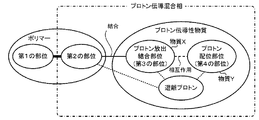
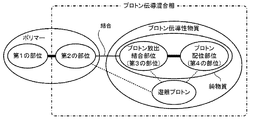
本実施形態の無加湿系プロトン伝導膜は、図1又は図2に例示するように、ポリマーと、プロトン伝導性物質とを備えている。ポリマーは、ガラス転移温度又は融解温度がプロトン伝導膜を使用する温度よりも高いガラス状又は結晶性の第1の部位と、非共有結合可能な官能基を有する第2の部位とを含んでいる。プロトン伝導性物質は、プロトンを放出可能でポリマーの第2の部位に非共有結合可能なプロトン放出・結合部位(第3の部位)と、プロトンに配位可能なプロトン配位部位(第4の部位)とを、相互作用し合う異なる分子に別々に含むか、同一分子内に含むものである。プロトン伝導性物質のプロトン放出・結合部位に結合した第2の部位とプロトン伝導性物質とを含むプロトン伝導混合相のガラス転移温度は、無加湿系プロトン伝導膜の使用温度より低い。プロトン放出・結合部位はポリマーの第2の部位よりも過多に存在している。 The non-humidifying proton conductive film of the present embodiment includes a polymer and a proton conductive substance as illustrated in FIG. 1 or FIG. The polymer comprises a glassy or crystalline first moiety whose glass transition or melting temperature is higher than the temperature at which the proton conductive film is used, and a second moiety having a non-covalent functional group. .. The proton-conducting substance has a proton-releasing / binding site (third site) capable of releasing a proton and non-covalent bond to the second site of the polymer, and a proton coordination site (fourth site) capable of coordinating with the proton. The site) is contained separately in different molecules that interact with each other, or is contained in the same molecule. The glass transition temperature of the proton conductive mixed phase containing the second site bonded to the proton release / binding site of the proton conductive substance and the proton conductive substance is lower than the operating temperature of the non-humidified proton conductive film. There are more proton release / binding sites than the second site of the polymer.
ポリマーの第1の部位は、ガラス転移温度又は融解温度が無加湿系プロトン伝導膜の使用温度(例えば80℃とか95℃)よりも高いものであり、無加湿系プロトン伝導膜の使用温度ではガラス状又は結晶になっている。第1の部位は、特に限定するものではないが、例えば、オリゴスチレン類、オリゴアクリル酸エステル類、オリゴメタクリル酸エステル類、オリゴオレフィン類、オリゴスルホン類、オリゴアリレート類、オリゴエーテルケトン類、オリゴエーテルイミド類、オリゴフェニレンスルフィド類、オリゴフェニレンエーテル類、オリゴカーボネート類、オリゴベンゾイミダゾール類、オリゴフルオロエチレン類などが挙げられる。このうち、オリゴスチレン類としては、オリゴスチレン、オリゴアセチルスチレン、オリゴアニソイルスチレン、オリゴベンゾイルスチレン、オリゴビフェニルスチレン、オリゴブロモエトキシスチレン、オリゴブロモメトキシスチレン、オリゴブロモスチレン、オリゴブトキシメチルスチレン、オリゴ−tert−ブチルスチレン、オリゴブチリルスチレン、オリゴクロロフルオロスチレン、オリゴクロロメチルスチレン、オリゴクロロスチレン、オリゴシアノスチレン、オリゴジクロロスチレン、オリゴジフルオロスチレン、オリゴジメチルスチレン、オリゴエトキシメチルスチレン、オリゴエトキシスチレン、オリゴフルオロメチルスチレン、オリゴフルオロスチレン、オリゴヨードスチレン、オリゴメトキシカルボニルスチレン、オリゴメトキシメチルスチレン、オリゴメチルスチレン、オリゴメトキシスチレン、オリゴパーフルオロスチレン、オリゴフェノキシスチレン、オリゴフェニルアセチルスチレン、オリゴフェニルスチレン、オリゴプロポキシスチレン、オリゴトルオイルスチレン、オリゴトリメチルスチレンなどが挙げられる。オリゴアクリル酸エステル類としては、例えばオリゴアクリル酸アダマンチル、オリゴアクリル酸−tert−ブチル、オリゴアクリル酸−tert−ブチルフェニル、オリゴアクリル酸シアノヘプチル、オリゴアクリル酸シアノヘキシル、オリゴアクリル酸シアノメチル、オリゴアクリル酸シアノフェニル、オリゴアクリル酸フルオロメチル、オリゴアクリル酸メトキシカルボニルフェニル、オリゴアクリル酸メトキシフェニル、オリゴアクリル酸ナフチル、オリゴアクリル酸ペンタクロロフェニル、オリゴアクリル酸フェニルなどが挙げられる。オリゴメタクリル酸エステル類としては、例えば、オリゴメタクリル酸メチル、オリゴメタクリル酸エチル、オリゴメタクリロニトリル、オリゴメタクリル酸アダマンチル、オリゴメタクリル酸ベンジル、オリゴメタクリル酸−tert−ブチル、オリゴメタクリル酸−tert−ブチルフェニル、オリゴメタクリル酸シクロエチル、オリゴメタクリル酸シアノエチル、オリゴメタクリル酸シアノメチルフェニル、オリゴメタクリル酸シアノフェニル、オリゴメタクリル酸シクロブチル、オリゴメタクリル酸シクロデシル、オリゴメタクリル酸シクロドデシル、オリゴメタクリル酸シクロブチル、オリゴメタクリル酸シクロヘキシル、オリゴメタクリル酸シクロオクチル、オリゴメタクリル酸フルオロアルキル、オリゴメタクリル酸グリシジル、オリゴメタクリル酸イソボルニル、オリゴメタクリル酸イソブチル、オリゴメタクリル酸フェニル、オリゴメタクリル酸トリメチルシリル、オリゴメタクリル酸キシレニルなどが挙げられる。オリゴオレフィン類としては、オリゴエチレン、オリゴプロピレン、オリゴα−オレフィンなどが挙げられる。オリゴスルホン類としてはオリゴフェニルスルホン、オリゴエーテルスルホン、オリゴスルホンなどが挙げられる。オリゴアリレート類としてはオリゴアリレートが挙げられる。オリゴエーテルケトン類としてはオリゴエーテルケトン、オリゴエーテルエーテルケトン、オリゴエーテルケトンケトン、オリゴエーテルエーテルケトンケトンなどが挙げられる。オリゴエーテルイミド類としてはオリゴエーテルイミドが挙げられる。オリゴフェニレンスルフィド類としてはオリゴフェニレンスルフィドが挙げられる。オリゴフェニレンエーテル類としてはオリゴフェニレンエーテルが挙げられる。オリゴカーボネート類としてはオリゴカーボネートが挙げられる。オリゴベンゾイミダゾール類としてはオリゴベンゾイミダゾールが挙げられる。オリゴフルオロエチレン類としてはオリゴテトラフルオロエチレン、オリゴクロロトリフルオロエチレン、オリゴフッ化ビニリデンが挙げられる。なお、接頭辞のオリゴはオリゴマーを意味し、数量体〜十数量体のことである。オリゴマー以上の多量体、すなわち通常のポリマーも第1の部位として用いることができる。 In the first part of the polymer, the glass transition temperature or melting temperature is higher than the operating temperature of the non-humidified proton conductive film (for example, 80 ° C. or 95 ° C.), and the glass is used at the operating temperature of the non-humidified proton conductive film. It is in the form or crystal. The first site is not particularly limited, but for example, oligostyrenes, oligoacrylic acid esters, oligomethacrylic acid esters, oligoolefins, oligosulfones, oligoallylates, oligoether ketones, oligos. Examples thereof include etherimides, oligophenylene sulfides, oligophenylene ethers, oligocarbonates, oligobenzoimidazoles, oligofluoroethylenes and the like. Among these, oligostyrenes include oligostyrene, oligoacetylstyrene, oligoanisoilstyrene, oligobenzoylstyrene, oligobiphenylstyrene, oligobromoethoxystyrene, oligobromomethoxystyrene, oligobromostyrene, oligobutoxymethylstyrene, and oligo-. tert-butyl styrene, oligobutyryl styrene, oligochlorofluorostyrene, oligochloromethylstyrene, oligochlorostyrene, oligocyanostyrene, oligodichlorostyrene, oligodifluorostyrene, oligodimethylstyrene, oligoethoxymethylstyrene, oligoethoxystyrene, oligo Fluoromethylstyrene, oligofluorostyrene, oligoiodostyrene, oligomethoxycarbonylstyrene, oligomethoxymethylstyrene, oligomethylstyrene, oligomethoxystyrene, oligoperfluorostyrene, oligophenoxystyrene, oligophenylacetylstyrene, oligophenylstyrene, oligopropoxy Examples thereof include styrene, oligotor oil styrene, and oligotrimethyl styrene. Examples of oligoacrylic acid esters include adamantyl oligoacrylic acid, tert-butyl oligoacrylic acid, tert-butylphenyl oligoacrylic acid, cyanoheptyl oligoacrylic acid, cyanohexyl oligoacrylic acid, cyanomethyl oligoacrylic acid, and oligoacrylic acid. Examples thereof include cyanophenyl acid, fluoromethyl oligoacrylate, methoxycarbonylphenyl oligoacrylate, methoxyphenyl oligoacrylate, naphthyl oligoacrylate, pentachlorophenyl oligoacrylate, and phenyl oligoacrylate. Examples of oligomethacrylic acid esters include methyl oligomethacrylic acid, ethyl oligomethacrylate, oligomethacrylic nitrile, adamantyl oligomethacrylic acid, benzyl oligomethacrylic acid, oligomethacrylic acid-tert-butyl, and oligomethacrylic acid-tert-butyl. Phenyl, oligo cycloethyl methacrylate, cyanoethyl oligo methacrylate, cyanomethyl phenyl methacrylate, cyanophenyl oligo methacrylate, cyclobutyl oligo methacrylate, cyclodecyl oligo methacrylate, cyclododecyl oligo methacrylate, cyclobutyl oligo methacrylate, cyclohexyl oligo methacrylate , Cyclooctyl Oligo Methacrylate, Fluoroalkyl Oligo Methacrylate, Glycydyl Oligo Methacrylate, Isobornyl Oligo Methacrylate, Isobutyl Oligo Methacrylate, phenyl Oligo Methacrylate, Trimethyl Cyril Oligo Methacrylate, Xylenyl Oligo Methacrylate and the like. Examples of oligoolefins include oligoethylene, oligopropylene, oligo α-olefin and the like. Examples of oligo sulfones include oligophenyl sulfone, oligo ether sulfone, and oligo sulfone. Examples of the oligoallylates include oligoallylates. Examples of the oligo ether ketone include oligo ether ketone, oligo ether ether ketone, oligo ether ketone ketone, and oligo ether ether ketone ketone. Examples of oligoetherimides include oligoetherimides. Examples of oligophenylene sulfides include oligophenylene sulfides. Examples of oligophenylene ethers include oligophenylene ethers. Examples of oligocarbonates include oligocarbonates. Examples of oligobenzoimidazoles include oligobenzoimidazoles. Examples of oligofluoroethylenes include oligotetrafluoroethylene, oligochlorotrifluoroethylene, and oligofluorovinylidene. In addition, the prefix oligo means an oligomer, and it is a quanta to ten quants. Multimers above oligomers, i.e. ordinary polymers, can also be used as the first site.
ポリマーの第2の部位は、非共有結合可能な官能基を有する。非共有結合には、水素結合や配位結合、イオン結合などが含まれる(以下同じ)。第2の部位としては、非共有結合可能な官能基を複数有したものでもよく、非共有結合可能な官能基を有するユニットを重合したものでもよい。この場合、非共有結合可能な官能基としては、塩基性基が好ましく、含窒素複素環基がより好ましい。含窒素複素環基としては、ピリジル基、ベンゾイミダゾリル基、ピリミジル基、イミダゾリル基、ベンゾチアゾリル基、ベンゾオキサゾリル基、オキサジアゾリル基、キノリル基、キノオキサリル基、チアジアゾリル基などが挙げられる。例えば、第2の部位がピリジル基を含む場合、ポリビニルピリジン類(官能基はピリジル基)などが挙げられる。ポリビニルピリジン類としては、例えば、ポリ(2−ビニルピリジン)、ポリ(3−ビニルピリジン)、ポリ(4−ビニルピリジン)などが挙げられる。 The second moiety of the polymer has a non-covalently bondable functional group. Non-covalent bonds include hydrogen bonds, coordination bonds, ionic bonds, etc. (the same applies hereinafter). As the second site, a unit having a plurality of non-covalently bondable functional groups may be used, or a unit having a non-covalent bondable functional group may be polymerized. In this case, as the non-covalently bondable functional group, a basic group is preferable, and a nitrogen-containing heterocyclic group is more preferable. Examples of the nitrogen-containing heterocyclic group include a pyridyl group, a benzoimidazolyl group, a pyrimidyl group, an imidazolyl group, a benzothiazolyl group, a benzoxazolyl group, an oxadiazolyl group, a quinolyl group, a quinooxalyl group and a thiadiazolyl group. For example, when the second site contains a pyridyl group, polyvinylpyridines (the functional group is a pyridyl group) and the like can be mentioned. Examples of polyvinylpyridines include poly (2-vinylpyridine), poly (3-vinylpyridine), and poly (4-vinylpyridine).
ポリマーは、少なくとも第1の部位と第2の部位とを有するものであればよく、例えば、第1の部位と第2の部位とを有するブロック共重合体であってもよいし、第1の部位と第2の部位とを有するランダム共重合体やマルチブロック共重合体であってもよい。以下、説明の便宜上、第1の部位をA鎖、第2の部位をB鎖と称する。ABジブロック共重合体の場合、A鎖の平均重合度は、2〜10000であることが好ましい。A鎖の平均重合度が下限値未満の場合にはガラス状又は結晶性ドメインを形成しにくいため好ましくなく、上限値を超える場合には試料の取扱いが難しくなるため好ましくない。A鎖の平均重合度は、10〜5000であることがより好ましく、30〜2000であることが特に好ましい。B鎖の平均重合度は、2〜5000であることが好ましい。B鎖の平均重合度が下限値未満の場合にはポリマーとプロトン伝導性物質とを混合しても均一なプロトン伝導混合相を形成しにくいため好ましくなく、上限値を超える場合にはプロトン伝導混合相の酸性度が低くなるため好ましくない。B鎖の平均重合度は、10〜1000であることがより好ましく、50〜500であることが特に好ましい。ABジブロック共重合体の場合、A鎖とB鎖の組成比は、99:1〜10:90であることが好ましい。この範囲を外れると、全体がガラス化したりソフトエラストマーとはならずに流動したりするおそれがあるため、好ましくない。 The polymer may be a polymer having at least a first moiety and a second moiety, and may be, for example, a block copolymer having a first moiety and a second moiety, or a first polymer. It may be a random copolymer or a multi-block copolymer having a site and a second site. Hereinafter, for convenience of explanation, the first site will be referred to as an A chain, and the second site will be referred to as a B chain. In the case of AB diblock copolymer, the average degree of polymerization of the A chain is preferably 2 to 10000. If the average degree of polymerization of the A chain is less than the lower limit, it is difficult to form a glassy or crystalline domain, which is not preferable, and if it exceeds the upper limit, it is difficult to handle the sample, which is not preferable. The average degree of polymerization of the A chain is more preferably 10 to 5000, and particularly preferably 30 to 2000. The average degree of polymerization of the B chain is preferably 2 to 5000. If the average degree of polymerization of the B chain is less than the lower limit, it is not preferable to mix the polymer and the proton conductive substance because it is difficult to form a uniform proton conduction mixed phase. If it exceeds the upper limit, the proton conduction mixture is not preferable. It is not preferable because the acidity of the phase is low. The average degree of polymerization of the B chain is more preferably 10 to 1000, and particularly preferably 50 to 500. In the case of AB diblock copolymer, the composition ratio of A chain and B chain is preferably 99: 1 to 10:90. If it is out of this range, the whole may be vitrified or flow without becoming a soft elastomer, which is not preferable.
プロトン伝導性物質は、プロトンを放出可能でポリマーの第2の部位に非共有結合可能な官能基を有するプロトン放出・結合部位(第3の部位)とプロトンに配位可能なプロトン配位部位(第4の部位)とを、相互作用し合う異なる分子に別々に含む(図1参照)か、同一分子内に含む(図2参照)ものである。プロトン放出・結合部位としては、ポリマーの第2の部位の官能基が塩基性基の場合には、官能基として酸性基を有することが好ましい。また、酸性基としてはカルボン酸基やリン酸基、スルホン酸基、スルホニルイミド基が挙げられるが、このうちスルホン酸基やスルホニルイミド基が好ましい。プロトン放出・結合部位はポリマーの第2の部位よりも過多に存在している。そのため、プロトン放出・結合部位から遊離プロトンが生じやすく、このことがプロトン伝導に大きく寄与する。プロトン配位部位としては、孤立電子対を含み弱くプロトンと配位するような官能基が好ましく、例えばエーテル結合やエステル基、アルコール基、ケトン基、アミド基などが挙げられるが、このうちエーテル結合やアルコール基が好ましい。 Proton conductive substances have a proton release / binding site (third site) having a functional group capable of releasing a proton and having a non-covalent bond to the second site of the polymer, and a proton coordination site capable of coordinating with the proton (third site). The fourth site) is contained separately in different interacting molecules (see FIG. 1) or in the same molecule (see FIG. 2). As the proton release / binding site, when the functional group at the second site of the polymer is a basic group, it is preferable to have an acidic group as the functional group. Examples of the acidic group include a carboxylic acid group, a phosphoric acid group, a sulfonic acid group and a sulfonylimide group, of which a sulfonic acid group and a sulfonylimide group are preferable. There are more proton release / binding sites than the second site of the polymer. Therefore, free protons are likely to be generated from the proton release / binding site, which greatly contributes to proton conduction. As the proton coordination site, a functional group containing a lone electron pair and weakly coordinating with a proton is preferable, and examples thereof include an ether bond, an ester group, an alcohol group, a ketone group, and an amide group. Among them, an ether bond is used. And alcohol groups are preferred.
プロトン伝導性物質は、プロトン放出・結合部位を含む物質Xと、プロトン配位部位を含み物質Xと相互作用し合う非水の物質Yとを含む混合物であってもよい(図1参照)。物質Xはポリマーの第2の部位に非共有結合し、物質Yは物質Xと相互作用し合うため、物質X、物質Yは共に膜から溶出することがない。物質Xは、特に限定するものではないが、ポリマーの第2の部位の官能基が塩基性基の場合には、官能基として酸性基を有することが好ましい。また、酸性基としてはカルボン酸基やリン酸基、スルホン酸基、スルホニルイミド基が挙げられるが、このうちスルホン酸基やスルホニルイミド基が好ましい。物質Xとしては、スルホン酸基を側鎖に有するポリマーやスルホニルイミド基を有するフッ素化合物などが特に好ましい。スルホン酸基を側鎖に有するポリマーとしては、スルホン酸基を持つパーフルオロアルキル部位を側鎖に有するパーフルオロカーボンのポリマー(例えばナフィオン)が好ましく、スルホニルイミド基を有するフッ素化合物としてはビス(トリフルオロメタンスルホニル)イミドなどが特に好ましい。また、物質Yは、プロトン配位部位を含み物質Xと相互作用し合う非水(つまり水以外)の物質であれば、特に限定するものではないが、エーテル結合を有する溶媒や、アルコール基を有する重合体などが好ましい。エーテル結合を有する溶媒としては、エーテル結合を有するプロトン性溶媒が好ましい。こうしたプロトン性溶媒としては、例えば水酸基末端ポリエチレングリコールやテトラエチレングリコール、トリエチレングリコールなどが挙げられ、具体的には、ソルヴェイ社(SOLVAY)のFomblinD2(登録商標)、すなわち水酸基両末端パーフルオロポリエーテルやFluorolinkC10(登録商標)、すなわちカルボン酸末端パーフルオロポリエーテルのように、水素原子がフッ素原子に置換されたプロトン性溶媒であってもよい。アルコール基を有する重合体としては、アルコール基を有するアクリル酸系重合体が好ましい。こうしたアクリル酸系重合体は、1種類のモノマーの重合体でもよいし、2種類以上のモノマーの共重合体でもよい。モノマーとしては、例えば、アクリル酸(2−ヒドロキシエチル)、アクリル酸(4−ヒドロキシブチル)などが挙げられる。2種類以上のモノマーを用いる場合、そのうちの少なくとも1つは重合性官能基を2つ以上有するモノマーであることが好ましい。重合性官能基を2つ以上有するモノマーを用いると、アルコール基を有するアクリル酸系共重合体として分岐を有するものが得られるため、プロトン伝導混合相の中の流動性を低減させ、形状保持性を高めることができる。重合性官能基を2つ以上有するモノマーとしては、例えば、N,N’−メチレンビスアクリルアミド、ジビニルベンゼンなどが挙げられる。 The proton conductive substance may be a mixture containing a substance X containing a proton release / binding site and a non-aqueous substance Y containing a proton coordination site and interacting with the substance X (see FIG. 1). Since the substance X is non-covalently bonded to the second site of the polymer and the substance Y interacts with the substance X, neither the substance X nor the substance Y is eluted from the membrane. The substance X is not particularly limited, but when the functional group at the second site of the polymer is a basic group, it is preferable to have an acidic group as the functional group. Examples of the acidic group include a carboxylic acid group, a phosphoric acid group, a sulfonic acid group and a sulfonylimide group, of which a sulfonic acid group and a sulfonylimide group are preferable. As the substance X, a polymer having a sulfonic acid group in the side chain, a fluorine compound having a sulfonylimide group, and the like are particularly preferable. The polymer having a sulfonic acid group in the side chain is preferably a perfluorocarbon polymer having a perfluoroalkyl moiety having a sulfonic acid group in the side chain (for example, Nafion), and the fluorine compound having a sulfonylimide group is bis (trifluoromethane). Sulfonyl) imide and the like are particularly preferred. Further, the substance Y is not particularly limited as long as it is a non-water (that is, other than water) substance that contains a proton coordination site and interacts with the substance X, but a solvent having an ether bond or an alcohol group may be used. A polymer having a polymer or the like is preferable. As the solvent having an ether bond, a protonic solvent having an ether bond is preferable. Examples of such a protic solvent include hydroxyl group-terminated polyethylene glycol, tetraethylene glycol, triethylene glycol, and the like. Specifically, FomblinD2 (registered trademark) of Solvey (SOLVAY), that is, hydroxyl group-terminal perfluoropolyether. It may be a protic solvent in which a hydrogen atom is replaced with a fluorine atom, such as Fluorolink C10 (registered trademark), that is, a carboxylic acid-terminated perfluoropolyether. As the polymer having an alcohol group, an acrylic acid-based polymer having an alcohol group is preferable. Such an acrylic acid-based polymer may be a polymer of one kind of monomer or a copolymer of two or more kinds of monomers. Examples of the monomer include acrylic acid (2-hydroxyethyl) and acrylic acid (4-hydroxybutyl). When two or more kinds of monomers are used, it is preferable that at least one of them is a monomer having two or more polymerizable functional groups. When a monomer having two or more polymerizable functional groups is used, an acrylic acid-based copolymer having an alcohol group having a branch can be obtained, so that the fluidity in the proton conduction mixed phase can be reduced and the shape retention can be maintained. Can be enhanced. Examples of the monomer having two or more polymerizable functional groups include N, N'-methylenebisacrylamide, divinylbenzene and the like.
プロトン伝導性物質は、プロトン放出・結合部位とプロトン配位部位とを同一分子内に含む単一の純物質であってもよい(図2参照)。この物質は、プロトン放出・結合部位がポリマーの第2の部位に非共有結合するため、膜から容易に溶出することがない。このようなプロトン伝導性物質としては、特に限定するものではないが、エーテル結合を有するジスルホン酸などが好ましい。このようなジスルホン酸としては、例えば3,3’−(プロパン−1,3−ジイルビス(オキシ))ビス(プロパン1−スルホン酸)などが挙げられる。 The proton conductive substance may be a single pure substance containing a proton release / binding site and a proton coordination site in the same molecule (see FIG. 2). This substance does not easily elute from the membrane because the proton release / binding site is non-covalently bonded to the second site of the polymer. Such a proton conductive substance is not particularly limited, but a disulfonic acid having an ether bond or the like is preferable. Examples of such disulfonic acid include 3,3'-(propane-1,3-diylbis (oxy)) bis (propane1-sulfonic acid).
プロトン伝導性物質とポリマーを選択するにあたっては、プロトン伝導性物質のプロトン放出・結合部位が結合した第2の部位とプロトン伝導性物質とを含むプロトン伝導混合相のガラス転移温度が、無加湿系プロトン伝導膜の使用温度より低くなるように選択する。これにより、プロトン伝導混合相は、使用時に溶融状態になるため、良好にプロトンを伝導することができる。また、膜全体としてソフトエラストマーの特性を有することになる。無加湿系プロトン伝導膜の使用温度は、ポリマーの第1の部位のガラス転移温度又は融解温度が十分に高ければ、例えば50℃に設定してもよいし、100℃に設定してもよいし、150℃を超える温度に設定してもよい。 In selecting a proton-conducting substance and a polymer, the glass transition temperature of the proton-conducting mixed phase containing the second site where the proton-releasing / bonding site of the proton-conducting substance is bonded and the proton-conducting substance is a non-humidified system. Select so that the temperature is lower than the operating temperature of the proton conductive film. As a result, the proton conduction mixed phase is in a molten state at the time of use, so that protons can be conducted satisfactorily. In addition, the film as a whole has the characteristics of a soft elastomer. The operating temperature of the non-humidified proton conductive film may be set to, for example, 50 ° C. or 100 ° C. as long as the glass transition temperature or melting temperature of the first portion of the polymer is sufficiently high. , The temperature may be set to exceed 150 ° C.
次に、本実施形態の無加湿系プロトン伝導膜を製造する方法について説明する。プロトン伝導性物質として、プロトン放出・結合部位を含む物質Xと、プロトン配位部位を含み物質Xと相互作用し合う非水の物質Yとを含む混合物を用いる場合、以下のようにして無加湿系プロトン伝導膜を製造する。すなわち、まずポリマーを溶媒に溶解又は分散させることによりポリマー溶液又は分散液を調製する。ここで用いる溶媒は比較的容易に蒸発するものが好ましく、例えばアルコール系溶媒、エーテル系溶媒、エステル系溶媒、ピリジン系溶媒、水及びこれらの混合溶媒などが挙げられる。また、物質Xと物質Yとを溶媒に溶解又は分散させることによりプロトン伝導性物質の溶液又は分散液を調製する。ここで用いる溶媒は比較的容易に蒸発するものが好ましく、例えばアルコール系溶媒、エーテル系溶媒、エステル系溶媒、ピリジン系溶媒、水及びこれらの混合溶媒などが挙げられる。そして、ポリマー溶液又は分散液とプロトン伝導性物質の溶液又は分散液とを混合し、その後溶媒を蒸発させることにより無加湿系プロトン伝導膜を得る。物質Yとして、アルコール基を有するアクリル酸系重合体を用いる場合、プロトン伝導混合相の溶融状態を損なわないために、第1の部位及び第2の部位を有するポリマー、物質X、物質Yを構成するアルコール基を有するアクリル酸系重合体の原料となるモノマーを予め混合した後に、重合過程を経るのが好ましく、共重合体の場合は、重合性官能基を2つ以上有して分岐を形成しうるモノマーの使用量も適宜調整することが好ましい。 Next, a method for producing the non-humidifying proton conductive film of the present embodiment will be described. When a mixture containing a substance X containing a proton release / binding site and a non-aqueous substance Y containing a proton coordination site and interacting with the substance X is used as the proton conductive substance, it is not humidified as follows. Manufacture a system proton conduction film. That is, a polymer solution or dispersion is first prepared by first dissolving or dispersing the polymer in a solvent. The solvent used here is preferably one that evaporates relatively easily, and examples thereof include an alcohol solvent, an ether solvent, an ester solvent, a pyridine solvent, water, and a mixed solvent thereof. Further, a solution or dispersion of a proton conductive substance is prepared by dissolving or dispersing the substance X and the substance Y in a solvent. The solvent used here is preferably one that evaporates relatively easily, and examples thereof include an alcohol solvent, an ether solvent, an ester solvent, a pyridine solvent, water, and a mixed solvent thereof. Then, the polymer solution or dispersion is mixed with the solution or dispersion of the proton conductive substance, and then the solvent is evaporated to obtain a non-humidified proton conductive film. When an acrylic acid-based polymer having an alcohol group is used as the substance Y, the polymer having the first moiety and the second moiety, the substance X, and the substance Y are formed so as not to impair the molten state of the proton conduction mixed phase. It is preferable that the monomer which is the raw material of the acrylic acid-based polymer having an alcohol group is mixed in advance and then undergoes a polymerization process. In the case of a copolymer, a branch is formed by having two or more polymerizable functional groups. It is preferable to appropriately adjust the amount of the possible monomer used.
プロトン伝導性物質として、プロトン放出・結合部位とプロトン配位部位とを同一分子内に含む単一の純物質を用いる場合、以下のようにして無加湿系プロトン伝導膜を製造する。すなわち、まずポリマーを溶媒に溶解又は分散させることによりポリマー溶液又は分散液を調製する。ここで用いる溶媒は比較的容易に蒸発するものが好ましく、例えばアルコール系溶媒、エーテル系溶媒、エステル系溶媒、ピリジン系溶媒、水及びこれらの混合溶媒などが挙げられる。また、プロトン放出・結合部位とプロトン配位部位とを同一分子内に含む単一の純物質を溶媒に溶解又は分散させることによりプロトン伝導性物質の溶液又は分散液を調製する。ここで用いる溶媒は比較的容易に蒸発するものが好ましく、例えばアルコール系溶媒、エーテル系溶媒、エステル系溶媒、ピリジン系溶媒、水及びこれらの混合溶媒などが挙げられる。プロトン伝導性物質の溶液又は分散液には、1,3−プロパンジオールやトリエチレングリコール、テトラエチレングリコール、水酸基両末端ポリエチレングリコールなどのアルコールが含まれていてもよい。そして、ポリマー溶液又は分散液とプロトン伝導性物質の溶液又は分散液とを混合し、その後溶媒を蒸発させることにより無加湿系プロトン伝導膜を得る。 When a single pure substance containing a proton release / binding site and a proton coordination site in the same molecule is used as the proton conductive substance, a non-humidified proton conductive film is produced as follows. That is, a polymer solution or dispersion is first prepared by first dissolving or dispersing the polymer in a solvent. The solvent used here is preferably one that evaporates relatively easily, and examples thereof include an alcohol solvent, an ether solvent, an ester solvent, a pyridine solvent, water, and a mixed solvent thereof. In addition, a solution or dispersion of a proton conductive substance is prepared by dissolving or dispersing a single pure substance containing a proton release / binding site and a proton coordination site in the same molecule in a solvent. The solvent used here is preferably one that evaporates relatively easily, and examples thereof include an alcohol solvent, an ether solvent, an ester solvent, a pyridine solvent, water, and a mixed solvent thereof. The solution or dispersion of the proton conductive substance may contain alcohols such as 1,3-propanediol, triethylene glycol, tetraethylene glycol, and polyethylene glycol having both hydroxyl groups. Then, the polymer solution or dispersion is mixed with the solution or dispersion of the proton conductive substance, and then the solvent is evaporated to obtain a non-humidified proton conductive film.
次に、本実施形態の無加湿系プロトン伝導膜を利用した燃料電池について、図3を参照しながら説明する。図3は燃料電池10の断面図である。燃料電池10は、上述した無加湿系プロトン伝導膜3の両面に電極4,5が配置された膜電極アセンブリ(Membrane Electrode Assembly,以下MEAという)2と、MEA2を両面から挟み込んだ一対のセパレータ6,7とを備えている。MEA2は、無加湿系プロトン伝導膜3を二つの電極、つまり燃料極であるアノード4と酸素極であるカソード5とで挟みこんだものである。アノード4及びカソード5は、それぞれ触媒層4a,5aとガス拡散層4b,5bとによって構成されている。触媒層4a,5aは、無加湿系プロトン伝導膜3に接触する側に位置し、白金微粒子を担持させた導電性カーボンブラックにより形成されている。一方、ガス拡散層4b,5bは、触媒層4a,5aに積層され、炭素繊維からなる糸で織成したカーボンクロスにより形成されている。なお、触媒層4a,5aに含まれる白金は、水素をプロトンと電子に分けるのを促進したり酸素とプロトンと電子から水を生成する反応を促進する作用を有するものであるが、同様の作用を有するものであれば白金以外のものを用いてもよい。また、ガス拡散層4b,5bは、カーボンクロスのほか、炭素繊維からなるカーボンペーパーまたはカーボンフェルトによって形成してもよく、十分なガス拡散性および導電性を有していればよい。一対のセパレータ6,7は、それぞれガス不透過の導電性部材(例えばカーボンや金属)により形成されている。一方のセパレータ6には、MEA2のアノード4と接触する面に燃料ガスを通過させる燃料ガス通路6gが形成されている。もう一方のセパレータ7には、MEA2のカソード5と接触する面に酸化ガスを通過させる酸化ガス通路7gが形成されている。
Next, the fuel cell using the non-humidifying proton conductive film of the present embodiment will be described with reference to FIG. FIG. 3 is a cross-sectional view of the
次に、燃料電池10の発電について説明する。燃料電池10を発電させるには、燃料電池10の外部から、燃料ガスとして水素を燃料ガス通路6gへ供給すると共に、酸化ガスとしてエアを酸化ガス通路7gへ供給する。燃料ガス通路6gを通過する水素は、アノード4のガス拡散層4bで拡散されて触媒層4aに至り、この触媒層4aでプロトンと電子に分かれる。このうちプロトンは無加湿系プロトン伝導膜3を伝導してカソード5に移動し、電子は図示しない外部回路を通ってカソードに移動する。酸化ガス通路7gを通過するエアは、カソード5のガス拡散層5bで拡散されて触媒層5aに至る。そして、カソード5でプロトンと電子とエア中の酸素とが反応して水が生成し、この反応により起電力が生じる。このように、燃料電池10によれば、無加湿系プロトン伝導膜3は無加湿のままプロトン伝導性を示すため、膜を加湿器で加湿する必要がない。
Next, the power generation of the
なお、本発明は上述した実施形態に何ら限定されることはなく、本発明の技術的範囲に属する限り種々の態様で実施し得ることはいうまでもない。 It goes without saying that the present invention is not limited to the above-described embodiment, and can be implemented in various aspects as long as it belongs to the technical scope of the present invention.
以下に、本発明の実施例について説明する。各実施例のプロトン伝導性ソフトエラストマー膜が本発明の無加湿系プロトン伝導膜に相当する。表1に各実施例、各比較例の結果をまとめた。なお、以下の実施例は本発明を何ら限定するものではない。 Hereinafter, examples of the present invention will be described. The proton conductive soft elastomer membrane of each example corresponds to the non-humidifying proton conductive membrane of the present invention. Table 1 summarizes the results of each example and each comparative example. The following examples do not limit the present invention in any way.
[実施例1]
[1]プロトン伝導性ソフトエラストマー膜の調製
リビングアニオン重合により合成されたポリスチレン−b−ポリ(4−ビニルピリジン)ブロック共重合体(S4VPと称することとする)をポリマーソース社(Polymer Source Inc)より購入した。ポリスチレンの平均重合度は2115、ポリ(4−ビニルピリジン)の平均重合度が143であった。このS4VP51mgを重量比7/3のテトラヒドロフラン(THF)/メタノール(MeOH)混合溶媒2.0gに溶解した。一方で、アルドリッチ社(Aldrich)より購入した10wt%のナフィオン(等価質量=1000)分散水溶液2.30gを10mL容量のテフロンビーカー(テフロンは登録商標)中に入れ、70℃のホットプレート上に48時間載せておくことで水を蒸発させ、これにテトラエチレングリコール(TEG)を240mg加え、さらに重量比6/4のTHF/MeOH混合溶媒2.0gを添加することで、ナフィオンをTEG/THF/MeOH中に溶解させた。S4VP/THF/MeOHの溶液と、ナフィオン/TEG/THF/MeOHの溶液を混合したところ、沈殿は生じず、混合液を60℃のホットプレート上に2日間載せておくことでTHF/MeOHを蒸発させてキャストし、ナフィオン/TEG/S4VPの重量比がおおよそ4.5/4.5/1のプロトン伝導性ソフトエラストマー膜を得た。ナフィオンのスルホン酸基は、S4VPのピリジル基に対して計算上、約7.4倍存在していることになる。[Example 1]
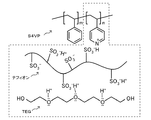
[1] Preparation of Proton Conductive Soft Elastomer Membrane Polystyrene-b-poly (4-vinylpyridine) block copolymer (referred to as S4VP) synthesized by living anionic polymerization is polymer Source Inc. I bought more. The average degree of polymerization of polystyrene was 2115, and the average degree of polymerization of poly (4-vinylpyridine) was 143. 51 mg of this S4VP was dissolved in 2.0 g of a mixed solvent of tetrahydrofuran (THF) / methanol (MeOH) having a weight ratio of 7/3. On the other hand, 2.30 g of a 10 wt% Nafion (equivalent mass = 1000) dispersion aqueous solution purchased from Aldrich was placed in a 10 mL volume Teflon beaker (Teflon is a registered trademark) and placed on a hot plate at 70 ° C. 48. Water is evaporated by leaving it for a while, 240 mg of tetraethylene glycol (TEG) is added thereto, and 2.0 g of a THF / MeOH mixed solvent having a weight ratio of 6/4 is added to add Nafion to TEG / THF /. It was dissolved in MeOH. When the S4VP / THF / MeOH solution and the Nafion / TEG / THF / MeOH solution were mixed, no precipitation occurred, and the THF / MeOH was evaporated by placing the mixed solution on a hot plate at 60 ° C. for 2 days. The mixture was cast to obtain a proton-conducting soft elastomer membrane having a weight ratio of Nafion / TEG / S4VP of about 4.5 / 4.5 / 1. The sulfonic acid group of Nafion is calculated to be present about 7.4 times as much as the pyridyl group of S4VP.
このプロトン伝導性ソフトエラストマー膜の模式図を図4に示す。図4中、ポリスチレン部位がポリマーの第1の部位に相当し、ポリ(4−ビニルピリジン)部位がポリマーの第2の部位に相当し、ナフィオンがプロトン放出・結合部位を含む物質Xに相当し、TEGがプロトン配位部位を含む物質Yに相当する。ポリスチレンのTg(ガラス転移温度)は約100℃、ポリ(4−ビニルピリジン)のTgは約150℃、ナフィオンのTgは約130℃、TEGの融点は約−6℃である。ポリ(4−ビニルピリジン)のピリジル基とナフィオン中の一部のスルホン酸基とはイオン結合しており、ナフィオン中の一部のスルホン酸基とTEGのエーテル結合の酸素原子とは静電相互作用により弱く結合しており、さらに一部のスルホン酸基からはプロトンが遊離し、スルホネートイオンとなっている。実施例1では、プロトン伝導混合相(図4の1点鎖線で囲んだ部分)は、ナフィオンとTEGとポリ(4−ビニルピリジン)とを含む混合物であり、ポリスチレンに固定化されている。プロトン伝導混合相のTgは室温以下であり、交流インピーダンス測定の温度(80℃や95℃、下記[2]参照)では溶融状態である。なお、測定温度は、プロトン伝導性ソフトエラストマー膜の使用温度とみなすことができる。 A schematic diagram of this proton conductive soft elastomer membrane is shown in FIG. In FIG. 4, the polystyrene moiety corresponds to the first moiety of the polymer, the poly (4-vinylpyridine) moiety corresponds to the second moiety of the polymer, and the naphthion corresponds to the substance X containing the proton release / binding site. , TEG corresponds to the substance Y containing the proton coordination site. Polystyrene has a Tg (glass transition temperature) of about 100 ° C., poly (4-vinylpyridine) has a Tg of about 150 ° C., Nafion has a Tg of about 130 ° C., and TEG has a melting point of about −6 ° C. The pyridyl group of poly (4-vinylpyridine) and some sulfonic acid groups in Nafion are ionic bonded, and some sulfonic acid groups in Nafion and the oxygen atom of the ether bond of TEG are electrostatically mutual. It is weakly bonded by action, and protons are released from some sulfonic acid groups to form sulfonate ions. In Example 1, the proton conduction mixed phase (the portion surrounded by the alternate long and short dash line in FIG. 4) is a mixture containing naphthion, TEG, and poly (4-vinylpyridine), and is immobilized on polystyrene. The Tg of the proton conduction mixed phase is room temperature or lower, and is in a molten state at the temperature of AC impedance measurement (80 ° C. or 95 ° C., see [2] below). The measured temperature can be regarded as the operating temperature of the proton conductive soft elastomer membrane.
[2]交流インピーダンス測定
厚さ0.1mm程度の白金網を電極として用いた。電極間距離を0.50cmとし、プロトン伝導性ソフトエラストマー膜を電極で挟み込んだ。膜の厚みは0.04cm、膜の幅は0.32cmであった。電極で挟み込んだ状態の測定用試料を自然対流式定温恒温乾燥器中に入れて設定温度を60℃とし、6時間程度試料を乾燥させた。その後乾燥器の設定温度(測定温度)を80℃として乾燥器内温度を安定させ、電圧を80mV、周波数を1000000Hzから1Hzで変化させて無加湿条件下で交流インピーダンス測定を行った。測定装置はエフアールエー(FRA)オプション付きのポテンショ/ガルバノスタットVERSASTAT4−400(プリンストン・アプライド・リサーチ(Prinston Applied Research))を用いた。測定試料の抵抗値をCole−ColeプロットのX軸の切片から読み取ったところ、5.0×10⁴Ωであった。プロトン伝導率=電極間距離/(膜の厚み×膜の幅×抵抗値)の関係式よりプロトン伝導率を求めたところ、7.8×10-4S/cmであった。次に、交流インピーダンス測定の測定温度を95℃としたところ、抵抗値は3.1×104S/cmであり、プロトン伝導率は1.3×10-3S/cmであった。温度を80℃から95℃に上げることでプロトン伝導率が大きくなったが、これは温度を上げることにより溶融状態のプロトン伝導混合相の粘度が下がってプロトン伝導性が向上したことによると考えられる。なお、得られたプロトン伝導性ソフトエラストマー膜は、測定中、全体としては流動せず形状を維持していた。[2] AC impedance measurement A platinum net with a thickness of about 0.1 mm was used as an electrode. The distance between the electrodes was set to 0.50 cm, and a proton conductive soft elastomer film was sandwiched between the electrodes. The thickness of the film was 0.04 cm, and the width of the film was 0.32 cm. The measurement sample sandwiched between the electrodes was placed in a natural convection constant temperature constant temperature dryer, the set temperature was set to 60 ° C., and the sample was dried for about 6 hours. After that, the set temperature (measurement temperature) of the dryer was set to 80 ° C. to stabilize the temperature inside the dryer, the voltage was changed from 1000000 Hz to 1 Hz, and the AC impedance was measured under non-humidified conditions. As a measuring device, a potentiometer / galvanostat VERSASTAT4-400 (Prinson Applied Research) with an FRA option was used. When reading the resistance value of the measurement sample from the intercept of X-axis of the Cole-Cole plot was 5.0 × 10 4 Ω. When the proton conductivity was calculated from the relational expression of proton conductivity = distance between electrodes / (film thickness x film width x resistance value), it was 7.8 × 10 -4 S / cm. Next, when the measurement temperature of the AC impedance measurement was 95 ° C., the resistance value was 3.1 × 10 4 S / cm, and the proton conductivity was 1.3 × 10 -3 S / cm. Increasing the temperature from 80 ° C to 95 ° C increased the proton conductivity, which is thought to be due to the fact that increasing the temperature decreased the viscosity of the molten proton-conducting mixed phase and improved the proton conductivity. .. The obtained proton conductive soft elastomer membrane did not flow as a whole and maintained its shape during the measurement.

[比較例1]
10wt%のナフィオン(等価質量=1000)分散水溶液2.52gを10mL容量のテフロンビーカー中に入れ、70℃のホットプレート上に48時間載せておくことで、水を蒸発させた。これにTEGを240mg加え、さらに重量比6/4のTHF/MeOH混合溶媒2.0gを添加することでナフィオンをTEG/THF/MeOH中に溶解させた。この溶液を60℃のホットプレート上に2日間載せてTHF/MeOHを蒸発させてキャストしたところ、ナフィオンとTEGのみからなる、室温において均一な粘土状混合物が得られた。無加湿条件下での交流インピーダンス測定のために上記粘土状混合物を50℃の自然対流式定温恒温乾燥器中に入れたところ流動し、固体状態でのプロトン伝導率を決定することができなかった。比較例1では、プロトン伝導混合相は、ナフィオンとTEGとの混合物であるが、このプロトン伝導混合相を支える固体相がなかっため、50℃では流動してしまったと考えられる。[Comparative Example 1]
Water was evaporated by placing 2.52 g of a 10 wt% Nafion (equivalent mass = 1000) dispersed aqueous solution in a Teflon beaker having a volume of 10 mL and placing it on a hot plate at 70 ° C. for 48 hours. 240 mg of TEG was added thereto, and 2.0 g of a THF / MeOH mixed solvent having a weight ratio of 6/4 was further added to dissolve Nafion in TEG / THF / MeOH. When this solution was placed on a hot plate at 60 ° C. for 2 days to evaporate and cast THF / MeOH, a clay-like mixture consisting only of naphthion and TEG, which was uniform at room temperature, was obtained. When the clay-like mixture was placed in a natural convection constant temperature and constant temperature dryer at 50 ° C. for AC impedance measurement under non-humidified conditions, it flowed and the proton conductivity in the solid state could not be determined. .. In Comparative Example 1, the proton conduction mixed phase is a mixture of Nafion and TEG, but it is considered that the proton conduction mixed phase flowed at 50 ° C. because there was no solid phase supporting the proton conduction mixed phase.
[比較例2]
ポリマーソース社より購入した、ポリスチレンの平均重合度が2115、ポリ(4−ビニルピリジン)の平均重合度が143のS4VP75mgを重量比7/3のTHF/MeOH混合溶媒2.0gで溶解した。一方で、10wt%のナフィオン(等価質量=1000)分散水溶液1.53gを10mL容量のテフロンビーカー中に入れ、70℃のホットプレート上に48時間載せておくことで水を蒸発させ、これに重量比6/4のTHF/MeOH混合溶媒2.0gを添加することでナフィオンをTHF/MeOH中に溶解させた。S4VP/THF/MeOH溶液と、ナフィオン/THF/MeOH溶液を混合したところ、沈殿は生じず、混合液を60℃のホットプレート上に2日間載せておくことで、THF/MeOHを蒸発させてキャストし、固体膜を得た。交流インピーダンス測定のために、厚みが0.04cm、幅が0.32cmの膜を用意し、電極間距離を0.50cmとして、膜を上下から電極で挟み込んで自然対流式定温恒温乾燥器中に入れた。設定温度を80℃として乾燥器内温度を安定させ、電圧を80mV、周波数を1000000Hzから1Hzで変化させて無加湿条件下で交流インピーダンス測定を行った。抵抗値は極めて大きく、プロトン伝導率は極めて低いことが分かった。比較例2では、プロトン伝導混合相に相当するのはナフィオンとポリ(4−ビニルピリジン)との混合物である。ナフィオンとポリ(4−ビニルピリジン)との混合物のTgは理論上両物質のTg以上、すなわち130℃以上であり、無加湿で80℃という条件では溶融状態ではなく固体状態であるため、ほとんどプロトンを伝導しなかったと考えられる。[Comparative Example 2]
75 mg of S4VP having an average degree of polymerization of polystyrene of 2115 and poly (4-vinylpyridine) having an average degree of polymerization of 143, which was purchased from Polymer Source, was dissolved in 2.0 g of a THF / MeOH mixed solvent having a weight ratio of 7/3. On the other hand, 1.53 g of a 10 wt% Nafion (equivalent mass = 1000) dispersed aqueous solution is placed in a 10 mL volume Teflon beaker and placed on a hot plate at 70 ° C. for 48 hours to evaporate the water, and the weight thereof is increased. Nafion was dissolved in THF / MeOH by adding 2.0 g of a THF / MeOH mixed solvent having a ratio of 6/4. When the S4VP / THF / MeOH solution and the Nafion / THF / MeOH solution were mixed, no precipitation occurred, and the mixture was placed on a hot plate at 60 ° C. for 2 days to evaporate and cast the THF / MeOH. And a solid film was obtained. For AC impedance measurement, prepare a film with a thickness of 0.04 cm and a width of 0.32 cm, set the distance between the electrodes to 0.50 cm, sandwich the film between the electrodes from above and below, and put it in a natural convection constant temperature constant temperature dryer. I put it in. The temperature inside the dryer was stabilized at a set temperature of 80 ° C., the voltage was changed from 1000000 Hz to 1 Hz, and the AC impedance was measured under non-humidifying conditions. It was found that the resistance value was extremely large and the proton conductivity was extremely low. In Comparative Example 2, the proton conduction mixed phase corresponds to a mixture of naphthion and poly (4-vinylpyridine). The Tg of the mixture of naphthion and poly (4-vinylpyridine) is theoretically Tg or more of both substances, that is, 130 ° C. or higher, and under the condition of no humidification and 80 ° C., it is in a solid state rather than a molten state, so that it is almost a proton. It is probable that it did not conduct.
[実施例2]
実施例2では、実施例1の[1]において、S4VPを101mg使用し、10wt%のナフィオン(等価質量=1000)分散水溶液を2.00g使用し、TEGを199mg使用したこと以外は、実施例1と同様にしてプロトン伝導性ソフトエラストマー膜を作製した(ナフィオン/TEG/S4VPの重量比がおおよそ4/4/2)。ナフィオンのスルホン酸基は、S4VPのピリジル基に対して計算上、約3.3倍存在していることになる。実施例1の[2]において、膜の厚みを0.06cm、膜の幅を0.33cmとした以外は実施例1と同様にして交流インピーダンス測定を行った。80℃での抵抗値は1.2×105Ωであり、プロトン伝導率は2.3×10-4S/cmであった。95℃での抵抗値は8.3×104Ωであり、プロトン伝導率は3.3×10-4S/cmであった。実施例2では、プロトン伝導混合相は、実施例1と同様、ナフィオンとTEGとポリ(4−ビニルピリジン)との混合物であり、ポリスチレンに固定化されている。このプロトン伝導混合相は、Tgが室温以下であり、交流インピーダンス測定の温度(80℃や95℃)では溶融状態である。実施例2で得られたプロトン伝導性ソフトエラストマー膜も、測定中、全体としては流動せず形状を維持していた。[Example 2]
In Example 2, except that in [1] of Example 1, 101 mg of S4VP was used, 2.00 g of a 10 wt% Nafion (equivalent mass = 1000) dispersed aqueous solution was used, and 199 mg of TEG was used. A proton conductive soft elastomer membrane was prepared in the same manner as in 1 (the weight ratio of Nafion / TEG / S4VP was approximately 4/4/2). The sulfonic acid group of Nafion is calculated to be present about 3.3 times as much as the pyridyl group of S4VP. In [2] of Example 1, the AC impedance was measured in the same manner as in Example 1 except that the thickness of the film was 0.06 cm and the width of the film was 0.33 cm. The resistance value at 80 ° C. was 1.2 × 10 5 Ω, and the proton conductivity was 2.3 × 10 -4 S / cm. The resistance value at 95 ° C. was 8.3 × 10 4 Ω, and the proton conductivity was 3.3 × 10 -4 S / cm. In Example 2, the proton conduction mixed phase is a mixture of Nafion, TEG and poly (4-vinylpyridine), as in Example 1, and is immobilized on polystyrene. This proton conduction mixed phase has a Tg of room temperature or less and is in a molten state at the temperature of AC impedance measurement (80 ° C. or 95 ° C.). The proton conductive soft elastomer membrane obtained in Example 2 also did not flow as a whole and maintained its shape during the measurement.
[実施例3]
実施例3では、実施例1の[1]において、S4VPを50mg使用し、10wt%のナフィオン(等価質量=1000)分散水溶液を3.03g使用し、TEGを150mg使用したこと以外は、実施例1と同様にしてプロトン伝導性ソフトエラストマー膜を作製した(ナフィオン/TEG/S4VPの重量比がおおよそ6/3/1)。ナフィオンのスルホン酸基は、S4VPのピリジル基に対して計算上、約9.8倍存在していることになる。実施例1の[2]において、膜の厚みを0.04cm、膜の幅を0.21cmとした以外は、実施例1と同様にして交流インピーダンス測定を行った。80℃での抵抗値は8.3×104Ωであり、プロトン伝導率は6.9×10-4S/cmであった。95℃での抵抗値は5.6×104Ωであり、プロトン伝導率は1.0×10-3S/cmであった。この実施例3では、プロトン伝導混合相は、実施例1と同様、ナフィオンとTEGとポリ(4−ビニルピリジン)との混合物であり、ポリスチレンに固定化されている。このプロトン伝導混合相は、Tgが室温以下であり、交流インピーダンス測定の温度(80℃や95℃)では溶融状態である。実施例3で得られたプロトン伝導性ソフトエラストマー膜も、測定中、全体としては流動せず形状を維持していた。[Example 3]
In Example 3, except that in [1] of Example 1, 50 mg of S4VP was used, 3.03 g of a 10 wt% Nafion (equivalent mass = 1000) dispersed aqueous solution was used, and 150 mg of TEG was used. A proton conductive soft elastomer membrane was prepared in the same manner as in 1 (the weight ratio of Nafion / TEG / S4VP was about 6/3/1). The sulfonic acid group of Nafion is calculated to be present in an amount of about 9.8 times that of the pyridyl group of S4VP. In [2] of Example 1, the AC impedance was measured in the same manner as in Example 1 except that the thickness of the film was 0.04 cm and the width of the film was 0.21 cm. The resistance value at 80 ° C. was 8.3 × 10 4 Ω, and the proton conductivity was 6.9 × 10 -4 S / cm. The resistance value at 95 ° C. was 5.6 × 10 4 Ω, and the proton conductivity was 1.0 × 10 -3 S / cm. In this Example 3, the proton conduction mixed phase is a mixture of Nafion, TEG, and poly (4-vinylpyridine) as in Example 1, and is immobilized on polystyrene. This proton conduction mixed phase has a Tg of room temperature or less and is in a molten state at the temperature of AC impedance measurement (80 ° C. or 95 ° C.). The proton conductive soft elastomer membrane obtained in Example 3 also did not flow as a whole and maintained its shape during the measurement.
[実施例4]
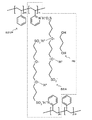
実施例4では、実施例1の[1]において、S4VPの代わりにリビングアニオン重合により合成されたポリスチレン−b−ポリ(2−ビニルピリジン)ブロック共重合体(S2VPと称する)を用いた。ポリスチレンの平均重合度は1250、ポリ(2−ビニルピリジン)の平均重合度が1285であった。またナフィオン/TEGの代わりに3,3’−(プロパン−1,3−ジイルビス(オキシ))ビス(プロパン−1−スルホン酸)(BSAと称する)/1,3−プロパンジオール(PDと称する)を用いた。BSAについてはソリッドステイトアイオニクス(Solid State Ionics),1995年,80巻,201頁−212頁及びコロイドポリマーサイエンス(Colloid Polymer Science),2014年,292巻、1261頁−1268頁 で報告されているスキームと類似の方法で合成した。S2VPを97mg、重量比7/3のTHF/MeOH混合溶媒を1.0g、ナフィオンの代わりにBSAを191mg、TEGの代わりにPDを191mg、重量比6/4のTHF/MeOH混合溶媒2.0gの代わりに重量比7/3のTHF/MeOH混合溶媒0.9gとした以外は、実施例1と同様にしてプロトン伝導性ソフトエラストマー膜を得た(BSA/PD/S2VPの重量比がおおよそ4/4/2)。BSAのスルホン酸基は、S2VPのピリジル基に対して計算上、約2.5倍存在していることになる。このプロトン伝導性ソフトエラストマー膜の模式図を図5に示す。図5中、ポリスチレン部位がポリマーの第1の部位に相当し、ポリ(2−ビニルピリジン)部位がポリマーの第2の部位に相当し、BSAがプロトン放出・結合部位とプロトン配位部位の両方を同一分子に含む単一のプロトン伝導性物質に相当する。PDはあってもなくてもよい。ポリスチレンのTg(ガラス転移温度)は約100℃、ポリ(2−ビニルピリジン)のTgは約100℃、BSAの融点は室温以下、PDの融点は−59℃である。ポリ(2−ビニルピリジン)のピリジル基とBSAのスルホン酸基とはイオン結合している。実施例4では、プロトン伝導混合相であるBSAとPDとポリ(2−ビニルピリジン)とからなる混合物は、ポリスチレンに固定化されている。またPDはBSAと静電相互作用していると考えられる。ポリ(2−ビニルピリジン)を含有したプロトン伝導混合相(図5の1点鎖線で囲んだ部分)のTgは室温以下であり、交流インピーダンス測定の温度(47℃〜95℃)では溶融状態である。[Example 4]
In Example 4, a polystyrene-b-poly (2-vinylpyridine) block copolymer (referred to as S2VP) synthesized by living anionic polymerization was used instead of S4VP in [1] of Example 1. The average degree of polymerization of polystyrene was 1250, and the average degree of polymerization of poly (2-vinylpyridine) was 1285. Also, instead of Nafion / TEG, 3,3'-(propane-1,3-diylbis (oxy)) bis (propane-1-sulfonic acid) (referred to as BSA) / 1,3-propanediol (referred to as PD). Was used. BSA is reported in Solid State Ionics, 1995, 80, 201-212 and Colloid Polymer Science, 2014, 292, 1261-1268. It was synthesized by a method similar to the scheme. 97 mg of S2VP, 1.0 g of THF / MeOH mixed solvent with a weight ratio of 7/3, 191 mg of BSA instead of Nafion, 191 mg of PD instead of TEG, 2.0 g of THF / MeOH mixed solvent with a weight ratio of 6/4. A proton conductive soft elastomer membrane was obtained in the same manner as in Example 1 except that 0.9 g of a THF / MeOH mixed solvent having a weight ratio of 7/3 was used instead of the above (the weight ratio of BSA / PD / S2VP was approximately 4). / 4/2). The sulfonic acid group of BSA is calculated to be present about 2.5 times as much as the pyridyl group of S2VP. A schematic diagram of this proton conductive soft elastomer membrane is shown in FIG. In FIG. 5, the polystyrene moiety corresponds to the first site of the polymer, the poly (2-vinylpyridine) site corresponds to the second site of the polymer, and BSA corresponds to both the proton release / binding site and the proton coordination site. Corresponds to a single proton conductive substance containing the same molecule. PD may or may not be present. Polystyrene has a Tg (glass transition temperature) of about 100 ° C., poly (2-vinylpyridine) has a Tg of about 100 ° C., BSA has a melting point of room temperature or lower, and PD has a melting point of −59 ° C. The pyridyl group of poly (2-vinylpyridine) and the sulfonic acid group of BSA are ionic bonded. In Example 4, a mixture of BSA, PD, and poly (2-vinylpyridine), which is a proton conduction mixed phase, is immobilized on polystyrene. It is also considered that PD has an electrostatic interaction with BSA. The Tg of the proton conduction mixed phase (the part surrounded by the one-point chain line in FIG. 5) containing poly (2-vinylpyridine) is below room temperature, and in the molten state at the temperature of AC impedance measurement (47 ° C. to 95 ° C.). is there.
実施例1の[2]において、膜の厚みを0.03cm、膜の幅を0.28cmとした以外は実施例1と同様にして交流インピーダンス測定を行った。80℃での抵抗値は4.1×10⁴Ωであり、プロトン伝導率は1.5×10⁻³S/cmであった。95℃での抵抗値は2.1×104Ωであり、プロトン伝導率は2.8×10-3S/cmであった。温度を80℃から95℃に上げることでプロトン伝導率が大きくなったが、これは温度を上げることにより溶融状態のプロトン伝導混合相の粘度が下がってプロトン伝導性が向上したことによると考えられる。一方、65℃での抵抗値は6.1×104Ω、プロトン伝導率は9.8×10-4S/cmであり、更に、47℃での抵抗値は1.4×105Ω、プロトン伝導率は4.3×10-4S/cmであった。温度を下げるにしたがってプロトン伝導率が小さくなったが、これは温度を下げることにより溶融状態のプロトン伝導混合相の粘度が上がってプロトン伝導性が低下したことによると考えられる。実施例4のプロトン伝導性ソフトエラストマー膜も、測定中、全体としては流動せず形状を維持していた。In [2] of Example 1, the AC impedance was measured in the same manner as in Example 1 except that the thickness of the film was 0.03 cm and the width of the film was 0.28 cm. The resistance value at 80 ° C. was 4.1 × 10 4 Ω, and the proton conductivity was 1.5 × 10 -3 S / cm. The resistance value at 95 ° C. was 2.1 × 10 4 Ω, and the proton conductivity was 2.8 × 10 -3 S / cm. Increasing the temperature from 80 ° C to 95 ° C increased the proton conductivity, which is thought to be due to the fact that increasing the temperature decreased the viscosity of the molten proton-conducting mixed phase and improved the proton conductivity. .. On the other hand, the resistance value at 65 ° C. is 6.1 × 10 4 Ω, the proton conductivity is 9.8 × 10 -4 S / cm, and the resistance value at 47 ° C. is 1.4 × 10 5 Ω. The proton conductivity was 4.3 × 10 -4 S / cm. The proton conductivity decreased as the temperature was lowered, which is considered to be because the viscosity of the molten proton conduction mixed phase increased and the proton conductivity decreased as the temperature was lowered. The proton conductive soft elastomer membrane of Example 4 also did not flow as a whole and maintained its shape during the measurement.
[実施例5]
ABジブロック共重合体として、ポリスチレン−b−ポリ(2−ビニルピリジン)(以下、S2VPという)を、Macromolecules 45, 8013-8020(2012)に記載のブロック共重合体合成法(可逆的付加開裂連鎖移動重合法)を参考にして合成した。ゲル浸透クロマトグラフィー(GPC)、核磁気共鳴分光法により、平均重合度、分子量分布(Mw/Mn)を決定した。ポリスチレンの平均重合度は307、ポリ(2−ビニルピリジン)の平均重合度は390、分子量分布Mw/Mnは1.39であった。[Example 5]
As an AB diblock copolymer, polystyrene-b-poly (2-vinylpyridine) (hereinafter referred to as S2VP) is used as a block copolymer synthesis method (reversible addition cleavage) according to Macromolecules 45, 8013-8020 (2012). It was synthesized with reference to (chain transfer polymerization method). The average degree of polymerization and molecular weight distribution (Mw / Mn) were determined by gel permeation chromatography (GPC) and nuclear magnetic resonance spectroscopy. The average degree of polymerization of polystyrene was 307, the average degree of polymerization of poly (2-vinylpyridine) was 390, and the molecular weight distribution Mw / Mn was 1.39.
S2VP、重量比58/42で混合して調製したビス(トリフルオロメタンスルホニル)イミド(HTFSIと称することとする)とテトラエチレングリコール(TEGと称することとする)からなる混合液体(HTFSI/TEGと称することとする)、塩基性アルミナカラムにより精製したアクリル酸(2−ヒドロキシエチル)、N,N’−メチレンビスアクリルアミド、溶媒の1,4−ジオキサン、そして重合開始剤アゾビスイソブチロニトリル(AIBNと称することとする)をそれぞれ50.3mg、359mg、108mg、4.1mg、1.18g、0.1mgはかりとり、20mL容量のサンプル瓶内で混合した。このとき、S2VP、HTFSI/TEG、精製したアクリル酸(2−ヒドロキシエチル)との重量比は1/7/2であった。HTFSIのスルホニルイミド基は、S2VPのピリジル基に対して計算上、約2.7倍存在していることになる。この混合物を20分間窒素でバブリングし、80℃のオイルバス中で30分間500rpmで撹拌し、アクリル酸(2−ヒドロキシエチル)及びN,N’−メチレンビスアクリルアミドを共重合した。30分経過した時点でサンプル瓶内では撹拌子が回転しなくなったが、未反応モノマー(アクリル酸(2−ヒドロキシエチル)及びN,N’−メチレンビスアクリルアミド)をできるだけ反応させるために80℃のオイルバス中にさらに6時間半サンプル瓶を漬けた。その後、50℃のホットプレート上にサンプル瓶を約2日間置いて溶媒キャストし、さらに1日間真空乾燥を行うことにより、溶媒(1,4−ジオキサン)や未反応モノマーを取り除いてプロトン伝導性ソフトエラストマー膜を得た。なお、以下、アクリル酸(2−ヒドロキシエチル)とN,N’−メチレンビスアクリルアミドとの共重合体を、アルコール基含有アクリル酸系共重合体と称することとする。 A mixed liquid (referred to as HTFSI / TEG) composed of bis (trifluoromethanesulfonyl) imide (referred to as HTFSI) and tetraethylene glycol (referred to as TEG) prepared by mixing S2VP with a weight ratio of 58/42. ), Acrylic acid (2-hydroxyethyl) purified by a basic alumina column, N, N'-methylenebisacrylamide, solvent 1,4-dioxane, and polymerization initiator azobisisobutyronitrile (AIBN). 50.3 mg, 359 mg, 108 mg, 4.1 mg, 1.18 g, and 0.1 mg, respectively, were weighed and mixed in a sample bottle having a volume of 20 mL. At this time, the weight ratio with S2VP, HTFSI / TEG, and purified acrylic acid (2-hydroxyethyl) was 1/7/2. The sulfonylimide group of HTFSI is calculated to be present about 2.7 times as much as the pyridyl group of S2VP. The mixture was bubbled with nitrogen for 20 minutes and stirred in an oil bath at 80 ° C. for 30 minutes at 500 rpm to copolymerize acrylate (2-hydroxyethyl) and N, N'-methylenebisacrylamide. After 30 minutes, the stirrer stopped rotating in the sample bottle, but the unreacted monomers (acrylic acid (2-hydroxyethyl) and N, N'-methylenebisacrylamide) were reacted at 80 ° C. as much as possible. The sample bottle was immersed in the oil bath for another 6 and a half hours. Then, the sample bottle is placed on a hot plate at 50 ° C. for about 2 days, cast with a solvent, and vacuum dried for another day to remove the solvent (1,4-dioxane) and unreacted monomers. An elastomer membrane was obtained. Hereinafter, the copolymer of acrylic acid (2-hydroxyethyl) and N, N'-methylenebisacrylamide will be referred to as an alcohol group-containing acrylic acid-based copolymer.
このプロトン伝導性ソフトエラストマー膜の模式図を図6に示す。図6中、ポリスチレン部位がポリマーの第1の部位に相当し、ポリ(2−ビニルピリジン)部位がポリマーの第2の部位に相当し、HTFSIがプロトン放出・結合部位を含む物質Xに相当し、TEGやアルコール基含有アクリル酸系共重合体がプロトン配位部位を含む物質Yに相当する。ポリスチレンのTg(ガラス転移温度)は約100℃、ポリ(2−ビニルピリジン)のTgは約100℃、アルコール基含有アクリル酸系共重合体のアクリル酸(2−ヒドロキシエチル)由来の重合鎖のTgは約−15℃、TEGの融点は約−6℃である。S2VPのポリ(2−ビニルピリジン)ブロックのピリジル基とHTFSI中の一部のスルホニルイミド基間ではイオン結合しており、HTFSI中の一部のスルホニルイミド基はTEGのエーテル結合の酸素原子や水酸基とは静電相互作用により弱く結合しており、さらに一部のスルホニルイミド基からはプロトンが遊離し、イミダイドイオンとなっている。実施例5では、プロトン伝導混合相は、HTFSI、TEG、S2VPのポリ(2−ビニルピリジン)ブロック及びアルコール基含有アクリル酸系共重合体を含む混合物であり、S2VPのポリスチレンブロックからなるハードドメインにより固定化されている。また、アルコール基含有アクリル酸系共重合体は、N,N’−メチレンビスアクリルアミド由来の分岐を形成し、プロトン伝導混合相の中の流動性を低減して形状保持性を高めている。プロトン伝導混合相のTgは室温以下であり、交流インピーダンス測定の温度(80℃や95℃)では溶融状態となっている。 A schematic diagram of this proton conductive soft elastomer membrane is shown in FIG. In FIG. 6, the polystyrene moiety corresponds to the first moiety of the polymer, the poly (2-vinylpyridine) moiety corresponds to the second moiety of the polymer, and HTFSI corresponds to the substance X containing the proton release / binding moiety. , TEG or an alcohol group-containing acrylic acid-based copolymer corresponds to the substance Y containing a proton coordination site. Polystyrene Tg (glass transition temperature) is about 100 ° C, poly (2-vinylpyridine) Tg is about 100 ° C, and the polymer chain derived from acrylic acid (2-hydroxyethyl), which is an alcohol group-containing acrylic acid-based copolymer. Tg is about -15 ° C and TEG has a melting point of about -6 ° C. An ionic bond is formed between the pyridyl group of the poly (2-vinylpyridine) block of S2VP and some sulfonylimide groups in HTFSI, and some sulfonylimide groups in HTFSI are oxygen atoms or hydroxyl groups of the ether bond of TEG. It is weakly bonded to and by electrostatic interaction, and protons are released from some sulfonylimide groups to form imidide ions. In Example 5, the proton conduction mixed phase is a mixture containing a poly (2-vinylpyridine) block of HTFSI, TEG, S2VP and an alcohol group-containing acrylic acid-based copolymer, with a hard domain consisting of a polystyrene block of S2VP. It is fixed. Further, the alcohol group-containing acrylic acid-based copolymer forms a branch derived from N, N'-methylenebisacrylamide, reduces the fluidity in the proton conduction mixed phase, and enhances the shape retention. The Tg of the proton conduction mixed phase is below room temperature, and is in a molten state at the temperature of AC impedance measurement (80 ° C. or 95 ° C.).
実施例1の[2]において電極間距離を0.70cm、膜の厚みを0.092cm、膜の幅を0.30cmとした以外は実施例1と同様にして交流インピーダンス測定を行った。80℃での抵抗値は7.0×10⁴Ωであり、プロトン伝導率は3.7×10⁻⁴S/cmであった。次に、交流インピーダンス測定の測定温度を95℃としたところ、抵抗値は6.6×104Ωであり、プロトン伝導率は3.9×10-4S/cmであった。温度を上げることでプロトン伝導率が大きくなった。これは温度を上げることにより溶融状態のプロトン伝導混合相の分子運動性が上がってプロトン伝導性が向上したことによると考えられる。なお、得られたプロトン伝導膜では、測定中に溶出物は見られず、また流動せずに膜形状も維持していた。The AC impedance was measured in the same manner as in Example 1 except that the distance between the electrodes was 0.70 cm, the thickness of the film was 0.092 cm, and the width of the film was 0.30 cm in [2] of Example 1. The resistance value at 80 ° C. was 7.0 × 10 4 Ω, and the proton conductivity was 3.7 × 10 -4 S / cm. Next, when the measurement temperature of the AC impedance measurement was 95 ° C., the resistance value was 6.6 × 10 4 Ω and the proton conductivity was 3.9 × 10 -4 S / cm. Increasing the temperature increased the proton conductivity. It is considered that this is because the molecular motility of the molten proton conduction mixed phase is increased and the proton conductivity is improved by raising the temperature. In the obtained proton conductive film, no eluate was observed during the measurement, and the film shape was maintained without flowing.
本出願は、2016年4月22日に出願された日本国特許出願第2016−85786号を優先権主張の基礎としており、引用によりその内容の全てが本明細書に含まれる。 This application is based on Japanese Patent Application No. 2016-85786 filed on April 22, 2016, the entire contents of which are incorporated herein by reference.
本発明は、プロトン伝導膜を使用する技術分野、例えば燃料電池などに利用可能である。 The present invention can be used in technical fields using proton conductive membranes, such as fuel cells.
10 燃料電池、2 MEA、3 無加湿系プロトン伝導膜、4 アノード、4a 触媒層、4b ガス拡散層、5 カソード、5a 触媒層、5b ガス拡散層、6 セパレータ、6g 燃料ガス通路、7 セパレータ、7g 酸化ガス通路。 10 Fuel cell, 2 MEA, 3 Non-humidified proton conductive membrane, 4 anode, 4a catalyst layer, 4b gas diffusion layer, 5 cathode, 5a catalyst layer, 5b gas diffusion layer, 6 separator, 6 g fuel gas passage, 7 separator, 7g Oxidation gas passage.
Claims (10)
ガラス転移温度又は融解温度が前記プロトン伝導膜の使用温度より高いガラス状又は結晶性の第1の部位と他の分子に非共有結合可能な官能基を有する第2の部位とを含むポリマーと、
プロトンを放出可能で前記ポリマーの第2の部位に非共有結合可能な官能基を有するプロトン放出・結合部位とプロトンに配位可能なプロトン配位部位とを相互作用し合う異なる分子に別々に含むか同一分子内に含むプロトン伝導性物質と、
を備え、
前記プロトン伝導性物質の前記プロトン放出・結合部位が結合した前記第2の部位と前記プロトン伝導性物質とを含むプロトン伝導混合相のガラス転移温度は、前記プロトン伝導膜の使用温度より低く、
前記プロトン放出・結合部位は、前記ポリマーの第2の部位よりも過多に存在している、
無加湿系プロトン伝導膜。A proton conductive film that exhibits proton conductivity in a non-humidified state.
A polymer containing a glassy or crystalline first moiety having a glass transition temperature or melting temperature higher than the operating temperature of the proton conductive film and a second moiety having a functional group non-covalently bonded to another molecule.
A proton release / binding site having a functional group capable of releasing a proton and having a non-covalent bond to the second site of the polymer and a proton coordination site capable of coordinating with a proton are separately contained in different molecules that interact with each other. Or a proton-conducting substance contained in the same molecule,
With
The glass transition temperature of the proton conductive mixed phase containing the second site to which the proton release / binding site of the proton conductive substance is bonded and the proton conductive substance is lower than the operating temperature of the proton conductive film.
The proton release / binding site is present in excess of the second site of the polymer.
Non-humidifying proton conduction membrane.
請求項1に記載の無加湿系プロトン伝導膜。The second site has a basic group as the functional group, and the proton release / binding site has an acidic group as the functional group.
The non-humidifying proton conductive film according to claim 1.
請求項2に記載の無加湿系プロトン伝導膜。The basic group is a nitrogen-containing heterocycle, and the acidic group is at least one of a carboxylic acid group, a phosphoric acid group, a sulfonic acid group and a sulfonylimide group.
The non-humidifying proton conduction membrane according to claim 2.
請求項3に記載の無加湿系プロトン伝導膜。The acidic group is at least one of a sulfonic acid group and a sulfonylimide group.
The non-humidifying proton conduction membrane according to claim 3.
請求項1〜4のいずれか1項に記載の無加湿系プロトン伝導膜。The proton coordination site is at least one of an ether bond, an ester group, an alcohol group, a ketone group and an amide group.
The non-humidifying proton conductive film according to any one of claims 1 to 4.
請求項1〜5のいずれか1項に記載の無加湿系プロトン伝導膜。The proton coordination site is at least one of an ether bond and an alcohol group.
The non-humidifying proton conduction membrane according to any one of claims 1 to 5.
前記物質Xは、スルホン酸基を側鎖に有するポリマー及びスルホニルイミド基を有するフッ素化合物の少なくとも一つであり、
前記物質Yは、エーテル結合を有するプロトン性溶媒及びアルコール基を有する重合体の少なくとも一つである、
請求項1〜6のいずれか1項に記載の無加湿系プロトン伝導膜。The proton conductive substance is a substance obtained by mixing a substance X containing the proton release / binding site and a non-aqueous substance Y containing the proton coordination site and interacting with the substance X.
The substance X is at least one of a polymer having a sulfonic acid group in the side chain and a fluorine compound having a sulfonylimide group.
The substance Y is at least one of a protonic solvent having an ether bond and a polymer having an alcohol group.
The non-humidifying proton conduction membrane according to any one of claims 1 to 6.
請求項1〜6のいずれか1項に記載の無加湿系プロトン伝導膜。The proton conductive substance is a single pure substance containing the proton release / binding site and the proton coordination site in the same molecule, and is a disulfonic acid having an ether bond.
The non-humidifying proton conduction membrane according to any one of claims 1 to 6.
(a)前記ポリマーと前記プロトン伝導性物質とを溶媒に溶解又は分散させることにより混合溶液又は分散液を得る工程と、
(b)前記混合溶液中又は前記分散液中の溶媒を蒸発させることにより前記無加湿系プロトン伝導膜を得る工程と、
を含む無加湿系プロトン伝導膜の製法。The method for producing a non-humidifying proton conductive film according to any one of claims 1 to 8.
(A) A step of obtaining a mixed solution or a dispersion liquid by dissolving or dispersing the polymer and the proton conductive substance in a solvent.
(B) A step of obtaining the non-humidifying proton conductive film by evaporating the solvent in the mixed solution or the dispersion liquid.
A method for producing a non-humidifying proton conductive film including.
Applications Claiming Priority (3)
| Application Number | Priority Date | Filing Date | Title |
|---|---|---|---|
| JP2016085786 | 2016-04-22 | ||
| JP2016085786 | 2016-04-22 | ||
| PCT/JP2017/012358 WO2017183397A1 (en) | 2016-04-22 | 2017-03-27 | Non-humidified proton conduction membrane, production method therefor, and fuel cell |
Publications (2)
| Publication Number | Publication Date |
|---|---|
| JPWO2017183397A1 JPWO2017183397A1 (en) | 2019-02-28 |
| JP6869552B2 true JP6869552B2 (en) | 2021-05-12 |
Family
ID=60116074
Family Applications (1)
| Application Number | Title | Priority Date | Filing Date |
|---|---|---|---|
| JP2018513087A Active JP6869552B2 (en) | 2016-04-22 | 2017-03-27 | Non-humidifying proton conductive film, its manufacturing method and fuel cell |
Country Status (3)
| Country | Link |
|---|---|
| US (1) | US10749200B2 (en) |
| JP (1) | JP6869552B2 (en) |
| WO (1) | WO2017183397A1 (en) |
Families Citing this family (3)
| Publication number | Priority date | Publication date | Assignee | Title |
|---|---|---|---|---|
| JP7103912B2 (en) * | 2018-10-24 | 2022-07-20 | トヨタ自動車株式会社 | Proton conductive membrane and fuel cell with bridging structure |
| JP7636291B2 (en) * | 2021-08-04 | 2025-02-26 | トヨタ自動車株式会社 | Proton Conducting Materials |
| KR20240122775A (en) | 2021-12-24 | 2024-08-13 | 고쿠리츠 다이가쿠 호우징 도우카이 고쿠리츠 다이가쿠 기코우 | Polymer electrolyte membrane based on a polymer having a high density of acidic functional groups |
Family Cites Families (10)
| Publication number | Priority date | Publication date | Assignee | Title |
|---|---|---|---|---|
| US5525436A (en) | 1994-11-01 | 1996-06-11 | Case Western Reserve University | Proton conducting polymers used as membranes |
| ATE478913T1 (en) * | 2000-06-02 | 2010-09-15 | Stanford Res Inst Int | POLYMER MEMBRANE COMPOSITION |
| EP2009720B1 (en) * | 2001-01-19 | 2010-12-29 | Panasonic Corporation | Electrolyte membrane-electrode assembly for fuel cell |
| JP5021864B2 (en) * | 2001-02-21 | 2012-09-12 | パナソニック株式会社 | Membrane / electrode assembly for solid polymer electrolyte fuel cell and solid polymer electrolyte membrane |
| JP2006508493A (en) * | 2002-01-23 | 2006-03-09 | ポリフューエル・インコーポレイテッド | Acid-base proton conducting polymer blend membrane |
| JP3978493B2 (en) * | 2003-05-06 | 2007-09-19 | 国立大学法人長岡技術科学大学 | Solid polymer electrolyte and method for producing the same |
| JP4798974B2 (en) * | 2004-08-17 | 2011-10-19 | 旭化成イーマテリアルズ株式会社 | Method for producing solid polymer electrolyte membrane |
| KR100657939B1 (en) * | 2004-12-24 | 2006-12-14 | 삼성에스디아이 주식회사 | Proton conductors, polymer electrolytes containing them and fuel cells employing them |
| JP2007200794A (en) * | 2006-01-30 | 2007-08-09 | Matsushita Electric Ind Co Ltd | Acid-base composite electrolyte, method for producing the same, membrane electrode assembly including the same, and fuel cell |
| KR101381149B1 (en) * | 2012-07-20 | 2014-04-10 | 한국에너지기술연구원 | Catalyst layer prepared by in-situ sol-gel reaction of tetraethoxysilane in Nafion ionomer solution with Pt/C for polymer electrolyte fuel cell |
-
2017
- 2017-03-27 US US16/095,588 patent/US10749200B2/en not_active Expired - Fee Related
- 2017-03-27 WO PCT/JP2017/012358 patent/WO2017183397A1/en not_active Ceased
- 2017-03-27 JP JP2018513087A patent/JP6869552B2/en active Active
Also Published As
| Publication number | Publication date |
|---|---|
| US10749200B2 (en) | 2020-08-18 |
| US20190109343A1 (en) | 2019-04-11 |
| JPWO2017183397A1 (en) | 2019-02-28 |
| WO2017183397A1 (en) | 2017-10-26 |
Similar Documents
| Publication | Publication Date | Title |
|---|---|---|
| Jangu et al. | Sulfonimide-containing triblock copolymers for improved conductivity and mechanical performance | |
| Li et al. | A new class of highly-conducting polymer electrolyte membranes: Aromatic ABA triblock copolymers | |
| Bae et al. | Sulfonated poly (arylene ether sulfone ketone) multiblock copolymers with highly sulfonated block. Synthesis and properties | |
| CA2576887C (en) | Polymer electrolyte material, polymer electrolyte part, membrane electrode assembly, and polymer electrolyte type fuel cell | |
| US20100098997A1 (en) | Polymer electrolyte membrane and process for preparation thereof, and membrane-electrode assembly and polymer electrolyte fuel cell | |
| US8455141B2 (en) | Polymer electrolyte as well as polymer electrolyte membrane, membrane electrode assembly and polymer electrolyte fuel cell using the same | |
| Wang et al. | Side chain sulfonic acid polymers with intrinsic pores in the main chain as proton exchange membranes for fuel cells and redox flow battery | |
| Kim et al. | Synthesis of Hard–Soft–Hard Triblock Copolymers, Poly (2-naphthyl glycidyl ether)-block-poly [2-(2-(2-methoxyethoxy) ethoxy) ethyl glycidyl ether]-block-poly (2-naphthyl glycidyl ether), for Solid Electrolytes | |
| Lee et al. | Fluorinated aromatic polyether ionomers containing perfluorocyclobutyl as cross-link groups for fuel cell applications | |
| Ghorai et al. | Chemically stable sulfonated polytriazoles containing trifluoromethyl and phosphine oxide moieties for proton exchange membranes | |
| WO2006068279A1 (en) | Ion-conductive binder, membrane-electrode assembly and fuel cell | |
| JP2008311226A (en) | Composite polymer electrolyte membrane, membrane-electrode assembly and fuel cell | |
| Xu et al. | Performance dependence of swelling-filling treated Nafion membrane on nano-structure of macromolecular filler | |
| JP6869552B2 (en) | Non-humidifying proton conductive film, its manufacturing method and fuel cell | |
| JP2020068130A (en) | Proton conductive film with crosslinking structure, and fuel cell | |
| JP2017216187A (en) | Composite nanofiber and electrolyte membrane including the same | |
| Shin et al. | Effect of crosslinking on the durability and electrochemical performance of sulfonated aromatic polymer membranes at elevated temperatures | |
| Kalamaras et al. | Thermal crosslinking of aromatic polyethers bearing pyridine groups for use as high temperature polymer electrolytes | |
| Chen et al. | Poly (fluorenyl terphenyl piperidinium) with sulfonated side chains for the application of high-temperature proton exchange membranes | |
| KR101350382B1 (en) | Styrene-butadiene triblock copolymer, and preparing method of the same | |
| JP2010232121A (en) | Electrolyte composite membrane, membrane-electrode assembly, and polymer electrolyte fuel cell | |
| WO2011102327A1 (en) | Solid electrolyte film, and method for producing same | |
| KR100843569B1 (en) | Hydrogen ion conductive composite triblock copolymer electrolyte membrane and its manufacturing method | |
| Anley et al. | Polybenzimidazole membranes doped with sulfonic acid-containing covalent organic frameworks and polymers for enhanced performance in vanadium redox flow batteries | |
| Yin et al. | Enhancement in proton conductivity by blending poly (polyoxometalate)-b-poly (hexanoic acid) block copolymers with sulfonated polysulfone |
Legal Events
| Date | Code | Title | Description |
|---|---|---|---|
| A621 | Written request for application examination |
Free format text: JAPANESE INTERMEDIATE CODE: A621 Effective date: 20200316 |
|
| TRDD | Decision of grant or rejection written | ||
| A01 | Written decision to grant a patent or to grant a registration (utility model) |
Free format text: JAPANESE INTERMEDIATE CODE: A01 Effective date: 20210323 |
|
| A61 | First payment of annual fees (during grant procedure) |
Free format text: JAPANESE INTERMEDIATE CODE: A61 Effective date: 20210407 |
|
| R150 | Certificate of patent or registration of utility model |
Ref document number: 6869552 Country of ref document: JP Free format text: JAPANESE INTERMEDIATE CODE: R150 |
|
| R250 | Receipt of annual fees |
Free format text: JAPANESE INTERMEDIATE CODE: R250 |
|
| R250 | Receipt of annual fees |
Free format text: JAPANESE INTERMEDIATE CODE: R250 |
|
| R250 | Receipt of annual fees |
Free format text: JAPANESE INTERMEDIATE CODE: R250 |