JP6861453B2 - Organic-inorganic composite particles, their manufacturing methods, and cosmetics - Google Patents
Organic-inorganic composite particles, their manufacturing methods, and cosmetics Download PDFInfo
- Publication number
- JP6861453B2 JP6861453B2 JP2020511051A JP2020511051A JP6861453B2 JP 6861453 B2 JP6861453 B2 JP 6861453B2 JP 2020511051 A JP2020511051 A JP 2020511051A JP 2020511051 A JP2020511051 A JP 2020511051A JP 6861453 B2 JP6861453 B2 JP 6861453B2
- Authority
- JP
- Japan
- Prior art keywords
- organic
- inorganic composite
- particles
- composite particles
- average particle
- Prior art date
- Legal status (The legal status is an assumption and is not a legal conclusion. Google has not performed a legal analysis and makes no representation as to the accuracy of the status listed.)
- Active
Links
Classifications
-
- A—HUMAN NECESSITIES
- A61—MEDICAL OR VETERINARY SCIENCE; HYGIENE
- A61K—PREPARATIONS FOR MEDICAL, DENTAL OR TOILETRY PURPOSES
- A61K8/00—Cosmetics or similar toiletry preparations
- A61K8/02—Cosmetics or similar toiletry preparations characterised by special physical form
- A61K8/0241—Containing particulates characterized by their shape and/or structure
- A61K8/025—Explicitly spheroidal or spherical shape
-
- A—HUMAN NECESSITIES
- A61—MEDICAL OR VETERINARY SCIENCE; HYGIENE
- A61K—PREPARATIONS FOR MEDICAL, DENTAL OR TOILETRY PURPOSES
- A61K8/00—Cosmetics or similar toiletry preparations
- A61K8/02—Cosmetics or similar toiletry preparations characterised by special physical form
- A61K8/0241—Containing particulates characterized by their shape and/or structure
- A61K8/0279—Porous; Hollow
-
- A—HUMAN NECESSITIES
- A61—MEDICAL OR VETERINARY SCIENCE; HYGIENE
- A61K—PREPARATIONS FOR MEDICAL, DENTAL OR TOILETRY PURPOSES
- A61K8/00—Cosmetics or similar toiletry preparations
- A61K8/18—Cosmetics or similar toiletry preparations characterised by the composition
- A61K8/19—Cosmetics or similar toiletry preparations characterised by the composition containing inorganic ingredients
- A61K8/25—Silicon; Compounds thereof
-
- A—HUMAN NECESSITIES
- A61—MEDICAL OR VETERINARY SCIENCE; HYGIENE
- A61K—PREPARATIONS FOR MEDICAL, DENTAL OR TOILETRY PURPOSES
- A61K8/00—Cosmetics or similar toiletry preparations
- A61K8/18—Cosmetics or similar toiletry preparations characterised by the composition
- A61K8/72—Cosmetics or similar toiletry preparations characterised by the composition containing organic macromolecular compounds
- A61K8/73—Polysaccharides
- A61K8/731—Cellulose; Quaternized cellulose derivatives
-
- A—HUMAN NECESSITIES
- A61—MEDICAL OR VETERINARY SCIENCE; HYGIENE
- A61Q—SPECIFIC USE OF COSMETICS OR SIMILAR TOILETRY PREPARATIONS
- A61Q1/00—Make-up preparations; Body powders; Preparations for removing make-up
-
- A—HUMAN NECESSITIES
- A61—MEDICAL OR VETERINARY SCIENCE; HYGIENE
- A61Q—SPECIFIC USE OF COSMETICS OR SIMILAR TOILETRY PREPARATIONS
- A61Q1/00—Make-up preparations; Body powders; Preparations for removing make-up
- A61Q1/12—Face or body powders for grooming, adorning or absorbing
-
- A—HUMAN NECESSITIES
- A61—MEDICAL OR VETERINARY SCIENCE; HYGIENE
- A61Q—SPECIFIC USE OF COSMETICS OR SIMILAR TOILETRY PREPARATIONS
- A61Q19/00—Preparations for care of the skin
-
- C—CHEMISTRY; METALLURGY
- C08—ORGANIC MACROMOLECULAR COMPOUNDS; THEIR PREPARATION OR CHEMICAL WORKING-UP; COMPOSITIONS BASED THEREON
- C08J—WORKING-UP; GENERAL PROCESSES OF COMPOUNDING; AFTER-TREATMENT NOT COVERED BY SUBCLASSES C08B, C08C, C08F, C08G or C08H
- C08J3/00—Processes of treating or compounding macromolecular substances
- C08J3/12—Powdering or granulating
-
- C—CHEMISTRY; METALLURGY
- C08—ORGANIC MACROMOLECULAR COMPOUNDS; THEIR PREPARATION OR CHEMICAL WORKING-UP; COMPOSITIONS BASED THEREON
- C08J—WORKING-UP; GENERAL PROCESSES OF COMPOUNDING; AFTER-TREATMENT NOT COVERED BY SUBCLASSES C08B, C08C, C08F, C08G or C08H
- C08J3/00—Processes of treating or compounding macromolecular substances
- C08J3/12—Powdering or granulating
- C08J3/16—Powdering or granulating by coagulating dispersions
-
- C—CHEMISTRY; METALLURGY
- C08—ORGANIC MACROMOLECULAR COMPOUNDS; THEIR PREPARATION OR CHEMICAL WORKING-UP; COMPOSITIONS BASED THEREON
- C08K—Use of inorganic or non-macromolecular organic substances as compounding ingredients
- C08K3/00—Use of inorganic substances as compounding ingredients
- C08K3/34—Silicon-containing compounds
- C08K3/36—Silica
-
- C—CHEMISTRY; METALLURGY
- C08—ORGANIC MACROMOLECULAR COMPOUNDS; THEIR PREPARATION OR CHEMICAL WORKING-UP; COMPOSITIONS BASED THEREON
- C08K—Use of inorganic or non-macromolecular organic substances as compounding ingredients
- C08K7/00—Use of ingredients characterised by shape
- C08K7/16—Solid spheres
- C08K7/18—Solid spheres inorganic
-
- C—CHEMISTRY; METALLURGY
- C08—ORGANIC MACROMOLECULAR COMPOUNDS; THEIR PREPARATION OR CHEMICAL WORKING-UP; COMPOSITIONS BASED THEREON
- C08K—Use of inorganic or non-macromolecular organic substances as compounding ingredients
- C08K7/00—Use of ingredients characterised by shape
- C08K7/22—Expanded, porous or hollow particles
- C08K7/24—Expanded, porous or hollow particles inorganic
- C08K7/26—Silicon- containing compounds
-
- C—CHEMISTRY; METALLURGY
- C08—ORGANIC MACROMOLECULAR COMPOUNDS; THEIR PREPARATION OR CHEMICAL WORKING-UP; COMPOSITIONS BASED THEREON
- C08L—COMPOSITIONS OF MACROMOLECULAR COMPOUNDS
- C08L1/00—Compositions of cellulose, modified cellulose or cellulose derivatives
- C08L1/02—Cellulose; Modified cellulose
-
- C—CHEMISTRY; METALLURGY
- C09—DYES; PAINTS; POLISHES; NATURAL RESINS; ADHESIVES; COMPOSITIONS NOT OTHERWISE PROVIDED FOR; APPLICATIONS OF MATERIALS NOT OTHERWISE PROVIDED FOR
- C09C—TREATMENT OF INORGANIC MATERIALS, OTHER THAN FIBROUS FILLERS, TO ENHANCE THEIR PIGMENTING OR FILLING PROPERTIES ; PREPARATION OF CARBON BLACK ; PREPARATION OF INORGANIC MATERIALS WHICH ARE NO SINGLE CHEMICAL COMPOUNDS AND WHICH ARE MAINLY USED AS PIGMENTS OR FILLERS
- C09C1/00—Treatment of specific inorganic materials other than fibrous fillers; Preparation of carbon black
- C09C1/0081—Composite particulate pigments or fillers, i.e. containing at least two solid phases, except those consisting of coated particles of one compound
-
- C—CHEMISTRY; METALLURGY
- C09—DYES; PAINTS; POLISHES; NATURAL RESINS; ADHESIVES; COMPOSITIONS NOT OTHERWISE PROVIDED FOR; APPLICATIONS OF MATERIALS NOT OTHERWISE PROVIDED FOR
- C09C—TREATMENT OF INORGANIC MATERIALS, OTHER THAN FIBROUS FILLERS, TO ENHANCE THEIR PIGMENTING OR FILLING PROPERTIES ; PREPARATION OF CARBON BLACK ; PREPARATION OF INORGANIC MATERIALS WHICH ARE NO SINGLE CHEMICAL COMPOUNDS AND WHICH ARE MAINLY USED AS PIGMENTS OR FILLERS
- C09C1/00—Treatment of specific inorganic materials other than fibrous fillers; Preparation of carbon black
- C09C1/28—Compounds of silicon
- C09C1/30—Silicic acid
- C09C1/3072—Treatment with macro-molecular organic compounds
-
- A—HUMAN NECESSITIES
- A61—MEDICAL OR VETERINARY SCIENCE; HYGIENE
- A61K—PREPARATIONS FOR MEDICAL, DENTAL OR TOILETRY PURPOSES
- A61K2800/00—Properties of cosmetic compositions or active ingredients thereof or formulation aids used therein and process related aspects
- A61K2800/40—Chemical, physico-chemical or functional or structural properties of particular ingredients
- A61K2800/41—Particular ingredients further characterized by their size
- A61K2800/412—Microsized, i.e. having sizes between 0.1 and 100 microns
-
- C—CHEMISTRY; METALLURGY
- C01—INORGANIC CHEMISTRY
- C01P—INDEXING SCHEME RELATING TO STRUCTURAL AND PHYSICAL ASPECTS OF SOLID INORGANIC COMPOUNDS
- C01P2004/00—Particle morphology
- C01P2004/30—Particle morphology extending in three dimensions
- C01P2004/32—Spheres
- C01P2004/34—Spheres hollow
-
- C—CHEMISTRY; METALLURGY
- C01—INORGANIC CHEMISTRY
- C01P—INDEXING SCHEME RELATING TO STRUCTURAL AND PHYSICAL ASPECTS OF SOLID INORGANIC COMPOUNDS
- C01P2004/00—Particle morphology
- C01P2004/60—Particles characterised by their size
- C01P2004/61—Micrometer sized, i.e. from 1-100 micrometer
-
- C—CHEMISTRY; METALLURGY
- C01—INORGANIC CHEMISTRY
- C01P—INDEXING SCHEME RELATING TO STRUCTURAL AND PHYSICAL ASPECTS OF SOLID INORGANIC COMPOUNDS
- C01P2004/00—Particle morphology
- C01P2004/60—Particles characterised by their size
- C01P2004/62—Submicrometer sized, i.e. from 0.1-1 micrometer
-
- C—CHEMISTRY; METALLURGY
- C01—INORGANIC CHEMISTRY
- C01P—INDEXING SCHEME RELATING TO STRUCTURAL AND PHYSICAL ASPECTS OF SOLID INORGANIC COMPOUNDS
- C01P2004/00—Particle morphology
- C01P2004/60—Particles characterised by their size
- C01P2004/64—Nanometer sized, i.e. from 1-100 nanometer
-
- C—CHEMISTRY; METALLURGY
- C01—INORGANIC CHEMISTRY
- C01P—INDEXING SCHEME RELATING TO STRUCTURAL AND PHYSICAL ASPECTS OF SOLID INORGANIC COMPOUNDS
- C01P2006/00—Physical properties of inorganic compounds
- C01P2006/11—Powder tap density
-
- C—CHEMISTRY; METALLURGY
- C01—INORGANIC CHEMISTRY
- C01P—INDEXING SCHEME RELATING TO STRUCTURAL AND PHYSICAL ASPECTS OF SOLID INORGANIC COMPOUNDS
- C01P2006/00—Physical properties of inorganic compounds
- C01P2006/14—Pore volume
-
- C—CHEMISTRY; METALLURGY
- C01—INORGANIC CHEMISTRY
- C01P—INDEXING SCHEME RELATING TO STRUCTURAL AND PHYSICAL ASPECTS OF SOLID INORGANIC COMPOUNDS
- C01P2006/00—Physical properties of inorganic compounds
- C01P2006/22—Rheological behaviour as dispersion, e.g. viscosity, sedimentation stability
-
- C—CHEMISTRY; METALLURGY
- C08—ORGANIC MACROMOLECULAR COMPOUNDS; THEIR PREPARATION OR CHEMICAL WORKING-UP; COMPOSITIONS BASED THEREON
- C08J—WORKING-UP; GENERAL PROCESSES OF COMPOUNDING; AFTER-TREATMENT NOT COVERED BY SUBCLASSES C08B, C08C, C08F, C08G or C08H
- C08J2300/00—Characterised by the use of unspecified polymers
- C08J2300/16—Biodegradable polymers
-
- C—CHEMISTRY; METALLURGY
- C08—ORGANIC MACROMOLECULAR COMPOUNDS; THEIR PREPARATION OR CHEMICAL WORKING-UP; COMPOSITIONS BASED THEREON
- C08J—WORKING-UP; GENERAL PROCESSES OF COMPOUNDING; AFTER-TREATMENT NOT COVERED BY SUBCLASSES C08B, C08C, C08F, C08G or C08H
- C08J2301/00—Characterised by the use of cellulose, modified cellulose or cellulose derivatives
- C08J2301/02—Cellulose; Modified cellulose
-
- C—CHEMISTRY; METALLURGY
- C08—ORGANIC MACROMOLECULAR COMPOUNDS; THEIR PREPARATION OR CHEMICAL WORKING-UP; COMPOSITIONS BASED THEREON
- C08L—COMPOSITIONS OF MACROMOLECULAR COMPOUNDS
- C08L101/00—Compositions of unspecified macromolecular compounds
- C08L101/16—Compositions of unspecified macromolecular compounds the macromolecular compounds being biodegradable
Landscapes
- Health & Medical Sciences (AREA)
- Chemical & Material Sciences (AREA)
- Life Sciences & Earth Sciences (AREA)
- Veterinary Medicine (AREA)
- Public Health (AREA)
- General Health & Medical Sciences (AREA)
- Animal Behavior & Ethology (AREA)
- Organic Chemistry (AREA)
- Epidemiology (AREA)
- Birds (AREA)
- Polymers & Plastics (AREA)
- Medicinal Chemistry (AREA)
- Chemical Kinetics & Catalysis (AREA)
- Inorganic Chemistry (AREA)
- Dispersion Chemistry (AREA)
- Dermatology (AREA)
- Composite Materials (AREA)
- Cosmetics (AREA)
- Compositions Of Macromolecular Compounds (AREA)
- Silicon Compounds (AREA)
- Processes Of Treating Macromolecular Substances (AREA)
- Biological Depolymerization Polymers (AREA)
Description
本発明は、良好な生分解性を有する球状の有機無機複合粒子、及び有機無機複合粒子を含む化粧料に関する。 The present invention relates to spherical organic-inorganic composite particles having good biodegradability and cosmetics containing organic-inorganic composite particles.
現在、石油由来の合成高分子(プラスチック)は、さまざまな産業で利用され、現代の生活を支えている。合成高分子の多くは、長期安定性を求めて開発されているため、自然環境中で分解し難い。そこで、様々な環境問題を引き起こしている。例えば、水環境中に流出したプラスチック製品が長い期間蓄積され、海洋や湖沼の生態系に大きな害を与えるという問題が発生している。また、近年、マイクロプラスチックと呼ばれる長さが5mm以下からナノレベルまでの微細なプラスチックが大きな問題となっている。マイクロプラスチックに該当するものとして、化粧用品などの小型の個人消費材、加工前のプラスチック樹脂の小さな塊、大きな製品が海中で浮遊するうちに微細化した物、などが挙げられている。 Currently, petroleum-derived synthetic polymers (plastics) are used in various industries and support modern life. Many synthetic polymers have been developed for long-term stability and are therefore difficult to decompose in the natural environment. Therefore, it causes various environmental problems. For example, there is a problem that plastic products spilled into the aquatic environment accumulate for a long period of time and cause great damage to marine and lake ecosystems. Further, in recent years, fine plastics having a length of 5 mm or less to the nano level, which are called microplastics, have become a big problem. Examples of microplastics include small personal consumption materials such as cosmetics, small lumps of unprocessed plastic resin, and fine products while large products are suspended in the sea.
近年では、洗顔料に、ざらざらした手触りを与えるため、また、洗浄効果を高めるために数百μm級のプラスチック粒子(例えば、ポリエチレン粒子)が含まれている。プラスチック粒子は、真比重が軽いため下水処理場で除去し難く、河川、海洋、池沼等に流れ出している。更にプラスチック粒子は、殺虫剤などの化学物質を吸着し易い。これらが魚介類に蓄積し、濃縮され、これらを通して人体に影響を与える虞がある。このことは国連環境計画等でも指摘されており、各国、各種業界団体が規制を検討している。 In recent years, plastic particles (for example, polyethylene particles) of several hundred μm class have been contained in the facial cleanser in order to give a rough texture and to enhance the cleaning effect. Since the true specific gravity of plastic particles is light, they are difficult to remove at sewage treatment plants and flow out into rivers, oceans, ponds and marshes. Furthermore, plastic particles easily adsorb chemical substances such as pesticides. These may accumulate in fish and shellfish, be concentrated, and affect the human body through them. This has been pointed out in the United Nations Environment Program, etc., and each country and various industry groups are considering regulations.
このような背景から、自然環境中で微生物などにより水と二酸化炭素に分解され、自然界の炭素サイクルに組み込まれる生分解性プラスチックの開発が世界中で活発に進められている。例えば、粒子径425μm以上の繊維状の生分解性プラスチック粒子を研磨材として含む洗浄剤が知られている(特許文献1を参照)。また、化粧品組成物への使用に適した1〜44μmのポリ乳酸が知られている(特許文献2を参照)。さらに、微細な生分解性粒子として、数平均粒子径が1μm未満のポリ乳酸系樹脂微粒子が知られている(特許文献3を参照)。 Against this background, the development of biodegradable plastics that are decomposed into water and carbon dioxide by microorganisms in the natural environment and incorporated into the carbon cycle in the natural world is being actively promoted all over the world. For example, a cleaning agent containing fibrous biodegradable plastic particles having a particle size of 425 μm or more as an abrasive is known (see Patent Document 1). Further, 1 to 44 μm of polylactic acid suitable for use in cosmetic compositions is known (see Patent Document 2). Further, as fine biodegradable particles, polylactic acid-based resin fine particles having a number average particle diameter of less than 1 μm are known (see Patent Document 3).
従来の生分解性プラスチック粒子は、粒子サイズが大きいと自然分解までに長い期間が必要である。粒子サイズが微細なものほど短い期間で自然分解するものの、微細な粒子は粒子同士の付着性が強く、流動性が低いという欠点がある。また、感触改良材として化粧料に配合した場合、肌との付着性が強くなる。そのため、好適な延び広がり性を要する感触改良材には適さなかった。また、従来の生分解性高分子は、水に浮くことや、有害な化学物質を吸着して濃縮しやすいため、環境問題を引き起こすおそれがあった。 Conventional biodegradable plastic particles require a long period of time for spontaneous decomposition when the particle size is large. The finer the particle size, the shorter the period of spontaneous decomposition, but the finer particles have the disadvantages of strong adhesion between particles and low fluidity. In addition, when it is added to cosmetics as a feel-improving material, its adhesion to the skin becomes stronger. Therefore, it is not suitable for a feel improving material that requires suitable spreadability. In addition, conventional biodegradable polymers float on water and easily adsorb and concentrate harmful chemical substances, which may cause environmental problems.
そこで、本発明の目的は、環境問題を引き起こす懸念が少なく、さらに、良好な流動性を有するとともに、真球度の高い、平均粒子径0.5〜25μmの有機無機複合粒子を提供することにある。このような有機無機複合粒子は、化粧料への配合に適しており、プラスチックビーズと同様な用途に安心して使用することができる。 Therefore, an object of the present invention is to provide organic-inorganic composite particles having an average particle size of 0.5 to 25 μm, which are less likely to cause environmental problems, have good fluidity, and have high sphericity. is there. Such organic-inorganic composite particles are suitable for compounding in cosmetics, and can be safely used in the same applications as plastic beads.
本発明の有機無機複合粒子は、シリカ成分1.0〜83.0重量%と生分解性プラスチック17.0〜99.0重量%を含んだ球状粒子である。その平均粒子径d1が0.5〜25μm、真密度が1.03〜2.00g/cm3、真球度が0.80以上である。The organic-inorganic composite particles of the present invention are spherical particles containing 1.0 to 83.0% by weight of a silica component and 17.0 to 99.0% by weight of a biodegradable plastic. Its average particle size d 1 is 0.5 to 25 μm, its true density is 1.03 to 2.00 g / cm 3 , and its sphericity is 0.80 or more.
さらに、有機無機複合粒子の水に対する接触角を90°以下とした。さらに、有機無機複合粒子の弾性率を2〜30GPaとした。さらに、有機無機複合粒子の分散液を超音波分散機により60分間分散させたとき、分散後の平均粒子径d3と、分散前の平均粒子径d1の比(d3/d1)を、0.95〜1.05の範囲とした。Further, the contact angle of the organic-inorganic composite particles with water was set to 90 ° or less. Further, the elastic modulus of the organic-inorganic composite particles was set to 2 to 30 GPa. Further, when the dispersion liquid of the organic-inorganic composite particles was dispersed for 60 minutes by an ultrasonic disperser, the ratio (d 3 / d 1 ) of the average particle diameter d 3 after dispersion and the average particle diameter d 1 before dispersion was obtained. , 0.95 to 1.05.
また、本発明による有機無機複合粒子の製造方法は、シリカ成分と生分解性プラスチックを含んだ分散液に界面活性剤と非水系溶媒を加えて、乳化液滴を含む乳化液を調製する乳化工程と、前記乳化液滴を脱水処理する脱水工程と、前記脱水工程で得られた非水系溶媒分散体を固液分離して有機無機複合粒子を固形物として得る工程とを備えている。 Further, the method for producing an organic-inorganic composite particle according to the present invention is an emulsification step of preparing an emulsified solution containing emulsified droplets by adding a surfactant and a non-aqueous solvent to a dispersion liquid containing a silica component and a biodegradable plastic. A step of dehydrating the emulsified droplets and a step of solid-liquid separating the non-aqueous solvent dispersion obtained in the dehydration step to obtain organic-inorganic composite particles as a solid substance are provided.
また、本発明に係る化粧料は、上述したいずれかの有機無機複合粒子が配合されている。 Further, the cosmetic according to the present invention contains any of the above-mentioned organic-inorganic composite particles.
本発明による有機無機複合粒子は、環境に流出しても水に浮かず、また、非水溶性の有害な化学物質を吸着し難く、更に良好な生分解性を有しているため、環境問題を引き起こす懸念が少ない。 The organic-inorganic composite particles according to the present invention do not float on water even if they flow out to the environment, do not easily adsorb harmful chemical substances that are water-insoluble, and have good biodegradability, which is an environmental problem. There is little concern that it will cause.
本発明による有機無機複合粒子は、シリカ成分を1.0〜83.0重量%、生分解性プラスチックを17.0〜99.0重量%の範囲で含んでいる。また、平均粒子径d1が0.5〜25μm、真密度が1.03〜2.00g/cm3、真球度が0.80以上である。The organic-inorganic composite particles according to the present invention contain a silica component in the range of 1.0 to 83.0% by weight and a biodegradable plastic in the range of 17.0 to 99.0% by weight. The average particle size d 1 is 0.5 to 25 μm, the true density is 1.03 to 2.00 g / cm 3 , and the sphericity is 0.80 or more.
シリカ成分が1%未満の場合は、シリカ成分が持つバインダーとしての効果が低くなり、また、微細な生分解性プラスチック同士の接点が多くなるために、再分離させることが困難となる。一方、生分解性プラスチックが17%未満の場合は、プラスチックビーズ特有のソフト感としっとり感が得られない。さらに、シリカ成分が1〜79重量%、生分解性プラスチックが21〜99重量%が好ましい。特に、シリカ成分が5〜70重量%、生分解性プラスチックが30〜95重量%が好ましい。 When the silica component is less than 1%, the effect of the silica component as a binder is low, and the number of contacts between fine biodegradable plastics is increased, which makes it difficult to re-separate. On the other hand, when the biodegradable plastic content is less than 17%, the soft and moist feeling peculiar to plastic beads cannot be obtained. Further, the silica component is preferably 1 to 79% by weight, and the biodegradable plastic is preferably 21 to 99% by weight. In particular, the silica component is preferably 5 to 70% by weight, and the biodegradable plastic is preferably 30 to 95% by weight.
有機無機複合粒子の真密度が1.03g/cm3未満だと、水系環境に流出した際に水に浮くために、生分解の速度が遅延する。一方、真密度が2.00g/cm3を超える粒子では、生分解性プラスチックの含有量が低く、プラスチック粒子の様な感触特性が得られにくい。真密度は1.10〜1.90g/cm3の範囲が特に好ましい。If the true density of the organic-inorganic composite particles is less than 1.03 g / cm 3 , the rate of biodegradation will be delayed because they will float on water when they flow out into an aqueous environment. On the other hand, particles having a true density of more than 2.00 g / cm 3 have a low content of biodegradable plastic, and it is difficult to obtain tactile characteristics like those of plastic particles. The true density is particularly preferably in the range of 1.10 to 1.90 g / cm 3.
有機無機複合粒子の真球度が0.80未満であると、肌上に塗布された際の転がり感の持続性が著しく低下する。真球度は0.90以上が特に好ましい。なお、真球度は走査型電子顕微鏡の写真から画像解析法により求められる。 When the sphericity of the organic-inorganic composite particles is less than 0.80, the sustainability of the rolling feeling when applied onto the skin is significantly reduced. The sphericity is particularly preferably 0.90 or more. The sphericity is obtained by an image analysis method from a photograph of a scanning electron microscope.
有機無機複合粒子の平均粒子径d1が0.5μm未満であると、転がり感、転がり感の持続性、均一な延び広がり性などの化粧料の感触特性が著しく低下する。一方、25μmを超えると、粒子粉体に触ったとき、ざらつきを感じるようになり、ソフト感としっとり感が低減する。また、平均粒子径は2〜10μmがより好ましい。なお、平均粒子径はレーザー回折法で求められる。 When the average particle size d 1 of the organic-inorganic composite particles is less than 0.5 μm, the tactile characteristics of the cosmetic such as rolling feeling, durability of rolling feeling, and uniform spreading and spreading property are remarkably deteriorated. On the other hand, if it exceeds 25 μm, when the particle powder is touched, a grainy feeling is felt, and the soft feeling and the moist feeling are reduced. Further, the average particle size is more preferably 2 to 10 μm. The average particle size is obtained by the laser diffraction method.
さらに、有機無機複合粒子は水に対する接触角が90°以下であることが好ましい。水に対する接触角が90°を超える有機無機複合粒子は、水系環境に流出した際に水に浮きやすく、生分解の速度が遅延するおそれがある。なお、接触角は、構成成分である生分解性プラスチックの性質に依存する。生分解性プラスチックが疎水性の場合は、接触角が90°を超えることが多い。この場合は、有機無機複合粒子に界面活性剤等を加えることで、接触角を90°以下にできる。接触角が90°以下の親水性の有機無機複合粒子は、生分解の遅延が起きにくいだけでなく、ポリ塩化ビフェニル化合物や殺虫剤などの非水溶性の有害な化学物質を吸着しにくい。さらに、接触角は80°以下が好ましく、70°以下が特に好ましい。 Further, the organic-inorganic composite particles preferably have a contact angle with water of 90 ° or less. Organic-inorganic composite particles having a contact angle with water of more than 90 ° tend to float on water when they flow out into an aqueous environment, which may delay the rate of biodegradation. The contact angle depends on the properties of the biodegradable plastic that is a constituent. If the biodegradable plastic is hydrophobic, the contact angle often exceeds 90 °. In this case, the contact angle can be reduced to 90 ° or less by adding a surfactant or the like to the organic-inorganic composite particles. Hydrophilic organic-inorganic composite particles having a contact angle of 90 ° or less are not only less likely to cause a delay in biodegradation, but are also less likely to adsorb water-insoluble harmful chemical substances such as polychlorinated biphenyl compounds and pesticides. Further, the contact angle is preferably 80 ° or less, and particularly preferably 70 ° or less.
さらに、有機無機複合粒子の弾性率は2〜30GPaが好ましい。弾性率が2未満であると、パウダーファンデーション等の圧縮成型品の強度が低下するため、粒子の配合量が制限されることがある。弾性率が30GPaを超えると、応力に対する歪が生じ難く、プラスチックビーズのようなソフト感としっとり感を付与できない。なお、弾性率は3〜20GPaの範囲が特に好ましい。ここで、弾性率は微小圧縮試験法で求められる。 Further, the elastic modulus of the organic-inorganic composite particles is preferably 2 to 30 GPa. If the elastic modulus is less than 2, the strength of the compression molded product such as powder foundation is lowered, so that the amount of particles to be blended may be limited. When the elastic modulus exceeds 30 GPa, distortion due to stress is unlikely to occur, and a soft feeling and a moist feeling like plastic beads cannot be imparted. The elastic modulus is particularly preferably in the range of 3 to 20 GPa. Here, the elastic modulus is obtained by the microcompression test method.
有機無機複合粒子を化粧料に用いる場合、化粧料の製造工程で粒子が崩壊し、当初想定していた機能が得られないおそれがある。そのため、粒子の分散液に超音波を印加し、印加前後の平均粒子径の変化率が変わらないことが好ましい。そこで、有機無機複合粒子を蒸留水に分散させた分散液を、超音波分散機を用いて60分間分散させた。分散試験後の平均粒子径d3と試験前の平均粒子径d1の比(d3/d1)は、±0.05以内、すなわち、0.95〜1.05が好ましい。この比(d3/d1)が0.95未満ということは、粒子の強度が低いということであり、化粧料等の製造工程における機械的付加により、粒子が崩壊し、所望の感触改良効果が得られないおそれがある。この比が1.05より大きいということは、水中で生分解性プラスチックが膨潤することを表している。そのため、化粧料等の製造後に増粘しやすく、品質安定性を担保できない。さらに、感触特性も変化する虞がある。なお、この比(d3/d1)は、0.97〜1.03が特に好ましい。When organic-inorganic composite particles are used in cosmetics, the particles may collapse in the manufacturing process of cosmetics, and the initially expected function may not be obtained. Therefore, it is preferable that ultrasonic waves are applied to the dispersion liquid of the particles and the rate of change in the average particle size before and after the application does not change. Therefore, the dispersion liquid in which the organic-inorganic composite particles were dispersed in distilled water was dispersed for 60 minutes using an ultrasonic disperser. The ratio (d 3 / d 1 ) of the average particle size d 3 after the dispersion test and the average particle size d 1 before the test is preferably within ± 0.05, that is, 0.95 to 1.05. If this ratio (d 3 / d 1 ) is less than 0.95, it means that the strength of the particles is low, and the particles are disintegrated by mechanical addition in the manufacturing process of cosmetics and the like, and a desired feel improving effect is obtained. May not be obtained. When this ratio is larger than 1.05, it means that the biodegradable plastic swells in water. Therefore, it is easy to thicken after manufacturing cosmetics and the like, and quality stability cannot be guaranteed. Further, the tactile characteristics may change. The ratio (d 3 / d 1 ) is particularly preferably 0.97 to 1.03.
また、有機無機複合粒子として、外殻の内部に空洞が形成された中空構造の粒子を適用することができる。中空粒子は同径の中実粒子より軽いため、成分量(重量%)が同一のとき、中空粒子の粒子数は中実粒子の場合の粒子数より多い。 Further, as the organic-inorganic composite particles, particles having a hollow structure in which a cavity is formed inside the outer shell can be applied. Since the hollow particles are lighter than the solid particles having the same diameter, the number of the hollow particles is larger than the number of the solid particles when the component amounts (% by weight) are the same.
なお、外殻の厚さTと有機無機複合粒子の外径ODの比(T/OD)は、0.02〜0.45の範囲が好ましい。外殻の厚さ比(T/OD)が、0.45を超えると、中空構造でない粒子と実質的に同等になってしまう。一方、外殻の厚さ比が、0.02未満であると、粒子が崩壊しやすくなる。更に、外殻の厚さ比(T/OD)は、0.04〜0.30の範囲が特に好ましい。ここで、外殻は、窒素ガスが通過する多孔性でも、窒素ガスが通過しない無孔性でも良い。 The ratio (T / OD) of the outer shell thickness T to the outer diameter OD of the organic-inorganic composite particles is preferably in the range of 0.02 to 0.45. When the thickness ratio (T / OD) of the outer shell exceeds 0.45, it becomes substantially equivalent to the particles having a non-hollow structure. On the other hand, if the thickness ratio of the outer shell is less than 0.02, the particles are likely to collapse. Further, the thickness ratio (T / OD) of the outer shell is particularly preferably in the range of 0.04 to 0.30. Here, the outer shell may be porous through which nitrogen gas passes, or may be non-porous through which nitrogen gas does not pass.
さらに、BET法で求めた単位体積当たりの比表面積は5〜60m2/cm3未満が好ましい。有機無機複合粒子の比表面積が5m2/cm3未満であると、生分解性が劣ることがある。比表面積が60m2/cm3以上であると、ナノマテリアルの定義に適合してしまい、従来のプラスチックビーズと同様な用途で安心して使用できない場合がある。比表面積は10〜60m2/cm3未満が特に好ましい。Further, the specific surface area per unit volume determined by the BET method is preferably less than 5 to 60 m 2 / cm 3. If the specific surface area of the organic-inorganic composite particles is less than 5 m 2 / cm 3 , the biodegradability may be inferior. If the specific surface area is 60 m 2 / cm 3 or more, it conforms to the definition of nanomaterials and may not be used with confidence in the same applications as conventional plastic beads. The specific surface area is particularly preferably less than 10 to 60 m 2 / cm 3.
以下に、本発明の有機無機複合粒子に含まれるシリカ成分と生分解プラスチックについて詳細に説明する。 The silica component and biodegradable plastic contained in the organic-inorganic composite particles of the present invention will be described in detail below.
<シリカ成分>
シリカ成分を例示すると、珪酸バインダーやシリカ粒子が挙げられる。珪酸バインダーとしては、アルカリ金属珪酸塩、有機塩基の珪酸塩等の珪酸塩水溶液を陽イオン交換樹脂で処理して脱アルカリ(Naイオンの除去等)したものを使用できる。珪酸塩としては、珪酸ナトリウム(水ガラス)、珪酸カリウム等のアルカリ金属珪酸塩、第4級アンモニウムシリケート等の有機塩基の珪酸塩などが挙げられる。<Silica component>
Examples of the silica component include a silicate binder and silica particles. As the silicate binder, an aqueous silicate solution such as an alkali metal silicate or an organic base silicate is treated with a cation exchange resin to dealkaliize (remove Na ions, etc.). Examples of the silicate include alkali metal silicates such as sodium silicate (water glass) and potassium silicate, and organic base silicates such as quaternary ammonium silicate.
ここで、シリカ粒子とはシリカを含有する無機酸化物粒子を表し、シリカだけでなく、シリカ−アルミナ、シリカ−ジルコニア、シリカ−チタニア、シリカ−セリアなどの複合酸化物が例示できる。シリカ粒子の組成の違いによって有機無機複合粒子の製造条件を変更する必要はない。化粧料に配合する場合には非晶質シリカが好適である。 Here, the silica particles represent inorganic oxide particles containing silica, and not only silica but also composite oxides such as silica-alumina, silica-zirconia, silica-titania, and silica-ceria can be exemplified. It is not necessary to change the production conditions of the organic-inorganic composite particles depending on the composition of the silica particles. Amorphous silica is suitable when blended in cosmetics.
また、シリカ粒子の平均粒子径d2は、5nm〜1μmが好ましい。平均粒子径が1μmを超えると、生分解性粒子に対するバインダーとしての効果が低下する。また、水中環境でのシリカの溶解速度が低下し、その結果、良好な生分解性を損なうことがある。平均粒子径が5nm未満の場合は、粒子としての安定性が低いことから工業的な側面で好ましくない。10nm〜0.5μmの範囲が特に望ましい。The average particle size d 2 of the silica particles is preferably 5 nm to 1 μm. When the average particle size exceeds 1 μm, the effect as a binder for biodegradable particles is reduced. In addition, the dissolution rate of silica in the aquatic environment may decrease, resulting in impaired good biodegradability. If the average particle size is less than 5 nm, the stability as particles is low, which is not preferable in terms of industry. The range of 10 nm to 0.5 μm is particularly desirable.
さらに、有機無機複合粒子には、酸化チタン、酸化鉄、酸化亜鉛、酸化セリウムの少なくとも一つを含む無機酸化物粒子が20重量%以下であれば含まれてもよい。この量であれば、有機無機複合粒子の内部に均一にこの無機酸化物粒子を含有することができる。ここで、酸化鉄として、酸化第二鉄、α−オキシ水酸化鉄、四酸化三鉄が好ましい。また、無機酸化物粒子の平均粒子径は、シリカ粒子と同レベルであることが望ましい。すなわち、5nm〜1μmの範囲が適している。 Further, the organic-inorganic composite particles may contain 20% by weight or less of inorganic oxide particles containing at least one of titanium oxide, iron oxide, zinc oxide and cerium oxide. With this amount, the inorganic oxide particles can be uniformly contained inside the organic-inorganic composite particles. Here, as iron oxide, ferric oxide, α-oxyoxyhydroxide, and triiron tetroxide are preferable. Further, it is desirable that the average particle size of the inorganic oxide particles is at the same level as that of the silica particles. That is, the range of 5 nm to 1 μm is suitable.
なお、植物由来の原料から生成されたシリカ成分を用いることが持続可能社会の実現の観点で好ましい。また、欧米などの海外では環境との調和、安全性の観点から自然及びオーガニック化粧料のニーズが高まっている。ISO16128−1(Guidelines on technical definitions and criteria for natural And organic cosmetic ingredients and products Part1:Definitions for ingredients)ではその原料が定義されている。シリカ源としては珪砂が多用されている。珪砂を起源とするシリカは鉱物由来原料の分類であるが、植物由来のシリカ成分であれば自然原料として分類され自然指数を高めることができることから、当該ニーズに対応することができる。 It is preferable to use a silica component produced from a plant-derived raw material from the viewpoint of realizing a sustainable society. In addition, overseas such as Europe and the United States, there is an increasing need for natural and organic cosmetics from the viewpoint of harmony with the environment and safety. ISO 16128-1 (Guidelines on technical definitions and criteria for natural And organic cosmetic ingredients and products Part 1: Definitions for ingredients) defines the raw materials. Silica sand is often used as a silica source. Silica derived from silica sand is a classification of mineral-derived raw materials, but if it is a plant-derived silica component, it is classified as a natural raw material and the natural index can be increased, so that the needs can be met.
植物由来のシリカ成分は、イネ科植物に多く含まれており、米の籾殻やその稲穂から抽出することができる。例えば、特開平7−196312号公報に開示された焼成法や特開2002−265257号公報に開示された加圧熱水法などにより、高純度なシリカが得られることが知られている。このようにして得られた植物由来のシリカ成分を水酸化ナトリウムで溶解して珪酸ナトリウムを調製し、その後、常法に従って、シリカ粒子を調製することができる。 The plant-derived silica component is abundant in grasses and can be extracted from rice husks and their rice ears. For example, it is known that high-purity silica can be obtained by a firing method disclosed in JP-A-7-196312 or a pressurized hydrothermal method disclosed in JP-A-2002-265257. The plant-derived silica component thus obtained is dissolved in sodium hydroxide to prepare sodium silicate, and then silica particles can be prepared according to a conventional method.
<生分解性プラスチック>
生分解性プラスチックとしては、平均粒子径d4が1nm〜1μmの生分解性プラスチック粒子が好ましい。このような微細な平均粒子径の粒子により得られる有機無機複合粒子は、良好な生分解性を発揮する。0.1〜0.5μmの範囲が特に好ましい。その他、電子顕微鏡写真で計測される太さが1〜500nm、長さが1μm以上のセルロースナノファイバーや、太さが10〜50nm、長さが100〜500nmのセルロースナノクリスタルも生分解性プラスチックとして好適である。<Biodegradable plastic>
As the biodegradable plastic, biodegradable plastic particles having an average particle diameter d 4 of 1 nm to 1 μm are preferable. The organic-inorganic composite particles obtained from such fine particles having an average particle size exhibit good biodegradability. The range of 0.1 to 0.5 μm is particularly preferable. In addition, cellulose nanofibers with a thickness of 1 to 500 nm and a length of 1 μm or more measured by electron micrographs and cellulose nanocrystals with a thickness of 10 to 50 nm and a length of 100 to 500 nm are also biodegradable plastics. Suitable.
特に、グルコース分子を構成単位とした結晶性セルロースが好ましい。更に、グルコース分子を構成単位としたI型の結晶形である結晶性セルロースが好ましい。I型の結晶形でない意図的な化学修飾を行ったセルロースは、前述のISO16128−1の定義に基づき、自然原料としての分類とはならない可能性がある。なお、セルロースの結晶形は、赤外分光法にて同定することができ、3365〜3370cm−1に強い吸収が認められる。その他、固体13C NMR法でもケミカルシフトの違いや、X線回折法による回折角から同定することもできる。また、結晶形は、Iα、Iβの何れであっても良く、混合物であっても良い。In particular, crystalline cellulose having a glucose molecule as a constituent unit is preferable. Further, crystalline cellulose having a glucose molecule as a constituent unit and having an I-type crystalline form is preferable. Cellulose that has undergone intentional chemical modification that is not in the I-type crystalline form may not be classified as a natural raw material based on the above definition of ISO161289-1. The crystal form of cellulose can be identified by infrared spectroscopy, and strong absorption is observed at 3365-3370 cm-1. In addition, the solid 13C NMR method can also be used for identification from the difference in chemical shift and the diffraction angle by the X-ray diffraction method. Further, the crystal form may be either Iα or Iβ, or may be a mixture.
生分解性プラスチックには、石油由来の物が工業的に多用されているが、生分解性があれば原料が何であるかは問わない。但し、持続可能社会の実現の観点では、生分解性プラスチックは、再生可能な有機資源であるバイオマスプラスチックであることが望ましく、化学合成で作られるポリ乳酸、ポリカプロラクトン、ポリブチレンサクシネート、ポリエチレンサクシネート、ポリビニルアルコール、ポリアスパラギン酸、微生物で作られるプルラン、ポリグルタミン酸、ポリヒドロキシアルカン酸、植物や動物由来のデンプン、セルロース、アミロース、アミロペクチン、キチン、キトサン、ポルフィランが挙げられる。特に植物由来のセルロースが品質、価格、流通量、および安全性の観点で好適である。 Petroleum-derived plastics are widely used industrially for biodegradable plastics, but it does not matter what the raw material is as long as it is biodegradable. However, from the viewpoint of realizing a sustainable society, it is desirable that the biodegradable plastic is biomass plastic, which is a renewable organic resource, and polylactic acid, polycaprolactone, polybutylene succinate, and polyethylene succi made by chemical synthesis. Examples include nate, polyvinyl alcohol, polyaspartic acid, microbially produced purulan, polyglutamic acid, polyhydroxyalkanoic acid, plant and animal derived starch, cellulose, amylose, amylopectin, chitin, chitosan and porphyran. In particular, plant-derived cellulose is suitable from the viewpoint of quality, price, distribution amount, and safety.
<有機無機複合粒子の製造方法>
次に、有機無機複合粒子の製造方法について説明する。はじめに、シリカ成分と生分解性プラスチックが分散された混合液を用意する。この混合液に界面活性剤と非水系溶媒を加えて、乳化液滴を形成する(乳化工程)。そして、この乳化液滴を脱水処理する(脱水工程)。得られた分散体を固液分離して有機無機複合粒子を固形物として取り出す(固液分離工程)。この固形物を乾燥して解砕する(乾燥工程)。<Manufacturing method of organic-inorganic composite particles>
Next, a method for producing organic-inorganic composite particles will be described. First, a mixed solution in which a silica component and a biodegradable plastic are dispersed is prepared. A surfactant and a non-aqueous solvent are added to this mixed solution to form emulsified droplets (emulsification step). Then, the emulsified droplets are dehydrated (dehydration step). The obtained dispersion is solid-liquid separated and the organic-inorganic composite particles are taken out as a solid (solid-liquid separation step). This solid is dried and crushed (drying step).
以下、各工程を詳細に説明する。 Hereinafter, each step will be described in detail.
<乳化工程>
シリカ成分と生分解性プラスチックが分散された混合液を用意する。シリカ成分の分散液と生分解性プラスチックの分散液とを混合して調製してもよい。この混合液の固形分濃度が、0.01〜50%の範囲になるように調整する。なお、溶媒は水が好ましい。固形分濃度が50%を超えると、通常、水分散体の粘度が高くなり、乳化液滴の均一性が損なわれることがある。固形分濃度が0.01%未満では特に利点がなく、経済性が悪い。<Emulsification process>
Prepare a mixed solution in which the silica component and the biodegradable plastic are dispersed. A dispersion liquid of a silica component and a dispersion liquid of a biodegradable plastic may be mixed and prepared. The solid content concentration of this mixed solution is adjusted to be in the range of 0.01 to 50%. The solvent is preferably water. When the solid content concentration exceeds 50%, the viscosity of the aqueous dispersion is usually increased, and the uniformity of the emulsified droplets may be impaired. If the solid content concentration is less than 0.01%, there is no particular advantage and the economy is poor.
この混合液に非水系溶媒と界面活性剤を加える。乳化のために必要な非水系溶媒は、水と相溶しないものであればよく、一般的な炭化水素溶媒を用いることができる。また、界面活性剤は、油中水滴型の乳化液滴を形成できるものであればよいが、非水系溶媒の極性に応じて、HLB値が1〜10の範囲の界面活性剤が適している。界面活性剤のHLB値は特に1〜5の範囲が好ましい。異なるHLB値の界面活性剤を組み合わせて用いてもよい。 A non-aqueous solvent and a surfactant are added to this mixed solution. The non-aqueous solvent required for emulsification may be any one that is incompatible with water, and a general hydrocarbon solvent can be used. The surfactant may be any one capable of forming water droplet type emulsified droplets in oil, but a surfactant having an HLB value in the range of 1 to 10 is suitable depending on the polarity of the non-aqueous solvent. .. The HLB value of the surfactant is particularly preferably in the range of 1 to 5. Surfactants with different HLB values may be used in combination.
次に、この溶液を乳化装置により乳化させる。このようにして、0.5〜500μmの乳化液滴を含んだ乳化液を調製する。乳化装置は、一般的な高速せん断装置の他、より微細な乳化液滴が得られる高圧乳化装置、より均一な乳化液滴が得られる膜乳化装置、マイクロチャネル乳化装置などの従来公知の装置を目的に応じて用いることができる。 Next, this solution is emulsified by an emulsifying device. In this way, an emulsified solution containing 0.5 to 500 μm emulsified droplets is prepared. The emulsifying device includes a general high-speed shearing device, a high-pressure emulsifying device that can obtain finer emulsified droplets, a membrane emulsifying device that can obtain more uniform emulsified droplets, and a conventionally known device such as a microchannel emulsifying device. It can be used according to the purpose.
<脱水工程>
次に、乳化工程で得られた乳化液を脱水処理する。例えば、常圧、または減圧下での加熱により、水を蒸発させる。これにより、乳化液滴が脱水されて粒子径0.5〜25μmの有機無機複合粒子を含む非水系溶媒分散体が得られる。<Dehydration process>
Next, the emulsion obtained in the emulsification step is dehydrated. For example, water is evaporated by heating under normal pressure or reduced pressure. As a result, the emulsified droplets are dehydrated to obtain a non-aqueous solvent dispersion containing organic-inorganic composite particles having a particle size of 0.5 to 25 μm.
具体的には、常圧下の加熱脱水法では、冷却管を備えたセパラブルフラスコを加熱し、非水系溶媒を回収しながら、脱水を行う。また、減圧下の加熱脱水法では、ロータリーエバポレーターや、蒸発缶など用いて減圧加熱し、非水系溶媒を回収しながら、脱水を行う。後述の固液分離工程で非水系溶媒分散体から固形物として取り出せる程度まで脱水を行うことが好ましい。脱水が不十分であると、固液分離工程で球状粒子としての形態を維持できないので注意が必要である。 Specifically, in the heat dehydration method under normal pressure, a separable flask provided with a cooling tube is heated, and dehydration is performed while recovering a non-aqueous solvent. Further, in the heating / dehydrating method under reduced pressure, dehydration is performed while recovering the non-aqueous solvent by heating under reduced pressure using a rotary evaporator or an evaporative can. It is preferable to perform dehydration to the extent that it can be taken out as a solid from the non-aqueous solvent dispersion in the solid-liquid separation step described later. Note that if dehydration is insufficient, the morphology as spherical particles cannot be maintained in the solid-liquid separation step.
<固液分離工程>
固液分離工程では、従来公知の濾過、遠心分離などの方法で、脱水工程で得られた非水系溶媒分散体から固形分を分離する。これにより、有機無機複合粒子のケーキ状物質が得られる。<Solid-liquid separation process>
In the solid-liquid separation step, the solid content is separated from the non-aqueous solvent dispersion obtained in the dehydration step by a conventionally known method such as filtration or centrifugation. As a result, a cake-like substance of organic-inorganic composite particles can be obtained.
<乾燥工程>
乾燥工程では、常圧または減圧下での加熱により、固液分離工程で得られたケーキ状物質から非水系溶媒を蒸発させる。これにより、平均粒子径0.5〜25μmの有機無機複合粒子の乾燥粉体が得られる。<Drying process>
In the drying step, the non-aqueous solvent is evaporated from the cake-like substance obtained in the solid-liquid separation step by heating under normal pressure or reduced pressure. As a result, a dry powder of organic-inorganic composite particles having an average particle diameter of 0.5 to 25 μm can be obtained.
なお、乳化工程と脱水工程の間に凍結工程を設けてもよい。乳化工程で得られた乳化液滴を−50〜0℃の範囲で冷却することにより、液滴中の水を凍結させた凍結乳化物が得られる。次いで、脱水工程で凍結乳化物を脱水処理する。凍結温度が−50℃〜−10℃の場合は、多孔性の有機無機複合粒子が調製できる。−10〜0℃の場合は、氷の結晶の成長に伴い、液滴中のシリカ成分と生分解性プラスチック成分が液滴の外周に排斥される。そのため、外殻の内部に空洞を有する中空構造の有機無機複合粒子が調製できる。凍結工程では、例えば、−10〜0℃の範囲の特定の温度を維持させてもよいし、この範囲内で変動させてもよい。 A freezing step may be provided between the emulsification step and the dehydration step. By cooling the emulsified droplets obtained in the emulsification step in the range of −50 to 0 ° C., a frozen emulsion obtained by freezing the water in the droplets can be obtained. Then, the frozen emulsion is dehydrated in the dehydration step. When the freezing temperature is −50 ° C. to −10 ° C., porous organic-inorganic composite particles can be prepared. At −10 to 0 ° C., the silica component and the biodegradable plastic component in the droplet are excluded to the outer periphery of the droplet as the ice crystals grow. Therefore, organic-inorganic composite particles having a hollow structure having cavities inside the outer shell can be prepared. In the freezing step, for example, a specific temperature in the range of −10 to 0 ° C. may be maintained, or may be varied within this range.
さらに、固液分離工程で得られた有機無機複合粒子のケーキ状物質を洗浄して、界面活性剤を低減してもよい。本発明に係る有機無機複合粒子をファンデーション等の固形製剤に用いる場合は、特に問題はないが、乳化物等の液体製剤に配合した場合、長期安定性を阻害することがある。そのため、有機無機複合粒子に対して、界面活性剤の残留量を500ppm以下とすることが好ましい。界面活性剤を低減させるためには、有機溶媒を用いて洗浄すると良い。 Further, the cake-like substance of the organic-inorganic composite particles obtained in the solid-liquid separation step may be washed to reduce the surfactant. When the organic-inorganic composite particles according to the present invention are used in a solid preparation such as a foundation, there is no particular problem, but when they are blended in a liquid preparation such as an emulsion, long-term stability may be impaired. Therefore, it is preferable that the residual amount of the surfactant is 500 ppm or less with respect to the organic-inorganic composite particles. In order to reduce the amount of surfactant, it is advisable to wash with an organic solvent.
<化粧料>
以下に、有機無機複合粒子と各種の化粧料成分とを配合して得られる化粧料について具体的に説明する。<Cosmetics>
The cosmetics obtained by blending the organic-inorganic composite particles and various cosmetic ingredients will be specifically described below.
化粧料に本発明の有機無機複合粒子を用いると、従来のシリカ粒子等の無機系単一成分からなる粒子と異なり、転がり感、転がり感の持続性、及び均一な延び広がり性だけでなく、プラスチックビーズ特有のソフト感としっとり感という、化粧料の感触改良材に求められる代表的な感触特性を得ることができる。 When the organic-inorganic composite particles of the present invention are used in cosmetics, unlike the conventional particles composed of an inorganic single component such as silica particles, not only the rolling feeling, the durability of the rolling feeling, and the uniform spreading and spreading property are also used. It is possible to obtain the typical feel characteristics required for a cosmetic feel improving material, such as a soft feeling and a moist feeling peculiar to plastic beads.
化粧料成分としては、以下のものが挙げられる。オリーブ油、ナタネ油、ホホバ油、牛脂等の油脂類。カルナバロウ、キャンデリラロウ、ミツロウ等のロウ類。パラフィン、スクワラン、合成及び植物性スクワラン、α−オレフィンオリゴマー、マイクロクリスタリンワックス、ペンタン、ヘキサン等の炭化水素類。ステアリン酸、ミリスチン酸、オレイン酸等の脂肪酸類。イソステアリルアルコール、オクチルドデカノール、ラウリルアルコール、エタノール、イソプロパノール、ブチルアルコール、ミリスチルアルコール、セタノール、ステアリルアルコール、ベヘニルアルコール等のアルコール類。アルキルグリセリルエーテル類、ミリスチン酸イソプロピル、パルチミン酸イソプロピル、ステアリン酸エチル、オレイン酸エチル、ラウリル酸セチル、オレイン酸デシル等のエステル類。エチレングリコール、トリエチレングリコール、ポリエチレングリコール、ジグリセリン等の多価アルコール類。ソルビトール、ブドウ糖、ショ糖等の糖類。メチルポリシロキサン、メチルハイドロジェンポリシロキサン、メチルフェニルシリコーン油、各種変性シリコーン油、環状ジメチルシリコン油等のシリコーン油。シリコーン系等の有機化合物にて架橋させたシリコーンゲル。ノニオン系、カチオン系、アニオン系、または両性の界面活性剤。パーフルオロポリエーテル等のフッ素油。アラビアガム、カラギーナン、寒天、キサンタンガム、ゼラチン、アルギン酸、グアーガム、アルブミン、プルラン、カルボキシビニルポリマー、セルロース及びその誘導体、ポリアクリル酸アミド、ポリアクリル酸ナトリウム、ポリビニルアルコール等の高分子。パラメトキシケイ皮酸オクチル等のケイ皮酸系、サリチル酸系、安息香酸エステル系、ウロカニン酸系、ベンゾフェノン系をはじめとした紫外線防御剤。各種粒子径、粒子径分布および形状を有する酸化チタン、酸化亜鉛、酸化アルミニウム、水酸化アルミニウム、ベンガラ、黄色酸化鉄、黒色酸化鉄、酸化セリウム、酸化ジルコニウム、シリカ、マイカ、タルク、セリサイト、窒化ホウ素、硫酸バリウム、パール光沢を有する雲母チタン、およびそれらの複合物。酢酸ブチル、アセトン、トルエン等の溶剤。動植物抽出物、アミノ酸及びペプチド類、ビタミン類、殺菌・防腐剤、酸化防止剤、変性又は未変性の粘土鉱物、各種有機顔染料、水、香料。ここで、前述の酸化チタンや酸化亜鉛等の無機化合物では、その表面に予めシリコーン処理、フッ素処理、金属石鹸処理などを施してもよい。 Examples of cosmetic ingredients include the following. Oils and fats such as olive oil, rapeseed oil, jojoba oil, and beef tallow. Waxes such as carnauba wax, candelilla wax, and beeswax. Hydrocarbons such as paraffin, squalane, synthetic and vegetable squalane, α-olefin oligomers, microcrystalline wax, pentane, and hexane. Fatty acids such as stearic acid, myristic acid, and oleic acid. Alcohols such as isostearyl alcohol, octyldodecanol, lauryl alcohol, ethanol, isopropanol, butyl alcohol, myristyl alcohol, cetanol, stearyl alcohol, and behenyl alcohol. Esters such as alkyl glyceryl ethers, isopropyl myristate, isopropyl myristate, ethyl stearate, ethyl oleate, cetyl laurate, decyl oleate and the like. Polyhydric alcohols such as ethylene glycol, triethylene glycol, polyethylene glycol and diglycerin. Sugars such as sorbitol, glucose and sucrose. Silicone oils such as methylpolysiloxane, methylhydrogenpolysiloxane, methylphenyl silicone oil, various modified silicone oils, and cyclic dimethylsilicone oil. Silicone gel crosslinked with an organic compound such as silicone. Nonionic, cationic, anionic, or amphoteric surfactants. Fluorine oil such as perfluoropolyether. Polymers such as arabic gum, carrageenan, agar, xanthan gum, gelatin, alginic acid, guar gum, albumin, purulan, carboxyvinyl polymer, cellulose and its derivatives, polyacrylic acid amide, sodium polyacrylate, polyvinyl alcohol and the like. UV protection agents including cinnamic acid-based, salicylic acid-based, benzoic acid ester-based, urocanic acid-based, benzophenone-based, such as octyl paramethoxycinnamate. Titanium oxide, zinc oxide, aluminum oxide, aluminum hydroxide, red iron oxide, yellow iron oxide, black iron oxide, cerium oxide, zirconium oxide, silica, mica, talc, sericite, nitride, which have various particle sizes, particle size distributions and shapes. Boron, barium sulfate, mica titanium with pearl luster, and composites thereof. Solvents such as butyl acetate, acetone and toluene. Animal and plant extracts, amino acids and peptides, vitamins, bactericidal / preservatives, antioxidants, modified or unmodified clay minerals, various organic facial dyes, water, fragrances. Here, in the above-mentioned inorganic compounds such as titanium oxide and zinc oxide, the surface thereof may be subjected to silicone treatment, fluorine treatment, metal soap treatment or the like in advance.
また、ポリアクリル酸メチル、ナイロン、シリコーン樹脂、シリコーンゴム、ポリエチレン、ポリエステル、ポリウレタンなどの樹脂粒子を含んでいてもよい。 Further, resin particles such as methyl polyacrylate, nylon, silicone resin, silicone rubber, polyethylene, polyester and polyurethane may be contained.
さらに、美白効果を有する有効成分として、アルブチン、コウジ酸、ビタミンC、アスコルビン酸ナトリウム、アスコルビン酸リン酸エステルマグネシウム、ジ−パルチミン酸アスコルビル、アスコルビン酸グルコシド、その他のアスコルビン酸誘導体、プラセンタエキス、イオウ、油溶性甘草エキス、クワエキス等の植物抽出液、リノール酸、リノレイン酸、乳酸、トラネキサム酸などを含ませてもよい。 Furthermore, as active ingredients having a whitening effect, arbutine, succinic acid, vitamin C, sodium ascorbic acid, magnesium ascorbic acid phosphate, ascorbic di-partimate, ascorbic acid glucoside, other ascorbic acid derivatives, placenta extract, sulfur, etc. Plant extracts such as oil-soluble licorice extract and quail extract, linoleic acid, linoleic acid, lactic acid, tranexamic acid and the like may be contained.
また、肌荒れ改善効果を有する有効成分として、ビタミンC、カロチノイド、フラボノイド、タンニン、カフェー誘導体、リグナン、サポニン、レチノイン酸及びレチノイン酸構造類縁体、N−アセチルグルコサミン、α−ヒドロキシ酸等の抗老化効果を有する有効成分、グリセリン、プロピレングリコール、1,3−ブチレングリコール等の多価アルコール類、混合異性化糖、トレハロース、プルラン等の糖類、ヒアルロン酸ナトリウム、コラーゲン、エラスチン、キチン・キトサン、コンドロイチン硫酸ナトリウム等の生体高分子類、アミノ酸、ベタイン、セラミド、スフィンゴ脂質、コレステロール及びその誘導体、ε−アミノ化プロン酸、グリチルリチン酸、各種ビタミン類などを含ませてもよい。 In addition, as an active ingredient having a rough skin improving effect, anti-aging effects such as vitamin C, carotenoid, flavonoid, tannin, caffeine derivative, lignan, saponin, retinoic acid and retinoic acid structural analog, N-acetylglucosamine, α-hydroxyic acid and the like. Active ingredients with, polyhydric alcohols such as glycerin, propylene glycol, 1,3-butylene glycol, mixed isomerized sugars, trehalose, saccharides such as purulan, sodium hyaluronate, collagen, elastin, chitin / chitosan, sodium chondroitin sulfate. Biopolymers such as, amino acids, betaines, ceramides, sphingolipids, cholesterol and derivatives thereof, ε-aminoated proic acid, glycyrrhizinic acid, various vitamins and the like may be included.
さらに、医薬部外品原料規格2006(発行:株式会社薬事日報社、平成18年6月16日)や、International Cosmetic Ingredient Dictionary and Handbook(発行:The Cosmetic, Toiletry, and Fragrance Association、Eleventh Edition2006)等に収載されている化粧料成分を使用することができる。 Furthermore, quasi-drug raw material standards 2006 (published by Yakuji Nippo Co., Ltd., June 16, 2006), International Cosmetic Ingredient Dictionary and Handbook (published by The Cosmetic, Toiletry, and Fragrance Association, Eleventh Edition 2006), etc. Cosmetic ingredients listed in can be used.
このような化粧料は、従来公知の一般的な方法で製造することができる。化粧料は、粉末状、ケーキ状、ペンシル状、スティック状、クリーム状、ジェル状、ムース状、液状などの各種形態で使用される。具体的には以下の製品が挙げられる。石鹸、クレンジングフォーム、メーク落とし用クリーム等の洗浄用化粧料。保湿・肌荒れ防止、アクネ、角質ケア、マッサージ、しわ・たるみ対応、くすみ・くま対応、紫外線ケア、美白、抗酸化ケア用等のスキンケア化粧料。パウダーファンデーション、リキッドファンデーション、クリームファンデーション、ムースファンデーション、プレスドパウダー、化粧下地等のベースメークアップ化粧料。アイシャドウ、アイブロー、アイライナー、マスカラ、口紅等のポイントメークアップ化粧料。育毛用、フケ防止、かゆみ防止、洗浄用、コンディショニング・整髪用、パーマネント・ウエーブ用、ヘアカラー・ヘアブリーチ用等のヘアケア化粧料。洗浄用、日焼け防止、手荒れ防止、スリミング用、血行改善用、かゆみ抑制、体臭防止、制汗、体毛ケア、リペラント用、ボディパウダー等のボディーケア化粧料。香水、オードパルファム、オードトワレ、オーデコロン、シャワーコロン等、練香水、ボディーロ−ション、バスオイル等のフレグランス化粧料。歯磨き、マウスウォッシュ等のオーラルケア製品。 Such cosmetics can be produced by a conventionally known general method. Cosmetics are used in various forms such as powder, cake, pencil, stick, cream, gel, mousse, and liquid. Specific examples include the following products. Cleaning cosmetics such as soap, cleansing foam, and makeup remover cream. Skin care cosmetics for moisturizing / rough skin prevention, acne, keratin care, massage, wrinkle / sagging, dullness / dark circles, UV care, whitening, antioxidant care, etc. Base makeup cosmetics such as powder foundation, liquid foundation, cream foundation, mousse foundation, pressed powder, makeup base, etc. Point makeup cosmetics such as eye shadow, eyebrow, eyeliner, mascara, and lipstick. Hair care cosmetics for hair growth, dandruff prevention, itch prevention, cleaning, conditioning / hair styling, permanent waving, hair coloring / hair bleaching, etc. Body care cosmetics for cleaning, sun protection, rough hands, slimming, blood circulation improvement, itch control, body odor prevention, antiperspirant, hair care, reperant, body powder, etc. Fragrance cosmetics such as perfume, eau de parfum, eau de toilette, eau de cologne, shower colon, perfume, body lotion, bath oil, etc. Oral care products such as toothpaste and mouthwash.
以下、本発明の実施例を具体的に説明する。 Hereinafter, examples of the present invention will be specifically described.
[実施例1]
市販のシリカゾル(日揮触媒化成社製:SS−300、平均粒子径300nm、シリカ濃度20質量%)50gをロータリーエバポレーターで濃縮し、シリカ濃度40質量%のシリカゾル25gとする。このシリカゾルに、陽イオン樹脂(三菱化成社製、SK−1B)を一気に加えてpHを2.5とした後、陽イオン交換樹脂を分離する。これにより、脱アルカリ処理(Naイオンの除去等)がなされ、シリカ粒子濃度39.3質量%のスラリーaが得られる。スラリーaに、I型セルロース粒子(旭化成社製セオラス(登録商標)RC−N30)10gと純水30gを均一に分散した高分子分散液を添加し、スラリーbを調製する。[Example 1]
50 g of a commercially available silica sol (manufactured by JGC Catalysts and Chemicals, Inc .: SS-300, average particle size 300 nm, silica concentration 20% by mass) is concentrated with a rotary evaporator to obtain 25 g of a silica sol having a silica concentration of 40% by mass. A cation resin (SK-1B manufactured by Mitsubishi Kasei Co., Ltd.) is added to this silica sol at once to adjust the pH to 2.5, and then the cation exchange resin is separated. As a result, dealkali treatment (removal of Na ions, etc.) is performed, and a slurry a having a silica particle concentration of 39.3% by mass is obtained. A polymer dispersion in which 10 g of type I cellulose particles (Theoras (registered trademark) RC-N30 manufactured by Asahi Kasei Corporation) and 30 g of pure water are uniformly dispersed is added to the slurry a to prepare the slurry b.
得られたスラリーbを、ヘプタン(関東化学社製)1300gと界面活性剤AO−10V(花王社製)9.75gを混合した溶液中に加え、乳化分散機(プライミクス社製T.K.ロボミックス)を使用して10000rpmにて10分間乳化を行う。得られた乳化液を60℃で16時間加熱して、乳化液滴から脱水したのち、ブフナー漏斗(関谷理化硝子器械社製3.2L)を用いて定量濾紙(アドバンテック東洋社製No.2)で濾過する。その後、ヘプタンで繰り返し洗浄して界面活性剤を除去し、ケーキ状物質を得る。このケーキ状物質を、120℃で12時間乾燥する。この乾燥粉体をジューサーミキサー(日立製作所社製)で10秒間粉砕し、250mesh篩(JIS試験用規格篩)でふるいにかけ、有機無機複合粒子の粉体を得た。有機無機複合粒子の調製条件を実施例ごとに表1に示す。また、有機無機複合粒子の粉体の物性を以下の方法で測定した。その結果を表2に示す。 The obtained slurry b is added to a solution in which 1300 g of heptane (manufactured by Kanto Chemical Co., Inc.) and 9.75 g of a surfactant AO-10V (manufactured by Kao Corporation) are mixed, and an emulsification disperser (TK Robo manufactured by Primix Corporation) is added. Emulsify at 10000 rpm for 10 minutes using the mix). The obtained emulsion is heated at 60 ° C. for 16 hours to dehydrate the emulsified droplets, and then a quantitative filter paper (No. 2 manufactured by Advantech Toyo Co., Ltd.) is used using a Buchner funnel (3.2 L manufactured by Sekiya Rika Glass Instruments Co., Ltd.). Filter with. Then, it is repeatedly washed with heptane to remove the surfactant to obtain a cake-like substance. The cake-like substance is dried at 120 ° C. for 12 hours. This dry powder was pulverized with a juicer mixer (manufactured by Hitachi, Ltd.) for 10 seconds and sieved with a 250 mesh sieve (JIS test standard sieve) to obtain a powder of organic-inorganic composite particles. Table 1 shows the preparation conditions for the organic-inorganic composite particles for each example. In addition, the physical characteristics of the powder of the organic-inorganic composite particles were measured by the following method. The results are shown in Table 2.
(1)各粒子の平均粒子径(d1、d2、d4)
レーザー回折法を用いて、有機無機複合粒子、シリカ粒子、生分解性プラスチック粒子の粒度分布を測定し、この粒度分布からメジアン径を求め、平均粒子径とした。このようにして、有機無機複合粒子の平均粒子径d1、シリカ粒子の平均粒子径d2および生分解性プラスチック粒子の平均粒子径d4を求めた。レーザー回折法による粒度分布の測定は、レーザー回折/散乱式粒子径分布測定装置LA-950v2(株式会社堀場製作所製)を用いた。但し、セルロースナノファイバーやセルロースナノクリスタル等に代表される繊維状生分解性プラスチック粒子の平均粒子径d4については、その粒子の比表面積と比重から、以下の式を用いて等価球換算の平均粒子径を算出した。(1) Average particle size of each particle (d 1 , d 2 , d 4 )
The particle size distribution of the organic-inorganic composite particles, silica particles, and biodegradable plastic particles was measured using a laser diffraction method, and the median diameter was obtained from this particle size distribution and used as the average particle size. Thus, to obtain an average particle diameter d 4 of the average particle diameter d 1, an average particle size d 2 and biodegradable plastic particles of the silica particles of the organic-inorganic composite particles. For the measurement of the particle size distribution by the laser diffraction method, a laser diffraction / scattering type particle size distribution measuring device LA-950v2 (manufactured by HORIBA, Ltd.) was used. However, the average particle diameter d 4 of the fibrous biodegradable plastic particles typified by cellulose nanofibers and cellulose nanocrystals, etc., the average from the specific surface area and specific gravity of the particle, the equivalent spherical translated using the following formula The particle size was calculated.
「平均粒子径」=6000÷(「真密度」×「比表面積」) "Average particle size" = 6000 ÷ ("true density" x "specific surface area")
(2)平均粒子径比(d3/d1)
レーザー回折/散乱式粒子径分布測定装置LA-950v2にて有機無機複合粒子の平均粒子径を測定する際、該装置の分散条件を「超音波60分間」に設定し分散した後、粒度分布を測定する。分散後の粒度分布からメジアン径で表わされる平均粒子径d3を求める。これから超音波分散前後の平均粒子径比(d3/d1)を求める。(2) Average particle size ratio (d 3 / d 1 )
When measuring the average particle size of organic-inorganic composite particles with a laser diffraction / scattering type particle size distribution measuring device LA-950v2, the dispersion condition of the device is set to "ultrasonic 60 minutes" to disperse, and then the particle size distribution is measured. Measure. The average particle size d 3 represented by the median diameter is obtained from the particle size distribution after dispersion. From this, the average particle size ratio (d 3 / d 1 ) before and after ultrasonic dispersion is obtained.
(3)有機無機複合粒子の真密度の測定方法
有機無機複合粒子を磁性ルツボ(B−2型)に約30mL採取し、105℃で2時間乾燥後、デシケーターに入れて室温まで冷却する。次に、サンプルを15mL採取し、全自動ピクノメーター(QUANTACHROME社製:Ultrapyc1200e)を用いて真密度を測定した。(3) Method for Measuring True Density of Organic-Inorganic Composite Particles Approximately 30 mL of organic-inorganic composite particles are collected in a magnetic crucible (B-2 type), dried at 105 ° C. for 2 hours, and then placed in a desiccator to cool to room temperature. Next, 15 mL of a sample was taken, and the true density was measured using a fully automatic pycnometer (manufactured by QUANTACHROME: Ultrapyc1200e).
(4)シリカ粒子の変動係数
走査型電子顕微鏡(日本電子社製JSM−7600F)により、倍率2万倍から25万倍で写真(SEM写真)を撮影する。この画像の250個の粒子について、画像解析装置(旭化成社製、IP−1000)を用いて、平均粒子径を測定し、粒子径分布に関する変動係数(CV値)を算出した。(4) Coefficient of variation of silica particles Photographs (SEM photographs) are taken with a scanning electron microscope (JSM-7600F manufactured by JEOL Ltd.) at a magnification of 20,000 to 250,000 times. For 250 particles of this image, the average particle size was measured using an image analyzer (manufactured by Asahi Kasei Co., Ltd., IP-1000), and the coefficient of variation (CV value) related to the particle size distribution was calculated.
(5)シリカ粒子、有機無機複合粒子の真球度
透過型電子顕微鏡(日立製作所製、H−8000)により、倍率2000倍から25万倍の倍率で写真撮影して得られる写真投影図から、任意の50個の粒子を選び、それぞれその最大径DLと、これに直交する短径DSとの比(DS/DL)を測定し、それらの平均値を真球度とした。(5) Sphericality of silica particles and organic-inorganic composite particles From a photographic projection obtained by taking a picture with a transmission electron microscope (manufactured by Hitachi, Ltd., H-8000) at a magnification of 2000 to 250,000 times. Arbitrary 50 particles were selected, the ratio (DS / DL) of the maximum diameter DL to the minor diameter DS orthogonal to each was measured, and the average value thereof was taken as the sphericity.
(6)有機無機複合粒子の比表面積
有機無機複合粒子の粉体を磁性ルツボ(B−2型)に約30mL採取し、105℃の温度で2時間乾燥した後、デシケーターに入れて室温まで冷却する。次に、この試料を1g取り、全自動表面積測定装置(湯浅アイオニクス社製、マルチソーブ12型)を用いて、比表面積(m2/g)をBET法にて測定した。有機無機複合粒子に配合したシリカと生分解性プラスチックの組成比(配合重量比)から求められる比重(例えば、シリカが100%であれば2.2g/cm3、セルロースが100%であれば1.5g/cm3)でこれを換算し、単位体積当たりの比表面積を求めた。(6) Specific Surface Area of Organic-Inorganic Composite Particles Approximately 30 mL of powder of organic-inorganic composite particles was collected in a magnetic lube pot (B-2 type), dried at a temperature of 105 ° C. for 2 hours, and then placed in a desiccator and cooled to room temperature. To do. Next, 1 g of this sample was taken, and the specific surface area (m 2 / g) was measured by the BET method using a fully automatic surface area measuring device (manufactured by Yuasa Ionics, Multisorb 12 type). Specific gravity (for example, 2.2 g / cm 3 when silica is 100%, 1 when cellulose is 100%) obtained from the composition ratio (blending weight ratio) of silica mixed in organic-inorganic composite particles and biodegradable plastic. This was converted at .5 g / cm 3 ) to determine the specific surface area per unit volume.
(7)有機無機複合粒子の細孔容積、細孔径
有機無機複合粒子の粉体10gをルツボに取り、105℃で1時間乾燥した後、デシケーター中で室温まで冷却し、自動ポロシメーター(カウンタークローム・インスツルメンツ社製PoreMasterPM33GT)を使用して水銀圧入法により細孔径分布を測定した。詳しくは、水銀を1.5kPa〜231MPaで圧入し、圧力と細孔径の関係から細孔径分布が求められる。この方法によれば、約7nmから約1000μmの細孔に水銀が圧入されるため、有機無機複合粒子の内部に存在する小径の細孔と、有機無機複合粒子の粒子同士の間隙の両方が細孔径分布に表れる。粒子同士の間隙は、概ね粒子の平均粒子径に対して1/5〜1/2の大きさになる。粒子同士の間隙に依存する部分を除いて、細孔に依存する細孔径分布に基づき、細孔容積、平均細孔径を算出した。このとき、必要に応じてピーク分離ソフト(自動ポロシメーターに付属)が用いられる。(7) Pore volume and pore size of organic-inorganic composite particles Take 10 g of powder of organic-inorganic composite particles in a rut, dry at 105 ° C for 1 hour, cool to room temperature in a desiccator, and use an automatic porosimeter (counterchrome. The pore size distribution was measured by a mercury intrusion method using a PoreMaster PM33GT manufactured by Instruments. Specifically, mercury is press-fitted at 1.5 kPa to 231 MPa, and the pore size distribution can be obtained from the relationship between the pressure and the pore size. According to this method, mercury is press-fitted into pores of about 7 nm to about 1000 μm, so that both the small-diameter pores existing inside the organic-inorganic composite particles and the gaps between the particles of the organic-inorganic composite particles are small. It appears in the pore size distribution. The gap between the particles is approximately 1/5 to 1/2 the average particle size of the particles. The pore volume and the average pore diameter were calculated based on the pore diameter distribution depending on the pores, excluding the portion depending on the gap between the particles. At this time, peak separation software (attached to the automatic porosimeter) is used as needed.
(8)有機無機複合粒子の組成分析
有機無機複合粒子の粉体0.2gを白金皿で精秤し、硫酸10mLと弗化水素酸10mLを加えて、砂浴上で硫酸の白煙が出るまで加熱する。冷却後、水約50mLを加えて加温溶解する。冷却後、水200mLに希釈しこれを試験溶液とする。この試験溶液について誘導結合プラズマ発光分光分析装置(島津製作所製、ICPS−8100、解析ソフトウェアICPS−8000)を使用し、有機無機複合粒子の組成を求める。(8) Composition analysis of organic-inorganic composite particles 0.2 g of powder of organic-inorganic composite particles is precisely weighed in a platinum dish, 10 mL of sulfuric acid and 10 mL of hydrofluoric acid are added, and white smoke of sulfuric acid is emitted on a sand bath. Heat up to. After cooling, about 50 mL of water is added to heat and dissolve. After cooling, dilute to 200 mL of water and use this as the test solution. The composition of organic-inorganic composite particles is determined for this test solution using an inductively coupled plasma emission spectrophotometer (ICPS-8100, manufactured by Shimadzu Corporation, analysis software ICPS-8000).
(9)接触角
有機無機複合粒子1gを105℃で乾燥させた後、直径1cm、高さ5cmのセルに入れ、50kgfの荷重でプレスして成型物を得る。得られた成型物の表面に水を一滴たらして水に対する接触角を測定した。(9) Contact Angle After 1 g of the organic-inorganic composite particles are dried at 105 ° C., they are placed in a cell having a diameter of 1 cm and a height of 5 cm and pressed with a load of 50 kgf to obtain a molded product. A drop of water was dropped on the surface of the obtained molded product, and the contact angle with water was measured.
(10)弾性率
有機無機複合粒子の粉体から、平均粒子径±0.5μmの範囲にある粒子1個を選び、試料とした。微小圧縮試験機(島津製作所製、MCTM−200)を用いて、この試料に一定の負荷速度で荷重を負荷し、圧縮弾性率を測定した。(10) Elastic Modulus From the powder of organic-inorganic composite particles, one particle having an average particle diameter in the range of ± 0.5 μm was selected and used as a sample. Using a microcompression tester (MCTM-200, manufactured by Shimadzu Corporation), a load was applied to this sample at a constant load rate, and the compressive elastic modulus was measured.
[実施例2]
実施例1で用いた高分子分散液内のI型セルロース粒子の代わりに、スギノマシン社製BiNFi−s WMa―10002を用いた。これ以外は実施例1と同様に有機無機複合粒子を調製し、実施例1と同様に物性を測定した。[Example 2]
BiNFi-s WMa-10002 manufactured by Sugino Machine Limited was used instead of the type I cellulose particles in the polymer dispersion used in Example 1. Other than this, organic-inorganic composite particles were prepared in the same manner as in Example 1, and their physical properties were measured in the same manner as in Example 1.
[実施例3]
実施例1で用いた高分子分散液内のI型セルロース粒子の代わりに、第一工業製薬社製レオクリスタC−2SPを用いた。これ以外は実施例1と同様に有機無機複合粒子を調製し、実施例1と同様に物性を測定した。[Example 3]
Leocrysta C-2SP manufactured by Dai-ichi Kogyo Seiyaku Co., Ltd. was used instead of the type I cellulose particles in the polymer dispersion used in Example 1. Other than this, organic-inorganic composite particles were prepared in the same manner as in Example 1, and their physical properties were measured in the same manner as in Example 1.
[実施例4]
高分子分散液内のI型セルロース粒子(旭化成社製セオラス(登録商標)RC−N30)の混合量を、4.3gに変更した。これ以外は実施例1と同様に有機無機複合粒子を調製し、実施例1と同様に物性を測定した。[Example 4]
The mixing amount of type I cellulose particles (Theoras (registered trademark) RC-N30 manufactured by Asahi Kasei Corporation) in the polymer dispersion was changed to 4.3 g. Other than this, organic-inorganic composite particles were prepared in the same manner as in Example 1, and their physical properties were measured in the same manner as in Example 1.
[実施例5]
高分子分散液内のI型セルロース粒子(旭化成社製セオラス(登録商標)RC−N30)の混合量を、23.3gに変更した。これ以外は実施例1と同様に有機無機複合粒子を調製し、実施例1と同様に物性を測定した。[Example 5]
The mixing amount of type I cellulose particles (Theoras (registered trademark) RC-N30 manufactured by Asahi Kasei Corporation) in the polymer dispersion was changed to 23.3 g. Other than this, organic-inorganic composite particles were prepared in the same manner as in Example 1, and their physical properties were measured in the same manner as in Example 1.
[実施例6]
乳化液を−5℃の恒温槽中に16時間静置して乳化液滴を凍結させ、さらにその乳化液を常温で放置したのち、ブフナー漏斗(関谷理化硝子器械社製3.2L)を用いて定量濾紙(アドバンテック東洋社製No.2)で濾過した。これ以外は実施例1と同様に有機無機複合粒子を調製し、実施例1と同様に物性を測定した。[Example 6]
The emulsion is allowed to stand in a constant temperature bath at -5 ° C for 16 hours to freeze the emulsified droplets, and the emulsion is left at room temperature, and then a Buchner funnel (3.2 L manufactured by Sekiya Rika Glass Instruments Co., Ltd.) is used. Was filtered through a quantitative filter paper (No. 2 manufactured by Advantech Toyo Co., Ltd.). Other than this, organic-inorganic composite particles were prepared in the same manner as in Example 1, and their physical properties were measured in the same manner as in Example 1.
[実施例7]
乳化液を−25℃の恒温槽中に16時間静置して乳化液滴を凍結させた。これ以外は実施例6と同様に有機無機複合粒子を調製し、実施例1と同様に物性を測定した。[Example 7]
The emulsion was allowed to stand in a constant temperature bath at −25 ° C. for 16 hours to freeze the emulsified droplets. Other than this, organic-inorganic composite particles were prepared in the same manner as in Example 6, and their physical properties were measured in the same manner as in Example 1.
[実施例8]
シリカゾルとして市販品(日揮触媒化成社製 SS−160、平均粒子径160nm、固形分濃度16質量%)62.5gを使用し、エバポレーターで濃縮してシリカ濃度40重量%のシリカゾルとした以外は実施例1と同様に有機無機複合粒子を調製し、実施例1と同様に物性を測定した。[Example 8]
62.5 g of a commercially available product (SS-160 manufactured by JGC Catalysts and Chemicals, average particle size 160 nm, solid content concentration 16% by mass) was used as the silica sol, and the mixture was concentrated with an evaporator to obtain a silica sol having a silica concentration of 40% by mass. Organic-inorganic composite particles were prepared in the same manner as in Example 1, and their physical properties were measured in the same manner as in Example 1.
[実施例9]
シリカゾルとして市販品(日揮触媒化成社製 SI−550、平均粒子径5nm、固形分濃度20質量%)50gを使用し、エバポレーターによる濃縮を行わなかった以外は実施例1と同様に有機無機複合粒子を調製し、実施例1と同様に物性を測定した。[Example 9]
As the silica sol, 50 g of a commercially available product (SI-550 manufactured by JGC Catalysts and Chemicals, average particle diameter 5 nm, solid content concentration 20% by mass) was used, and the organic-inorganic composite particles were the same as in Example 1 except that the particles were not concentrated by an evaporator. Was prepared, and the physical properties were measured in the same manner as in Example 1.
[実施例10]
スラリーaとして珪酸液(固形分濃度5%)200gを使用し、これに、I型セルロース粒子(旭化成社製セオラス(登録商標)RC−N30)10gと純水30gを混合した高分子分散液を添加し、スラリーbを調製した。以降は実施例6と同様に有機無機複合粒子を調製し、実施例1と同様に物性を測定した。[Example 10]
200 g of a silicic acid solution (solid content concentration 5%) was used as the slurry a, and a polymer dispersion prepared by mixing 10 g of type I cellulose particles (Seoras (registered trademark) RC-N30 manufactured by Asahi Kasei Corporation) and 30 g of pure water was added thereto. Addition was made to prepare slurry b. After that, organic-inorganic composite particles were prepared in the same manner as in Example 6, and their physical properties were measured in the same manner as in Example 1.
[実施例11]
乳化分散機(プライミクス社製T.K.ロボミックス)を使用して5000rpmにて10分間乳化を行った以外は、実施例1と同様に有機無機複合粒子を調製し、実施例1と同様に物性を測定した。[Example 11]
Organic-inorganic composite particles were prepared in the same manner as in Example 1 except that emulsification was performed at 5000 rpm for 10 minutes using an emulsification disperser (TK Robomix manufactured by Primix Corporation), and the same as in Example 1. The physical properties were measured.
[比較例1]
高分子分散液内のセルロース粒子(旭化成社製セオラス(登録商標)RC−N30)の混合量を、1.1gに変更した以外は実施例1と同様に有機無機複合粒子を調製し、実施例1と同様に物性を測定した。[Comparative Example 1]
Organic-inorganic composite particles were prepared in the same manner as in Example 1 except that the mixing amount of cellulose particles (Seoras (registered trademark) RC-N30 manufactured by Asahi Kasei Co., Ltd.) in the polymer dispersion was changed to 1.1 g. Physical properties were measured in the same manner as in 1.
[比較例2]
乳化液を95℃で4時間加熱した以外は実施例1と同様に有機無機複合粒子を調製し、実施例1と同様に物性を測定した。高温で急激に加熱することにより、脱水より先に乳化液滴が崩壊したため、真球度の高い粒子が得られなかった。[Comparative Example 2]
Organic-inorganic composite particles were prepared in the same manner as in Example 1 except that the emulsion was heated at 95 ° C. for 4 hours, and the physical properties were measured in the same manner as in Example 1. By rapidly heating at a high temperature, the emulsified droplets collapsed before dehydration, so that particles with high sphericity could not be obtained.
[比較例3]
乳化分散機(プライミクス社製T.K.ロボミックス)を使用して500rpmにて10分間乳化を行った以外は、実施例1と同様に有機無機複合粒子を調製し、実施例1と同様に物性を測定した。[Comparative Example 3]
Organic-inorganic composite particles were prepared in the same manner as in Example 1 except that emulsification was performed at 500 rpm for 10 minutes using an emulsification disperser (TK Robomix manufactured by Primix Corporation), and the same as in Example 1. The physical properties were measured.
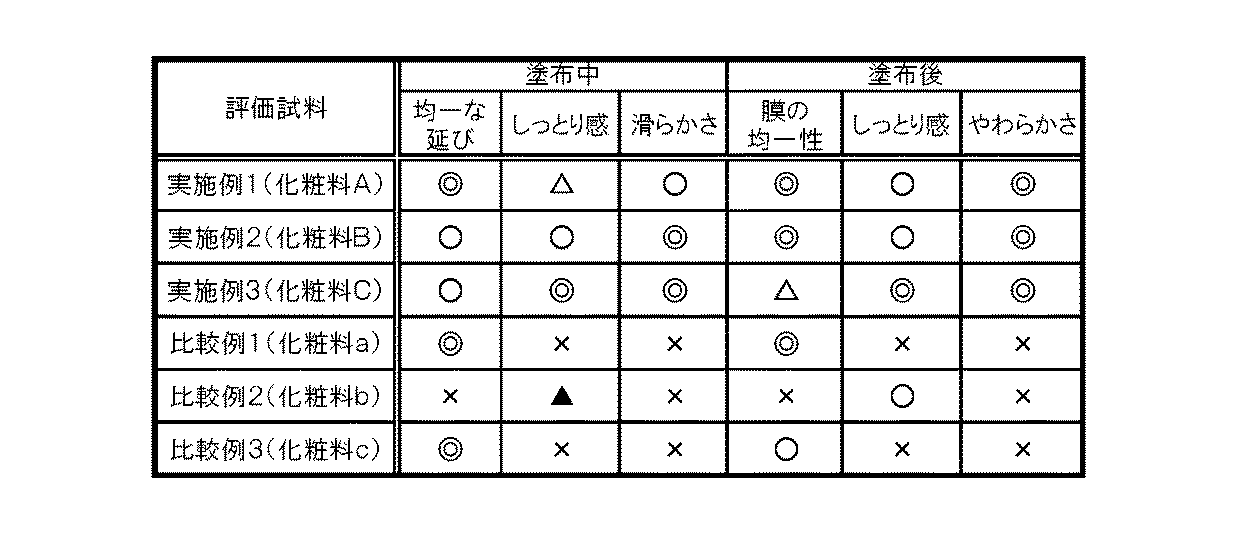
[有機無機複合粒子の粉体の感触特性]
次に、各実施例と比較例で得られた粉体を用いて、感触特性を評価した。各粉体について、20名の専門パネラーによる官能テストを行った。さらさら感、しっとり感、転がり感、均一な延び広がり性、肌への付着性、転がり感の持続性、およびソフト感の7つの評価項目に関して聞き取り調査を行い、以下の評価点基準(a)に基づき評価する。各人の評価点を合計し、以下の評価基準(b)に基づき有機無機複合粒子の感触に関する評価を行った。結果を表3に示す。その結果、各実施例の粉体は、化粧料の感触改良材として極めて優れているが、比較例の粉体は、感触改良材として適していないことが分かった。
評価点基準(a)
5点:非常に優れている。
4点:優れている。
3点:普通。
2点:劣る。
1点:非常に劣る。
評価基準(b)
◎:合計点が80点以上
○:合計点が60点以上80点未満
△:合計点が40点以上60点未満
▲:合計点が20点以上40点未満
×:合計点が20点未満[Tactile characteristics of powder of organic-inorganic composite particles]
Next, the tactile characteristics were evaluated using the powders obtained in each Example and Comparative Example. Each powder was subjected to a sensory test by 20 specialized panelists. Interview surveys were conducted on seven evaluation items: silky feeling, moist feeling, rolling feeling, uniform spreading and spreading, adhesion to the skin, sustainability of rolling feeling, and soft feeling, and the following evaluation point criteria (a) were met. Evaluate based on. The evaluation points of each person were totaled, and the feel of the organic-inorganic composite particles was evaluated based on the following evaluation criteria (b). The results are shown in Table 3. As a result, it was found that the powder of each example was extremely excellent as a feel improving material for cosmetics, but the powder of the comparative example was not suitable as a feel improving material.
Evaluation point standard (a)
5 points: Very good.
4 points: Excellent.
3 points: Normal.
2 points: Inferior.
1 point: Very inferior.
Evaluation criteria (b)
⊚: Total score is 80 points or more ○: Total score is 60 points or more and less than 80 points △: Total score is 40 points or more and less than 60 points ▲: Total score is 20 points or more and less than 40 points ×: Total score is less than 20 points
[パウダーファンデーションの使用感]
次に、有機無機複合粒子の粉体を用いて表4に示す配合比率(重量%)となるようにパウダーファンデーションを作製した。すなわち、実施例1の粉体(成分(1))と成分(2)〜(9)をミキサーに入れて撹拌し、均一に混合した。次に、化粧料成分(10)〜(12)をこのミキサーに入れて撹拌し、さらに均一に混合した。次いで、得られたケーキ状物質を解砕処理した後、その中から約12gを取り出し、46mm×54mm×4mmの角金皿に入れてプレス成型した。この様にして得られたパウダーファンデーションについて、20名の専門パネラーによる官能テストを行った。肌への塗布中の均一な延び、しっとり感、滑らかさ、および、肌に塗布後の化粧膜の均一性、しっとり感、やわらかさの6つの評価項目に関して聞き取り調査を行い、評価点基準(a)に基づき評価した。また、各人の評価点を合計し、評価基準(b)に基づきファンデーションの使用感を評価した。結果を表5に示す。ここでは、実施例1〜3による化粧料A〜Cを代表例として取り上げて評価した。実施例に基づく化粧料A〜Cは、その使用感が、塗布中でも塗布後でも、非常に優れていることが分かった。しかし、比較例1〜3の化粧料a〜cは、その使用感がよくないことが分かった。[Usage of powder foundation]
Next, a powder foundation was prepared using the powder of the organic-inorganic composite particles so as to have the blending ratio (% by weight) shown in Table 4. That is, the powder of Example 1 (component (1)) and components (2) to (9) were put into a mixer and stirred, and mixed uniformly. Next, the cosmetic ingredients (10) to (12) were put into this mixer and stirred, and further uniformly mixed. Next, after the obtained cake-like substance was crushed, about 12 g of the obtained cake-like substance was taken out, placed in a 46 mm × 54 mm × 4 mm square metal plate, and press-molded. The powder foundation thus obtained was subjected to a sensory test by 20 specialized panelists. Interview surveys were conducted on the six evaluation items of uniform elongation during application to the skin, moist feeling, smoothness, and uniformity, moist feeling, and softness of the cosmetic film after application to the skin, and the evaluation point criteria (a) ) Based on the evaluation. In addition, the evaluation points of each person were totaled, and the usability of the foundation was evaluated based on the evaluation standard (b). The results are shown in Table 5. Here, the cosmetics A to C according to Examples 1 to 3 were taken up as representative examples and evaluated. It was found that the cosmetics A to C based on the examples were very excellent in usability both during and after application. However, it was found that the cosmetics a to c of Comparative Examples 1 to 3 did not have a good feeling of use.
Claims (12)
前記乳化液滴を脱水処理する脱水工程と、
前記脱水工程で得られた非水系溶媒分散体を固液分離して平均粒子径が0.5〜25μmで真球度が0.80以上の有機無機複合粒子を固形物として得る工程と、を含むことを特徴とする有機無機複合粒子の製造方法。 A surfactant and a non-aqueous solvent are added to a dispersion liquid in which 1.0 to 83.0% by weight of a silica component and 17.0 to 99.0% by weight of biodegradable biomass plastic are dispersed, and 0.5. An emulsification step of preparing an emulsified solution containing an emulsified droplet of ~ 500 μm, and
A dehydration step of dehydrating the emulsified droplets and
A step of solid-liquid separating the non-aqueous solvent dispersion obtained in the dehydration step to obtain organic-inorganic composite particles having an average particle size of 0.5 to 25 μm and a sphericity of 0.80 or more as solids. A method for producing an organic-inorganic composite particle, which comprises.
Applications Claiming Priority (3)
| Application Number | Priority Date | Filing Date | Title |
|---|---|---|---|
| JP2018066583 | 2018-03-30 | ||
| JP2018066583 | 2018-03-30 | ||
| PCT/JP2019/013871 WO2019189692A1 (en) | 2018-03-30 | 2019-03-28 | Organic-inorganic composite particles, manufacturing method therefor, and cosmetic |
Publications (2)
| Publication Number | Publication Date |
|---|---|
| JPWO2019189692A1 JPWO2019189692A1 (en) | 2020-12-03 |
| JP6861453B2 true JP6861453B2 (en) | 2021-04-21 |
Family
ID=68061919
Family Applications (1)
| Application Number | Title | Priority Date | Filing Date |
|---|---|---|---|
| JP2020511051A Active JP6861453B2 (en) | 2018-03-30 | 2019-03-28 | Organic-inorganic composite particles, their manufacturing methods, and cosmetics |
Country Status (7)
| Country | Link |
|---|---|
| US (1) | US11701307B2 (en) |
| EP (1) | EP3778749A4 (en) |
| JP (1) | JP6861453B2 (en) |
| KR (1) | KR102719248B1 (en) |
| CN (1) | CN111801377A (en) |
| CA (1) | CA3093805A1 (en) |
| WO (1) | WO2019189692A1 (en) |
Families Citing this family (7)
| Publication number | Priority date | Publication date | Assignee | Title |
|---|---|---|---|---|
| CN111718537B (en) * | 2020-07-28 | 2022-12-13 | 黎明职业大学 | Antibacterial modified plastic |
| JP7328268B2 (en) * | 2021-02-19 | 2023-08-16 | 日揮触媒化成株式会社 | Coated particles, method for producing the same, and cosmetic |
| JP7767958B2 (en) * | 2022-02-08 | 2025-11-12 | 富士フイルムビジネスイノベーション株式会社 | cellulose particles |
| JPWO2023189800A1 (en) * | 2022-03-30 | 2023-10-05 | ||
| CN115386208B (en) * | 2022-08-11 | 2025-06-24 | 长兴电子(苏州)有限公司 | Degradable microbeads and preparation method and application thereof |
| JP7443614B1 (en) | 2022-10-05 | 2024-03-05 | 松本油脂製薬株式会社 | Resin particles and their uses |
| EP4620997A4 (en) * | 2022-11-17 | 2026-05-13 | Kao Corp | POROUS CELLULOSE PARTICLES |
Family Cites Families (20)
| Publication number | Priority date | Publication date | Assignee | Title |
|---|---|---|---|---|
| JPH0825736B2 (en) | 1993-12-28 | 1996-03-13 | 前田製管株式会社 | Method for producing amorphous silica using rice husk as a raw material |
| JP3663666B2 (en) * | 1995-04-19 | 2005-06-22 | チッソ株式会社 | Spherical cellulose and process for producing the same |
| DE69839096T2 (en) * | 1997-12-04 | 2009-01-29 | Asahi Kasei Kabushiki Kaisha | DISPERSION OF CELLULOSE |
| DE19954403A1 (en) | 1999-11-12 | 2001-05-17 | Wolff Walsrode Ag | Single and multi-layer, biodegradable, thermoplastic films with improved barrier properties as well as their use as packaging films or in cosmetic and hygiene articles |
| JP3598369B2 (en) | 2001-03-05 | 2004-12-08 | 独立行政法人産業技術総合研究所 | Method for producing silica raw material |
| JP4731053B2 (en) * | 2001-06-28 | 2011-07-20 | 日揮触媒化成株式会社 | Resin-coated spherical porous particles, method for producing the same, and cosmetics containing the particles |
| KR20050016579A (en) * | 2002-07-11 | 2005-02-21 | 쇼쿠바이가세고교 가부시키가이샤 | Cosmetic |
| JP4123124B2 (en) * | 2003-10-22 | 2008-07-23 | コニカミノルタビジネステクノロジーズ株式会社 | Toner for electrostatic image development |
| US7547498B2 (en) | 2003-10-16 | 2009-06-16 | Konica Minolta Business Technologies, Inc. | Toner for developing electrostatic latent images and a production method for the same |
| JP2008273780A (en) | 2007-04-27 | 2008-11-13 | Jgc Catalysts & Chemicals Ltd | Modified silica-based sol and method for preparing the same |
| JP5757698B2 (en) * | 2009-08-06 | 2015-07-29 | 日揮触媒化成株式会社 | Organic-inorganic composite particles and method for producing the same, dispersion containing the particles, and cosmetics containing the particles |
| US8968787B2 (en) | 2010-05-24 | 2015-03-03 | Micro Powders, Inc. | Composition comprising biodegradable polymers for use in a cosmetic composition |
| JP6081159B2 (en) | 2011-11-28 | 2017-02-15 | 旭化成アドバンス株式会社 | Cleaning agent and manufacturing method thereof |
| JP6096897B2 (en) | 2012-07-13 | 2017-03-15 | ロレアル | Cosmetic composition |
| JP6168401B2 (en) | 2012-07-31 | 2017-07-26 | 東レ株式会社 | Polylactic acid resin fine particles, dispersion using the same, and method for producing polylactic acid resin fine particles |
| JP2016002739A (en) * | 2014-06-18 | 2016-01-12 | 株式会社日本触媒 | Composite particle |
| JP6703432B2 (en) * | 2016-04-01 | 2020-06-03 | 日揮触媒化成株式会社 | Porous silica-based particles and cleaning cosmetics |
| KR20180079673A (en) * | 2017-01-02 | 2018-07-11 | 퀴아오셩 리 | Skin whitening and sunscreen composition comprising nano materials and chinese medicine extract |
| JP7058944B2 (en) | 2017-03-31 | 2022-04-25 | 日揮触媒化成株式会社 | Organic-inorganic composite particles and cosmetics |
| CN107497378A (en) * | 2017-10-09 | 2017-12-22 | 南京慧联生物科技有限公司 | The method that one-step method prepares the polyvinyl alcohol/silicon dioxide complex microsphere of core shell structure |
-
2019
- 2019-03-28 EP EP19775731.3A patent/EP3778749A4/en active Pending
- 2019-03-28 KR KR1020207024543A patent/KR102719248B1/en active Active
- 2019-03-28 CA CA3093805A patent/CA3093805A1/en active Pending
- 2019-03-28 WO PCT/JP2019/013871 patent/WO2019189692A1/en not_active Ceased
- 2019-03-28 US US16/979,341 patent/US11701307B2/en active Active
- 2019-03-28 CN CN201980016948.7A patent/CN111801377A/en active Pending
- 2019-03-28 JP JP2020511051A patent/JP6861453B2/en active Active
Also Published As
| Publication number | Publication date |
|---|---|
| EP3778749A1 (en) | 2021-02-17 |
| US20210000705A1 (en) | 2021-01-07 |
| US11701307B2 (en) | 2023-07-18 |
| WO2019189692A1 (en) | 2019-10-03 |
| JPWO2019189692A1 (en) | 2020-12-03 |
| CA3093805A1 (en) | 2019-10-03 |
| KR102719248B1 (en) | 2024-10-21 |
| BR112020019683A8 (en) | 2021-12-21 |
| EP3778749A4 (en) | 2021-06-02 |
| CN111801377A (en) | 2020-10-20 |
| BR112020019683A2 (en) | 2021-01-05 |
| KR20200136888A (en) | 2020-12-08 |
Similar Documents
| Publication | Publication Date | Title |
|---|---|---|
| JP7058944B2 (en) | Organic-inorganic composite particles and cosmetics | |
| KR102719248B1 (en) | Organic-inorganic composite particles and their manufacturing method, and cosmetics | |
| US11806421B2 (en) | Porous-cellulose particles and production method thereof, and cosmetic | |
| JP5631530B2 (en) | Porous silica-based particles having surface smoothness, a method for producing the same, and a cosmetic comprising the porous silica-based particles | |
| KR101763191B1 (en) | Porous silica particles, method for producing same, and cosmetic compounded with same | |
| CN110603223B (en) | Hollow Particles and Cosmetics | |
| EP4019553A1 (en) | Particles containing starch, method for producing same, and cosmetic preparation | |
| JP5791771B2 (en) | Porous silica-based particles having excellent surface smoothness and cosmetics comprising the porous silica-based particles | |
| JP5156182B2 (en) | Cosmetic composition | |
| JP2019178257A (en) | Organic-inorganic composite particle, and cosmetics | |
| JP2009091318A (en) | Modified surface modifier, method for producing the same, method for surface-modifying powder with the modifier, and cosmetic containing the modified powder | |
| JP6854883B2 (en) | Makeup cosmetics | |
| EA029628B1 (en) | Foamable personal care composition comprising a continuous oil phase | |
| JP5174447B2 (en) | Method for producing modified surface modifier, method for surface modification of powder with the modifier, and method for producing cosmetics containing the powder | |
| BR112020019683B1 (en) | SPHERICAL ORGANIC-INORGANIC COMPOUND PARTICLES AND METHOD OF MANUFACTURING THEM AND COSMETICS | |
| JP5450711B2 (en) | Method for producing modified surface modifier, method for surface modification of powder with the modifier, and method for producing cosmetics containing the powder | |
| CA3063038C (en) | Hollow particles and cosmetic | |
| US20240225989A9 (en) | Coated particle, method for producing same, and cosmetic | |
| CN120548338A (en) | New multifunctional biodegradable micropowder |
Legal Events
| Date | Code | Title | Description |
|---|---|---|---|
| A621 | Written request for application examination |
Free format text: JAPANESE INTERMEDIATE CODE: A621 Effective date: 20200623 |
|
| A871 | Explanation of circumstances concerning accelerated examination |
Free format text: JAPANESE INTERMEDIATE CODE: A871 Effective date: 20200623 |
|
| A975 | Report on accelerated examination |
Free format text: JAPANESE INTERMEDIATE CODE: A971005 Effective date: 20200714 |
|
| A131 | Notification of reasons for refusal |
Free format text: JAPANESE INTERMEDIATE CODE: A131 Effective date: 20200826 |
|
| A521 | Request for written amendment filed |
Free format text: JAPANESE INTERMEDIATE CODE: A523 Effective date: 20201023 |
|
| A131 | Notification of reasons for refusal |
Free format text: JAPANESE INTERMEDIATE CODE: A131 Effective date: 20210105 |
|
| A521 | Request for written amendment filed |
Free format text: JAPANESE INTERMEDIATE CODE: A523 Effective date: 20210122 |
|
| TRDD | Decision of grant or rejection written | ||
| A01 | Written decision to grant a patent or to grant a registration (utility model) |
Free format text: JAPANESE INTERMEDIATE CODE: A01 Effective date: 20210318 |
|
| A61 | First payment of annual fees (during grant procedure) |
Free format text: JAPANESE INTERMEDIATE CODE: A61 Effective date: 20210324 |
|
| R150 | Certificate of patent or registration of utility model |
Ref document number: 6861453 Country of ref document: JP Free format text: JAPANESE INTERMEDIATE CODE: R150 |
|
| R157 | Certificate of patent or utility model (correction) |
Free format text: JAPANESE INTERMEDIATE CODE: R157 |
|
| R250 | Receipt of annual fees |
Free format text: JAPANESE INTERMEDIATE CODE: R250 |
|
| R250 | Receipt of annual fees |
Free format text: JAPANESE INTERMEDIATE CODE: R250 |
|
| R250 | Receipt of annual fees |
Free format text: JAPANESE INTERMEDIATE CODE: R250 |