JP6700616B2 - Semi-transparent stretched film - Google Patents
Semi-transparent stretched film Download PDFInfo
- Publication number
- JP6700616B2 JP6700616B2 JP2017083158A JP2017083158A JP6700616B2 JP 6700616 B2 JP6700616 B2 JP 6700616B2 JP 2017083158 A JP2017083158 A JP 2017083158A JP 2017083158 A JP2017083158 A JP 2017083158A JP 6700616 B2 JP6700616 B2 JP 6700616B2
- Authority
- JP
- Japan
- Prior art keywords
- resin
- crystalline
- mass
- layer
- stretched film
- Prior art date
- Legal status (The legal status is an assumption and is not a legal conclusion. Google has not performed a legal analysis and makes no representation as to the accuracy of the status listed.)
- Active
Links
Landscapes
- Manufacture Of Macromolecular Shaped Articles (AREA)
- Laminated Bodies (AREA)
- Shaping By String And By Release Of Stress In Plastics And The Like (AREA)
- Molding Of Porous Articles (AREA)
- Compositions Of Macromolecular Compounds (AREA)
Description
本発明は、少なくとも基材層および表面層を含む半透明性延伸フィルムに関する。 The present invention relates to a translucent stretched film including at least a base material layer and a surface layer.
従来、透写紙、グラシン紙、パラフィン紙および硫酸紙といった半透明性を有する紙は、その表面に印刷等された文字や絵柄の視認性に優れ、内容物の確認も可能であることから、薬包紙、食品の包装紙、クッキングシート、ブックカバー等に用いられている。しかしながら、それらの半透明性を有する紙は、厚みを大きくすると半透明性が失われ、厚みを小さくすると機械強度が不十分となる。また印刷・断裁・包装等の際に紙粉が発生し、印刷性や断裁作業性の悪化、包装物の汚染といった問題を生ずることがある。またプラスチック製フィルムと比べると耐湿性、耐水性および耐油性は低く、水分や油分を含む食品等の包装等には使用できない場合がある。さらには、紙は一般にヒートシール性を有さず、ヒートシール性を要する包装形態には使用できない。 Conventionally, translucent paper, glassine paper, paraffin paper, and sulfuric acid paper, which have semi-transparency, have excellent visibility of characters and patterns printed on the surface, and the contents can be confirmed. It is used for medicine wrapping paper, food wrapping paper, cooking sheets, book covers, etc. However, the translucent paper loses the translucency when the thickness is increased, and the mechanical strength becomes insufficient when the thickness is decreased. In addition, paper dust is generated during printing, cutting, packaging, and the like, which may cause problems such as deterioration of printability and cutting workability, and contamination of packages. Further, it has lower moisture resistance, water resistance and oil resistance than a plastic film, and may not be used for packaging foods and the like containing water or oil. Furthermore, paper generally does not have heat sealability, and cannot be used in a packaging form that requires heat sealability.
これに対し、プラスチック製フィルムは、耐湿性、耐水性および耐油性に優れ、良好な機械強度を有することから、食品や薬品等の包装紙等に用いられている。しかしながら、プラスチック製フィルムは透明性が高く、その全面に印刷しなければ文字や絵柄等を視認しにくく、加えて質感が均一であるため高級感や意匠性が得られにくい。このため、プラスチック製フィルムは消費者の注目を集めにくいという課題がある。 On the other hand, a plastic film has excellent moisture resistance, water resistance and oil resistance, and has good mechanical strength, and is therefore used for wrapping paper for foods, chemicals and the like. However, the plastic film has high transparency, and it is difficult to visually recognize characters and patterns unless printed on the entire surface, and in addition, it is difficult to obtain a high-class feeling and design because the texture is uniform. Therefore, the plastic film has a problem that it is difficult to attract the attention of consumers.
加えて、透写紙等ではその用途から鉛筆筆記性が必要とされるが、プラスチック製フィルムは表面が滑らかすぎるために鉛筆等による筆記ができない。また、紙に比べてプラスチック製フィルムは外観につやがあるため、紙の代替として用いることができない場合がある。 In addition, a pencil writing property is required for a transparent paper or the like due to its use, but a plastic film cannot be written with a pencil or the like because the surface is too smooth. Further, since the plastic film has a glossy appearance as compared with paper, it may not be used as a substitute for paper.
特許文献1には、ポリプロピレンおよび特定の炭酸カルシウム粉末を含有するポリプロピレン樹脂組成物から形成されたパール光沢を有するポリプロピレン二軸延伸フィルムが提案されている。 Patent Document 1 proposes a polypropylene biaxially stretched film having a pearl luster formed from a polypropylene resin composition containing polypropylene and a specific calcium carbonate powder.
特許文献2には、結晶性ポリオレフィンと環状オレフィン系樹脂とからなる不透明ポリオレフィン系フィルムが提案されている。 Patent Document 2 proposes an opaque polyolefin film composed of a crystalline polyolefin and a cyclic olefin resin.
特許文献3には、ポリマーマトリックス、およびシンジオタクチックポリスチレン重合体からなる固体、非中空粒子を含むキャビテーション化剤を含む基材層と、少なくとも1種の追加の層とを含む不透明なポリマーフィルムが提案されている。特許文献3には、上記ポリマーフィルム中にエチレンノルボレンコポリマーがキャビテーション化剤として更に含まれることが記載されている。 US Pat. No. 6,096,849 discloses an opaque polymer film comprising a polymer matrix and a base layer comprising a solid, composed of syndiotactic polystyrene polymer, a cavitation agent comprising non-hollow particles, and at least one additional layer. Proposed. Patent Document 3 describes that an ethylene norborene copolymer is further contained in the polymer film as a cavitation agent.
しかしながら、上記特許文献1に関して、ポリプロピレン二軸延伸フィルムに用いられる炭酸カルシウムは不透明性であり、半透明性のフィルムは得られない。また、粒子の脱落による包装物の汚染や、印刷用途での印刷版の汚れが発生することがあり、断裁作業性についても良好であるとはいえない。
また、上記特許文献2に関して、不透明ポリオレフィン系フィルムは、結晶性オレフィンと環状オレフィン系樹脂の単層フィルムのため、外観につやがあり紙のような質感は無く、鉛筆などによる筆記性についても有さないものである。
さらに、上記特許文献3に記載のポリマーフィルムは不透明性であり、半透明性を有するものではない。また、つや消し効果を有する表面層については記載されておらず、上記ポリマーフィルムは紙のような質感を有するものではない。
However, regarding the above-mentioned Patent Document 1, calcium carbonate used for a polypropylene biaxially stretched film is opaque, and a translucent film cannot be obtained. In addition, the package may be contaminated due to the particles falling off, or the printing plate may be contaminated for printing purposes, and the cutting workability is not satisfactory.
Further, regarding the above-mentioned Patent Document 2, since the opaque polyolefin film is a single-layer film of a crystalline olefin and a cyclic olefin resin, it has a glossy appearance and does not have a paper-like texture, and also has a writing property with a pencil or the like. It is something that is not done.
Furthermore, the polymer film described in Patent Document 3 is opaque and does not have translucency. Further, it does not describe a surface layer having a matte effect, and the polymer film does not have a paper-like texture.
このような状況下、紙に比べて高い耐湿性、耐水性、耐油性、および機械強度を有するプラスチック製フィルムでありながら半透明性および紙のような外観をも有し、好ましくは優れた印刷適性を有し、所望により鉛筆筆記性をも有するフィルムが望まれている。
したがって、本発明の目的は、紙のような外観を有する半透明性延伸フィルム、好ましくは優れた印刷適性を有し、所望により鉛筆筆記性をも有する半透明性延伸フィルムを提供することである。
Under such circumstances, it is a plastic film that has higher moisture resistance, water resistance, oil resistance, and mechanical strength than paper, but also has semi-transparency and a paper-like appearance, and is preferably excellent in printing. A film having suitability and, if desired, pencil writing property is desired.
Accordingly, it is an object of the present invention to provide a translucent stretched film having a paper-like appearance, preferably a translucent stretched film having excellent printability and optionally pencil writability. ..
本発明者らは、鋭意研究を重ねた結果、半透明性延伸フィルムにおける紙のような外観は、表面側のつや(光沢度)および基材層による白さの不均一性が関連することを見出した。そして、本発明者らは、少なくとも基材層および表面層を含む半透明性延伸フィルムであって、前記基材層は、融点が120〜175℃である結晶性熱可塑性樹脂Aと、非晶性熱可塑性樹脂Bとを樹脂成分として少なくとも含有する層を1層以上有し、表面層は190℃および2.16kgにおけるメルトマスフローレートが0.02〜2g/10分である結晶性熱可塑性樹脂Dを樹脂成分として少なくとも含有する、全光線透過率が35〜85%である半透明性延伸フィルムにより上記課題を解決できることを見出し、本発明を完成させるに至った。 As a result of intensive studies, the present inventors have found that the paper-like appearance of the translucent stretched film is related to the gloss (glossiness) on the surface side and the non-uniformity of whiteness due to the base material layer. I found it. And, the present inventors are a semitransparent stretched film including at least a base material layer and a surface layer, wherein the base material layer has a crystalline thermoplastic resin A having a melting point of 120 to 175° C. and an amorphous material. Crystalline thermoplastic resin having one or more layers containing at least a thermoplastic resin B as a resin component, and the surface layer has a melt mass flow rate of 0.02 to 2 g/10 minutes at 190° C. and 2.16 kg. It has been found that the above problems can be solved by a semitransparent stretched film containing at least D as a resin component and having a total light transmittance of 35 to 85%, and completed the present invention.
すなわち、本発明には、以下のものが含まれる。
[1]少なくとも基材層および表面層を含む半透明性延伸フィルムであって、
前記基材層は、融点が120〜175℃である結晶性熱可塑性樹脂Aと、非晶性熱可塑性樹脂Bとを樹脂成分として少なくとも含有する層を1層以上有し、
前記表面層は、190℃および2.16kgにおけるメルトマスフローレートが0.02〜2g/10分である結晶性熱可塑性樹脂Dを樹脂成分として少なくとも含有する、全光線透過率が35〜85%である、半透明性延伸フィルム。
[2]前記非晶性熱可塑性樹脂Bのガラス転移温度が135〜185℃である、[1]に記載の半透明性延伸フィルム。
[3]前記基材層は、融点が200〜280℃である結晶性熱可塑性樹脂Cを樹脂成分として更に含有する、[1]または[2]に記載の半透明性延伸フィルム。
[4]前記基材層は、非晶性熱可塑性樹脂Bの含有量が基材層の樹脂成分の全質量を基準に2〜40質量%である、[1]〜[3]のいずれかに記載の半透明性延伸フィルム。
[5]前記表面層は、結晶性熱可塑性樹脂A’を樹脂成分として更に含有する、[1]〜[4]のいずれかに記載の半透明性延伸フィルム。
[6]前記表面層は、前記結晶性熱可塑性樹脂Dの含有量が表面層の樹脂成分の全質量を基準に1〜60質量%である、[1]〜[5]のいずれかに記載の半透明性延伸フィルム。
[7]前記表面層は、非晶性熱可塑性樹脂B’及び/又は結晶性熱可塑性樹脂C’を樹脂成分として更に含有し、非晶性熱可塑性樹脂B’及び/又は結晶性熱可塑性樹脂C’の含有量の合計が表面層の樹脂成分の全質量を基準に5〜30質量%である、[1]〜[6]のいずれかに記載の半透明性延伸フィルム。
[8]前記非晶性熱可塑性樹脂Bは、非晶性環状オレフィン共重合体である、[1]〜[7]のいずれかに記載の半透明性延伸フィルム。
[9]前記結晶性熱可塑性樹脂Dは高密度ポリエチレンである、[1]〜[8]のいずれかに記載の半透明性延伸フィルム。
[10]表面層が積層された面の反対側の面にヒートシール層を有する、[1]〜[9]のいずれかに記載の半透明性延伸フィルム。
[11]表面層側の60度鏡面光沢度は1〜20%である、[1]〜[10]のいずれかに記載の半透明性延伸フィルム。
That is, the present invention includes the following.
[1] A semitransparent stretched film including at least a base material layer and a surface layer,
The base material layer has at least one layer containing at least a crystalline thermoplastic resin A having a melting point of 120 to 175° C. and an amorphous thermoplastic resin B as resin components,
The surface layer contains at least a crystalline thermoplastic resin D having a melt mass flow rate of 0.02 to 2 g/10 minutes at 190° C. and 2.16 kg as a resin component, and a total light transmittance of 35 to 85%. There is a semitransparent stretched film.
[2] The semitransparent stretched film according to [1], wherein the amorphous thermoplastic resin B has a glass transition temperature of 135 to 185°C.
[3] The semitransparent stretched film according to [1] or [2], wherein the base material layer further contains, as a resin component, a crystalline thermoplastic resin C having a melting point of 200 to 280°C.
[4] Any one of [1] to [3], wherein the content of the amorphous thermoplastic resin B in the base material layer is 2 to 40 mass% based on the total mass of the resin components of the base material layer. The semitransparent stretched film according to 1.
[5] The semitransparent stretched film according to any one of [1] to [4], wherein the surface layer further contains a crystalline thermoplastic resin A′ as a resin component.
[6] In the surface layer, the content of the crystalline thermoplastic resin D is 1 to 60% by mass based on the total mass of the resin components of the surface layer, [1] to [5]. Semi-transparent stretched film.
[7] The surface layer further contains an amorphous thermoplastic resin B′ and/or a crystalline thermoplastic resin C′ as a resin component, and the amorphous thermoplastic resin B′ and/or the crystalline thermoplastic resin. The semitransparent stretched film according to any one of [1] to [6], wherein the total content of C′ is 5 to 30% by mass based on the total mass of the resin components of the surface layer.
[8] The semitransparent stretched film according to any one of [1] to [7], wherein the amorphous thermoplastic resin B is an amorphous cyclic olefin copolymer.
[9] The semitransparent stretched film according to any one of [1] to [8], wherein the crystalline thermoplastic resin D is high-density polyethylene.
[10] The translucent stretched film according to any one of [1] to [9], which has a heat seal layer on the surface opposite to the surface on which the surface layer is laminated.
[11] The semitransparent stretched film according to any one of [1] to [10], wherein the surface layer side has a 60-degree specular gloss of 1 to 20%.
本発明の半透明性延伸フィルムは、白色で半透明性を有すると共に、機械強度、耐湿性、耐水性および耐油性に優れることから、ラベル、テープ用基材、印刷用基材、ポスター用紙、感熱紙基材、記録用紙基材等に好適に用いることができる。また、紙の地合いのように白さが不均一で、つや消しされた外観を有するため、紙の質感(紙のような外観)を有しており、その結果、紙の代替品として使用しやすい。
また、つや消しの外観を得るために、表面を適度に粗面化したことで、紙の様に鉛筆筆記が可能である。
The semi-transparent stretched film of the present invention has a white semi-transparency, and also has excellent mechanical strength, moisture resistance, water resistance and oil resistance, and therefore has a label, a tape substrate, a printing substrate, a poster paper, It can be suitably used for a heat-sensitive paper base material, a recording paper base material and the like. In addition, it has a non-uniform whiteness like the texture of paper and has a matte appearance, so it has the texture of paper (paper-like appearance), and as a result, it is easy to use as a substitute for paper. ..
Further, in order to obtain a matte appearance, the surface is appropriately roughened so that it is possible to write with a pencil like paper.
本発明の半透明性延伸フィルムは無機粒子を含有しなくても紙の質感を有する。このような実施形態では、無機粒子の脱落による包装物の汚染や、印刷用途での印刷版の汚れが無く、断裁時に切断面が荒れることや断裁刃の消耗が早い等の問題が起こらない。
さらに、本発明のある実施態様では、本発明の半透明性延伸フィルムは優れた印刷適性およびヒートシール性を有するため、食品包装用途に好ましく用いることができる。
The translucent stretched film of the present invention has the texture of paper even if it does not contain inorganic particles. In such an embodiment, there is no problem that the package is not contaminated due to the dropping of the inorganic particles, the printing plate is not contaminated for printing purposes, the cutting surface is roughened during cutting, and the cutting blade is consumed quickly.
Furthermore, in one embodiment of the present invention, the semitransparent stretched film of the present invention has excellent printability and heat sealability, and thus can be preferably used for food packaging applications.
本明細書において、「〜」とは、以上と以下を意味する。即ち、α〜βという表記は、α以上β以下又はβ以上α以下を意味し、範囲としてαとβを含む。 In the present specification, “to” means the above and the following. That is, the notation α to β means α or more and β or less or β or more and α or less, and includes α and β as a range.
本発明は、少なくとも基材層および表面層を含む半透明性延伸フィルムであって、前記基材層は、融点が120〜175℃である結晶性熱可塑性樹脂A(以下、結晶性樹脂Aとも称する)と、非晶性熱可塑性樹脂B(以下、非晶性樹脂Bとも称する)とを樹脂成分として少なくとも含有する層を1層以上有し、表面層は、190℃および2.16kgにおけるメルトマスフローレートが0.02〜2g/10分である結晶性熱可塑性樹脂Dを樹脂成分として少なくとも含有する、全光線透過率が35〜85%である半透明性延伸フィルムに関する。本発明の半透明性延伸フィルムは、少なくとも基材層および表面層が積層されており、複数層から構成されている。
ここで、結晶性熱可塑性樹脂とは、DSCを用いて、窒素流下、−40℃から300℃まで20℃/分の速度で昇温し、300℃で5分間保持し、20℃/分で−40℃まで冷却し、−40℃で5分間保持した後、再び20℃/分で300℃まで昇温した際のDSC曲線に明確な溶融ピークが現れる熱可塑性樹脂をいう。
また、非晶性熱可塑性樹脂とは、DSCを用いた上記測定において明確な溶融ピークが現れない熱可塑性樹脂をいう。
また、「融点が120〜175℃である結晶性熱可塑性樹脂Aと、非晶性熱可塑性樹脂Bとを樹脂成分として少なくとも含有する層を1層以上有し」とは、基材層が、結晶性樹脂Aと非晶性樹脂Bとを樹脂成分として少なくとも含有する(当該樹脂A及びBを併用する)層を、基材層を構成する層として単数又は複数含み得ることを意味するものであり、基材層が、結晶性樹脂Aと非晶性樹脂Bとを樹脂成分として少なくとも含有する(当該樹脂A及びBを併用する)層を、基材層に隣接した別の層として有することを意味するものではない。
The present invention is a semitransparent stretched film including at least a base material layer and a surface layer, wherein the base material layer has a crystalline thermoplastic resin A having a melting point of 120 to 175°C (hereinafter, also referred to as crystalline resin A). And a non-crystalline thermoplastic resin B (hereinafter, also referred to as the non-crystalline resin B) as resin components at least one layer, and the surface layer is a melt at 190° C. and 2.16 kg. The present invention relates to a semitransparent stretched film having a total light transmittance of 35 to 85%, which contains at least a crystalline thermoplastic resin D having a mass flow rate of 0.02 to 2 g/10 minutes as a resin component. The translucent stretched film of the present invention has at least a substrate layer and a surface layer laminated, and is composed of a plurality of layers.
Here, the crystalline thermoplastic resin means that the temperature is raised from -40° C. to 300° C. at a rate of 20° C./min under a nitrogen flow using DSC, held at 300° C. for 5 minutes, and at 20° C./min This is a thermoplastic resin in which a clear melting peak appears in the DSC curve when cooled to -40°C, held at -40°C for 5 minutes, and then again heated to 300°C at 20°C/min.
Further, the amorphous thermoplastic resin refers to a thermoplastic resin in which a clear melting peak does not appear in the above measurement using DSC.
Further, "having one or more layers containing at least a crystalline thermoplastic resin A having a melting point of 120 to 175° C. and an amorphous thermoplastic resin B as resin components" means that the base material layer is It means that a layer containing at least a crystalline resin A and an amorphous resin B as a resin component (the resin A and B are used in combination) can be included in a single layer or a plurality of layers as a layer constituting a base material layer. And the base material layer has a layer containing at least the crystalline resin A and the amorphous resin B as a resin component (using the resins A and B together) as another layer adjacent to the base material layer. Does not mean.
本発明の半透明性延伸フィルムは、基材層を含む。基材層は、上記結晶性樹脂Aおよび非晶性樹脂Bを樹脂成分として少なくとも含有する層を1層以上有する。つまり、基材層は、単層又は複数層のいずれであってもよく、基材層が複数層の場合、上記結晶性樹脂Aおよび非晶性樹脂Bを樹脂成分として少なくとも含有する(当該樹脂A及びBを併用する)層は、1層であってもよく、また複数層であってもよい。
半透明性延伸フィルムの基材層が上記結晶性樹脂Aおよび非晶性樹脂Bを含有することにより、結晶性樹脂A中での非晶性樹脂Bの分散状態およびその周囲に形成される空隙部が様々な大きさになることで透過率に部分差が生じ、紙の地合いのような白さの不均一性が得られることとなる。また、メルトマスフローレートが上記範囲内の結晶性熱可塑性樹脂Dを表面層に含有することにより、つや消しの外観を有する表面層が得られる。このような基材層と表面層を組み合わせることで、半透明性を有する紙のような外観の半透明性延伸フィルムを得ることができる。なお、半透明性延伸フィルムの基材層中の前記非晶性樹脂B自体は中空状態ではなく中実状態(又は非中空状態)である。
The translucent stretched film of the present invention includes a base material layer. The base material layer has one or more layers containing at least the crystalline resin A and the amorphous resin B as resin components. That is, the base material layer may be either a single layer or a plurality of layers. When the base material layer is a plurality of layers, it contains at least the crystalline resin A and the amorphous resin B as resin components (the resin The layer (using both A and B) may be a single layer or a plurality of layers.
Since the base material layer of the semitransparent stretched film contains the crystalline resin A and the amorphous resin B, the dispersed state of the amorphous resin B in the crystalline resin A and the voids formed around it Since the parts have various sizes, a partial difference occurs in the transmittance, and non-uniformity of whiteness such as the texture of paper is obtained. Further, by containing the crystalline thermoplastic resin D having a melt mass flow rate within the above range in the surface layer, a surface layer having a matte appearance can be obtained. By combining such a base material layer and a surface layer, a semitransparent stretched film having a semitransparent paper-like appearance can be obtained. The amorphous resin B itself in the base layer of the semitransparent stretched film is not in a hollow state but in a solid state (or a non-hollow state).
本発明の半透明性延伸フィルムは、全光線透過率が35〜85%である。全光線透過率が35%未満であると、不透明になり、包装に用いた場合、内容物の確認が困難となる。また、85%を超えると、透明性が余りに高くなり、フィルム表面に印字された文字や絵柄等の視認性が悪化する。本発明の半透明性延伸フィルムは、全光線透過率が好ましくは40%〜80%、より好ましくは50%〜75%、さらに好ましくは52〜70%である。全光線透過率が上記範囲内であれば、延伸フィルムが半透明性となるため好ましい。本発明では、全光線透過率は、JIS K 7361に準拠して測定される値のことであり、日本電色工業株式会社製ヘーズメーターNDH−5000等を用いて測定した。 The semitransparent stretched film of the present invention has a total light transmittance of 35 to 85%. If the total light transmittance is less than 35%, it becomes opaque, and it becomes difficult to confirm the contents when used for packaging. On the other hand, when it exceeds 85%, the transparency becomes too high, and the visibility of characters, patterns, etc. printed on the film surface deteriorates. The total light transmittance of the semitransparent stretched film of the present invention is preferably 40% to 80%, more preferably 50% to 75%, and further preferably 52 to 70%. When the total light transmittance is within the above range, the stretched film becomes translucent, which is preferable. In the present invention, the total light transmittance is a value measured according to JIS K 7361, and was measured using a haze meter NDH-5000 manufactured by Nippon Denshoku Industries Co., Ltd.
結晶性樹脂Aの融点は、120〜175℃であり、好ましくは123〜170℃、より好ましくは126〜166℃、さらに好ましくは130〜164℃、特に好ましくは135〜163℃である。結晶性樹脂Aの融点が120℃未満である場合には、得られる延伸フィルムの耐熱性が低下し、延伸フィルムの生産性が低下する。結晶性樹脂Aの融点が175℃を超える場合には、結晶性樹脂A中で非晶性樹脂Bの微細分散物の大きさを制御することが困難となる。 The melting point of the crystalline resin A is 120 to 175°C, preferably 123 to 170°C, more preferably 126 to 166°C, further preferably 130 to 164°C, and particularly preferably 135 to 163°C. When the melting point of the crystalline resin A is lower than 120° C., the heat resistance of the obtained stretched film is lowered and the productivity of the stretched film is lowered. When the melting point of the crystalline resin A exceeds 175° C., it becomes difficult to control the size of the fine dispersion of the amorphous resin B in the crystalline resin A.
結晶性樹脂Aのガラス転移温度は、50℃以下が好ましく、−30℃〜30℃がより好ましい。結晶性樹脂Aのガラス転移温度が上記要件を満たし、後に記載するように非晶性樹脂Bが特定のガラス転移温度を有すると、フィルムの延伸の際に、結晶性樹脂Aと非晶性樹脂Bとの界面間に、適度な空隙部が形成され得るため好ましい。また、延伸フィルムの生産性や得られる延伸フィルムの耐熱性、柔軟性、低温もろさ等が良好となるため好ましい。 The glass transition temperature of the crystalline resin A is preferably 50°C or lower, more preferably -30°C to 30°C. When the glass transition temperature of the crystalline resin A satisfies the above requirements and the amorphous resin B has a specific glass transition temperature as described later, when the film is stretched, the crystalline resin A and the amorphous resin B are stretched. It is preferable because an appropriate void can be formed between the interface with B. Further, the productivity of the stretched film and the heat resistance, flexibility, low temperature brittleness and the like of the obtained stretched film are favorable, which is preferable.
本発明では、結晶性樹脂Aの融点およびガラス転移温度はパーキン・エルマー社製入力補償型DSC、DiamondDSCを用いて測定を行った。 In the present invention, the melting point and glass transition temperature of the crystalline resin A were measured using an input compensation type DSC, DiamondDSC manufactured by Perkin-Elmer.
結晶性樹脂Aの、230℃および2.16kgにおけるメルトマスフローレートは、好ましくは0.5〜10g/10分、より好ましくは1〜8g/10分、さらに好ましくは2〜6g/10分、特に好ましくは2.5〜6g/10分である。メルトマスフローレートを上記範囲内とすることで、樹脂の流動性が適度な範囲となり、延伸フィルムを、精度良い厚みで作製することができる。また、結晶性樹脂A中で非晶性樹脂Bの微細分散物の大きさを制御し易くなり、所望の全光線透過率が得られやすくなる。本発明では、結晶性樹脂Aのメルトマスフローレートは、JIS K 7210:1999に準拠し、株式会社東洋精機製作所製メルトインデクサーを用いて測定した。ここで、前記非晶性樹脂Bの微細分散物自体は中空状態ではなく中実状態(又は非中空状態ともいう)である。 The melt mass flow rate of the crystalline resin A at 230° C. and 2.16 kg is preferably 0.5 to 10 g/10 minutes, more preferably 1 to 8 g/10 minutes, further preferably 2 to 6 g/10 minutes, particularly It is preferably 2.5 to 6 g/10 minutes. By setting the melt mass flow rate within the above range, the fluidity of the resin is in an appropriate range, and a stretched film can be manufactured with an accurate thickness. In addition, the size of the fine dispersion of the amorphous resin B in the crystalline resin A can be easily controlled, and the desired total light transmittance can be easily obtained. In the present invention, the melt mass flow rate of the crystalline resin A was measured according to JIS K 7210:1999 using a melt indexer manufactured by Toyo Seiki Co., Ltd. Here, the fine dispersion of the amorphous resin B itself is not in a hollow state but in a solid state (also referred to as a non-hollow state).
結晶性樹脂Aとしては、融点が120〜175℃である結晶性熱可塑性樹脂であれば特に限定されないが、例えば結晶性ポリオレフィン系樹脂、結晶性アセタール系樹脂、ならびに結晶性ポリエステル系樹脂および結晶性ポリアミド系樹脂のうち融点が120〜175℃であるもの等が挙げられる。これらを単独でまたは2種以上を混合して用いることができる。これらのなかでも、結晶性ポリオレフィン系樹脂が好ましく、とりわけ、上述の結晶性樹脂Aの融点や好ましくはガラス転移温度を示す結晶性ポリオレフィン系樹脂が、延伸性に優れ、適当なフィルム延伸温度で所望の全光線透過率を示す半透明性延伸フィルムが得られ易くなるため好ましい。 The crystalline resin A is not particularly limited as long as it is a crystalline thermoplastic resin having a melting point of 120 to 175° C., for example, a crystalline polyolefin resin, a crystalline acetal resin, a crystalline polyester resin and a crystalline resin. Among the polyamide resins, those having a melting point of 120 to 175° C. and the like can be mentioned. These may be used alone or in combination of two or more. Among these, crystalline polyolefin resins are preferable, and above all, crystalline polyolefin resins exhibiting the melting point of the crystalline resin A or preferably the glass transition temperature are excellent in stretchability and desired at an appropriate film stretching temperature. It is preferable because a semitransparent stretched film exhibiting the total light transmittance of is easily obtained.
結晶性ポリオレフィン系樹脂としては、エチレン、プロピレン、1−ブテン、1−ペンテン、3−メチル−1−ペンテン、4−メチル−1−ペンテン、1−ヘキセン、1−オクテン等を単量体とする単独重合体または共重合体等が挙げられ、これらを単独でまたは2種以上の混合物として用いることができる。これらのなかでも、結晶性ポリプロピレン系樹脂が好ましく、特に結晶性プロピレン単独重合体および結晶性のプロピレンとエチレンとの共重合体(以下、結晶性プロピレン−エチレン共重合体ともいう)からなる群から選ばれた少なくとも1種が好ましい。結晶性樹脂Aに結晶性プロピレン単独重合体(結晶性ポリプロピレン単独重合体)を用いる場合、フィルムの機械強度や耐熱性が向上しやすい傾向がある。結晶性樹脂Aに結晶性プロピレン−エチレン共重合体を用いる場合、フィルムの低温での折り割れ性が良化し、かつ表面光沢度を下げやすい傾向がある。 As the crystalline polyolefin-based resin, ethylene, propylene, 1-butene, 1-pentene, 3-methyl-1-pentene, 4-methyl-1-pentene, 1-hexene, 1-octene and the like are used as monomers. Examples thereof include homopolymers and copolymers, and these can be used alone or as a mixture of two or more kinds. Among these, crystalline polypropylene resins are preferable, and particularly from the group consisting of crystalline propylene homopolymer and crystalline propylene-ethylene copolymer (hereinafter, also referred to as crystalline propylene-ethylene copolymer). At least one selected is preferable. When a crystalline propylene homopolymer (crystalline polypropylene homopolymer) is used for the crystalline resin A, the mechanical strength and heat resistance of the film tend to be improved. When a crystalline propylene-ethylene copolymer is used as the crystalline resin A, the film tends to have improved breakability at low temperatures and tends to have a reduced surface gloss.
したがって、結晶性樹脂Aは、結晶性プロピレン単独重合体のみを使用したり、結晶性プロピレン単独重合体と、プロピレンとエチレン等との共重合体および/または他の重合体との混合物を使用したり、プロピレンとエチレン等との共重合体および/または他の重合体のみを使用したりすることができる。また、結晶性樹脂Aは、要求される品質に応じて、層によって用いる樹脂の種類を使い分けることもできる。上記他の重合体は、結晶性樹脂Aとして用いることができる任意の重合体であってよく、上述の結晶性プロピレン単独重合体およびプロピレンとエチレン等との共重合体以外の結晶性ポリオレフィン系樹脂、結晶性ポリエステル系樹脂、結晶性ポリアミド系樹脂、結晶性アセタール系樹脂等であってよい。好ましくは、結晶性樹脂Aとして、結晶性プロピレン単独重合体と結晶性プロピレン−エチレン共重合体の2成分を組み合わせて使用することが好ましい。この場合、結晶性プロピレン単独重合体と結晶性プロピレン−エチレン共重合体の好ましい質量比率は、結晶性プロピレン単独重合体(P1):結晶性プロピレン−エチレン共重合体(P2)=90:10〜99.5:0.5であり、より好ましい質量比率はP1:P2=93:7〜99:1であり、さらに好ましい質量比率はP1:P2=95:5〜97:3である。 Therefore, the crystalline resin A may be a crystalline propylene homopolymer alone or a mixture of a crystalline propylene homopolymer and a copolymer of propylene and ethylene and/or another polymer. Alternatively, it is possible to use only a copolymer of propylene and ethylene and/or another polymer. In addition, the crystalline resin A can be used in different types according to the required quality. The other polymer may be any polymer that can be used as the crystalline resin A, and is a crystalline polyolefin resin other than the above-mentioned crystalline propylene homopolymer and copolymer of propylene and ethylene. It may be a crystalline polyester resin, a crystalline polyamide resin, a crystalline acetal resin, or the like. Preferably, the crystalline resin A is preferably a combination of two components, a crystalline propylene homopolymer and a crystalline propylene-ethylene copolymer. In this case, the preferable mass ratio of the crystalline propylene homopolymer and the crystalline propylene-ethylene copolymer is as follows: crystalline propylene homopolymer (P1): crystalline propylene-ethylene copolymer (P2)=90:10 It is 99.5:0.5, a more preferable mass ratio is P1:P2=93:7 to 99:1, and a more preferable mass ratio is P1:P2=95:5 to 97:3.
結晶性プロピレン単独重合体としては、結晶性のアイソタクチックポリプロピレン樹脂が好ましい。本発明では、結晶性のアイソタクチックポリプロピレン樹脂は、好ましくは、高温核磁気共鳴(NMR)測定によって求められる立体規則性度であるメソペンタッド分率([mmmm])が好ましくは90〜98%であり、より好ましくは91〜95%である。メソペンタッド分率[mmmm]が90%以上であると、高い立体規則性成分により、樹脂の結晶性が向上し、高い熱安定性、機械強度が得られる。一方、メソペンタッド分率[mmmm]を好ましくは98%以下とすることで、延伸性が良好となる。 As the crystalline propylene homopolymer, a crystalline isotactic polypropylene resin is preferable. In the present invention, the crystalline isotactic polypropylene resin preferably has a mesopentad fraction ([mmmm]), which is a degree of stereoregularity determined by high temperature nuclear magnetic resonance (NMR) measurement, preferably 90 to 98%. Yes, and more preferably 91 to 95%. When the mesopentad fraction [mmmm] is 90% or more, the crystallinity of the resin is improved due to the high stereoregular component, and high thermal stability and mechanical strength are obtained. On the other hand, when the mesopentad fraction [mmmm] is preferably 98% or less, the stretchability becomes good.
上記メソペンタッド分率([mmmm])を測定するための高温NMR装置には、特に制限はなく、ポリオレフィン類の立体規則性度が測定可能な一般に市販されている高温型核磁気共鳴(NMR)装置、例えば日本電子株式会社製高温型フーリエ変換核磁気共鳴装置(高温FT−NMR)JNM−ECP500を用いることができる。観測核は13C(125MHz)であり、測定温度は135℃、溶媒にはオルト−ジクロロベンゼン(ODCB:ODCBと重水素化ODCBの混合溶媒(体積混合比=4/1))が用いられる。高温NMRによる方法は、公知の方法、例えば、「日本分析化学・高分子分析研究懇談会編、新版高分子分析ハンドブック、紀伊国屋書店、1995年、610頁」に記載の方法により行うことができる。測定モードは、シングルパルスプロトンブロードバンドデカップリング、パルス幅9.1μsec(45°パルス)、パルス間隔5.5sec、積算回数4500回、シフト基準はCH3(mmmm)=21.7ppmとされる。 The high temperature NMR apparatus for measuring the mesopentad fraction ([mmmm]) is not particularly limited, and a commercially available high temperature nuclear magnetic resonance (NMR) apparatus capable of measuring the stereoregularity of polyolefins. For example, a high temperature Fourier transform nuclear magnetic resonance apparatus (high temperature FT-NMR) JNM-ECP500 manufactured by JEOL Ltd. can be used. The observation nucleus is 13 C (125 MHz), the measurement temperature is 135° C., and ortho-dichlorobenzene (a mixed solvent of ODCB:ODCB and deuterated ODCB (volume mixing ratio=4/1)) is used as a solvent. The high temperature NMR method can be carried out by a known method, for example, the method described in “Japan Analytical Chemistry/Polymer Analysis Research Round-table, New Edition Polymer Analysis Handbook, Kinokuniya Bookstore, 1995, p. 610”. .. The measurement mode is single pulse proton broadband decoupling, pulse width 9.1 μsec (45° pulse), pulse interval 5.5 sec, number of integrations 4500 times, and shift reference is CH 3 (mmmm)=21.7 ppm.
立体規則性度を表すペンタッド分率は、同方向並びの連子「メソ(m)」と異方向の並びの連子「ラセモ(r)」の5連子(ペンタッド)の組み合わせ(mmmmやmrrm等)に由来する各シグナルの強度積分値より百分率で算出される。mmmmやmrrm等に由来する各シグナルの帰属に関し、例えば「T.Hayashi et al.,Polymer,29巻,138頁(1988)」等のスペクトルの記載が参照される。上記メソペンタッド分率([mmmm])は、ポリプロピレン樹脂の重合条件や触媒の種類、触媒量等の重合条件を、適宜調整することによってコントロールすることができる。 The pentad fraction, which represents the degree of stereoregularity, is a combination of a pair of pentads of "meso (m)" in the same direction and "racemo (r)" in the opposite direction (mmmm or mrrm). Etc.) is calculated as a percentage from the integrated value of intensity of each signal. Regarding attribution of signals derived from mmmm, mrrm, etc., reference is made to the description of spectra such as “T. Hayashi et al., Polymer, 29, 138 (1988)”. The mesopentad fraction ([mmmm]) can be controlled by appropriately adjusting the polymerization conditions of the polypropylene resin, the type of catalyst, the amount of catalyst, and the like.
結晶性プロピレン単独重合体としては、公知の方法、例えばチタン、アルミニウム化合物からなるチーグラー触媒系を用い、炭化水素溶媒中でプロピレンを重合する方法、液状プロピレン中で重合する方法(バルク重合)、気相で重合する方法等により製造したものを用いることができる。また、市販の生成物を用いることもできる。代表的市販品としては、例えば株式会社プライムポリマー製のプライムポリプロ(登録商標)シリーズのうち単独重合体のもの、サンアロマー株式会社製のPC412A等、日本ポリプロ株式会社製のノバテック(登録商標)シリーズのうち単独重合体のもの、Borealis社製Daployシリーズ、大韓油化工業株式会社製5014Lシリーズ、住友化学株式会社製の住友ノーブレン(登録商標)シリーズのうち単独重合体のもの等が挙げられる。 As the crystalline propylene homopolymer, known methods, for example, using a Ziegler catalyst system composed of titanium and aluminum compounds, a method of polymerizing propylene in a hydrocarbon solvent, a method of polymerizing in liquid propylene (bulk polymerization), a gas What was manufactured by the method of polymerizing in a phase, etc. can be used. Moreover, a commercially available product can also be used. Typical commercial products include, for example, homopolymers of Prime Polypro (registered trademark) series manufactured by Prime Polymer Co., PC412A manufactured by Sun Allomer Co., Ltd., and Novatec (registered trademark) series manufactured by Japan Polypro Co., Ltd. Among them, homopolymers, Daploy series manufactured by Borealis, 5014L series manufactured by Korea Oil Chemicals Co., Ltd., and homopolymers selected from Sumitomo Noblene (registered trademark) series manufactured by Sumitomo Chemical Co., Ltd. may be mentioned.
結晶性のプロピレンとエチレンとの共重合体としては、プロピレンとエチレンとのランダム共重合体、プロピレンとエチレンとのブロック共重合体がいずれも好ましく用いられ、エチレン50質量%以下を共重合体中に含有するものがより好ましい。代表的市販品としては、例えば株式会社プライムポリマー社製プライムポリプロ(登録商標)シリーズのうち共重合体のもの、日本ポリプロ株式会社製のノバテック(登録商標)シリーズのうち共重合体のものおよびウインテック(登録商標)シリーズ、住友化学株式会社製の住友ノーブレン(登録商標)シリーズのうち共重合体のもの等が挙げられる。 As the crystalline copolymer of propylene and ethylene, a random copolymer of propylene and ethylene and a block copolymer of propylene and ethylene are preferably used, and 50% by mass or less of ethylene in the copolymer is used. Those contained in are more preferable. Typical commercially available products include, for example, copolymers of Prime Polypro (registered trademark) series manufactured by Prime Polymer Co., Ltd., copolymers of Novatech (registered trademark) series manufactured by Nippon Polypro Co., Ltd., and Win. Examples include TEC (registered trademark) series and Sumitomo Noblen (registered trademark) series manufactured by Sumitomo Chemical Co., Ltd., which are copolymers.
結晶性ポリアミド系樹脂としては、開環重合系脂肪族ポリアミド、アミド系エラストマー等が挙げられ、例えばナイロン12(PA12)のうち120〜175℃の範囲に融点を有するもの等を用いることができる。結晶性ポリアミド系樹脂は、これらを単独でまたは2種以上を混合して用いることができる。 Examples of the crystalline polyamide resin include ring-opening polymerization type aliphatic polyamide and amide elastomer. For example, nylon 12 (PA12) having a melting point in the range of 120 to 175° C. can be used. The crystalline polyamide resin can be used alone or in combination of two or more kinds.
結晶性アセタール系樹脂としては、ポリオキシメチレン樹脂、ポリオキシエチレン樹脂等の単独重合体、これらの共重合体等が挙げられる。結晶性アセタール系樹脂は、これらを単独でまたは2種以上を混合して用いることができる。 Examples of the crystalline acetal resin include homopolymers such as polyoxymethylene resin and polyoxyethylene resin, and copolymers thereof. The crystalline acetal resin may be used alone or in combination of two or more.
結晶性樹脂Aは、基材層に含まれる樹脂成分の全質量を基準に、好ましくは60質量%以上、より好ましくは65質量%以上、さらに好ましくは75質量%以上、特に好ましくは85質量%以上の量で用いることができる。また、結晶性樹脂Aは、基材層に含まれる樹脂成分の全質量を基準に、好ましくは98質量%以下、より好ましくは97.5質量%以下、さらに好ましくは96質量%以下、さらに一層好ましくは94質量%以下、特に好ましくは93質量%以下の量で用いることができる。例えば基材層が結晶性樹脂Aと非晶性樹脂Bとを含有する層を2層以上含む場合には、前記結晶性樹脂Aと非晶性樹脂Bとを含有する層に含まれる樹脂成分の全質量を基準に、それぞれの層において、結晶性樹脂Aの質量%が上記範囲内となることが好ましい。結晶性樹脂Aを上記範囲で用いることにより、延伸性や機械強度に優れたフィルムが得られやすくなる。 The crystalline resin A is preferably 60% by mass or more, more preferably 65% by mass or more, further preferably 75% by mass or more, particularly preferably 85% by mass, based on the total mass of the resin components contained in the base material layer. It can be used in the above amounts. The crystalline resin A is preferably 98% by mass or less, more preferably 97.5% by mass or less, still more preferably 96% by mass or less, based on the total mass of the resin components contained in the base material layer, and even more. It can be used in an amount of preferably 94% by mass or less, particularly preferably 93% by mass or less. For example, when the base material layer includes two or more layers containing the crystalline resin A and the amorphous resin B, the resin component contained in the layer containing the crystalline resin A and the amorphous resin B. It is preferable that the mass% of the crystalline resin A in each layer is within the above range based on the total mass of By using the crystalline resin A in the above range, a film having excellent stretchability and mechanical strength can be easily obtained.
次に、非晶性樹脂Bについて説明する。非晶性樹脂Bは、上述のDSC測定において融点は確認されないがガラス転移温度は確認される樹脂である。非晶性樹脂Bのガラス転移温度は、好ましくは220℃以下であり、より好ましくは190℃以下であり、さらに好ましくは185℃以下であり、さらに一層好ましくは180℃以下であり、特段好ましくは174℃以下であり、特に一層好ましくは164℃以下である。また、非晶性樹脂Bのガラス転移温度は、好ましくは40℃以上であり、より好ましくは50℃以上であり、さらに好ましくは135℃以上であり、さらに一層好ましくは140℃以上であり、特段好ましくは144℃以上であり、特に一層好ましくは148℃以上である。
非晶性樹脂Bのガラス転移温度が上記範囲内であれば、フィルムの延伸の際に、結晶性樹脂Aと、非晶性樹脂Bとの界面間により適度な空隙部が形成され得るため好ましい。本発明では、非晶性樹脂Bのガラス転移温度はパーキン・エルマー社製入力補償型DSC、DiamondDSCを用いて測定を行った。
Next, the amorphous resin B will be described. The amorphous resin B is a resin whose melting point is not confirmed in the above-mentioned DSC measurement, but whose glass transition temperature is confirmed. The glass transition temperature of the amorphous resin B is preferably 220° C. or lower, more preferably 190° C. or lower, further preferably 185° C. or lower, still more preferably 180° C. or lower, and particularly preferably It is 174°C or lower, and particularly preferably 164°C or lower. Further, the glass transition temperature of the amorphous resin B is preferably 40° C. or higher, more preferably 50° C. or higher, even more preferably 135° C. or higher, still more preferably 140° C. or higher. It is preferably 144°C or higher, and particularly preferably 148°C or higher.
When the glass transition temperature of the amorphous resin B is within the above range, an appropriate void portion can be formed between the interfaces of the crystalline resin A and the amorphous resin B during stretching of the film, which is preferable. .. In the present invention, the glass transition temperature of the amorphous resin B was measured using an input compensation type DSC, Diamond DSC manufactured by Perkin-Elmer.
非晶性樹脂Bは、260℃および2.16kgにおけるメルトマスフローレートが好ましくは1〜15g/10分、より好ましくは2〜13g/10分、さらに好ましくは3〜11g/10分であると、結晶性樹脂Aとの混合および分散性に優れ、所望の全光線透過率の範囲の半透明性が得られ易く好ましい。本発明では、非晶性樹脂Bのメルトマスフローレートは、JIS K 7210:1999に準拠し、株式会社東洋精機製作所製メルトインデクサーを用いて測定した。 The amorphous resin B has a melt mass flow rate at 260° C. and 2.16 kg of preferably 1 to 15 g/10 minutes, more preferably 2 to 13 g/10 minutes, and further preferably 3 to 11 g/10 minutes. It is preferable because it is excellent in mixing and dispersibility with the crystalline resin A, and the desired semi-transparency in the range of the total light transmittance is easily obtained. In the present invention, the melt mass flow rate of the amorphous resin B is measured according to JIS K 7210:1999 using a melt indexer manufactured by Toyo Seiki Seisakusho.
非晶性樹脂Bとしては、環状オレフィンと直鎖オレフィンの共重合体等の非晶性環状オレフィン共重合体、共重合したポリエステル系樹脂、ポリエチレン、ポリプロピレン、ポリブテン、ポリメチルペンテン、シクロペンタジエン等のような直鎖状、分岐状または環状のポリオレフィン系樹脂、ポリアミド系樹脂、ポリイミド系樹脂、ポリエーテル系樹脂、ポリエステルアミド系樹脂、ポリエーテルエステル系樹脂、アクリル系樹脂、ポリウレタン系樹脂、ポリカーボネート系樹脂、ポリ塩化ビニル系樹脂、ポリアクリロニトリル、ポリフェニレンスルフィド、ポリスチレン、フッ素系樹脂等を例示することができる。これらのなかでも、共重合するモノマー種が多様であり、モノマー種による材料物性の調整が容易であることから、非晶性環状オレフィン共重合体、共重合したポリエステル系樹脂、ポリオレフィン系樹脂、ポリアミド系樹脂、アクリル系樹脂、またはこれらの混合物、等が好ましい。特に非晶性環状オレフィン共重合体を用いた場合には、適度な空隙部が形成されやすく、好適な全光線透過率が得られるため好ましい。その理由は必ずしも定かではないが、非晶性環状オレフィン共重合体は、溶融密度と固体密度の密度比が小さく、溶融押出から冷却までの過程における樹脂収縮性が結晶性樹脂Aとは大きく異なるため、適度な空隙部が形成され易く、結果として好適な全光線透過率が得られ易いものと推測される。 Examples of the amorphous resin B include amorphous cyclic olefin copolymers such as copolymers of cyclic olefins and linear olefins, copolymerized polyester resins, polyethylene, polypropylene, polybutene, polymethylpentene, cyclopentadiene and the like. Such linear, branched or cyclic polyolefin resin, polyamide resin, polyimide resin, polyether resin, polyesteramide resin, polyetherester resin, acrylic resin, polyurethane resin, polycarbonate resin Examples thereof include polyvinyl chloride resin, polyacrylonitrile, polyphenylene sulfide, polystyrene, and fluorine resin. Among these, since the types of monomers to be copolymerized are diverse and the physical properties of the materials can be easily adjusted by the monomer types, amorphous cyclic olefin copolymers, copolymerized polyester resins, polyolefin resins, polyamides A resin, an acrylic resin, a mixture thereof, or the like is preferable. In particular, when an amorphous cyclic olefin copolymer is used, suitable voids are easily formed and a suitable total light transmittance is obtained, which is preferable. Although the reason is not always clear, the amorphous cyclic olefin copolymer has a small density ratio between the melt density and the solid density, and the resin shrinkability in the process from melt extrusion to cooling is significantly different from that of the crystalline resin A. Therefore, it is assumed that appropriate voids are easily formed, and as a result, suitable total light transmittance is easily obtained.
非晶性樹脂Bとしてはこれらの樹脂を単独で使用してもよく、また2種以上の非晶性樹脂Bを併用することもできる。 As the amorphous resin B, these resins may be used alone, or two or more kinds of the amorphous resin B may be used in combination.
非晶性環状オレフィン共重合体とは、シクロアルケン、ビシクロアルケン、トリシクロアルケンおよびテトラシクロアルケンからなる群から選択される少なくとも1種の環状オレフィンと、エチレンおよびプロピレン等の直鎖オレフィンとからなる共重合体である。 The amorphous cyclic olefin copolymer is composed of at least one cyclic olefin selected from the group consisting of cycloalkene, bicycloalkene, tricycloalkene and tetracycloalkene, and linear olefin such as ethylene and propylene. It is a copolymer.
環状オレフィンとしては、ビシクロ[2.2.1]ヘプト−2−エン、6−メチルビシクロ[2.2.1]ヘプト−2−エン、5,6−ジメチルビシクロ[2.2.1]ヘプト−2−エン、1−メチルビシクロ[2.2.1]ヘプト−2−エン、6−エチルビシクロ[2.2.1]ヘプト−2−エン、6−n−ブチルビシクロ[2.2.1]ヘプト−2−エン、6−i−ブチルビシクロ[2.2.1]ヘプト−2−エン、7−メチルビシクロ[2.2.1]ヘプト−2−エン、トリシクロ[4.3.0.12.5]−3−デセン、2−メチル−トリシクロ[4.3.0.12.5]−3−デセン、5−メチル−トリシクロ[4.3.0.12.5]−3−デセン、トリシクロ[4.4.0.12.5]−3−デセン、10−メチル−トリシクロ[4.4.0.12.5]−3−デセン、テトラシクロ[4.4.0.12,5.17,10]ドデカ−3−エン等およびそれらの誘導体を例示することができる。 Examples of the cyclic olefin include bicyclo[2.2.1]hept-2-ene, 6-methylbicyclo[2.2.1]hept-2-ene and 5,6-dimethylbicyclo[2.2.1]hept. -2-ene, 1-methylbicyclo[2.2.1]hept-2-ene, 6-ethylbicyclo[2.2.1]hept-2-ene, 6-n-butylbicyclo[2.2. 1] hept-2-ene, 6-i-butylbicyclo[2.2.1]hept-2-ene, 7-methylbicyclo[2.2.1]hept-2-ene, tricyclo[4.3. 0.1 2.5 ]-3-decene, 2-methyl-tricyclo[4.3.0.1 2.5 ]-3-decene, 5-methyl-tricyclo[4.3.0.1 2.5 ] -3-decene, tricyclo [4.4.0.1 2.5] -3-decene, 10-methyl - tricyclo [4.4.0.1 2.5] -3-decene, tetracyclo [4. 4.0.1 2,5 . [ 17,10 ] dodeca-3-ene and the like and their derivatives can be exemplified.
非晶性環状オレフィン共重合体のガラス転移温度は、例えば、環状オレフィン共重合体中の環状オレフィン成分の含有量を多くし、エチレン等の直鎖オレフィン成分の含有量を少なくすることにより、上記範囲内に調節することができる。好ましくは、環状オレフィン成分の含有量は70〜90質量%であり、エチレン等の直鎖オレフィン成分の含有量は30〜10質量%である。より好ましくは、環状オレフィン成分の含有量は75〜85質量%であり、エチレン等の直鎖オレフィン成分の含有量は25〜15質量%である。さらに好ましくは、環状オレフィン成分の含有量は77〜83質量%であり、エチレン等の直鎖オレフィン成分の含有量は23〜17質量%である。 The glass transition temperature of the amorphous cyclic olefin copolymer is, for example, by increasing the content of the cyclic olefin component in the cyclic olefin copolymer and decreasing the content of the linear olefin component such as ethylene, It can be adjusted within the range. Preferably, the content of the cyclic olefin component is 70 to 90% by mass, and the content of the linear olefin component such as ethylene is 30 to 10% by mass. More preferably, the content of the cyclic olefin component is 75 to 85% by mass, and the content of the linear olefin component such as ethylene is 25 to 15% by mass. More preferably, the content of the cyclic olefin component is 77 to 83% by mass, and the content of the linear olefin component such as ethylene is 23 to 17% by mass.
環状オレフィンとしては、生産性、透明性および容易な高Tg化の観点から、ビシクロ[2.2.1]ヘプト−2−エン(ビシクロ[2.2.1]ヘプタ−2−エンともノルボルネンともいう)およびその誘導体、テトラシクロ[4.4.0.12,5.17,10]ドデカ−3−エン(テトラシクロドデセンともいう)およびその誘導体が好ましい。直鎖オレフィン成分としては、反応性の観点から、エチレン、プロピレン及び1−ブテンからなる群から選ばれた少なくとも一種が好ましく、エチレンがより好ましい。 As the cyclic olefin, from the viewpoints of productivity, transparency, and easy increase in Tg, both bicyclo[2.2.1]hept-2-ene (bicyclo[2.2.1]hept-2-ene and norbornene are used. And its derivatives, tetracyclo[4.4.0.1 2,5 . [ 17,10 ] Dodeca-3-ene (also referred to as tetracyclododecene) and its derivatives are preferable. From the viewpoint of reactivity, the linear olefin component is preferably at least one selected from the group consisting of ethylene, propylene and 1-butene, and more preferably ethylene.
また、環状オレフィンおよび直鎖オレフィンの他に本発明の目的を損なわない範囲で、必要に応じて、他の共重合可能な不飽和単量体成分を共重合させることもできる。そのような他の共重合可能な不飽和単量体は、分子量調整剤として作用してよく、その例として、プロピレン、1−ブテン、4−メチル−1−ペンテン、1−ヘキセン、1−オクテン、1−デセン、1−ドデセン、1−テトラデセン、1−ヘキサデセン、1−オクタデセン、1−エイコセン等の3〜20個の炭素原子を有するα−オレフィン、シクロペンテン、シクロヘキセン、3−メチルシクロヘキセン、シクロオクテン、1,4−ヘキサジエン、4−メチル−1,4−ヘキサジエン、5−メチル−1,4−ヘキサジエン、1,7−オクタジエン、ジシクロペンタジエン、5−エチリデン−2−ノルボルネン、5−ビニル−2−ノルボルネル、テトラシクロドデセン、2−メチルテトラシクロドデセン、2−エチルテトラシクロドデセン等を挙げることができる。 In addition to cyclic olefins and linear olefins, other copolymerizable unsaturated monomer components may be copolymerized, if necessary, within a range not impairing the object of the present invention. Such other copolymerizable unsaturated monomers may act as molecular weight regulators, examples being propylene, 1-butene, 4-methyl-1-pentene, 1-hexene, 1-octene. , 1-decene, 1-dodecene, 1-tetradecene, 1-hexadecene, 1-octadecene, 1-eicosene, and the like α-olefins having 3 to 20 carbon atoms, cyclopentene, cyclohexene, 3-methylcyclohexene, cyclooctene , 1,4-hexadiene, 4-methyl-1,4-hexadiene, 5-methyl-1,4-hexadiene, 1,7-octadiene, dicyclopentadiene, 5-ethylidene-2-norbornene, 5-vinyl-2. -Norbornel, tetracyclododecene, 2-methyltetracyclododecene, 2-ethyltetracyclododecene and the like can be mentioned.
さらに、非晶性樹脂Bとして、非晶性環状オレフィン共重合体の水素添加物を使用することもできる。向上した耐熱劣化性および耐候劣化性がもたらされることから、二重結合のほぼ全てが水素添加により飽和された水素添加物が好ましい。水素添加物の水素添加率は、好ましくは90%以上、より好ましくは99%以上である。 Further, as the amorphous resin B, a hydrogenated product of an amorphous cyclic olefin copolymer can be used. Hydrogenated products in which almost all of the double bonds are saturated by hydrogenation are preferred because they provide improved resistance to heat and weathering. The hydrogenation rate of the hydrogenated product is preferably 90% or more, more preferably 99% or more.
非晶性樹脂Bは市販されているものを用いてもよい。代表的市販品としては、例えばTopas Advanced Polymers GmbH製トパス(登録商標)6015S−04、6017S−04、6013M−07等、三井化学株式会社製アペル(登録商標)APL6015T、JSR株式会社製JSR ARTON(登録商標)F4520等が挙げられる。 As the amorphous resin B, a commercially available one may be used. Typical commercial products include, for example, Topas Advanced Polymers GmbH Topas (registered trademark) 6015S-04, 6017S-04, 6013M-07, Mitsui Chemicals Co., Ltd. Apel (registered trademark) APL6015T, JSR Corporation JSR ARTON ( Registered trademark) F4520 and the like.
非晶性樹脂Bは、基材層に含まれる樹脂成分の全質量を基準に、好ましくは2質量%以上、より好ましくは2.5質量%以上、さらに好ましくは4質量%以上、さらに一層好ましくは5質量%以上、特段好ましくは6質量%以上、特に一層好ましくは7質量%以上の量で用いることができる。また、非晶性樹脂Bは、基材層に含まれる樹脂成分の全質量を基準に、好ましくは40質量%以下、より好ましくは35質量%以下、さらに好ましくは25質量%以下、特に好ましくは15質量%以下の量で用いることができる。また、非晶性樹脂Bの含有量は、結晶性樹脂A100質量部に対して2.1質量部以上、2.5質量部以上、3質量部以上、4質量部以上、6.5質量部以上、7.5質量部以上等はそれぞれ好ましい態様であり、また、非晶性樹脂Bの含有量は、結晶性樹脂A100質量部に対して67質量部以下、54質量部以下、33質量部以下、18質量部以下等はそれぞれ好ましい態様である。非晶性樹脂Bを上記範囲で用いることにより、所望の全光線透過率および紙の地合いのような白さの不均一性が得られやすくなる。 The amorphous resin B is preferably 2% by mass or more, more preferably 2.5% by mass or more, still more preferably 4% by mass or more, still more preferably based on the total mass of the resin components contained in the base material layer. Can be used in an amount of 5% by mass or more, particularly preferably 6% by mass or more, and particularly preferably 7% by mass or more. The amorphous resin B is preferably 40% by mass or less, more preferably 35% by mass or less, still more preferably 25% by mass or less, and particularly preferably, based on the total mass of the resin components contained in the base material layer. It can be used in an amount of 15% by mass or less. The content of the amorphous resin B is 2.1 parts by mass or more, 2.5 parts by mass or more, 3 parts by mass or more, 4 parts by mass or more, 6.5 parts by mass with respect to 100 parts by mass of the crystalline resin A. As described above, 7.5 parts by mass or more are each preferable modes, and the content of the amorphous resin B is 67 parts by mass or less, 54 parts by mass or less, and 33 parts by mass with respect to 100 parts by mass of the crystalline resin A. Hereinafter, 18 parts by mass or less and the like are preferable embodiments. By using the amorphous resin B in the above range, it is easy to obtain desired total light transmittance and nonuniformity of whiteness such as texture of paper.
本発明の半透明性延伸フィルムを構成する基材層は、樹脂成分として結晶性樹脂A及び非晶性樹脂Bの2成分とすることができる。また、本発明の半透明性延伸フィルムを構成する基材層の樹脂成分は、上記結晶性樹脂A及び非晶性樹脂Bに加えて、融点が200〜280℃である結晶性熱可塑性樹脂C(以下、結晶性樹脂Cと称する)を樹脂成分として更に含有することができる(即ち、結晶性樹脂Cの含有量は、基材層に含まれる樹脂成分の全質量を基準に0質量%であってもよく、また0質量%を超えていてもよい)。本発明の半透明性延伸フィルムの基材層が、結晶性樹脂Aおよび非晶性樹脂Bに加えて結晶性樹脂Cを含有する場合、紙の地合いのような白さの不均一性がさらに得られやすくなり、その結果、紙の代替として使用しやすくなる。本発明の半透明性延伸フィルムの基材層が結晶性樹脂Cを含有しない場合、全光線透過率(半透明性)、印刷適性や鉛筆筆記性の観点では好ましい態様である。 The base material layer constituting the semitransparent stretched film of the present invention can be composed of two components, a crystalline resin A and an amorphous resin B, as resin components. In addition to the crystalline resin A and the amorphous resin B, the resin component of the base material layer constituting the semitransparent stretched film of the present invention is a crystalline thermoplastic resin C having a melting point of 200 to 280°C. (Hereinafter, referred to as crystalline resin C) can be further contained as a resin component (that is, the content of the crystalline resin C is 0% by mass based on the total mass of the resin component contained in the base material layer). May be present and may exceed 0% by mass). When the substrate layer of the semitransparent stretched film of the present invention contains the crystalline resin C in addition to the crystalline resin A and the amorphous resin B, the nonuniformity of whiteness such as the texture of paper is further increased. It is easier to obtain and, as a result, easier to use as a substitute for paper. When the substrate layer of the semitransparent stretched film of the present invention does not contain the crystalline resin C, it is a preferable aspect from the viewpoint of total light transmittance (semitransparency), printability and pencil writing property.
結晶性樹脂Cの融点は、好ましくは200〜280℃、より好ましくは230〜270℃、さらに好ましくは240〜260℃である。上記範囲内の融点を有する結晶性樹脂Cを用いる場合には、溶融押出の際に結晶性樹脂Cの微細分散物の大きさを結晶性樹脂A中で制御することが容易となり、および結晶性樹脂Cの変形が適度に抑制されるため、得られる延伸フィルムの全光線透過率が低下し、これにより所望の半透明性を有する延伸フィルムが得られ易くなるため好ましい。 The melting point of the crystalline resin C is preferably 200 to 280°C, more preferably 230 to 270°C, and further preferably 240 to 260°C. When the crystalline resin C having a melting point within the above range is used, it becomes easy to control the size of the fine dispersion of the crystalline resin C in the crystalline resin A during melt extrusion, and Since the deformation of the resin C is appropriately suppressed, the total light transmittance of the obtained stretched film is lowered, which makes it easy to obtain a stretched film having desired translucency, which is preferable.
結晶性樹脂Cのガラス転移温度は、20〜130℃が好ましく、60〜120℃がより好ましく、80〜110℃がさらに好ましい。上記範囲内の融点を有する結晶性樹脂Cのガラス転移温度を用いる場合に、先に記載したように結晶性樹脂Aおよび非晶性樹脂Bが特定のガラス転移温度を有すると、フィルムの延伸の際に、結晶性樹脂Aと非晶性樹脂Bと結晶性樹脂Cの界面間に適度な空隙部が形成され得るため好ましい。また、延伸フィルムの生産性や得られる延伸フィルムの耐熱性、柔軟性、低温もろさ等が良好となるため好ましい。 20-130 degreeC is preferable, as for the glass transition temperature of crystalline resin C, 60-120 degreeC is more preferable, and 80-110 degreeC is further more preferable. When the glass transition temperature of the crystalline resin C having a melting point within the above range is used, if the crystalline resin A and the amorphous resin B have a specific glass transition temperature as described above, the film may be stretched. At this time, a suitable void portion can be formed between the interfaces of the crystalline resin A, the amorphous resin B, and the crystalline resin C, which is preferable. Further, the productivity of the stretched film and the heat resistance, flexibility, low temperature brittleness and the like of the obtained stretched film are favorable, which is preferable.
本発明では、結晶性樹脂Cの融点およびガラス転移温度はパーキン・エルマー社製入力補償型DSC、DiamondDSCを用いて測定を行った。 In the present invention, the melting point and the glass transition temperature of the crystalline resin C were measured using an input compensation type DSC, Diamond DSC manufactured by Perkin-Elmer.
結晶性樹脂Cは、300℃および1.2kg又は260℃および5kgにおけるメルトマスフローレートが好ましくは1〜60g/10分、より好ましくは1〜40g/10分、さらに好ましくは5〜35g/10分であり、特に好ましくは10〜20g/10分である。メルトマスフローレートが上記範囲内である場合、結晶性樹脂Aおよび非晶性樹脂Bとの混合性および分散性に優れ、および所望の全光線透過率の範囲の半透明性が得られ易く好ましい。本発明では、結晶性樹脂Cのメルトマスフローレートは、JIS K 7210:1999に準拠し、株式会社東洋精機製作所製メルトインデクサーを用いて測定した。 The crystalline resin C has a melt mass flow rate at 300° C. and 1.2 kg or 260° C. and 5 kg of preferably 1 to 60 g/10 minutes, more preferably 1 to 40 g/10 minutes, and further preferably 5 to 35 g/10 minutes. And particularly preferably 10 to 20 g/10 minutes. When the melt mass flow rate is within the above range, it is preferable because the mixing property with the crystalline resin A and the amorphous resin B and the dispersibility are excellent, and the desired semi-transparency in the range of the total light transmittance is easily obtained. In the present invention, the melt mass flow rate of the crystalline resin C was measured using a melt indexer manufactured by Toyo Seiki Seisakusho Co., Ltd. according to JIS K 7210:1999.
結晶性樹脂Cとしては、融点が200〜280℃である結晶性熱可塑性樹脂Cであれば特に限定されないが、例えば結晶性ポリスチレン系樹脂、結晶性ポリカーボネート系樹脂、ポリフェニレンサルファイド樹脂、ポリメチルペンテン樹脂(4−メチルペンテン−1を主構成単位とする樹脂)、ならびに結晶性ポリアミド系樹脂および結晶性ポリエステル系樹脂のうち融点が200〜280℃であるもの等が挙げられる。これらのなかでも、結晶性樹脂Aへの分散性が適度で所望の全光線透過率に制御しやすく、および水、酸、アルカリ、塩等への耐性に優れるため食品包装用途等にも使用しやすいことから、融点が200〜280℃である結晶性ポリエステル系樹脂、ポリメチルペンテン樹脂、結晶性ポリスチレン系樹脂等が好ましい。 The crystalline resin C is not particularly limited as long as it is a crystalline thermoplastic resin C having a melting point of 200 to 280° C., for example, crystalline polystyrene resin, crystalline polycarbonate resin, polyphenylene sulfide resin, polymethylpentene resin. (A resin containing 4-methylpentene-1 as a main constituent unit), and crystalline polyamide resins and crystalline polyester resins having a melting point of 200 to 280° C. and the like. Among these, the dispersibility in the crystalline resin A is moderate and easy to control to the desired total light transmittance, and the excellent resistance to water, acids, alkalis, salts and the like is also used for food packaging applications and the like. A crystalline polyester-based resin, a polymethylpentene resin, a crystalline polystyrene-based resin and the like having a melting point of 200 to 280° C. are preferable because they are easy.
特に結晶性ポリスチレン系樹脂を用いた場合には、好適な全光線透過率が得られるため好ましい。その理由は必ずしも定かではないが、結晶性ポリスチレン系樹脂は上述の好ましい融点および好ましくは上述のガラス転移温度を有する樹脂であるにもかかわらず、一般的に比重が1.05以下とさほど高くないため、結晶性樹脂Aおよび非晶性樹脂B中で占める体積が適度に大きくなり、結果として好適な全光線透過率が得られ易いものと推測される。 In particular, when a crystalline polystyrene resin is used, preferable total light transmittance can be obtained, which is preferable. Although the reason is not always clear, although the crystalline polystyrene resin is a resin having the above-mentioned preferable melting point and preferably the above-mentioned glass transition temperature, the specific gravity thereof is generally not so high as 1.05 or less. Therefore, it is presumed that the volume occupied in the crystalline resin A and the amorphous resin B becomes moderately large, and as a result, a suitable total light transmittance can be easily obtained.
結晶性樹脂Cとしては上記樹脂を単独で使用してもよく、または2種以上の結晶性樹脂Cを併用することもできる。2種以上の結晶性樹脂Cを併用することで、結晶性樹脂A中での結晶性樹脂Cの微細分散物の大きさや、結晶性樹脂Aと非晶性樹脂Bと結晶性樹脂Cとの界面間に生じる空隙部の大きさにばらつきが生じやすくなり、その結果、紙の地合いのような白さの不均一性が得られ易くなる。 As the crystalline resin C, the above resins may be used alone, or two or more crystalline resins C may be used in combination. By using two or more kinds of the crystalline resin C in combination, the size of the fine dispersion of the crystalline resin C in the crystalline resin A, the amount of the crystalline resin A, the amorphous resin B and the crystalline resin C The size of the voids generated between the interfaces is likely to vary, and as a result, uneven whiteness such as the texture of the paper is likely to be obtained.
結晶性ポリカーボネート系樹脂としては、例えば、式:〔−O−Ph−C(CH3)2−Ph−O−C(=O)−〕で表される繰り返し単位を含み、上述のDSC測定において融点が観察されるポリカーボネート系樹脂が挙げられる。ここで、Phとは、2価のフェニレン基(−C6H4−)を示す。 Examples of the crystalline polycarbonate resin, for example, the formula: [- O-Ph-C (CH 3) 2 -Ph-O-C (= O) - ] wherein the repeating unit represented by the DSC measurement of the above Polycarbonate resins whose melting points are observed are mentioned. Here, Ph, 2 divalent phenylene group - shows a (-C 6 H 4).
結晶性ポリアミド系樹脂としては、例えば開環重合系脂肪族ポリアミド、重縮合系ポリアミド、半芳香族ポリアミド、アミド系エラストマー等が挙げられる。ヘキサメチレンジアミンとアジピン酸の重縮合反応で合成される所謂ナイロン66(PA66)樹脂が、適度な融点を有し、所望の全光線透過率の範囲の半透明性が得られるため好ましい。また、ナイロン6(PA6)等を用いることもできる。 Examples of the crystalline polyamide resin include ring-opening polymerization type aliphatic polyamide, polycondensation type polyamide, semi-aromatic polyamide and amide type elastomer. A so-called nylon 66 (PA66) resin synthesized by a polycondensation reaction of hexamethylenediamine and adipic acid is preferable because it has an appropriate melting point and can obtain translucency in a desired total light transmittance range. Also, nylon 6 (PA6) or the like can be used.
ポリフェニレンサルファイド樹脂としては、ASTM−D792に準拠して測定した比重が好ましくは1.4以下であり、ASTM−D638に準拠して測定した引張弾性率が好ましくは3.5GPa以下であるものが、所望の全光線透過率の範囲の半透明性が得られ易い。 As the polyphenylene sulfide resin, the specific gravity measured according to ASTM-D792 is preferably 1.4 or less, and the tensile modulus measured according to ASTM-D638 is preferably 3.5 GPa or less. It is easy to obtain a desired semi-transparency in the range of the total light transmittance.
ポリメチルペンテン樹脂としては、ASTM−D638に準拠して23℃において測定した引張弾性率が好ましくは1.8GPa以上であり、ASTM−D1525に準拠して測定したビカット軟化温度が好ましくは165℃以上、より好ましくは170℃以上のものが、所望の全光線透過率の範囲の半透明性が得られ易く好ましい。ポリメチルペンテン樹脂の代表的な市販品の例としては、三井化学株式会社製TPX(登録商標)DX845、DX231、DX820、RT18、RT31等が挙げられる。 As the polymethylpentene resin, the tensile elastic modulus measured at 23° C. according to ASTM-D638 is preferably 1.8 GPa or more, and the Vicat softening temperature measured according to ASTM-D1525 is preferably 165° C. or more. It is more preferable that the temperature is 170° C. or higher, because it is easy to obtain the desired semi-transparency in the range of the total light transmittance. Examples of typical commercial products of the polymethylpentene resin include TPX (registered trademark) DX845, DX231, DX820, RT18, RT31 manufactured by Mitsui Chemicals, Inc.
結晶性ポリエステル系樹脂としては、例えばポリエチレンテレフタレート、ポリエチレンナフタレート、ポリブチレンテレフタレート、ポリブチレンナフタレート、ポリトリメチレンテレフタレート、ポリトリメチレンナフタレート、ポリシクロヘキサンジメチレンテレフタレート等が挙げられる。結晶性ポリエステル系樹脂は、これらを単独でまたは2種以上を混合して用いることができる。とりわけ、結晶性ポリエステル系樹脂としては、その共重合成分のうち、酸成分はテレフタル酸を主成分とし、ジオール成分はエチレングリコールを主成分とするものが好ましい。主成分であるテレフタル酸とエチレングリコールはそれぞれ、酸成分およびジオール成分中に51mol%以上、好ましくは70mol%以上、さらに好ましくは80mol%以上の割合で含まれる。また、結晶性ポリエステル系樹脂は、酸成分および/またはジオール成分中に49mol%以下、好ましくは30mol%以下、さらに好ましくは20mol%以下のその他の共重合成分を含んでいてもよい。 Examples of the crystalline polyester resin include polyethylene terephthalate, polyethylene naphthalate, polybutylene terephthalate, polybutylene naphthalate, polytrimethylene terephthalate, polytrimethylene naphthalate, polycyclohexane dimethylene terephthalate, and the like. The crystalline polyester resins may be used alone or in admixture of two or more. In particular, as the crystalline polyester resin, among the copolymerization components, those having an acid component containing terephthalic acid as a main component and a diol component containing ethylene glycol as a main component are preferable. The main components, terephthalic acid and ethylene glycol, are contained in the acid component and the diol component in a proportion of 51 mol% or more, preferably 70 mol% or more, more preferably 80 mol% or more. The crystalline polyester resin may contain 49 mol% or less, preferably 30 mol% or less, more preferably 20 mol% or less of other copolymerization components in the acid component and/or the diol component.
上記共重合可能なその他の酸成分の例としては、イソフタル酸、2−クロロテレフタル酸、2,5−ジクロロテレフタル酸、2−メチルテレフタル酸、4,4−スチルベンジカルボン酸、4,4−ビフェニルジカルボン酸、オルトフタル酸、2,6−ナフタレンジカルボン酸、2,7−ナフタレンジカルボン酸、ビス安息香酸、ビス(p−カルボキシフェニル)メタン、アントラセンジカルボン酸、4,4−ジフェニルエーテルジカルボン酸、4,4−ジフェノキシエタンジカルボン酸、5−Naスルホイソフタル酸、エチレン−ビス−p−安息香酸等の芳香族ジカルボン酸や、アジピン酸、セバシン酸、アゼライン酸、ドデカン二酸、1,3−シクロヘキサンジカルボン酸、1,4−シクロヘキサンジカルボン酸等の脂肪族ジカルボン酸等が挙げられる。これらのなかでも、イソフタル酸、2,6−ナフタレンジカルボン酸等の芳香族ジカルボン酸が好ましい。 Examples of the other copolymerizable acid component include isophthalic acid, 2-chloroterephthalic acid, 2,5-dichloroterephthalic acid, 2-methylterephthalic acid, 4,4-stilbenedicarboxylic acid, 4,4-biphenyl. Dicarboxylic acid, orthophthalic acid, 2,6-naphthalenedicarboxylic acid, 2,7-naphthalenedicarboxylic acid, bisbenzoic acid, bis(p-carboxyphenyl)methane, anthracene dicarboxylic acid, 4,4-diphenyl ether dicarboxylic acid, 4,4 -Aromatic dicarboxylic acids such as diphenoxyethanedicarboxylic acid, 5-Na sulfoisophthalic acid, ethylene-bis-p-benzoic acid, adipic acid, sebacic acid, azelaic acid, dodecanedioic acid, 1,3-cyclohexanedicarboxylic acid And aliphatic dicarboxylic acids such as 1,4-cyclohexanedicarboxylic acid. Of these, aromatic dicarboxylic acids such as isophthalic acid and 2,6-naphthalenedicarboxylic acid are preferable.
また、上記共重合可能なその他のジオール成分の例としては、ジエチレングリコール、1,2−プロピレングリコール、1,3−プロパンジオール、2,2−ジメチル−1,3−プロパンジオール、トランス−テトラメチル−1,3−シクロブタンジオール、2,2,4,4−テトラメチル−1,3−シクロブタンジオール、1,4−ブタンジオール、ネオペンチルグリコール、1,5−ペンタンジオール、1,6−ヘキサンジオール、1,4−シクロヘキサンジメタノール、1,3−シクロヘキサンジメタノール、デカメチレングリコール、1,4−シクロヘキサンジオール、1,3−シクロヘキサンジオール、スピログリコール、p−キシレンジオール、ビスフェノールA、テトラブロモビスフェノールA、テトラブロモビスフェノールA−ビス(2−ヒドロキシエチルエーテル)等のジオールが挙げられる。これらのなかでも、ジエチレングリコールおよび1,3−プロパンジオールが好ましい。 Examples of the other copolymerizable diol components include diethylene glycol, 1,2-propylene glycol, 1,3-propanediol, 2,2-dimethyl-1,3-propanediol, trans-tetramethyl- 1,3-cyclobutanediol, 2,2,4,4-tetramethyl-1,3-cyclobutanediol, 1,4-butanediol, neopentyl glycol, 1,5-pentanediol, 1,6-hexanediol, 1,4-cyclohexanedimethanol, 1,3-cyclohexanedimethanol, decamethylene glycol, 1,4-cyclohexanediol, 1,3-cyclohexanediol, spiroglycol, p-xylenediol, bisphenol A, tetrabromobisphenol A, Examples include diols such as tetrabromobisphenol A-bis(2-hydroxyethyl ether). Among these, diethylene glycol and 1,3-propanediol are preferable.
これらの結晶性ポリエステル系樹脂は、1種のみを単独で、または2種以上を混合して使用してもよい。結晶性ポリエステル系樹脂の市販品としては、例えば、三菱化学株式会社製ノバペックス(登録商標)シリーズ、帝人株式会社製TR−8550FF等が挙げられる。 These crystalline polyester resins may be used alone or in combination of two or more. Examples of commercially available crystalline polyester resins include Novapex (registered trademark) series manufactured by Mitsubishi Chemical Co., Ltd., TR-8550FF manufactured by Teijin Ltd., and the like.
結晶性ポリスチレン系樹脂の構造としては、アイソタクチック構造、シンジオタクチック構造のいずれであってもよいが、結晶性ポリスチレン系樹脂として主にシンジオタクチック構造を有する結晶性ポリスチレン系樹脂を用いるのが好ましい。本発明では、シンジオタクチック構造とは、立体化学構造がシンジオタクチック構造、即ち炭素−炭素結合から形成される主鎖に対して側鎖であるフェニル基や置換フェニル基が交互に反対方向に位置する立体構造を有するものをいう。 The structure of the crystalline polystyrene-based resin may be either an isotactic structure or a syndiotactic structure, but as the crystalline polystyrene-based resin, a crystalline polystyrene-based resin having a syndiotactic structure is mainly used. Is preferred. In the present invention, the syndiotactic structure means that the stereochemical structure is a syndiotactic structure, that is, a phenyl group or a substituted phenyl group, which is a side chain with respect to the main chain formed from carbon-carbon bonds, alternates in opposite directions. It refers to one having a three-dimensional structure located.
結晶性ポリスチレン系樹脂のタクティシティーは、同位体炭素による核磁気共鳴法(13C−NMR法)により定量することができる。13C−NMR法により測定されるタクティシティーは、連続する複数個の構成単位の存在割合、例えば2個の場合はダイアッド、3個の場合はトリアッド、5個の場合はペンタッドによって示すことができる。本発明に用いるポリスチレン系樹脂Bは通常、ラセミダイアッドで75%以上、好ましくは85%以上、若しくはラセミトリアッドで60%以上、好ましくは75%以上、若しくはラセミペンタッドで30%以上、好ましくは50%以上のシンジオタクティシティーを有するスチレン系ポリマーである。 The tacticity of the crystalline polystyrene resin can be quantified by a nuclear magnetic resonance method ( 13 C-NMR method) using isotope carbon. The tacticity measured by the 13 C-NMR method can be indicated by the abundance ratio of a plurality of continuous constitutional units, for example, diad in the case of two, triad in the case of 3, and pentad in the case of 5. .. The polystyrene resin B used in the present invention is usually 75% or more, preferably 85% or more in racemic diad, or 60% or more, preferably 75% or more in racemic triad, or 30% or more, preferably 50% in racemic pentad. It is a styrenic polymer having a syndiotacticity of at least %.
結晶性ポリスチレン系樹脂の種類としては、スチレン単独重合体(ポリスチレン)、ポリ(アルキルスチレン)、ポリ(ハロゲン化スチレン)、ポリ(ハロゲン化アルキルスチレン)、ポリ(アルコキシスチレン)、ポリ(ビニル安息香酸エステル)、これらの水素化重合体およびこれらの混合物、ならびにこれらを主成分とする共重合体が挙げられる。 The types of crystalline polystyrene resins include styrene homopolymer (polystyrene), poly(alkylstyrene), poly(halogenated styrene), poly(halogenated alkylstyrene), poly(alkoxystyrene), poly(vinylbenzoic acid). Ester), hydrogenated polymers thereof and mixtures thereof, and copolymers containing them as a main component.
ポリ(アルキルスチレン)としては、ポリ(メチルスチレン)、ポリ(エチルスチレン)、ポリ(イソプロピルスチレン)、ポリ(ターシャリーブチルスチレン)、ポリ(フェニルスチレン)、ポリ(ビニルナフタレン)、ポリ(ビニルスチレン)等が挙げられる。ポリ(ハロゲン化スチレン)としては、ポリ(クロロスチレン)、ポリ(ブロモスチレン)、ポリ(フルオロスチレン)等が挙げられる。ポリ(ハロゲン化アルキルスチレン)としては、ポリ(クロロメチルスチレン)等が挙げられる。ポリ(アルコキシスチレン)としては、ポリ(メトキシスチレン)、ポリ(エトキシスチレン)等が挙げられる。 As poly(alkylstyrene), poly(methylstyrene), poly(ethylstyrene), poly(isopropylstyrene), poly(tertiarybutylstyrene), poly(phenylstyrene), poly(vinylnaphthalene), poly(vinylstyrene) ) And the like. Examples of poly(halogenated styrene) include poly(chlorostyrene), poly(bromostyrene) and poly(fluorostyrene). Examples of the poly(halogenated alkylstyrene) include poly(chloromethylstyrene). Examples of poly(alkoxystyrene) include poly(methoxystyrene) and poly(ethoxystyrene).
これらの構造単位を含む共重合体のコモノマー成分としては、上記スチレン系重合体のモノマーのほか、エチレン、プロピレン、ブテン、ヘキセン、オクテン等のオレフィンモノマー、ブタジエン、イソプレン等のジエンモノマー、環状オレフィンモノマー、環状ジエンモノマー、メタクリル酸メチル、無水マレイン酸、アクリロニトリル等の極性ビニルモノマーが挙げられる。好ましいスチレン系重合体としては、ポリスチレン、ポリ(p−メチルスチレン)、ポリ(m−メチルスチレン)、ポリ(p−ターシャリーブチルスチレン)、ポリ(p−クロロスチレン)、ポリ(m−クロロスチレン)、ポリ(p−フルオロスチレン)、水素化ポリスチレンおよびこれらの構造単位を含む共重合体が挙げられる。その共重合体の具体例としては、スチレン−アクリル酸ブチル共重合体、スチレン−共役ジエンブロック共重合体、およびスチレン−共役ジエンブロック共重合体の水素添加物などが例示され、これらをそれぞれ単独で用いても2種類以上を混合して用いてもよい。前記共役ジエンとしては、例えば、ブタジエン、イソプレン、1,3−ペンタジエン、2,3−ジメチル−1,3−ブタジエン等を例示することができる。 As the comonomer component of the copolymer containing these structural units, in addition to the monomers of the styrene-based polymer, olefin monomers such as ethylene, propylene, butene, hexene and octene, diene monomers such as butadiene and isoprene, and cyclic olefin monomers. , Polar vinyl monomers such as cyclic diene monomer, methyl methacrylate, maleic anhydride, and acrylonitrile. Preferred styrene-based polymers include polystyrene, poly(p-methylstyrene), poly(m-methylstyrene), poly(p-tertiarybutylstyrene), poly(p-chlorostyrene), poly(m-chlorostyrene). ), poly(p-fluorostyrene), hydrogenated polystyrene and copolymers containing these structural units. Specific examples of the copolymer include a styrene-butyl acrylate copolymer, a styrene-conjugated diene block copolymer, and a hydrogenated product of a styrene-conjugated diene block copolymer. Or a mixture of two or more kinds may be used. Examples of the conjugated diene include butadiene, isoprene, 1,3-pentadiene, 2,3-dimethyl-1,3-butadiene and the like.
結晶性ポリスチレン系樹脂としては、スチレン系モノマーとして少なくともスチレンとp−メチルスチレンを共重合させて得られた樹脂が好ましく、スチレン系モノマー中のp−メチルスチレンの含有率は1〜30モル%であることが好ましく、3〜15モル%であることがより好ましい。スチレン系モノマー中のp−メチルスチレンの含有率を上記範囲とすることで、結晶性樹脂A中でポリスチレン系樹脂の微細分散物の大きさを制御することが容易となる。そのため、延伸フィルムの全光線透過率を低くして所望の範囲とすることができる。さらにはフィルムの柔軟性も好適なものとなり、かつ延伸性も良化して破断等が発生しにくくなる。 The crystalline polystyrene-based resin is preferably a resin obtained by copolymerizing at least styrene as a styrene-based monomer and p-methylstyrene, and the content of p-methylstyrene in the styrene-based monomer is 1 to 30 mol%. It is preferably present, and more preferably 3 to 15 mol %. By setting the content of p-methylstyrene in the styrene-based monomer within the above range, it becomes easy to control the size of the fine dispersion of the polystyrene-based resin in the crystalline resin A. Therefore, the total light transmittance of the stretched film can be reduced to a desired range. Further, the flexibility of the film is also suitable, and the stretchability is improved so that breakage or the like is less likely to occur.
本発明に用いる結晶性ポリスチレン系樹脂の分子量は、特に制限されないが、好ましくは重量平均分子量が1万以上、より好ましくは5万以上である。重量平均分子量を1万以上とすることで、得られる延伸フィルムの熱的性質や機械強度を向上させることができる。また、本発明に用いるポリスチレン系樹脂の分子量の上限は、結晶性樹脂Aとの混合および分散性の観点から、好ましくは300万、より好ましくは150万である。 The molecular weight of the crystalline polystyrene resin used in the present invention is not particularly limited, but the weight average molecular weight is preferably 10,000 or more, more preferably 50,000 or more. When the weight average molecular weight is 10,000 or more, the thermal properties and mechanical strength of the obtained stretched film can be improved. In addition, the upper limit of the molecular weight of the polystyrene resin used in the present invention is preferably 3,000,000, and more preferably 1,500,000 from the viewpoint of mixing with the crystalline resin A and dispersibility.
結晶性ポリスチレン系樹脂は、JIS K 7210:1999に準拠し、300℃および1.2kgで測定したメルトマスフローレートが、好ましくは1〜40g/10分、より好ましくは10〜35g/10分である。メルトマスフローレートを上記範囲とすることで、結晶性樹脂A中で結晶性樹脂Cの微細分散物の大きさを制御することが容易となる。そのため所望の全光線透過率が得られ易くなる。 According to JIS K 7210:1999, the crystalline polystyrene resin has a melt mass flow rate measured at 300° C. and 1.2 kg of preferably 1 to 40 g/10 minutes, more preferably 10 to 35 g/10 minutes. .. By setting the melt mass flow rate within the above range, it becomes easy to control the size of the fine dispersion of the crystalline resin C in the crystalline resin A. Therefore, it becomes easy to obtain a desired total light transmittance.
本発明では、結晶性ポリスチレン系樹脂は、公知の方法、例えばスチレンをモノマーとし、メタロセン触媒を用いて重合する方法等により製造したものを用いてよく、または市販されているものを用いてもよい。代表的市販品としては、例えば出光興産株式会社製ザレック(登録商標)142ZE、ザレック(登録商標)300ZC、ザレック(登録商標)130ZCおよびザレック(登録商標)90ZC等が挙げられる。これらの結晶性ポリスチレン系樹脂は、1種のみを単独で、または2種以上を混合して使用してもよい。 In the present invention, the crystalline polystyrene resin may be a known one, for example, a resin produced by a method of polymerizing styrene as a monomer using a metallocene catalyst, or a commercially available resin. .. Examples of typical commercial products include Zarek (registered trademark) 142ZE, Zarek (registered trademark) 300ZC, Zarek (registered trademark) 130ZC, and Zarek (registered trademark) 90ZC manufactured by Idemitsu Kosan Co., Ltd. These crystalline polystyrene resins may be used alone or in combination of two or more.
基材層において結晶性熱可塑性樹脂Cを用いる場合、非晶性熱可塑性樹脂Bおよび結晶性熱可塑性樹脂Cの含有量の合計は、好ましくは基材層の樹脂成分の全質量を基準に4〜35質量%、より好ましくは5〜25質量%、さらに好ましくは6〜20質量%、特に好ましくは7〜15質量%、特段好ましくは10〜15質量%である。非晶性熱可塑性樹脂Bおよび結晶性熱可塑性樹脂Cの含有量の合計が上記範囲である場合、所望の全光線透過率および紙の地合いのような白さの不均一性が得られやすく、および延伸性を向上し、破断の発生等を抑制することができる。 When the crystalline thermoplastic resin C is used in the base material layer, the total content of the amorphous thermoplastic resin B and the crystalline thermoplastic resin C is preferably 4 based on the total mass of the resin components of the base material layer. ˜35% by mass, more preferably 5 to 25% by mass, further preferably 6 to 20% by mass, particularly preferably 7 to 15% by mass, particularly preferably 10 to 15% by mass. When the total content of the amorphous thermoplastic resin B and the crystalline thermoplastic resin C is in the above range, desired total light transmittance and nonuniformity of whiteness such as texture of paper are easily obtained, Further, the stretchability can be improved and the occurrence of breakage can be suppressed.
基材層には、結晶性樹脂A、非晶性樹脂Bおよび結晶性樹脂Cの他に樹脂成分として、結晶性樹脂A、非晶性樹脂Bおよび結晶性樹脂Cとは異なった融点やガラス転移温度を示す結晶性樹脂および/または非晶性樹脂(以下、他の樹脂Rとも称する)を、延伸性の調整、低温耐衝撃性の調整、表面粗さの調整、剛度、強度、伸度等の各種物性の調整等を目的に、本発明の効果を損なわない範囲内で含有させてもよい。 In the base material layer, in addition to the crystalline resin A, the amorphous resin B and the crystalline resin C, a resin component other than the crystalline resin A, the amorphous resin B and the crystalline resin C, a melting point and a glass different from those of the crystalline resin A, the amorphous resin B and the crystalline resin C are used. A crystalline resin and/or an amorphous resin exhibiting a transition temperature (hereinafter, also referred to as other resin R) may be adjusted for stretchability, low temperature impact resistance, surface roughness, rigidity, strength, and elongation. For the purpose of adjusting various physical properties such as the above, it may be contained within a range that does not impair the effects of the present invention.
他の樹脂Rとしては、特に限定されず、延伸フィルム用途に適したものとされる従来公知の樹脂を本発明においても適宜用いることができる。他の樹脂Rとしては、例えばポリエチレン、ポリプロピレン、ポリ(1−ブテン)、ポリイソブテン、ポリ(1−ペンテン)、ポリメチルペンテン等のポリオレフィン系樹脂や、それらの共重合体樹脂、例えば、エチレン−プロピレン共重合体、プロピレン−ブテン共重合体、エチレン−ブテン共重合体等の、α−オレフィン同士の共重合体等が例示できる。また、スチレン系樹脂、ビニル系樹脂、ポリエステル系樹脂、ポリウレタン系樹脂、ナイロン系樹脂やそれらの共重合体、例えば、スチレン−ブタジエン共重合体等のビニル単量体−ジエン単量体共重合体、スチレン−ブタジエン−スチレン共重合体等のビニル単量体−ジエン単量体−ビニル単量体共重合体等が挙げられる。 The other resin R is not particularly limited, and conventionally known resins that are suitable for stretched film applications can be appropriately used in the present invention. Examples of the other resin R include polyolefin resins such as polyethylene, polypropylene, poly(1-butene), polyisobutene, poly(1-pentene), and polymethylpentene, and copolymer resins thereof such as ethylene-propylene. Examples thereof include copolymers of α-olefins such as copolymers, propylene-butene copolymers and ethylene-butene copolymers. In addition, styrene-based resins, vinyl-based resins, polyester-based resins, polyurethane-based resins, nylon-based resins and copolymers thereof, for example, vinyl monomer-diene monomer copolymers such as styrene-butadiene copolymer , Vinyl monomers such as styrene-butadiene-styrene copolymer-diene monomer-vinyl monomer copolymer and the like.
基材層に他の樹脂Rを使用する場合、このような他の樹脂Rの含有量は、基材層に含まれる樹脂成分の全質量を基準に15質量%以下であることが好ましく、10質量%以下であることがより好ましい。他の樹脂Rの含有量の下限値は、特に限定されないが、例えば0質量%、1質量%などである。 When another resin R is used for the base material layer, the content of such another resin R is preferably 15% by mass or less based on the total mass of the resin components contained in the base material layer. It is more preferable that the content is not more than mass %. The lower limit of the content of the other resin R is not particularly limited, but is, for example, 0% by mass or 1% by mass.
基材層は、樹脂成分に加えて、必要に応じて、任意成分として、添加剤を含有してもよい。添加剤としては、例えば熱安定剤、酸化防止剤、有機系および無機系滑剤、塩素捕獲剤、帯電防止剤等が挙げられる。本発明の効果を損なわない範囲内の量で、このような添加剤を用いることができる。
なお、上述の通り、本発明の半透明性延伸フィルムは炭酸カルシウム等の無機物を含有しなくても紙の質感を有する。よって、本発明の上記特徴を妨げないよう、基材層中に無機物を基材層全質量の1質量%以下、0.5質量%以下、0.1質量%以下、0.01質量%以下又は0質量%(無機物を含有しない)等とすることが好ましい。
The base material layer may contain an additive as an optional component in addition to the resin component, if necessary. Examples of the additives include heat stabilizers, antioxidants, organic and inorganic lubricants, chlorine scavengers, antistatic agents and the like. Such additives can be used in an amount that does not impair the effects of the present invention.
As described above, the translucent stretched film of the present invention has the texture of paper even if it does not contain an inorganic substance such as calcium carbonate. Therefore, in order not to impede the above-mentioned characteristics of the present invention, an inorganic substance in the base material layer is 1 mass% or less, 0.5 mass% or less, 0.1 mass% or less, 0.01 mass% or less of the total mass of the base material layer. Alternatively, it is preferably 0% by mass (containing no inorganic substance).
熱安定剤および酸化防止剤の例としては、フェノール系、ヒンダードアミン系、ホスファイト系、ラクトン系、トコフェロール系の熱安定剤や酸化防止剤が例示される。さらに具体的には、ジブチルヒドロキシトルエン、ペンタエリスリトールテトラキス[3−(3,5−ジ−t−ブチル−4−ヒドロキシフェニル)プロピオネート](BASFジャパン株式会社製「Irganox(登録商標)1010」)、1,3,5−トリメチル−2,4,6−トリス(3,5−ジ−t−ブチル−4ヒドロキシ)ベンゼン(BASFジャパン株式会社製「Irganox(登録商標)1330」)、トリス(2,4−ジ−t−ブチルフェニル)ホスファイト(BASFジャパン株式会社製「Irgafos(登録商標)168」)等が挙げられる。これらのなかでも、フェノール系酸化防止剤系から選ばれた少なくとも1種あるいはそれらの組み合わせ、あるいはフェノール系とホスファイト系との組み合わせ、およびフェノール系とラクトン系、フェノール系とホスファイト系とラクトン系の組み合わせが、フィルムの化学的な安定性を付与する観点から好ましい。 Examples of heat stabilizers and antioxidants include phenol-based, hindered amine-based, phosphite-based, lactone-based, and tocopherol-based heat stabilizers and antioxidants. More specifically, dibutyl hydroxytoluene, pentaerythritol tetrakis [3-(3,5-di-t-butyl-4-hydroxyphenyl)propionate] ("Irganox (registered trademark) 1010" manufactured by BASF Japan Ltd.), 1,3,5-Trimethyl-2,4,6-tris(3,5-di-t-butyl-4hydroxy)benzene ("Irganox (registered trademark) 1330" manufactured by BASF Japan Ltd.), Tris(2, 4-di-t-butylphenyl) phosphite ("Irgafos (registered trademark) 168" manufactured by BASF Japan Ltd.) and the like can be mentioned. Among these, at least one selected from the phenolic antioxidant system or a combination thereof, or a combination of a phenolic system and a phosphite system, a phenolic system and a lactone system, a phenolic system, a phosphite system and a lactone system. Is preferable from the viewpoint of imparting chemical stability to the film.
滑剤の例としては、有機系滑剤および無機系滑剤が挙げられる。有機系滑剤として、ステアリン酸アミド、エルカ酸アミド等脂肪族アミド、ラウリル酸ジエタノールアミド、アルキルジエタノールアミン、脂肪族モノグリセライド、脂肪族ジグリセライド、シリコーン架橋ポリマーが挙げられる。また無機系滑剤として、シリカ、アルミナ等が挙げられる。印刷用途での印刷版の汚れの少ない点で有機系滑剤が好ましい。 Examples of the lubricant include organic lubricants and inorganic lubricants. Examples of the organic lubricant include stearic acid amide, aliphatic amide such as erucic acid amide, lauric acid diethanolamide, alkyldiethanolamine, aliphatic monoglyceride, aliphatic diglyceride, and silicone crosslinked polymer. Examples of the inorganic lubricant include silica and alumina. Organic lubricants are preferable in that the printing plates are less likely to be contaminated in printing applications.
塩素捕獲剤の例としては、ステアリン酸カルシウムや金属石鹸類、ハイドロタルサイト等が挙げられる。 Examples of chlorine scavengers include calcium stearate, metal soaps, hydrotalcite and the like.
帯電防止剤の例としては、アルキルメチルジベタイン、アルキルアミンジエタノールおよび/またはアルキルアミンエタノールエステルおよび/またはアルキルアミンジエタノールジエステル等が挙げられる。これらのうち2種類以上の帯電防止剤を併用しても良く、さらに脂肪族アルコールを併用しても良い。
それらのなかでも、ステアリルジエタノールアミンモノステアリン酸エステルとステアリルジエタノールアミンを併用すると、帯電防止性能に優れ、印刷適性が向上することから好ましい。
帯電防止剤の代表的な市販品の例としては、花王株式会社製エレクトロストリッパーシリーズ等が挙げられる。
Examples of the antistatic agent include alkylmethyldibetaine, alkylamine diethanol and/or alkylamine ethanol ester and/or alkylamine diethanol diester. Among these, two or more kinds of antistatic agents may be used in combination, and an aliphatic alcohol may be used in combination.
Among them, it is preferable to use stearyldiethanolamine monostearate in combination with stearyldiethanolamine, since the antistatic performance is excellent and the printability is improved.
Examples of typical commercially available antistatic agents include Electrostriper series manufactured by Kao Corporation.
次に表面層について説明する。表面層は、190℃および2.16kgにおけるメルトマスフローレートが0.02〜2g/10分である結晶性熱可塑性樹脂D(以下、結晶性樹脂Dと称する)を樹脂成分として少なくとも含有する。本発明では、結晶性樹脂Dのメルトマスフローレートは、JIS K 7210:1999に準拠し、株式会社東洋精機製作所製メルトインデクサーを用いて測定した。 Next, the surface layer will be described. The surface layer contains at least a crystalline thermoplastic resin D (hereinafter, referred to as crystalline resin D) having a melt mass flow rate of 0.02 to 2 g/10 minutes at 190° C. and 2.16 kg as a resin component. In the present invention, the melt mass flow rate of the crystalline resin D was measured using a melt indexer manufactured by Toyo Seiki Seisakusho Co., Ltd. according to JIS K 7210:1999.
結晶性樹脂Dは、190℃および2.16kgにおけるメルトマスフローレートが0.02〜2g/10分、好ましくは0.02〜1.5g/10分であり、より好ましくは0.02〜1g/10分であり、さらに好ましくは0.03〜0.5g/10分であり、特に好ましくは0.03〜0.1g/10分である。結晶性樹脂Dは、190℃および2.16kgにおけるメルトマスフローレートが0.02g/10分未満であれば、フィッシュアイが発生してフィルムの外観が悪化する。また、190℃および2.16kgにおけるメルトマスフローレートが2g/10分を超えると粗面化が不十分となり、その結果、適度なつや消しの外観が得られない。なお、結晶性樹脂Dとして、190℃および2.16kgにおけるメルトマスフローレートが0.02〜0.1g/10分の結晶性樹脂Dと0.11〜1.5g/10分の結晶性樹脂Dとを併用することは印刷適性及び鉛筆筆記性の観点から好ましい態様であり、0.03〜0.1g/10分の結晶性樹脂Dと0.11〜1g/10分の結晶性樹脂Dとを併用することはより好ましい態様である。 The crystalline resin D has a melt mass flow rate at 190° C. and 2.16 kg of 0.02 to 2 g/10 minutes, preferably 0.02 to 1.5 g/10 minutes, and more preferably 0.02 to 1 g/minute. It is 10 minutes, more preferably 0.03 to 0.5 g/10 minutes, and particularly preferably 0.03 to 0.1 g/10 minutes. If the melt mass flow rate of the crystalline resin D at 190° C. and 2.16 kg is less than 0.02 g/10 minutes, fish eyes are generated and the appearance of the film is deteriorated. Further, when the melt mass flow rate at 190° C. and 2.16 kg exceeds 2 g/10 minutes, roughening becomes insufficient, and as a result, a suitable matte appearance cannot be obtained. As the crystalline resin D, a crystalline resin D having a melt mass flow rate of 0.02 to 0.1 g/10 min at 190° C. and 2.16 kg and a crystalline resin D of 0.11 to 1.5 g/10 min. Is a preferred embodiment from the viewpoint of printability and pencil writability, and the crystalline resin D of 0.03 to 0.1 g/10 minutes and the crystalline resin D of 0.11 to 1 g/10 minutes. Is a more preferred embodiment.
結晶性樹脂Dの融点は、特に限定的ではないが、好ましくは100℃〜160℃である。 The melting point of the crystalline resin D is not particularly limited, but is preferably 100°C to 160°C.
結晶性樹脂Dとしては、例えば結晶性ポリエチレン系樹脂、結晶性ポリプロピレン系樹脂、結晶性ポリスチレン系樹脂等が挙げられ、これらを単独でまたは2種以上を混合して用いることができる。これらの中でも、印刷適性及び鉛筆筆記性の観点から、結晶性樹脂Dとして結晶性ポリエチレン系樹脂を使用することが好ましく、結晶性樹脂Dが結晶性ポリエチレン系樹脂であることがより好ましい。前記結晶性ポリエチレン系樹脂としては、高密度ポリエチレン(HDPE)、中密度ポリエチレン(MDPE)及び低密度ポリエチレン(LDPE)からなる群から選ばれた少なくとも一種が好ましく、高密度ポリエチレン及び低密度ポリエチレンからなる群から選ばれた少なくとも一種がより好ましく、高密度ポリエチレン及び低密度ポリエチレンの二種であることがさらに好ましい。この二種を併用することで、光沢度と印刷適性を良好にし易く好ましい。ここで、高密度ポリエチレンとは、密度が0.942g・cm−3以上のポリエチレン(好ましくは0.942g・cm−3以上0.965g・cm−3以下のポリエチレン)をいい、中密度ポリエチレンとは、密度が0.930g・cm−3以上0.942g・cm−3未満のポリエチレン(好ましくは0.930g・cm−3以上0.941g・cm−3以下のポリエチレン)をいい、低密度ポリエチレンとは、0.910g・cm−3以上0.930g・cm−3未満(好ましくは0.910g・cm−3以上0.929g・cm−3以下のポリエチレン)をいう。本明細書において、低密度ポリエチレンは直鎖状低密度ポリエチレンを包含する。直鎖状低密度ポリエチレンは、エチレンと炭素数3〜20個のα−オレフィンから選択された1種以上のα−オレフィンとの共重合体であり、炭素数3〜20個のα−オレフィンとしては、プロピレン、1−ブテン、1−ペンテン、4−メチル1−ペンテン、1−ヘキセン、1−オクテン、1−デセン、1−ドデセン等が挙げられる。直鎖状低密度ポリエチレンとしては、メタロセン触媒で重合され、従来触媒(チーグラーナッタ触媒)と比較してシャープな分子量分布を示す、メタロセン触媒直鎖状低密度ポリエチレンを用いても良い。 Examples of the crystalline resin D include a crystalline polyethylene resin, a crystalline polypropylene resin, a crystalline polystyrene resin, and the like, and these can be used alone or in combination of two or more kinds. Among these, from the viewpoint of printability and pencil writability, it is preferable to use a crystalline polyethylene resin as the crystalline resin D, and it is more preferable that the crystalline resin D is a crystalline polyethylene resin. The crystalline polyethylene resin is preferably at least one selected from the group consisting of high-density polyethylene (HDPE), medium-density polyethylene (MDPE) and low-density polyethylene (LDPE), and comprises high-density polyethylene and low-density polyethylene. At least one selected from the group is more preferable, and two kinds of high-density polyethylene and low-density polyethylene are more preferable. By using these two types in combination, it is easy to improve the glossiness and printability, which is preferable. Here, the high-density polyethylene, density refers to 0.942 g · cm -3 or more polyethylene (preferably 0.942 g · cm -3 or more 0.965 g · cm -3 or less of polyethylene), and medium density polyethylene a density of say a 0.930 g · cm -3 or more 0.942 g · cm -3 than polyethylene (preferably 0.930 g · cm -3 or more 0.941 g · cm -3 or less of polyethylene), low density polyethylene Means 0.910 g·cm −3 or more and less than 0.930 g·cm −3 (preferably 0.910 g·cm −3 or more and 0.929 g·cm −3 or less polyethylene). As used herein, low density polyethylene includes linear low density polyethylene. Linear low-density polyethylene is a copolymer of ethylene and one or more α-olefins selected from α-olefins having 3 to 20 carbon atoms, and as a α-olefin having 3 to 20 carbon atoms, Include propylene, 1-butene, 1-pentene, 4-methyl 1-pentene, 1-hexene, 1-octene, 1-decene, 1-dodecene and the like. As the linear low-density polyethylene, a metallocene-catalyzed linear low-density polyethylene that is polymerized with a metallocene catalyst and exhibits a sharper molecular weight distribution than a conventional catalyst (Ziegler-Natta catalyst) may be used.
結晶性樹脂Dは市販されているものを用いてもよい。代表的市販品としては、例えばプライムポリマー株式会社製ハイゼックス(登録商標)7000F、ハイゼックス(登録商標)3300F、日本ポリプロ株式会社製のノバテック(登録商標)HF111K、ノバテック(登録商標)HE30、ノバテック(登録商標)LF280等が挙げられる。 As the crystalline resin D, a commercially available one may be used. Typical commercial products include, for example, Hi-Zex (registered trademark) 7000F, Hi-Zex (registered trademark) 3300F manufactured by Prime Polymer Co., Ltd., Novatec (registered trademark) HF111K manufactured by Japan Polypro Co., Novatec (registered trademark) HE30, Novatec (registered trademark). Trademark) LF280 and the like.
表面層は、結晶性樹脂Dに加えて、結晶性熱可塑性樹脂A’(以下、結晶性樹脂A’ともいう)を樹脂成分として更に含有してもよい。表面層に結晶性樹脂A’を含有する場合、樹脂成分の流動性が向上し、紙のような外観を有し且つ厚さが安定した本発明フィルムをより好適に得ることができる。このような結晶性樹脂A’としては、基材層に用いることができる結晶性樹脂Aと同様の樹脂が挙げられる。結晶性熱可塑性樹脂A’の具体的な(i)樹脂成分の種類、(ii)メルトマスフローレート、(iii)融点、(iv)ガラス転移温度、(v)上記(i)〜(iv)等の好ましい態様、などの全ての説明については、それぞれ、基材層の説明で上述した結晶性樹脂Aの上記(i)〜(v)等と同様である。そのため、ここでは結晶性熱可塑性樹脂A’の上記(i)〜(v)等を含む説明を省略する。結晶性熱可塑性樹脂A’は、1種単独で使用してもよく、または2種以上の樹脂成分を組み合わせて使用してもよい。表面層において使用する結晶性樹脂A’と基材層において使用する結晶性樹脂Aは、それぞれ、同じ種類の樹脂を組み合わせて使用してもよいし、異なった種類の樹脂を使用してもよい。 In addition to the crystalline resin D, the surface layer may further contain a crystalline thermoplastic resin A'(hereinafter also referred to as a crystalline resin A') as a resin component. When the surface layer contains the crystalline resin A', the fluidity of the resin component is improved, and the film of the present invention having a paper-like appearance and a stable thickness can be more suitably obtained. Examples of such crystalline resin A'include the same resins as the crystalline resin A that can be used for the base material layer. Specific (i) type of resin component of crystalline thermoplastic resin A′, (ii) melt mass flow rate, (iii) melting point, (iv) glass transition temperature, (v) above (i) to (iv), etc. All the description of the preferred embodiments of the above is the same as the above (i) to (v) of the crystalline resin A described in the description of the base material layer. Therefore, the description including the above (i) to (v) of the crystalline thermoplastic resin A'is omitted here. The crystalline thermoplastic resin A′ may be used alone or in combination of two or more kinds of resin components. The crystalline resin A′ used in the surface layer and the crystalline resin A used in the base material layer may be the same type of resin in combination, or different types of resin may be used. ..
さらに、表面層は、結晶性樹脂D(および場合により結晶性樹脂A’)に加えて、非晶性熱可塑性樹脂B’(以下、非晶性樹脂B’ともいう)および/または結晶性熱可塑性樹脂C’(以下、結晶性樹脂C’ともいう)を樹脂成分として含有することもできる。非晶性樹脂B’および/または結晶性樹脂C’を表面層の樹脂成分として含有する場合、所望の全光線透過率および紙の地合いのような白さの不均一性がより好適に得られる。非晶性樹脂B’および結晶性樹脂C’としては、それぞれ、基材層に用いることができる非晶性樹脂Bおよび結晶性樹脂Cと同様の樹脂が挙げられる。非晶性樹脂B’および結晶性樹脂C’の具体的な(i)樹脂成分の種類、(ii)メルトマスフローレート、(iii)融点(結晶性樹脂C’の場合)、(iv)ガラス転移温度、(v)上記(i)〜(iv)等の好ましい態様、などの全ての説明については、それぞれ、基材層の説明で上述した非晶性樹脂Bおよび結晶性樹脂Cの上記(i)〜(v)等と同様である。そのため、ここでは非晶性樹脂B’および結晶性樹脂C’の上記(i)〜(v)を含む説明を省略する。非晶性樹脂B’および結晶性樹脂C’は、それぞれ、1種単独で使用してもよく、または2種以上の樹脂成分を組み合わせて使用してもよい。
表面層において使用する非晶性樹脂B’と基材層において使用する非晶性樹脂Bは、それぞれ、同じ種類の樹脂を組み合わせて使用してもよいし、異なった種類の樹脂を使用してもよい。また、表面層において使用する結晶性樹脂C’と基材層において使用する結晶性樹脂Cは、それぞれ、同じ種類の樹脂を組み合わせて使用してもよいし、異なった種類の樹脂を使用してもよい。
Further, the surface layer includes, in addition to the crystalline resin D (and optionally the crystalline resin A′), an amorphous thermoplastic resin B′ (hereinafter, also referred to as an amorphous resin B′) and/or a crystalline thermal resin. A plastic resin C'(hereinafter, also referred to as a crystalline resin C') may be contained as a resin component. When the amorphous resin B′ and/or the crystalline resin C′ is contained as the resin component of the surface layer, the desired total light transmittance and the nonuniformity of whiteness such as the texture of paper are more suitably obtained. .. Examples of the amorphous resin B′ and the crystalline resin C′ include the same resins as the amorphous resin B and the crystalline resin C that can be used for the base material layer. Specific (i) types of resin components of amorphous resin B'and crystalline resin C', (ii) melt mass flow rate, (iii) melting point (in the case of crystalline resin C'), (iv) glass transition For all explanations of temperature, (v) preferred embodiments such as (i) to (iv), etc., the above (i) of the amorphous resin B and the crystalline resin C described above in the description of the base material layer, respectively. )-(V) and the like. Therefore, the description of the amorphous resin B′ and the crystalline resin C′ including the above (i) to (v) is omitted here. Each of the amorphous resin B′ and the crystalline resin C′ may be used alone or in combination of two or more kinds of resin components.
The amorphous resin B′ used in the surface layer and the amorphous resin B used in the base material layer may be the same type of resin in combination, or different types of resins may be used. Good. The crystalline resin C′ used in the surface layer and the crystalline resin C used in the base material layer may be the same type of resin in combination, or different types of resins may be used. Good.
表面層中の結晶性樹脂Dの含有量は、表面層の樹脂成分の全質量を基準に、1〜60質量%が好ましく、1〜50質量%がより好ましく、5〜50質量%がさらに好ましく、15〜45質量%がさらに一層好ましく、35〜45質量%が特に好ましい。表面層中の結晶性樹脂Dの含有量が上記範囲内であれば、フィルムの表面を適度に粗面化して、つや消しの効果が得られる。 The content of the crystalline resin D in the surface layer is preferably 1 to 60% by mass, more preferably 1 to 50% by mass, and further preferably 5 to 50% by mass, based on the total mass of the resin components of the surface layer. 15 to 45 mass% is even more preferable, and 35 to 45 mass% is particularly preferable. When the content of the crystalline resin D in the surface layer is within the above range, the surface of the film is appropriately roughened and a matting effect is obtained.
表面層が結晶性樹脂A’を含有する場合、表面層中の結晶性樹脂A’の含有量は、表面層の樹脂成分の全質量を基準に、好ましくは40〜99質量%、より好ましくは45〜95質量%、さらに好ましくは45〜90質量%、さらに一層好ましくは45〜80質量%、特に好ましくは45〜65質量%である。表面層中の結晶性樹脂A’の含有量が上記範囲内であれば、延伸性に優れ、粗面化も十分となるため、好ましい。表面層が結晶性樹脂A’を含有する場合、結晶性樹脂Dと結晶性樹脂A’との含有量の質量比率は、結晶性樹脂D:結晶性樹脂A’=1:99〜60:40が好ましく、5:95〜50:50がより好ましく、15:85〜45:55がさらに好ましく、25:75=45:55がさらに一層好ましく、35:65〜45:55が特に好ましい
表面層が結晶性樹脂A’を含有する場合、表面層に含まれる結晶性樹脂A’の含有量と基材層に含まれる結晶性樹脂Aの含有量はそれぞれ、同一であってもよいし、または異なっていてもよい。
When the surface layer contains the crystalline resin A′, the content of the crystalline resin A′ in the surface layer is preferably 40 to 99% by mass, more preferably based on the total mass of the resin component of the surface layer. 45 to 95% by mass, more preferably 45 to 90% by mass, even more preferably 45 to 80% by mass, and particularly preferably 45 to 65% by mass. When the content of the crystalline resin A'in the surface layer is within the above range, the stretchability is excellent and the roughening is sufficient, which is preferable. When the surface layer contains the crystalline resin A′, the mass ratio of the contents of the crystalline resin D and the crystalline resin A′ is as follows: crystalline resin D:crystalline resin A′=1:99 to 60:40. Is preferred, 5:95 to 50:50 is more preferred, 15:85 to 45:55 is further preferred, 25:75=45:55 is even more preferred, and 35:65 to 45:55 is particularly preferred. When the crystalline resin A′ is contained, the content of the crystalline resin A′ contained in the surface layer and the content of the crystalline resin A contained in the base layer may be the same or different. May be.
表面層が非晶性樹脂B’および/または結晶性樹脂C’を含有する場合、表面層中の非晶性樹脂B’および/または結晶性樹脂C’の含有量の合計は、表面層の樹脂成分の全質量を基準に、好ましくは5〜30質量%、より好ましくは7〜28質量%、さらに好ましくは9〜26質量%である。表面層中の非晶性樹脂B’および/または結晶性樹脂C’の含有量の合計が上記範囲内であれば、所望の全光線透過率および紙の地合いのような白さの不均一性がさらに得られやすく、および粗面化が向上し、結果として破断の発生等を抑制することができる。
表面層が非晶性樹脂B’を含有する場合、表面層に含まれる非晶性樹脂B’の含有量と基材層に含まれる非晶性樹脂Bの含有量はそれぞれ、同一であってもよいし、または異なっていてもよい。また、表面層が結晶性樹脂C’を含有する場合、表面層に含まれる結晶性樹脂C’の含有量と基材層に含まれる結晶性樹脂Cの含有量とはそれぞれ、同一であってもよいし、または異なっていてもよい。
When the surface layer contains the amorphous resin B′ and/or the crystalline resin C′, the total content of the amorphous resin B′ and/or the crystalline resin C′ in the surface layer is equal to that of the surface layer. It is preferably 5 to 30% by mass, more preferably 7 to 28% by mass, and further preferably 9 to 26% by mass, based on the total mass of the resin component. When the total content of the amorphous resin B'and/or the crystalline resin C'in the surface layer is within the above range, the desired total light transmittance and the non-uniformity of whiteness such as the texture of paper are desired. Is more easily obtained, and roughening is improved, and as a result, occurrence of breakage and the like can be suppressed.
When the surface layer contains the amorphous resin B′, the content of the amorphous resin B′ contained in the surface layer and the content of the amorphous resin B contained in the base layer are the same. It may be different or different. When the surface layer contains the crystalline resin C′, the content of the crystalline resin C′ contained in the surface layer and the content of the crystalline resin C contained in the base layer are the same. It may be different or different.
表面層には、結晶性樹脂D、ならびに任意に結晶性樹脂A’、非晶性樹脂B’および/または結晶性樹脂C’の他に樹脂成分として、結晶性樹脂D、および場合により用いる結晶性樹脂A’、非晶性樹脂Bおよび結晶性樹脂C’とは異なった融点やガラス転移温度を示す他の樹脂R’を、延伸性の調整、低温耐衝撃性の調整、表面粗さの調整、剛度、強度、伸度等の各種物性の調整等を目的に、本発明の効果を損なわない範囲内で含有させてもよい。 In the surface layer, in addition to the crystalline resin D, and optionally the crystalline resin A′, the amorphous resin B′ and/or the crystalline resin C′, the crystalline resin D, and optionally a crystal used as a resin component. Other resin R'having a melting point or glass transition temperature different from that of the crystalline resin A', the amorphous resin B and the crystalline resin C'is adjusted for the stretchability, the low temperature impact resistance, and the surface roughness. For the purpose of adjustment, adjustment of various physical properties such as rigidity, strength, and elongation, they may be contained within a range that does not impair the effects of the present invention.
他の樹脂R’としては、基材層に用いる他の樹脂Rとして例示したものを用いることができる。 As the other resin R′, those exemplified as the other resin R used for the base material layer can be used.
表面層に他の樹脂R’を使用する場合、このような他の樹脂R’の含有量は、表面層に含まれる樹脂成分の全質量を基準に35質量%以下であることが好ましく、30質量%以下であることがより好ましい。他の樹脂R’の含有量の下限値は、特に限定されないが、例えば0質量%、1質量%などである。 When another resin R'is used for the surface layer, the content of such another resin R'is preferably 35% by mass or less based on the total mass of the resin components contained in the surface layer, 30 It is more preferable that the content is not more than mass %. The lower limit of the content of the other resin R′ is not particularly limited, but is, for example, 0% by mass or 1% by mass.
表面層は、樹脂成分に加えて、必要に応じて、任意成分として、添加剤、例えば熱安定剤、酸化防止剤、有機および無機系滑剤、塩素捕獲剤、帯電防止剤等を含有してもよい。本発明の効果を損なわない範囲内の量で、このような添加剤を用いることができる。表面層に用い得る添加剤としては、基材層に用い得る添加剤として例示した添加剤を用いることができる。
なお、上述の通り、本発明の半透明性延伸フィルムは炭酸カルシウム等の無機物を含有しなくても紙の質感を有する。よって、本発明の上記特徴を妨げないよう、表面層中に無機物を表面層全質量の1質量%以下、0.5質量%以下、0.1質量%以下、0.01質量%以下又は0質量%(無機物を含有しない)等とすることが好ましい。
In addition to the resin component, the surface layer may optionally contain additives such as a heat stabilizer, an antioxidant, an organic and inorganic lubricant, a chlorine scavenger, and an antistatic agent as optional components. Good. Such additives can be used in an amount that does not impair the effects of the present invention. As the additive that can be used in the surface layer, the additives exemplified as the additive that can be used in the base material layer can be used.
As described above, the translucent stretched film of the present invention has the texture of paper even if it does not contain an inorganic substance such as calcium carbonate. Therefore, in order not to impede the above-mentioned characteristics of the present invention, an inorganic substance in the surface layer is 1% by mass or less, 0.5% by mass or less, 0.1% by mass or less, 0.01% by mass or less or 0% by mass or less of the total mass of the surface layer. It is preferably set to mass% (does not contain an inorganic substance) or the like.
本発明の半透明性延伸フィルムの密度は、好ましくは0.65〜0.95g/cm3、より好ましくは0.72〜0.92g/cm3であり、さらに好ましくは0.76〜0.90g/cm3であり、特に好ましくは0.80〜0.88g/cm3である。密度が上記範囲内であると、所望の全光線透過率の範囲の半透明性が得られ易く好ましい。また密度を0.65g/cm3以上とすることで、破断強度や層内剥離強度を向上させ易く、本フィルムを包装用途等に好適に用いることができる。本発明の半透明性延伸フィルムの密度は、JIS K 7222:2005の3.3に定義される見掛け密度であり、該規格に準拠して測定される。 The density of the semitransparent stretched film of the present invention is preferably 0.65 to 0.95 g/cm 3 , more preferably 0.72 to 0.92 g/cm 3 , and further preferably 0.76 to 0. was 90 g / cm 3, particularly preferably 0.80~0.88g / cm 3. When the density is within the above range, translucency within a desired range of total light transmittance is easily obtained, which is preferable. When the density is 0.65 g/cm 3 or more, the breaking strength and the intralayer peel strength can be easily improved, and the present film can be suitably used for packaging applications and the like. The density of the semitransparent stretched film of the present invention is an apparent density defined in 3.3 of JIS K 7222:2005, and is measured according to the standard.
本発明の半透明性延伸フィルムは、例えば、結晶性樹脂Aおよび非晶性樹脂Bを、必要に応じて結晶性樹脂C、他の樹脂Rおよび/または添加剤等と共にブレンドすることにより得た基材層形成用樹脂組成物(以下、基材層用樹脂組成物ともいう)と、結晶性樹脂Dを、必要に応じて結晶性樹脂A’、非晶性樹脂B’、結晶性樹脂C’、他の樹脂R’および/または添加剤等と共にブレンドすることにより得た表面層形成用樹脂組成物(以下、表面層用樹脂組成物ともいう)とを押出成形し、二軸延伸を施すことにより製造することができる。 The translucent stretched film of the present invention is obtained, for example, by blending the crystalline resin A and the amorphous resin B together with the crystalline resin C, other resin R and/or additives, etc., if necessary. A resin composition for forming a base material layer (hereinafter, also referred to as a resin composition for a base material layer) and a crystalline resin D, if necessary, a crystalline resin A′, an amorphous resin B′, and a crystalline resin C. ', another resin R', and/or a resin composition for forming a surface layer obtained by blending with an additive and the like (hereinafter, also referred to as a resin composition for a surface layer) is extrusion-molded and biaxially stretched It can be manufactured.
基材層用樹脂組成物および表面層用樹脂組成物を調製するためのブレンド法としては、例えばドライブレンド法およびメルトブレンド法等が挙げられる。例えば基材層用樹脂組成物を調製する場合、ドライブレンド法では、結晶性樹脂Aおよび非晶性樹脂Bのペレットや粉体等を、必要に応じて結晶性樹脂Cや他の樹脂Rのペレットや粉体および/または添加剤と共に、タンブラーやミキサー等のバッチ式混合装置や、あるいは連続計量式混合装置を用いてドライブレンドする。また、例えば基材層用樹脂組成物を調製する場合、メルトブレンド法では、結晶性樹脂Aおよび非晶性樹脂Bのペレットや粉体等を、必要に応じて結晶性樹脂Cや他の樹脂Rのペレットや粉体および/または添加剤と共に混練機に供給し、溶融混練してメルトブレンド樹脂組成物を得る。表面層用樹脂組成物を調製する場合においても、上記基材層樹脂組成物の場合と同様である。 Examples of the blending method for preparing the resin composition for the base layer and the resin composition for the surface layer include a dry blending method and a melt blending method. For example, in the case of preparing a resin composition for a base material layer, in the dry blending method, pellets or powders of the crystalline resin A and the amorphous resin B may be mixed with the crystalline resin C or another resin R if necessary. Dry blending is carried out with a pellet or powder and/or an additive using a batch type mixing device such as a tumbler or a mixer, or a continuous metering type mixing device. In addition, for example, in the case of preparing a resin composition for a base material layer, in the melt blending method, pellets or powders of the crystalline resin A and the amorphous resin B, and the crystalline resin C and other resins are used as necessary. It is supplied to a kneading machine together with the pellets and powder of R and/or additives, and melt-kneaded to obtain a melt-blended resin composition. The case of preparing the resin composition for the surface layer is also the same as the case of the resin composition for the base material layer.
溶融混練に用いる混練機としては公知の混練機を使用できる。例えば1軸スクリュータイプ、2軸スクリュータイプ、またはそれ以上の多軸スクリュータイプを用いることができる。さらに、2軸以上のスクリュータイプの場合、同方向回転、異方向回転のいずれの混練タイプをも用いることができる。本発明では、同方向回転の2軸スクリュータイプの混練機が、微細分散物の大きさを制御し易いため好ましい。 As a kneading machine used for melt kneading, a known kneading machine can be used. For example, a single-screw type, a twin-screw type, or a multi-screw type of more than that can be used. Further, in the case of a screw type having two or more screws, either a kneading type rotating in the same direction or a different direction can be used. In the present invention, a twin-screw type kneader rotating in the same direction is preferable because the size of the fine dispersion can be easily controlled.
溶融混練の混練温度は、220〜300℃の範囲の温度が好ましく、230〜280℃の範囲の温度がより好ましい。上記温度範囲とすることで、結晶性樹脂A中で非晶性樹脂B、場合により結晶性樹脂Cの微細分散物の大きさを制御し、場合により結晶性樹脂A’中で非晶性樹脂B’および/または結晶性樹脂C’の微細分散物の大きさを制御し、結果として所望の全光線透過率を得ることができるため好ましい。溶融混練の際の樹脂の劣化防止のため、窒素等の不活性ガスをパージしてもよい。 The kneading temperature for melt kneading is preferably in the range of 220 to 300°C, more preferably in the range of 230 to 280°C. By setting the temperature range to the above range, the size of the fine dispersion of the amorphous resin B in the crystalline resin A and the crystalline resin C in some cases is controlled, and the amorphous resin in the crystalline resin A′ is adjusted in some cases. It is preferable because the size of the fine dispersion of B′ and/or the crystalline resin C′ can be controlled, and as a result, a desired total light transmittance can be obtained. An inert gas such as nitrogen may be purged to prevent deterioration of the resin during melt-kneading.
溶融混練された樹脂は、一般的に公知の造粒機を用いて、適当な大きさにペレタイズすることによってペレット状のメルトブレンド樹脂組成物を得ることができる。 The melt-kneaded resin can be pelletized to an appropriate size by using a generally known granulator to obtain a pellet-shaped melt-blended resin composition.
上述の通り得られた基材層用樹脂組成物および/または表面層用樹脂組成物のドライブレンド樹脂組成物および/またはメルトブレンド樹脂組成物は、押出機に供給し、加熱溶融して、フィルター等により微小異物等を除去した後、Tダイよりシート状に溶融押出することができる。 The dry blend resin composition and/or the melt blend resin composition of the resin composition for a base layer and/or the resin composition for a surface layer obtained as described above is supplied to an extruder, melted by heating, and then filtered. After removing fine foreign matters and the like by a method such as the above, it can be melt-extruded into a sheet form from a T-die.
押出機のスクリュータイプに制限は無く、1軸スクリュータイプ、2軸スクリュータイプ、またはそれ以上の多軸スクリュータイプを用いることができる。樹脂の混合方法をドライブレンドとした場合は、2軸スクリュータイプ、またはそれ以上の多軸スクリュータイプが混合性能および分散性能に優れるため好ましい。 There is no limitation on the screw type of the extruder, and a single screw type, a twin screw type, or a multi-screw type of more than that can be used. When the resin blending method is dry blending, a twin screw type or a multi-screw type having more than two screws is preferable because of excellent mixing performance and dispersion performance.
押出温度は、220〜300℃の範囲の温度が好ましく、230〜290℃の範囲の温度がより好ましい。押出の際の樹脂の熱劣化防止のため、窒素等の不活性ガスをパージしてもよい。 The extrusion temperature is preferably in the range of 220 to 300°C, more preferably in the range of 230 to 290°C. In order to prevent thermal deterioration of the resin during extrusion, an inert gas such as nitrogen may be purged.
積層フィルムを得るための積層方法は、従来公知の方法、例えば共押出法、ラミネート法、ヒートシール法等を用いることができる。したがって、本発明の積層フィルムは、基材層用樹脂組成物および表面層用樹脂組成物を共押出して積層し延伸させて得た多層フィルムであってもよいし、本発明の延伸フィルムと他のフィルムとのラミネートであってもよいし、単層として押出しされた基材層および表面層の無延伸フィルムを互いに貼り合わせて得られる多層無延伸フィルム(基材層は複数であってよく、基材層の種類は異なっていても同じであってもよい)を延伸して得られる多層フィルムであってもよい。 As a laminating method for obtaining the laminated film, a conventionally known method such as a coextrusion method, a laminating method or a heat sealing method can be used. Therefore, the laminated film of the present invention may be a multilayer film obtained by co-extruding the resin composition for the base layer and the resin composition for the surface layer, and laminating and stretching the resin composition, and the stretched film of the present invention May be a laminate with the film, a multilayer unstretched film obtained by sticking the unstretched film of the substrate layer and the surface layer extruded as a single layer to each other (the substrate layer may be a plurality, The type of the base material layer may be different or the same) and may be a multilayer film obtained by stretching.
共押出法としては、溶融樹脂を金型手前のフィードブロック内で接触させるダイ前積層法、金型、例えばマルチマニホールドダイの内部の経路で接触させるダイ内積層法、同心円状の複数リップから吐出し接触させるダイ外積層法等が挙げられる。本発明の半透明性延伸フィルムは、例えば表面層(b層)と基材層(a層)からなるb層/a層の2層の構成、基材層を2層としたb層/a層/a層や表面層を2層形成したb層/a層/b層の3層の構成、片側の表面層をさらに別の層(c層)としたb層/a層/c層の3層の構成、基材層を2層としたb層/a層/a層/c層の4層の構成や、基材層を構成する2層のうちの1層を他の基材層(a’層)としたb層/a層/a’層/c層の4層構成等とすることができる。 Examples of the co-extrusion method include a die pre-laminating method in which a molten resin is brought into contact in a feed block in front of a die, an intra-die laminating method in which a die, for example, a path inside a multi-manifold die is brought into contact, and discharge from concentric circular lips And the die outer laminating method in which they are brought into contact with each other. The translucent stretched film of the present invention has, for example, a two-layer structure of a b layer/a layer consisting of a surface layer (b layer) and a base material layer (a layer), and a b base layer/a having two base material layers Layer/a layer or a three-layer structure of b layer/a layer/b layer in which two surface layers are formed, and b layer/a layer/c layer in which one surface layer is another layer (c layer) Three-layer structure, four-layer structure of b layer/a layer/a layer/c layer with two base material layers, and one of the two base material layers is another base material layer. It is possible to have a four-layer structure such as b layer/a layer/a' layer/c layer which is (a' layer).
例えばb層/a層の2層の構成の場合、押し出されるb層に用いる表面層用樹脂組成物とa層に用いる基材層用樹脂組成物の質量比率b:aは、好ましくは1:9〜9:1、より好ましくは1:9〜3:7である。また、例えばb層/a層/c層の3層の構成の場合、押し出されるb層に用いる表面層用樹脂組成物とa層に用いる基材層用樹脂組成物とc層に用いる樹脂組成物の質量比率b:a:cは、好ましくは1:8:1〜8:1:1、より好ましくは1:8:1〜3:6:1である。 For example, in the case of a two-layer structure of b layer/a layer, the mass ratio b:a of the resin composition for the surface layer used for the extruded b layer and the resin composition for the base layer used for the a layer is preferably 1: It is 9 to 9:1, more preferably 1:9 to 3:7. In the case of a three-layer structure of b layer/a layer/c layer, for example, the resin composition for the surface layer used for the extruded b layer, the resin composition for the base layer used for the a layer, and the resin composition used for the c layer. The mass ratio b:a:c of the substance is preferably 1:8:1 to 8:1:1, more preferably 1:8:1 to 3:6:1.
押し出された基材層は、非晶性樹脂Bが結晶性樹脂A中で様々な大きさで分散している状態となる。これにより、後の延伸工程により非晶性樹脂Bの周囲に形成される空隙部が様々な大きさとなり、透過率に部分差が生じることで、紙の地合いのような白さの不均一性が得られることとなる。 The extruded base material layer is in a state in which the amorphous resin B is dispersed in the crystalline resin A in various sizes. As a result, the voids formed around the amorphous resin B in the subsequent stretching step have various sizes, and a partial difference occurs in the transmittance, resulting in uneven whiteness such as the texture of paper. Will be obtained.
ラミネート法としては、Tダイ法に用いる溶融押出成型法の設備を使用し、溶融樹脂のフィルムを他のフィルム上に直接押し出して積層フィルムを成型する押出ラミネート法等が挙げられる。 Examples of the laminating method include an extrusion laminating method in which equipment for a melt extrusion molding method used in the T-die method is used and a film of a molten resin is directly extruded onto another film to form a laminated film.
ヒートシール法としては、貼り合わせた複数のフィルムに加熱した金属体をフィルム外部から押し当て、伝導した熱がフィルムを溶融させて接着する外部加熱法、および高周波の電波や超音波によってフィルムに熱を発生させ接合する内部発熱法等が挙げられる。 The heat-sealing method includes an external heating method in which a heated metal body is pressed from the outside of the film to a plurality of laminated films, and the conducted heat melts and bonds the film, and heat is applied to the film by high-frequency radio waves or ultrasonic waves. An internal heat generation method for generating and joining is mentioned.
本発明では、上記の積層方法を単独でまたは複数組み合わせて用いることができる。 In the present invention, the above stacking methods can be used alone or in combination.
基材層が2層以上の層から構成される場合、各基材層において用いる結晶性樹脂Aは、それぞれ、同じ種類の樹脂を組み合わせて使用してもよいし、異なった種類の樹脂を使用してもよく、各基材層中の結晶性樹脂Aの含有量はそれぞれ、同一であってもよいし、または異なっていてもよい。これは、基材層が2層以上の層から構成される場合、各基材層において用いる非晶性樹脂Bおよび/または結晶性樹脂Cについても同様である。それらの種類および/または含有量が異なる場合、例えば基材層中の非晶性樹脂Bおよび場合により結晶性熱可塑性樹脂Cの含有量が多い層で所望の全光線透過率を得やすくし、含有量が少ない層で延伸性を良化させる等、品質と生産性を両立させ易くすることができる。
また、表面層が2層以上であり、かつ各表面層が結晶性樹脂A’を含む場合、各表面層において用いる結晶性樹脂A’は、それぞれ、同じ種類の樹脂を組み合わせて使用してもよいし、異なった種類の樹脂を使用してもよく、各表面層中の結晶性樹脂A’の含有量はそれぞれ、同一であってもよいし、または異なっていてもよい。これは、表面層が2層以上であり、各表面層が非晶性樹脂B’および/または結晶性樹脂C’を含む場合、各表面層において用いる非晶性樹脂B’および/または結晶性樹脂C’についても同様である。
When the base material layer is composed of two or more layers, the crystalline resin A used in each base material layer may be the same kind of resin in combination, or different kinds of resins may be used. Alternatively, the content of the crystalline resin A in each base material layer may be the same or different. This also applies to the amorphous resin B and/or the crystalline resin C used in each base material layer when the base material layer is composed of two or more layers. When the types and/or the contents thereof are different, for example, it is easy to obtain a desired total light transmittance in a layer containing a large amount of the amorphous resin B and the crystalline thermoplastic resin C in the base material layer, It is possible to improve both the quality and the productivity by improving the stretchability of the layer having a small content.
In addition, when the surface layer is two or more layers and each surface layer contains the crystalline resin A′, the crystalline resin A′ used in each surface layer may be the same kind of resin in combination. Good or different types of resins may be used, and the content of the crystalline resin A′ in each surface layer may be the same or different. This is because when the surface layer is two or more layers and each surface layer contains the amorphous resin B′ and/or the crystalline resin C′, the amorphous resin B′ and/or the crystalline resin used in each surface layer is used. The same applies to the resin C′.
押し出された樹脂シートは、例えば、25℃以上120℃未満の温度に設定した少なくとも1個以上の金属ドラム上にエアナイフや他のロール、または静電気等により密着させるといった公知の方法により、シート状に成形され、原反シートとなる。
金属ドラムの温度が上記範囲内であれば、結晶性樹脂A、結晶性樹脂Cおよび結晶性樹脂D、場合により結晶性樹脂A’および/または結晶性樹脂C’の結晶成長を制御することが可能となり、延伸時の変形が抑制され、所望の全光線透過率が得られやすくなる。金属ドラムのより好ましい温度は30〜100℃であり、さらに好ましい温度は40〜70℃である。
The extruded resin sheet is formed into a sheet by, for example, a known method in which at least one metal drum set to a temperature of 25° C. or higher and lower than 120° C. is brought into close contact with an air knife, another roll, or static electricity. It is formed into a raw sheet.
When the temperature of the metal drum is within the above range, it is possible to control the crystal growth of the crystalline resin A, the crystalline resin C and the crystalline resin D, and in some cases, the crystalline resin A′ and/or the crystalline resin C′. It becomes possible, the deformation at the time of stretching is suppressed, and the desired total light transmittance is easily obtained. The more preferable temperature of the metal drum is 30 to 100°C, and the more preferable temperature is 40 to 70°C.
本発明の半透明性延伸フィルムを得るための延伸方法としては、周速差を設けたロール間で延伸する方法、テンター法、チューブラー法等公知の方法を用いることができる。延伸方向としては、一軸延伸、二軸延伸、斜め方向への二軸延伸等が可能であり、二軸以上の延伸では、逐次延伸および同時延伸がいずれも適用可能である。これらのうち全光線透過率の均一なフィルムが得られ易い点から、テンター法による同時二軸延伸方法、テンター法による逐次二軸延伸方法、および周速差を設けたロール間で縦(流れ、MD)延伸した後テンター法にて横(巾、TD)延伸する逐次二軸延伸方法が好ましい。 As a stretching method for obtaining the translucent stretched film of the present invention, a known method such as a method of stretching between rolls having a peripheral speed difference, a tenter method, a tubular method or the like can be used. The stretching direction may be uniaxial stretching, biaxial stretching, oblique biaxial stretching, or the like, and in biaxial or more stretching, either sequential stretching or simultaneous stretching is applicable. Among these, from the viewpoint that a film having a uniform total light transmittance is easily obtained, a simultaneous biaxial stretching method by a tenter method, a sequential biaxial stretching method by a tenter method, and a longitudinal direction between rolls provided with a peripheral speed difference (flow, A sequential biaxial stretching method in which MD (MD) stretching is followed by transverse (width, TD) stretching by a tenter method is preferable.
延伸は通常、フィルム温度(Ts)が、基材層中に含まれる結晶性樹脂Aのうち主となる樹脂である結晶性樹脂Aの融点Tm(A)とガラス転移温度Tg(A)の間の温度となるように行う。ここで、主となる樹脂とは、基材層中に含まれる結晶性樹脂Aのうち最も含有量の多い樹脂をいう(例えば実施例1ではA1に相当する)。また、ここで、フィルム温度Tsはフィルムが延伸開始される時点のフィルムの温度であるが、逐次二軸延伸等の多段延伸において各段でのフィルム温度が異なる場合は、それらのうち最も低いフィルム温度をTsとする。
加えて、Tsが基材層中に含まれる非晶性樹脂Bのガラス転移温度Tg(B)以下であると、延伸時に非晶性樹脂Bが変形できず、結晶性樹脂Aと非晶性樹脂Bとの界面間に形成される空隙部の大きさに差ができやすくなり、紙の地合いのような白さの不均一性が得られやすくなる。
したがって、本発明では以下の関係式:
Tm(A)>Tg(B)>Ts>Tg(A)
が満たされることにより、所望の全光線透過率および紙の地合いのような白さの不均一性を備えた半透明性延伸フィルムが得られるため好ましい。
Stretching is usually performed so that the film temperature (Ts) is between the melting point Tm(A) and the glass transition temperature Tg(A) of the crystalline resin A which is the main resin among the crystalline resins A contained in the base material layer. So that the temperature becomes Here, the main resin means a resin having the largest content of the crystalline resins A contained in the base material layer (for example, corresponds to A1 in Example 1). Further, here, the film temperature Ts is the temperature of the film at the time when the film is started to be stretched, but when the film temperature in each stage is different in multistage stretching such as sequential biaxial stretching, the lowest film among them is used. Let temperature be Ts.
In addition, when Ts is equal to or lower than the glass transition temperature Tg(B) of the amorphous resin B contained in the base material layer, the amorphous resin B cannot be deformed during stretching, and the amorphous resin B and the amorphous resin B cannot be deformed. The size of the void formed between the interface with the resin B is likely to be different, and the nonuniformity of whiteness such as the texture of paper is easily obtained.
Therefore, in the present invention, the following relational expression:
Tm(A)>Tg(B)>Ts>Tg(A)
By satisfying the above condition, a semitransparent stretched film having a desired total light transmittance and a nonuniformity of whiteness such as the texture of paper can be obtained, which is preferable.
Tsは、好ましくはTg(B)より3℃以上低いと、より好ましくはTg(B)より5℃〜30℃低いと、所望の全光線透過率を示す半透明のフィルムが得られ易く好ましい。 It is preferable that Ts is lower than Tg(B) by 3° C. or more, and more preferably lower than Tg(B) by 5° C. to 30° C., because a semitransparent film exhibiting a desired total light transmittance can be easily obtained.
逐次二軸延伸方法としては、使用する樹脂の融点およびガラス転移温度により延伸温度や延伸倍率を調整する必要があるが、まず原反シートを好ましくは100〜180℃、より好ましくは120〜170℃のフィルム温度(Ts)に保ち、周速差を設けたロール間に通して、あるいはテンター法にて、縦方向に好ましくは2〜10倍、より好ましくは2.5〜8倍、さらに好ましくは3〜6倍に延伸する。引き続き、当該延伸フィルムをテンター法にて、好ましくは100〜180℃、より好ましくは120〜175℃のフィルム温度(Ts)で、横方向に好ましくは2〜12倍、より好ましくは2.5〜11.5倍、さらに好ましくは3〜11倍に延伸した後、緩和、熱セットを施し巻き取る。なお延伸時の温度を上げると全光線透過率が上がりやすく、温度を下げると全光線透過率が下がりやすくなる。 As the sequential biaxial stretching method, it is necessary to adjust the stretching temperature and the stretching ratio depending on the melting point and the glass transition temperature of the resin used, but first, the raw sheet is preferably 100 to 180°C, more preferably 120 to 170°C. The film temperature (Ts) is maintained, the film is passed between rolls provided with a peripheral speed difference, or by a tenter method in the longitudinal direction, preferably 2 to 10 times, more preferably 2.5 to 8 times, and further preferably It is stretched 3 to 6 times. Subsequently, the stretched film is subjected to a tenter method, preferably at a film temperature (Ts) of 100 to 180° C., more preferably 120 to 175° C., preferably 2 to 12 times in the transverse direction, more preferably 2.5 to After stretching 11.5 times, and more preferably 3 to 11 times, it is relaxed and heat set, and wound. If the temperature during stretching is increased, the total light transmittance tends to increase, and if the temperature is decreased, the total light transmittance tends to decrease.
フィルムを延伸することにより、基材層、および場合により表面層中において、結晶性樹脂A中で分散している非晶性樹脂Bの周囲に様々な大きさの空隙部が形成される。これにより、透過率に部分差が生じ、紙の地合いのような白さの不均一性が得られることとなる。なお、結晶性樹脂A中で分散している前記非晶性樹脂B自体は中空状態ではなく中実状態(又は非中空状態ともいう)である。 By stretching the film, voids of various sizes are formed around the amorphous resin B dispersed in the crystalline resin A in the base material layer and, in some cases, the surface layer. As a result, a partial difference occurs in the transmittance, and non-uniformity of whiteness such as the texture of paper is obtained. The amorphous resin B itself dispersed in the crystalline resin A is not in a hollow state but in a solid state (also referred to as a non-hollow state).
本フィルムを包装用途等で使用する場合には、本フィルムの片面および/または両面に、必要に応じてヒートシール層を積層することもできる。即ち、本発明の半透明性延伸フィルムはヒートシール層を有していてもよい。
好ましくは、本発明の半透明性延伸フィルムは、表面層の反対側の面にヒートシール層を有する。表面層の反対側の面とは、例えば、基材層から見て表面層が形成されている面を本フィルムおもて側の面とした場合には、本フィルムの裏面側の面をいう。
When the present film is used for packaging or the like, a heat seal layer may be laminated on one side and/or both sides of the present film, if necessary. That is, the semitransparent stretched film of the present invention may have a heat seal layer.
Preferably, the semitransparent stretched film of the present invention has a heat seal layer on the surface opposite to the surface layer. The surface opposite to the surface layer means, for example, the surface on the back surface side of the present film when the surface on which the surface layer is formed as viewed from the base material layer is the front surface of the film. ..
ヒートシール層に用いる樹脂は、融点が150℃以下の熱可塑性樹脂であって、エチレン、プロピレン、ブテン、ペンテン、ヘキセン、オクテン、デセン等の炭素原子数が2〜10のα−オレフィン系モノマーからなる群から選択された2種以上のランダム共重合体またはブロック共重合体が好ましい。これらの共重合体は単独で、または混合して使用することができる。 The resin used for the heat-sealing layer is a thermoplastic resin having a melting point of 150° C. or lower, and is selected from α-olefin-based monomers having 2 to 10 carbon atoms such as ethylene, propylene, butene, pentene, hexene, octene and decene. Two or more kinds of random copolymers or block copolymers selected from the group consisting of are preferred. These copolymers can be used alone or as a mixture.
特に好ましいのは結晶性プロピレン−α−オレフィンランダム共重合体、α−オレフィンとしてはエチレンまたは炭素原子数が4〜20のα−オレフィン等が挙げられ、エチレン、ブテン−1、ヘキセン−1、オクテン−1等を用いることが好ましく、エチレンもしくはブチレンを用いたコポリマーもしくはターポリマーを用いることが特に好ましい。例えばプロピレン−エチレン−ブテンランダム共重合体(住友化学工業株式会社製FL6741G)が好ましい。ヒートシール層には本発明の効果を損なわない範囲内で、アクリル樹脂系微粒子やシリカ等のブロッキング防止剤を併用してよい。 Particularly preferred is a crystalline propylene-α-olefin random copolymer, and the α-olefin includes ethylene or an α-olefin having 4 to 20 carbon atoms, and the like. Ethylene, butene-1, hexene-1, octene. -1 or the like is preferably used, and a copolymer or terpolymer using ethylene or butylene is particularly preferably used. For example, a propylene-ethylene-butene random copolymer (FL6741G manufactured by Sumitomo Chemical Co., Ltd.) is preferable. An antiblocking agent such as acrylic resin-based fine particles or silica may be used in combination with the heat seal layer within a range that does not impair the effects of the present invention.
巻き取られたフィルムは、好ましくは20〜45℃程度の雰囲気中でエージング処理を施した後、所望の製品幅に断裁することができる。こうして機械強度、剛性に優れた延伸フィルムが得られる。 The wound film is preferably subjected to aging treatment in an atmosphere of about 20 to 45° C. and then cut into a desired product width. Thus, a stretched film having excellent mechanical strength and rigidity can be obtained.
フィルムには、オンラインもしくはオフラインにて、必要に応じてコロナ処理、プラズマ処理、フレーム処理等を行うことができる。特に、本フィルムを印刷用途で使用する場合には、本フィルムの片面および/または両面に、印刷インキの濡れ広がりや密着性の改善等を目的に、コロナ処理、プラズマ処理、フレーム処理等の処理を行うことが好ましい。本発明では、フィルム表面のJIS K 6768:1999のぬれ張力が36〜45mN/mであると好ましく、38〜44mN/mであるとより好ましい。
あるいは、同様のぬれ張力を有し、さらに平滑性をも有する印刷適性付与層を設けてもよい。
The film can be subjected to a corona treatment, a plasma treatment, a flame treatment or the like, if necessary, online or offline. In particular, when this film is used for printing, treatment such as corona treatment, plasma treatment, flame treatment, etc. is performed on one and/or both sides of this film for the purpose of spreading and spreading the printing ink and improving adhesion. Is preferably performed. In the present invention, the wetting tension of JIS K 6768:1999 on the film surface is preferably 36 to 45 mN/m, and more preferably 38 to 44 mN/m.
Alternatively, a printability imparting layer having the same wetting tension and also smoothness may be provided.
本発明の半透明性延伸フィルムは、表面層の60度鏡面光沢度が、好ましくは1〜20%、より好ましくは3〜18%であり、さらに好ましくは5〜17%であり、特に好ましくは6〜15%である。60度鏡面光沢度が上記範囲内であると、風合いが紙調であり、かつ印字された文字や絵柄の視認性が良好となるため好ましい。本発明では、60度鏡面光沢度は、JIS Z 8741(方法3)に準拠して測定した値である。 In the semitransparent stretched film of the present invention, the surface layer has a 60-degree specular gloss of preferably 1 to 20%, more preferably 3 to 18%, further preferably 5 to 17%, particularly preferably 6 to 15%. When the 60-degree specular gloss is within the above range, the texture is paper-like and the visibility of printed characters and patterns is good, which is preferable. In the present invention, the 60-degree specular gloss is a value measured according to JIS Z 8741 (method 3).
本発明の半透明性延伸フィルムは、無機物の脱落による包装物の汚染や、印刷用途での印刷版の汚れ、また、断裁時に切断面が荒れることや断裁刃の消耗が早い等の問題を防ぐために、灰分が好ましくはフィルムの全質量を基準に1質量%以下、より好ましくは0.5質量%以下、さらに好ましくは0.1質量%以下である。灰分の下限値は、特に制限されないが、少ないほど好ましく、例えば0.01質量%、0質量%等である。本発明では、灰分は、JIS K 7250−1:2006のA法に準じて測定することができる。 The semi-transparent stretched film of the present invention prevents problems such as contamination of packages due to falling off of inorganic substances, stains of printing plates for printing applications, rough cutting surfaces during cutting, and rapid wear of cutting blades. For burning, the ash content is preferably 1% by mass or less, more preferably 0.5% by mass or less, still more preferably 0.1% by mass or less, based on the total mass of the film. The lower limit of the ash content is not particularly limited, but the lower the lower limit, the better, and it is, for example, 0.01 mass% or 0 mass%. In the present invention, the ash content can be measured according to the method A of JIS K 7250-1:2006.
本発明の半透明性延伸フィルムの厚みは、その用途にもよるが、10〜150μmであることが好ましく、より好ましくは15〜100μm、さらに好ましくは20〜60μmである。フィルムの厚みが10μm以上であると、十分な強度が得られやすい。また、フィルムの厚みが150μm以下であると、延伸性や生産性に優れる。 The thickness of the semitransparent stretched film of the present invention is preferably 10 to 150 μm, more preferably 15 to 100 μm, and still more preferably 20 to 60 μm, although it depends on its application. When the thickness of the film is 10 μm or more, sufficient strength is easily obtained. Further, when the thickness of the film is 150 μm or less, stretchability and productivity are excellent.
基材層の厚みが本発明の半透明性延伸フィルムの厚みの60〜95%で構成され、表面層の厚みがフィルムの厚みの5〜40%で構成される場合、所望の全光線透過率および紙の地合いのような白さの不均一性が得られやすく、およびつや消しの外観も得られやすい傾向がある。 When the thickness of the base material layer is 60 to 95% of the thickness of the semitransparent stretched film of the present invention, and the thickness of the surface layer is 5 to 40% of the thickness of the film, the desired total light transmittance is Also, whiteness nonuniformity such as the texture of paper tends to be easily obtained, and a matte appearance tends to be easily obtained.
本発明の半透明性延伸フィルムは、好ましくは鉛筆筆記性を有する。一般にプラスチック製フィルムは、フィルム表面が滑らかすぎるために鉛筆等による筆記ができないが、透写紙等の用途では鉛筆筆記性が必要となる。本発明の半透明性延伸フィルムが鉛筆筆記性を有する場合には、無機粒子を含有しないにもかかわらず紙の様に鉛筆筆記が可能となり、透写紙等の用途に用いることができる。なお、鉛筆筆記性は、表面を適度に粗面化したことにより奏される効果であると思われる。 The semitransparent stretched film of the present invention preferably has pencil writing properties. Generally, a plastic film cannot be written with a pencil or the like because the film surface is too smooth, but in applications such as translucent paper, pencil writability is required. When the translucent stretched film of the present invention has pencil writing properties, it can be written in pencil like paper, even though it does not contain inorganic particles, and can be used for applications such as transparencies. Pencil writability is considered to be an effect achieved by appropriately roughening the surface.
本発明の半透明性延伸フィルムは、好ましくはヒートシール性および/または印刷適性を有する。本発明の半透明性延伸フィルムがヒートシール性および/または印刷適性を有する場合には、食品包装用途に好ましく用いることができる。 The semitransparent stretched film of the present invention preferably has heat sealability and/or printability. When the semitransparent stretched film of the present invention has heat sealability and/or printability, it can be preferably used for food packaging applications.
本発明の半透明性延伸フィルムは、包装用、食品包装用、薬品包装用、装飾用、ラベル用、テープ用基材、印刷用基材、ポスター用紙、感熱紙基材、記録用紙基材等に好適に用いることができる。 The translucent stretched film of the present invention is used for packaging, food packaging, chemical packaging, decoration, labels, tape substrates, printing substrates, poster papers, thermal paper substrates, recording paper substrates, etc. Can be suitably used for.
以下、本発明を実施例により更に具体的に説明するが、本発明はこれら実施例に限定されない。 Hereinafter, the present invention will be described more specifically by way of examples, but the present invention is not limited to these examples.
[樹脂のメルトマスフローレート(MFR)]
JIS K 7210:1999に準じて、株式会社東洋精機製作所製メルトインデクサーを用いて測定した。結晶性樹脂Aおよび結晶性樹脂A’は、測定温度230℃および荷重2.16kgの条件で測定し、非晶性樹脂Bおよび非晶性樹脂B’は、測定温度260℃および荷重2.16kgの条件で測定し、結晶性樹脂Cおよび結晶性樹脂C’は、測定温度300℃および荷重1.2kgの条件で測定した。また、結晶性樹脂Dは、測定温度190℃および荷重2.16kgにおいて測定した。
[Resin melt mass flow rate (MFR)]
According to JIS K 7210:1999, it was measured using a melt indexer manufactured by Toyo Seiki Seisakusho. The crystalline resin A and the crystalline resin A′ were measured under the conditions of a measurement temperature of 230° C. and a load of 2.16 kg, and the amorphous resin B and the amorphous resin B′ were measured at a measurement temperature of 260° C. and a load of 2.16 kg. The crystalline resin C and the crystalline resin C′ were measured under the conditions of a measurement temperature of 300° C. and a load of 1.2 kg. The crystalline resin D was measured at a measurement temperature of 190° C. and a load of 2.16 kg.
[樹脂の融点、ガラス転移温度]
パーキン・エルマー社製入力補償型DSC、DiamondDSCを用い、以下の手順により算出した。各樹脂を5mg量り取り、アルミニウム製のサンプルホルダーに詰め、DSC装置にセットした。窒素流下、−40℃から300℃まで20℃/分の速度で昇温し、300℃で5分間保持し、20℃/分で−40℃まで冷却し、−40℃で5分間保持した。その後再び20℃/分で300℃まで昇温する際のDSC曲線より、融点およびガラス転移温度を求めた。JIS K 7121の9.1(1)に定める溶融ピーク(複数の溶融ピークを示す場合は最大の溶融ピーク)を融点とし、JIS K 7121の9.3(1)に定める中間点ガラス転移温度をガラス転移温度とした。
[Resin melting point, glass transition temperature]
It was calculated by the following procedure using an input compensation type DSC and DiamondDSC manufactured by Perkin-Elmer. 5 mg of each resin was weighed, packed in an aluminum sample holder, and set in a DSC apparatus. Under nitrogen flow, the temperature was raised from -40°C to 300°C at a rate of 20°C/min, kept at 300°C for 5 minutes, cooled to -40°C at 20°C/min, and kept at -40°C for 5 minutes. After that, the melting point and the glass transition temperature were determined from the DSC curve when the temperature was raised again to 300° C. at 20° C./min. The melting point defined in 9.1(1) of JIS K 7121 (the maximum melting peak in the case of showing multiple melting peaks) is taken as the melting point, and the midpoint glass transition temperature defined in 9.3(1) of JIS K 7121 is used. The glass transition temperature was used.
[フィルムの厚み]
シチズンセイミツ株式会社製紙厚測定器MEI−11を用いて、JIS C 2330に準拠して測定した。
[Film thickness]
It was measured according to JIS C 2330 using a paper thickness meter MEI-11 manufactured by Citizen Seimitsu Co., Ltd.
[フィルムの全光線透過率]
日本電色工業株式会社製ヘーズメーターNDH−5000を用いて、JIS K 7361に準拠して測定した。
[Total light transmittance of film]
It was measured according to JIS K 7361 using a haze meter NDH-5000 manufactured by Nippon Denshoku Industries Co., Ltd.
[フィルムの60度鏡面光沢度]
株式会社村上色彩技術研究所製変角光沢計GM−3D型を用いて、JIS Z 8741(方法3)に準拠して、60度鏡面光沢度を測定した。なお測定は、フィルムの縦方向および横方向について測定し、両者を平均した値である。
[60 degree specular gloss of film]
Using a variable angle gloss meter GM-3D manufactured by Murakami Color Research Laboratory Co., Ltd., the 60-degree specular gloss was measured according to JIS Z 8741 (method 3). The measurement is a value obtained by measuring the film in the machine direction and in the machine direction and averaging both.
[白さの不均一性]
蛍光灯の光を透かしてフィルムを目視観察し、白さのムラの程度を下記のように評価した。
A:白さに十分なムラがあり、紙の代替として使用可能である。
B:白さのムラがあり、紙の代替として使用可能である。
C:白さのムラが若干見られるが、紙の代替として不十分である。
D:白さのムラは見られず均一である。
[Non-uniformity of whiteness]
The film was visually observed through the light of a fluorescent lamp and the degree of whiteness unevenness was evaluated as follows.
A: Whiteness has sufficient unevenness and can be used as a substitute for paper.
B: It has uneven whiteness and can be used as a substitute for paper.
C: Some whiteness unevenness is observed, but it is insufficient as a substitute for paper.
D: Whiteness is uniform and uniform.
[フィルムの灰分]
JIS−K7250−1(2006)A法に準じて、測定試料量200gで測定した。
[Ash content of film]
According to JIS-K7250-1 (2006)A method, the measurement sample amount was 200 g.
[ヒートシール性評価法]
23℃、50%RHの環境下において、MD方向250mm、TD方向50mmにカットしたサンプル2枚のヒートシール面同士を重ね合わせた状態で、熱傾斜式ヒートシーラー HG−100−2(株式会社東洋精機製作所製)を用い、シール温度110℃、シール圧力200KPa、シール時間2秒、ヒートシール部の幅(フィルムのMD方向に相当)1cmの条件でヒートシール処理を行った。次いで23℃に調温したサンプルのTD方向を25mmにカットした。その後、引張試験機 テクノグラフTGI−1kN(ミネベア株式会社製)を用いて、2枚のフィルムのそれぞれの端部を上と下のチャックで挟み、引っ張り速度300mm/分で180°剥離した。その際の応力の最大値を測定した。上記測定3回の平均値をヒートシール部の接着強度(N/25mm)とした。
接着強度について、下記のように評価した。
A:4N以上〜6N未満:ヒートシール強度が適度であり、開封性に優れる。
B:6N以上〜8N未満:ヒートシール強度が若干強いが、実用可能な程度に開封性が良好である。
C:8N以上:ヒートシール強度が強く、開封に難あり。
D:4N未満:ヒートシール強度が弱く、実用不可である。
[Heat sealability evaluation method]
In an environment of 23° C. and 50% RH, heat-sealed heat sealer HG-100-2 (Toyo Corporation (Manufactured by Seiki Seisakusho Co., Ltd.), heat sealing treatment was performed under the conditions of a sealing temperature of 110° C., a sealing pressure of 200 KPa, a sealing time of 2 seconds, and a width of the heat sealing portion (corresponding to the MD direction of the film) of 1 cm. Next, the TD direction of the sample whose temperature was adjusted to 23° C. was cut into 25 mm. Then, using a tensile tester Technograph TGI-1kN (manufactured by Minebea Co., Ltd.), the ends of each of the two films were sandwiched between the upper and lower chucks and peeled at 180° at a pulling speed of 300 mm/min. The maximum value of the stress at that time was measured. The average value of the above three measurements was taken as the adhesive strength (N/25 mm) of the heat-sealed portion.
The adhesive strength was evaluated as follows.
A: 4 N or more and less than 6 N: The heat seal strength is appropriate and the unsealing property is excellent.
B: 6 N or more and less than 8 N: The heat seal strength is slightly strong, but the unsealing property is good enough for practical use.
C: 8 N or more: The heat seal strength is strong and there is a difficulty in opening.
D: Less than 4 N: Heat seal strength is weak and not practical.
[印刷適性評価法]
グラビア輪転印刷機((株)オリエント総業製OSG−550HDX)にて、DICグラフィックス株式会社製インク アルティマNT805を用いて4色グラビア印刷を実施した。CMYKの4色それぞれにつき、100%、90%、80%、70%、60%の5諧調を印刷し、印刷部(4色×5諧調の20桝)を目視観察し、下記のように評価した。
A:いずれの枡にもドット抜けが見られず、しかも鮮明に印刷されているので、非常に良好である。
B:いずれの枡にもドット抜けが見られず、良好である。
C:ドット抜けが見られる枡が1枡以上6枡以下あるが、実用上問題ない。
D:ドット抜けが見られる枡が7枡以上12枡以下あり、実用上好ましくない。
E:ドット抜けが見られる枡が13枡以上あり、実用不可である。
[Printability evaluation method]
Four-color gravure printing was performed with a gravure rotary printing machine (OSG-550HDX manufactured by Orient Sogyo Co., Ltd.) using ink Ultima NT805 manufactured by DIC Graphics Co., Ltd. 5 gradations of 100%, 90%, 80%, 70%, and 60% are printed for each of the four colors of CMYK, and the printed part (4 colors x 20 gradations of 5 gradations) is visually observed and evaluated as follows. did.
A: No dot omission was observed in any of the cells, and moreover, it was printed clearly, which is very good.
B: No dot omission was observed in any of the cells, which is good.
C: There are 1 or more and 6 or less cells with missing dots, but there is no practical problem.
D: There are 7 or more and 12 or less cells with missing dots, which is not preferable in practice.
E: There are 13 or more cells with missing dots, which is not practical.
[鉛筆筆記性]
各フィルムにHBの鉛筆にて筆記し、筆記状態を下記基準にて評価した。
A:濃くはっきりと筆記されており、筆記性に非常に優れる。
B:上記評価Aよりは劣るものの濃くはっきりと筆記されており、筆記性に優れる。
C:読み取り可能な濃度で筆記でき、実用上問題ない。
D:筆記できるが薄く、実用上問題あり。
E:筆記できない。
[Pencil writing]
Each film was written with a pencil of HB, and the written state was evaluated according to the following criteria.
A: It is written clearly and darkly, and it is very excellent in writability.
B: Although inferior to the above evaluation A, it was written in a dark and clear manner, and was excellent in writability.
C: Writing is possible at a readable density, and there is no practical problem.
D: Writable, but thin and practically problematic.
E: I cannot write.
[ぬれ張力]
フィルム表面のぬれ張力は、延伸フィルムをコロナ処理してから1日後に、コロナ処理を施した面についてJIS K 6768:1999に従って測定した。
[Wet tension]
The wet tension of the film surface was measured one day after the stretched film was subjected to the corona treatment, and the surface subjected to the corona treatment was measured according to JIS K 6768:1999.
実施例および比較例において、以下の樹脂を結晶性樹脂A及び/又はA’として用いた。
・プライムポリプロ(登録商標)F−300SP(以下、樹脂A1又はA’1ともいう):株式会社プライムポリマー製、結晶性プロピレン単独重合体、230℃および2.16kgにおけるMFR=3g/10分、融点160℃、ガラス転移温度−7℃
・ウインテック(登録商標)WFW5T(以下、樹脂A2又はA’2ともいう):日本ポリプロ株式会社製、結晶性プロピレン−エチレン共重合体、230℃および2.16kgにおけるMFR=3.5g/10分、融点142℃、ガラス転移温度−19℃
The following resins were used as crystalline resins A and/or A′ in the examples and comparative examples.
-Prime Polypro (registered trademark) F-300SP (hereinafter, also referred to as resin A1 or A'1): made by Prime Polymer Co., Ltd., crystalline propylene homopolymer, MFR at 230°C and 2.16 kg = 3 g/10 minutes, Melting point 160°C, glass transition temperature -7°C
-Wintec (registered trademark) WFW5T (hereinafter, also referred to as resin A2 or A'2): manufactured by Nippon Polypro Ltd., crystalline propylene-ethylene copolymer, MFR at 230°C and 2.16 kg = 3.5 g/10. Min, melting point 142°C, glass transition temperature -19°C
実施例および比較例において、以下の樹脂を非結晶性樹脂B及び/又はB’として用いた。
・トパス(登録商標)6015S−04(以下、樹脂B1又はB’1ともいう):Topas Advanced Polymers GmbH製、非晶性ノルボルネン−エチレン共重合体、260℃および2.16kgにおけるMFR=4.1g/10分、ガラス転移温度158℃
・アペル(登録商標)APL6015T(以下、樹脂B2又はB’2ともいう):三井化学株式会社製、非晶性テトラシクロドデセン−エチレン共重合体、260℃および2.16kgにおけるMFR=10g/10分、ガラス転移温度145℃
・トパス(登録商標)6013M−07(以下、樹脂B3又はB’3ともいう):Topas Advanced Polymers GmbH製、非晶性ノルボルネン−エチレン共重合体、260℃および2.16kgにおけるMFR=14.3g/10分、ガラス転移温度142℃
In the examples and comparative examples, the following resins were used as the amorphous resins B and/or B'.
Topas (registered trademark) 6015S-04 (hereinafter, also referred to as resin B1 or B′1): made by Topas Advanced Polymers GmbH, amorphous norbornene-ethylene copolymer, MFR at 260° C. and 2.16 kg=4.1 g. /10 minutes, glass transition temperature 158°C
Apel (registered trademark) APL6015T (hereinafter, also referred to as resin B2 or B′2): Mitsui Chemicals, Inc., amorphous tetracyclododecene-ethylene copolymer, MFR at 260° C. and 2.16 kg=10 g/ 10 minutes, glass transition temperature 145°C
Topas (registered trademark) 6013M-07 (hereinafter, also referred to as resin B3 or B′3): an amorphous norbornene-ethylene copolymer manufactured by Topas Advanced Polymers GmbH, MFR=14.3 g at 260° C. and 2.16 kg. /10 minutes, glass transition temperature 142°C
実施例および比較例において、以下の樹脂を結晶性樹脂C及び/又はC’として用いた。
・ザレック(登録商標)142ZE(以下、樹脂C1又はC’1ともいう):出光興産株式会社製、ポリスチレン樹脂、300℃および1.2kgにおけるMFR=14g/10分、融点247℃、ガラス転移温度95℃
In the examples and comparative examples, the following resins were used as the crystalline resins C and/or C′.
-Zarek (registered trademark) 142ZE (hereinafter, also referred to as resin C1 or C'1): manufactured by Idemitsu Kosan Co., Ltd., polystyrene resin, MFR at 300°C and 1.2 kg = 14 g/10 minutes, melting point 247°C, glass transition temperature. 95°C
実施例および比較例において、以下の樹脂を結晶性樹脂Dとして用いた。
・ハイゼックス(登録商標)7000F(以下、樹脂D1ともいう):株式会社プライムポリマー製、高密度ポリエチレン、190℃および2.16kgにおけるMFR=0.04g/10分
・ノバテック(登録商標)HF111K(以下、樹脂D2ともいう):日本ポリエチレン株式会社製、高密度ポリエチレン、190℃および2.16kgにおけるMFR=0.05g/10分
・ノバテック(登録商標)HE30(以下、樹脂D3ともいう):日本ポリエチレン株式会社製、低密度ポリエチレン、190℃および2.16kgにおけるMFR=0.30g/10分
・ノバテック(登録商標)LF280(以下、樹脂D4ともいう):日本ポリエチレン株式会社製、低密度ポリエチレン、190℃および2.16kgにおけるMFR=0.70g/10分
The following resins were used as the crystalline resin D in the examples and comparative examples.
-HIZEX (registered trademark) 7000F (hereinafter, also referred to as resin D1): made by Prime Polymer Co., Ltd., high-density polyethylene, MFR at 190°C and 2.16 kg = 0.04 g/10 minutes-Novatec (registered trademark) HF111K (hereinafter , Resin D2): High-density polyethylene manufactured by Japan Polyethylene Corporation, MFR at 190° C. and 2.16 kg=0.05 g/10 min. Novatec (registered trademark) HE30 (hereinafter, also referred to as resin D3): Japan polyethylene Ltd., low density polyethylene, MFR at 190° C. and 2.16 kg=0.30 g/10 min Novatec (registered trademark) LF280 (hereinafter, also referred to as resin D4): Nippon Polyethylene Co., Ltd., low density polyethylene, 190 MFR at 0.degree. C. and 2.16 kg=0.70 g/10 min
〔実施例1〕
樹脂A1、樹脂A2および樹脂B1のペレットをそれぞれ、表1に示す割合でミキサーにてドライブレンドして、基材層用樹脂組成物を調製した。また、樹脂A’2および樹脂D1のペレットをそれぞれ、表1に示す割合でミキサーにてドライブレンドして、表面層用樹脂組成物を調製した。
[Example 1]
Pellets of resin A1, resin A2 and resin B1 were dry blended in a mixer at the ratios shown in Table 1 to prepare a resin composition for a base layer. Further, the resin A′2 pellets and the resin D1 pellets were dry blended in a ratio shown in Table 1 with a mixer to prepare a surface layer resin composition.
基材層を形成するための基材層用ドライブレンド樹脂組成物を一軸スクリュータイプ押出機aに、表面層を形成するための表面層用ドライブレンド樹脂組成物を一軸スクリュータイプ押出機bに、それぞれホッパーから投入して240℃で溶融させ、これらを2層マルチマニホールドダイ内部にて表面層(b層)−基材層(a層)の2層構成に積層した2層積層樹脂層として押し出した。一軸スクリュータイプ押出機bと一軸スクリュータイプ押出機aの押出樹脂量の質量比率はb:a=2:8とした。押し出された樹脂シートの基材層側を、45℃に制御した冷却ドラム上にエアナイフを用い空気圧で押しつけながら冷却することにより樹脂シートを固化した。このようにして原反シートを得た。 The base layer dry blend resin composition for forming the base layer is in a single screw type extruder a, and the surface layer dry blend resin composition for forming the surface layer is in a single screw type extruder b. Each of them is charged from a hopper and melted at 240° C., and these are extruded as a two-layer laminated resin layer in which two layers of a surface layer (b layer) and a base material layer (a layer) are laminated inside a two-layer multi-manifold die. It was The mass ratio of the amount of extruded resin between the single screw type extruder b and the single screw type extruder a was set to b:a=2:8. The resin sheet was solidified by cooling the extruded resin sheet while pressing the base material layer side of the extruded resin sheet on the cooling drum controlled at 45° C. with an air pressure using an air knife. Thus, a raw sheet was obtained.
得られた原反シートに対して、ブルックナー社製バッチ式二軸延伸機KAROを用いて延伸を行った。延伸方法は、縦方向に延伸した後横方向に延伸する逐次二軸延伸方法にて実施した。設定温度158℃のオーブン内にてフィルム温度(Ts)を138℃まで予熱し、まず縦方向に延伸速度6倍/秒にて4倍まで延伸した。次いで同オーブン内にてフィルム温度(Ts)を141℃まで予熱し、横方向に延伸速度1倍/秒にて10倍まで延伸した。次いで同オーブン内にて、緩和速度0.5倍/秒にて横方向を9.5倍まで緩和し、次いで10秒間熱セットした後、オーブンより排出して室温へ冷却し、厚み30μmの延伸フィルムを得た。得られた延伸フィルムの表面層側にコロナ処理を行った。コロナ処理の強さは、処理から1日後の処理面のぬれ張力が40mN/mとなるように調節した。これにより、実施例1の延伸フィルムを得た。 The obtained raw sheet was stretched using a batch type biaxial stretching machine KARO manufactured by Bruckner. The stretching method was a sequential biaxial stretching method of stretching in the machine direction and then in the transverse direction. The film temperature (Ts) was preheated to 138° C. in an oven at a set temperature of 158° C., and first stretched in the machine direction up to 4 times at a stretching speed of 6 times/sec. Next, in the same oven, the film temperature (Ts) was preheated to 141° C., and transversely stretched at a stretching speed of 1 time/second to 10 times. Next, in the same oven, the transverse direction was relaxed to 9.5 times at a relaxation rate of 0.5 times/second, then heat set for 10 seconds, discharged from the oven, cooled to room temperature, and stretched to a thickness of 30 μm. I got a film. Corona treatment was performed on the surface layer side of the obtained stretched film. The strength of the corona treatment was adjusted so that the wet tension of the treated surface one day after the treatment was 40 mN/m. Thereby, the stretched film of Example 1 was obtained.
〔実施例2〕
表面層に関して、上記実施例1に記載された表面層を構成する樹脂成分の割合に代えて樹脂A’2を80質量%および樹脂D1を20質量%用いたこと以外は、実施例1と同様にして実施例2の延伸フィルムを得た。
[Example 2]
Regarding the surface layer, the same as in Example 1 except that 80% by mass of the resin A′2 and 20% by mass of the resin D1 were used instead of the ratio of the resin component forming the surface layer described in Example 1 above. The stretched film of Example 2 was obtained.
〔実施例3〕
表面層に関して、上記実施例1に記載された表面層を構成する樹脂成分の割合に代えて樹脂A’2を70質量%および樹脂D1を30質量%用いたこと以外は、実施例1と同様にして実施例3の延伸フィルムを得た。
[Example 3]
Regarding the surface layer, the same as in Example 1 except that 70% by mass of the resin A′2 and 30% by mass of the resin D1 were used instead of the ratio of the resin component forming the surface layer described in Example 1 above. The stretched film of Example 3 was obtained.
〔実施例4〕
表面層に関して、上記実施例1に記載された表面層を構成する樹脂成分およびその割合に代えて樹脂A’2を80質量%および樹脂D2を20質量%用いたこと以外は、実施例1と同様にして、実施例4の延伸フィルムを得た。
[Example 4]
Regarding the surface layer, the same procedure as in Example 1 was carried out except that 80% by mass of the resin A′2 and 20% by mass of the resin D2 were used instead of the resin component and the ratio thereof constituting the surface layer described in Example 1 above. Similarly, a stretched film of Example 4 was obtained.
〔実施例5〕
表面層に関して、上記実施例1に記載された表面層を構成する樹脂成分およびその割合に代えて、樹脂A’2を60質量%、樹脂D1を20質量%および樹脂D3を20質量%用いたこと以外は、実施例1と同様にして実施例5の延伸フィルムを得た。
[Example 5]
With respect to the surface layer, 60% by mass of resin A′2, 20% by mass of resin D1 and 20% by mass of resin D3 were used instead of the resin component and the ratio thereof constituting the surface layer described in Example 1 above. A stretched film of Example 5 was obtained in the same manner as in Example 1 except for the above.
〔実施例6〕
表面層に関して、上記実施例1に記載された表面層を構成する樹脂成分およびその割合に代えて、樹脂A’2を50質量%、樹脂B’1を10質量%、樹脂D1を20質量%および樹脂D3を20質量%用いたこと以外は、実施例1と同様にして実施例6の延伸フィルムを得た。
[Example 6]
Regarding the surface layer, in place of the resin component and the ratio thereof constituting the surface layer described in Example 1 above, the resin A′2 is 50% by mass, the resin B′1 is 10% by mass, and the resin D1 is 20% by mass. And a stretched film of Example 6 was obtained in the same manner as in Example 1 except that 20% by mass of Resin D3 was used.
〔実施例7〕
表面層に関して、上記実施例1に記載された表面層を構成する樹脂成分およびその割合に代えて、樹脂A’2を50質量%、樹脂B’3を10質量%、樹脂D1を20質量%および樹脂D3を20質量%用いたこと以外は、実施例1と同様にして実施例7の延伸フィルムを得た。
[Example 7]
Regarding the surface layer, in place of the resin component and the ratio thereof constituting the surface layer described in the above Example 1, 50% by mass of resin A′2, 10% by mass of resin B′3, and 20% by mass of resin D1. A stretched film of Example 7 was obtained in the same manner as in Example 1 except that 20% by mass of Resin D3 was used.
〔実施例8〕
表面層に関して、上記実施例1に記載された表面層を構成する樹脂成分およびその割合に代えて、樹脂A’2を60質量%、樹脂D1を20質量%および樹脂D4を20質量%用いたこと以外は、実施例1と同様にして実施例8の延伸フィルムを得た。
[Example 8]
Regarding the surface layer, 60% by mass of the resin A′2, 20% by mass of the resin D1 and 20% by mass of the resin D4 were used instead of the resin component and the ratio thereof constituting the surface layer described in Example 1 above. A stretched film of Example 8 was obtained in the same manner as in Example 1 except for the above.
〔実施例9〕
基材層に関して、上記実施例1に記載された基材層を構成する樹脂成分およびその割合に代えて樹脂A1を83質量%、樹脂A2を3.5質量%、樹脂B1を5.5質量%、および樹脂C1を8質量%用いた。また、表面層に関して、上記実施例1に記載された表面層を構成する樹脂成分およびその割合に代えて樹脂D1を20質量%、樹脂A’2を80質量%用いた。また、溶融温度に関して、240℃に代えて280℃で基材層用ドライブレンド樹脂組成物および表面層用ドライブレンド樹脂組成物を溶融させた。その他(上述のこと以外)は実施例1と同様にして、実施例9の延伸フィルムを得た。
[Example 9]
Regarding the base material layer, 83 mass% of the resin A1, 3.5 mass% of the resin A2, and 5.5 mass% of the resin B1 are used instead of the resin component and the ratio thereof constituting the base material layer described in Example 1 above. % And 8% by mass of resin C1. Regarding the surface layer, 20% by mass of the resin D1 and 80% by mass of the resin A′2 were used instead of the resin component and the ratio thereof constituting the surface layer described in Example 1 above. Regarding the melting temperature, the base layer dry blend resin composition and the surface layer dry blend resin composition were melted at 280°C instead of 240°C. Other than the above (except for the above), a stretched film of Example 9 was obtained in the same manner as in Example 1.
〔実施例10〕
基材層に関して、上記実施例1に記載された基材層を構成する樹脂成分およびその割合に代えて樹脂A1を83質量%、樹脂A2を3.5質量%、および樹脂B1を13.5質量%用いた。また、表面層に関して、上記実施例1に記載された表面層を構成する樹脂成分およびその割合に代えて樹脂D1を24.3質量%、樹脂A’2を65.7質量%、および樹脂B’1を10質量%用いた。その他(上述のこと以外)は実施例1と同様にして、実施例10の延伸フィルムを得た。
[Example 10]
Regarding the base material layer, 83 mass% of the resin A1, 3.5 mass% of the resin A2, and 13.5 mass% of the resin B1 were used instead of the resin component and the ratio thereof constituting the base material layer described in Example 1 above. Mass% was used. Further, regarding the surface layer, in place of the resin component and the ratio thereof constituting the surface layer described in Example 1 above, the resin D1 is 24.3% by mass, the resin A′2 is 65.7% by mass, and the resin B. '1 was used at 10 mass %. Other than the above (except for the above), the stretched film of Example 10 was obtained in the same manner as in Example 1.
〔実施例11〕
基材層に関して、上記実施例1に記載された基材層を構成する樹脂成分およびその割合に代えて樹脂A1を83質量%、樹脂A2を3.5質量%、および樹脂B1を13.5質量%用いた。また、表面層に関して、上記実施例1に記載された表面層を構成する樹脂成分およびその割合に代えて樹脂D1を20質量%、樹脂A’2を55質量%、および樹脂C’1を25質量%用いた。また、溶融温度に関して、240℃に代えて280℃で基材層用ドライブレンド樹脂組成物および表面層用ドライブレンド樹脂組成物を溶融させた。その他(上述のこと以外)は実施例1と同様にして、実施例11の延伸フィルムを得た。
[Example 11]
Regarding the base material layer, 83 mass% of the resin A1, 3.5 mass% of the resin A2, and 13.5 mass% of the resin B1 were used instead of the resin component and the ratio thereof constituting the base material layer described in Example 1 above. Mass% was used. Further, regarding the surface layer, in place of the resin component constituting the surface layer described in Example 1 and the ratio thereof, 20 mass% of resin D1, 55 mass% of resin A′2, and 25 mass% of resin C′1 were used. Mass% was used. Regarding the melting temperature, the base layer dry blend resin composition and the surface layer dry blend resin composition were melted at 280°C instead of 240°C. Other than the above (except for the above), the stretched film of Example 11 was obtained in the same manner as in Example 1.
〔実施例12〕
基材層に関して、上記実施例1に記載された基材層を構成する樹脂成分およびその割合に代えて基材層において樹脂A1を83質量%、樹脂A2を3.5質量%、樹脂B2を13.5質量%用いた。また、表面層に関して、樹脂D1を20質量%、樹脂A’2を55質量%、および樹脂C’1を25質量%用いた。また、溶融温度に関して、240℃に代えて280℃で基材層用ドライブレンド樹脂組成物および表面層用ドライブレンド樹脂組成物を溶融させた。その他(上述のこと以外)は実施例1と同様にして、実施例12の延伸フィルムを得た。なお、実施例12の密度は0.89g/cm3であった。
[Example 12]
Regarding the base material layer, in place of the resin component and the ratio thereof constituting the base material layer described in Example 1 above, in the base material layer, 83 mass% of the resin A1, 3.5 mass% of the resin A2 and 3.5 mass% of the resin B2 were used. 13.5 mass% was used. Further, regarding the surface layer, 20 mass% of resin D1, 55 mass% of resin A′2, and 25 mass% of resin C′1 were used. Regarding the melting temperature, the base layer dry blend resin composition and the surface layer dry blend resin composition were melted at 280°C instead of 240°C. Other than the above (except for the above), the stretched film of Example 12 was obtained in the same manner as in Example 1. The density of Example 12 was 0.89 g/cm 3 .
〔実施例13〕
樹脂A1、樹脂A2、樹脂B2、および樹脂C1のペレットをそれぞれ、表1に示す割合でミキサーにてドライブレンドして、基材層用樹脂組成物を調製した。また、樹脂A’2、樹脂B’1、樹脂C’1および樹脂D1のペレットをそれぞれ、表1に示す割合でミキサーにてドライブレンドして、表面層樹脂組成物を調製した。
[Example 13]
Pellets of resin A1, resin A2, resin B2, and resin C1 were each dry-blended with a mixer at a ratio shown in Table 1 to prepare a resin composition for a base layer. Further, the resin A′2, resin B′1, resin C′1 and resin D1 pellets were dry-blended in a mixer at the ratios shown in Table 1 to prepare a surface layer resin composition.
ヒートシール層用樹脂として、プロピレン−エチレン−ブテンランダム共重合体(住友化学株式会社製 住友ノーブレン(登録商標)FL6741G)90質量部、およびプロピレン−ブテン共重合体(三井化学株式会社製 タフマー(商標)XM−7070)10質量部、ブロッキング防止剤として非晶質シリカ(富士シリシア化学株式会社製 サイリシア730)0.2質量部をミキサーにてドライブレンドして、ヒートシール層用樹脂組成物を調製した。 As a resin for the heat seal layer, 90 parts by mass of a propylene-ethylene-butene random copolymer (Sumitomo Chemical Co., Ltd. Sumitomo Noblene (registered trademark) FL6741G), and a propylene-butene copolymer (Mitsui Chemicals Tuffmer (trademark ) XM-7070) 10 parts by mass and 0.2 parts by mass of amorphous silica (Silysia 730 manufactured by Fuji Silysia Chemical Ltd.) as an anti-blocking agent are dry blended with a mixer to prepare a resin composition for a heat seal layer. did.
基材層を形成するための基材層用ドライブレンド樹脂組成物を一軸スクリュータイプ押出機aに、表面層を形成するための表面層用ドライブレンド樹脂組成物を一軸スクリュータイプ押出機bに、ヒートシール層を形成するためのヒートシール層用樹脂組成物を一軸スクリュータイプ押出機HSに、それぞれホッパーから投入して280℃で溶融した。これらを3層マルチマニホールドダイ内部にて表面層(b層)−基材層(a層)−ヒートシール層(HS)の3層構成に積層した3層積層樹脂層として押し出した。一軸スクリュータイプ押出機bと一軸スクリュータイプ押出機aと一軸スクリュータイプ押出機HSの押出樹脂量の質量比率は2:7:1とした。押し出された樹脂シートのヒートシール層側を、45℃に制御した冷却ドラム上にエアナイフを用い空気圧で押しつけながら冷却することにより固化した。これにより原反シートを得た。 The base layer dry blend resin composition for forming the base layer is in a single screw type extruder a, and the surface layer dry blend resin composition for forming the surface layer is in a single screw type extruder b. The resin composition for a heat-sealing layer for forming the heat-sealing layer was put into a single screw type extruder HS from each hopper and melted at 280°C. These were extruded in a three-layer multi-manifold die as a three-layer resin layer having a three-layer structure of a surface layer (b layer)-base material layer (a layer)-heat seal layer (HS). The mass ratio of the extruded resin amounts of the single screw type extruder b, the single screw type extruder a and the single screw type extruder HS was set to 2:7:1. The heat-sealing layer side of the extruded resin sheet was solidified by cooling it while pressing it against the cooling drum controlled at 45° C. with an air pressure using an air knife. Thereby, a raw sheet was obtained.
得られた原反シートに対して、実施例1と同様の延伸及びコロナ処理を行うことにより、実施例13の延伸フィルムを得た。なお、実施例13の密度は0.84g/cm3であった。 The obtained raw sheet was stretched and corona-treated in the same manner as in Example 1 to obtain a stretched film of Example 13. The density of Example 13 was 0.84 g/cm 3 .
〔実施例14〕
基材層に関して、上記実施例1に記載された基材層を構成する樹脂成分およびその割合に代えて樹脂A1を92質量%、樹脂A2を5質量%、樹脂B1を3質量%用いた。表面層に関して、上記実施例1に記載された表面層を構成する樹脂成分およびその割合に代えて、樹脂A’2を50質量%、樹脂B’3を10質量%、樹脂D1を20質量%および樹脂D3を20質量%用いたこと以外は、実施例1と同様にして実施例14の延伸フィルムを得た。
[Example 14]
Regarding the base material layer, 92 mass% of the resin A1, 5 mass% of the resin A2 and 3 mass% of the resin B1 were used in place of the resin component and the ratio thereof constituting the base material layer described in Example 1 above. Regarding the surface layer, in place of the resin component and the ratio thereof constituting the surface layer described in the above Example 1, 50% by mass of resin A′2, 10% by mass of resin B′3, and 20% by mass of resin D1. A stretched film of Example 14 was obtained in the same manner as in Example 1 except that 20% by mass of Resin D3 was used.
〔比較例1〕
基材層に関し、上記実施例1に記載された基材層を構成する樹脂成分およびその割合に代えて樹脂A1をドライブレンドおよび溶融混練せずに単独で使用した。また、フィルムの層構成に関し、上記実施例1において表面層(b層)−基材層(a層)の2層構成に積層したことに代えて表面層(b層)を形成せずに基材層(a層)のみを形成した。その他(上述のこと以外)は実施例1と同様にして、比較例1の延伸フィルムを得た。なお、比較例1の密度は0.97g/cm3であった。
[Comparative Example 1]
Regarding the base material layer, resin A1 was used alone without dry blending and melt-kneading, instead of the resin component and the ratio thereof constituting the base material layer described in Example 1 above. Regarding the layer structure of the film, instead of laminating the two-layer structure of the surface layer (b layer)-base material layer (a layer) in Example 1 above, the base layer was formed without forming the surface layer (b layer). Only the material layer (a layer) was formed. A stretched film of Comparative Example 1 was obtained in the same manner as in Example 1 except for the above (other than the above). The density of Comparative Example 1 was 0.97 g/cm 3 .
〔比較例2〕
フィルムの層構成に関し、上記実施例1において表面層(b層)−基材層(a層)の2層構成に積層したことに代えて、表面層(b層)を調製せずに基材層(a層)のみを調製したこと以外は実施例1と同様にして、比較例2の延伸フィルムを得た。
[Comparative Example 2]
Regarding the layer structure of the film, the base material without preparing the surface layer (b layer) in place of the two-layer structure of the surface layer (b layer)-base material layer (a layer) in Example 1 described above. A stretched film of Comparative Example 2 was obtained in the same manner as in Example 1 except that only the layer (layer a) was prepared.
〔比較例3〕
表面層に関し、上記実施例1に記載された表面層を構成する樹脂成分およびその割合に代えて、樹脂A’2のペレットをドライブレンドおよび溶融混合を実施せずに単独で使用したこと以外は実施例1と同様にして、比較例3の延伸フィルムを得た。
[Comparative Example 3]
Regarding the surface layer, in place of the resin component and the ratio thereof constituting the surface layer described in Example 1 above, pellets of the resin A′2 were used alone without performing dry blending and melt mixing. A stretched film of Comparative Example 3 was obtained in the same manner as in Example 1.
〔比較例4〕
基材層に関し、上記実施例1に記載された表面層を構成する樹脂成分およびその割合に代えて、樹脂A1をドライブレンドおよび溶融混合せずに単独で使用した。また、表面層に関し、上記実施例1に記載された基材層を構成する樹脂成分およびその割合に代えて、樹脂D1を20質量%および樹脂A’2を80質量%用いた。その他(上述のこと以外)は実施例1と同様にして、比較例4の延伸フィルムを得た。
[Comparative Example 4]
Regarding the substrate layer, instead of the resin component and the ratio thereof constituting the surface layer described in Example 1 above, Resin A1 was used alone without dry blending and melt mixing. Regarding the surface layer, 20% by mass of resin D1 and 80% by mass of resin A′2 were used instead of the resin component and the ratio thereof constituting the base material layer described in Example 1 above. A stretched film of Comparative Example 4 was obtained in the same manner as in Example 1 except for the above (other than the above).
以下の表1及び表2に、各実施例においた得られた延伸フィルムの測定および評価結果を、各延伸フィルムに用いた樹脂の組成と共に示す。なお、表2の印刷適性において、−**は、低い光沢度と白さの不均一性の両方を兼ね備える延伸フィルムが得られなかったため、評価は行わなかったことを意味する。 Tables 1 and 2 below show the measurement and evaluation results of the stretched films obtained in each example, together with the composition of the resin used for each stretched film. In the printability of Table 2, - ** means that a stretched film having both low glossiness and nonuniformity of whiteness could not be obtained, and therefore evaluation was not performed.
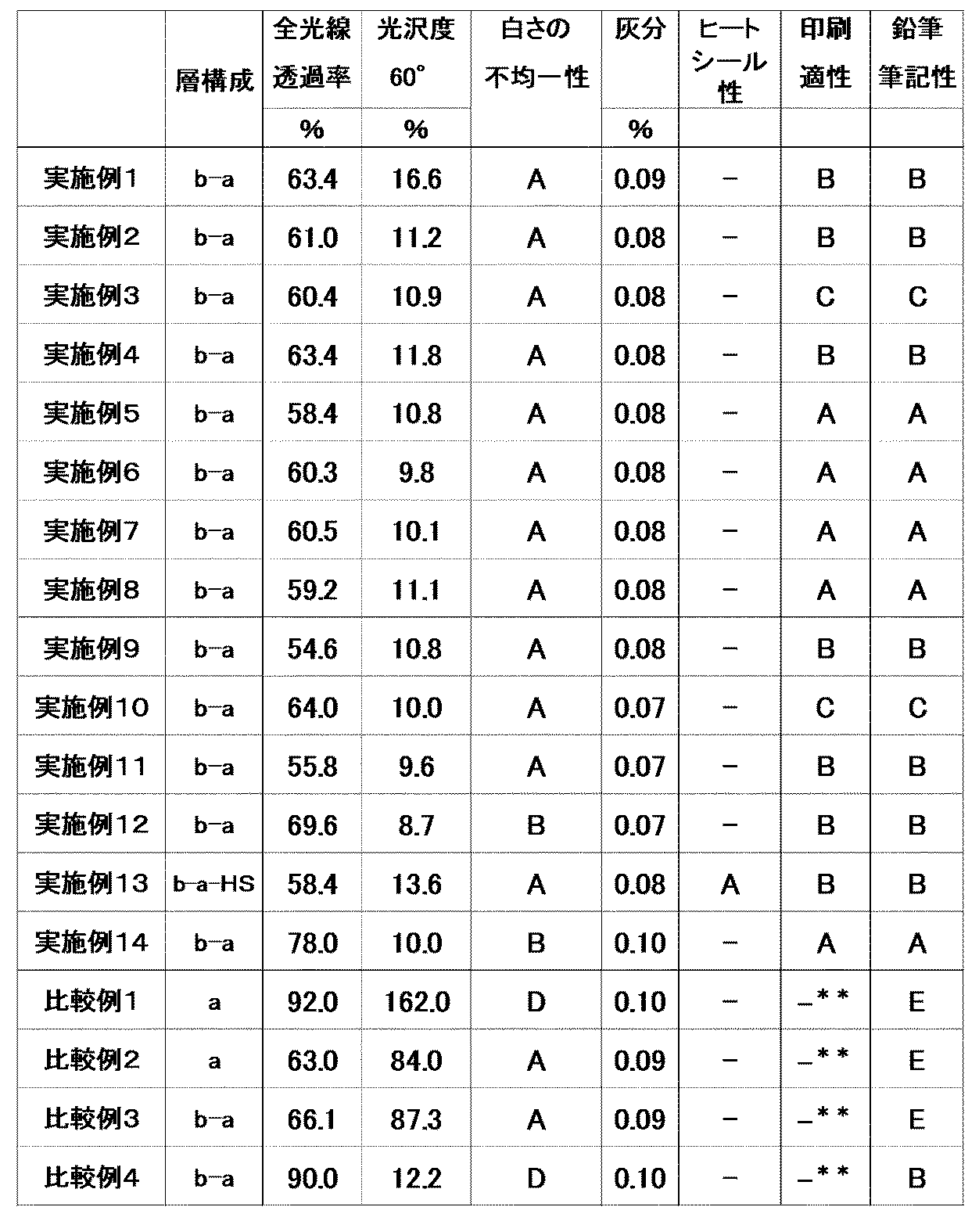
表1及び表2に示される通り、実施例1〜14の延伸フィルムは、光沢度が著しく低い、全光線透過率が35〜85%の間である半透明の延伸フィルムであった。また、これらのフィルムは、無機顔料(無機粒子)を有しなくとも印刷適性および鉛筆筆記性を有するものであった。したがって、本発明の半透明性延伸フィルムは、紙に比べて優れた耐湿性、耐水性、耐油性、機械強度をも有するフィルムでありながら、適度な半透明性と低い光沢度により紙のような質感を示し、さらに印刷適性および鉛筆筆記性を有するため、紙の代替として使用可能であることが理解される。
また、実施例13の延伸フィルムは、ヒートシール性をも有するため、例えばパン等の食品類のヒートシール性を要する包装形態等にも好適に使用可能であることが理解できる。
As shown in Tables 1 and 2, the stretched films of Examples 1 to 14 were translucent stretched films having extremely low gloss and a total light transmittance of 35 to 85%. Further, these films had printability and pencil writability even if they had no inorganic pigment (inorganic particles). Therefore, the translucent stretched film of the present invention is a film having excellent moisture resistance, water resistance, oil resistance, and mechanical strength as compared with paper, but has a moderate translucency and a low glossiness so that It is understood that it can be used as a substitute for paper due to its excellent texture and printability and pencil writing property.
Further, since the stretched film of Example 13 also has a heat-sealing property, it can be understood that the stretched film can be suitably used for a packaging form or the like that requires heat-sealing property of foods such as bread.
これに対し、基材層において結晶性樹脂Aを単独成分で用い、表面層を形成しなかった比較例1では、白さの不均一性を有さず、光沢度が高い、透明性フィルムしか得られなかった。また、表面層を形成しなかった比較例2では、半透明性および白さの不均一性は得られたものの、光沢度が高く、つや消しの外観を有する延伸フィルムは得られなかった。さらに、表面層において結晶性樹脂Dを用いずに結晶性樹脂Aを単独成分として用いた比較例3においても、半透明性および白さの不均一性は得られたものの、光沢度が高く、つや消しの外観を有する延伸フィルムは得られなかった。また、基材層において非晶性樹脂Bを用いなかった比較例4では、白さの不均一性が得られなかった。即ち、比較例1〜4で得られたフィルムは、紙のような外観を示さなかった。 On the other hand, in Comparative Example 1 in which the crystalline resin A was used as the sole component in the base material layer and the surface layer was not formed, only a transparent film having no whiteness nonuniformity and high glossiness was used. I couldn't get it. Further, in Comparative Example 2 in which the surface layer was not formed, translucency and non-uniformity of whiteness were obtained, but a stretched film having a high glossiness and a matte appearance could not be obtained. Furthermore, even in Comparative Example 3 in which the crystalline resin A was used as the sole component without using the crystalline resin D in the surface layer, translucency and nonuniformity of whiteness were obtained, but the glossiness was high, No stretched film with a matte appearance was obtained. Further, in Comparative Example 4 in which the amorphous resin B was not used in the base material layer, non-uniformity of whiteness was not obtained. That is, the films obtained in Comparative Examples 1 to 4 did not show a paper-like appearance.
Claims (6)
前記基材層は、融点が120〜175℃である結晶性熱可塑性樹脂Aと、非晶性熱可塑性樹脂Bとを樹脂成分として少なくとも含有する層を1層以上有し、
前記表面層は、190℃および2.16kgにおけるメルトマスフローレートが0.02〜2g/10分である結晶性熱可塑性樹脂Dを樹脂成分として少なくとも含有する、全光線透過率が35〜85%である、半透明性延伸フィルム。 A translucent stretched film comprising at least a base material layer and a surface layer,
The base material layer has at least one layer containing at least a crystalline thermoplastic resin A having a melting point of 120 to 175° C. and an amorphous thermoplastic resin B as resin components,
The surface layer contains at least a crystalline thermoplastic resin D having a melt mass flow rate of 0.02 to 2 g/10 minutes at 190° C. and 2.16 kg as a resin component, and a total light transmittance of 35 to 85%. There is a semitransparent stretched film.
Priority Applications (4)
| Application Number | Priority Date | Filing Date | Title |
|---|---|---|---|
| KR1020187029707A KR102136978B1 (en) | 2016-05-31 | 2017-05-29 | Translucent stretched film |
| EP17805941.6A EP3466679B1 (en) | 2016-05-31 | 2017-05-29 | Translucent stretched film |
| PCT/IB2017/000637 WO2017208062A1 (en) | 2016-05-31 | 2017-05-29 | Translucent stretched film |
| CN201780024227.1A CN109070556B (en) | 2016-05-31 | 2017-05-29 | Translucent stretched film |
Applications Claiming Priority (2)
| Application Number | Priority Date | Filing Date | Title |
|---|---|---|---|
| JP2016109520 | 2016-05-31 | ||
| JP2016109520 | 2016-05-31 |
Publications (2)
| Publication Number | Publication Date |
|---|---|
| JP2017213869A JP2017213869A (en) | 2017-12-07 |
| JP6700616B2 true JP6700616B2 (en) | 2020-05-27 |
Family
ID=60575300
Family Applications (1)
| Application Number | Title | Priority Date | Filing Date |
|---|---|---|---|
| JP2017083158A Active JP6700616B2 (en) | 2016-05-31 | 2017-04-19 | Semi-transparent stretched film |
Country Status (1)
| Country | Link |
|---|---|
| JP (1) | JP6700616B2 (en) |
Families Citing this family (3)
| Publication number | Priority date | Publication date | Assignee | Title |
|---|---|---|---|---|
| JP2019098546A (en) * | 2017-11-29 | 2019-06-24 | 王子ホールディングス株式会社 | Laminate stretched film |
| JP7399624B2 (en) * | 2019-03-28 | 2023-12-18 | トクラス株式会社 | Painted object |
| JPWO2023074385A1 (en) * | 2021-10-25 | 2023-05-04 |
Family Cites Families (8)
| Publication number | Priority date | Publication date | Assignee | Title |
|---|---|---|---|---|
| DE19536043A1 (en) * | 1995-09-28 | 1997-04-10 | Hoechst Ag | Polyolefin film with cycloolefin polymer, process for its production and its use |
| JP2002052674A (en) * | 2000-08-11 | 2002-02-19 | Mitsubishi Polyester Film Copp | Laminated polyester film containing fine bubbles |
| WO2002028949A1 (en) * | 2000-09-29 | 2002-04-11 | Yupo Corporation | Stretched resin film |
| JP6119343B2 (en) * | 2013-03-21 | 2017-04-26 | 東レ株式会社 | Void-containing polyester film |
| JP6375795B2 (en) * | 2014-09-03 | 2018-08-22 | Dic株式会社 | Multilayer film, laminate film and packaging material using the same |
| JP6540325B2 (en) * | 2015-01-22 | 2019-07-10 | 王子ホールディングス株式会社 | Translucent stretched film |
| JP6702068B2 (en) * | 2015-09-08 | 2020-05-27 | 王子ホールディングス株式会社 | Semi-transparent stretched film |
| JP6540524B2 (en) * | 2016-01-25 | 2019-07-10 | 王子ホールディングス株式会社 | Translucent wood grain oriented film |
-
2017
- 2017-04-19 JP JP2017083158A patent/JP6700616B2/en active Active
Also Published As
| Publication number | Publication date |
|---|---|
| JP2017213869A (en) | 2017-12-07 |
Similar Documents
| Publication | Publication Date | Title |
|---|---|---|
| JP7548346B2 (en) | Method for producing biaxially oriented polypropylene film | |
| JP3824718B2 (en) | Polyolefin film containing cycloolefin polymer, production method thereof and use thereof | |
| JP6540524B2 (en) | Translucent wood grain oriented film | |
| TWI622609B (en) | Porous polypropylene film | |
| TWI888600B (en) | Laminated films and packaging materials | |
| JP6702068B2 (en) | Semi-transparent stretched film | |
| KR20240032740A (en) | Biaxially oriented laminated polypropylene film | |
| CN102331590A (en) | Laminate and process for preparing the same | |
| WO2001038434A1 (en) | Stretched resin film and process for producing the same | |
| JP6540325B2 (en) | Translucent stretched film | |
| EP3466679B1 (en) | Translucent stretched film | |
| JP2017213869A (en) | Translucent stretched film | |
| JP2007293289A (en) | Light reflection sheet | |
| KR20240130086A (en) | Biaxially oriented polypropylene film | |
| JP2023013959A (en) | Biaxially oriented laminated polypropylene film | |
| JP2017213868A (en) | Translucent stretched film | |
| JP5977032B2 (en) | Polyolefin film for laminate molding | |
| WO2017208062A1 (en) | Translucent stretched film | |
| JP2023013958A (en) | Biaxially oriented laminated polypropylene film | |
| JP2019098546A (en) | Laminate stretched film | |
| JP2022169099A (en) | Heat-shrinkable multilayer film | |
| WO2020157242A1 (en) | Film | |
| JP2001214013A (en) | Resin stretched film and manufacturing method | |
| KR102917376B1 (en) | Heat shrinkable film for label, label including the film and container having the label attached thereto | |
| US20240383239A1 (en) | Heat-shrinkable film |
Legal Events
| Date | Code | Title | Description |
|---|---|---|---|
| A621 | Written request for application examination |
Free format text: JAPANESE INTERMEDIATE CODE: A621 Effective date: 20190612 |
|
| TRDD | Decision of grant or rejection written | ||
| A01 | Written decision to grant a patent or to grant a registration (utility model) |
Free format text: JAPANESE INTERMEDIATE CODE: A01 Effective date: 20200401 |
|
| A61 | First payment of annual fees (during grant procedure) |
Free format text: JAPANESE INTERMEDIATE CODE: A61 Effective date: 20200414 |
|
| R150 | Certificate of patent or registration of utility model |
Ref document number: 6700616 Country of ref document: JP Free format text: JAPANESE INTERMEDIATE CODE: R150 |
|
| R250 | Receipt of annual fees |
Free format text: JAPANESE INTERMEDIATE CODE: R250 |
|
| R250 | Receipt of annual fees |
Free format text: JAPANESE INTERMEDIATE CODE: R250 |
|
| R250 | Receipt of annual fees |
Free format text: JAPANESE INTERMEDIATE CODE: R250 |
|
| R250 | Receipt of annual fees |
Free format text: JAPANESE INTERMEDIATE CODE: R250 |