JP6089591B2 - Packaging material formed by laminating printing ink for heat shrinkable film and hot melt adhesive - Google Patents
Packaging material formed by laminating printing ink for heat shrinkable film and hot melt adhesive Download PDFInfo
- Publication number
- JP6089591B2 JP6089591B2 JP2012239359A JP2012239359A JP6089591B2 JP 6089591 B2 JP6089591 B2 JP 6089591B2 JP 2012239359 A JP2012239359 A JP 2012239359A JP 2012239359 A JP2012239359 A JP 2012239359A JP 6089591 B2 JP6089591 B2 JP 6089591B2
- Authority
- JP
- Japan
- Prior art keywords
- packaging material
- heat
- adhesive
- shrinkable film
- film
- Prior art date
- Legal status (The legal status is an assumption and is not a legal conclusion. Google has not performed a legal analysis and makes no representation as to the accuracy of the status listed.)
- Expired - Fee Related
Links
Images


Landscapes
- Inks, Pencil-Leads, Or Crayons (AREA)
- Adhesives Or Adhesive Processes (AREA)
Description
本発明は、熱収縮性フィルムに熱収縮性フィルム用印刷インキからなるデザイン印刷層と熱収縮性フィルム用ホットメルト接着剤からなる接着層を積層してなる包装材および包装材付き物品に関する。特に、本発明は、清涼飲料水、調味料,洗剤,シャンプー,食用油,化粧品,医薬品などに使用されているガラスビン、PET(ポリエチレンテレフタレート)ボトル等の物品に好ましく用いられる。 The present invention relates to a packaging material obtained by laminating a heat-shrinkable film with a design printing layer made of printing ink for heat-shrinkable film and an adhesive layer made of hot-melt adhesive for heat-shrinkable film, and an article with the packaging material. In particular, the present invention is preferably used for articles such as glass bottles and PET (polyethylene terephthalate) bottles used in soft drinks, seasonings, detergents, shampoos, edible oils, cosmetics, pharmaceuticals and the like.
例えば、PETボトル(容器)の外周面にラベル(フィルム)を取り付けてラベル付きPETボトル(フィルム付きPETボトル)を製造する方法には、ストレッチラベルを用いる方法や熱収縮ラベルを用いる方法等がある。 For example, methods for producing a labeled PET bottle (film-attached PET bottle) by attaching a label (film) to the outer peripheral surface of a PET bottle (container) include a method using a stretch label and a method using a heat shrink label. .
ここで、ストレッチラベルを用いる方法は、輪ゴムの原理を利用したものである。すなわち、ストレッチラベルは、筒状またはリング状をなしており、これを拡径するように、引き伸ばしてPETボトルの外周側に位置させ、引張力を解除してほぼ元の形状に戻すことにより、PETボトルの外周面に密着させる。しかしながら、ストレッチラベルは、その復元力が小さいため、ストレッチラベルを用いる方法は、特に、デザイン性を重視した凸凹形状のボトル(異型ボトル)には使用できないという問題がある。 Here, the method using a stretch label utilizes the principle of a rubber band. That is, the stretch label has a cylindrical shape or a ring shape, and is stretched and positioned on the outer peripheral side of the PET bottle so as to expand the diameter. By releasing the tensile force and returning it to the original shape, Close contact with the outer peripheral surface of the PET bottle. However, since the restoring force of the stretch label is small, there is a problem that the method using the stretch label cannot be used particularly for an irregularly shaped bottle (atypical bottle) with an emphasis on design.
一方、熱収縮ラベルを用いる方法は、熱収縮ラベルをPETボトルの外周側に位置させ、ヒーターや蒸気の熱で収縮させることにより、PETボトルの外周面に密着させる。かかる熱収縮ラベルとして、シート状(フィルム状)の熱収縮ラベルを用いる方法が検討されている。シート状の熱収縮ラベル(以下、「熱収縮フィルム」と言う。)を用いる方法では、例えば、紫外線硬化型接着剤による接着(例えば、特許文献1参照)、レーザーによる熱融着(例えば、特許文献2および3参照)、熱収縮性フィルム用ホットメルト接着剤による接着(例えば、特許文献4参照)により、熱収縮フィルムをPETボトルの外周面に取り付ける。 On the other hand, in the method using a heat-shrink label, the heat-shrink label is positioned on the outer peripheral side of the PET bottle, and is made to adhere to the outer peripheral surface of the PET bottle by shrinking with the heat of a heater or steam. As such a heat-shrinkable label, a method using a sheet-like (film-like) heat-shrinkable label has been studied. In a method using a sheet-like heat-shrinkable label (hereinafter referred to as “heat-shrinkable film”), for example, adhesion with an ultraviolet curable adhesive (see, for example, Patent Document 1), heat fusion with a laser (for example, a patent) The heat shrink film is attached to the outer peripheral surface of the PET bottle by adhesion with a hot melt adhesive for heat shrinkable film (see, for example, Patent Document 4).
しかしながら、紫外線硬化型接着剤は、それ自体が高価である。また、紫外線硬化型接着剤は、多官能アクリレートや光重合開始剤等を含有しているため、皮膚刺激性が高く、作業者の環境安全性が低いという問題がある。一方、レーザーを用いた場合、熱収縮フィルムを熱融着した際に、その融着部分に位置ズレが生じ易く、ラベル付きPETボトル(包装材付き物品)の高い品質を維持することが困難である。また、レーザー照射機の騒音が酷く、作業者の環境安全性がやはり低いという問題がある。 However, the ultraviolet curable adhesive itself is expensive. Further, since the ultraviolet curable adhesive contains a polyfunctional acrylate, a photopolymerization initiator, and the like, there is a problem that the skin irritation is high and the environmental safety of the worker is low. On the other hand, when a laser is used, when the heat-shrinkable film is heat-sealed, misalignment tends to occur in the fused portion, and it is difficult to maintain the high quality of the labeled PET bottle (article with packaging material). is there. In addition, there is a problem that the noise of the laser irradiator is severe and the environmental safety of the operator is low.
そこで、作業者の高い環境安全性を確保しつつ低コスト化を実現するために、熱収縮フィルムをホットメルト接着剤により、PETボトルの外表面に取り付けることも検討されている。しかしながら、ホットメルト接着剤は、一般的に耐熱性が低く、熱収縮フィルムの熱収縮温度で軟化することにより流動してしまう。このため、一般的なホットメルト接着剤は、熱収縮フィルムをPETボトルの外表面に取り付けるのに使用することができない。 Therefore, in order to achieve cost reduction while ensuring high environmental safety for workers, it has been studied to attach a heat shrink film to the outer surface of a PET bottle with a hot melt adhesive. However, hot-melt adhesives generally have low heat resistance and flow when softened at the heat shrink temperature of the heat shrink film. For this reason, common hot melt adhesives cannot be used to attach heat shrink films to the outer surface of PET bottles.
さらに、一般的なホットメルト接着剤は、熱収縮性フィルムに一般的なフィルム用印刷インキからなるデザイン印刷層に直接ホットメルト接着剤を塗工しようとすると、はじかれてしまい均一に塗工できず、基材フィルムの熱収縮時に、その重複部(貼り合わせ部)における位置ズレや剥がれてしまう問題があった。 In addition, general hot melt adhesives are repelled and applied uniformly to the heat-shrinkable film when the hot melt adhesive is applied directly to a design printing layer consisting of general film printing ink. First, there was a problem that the overlapping portion (bonding portion) was displaced or peeled off when the base film was thermally contracted.
本発明は、上記問題点を解決するべくなされたものであり、その目的は、コストの増大および作業者の環境安全性の悪化を防止しつつ、良好な塗工適性を発揮し、加熱時にも流動し難い熱収縮性フィルム用ホットメルト接着剤を提供することにある。 The present invention has been made to solve the above problems, and its purpose is to exhibit good coating suitability while preventing cost increase and deterioration of worker's environmental safety, even during heating. An object of the present invention is to provide a hot-melt adhesive for heat-shrinkable films that does not flow easily.
また、本発明の他の目的は、ホットメルト接着剤をはじかず塗工適性を向上させることを可能とし、かつ、擦られや接触によるデザイン層の劣化を防ぎつつ熱収縮フィルムの熱収縮を阻害しない熱収縮性フィルム用印刷インキからなるデザイン印刷層を、熱収縮フィルムに積層し基材フィルムの熱収縮時に、その重複部(貼り合わせ部)における位置ズレや剥がれを防止して、基材フィルムによる物品の被覆を確実に行い得る熱収縮性フィルムに熱収縮性フィルム用印刷インキからなるデザイン印刷層と熱収縮性フィルム用ホットメルト接着剤からなる接着層を積層してなる包装材および包装材付き物品を提供することにある。 Another object of the present invention is to improve coating suitability without repelling hot melt adhesives and to prevent thermal shrinkage of heat shrinkable films while preventing deterioration of the design layer due to rubbing and contact. The design print layer made of printing ink for heat shrinkable film is laminated on the heat shrinkable film, and when the base film is heat shrunk, it prevents the position shift and peeling at the overlapping part (bonding part). A packaging material and packaging material in which a heat-shrinkable film capable of reliably covering an article with a design printing layer made of a printing ink for heat-shrinkable film and an adhesive layer made of a hot-melt adhesive for heat-shrinkable film are laminated The purpose is to provide an attached article.
さらに、本発明の他の目的は、かかる包装材の熱収縮物により、物品を被覆してなる品質の高い包装材付き物品を提供することにある。 Furthermore, another object of the present invention is to provide an article with a high quality packaging material, which is obtained by coating the article with the heat shrink product of the packaging material.
本発明は、熱収縮性フィルムに、熱収縮性フィルム用印刷インキ(A)からなるデザイン
印刷層、及び、熱収縮性フィルム用ホットメルト接着剤(B)からなる接着層を積層して
なる包装材であって、
熱収縮性フィルム用印刷インキ(A)が、ウレタン樹脂組成物または、ウレタン樹脂及び
塩化ビニル/酢酸ビニル共重合体樹脂の混合樹脂組成物いずれかから選択される樹脂組成物を含み、印刷インキ(A)100重量部中、イソシアネート硬化剤(C)を1〜10重量%含み、
且つ、熱収縮性フィルム用ホットメルト接着剤(B)100重量部中、下記(B1)〜(B4
)であることを特徴とする包装材。
(B1)軟化点が105〜140℃のポリエチレンワックスを、5〜30重量%
(B2)エラストマーを、10〜20重量%
(B3)接着付与剤を、25〜40重量%
(B4)軟化剤を、25〜40重量%
The present invention is a packaging in which a heat-shrinkable film is laminated with a design printing layer made of a printing ink for heat-shrinkable film (A) and an adhesive layer made of a hot-melt adhesive for heat-shrinkable film (B). Material,
The printing ink for heat-shrinkable film (A) contains a resin composition selected from either a urethane resin composition or a mixed resin composition of urethane resin and vinyl chloride / vinyl acetate copolymer resin, and printing ink ( A) 1 to 10% by weight of isocyanate curing agent (C) in 100 parts by weight,
And in 100 parts by weight of hot-melt adhesive for heat-shrinkable film (B), the following (B1) to (B4
The packaging material characterized by the above.
(B1) 5 to 30% by weight of polyethylene wax having a softening point of 105 to 140 ° C.
(B2) 10-20% by weight of elastomer
(B3) 25-40% by weight of adhesion promoter
(B4) 25-40% by weight of softener
更に、本発明は、前記ホットメルト接着剤(B)が、加熱時において粘度が500Pa・sとなる温度をX[℃]とし、冷却時において粘度が500Pa・sとなる温度をY[℃]としたとき、X>YかつX−Yが5[℃]以上であることを特徴とする前記包装材に関する。 Further, according to the present invention, the temperature at which the hot melt adhesive (B) has a viscosity of 500 Pa · s when heated is X [° C.], and the temperature at which the viscosity is 500 Pa · s when cooled is Y [° C.]. X> Y and XY is 5 [° C.] or more.
更に、本発明は、前記温度Xが、90〜125℃であることを特徴とする前記包装材に関する。 Furthermore, the present invention relates to the packaging material, wherein the temperature X is 90 to 125 ° C.
更に、本発明は、前記温度Yが、85〜110℃であることを特徴とする前記包装材に関する。 Furthermore, the present invention relates to the packaging material, wherein the temperature Y is 85 to 110 ° C.
更に、本発明は、前記イソシアネート硬化剤(C)が下記(C1)〜(C2)であることを特徴とする前記包装材に関する。
(C1)ジイソシアネートがHDIおよびIPDIから一種以上選択される
(C2)ポリイソシアネートの変性体がアダクト型および2官能プレポリマーから一種以上選択される
Furthermore, the present invention relates to the packaging material, wherein the isocyanate curing agent (C) is the following (C1) to (C2).
(C1) One or more diisocyanates are selected from HDI and IPDI. (C2) One or more modified polyisocyanates are selected from adduct-type and bifunctional prepolymers.
更に、本発明は、熱収縮性フィルムの少なくとも一方の面に、前記デザイン印刷層を有し、且つ、前記フィルムの少なくとも一方の端部に前記接着層を備えたことを特徴とする前記の包装材に関する。 Furthermore, the present invention is the above packaging, characterized in that the design print layer is provided on at least one surface of the heat-shrinkable film, and the adhesive layer is provided on at least one end of the film. Regarding materials.
更に、本発明は、前記包装材を物品の外周に装着する工程、
次いで、加熱することで熱収縮性フィルムを収縮させる工程を有する包装材付き物品の製造方法に関する。
Furthermore, the present invention is a process of mounting the packaging material on the outer periphery of the article,
Then, it is related with the manufacturing method of the articles | goods with a packaging material which has the process of shrinking a heat-shrinkable film by heating.
更に、本発明は、包装材を装着する工程が、包装材一方の端部を、他方の端部に重ねて円筒状包装材を形成し、当該円筒状包装材を物品の外周に装着する工程であることを特徴とする前記包装材付き物品の製造方法に関する。 Further, in the present invention, the step of attaching the packaging material is a step of forming a cylindrical packaging material by overlapping one end of the packaging material on the other end, and attaching the cylindrical packaging material to the outer periphery of the article. It is related with the manufacturing method of the said articles | goods with a packaging material characterized by the above-mentioned.
前記包装材を装着する工程が、
物品に、包装材の一方の端部を貼り付ける工程と、
次に、当該物品の外周に当該包装材を巻きつけて、当該包装材の両方の端部が重なるように貼り付ける工程からなることを特徴とする前記包装材付き物品の製造方法に関する。
The step of attaching the packaging material comprises
A process of attaching one end of the packaging material to the article;
Next, the present invention relates to a method for manufacturing an article with a packaging material, comprising a step of winding the packaging material around the outer periphery of the article and attaching the packaging material so that both ends overlap.
ポリエチレンワックス、エラストマー、接着付与剤および軟化剤は、いずれも皮膚刺激性がないか、あるいは、極めて低い化合物である。本発明では、これらの成分を用いることにより、作業者の環境安全性を向上することができる。 Polyethylene wax, elastomers, adhesion-imparting agents and softeners are all compounds that have no skin irritation or are extremely low. In the present invention, the use of these components can improve the worker's environmental safety.
また、本発明は、高価な紫外線硬化型接着剤ではなく、また、各前記成分も比較的安価かつ入手も容易であるため、コストの削減を図ることができる。 In addition, the present invention is not an expensive ultraviolet curable adhesive, and each of the above components is relatively inexpensive and easily available, so that the cost can be reduced.
さらに、本発明の熱収縮性フィルム用ホットメルト接着剤は、各上記成分を所定の含有量で含むことにより、例えば、加熱時と冷却時とにおいて異なる経路を辿って粘度を変化させることができる。このため、ホットメルト接着剤は、良好な塗工適性を発揮するとともに、加熱時においても十分な粘度を維持することができる。 Furthermore, the hot-melt adhesive for heat-shrinkable film of the present invention can change the viscosity by following different paths at the time of heating and cooling, for example, by containing each of the above components at a predetermined content. . For this reason, the hot melt adhesive exhibits good coating suitability and can maintain a sufficient viscosity even during heating.
硬化剤は、熱収縮性の熱収縮を阻害しない化合物である。本発明では、これを用いることにより、擦られや接触によるデザイン層の劣化を防ぐことができる。 The curing agent is a compound that does not inhibit heat-shrinkable heat shrinkage. In the present invention, by using this, it is possible to prevent deterioration of the design layer due to rubbing or contact.
このようなことから、本発明によれば、コストの増大および作業者の環境安全性の悪化を防止することができる。また、本発明によれば、熱収縮性フィルム用印刷インキからなるデザイン印刷層が、熱収縮性フィルム用ホットメルト接着剤と親和性の高い、ウレタン樹脂組成物またはウレタン樹脂及び塩化ビニル/酢酸ビニル共重合体樹脂の混合樹脂組成物いずれかから選択される樹脂組成物を含むため、熱収縮性フィルム用ホットメルト接着剤が塗工される際のはじきを防ぎ、基材フィルムを物品に確実に貼着することができるとともに、基材フィルムの熱収縮時における重複部(貼り合わせ部)の位置ズレを防止して、品質の高い包装材付き物品を製造することができる。 For this reason, according to the present invention, it is possible to prevent an increase in cost and deterioration of the environmental safety of the worker. Further, according to the present invention, the design printing layer comprising the printing ink for heat-shrinkable film has high affinity with the hot-melt adhesive for heat-shrinkable film, the urethane resin composition or urethane resin, and vinyl chloride / vinyl acetate. Since it contains a resin composition selected from any of the mixed resin compositions of copolymer resins, it prevents repelling when hot-melt adhesive for heat-shrinkable films is applied, and ensures that the base film is attached to the article. While being able to stick, the position shift of the duplication part (bonding part) at the time of the heat shrink of a base film can be prevented, and a high quality article with a packaging material can be manufactured.
まず、本発明の包装材および包装材付き物品に用いてなる熱収縮性フィルム用印刷インキ(A)について説明する。 First, the printing ink (A) for heat-shrinkable film used for the packaging material of the present invention and the article with the packaging material will be described.
熱収縮性フィルム用印刷インキ(A)は、ウレタン樹脂組成物またはウレタン樹脂及び塩化ビニル/酢酸ビニル共重合体樹脂の混合樹脂組成物いずれかから選択される樹脂組成物をメインバインダーとする。これらの樹脂は、熱収縮性フィルム用ホットメルト接着剤と親和性が高く、ホットメルト接着剤が塗工される際のはじきを防ぐため、結果として、包装材の接着強度の低下を防ぐことが可能となる。 The printing ink (A) for heat-shrinkable film has as its main binder a resin composition selected from either a urethane resin composition or a mixed resin composition of urethane resin and vinyl chloride / vinyl acetate copolymer resin. These resins have a high affinity with hot-melt adhesives for heat-shrinkable films and prevent repelling when hot-melt adhesives are applied. As a result, they can prevent a decrease in the adhesive strength of packaging materials. It becomes possible.
ウレタン樹脂はその柔軟性や低結晶性から、熱履歴での応力緩和能を持つことによる包装材における作成時の加工適性に優れ、皮膜の残留溶剤を低減でき、極性の高い溶媒に優れた溶解性を有する。さらに、塩化ビニル/酢酸ビニル共重合体樹脂は、一般に高い顔料分散性を有するので、デザイン印刷層の平滑性を高め、ホットメルト接着剤のはじきをさらに押さえることが可能である。 Because of its flexibility and low crystallinity, urethane resin has excellent processability when creating packaging materials due to its ability to relieve stress due to thermal history, can reduce residual solvent in the film, and dissolves well in highly polar solvents. Have sex. Furthermore, since the vinyl chloride / vinyl acetate copolymer resin generally has high pigment dispersibility, it is possible to improve the smoothness of the design print layer and further suppress the repellency of the hot melt adhesive.
ウレタン樹脂の合成法は、高分子ポリオールとジイソシアネートを必要に応じイソシアネート基に不活性な溶媒を用い、また、更に必要であればウレタン化触媒を用いて10〜150℃の温度で反応させ、末端にイソシアネート基を有するプレポリマーを製造し、次いで、このプレポリマーに鎖延長剤、末端停止剤を反応させてウレタン樹脂を得るプレポリマー法、あるいは、高分子ポリオールとジイソシアネートと鎖延長剤を一段で反応させてウレタン樹脂を得るワンショット法など公知の方法により製造することが出来る。 The urethane resin is synthesized by reacting a polymer polyol and diisocyanate at a temperature of 10 to 150 ° C. using a solvent inert to an isocyanate group, if necessary, and using a urethanization catalyst if necessary. The prepolymer method in which a prepolymer having an isocyanate group is produced and then a urethane resin is obtained by reacting the prepolymer with a chain extender and a terminal terminator, or a polymer polyol, a diisocyanate and a chain extender in one step. It can be produced by a known method such as a one-shot method in which a urethane resin is obtained by reaction.
高分子ポリオールとしては、ポリエステルポリオール、ポリエーテルポリオール、アクリルポリオールなどがある。本発明においては、ポリエステルポリオール、ポリエーテルポリオールの一種以上を使用することが望ましい。 Examples of the polymer polyol include polyester polyol, polyether polyol, and acrylic polyol. In the present invention, it is desirable to use one or more of polyester polyol and polyether polyol.
ポリエステルポリオールは、末端および/または側鎖にヒドロキシル基を含有するポリエステルポリオールのことで、グリコールやポリオールらのヒドロキシル基含有化合物と多価カルボン酸、あるいはこれらの無水物とを脱水縮合または重合させて得られる。本発明において、より具体的にはヒドロキシル基を2個含有する化合物と2価のカルボン酸からなるポリエステルジオールが好ましい。 The polyester polyol is a polyester polyol containing a hydroxyl group at the terminal and / or side chain, and is obtained by dehydration condensation or polymerization of a hydroxyl group-containing compound such as glycol or polyol and a polyvalent carboxylic acid or an anhydride thereof. can get. In the present invention, more specifically, a polyester diol composed of a compound containing two hydroxyl groups and a divalent carboxylic acid is preferred.
ポリエステルポリオールの合成に用いる、ヒドロキシル基含有化合物としては、エチレングリコール、1,2−プロパンジオール、1,3−プロパンジオール、1,3−ブタンジオール、ペンタンジオール、2−メチル−1,3−プロパンジオール、ネオペンチルグリコール、3−メチル−1,5−ペンタンジオール、ヘキサンジオール、オクタンジオール、1,9−ノナンンジオール、2−メチル−1,8−オクタンジオール、1,4−ブチンジオール、2,2,4−トリメチル−1,3−ペンタンジオール、1,4−シクロヘキサンジメタノール、2−ブチル−2−エチル−1,3−プロパンジオール、3−メチル1,5ペンタンジオール、ジエチレングリコール、トリエチレングリコール、ポリプロピレングリコール、ジプロピレングリコール、が挙げられる。またグリセリン、トリメチロールプロパン、トリメチロールエタン、1,2,6−ヘキサントリオール、1,2,4−ブタントリオール、ソルビトール、ペンタエスリトールなどのヒドロキシル基を3個以上有する低分子ポリオールも挙げられる。 Examples of the hydroxyl group-containing compound used for the synthesis of the polyester polyol include ethylene glycol, 1,2-propanediol, 1,3-propanediol, 1,3-butanediol, pentanediol, and 2-methyl-1,3-propane. Diol, neopentyl glycol, 3-methyl-1,5-pentanediol, hexanediol, octanediol, 1,9-nonanediol, 2-methyl-1,8-octanediol, 1,4-butynediol, 2 , 2,4-Trimethyl-1,3-pentanediol, 1,4-cyclohexanedimethanol, 2-butyl-2-ethyl-1,3-propanediol, 3-methyl 1,5-pentanediol, diethylene glycol, triethylene Glycol, polypropylene glycol, dipropylene glycol Call. Moreover, the low molecular polyol which has 3 or more of hydroxyl groups, such as glycerol, a trimethylol propane, a trimethylol ethane, 1,2, 6-hexane triol, 1,2, 4- butane triol, sorbitol, a penta esitol, is also mentioned. .
また、高分子量のヒドロキシル基含有化合物として、飽和または不飽和の低分子ジオール類(2)や、酸化エチレン、酸化プロピレン、テトラヒドロフランなどの重合体または共重合体のポリエーテルジオール類(3)等もポリエステルジオールの原料として併用することができる。 Moreover, as a high molecular weight hydroxyl group-containing compound, a saturated or unsaturated low molecular diol (2), a polymer or copolymer polyether diol (3) such as ethylene oxide, propylene oxide, and tetrahydrofuran is also included. It can be used together as a raw material for polyester diol.
更に、ポリエステルポリオールには、アルキル側鎖を有するヒドロキシル基含有化合物をモノマーとして用いることが好ましい。当該ポリエステルポリオールを用いることで、ウレタン樹脂の結晶性が大きく下がり、且つアルキル側鎖が炭化水素で疎水的であることから、ポリオレフィンフィルムへの密着性が向上する。さらに、ヒドロキシル基含有化合物がアルキル側鎖を有さない場合に比べ、耐加水分解性が向上する。 Furthermore, it is preferable to use a hydroxyl group-containing compound having an alkyl side chain as a monomer for the polyester polyol. By using the polyester polyol, the crystallinity of the urethane resin is greatly lowered, and the alkyl side chain is hydrocarbon and hydrophobic, so that the adhesion to the polyolefin film is improved. Furthermore, hydrolysis resistance improves compared with the case where a hydroxyl-group containing compound does not have an alkyl side chain.
ポリエステルジオールの合成に用いる多価カルボン酸モノマーとしては、アジピン酸、フタル酸、イソフタル酸、テレフタル酸、マレイン酸、フマル酸、こはく酸、しゅう酸、マロン酸、グルタル酸、ピメリン酸、スペリン酸、アゼライン酸、セバシン酸、トリメリット酸、ピロメリット酸などの多価カルボン酸あるいはこれらの無水物(4)が挙げられる。この中で、ノントルエン系溶剤への溶解性などからアジピン酸を用いることが好ましく、多価カルボン酸モノマー中50重量%以上使用することがさらに好ましい。 Polycarboxylic acid monomers used for the synthesis of polyester diol include adipic acid, phthalic acid, isophthalic acid, terephthalic acid, maleic acid, fumaric acid, succinic acid, oxalic acid, malonic acid, glutaric acid, pimelic acid, speric acid, Examples thereof include polycarboxylic acids such as azelaic acid, sebacic acid, trimellitic acid and pyromellitic acid, and anhydrides (4) thereof. Among these, it is preferable to use adipic acid from the viewpoint of solubility in a non-toluene solvent, and it is more preferable to use 50% by weight or more in the polyvalent carboxylic acid monomer.
ウレタン樹脂に用いるポリエステルジオールの数平均分子量は、得られるウレタン樹脂の溶解性、乾燥性、耐ブロッキング性等を考慮して適宜決定され、通常は700〜100000、好ましくは1000〜6000の範囲内とするのがよい。該数平均分子量が700未満であればハードセグメントの量が多くなることによる溶解性の低下に伴い印刷適性が劣る傾向があり、他方100000を越えるとハードセグメントの割合が少なくなり、乾燥性及び耐ブロッキング性が低下する傾向がある。 The number average molecular weight of the polyester diol used for the urethane resin is appropriately determined in consideration of the solubility, drying property, blocking resistance and the like of the obtained urethane resin, and is usually in the range of 700 to 100,000, preferably 1000 to 6000. It is good to do. If the number average molecular weight is less than 700, the printability tends to be inferior due to a decrease in solubility due to an increase in the amount of hard segments. There exists a tendency for blocking property to fall.
ポリエステルジオールの酸価は1.0mgKOH/g以下であることが好ましく、0.5mgKOH/g以下であることがより好ましい。酸価が1.0mgKOH/gより大きいと、印刷インキの増粘の傾向が大きくなるためである。 The acid value of the polyester diol is preferably 1.0 mgKOH / g or less, and more preferably 0.5 mgKOH / g or less. This is because if the acid value is larger than 1.0 mg KOH / g, the tendency of the printing ink to increase in viscosity increases.
ポリエステルジオールは、他の高分子ポリオールよりも耐ブロッキング性に優れ、さらにホットメルト接着剤中の可塑剤によるフィルム接着性低下を防止できるので、ポリエステルポリオール合計で高分子ポリオール中の50重量%以上用いることが好ましい。 Polyester diol is superior to other polymer polyols in blocking resistance, and further can prevent deterioration of film adhesion due to a plasticizer in a hot melt adhesive. Therefore, the polyester polyol is used in a total amount of 50% by weight or more in the polymer polyol. It is preferable.
高分子ポリオールとしてポリエーテルポリオールを使用することも好ましい。例えば、ポリエチレングリコール、ポリプロピレングリコール、ポリトリメチレングリコール、ポリテトラメチレングリコールなどが挙げられる。これらは、アルコールへの溶解性が優れるため、ポリエステル系ポリウレタンに別の溶剤溶解性を付与することができるため、多くの用途の場合、併用することが好ましい。これらの特性を発現させ、かつ耐水性などを低下させないために、ポリエーテルポリオール分子量は700〜3000、高分子ポリオール中の50重量%以下とすることが好ましい。 It is also preferable to use a polyether polyol as the polymer polyol. For example, polyethylene glycol, polypropylene glycol, polytrimethylene glycol, polytetramethylene glycol and the like can be mentioned. Since these have excellent solubility in alcohol and can impart another solvent solubility to the polyester-based polyurethane, they are preferably used in combination in many applications. In order to develop these characteristics and not lower the water resistance, the polyether polyol molecular weight is preferably 700 to 3000 and 50% by weight or less in the polymer polyol.
ウレタン樹脂の合成に使用されるジイソシアネートとしては、ウレタン樹脂の製造に一般的に用いられる各種公知の芳香族ジイソシアネート、脂肪族ジイソシアネート、脂環族ジイソシアネートなどが挙げられる。例えば、1,5−ナフチレンジイソシアネート、4,4’−ジフェニルメタンジイソシアネート(MDI)、4,4’−ジフェニルジメチルメタンジイソシアネート、4,4’−ジベンジルイソシアネート、ジアルキルジフェニルメタンジイソシアネート、テトラアルキルジフェニルメタンジイソシアネート、1,3−フェニレンジイソシアネート、1,4−フェニレンジイソシアネート、トリレンジイソシアネート、ブタン−1,4−ジイソシアネート、ヘキサメチレンジイソシアネート、イソプロピレンジイソシアネート、メチレンジイソシアネート、2,2,4−トリメチルヘキサメチレンジイソシアネート、リジンジイソシアネート、シクロヘキサン−1,4−ジイソシアネート、キシリレンジイソシアネート、イソホロンジイソシアネート、ジメリールジイソシアネート、ジシクロヘキシルメタン−4,4’−ジイソシアネート、1,3−ビス(イソシアネートメチル)シクロヘキサン、メチルシクロヘキサンジイソシアネート、ノルボルナンジイソシアネート、m−テトラメチルキシリレンジイソシアネート、4,4−ジフェニルメタンジイソシアネート、トリレンジイソシアネート、ビス−クロロメチル−ジフェニルメタン−ジイソシアネート、2,6−ジイソシアネート−ベンジルクロライドやダイマー酸のカルボキシル基をイソシアネート基に転化したダイマージイソシアネート等が挙げられる。これらのジイソシアネート化合物は単独で、または2種以上を混合して用いることができる。 Examples of the diisocyanate used for the synthesis of the urethane resin include various known aromatic diisocyanates, aliphatic diisocyanates, and alicyclic diisocyanates that are generally used in the production of urethane resins. For example, 1,5-naphthylene diisocyanate, 4,4′-diphenylmethane diisocyanate (MDI), 4,4′-diphenyldimethylmethane diisocyanate, 4,4′-dibenzyl isocyanate, dialkyldiphenylmethane diisocyanate, tetraalkyldiphenylmethane diisocyanate, 1 , 3-phenylene diisocyanate, 1,4-phenylene diisocyanate, tolylene diisocyanate, butane-1,4-diisocyanate, hexamethylene diisocyanate, isopropylene diisocyanate, methylene diisocyanate, 2,2,4-trimethylhexamethylene diisocyanate, lysine diisocyanate, Cyclohexane-1,4-diisocyanate, xylylene diisocyanate, isophorone diisocyanate Nate, dimethylene diisocyanate, dicyclohexylmethane-4,4′-diisocyanate, 1,3-bis (isocyanate methyl) cyclohexane, methylcyclohexane diisocyanate, norbornane diisocyanate, m-tetramethylxylylene diisocyanate, 4,4-diphenylmethane diisocyanate, tri Examples thereof include diisocyanate, dimerisocyanate obtained by converting a diisocyanate carboxyl group into diisocyanate, bis-chloromethyl-diphenylmethane-diisocyanate, 2,6-diisocyanate-benzyl chloride, and a dimer acid carboxyl group. These diisocyanate compounds can be used alone or in admixture of two or more.
ウレタン樹脂の合成には鎖伸長剤を使用してもよく、例えば2−ブチル−2−エチル−1,3−プロパンジオールの他、前記飽和または不飽和の低分子ポリオール類(1)、エチレンジアミン、プロピレンジアミン、ヘキサメチレンジアミン、ジエチレントリアミン、トリエチレンテトラミン、イソホロンジアミン、ジシクロヘキシルメタン−4,4’−ジアミンなどの他、2−ヒドロキシエチルエチレンジアミン、2−ヒドロキシエチルプロピルジアミン、2−ヒドロキシエチルプロピレンジアミン、ジ−2−ヒドロキシエチルエチレンジアミン、ジ−2−ヒドロキシエチレンジアミン、ジ−2−ヒドロキシエチルプロピレンジアミン、2−ヒドロキシピロピルエチレンジアミン、ジ−2−ヒドロキシピロピルエチレンジアミン、ジ−2−ヒドロキシプロピルエチレンジアミンなど分子内に水酸基を有するアミン類も用いることが出来る。これらの鎖伸長剤は単独で、または2種以上を混合して用いることができる。 A chain extender may be used for the synthesis of the urethane resin. For example, in addition to 2-butyl-2-ethyl-1,3-propanediol, the saturated or unsaturated low molecular polyols (1), ethylenediamine, In addition to propylenediamine, hexamethylenediamine, diethylenetriamine, triethylenetetramine, isophoronediamine, dicyclohexylmethane-4,4'-diamine, 2-hydroxyethylethylenediamine, 2-hydroxyethylpropyldiamine, 2-hydroxyethylpropylenediamine, di 2-hydroxyethylethylenediamine, di-2-hydroxyethylenediamine, di-2-hydroxyethylpropylenediamine, 2-hydroxypyrroleethylenediamine, di-2-hydroxypyrroleethylenediamine, di-2- Amines having a hydroxyl group in the molecule, such as mud propyl ethylene diamine may also be used. These chain extenders can be used alone or in admixture of two or more.
また、反応停止を目的とした末端停止剤として、一価の活性水素化合物を用いることもできる。かかる化合物としては例えば、1級、2級のアミノ基を有する化合物、ジ−n−ブチルアミン等のジアルキルアミン類や水酸基を有するアミノアルコール類、エタノール、イソプロピルアルコール等のアルコール類があげられる。更に、特にウレタン樹脂中にカルボキシル基を導入したいときには、グリシン、L−アラニン等のアミノ酸を反応停止剤として用いることができる。この中で、1級、2級のアミノ基を有するアミノアルコール類は、末端停止剤として用いる場合、高温での反応を避けて、アミノ基のみ反応するよう制御する必要がある。これらの末端停止剤は単独で、または2種以上を混合して用いることができる。ここで、鎖延長剤にアミノ基を用いる場合、イソシアネート基と反応してウレア結合を形成するため、得られる樹脂はポリウレタン/ウレア樹脂になるが、本発明においては、これらの樹脂もウレタン樹脂とする。 A monovalent active hydrogen compound can also be used as a terminal terminator for the purpose of terminating the reaction. Examples of such compounds include compounds having primary and secondary amino groups, dialkylamines such as di-n-butylamine, amino alcohols having a hydroxyl group, and alcohols such as ethanol and isopropyl alcohol. Furthermore, amino acids such as glycine and L-alanine can be used as a reaction terminator particularly when it is desired to introduce a carboxyl group into the urethane resin. Among these, amino alcohols having primary and secondary amino groups need to be controlled so as to react only with amino groups while avoiding reaction at high temperature when used as a terminal terminator. These end terminators can be used alone or in admixture of two or more. Here, when an amino group is used as a chain extender, it reacts with an isocyanate group to form a urea bond, so that the resulting resin is a polyurethane / urea resin. In the present invention, these resins are also urethane resins. To do.
さらに本発明においては、水溶性のウレタン樹脂を用いることもできる。水溶性のウレタン樹脂を合成する場合には、前記高分子ポリオール、ジイソシアネート等に加えて、活性水素基を有するアニオン性基含有化合物や、カチオン性基含有化合物及びノニオン性基有化合物等を用いる。本発明においては、水溶性ウレタン樹脂の溶解性、塗膜物性等の観点から、アニオン性基含有化合物を用い、必要に応じてノニオン性基含有化合物を併用することが好ましい。 Furthermore, in the present invention, a water-soluble urethane resin can also be used. In the case of synthesizing a water-soluble urethane resin, an anionic group-containing compound having an active hydrogen group, a cationic group-containing compound, a nonionic group-containing compound, or the like is used in addition to the polymer polyol and diisocyanate. In the present invention, from the viewpoints of solubility of the water-soluble urethane resin, physical properties of the coating film, etc., it is preferable to use an anionic group-containing compound and use a nonionic group-containing compound in combination as necessary.
活性水素基を有するアニオン性基含有化合物としては、カルボキシル基を有する化合物が一般に知られており、2,2-ジメチロールプロピオン酸、2,2-ジメチロールブタン酸、2-ジメチロール酪酸、2,2-ジメチロール吉草酸等のジメチロールアルカン酸、グルタミン、アスパラギン、リジン、ジアミノプロピオン酸、オルニチン、ジアミノ安息香酸、ジアミノベンゼンスルホン酸等のジアミン型アミノ酸類、グリシン、アラニン、グルタミン酸、タウリン、アスパラギン酸、アミノ酪酸、バリン、アミノカプロン酸、アミノ安息香酸、アミノイソフタル酸、スルファミン酸などのモノアミン型アミノ酸類が挙げられる。 As an anionic group-containing compound having an active hydrogen group, a compound having a carboxyl group is generally known, and 2,2-dimethylolpropionic acid, 2,2-dimethylolbutanoic acid, 2-dimethylolbutyric acid, 2, Dimethylolalkanoic acid such as 2-dimethylolvaleric acid, glutamine, asparagine, lysine, diaminopropionic acid, ornithine, diaminobenzoic acid, diamine type amino acids such as diaminobenzenesulfonic acid, glycine, alanine, glutamic acid, taurine, aspartic acid, Monoamine type amino acids such as aminobutyric acid, valine, aminocaproic acid, aminobenzoic acid, aminoisophthalic acid, sulfamic acid and the like can be mentioned.
ウレタン樹脂に組み込まれたアニオン性基は、中和により塩を形成し水に溶解する。その際に使用される中和剤としては、アンモニア、モノエチルアミン、ジエチルアミン、トリメチルアミン、トリエチルアミン、トリイソプロピルアミン、トリブチルアミン、トリエタノールアミン、メチルジエタノールアミン、モノエタノールアミン等が挙げられるが、乾燥後塗膜中に残存し難く、塗膜物性を損なわないため、アンモニアが好ましい。 The anionic group incorporated in the urethane resin forms a salt by neutralization and dissolves in water. Examples of the neutralizing agent used in this case include ammonia, monoethylamine, diethylamine, trimethylamine, triethylamine, triisopropylamine, tributylamine, triethanolamine, methyldiethanolamine, and monoethanolamine. Ammonia is preferred because it does not easily remain in the film and does not impair the physical properties of the coating.
活性水素基を有するカチオン性基含有化合物としては、アミノ基、アンモニウム塩基、スルホニウム塩基等を有する化合物が挙げられる。しかしながら、ウレタン樹脂に組み込まれたカチオン性基は、中和により水に溶解するが、中和剤にナトリウムイオン、リチウムイオン等の無機イオンを使用せざる得ない場合が多く、塗膜乾燥後に中和剤が残存するので、塗膜物性の点で好ましくない。 Examples of the cationic group-containing compound having an active hydrogen group include compounds having an amino group, an ammonium base, a sulfonium base and the like. However, the cationic group incorporated in the urethane resin dissolves in water by neutralization, but there are many cases where an inorganic ion such as sodium ion or lithium ion must be used as a neutralizing agent, Since the additive remains, it is not preferable from the viewpoint of physical properties of the coating film.
ノニオン性基有化合物としては、エチレングリコールやポリエチレングリコール等のエチレンオキシド繰り返し単位含有合物を用いることが好ましい。ノニオン性基は水への溶解性に乏しいため、ノニオン性基のみでウレタン樹脂を水に溶解させるのは難しいが、樹脂の安定性、塗膜適性等を調整するために、前記のアニオン/カチオン性基含有化合物と併用することが出来る。 As the nonionic group-containing compound, it is preferable to use an ethylene oxide repeating unit-containing compound such as ethylene glycol or polyethylene glycol. Since nonionic groups are poorly soluble in water, it is difficult to dissolve a urethane resin in water with only nonionic groups. However, in order to adjust the stability of the resin, the suitability of the coating film, etc. It can be used in combination with a functional group-containing compound.
ウレタン樹脂の中間体であるプレポリマーを製造するに当たり、高分子ポリオールとジイソシアネートとの量は、ジイソシアネートのイソシアネート基のmol数と、高分子ポリオールを含むジオール、ポリオールの水酸基の合計mol数の比であるNCO/OH比を1.1〜3.0の範囲となるようにすることが好ましい。この比が1.1より小さいときは十分な耐アルカリ性が得られない傾向があり、また、3.0より大きい場合には得られるプレポリマーの溶解性が低下する傾向が認められる。 In the production of the prepolymer which is an intermediate of the urethane resin, the amount of the polymer polyol and the diisocyanate is the ratio of the number of moles of the isocyanate group of the diisocyanate and the total number of moles of the diol containing the polymer polyol and the hydroxyl group of the polyol. It is preferable that a certain NCO / OH ratio is in the range of 1.1 to 3.0. When this ratio is less than 1.1, there is a tendency that sufficient alkali resistance cannot be obtained, and when it is more than 3.0, the solubility of the resulting prepolymer tends to be lowered.
さらに、このウレタン化反応には触媒を用いることもできる。使用できる触媒としては、例えば、トリエチルアミン、ジメチルアニリンなどの3級アミン系の触媒;スズ、亜鉛などの金属系の触媒などが挙げられる。これらの触媒は高分子ポリオールを含む水酸基含有化合物に対して0.001〜1モル%の範囲で使用される。 Furthermore, a catalyst can also be used for this urethanation reaction. Examples of catalysts that can be used include tertiary amine catalysts such as triethylamine and dimethylaniline; metal catalysts such as tin and zinc. These catalysts are used in the range of 0.001 to 1 mol% with respect to the hydroxyl group-containing compound including the polymer polyol.
上記で得られた末端にイソシアネート基を有するプレポリマーと鎖延長剤であるジオール、ジアミン、トリオールなどとを10〜80℃で反応させ、末端に活性水素基を含有するウレタン樹脂が得られる。 The prepolymer having an isocyanate group at the terminal obtained above and a diol, diamine, triol or the like as a chain extender are reacted at 10 to 80 ° C. to obtain a urethane resin containing an active hydrogen group at the terminal.
末端停止剤を用いるときには、末端停止剤と鎖延長剤とを一緒に使用して鎖延長反応を行ってもよく、また鎖延長剤によりある程度鎖延長反応を行った後に末端停止剤を単独に添加して末端停止反応を行ってもよい。一方、末端停止剤を用いなくても分子量のコントロールは可能であるが、この場合には鎖延長剤を含む溶液中にプレポリマーを添加する方法が反応制御という点で好ましい。 When using an end-stopper, the end-stopper and chain extender may be used together to carry out a chain extension reaction. Thus, an end termination reaction may be performed. On the other hand, the molecular weight can be controlled without using a terminal terminator, but in this case, a method of adding a prepolymer to a solution containing a chain extender is preferable in terms of reaction control.
末端停止剤は分子量をコントロールするために用いられる。使用量が多くなると得られるウレタン樹脂の分子量は低くなる。これは鎖延長剤と末端停止剤のプレポリマーに対する反応性により変化するが、一般的に、末端停止剤のアミノ基や水酸基のmol数に対する鎖延長剤のアミノ基や水酸基のmol数の比は0.5〜5.0の範囲が好ましい。この比が5.0を越える場合には高分子量化するためドライラミネート適性が悪くなる傾向があり、0.5未満の場合には分子量ならびに初期接着力が低下する傾向が認められる。 End terminators are used to control molecular weight. As the amount used increases, the molecular weight of the urethane resin obtained decreases. This varies depending on the reactivity of the chain extender and end terminator to the prepolymer, but in general, the ratio of the number of moles of amino groups and hydroxyl groups of the chain extender to the number of moles of amino groups and hydroxyl groups of the end terminator is A range of 0.5 to 5.0 is preferred. When this ratio exceeds 5.0, the polymer has a high molecular weight, so that the suitability for dry lamination tends to deteriorate. When it is less than 0.5, the molecular weight and the initial adhesive force tend to decrease.
また、プレポリマー中のイソシアネート基の当量に対する鎖延長剤および末端停止剤のアミノ基と水酸基の合計のmol数の比は1.1〜3.0、好ましくは1.5〜2.0の範囲となるようにして反応させる。この比が大きく鎖延長剤または末端停止剤の使用量が多い場合にはこれらが未反応のまま残存し、臭気が残りやすくなる傾向がある。 The ratio of the total number of moles of amino groups and hydroxyl groups of the chain extender and terminal terminator to the equivalent of isocyanate groups in the prepolymer is 1.1 to 3.0, preferably 1.5 to 2.0. To react. When this ratio is large and the amount of chain extender or terminal terminator used is large, they remain unreacted and odor tends to remain.
ウレタン樹脂は、重量平均分子量が20000から100000であることが好ましい。20000より小さいと、印刷物における耐ブロッキング性の確保が難しく、100000より大きいと、溶剤への溶解性が劣ることから印刷効果の確保が難しい。 The urethane resin preferably has a weight average molecular weight of 20,000 to 100,000. If it is smaller than 20000, it is difficult to ensure blocking resistance in the printed matter, and if it is larger than 100,000, it is difficult to ensure the printing effect because the solubility in a solvent is poor.
ウレタン樹脂の、アミン価は0.5から20.0mgKOH/gであることが好ましい。アミン価が0.5より低いと、ポリオレフィン系フィルムへの接着性の確保が難しく、20.0より大きいと、イソシアネート系硬化剤を添加した際のインキ安定性の確保が難しい。 The amine value of the urethane resin is preferably 0.5 to 20.0 mgKOH / g. When the amine value is lower than 0.5, it is difficult to ensure adhesion to the polyolefin film, and when it is greater than 20.0, it is difficult to ensure ink stability when an isocyanate curing agent is added.
熱収縮性フィルム用印刷インキ(A)に用いられるウレタン樹脂に使用される溶剤としては、酢酸エチル、酢酸n−プロピル、酢酸イソプロピル、酢酸イソブチル、プロピレングリコールモノエチルエーテルアセテートなどのエステル系溶剤、メタノール、エタノール、n−プロパノール、イソプロパノール、n−ブタノール等のアルコール系溶剤、ベンゼン、トルエン、キシレン等の芳香族系溶剤、アセトン、メチルエチルケトン、メチルイソブチルケトン等のケトン系溶剤、水などの公知の溶剤を、単独または複数使用できる。 Solvents used for urethane resins used in printing inks for heat-shrinkable films (A) include ester solvents such as ethyl acetate, n-propyl acetate, isopropyl acetate, isobutyl acetate, propylene glycol monoethyl ether acetate, and methanol. Alcohol solvents such as ethanol, n-propanol, isopropanol and n-butanol, aromatic solvents such as benzene, toluene and xylene, ketone solvents such as acetone, methyl ethyl ketone and methyl isobutyl ketone, and known solvents such as water , Single or multiple use.
本発明において利用可能な塩化ビニル/酢酸ビニル共重合体樹脂としては、塩化ビニルモノマーと酢酸ビニルモノマーを共重合して得られる。また、水酸基を有する塩化ビニル/酢酸ビニル共重合体は、共重合において更にビニルアルコールを用いたり、酢酸ビニルの一部をケン化することができる。水酸基を有する塩化ビニル/酢酸ビニル共重合体は、塩化ビニル、酢酸ビニルおよびビニルアルコールのモノマー比率により樹脂被膜の性質や樹脂溶解挙動が決定される。即ち、塩化ビニルは樹脂被膜の強靭さや硬さを付与し、酢酸ビニルは接着性や柔軟性を付与し、ビニルアルコールは極性溶剤への良好な溶解性を付与する。本発明においては、様々な溶剤への溶解性を確保する観点から塩化ビニル/酢酸ビニル共重合体樹脂は水酸基を持つことが好ましく、水酸基価は60〜170mgKOH/gが好ましい。 The vinyl chloride / vinyl acetate copolymer resin usable in the present invention is obtained by copolymerizing a vinyl chloride monomer and a vinyl acetate monomer. The vinyl chloride / vinyl acetate copolymer having a hydroxyl group can further use vinyl alcohol in the copolymerization or saponify a part of vinyl acetate. In the vinyl chloride / vinyl acetate copolymer having a hydroxyl group, the properties of the resin film and the resin dissolution behavior are determined by the monomer ratio of vinyl chloride, vinyl acetate and vinyl alcohol. That is, vinyl chloride imparts toughness and hardness of the resin coating, vinyl acetate imparts adhesion and flexibility, and vinyl alcohol imparts good solubility in polar solvents. In the present invention, from the viewpoint of ensuring solubility in various solvents, the vinyl chloride / vinyl acetate copolymer resin preferably has a hydroxyl group, and the hydroxyl value is preferably 60 to 170 mgKOH / g.
熱収縮性フィルム用印刷インキ(A)は、ウレタン樹脂またはウレタン樹脂及び塩化ビニル/酢酸ビニル共重合体樹脂のいずれかから選択される樹脂、顔料、必要に応じて分散剤、前記樹脂以外の樹脂等を併用して、公知の方法で有機溶剤中に着色剤を溶解又は分散することにより製造することができる。好ましくは着色剤と樹脂、必要に応じて分散剤を使用して顔料分散体を製造し、更に樹脂、必要な添加剤を混合、攪拌することである。 The printing ink for heat-shrinkable film (A) is a resin selected from one of urethane resin or urethane resin and vinyl chloride / vinyl acetate copolymer resin, a pigment, if necessary, a resin other than the above resin Etc. can be used together to dissolve or disperse the colorant in the organic solvent by a known method. Preferably, a pigment dispersion is produced using a colorant and a resin, and if necessary, a dispersant, and the resin and necessary additives are further mixed and stirred.
分散剤としては、アニオン性、ノニオン性、カチオン性、両イオン性などの界面活性剤を使用することができる。分散剤は、インキの保存安定性の観点からインキの総重量に対して0.05重量%以上、かつ、ラミネート適性の観点から5重量%以下でインキ中に含まれることが好ましい。さらに、0.1〜2重量%の範囲で含まれることがより好ましい。 As the dispersant, anionic, nonionic, cationic, amphoteric surfactants can be used. The dispersant is preferably contained in the ink in an amount of 0.05% by weight or more based on the total weight of the ink from the viewpoint of the storage stability of the ink and 5% by weight or less from the viewpoint of the suitability for lamination. Furthermore, it is more preferable that it is contained in the range of 0.1 to 2% by weight.
熱収縮性フィルム用印刷インキ(A)に使用される溶剤としては、熱収縮性フィルム用印刷インキ(A)に用いられるウレタン樹脂で述べた溶剤を挙げることができる。 Examples of the solvent used in the printing ink for heat-shrinkable film (A) include the solvents described in the urethane resin used in the printing ink for heat-shrinkable film (A).
熱収縮性フィルム用印刷インキ(A)における、印刷時に使用する希釈溶剤は、粘度を調整して印刷効果や印刷物濃度などを制御するために、使用材料の溶解性や乾燥性を考慮し、前述の熱収縮性フィルム用印刷インキ(A)に使用される溶剤より適宜選択できる。 In the printing ink for heat-shrinkable film (A), the dilution solvent used at the time of printing is controlled by adjusting the viscosity and controlling the printing effect and printed matter density. It can select suitably from the solvent used for printing ink (A) for heat-shrinkable film.
熱収縮性フィルム用印刷インキ(A)は、用途や基材に応じて、様々な樹脂を併用することができる。用いられる樹脂の例としては、アクリル樹脂、ニトロセルロース樹脂、塩素化ポリプロピレン樹脂、酢酸ビニル樹脂、ポリアミド樹脂、ポリエステル樹脂、アルキッド樹脂、ポリ塩化ビニル樹脂、ロジン系樹脂、ロジン変性マレイン酸樹脂、テルペン樹脂、フェノール変性テルペン樹脂、ケトン樹脂、環化ゴム、塩化ゴム、ブチラール、石油樹脂、およびこれらの変性樹脂などを挙げることができる。これらの樹脂は、単独で、または2種以上を混合して用いることができ、その含有量は、インキの総重量に対して5〜25重量%が好ましい。 The printing ink (A) for heat-shrinkable film can be used in combination with various resins depending on the application and the substrate. Examples of resins used include acrylic resin, nitrocellulose resin, chlorinated polypropylene resin, vinyl acetate resin, polyamide resin, polyester resin, alkyd resin, polyvinyl chloride resin, rosin resin, rosin modified maleic acid resin, terpene resin And phenol-modified terpene resin, ketone resin, cyclized rubber, chlorinated rubber, butyral, petroleum resin, and modified resins thereof. These resins can be used alone or in combination of two or more, and the content thereof is preferably 5 to 25% by weight based on the total weight of the ink.
熱収縮性フィルム用印刷インキ(A)には、公知の無機顔料、有機顔料を使用できる。 In the printing ink for heat-shrinkable film (A), known inorganic pigments and organic pigments can be used.
無機顔料としては、酸化チタン、酸化亜鉛、硫化亜鉛、硫酸バリウム、炭酸カルシウム、酸化クロム、シリカなどが挙げられる。白インキの顔料には酸化チタンを用いることが着色力、隠ぺい力、耐薬品性、耐候性の点から好ましい。 Examples of inorganic pigments include titanium oxide, zinc oxide, zinc sulfide, barium sulfate, calcium carbonate, chromium oxide, and silica. Titanium oxide is preferably used for the white ink pigment from the viewpoint of coloring power, hiding power, chemical resistance, and weather resistance.
白色系以外の無機顔料としては、カーボンブラック、アルミニウム、マイカ(雲母)などの顔料が挙げられる。アルミニウムは粉末またはペースト状であるが、取扱い性および安全性の面からペースト状で使用するのが好ましく、リーフィングまたはノンリーフィングを使用するかは輝度感および濃度の点から適宜選択される。 Examples of inorganic pigments other than white pigments include carbon black, aluminum, mica (mica) and the like. Aluminum is in the form of powder or paste, but is preferably used in the form of paste from the viewpoint of handling and safety, and whether to use leafing or non-leafing is appropriately selected from the viewpoint of brightness and concentration.
有機顔料としては、アゾ系、フタロシアニン系、アントラキノン系、ペリレン系、ペリノン系、キナクリドン系、チオインジゴ系、ジオキサジン系、イソインドリノン系、キノフタロン系、アゾメチンアゾ系、ジクトピロロピロール系、イソインドリン系などの顔料が挙げられる。藍インキには銅フタロシアニン、透明黄インキにはコスト・耐光性の点からC. I. Pigment No Yellow83を用いることが好ましい。 Organic pigments include azo, phthalocyanine, anthraquinone, perylene, perinone, quinacridone, thioindigo, dioxazine, isoindolinone, quinophthalone, azomethine azo, dictopyrrolopyrrole, isoindoline, etc. Pigments. Indigo ink is copper phthalocyanine, and transparent yellow ink is C.I. I. Pigment No Yellow 83 is preferably used.
顔料は、熱収縮性フィルム用印刷インキ(A)の濃度・着色力を確保するのに充分な量、すなわち印刷インキの総重量に対して1〜50重量%の割合で含まれることが好ましい。また、これらの顔料は単独で、または2種以上を併用して用いて行うことができる。 The pigment is preferably contained in an amount sufficient to ensure the concentration and coloring power of the printing ink (A) for heat-shrinkable film, that is, 1 to 50% by weight based on the total weight of the printing ink. These pigments can be used alone or in combination of two or more.
顔料分散は公知の、例えばローラーミル、ボールミル、ペブルミル、アトライター、サンドミルなどを用いることができる。 For the pigment dispersion, known roller mills, ball mills, pebble mills, attritors, sand mills and the like can be used.
前記方法で製造されたインキ粘度は、顔料の沈降を防ぎ、適度に分散させる観点から10mPa・s以上、インキ製造時や印刷時の作業性効率の観点から1000mPa・s以下の範囲であることが好ましい。なお、上記粘度はトキメック社製B型粘度計で25℃において測定された粘度である。 The ink viscosity produced by the above method is in the range of 10 mPa · s or more from the viewpoint of preventing the pigment from settling and being appropriately dispersed, and 1000 mPa · s or less from the viewpoint of workability efficiency during ink production or printing. preferable. In addition, the said viscosity is a viscosity measured at 25 degreeC with the Tokimec B-type viscometer.
熱収縮性フィルム用印刷インキ(A)は、グラビア印刷、フレキソ印刷、インクジェット印刷などの既知の印刷方式で熱収縮フィルムに印刷することができる。好ましくはグラビア印刷、フレキソ印刷である。 The printing ink (A) for heat-shrinkable film can be printed on the heat-shrinkable film by a known printing method such as gravure printing, flexographic printing, and ink jet printing. Gravure printing and flexographic printing are preferred.
熱収縮性フィルム用インキ(A)は、用途や基材、必要な物性に応じて、イソシアネート硬化剤を併用して使用することができる。用いられるイソシアネート硬化剤の例としては、ジイソシアネートがヘキサメチレンジイソシアネート(HDI)、イソホロンジイソシアネート(IPDI)、キシリレンジイソシアネート(XDI)をあげることができる。また、ポリイソシアネートの変性体がアダクト型、2官能プレポリマー型、ビゥレット型をあげられる。熱収縮性フィルムの熱収縮の阻害の点からジイソシアネートがHDI及びIPDIから選択され、ポリイソシアネートの変性体がアダクト型及び2官能プレポリマーから選択され用いられることが望ましい。これらの硬化剤は単独で、または2種以上を混合して用いることができ、印刷インキ(A)100重量部中、1〜10重量%が好ましい。10重量%より大きいと、印刷物における乾燥性の低下により耐ブロッキング性の確保が難しい。また、デザイン印刷層が硬化しすぎて熱収縮性フィルムの熱収縮を阻害してしまう。1重量%より小さいと、印刷物における塗膜の硬化が十分に見られない。 The ink (A) for heat-shrinkable film can be used in combination with an isocyanate curing agent depending on the application, base material and required physical properties. As an example of the isocyanate curing agent to be used, diisocyanate includes hexamethylene diisocyanate (HDI), isophorone diisocyanate (IPDI), and xylylene diisocyanate (XDI). Examples of the modified polyisocyanate include adduct type, bifunctional prepolymer type, and biuret type. From the viewpoint of inhibiting heat shrinkage of the heat-shrinkable film, it is desirable that the diisocyanate is selected from HDI and IPDI, and the modified polyisocyanate is selected from an adduct type and a bifunctional prepolymer. These curing agents can be used alone or in admixture of two or more, and preferably 1 to 10% by weight in 100 parts by weight of the printing ink (A). When it is larger than 10% by weight, it is difficult to ensure blocking resistance due to a decrease in drying property of the printed matter. In addition, the design print layer is hardened too much to inhibit the heat shrinkage of the heat shrinkable film. When it is less than 1% by weight, the cured film is not sufficiently cured on the printed matter.
熱収縮性フィルム用印刷インキ(A)を用いて印刷されたデザイン印刷等は、その厚みが0.5〜3μmであり、用途に応じて熱収縮性フィルムの全面、あるいは一部に形成される。 The design printing, etc., printed using the printing ink for heat-shrinkable film (A) has a thickness of 0.5 to 3 μm, and is formed on the entire surface or part of the heat-shrinkable film depending on the application. .
次に、熱収縮性フィルム用ホットメルト接着剤(B)について説明する。熱収縮性フィルム用ホットメルト接着剤(B)は、軟化点が105〜140℃のポリエチレンワックスと、エラストマーと、接着付与剤と、軟化剤とを含んでいる。以下、接着剤の各成分について説明する。 Next, the hot melt adhesive (B) for heat shrinkable film will be described. The hot-melt adhesive for heat-shrinkable film (B) contains a polyethylene wax having a softening point of 105 to 140 ° C., an elastomer, an adhesion-imparting agent, and a softening agent. Hereinafter, each component of the adhesive will be described.
<エラストマー>
エラストマーは、接着剤の凝集力、ひいては接着力を向上するために用いる。このエラストマーは、熱可塑性エラストマーであることが好ましい。具体的には、例えば、スチレン系熱可塑性エラストマー、ポリオレフィン系熱可塑性エラストマー、エチレン−酢酸ビニル系熱可塑性エラストマー、ポリ塩化ビニル系熱可塑性エラストマー、ポリウレタン系熱可塑性エラストマー、ポリエステル系熱可塑性エラストマー、ポリアミド系熱可塑性エラストマー、ポリブタジエン系熱可塑性エラストマー、トランスポリイソプレン系熱可塑性エラストマー、フッ素ゴム系熱可塑性エラストマー、塩素化ポリエチレン系熱可塑性エラストマー等が挙げられる。これらの中でも、これらのうちの1種または2種以上を組み合わせて用いることができる。これらの中でもスチレン系熱可塑性エラストマー、ポリオレフィン系熱可塑性エラストマー、エチレン−酢酸ビニル系熱可塑性エラストマーが好適である。
<Elastomer>
The elastomer is used to improve the cohesive strength of the adhesive, and thus the adhesive strength. This elastomer is preferably a thermoplastic elastomer. Specifically, for example, styrene-based thermoplastic elastomer, polyolefin-based thermoplastic elastomer, ethylene-vinyl acetate-based thermoplastic elastomer, polyvinyl chloride-based thermoplastic elastomer, polyurethane-based thermoplastic elastomer, polyester-based thermoplastic elastomer, polyamide-based Examples thereof include thermoplastic elastomers, polybutadiene-based thermoplastic elastomers, trans-polyisoprene-based thermoplastic elastomers, fluororubber-based thermoplastic elastomers, and chlorinated polyethylene-based thermoplastic elastomers. Among these, one or more of these can be used in combination. Of these, styrene-based thermoplastic elastomers, polyolefin-based thermoplastic elastomers, and ethylene-vinyl acetate-based thermoplastic elastomers are suitable.
また、熱可塑性エラストマーは、分子内に凝集力付与部位および緩和部位を有することがより好ましい。具体的には、例えば、スチレン系熱可塑性エラストマーが挙げられる。スチレン系熱可塑性エラストマーは、その分子構造中に、多くの芳香族炭化水素基を有するため、ポリエチレンワックスとの相溶性が高いことから好ましい。 The thermoplastic elastomer more preferably has a cohesive force imparting site and a relaxation site in the molecule. Specifically, for example, a styrene-based thermoplastic elastomer can be mentioned. Styrenic thermoplastic elastomers are preferred because they have many aromatic hydrocarbon groups in their molecular structure and are therefore highly compatible with polyethylene wax.
スチレン系熱可塑性エラストマーは、一般的に、その分子構造に対して凝集力を付与するポリスチレンブロック(凝集力付与部位)と、その分子構造に対して柔軟性を付与する中間ブロック(緩和部位:柔軟性付与部位)とを有している。スチレン系熱可塑性エラストマーは、これらの凝集力付与部位および柔軟性付与部位を有することでゴム弾性が得やすくなる。スチレン系熱可塑性エラストマーにおいて、ポリスチレンブロックは、物理的架橋(ドメイン)を形成することにより橋掛け点となる。中間ブロック(ソフトセグメント)は、例えば、ポリブタジエン(B)、ポリイソプレン(I)、ポリオレフィンエラストマー(エチレン・プロピレン、EP)から選択され、ハードセグメントであるポリスチレンブロック(S)との配列の様式に応じて、直鎖状(リニアタイプ)と放射状(ラジカルタイプ)とに分類される。 Styrenic thermoplastic elastomers generally have a polystyrene block that imparts cohesive force to its molecular structure (cohesive force imparting site) and an intermediate block that imparts flexibility to its molecular structure (relaxation site: flexible) Sex imparting site). The styrenic thermoplastic elastomer has rubber cohesive force imparting sites and flexibility imparting sites, so that rubber elasticity is easily obtained. In the styrenic thermoplastic elastomer, the polystyrene block becomes a bridging point by forming a physical crosslink (domain). The intermediate block (soft segment) is selected from, for example, polybutadiene (B), polyisoprene (I), and polyolefin elastomer (ethylene propylene, EP), depending on the arrangement pattern with the polystyrene block (S) that is a hard segment. Thus, it is classified into linear (linear type) and radial (radical type).
スチレン系熱可塑性エラストマーの具体例としては、例えば、スチレン/ブタジエンブロック共重合体(S−B:ジブロック)、(S−B−S:トリブロック)、スチレン/イソプレンブロック共重合体(S−I:ジブロック)、(S−I−S:トリブロック)またはスチレン/ブタジエン−イソプレンブロック共重合体(S−B・I:ジブロック)、(S−B/I−B:トリブロック)、これらの水添物(例えば、スチレン/ブタジエン/スチレンブロック共重合体(SBS)の水添物、スチレン/イソプレン/スチレンブロック共重合体の水添物(SEPS))、あるいは、これらのカルボン酸変性物等が挙げられる。なお、スチレン系熱可塑性エラストマーは、スチレンブロックを構成するスチレンの一部が、α−メチルスチレンのような芳香族系ビニル化合物で置き換えられていてもよい。中でも、スチレン系熱可塑性エラストマーとしては、スチレン−エチレン・ブチレン−スチレンブロックポリマー(SEBS)が好適である。スチレン−エチレン・ブチレン−スチレンブロックポリマーは、熱安定性が高い(熱分解し難い)ためである。 Specific examples of the styrene-based thermoplastic elastomer include, for example, a styrene / butadiene block copolymer (SB: diblock), (SBS: triblock), and a styrene / isoprene block copolymer (S- I: diblock), (S-I-S: triblock) or styrene / butadiene-isoprene block copolymer (SB-I: diblock), (SB / IB: triblock), These hydrogenated products (for example, hydrogenated product of styrene / butadiene / styrene block copolymer (SBS), hydrogenated product of styrene / isoprene / styrene block copolymer (SEPS)), or their carboxylic acid modified products Thing etc. are mentioned. In the styrene thermoplastic elastomer, a part of styrene constituting the styrene block may be replaced with an aromatic vinyl compound such as α-methylstyrene. Of these, styrene-ethylene-butylene-styrene block polymer (SEBS) is suitable as the styrenic thermoplastic elastomer. This is because the styrene-ethylene / butylene-styrene block polymer has high thermal stability (hard to be thermally decomposed).
エラストマーの溶融粘度は、1〜10Pa・s程度であることが好ましい。溶融粘度が上記下限値未満の場合、接着剤の熱収縮温度での接着力が低くなり、熱収縮適性が低下する場合がある。その結果、重複部にズレや剥離が生じるおそれある。一方、溶融粘度が上記上限値を超えると、接着剤の基材フィルムへの塗工時に、その塗工量や塗工方法等によっては、接着剤に擦れや糸曳きが生じやすくなる場合がある。 The melt viscosity of the elastomer is preferably about 1 to 10 Pa · s. When melt viscosity is less than the said lower limit, the adhesive force in the heat shrink temperature of an adhesive agent will become low, and heat shrink suitability may fall. As a result, there is a possibility that deviation or peeling occurs in the overlapping portion. On the other hand, when the melt viscosity exceeds the above upper limit value, the adhesive may be easily rubbed or stringed depending on the coating amount, the coating method, or the like when the adhesive is applied to the base film. .
なお、エラストマーの溶融粘度とは、エラストマーを濃度25重量%で含有するトルエン溶液の粘度を、25℃でB型粘度計を用いて測定した際の値である。 The melt viscosity of the elastomer is a value when the viscosity of a toluene solution containing the elastomer at a concentration of 25% by weight is measured at 25 ° C. using a B-type viscometer.
エラストマーの含有量は、接着剤100重量部中、10〜20重量%であることが必要である。エラストマーの含有量が上記下限値未満であると、接着剤の凝集力が小さくなる場合がある。このため、接着剤は、熱収縮温度での接着力が低くなり、基材フィルムを熱収縮させる際の温度等によっては、熱収縮適性を有さなくなり、重複部にズレや剥離が生じるおそれある。一方、含有量が上記上限値を超えると、接着剤の基材フィルムへの塗工時に、その塗工量や塗工方法等によっては、接着剤に擦れや糸曳きが生じやすくなる場合がある。 The content of the elastomer needs to be 10 to 20% by weight in 100 parts by weight of the adhesive. If the elastomer content is less than the lower limit, the cohesive force of the adhesive may be reduced. For this reason, the adhesive has a low adhesive force at the heat shrink temperature, and depending on the temperature at the time of heat shrinking the base film, it does not have heat shrink suitability, and there is a possibility that deviation or peeling will occur in the overlapping portion. . On the other hand, when the content exceeds the above upper limit value, the adhesive may be easily rubbed or stringed depending on the coating amount or the coating method when the adhesive is applied to the base film. .
<接着付与剤>
接着付与剤は、接着剤の基材フィルムの裏面および表面(印刷面)対する接着性(密着性)を向上するために用いる。この接着付与剤としては、例えば、フェノール樹脂、変性フェノール樹脂、テルペンフェノール樹脂、キシレンフェノール樹脂、キシレン樹脂、シクロペンタジエン−フェノール樹脂、脂肪族系石油樹脂、脂環族系石油樹脂、芳香族系石油樹脂のような石油樹脂、これらに水素添加した石油樹脂、フェノール変性石油樹脂、ロジンエステル樹脂、酸変性ロジン樹脂、水素添加したロジン樹脂、水素添加したロジンエステル樹脂、低分子量ポリスチレン系樹脂、テルペン樹脂、水素添加したテルペン樹脂等が挙げられ、これらのうちの1種または2種以上を組み合わせて用いることができる。
<Adhesive agent>
The adhesion-imparting agent is used to improve the adhesion (adhesion) to the back surface and the surface (printing surface) of the base film of the adhesive. Examples of the adhesion imparting agent include phenol resin, modified phenol resin, terpene phenol resin, xylene phenol resin, xylene resin, cyclopentadiene-phenol resin, aliphatic petroleum resin, alicyclic petroleum resin, and aromatic petroleum. Petroleum resins such as resins, hydrogenated petroleum resins, phenol-modified petroleum resins, rosin ester resins, acid-modified rosin resins, hydrogenated rosin resins, hydrogenated rosin ester resins, low molecular weight polystyrene resins, terpene resins Hydrogenated terpene resins and the like can be mentioned, and one or more of these can be used in combination.
接着付与剤の含有量は、接着剤100重量部中、25〜40重量%であることが必要である。ここで、接着付与剤の含有量が前記下限値未満であると、接着剤の凝集力が過剰になる場合がある。このため、接着剤は、熱収縮温度での接着力が低くなり、基材フィルムを熱収縮させる際の温度等によっては、熱収縮適性を有さなくなり、重複部にズレや剥離が生じるおそれある。一方、含有量が上記上限値を上回ると、接着剤の凝集力が小さくなり、接着性が得られない結果、同様に、接着剤は、熱収縮適性を有さなくなる場合がある。なお、接着付与剤の含有量を前記範囲とすることにより、接着剤は、良好な熱収縮適性を発揮することができる。 The content of the adhesion-imparting agent needs to be 25 to 40% by weight in 100 parts by weight of the adhesive. Here, if the content of the adhesion-imparting agent is less than the lower limit, the cohesive force of the adhesive may become excessive. For this reason, the adhesive has a low adhesive force at the heat shrink temperature, and depending on the temperature at the time of heat shrinking the base film, it does not have heat shrink suitability, and there is a possibility that deviation or peeling will occur in the overlapping portion. . On the other hand, if the content exceeds the above upper limit value, the cohesive force of the adhesive is reduced, and as a result, the adhesiveness cannot be obtained. Similarly, the adhesive may not have heat shrinkability. In addition, the adhesive agent can exhibit favorable heat shrinkability by making content of an adhesion | attachment imparting agent into the said range.
<軟化剤>
軟化剤は、接着剤の接着力が、低温時に低下するのを防止するために用いる。この軟化剤としては、例えば、鉱物油(合成オイル)類、植物油類、動物油類、パラフィン類、テルペノイド類、脂肪酸類、脂肪酸エステル類、アルコール類、はちみつ、クロタミトン等が挙げられ、これらのうちの1種または2種以上を組み合わせて用いることができる。
<Softener>
The softener is used to prevent the adhesive strength of the adhesive from decreasing at low temperatures. Examples of the softener include mineral oils (synthetic oils), vegetable oils, animal oils, paraffins, terpenoids, fatty acids, fatty acid esters, alcohols, honey, crotamiton, etc. One kind or a combination of two or more kinds can be used.
鉱物油類としては、例えば、ワセリン、プロセスオイル等が挙げられる。プロセスオイルとは、ゴムや熱可塑性エラストマー等の可塑剤として一般的に用いられるオイルであり、いわゆる石油精製等において生産されるオイルである。かかるプロセスオイルは、パラフィン系プロセスオイルと、ナフテン系プロセスオイルと、芳香族系プロセスオイルとに大別される。 Examples of mineral oils include petroleum jelly and process oil. The process oil is an oil generally used as a plasticizer such as rubber or thermoplastic elastomer, and is produced in so-called petroleum refining. Such process oils are roughly classified into paraffinic process oils, naphthenic process oils, and aromatic process oils.
プロセスオイルは、芳香族系炭化水素と、ナフテン系炭化水素と、パラフィン系炭化水素との混合物である。一般に、全炭化水素に対して30重量%以上で芳香族系炭化水素を含むプロセスオイルは、芳香族系プロセスオイルと呼ばれ、全炭化水素に対して35〜45重量%でナフテン系炭化水素を含むプロセスオイルは、ナフテン系プロセスオイルと呼ばれ、全炭化水素に対して50重量%以上でパラフィン系炭化水素を含むプロセスオイルは、パラフィン系プロセスオイルと呼ばれている。 The process oil is a mixture of aromatic hydrocarbons, naphthenic hydrocarbons, and paraffinic hydrocarbons. Generally, a process oil containing 30% by weight or more of aromatic hydrocarbons based on the total hydrocarbons is called an aromatic process oil, and naphthenic hydrocarbons are contained at 35 to 45% by weight based on the total hydrocarbons. The process oil containing is called naphthenic process oil, and the process oil containing paraffinic hydrocarbon in 50% by weight or more based on the total hydrocarbons is called paraffinic process oil.
パラフィン系原油に対して、例えば、蒸留、水素化改質、溶剤抽出、溶剤脱ロウ等の処理を施すことにより、パラフィン系プロセスオイル、芳香族系プロセスオイル等が分離される。ナフテン系原油に対して、例えば、蒸留、溶剤抽出等の処理を施すことにより、ナフテン系プロセスオイル、芳香族系プロセスオイル等が分離される。 For example, paraffinic process oil, aromatic process oil, and the like are separated by subjecting the paraffinic crude oil to treatment such as distillation, hydrogenation reforming, solvent extraction, and solvent dewaxing. For example, naphthenic process oil, aromatic process oil, and the like are separated by subjecting the naphthenic crude oil to a treatment such as distillation or solvent extraction.
中でも、鉱物油類としては、ナフテン系プロセスオイルおよび/またはパラフィン系プロセスオイルが好適である。かかる鉱物油類を含有する接着剤を用いることにより、基材フィルムを物品から手で剥がした際に、残渣を極めて少なくすることができる。 Among these, naphthenic process oil and / or paraffinic process oil are suitable as mineral oils. By using such an adhesive containing mineral oil, when the base film is peeled off from the article by hand, the residue can be extremely reduced.
植物油類としては、例えば、オリーブ油、カルナウバロウ、米胚芽油、コーン油、サザンカ油、ツバキ油、ヒマシ油、ホホバ種子油、ユーカリ葉油等が挙げられ、動物油類としては、例えば、ミンク油、ミツロウ等が挙げられる。 Examples of vegetable oils include olive oil, carnauba wax, rice germ oil, corn oil, sasanqua oil, camellia oil, castor oil, jojoba seed oil, eucalyptus leaf oil and the like, and animal oils include, for example, mink oil, beeswax Etc.
また、パラフィン類としては、例えば、流動パラフィン、パラフィン等が挙げられ、テルペノイド類としては、例えば、スクワラン等が挙げられる。 Examples of paraffins include liquid paraffin and paraffin. Examples of terpenoids include squalane.
また、脂肪酸類としては、例えば、ミスチル酸、ミスチル酸亜鉛、ステアリン酸、イソステアリン酸、オレイン酸等が挙げられ、脂肪酸エステル類としては、例えば、ミスチル酸イソプロピル、スリスチン酸オクチルドデシル、トリイソオクタン酸グリセリン、アジピン酸ジイソプロピル、セバシン酸ジエチル、エチルヘキサン酸セチル、パルミチン酸セチル、パルミチン酸エチルヘキシル、パルミチン酸イソプロピル、中鎖脂肪酸トリグリセリド、サリチル酸エチレングリコール、ジステアリン酸グリコール等が挙げられる。 Examples of fatty acids include misty acid, zinc myristate, stearic acid, isostearic acid, oleic acid, and the like. Examples of fatty acid esters include isopropyl myristate, octyldodecyl ristylate, and glyceryl triisooctanoate. And diisopropyl adipate, diethyl sebacate, cetyl ethyl hexanoate, cetyl palmitate, ethyl hexyl palmitate, isopropyl palmitate, medium chain fatty acid triglyceride, ethylene glycol salicylate, glycol distearate and the like.
さらに、アルコール類としては、例えば、オクチルドデカノール、ヘキシルデカノール、セテアリルアルコール、セタノール、ベヘニルアルコール等が挙げられる。 Furthermore, examples of alcohols include octyldodecanol, hexyldecanol, cetearyl alcohol, cetanol, and behenyl alcohol.
軟化剤の含有量は、接着剤100重量部中、25〜40重量%であることが必要である。ここで、軟化剤の含有量を前記範囲とすることにより、接着剤の接着力が、低温時に低下するのを確実に防止することできる。 The content of the softening agent needs to be 25 to 40% by weight in 100 parts by weight of the adhesive. Here, by setting the content of the softening agent in the above range, it is possible to reliably prevent the adhesive strength of the adhesive from decreasing at a low temperature.
<軟化点が105〜140℃のポリエチレンワックス>
軟化点が105〜140℃のポリエチレンワックスは、接着剤の熱収縮適性を向上するため、例えば、冷却時の粘度と加熱時の粘度との差、すなわち、X−Yを大きくするために用いる。
<Polyethylene wax having a softening point of 105 to 140 ° C.>
Polyethylene wax having a softening point of 105 to 140 ° C. is used, for example, to increase the difference between the viscosity during cooling and the viscosity during heating, that is, XY, in order to improve the heat shrinkability of the adhesive.
ここで、軟化点が105℃未満のポリエチレンワックスを用いた場合、接着剤は、熱収縮温度での接着力(凝集力)が低くなり、熱収縮適性を有さず、重複部にズレや剥離が生じる。一方、軟化点が140℃を上回るポリエチレンワックスを用いた場合、接着剤の塗工適性が低下し、基材フィルムへ塗工することができなかったり、擦れや糸曳きが生じる。特に、このポリエチレンワックスの軟化点は、110〜135℃程度であることが好ましく、115〜130℃程度であることがより好ましい。これにより、接着剤は、良好な熱収縮適性を発揮するとともに、安定的に基材フィルムに塗工することが可能となる。 Here, when polyethylene wax having a softening point of less than 105 ° C. is used, the adhesive has a low adhesive force (cohesive force) at the heat shrink temperature, does not have heat shrinkability, and is displaced or peeled off at the overlapping portion. Occurs. On the other hand, when a polyethylene wax having a softening point higher than 140 ° C. is used, the suitability of the adhesive decreases, and it cannot be applied to the base film, and rubbing and stringing occur. In particular, the softening point of the polyethylene wax is preferably about 110 to 135 ° C, and more preferably about 115 to 130 ° C. As a result, the adhesive exhibits good heat shrinkability and can be stably applied to the base film.
なお、軟化点の測定は、JIS K−2207(石油アスファルト)に規定された「6.4軟化点試験方法(環球法)」に準拠して行うことができる。 In addition, the measurement of a softening point can be performed based on "6.4 softening point test method (ring ball method)" prescribed | regulated to JISK-2207 (petroleum asphalt).
かかるポリエチレンワックスは、加熱時における発熱ピークを示す温度V[℃]と、冷却時における吸熱ピークを示す温度W[℃]とが、V>Wを満足し、かつ、VとWとの差(V−W)ができる限り大きい値を示すものが好ましい。かかるポリエチレンワックスを用いることにより、前述したようなヒステリシス特性を示す接着剤を確実に調製すること
ができる。
In such a polyethylene wax, the temperature V [° C.] showing an exothermic peak during heating and the temperature W [° C.] showing an endothermic peak during cooling satisfy V> W, and the difference between V and W ( V-W) is preferably as large as possible. By using such a polyethylene wax, an adhesive exhibiting hysteresis characteristics as described above can be reliably prepared.
なお、ポリエチレンワックスの分子量(平均分子量)は、特に限定されないが、800〜8,000程度であることが好ましく、850〜5,000程度であることがより好ましい。 The molecular weight (average molecular weight) of the polyethylene wax is not particularly limited, but is preferably about 800 to 8,000, and more preferably about 850 to 5,000.
ポリエチレンワックスの含有量は、接着剤100重量部中、5〜30重量%であることが必要である。ここで、ポリエチレンワックスの含有量を前記範囲とすることにより、ヒステリシス特性がより確実に得られる。このため、接着剤は、良好な熱収縮適性を発揮することができる。
The content of the polyethylene wax needs to be 5 to 30% by weight in 100 parts by weight of the adhesive. Here, by setting the content of the polyethylene wax within the above range, the hysteresis characteristics can be obtained more reliably. For this reason, the adhesive can exhibit good heat shrinkability.
このようなポリエチレンワックスは、例えば、ICI法(最も代表的な方法)、BASF法、du Pont法、Union Carbide法のような高圧法、フィリップス法、スタンダード(インジアナ)法のような中圧法、チーグラー法のような低圧法等を用
いて合成することができる。
Such polyethylene waxes include, for example, high pressure methods such as ICI method (most representative method), BASF method, du Pont method, Union Carbide method, medium pressure method such as Phillips method and Standard (Indiana) method, Ziegler It can synthesize | combine using low-pressure methods etc. like the method.
以上のポリエチレンワックス、エラストマー、接着付与剤および軟化剤を、上記のような配合比(重量%)で混合して、ホットメルト接着剤を調製することができる。具体的には、接着剤は、まず、軟化剤およびエラストマーを加熱・溶解して混合物を得た後、この混合物に接着付与剤を完全に溶解し、その後、この混合物にポリエチレンワックスを溶解することにより調製することができる。この際、混合物を加熱しつつ、回転数200〜500rpmでプロペラ式の攪拌翼を用いて攪拌することが好ましい。 A hot melt adhesive can be prepared by mixing the above polyethylene wax, elastomer, adhesion-imparting agent, and softening agent at the blending ratio (% by weight) as described above. Specifically, the adhesive is prepared by first heating and dissolving a softener and an elastomer to obtain a mixture, then completely dissolving the adhesion-imparting agent in the mixture, and then dissolving polyethylene wax in the mixture. Can be prepared. Under the present circumstances, it is preferable to stir using a propeller-type stirring blade at the rotation speed of 200-500 rpm, heating a mixture.
各成分を所定の配合比(重量%)で含有する接着剤は、優れた凝集力を維持することにより、良好な接着性を発揮し、基材フィルムを加熱により収縮させる際の重複部のズレや剥離を確実に防止することができる。 An adhesive containing each component in a predetermined blending ratio (% by weight) exhibits excellent adhesiveness by maintaining excellent cohesive force, and misalignment of overlapping portions when the base film is shrunk by heating. And peeling can be reliably prevented.
本発明の包装材および包装材付き物品について、さらに詳細に説明する。 The packaging material and the article with the packaging material of the present invention will be described in more detail.
本発明の包装材は、熱収縮性フィルムの少なくとも一方の面に、前述の熱収縮性フィルム用印刷インキからなるデザイン印刷層を有し、前記フィルムの左右2つ端部のうち、少なくとも一方の端部に、熱収縮性フィルム用ホットメルト接着剤(B)からなる接着層を積層したものである。 The packaging material of the present invention has a design printing layer made of the above-described printing ink for heat-shrinkable film on at least one surface of the heat-shrinkable film, and at least one of the two right and left ends of the film. The adhesive layer which consists of a hot-melt-adhesive agent (B) for heat-shrinkable films is laminated | stacked on the edge part.
例えば、図2に示すように熱可塑性フィルムの一方の面にデザイン印刷層を全体または一部を有し(2-1)、同じ面側の一方の端部にデザイン印刷層に重なるように接着層(2-2)が形成される場合が考えられる。 For example, as shown in FIG. 2, the design print layer is entirely or partially on one side of the thermoplastic film (2-1), and is bonded to one end of the same side so as to overlap the design print layer. A case where the layer (2-2) is formed is considered.
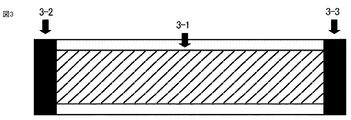
更に、図3に示すように熱可塑性フィルムの一方の面にデザイン印刷層を全体または一部を有し(3-1)、同じ面側にデザイン印刷層に重なるように熱可塑性フィルムの両端に接着層(3-2、3-3)が形成されている。そして、図3の接着層のうち少なくとも一方が、本願発明に係る熱収縮性フィルム用ホットメルト接着剤により形成されるなる接着層である必要がある。 Further, as shown in FIG. 3, the design print layer is entirely or partially on one side of the thermoplastic film (3-1), and is placed on both ends of the thermoplastic film so as to overlap the design print layer on the same side. An adhesive layer (3-2, 3-3) is formed. Then, at least one of the adhesive layers in FIG. 3 needs to be an adhesive layer formed by the hot-melt adhesive for heat-shrinkable film according to the present invention.
一方、他方の接着層は、本願発明に係る熱収縮性フィルム用ホットメルト接着剤であっても、その他一般的なホットメルト接着剤であっても良い。詳細は後述するが、当該接着層は、熱可塑性フィルムに接着させるための部位ではなく、ペットボトル等の物品に直接接着させるための部位だからである。一般的なホットメルト接着剤としては、アクリル系、ゴム系およびウレタン系などの接着剤から選ばれ、例えば、東洋アドレ社製、再剥離型ホットメルト接着剤ラベルメルトP−708J等は、接着性、リサイクル適性等の観点から好適である。 On the other hand, the other adhesive layer may be a hot-melt adhesive for a heat-shrinkable film according to the present invention, or other general hot-melt adhesive. Although details will be described later, this is because the adhesive layer is not a part for adhering to the thermoplastic film but a part for directly adhering to an article such as a PET bottle. The general hot melt adhesive is selected from acrylic, rubber, and urethane adhesives. For example, a re-peelable hot melt adhesive label melt P-708J manufactured by Toyo Adre is adhesive. From the viewpoint of recyclability and the like.
基材フィルムとしては、例えば、延伸ポリエステル系フィルム、延伸ポリスチレン系フィルム、延伸ポリオレフィン系フィルム、ポリ乳酸系フィルム、発泡ポリオレフィン系フィルム、延伸ポリエステル−ポリスチレン共押出しフィルム、発泡ポリスチレン系フィルム等が挙げられる。 Examples of the base film include a stretched polyester film, a stretched polystyrene film, a stretched polyolefin film, a polylactic acid film, a foamed polyolefin film, a stretched polyester-polystyrene coextruded film, and a foamed polystyrene film.
基材フィルムの形状は、特に限定されない。基材フィルムは、例えば、帯状(リボン状)等として用いられる。 The shape of the base film is not particularly limited. A base film is used as a strip | belt shape (ribbon shape) etc., for example.
帯状の基材フィルムは、横一軸延伸フィルム、縦一軸延伸フィルム、二軸延伸フィルムのいずれであってもよい。横一軸延伸フィルムを用いた包装材は、予め筒状に形成し、物品の胴部の外周側に配置した後、熱収縮処理を行って包装材付き物品を製造する場合に好適である。また、搬送方向(長手方向)に沿って熱収縮可能である一軸延伸フィルム(MD(Machine Direction)方向一軸延伸フィルム)を用いた包装材は、物品の胴部の外周面に巻き付けた後、熱収縮処理を行って包装材付き物品を製造する場合に好適である。いずれの場合も、包装材(基材フィルム)で物品を確実に被覆することができる。 The belt-like substrate film may be any of a lateral uniaxially stretched film, a longitudinally uniaxially stretched film, and a biaxially stretched film. The packaging material using the laterally uniaxially stretched film is suitable for the case where the article with the packaging material is manufactured by forming in a cylindrical shape in advance and arranging it on the outer peripheral side of the body part of the article and then performing the heat shrinkage treatment. In addition, a packaging material using a uniaxially stretched film (MD (Machine Direction) direction uniaxially stretched film) that is heat-shrinkable along the transport direction (longitudinal direction) is wound around the outer peripheral surface of the body portion of the article, It is suitable when manufacturing an article with a packaging material by performing shrinkage treatment. In either case, the article can be reliably covered with the packaging material (base film).
かかる基材フィルムの延伸方向における熱収縮率は、5〜85%程度であることが好ましく、20〜60%程度であることがより好ましい。このような熱収縮率を有する基材フィルムを用いることにより、包装材は、熱収縮フィルムとしての効果を確実に発揮することができる。 The thermal contraction rate in the stretching direction of the base film is preferably about 5 to 85%, more preferably about 20 to 60%. By using a base film having such a heat shrinkage rate, the packaging material can reliably exhibit the effect as a heat shrink film.
なお、本明細書において熱収縮率とは、100℃の温水に浸漬したときの熱収縮率であって、延伸方向の熱収縮率は、下記式に従って計算される。したがって、縦一軸延伸フィルムは、その搬送方向に収縮するため、搬送方向に対する熱収縮率が5〜85%程度であることが好ましく、横一軸延伸フィルムは、その幅方向に収縮するため、幅方向に対する熱収縮率が5〜85%程度であることが好ましい。なお、二軸延伸フィルムの場合、いずれかの延伸方向における熱収縮率が上記範囲内であることが好ましい。熱収縮率(%)=(加熱前の寸法−加熱後の寸法)/(加熱前の寸法)×100 In addition, in this specification, a heat shrinkage rate is a heat shrinkage rate when immersed in 100 degreeC warm water, Comprising: The heat shrinkage rate of an extending | stretching direction is calculated according to a following formula. Accordingly, since the longitudinal uniaxially stretched film shrinks in the transport direction, the thermal shrinkage rate with respect to the transport direction is preferably about 5 to 85%, and the lateral uniaxially stretched film shrinks in the width direction. It is preferable that the heat shrinkage ratio with respect to is about 5 to 85%. In the case of a biaxially stretched film, it is preferable that the thermal shrinkage rate in any stretching direction is within the above range. Thermal contraction rate (%) = (dimension before heating−dimension after heating) / (dimension before heating) × 100
また、基材フィルムの平均厚さは、耐熱性、剛性、機械適性や外観等に応じて適宜設定され、特に限定されない。具体的には、基材フィルムの平均厚さは、10〜50μm程度であることが好ましく、10〜30μm程度であることがより好ましく、15〜25μm程度であることがさらに好ましい。本発明によれば、このように薄い基材フィルムであっても、破断することなく、物品を確実に被覆することができる。これにより、包装材付き物品の製造コストの低減を図ることができる。
Moreover, the average thickness of a base film is suitably set according to heat resistance, rigidity, mechanical suitability, an external appearance, etc., and is not specifically limited. Specifically, the average thickness of the base film is preferably about 10 to 50 μm, more preferably about 10 to 30 μm, and still more preferably about 15 to 25 μm. According to the present invention, even such a thin base film can reliably cover an article without breaking. Thereby , reduction of the manufacturing cost of articles | goods with a packaging material can be aimed at.
なお、基材フィルムの構成材料には、必要に応じて、滑剤、充填剤、熱安定剤、酸化防止剤、紫外線吸収剤、帯電防止剤、難燃剤、着色剤のような各種添加剤を添加してもよい。また、基材フィルムの表面には、例えば、コロナ放電処理、プラズマ処理、火炎処理、酸処理のような表面処理を施してもよい。これにより、基材フィルムの表面に対する印刷適性を向上することができる。 In addition, various additives such as lubricants, fillers, heat stabilizers, antioxidants, UV absorbers, antistatic agents, flame retardants, and coloring agents are added to the constituent materials of the base film as necessary. May be. The surface of the base film may be subjected to a surface treatment such as corona discharge treatment, plasma treatment, flame treatment, or acid treatment. Thereby, the printability with respect to the surface of a base film can be improved.
なお、基材フィルムは、上記フィルムの単層フィルムに限定されず、2種類以上の上記フィルムの積層フィルムや不織布と前記フィルムとの積層フィルムであってもよい。さらに、基材フィルムの表面および/または裏面には、酸化珪素、酸化アルミニウム、アルミニウム等の蒸着膜を設けるようにしてもよい。基材フィルムを積層フィルムとする場合、その平均厚さは、10〜300μm程度とすることが好ましい。 In addition, a base film is not limited to the single layer film of the said film, The laminated film of the laminated film of 2 or more types of said films, the nonwoven fabric, and the said film may be sufficient. Furthermore, you may make it provide vapor deposition films, such as a silicon oxide, aluminum oxide, aluminum, on the surface and / or back surface of a base film. When making a base film into a laminated | multilayer film, it is preferable that the average thickness shall be about 10-300 micrometers.
本発明の熱収縮性フィルム用ホットメルト接着剤(以下、単に「接着剤」と言うこともある。)は、軟化点が105〜140℃のポリエチレンワックスを、10〜30重量%と、エラストマーを、10〜20重量%と、接着付与剤を、25〜40重量%と、軟化剤を、25〜40重量%とで含む。ポリエチレンワックス、エラストマー、接着付与剤および軟化剤を含む接着剤は、特に、ポリエチレンワックスの作用により、固体状態から加熱して溶融状態とする時(加熱時)には、比較的高温においても高い粘度を維持し、一方、溶融状態から冷却して固体状態とする時(冷却時)には、比較的低温においても低い粘度を維持する特性(特徴)を発揮することができる。 The hot-melt adhesive for heat-shrinkable film of the present invention (hereinafter sometimes simply referred to as “adhesive”) comprises polyethylene wax having a softening point of 105 to 140 ° C., 10 to 30% by weight, and an elastomer. 10 to 20% by weight, 25 to 40% by weight of an adhesion-imparting agent, and 25 to 40% by weight of a softening agent. Adhesives containing polyethylene wax, elastomers, adhesion promoters and softeners, especially when heated from a solid state to a molten state (during heating) due to the action of polyethylene wax, have a high viscosity even at relatively high temperatures. On the other hand, when cooling from a molten state to a solid state (during cooling), it is possible to exhibit characteristics (features) that maintain a low viscosity even at a relatively low temperature.
したがって、かかる接着剤は、基材フィルムを熱収縮させる熱収縮温度において、十分に高い粘度および凝集力を維持すること、すなわち、優れた熱収縮適性(シュリンク適性)を発揮することができる。その結果、基材フィルムを収縮させる際に、重複部(貼り合わせ部)にズレや剥離が生じることを確実に防止することができる。ここで、熱収縮適性は、熱収縮前の基材フィルムが貼り付けられた物品を、温度が90℃に調整された湯浴に3秒間浸漬した際に、重複部にズレや剥離が生じるか否かを確認することにより評価できる。 Therefore, such an adhesive can maintain a sufficiently high viscosity and cohesive strength at the heat shrink temperature at which the base film is heat shrunk, that is, exhibits excellent heat shrinkability (shrinkability). As a result, when shrinking a base film, it can prevent reliably that a gap and peeling arise in an overlap part (bonding part). Here, the heat shrinkability means that when an article with a base film before heat shrinking is immersed in a hot water bath adjusted to a temperature of 90 ° C. for 3 seconds, misalignment or peeling occurs at the overlapping portion. It can be evaluated by checking whether or not.
特に、各成分を上記含有量で含むことにより、接着剤の特性がより顕著に発揮される。このような特性を接着剤が有するか否かは、接着剤が加熱時(昇温時)において所定の粘度となる温度と、冷却時(降温時)において所定の粘度となる温度との差の程度を指標として判断することができる。 In particular, by including each component in the above content, the properties of the adhesive are more prominently exhibited. Whether the adhesive has such characteristics depends on the difference between the temperature at which the adhesive has a predetermined viscosity when heated (when the temperature rises) and the temperature at which the adhesive becomes a predetermined viscosity when cooled (when the temperature is lowered). The degree can be determined as an index.
具体的には、加熱時において接着剤の粘度が500Pa・sとなる温度をX[℃]とし、冷却時(降温時)において接着剤の粘度が500Pa・sとなる温度をY[℃]としたとき、X>YかつX−Yが5以上であることが好ましく、10以上であることがより好ましく、15以上であることがさらに好ましい。これにより、接着剤は、加熱時には、比較的高温において十分に高い粘度を維持し、冷却時には、比較的低温において十分に低い粘度をより確実に維持することができる。なお、X−Yの上限値は、特に限定されないが、通常、30程度、好ましくは25程度、より好ましくは20程度である。 Specifically, the temperature at which the viscosity of the adhesive is 500 Pa · s during heating is X [° C.], and the temperature at which the viscosity of the adhesive is 500 Pa · s during cooling (when the temperature is lowered) is Y [° C.]. X> Y and XY is preferably 5 or more, more preferably 10 or more, and still more preferably 15 or more. Thereby, the adhesive can maintain a sufficiently high viscosity at a relatively high temperature during heating, and more reliably maintain a sufficiently low viscosity at a relatively low temperature during cooling. The upper limit of XY is not particularly limited, but is usually about 30, preferably about 25, and more preferably about 20.
温度Xは、特に限定されないが、90〜125℃程度であることが好ましく、95〜120℃程度であることがより好ましく、100〜120℃程度であることがさらに好ましい。これにより、接着剤は、加熱時において極めて高い温度においても、十分に高い粘度を維持すること、すなわち、優れた熱収縮適性を発揮することができる。 The temperature X is not particularly limited, but is preferably about 90 to 125 ° C, more preferably about 95 to 120 ° C, and further preferably about 100 to 120 ° C. As a result, the adhesive can maintain a sufficiently high viscosity, that is, exhibits excellent heat shrinkability even at an extremely high temperature during heating.
特に、接着剤は、加熱時における90℃での粘度が1,000Pa・s以上であることが好ましく、4,000Pa・s以上であることがより好ましい。これにより、接着剤は、より優れた熱収縮適性を発揮することができる。 In particular, the adhesive preferably has a viscosity at 90 ° C. during heating of 1,000 Pa · s or more, and more preferably 4,000 Pa · s or more. Thereby, the adhesive agent can exhibit more excellent heat shrinkability.
一方、接着剤は、その塗工時において、十分に低い粘度を維持することができる。そのため、塗工に際して、接着剤の基材フィルムに対する塗工量が不安定になったり、擦れや糸曳きが生じることを防止できる。 On the other hand, the adhesive can maintain a sufficiently low viscosity at the time of coating. Therefore, it is possible to prevent the coating amount of the adhesive on the base film from becoming unstable, or causing rubbing and stringing during coating.
また、温度Yも、特に限定されないが、85〜110℃程度であることが好ましく、90〜105℃程度であることがより好ましく、90〜100℃程度であることがさらに好ましい。これにより、接着剤は、冷却時において極めて低い温度においても、十分に低い粘度を維持すること、すなわち、優れた塗工適性を発揮することができる。 Also, the temperature Y is not particularly limited, but is preferably about 85 to 110 ° C, more preferably about 90 to 105 ° C, and further preferably about 90 to 100 ° C. As a result, the adhesive can maintain a sufficiently low viscosity even at an extremely low temperature during cooling, that is, can exhibit excellent coating suitability.
特に、接着剤は、冷却時における110℃での粘度が40Pa・s以下であることが好ましく、20Pa・s以下であることがより好ましい。これにより、接着剤は、より優れた塗工適性を発揮することができる。 In particular, the viscosity of the adhesive at 110 ° C. during cooling is preferably 40 Pa · s or less, and more preferably 20 Pa · s or less. Thereby, the adhesive agent can exhibit more excellent coating suitability.
ここで、接着剤の冷却時および加熱時の粘度は、具体的には、レオメーターによって測定される値である。レオメーターによれば、接着剤における粘度の温度依存性を容易に測定可能である。なお、上記粘度は、例えば、動的粘度粘弾性測定装置(株式会社ユービーエム社製、「Rheosol−G3000」)を用いて測定することができる。 Here, the viscosity at the time of cooling and heating of the adhesive is specifically a value measured by a rheometer. According to the rheometer, the temperature dependence of the viscosity in the adhesive can be easily measured. In addition, the said viscosity can be measured using the dynamic viscosity viscoelasticity measuring apparatus (The UBM Co., Ltd. make, "Rhesol-G3000"), for example.
例えば、接着剤は、図1に示すような粘度挙動を示す。図1は、レオメーターを用いて測定した熱収縮性フィルム用ホットメルト接着剤の粘度挙動を示す模式図の一例である。なお、図1は、特定の組成の接着剤の粘度挙動を示すグラフであり、接着剤は、その組成に応じて粘度挙動が若干変化することは言うまでもない。 For example, the adhesive exhibits a viscosity behavior as shown in FIG. FIG. 1 is an example of a schematic diagram showing the viscosity behavior of a hot-melt adhesive for heat-shrinkable film measured using a rheometer. In addition, FIG. 1 is a graph which shows the viscosity behavior of the adhesive agent of a specific composition, and it cannot be overemphasized that a viscosity behavior changes a little according to the composition.
接着剤を高温状態(溶融状態)から冷却していくと、その粘度は、Iの経路を辿って、2つの変曲点A、Bを通過して上昇する。次いで、接着剤を低温状態(固体状態)から加熱していくと、その粘度は、IIの経路を辿って、すなわち、冷却時とは異なった経路を辿って、2つの変曲点C、Dを通過して下降する。このように、冷却時と加熱時の粘度挙動が異なり(ヒステリシス(Hysteresis)特性を示し)、それらの差が大きいことが、本発明のホットメルト接着剤の特徴である。このような特性(物性)を有することにより、次のような効果が得られる。 When the adhesive is cooled from the high temperature state (molten state), the viscosity increases along the path I and passes through the two inflection points A and B. Next, when the adhesive is heated from a low temperature state (solid state), its viscosity follows a path II, that is, a path different from that during cooling, and two inflection points C and D. Pass through and descend. As described above, the hot melt adhesive of the present invention is characterized in that the viscosity behavior at the time of cooling is different from that at the time of heating (showing hysteresis characteristics) and the difference between them is large. By having such characteristics (physical properties), the following effects can be obtained.
すなわち、従来の熱収縮性フィルム用ホットメルト接着剤では、塗工ヘッドとして、貯留タンクから吐出口までの距離(供給路の距離)が短いタイプのものを用いた場合、ホットメルト接着剤は、その温度が高い状態で、デザイン印刷層に塗工されることになる。そのため、熱収縮性フィルム用ホットメルト接着剤の温度が高過ぎ、基材フィルムが不本意に収縮してしまう。一方、これを回避すべく、貯留タンクから吐出口までの距離(供給路の距離)が長いタイプの塗工ヘッドを用いると、従来のホットメルト接着剤では、吐出口に至るまでに過度に冷却されてしまう結果、吐出口から吐出する際に擦れや糸曳きが生じてしまい、デザイン印刷層に塗工することができない。 That is, in the conventional hot melt adhesive for heat-shrinkable film, when a coating head having a short distance from the storage tank to the discharge port (distance of the supply path) is used, the hot melt adhesive is In the state where the temperature is high, it is applied to the design print layer. Therefore, the temperature of the hot-melt adhesive for heat-shrinkable film is too high and the base film shrinks unintentionally. On the other hand, in order to avoid this, if a coating head with a long distance from the storage tank to the discharge port (distance of the supply path) is used, the conventional hot melt adhesive will overcool before reaching the discharge port. As a result, rubbing and stringing occur when ejected from the ejection port, and cannot be applied to the design print layer.
これに対して、本発明の熱収縮性フィルム用ホットメルト接着剤は、冷却時において比較的広い温度範囲において、十分に低い粘度を維持する。このため、この接着剤は、貯留タンクから吐出口までの距離(供給路の距離)の長短に係わらず、塗工ヘッドから確実に吐出することができ、デザイン印刷層に良好に塗工することができる。 On the other hand, the hot melt adhesive for heat-shrinkable film of the present invention maintains a sufficiently low viscosity in a relatively wide temperature range during cooling. For this reason, this adhesive can be reliably discharged from the coating head regardless of the distance from the storage tank to the discharge port (distance of the supply path), and should be applied well to the design print layer Can do.
一方、基材フィルムを収縮させる際(加熱時)には、図1中のIIの経路で示されるように、接着剤は、温度が比較的高くなっても、十分に高い粘度を維持するので凝集力が高く、良好な接着性を維持する。このため、基材フィルムが収縮しても、重複部(貼り付け面)にズレや剥離が生じるのを確実に防止することができる。なお、従来の熱収縮性フィルム用ホットメルト接着剤の粘度挙動は、冷却時および加熱時においてほぼ一致して直線的である。このため、従来の熱収縮性フィルム用ホットメルト接着剤は、高温になると、粘度が極端に低くなるので、基材フィルムを収縮させると、基材フィルムが物品から容易に脱落する。したがって、従来の熱収縮性フィルム用ホットメルト接着剤は、本発明に使用することができない。 On the other hand, when the base film is shrunk (during heating), as shown by the path II in FIG. 1, the adhesive maintains a sufficiently high viscosity even when the temperature is relatively high. High cohesion and maintains good adhesion. For this reason, even if a base film shrink | contracts, it can prevent reliably that a shift | offset | difference and peeling arise in an overlap part (attachment surface). The viscosity behavior of conventional hot-melt adhesives for heat-shrinkable films is almost coincident and linear during cooling and heating. For this reason, since the viscosity of the conventional hot melt adhesive for heat-shrinkable film becomes extremely low when the temperature is high, the base film is easily detached from the article when the base film is shrunk. Therefore, the conventional hot melt adhesive for heat-shrinkable film cannot be used in the present invention.
本発明の包装材は、熱収縮性フィルムの少なくとも一方の面に、前述の熱収縮性フィルム用印刷インキ(A)からなるデザイン印刷層を有し、前記フィルムの左右2つ端部のうち、少なくとも一方の端部に、熱収縮性フィルム用ホットメルト接着剤(B)からなる接着層を積層したものである。 The packaging material of the present invention has a design printing layer made of the above-mentioned printing ink for heat-shrinkable film (A) on at least one surface of the heat-shrinkable film, and among the two left and right ends of the film, An adhesive layer made of a hot-melt adhesive for heat-shrinkable film (B) is laminated on at least one end.
例えば、図2に示すように熱可塑性フィルムの一方の面にデザイン印刷層を全体または一部を有し(2-1)、同じ面側の一方の端部にデザイン印刷層に重なるように接着層(2-2)が形成される場合が考えられる。 For example, as shown in FIG. 2, the design print layer is entirely or partially on one side of the thermoplastic film (2-1), and is bonded to one end of the same side so as to overlap the design print layer. A case where the layer (2-2) is formed is considered.
更に、図3に示すように熱可塑性フィルムの一方の面にデザイン印刷層を全体または一部を有し(3-1)、同じ面側にデザイン印刷層に重なるように熱可塑性フィルムの両端に接着層(3-2、3-3)が形成されている。そして、図3の接着層のうち少なくとも一方が、本願発明に係る熱収縮性フィルム用ホットメルト接着剤により形成されるなる接着層である必要がある。 Further, as shown in FIG. 3, the design print layer is entirely or partially on one side of the thermoplastic film (3-1), and is placed on both ends of the thermoplastic film so as to overlap the design print layer on the same side. An adhesive layer (3-2, 3-3) is formed. Then, at least one of the adhesive layers in FIG. 3 needs to be an adhesive layer formed by the hot-melt adhesive for heat-shrinkable film according to the present invention.
一方、他方の接着層は、本願発明に係る熱収縮性フィルム用ホットメルト接着剤であっても、その他一般的なホットメルト接着剤であっても良い。詳細は後述するが、当該接着層は、熱可塑性フィルムに接着させるための部位ではなく、ペットボトル等の物品に直接接着させるための部位だからである。一般的なホットメルト接着剤としては例えば、アクリル系接着剤、ゴム系接着剤、ウレタン系接着剤のような溶剤系または水系の接着剤のうちの1種または2種以上を組み合わせて用いることもできる。 On the other hand, the other adhesive layer may be a hot-melt adhesive for a heat-shrinkable film according to the present invention, or other general hot-melt adhesive. Although details will be described later, this is because the adhesive layer is not a part for adhering to the thermoplastic film but a part for directly adhering to an article such as a PET bottle. As a general hot melt adhesive, for example, one or more of solvent-based or water-based adhesives such as acrylic adhesives, rubber adhesives, and urethane adhesives may be used in combination. it can.
ホットメルト接着剤を熱収縮フィルムまたはデザイン印刷層に塗工して接着層を形成するためには、熱収縮性フィルムに直接塗工する方法、ホットメルト接着剤を剥離シートに塗工したものを、熱収縮性フィルムに転写する方法(以下、転写塗工ともいう)がある。本発明においては後者が好ましい。 In order to form an adhesive layer by applying hot-melt adhesive to a heat-shrinkable film or design printing layer, a method of directly applying to the heat-shrinkable film, or a hot-melt adhesive applied to a release sheet There is a method of transferring to a heat-shrinkable film (hereinafter also referred to as transfer coating). The latter is preferred in the present invention.
直接塗工する方法としては、スリット塗工、カーテンスプレー、スパイラルスプレー、ドットまたはビード方式による塗工が好ましく、スリット塗工がより好ましい。 As a direct coating method, slit coating, curtain spray, spiral spray, dot or bead coating is preferable, and slit coating is more preferable.
転写塗工する方法としては、ロール塗工、スリット塗工が好ましい。具体的には、例えば、ハンドアプリケーターを用いてホットメルト接着剤を剥離シートに塗工した後、形成した接着層を熱収縮性フィルムまたはデザイン印刷層に転写できる。 As a transfer coating method, roll coating and slit coating are preferred. Specifically, for example, after the hot melt adhesive is applied to the release sheet using a hand applicator, the formed adhesive layer can be transferred to a heat-shrinkable film or a design printing layer.
ホットメルト接着剤は、130〜200℃に加熱し、溶融させて塗工することが好ましい。そして、塗工温度は、90〜150℃が好ましく、110〜140℃がより好ましい。塗工温度が90℃未満の場合ホットメルト接着剤の粘度が高く安定に得することが難しい。一方、150℃以上の場合、塗工時熱収縮フィルムが収縮してしまう。 The hot melt adhesive is preferably heated to 130 to 200 ° C. and melted for coating. And 90-150 degreeC is preferable and, as for coating temperature, 110-140 degreeC is more preferable. When the coating temperature is less than 90 ° C., the hot melt adhesive has a high viscosity and is difficult to obtain stably. On the other hand, when the temperature is 150 ° C. or higher, the heat-shrinkable film shrinks during coating.
接着層の厚みは10〜200μmが好ましい。またPETボトルを包装する場合は、10〜200g/m2がより好ましい。 The thickness of the adhesive layer is preferably 10 to 200 μm. Moreover, when packaging a PET bottle, 10-200 g / m <2> is more preferable.
また、接着層の幅は、1〜100mmが好ましく、3〜100mmが好ましい。なお、接着層の幅とは、接着層の、包装材を物品に巻きつける方向における長さである。 The width of the adhesive layer is preferably 1 to 100 mm, and more preferably 3 to 100 mm. The width of the adhesive layer is the length of the adhesive layer in the direction in which the packaging material is wound around the article.
なお前記の方法(2)において、物品と包装材の端部を予め貼り付けておくための接着剤は、本願のホットメルト接着剤に限定されることは無く、各種公知の接着剤を用いることが出来る。例えば、東洋アドレ社製、再剥離型ホットメルト接着剤ラベルメルトP−708J等は、接着性、リサイクル適性等の観点から好適である。
In the above method (2), the adhesive for preliminarily attaching the article and the end of the packaging material is not limited to the hot melt adhesive of the present application, and various known adhesives may be used. I can do it. For example, a re-peelable hot melt adhesive label melt P-708J manufactured by Toyo Adre is suitable from the viewpoints of adhesiveness, recyclability, and the like.
本発明の包装材は、物品を包装して使用することが好ましい。当該包装の態様は、物品全体を包装することができる。また、物品の一部、例えば飲料ボトルのキャップ部分を包装するように、物品の一部を包装することも好ましい。また、多数の物品をまとめて包装する、いわゆるマルチパックとして使用することも好ましい。 The packaging material of the present invention is preferably used after packaging an article. The packaging aspect can package the entire article. It is also preferable to wrap a part of the article so as to wrap a part of the article, for example a cap part of a beverage bottle. Moreover, it is also preferable to use it as what is called a multipack which packages many articles collectively.
本発明の包装材は、物品に装着し、加熱することで、包装材付き物品を製造できる。すなわち、物品の外周に包装材を装着する工程、次いで、加熱することで熱収縮性フィルムを収縮させる工程を有することが好ましい。
包装材を装着する方法としては、様々な方法が考え得るが、代表的な方法として、下記が例示できる。
あらかじめ包装材を円筒状にし、物品に装着する方法
物品に、包装材の一方の端部を予め貼り付けておき、次いで物品の外周に当該包装材を巻きつけて、包装材の両方の端部を重ねる方法
The packaging material of the present invention can be produced by attaching the packaging material to the article and heating it. That is, it is preferable to have a step of attaching a packaging material to the outer periphery of the article, and then a step of shrinking the heat-shrinkable film by heating.
Although various methods can be considered as a method for attaching the packaging material, the following can be exemplified as typical methods.
A method for attaching a packaging material to a cylinder in advance and attaching it to the article. One end of the packaging material is affixed in advance to the article, and then the packaging material is wrapped around the outer periphery of the article, and both ends of the packaging material How to stack
物品としては、例えば、清涼飲料水、ビール、ウイスキー、調味料、洗剤、シャンプー、食用油、化粧品、医薬品などに使用される容器、ヨーグルト、プリンなどの包装に使用されるカップ、CDやDVD等のメディアやこれを収納するケース、乾電池単体のような筒状または柱状の胴部(部分)を備える物品等が挙げられる。 Examples of articles include soft drinks, beer, whiskey, seasonings, detergents, shampoos, edible oils, cosmetics, containers used for pharmaceuticals, cups used for packaging yogurt, pudding, CDs, DVDs, etc. Media, a case for storing the media, an article having a cylindrical or columnar body (part) such as a dry battery alone, and the like.
また、筒状の胴部を備える容器の具体例としては、例えば、ガラス瓶のようなガラス容器、PET(ポリエチレンテレフタレート)ボトルのようなプラスチック容器、紙容器等が挙げられる。 Specific examples of the container having a cylindrical body include a glass container such as a glass bottle, a plastic container such as a PET (polyethylene terephthalate) bottle, and a paper container.
以上、本発明の熱収縮性フィルム用印刷インキ、ホットメルト接着剤、包装材、包装材付き物品の実施形態について説明したが、本発明は、これに限定されるものではない。本発明の熱収縮性フィルム用印刷インキ(A)および熱収縮性フィルム用ホットメルト接着剤(B)、包装材および包装材付き物品を構成する各部は、同様の機能を発揮し得る任意の構成のものと置換することができる。また、任意の構成物が付加されていてもよい。また、本発明の包装材付き物品の製造方法では、任意の目的の1以上の工程が追加されてもよい。 As mentioned above, although embodiment of the printing ink for heat-shrinkable films of this invention, a hot-melt-adhesive, a packaging material, and articles | goods with a packaging material was described, this invention is not limited to this. The printing ink (A) for heat-shrinkable film and hot-melt adhesive (B) for heat-shrinkable film of the present invention, each part constituting the packaging material and the article with the packaging material, any configuration capable of exhibiting the same function Can be substituted. Moreover, arbitrary components may be added. Moreover, in the manufacturing method of the article with a packaging material of the present invention, one or more steps for an arbitrary purpose may be added.
また、物品は、筒状または柱状の部分を胴部に備えなくてもよい。筒状または柱状の部分を胴部以外の部分に備える例としては、PETボトルの口部と、この口部に装着された蓋との組み合わせ、ワインボトルの口部と、この口部に嵌入されたコルク栓との組み合わせ等が挙げられる。本発明の包装材は、これらの部分に対して、例えば、改竄防止用フィルムとして用いることができる。 In addition, the article does not have to be provided with a cylindrical or columnar portion in the body portion. As an example in which a cylindrical or columnar part is provided in a part other than the body part, a combination of a mouth part of a PET bottle and a lid attached to the mouth part, a mouth part of a wine bottle, and the mouth part is inserted into the mouth part. The combination with a cork stopper etc. is mentioned. The packaging material of the present invention can be used as, for example, a falsification preventing film for these portions.
さらに、物品は、筒状または柱状の部分を備えなくてもよく、その形状は、例えば、球状、立方体状、直方体状、不定形状(異形状)等のいかなる形状であってもよい。 Further, the article may not have a cylindrical or columnar portion, and the shape thereof may be any shape such as a spherical shape, a cubic shape, a rectangular parallelepiped shape, and an indefinite shape (unshaped shape).
なお、本発明の熱収縮性フィルム用ホットメルト接着剤(B)で構成される接着部は、残渣なく物品から取り除くことできるとともに、熱アルカリ水溶液により物品から容易に取り除くこともできる。このため、物品がPETボトルである場合、特に、そのリサイクル適性が向上する。換言すれば、本発明は、PETボトルに用いるのに適している。 In addition, the adhesive part composed of the hot-melt adhesive for heat-shrinkable film (B) of the present invention can be removed from the article without any residue, and can be easily removed from the article with a hot alkaline aqueous solution. For this reason, when the article is a PET bottle, the recycling suitability is improved. In other words, the present invention is suitable for use with PET bottles.
また、接着部は、熱収縮性フィルム用印刷インキ(A)からなるデザイン印刷層の一部のみでなく、全体(全面)に形成するようにしてもよく、基材フィルムの裏面または表面に散在する複数の点で構成してもよい。 In addition, the adhesive part may be formed not only on a part of the design print layer made of the printing ink for heat-shrinkable film (A) but also on the whole (entire surface), and scattered on the back surface or the surface of the base film. A plurality of points may be configured.
さらに、包装材付き物品は、物品の一部のみならず、その全体を包装材の熱収縮物で被覆した構成とすることもできる。 Furthermore, the article with a packaging material can be configured to cover not only a part of the article but also the whole with a heat-shrinkable material of the packaging material.
以下、実施例をあげて本発明を詳細に説明するが、本発明はこれら実施例に限定されるものではない。なお、本発明における部および%は、特に注釈の無い場合、重量部および重量%を表す。 EXAMPLES Hereinafter, although an Example is given and this invention is demonstrated in detail, this invention is not limited to these Examples. In the present invention, “parts” and “%” represent “parts by weight” and “% by weight” unless otherwise noted.
<アミン価の測定方法>
試料を0.5〜2g精秤する。(試料量:Sg)精秤した試料に中性エタノール(BDG中性)30mLを加え溶解させる。得られた溶液を0.2mol/Lエタノール性塩酸溶液(力価:f)で滴定を行なう。溶液の色が緑から黄に変化した点を終点とし、この時の滴定量(AmL)を用い次の(式1)によりアミン価を求めた。
(式1) アミン価=(A×f×0.2×56.108)/S
<Method of measuring amine value>
Weigh 0.5-2 g of sample accurately. (Sample amount: Sg) 30 mL of neutral ethanol (BDG neutral) is added to a precisely weighed sample and dissolved. The obtained solution is titrated with a 0.2 mol / L ethanolic hydrochloric acid solution (titer: f). The point at which the color of the solution changed from green to yellow was taken as the end point, and the amine value was determined by the following (Formula 1) using the titration amount (AmL) at this time.
(Formula 1) Amine number = (A × f × 0.2 × 56.108) / S
<数平均分子量(Mn)、重量平均分子量(Mw)>
v数平均分子量(Mn)と重量平均分子量(Mw)の測定は、昭和電工社製GPC(ゲルパーミエーションクロマトグラフィー)「ShodexGPC System−21」を用いた。GPCは溶媒に溶解した物質をその分子サイズの差によって分離定量する液体クロマトグラフィーであり、溶媒としてはテトロヒドロフラン、重量平均分子量(Mn)の決定はポリスチレン換算で行った。
<Number average molecular weight (Mn), weight average molecular weight (Mw)>
The measurement of v number average molecular weight (Mn) and weight average molecular weight (Mw) used GPC (gel permeation chromatography) "ShodexGPC System-21" by Showa Denko KK. GPC is liquid chromatography that separates and quantifies substances dissolved in a solvent based on the difference in molecular size. Tetrohydrofuran is used as a solvent, and weight average molecular weight (Mn) is determined in terms of polystyrene.
<水酸基価(OHV)>
共栓三角フラスコ中に試料、約1gを精密に量り採り、トルエン/エタノール(容量比:トルエン/エタノール=2/1)混合液100mlを加えて溶解する。更にアセチル化剤(無水酢酸25gをピリジンで溶解し、容量100mlとした溶液)を正確に5ml加え、約1時間攪拌した。これに、フェノールフタレイン試液を指示薬として加え、30秒間持続する。その後、溶液が淡紅色を呈するまで0.1Nアルコール性水酸化カリウム溶液で滴定する。
水酸基価は次式により求めた。水酸基価は樹脂の乾燥状態の数値とした(単位:mgKOH/g)。
水酸基価(mgKOH/g)=[{(b−a)×F×28.25}/S]/(不揮発分濃度/100)+D
ただし、S:試料の採取量(g)
a:0.1Nアルコール性水酸化カリウム溶液の消費量(ml)
b:空実験の0.1Nアルコール性水酸化カリウム溶液の消費量(ml)
F:0.1Nアルコール性水酸化カリウム溶液の力価
D:酸価(mgKOH/g)
<Hydroxyl value (OHV)>
About 1 g of a sample is accurately weighed in a stoppered Erlenmeyer flask and dissolved by adding 100 ml of a toluene / ethanol (volume ratio: toluene / ethanol = 2/1) mixed solution. Further, exactly 5 ml of an acetylating agent (a solution in which 25 g of acetic anhydride was dissolved in pyridine to make a volume of 100 ml) was added and stirred for about 1 hour. To this, phenolphthalein reagent is added as an indicator and lasts for 30 seconds. Thereafter, the solution is titrated with a 0.1N alcoholic potassium hydroxide solution until the solution becomes light red.
The hydroxyl value was determined by the following formula. The hydroxyl value was a numerical value in the dry state of the resin (unit: mgKOH / g).
Hydroxyl value (mgKOH / g) = [{(ba) × F × 28.25} / S] / (Non-volatile content concentration / 100) + D
Where S: Amount of sample collected (g)
a: Consumption of 0.1N alcoholic potassium hydroxide solution (ml)
b: Consumption of 0.1N alcoholic potassium hydroxide solution in the empty experiment (ml)
F: Potency of 0.1N alcoholic potassium hydroxide solution
D: Acid value (mgKOH / g)
<酸価(AV)>
共栓三角フラスコ中に試料化合物(B)を、約1gを精密に量り採り、トルエン/エタノール(容積比:トルエン/エタノール=2/1)混合液100mlを加えて溶解した。これに、フェノールフタレイン試液を指示薬として加え、30秒間保持した後、溶液が淡紅色を呈するまで0.1Nアルコール性水酸化カリウム溶液で滴定した。
乾燥状態の樹脂の値として、酸価(mgKOH/g)を次式により求めた。
酸価(mgKOH/g)={(5.611×a×F)/S}/(不揮発分濃度/100)
ただし、S:試料の採取量(g)
a:0.1Nアルコール性水酸化カリウム溶液の消費量(ml)
F:0.1Nアルコール性水酸化カリウム溶液の力価
<Acid value (AV)>
About 1 g of sample compound (B) was accurately weighed in a stoppered Erlenmeyer flask, and dissolved by adding 100 ml of a toluene / ethanol (volume ratio: toluene / ethanol = 2/1) mixed solution. To this was added a phenolphthalein test solution as an indicator, which was held for 30 seconds, and then titrated with a 0.1N alcoholic potassium hydroxide solution until the solution turned light red.
The acid value (mgKOH / g) was determined by the following equation as the value of the resin in the dry state.
Acid value (mgKOH / g) = {(5.611 × a × F) / S} / (Nonvolatile content concentration / 100)
Where S: Amount of sample collected (g)
a: Consumption of 0.1N alcoholic potassium hydroxide solution (ml)
F: Potency of 0.1N alcoholic potassium hydroxide solution
<ホットメルト接着剤の粘度の測定方法>
得られたホットメルト接着剤を、プレート型レオメーターを用いて、粘度測定を行った。測定方法及び測定条件は下記の通りである。測定結果を表1に示す。・測定装置:動的粘度粘弾性測定装置 Rheosol−G3000(株式会社 ユービーエム社製
・測定モード:温度依存性
・チャック:パラレルプレート
・波形:正弦波
・パラレル直径:19.99mm
・キャップ:1mm
・降温粘度測定開始温度:180℃ 測定終了温度: 30℃
・昇温温度測定開始温度: 30℃ 測定終了温度:180℃
・降温速度:3℃/分
・昇温速度:3℃/分
・回転幅:2Hz,3deg
<Measurement method of viscosity of hot melt adhesive>
The viscosity of the obtained hot melt adhesive was measured using a plate type rheometer. The measurement method and measurement conditions are as follows. The measurement results are shown in Table 1.・ Measuring device: Dynamic viscosity viscoelasticity measuring device Rheosol-G3000 (manufactured by UBM Co., Ltd. ・ Measurement mode: temperature dependence ・ Chuck: parallel plate ・ Waveform: sine wave ・ Parallel diameter: 19.99 mm
・ Cap: 1mm
-Temperature drop viscosity start temperature: 180 ° C Measurement end temperature: 30 ° C
・ Starting temperature measurement temperature: 30 ° C Measurement end temperature: 180 ° C
・ Cooling rate: 3 ° C./min ・ Cooling rate: 3 ° C./min ・ Rotation width: 2 Hz, 3 deg
<軟化点(℃)の測定法>
軟化点の測定は、JIS K−2207(石油アスファルト) 6.4軟化点試験方法(環球法)に準拠して行った。
<Measurement method of softening point (° C)>
The softening point was measured in accordance with 6.4 K-2207 (petroleum asphalt) 6.4 softening point test method (ring and ball method).
<熱収縮性フィルム用印刷インキ(A)の製造例>
(ポリエステルジオールの合成例)
攪拌機、温度計、分水器および窒素ガス導入管を備えた丸底フラスコに、2−ブチル−2−エチル−1,3−プロパンジオール(以下BEPGと略す)56.846部、アジピン酸43.152部、テトラブチルチタネート0.002部を仕込み、窒素気流下に230℃で縮合により生じる水を除去しながらエステル化を8時間行った。ポリエステルの酸価が15以下になったことを確認後、真空ポンプにより徐々に真空度を上げ反応を終了した。これにより水酸基価56.1mgKOH/g(水酸基価から算出される数平均分子量2000)、酸価0.3mgKOH/gのポリエステルジオ−ルを得た。
<Example of production of printing ink (A) for heat-shrinkable film>
(Synthesis example of polyester diol)
In a round bottom flask equipped with a stirrer, a thermometer, a water separator and a nitrogen gas introduction tube, 56.846 parts of 2-butyl-2-ethyl-1,3-propanediol (hereinafter abbreviated as BEPG) and 43. adipic acid. 152 parts and 0.002 part of tetrabutyl titanate were charged, and esterification was carried out for 8 hours while removing water produced by condensation at 230 ° C. under a nitrogen stream. After confirming that the acid value of the polyester was 15 or less, the degree of vacuum was gradually raised with a vacuum pump to complete the reaction. As a result, a polyester diol having a hydroxyl value of 56.1 mgKOH / g (number average molecular weight 2000 calculated from the hydroxyl value) and an acid value of 0.3 mgKOH / g was obtained.
(ウレタン樹脂合成例1)
攪拌機、温度計、還流冷却器および窒素ガス導入管を備えた四つ口フラスコに、先述のポリエステルジオ−ル22.226部、イソホロンジイソシアネート5.434部、酢酸エチル7.500部を仕込み、窒素気流下に120℃で6時間反応させ、酢酸エチル7.500部を加え冷却し、末端イソシアネートプレポリマーの溶液42.663部を得た。次いでイソホロンジアミン2.203部、ジn−ブチルアミン0.138部、酢酸エチル20.000部およびエタノール20.000部を混合したものへ、得られた末端イソシアネートプレポリマーの溶剤溶液42.663部を室温で徐々に添加し、次に50℃で1時間反応させ、エタノール15.000部を添加し、固形分30.0%、重量平均分子量24000、アミン価4.0mgKOH/樹脂1gのポリエステルウレタンを得た。
(Urethane resin synthesis example 1)
A four-necked flask equipped with a stirrer, a thermometer, a reflux condenser and a nitrogen gas inlet tube is charged with 22.226 parts of the polyester diol, 5.434 parts of isophorone diisocyanate, and 7.500 parts of ethyl acetate. The mixture was reacted at 120 ° C. for 6 hours under a stream of air, and 7.500 parts of ethyl acetate was added and cooled to obtain 42.663 parts of a solution of a terminal isocyanate prepolymer. Next, 42.663 parts of the solvent solution of the obtained terminal isocyanate prepolymer was added to a mixture of 2.203 parts of isophoronediamine, 0.138 parts of di-n-butylamine, 20.000 parts of ethyl acetate and 20.000 parts of ethanol. Gradually add at room temperature, then react at 50 ° C. for 1 hour, add 15.000 parts of ethanol, add polyester urethane with solid content 30.0%, weight average molecular weight 24000, amine number 4.0 mg KOH / resin 1 g. Obtained.
(ウレタン樹脂合成例2)
撹拌機、温度計、還流冷却器及び窒素ガス導入管を備えた四ツ口フラスコに数平均分子量(以下Mnという)2000のポリプロピレングリコール(PPG2000、日本油脂社製)1041.6部、イソホロンジイソシアネート266.7部、2−エチルヘキシル酸第一錫0.25部及び酢酸エチル200部を仕込み、窒素気流下に85℃で3時間反応させ、酢酸エチル366.0部を加え冷却し、末端イソシアネートプレポリマーの溶剤溶液1874.6部を得た。次いでイソホロンジアミン91.3部、ジ−n−ブチルアミン1.54部、アミノエチルエタノールアミン6.2部、酢酸エチル1200部、イソプロピルアルコール1120部を混合した物に、得られた末端イソシアネートプレポリマー1581.1部を室温で徐々に添加し、次に50℃で1時間反応させ、固形分30%、重量平均分子量35000のポリエーテルウレタンを得た。
(Urethane resin synthesis example 2)
In a four-necked flask equipped with a stirrer, a thermometer, a reflux condenser and a nitrogen gas introduction tube, 1041.6 parts of polypropylene glycol (PPG2000, manufactured by NOF Corporation) having a number average molecular weight (hereinafter referred to as Mn) of 2000, isophorone diisocyanate 266 .7 parts, stannous 2-ethylhexylate and 200 parts of ethyl acetate were added, reacted at 85 ° C. for 3 hours under a nitrogen stream, cooled by adding 366.0 parts of ethyl acetate, and terminal isocyanate prepolymer 1874.6 parts of a solvent solution was obtained. Next, 91.3 parts of isophoronediamine, 1.54 parts of di-n-butylamine, 6.2 parts of aminoethylethanolamine, 1200 parts of ethyl acetate and 1120 parts of isopropyl alcohol were mixed with the resulting terminal isocyanate prepolymer 1581. .1 part was gradually added at room temperature and then reacted at 50 ° C. for 1 hour to obtain a polyetherurethane having a solid content of 30% and a weight average molecular weight of 35,000.
(塩化ビニル/酢酸ビニル共重合体樹脂の調製)
塩化ビニル/酢酸ビニル共重合体樹脂(ソルバインTA5R日信化学(株)製)25部を、酢酸エチル75部に混合溶解させて、塩化ビニル/酢酸ビニル共重合体樹脂ワニスを得た。水酸基価166.3KOHmg/g。
(Preparation of vinyl chloride / vinyl acetate copolymer resin)
25 parts of vinyl chloride / vinyl acetate copolymer resin (Solvain TA5R manufactured by Nissin Chemical Co., Ltd.) was mixed and dissolved in 75 parts of ethyl acetate to obtain a vinyl chloride / vinyl acetate copolymer resin varnish. Hydroxyl value 166.3 KOHmg / g.
(インキ1)
チタニックスJR−805(テイカ社製)30.0部、ポリエステルウレタン20.0部、酢酸エチル5.0部、エタノール5.0部を撹拌混合しサンドミルで練肉した後、ポリエステルウレタン30.0部、酢酸エチル5.0部、エタノール5.0部を攪拌混合し白色印刷インキ(W1を得た。得られた白色印刷インキ(W1)100部に、脂肪酸アマイト゛P(花王株式会社製)を5部、W1と同一溶剤組成である酢酸エチル/エタノール混合溶剤(重量比50/50)50部を希釈溶剤として添加混合し、白色希釈印刷インキ(インキ1)を得た。
(Ink 1)
30.0 parts of Titanic JR-805 (manufactured by Teica), 20.0 parts of polyester urethane, 5.0 parts of ethyl acetate and 5.0 parts of ethanol were stirred and mixed in a sand mill, and then 30.0 parts of polyester urethane. Parts, ethyl acetate 5.0 parts and ethanol 5.0 parts were stirred and mixed to obtain a white printing ink (W1 was obtained. To 100 parts of the obtained white printing ink (W1), fatty acid amide P (manufactured by Kao Corporation) was added. 5 parts, 50 parts of an ethyl acetate / ethanol mixed solvent (weight ratio 50/50) having the same solvent composition as W1 was added and mixed as a diluent solvent to obtain a white diluted printing ink (ink 1).
(インキ2〜8)
表1の仕込み比にて、インキ1と同様の操作で、白色印刷インキ(W2〜8)、白色希釈
印刷インキ(インキ2〜8)を得た。なお、錬肉前後の溶剤種、溶剤量はインキ1の製造例と同一である。なおポリイソシアネート硬化剤が入ったインキは以下の成分を用いて調整した。本明細書において、インキ1、2、5、および6は参考例である。
(Ink 2-8)
White printing inks (W2 to 8) and white diluted printing inks (inks 2 to 8) were obtained by the same operation as ink 1 at the charging ratio shown in Table 1. In addition, the solvent type before and after wrought meat and the amount of solvent are the same as in the production example of ink 1. The ink containing the polyisocyanate curing agent was prepared using the following components. In the present specification, inks 1, 2, 5, and 6 are reference examples.
<イソシアネート硬化剤>
・デュラネートD101(旭化成株式会社製)(以下「D101」)
ジイソシアネートがHDIでありポリイソシアネートの変性体が2官能プレポリマー
・マイテックNY260A(三菱化学株式会社製)(以下「NY260A」)
ジイソシアネートがIPDIでありポリイソシアネートの変性体がアダクト型
・タケネートD110NB(三井化学株式会社)(D110NB)
ジイソシアネートがXDIでありポリイソシアネートの変性体がアダクト型
<Isocyanate curing agent>
・ Duranate D101 (Asahi Kasei Corporation) (hereinafter “D101”)
The diisocyanate is HDI and the modified polyisocyanate is a bifunctional prepolymer Maitec NY260A (Mitsubishi Chemical Corporation) (hereinafter “NY260A”)
The diisocyanate is IPDI and the modified polyisocyanate is adduct type / Takenate D110NB (Mitsui Chemicals) (D110NB)
Diisocyanate is XDI and modified polyisocyanate is adduct type

熱収縮性フィルム用ホットメルト接着剤(B)に使用した原料は、以下の成分を用いて調製した。 The raw materials used for the hot-melt adhesive (B) for heat-shrinkable film were prepared using the following components.
<エラストマー>
・クレイトンG1650(クレイトンポリマー社製)(以下、「G1650」と略す。)
スチレン−エチレン・ブチレン−スチレンブロックポリマー(SEBS)
ジブロック量:0%
溶融粘度:8Pa・s
・クレイトンG1652(クレイトンポリマー社製)(以下、「G1652」と略す。)
スチレン−エチレン・ブチレン−スチレンブロックポリマー(SEBS)
ジブロック量:0%
溶融粘度:1.350Pa・s
<Elastomer>
Kraton G1650 (manufactured by Kraton Polymer Co., Ltd.) (hereinafter abbreviated as “G1650”)
Styrene-ethylene-butylene-styrene block polymer (SEBS)
Diblock amount: 0%
Melt viscosity: 8 Pa · s
Kraton G1652 (manufactured by Kraton Polymer Co., Ltd.) (hereinafter abbreviated as “G1652”)
Styrene-ethylene-butylene-styrene block polymer (SEBS)
Diblock amount: 0%
Melt viscosity: 1.350 Pa · s
なお、溶融粘度は、エラストマー濃度25%のトルエン溶液の25℃での溶融粘度である。また、溶融粘度の測定は、B型粘度計(東機産業社製、「RB80L」)およびローターNo.3を用いて適した回転数で行った。 The melt viscosity is a melt viscosity at 25 ° C. of a toluene solution having an elastomer concentration of 25%. The melt viscosity was measured using a B-type viscometer (manufactured by Toki Sangyo Co., Ltd., “RB80L”) and rotor No. 3 was carried out at a suitable rotational speed.
<接着付与剤>
・ハリタックF(ハリマ化成社製)(以下、「HAF」と略す。)
水添ロジン
酸価:175mgKOH/g
軟化点:72℃
・YSポリスターT30(ヤスハラケミカル社製)(以下、「T30」と略す。)
テルペンフェノール樹脂
軟化点:30℃
<Adhesive agent>
-Haritac F (manufactured by Harima Chemicals) (hereinafter abbreviated as "HAF")
Hydrogenated rosin Acid value: 175 mgKOH / g
Softening point: 72 ° C
YS polystar T30 (manufactured by Yasuhara Chemical Co., Ltd.) (hereinafter abbreviated as “T30”)
Terpene phenol resin Softening point: 30 ° C
<軟化剤>
・ダイアナフレシアN90(出光興産社製)(以下、「N90」と略す。)
パラフィン系プロセスオイル
・トプコS977(東洋アドレ社製)(以下、「S977」と略す。)
ワセリン
・リケマールPL012(理研ビタミン社製)(以下、「PL012」と略す。)
脂肪酸エステル
・精製ヤシ油(市販品)(以下、「RCO」と略す。)
植物油類
・ハイコールK350(カネダ社製)(以下、「K350」と略す。)
パラフィン
<Softener>
Diana Fresia N90 (made by Idemitsu Kosan Co., Ltd.) (hereinafter abbreviated as “N90”)
Paraffin-based process oil Topco S977 (manufactured by Toyo Adre) (hereinafter abbreviated as “S977”)
Vaseline ・ Riquemar PL012 (manufactured by Riken Vitamin Co., Ltd.) (hereinafter abbreviated as “PL012”)
Fatty acid ester • Refined coconut oil (commercially available) (hereinafter abbreviated as “RCO”)
Vegetable oils ・ High Coal K350 (manufactured by Kaneda) (hereinafter abbreviated as “K350”)
paraffin
<ポリエチレンワックス>
・ポリワックス500(ベーカー・ペトロライト社製)(以下、「PW500」と略す。)
分子量:500
軟化点:88℃
分散度:1.0
針入度:6.5
・ポリワックス850(ベーカー・ペトロライト社製)(以下、「PW850」と略す。)
分子量:850
軟化点:107℃
分散度:1.0
針入度:1.0
・ポリワックス1000(ベーカー・ペトロライト社製)(以下、「PW1000」と略す。)
分子量:1000
軟化点:117℃
分散度:1.08
針入度:1.0
・ポリワックス2000(ベーカー・ペトロライト社製)(以下、「PW2000」と略す。)
分子量:2000
軟化点:128℃
分散度:1.10
針入度:0.5
・ポリワックス3000(ベーカー・ペトロライト社製)(以下、「PW3000」と略す。)
分子量:3000
軟化点:130℃
分散度:1.10
針入度:0.5
・エクセレックス40800(三井化学社製)(以下、「EX40800」と略す。)
分子量:4000
軟化点:135℃
分散度:1.20
針入度:1.0
<Polyethylene wax>
Polywax 500 (manufactured by Baker Petrolite) (hereinafter abbreviated as “PW500”)
Molecular weight: 500
Softening point: 88 ° C
Dispersity: 1.0
Needle penetration: 6.5
Polywax 850 (manufactured by Baker Petrolite) (hereinafter abbreviated as “PW850”)
Molecular weight: 850
Softening point: 107 ° C
Dispersity: 1.0
Needle penetration: 1.0
Polywax 1000 (manufactured by Baker Petrolite) (hereinafter abbreviated as “PW1000”)
Molecular weight: 1000
Softening point: 117 ° C
Dispersity: 1.08
Needle penetration: 1.0
Polywax 2000 (manufactured by Baker Petrolite) (hereinafter abbreviated as “PW2000”)
Molecular weight: 2000
Softening point: 128 ° C
Dispersity: 1.10
Needle penetration: 0.5
Polywax 3000 (manufactured by Baker Petrolite) (hereinafter abbreviated as “PW3000”)
Molecular weight: 3000
Softening point: 130 ° C
Dispersity: 1.10
Needle penetration: 0.5
Exelex 40800 (Mitsui Chemicals) (hereinafter abbreviated as “EX40800”)
Molecular weight: 4000
Softening point: 135 ° C
Dispersity: 1.20
Needle penetration: 1.0
<熱収縮フィルム用ホットメルト接着剤(B)の製造例>
(接着剤1)
攪拌機を備えたステンレスビーカーに、軟化剤としてN90:35部と、エラストマーとしてG1652:20部と、接着付与剤としてT30:5部とを投入し、加熱して溶融した。なお、この加熱は、内容物の温度が130℃未満150℃超にならないようにして行った。
<Example of production of hot melt adhesive (B) for heat shrinkable film>
(Adhesive 1)
A stainless beaker equipped with a stirrer was charged with N90: 35 parts as a softening agent, G1652: 20 parts as an elastomer, and T30: 5 parts as an adhesion-imparting agent, and heated to melt. This heating was performed so that the temperature of the contents did not become lower than 130 ° C and higher than 150 ° C.
その後、攪拌を行って、均一溶融溶液を得た。溶融溶液を150℃未満の温度に保持しつつ、かつ攪拌を続けながら、この溶融溶液に接着付与剤としてHAF:35部を徐々に添加し、その後、ポリエチレンワックスとしてPW2000:5部を添加した後、冷却してホットメルト接着剤を得た。 Thereafter, stirring was performed to obtain a uniform molten solution. While maintaining the molten solution at a temperature of less than 150 ° C. and continuing to stir, HAF: 35 parts was gradually added to the molten solution as an adhesion-imparting agent, and then PW2000: 5 parts was added as a polyethylene wax. And cooled to obtain a hot melt adhesive.
また、得られたホットメルト接着剤について、プレート型レオメーターを用いて、粘度測定を行った。その結果、加熱時において粘度が500Pa・sとなる温度が108℃、冷却時において粘度が500Pa・sとなる温度が89℃であった。また、加熱時における90℃での粘度が1,000Pa・s、冷却時における110℃での粘度が8.9Pa・sであった。 The obtained hot melt adhesive was subjected to viscosity measurement using a plate type rheometer. As a result, the temperature at which the viscosity became 500 Pa · s during heating was 108 ° C., and the temperature at which the viscosity became 500 Pa · s during cooling was 89 ° C. The viscosity at 90 ° C. during heating was 1,000 Pa · s, and the viscosity at 110 ° C. during cooling was 8.9 Pa · s.
なお、粘度の測定方法および測定条件は下記の通りである。
・測定装置:動的粘度粘弾性測定装置(株式会社ユービーエム社製、「Rheosol−G3000」)
・測定モード:温度依存性
・チャック:パラレルプレート
・波形:正弦波
・パラレル直径:19.99mm
・キャップ:1mm
・降温粘度測定開始温度:180℃ 測定終了温度: 30℃
・昇温粘度測定開始温度: 30℃ 測定終了温度:180℃
・降温速度:3℃/分
・昇温速度:3℃/分
・回転幅:2Hz、3deg
The viscosity measurement method and measurement conditions are as follows.
Measuring device: Dynamic viscosity viscoelasticity measuring device (“Rheosol-G3000” manufactured by UBM Co., Ltd.)
・ Measurement mode: Temperature dependence ・ Chuck: Parallel plate ・ Waveform: Sine wave ・ Parallel diameter: 19.99 mm
・ Cap: 1mm
-Temperature drop viscosity start temperature: 180 ° C Measurement end temperature: 30 ° C
-Temperature rising viscosity measurement start temperature: 30 ° C Measurement end temperature: 180 ° C
・ Cooling rate: 3 ° C./min ・ Cooling rate: 3 ° C./min ・ Rotation width: 2 Hz, 3 deg
(接着剤2〜11)
各原料を表2に記載された通りに変更し、接着剤1と同様の方法で、接着剤2〜11を得た。
(Adhesive 2-11)
Each raw material was changed as described in Table 2, and adhesives 2 to 11 were obtained in the same manner as adhesive 1.
(接着剤12〜13)
各原料を表3に記載された通りに変更し、接着剤1と同様の方法で、接着剤12〜13を得た。
(Adhesive 12-13)
Each raw material was changed as described in Table 3, and adhesives 12 to 13 were obtained in the same manner as adhesive 1.
本明細書において、下記実施例1〜12、15、16、および19は参考例である。
[実施例1]
<印刷物の作成方法>
NBR(ニトリルブタジエンゴム)製のゴム硬度80Hsの圧胴、刃先の厚みが60μm(母材の厚み40μm、片側セラミック層の厚み10μm)のセラミックメッキドクターブレード、東洋プリプレス株式会社製のクロム硬度1050Hvの電子彫刻版(スタイラス角度130度、色インキ用:175線/inch、白インキ用:175線/inch)、およびインキ1を、富士機械工業株式会社製グラビア印刷機にセットし、ドクター圧2
kg/cm2、印圧2kg/cm2、印刷速度60m/分、乾燥温度F60℃の条件で、厚さ20μmのMD方向一軸延伸ポリエチレンテレフタレートフィルム(東洋紡社製)に印刷し、デザイン印刷層1を有する印刷物1を得た。
In the present specification, Examples 1 to 12, 15, 16, and 19 below are reference examples.
[Example 1]
<How to create printed matter>
An NBR (nitrile butadiene rubber) rubber hardness 80Hs impression cylinder, a blade thickness of 60 μm (base material thickness 40 μm, one side ceramic layer thickness 10 μm), a chrome hardness 1050 Hv made by Toyo Prepress Co., Ltd. Electronic engraving plate (
Printing is performed on a 20 μm thick MD uniaxially stretched polyethylene terephthalate film (manufactured by Toyobo Co., Ltd.) under the conditions of kg / cm 2, printing pressure 2 kg / cm 2, printing speed 60 m / min, and drying temperature F 60 ° C. Print 1 was obtained.
<包装材付き物品試験用包装材1(S1)の作成方法>
まず、厚さ20μm、幅60mm、長さ250mmの大きさにカットした印刷物1を用意した。次に、接着剤1を離型紙に150℃に加熱したハンドアプリケーターを用いて、塗工量80〜120g/m2になるように塗工を行なって、塗工物を得た。次いで、塗工物を必要な大きさに切り取り、印刷物1の印刷面側の一端部に転写し、2Kgのロールを1往復させて、接着部を形成した。これにより、包装材付き物品試験用包装材を得た。なお、ポリエチレンテレフタレートフィルムの延伸方向における熱収縮率は、約44%であった。
<Method for creating packaging material 1 (S1) for testing articles with packaging material>
First, a printed material 1 cut to a size of 20 μm in thickness, 60 mm in width, and 250 mm in length was prepared. Next, the adhesive 1 was coated on the release paper using a hand applicator heated to 150 ° C. so that the coating amount was 80 to 120 g / m 2 to obtain a coated product. Next, the coated product was cut to a required size, transferred to one end portion on the printing surface side of the printed material 1, and a 2 kg roll was reciprocated once to form an adhesive portion. Thereby, the packaging material for article tests with packaging material was obtained. The heat shrinkage rate in the stretching direction of the polyethylene terephthalate film was about 44%.
<塗工適正試験用包装材1(T1)の作成方法>
塗工適性試験に際しては、包装材付き物品試験用包装材1の塗工方法とは、別の塗工方法を用いた。具体的には、ノードソン社製メルターシリーズ3400(スリットコーター方式)を用い、塗工機の温度140℃、ホース温度140℃、ヘッド温度110℃、塗工速度20〜150m/minの条件で、印刷物1に、接着剤1を塗工した。さらに、別途、塗工を1時間停止させ、再度塗工した。これら一連の試験サンプルを、塗工適正試験用サンプル1(T1)とした。
<Method for creating packaging material 1 (T1) for coating suitability test>
In the coating suitability test, a coating method different from the coating method of the packaging material for article test 1 with a packaging material was used. Specifically, using a melter series 3400 (slit coater method) manufactured by Nordson Co., under the conditions of a coating machine temperature of 140 ° C., a hose temperature of 140 ° C., a head temperature of 110 ° C., and a coating speed of 20 to 150 m / min. 1 was coated with adhesive 1. Furthermore, the coating was separately stopped for 1 hour and then coated again. These series of test samples were designated as sample 1 for coating suitability test (T1).
[実施例2〜18]
インキ1〜8、接着剤2〜11を、表4に記載された通りに、実施例1同様の方法で印刷、積層し、包装材付き物品試験用包装材2〜18(S2〜S18)、塗工適性試験用サンプル2〜18(T2〜T18)を得た。
[Examples 2 to 18]
Inks 1 to 8 and adhesives 2 to 11 were printed and laminated in the same manner as in Example 1 as described in Table 4, and packaging materials for packaging test 2-18 (S2 to S18), Coating suitability test samples 2 to 18 (T2 to T18) were obtained.
[実施例19]
ホットメルト接着剤(製品名トヨメルトP-708K、東洋アドレ社製)を150度に加熱し、溶融させた。それを離型シートにハンドアプリケーターを用いて塗工厚30μm、幅15mmになるように塗工することで物品接着層を形成した。当該物品接着層を、シュリンク適性試験用包装材1の接着層1が形成されていない他方の端部に転写し、積層することで包装材付き物品試験用包装材19(S19)を得た。
実施例19は、実施例1〜18と異なり、物品に包装材の一方の端部を予め貼り付けておき、次いで物品の外周に当該包装材を巻きつけて、包装材の両方の端部を重ねる方法を評価するための実施例である。従って、塗工適性試験用サンプルは、塗工適正試験用サンプル1(T1)と同一となるため作成していない。
[比較例1〜2]
インキ1、接着剤12〜13を、表4に記載された通りに、実施例1同様の方法で印刷、積層し、包装材付き物品試験用包装材20〜21(S20〜S21)、塗工適性試験用サンプル20〜21(T20〜T21)を得た。
[Example 19]
Hot-melt adhesive (product name Toyomeruto P-708K, manufactured by Toyo A de Re, Inc.) was heated to 150 degrees, was melted. The article adhesive layer was formed by coating the release sheet with a hand applicator so that the coating thickness was 30 μm and the width was 15 mm. The article adhesive layer was transferred to the other end of the shrink aptitude test packaging material 1 where the adhesive layer 1 was not formed and laminated to obtain an article test packaging material 19 with packaging material (S19).
Example 19 is different from Examples 1 to 18 in that one end of the packaging material is attached in advance to the article, and then the packaging material is wrapped around the outer periphery of the article so that both ends of the packaging material are attached. It is an Example for evaluating the method to overlap. Accordingly, the coating suitability test sample is not prepared because it is the same as the coating suitability test sample 1 (T1).
[Comparative Examples 1-2]
Ink 1 and adhesives 12 to 13 were printed and laminated in the same manner as in Example 1 as described in Table 4, and packaging materials for packaging test 20 to 21 (S20 to S21) and coating were applied. Aptitude test samples 20 to 21 (T20 to T21) were obtained.
[比較例3]
MD方向一軸延伸ポリエチレンテレフタレートフィルム(東洋紡社製)を縦17cm、横22cmの大きさにカットし、当該フィルムの端部に、接着剤1を、実施例1と同様の方法で転写することで、デザイン印刷層を有さない包装材付き物品試験用包装材22(S22)、塗工適性試験用包装材22(T22)を得た。
[Comparative Example 3]
By cutting MD direction uniaxially stretched polyethylene terephthalate film (manufactured by Toyobo Co., Ltd.) into a size of 17 cm in length and 22 cm in width, and transferring the adhesive 1 to the end of the film in the same manner as in Example 1, The packaging material 22 for the article test with packaging material having no design printing layer (S22) and the packaging material 22 for coating aptitude test (T22) were obtained.
表4の説明は以下の通りである。
○:該当するインキ、接着剤を印刷、積層している。
空白又は“無し”:該当するインキ、接着剤は使用していない。
実施例1を例に取って説明すると、インキ1を印刷した印刷物1に、接着剤1を積層した包装材を作成している。さらに、接着剤の積層方法の違いによって、包装材付き物品試験用包装材1(S1)、塗工適性試験用包装材1(T1)の2種類を作成している。
また、比較例3についても説明すると、印刷物は使用しておらず、ポリエチレンテレフタレートフィルムに接着剤1のみを積層した包装材を作成している。
The description of Table 4 is as follows.
○: Applicable ink and adhesive are printed and laminated.
Blank or “None”: The corresponding ink or adhesive is not used.
Taking Example 1 as an example, a packaging material in which an adhesive 1 is laminated on a printed matter 1 on which ink 1 is printed is prepared. Furthermore, two types of packaging materials for packaging test 1 (S1) and coating suitability testing packaging materials 1 (T1) are created depending on the adhesive lamination method.
Moreover, if it demonstrates also about the comparative example 3, the printed material is not used and the packaging material which laminated | stacked only the adhesive agent 1 on the polyethylene terephthalate film is created.
[包装材付き物品試験用サンプル1]
包装材付き物品試験用包装材1を、接着部1を内側にして当該接着部の全ての部分が、当該包装材1の他方の端部に重なるように貼り合わせて円筒状の包装材加工品1を作成した。包装材加工品1を円周200mmの円筒状のPETボトルの胴部に装着することで包装材付き物品試験用サンプル1(SS1)を得た。
[Sample 1 for testing articles with packaging materials]
An article test packaging material 1 with a packaging material is bonded to the other side of the packaging material 1 with the bonding portion 1 on the inside so that all the portions of the bonding portion overlap the cylindrical packaging material processed product. 1 was created. The packaged material processed product 1 was attached to the body of a cylindrical PET bottle having a circumference of 200 mm to obtain an article test sample 1 (SS1) with a packaging material.
[包装材付き物品試験用サンプル2〜18]
包装材付き物品試験用包装材2〜18を、試験サンプル1と同様の方法で、PETボトルの胴部に装着することでシ包装材付き物品試験用サンプル2〜18(SS2〜SS18)を得た。
[Samples 2-18 for testing articles with packaging materials]
Samples 2-18 (SS2 to SS18) for testing articles with packaging material are obtained by mounting packaging materials 2 to 18 for packaging test with the packaging body on the body of the PET bottle in the same manner as test sample 1. It was.
[包装材付き物品試験用サンプル19]
包装材付き物品試験用包装材19の物品接着層を円周200mmの円筒状のPETボトルの胴部に貼り付けた。次いで、当該包装材19の接着層1の全ての部分が当該包装材19の他方の端部に重なるように、当該PETボトルの外周に巻きつけることで包装材付き物品試験用サンプル19(SS19)を得た。
[Sample 19 for testing articles with packaging materials]
The article adhesive layer of the packaging test article 19 with packaging material was attached to the body of a cylindrical PET bottle having a circumference of 200 mm. Next, the article test sample 19 with a packaging material (SS19) is wound around the outer periphery of the PET bottle so that all the portions of the adhesive layer 1 of the packaging material 19 overlap the other end of the packaging material 19. Got.
[包装材付き物品試験用サンプル20〜22]
包装材付き物品試験用包装材20〜22を、試験サンプル1と同様の方法で、PETボトルの胴部に装着することで包装材付き物品試験用サンプル20〜22(SS20〜SS22)を得た。
[Samples 20-22 for testing articles with packaging materials]
The packaging material test packaging materials 20 to 22 with packaging materials were attached to the body of the PET bottle in the same manner as the test sample 1 to obtain the packaging material testing samples 20 to 22 (SS20 to SS22). .
各実施例および各比較例で作製された包装材付き物品試験用サンプルおよび塗工適性試験用サンプルについて、以下の試験を行った。その試験結果を、表5に示す。 The following tests were performed on the sample for testing articles with packaging materials and the sample for coating suitability produced in each example and each comparative example. The test results are shown in Table 5.
<リサイクル適性試験>
包装材付き物品試験用サンプル1〜22(SS1〜SS22)を約8×8mm角に粉砕して、フィルムが付いた状態のPETボトルのペレットとした。1,000mLの丸型フラスコに、90℃の1.5wt%水酸化ナトリウム水溶液360gとペレット40gとを入れて、プロペラ(攪拌羽)を用いて250rpmで攪拌した。15分経過後、ペレットを含む水酸化ナトリウム水溶液をフィルターで濾過し、ペレットにホットメルト接着剤が付着しているか否かを目視で確認し、以下の評価基準に基づいて評価した。
<Recyclability test>
Samples 22 to 22 (SS1 to SS22) for testing articles with packaging material were pulverized into approximately 8 × 8 mm squares to form PET bottle pellets with a film attached. A 1000 mL round flask was charged with 360 g of a 1.5 wt% sodium hydroxide aqueous solution at 90 ° C. and 40 g of pellets, and stirred at 250 rpm using a propeller (stirring blade). After 15 minutes, the sodium hydroxide aqueous solution containing the pellets was filtered with a filter, whether or not the hot melt adhesive was adhered to the pellets was visually confirmed, and evaluated based on the following evaluation criteria.
◎:ペレットにホットメルト接着剤が付着していなかった。
×:ペレットにホットメルト接着剤が付着していた。
(Double-circle): The hot melt adhesive did not adhere to the pellet.
X: The hot-melt-adhesive had adhered to the pellet.
<熱収縮適性試験>
得られた包装材付き物品試験用サンプル1〜22(SS1〜SS22)を90℃に加熱した湯浴に浸漬することで熱収縮フィルムを収縮させてポリエチレンテレフタレートフィルムの重複部に剥離やズレ、熱収縮フィルムの熱収縮の阻害が生じているか否かを目視で確認し、以下の評価基準に基づいて評価した。
<Heat shrinkability test>
The heat-shrinkable film is shrunk by immersing the obtained sample materials for testing with packaging 1 to 22 (SS1 to SS22) in a hot water bath heated to 90 ° C., and peeling or misalignment is caused in the overlapping part of the polyethylene terephthalate film. It was visually confirmed whether or not the thermal shrinkage of the shrink film occurred and evaluated based on the following evaluation criteria.
◎:熱収縮フィルムの熱収縮を阻害せず重複部のズレが1mm以下であり、かつ、剥離していなかった。
○:熱収縮フィルムの熱収縮を阻害せず重複部のズレが2mm以下であり、かつ、剥離していなかった。
○△:熱収縮フィルムの熱収縮を若干阻害しているが実用範囲内である。また、重複部のズレが1mm以下であり、かつ、剥離していなかった。
△:熱収縮フィルムの熱収縮を阻害せず重複部のズレが2mm以下であるが、若干剥離していた。
×:熱収縮フィルムの熱収縮を阻害せず重複部のズレが2mmを超えていたか、または、大きく剥離していた。
(Double-circle): The thermal contraction of the heat-shrinkable film was not inhibited, the deviation of the overlapping part was 1 mm or less, and it was not peeled off.
○: The heat shrinkage of the heat shrinkable film was not hindered, the deviation of the overlapping portion was 2 mm or less, and it was not peeled off.
○ Δ: The heat shrinkage of the heat shrink film is slightly inhibited, but is within the practical range. Moreover, the deviation of the overlapped portion was 1 mm or less and was not peeled off.
(Triangle | delta): Although the heat shrink of a heat shrink film was not inhibited and the gap | deviation of the overlap part was 2 mm or less, it peeled slightly.
X: The thermal contraction of the heat-shrinkable film was not inhibited, and the deviation of the overlapping portion exceeded 2 mm or was largely peeled off.
<塗工適性および1時間停止後の塗工適性>
塗工機(ノードソン社製、「メルターシリーズ3400」)を用いて、スリットコーター方式で先述したように、塗工適性試験用サンプル1〜18、20〜22(T1〜T18、T20〜T22)に、塗工速度20〜150m/minの速度でホットメルト接着剤を塗工して、塗工適性を、以下の評価基準に基づいて評価した。また、ホットメルト接着剤の塗工を1時間停止した後、再度塗工した際の塗工適性も、以下の評価基準に基づいて評価した。なお、塗工機の温度設定を140℃、ホース設定温度を140℃、ヘッド設定温度を110℃とした。
<Coating suitability and coating suitability after stopping for 1 hour>
Using a coating machine (“Melter Series 3400” manufactured by Nordson Co., Ltd.), as described above in the slit coater method, samples 1-18, 20-22 (T1 to T18, T20 to T22) for coating aptitude test The hot melt adhesive was applied at a coating speed of 20 to 150 m / min, and the coating suitability was evaluated based on the following evaluation criteria. Moreover, the coating suitability at the time of applying again after stopping the application of the hot melt adhesive for 1 hour was also evaluated based on the following evaluation criteria. The temperature setting of the coating machine was 140 ° C., the hose setting temperature was 140 ° C., and the head setting temperature was 110 ° C.
◎:ホットメルト接着剤の塗工に全く問題がなかった。
○:ホットメルト接着剤の塗工にほぼ問題がなかった。
△:ホットメルト接着剤を若干塗工し難かった。
×:ホットメルト接着剤の塗工面が擦れたか、または、ホットメルト接着剤を塗工できなかった。
A: There was no problem in coating the hot melt adhesive.
○: There was almost no problem in the application of the hot melt adhesive.
Δ: It was difficult to apply the hot melt adhesive slightly.
X: The coating surface of the hot melt adhesive was rubbed or the hot melt adhesive could not be applied.
<デザイン層の耐摩擦試験>
学振型耐摩擦試験機を用いて、塗工適性試験用サンプル1〜18、20〜22(T1〜T18、T20〜T22)のデザイン層対上質紙で、荷重200g、100回擦った際のインキとられを以下の評価基準に基づいて評価した。
<Friction resistance test of design layer>
Using a Gakushin type anti-friction tester, the design layer of the samples for coating aptitude test 1 to 18, 20 to 22 (T1 to T18, T20 to T22) vs. fine paper with a load of 200 g and rubbed 100 times Ink removal was evaluated based on the following evaluation criteria.
◎:デザイン印刷層のインキ取られはなかった。
○:デザイン印刷層のインキ取られはほとんどなかった(10%未満)。
△:デザイン印刷層のインキ取られがあった(10%以上50%未満)。
×:デザイン印刷層のインキ取られがおおきくあった(50%以上)。
(Double-circle): The ink of the design printing layer was not taken out.
◯: Ink of the design print layer was hardly removed (less than 10%).
Δ: Ink was removed from the design print layer (10% or more and less than 50%).
X: The ink of the design printing layer was greatly removed (50% or more).
1 PETボトル
2 基材フィルム
21 重複部
3、3’ 接着部
4 包装材
DESCRIPTION OF SYMBOLS 1 PET bottle 2 Base film 21
Claims (9)
熱収縮性フィルム用印刷インキ(A)が、ウレタン樹脂組成物または、ウレタン樹脂及び塩化ビニル/酢酸ビニル共重合体樹脂の混合樹脂組成物いずれかから選択される樹脂組成物を含み、印刷インキ(A)100重量部中、イソシアネート硬化剤(C)を1〜10重量%含み、且つ、熱収縮性フィルム用ホットメルト接着剤(B)100重量部中、下記(B1)〜(B4)であることを特徴とする包装材。
(B1)軟化点が105〜140℃のポリエチレンワックスを、5〜30重量%
(B2)エラストマーを、10〜20重量%
(B3)接着付与剤を、25〜40重量%
(B4)軟化剤を、25〜40重量% A packaging material in which a heat-shrinkable film is laminated with a design printing layer made of printing ink for heat-shrinkable film (A) and an adhesive layer made of hot-melt adhesive for heat-shrinkable film (B). ,
The printing ink for heat-shrinkable film (A) contains a resin composition selected from either a urethane resin composition or a mixed resin composition of urethane resin and vinyl chloride / vinyl acetate copolymer resin, and printing ink ( A) 1 to 10% by weight of the isocyanate curing agent (C) in 100 parts by weight, and the following (B1) to (B4) in 100 parts by weight of the hot-melt adhesive for heat-shrinkable film (B) A packaging material characterized by that.
(B1) 5 to 30% by weight of polyethylene wax having a softening point of 105 to 140 ° C.
(B2) 10-20% by weight of elastomer
(B3) 25-40% by weight of adhesion promoter
(B4) 25-40% by weight of softener
(C1)ジイソシアネートがヘキサメチレンジイソシアネート(HDI)およびイソホロンジイソシアネート(IPDI)、から1種以上選択される
(C2)ポリイソシアネートの変性体がアダクト型および2官能プレポリマーから1種以上選択される The packaging material according to any one of claims 1 to 4, wherein the isocyanate curing agent (C) comprises a modified product of diisocyanate and polyisocyanate, and is the following (C1) to (C2).
(C1) One or more diisocyanates are selected from hexamethylene diisocyanate (HDI) and isophorone diisocyanate (IPDI). (C2) One or more modified polyisocyanates are selected from adducts and bifunctional prepolymers.
次いで、加熱することで熱収縮性フィルムを収縮させる工程を有する包装材付き物品の製造方法。 A process of mounting the packaging material according to any one of claims 1 to 6 on an outer periphery of an article,
Then, the manufacturing method of the articles | goods with a packaging material which has the process of shrinking a heat-shrinkable film by heating.
物品に、包装材の一方の端部を貼り付ける工程と、
次に、当該物品の外周に当該包装材を巻きつけて、当該包装材の両方の端部が重なるように貼り付ける工程からなることを特徴とする請求項7記載の包装材付き物品の製造方法。 The process of attaching the packaging material according to claim 7 ,
A process of attaching one end of the packaging material to the article;
8. The method for manufacturing an article with packaging material according to claim 7 , further comprising a step of winding the packaging material around the outer periphery of the article and pasting the packaging material so that both ends overlap each other. .
Priority Applications (1)
| Application Number | Priority Date | Filing Date | Title |
|---|---|---|---|
| JP2012239359A JP6089591B2 (en) | 2012-10-30 | 2012-10-30 | Packaging material formed by laminating printing ink for heat shrinkable film and hot melt adhesive |
Applications Claiming Priority (1)
| Application Number | Priority Date | Filing Date | Title |
|---|---|---|---|
| JP2012239359A JP6089591B2 (en) | 2012-10-30 | 2012-10-30 | Packaging material formed by laminating printing ink for heat shrinkable film and hot melt adhesive |
Publications (3)
| Publication Number | Publication Date |
|---|---|
| JP2014089335A JP2014089335A (en) | 2014-05-15 |
| JP2014089335A5 JP2014089335A5 (en) | 2015-08-06 |
| JP6089591B2 true JP6089591B2 (en) | 2017-03-08 |
Family
ID=50791275
Family Applications (1)
| Application Number | Title | Priority Date | Filing Date |
|---|---|---|---|
| JP2012239359A Expired - Fee Related JP6089591B2 (en) | 2012-10-30 | 2012-10-30 | Packaging material formed by laminating printing ink for heat shrinkable film and hot melt adhesive |
Country Status (1)
| Country | Link |
|---|---|
| JP (1) | JP6089591B2 (en) |
Families Citing this family (4)
| Publication number | Priority date | Publication date | Assignee | Title |
|---|---|---|---|---|
| JP2016196560A (en) * | 2015-04-03 | 2016-11-24 | サカタインクス株式会社 | Gravure printing ink composition for surface printing |
| JP6736918B2 (en) * | 2016-03-09 | 2020-08-05 | 凸版印刷株式会社 | Decorative sheet and veneer |
| JP7142822B1 (en) | 2021-11-17 | 2022-09-28 | 東洋インキScホールディングス株式会社 | hot melt adhesive |
| CN116445120A (en) * | 2023-03-22 | 2023-07-18 | 香洋新材料(江苏)有限公司 | PET adhesive for thermal transfer printing and preparation method thereof |
Family Cites Families (6)
| Publication number | Priority date | Publication date | Assignee | Title |
|---|---|---|---|---|
| US3821143A (en) * | 1973-03-22 | 1974-06-28 | Du Pont | Hot melt adhesive composition containing a branched elastomeric copolymer |
| JP2004138699A (en) * | 2002-10-16 | 2004-05-13 | Dainippon Printing Co Ltd | Bottle label |
| JP2004238578A (en) * | 2003-02-10 | 2004-08-26 | Osaka Insatsu Ink Seizo Kk | Ink composition for olefin-based shrink film and olefin-based shrink label printed using the ink composition |
| JP2005025145A (en) * | 2003-07-02 | 2005-01-27 | Washitani Kazuhiko | Shrink film heat label and the label sticking method |
| JP2006235552A (en) * | 2005-02-15 | 2006-09-07 | Kotobuki Seihan Printing Co Ltd | Shrinkable film label |
| JP2012041075A (en) * | 2010-08-20 | 2012-03-01 | Toyo Adl Corp | Vessel with roll shrink label and method of manufacturing the same |
-
2012
- 2012-10-30 JP JP2012239359A patent/JP6089591B2/en not_active Expired - Fee Related
Also Published As
| Publication number | Publication date |
|---|---|
| JP2014089335A (en) | 2014-05-15 |
Similar Documents
| Publication | Publication Date | Title |
|---|---|---|
| JP6019911B2 (en) | Packaging material made by laminating printing ink and adhesive for heat-shrinkable film | |
| JP6760435B2 (en) | Binder for printing ink, laminated ink composition for flexible packaging and printed matter | |
| JP7389209B2 (en) | Peeling detection label | |
| JP2018053014A (en) | Gravure ink and printed matter | |
| JP5157594B2 (en) | Method for producing polyurethane urea resin and printing ink composition using the same | |
| JP6089591B2 (en) | Packaging material formed by laminating printing ink for heat shrinkable film and hot melt adhesive | |
| JP6699389B2 (en) | Package | |
| CN112424854A (en) | Peeling detection label | |
| JP6786698B1 (en) | Gravure printing ink composition for front printing and printed matter | |
| CN112400200B (en) | Peeling detection label | |
| JP2016150945A (en) | Polyurethaneurea resin composition for gravure or flexographic printing ink | |
| JP6688649B2 (en) | Laminated ink composition for flexible packaging | |
| JP2010168461A (en) | Printing ink binder | |
| JP6588683B1 (en) | Water-based liquid ink and printed matter | |
| JP6622947B2 (en) | Water-based liquid ink and printed matter | |
| CN113631381A (en) | Peeling detection label | |
| JP6819365B2 (en) | Printing coating agent and printed matter | |
| JP5974389B2 (en) | Package | |
| WO2012147951A1 (en) | Hot melt adhesive, adhesive film, coated article, and method for manufacturing coated article | |
| JP5442061B2 (en) | Hot melt adhesive, adhesive film, coated article and method for producing coated article | |
| JP2010189544A (en) | Polyurethane resin, printing ink composition, coating agent composition and adhesive composition | |
| JP2015048105A (en) | A package having a printed layer on the front surface of the article and the back surface of the exterior body |
Legal Events
| Date | Code | Title | Description |
|---|---|---|---|
| A521 | Written amendment |
Free format text: JAPANESE INTERMEDIATE CODE: A523 Effective date: 20150623 |
|
| A621 | Written request for application examination |
Free format text: JAPANESE INTERMEDIATE CODE: A621 Effective date: 20150703 |
|
| A977 | Report on retrieval |
Free format text: JAPANESE INTERMEDIATE CODE: A971007 Effective date: 20160722 |
|
| A131 | Notification of reasons for refusal |
Free format text: JAPANESE INTERMEDIATE CODE: A131 Effective date: 20160802 |
|
| A521 | Written amendment |
Free format text: JAPANESE INTERMEDIATE CODE: A523 Effective date: 20160914 |
|
| A711 | Notification of change in applicant |
Free format text: JAPANESE INTERMEDIATE CODE: A711 Effective date: 20161004 |
|
| A521 | Written amendment |
Free format text: JAPANESE INTERMEDIATE CODE: A821 Effective date: 20161004 |
|
| A521 | Written amendment |
Free format text: JAPANESE INTERMEDIATE CODE: A523 Effective date: 20161213 |
|
| TRDD | Decision of grant or rejection written | ||
| A01 | Written decision to grant a patent or to grant a registration (utility model) |
Free format text: JAPANESE INTERMEDIATE CODE: A01 Effective date: 20170110 |
|
| A61 | First payment of annual fees (during grant procedure) |
Free format text: JAPANESE INTERMEDIATE CODE: A61 Effective date: 20170123 |
|
| R151 | Written notification of patent or utility model registration |
Ref document number: 6089591 Country of ref document: JP Free format text: JAPANESE INTERMEDIATE CODE: R151 |
|
| R250 | Receipt of annual fees |
Free format text: JAPANESE INTERMEDIATE CODE: R250 |
|
| LAPS | Cancellation because of no payment of annual fees |