JP5283486B2 - Production method of fishing net - Google Patents
Production method of fishing net Download PDFInfo
- Publication number
- JP5283486B2 JP5283486B2 JP2008292873A JP2008292873A JP5283486B2 JP 5283486 B2 JP5283486 B2 JP 5283486B2 JP 2008292873 A JP2008292873 A JP 2008292873A JP 2008292873 A JP2008292873 A JP 2008292873A JP 5283486 B2 JP5283486 B2 JP 5283486B2
- Authority
- JP
- Japan
- Prior art keywords
- fishing net
- dyeing
- different
- nylon
- fishing
- Prior art date
- Legal status (The legal status is an assumption and is not a legal conclusion. Google has not performed a legal analysis and makes no representation as to the accuracy of the status listed.)
- Active
Links
Images

Classifications
-
- A—HUMAN NECESSITIES
- A01—AGRICULTURE; FORESTRY; ANIMAL HUSBANDRY; HUNTING; TRAPPING; FISHING
- A01K—ANIMAL HUSBANDRY; AVICULTURE; APICULTURE; PISCICULTURE; FISHING; REARING OR BREEDING ANIMALS, NOT OTHERWISE PROVIDED FOR; NEW BREEDS OF ANIMALS
- A01K75/00—Accessories for fishing nets; Details of fishing nets, e.g. structure
-
- D—TEXTILES; PAPER
- D06—TREATMENT OF TEXTILES OR THE LIKE; LAUNDERING; FLEXIBLE MATERIALS NOT OTHERWISE PROVIDED FOR
- D06P—DYEING OR PRINTING TEXTILES; DYEING LEATHER, FURS OR SOLID MACROMOLECULAR SUBSTANCES IN ANY FORM
- D06P1/00—General processes of dyeing or printing textiles, or general processes of dyeing leather, furs, or solid macromolecular substances in any form, classified according to the dyes, pigments, or auxiliary substances employed
- D06P1/0096—Multicolour dyeing
Landscapes
- Life Sciences & Earth Sciences (AREA)
- Environmental Sciences (AREA)
- Marine Sciences & Fisheries (AREA)
- Animal Husbandry (AREA)
- Biodiversity & Conservation Biology (AREA)
- Engineering & Computer Science (AREA)
- Textile Engineering (AREA)
- Braiding, Manufacturing Of Bobbin-Net Or Lace, And Manufacturing Of Nets By Knotting (AREA)
Abstract
Description
本発明は漁網の製造方法に関する。 The present invention relates to a method for manufacturing a fishing net.
漁網の一種として、刺し網漁網が知られている。この刺し網漁網は、その色の違いによって漁獲に差があることが経験的に知られており、魚にとって見えにくい色彩を採用することで漁獲の向上を図ることができる。しかし、魚にとって見えにくい色彩は、海底の色彩の変化や太陽光の変化によって変化する。このため、刺し網漁網は、漁業者の経験にもとづいて、同漁業者によって、その漁業を行う海域の水中で魚類にとってもっとも見えにくい色彩に染色されて使われている。すなわち、漁業者が単一の色彩の漁網を購入し、その漁網に漁業者自身が色付けを行って、漁獲の向上が図られている。 As a type of fishing net, a stabbed net is known. It has been empirically known that this net has a difference in catch due to the difference in color, and it is possible to improve catch by adopting a color that is difficult for fish to see. However, colors that are difficult for fish to see change due to changes in the color of the seabed and sunlight. For this reason, gill nets are used by the fishermen in a color that is most difficult for fish to see in the waters of the fishery. That is, a fisherman purchases a fishing net of a single color, and the fisherman himself colors the fishing net to improve fishing.
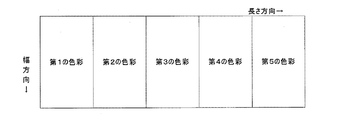
あるいは、漁網の製造者が、その製造段階において、漁業者の要望にもとづいて、図3に示すように水平方向すなわち漁網の長さ方向に沿ってその色彩を変えることが行われている。これは「パネリング」と称されている。この手法は、漁網を、機械による編網方向と同じ方向であるその長さ方向に沿って、その幅方向よりもはるかに長い寸法の所定の長さ切断し、切断されたそれぞれの漁網を別々に染色し、最後に手作業により縫製してこれらの漁網を繋ぎ合わせるものである。この場合に繋ぎ合わせの目数は一般に30目〜120目程度であり、したがってそれによる漁網のコストの上昇は、製品価格の数%程度となる。なお、図3では、理解の容易のために幅方向に比べて長さ方向の尺度が極端に圧縮されて表示されている。実際の漁網は、幅が2.5〜15m程度、長さが200〜1200m程度である。 Alternatively, a fishing net manufacturer changes its color in the horizontal direction, that is, along the length of the fishing net, as shown in FIG. This is called “paneling”. This technique cuts a fishing net along its length, which is the same direction as the machine's knitting net, with a length that is much longer than its width, and separates each cut fishing net separately. The fish nets are then joined together by sewing by hand. In this case, the number of stitches for joining is generally about 30 to 120, and therefore the increase in the cost of the fishing net is about several percent of the product price. In FIG. 3, the scale in the length direction is displayed in an extremely compressed manner compared to the width direction for easy understanding. The actual fishing net has a width of about 2.5 to 15 m and a length of about 200 to 1200 m.
漁網の部分部分においてその色彩を変えるための他の手法として、特許文献1に記載されたものがある。これは、漁網をその各部分ごとに色彩の異なる別の染料で染色するというもので、水深方向すなわち漁網の幅方向にも異なった呈色を施すことが可能である。このようにすると、漁網の長さ方向にのみ色彩を変化させる場合に比べて、さらなる漁獲の向上を期待することができる。
しかし、特許文献1の方法では、上述のように漁網をその各部分ごとに色彩の異なる別の染料で染色するため、その色彩の数だけ染色を行わなければならず、相当な手間である。また、色彩の数は別にしても、漁網をその各部分ごとに色彩の異なる別の染料で染色するという工程は、例えば連続して形成されている一枚の漁網から各部分を選択してその部分のみを染色に供する必要があり、同様に相当な手間である。 However, in the method of Patent Document 1, since the fishing net is dyed with different dyes having different colors for each part as described above, it is necessary to perform dyeing for the number of colors, which is a considerable labor. In addition, even if the number of colors is different, the process of dyeing a fishing net with another dye having a different color for each part is performed by, for example, selecting each part from a single continuous fishing net. Only that part needs to be used for dyeing, which is also a considerable effort.
そこで本発明は、簡単な手法によって、漁網に対し、特にその幅方向に沿った複数の部位において異なった色彩を付与できるようにすることを目的とする。 Therefore, an object of the present invention is to make it possible to give different colors to a fishing net by a simple method, particularly at a plurality of portions along the width direction.
この目的を達成するため本発明は、漁網の一部分と他の部分とを、異種の重合体または共重合比の異なる重合体によって構成されることで染色特性が異なるように構成された糸条によりそれぞれ形成したうえで、染料により前記漁網の一部分と他の部分とを一度に染色することで、前記一部分と他の部分とを異なった色彩または異なった色の濃さで染色するものである。
このようにすると、例えば、染料により漁網全体を一度に染色するだけで、漁網の一部分と他の部分とを異なる色彩または異なる濃淡で染色することができる。
In order to achieve this object, the present invention is based on a yarn configured to have different dyeing characteristics by constituting a part of a fishing net and another part with different polymers or polymers having different copolymerization ratios. After forming each, the part and the other part of the fishing net are dyed at once with the dye, so that the part and the other part are dyed with different colors or different color intensities .
In this way, for example, simply staining the entire fishing nets at once by the dye can stain one portion and the other portion of a fishing net in a different color or different shades.
したがって本発明によると、簡単な手法によって、漁網に、その各部位ごとに異なった色彩または異なった色の濃さを付与することができる。 Therefore, according to the present invention, it is possible to give a fishing net a different color or a different color intensity for each part by a simple method.
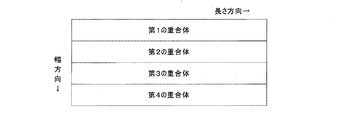
本発明の方法によって得られる漁網は、図1に示すように、その長さ方向すなわち使用時の水平方向のみならず、その幅方向すなわち使用時の水深方向にも、その部位ごとの色彩が変化したものとすることができる。長さ方向に沿った色彩の変化は、従来と同様に色彩の異なる漁網同士を縫製により繋ぎ合わせることにより、達成することができる。その場合のコストの上昇も、先に説明した従来の場合と同程度である。 As shown in FIG. 1, the fishing net obtained by the method of the present invention changes not only in its length direction, that is, in the horizontal direction during use, but also in its width direction, that is, in the direction of water depth during use. Can be. The change of the color along the length direction can be achieved by connecting fishing nets having different colors together by sewing as in the prior art. The increase in cost in that case is similar to that in the conventional case described above.
幅方向に沿った色彩の変化は、幅方向に沿った漁網の一部分および他の部分を、染色特性の異なる糸条によりそれぞれ形成したうえで、前記漁網を染色することにより、達成することができる。 The change in color along the width direction can be achieved by forming a part of the fishing net along the width direction and other parts with yarns having different dyeing characteristics and then dyeing the fishing net. .
本発明に用いる染色性の異なる糸条としては、以下のものが挙げられる。例えば、染色性の異なる糸条としては、異種の重合体によって構成される糸条が挙げられる。ナイロン糸としてはナイロン6からなる糸、ナイロン66からなる糸、ナイロン12からなる糸が挙げられる。 Examples of the yarn having different dyeability used in the present invention include the following. For example, examples of the yarn having different dyeability include a yarn composed of different polymers. Examples of the nylon thread include a thread made of nylon 6, a thread made of nylon 66, and a thread made of nylon 12.
また、共重合体からなる糸条を用いることによっても、その染色性を異ならせることができる。例えば、ナイロン6とナイロン66との共重合体からなる糸を用い、ナイロン6/ナイロン66との共重合比率を変えることによって、酸性染料や含金染料に対する染色特性に変化を付けることができる。すなわち、単一の酸性染料で染色したときに、ナイロン6/ナイロン66の共重合比率が異なる重合体からなる糸では、その比率の違いによって濃い色彩から淡い色彩に染色することができる。具体的には、ナイロン6/ナイロン66=95/5〜80/20といった比率のものを用いるとよい。この傾向は、共重合ナイロンの結晶化具合によって染色性が異なることによるものであると推察され、結晶化が高いものすなわちナイロン6/ナイロン66の共重合比率が95/5のものは淡く染まり、結晶化が低いものすなわちナイロン6/ナイロン66の共重合比率が80/20のものは濃く染まる。 Moreover, the dyeability can also be varied by using yarns made of a copolymer. For example, by using a yarn made of a copolymer of nylon 6 and nylon 66 and changing the copolymerization ratio of nylon 6 / nylon 66, it is possible to change the dyeing characteristics for acid dyes and metal-containing dyes. That is, when dyed with a single acidic dye, a yarn made of a polymer having a different copolymerization ratio of nylon 6 / nylon 66 can be dyed from a dark color to a light color depending on the difference in the ratio. Specifically, nylon 6 / nylon 66 = 95/5 to 80/20 may be used. This tendency is presumed to be due to the fact that the dyeability varies depending on the crystallization degree of the copolymer nylon. Those having low crystallization, that is, those having a copolymerization ratio of nylon 6 / nylon 66 of 80/20, are dyed deeply.
なお、上記した糸条を用いることで染色性の異なる網地を製造することが可能であるが、網地全体の構成上、極端に糸質の異なるものを用いることは好ましくない。特に編網後の熱セット工程や染色工程での受熱を考慮すると、収縮率の近いものを用いることが好ましい。 In addition, although it is possible to manufacture a net having different dyeability by using the above-described yarn, it is not preferable to use a yarn having extremely different yarn quality due to the overall configuration of the net. In particular, in consideration of heat reception in the heat setting step after the knitting net and in the dyeing step, it is preferable to use one having a close contraction rate.
漁網の幅方向に沿って色彩を変化させるための詳細な手法について説明する。すなわち、上に挙げた染色速度などの染色性の異なる複数種類の糸条、例えばナイロン糸を準備し、これらのナイロン糸を必要本数ごとに分けて編網機にて編網する。その結果、図2に示すような染色前の漁網が得られる。この漁網は、図示のように、その幅方向に沿って複数の部位に分かれることになり、各部位ごと異なった重合体、例えば異なった種類のナイロン糸で構成されたものとなる。 A detailed method for changing the color along the width direction of the fishing net will be described. That is, a plurality of types of yarns having different dyeing properties such as the dyeing speed mentioned above, for example, nylon yarns, are prepared, and these nylon yarns are divided into necessary numbers and knitted by a knitting machine. As a result, a fishing net before dyeing as shown in FIG. 2 is obtained. As shown in the figure, this fishing net is divided into a plurality of parts along the width direction, and is constituted by a different polymer for each part, for example, a different kind of nylon thread.
次に、この漁網を、例えばオーバーマイヤー染色機を用いて、単一の染料により染色する。すると、各種のナイロン糸の染色性つまり染色速度の相違によって、使用した染料の色彩系で各部位ごとに濃淡に着色された漁網、すなわち各部位ごとに色彩の異なった漁網が得られる。異なる染料を使用することで、その染料の色彩系によって濃淡に着色された複数種類の漁網を得ることができる。 The fishing net is then dyed with a single dye, for example using an Overmeyer dyeing machine. Then, depending on the dyeability of various nylon yarns, that is, the dyeing speed, fishing nets colored in different shades in the color system of the dyes used, that is, fishing nets having different colors in each portion are obtained. By using different dyes, it is possible to obtain a plurality of types of fishing nets colored in shades by the color system of the dyes.
得られた漁網は、そのままで使用しても良いし、あるいはその長さ方向に沿った所定長さごとに裁断して、図1に示すように色彩系の異なる複数種類のものを繋ぎ合わせて使用しても良い。 The obtained fishing net may be used as it is, or it is cut for each predetermined length along the length direction, and a plurality of types having different color systems are joined together as shown in FIG. May be used.
なお、図1では、漁網の幅方向に沿って各部位を平行に配置し、それぞれの部位が矩形状になるものを例示したが、これに限らず、各部位が任意の形状となるように構成することも可能である。 In addition, in FIG. 1, although arrange | positioning each part in parallel along the width direction of a fishing net and illustrating each part becoming a rectangular shape, not only this but each part becomes arbitrary shapes It is also possible to configure.
次に本発明の方法の優位性について説明する。
例えば、漁網の幅方向にも、染色後に、従来のパネリングの手法と同様の手法により手作業の縫製で繋ぎ合わせを行うことができる。しかし、その場合は、長さ方向に沿った少ない位置で繋ぎ合わせを行うパネリングの手法とは違って、漁網の長さ方向にわたった繋ぎ合わせが必要となり、このため具体的には3000目〜20000目もの目数を繋ぎ合わせることが必要になる。したがって、その製造コストが極端に増大し、例えば製造コストが従来製品の価格の数倍にも達すると算定することができる。このため現実には採用することができない手法である。
Next, the superiority of the method of the present invention will be described.
For example, also in the width direction of a fishing net, after dyeing, it can be joined by manual sewing by a technique similar to a conventional paneling technique. However, in this case, unlike the paneling method in which joining is performed at a small number of positions along the length direction, it is necessary to join the fishing nets in the length direction. It is necessary to connect 20,000 eyes. Therefore, it can be calculated that the manufacturing cost is extremely increased, for example, the manufacturing cost reaches several times the price of the conventional product. For this reason, it is a technique that cannot be adopted in reality.
また、例えば、特許文献1の記載の手法と同様に、漁網を幅方向の部位ごとに区分けし、その区分けされた部位ごとに別の染料で異なる色彩に染色することもできる。しかし、その場合は、少量ずつの網地を染色しなければならず、例えば一度の染色に約1時間を要するとすると、一つの漁網の染色に相当な時間を必要とすることになり、その分だけ製造コストが増大することになる。さらに、このような各部位ごとの染色は、上述したオーバーマイヤー染色機のような本格的な装置を用いて行うことができず、手作業で少量の部位ごとの染色を行わざるを得ず、したがって、その分の手間を要するとともに、海洋での魚労に耐える十分な染色堅牢度を得るのは困難である。 Further, for example, as in the technique described in Patent Document 1, the fishing net can be divided into parts in the width direction, and the divided parts can be dyed in different colors with different dyes. In that case, however, a small amount of net must be dyed. For example, if it takes about 1 hour to dye once, it will take a considerable amount of time to dye one fishing net. The manufacturing cost will increase by that amount. Furthermore, such dyeing for each part cannot be performed using a full-fledged device such as the above-mentioned Overmeier dyeing machine, and must be manually dyed for each small part, Therefore, it is difficult to obtain a sufficient dyeing fastness that can withstand the fisheries in the sea while requiring labor for that amount.
これに対し本発明の方法によれば、一種類の染料を用いただけの通常の染色方法で漁網の幅方向に沿って異なった色彩を施すことができる。このため、染色工程におけるコストを増大させることがなく、しかも通常の染色方法と同等の染色堅牢度を得ることができる。 On the other hand, according to the method of the present invention, different colors can be applied along the width direction of the fishing net by a normal dyeing method using only one kind of dye. For this reason, without increasing the cost in the dyeing process, it is possible to obtain the dyeing fastness equivalent to that of a normal dyeing method.
なお、本発明の漁網の製造方法においては、上記のようなナイロンすなわちポリアミド系の重合体を用いたもののみならず、互いの染色性を異ならせることができる重合体であれば、任意のものを利用することもできる。 In the method for producing a fishing net according to the present invention, not only those using the above-mentioned nylon, that is, polyamide-based polymers, but also any polymers can be used as long as the polymers can have different dyeing properties. Can also be used.
そして、漁網の幅方向の各部位ごとのみならず、その長さ方向の各部位ごとにも染色性の異なる重合体によって形成された糸を用いることで、同様に、長さ方向に色彩の異なる漁網を、一般的な縫製による繋ぎ合わせの手法とは異なる手法によって製造することができる。 And by using yarns formed of polymers having different dyeing properties not only for each part in the width direction of the fishing net but also for each part in the length direction, the colors are similarly different in the length direction. The fishing net can be manufactured by a method different from a general sewing method.
次に実施例について説明する。
(実施例1)
幅方向の網目の目数が60目である漁網を製造した。そのとき、漁網の幅方向の第1目〜第15目を構成する糸は、ナイロン6/ナイロン66の共重合比95/5の共重合ナイロンを用いた1.5号(約400dtex)のモノフィラメントを20本引きそろえて用いた。同様に、漁網の第16〜第30目を構成する糸は、ナイロン6/ナイロン66の共重合比90/10の共重合ナイロンを用いた1.5号のモノフィラメントを20本引きそろえて用い、漁網の第31〜45目を構成する糸は、ナイロン6/ナイロン66の共重合比85/15の共重合ナイロンを用いた1.5号のモノフィラメントを20本引きそろえて用い、漁網の第46〜60目を構成する糸は、ナイロン6/ナイロン66の共重合比80/20の共重合ナイロンを用いた1.5号のモノフィラメントを20本引きそろえて用いた。
Next, examples will be described.
Example 1
A fishing net having 60 meshes in the width direction was produced. At that time, the yarn constituting the first to fifteenth in the width direction of the fishing net was a monofilament of No. 1.5 (about 400 dtex) using a copolymer nylon of nylon 6 / nylon 66 with a copolymerization ratio of 95/5 20 were used together. Similarly, as the yarns constituting the 16th to 30th fishnets, 20 monofilaments of No. 1.5 using nylon 6 / nylon 66 copolymerization ratio 90/10 nylon are used, As the yarns constituting the 31st to 45th eyes of the fishing net, 20 No. 1.5 monofilaments using copolymerized nylon of nylon 6 / nylon 66 with a copolymerization ratio of 85/15 were used. As the yarn constituting the 60th mesh, 20 monofilaments of No. 1.5 using nylon 6 / nylon 66 copolymerized nylon having a copolymerization ratio of 80/20 were used.
これらの引きそろえモノフィラメントを用いて、1目の大きさが120mmであり、全幅寸法が7.2mの漁網を得た。 Using these aligned monofilaments, a fishing net having a first mesh size of 120 mm and a total width of 7.2 m was obtained.
このような漁網を長さ100mに裁断し、オーバーマイヤー染色機を用い、染料として、スミノールミリング グレー(商品名、住友化学社製の酸性染料)と、タオカダイスタッフラニール グレー(商品名、田岡化学工業社製の含金染料)とを混合したグレー系の染料を用いて、染色温度90℃、染色時間30分の条件で染色を行った。 Such a fishing net is cut into a length of 100 m, and using an Overmeier dyeing machine, Suminol Milling Gray (trade name, acid dye made by Sumitomo Chemical) and Taokadai Staffranyl Gray (trade name, Dyeing was performed using a gray dye mixed with a metal-containing dye manufactured by Taoka Chemical Co., Ltd. under conditions of a dyeing temperature of 90 ° C. and a dyeing time of 30 minutes.
これにより、全体としてグレー系に染色され、幅方向に沿った第1目〜第15目、第16目〜第30目、第31目〜第45目、第46目〜第60目の順に色彩が濃くなる漁網が得られた。 Thereby, it is dye | stained as a gray system as a whole, and it is a color in order of the 1st-15th eyes, the 16th-30th eyes, the 31st-45th eyes, the 46th-60th eyes along the width direction. A thickening fishing net was obtained.
(実施例2)
実施例1の漁網の第1目〜第15目を構成した糸を同様に第1目〜第15目に用い、実施例1の漁網の第46目〜第60目を構成した糸を第16目〜第30目に用い、実施例1の漁網の第31目〜第45目を構成した糸を同様に第31目〜第45目に用い、実施例1の漁網の第16目〜第30目を構成した糸を第46目〜第60目に用いて、漁網を編網した。そして、実施例1と同様にオーバーマイヤー染色機を用い、染料として、スミノールミリング グリーン(商品名、住友化学社製の酸性染料)と、タオカダイスタッフラニール グリーン(商品名、田岡化学工業社製の含金染料)とを混合したグリーン系の染料を用いて、染色温度90℃、染色時間30分の条件で染色を行った。
(Example 2)
Similarly, the first to fifteenth yarns of the fishing net of Example 1 are similarly used for the first to fifteenth yarns, and the 46th to 60th yarns of the fishing net of Example 1 are sixteenth. Threads constituting the 31st to 45th eyes of the fishing net of Example 1 are similarly used for the 31st to 45th eyes, and the 16th to 30th of the fishing net of Example 1 are used. The fishing nets were knitted using the yarns constituting the eyes for the 46th to 60th eyes. Then, using the Overmeier dyeing machine as in Example 1, Suminol Milling Green (trade name, acid dye made by Sumitomo Chemical Co., Ltd.) and Taokadai Stafflanil Green (trade name, Taoka Chemical Industry Co., Ltd.) Using a green dye mixed with a metal-containing dye), dyeing was performed under conditions of a dyeing temperature of 90 ° C. and a dyeing time of 30 minutes.
これにより、全体としてグリーン系に染色され、幅方向に沿った第1目〜第15目、第46目〜第60目、第31目〜第45目、第16目〜第30目の順に色彩が濃くなる漁網が得られた。 As a result, it is dyed green as a whole, and the colors in the order of the first eye to the fifteenth eye, the 46th to the 60th eye, the 31st to the 45th eye, and the 16th to the 30th eye along the width direction. A thickening fishing net was obtained.
(実施例3)
実施例1の漁網の第31目〜第45目を構成した糸を第1目〜第15目に用い、実施例1の漁網の第1目〜第15目を構成した糸を第16目〜第30目に用い、実施例1の漁網の第16目〜第30目を構成した糸を第31目〜第45目に用い、実施例1の漁網の第46目〜第60目を構成した糸を同様に第46目〜第60目に用いて、漁網を編網した。そして、実施例1と同様にオーバーマイヤー染色機を用い、染料として、スミノールミリング ブルー(商品名、住友化学社製の酸性染料)と、タオカダイスタッフラニール ブルー(商品名、田岡化学工業社製の含金染料)とを混合したブルー系の染料を用いて、染色温度90℃、染色時間30分の条件で染色を行った。
(Example 3)
Using the first to fifteenth yarns constituting the 31st to 45th fishing nets of the first example, using the sixteenth to fifteenth yarns constituting the first to fifteenth fishing nets of the first example. Using the thirteenth to the thirty-fifth threads of the fishing net of the first example, the thirty-first to thirty-fifth eyes of the first example of the fishing net of the first example were configured. The fishing net was knitted using the 46th to 60th yarns. Then, using the Overmeier dyeing machine as in Example 1, Suminol Milling Blue (trade name, acid dye made by Sumitomo Chemical Co., Ltd.) and Taokadai Staffranyl Blue (trade name, Taoka Chemical Industry Co., Ltd.) Dyeing was performed using a blue dye mixed with a metal-containing dye (manufactured metal dye) under the conditions of a dyeing temperature of 90 ° C. and a dyeing time of 30 minutes.
これにより、全体としてブルー系に染色され、幅方向に沿った第31目〜第45目、第1目〜第15目、第16目〜第30目、第46目〜第60目の順に色彩が濃くなる漁網が得られた。 As a result, it is dyed blue as a whole, and in the order of the 31st to 45th eyes, the 1st to 15th eyes, the 16th to 30th eyes, and the 46th to 60th eyes along the width direction. A thickening fishing net was obtained.
(実施例4)
得られた実施例1〜実施例3の漁網をそれぞれ長さ方向に100mになるように裁断し、その裁断したものを、縫製によりその長さ方向に繋ぎ合わせた。これにより、全幅7.2m、全長500mの漁網であって、長さ方向に沿って、100mごとに色彩系が変化し、かつ幅方向に沿って1.8mごとにそれぞれの色彩系の濃度が変化する漁網が得られた。
( Example 4 )
The obtained fishing nets of Examples 1 to 3 were each cut to be 100 m in the length direction, and the cut pieces were joined in the length direction by sewing. This is a fishing net with a total width of 7.2 m and a total length of 500 m, and the color system changes every 100 m along the length direction, and the density of each color system changes every 1.8 m along the width direction. A changing fishing net was obtained.
Claims (2)
Priority Applications (2)
| Application Number | Priority Date | Filing Date | Title |
|---|---|---|---|
| JP2008292873A JP5283486B2 (en) | 2008-11-17 | 2008-11-17 | Production method of fishing net |
| US12/411,763 US9295240B2 (en) | 2008-11-17 | 2009-03-26 | Method for producing fishing net and fishing net produced by the method |
Applications Claiming Priority (1)
| Application Number | Priority Date | Filing Date | Title |
|---|---|---|---|
| JP2008292873A JP5283486B2 (en) | 2008-11-17 | 2008-11-17 | Production method of fishing net |
Publications (2)
| Publication Number | Publication Date |
|---|---|
| JP2010119302A JP2010119302A (en) | 2010-06-03 |
| JP5283486B2 true JP5283486B2 (en) | 2013-09-04 |
Family
ID=42170903
Family Applications (1)
| Application Number | Title | Priority Date | Filing Date |
|---|---|---|---|
| JP2008292873A Active JP5283486B2 (en) | 2008-11-17 | 2008-11-17 | Production method of fishing net |
Country Status (2)
| Country | Link |
|---|---|
| US (1) | US9295240B2 (en) |
| JP (1) | JP5283486B2 (en) |
Families Citing this family (3)
| Publication number | Priority date | Publication date | Assignee | Title |
|---|---|---|---|---|
| EP1985176B1 (en) * | 2006-01-23 | 2014-02-26 | Yoz-Ami Corporation | Colored fishing line, and process for producing the same |
| JP2018068260A (en) * | 2016-11-04 | 2018-05-10 | 株式会社長浦製網所 | Method for manufacturing fishing net and method for dyeing fishing net |
| KR102720448B1 (en) * | 2021-12-16 | 2024-10-22 | 대일어망 주식회사 | Ring-linked doubled trawlnet |
Family Cites Families (28)
| Publication number | Priority date | Publication date | Assignee | Title |
|---|---|---|---|---|
| US2810229A (en) * | 1956-04-05 | 1957-10-22 | Shark Chaser Chemicals Company | Method of and means for controlling fish movements |
| US3416877A (en) * | 1963-05-08 | 1968-12-17 | Gaf Corp | Basic dye dyeing of polyacrylonitrile assisted by tributylphosphate and a phosphate ester of an ethylene oxide condensate |
| US3175319A (en) * | 1963-11-04 | 1965-03-30 | John T Gonsalves | Method of purse seining |
| US3493316A (en) * | 1966-05-09 | 1970-02-03 | Allied Chem | Dyed fiber products |
| US3622264A (en) * | 1968-06-13 | 1971-11-23 | Uniroyal Inc | Fiber blends of polyolefin with polyvinylpyridines of quinolines with and without a polyethylene oxide and acid and disperse dye variegated dyeing thereof |
| US3652198A (en) * | 1968-09-13 | 1972-03-28 | Uniroyal Inc | Mixture of filaments capable of being dyed to a multicolor pattern with anionic disperse dyes |
| JPS4933434Y1 (en) * | 1970-12-29 | 1974-09-09 | ||
| JPS4933434A (en) | 1972-07-20 | 1974-03-27 | ||
| JPS4998374U (en) * | 1972-12-21 | 1974-08-24 | ||
| US3879521A (en) | 1973-01-02 | 1975-04-22 | Diamond Shamrock Corp | Removal of SO{HD 2 {B from flue gas |
| US4218217A (en) * | 1974-04-01 | 1980-08-19 | Sandoz, Inc. | Method of producing multicolor dyeings |
| JPS51115180U (en) * | 1975-03-13 | 1976-09-18 | ||
| JPS5249187U (en) * | 1975-10-02 | 1977-04-07 | ||
| JPS5249187A (en) | 1975-10-14 | 1977-04-19 | Gunze Ltd | Film packing method |
| JPS5618065U (en) * | 1979-07-19 | 1981-02-17 | ||
| JPS5618065A (en) | 1979-07-25 | 1981-02-20 | Hitachi Ltd | Pressure responsive ignition time controller |
| NL7908515A (en) * | 1979-11-22 | 1981-06-16 | Anza Bv | METHOD FOR MAKING A BRAIDED ROPE, TWINE YARN OR KNITTED ROPE, RESPECTIVELY FOR MAKING A NETWORK FROM THE MATERIALS SPECIFIED, IN PARTICULAR A NETWORK INTENDED FOR FISHERIES. |
| DE3011710A1 (en) * | 1980-03-26 | 1981-10-01 | Bayer Ag, 5090 Leverkusen | METHOD FOR EQUIPING FISH NET |
| JPS58125977A (en) | 1982-01-22 | 1983-07-27 | Nec Corp | charge transfer imaging device |
| JPS58125977U (en) * | 1982-02-19 | 1983-08-26 | 片岡 善治郎 | fishing net |
| JPS59159268A (en) | 1983-02-28 | 1984-09-08 | Sumitomo Metal Ind Ltd | Method and device for plasma scarfing |
| JPS59159268U (en) * | 1983-04-12 | 1984-10-25 | 泰東製綱株式会社 | rod receiving net |
| JP2765080B2 (en) * | 1989-08-07 | 1998-06-11 | 東レ株式会社 | Fiber structure having rope or net-like shape |
| US5131914A (en) * | 1990-12-13 | 1992-07-21 | Hoechst Celanese Corporation | Process for preparing multi-colored dyed polyamide substrates including the application of a reactive vinyl sulfone dye and a resist agent |
| JP3138070B2 (en) * | 1992-07-10 | 2001-02-26 | 三菱化学株式会社 | Monofilament |
| US5647160A (en) * | 1995-10-12 | 1997-07-15 | Northwest International Development Corporation | Netting colored to induce fish to swim into net |
| US5819464A (en) * | 1998-01-26 | 1998-10-13 | Jovanovich; John | Condition-adaptable colored fishing net |
| JP3828779B2 (en) * | 2000-12-28 | 2006-10-04 | 富士写真フイルム株式会社 | Photosensitive material light shielding container and photosensitive material package using light shielding cloth pieces |
-
2008
- 2008-11-17 JP JP2008292873A patent/JP5283486B2/en active Active
-
2009
- 2009-03-26 US US12/411,763 patent/US9295240B2/en active Active
Also Published As
| Publication number | Publication date |
|---|---|
| JP2010119302A (en) | 2010-06-03 |
| US9295240B2 (en) | 2016-03-29 |
| US20100122486A1 (en) | 2010-05-20 |
Similar Documents
| Publication | Publication Date | Title |
|---|---|---|
| JP5283486B2 (en) | Production method of fishing net | |
| CN101328648B (en) | Reparing method of polyethylene twist netting for net box or purse net | |
| TW201509332A (en) | Industrial material fastener tape and slide fastener provided with same | |
| CN100546816C (en) | Repair method of warp-knitted mesh with rhombus mesh for fishing | |
| EP1941103A1 (en) | Artificial lawn, in particular an artificial grass sports field | |
| CN211631384U (en) | Novel sewing connection structure of metal netting | |
| US2253048A (en) | Fishing line | |
| JP4069322B2 (en) | Multicolor lace | |
| KR20150112780A (en) | Square mesh net for cockle seed form | |
| KR20200069599A (en) | Laver farming net and manufacturing method thereof | |
| CN101724976B (en) | Net mending method for hexagonal mesh net of trawl fishing gear or marine fishing cage | |
| KR101993196B1 (en) | Raschel knit net | |
| JPH01321957A (en) | Fishnet | |
| JP2018068260A (en) | Method for manufacturing fishing net and method for dyeing fishing net | |
| JP7602305B1 (en) | Fishing line manufacturing method, fishing line and fishing line evaluation method | |
| CN109056180B (en) | A warp knitting process of louver fabric | |
| CN106436006B (en) | A kind of big-holed net ring type tubercle and its assemble method | |
| JP5913674B1 (en) | Simulated bait using micro optical film and method for producing the same | |
| JPS61224920A (en) | Twine and net cloth for fishing net and gill net | |
| CN212728507U (en) | Novel string hook capable of quickly changing sub-line | |
| JP2004218167A (en) | Method for pattern-dyeing yarn like material and conjugated yarn like material used for the same | |
| JPH03244334A (en) | Fishing-line | |
| JP2021036081A (en) | Heat-adhesive fiber and thermoformed body using the same fiber | |
| CN114775075B (en) | Preparation method of isosceles right triangle deep-open sea culture protection net | |
| JPS61199738A (en) | Twine and net cloth for fishing net and gill net |
Legal Events
| Date | Code | Title | Description |
|---|---|---|---|
| A621 | Written request for application examination |
Free format text: JAPANESE INTERMEDIATE CODE: A621 Effective date: 20111108 |
|
| A977 | Report on retrieval |
Free format text: JAPANESE INTERMEDIATE CODE: A971007 Effective date: 20121227 |
|
| A131 | Notification of reasons for refusal |
Free format text: JAPANESE INTERMEDIATE CODE: A131 Effective date: 20130205 |
|
| A521 | Request for written amendment filed |
Free format text: JAPANESE INTERMEDIATE CODE: A523 Effective date: 20130408 |
|
| TRDD | Decision of grant or rejection written | ||
| A01 | Written decision to grant a patent or to grant a registration (utility model) |
Free format text: JAPANESE INTERMEDIATE CODE: A01 Effective date: 20130430 |
|
| A61 | First payment of annual fees (during grant procedure) |
Free format text: JAPANESE INTERMEDIATE CODE: A61 Effective date: 20130528 |
|
| R150 | Certificate of patent or registration of utility model |
Ref document number: 5283486 Country of ref document: JP Free format text: JAPANESE INTERMEDIATE CODE: R150 |
|
| R250 | Receipt of annual fees |
Free format text: JAPANESE INTERMEDIATE CODE: R250 |
|
| R250 | Receipt of annual fees |
Free format text: JAPANESE INTERMEDIATE CODE: R250 |
|
| R250 | Receipt of annual fees |
Free format text: JAPANESE INTERMEDIATE CODE: R250 |
|
| R250 | Receipt of annual fees |
Free format text: JAPANESE INTERMEDIATE CODE: R250 |
|
| R250 | Receipt of annual fees |
Free format text: JAPANESE INTERMEDIATE CODE: R250 |
|
| R250 | Receipt of annual fees |
Free format text: JAPANESE INTERMEDIATE CODE: R250 |
|
| R250 | Receipt of annual fees |
Free format text: JAPANESE INTERMEDIATE CODE: R250 |
|
| R250 | Receipt of annual fees |
Free format text: JAPANESE INTERMEDIATE CODE: R250 |
|
| R250 | Receipt of annual fees |
Free format text: JAPANESE INTERMEDIATE CODE: R250 |
|
| S531 | Written request for registration of change of domicile |
Free format text: JAPANESE INTERMEDIATE CODE: R313531 |
|
| R350 | Written notification of registration of transfer |
Free format text: JAPANESE INTERMEDIATE CODE: R350 |
|
| R250 | Receipt of annual fees |
Free format text: JAPANESE INTERMEDIATE CODE: R250 |