JP5259102B2 - Low lead bronze casting alloy - Google Patents
Low lead bronze casting alloy Download PDFInfo
- Publication number
- JP5259102B2 JP5259102B2 JP2007047233A JP2007047233A JP5259102B2 JP 5259102 B2 JP5259102 B2 JP 5259102B2 JP 2007047233 A JP2007047233 A JP 2007047233A JP 2007047233 A JP2007047233 A JP 2007047233A JP 5259102 B2 JP5259102 B2 JP 5259102B2
- Authority
- JP
- Japan
- Prior art keywords
- casting
- mass
- alloy
- tensile strength
- content
- Prior art date
- Legal status (The legal status is an assumption and is not a legal conclusion. Google has not performed a legal analysis and makes no representation as to the accuracy of the status listed.)
- Active
Links
Images







Landscapes
- Continuous Casting (AREA)
Description
本発明は、給水・給湯用や蒸気用のバルブ或は継手などの配管器材、シリンダやケーシング等の圧力器材或は構造部材等にも適する青銅鋳物合金で、特に、高温下における引張強さを改善し、鋳物の健全性にも寄与した低鉛青銅鋳物合金に関する。 The present invention is a bronze cast alloy suitable for piping equipment such as valves or joints for water supply / hot water supply and steam, pressure equipment such as cylinders and casings, or structural members, and in particular, has a tensile strength at high temperatures. The present invention relates to a low lead bronze casting alloy that has improved and contributed to the soundness of castings.
青銅鋳物(JIS H5120 CAC406)は、通常、鋳造性、耐食性、被削性、耐圧性に優れており、バルブ、コック、継手等の給水・給湯用や蒸気用の配管器材などにも多く用いられている。この青銅鋳物(CAC406)は、数%のPb(鉛)を含有しており、特に、被削性や耐圧性の向上に寄与している。ところが、昨今、低濃度のPbでも人体に悪影響を及ぼすとして、水道水中へのPb浸出規制や、土壌汚染を防止すべく、Pb含有廃棄物の排出規制、更には使用材料中のPb含有規制など、世界的にも各方面から厳しく規制されつつある。このような状況に基づいて、新たに有用な鉛レス銅合金の開発が急務となり、そのなかで、Bi系、Bi-Sb系、Bi-Se系などの各種の材料が開発されている。 Bronze castings (JIS H5120 CAC406) are usually excellent in castability, corrosion resistance, machinability, and pressure resistance, and are often used for water supply and hot water supply such as valves, cocks and joints, and piping equipment for steam. ing. This bronze casting (CAC406) contains several percent of Pb (lead), and particularly contributes to improvement of machinability and pressure resistance. However, recently, even if low concentration of Pb has an adverse effect on the human body, regulation of Pb leaching into tap water, discharge regulation of Pb-containing wastes, and regulation of Pb content in materials used to prevent soil contamination, etc. Globally, it is being strictly regulated from various directions. Based on such a situation, development of a new useful lead-free copper alloy has become an urgent task, and various materials such as Bi-based, Bi-Sb-based, and Bi-Se-based materials have been developed.
例えば、特許文献1には、銅合金中の鉛に代えてBiを添加して切削性を上げ、脱亜鉛を防止した鉛レス銅合金が開示されており、特許文献2には、切削性向上のためのBi添加による鋳造時のポロシティ発生をSbの添加により抑制し、機械的強度を上げた無鉛青銅が開示されている。また、特許文献3には、SeとBiの添加により、特にZn-Se化合物を析出させ、機械的性質及び切削性や鋳造性をCAC406と実質同等とした青銅合金が開示されている。
また、特許文献4には、鉛の含有量を微量に抑えてSn、Ni、Zn、Bi、P等を含有し、機械的性質や鋳造性などを従来の鉛使用銅合金と同程度に維持した水道用部材が開示されている。
For example,
上記特許文献のように、Pbの代替成分として、Biを添加した青銅系低鉛合金において、微量のPbを含有している場合、鋳物材料が100℃を超えるような高温下に曝されると、機械的性質、とりわけ引張強さが低下するおそれがある。これは、Cuに固溶しないBi及びPbが低融点のBi-Pb2元系共晶物として結晶粒界、及び結晶粒内に存在し、ここが高温下において局部的に弱い部分となり、引張強さを低下させることが一因と考えられている。これらの現象はBiが添加された材料であれば、Bi系、Bi-Sb系、Bi-Se系などの各種の材料で同様の傾向が見られる。 As in the above-mentioned patent document, when a small amount of Pb is contained in a bronze-based low lead alloy to which Bi is added as an alternative component of Pb, the casting material is exposed to a high temperature exceeding 100 ° C. The mechanical properties, particularly the tensile strength, may be reduced. This is because Bi and Pb, which do not form a solid solution in Cu, exist as a low melting point Bi—Pb binary eutectic in the grain boundaries and in the crystal grains, which are locally weak at high temperatures, It is thought that one of the causes is to reduce the thickness. The same tendency is observed in various materials such as Bi-based, Bi-Sb-based, and Bi-Se-based materials as long as Bi is added to these phenomena.
特許文献4において、高濃度のNiの含有は、合金の押湯による効果を過剰に高め、鋳物の中心引けや堰前の引けを助長することになる。そのため、多数個取りの大量生産型の型方案を用いることが多い比較的小型の鋳物部品では、実質有効な押湯を取付けることが困難なため、過剰なNiの添加は鋳物の健全性を確保する上で逆効果を招きかねない。
In
また、本件出願人は、先に出願したPCT/JP2004/4757のなかで、合金中にTeを含有させて、高温下での機械的性質の向上を実現させる技術を提案している。しかし、蒸気用バルブ等に用いる青銅鋳物では、180℃程度の高温下においても所定の引張強さを必要とするため、高温下における引張強さの更なる改善と、汎用的な成分をより多く用いるなど量産性の改善が求められていた。 In addition, the present applicant has proposed a technique for realizing improvement in mechanical properties at high temperatures by containing Te in an alloy in PCT / JP2004 / 4757 filed earlier. However, bronze castings used for steam valves and the like require a predetermined tensile strength even at a high temperature of about 180 ° C. Therefore, further improvement in tensile strength at a high temperature and more general-purpose components Improvements in mass productivity such as use were demanded.
また、上記Bi-Pb2元系共晶物の生成を抑制し、高温化における引張強さを改善する技術として、Pbの含有量を0に近づける超低減技術が考えられる。しかし、鉛レス銅合金は、その量産時において、従来のCAC406の製造と鋳造設備を共用して製造しているところが多く、このような場合、炉や取鍋等からのPbの混入が考えられる。また、鉛レス銅合金は、コスト及び環境に配慮してスクラップ等のリサイクル材や、リサイクル材からなるインゴットを用いて製造されているが、これらの材料には不可避不純物としてのPbが混入していることから、例え鉛レス銅合金専用の鋳造設備を用いたとしても、鉛レス銅合金へのPbの混入が避けられない。従って、上記鉛レス銅合金は、鉛レスと言えども0.25質量%以下(JIS B 2011に規定の鉛レス青銅弁)のPbの含有を許容しているのが現状であり、量産性、コスト面からも、Pbの含有量を0に近づけるという超低減技術は現実的でない。 Further, as a technique for suppressing the formation of the Bi—Pb binary eutectic and improving the tensile strength at high temperatures, an ultra-reduction technique for bringing the Pb content close to 0 can be considered. However, many leadless copper alloys are manufactured in common with the production of the conventional CAC406 and the casting equipment during mass production. In such a case, it is considered that Pb is mixed from a furnace or a ladle. . Lead-free copper alloys are manufactured using recycled materials such as scrap and ingots made of recycled materials in consideration of cost and the environment, but these materials contain Pb as an inevitable impurity. For this reason, even if casting equipment dedicated to lead-free copper alloys is used, it is unavoidable that Pb is mixed into the lead-less copper alloy. Therefore, the lead-free copper alloy is allowed to contain Pb in an amount of 0.25% by mass or less (lead-free bronze valve as defined in JIS B 2011) even though it is lead-free. In terms of cost, an ultra-reduction technique that brings the Pb content close to 0 is not practical.
一方、Bi含有の鉛レス青銅合金において、低Pbを不可避不純物として含有を許容した上で、この合金中に高濃度のPを添加して高温下の引張特性を改善するようにした技術が知られており、引張特性を向上する上で特に有効な技術として注目されている。
しかし、高濃度のPの含有は、溶解雰囲気からのガス吸収や鋳型に含まれる水分との反応により、水素などの有害ガスを吸収し、凝固の際にこれが放出されて鋳物内部に気泡などのガス欠陥を発生させることがある。これにより、鋳物内部に巣を発生させる可能性が高くなっている。また、高濃度のPの含有は、合金の固相線温度を低下させることに繋がるため、凝固中における鋳型との反応時間が更に長くなり、ガス吸収をさらに助長して水素ガス放出の影響と相まって溶質の偏析を助長する場合もある。さらに、材料凝固時におけるマッシー型の凝固傾向が強くなることでデンドライトが発達し、このデンドライト間隙への溶湯の補給が阻害されたり収縮巣へのBiなどの補給も妨げられて、特に、厚肉鋳物や偏肉鋳物などの健全性を確保することが難しい。
On the other hand, there is a known technique in which a Bi-containing leadless bronze alloy is allowed to contain low Pb as an unavoidable impurity, and a high concentration of P is added to the alloy to improve tensile properties at high temperatures. Therefore, it is attracting attention as a particularly effective technique for improving tensile properties.
However, the inclusion of high concentration of P absorbs harmful gases such as hydrogen due to gas absorption from the melting atmosphere and reaction with moisture contained in the mold, and is released during solidification to cause bubbles and the like inside the casting. May cause gas defects. Thereby, possibility that a nest will be generated inside a casting is high. In addition, since the inclusion of a high concentration of P leads to a decrease in the solidus temperature of the alloy, the reaction time with the mold during solidification is further prolonged, further promoting gas absorption and the influence of hydrogen gas release. In combination, solute segregation may be promoted. Furthermore, the dendrite develops due to the strong tendency of solidification of the massey type at the time of solidification of the material, which prevents the supply of molten metal to the gap between the dendrites and prevents the supply of Bi or the like to the shrinkage nest. It is difficult to ensure the soundness of castings and uneven castings.
このため、高濃度Pを含有したときに、P含有による悪影響を抑制するようにした手段として、次のようなものがある。イ.鋳造時における冷却速度を速めて鋳型からのガス吸収を抑制し、ガスの発生や偏析を抑制する。ロ.製品の厚肉化を避け、鋳物の凝固時間を短くする。ハ.溶解雰囲気を弱酸化性とし、ガスの吸収を抑制する。ニ.注湯温度を下げる。ホ.鋳型を塗型する。 For this reason, there are the following means as means for suppressing the adverse effects caused by P inclusion when high concentration P is contained. A. The cooling rate during casting is increased to suppress gas absorption from the mold, thereby suppressing gas generation and segregation. B. Avoid product thickening and shorten casting solidification time. C. The melting atmosphere is weakly oxidizable and suppresses gas absorption. D. Reduce pouring temperature. E. Paint the mold.
しかし、何れの抑制手段にも以下のような問題がある。すなわち、イに関しては、砂型で生産する場合には大幅な冷却速度の向上は難しい。ロは、製品の強度等の制約があるため、薄肉化が難しい場合が多い。また、ハ及びニについては、実施は可能ではあるが、これらを最適化しても鋳物としての健全性を確保することが難しくなる場合がある。ホは、ある程度の効果を得ることはできるが、生産性が低くなり、コストの面でも不利となる問題が発生する。このように、合金中にPを含有させた場合には引張特性を向上させることはできるが、このPの含有によって新たな悪影響が生じ、これを解決することは難しい。このため、従来においては、実際にはPを含有させて引張強さを向上する場合、このPの含有量を抑制する以外に有効な手段が無く、Pの含有量を少なくするとこのP含有による引張特性の向上が十分に発揮できない。 However, each suppression means has the following problems. That is, with respect to a, it is difficult to significantly improve the cooling rate when producing with a sand mold. There are many cases where it is difficult to reduce the thickness of b. Although c and d can be implemented, it may be difficult to ensure soundness as a casting even if they are optimized. Although e can achieve a certain degree of effect, there is a problem that productivity is lowered and disadvantageous in terms of cost. As described above, when P is contained in the alloy, the tensile properties can be improved. However, the inclusion of P causes a new adverse effect, which is difficult to solve. Therefore, in the past, when the tensile strength is improved by actually containing P, there is no effective means other than suppressing the P content, and if the P content is reduced, the P content is reduced. Tensile properties cannot be improved sufficiently.
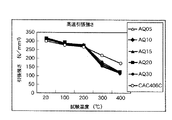
ここで、一般に青銅系合金の高温下における引張強さに関して、青銅系合金製の砂型鋳物では、高温下での引張強さに低下が見られるが、例えば、表1に示す連続鋳造鋳物(約φ28mm)は、100℃〜200℃位までの高温下においても引張強さは低下しないことが経験的に知られている(図23参照:「鉛フリー銅合金鋳物の生産技術と適用事例」、財団法人素形材センター、平成16年10月15日発行、P35,37より引用)。しかし、これらの現象について、他の鋳物径や鋳造方法(例:金型鋳造)にわたって定量的に把握したものはない。
Here, regarding the tensile strength at a high temperature of a bronze-based alloy, in a sand-type casting made of a bronze-based alloy, there is a decrease in the tensile strength at a high temperature. For example, a continuous cast casting (about approx. φ28 mm) is empirically known that tensile strength does not decrease even at high temperatures from about 100 ° C. to 200 ° C. (see FIG. 23: “Production technology and application examples of lead-free copper alloy castings”), (Source: Foundation Materials Center, issued October 15, 2004, quoted from

このため、例えば、砂型鋳造等の鋳造によって合金を設ける場合において、特に、高温特性を向上させるために、Pを高含有させることを前提としたBiを含有する青銅系低鉛合金において、Pによる鋳物の健全性への悪影響を抑制するために定量的に把握することが求められている。 For this reason, for example, in the case where an alloy is provided by casting such as sand mold casting, particularly in a bronze-based low lead alloy containing Bi on the premise that P is highly contained in order to improve high temperature characteristics, It is required to grasp quantitatively in order to suppress the adverse effect on the soundness of the casting.
本発明は、上記の課題点に鑑みて鋭意研究の結果開発に至ったものであり、その目的とするところは、高温特性を向上させるため、Pを高含有させることを前提としたBiを含有する青銅系の低鉛合金において、Pによる鋳物の健全性への悪影響を抑制する有効かつ新たな手法の開発が求められ、もって、高温下における引張強さを改善しつつ鋳物の健全性を確保し、量産性に優れた鉛レスの青銅鋳物合金を提供することにある。 The present invention has been developed as a result of diligent research in view of the above-mentioned problems, and its object is to contain Bi on the premise that P is highly contained in order to improve high temperature characteristics. In the bronze-based low lead alloy, the development of an effective and new method to suppress the adverse effects of cast iron on the soundness of castings is required, so that the soundness of castings is ensured while improving the tensile strength at high temperatures. Another object of the present invention is to provide a leadless bronze cast alloy that is excellent in mass productivity.
上記の目的を達成するため、請求項1に係る発明は、質量比で、Zn:3.0〜10.0%、Sn:2.0〜6.0%、Bi:0.1〜0.3%、P:0.16〜0.6%、Ni:0.1〜1.0%、Pb:0.005〜2.0%と残部Cuと不可避不純物からなる青銅鋳物合金であり、前記PとNiとの交互作用により固相線温度を上げ、過度のマッシー型凝固を緩和させ、溶質の偏析を抑制することにより鋳物の健全性を確保した低鉛青銅鋳物合金である。
In order to achieve the above object, the invention according to
請求項2に係る発明は、質量比で、Zn:3.0〜10.0%、Sn:2.0〜6.0%、Bi:0.1〜0.3%、P:0.16〜0.6%、Ni:0.1〜1.0%、Pb:0.005〜2.0%と残部Cuと不可避不純物からなる青銅鋳物合金であり、PとNiとの交互作用によりPの活性を低下させ、溶湯と鋳型との反応に対する感受性を緩和して鋳物の健全性を確保した低鉛青銅鋳物合金である。
すなわち、高濃度のPの含有は、溶解雰囲気や鋳型の水分との反応により、鋳物内部にガス欠陥を発生させる。Niの含有は、Pの活性を抑制することにより、擬似的にPの含有量を抑制するのと同様の効果を有する。また、Niの効果は、上記のように合金の押湯効果を高めることから、指向性凝固の傾向が強まり、発生したガスを押湯部に濃化させる効果もあり、これら両者の作用で鋳物の健全性を確保する。
The invention according to claim 2 is, by mass ratio, Zn: 3.0 to 10.0%, Sn: 2.0 to 6.0%, Bi: 0.1 to 0.3 %, P: 0.16. ~ 0.6%, Ni: 0.1 to 1.0%, Pb: 0.005 to 2.0%, balance bronze cast alloy consisting of Cu and unavoidable impurities, P and Ni interact with P It is a low lead bronze casting alloy that reduces the activity of the steel and relaxes the sensitivity to the reaction between the molten metal and the mold to ensure the soundness of the casting.
That is, the inclusion of a high concentration of P causes a gas defect in the casting due to a reaction with the melting atmosphere or the moisture of the mold. The content of Ni has the same effect as suppressing the P content in a pseudo manner by suppressing the activity of P. In addition, since the effect of Ni enhances the feeder effect of the alloy as described above, the tendency of directional solidification is strengthened, and there is also an effect of concentrating the generated gas in the feeder part. Ensure the soundness of
請求項3に係る発明は、さらに質量比で0.0<Se≦0.35%を含有した低鉛青銅鋳物合金である。
The invention according to claim 3 is a low lead bronze cast alloy further containing 0.0 <Se ≦ 0.35 % by mass ratio.
請求項7に係る発明は、Pb:0.005〜2.0質量%の混入を許容した鉛レス青銅鋳物合金である。 The invention according to claim 7 is a lead-free bronze cast alloy that allows mixing of Pb: 0.005 to 2.0 mass%.
請求項1に係る発明によると、Pを含有させることで高温下において引張特性を大きく改善させながら、Pを含有することによる悪影響を抑制でき、固相線温度を上げ、過度のマッシー型凝固を緩和させ、溶質の偏析を抑制することにより押湯効果を改善し、押湯系方案への適用を高め、鋳物の健全性を確保することができる低鉛青銅鋳物合金を提供できる。また、鉛を低減した鋳物合金であることにより、人体への悪影響を回避しつつリサイクルなどの環境保護の推進に寄与したり、更には、量産性とコスト面にも優れた低鉛青銅鋳物合金である。従来の低鉛銅合金では、主に使用温度100℃以下の給水・給湯用器具での適用に限定されるものであったが、高温下における引張強さを改善した本発明合金は、使用用途を限定することなく、従来の青銅合金の適用用途全般に展開できる。しかも、リサイクル材料としての使用範囲が拡大し、環境保護は勿論のこと、コスト面にも優れた効果を発揮する。特に、砂型鋳造品など、鋳造時における冷却速度が遅い合金に好適であり、高温下(約180℃)における引張強さ152MPaを必要とする合金に最適である。さらには、ある程度のPbを不可避不純物として許容することができ、この場合、合金の180℃における引張強さを、例えば、152MPaに確保することで、Pbの含有量に影響されることなく、高温下においても、優れた引張強さを確保することができる。これにより、その量産時において、従来のCAC406の製造と鋳造設備を共用して製造する場合において、その炉や取鍋等からのPbの混入に影響されることはなく、また、スクラップやスクラップを用いたインゴットなどのリサイクル材を用いて製造する場合にあっても、不可避不純物としてのPbの混入に影響されることはなく、高温下での引張強さは確保される。
また、Niを主要成分として含有し、P−Ni交互作用を得ることにより、Pの含有量を抑制しつつ、高温下(約180℃)における引張強さ152MPaを有する合金であり、Niの含有による引張強さの向上作用を得ることができた。例えば、JIS B 8270「圧力容器の構造」において、CAC406の200℃での基本許容応力値は38MPaと規定されているが、この規定値の4倍にあたる、152MPaを高温下においても確保することができる。Pは過剰に含有すると、鋳物の健全性が低下する傾向にあるが、P−Ni交互作用により、Pの含有量が少なくとも高温下における引張強さが確保できるので、鋳物の健全性も十分に確保することができ、バルブ等の耐圧容器に好適な合金を得ることができる。
According to the invention of
Further, it is an alloy containing Ni as a main component and having a tensile strength of 152 MPa at a high temperature (about 180 ° C.) while suppressing the P content by obtaining a P—Ni interaction, and containing Ni. It was possible to obtain an effect of improving the tensile strength by. For example, in JIS B 8270 “Structure of pressure vessel”, the basic allowable stress value of CAC406 at 200 ° C. is defined as 38 MPa, but it is possible to secure 152 MPa, which is four times the specified value, even at high temperatures. it can. When P is contained excessively, the soundness of the casting tends to be lowered. However, the P-Ni interaction can ensure the tensile strength at least under high temperature by the P-Ni interaction. An alloy suitable for a pressure vessel such as a valve can be obtained.
請求項2に係る発明によると、Pを含有させることで高温下において引張特性を大きく改善させながら、Pを含有することによる悪影響を抑制でき、Pの活性を低下させることで、溶解雰囲気からのガス吸収や鋳型の水分や有機物との反応を抑制し、鋳物の健全性を高めて、耐圧性や機械的性質も改善できる低鉛青銅鋳物合金を提供できる。また、鉛を低減した鋳物合金であることにより、人体への悪影響を回避しつつリサイクルなどの環境保護の推進に寄与したり、更には、量産性とコスト面にも優れた低鉛青銅鋳物合金である。従来の低鉛銅合金では、主に使用温度100℃以下の給水・給湯用器具での適用に限定されるものであったが、高温下における引張強さを改善した本発明合金は、使用用途を限定することなく、従来の青銅合金の適用用途全般に展開できる。しかも、リサイクル材料としての使用範囲が拡大し、環境保護は勿論のこと、コスト面にも優れた効果を発揮する。特に、砂型鋳造品など、鋳造時における冷却速度が遅い合金に好適であり、高温下(約180℃)における引張強さ152MPaを必要とする合金に最適である。 According to the invention of claim 2, by containing P, the tensile properties can be greatly improved at high temperatures, while the adverse effects caused by containing P can be suppressed, and by reducing the activity of P, it is possible to remove from the dissolved atmosphere. It is possible to provide a low lead bronze cast alloy that can suppress gas absorption and reaction with moisture and organic matter in the mold, improve the soundness of the casting, and improve pressure resistance and mechanical properties. In addition, the lead-free cast alloy contributes to the promotion of environmental protection such as recycling while avoiding adverse effects on the human body. Furthermore, it is a low-lead bronze cast alloy that is excellent in mass productivity and cost. It is. The conventional low lead copper alloy is mainly limited to use in water supply and hot water supply equipment with a use temperature of 100 ° C. or less, but the alloy of the present invention with improved tensile strength under high temperature Without being limited, the present invention can be applied to all applications of conventional bronze alloys. In addition, the range of use as a recycled material is expanded, and an excellent effect is shown in terms of cost as well as environmental protection. In particular, it is suitable for an alloy having a slow cooling rate at the time of casting, such as a sand mold casting, and is suitable for an alloy that requires a tensile strength of 152 MPa at a high temperature (about 180 ° C.).
しかも、Pを低濃度から高濃度で含有させることができ、高濃度により含有させた場合でも、Niを所定量含有させることで合金中への巣の発生や溶質の偏析等を防いで合金が厚肉鋳物や偏肉鋳物の場合にも健全性を確保できる低鉛青銅鋳物合金である。また、Niの含有量を調節して押湯系とばり堰系の方案に対応することができ、Niを高含有した場合には押湯系方案を効果的に配することで健全な鋳物が得られ、一方、Niの含有量を低く抑えることで、ばり堰方案を採用した場合に堰引けや中心引け、さらには外引けなどの発生を防ぐことができる。 Moreover , P can be contained at a low concentration to a high concentration, and even when it is contained at a high concentration, the alloy can be formed by preventing the formation of nests in the alloy and segregation of solutes by containing a predetermined amount of Ni. It is a low lead bronze casting alloy that can ensure soundness even in the case of thick castings and uneven castings. Moreover, the content of Ni can be adjusted to cope with the hot water system and the flash weir system, and when the Ni content is high, a healthy casting can be obtained by effectively arranging the hot water system. On the other hand, by keeping the Ni content low, it is possible to prevent the occurrence of weiring, centering, and even outer shrinkage when the flash weir method is adopted.
また、ばり堰方案によって鋳物を設けることができるため鋳物の健全性が高まると共に、鋳物表面の肌荒れを少なくして精度の高い鋳物を得ることができ、また、歩留まりが高まってコストを抑えることができる低鉛青銅鋳物合金である。 In addition , since the casting can be provided by the flash weir method, the soundness of the casting can be improved, the surface roughness of the casting can be reduced, and a highly accurate casting can be obtained, and the yield can be increased and the cost can be reduced. This is a low lead bronze casting alloy.
さらには、Ni−P系金属間化合物の生成を抑制できることで、合金の常温及び高温伸びを確保して引張特性を高めることができる低鉛青銅鋳物合金である。 Furthermore , it is a low lead bronze cast alloy that can suppress the formation of Ni-P intermetallic compound and thereby ensure the normal temperature and high temperature elongation of the alloy and enhance the tensile properties.
請求項3に係る発明によると、Seを主要成分として含有し、Biの含有量を抑制しつつ、高温下(約180℃)における引張強さ152MPaを有する低鉛青銅鋳物合金を提供できる。また、Seは、合金中に、Se−Zn、Cu−Seの金属間化合物として存在するから、Biの含有量を抑えつつ、引張強さや鋳物の健全性の確保に有効であり、バルブ等の耐圧容器に好適な合金を得ることができる。 According to the invention of claim 3 , it is possible to provide a low lead bronze cast alloy having a tensile strength of 152 MPa at a high temperature (about 180 ° C.) while containing Se as a main component and suppressing the Bi content. In addition, since Se exists as an intermetallic compound of Se—Zn and Cu—Se in the alloy, it is effective in securing tensile strength and soundness of castings while suppressing the Bi content. An alloy suitable for a pressure vessel can be obtained.
本発明に係る青銅鋳物合金は、低Pbが混入することを許容し、少なくともBiとPを含有し、鋳物材料中にPを高濃度に含有させることにより高温下での引張強さを改善した青銅鋳物合金において、Niを含有させることにより、PとNiとの交互作用により固相線温度を上げ、過度のマッシー型凝固を緩和させ、溶質の偏析を抑制することにより押湯効果を改善し、押湯系方案への適用を高め、鋳物の健全性を確保した。 The bronze casting alloy according to the present invention allows low Pb to be mixed, contains at least Bi and P, and improves the tensile strength at high temperatures by containing P in a high concentration in the casting material. In the bronze casting alloy, by containing Ni, the solidus temperature is raised by the interaction of P and Ni, the excessive massy-type solidification is alleviated, and the segregation of the solute is suppressed, thereby improving the hot metal effect. In addition, the application to the feeder system has been improved and the soundness of castings has been secured.
Biを含有する鉛レス青銅合金では、押湯の効きが従来のPbを含有するCAC406などよりも小さいと経験的に知られており、鋳造条件によっては合金内部にポロシティが多く発生する場合がある。これを改善する方法として、押湯効果を高めて鋳物の健全性を確保するか、ポロシティを分散させて鋳物の健全性を確保するかの2通りが考えられる。Niは押湯効果を高めることで鋳物の健全性を高めるが、実質有効な押湯を取付けることが出来ない場合には、逆に鋳物の中心引けや堰部の引け、さらには外引けを助長する傾向にあるので注意する必要がある。 A lead-free bronze alloy containing Bi is empirically known that the effectiveness of the feeder is smaller than that of the conventional CAC406 containing Pb, etc. Depending on the casting conditions, a lot of porosity may be generated inside the alloy. . As a method for improving this, there are two ways of enhancing the feeder effect and ensuring the soundness of the casting, or dispersing the porosity to ensure the soundness of the casting. Ni improves the soundness of the casting by enhancing the feeder effect. However, if a practically effective feeder cannot be installed, conversely, the center of the casting and the weir part are retracted, and further the outer contraction is promoted. It is necessary to be careful because it tends to be.
また、本発明に係る鉛レス青銅鋳物合金は、低Pbが混入することを許容し、少なくともBiと高濃度のPを含有する青銅鋳物合金において、Niを含有させてPの活性を低下させ、溶湯と鋳型との反応に対する感受性を緩和して鋳物の健全性を確保した。
これらにより、例えば、二次デンドライトアーム間隔が14μm以上の合金領域で、100℃を超える高温下での引張強さを改善し、少なくとも180℃における引張強さ152MPaを確保することもできる鉛レス青銅鋳物合金である。
Moreover, the leadless bronze cast alloy according to the present invention allows low Pb to be mixed, and in a bronze cast alloy containing at least Bi and a high concentration of P, Ni is contained to reduce the activity of P, The sensitivity to the reaction between the molten metal and the mold was relaxed to ensure the soundness of the casting.
As a result, for example, leadless bronze that can improve the tensile strength at a high temperature exceeding 100 ° C. and ensure a tensile strength of 152 MPa at least at 180 ° C. in an alloy region having a secondary dendrite arm interval of 14 μm or more. It is a casting alloy.
このとき、本発明の鉛レス青銅鋳物合金は、後述するように、質量比で、P:0.15〜0.40%、Ni:0.1〜3.0%とするのが好ましく、前記のNiは、高濃度のPの含有による固相線温度の低下を抑制し、マッシー型凝固形態を緩和することで、溶質の偏析を抑制すると同時に押湯効果を改善し、有効な押湯を配された方案を用いた場合に鋳物の健全性を確保することができる。Niは、0.1質量%以上の含有で押湯効果の改善が得られ、Niの含有量の増加とともに直線的に押湯効果が増大する。 At this time, the leadless bronze cast alloy of the present invention is preferably made to have a mass ratio of P: 0.15 to 0.40% and Ni: 0.1 to 3.0% as described later. Ni suppresses the decrease in the solidus temperature due to the high concentration of P and relaxes the massy-type solidification form, thereby suppressing the segregation of the solute and at the same time improving the feeder effect, When using the arranged method, the soundness of the casting can be ensured. When Ni is contained in an amount of 0.1% by mass or more, an improvement in the feeder effect is obtained, and the feeder effect increases linearly as the Ni content increases.
一方で、高濃度のNiの含有は、合金の押湯の効きを過剰に高め、鋳物の中心引けや堰前の引けを助長する。特に、多数個取りの大量生産型の型方案を用いることが多い比較的小型の鋳物部品では、実質有効な押湯を取付けることが困難なため、過剰なNiの添加は、鋳物の健全性を確保する上で逆効果を招きかねない。この影響は、2.0質量%以上の含有で顕著となり、理想的には1.5質量%未満にNiを抑制することで、従来方案の大幅な改善なしに生産することが可能となる。 On the other hand, the inclusion of a high concentration of Ni excessively increases the effectiveness of the hot metal of the alloy and promotes the center shrinkage of the casting and the shrinkage before the weir. In particular, in a relatively small casting part that often uses a large-scale, mass-produced mold method, it is difficult to attach a substantially effective feeder, so excessive Ni addition can reduce the soundness of the casting. It may have a negative effect on securing it. This effect becomes significant when the content is 2.0% by mass or more, and ideally, by suppressing Ni to less than 1.5% by mass, it is possible to produce without significant improvement of the conventional method.
ここで、本発明における「青銅」合金の基本構成は、Sn,Zn,BiとCu及び不可避不純物であり、好ましい青銅鋳物合金としては、Cu-Sn-Zn-Bi系(以下、「Bi系」という。)及びCu-Sn-Zn-Bi-Se系(以下、「Bi-Se系」という。)である。 Here, the basic composition of the “bronze” alloy in the present invention is Sn, Zn, Bi, Cu, and inevitable impurities. As a preferable bronze casting alloy, a Cu—Sn—Zn—Bi system (hereinafter referred to as “Bi system”). And Cu—Sn—Zn—Bi—Se system (hereinafter referred to as “Bi—Se system”).
本発明における青銅鋳物合金は低鉛としているが、この低鉛とは、Pbの含有量が、Pbを含有する青銅合金(CAC406等)に比して少ない合金であることをいい、JIS H5120等に規定されている、鉛フリー(鉛レス)銅合金における残余成分としてのPb含有量(0.25質量%以下)に限定されないことをいう。 The bronze casting alloy in the present invention has low lead. This low lead means that the Pb content is less than that of the bronze alloy containing Pb (CAC406 or the like), such as JIS H5120. It is not limited to the Pb content (0.25% by mass or less) as a residual component in the lead-free (lead-free) copper alloy.
本発明における「高濃度のP(燐)」とは、公知技術における残留Pよりも多い、0.1質量%を超える量のPをいう。
また、本発明における「PとNiの交互作用」とは、P含有量の増加に対する効果(引張強さ)の向上割合が、Niの含有により高温下において増加する、相乗効果をいう。
The “high concentration P (phosphorus)” in the present invention refers to P in an amount exceeding 0.1 mass%, which is larger than the residual P in the known art.
Further, the “interaction between P and Ni” in the present invention refers to a synergistic effect in which the improvement rate of the effect (tensile strength) on the increase in the P content increases at high temperatures due to the Ni content.
ここで、以降における「引張強さ」は、後述するJIS Z2201に規定の4号試験片を用い、アムスラー引張試験機にて評価したものである。
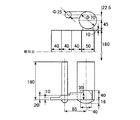
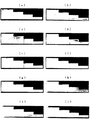
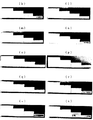
また、本発明における「鋳物の健全性」は、後述する階段状鋳物試験片を用い、染色浸透探傷試験にて観察面における鋳造の欠陥有無を評価したものであり、CAC406と同等、または鋳造方案の修正によりCAC406と同等まで改善可能な状態と判断可能であれば合格と評価したものである。
次に、各成分範囲とその理由を具体的に詳述する。
Here, “tensile strength” in the following is evaluated by an Amsler tensile tester using a No. 4 test piece defined in JIS Z2201 described later.
Further, the “soundness of the casting” in the present invention is an evaluation of the presence or absence of casting defects on the observation surface in the dye penetration test using a stepped casting test piece, which will be described later, and is equivalent to CAC406 or a casting method. If it can be determined that the state can be improved to the same level as that of CAC406 by correcting the above, it is evaluated as acceptable.
Next, each component range and the reason will be specifically described in detail.
P:0.1<P≦0.6質量%
一般に、銅合金におけるPは、0.01以上0.1質量%以下の範囲内で、比較的低濃度の含有である。例えば、金属溶湯の脱酸の促進や湯流れ性を良好にするため、砂型鋳造により製造された鋳物には、残留Pとして、0.01以上0.1質量%未満を含有しており、例えばCAC406における残余成分としてのP含有量は、0.05質量%以下である。また、日本鋳造工学会第146回全国講演大会講演概要集P30に示されているように、Pを積極的に含有して鋳造割れを防止する場合であっても、200〜300ppm(0.02〜0.03質量%)の含有である。これらの例によるPは、鋳造炉中の金属溶湯や取鍋中の金属溶湯に添加され、鋳物に含有される残留Pは、0.1質量%以下である。
P: 0.1 <P ≦ 0.6% by mass
Generally, P in a copper alloy is contained in a relatively low concentration within a range of 0.01 to 0.1% by mass. For example, in order to promote the deoxidation of the molten metal and improve the flowability of the molten metal, the casting produced by sand mold casting contains 0.01 or more and less than 0.1% by mass as the residual P. P content as a residual component in CAC406 is 0.05 mass% or less. Further, as shown in P30 of the 146th Annual Meeting of the Japan Foundry Engineering Society, even if P is actively contained to prevent casting cracks, 200 to 300 ppm (0.02 ~ 0.03 mass%). P in these examples is added to the molten metal in the casting furnace and the molten metal in the ladle, and the residual P contained in the casting is 0.1% by mass or less.
また、前述のPCT/JP2004/4757公報に提案されているように、P:0.01〜0.5質量%、好ましくは0.05〜0.1質量%を含有して、100℃における引張強さの改善を図っている。
なお、一般に、銅合金の連続鋳造では、金属溶湯の脱酸の促進を目的として、0.5質量%未満のPが金属溶湯に対して添加されるが、このPは鋳物に積極的に含有するものではなく、残留Pとしての含有量は開示されていない。
Further, as proposed in the aforementioned PCT / JP2004 / 4757 publication, P: 0.01 to 0.5% by mass, preferably 0.05 to 0.1% by mass, We are trying to improve the strength.
In general, in continuous casting of a copper alloy, less than 0.5% by mass of P is added to the molten metal for the purpose of promoting deoxidation of the molten metal, but this P is positively contained in the casting. However, the content as residual P is not disclosed.
一方、本発明におけるPの含有は、高温下(約180℃)における引張強さの向上に寄与し、脱酸目的や鋳造割れを防止するための添加量を大きく上回る、高濃度の範囲に属する量のPを積極的に含有させるものであり、0.1質量%を超える含有がBi-Pb2元系共晶物の生成を抑制する一方、合金の粒界強度を上げることにより、高温下における引張強さの向上に寄与する。
好ましくは、後述する実施例1(Pの含有量と180℃における引張強さとの関係)において、引張強さ152MPaを満足する範囲として、上限値を0.6質量%とし、下限値を0.2質量%とするのが好ましい。なお、上限値は、180℃における引張強さのピーク値が得られると共に、量産時におけるコストの観点から、0.4質量%を上限とするのがより好ましく、また、後述する実施例5において鋳物の健全性が確認され、量産において鋳造方案の大幅な変更を伴うことなく鋳物の健全性が確保できる値としても、0.4質量%を上限値とするのが好ましい。
On the other hand, the inclusion of P in the present invention belongs to a high concentration range that contributes to the improvement of tensile strength at high temperatures (about 180 ° C.) and greatly exceeds the addition amount for preventing deoxidation purposes and casting cracks. The amount of P is positively contained, and the content exceeding 0.1% by mass suppresses the formation of Bi—Pb binary eutectic, while increasing the grain boundary strength of the alloy at a high temperature. Contributes to improved tensile strength.
Preferably, in Example 1 (relation between P content and tensile strength at 180 ° C.) to be described later, the upper limit is set to 0.6% by mass and the lower limit is set to 0. It is preferable to set it as 2 mass%. The upper limit is more preferably 0.4% by mass from the viewpoint of cost during mass production, and a peak value of tensile strength at 180 ° C. is obtained, and in Example 5 described later Even if the soundness of the casting is confirmed and the soundness of the casting can be ensured without significant change in the casting method in mass production, the upper limit is preferably 0.4% by mass.
また、後述するNiを含有する場合には、NiとPとの交互作用により、180℃における引張強さ152MPaを確実に得られるPの下限値を下げることができることから、Pの下限値は、0.12質量%、より好ましくは、0.15質量%とし、上限値を0.4質量%に抑制した範囲で、180℃における引張強さ152MPaを得ることが可能となる。なお、より鋳物の健全性を必要とする場合には、さらにP含有量を抑制することが有効で、そのときの上限値は、0.3質量%が好ましい。Niを含有する場合、Pの含有量は0.16質量%とするのが最も好ましい。 Further, in the case of containing Ni described later, the lower limit value of P, which can surely obtain a tensile strength of 152 MPa at 180 ° C., can be lowered by the interaction between Ni and P. It is possible to obtain a tensile strength of 152 MPa at 180 ° C. within a range of 0.12% by mass, more preferably 0.15% by mass, and an upper limit of 0.4% by mass. In addition, when the soundness of casting is required more, it is effective to further suppress the P content, and the upper limit at that time is preferably 0.3% by mass. When Ni is contained, the P content is most preferably 0.16% by mass.
Ni:0.0<Ni≦3.0質量%
一般に、銅合金におけるNiは、α相に固溶し、マトリックスが強化され、合金の機械的性質、とりわけ引張強さの向上に寄与する。例えば、特開2003−193157公報には、Niを0.2〜3.0重量%含有することにより、CAC406と同等の引張強さを常温下において確保した技術が提案されており、Ni含有量の増加に伴う引張強さの変化は、Pを0.01〜0.02重量%(130〜200ppm)含有する実施例合金にて、引張強さのピークがNi含有量0.6〜0.8重量%に存在するなだらかな山形状の特性を呈している(上述の公報における図1参照)。
Ni: 0.0 <Ni ≦ 3.0 mass%
In general, Ni in a copper alloy dissolves in the α phase, strengthens the matrix, and contributes to the improvement of the mechanical properties of the alloy, particularly the tensile strength. For example, Japanese Patent Application Laid-Open No. 2003-193157 proposes a technique that ensures the tensile strength equivalent to that of CAC406 at room temperature by containing 0.2 to 3.0% by weight of Ni. The change in tensile strength accompanying the increase in the tensile strength of the example alloy containing 0.01 to 0.02 wt% (130 to 200 ppm) of P, the peak of tensile strength is 0.6 to 0. It exhibits a gentle mountain-shaped characteristic existing at 8% by weight (see FIG. 1 in the above-mentioned publication).
また、高温下(180℃)においては、後述する実施例4(P及びNiの含有量と180℃における引張強さとの関係)の比較例に示すように、残留Pレベル(0.1質量%以下)のPを含有した鉛レス銅合金では、Ni含有量の増加に伴う引張強さは、ほとんど変化しない。 Further, at a high temperature (180 ° C.), as shown in a comparative example of Example 4 (relation between P and Ni contents and tensile strength at 180 ° C.) described later, the residual P level (0.1% by mass) In the lead-less copper alloy containing P of the following), the tensile strength accompanying the increase in Ni content hardly changes.
これに対し、本発明におけるNiの含有は、0.1質量%を超える高濃度のPの含有を前提として高温下における引張強さの向上に寄与するものであり、この引張強さの変化は、後述する実施例4に示すように、P-Niの交互作用により、微量のNi含有で引張強さが大きく向上する、放物線状(軸はx軸)の特性を得ることができる。これにより、Niを微量でも含有させることで、Pの含有量を高濃度範囲(0.1<P≦0.6質量%)内において抑制しつつ、高温下における引張強さを向上することが可能となった。これはPが溶湯から蒸発しやすく、高濃度にコントロールすることが難しいことを考慮すれば、極めて有用である。
具体的なNi含有量として、少なくとも0を超える値であればよく、例えば0.05質量%や0.08質量%も適用可能であり、好ましくは0.1質量%の含有により、Pの含有量を抑制しつつ、高温下(約180℃)における引張強さ152MPaを得ることができる。
On the other hand, the content of Ni in the present invention contributes to the improvement of the tensile strength at high temperatures on the premise of containing a high concentration of P exceeding 0.1% by mass. As shown in Example 4 to be described later, a parabolic characteristic (the axis is the x-axis) can be obtained by the interaction of P—Ni and the tensile strength is greatly improved by containing a small amount of Ni. Thereby, by containing even a small amount of Ni, it is possible to improve the tensile strength at high temperatures while suppressing the P content within a high concentration range (0.1 <P ≦ 0.6 mass%). It has become possible. This is extremely useful in view of the fact that P is easily evaporated from the molten metal and difficult to control at a high concentration.
The specific Ni content may be a value that exceeds at least 0, for example, 0.05% by mass or 0.08% by mass is applicable, and preferably 0.1% by mass, While suppressing the amount, a tensile strength of 152 MPa at a high temperature (about 180 ° C.) can be obtained.
一方、Niの過剰の含有は、引張強さの向上が飽和することから、上限値を3.0質量%としているが、Pの好ましい上限値(0.4質量%)における引張強さの向上の飽和状態を、図10(P=0.32質量%)から判断すると、2.0質量%を上限値とするのが良い。また、コスト低減を考慮して、少ないNi含有量でも効果的に引張強さを得ることができる範囲として、1.0質量%を上限とするのが良い。更に、高温下(約180℃)における引張強さ152MPaを最低限確保する観点からは、下限値を0.3質量%、上限値を0.6質量%とするのが好ましい。 On the other hand, when Ni is excessively contained, since the improvement in tensile strength is saturated, the upper limit is set to 3.0% by mass. However, the improvement in tensile strength at the preferable upper limit (0.4% by mass) of P is set. When the saturated state of FIG. 10 is judged from FIG. 10 (P = 0.32 mass%), it is preferable to set 2.0 mass% as the upper limit. In consideration of cost reduction, the upper limit is preferably 1.0% by mass as a range in which the tensile strength can be effectively obtained even with a small Ni content. Furthermore, from the viewpoint of ensuring a minimum tensile strength of 152 MPa at a high temperature (about 180 ° C.), it is preferable to set the lower limit to 0.3 mass% and the upper limit to 0.6 mass%.
また、Niの含有は、高濃度のPの含有による固相線温度の低下を抑制し、過度のマッシー型凝固形態を緩和することで、溶質の偏析を抑制すると同時に押湯効果を改善し、鋳物の健全性を確保することができる。さらに、Niは、Pの活性を低下させることで、溶解雰囲気からのガス吸収や鋳物の水分や有機物との反応を抑制し、鋳物の健全性を高め耐圧性や機械的性質を改善する。 In addition, the content of Ni suppresses a decrease in the solidus temperature due to the inclusion of a high concentration of P and relaxes an excessive massy-type solidification form, thereby suppressing the segregation of the solute and at the same time improving the feeder effect. The soundness of the casting can be ensured. Furthermore, Ni lowers the activity of P, thereby suppressing gas absorption from the melting atmosphere and reaction with moisture and organic matter of the casting, improving the soundness of the casting and improving pressure resistance and mechanical properties.
この場合、例えば、Niの含有を1.5%以下とすることで押湯効果をより抑制すること、すなわち鋳物の耐圧性に影響を与えるような大きな鋳造欠陥(引け)を抑制することが可能になり、これにより、ばり堰方案に対する適用性を高めて、鋳物の健全性を確保できる。
このとき、鋳造時のNi含有量としては、押湯系の方案の場合にはNi含有量を高め、ばり堰系の方案(押湯の作用が働かない方案)の場合には低めとするのがよい。上述したように、Niを含有させると押湯効果がより強まるため、Niを多く含有させた場合、押湯を効果的に配設することで健全な鋳物が得られる。一方、ばり堰方案を使用したときに押湯効果を過剰に高めると、堰引けや中心引けさらには外引けが発生する可能性が高まる。ばり堰方案ではNiの含有量を低く抑えることが重要であるが、低く抑えすぎるとPによる影響を排除できなくなってしまうことに加え、高温下において高い引張り強さを確保できなくなる。従って、Niの含有量は、Pの含有量を最適含有量である0.16質量%を前提とした場合、0.2〜3.0質量%とするのが好ましい。更には、より鋳物の健全性を高めるために、Ni含有量の上限を2.0質量%とすることがより有効であり、1.5質量%以下に抑制するとなお望ましい。更に、高温引張り強さやNiの伸び低下への影響も考慮すると、0.3〜1.0質量%が最適である。
In this case, for example, by controlling the content of Ni to 1.5% or less, it is possible to further suppress the feeder effect, that is, to suppress a large casting defect (shrinkage) that affects the pressure resistance of the casting. Thus, the applicability to the flash weir plan can be improved and the soundness of the casting can be secured.
At this time, the Ni content at the time of casting should be increased in the case of the feeder type system, and lower in the case of the flash weir type method (method in which the feeder action does not work). Is good. As described above, when Ni is contained, the hot metal effect is further enhanced. Therefore, when a large amount of Ni is contained, a healthy casting can be obtained by effectively arranging the hot water. On the other hand, if the hot water supply effect is excessively increased when the flash weir method is used, the possibility of occurrence of weiring, center shrinkage and even outer shrinkage increases. In the weir plan, it is important to keep the Ni content low, but if it is too low, the influence of P cannot be eliminated, and high tensile strength cannot be secured at high temperatures. Therefore, the Ni content is preferably 0.2 to 3.0% by mass, assuming that the optimum P content is 0.16% by mass. Furthermore, in order to further improve the soundness of the casting, it is more effective to set the upper limit of the Ni content to 2.0 mass%, and it is more desirable to suppress it to 1.5 mass% or less. Further, when considering the influence on the high temperature tensile strength and the decrease in the elongation of Ni, 0.3 to 1.0% by mass is optimal.
また、前述の課題のように、高濃度のNiの含有は、鋳物の中心引けや堰前の引けを助長し、多数個取りの大量生産型の型方案を用いることが多い比較的小型の鋳物部品では、実質有効な押湯を取付けることが困難なため、過剰なNiの添加は鋳物の健全性を確保する上で逆効果を招きかねない。
この影響は、2.0質量%以上の含有で顕著となるため、理想的には、1.5質量%未満にNiを抑制することで、従来方案の大幅な改善なしに生産することが可能となる。
In addition, as described above, the inclusion of a high concentration of Ni promotes the center shrinkage of the casting and the shrinkage before the weir, and a relatively small casting that often uses a mass production type mold plan. In parts, it is difficult to attach a substantially effective feeder, so excessive addition of Ni may have an adverse effect on ensuring the soundness of the casting.
Since this effect becomes significant when the content is 2.0% by mass or more, ideally, by suppressing Ni to less than 1.5% by mass, it is possible to produce without significant improvement of the conventional method. It becomes.
また、Niの含有を1.5%以下とした場合には、Ni-P系金属間化合物の生成を抑制し、常温及び高温伸びと鋳物の健全性を確保して引張特性を高めることが可能になる。 In addition, when the Ni content is 1.5% or less, it is possible to suppress the formation of Ni-P-based intermetallic compounds, to ensure normal temperature and high temperature elongation and soundness of castings, and to improve tensile properties. become.
Bi:0.1〜3.0質量%
Pbの代替成分たる低融点成分として、鋳造の凝固過程において、合金(鋳物)中のデンドライト間隙の最終凝固部に生じる、ミクロポロシティと称される微細な収縮巣(引け巣)に入り込むことにより、合金の健全性(耐圧性)を向上しつつ、切削性の確保に寄与する成分である。切削性向上には0.1質量%以上の含有が有効だが、ミクロポロシティを減少させ、合金の健全性を確保するためには、Seの含有と共に、0.25質量%以上の含有が必要である。一方、Biが多量に含有されると、鋳物の凝固過程において、Biが、Snや高濃度に含有されているPと共に鋳物表面に集中する「逆偏析」を生じ、この場合、鋳物内部におけるミクロポロシティが増加するおそれがあることから、合金の健全性を確保するためには、上限値を3.0質量%とするのが有効である。
Bi: 0.1-3.0 mass%
As a low melting point component that is an alternative component of Pb, by entering into a fine shrinkage nest (shrinkage nest) called microporosity generated in the final solidification part of the dendrite gap in the alloy (casting) in the solidification process of casting, It is a component that contributes to ensuring machinability while improving the soundness (pressure resistance) of the alloy. Inclusion of 0.1% by mass or more is effective for improving machinability, but in order to reduce microporosity and ensure the soundness of the alloy, it is necessary to contain 0.25% by mass or more together with the inclusion of Se. is there. On the other hand, when a large amount of Bi is contained, in the solidification process of the casting, Bi is concentrated on the casting surface together with Sn and P contained in a high concentration, and in this case, micro segregation inside the casting occurs. Since the porosity may increase, it is effective to set the upper limit to 3.0% by mass in order to ensure the soundness of the alloy.
耐圧性が要求される用途など、より効果的にミクロポロシティを低減する必要がある場合には、下限値を0.4質量%、上限値を2.5質量%とするのが有効である。また、CAC406と略同等の切削条件による加工を可能とする場合には、下限値を1.0質量%とするのがよい。
なお、Biが多量に含有されると、引張強さが低下することから、高温下における引張強さを量産レベルで確実に確保する必要がある場合には、上限値を2.6質量%とするのが有効であり、量産におけるコスト低減を重視する場合には、上限値を2.0質量%とするのが好ましい。
When it is necessary to more effectively reduce the microporosity, such as in applications where pressure resistance is required, it is effective to set the lower limit to 0.4 mass% and the upper limit to 2.5 mass%. Further, in the case where machining under substantially the same cutting conditions as CAC 406 is possible, the lower limit value is preferably 1.0% by mass.
In addition, since tensile strength will fall when Bi is contained in large quantities, when it is necessary to ensure reliably the tensile strength in high temperature in mass production level, an upper limit is 2.6 mass%. It is effective to do this, and when emphasizing cost reduction in mass production, the upper limit value is preferably set to 2.0% by mass.
Zn:3.0〜10.0質量%
切削性に影響を与えずに、硬さや機械的性質、特に伸びを向上させる成分であり、3.0質量%以上の含有で、効果的に溶湯の脱酸を促進し、鋳物の健全性確保や湯流れ性を向上させる。Znは比較的安価であるため、可能な限り多く含有させたい成分であるが、Znの蒸気による鋳造環境の悪化を考慮して、上限値を10質量%とする。
また、Znによる脱酸効果を確実に得る場合には、下限を4.0質量%とするのが好ましい。更に、鋳型への溶湯の充填性を重視して、Znの蒸気圧を下げる必要がある場合には、上限値は9.0質量%とするのが好ましい。なお、後述するSnの最適下限値2.8質量%を考慮すると、δ相を析出させない範囲として、下限値を6.0質量%とするのが好適である。
Zn: 3.0-10.0 mass%
It is a component that improves hardness and mechanical properties, especially elongation, without affecting the machinability. Containing 3.0% by mass or more effectively promotes deoxidation of the molten metal and ensures the soundness of the casting. Improves hot water flow. Since Zn is relatively inexpensive, it is a component that is desired to be contained as much as possible. However, considering the deterioration of the casting environment due to the vapor of Zn, the upper limit is set to 10% by mass.
Moreover, when obtaining the deoxidation effect by Zn reliably, it is preferable to make a minimum into 4.0 mass%. Furthermore, when it is necessary to lower the vapor pressure of Zn with emphasis on the filling property of the molten metal into the mold, the upper limit value is preferably 9.0% by mass. In consideration of the optimum lower limit value of 2.8% by mass of Sn described later, it is preferable to set the lower limit value to 6.0% by mass as a range in which the δ phase is not precipitated.
Sn:2.0〜6.0質量%
合金の機械的性質、とりわけ、伸びと耐食性の向上に寄与する成分であり、2.0質量%以上の含有が有効である。一方、含有量の増加に伴い、硬く脆弱なδ相を析出し、加工性と伸びを低下させてしまうこと、及びコストを考慮し、上限値を6.0質量%とする。 また、CAC406と同等の引張強さを要求される場合には、2.8質量%以上の含有が効果的である。さらに、量産時において鋳造条件が相違しても、P,Bi,Snなどの溶質の逆偏析を抑制する必要がある場合には、上限値を5.5質量%とするのがよい。なお、より引張強さを重視して、引張強さのピーク値を得る場合には、上限値を4.5質量%とするのが好適である。
なお、Snと、Znの交互作用を見極めることにより、常温及び高温伸びを最適化することも可能である。
Sn: 2.0-6.0 mass%
It is a component that contributes to improving the mechanical properties of the alloy, in particular, elongation and corrosion resistance, and it is effective to contain 2.0% by mass or more. On the other hand, the upper limit is set to 6.0% by mass in consideration of the fact that hard fragile δ phase is precipitated as the content is increased, the workability and elongation are lowered, and the cost is taken into consideration. Moreover, when the tensile strength equivalent to CAC406 is requested | required, containing 2.8 mass% or more is effective. Furthermore, even if the casting conditions are different during mass production, if it is necessary to suppress reverse segregation of solutes such as P, Bi, Sn, etc., the upper limit value is preferably set to 5.5% by mass. In the case where the tensile strength is more important and the peak value of the tensile strength is obtained, the upper limit value is preferably set to 4.5% by mass.
Note that the normal temperature and high temperature elongation can be optimized by determining the interaction between Sn and Zn.
Se:0.0<Se≦1.3
SeはPbの代替成分として、CuとZnの含有比率に応じて、Se-Zn、Cu-Seなどの金属間化合物を形成することにより、Biの含有量を抑制しつつ、合金の切削性を確保する。また、これらの金属間化合物の晶出により、ミクロポロシティを分散して合金の健全性が向上し、引張強さを安定させる。
このように本発明のPとNiを含有した鉛レス青銅鋳物合金は、Bi系の鉛レス青銅合金に限ることなく、Bi−Se系の鉛レス青銅合金にも適用することができる。この場合、Bi系合金と同様の高温下における引張強さの改善と、鋳物の健全性を確保することができる。
Seの過剰の含有は、脆弱な上記金属間化合物の晶出量が多くなり、引張強さが低下するため、上限値を1.3%とする。さらに、Seの含有量を抑制しつつ、CAC406と同等の引張強さを要求される場合には、上限値を0.35質量%とするのがよい。
Se: 0.0 <Se ≦ 1.3
As an alternative component of Pb, Se forms an intermetallic compound such as Se—Zn and Cu—Se according to the content ratio of Cu and Zn, thereby suppressing the Bi content and improving the machinability of the alloy. Secure. Moreover, the crystallization of these intermetallic compounds disperses the microporosity, thereby improving the soundness of the alloy and stabilizing the tensile strength.
Thus, the lead-free bronze cast alloy containing P and Ni of the present invention is not limited to a Bi-based lead-less bronze alloy, but can be applied to a Bi-Se-based lead-less bronze alloy. In this case, it is possible to ensure the improvement of the tensile strength at a high temperature similar to that of the Bi-based alloy and the soundness of the casting.
The excessive content of Se increases the amount of crystallization of the brittle intermetallic compound and decreases the tensile strength, so the upper limit is set to 1.3%. Furthermore, when the tensile strength equivalent to that of CAC406 is required while suppressing the Se content, the upper limit value is preferably set to 0.35% by mass.
Pb:0.005〜2.0質量%
高温(180℃)時の引張強さを確保するために、Pbを0.005質量%以下に制御すべく、Pbを極力排除した材料の使用を余儀なくされていた。しかし、後述のPの含有により、高温下における引張強さが確保されたことから、Pbを含有するリサイクル材料の使用も促進されることが期待される。具体的には、本発明における低鉛の領域である、0.005〜2.0質量%の範囲で高温下における引張強さが改善され、国内の鉛レス青銅弁のPb含有基準である0.25質量%以下の範囲内でPbの含有を許容することが可能となる。
Pb: 0.005 to 2.0% by mass
In order to ensure the tensile strength at a high temperature (180 ° C.), in order to control Pb to 0.005% by mass or less, a material in which Pb is excluded as much as possible has been used. However, since the tensile strength at a high temperature is ensured by the inclusion of P described later, it is expected that the use of a recycled material containing Pb is also promoted. Specifically, the tensile strength at high temperature is improved in the range of 0.005 to 2.0% by mass, which is the low lead region in the present invention, and 0 which is the Pb content standard of domestic leadless bronze valves. It becomes possible to allow Pb to be contained within a range of .25% by mass or less.
Te:0.0<Te≦1.0質量%
TeはZn、Cu、Bi、Seなどと化合物を生成し、合金中に分散相として存在する。特にPbと結合することで、Bi-Pb共晶の生成を抑制し高温下における合金の脆化を抑制する。また、Teの含有により、同じく高温特性の改善に効果のあるPの含有量を低減することが可能であり、その結果、鋳物の健全性が改善される。Teは0.1質量%以上の含有で高温引張強さの改善効果が明確となり、Zn、Pb、Biなどの含有量の影響もあるが、0.2質量%以上でさらなる特性の改善が可能である。しかし、過剰の含有は上記化合物が多量に生成されることから、合金を脆化させることがあるため、その含有量の上限は1.0質量%とするのが望ましい。また、0.5質量%以上の含有で180℃引張強さの改善の効果が飽和する傾向にあることから、その含有量の上限を0.5質量%とするのが有効である。
また、Teの高温特性改善の効果により、同様の効果を持つPの含有量を0.1質量%以下に抑制することが可能であり、その結果、鋳物の健全性が改善される。
Te: 0.0 <Te ≦ 1.0 mass%
Te forms a compound with Zn, Cu, Bi, Se, etc., and exists as a dispersed phase in the alloy. In particular, bonding with Pb suppresses the formation of Bi—Pb eutectic and suppresses embrittlement of the alloy at high temperatures. Further, the inclusion of Te can reduce the P content, which is also effective in improving the high temperature characteristics, and as a result, the soundness of the casting is improved. When Te is contained in an amount of 0.1% by mass or more, the effect of improving high-temperature tensile strength becomes clear, and there is an influence of the contents of Zn, Pb, Bi, etc., but if it is 0.2% by mass or more, further improvement of properties is possible It is. However, since excessive content produces a large amount of the above compound, the alloy may become brittle, so the upper limit of the content is preferably 1.0% by mass. In addition, since the effect of improving the tensile strength at 180 ° C. tends to be saturated when the content is 0.5% by mass or more, it is effective to set the upper limit of the content to 0.5% by mass.
Further, due to the effect of improving the high temperature characteristics of Te, it is possible to suppress the content of P having the same effect to 0.1% by mass or less, and as a result, the soundness of the casting is improved.
不可避不純物:
本発明銅合金における不可避不純物としては、上述のPbの他、Fe:0.3質量%以下、Al:0.01質量%以下、Si:0.01質量%以下、Mn:0.25質量%以下、S:0.3質量%以下、Mg:0.01質量%以下、Ti:0.01質量%以下、Zr:0.1質量%以下、Co:0.3質量%以下、Cr:0.3質量%以下、Sb:1.1質量%以下が挙げられる。
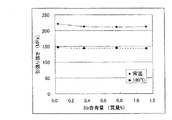
特に、Sbの含有量と常温下及び高温下における引張強さの関係について検証した。表2、表3は、各化学成分値を有した鉛レス銅合金のSb含有の影響を示したもので、グラフ化したものを図12に示す。同図からわかるように、引張強さへの影響はなく、Sbが不可避不純物となることを確認した。
Inevitable impurities:
As inevitable impurities in the copper alloy of the present invention, in addition to the above-mentioned Pb, Fe: 0.3% by mass or less, Al: 0.01% by mass or less, Si: 0.01% by mass or less, Mn: 0.25% by mass Hereinafter, S: 0.3 mass% or less, Mg: 0.01 mass% or less, Ti: 0.01 mass% or less, Zr: 0.1 mass% or less, Co: 0.3 mass% or less, Cr: 0 3 mass% or less, Sb: 1.1 mass% or less.
In particular, the relationship between the Sb content and the tensile strength at normal and high temperatures was verified. Tables 2 and 3 show the influence of Sb content of the leadless copper alloy having each chemical component value, and FIG. 12 shows a graph. As can be seen from the figure, it was confirmed that Sb was an inevitable impurity without affecting the tensile strength.
以下に、本発明における鉛レス青銅鋳物合金の好ましい実施例を詳述する。本実施例では、引張強さの基準値として、152MPaを180℃における目標値とした。180℃を基準としたのは、呼び圧力10Kまたはクラス150の青銅製バルブにおいて、流体を飽和蒸気とした場合の最高許容圧力が1.0MPaであり、この圧力に対応する飽和温度が180℃であることによる。また、152MPaを基準としたのは、JIS B 8270「圧力容器の構造」において、材料本体の引張強さの目標数値を、この材料を用いた製品の安全等を考慮して、基本許容圧力の4倍とする基本的な考え方に準拠し、CAC406の200℃での基本許容応力値38MPaの4倍の値とし、本発明合金の主な用途であるバルブなどの圧力容器の使用に適したものである。
Hereinafter, preferred embodiments of the leadless bronze cast alloy according to the present invention will be described in detail. In this example, 152 MPa was set as a target value at 180 ° C. as a reference value of tensile strength. Based on 180 ° C, the maximum allowable pressure is 1.0 MPa when the fluid is saturated steam in a nominal pressure 10K or
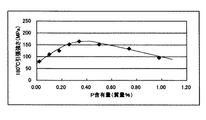
先ず、本試験において、Pの含有量と180℃における引張強さの関係について検証した。各サンプルの組成を表4に示す。試験結果を同表、並びにグラフ化したものを図1に示す。なお、本実施例における各サンプルは、砂型鋳物から採取した。引張試験は、試験片をCo2鋳型を用いて鋳込み温度1130℃でJIS A号方案に鋳造後、切削加工により製作したJIS Z2201に規定の4号試験片とし、アムスラー引張試験機を用いて行った。この引張試験の条件は、供試品を砂型鋳物から採取する他の実施例においても同様である。 First, in this test, the relationship between the P content and the tensile strength at 180 ° C. was verified. Table 4 shows the composition of each sample. The test results are shown in the same table and graphed in FIG. In addition, each sample in a present Example was extract | collected from the sand casting. The tensile test is carried out using an Amsler tensile tester with a test piece cast into a JIS A plan at a casting temperature of 1130 ° C. using a Co 2 mold and then cut into a No. 4 test piece specified in JIS Z2201. It was. The conditions for this tensile test are the same in other examples in which the specimen is taken from a sand casting.
No.1−1〜8は、Bi-Se系合金において、本発明合金の特徴成分であるPの含有量を変化させた供試品である。本試験結果から、Pを0.10質量%を超える高濃度に含有させることで、180℃という高温下での引張強さが向上していることがわかる。図1のグラフより、特に、152MPaという目標値を達成するためには、本実施例において、Pを0.26〜0.50質量%含有させることが必要である。 No. 1-1 to 8 are specimens in which the content of P, which is a characteristic component of the alloy of the present invention, is changed in the Bi—Se alloy. From this test result, it is understood that the tensile strength at a high temperature of 180 ° C. is improved by containing P at a high concentration exceeding 0.10% by mass. From the graph of FIG. 1, in order to achieve the target value of 152 MPa in particular, it is necessary to contain 0.26 to 0.50 mass% of P in this example.
次に、表5に示すNo.1−9〜16は、No.1−1〜8と同様のBi-Se系合金において、主要成分であるSn,Zn,Bi,Seの含有量を変えて、本発明銅合金の特徴成分である高濃度のPを含有した供試品である。また、No.1−17〜24は、本発明銅合金(Bi系)において、主要成分であるSn,Zn,Biの含有量を変えて、本発明銅合金の特徴成分である高濃度のPを含有した供試品である。 Next, No. 1 shown in Table 5 was obtained. Nos. 1-9 to 16 are No. In the same Bi-Se alloys as 1-1 to 8, the contents of Sn, Zn, Bi, and Se, which are the main components, are changed, and a high concentration of P, which is a characteristic component of the copper alloy of the present invention, is contained. It is a trial product. No. Nos. 1-17 to 24 include a high-concentration P which is a characteristic component of the copper alloy of the present invention by changing the content of Sn, Zn, Bi as the main component in the copper alloy of the present invention (Bi series). It is a trial product.
これらの供試品について、180℃における引張強さを検証した。表5を考察すると、本試験結果から、以下の成分範囲における実施例について、高濃度のPを含有することにより、高温下(180℃)における引張強さ152MPaという目標値を達成していることがわかる。
<Bi-Se系合金>
質量%で、Sn:3.0〜6.0(好ましくは3.1〜5.9)、Zn:4.0〜9.0(好ましくは8.3)、Bi:1.0〜3.0(好ましくは1.3〜2.2)、Se:0.2〜0.5、P:0.20(好ましくは0.22)〜0.50、残余:Cu及び不可避不純物
<Bi系合金>
質量%で、Sn:3.0〜6.0(好ましくは5.8)、Zn:4.0〜9.0(好ましくは8.4)、Bi:1.0〜3.0(好ましくは1.1〜2.2)、P:0.20〜0.40(好ましくは0.22〜0.27)、残余:Cu及び不可避不純物
About these specimens, the tensile strength in 180 degreeC was verified. When Table 5 is considered, the target value of 152 MPa in tensile strength at high temperatures (180 ° C.) is achieved by including a high concentration of P in Examples in the following component ranges based on the results of this test. I understand.
<Bi-Se alloy>
In mass%, Sn: 3.0 to 6.0 (preferably 3.1 to 5.9), Zn: 4.0 to 9.0 (preferably 8.3), Bi: 1.0 to 3. 0 (preferably 1.3 to 2.2), Se: 0.2 to 0.5, P: 0.20 (preferably 0.22) to 0.50, the remainder: Cu and inevitable impurities <Bi-based alloy >
In mass%, Sn: 3.0 to 6.0 (preferably 5.8), Zn: 4.0 to 9.0 (preferably 8.4), Bi: 1.0 to 3.0 (preferably 1.1-2.2), P: 0.20-0.40 (preferably 0.22-0.27), remaining: Cu and inevitable impurities
次に、鉛レス青銅鋳物合金の高温下における引張強さを定量的に把握し、本発明の好適な対象合金領域を示すと共に、本発明の効果を検証する。
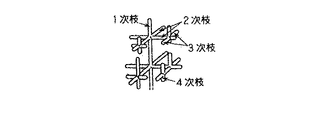
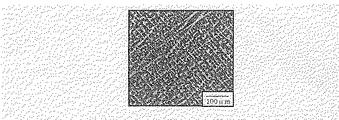
一般に、合金の引張強さは、そのミクロ組織の大きさに関係することが知られている。そこで、本試験は、合金のミクロ組織の大きさを示す尺度として、二次デンドライトアーム間隔を用いた。ここで、デンドライトとは、金属凝固における結晶の成長形態の1つである。図2は、デンドライトの模式図であり、同図において、幹を一次デンドライトアーム(一次枝)とした場合、この一次枝から生成している枝を二次デンドライトアーム(二次枝)と呼び、そのアーム間隔は鋳物の機械的性質などに大きな影響をおよぼすことが知られている。図3は、CAC406の代表的なミクロ組織を示した顕微鏡写真であり、このミクロ組織を観察すると、二次デンドライトアームが発達し、整列していることがわかる。
Next, the tensile strength of the leadless bronze cast alloy at high temperatures is quantitatively grasped, and a suitable target alloy region of the present invention is shown and the effect of the present invention is verified.
In general, it is known that the tensile strength of an alloy is related to the size of its microstructure. Therefore, in this test, the secondary dendrite arm interval was used as a scale indicating the size of the microstructure of the alloy. Here, dendrite is one of crystal growth forms in metal solidification. FIG. 2 is a schematic diagram of a dendrite. In FIG. 2, when a trunk is a primary dendrite arm (primary branch), a branch generated from the primary branch is called a secondary dendrite arm (secondary branch). It is known that the distance between the arms has a great influence on the mechanical properties of the casting. FIG. 3 is a photomicrograph showing a representative microstructure of CAC406. When this microstructure is observed, it can be seen that secondary dendrite arms have developed and are aligned.
そこで、二次枝法を用いて二次デンドライトアームを測定し、ミクロ組織の大きさを評価した。二次枝法とは、図4(a)に示すように、整列したアーム群における平均間隔を求める方法である。即ち、二次アームが複数本、実質的に平行に成長しているデンドライトアームを顕微鏡組織において探し、そのデンドライトアームと略直交する任意の長さの直線を引き、この直線の距離Lをデンドライトアームを横切るアーム本数(n−1)で除し、これをdsとする。つまり、二次デンドライトアームの大きさは、L/(n−1)で表される。なお、試験片鋳物のミクロ組織は、観察する箇所により組織の大きさが異なり、多結晶であるために個々の結晶粒でデンドライトの発達の仕方に違いが見られる。本試験では、各試験片の二次デンドライトアーム間隔の測定方法を以下のように統一した。また、実際の製品鋳物では明確な結晶粒界が観察されない場合があるが、そのような場合には、下記3項を適用する。 Therefore, the secondary dendrite arm was measured using the secondary branch method, and the size of the microstructure was evaluated. As shown in FIG. 4A, the secondary branch method is a method for obtaining an average interval between aligned arm groups. That is, a dendrite arm having a plurality of secondary arms and growing substantially in parallel is searched for in the microstructure, a straight line having an arbitrary length substantially perpendicular to the dendrite arm is drawn, and the distance L of this straight line is determined as the dendrite arm. Is divided by the number of arms crossing (n−1), and this is defined as ds. That is, the size of the secondary dendrite arm is represented by L / (n-1). It should be noted that the microstructure of the test piece casting differs in the size of the structure depending on the location to be observed, and since it is polycrystalline, there is a difference in the manner of dendrite development in each crystal grain. In this test, the measurement method of the secondary dendrite arm interval of each test piece was unified as follows. Moreover, in the actual product casting, a clear crystal grain boundary may not be observed. In such a case, the following three items are applied.
1.観察箇所
JIS4号引張試験片 標点部 横断面
2.測定箇所
試験片の横断面中心付近を図4(b)に示すような各々の結晶粒について二次アームが整列している箇所を特定。計約3つ以上の結晶粒について測定した。
3.測定数
アーム5本以上整列しているデンドライトを30本
図4(c)は、CAC406の測定例である。測定本数が約10本を超えると、二次デンドライトアーム間隔の平均値が集束するので、測定箇所の違いによる影響を排除することができる。
1. Observation location JIS No. 4 tensile test specimen Gage cross section Measurement location The location where the secondary arm is aligned for each crystal grain as shown in FIG. A total of about 3 or more crystal grains were measured.
3. Number of
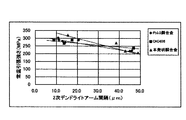
上記方法に基づいて、本試験では、砂型鋳物、金型鋳物、連続鋳造鋳物に分けて、これら鋳物の常温並びに高温における引張強さについて検証した。各サンプルの組成を表6(常温)、表7(高温)に示す。試験結果を同表、並びにグラフ化したものを図5(常温)、図6(高温)に示す。なお、本実施例における常温とは、約23℃であり、他の実施例においても同様である。 Based on the above method, this test was divided into sand casting, die casting, and continuous casting, and the tensile strength at normal temperature and high temperature of these castings was verified. The composition of each sample is shown in Table 6 (room temperature) and Table 7 (high temperature). FIG. 5 (room temperature) and FIG. 6 (high temperature) show the test results in the same table and graph form. The room temperature in this embodiment is about 23 ° C., and the same applies to other embodiments.
本試験結果から、180℃での引張強さは、二次デンドライトアーム間隔が小さいほど、引張強さの低下は小さいことがわかる。ところで、連続鋳造鋳物の引張強さは低下しないというのが従来の常識であったが、本試験結果から明らかであるように、径の違いによって低下することが確認され、特に、径の太い鋳物の引張強さが低下している。これは、径が太くなるほど鋳物の冷却速度が遅くなることから、二次デンドライトアーム間隔が大きくなったことに起因していると考えられる。 From this test result, it can be seen that the decrease in the tensile strength at 180 ° C. is smaller as the secondary dendrite arm spacing is smaller. By the way, the conventional common sense is that the tensile strength of continuous castings does not decrease, but as is clear from the results of this test, it has been confirmed that the tensile strength decreases, and in particular, castings with large diameters. The tensile strength of is reduced. This is considered to be due to the fact that the cooling rate of the casting becomes slower as the diameter becomes larger, so that the secondary dendrite arm interval becomes larger.
ここで「連続鋳造鋳物」は、例えば中空縦形の鋳型に対して、上方から金属溶湯を流し込む一方、下方から凝固した鋳物を連続的に引き抜く「連続鋳造」により成形されたものであり、金属溶湯の凝固は、水冷等の冷却設備により促進される。
これに対し「砂型鋳造」は、硬化させた鋳砂からなる鋳型に金属溶湯を流し込み、これを空冷放置した後、凝固した金属部分を鋳型から取り出す「砂型鋳造」により成形されたものであり、「金型鋳物」は、金属製の鋳型に金属溶湯を流し込み、これを空冷放置した後、凝固した金属部分を鋳型から取り出す「金型鋳造」により成形されたものである。鋳物の冷却速度は、上述の鋳造方法の相違のほか、鋳物の大きさや鋳造方案によっても相違するが、本実施例における「砂型鋳物」「金型鋳物」は、「連続鋳造鋳物」に比して冷却速度は遅いことから、二次デンドライトアーム間隔が更に大きいものとなり、引張強さが低下したものと考えられる。
Here, the “continuous casting” is formed by “continuous casting” in which, for example, a molten metal is poured from above into a hollow vertical mold, while the solidified casting is continuously drawn out from below. Solidification is promoted by a cooling facility such as water cooling.
On the other hand, “sand mold casting” is formed by “sand mold casting”, in which a molten metal is poured into a mold made of hardened cast sand, left to cool in air, and a solidified metal portion is taken out of the mold. The “mold casting” is formed by “mold casting” in which a molten metal is poured into a metal mold, left to air-cool, and then a solidified metal portion is taken out from the mold. The cooling rate of the casting differs depending on the size of the casting and the casting method, in addition to the difference in the casting method described above, but “sand casting” and “die casting” in this example are compared to “continuous casting”. Since the cooling rate is slow, the secondary dendrite arm spacing is further increased and the tensile strength is considered to be reduced.
一方、本発明銅合金は、二次デンドライトアーム間隔に影響されることなく、高温域での引張強さの低下が改善されていることがわかる。すなわち、本発明銅合金は、上述の鋳造方法(冷却速度)の差異に影響されることなく、高温下における引張強度を向上した合金であり、換言すれば、公知の鋳造方法(冷却速度)により製造可能としつつ、高温下における引張強度を向上した合金であることがわかる。また、本発明銅合金は、図5及び図6の中で、CAC406と同様な傾向を示していることから、CAC406の代替材として、高温域まで引張強さを確保するものである。 On the other hand, it can be seen that the copper alloy of the present invention is improved in the decrease in tensile strength at high temperatures without being affected by the secondary dendrite arm spacing. That is, the copper alloy of the present invention is an alloy that has improved tensile strength at high temperatures without being affected by the difference in the above-described casting method (cooling rate), in other words, by a known casting method (cooling rate). It can be seen that the alloy has improved tensile strength at high temperatures while being manufacturable. Moreover, since the copper alloy of the present invention shows the same tendency as CAC406 in FIGS. 5 and 6, as an alternative to CAC406, the tensile strength is ensured up to a high temperature range.
なお、図6に示されるように、鉛レス銅合金の高温(180℃)での引張強さの推移の中で、目標値152MPaにおける二次デンドライトアーム間隔が14μm付近であることから、この14μmを本発明銅合金に好適な合金領域の境界基準値とした。従って、本発明銅合金によれば、二次デンドライトアーム間隔が14μm以上の合金領域で、少なくとも180℃における引張強さ152MPaを確保することができる。 As shown in FIG. 6, the secondary dendrite arm spacing at the target value of 152 MPa is around 14 μm in the transition of the tensile strength of the lead-less copper alloy at a high temperature (180 ° C.). Was defined as the boundary reference value of the alloy region suitable for the copper alloy of the present invention. Therefore, according to the copper alloy of the present invention, it is possible to ensure a tensile strength of 152 MPa at least at 180 ° C. in an alloy region having a secondary dendrite arm interval of 14 μm or more.
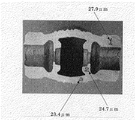
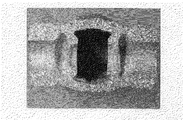
ここで、実製品の二次デンドライトアーム間隔を測定する。特に、このアーム間隔が小さい傾向にある小型弁(耐圧10K、呼び径1/2、鉛レス青銅製の汎用ゲートバルブ、砂型鋳物)を採用した。図7は、胴体部の切断面を示しており、図8は、硝酸を用いて切断面をエッチング処理したものである。各々肉厚の異なる部位(合金領域)1乃至3の二次デンドライトアーム間隔は、27.9μm、24.7μm、23.4μmであり、何れも14μm以上のアーム間隔を有していることから、通常の砂型鋳物製品は改善対象として判断することができる。なお、14μm以上のアーム間隔を有する部位は、鋳物の一部分(合金領域)であればよく、この場合、鋳物部品全体が、本発明銅合金の実施対象となる。 Here, the secondary dendrite arm spacing of the actual product is measured. In particular, a small valve (withstand pressure of 10K, nominal diameter of 1/2, general-purpose gate valve made of leadless bronze, sand casting) whose arm spacing tends to be small was adopted. FIG. 7 shows a cut surface of the body part, and FIG. 8 shows the cut surface etched using nitric acid. The secondary dendrite arm intervals of the parts (alloy regions) 1 to 3 having different wall thicknesses are 27.9 μm, 24.7 μm, and 23.4 μm, and all have arm intervals of 14 μm or more. Ordinary sand casting products can be judged as improvement targets. In addition, the site | part which has an arm space | interval of 14 micrometers or more should just be a part of casting (alloy area | region), and in this case, the whole casting component becomes the implementation object of this invention copper alloy.
測定方法としては、図8のようにエッチング処理し、金属組織を把握し易い状態で電子顕微鏡を用い、二次デンドライトアーム間隔を測定している。このように、同じ鋳物であっても、肉厚の違いによって二次デンドライトアーム間隔が異なるため、局所的な合金領域の引張強さを定量的に把握でき、引張強さに起因する製品としての合否判定が可能となる。 As a measuring method, as shown in FIG. 8, the secondary dendrite arm interval is measured using an electron microscope in a state where the metal structure is easily grasped as shown in FIG. In this way, even with the same casting, the secondary dendrite arm spacing varies depending on the wall thickness, so the tensile strength of the local alloy region can be quantitatively grasped, and the product resulting from the tensile strength Pass / fail judgment is possible.
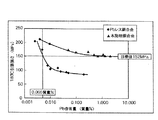
次に、本発明銅合金(Bi-Se系)に関して、Pbの含有量と180℃における引張強さの関係について検証した。各サンプルの組成を表8に示し、試験結果を同表、並びにグラフ化したものを図9に示す。なお、各サンプルは砂型鋳物から採取した。 Next, regarding the copper alloy of the present invention (Bi-Se system), the relationship between the Pb content and the tensile strength at 180 ° C. was verified. The composition of each sample is shown in Table 8, and the test results are shown in the same table and graphed in FIG. Each sample was taken from a sand casting.
本試験結果から、Pを高濃度に含有する本発明銅合金では、Pbの含有量の増加に伴って緩やかに引張強さが低下するものの、0.5%以上から引張強さの低下が見られなくなり、しかも、180℃における目標値152MPaをほぼ確保していることがわかる。一方、比較例とした鉛レス銅合金では、引張強さの低下が顕著に表れており、Pbの含有量が0.005質量%を超えると、180℃における目標値152MPaを満たすことができない。このように、本発明銅合金は、Pbが含有されても高温下において優れた引張強さを確保することが可能であり、リサイクル材として極めて有用である。 From this test result, in the copper alloy of the present invention containing P at a high concentration, although the tensile strength gradually decreases as the Pb content increases, the tensile strength decreases from 0.5% or more. It can be seen that the target value 152 MPa at 180 ° C. is almost secured. On the other hand, in the lead-less copper alloy as a comparative example, the tensile strength is significantly reduced. When the Pb content exceeds 0.005% by mass, the target value of 152 MPa at 180 ° C. cannot be satisfied. Thus, the copper alloy of the present invention can ensure excellent tensile strength at high temperatures even when Pb is contained, and is extremely useful as a recycled material.
次に、本発明銅合金(Bi系)に関して、Niの含有量と180℃における引張強さの関係について検証した。各サンプルの組成を表9に示し、試験結果を同表、並びにグラフ化したものを図10に示す。なお、本実施例4における各サンプルは、砂型鋳物から採取した。 Next, regarding the copper alloy of the present invention (Bi series), the relationship between the Ni content and the tensile strength at 180 ° C. was verified. The composition of each sample is shown in Table 9, and the test results are shown in FIG. In addition, each sample in this Example 4 was extract | collected from the sand casting.
本試験結果から、Pを高濃度に含有した本発明銅合金にNiを加えることで、常温下及び高温下における引張強さを向上させることが判明した。特に、図10のグラフより、Niの含有量が0.1〜3.0質量%において、152MPaの目標値を確保していることが確認できる。
一方で、伸びはNiの含有量の増加とともに低下する傾向を示している。特に、常温での伸びにおいて顕著である。Niはマトリックスに固溶し引張強さを向上させるが、過剰なNiの添加は、Ni−P系金属間化合物などの生成により、伸びに影響を与えるため好ましくない。Sn、Zn、Bi、Pなどの各元素を最適化することで、常温および高温引張強さを確保しつつ、常温でのCAC406のJIS規格下限値である15%を十分に確保することができる。
From this test result, it was found that adding Ni to the copper alloy of the present invention containing P at a high concentration improves the tensile strength at room temperature and high temperature. In particular, it can be confirmed from the graph of FIG. 10 that the target value of 152 MPa is secured when the Ni content is 0.1 to 3.0 mass%.
On the other hand, the elongation tends to decrease as the Ni content increases. This is particularly noticeable in the elongation at room temperature. Ni is dissolved in the matrix to improve the tensile strength, but excessive addition of Ni is not preferable because it affects the elongation due to the formation of Ni-P intermetallic compounds and the like. By optimizing each element such as Sn, Zn, Bi, and P, it is possible to sufficiently ensure 15%, which is the JIS standard lower limit value of CAC406 at room temperature, while securing room temperature and high temperature tensile strength. .
次に、以下の各サンプルにおいて、常温下及び180℃における引張強さを検証した。
表10に示すNo.4−11〜16は、本発明合金(Bi系)において、主要成分であるSn,Zn,Biの含有量を変え、且つ特徴成分であるPとNiの含有量を変えた供試品である。また、No.4−17,18は、本発明合金(Bi-Se系)において、主要成分であるBi,Seの含有量を変えた本発明合金に係る供試品であり、No.4−19,20は、比較例として、主要成分であるZnの含有量を増した供試品である。
Next, in each sample below, the tensile strength at normal temperature and 180 ° C. was verified.
No. shown in Table 10 Nos. 4-11 to 16 are specimens in which the contents of Sn, Zn, Bi, which are main components, and the contents of P and Ni, which are characteristic components, are changed in the alloy of the present invention (Bi series). . No. Nos. 4-17 and 18 are specimens related to the alloys of the present invention in which the contents of Bi and Se as main components are changed in the alloys of the present invention (Bi-Se series). As comparative examples, 4-19 and 20 are specimens in which the content of Zn as a main component was increased.
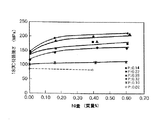
更にここで、Pを0.14質量%、0.22質量%、0.28質量%、0.32質量%含有する本発明銅合金(Bi系)中に、Niを0、0.20質量%、0.40質量%、0.60質量%含有した場合の180℃における引張強さを検証した。比較例として、Pを0.02質量%、0.10質量%とした場合についても測定した。各サンプルの組成を表11に示し、試験結果を同表、並びにグラフ化したものを図11に示す。 Furthermore, in this invention copper alloy (Bi type | system | group) which contains P 0.14 mass%, 0.22 mass%, 0.28 mass%, 0.32 mass% here, Ni is 0, 0.20 mass. %, 0.40% by mass, and 0.60% by mass, the tensile strength at 180 ° C. was verified. As a comparative example, measurement was also performed when P was 0.02 mass% and 0.10 mass%. The composition of each sample is shown in Table 11, and the test results are shown in FIG.
本試験結果から、高温下における引張強さは、Pを高濃度に含有するほど、Ni含有の特性向上効果をより促進させ、PとNiの交互作用があることが確認された。具体的には、比較例に示した低濃度のPの含有では、Niを含有しても引張強さの向上は微小なものに留まるが、Pを0.10質量%を超えて含有させた場合にNiを含有すると、引張強さが大きく向上した。特に、Pを0.14質量%以上含有させた場合に、表11、図11の特性に応じて少なくとも0.16〜0.61質量%のNiを含有させることで、引張強さの目標値152MPaを得ることができる。 From the test results, it was confirmed that the tensile strength under high temperature further promotes the Ni-containing property improvement effect as P is contained in a higher concentration, and there is an interaction between P and Ni. Specifically, in the case of containing a low concentration of P as shown in the comparative example, the improvement in tensile strength remains small even if Ni is contained, but P is contained in an amount exceeding 0.10% by mass. When Ni was contained in the case, the tensile strength was greatly improved. In particular, when P is contained in an amount of 0.14% by mass or more, the target value of tensile strength is obtained by including at least 0.16 to 0.61% by mass of Ni according to the characteristics shown in Table 11 and FIG. 152 MPa can be obtained.
また、以下のサンプルにおいて、180℃での伸びを検証した。本実験は、Sn、Zn、P、Niが180℃伸びに与える影響を調査するための4元配置実験であり、供試品の化学成分値と180℃伸びの測定結果を表12に示す。 In the following samples, the elongation at 180 ° C. was verified. This experiment is a quaternary arrangement experiment for investigating the influence of Sn, Zn, P, and Ni on the 180 ° C. elongation. Table 12 shows the chemical component values of the specimens and the measurement results of the 180 ° C. elongation.
本試験結果から、Znは10%を越えて含有させると180℃伸びが低下する傾向にある。また、Sn・Ni・Pとの交互作用も存在する。Snとの交互作用は高Zn低Sn側で180℃伸びが低下する傾向にあるが、さらにSnを高く含有させた場合には、高Zn高Snでも180℃伸びが低下することがわかっている。Niとの交互作用は、Niを低く含有(0.2質量%)する場合、Znの含有量を高くすると180℃伸びが低下するが、Niを高く(0.4質量%)含有するとその影響は小さくなる。Pとの交互作用は、Pを低く含有(0.16質量%)するときにはZnの含有量の影響は小さいが、Pを高く(0.32質量%)含有するときは、高Zn(11質量%)側で180℃伸びが大きく低下する。
また、SnとPの交互作用も存在し、Pを高く含有(0.32質量%)するときには、Snの影響は小さいが、Pを低く含有(0.16質量%)するときには、高Sn(3質量%)側で180℃伸びが低下する。
From this test result, when Zn is contained exceeding 10%, the 180 ° C. elongation tends to decrease. There is also an interaction with Sn, Ni, P. The interaction with Sn tends to decrease the 180 ° C. elongation on the high Zn low Sn side, but it is known that when Sn is further contained, the 180 ° C. elongation decreases even with high Zn high Sn. . When the Ni content is low (0.2% by mass), the interaction with Ni decreases the 180 ° C. elongation when the Zn content is high, but the effect is high when the Ni content is high (0.4% by mass). Becomes smaller. As for the interaction with P, the influence of Zn content is small when P is low (0.16% by mass), but when P is high (0.32% by mass), high Zn (11% by mass) %), The 180 ° C. elongation is greatly reduced.
In addition, there is an interaction between Sn and P. When P is highly contained (0.32 mass%), the influence of Sn is small, but when P is contained low (0.16 mass%), high Sn ( The 180 ° C. elongation decreases on the 3% by mass) side.
表9、表10(Bi系)、表11、表12を考察すると、本試験結果から、以下の成分範囲における実施例について、高濃度のPを含有することにより、高温下(180℃)における引張強さ152MPaという目標値を達成していることがわかる。
<Bi系合金>
質量%で、Sn:2.0〜6.0(好ましくは2.3〜5.7)、Zn:6.0〜10.0(好ましくは6.5〜9.5)、Bi:0.1〜3.0(好ましくは2.6)、P:0.12〜0.40(好ましくは0.33)、Ni:0.1〜3.0、残余:Cu及び不可避不純物
なお、Bi-Se系合金については、上記Bi系合金の成分に加え、Se:0.1〜1.3を含有する範囲で、適用可能である。
図17は、P-Niの交互作用を示す概念図である。低濃度(0.1≦P)のPを含有した比較例合金に対し、高濃度(0.1<P≦0.6)のPを含有した本発明銅合金は、高温下における引張強さは向上する(図17のA参照)。これに対し、Pに加えてNiを含有した場合、低濃度のPを含有した比較例合金において、高温下における引張強さの向上は僅か(図17のC参照)であるものの、高濃度のPを含有した本発明銅合金では、高温化における引張強さが常温下における引張強さ付近まで大きく向上する(図17のB参照)。このように、P-Niの交互作用とは、P含有量の増加に対する効果(引張強さ)の向上割合が、Niの含有により高温下において増加する、相乗効果(図17のB−C参照)をいう。
When Table 9, Table 10 (Bi system), Table 11, and Table 12 are considered, it can be seen from the results of this test that the examples in the following component ranges contain a high concentration of P at high temperatures (180 ° C.). It can be seen that the target value of tensile strength of 152 MPa has been achieved.
<Bi alloy>
By mass%, Sn: 2.0 to 6.0 (preferably 2.3 to 5.7), Zn: 6.0 to 10.0 (preferably 6.5 to 9.5), Bi: 0.0. 1 to 3.0 (preferably 2.6), P: 0.12 to 0.40 (preferably 0.33), Ni: 0.1 to 3.0, the remainder: Cu and inevitable impurities Bi- The Se-based alloy can be applied in a range containing Se: 0.1 to 1.3 in addition to the components of the Bi-based alloy.
FIG. 17 is a conceptual diagram showing the interaction of P—Ni. The copper alloy of the present invention containing P at a high concentration (0.1 <P ≦ 0.6) is higher in tensile strength at high temperatures than the comparative alloy containing P at a low concentration (0.1 ≦ P). Is improved (see A in FIG. 17). On the other hand, when Ni is contained in addition to P, the comparative example alloy containing low concentration of P has a slight improvement in tensile strength at high temperature (see C in FIG. 17), but high concentration. In the copper alloy of the present invention containing P, the tensile strength at high temperature is greatly improved to near the tensile strength at normal temperature (see B in FIG. 17). Thus, the interaction of P—Ni is a synergistic effect in which the improvement rate of the effect (tensile strength) on the increase of the P content increases at high temperatures due to the inclusion of Ni (see BC in FIG. 17). ).
本発明合金に、高温特性改善に効果のあるTeを添加した場合の効果について検証した。各サンプルの組成と180℃における引張強さの検証結果を表13に示す。 The effect of adding Te, which is effective in improving high temperature characteristics, to the alloy of the present invention was verified. Table 13 shows the composition of each sample and the verification results of the tensile strength at 180 ° C.
この試験結果から、本発明合金にTeを0.2質量%以上含有することで180℃引張強さが改善できることがわかった。特に、Pの含有量の少ない所での効果が大きく、Teの含有によりさらにPの含有量を抑制することで、より高い鋳造性を得ることが可能となった。 From this test result, it was found that the 180 ° C. tensile strength can be improved by containing 0.2 mass% or more of Te in the alloy of the present invention. In particular, the effect at a place where the content of P is small is great, and it becomes possible to obtain higher castability by further suppressing the content of P by containing Te.
下表は、塗型の有無で、PとNiの含有量により、180℃引張強さが変化するか調査を行ったものである。これより、Niを含有しPを低減したNo.6−1、2は、塗型の有無で180℃引張強さに変化がないものの、Pのみを添加したNo.6−3、4は塗型を塗布しない水準で180℃引張強さが大きく低下した。これは、Pの低減やNiの含有で、塗型の有無によらず鋳型との反応を抑制していることを意味する。また、Niの添加で注湯温度による180℃引張強さへの影響も小さくなるため、NiがPの活性を抑制して、雰囲気中のガス成分との反応も抑制している可能性も示唆される。 The following table investigates whether the tensile strength at 180 ° C. changes depending on the contents of P and Ni depending on the presence or absence of a coating mold. From this, No. containing Ni and reducing P was obtained. Nos. 6-1 and 2 were No. in which only P was added, although there was no change in the 180 ° C. tensile strength with and without the coating mold. Nos. 6-3 and 4 had a 180 ° C. tensile strength greatly reduced at a level where no coating mold was applied. This means that the reaction with the mold is suppressed regardless of the presence or absence of coating by reducing P or containing Ni. In addition, the effect of pouring temperature on 180 ° C tensile strength is reduced by the addition of Ni, suggesting the possibility that Ni suppresses the activity of P and also suppresses the reaction with gas components in the atmosphere. Is done.
次に、本発明の鉛レス青銅鋳物合金の鋳物健全性について試験を行い、その試験結果を説明する。
先ず、本発明合金について、P及びNiの含有量が固相線温度に与える影響を検証する。試験方法としては、P、Niの成分値を変えた本発明合金と比較例合金の供試品の固相線温度を測定した。
各供試品の固相線温度は、熱分析により求めた。熱分析は、まず、合金の冷却曲線を求め、次に、冷却曲線の傾きや直線性を解析することで求めた。その解析方法については、「平成14年度鉛レス銅合金鋳物実用上の問題点解明研究報告書(素形材センター 研究調査報告574)」のp74〜75に詳細な説明がなされている。
各供試品の化学成分値(質量%)と、測定した固相線温度の結果を表15に示す。
Next, a test is conducted on the casting soundness of the leadless bronze cast alloy of the present invention, and the test results will be described.
First, the effect of the P and Ni contents on the solidus temperature is examined for the alloy of the present invention. As a test method, the solidus temperature of the specimens of the present invention alloy and the comparative example alloy with different component values of P and Ni were measured.
The solidus temperature of each specimen was determined by thermal analysis. The thermal analysis was obtained by first obtaining a cooling curve of the alloy and then analyzing the slope and linearity of the cooling curve. The analysis method is described in detail on pages 74 to 75 of “2002 Report on Practical Problem Elucidation of Lead-free Copper Alloy Casting (Survey Research Report 574)”.
Table 15 shows the chemical component value (% by mass) of each sample and the measured solidus temperature.
各供試品の化学成分値の割合について、No.7−1は、Pを脱酸目的程度の量に添加した従来のBiを含有する鉛レス青銅鋳物合金であり、No.7−2はNo.7−1のPを0.3質量%とした供試品である。これはPの高含有による固相線温度の低下を調査するための供試品である。No.7−3は、No.7−2にNiを1.0質量%含有させた供試品である。これはNiの含有による固相線温度の上昇を調査するための供試品である。No.7−4は、No.7−3のPを0.16質量%とした供試品である。これはNiの含有とともにPを低減したときの影響を調査するための供試品である。No.7−5は、No.7−4のNiを1.4質量%とした供試品である。これはPを中程度(0.15質量%)に含有させたときのNiの影響を調査するための供試品である。No.7−6は、Seを0.2質量%含有させた供試品である。これは、Seの含有による固相線温度の変化を調査するための供試品である。No.7−7は、Sbを0.4質量%含有させた供試品である。これは、Sbの含有による固相線温度の影響を調査するための供試品である。 Regarding the ratio of the chemical component value of each sample, no. No. 7-1 is a conventional leadless bronze cast alloy containing Bi with P added in an amount suitable for deoxidation. 7-2 is No.7. It is a specimen in which P in 7-1 is 0.3% by mass. This is a sample for investigating the decrease in the solidus temperature due to the high content of P. No. 7-3 is No. 7-3. This is a test sample containing 7% by mass of Ni in 7-2. This is a specimen for investigating the rise in the solidus temperature due to the Ni content. No. 7-4 is No.7. This is a test sample in which P in 7-3 is 0.16% by mass. This is a specimen for investigating the effects when P is reduced together with the Ni content. No. 7-5 is No.7. This is a specimen with 7-4 Ni at 1.4 mass%. This is a specimen for investigating the influence of Ni when P is contained in an intermediate level (0.15% by mass). No. 7-6 is a sample containing 0.2% by mass of Se. This is a specimen for investigating changes in the solidus temperature due to the inclusion of Se. No. 7-7 is a sample containing 0.4% by mass of Sb. This is a specimen for investigating the influence of the solidus temperature due to the inclusion of Sb.
表15において、No.7−1とNo.7−2の固相線温度の測定結果から、Pの増加により固相線温度が低下することがわかる。また、No.7−3の結果から、Niには固相線温度を上昇させる効果があることがわかる。No.7−4の結果から、Niを含有した状態でも、Pの含有量の変化により固相線温度が変化することがわかる。No.7−5の結果から、中程度のPの含有量であってもNiによる固相線温度を向上させる効果があることがわかる。No.7−6、No.7−7の結果より、Se及びSbを含有しても固相線温度の変化は小さいことがわかる。
この試験結果より、Pは本発明の合金の固相線温度を低下させ、Niは固相線温度を上昇させることがわかった。さらには、これらの作用は、PとNiの含有量の変化にリニアに対応することがわかった。また、SeやSbの含有が固相線温度に与える影響は小さく、これらを含有した場合にも同様の固相線温度が得られる。
In Table 15, no. 7-1 and No. From the measurement result of the solidus temperature of 7-2, it can be seen that the solidus temperature decreases as P increases. No. From the result of 7-3, it can be seen that Ni has the effect of increasing the solidus temperature. No. From the result of 7-4, it can be seen that the solidus temperature changes due to the change of the P content even in the state of containing Ni. No. From the results of 7-5, it can be seen that even when the content of P is moderate, there is an effect of improving the solidus temperature due to Ni. No. 7-6, no. From the results of 7-7, it can be seen that the change in the solidus temperature is small even when Se and Sb are contained.
From this test result, it was found that P decreases the solidus temperature of the alloy of the present invention, and Ni increases the solidus temperature. Furthermore, it was found that these actions correspond linearly to changes in the P and Ni contents. Moreover, the influence of the inclusion of Se or Sb on the solidus temperature is small, and the same solidus temperature can be obtained even when these are contained.
続いて、本発明の鉛レス青銅鋳物合金について、階段状鋳物試験片を供試片として設け、これについて染色浸透探傷試験を行った。図13は、階段状鋳物試験片の鋳造方案を示した説明図であり、図14は、各試験片の測定箇所を示した説明図である。
図13に示す階段状鋳物試験片の鋳造方案により、表16に示すNo.8−1〜20の供試品を鋳造し、得られた鋳物から図14に示す試験片を切断して、それぞれの試験片の切断面を研磨した上で、染色浸透探傷試験を行った。染色浸透探傷試験とは、試験片の切断面に浸透液を吹き付け、これを10分間放置した後に浸透液を拭き取り、さらに、現像液を吹き付けて切断面に浮き出る赤色表示により、鋳造欠陥の有無を判定する試験である。階段状試験片の鋳造方案は、φ25mmの湯口から、φ70mm×160mmの押し湯を介して、階段状部における肉厚40mmの側方から溶湯を流し込むようにしており、鋳造条件は、溶解は15kg高周波実験炉で行い、溶解量は12kgとし、鋳込み温度1180℃、鋳型はCo2鋳型を用いた。
Then, about the leadless bronze casting alloy of this invention, the step-like casting test piece was provided as a test piece, and the dyeing | penetration penetration flaw test was done about this. FIG. 13 is an explanatory view showing a casting method of a stepped cast test piece, and FIG. 14 is an explanatory view showing a measurement location of each test piece.
According to the casting method of the stepped cast specimen shown in FIG. Samples of 8-1 to 20 were cast, the test pieces shown in FIG. 14 were cut from the obtained castings, the cut surfaces of the respective test pieces were polished, and then a dye penetration test was performed. In the dye penetrant flaw detection test, the penetrant is sprayed on the cut surface of the test piece, left to stand for 10 minutes, and then the penetrant is wiped off. Further, the developer is sprayed on the cut surface to show the presence of casting defects. It is a test to judge. The casting method of the stepped test piece is such that the molten metal is poured from the side of the wall thickness of 40 mm in the stepped portion through the hot water of φ70 mm × 160 mm from the φ25 mm gate, and the casting condition is 15 kg for melting. This was carried out in a high-frequency experimental furnace, the dissolution amount was 12 kg, the casting temperature was 1180 ° C., and the mold was a Co 2 mold.
No.8−1は、Pを脱酸目的に添加した従来のBiを含有する鉛レス青銅鋳物合金である。No.8−2、3はNo.8−1のPを高含有させたものであり、Pの含有量と鋳物の健全性を調査した供試品である。No.8−4〜7はPを0.3質量%に固定してNiの含有量を変化させて、Niの含有量と鋳物の健全性を調査するための供試品である。No.8−8〜13は、PとNiの含有量を変化させて、異なる含有量の組合せでの健全性を確認するための供試品である。No.8−14〜16は鋳物の健全性に影響を与えるBiとSeの含有量を変化させ、本発明にも適用されるかを確認するための供試品である。No.8−17、18は本発明合金を構成する元素の含有量を変化させ、鋳物の健全性を確認するための供試品である。No.8−19、20は、SbとNiを含有させ、本発明合金に微量元素を含有させた場合の影響を調査した供試品である。図15(a)〜図15(j)、及び図16(k)〜図16(t)において、各試験片の染色浸透探傷試験結果を示しており、各試験片No.1〜20は、図15(a)〜図15(j)と、図16(k)〜図16(t)までの各図に対応している。 No. 8-1 is a lead-free bronze casting alloy containing conventional Bi to which P is added for the purpose of deoxidation. No. 8-2 and 3 are Nos. It is a specimen in which the content of P in 8-1 is high, and the content of P and the soundness of the casting are investigated. No. 8-4 to 7 are specimens for investigating the Ni content and the soundness of castings by fixing P at 0.3% by mass and changing the Ni content. No. 8-8 to 13 are specimens for confirming the soundness of combinations of different contents by changing the contents of P and Ni. No. 8-14 to 16 are specimens for confirming whether they are applied to the present invention by changing the contents of Bi and Se that affect the soundness of the casting. No. 8-17 and 18 are specimens for changing the content of elements constituting the alloy of the present invention and confirming the soundness of the casting. No. Nos. 8-19 and 20 are specimens in which the effects of adding Sb and Ni and adding trace elements to the alloy of the present invention were investigated. 15 (a) to 15 (j) and FIGS. 16 (k) to 16 (t) show the dye penetration test results of each test piece. 1 to 20 correspond to FIGS. 15 (a) to 15 (j) and FIGS. 16 (k) to 16 (t).
試験結果より、No.8−1、2に関しては染色される箇所がほとんどなく良好な鋳造性が得られているが、Pを0.3質量%に増加したNo.8−3では染色される箇所が多く、生産時においては、鋳造方案の変更や鋳造方法の最適化が求められる。また、No.8−3にNiを0.1質量%含有させたNo.8−4は、Niの若干のポロシティ低減効果は見られるものの、染色された面積が多くこれも評価としては「△」とするが、最低限の効果は得られたものとする。さらに、Niの含有量を増すと染色される面積が減少し、1.0質量%のNi含有でほぼ無欠陥となり、良好な鋳物が得られる。また、様々なPとNiの組合わせでも、Niの含有により良好な鋳造性が得られることが確認された。また、Seを含有させた場合、染色される箇所が小さくなる傾向を示し、Seの含有により、より良好な鋳造性が得られることがわかった。また、本発明合金の構成元素を大きく変化させても、所定の質量比の範囲内であれば良好な鋳造性が得られることが確認された。また、SbやFeは、この階段状鋳物試験片での評価において、その影響は小さい。 From the test results, No. As for Nos. 8-1 and 2, there are almost no spots to be dyed and good castability is obtained. In 8-3, there are many places to be dyed, and at the time of production, it is required to change the casting method or optimize the casting method. No. No. 8-3 containing 0.1% by mass of Ni. In 8-4, although a slight porosity reduction effect of Ni is observed, the dyed area is large and this is also evaluated as “Δ”, but the minimum effect is obtained. Further, when the Ni content is increased, the dyed area is reduced, and when Ni content is 1.0% by mass, the defect becomes almost defect-free and a good casting can be obtained. Further, it was confirmed that even in various combinations of P and Ni, good castability can be obtained by containing Ni. Moreover, when Se was contained, the dyeing | staining location showed the tendency to become small, and it turned out that better castability is acquired by containing Se. Further, it was confirmed that even if the constituent elements of the alloy of the present invention were greatly changed, good castability could be obtained within a predetermined mass ratio range. In addition, Sb and Fe have a small influence in the evaluation with the stepped cast specimen.
<Bi系合金>
質量%で、Sn:2.5(好ましくは2.9)〜6.0、Zn:4.0(好ましくは3.9)〜8.0、Bi:0.5〜3.0(好ましくは2.5)、P:0.15〜0.40(好ましくは0.36)、0≦Ni≦2.0(好ましくは1.9)、残余:Cu及び不可避不純物
なお、Bi-Se系合金については、上記Bi系合金の成分に加え、Se:0.1〜1.3を含有する範囲で、適用可能である。
<Bi alloy>
In mass%, Sn: 2.5 (preferably 2.9) to 6.0, Zn: 4.0 (preferably 3.9) to 8.0, Bi: 0.5 to 3.0 (preferably 2.5), P: 0.15 to 0.40 (preferably 0.36), 0 ≦ Ni ≦ 2.0 (preferably 1.9), the remainder: Cu and inevitable impurities Note that the Bi—Se alloy Is applicable to the range containing Se: 0.1 to 1.3 in addition to the components of the Bi-based alloy.
(切削性試験)
切削性試験片は、円柱状の被削物を施盤にて施削加工し、バイトに掛かる切削抵抗を青銅鋳物CAC406の切削抵抗を100とした切削性指数で評価した。試験条件は、鋳込み温度1160℃(Co2鋳型)、被切削物の形状φ31×300mm、表面粗さRA3.2、切り込み深さ片肉3.0mm、施盤回転数1800rpm、送り量0.2mm/rev、油使用無しである。
切削性試験の試験結果を表17に示す。
(Machinability test)
For the machinability test piece, a cylindrical workpiece was machined with a lathe, and the cutting resistance applied to the cutting tool was evaluated by a machinability index with the cutting resistance of the bronze cast CAC406 as 100. The test conditions were as follows: casting temperature 1160 ° C. (Co 2 mold), workpiece shape φ31 × 300 mm, surface roughness R A 3.2, depth of cut 3.0 mm, lathe speed 1800 rpm, feed
Table 17 shows the test results of the machinability test.
表17に示すNo.9−1〜4は本発明銅合金(Bi系)の供試品、No.9−5〜11は、本発明銅合金(Bi-Se系)の供試品である。
いずれの供試品も、CAC406の加工に用いられる、加工設備、刃物、切削条件で加工が可能である指数80%以上を満たしており、CAC406と略同等の切削条件で加工することができるものと認められる。
Nos. 9-1 to 4 shown in Table 17 are specimens of the copper alloy of the present invention (Bi series). 9-5 to 11 are specimens of the copper alloy of the present invention (Bi-Se series).
All of the specimens satisfy the index of 80% or more that can be processed with the processing equipment, blades, and cutting conditions used for the processing of CAC406, and can be processed under cutting conditions substantially equivalent to those of CAC406. It is recognized.
(隙間噴流腐食試験)
エロージョン・コロージョンは隙間噴流腐食試験により評価する。試験方法は腐食液に対して暴露面積を64mm2(φ16mm)に加工した試験片を鏡面研磨し、次いで、この試験片表面より0.4mmの高さに配置した噴射ノズル(ノズル径:1.6mm)から試験溶液(1%塩化第二銅水溶液)を0.4リットル/minで噴射する。試験溶液を5時間噴射した後、腐食面における最大腐食深さを測定した。
表18に示すNo.10−1〜3は、本発明銅合金(Bi系)の供試品であり、比較例に示したCAC406、CAC401よりも良好な結果が得られた。
(Crevice jet corrosion test)
Erosion and corrosion are evaluated by a crevice jet corrosion test. In the test method, a test piece processed to have an exposed area of 64 mm 2 (φ16 mm) with respect to the corrosive liquid is mirror-polished, and then a jet nozzle (nozzle diameter: 1. mm) disposed at a height of 0.4 mm from the surface of the test piece. 6 mm), a test solution (1% cupric chloride aqueous solution) is sprayed at 0.4 liter / min. After spraying the test solution for 5 hours, the maximum corrosion depth on the corroded surface was measured.
No. shown in Table 18 10-1 to 3 are specimens of the copper alloy of the present invention (Bi-based), and better results were obtained than CAC406 and CAC401 shown in the comparative examples.
(引張試験 破断面・組織評価)
実施例1(Pの含有量と180℃における引張強さの関係)と同様の引張試験を行い、引張試験片の破断面組織の観察、ミクロ組織の観察、EDX分析により評価した。
表19に示すように、No.11−1は、本発明銅合金(Bi系)において、高濃度のPを含有した供試品であり、No.11−2は、本発明銅合金(Bi系)において、Niを含有することにより、Pを高濃度の範囲内(0.1<P≦0.6質量%)において抑制した供試品である。No.11−3は比較例であり、JIS H5120 CAC911(Bi-Se系青銅鋳物)に該当する供試品であり、Pの含有量は低濃度である0.02質量%である。
(Tensile test, fracture surface / structure evaluation)
A tensile test similar to that in Example 1 (relationship between P content and tensile strength at 180 ° C.) was performed, and evaluation was performed by observation of the fracture surface structure of the tensile test piece, observation of the microstructure, and EDX analysis.
As shown in Table 19, no. 11-1 is a specimen containing a high concentration of P in the copper alloy of the present invention (Bi series). 11-2 is a specimen in which P is suppressed in a high concentration range (0.1 <P ≦ 0.6 mass%) by containing Ni in the copper alloy (Bi system) of the present invention. . No. 11-3 is a comparative example, which is a specimen corresponding to JIS H5120 CAC911 (Bi-Se bronze casting), and the content of P is 0.02% by mass, which is a low concentration.
各供試品を用いた180℃引張試験後の破断面SEM写真及び組織写真を、図18〜20に示す。本発明銅合金では、図19(b)に示すように、破断面中央部に繊維状、その周辺に放射状の破面組織が観察され、図18及び図19(a)に示すように、SEM写真において微少なディンプル(くぼみ)が多数みられることから、180℃における引張試験では「延性破壊」が生じたものと考えられる。
一方、比較例合金では、図20に示すように、結晶面(晶へき面)に沿った「へき開割れ」を呈し、SEM写真においてディンプルはみられないことから、180℃における引張試験では、「脆性破壊」が生じたものと考えられる。
このように、高濃度のPの含有により、高温下(180℃)における合金の結晶粒界等の強度が向上したことから、「脆性破壊」から「延性破壊」に転じている。また、Niを含有した場合も同様である。
The fracture surface SEM photograph and structure | tissue photograph after a 180 degreeC tensile test using each specimen are shown to FIGS. In the copper alloy of the present invention, as shown in FIG. 19B, a fibrous fracture surface structure is observed in the central portion of the fracture surface, and a radial fracture surface structure is observed in the periphery thereof. As shown in FIG. 18 and FIG. Since many fine dimples (dents) are seen in the photograph, it is considered that “ductile fracture” occurred in the tensile test at 180 ° C.
On the other hand, as shown in FIG. 20, the comparative example alloy exhibits “cleavage cracks” along the crystal plane (crystal cleavage plane), and no dimples are observed in the SEM photograph. It is thought that “brittle fracture” occurred.
As described above, since the strength of the crystal grain boundaries of the alloy at high temperature (180 ° C.) is improved by containing a high concentration of P, the “brittle fracture” is changed to “ductile fracture”. The same applies when Ni is contained.
図21は、本発明銅合金(No.11−2)のミクロ組織であり、図22は、図21のEDX分析による成分分布である。本実施例においては、初晶αがデンドライト状に成長し、その間隙部にBi相が観察され、このBi相に隣接してCu-P化合物(Cu3P)、Ni-P化合物(Ni3P)が存在する。また、P、Niは、初晶αにも固溶しており、マトリクス強度を向上させているものと考えられる。
従って、上記評価の結果、高濃度のPの含有により、高温下(180℃)に引張強さの向上効果が、供試品の破断面・組織観察によっても裏付けることができ、また、Niを含有した場合には、Pを高濃度の範囲内において抑制しつつ、高温下(180℃)に引張強さの向上効果が、供試品の破断面・組織観察によって裏付けることができた。
21 shows the microstructure of the copper alloy of the present invention (No. 11-2), and FIG. 22 shows the component distribution by EDX analysis of FIG. In this example, the primary crystal α grows in a dendrite shape, and a Bi phase is observed in the gap, and a Cu—P compound (Cu 3 P) and a Ni—P compound (Ni 3 P) are present adjacent to the Bi phase. To do. Moreover, P and Ni are also dissolved in the primary crystal α, and it is considered that the matrix strength is improved.
Therefore, as a result of the above evaluation, the inclusion of a high concentration of P can confirm the effect of improving the tensile strength at high temperatures (180 ° C.) by observing the fracture surface / structure of the specimen, When contained, the effect of improving the tensile strength at high temperature (180 ° C.) while suppressing P within a high concentration range could be supported by observation of the fracture surface and structure of the specimen.
本発明の鉛レス青銅鋳物合金は、給水・給湯用や蒸気用の配管器材(バルブ・継手など)、圧力器材(ケーシング)等々、幅広い分野における各種部品に適する銅合金である。本発明合金は、引張強さの向上を図る合金であるから薄肉形状の部品、例えば配管器材のみならず、構造部品にも適する。ガス器具、洗濯機、空調機等の電気・機械製品を加工成形したりするのに適している。その他、本発明の銅合金を材料として好適な部材・部品は、特に、バルブや水栓等の水接触部品、即ち、ボールバルブ、ボールバルブ中の空用ボール、バタフライバルブ、ゲートバルブ、グローブバルブ、チェックバルブ、給水栓、給湯器や温水洗浄便座等の取付金具、給水・給湯管及び管継手、電気温水器部品(ケーシング、ガスノズル、ポンプ部品、バーナなど)、ストレーナ、水道メータ用部品、水中下水道用部品、排水プラグ、エルボ管、ベローズ、便器用接続フランジ、スピンドル、ジョイント、ヘッダー、分岐栓、ホースニップル、水栓付属金具、止水栓、給排水配水栓用品、衛生陶器金具、シャワー用ホースの接続金具、ガス器具、ドアやノブ等の建材、家電製品、サヤ管ヘッダー用アダプタ、自動車クーラー部品、釣り具部品、顕微鏡部品、水道メータ部品、計量器部品、鉄道パンタグラフ部品、その他の部材・部品に広く応用することができる。更には、トイレ用品、台所用品、浴室品、洗面所用品、家具部品、居間用品、スプリンクラー用部品、ドア部品、門部品、自動販売機部品、洗濯機部品、空調機部品、ガス溶接機用部品、熱交換器用部品、太陽熱温水器部品、自動車用部品、金型及びその部品、ベアリング、歯車、建設機械用部品、鉄道車両用部品、輸送機器用部品、素材、中間品、最終製品及び組立体等にも広く適用できる。 The leadless bronze casting alloy of the present invention is a copper alloy suitable for various parts in a wide range of fields such as piping equipment (valves, joints, etc.) for water and hot water supply and steam, pressure equipment (casing), and the like. Since the alloy of the present invention is an alloy that improves the tensile strength, it is suitable not only for thin-walled parts such as piping equipment but also for structural parts. It is suitable for processing and molding electrical and mechanical products such as gas appliances, washing machines and air conditioners. Other members / parts suitable for the copper alloy of the present invention are water contact parts such as valves and faucets, that is, ball valves, empty balls in ball valves, butterfly valves, gate valves, globe valves. , Check valves, faucets, fittings such as water heaters and hot water flush toilet seats, water / hot water pipes and fittings, electric water heater parts (casing, gas nozzle, pump parts, burners, etc.), strainers, water meter parts, underwater Sewer parts, drain plugs, elbow pipes, bellows, toilet flanges, spindles, joints, headers, branch plugs, hose nipples, faucet fittings, stop cocks, water supply / drainage faucets, sanitary ware fittings, shower hoses Fittings, gas appliances, building materials such as doors and knobs, home appliances, adapters for Saya tube headers, automotive cooler parts, fishing gear parts , It can be widely applied to a microscope component, water meter parts, meter parts, railroad pantograph components, other components and parts. Furthermore, toilet articles, kitchen articles, bathroom articles, toilet articles, furniture parts, living room articles, sprinkler parts, door parts, gate parts, vending machine parts, washing machine parts, air conditioner parts, gas welder parts , Heat exchanger parts, solar water heater parts, automotive parts, molds and parts, bearings, gears, construction machine parts, railway vehicle parts, transportation equipment parts, materials, intermediate products, final products and assemblies Etc.
特に高温下に使用され得る用途として、以下の用途が挙げられる。
1.<Bi系(Niなし)、Bi-Se系(Niなし)>(耐圧性をさほど要求されない環境で使用される合金)
バーナー、ガスノズル、フレアナット、ボールタップ、サーモスタット部品、ボルト、ナット、スピンドル、摺動部品(軸受、歯車、プッシュ、スリーヴ、ウォームギア)などの構造部品。
2.<Bi系(Ni含有)、Bi-Se系(Ni含有)>(強度・耐圧性を要求される用途)
熱交換器(プレート、チューブ)、ガスタービン、原子炉部品、工業用炉部材(配管、バルブ、継手)、海水処理設備(配管、バルブ、容器、継手)、減圧弁、電磁弁、蒸気弁、安全弁、蒸気配管、給湯器具、蒸気発生装置、ボイラ部品(配管、バルブ、容器、継手)、ポンプ部品(ケーシング、カバー、インペラー)、スチームトラップ、ドレン管、蒸気用弁、フロート、空調機部品(配管、バルブ、継手)、蒸気用ストレーナ、油圧ポンプ部品(ケーシング、インペラー)、排気管、電気温水器部品(配管、バルブ、継手)、貯湯容器、比例弁、ルームヒータ部品、気化器、サービスバルブ、ボールタップ、食器洗浄器、バルブや水洗等の水接触部品(ボールバルブ、ボールバルブ用の中空ボール、バタフライバルブ、ゲートバルブ、グローブバルブ、チャッキバルブ、給水管、接続管、管継手、ストレーナ)、ヘッダー、分岐栓、ホースニップル、水洗付属金具、止水栓、給排水配水栓用品、サヤ間ヘッダーアダプタなどの配管・圧力器材。
なお、水栓金具や水栓附属金具、給水・給湯部品などは、通常の使用にあっては100℃以上の使用はないものの、冷水-熱水を交番的に使用される状況下や、食器洗い乾燥機などにおける熱風乾燥などの100℃を超える高温に曝される状況下にあっては、本発明銅合金は有意性がある。
Examples of applications that can be used particularly at high temperatures include the following applications.
1. <Bi-based (without Ni), Bi-Se-based (without Ni)> (Alloy used in environments where pressure resistance is not so required)
Structural parts such as burners, gas nozzles, flare nuts, ball taps, thermostat parts, bolts, nuts, spindles, sliding parts (bearings, gears, pushes, sleeves, worm gears).
2. <Bi-based (Ni-containing), Bi-Se-based (Ni-containing)> (Applications requiring strength and pressure resistance)
Heat exchangers (plates, tubes), gas turbines, nuclear reactor parts, industrial furnace components (piping, valves, fittings), seawater treatment equipment (piping, valves, containers, fittings), pressure reducing valves, solenoid valves, steam valves, Safety valve, steam piping, hot water supply equipment, steam generator, boiler parts (piping, valves, containers, joints), pump parts (casing, cover, impeller), steam trap, drain pipe, steam valve, float, air conditioner parts ( Piping, valves, fittings), steam strainers, hydraulic pump parts (casing, impeller), exhaust pipes, electric water heater parts (piping, valves, fittings), hot water storage containers, proportional valves, room heater parts, vaporizers, service valves Water contact parts such as ball taps, dishwashers, valves and water washers (ball valves, hollow balls for ball valves, butterfly valves, gate valves, groups Bubarubu, the chuck valve, water supply pipe, the connection pipe, pipe joint, strainers), header, branching plugs, hose nipple, washing accessory bracket, stop cock, plumbing distribution plug supplies, piping, pressure equipment, such as a sheath between header adapter.
The faucet fittings, faucet fittings, water supply / hot water supply parts, etc. are not used at 100 ° C or higher under normal use. The copper alloy of the present invention is significant under the condition of being exposed to a high temperature exceeding 100 ° C. such as hot air drying in a dryer or the like.
Claims (3)
Priority Applications (1)
| Application Number | Priority Date | Filing Date | Title |
|---|---|---|---|
| JP2007047233A JP5259102B2 (en) | 2007-02-27 | 2007-02-27 | Low lead bronze casting alloy |
Applications Claiming Priority (1)
| Application Number | Priority Date | Filing Date | Title |
|---|---|---|---|
| JP2007047233A JP5259102B2 (en) | 2007-02-27 | 2007-02-27 | Low lead bronze casting alloy |
Publications (2)
| Publication Number | Publication Date |
|---|---|
| JP2008208433A JP2008208433A (en) | 2008-09-11 |
| JP5259102B2 true JP5259102B2 (en) | 2013-08-07 |
Family
ID=39784986
Family Applications (1)
| Application Number | Title | Priority Date | Filing Date |
|---|---|---|---|
| JP2007047233A Active JP5259102B2 (en) | 2007-02-27 | 2007-02-27 | Low lead bronze casting alloy |
Country Status (1)
| Country | Link |
|---|---|
| JP (1) | JP5259102B2 (en) |
Families Citing this family (4)
| Publication number | Priority date | Publication date | Assignee | Title |
|---|---|---|---|---|
| MX366520B (en) * | 2012-05-03 | 2019-07-11 | Sloan Valve Co | Antimony-modified low-lead copper alloy. |
| JP5406405B1 (en) * | 2013-06-12 | 2014-02-05 | 株式会社栗本鐵工所 | Copper alloy for water supply components |
| CN116657000A (en) * | 2023-04-19 | 2023-08-29 | 宁波金田铜业(集团)股份有限公司 | A polished brass ingot without impurity spots and its preparation method |
| CN119177373B (en) * | 2024-09-13 | 2025-12-12 | 宁波金田铜业(集团)股份有限公司 | A tin bronze rod/wire and its preparation method |
Family Cites Families (7)
| Publication number | Priority date | Publication date | Assignee | Title |
|---|---|---|---|---|
| AU5005793A (en) * | 1992-08-14 | 1994-03-15 | Thomas D. Nielsen | Lead-free copper base alloys |
| JP2889829B2 (en) * | 1994-10-20 | 1999-05-10 | 株式会社タブチ | Lead-free free-cutting bronze alloy |
| JP2004068096A (en) * | 2002-08-07 | 2004-03-04 | Nippo Valve Co Ltd | Se-containing alloy for improving machinability of copper alloy |
| JP4455507B2 (en) * | 2002-09-09 | 2010-04-21 | 株式会社キッツ | Valve for drinking water |
| JP3690746B2 (en) * | 2002-09-09 | 2005-08-31 | 株式会社キッツ | Copper alloy and ingot or wetted parts using the alloy |
| JP2006111925A (en) * | 2004-10-14 | 2006-04-27 | Kitz Corp | Copper-base alloy |
| CN101203623A (en) * | 2005-06-21 | 2008-06-18 | 株式会社栗本铁工所 | Copper alloy water channel components |
-
2007
- 2007-02-27 JP JP2007047233A patent/JP5259102B2/en active Active
Also Published As
| Publication number | Publication date |
|---|---|
| JP2008208433A (en) | 2008-09-11 |
Similar Documents
| Publication | Publication Date | Title |
|---|---|---|
| AU2005272376B2 (en) | Copper alloy | |
| JP4397963B2 (en) | Lead-free brass alloy with excellent stress corrosion cracking resistance | |
| JP6335194B2 (en) | Lead-free, easy-to-cut, corrosion-resistant brass alloy with good thermoformability | |
| AU2013340034B2 (en) | Brass alloy and processed part and wetted part | |
| US6395110B2 (en) | Copper-based alloy excelling in corrosion resistance, method for production thereof, and products made of the copper-based alloy | |
| JP2008208433A (en) | Leadless bronze casting alloy | |
| KR100976741B1 (en) | Bronze Low Smoke Alloy | |
| JP4522736B2 (en) | Copper-base alloy for die casting and ingots and products using this alloy | |
| JP4489701B2 (en) | Copper base alloy | |
| JP5566622B2 (en) | Cast alloy and wetted parts using the alloy | |
| CN106001514A (en) | Casting process of high-silicon austenitic stainless steel casting | |
| JPWO2006137557A1 (en) | Copper alloy waterworks components | |
| JP5885424B2 (en) | Method for producing extruded pipe member made of aluminum alloy for heat exchanger | |
| JP2006111925A (en) | Copper-base alloy |
Legal Events
| Date | Code | Title | Description |
|---|---|---|---|
| A621 | Written request for application examination |
Free format text: JAPANESE INTERMEDIATE CODE: A621 Effective date: 20091222 |
|
| A977 | Report on retrieval |
Free format text: JAPANESE INTERMEDIATE CODE: A971007 Effective date: 20120201 |
|
| A131 | Notification of reasons for refusal |
Free format text: JAPANESE INTERMEDIATE CODE: A131 Effective date: 20120207 |
|
| A521 | Request for written amendment filed |
Free format text: JAPANESE INTERMEDIATE CODE: A523 Effective date: 20120409 |
|
| A131 | Notification of reasons for refusal |
Free format text: JAPANESE INTERMEDIATE CODE: A131 Effective date: 20130122 |
|
| A521 | Request for written amendment filed |
Free format text: JAPANESE INTERMEDIATE CODE: A523 Effective date: 20130325 |
|
| TRDD | Decision of grant or rejection written | ||
| A01 | Written decision to grant a patent or to grant a registration (utility model) |
Free format text: JAPANESE INTERMEDIATE CODE: A01 Effective date: 20130423 |
|
| A61 | First payment of annual fees (during grant procedure) |
Free format text: JAPANESE INTERMEDIATE CODE: A61 Effective date: 20130424 |
|
| FPAY | Renewal fee payment (event date is renewal date of database) |
Free format text: PAYMENT UNTIL: 20160502 Year of fee payment: 3 |
|
| R150 | Certificate of patent or registration of utility model |
Ref document number: 5259102 Country of ref document: JP Free format text: JAPANESE INTERMEDIATE CODE: R150 Free format text: JAPANESE INTERMEDIATE CODE: R150 |
|
| R250 | Receipt of annual fees |
Free format text: JAPANESE INTERMEDIATE CODE: R250 |
|
| R250 | Receipt of annual fees |
Free format text: JAPANESE INTERMEDIATE CODE: R250 |
|
| R250 | Receipt of annual fees |
Free format text: JAPANESE INTERMEDIATE CODE: R250 |
|
| R250 | Receipt of annual fees |
Free format text: JAPANESE INTERMEDIATE CODE: R250 |
|
| R250 | Receipt of annual fees |
Free format text: JAPANESE INTERMEDIATE CODE: R250 |
|
| R250 | Receipt of annual fees |
Free format text: JAPANESE INTERMEDIATE CODE: R250 |
|
| R250 | Receipt of annual fees |
Free format text: JAPANESE INTERMEDIATE CODE: R250 |
|
| R250 | Receipt of annual fees |
Free format text: JAPANESE INTERMEDIATE CODE: R250 |
|
| S531 | Written request for registration of change of domicile |
Free format text: JAPANESE INTERMEDIATE CODE: R313531 |
|
| R350 | Written notification of registration of transfer |
Free format text: JAPANESE INTERMEDIATE CODE: R350 |
|
| R250 | Receipt of annual fees |
Free format text: JAPANESE INTERMEDIATE CODE: R250 |
|
| R250 | Receipt of annual fees |
Free format text: JAPANESE INTERMEDIATE CODE: R250 |
|
| R250 | Receipt of annual fees |
Free format text: JAPANESE INTERMEDIATE CODE: R250 |