JP5118968B2 - Method for producing lipid A analog - Google Patents
Method for producing lipid A analog Download PDFInfo
- Publication number
- JP5118968B2 JP5118968B2 JP2007533245A JP2007533245A JP5118968B2 JP 5118968 B2 JP5118968 B2 JP 5118968B2 JP 2007533245 A JP2007533245 A JP 2007533245A JP 2007533245 A JP2007533245 A JP 2007533245A JP 5118968 B2 JP5118968 B2 JP 5118968B2
- Authority
- JP
- Japan
- Prior art keywords
- formula
- compound represented
- solvent
- acid
- iii
- Prior art date
- Legal status (The legal status is an assumption and is not a legal conclusion. Google has not performed a legal analysis and makes no representation as to the accuracy of the status listed.)
- Expired - Fee Related
Links
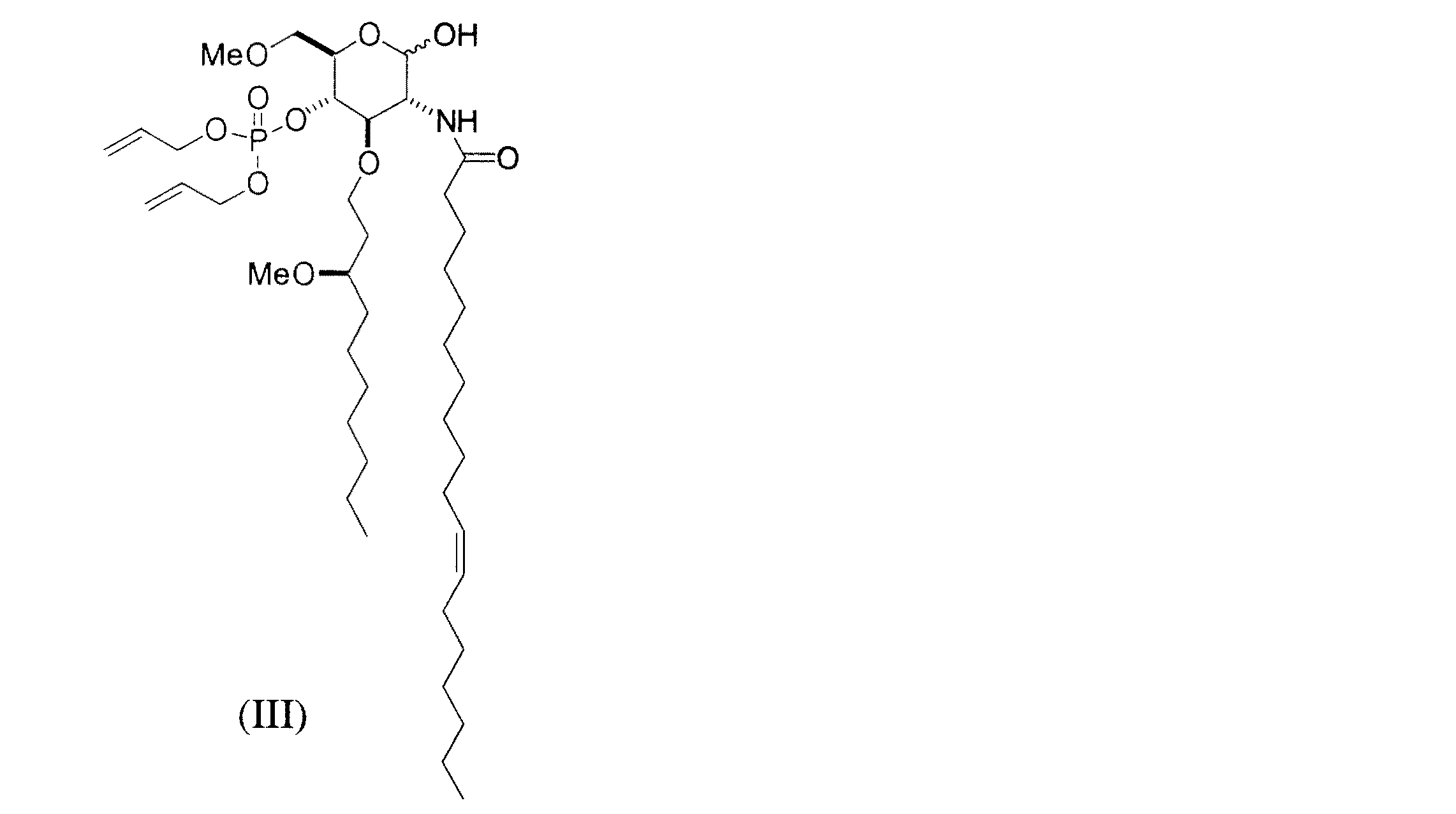
- 0 CCCCCCCC(CC*C([C@@](C(COC)O*1O)OP(OCC=C)(OCC=C)=O)[C@]1NC(CCCCCCCCCC=CCCCCCC)=O)OC Chemical compound CCCCCCCC(CC*C([C@@](C(COC)O*1O)OP(OCC=C)(OCC=C)=O)[C@]1NC(CCCCCCCCCC=CCCCCCC)=O)OC 0.000 description 1
Landscapes
- Saccharide Compounds (AREA)
Description
本発明は、医薬として有用な、式(I)で表されるリピッドA類縁体E5564(B1287,Eritoranの名称でも知られる)の製造方法に関する。 The present invention relates to a method for producing a lipid A analog E5564 (B1287, also known as Eritoran) represented by formula (I), which is useful as a medicine.
式(I)で表されるE5564(B1287,Eritoranの名称でも知られている)については、グラム陰性菌外膜に存在するリポ多糖類(LPS:Lipopolysaccharide)成分あるいはエンドトキシンが引き起こす致死率の高いグラム陰性菌血症、特にエンドトキシンショックの予防・治療等に優れた効果を有することが知られている。また、E5564は、ヒトにおいても優れた抗エンドトキシン作用が確認されており(非特許文献1)、また、細菌の菌体成分を認識する受容体のひとつであるTLR4(toll−like receptor 4)に対して拮抗作用を有することも知られている(特許文献1,非特許文献2)。それらの作用に基づいてE5564は、敗血症(sepsis)、内毒素症(endotoxemia)、冠動脈バイパス形成術の予後改善(CABG:prognosis of coronary−artery bypass graft surgeries)等の予防または治療剤として特に有用であることが報告されている(例えば、特許文献2、3、4参照)。 For E5564 (B1287, also known as Eritoran) represented by the formula (I), a gram with a high lethality caused by a lipopolysaccharide (LPS) component present in the outer membrane of a gram-negative bacterium or endotoxin It is known to have an excellent effect in the prevention and treatment of negative bacteremia, particularly endotoxin shock. E5564 has also been confirmed to have an excellent anti-endotoxin action in humans (Non-patent Document 1), and TLR4 (toll-like receptor 4), which is one of the receptors that recognize bacterial cell components, It is also known that it has an antagonistic action (Patent Document 1, Non-Patent Document 2). Based on their action, E5564 is particularly useful as a prophylactic or therapeutic agent for sepsis, endotoxemia, prognosis improvement of coronary artery bypass grafting (CABG), and the like. It has been reported (see, for example, Patent Documents 2, 3, and 4).
特許文献2には、式(I)で表されるE5564のフリー体、特許文献3には、式(I)で表されるE5564(B1287)が記載されている。さらに、特許文献5、6および7にはE5564の合成法が開示されている。 Patent Document 2 describes a free form of E5564 represented by Formula (I), and Patent Document 3 describes E5564 (B1287) represented by Formula (I). Further, Patent Documents 5, 6 and 7 disclose a synthesis method of E5564.
特許文献5,6および7に開示されている合成法によれば、E5564は2つの糖類(サッカライド)を結合した後、2本のアシル型側鎖を導入しているが、側鎖導入のための官能基変換に多くの工程が必要で、また、多くの工程においてジクロロメタンの使用が必要とされている。特許文献6、7には、1本のアシル型側鎖を予め導入後、2つの糖類を結合させる別合成法も開示されているが、残る2本目のアシル型側鎖の導入は低収率であり、また、ジクロロメタンの使用も回避されていない。さらに、特許文献3には予め2本のアシル型側鎖を導入後、2つの糖類を結合して式(I)で表されるリピッドA類縁体を製造する方法が記載されている。例えば、特許文献3の実施例5のステップ3(p123−124)には、本発明に係る式(VIII)の化合物が記載されている。しかし、ステップ3記載の方法によれば、式(VIII)の化合物を得るためには、ジクロロメタンを溶媒とし、爆発性を有するテトラゾールの存在下で亜リン酸基を導入後、反応温度−78℃にて高価なm−クロロ過安息香酸を酸化剤として投入することおよび生成物のカラムクロマトグラフィーによる精製が必要とされている。さらに、ステップ4(p124−125)には、本発明に係る式(II)の化合物とその4ナトリウム塩(B1287)の製造法が開示されているが、その製造法によればテトラキス(トリフェニルホスフィン)パラジウムの窒素充填グローブバッグを使用した反応容器への移送が必要である。また、本発明に係るリピッドA類縁体のβ−Dグルコピラノシル部分を構成する糖類の合成例として、例えば、実施例1ステップ3(p100−101)には、本発明に係る式(X)から式(III)の化合物の製造法が開示されているが、収率が極めて低い。
E5564は、敗血症(sepsis)、内毒素症(endotoxemia)、冠動脈バイパス形成術の予後改善(CABG:prognosis of coronary−artery bypass graft surgeries)等の予防・治療剤として良好な作用を示すが、既存の製造法は医薬品の原薬としての商業的生産の観点から、工程数の多さ、原料原価、製造過程における安全性、操作性、再現性等に課題を有している。また、既存の製法によれば、E5564の合成過程では、例えば反応溶媒としてジクロロメタンの使用が必要であるが、該ジクロロメタンは人体への影響から、国連危険物分類(UN Hazard Class)によれば6.1[Toxic substances]に分類され、医薬品規制調和国際会議(ICH)品質ガイドラインQ3C [不純物に関するガイドライン:残留溶媒]によればクラス2[医薬品中の残留量を規制すべき溶媒]に分類され、また、日本においては大気汚染、水質汚濁に係る環境基準としての上限値が設定されている。
2本のアシル型側鎖を予め導入後、2つの糖類を結合する特許文献3記載の製法はトータル工程数の減少、特に糖類の結合後における工程改善の面で優れているが、毒性を有する試薬の大量使用、爆発性試薬の使用、製造過程における操作性、再現性等に課題を有し、またジクロロメタンの使用も回避されていない。
したがって、環境に優しく、安全性、操作性、再現性に優れたE5564の製造方法が求められている。E5564 has a good effect as a prophylactic / therapeutic agent for sepsis, endotoxemia, prognostic improvement of coronary artery bypass grafting (CABG), etc. From the viewpoint of commercial production as a drug substance for pharmaceuticals, the production method has problems in the number of processes, raw material costs, safety in the production process, operability, reproducibility, and the like. Further, according to the existing production method, for example, use of dichloromethane as a reaction solvent is necessary in the synthesis process of E5564. However, due to the influence on the human body, the dichloromethane is 6 according to the UN Hazard Class. .1 [Toxic substances], classified according to Class 2 [Solvents that should regulate the residual amount in pharmaceuticals] according to Quality Guidelines Q3C [Guidelines on Impurities: Residual Solvents] In Japan, an upper limit is set as an environmental standard for air pollution and water pollution.
The method described in Patent Document 3 in which two acyl-type side chains are introduced in advance and two saccharides are bound is excellent in terms of reducing the total number of steps, particularly in terms of improving the steps after saccharide binding, but has toxicity. There are problems in the use of large amounts of reagents, the use of explosive reagents, the operability and reproducibility in the manufacturing process, and the use of dichloromethane is not avoided.
Therefore, there is a demand for a method for producing E5564 that is environmentally friendly and excellent in safety, operability, and reproducibility.
本発明者らは、鋭意研究した結果、式(I)で表されるE5564の新規製造法およびその合成中間体の環境に優しく、安全性、操作性、再現性に優れた新規製造法を見出し、以下の本発明を完成した。 As a result of diligent research, the present inventors have found a novel production method of E5564 represented by the formula (I) and a synthetic intermediate thereof that are environmentally friendly and excellent in safety, operability, and reproducibility. The following present invention was completed.
<1> 求核剤の存在下、式(VIII)で表される化合物とパラジウム触媒とを反応させた後、ナトリウム源で処理して、式(I)で表される化合物を製造する方法。 <1> A method for producing a compound represented by the formula (I) by reacting a compound represented by the formula (VIII) with a palladium catalyst in the presence of a nucleophile and then treating with a sodium source.
<2> 第1の芳香族炭化水素溶媒中、ピリジン−トリフルオロ酢酸存在下、式(VII)で表される化合物にジアリル N,N−ジイソプロピルホスホラミデートおよび酸化剤を順次反応させて、式(VIII)で表される化合物を得、次いで求核剤の存在下、式(VIII)で表される化合物とパラジウム触媒とを反応させた後、ナトリウム源で処理して、式(I)で表される化合物を製造する方法。 <2> In the presence of pyridine-trifluoroacetic acid in the first aromatic hydrocarbon solvent, diallyl N, N-diisopropyl phosphoramidate and an oxidizing agent are sequentially reacted with the compound represented by the formula (VII), A compound represented by (VIII) is obtained, and then the compound represented by formula (VIII) is reacted with a palladium catalyst in the presence of a nucleophile, followed by treatment with a sodium source to obtain a compound represented by formula (I) A method for producing the represented compound.
<3> 式(VI)で表される化合物の1−プロペニル基を選択的に脱保護して、式(VII)で表される化合物を得、次いで、第1の芳香族炭化水素溶媒中、ピリジン−トリフルオロ酢酸存在下、式(VII)で表される化合物にジアリル N,N−ジイソプロピルホスホラミデートおよび酸化剤を順次反応させて、式(VIII)で表される化合物を得、次いで求核剤の存在下、式(VIII)で表される化合物とパラジウム触媒とを反応させた後、ナトリウム源で処理して、式(I)で表される化合物を製造する方法。 <3> The 1-propenyl group of the compound represented by the formula (VI) is selectively deprotected to obtain a compound represented by the formula (VII), and then in the first aromatic hydrocarbon solvent, In the presence of pyridine-trifluoroacetic acid, the compound represented by the formula (VII) is sequentially reacted with diallyl N, N-diisopropyl phosphoramidate and an oxidizing agent to obtain a compound represented by the formula (VIII). A method for producing a compound represented by the formula (I) by reacting a compound represented by the formula (VIII) with a palladium catalyst in the presence of a nucleating agent and then treating with a sodium source.
<4> 炭化水素類溶媒及び/又は第2の芳香族炭化水素溶媒を含んでなる第1の溶媒中、有機スルホン酸存在下、式(IV)で表される化合物と式(V)で表される化合物とを反応させて、式(VI)で表される化合物を得、次いで式(VI)で表される化合物の1−プロペニル基を選択的に脱保護して、式(VII)で表される化合物を得、次いで、第1の芳香族炭化水素溶媒中、ピリジン−トリフルオロ酢酸存在下、式(VII)で表される化合物にジアリル N,N−ジイソプロピルホスホラミデートおよび酸化剤を順次反応させて、式(VIII)で表される化合物を得、次いで求核剤の存在下、式(VIII)で表される化合物とパラジウム触媒とを反応させた後、ナトリウム源で処理して、式(I)で表される化合物を製造する方法。 <4> A compound represented by formula (IV) and a formula (V) in the presence of an organic sulfonic acid in a first solvent comprising a hydrocarbon solvent and / or a second aromatic hydrocarbon solvent. To obtain a compound represented by the formula (VI), and then selectively deprotect the 1-propenyl group of the compound represented by the formula (VI) to obtain a compound represented by the formula (VII) Then, diallyl N, N-diisopropylphosphoramidate and an oxidizing agent are added to the compound represented by the formula (VII) in the presence of pyridine-trifluoroacetic acid in a first aromatic hydrocarbon solvent. By sequentially reacting, a compound represented by the formula (VIII) is obtained, and then the compound represented by the formula (VIII) is reacted with a palladium catalyst in the presence of a nucleophile, followed by treatment with a sodium source. Producing a compound represented by formula (I) Method.
<5> 上記<1>〜<4>のいずれかにおいて、第1の芳香族炭化水素溶媒がトルエン溶媒であるのがよい。
<6> 上記<4>又は<5>において、有機スルホン酸は、メタンスルホン酸又はエタンスルホン酸であるのがよい。
<7> 上記<4>〜<6>のいずれかにおいて、第1の溶媒は、トルエン−ヘプタン混合溶媒であるのがよい。<5> In any one of the above items <1> to <4>, the first aromatic hydrocarbon solvent may be a toluene solvent.
<6> In the above item <4> or <5>, the organic sulfonic acid may be methanesulfonic acid or ethanesulfonic acid.
<7> In any one of the above items <4> to <6>, the first solvent may be a toluene-heptane mixed solvent.
<8> 上記<4>〜<7>のいずれかにおいて、式(IV)で表される化合物は、酢酸エステル系溶媒と水との混合溶媒中、炭酸カリウム存在下、式(III)で表される化合物と、該式(III)で表される化合物1当量に対して1ないし10当量のトリクロロアセトニトリルとを反応させることにより得るのがよい。 <8> In any one of the above items <4> to <7>, the compound represented by formula (IV) is represented by formula (III) in the presence of potassium carbonate in a mixed solvent of an acetate solvent and water. And 1 to 10 equivalents of trichloroacetonitrile is preferably reacted with 1 equivalent of the compound represented by the formula (III).
<9> 上記<4>〜<8>のいずれかにおいて、式(IV)で表される化合物は、式(X)で表される化合物の1−プロペニル基を選択的に脱保護して、式(III)で表される化合物を得、次いで酢酸エステル系溶媒と水との混合溶媒中、炭酸カリウム存在下、式(III)で表される化合物と、該式(III)で表される化合物1当量に対して1ないし10当量のトリクロロアセトニトリルとを反応させることにより得るのがよい。 <9> In any one of the above items <4> to <8>, the compound represented by formula (IV) selectively deprotects the 1-propenyl group of the compound represented by formula (X), A compound represented by formula (III) is obtained, and then a compound represented by formula (III) and a compound represented by formula (III) in the presence of potassium carbonate in a mixed solvent of an acetate solvent and water. It may be obtained by reacting 1 to 10 equivalents of trichloroacetonitrile with respect to 1 equivalent of the compound.
<10> 上記<4>〜<9>のいずれかにおいて、式(IV)で表される化合物は、ピリジン−トリフルオロ酢酸存在下、式(IX)で表される化合物にジアリル N,N−ジイソプロピルホスホラミデートおよび酸化剤を順次反応させて、式(X)で表される化合物を得、次いで式(X)で表される化合物の1−プロペニル基を選択的に脱保護して、式(III)で表される化合物を得、次いで酢酸エステル系溶媒と水との混合溶媒中、炭酸カリウム存在下、式(III)で表される化合物と、該式(III)で表される化合物1当量に対して1ないし10当量のトリクロロアセトニトリルとを反応させることにより得るのがよい。 <10> In any one of the above items <4> to <9>, the compound represented by formula (IV) is diallyl N, N— in the presence of pyridine-trifluoroacetic acid in the presence of pyridine-trifluoroacetic acid. Diisopropyl phosphoramidate and an oxidizing agent are sequentially reacted to obtain a compound represented by the formula (X), and then the 1-propenyl group of the compound represented by the formula (X) is selectively deprotected to obtain a compound represented by the formula A compound represented by formula (III) and a compound represented by formula (III) in the presence of potassium carbonate in a mixed solvent of an acetate solvent and water are obtained. It may be obtained by reacting 1 to 10 equivalents of trichloroacetonitrile with respect to 1 equivalent.
<11> 上記<8>〜<10>のいずれかにおいて、酢酸エステル系溶媒が酢酸メチルであるのがよい。
<12> 上記<8>〜<11>のいずれかにおいて、水の含量が混合溶媒中、1〜10%(容量/容量比)であるのがよい。
<13> 上記<1>〜<12>のいずれかにおいて、求核剤が環状有機酸エステル類または環状ケトン類であるのがよい。<11> In any one of the above items <8> to <10>, the acetate solvent may be methyl acetate.
<12> In any one of the above items <8> to <11>, the water content may be 1 to 10% (volume / volume ratio) in the mixed solvent.
<13> In any one of the above items <1> to <12>, the nucleophile may be a cyclic organic acid ester or a cyclic ketone.
<14> 上記<1>〜<13>のいずれかにおいて、求核剤がメルドラム酸またはジメドンであるのがよい。
<15> 上記<1>〜<14>のいずれかにおいて、パラジウム触媒がテトラキス(トリフェニルホスフィン)パラジウムであるのがよい。
<16> 上記<15>において、テトラキス(トリフェニルホスフィン)パラジウムが酢酸パラジウムとトリフェニルホスフィンから系内で生成されるのがよい。<14> In any one of the above items <1> to <13>, the nucleophile may be meldrum acid or dimedone.
<15> In any one of the above items <1> to <14>, the palladium catalyst may be tetrakis (triphenylphosphine) palladium.
<16> In the above item <15>, tetrakis (triphenylphosphine) palladium is preferably generated in the system from palladium acetate and triphenylphosphine.
<A1> 求核剤の存在下、式(VIII)で表される化合物とパラジウム触媒とを反応させた後、ナトリウム源で処理して、式(I)で表される化合物を製造する方法。 <A1> A method for producing a compound represented by the formula (I) by reacting a compound represented by the formula (VIII) with a palladium catalyst in the presence of a nucleophile and then treating with a sodium source.
<A2> トルエン溶媒中、ピリジン−トリフルオロ酢酸存在下、式(VII)で表される化合物にジアリル N,N−ジイソプロピルホスホラミデートおよび酸化剤を順次反応させて、式(VIII)で表される化合物を得、次いで求核剤の存在下、式(VIII)で表される化合物とパラジウム触媒とを反応させた後、ナトリウム源で処理して、式(I)で表される化合物を製造する方法。 <A2> In the presence of pyridine-trifluoroacetic acid in a toluene solvent, diallyl N, N-diisopropyl phosphoramidate and an oxidizing agent are sequentially reacted with the compound represented by the formula (VII) to represent the compound represented by the formula (VIII). Then, the compound represented by the formula (VIII) is reacted with a palladium catalyst in the presence of a nucleophile, and then treated with a sodium source to produce the compound represented by the formula (I). how to.
<A3> 式(VI)で表される化合物の1−プロペニル基を選択的に脱保護して、式(VII)で表される化合物を得、次いで、トルエン溶媒中、ピリジン−トリフルオロ酢酸存在下、式(VII)で表される化合物にジアリル N,N−ジイソプロピルホスホラミデートおよび酸化剤を順次反応させて、式(VIII)で表される化合物を得、次いで求核剤の存在下、式(VIII)で表される化合物とパラジウム触媒とを反応させた後、ナトリウム源で処理して、式(I)で表される化合物を製造する方法。 <A3> The 1-propenyl group of the compound represented by formula (VI) is selectively deprotected to obtain the compound represented by formula (VII), and then pyridine-trifluoroacetic acid is present in a toluene solvent. Below, the compound represented by the formula (VII) is sequentially reacted with diallyl N, N-diisopropyl phosphoramidate and an oxidizing agent to obtain a compound represented by the formula (VIII), and then in the presence of a nucleophile, A method for producing a compound represented by the formula (I) by reacting a compound represented by the formula (VIII) with a palladium catalyst and then treating with a sodium source.
<A4> トルエン−へプタン混合溶媒中、メタンスルホン酸存在下、式(IV)で表される化合物と式(V)で表される化合物とを反応させて、式(VI)で表される化合物を得、次いで式(VI)で表される化合物の1−プロペニル基を選択的に脱保護して、式(VII)で表される化合物を得、次いで、トルエン溶媒中、ピリジン−トリフルオロ酢酸存在下、式(VII)で表される化合物にジアリル N,N−ジイソプロピルホスホラミデートおよび酸化剤を順次反応させて、式(VIII)で表される化合物を得、次いで求核剤の存在下、式(VIII)で表される化合物とパラジウム触媒とを反応させた後、ナトリウム源で処理して、式(I)で表される化合物を製造する方法。 <A4> In a toluene-heptane mixed solvent, the compound represented by the formula (IV) is reacted with the compound represented by the formula (V) in the presence of methanesulfonic acid, and represented by the formula (VI). The compound is obtained, and then the 1-propenyl group of the compound represented by the formula (VI) is selectively deprotected to obtain the compound represented by the formula (VII), and then pyridine-trifluoromethane in a toluene solvent. In the presence of acetic acid, the compound represented by the formula (VII) is sequentially reacted with diallyl N, N-diisopropylphosphoramidate and an oxidizing agent to obtain a compound represented by the formula (VIII), and then the presence of a nucleophile. A method for producing a compound represented by formula (I) by reacting a compound represented by formula (VIII) with a palladium catalyst and then treating with a sodium source.
<A5> 上記<A4>において、式(IV)で表される化合物は、酢酸エステル系溶媒と水との混合溶媒中、炭酸カリウム存在下、式(III)で表される化合物と、該式(III)で表される化合物1当量に対して1ないし10当量のトリクロロアセトニトリルとを反応させることにより得るのがよい。 <A5> In the above <A4>, the compound represented by the formula (IV) is a compound represented by the formula (III) in the presence of potassium carbonate in a mixed solvent of an acetate solvent and water, and the formula It may be obtained by reacting 1 to 10 equivalents of trichloroacetonitrile with 1 equivalent of the compound represented by (III).
<A6> 上記<A4>において、式(IV)で表される化合物は、式(X)で表される化合物の1−プロペニル基を選択的に脱保護して、式(III)で表される化合物を得、次いで酢酸エステル系溶媒と水との混合溶媒中、炭酸カリウム存在下、式(III)で表される化合物と、該式(III)で表される化合物1当量に対して1ないし10当量のトリクロロアセトニトリルとを反応させることにより得るのがよい。 <A6> In the above <A4>, the compound represented by the formula (IV) is represented by the formula (III) by selectively deprotecting the 1-propenyl group of the compound represented by the formula (X). Then, in a mixed solvent of an acetic ester solvent and water, in the presence of potassium carbonate, the compound represented by the formula (III) and 1 equivalent of the compound represented by the formula (III) are 1 It may be obtained by reacting with 10 equivalents of trichloroacetonitrile.
<A7> 上記<A4>において、式(IV)で表される化合物は、ピリジン−トリフルオロ酢酸存在下、式(IX)で表される化合物にジアリル N,N−ジイソプロピルホスホラミデートおよび酸化剤を順次反応させて、式(X)で表される化合物を得、次いで式(X)で表される化合物の1−プロペニル基を選択的に脱保護して、式(III)で表される化合物を得、次いで酢酸エステル系溶媒と水との混合溶媒中、炭酸カリウム存在下、式(III)で表される化合物と、該式(III)で表される化合物1当量に対して1ないし10当量のトリクロロアセトニトリルとを反応させることにより得るのがよい。 <A7> In the above <A4>, the compound represented by the formula (IV) is a compound represented by the formula (IX) in the presence of pyridine-trifluoroacetic acid, diallyl N, N-diisopropyl phosphoramidate and an oxidizing agent. Are sequentially reacted to obtain a compound represented by the formula (X), and then the 1-propenyl group of the compound represented by the formula (X) is selectively deprotected to represent the compound represented by the formula (III). Then, in a mixed solvent of an acetate solvent and water, in the presence of potassium carbonate, the compound represented by the formula (III) and 1 to 1 equivalent per 1 equivalent of the compound represented by the formula (III) It may be obtained by reacting with 10 equivalents of trichloroacetonitrile.
<A8> 上記<A5>〜<A7>のいずれかにおいて、酢酸エステル系溶媒が酢酸メチルであるのがよい。
<A9> 上記<A5>〜<A8>のいずれかにおいて、水の含量が混合溶媒中、1〜10%(容量/容量比)であるのがよい。
<A10> 上記<A1>〜<A9>のいずれかにおいて、求核剤が環状有機酸エステル類または環状ケトン類であるのがよい。<A8> In any one of the above items <A5> to <A7>, the acetate solvent may be methyl acetate.
<A9> In any one of the above items <A5> to <A8>, the water content may be 1 to 10% (volume / volume ratio) in the mixed solvent.
<A10> In any one of the above items <A1> to <A9>, the nucleophile may be a cyclic organic acid ester or a cyclic ketone.
<A11> 上記<A1>〜<A10>のいずれかにおいて、求核剤がメルドラム酸またはジメドンであるのがよい。
<A12> 上記<A1>〜<A11>のいずれかにおいて、パラジウム触媒がテトラキス(トリフェニルホスフィン)パラジウムであるのがよい。
<A13> 上記<A12>において、テトラキス(トリフェニルホスフィン)パラジウムが酢酸パラジウムとトリフェニルホスフィンから系内で生成されるのがよい。<A11> In any one of the above items <A1> to <A10>, the nucleophile may be Meldrum's acid or dimedone.
<A12> In any one of the above items <A1> to <A11>, the palladium catalyst may be tetrakis (triphenylphosphine) palladium.
<A13> In the above <A12>, tetrakis (triphenylphosphine) palladium is preferably generated in the system from palladium acetate and triphenylphosphine.
本発明によれば、グラム陰性菌外膜に存在するリポ多糖類(LPS:Lipopolysaccharide)成分あるいはエンドトキシンが引き起こす致死率の高いグラム陰性菌血症、特にエンドトキシンショックにおいて主要な役割を担うリピッドAに拮抗し、優れた抗エンドトキシン作用を示し、また、細菌の菌体成分を認識する受容体のひとつであるTLR4(toll−like receptor 4)に対して拮抗作用を示すことから、敗血症(sepsis)、内毒素症(endotoxemia)、冠動脈バイパス形成術の予後改善(CABG:prognosis of coronary−artery bypass graft surgeries)の予防または治療剤として特に有用である式(I)化合物(E5564)を医薬品の製造原体として生産することができる。 According to the present invention, a lipopolysaccharide (LPS: Lipopolysaccharide) component present in the outer membrane of a gram-negative bacterium or antagonism of lipid A, which plays a major role in gram-negative bacteremia caused by endotoxin, particularly in endotoxin shock In addition, since it exhibits an excellent anti-endotoxin action and also exhibits an antagonistic action against TLR4 (toll-like receptor 4), which is one of the receptors that recognize bacterial cell components, sepsis, internal A compound of formula (I) (E5) that is particularly useful as a preventive or therapeutic agent for endotoxemia, prognosis improvement of coronary artery bypass grafting (CABG: prognosis of coronary-by-gravity graft surgeries) 64) can be produced as a manufacturing bulk pharmaceuticals.
本明細書においては、次の略号を使用することがある。
DDP: ジアリル N,N−ジイソプロピルホスホラミデート;
Py: ピリジン;及び
TFA: トリフルオロ酢酸。In this specification, the following abbreviations may be used.
DDP: diallyl N, N-diisopropyl phosphoramidate;
Py: pyridine; and TFA: trifluoroacetic acid.
次に、本発明に係る式(I)の化合物の製造法を詳細に説明する。
式(I)の化合物は、以下の製造法により、製造することができる。Next, the process for producing the compound of formula (I) according to the present invention will be described in detail.
The compound of the formula (I) can be produced by the following production method.
製造法Manufacturing method
本製造法の第1工程は、式(IX)の化合物に亜リン酸基を導入後、酸化反応を経て式(X)の化合物とする工程である。本工程で用いられる溶媒は、特に限定されないが、原料物質と容易に反応しない不活性溶媒が望ましく、例えばテトラヒドロフラン、ジエチルエーテル、ジイソプロピルエーテル、ジオキサン、ジメトキシエタン等のエーテル類、例えばクロロホルム、四塩化炭素、1,2−ジクロロエタン等のハロゲン化炭化水素類、例えばヘキサン、へプタン等の炭化水素類、例えばベンゼン、トルエン等の芳香族炭化水素類、例えば酢酸エチル、酢酸メチル等の酢酸エステル類、例えばN,N−ジメチルホルムアミド、N−メチル−2−ピペリドン、ヘキサメチルホスホリルアミド等のアミド類、ジメチルスルホキシド等のスルホキシド類およびそれらの混合溶媒等が挙げられ、中でも芳香族炭化水素溶媒が好ましく、特に例えばトルエンが好適である。 The first step of this production method is a step of converting the compound of formula (IX) into a compound of formula (X) through an oxidation reaction after introducing a phosphite group. The solvent used in this step is not particularly limited, but an inert solvent that does not easily react with the raw material is desirable. For example, ethers such as tetrahydrofuran, diethyl ether, diisopropyl ether, dioxane, dimethoxyethane, such as chloroform, carbon tetrachloride, and the like. Halogenated hydrocarbons such as 1,2-dichloroethane, hydrocarbons such as hexane and heptane, aromatic hydrocarbons such as benzene and toluene, acetate esters such as ethyl acetate and methyl acetate, Examples thereof include amides such as N, N-dimethylformamide, N-methyl-2-piperidone and hexamethylphosphorylamide, sulfoxides such as dimethyl sulfoxide, and mixed solvents thereof. Among them, aromatic hydrocarbon solvents are preferable, For example, toluene is preferred
本工程は、ピリジンおよびトリフルオロ酢酸の存在下で行うことにより、緩和な条件で反応が進行する。本工程で使用するピリジンとトリフルオロ酢酸は、式(IX)の化合物に対して、等量ないし過剰に使用することができるが、反応を円滑に進め、精製処理等を考慮すると、それぞれ1.0〜3.0当量および1.0〜3.0当量が好ましく、中でもそれぞれ1.0〜2.0当量および1.0〜2.0当量が好適である。 By carrying out this step in the presence of pyridine and trifluoroacetic acid, the reaction proceeds under mild conditions. The pyridine and trifluoroacetic acid used in this step can be used in the same amount or in excess with respect to the compound of formula (IX). 0 to 3.0 equivalents and 1.0 to 3.0 equivalents are preferred, with 1.0 to 2.0 equivalents and 1.0 to 2.0 equivalents being preferred, respectively.
本工程は、亜リン酸基を導入する工程と酸化工程の全2工程からなり、亜リン酸基を導入する工程で使用されるジアリル N,N−ジイソプロピルホスホラミデートは式(IX)の化合物に対し、当量ないし過剰量用いることができるが、好ましくは1.0〜2.0当量である。亜リン酸基導入工程の反応時間は0.5〜4時間であり、好ましくは1〜2時間である。反応温度は−78℃〜室温で、好ましくは−40〜0℃である。酸化工程で使用される酸化剤は、過酸化水素、m−クロロ過安息香酸、オクソン等が挙げられるが、過酸化水素が最も好適である。過酸化水素は式(IX)の化合物に対して、等量ないし過剰量用いることができるが、1.0〜3.0当量が好ましい。酸化工程の反応時間は、0.5〜6時間であり、好ましくは1〜4時間である。反応温度は−50〜0℃が好ましい。 This step consists of a total of two steps of introducing a phosphite group and an oxidation step, and diallyl N, N-diisopropyl phosphoramidate used in the step of introducing a phosphite group is a compound of the formula (IX) The amount can be used in an equivalent amount to an excess amount, but is preferably 1.0 to 2.0 equivalents. The reaction time of the phosphite group introduction step is 0.5 to 4 hours, preferably 1 to 2 hours. The reaction temperature is -78 ° C to room temperature, preferably -40 to 0 ° C. Examples of the oxidizing agent used in the oxidation step include hydrogen peroxide, m-chloroperbenzoic acid, oxon and the like, and hydrogen peroxide is most preferable. Hydrogen peroxide can be used in an equivalent amount or an excess amount relative to the compound of formula (IX), but 1.0 to 3.0 equivalents are preferred. The reaction time of the oxidation step is 0.5 to 6 hours, preferably 1 to 4 hours. The reaction temperature is preferably -50 to 0 ° C.
本製造法の第2工程は、式(X)の化合物から酸加水分解により1−プロペニル基を選択的に脱保護し、式(III)の化合物を製造する工程である。本工程で用いられる溶媒は、特に限定されないが、原料物質と容易に反応しない不活性溶媒が望ましく、例えばメタノール、エタノール、イソプロパノール、tert−ブタノール等のアルコール類、例えばテトラヒドロフラン、ジエチルエーテル、ジイソプロピルエーテル、ジオキサン、ジメトキシエタン、ジエトキシエタン、ジグライム等のエーテル類、例えばクロロホルム、四塩化炭素、1,2−ジクロロエタン等のハロゲン化炭化水素類、例えばヘキサン、へプタン等の炭化水素類、例えばベンゼン、トルエン等の芳香族炭化水素類、例えばアセトニトリル等のニトリル類、例えばN,N−ジメチルホルムアミド、N,N−ジメチルアセトアミド、N−メチル−2−ピペリドン、ヘキサメチルホスホリルアミド等のアミド類、ジメチルスルホキシド等のスルホキシド類があげられ、中でもアセトニトリル等のニトリル類が好適である。 The second step of this production method is a step of producing a compound of formula (III) by selectively deprotecting the 1-propenyl group from the compound of formula (X) by acid hydrolysis. The solvent used in this step is not particularly limited, but an inert solvent that does not easily react with the raw material is desirable. For example, alcohols such as methanol, ethanol, isopropanol, and tert-butanol, such as tetrahydrofuran, diethyl ether, diisopropyl ether, Ethers such as dioxane, dimethoxyethane, diethoxyethane, and diglyme, halogenated hydrocarbons such as chloroform, carbon tetrachloride, and 1,2-dichloroethane, hydrocarbons such as hexane and heptane, such as benzene and toluene Aromatic hydrocarbons such as acetonitrile, nitriles such as acetonitrile, amides such as N, N-dimethylformamide, N, N-dimethylacetamide, N-methyl-2-piperidone and hexamethylphosphorylamide, dimethyl Sulfoxides are mentioned, such as sulfoxides, are suitable nitriles such as acetonitrile among others.
本工程で使用される酸とは、一般的な有機酸および無機酸が挙げられ、有機酸としては、例えば酢酸、トリフルオロ酢酸、プロピオン酸、安息香酸等の一カルボン酸;シュウ酸等の二カルボン酸;メタンスルホン酸、トシル酸、トリフルオロメタンスルホン酸等の有機スルホン酸、無機酸としては、例えばリン酸、塩酸、硫酸、硝酸を使用することができ、塩酸、硫酸等の無機酸が好適である。 Examples of the acid used in this step include general organic acids and inorganic acids. Examples of organic acids include monocarboxylic acids such as acetic acid, trifluoroacetic acid, propionic acid, and benzoic acid; and two carboxylic acids such as oxalic acid. Carboxylic acid; organic sulfonic acid such as methanesulfonic acid, tosylic acid and trifluoromethanesulfonic acid, and inorganic acid, for example, phosphoric acid, hydrochloric acid, sulfuric acid and nitric acid can be used, and inorganic acids such as hydrochloric acid and sulfuric acid are preferred It is.
本工程で使用する酸は、式(X)の化合物に対して触媒量ないし過剰に使用することができるが、反応を円滑に進め、精製処理等を考慮すると、0.01〜1.5当量が好ましく、中でも0.1〜1.0当量が好適である。 The acid used in this step can be used in a catalytic amount or in excess relative to the compound of formula (X), but if the reaction proceeds smoothly and considering purification treatment, etc., 0.01 to 1.5 equivalents Of these, 0.1 to 1.0 equivalent is preferable.
反応時間は0.5〜12時間であり、好ましくは1〜6時間である。反応温度は0℃ないし加熱還流であり、好ましくは10〜60℃である。 The reaction time is 0.5 to 12 hours, preferably 1 to 6 hours. The reaction temperature is 0 ° C. to heating under reflux, preferably 10 to 60 ° C.
なお、得られた式(III)の化合物は至適条件下で結晶を得ることにより純度の向上等の効果が得られる。 In addition, the obtained compound of formula (III) can obtain effects such as improvement in purity by obtaining crystals under optimum conditions.
本製造法の第3工程は、式(III)の化合物に塩基の存在下、脱離基としてトリクロロエタンイミデート基を導入し、式(IV)の化合物を製造する工程である。本工程で使用されるトリクロロアセトニトリルは、式(III)の化合物に対して、等量ないし過剰に使用することができるが、反応を円滑に進め、精製処理等を考慮すると、1.0〜10.0当量が好ましく、中でも2.0〜5.0当量が好適である。 The third step of this production method is a step of producing a compound of formula (IV) by introducing a trichloroethaneimidate group as a leaving group into the compound of formula (III) in the presence of a base. The trichloroacetonitrile used in this step can be used in the same amount or in excess with respect to the compound of formula (III). 0.0 equivalent is preferable, and 2.0-5.0 equivalent is especially preferable.
本工程で用いられる溶媒は、例えばテトラヒドロフラン、ジエチルエーテル、ジイソプロピルエーテル、ジオキサン、ジメトキシエタン等のエーテル類、例えばクロロホルム、四塩化炭素、1,2−ジクロロエタン等のハロゲン化炭化水素類、例えば酢酸メチル、酢酸エチル等の酢酸エステル類、水、それらの混合溶媒等が挙げられ、中でも酢酸メチル、酢酸エチル等の酢酸エステル類と水の混合溶媒が好適であり、反応を再現性良く行うことができる。 Solvents used in this step are, for example, ethers such as tetrahydrofuran, diethyl ether, diisopropyl ether, dioxane, dimethoxyethane, halogenated hydrocarbons such as chloroform, carbon tetrachloride, 1,2-dichloroethane, such as methyl acetate, Examples thereof include acetates such as ethyl acetate, water, mixed solvents thereof, and the like. Among these, mixed solvents of acetates such as methyl acetate and ethyl acetate and water are preferable, and the reaction can be performed with good reproducibility.
溶媒として使用される酢酸エステル類と水の混合比は、水の割合として1〜10%(容量/容量比)が好ましく、中でも2〜5%が好適である。 The mixing ratio of acetic acid esters and water used as a solvent is preferably 1 to 10% (volume / volume ratio) as a ratio of water, and 2 to 5% is particularly preferable.
本工程で使用される塩基とは、例えば炭酸ナトリウム、炭酸カリウム、炭酸セシウム等の炭酸塩、例えば炭酸水素ナトリウム等の炭酸水素塩、例えばナトリウムメトキシド、カリウムtert−ブトキシド等のアルカリ金属アルコキシド類があげられ、中でも、炭酸カリウム等の炭酸塩が好ましい。 Examples of the base used in this step include carbonates such as sodium carbonate, potassium carbonate, and cesium carbonate, bicarbonates such as sodium bicarbonate, and alkali metal alkoxides such as sodium methoxide and potassium tert-butoxide. Among them, carbonates such as potassium carbonate are preferable.
本工程で使用する塩基は、式(III)の化合物に対して、等量ないし過剰に使用することができるが、反応を円滑に進め、精製処理等を考慮すると、0.5〜3.0当量が好ましく、中でも1.0〜1.3当量が好適である。 The base used in this step can be used in the same amount or in excess with respect to the compound of formula (III). However, when the reaction proceeds smoothly and considering purification treatment, the base is 0.5 to 3.0. Equivalents are preferred, with 1.0 to 1.3 equivalents being preferred.
反応時間は0.5〜24時間であり、好ましくは1〜5時間である。反応温度は−20℃〜室温で行うことが好ましく、中でも−5〜10℃が好適である。 The reaction time is 0.5 to 24 hours, preferably 1 to 5 hours. The reaction temperature is preferably -20 ° C to room temperature, and -5 to 10 ° C is particularly preferable.
本製造法の第4工程は、式(IV)の化合物と式(V)の化合物をグリコシル結合して、式(VI)の化合物を製造する工程である。グリコシル化反応は酸触媒の存在下、進行することができる。本工程で使用される酸触媒としては、有機酸、ルイス酸をあげることができるが、有機酸としてのメタンスルホン酸、エタンスルホン酸、カンファースルホン酸、p−トルエンスルホン酸等の有機スルホン酸が好ましく、メタンスルホン酸、エタンスルホン酸が特に好適である。 The fourth step of this production method is a step of producing a compound of formula (VI) by glycosyl bonding the compound of formula (IV) and the compound of formula (V). The glycosylation reaction can proceed in the presence of an acid catalyst. Examples of the acid catalyst used in this step include organic acids and Lewis acids, but organic sulfonic acids such as methanesulfonic acid, ethanesulfonic acid, camphorsulfonic acid, and p-toluenesulfonic acid as organic acids. Methanesulfonic acid and ethanesulfonic acid are particularly preferable.
本工程で用いられる溶媒(第1の溶媒)は、原料物質と容易に反応しない不活性溶媒が望ましく、例えばテトラヒドロフラン、ジエチルエーテル、ジイソプロピルエーテル、ジオキサン、ジメトキシエタン等のエーテル類、例えばクロロホルム、四塩化炭素、1,2−ジクロロエタン等のハロゲン化炭化水素類、ヘキサン、へプタン等の炭化水素類、例えばベンゼン、トルエン等の芳香族炭化水素類(第2の芳香族炭化水素溶媒)、アセトニトリル等のニトリル類の溶媒またはこれらの混合物が挙げられる。中でも、ヘキサン、へプタン等の炭化水素類、ベンゼン、トルエン等の芳香族炭化水素類の溶媒(第2の芳香族炭化水素溶媒)またはその混合溶媒が好ましく、中でもヘプタンとトルエンの混合溶媒が好適である。反応温度は、0℃ないし加熱還流で行うことができ、10〜30℃が好ましい。反応時間は1時間〜7日間行うことができ、8時間〜3日間が好ましい。 The solvent (first solvent) used in this step is preferably an inert solvent that does not easily react with the raw material. For example, ethers such as tetrahydrofuran, diethyl ether, diisopropyl ether, dioxane, and dimethoxyethane, such as chloroform and tetrachloride. Carbon, halogenated hydrocarbons such as 1,2-dichloroethane, hydrocarbons such as hexane and heptane, aromatic hydrocarbons such as benzene and toluene (second aromatic hydrocarbon solvent), acetonitrile, etc. Examples include nitrile solvents or mixtures thereof. Of these, hydrocarbons such as hexane and heptane, aromatic hydrocarbon solvents such as benzene and toluene (second aromatic hydrocarbon solvent) or a mixed solvent thereof are preferable, and a mixed solvent of heptane and toluene is particularly preferable. It is. The reaction temperature can be 0 ° C to heating under reflux, and preferably 10 to 30 ° C. The reaction time can be 1 hour to 7 days, preferably 8 hours to 3 days.
本工程の第5工程は、式(VI)の化合物から酸加水分解により1−プロペニル基を選択的に脱保護し、式(VII)の化合物を製造する工程である。本工程で用いられる溶媒は、特に限定されないが、原料物質と容易に反応しない不活性溶媒が望ましく、例えばメタノール、エタノール、イソプロパノール、tert−ブタノール等のアルコール類、例えばテトラヒドロフラン、ジエチルエーテル、ジイソプロピルエーテル、ジオキサン、ジメトキシエタン、ジエトキシエタン、ジグライム等のエーテル類、例えばクロロホルム、四塩化炭素、1,2−ジクロロエタン等のハロゲン化炭化水素類、例えばヘキサン、へプタン等の炭化水素類、例えばベンゼン、トルエン等の芳香族炭化水素類、例えばアセトニトリル等のニトリル類、例えばN,N−ジメチルホルムアミド、N,N−ジメチルアセトアミド、N−メチル−2−ピペリドン、ヘキサメチルホスホリルアミド等のアミド類、ジメチルスルホキシド等のスルホキシド類があげられ、中でもアセトニトリル等のニトリル類が好適である。 The fifth step of this step is a step of producing a compound of the formula (VII) by selectively deprotecting the 1-propenyl group from the compound of the formula (VI) by acid hydrolysis. The solvent used in this step is not particularly limited, but an inert solvent that does not easily react with the raw material is desirable. For example, alcohols such as methanol, ethanol, isopropanol, and tert-butanol, such as tetrahydrofuran, diethyl ether, diisopropyl ether, Ethers such as dioxane, dimethoxyethane, diethoxyethane, and diglyme, halogenated hydrocarbons such as chloroform, carbon tetrachloride, and 1,2-dichloroethane, hydrocarbons such as hexane and heptane, such as benzene and toluene Aromatic hydrocarbons such as acetonitrile, nitriles such as acetonitrile, amides such as N, N-dimethylformamide, N, N-dimethylacetamide, N-methyl-2-piperidone and hexamethylphosphorylamide, dimethyl Sulfoxides are mentioned, such as sulfoxides, are suitable nitriles such as acetonitrile among others.
本工程で使用される酸とは、一般的な有機酸および無機酸が挙げられ、有機酸としては、例えば酢酸、トリフルオロ酢酸、プロピオン酸、安息香酸等の一カルボン酸;シュウ酸等の二カルボン酸;メタンスルホン酸、トシル酸、トリフルオロメタンスルホン酸等の有機スルホン酸、無機酸としては、例えばリン酸、塩酸、硫酸、硝酸を使用することができ、塩酸、硫酸等の無機酸が好適である。 Examples of the acid used in this step include general organic acids and inorganic acids. Examples of organic acids include monocarboxylic acids such as acetic acid, trifluoroacetic acid, propionic acid, and benzoic acid; and two carboxylic acids such as oxalic acid. Carboxylic acid; organic sulfonic acid such as methanesulfonic acid, tosylic acid and trifluoromethanesulfonic acid, and inorganic acid, for example, phosphoric acid, hydrochloric acid, sulfuric acid and nitric acid can be used, and inorganic acids such as hydrochloric acid and sulfuric acid are preferred It is.
本工程で使用する酸は、式(VI)の化合物に対して触媒量ないし過剰に使用することができるが、反応を円滑に進め、精製処理等を考慮すると、0.01〜1.5当量が好ましく、中でも0.1〜0.5当量が好適である。 The acid used in this step can be used in a catalytic amount or in excess relative to the compound of formula (VI), but if the reaction proceeds smoothly and considering purification treatment, etc., 0.01 to 1.5 equivalents Of these, 0.1 to 0.5 equivalents are preferred.
反応時間は0.5〜12時間であり、好ましくは1〜6時間である。反応温度は0℃ないし加熱還流であり、好ましくは10〜60℃である。 The reaction time is 0.5 to 12 hours, preferably 1 to 6 hours. The reaction temperature is 0 ° C. to heating under reflux, preferably 10 to 60 ° C.
なお、本工程は減圧下に反応、処理を行うことで収量の向上、操作性の改善、副生成物の減少等の効果が得られる。 In this step, the reaction and treatment are carried out under reduced pressure to obtain effects such as improved yield, improved operability, and reduced by-products.
本製造法の第6工程は、式(VII)の化合物に亜リン酸を導入後、酸化反応を経て式(VIII)の化合物とする工程である。本工程で用いられる溶媒は、特に限定されないが、原料物質と容易に反応しない不活性溶媒が望ましく、例えばテトラヒドロフラン、ジエチルエーテル、ジイソプロピルエーテル、ジオキサン、ジメトキシエタン等のエーテル類、例えばクロロホルム、四塩化炭素、1,2−ジクロロエタン等のハロゲン化炭化水素類、例えばヘキサン、へプタン等の炭化水素類、例えばベンゼン、トルエン等の芳香族炭化水素類(第1の芳香族炭化水素溶媒)、例えば酢酸エチル、酢酸メチル等の酢酸エステル類、例えばN,N−ジメチルホルムアミド、N−メチル−2−ピペリドン、ヘキサメチルホスホリルアミド等のアミド類、ジメチルスルホキシド等のスルホキシド類およびそれらの混合溶媒等が挙げられ、中でも芳香族炭化水素溶媒(第1の芳香族炭化水素溶媒)が好ましく、特に例えばトルエンが好適である。 The sixth step of this production method is a step of introducing phosphorous acid into the compound of formula (VII) and then converting it into a compound of formula (VIII) through an oxidation reaction. The solvent used in this step is not particularly limited, but an inert solvent that does not easily react with the raw material is desirable. For example, ethers such as tetrahydrofuran, diethyl ether, diisopropyl ether, dioxane, dimethoxyethane, such as chloroform, carbon tetrachloride, and the like. Halogenated hydrocarbons such as 1,2-dichloroethane, hydrocarbons such as hexane and heptane, aromatic hydrocarbons such as benzene and toluene (first aromatic hydrocarbon solvent), such as ethyl acetate , Acetate esters such as methyl acetate, amides such as N, N-dimethylformamide, N-methyl-2-piperidone and hexamethylphosphorylamide, sulfoxides such as dimethyl sulfoxide, and mixed solvents thereof. Among them, aromatic hydrocarbon solvent (first aromatic Hydrocarbon solvent) is preferred, it is particularly preferred, such as toluene.
本工程は、ピリジンおよびトリフルオロ酢酸の存在下で行うことにより、緩和な条件で反応が進行する。本工程で使用するピリジンとトリフルオロ酢酸は、式(VII)の化合物に対して、等量ないし過剰に使用することができるが、反応を円滑に進め、精製処理等を考慮すると、それぞれ1.0〜3.0当量および1.0〜3.0当量が好ましく、中でもそれぞれ1.0〜2.0当量および1.0〜2.0当量が好適である。 By carrying out this step in the presence of pyridine and trifluoroacetic acid, the reaction proceeds under mild conditions. The pyridine and trifluoroacetic acid used in this step can be used in the same amount or in excess with respect to the compound of formula (VII). 0 to 3.0 equivalents and 1.0 to 3.0 equivalents are preferred, with 1.0 to 2.0 equivalents and 1.0 to 2.0 equivalents being preferred, respectively.
本工程は、亜リン酸基を導入する工程と酸化工程の全2工程からなり、亜リン酸基を導入する工程で使用されるジアリル N,N−ジイソプロピルホスホラミデートは式(VII)の化合物に対し、当量ないし過剰量用いることができるが、好ましくは1.5〜3.0当量である。亜リン酸基導入工程の反応時間は0.5〜24時間であり、好ましくは0.5〜4時間である。反応温度は−78℃〜室温で、好ましくは−40〜0℃である。酸化工程で使用される酸化剤は、過酸化水素、m−クロロ過安息香酸、オクソン等が挙げられるが、過酸化水素が最も好適である。酸化工程の反応時間は、0.5〜6時間であり、好ましくは1〜3時間である。反応温度は−50〜0℃が好ましい。 This step consists of two steps of introducing a phosphite group and an oxidation step, and diallyl N, N-diisopropyl phosphoramidate used in the step of introducing a phosphite group is a compound of formula (VII) The amount can be used in an equivalent amount to an excess amount, but is preferably 1.5 to 3.0 equivalents. The reaction time of the phosphite group introduction step is 0.5 to 24 hours, preferably 0.5 to 4 hours. The reaction temperature is -78 ° C to room temperature, preferably -40 to 0 ° C. Examples of the oxidizing agent used in the oxidation step include hydrogen peroxide, m-chloroperbenzoic acid, oxon and the like, and hydrogen peroxide is most preferable. The reaction time of the oxidation step is 0.5 to 6 hours, preferably 1 to 3 hours. The reaction temperature is preferably -50 to 0 ° C.
本製造法の第7工程は、式(VIII)の化合物の2−プロペニル基を脱保護することにより、式(II)の化合物を製造する工程である。2−プロペニル基の除去は、文献記載の方法、例えば酸または塩基を用いる加水分解、パラジウム触媒等の金属触媒を用いる脱アリル化反応等により行うことができる。中でも、例えばパラジウム触媒等の金属触媒を用いる脱アリル化反応が好ましく、テトラキス(トリフェニルホスフィン)パラジウム等の0価のパラジウム触媒の使用が特に好ましい。テトラキス(トリフェニルホスフィン)パラジウム等の0価のパラジウム触媒は、市販の試薬を用いることもできるが、試薬の安定性から、系内で生成させる方法が好ましく、例えば2価のパラジウム試薬とトリフェニルホスフィン等の配位子との組み合わせが好適である。本工程で使用される2価のパラジウム試薬としては、酢酸パラジウム、塩化パラジウム、塩化ビス(トリフェニルホスフィン)パラジウム(II)等をあげることができる。例えば酢酸パラジウムを2価のパラジウム試薬として使用する場合、酢酸パラジウムは、式(VIII)の化合物に対して、触媒量使用することができるが、反応を円滑に進め、精製処理等を考慮すると、0.01〜0.50当量が好ましく、0.05〜0.25当量が好適である。トリフェニルホスフィンは式(VIII)の化合物に対し、1.5〜10当量用いることができ、3.0〜5.0当量がより好ましい。本反応に使用される求核剤としては、分子内に活性メチレン構造を有する化合物が好ましく、例えばシアノ酢酸エチル等の鎖状有機酸エステル類、メルドラム酸(Isopropylidene malonate)等の環状有機酸エステル類、ジメドン(5,5−Dimethyl−1,3−cyclohexanedione)等の環状ケトン類があげられ、中でもメルドラム酸等の環状有機酸エステル類、ジメドン等の環状ケトン類が副生成物減少の点で好適である。 The seventh step of this production method is a step of producing a compound of formula (II) by deprotecting the 2-propenyl group of the compound of formula (VIII). The 2-propenyl group can be removed by methods described in the literature, for example, hydrolysis using an acid or base, deallylation reaction using a metal catalyst such as a palladium catalyst, and the like. Among them, for example, a deallylation reaction using a metal catalyst such as a palladium catalyst is preferable, and use of a zero-valent palladium catalyst such as tetrakis (triphenylphosphine) palladium is particularly preferable. A commercially available reagent can be used as the zero-valent palladium catalyst such as tetrakis (triphenylphosphine) palladium, but a method of generating it in the system is preferable from the stability of the reagent. For example, a divalent palladium reagent and triphenyl are used. A combination with a ligand such as phosphine is preferred. Examples of the divalent palladium reagent used in this step include palladium acetate, palladium chloride, bis (triphenylphosphine) palladium (II) chloride and the like. For example, when palladium acetate is used as a divalent palladium reagent, palladium acetate can be used in a catalytic amount with respect to the compound of formula (VIII), but the reaction proceeds smoothly and considering purification treatment, 0.01-0.50 equivalent is preferable and 0.05-0.25 equivalent is suitable. Triphenylphosphine can be used in an amount of 1.5 to 10 equivalents, more preferably 3.0 to 5.0 equivalents, relative to the compound of formula (VIII). The nucleophile used in this reaction is preferably a compound having an active methylene structure in the molecule, for example, a chain organic acid ester such as ethyl cyanoacetate, or a cyclic organic acid ester such as Meldrum acid (Isopropylene malonate). And cyclic ketones such as dimedone (5,5-Dimethyl-1,3-cyclohexanedione), among them, cyclic organic acid esters such as meldrum acid and cyclic ketones such as dimedone are preferable in terms of reduction of by-products. It is.
本工程で用いられる求核剤は、酢酸パラジウムに対し、等量ないし過剰量、好ましくは10〜100当量、より好ましくは20〜30当量程度用いる。反応時間は1〜12時間であり、好ましくは2〜6時間である。反応温度は10〜50℃の温度で、好ましくは20〜40℃である。 The nucleophile used in this step is used in an equivalent amount to an excess amount, preferably 10 to 100 equivalents, more preferably about 20 to 30 equivalents with respect to palladium acetate. The reaction time is 1 to 12 hours, preferably 2 to 6 hours. The reaction temperature is 10 to 50 ° C, preferably 20 to 40 ° C.
本工程で用いられる溶媒は、特に限定されないが、原料物質と容易に反応しない不活性溶媒が望ましく、例えばテトラヒドロフラン、ジエチルエーテル、ジイソプロピルエーテル、ジオキサン、ジメトキシエタン等のエーテル類、例えばクロロホルム、四塩化炭素、1,2−ジクロロエタン等のハロゲン化炭化水素類、ヘキサン、へプタン等の炭化水素類、例えばベンゼン、トルエン等の芳香族炭化水素類の溶媒またはこれらの混合物が挙げられ、特にテトラヒドロフランが好適である。 The solvent used in this step is not particularly limited, but an inert solvent that does not easily react with the raw material is desirable. For example, ethers such as tetrahydrofuran, diethyl ether, diisopropyl ether, dioxane, dimethoxyethane, such as chloroform, carbon tetrachloride, and the like. , Halogenated hydrocarbons such as 1,2-dichloroethane, hydrocarbons such as hexane and heptane, aromatic hydrocarbons such as benzene and toluene, or a mixture thereof. Tetrahydrofuran is particularly preferable. is there.
本工程で使用されるパラジウム触媒に起因する残留パラジウムの除去には、特に限定されないが、トリメルカプトトリアジン、ジメチルジチオカルバメートナトリウム等の硫黄含有化合物、ダイヤイオン(登録商標)CR20等の樹脂固定型吸着剤、シリカゲルカラム等のカラムクロマトグラフィーの使用が好ましく、中でも、トリメルカプトトリアジン、ジメチルジチオカルバメートナトリウム等の硫黄含有化合物が好適である。 Removal of residual palladium caused by the palladium catalyst used in this step is not particularly limited, but is a sulfur-containing compound such as trimercaptotriazine and sodium dimethyldithiocarbamate, and resin-fixed adsorption such as Diaion (registered trademark) CR20. It is preferable to use column chromatography such as an agent and a silica gel column, and among them, sulfur-containing compounds such as trimercaptotriazine and sodium dimethyldithiocarbamate are preferable.
本製造法の第8工程は、式(II)の化合物にナトリウムイオンを加えることにより、式(I)の化合物を製造する工程である。 The eighth step of the production method is a step of producing the compound of formula (I) by adding sodium ion to the compound of formula (II).
本工程で用いられるナトリウムイオンのナトリウム源としては、特に限定されないが、水酸化ナトリウム、炭酸ナトリウム等があげられ、中でも、水酸化ナトリウムが好適である。 The sodium source of sodium ions used in this step is not particularly limited, and examples thereof include sodium hydroxide and sodium carbonate. Among these, sodium hydroxide is preferable.
本工程で用いられる溶媒は、特に限定されないが、原料物質と容易に反応しない不活性溶媒が望ましく、例えばメタノール、エタノール、イソプロパノール、tert−ブタノール等のアルコール類、例えばテトラヒドロフラン、ジエチルエーテル、ジイソプロピルエーテル、ジオキサン、ジメトキシエタン等のエーテル類、例えば、酢酸エチル、酢酸メチル、酢酸イソプロピル等の酢酸エステル類、例えばアセトン、メチルエチルケトン等のケトン類、例えばアセトニトリル等のニトリル類、水またはそれらの混合溶媒等が挙げられ、中でもメタノール、エタノール、イソプロパノール、tert−ブタノール等のアルコール類が好ましい。 The solvent used in this step is not particularly limited, but an inert solvent that does not easily react with the raw material is desirable. For example, alcohols such as methanol, ethanol, isopropanol, and tert-butanol, such as tetrahydrofuran, diethyl ether, diisopropyl ether, Ethers such as dioxane and dimethoxyethane, for example, acetates such as ethyl acetate, methyl acetate and isopropyl acetate, ketones such as acetone and methyl ethyl ketone, nitriles such as acetonitrile, water or a mixed solvent thereof Of these, alcohols such as methanol, ethanol, isopropanol, and tert-butanol are preferred.
本発明の式(I)の化合物は、グラム陰性菌外膜に存在するリポ多糖類(LPS:Lipopolysaccharide)成分あるいはエンドトキシンが引き起こす致死率の高いグラム陰性菌血症、特にエンドトキシンショックにおいて主要な役割を担うリピッドAに拮抗し、優れた抗エンドトキシン作用を示し、また、細菌の菌体成分を認識する受容体のひとつであるTLR4(toll−like receptor 4)に対して拮抗作用を示すことから、敗血症(sepsis)、内毒素症(endotoxemia)、冠動脈バイパス形成術の予後改善(CABG:prognosis of coronary−artery bypass graft surgeries)の予防または治療剤として特に有用である。 The compound of the formula (I) of the present invention plays a major role in gram-negative bacteremia caused by lipopolysaccharide (LPS) component or endotoxin present in the outer membrane of gram-negative bacteria, particularly in endotoxin shock. Since it antagonizes the responsible lipid A, exhibits an excellent anti-endotoxin action, and also exhibits an antagonistic action on TLR4 (toll-like receptor 4), which is one of the receptors that recognize bacterial cell components. (Sepsis), endotoxemia, and prognostic improvement of coronary artery bypass grafting (CABG: prognosis of coronary bypass graft surges).
(実施例)
以下に実施例を挙げて本発明を更に具体的に説明するが、もとより本発明はこれらの実施例のみに限定されるものではない。(Example)
The present invention will be described more specifically with reference to the following examples. However, the present invention is not limited to these examples.
本発明に係る化合物の同定は、WO2004/074303(特許文献3)記載の製造法に従い合成された化合物を対照とし、HPLC法によって保持時間を比較することにより行った。化合物の定量は、WO2004/074303(特許文献3)記載の製造法に従い合成された化合物を対照として作成した検量線より、HPLC法によってUV検出器から得られる強度より算出した。 The identification of the compound according to the present invention was carried out by comparing the retention times by the HPLC method using the compound synthesized according to the production method described in WO2004 / 074303 (Patent Document 3) as a control. The quantification of the compound was calculated from the intensity obtained from the UV detector by the HPLC method from the calibration curve prepared using the compound synthesized according to the production method described in WO2004 / 074303 (Patent Document 3) as a control.
HPLC法において使用できる固定相は、特に限定されないが、C18(ODS)、C4、C8、C22、C30等の逆相カラムが好ましい。移動相は、特に限定されないが、アセトニトリル、メタノール、水等の溶媒あるいはそれらの混合溶媒が好ましく、所望により過塩素酸、トリフルオロ酢酸、酢酸、リン酸等の酸類およびそれらの塩類、トリエチルアミン、ジエチルアミン等のアミン類を添加することにより良好なピーク分離が得られる。また、カラムオーブン等でカラム温度を一定に保つことにより、ピーク分離、保持時間の再現性が向上する。 The stationary phase that can be used in the HPLC method is not particularly limited, but a reverse phase column such as C18 (ODS), C4, C8, C22, C30, etc. is preferable. The mobile phase is not particularly limited, but a solvent such as acetonitrile, methanol, water, or a mixed solvent thereof is preferable. If desired, acids such as perchloric acid, trifluoroacetic acid, acetic acid, phosphoric acid, and salts thereof, triethylamine, diethylamine Good peak separation can be obtained by adding amines such as. Moreover, the reproducibility of peak separation and retention time is improved by keeping the column temperature constant in a column oven or the like.
α−D−グルコピラノース, (1Z)−1−プロペニル 2−デオキシ−3―O―[(3R)−3−メトキシデシル]−6−O−メチル−2−[[(11Z)−1−オクソ−11−オクタデセニル]アミノ]−, 4−(ジ−2−プロペニル ホスフェート)α-D-glucopyranose, (1Z) -1-propenyl 2-deoxy-3-O-[(3R) -3-methoxydecyl] -6-O-methyl-2-[[(11Z) -1-oxo -11-octadecenyl] amino]-, 4- (di-2-propenyl phosphate)
2Lの4径フラスコにα−D−グルコース, (1Z)−1−プロペニル 2−デオキシ−3−O−[(3R)−3−メトキシデシル]−6−O−メチル−2−[[(11Z)−1−オクソ−11−オクタデセニル]アミノ]− [CAS登録番号: 748165−17−5]235gをトルエン 933mLに溶解した後、ジアリル N,N−ジイソプロピルホスホラミデート 129mL、ピリジン 39.4mL、トリフルオロ酢酸 36.3mLを順次室温にて滴下した。滴下終了1.5時間後、反応液を−20℃に冷却し、過酸化水素 47.5mLを含むアセトニトリル希釈溶液(933mL)を37分かけて滴下した。滴下終了40分かけて10℃まで昇温させた。3時間後、5%亜硫酸水素ナトリウム水溶液 940mLを加え反応をクエンチし、室温まで昇温した。酢酸エチルで抽出し、冷蔵保存した溶液を標題化合物の溶液として、そのまま次の反応に使用した。 Α-D-glucose, (1Z) -1-propenyl 2-deoxy-3-O-[(3R) -3-methoxydecyl] -6-O-methyl-2-[[[11Z ) -1-Oxo-11-octadecenyl] amino]-[CAS registration number: 748165-17-5] After dissolving 235 g in toluene 933 mL, diallyl N, N-diisopropyl phosphoramidate 129 mL, pyridine 39.4 mL, tri 36.3 mL of fluoroacetic acid was successively added dropwise at room temperature. 1.5 hours after the completion of dropping, the reaction solution was cooled to −20 ° C., and a diluted acetonitrile solution (933 mL) containing 47.5 mL of hydrogen peroxide was added dropwise over 37 minutes. The temperature was raised to 10 ° C. over 40 minutes after completion of the dropping. After 3 hours, 940 mL of 5% aqueous sodium hydrogen sulfite solution was added to quench the reaction, and the temperature was raised to room temperature. The solution extracted with ethyl acetate and stored refrigerated was directly used in the next reaction as a solution of the title compound.
α−D−グルコース, 2−デオキシ−3−O−[(3R)−3−メトキシデシル]−6−O−メチル−2−[[(11Z)−1−オクソ−11−オクタデセニル]アミノ]−, 4−(ジ−2−プロペニル ホスフェート)α-D-glucose, 2-deoxy-3-O-[(3R) -3-methoxydecyl] -6-O-methyl-2-[[(11Z) -1-oxo-11-octadecenyl] amino]- , 4- (Di-2-propenyl phosphate)
実施例1で得られたα−D−グルコピラノース, (1Z)−1−プロペニル 2−デオキシ−3―O―[(3R)−3−メトキシデシル]−6−O−メチル−2−[[(11Z)−1−オクソ−11−オクタデセニル]アミノ]−, 4−(ジ−2−プロペニル ホスフェート)溶液を1N塩酸水 699mLで洗浄し、5N 塩酸水 27.9mLを添加して、室温にて5時間攪拌した。5%重曹水 699mLで中和後、酢酸エチルで分液し、有機層を5%食塩水 699mLで洗浄した。無水硫酸マグネシウム 69.9gを加えて乾燥後、濾過し、濾液を減圧濃縮した。残渣にアセトン466mLを加え、再び減圧濃縮した。このアセトン処理を繰り返し、標題化合物の粗体 289.1g(含有率92.1%、含量266.3g)を得た。収率97%。
得られた粗体 289.1gにアセトニトリル 1065mLを加え、20℃で5分間攪拌後、4時間で0℃まで冷却し、さらに4時間攪拌した。析出した結晶を濾取し、減圧下室温にて終夜乾燥し、228.6g相当の標題化合物を得た。Α-D-Glucopyranose obtained in Example 1, (1Z) -1-propenyl 2-deoxy-3-O-[(3R) -3-methoxydecyl] -6-O-methyl-2-[[ The (11Z) -1-oxo-11-octadecenyl] amino]-, 4- (di-2-propenyl phosphate) solution was washed with 699 mL of 1N aqueous hydrochloric acid, and 27.9 mL of 5N aqueous hydrochloric acid was added at room temperature. Stir for 5 hours. After neutralizing with 699 mL of 5% aqueous sodium hydrogen carbonate, the mixture was separated with ethyl acetate, and the organic layer was washed with 699 mL of 5% brine. 69.9 g of anhydrous magnesium sulfate was added and dried, followed by filtration. The filtrate was concentrated under reduced pressure. To the residue was added 466 mL of acetone, and the mixture was concentrated again under reduced pressure. This acetone treatment was repeated to obtain 289.1 g (content 92.1%, content 266.3 g) of the crude title compound. Yield 97%.
10285 mL of acetonitrile was added to 289.1 g of the resulting crude product, stirred at 20 ° C. for 5 minutes, cooled to 0 ° C. over 4 hours, and further stirred for 4 hours. The precipitated crystals were collected by filtration and dried overnight at room temperature under reduced pressure to obtain 228.6 g of the title compound.
α−D−グルコピラノース, 2−デオキシ−3―O―[(3R)−3−メトキシデシル]−6−O−メチル−2−[[(11Z)−1−オクソ−11−オクタデセニル]アミノ]−, 4−(ジ−2−プロペニル ホスフェート) 1−(2,2,2−トリクロロエタンイミデート) α-D-glucopyranose, 2-deoxy-3-O-[(3R) -3-methoxydecyl] -6-O-methyl-2-[[(11Z) -1-oxo-11-octadecenyl] amino] -, 4- (di-2-propenyl phosphate) 1- (2,2,2-trichloroethaneimidate)
2Lの4径フラスコにα−D−グルコース, 2−デオキシ−3−O−[(3R)−3−メトキシデシル]−6−O−メチル−2−[[(11Z)−1−オクソ−11−オクタデセニル]アミノ]−, 4−(ジ−2−プロペニル ホスフェート) 280g、炭酸カリウム 46.8g、酢酸メチル 560mL、トリクロロアセトニトリル 170mL、水 8.4mLを加え、0℃で窒素雰囲気下2時間撹拌した。反応液をセライト濾過し40℃で減圧濃縮した。続いてヘプタン 560mLで3回共沸を行い、標題化合物 432g(含量63.9%、ヘプタン171.4mL含有)を得た。収率87.5% In a 2 L 4-diameter flask, α-D-glucose, 2-deoxy-3-O-[(3R) -3-methoxydecyl] -6-O-methyl-2-[[(11Z) -1-oxo-11 -Octadecenyl] amino]-, 4- (di-2-propenyl phosphate) 280 g, potassium carbonate 46.8 g, methyl acetate 560 mL, trichloroacetonitrile 170 mL, water 8.4 mL were added, and the mixture was stirred at 0 ° C. under a nitrogen atmosphere for 2 hours. . The reaction solution was filtered through Celite and concentrated under reduced pressure at 40 ° C. Subsequently, azeotropy was performed three times with 560 mL of heptane to obtain 432 g of the title compound (content 63.9%, containing 171.4 mL heptane). Yield 87.5%
α−D−グルコピラノシド, (1Z)−1−プロペニル 6−O−〔4−O−〔ビス(2−プロペニルオキシ)ホスフィニル〕−2−デオキシ−3−O−〔(3R)−3−メトキシデシル〕−6−O−メチル −2−〔〔(11Z)−1−オクソ−11−オクタデセニル〕アミノ〕−β−D−グルコピラノシル〕−3−O−デシル−2−デオキシ−2−〔(1,3−ジオクソテトラデシル)アミノ〕−, 4−(2−プロペニル カーボネート) α-D-glucopyranoside, (1Z) -1-propenyl 6-O- [4-O- [bis (2-propenyloxy) phosphinyl] -2-deoxy-3-O-[(3R) -3-methoxydecyl ] -6-O-methyl-2-[[(11Z) -1-oxo-11-octadecenyl] amino] -β-D-glucopyranosyl] -3-O-decyl-2-deoxy-2-[(1, 3-Dioxotetradecyl) amino]-, 4- (2-propenyl carbonate)
2Lの4径フラスコにα−D−グルコピラノース, 2−デオキシ −3−O−〔(3R)−3−メトキシデシル〕−6−O−メチル−2−〔〔(11Z)−1−オクソ−11−オクタデセニル〕アミノ〕−, 4−(ジ−2−プロペニル ホスフェート) 1−(2,2,2−トリクロロエタンイミデート) 410.8gのヘプタン溶液(含量50.4%)、 ヘプタン 249.7mL、 α−D−グルコピラノシド, (1Z)−1−プロペニル 3−O−デシル−2−デオキシ−2−〔(1,3−ジオクソテトラデシル)アミノ〕−, 4−(2−プロペニル カーボネート) [CAS登録番号:185955−29−7]105.9g、トルエン 140mL、メタンスルホン酸 2.89mLを順次投入し、25℃で窒素雰囲気下15時間撹拌した。反応液に酢酸エチル 2000mL、水 1000mLを加え抽出、分液後、有機層を5%炭酸水素ナトリウム水溶液 1000mL、10%食塩水 1000mLで順次洗浄した。減圧下(温浴45〜50℃)濃縮した後、残渣にメタノール 800mLを加え濃縮し、さらに同様の操作を繰り返すことで標題化合物の粗体を得た。
得られた粗体にメタノール 1920mLを加え、不溶物をセライト濾過した。不溶物とセライトをメタノールで洗浄した。さらに、メタノール 1400mLを溶液に加えた後、17℃に冷却し水 375mLを滴下した。その後−20℃に冷却し45分間撹拌した後、濾過した。濾過物を事前に0℃に冷却した90%含水メタノール 400mLで洗浄、そのままヌッチェ上で減圧乾燥し 427.2gの湿体を得た。
10Lの4径フラスコに湿体 427.2gを入れ、メタノール 2400mLを加え溶解した。10℃に冷却後、水 180mLを滴下した。滴下終了後0℃に冷却し、50分間撹拌した後、濾過した。濾過物を事前に0℃に冷却した90%含水メタノール 400mLで洗浄後、35℃で減圧乾燥することにより標題化合物 199.5g(含量:92.2%)を得た。収率92.6%Α-D-glucopyranose, 2-deoxy-3-O-[(3R) -3-methoxydecyl] -6-O-methyl-2-[[(11Z) -1-oxo- 11-octadecenyl] amino]-, 4- (di-2-propenyl phosphate) 1- (2,2,2-trichloroethaneimidate) 410.8 g of heptane solution (content 50.4%), heptane 249.7 mL, α-D-glucopyranoside, (1Z) -1-propenyl 3-O-decyl-2-deoxy-2-[(1,3-dioxotetradecyl) amino]-, 4- (2-propenyl carbonate) [CAS Registration Number: 189555-29-7], 105.9 g, 140 mL of toluene, and 2.89 mL of methanesulfonic acid were sequentially added, and the mixture was stirred at 25 ° C. under a nitrogen atmosphere for 15 hours. The reaction mixture was extracted with 2000 mL of ethyl acetate and 1000 mL of water, and after separation, the organic layer was washed successively with 1000 mL of 5% aqueous sodium hydrogen carbonate solution and 1000 mL of 10% brine. After concentration under reduced pressure (warm bath 45-50 ° C.), the residue was concentrated by adding 800 mL of methanol, and the same operation was repeated to obtain a crude product of the title compound.
To the resulting crude product, 1920 mL of methanol was added, and the insoluble material was filtered through Celite. Insoluble matter and celite were washed with methanol. Further, 1400 mL of methanol was added to the solution, and then cooled to 17 ° C., and 375 mL of water was added dropwise. Thereafter, the mixture was cooled to −20 ° C., stirred for 45 minutes, and filtered. The filtrate was washed with 400 mL of 90% aqueous methanol previously cooled to 0 ° C., and then dried under reduced pressure on Nutsche to obtain 427.2 g of a wet body.
427.2 g of wet body was placed in a 10 L 4-diameter flask, and 2400 mL of methanol was added and dissolved. After cooling to 10 ° C., 180 mL of water was added dropwise. After completion of dropping, the mixture was cooled to 0 ° C., stirred for 50 minutes, and filtered. The filtrate was washed with 400 mL of 90% aqueous methanol previously cooled to 0 ° C. and then dried under reduced pressure at 35 ° C. to obtain 199.5 g (content: 92.2%) of the title compound. Yield 92.6%
α−D−グルコピラノース, 6−O−〔4−O−〔ビス(2−プロペニルオキシ)ホスフィニル〕−2−デオキシ−3−O−〔(3R)−3−メトキシデシル〕−6−O−メチル−2−〔〔(11Z)−1−オクソ−11−オクタデセニル〕アミノ〕−β−D−グルコピラノシル〕−3−O−デシル−2−デオキシ−2−〔(1,3−ジオクソテトラデシル)アミノ〕−, 4−(2−プロペニル カーボネート) α-D-glucopyranose, 6-O- [4-O- [bis (2-propenyloxy) phosphinyl] -2-deoxy-3-O-[(3R) -3-methoxydecyl] -6-O— Methyl-2-[[(11Z) -1-oxo-11-octadecenyl] amino] -β-D-glucopyranosyl] -3-O-decyl-2-deoxy-2-[(1,3-dioxotetradecyl ) Amino]-, 4- (2-propenyl carbonate)
10Lの4径フラスコにα−D−グルコピラノシド, (1Z)−1−プロペニル 6−O−〔4−O−〔ビス(2−プロペニルオキシ)ホスフィニル〕−2−デオキシ−3−O−〔(3R)−3−メトキシデシル〕−6−O−メチル−2−〔〔(11Z)−1−オクソ−11−オクタデセニル〕アミノ〕−β−D−グルコピラノシル〕−3−O−デシル−2−デオキシ−2−〔(1,3−ジオクソテトラデシル)アミノ〕−, 4−(2−プロペニル カーボネート) 199.0g(含量:92.2%)、アセトニトリル 1990mL、1N塩酸水 34.6mLを加え、真空度130hPa、30℃で2時間撹拌した。更に減圧度とジャケット温度を除々に上げ、最終的に真空度106hPaでアセトニトリルを容量約3/4位まで濃縮した。濃縮液に10%食塩水 995mL、酢酸エチル 1493mLを加え抽出した。この後有機層を5%炭酸水素ナトリウム水 995mL、10%食塩水 995mLの順に洗浄した。有機層を無水硫酸マグネシウム 60gで乾燥後、濾過した。濾液を濃縮し、残渣にトルエン 640mLを加え溶解し、標題化合物のトルエン溶液 778.1g(含量 155.6g相当)を得た。収率87.2%。 Α-D-glucopyranoside, (1Z) -1-propenyl 6-O- [4-O- [bis (2-propenyloxy) phosphinyl] -2-deoxy-3-O-[(3R ) -3-Methoxydecyl] -6-O-methyl-2-[[(11Z) -1-oxo-11-octadecenyl] amino] -β-D-glucopyranosyl] -3-O-decyl-2-deoxy- 2-[(1,3-Dioxotetradecyl) amino]-, 4- (2-propenyl carbonate) 199.0 g (content: 92.2%), acetonitrile 1990 mL, 1N aqueous hydrochloric acid 34.6 mL were added, and vacuum was added. The mixture was stirred at 130 ° C. and 30 ° C. for 2 hours. Further, the degree of decompression and the jacket temperature were gradually increased, and finally acetonitrile was concentrated to a volume of about 3/4 at a vacuum degree of 106 hPa. The concentrate was extracted by adding 995 mL of 10% brine and 1493 mL of ethyl acetate. Thereafter, the organic layer was washed with 5% aqueous sodium hydrogen carbonate 995 mL and 10% brine 995 mL in this order. The organic layer was dried over 60 g of anhydrous magnesium sulfate and then filtered. The filtrate was concentrated, and 640 mL of toluene was added to the residue and dissolved to obtain 778.1 g (corresponding to a content of 155.6 g) of the title compound in toluene. Yield 87.2%.
α−D−グルコピラノース, 6−O−〔4−O−〔ビス(2−プロペニルオキシ)ホスフィニル〕−2−デオキシ−3−O−〔(3R)−3−メトキデシル〕−6−O−メチル−2−〔〔(11Z)−1−オクソ−11−オクタデセニル〕アミノ〕−β−D−グルコピラノシル〕−3−O−デシル−2−デオキシ−2−〔(1,3−ジオクソテトラデシル)アミノ〕−, 1−(ジ−2−プロペニル ホスフェート) 4−(2−プロペニル カーボネート) α-D-glucopyranose, 6-O- [4-O- [bis (2-propenyloxy) phosphinyl] -2-deoxy-3-O-[(3R) -3-methodecyl] -6-O-methyl -2-[[(11Z) -1-Oxo-11-octadecenyl] amino] -β-D-glucopyranosyl] -3-O-decyl-2-deoxy-2-[(1,3-dioxotetradecyl) Amino]-, 1- (di-2-propenyl phosphate) 4- (2-propenyl carbonate)
α−D−グルコピラノース, 6−O−〔4−O−〔ビス(2−プロペニルオキシ)ホスフィニル〕−2−デオキシ−3−O−〔(3R)−3−メトキシデシル〕−6−O−メチル−2−〔〔(11Z)−1−オクソ−11−オクタデセニル〕アミノ〕−β−D−グルコピラノシル〕−3−O−デシル−2−デオキシ−2−〔(1,3−ジオクソテトラデシル)アミノ〕−, 4−(2−プロペニル カーボネート)のトルエン溶液 550.6g(含量110g相当)を、50℃で減圧濃縮した。残渣にトルエン 440mLを加え溶解した溶液を浴温45−50℃で減圧濃縮した。さらにトルエン 440mLを投入後窒素置換して、537.6g(含量109.13g)のトルエン溶液とした。この溶液を減圧濃縮した後、乾燥トルエン665mLを加え、窒素置換した。トリフルオロ酢酸 11.91mLを加え15時間攪拌後、ピリジン 12.50mLを加えた。−20℃に冷却後、ジアリル N,N−ジイソプロピルホスホラミデート 37.15mLを滴下した。滴下終了30分後に−30℃に冷却し、30%過酸化水素 15.17mLを滴下した。滴下終了6分後恒温槽を−20℃に設定した。1時間10分後、5%チオ硫酸ナトリウム水溶液 655mLを加え反応をクエンチした。酢酸エチル 655mLを加え抽出し、有機層を0.5N塩酸水 655mL、10%食塩水 655mL、5%重曹水 655mL、10%食塩水 655mLで順次洗浄し、無水硫酸マグネシウム 43.7gを加えて乾燥後、濾過した。濾液を減圧濃縮して、159.0gの標題化合物(含量101.6g)を得た。収率83.5%。 α-D-glucopyranose, 6-O- [4-O- [bis (2-propenyloxy) phosphinyl] -2-deoxy-3-O-[(3R) -3-methoxydecyl] -6-O— Methyl-2-[[(11Z) -1-oxo-11-octadecenyl] amino] -β-D-glucopyranosyl] -3-O-decyl-2-deoxy-2-[(1,3-dioxotetradecyl ) Amino]-, 4- (2-propenyl carbonate) in toluene (550.6 g, corresponding to a content of 110 g) was concentrated under reduced pressure at 50 ° C. To the residue, 440 mL of toluene was added and dissolved, and the solution was concentrated under reduced pressure at a bath temperature of 45-50 ° C. Further, 440 mL of toluene was added, and the atmosphere was replaced with nitrogen to obtain 537.6 g (content 109.13 g) of a toluene solution. After concentrating this solution under reduced pressure, 665 mL of dry toluene was added to purge with nitrogen. After adding 11.91 mL of trifluoroacetic acid and stirring for 15 hours, 12.50 mL of pyridine was added. After cooling to −20 ° C., 37.15 mL of diallyl N, N-diisopropyl phosphoramidate was added dropwise. 30 minutes after the completion of dropping, the mixture was cooled to −30 ° C., and 15.17 mL of 30% hydrogen peroxide was added dropwise. Six minutes after the completion of dropping, the thermostatic bath was set to -20 ° C. After 1 hour and 10 minutes, 655 mL of 5% aqueous sodium thiosulfate solution was added to quench the reaction. 655 mL of ethyl acetate was added for extraction, and the organic layer was washed successively with 655 mL of 0.5N hydrochloric acid, 655 mL of 10% brine, 655 mL of 5% sodium bicarbonate, 655 mL of 10% brine, and dried by adding 43.7 g of anhydrous magnesium sulfate. After that, it was filtered. The filtrate was concentrated under reduced pressure to obtain 159.0 g of the title compound (content 101.6 g). Yield 83.5%.
α−D−グルコピラノース, 3−O−デシル−2−デオキシ−6−O−(2−デオキシ−3−O−〔(3R)−3−メトキシデシル〕−6−O−メチル−2−〔〔(11Z)−1−オクソ−11−オクタデセニル〕アミノ〕−4−O−ホスホノ−β−D−グルコピラノシル)−2−〔(1,3−ジオクソテトラデシル)アミノ〕−, 1−(ジハイドロジェン ホスフェート),4ナトリウム塩α-D-glucopyranose, 3-O-decyl-2-deoxy-6-O- (2-deoxy-3-O-[(3R) -3-methoxydecyl] -6-O-methyl-2- [ [(11Z) -1-Oxo-11-octadecenyl] amino] -4-O-phosphono-β-D-glucopyranosyl) -2-[(1,3-dioxotetradecyl) amino]-, 1- (di Hydrogen phosphate), tetrasodium salt
3Lの4径フラスコに、メルドラム酸 70.49g、酢酸パラジウム 2.93g、トリフェニルホスフィン 51.3gを投入した。窒素置換後、テトラヒドロフラン 1321mLを加え、α−D−グルコピラノース, 6−O−[4−O−[ビス(2−プロペニルオキシ)ホスフィニル]−2−デオキシ−3−O−[(3R)−3−メトキシデシル]−6−O−メチル−2−[[(11Z)−1−オクソ−11−オクタデセニル]アミノ]−β−D−グルコピラノシル]−3−O−デシル−2−デオキシ−2−[(1,3−ジオクソテトラデシル)アミノ]−, 1−(ジ−2−プロペニル ホスフェート) 4−(2−プロペニル カーボネート)101.6gのテトラヒドロフラン溶液(203mL)を加え32℃で2時間攪拌後、30℃にてさらに4時間攪拌し、反応液に250mLのメタノールを加えて減圧濃縮し、残渣 466.7gを得た。これにメタノール 4570mLを加えて40℃に加温し溶解させた後、トリメルカプトトリアジン 5.55gを加え室温で終夜撹拌した。析出したトリメルカプトトリアジン−パラジウム錯体を濾別し、さらにメタノールで洗浄し、濾液4330gを得た。
このメタノール溶液3908.2mLを減圧下濃縮し、残渣440.9gを得た。残渣にアセトン450mLを加え、減圧下濃縮後、再びアセトン450mLを加え濃縮した。残渣を終夜冷蔵保存後、アセトン1800mLを加え40℃に加温し、1.5時間攪拌した。これを空冷し30℃以下で1.5時間攪拌後濾取した。濾過物をアセトン 750mLで洗浄後、取り出した固体を35〜40℃で減圧乾燥し、粗体として標題化合物のフリーリン酸体104.48g(含量74.2%)を定量的に得た。
得られたフリーリン酸体の粗体を0.1N水酸化ナトリウム水溶液で処理して、標題化合物を得た。
Meldrum acid 70.49 g, palladium acetate 2.93 g, and triphenylphosphine 51.3 g were charged into a 3 L 4-diameter flask. After nitrogen substitution, 1321 mL of tetrahydrofuran was added, and α-D-glucopyranose, 6-O- [4-O- [bis (2-propenyloxy) phosphinyl] -2-deoxy-3-O-[(3R) -3 -Methoxydecyl] -6-O-methyl-2-[[(11Z) -1-oxo-11-octadecenyl] amino] -β-D-glucopyranosyl] -3-O-decyl-2-deoxy-2- [ (1,3-Dioxotetradecyl) amino]-, 1- (di-2-propenyl phosphate) 4- (2-propenyl carbonate) 101.6 g of tetrahydrofuran solution (203 mL) was added and stirred at 32 ° C. for 2 hours. The mixture was further stirred at 30 ° C. for 4 hours, 250 mL of methanol was added to the reaction solution, and the mixture was concentrated under reduced pressure to obtain 466.7 g of a residue. To this was added 4570 mL of methanol and heated to 40 ° C. to dissolve, then 5.55 g of trimercaptotriazine was added and stirred overnight at room temperature. The precipitated trimercaptotriazine-palladium complex was separated by filtration and further washed with methanol to obtain 4330 g of a filtrate.
3908.2 mL of this methanol solution was concentrated under reduced pressure to obtain 440.9 g of a residue. To the residue, 450 mL of acetone was added, concentrated under reduced pressure, and then 450 mL of acetone was added again and concentrated. The residue was stored refrigerated overnight, 1800 mL of acetone was added, the mixture was heated to 40 ° C., and stirred for 1.5 hours. This was air-cooled, stirred at 30 ° C. or lower for 1.5 hours, and collected by filtration. The filtrate was washed with 750 mL of acetone, and the taken-out solid was dried under reduced pressure at 35 to 40 ° C. to quantitatively obtain 104.48 g (content 74.2%) of the free phosphoric acid form of the title compound as a crude product.
The resulting crude free phosphate was treated with 0.1N aqueous sodium hydroxide to give the title compound.
Claims (15)
Priority Applications (1)
| Application Number | Priority Date | Filing Date | Title |
|---|---|---|---|
| JP2007533245A JP5118968B2 (en) | 2005-08-31 | 2006-08-29 | Method for producing lipid A analog |
Applications Claiming Priority (6)
| Application Number | Priority Date | Filing Date | Title |
|---|---|---|---|
| US71243105P | 2005-08-31 | 2005-08-31 | |
| US60/712,431 | 2005-08-31 | ||
| JP2005253044 | 2005-09-01 | ||
| JP2005253044 | 2005-09-01 | ||
| PCT/JP2006/316941 WO2007026675A1 (en) | 2005-08-31 | 2006-08-29 | Process for production of lipid a analogue |
| JP2007533245A JP5118968B2 (en) | 2005-08-31 | 2006-08-29 | Method for producing lipid A analog |
Publications (2)
| Publication Number | Publication Date |
|---|---|
| JPWO2007026675A1 JPWO2007026675A1 (en) | 2009-03-05 |
| JP5118968B2 true JP5118968B2 (en) | 2013-01-16 |
Family
ID=47693090
Family Applications (1)
| Application Number | Title | Priority Date | Filing Date |
|---|---|---|---|
| JP2007533245A Expired - Fee Related JP5118968B2 (en) | 2005-08-31 | 2006-08-29 | Method for producing lipid A analog |
Country Status (1)
| Country | Link |
|---|---|
| JP (1) | JP5118968B2 (en) |
Citations (3)
| Publication number | Priority date | Publication date | Assignee | Title |
|---|---|---|---|---|
| WO1997011708A1 (en) * | 1995-09-29 | 1997-04-03 | Eisai Research Institute | Method for treating alcoholic liver disease |
| JPH11506793A (en) * | 1995-06-05 | 1999-06-15 | エーザイ株式会社 | Substituted liposaccharides useful for the treatment and prevention of endotoxemia |
| WO2004074303A2 (en) * | 2003-02-20 | 2004-09-02 | Eisai Co, Ltd. | Reagents and methods for preparing lps antagonist b1287 and stereoisomers thereof |
-
2006
- 2006-08-29 JP JP2007533245A patent/JP5118968B2/en not_active Expired - Fee Related
Patent Citations (3)
| Publication number | Priority date | Publication date | Assignee | Title |
|---|---|---|---|---|
| JPH11506793A (en) * | 1995-06-05 | 1999-06-15 | エーザイ株式会社 | Substituted liposaccharides useful for the treatment and prevention of endotoxemia |
| WO1997011708A1 (en) * | 1995-09-29 | 1997-04-03 | Eisai Research Institute | Method for treating alcoholic liver disease |
| WO2004074303A2 (en) * | 2003-02-20 | 2004-09-02 | Eisai Co, Ltd. | Reagents and methods for preparing lps antagonist b1287 and stereoisomers thereof |
Non-Patent Citations (2)
| Title |
|---|
| JPN7012002200; Bioorganic & Medicinal Chemistry 10(4), 2002, pp.1129-36 * |
| JPN7012002201; Canadian Journal of Chemistry 80(8), 2002, pp.973-82 * |
Also Published As
| Publication number | Publication date |
|---|---|
| JPWO2007026675A1 (en) | 2009-03-05 |
Similar Documents
| Publication | Publication Date | Title |
|---|---|---|
| EP2417144B1 (en) | Synthesis of 2'-o-fucosyllactose | |
| Ying et al. | General methods for the synthesis of glycopyranosyluronic acid azides | |
| US7388083B2 (en) | Epimerization of 4′-C bond and modification of 14-CH3-(CO)-fragment in anthracyclin antibiotics | |
| CN101454333B (en) | Lactosamine derivatives | |
| Dolhem et al. | Synthesis of glyco-1-ynitols via 1, 1-dibromo-1-alkenes from partially and unprotected aldoses | |
| Bianchi et al. | Neo-glycoconjugates: stereoselective synthesis of α-glycosyl amides via Staudinger ligation reactions | |
| JPH051092A (en) | Nucleoside derivative and its production | |
| JP5118968B2 (en) | Method for producing lipid A analog | |
| IL189801A (en) | Process for production of lipid a analogue | |
| KR0139021B1 (en) | 1-n-ethylsisomycin preparation process | |
| CN101541820A (en) | Sodium salt of disaccharide compound, process for producing the same, and use thereof | |
| Cai et al. | Efficient synthesis of d-xylo and d-ribo-phytosphingosines from methyl 2-amino-2-deoxy-β-d-hexopyranosides | |
| CN101238140A (en) | Method for producing lipid a analogue | |
| JP4534024B2 (en) | Compound separation carrier and compound separation method | |
| JP4691101B2 (en) | 1-α-halo-2,2-difluoro-2-deoxy-D-ribofuranose derivative and method for producing the same | |
| JP2000226397A (en) | Lipid A intermediate, method for producing the same, method for producing lipid A and derivatives thereof | |
| JP5478612B2 (en) | Method for glycosidation of colchicine and thiocolchicine | |
| RU2304583C1 (en) | Method for synthesis di- and triaminochlorines | |
| JPH1059994A (en) | Method for producing sialic acid derivative | |
| Kanaujiya et al. | N-nitrosamine directed stereoselective O-glycosylation reactions of 2-amino thioglycosides with NIS-TfOH | |
| JP5244608B2 (en) | Sodium salt of disaccharide compound, process for producing the same and use thereof | |
| WO1997043295A1 (en) | D-pentofuranose derivatives and process for the preparation thereof | |
| TWI744448B (en) | The production method of glycyrrhizic acid and galacturonic acid glycyrrhizic acid and the intermediate used in the production method | |
| Evans et al. | Synthesis and immunostimulatory activity of two α-S-galactosyl phenyl-capped ceramides | |
| JP2020158489A (en) | Method for Producing Bicyclic Ulosonic Acid Derivative and Method for Producing Ulosonic Acid Derivative |
Legal Events
| Date | Code | Title | Description |
|---|---|---|---|
| A621 | Written request for application examination |
Free format text: JAPANESE INTERMEDIATE CODE: A621 Effective date: 20090819 |
|
| A131 | Notification of reasons for refusal |
Free format text: JAPANESE INTERMEDIATE CODE: A131 Effective date: 20120612 |
|
| A521 | Request for written amendment filed |
Free format text: JAPANESE INTERMEDIATE CODE: A523 Effective date: 20120807 |
|
| TRDD | Decision of grant or rejection written | ||
| A01 | Written decision to grant a patent or to grant a registration (utility model) |
Free format text: JAPANESE INTERMEDIATE CODE: A01 Effective date: 20121002 |
|
| A01 | Written decision to grant a patent or to grant a registration (utility model) |
Free format text: JAPANESE INTERMEDIATE CODE: A01 |
|
| A61 | First payment of annual fees (during grant procedure) |
Free format text: JAPANESE INTERMEDIATE CODE: A61 Effective date: 20121022 |
|
| R150 | Certificate of patent or registration of utility model |
Ref document number: 5118968 Country of ref document: JP Free format text: JAPANESE INTERMEDIATE CODE: R150 Free format text: JAPANESE INTERMEDIATE CODE: R150 |
|
| FPAY | Renewal fee payment (event date is renewal date of database) |
Free format text: PAYMENT UNTIL: 20151026 Year of fee payment: 3 |
|
| R250 | Receipt of annual fees |
Free format text: JAPANESE INTERMEDIATE CODE: R250 |
|
| R250 | Receipt of annual fees |
Free format text: JAPANESE INTERMEDIATE CODE: R250 |
|
| R250 | Receipt of annual fees |
Free format text: JAPANESE INTERMEDIATE CODE: R250 |
|
| LAPS | Cancellation because of no payment of annual fees |