JP4934945B2 - Method for producing carbonated solid - Google Patents
Method for producing carbonated solid Download PDFInfo
- Publication number
- JP4934945B2 JP4934945B2 JP2004055589A JP2004055589A JP4934945B2 JP 4934945 B2 JP4934945 B2 JP 4934945B2 JP 2004055589 A JP2004055589 A JP 2004055589A JP 2004055589 A JP2004055589 A JP 2004055589A JP 4934945 B2 JP4934945 B2 JP 4934945B2
- Authority
- JP
- Japan
- Prior art keywords
- raw material
- uncarbonated
- fine powder
- carbon dioxide
- slag
- Prior art date
- Legal status (The legal status is an assumption and is not a legal conclusion. Google has not performed a legal analysis and makes no representation as to the accuracy of the status listed.)
- Expired - Fee Related
Links
Images
Classifications
-
- Y—GENERAL TAGGING OF NEW TECHNOLOGICAL DEVELOPMENTS; GENERAL TAGGING OF CROSS-SECTIONAL TECHNOLOGIES SPANNING OVER SEVERAL SECTIONS OF THE IPC; TECHNICAL SUBJECTS COVERED BY FORMER USPC CROSS-REFERENCE ART COLLECTIONS [XRACs] AND DIGESTS
- Y02—TECHNOLOGIES OR APPLICATIONS FOR MITIGATION OR ADAPTATION AGAINST CLIMATE CHANGE
- Y02W—CLIMATE CHANGE MITIGATION TECHNOLOGIES RELATED TO WASTEWATER TREATMENT OR WASTE MANAGEMENT
- Y02W30/00—Technologies for solid waste management
- Y02W30/50—Reuse, recycling or recovery technologies
- Y02W30/91—Use of waste materials as fillers for mortars or concrete
Landscapes
- Curing Cements, Concrete, And Artificial Stone (AREA)
Description
本発明は、CaO含有廃材(例えば、コンクリート廃材)や鉄鋼製造プロセスで発生したスラグなどのような、粉粒状の未炭酸化Ca含有原料を主体とする原料を炭酸ガスと接触させ、炭酸化反応によって生成した炭酸カルシウムをバインダーとして固結させることにより炭酸固化体を製造する方法に関するものである。 The present invention makes a carbonation reaction by bringing a raw material mainly composed of granular uncarbonated Ca-containing raw materials such as CaO-containing waste materials (for example, concrete waste materials) and slag generated in a steel manufacturing process into contact with carbon dioxide gas. This relates to a method for producing a carbonate solidified body by solidifying calcium carbonate produced by the above as a binder.
鉄鋼製造プロセスで発生するスラグの利材化方法の一つとして、粉粒状のスラグをこれに含まれる未炭酸化Ca(CaO及び/又はCa(OH)2)を利用して炭酸固化させることにより、ブロック化された炭酸固化体を得る方法が知られている(例えば、特許文献1)。この方法では、例えば、水分を添加した粉粒状のスラグを型枠に充填し、このスラグ充填層に炭酸ガスを吹き込むことによってスラグに含まれる未炭酸化Caに炭酸化反応を生じさせ、この炭酸化反応で生成した炭酸カルシウムを主たるバインダーとしてスラグ充填層を固結させ、ブロック化された炭酸固化体を得るものである。 As one of the methods for making slag generated in the steel manufacturing process, carbonaceous solidified slag in granular form using uncarbonated Ca (CaO and / or Ca (OH) 2 ) contained therein A method for obtaining a blocked carbonated solid body is known (for example, Patent Document 1). In this method, for example, powdery slag to which moisture is added is filled into a mold, and carbonation gas is blown into the slag filling layer to cause a carbonation reaction in uncarbonated Ca contained in the slag. The slag filling layer is consolidated using calcium carbonate produced by the crystallization reaction as a main binder to obtain a blocked carbonated solidified body.
このような炭酸固化体の製造技術は、スラグやその他のCaO含有廃材を原料として利用できるため、資源のリサイクル化という観点から非常に有用なものである。また、製造された炭酸固化体は旧来のコンクリート製品に代わる製品として、路面敷設用や建築用などの土木・建築材料、藻礁用や魚礁用などの水中沈設用材料をはじめとする様々な用途への利用が期待でき、特に藻礁用や魚礁用などの水中沈設用材料としては、海藻類の生育や水中生物の棲息に好ましい環境を提供するという面で、コンクリート製品に較べて優れた性能を有することが判っている。 Such a carbonic acid solidified production technique is very useful from the viewpoint of resource recycling because slag and other CaO-containing waste materials can be used as raw materials. In addition, the carbonated solids produced can be used as a replacement for conventional concrete products in various applications including civil engineering and building materials for road laying and construction, and submerged materials for algae and fish reefs. As a material for underwater subsidence, especially for algae and fish reefs, it offers superior performance compared to concrete products in terms of providing a favorable environment for seaweed growth and aquatic life. Is known to have
しかし、上述のようにして製造される炭酸固化体は、炭酸化反応によって生成した炭酸カルシウムをバインダーとして原料粒子を固結させた多孔質体であるため、コンクリート製品などに較べて強度(圧縮強度)を出しにくい難点があり、このため搬送中や使用中に亀裂を生じるなどの問題を生じることがある。
したがって本発明の目的は、このような従来技術の課題を解決し、高い強度を有する炭酸固化体を安定して製造することができる炭酸固化体の製造方法を提供することにある。
However, the carbonated solid body produced as described above is a porous body in which raw material particles are consolidated by using calcium carbonate produced by the carbonation reaction as a binder, so it has higher strength (compressive strength) than concrete products. ) Is difficult to produce, which may cause problems such as cracks during transportation and use.
Accordingly, an object of the present invention is to provide a method for producing a carbonated solid body that solves such problems of the prior art and can stably produce a carbonated solid body having high strength.
スラグなどの粉粒状の未炭酸化Ca含有原料(以下、“スラグ”を例に説明する)の充填層を炭酸ガス(CO2)と接触させ、炭酸化反応によって生成した炭酸カルシウム(CaCO3)を主たるバインダーとして固結させることにより炭酸固化体を製造する場合において、スラグ中の未炭酸化CaとCO2との反応は、各スラグ粒子の周囲に存在する水を介して進行するものと考えられている。すなわち、スラグ粒子の表面に存在する水(表面付着水)にスラグ粒子間を流れるCO2が溶解するとともに、スラグ側からはCaイオンが溶出し、この水に溶解・溶出したCO2とCaイオンとが反応(炭酸化反応)することにより、スラグ粒子表面にCaCO3が析出するものと考えられる。そして、このスラグ粒子表面に析出したCaCO3がスラグ粒子どうしを結合する主たるバインダーとなってスラグ充填層の全体が固結(炭酸固化)するものである。 Calcium carbonate (CaCO 3 ) produced by carbonation reaction by contacting a packed bed of granular uncarbonated Ca-containing raw material such as slag (hereinafter described as “slag” as an example) with carbon dioxide (CO 2 ). In the case of producing a carbonate solid by solidifying as a main binder, it is considered that the reaction between uncarbonated Ca and CO 2 in the slag proceeds via the water present around each slag particle. It has been. That is, CO 2 flowing between the slag particles is dissolved in water (surface adhering water) existing on the surface of the slag particles, and Ca ions are eluted from the slag side, and the dissolved CO 2 and Ca ions are dissolved and eluted in the water. It is considered that CaCO 3 precipitates on the surface of the slag particles due to the reaction (carbonation reaction). The CaCO 3 deposited on the surface of the slag particles serves as a main binder for bonding the slag particles together, and the entire slag packed layer is consolidated (carbonized).
本発明者らは、このような原理でスラグ充填層の炭酸固化が生じることを前提に、炭酸化反応により生成するCaCO3をバインダーとしてスラグ粒子どうしを強固に固結させるための方策について検討を行った。その結果、微粉分を含んだ粉粒状の未炭酸化Ca含有原料に対して適量の未炭酸化Caを含有しない微粉原料を混合することにより、製造される炭酸固化体の強度を飛躍的に高めることができることを見出した。同時に、製造中における原料層の膨張が抑制され、寸法精度が高い炭酸固化体が得られることも判明した。 On the premise that carbonation solidification of the slag packed bed occurs on the basis of such a principle, the present inventors examined a policy for firmly solidifying slag particles using CaCO 3 produced by the carbonation reaction as a binder. went. As a result, the strength of the carbonated solid body to be produced is dramatically increased by mixing a fine powder raw material not containing an appropriate amount of uncarbonated Ca with a granular uncarbonated Ca-containing raw material containing fine powder. I found that I can do it. At the same time, it was also found that the carbonized solid body with high dimensional accuracy can be obtained by suppressing the expansion of the raw material layer during production.
本発明はこのような知見に基づきなされたもので、その特徴は以下の通りである。
[1] 未炭酸化Ca含有原料を主体とする原料を、水分を含んだ状態で炭酸ガスと接触させて炭酸化反応で固結させることにより、炭酸固化体を製造する方法であって、
粒径が10mm以下であり、且つ粒径1.18mm以上の割合が10質量%以上であり、粒径100μm以下の微粉分の割合が2〜30質量%である粉粒状の未炭酸化Ca含有原料に、石灰石微粉末、アルミナ微粉末、製鋼ダスト、珪石粉の中から選ばれる1種以上からなる、粒径100μm以下の未炭酸化Caを含有しない微粉原料を、混合原料中での当該微粉原料の配合割合が1〜10質量%となるように混合するとともに、混合原料中での未炭酸化Ca含有原料の割合を50質量%以上とし、該混合原料を炭酸化反応により固結させることを特徴とする炭酸固化体の製造方法。
The present invention has been made based on such findings, and the features thereof are as follows.
[1] A method for producing a solidified carbonate by bringing a raw material mainly composed of an uncarbonated Ca-containing raw material into contact with carbon dioxide gas in a moisture-containing state and solidifying by a carbonation reaction,
Powdered uncarbonated Ca containing particles having a particle size of 10 mm or less, a proportion of particle size of 1.18 mm or more is 10 mass% or more, and a proportion of fine powder having a particle size of 100 μm or less is 2 to 30 mass% The raw material is a fine powder raw material containing at least one selected from limestone fine powder, alumina fine powder, steelmaking dust, and silica powder, and containing no uncarbonated Ca with a particle size of 100 μm or less. While mixing so that the compounding ratio of the raw materials becomes 1 to 10% by mass, the ratio of the uncarbonated Ca-containing raw material in the mixed raw material is set to 50% by mass or more, and the mixed raw material is solidified by a carbonation reaction. A method for producing a carbonic acid solidified product.
[2]上記[1]の製造方法において、混合原料の充填層を形成し、該原料充填層に炭酸ガス又は炭酸ガス含有ガスを吹き込むことを特徴とする炭酸固化体の製造方法。 [2] A method for producing a solidified carbonic acid product according to the method of [1], wherein a packed layer of mixed raw materials is formed, and carbon dioxide gas or a carbon dioxide-containing gas is blown into the raw material packed layer.
本発明法によれば、炭酸化反応によって生成するCaCO3による原料粒子間の結合が強化されることにより、高い強度を有する炭酸固化体を安定して製造することができる。また、製造される炭酸固化体の寸法精度を高めることができる。 According to the method of the present invention, by strengthening the bond between the raw material particles by CaCO 3 produced by the carbonation reaction, a carbonate solidified body having high strength can be stably produced. Moreover, the dimensional accuracy of the carbonic acid solid body manufactured can be improved.
本発明の炭酸固化体の製造方法では、微粉分を含む粉粒状の未炭酸化Ca含有原料に対して未炭酸化Caを含有しない微粉原料を混合し、この混合原料を炭酸ガス存在下で炭酸化反応により固化(固結)させ、炭酸固化体を製造する。なお、本発明において微粉原料が未炭酸化Caを含有しないとは、不可避的成分として含まれ或いは混入する以外の未炭酸化Ca(下記のようなCaO、Ca(OH)2)を含まないという意味である。
本発明で使用する粉粒状の未炭酸化Ca含有原料の種類に特別な制限はないが、例えば、コンクリートや鉄鋼製造プロセスで発生したスラグなどが挙げられる。
未炭酸化Ca含有原料中に含まれる未炭酸化Ca、すなわちCaO及び/又はCa(OH)2は、少なくとも固体粒子の組成の一部として含まれるものであればよく、したがって、鉱物としてのCaO、Ca(OH)2の他に、2CaO・SiO2、3CaO・SiO2、ガラスなどのように組成の一部として固体粒子中に存在するものも含まれる。
なお、使用可能な未炭酸化Ca含有原料の種類などについては、後に詳述する。
In the method for producing a solidified carbonic acid product of the present invention, a fine powder raw material not containing uncarbonated Ca is mixed with a granular uncarbonated Ca-containing raw material containing fine powder, and the mixed raw material is carbonated in the presence of carbon dioxide gas. Solidification (consolidation) by a solidification reaction produces a carbonate solidified body. In the present invention, the fact that the fine powder raw material does not contain uncarbonated Ca does not contain any uncarbonated Ca (CaO, Ca (OH) 2 as described below) other than being included or mixed as an inevitable component. Meaning.
Although there is no special restriction | limiting in the kind of the granular uncarbonated Ca containing raw material used by this invention, For example, the slag etc. which generate | occur | produced in the concrete or steel manufacturing process are mentioned.
The uncarbonated Ca contained in the uncarbonated Ca-containing raw material, that is, CaO and / or Ca (OH) 2 suffices to be contained at least as a part of the composition of the solid particles, and therefore CaO as a mineral. In addition to Ca (OH) 2 , 2CaO · SiO 2 , 3CaO · SiO 2 , glass, and the like that are present in solid particles as part of the composition are also included.
The types of uncarbonated Ca-containing raw materials that can be used will be described in detail later.
粉粒状の未炭酸化Ca含有原料の粒度には特別な制限はないが、CO2との接触面積を確保して反応性を高めるためには、全体としての粒度はある程度細かい方が好ましい。また、未炭酸化Ca含有原料の粒度が大き過ぎると、原料粒子内部に炭酸化しきれないCaが残存するため、製造された炭酸固化体中の原料粒子が膨張崩壊し、亀裂などの原因となる場合もある。以上の観点から、未炭酸化Ca含有原料は実質的に(すなわち、不可避的に含まれる粒度の大きい固体粒子を除き)10mm以下、より望ましくは5mm以下、特に望ましくは3mm以下の粒度のものが好ましい。一方、未炭酸化Ca含有原料全体としての粒度が小さ過ぎると原料充填時の気孔率が高くなりすぎるため、製品の強度が低下する。このため未炭酸化Ca含有原料は、粒径1.18mm以上の割合が10質量%以上、望ましくは15質量%以上であることが好ましい。 The particle size of the powdered uncarbonated Ca-containing raw material is not particularly limited, but in order to ensure the contact area with CO 2 and increase the reactivity, it is preferable that the particle size as a whole is somewhat fine. In addition, if the particle size of the uncarbonated Ca-containing raw material is too large, Ca that cannot be carbonated remains inside the raw material particles, so that the raw material particles in the produced carbonate solidified body expand and collapse, causing cracks and the like. In some cases. In view of the above, the uncarbonated Ca-containing raw material has a particle size of 10 mm or less, more desirably 5 mm or less, and particularly desirably 3 mm or less, substantially (that is, excluding inevitably contained solid particles having a large particle size). preferable. On the other hand, if the particle size of the entire uncarbonated Ca-containing raw material is too small, the porosity at the time of filling the raw material becomes too high, so that the strength of the product is lowered. For this reason, the uncarbonated Ca-containing raw material preferably has a ratio of the particle size of 1.18 mm or more of 10% by mass or more, and preferably 15% by mass or more.
また、粉粒状の未炭酸化Ca含有原料は、以下のような理由から或る程度の微粉分(微粉状の原料粒子)を含んでいることが必要である。粉粒状の未炭酸化Ca含有原料の炭酸化反応機構は以下のようなものである。
(1) スラグ粒子の表面付着水中にスラグ粒子からCaイオンが溶解
(2) スラグ粒子間を流れるガスから表面付着水中にCO2イオンが溶解
(3) 反応開始:炭酸カルシウムのスラグ粒子表面への付着(析出)
(4) 反応終了:スラグ粒子表面に炭酸カルシウム皮膜が形成されることで、スラグ粒子から表面付着水へのCaイオンの供給(溶解)が停止
ここで、粉粒状の未炭酸化Ca含有原料に含まれる微粉分は比表面積が大きいためCaイオンの溶解特性が高く、反応後の微粉部分は生成した炭酸カルシウムとSiO2を中心とした残部が複雑に入り混じった組織となる。そして、この部分が炭酸固化体内部での原料粒子の結合性を大きく支配しており、この部分の体積が大きいほど炭酸固化体の強度が高くなるものと考えられる。したがって、製造される炭酸固化体の強度を確保するには、粉粒状の未炭酸化Ca含有原料は、或る程度の量の微粉分を含んでいることが必要である。
The granular uncarbonated Ca-containing raw material needs to contain a certain amount of fine powder (fine powdery raw material particles) for the following reasons. The carbonation reaction mechanism of the powdered uncarbonated Ca-containing raw material is as follows.
(1) Dissolved Ca ions from slag particles in the surface water of slag particles
(2) CO 2 ions dissolve in the water adhering to the surface from the gas flowing between the slag particles
(3) Reaction start: Adhesion (precipitation) of calcium carbonate to the surface of slag particles
(4) Reaction completed: The supply (dissolution) of Ca ions from the slag particles to the surface adhering water is stopped by forming a calcium carbonate film on the surface of the slag particles. Since the contained fine powder has a large specific surface area, the dissolution characteristics of Ca ions are high, and the fine powder portion after the reaction has a structure in which the remainder centered on the generated calcium carbonate and SiO 2 is mixed and mixed. And this part largely governs the bondability of the raw material particles inside the carbonated solid, and it is considered that the strength of the carbonated solid increases as the volume of this part increases. Therefore, in order to ensure the strength of the carbonated solid product to be produced, it is necessary that the granular uncarbonated Ca-containing raw material contains a certain amount of fine powder.
上記の観点からだけで言うと、充填密度が低下しない範囲で未炭酸化Ca含有原料中の微粉分を多くすれば、それだけ炭酸固化体の強度が向上するということになる。しかし、上述した炭酸化反応は活性(=Caイオンの溶解特性が高い)な微粉分が多すぎても有効に機能しないことが判った。これは、活性な微粉分が多すぎると炭酸化反応の反応速度が速すぎるため、炭酸カルシウム皮膜が原料粒子を被覆した時点で、未反応の微粉分を残したまま炭酸化反応が終了してしまうためである。すなわち、活性微粉分が多量に存在すると、その活性微粉分から水へのCaイオンの溶解が急速に進んで速い速度で炭酸化反応が進行し、活性微粉が多量に存在する部分の周囲部が反応(炭酸化反応)してしまうと、その時点で炭酸化反応が終了してしまう。その結果、炭酸カルシウムが生成した周囲部の内側には未反応の微粉分が残されることになり、得られる炭酸固化体は却って強度的に不十分・不安定なものとなってしまう。したがって、未炭酸化Ca含有原料の微粉分は適度な活性を持つこと(つまり、過剰な活性を持たないこと)が望ましい。 If it says only from said viewpoint, if the fine powder content in an uncarbonated Ca containing raw material is increased in the range which a filling density does not fall, the intensity | strength of a carbonic acid solidified body will improve that much. However, it has been found that the carbonation reaction described above does not function effectively even if there is too much active (= high solubility of Ca ions) fines. This is because the reaction rate of the carbonation reaction is too high when there is too much active fines, so when the calcium carbonate film coats the raw material particles, the carbonation reaction is completed while leaving unreacted fines. It is because it ends. That is, if there is a large amount of active fine powder, the dissolution of Ca ions from the active fine powder into water proceeds rapidly, and the carbonation reaction proceeds at a high rate, and the periphery of the portion where there is a large amount of active fine powder reacts. If (carbonation reaction) is carried out, the carbonation reaction ends at that point. As a result, an unreacted fine powder is left inside the peripheral portion where calcium carbonate is generated, and the resulting carbonate solid is insufficient and unstable in strength. Therefore, it is desirable that the fine powder content of the uncarbonated Ca-containing raw material has an appropriate activity (that is, has no excessive activity).
そこで、本発明では活性な微粉分を含む未炭酸化Ca含有原料に対して、不活性な微粉原料、すなわち未炭酸化Ca(先に述べたようなCaO、Ca(OH)2)を含有しない微粉原料を混合し、混合原料中の微粉分(活性微粉+不活性微粉)に適度な活性を持たせることにより、微粉分の機能を有効に発揮させるようするものである。すなわち、混合原料中の微粉分(活性微粉+不活性微粉)が適度な活性を有することにより、微粉分から水へのCaイオンの溶解速度とこれに伴う炭酸化反応の反応速度が適度に抑えられ、このため未炭酸化Caを含有する微粉分全体が適切に反応できるようになる。この結果、上述したような微粉分による原料粒子の結合作用が効果的に得られ、炭酸固化体の強度を高めることが可能になる。 Therefore, in the present invention, inactive fine powder raw material, that is, uncarbonated Ca (CaO, Ca (OH) 2 as described above) is not contained with respect to the non-carbonated Ca-containing raw material containing active fine powder. The fine powder material is mixed, and the fine powder content in the mixed raw material (active fine powder + inactive fine powder) is allowed to have an appropriate activity so that the function of the fine powder content is effectively exhibited. That is, the fine powder (active fine powder + inactive fine powder) in the mixed raw material has an appropriate activity, so that the dissolution rate of Ca ions from the fine powder to water and the reaction rate of the carbonation reaction associated therewith can be moderately suppressed. For this reason, the whole fine powder containing uncarbonated Ca can react appropriately. As a result, the binding action of the raw material particles by the fine powder as described above is effectively obtained, and the strength of the carbonate solidified body can be increased.
また、従来製法では、製造(炭酸化処理)中に原料層が膨張して、製品を寸法精度の許容範囲に収めることが難しくなるケースがあるが、未炭酸化Ca含有原料に微粉原料を混合する本発明製法では、そのような原料層の膨張が適切に抑制され、寸法精度が高い炭酸固化体が得られることも判明した。この理由は必ずしも明確ではないが、未炭酸化Caを含有しない微粉原料を添加することにより、原料粒子間の空隙を埋める方向でCaCO3層が生成するためであると考えられる。 In addition, in the conventional manufacturing method, there are cases where the raw material layer expands during production (carbonation treatment), making it difficult to keep the product within the allowable range of dimensional accuracy. In the manufacturing method of the present invention, it was also found that such expansion of the raw material layer is appropriately suppressed, and a carbonated solid with high dimensional accuracy can be obtained. The reason for this is not necessarily clear, but it is considered that a CaCO 3 layer is formed in a direction to fill the voids between the raw material particles by adding a fine powder raw material not containing uncarbonated Ca.
未炭酸化Ca含有原料に混合される未炭酸化Caを含有しない微粉原料(以下、「不活性微粉原料」という)の粒度は特に限定されないが、上述したような効果を適切に得るには、粒径100μm以下、好ましくは75μm以下の原料であることが好ましい。
不活性微粉原料の種類としては、疎水性を有しない材料、すなわち水に対する適度な濡れ性を示す材料であれば特に制限はない。例えば、石灰石微粉末、アルミナ微粉末や製鋼ダストなどのような金属酸化物微粉末などが例示でき、これらの中から選ばれる1種以上を用いることができるが、これらに限定されものではない。
The particle size of the fine powder raw material (hereinafter referred to as “inactive fine powder raw material”) that does not contain uncarbonated Ca mixed with the non-carbonated Ca-containing raw material is not particularly limited. A raw material having a particle size of 100 μm or less, preferably 75 μm or less is preferable.
The type of the inert fine powder raw material is not particularly limited as long as it is a material that does not have hydrophobicity, that is, a material that exhibits appropriate wettability with water. For example, limestone fine powder, alumina fine powder, metal oxide fine powder such as steelmaking dust, and the like can be exemplified, and one or more kinds selected from these can be used, but are not limited thereto.
未炭酸化Ca含有原料に対する不活性微粉原料の配合割合は、少なすぎると配合による効果が十分に得られず、一方、過剰に配合すると原料充填時の気孔率が高くなりすぎるため、製品の強度が低下する。以上の観点から、混合原料中での不活性微粉原料の配合割合は1〜10質量%、好ましくは3〜7質量%とすることが望ましい。
なお、不活性微粉原料を未炭酸化Ca含有原料に添加・混合するに当たっては、微粉原料そのもの(すなわち、100%微粉原料)を未炭酸化Ca含有原料に添加・混合する以外に、微粉分を含む原料を未炭酸化Ca含有原料に添加・混合してもよく、この場合には、当該微粉分が不活性微粉原料として機能することになる。
If the blending ratio of the inert fine powder raw material to the uncarbonated Ca-containing raw material is too small, the effect of the blending cannot be obtained sufficiently. Decreases. From the above viewpoint, the blending ratio of the inert fine powder material in the mixed material is 1 to 10% by mass, preferably 3 to 7% by mass.
In addition, when adding / mixing the inert fine powder raw material to the uncarbonated Ca-containing raw material, in addition to adding / mixing the fine powder raw material itself (that is, 100% fine powder raw material) to the uncarbonated Ca-containing raw material, The containing raw material may be added to and mixed with the uncarbonated Ca-containing raw material. In this case, the fine powder component functions as an inert fine powder raw material.
先に述べたように粉粒状の未炭酸化Ca含有原料に含まれる微粉分は炭酸固化体の強度の向上に寄与するが、微粉分の含有量が過剰であると、不活性微粉原料を添加したとしても、先に述べたような理由により炭酸固化体の強度の向上にマイナスとなるおそれがある。このため未炭酸化Ca含有原料中の粒径100μm以下の微粉分の割合は2〜30質量%程度とすることが好ましい。粒径100μm以下の微粉分の割合が2質量%未満では、活性微粉による炭酸固化体の強度向上が十分でなく、一方、粒径100μm以下の微粉分の割合が30質量%を超えると、未反応の微粉分が生じて炭酸固化体の強度向上にマイナスとなるおそれがある。
混合原料中での未炭酸化Ca含有原料の割合は、50質量%以上であることが好ましい。混合原料中での未炭酸化Ca含有原料の割合が50質量%未満では、炭酸化反応時の析出CaCO3量が不足するため、製品の強度が低下する。
As described above, the fine powder contained in the granular uncarbonated Ca-containing raw material contributes to the improvement of the strength of the carbonate solidified body, but if the fine powder content is excessive, the inert fine powder raw material is added. Even if it does, there exists a possibility that it may become a minus for the improvement of the intensity | strength of a carbonic acid solidification body for the reason as stated above. For this reason, it is preferable that the ratio of the fine powder with a particle size of 100 micrometers or less in an uncarbonated Ca containing raw material shall be about 2-30 mass%. If the proportion of fine powder having a particle size of 100 μm or less is less than 2% by mass, the strength improvement of the carbonate solid by active fine powder is not sufficient, while if the proportion of fine powder having a particle size of 100 μm or less exceeds 30% by mass, There is a possibility that fine particles of the reaction are generated and it is negative for improving the strength of the carbonated solid.
The proportion of the uncarbonated Ca-containing raw material in the mixed raw material is preferably 50% by mass or more. When the ratio of the uncarbonated Ca-containing raw material in the mixed raw material is less than 50% by mass, the amount of precipitated CaCO 3 during the carbonation reaction is insufficient, so that the strength of the product is lowered.
不活性微粉原料は未炭酸化Ca含有原料に均一に混合されることが好ましく、このため不活性微粉原料を未炭酸化Ca含有原料に配合した後、撹拌機等でよく混合することが好ましい。
混合原料を炭酸化処理する方法に特別な制限はないが、一般には、型枠などの容器に混合原料を装入して原料充填層を形成し、この原料充填層に炭酸ガスを吹き込むことにより原料充填層を固化させる方法が簡便である。
既に述べたように、未炭酸化Ca含有原料を炭酸ガス存在下で炭酸化反応により固化させるには原料が適量の水分を含んでいること、より具体的には原料粒子の表面に表面付着水が存在することが必要である。このため、未炭酸化Ca含有原料と不活性微粉原料の混合原料には、必要に応じて水分が添加される。なお、この水分添加を未炭酸化Ca含有原料に対して行い、しかる後、この水分添加された未炭酸化Ca含有原料に不活性微粉原料を添加・混合するようにしてもよい。
The inert fine powder raw material is preferably mixed uniformly with the uncarbonated Ca-containing raw material. For this reason, it is preferable that the inert fine powder raw material is mixed with the non-carbonated Ca-containing raw material and then mixed well with a stirrer or the like.
There is no particular restriction on the method of carbonating the mixed raw material, but in general, the mixed raw material is charged into a container such as a mold to form a raw material packed layer, and carbon dioxide gas is blown into the raw material packed layer. A method of solidifying the raw material packed bed is simple.
As already described, in order to solidify an uncarbonated Ca-containing raw material by a carbonation reaction in the presence of carbon dioxide gas, the raw material should contain an appropriate amount of water, more specifically, surface adhering water on the surface of the raw material particles. Must exist. For this reason, moisture is added to the mixed raw material of the uncarbonated Ca-containing raw material and the inert fine powder raw material as necessary. The moisture addition may be performed on the uncarbonated Ca-containing material, and then an inert fine powder material may be added to and mixed with the moisture-added uncarbonated Ca-containing material.
以下、本発明の具体的な実施形態について説明する。
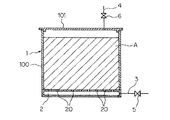
図1は本発明の一実施形態を示すもので、型枠1に原料を充填して原料充填層Aを形成し、この原料充填層A内に炭酸ガスを吹き込むようにしたものである。図1は、原料充填層Aを形成する型枠1を縦断面した状態を示している。
前記型枠1は実質的に気密又は半気密にすることが可能な型枠であって、本実施形態では、容器状の本体100とその上部を閉塞する蓋体101とから構成されている。前記本体100の底部にはガス給気部2(ガス給気用空間)が設けられるとともに、このガス給気部2と本体100との間の隔壁には多数のガス通孔20が形成されている。前記ガス給気部2にはガス供給管3が接続され、このガス供給管3を通じてガス給気部2内に炭酸ガス又は炭酸ガス含有ガス(以下、総称して“炭酸ガス”という)が供給される。また、型枠1の上部には型枠内に供給されたガスの排気を行うための排気管4が接続されている。その他図面において、5,6は各配管系に設けられた開閉弁である。
Hereinafter, specific embodiments of the present invention will be described.
FIG. 1 shows an embodiment of the present invention. A raw material filling layer A is formed by filling a mold 1 with raw materials, and carbon dioxide gas is blown into the raw material filling layer A. FIG. 1 shows a state in which a mold 1 for forming the raw material filled layer A is longitudinally cross-sectional.
The mold 1 is a mold that can be substantially airtight or semi-airtight. In the present embodiment, the mold 1 includes a container-like
未炭酸化Ca含有原料に不活性微粉原料を配合し、これを均一に混合した混合原料が型枠1内に装入され、原料充填層Aが形成される。原料が炭酸ガスと接触して炭酸化反応により固結するには、先に述べたように水分(原料粒子の表面付着水)が必要であり、このため必要に応じて混合原料に水分を添加する。この水分添加は型枠1に装入する前に行ってもよいし、装入後に行ってもよい。また、型枠装入後に行う場合には、型枠1の上部を開放した状態で、型枠1ごと水槽内の水に浸漬してもよいし、原材料充填層Aの上部から十分な量の水を散水してもよい。また、未炭酸化Ca含有原料に水分添加を行い、しかる後、不活性微粉原料を添加して十分に混合するようにしてもよい。通常、原料充填層Aの含水率は3〜12%、好ましくは5〜10%程度とするのが適当である。 An inert fine powder raw material is blended with an uncarbonated Ca-containing raw material, and a mixed raw material obtained by uniformly mixing the raw material is charged into the mold 1 to form a raw material packed layer A. In order for the raw material to come into contact with carbon dioxide gas and solidify by the carbonation reaction, as described above, water (water adhering to the surface of the raw material particles) is required. To do. This water addition may be performed before charging into the mold 1 or may be performed after charging. In addition, when performing after the mold is inserted, the mold 1 may be immersed in water in the water tank with the upper part of the mold 1 opened, or a sufficient amount from the upper part of the raw material filling layer A may be used. Water may be sprinkled. Further, moisture may be added to the uncarbonated Ca-containing raw material, and then the inert fine powder raw material may be added and mixed sufficiently. Usually, the moisture content of the raw material packed bed A is 3 to 12%, preferably about 5 to 10%.
上記のように水分を含んだ原料充填層Aを形成した後、型枠1内に吹き込まれる炭酸ガスが原料充填層全体に良く浸透するようにするため型枠に蓋体101を装着し、型枠1を気密又は半気密状態にする。この状態で型枠1内に炭酸ガスの供給を行って、混合原料に炭酸化反応を生じさせる。図1の場合には、ガス供給管3を通じて供給された炭酸ガスは、ガス給気部2に導入された後、ガス通孔20から上方の原料充填層A内に吹き込まれる。原料充填層A内を通過する炭酸ガスの一部は、原料粒子からその表面付着水に溶出したCaイオンと反応し、原料粒子の表面にCaCO3が析出し、これがバインダーとなって原料充填層Aの固結が進行する。炭酸ガスの残りは原料充填層Aを通過して排気管4から型枠1外に排出される。また、場合によっては、排気管4の開閉弁6を閉じた状態で原料充填層A内に炭酸ガスを供給するようにしてもよいが、その場合には、時々開閉弁6を開にして型枠1内に溜まったガスを放出し、型枠1内の炭酸ガス濃度が所定レベル以上に維持されるようにすることが好ましい。
以上のような炭酸ガスの供給を所定時間行った後、固結した原料充填層Aを脱型し、製品である炭酸固化体を取り出す。
After forming the raw material filled layer A containing moisture as described above, the
After supplying the carbon dioxide gas as described above for a predetermined time, the consolidated raw material packed bed A is demolded, and the carbonated solid product as a product is taken out.
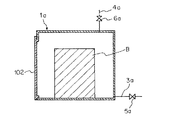
図1に示した実施形態は型枠1内に原料充填層Aを形成し、この原料充填層内に炭酸ガスを吹き込むようにしたものであるが、本発明法は、混合原料を炭酸ガス雰囲気内に置き、炭酸ガスを原料内部に浸透させるような実施形態を採ることもできる。この場合には、混合原料を圧縮成形などによって予成形し、この予成形されたものを炭酸ガス雰囲気内に置いて炭酸固化させる。図2は、その一実施形態を示すもので、処理容器を縦断面した状態で示している。
処理容器1aは実質的に気密にすることが可能な容器であって、その側部には原料出し入れ部102が設けられている。この処理容器1aにはガス供給管3aが接続され、このガス供給管3を通じて処理容器1a内に炭酸ガスが供給される。また、処理容器1aの上部には処理容器内に供給されたガスの排気を行うための排気管4aが接続されている。その他図面において、5a,6aは各配管系に設けられた開閉弁である。
In the embodiment shown in FIG. 1, a raw material filling layer A is formed in a mold 1 and carbon dioxide gas is blown into the raw material filling layer. It is also possible to take an embodiment in which carbon dioxide gas is permeated into the raw material. In this case, the mixed raw material is preformed by compression molding or the like, and the preformed product is placed in a carbon dioxide gas atmosphere to be solidified by carbonation. FIG. 2 shows the embodiment, and shows the processing container in a longitudinal section.
The processing container 1a is a container that can be substantially airtight, and a raw material taking-in / out
未炭酸化Ca含有原料と不活性微粉原料との混合原料には、先に述べたような理由から予め所定の水分が添加されるとともに、圧縮成形などの方法により任意の形状に予成形される。なお、混合原料を予成形するに当たっては、予成形体内の貫通気孔が過剰に塞がれないことを限度として、セメントなどのポラゾン反応物質、糖蜜、デンプンなどのバインダーを混合原料に配合してもよい。混合原料の予成形体Bは、処理容器1a内に装入(収納)され、処理容器1a内は気密にされる。この状態で、ガス供給管3aを通じて処理容器1a内に所定時間炭酸ガスの供給を行う。供給された炭酸ガスの一部は予成形体Bの表面から内部に浸透し、原料に炭酸化反応を生じさせる。炭酸ガスの残りは排気管4aから処理容器1a外に排出される。また、場合によっては、図2の実施形態と同様に、排気管4aの開閉弁6aを閉じた状態で処理容器1a内に炭酸ガスを供給するようにしてもよい。
以上のような炭酸化処理を所定時間行った後、製品である固結した予成形体B(炭酸固化体)を処理容器1aから取り出す。
Predetermined moisture is added in advance to the mixed raw material of the uncarbonated Ca-containing raw material and the inert fine powder raw material for the reasons described above, and the raw material is pre-formed into an arbitrary shape by a method such as compression molding. . In addition, when pre-molding the mixed raw material, it is possible to add a binder such as cement and other substances such as porazone, molasses and starch to the mixed raw material as long as the through-holes in the preform are not blocked excessively. Good. The preform B of the mixed raw material is charged (stored) in the processing container 1a, and the processing container 1a is hermetically sealed. In this state, carbon dioxide gas is supplied into the processing container 1a through the gas supply pipe 3a for a predetermined time. A part of the supplied carbon dioxide gas penetrates from the surface of the preform B to cause a carbonation reaction in the raw material. The remainder of the carbon dioxide gas is discharged out of the processing container 1a from the exhaust pipe 4a. In some cases, as in the embodiment of FIG. 2, carbon dioxide gas may be supplied into the processing container 1a with the on-off valve 6a of the exhaust pipe 4a closed.
After performing the carbonation treatment as described above for a predetermined time, the solidified preform B (carbonate solidified product) as a product is taken out from the processing container 1a.
本発明により製造される炭酸固化体の形状は任意であり、例えば断面形状が円形、楕円形、三角形、四角形以上の多角形、星形など、或いは全体形状が球形状、楕球形、四面体以上の多面体形、円錐体形、柱状形、テトラポット形など、任意の形状とすることができる。
また、本発明により製造される炭酸固化体は、漁礁・藻礁造成用石材、築磯用石材、水質浄化用石材、通水性舗装用石材、通水性被覆ブロック、埋設排水溝用ブロック、水耕栽培用ベース材、浄水用フィルター、給水用容器をはじめとする種々の用途に使用することができる。
The shape of the carbonic acid solidified body produced by the present invention is arbitrary, for example, the cross-sectional shape is circular, elliptical, triangular, quadrilateral or more polygonal, star shape, etc., or the overall shape is spherical, elliptical, tetrahedral or higher The shape may be any shape such as a polyhedron shape, a cone shape, a columnar shape, or a tetrapot shape.
Carbonated solids produced by the present invention include fishing reef and algae reef building stones, building stones, water purification stones, water-permeable paving stones, water-permeable covering blocks, buried drainage blocks, hydroponics It can be used for various purposes including cultivation base materials, water purification filters, and water supply containers.
以下、本発明の製造方法における好ましい製造条件について説明する。
未炭酸化Ca含有原料としては、少なくとも組成の一部として未炭酸化Caを含むものであれば特に制限はないが、未炭酸化Caの含有率が高く、しかも資源のリサイクルを図ることができるという点で、鉄鋼製造プロセスで発生するスラグ、コンクリート(例えば、廃コンクリート)などが特に好ましい。一般に、鉄鋼製造プロセスで発生するスラグのCaO濃度は約13〜55mass%、また、コンクリート(例えば、廃コンクリート)のCaO濃度は約5〜15mass%(セメント中のCaO濃度:50〜60mass%)であり、また、これらは入手も容易であるため、未炭酸化Ca含有原料として極めて好適な素材であるといえる。したがって、未炭酸化Ca含有原料の少なくとも一部が、また特に望ましくは主たる原料がスラグ及び/又はコンクリートであることが好ましい。
Hereinafter, preferable manufacturing conditions in the manufacturing method of the present invention will be described.
The uncarbonated Ca-containing raw material is not particularly limited as long as it contains uncarbonated Ca as at least a part of the composition, but the content of uncarbonated Ca is high, and resources can be recycled. In this respect, slag, concrete (for example, waste concrete) generated in the steel manufacturing process is particularly preferable. Generally, the CaO concentration of slag generated in the steel manufacturing process is about 13 to 55 mass%, and the CaO concentration of concrete (for example, waste concrete) is about 5 to 15 mass% (CaO concentration in cement: 50 to 60 mass%). In addition, since these are easily available, it can be said that they are extremely suitable materials as uncarbonated Ca-containing raw materials. Therefore, it is preferable that at least a part of the uncarbonated Ca-containing raw material, and particularly preferably, the main raw material is slag and / or concrete.
鉄鋼製造プロセスで発生するスラグとしては、高炉徐冷スラグ、高炉水砕スラグなどの高炉系スラグ、予備処理、転炉、鋳造などの工程で発生する脱炭スラグ、脱燐スラグ、脱硫スラグ、脱珪スラグ、鋳造スラグなどの製鋼系スラグ、鉱石還元スラグ、電気炉スラグなどを挙げることができるが、これらに限定されるものではなく、また、2種以上のスラグを混合して用いることもできる。
また、鉄鋼製造プロセスで発生するスラグには相当量の鉄分(粒鉄などの鉄分)が含まれており、このようなスラグをそのまま使用すると、この鉄分の分だけ原料中でのCaO濃度が低下するため、スラグとしては地金(鉄分)回収処理を経たスラグを用いることが好ましい。
Slag generated in the steel manufacturing process includes blast furnace slag, blast furnace granulated slag, blast furnace slag, decarburization slag, dephosphorization slag, desulfurization slag, Examples include steel slag such as silica slag and cast slag, ore reduction slag, electric furnace slag, and the like. However, the present invention is not limited thereto, and two or more slags can be mixed and used. .
In addition, the slag generated in the steel manufacturing process contains a considerable amount of iron (iron such as granular iron). If such slag is used as it is, the CaO concentration in the raw material is reduced by this amount of iron. Therefore, as the slag, it is preferable to use a slag that has undergone a metal (iron) recovery process.
また、コンクリートとしては、例えば、建築物や土木構造物の取壊しなどにより生じた廃コンクリートなどを用いることができる。
また、未炭酸化Ca含有材としては、上記のスラグやコンクリート以外に、モルタル、ガラス、アルミナセメント、CaO含有耐火物などが挙げられ、これらの1種以上を単独でまたは混合して、或いはスラグ及び/又はコンクリートと混合して使用することもできる。
これらの材料は必要に応じて細粒状に破砕処理され、原料として用いられる。
未炭酸化Ca含有原料は、その全量が未炭酸化Caを含む固体粒子である必要はない。すなわち、未炭酸化Ca含有原料に含まれる未炭酸化Caの炭酸化によって炭酸固化体のバインダーとして十分な量のCaCO3が生成されるのであれば、未炭酸化Ca含有原料に未炭酸化Caを含まない固体粒子が含まれていてもよい。このような固体粒子としては、例えば、天然石、砂、可溶性シリカ、金属(例えば、金属鉄、酸化鉄)などが挙げられる。
また、これらのうち金属鉄、酸化鉄、可溶性シリカなどは、本発明法により製造された炭酸固化体が水中沈設用材料として用いられる場合に、水中の硫黄や燐の固定剤、海藻類などの水生植物の栄養源などとして有効に作用する。また、これら以外にも任意の成分(粒子)を適量、すなわち炭酸固化体の強度低下などを招かない限度で含むことができる。
Moreover, as concrete, the waste concrete etc. which were produced by the demolition of a building or a civil engineering structure etc. can be used, for example.
Examples of the non-carbonated Ca-containing material include mortar, glass, alumina cement, CaO-containing refractories, etc., in addition to the above slag and concrete, and one or more of these may be used alone or in combination, or slag And / or mixed with concrete.
These materials are crushed into fine particles as necessary and used as raw materials.
The uncarbonated Ca-containing raw material does not need to be solid particles whose entire amount contains uncarbonated Ca. That is, if the carbonation of the uncarbonated Ca contained in the uncarbonated Ca-containing raw material produces a sufficient amount of CaCO 3 as a binder for the solidified carbonic acid, the uncarbonated Ca-containing raw material is converted into the uncarbonated Ca-containing raw material. Solid particles not containing may be contained. Examples of such solid particles include natural stone, sand, soluble silica, metal (for example, metallic iron, iron oxide) and the like.
Among these, metallic iron, iron oxide, soluble silica, and the like, such as a fixing agent for sulfur and phosphorus in water, seaweeds, etc., when the carbonate solid produced by the method of the present invention is used as an underwater sedimentation material, It works effectively as a nutrient source for aquatic plants. In addition to these, an arbitrary component (particle) can be contained in an appropriate amount, that is, as long as the strength of the carbonated solid is not reduced.
混合原料に炭酸化反応を生じさせるために使用される炭酸ガス又は炭酸ガス含有ガスとしては、例えば、一貫製鉄所内で排出される石灰焼成工場排ガス(通常、CO2:25%前後)や加熱炉排ガス(通常、CO2:6.5%前後)などが好適であるが、これらに限定されるものではない。また、ガス中のCO2濃度が低すぎると処理効率が低下するという問題を生じるが、それ以外の問題は格別ない。したがって、CO2濃度は特に限定しないが、効率的な処理を行うには3%以上のCO2濃度とすることが好ましい。
また、炭酸ガスの供給量にも特別な制限はないが、一般的な目安としては0.004〜0.5m3/min・t(原料ton)程度のガス供給量が確保できればよい。また、ガス供給時間(炭酸化処理時間)にも特別な制約はないが、目安としては炭酸ガスの供給量が未炭酸化Ca含有原料の重量の3%以上となる時点、すなわち、ガス量に換算すると原料1t当たり15m3以上、好ましくは200m3以上の炭酸ガスが供給されるまでガス供給を行うことが好ましい。
Examples of the carbon dioxide gas or carbon dioxide-containing gas used for causing a carbonation reaction in the mixed raw material include lime burning factory exhaust gas (usually around 25% CO 2 ) discharged in an integrated steelworks, and a heating furnace. Exhaust gas (usually, CO 2 : around 6.5%) and the like are suitable, but are not limited to these. In addition, if the CO 2 concentration in the gas is too low, there arises a problem that the processing efficiency is lowered, but other problems are not exceptional. Therefore, the CO 2 concentration is not particularly limited, but it is preferable to set the CO 2 concentration to 3% or more for efficient treatment.
Moreover, there is no special restriction | limiting in the supply amount of a carbon dioxide gas, However, As a general guideline, the gas supply amount of about 0.004-0.5m < 3 > / min * t (raw material ton) should just be ensured. Further, there is no special restriction on the gas supply time (carbonation treatment time), but as a guideline, the time when the supply amount of carbon dioxide gas becomes 3% or more of the weight of the uncarbonated Ca-containing raw material, that is, the gas amount Convert to the raw material 1t per 15 m 3 or more, preferably it is preferable to carry out the gas supply to 200 meters 3 or more carbon dioxide is supplied.
供給される炭酸ガス又は炭酸ガス含有ガスは常温でよいが、ガスが常温よりも高温であればそれだけ反応性が高まるため有利である。但し、ガスの温度が過剰に高いと混合原料の水分を乾燥させたり、或いはCaCO3がCaOとCO2に分解してしまうため、高温ガスを用いる場合でもこのような分解を生じない程度の温度のガスを用いる必要がある。
また、炭酸ガス又は炭酸ガス含有ガスは原料の乾燥を防ぐために加湿した状態で混合原料に供給されることが好ましい。このため混合原料にガスを供給するに当たっては、炭酸ガス又は炭酸ガス含有ガスを一旦水中に吹き込んでH2Oを飽和させた後、原料に供給することが好ましく、これにより混合原料の乾燥を防止して炭酸化反応を促進させることができる。
The supplied carbon dioxide gas or carbon dioxide-containing gas may be at normal temperature, but if the gas is higher than normal temperature, it is advantageous because the reactivity increases accordingly. However, if the temperature of the gas is excessively high, moisture of the mixed raw material is dried or CaCO 3 is decomposed into CaO and CO 2 , so that such decomposition does not occur even when a high temperature gas is used. It is necessary to use this gas.
Further, the carbon dioxide gas or the carbon dioxide-containing gas is preferably supplied to the mixed raw material in a humidified state in order to prevent the raw material from being dried. For this reason, when supplying gas to the mixed raw material, it is preferable to blow carbon dioxide gas or a carbon dioxide-containing gas into water once to saturate H 2 O and then supply the raw material to the raw material, thereby preventing drying of the mixed raw material. Thus, the carbonation reaction can be promoted.
微粉分を含む粉粒状の未炭酸化Ca含有原料として所定の粒度分布を有する製鋼スラグ(粒径3mm以下で且つ粒径1.18mm以上の割合が約21質量%、粒径100以下の微粉の割合が10質量%の製鋼スラグ)を用いた。この製鋼スラグ:95質量部と、不活性微粉原料である珪石粉(粒径100μm以下):5質量部を混合した含水率:8%の混合原料を、図1に示すような構造の1m×1m×1mの型枠に装入し、加圧振動成形機で加振して高さ約0.5mの原料充填層を形成した。炭酸ガス含有ガス(CO2:25%)を100L/分の供給量で48時間かけて型枠の底部から前記原料充填層内に吹き込み、原料を炭酸固化させた。
比較例として、全量が製鋼スラグ(粒径3mm以下で、且つ粒径1.18mm以上の割合が約21質量%、粒径100μm以下の微粉の割合が10質量%の製鋼スラグ)からなる原料を、同様に型枠に装入・加振して高さ約0.5mの原料充填層を形成し、炭酸ガス含有ガス(CO2:25%)を100L/分の供給量で48時間かけて型枠の底部から前記原料充填層内に吹き込み、原料を炭酸固化させた。
以上のようにして製造された炭酸固化体から100mmφ×200mm高さの試験体(コア)を採取し、その圧縮強度(10本の平均値)を測定した結果を以下に示す。
本発明例:115kgf/cm2
比較例 :80kgf/cm2
Steelmaking slag having a predetermined particle size distribution as a granular uncarbonated Ca-containing raw material containing fine powder (a ratio of a fine particle having a particle size of 3 mm or less and a particle size of 1.18 mm or more is about 21% by mass and a particle size of 100 or less Steelmaking slag having a ratio of 10% by mass was used. This steelmaking slag: 95 parts by mass and an inert fine powder raw material quartzite powder (particle size of 100 μm or less): a mixed raw material having a moisture content of 8% mixed with 8 parts by mass is shown in FIG. The material was charged into a 1 m × 1 m mold and vibrated with a pressure vibration molding machine to form a raw material packed layer having a height of about 0.5 m. Carbon dioxide containing gas (CO 2 : 25%) was blown into the raw material packed bed from the bottom of the mold at a supply rate of 100 L / min for 48 hours to solidify the raw material.
As a comparative example, a raw material consisting of steelmaking slag (steelmaking slag having a particle size of 3 mm or less, a ratio of particle size of 1.18 mm or more is about 21% by mass, and a ratio of fine powder having a particle size of 100 μm or less is 10% by mass). Similarly, a raw material packed layer having a height of about 0.5 m is formed by charging and exciting the mold, and a carbon dioxide containing gas (CO 2 : 25%) is supplied at 100 L / min for 48 hours. The raw material was blown into the raw material packed bed from the bottom of the mold to solidify the raw material.
A test body (core) having a height of 100 mmφ × 200 mm was collected from the carbonated solid body produced as described above, and the compression strength (average value of 10) was measured.
Example of the present invention: 115 kgf / cm 2
Comparative example: 80 kgf / cm 2
1 型枠
1a 処理容器
2 ガス給気部
3,3a ガス供給管
4,4a 排気管
5,5a,6,6a 開閉弁
20 ガス通孔
100 本体
101 蓋体
102 原料出し入れ部
A 原料充填層
B 予成形体
DESCRIPTION OF SYMBOLS 1 Mold
Claims (2)
粒径が10mm以下であり、且つ粒径1.18mm以上の割合が10質量%以上であり、粒径100μm以下の微粉分の割合が2〜30質量%である粉粒状の未炭酸化Ca含有原料に、石灰石微粉末、アルミナ微粉末、製鋼ダスト、珪石粉の中から選ばれる1種以上からなる、粒径100μm以下の未炭酸化Caを含有しない微粉原料を、混合原料中での当該微粉原料の配合割合が1〜10質量%となるように混合するとともに、混合原料中での未炭酸化Ca含有原料の割合を50質量%以上とし、該混合原料を炭酸化反応により固結させることを特徴とする炭酸固化体の製造方法。 A method for producing a carbonate solidified body by bringing a raw material mainly composed of an uncarbonated Ca-containing raw material into contact with carbon dioxide gas in a state containing moisture and solidifying by a carbonation reaction,
Powdered uncarbonated Ca containing particles having a particle size of 10 mm or less, a proportion of particle size of 1.18 mm or more is 10 mass% or more, and a proportion of fine powder having a particle size of 100 μm or less is 2 to 30 mass% The raw material is a fine powder raw material containing at least one selected from limestone fine powder, alumina fine powder, steelmaking dust, and silica powder, and containing no uncarbonated Ca with a particle size of 100 μm or less. While mixing so that the compounding ratio of the raw materials becomes 1 to 10% by mass, the ratio of the uncarbonated Ca-containing raw material in the mixed raw material is set to 50% by mass or more, and the mixed raw material is solidified by a carbonation reaction. A method for producing a carbonic acid solidified product.
Priority Applications (1)
| Application Number | Priority Date | Filing Date | Title |
|---|---|---|---|
| JP2004055589A JP4934945B2 (en) | 2004-02-27 | 2004-02-27 | Method for producing carbonated solid |
Applications Claiming Priority (1)
| Application Number | Priority Date | Filing Date | Title |
|---|---|---|---|
| JP2004055589A JP4934945B2 (en) | 2004-02-27 | 2004-02-27 | Method for producing carbonated solid |
Publications (2)
| Publication Number | Publication Date |
|---|---|
| JP2005239527A JP2005239527A (en) | 2005-09-08 |
| JP4934945B2 true JP4934945B2 (en) | 2012-05-23 |
Family
ID=35021659
Family Applications (1)
| Application Number | Title | Priority Date | Filing Date |
|---|---|---|---|
| JP2004055589A Expired - Fee Related JP4934945B2 (en) | 2004-02-27 | 2004-02-27 | Method for producing carbonated solid |
Country Status (1)
| Country | Link |
|---|---|
| JP (1) | JP4934945B2 (en) |
Families Citing this family (2)
| Publication number | Priority date | Publication date | Assignee | Title |
|---|---|---|---|---|
| JP7378213B2 (en) * | 2018-07-11 | 2023-11-13 | 太平洋セメント株式会社 | Carbon dioxide fixation method |
| JP2023114666A (en) * | 2022-02-07 | 2023-08-18 | 株式会社フジタ | Concrete product manufacturing method |
Family Cites Families (13)
| Publication number | Priority date | Publication date | Assignee | Title |
|---|---|---|---|---|
| JPS54131624A (en) * | 1978-04-03 | 1979-10-12 | Mitsubishi Heavy Ind Ltd | Production of artificial aggregates |
| JPS57100969A (en) * | 1980-12-16 | 1982-06-23 | Denki Kagaku Kogyo Kk | Formed body strength increasing method |
| JPS57191265A (en) * | 1981-05-22 | 1982-11-25 | Ibigawa Electric Ind Co Ltd | Slag inorganic hardened body |
| JPS5874559A (en) * | 1981-10-27 | 1983-05-06 | 日本鋼管株式会社 | Manufacture of hardened body |
| JPS623051A (en) * | 1985-06-27 | 1987-01-09 | 新日本製鐵株式会社 | Manufacture of road bed material |
| JP3175694B2 (en) * | 1997-05-08 | 2001-06-11 | 日本鋼管株式会社 | Submerged stone and method of manufacturing the same |
| JP3175710B2 (en) * | 1997-09-29 | 2001-06-11 | 日本鋼管株式会社 | Stone for laying freshwater water bodies such as rivers and method for producing the same |
| JP3714043B2 (en) * | 1998-10-14 | 2005-11-09 | Jfeスチール株式会社 | Agglomeration method of steelmaking slag |
| JP4013368B2 (en) * | 1998-11-08 | 2007-11-28 | Jfeスチール株式会社 | Stone material for submergence and method for producing the same |
| JP3968898B2 (en) * | 1998-11-08 | 2007-08-29 | Jfeスチール株式会社 | Artificial stone mainly composed of slag and method for producing the same |
| JP2000350977A (en) * | 1999-06-11 | 2000-12-19 | Kawasaki Steel Corp | Solidification method of powdered granular steelmaking slag |
| JP2003253642A (en) * | 2001-09-10 | 2003-09-10 | Jfe Steel Kk | Installation method of underwater structure and block for underwater structure |
| JP4474906B2 (en) * | 2003-11-21 | 2010-06-09 | Jfeスチール株式会社 | Method for producing carbonated solid |
-
2004
- 2004-02-27 JP JP2004055589A patent/JP4934945B2/en not_active Expired - Fee Related
Also Published As
| Publication number | Publication date |
|---|---|
| JP2005239527A (en) | 2005-09-08 |
Similar Documents
| Publication | Publication Date | Title |
|---|---|---|
| JP4240638B2 (en) | Manufacturing method of artificial stone | |
| JP5567778B2 (en) | Aqueous suspension based on hydraulic binder and process for its production | |
| JP3828897B2 (en) | Method for stabilizing steelmaking slag and stabilized steelmaking slag | |
| JP5263190B2 (en) | Method for producing carbonated solid | |
| JP2002012480A (en) | Method for producing carbonated solidified body | |
| JP5531555B2 (en) | Stone for underwater settling | |
| JP3175694B2 (en) | Submerged stone and method of manufacturing the same | |
| JP4507298B2 (en) | Slag component elution control method | |
| JP4506236B2 (en) | Method for producing carbonated solid | |
| JP2000139268A (en) | Seaweed bed growth promotion type reef | |
| JP4474906B2 (en) | Method for producing carbonated solid | |
| JP4934945B2 (en) | Method for producing carbonated solid | |
| JP2001253785A (en) | Method for producing porous carbonized solid | |
| JP4474907B2 (en) | Method for producing carbonated solid | |
| JP4539121B2 (en) | Method for producing carbonated solid | |
| JP4474690B2 (en) | Porous stone for water purification and water purification method | |
| JP3198279B2 (en) | Stone production method using slag etc. as main raw material | |
| JP2002003921A (en) | Method for producing carbonated solidified body | |
| JPH1121153A (en) | Roadbed material and method of manufacturing the same | |
| JP2000143304A (en) | Artificial stone using slag as main raw material and method for producing the same | |
| JP2004209378A (en) | Coal ash treatment method | |
| JP2006255705A (en) | Method for producing carbonated solid | |
| JP4645195B2 (en) | Method for producing carbonated solid | |
| JP2003137543A (en) | Carbonation treatment method and CO2 absorption method by carbonation | |
| JP2000157095A (en) | How to create or improve algae reefs |
Legal Events
| Date | Code | Title | Description |
|---|---|---|---|
| A621 | Written request for application examination |
Free format text: JAPANESE INTERMEDIATE CODE: A621 Effective date: 20061222 |
|
| A977 | Report on retrieval |
Free format text: JAPANESE INTERMEDIATE CODE: A971007 Effective date: 20090415 |
|
| A131 | Notification of reasons for refusal |
Free format text: JAPANESE INTERMEDIATE CODE: A131 Effective date: 20091222 |
|
| A521 | Written amendment |
Free format text: JAPANESE INTERMEDIATE CODE: A523 Effective date: 20100220 |
|
| A131 | Notification of reasons for refusal |
Free format text: JAPANESE INTERMEDIATE CODE: A131 Effective date: 20110222 |
|
| A521 | Written amendment |
Free format text: JAPANESE INTERMEDIATE CODE: A523 Effective date: 20110420 |
|
| TRDD | Decision of grant or rejection written | ||
| A01 | Written decision to grant a patent or to grant a registration (utility model) |
Free format text: JAPANESE INTERMEDIATE CODE: A01 Effective date: 20120124 |
|
| A01 | Written decision to grant a patent or to grant a registration (utility model) |
Free format text: JAPANESE INTERMEDIATE CODE: A01 |
|
| A61 | First payment of annual fees (during grant procedure) |
Free format text: JAPANESE INTERMEDIATE CODE: A61 Effective date: 20120206 |
|
| FPAY | Renewal fee payment (event date is renewal date of database) |
Free format text: PAYMENT UNTIL: 20150302 Year of fee payment: 3 |
|
| R150 | Certificate of patent or registration of utility model |
Free format text: JAPANESE INTERMEDIATE CODE: R150 |
|
| LAPS | Cancellation because of no payment of annual fees |