JP4917841B2 - Electroless plating method on resin surface - Google Patents
Electroless plating method on resin surface Download PDFInfo
- Publication number
- JP4917841B2 JP4917841B2 JP2006161415A JP2006161415A JP4917841B2 JP 4917841 B2 JP4917841 B2 JP 4917841B2 JP 2006161415 A JP2006161415 A JP 2006161415A JP 2006161415 A JP2006161415 A JP 2006161415A JP 4917841 B2 JP4917841 B2 JP 4917841B2
- Authority
- JP
- Japan
- Prior art keywords
- plated
- solution
- noble metal
- anionic surfactant
- plating
- Prior art date
- Legal status (The legal status is an assumption and is not a legal conclusion. Google has not performed a legal analysis and makes no representation as to the accuracy of the status listed.)
- Expired - Fee Related
Links
Classifications
-
- H—ELECTRICITY
- H05—ELECTRIC TECHNIQUES NOT OTHERWISE PROVIDED FOR
- H05K—PRINTED CIRCUITS; CASINGS OR CONSTRUCTIONAL DETAILS OF ELECTRIC APPARATUS; MANUFACTURE OF ASSEMBLAGES OF ELECTRICAL COMPONENTS
- H05K3/00—Apparatus or processes for manufacturing printed circuits
- H05K3/10—Apparatus or processes for manufacturing printed circuits in which conductive material is applied to the insulating support in such a manner as to form the desired conductive pattern
- H05K3/18—Apparatus or processes for manufacturing printed circuits in which conductive material is applied to the insulating support in such a manner as to form the desired conductive pattern using precipitation techniques to apply the conductive material
- H05K3/181—Apparatus or processes for manufacturing printed circuits in which conductive material is applied to the insulating support in such a manner as to form the desired conductive pattern using precipitation techniques to apply the conductive material by electroless plating
-
- C—CHEMISTRY; METALLURGY
- C23—COATING METALLIC MATERIAL; COATING MATERIAL WITH METALLIC MATERIAL; CHEMICAL SURFACE TREATMENT; DIFFUSION TREATMENT OF METALLIC MATERIAL; COATING BY VACUUM EVAPORATION, BY SPUTTERING, BY ION IMPLANTATION OR BY CHEMICAL VAPOUR DEPOSITION, IN GENERAL; INHIBITING CORROSION OF METALLIC MATERIAL OR INCRUSTATION IN GENERAL
- C23C—COATING METALLIC MATERIAL; COATING MATERIAL WITH METALLIC MATERIAL; SURFACE TREATMENT OF METALLIC MATERIAL BY DIFFUSION INTO THE SURFACE, BY CHEMICAL CONVERSION OR SUBSTITUTION; COATING BY VACUUM EVAPORATION, BY SPUTTERING, BY ION IMPLANTATION OR BY CHEMICAL VAPOUR DEPOSITION, IN GENERAL
- C23C18/00—Chemical coating by decomposition of either liquid compounds or solutions of the coating forming compounds, without leaving reaction products of surface material in the coating; Contact plating
- C23C18/16—Chemical coating by decomposition of either liquid compounds or solutions of the coating forming compounds, without leaving reaction products of surface material in the coating; Contact plating by reduction or substitution, e.g. electroless plating
- C23C18/1601—Process or apparatus
- C23C18/1633—Process of electroless plating
- C23C18/1646—Characteristics of the product obtained
- C23C18/165—Multilayered product
- C23C18/1653—Two or more layers with at least one layer obtained by electroless plating and one layer obtained by electroplating
-
- C—CHEMISTRY; METALLURGY
- C23—COATING METALLIC MATERIAL; COATING MATERIAL WITH METALLIC MATERIAL; CHEMICAL SURFACE TREATMENT; DIFFUSION TREATMENT OF METALLIC MATERIAL; COATING BY VACUUM EVAPORATION, BY SPUTTERING, BY ION IMPLANTATION OR BY CHEMICAL VAPOUR DEPOSITION, IN GENERAL; INHIBITING CORROSION OF METALLIC MATERIAL OR INCRUSTATION IN GENERAL
- C23C—COATING METALLIC MATERIAL; COATING MATERIAL WITH METALLIC MATERIAL; SURFACE TREATMENT OF METALLIC MATERIAL BY DIFFUSION INTO THE SURFACE, BY CHEMICAL CONVERSION OR SUBSTITUTION; COATING BY VACUUM EVAPORATION, BY SPUTTERING, BY ION IMPLANTATION OR BY CHEMICAL VAPOUR DEPOSITION, IN GENERAL
- C23C18/00—Chemical coating by decomposition of either liquid compounds or solutions of the coating forming compounds, without leaving reaction products of surface material in the coating; Contact plating
- C23C18/16—Chemical coating by decomposition of either liquid compounds or solutions of the coating forming compounds, without leaving reaction products of surface material in the coating; Contact plating by reduction or substitution, e.g. electroless plating
- C23C18/18—Pretreatment of the material to be coated
- C23C18/20—Pretreatment of the material to be coated of organic surfaces, e.g. resins
- C23C18/2006—Pretreatment of the material to be coated of organic surfaces, e.g. resins by other methods than those of C23C18/22 - C23C18/30
- C23C18/2046—Pretreatment of the material to be coated of organic surfaces, e.g. resins by other methods than those of C23C18/22 - C23C18/30 by chemical pretreatment
- C23C18/2073—Multistep pretreatment
- C23C18/2086—Multistep pretreatment with use of organic or inorganic compounds other than metals, first
-
- C—CHEMISTRY; METALLURGY
- C23—COATING METALLIC MATERIAL; COATING MATERIAL WITH METALLIC MATERIAL; CHEMICAL SURFACE TREATMENT; DIFFUSION TREATMENT OF METALLIC MATERIAL; COATING BY VACUUM EVAPORATION, BY SPUTTERING, BY ION IMPLANTATION OR BY CHEMICAL VAPOUR DEPOSITION, IN GENERAL; INHIBITING CORROSION OF METALLIC MATERIAL OR INCRUSTATION IN GENERAL
- C23C—COATING METALLIC MATERIAL; COATING MATERIAL WITH METALLIC MATERIAL; SURFACE TREATMENT OF METALLIC MATERIAL BY DIFFUSION INTO THE SURFACE, BY CHEMICAL CONVERSION OR SUBSTITUTION; COATING BY VACUUM EVAPORATION, BY SPUTTERING, BY ION IMPLANTATION OR BY CHEMICAL VAPOUR DEPOSITION, IN GENERAL
- C23C18/00—Chemical coating by decomposition of either liquid compounds or solutions of the coating forming compounds, without leaving reaction products of surface material in the coating; Contact plating
- C23C18/16—Chemical coating by decomposition of either liquid compounds or solutions of the coating forming compounds, without leaving reaction products of surface material in the coating; Contact plating by reduction or substitution, e.g. electroless plating
- C23C18/18—Pretreatment of the material to be coated
- C23C18/20—Pretreatment of the material to be coated of organic surfaces, e.g. resins
- C23C18/28—Sensitising or activating
- C23C18/30—Activating or accelerating or sensitising with palladium or other noble metal
-
- C—CHEMISTRY; METALLURGY
- C23—COATING METALLIC MATERIAL; COATING MATERIAL WITH METALLIC MATERIAL; CHEMICAL SURFACE TREATMENT; DIFFUSION TREATMENT OF METALLIC MATERIAL; COATING BY VACUUM EVAPORATION, BY SPUTTERING, BY ION IMPLANTATION OR BY CHEMICAL VAPOUR DEPOSITION, IN GENERAL; INHIBITING CORROSION OF METALLIC MATERIAL OR INCRUSTATION IN GENERAL
- C23C—COATING METALLIC MATERIAL; COATING MATERIAL WITH METALLIC MATERIAL; SURFACE TREATMENT OF METALLIC MATERIAL BY DIFFUSION INTO THE SURFACE, BY CHEMICAL CONVERSION OR SUBSTITUTION; COATING BY VACUUM EVAPORATION, BY SPUTTERING, BY ION IMPLANTATION OR BY CHEMICAL VAPOUR DEPOSITION, IN GENERAL
- C23C18/00—Chemical coating by decomposition of either liquid compounds or solutions of the coating forming compounds, without leaving reaction products of surface material in the coating; Contact plating
- C23C18/16—Chemical coating by decomposition of either liquid compounds or solutions of the coating forming compounds, without leaving reaction products of surface material in the coating; Contact plating by reduction or substitution, e.g. electroless plating
- C23C18/31—Coating with metals
- C23C18/32—Coating with nickel, cobalt or mixtures thereof with phosphorus or boron
-
- C—CHEMISTRY; METALLURGY
- C23—COATING METALLIC MATERIAL; COATING MATERIAL WITH METALLIC MATERIAL; CHEMICAL SURFACE TREATMENT; DIFFUSION TREATMENT OF METALLIC MATERIAL; COATING BY VACUUM EVAPORATION, BY SPUTTERING, BY ION IMPLANTATION OR BY CHEMICAL VAPOUR DEPOSITION, IN GENERAL; INHIBITING CORROSION OF METALLIC MATERIAL OR INCRUSTATION IN GENERAL
- C23C—COATING METALLIC MATERIAL; COATING MATERIAL WITH METALLIC MATERIAL; SURFACE TREATMENT OF METALLIC MATERIAL BY DIFFUSION INTO THE SURFACE, BY CHEMICAL CONVERSION OR SUBSTITUTION; COATING BY VACUUM EVAPORATION, BY SPUTTERING, BY ION IMPLANTATION OR BY CHEMICAL VAPOUR DEPOSITION, IN GENERAL
- C23C18/00—Chemical coating by decomposition of either liquid compounds or solutions of the coating forming compounds, without leaving reaction products of surface material in the coating; Contact plating
- C23C18/16—Chemical coating by decomposition of either liquid compounds or solutions of the coating forming compounds, without leaving reaction products of surface material in the coating; Contact plating by reduction or substitution, e.g. electroless plating
- C23C18/31—Coating with metals
- C23C18/38—Coating with copper
-
- H—ELECTRICITY
- H05—ELECTRIC TECHNIQUES NOT OTHERWISE PROVIDED FOR
- H05K—PRINTED CIRCUITS; CASINGS OR CONSTRUCTIONAL DETAILS OF ELECTRIC APPARATUS; MANUFACTURE OF ASSEMBLAGES OF ELECTRICAL COMPONENTS
- H05K2203/00—Indexing scheme relating to apparatus or processes for manufacturing printed circuits covered by H05K3/00
- H05K2203/07—Treatments involving liquids, e.g. plating, rinsing
- H05K2203/0779—Treatments involving liquids, e.g. plating, rinsing characterised by the specific liquids involved
- H05K2203/0786—Using an aqueous solution, e.g. for cleaning or during drilling of holes
- H05K2203/0793—Aqueous alkaline solution, e.g. for cleaning or etching
-
- H—ELECTRICITY
- H05—ELECTRIC TECHNIQUES NOT OTHERWISE PROVIDED FOR
- H05K—PRINTED CIRCUITS; CASINGS OR CONSTRUCTIONAL DETAILS OF ELECTRIC APPARATUS; MANUFACTURE OF ASSEMBLAGES OF ELECTRICAL COMPONENTS
- H05K2203/00—Indexing scheme relating to apparatus or processes for manufacturing printed circuits covered by H05K3/00
- H05K2203/11—Treatments characterised by their effect, e.g. heating, cooling, roughening
- H05K2203/1105—Heating or thermal processing not related to soldering, firing, curing or laminating, e.g. for shaping the substrate or during finish plating
-
- H—ELECTRICITY
- H05—ELECTRIC TECHNIQUES NOT OTHERWISE PROVIDED FOR
- H05K—PRINTED CIRCUITS; CASINGS OR CONSTRUCTIONAL DETAILS OF ELECTRIC APPARATUS; MANUFACTURE OF ASSEMBLAGES OF ELECTRICAL COMPONENTS
- H05K2203/00—Indexing scheme relating to apparatus or processes for manufacturing printed circuits covered by H05K3/00
- H05K2203/12—Using specific substances
- H05K2203/122—Organic non-polymeric compounds, e.g. oil, wax or thiol
-
- H—ELECTRICITY
- H05—ELECTRIC TECHNIQUES NOT OTHERWISE PROVIDED FOR
- H05K—PRINTED CIRCUITS; CASINGS OR CONSTRUCTIONAL DETAILS OF ELECTRIC APPARATUS; MANUFACTURE OF ASSEMBLAGES OF ELECTRICAL COMPONENTS
- H05K3/00—Apparatus or processes for manufacturing printed circuits
- H05K3/38—Improvement of the adhesion between the insulating substrate and the metal
- H05K3/381—Improvement of the adhesion between the insulating substrate and the metal by special treatment of the substrate
Landscapes
- Chemical & Material Sciences (AREA)
- Engineering & Computer Science (AREA)
- Metallurgy (AREA)
- Chemical Kinetics & Catalysis (AREA)
- Materials Engineering (AREA)
- Mechanical Engineering (AREA)
- General Chemical & Material Sciences (AREA)
- Organic Chemistry (AREA)
- Inorganic Chemistry (AREA)
- Manufacturing & Machinery (AREA)
- Microelectronics & Electronic Packaging (AREA)
- Chemically Coating (AREA)
- Manufacturing Of Printed Wiring (AREA)
Description
本発明は、導電性の低い材料や鏡面物などの被めっき材、特に樹脂素材の表面に金属めっき処理を行い、金属めっき皮膜を形成する方法に関する。 The present invention relates to a method for forming a metal plating film by performing metal plating on a surface of a material to be plated such as a low-conductivity material or a mirror surface, particularly a resin material.
樹脂素材等の伝導性の低い材料の表面に金属皮膜を提供する方法として、無電解めっき処理が広く知られている。無電解めっき処理とは、溶液中の金属イオンを化学的に析出させることにより被めっき材の表面に金属皮膜を形成する方法をいい、電解析出させる電解めっきと異なり被めっき材の表面に導電性を必要としない。このため、装飾用、電子機器など広い分野に用いられている。電子機器の分野においては、ポリイミド樹脂などの各種プラスチック材がプリント配線版、フレキシブルプリント配線版、テープ自動ボンディング実装基板の基材として用いられており、その金属化に無電解めっき方法が用いられている。この分野においても、めっき皮膜は、被めっき材の表面に均一に形成されることが求められ、さらに、めっき皮膜の膨れや剥がれがあることは望ましいものではない。 Electroless plating treatment is widely known as a method for providing a metal film on the surface of a material having low conductivity such as a resin material. Electroless plating treatment is a method of forming a metal film on the surface of the material to be plated by chemically precipitating metal ions in the solution. Unlike the electrolytic plating in which electrolytic deposition is performed, the surface of the material to be plated is electrically conductive. Does not require sex. For this reason, it is used in a wide range of fields such as decoration and electronic equipment. In the field of electronic equipment, various plastic materials such as polyimide resin are used as base materials for printed wiring boards, flexible printed wiring boards, and automatic tape bonding mounting boards, and electroless plating methods are used for metallization. Yes. Also in this field, the plating film is required to be uniformly formed on the surface of the material to be plated, and it is not desirable that the plating film swells or peels off.
しかしながら、無電解めっき処理によって形成されためっき皮膜は、樹脂素材に対する密着性が不十分であるという問題があった。樹脂表面とめっき皮膜との密着性が弱いとめっき皮膜の膨れや剥がれの原因となる。そのため、無電解めっき処理に先立ち被めっき材の表面を処理するさまざまな方法、例えば樹脂表面に対して化学エッチング処理を行うことによりその表面を粗化する方法など、が提案されている。ポリイミド樹脂に対しては、一般に行われているエッチングでは不十分で、エッチング前に特殊な溶剤に浸漬して樹脂表面を膨潤させるプリエッチングを行い、クロム酸・硫酸混合液によるエッチングを行った後、無電解めっきを行う方法が提案されている(特許文献1)。また、抱水ヒドラジンとアルカリ金属水酸化物を含有する水溶液で処理する工程の後、触媒付与工程を含む無電解めっき方法が提案されている(特許文献2)。 However, the plating film formed by the electroless plating treatment has a problem that the adhesion to the resin material is insufficient. If the adhesion between the resin surface and the plating film is weak, the plating film may swell or peel off. Therefore, various methods for treating the surface of the material to be plated prior to the electroless plating treatment, for example, a method for roughening the surface by performing chemical etching treatment on the resin surface have been proposed. For polyimide resin, generally performed etching is not sufficient, after pre-etching to swell the resin surface by immersing in a special solvent before etching and after etching with chromic acid / sulfuric acid mixed solution A method of performing electroless plating has been proposed (Patent Document 1). Moreover, the electroless-plating method which includes the catalyst provision process after the process processed with the aqueous solution containing a hydrazine hydrate and an alkali metal hydroxide is proposed (patent document 2).
別の方法として、陰イオン性界面活性剤および非イオン性界面活性剤の少なくとも一方とアルカリ成分を含む溶液で処理する工程の後、触媒付与工程を含む無電解めっき方法が提案されている(特許文献3)。 As another method, an electroless plating method including a step of applying a catalyst after a step of treating with a solution containing at least one of an anionic surfactant and a nonionic surfactant and an alkali component has been proposed (patent) Reference 3).
上記した方法のうち、前者は、被めっき材の表面を粗化することによる投錨効果によりめっき皮膜の密着性を高めている。しかしながら、電子機器、電気回路分野においては、導体回路の細薄化が進み、被めっき材の表面を粗化することが導体回路特性の低下を招くことがある。導体回路特性を向上するためには、被めっき材の表面平滑性を高める必要がある。また、表面粗化に用いるエッチングには、クロム酸などの毒劇物を用いるため、環境汚染に配慮する必要がある。 Among the methods described above, the former increases the adhesion of the plating film by the anchoring effect by roughening the surface of the material to be plated. However, in the field of electronic equipment and electric circuits, the conductor circuits are becoming thinner and roughening the surface of the material to be plated may cause deterioration of the conductor circuit characteristics. In order to improve the conductor circuit characteristics, it is necessary to improve the surface smoothness of the material to be plated. In addition, since etching used for surface roughening uses poisonous and deleterious substances such as chromic acid, it is necessary to consider environmental pollution.
特許文献3に記載の技術は、被めっき材の表面粗化を行うことなく、付着性に優れためっき皮膜を形成する方法を提供する。しかしながら、開示されている方法は、触媒付与工程において、従来用いられている錫・パラジウム混合コロイド触媒を用いている。この錫・パラジウムコロイド触媒は、さまざまな基体に付着しやすいという特徴を有するが、そのコロイド状態を維持するための前処理浴や触媒付与後に酸性液による活性化処理を必要とするため、全体の工程が長くなり、その管理が煩雑となる。また、毒性が高い錫を用いるため廃液処理などに問題がある。 The technique described in Patent Document 3 provides a method for forming a plating film having excellent adhesion without roughening the surface of the material to be plated. However, the disclosed method uses a conventionally used tin / palladium mixed colloidal catalyst in the catalyst application step. This tin / palladium colloidal catalyst has a feature that it easily adheres to various substrates. However, it requires a pretreatment bath for maintaining the colloidal state and an activation treatment with an acidic solution after applying the catalyst. A process becomes long and the management becomes complicated. In addition, since highly toxic tin is used, there is a problem in waste liquid treatment.
本発明は、従来の無電解めっき方法では良好な密着性を得ることができなかった被めっき物、特に均一かつ密着性の良いめっき皮膜を得ることが困難であるポリイミド樹脂など、の基材に対しても均一かつ密着性の優れためっき皮膜を形成することが可能であり、環境上問題のある錫を用いない新規な無電解めっき方法を提供することを目的とするものである。 The present invention is applied to a substrate such as a polyimide resin, which is difficult to obtain a plating film having a good adhesion, particularly a plating object for which good adhesion cannot be obtained by a conventional electroless plating method. In contrast, an object of the present invention is to provide a novel electroless plating method that can form a plating film having excellent uniformity and adhesion, and does not use tin, which has environmental problems.
本発明者は、上記課題を解決するため鋭意検討した結果、被めっき材の表面を特定の前処理を行い特定の溶液により触媒を付与した後に、無電解めっき処理を行うことにより被めっき材、特にポリイミド樹脂の表面に対し、均一かつ密着性の高いめっき皮膜を得ることを見出し本発明に行った。 As a result of intensive studies to solve the above-mentioned problems, the present inventor performs a specific pretreatment on the surface of the material to be plated and gives a catalyst with a specific solution, and then performs an electroless plating treatment, In particular, the present inventors have found that a plating film having a uniform and high adhesion can be obtained on the surface of a polyimide resin.
すなわち、本発明は、被めっき材を、陰イオン性界面活性剤および有機溶剤を含む溶液で前処理する工程、陰イオン性界面活性剤および貴金属イオンを含む溶液であって錫イオンを実質的に含まない貴金属イオン含有処理液で処理し該貴金属を被めっき材の表面に付着させる工程、めっき材を加熱乾燥する工程、アルカリ性水溶液で処理する工程、次いで無電解めっきをする工程、を特徴とする無電解めっき方法である。また、本発明の第2の態様として、被めっき材を、陰イオン性界面活性剤、有機溶剤およびアルカリ成分を含む溶液で前処理する工程、陰イオン性界面活性剤および貴金属イオンを含む溶液であって錫イオンを実質的に含まない貴金属イオン含有処理液で処理し該貴金属を被めっき材の表面に付着させる工程、被めっき材を加熱乾燥する工程、アルカリ性水溶液で処理する工程、無電解めっきをする工程、次いで電解めっきを特徴とする金属めっきの形成方法である。 That is, the present invention is a step of pretreating a material to be plated with a solution containing an anionic surfactant and an organic solvent, a solution containing an anionic surfactant and a noble metal ion, and substantially containing tin ions. It is characterized in that it is treated with a precious metal ion-containing treatment solution not contained, and the precious metal is attached to the surface of the material to be plated, the step of heating and drying the plating material, the step of treating with an alkaline aqueous solution, and then the step of electroless plating. This is an electroless plating method. Further, as a second aspect of the present invention, a step of pretreating a material to be plated with a solution containing an anionic surfactant, an organic solvent and an alkali component, a solution containing an anionic surfactant and a noble metal ion A step of treating with a noble metal ion-containing treatment solution substantially free of tin ions and attaching the noble metal to the surface of the material to be plated, a step of heating and drying the material to be plated, a step of treating with an alkaline aqueous solution, electroless plating This is a method for forming metal plating characterized by electrolytic plating and then electrolytic plating.
本発明によれば、クロム酸などの有害性の高い処理液を用いることなく、比較的安全性のある処理液を用いて処理を行うことにより、密着性の高いめっき皮膜を形成することができる。また、クロム酸や過マンガン酸塩処理などの被めっき材の表面を祖化する必要がなく、比較的平滑な表面であっても密着性の高いめっき皮膜を析出ができる。さらに、ポリイミド樹脂などの従来の方法では均一なめっき皮膜の析出が困難であった被めっき材に対しても均一で密着性の高いめっき皮膜を形成できる。また、従来の無電解めっき方法と比較し、煩雑な管理を要する触媒溶液を用いる必要がないため管理が容易となり、かつ、全体の処理工程を短縮することができる。錫などの有害性の金属成分を含まないため排水などの環境汚染が少ないめっき方法である。 According to the present invention, a plating film with high adhesion can be formed by performing treatment using a relatively safe treatment liquid without using a highly harmful treatment liquid such as chromic acid. . Further, it is not necessary to make the surface of the material to be plated such as chromic acid or permanganate treatment, and a plating film having high adhesion can be deposited even on a relatively smooth surface. Furthermore, a uniform and highly adhesive plating film can be formed even on a material to be plated, for which it has been difficult to deposit a uniform plating film by a conventional method such as polyimide resin. Further, compared with the conventional electroless plating method, since it is not necessary to use a catalyst solution that requires complicated management, management is facilitated and the entire processing steps can be shortened. It is a plating method with little environmental pollution such as waste water because it does not contain harmful metal components such as tin.
本発明の無電解めっき方法は、まず、被めっき材の表面を陰イオン界面活性剤、有機溶媒および必要によりアルカリ成分を含む前処理溶液により処理する。 In the electroless plating method of the present invention, first, the surface of a material to be plated is treated with a pretreatment solution containing an anionic surfactant, an organic solvent, and, if necessary, an alkali component.
上記陰イオン界面活性剤としては、カルボン酸塩、アルキルベンゼンスルホン酸塩などのスルホン酸塩、ラウリル硫酸ナトリウム、ラウリル硫酸カリウム、ステアリル硫酸ナトリウム、ステアリル硫酸カリウム、ポリオキシエチレンアルキルエーテル硫酸塩などのアルキル硫酸塩、ポリエチレングリコールモノオクチルフェニルエーテルフォスフェートなどのリン酸エステル塩などが用いることが可能である。特に、ポリエチレングリコールモノオクチルフェニルエーテルフォスフェートなどのリン酸エステル塩およびベンゼンスルホン酸塩が好ましい。陰イオン性界面活性剤は単独でも混合物としても良い。前処理溶液中の界面活性剤の濃度は、2〜35g/Lの範囲が用いることが可能であり、好ましくは4〜12g/Lの範囲である。 Examples of the anionic surfactant include sulfonates such as carboxylates and alkylbenzene sulfonates, alkyl sulfates such as sodium lauryl sulfate, potassium lauryl sulfate, sodium stearyl sulfate, potassium stearyl sulfate, and polyoxyethylene alkyl ether sulfate. Salts and phosphate ester salts such as polyethylene glycol monooctyl phenyl ether phosphate can be used. In particular, phosphoric acid ester salts such as polyethylene glycol monooctyl phenyl ether phosphate and benzene sulfonate are preferable. The anionic surfactants may be used alone or as a mixture. The concentration of the surfactant in the pretreatment solution can be in the range of 2 to 35 g / L, and preferably in the range of 4 to 12 g / L.
上記有機溶剤としては、被めっき材、例えば樹脂の表面を膨潤するものであれば良く、メタノール、エタノール、1−プロパノール、2−プロパノール、ブタノール、2−アミノエタノール、1−アミノ−2−プロパノール、2−アミノ−1−ブタノールなどのアルコール類、エチレングリコール、プロピレングリコール、ジエチレングリコールなどのグリコール類、エチレングリコールモノアルキルエーテル類、プロピレングリコールモノアルキルエーテル類、ジエチレングリコールモノアルキルエーテル類、アセトンなどのケトン類、酢酸エチルエステル、ブチルアセテートなどのエステル類またはこれらの混合物が挙げられる。なお、有機溶剤は、前述の陰イオン界面活性剤とは、陰イオン性の交換基を有しない点で明確に異なるものである。前処理溶液中の有機溶媒の濃度は、1〜100g/Lの範囲が用いることが可能であり、好ましくは5〜50g/L、より好ましくは10〜30g/Lの範囲である。 The organic solvent may be any material that swells the surface of the material to be plated, for example, resin, methanol, ethanol, 1-propanol, 2-propanol, butanol, 2-aminoethanol, 1-amino-2-propanol, Alcohols such as 2-amino-1-butanol, glycols such as ethylene glycol, propylene glycol, diethylene glycol, ethylene glycol monoalkyl ethers, propylene glycol monoalkyl ethers, diethylene glycol monoalkyl ethers, ketones such as acetone, Examples thereof include esters such as ethyl acetate and butyl acetate, or mixtures thereof. The organic solvent is clearly different from the above-mentioned anionic surfactant in that it does not have an anionic exchange group. The concentration of the organic solvent in the pretreatment solution can be in the range of 1 to 100 g / L, preferably 5 to 50 g / L, more preferably 10 to 30 g / L.
本発明の前処理溶液は、アルカリ性である。前処理溶液は、アルカリ成分を含むことができる。上記アルカリ成分としては、溶液中でアルカリ性を示す化合物であればよく、水酸化物、炭酸塩、リン酸塩などが挙げられる。水酸化カリウム、水酸化ナトリウム水酸化リチウムが好ましい。前処理溶液中のアルカリ成分の濃度は、20〜80g/Lの範囲が用いることが可能であり、好ましくは25〜50g/L、より好ましくは30〜40g/Lの範囲である。 The pretreatment solution of the present invention is alkaline. The pretreatment solution can contain an alkaline component. The alkali component may be any compound that exhibits alkalinity in a solution, and examples thereof include hydroxides, carbonates, and phosphates. Potassium hydroxide and sodium hydroxide lithium hydroxide are preferred. The alkali component concentration in the pretreatment solution can be in the range of 20-80 g / L, preferably 25-50 g / L, more preferably 30-40 g / L.
前処理溶液は、上記成分を水に溶解することにより調整される。水としては、水道水、脱イオン水などが好ましく、被めっき材表面を膨潤する作用のない有機溶媒を含んでも良い。前処理水溶液のpHは、12以上が好ましい。 The pretreatment solution is prepared by dissolving the above components in water. As water, tap water, deionized water and the like are preferable, and an organic solvent which does not swell the surface of the material to be plated may be included. The pH of the pretreatment aqueous solution is preferably 12 or more.
前処理溶液の処理方法については特に制限はなく、被めっき材の表面を前処理溶液に十分接触させることができる方法であれば良い。例えば、噴霧などの方法であっても良いが、溶液中に被めっき材を浸漬する方法が好ましい。前処理溶液の温度は、50〜80℃であることが好ましい。特に60〜75℃であることが好ましい。被めっき材と前処理溶液との接触時間は、特に制限はないが、5分から20分の間であることが好ましい。前処理液の温度を高くすると、被めっき材と前処理溶液との接触時間を短くすることができる。温度70℃で10分間接触することが特に好ましい。 There is no restriction | limiting in particular about the processing method of a pretreatment solution, What is necessary is just the method which can fully contact the surface of a to-be-plated material to a pretreatment solution. For example, a method such as spraying may be used, but a method of immersing a material to be plated in a solution is preferable. The temperature of the pretreatment solution is preferably 50 to 80 ° C. In particular, the temperature is preferably 60 to 75 ° C. The contact time between the material to be plated and the pretreatment solution is not particularly limited, but is preferably between 5 minutes and 20 minutes. When the temperature of the pretreatment liquid is increased, the contact time between the material to be plated and the pretreatment solution can be shortened. It is particularly preferable to contact at a temperature of 70 ° C. for 10 minutes.
前処理溶液により処理された被めっき材の表面に貴金属を付着させるためには、陰イオン性界面活性剤、貴金属イオン、必要に応じて酸成分および有機溶媒を含む水溶液を用いることが好ましい。かかる貴金属イオン含有溶液には、錫またはそのイオンが実質的に含まれない。 In order to adhere the noble metal to the surface of the material to be plated treated with the pretreatment solution, it is preferable to use an aqueous solution containing an anionic surfactant, noble metal ions, and optionally an acid component and an organic solvent. Such noble metal ion-containing solution is substantially free of tin or its ions.
貴金属を被めっき材の表面に付着させる工程で用いる上記貴金属イオン含有溶液に含まれる陰イオン性界面活性剤は、前処理溶液のために記載したものの中から選択して用いることができる。前処理溶液で用いるものと同一でも異なっても良いが、好ましくは、前処理溶液と貴金属イオンを含む溶液とは同一の陰イオン性界面活性剤を用いる。貴金属イオンを含む溶液中の陰イオン性界面活性剤の濃度は、2〜35g/Lの範囲が用いることが可能であり、好ましくは5〜12g/Lの範囲である。 The anionic surfactant contained in the noble metal ion-containing solution used in the step of attaching the noble metal to the surface of the material to be plated can be selected from those described for the pretreatment solution. Although it may be the same as or different from that used in the pretreatment solution, the same anionic surfactant is preferably used for the pretreatment solution and the solution containing noble metal ions. The concentration of the anionic surfactant in the solution containing the noble metal ions can be in the range of 2 to 35 g / L, and preferably in the range of 5 to 12 g / L.
上記貴金属イオンとしては、パラジウム、銀、ルテニウムなど無電解めっき用触媒として公知のものを用いることができる。公知のパラジウム−錫コロイドのようなコロイド状のものは、該貴金属イオンに含まれない。溶液には塩化パラジウムなど貴金属塩の添加により貴金属イオンを供給する。溶液中の貴金属イオンの濃度は、その塩として0.01〜2g/Lの範囲が用いることが可能であり、好ましくは0.1〜1g/Lの範囲である。 As said noble metal ion, a well-known thing can be used as a catalyst for electroless plating, such as palladium, silver, and ruthenium. Colloidal materials such as known palladium-tin colloids are not included in the noble metal ions. A precious metal ion is supplied to the solution by adding a precious metal salt such as palladium chloride. The concentration of the noble metal ions in the solution can be in the range of 0.01 to 2 g / L, preferably 0.1 to 1 g / L, as the salt thereof.
貴金属イオンと陰イオン性界面活性剤とを溶解する溶媒として、極性溶媒を用いることができ、水が好ましい。場合により、有機溶媒と水との混合溶媒とすることができる。有機溶媒としては、上記した前処理溶液に用いるものの中から適宜選択して用いることができる。前処理溶液で用いるものと同一でも異なっても良いが、好ましくは、前処理溶液と貴金属イオンを含む溶液とは同一の有機溶媒を用いることである。貴金属イオンを含む溶液に有機溶媒と水との混合溶媒を用いる場合には、有機溶媒の濃度は、1〜100g/Lの範囲が用いることが可能であり、好ましくは5〜50g/L、より好ましくは10〜30g/Lの範囲である。 As a solvent for dissolving the noble metal ion and the anionic surfactant, a polar solvent can be used, and water is preferable. In some cases, a mixed solvent of an organic solvent and water can be used. As an organic solvent, it can select suitably from what is used for the above-mentioned pretreatment solution, and can use it. Although it may be the same as or different from that used in the pretreatment solution, the pretreatment solution and the solution containing noble metal ions are preferably the same organic solvent. When a mixed solvent of an organic solvent and water is used for the solution containing the noble metal ions, the concentration of the organic solvent can be in the range of 1 to 100 g / L, preferably 5 to 50 g / L. Preferably it is the range of 10-30 g / L.
貴金属イオンを含む溶液には、酸成分を添加することができる。酸としては、塩酸、硫酸、硝酸などが使用できるが、塩酸が好ましい。塩酸は、0.3〜13g/Lの範囲で、好ましくは、0.6〜6g/Lの範囲で添加可能である。貴金属イオン含有処理液は、酸性すなわちpH0〜7の間で調整される。 An acid component can be added to the solution containing noble metal ions. As the acid, hydrochloric acid, sulfuric acid, nitric acid and the like can be used, but hydrochloric acid is preferable. Hydrochloric acid can be added in the range of 0.3 to 13 g / L, preferably in the range of 0.6 to 6 g / L. The noble metal ion-containing treatment liquid is adjusted to be acidic, that is, between pH 0 and 7.
前処理された被めっき材の表面に貴金属を付着させるためには、上記溶液の温度が50〜80℃であることが好ましい。特に60〜75℃であることが好ましい。被めっき材と該溶液との接触時間は、特に制限はないが、5分から20分の間であることが好ましい。溶液の温度を高くすると、被めっき材と前処理溶液との接触時間を短くすることができ、温度70℃で10分間接触することが特に好ましい。貴金属イオン含有溶液の処理方法についても特に制限はなく、被めっき材の表面を貴金属イオンを含む溶液に十分接触させることができる方法であれば良い。例えば、噴霧などの方法であっても良いが、溶液中に被めっき材を浸漬する方法が好ましい。 In order to adhere the noble metal to the surface of the pretreated material to be plated, the temperature of the solution is preferably 50 to 80 ° C. In particular, the temperature is preferably 60 to 75 ° C. The contact time between the material to be plated and the solution is not particularly limited, but is preferably between 5 minutes and 20 minutes. When the temperature of the solution is increased, the contact time between the material to be plated and the pretreatment solution can be shortened, and it is particularly preferable that the contact is performed at a temperature of 70 ° C. for 10 minutes. There is no particular limitation on the method for treating the noble metal ion-containing solution, and any method can be used as long as the surface of the material to be plated can be sufficiently brought into contact with the solution containing the noble metal ions. For example, a method such as spraying may be used, but a method of immersing a material to be plated in a solution is preferable.
本発明の方法においては、貴金属を被めっき材の表面に付着させる工程の後、無電解めっき処理を行う前に、被めっき材を加熱し乾燥させる工程を含む。この場合、温度が50〜150℃であることが好ましい。特に100〜120℃であることが好ましい。加熱乾燥時間は、特に制限はないが、10分から60分の間であることが好ましい。 The method of the present invention includes a step of heating and drying the material to be plated before the electroless plating treatment after the step of attaching the noble metal to the surface of the material to be plated. In this case, the temperature is preferably 50 to 150 ° C. In particular, the temperature is preferably 100 to 120 ° C. The heat drying time is not particularly limited, but is preferably between 10 minutes and 60 minutes.
次に、本発明の方法には、貴金属を被めっき材の表面に付着させる工程の後、無電解めっき処理を行う前に、アルカリ性水溶液により被めっき材の表面を処理する工程を含む。この場合、アルカリ性水溶液は、水酸化物、炭酸塩、リン酸塩などの水溶液が挙げられる。水酸化カリウム、水酸化ナトリウム、水酸化リチウムの水溶液が好ましい。水溶液中のアルカリ成分の濃度は、塩に換算して10〜70g/Lの範囲が用いることが可能であり、好ましくは20〜50g/Lの範囲である。アルカリ水溶液の温度は、特に制限はなく、室温から50℃の範囲が好ましい。被めっき材とアルカリ水溶液の接触時間は、30秒から2分の間で十分である。このアルカリ性水溶液の処理を行うことにより、理論は明確ではないが、めっき皮膜の均一な析出性および被めっき材表面との密着性が良好なめっき皮膜を析出させることができる。 Next, the method of the present invention includes a step of treating the surface of the material to be plated with an alkaline aqueous solution after the step of attaching the noble metal to the surface of the material to be plated and before performing the electroless plating treatment. In this case, examples of the alkaline aqueous solution include aqueous solutions of hydroxide, carbonate, phosphate, and the like. An aqueous solution of potassium hydroxide, sodium hydroxide, or lithium hydroxide is preferred. The concentration of the alkali component in the aqueous solution can be in the range of 10 to 70 g / L, preferably in the range of 20 to 50 g / L, in terms of salt. There is no restriction | limiting in particular in the temperature of aqueous alkali solution, The range of room temperature to 50 degreeC is preferable. The contact time between the material to be plated and the aqueous alkali solution is sufficient between 30 seconds and 2 minutes. By treating this alkaline aqueous solution, although the theory is not clear, it is possible to deposit a plating film having a uniform deposition property of the plating film and good adhesion to the surface of the material to be plated.
さらに、本発明の方法は、前述の処理を施し貴金属を被めっき材の表面に付着させた後に、無電解めっき処理を行う。無電解めっき液は、従来より用いられているものを用いることができ、公知の無電解ニッケルめっき液、無電解銅めっき液などにより金属を析出することができる。めっき条件などは、従来の無電解めっき処理で行うことができる。また、無電解めっき処理に引き続き、更なる無電解めっき処理または電解めっき処理により更に厚いめっき皮膜を得ることができる。 Furthermore, in the method of the present invention, the electroless plating treatment is performed after the above-described treatment is performed and the noble metal is adhered to the surface of the material to be plated. As the electroless plating solution, those conventionally used can be used, and a metal can be deposited by a known electroless nickel plating solution, electroless copper plating solution or the like. The plating conditions can be performed by a conventional electroless plating process. Further, a thicker plating film can be obtained by further electroless plating or electrolytic plating after the electroless plating.
本発明においては、さらに前記各工程の間に被めっき材の表面を水により洗浄する工程を含んでも良い。 In this invention, you may include the process of wash | cleaning the surface of a to-be-plated material with water between each said process further.
本発明による無電解めっきにより、さまざまな被めっき材にめっき皮膜を析出することが可能である。とくに、ポリイミド樹脂、ポリアミド樹脂などの樹脂基体にめっき皮膜を形成することが可能である。 By the electroless plating according to the present invention, it is possible to deposit plating films on various materials to be plated. In particular, it is possible to form a plating film on a resin substrate such as polyimide resin or polyamide resin.
実施例1
被めっき材として、東レ・デュポン株式会社製の熱成形性を有するポリイミドフィルム(寸法:5cm×10cm)を用いた。
Example 1
As the material to be plated, a polyimide film (dimension: 5 cm × 10 cm) having thermoformability manufactured by Toray DuPont Co., Ltd. was used.
水酸化ナトリウム34.5g、ジエチレングリコールモノブチルエーテル23.875gおよびポリエチレングリコールモノオクチルフェニルエーテルフォスフェート8.305gを水に溶解し1リットルの前処理溶液を調整した。上記被めっき材を70℃に加熱した前処理溶液に10分間浸漬した。 34.5 g of sodium hydroxide, 23.875 g of diethylene glycol monobutyl ether and 8.305 g of polyethylene glycol monooctylphenyl ether phosphate were dissolved in water to prepare a 1 liter pretreatment solution. The material to be plated was immersed in a pretreatment solution heated to 70 ° C. for 10 minutes.
被めっき材を前処理溶液から取り出し、室温で3分間水によりその表面を洗浄し、引き続き、塩化パラジウム0.168g、ポリエチレングリコールモノオクチルフェニルエーテルフォスフェート8.305g、ジエチレングリコールモノブチルエーテル23.875gおよび塩酸87.5gを水に溶解し1リットルとした貴金属イオン含有溶液に10分間浸漬した。このとき該溶液は70℃に加熱してあった。これにより、被めっき材の表面にパラジウムが付着した。 The material to be plated is removed from the pretreatment solution and the surface is washed with water at room temperature for 3 minutes. Subsequently, 0.168 g of palladium chloride, 8.305 g of polyethylene glycol monooctylphenyl ether phosphate, 23.875 g of diethylene glycol monobutyl ether and hydrochloric acid 87.5 g was dissolved in water and immersed in a noble metal ion-containing solution made up to 1 liter for 10 minutes. At this time, the solution was heated to 70 ° C. Thereby, palladium adhered to the surface of the material to be plated.
その後、パラジウムが付着した被めっき材を室温で2分間水により洗浄し、更に、脱イオン水により室温で1分間洗浄した。続いて、被めっき材を120℃で30分間の加熱乾燥を行い、水による表面洗浄後、水酸化ナトリウム34.5g/Lの水溶液に室温で1分間浸漬した。 Thereafter, the material to be plated with palladium adhered was washed with water at room temperature for 2 minutes, and further washed with deionized water at room temperature for 1 minute. Subsequently, the material to be plated was heat-dried at 120 ° C. for 30 minutes, washed with water and then immersed in an aqueous solution of sodium hydroxide 34.5 g / L at room temperature for 1 minute.
さらに、被めっき材は、水による洗浄後、公知のNIPOSIT(商標)468無電解ニッケルめっき液(ローム・アンド・ハース電子材料製)により無電解めっき処理された。得られたニッケルめっき皮膜の外観をその均一性および膨れの有無を目視により確認した。析出したニッケルめっき皮膜は、約0.2μmの厚さの均一で膨れのないものであった。 Furthermore, the material to be plated was subjected to electroless plating treatment with a known NIPOSIT (trademark) 468 electroless nickel plating solution (manufactured by Rohm and Haas Electronic Materials) after washing with water. The appearance of the obtained nickel plating film was visually confirmed for its uniformity and presence of swelling. The deposited nickel plating film had a thickness of about 0.2 μm and was uniform and free from swelling.
剥離性試験
実施例1で得られたニッケルめっき皮膜について密着性を次の方法により確認した。
析出したニッケルめっき皮膜表面にニチバン株式会社製セロテープ(登録商標)CT18を十分に圧着した後、該セロテープ(登録商標)をすばやく引き剥がした。この時、該セロテープ(登録商標)と共にニッケルめっき皮膜が剥がされず被めっき材の表面に残留するか、該セロテープ(登録商標)と共にニッケルめっき皮膜が剥がれ被めっき材表面に残留しないかにより、ニッケルめっき皮膜の剥離性を評価した。
Peelability test The nickel plating film obtained in Example 1 was checked for adhesion by the following method.
Cellotape (registered trademark) CT18 manufactured by Nichiban Co., Ltd. was sufficiently pressure-bonded to the surface of the deposited nickel plating film, and then the cellotape (registered trademark) was quickly peeled off. At this time, the nickel plating film is not peeled off together with the cello tape (registered trademark) but remains on the surface of the material to be plated, or the nickel plating film is peeled off together with the cello tape (registered trademark) and does not remain on the surface of the material to be plated. The peelability of the film was evaluated.
密着性試験
実施例1で得られた被めっき材を、さらに加熱乾燥後、その表面を酸洗浄し、次いで、電解硫酸銅めっき処理をした。用いた電解銅めっき液は公知のELECTROPOSIT(商標)1100電解銅めっき(ローム・アンド・ハース電子材料製)であった。得られた銅めっき皮膜は膜厚が18μmであり、その皮膜に膨れは見られなかった。この銅めっき皮膜を1cm幅で切断し、プリント配線板試験方法JIS C5012に準拠し、角度90℃で引き上げ速さ50mm/minにより試験機によりその密着強度を測定した。その結果、密着強度は0.196N/mm(0.20kgf/cm)であった。
Adhesion test The material to be plated obtained in Example 1 was further heat-dried, and then the surface was acid-washed and then subjected to electrolytic copper sulfate plating. The electrolytic copper plating solution used was a known ELECTROPOSIT ™ 1100 electrolytic copper plating (Rohm and Haas Electronic Materials). The obtained copper plating film had a film thickness of 18 μm, and no swelling was observed in the film. This copper plating film was cut at a width of 1 cm, and the adhesion strength was measured with a tester at an angle of 90 ° C. and a lifting speed of 50 mm / min in accordance with the printed wiring board test method JIS C5012. As a result, the adhesion strength was 0.196 N / mm (0.20 kgf / cm).
実施例2−4
実施例1の前処理溶液に用いたポリエチレングリコールモノオクチルフェニルエーテルフォスフェートに換えて表1に記載の陰イオン性界面活性剤を含む前処理溶液を用いた以外は、実施例1に記載の方法により剥離性及び密着性試験を行った。その結果を表2に示す。
Example 2-4
The method described in Example 1 except that the pretreatment solution containing the anionic surfactant described in Table 1 was used instead of the polyethylene glycol monooctylphenyl ether phosphate used in the pretreatment solution of Example 1. The peelability and adhesion tests were performed. The results are shown in Table 2.
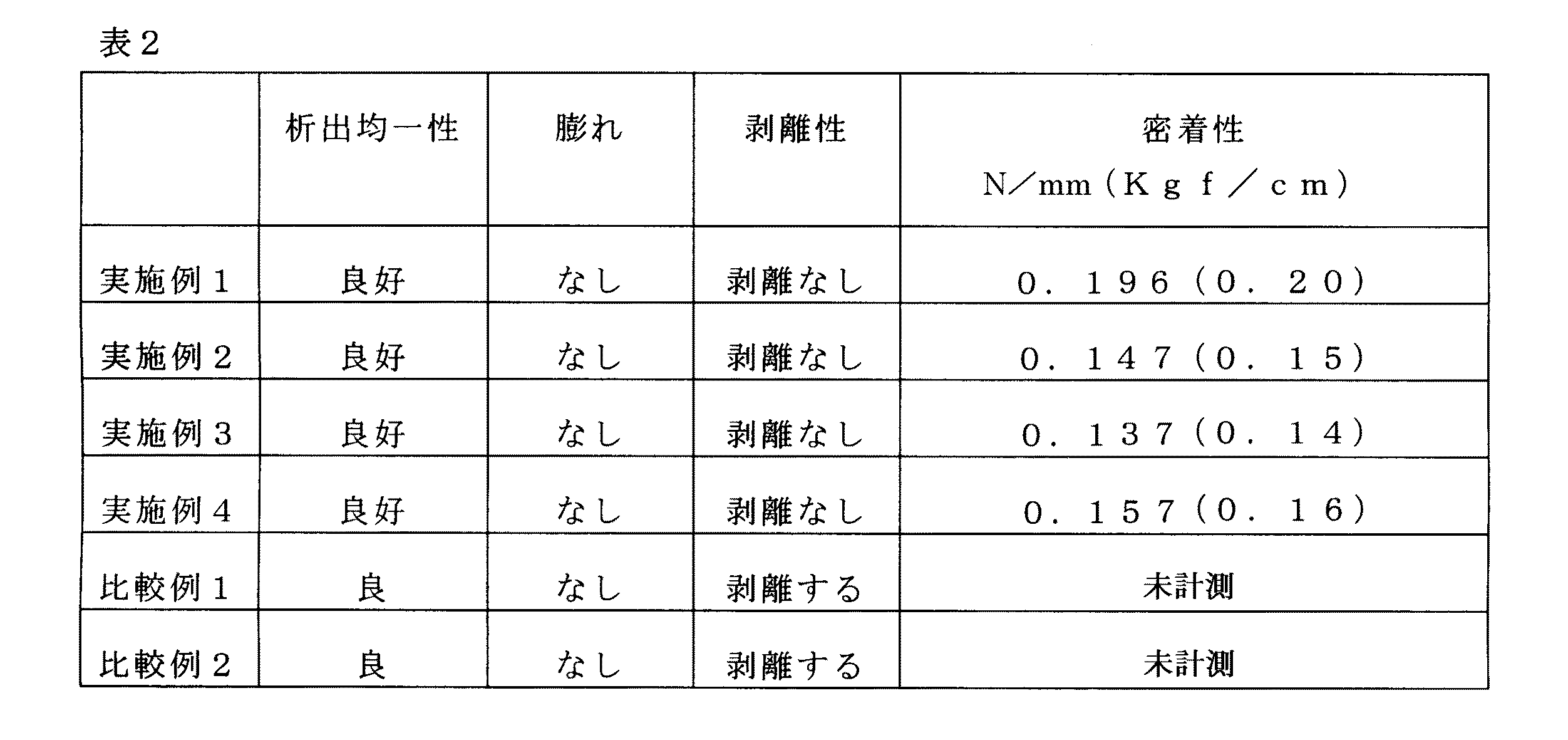
比較例1
貴金属イオン含有溶液処理の後の加熱乾燥処理及びアルカリ水溶液処理を行わなかった以外、実施例1と同様の処理を行った。その結果を表2に示す。
Comparative Example 1
The same treatment as in Example 1 was performed except that the heat drying treatment and the alkaline aqueous solution treatment after the noble metal ion-containing solution treatment were not performed. The results are shown in Table 2.
比較例2
貴金属イオン含有溶液処理の後のアルカリ水溶液処理を行わなかった以外、実施例1と同様の処理を行った。その結果を表2に示す。
Comparative Example 2
The same treatment as in Example 1 was performed except that the alkaline aqueous solution treatment after the noble metal ion-containing solution treatment was not performed. The results are shown in Table 2.
比較例3
被めっき材をポリカーボネート板を用いた以外は、実施例1と同様の処理を行った。しかし、当該前処理溶液によっては、その表面を膨潤させることができなかった。
Comparative Example 3
The same treatment as in Example 1 was performed except that a polycarbonate plate was used as the material to be plated. However, the pretreatment solution could not swell the surface.
上記結果より、本発明の方法によれば、均一かつ良好な密着性を有するめっき皮膜が形成されたことがわかる。 From the above results, it can be seen that according to the method of the present invention, a plating film having uniform and good adhesion was formed.
すなわち、従来行われていた樹脂の表面粗化を行うことなく、かつ、コロイド触媒などの錫を含む触媒溶液を用いることなく、平滑な樹脂表面に対して、均一かつ良好な密着性を有するめっき皮膜を形成することができた。このためには、触媒として作用する非コロイド系貴金属を提供する溶液に陰イオン性界面活性剤を含むことが必要であることが理解される。
That is, plating having uniform and good adhesion to a smooth resin surface without performing conventional surface roughening of the resin and without using a catalyst solution containing tin such as a colloidal catalyst. A film could be formed. To this end, it is understood that it is necessary to include an anionic surfactant in the solution that provides the non-colloidal noble metal that acts as a catalyst.
Claims (9)
Priority Applications (2)
| Application Number | Priority Date | Filing Date | Title |
|---|---|---|---|
| JP2006161415A JP4917841B2 (en) | 2006-06-09 | 2006-06-09 | Electroless plating method on resin surface |
| US11/810,876 US20080053834A1 (en) | 2006-06-09 | 2007-06-07 | Electroless plating method for resin surfaces |
Applications Claiming Priority (1)
| Application Number | Priority Date | Filing Date | Title |
|---|---|---|---|
| JP2006161415A JP4917841B2 (en) | 2006-06-09 | 2006-06-09 | Electroless plating method on resin surface |
Publications (2)
| Publication Number | Publication Date |
|---|---|
| JP2007327131A JP2007327131A (en) | 2007-12-20 |
| JP4917841B2 true JP4917841B2 (en) | 2012-04-18 |
Family
ID=38927785
Family Applications (1)
| Application Number | Title | Priority Date | Filing Date |
|---|---|---|---|
| JP2006161415A Expired - Fee Related JP4917841B2 (en) | 2006-06-09 | 2006-06-09 | Electroless plating method on resin surface |
Country Status (2)
| Country | Link |
|---|---|
| US (1) | US20080053834A1 (en) |
| JP (1) | JP4917841B2 (en) |
Families Citing this family (6)
| Publication number | Priority date | Publication date | Assignee | Title |
|---|---|---|---|---|
| WO2009084470A1 (en) * | 2007-12-27 | 2009-07-09 | Fujifilm Corporation | Plating method, method for forming metal thin film, and plating catalyst liquid |
| JP5371393B2 (en) | 2008-11-27 | 2013-12-18 | ユーエムジー・エービーエス株式会社 | Plating resin composition and resin plating product |
| JP2010138475A (en) * | 2008-12-15 | 2010-06-24 | Fujifilm Corp | Plating catalyst liquid, plating method, method for producing laminated body having metal film |
| JP6367606B2 (en) * | 2013-09-09 | 2018-08-01 | 上村工業株式会社 | Pretreatment agent for electroless plating, pretreatment method for printed wiring board using said pretreatment agent for electroless plating, and method for producing the same |
| JP6070592B2 (en) | 2014-01-31 | 2017-02-01 | 豊田合成株式会社 | Manufacturing method for resin injection molding dies and resin molded products |
| JP6671583B2 (en) * | 2018-03-29 | 2020-03-25 | グリーンケム株式会社 | Metal plating method |
Family Cites Families (20)
| Publication number | Priority date | Publication date | Assignee | Title |
|---|---|---|---|---|
| BE792310A (en) * | 1971-12-08 | 1973-06-05 | Kalle Ag | PROCESS FOR DEPOSITING COPPER COATS ON MOLDED PARTS OF POLYIMIDES |
| US4042730A (en) * | 1976-03-29 | 1977-08-16 | Bell Telephone Laboratories, Incorporated | Process for electroless plating using separate sensitization and activation steps |
| US4151313A (en) * | 1977-03-11 | 1979-04-24 | Hitachi, Ltd. | Method for production of printed circuits by electroless metal plating employing a solid solution of metal oxides of titanium, nickel, and antimony as a masking material |
| JPS5439633A (en) * | 1977-09-02 | 1979-03-27 | Hitachi Chemical Co Ltd | Multiistylus head and method of making same |
| DE3144374A1 (en) * | 1981-11-07 | 1983-05-19 | Robert Bosch Gmbh, 7000 Stuttgart | Bath for catalysing nonmetallic substances, nonmetal/metal composite substances, and also light metals and light metal alloys before chemical (electroless) metallisation |
| US4473602A (en) * | 1982-12-30 | 1984-09-25 | International Business Machines Corporation | Palladium activation of 2.5% silicon iron prior to electroless nickel plating |
| JPS62198192A (en) * | 1986-02-26 | 1987-09-01 | 住友ベークライト株式会社 | Manufacture of printed wiring board |
| US4900618A (en) * | 1986-11-07 | 1990-02-13 | Monsanto Company | Oxidation-resistant metal coatings |
| JPH0826462B2 (en) * | 1987-11-30 | 1996-03-13 | 龍徳 四十宮 | Method for producing molded product of surface metallized polymer |
| DE3813430A1 (en) * | 1988-04-18 | 1989-10-26 | Schering Ag | METHOD FOR THE TWO-SIDED METALIZATION OF POLYIMIDE FILMS |
| DE3828531A1 (en) * | 1988-08-23 | 1990-03-15 | Rudolf Dr Ing Ernst | Oxygen absorbent and use of the same |
| US5348574A (en) * | 1993-07-02 | 1994-09-20 | Monsanto Company | Metal-coated polyimide |
| JP2761188B2 (en) * | 1994-05-27 | 1998-06-04 | 株式会社日本触媒 | Emulsion polymerization inhibitor and suspension polymerization method using the same |
| US6180469B1 (en) * | 1998-11-06 | 2001-01-30 | Advanced Micro Devices, Inc. | Low resistance salicide technology with reduced silicon consumption |
| JP3689096B2 (en) * | 2002-10-02 | 2005-08-31 | 学校法人神奈川大学 | Thin film formation method |
| JP4135459B2 (en) * | 2002-10-10 | 2008-08-20 | トヨタ自動車株式会社 | Method for pretreatment of electroless plating material and method for manufacturing plating coated member |
| JP4189532B2 (en) * | 2002-12-10 | 2008-12-03 | 奥野製薬工業株式会社 | Method for activating catalyst for electroless plating |
| JP2004271985A (en) * | 2003-03-10 | 2004-09-30 | Fuji Photo Film Co Ltd | Developing solution for photosensitive lithographic printing plate and platemaking method for lithographic printing plate |
| JP2006070319A (en) * | 2004-09-01 | 2006-03-16 | Toyota Motor Corp | Resin plating method |
| US20060236884A1 (en) * | 2005-04-20 | 2006-10-26 | Agfa-Gevaert | Process for contact printing of patterns of electroless deposition catalyst |
-
2006
- 2006-06-09 JP JP2006161415A patent/JP4917841B2/en not_active Expired - Fee Related
-
2007
- 2007-06-07 US US11/810,876 patent/US20080053834A1/en not_active Abandoned
Also Published As
| Publication number | Publication date |
|---|---|
| US20080053834A1 (en) | 2008-03-06 |
| JP2007327131A (en) | 2007-12-20 |
Similar Documents
| Publication | Publication Date | Title |
|---|---|---|
| CA2866786C (en) | Process for metallizing nonconductive plastic surfaces | |
| KR101872066B1 (en) | Process for metallizing nonconductive plastic surfaces | |
| KR100541893B1 (en) | How to coat the substrate with metal | |
| JP2769954B2 (en) | Method for electrodepositing metal plating directly on plastic substrates | |
| TWI546128B (en) | A process for electroless plating and a solution used for the same | |
| CA2866766C (en) | Process for metallizing nonconductive plastic surfaces | |
| TW201509812A (en) | Pretreatment agent for electroless plating, and pretreatment and production of printed wiring board using same | |
| US20080053834A1 (en) | Electroless plating method for resin surfaces | |
| US5616230A (en) | Method for direct-electroplating an electrically nonconductive substrate | |
| EP2007931B1 (en) | Polyimide substrate and method of manufacturing printed wiring board using the same | |
| KR100555928B1 (en) | Pretreatment of Electroless Plating Materials | |
| JP2008255460A (en) | Electroless plating treatment method of polyimide resin | |
| JP2000178752A (en) | Palladium catalyst remover for electroless plating | |
| JPH10245444A (en) | Method for forming conductive film on polyimide resin surface | |
| JPH0319301B2 (en) | ||
| JP2987556B2 (en) | Method for forming metal conductive layer on fluororesin body surface | |
| CN114829672B (en) | Avoiding unwanted plating on stent coatings for electrodeposition | |
| JP3325236B2 (en) | Electroless copper plating method | |
| TW201715080A (en) | Solutions of organic salts as pretreatments for plastics prior to etching | |
| JP2005120407A (en) | Method for electroless-plating article to be plated having polyimide resin | |
| CZ20004225A3 (en) | A method for plating substrates |
Legal Events
| Date | Code | Title | Description |
|---|---|---|---|
| A621 | Written request for application examination |
Free format text: JAPANESE INTERMEDIATE CODE: A621 Effective date: 20090520 |
|
| RD02 | Notification of acceptance of power of attorney |
Free format text: JAPANESE INTERMEDIATE CODE: A7422 Effective date: 20090520 |
|
| A977 | Report on retrieval |
Free format text: JAPANESE INTERMEDIATE CODE: A971007 Effective date: 20110822 |
|
| A131 | Notification of reasons for refusal |
Free format text: JAPANESE INTERMEDIATE CODE: A131 Effective date: 20110824 |
|
| A521 | Request for written amendment filed |
Free format text: JAPANESE INTERMEDIATE CODE: A523 Effective date: 20111124 |
|
| TRDD | Decision of grant or rejection written | ||
| A01 | Written decision to grant a patent or to grant a registration (utility model) |
Free format text: JAPANESE INTERMEDIATE CODE: A01 Effective date: 20120119 |
|
| A01 | Written decision to grant a patent or to grant a registration (utility model) |
Free format text: JAPANESE INTERMEDIATE CODE: A01 |
|
| A61 | First payment of annual fees (during grant procedure) |
Free format text: JAPANESE INTERMEDIATE CODE: A61 Effective date: 20120127 |
|
| FPAY | Renewal fee payment (event date is renewal date of database) |
Free format text: PAYMENT UNTIL: 20150203 Year of fee payment: 3 |
|
| R150 | Certificate of patent or registration of utility model |
Ref document number: 4917841 Country of ref document: JP Free format text: JAPANESE INTERMEDIATE CODE: R150 Free format text: JAPANESE INTERMEDIATE CODE: R150 |
|
| R250 | Receipt of annual fees |
Free format text: JAPANESE INTERMEDIATE CODE: R250 |
|
| R250 | Receipt of annual fees |
Free format text: JAPANESE INTERMEDIATE CODE: R250 |
|
| R250 | Receipt of annual fees |
Free format text: JAPANESE INTERMEDIATE CODE: R250 |
|
| R250 | Receipt of annual fees |
Free format text: JAPANESE INTERMEDIATE CODE: R250 |
|
| R250 | Receipt of annual fees |
Free format text: JAPANESE INTERMEDIATE CODE: R250 |
|
| R250 | Receipt of annual fees |
Free format text: JAPANESE INTERMEDIATE CODE: R250 |
|
| R250 | Receipt of annual fees |
Free format text: JAPANESE INTERMEDIATE CODE: R250 |
|
| R250 | Receipt of annual fees |
Free format text: JAPANESE INTERMEDIATE CODE: R250 |
|
| R250 | Receipt of annual fees |
Free format text: JAPANESE INTERMEDIATE CODE: R250 |
|
| LAPS | Cancellation because of no payment of annual fees |