JP4875488B2 - Sanitary thin paper and method for producing the same - Google Patents
Sanitary thin paper and method for producing the same Download PDFInfo
- Publication number
- JP4875488B2 JP4875488B2 JP2006514144A JP2006514144A JP4875488B2 JP 4875488 B2 JP4875488 B2 JP 4875488B2 JP 2006514144 A JP2006514144 A JP 2006514144A JP 2006514144 A JP2006514144 A JP 2006514144A JP 4875488 B2 JP4875488 B2 JP 4875488B2
- Authority
- JP
- Japan
- Prior art keywords
- fatty acid
- acid
- paper
- thin paper
- pulp
- Prior art date
- Legal status (The legal status is an assumption and is not a legal conclusion. Google has not performed a legal analysis and makes no representation as to the accuracy of the status listed.)
- Expired - Fee Related
Links
Images

Classifications
-
- D—TEXTILES; PAPER
- D21—PAPER-MAKING; PRODUCTION OF CELLULOSE
- D21H—PULP COMPOSITIONS; PREPARATION THEREOF NOT COVERED BY SUBCLASSES D21C OR D21D; IMPREGNATING OR COATING OF PAPER; TREATMENT OF FINISHED PAPER NOT COVERED BY CLASS B31 OR SUBCLASS D21G; PAPER NOT OTHERWISE PROVIDED FOR
- D21H21/00—Non-fibrous material added to the pulp, characterised by its function, form or properties; Paper-impregnating or coating material, characterised by its function, form or properties
- D21H21/14—Non-fibrous material added to the pulp, characterised by its function, form or properties; Paper-impregnating or coating material, characterised by its function, form or properties characterised by function or properties in or on the paper
- D21H21/22—Agents rendering paper porous, absorbent or bulky
- D21H21/24—Surfactants
-
- D—TEXTILES; PAPER
- D21—PAPER-MAKING; PRODUCTION OF CELLULOSE
- D21H—PULP COMPOSITIONS; PREPARATION THEREOF NOT COVERED BY SUBCLASSES D21C OR D21D; IMPREGNATING OR COATING OF PAPER; TREATMENT OF FINISHED PAPER NOT COVERED BY CLASS B31 OR SUBCLASS D21G; PAPER NOT OTHERWISE PROVIDED FOR
- D21H27/00—Special paper not otherwise provided for, e.g. made by multi-step processes
- D21H27/002—Tissue paper; Absorbent paper
-
- A—HUMAN NECESSITIES
- A47—FURNITURE; DOMESTIC ARTICLES OR APPLIANCES; COFFEE MILLS; SPICE MILLS; SUCTION CLEANERS IN GENERAL
- A47K—SANITARY EQUIPMENT; ACCESSORIES THEREFOR, e.g. TOILET ACCESSORIES
- A47K10/00—Body-drying implements; Toilet paper; Holders therefor
- A47K10/24—Towel dispensers; Toilet paper dispensers
- A47K10/32—Dispensers for paper towels or toilet paper
- A47K2010/3266—Wet wipes
-
- D—TEXTILES; PAPER
- D21—PAPER-MAKING; PRODUCTION OF CELLULOSE
- D21H—PULP COMPOSITIONS; PREPARATION THEREOF NOT COVERED BY SUBCLASSES D21C OR D21D; IMPREGNATING OR COATING OF PAPER; TREATMENT OF FINISHED PAPER NOT COVERED BY CLASS B31 OR SUBCLASS D21G; PAPER NOT OTHERWISE PROVIDED FOR
- D21H17/00—Non-fibrous material added to the pulp, characterised by its constitution; Paper-impregnating material characterised by its constitution
- D21H17/03—Non-macromolecular organic compounds
- D21H17/05—Non-macromolecular organic compounds containing elements other than carbon and hydrogen only
- D21H17/14—Carboxylic acids; Derivatives thereof
-
- D—TEXTILES; PAPER
- D21—PAPER-MAKING; PRODUCTION OF CELLULOSE
- D21H—PULP COMPOSITIONS; PREPARATION THEREOF NOT COVERED BY SUBCLASSES D21C OR D21D; IMPREGNATING OR COATING OF PAPER; TREATMENT OF FINISHED PAPER NOT COVERED BY CLASS B31 OR SUBCLASS D21G; PAPER NOT OTHERWISE PROVIDED FOR
- D21H17/00—Non-fibrous material added to the pulp, characterised by its constitution; Paper-impregnating material characterised by its constitution
- D21H17/20—Macromolecular organic compounds
- D21H17/33—Synthetic macromolecular compounds
- D21H17/46—Synthetic macromolecular compounds obtained otherwise than by reactions only involving carbon-to-carbon unsaturated bonds
- D21H17/53—Polyethers; Polyesters
-
- D—TEXTILES; PAPER
- D21—PAPER-MAKING; PRODUCTION OF CELLULOSE
- D21H—PULP COMPOSITIONS; PREPARATION THEREOF NOT COVERED BY SUBCLASSES D21C OR D21D; IMPREGNATING OR COATING OF PAPER; TREATMENT OF FINISHED PAPER NOT COVERED BY CLASS B31 OR SUBCLASS D21G; PAPER NOT OTHERWISE PROVIDED FOR
- D21H17/00—Non-fibrous material added to the pulp, characterised by its constitution; Paper-impregnating material characterised by its constitution
- D21H17/20—Macromolecular organic compounds
- D21H17/33—Synthetic macromolecular compounds
- D21H17/46—Synthetic macromolecular compounds obtained otherwise than by reactions only involving carbon-to-carbon unsaturated bonds
- D21H17/54—Synthetic macromolecular compounds obtained otherwise than by reactions only involving carbon-to-carbon unsaturated bonds obtained by reactions forming in the main chain of the macromolecule a linkage containing nitrogen
- D21H17/55—Polyamides; Polyaminoamides; Polyester-amides
Landscapes
- Paper (AREA)
Description
本発明は、家庭用などの衛生薄葉紙及びその製造方法に係り、特に柔らかくかつ滑らかな衛生薄葉紙を提供するもので、その衛生薄葉紙としては、ティッシュペーパやトイレットペーパーなどを挙げることができる。 The present invention relates to sanitary thin paper for household use and a method for producing the same, and particularly provides a soft and smooth sanitary thin paper. Examples of the sanitary thin paper include tissue paper and toilet paper.
近年、生活環境の変化に伴って、使用者にとって、柔らかくかつ滑らかな衛生薄葉紙は好まれる傾向にある。特にティッシュペーパの分野においてその傾向は顕著である。
柔軟性を確保するためには、特許文献1に示されているように、たとえば第4級アンモニウム塩を添加することが知られている。また、特許文献2に示されているように、ポリシロキサン物質を添加することも知られている。
しかしながら、柔軟性のみを付与したとしても、滑らかさを兼ね備えていないと肌触りが悪い。肌触りに影響する「滑らかさ」を得るためには、潤滑剤を添加することが考えられるが、実際にこれに適した潤滑剤を見出し難い。
In order to ensure flexibility, it is known to add, for example, a quaternary ammonium salt as disclosed in Patent Document 1. As shown in Patent Document 2, it is also known to add a polysiloxane substance.
However, even if only flexibility is imparted, the touch is poor unless it has smoothness. In order to obtain “smoothness” that affects the touch, it is conceivable to add a lubricant, but it is difficult to actually find a lubricant suitable for this.
本発明の主たる課題は、柔軟性に優れ、しかも滑らかさの両者において著しく優れた衛生薄葉紙及びその製造方法を提供することにある。 The main subject of this invention is providing the sanitary thin paper which was excellent in the softness | flexibility, and was remarkably excellent in both smoothness, and its manufacturing method.
上記課題を解決して本発明は次記のとおりである。
〔請求項1記載の発明〕
パルプを原料とし、脂肪酸エステル系化合物を含む柔軟剤成分及び脂肪酸アミド系化合物を含む柔軟剤成分を内添し、
下記一般式(1)で示されるポリエステル系化合物が外添されている、
ことを特徴とする衛生薄葉紙。
[Invention of Claim 1]
Using pulp as a raw material , internally adding a softener component containing a fatty acid ester compound and a softener component containing a fatty acid amide compound,
A polyester compound represented by the following general formula (1) is externally added,
Hygienic thin paper characterized by that.
〔請求項2記載の発明〕
前記脂肪酸エステル系化合物及び前記脂肪酸アミド系化合物を含めた柔軟剤成分の含有量が、乾燥質量基準で前記パルプ原料100質量部に対し0.002〜10質量部である、請求項1記載の衛生薄葉紙。
[Invention of Claim 2]
The hygiene according to claim 1, wherein the content of the softener component including the fatty acid ester compound and the fatty acid amide compound is 0.002 to 10 parts by mass with respect to 100 parts by mass of the pulp raw material on a dry mass basis. Tissue paper.
〔請求項3記載の発明〕
前記ポリエステル系化合物が、乾燥質量基準で前記パルプ原料に対し0.05〜30.0質量%の割合で添加されている、請求項1又は2記載の衛生薄葉紙。
[Invention of Claim 3 ]
The sanitary thin paper according to claim 1 or 2 , wherein the polyester-based compound is added at a ratio of 0.05 to 30.0 mass% with respect to the pulp raw material on a dry mass basis.
〔請求項4記載の発明〕
1プライ当たりの米坪が10〜35g/m2である、請求項1〜3のいずれか1項に記載の衛生薄葉紙。
[Invention of Claim 4 ]
Basis weight per ply is 10~35g / m 2, sanitary thin paper according to any one of claims 1 to 3.
〔請求項5記載の発明〕
抄紙段階でクレープが付与され、そのクレープ形状が、クレープの流れ方向の頂点距離が0.1mm以下、クレープの幅方向の長さが0.5mm以下である、請求項1〜4のいずれか1項に記載の衛生薄葉紙。
[Invention of Claim 5 ]
Crepe is given in the paper making step, the crepe shape, the vertex distance crepe flow direction 0.1mm or less, the length in the width direction of the crepe is 0.5mm or less, either of the preceding claims 1 The sanitary thin paper according to the item.
〔請求項6記載の発明〕
紙の幅方向断面における隣接するパルプ繊維間距離が1μm以上であるパルプ繊維数の、全パルプ繊維数中に占める割合が50%以上である、請求項5記載の衛生薄葉紙。
[Invention of Claim 6 ]
The sanitary thin paper according to claim 5 , wherein the ratio of the number of pulp fibers having a distance between adjacent pulp fibers in the cross section in the width direction of 1 µm or more to the total number of pulp fibers is 50% or more.
〔請求項7記載の発明〕
紙の幅方向断面におけるパルプ繊維が占める面積を除く空隙の面積率が50%以上である、請求項5又は6記載の衛生薄葉紙。
[Invention of Claim 7 ]
The sanitary thin paper according to claim 5 or 6 , wherein an area ratio of voids excluding an area occupied by pulp fibers in a cross section in the width direction of the paper is 50% or more.
〔請求項8記載の発明〕
パルプ原料の湿紙に対し、脂肪酸エステル系化合物及び脂肪酸アミド系化合物を内添で含有させた後、その湿紙に下記一般式(2)で示されるポリエステル系化合物をオンラインで外添する、ことを特徴とする衛生薄葉紙の製造方法。
Adding a fatty acid ester compound and a fatty acid amide compound internally to the wet paper of the pulp raw material, and then externally adding a polyester compound represented by the following general formula (2) to the wet paper online A method for producing sanitary thin paper.
本発明によれば、柔らかさのみでなく、滑らかさにおいても著しく優れたものとなる。この理由は、次のように考えられる。すなわち、脂肪酸エステル系化合物は、繊維間に浸透して繊維間結合を緩めるため、嵩高効果も発揮し、使用者にとって、柔らかさを与えるものとなる。脂肪酸アミド系化合物は、嵩高効果を助長するばかりでなく、保湿的なしっとり感・滑らか感を与える。これら脂肪酸エステル系化合物及び脂肪酸アミド系化合物の両者は、カチオン性であることが特に望ましいことも知見している。 According to the present invention, not only softness but also smoothness is remarkably excellent. The reason is considered as follows. That is, since the fatty acid ester compound penetrates between the fibers and loosens the bond between the fibers, it also exhibits a bulky effect and gives the user softness. The fatty acid amide compound not only promotes a bulky effect but also provides a moisturizing moist and smooth feeling. It has also been found that both of these fatty acid ester compounds and fatty acid amide compounds are particularly desirable to be cationic.
かかるパルプ紙に対してポリエステル系化合物を外添すると、パルプ繊維表面にポリエステルの薄膜を形成でき、肌が触れたとき、表層部分において繊維間の摩擦を低減する機能を有するものとなる。したがって、得られる衛生薄葉紙は、ポーラスでしっとりした柔らかなものとなり、かつ表面が滑らかなものとなる。 When a polyester compound is externally added to such pulp paper, a polyester thin film can be formed on the surface of the pulp fiber, and when the skin touches, it has a function of reducing friction between the fibers in the surface layer portion. Accordingly, the obtained sanitary thin paper is porous, moist and soft, and has a smooth surface.
このようにポリエステル系化合物はパルプ繊維表面にポリエステルの薄膜を形成するためのものであるために、外添するのが好ましい。脂肪酸エステル系化合物は、繊維間に浸透させて繊維間結合を緩めるためのものであるから、内添するのが好ましい。これに対し、脂肪酸アミド系化合物は内添である方が、効果が大きいものの、外添であってもよいことを知見している。 Thus, since the polyester compound is for forming a polyester thin film on the pulp fiber surface, it is preferably added externally. The fatty acid ester compound is preferably added internally because it penetrates between the fibers to loosen the bond between the fibers. On the other hand, it has been found that the fatty acid amide-based compound can be externally added although the effect is larger when it is internally added.
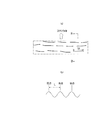
一方、滑らかさは、クレープ形状に大いに関係することを知見した。すなわち、図1に示すように、クレープの(用紙)流れ方向の頂点距離Lが0.1mm以下、クレープの幅方向長さWが0.5mm以下であるものが望ましいことを知見した。クレープの流れ方向の頂点距離Lが短く0.1mm以下であると、滑らかさを与える。他方、クレープの幅方向長さWが0.5mmを超えると、衛生薄葉紙を肌に当てて流れ方向に移動させて清拭するときの滑らかさを阻害する。 On the other hand, it was found that smoothness is greatly related to the crepe shape. That is, as shown in FIG. 1, it has been found that it is desirable that the apex distance L in the (paper) flow direction of the crepe is 0.1 mm or less and the width direction length W of the crepe is 0.5 mm or less. When the apex distance L in the crepe flow direction is short and 0.1 mm or less, smoothness is given. On the other hand, when the length W in the width direction of the crepe exceeds 0.5 mm, smoothness is obstructed when the sanitary thin paper is applied to the skin and moved in the flow direction for wiping.
次に、本発明の実施の形態を説明する。なお、前述のように、衛生薄葉紙としては、ティッシュペーパやトイレットペーパーなどを挙げることができる。また、化粧用紙としても使用可能である。 Next, an embodiment of the present invention will be described. As described above, examples of sanitary thin paper include tissue paper and toilet paper. It can also be used as decorative paper.
本衛生薄葉紙としては、1プライ当たりの米坪(JIS P 8124)が7〜40g/m2(好ましくは10〜35g/m2、より好ましくは11.0〜17.0g/m2)であるものを対象とするとき、本発明の特性が良好に発現する。7g/m2未満であると抄造が困難となる、10g/m2未満だと抄紙段階で紙が薄いため穴が生じる恐れがある、との問題がある。一方、40g/m2を超えると紙厚が増し硬くなり、また、35g/m2を超えると、クレープを設ける場合において、紙表面のクレープが粗くなり表面性が悪くなる。そのため、柔軟剤の効果が発現しにくくなる。本衛生薄葉紙は、2プライ(2枚重ねで一組)のほか3プライ以上もものでもよい。さらに、本発明は、必要な紙力が要求されるティッシュペーパであるときに特に顕著な効果を示すが、トイレットペーパーでもよい。 The sanitary thin paper has 7 to 40 g / m 2 (preferably 10 to 35 g / m 2 , more preferably 11.0 to 17.0 g / m 2 ) of rice basis weight (JIS P 8124) per ply. When the object is intended, the characteristics of the present invention are exhibited well. If it is less than 7 g / m 2 , paper making becomes difficult. If it is less than 10 g / m 2 , there is a problem that holes may be formed because the paper is thin at the paper making stage. On the other hand, when it exceeds 40 g / m 2 , the paper thickness increases and becomes hard, and when it exceeds 35 g / m 2 , when the crepe is provided, the crepe on the paper surface becomes rough and the surface property becomes poor. Therefore, the effect of a softening agent becomes difficult to express. This sanitary thin paper may be 3 plies or more in addition to 2 plies (a set of 2 sheets stacked). Furthermore, although the present invention shows a particularly remarkable effect when the tissue paper requires a required paper strength, toilet paper may be used.
本衛生薄葉紙は、既知の設備および製造工程に従って製造することができる。すなわち、パルプ原料を抄紙機で抄紙するとともに、好ましくはクレープ処理及びカレンダー処理を施す製造方法により製造することができる。 The sanitary thin paper can be manufactured according to known equipment and manufacturing processes. That is, it can be manufactured by a manufacturing method in which a pulp raw material is made with a paper machine and preferably subjected to creping and calendering.
本形態の衛生薄葉紙は、衛生薄葉紙の柔軟性付与剤として、前記一般式(1)で示されたポリエステル系化合物をパルプ原料に添加したものである。 The sanitary thin paper of this embodiment is obtained by adding the polyester compound represented by the general formula (1) to the pulp raw material as a flexibility imparting agent for sanitary thin paper.
ポリエステル系化合物は、水溶性であるので、水に溶解または分散することができるものの、高分子量であるために、イソプロピルアルコール、ジプロピレングリコールなどの溶剤に溶解して使用するのが望ましい。 The polyester compound is soluble in water and can be dissolved or dispersed in water. However, since the polyester compound has a high molecular weight, it is desirable to use it by dissolving in a solvent such as isopropyl alcohol or dipropylene glycol.
一般式(1)で表されるポリエステル系化合物は、芳香族ジカルボン酸又はその誘導体と一般式 HO−(R2O)a−H で表されるグリコールより、公知の方法により製造することができる。芳香族ジカルボン酸としては、テレフタル酸、イソフタル酸及びフタル酸を挙げることができ、その誘導体としては、たとえば、これらのジカルボン酸のジメチルエステル、ジエチルエステル、ジプロピルエステル、ジブチルエステルなどの低級アルキルエステル、これらのジカルボン酸のクロライドなど、及び、無水フタル酸などを挙げることができる。これらの芳香族ジカルボン酸又はその誘導体は、1種を単独で使用することができ、2種以上を組み合わせて使用することもできる。 The polyester compound represented by the general formula (1) can be produced by a known method from an aromatic dicarboxylic acid or a derivative thereof and a glycol represented by the general formula HO— (R 2 O) a—H 2. . Examples of aromatic dicarboxylic acids include terephthalic acid, isophthalic acid, and phthalic acid, and examples of derivatives thereof include lower alkyl esters such as dimethyl ester, diethyl ester, dipropyl ester, and dibutyl ester of these dicarboxylic acids. , Chlorides of these dicarboxylic acids, and phthalic anhydride. These aromatic dicarboxylic acids or derivatives thereof can be used singly or in combination of two or more.
一般式HO−(R2O)a−Hで表されるグリコールとしては、たとえば、エチレングリコール、プロピレングリコール、ジエチレングリコール、ジプロピレングリコール、ポリエチレングリコール、ポリプロピレングリコール、両末端が水酸基であるエチレンオキシドとプロピレンオキシドのランダム状又はブロック状共重合体などを挙げることができる。 Examples of the glycol represented by the general formula HO— (R 2 O) a—H include ethylene glycol, propylene glycol, diethylene glycol, dipropylene glycol, polyethylene glycol, polypropylene glycol, and ethylene oxide and propylene oxide in which both ends are hydroxyl groups. Or a random copolymer or a block copolymer.
これらのグリコールは、1種を単独で使用することができ、2種以上を組み合わせて使用することもできる。一般式(1)において、aは1〜200であって、より好ましくは1〜150である。aが200を超えると、一般式(1)で表されるポリエステル系化合物の粘度が高くなり過ぎて、取り扱いが容易でなくなるおそれがある。一般式(1)において、aは、同一分子内において、すべて同一であっても、異なっていてもよい。aがすべて同一である一般式(1)で表されるポリエステル系化合物は、たとえば、テレフタル酸、イソフタル酸、フタル酸などのジメチルエステルなどと、一定の分子量を有するポリエチレングリコールなどを反応し、脱メタノールなどを伴うエステル交換反応を行って重合することにより製造することができる。同一分子内に、aが1である繰り返し単位と、aが数十ないし百数十である繰り返し単位が存在する一般式(1)で表されるポリエステル系化合物は、たとえば、テレフタル酸、イソフタル酸、フタル酸などのジヒドロキシエチルエステルなどと、一定の分子量を有するポリエチレングリコールなどを反応し、脱エチルングリコールなどを伴うエステル交換反応を行って重合することにより製造することができる。一般式(1)において、bは2〜100であり、より好ましくは2〜30である。bが100を超えると、一般式(1)で表されるポリエステル系化合物の粘度が高くなり過ぎて、取り扱いが容易でなくなるおそれがある。 These glycols can be used individually by 1 type, and can also be used in combination of 2 or more type. In General formula (1), a is 1-200, More preferably, it is 1-150. If a exceeds 200, the viscosity of the polyester-based compound represented by the general formula (1) becomes too high, and handling may be difficult. In general formula (1), a may be all the same or different in the same molecule. A polyester compound represented by the general formula (1) in which all a are the same is reacted with, for example, dimethyl ester such as terephthalic acid, isophthalic acid, and phthalic acid and polyethylene glycol having a certain molecular weight, and the like. It can manufacture by performing transesterification with methanol etc. and superposing | polymerizing. The polyester compound represented by the general formula (1) in which a repeating unit in which a is 1 and a repeating unit in which a is several tens to several hundreds exists in the same molecule includes, for example, terephthalic acid and isophthalic acid. It can be produced by reacting dihydroxyethyl ester such as phthalic acid with polyethylene glycol having a certain molecular weight, etc., and performing polymerization by carrying out an ester exchange reaction involving deethylen glycol or the like. In General formula (1), b is 2-100, More preferably, it is 2-30. When b exceeds 100, the viscosity of the polyester compound represented by the general formula (1) becomes too high, and the handling may be difficult.
一般式(1)で表されるポリエステル系化合物の質量平均分子量は、1,000〜200,000であることが好ましく、10,000〜50,000であることがより好ましい。ポリエステル系化合物の質量平均分子量が1,000未満であると、柔軟性付与効果が十分に発揮されないおそれがある。ポリエステル系化合物の質量平均分子量が200,000を超えると、ポリエステル系化合物の粘度が高くなり過ぎて、取り扱いが容易でなくなるおそれがある。ポリエステル系化合物の質量平均分子量は、分子量既知の単分散のポリエチレングリコールを測定標準物質として、ゲル浸透クロマトグラフィーにより求めることができる。 The mass average molecular weight of the polyester compound represented by the general formula (1) is preferably 1,000 to 200,000, and more preferably 10,000 to 50,000. There exists a possibility that the softness | flexibility provision effect may not fully be exhibited as the mass mean molecular weight of a polyester-type compound is less than 1,000. If the mass average molecular weight of the polyester compound exceeds 200,000, the viscosity of the polyester compound becomes too high and handling may be difficult. The mass average molecular weight of the polyester compound can be determined by gel permeation chromatography using monodispersed polyethylene glycol having a known molecular weight as a measurement standard substance.
本衛生薄葉紙において、一般式(1)で表されるポリエステル系化合物の含有量(添加量)には特に制限はないが、通常は乾燥質量基準でパルプ原料に対し0.05〜30.0質量%で外添することが好ましく、0.5〜5.0質量%であることがより好ましい。一般式(1)で表されるポリエステル系化合物の含有量が0.05質量%未満であると、十分な滑らかさ付与効果が発揮されないおそれがある。一般式(1)で表されるポリエステル系化合物の含有量が30.0質量%を越えると、滑らかさ付与効果は大きくなるが、ベトツキ感を与えるなどの問題が生じる。 In the sanitary thin paper, the content (addition amount) of the polyester compound represented by the general formula (1) is not particularly limited, but is usually 0.05 to 30.0 mass relative to the pulp raw material on a dry mass basis. % Is preferably added, and more preferably 0.5 to 5.0% by mass. If the content of the polyester compound represented by the general formula (1) is less than 0.05% by mass, a sufficient smoothness-imparting effect may not be exhibited. When the content of the polyester compound represented by the general formula (1) exceeds 30.0% by mass, the effect of imparting smoothness increases, but problems such as giving a feeling of stickiness arise.
本発明は必要により、一般式(3)で示される水溶性ポリウレタン樹脂を含ませることができる。水溶性ポリウレタン樹脂は、乾燥質量基準でパルプ原料に対し0.05〜7質量%添加できる。ポリエステル系化合物と水溶性ポリウレタン樹脂との質量比は、100/1〜55/45が、特に100/1〜70/30が好ましい。すなわち、本発明のポリエステル系化合物が主体とするものが望ましい。添加方法としては、スプレー塗布や転写塗布などの外添で行うことができる。
本発明において、前記ポリエステル系化合物を添加すると、パルプ原料の水素結合に影響されることなくパルプ繊維に付着し、おそらく各パルプ繊維を被覆する結果、滑らかさを与える効果が知見されている。 In the present invention, it has been found that when the polyester compound is added, the polyester compound adheres to the pulp fiber without being influenced by hydrogen bonding of the pulp raw material, and possibly provides smoothness as a result of covering each pulp fiber.
本形態において、脂肪酸エステル系化合物としては、カチオン性の脂肪酸エステル系化合物とノニオン性の脂肪酸エステル系化合物との両者が添加されているのが望ましい。さらに、(a)これらの一方又は両方の脂肪酸エステル系化合物を内添により、(b)脂肪酸アミド系化合物を内添又は外添により添加する。添加剤の添加をスプレー塗布や転写塗布などの外添で行うことも考えられる。一方、内添、すなわち抄紙原料に混入して抄紙することもできる。 In this embodiment, as the fatty acid ester compound, it is desirable to add both a cationic fatty acid ester compound and a nonionic fatty acid ester compound. Further, (a) one or both of these fatty acid ester compounds are added internally, and (b) the fatty acid amide compound is added internally or externally. It is also conceivable to add the additive by external addition such as spray coating or transfer coating. On the other hand, paper can also be made by internal addition, that is, mixed with papermaking raw materials.
薬液の添加量としては、乾燥質量基準でパルプ原料100質量部に対し0.002〜10質量部が望ましい。また、(a)/(b)の比は、0.1〜500が望ましい。 As addition amount of a chemical | medical solution, 0.002-10 mass parts is desirable with respect to 100 mass parts of pulp raw materials on a dry mass basis. The ratio (a) / (b) is preferably 0.1 to 500.
(a)の脂肪酸エステル系化合物は繊維に付着すると繊維内部に浸透して、乾燥時にルーメン(内孔部)の内部同士が水素結合して潰れるのを防ぎ、よって嵩高くふんわりした紙質とすることができる。ただしカチオン性がないと、単独では繊維に定着しにくく効果が発揮しにくい。 When the fatty acid ester compound (a) adheres to the fiber, it penetrates into the inside of the fiber and prevents the inside of the lumen (inner hole part) from being hydrogen-bonded and crushed during drying, so that the paper texture is bulky and fluffy. Can do. However, if it is not cationic, it is difficult to be fixed on the fiber by itself, and it is difficult to exert the effect.
脂肪酸エステル系化合物としては、多炭素数が6〜24のアルコールと炭素数7〜25の脂肪酸との化合物であるのが望ましい。炭素数が6〜24のアルコールとしては、直鎖アルコール、分岐鎖を有するアルコール、飽和アルコール、及び不飽和アルコールの何れでも良い。これら各種のアルコールの中でも炭素数が10〜22のアルコールが好ましく、特に、ラウリルアルコール、ミリスチルアルコール、セチルアルコール、ステアリルアルコール、ベヘニルアルコール、及びオレイルアルコールが好ましい。これらはその一種を単独で用いても良いし、二種以上を併用しても良い。 The fatty acid ester compound is preferably a compound of an alcohol having 6 to 24 carbon atoms and a fatty acid having 7 to 25 carbon atoms. The alcohol having 6 to 24 carbon atoms may be any of linear alcohol, branched chain alcohol, saturated alcohol, and unsaturated alcohol. Among these various alcohols, alcohols having 10 to 22 carbon atoms are preferable, and lauryl alcohol, myristyl alcohol, cetyl alcohol, stearyl alcohol, behenyl alcohol, and oleyl alcohol are particularly preferable. These may be used alone or in combination of two or more.
炭素数7〜25の脂肪酸としては、直鎖脂肪酸、分岐鎖を有する脂肪酸、飽和脂肪酸、及び不飽和脂肪酸の何れでも良い。これら各種の脂肪酸の中でも、炭素数が10〜22の脂肪酸が好ましく、特に、ラウリン酸、ミリスチン酸、パルミチン酸、ステアリン酸、ベヘン酸、及びオレイン酸が好ましい。これらはその一種を単独で用いても良いし、二種以上を併用しても良い。 The fatty acid having 7 to 25 carbon atoms may be any of linear fatty acid, fatty acid having a branched chain, saturated fatty acid, and unsaturated fatty acid. Among these various fatty acids, fatty acids having 10 to 22 carbon atoms are preferable, and lauric acid, myristic acid, palmitic acid, stearic acid, behenic acid, and oleic acid are particularly preferable. These may be used alone or in combination of two or more.
また、(b)の脂肪酸アミド系化合物は、繊維1本1本の表面をコーティングし、嵩高効果を与えるとともに、表面に滑性を出し、紙表面の滑らかさを向上させる。 In addition, the fatty acid amide compound (b) coats the surface of each fiber, gives a bulky effect, gives the surface slipperiness, and improves the smoothness of the paper surface.
本発明の脂肪酸アミド化合物は、ポリアルキレンポリアミンおよびカルボン酸を反応させて得られる。 The fatty acid amide compound of the present invention is obtained by reacting a polyalkylene polyamine and a carboxylic acid.
本発明に用いられるポリアルキレンポリアミンは、分子中に少なくとも3個のアミノ基を有し、下記の式で示される:
H2N−(R1−NH−)n−R1−NH2 …(4)
(ここで、R1は各々独立して炭素数1〜4のアルキレン基であり、nは1〜3の整数である)。
The polyalkylene polyamine used in the present invention has at least three amino groups in the molecule and is represented by the following formula:
H 2 N— (R 1 —NH—) n —R 1 —NH 2 (4)
(Here, R 1 is each independently an alkylene group having 1 to 4 carbon atoms, and n is an integer of 1 to 3).
上記式(4)におけるR1の具体的としてはメチレン基、エチレン基、トリメチレン基、テトラメチレン基、およびブチレン基が挙げられる。1分子中に異なるR1が存在していてもよく、2種以上のポリアルキレンポリアミンを用いることも可能である。好ましいR1はエチレン基である。アルキレン基の炭素数が4を超える場合は取り扱いが困難になる。このような化合物を用いて得られるアミド化合物を用いると、嵩高く柔軟な紙を調製することが可能となる。 Specific examples of R 1 in the above formula (4) include a methylene group, an ethylene group, a trimethylene group, a tetramethylene group, and a butylene group. Different R 1 may exist in one molecule, and two or more polyalkylene polyamines can be used. Preferred R 1 is an ethylene group. When the number of carbon atoms of the alkylene group exceeds 4, handling becomes difficult. When an amide compound obtained using such a compound is used, a bulky and flexible paper can be prepared.
アミド化合物の調製に用いられるカルボン酸としては、炭素数10〜24のカルボン酸が用いられる。このカルボン酸は飽和カルボン酸、不飽和カルボン酸のいずれであってもよいし、直鎖状カルボン酸、分岐鎖を有するカルボン酸のいずれであってもよい。但し、そのうちの少なくとも40質量%は、不飽和結合および分岐鎖のうちの少なくとも一方を有するカルボン酸であることが必要である。 As the carboxylic acid used for the preparation of the amide compound, a carboxylic acid having 10 to 24 carbon atoms is used. The carboxylic acid may be either a saturated carboxylic acid or an unsaturated carboxylic acid, and may be either a linear carboxylic acid or a branched carboxylic acid. However, at least 40% by mass of them needs to be a carboxylic acid having at least one of an unsaturated bond and a branched chain.
炭素数10〜24のカルボン酸の例としては、次の化合物が挙げられる:カプリン酸、ラウリン酸、ミリスチン酸、パルミチン酸、パルミトレイン酸、イソパルミチン酸、ステアリン酸、オレイン酸、リノール酸、リノレン酸、イソステアリン酸、アラキン酸、ベヘン酸、エルカ酸、リグノセリン酸などの単独の脂肪酸;およびヤシ油脂肪酸、パーム油脂肪酸、牛脂脂肪酸、豚脂脂肪酸、大豆油脂肪酸、なたね油脂肪酸、トール油脂肪酸、オリーブ油脂肪酸、カカオ油脂肪酸、ゴマ油脂肪酸、トウモロコシ油脂肪酸、ヒマワリ油脂肪酸、綿実油脂肪酸などの天然油脂由来の混合脂肪酸、およびこれらの水素添加物など。これらは2種以上混合して用いられ得る。これらの中で炭素数12〜22のカルボン酸が好ましく、特に炭素数14〜18のカルボン酸が好ましい。炭素数が10未満のカルボン酸では、得られるアミド化合物による嵩高性および柔軟性向上効果が低く、炭素数が24を超えるカルボン酸では得られるアミド化合物の取り扱いが困難となる。 Examples of carboxylic acids having 10 to 24 carbon atoms include the following compounds: capric acid, lauric acid, myristic acid, palmitic acid, palmitoleic acid, isopalmitic acid, stearic acid, oleic acid, linoleic acid, linolenic acid , Isostearic acid, arachidic acid, behenic acid, erucic acid, lignoceric acid, and other fatty acids; and coconut oil fatty acid, palm oil fatty acid, beef tallow fatty acid, tallow fatty acid, soybean oil fatty acid, rapeseed oil fatty acid, tall oil fatty acid, olive oil fatty acid , Mixed fatty acids derived from natural fats and oils such as cacao oil fatty acid, sesame oil fatty acid, corn oil fatty acid, sunflower oil fatty acid, cottonseed oil fatty acid, and hydrogenated products thereof. These may be used as a mixture of two or more. Among these, carboxylic acids having 12 to 22 carbon atoms are preferable, and carboxylic acids having 14 to 18 carbon atoms are particularly preferable. When the carboxylic acid has less than 10 carbon atoms, the effect of improving the bulkiness and flexibility of the obtained amide compound is low, and when the carboxylic acid has more than 24 carbon atoms, it is difficult to handle the obtained amide compound.
上記のうち、不飽和結合を有するカルボン酸(単独の脂肪酸)の例としては、オレイン酸、リノール酸、リノレン酸、エルカ酸、およびパルミトレイン酸があり、分岐鎖を有するカルボン酸としては、イソパルミチン酸、およびイソステアリン酸がある。これらの脂肪酸が不純物として他の脂肪酸を含有する場合もあり、そのような脂肪酸も利用され得る。不飽和カルボン酸を40〜100質量%含む天然の混合脂肪酸としては、大豆油脂肪酸、パーム油脂肪酸、オリーブ油脂肪酸、カカオ油脂肪酸、ゴマ油脂肪酸、トウモロコシ油脂肪酸、ヒマワリ油脂肪酸、綿実油脂肪酸、牛脂脂肪酸、豚脂脂肪酸などが挙げられる。不飽和結合および分岐鎖のうちの少なくとも一方を有するカルボン酸または該カルボン酸の混合物のうち特に好ましいのは、大豆油脂肪酸、オレイン酸、およびエルカ酸である。 Among the above, examples of the carboxylic acid having an unsaturated bond (single fatty acid) include oleic acid, linoleic acid, linolenic acid, erucic acid, and palmitoleic acid, and the carboxylic acid having a branched chain includes isopalmitin. There are acids, and isostearic acid. These fatty acids may contain other fatty acids as impurities, and such fatty acids can also be utilized. Natural mixed fatty acids containing 40 to 100% by weight of unsaturated carboxylic acid include soybean oil fatty acid, palm oil fatty acid, olive oil fatty acid, cocoa oil fatty acid, sesame oil fatty acid, corn oil fatty acid, sunflower oil fatty acid, cottonseed oil fatty acid, beef tallow fatty acid, Examples include pork fat fatty acid. Particularly preferred among carboxylic acids having at least one of unsaturated bonds and branched chains or mixtures of the carboxylic acids are soybean oil fatty acid, oleic acid, and erucic acid.
本形態の脂肪酸アミド系化合物は、上記式(4)で示されるポリアルキレンポリアミンに上記カルボン酸を反応させて得られる。このカルボン酸は、ポリアルキレンポリアミン1モルに対して、1.5〜2.5モル、好ましくは1.8〜2.2モルの割合で使用される。この量が1.5モル未満の場合は、充分に嵩高く柔軟な紙が得られず、2.5モルを超える場合は得られるアミド化合物の取り扱いが困難になる。 The fatty acid amide compound of this embodiment is obtained by reacting the carboxylic acid with the polyalkylene polyamine represented by the above formula (4). The carboxylic acid is used in a proportion of 1.5 to 2.5 mol, preferably 1.8 to 2.2 mol, relative to 1 mol of the polyalkylene polyamine. When this amount is less than 1.5 mol, a sufficiently bulky and flexible paper cannot be obtained, and when it exceeds 2.5 mol, handling of the resulting amide compound becomes difficult.
上記アミド化合物は、そのまま添加剤として使用することができるが、無機酸あるいは有機酸で中和して塩として使用すると、取り扱いがさらに容易になる。上記無機酸としては、塩酸、硫酸、炭酸、硝酸、リン酸などが挙げられる。有機酸としては、次の化合物が挙げられる:蟻酸、酢酸、プロピオン酸、オクチル酸、酪酸、シュウ酸、マロン酸、イタコン酸、アジピン酸、コハク酸、セバシン酸、クエン酸、ヒドロキシ安息香酸、リンゴ酸、ヒドロキシマロン酸、乳酸、サリチル酸、ヒドロキシ吉草酸、アスパラギン酸、グルタミン酸、タウリン、スルファミン酸、ラウリン酸、ミリスチン酸、パルミチン酸、ステアリン酸、オレイン酸など。これらの中では有機酸が好ましく、その中でも蟻酸、酢酸および乳酸が特に好ましい。 The amide compound can be used as an additive as it is, but when it is neutralized with an inorganic acid or organic acid and used as a salt, handling becomes easier. Examples of the inorganic acid include hydrochloric acid, sulfuric acid, carbonic acid, nitric acid, and phosphoric acid. Organic acids include the following compounds: formic acid, acetic acid, propionic acid, octylic acid, butyric acid, oxalic acid, malonic acid, itaconic acid, adipic acid, succinic acid, sebacic acid, citric acid, hydroxybenzoic acid, apple Acid, hydroxymalonic acid, lactic acid, salicylic acid, hydroxyvaleric acid, aspartic acid, glutamic acid, taurine, sulfamic acid, lauric acid, myristic acid, palmitic acid, stearic acid, oleic acid and the like. Of these, organic acids are preferable, and formic acid, acetic acid, and lactic acid are particularly preferable.
塩を形成させるために使用する酸の量は、上記反応により得られた生成物の全アミン価を測り、目的に応じて必要な量を決定する。全アミン価と当量の無機酸または有機酸を添加してアミド化合物の塩とすることが好ましい。 The amount of acid used to form the salt is determined according to the purpose by measuring the total amine value of the product obtained by the above reaction. It is preferable to add an inorganic acid or an organic acid equivalent to the total amine value to form a salt of an amide compound.
このようにして得られるアミド化合物またはその塩は取り扱いが容易であり、嵩高く柔軟な紙が製造可能である。さらに、この化合物をパルプ繊維が任意の割合で水中に分散してなるパルプスラリー中に添加しても、起泡が生じにくいという利点がある。 The amide compound or salt thereof thus obtained is easy to handle, and a bulky and flexible paper can be produced. Furthermore, even when this compound is added to a pulp slurry in which pulp fibers are dispersed in water at an arbitrary ratio, there is an advantage that foaming is hardly generated.
また、薬液の使用により、紙力の低下が生じる場合があるので、デンプン、ポリアクリルアミド系表面紙力剤、ポリビニルアルコールなどの紙力剤、特にデンプンを内添するのが望ましい。 Further, since the paper strength may be lowered by using the chemical solution, it is desirable to internally add a paper strength agent such as starch, polyacrylamide type surface strength agent, polyvinyl alcohol, etc., particularly starch.
本形態では、脂肪酸エステル系化合物及び脂肪酸アミド系化合物を内添でパルプ湿紙に含有させた後、その湿紙にポリエステル系化合物をオンラインで外添するか、又は脂肪酸エステル系化合物及び脂肪酸アミド系化合物を内添及び外添の少なくともいずれか一方で含有させた後、パルプ湿紙又は乾紙にポリエステル系化合物をオンラインで外添するが、他の適宜の保湿剤や平滑剤などの添加剤を別工程で添加することができる。 In this embodiment, after the fatty acid ester compound and the fatty acid amide compound are internally added to the pulp wet paper, the polyester compound is externally added online to the wet paper, or the fatty acid ester compound and the fatty acid amide type are added. After the compound is contained in at least one of internal and external additions, the polyester compound is externally added online to pulp wet paper or dry paper, but other appropriate additives such as a moisturizing agent and a smoothing agent are added. It can be added in a separate step.
この保湿剤としては、ポリエチレングリコール、グリセリン、1,3−ブチレングリコール、1,2−ペンタンジオール、エリスリトール、ソルビトール、キシリトール、マルチトール、プロピレングリコール、ジプロピレングリコール、ジグリセリン、ピロリドンカルボン酸ナトリウム、乳酸、乳酸ナトリウム等などの保湿剤を挙げることができる。 As this humectant, polyethylene glycol, glycerin, 1,3-butylene glycol, 1,2-pentanediol, erythritol, sorbitol, xylitol, maltitol, propylene glycol, dipropylene glycol, diglycerin, sodium pyrrolidone carboxylate, lactic acid And moisturizers such as sodium lactate.
平滑剤としては、シリコーンオイル、シリコーンパウダー等のポリシロキサンなどを挙げることができる。必要ならば、前記ポリエステル系化合物を乳化などの手段により微粒子化してパウダー粒子として使用することができる。特に、平均粒子径0.1〜30μmのパウダー粒子からなるシリコーンパウダーが好ましい。あるいは、前記パウダー粒子の凝集粒子であり、その凝集粒子の平均粒子径が10〜100μmであるものも使用可能である。 Examples of the smoothing agent include polysiloxanes such as silicone oil and silicone powder. If necessary, the polyester-based compound can be finely divided by means such as emulsification and used as powder particles. In particular, silicone powder made of powder particles having an average particle size of 0.1 to 30 μm is preferable. Alternatively, it is also possible to use powder particles that are aggregated particles having an average particle diameter of 10 to 100 μm.
本衛生薄抄紙のパルプ原料としては、NBKP配合率が30〜80質量%、LBKP20〜70質量%のパルプ繊維を主原料とするのが望ましい。必要により、パルプ原料に対し、古紙パルプを30質量%以下、好適には10質量%以下配合することができるが、バージンパルプを100質量%配合したものが柔軟性などの点で望ましい。 As a pulp raw material of the sanitary thin paper, it is desirable to use a pulp fiber having a NBKP content of 30 to 80% by mass and LBKP 20 to 70% by mass as a main raw material. If necessary, waste paper pulp can be blended in an amount of 30% by mass or less, preferably 10% by mass or less, based on the pulp raw material, but 100% by mass of virgin pulp is desirable in terms of flexibility.
一方、本形態の衛生薄葉紙では、図2に模式的に示すように、紙の幅方向断面における、パルプ繊維Fが占める面積を除く空隙の面積率(すなわち図2における単位面積S中のパルプ繊維Fを除く非ハッチング領域の面積率)は50%以上が望ましい。この面積率が高いと、柔らかさ感を与える。過度に当該面積率が高いと、強度の低下を与え、またコシがないものとなる。 On the other hand, in the sanitary thin paper of this embodiment, as schematically shown in FIG. 2, the area ratio of voids excluding the area occupied by the pulp fibers F in the cross section in the width direction of the paper (that is, pulp fibers in the unit area S in FIG. 2) The area ratio of the non-hatching area excluding F is preferably 50% or more. A high area ratio gives a soft feeling. If the area ratio is excessively high, the strength is lowered and the body is not stiff.
特に、さらに、紙の幅方向断面における、隣接するパルプ繊維間距離Dが1μm以上であるパルプ繊維数の、全パルプ繊維数中に占める本数割合が50%以上であり、最適には5μm以上が50%以上であるものが望ましい。これについても、同様で、本数割合が高いと、柔らかさ感を与える。過度に当該本数割合が高いと、強度の低下を与える。 In particular, in the cross section in the width direction of the paper, the number of pulp fibers having a distance D between adjacent pulp fibers of 1 μm or more is 50% or more of the total number of pulp fibers, and optimally 5 μm or more. What is 50% or more is desirable. This is also the same. When the number ratio is high, a soft feeling is given. If the number ratio is excessively high, the strength is lowered.
後の実施例で示すように、従来例において、本発明に係る形態の製品は存在しない。 As shown in the following examples, in the conventional example, there is no product in the form according to the present invention.
表面特性の指標としてのMMDとしては、ティシュペーパーでは9.0以下、特に8.5以下、トイレットペーパーでは13以下、特に11以下であるものが望ましい。 As the MMD as an index of the surface property, it is desirable that the tissue paper is 9.0 or less, particularly 8.5 or less, and the toilet paper is 13 or less, particularly 11 or less.
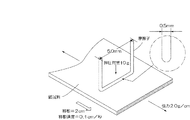
この表面特性の試験には、カトーテック株式会社製「摩擦感テスター KESSE」を用いることができる。測定に際しては、図3に示すように、横断面直径0.5mmのピアノ線からなり、その接触面の長さは5mmである摩擦子を、紙試料に10gの接触圧で接触させながら、移動方向に20g/cmの張力を紙(紙)試料に与えつつ、0.1cm/秒の速度で2cm移動させたときの、摩擦係数を測定する。そして、摩擦係数の平均偏差(摩擦子を移動させたときの表面厚さの変動、すなわち摩擦係数を摩擦距離(移動距離=2cm)で割った値)がMMDである。 For this surface property test, “Friction Tester KESSE” manufactured by Kato Tech Co., Ltd. can be used. At the time of measurement, as shown in FIG. 3, a friction element consisting of a piano wire having a cross-sectional diameter of 0.5 mm and a contact surface length of 5 mm is moved while contacting a paper sample with a contact pressure of 10 g. The coefficient of friction is measured when moving 2 cm at a speed of 0.1 cm / sec while applying a tension of 20 g / cm to the paper (paper) sample in the direction. The average deviation of the friction coefficient (the variation of the surface thickness when the friction element is moved, that is, the value obtained by dividing the friction coefficient by the friction distance (movement distance = 2 cm)) is MMD.
ソフトネスとしては、ティシュペーパーでは1.5以下、特に1.4以下、トイレットペーパーでは3.5以下、特に2.5以下であるものが望ましい。 The softness is preferably 1.5 or less, particularly 1.4 or less for tissue paper, and 3.5 or less, particularly 2.5 or less for toilet paper.
本形態の衛生薄葉紙を得るためには、各種の要素を選定することより得ることができる。すなわち、パルプ原料としてのLBKPとNBKPの配合比率、パルプの種類(繊維粗度、あるいは原料となる樹木の種類や樹齢)、叩解度、抄紙水分、カレンダー隙間・圧力・材質、薬液の添加及びその量などにより調整することが可能である。パルプは、古紙パルプを配合しないものが望ましい。 In order to obtain the sanitary thin paper of this embodiment, it can be obtained by selecting various elements. That is, the blending ratio of LBKP and NBKP as pulp raw materials, the type of pulp (fiber roughness, or the type and age of trees as raw materials), beating degree, papermaking moisture, calendar gap / pressure / material, addition of chemicals and its It is possible to adjust the amount. It is desirable that the pulp does not contain waste paper pulp.
さらに、引張強度、縦横比、クレープ形状(クレープ率、クレープの高低差等)、水分率、密度、紙力剤の添加、薬液の添加及びその量等により調整することが可能である。表面特性は、パルプ配合、カレンダー条件、抄紙水分、ドクターの刃先角度、ブレード角度、接着・剥離強度のバランス、クレープ率、薬液の添加及びその量などにより調整することが可能である。 Further, the tensile strength, aspect ratio, crepe shape (crepe rate, crepe height difference, etc.), moisture content, density, addition of paper strength agent, addition of chemicals and the amount thereof can be adjusted. The surface characteristics can be adjusted by pulp blending, calendar conditions, papermaking moisture, doctor blade edge angle, blade angle, balance of adhesion / peeling strength, crepe rate, addition of chemicals and the amount thereof.
本形態におけるクレープ形状を得るに際して、大きく影響するものに添加剤の添加である。すなわち、カチオン性の脂肪酸エステル系化合物(薬液)とノニオン性の脂肪酸エステル系化合物(薬液)との両薬液添加されているのが望ましい。 In obtaining the crepe shape in the present embodiment, an additive is added to the one that greatly affects. That is, it is desirable that both chemical solutions of a cationic fatty acid ester compound (chemical solution) and a nonionic fatty acid ester compound (chemical solution) are added.
〔柔軟剤成分〕
脂肪酸エステル系化合物及び脂肪酸アミド系化合物を含めた柔軟剤成分について説明すると次記のとおりである。
衛生薄葉紙に添加する柔軟剤としては、カチオン性界面活性剤が望ましい。そのカチオン性界面活性剤の種類は特に限定されるものではないが、分子内に少なくとも1個の炭素数6〜26の飽和あるいは不飽和の炭化水素基を有するアミン化合物又はその中和物又は4級化物あるいはこれらの混合物が好適である。好適なアミン化合物又はその中和物又は4級化物をより詳細に説明すると、これらは、分子内に少なくとも1個、好ましくは1〜2個、最も好ましくは2個の、炭素数6〜26、好ましくは14〜22の飽和あるいは不飽和の、アルキル基又はアルケニル基などの炭化水素基を有する。該炭化水素基は、鎖中にエステル基、逆エステル基、アミド基、逆アミド基、エーテル基を有していてもよい。なお、これらの炭化水素基は、例えば通常工業的に使用される牛脂由来の未水添脂肪酸や不飽和部を水添或いは部分水添して得られる脂肪酸、パーム椰子、油椰子などの植物由来の未水添脂肪酸や脂肪酸エステル或いは不飽和部を水添或いは部分水添して得られる脂肪酸や脂肪酸エステル等を使用することにより、導入することができる。
[Softener component]
The softener component including the fatty acid ester compound and the fatty acid amide compound will be described as follows.
As the softening agent added to the sanitary thin paper, a cationic surfactant is desirable. Although the kind of the cationic surfactant is not particularly limited, the amine compound having at least one saturated or unsaturated hydrocarbon group having 6 to 26 carbon atoms in the molecule or a neutralized product thereof or 4 Graded products or mixtures thereof are preferred. More specifically describing suitable amine compounds or neutralized products or quaternized products thereof, these compounds have at least 1, preferably 1 to 2, most preferably 2, 6 to 26 carbon atoms in the molecule. Preferably it has 14-22 saturated or unsaturated hydrocarbon groups, such as an alkyl group or an alkenyl group. The hydrocarbon group may have an ester group, reverse ester group, amide group, reverse amide group, or ether group in the chain. In addition, these hydrocarbon groups are derived from plants such as fatty acids obtained by hydrogenation or partial hydrogenation of unhydrogenated fatty acids or unsaturated parts derived from beef tallow, which are usually used industrially, palm palms, oil palms, etc. This can be introduced by using a fatty acid, a fatty acid ester or the like obtained by hydrogenation or partial hydrogenation of an unhydrogenated fatty acid, fatty acid ester or unsaturated part.
また、下記一般式(5)で表される化合物も好適に使用できる。
ここに特に、炭素数6〜24のアルキル基を有するトリメチルモノアルキルアンモニウムハライド及び/又は炭素数6〜24のアルキル基を有するジメチルジアルキルアンモニウムハライドであることができる。 In particular, trimethyl monoalkyl ammonium halide having an alkyl group having 6 to 24 carbon atoms and / or dimethyl dialkyl ammonium halide having an alkyl group having 6 to 24 carbon atoms can be used.
また、アルキル基及び/又はアルケニル基を有するイミダゾリン環を有する4級アンモニウム塩とすることができる。ここに、イミダゾリン環を有する4級アンモニウム塩が下記一般式(6)で表される化合物とすることができる。
本発明においてアルコキシル化脂肪酸エステルを使用できる。 In the present invention, an alkoxylated fatty acid ester can be used.
さらに、本発明において使用することができるカチオン性界面活性剤として、R1R2R3R4N+X−で示すアルキルアンモニウム塩がある。式中、R1は約12〜約18の炭素原子を有するアルキル基、又は約12〜約18炭素原子を有する芳香族アリール又はアルカリール基から選ばれ;R2、R3及びR4は独立して水素原子、約1〜約18炭素原子を有するアルキル基、又は約12〜約18炭素原子を有する芳香族アリール又はアルカリール基から選ばれ;Xはクロリド、ブロミド、ヨージド、アセテート、ホスフェート、ニトレート、スルフェート、メチルスルフェート、エチルスルフェート、トシレート、ラクテート、紙レート、グリコレート、及びそれらの混合物から選ばれるアニオンである。また、アルキル基はエーテル結合、又はヒドロキシ又はアミノ基置換体(例えばアルキル基はポリエチレングリコール及びポリプロピレングリコール部分を含有することができる)を含有することもできる。 Further, as a cationic surfactant that can be used in the present invention, there is an alkylammonium salt represented by R1R2R3R4N + X-. Wherein R1 is selected from an alkyl group having from about 12 to about 18 carbon atoms, or an aromatic aryl or alkaryl group having from about 12 to about 18 carbon atoms; R2, R3 and R4 are independently hydrogen atoms , An alkyl group having about 1 to about 18 carbon atoms, or an aromatic aryl or alkaryl group having about 12 to about 18 carbon atoms; X is chloride, bromide, iodide, acetate, phosphate, nitrate, sulfate, An anion selected from methyl sulfate, ethyl sulfate, tosylate, lactate, paper rate, glycolate, and mixtures thereof. The alkyl group can also contain an ether linkage, or a hydroxy or amino group substituent (eg, the alkyl group can contain polyethylene glycol and polypropylene glycol moieties).
また、他の有用なカチオン性界面活性剤としては、上記構造においてR1がR5CO−(CH2)n−(式中、R5は約12〜約18の炭素原子を有するアルキル基であり;nは約2〜約6、好ましくは約2〜約4、より好ましくは約2〜約3の整数である)に変えられたアミノアミドがある。これらのカチオン性乳化剤の非限定的例としては、ステアラミドプロピルPG−ジモニウムクロリドホスフェート、ステアラミドプロピルエチルジモニウムエトスルフェート、ステアラミドプロピルジメチル(ミリスチルアセテート)アンモニウムクロリド、ステアラミドプロピルジメチルセテアリールアンモニウムトシレート、ステアラミドプロピルジメチルアンモニウムクロリド、ステアラミドプロピルジメチルアンモニウムラクテート、及びそれらの混合物がある。 Other useful cationic surfactants include those in which R1 is R5CO— (CH 2 ) n — (wherein R5 is an alkyl group having from about 12 to about 18 carbon atoms; From about 2 to about 6, preferably from about 2 to about 4, more preferably from about 2 to about 3. Non-limiting examples of these cationic emulsifiers include stearamide propyl PG-dimonium chloride phosphate, stearamide propyl ethyl dimonium ethosulphate, stearamide propyl dimethyl (myristyl acetate) ammonium chloride, stearamide propyl dimethyl cetearyl. There are ammonium tosylate, stearamidopropyldimethylammonium chloride, stearamidopropyldimethylammonium lactate, and mixtures thereof.
4級アンモニウム塩カチオン性界面活性剤の非限定的例としては、セチルアンモニウムクロリド、セチルアンモニウムブロミド、ラウリルアンモニウムクロリド、ラウリルアンモニウムブロミド、ステアリルアンモニウムクロリド、ステアリルアンモニウムブロミド、セチルジメチルアンモニウムクロリド、セチルジメチルアンモニウムブロミド、ラウリルジメチルアンモニウムクロリド、ラウリルジメチルアンモニウムブロミド、ステアリルジメチルアンモニウムクロリド、ステアリルジメチルアンモニウムブロミド、セチルトリメチルアンモニウムクロリド、セチルトリメチルアンモニウムブロミド、ラウリルトリメチルアンモニウムクロリド、ラウリルトリメチルアンモニウムブロミド、ステアリルトリメチルアンモニウムクロリド、ステアリルトリメチルアンモニウムブロミド、ラウリルジメチルアンモニウムクロリド、ステアリルジメチルセチルジタロウジメチルアンモニウムクロリド、ジセチルアンモニウムクロリド、ジセチルアンモニウムブロミド、ジラウリルアンモニウムクロリド、ジラウリルアンモニウムブロミド、ジステアリルアンモニウムクロリド、ジステアリルアンモニウムブロミド、ジセチルメチルアンモニウムクロリド、ジセチルメチルアンモニウムブロミド、ジラウリルメチルアンモニウムクロリド、ジラウリルメチルアンモニウムブロミド、ジステアリルメチルアンモニウムクロリド、ジステアリルメチルアンモニウムブロミド、及びそれらの混合物からなる群から選ばれるものがある。 Non-limiting examples of quaternary ammonium salt cationic surfactants include cetylammonium chloride, cetylammonium bromide, laurylammonium chloride, laurylammonium bromide, stearylammonium chloride, stearylammonium bromide, cetyldimethylammonium chloride, cetyldimethylammonium bromide Lauryldimethylammonium chloride, lauryldimethylammonium bromide, stearyldimethylammonium chloride, stearyldimethylammonium bromide, cetyltrimethylammonium chloride, cetyltrimethylammonium bromide, lauryltrimethylammonium chloride, lauryltrimethylammonium bromide, stearyltrimethylammonium chloride, Tearyl trimethyl ammonium bromide, lauryl dimethyl ammonium chloride, stearyl dimethyl cetyl ditallow dimethyl ammonium chloride, dicetyl ammonium chloride, dicetyl ammonium bromide, dilauryl ammonium chloride, dilauryl ammonium bromide, distearyl ammonium chloride, distearyl ammonium bromide, There are those selected from the group consisting of dicetylmethylammonium chloride, dicetylmethylammonium bromide, dilaurylmethylammonium chloride, dilaurylmethylammonium bromide, distearylmethylammonium chloride, distearylmethylammonium bromide, and mixtures thereof.
付加的な4級アンモニウム塩としては、C12−C22のアルキル炭素鎖がタロウ脂肪酸から又はココナッツ脂肪酸から導かれるものがある。用語「タロウ」とは、一般にC12からC18の範囲でアルキル鎖の混合を有するタロウ脂肪酸(通常は水素化タロウ脂肪酸)由来のアルキル基をいう。用語「ココナッツ」とは、一般にC12からC18の範囲でアルキル鎖の混合を有するココナッツ脂肪酸(通常は水素化タロウ脂肪酸)由来のアルキル基をいう。タロウ及びココナッツ源由来の4級アンモニウム塩の例としては、ジタロウジメチルアンモニウムクロリド、ジタロウジメチルアンモニウムメチルスルフェート、ジ(水素化タロウ)ジメチルアンモニウムクロリド、ジ(水素化タロウ)ジメチルアンモニウムアセテート、ジタロウジプロピルアンモニウムホスフェート、ジタロウジメチルアンモニウムニトレート、ジ(ココナッツアルキル)ジメチルアンモニウムクロリド、ジ(ココナッツアルキル)ジメチルアンモニウムブロミド、タロウアンモニウムクロリド、ココナッツアンモニウムクロリド、ステアラミドプロピルPG−ジモニウムクロリドホスフェート、ステアラミドプロピルエチルジモニウムエトスルフェート、ステアラミドジメチル(ミリスチルアセテート)アンモニウムクロリド、ステアラミドジプロピルメチルセテアリールアンモニウムトシレート、ステアラミドジメチルアンモニウムクロリド、ステアラミドジメチルアンモニウムラクテート、及びそれらの混合物がある。 Additional quaternary ammonium salts include those in which a C12-C22 alkyl carbon chain is derived from a tallow fatty acid or from a coconut fatty acid. The term “tallow” refers to an alkyl group derived from a tallow fatty acid (usually hydrogenated tallow fatty acid) having a mixture of alkyl chains generally in the range of C12 to C18. The term “coconut” refers to an alkyl group derived from a coconut fatty acid (usually hydrogenated tallow fatty acid) having a mixture of alkyl chains, generally in the C12 to C18 range. Examples of quaternary ammonium salts derived from tallow and coconut sources include ditallow dimethyl ammonium chloride, ditallow dimethyl ammonium methyl sulfate, di (hydrogenated tallow) dimethyl ammonium chloride, di (hydrogenated tallow) dimethyl ammonium acetate, di Tallow dipropylammonium phosphate, ditallow dimethylammonium nitrate, di (coconut alkyl) dimethylammonium chloride, di (coconut alkyl) dimethylammonium bromide, tallow ammonium chloride, coconut ammonium chloride, stearamide propyl PG-dimonium chloride phosphate, stearate Aramidpropylethyldimonium ethosulphate, stearamide dimethyl (myristyl acetate) ammonium chloride Chloride, stearamidopropyl dipropyl methyl cetearyl ammonium tosylate, stearamidopropyl dimethyl ammonium chloride, stearamidopropyl dimethyl ammonium lactate, and mixtures thereof.
ここで有用な好ましいカチオン性界面活性剤としては、ジラウリルジメチルアンモニウムクロリド、ジステアリルジメチルアンモニウムクロリド、ジミリスチルジメチルアンモニウムクロリド、ジパルミチルジメチルアンモニウムクロリド、ジステアリルジメチルアンモニウムクロリド、及びそれらの混合物からなる群から選ばれるものがある。 Preferred cationic surfactants useful herein comprise dilauryldimethylammonium chloride, distearyldimethylammonium chloride, dimyristyldimethylammonium chloride, dipalmityldimethylammonium chloride, distearyldimethylammonium chloride, and mixtures thereof. Some are chosen from the group.
以上のほか、柔軟剤としては、ポリエチレンポリアミン高級脂肪酸アミド型カチオン系界面活性剤、イミダゾリン型カチオン界面活性剤およびアルキルジメチルアンモニウムクロライドなどの第4級アンモニウム塩型カチオン界面活性剤などを挙げることができるが、これらのうち柔軟性付与効果の大きいポリエチレンポリアミン高級脂肪酸アミド型カチオン系界面活性剤が特に好ましい。 In addition to the above, examples of the softening agent include polyethylene polyamine higher fatty acid amide type cationic surfactants, imidazoline type cationic surfactants and quaternary ammonium salt type cationic surfactants such as alkyldimethylammonium chloride. However, among these, a polyethylene polyamine higher fatty acid amide type cationic surfactant having a great flexibility imparting effect is particularly preferable.
かかるポリエチレンポリアミン高級脂肪酸アミド型カチオン系界面活性剤としては、ポリエチレンポリアミン高級脂肪酸アミド(e1)、ポリオキシアルキレンポリエチレンポリアミン高級脂肪酸アミド(e2)、ポリエチレンポリアミン高級脂肪酸アミドの尿素縮合物(e3)、ポリオキシアルキレンポリエチレンポリアミン高級脂肪酸アミドの尿素縮合物(e4)、(e1)〜(e4)のエピクロルヒドリン付加物(e5)、ポリエチレンポリアミン高級脂肪酸アミドのアルキルクロライド4級化塩(e6)、ポリエチレンポリアミン高級脂肪酸アミドのモノクロル酢酸付加両性化合物(e7)およびポリエチレンポリアミン高級脂肪酸アミドの部分イミダゾリニウム塩(e8)などが挙げられる。 Such polyethylene polyamine higher fatty acid amide type cationic surfactants include polyethylene polyamine higher fatty acid amide (e1), polyoxyalkylene polyethylene polyamine higher fatty acid amide (e2), urea condensate of polyethylene polyamine higher fatty acid amide (e3), poly Oxyalkylene polyethylene polyamine higher fatty acid amide urea condensate (e4), epichlorohydrin adduct (e5) of (e1) to (e4), alkyl chloride quaternized salt of polyethylene polyamine higher fatty acid amide (e6), polyethylene polyamine higher fatty acid Examples include amido monochloroacetic acid addition amphoteric compound (e7) and a partial imidazolinium salt (e8) of polyethylene polyamine higher fatty acid amide.
これら(e1)〜(e8)の構成成分であるポリエチレンポリアミンとしては、ジエチレントリアミン、トリエチレンテトラミン、テトラエチレンペンタミンなどが挙げられる。これらのうち好ましいものはジエチレントリアミンおよびトリエチレンテトラミンである。 Examples of the polyethylene polyamine that is a constituent of (e1) to (e8) include diethylenetriamine, triethylenetetramine, and tetraethylenepentamine. Of these, preferred are diethylenetriamine and triethylenetetramine.
(e2)または(e4)を構成するポリオキシアルキレン基は、アルキレンオキシドが付加した基である。このアルキレンオキシドとしては、たとえばエチレンオキシド、プロピレンオキシドおよびブチレンオキシドが挙げられる。これらのうち好ましいものは、エチレンオキシドおよびエチレンオキシドとプロピレンオキシドの併用(ブロックまたはランダム付加)である。エチレンオキシドとプロピレンオキシドを併用する場合の混合重量比としては、1:(0.1〜1.0)が好ましい。アルキレンオキシドの付加モル数としては通常1〜10モル、好ましくは、1〜5モルである。 The polyoxyalkylene group constituting (e2) or (e4) is a group to which an alkylene oxide is added. Examples of the alkylene oxide include ethylene oxide, propylene oxide, and butylene oxide. Among these, ethylene oxide and a combination of ethylene oxide and propylene oxide (block or random addition) are preferable. The mixing weight ratio when ethylene oxide and propylene oxide are used in combination is preferably 1: (0.1 to 1.0). The added mole number of alkylene oxide is usually 1 to 10 moles, preferably 1 to 5 moles.
(e1)〜(e8)の構成成分である高級脂肪酸としては、パ−ム油、牛脂、ナタネ油、米ぬか油、魚油などの天然油脂由来のものが通常用いられるが、石油化学で製造される合成系の高級脂肪酸も使用できる。これらのうち好ましいものは、ヨウ素価が50以下で炭素数が12〜24の高級脂肪酸である。 As higher fatty acids which are constituents of (e1) to (e8), those derived from natural fats and oils such as palm oil, beef tallow, rapeseed oil, rice bran oil, fish oil and the like are usually used, but are produced by petrochemistry. Synthetic higher fatty acids can also be used. Among these, higher fatty acids having an iodine value of 50 or less and 12 to 24 carbon atoms are preferable.
これら(e1)〜(e8)のもう一方の構成成分であるポリエチレンポリアミンまたはポリオキシアルキレンポリエチレンポリアミンと高級脂肪酸のモル比は、通常1:1.0〜 2.5、好ましくは1:1.2〜1.8である。上記例示した(e1)〜(e8)のうち好ましいものは、(e1)〜(e5)である。 The molar ratio of polyethylene fatty acid or polyoxyalkylene polyethylene polyamine which is the other component of these (e1) to (e8) and higher fatty acid is usually 1: 1.0 to 2.5, preferably 1: 1.2. ~ 1.8. Among the above-exemplified (e1) to (e8), preferred are (e1) to (e5).
次に、本発明の実施例を示す。
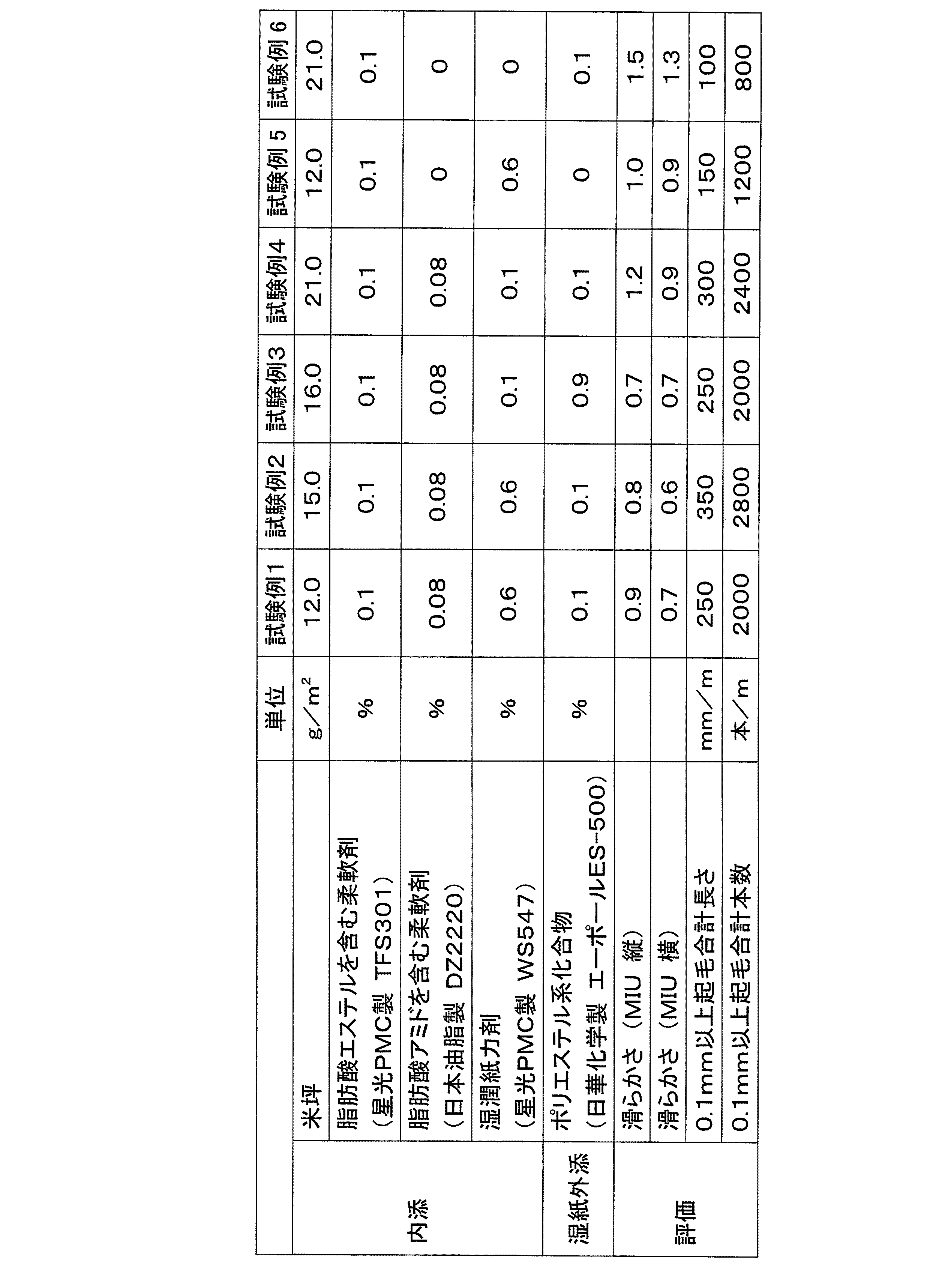
ティシュペーパー用及びトイレットペーパー用のものについて、添加剤の種類により評価の相違を調べた。結果を表1に示す。使用した添加剤を表1に併記した。
評価は、カトーテック社製KES試験機により摩擦係数に関係するMIU値を測定することにより行った。値が小さいほど滑らかであることを示している。
また、電子顕微鏡下で、MIU値のみでは評価できないので、製品紙の表面における繊維起毛の状態を観察した。
Next, examples of the present invention will be described.
For tissue paper and toilet paper, the difference in evaluation was examined depending on the type of additive. The results are shown in Table 1. Table 1 shows the additives used.
The evaluation was performed by measuring the MIU value related to the friction coefficient with a Kato Tech KES testing machine. A smaller value indicates smoother.
Moreover, since it cannot evaluate only with MIU value under an electron microscope, the state of fiber raising on the surface of product paper was observed.
この結果によれば、本発明の製品は官能評価において、「柔らかさ」「滑らかさ」のいずれも高い評価となった。ここに、0.1mm以上起毛合計長さがより長いこと、及び0.1mm以上起毛合計本数が多いことはより滑らかであることを示す。その理由は、紙の表面に長い毛羽のものが多く存在することが、羽毛の例から推測できよう。 According to this result, the product of the present invention was highly evaluated for both “softness” and “smoothness” in sensory evaluation. Here, the fact that the total raised length of 0.1 mm or more is longer and that the total number of raised brushes of 0.1 mm or more is larger indicates smoother. The reason can be inferred from the example of feathers that there are many long feathers on the paper surface.
市販のティシュペーパーと本発明に係るティシュペーパーについて、各種の比較を行った。いずれも、2枚重ねで一組(2プライ)としたものである。結果を表2に示す。
ここで、使用した柔軟性成分は次記のとおりである。
柔軟剤A:ノニオン系脂肪酸エステル(日本PMC社製「SFS1001」)
柔軟剤B:カチオン系脂肪酸エステル(日本PMC社製「SFS1002」)
柔軟剤C:カチオン系脂肪酸エステル(日本PMC社製「SFS1004」)
柔軟剤D:カチオン系脂肪酸アミド(日本油脂社製「嵩高剤J」)
官能評価は、5点評価によるものである。また、空隙面積率及び本数割合の測定に際しては、サンプルを6枚重ね、その上下にOHP紙を重ねた状態で、鋭利な髭剃り用片刃にて90度の角度で切断し、切断サンプルの断面を1000倍のSEM写真で撮像し、その写真から判断するものである。
Various comparisons were made between commercially available tissue paper and tissue paper according to the present invention. In both cases, two sheets are stacked to form one set (2 plies). The results are shown in Table 2.
Here, the used flexible components are as follows.
Softener A: Nonionic fatty acid ester (“SFS1001” manufactured by Japan PMC)
Softener B: Cationic fatty acid ester (“SFS1002” manufactured by Japan PMC)
Softener C: Cationic fatty acid ester (“SFS1004” manufactured by Japan PMC)
Softener D: Cationic fatty amide (Nippon Yushi Co., Ltd. “Bulk Agent J”)
Sensory evaluation is based on 5-point evaluation. When measuring the void area ratio and the number ratio, six samples were stacked, and OHP paper was stacked on top and bottom of the sample, and then cut at a 90-degree angle with a sharp shaving blade. Is taken with a 1000 times SEM photograph and judged from the photograph.
この結果によれば、本発明の製品は官能評価において、「柔らかさ」「滑らかさ」のいずれも高い評価となった。 According to this result, the product of the present invention was highly evaluated for both “softness” and “smoothness” in sensory evaluation.
本発明は、ティッシュペーパやトイレットペーパー等の家庭用などの衛生薄葉紙及びその製造方法として、特に柔らかくかつ滑らかな衛生薄葉紙として、適用可能である。 INDUSTRIAL APPLICABILITY The present invention can be applied as sanitary thin paper for household use such as tissue paper and toilet paper and a method for producing the same, particularly as a soft and smooth sanitary thin paper.
F…パルプ繊維。 F: Pulp fiber.
Claims (8)
下記一般式(1)で示されるポリエステル系化合物が外添されている、
ことを特徴とする衛生薄葉紙。
A polyester compound represented by the following general formula (1) is externally added,
Hygienic thin paper characterized by that.
Priority Applications (1)
| Application Number | Priority Date | Filing Date | Title |
|---|---|---|---|
| JP2006514144A JP4875488B2 (en) | 2004-06-03 | 2005-06-03 | Sanitary thin paper and method for producing the same |
Applications Claiming Priority (6)
| Application Number | Priority Date | Filing Date | Title |
|---|---|---|---|
| JP2004165961 | 2004-06-03 | ||
| JP2004165961 | 2004-06-03 | ||
| JP2004347116 | 2004-11-30 | ||
| JP2004347116 | 2004-11-30 | ||
| JP2006514144A JP4875488B2 (en) | 2004-06-03 | 2005-06-03 | Sanitary thin paper and method for producing the same |
| PCT/JP2005/010257 WO2005118954A1 (en) | 2004-06-03 | 2005-06-03 | Sanitary thin paper and process for producing the same |
Publications (2)
| Publication Number | Publication Date |
|---|---|
| JPWO2005118954A1 JPWO2005118954A1 (en) | 2008-04-03 |
| JP4875488B2 true JP4875488B2 (en) | 2012-02-15 |
Family
ID=35462944
Family Applications (1)
| Application Number | Title | Priority Date | Filing Date |
|---|---|---|---|
| JP2006514144A Expired - Fee Related JP4875488B2 (en) | 2004-06-03 | 2005-06-03 | Sanitary thin paper and method for producing the same |
Country Status (5)
| Country | Link |
|---|---|
| US (1) | US20070233024A1 (en) |
| EP (1) | EP1752580A4 (en) |
| JP (1) | JP4875488B2 (en) |
| CN (1) | CN100595379C (en) |
| WO (1) | WO2005118954A1 (en) |
Cited By (4)
| Publication number | Priority date | Publication date | Assignee | Title |
|---|---|---|---|---|
| JP6069452B1 (en) * | 2015-09-30 | 2017-02-01 | 大王製紙株式会社 | Toilet Paper |
| KR20180054588A (en) | 2015-09-14 | 2018-05-24 | 다이오세이시가부시끼가이샤 | Tissue paper |
| KR20190055108A (en) | 2016-09-30 | 2019-05-22 | 다이오 페이퍼 코퍼레이션 | Tissue paper |
| WO2019167747A1 (en) | 2018-02-28 | 2019-09-06 | 大王製紙株式会社 | Tissue paper |
Families Citing this family (15)
| Publication number | Priority date | Publication date | Assignee | Title |
|---|---|---|---|---|
| JP4928943B2 (en) * | 2004-08-31 | 2012-05-09 | 大王製紙株式会社 | Household hygiene tissue paper |
| JP2007307287A (en) * | 2006-05-22 | 2007-11-29 | Meiko Shoji Kk | Textile for wiping body |
| JP4833936B2 (en) * | 2007-07-31 | 2011-12-07 | ライオン株式会社 | Tissue paper |
| JP5410026B2 (en) * | 2008-03-17 | 2014-02-05 | 大王製紙株式会社 | Sanitary tissue paper |
| JP2010084273A (en) * | 2008-09-30 | 2010-04-15 | Hakuto Co Ltd | Modifier and paper product containing the same |
| JP5479835B2 (en) * | 2009-09-30 | 2014-04-23 | 大王製紙株式会社 | Water-degradable sanitary thin paper and toilet paper roll |
| JP5445203B2 (en) * | 2010-02-16 | 2014-03-19 | 日油株式会社 | Additive for paper |
| WO2015022738A1 (en) * | 2013-08-14 | 2015-02-19 | アスクル株式会社 | Tissue base paper and tissue paper |
| JP6242018B2 (en) * | 2015-06-16 | 2017-12-06 | 大王製紙株式会社 | Tissue paper |
| JP6583117B2 (en) * | 2016-04-18 | 2019-10-02 | 王子ホールディングス株式会社 | Hygienic thin paper and method for producing the same |
| JP7163031B2 (en) * | 2018-01-31 | 2022-10-31 | 大王製紙株式会社 | Sanitary tissue paper and method for producing sanitary tissue paper |
| CN111886382A (en) * | 2018-03-22 | 2020-11-03 | 巴克曼实验室国际公司 | Modified creping adhesive formulations and creping methods using the same |
| JP6689944B1 (en) * | 2018-11-30 | 2020-04-28 | 大王製紙株式会社 | Toilet Paper |
| JP7175801B2 (en) * | 2019-03-06 | 2022-11-21 | 大王製紙株式会社 | Toilet Paper |
| JP7169924B2 (en) * | 2019-03-27 | 2022-11-11 | 大王製紙株式会社 | TOILET PAPER AND TOILET PAPER MANUFACTURING METHOD |
Citations (5)
| Publication number | Priority date | Publication date | Assignee | Title |
|---|---|---|---|---|
| JPH02224626A (en) * | 1988-06-14 | 1990-09-06 | Procter & Gamble Co:The | Soft tissue paper |
| US5716692A (en) * | 1994-06-17 | 1998-02-10 | The Procter & Gamble Co. | Lotioned tissue paper |
| JP2001512178A (en) * | 1997-07-31 | 2001-08-21 | ザ、プロクター、エンド、ギャンブル、カンパニー | Wet cleaning products |
| JP2002345676A (en) * | 2001-05-28 | 2002-12-03 | Daio Paper Corp | Thin sanitary paper roll and manufacturing method therefor |
| JP2004188078A (en) * | 2002-12-13 | 2004-07-08 | Daio Paper Corp | Thin sanitary paper |
Family Cites Families (11)
| Publication number | Priority date | Publication date | Assignee | Title |
|---|---|---|---|---|
| GB1108015A (en) * | 1964-06-03 | 1968-03-27 | Peter Spence & Sons Ltd | Improvements in or relating to paper |
| AU1295895A (en) * | 1993-12-13 | 1995-07-03 | Procter & Gamble Company, The | Lotion composition for imparting soft, lubricious feel to tissue paper |
| CA2225176C (en) * | 1995-06-28 | 2004-08-17 | The Procter & Gamble Company | Creped tissue paper exhibiting unique combination of physical attributes |
| US5705164A (en) * | 1995-08-03 | 1998-01-06 | The Procter & Gamble Company | Lotioned tissue paper containing a liquid polyol polyester emollient and an immobilizing agent |
| ZA983401B (en) * | 1997-04-24 | 1998-10-27 | Procter & Gamble | Absorbent articles having lotioned leg cuffs containing a polysiloxane emollient |
| US6280757B1 (en) * | 1997-05-22 | 2001-08-28 | The Procter & Gamble Company | Cleansing articles for skin or hair |
| JP4463399B2 (en) * | 2000-08-23 | 2010-05-19 | 日東電工株式会社 | Medical adhesive tape or sheet, and emergency bandage |
| EP1225277A1 (en) * | 2001-01-19 | 2002-07-24 | SCA Hygiene Products GmbH | Lotioned fibrous web |
| EP1233107B1 (en) * | 2001-02-16 | 2007-08-22 | The Procter & Gamble Company | Embossed and lotioned tissue |
| EP1400199B1 (en) * | 2001-05-28 | 2018-01-03 | Daio Paper Corporation | Thin sanitary paper roll |
| US7229528B2 (en) * | 2003-12-19 | 2007-06-12 | The Procter & Gamble Company | Processes for foreshortening fibrous structures |
-
2005
- 2005-06-03 JP JP2006514144A patent/JP4875488B2/en not_active Expired - Fee Related
- 2005-06-03 US US11/597,961 patent/US20070233024A1/en not_active Abandoned
- 2005-06-03 WO PCT/JP2005/010257 patent/WO2005118954A1/en not_active Ceased
- 2005-06-03 CN CN200580017964A patent/CN100595379C/en not_active Expired - Fee Related
- 2005-06-03 EP EP05750808A patent/EP1752580A4/en not_active Withdrawn
Patent Citations (5)
| Publication number | Priority date | Publication date | Assignee | Title |
|---|---|---|---|---|
| JPH02224626A (en) * | 1988-06-14 | 1990-09-06 | Procter & Gamble Co:The | Soft tissue paper |
| US5716692A (en) * | 1994-06-17 | 1998-02-10 | The Procter & Gamble Co. | Lotioned tissue paper |
| JP2001512178A (en) * | 1997-07-31 | 2001-08-21 | ザ、プロクター、エンド、ギャンブル、カンパニー | Wet cleaning products |
| JP2002345676A (en) * | 2001-05-28 | 2002-12-03 | Daio Paper Corp | Thin sanitary paper roll and manufacturing method therefor |
| JP2004188078A (en) * | 2002-12-13 | 2004-07-08 | Daio Paper Corp | Thin sanitary paper |
Cited By (14)
| Publication number | Priority date | Publication date | Assignee | Title |
|---|---|---|---|---|
| US10570568B2 (en) | 2015-09-14 | 2020-02-25 | Daio Paper Corpporation | Tissue paper |
| EP3721766A1 (en) | 2015-09-14 | 2020-10-14 | Daio Paper Corporation | Tissue paper |
| KR20180054588A (en) | 2015-09-14 | 2018-05-24 | 다이오세이시가부시끼가이샤 | Tissue paper |
| EP3721767A1 (en) | 2015-09-14 | 2020-10-14 | Daio Paper Corporation | Tissue paper |
| KR20180059799A (en) | 2015-09-30 | 2018-06-05 | 다이오세이시가부시끼가이샤 | Toilet paper |
| US10550521B2 (en) | 2015-09-30 | 2020-02-04 | Daio Paper Corporation | Toilet paper |
| US10731299B2 (en) | 2015-09-30 | 2020-08-04 | Daio Paper Corporation | Method of manufacturing a toilet paper |
| JP6069452B1 (en) * | 2015-09-30 | 2017-02-01 | 大王製紙株式会社 | Toilet Paper |
| WO2017056836A1 (en) * | 2015-09-30 | 2017-04-06 | 大王製紙株式会社 | Toilet paper |
| KR20190055108A (en) | 2016-09-30 | 2019-05-22 | 다이오 페이퍼 코퍼레이션 | Tissue paper |
| US10844549B2 (en) | 2016-09-30 | 2020-11-24 | Daio Paper Corporation | Tissue paper |
| WO2019167747A1 (en) | 2018-02-28 | 2019-09-06 | 大王製紙株式会社 | Tissue paper |
| KR20200127984A (en) | 2018-02-28 | 2020-11-11 | 다이오 페이퍼 코퍼레이션 | Tissue paper |
| US11280050B2 (en) | 2018-02-28 | 2022-03-22 | Daio Paper Corporation | Tissue paper |
Also Published As
| Publication number | Publication date |
|---|---|
| JPWO2005118954A1 (en) | 2008-04-03 |
| EP1752580A4 (en) | 2010-03-24 |
| EP1752580A1 (en) | 2007-02-14 |
| WO2005118954A1 (en) | 2005-12-15 |
| CN1977082A (en) | 2007-06-06 |
| US20070233024A1 (en) | 2007-10-04 |
| CN100595379C (en) | 2010-03-24 |
Similar Documents
| Publication | Publication Date | Title |
|---|---|---|
| JP4875488B2 (en) | Sanitary thin paper and method for producing the same | |
| TW396229B (en) | Tissue paper having a substantive anhydrous softening mixture deposited thereon | |
| TW490530B (en) | Soft tissue paper having a surface deposited substantive softening agent | |
| US20100136294A1 (en) | Fibrous structures comprising a lotion and methods for making same | |
| CN1466638A (en) | Soft, resilient, single-use embossed wipes | |
| US20090136722A1 (en) | Wet formed fibrous structure product | |
| JP2011528731A (en) | Emulsion composition, method for softening fiber structure using emulsion composition, and fibrous substrate treated with emulsion composition | |
| JP4450552B2 (en) | Thin leaf sanitary paper | |
| EP1793040B1 (en) | Tissue for household use | |
| JP4585236B2 (en) | Toilet paper roll | |
| JP2004124314A (en) | Sanitary paper | |
| KR101181063B1 (en) | Sanitary thin paper and process for producing the same | |
| JP2005348976A5 (en) | ||
| US20070251656A1 (en) | Processes for foreshortening fibrous structures | |
| MX2012007667A (en) | Lotion composition and fibrous structure comprising same. | |
| JP2006021020A (en) | Sheet roll for sanitary thin paper | |
| JP2006021020A5 (en) | ||
| TW201005035A (en) | Emulsion composition, methods of softening fibrous structures using the same, and fibrous substrate treated therewith | |
| JP7163031B2 (en) | Sanitary tissue paper and method for producing sanitary tissue paper | |
| WO2025023942A1 (en) | A pre-wetted and dispersible wipe with a buoyancy reduction wetting agent | |
| MXPA00003462A (en) | Tissue paper having a substantive anhydrous softening mixture deposited thereon | |
| MXPA99006149A (en) | Soft tissue paper having a surface deposited softening agent |
Legal Events
| Date | Code | Title | Description |
|---|---|---|---|
| A521 | Request for written amendment filed |
Free format text: JAPANESE INTERMEDIATE CODE: A523 Effective date: 20080514 |
|
| A621 | Written request for application examination |
Free format text: JAPANESE INTERMEDIATE CODE: A621 Effective date: 20080514 |
|
| A131 | Notification of reasons for refusal |
Free format text: JAPANESE INTERMEDIATE CODE: A131 Effective date: 20110401 |
|
| A521 | Request for written amendment filed |
Free format text: JAPANESE INTERMEDIATE CODE: A523 Effective date: 20110525 |
|
| TRDD | Decision of grant or rejection written | ||
| A01 | Written decision to grant a patent or to grant a registration (utility model) |
Free format text: JAPANESE INTERMEDIATE CODE: A01 Effective date: 20111118 |
|
| A01 | Written decision to grant a patent or to grant a registration (utility model) |
Free format text: JAPANESE INTERMEDIATE CODE: A01 |
|
| A61 | First payment of annual fees (during grant procedure) |
Free format text: JAPANESE INTERMEDIATE CODE: A61 Effective date: 20111125 |
|
| FPAY | Renewal fee payment (event date is renewal date of database) |
Free format text: PAYMENT UNTIL: 20141202 Year of fee payment: 3 |
|
| R150 | Certificate of patent or registration of utility model |
Ref document number: 4875488 Country of ref document: JP Free format text: JAPANESE INTERMEDIATE CODE: R150 Free format text: JAPANESE INTERMEDIATE CODE: R150 |
|
| FPAY | Renewal fee payment (event date is renewal date of database) |
Free format text: PAYMENT UNTIL: 20141202 Year of fee payment: 3 |
|
| R250 | Receipt of annual fees |
Free format text: JAPANESE INTERMEDIATE CODE: R250 |
|
| R250 | Receipt of annual fees |
Free format text: JAPANESE INTERMEDIATE CODE: R250 |
|
| R250 | Receipt of annual fees |
Free format text: JAPANESE INTERMEDIATE CODE: R250 |
|
| R250 | Receipt of annual fees |
Free format text: JAPANESE INTERMEDIATE CODE: R250 |
|
| R250 | Receipt of annual fees |
Free format text: JAPANESE INTERMEDIATE CODE: R250 |
|
| R250 | Receipt of annual fees |
Free format text: JAPANESE INTERMEDIATE CODE: R250 |
|
| R250 | Receipt of annual fees |
Free format text: JAPANESE INTERMEDIATE CODE: R250 |
|
| R250 | Receipt of annual fees |
Free format text: JAPANESE INTERMEDIATE CODE: R250 |
|
| R250 | Receipt of annual fees |
Free format text: JAPANESE INTERMEDIATE CODE: R250 |
|
| LAPS | Cancellation because of no payment of annual fees |