JP4828552B2 - Cassette and embedding assembly, mounting apparatus therefor, and method therefor for handling and holding tissue specimens during processing, embedding and microtome sectioning procedures - Google Patents
Cassette and embedding assembly, mounting apparatus therefor, and method therefor for handling and holding tissue specimens during processing, embedding and microtome sectioning procedures Download PDFInfo
- Publication number
- JP4828552B2 JP4828552B2 JP2008008364A JP2008008364A JP4828552B2 JP 4828552 B2 JP4828552 B2 JP 4828552B2 JP 2008008364 A JP2008008364 A JP 2008008364A JP 2008008364 A JP2008008364 A JP 2008008364A JP 4828552 B2 JP4828552 B2 JP 4828552B2
- Authority
- JP
- Japan
- Prior art keywords
- cassette
- frame
- tissue
- embedding
- mounting member
- Prior art date
- Legal status (The legal status is an assumption and is not a legal conclusion. Google has not performed a legal analysis and makes no representation as to the accuracy of the status listed.)
- Expired - Lifetime
Links
- 238000000034 method Methods 0.000 title claims description 37
- 230000007246 mechanism Effects 0.000 claims description 25
- 230000008569 process Effects 0.000 claims description 20
- 230000006641 stabilisation Effects 0.000 claims description 6
- 238000011105 stabilization Methods 0.000 claims description 6
- 238000003825 pressing Methods 0.000 claims description 4
- 230000003993 interaction Effects 0.000 claims 3
- 230000008878 coupling Effects 0.000 claims 2
- 238000010168 coupling process Methods 0.000 claims 2
- 238000005859 coupling reaction Methods 0.000 claims 2
- 230000000087 stabilizing effect Effects 0.000 claims 2
- 238000007789 sealing Methods 0.000 claims 1
- 210000001519 tissue Anatomy 0.000 description 121
- 239000012188 paraffin wax Substances 0.000 description 30
- 239000000463 material Substances 0.000 description 16
- 238000005520 cutting process Methods 0.000 description 6
- 229940057995 liquid paraffin Drugs 0.000 description 6
- 238000007373 indentation Methods 0.000 description 4
- 230000007170 pathology Effects 0.000 description 3
- 229910001220 stainless steel Inorganic materials 0.000 description 3
- 239000010935 stainless steel Substances 0.000 description 3
- 238000004458 analytical method Methods 0.000 description 2
- 238000000429 assembly Methods 0.000 description 2
- 230000000712 assembly Effects 0.000 description 2
- 238000001816 cooling Methods 0.000 description 2
- 239000012530 fluid Substances 0.000 description 2
- 238000000465 moulding Methods 0.000 description 2
- 241001510071 Pyrrhocoridae Species 0.000 description 1
- 241001122767 Theaceae Species 0.000 description 1
- 230000005856 abnormality Effects 0.000 description 1
- 238000001574 biopsy Methods 0.000 description 1
- 208000003295 carpal tunnel syndrome Diseases 0.000 description 1
- 230000015556 catabolic process Effects 0.000 description 1
- 210000004027 cell Anatomy 0.000 description 1
- 239000003086 colorant Substances 0.000 description 1
- 238000005336 cracking Methods 0.000 description 1
- 230000003247 decreasing effect Effects 0.000 description 1
- 238000006731 degradation reaction Methods 0.000 description 1
- 238000003745 diagnosis Methods 0.000 description 1
- 201000010099 disease Diseases 0.000 description 1
- 208000037265 diseases, disorders, signs and symptoms Diseases 0.000 description 1
- 238000004043 dyeing Methods 0.000 description 1
- 229920001971 elastomer Polymers 0.000 description 1
- 239000000806 elastomer Substances 0.000 description 1
- 238000005516 engineering process Methods 0.000 description 1
- 210000003722 extracellular fluid Anatomy 0.000 description 1
- 238000007667 floating Methods 0.000 description 1
- 239000012634 fragment Substances 0.000 description 1
- 239000011521 glass Substances 0.000 description 1
- 230000008595 infiltration Effects 0.000 description 1
- 238000001764 infiltration Methods 0.000 description 1
- 230000014759 maintenance of location Effects 0.000 description 1
- 238000004519 manufacturing process Methods 0.000 description 1
- 238000012986 modification Methods 0.000 description 1
- 230000004048 modification Effects 0.000 description 1
- 238000010827 pathological analysis Methods 0.000 description 1
- 230000001575 pathological effect Effects 0.000 description 1
- 230000000717 retained effect Effects 0.000 description 1
- 238000007790 scraping Methods 0.000 description 1
- 239000007787 solid Substances 0.000 description 1
- 239000011343 solid material Substances 0.000 description 1
- 239000003381 stabilizer Substances 0.000 description 1
- 238000010186 staining Methods 0.000 description 1
- 239000000126 substance Substances 0.000 description 1
- XLYOFNOQVPJJNP-UHFFFAOYSA-N water Substances O XLYOFNOQVPJJNP-UHFFFAOYSA-N 0.000 description 1
Images




Classifications
-
- G—PHYSICS
- G01—MEASURING; TESTING
- G01N—INVESTIGATING OR ANALYSING MATERIALS BY DETERMINING THEIR CHEMICAL OR PHYSICAL PROPERTIES
- G01N1/00—Sampling; Preparing specimens for investigation
- G01N1/28—Preparing specimens for investigation including physical details of (bio-)chemical methods covered elsewhere, e.g. G01N33/50, C12Q
- G01N1/36—Embedding or analogous mounting of samples
-
- G—PHYSICS
- G01—MEASURING; TESTING
- G01N—INVESTIGATING OR ANALYSING MATERIALS BY DETERMINING THEIR CHEMICAL OR PHYSICAL PROPERTIES
- G01N1/00—Sampling; Preparing specimens for investigation
- G01N1/02—Devices for withdrawing samples
- G01N1/04—Devices for withdrawing samples in the solid state, e.g. by cutting
- G01N1/06—Devices for withdrawing samples in the solid state, e.g. by cutting providing a thin slice, e.g. microtome
-
- A—HUMAN NECESSITIES
- A61—MEDICAL OR VETERINARY SCIENCE; HYGIENE
- A61B—DIAGNOSIS; SURGERY; IDENTIFICATION
- A61B10/00—Instruments for taking body samples for diagnostic purposes; Other methods or instruments for diagnosis, e.g. for vaccination diagnosis, sex determination or ovulation-period determination; Throat striking implements
- A61B10/0096—Casings for storing test samples
Landscapes
- Physics & Mathematics (AREA)
- Health & Medical Sciences (AREA)
- Life Sciences & Earth Sciences (AREA)
- Chemical & Material Sciences (AREA)
- Analytical Chemistry (AREA)
- Biochemistry (AREA)
- General Health & Medical Sciences (AREA)
- General Physics & Mathematics (AREA)
- Immunology (AREA)
- Pathology (AREA)
- Sampling And Sample Adjustment (AREA)
Description
本発明は、一般に、病理分析用の組織標本をハンドリングし包埋する支持体に関し、より詳細には、1つまたは複数の組織標本を受け取り、包埋され、その後、この1つまたは複数の組織標本とともにミクロトームにより切片にし得るカセットに関する。 The present invention relates generally to a support for handling and embedding tissue specimens for pathological analysis, and more particularly to receiving and embedding one or more tissue specimens, after which the one or more tissue specimens are received. The present invention relates to a cassette that can be sectioned by a microtome together with a specimen.
組織の様々な疾患および状態を正確に診断するために、医療従事者は、患者の身体から1つまたは複数の組織標本を取り出さなければならない。身体から組織を採取するこの工程は、生検として知られている。1つまたは複数の組織標本が取り出され、病理検査室に送られると、この組織は、組織学技師、および最終的には病理学者によって実施される一連の手順を経て診断されることになる。本発明は一般に、1つまたは複数の組織標本を病理学者が顕微鏡下で分析し得るスライドの形で準備するために、組織学技師によって通常実施される手順に関係するものである。 In order to accurately diagnose various diseases and conditions in the tissue, medical personnel must remove one or more tissue specimens from the patient's body. This process of collecting tissue from the body is known as a biopsy. Once one or more tissue specimens have been removed and sent to a pathology laboratory, the tissue will be diagnosed through a series of procedures performed by a histologist and, ultimately, a pathologist. The present invention generally relates to a procedure typically performed by a histologist to prepare one or more tissue specimens in the form of a slide that can be analyzed by a pathologist under a microscope.
本明細書全体を通じて単数形の「標本」という用語を用いるが、この用語は、「複数の標本」という複数形も同様に含むことを理解されたい。患者の身体から組織標本が取り出されると、この組織標本は典型的には、組織固定溶液が入った試料容器中に置かれ、次いで、この容器は病理検査室に移される。この組織は、病理検査室では「グロスイン(grossing−in)」として知られる工程にかけられることになる。この工程中に、組織学技師は、容器から組織標本を回収し、典型的にはこの組織を、組織処理を行うのに適切なサイズに切断し、個々の標本を適切に寸法設定された小型のプラスチック製組織カセット内に置き、各カセットに追跡番号を割り当てる。次いで、これらの追跡番号を検査室で使用する追跡システムに記録する。単に断片であり得る最小の組織標本用のカセットは、側面および底面に微細なメッシュ状の開口を有する。極めて小さい組織標本が関与する他の状況では、これらの標本を、ティーバッグに似たバッグ内に置き、これら最小の組織標本がなくなることを防ぐ。比較的大きな組織標本は、いくらか大型のスロット開口を有するカセット内に置く。この場合も、これらの開口は、カセット内の組織標本よりも小さい。 Throughout this specification, the singular term “specimen” is used, but it should be understood that this term includes the plural form “plurality of specimens” as well. When a tissue specimen is removed from the patient's body, the tissue specimen is typically placed in a sample container containing a tissue fixing solution, which is then transferred to a pathology laboratory. This tissue will be subjected to a process known as “grossing-in” in the pathology laboratory. During this process, the histologist retrieves the tissue specimen from the container, typically cuts the tissue into the appropriate size for tissue processing, and the individual specimens are appropriately sized. And place a tracking number on each cassette. These tracking numbers are then recorded in the tracking system used in the laboratory. The smallest tissue specimen cassette, which can only be a piece, has fine mesh openings on the sides and bottom. In other situations involving very small tissue specimens, these specimens are placed in a bag similar to a tea bag to prevent these minimal tissue specimens from being lost. A relatively large tissue specimen is placed in a cassette with a somewhat larger slot opening. Again, these openings are smaller than the tissue specimen in the cassette.
次いで、これらのカセットをステンレス綱製の穴あきバスケット内に置き、多くの場合一晩中、組織処理機にかける。この機械は、真空、熱、および化学物質の組合せを利用して間質液を除去する。組織標本からこれらの液を除去した後で、この処理機は、この組織標本を溶融パラフィン浴に浸して、組織内の隙間をパラフィンで置き換える。次いで、組織学技師は、機械からバスケットを取り出し、個々の組織カセットを取り出す。溶融パラフィン溜めおよび分注器を有する包埋ステーションで、組織学技師は、各カセットから組織を個々に取り出す。組織学技師は、組織カセットとほぼ同じサイズで、溶融パラフィンが部分的に充填されたステンレス綱製ベースモールド内に、組織のタイプに基づいて、組織標本の向きに注意して入れなければならない。この組織標本は、典型的にはピンセットを使用して手作業で、このモールドの底部に押し付けて保持しなければならない。組織標本がこのように保持されない場合、後でミクロトーム内でこの組織を適切なスライスにしにくくなる恐れがある。次いで、この溶融パラフィンを、TEC(熱電式冷却器)とし得る冷却プレート上で急速に冷却させ、パラフィンを部分的に凝固させ、それによって、正しい向きでモールドの底部に押し付けて組織標本を保持する。その後、カセットをベースモールドの上部に置き、カセットの上部開口を通してベースモールド内にパラフィンを注ぐ。この手順のこの時点で、カセットの機能が、組織保持コンポーネントから、ミクロトーム内で凝固したパラフィンから削り出す断片すなわちスライスを取得する際に後で使用する固定化装置に変わる。このベースモールドを、溶融パラフィンがすべて凝固するまで冷却し、組織学技師は、包埋されたパラフィンのブロックからステンレス綱製ベースモールドを取り出す。こうすると、プラスチック製組織カセットが反対側にある状態で、組織標本が矩形のパラフィンブロック内に包埋される。この組織カセットは、その後、ミクロトームのチャック内でホルダとして使用することになる。組織処理機の場合と同様に、この包埋工程はバッチで実施され、この工程中に、平均的な組織学技師は、1時間当たり約40〜60個のカセットを包埋することができる。 These cassettes are then placed in stainless steel perforated baskets and are often placed on a tissue processor overnight. This machine uses a combination of vacuum, heat, and chemicals to remove interstitial fluid. After removing these fluids from the tissue specimen, the processor immerses the tissue specimen in a molten paraffin bath to replace the gaps in the tissue with paraffin. The histologist then removes the basket from the machine and removes the individual tissue cassettes. At the embedding station with molten paraffin reservoir and dispenser, the histologist removes the tissue from each cassette individually. The histologist must carefully place the orientation of the tissue specimen in a stainless steel base mold approximately the same size as the tissue cassette and partially filled with molten paraffin, based on the type of tissue. The tissue specimen must be held by pressing it against the bottom of the mold, typically manually using tweezers. If the tissue specimen is not retained in this manner, it may be difficult to later make the tissue a suitable slice within the microtome. The molten paraffin is then rapidly cooled on a cooling plate, which can be a TEC (thermoelectric cooler), to partially solidify the paraffin, thereby pressing it against the bottom of the mold in the correct orientation to hold the tissue specimen. . Thereafter, the cassette is placed on top of the base mold and paraffin is poured into the base mold through the top opening of the cassette. At this point in the procedure, the function of the cassette is changed from a tissue holding component to an immobilization device for later use in obtaining a piece or slice to be machined from paraffin solidified in a microtome. The base mold is cooled until all of the molten paraffin has solidified, and the histologist removes the stainless steel base mold from the embedded paraffin block. In this way, the tissue specimen is embedded in a rectangular paraffin block with the plastic tissue cassette on the opposite side. This tissue cassette will then be used as a holder in a microtome chuck. As with the tissue processor, this embedding process is performed in batches, during which the average histologist can embed approximately 40-60 cassettes per hour.
この時点で、包埋された組織標本を含む硬化したパラフィンブロックを、顕微鏡スライド上に配置するために極めて薄い切片にスライスする準備が整っている。組織学技師は、包埋された組織ブロックを、包埋されたプラスチックカセットを有するブロック面を受けるように寸法設定されたミクロトーム上のチャック内に取り付ける。次いで、組織学技師は、プラスチックカセット表面の反対側に包埋された組織標本を含むパラフィンブロックのスライス処理を開始することができる。これにより、パラフィン内に包埋された組織のリボン状の個々のスライスが得られる。ミクロトームの動作が正常に行われると、個々のスライスは互いにくっついている。その後、これらの極めて薄いリボン状のスライスを水浴中に浮かべ、このスライスの下に、ガラススライドを注意深く置く。こうすると、薄い切片にされた組織標本が中に包埋されたスライスが、スライドの上面に付着する。 At this point, the hardened paraffin block containing the embedded tissue specimen is ready to be sliced into very thin sections for placement on a microscope slide. The histologist installs the embedded tissue block in a chuck on a microtome that is sized to receive a block surface having an embedded plastic cassette. The histologist can then begin slicing the paraffin block containing the tissue specimen embedded on the opposite side of the plastic cassette surface. This gives individual ribbon-like slices of tissue embedded in paraffin. When the microtome operates normally, the individual slices stick together. These very thin ribbon-like slices are then floated in a water bath and a glass slide is carefully placed under the slices. In this way, a slice in which a thin tissue specimen is embedded adheres to the upper surface of the slide.
組織学技師により組織標本から十分な数のスライドが得られると、これらのスライドは自動染色機内に配置される。この染色機では、一連の浸潤ステップを経て、このスライドの異なる組織および細胞が異なる色に染色される。こうすると、病理学者が異なる構造を識別する助けになり、組織中の異常を発見することがより容易になる。この染色手順が完了した後で、これらのスライドにカバーガラスを載せ、それらを病理学者が顕微鏡下に置いて分析する準備が整えられる。 Once a sufficient number of slides have been obtained from the tissue specimen by the histologist, these slides are placed in an automatic dyeing machine. In this stainer, through a series of infiltration steps, the different tissues and cells of the slide are stained in different colors. This helps the pathologist identify different structures and makes it easier to find abnormalities in the tissue. After this staining procedure is complete, coverslips are placed on these slides and they are ready for analysis by a pathologist under the microscope.
上記で示した手順の概要に基づいて、従来方式の組織標本のハンドリングおよび処理が、組織学技師が実施するいくつかの手作業のステップを伴う極めて労働集約的な工程であることが理解されよう。このため、手根管症候群など、繰り返し圧迫を受けることによる障害が蔓延している。これは、組織標本を包埋する工程に特に当てはまる。これら複数の手作業の操作および組織を繰り返しハンドリングすることにより、人的ミスの確度が高くなり、さらに、病理学者が分析を行うスライドに最終的に付着させる組織標本を最適な状態かつ向きにして正確な診断が行われるようにするために、高度な訓練を受けた熟練組織学技師が必要になる。 Based on the above outlined procedure, it will be understood that conventional tissue specimen handling and processing is a very labor intensive process with several manual steps performed by a histologist. . For this reason, obstacles caused by repeated pressure such as carpal tunnel syndrome are widespread. This is especially true for the process of embedding tissue specimens. These multiple manual operations and repeated handling of tissue increase the likelihood of human error and, in addition, optimize the orientation and orientation of the tissue specimen that will ultimately be attached to the slide for pathologist analysis. A highly trained skilled tissue engineer is required to ensure an accurate diagnosis.
特許文献1は、グロスイン、包埋、およびミクロトームによる切片化すなわちスライスの手順中に、組織標本を保持する新しいやり方を含めて、この領域の技術に対する様々な改善点を開示している。より詳細には、特許文献1は、組織を閉じ込め支持する装置に関係するものである。この装置は、カセットとすることができ、これをミクロトームで切削し得る。カセットを使用する場合、このカセット内で組織標本を固定し、組織液をパラフィンで置き換える工程にかける。次いで、この組織標本およびカセットを同時にスライスして、顕微鏡スライドに載せる。この組織標本は、それを組織処理機で処理するときから、ミクロトームで切削するときまで、カセットから取り出さないので、かなりの長さのハンドリング時間が節約される。さらに、別々の組織ハンドリングステップが不要になるために、人的ミス、または、例えばハンドリング中に組織を落として組織がなくなる可能性がかなり小さくなる。この特許は、全手順中のハンドリングステップを新規な組織カセットと組み合わせてさらに少なくする自動化工程も、概略的に論じている。
この分野では様々な進歩がなされているが、製作能力の向上、ならびに包埋組織標本の質、およびその後で得られる、診断にかけられることになる包埋組織のスライスまたはリボンの質を向上させ、かつばらつきをより少なくすることに関係するさらなる改善がますます求められている。 While various advances have been made in this area, it has improved production capabilities and the quality of the embedded tissue specimen and the quality of the resulting slices or ribbons of the embedded tissue that are to be diagnosed, There is an increasing need for further improvements related to reducing variability.
本発明は一般に、包埋、およびミクロトームによる切片化すなわちスライスの工程中に組織標本を保持するカセットに関係するものである。このカセットは、組織標本を受け取る内部スペースを画定するための、底壁およびこの底壁に対して上向きに延びる複数の側壁を備えた本体を含む。この底壁および複数の側壁は、ミクロトーム内で切片にし得る材料から構成される。このカセット材料は、カセットが本発明に従って機能しにくくなる、処理中のいかなるタイプの劣化にも耐えることが好ましい。本発明の第1の態様では、これら複数の側壁は、底壁の両側に第1および第2の側壁を含む。各側壁は、第1および第2の側壁のほぼ中点から、底壁の反対側の第1および第2の側壁に向かって曲がった部分を含む。好ましい実施形態では、矩形のカセットを構成する4つの側壁のうち最も長い2つの側壁は、カセット内部から離れる方向にほぼV形である。こうすると、包埋工程が完了した後で、ミクロトームの刃にはV形の頂点が向けられ、これが切削動作の助けとなる。具体的には、この形状により、ミクロトーム内でのスライスの作製中に、硬化したパラフィンがカセットの側壁材料から破壊または割れによりとれることが少なくなるか、あるいはなくなることがわかっている。 The present invention relates generally to cassettes that hold tissue specimens during the embedding and microtome sectioning or slicing process. The cassette includes a body with a bottom wall and a plurality of side walls extending upwardly relative to the bottom wall to define an interior space for receiving a tissue specimen. The bottom wall and the plurality of side walls are composed of a material that can be sectioned in a microtome. The cassette material preferably resists any type of degradation during processing that makes the cassette difficult to function according to the present invention. In the first aspect of the invention, the plurality of side walls includes first and second side walls on opposite sides of the bottom wall. Each side wall includes a portion bent from approximately the midpoint of the first and second side walls toward the first and second side walls opposite to the bottom wall. In a preferred embodiment, the longest two of the four sidewalls that make up the rectangular cassette are approximately V-shaped away from the cassette interior. In this way, after the embedding process is completed, the V-shaped apex is directed to the blade of the microtome, which helps the cutting operation. Specifically, this shape has been found to reduce or eliminate hardened paraffins from breaking or cracking from the sidewall material of the cassette during slice making in the microtome.
好ましくは、このカセットはさらに、本体に結合されて、開位置と閉位置との間で移動するように構成された蓋を含む。この蓋は、カセット内部の組織標本の上部を下向きに押すことができる。この蓋は、カセットの底壁よりも剛性が高いことが好ましい。この特徴により、包埋工程中にこの蓋は、カセット内の組織標本をモールドの底部に平行に位置決めすることができる。より具体的には、溶融パラフィンが凝固する間、このより剛性が高い蓋は、組織標本およびカセットのより可撓性が大きい底壁を、ベースモールドの剛体の底部に押し付ける。こうすると確実に、組織標本をスライスする前のミクロトーム内での面出し操作中にカセットの底壁全体を取り除くことができ、かつカセットの底壁に対して組織を平らに位置決めする助けとなる。 Preferably, the cassette further includes a lid coupled to the body and configured to move between an open position and a closed position. This lid can push the top of the tissue specimen inside the cassette downward. The lid is preferably more rigid than the bottom wall of the cassette. This feature allows the lid to position the tissue specimen in the cassette parallel to the bottom of the mold during the embedding process. More specifically, while the molten paraffin solidifies, this more rigid lid presses the more flexible bottom wall of the tissue specimen and cassette against the bottom of the base mold rigid body. This ensures that the entire bottom wall of the cassette can be removed during a chamfering operation in the microtome prior to slicing the tissue specimen, and helps to position the tissue flat relative to the bottom wall of the cassette.
本発明の別の態様では、カセットの側壁は、開口区域と中実材料区域とが少なくとも約2.5:1の比になるように穴が開けられ、そのため、凝固したパラフィンが側壁の開口区域を占める。この比は、カセットおよび/またはパラフィン包埋媒質に異なる材料を使用することによって変更し得る。例えば、分子量がより大きいパラフィンまたは分子量がより小さいカセットにより、この比をいくらか変えることができる。現在、業界標準のパラフィン(例えば、SakuraVIPの処理/包埋媒質)は、少なくとも約3.0:1、より好ましくは少なくとも約3.5:1の比で最も良好に機能する。こうすると、組織のスライスを取得する間に、ミクロトームの刃によって切り出さなければならないカセット材料の量が少なくなり、したがって、刃の寿命が延び、得られるリボン状の包埋組織標本の質が高くなる。さらに、上記の比を用いることによって確実に、パラフィンが、ミクロトームの刃によって切り出されるときに破砕しない十分な強さが得られる。別の特徴により同様の利点が得られる。これは、リブから側壁を形成し、第1および第2の側壁の一方のリブを、側壁の長さに沿って、反対側の側壁のリブに対してオフセットすることに関係するものである。こうすると、ミクロトームの刃は、各切出し操作中に、その長さに沿ってより均一な量のカセット材料に接触することになる。こうすると、カセット材料を切り出す間の刃の摩耗がかなり少なくなる。用いられる大部分の刃は使い捨てなので、刃の摩耗が少なくなると、刃のコストを管理するのに有利である。 In another aspect of the invention, the side wall of the cassette is perforated so that the ratio of the open area to the solid material area is at least about 2.5: 1, so that the solidified paraffin is in the open area of the side wall. Occupy. This ratio may be altered by using different materials for the cassette and / or paraffin embedding medium. For example, this ratio can be somewhat varied by higher molecular weight paraffins or lower molecular weight cassettes. Currently, industry standard paraffins (eg, Sakura Kur VIP processing / embedding media) perform best with a ratio of at least about 3.0: 1, more preferably at least about 3.5: 1. This reduces the amount of cassette material that must be cut out by the microtome blade while obtaining a slice of tissue, thus extending the life of the blade and increasing the quality of the resulting ribbon-like embedded tissue specimen. . Furthermore, the use of the above ratio ensures that the paraffin is sufficiently strong that it will not break when it is cut out by a microtome blade. Another feature provides similar advantages. This involves forming a sidewall from the rib and offsetting one of the first and second sidewall ribs relative to the opposite sidewall rib along the length of the sidewall. This will cause the microtome blade to contact a more uniform amount of cassette material along its length during each cutting operation. This significantly reduces blade wear during the cutting of the cassette material. Since most blades used are disposable, reducing blade wear is advantageous in managing blade costs.
本発明の別の態様では、カセットはさらに、少なくとも2つの側壁の上側部分に沿って延びるフランジを含む。このフランジは、組織包埋工程中に、フレーム内の移動止めと位置が合うように構成されたくぼみを含む。これにより、カセット内部の有効高さ寸法が大きくなり、それによって、より多くの組織がカセット内に置かれ、ミクロトーム内でより多くの切出し操作を行うことができる。この点について、ミクロトームの各切出し動作により取得されるスライスは、たかだか5ミクロンにすぎないことがある。したがって、例えば、深さが0.14インチのくぼみを使用すると、ミクロトーム内で取得し得るスライスの数は、約70枚よりも多くなることがある。 In another aspect of the invention, the cassette further includes a flange extending along the upper portion of the at least two sidewalls. The flange includes a recess configured to align with a detent in the frame during the tissue embedding process. This increases the effective height dimension inside the cassette, thereby placing more tissue in the cassette and allowing more cutting operations to be performed within the microtome. In this regard, the slice obtained by each microtome cutting operation may be no more than 5 microns. Thus, for example, using a recess with a depth of 0.14 inches, the number of slices that can be obtained in the microtome may be greater than about 70.
本明細書で開示するように、本発明ではさらに、2つ以上の組織カセット、フレーム、およびベースモールドからなる様々な独特のアセンブリが企図されている。フレームおよびベースモールドに関して、例えば、フレームをベースモールドに物理的に押し付けて保持する構造が提供される。好ましい実施形態では、このような保持機能を実施し、かつベースモールドから液体パラフィンの漏れをも防ぐシールが設けられる。 As disclosed herein, the present invention further contemplates various unique assemblies consisting of two or more tissue cassettes, frames, and base molds. With respect to the frame and base mold, for example, a structure is provided that holds the frame physically pressed against the base mold. In a preferred embodiment, a seal is provided that performs such a retention function and also prevents liquid paraffin from leaking from the base mold.
本発明の別の態様では、フレーム内の組織包埋工程中に使用する上側位置から、このフレーム内の下側位置に組織標本カセットを載置する装置が企図されている。この装置は、ハンドルと、このハンドルに結合され、カセットの上面と係合するように構成された載置機構と、このハンドルに動作可能に結合され、カセットがフレーム内の下側位置に達したときに載置機構の垂直移動を止めるように構成されたストッパとを含む。この載置機構はさらに、複数のフィンガを備える。これら複数のフィンガは、カセットの上面の対応する複数の区域と係合するように構成される。例えば、カセット上の4つのコーナ区域と係合させるために、4本のフィンガを提供し得る。こうすると確実に、カセットが、カセットのコーナ部分に近接して配置された少なくとも4対の移動止めと係合し、それによって、カセットの底壁が、ベースモールドの底壁に平行に、かつ押し付けられて位置決めされる助けとなる。 In another aspect of the invention, an apparatus for mounting a tissue specimen cassette from an upper position used during a tissue embedding process in a frame to a lower position in the frame is contemplated. The device includes a handle, a mounting mechanism coupled to the handle and configured to engage an upper surface of the cassette, and an operably coupled to the handle such that the cassette has reached a lower position within the frame. And a stopper configured to stop vertical movement of the mounting mechanism. The mounting mechanism further includes a plurality of fingers. The plurality of fingers are configured to engage corresponding regions of the upper surface of the cassette. For example, four fingers may be provided to engage four corner areas on the cassette. This ensures that the cassette engages at least four pairs of detents located proximate to the corner portion of the cassette so that the bottom wall of the cassette is pressed against and parallel to the bottom wall of the base mold. Helped to be positioned.
一実施形態では、載置装置は剛体部材であり、ストッパは、固定ストッパ部材を含む。この固定ストッパ部材は、移動できるように載置機構に結合され、フレームの上面に当たって止まるように構成される。別の実施形態では、この装置は安定化機構を含む。この安定化機構は、ハンドルに結合され、載置機構に対して相対的に移動可能である。この安定化機構は、載置機構がカセットをフレーム内で上側位置から下側位置に移動させるときに、フレームの上面と係合するように構成される。この実施形態では、載置機構は、通常はばねで付勢されて上方位置にあり、カセットを上側位置から下側位置に移動させるときに、このばねによる付勢に対して下向きに力が加えられる。この実施形態のストッパはさらに、ハンドルおよび安定化機構のそれぞれの表面を含み、これらの表面は、載置機構によりカセットが下側位置に置かれたときに互いに係合する。本発明の載置装置は、このカセットが押されてフレームを貫通して先に行きすぎないようにしながら、確実にカセットをベースモールド内に完全に載置する。この載置装置はさらに、カセットの底壁、したがって組織標本が、ベースモールドの底部に押し付けられて平らになるようにする。こうすると、後でミクロトーム内で作製される組織の削り出す効率および削り出された断片の質が改善する。 In one embodiment, the mounting device is a rigid member, and the stopper includes a fixed stopper member. The fixed stopper member is coupled to the mounting mechanism so as to be movable, and is configured to come into contact with the upper surface of the frame and stop. In another embodiment, the device includes a stabilization mechanism. The stabilization mechanism is coupled to the handle and is movable relative to the mounting mechanism. The stabilization mechanism is configured to engage the upper surface of the frame when the mounting mechanism moves the cassette from the upper position to the lower position within the frame. In this embodiment, the mounting mechanism is normally biased by a spring and is in the upper position. When the cassette is moved from the upper position to the lower position, a force is applied downward to the biasing by the spring. It is done. The stopper of this embodiment further includes respective surfaces of the handle and the stabilization mechanism that engage each other when the cassette is placed in the lower position by the mounting mechanism. The mounting device of the present invention ensures that the cassette is completely placed in the base mold while preventing the cassette from being pushed through the frame and going too far forward. The mounting device further allows the bottom wall of the cassette and thus the tissue specimen to be pressed flat against the bottom of the base mold. In this way, the efficiency and the quality of the machined fragments are improved for the tissue that is subsequently produced in the microtome.
本明細書で開示するように、本発明は、組織カセットを使用する様々な方法およびカセット/フレーム/ベースモールドのアセンブリも含む。 As disclosed herein, the present invention also includes various methods of using tissue cassettes and cassette / frame / base mold assemblies.
本発明の上記その他の目的、利点、および特徴は、以下の詳細な説明を添付の図面と併せ読めば、当業者にはより容易に明らかになるであろう。 These and other objects, advantages and features of the present invention will become more readily apparent to those of ordinary skill in the art when the following detailed description is read in conjunction with the accompanying drawings.
まず図1〜図3に移ると、本発明に従って構成された組織カセット10をフレーム12内で受け取り、次いで、組織カセット10およびフレーム12をベースモールド14内で位置決めする。載置操作の後で、以下でさらに説明するように、ベースモールド14に液体パラフィンを充填する。組織カセット10は、4つの側壁22a、22b、22c、22dと底壁24とによって形成された、穴が開いた本体20を含む。好ましくは、各壁は、穴または開口26とリブ28とを有するように構成される。上部フランジ30は、それぞれの側壁22a〜dを取り囲み、かつこれらの側壁から外向きに延びる。蓋32は、ヒンジ34によって本体20に取り付けられる。ヒンジ34により、蓋32を垂直に移動させて本体20の内部に入れ、それによって、1つまたは複数の組織標本を底壁24に押し付けて保持することができる。蓋32は同様に、穴36を有するように形成される。穴36は、細長くし、かつリブ38によって全体的に分離し得る。図1に最もよく示されるように、底壁24および蓋32上の細長い穴26、36はそれぞれ、底壁24および蓋32の中央区域24a、32aに向かって延びる。こうすると、カセット10の成型工程中に、(図示しない)モールドにPFAなどの材料を充填する助けになる。
Turning first to FIGS. 1-3, a
蓋32は、その周囲に沿って側壁22a〜dの形状にぴったり合う形状で形成される。この点について、蓋32の長手方向のそれぞれの側縁部40a、40bは、浅い「V」形状で形成され、各側縁部は、そのほぼ中央部分に頂点42a、42bを有する。この形状は同様に、側壁22aおよび反対側の側壁22cの長手方向の浅い「V」形状に対応する。そのため、後で包埋された組織カセットがミクロトーム内に置かれ、この包埋された組織カセットから切片がスライスされるときに、ミクロトームの刃は最初に、ミクロトーム内でいずれの側面が上を向いているか応じて、側壁22aまたは22cの対応する頂点に接触することになる。こうすると、包埋された組織カセットから作製されるリボン状のスライスの質が向上することがわかっている。すなわち、パラフィン/カセット界面で、パラフィンの破砕がほとんど、あるいは全く生じない。
The
フレーム12は、より具体的には、カセット10を受け取る開いた内部50、および患者のデータなどの印を記録するのに使用し得る角度の付いた前壁52を含む。上部および下部の移動止めのそれぞれの組54、56および58、60は、フレーム12の開いた内部50に内向きに延びる。まず、1つまたは複数の組織標本をカセット本体20内に配置し、蓋32を閉めた後で、上部フランジ30を下向きに、上部の移動止めの組54を通過させ、下部の移動止めの組56に押し付けることによって、上部の移動止めの対54、56の間で組織カセット10を保持する。蓋32がスナップ止めされ、閉じた位置で保持されるように、それぞれの移動止め61が側壁22a〜dから内向きに延びる。載置操作中、組織カセット10は、フランジ30が移動止め58をカチッと通過して、下側位置の移動止め60に支えられるまで(図5)、フレーム12を貫通して垂直下向きに移動することになる。自動ハンドリング/包埋操作中に、グリッパ機構のフィンガがアセンブリに位置が合うように、必要に応じて、陥凹部62、64が少なくとも2つの対向する側壁に形成される。好ましくは、側壁66a、66bは、これらの陥凹部62、64を含み、追加の側壁66c、66dは、自動ハンドリングを可能にし、また必要に応じて他の機能を可能にする追加の構造を含み得る。ベースモールド14は、フレーム12を受け取る開いた内部70を含み、弾性エラストマシール72によって周囲を囲うことができる。弾性エラストマシール72は、包埋工程中に液体パラフィンが漏れるのを防ぐ。こうすると、包埋工程が完了した後で、フレーム12から硬化した余分なパラフィンを削り落とす追加のステップがなくなる。このような余分なパラフィンがあると、フレームがミクロトームのチャックに正しく嵌らないことがある。
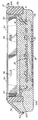
図2および図3と図4および図5とを比較することによって、載置工程中に、組織カセット10が、垂直下向きに移動してベースモールド14の内部70に入り、それによって、組織カセット10の底部24がベースモールド14の底部74に接触することが理解されよう。この位置で、それぞれの移動止め58、60の間で組織カセット本体20のフランジ30が受けられ、この下側位置に保持される。フレーム12は、好ましくは圧入され、ベースモールド14内で1つまたは複数の弾性シール72によって摩擦により保持される。この実施形態では、シール72は2種類の機能を果たす。第1に、シール72は、ベースモールド14内で摩擦によってフレーム12を物理的に保持する。こうすると、ベースモールド14にパラフィンを充填する間に、フレーム12およびそれに取り付けられたカセット10が浮くか、またはそれ以外の形で動くことが防止される。第2に、シール72は、ベースモールド14から、フレーム12の外壁12aとベースモールド14の内部70との間の区域に液体パラフィンが漏れるのを防ぐ。フレーム12をベースモールド14に押し付けて物理的に保持する代わりに、シール72以外の保持部材を使用し得ることを理解されたい。この場合、シール72は必要でないことがある。いくつかの例として、このような保持部材は、クランプ、止め金具、ばね部材、または重りとし得る。これらの図では、見やすいように、カセット10内の1つまたは複数の組織標本を割愛してある。ただし、カセット本体20の内部に収容された1つまたは複数の組織標本80の上で蓋32を下向きに押すことになることが理解されよう(図6)。カセット10、フレーム12、およびベースモールド14のアセンブリは、図4および図5に示す載置された構成になり、フレーム12の開いた内部およびカセット10の穴26、36を通して、ベースモールド14の内部70に液体パラフィンが導入される。好ましくは、次いでこの液体パラフィンを、TECなどの適当な冷却装置上で冷却し、図6に示すように、組織カセット10、フレーム12、包埋された組織標本80、および硬化したパラフィン82のアセンブリをベースモールド14から取り出す。その後、ミクロトームのチャック内でこのアセンブリを固定する装置としてフレーム12を使用し、次いで、パラフィン82の底面82aからスライスを取得する。まず、面出し用の刃を使用して、パラフィン82の初期層および組織カセット10の底壁24を除去する。この時点で、異なるミクロトームの刃を使用して、組織標本80および周囲のパラフィン82、ならびに組織カセット本体20の側壁22a〜dのリボン状のスライスすなわち削り出した断片を取得し得る。多くの場合、面出し用に使用するのと同じ刃を切片化用にも使用することができる。
By comparing FIGS. 2 and 3 with FIGS. 4 and 5, the
図7および図8に、上記で説明した組織カセット10、フレーム12、およびベースモールド14とともに使用し得る1つのタイプの載置装置100を示す。載置装置100は、上端にハンドル102を、下端に載置機構104を含む。載置機構104は、中空のシリンダ106に結合される。シリンダ106は、上向きに延びてハンドル102に剛体結合されたシュラウド108に入る。4つの複数の安定器部材110がシリンダ106に剛体結合され、複数の好ましくは移動可能な載置フィンガ112が、シリンダ106を貫通して延びる往復運動シャフト114に結合される。シャフト114は、ハンドル102に剛体結合され、ハンドル102の底面102aとシリンダ106の上面106aの間に位置するばね116によって、ハンドル102とともに上方位置に付勢される。そのため、安定器部材110をフレーム12の上側に押し付けて置いて安定させ、次いで、矢印118で示すようにハンドル102を下向きに押すことができることを理解されたい。こうすると、往復運動シャフト114およびそれに取り付けられた載置フィンガ112が下向きに移動して組織カセット10に押し付けられ、それによって組織カセット10が、フレーム12に対して相対的に、図3示すその上側位置から、図5 に示すその下側の載置位置に移動する。カセット100が押されてフレーム12を貫通して先に行きすぎないように、フランジ30が、移動止め58、60の間のその下側位置に達したときに、表面108aが表面110aに当たって止まる。
7 and 8 illustrate one type of
図9および図10に、組織カセットの第2実施形態120を示す。組織カセット120は、4つの側壁124a〜dを有するカセット本体122を含む。側壁124a〜dは、開いた内部を取り囲み、底壁126によって底面上で境界づけられる。側壁124a〜dは、穴130によって分離したリブ128から構成され、底壁126は、穴134によって分離したリブ132によって構成される。側壁124aのリブ128は、反対側の側壁124bのリブ128に対して相対的に、図10の距離「d」で示すように長手方向にオフセットされる。ただしこの実施形態では、距離「d」は、変化し得る。距離「d」は平均で、約0.015インチ〜0.030インチである。リブ128をこのようにオフセットすると、壁124aおよび124bを通過するミクロトームの刃が、その長さに沿ってより均一な量のカセット材料に接触するようになる。こうすると、刃の寿命がより長くなり、刃の摩耗がより均一になり、包埋組織のスライスが、よりばらつきのない高品質なものになる。リブ132および穴134は、それらの長手方向に、底壁126の中央区域126aに向かって延びる。この好ましい実施形態では、側壁124a〜dは、PFAなどのプラスチックカセット材料と、穴130によって形成された開いた区域の比が、約3.7:1になるように構成される。好ましい実施形態で少なくともこの比を実現するために、リブ128の幅w1を約0.010インチ〜0.014インチとし、穴130の幅w2を約0.040インチ〜0.050インチとする。側壁の中実部分136の下にあるこの穴の開いた区域は、組織標本80の包埋後(図6)、ミクロトームの刃によって切り出されることになる区域である。特に、カセット120の材料としてPFAを48〜55のショアD硬さで、上記で述べた業界標準のパラフィン包埋材料と組み合わせて使用するとき、カセット材料と開いた区域をこの比にすると、包埋されたカセットを貫通してなされる切削の質を向上させ、刃の寿命が大きく延びることがわかっている。包埋材料およびカセット材料のそれぞれの分子量に応じて、この比を増減し得る。
9 and 10 show a
フランジ140は、カセット本体122の上面を取り囲み、それぞれの上向きのくぼみ142a、142b、142c、142dを含む。フランジ140は、いくつかの下向きのくぼみ142e、142fも含む(いくつかのくぼみのうち2つだけを参照する)。これらのくぼみはそれぞれ、フレーム12の少なくとも54、56および58、60の移動止め(図3および図5参照)と位置が合う。フレーム12に追加の下部移動止めを形成して、さらなる支持を提供し、かつ、カセット10が押されてフレーム12を貫通して先に行きすぎないようにし得ることを理解されたい。このような場合、これらの追加の支持移動止めを受け入れるように、追加のくぼみがフランジ140の下面に形成される。これらのくぼみにより、フレーム12からのカセット本体120の有効外側延長部が長くなり、それによって、ミクロトーム内で包埋カセットから取得し得るスライスの数が増える。これは、病理学検査用の所望のスライドを得るための多くの状況において重要であり得る。
A flange 140 surrounds the top surface of the
側壁124a〜d上には、蓋150を定位置に保持するための移動止め144も形成される。蓋150は、ヒンジ152によってカセット本体122に結合される。蓋150は、カセット本体122の底壁126よりも剛性が高くなるように形成し、それによって、蓋150を使用して、組織標本を底壁126に押し付け、底壁126をベースモールド14の剛体の底部74に押し付けることができる(図5)。蓋150は、穴156によって全体的に分離した複数のリブ154によって形成され、それぞれ、蓋150の中央区域150aに向かって長手方向に細長く延びる。蓋150はさらに、その上を長手方向に延びる側縁部158a、158bを含む。これらの側縁部は、中央頂点160a、160bを有する浅い「V」形である。好ましくは、角度α(図10)は約4°である。第1実施形態の場合と同様に、側縁部158a、158bの形状は、カセット本体122の側壁124a、124bの同様の形状にぴったり合う。この点について、これらの側壁124a、124bは、それぞれの頂点162、162bを含み、これらの側壁のいずれか一方が、ミクロトーム内で最初に切削される壁になる。蓋150のそれぞれの端部164a、164bも、カセット本体の側壁124c、124dの同様の形状にぴったり合い、それによって、カセット本体122内で蓋150が緊密に嵌合する。フレーム12内での載置工程およびベースモールド14内での包埋すなわち成型の工程を含めて、1つまたは複数の組織標本を包埋する工程でカセット120を使用することは、図1〜図8に関して上記で説明したものと同じである。
A
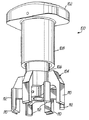
図11および図12に、第2実施形態による手動の載置装置200を示す。載置装置200は、シャフト206によって互いに剛体結合された上部ハンドル202および下部載置機構204を備える。図12では、見やすいように、ハンドル202およびシャフト206を割愛する。好ましくは、載置機構204は、4つの複数の載置部材210、212、214、216を備える。これらの載置部材は、シャフト206から概ね半径方向外向きに延び、それぞれがフィンガ部分210a、212a、214a、216aを含む。これらのフィンガ部分210a〜216aはそれぞれ、カセット10(図1)またはカセット120(図9)の上部コーナ部分と係合する。次いで、使用者が、ハンドル202を下向きに押すと、フィンガ部分210a〜216aは、カセット10またはカセット120を下向きに付勢し、カセットが下側載置位置に至る(図5)。カセットが下に行きすぎないように、載置機構204に1対のストッパ218、220が設けられる。この実施形態では、カセット10またはカセット120が下側載置位置に達したときに(図5)、ストッパ表面218a、220aは、フレーム12の上面に当たって止まる。そのため、フィンガ部分210a〜216aの下端とストッパ表面218a、220aの間隔は、上部移動止め対54、56と下部移動止め対58、60の間隔と等しくなる。本発明の趣旨および範囲に含まれる他の形態の載置機構およびストッパを設けることができることを理解されたい。
11 and 12 show a
本発明の様々な実施形態を説明することによって本発明を示し、これらの実施形態をかなり詳細に説明してきたが、添付の特許請求の範囲の範囲を、このような細部に限定、あるいはいかなる形でも制限することを意図するものではない。追加の利点および改変が当業者には容易に明らかになるであろう。したがって、本発明はそのより広い態様において、特定の細部、代表的な機器および方法、ならびに上記で示し説明した実施例に限定されるものではない。したがって、本出願人の全体的な発明の概念の範囲または趣旨から逸脱することなく、このような細部から逸脱することができる。 While the invention has been shown and described in considerable detail by describing various embodiments of the invention, the scope of the appended claims should be limited to such details or in any form. But it is not intended to be limiting. Additional advantages and modifications will be readily apparent to those skilled in the art. The invention in its broader aspects is therefore not limited to the specific details, representative apparatus and method, and examples shown and described above. Accordingly, departures may be made from such details without departing from the scope or spirit of Applicants' general inventive concept.
10 組織カセット
12 フレーム
20 本体
22a,22b,22c,22d 側壁
24 底壁
26 穴、開口
28 リブ
30 上部フランジ
32 蓋
36 穴
38 リブ
100 載置装置
120 組織カセット
122 カセット本体
124a,124b,124c,124d 側壁
126 底壁
128 リブ
130 穴
132 リブ
134 穴
140 フランジ
150 蓋
154 リブ
156 穴
200 載置装置
DESCRIPTION OF
Claims (10)
前記カセットの上面に係合し、垂直下方に移動することにより前記カセットを下方に移動させるように構成された載置部材(112;210、212、214、216)と、
前記カセットが前記フレーム内の前記下側位置に達したときに、前記載置部材の垂直移動を停止するように構成されたストッパ部材(110;218,220)と、
を備える載置機構(104、204)を備える装置において、
前記ストッパ部材(218,220)が、前記載置部材(210、212、214、216)と一体に移動可能とされているとともに、前記カセットが前記フレーム内の前記下側位置に達したときに前記フレームとの機械的な相互作用によって前記載置部材の垂直移動を停止させる、又は
前記ストッパ部材(110)が前記フレームに係合する安定化機構(110)として構成され、該安定化機構が、前記フレームに係合して静止して、前記カセットが前記フレーム内の前記下側位置に達したときに前記載置部材(112)の垂直移動を停止させる、
ように構成されている、装置。 An apparatus for moving a tissue specimen cassette from an upper position in a frame used during a tissue embedding process to a lower position in the frame,
Engage the upper surface of the cassette, the mounting member that is configured so that moving the cassette downward by moving vertically downward; and (112 210, 212),
When the cassette reaches the lower position in the frame, configured stopper member to stop the vertical movement of the placement member; and (110 218, 220),
In an apparatus comprising a mounting mechanism (104, 204) comprising :
When the stopper member (218, 220) is movable integrally with the mounting member (210, 212, 214, 216), and the cassette reaches the lower position in the frame. Stop vertical movement of the mounting member by mechanical interaction with the frame, or
The stopper member (110) is configured as a stabilization mechanism (110) that engages with the frame, the stabilization mechanism engages with the frame and stops, and the cassette is placed on the lower side in the frame. Stopping the vertical movement of the mounting member (112) when the position is reached,
The device is configured as follows.
請求項1〜4のいずれか一項に記載の装置を使用して前記カセットを前記フレームに対して前記下側位置に移動するステップと、
包埋媒体中に前記カセットを包埋するステップと、
前記包埋媒体中に包埋された組織標本を切片化するステップと、
を備える方法において、
前記カセットを移動させるステップは、
前記載置部材(112;210、212、214、216)を前記カセットの上面に係合させるステップと、
前記載置部材(112;210、212、214、216)を下方に向かって押圧するステップと、
を備え、
前記ストッパ部材(218,220)が、前記載置部材(210、212、214、216)と一体に可動であるとともに、前記カセットが前記フレーム内の前記下側位置に達したときに、前記フレームとの機械的な相互作用によって前記載置部材の垂直移動を停止させる、又は、
前記ストッパ部材(110)が、前記載置部材(112)に対して移動するとともに前記フレームに係合する安定化機構(110)として構成され、前記安定化機構(110)が前記フレームと係合するとともに静止して、前記カセットが前記フレーム内の前記下側位置に達したときに、前記載置部材(112)の垂直移動を停止させる、ことを特徴とする方法。 As before Symbol cassette is in said upper position, and coupling with the frame the cassette,
Moving the cassette to the lower position relative to the frame using the apparatus of any one of claims 1-4;
Embedding the cassette in an embedding medium ;
Sectioning a tissue specimen embedded in the embedding medium ;
In a method comprising:
The step of moving the cassette comprises:
Engaging the mounting member (112; 210, 212, 214, 216) with the upper surface of the cassette;
Pressing the mounting member (112; 210, 212, 214, 216) downward;
With
The stopper member (218, 220) is movable integrally with the mounting member (210, 212, 214, 216), and when the cassette reaches the lower position in the frame, the frame Stop the vertical movement of the mounting member by mechanical interaction with, or
The stopper member (110) is configured as a stabilizing mechanism (110) that moves relative to the mounting member (112) and engages the frame, and the stabilizing mechanism (110) engages with the frame. And stopping and stopping the vertical movement of the mounting member (112) when the cassette reaches the lower position in the frame .
前記カセットを移動するステップは、前記カセットの低壁を前記型の底に接触させるステップを備えることを特徴とする請求項6に記載の方法。 The cassette further comprises a bottom wall on which the tissue specimen is disposed;
The method of claim 6 , wherein moving the cassette comprises contacting the bottom wall of the cassette with the bottom of the mold.
Priority Applications (1)
| Application Number | Priority Date | Filing Date | Title |
|---|---|---|---|
| JP2008008364A JP4828552B2 (en) | 2008-01-17 | 2008-01-17 | Cassette and embedding assembly, mounting apparatus therefor, and method therefor for handling and holding tissue specimens during processing, embedding and microtome sectioning procedures |
Applications Claiming Priority (1)
| Application Number | Priority Date | Filing Date | Title |
|---|---|---|---|
| JP2008008364A JP4828552B2 (en) | 2008-01-17 | 2008-01-17 | Cassette and embedding assembly, mounting apparatus therefor, and method therefor for handling and holding tissue specimens during processing, embedding and microtome sectioning procedures |
Related Parent Applications (1)
| Application Number | Title | Priority Date | Filing Date |
|---|---|---|---|
| JP2004539746A Division JP4237704B2 (en) | 2002-09-26 | 2002-09-26 | Cassette for handling and holding tissue specimens during processing, embedding and microtome sectioning procedures, and method therefor |
Publications (3)
| Publication Number | Publication Date |
|---|---|
| JP2008102158A JP2008102158A (en) | 2008-05-01 |
| JP2008102158A5 JP2008102158A5 (en) | 2009-01-08 |
| JP4828552B2 true JP4828552B2 (en) | 2011-11-30 |
Family
ID=39436555
Family Applications (1)
| Application Number | Title | Priority Date | Filing Date |
|---|---|---|---|
| JP2008008364A Expired - Lifetime JP4828552B2 (en) | 2008-01-17 | 2008-01-17 | Cassette and embedding assembly, mounting apparatus therefor, and method therefor for handling and holding tissue specimens during processing, embedding and microtome sectioning procedures |
Country Status (1)
| Country | Link |
|---|---|
| JP (1) | JP4828552B2 (en) |
Families Citing this family (4)
| Publication number | Priority date | Publication date | Assignee | Title |
|---|---|---|---|---|
| CN118974535A (en) * | 2022-03-31 | 2024-11-15 | 莱卡生物系统努斯洛赫有限责任公司 | Device for pressing box and embedding machine having the same |
| CN115096638A (en) * | 2022-06-17 | 2022-09-23 | 上海市同济医院 | Medical tissue sample treater |
| GB202300940D0 (en) * | 2023-01-23 | 2023-03-08 | Cellpath Ltd | Cassette assembly |
| WO2024239273A1 (en) * | 2023-05-24 | 2024-11-28 | Leica Biosystems Nussloch Gmbh | Embedder and control method of dispensing paraffin for same |
Family Cites Families (4)
| Publication number | Priority date | Publication date | Assignee | Title |
|---|---|---|---|---|
| US1885138A (en) * | 1929-09-20 | 1932-11-01 | Pilson Sam | Mechanical arm |
| US3587872A (en) * | 1969-04-28 | 1971-06-28 | Paul E Pauly | Mechanical arm and control means therefor |
| US4893982A (en) * | 1987-09-17 | 1990-01-16 | Taiho Seiki Co., Ltd. | Apparatus for conveying workpiece |
| JP2798430B2 (en) * | 1989-08-08 | 1998-09-17 | サクラ精機株式会社 | Pathological tissue inspection method and fixed embedding device used therefor |
-
2008
- 2008-01-17 JP JP2008008364A patent/JP4828552B2/en not_active Expired - Lifetime
Also Published As
| Publication number | Publication date |
|---|---|
| JP2008102158A (en) | 2008-05-01 |
Similar Documents
| Publication | Publication Date | Title |
|---|---|---|
| JP4237704B2 (en) | Cassette for handling and holding tissue specimens during processing, embedding and microtome sectioning procedures, and method therefor | |
| US11774330B2 (en) | Sectionable cassette and embedding frame with tissue immobilizing separable lid, and methods for preparing biopsy tissue samples | |
| CA2665687C (en) | Biopsy support with sectionable resilient cellular material | |
| JP7581350B2 (en) | Slicable cassette with connector and embedding frame and method for preparing biopsy tissue samples - Patents.com | |
| US8877146B2 (en) | Cassette for handling and holding tissue samples during processing, embedding and microtome procedures, and methods therefor | |
| JP2008102158A (en) | Processing, embedding, cassette and embedding assembly handling and holding tissue specimen during segmentation procedure by microtome, placing device therefor, and method therefor | |
| KR20240138103A (en) | Film cutting device and container cover film cutting method using the same |
Legal Events
| Date | Code | Title | Description |
|---|---|---|---|
| A621 | Written request for application examination |
Free format text: JAPANESE INTERMEDIATE CODE: A621 Effective date: 20080117 |
|
| A521 | Request for written amendment filed |
Free format text: JAPANESE INTERMEDIATE CODE: A523 Effective date: 20081114 |
|
| A131 | Notification of reasons for refusal |
Free format text: JAPANESE INTERMEDIATE CODE: A131 Effective date: 20100525 |
|
| A601 | Written request for extension of time |
Free format text: JAPANESE INTERMEDIATE CODE: A601 Effective date: 20100824 |
|
| A602 | Written permission of extension of time |
Free format text: JAPANESE INTERMEDIATE CODE: A602 Effective date: 20100827 |
|
| A521 | Request for written amendment filed |
Free format text: JAPANESE INTERMEDIATE CODE: A523 Effective date: 20100924 |
|
| TRDD | Decision of grant or rejection written | ||
| A01 | Written decision to grant a patent or to grant a registration (utility model) |
Free format text: JAPANESE INTERMEDIATE CODE: A01 Effective date: 20110816 |
|
| A01 | Written decision to grant a patent or to grant a registration (utility model) |
Free format text: JAPANESE INTERMEDIATE CODE: A01 |
|
| A61 | First payment of annual fees (during grant procedure) |
Free format text: JAPANESE INTERMEDIATE CODE: A61 Effective date: 20110914 |
|
| FPAY | Renewal fee payment (event date is renewal date of database) |
Free format text: PAYMENT UNTIL: 20140922 Year of fee payment: 3 |
|
| R150 | Certificate of patent or registration of utility model |
Ref document number: 4828552 Country of ref document: JP Free format text: JAPANESE INTERMEDIATE CODE: R150 Free format text: JAPANESE INTERMEDIATE CODE: R150 |
|
| R250 | Receipt of annual fees |
Free format text: JAPANESE INTERMEDIATE CODE: R250 |
|
| R250 | Receipt of annual fees |
Free format text: JAPANESE INTERMEDIATE CODE: R250 |
|
| R250 | Receipt of annual fees |
Free format text: JAPANESE INTERMEDIATE CODE: R250 |
|
| R250 | Receipt of annual fees |
Free format text: JAPANESE INTERMEDIATE CODE: R250 |
|
| R250 | Receipt of annual fees |
Free format text: JAPANESE INTERMEDIATE CODE: R250 |
|
| R250 | Receipt of annual fees |
Free format text: JAPANESE INTERMEDIATE CODE: R250 |
|
| R250 | Receipt of annual fees |
Free format text: JAPANESE INTERMEDIATE CODE: R250 |
|
| R250 | Receipt of annual fees |
Free format text: JAPANESE INTERMEDIATE CODE: R250 |
|
| R250 | Receipt of annual fees |
Free format text: JAPANESE INTERMEDIATE CODE: R250 |
|
| EXPY | Cancellation because of completion of term |