JP4472980B2 - Coextruded film - Google Patents
Coextruded film Download PDFInfo
- Publication number
- JP4472980B2 JP4472980B2 JP2003427545A JP2003427545A JP4472980B2 JP 4472980 B2 JP4472980 B2 JP 4472980B2 JP 2003427545 A JP2003427545 A JP 2003427545A JP 2003427545 A JP2003427545 A JP 2003427545A JP 4472980 B2 JP4472980 B2 JP 4472980B2
- Authority
- JP
- Japan
- Prior art keywords
- less
- thickness
- layer
- film
- birefringence
- Prior art date
- Legal status (The legal status is an assumption and is not a legal conclusion. Google has not performed a legal analysis and makes no representation as to the accuracy of the status listed.)
- Expired - Fee Related
Links
Classifications
-
- B—PERFORMING OPERATIONS; TRANSPORTING
- B29—WORKING OF PLASTICS; WORKING OF SUBSTANCES IN A PLASTIC STATE IN GENERAL
- B29D—PRODUCING PARTICULAR ARTICLES FROM PLASTICS OR FROM SUBSTANCES IN A PLASTIC STATE
- B29D7/00—Producing flat articles, e.g. films or sheets
- B29D7/01—Films or sheets
-
- B—PERFORMING OPERATIONS; TRANSPORTING
- B29—WORKING OF PLASTICS; WORKING OF SUBSTANCES IN A PLASTIC STATE IN GENERAL
- B29C—SHAPING OR JOINING OF PLASTICS; SHAPING OF MATERIAL IN A PLASTIC STATE, NOT OTHERWISE PROVIDED FOR; AFTER-TREATMENT OF THE SHAPED PRODUCTS, e.g. REPAIRING
- B29C48/00—Extrusion moulding, i.e. expressing the moulding material through a die or nozzle which imparts the desired form; Apparatus therefor
- B29C48/03—Extrusion moulding, i.e. expressing the moulding material through a die or nozzle which imparts the desired form; Apparatus therefor characterised by the shape of the extruded material at extrusion
- B29C48/07—Flat, e.g. panels
- B29C48/08—Flat, e.g. panels flexible, e.g. films
-
- B—PERFORMING OPERATIONS; TRANSPORTING
- B29—WORKING OF PLASTICS; WORKING OF SUBSTANCES IN A PLASTIC STATE IN GENERAL
- B29C—SHAPING OR JOINING OF PLASTICS; SHAPING OF MATERIAL IN A PLASTIC STATE, NOT OTHERWISE PROVIDED FOR; AFTER-TREATMENT OF THE SHAPED PRODUCTS, e.g. REPAIRING
- B29C48/00—Extrusion moulding, i.e. expressing the moulding material through a die or nozzle which imparts the desired form; Apparatus therefor
- B29C48/16—Articles comprising two or more components, e.g. co-extruded layers
- B29C48/18—Articles comprising two or more components, e.g. co-extruded layers the components being layers
- B29C48/21—Articles comprising two or more components, e.g. co-extruded layers the components being layers the layers being joined at their surfaces
-
- B—PERFORMING OPERATIONS; TRANSPORTING
- B29—WORKING OF PLASTICS; WORKING OF SUBSTANCES IN A PLASTIC STATE IN GENERAL
- B29C—SHAPING OR JOINING OF PLASTICS; SHAPING OF MATERIAL IN A PLASTIC STATE, NOT OTHERWISE PROVIDED FOR; AFTER-TREATMENT OF THE SHAPED PRODUCTS, e.g. REPAIRING
- B29C48/00—Extrusion moulding, i.e. expressing the moulding material through a die or nozzle which imparts the desired form; Apparatus therefor
- B29C48/25—Component parts, details or accessories; Auxiliary operations
- B29C48/30—Extrusion nozzles or dies
- B29C48/305—Extrusion nozzles or dies having a wide opening, e.g. for forming sheets
- B29C48/307—Extrusion nozzles or dies having a wide opening, e.g. for forming sheets specially adapted for bringing together components, e.g. melts within the die
-
- B—PERFORMING OPERATIONS; TRANSPORTING
- B29—WORKING OF PLASTICS; WORKING OF SUBSTANCES IN A PLASTIC STATE IN GENERAL
- B29C—SHAPING OR JOINING OF PLASTICS; SHAPING OF MATERIAL IN A PLASTIC STATE, NOT OTHERWISE PROVIDED FOR; AFTER-TREATMENT OF THE SHAPED PRODUCTS, e.g. REPAIRING
- B29C48/00—Extrusion moulding, i.e. expressing the moulding material through a die or nozzle which imparts the desired form; Apparatus therefor
- B29C48/25—Component parts, details or accessories; Auxiliary operations
- B29C48/88—Thermal treatment of the stream of extruded material, e.g. cooling
- B29C48/911—Cooling
- B29C48/9135—Cooling of flat articles, e.g. using specially adapted supporting means
- B29C48/914—Cooling drums
-
- B—PERFORMING OPERATIONS; TRANSPORTING
- B29—WORKING OF PLASTICS; WORKING OF SUBSTANCES IN A PLASTIC STATE IN GENERAL
- B29K—INDEXING SCHEME ASSOCIATED WITH SUBCLASSES B29B, B29C OR B29D, RELATING TO MOULDING MATERIALS OR TO MATERIALS FOR MOULDS, REINFORCEMENTS, FILLERS OR PREFORMED PARTS, e.g. INSERTS
- B29K2995/00—Properties of moulding materials, reinforcements, fillers, preformed parts or moulds
- B29K2995/0018—Properties of moulding materials, reinforcements, fillers, preformed parts or moulds having particular optical properties, e.g. fluorescent or phosphorescent
- B29K2995/0026—Transparent
-
- B—PERFORMING OPERATIONS; TRANSPORTING
- B29—WORKING OF PLASTICS; WORKING OF SUBSTANCES IN A PLASTIC STATE IN GENERAL
- B29L—INDEXING SCHEME ASSOCIATED WITH SUBCLASS B29C, RELATING TO PARTICULAR ARTICLES
- B29L2009/00—Layered products
- B29L2009/001—Layered products the layers being loose
-
- B—PERFORMING OPERATIONS; TRANSPORTING
- B29—WORKING OF PLASTICS; WORKING OF SUBSTANCES IN A PLASTIC STATE IN GENERAL
- B29L—INDEXING SCHEME ASSOCIATED WITH SUBCLASS B29C, RELATING TO PARTICULAR ARTICLES
- B29L2017/00—Carriers for sound or information
- B29L2017/001—Carriers of records containing fine grooves or impressions, e.g. disc records for needle playback, cylinder records
- B29L2017/003—Records or discs
-
- Y—GENERAL TAGGING OF NEW TECHNOLOGICAL DEVELOPMENTS; GENERAL TAGGING OF CROSS-SECTIONAL TECHNOLOGIES SPANNING OVER SEVERAL SECTIONS OF THE IPC; TECHNICAL SUBJECTS COVERED BY FORMER USPC CROSS-REFERENCE ART COLLECTIONS [XRACs] AND DIGESTS
- Y10—TECHNICAL SUBJECTS COVERED BY FORMER USPC
- Y10T—TECHNICAL SUBJECTS COVERED BY FORMER US CLASSIFICATION
- Y10T428/00—Stock material or miscellaneous articles
- Y10T428/21—Circular sheet or circular blank
-
- Y—GENERAL TAGGING OF NEW TECHNOLOGICAL DEVELOPMENTS; GENERAL TAGGING OF CROSS-SECTIONAL TECHNOLOGIES SPANNING OVER SEVERAL SECTIONS OF THE IPC; TECHNICAL SUBJECTS COVERED BY FORMER USPC CROSS-REFERENCE ART COLLECTIONS [XRACs] AND DIGESTS
- Y10—TECHNICAL SUBJECTS COVERED BY FORMER USPC
- Y10T—TECHNICAL SUBJECTS COVERED BY FORMER US CLASSIFICATION
- Y10T428/00—Stock material or miscellaneous articles
- Y10T428/31504—Composite [nonstructural laminate]
- Y10T428/31855—Of addition polymer from unsaturated monomers
- Y10T428/31909—Next to second addition polymer from unsaturated monomers
Landscapes
- Engineering & Computer Science (AREA)
- Mechanical Engineering (AREA)
- Physics & Mathematics (AREA)
- Thermal Sciences (AREA)
- Manufacturing & Machinery (AREA)
- Laminated Bodies (AREA)
- Extrusion Moulding Of Plastics Or The Like (AREA)
Description
本発明は、低複屈折性が改善されたフィルム、1層のそのようなフィルムを含んで成る多層フィルム、並びにそのようなフィルムの製造方法及びそのようなフィルムを使用した光学装置に関する。 The present invention relates to a film with improved low birefringence, a multilayer film comprising one such film, a method for producing such a film and an optical device using such a film.
音楽、ビデオ及び他の情報の記憶に広く使用されているコンパクトディスク(CD)の出現により、光学式記憶装置の使用は一般的になってきた。この種の光学式記憶装置は、優れた光学的特性を有する透明な基材を必要とする。基材に、一連にピット又はくぼみを付けることにより情報がコード化される。適切にコートされたこの基材は、レーザーにより読み取ることができ、ディスクに記憶された情報を再生する信号を生じる。この種の記憶装置によって、より小さいスペースにより多くの情報を記憶する必要性がますます増えている。 With the advent of compact discs (CDs) that are widely used for storing music, video and other information, the use of optical storage devices has become commonplace. This type of optical storage device requires a transparent substrate having excellent optical properties. Information is encoded by making a series of pits or depressions in the substrate. This properly coated substrate can be read by a laser and produces a signal that reproduces the information stored on the disk. With this type of storage, there is an increasing need to store more information in a smaller space.
ビスフェノールAポリカーボネート(BPA−PC)等の熱可塑性ポリマーが光学式記憶媒体用途に広く使用されているが、BPA−PCのような熱可塑性樹脂には幾つかの制限がある。熱可塑性樹脂を押出フィルムプロセスで加工し、光学式記憶媒体の光学的要件を満たすことはかなり難しい。これらの用途では、BPA−PCのような熱可塑性ポリマー及びそれらから作られた光学式データ記憶装置は、それらの複屈折性によって制限される。樹脂の固有の特性及びその樹脂がどのように加工(その流動学的特性に左右される)されたかによって決まる複屈折性は、装置(すなわち、ディスク)に記憶された情報の再生を妨げることがある。 While thermoplastic polymers such as bisphenol A polycarbonate (BPA-PC) are widely used for optical storage media applications, thermoplastic resins such as BPA-PC have some limitations. It is quite difficult to process thermoplastics in an extruded film process and meet the optical requirements of optical storage media. In these applications, thermoplastic polymers such as BPA-PC and optical data storage devices made from them are limited by their birefringence. Birefringence, which depends on the inherent properties of the resin and how it is processed (depending on its rheological properties), can hamper the reproduction of information stored on the device (ie, disk). is there.
光学式ディスク、特に読み取り−書き込みディスク及び多量のデータを記憶することができるディスクをさらに進歩させることに、様々な物理的因子がますます重要になっている。ディスクの記憶容量に密接に関係する1つのそのような因子は、複屈折、すなわち垂直な2つの方向に偏光された光の屈折率の差である。複屈折は、レーザービームの異なる偏光成分間の位相遅延(すなわち、偏光に依存する効果)をもたらすため、ディスクの読み取りやすさが低減する。従って、典型的には1×10⁻⁴nm/nm以下の低い複屈折率を有する熱可塑性フィルムが、光ディスクにとって望ましい構成要素である。 Various physical factors are becoming increasingly important for further advancement of optical discs, especially read-write discs and discs that can store large amounts of data. One such factor that is closely related to the storage capacity of the disk is birefringence, the difference in the refractive index of light polarized in two perpendicular directions. Birefringence results in a phase delay (ie, polarization dependent effect) between the different polarization components of the laser beam, thus reducing the readability of the disk. Therefore, a thermoplastic film having a low birefringence typically less than 1 × 10 −4 nm / nm is a desirable component for an optical disc.
典型的には1×10⁻⁴nm/nm以下の低い複屈折率を有するフィルムの他の用途は、液晶ディスプレイ用の偏光子である。 Another application for films having a low birefringence of typically 1 × 10 −4 nm / nm or less is a polarizer for liquid crystal displays.
複屈折の原因は、フィルムの製造に用いる原料の物理的加工、そのフィルムにおける分子の配向度、及び製造されたフィルムにかかる熱応力など幾つかある。従って、フィルムの観測される複屈折は、固有の複屈折性を決める分子構造と、ポリマー鎖の熱応力及び配向を生じさせることのできる加工条件により決まる。具体的に言うと、観測される複屈折は、典型的には、固有の複屈折とフィルム基材等の製品を製造する際に導入される複屈折の和の関数である。 There are several causes of birefringence, such as physical processing of raw materials used for manufacturing a film, degree of molecular orientation in the film, and thermal stress applied to the manufactured film. Thus, the observed birefringence of the film depends on the molecular structure that determines the intrinsic birefringence and the processing conditions that can cause the thermal stress and orientation of the polymer chains. Specifically, the observed birefringence is typically a function of the sum of the intrinsic birefringence and the birefringence introduced when manufacturing a product such as a film substrate.
BPA−PC等の熱可塑性フィルムを形成するために使用される押出ダイの壁面で生じるせん断応力は、そのようなフィルムの外表面の近くでフィルムの高度に配向した分子構造を生じる。この配向した分子構造は、表面付近でフィルムにかなり高い複屈折性をもたらし、バルクフィルムの全体的な複屈折性を高める。 The shear stress that occurs on the walls of an extrusion die used to form a thermoplastic film such as BPA-PC results in a highly oriented molecular structure of the film near the outer surface of such a film. This oriented molecular structure results in a fairly high birefringence in the film near the surface and enhances the overall birefringence of the bulk film.
応力が溶剤のゆっくりとした蒸発を通じて解放される溶剤系フィルムコーティング材料を使用して低複屈折フィルムを製造することが一般的に行われている。しかしながら、そのような方法は、放出物の観点及びポリマーフィルム中に連行された溶剤の存在の観点から望ましくない。溶剤キャストシート、例えばポリカーボネートシートは、比較的低い複屈折率を持つように製造できるが、加工速度は非常に遅い(また、費用がかかる)。試料は、過剰なレベルの残留キャスト用溶剤を保持する。標準的な分子量のポリカーボネートは、透明な(たいていはアモルファスの)シートをキャストする代わりに、溶液から結晶化させることも可能である。
米国特許第4,617,207号明細書には、コアの熱可塑性樹脂シートを、2つの非接着性の可剥性樹脂と共押出することによって、熱可塑性フィルムを形成するために使用される押出ダイの壁面で生じるせん断応力を減少させ、低い2つの屈折率又は複屈折率を有するフィルムが得られることが開示されている。しかしながら、光学式読み取り−書き込み記憶媒体に望ましい材料、例えばポリカーボネート、ポリエステル、ポリスチレン及びポリ(メチルメタクリレート)から作られた熱可塑性フィルムは、そのような用途にとって望ましい厚さを有することは米国特許第4,617,207号明細書に記載されていない。特別な条件の場合にだけ、望ましい厚さ及び複屈折性を有するそのようなフィルムを製造することができる。そのようなフィルムには、液晶ディスプレイ用の偏光子としての用途もあり、250μm未満のフィルムが望ましい。
It is common practice to produce low birefringence films using solvent-based film coating materials in which stress is released through slow evaporation of the solvent. However, such a method is undesirable in terms of emissions and the presence of solvents entrained in the polymer film. Solvent cast sheets, such as polycarbonate sheets, can be made to have a relatively low birefringence, but the processing speed is very slow (and expensive). The sample retains an excessive level of residual casting solvent. Standard molecular weight polycarbonate can be crystallized from solution instead of casting a clear (usually amorphous) sheet.
US Pat. No. 4,617,207 is used to form a thermoplastic film by co-extruding a core thermoplastic sheet with two non-adhesive strippable resins. It is disclosed that a film having a low two refractive index or birefringence can be obtained by reducing the shear stress generated on the wall of the extrusion die. However, it is known that thermoplastic films made from materials desirable for optical read-write storage media, such as polycarbonate, polyester, polystyrene and poly (methyl methacrylate), have a desirable thickness for such applications. No. 617,207. Only under special conditions can such a film with the desired thickness and birefringence be produced. Such films also have applications as polarizers for liquid crystal displays, and films less than 250 μm are desirable.
従って、1×10⁻⁴nm/nm未満の複屈折率を示す250μm未満の厚さを有する熱可塑性の透明な溶融加工可能な押出フィルムを製造できるようにすることが必要である。 It is therefore necessary to be able to produce thermoplastic transparent melt processable extruded films having a thickness of less than 250 μm exhibiting a birefringence of less than 1 × 10 −4 nm / nm.
本発明は、厚さ250μm未満の1層の透明なポリマー内部コア層と2層の可剥性ポリマー外層を含み、前記内部コア層が、1×10⁻⁴nm/nm以下の複屈折率を達成するのに十分に小さい全フィルム厚の40%未満の割合を構成するとともに十分に低いメルトフローインデックス値を示すことを特徴とする同時押出フィルムを提供する。また、本発明は、1層の可剥性層を有するそのようなフィルム、押し出された内部層フィルム、並びにそのようなフィルムの製造方法及びそのようなフィルムを使用した光学装置を提供する。 The present invention includes a transparent polymer inner core layer having a thickness of less than 250 μm and two peelable polymer outer layers, and the inner core layer has a birefringence of 1 × 10 −4 nm / nm or less. A coextruded film is provided that comprises a fraction of less than 40% of the total film thickness that is sufficiently small to achieve and exhibits a sufficiently low melt flow index value. The present invention also provides such a film having a single peelable layer, an extruded inner layer film, a method for producing such a film, and an optical device using such a film.
本発明は、1×10⁻⁴nm/nm以下の複屈折率を有し、残留溶剤を含まず、厚さが250μm未満である低複屈折フィルムを提供する。 The present invention provides a low birefringence film having a birefringence of 1 × 10 −4 nm / nm or less, no residual solvent, and a thickness of less than 250 μm.
本発明の熱可塑性樹脂シートは、透明であること、250μmの厚さを有すること、残留溶剤を含まないこと、1×10⁻⁴nm/nm以下の複屈折率を有すること、及び製造費が低いことが必要である。 The thermoplastic resin sheet of the present invention is transparent, has a thickness of 250 μm, does not contain residual solvent, has a birefringence of 1 × 10 −4 nm / nm or less, and has a production cost of It needs to be low.
上記のシートにおいて使用可能な熱可塑性樹脂は、ポリカーボネート樹脂、アクリレート樹脂、ポリスチレン樹脂及びポリエステル樹脂である。 Thermoplastic resins that can be used in the above sheet are polycarbonate resin, acrylate resin, polystyrene resin, and polyester resin.
例示のために先に挙げた熱可塑性樹脂は、押出法、カレンダー法又は溶液キャスト法によりフィルム構造体に形作ることができ、第1の熱可塑性樹脂及びこの第1の熱可塑性樹脂に対して非接着性の第2の熱可塑性樹脂を、第1の熱可塑性樹脂がコア層を形成し、第2の熱可塑性樹脂がこのコア層の両面に積層された外層を形成するように少なくとも3つの層に押出し、次に、外層を剥がすことが望ましい。上記の特定の熱可塑性樹脂からコア層を形成するのに適した樹脂を選択することが好ましい。 The thermoplastic resins listed above for illustration can be formed into a film structure by extrusion, calendering, or solution casting, and are non-reactive with the first thermoplastic and the first thermoplastic. Adhesive second thermoplastic resin, at least three layers such that the first thermoplastic resin forms a core layer and the second thermoplastic resin forms an outer layer laminated on both sides of the core layer It is desirable to extrude into an outer layer and then peel off the outer layer. It is preferable to select a resin suitable for forming the core layer from the above specific thermoplastic resin.
本発明のシートは、屈折率が低いというその特徴的性質のために、光学式記憶媒体、液晶ディスプレイ用の基材として、及び他の分野で都合よく使用できる。 The sheet of the present invention can be conveniently used as an optical storage medium, a substrate for a liquid crystal display, and in other fields due to its characteristic property of low refractive index.
本発明によると、熱可塑性フィルムは、第1の熱可塑性樹脂と第2の熱可塑性樹脂を、第1の熱可塑性樹脂から得られる層の両面が第2の熱可塑性樹脂の外層で被覆されるようにシート状の構造体に共押出しし、次に、第2の熱可塑性樹脂の外層を剥がして第1の熱可塑性樹脂のシートを得ることにより製造される。 According to the present invention, the thermoplastic film is coated with the first thermoplastic resin and the second thermoplastic resin, and both surfaces of the layer obtained from the first thermoplastic resin are coated with the outer layer of the second thermoplastic resin. Thus, it is manufactured by coextruding into a sheet-like structure, and then peeling off the outer layer of the second thermoplastic resin to obtain a first thermoplastic resin sheet.
第1の熱可塑性樹脂は、カーボネート、エステル、スチレン又はアクリレートの反復単位を含むことができる。これらの例示した樹脂の中で、ポリカーボネート樹脂及びポリエステル樹脂が好ましい。最適な第1の熱可塑性樹脂のメルトフローインデックス(ASTM D1238に記載、300℃及び荷重1.2kgの条件を用いる)は、1×10⁻⁴nm/nm以下の複屈折率を有するフィルムをもたらすのに十分に低い値であるのがよい。第1の熱可塑性樹脂がポリカーボネートを含む場合には、メルトフローインデックス(MFI)は2.5以下であるのがよい。第1の熱可塑性樹脂がポリエステル、例えばポリエチレンテレフタレートを含む場合には、メルトフローインデックスは22.0以下であることが望ましい。より高いメルトフローインデックスを有する材料は、加工時により低い粘度を示すが、コア層の複屈折率は1×10-4nm/nmを超えてしまう。 The first thermoplastic resin can include repeating units of carbonate, ester, styrene or acrylate. Of these exemplified resins, polycarbonate resins and polyester resins are preferred. Optimal first thermoplastic resin melt flow index (described in ASTM D1238, using conditions of 300 ° C. and a load of 1.2 kg) results in a film having a birefringence of 1 × 10 −4 nm / nm or less. It should be a sufficiently low value. When the first thermoplastic resin includes polycarbonate, the melt flow index (MFI) is preferably 2.5 or less. When the first thermoplastic resin contains polyester, for example, polyethylene terephthalate, the melt flow index is desirably 22.0 or less. A material with a higher melt flow index will exhibit a lower viscosity during processing, but the birefringence of the core layer will exceed 1 × 10 −4 nm / nm.
本発明の実施において有用な第2の熱可塑性樹脂は、第1の熱可塑性樹脂と不混和性である(すなわち、第1の熱可塑性樹脂と混合又はブレンドされない)。これは、第1の熱可塑性樹脂に対して第2の熱可塑性樹脂が非接着性であるということであり、その種類は、第1の熱可塑性樹脂の種類を勘案して選択できる。 The second thermoplastic resin useful in the practice of the present invention is immiscible with the first thermoplastic resin (ie, not mixed or blended with the first thermoplastic resin). This means that the second thermoplastic resin is non-adhesive to the first thermoplastic resin, and the type can be selected in consideration of the type of the first thermoplastic resin.
本発明において使用できる第1の熱可塑性樹脂及び第2の熱可塑性樹脂は、それらを多重隣接層として共押出した後に、第2の熱可塑性樹脂を第1の熱可塑性樹脂から容易に剥離できる限りいかなる組み合わせであってもよい。例として、第1の熱可塑性樹脂としてポリカーボネート樹脂を選択した場合には、対応する第2の熱可塑性樹脂として、低密度ポリエチレン、高密度ポリエチレン及びポリプロピレン等のオレフィンを選択することができる。剥離後のコアのポリカーボネート層の表面に実質的に欠陥を生じないため、ポリカーボネートとポリプロピレンの組み合わせが特に都合よい。 As long as the first thermoplastic resin and the second thermoplastic resin that can be used in the present invention can be easily exfoliated from the first thermoplastic resin after they are coextruded as multiple adjacent layers. Any combination is possible. As an example, when a polycarbonate resin is selected as the first thermoplastic resin, olefins such as low-density polyethylene, high-density polyethylene, and polypropylene can be selected as the corresponding second thermoplastic resin. A combination of polycarbonate and polypropylene is particularly advantageous because it does not substantially cause defects in the surface of the core polycarbonate layer after peeling.
本明細書で用いる「不混和性」又は「非接着性」という用語は、樹脂層が互いに接着しない組み合わせだけでなく、両方の樹脂層を容易に剥離できる組み合わせを示す。 As used herein, the terms “immiscible” or “non-adhesive” indicate not only a combination in which the resin layers do not adhere to each other, but also a combination in which both resin layers can be easily peeled off.
本発明において、第1の熱可塑性樹脂と第2の熱可塑性樹脂は、第2の熱可塑性樹脂が第1の熱可塑性樹脂の得られる層の両方の表面を覆うように共押出される。共押出は、Tダイに入る直前にフィードブロックで両方の樹脂を積層し、Tダイに供給するフィードブロック法(米国特許第3,557,265号、第3,476,627号及び第4,336,012号明細書)や、Tダイ内で両方の樹脂を積層するマルチマニホールド法を使用して行うことができる。例えば、Kenkichi Murakami, "Plastics Age" 21(9), 74(1975)を参照されたい。 In the present invention, the first thermoplastic resin and the second thermoplastic resin are coextruded so that the second thermoplastic resin covers both surfaces of the layer from which the first thermoplastic resin is obtained. In the coextrusion, both resins are laminated with a feed block immediately before entering the T die and fed to the T die (US Pat. Nos. 3,557,265, 3,476,627, and 4, 336,012 specification) or a multi-manifold method in which both resins are laminated in a T-die. See, for example, Kenkichi Murakami, “Plastics Age” 21 (9), 74 (1975).
共押出しによって得られる第1及び第2の熱可塑性樹脂の積層後の層構成に関し、同一の樹脂を両方の外層を成す第2の熱可塑性樹脂として使用すること、換言すれば、2種の樹脂から成る3層の構造、すなわち2/1/2型の構造をとることが概して都合よい。なぜなら、上記構造は幾種類もの樹脂を取り扱う必要がないからである。得られる積層体が3種の異なる樹脂から成る3層の構造をとるように両方の外層を成す第2の熱可塑性樹脂として種類の異なる樹脂を使用することも当然可能である。 Regarding the layer structure after lamination of the first and second thermoplastic resins obtained by coextrusion, the same resin is used as the second thermoplastic resin forming both outer layers, in other words, two types of resins. It is generally advantageous to take a three-layer structure consisting of: a 2/1/2 type structure. This is because the above structure does not require handling various types of resins. Of course, it is also possible to use different types of resins as the second thermoplastic resin forming both outer layers so that the resulting laminate has a three-layer structure composed of three different resins.
第2の熱可塑性樹脂から作られた外層上に別の樹脂から作られたさらなる層を積層し、例えば3/2/1/2/3のような構造にすることも可能である。あるいは、共押出積層体は、2/1/2/1/2のような別の構造をとることもできる。さらに、共押出積層体は、1/3/1構造を有する最終的なシートが得られるように、別の2/1/3/1/2の構造をとってもよい。さらに、共押出積層体は、別の構造2/1/1’/2’を取ることもできる。ここで、樹脂2’は、1/1’構造を有する最終的なシートが得られるように、樹脂1’に対して非接着性である。 It is also possible to laminate a further layer made of another resin on the outer layer made of the second thermoplastic resin to give a structure such as 3/2/1/2/3. Alternatively, the coextruded laminate can have another structure such as 2/1/2/1/2. Further, the coextruded laminate may have another 2/1/3/1/2 structure so that a final sheet having a 1/3/1 structure is obtained. Furthermore, the co-extruded laminate can take another structure 2/1/1 ′ / 2 ′. Here, the resin 2 'is non-adhesive to the resin 1' so that a final sheet having a 1/1 'structure is obtained.
各共押出シート状積層体の全厚における第1の熱可塑性樹脂の厚さの割合は、好ましくは40%以下である。この割合が40%を超える場合には、第1の熱可塑性樹脂の得られるシートは大きい複屈折率を有する。従って、そのような高い割合を使用することは望ましくない。この割合が25%を超えることが好ましい。 The ratio of the thickness of the first thermoplastic resin in the total thickness of each coextruded sheet-like laminate is preferably 40% or less. When this ratio exceeds 40%, the sheet from which the first thermoplastic resin is obtained has a large birefringence. Therefore, it is not desirable to use such a high ratio. It is preferable that this ratio exceeds 25%.
シート状積層体からの第2の熱可塑性樹脂から作られた外層の剥離は、第1の熱可塑性樹脂と第2の熱可塑性樹脂が不混和性であることから互いに非接着性であるため、容易に行なうことができる。コア層に塵が付着したり引掻き傷が生じないように、コア層をロールの形態に巻き上げる直前に外層を剥離することが望ましい。しかしながら、外層を剥がし取った後、続いてコアフィルムを加熱及びカレンダリングすることによりコアフィルム表面の品質をさらに高めることができる。 Since the peeling of the outer layer made from the second thermoplastic resin from the sheet-like laminate is non-adhesive to each other since the first thermoplastic resin and the second thermoplastic resin are immiscible, It can be done easily. It is desirable to peel off the outer layer immediately before the core layer is rolled up in the form of a roll so that dust does not adhere to the core layer and scratches do not occur. However, after peeling off the outer layer, the quality of the core film surface can be further enhanced by subsequently heating and calendering the core film.
先に述べたように、コア層(単層又は複数層)の望ましい厚さは250μm未満であり、概して25μm以上であるのがよい。好ましい態様において、この厚さは75〜125μmである。この好ましい態様における可剥性外層のそれぞれの厚さは、コア層の低い複屈折率を最適化するのを促進するため、コア層よりも少なくとも50%厚いことが望ましい。 As stated above, the desired thickness of the core layer (single layer or multiple layers) is less than 250 μm and should generally be greater than 25 μm. In a preferred embodiment, this thickness is 75-125 μm. Each thickness of the peelable outer layer in this preferred embodiment is preferably at least 50% thicker than the core layer to help optimize the low birefringence of the core layer.
可剥性外層中の本発明の方法の実施において有用な熱可塑性樹脂は、加工助剤、剥離剤、滑剤、スリップ剤、粘着防止剤及び可塑剤等の様々な添加剤を問題のない限りにおいて含んでも良い。そのような添加剤は、R. Gachter及びH. Muller編集の"Plastics Additives Handbook", 第4版に記載されているように当該技術分野でよく知られている。 Thermoplastic resins useful in the practice of the method of the present invention in the peelable outer layer include various additives such as processing aids, release agents, lubricants, slip agents, anti-blocking agents, and plasticizers as long as there are no problems. May be included. Such additives are well known in the art as described in "Plastics Additives Handbook", 4th edition, edited by R. Gachter and H. Muller.
コア層の第1の熱可塑性樹脂を、外層を剥がし取った後に巻き上げ、巻かれたロール形態にすることが望ましい。コア層を保護するため及びコア層がそれ自体に粘着するのを防止するために、マスキングフィルムをロールに差し込むことも時によって望ましい。処理工程及びロール状フィルムのコストを減少させる手段として、2つの外層のうちの1つをコア層に隣接させ、マスキングフィルムとしての役割を持たせてコア層と共に巻き上げる。 It is desirable to roll up the first thermoplastic resin of the core layer after peeling off the outer layer to form a wound roll. It is sometimes desirable to insert a masking film into the roll to protect the core layer and to prevent the core layer from sticking to itself. As a means of reducing the cost of the processing step and the roll film, one of the two outer layers is adjacent to the core layer and wound together with the core layer to serve as a masking film.
本発明のコア層フィルムは、そのフィルムの低い複屈折率のために、光学装置の部材として使用できる。そのような部材を使用できる典型的な装置は、光学式読取記憶装置及び液晶画像形成装置である。典型的な用途は、デジタルビデオディスク用のカバーシートとしての利用及び液晶装置用の偏光フィルムとしての利用である。 The core layer film of the present invention can be used as a member of an optical device because of the low birefringence of the film. Typical devices that can use such members are optical reading and storage devices and liquid crystal image forming devices. Typical applications are as a cover sheet for digital video discs and as a polarizing film for liquid crystal devices.
以下の例により本発明を例示する。
例1(比較例)
ポリカーボネート(「PC」、GE Plastics製のLexan 151(商標)、MFI=2.5)を120℃の乾燥剤入り乾燥器内で8時間乾燥させた。3層マルチマニホールド共押出ダイ(幅18cm(7インチ))を3基の異なる押出機に接続した。各押出機がダイの各マニホールドに供給した。乾燥させたPCを外層のダイのうちの1つを通じて押出す2.5cm(1インチ)押出機、乾燥させたPCをダイの他方の側にあるマニホールドを通じて押出す3.2cm(1−1/4インチ)押出機、及び乾燥させたPCをダイの中央マニホールドを通じて押出す1.9cm(3/4インチ)押出機を使用して、キャストシートを押出した。各溶融流れ及びダイを300℃に保った。押出シートがダイから出てきたら、それを55℃の冷却ロール上にキャストした。連続キャストシートの最終的な寸法は幅18cm及び厚さ50μmであった。
The following examples illustrate the invention.
Example 1 (comparative example)
Polycarbonate (“PC”, Lexan 151 ™ from GE Plastics, MFI = 2.5) was dried in a dryer with a desiccant at 120 ° C. for 8 hours. A three layer multi-manifold coextrusion die (18 cm (7 inches) wide) was connected to three different extruders. Each extruder fed to each manifold of the die. Extrude the dried PC through one of the outer dies 2.5 cm (1 inch) extruder, extrude the dried PC through the manifold on the other side of the die 3.2 cm (1-1 / The cast sheet was extruded using a 4 inch) extruder and a 1.9 cm (3/4 inch) extruder that extruded the dried PC through the central manifold of the die. Each melt stream and die was kept at 300 ° C. When the extruded sheet came out of the die, it was cast on a 55 ° C. chill roll. The final dimensions of the continuous cast sheet were 18 cm wide and 50 μm thick.
冷却ロールから剥がした後、PCの試料を調製し、厚さを求め、分光エリプソメーター(J.A. WoolamモデルM-2000V)を使用してX,Y位相差を波長400nmで求めた。次に、X,Y複屈折率を計算(位相差を試料の厚さで割ることにより)し、X,Y複屈折率が2.8×10⁻⁴nm/nmであると求められた。 After peeling from the cooling roll, a PC sample was prepared, the thickness was determined, and the X and Y phase differences were determined at a wavelength of 400 nm using a spectroscopic ellipsometer (JA Woolam model M-2000V). Next, the X and Y birefringence was calculated (by dividing the phase difference by the thickness of the sample) and the X and Y birefringence was determined to be 2.8 × 10 −4 nm / nm.
例2(比較例)
ポリカーボネート(「PC」、GE Plastics製のLexan 151(商標)、MFI=17.5)を120℃の乾燥剤入り乾燥器内で8時間乾燥させた。3層マルチマニホールド共押出ダイ(幅18cm(7インチ))を3基の異なる押出機に接続した。各押出機がダイの各マニホールドに供給した。ポリプロピレン(「PP」、Huntsman P4G2Z-073AX)を外層のダイのうちの1つを通じて押出す2.5cm(1インチ)押出機、同じPPをダイの他方の側にあるマニホールドを通じて押出す3.2cm(1−1/4インチ)押出機、及び乾燥させたPCをダイの中央マニホールドを通じて押出す1.9cm(3/4インチ)押出機を使用して、キャストシートを押出した。各溶融流れ及びダイを300℃に保った。押出シートがダイから出てきたら、それを55℃の冷却ロール上にキャストした。連続キャストシートの最終的な寸法は幅18cm及び厚さ370μmであった。2つのPP外層の厚さはそれぞれ13μmであり、中心のPCコア層の厚さは100μmであった。
冷却ロールから剥がした後、コアPC層から2つのPP外層を剥がした。PCの試料を調製し、厚さを求め、分光エリプソメーター(J.A. WoolamモデルM-2000V)を使用してX,Y位相差を波長400nmで求めた。次に、X,Y複屈折率を計算(位相差を試料の厚さで割ることにより)し、X,Y複屈折率が2.5×10⁻⁴nm/nmであると求められた。
Example 2 (comparative example)
Polycarbonate (“PC”, Lexan 151 ™ from GE Plastics, MFI = 17.5) was dried in a dryer with a desiccant at 120 ° C. for 8 hours. A three layer multi-manifold coextrusion die (18 cm (7 inches) wide) was connected to three different extruders. Each extruder fed to each manifold of the die. A 2.5 cm (1 inch) extruder that extrudes polypropylene (“PP”, Huntsman P4G2Z-073AX) through one of the outer dies, 3.2 cm that extrudes the same PP through the manifold on the other side of the die The cast sheet was extruded using a (1-1 / 4 inch) extruder and a 1.9 cm (3/4 inch) extruder that extrudes the dried PC through the central manifold of the die. Each melt stream and die was kept at 300 ° C. When the extruded sheet came out of the die, it was cast on a 55 ° C. chill roll. The final dimensions of the continuous cast sheet were 18 cm wide and 370 μm thick. The two PP outer layers each had a thickness of 13 μm, and the central PC core layer had a thickness of 100 μm.
After peeling from the cooling roll, the two PP outer layers were peeled from the core PC layer. A PC sample was prepared, the thickness was determined, and the X and Y phase differences were determined at a wavelength of 400 nm using a spectroscopic ellipsometer (JA Woolam model M-2000V). Next, the X and Y birefringence was calculated (by dividing the phase difference by the thickness of the sample), and the X and Y birefringence was determined to be 2.5 × 10 −4 nm / nm.
例3(比較例)
ポリカーボネート(「PC」、GE Plastics製のLexan 151(商標)、MFI=10.5)を120℃の乾燥剤入り乾燥器内で8時間乾燥させた。3層マルチマニホールド共押出ダイ(幅18cm(7インチ))を3基の異なる押出機に接続した。各押出機がダイの各マニホールドに供給した。ポリプロピレン(「PP」、Huntsman P4G2Z-073AX)を外層のダイのうちの1つを通じて押出す2.5cm(1インチ)押出機、同じPPをダイの他方の側にあるマニホールドを通じて押出す3.2cm(1−1/4インチ)押出機、及び乾燥させたPCをダイの中央マニホールドを通じて押出す1.9cm(3/4インチ)押出機を使用して、キャストシートを押出した。各溶融流れ及びダイを300℃に保った。押出シートがダイから出てきたら、それを55℃の冷却ロール上にキャストした。連続キャストシートの最終的な寸法は幅18cm及び厚さ370μmであった。2つのPP外層の厚さはそれぞれ135μmであり、中心のPCコア層の厚さは100μmであった。
Example 3 (comparative example)
Polycarbonate (“PC”, Lexan 151 ™ from GE Plastics, MFI = 10.5) was dried in a dryer with a desiccant at 120 ° C. for 8 hours. A three layer multi-manifold coextrusion die (18 cm (7 inches) wide) was connected to three different extruders. Each extruder fed to each manifold of the die. A 2.5 cm (1 inch) extruder that extrudes polypropylene (“PP”, Huntsman P4G2Z-073AX) through one of the outer dies, 3.2 cm that extrudes the same PP through the manifold on the other side of the die The cast sheet was extruded using a (1-1 / 4 inch) extruder and a 1.9 cm (3/4 inch) extruder that extrudes the dried PC through the central manifold of the die. Each melt stream and die was kept at 300 ° C. When the extruded sheet came out of the die, it was cast on a 55 ° C. chill roll. The final dimensions of the continuous cast sheet were 18 cm wide and 370 μm thick. The two PP outer layers each had a thickness of 135 μm, and the central PC core layer had a thickness of 100 μm.
冷却ロールから剥がした後、コアPC層から2つのPP外層を剥がした。PCの試料を調製し、厚さを求め、分光エリプソメーター(J.A. WoolamモデルM-2000V)を使用してX,Y位相差を波長400nmで求めた。次に、X,Y複屈折率を計算(位相差を試料の厚さで割ることにより)し、X,Y複屈折率が1.8×10⁻⁴nm/nmであると求められた。 After peeling from the cooling roll, the two PP outer layers were peeled from the core PC layer. A PC sample was prepared, the thickness was determined, and the X and Y phase differences were determined at a wavelength of 400 nm using a spectroscopic ellipsometer (JA Woolam model M-2000V). Next, the X and Y birefringence was calculated (by dividing the phase difference by the thickness of the sample), and the X and Y birefringence was determined to be 1.8 × 10 −4 nm / nm.
例4(比較例)
ポリカーボネート(「PC」、GE Plastics製のLexan 151(商標)、MFI=2.5)を120℃の乾燥剤入り乾燥器内で8時間乾燥させた。3層マルチマニホールド共押出ダイ(幅18cm(7インチ))を3基の異なる押出機に接続した。各押出機がダイの各マニホールドに供給した。ポリプロピレン(「PP」、Huntsman P4G2Z-073AX)を外層のダイのうちの1つを通じて押出す2.5cm(1インチ)押出機、同じPPをダイの他方の側にあるマニホールドを通じて押出す3.2cm(1−1/4インチ)押出機、及び乾燥させたPCをダイの中央マニホールドを通じて押出す1.9cm(3/4インチ)押出機を使用して、キャストシートを押出した。各溶融流れ及びダイを300℃に保った。押出シートがダイから出てきたら、それを55℃の冷却ロール上にキャストした。連続キャストシートの最終的な寸法は幅18cm及び厚さ370μmであった。2つのPP外層の厚さはそれぞれ135μmであり、中心のPCコア層の厚さは100μmであった。
Example 4 (comparative example)
Polycarbonate (“PC”, Lexan 151 ™ from GE Plastics, MFI = 2.5) was dried in a dryer with a desiccant at 120 ° C. for 8 hours. A three layer multi-manifold coextrusion die (18 cm (7 inches) wide) was connected to three different extruders. Each extruder fed to each manifold of the die. A 2.5 cm (1 inch) extruder that extrudes polypropylene (“PP”, Huntsman P4G2Z-073AX) through one of the outer dies, 3.2 cm that extrudes the same PP through the manifold on the other side of the die The cast sheet was extruded using a (1-1 / 4 inch) extruder and a 1.9 cm (3/4 inch) extruder that extrudes the dried PC through the central manifold of the die. Each melt stream and die was kept at 300 ° C. When the extruded sheet came out of the die, it was cast on a 55 ° C. chill roll. The final dimensions of the continuous cast sheet were 18 cm wide and 370 μm thick. The two PP outer layers each had a thickness of 135 μm, and the central PC core layer had a thickness of 100 μm.
冷却ロールから剥がした後、コアPC層から2つのPP外層を剥がした。PCの試料を調製し、厚さを求め、分光エリプソメーター(J.A. WoolamモデルM-2000V)を使用してX,Y位相差を波長400nmで求めた。次に、X,Y複屈折率を計算(位相差を試料の厚さで割ることにより)し、X,Y複屈折率が1.5×10⁻⁴nm/nmであると求められた。 After peeling from the cooling roll, the two PP outer layers were peeled from the core PC layer. A PC sample was prepared, the thickness was determined, and the X and Y phase differences were determined at a wavelength of 400 nm using a spectroscopic ellipsometer (JA Woolam model M-2000V). Next, X and Y birefringence was calculated (by dividing the phase difference by the thickness of the sample), and the X and Y birefringence was determined to be 1.5 × 10 −4 nm / nm.
例5(比較例)
ポリカーボネート(「PC」、GE Plastics製のLexan 151(商標)、MFI=2.5)を120℃の乾燥剤入り乾燥器内で8時間乾燥させた。3層マルチマニホールド共押出ダイ(幅18cm(7インチ))を3基の異なる押出機に接続した。各押出機がダイの各マニホールドに供給した。ポリプロピレン(「PP」、Huntsman P4G2Z-073AX)を外層のダイのうちの1つを通じて押出す2.5cm(1インチ)押出機、同じPPをダイの他方の側にあるマニホールドを通じて押出す3.2cm(1−1/4インチ)押出機、及び乾燥させたPCをダイの中央マニホールドを通じて押出す1.9cm(3/4インチ)押出機を使用して、キャストシートを押出した。各溶融流れ及びダイを300℃に保った。押出シートがダイから出てきたら、それを55℃の冷却ロール上にキャストした。連続キャストシートの最終的な寸法は幅18cm及び厚さ250μmであった。2つのPP外層の厚さはそれぞれ75μmであり、中心のPCコア層の厚さは100μmであった。
Example 5 (comparative example)
Polycarbonate (“PC”, Lexan 151 ™ from GE Plastics, MFI = 2.5) was dried in a dryer with a desiccant at 120 ° C. for 8 hours. A three layer multi-manifold coextrusion die (18 cm (7 inches) wide) was connected to three different extruders. Each extruder fed to each manifold of the die. A 2.5 cm (1 inch) extruder that extrudes polypropylene (“PP”, Huntsman P4G2Z-073AX) through one of the outer dies, 3.2 cm that extrudes the same PP through the manifold on the other side of the die The cast sheet was extruded using a (1-1 / 4 inch) extruder and a 1.9 cm (3/4 inch) extruder that extrudes the dried PC through the central manifold of the die. Each melt stream and die was kept at 300 ° C. When the extruded sheet came out of the die, it was cast on a 55 ° C. chill roll. The final dimensions of the continuous cast sheet were 18 cm wide and 250 μm thick. Each of the two PP outer layers had a thickness of 75 μm, and the central PC core layer had a thickness of 100 μm.
冷却ロールから剥がした後、コアPC層から2つのPP外層を剥がした。PCの試料を調製し、厚さを求め、分光エリプソメーター(J.A. WoolamモデルM-2000V)を使用してX,Y位相差を波長400nmで求めた。次に、X,Y複屈折率を計算(位相差を試料の厚さで割ることにより)し、X,Y複屈折率が3.9×10⁻⁴nm/nmであると求められた。 After peeling from the cooling roll, the two PP outer layers were peeled from the core PC layer. A PC sample was prepared, the thickness was determined, and the X and Y phase differences were determined at a wavelength of 400 nm using a spectroscopic ellipsometer (JA Woolam model M-2000V). Next, the X and Y birefringence was calculated (by dividing the phase difference by the thickness of the sample) and the X and Y birefringence was determined to be 3.9 × 10 −4 nm / nm.
例6(本発明)
ポリカーボネート(「PC」、GE Plastics製のLexan 151(商標)、MFI=2.5)を120℃の乾燥剤入り乾燥器内で8時間乾燥させた。3層マルチマニホールド共押出ダイ(幅18cm(7インチ))を3基の異なる押出機に接続した。各押出機がダイの各マニホールドに供給した。ポリプロピレン(「PP」、Huntsman P4G2Z-073AX)を外層のダイのうちの1つを通じて押出す2.5cm(1インチ)押出機、同じPPをダイの他方の側にあるマニホールドを通じて押出す3.2cm(1−1/4インチ)押出機、及び乾燥させたPCをダイの中央マニホールドを通じて押出す1.9cm(3/4インチ)押出機を使用して、キャストシートを押出した。各溶融流れ及びダイを300℃に保った。押出シートがダイから出てきたら、それを55℃の冷却ロール上にキャストした。連続キャストシートの最終的な寸法は幅18cm及び厚さ450μmであった。2つのPP外層の厚さはそれぞれ175μmであり、中心のPCコア層の厚さは100μmであった。
Example 6 (Invention)
Polycarbonate (“PC”, Lexan 151 ™ from GE Plastics, MFI = 2.5) was dried in a dryer with a desiccant at 120 ° C. for 8 hours. A three layer multi-manifold coextrusion die (18 cm (7 inches) wide) was connected to three different extruders. Each extruder fed to each manifold of the die. A 2.5 cm (1 inch) extruder that extrudes polypropylene (“PP”, Huntsman P4G2Z-073AX) through one of the outer dies, 3.2 cm that extrudes the same PP through the manifold on the other side of the die The cast sheet was extruded using a (1-1 / 4 inch) extruder and a 1.9 cm (3/4 inch) extruder that extrudes the dried PC through the central manifold of the die. Each melt stream and die was kept at 300 ° C. When the extruded sheet came out of the die, it was cast on a 55 ° C. chill roll. The final dimensions of the continuous cast sheet were 18 cm wide and 450 μm thick. The two PP outer layers each had a thickness of 175 μm, and the central PC core layer had a thickness of 100 μm.
冷却ロールから剥がした後、コアPC層から2つのPP外層を剥がした。PCの試料を調製し、厚さを求め、分光エリプソメーター(J.A. WoolamモデルM-2000V)を使用してX,Y位相差を波長400nmで求めた。次に、X,Y複屈折率を計算(位相差を試料の厚さで割ることにより)し、X,Y複屈折率が0.5×10⁻⁴nm/nmであると求められた。 After peeling from the cooling roll, the two PP outer layers were peeled from the core PC layer. A PC sample was prepared, the thickness was determined, and the X and Y phase differences were determined at a wavelength of 400 nm using a spectroscopic ellipsometer (JA Woolam model M-2000V). Next, the X and Y birefringence was calculated (by dividing the phase difference by the thickness of the sample) and the X and Y birefringence was determined to be 0.5 × 10 −4 nm / nm.
例7(本発明)
ポリカーボネート(「PC」、GE Plastics製のLexan 151(商標)、MFI=2.5)を120℃の乾燥剤入り乾燥器内で8時間乾燥させた。3層マルチマニホールド共押出ダイ(幅18cm(7インチ))を3基の異なる押出機に接続した。各押出機がダイの各マニホールドに供給した。ポリプロピレン(「PP」、Huntsman P4G2Z-073AX)を外層のダイのうちの1つを通じて押出す2.5cm(1インチ)押出機、同じPPをダイの他方の側にあるマニホールドを通じて押出す3.2cm(1−1/4インチ)押出機、及び乾燥させたPCをダイの中央マニホールドを通じて押出す1.9cm(3/4インチ)押出機を使用して、キャストシートを押出した。各溶融流れ及びダイを300℃に保った。押出シートがダイから出てきたら、それを55℃の冷却ロール上にキャストした。連続キャストシートの最終的な寸法は幅18cm及び厚さ210μmであった。2つのPP外層の厚さはそれぞれ80μmであり、中心のPCコア層の厚さは50μmであった。
Example 7 (Invention)
Polycarbonate (“PC”, Lexan 151 ™ from GE Plastics, MFI = 2.5) was dried in a dryer with a desiccant at 120 ° C. for 8 hours. A three layer multi-manifold coextrusion die (18 cm (7 inches) wide) was connected to three different extruders. Each extruder fed to each manifold of the die. A 2.5 cm (1 inch) extruder that extrudes polypropylene (“PP”, Huntsman P4G2Z-073AX) through one of the outer dies, 3.2 cm that extrudes the same PP through the manifold on the other side of the die The cast sheet was extruded using a (1-1 / 4 inch) extruder and a 1.9 cm (3/4 inch) extruder that extrudes the dried PC through the central manifold of the die. Each melt stream and die was kept at 300 ° C. When the extruded sheet came out of the die, it was cast on a 55 ° C. chill roll. The final dimensions of the continuous cast sheet were 18 cm wide and 210 μm thick. The two PP outer layers each had a thickness of 80 μm, and the central PC core layer had a thickness of 50 μm.
冷却ロールから剥がした後、コアPC層から2つのPP外層を剥がした。PCの試料を調製し、厚さを求め、分光エリプソメーター(J.A. WoolamモデルM-2000V)を使用してX,Y位相差を波長400nmで求めた。次に、X,Y複屈折率を計算(位相差を試料の厚さで割ることにより)し、X,Y複屈折率が1×10⁻⁴nm/nmであると求められた。 After peeling from the cooling roll, the two PP outer layers were peeled from the core PC layer. A PC sample was prepared, the thickness was determined, and the X and Y phase differences were determined at a wavelength of 400 nm using a spectroscopic ellipsometer (JA Woolam model M-2000V). Next, the X and Y birefringence was calculated (by dividing the phase difference by the thickness of the sample), and the X and Y birefringence was determined to be 1 × 10 −4 nm / nm.
例8(本発明)
ポリエチレンテレフタレート(Eastman Chemicals製の#7352、MFI=21.5)を150℃の乾燥剤入り乾燥器内で8時間乾燥させた。3層マルチマニホールド共押出ダイ(幅18cm(7インチ))を3基の異なる押出機に接続した。各押出機がダイの各マニホールドに供給した。ポリプロピレン(「PP」、Huntsman P4G2Z-073AX)を外層のダイのうちの1つを通じて押出す2.5cm(1インチ)押出機、同じPPをダイの他方の側にあるマニホールドを通じて押出す3.2cm(1−1/4インチ)押出機、及び乾燥させたPETをダイの中央マニホールドを通じて押出す1.9cm(3/4インチ)押出機を使用して、キャストシートを押出した。各溶融流れ及びダイを275℃に保った。押出シートがダイから出てきたら、それを55℃の冷却ロール上にキャストした。連続キャストシートの最終的な寸法は幅18cm及び厚さ250μmであった。2つのPP外層の厚さはそれぞれ100μmであり、中心のPETコア層の厚さは50μmであった。
Example 8 (Invention)
Polyethylene terephthalate (# 7352, manufactured by Eastman Chemicals, MFI = 21.5) was dried in a dryer with a desiccant at 150 ° C. for 8 hours. A three layer multi-manifold coextrusion die (18 cm (7 inches) wide) was connected to three different extruders. Each extruder fed to each manifold of the die. A 2.5 cm (1 inch) extruder that extrudes polypropylene (“PP”, Huntsman P4G2Z-073AX) through one of the outer dies, 3.2 cm that extrudes the same PP through the manifold on the other side of the die The cast sheet was extruded using a (1-1 / 4 inch) extruder and a 1.9 cm (3/4 inch) extruder that extrudes the dried PET through the central manifold of the die. Each melt stream and die was kept at 275 ° C. When the extruded sheet came out of the die, it was cast on a 55 ° C. chill roll. The final dimensions of the continuous cast sheet were 18 cm wide and 250 μm thick. The two PP outer layers each had a thickness of 100 μm, and the central PET core layer had a thickness of 50 μm.
冷却ロールから剥がした後、コアPET層から2つのPP外層を剥がした。PETの試料を調製し、厚さを求め、分光エリプソメーター(J.A. WoolamモデルM-2000V)を使用してX,Y位相差を波長400nmで求めた。次に、X,Y複屈折率を計算(位相差を試料の厚さで割ることにより)し、X,Y複屈折率が0.7×10⁻⁴nm/nmであると求められた。
表1に各試料と計算したX,Y複屈折率をまとめた。
After peeling from the cooling roll, the two outer PP layers were peeled from the core PET layer. A PET sample was prepared, the thickness was determined, and the X and Y phase differences were determined at a wavelength of 400 nm using a spectroscopic ellipsometer (JA Woolam model M-2000V). Next, the X and Y birefringence was calculated (by dividing the phase difference by the thickness of the sample) and the X and Y birefringence was determined to be 0.7 × 10 −4 nm / nm.
Table 1 summarizes the X and Y birefringence calculated for each sample.
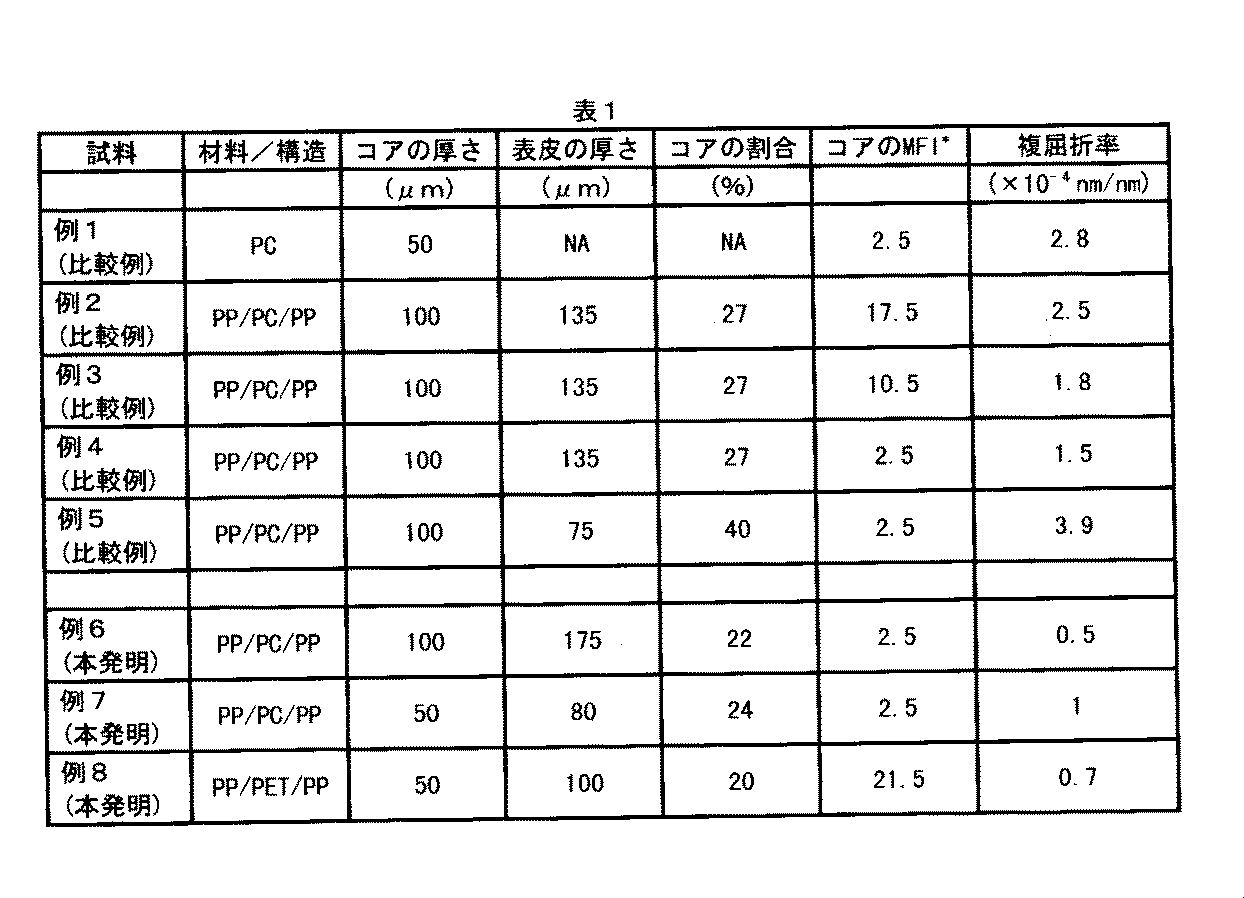
表1から、全てのPCフィルムが、可剥性層なしに押出された場合(例1)には、複屈折のレベルが望ましいレベルを十分に超えたことが判る。可剥性層を有するPCコア層の場合(それらの例では可剥性層はPP)、MFIが2.5でコア層の厚さ比が十分に低い場合にだけ望ましい複屈折レベル(1×10⁻⁴nm/nm以下)が達成された。例8のPETコア試料は、コア層の割合が40%未満であり、そしてMFIがPETとしてはそのような値を達成するのに十分に低いために、望ましいレベルの複屈折を達成した。高いMFIを有するPETの場合に、複屈折のレベルは望ましくないレベルに増加することが予想される。 From Table 1, it can be seen that when all PC films were extruded without the peelable layer (Example 1), the level of birefringence was well above the desired level. In the case of a PC core layer with a peelable layer (in those examples the peelable layer is PP), the birefringence level (1 ×) is desired only if the MFI is 2.5 and the core layer thickness ratio is low enough 10 −4 nm / nm or less) was achieved. The PET core sample of Example 8 achieved the desired level of birefringence because the core layer fraction was less than 40% and the MFI was low enough to achieve such values for PET. In the case of PET with a high MFI, the level of birefringence is expected to increase to an undesirable level.
本発明の態様には、以下に示す態様が含まれる。
透明なポリマー内部層が25〜250μm、望ましくは75〜125μmの厚さを有する態様;
2層の可剥性ポリマー外層が加工助剤を含む態様;
2層の可剥性ポリマー外層が可塑剤又は粘着防止剤を含む態様;
透明なポリマー内部層が加工助剤、粘着防止剤、剥離剤、滑剤又はスリップ剤を含む態様;及び
2層の可剥性ポリマー外層が同じ又は異なる組成を有する態様。
Embodiments of the present invention include the following embodiments.
An embodiment in which the transparent polymer inner layer has a thickness of 25 to 250 μm, desirably 75 to 125 μm;
An embodiment wherein the two peelable polymer outer layers comprise a processing aid;
An embodiment wherein the two peelable polymer outer layers comprise a plasticizer or an anti-tacking agent;
An embodiment in which the transparent polymer inner layer contains a processing aid, an anti-blocking agent, a release agent, a lubricant or a slip agent; and an embodiment in which the two peelable polymer outer layers have the same or different compositions.
上記の内部層フィルムを含む光学装置、光学式読取記憶装置、例えばCD又はDVDも考えられる。
本明細書で引用した特許文献及び他の刊行物の全内容は、引用によりここに含まれていることにする。
Also conceivable are optical devices, optical reading and storage devices such as CDs or DVDs comprising the inner layer film described above.
The entire contents of the patent documents and other publications cited herein are hereby incorporated by reference.
Claims (16)
前記内部コア層が主にポリカーボネートを含んで成り、1×10⁻⁴nm/nm以下の複屈折率を達成するために2.5以下のメルトフローインデックス値を示し、かつ、厚みが全フィルム厚の40%未満の割合であることを特徴とする同時押出フィルム。 Comprising one transparent polymer inner core layer less than 250 μm thick and two peelable polymer outer layers;
The inner core layer mainly comprises polycarbonate , exhibits a melt flow index value of 2.5 or less in order to achieve a birefringence of 1 × 10 −4 nm / nm or less, and the thickness is the total film thickness A coextruded film characterized by a ratio of less than 40%.
前記内部コア層が主にポリエステルを含んで成り、1×10⁻⁴nm/nm以下の複屈折率を達成するために22.0以下のメルトフローインデックス値を示し、かつ、厚みが全フィルム厚の40%未満の割合であることを特徴とする同時押出フィルム。 Comprising one transparent polymer inner core layer less than 250 μm thick and two peelable polymer outer layers;
The inner core layer mainly comprises polyester , exhibits a melt flow index value of 22.0 or less in order to achieve a birefringence of 1 × 10 −4 nm / nm or less, and the thickness is the total film thickness A coextruded film characterized by a ratio of less than 40%.
前記内部層が主にポリカーボネートを含んで成り、1×10⁻⁴nm/nm以下の複屈折率を達成するために2.5以下のメルトフローインデックス値を示し、かつ、厚みが全フィルム厚の40%未満の割合であるフィルムを同時押出することを含む低複屈折層を形成する方法。 Comprising one transparent polymer inner layer less than 250 μm thick and two peelable polymer outer layers,
The inner layer mainly comprises polycarbonate , exhibits a melt flow index value of 2.5 or less in order to achieve a birefringence of 1 × 10 −4 nm / nm or less, and the thickness is the total film thickness A method of forming a low birefringent layer comprising coextruding a film having a proportion of less than 40%.
前記内部層が主にポリエステルを含んで成り、1×10⁻⁴nm/nm以下の複屈折率を達成するために22.0以下のメルトフローインデックス値を示し、かつ、厚みが全フィルム厚の40%未満の割合であるフィルムを同時押出することを含む低複屈折層を形成する方法。 Comprising one transparent polymer inner layer less than 250 μm thick and two peelable polymer outer layers,
The inner layer mainly comprises polyester , exhibits a melt flow index value of 22.0 or less in order to achieve a birefringence of 1 × 10 −4 nm / nm or less, and the thickness is the total film thickness A method of forming a low birefringent layer comprising coextruding a film having a proportion of less than 40%.
Applications Claiming Priority (1)
| Application Number | Priority Date | Filing Date | Title |
|---|---|---|---|
| US10/328,343 US6808780B2 (en) | 2002-12-23 | 2002-12-23 | Low birefringence film |
Publications (2)
| Publication Number | Publication Date |
|---|---|
| JP2004203050A JP2004203050A (en) | 2004-07-22 |
| JP4472980B2 true JP4472980B2 (en) | 2010-06-02 |
Family
ID=32469013
Family Applications (1)
| Application Number | Title | Priority Date | Filing Date |
|---|---|---|---|
| JP2003427545A Expired - Fee Related JP4472980B2 (en) | 2002-12-23 | 2003-12-24 | Coextruded film |
Country Status (4)
| Country | Link |
|---|---|
| US (1) | US6808780B2 (en) |
| EP (1) | EP1433586A1 (en) |
| JP (1) | JP4472980B2 (en) |
| CN (1) | CN100480019C (en) |
Families Citing this family (6)
| Publication number | Priority date | Publication date | Assignee | Title |
|---|---|---|---|---|
| EP1816164A4 (en) * | 2003-11-25 | 2008-01-02 | Asahi Kasei Life & Living Corp | MAT FILM |
| DE102005020424A1 (en) * | 2005-04-29 | 2006-11-02 | Röhm Gmbh | Thermoplastic plastic foil production as a liquid crystal screen, comprises placing the plastic in an extrusion equipment containing an extruder for melting the plastic, and transferring the melt web into a chill roll for cooling the melt |
| CN103562263B (en) * | 2011-05-12 | 2015-05-27 | 沙特基础全球技术有限公司 | Amorphous polycarbonate film for capacitors, method of making, and articles made therefrom |
| US9720155B2 (en) | 2014-05-02 | 2017-08-01 | Sabic Global Technologies | Multilayered articles with low optical retardation |
| JP6578711B2 (en) * | 2015-04-03 | 2019-09-25 | 三菱ケミカル株式会社 | LAMINATED FILM, ITS MANUFACTURING METHOD, POLARIZER PROTECTIVE FILM MANUFACTURING METHOD, POLARIZING PLATE MANUFACTURING METHOD, AND LIQUID CRYSTAL DISPLAY DEVICE |
| JP6578723B2 (en) * | 2015-04-20 | 2019-09-25 | 三菱ケミカル株式会社 | Laminated film and polarizing plate protective film obtained therefrom |
Family Cites Families (15)
| Publication number | Priority date | Publication date | Assignee | Title |
|---|---|---|---|---|
| US3476627A (en) | 1966-04-12 | 1969-11-04 | Du Pont | Process for coextruding multiple-layered thermoplastic sheeting |
| US3557265A (en) | 1967-12-29 | 1971-01-19 | Dow Chemical Co | Method of extruding laminates |
| JPS6031673B2 (en) * | 1977-04-15 | 1985-07-23 | 東レ株式会社 | Three layer laminated polypropylene film |
| US4336012A (en) | 1980-10-20 | 1982-06-22 | The Standard Oil Company | Coextrusion device |
| US4410587A (en) | 1982-07-06 | 1983-10-18 | Conwed Corporation | Co-extruded fusible net |
| US4617207A (en) | 1983-08-15 | 1986-10-14 | Mitsui Toatsu Chemicals, Incorporated | Thermoplastic resin sheet |
| JPS60184821A (en) * | 1984-03-05 | 1985-09-20 | Mitsui Toatsu Chem Inc | Optically non-anisotropic thermoplastic resin sheet |
| JP2539382B2 (en) * | 1986-07-28 | 1996-10-02 | 住友ベークライト株式会社 | Liquid crystal film manufacturing method |
| JP2505473B2 (en) * | 1987-07-02 | 1996-06-12 | 東レ株式会社 | Optical recording medium |
| US5075060A (en) * | 1988-11-16 | 1991-12-24 | Canon Kabushiki Kaisha | Process for producing a substrate sheet for an optical recording medium |
| JPH1067082A (en) * | 1996-08-28 | 1998-03-10 | Teijin Ltd | Multi-layer stretched film |
| US6638637B2 (en) * | 2000-02-16 | 2003-10-28 | 3M Innovative Properties Company | Oriented multilayer polyolefin films |
| JP2002166459A (en) * | 2000-12-01 | 2002-06-11 | Toray Ind Inc | Method for producing thermoplastic resin film, thermoplastic resin film and liquid crystal display element substrate |
| US6773649B2 (en) * | 2001-02-16 | 2004-08-10 | General Electric Company | Film extrusion process for producing thermoplastic film |
| JP2002283429A (en) * | 2001-03-26 | 2002-10-03 | Niwa Takashi | Method for manufacturing acrylic film |
-
2002
- 2002-12-23 US US10/328,343 patent/US6808780B2/en not_active Expired - Lifetime
-
2003
- 2003-12-11 EP EP20030078935 patent/EP1433586A1/en not_active Withdrawn
- 2003-12-23 CN CNB2003101231486A patent/CN100480019C/en not_active Expired - Fee Related
- 2003-12-24 JP JP2003427545A patent/JP4472980B2/en not_active Expired - Fee Related
Also Published As
| Publication number | Publication date |
|---|---|
| JP2004203050A (en) | 2004-07-22 |
| CN100480019C (en) | 2009-04-22 |
| CN1509859A (en) | 2004-07-07 |
| US6808780B2 (en) | 2004-10-26 |
| EP1433586A1 (en) | 2004-06-30 |
| US20040121174A1 (en) | 2004-06-24 |
Similar Documents
| Publication | Publication Date | Title |
|---|---|---|
| CN101678641B (en) | Laminated film for optical parts | |
| WO2007141899A1 (en) | Polycarbonate resin film and method for production thereof | |
| JP2013525136A (en) | Non-flattened film and manufacturing process thereof | |
| JP4472980B2 (en) | Coextruded film | |
| JP2001243658A (en) | Plastic film and wound layer for transparent protective layer of optical disk | |
| JP2001506767A (en) | Peelable thermoplastic skin layer | |
| KR100854605B1 (en) | Wound laminate | |
| JP2001243659A (en) | Method of manufacturing plastic film roll and optical disk | |
| JP6877456B2 (en) | Films, winders and adhesive tapes | |
| US5458964A (en) | Biaxially oriented film comprising organic particles | |
| JP2000112133A (en) | Photoresist cover film for photosensitive plate | |
| JP4526214B2 (en) | Easy peelable laminated film | |
| JPH05189747A (en) | Base film for digital compact cassette | |
| JP2024139033A (en) | Optical film with processing film, roll, method for producing optical film with processing film, method for producing processing film | |
| JP4805608B2 (en) | Biaxially oriented laminated film and magnetic recording medium | |
| JP2002226610A (en) | Polypropylene release film | |
| CN1128712C (en) | Flakes From Multilayer iridescent films for use in paints and coatings | |
| JP4220933B2 (en) | Biaxially oriented laminated film and magnetic recording medium | |
| EP0256554A2 (en) | Plastic substrate for optical memory card or disk | |
| JP2009241487A (en) | Surface protective film | |
| JP2953030B2 (en) | Laminated film | |
| JP5226597B2 (en) | Biaxially oriented laminated film | |
| JPH02178016A (en) | Liquid crystalline polymer film and manufacture thereof | |
| JP2011243240A (en) | Biaxially-oriented laminated film | |
| JP4978155B2 (en) | IC card or IC tag manufacturing method |
Legal Events
| Date | Code | Title | Description |
|---|---|---|---|
| A621 | Written request for application examination |
Free format text: JAPANESE INTERMEDIATE CODE: A621 Effective date: 20061122 |
|
| A711 | Notification of change in applicant |
Free format text: JAPANESE INTERMEDIATE CODE: A711 Effective date: 20070119 |
|
| RD03 | Notification of appointment of power of attorney |
Free format text: JAPANESE INTERMEDIATE CODE: A7423 Effective date: 20070122 |
|
| A521 | Request for written amendment filed |
Free format text: JAPANESE INTERMEDIATE CODE: A821 Effective date: 20070119 |
|
| A521 | Request for written amendment filed |
Free format text: JAPANESE INTERMEDIATE CODE: A523 Effective date: 20070129 |
|
| RD04 | Notification of resignation of power of attorney |
Free format text: JAPANESE INTERMEDIATE CODE: A7424 Effective date: 20070205 |
|
| A977 | Report on retrieval |
Free format text: JAPANESE INTERMEDIATE CODE: A971007 Effective date: 20090528 |
|
| A131 | Notification of reasons for refusal |
Free format text: JAPANESE INTERMEDIATE CODE: A131 Effective date: 20090604 |
|
| A521 | Request for written amendment filed |
Free format text: JAPANESE INTERMEDIATE CODE: A523 Effective date: 20090727 |
|
| RD03 | Notification of appointment of power of attorney |
Free format text: JAPANESE INTERMEDIATE CODE: A7423 Effective date: 20090727 |
|
| A131 | Notification of reasons for refusal |
Free format text: JAPANESE INTERMEDIATE CODE: A131 Effective date: 20091110 |
|
| A521 | Request for written amendment filed |
Free format text: JAPANESE INTERMEDIATE CODE: A523 Effective date: 20100105 |
|
| TRDD | Decision of grant or rejection written | ||
| A01 | Written decision to grant a patent or to grant a registration (utility model) |
Free format text: JAPANESE INTERMEDIATE CODE: A01 Effective date: 20100302 |
|
| A01 | Written decision to grant a patent or to grant a registration (utility model) |
Free format text: JAPANESE INTERMEDIATE CODE: A01 |
|
| A61 | First payment of annual fees (during grant procedure) |
Free format text: JAPANESE INTERMEDIATE CODE: A61 Effective date: 20100304 |
|
| FPAY | Renewal fee payment (event date is renewal date of database) |
Free format text: PAYMENT UNTIL: 20130312 Year of fee payment: 3 |
|
| R150 | Certificate of patent or registration of utility model |
Ref document number: 4472980 Country of ref document: JP Free format text: JAPANESE INTERMEDIATE CODE: R150 Free format text: JAPANESE INTERMEDIATE CODE: R150 |
|
| FPAY | Renewal fee payment (event date is renewal date of database) |
Free format text: PAYMENT UNTIL: 20160312 Year of fee payment: 6 |
|
| R250 | Receipt of annual fees |
Free format text: JAPANESE INTERMEDIATE CODE: R250 |
|
| R250 | Receipt of annual fees |
Free format text: JAPANESE INTERMEDIATE CODE: R250 |
|
| R250 | Receipt of annual fees |
Free format text: JAPANESE INTERMEDIATE CODE: R250 |
|
| R250 | Receipt of annual fees |
Free format text: JAPANESE INTERMEDIATE CODE: R250 |
|
| R250 | Receipt of annual fees |
Free format text: JAPANESE INTERMEDIATE CODE: R250 |
|
| LAPS | Cancellation because of no payment of annual fees |