JP4391237B2 - Methods for ligand discovery - Google Patents
Methods for ligand discovery Download PDFInfo
- Publication number
- JP4391237B2 JP4391237B2 JP2003547631A JP2003547631A JP4391237B2 JP 4391237 B2 JP4391237 B2 JP 4391237B2 JP 2003547631 A JP2003547631 A JP 2003547631A JP 2003547631 A JP2003547631 A JP 2003547631A JP 4391237 B2 JP4391237 B2 JP 4391237B2
- Authority
- JP
- Japan
- Prior art keywords
- target
- ligand
- compound
- elongation factor
- group
- Prior art date
- Legal status (The legal status is an assumption and is not a legal conclusion. Google has not performed a legal analysis and makes no representation as to the accuracy of the status listed.)
- Expired - Fee Related
Links
- 0 *CCNC(*)=O Chemical compound *CCNC(*)=O 0.000 description 4
Images

Classifications
-
- C—CHEMISTRY; METALLURGY
- C40—COMBINATORIAL TECHNOLOGY
- C40B—COMBINATORIAL CHEMISTRY; LIBRARIES, e.g. CHEMICAL LIBRARIES
- C40B40/00—Libraries per se, e.g. arrays, mixtures
- C40B40/04—Libraries containing only organic compounds
-
- C—CHEMISTRY; METALLURGY
- C07—ORGANIC CHEMISTRY
- C07D—HETEROCYCLIC COMPOUNDS
- C07D207/00—Heterocyclic compounds containing five-membered rings not condensed with other rings, with one nitrogen atom as the only ring hetero atom
- C07D207/46—Heterocyclic compounds containing five-membered rings not condensed with other rings, with one nitrogen atom as the only ring hetero atom with hetero atoms directly attached to the ring nitrogen atom
-
- C—CHEMISTRY; METALLURGY
- C07—ORGANIC CHEMISTRY
- C07D—HETEROCYCLIC COMPOUNDS
- C07D333/00—Heterocyclic compounds containing five-membered rings having one sulfur atom as the only ring hetero atom
- C07D333/02—Heterocyclic compounds containing five-membered rings having one sulfur atom as the only ring hetero atom not condensed with other rings
- C07D333/04—Heterocyclic compounds containing five-membered rings having one sulfur atom as the only ring hetero atom not condensed with other rings not substituted on the ring sulphur atom
- C07D333/26—Heterocyclic compounds containing five-membered rings having one sulfur atom as the only ring hetero atom not condensed with other rings not substituted on the ring sulphur atom with hetero atoms or with carbon atoms having three bonds to hetero atoms with at the most one bond to halogen, e.g. ester or nitrile radicals, directly attached to ring carbon atoms
- C07D333/38—Carbon atoms having three bonds to hetero atoms with at the most one bond to halogen, e.g. ester or nitrile radicals
-
- C—CHEMISTRY; METALLURGY
- C07—ORGANIC CHEMISTRY
- C07D—HETEROCYCLIC COMPOUNDS
- C07D333/00—Heterocyclic compounds containing five-membered rings having one sulfur atom as the only ring hetero atom
- C07D333/50—Heterocyclic compounds containing five-membered rings having one sulfur atom as the only ring hetero atom condensed with carbocyclic rings or ring systems
- C07D333/52—Benzo[b]thiophenes; Hydrogenated benzo[b]thiophenes
- C07D333/62—Benzo[b]thiophenes; Hydrogenated benzo[b]thiophenes with hetero atoms or with carbon atoms having three bonds to hetero atoms with at the most one bond to halogen, e.g. ester or nitrile radicals, directly attached to carbon atoms of the hetero ring
- C07D333/68—Carbon atoms having three bonds to hetero atoms with at the most one bond to halogen
- C07D333/70—Carbon atoms having three bonds to hetero atoms with at the most one bond to halogen attached in position 2
-
- C—CHEMISTRY; METALLURGY
- C07—ORGANIC CHEMISTRY
- C07D—HETEROCYCLIC COMPOUNDS
- C07D401/00—Heterocyclic compounds containing two or more hetero rings, having nitrogen atoms as the only ring hetero atoms, at least one ring being a six-membered ring with only one nitrogen atom
- C07D401/02—Heterocyclic compounds containing two or more hetero rings, having nitrogen atoms as the only ring hetero atoms, at least one ring being a six-membered ring with only one nitrogen atom containing two hetero rings
- C07D401/04—Heterocyclic compounds containing two or more hetero rings, having nitrogen atoms as the only ring hetero atoms, at least one ring being a six-membered ring with only one nitrogen atom containing two hetero rings directly linked by a ring-member-to-ring-member bond
-
- C—CHEMISTRY; METALLURGY
- C07—ORGANIC CHEMISTRY
- C07D—HETEROCYCLIC COMPOUNDS
- C07D405/00—Heterocyclic compounds containing both one or more hetero rings having oxygen atoms as the only ring hetero atoms, and one or more rings having nitrogen as the only ring hetero atom
- C07D405/02—Heterocyclic compounds containing both one or more hetero rings having oxygen atoms as the only ring hetero atoms, and one or more rings having nitrogen as the only ring hetero atom containing two hetero rings
- C07D405/12—Heterocyclic compounds containing both one or more hetero rings having oxygen atoms as the only ring hetero atoms, and one or more rings having nitrogen as the only ring hetero atom containing two hetero rings linked by a chain containing hetero atoms as chain links
-
- C—CHEMISTRY; METALLURGY
- C40—COMBINATORIAL TECHNOLOGY
- C40B—COMBINATORIAL CHEMISTRY; LIBRARIES, e.g. CHEMICAL LIBRARIES
- C40B20/00—Methods specially adapted for identifying library members
- C40B20/08—Direct analysis of the library members per se by physical methods, e.g. spectroscopy
-
- C—CHEMISTRY; METALLURGY
- C40—COMBINATORIAL TECHNOLOGY
- C40B—COMBINATORIAL CHEMISTRY; LIBRARIES, e.g. CHEMICAL LIBRARIES
- C40B30/00—Methods of screening libraries
- C40B30/04—Methods of screening libraries by measuring the ability to specifically bind a target molecule, e.g. antibody-antigen binding, receptor-ligand binding
-
- G—PHYSICS
- G01—MEASURING; TESTING
- G01N—INVESTIGATING OR ANALYSING MATERIALS BY DETERMINING THEIR CHEMICAL OR PHYSICAL PROPERTIES
- G01N33/00—Investigating or analysing materials by specific methods not covered by groups G01N1/00 - G01N31/00
- G01N33/48—Biological material, e.g. blood, urine; Haemocytometers
- G01N33/50—Chemical analysis of biological material, e.g. blood, urine; Testing involving biospecific ligand binding methods; Immunological testing
- G01N33/68—Chemical analysis of biological material, e.g. blood, urine; Testing involving biospecific ligand binding methods; Immunological testing involving proteins, peptides or amino acids
- G01N33/6803—General methods of protein analysis not limited to specific proteins or families of proteins
- G01N33/6845—Methods of identifying protein-protein interactions in protein mixtures
Landscapes
- Chemical & Material Sciences (AREA)
- Organic Chemistry (AREA)
- Life Sciences & Earth Sciences (AREA)
- Health & Medical Sciences (AREA)
- Molecular Biology (AREA)
- Engineering & Computer Science (AREA)
- Biochemistry (AREA)
- Medicinal Chemistry (AREA)
- Chemical Kinetics & Catalysis (AREA)
- Immunology (AREA)
- Physics & Mathematics (AREA)
- General Chemical & Material Sciences (AREA)
- General Health & Medical Sciences (AREA)
- Analytical Chemistry (AREA)
- Hematology (AREA)
- Urology & Nephrology (AREA)
- Biomedical Technology (AREA)
- Pathology (AREA)
- Biotechnology (AREA)
- Food Science & Technology (AREA)
- Bioinformatics & Computational Biology (AREA)
- Proteomics, Peptides & Aminoacids (AREA)
- General Physics & Mathematics (AREA)
- Microbiology (AREA)
- Bioinformatics & Cheminformatics (AREA)
- Cell Biology (AREA)
- Biophysics (AREA)
- Spectroscopy & Molecular Physics (AREA)
- Peptides Or Proteins (AREA)
- Investigating Or Analysing Biological Materials (AREA)
- Medicines Containing Antibodies Or Antigens For Use As Internal Diagnostic Agents (AREA)
- Heterocyclic Carbon Compounds Containing A Hetero Ring Having Oxygen Or Sulfur (AREA)
- Other Investigation Or Analysis Of Materials By Electrical Means (AREA)
- Medicines That Contain Protein Lipid Enzymes And Other Medicines (AREA)
- Organic Low-Molecular-Weight Compounds And Preparation Thereof (AREA)
Description
(背景)
薬物発見プロセスは、通常、引き続く医化学最適化のための適度な親和性リード(lead)を同定するための、化合物ライブラリーの大規模な機能的スクリーニングで開始する。しかし、目的の標的の全てがこのようなスクリーニングに耐えられるわけではない。いくつかの場合において、ハイスループットスクリーニングに耐えられるアッセイが、利用可能ではない。他の場合において、標的は、複数の結合様式を有し得、その結果、このようなスクリーニングの結果が曖昧であり、そして解釈が困難である。なお他の場合において、ハイスループットアッセイのためのアッセイ条件は、人為結果を受けやすいようなものである。その結果、必ずしも機能的スクリーニングに依存しない、リガンドの発見のための代替の方法が必要とされる。
(background)
The drug discovery process usually begins with a large-scale functional screening of a compound library to identify moderate affinity leads for subsequent medicinal chemistry optimization. However, not all targets of interest can withstand such screening. In some cases, no assay that can withstand high-throughput screening is available. In other cases, the target may have multiple binding modes, so that the results of such screening are ambiguous and difficult to interpret. In still other cases, assay conditions for high throughput assays are such that they are susceptible to artifacts. As a result, alternative methods for ligand discovery are needed that do not necessarily rely on functional screening.
(発明の要旨)
本発明は、結合技術を使用する、リガンド発見のための方法に関する。
(Summary of the Invention)
The present invention relates to a method for ligand discovery using binding techniques.
1つの局面において、本発明は、以下: In one aspect, the present invention provides the following:
mは、0、1、または2であり;そして
nは、1または2である。
m is 0, 1, or 2; and n is 1 or 2.
特定の実施形態において、この標的は、ポリペプチドまたタンパク質であり、これは例えば、酵素、レセプター、転写因子、レセプターに対するリガンド、増殖因子、サイトカイン、免疫グロブリン、核タンパク質、シグナル伝達成分、およびアロステリック酵素調節因子からなる群より選択され得る。−S−S−結合と標的化合物との間の共有結合は、可逆的であっても非可逆的であってもよい。 In certain embodiments, the target is a polypeptide or protein, such as an enzyme, receptor, transcription factor, ligand for the receptor, growth factor, cytokine, immunoglobulin, nucleoprotein, signaling component, and allosteric enzyme. It can be selected from the group consisting of modulators. The covalent bond between the —S—S— bond and the target compound may be reversible or irreversible.
別の局面において、本発明は、各メンバーが以下: In another aspect, the invention provides that each member has the following:
このライブラリーは、好ましくは、少なくとも約5のメンバー、より好ましくは、少なくとも約100のメンバーを有し、そしてこのライブラリーの個々のメンバーの原子質量は、好ましくは、少なくとも約5原子質量単位、より好ましくは、少なくとも約10原子質量単位異なる。 The library preferably has at least about 5 members, more preferably at least about 100 members, and the atomic mass of individual members of the library is preferably at least about 5 atomic mass units, More preferably, it differs by at least about 10 atomic mass units.
さらなる局面において、本発明は、以下を包含する方法に関する:
a)標的タンパク質に結合する、式RDSSR1の第一の化合物を同定する工程;
b)標的タンパク質に結合する、式RESSR1の第二の化合物を同定する工程;および
c)RDおよびREを含む結合体化合物を形成する工程であって、ここで、RDおよびR1は、各々独立して、C1〜C20の非置換脂肪族、C1〜C20の置換脂肪族、非置換アリール、および置換アリールであり;そしてR1は、非置換C1〜C10脂肪族、置換C1〜C10脂肪族、非置換アリールである。この方法の特定の実施形態において、標的に結合する第二の化合物の同定は、第一の化合物の存在下で行われる。
In a further aspect, the present invention relates to a method comprising:
a) identifying a first compound of formula R D SSR 1 that binds to the target protein;
b) identifying a second compound of formula R E SSR 1 that binds to the target protein; and c) forming a conjugate compound comprising R D and R E , wherein R D and R 1 is each independently C 1 -C 20 unsubstituted aliphatic, C 1 -C 20 substituted aliphatic, unsubstituted aryl, and substituted aryl; and R 1 is unsubstituted C 1- C 10 aliphatic, substituted C 1 -C 10 aliphatic, unsubstituted aryl. In certain embodiments of this method, identification of the second compound that binds to the target is performed in the presence of the first compound.
別の実施形態において、RDSSR1およびRESSR1は、各々独立して、以下: In another embodiment, R D SSR 1 and R E SSR 1 are each independently the following:
mは、0、1、または2であり;そして
nは、1または2である。
m is 0, 1, or 2; and n is 1 or 2.
なおさらなる局面において、本発明は、以下を包含する方法に関する:
a)目的の部位またはその近くで共有結合を形成し得るか、または金属に配位し得る、アンカー基を有する標的を提供する工程;
b)この標的を伸長因子と接触させて、これによって、標的−伸長因子複合体を形成する工程であって、ここで、この伸長因子は、共有結合を形成するかまたは金属に配位するかのいずれかである、第一の官能基、および共有結合を形成し得る第二の官能基を含む、工程;
c)この標的−伸長因子複合体を、第二の官能基と共有結合を形成し得る基を含む候補リガンドと接触させる工程;
d)標的伸長因子複合体と候補リガンドとの間で、共有結合を形成させる工程;ならびに
e)標的−伸長因子−リガンド結合体中に存在する、候補リガンドを同定する工程。
In yet a further aspect, the present invention relates to a method comprising:
a) providing a target with an anchor group that can form a covalent bond at or near the site of interest or can coordinate to a metal;
b) contacting the target with an elongation factor, thereby forming a target-elongation factor complex, wherein the elongation factor forms a covalent bond or coordinates to a metal A process comprising a first functional group and a second functional group capable of forming a covalent bond;
c) contacting the target-elongation agent complex with a candidate ligand comprising a group capable of forming a covalent bond with a second functional group;
d) forming a covalent bond between the target elongation factor complex and the candidate ligand; and e) identifying the candidate ligand present in the target-elongation factor-ligand conjugate.
この方法の特定の実施形態において、アンカー基は、反応性求電子基、反応性求核基、および金属配位部位からなる群より選択される。 In certain embodiments of this method, the anchor group is selected from the group consisting of a reactive electrophilic group, a reactive nucleophilic group, and a metal coordination site.
本発明はまた、以下を包含する方法に関する:
a)反応性の求核基を、目的の部位またはその近くに有する標的を提供する工程;
b)この標的を伸長因子と接触させて、これによって、標的−伸長因子複合体を形成する工程であって、ここで、この伸長因子は、標的における求核基と反応して共有結合を形成する、第一の官能基、およびジスルフィド結合を形成し得る、第二の官能基を含む、工程;
c)この標的−伸長因子複合体を、ジスルフィド結合を形成し得るリガンド候補物と接触させる工程;
d)標的−伸長因子複合体とリガンド候補物との間でジスルフィド結合を形成する工程であって、これによって、標的−伸長因子−リガンド結合体を形成する、工程;ならびに
e)この標的−伸長因子−リガンド結合体中に存在する、リガンド候補物を同定する工程。
The present invention also relates to a method comprising:
a) providing a target having a reactive nucleophilic group at or near the site of interest;
b) contacting the target with an elongation factor, thereby forming a target-elongation factor complex, wherein the elongation factor reacts with a nucleophilic group at the target to form a covalent bond. Including a first functional group and a second functional group capable of forming a disulfide bond;
c) contacting the target-elongation factor complex with a ligand candidate capable of forming a disulfide bond;
d) forming a disulfide bond between the target-elongation factor complex and the ligand candidate, thereby forming a target-elongation factor-ligand conjugate; and e) the target-elongation Identifying candidate ligands present in the factor-ligand conjugate.
標的における反応性求核基は、例えば、チオールまたはマスクされたチオールであり得、そして伸長因子は、以下の式を有し得る: The reactive nucleophilic group at the target can be, for example, a thiol or a masked thiol, and the elongation factor can have the following formula:
特定の実施形態において、伸長因子は、以下の式のものである: In certain embodiments, the elongation factor is of the following formula:
異なる局面において、本発明は、タンパク質−伸長因子複合体に関し、ここで、このタンパク質は、伸長因子と共有結合を形成し、この伸長因子は、共有結合を形成し得る第一の官能基、および第二の共有結合を形成し得る第二の官能基を含む。 In a different aspect, the invention relates to a protein-elongation factor complex, wherein the protein forms a covalent bond with the elongation factor, the elongation factor being a first functional group capable of forming a covalent bond, and It includes a second functional group that can form a second covalent bond.
別の局面において、本発明は、タンパク質−伸長因子複合体に関し、ここで、このタンパク質は、伸長因子とともに金属に配位し、この伸長因子は、金属に配位し得る第一の官能基、および共有結合を形成し得る第二の官能基を含む。 In another aspect, the present invention relates to a protein-elongation factor complex, wherein the protein is coordinated to a metal with an elongation factor, the elongation factor being coordinated to the metal, a first functional group, And a second functional group capable of forming a covalent bond.
これらの複合体は、第二の官能基と、ジスルフィド結合を形成し得る化合物との間に、ジスルフィド結合をさらに含み得る。 These complexes can further comprise a disulfide bond between the second functional group and the compound capable of forming a disulfide bond.
(好ましい実施形態の説明)
本発明は、目的の標的における選択された部位に結合し得るリガンドを同定するための、迅速かつ効率的な方法を提供する。本明細書中の方法によって同定されるリガンド自体が、例えば、新規治療薬剤、酵素インヒビター、標識化合物、診断剤、タンパク質精製のための親和性薬剤などの開発のための、リード化合物としての用途を見出す。
(Description of Preferred Embodiment)
The present invention provides a rapid and efficient method for identifying ligands that can bind to selected sites in a target of interest. The ligands themselves identified by the methods herein may be used as lead compounds for the development of new therapeutic agents, enzyme inhibitors, labeled compounds, diagnostic agents, affinity agents for protein purification, etc. Find out.
他に定義されない限り、本明細書中で使用される技術用語および科学用語は、本発明が属する分野の当業者によって通常理解されるものと同じ意味を有する。Singletonら、Dictionary of Microbiology and Molecular Biology 第2版、J.Wiley & Sons(New York,NY 1994)、およびMarch,Advanced Organic Chemistry Reactions,Mechanisms and Structure 第4版、John Wiley & Sons(New York,NY 1992)のような参考文献は、当業者に、本願において使用される用語の多くの一般的指針を提供する。 Unless defined otherwise, technical and scientific terms used herein have the same meaning as commonly understood by one of ordinary skill in the art to which this invention belongs. Singleton et al., Dictionary of Microbiology and Molecular Biology, 2nd edition, J. Am. Wiley & Sons (New York, NY 1994) and March, Advanced Organic Chemistry Reactions, Machinery and Structure 4th edition, John Wiley & Sons 92 (Now) Provides many general guidelines for the terms used.
本発明の1つの局面において、化合物が提供される。明白にかまたは暗示的に他のように示されない限り、これらの化合物は、個々のエナンチオマー、ジアステレオマー、幾何異性体、またはこれらの混合物の形態であり得る。これらの化合物が二重結合を含む場合、これらの二重結合は、他のように示されない限り、ZまたはEのいずれか、あるいはその混合物であり得る。 In one aspect of the invention, compounds are provided. Unless expressly or implicitly indicated otherwise, these compounds may be in the form of individual enantiomers, diastereomers, geometric isomers, or mixtures thereof. Where these compounds contain double bonds, these double bonds can be either Z or E, or mixtures thereof, unless otherwise indicated.
(定義)
本明細書中で使用される用語の定義としては、以下が挙げられる:
用語「脂肪族」または「非置換脂肪族」とは、直鎖、分枝鎖、環状、または多環式の炭化水素をいい、そしてアルキル部分、アルケニル部分、アルキニル部分、シクロアルキル部分、シクロアルケニル部分、およびシクロアルキニル部分が挙げられる。
(Definition)
Definitions of terms used herein include the following:
The term “aliphatic” or “unsubstituted aliphatic” refers to a straight, branched, cyclic, or polycyclic hydrocarbon, and an alkyl, alkenyl, alkynyl, cycloalkyl, cycloalkenyl Moieties, and cycloalkynyl moieties.
用語「アルキル」または「非置換アルキル」とは、飽和炭化水素をいう。 The term “alkyl” or “unsubstituted alkyl” refers to a saturated hydrocarbon.
用語「アルケニル」または「非置換アルケニル」とは、少なくとも1つの炭素−炭素二重結合を有する炭化水素をいう。 The term “alkenyl” or “unsubstituted alkenyl” refers to a hydrocarbon having at least one carbon-carbon double bond.
用語「アルキニル」、または「非置換アルキニル」とは、少なくとも1つの炭素−炭素三重結合を有する炭化水素をいう。 The term “alkynyl” or “unsubstituted alkynyl” refers to a hydrocarbon having at least one carbon-carbon triple bond.
用語「アリール」または「非置換アリール」とは、少なくとも1つの芳香族環を有する、単環式または多環式の不飽和部分をいう。この用語は、1つ以上のヘテロ原子をその少なくとも1つの芳香族環内に含む、ヘテロアリールを包含する。アリールの代表的な例としては、以下が挙げられる:フェニル、ナフチル、テトラヒドロナフチル、インダニル、インデニル、ピリジル、ピラジニル、ピリミジニル、ピロリル、ピラゾリル、イミダゾリル、チアゾリル、オキサゾリル、イソオキサゾリル、チアジアゾリル、オキサジアゾリル、チオフェニル、フラニル、キノリニル、イソキノリニルなど。 The term “aryl” or “unsubstituted aryl” refers to a monocyclic or polycyclic unsaturated moiety having at least one aromatic ring. The term includes heteroaryls that contain one or more heteroatoms in its at least one aromatic ring. Representative examples of aryl include: phenyl, naphthyl, tetrahydronaphthyl, indanyl, indenyl, pyridyl, pyrazinyl, pyrimidinyl, pyrrolyl, pyrazolyl, imidazolyl, thiazolyl, oxazolyl, isoxazolyl, thiadiazolyl, oxadiazolyl, thiophenyl, furanyl , Quinolinyl, isoquinolinyl and the like.
用語「置換(された)」とは、部分を修飾するように使用される場合、少なくとも1つの水素原子が他の基で置換されている、その部分の置換されたバージョンをいい、この別の基としては、以下:脂肪族;アリール、アルキルアリール、F、Cl、I、Br、−OH;−NO2;−CN;−CF3;−CH2CF3;−CH2Cl;−CH2OH;−CH2CH2OH;−CH2NH2;−CH2SO2CH3;−ORX;−C(O)RX;−COORX;−C(O)N(RX)2;−OC(O)RX;−OCOORX;−OC(O)N(RX)2;−N(RX)2;−S(O)2RX;および−NRXC(O)RXが挙げられるが、これらに限定されず、ここで、各場合のRXは、独立して、水素、置換脂肪族、非置換脂肪族、置換アリール、または非置換アリールである。さらに、部分における隣接する基の置換は、一緒になって、環式基を形成し得る。 The term “substituted”, when used to modify a moiety, refers to a substituted version of that moiety in which at least one hydrogen atom is replaced with another group. the group, the following: aliphatic; aryl, alkylaryl, F, Cl, I, Br , -OH; -NO 2; -CN; -CF 3; -CH 2 CF 3; -CH 2 Cl; -CH 2 OH; -CH 2 CH 2 OH; -CH 2 NH 2; -CH 2 SO 2 CH 3; -OR X; -C (O) R X; -COOR X; -C (O) N (R X) 2 ; -OC (O) R X; -OCOOR X; -OC (O) N (R X) 2; -N (R X) 2; -S (O) 2 R X; and -NR X C (O) Although R X can be mentioned, but are not limited to, wherein, R X in each case independently, water , Substituted aliphatic, unsubstituted aliphatic, substituted aryl or unsubstituted aryl,. Furthermore, substitution of adjacent groups in the moieties can be taken together to form a cyclic group.
用語「アンタゴニスト」は、その最も広い意味で使用され、そして標的(例えばTBM)によって示される生物学的活性を、部分的にかまたは完全に、遮断するか、阻害するか、または中和する、任意のリガンドを包含する。類似の様式で、用語「アゴニスト」は、その最も広い意味で使用され、そして標的(例えば、TBM)によって示される生物学的活性を、例えば、このようなTBMの機能もしくは発現、またはこのようなTBMを介するシグナル伝達の効率を特異的に変化させ、これにより、すでに存在する生物学的活性を変化させる(増加もしくは阻害する)か、または新たな生物学的活性を誘発することによって模倣する、任意のリガンドを包含する。 The term “antagonist” is used in its broadest sense, and partially or completely blocks, inhibits, or neutralizes a biological activity exhibited by a target (eg, TBM). Includes any ligand. In a similar manner, the term “agonist” is used in its broadest sense and refers to the biological activity exhibited by a target (eg, TBM), eg, the function or expression of such TBM, or such Specifically altering the efficiency of signaling through the TBM, thereby changing (increasing or inhibiting) an already existing biological activity or mimicking a new biological activity, Includes any ligand.
用語「伸長因子」とは、約30〜約1,500ダルトンの分子量を有し、そして標的上の基と反応し得る第一の官能基、およびリガンド候補物またはリガンド候補物のライブラリーのメンバーと反応してジスルフィド結合を形成し得る第二の官能基を有する、分子をいう。 The term “elongation factor” refers to a first functional group having a molecular weight of about 30 to about 1,500 daltons and capable of reacting with a group on a target, and a member of a ligand candidate or library of ligand candidates. Refers to a molecule having a second functional group that can react with to form a disulfide bond.
用語「リガンド」とは、標的に対する測定可能な結合親和性を有する実体をいう。一般に、リガンドとは、約100mM以下、好ましくは約10mM以下、そしてより好ましくは約1mM以下のKdまたはKiで標的に結合する場合に、測定可能な親和性を有するといわれる。好ましい実施形態において、リガンドはペプチドではなく、そして低分子である。リガンドは、大きさが約2000ダルトン未満である場合、通常は大きさが約1500ダルトン未満である場合に、低分子である。より好ましい実施形態において、低分子リガンドは、大きさが約1000ダルトン未満、通常は大きさが約750ダルトン未満、そしてより通常には大きさが約500ダルトン未満である。 The term “ligand” refers to an entity having a measurable binding affinity for a target. In general, a ligand is said to have a measurable affinity when it binds to a target with a K d or K i of about 100 mM or less, preferably about 10 mM or less, and more preferably about 1 mM or less. In a preferred embodiment, the ligand is not a peptide and is a small molecule. A ligand is a small molecule if it is less than about 2000 daltons in size, and usually less than about 1500 daltons in size. In a more preferred embodiment, the small molecule ligand is less than about 1000 daltons in size, usually less than about 750 daltons, and more usually less than about 500 daltons in size.
伸長因子に関して、用語「結合決定基」とは、伸長因子の、標的(例えば、標的ポリペプチド)への結合に関与する部分に関する。 With respect to elongation factors, the term “binding determinant” relates to the portion of the elongation factor involved in binding to a target (eg, a target polypeptide).
用語「リガンド候補物」とは、標的上の相補的な基または適合性の反応性基と共有結合を形成し得る反応性基を有するか、またはこの反応性基を有するように修飾された化合物をいう。リガンド候補物または標的のいずれかにおける反応性基は、例えば、保護基でマスクされ得る。 The term “ligand candidate” refers to a compound that has or has been modified to have a reactive group capable of forming a covalent bond with a complementary or compatible reactive group on a target. Say. Reactive groups on either the ligand candidate or target can be masked with, for example, protecting groups.
用語「ポリヌクレオチド」とは、単数形または複数形で使用される場合、一般に、未修飾のRNAまたはDNAあるいは修飾されたRNAまたはDNAであり得る、任意のポリリボヌクレオチドまたはポリデオキシリボヌクレオチドをいう。従って、例として、本明細書中で定義されるようなポリヌクレオチドとしては、限定されないが、一本鎖DNAおよび二本鎖DNA、一本鎖領域および二本鎖領域を含むDNA、一本鎖RNAおよび二本鎖RNA、ならびに一本鎖領域および二本鎖領域を含むRNA、DNAおよびRNAを含むハイブリッド分子(これは、一本鎖であっても、より代表的には二本鎖であっても、一本鎖領域および二本鎖領域を含んでもよい)が挙げられる。さらに、用語「ポリヌクレオチド」とは、本明細書中において使用される場合、RNAまたはDNA、あるいはRNAとDNAとの両方を含む、三重鎖領域をいう。このような領域における鎖は、同じ分子由来であっても、異なる分子由来であってもよい。これらの領域は、その分子の1つ以上の全てを含み得るが、より代表的には、その分子のいくらかの領域のみを含む。三重らせん領域の分子の1つは、しばしば、オリゴヌクレオチドである。用語「ポリヌクレオチド」とは具体的には、1つ以上の修飾塩基を含むDNAおよびRNAを含む。従って、安定性または他の理由により修飾された骨格を有するDNAまたはRNAは、この用語が本明細書中で意図されるような「ポリヌクレオチド」である。さらに、通常でない塩基(例えば、イノシン)、あるいは修飾塩基(例えば、トリチル化塩基)を含むDNAまたはRNAは、本明細書中で定義されるような用語「ポリヌクレオチド」の範囲に含まれる。一般に、用語「ポリヌクレオチド」は、化学的、酵素的、および/または代謝的に修飾された形態の、全ての未修飾ポリヌクレオチド、ならびに種々のウイルスおよび細胞(単純な細胞および複雑な細胞を含む)に特徴的なDNAおよびRNAの化学的形態を包含する。 The term “polynucleotide”, when used in the singular or plural, generally refers to any polyribonucleotide or polydeoxyribonucleotide, which can be unmodified RNA or DNA or modified RNA or DNA. Thus, by way of example, polynucleotides as defined herein include, but are not limited to, single stranded and double stranded DNA, single stranded and double stranded DNA, single stranded RNA and double-stranded RNA, as well as RNA containing single-stranded and double-stranded regions, hybrid molecules containing DNA and RNA (this is more typically double-stranded, even single-stranded Or a single-stranded region and a double-stranded region may be included). Furthermore, the term “polynucleotide” as used herein refers to triple-stranded regions comprising RNA or DNA, or both RNA and DNA. The chains in such regions may be from the same molecule or from different molecules. These regions can include all of one or more of the molecule, but more typically include only some regions of the molecule. One of the molecules in the triple helix region is often an oligonucleotide. The term “polynucleotide” specifically includes DNA and RNA containing one or more modified bases. Thus, DNAs or RNAs with backbones modified for stability or for other reasons are “polynucleotides” as that term is intended herein. In addition, DNA or RNA containing unusual bases (eg, inosine) or modified bases (eg, tritylated bases) are included within the scope of the term “polynucleotide” as defined herein. In general, the term “polynucleotide” includes all unmodified polynucleotides in chemically, enzymatically and / or metabolically modified forms, as well as various viruses and cells, including simple and complex cells. And the chemical forms of DNA and RNA characteristic of
語句「保護(された)チオール」とは、本明細書中において使用される場合、基または分子と反応して、チオールの反応性を低くし、そして脱保護されて遊離チオールを再生し得る共有結合を形成した、チオールをいう。 The phrase “protected thiol” as used herein refers to a share that can react with a group or molecule to make the thiol less reactive and deprotected to regenerate the free thiol. A thiol that has formed a bond.
語句「可逆的共有結合」とは、本明細書中において使用される場合、好ましくは標的を変性しない条件下で破壊され得る、共有結合をいう。例としては、限定されないが、ジスルフィド、シッフ塩基、チオエステル、配位錯体、ボロネートエステルなどが挙げられる。 The phrase “reversible covalent bond” as used herein refers to a covalent bond that can be broken, preferably under conditions that do not denature the target. Examples include, but are not limited to, disulfides, Schiff bases, thioesters, coordination complexes, boronate esters, and the like.
語句「反応性基」とは、適合性の反応性基もしくは相補的な反応性基を提供される場合に共有結合が形成され得る部位を提供する、化学基または部分である。代表的な例は、他の−SHまたは−SS−と反応してジスルフィドを形成し得る−SH;活性化−COOHと反応してアミドを形成し得る−NH2;アルデヒドまたはケトンと反応してシッフ塩基を形成し得る−NH2などである。 The phrase “reactive group” is a chemical group or moiety that provides a site where a covalent bond can be formed when provided with a compatible reactive group or a complementary reactive group. Representative examples include, -SH may form a disulfide react with other -SH or -SS-; react with an aldehyde or ketone; -NH 2 capable of forming an amide by reacting with an activated -COOH and the like -NH 2 which can form a Schiff base.
語句「反応性求核基」とは、本明細書中において使用される場合、標的を変性も損傷もしない条件下で、別の分子上の適合性の官能基と共有結合を形成し得る求核基をいう。最も適切な求核基は、チオール、アルコール、およびアミンである。同様に、語句「反応性求電子基」とは、本明細書中において使用される場合、好ましくは、標的を変性も他に損傷もしない条件下で、別の分子上の適合性の官能基と共有結合を形成し得る求電子基をいう。最も適切な求電子基は、イミン、カルボニル、エポキシド、アジリジン(aziridie)、スルホネート、ジスルフィド、活性化エステル、活性化カルボニル、およびヘミアセタールである。 The phrase “reactive nucleophilic group” as used herein refers to a sought-after bond that can form a covalent bond with a compatible functional group on another molecule under conditions that do not denature or damage the target. Refers to a nuclear group. The most suitable nucleophilic groups are thiols, alcohols, and amines. Similarly, the phrase “reactive electrophilic group” as used herein is preferably a compatible functional group on another molecule under conditions that do not denature or otherwise damage the target. And an electrophilic group capable of forming a covalent bond. The most suitable electrophilic groups are imines, carbonyls, epoxides, aziridines, sulfonates, disulfides, activated esters, activated carbonyls, and hemiacetals.
語句「目的の部位」とは、リガンドが結合し得る標的上の任意の部位をいう。例えば、標的が酵素である場合、目的の部位としては、この酵素の結合基質、インヒビター、アクチベーター、補因子、またはアロステリックモジュレーターと接触するか、または約10オングストローム以内(より好ましくは、約5オングストローム以内)の位置にある、アミノ酸が挙げられ得る。酵素がプロテアーゼである場合、目的の部位としては、P6からP6’の基質結合チャネル、触媒機能に関与する残基(例えば、触媒性三つ組およびオキシアニオンホール)、ならびに任意の補因子(例えば、Znのような金属)結合部位が挙げられる。酵素がプロテインキナーゼである場合、目的の部位としては、ATP結合部位に加えて、基質結合チャネルが挙げられる。酵素がデヒドロゲナーゼである場合、目的の部位としては、基質結合領域およびNAD/NADHによって占められる部位が挙げられる。酵素がPDE4のような加水分解酵素(hydralase)である場合、目的の部位としては、cAMPと接触する残基、および触媒性二価陽イオンの結合に関与する残基が挙げられる。 The phrase “site of interest” refers to any site on the target to which a ligand can bind. For example, if the target is an enzyme, the site of interest may be contacted with a binding substrate, inhibitor, activator, cofactor, or allosteric modulator of the enzyme, or within about 10 angstroms (more preferably about 5 angstroms). An amino acid in the position (within) may be mentioned. When the enzyme is a protease, target sites include P6 to P6 ′ substrate binding channels, residues involved in catalytic function (eg, catalytic triads and oxyanion holes), and any cofactors (eg, Zn Metal) binding sites. When the enzyme is a protein kinase, the target site includes a substrate binding channel in addition to the ATP binding site. When the enzyme is a dehydrogenase, the target site includes a substrate binding region and a site occupied by NAD / NADH. When the enzyme is a hydrolase such as PDE4, the target site includes a residue that contacts cAMP and a residue involved in the binding of a catalytic divalent cation.
用語「標的」、「標的分子」および「TM」は、交換可能に、最も広い意味で使用され、そしてリガンドの結合がその標的の機能に対する影響を有する、化学実体または生物学的実体をいう。標的は、分子、分子の一部、または分子の凝集物であり得る。リガンドの結合は、可逆的であっても不可逆的であってもよい。標的分子の特定の例としては、ポリペプチドまたはタンパク質(例えば、酵素(システインプロテアーゼ、セリンプロテアーゼ、およびアスパルチルプロテアーゼのようなプロテアーゼが挙げられる))、レセプター、転写因子、レセプターに対するリガンド、増殖因子、サイトカイン、免疫グロブリン、核タンパク質、シグナル伝達成分(例えば、キナーゼ、ホスファターゼ)、アロステリック酵素調節因子など、ポリヌクレオチド、ペプチド、炭水化物、糖タンパク質、糖脂質、および他の高分子(例えば、核酸−タンパク質複合体、クロマチンまたはリボソーム、脂質二重層含有構造体(例えば、膜)、または膜由来の構造物(例えば、小胞))が挙げられる。この定義は、具体的に、以下に定義されるように、標的生物学的分子(「TBM」)を包含する。 The terms “target”, “target molecule” and “TM” are used interchangeably in the broadest sense and refer to a chemical or biological entity whose binding has an effect on the function of the target. A target can be a molecule, a part of a molecule, or an aggregate of molecules. Ligand binding may be reversible or irreversible. Specific examples of target molecules include polypeptides or proteins (eg, enzymes (including proteases such as cysteine protease, serine protease, and aspartyl protease)), receptors, transcription factors, ligands for receptors, growth factors, Cytokines, immunoglobulins, nucleoproteins, signaling components (eg, kinases, phosphatases), allosteric enzyme modulators, etc., polynucleotides, peptides, carbohydrates, glycoproteins, glycolipids, and other macromolecules (eg, nucleic acid-protein complexes) Body, chromatin or ribosome, lipid bilayer-containing structure (eg, membrane), or membrane-derived structure (eg, vesicle)). This definition specifically includes the target biological molecule (“TBM”), as defined below.
「標的生物学的分子」または「TBM」とは、本明細書中において使用される場合、単一の生物学的分子、または互いと生物学的に関連する複合体(これに対して、低分子のアゴニストまたはアンタゴニストが、TBMの機能に対する影響を有する)を形成し得る複数の生物学的分子をいう。好ましい実施形態において、TBMは、タンパク質またはその一部、あるいは2つ以上のアミノ酸を含み、そして相補的な反応性基を有する化合物と共有結合を形成し得る反応性基を有するかまたはこの反応性基を有するように改変され得るものである。TBMの代表的な例としては、以下が挙げられる:酵素、レセプター、転写因子、レセプターに対するリガンド、増殖因子、免疫グロブリン、核タンパク質、シグナル伝達成分、糖タンパク質、糖脂質、および他の高分子(例えば、核酸−タンパク質複合体、クロマチンまたはリボソーム)、脂質二重層含有構造体(例えば、膜)、あるいは膜由来の構造体(例えば、小胞)。標的は、種々の様式で得られ得、この様式としては、天然の供給源からの単離および精製、化学合成、組換え産生、ならびにこれらおよび類似の方法の任意の組み合わせが挙げられる。 “Target biological molecule” or “TBM” as used herein refers to a single biological molecule or a complex that is biologically related to each other (as opposed to low A plurality of biological molecules that can form an agonist or antagonist of a molecule that has an effect on the function of TBM). In a preferred embodiment, the TBM has or is reactive with a protein or portion thereof, or a reactive group that can form a covalent bond with a compound that has two or more amino acids and has a complementary reactive group. It can be modified to have a group. Representative examples of TBMs include: enzymes, receptors, transcription factors, ligands for receptors, growth factors, immunoglobulins, nucleoproteins, signaling components, glycoproteins, glycolipids, and other macromolecules ( For example, nucleic acid-protein complexes, chromatin or ribosomes), lipid bilayer-containing structures (eg, membranes), or membrane-derived structures (eg, vesicles). Targets can be obtained in a variety of ways, including isolation and purification from natural sources, chemical synthesis, recombinant production, and any combination of these and similar methods.
好ましいタンパク質標的としては、以下が挙げられる:細胞表面タンパク質および可溶性レセプタータンパク質(例えば、リンパ球細胞表面レセプター;酵素;プロテアーゼ(例えば、アルパルチルプロテアーゼ、システインプロテアーゼ、メタロプロテアーゼ、およびセリンプロテアーゼ);ステロイドレセプター;核タンパク質;アロステリック酵素;凝固因子;キナーゼ(セリン/スレオニンキナーゼおよびチロシンキナーゼ);ホスファターゼ(セリン/スレオニンホスファターゼ、チロシンホスファターゼ、および二重特異性ホスファターゼ、特に、PTP−1B、TC−PTPおよびLAR);チミジル酸シンターゼ;細菌酵素、真菌酵素およびウイルス酵素(特に、HIV、インフルエンザ、ライノウイルスおよびRSVと関連した酵素);シグナル伝達分子;転写因子;DNAおよび/またはRNAの合成または分解に関連するタンパク質または酵素;免疫グロブリン;ホルモン;および種々のサイトカインに対するレセプター。レセプターの例示的な例としては、例えば以下が挙げられる:エリトロポイエチン(EPO)、顆粒球コロニー刺激(G−CSF)レセプター、顆粒球マクロファージコロニー刺激(GM−CSF)レセプター、トロンボポイエチン(TPO)、インターロイキン(例えば、IL−2、IL−3、IL−4、IL−5、IL−6、IL−10、IL−11、IL−12)、成長ホルモン、プロラクチン、ヒト胎盤性ラクトゲン(LPL)、CNTF、オンコスタチン、RANTES、MIPb、IL−8、インスリン、インスリン様増殖因子1(IGF−1)、上皮増殖因子(EGF)、ヒレグリン−aおよびヒレグリン−b、血管内皮増殖因子(VEGF)、胎盤成長因子(PLGF)、組織成長因子(TGF−αおよびTGF−β)および神経成長因子(NGF)。他の標的としては、種々のニューロトロフィンおよびこれらのリガンド、他のホルモンおよびレセプター(例えば、骨形態形成因子、卵胞刺激ホルモン(FSH)、および黄体化ホルモン(LH)、CD40リガンド、アポトーシス因子−1およびアポトーシス因子−2(AP−1およびAP−2)、p53、bax/bcl2、mdm2、カスパーゼ(1、3、8および9)、カテプシン、IL−1/IL−1レセプター、BACE、HIVインテグラーゼ、PDE IV、C型肝炎ヘリカーゼ、C型肝炎プロテアーゼ、ライノウイルスプロテアーゼ、トリプターゼ、cPLA(細胞質ゾルホスホリパーゼA2)、CDK4、c−junキナーゼ、アダプター(例えば、Grb2、GSK−3,AKT、MEKK−1、PAK−1、raf、TRAF’s1−6、Tie2、ErbB 1および2)、FGF、PDGF、PARP、CD2、C5aレセプター、CD4、CD26、CD3、TGF−α、NF−kB、IKKβ、STAT 6、ニューロキニン−1、CD45、Cdc25A、SHIP−2、ヒトp53、bax/bcl2、IgE/IgER、ZAP−70、lck、syk、ITK/BTK、TACE、カテプシンS、KおよびF、CD11a、LFA/ICAM、VLA−4、CD28/B7、CTLA4、TNFαおよびTNFβ、(ならびにp55 TNFレセプターおよびp75 TNFレセプター)、CD40L、p38マップキナーゼ、IL−2、IL−4、Il−13、IL−15、Rac 2、PKCθ、IL−8,TAK−1、jnk、IKK2およびIL−18)が挙げられる。 Preferred protein targets include: cell surface proteins and soluble receptor proteins (eg, lymphocyte cell surface receptors; enzymes; proteases (eg, alpartyl protease, cysteine protease, metalloprotease, and serine protease); steroid receptors Nucleoprotein; allosteric enzyme; coagulation factor; kinase (serine / threonine kinase and tyrosine kinase); Thymidylate synthase; bacterial, fungal and viral enzymes (especially related to HIV, influenza, rhinovirus and RSV); Signaling enzymes; transcription factors; proteins or enzymes involved in the synthesis or degradation of DNA and / or RNA; immunoglobulins; hormones; and receptors for various cytokines. Erythropoietin (EPO), granulocyte colony stimulating (G-CSF) receptor, granulocyte macrophage colony stimulating (GM-CSF) receptor, thrombopoietin (TPO), interleukins (eg IL-2 IL-3, IL-4, IL-5, IL-6, IL-10, IL-11, IL-12), growth hormone, prolactin, human placental lactogen (LPL), CNTF, oncostatin, RANTES, MIPb, IL-8, insulin, insulin-like increase Factor 1 (IGF-1), epidermal growth factor (EGF), heregulin-a and heregulin-b, vascular endothelial growth factor (VEGF), placental growth factor (PLGF), tissue growth factor (TGF-α and TGF-β) And nerve growth factor (NGF) Other targets include various neurotrophins and their ligands, other hormones and receptors (eg, bone morphogenic factor, follicle stimulating hormone (FSH), and luteinizing hormone (LH) ), CD40 ligand, apoptotic factor-1 and apoptotic factor-2 (AP-1 and AP-2), p53, bax / bcl2, mdm2, caspase (1, 3, 8, and 9), cathepsin, IL-1 / IL -1 receptor, BACE, HIV integrase, PDE IV, hepatitis C helicase, hepatitis C Rotase, rhinovirus protease, tryptase, cPLA (cytosolic phospholipase A2), CDK4, c-jun kinase, adapter (eg, Grb2, GSK-3, AKT, MEKK-1, PAK-1, raf, TRAF's1-6 Tie2, ErbB 1 and 2), FGF, PDGF, PARP, CD2, C5a receptor, CD4, CD26, CD3, TGF-α, NF-kB, IKKβ, STAT 6, neurokinin-1, CD45, Cdc25A, SHIP- 2, human p53, bax / bcl2, IgE / IgER, ZAP-70, lck, syk, ITK / BTK, TACE, cathepsin S, K and F, CD11a, LFA / ICAM, VLA-4, CD28 / B7, CTLA4, TNFα and TNF β, (and p55 TNF receptor and p75 TNF receptor), CD40L, p38 map kinase, IL-2, IL-4, Il-13, IL-15, Rac2, PKCθ, IL-8, TAK-1, jnk, IKK2 and IL-18).
(結合方法)
本発明は、リガンド発見のための新規の方法を提供し、この方法は、「結合」と呼ばれるプロセスによる。潜在的なリガンドは、標的に共有結合されるかまたは「結合」され、続いて同定される。前に示したように、本発明の1つの局面において、本方法は、以下の工程を包含する:
a)目的の部位またはその近くに化学的反応性基を含む標的を、化学的反応性基と共有結合を形成し得る化合物と接触させる工程;
b)標的と化合物との間に共有結合を形成し、それによって標的化合物結合体を形成する工程;および
c)標的化合物結合体を同定する工程。
(Join method)
The present invention provides a novel method for ligand discovery, which is by a process called “binding”. Potential ligands are covalently bound or “bound” to the target and subsequently identified. As indicated previously, in one aspect of the invention, the method includes the following steps:
a) contacting a target comprising a chemically reactive group at or near the site of interest with a compound capable of forming a covalent bond with the chemically reactive group;
b) forming a covalent bond between the target and the compound, thereby forming a target compound conjugate; and c) identifying the target compound conjugate.
1つの実施形態において、複数の化合物が使用され、その結果、本方法は、以下の工程を包含する:
a)目的の部位またはその近くに化学的反応性基を含む標的を得る工程;
b)化学的反応性基に共有結合し得る複数の化合物と標的を合わせ、ここで少なくとも1つの化合物が、標的と共有結合を形成する工程;および
c)標的−化合物結合体において共有結合を形成した化合物を同定する工程。
In one embodiment, multiple compounds are used so that the method includes the following steps:
a) obtaining a target comprising a chemically reactive group at or near the site of interest;
b) combining a target with a plurality of compounds that can be covalently bound to a chemically reactive group, wherein at least one compound forms a covalent bond with the target; and c) forming a covalent bond at the target-compound conjugate. Identifying the compound.
好ましい実施形態において、標的は、タンパク質であり、化学的反応性基は、その中のシステイン残基上のチオールである。目的の部位が、天然に存在するシステイン残基を含まない場合、標的は、目的の部位またはその近くにシステイン残基を含むように改変され得る。システインは、目的の部位から10Å以内に位置する場合、好ましくは、目的の部位から5Å以内に位置する場合、目的の部位の近くにあるといわれる。改変のために好ましい残基は、溶媒接近可能である残基である。溶媒接近性は、標準的数値法(Lee,B.& Richards,F.M.J.Mol.Biol 55:379−400(1971);Shrake,A.& Rupley,J.A.J.Mol.Biol.79:351−371(1973))または分析法(Connolly,M.L.Science 221:709−713(1983);Richmond,T.J.J.Mol.Biol.178:63−89(1984))を使用して構造モデルから計算され得る。例えば、潜在的なシステイン改変体は、LeeおよびRichardsの方法(Lee,B.& Richards,F.M.J.Mol.Biol 55:379−400(1971))によって計算される場合に、炭素β(CB)、または硫黄γ(SG)の合わせた表面積が、21Å2より大きい場合、溶媒接近可能であると考えられる。この値は、Creamerらによって記載されるような(Creamer,T.P.ら、Biochemistry 34:16245−16250(1995))システイン側鎖に接近可能な理論的表面積の約33%を示す。 In a preferred embodiment, the target is a protein and the chemically reactive group is a thiol on a cysteine residue therein. If the site of interest does not contain a naturally occurring cysteine residue, the target can be modified to include a cysteine residue at or near the site of interest. Cysteine is said to be near the site of interest when it is located within 10 cm of the site of interest, preferably when it is located within 5 cm of the site of interest. Preferred residues for modification are those that are solvent accessible. Solvent accessibility is determined by standard numerical methods (Lee, B. & Richards, FMJ Mol. Biol 55: 379-400 (1971); Shrake, A. & Rupley, JAJ Mol. Biol. 79: 351-371 (1973)) or analytical methods (Connolly, ML Science 221: 709-713 (1983); Richmond, T.J.J. Mol. Biol. 178: 63-89 (1984). )) Can be used to calculate from the structural model. For example, potential cysteine variants are carbon beta as calculated by the method of Lee and Richards (Lee, B. & Richards, FMJ Mol. Biol 55: 379-400 (1971)). When the combined surface area of (CB) or sulfur γ (SG) is greater than 21 2 , it is considered that the solvent is accessible. This value represents about 33% of the theoretical surface area accessible to the cysteine side chain as described by Creamer et al. (Creamer, TP et al., Biochemistry 34: 16245-16250 (1995)).
また、システインに変異されるべき残基、または他のチオール含むアミノ酸残基は、骨格原子との水素結合に関与しないか、または、せいぜい、ただ1つの水素結合によって骨格と相互作用することが好ましい。側鎖が、他の側鎖と複数の(>1)水素結合に関与する野生型残基はまた、より好ましくない。全ての標準的な回転異性体(−60°、60°、または180°のχ1の角度)が、任意の他の残基のN原子、CA原子、C原子、O原子、またはCB原子との不利な立体的な接触を導入し得る改変体もまた、より好ましくない。不利な接触は、関与する原子のファンデルワールス半径の合計の80%未満である原子間距離として規定される。目的の部位が凹状の領域である特定の実施形態において、このような部位の縁(例えば、隆起領域または隣接する凸状領域)で見出される残基が、システイン残基に突然変異するためにより好ましい。凸状および凹状は、表面ベクトルに基づいて計算され得る(Duncan,B.S.& Olson,A.J.Biopolymers 33:219−229(1993))か、または分子表面に沿って配置される水プローブの接近可能性を決定することによって計算され得る(Nicholls,A.ら、Proteins 11:281−296(1991);Brady,G.P.,Jr.& Stouten,P.F.J.Comput.Aided Mol.Des.14:383−401(2000))。L−アミノ酸に対して名目上禁制である骨格配座(Ramachandran,G.N.ら、J.Mol.Biol.7:95−99(1963);Ramachandran,G.N.&Sasisekharahn,V.Adv.Prot.Chem.23:283−437(1968))を保有する残基は、システインに対する改変のためのより好ましくない標的である。禁制の配座は、通常、正の値のφ角を特徴とする。 It is also preferred that the residue to be mutated to cysteine, or other amino acid residue containing a thiol, does not participate in hydrogen bonding with the skeletal atom or, at best, interacts with the skeleton by only one hydrogen bond. . Also less preferred are wild-type residues whose side chains are involved in multiple (> 1) hydrogen bonds with other side chains. All standard rotamers (-60 °, 60 °, or 180 ° χ1 angles) with any other residue N, CA, C, O, or CB atoms Also less preferred are variants that can introduce adverse steric contacts. Adverse contact is defined as an interatomic distance that is less than 80% of the total van der Waals radius of the atoms involved. In certain embodiments where the site of interest is a concave region, residues found at the edges of such sites (eg, raised regions or adjacent convex regions) are more preferred for mutating to cysteine residues . Convex and concave can be calculated based on surface vectors (Duncan, BS & Olson, AJ Biopolymers 33: 219-229 (1993)) or water placed along the molecular surface Can be calculated by determining the accessibility of the probe (Nichols, A. et al., Proteins 11: 281-296 (1991); Brady, GP, Jr. & Stouten, PF J. Compute. Aided Mol.Des.14: 383-401 (2000)). Skeletal conformations that are nominally forbidden for L-amino acids (Ramachandran, GN, et al., J. Mol. Biol. 7: 95-99 (1963); Ramachandran, GN & Saseisekharahn, V. Adv. Prot. Chem. 23: 283-437 (1968)) is a less preferred target for modification to cysteine. Forbidden conformations are usually characterized by a positive value of the φ angle.
他の好ましい改変体は、システインへと改変されそして、−Cys−SSR1を含むように結合される場合、R1の原子を目的の部位に指向する配座を保有する改変体である。2つの一般的な手順は、これらの好ましい改変体を同定するために使用され得る。第1の手順において、検索は、Protein Databank(Berman,H.M.ら、Nucleic Acids Research 28:235−242(2000))における単一の構造(Hobohm,U.ら、Protein Science 1:409−417(1992))から作られ得、位置jでジスルフィド結合されたシステインを含む構造フラグメントを同定し、ここで、フラグメントの残基j−1、j、およびj+1の骨格原子は、標的分子の残基i−1、i、およびi+1の骨格原子と、0.75Å2未満のRMSDで、重ね合わせされ得る。(システインに変異された場合に)残基iのCβ原子よりも目的の部位の任意の原子に近い位置jにシステインとジスルフィド結合された配置するフラグメントが同定される場合、位置iは、好ましいと考えられる。代替の手順では、位置iの残基は、計算上、システインに「変異」され、ジスルフィド結合を介してS−メチル基でキャップされる。 Other preferred variants are those that, when modified to cysteine and when attached to include -Cys-SSR 1 , possess a conformation that directs the atom of R 1 to the site of interest. Two general procedures can be used to identify these preferred variants. In the first procedure, the search was performed with a single structure (Hobohm, U., et al., Protein Science 1: 409- in Protein Database (Berman, HM et al., Nucleic Acids Research 28: 235-242 (2000)). 417 (1992)), which identifies a structural fragment containing a cysteine disulfide bonded at position j, wherein the skeletal atoms of residues j-1, j, and j + 1 of the fragment are the residues of the target molecule. Can be superposed with the skeletal atoms of groups i-1, i, and i + 1, with an RMSD of less than 0.75 2 . Position i is preferred when a fragment is placed that is disulfide bonded to cysteine at position j closer to any atom of the site of interest than the Cβ atom of residue i (when mutated to cysteine). Conceivable. In an alternative procedure, the residue at position i is computationally “mutated” to cysteine and capped with a S-methyl group via a disulfide bond.
目的の部位に1つ以上のシステインを付加することに加えて、目的の部位の外側に位置する1つ以上の天然に存在するシステインを欠失する(そして、これらを例えば、アラニンと置換する)ことが望ましくあり得る。1つ以上の天然に存在するシステインが欠失されるか、または「スクラッブ」されたこれらの変異体は、本発明の別の局面を含む。種々の組換え技術、化学技術、合成技術および/または他の技術は、標的を改変するために使用され、その結果、この標的は、結合のために利用可能な所望の数の遊離チオール基を保有する。このような技術としては、例えば、標的ポリペプチドをコードする核酸配列の部位特異的変異誘発が挙げられ、その結果、この核酸配列は、異なる数のシステイン残基を有するポリペプチドをコードする。ポリメラーゼ連鎖反応(PCR)増幅(例えば、1987年7月28日に発行された米国特許第4,683,195号;およびCurrent Protocols In Molecular Biology,第15章(Ausubelら編、1991)を使用する部位特異的変異誘発は、特に好ましい。他の部位特異的変異誘発技術もまた、当該分野において周知であり、そして例えば、以下の刊行物において記載される:Ausubelら、上述、第8章;Molecular Cloning:A Laboratory Manual.,第2版(Sambrookら、1989);Zollerら、Methods Enzymol.100:468−500(1983);Zoller & Smith,DNA 3:479−488(1984);Zollerら、Nucl.Acids Res.,10:6487(1987);Brakeら、Proc.Natl.Acad.Sci.USA 81:4642−4646(1984);Botsteinら、Science 229:1193(1985);Kunkelら、Methods Enzymol.154:367−82(1987),Adelmanら、DNA 2:183(1983);およびCarterら、Nucl.Acids Res.,13:4331(1986)。カセット変異誘発(Wellsら、Gene,34:315[1985])および制限選択変異誘発(Wellsら、Philos.Trans.R.Soc.London SerA,317:415[1986])もまた、使用され得る。 In addition to adding one or more cysteines at the site of interest, one or more naturally occurring cysteines located outside the site of interest are deleted (and these are replaced, for example, with alanine). It may be desirable. These variants in which one or more naturally occurring cysteines have been deleted or “scrubbed” comprise another aspect of the invention. Various recombinant, chemical, synthetic and / or other techniques are used to modify the target so that the target has the desired number of free thiol groups available for conjugation. Possess. Such techniques include, for example, site-directed mutagenesis of a nucleic acid sequence encoding a target polypeptide so that the nucleic acid sequence encodes a polypeptide having a different number of cysteine residues. Uses polymerase chain reaction (PCR) amplification (eg, US Pat. No. 4,683,195 issued July 28, 1987; and Current Protocols In Molecular Biology, Chapter 15 (Ausubel et al., 1991)). Site-directed mutagenesis is particularly preferred Other site-directed mutagenesis techniques are also well known in the art and are described, for example, in the following publications: Ausubel et al., Supra, Chapter 8; Cloning: A Laboratory Manual., 2nd edition (Sambrook et al., 1989); Zoller et al., Methods Enzymol. 100: 468-500 (1983); Zoller & Smith, DNA 3: 479-48. 8 (1984); Zoller et al., Nucl. Acids Res., 10: 6487 (1987); Brake et al., Proc. Natl. Acad. Sci. USA 81: 4642-4646 (1984); Botstein et al., Science 229: 1193 ( Kunkel et al., Methods Enzymol. 154: 367-82 (1987), Adelman et al., DNA 2: 183 (1983); and Carter et al., Nucl. Acids Res., 13: 4331 (1986). Wells et al., Gene, 34: 315 [1985]) and restriction selective mutagenesis (Wells et al., Philos. Trans. R. Soc. London SerA, 317: 415 [1986]). , It may be used.
1を超えるアミノ酸置換を有するアミノ酸配列改変体は、いくつかの方法の1つにおいて生成され得る。アミノ酸が、ポリペプチド鎖において一緒に密接に位置される場合、これらは、所望のアミノ酸置換の全てをコードする1つのオリゴヌクレオチドを使用して、同時に変異され得る。しかし、アミノ酸が、互いからいくらか距離を開けて配置される(例えば、10を超えるアミノ酸によって分離される)場合、所望の変化の全てをコードする単一のオリゴヌクレオチドを生成することはより困難である。代わりに、2つの代替的な方法の一方が使用され得る。第1の方法において、別々のオリゴヌクレオチドが、置換される各アミノ酸について生成される。次いで、これらオリゴヌクレオチドが、一本鎖のテンプレートDNAに同時にアニールされ、テンプレートから合成された第2のDNA鎖が、所望のアミノ酸置換の全てをコードする。代替的方法は、所望の変異体を生成するために2回以上の変異誘発を包含する。 Amino acid sequence variants with more than one amino acid substitution can be generated in one of several ways. When amino acids are located closely together in a polypeptide chain, they can be mutated simultaneously using one oligonucleotide that encodes all of the desired amino acid substitutions. However, if amino acids are located some distance from each other (eg separated by more than 10 amino acids), it is more difficult to generate a single oligonucleotide that encodes all of the desired changes. is there. Instead, one of two alternative methods can be used. In the first method, a separate oligonucleotide is generated for each amino acid to be substituted. These oligonucleotides are then simultaneously annealed to the single stranded template DNA, and the second DNA strand synthesized from the template encodes all of the desired amino acid substitutions. Alternative methods include more than one mutagenesis to generate the desired mutant.
一旦標的−化合物結合体が形成されると、この結合体は、多くの方法を使用して検出され得る。1つの実施形態において、質量分析が使用される。この標的−化合物結合体は、質量分析で直接検出され得るかまたは、この標的化合物結合体は、検出前に断片化され得る。あるいは、この化合物は、質量分析器内で遊離され得、引き続いて同定され得る。以下により詳細に記載されるように、このような容易かつしっかりとした様式での、標的−化合物結合体中の化合物を同定するための質量分析の使用は、本発明の驚くべきかつ予測されなかった発見の1つである。標的−化合物結合体および標的−化合物結合体を含む質量分析器(MS)のどちらも、本発明の局面を包含する。 Once the target-compound conjugate is formed, this conjugate can be detected using a number of methods. In one embodiment, mass spectrometry is used. The target-compound conjugate can be detected directly by mass spectrometry or the target compound conjugate can be fragmented prior to detection. Alternatively, the compound can be released in the mass analyzer and subsequently identified. As described in more detail below, the use of mass spectrometry to identify compounds in target-compound conjugates in such an easy and robust manner is surprising and unexpected of the present invention. This is one of the discoveries. Both target-compound conjugates and mass spectrometers (MS) comprising target-compound conjugates encompass aspects of the invention.
MSは、質量対電荷の比(m/z)に基づいて分子を検出し、従って、その分子のサイズに基づいて分子を分解し得る(Yates,Trends Genet.16:5−8[2000]に総説される)。質量分析器は、最初に分子をガス相イオンに転換し、次いで個々のイオンをm/z比に基づいて分離し、最後に検出する。質量分析計は、質量分析器の不可欠な部分であり、物理特性(例えば、電場もしくは磁場、または飛行時間[TOF])を使用して、次いでイオン分析器に衝突する(strike)特定のm/z値のイオンを分離する。質量分析器は、迅速にデータを作成し得、従って、高スループットの分析のための大きい可能性を有する。質量分析器は、単独でかまたは標的に共有結合されている化合物を検出もしくは同定するための他の手段と組み合わせて使用され得る。質量分析技術のさらなる記載としては、FitzgeraldおよびSiuzdak,Chemistry&Biology 3:707−715[1996];Chuら,J.Am.Chem.Soc.118:7827−7835[1996];Siudzak,Proc.Natl.Acad.Sci.USA 91:11290−11297[1994];Burlingameら,Anal.Chem.68:599R−651R[1996];Wuら,Chemistry&Biology 4:653−657[1997];およびLooら,Am.Reports Med.Chem.31:319−325[1996]が挙げられる。 MS detects molecules based on the mass-to-charge ratio (m / z) and can therefore degrade molecules based on the size of that molecule (Yates, Trends Genet. 16: 5-8 [2000] Reviewed). The mass analyzer first converts the molecules to gas phase ions, then separates the individual ions based on the m / z ratio and finally detects them. A mass spectrometer is an integral part of a mass analyzer, using physical properties (eg, electric or magnetic field, or time of flight [TOF]) and then striking a specific m / s that strikes the ion analyzer. Separate z-valued ions. Mass analyzers can generate data quickly and thus have great potential for high-throughput analysis. The mass analyzer can be used alone or in combination with other means for detecting or identifying compounds that are covalently bound to the target. For further description of mass spectrometry techniques, see Fitzgerald and Siuzdak, Chemistry & Biology 3: 707-715 [1996]; Chu et al., J. Biol. Am. Chem. Soc. 118: 7827-7835 [1996]; Siudzak, Proc. Natl. Acad. Sci. USA 91: 11290-11297 [1994]; Burlingame et al., Anal. Chem. 68: 599R-651R [1996]; Wu et al., Chemistry & Biology 4: 653-657 [1997]; and Loo et al., Am. Reports Med. Chem. 31: 319-325 [1996].
標的−化合物結合体は、他の手段を使用して同定され得る。例えば、反応混合物の成分を分離して共有結合分子を同定する能力を増強するために、液体クロマトグラフィー、薄層クロマトグラフィーなどのような種々のクロマトグラフィー技術を使用し得る。このようなクロマトグラフィー技術は、質量分析器と組み合わせて使用され得るかまたは質量分析器から分離され得る。また上記の技術のいずれかを使用してその同定を容易にするために、遊離された化合物に、(蛍光性に、放射活性に、またはその他で)標識されたプローブをカップリングさせ得る。なお別の実施形態において、新しい結合の形成が、標識プローブを遊離し、次いで、この標識プローブはモニターされ得る。ELISAまたは酵素アッセイのような単純な機能的アッセイもまた、そのアッセイが測定するのに不可欠な領域で結合が生じる場合に、結合を検出するのに使用され得る。標的分子に結合された有機化合物を同定するための使用を見出し得る他の技術としては、例えば、核磁気共鳴(NMR)、表面プラズマ共鳴(例えば、BIACORE)、キャピラリー電気泳動、X線結晶学など(これらの全ては、当業者に周知である)が挙げられ得る。 Target-compound conjugates can be identified using other means. For example, various chromatographic techniques such as liquid chromatography, thin layer chromatography, etc. may be used to enhance the ability to separate components of the reaction mixture and identify covalent molecules. Such chromatographic techniques can be used in combination with or separated from the mass analyzer. Also, a labeled probe (fluorescently, radioactively or otherwise) can be coupled to the released compound to facilitate its identification using any of the techniques described above. In yet another embodiment, the formation of a new bond releases the labeled probe, which can then be monitored. A simple functional assay, such as an ELISA or enzyme assay, can also be used to detect binding when binding occurs in a region essential for the assay to measure. Other techniques that may find use to identify organic compounds bound to target molecules include, for example, nuclear magnetic resonance (NMR), surface plasma resonance (eg, BIACORE), capillary electrophoresis, x-ray crystallography, etc. (All of which are well known to those skilled in the art).
本発明の別の局面において、この標的は、タンパク質であり、そして共有結合もしくは結合は、ジスルフィド結合である。この方法は、以下:
a)ジスルフィド結合を形成し得る標的タンパク質とリガンド候補(これもまたジスルフィド結合を形成し得る)とを接触させる工程;
b)標的タンパク質とリガンド候補との間にジスルフィド結合を形成し、それによって標的タンパク質−リガンド結合体を形成する工程;および
c)標的タンパク質−リガンド結合体中に存在するリガンドを同定する工程、
を包含する。
In another aspect of the invention, the target is a protein and the covalent bond or bond is a disulfide bond. This method is as follows:
a) contacting a target protein capable of forming a disulfide bond with a ligand candidate (which can also form a disulfide bond);
b) forming a disulfide bond between the target protein and the candidate ligand, thereby forming a target protein-ligand conjugate; and c) identifying a ligand present in the target protein-ligand conjugate;
Is included.
必要に応じて、この標的タンパク質は、還元剤の存在下でリガンド候補と接触される。適切な還元剤の例示的な例としては、以下が挙げられるが、これらに限定されない:システイン、システアミン、ジチオトレイトール、ジチオエリスリトール、グルタチオン、2−メルカプトエタノール、3−メルカプトプロピオン酸、トリス−(2−カルボキシエチル−ホスフィン)(「TCEP」)のようなホスフィン、または水素化ホウ素ナトリウム。1つの実施形態において、還元剤は、2−メルカプトエタノールである。別の実施形態において、還元剤は、システアミンである。別の実施形態において、還元剤は、グルタチオンである、別の実施形態において、還元剤は、システインである。 If necessary, the target protein is contacted with a ligand candidate in the presence of a reducing agent. Illustrative examples of suitable reducing agents include, but are not limited to: cysteine, cysteamine, dithiothreitol, dithioerythritol, glutathione, 2-mercaptoethanol, 3-mercaptopropionic acid, tris- ( 2-phosphine, such as 2-carboxyethyl-phosphine) (“TCEP”), or sodium borohydride. In one embodiment, the reducing agent is 2-mercaptoethanol. In another embodiment, the reducing agent is cysteamine. In another embodiment, the reducing agent is glutathione. In another embodiment, the reducing agent is cysteine.
1つの実施形態において、標的タンパク質は、天然に存在するタンパク質配列の一部であるシステイン由来の、天然に存在する−SH基を保有する。別の実施形態において、標的タンパク質は、操作された−SH基を保有し、ここでは、変異原性を使用して、天然に存在するアミノ酸をシステインに変異させた。非ネイティブなシステインを有するこれらの標的タンパク質は、本発明の別の局面を包含する。 In one embodiment, the target protein carries a naturally occurring -SH group derived from cysteine that is part of the naturally occurring protein sequence. In another embodiment, the target protein carries an engineered -SH group, where mutagenicity was used to mutate a naturally occurring amino acid to cysteine. These target proteins with non-native cysteines encompass another aspect of the invention.
別の実施形態では、標的タンパク質は、ジスルフィドの形態にあるマスクされた−SHを所有している。別の実施形態では、標的タンパク質は、チオールがジスルフィドとしてマスクされているシステインを所有している。別の実施形態において、標的タンパク質は、チオールが別のシステインとジスルフィド結合を形成しているシステインを所有している。別の実施形態では、標的タンパク質は、チオールがグルタチオンとジスルフィド結合を形成しているシステインを所有している。別の実施形態では、標的タンパク質は、チオールが、式−SSR1のジスルフィドを形成しているシステインを所有し、ここで、R1は、非置換C1−C10脂肪族化合物、置換C1−C10脂肪族化合物、非置換アリールまたは置換アリールである。別の実施形態では、標的タンパク質は、チオールが、式−SSR2R3のジスルフィドとしてマスクされているシステインを所有し、ここで、R2は、C1−C5アルキル、そしてR3は、NH2、OH、またはCOOHである。別の実施形態では、標的タンパク質は、チオールが、式−SSCH2CH2OHのジスルフィドとしてマスクされているシステインを所有している。なお別の実施形態では、標的タンパク質は、チオールが、式−SSCH2CH2NH2のジスルフィドとしてマスクされているシステインを所有している。 In another embodiment, the target protein possesses masked -SH in disulfide form. In another embodiment, the target protein possesses a cysteine where the thiol is masked as a disulfide. In another embodiment, the target protein possesses a cysteine in which the thiol forms a disulfide bond with another cysteine. In another embodiment, the target protein possesses a cysteine where the thiol forms a disulfide bond with glutathione. In another embodiment, the target protein possesses a cysteine where the thiol forms a disulfide of formula —SSR 1 , where R 1 is an unsubstituted C 1 -C 10 aliphatic compound, substituted C 1 -C 10 aliphatic, unsubstituted aryl, or substituted aryl. In another embodiment, the target protein possesses a cysteine in which the thiol is masked as a disulfide of formula —SSR 2 R 3 , where R 2 is C 1 -C 5 alkyl, and R 3 is it is NH 2, OH or COOH,. In another embodiment, the target protein possesses a cysteine where the thiol is masked as a disulfide of the formula —SSCH 2 CH 2 OH. In yet another embodiment, the target protein possesses a cysteine where the thiol is masked as a disulfide of the formula —SSCH 2 CH 2 NH 2 .
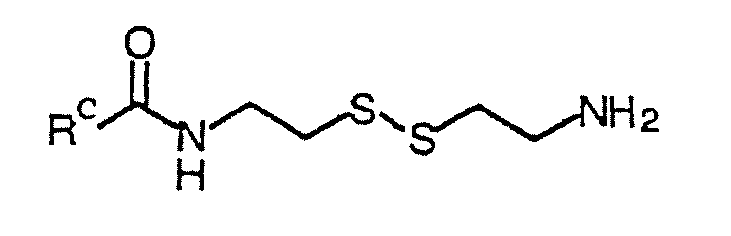
別の実施形態では、リガンド候補は、−SH基を所有している。別の実施形態では、リガンド候補は、マスクされたチオールを所有している。マスクされたチオール基を備えるリガンド候補は、本発明の別の局面を含む。別の実施形態では、リガンド候補は、式−SSR1のジスルフィドの形態にあるマスクされたチオールを所有し、ここで、R1は、非置換C1−C10脂肪族化合物、置換C1−C10脂肪族化合物、非置換アリールまたは置換アリールである。別の実施形態では、リガンド候補は、式−SSR2R3のジスルフィドとしてマスクされているチオールを所有し、ここで、R2は、C1−C5アルキル(好ましくは、−CH2−、−CH2CH2−、または−CH2CH2CH2−)であり、そしてR3は、NH2、OH、またはCOOHである。別の実施形態では、リガンド候補は、式−SSCH2CH2OHのジスルフィドとしてマスクされているチオールを所有している。なお別の実施形態では、リガンド候補は、式−SSCH2CH2NH2のジスルフィドとしてマスクされたチオールを所有している。リガンド候補の例示の例は以下を含む: In another embodiment, the ligand candidate possesses a —SH group. In another embodiment, the ligand candidate possesses a masked thiol. Ligand candidates comprising a masked thiol group include another aspect of the present invention. In another embodiment, the ligand candidate possesses a masked thiol in the form of a disulfide of formula -SSR 1 where R 1 is an unsubstituted C 1 -C 10 aliphatic compound, substituted C 1- C 10 aliphatic, unsubstituted aryl, or substituted aryl. In another embodiment, the candidate ligand possesses a thiol masked as a disulfide of formula —SSR 2 R 3 , wherein R 2 is C 1 -C 5 alkyl (preferably —CH 2 —, -CH 2 CH 2 -, or -CH 2 CH 2 CH 2 - is), and R 3 is NH 2, OH or COOH,. In another embodiment, the ligand candidate possesses a thiol that is masked as a disulfide of the formula —SSCH 2 CH 2 OH. In yet another embodiment, the ligand candidate possesses a thiol masked as a disulfide of formula -SSCH 2 CH 2 NH 2. Illustrative examples of ligand candidates include:
複数のリガンド候補は、リガンド候補のライブラリーを含む。1つの実施形態では、ライブラリーは、少なくとも5のリガンド候補を含む。別の実施形態では、ライブラリーは、少なくとも20のリガンド候補を含む。別の実施形態では、ライブラリーは、少なくとも100のリガンド候補を含む。別の実施形態では、ライブラリーは、少なくとも500のリガンド候補を含む。別の実施形態では、ライブラリーは、少なくとも1000のリガンド候補を含む。別の実施形態では、ライブラリーの各メンバーは、異なる分子量を有する。別の実施形態では、ライブラリーの各メンバーは、少なくとも5原子量単位だけ、ライブラリーの別のメンバーから異なる質量を有している。別の実施形態では、ライブラリーの各メンバーは、少なくとも10原子量単位だけ、ライブラリーの別のメンバーから異なる質量を有している。 The plurality of ligand candidates includes a library of ligand candidates. In one embodiment, the library includes at least 5 ligand candidates. In another embodiment, the library comprises at least 20 ligand candidates. In another embodiment, the library comprises at least 100 ligand candidates. In another embodiment, the library comprises at least 500 ligand candidates. In another embodiment, the library comprises at least 1000 ligand candidates. In another embodiment, each member of the library has a different molecular weight. In another embodiment, each member of the library has a mass that differs from another member of the library by at least 5 atomic weight units. In another embodiment, each member of the library has a mass that differs from another member of the library by at least 10 atomic weight units.
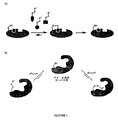
標的がタンパク質であり、そして共有結合がジスルフィドである結合(tethering)法は、図1に概略的に示される。図1Aは、チオール含有タンパク質が、複数のリガンド候補(例えば、>5、>20、>100、>500、>1000など)と反応する結合法の1つの実施形態を示す。この実施形態では、リガンド候補は、式−SSR1のジスルフィドの形態にあるマスクされたチオールを所有し、ここで、R1は、先に規定された通りである。特定の実施形態では、R1は、可能なリガンド候補の可溶性を増大するように選択される。図示されるように、標的に対し固有の結合親和性を所有するリガンド候補が同定され、そしてジスルフィド部分を含まない対応するリガンドが、同定された結合決定基(丸によって示される)を含んで作製される。 A tethering method in which the target is a protein and the covalent bond is a disulfide is shown schematically in FIG. FIG. 1A illustrates one embodiment of a binding method in which a thiol-containing protein reacts with multiple candidate ligands (eg,>5,>20,>100,>500,> 1000, etc.). In this embodiment, the ligand candidate possesses a masked thiol in the form of the disulfide of formula -SSR 1 , where R 1 is as defined above. In certain embodiments, R 1 is selected to increase the solubility of possible ligand candidates. As shown, candidate ligands are identified that possess a unique binding affinity for the target, and the corresponding ligand containing no disulfide moiety is created containing the identified binding determinants (indicated by circles). Is done.
図1Bは、結合の背後にある理論を概略的に示す。チオール含有タンパク質は、少なくとも1つのジスルフィド含有リガンド候補と平衡であり、そして平衡は、改変タンパク質と非改変タンパク質との間で確立されている。1つの実施形態では、チオール含有タンパク質とリガンド候補とは還元剤の存在下で接触される。別の実施形態では、このチオール含有タンパク質とリガンド候補は、準化学量論量の還元剤の存在下で接触される。リガンド候補が標的タンパク質に対する固有の結合親和性を有さない場合、この平衡は、非改変タンパク質に向かってシフトする。対照的に、リガンド候補が、タンパク質に対する固有の親和性を有する場合、平衡は、改変タンパク質に向かってシフトする。両方の状況を、図1Bに示す。第1に、リガンド候補のRA部分は、タンパク質に対する結合親和性をほとんど有さないか、有さない。従って、タンパク質−リガンド結合体の形成は、与えられたタンパク質、リガンド候補、および還元剤の濃度でジスルフィド結合を形成する確率の関数である。第2に、リガンド候補のRB部分は、タンパク質に対する固有の結合親和性を所有している。結果として、一旦、タンパク質とリガンド候補との間でジスルフィド結合が形成されると、このタンパク質−リガンド結合体は安定化される。従って、この平衡は、タンパク質−リガント結合体の形成に向かってシフトする。 FIG. 1B schematically shows the theory behind the coupling. The thiol-containing protein is in equilibrium with at least one disulfide-containing ligand candidate, and an equilibrium is established between the modified protein and the unmodified protein. In one embodiment, the thiol-containing protein and the ligand candidate are contacted in the presence of a reducing agent. In another embodiment, the thiol-containing protein and the ligand candidate are contacted in the presence of a substoichiometric amount of a reducing agent. If the ligand candidate does not have an intrinsic binding affinity for the target protein, this equilibrium shifts towards the unmodified protein. In contrast, if the ligand candidate has an intrinsic affinity for the protein, the equilibrium shifts towards the variant protein. Both situations are shown in FIG. 1B. First, the RA portion of the ligand candidate has little or no binding affinity for the protein. Thus, protein-ligand conjugate formation is a function of the probability of forming a disulfide bond at a given protein, ligand candidate, and reducing agent concentration. To the 2, R B moiety of the ligand candidate possesses an inherent binding affinity for the protein. As a result, once a disulfide bond is formed between the protein and the ligand candidate, the protein-ligand conjugate is stabilized. This equilibrium therefore shifts towards the formation of protein-ligant conjugates.
結合をさらに図示するために、この方法は、チミジレートシンターゼ(「TS」)(生存する実質的に全ての生物に対して必須の酵素)に適用されている。TSは、ジヒドロ葉酸レダクターゼ(「DHFR」)およびセリンヒドロキシメチラーゼと共に、生化学機能ユニット、シミジレートシンターゼサイクル(これは、RNAベースのdUMPからDNAベースのチミジン5’−モノホスフェート(「dTMP」)の合成のための唯一の新規の経路を提供する)を形成する。TSおよびDHRFの両方は、抗癌薬物開発のための標的である。TS遺伝子はまた、多くのウイルス中で見出されるので、抗寄生虫、抗真菌および抗ウイルス剤の開発の標的でもある。 To further illustrate the binding, this method has been applied to thymidylate synthase (“TS”), an enzyme that is essential for virtually all living organisms. TS, together with dihydrofolate reductase (“DHFR”) and serine hydroxymethylase, is a biochemical functional unit, a shimidylate synthase cycle (from RNA-based dUMP to DNA-based thymidine 5′-monophosphate (“dTMP”)). Provides the only new route for synthesis). Both TS and DHRF are targets for anticancer drug development. The TS gene is also a target for the development of antiparasitic, antifungal and antiviral agents because it is found in many viruses.
TSは、いくつかの理由から理論的な確証標的である。第1に、種々のTS酵素の多数の高分解能結晶構造は、構造情報が化合物設計に取り込まれ得るように決定されている。第2に、簡単な比色アッセイは、潜在的なリガンドがTSに結合するか否かを測定するために存在する。このアッセイは、dUMPの存在下で、5,10−CH2−H4ホレート対H2ホレートの転換の割合に依存する。結合についての第2のアッセイはまた、分光光度的であり、そしてピリドキサール−5’−ホスフェート(「PLP」)との競合に依存し、独特のスペクトルサインを有するTSと複合体を形成する。 TS is a theoretical confirmation target for several reasons. First, a number of high resolution crystal structures of various TS enzymes have been determined so that structural information can be incorporated into the compound design. Second, a simple colorimetric assay exists to determine whether a potential ligand binds to TS. This assay relies on the ratio of 5,10-CH 2 -H 4 folate to H 2 folate conversion in the presence of dUMP. The second assay for binding is also spectrophotometric and relies on competition with pyridoxal-5′-phosphate (“PLP”) to form a complex with TS having a unique spectral signature.
図示の目的のために選択されたTSは、E.coli TSである。全てのTS酵素と同様に、E.coli TSは、結合するために使用され得る活性部位(Cys146)中の天然に存在するシステイン残基を含む。E.coli TSは、4つの他のシステインを含むが、これらは、他のTS酵素の間で保存されておらず、そして隠されており、従って、アクセス可能でない。しかし、これらのシステインの1つ以上がジスルフィドに関して反応性であった場合、次いで、これらの酵素の変異体バージョンが使用され得、この変異体バージョンでは、これらのシステインが、別のアミノ酸(例えば、アラニン)へと変異される。 The TS selected for the purposes of illustration is E.E. E. coli TS. Like all TS enzymes, E. coli. E. coli TS contains a naturally occurring cysteine residue in the active site (Cys146) that can be used to bind. E. E. coli TS contains four other cysteines, but these are not conserved and hidden among other TS enzymes and are therefore not accessible. However, if one or more of these cysteines were reactive with respect to disulfide, then a mutant version of these enzymes could be used, in which these cysteines were converted to another amino acid (eg, Alanine).
第1の実験において、野生型TSおよびC146S変異体(ここで、146位でのシステインが、セリンに変異されている)を、シスタミン(H2NCH2CH2SSCH2CH2NH2)と接触させた。野生型TS酵素は、1当量のシスタミンときれいに反応したが、変異体TSは反応せず、このことは、シスタミンが、Cys−146と反応し、そしてCys−146について選択的であったことを示す。 In the first experiment, wild-type TS and C146S mutants (where cysteine at position 146 is mutated to serine) are contacted with cystamine (H 2 NCH 2 CH 2 SSCH 2 CH 2 NH 2 ). I let you. Wild-type TS enzyme reacted cleanly with 1 equivalent of cystamine, but mutant TS did not react, indicating that cystamine reacted with Cys-146 and was selective for Cys-146. Show.
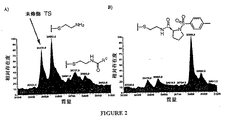
野生型TSを、リガンド候補の異なるプールを用いていくつかの結合実験に供した。図2は、2つの代表的な結合実験を図示し、ここで、リガンド候補は以下の式 Wild-type TS was subjected to several binding experiments with different pools of ligand candidates. FIG. 2 illustrates two representative binding experiments, where the candidate ligand is:
これは、式RSSR1のリガンド候補の属の特定の実施形態であり、ここで、RはRCC(=O)NHCH2CH2−に対応し、そしてR1は−CH2CH2NH2に対応する。これはまた、式RSSR2R3のリガンド候補の属の特定の実施形態であり、ここで、RはRCC(=O)NHCH2CH2−に対応し、そしてR2R3は一緒になって−CH2CH2NH2に対応する。RCは、非置換C1〜C10アルキル、置換C1〜C10アルキル、非置換アリールまたは置換アリールであり、そしてライブラリーメンバーのこのプールの間における可変部分である。 This is a specific embodiment of the genus of candidate ligands of formula RSSR 1 where R corresponds to R C C (═O) NHCH 2 CH 2 — and R 1 is —CH 2 CH 2 NH Corresponds to 2 . This is also a specific embodiment of the genus of ligand candidates of formula RSSR 2 R 3 , where R corresponds to R C C (═O) NHCH 2 CH 2 — and R 2 R 3 together And corresponds to —CH 2 CH 2 NH 2 . R C is unsubstituted C 1 -C 10 alkyl, substituted C 1 -C 10 alkyl, unsubstituted aryl or substituted aryl, and is a variable moiety between this pool of library members.
図2Aは、TSに対する結合親和性をわずかに有するかまたは有さない10の異なるリガンド候補のプールとTSとの反応の逆重畳積分マススペクトルである。いかなる結合相互作用も存在しない場合、TSと個々のリガンド候補との間のジスルフィド交換反応における平衡は、未改変の酵素に向かう。これは、以下の式によって概略的に図示される。 FIG. 2A is a deconvolution integral mass spectrum of the reaction of TS with a pool of 10 different ligand candidates with little or no binding affinity for TS. In the absence of any binding interaction, the equilibrium in the disulfide exchange reaction between TS and the individual ligand candidates is towards the unmodified enzyme. This is schematically illustrated by the following equation:
図2Bは、10の異なるリガンド候補物のプールとのTSの反応の逆重畳した質量スペクトルである。ここでそのリガンド候補物のうちの1つは、酵素に対する固有の結合親和性を有する。認められ得るように、最も顕著なピークは、Cys146のチオールが、N−トシル−D−プロリン化合物で改変されているTSに対応するピークである。このピークは、非改変酵素およびTS(Cys146のチオールが、システアミンで改変されている)に対応するピークを含む他の全てのピークを小さく見せる。図2Bは、結合が所望の部位に対する固有の強い結合親和性を有する部分を捕捉した、質量スペクトルの例である。 FIG. 2B is a desuperposed mass spectrum of the reaction of TS with a pool of 10 different ligand candidates. Here, one of the ligand candidates has an intrinsic binding affinity for the enzyme. As can be seen, the most prominent peak is the peak corresponding to TS in which the thiol of Cys146 has been modified with an N-tosyl-D-proline compound. This peak makes all other peaks smaller, including the peak corresponding to the unmodified enzyme and TS (the thiol of Cys146 has been modified with cysteamine). FIG. 2B is an example of a mass spectrum that captures a moiety that has an intrinsically strong binding affinity for the site where binding is desired.
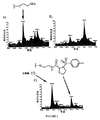
結合が還元剤の存在下で起こる場合、このプロセスは、より熱力学的に駆動され、平衡制御される。図3は、この現象の例示であり、漸増濃度の還元剤(2−メルカプトエタノール)の存在下で、選択された化合物N−トシル−D−プロリン化合物を含む同じライブラリープールとTSが反応される、3つの実験を示す。 If the binding occurs in the presence of a reducing agent, this process is more thermodynamically driven and equilibrium controlled. FIG. 3 is an illustration of this phenomenon where TS is reacted with the same library pool containing the selected compound N-tosyl-D-proline compound in the presence of increasing concentrations of reducing agent (2-mercaptoethanol). Three experiments are shown.
図3Aは、2−メルカプトエタノールなしで反応が行われる場合の逆重畳した質量スペクトルである。最も顕著なピークは、システアミンで改変されたTSに対応する。しかし、N−トシル−D−プロリンに対応するピークは、それにもかかわらず、他のリガンド候補物に対して適度に選択される。図3Bは、その反応が、0.2mM 2−メルカプトエタノールの存在下にある場合の逆重畳した質量スペクトルである。対照的に、図3Aのスペクトルに対して、N−トシル−D−プロリンに対応するピークは、最も顕著なピークであり、従って、他のリガンド候補物に対して強く選択される。最後に、図3Cは、その反応が、20mM 2−メルカプトエタノールの存在下にある場合の逆重畳した質量スペクトルである。驚くべきことではないが、このような強い還元条件下の最も顕著なピークは、非改変酵素である。にもかかわらず、N−トシル−D−プロリンに対応するピークは、ライブラリープール中の他のリガンド候補物のピークに対してなお選択される。 FIG. 3A is a desuperimposed mass spectrum when the reaction is performed without 2-mercaptoethanol. The most prominent peak corresponds to TS modified with cysteamine. However, the peak corresponding to N-tosyl-D-proline is nevertheless reasonably selected for other ligand candidates. FIG. 3B is a desuperimposed mass spectrum when the reaction is in the presence of 0.2 mM 2-mercaptoethanol. In contrast, for the spectrum of FIG. 3A, the peak corresponding to N-tosyl-D-proline is the most prominent peak and is therefore strongly selected for other ligand candidates. Finally, FIG. 3C is a de-superimposed mass spectrum when the reaction is in the presence of 20 mM 2-mercaptoethanol. Not surprisingly, the most prominent peak under such strong reducing conditions is the unmodified enzyme. Nevertheless, the peak corresponding to N-tosyl-D-proline is still selected relative to the peaks of other ligand candidates in the library pool.
図3は、標的に対して固有の親和性を有する特定のリガンド候補物による標的タンパク質中のシステイン改変の程度が、一部、還元剤濃度の関数であるという事実を強調している。一般に、標的タンパク質に対するリガンド候補物の結合親和性が高くなるほど、使用され得る還元剤の濃度は高くなり、さらにより強く選択される。結果として、結合スクリーニングにおいて使用される還元剤の濃度は、結合親和性の代理として、およびリガンド候補物が強く選択されなければならない結合親和性の下限を設定するために使用され得る。 FIG. 3 highlights the fact that the degree of cysteine modification in a target protein by a specific ligand candidate with an intrinsic affinity for the target is partly a function of the reducing agent concentration. In general, the higher the binding affinity of the ligand candidate for the target protein, the higher the concentration of reducing agent that can be used, and even more strongly selected. As a result, the concentration of reducing agent used in binding screening can be used as a surrogate for binding affinity and to set a lower bound for binding affinity at which ligand candidates must be strongly selected.
ある局面において、この方法は、以下の工程を包含する:
a)ジスルフィド結合を形成し得る標的タンパク質と、やはりジスルフィド結合を形成し得るリガンド候補物とを接触させる工程;
b)この標的タンパク質とリガンド候補物との間でジスルフィド結合を形成して、それにより、標的タンパク質−リガンド結合体を形成する工程;
c)この標的タンパク質−リガンド結合体と、還元剤とを接触させる工程;および
d)この標的タンパク質−リガンド結合体の量を所望の量に減少させるために還元剤の濃度を決定する工程。
In one aspect, the method includes the following steps:
a) contacting a target protein capable of forming a disulfide bond with a ligand candidate that can also form a disulfide bond;
b) forming a disulfide bond between the target protein and the ligand candidate, thereby forming a target protein-ligand conjugate;
c) contacting the target protein-ligand conjugate with a reducing agent; and d) determining the concentration of the reducing agent to reduce the amount of the target protein-ligand conjugate to a desired amount.
次いで、標的タンパク質−リガンド結合体の量を低下させるために必要な還元剤の濃度が、標的タンパク質のリガンド候補物に対する結合親和性についての代理として使用される。 The concentration of reducing agent required to reduce the amount of target protein-ligand conjugate is then used as a surrogate for the binding affinity of the target protein for the ligand candidate.
あるいは、この方法は、結合実験を較正するために使用され得る。このような較正の例示は、以下の通りである。第1の結合実験を、複数のリガンド候補物に対して行い、ここで、より強く選択されたリガンド候補物を同定する。あるいは、特定の親和性を有する既知の基質を、例えば、ジスルフィドの付加によって改変する。次いで、この同定されたリガンド候補物(または較正化合物)を使用して、特定の最小結合親和性を有するリガンド候補物のみを選択するために必要な実験条件を較正する。1つの実施形態において、この較正は、還元剤の濃度であり、較正化合物は、一連の結合試験において使用され、ここで還元剤の一定の濃度範囲が使用される。例は、以下の通りであり、この方法は、以下の工程を包含する:
a)ジスルフィド結合を形成し得る標的タンパク質と、やはりジスルフィド結合を形成し得る較正化合物とを接触させる工程;
b)この標的タンパク質と較正化合物との間でジスルフィド結合を形成して、それにより、標的タンパク質−較正化合物結合体を形成する工程;
c)この標的タンパク質−較正化合物結合体と、還元剤とを接触させる工程;および
d)この標的タンパク質−リガンド結合体の量を所望の量に減少させるために必要な還元剤の濃度を決定する工程。
Alternatively, this method can be used to calibrate binding experiments. An example of such a calibration is as follows. A first binding experiment is performed on a plurality of ligand candidates, where the more strongly selected ligand candidates are identified. Alternatively, known substrates with specific affinities are modified, for example by addition of disulfides. This identified ligand candidate (or calibration compound) is then used to calibrate the experimental conditions necessary to select only those ligand candidates that have a certain minimum binding affinity. In one embodiment, the calibration is the concentration of reducing agent, and the calibration compound is used in a series of binding tests, where a range of reducing agent concentrations is used. An example is as follows and the method includes the following steps:
a) contacting a target protein capable of forming a disulfide bond with a calibration compound that can also form a disulfide bond;
b) forming a disulfide bond between the target protein and the calibration compound, thereby forming a target protein-calibration compound conjugate;
c) contacting the target protein-calibrator compound conjugate with a reducing agent; and d) determining the concentration of reducing agent required to reduce the amount of the target protein-ligand conjugate to the desired amount. Process.
一般に、より低濃度の還元剤は、より高い割合の標的が、較正化合物で改変されるという結果を生じ、逆もまた同様である。1つの実施形態において、その所望の量は50%である。言い換えると、標的タンパク質の約50%が、非改変形態であり、残りの約50%が標的タンパク質−較正化合物結合体として存在する。従って、所望の量(この場合は、約50%)と関連する還元剤の濃度は、リガンド候補物が、選択される結合親和性のいくらか低いレベルを有することが必要な、引き続く結合実験において使用される。結合親和性の所望のより低いレベルに依存して使用され得る他の所望の量の例示としては、約20%、25%、30%、40%、60%、75%などが挙げられる。 In general, a lower concentration of reducing agent results in a higher percentage of target being modified with the calibration compound, and vice versa. In one embodiment, the desired amount is 50%. In other words, about 50% of the target protein is in an unmodified form and the remaining about 50% is present as a target protein-calibration compound conjugate. Thus, the concentration of reducing agent associated with the desired amount (in this case about 50%) is used in subsequent binding experiments where the ligand candidate is required to have a somewhat lower level of selected binding affinity. Is done. Examples of other desired amounts that may be used depending on the desired lower level of binding affinity include about 20%, 25%, 30%, 40%, 60%, 75%, and the like.
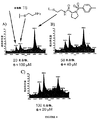
以前に述べたように、結合法は、単一のリガンド候補物または複数のリガンド候補物とともに使用され得る。好ましい実施形態において、この結合法は、複数のリガンド候補物(例えば、5、20、100、500、1000、および>1000ですら)をスクリーニングして、スループットおよび効率を最大にするために使用される。図4は、ライブラリープール中のリガンド候補物の数を変化させた実験結果を示す。この実験は、N−トシル−D−プロリンが、そのプールが100のリガンド候補物を含む場合ですら強く選択されることを示すが、より大きな数のリガンド候補物(例えば、約>500、>750、>1000)を含むライブラリーが、現在慣用的に使用される。 As previously mentioned, the binding method can be used with a single ligand candidate or multiple ligand candidates. In preferred embodiments, this binding method is used to screen multiple ligand candidates (eg, 5, 20, 100, 500, 1000, and even> 1000) to maximize throughput and efficiency. The FIG. 4 shows the experimental results when the number of ligand candidates in the library pool was changed. This experiment shows that N-tosyl-D-proline is strongly selected even when the pool contains 100 ligand candidates, but a larger number of ligand candidates (eg, about> 500,> 750,> 1000) are now routinely used.
構造−活性関係(「SAR」)は、SARが、伝統的なアッセイを用いて展開されたのと、まさしく同じ方法にて結合実験からの情報を使用して展開され得る。例えば、以下の模式図の左側にあるRCを有するリガンド候補物は、E.coli TSに対して強く選択されたが、右側にあるRCを有するリガンド候補物は、選択されなかった。 Structure-activity relationships (“SAR”) can be developed using information from binding experiments in exactly the same way that SAR was developed using traditional assays. For example, a ligand candidate having RC on the left side of the following schematic diagram is E. coli. Although strongly selected against E. coli TS, ligand candidates with RC on the right were not selected.
上記に加えて、さらなる実験を、結合から選択された化合物が、標的に対する結合親和性を有する化合物に対応することを確証するために行った。1つの例示において、結合実験を、既知の基質の存在下で行う。選択されたリガンド候補物が、標的に対して固有の結合親和性を有する場合、基質による置換に抵抗性である。対照的に、固有の結合親和性またはシステアミンを欠くリガンド候補物は、基質によって容易に置換される。別の例示は、結合なしのアナログに対する伝統的酵素アッセイである。例えば、リガンドフラグメントのRC部分が以下: In addition to the above, further experiments were performed to confirm that compounds selected from binding correspond to compounds with binding affinity for the target. In one illustration, binding experiments are performed in the presence of a known substrate. A selected ligand candidate is resistant to displacement by a substrate if it has an intrinsic binding affinity for the target. In contrast, ligand candidates that lack intrinsic binding affinity or cysteamine are readily displaced by the substrate. Another example is a traditional enzyme assay for unbound analogs. For example, the RC portion of the ligand fragment is:
別の実施形態において、活性部位中に天然に存在するシステイン残基を、セリンに変異させ(C146S)、別のシステインを導入した(L143CまたはH147C)。C146S/L143C変異体を使用した結合は、野生型酵素と類似の結果を生じた。注意すべきは、N−トシル−D−プロリンアナログが、強く選択されたことである。対照的に、C146S/H147Cは、N−トシル−D−プロリンアナログを選択しなかったが、いくつかの他の分子を選択した。これらの結果は、反応性のシステインを取り囲む局所的な結合環境における差異およびジスルフィドリンカーの幾何的制約を反映すると考えられる。 In another embodiment, a naturally occurring cysteine residue in the active site was mutated to serine (C146S) and another cysteine was introduced (L143C or H147C). Binding using the C146S / L143C mutant produced results similar to the wild type enzyme. Note that the N-tosyl-D-proline analog was strongly selected. In contrast, C146S / H147C did not select the N-tosyl-D-proline analog, but selected several other molecules. These results are thought to reflect differences in the local binding environment surrounding the reactive cysteine and the geometric constraints of the disulfide linker.
X線結晶学を使用して、ネイティブ酵素およびいくつかの複合体の三次元構造を解明して、結合から得られた情報が、標的に対する豊富な結合と相関され得ることを確認した。表1は、結晶学的データおよび細分(refinement)パラメーターを詳細に示す。1つの複合体は、TSに結合したN−トシル−D−プロリンの遊離酸の複合体である(表1の4番目の記載)。別の複合体は、活性部位のシステイン(Cys−146)に結合したN−トシル−D−プロリン誘導体の複合体である(表1の2番目の記載)。なお別の複合体は、C146S/L143C変異体に結合したN−トシル−D−プロリン誘導体の複合体である(表1の3番目の記載)。 X-ray crystallography was used to elucidate the three-dimensional structure of the native enzyme and several complexes, confirming that the information obtained from binding could be correlated with abundant binding to the target. Table 1 details the crystallographic data and refinement parameters. One complex is a free acid complex of N-tosyl-D-proline bound to TS (the fourth description in Table 1). Another complex is a complex of N-tosyl-D-proline derivative bound to the active site cysteine (Cys-146) (second description in Table 1). Yet another complex is a complex of N-tosyl-D-proline derivative bound to the C146S / L143C variant (third description in Table 1).
*1213結晶は、1非対称単位につき1つのモノマーを含む。P63形態は、生物学的に関連したホモダイマーを含む。
†括弧中の値は、最高の分解能ビン(resolution bin)である。
$Rsym(l)=Σhki|lhki(lhki)|/Σhkilhki(ここでlhkiは、反射hkiの強度である)
§Rcryst=Σhki||Fobs|−|Fcalc||/|Fobs|(ここでFobsおよびFcalcは、それぞれ、細分に使用されるデータについての観察および計算された構造因子である)
¶Rtree=は、Σhki||Fobs|−|Fcalc||/|Fobs|(ここでFobsおよびFcalcは、それぞれ、細分から省略されたデータの10%についての観察および計算された構造因子である)
重大なことには、N−トシル−D−プロリン部分の位置は、3つの場合全てにおいて非常に類似している(タンパク質中の全てのCα炭素について0.11〜0.56Åと比較して、0.55〜1.88ÅのRMSD)。N−トシル−D−プロリン置換基が、きっちりと重複している一方で、アルキル−ジスルフィド結合が異なるシステイン残基に由来するこの部分に集中するという事実は、N−トシル−D−プロリン部分(結合ではなく)が、結合決定因子であるという概念を支持する。
* 12 13 crystals contain one monomer per asymmetric unit. P6 3 form comprises a homodimer biologically relevant.
† The value in parentheses is the highest resolution bin.
$ R sym (l) = Σ hki | l hki (l hki ) | / Σ hki l hki (where l hki is the intensity of the reflection hki )
§ R cryst = Σ hki || F obs || F calc || / | F obs | ( where F obs and F calc, respectively, the observation and calculated structure factors for the data used in the subdivision is there)
¶ R tree = is Σ hki || F obs | − | F calc || / | F obs | (where F obs and F calc are observations and calculations for 10% of the data omitted from subdivision, respectively) Structure factor)
Significantly, the position of the N-tosyl-D-proline moiety is very similar in all three cases (compared to 0.11-0.56 に つ い て for all Cα carbons in the protein, 0.55-1.88 cm RMSD). The fact that the N-tosyl-D-proline substituents overlap exactly while the alkyl-disulfide bonds are concentrated in this part derived from a different cysteine residue is due to the N-tosyl-D-proline moiety ( Supports the notion that (but not binding) is a binding determinant.
見られ得るように、結合は、標的中の目的の部位に結合するリガンドを同定し得る強力な方法である。結合は、単独または他の医薬品化学法と組み合わせて使用され、薬物候補を同定および最適化し得る。 As can be seen, binding is a powerful method that can identify ligands that bind to a site of interest in a target. Binding can be used alone or in combination with other medicinal chemistry methods to identify and optimize drug candidates.
本発明の1局面において、結合は、結合決定因子(例えば、RC)を同定するために使用され、次いで、伝統的な医薬品化学が、その同定された結合決定因子またはそのバリエーションを含むより高い親和性化合物を作製するために使用される。1つの実施形態において、結合は、結合決定因子を同定すること、および化合物がより高い親和性で標的に結合するか否かを評価することの両方のために使用され得る。例えば、結合は、機能的アッセイが利用可能でないか、または人工物の影響を受けやすいかのいずれかである伝統的な結合実験の代わりである。このアプローチは、図5に模式的に例示される。見られ得るように、結合は、結合決定因子RDを同定するために使用される。一旦このような結合因子が同定されると、伝統的医薬品化学アプローチが使用されて、改変ライブラリー中のRDの改変体が合成される。リガンド候補物の改変ライブラリーは、RDの改変体(例えば、そのアイソスター(isostere)およびホモログ)を含む。改変ライブラリーはまた、RDまたはその改変体、ならびに隣接する結合領域を利用し得る他の結合決定因子を含む「拡大された」化合物を含み得る。図5は、改変ライブラリーからの選択された化合物を例示し、ここで本来の結合決定因子RDは、RD’に改変され、選択された化合物は、第2の結合決定因子REを含む。実施例6は、低μM化合物である化合物1の最適化から同定されたTSの低μM親和性化合物(2および3)の最適化の試みに関するこの方法をさらに例示する。 In one aspect of the invention, binding is used to identify binding determinants (eg, R C ), and then traditional medicinal chemistry is higher than including the identified binding determinants or variations thereof. Used to make affinity compounds. In one embodiment, binding can be used for both identifying binding determinants and assessing whether a compound binds to a target with higher affinity. For example, binding is an alternative to traditional binding experiments where functional assays are not available or are susceptible to artifacts. This approach is schematically illustrated in FIG. As can be seen, binding is used to identify the binding determinant RD . Once such a binding agent is identified, traditional medicinal chemistry approaches are used to synthesize variants of RD in the modified library. Modified libraries of ligand candidates include RD variants (eg, their isosteres and homologs). Modified libraries can also include “expanded” compounds including RD or variants thereof, as well as other binding determinants that can utilize adjacent binding regions. FIG. 5 illustrates selected compounds from a modified library, where the original binding determinant R D is modified to R D ′ and the selected compound is the second binding determinant R E. Including. Example 6 further illustrates this method for an attempt to optimize the low μM affinity compounds of TS (2 and 3) identified from the optimization of compound 1, which is a low μM compound.
本発明の別の局面において、実質的にともに結合された2つの結合決定因子を同定するための方法が提供される。一般に、この方法は、以下の工程を包含する:
a)標的タンパク質に結合する第1の化合物を同定する工程;
b)この標的タンパク質に結合する第2の化合物を同定する工程;ならびに
c)第1の化合物および第2の化合物を、リンカーエレメントを介して結合して、標的タンパク質に結合する結合体分子を形成する工程。好ましい実施形態において、この結合体分子は、第1の化合物または第2の化合物いずれか単独よりも高い結合親和性で標的タンパク質に結合する。
In another aspect of the invention, a method is provided for identifying two binding determinants that are substantially bound together. In general, the method includes the following steps:
a) identifying a first compound that binds to the target protein;
b) identifying a second compound that binds to the target protein; and c) binding the first compound and the second compound via a linker element to form a conjugate molecule that binds to the target protein. Process. In preferred embodiments, the conjugate molecule binds to the target protein with a higher binding affinity than either the first compound or the second compound alone.
1つの実施形態において、第1の化合物は、式RDSSR1の化合物であり、第2の化合物は、式RESSR1の化合物(ここでRおよびR1は、先に記載された通りであり、RDおよびREは、それぞれ独立して、C1〜C20非置換脂肪族、C1〜C20置換脂肪族、非置換アリール、または置換アリールである)であり、第1および第2の化合物は、ジスルフィド結合を介して標的タンパク質に結合する。図6は、この方法の模式的例示であり、ここで2つの別個の結合実験を使用して、結合決定因子RDおよびREを同定する。これらの結合決定因子は、その後、一緒に結合されて、標的タンパク質に結合する結合体分子を形成する。 In one embodiment, the first compound is a compound of formula R D SSR 1 and the second compound is a compound of formula R E SSR 1 where R and R 1 are as previously described. And R D and R E are each independently C 1 -C 20 unsubstituted aliphatic, C 1 -C 20 substituted aliphatic, unsubstituted aryl, or substituted aryl), the first and The second compound binds to the target protein via a disulfide bond. FIG. 6 is a schematic illustration of this method, where two separate binding experiments are used to identify binding determinants R D and R E. These binding determinants are then bound together to form a conjugate molecule that binds to the target protein.
別の実施形態において、結合決定因子RDおよびREを同定するためのこの結合実験は、同時に起こる。このようにして、この2つの同定された結合決定因子は、重複しない部位において標的タンパク質に結合することが確認される。従って、この方法は、以下の工程を包含する:
a)標的タンパク質に結合する第1の化合物を同定する工程;
b)この標的タンパク質に結合した第1の化合物の存在下で、この標的タンパク質に結合する第2の化合物を同定する工程;ならびに
c)この第1の化合物および第2の化合物を、リンカーエレメントを介して結合して、この標的タンパク質に結合する結合体分子を形成する工程。図7は、この方法の模式的例示である。第1の結合実験において、その結合決定因子RDが同定される。一旦RDが同定されると、第2の反応性システインが導入されるかまたはマスクが外されるかのいずれかであり、結合決定因子REを同定するための結合実験は、結合決定因子RDの存在下で起こる。これら2つの結合決定因子RDおよびREは、その後結合されて、その標的タンパク質に結合する結合体分子を形成する。
In another embodiment, this binding experiment to identify binding determinants R D and R E occurs simultaneously. In this way, it is confirmed that the two identified binding determinants bind to the target protein at non-overlapping sites. The method thus includes the following steps:
a) identifying a first compound that binds to the target protein;
b) identifying a second compound that binds to the target protein in the presence of the first compound bound to the target protein; and c) the first compound and the second compound, the linker element To form a conjugate molecule that binds to the target protein. FIG. 7 is a schematic illustration of this method. In the first binding experiment, the binding determinant RD is identified. Once the R D is identified, is either one of or mask the second reactive cysteine is introduced is removed, the binding experiments to identify binding determinants R E, binding determinant Occurs in the presence of RD . These two binding determinants R D and R E are then combined to form a conjugate molecule that binds to its target protein.
別の実施形態において、第1の化合物は、結合を使用して同定され、第2の化合物は、非結合方法を通じて同定される。1つの実施形態において、この非結合方法は、合理的薬物設計および伝統的な医薬品化学を包含する。TSに結合したN−トシル−D−プロリンの結晶構造により、そのトシル基が、メチレンテトラヒドロ葉酸(TS酵素の天然の補因子)のベンズアミド部分とほぼ同じ位置および配向にあることが明らかになった。結論として、メチレンテトラヒドロ葉酸のグルタミン酸部分は、化合物1にグラフト化された。表2は、選択された数のこれらの化合物を示す。 In another embodiment, the first compound is identified using binding and the second compound is identified through a non-binding method. In one embodiment, this non-binding method involves rational drug design and traditional medicinal chemistry. The crystal structure of N-tosyl-D-proline bound to TS revealed that its tosyl group is in approximately the same position and orientation as the benzamide moiety of methylenetetrahydrofolate (a natural cofactor of the TS enzyme). . In conclusion, the glutamic acid moiety of methylenetetrahydrofolic acid was grafted to compound 1. Table 2 shows a selected number of these compounds.
本発明の別の局面において、結合方法に対するバリエーションが、化合物を作製し、最適化することにおいて使用するために提供される。一般に、この方法は、以下の工程を包含する:
a)共有結合を形成し得る固定基(anchoring group)を有する標的を提供するか、または目的の部位もしくはその部位の近くにある金属を配位結合する工程;
b)この標的と、エクステンダーとを接触させ、それにより標的−エクステンダー錯体を形成する工程であって、ここでこのエクステンダーは、共有結合を形成するかまたは金属を配位結合させるかのいずれかである第1の官能基、および共有結合を形成し得る第2の官能基を含む、工程;
c)この標的−エクステンダー錯体と、第2の官能基と共有結合を形成し得る基を含む候補配位子とを接触させる工程;
d)この標的−エクステンダー錯体とこの候補配位子との間で共有結合を形成しする工程;ならびに
e)この標的−エクステンダー−配位子結合体中に存在する候補配位子を同定する工程。
In another aspect of the invention, variations to the binding methods are provided for use in making and optimizing compounds. In general, the method includes the following steps:
a) providing a target having an anchoring group capable of forming a covalent bond, or coordinating a metal at or near the site of interest;
b) contacting the target with an extender, thereby forming a target-extender complex, wherein the extender either forms a covalent bond or coordinates a metal. Including a first functional group and a second functional group capable of forming a covalent bond;
c) contacting the target-extender complex with a candidate ligand comprising a group capable of forming a covalent bond with the second functional group;
d) forming a covalent bond between the target-extender complex and the candidate ligand; and e) identifying a candidate ligand present in the target-extender-ligand conjugate. .
1つの実施形態において、この標的中の固定基は、反応性求核基または求電子基であり、エクステンダーの第1の官能基と不可逆的な共有結合を形成する。別の実施形態において、標的中の固定基は、反応性求核基または求電子基基であり、エクステンダーの第1の官能基と不可逆的な共有結合を形成する。別の実施形態において、標的中の固定基は、金属配位部位であり、固定基は、第1の官能基と一緒になって、金属配位部位を形成する。このような部位に結合し得る適切な金属の例としては、Cd、Hg、As、Zn、Fe、Cu、Ni、CoおよびCaが挙げられる。別の実施形態において、第2の官能基は、反応性求核基または反応性求電子基である。 In one embodiment, the anchoring group in the target is a reactive nucleophilic group or an electrophilic group and forms an irreversible covalent bond with the first functional group of the extender. In another embodiment, the anchoring group in the target is a reactive nucleophilic group or an electrophilic group that forms an irreversible covalent bond with the first functional group of the extender. In another embodiment, the anchoring group in the target is a metal coordination site, and the anchoring group together with the first functional group forms a metal coordination site. Examples of suitable metals that can bind to such sites include Cd, Hg, As, Zn, Fe, Cu, Ni, Co, and Ca. In another embodiment, the second functional group is a reactive nucleophilic group or a reactive electrophilic group.
好ましい実施形態において、そのエクステンダーは、上記の第1および第2の官能基を含み、そして標的に対する固有の結合親和性を有する結合決定因子を含む。結合決定因子が、既に、第1および第2の官能基を含まない場合、これらを含むように改変され得る。1つの方法において、結合は、結合決定因子RCを同定するために使用され、次いで、このRCは、第1および第2の官能基を含むように改変される。別の方法において、この結合決定因子は、標的の既知の基質またはそのフラグメントから得られる。 In a preferred embodiment, the extender includes the first and second functional groups described above, and includes a binding determinant that has an intrinsic binding affinity for the target. If the binding determinant already does not include the first and second functional groups, it can be modified to include them. In one method, binding is used to identify binding determinants R C, then the R C is modified to include a first and second functional groups. In another method, the binding determinant is obtained from a known substrate of the target or a fragment thereof.
別の実施形態において、標的中の固定基は、反応性求核基であり、エクステンダーは、求核基と共有結合を形成し得る第1の官能基およびジスルフィド結合を形成し得る第2の官能基を含む。この方法は、以下の工程を包含する:
a)目的の部位にまたはその近くに反応性求核基を有する標的を提供する工程;および
b)この標的と、エクステンダーとを接触させる工程であって、それによって、標的−エクステンダー錯体を形成する工程であって、ここでこのエクステンダーは、標的中の求核基と反応して共有結合を形成する第1の官能基およびジスルフィド結合を形成し得る第2の官能基を含む、工程;
c)この標的−エクステンダー錯体を、ジスルフィド結合を形成し得る配位子候補物と接触させる工程;
d)この標的−エクステンダー錯体とこの配位子候補物との間でジスルフィド結合を形成し、それによって、標的−エクステンダー−配位子結合体を形成する工程;ならびに
e)この標的−エクステンダー−配位子結合体中に存在する配位子候補物を同定する工程。必要に応じて、この標的を、還元剤の存在下で配位子候補物と接触させる。
In another embodiment, the anchoring group in the target is a reactive nucleophilic group and the extender has a first functional group that can form a covalent bond with the nucleophilic group and a second functional group that can form a disulfide bond. Contains groups. This method includes the following steps:
a) providing a target having a reactive nucleophilic group at or near the site of interest; and b) contacting the target with an extender, thereby forming a target-extender complex. A step, wherein the extender comprises a first functional group that reacts with a nucleophilic group in the target to form a covalent bond and a second functional group that can form a disulfide bond;
c) contacting the target-extender complex with a ligand candidate capable of forming a disulfide bond;
d) forming a disulfide bond between the target-extender complex and the ligand candidate, thereby forming a target-extender-ligand conjugate; and e) the target-extender-configuration Identifying a ligand candidate present in the ligand conjugate. If necessary, this target is contacted with a ligand candidate in the presence of a reducing agent.
適切な還元剤の例としては、以下が挙げられるが、これらに限定されない:システイン、システアミン、ジチオスレイトール、ジチオエリスリトール、グルタチオン、2−メルカプトエタノール、3−メルカプトプロピオン酸、ホスフィン(例えば、トリス−(2−カルボキシエチル−ホスフィン)(「TCEP」)、または水素化ホウ素ナトリウム。1つの実施形態において、この還元剤は、2−メルカプトエタノールである。別の実施形態において、この還元剤は、システアミンである。別の実施形態において、この還元剤は、グルタチオンである。別の実施形態において、この還元剤は、システインである。 Examples of suitable reducing agents include, but are not limited to: cysteine, cysteamine, dithiothreitol, dithioerythritol, glutathione, 2-mercaptoethanol, 3-mercaptopropionic acid, phosphine (eg, tris- (2-carboxyethyl-phosphine) (“TCEP”), or sodium borohydride, In one embodiment, the reducing agent is 2-mercaptoethanol, In another embodiment, the reducing agent is cysteamine. In another embodiment, the reducing agent is glutathione In another embodiment, the reducing agent is cysteine.
1つの実施形態において、この標的は、反応性求核基としての−OHを含み、そのエクステンダーは、その標的上の反応性求核基と共有結合を形成し得る第1の官能基およびジスルフィド結合を形成し得る第2の官能基を含む。別の実施形態において、この標的上の反応性求核基は、天然に存在するタンパク質配列の一部であるセリン、スレオニン、またはチロシンに由来する−OHである。別の実施形態において、この標的上の反応性求核基は、操作された−OH基である。ここで、天然に存在するアミノ酸を、セリン、スレオニン、またはチロシンに変異させるために変異誘発を使用する。別の実施形態において、エクステンダーの第1の官能基は、ボロン酸であり、その第2の官能基は、−SHまたはマスクされた−SHである。マスクされた−SHの例は、式−SSR1(ここでR1は、上記の通りである)のジスルフィドである。 In one embodiment, the target includes —OH as a reactive nucleophilic group, and the extender includes a first functional group and a disulfide bond that can form a covalent bond with the reactive nucleophilic group on the target. A second functional group capable of forming In another embodiment, the reactive nucleophile on the target is —OH derived from serine, threonine, or tyrosine that is part of a naturally occurring protein sequence. In another embodiment, the reactive nucleophilic group on the target is an engineered —OH group. Here, mutagenesis is used to mutate naturally occurring amino acids to serine, threonine, or tyrosine. In another embodiment, the first functional group of the extender is a boronic acid and the second functional group is -SH or masked -SH. An example of masked -SH is a disulfide of the formula -SSR 1 where R 1 is as described above.
別の実施形態において、この標的は、反応性求核基としての−SHを含み、エクステンダーは、この標的上の反応性求核基と共有結合を形成し得る第1の官能基およびジスルフィド結合を形成し得る第2の官能基を含む。1つの実施形態において、この標的上の反応性求核基は、天然に存在するタンパク質配列の一部であるシステインに由来する、天然に存在する−SHである。別の実施形態において、この標的上の反応性求核基は、操作された−SH基である。ここで、天然に存在するアミノ酸をシステインに変異させるために、変異誘発を使用した。 In another embodiment, the target includes —SH as a reactive nucleophilic group, and the extender has a first functional group and a disulfide bond that can form a covalent bond with the reactive nucleophilic group on the target. It includes a second functional group that can be formed. In one embodiment, the reactive nucleophilic group on the target is a naturally occurring -SH derived from a cysteine that is part of a naturally occurring protein sequence. In another embodiment, the reactive nucleophilic group on the target is an engineered —SH group. Here, mutagenesis was used to mutate naturally occurring amino acids to cysteine.
別の実施形態において、この標的タンパク質は、反応性求核基として、ジスルフィドの形態でマスクされた−SHを有する。別の実施形態において、この標的タンパク質は、システインを含み、ここでそのチオールは、ジスルフィドとしてマスクされている。別の実施形態において、この標的タンパク質は、システインを含み、ここで、そのチオールは、別のシステインとのジスルフィド結合としてマスクされる。別の実施形態において、この標的タンパク質は、システインを含み、ここでそのチオールは、グルタチオンとのジスルフィド結合としてマスクされている。別の実施形態において、この標的タンパク質は、システインを含み、ここでそのチオールは、式−SSR1(ここでR1は、上記の通りである)のジスルフィドとしてマスクされている。 In another embodiment, the target protein has -SH masked in the disulfide form as a reactive nucleophilic group. In another embodiment, the target protein comprises cysteine, where the thiol is masked as a disulfide. In another embodiment, the target protein comprises a cysteine, where the thiol is masked as a disulfide bond with another cysteine. In another embodiment, the target protein comprises cysteine, where the thiol is masked as a disulfide bond with glutathione. In another embodiment, the target protein comprises a cysteine, wherein the thiol is masked as a disulfide of formula —SSR 1 (where R 1 is as described above).
1つの実施形態において、エクステンダーの第1および第2の官能基は、各々独立して、−SHまたはマスクされた−SHである。マスクされたチオールの例は、式−SSR1(ここでR1は、上記の通りである)のジスルフィドである。この実施形態において、標的とエクステンダーとの間で形成される共有結合は、ジスルフィド結合であり、従って、可逆性の共有結合である。この方法の1つのバリエーションにおいて、この標的を、エクステンダーと接触させ、その後に、標的−エクステンダー複合体を、1つ以上の配位子候補物と接触させる。別のバリエーションにおいて、この標的を、エクステンダーおよび1つ以上の配位子候補物を含むプールと接触させる。 In one embodiment, the first and second functional groups of the extender are each independently -SH or masked -SH. An example of a masked thiol is a disulfide of the formula -SSR 1 where R 1 is as described above. In this embodiment, the covalent bond formed between the target and the extender is a disulfide bond and is therefore a reversible covalent bond. In one variation of this method, the target is contacted with an extender, after which the target-extender complex is contacted with one or more ligand candidates. In another variation, the target is contacted with a pool containing an extender and one or more ligand candidates.
別の実施形態において、第1の官能基は、標的を変性させない条件下で、標的の反応性求核基と不可逆性の共有結合を形成し得る基であり、第2の官能基は、−SHまたはマスクされた−SHである。第1の実施形態において、第1の官能基は、SN2様付加を受け得る基である。このようなエクステンダーの例としては、(i)例えば、以下のようなα−ハロ酸: In another embodiment, the first functional group is a group capable of forming an irreversible covalent bond with the reactive nucleophilic group of the target under conditions that do not denature the target, and the second functional group is- SH or masked -SH. In the first embodiment, the first functional group is a group capable of undergoing SN2-like addition. Examples of such extenders include (i), for example, the following α-halo acids:
別の実施形態において、第1の官能基は、SNアリール様付加を受け得る基である。適切な基の例としては、7−ハロ−2,1,3−ベンゾキサジアゾール(benzoxadiazaole)、および例えば、以下のようなオルト/パラニトロ置換ハロベンゼン: In another embodiment, the first functional group is a group capable of undergoing SN aryl-like addition. Examples of suitable groups include 7-halo-2,1,3-benzoxadiazole and, for example, ortho / paranitro substituted halobenzenes such as:
別の実施形態において、第1の官能基は、Michael型の付加を受け得る基である。適切な基の例としては、電子除去系(electron withdrawing system)(例えば、カルボニル、イミン、キニン、CN、NO2、および−S(=O)−)に隣接した二重結合または三重結合を含む任意の部分が挙げられる。このようなエクステンダーの例としては、以下が挙げられる: In another embodiment, the first functional group is a group capable of undergoing a Michael type addition. Examples of suitable groups include a double or triple bond adjacent to an electron withdrawing system (eg, carbonyl, imine, quinine, CN, NO 2 , and —S (═O) —). Any part can be mentioned. Examples of such extenders include the following:
エクステンダーは、しばしば、特定の標的または標的のファミリーに合わせて作られる。キナーゼ特異的エクステンダーの例としては、以下が挙げられる: Extenders are often tailored to a specific target or family of targets. Examples of kinase specific extenders include the following:
標的上の反応性基とリガンドとの間、標的と伸長因子との間、標的−伸長因子複合体とリガンドとの間、または2つのリガンド間に、可逆的または非可逆的な共有結合を形成するための合成方法は、当該分野において周知であり、そして基本的な教科書(例えば、March,Advanced Organic Chemistry,John Wiley & Sons,New York,第4版,1992)に記載されている。アルデヒドとケトンとアミンとの間の還元的アミノ化は、例えば、Marchら(前出),898−900頁に;アミンを調製するための代替の方法は、1276頁に;ヒドラゾンおよびヒドラゾン誘導体(例えば、セミカルバゾン)を得るための、アルデヒドとケトンとヒドラジン誘導体との間の反応は、904−906頁に;アミド結合の形成は、1275頁に;尿素の形成は、1299頁に;チオカルバメートの形成は、892頁に;カルバメートの形成は、1280頁に;スルホンアミドの形成は、1296頁に;チオエーテルの形成は、1297頁に;ジスルフィドの形成は、1284頁に;エーテルの形成は、1285頁に;エステルの形成は、1281頁に;エポキシドの付加は、368頁に;アジリジンの付加は、368頁に;アセタールおよびケタールの形成は、1269頁に;カーボネートの形成は、392頁に;デナミン(denamine)の形成は、1264頁に;アルケンの複分解は、1146−1148頁に(Grubbsら,Acc.Chem.Res.28:446−453[1995]もまた参照のこと);アルカンおよびアセチレンとの、アリールハライドおよびスルホネートの、遷移金属で触媒されるカップリング(例えば、Heck反応)は、717−178頁に;アリールハライドおよびスルホネートの、有機金属試薬(例えば、有機ホウ素試薬)との反応は、662頁に(Miyauraら,Chem.Rev.95:2457[1995]もまた参照のこと);有機スズ試薬および有機亜鉛試薬、オキサゾリジンの形成(Edeら,Tetrahedron Letts.28:7119−7122[1997]);チアゾリジンの形成(Patekら,Tetrahedron Letts.36:2227−2230[1995[);イミドエステルを介するアミンのカップリングによる、アミジン基を介して結合したアミン(Daviesら,Canadian J.Biochem.c50:416−422[1972])などが記載されている。 Form a reversible or irreversible covalent bond between the reactive group on the target and the ligand, between the target and the elongation factor, between the target-extension factor complex and the ligand, or between the two ligands. Synthetic methods for doing so are well known in the art and are described in basic textbooks (eg, March, Advanced Organic Chemistry, John Wiley & Sons, New York, 4th edition, 1992). Reductive amination between aldehydes, ketones and amines is described, for example, in March et al. (Supra), pages 898-900; an alternative method for preparing amines on page 1276; hydrazone and hydrazone derivatives ( For example, the reaction between an aldehyde, a ketone and a hydrazine derivative to obtain a semicarbazone) on pages 904-906; amide bond formation on page 1275; urea formation on page 1299; thiocarbamate Formation on page 892; Carbamate formation on page 1280; Sulfonamide formation on page 1296; Thioether formation on page 1297; Disulfide formation on page 1284; Ether formation on 1285 Page; ester formation on page 1281; epoxide addition on page 368; aziridine addition on page 368 Acetal and ketal formation on page 1269; carbonate formation on page 392; denamine formation on page 1264; alkene metathesis on pages 1461-1148 (Grubbs et al., Acc. Chem. Res. 28: 446-453 [1995]); transition metal catalyzed coupling of aryl halides and sulfonates with alkanes and acetylenes (eg, Heck reaction), pages 717-178 The reaction of aryl halides and sulfonates with organometallic reagents such as organoboron reagents (see also Miyaura et al., Chem. Rev. 95: 2457 [1995]); organotin reagents And organozinc reagents, oxazolidine formation (Ede , Tetrahedron Letts. 28: 7119-7122 [1997]); formation of thiazolidine (Patek et al., Tetrahedron Letts. 36: 2227-2230 [1995 [); coupled via an amidine group by coupling of amines via imidoesters. (Davies et al., Canadian J. Biochem. C50: 416-422 [1972]) and the like.
伸長因子を使用する結合方法をさらに説明するために、この方法を、抗アポトーシス標的カスパーゼ−3(システインアスパルチルプロテアーゼファミリーのメンバー)に適用した。現在、カスパーゼファミリーの約1ダースのメンバーが公知であり、これらの多くが、アポトーシスカスケードの阻害または伝播に関与する。カスパーゼは、過剰または異常なレベルのプログラムされた細胞死を含む、種々の治療適応症(例えば、発作、外傷性脳傷害、脊椎損傷、アルツハイマー病、ハンティングトン病、パーキンソン病、心臓血管病、肝不全、および敗血症)に対する潜在的な薬物標的である。さらに、カスパーゼ−3は、天然に存在するシステイン残基を、活性部位において含み、そして機能的にと結晶学的にとの両方で、十分に特徴付けられている。 To further illustrate the binding method using elongation factors, this method was applied to the anti-apoptotic target caspase-3 (a member of the cysteine aspartyl protease family). Currently, about a dozen members of the caspase family are known, and many of these are involved in the inhibition or propagation of the apoptotic cascade. Caspases have a variety of therapeutic indications, including excessive or abnormal levels of programmed cell death (eg, stroke, traumatic brain injury, spinal cord injury, Alzheimer's disease, Huntington's disease, Parkinson's disease, cardiovascular disease, liver Is a potential drug target for failure and sepsis). In addition, caspase-3 contains a naturally occurring cysteine residue in the active site and is well characterized, both functionally and crystallographically.
カスパーゼ−3活性部位において使用するために適切な伸長因子を、小さいアスパルチルベースのアリールアシルオキシメチルケトンが、活性部位のシステインと不可逆的に反応することが公知であるという事実を使用して設計した。実施例7〜10および14は、5つの代表的な伸長因子の合成を記載する。これらの伸長因子はまた、他のカスパーゼ標的(例えば、カスパーゼ−1およびカスパーゼ−7)との結合実験において使用され得る。より詳細に記載される2つの伸長因子は、化合物13および14である。 A suitable elongation factor for use in the caspase-3 active site was designed using the fact that small aspartyl-based arylacyloxymethyl ketones are known to react irreversibly with active site cysteines. . Examples 7-10 and 14 describe the synthesis of five representative elongation factors. These elongation factors can also be used in binding experiments with other caspase targets such as caspase-1 and caspase-7. Two elongation factors described in more detail are compounds 13 and 14.
両方の伸長因子は、活性部位のシステインにおいて、カスパーゼ−3を選択的に修飾することを示し、そしてヒドロキシルアミンで処理すると、以下の標的−伸長因子複合体を生成した: Both elongation factors have been shown to selectively modify caspase-3 at the active site cysteine, and treatment with hydroxylamine produced the following target-elongation factor complex:
標的−伸長因子複合体13’および14’を、それぞれ、約10,000のリガンド候補物のライブラリーに対する結合方法において使用した。標的−伸長因子複合体13’を使用する、選択されたリガンド候補物の代表的な例は、以下である: Target-elongation factor complexes 13 'and 14' were each used in a binding method to a library of approximately 10,000 ligand candidates. A representative example of a selected ligand candidate using the target-elongation factor complex 13 'is the following:
伸長因子および選択されたリガンド候補物が、どのように標的に結合するかを評価するために、標的−伸長因子リガンド複合体の2つの構造を決定した。一般的な結晶学的手順を、実施例12にさらに記載する。第一の構造は、標的−伸長因子複合体13’がリガンド候補物15と接触された場合に形成される結合体であった。第二の構造は、標的−伸長因子複合体14’がリガンド候補物16と接触された場合に形成される結合体であった。表3は、これらの構造についての選択された結晶学的データをまとめる。 In order to evaluate how elongation factors and selected ligand candidates bind to the target, two structures of the target-elongation factor ligand complex were determined. The general crystallographic procedure is further described in Example 12. The first structure was a conjugate formed when target-elongation factor complex 13 'was contacted with ligand candidate 15. The second structure was a conjugate formed when target-elongation factor complex 14 'was contacted with ligand candidate 16. Table 3 summarizes selected crystallographic data for these structures.
伸長因子およびリガンド候補物からの結合決定基がカスパーゼ−3の活性部位との生成的な接点を作製することを考慮して、ジスルフィドがより安定な結合で置き換えられた化合物を設計した。さらに、結合決定基のSARをプローブするための誘導体を作製した。伸長因子13およびリガンド候補物15を含む結合体に関して、標的−伸長因子リガンド結合体は、以下を含む: In view of the fact that binding determinants from elongation factors and ligand candidates create productive contacts with the active site of caspase-3, compounds were designed in which the disulfide was replaced with a more stable bond. Furthermore, a derivative for probing the SAR of the binding determinant was prepared. With respect to the conjugate comprising elongation factor 13 and ligand candidate 15, the target-elongation factor ligand conjugate includes:
同様に、新規なクラスのカスパーゼ−3インヒビターは、伸長因子14およびリガンド候補物16を含む、標的−伸長因子リガンド結合体から生じた。 Similarly, a new class of caspase-3 inhibitors originated from target-elongation factor ligand conjugates, including elongation factor 14 and ligand candidate 16.
実施例13および15〜21は、伸長因子13および14を使用する結合の使用に基づいて合成された、カスパーゼ−3インヒビターのより抜きのもののさらなる詳細を記載する。 Examples 13 and 15-21 describe further details of the excerpts of caspase-3 inhibitors synthesized based on the use of binding using elongation factors 13 and 14.
本発明のサリチル酸スルホンアミド含有化合物は、さらに価値がある。適切なP4結合フラグメントとしてのサリチル酸スルホンアミドの同定は、従来の医科学を使用しては見受けられない。化合物21を例として使用して、化合物21のサリチル酸スルホンアミドのないバージョンは、約28μMのKiで、カスパーゼ−3を阻害する。このフラグメントにサリチル酸スルホンアミドを付加することにより、結合が約200倍改善され、そして約0.16μMのKiを有する化合物21を生じる。対照的に、カスパーゼ−3のP1−P3部位に結合する、公知のトリペプチド(例えば、化合物I)を出発点として使用する場合、結合親和性は低下する。 The salicylic acid sulfonamide-containing compound of the present invention is further valuable. The identification of salicylic acid sulfonamide as a suitable P4 binding fragment is not found using conventional medical science. Using compound 21 as an example, a salicylic acid sulfonamide-free version of compound 21 inhibits caspase-3 with a K i of about 28 μM. Addition of salicylic acid sulfonamide to this fragment improves binding about 200-fold and yields compound 21 with a K i of about 0.16 μM. In contrast, when a known tripeptide (eg, Compound I) that binds to the P1-P3 site of caspase-3 is used as a starting point, the binding affinity is reduced.
本発明は、以下の非限定的な実施再によって、さらに説明される。 The invention is further illustrated by the following non-limiting implementation.
(実施例1)
未改変すなわち「野生型」のE.coli TS酵素のいくつかの変異体を作製し、(TS遺伝子が排除された)E.coli株χ2913において過剰発現させ、そして精製した。このχ2913株は、チミジン補充を必要とする。なぜなら、(欠失した)TS遺伝子は、生存のために必須であるからである。第一の変異体は、活性部位のシステインがセリンで置き換えられたものである(C146Sと略記される)。第二の変異体および第三の変異体は、C146S変異に加えて、活性部位に導入された非ネイティブなシステインを含む。第二の変異体は、残基143において、ロイシンの代わりにシステインを含み、そしてC146S/L143Cと示される。第三の変異体は、残基147において、ヒスチジンの代わりにシステインを含み、そしてC146S/H147Cと示される。他の変異体としては、D169C、W83C、およびI79Cが挙げられ、これらでは、活性部位のシステイン(C146)を維持した。
Example 1
Unmodified or “wild type” E. coli. Several variants of E. coli TS enzyme were generated and E. coli (TS gene was eliminated) E. coli strain χ2913 was overexpressed and purified. This χ2913 strain requires thymidine supplementation. This is because the (deleted) TS gene is essential for survival. The first variant is one in which the active site cysteine is replaced with serine (abbreviated C146S). The second and third mutants contain a non-native cysteine introduced into the active site in addition to the C146S mutation. The second variant contains a cysteine at residue 143 instead of leucine and is designated C146S / L143C. The third variant contains a cysteine at residue 147 instead of histidine and is designated C146S / H147C. Other mutants included D169C, W83C, and I79C, which maintained the active site cysteine (C146).
(実施例2)
ジスルフィド含有ライブラリーメンバーを、市販のカルボン酸およびモノ−N−(tert−ブトキシカルボニル)−保護シスタミン(モノ−BOC−シスタミン)から、Parlowおよび共同研究者(Mol.Diversity 1:266−269(1995))の方法を適用することによって作製した。簡単には、260μmolの各カルボン酸を、ポリスチレン樹脂上の130μmo1当量の4−ヒドロキシ−3−ニトロベンゾフェノン上に、N,N−ジメチルホルムアミド(「DMF」)中の1,3−ジイソプロピルカルボジイミド(「DIC」)を使用して固定した。室温で4時間後、この樹脂をDMF(2×)、ジクロロメタン(DCM、3×)、およびテトラヒドロフラン(「THF」、1×)でリンスして、未結合の酸およびDICを除去した。THF中66μmolのモノ−BOC保護シスタミンでのアミド形成を介して、この酸を樹脂から切断した。周囲温度で12時間の反応後、溶媒をエバポレートし、そしてBOC基を、DCM中80%のトリフルオロ酢酸(「TFA」)を使用して、各ジスルフィドの結合していない半分から除去した。この生成物を、HPLC−MSによって特徴付け、そして実質的に純粋な生成物を、さらなる精製なしで使用した。合計530の化合物を、この方法論を使用して作製した。
(Example 2)
Disulfide-containing library members were obtained from commercially available carboxylic acids and mono-N- (tert-butoxycarbonyl) -protected cystamine (mono-BOC-cystamine) from Parlow and co-workers (Mol. Diversity 1: 266-269 (1995). It was produced by applying the method of)). Briefly, 260 μmol of each carboxylic acid was transferred onto 1,3-diisopropylcarbodiimide (“DMF”) in N, N-dimethylformamide (“DMF”) onto 130 μmol 1 equivalent of 4-hydroxy-3-nitrobenzophenone on a polystyrene resin. DIC "). After 4 hours at room temperature, the resin was rinsed with DMF (2 ×), dichloromethane (DCM, 3 ×), and tetrahydrofuran (“THF”, 1 ×) to remove unbound acid and DIC. The acid was cleaved from the resin via amide formation with 66 μmol mono-BOC protected cystamine in THF. After 12 hours of reaction at ambient temperature, the solvent was evaporated and the BOC group was removed from the unbonded half of each disulfide using 80% trifluoroacetic acid in DCM (“TFA”). This product was characterized by HPLC-MS and the substantially pure product was used without further purification. A total of 530 compounds were made using this methodology.
ライブラリーをまた、モノ−BOC−保護シスタミンおよび種々のスルホニルクロリド、イソシアネート、およびイソチオシアネートから構築した。スルホニルクロリドの場合、10μmolの各スルホニルクロリドを、THF(2%のジイソプロピルエチルアミンを含む)中10.5μmolのモノ−BOC保護シスタミンと、15ミリグラムのポリ(4−ビニルピリジン)の存在下でカップリングさせた。48時間後、このポリ(4−ビニルピリジン)を、濾過によって除去し、そしてその溶媒をエバポレートした。BOC基を、DCM中50%のTFAを使用して除去した。イソ(チオ)シアネートの場合、10μmolの各イソシアネートまたはイソチオシアネートを、THF中10.5μmolのモノ−BOC−保護シスタミンとカップリングさせた。周囲温度で12時間の反応の後、溶媒をエバポレートし、そしてBOC基を、DCM中50%のTFAを使用して除去した。合計212の化合物を、この方法論を使用して作製した。 The library was also constructed from mono-BOC-protected cystamine and various sulfonyl chlorides, isocyanates, and isothiocyanates. In the case of sulfonyl chloride, 10 μmol of each sulfonyl chloride is coupled with 10.5 μmol of mono-BOC protected cystamine in THF (containing 2% diisopropylethylamine) in the presence of 15 milligrams of poly (4-vinylpyridine). I let you. After 48 hours, the poly (4-vinylpyridine) was removed by filtration and the solvent was evaporated. The BOC group was removed using 50% TFA in DCM. In the case of iso (thio) cyanate, 10 μmol of each isocyanate or isothiocyanate was coupled with 10.5 μmol of mono-BOC-protected cystamine in THF. After 12 hours of reaction at ambient temperature, the solvent was evaporated and the BOC group was removed using 50% TFA in DCM. A total of 212 compounds were made using this methodology.
最後に、オキシムベースのライブラリーを、10μmolの特定のアルデヒドまたはケトンを、1:1のメタノール:クロロホルム(2%の酢酸が添加された)中10.5μmolのHO(CH2)2SS(CH2)2ONH2と、周囲温度で12時間反応させることによって構築し、オキシム生成物を得た。合計448の化合物を、この方法論を使用して作製した。 Finally, an oxime-based library is prepared by adding 10 μmol of a specific aldehyde or ketone, 10.5 μmol HO (CH 2 ) 2 SS (CH in 1: 1 methanol: chloroform (2% acetic acid added). 2 ) Constructed by reacting with 2 ONH 2 at ambient temperature for 12 hours to give the oxime product. A total of 448 compounds were made using this methodology.
個々のライブラリーメンバーを、アセトニトリルまたはジメチルスルホキシドのいずれかに溶解して、50mMまたは100mMの最終濃度にした。次いで、これらの各々のアリコートを8〜15の別個の化合物の群にプールし、このプールの各メンバーは、独特の分子量を有する。 Individual library members were dissolved in either acetonitrile or dimethyl sulfoxide to a final concentration of 50 mM or 100 mM. Each of these aliquots is then pooled into groups of 8-15 distinct compounds, each member of this pool having a unique molecular weight.
(実施例3)
N−トシル−プロリン誘導体を、以下のように合成した。プロリンメチルエステル塩酸塩を、4−(クロロスルホニル)安息香酸および炭酸ナトリウムと、水中で反応させた。この生成物を、トリフルオロ酢酸ペンタフルオロフェニルおよびピリジンと、N,N−ジメチルホルムアミド中で反応させることによって、ペンタフルオロフェニルエステルに転換し、そしてフラッシュクロマトグラフィーによって精製した。次いで、この活性化エステルを、グルタメート(または試験される任意の他のアミノ酸)のメチルエステルで、トリエチルアミンおよびジクロロメタンの存在下で反応させ、この生成物を、フラッシュクロマトグラフィーによって精製し、そしてこのメチルエステルを水中で水酸化リチウムで加水分解した。その最終生成物を逆相HPLCで精製し、そして凍結乾燥した。
(Example 3)
N-tosyl-proline derivative was synthesized as follows. Proline methyl ester hydrochloride was reacted with 4- (chlorosulfonyl) benzoic acid and sodium carbonate in water. The product was converted to the pentafluorophenyl ester by reacting with pentafluorophenyl trifluoroacetate and pyridine in N, N-dimethylformamide and purified by flash chromatography. The activated ester is then reacted with the methyl ester of glutamate (or any other amino acid to be tested) in the presence of triethylamine and dichloromethane, the product purified by flash chromatography and the methyl ester The ester was hydrolyzed with lithium hydroxide in water. The final product was purified by reverse phase HPLC and lyophilized.
あるいは、上記手順を、プロリンt−ブチルエステルで開始して行った。安息香酸へのアミノエステルのカップリング後、このt−ブチルエステルを、DCM中50%のTFAを用いて、スカベンジャーとしてトリエチルシランを用いて除去した。次いで、この遊離酸を、上記のようにペンタフルオロフェニルエステルに転換し、そして適切なアミンと反応させた。このメチルエステルを、水中で水酸化リチウムで加水分解し、そしてその最終生成物を、逆相HPLCで精製し、そして凍結乾燥した。 Alternatively, the above procedure was performed starting with proline t-butyl ester. After coupling of the amino ester to benzoic acid, the t-butyl ester was removed using 50% TFA in DCM using triethylsilane as a scavenger. The free acid was then converted to the pentafluorophenyl ester as described above and reacted with the appropriate amine. The methyl ester was hydrolyzed with lithium hydroxide in water and the final product was purified by reverse phase HPLC and lyophilized.
(実施例4)
ジスルフィドライブラリースクリーニングを、以下のように行った。代表的な実験において、8〜15のジスルフィド含有化合物のライブラリーを含む1μlのDMSO溶液を、49μlのタンパク質含有緩衝液に添加した。これらの化合物を、各々が独特の分子量を有するように選択した。理想的には、これらの分子量は、解析が明瞭であるように、少なくとも10原子量単位(amu)異なる。8〜15のジスルフィド含有化合物のプールを、代表的に、解析の容易さのために使用したが、より大きいプールを使用し得る。タンパク質は、約15μMの濃度で存在し、ジスルフィドライブラリーメンバーの各々は、約0.2mMで存在し、従って、全てのジスルフィドライブラリーメンバーの合計濃度は、約2mMである。スクリーニングを、25mMのリン酸カリウム(pH7.5)および1mMの2−メルカプトエタノールを含有する緩衝液中で行なったが、他の緩衝液および還元剤を使用し得る。これらの反応を、周囲温度で少なくとも30分間平衡させた。これらの条件は、タンパク質が質量分析系中でイオン化されることの容易さ(以下を参照のこと)、特定のシステインの反応性などに依存して、かなり変動し得る。TSの場合、上記条件で満足であることが見出された。酸素または外来の金属イオンを排除するために、特別の努力を払わなかった;これらの反応の時間スケールにおいて、ジスルフィド交換を容易にするために十分な遊離チオールが存在する。
(Example 4)
Disulfide library screening was performed as follows. In a representative experiment, 1 μl of DMSO solution containing a library of 8-15 disulfide-containing compounds was added to 49 μl of protein-containing buffer. These compounds were selected so that each had a unique molecular weight. Ideally, these molecular weights differ by at least 10 atomic weight units (amu) so that the analysis is clear. A pool of 8-15 disulfide-containing compounds was typically used for ease of analysis, although larger pools can be used. The protein is present at a concentration of about 15 μM and each of the disulfide library members is present at about 0.2 mM, thus the total concentration of all disulfide library members is about 2 mM. Screening was performed in a buffer containing 25 mM potassium phosphate (pH 7.5) and 1 mM 2-mercaptoethanol, but other buffers and reducing agents may be used. These reactions were allowed to equilibrate for at least 30 minutes at ambient temperature. These conditions can vary considerably depending on the ease with which the protein is ionized in the mass spectrometry system (see below), the reactivity of the particular cysteine, and the like. In the case of TS, it was found that the above conditions were satisfactory. No special effort was made to exclude oxygen or extraneous metal ions; there are enough free thiols to facilitate disulfide exchange on the time scale of these reactions.
平衡後、この反応物を、HP1100 HPLCに注入し、そして質量分析計(Finnigan MAT LCQ)に取り付けたC18カラムでクロマトグラフィーで分離した。タンパク質から生じる複数に荷電したイオンを、利用可能なソフトウェア(Xcalibur)を用いて解析し、このタンパク質の質量が現れた。次いで、このタンパク質にジスルフィド結合を介して結合した任意のライブラリーメンバーの同定を、未修飾タンパク質の既知の質量から、観察された質量を減算することによって、容易に決定した。このプロセスは、ライブラリーメンバーの付着が、そのタンパク質自体のイオン化特性を劇的に変化させないことを仮定する。これは、多くの場合において、タンパク質がいずれの所定のライブラリーメンバーよりも少なくとも20倍大きいという事実に起因して、控えめな仮定である。この仮定を、1つのタンパク質によって選択された低分子が他のタンパク質によって選択されないことを実証することによって、確認した。 After equilibration, the reaction was injected into an HP1100 HPLC and chromatographed on a C18 column attached to a mass spectrometer (Finigan MAT LCQ). Multiple charged ions originating from the protein were analyzed using available software (Xcalibur) and the mass of this protein appeared. The identity of any library member bound to this protein via a disulfide bond was then readily determined by subtracting the observed mass from the known mass of the unmodified protein. This process assumes that attachment of library members does not dramatically change the ionization properties of the protein itself. This is a conservative assumption due to the fact that in many cases the protein is at least 20 times larger than any given library member. This assumption was confirmed by demonstrating that small molecules selected by one protein are not selected by other proteins.
(実施例5)
結晶を、非共有結合複合体については1mMの化合物を結晶化緩衝液に含めたことを例外として、Perryら,Proteins 8:315−333(1990)に以前に記載されたようにして、成長させた。データ収集の前に、結晶を、70%の飽和(NH4)2SO4、20%のグリセロール、50mMのK2HPO4(pH7.0)を含む溶液に移した。非共有結合N−トシル−D−プロリン複合体については、10mMの化合物を、浸漬溶液に添加した;他の複合体については、1mMの化合物を含めた。回折データを、Rigaku RU−3R発生器およびR−axis−IV検出器を使用して−170℃で収集し、そしてd*TREKを使用して処理した。これらの結晶は、以前に記載された構造(I2 13形態についてPDBコード1TJS、およびP6 3形態について2TSC)と同形であったので、精製を、REFMAC(CCP4)を使用する剛体精製によって開始した。このタンパク質モデルを、INSIGHT−II(MSI,San Diego)において構築した化合物モデルを使用して調整し、そしてPROTIN(CCP4)辞書を、MAKEDIC(CCP4)を使用して作製した。位置因子および個々の等方性温度因子での精製を、示される解像範囲における全ての反射を使用して、REFMAC(CCP4)を用いて実施した。溶媒分子を、ARPP(CCP4)を使用して自動的に配置し、そして介在する特徴がFo−Fc差マップに残らなくなるまで、精製を続けた。PDB登録番号は、ネイティブのC146結合N−トシル−D−プロリン、L143C結合N−トシル−D−プロリン、N−トシル−D−プロリン遊離酸浸漬、グルタメート−N−トシル−D−プロリン浸漬、およびグルタメート−N−トシル−D−プロリンβ−アラニン結晶についてそれぞれ、1F4B、1F4C、1F4D、1F4E、1F4F、である。
(Example 5)
Crystals were grown as previously described in Perry et al., Proteins 8: 315-333 (1990), with the exception that 1 mM compound was included in the crystallization buffer for non-covalent complexes. It was. Prior to data collection, the crystals were transferred to a solution containing 70% saturated (NH 4 ) 2 SO 4 , 20% glycerol, 50 mM K 2 HPO 4 (pH 7.0). For non-covalent N-tosyl-D-proline complex, 10 mM compound was added to the dipping solution; for other complexes, 1 mM compound was included. Diffraction data was collected at −170 ° C. using a Rigaku RU-3R generator and R-axis-IV detector and processed using d * TREK. Since these crystals were isomorphic to the previously described structure (PDB code 1TJS for the I2 13 form and 2TSC for the P6 3 form), purification was initiated by rigid body purification using REFMAC (CCP4). This protein model was adjusted using a compound model constructed in INSIGHT-II (MSI, San Diego) and a PROTIN (CCP4) dictionary was created using MAKEDIC (CCP4). Purification with position factors and individual isotropic temperature factors was performed with REFMAC (CCP4), using all reflections in the resolution range shown. Solvent molecules were automatically placed using ARPP (CCP4) and purification was continued until no intervening features remained in the Fo-Fc difference map. PDB registry numbers are native C146-conjugated N-tosyl-D-proline, L143C-conjugated N-tosyl-D-proline, N-tosyl-D-proline free acid soak, glutamate-N-tosyl-D-proline soak, and 1F4B, 1F4C, 1F4D, 1F4E, and 1F4F for glutamate-N-tosyl-D-proline β-alanine crystals, respectively.
(実施例6)
選択されたN−トシル−D−プロリン化合物を、結合を使用して、一連のリガンド候補物として最適化および試験した。TSに結合したN−トシル−D−プロリンの結晶構造に基づいて、フェニル環から離れたメチル基は、誘導体化点として使用するための有望な位置にあった。スキーム1は、88の異なるアルデヒド(ここで、R5は、非置換アリールまたは置換アリールから選択される)および6つの異なるリンカーを使用して、誘導体を合成するために使用された一般的方法を説明する。
(Example 6)
Selected N-tosyl-D-proline compounds were optimized and tested as a series of ligand candidates using binding. Based on the crystal structure of N-tosyl-D-proline attached to TS, the methyl group away from the phenyl ring was in a promising position for use as a derivatization point. Scheme 1 shows a general method used to synthesize derivatives using 88 different aldehydes (where R 5 is selected from unsubstituted aryl or substituted aryl) and 6 different linkers. explain.
(実施例7)
この実施例は、化合物13の合成のための1つの実施形態を記載する。一般的な反応スキームは、スキーム2に概説される。
(Example 7)
This example describes one embodiment for the synthesis of compound 13. The general reaction scheme is outlined in Scheme 2.
アセチルスルファニル−酢酸ペンタフルオロフェニルエステル(1.6g、5.3mmol)およびH−Asp(OtBu)−OH(1g、5.3mmol)を、20mlの乾燥ジクロロメタン(DCM)中で混合した。次いで、1.6mlのトリエチルアミン(11.5mmol)を添加し、そしてこの反応を、周囲温度で3.5時間進行させた。次いで、有機層を、3×15mlの1M炭酸ナトリウムで抽出し、合わせた水性画分を、100mlの1M硫酸水素ナトリウムで酸性化し、そして3×30mlの酢酸エチルで抽出した。次いで、合わせた有機画分を、30mlの1M硫酸水素ナトリウム、30mlの5M NaClでリンスし、硫酸ナトリウムで乾燥し、濾過し、そして減圧下でエバポレートして、1.97gの24をほぼ無色のシロップとして得、これを、さらに精製せずに使用した。MW=305(実測値306、M+l)。
Acetylsulfanyl-acetic acid pentafluorophenyl ester (1.6 g, 5.3 mmol) and H-Asp (OtBu) -OH (1 g, 5.3 mmol) were mixed in 20 ml of dry dichloromethane (DCM). 1.6 ml of triethylamine (11.5 mmol) was then added and the reaction was allowed to proceed for 3.5 hours at ambient temperature. The organic layer was then extracted with 3 × 15 ml of 1M sodium carbonate, the combined aqueous fractions acidified with 100 ml of 1M sodium hydrogensulfate and extracted with 3 × 30 ml of ethyl acetate. The combined organic fractions were then rinsed with 30 ml of 1 M sodium bisulfate, 30 ml of 5 M NaCl, dried over sodium sulfate, filtered and evaporated under reduced pressure to give 1.97 g of 24 nearly colorless. Obtained as a syrup which was used without further purification. MW = 305 (actual value 306, M + 1).
(3−(2−アセチルスルファニル−アセチルアミノ)−5−クロロ−4−オキソ−ペンタン酸tert−ブチルエステル25)
遊離酸24を、10mlの乾燥テトラヒドロフラン(THF)に溶解し、0℃に冷却し、そして0.58mlのN−メチル−モルホリン(5.3mmol)および0.69mlのイソブチルクロロホルメートで処理した。濃厚な白色沈澱が即座に形成し、そして30分後、この反応物を、ガラスフリットに通して濾過し、そしてさらに10mlのTHFを含む新たなフラスコに移した。その一方で、1−メチル−3−ニトロ−1−ニトロソグアニジン(2.3g、15.6mmol)を、7.4mlの40%水性KOHおよび25mlのジエチルエーテルと45分間0℃で反応させることによって、ジアゾメタンを調製した。次いで、黄色のエーテル層を、混合無水物を含有する反応物中にデカンテーションし、そして165分間かけて周囲温度にゆっくりと温めながら、この反応を進行させた。この反応物を、8℃に冷却し、そして1.5mlのジオキサン中4N HCl(合計6mmol)を滴下した。これにより、かなりの気泡が生じ、そして黄色の溶液は無色になった。周囲温度に次第に温めながら、この反応を2時間進行させ、次いで、1mlの氷酢酸でクエンチした。その溶媒を減圧下で除去し、そしてその残渣を、75mlの酢酸エチルに再溶解し、2×50mlの飽和重炭酸ナトリウム、50mlの5M NaClでリンスし、硫酸ナトリウムで乾燥し、濾過し、そして乾燥するまでエバポレートし、その後、90:10のクロロホルム:酢酸エチルを使用するフラッシュクロマトグラフィーによって精製して、0.747gの25を淡黄色油状物(2.2mmol、23から42%)として得た。計算値MW=337.7、実測値338(M+1)。
(3- (2-acetylsulfanyl-acetylamino) -5-chloro-4-oxo-pentanoic acid tert-butyl ester 25)
The
(2,6−ジクロロ−安息香酸3−(2−アセチルスルファニル−アセチルアミノ)−4−tert−ブトキシカルボニル−2−オキソ−ブチルエステル26)
クロロメチルケトン25(0.25g、0.74mmol)を、5mlの乾燥N,N−ジメチルホルムアミド(DMF)に溶解し、これに、0.17gの2,6−ジクロロ安息香酸(0.89mmol)および0.107gのKF(1.84mmol)を添加した。この反応を、周囲温度で19時間進行させ、この時点で、これを75mlの酢酸エチルで希釈し、2×50mlの飽和重炭酸ナトリウム、50mlの1M硫酸水素ナトリウム、50mlの5M NaClでリンスし、硫酸ナトリウムで乾燥し、濾過し、そして減圧下で乾燥して、黄色シロップを得、これは、HPLC−MSによって、約75%の生成物26および25%の未反応25であることがわかった。これを、さらに精製せずに使用した。計算値MW=492.37、実測値493(M+l)。
(2,6-Dichloro-benzoic acid 3- (2-acetylsulfanyl-acetylamino) -4-tert-butoxycarbonyl-2-oxo-butyl ester 26)
Chloromethyl ketone 25 (0.25 g, 0.74 mmol) was dissolved in 5 ml of dry N, N-dimethylformamide (DMF) to which 0.17 g of 2,6-dichlorobenzoic acid (0.89 mmol). And 0.107 g of KF (1.84 mmol) were added. The reaction was allowed to proceed for 19 hours at ambient temperature, at which point it was diluted with 75 ml of ethyl acetate and rinsed with 2 × 50 ml of saturated sodium bicarbonate, 50 ml of 1M sodium hydrogen sulfate, 50 ml of 5M NaCl, Dry over sodium sulfate, filter and dry under reduced pressure to give a yellow syrup, which was found by HPLC-MS to be about 75% product 26 and 25% unreacted 25. . This was used without further purification. Calculated value MW = 492.37, measured value 493 (M + 1).
(2,6−ジクロロ−安息香酸3−(2−アセチルスルファニル−アセチルアミノ)−4−カルボキシ−2−オキソ−ブチルエステル13)
生成物26を、10mlの乾燥DCMに溶解し、0℃に冷却し、そして9mlのトリフルオロ酢酸(TFA)で処理した。次いで、この反応物を氷浴から取り除き、そして1時間かけて、周囲温度に温めた。溶媒を減圧下で除去し、そしてその残渣を、DCMへの再溶解およびエバポレーションを2回行って、残留TFAを除去した。粗製生成物13を、逆相高圧液体クロマトグラフィーによって精製して、101.9mg(0.234mmol、25から32%)の白色吸湿性粉末を得た。計算値MW=436.37、実測値437(M+1)。これを、ジメチルスルホキシド(DMSO)に溶解して、50mMのストック溶液を得た。
(2,6-Dichloro-benzoic acid 3- (2-acetylsulfanyl-acetylamino) -4-carboxy-2-oxo-butyl ester 13)
Product 26 was dissolved in 10 ml dry DCM, cooled to 0 ° C. and treated with 9 ml trifluoroacetic acid (TFA). The reaction was then removed from the ice bath and allowed to warm to ambient temperature over 1 hour. The solvent was removed under reduced pressure and the residue was redissolved in DCM and evaporated twice to remove residual TFA. The crude product 13 was purified by reverse phase high pressure liquid chromatography to give 101.9 mg (0.234 mmol, 25 to 32%) of white hygroscopic powder. Calculated value MW = 436.37, measured value 437 (M + 1). This was dissolved in dimethyl sulfoxide (DMSO) to obtain a 50 mM stock solution.
(実施例8)
a.本実施例は、特定の伸長因子(化合物32(これをカスパーゼ3についての結合実験において用いた))についての1つの実施形態を記載する。一般的なスキームをスキーム3に記載する。
(Example 8)
a. This example describes one embodiment for a specific elongation factor (compound 32, which was used in the binding experiment for caspase 3). A general scheme is described in Scheme 3.
b)化合物27(2.36g、15.94mmol)を、50mLの無水テトラヒドロフラン(「THF」)中に溶解し、そしてピリジン(1.35mL、16.74mmol)、引き続きペンタフルオロフェニルトリフルオロアセテート(2.71mL、15.78mmol)を添加した。この溶液を、周囲温度で2時間、撹拌した。THFを減圧下で除去し、そして残渣を75mLのEtOAc中に再溶解し、2×25mLの1M HCl、25mLの飽和NaHCO3、25mLのブラインで洗浄し、無水Na2SO4を通して乾燥し、ろ過し、そして溶媒を減圧下で除去して化合物28(3.77g、12mmol、75%)、ES(+)MS m/e=314(M+H)を得、これをさらなる精製をせずに用いた。 b) Compound 27 (2.36 g, 15.94 mmol) was dissolved in 50 mL anhydrous tetrahydrofuran (“THF”) and pyridine (1.35 mL, 16.74 mmol) followed by pentafluorophenyl trifluoroacetate (2 .71 mL, 15.78 mmol) was added. The solution was stirred at ambient temperature for 2 hours. The THF is removed under reduced pressure and the residue is redissolved in 75 mL EtOAc, washed with 2 × 25 mL 1M HCl, 25 mL saturated NaHCO 3 , 25 mL brine, dried over anhydrous Na 2 SO 4 and filtered. And the solvent was removed under reduced pressure to give compound 28 (3.77 g, 12 mmol, 75%), ES (+) MS m / e = 314 (M + H), which was used without further purification. .
c)化合物28(3.77g、11.99mmol)を、H2N−Asp(OtBu)−CO2H(2.27g、11.99mmol)と混合し、そして40mLの乾燥DCM中に懸濁した。次いで、トリエチルアミン(2.9ml、20.8mmol)を添加し、そしてこの溶液を16時間撹拌し、その時点で、それに、100mLのEtOAcを注ぎ、2×50mlの1M NaHSO4および50mLのブラインでリンスし、そして無水Na2SO4を通して乾燥し、ろ過し、そして溶媒を減圧下で除去して生成物を得、この生成物を、94:5:1のCHCl3:メタノール:酢酸を用いるフラッシュクロマトグラフィーにより精製して、化合物29を得た(2.62g、8.2mmol、68%収率、ES(+)MS m/e=264((M−tBu)+H))。 c) Compound 28 (3.77 g, a 11.99mmol), H 2 N-Asp (OtBu) -CO 2 H (2.27g, 11.99mmol) were mixed and suspended in dry DCM 40mL . Triethylamine (2.9 ml, 20.8 mmol) was then added and the solution was stirred for 16 h, at which time it was poured with 100 mL EtOAc and rinsed with 2 × 50 ml 1M NaHSO 4 and 50 mL brine. And dried over anhydrous Na 2 SO 4 , filtered, and the solvent removed under reduced pressure to give the product, which was flash chromatographed with 94: 5: 1 CHCl 3 : methanol: acetic acid. Purification by chromatography gave compound 29 (2.62 g, 8.2 mmol, 68% yield, ES (+) MS m / e = 264 ((M-tBu) + H)).
d)化合物29(2.62g、8.2mmol)を、25mLの無水THF中に溶解し、そして0℃まで冷却した。この溶液に、N−メチルモルホリン(1.88mL、17.06mmol)と引き続くイソブチルクルロホルメート(2.15mL、16.56mmol)を添加した。得られた懸濁液を、さらに2時間撹拌し、そしてこの混合物をろ過した。この溶液を、0℃で、エーテル様ジアゾメタン溶液へと注いだ。濃黄色の溶液を、一晩で室温まで温めた。この濃い橙色の溶液を通して窒素を30分間バブリングした。この溶液の半分を0℃まで冷却し、そして4MのHCl(3.8mL、15mmol)を滴下し、そしてこの溶液を0℃で1時間撹拌した。溶媒を減圧下で除去し、そして残渣を50mLのEtOAc中に再溶解した。有機層を2×25mLの飽和NaHCO3、25mLのブラインで洗浄し、無水Na2SO4を通して乾燥し、そして濃縮し、そして95:5のCHCl3:EtOAcを用いるフラッシュカラムクロマトグラフィーにより精製して化合物30を得た(0.198g、0.562mmol、14%)、ES(+)MS m/e=296((M−tBu)+H))。 d) Compound 29 (2.62 g, 8.2 mmol) was dissolved in 25 mL anhydrous THF and cooled to 0 ° C. To this solution was added N-methylmorpholine (1.88 mL, 17.06 mmol) followed by isobutylcuruloformate (2.15 mL, 16.56 mmol). The resulting suspension was stirred for an additional 2 hours and the mixture was filtered. This solution was poured into an ethereal diazomethane solution at 0 ° C. The dark yellow solution was allowed to warm to room temperature overnight. Nitrogen was bubbled through this dark orange solution for 30 minutes. Half of the solution was cooled to 0 ° C. and 4M HCl (3.8 mL, 15 mmol) was added dropwise and the solution was stirred at 0 ° C. for 1 hour. The solvent was removed under reduced pressure and the residue was redissolved in 50 mL of EtOAc. The organic layer was washed with 2 × 25 mL saturated NaHCO 3 , 25 mL brine, dried over anhydrous Na 2 SO 4 and concentrated and purified by flash column chromatography using 95: 5 CHCl 3 : EtOAc. Compound 30 was obtained (0.198 g, 0.562 mmol, 14%), ES (+) MS m / e = 296 ((M-tBu) + H)).
e)化合物30(50mg、0.143mmol)を1mlの無水ジメチルホルムアミド(「DMF」)中に溶解し、そして2,6−ジクロロ安息香酸(33mg、0.172mmol)およびKF(21mg、0.358mmol)の混合物を添加した。この溶液を、周囲温度で16時間撹拌し、次いで、20mLのEtOAcを注ぎ、2×10mLの飽和NaHCO3、10mLのブラインを用いてリンスし、無水Na2SO4を通して乾燥し、ろ過し、そして溶媒を減圧下で除去して化合物31を得た(48mg、0.0948mmol、67%)、ES(+)MS m/e=451((M−tBu)+H))。 e) Compound 30 (50 mg, 0.143 mmol) is dissolved in 1 ml anhydrous dimethylformamide (“DMF”) and 2,6-dichlorobenzoic acid (33 mg, 0.172 mmol) and KF (21 mg, 0.358 mmol) ) Was added. The solution is stirred at ambient temperature for 16 hours, then poured into 20 mL EtOAc, rinsed with 2 × 10 mL saturated NaHCO 3 , 10 mL brine, dried over anhydrous Na 2 SO 4 , filtered, and The solvent was removed under reduced pressure to give compound 31 (48 mg, 0.0948 mmol, 67%), ES (+) MS m / e = 451 ((M-tBu) + H)).
f)化合物31を、5mLのジクロロメタン(「DCM」)中に溶解し、0℃まで冷却し、5mLのトリフルオロ酢酸(「TFA」)を添加し、そしてこの溶液を30分間撹拌した。溶媒を減圧下で除去し、そして粗残渣を、逆相調製HPLCにより精製して化合物32を得た(0.006g、0.013mmol、14%)ES(+)MS:m/e=450.29(M+1)。 f) Compound 31 was dissolved in 5 mL of dichloromethane (“DCM”), cooled to 0 ° C., 5 mL of trifluoroacetic acid (“TFA”) was added, and the solution was stirred for 30 minutes. The solvent was removed under reduced pressure and the crude residue was purified by reverse phase preparative HPLC to give compound 32 (0.006 g, 0.013 mmol, 14%) ES (+) MS: m / e = 450. 29 (M + 1).
(実施例9)
本実施例は、化合物14の合成についての1つの実施形態を記載する。一般的な反応スキームを、スキーム4に概説する。
Example 9
This example describes one embodiment for the synthesis of compound 14. The general reaction scheme is outlined in Scheme 4.
b)化合物34を、化合物30の代わりに化合物33を用いて開始することを除き、実施例8eの手順に従い調製した(88%)。ES(+)MS m/e=454((M−tBu)+H))。 b) Compound 34 was prepared according to the procedure of Example 8e (88%), except starting with compound 33 instead of compound 30. ES (+) MS m / e = 454 ((M-tBu) + H)).
c)化合物34(0.5g、0.9mmol)を、10mLのMeOH中に溶解し、そして0℃まで冷却した。次いで、NaBH4(0.074g、1.96mmol)を一部添加し、そして反応物を1.5時間撹拌した。この反応物に25mLの1M HClを注ぎ、そして3×10mLのDCMを用いて抽出し、無水Na2SO4を通して乾燥し、ろ過し、そして溶媒を減圧下で除去して化合物35を得た(0.297g、0.058mmol、60%)、ES(+)MS m/e=456((M−tBu)+H))。 c) Compound 34 (0.5 g, 0.9 mmol) was dissolved in 10 mL MeOH and cooled to 0 ° C. NaBH 4 (0.074 g, 1.96 mmol) was then partially added and the reaction was stirred for 1.5 hours. The reaction was poured with 25 mL of 1M HCl and extracted with 3 × 10 mL of DCM, dried over anhydrous Na 2 SO 4 , filtered and the solvent removed under reduced pressure to give compound 35 ( 0.297 g, 0.058 mmol, 60%), ES (+) MS m / e = 456 ((M-tBu) + H)).
d)化合物35(0.297g、0.579mmol)を5mLのMeOH中に溶解し、次いで、この溶液を窒素と共に噴霧し、湿潤Pd/C(10%重量/重量、Aldrich、0.123g)を添加し、そしてこの溶液を水素で充填したバルーンの下で30分間撹拌した。次いで、反応物を、セライトを通してろ過し、そして溶媒を減圧下で除去して化合物36を得た(0.188g、0.497mmol、86%)、ES(+)MS m/e=292((M−tBu)+H))。 d) Compound 35 (0.297 g, 0.579 mmol) is dissolved in 5 mL of MeOH, then the solution is sprayed with nitrogen and wet Pd / C (10% w / w, Aldrich, 0.123 g) is added. And the solution was stirred for 30 minutes under a balloon filled with hydrogen. The reaction was then filtered through celite and the solvent removed under reduced pressure to give compound 36 (0.188 g, 0.497 mmol, 86%), ES (+) MS m / e = 292 (( M-tBu) + H)).
e)40mLのCCl4中のメタ−トルエンスルホニルクロリド(6.8g、35.67mmol)、N−ブロモスクシンイミド(6.35g、35.67mmol)、およびベンゾイルペルオキシド(0.670g、3.07mmol)の溶液を、2時間、還流した。室温まで冷却した後、この混合物をろ過し、溶媒を減圧下で除去しそして生成物を9.5:0.5のヘキサン:EtOAcを用いるフラッシュクロマトフラフィーにより精製して化合物37を得た(3.43g、12.7mmol、36%)、ES(+)MS m/e=213((M−)+H))。 e) of meta-toluenesulfonyl chloride (6.8 g, 35.67 mmol), N-bromosuccinimide (6.35 g, 35.67 mmol), and benzoyl peroxide (0.670 g, 3.07 mmol) in 40 mL CCl 4 . The solution was refluxed for 2 hours. After cooling to room temperature, the mixture was filtered, the solvent was removed under reduced pressure, and the product was purified by flash chromatography using 9.5: 0.5 hexane: EtOAc to give compound 37 (3 .43 g, 12.7 mmol, 36%), ES (+) MS m / e = 213 ((M −) + H)).
f)化合物36(0.188g、0.497mmol)を、2mLのDCM中に溶解し、そしてジイソプロピルエチルエミン(0.173mL、0.994mmol)を添加し、次いで、この溶液を20mLのDCM中に溶解された化合物37(0.670g、2.49mmol)に滴下した。室温での20分間の撹拌の後に、DCMを減圧下で除去し、そして残渣を20mLのEtOAc中に再溶解し、2×10mLの1M NaHSO4、10mLの飽和NaHCO3、10mLのブラインでリンスし、無水Na2SO4を通して乾燥し、ろ過し、そして溶媒を減圧下で除去して生成物を得、この生成物を4:1のヘキサン:EtOAcを用いるフラッシュクロマトグラフィーにより精製して化合物38を得た(0.068g、0.111mmol、22%)、ES(+)MS m/e=555((M−tBu)+H))。 f) Compound 36 (0.188 g, 0.497 mmol) is dissolved in 2 mL DCM and diisopropylethylemine (0.173 mL, 0.994 mmol) is added, then the solution is dissolved in 20 mL DCM. It was added dropwise to the dissolved compound 37 (0.670 g, 2.49 mmol). After 20 minutes of stirring at room temperature, the DCM was removed under reduced pressure and the residue was redissolved in 20 mL of EtOAc and rinsed with 2 × 10 mL of 1M NaHSO 4 , 10 mL saturated NaHCO 3 , 10 mL brine. , Dried over anhydrous Na 2 SO 4 , filtered, and the solvent removed under reduced pressure to give the product, which was purified by flash chromatography using 4: 1 hexane: EtOAc to give compound 38. (0.068 g, 0.111 mmol, 22%), ES (+) MS m / e = 555 ((M-tBu) + H)).
g)化合物38(0.068g、0.111g)を、1mLのDMF中に溶解し、そしてチオ酢酸カリウム(0.013g、0.111mmol)を添加した。この反応物を周囲温度で1時間撹拌し、次いで、10mLのDCMを注ぎ、2×5mLの1M NaHSO4、5mLの飽和NaHCO3および5mLのブラインで洗浄し、無水Na2SO4を通して乾燥し、ろ過し、そして溶媒を減圧下で除去して化合物39を得た(0.044g、0.073mmol、66%)、ES(+)MS m/e=550((M−tBu)+H))。 g) Compound 38 (0.068 g, 0.111 g) was dissolved in 1 mL DMF and potassium thioacetate (0.013 g, 0.111 mmol) was added. The reaction was stirred at ambient temperature for 1 h, then poured with 10 mL DCM, washed with 2 × 5 mL 1 M NaHSO 4 , 5 mL saturated NaHCO 3 and 5 mL brine, dried over anhydrous Na 2 SO 4 , Filtration and removal of the solvent under reduced pressure gave compound 39 (0.044 g, 0.073 mmol, 66%), ES (+) MS m / e = 550 ((M-tBu) + H)).
h)化合物39(0.044g、0.073mmol)を、2mLのDCM中に溶解し、そしてDess−Martin periodinane(0.046g、0.108mmol)を添加した。この反応物を、室温で30分間撹拌し、そして反応物をろ過した。5mLのDCMを添加し、そして溶液を0℃まで冷却し、そして7mLのTFAを添加した。この反応物を、30分間撹拌し、そして溶媒を、減圧下で除去した。粗残渣を、逆相調製HPLCにより精製して化合物14を得た(0.005g、0.008mmol、11%)ES(+)MS:m/e=548.41(M+1)。 h) Compound 39 (0.044 g, 0.073 mmol) was dissolved in 2 mL DCM and Dess-Martin periodinane (0.046 g, 0.108 mmol) was added. The reaction was stirred at room temperature for 30 minutes and the reaction was filtered. 5 mL of DCM was added and the solution was cooled to 0 ° C. and 7 mL of TFA was added. The reaction was stirred for 30 minutes and the solvent was removed under reduced pressure. The crude residue was purified by reverse phase preparative HPLC to give compound 14 (0.005 g, 0.008 mmol, 11%) ES (+) MS: m / e = 548.41 (M + 1).
(実施例10)
本実施例は、カスパーゼ3との結合において使用される伸長因子40の合成についての1つの実施形態を記載し、ここで、チオールが、この酵素のプライム部位に指向される。一般的な反応スキームを、スキーム5に概説する。
(Example 10)
This example describes one embodiment for the synthesis of elongation factor 40 used in binding to caspase 3, where a thiol is directed to the prime site of this enzyme. The general reaction scheme is outlined in Scheme 5.
アミド(8.8g、24mmol)を乾燥THF(100ml)に溶解し、窒素下で氷−ブラインバス中で−5℃まで冷却し、そしてTHF(12ml、12mmol)中の1M水酸化アルミニウムリチウムを10分の間に添加した。この反応物を、氷上で40分間攪拌し、次いで75ml飽和硫酸水素ナトリウムおよび250mlジエチルエーテルを添加し、そして氷上で15分間攪拌した。エーテル層を除去し、そして硫酸ナトリウムで乾燥し、ろ過し、そしてエバポレートして、アルデヒドを得、これをさらなる精製をせずに使用した(8.3g、24mmol、100%、ES(+)MS m/z=348(M+Na+H2O))。 Amide (8.8 g, 24 mmol) was dissolved in dry THF (100 ml), cooled to −5 ° C. in an ice-brine bath under nitrogen, and 1M lithium aluminum hydroxide in THF (12 ml, 12 mmol) was added to 10%. Added in minutes. The reaction was stirred on ice for 40 minutes, then 75 ml saturated sodium hydrogensulfate and 250 ml diethyl ether were added and stirred on ice for 15 minutes. The ether layer was removed and dried over sodium sulfate, filtered, and evaporated to give the aldehyde, which was used without further purification (8.3 g, 24 mmol, 100%, ES (+) MS. m / z = 348 (M + Na + H 2 O)).
アルデヒド(8.3g、24mmol)を、乾燥THF(100ml)に溶解し、ドライアイス/アセトンバス中で冷却し、そしてTHF(30ml、30mmol)中の1M臭化ビニルマグネシウムを添加した。1時間後、別の20mlのグリニャールを添加し、続いて2時間後に別の20mlのグリニャールを添加した。4時間後、反応物を、周囲温度まで温め、そして90分間続けた。90分の時点で、氷−水バス中で冷却し、100mlの飽和硫酸水素ナトリウムを添加し、水層を排出し、そして有機層を75ml 1N HCl、75ml飽和炭酸水素ナトリウム、および75mlブラインでリンスし、そして硫酸ナトリウムで乾燥し、エバポレートして乾燥し、そしてフラッシュクロマトグラフィー(最初、80:20 ヘキサン:EtOAc、次いで70:30 ヘキサン:EtOAcを用いる)を使用したシリカゲル上で精製して、生成物アルコール(2.5g、7.45mmol、31%、ES(+)MS m/z=358(M+Na))を産生した。 The aldehyde (8.3 g, 24 mmol) was dissolved in dry THF (100 ml), cooled in a dry ice / acetone bath, and 1M vinylmagnesium bromide in THF (30 ml, 30 mmol) was added. After 1 hour, another 20 ml of Grignard was added followed by another 20 ml of Grignard after 2 hours. After 4 hours, the reaction was warmed to ambient temperature and continued for 90 minutes. At 90 minutes, cool in an ice-water bath, add 100 ml saturated sodium hydrogensulfate, drain the aqueous layer, and rinse the organic layer with 75 ml 1N HCl, 75 ml saturated sodium bicarbonate, and 75 ml brine. And dried over sodium sulfate, evaporated to dryness and purified on silica gel using flash chromatography (initially with 80:20 hexane: EtOAc then 70:30 hexane: EtOAc) to yield Product alcohol (2.5 g, 7.45 mmol, 31%, ES (+) MS m / z = 358 (M + Na)).
アルコール(2.5g、7.45mmol)を、乾燥DCM(40ml)に溶解し、氷−水バス中で冷却し、そしてメタクロロペルオキシ(perxoy)安息香酸(mCPBA、10g、44.6mmol)および別の40ml乾燥DCMで処理した。反応を、19時間続け、19時間の時点で75ml飽和炭酸水素ナトリウムを別の100ml DCMとともに添加した。水層を排出し、有機層を75ml飽和炭酸水素ナトリウム、2×100ml 20%飽和炭酸水素ナトリウム、75mlブラインでリンスし、硫酸ナトリウムで乾燥し、ろ過し、エバポレートして乾燥し、そしてフラッシュクロマトグラフィー(最初、70:30 ヘキサン:EtOAc、次いで50:50 ヘキサン:EtOAcを使用する)を使用して精製し、生成物エポキシド(0.828g、2.36mmol、32%、ES(+)MS m/z=352(M+H))を得た。
Alcohol (2.5 g, 7.45 mmol) is dissolved in dry DCM (40 ml), cooled in an ice-water bath, and metachloroperoxybenzoic acid (mCPBA, 10 g, 44.6 mmol) and another. Of 40 ml of dry DCM. The reaction was continued for 19 hours, at which time 75 ml saturated sodium bicarbonate was added along with another 100 ml DCM. The aqueous layer is drained and the organic layer is rinsed with 75 ml saturated sodium bicarbonate, 2 × 100
エポキシド(0.132g、0.376mmol)を、乾燥メタノール(2ml)に溶解し、それにチオ尿素(52.3mg、0.687mmol)および3ml追加メタノールを添加する。次いで反応物を散布し、そして2日間窒素下に保つ。次に反応物に50ml EtOAcを注ぎ、2×25ml 1M亜硫酸水素ナトリウム、2×25ml炭酸水素ナトリウム、25mlブラインでリンスし、硫酸ナトリウムで乾燥し、ろ過し、エバポレートして乾燥し、そしてフラッシュクロマトグラフィー(最初、80:20 ヘキサン:EtOAc、次いで70:30 ヘキサン:EtOAcを使用する)により精製し、生成物チイラン(35mg、0.095mmol、25%、ES(+)MS m/z=390(M+Na))を得た。 Epoxide (0.132 g, 0.376 mmol) is dissolved in dry methanol (2 ml) to which thiourea (52.3 mg, 0.687 mmol) and 3 ml additional methanol are added. The reaction is then sparged and kept under nitrogen for 2 days. The reaction is then poured with 50 ml EtOAc, rinsed with 2 × 25 ml 1M sodium bisulfite, 2 × 25 ml sodium bicarbonate, 25 ml brine, dried over sodium sulfate, filtered, evaporated to dryness and flash chromatography. Purify (using 80:20 hexanes: EtOAc then 70:30 hexanes: EtOAc) and use the product thiirane (35 mg, 0.095 mmol, 25%, ES (+) MS m / z = 390 (M + Na )).
チイラン(35mg、0.095mmol)を、乾燥DCM(0.5ml)に溶解し、そしてDess−Martinペルヨージナン(43.3mg、0.102mmol)を添加し、続いて別の0.5ml乾燥DCMを添加する。30分後、反応物を7ml DCMで希釈し、0.45μフィルターを通してろ過し、そしてフラッシュクロマトグラフィー(80:20 ヘキサン:EtOAcを用いる)により精製し、生成物(17mg、0.047mmol、49%、ES(+)MS m/z=388(M+Na))を産生した。 Thiilan (35 mg, 0.095 mmol) is dissolved in dry DCM (0.5 ml) and Dess-Martin periodinane (43.3 mg, 0.102 mmol) is added followed by another 0.5 ml dry DCM. To do. After 30 minutes, the reaction was diluted with 7 ml DCM, filtered through a 0.45μ filter and purified by flash chromatography (using 80:20 hexane: EtOAc) to give the product (17 mg, 0.047 mmol, 49% , ES (+) MS m / z = 388 (M + Na)).
チイラン(17mg、0.047mmol)を、乾燥DCM(5ml)に溶解し、氷−水バス中で冷却し、そして5mlトリフルオロ酢酸を用いて処理した。反応を、氷上で40分間続け、40分間の時点でエバポレートして乾燥し、そして逆相HPLCを使用して精製し、白色固体として化合物40(1.8mg、0.0058mmol、13%、ES(+)MS m/z=332(M+Na))を産生した。この物質は、DMSO中で安定しないが、−20℃に維持したメタノール中の溶液としては、1ヶ月間安定である。カスパーゼの活性部位チオールに対するこの伸長因子の共役反応は、2〜5分間のみ、pH6でおよび酵素に関して低い化学量論(1〜3等量)で行われることが一般的に好ましい。 Thiilan (17 mg, 0.047 mmol) was dissolved in dry DCM (5 ml), cooled in an ice-water bath and treated with 5 ml trifluoroacetic acid. The reaction was continued on ice for 40 minutes, evaporated to dryness at 40 minutes, and purified using reverse phase HPLC to give compound 40 (1.8 mg, 0.0058 mmol, 13%, ES ( +) MS m / z = 332 (M + Na)). This material is not stable in DMSO but is stable for one month as a solution in methanol maintained at -20 ° C. It is generally preferred that this elongation factor conjugation reaction to the active site thiol of caspase is carried out for only 2-5 minutes, at pH 6 and with low stoichiometry (1-3 equivalents) for the enzyme.
(実施例11)
本実施例は、伸長因子13を用いるカスパーゼ3の改変を説明する。カスパーゼ3を、クローン化し、過剰発現し、そして標準技術を用いて精製する。2mlの0.2mg/ml溶液に10μlの50mM化合物13を添加し、そして反応を周囲温度で3.5時間続けた。3.5時間の時点での質量分析は、カスパーゼ3大サブユニットの完全な改変を示した(MW 16861、計算値16860)。チオエステルを、PBS緩衝液中で緩衝化された0.2mlの0.5Mヒドロキシルアミンを添加することにより脱保護し、そして反応を18時間続けた。18時間の時点で、大サブユニットは、質量16819(計算値16818)を有した。タンパク質を、Ultrafree 5 MWCOユニット中で濃縮し、そして緩衝液をNap−5カラムを用いて0.1MTES pH7.5に交換した。
Example 11
This example illustrates the modification of caspase 3 using elongation factor 13. Caspase 3 is cloned, overexpressed and purified using standard techniques. 10 μl of 50 mM compound 13 was added to 2 ml of 0.2 mg / ml solution and the reaction was continued for 3.5 hours at ambient temperature. Mass spectrometry at the 3.5 hour time point showed complete modification of the caspase 3 large subunit (MW 16861, calculated 16860). The thioester was deprotected by adding 0.2 ml of 0.5 M hydroxylamine buffered in PBS buffer and the reaction continued for 18 hours. At 18 hours, the large subunit had a mass of 16819 (calculated 16818). The protein was concentrated in an Ultrafree 5 MWCO unit and the buffer was exchanged to 0.1MTES pH 7.5 using a Nap-5 column.
(実施例12)
カスパーゼ3の結晶を、20℃で懸滴拡散蒸着法(hanging drop vapor diffusion method)を用いて成長させた。等量のタンパク質溶液(10mM Tris pH8.5中の5〜10mg/mlの以前に改変したタンパク質)を100mMクエン酸ナトリウム、pH5.9、4%グリセロール、10〜20%PEG6000および10mMDTTを含む貯蔵溶液と混合する。小さな斜方形板は、通常1〜2週間後に現れる。斜方形板は、2か月後、約200×200×20μmの最大サイズに達する。データを集める前に、結晶を25%グリセロールを含む貯蔵溶液に短時間浸し、次いで液体窒素中で瞬間凍結する。
Example 12
Caspase 3 crystals were grown at 20 ° C. using a hanging drop vapor diffusion method. Stock solution containing equal volume of protein solution (5-10 mg / ml previously modified protein in 10 mM Tris pH 8.5) with 100 mM sodium citrate, pH 5.9, 4% glycerol, 10-20% PEG6000 and 10 mM DTT Mix with. Small rhomboid plates usually appear after 1-2 weeks. The rhombic plate reaches a maximum size of about 200 × 200 × 20 μm after 2 months. Before collecting data, the crystals are briefly immersed in a stock solution containing 25% glycerol and then snap frozen in liquid nitrogen.
2つの結合した化合物の回折データを、100KでRigaku(Tokyo)RU−3R発生装置、R−軸−IV検出装置を使用して集め、そしてD*Trekを用いて処理した。Protein Data Bank エントリー1CP3の座標を使用するプログラムAmoRe(Navaza,J.、Acta Crystallogr.Sect.A、A50:157〜163(1994))において実行されるように、分子置換により、構造を解析する。化合物モデルを、Pymol(DeLano,W.L.、World Wide Web URL:http://www.pymol.org)において構築し、そのモデルをプログラムO(Jones,T.A.ら、Acta Cryst.、A47:110〜119(1991))を用いて調整し、そしてプログラムRefmac(CCP4)を用いて精密化する。 Diffraction data for the two coupled compounds were collected at 100 K using a Rigaku (Tokyo) RU-3R generator, R-axis-IV detector, and processed with D * Trek. Protein Data Bank Analyze the structure by molecular replacement as performed in the program AmoRe (Navaza, J., Acta Crystallogr. Sect. A, A50: 157-163 (1994)) using the coordinates of entry 1CP3. A compound model was constructed at Pymol (DeLano, WL, World Wide Web URL: http://www.pymol.org), and the model was programmed O (Jones, TA et al., Acta Cryst., A47: 110-119 (1991)) and refined using the program Refmac (CCP4).
(実施例13)
本実施例は、化合物50の合成についての一つの実施形態を説明する。一般的な反応スキームは、スキーム6に概説される。
(Example 13)
This example illustrates one embodiment for the synthesis of compound 50. The general reaction scheme is outlined in Scheme 6.
b)化合物41(7.07g、18.25mmol)を、窒素雰囲気下で90ml乾燥THFに懸濁し、そして0℃まで冷却する。イソブチルクロロギ酸(2.49ml、19.16mmol)をシリンジにより添加し、続いてN−メチルモルフォリン(2.21mL、20mmol)を添加する。反応物を0℃で30分間攪拌し、次いで、182mL THFおよび63mL mL MeOH中のホウ化水素ナトリウム(2.4g、63.88mmol)の−78℃の溶液に注入いだ。反応物を−78℃で2時間攪拌し、次いで、減圧下でTHFの大部分を除去する。残渣に200mL EtOAcを注ぎ、2×75mL 1M NaHSO4、75ml飽和NaHCO3、および75mlブラインでリンスし、無水Na2SO4上で乾燥し、ろ過し、そして減圧下で溶媒を除去して、白色固体として、化合物42(6.80g、18.21mmol、100%)、ES(+)MS m/e=317((M−tBu)+H))を産生し、これをさらなる精製を使用せずに、使用した。 b) Compound 41 (7.07 g, 18.25 mmol) is suspended in 90 ml dry THF under a nitrogen atmosphere and cooled to 0 ° C. Isobutylchloroformate (2.49 ml, 19.16 mmol) is added by syringe, followed by N-methylmorpholine (2.21 mL, 20 mmol). The reaction was stirred at 0 ° C. for 30 min and then poured into a −78 ° C. solution of sodium borohydride (2.4 g, 63.88 mmol) in 182 mL THF and 63 mL mL MeOH. The reaction is stirred at −78 ° C. for 2 hours and then most of the THF is removed under reduced pressure. The residue is poured with 200 mL EtOAc, rinsed with 2 × 75 mL 1M NaHSO 4 , 75 ml saturated NaHCO 3 , and 75 ml brine, dried over anhydrous Na 2 SO 4 , filtered and the solvent removed under reduced pressure to give a white Compound 42 (6.80 g, 18.21 mmol, 100%), ES (+) MS m / e = 317 ((M-tBu) + H)) was produced as a solid without further purification. ,used.
c)化合物42(6.80g、18.21mmol)を窒素雰囲気下で100ml乾燥DCMに溶解し、そして溶液を0℃まで冷却する。トリエチルアミン(5.34mL、38.33mmol)を添加し、次にメタンスホニルクロリド(1.55mL、20.08mmol)を滴下する。反応物を0℃で1時間攪拌し、次いで2×35mL 1M NaHSO4、40mLブラインでリンスし、無水Na2SO4で乾燥し、ろ過し、そして減圧下で溶媒を除去した。残渣をフラッシュクロマトグラフィー(3:2 ヘキサン:EtOAcを使用する)により精製し、化合物43(6.69g、14.82mmol、83%、ES(+)MS m/e=395((M−tBu)+H))を産生した。 c) Compound 42 (6.80 g, 18.21 mmol) is dissolved in 100 ml dry DCM under nitrogen atmosphere and the solution is cooled to 0 ° C. Triethylamine (5.34 mL, 38.33 mmol) is added, followed by the dropwise addition of methanesulfonyl chloride (1.55 mL, 20.08 mmol). The reaction was stirred at 0 ° C. for 1 h, then rinsed with 2 × 35 mL 1M NaHSO 4 , 40 mL brine, dried over anhydrous Na 2 SO 4 , filtered, and the solvent was removed under reduced pressure. The residue was purified by flash chromatography (using 3: 2 hexane: EtOAc) to give compound 43 (6.69 g, 14.82 mmol, 83%, ES (+) MS m / e = 395 ((M-tBu)). + H)) was produced.
d)化合物Aを、以下に示されるように化合物42(93%)の代わりにFmoc−β−アラニノール(5.14g、17.29mmol)から出発することを除いて、実施例13cの方法により調製した。 d) Prepared by the method of Example 13c except that Compound A starts from Fmoc-β-alaninol (5.14 g, 17.29 mmol) instead of Compound 42 (93%) as shown below. did.
e)化合物Bを、以下に示されるように化合物38(91%)の代わりに化合物Aから出発することを除いて、実施例9gの方法により調製した。 e) Compound B was prepared by the method of Example 9g except starting from compound A instead of compound 38 (91%) as shown below.
f)化合物B(5.12g、14.4mmol)を、10mL DCM中に溶解し、そして50mL MeOHを、加えた。窒素を、15分間、溶液を通じてバブリングし、次いでヒドロキシルアミン(水中に50%、4.42mL、72mmol)を加え、続いてTCEP(4.13g、14.4mmol)を加え、そしてこの反応物を、4時間、窒素雰囲気下で撹拌した。次いで、溶媒を、減圧下で除去し、そして残渣を、100mL EtOAc中で溶解し、50mL 飽和NaHCO3で洗浄し、そして50mL ブラインで洗浄し、無水Na2SO4で乾燥し、そしてろ過した。溶媒を、減圧下で除去し、そして残渣を、4:1へキサン:EtOAcを使用するフラッシュクロマトグラフィーによって精製し、化合物44(3.32g、10.6mmol、74%)を得た。ES(+)MS m/e=313(M+1)。 f) Compound B (5.12 g, 14.4 mmol) was dissolved in 10 mL DCM and 50 mL MeOH was added. Nitrogen was bubbled through the solution for 15 minutes, then hydroxylamine (50% in water, 4.42 mL, 72 mmol) was added followed by TCEP (4.13 g, 14.4 mmol) and the reaction was Stir for 4 hours under nitrogen atmosphere. The solvent was then removed under reduced pressure and the residue was dissolved in 100 mL EtOAc, washed with 50 mL saturated NaHCO 3 and washed with 50 mL brine, dried over anhydrous Na 2 SO 4 and filtered. The solvent was removed under reduced pressure and the residue was purified by flash chromatography using 4: 1 hexane: EtOAc to give compound 44 (3.32 g, 10.6 mmol, 74%). ES (+) MS m / e = 313 (M + 1).
g)化合物43(2.29g、5.07mmol)を、25mL DMF中で溶解し、ヨウ化カリウム(1.68g、10.15mmol)を加え、そしてこの混合液を、15分間、室温で撹拌した。化合物44(1.59g、5.07mmol)を加え、続いて重炭酸ナトリウム(0.426g、5.07mmol)を加えた。この反応液を、窒素でパージし、そして20時間、周囲温度で撹拌した。次いで、この反応液に、100mL EtOAcを流入し、2×50mL 1M NaHSO4、50mL 飽和NaHCO3、および50mL ブラインですすぎ、無水Na2SO4で乾燥し、ろ過し、そして溶媒を減圧下で除去して、生成物を得、この生成物をCHCl3:MeOH中の2M NH3 95:5を使用するフラッシュクロマトグラフィーによって精製して、化合物45(1.38g、2.06mmol、41%収率)を得た。ES(+)MS m/e=612((M−tBu)+H)。 g) Compound 43 (2.29 g, 5.07 mmol) was dissolved in 25 mL DMF, potassium iodide (1.68 g, 10.15 mmol) was added and the mixture was stirred for 15 minutes at room temperature. . Compound 44 (1.59 g, 5.07 mmol) was added, followed by sodium bicarbonate (0.426 g, 5.07 mmol). The reaction was purged with nitrogen and stirred for 20 hours at ambient temperature. The reaction is then flushed with 100 mL EtOAc, rinsed with 2 × 50 mL 1M NaHSO 4 , 50 mL saturated NaHCO 3 , and 50 mL brine, dried over anhydrous Na 2 SO 4 , filtered, and the solvent removed under reduced pressure. To give the product, which was purified by flash chromatography using 2M NH 3 95: 5 in CHCl 3 : MeOH to give compound 45 (1.38 g, 2.06 mmol, 41% yield). ) ES (+) MS m / e = 612 ((M-tBu) + H).
h)化合物45(1.38g、2.06mmol)を、10mL DCM中に溶解した。次いで、10mL ジエチルアミンを、加えた。この反応液を、16時間、周囲温度で撹拌し、溶媒を、減圧下で除去し、そして残渣を、CHCl3:MeOH中の2M NH3 95:5を使用するフラッシュクロマトグラフィーによって精製し、化合物46(0.723g、1.62mmol、79%収率)を得た。ES(+)MS m/e=390((M−tBu)+H)
i)化合物47を、化合物27(97%)の代わりに5−(メタンスルホニル)チオフェン−2−カルボン酸を用いて出発することを除いて、実施例8bの手順により調製した。ES(+)MS m/e=372(M+H)。
h) Compound 45 (1.38 g, 2.06 mmol) was dissolved in 10 mL DCM. 10 mL diethylamine was then added. The reaction is stirred for 16 hours at ambient temperature, the solvent is removed under reduced pressure, and the residue is purified by flash chromatography using 2M NH 3 95: 5 in CHCl 3 : MeOH to give the compound 46 (0.723 g, 1.62 mmol, 79% yield) was obtained. ES (+) MS m / e = 390 ((M-tBu) + H)
i) Compound 47 was prepared by the procedure of Example 8b, except starting with 5- (methanesulfonyl) thiophene-2-carboxylic acid instead of compound 27 (97%). ES (+) MS m / e = 372 (M + H).
j)化合物46(0.320g、0.717mmol)を、5mL DCM中に溶解し、化合物47(0.401g、1.08mmol)を加え、次いでDIEA(0.249mL、1.43mmol)を加えた。残渣を、16時間、周囲温度で撹拌し、そして溶媒を減圧下で除去した。この反応液を、20mL EtOAc中で再溶解し、2×5mL 1M NaHSO4、5mL ブラインで洗浄し、無水Na2SO4で乾燥し、ろ過し、そして溶媒を減圧下で除去して生成物を得、この生成物をDCM:EtOAc 4:1を使用するフラッシュクロマトグラフィーによって精製して、化合物48(0.126g、0.198mmol、28%収率)を得た。ES(+)MS m/e=578((M−tBu)+H)。 j) Compound 46 (0.320 g, 0.717 mmol) was dissolved in 5 mL DCM and compound 47 (0.401 g, 1.08 mmol) was added followed by DIEA (0.249 mL, 1.43 mmol). . The residue was stirred for 16 hours at ambient temperature and the solvent was removed under reduced pressure. The reaction is redissolved in 20 mL EtOAc, washed with 2 × 5 mL 1M NaHSO 4 , 5 mL brine, dried over anhydrous Na 2 SO 4 , filtered, and the solvent is removed under reduced pressure to yield the product. The product was purified by flash chromatography using DCM: EtOAc 4: 1 to give compound 48 (0.126 g, 0.198 mmol, 28% yield). ES (+) MS m / e = 578 ((M-tBu) + H).
k)化合物48(0.062g、0.098mmol)を、0.5mL無水THF中で溶解した。この溶液に、1mLエチルエーテル中のリチウムボロヒドリド(0.003g、0.121mmol)を加えた。この反応液を、45分間、室温で撹拌し、次いで10mL EtOAcを流入し、5mL飽和NaHCO3、および5mL ブラインですすぎ、無水Na2SO4で乾燥し、ろ過し、そして溶媒を、減圧下で除去して、化合物49(0.058g、0.096mmol、98%)を得た。ES(+)MS m/e=550((M−tBu)+H)。 k) Compound 48 (0.062 g, 0.098 mmol) was dissolved in 0.5 mL anhydrous THF. To this solution was added lithium borohydride (0.003 g, 0.121 mmol) in 1 mL ethyl ether. The reaction was stirred for 45 minutes at room temperature, then flushed with 10 mL EtOAc, rinsed with 5 mL saturated NaHCO 3 , and 5 mL brine, dried over anhydrous Na 2 SO 4 , filtered, and the solvent was removed under reduced pressure. Removal gave compound 49 (0.058 g, 0.096 mmol, 98%). ES (+) MS m / e = 550 ((M-tBu) + H).
l)化合物49(0.058g、0.098mmol)を、1mL DMSO中に溶解し、そしてIBXを加えた(0.082g、0.294mmol)。この反応液を、5時間、周囲温度で撹拌し、次いで10mL EtOAcを注ぎ、5mL飽和NaHCO3、および5mL ブラインで洗浄し、無水Na2SO4で乾燥し、ろ過し、そして溶媒を減圧下で除去して黄色固体を得、次いでこの黄色固体を5mL DCM中に溶解し、そして0℃に冷却した。5mLのTFAを加え、そしてこの反応液を30分間撹拌した。減圧下で溶媒を除去した後、粗生成物の残渣を、逆相予備HPLCによって精製し、化合物50(0.009g、0.016mmol、17%)を得た。ES(+)MS m/e=548.68(M+H)。 l) Compound 49 (0.058 g, 0.098 mmol) was dissolved in 1 mL DMSO and IBX was added (0.082 g, 0.294 mmol). The reaction was stirred for 5 h at ambient temperature, then poured with 10 mL EtOAc, washed with 5 mL saturated NaHCO 3 , and 5 mL brine, dried over anhydrous Na 2 SO 4 , filtered, and the solvent was removed under reduced pressure. Removal gave a yellow solid, which was then dissolved in 5 mL DCM and cooled to 0 ° C. 5 mL of TFA was added and the reaction was stirred for 30 minutes. After removal of the solvent under reduced pressure, the crude product residue was purified by reverse phase preparative HPLC to give compound 50 (0.009 g, 0.016 mmol, 17%). ES (+) MS m / e = 548.68 (M + H).
(実施例14)
本実施例は、以下に示される化合物51の合成のための一実施形態を示す。
(Example 14)
This example illustrates one embodiment for the synthesis of compound 51 shown below.
(実施例15)
本実施例は、化合物54の合成のための一実施形態を示す。一般的な反応スキームを、図7中で概説する。
(Example 15)
This example shows one embodiment for the synthesis of compound 54. The general reaction scheme is outlined in FIG.
b)化合物53を、化合物48を化合物52で置換することを除いて、実施例13kの手順により調製した。ES(+)MS m/e=566((M−tBu)+H)。 b) Compound 53 was prepared by the procedure of Example 13k except that compound 48 was replaced with compound 52. ES (+) MS m / e = 566 ((M-tBu) + H).
c)化合物54を、化合物39(0.005g、0.009mmol、11%)を化合物53で置換することを除いて、実施例9hの手順により調製した。ES(+)MS m/e=564.68(M+1)。 c) Compound 54 was prepared by the procedure of Example 9h, except that compound 39 (0.005 g, 0.009 mmol, 11%) was replaced with compound 53. ES (+) MS m / e = 564.68 (M + 1).
(実施例16)
本実施例は、化合物56の合成のための一実施形態を示す。一般的な反応スキームを、図8中で概説する。
(Example 16)
This example illustrates one embodiment for the synthesis of compound 56. The general reaction scheme is outlined in FIG.
b)化合物56を、化合物55(0.005g、0.0086mmol、36%)を用いて出発することを除いて、実施例13k、続いて実施例9hの手順により調製した。ES(+)MS m/e=580(M+1)。 b) Compound 56 was prepared by the procedure of Example 13k followed by Example 9h, except starting with Compound 55 (0.005 g, 0.0086 mmol, 36%). ES (+) MS m / e = 580 (M + 1).
(実施例17)
本実施例は、以下に示される化合物57の合成のための一実施形態を記載する。
(Example 17)
This example describes one embodiment for the synthesis of compound 57 shown below.
(実施例18)
本実施例は、以下に示される化合物58の合成のための一実施形態を記載する。
(Example 18)
This example describes one embodiment for the synthesis of compound 58 shown below.
(実施例19)
本実施例は、以下に示される化合物59の合成のための一実施形態を記載する。
Example 19
This example describes one embodiment for the synthesis of compound 59 shown below.
(実施例20)
本実施例は、以下に示される化合物60の合成のための一実施形態を記載する。
(Example 20)
This example describes one embodiment for the synthesis of compound 60 shown below.
(実施例21)
本実施例は、以下に示される化合物61の合成のための一実施形態を記載する。
(Example 21)
This example describes one embodiment for the synthesis of compound 61 shown below.
本明細書を通じて引用された全ての参考文献は、本明細書中に参考として明白に援用される。本発明が、その特定の実施形態に対する参照を用いて記載されたが、様々な変化がなされ得、そして等価物が、本発明の精神および範囲から逸脱することなく、置換され得ることは、当業者によって理解されるべきである。さらに、多くの改変が、特定の状況、物質、物質の組成物、工程などに適合するためにされ得る。全てのこのような改変は、ここに添付の特許請求の範囲内である。 All references cited throughout this specification are expressly incorporated herein by reference. Although the invention has been described with reference to specific embodiments thereof, it is to be understood that various changes can be made and equivalents can be substituted without departing from the spirit and scope of the invention. Should be understood by the contractor. In addition, many modifications may be made to suit a particular situation, material, composition of matter, process, etc. All such modifications are within the scope of the claims appended hereto.
Claims (8)
a)共有結合を形成し得るアンカー基を有するか、または目的の部位にて、もしくは目的の部位の近傍にて金属を配位結合する能力を有するアンカー基を有する、標的を提供する工程;
b)該標的を、伸長因子と接触させ、それにより、標的−伸長因子複合体を形成させる工程であって、ここで、該伸長因子が、第一の官能基および第二の官能基を含み、該第一の官能基は、共有結合を形成するかまたは金属を配位結合するかのいずれかであり、そして該第二の官能基が共有結合を形成する能力を有する、工程;
c)該標的−伸長因子複合体を候補リガンドと接触させる工程であって、該候補リガンドが、該第二の官能基と共有結合を形成する能力を有する基を含む、工程;
d)該標的−伸長因子複合体と該候補リガンドとの間に共有結合を形成させる工程;および
e)該標的−伸長因子−リガンド結合体中に存在する該候補リガンドを同定する工程、
を包含し、
該伸長因子は、以下の式:
該第一の官能基は、
該第二の官能基は、−SR’である、
方法。Less than:
a) providing a target having an anchor group capable of forming a covalent bond or having an anchor group capable of coordinating metals at or near the site of interest;
b) contacting the target with an elongation factor, thereby forming a target-elongation factor complex, wherein the elongation factor comprises a first functional group and a second functional group The first functional group either forms a covalent bond or coordinates a metal, and the second functional group has the ability to form a covalent bond;
c) contacting the target-elongation factor complex with a candidate ligand, wherein the candidate ligand comprises a group capable of forming a covalent bond with the second functional group;
d) forming a covalent bond between the target-elongation factor complex and the candidate ligand; and e) identifying the candidate ligand present in the target-elongation factor-ligand conjugate;
Including
The elongation factor has the following formula:
The first functional group is
The second functional group is -SR ' ;
Method.
a)目的の部位にて、もしくは目的の部位の近傍にて反応性求核基を有する標的を提供する工程;
b)該標的を、伸長因子と接触させ、それにより、標的−伸長因子複合体を形成させる工程であって、ここで、該伸長因子が、第一の官能基および第二の官能基を含み、該第一の官能基は、該標的における該求核基と反応して共有結合を形成し、そして該第二の官能基がジスルフィド結合を形成する能力を有する、工程;
c)該標的−伸長因子複合体を候補リガンドと接触させる工程であって、該候補リガンドが、ジスルフィド結合を形成する能力を有する、工程;
d)該標的−伸長因子複合体と該候補リガンドとの間にジスルフィド結合を形成し、それにより、標的−伸長因子−リガンド結合体を形成させる工程;ならびに
e)該標的−伸長因子−リガンド結合体中に存在する該候補リガンドを同定する工程、
を包含し、
該伸長因子が、以下:
該第一の官能基は、
該第二の官能基は、−SR’である、
方法。Less than:
a) providing a target having a reactive nucleophilic group at or near the site of interest;
b) contacting the target with an elongation factor, thereby forming a target-elongation factor complex, wherein the elongation factor comprises a first functional group and a second functional group The first functional group reacts with the nucleophilic group at the target to form a covalent bond and the second functional group has the ability to form a disulfide bond;
c) contacting the target-elongation factor complex with a candidate ligand, the candidate ligand having the ability to form a disulfide bond;
d) forming a disulfide bond between the target-elongation factor complex and the candidate ligand, thereby forming a target-elongation factor-ligand conjugate; and e) the target-elongation factor-ligand binding. Identifying the candidate ligand present in the body,
Including
The elongation factor is:
The first functional group is
The second functional group is -SR ' ;
Method.
Applications Claiming Priority (3)
| Application Number | Priority Date | Filing Date | Title |
|---|---|---|---|
| US09/990,421 US6919178B2 (en) | 2000-11-21 | 2001-11-21 | Extended tethering approach for rapid identification of ligands |
| US10/121,216 US6998233B2 (en) | 1998-06-26 | 2002-04-10 | Methods for ligand discovery |
| PCT/US2002/013061 WO2003046200A2 (en) | 2001-11-21 | 2002-04-24 | Methods for ligand discovery |
Related Child Applications (1)
| Application Number | Title | Priority Date | Filing Date |
|---|---|---|---|
| JP2009020721A Division JP2009109515A (en) | 2001-11-21 | 2009-01-30 | Methods for ligand discovery |
Publications (3)
| Publication Number | Publication Date |
|---|---|
| JP2005510574A JP2005510574A (en) | 2005-04-21 |
| JP2005510574A5 JP2005510574A5 (en) | 2005-12-22 |
| JP4391237B2 true JP4391237B2 (en) | 2009-12-24 |
Family
ID=26819229
Family Applications (3)
| Application Number | Title | Priority Date | Filing Date |
|---|---|---|---|
| JP2003547631A Expired - Fee Related JP4391237B2 (en) | 2001-11-21 | 2002-04-24 | Methods for ligand discovery |
| JP2009020721A Withdrawn JP2009109515A (en) | 2001-11-21 | 2009-01-30 | Methods for ligand discovery |
| JP2011040912A Pending JP2011140497A (en) | 2001-11-21 | 2011-02-25 | Method for ligand discovery |
Family Applications After (2)
| Application Number | Title | Priority Date | Filing Date |
|---|---|---|---|
| JP2009020721A Withdrawn JP2009109515A (en) | 2001-11-21 | 2009-01-30 | Methods for ligand discovery |
| JP2011040912A Pending JP2011140497A (en) | 2001-11-21 | 2011-02-25 | Method for ligand discovery |
Country Status (10)
| Country | Link |
|---|---|
| US (1) | US20050142614A1 (en) |
| EP (2) | EP1939625A3 (en) |
| JP (3) | JP4391237B2 (en) |
| AU (2) | AU2002254725A1 (en) |
| CA (1) | CA2464094C (en) |
| IL (1) | IL161409A0 (en) |
| MX (1) | MXPA04004814A (en) |
| NZ (1) | NZ532579A (en) |
| RU (1) | RU2295518C2 (en) |
| WO (1) | WO2003046200A2 (en) |
Families Citing this family (26)
| Publication number | Priority date | Publication date | Assignee | Title |
|---|---|---|---|---|
| US6335155B1 (en) * | 1998-06-26 | 2002-01-01 | Sunesis Pharmaceuticals, Inc. | Methods for rapidly identifying small organic molecule ligands for binding to biological target molecules |
| US6919178B2 (en) * | 2000-11-21 | 2005-07-19 | Sunesis Pharmaceuticals, Inc. | Extended tethering approach for rapid identification of ligands |
| US7214487B2 (en) | 1998-06-26 | 2007-05-08 | Sunesis Pharmaceuticals, Inc. | Methods for identifying compounds that modulate enzymatic activities by employing covalently bonded target-extender complexes with ligand candidates |
| JP2005534286A (en) | 2002-03-21 | 2005-11-17 | サネシス ファーマシューティカルズ, インコーポレイテッド | Identification of kinase inhibitors |
| JP5198063B2 (en) * | 2004-08-26 | 2013-05-15 | アッパラオ・サティアム | Novel biocleavable linker |
| PL2526933T3 (en) | 2006-09-22 | 2015-08-31 | Pharmacyclics Llc | Inhibitors of Bruton's tyrosine kinase |
| US20120101113A1 (en) | 2007-03-28 | 2012-04-26 | Pharmacyclics, Inc. | Inhibitors of bruton's tyrosine kinase |
| SG10201508035TA (en) * | 2007-03-28 | 2015-10-29 | Pharmacyclics Inc | Inhibitors of bruton's tyrosine kinase |
| CA2730930C (en) | 2008-07-16 | 2015-01-13 | Pharmacyclics, Inc. | Inhibitors of bruton's tyrosine kinase for the treatment of solid tumors |
| KR101341876B1 (en) * | 2008-09-05 | 2013-12-20 | 셀진 아빌로믹스 리서치, 인코포레이티드 | Algorithm for designing irreversible inhibitors |
| US9556426B2 (en) | 2009-09-16 | 2017-01-31 | Celgene Avilomics Research, Inc. | Protein kinase conjugates and inhibitors |
| AU2010339456A1 (en) | 2009-12-30 | 2012-07-05 | Celgene Avilomics Research, Inc. | Ligand-directed covalent modification of protein |
| US8859731B2 (en) | 2010-04-21 | 2014-10-14 | Novo Nordisk A/S | Selective modification of proteins |
| NZ772688A (en) | 2010-06-03 | 2022-09-30 | Pharmacyclics Llc | The use of inhibitors of bruton’s tyrosine kinase (btk) |
| EA201490265A1 (en) | 2011-07-13 | 2014-12-30 | Фармасайкликс, Инк. | BLUTON TYROSINKINASE INHIBITORS |
| US8377946B1 (en) | 2011-12-30 | 2013-02-19 | Pharmacyclics, Inc. | Pyrazolo[3,4-d]pyrimidine and pyrrolo[2,3-d]pyrimidine compounds as kinase inhibitors |
| WO2013184572A1 (en) | 2012-06-04 | 2013-12-12 | Pharmacyclics, Inc. | Crystalline forms of a bruton's tyrosine kinase inhibitor |
| AU2013293087B2 (en) | 2012-07-24 | 2017-08-31 | Pharmacyclics Llc | Mutations associated with resistance to inhibitors of Bruton's tyrosine kinase (BTK) |
| SG11201503842PA (en) | 2012-11-15 | 2015-06-29 | Pharmacyclics Inc | Pyrrolopyrimidine compounds as kinase inhibitors |
| US9421208B2 (en) | 2013-08-02 | 2016-08-23 | Pharmacyclics Llc | Methods for the treatment of solid tumors |
| EP3033079B1 (en) | 2013-08-12 | 2018-10-31 | Pharmacyclics LLC | Methods for the treatment of her2 amplified cancer |
| CA2925124A1 (en) | 2013-09-30 | 2015-04-02 | Pharmacyclics Llc | Inhibitors of bruton's tyrosine kinase |
| CA2942528A1 (en) | 2014-03-20 | 2015-09-24 | Pharmacyclics Inc. | Phospholipase c gamma 2 and resistance associated mutations |
| CA2959602A1 (en) | 2014-08-01 | 2016-02-04 | Pharmacyclics Llc | Inhibitors of bruton's tyrosine kinase |
| US9545407B2 (en) | 2014-08-07 | 2017-01-17 | Pharmacyclics Llc | Formulations of a bruton's tyrosine kinase inhibitor |
| IL315294A (en) | 2015-03-03 | 2024-10-01 | Pharmacyclics Llc | Pharmaceutical formulations of proton tyrosine kinase inhibitor |
Family Cites Families (7)
| Publication number | Priority date | Publication date | Assignee | Title |
|---|---|---|---|---|
| US4683195A (en) | 1986-01-30 | 1987-07-28 | Cetus Corporation | Process for amplifying, detecting, and/or-cloning nucleic acid sequences |
| US5367058A (en) * | 1993-08-25 | 1994-11-22 | Becton, Dickinson And Company | Modified antibodies with increased affinity |
| US5361058A (en) * | 1993-11-02 | 1994-11-01 | Gould Electronics Inc. | Time delay fuse |
| DE19610103A1 (en) * | 1996-03-15 | 1997-09-18 | Basf Ag | Cycloalkyl derivatives and their synthesis on solid phase |
| WO1999041216A1 (en) * | 1998-02-17 | 1999-08-19 | Chembridge Corporation | Supports for solid state chemical reactions and method of use thereof |
| US6344330B1 (en) * | 1998-03-27 | 2002-02-05 | The Regents Of The University Of California | Pharmacophore recombination for the identification of small molecule drug lead compounds |
| EP1441228B1 (en) * | 2000-11-21 | 2006-06-28 | Sunesis Pharmaceuticals, Inc. | An extended tethering approach for rapid identification of ligands |
-
2002
- 2002-04-24 NZ NZ532579A patent/NZ532579A/en not_active IP Right Cessation
- 2002-04-24 JP JP2003547631A patent/JP4391237B2/en not_active Expired - Fee Related
- 2002-04-24 EP EP08006555A patent/EP1939625A3/en not_active Withdrawn
- 2002-04-24 AU AU2002254725A patent/AU2002254725A1/en not_active Abandoned
- 2002-04-24 RU RU2004119036/04A patent/RU2295518C2/en not_active IP Right Cessation
- 2002-04-24 MX MXPA04004814A patent/MXPA04004814A/en active IP Right Grant
- 2002-04-24 CA CA2464094A patent/CA2464094C/en not_active Expired - Fee Related
- 2002-04-24 WO PCT/US2002/013061 patent/WO2003046200A2/en not_active Ceased
- 2002-04-24 IL IL16140902A patent/IL161409A0/en unknown
- 2002-04-24 EP EP02723967A patent/EP1446496A4/en not_active Withdrawn
-
2005
- 2005-02-09 US US11/054,754 patent/US20050142614A1/en not_active Abandoned
-
2009
- 2009-01-30 JP JP2009020721A patent/JP2009109515A/en not_active Withdrawn
- 2009-07-22 AU AU2009202965A patent/AU2009202965A1/en not_active Abandoned
-
2011
- 2011-02-25 JP JP2011040912A patent/JP2011140497A/en active Pending
Also Published As
| Publication number | Publication date |
|---|---|
| NZ532579A (en) | 2006-11-30 |
| WO2003046200A3 (en) | 2003-07-24 |
| JP2005510574A (en) | 2005-04-21 |
| RU2004119036A (en) | 2005-05-27 |
| WO2003046200A2 (en) | 2003-06-05 |
| EP1446496A2 (en) | 2004-08-18 |
| AU2002254725A1 (en) | 2003-06-10 |
| AU2009202965A1 (en) | 2009-08-13 |
| RU2295518C2 (en) | 2007-03-20 |
| JP2011140497A (en) | 2011-07-21 |
| IL161409A0 (en) | 2004-09-27 |
| CA2464094A1 (en) | 2003-06-05 |
| CA2464094C (en) | 2013-07-02 |
| US20050142614A1 (en) | 2005-06-30 |
| EP1446496A4 (en) | 2005-03-30 |
| EP1939625A2 (en) | 2008-07-02 |
| MXPA04004814A (en) | 2004-08-11 |
| JP2009109515A (en) | 2009-05-21 |
| EP1939625A3 (en) | 2008-09-03 |
Similar Documents
| Publication | Publication Date | Title |
|---|---|---|
| JP2009109515A (en) | Methods for ligand discovery | |
| JP2013116121A (en) | Methods for ligand discovery | |
| JP3836791B2 (en) | Extended tethering approach for rapid identification of ligands | |
| AU2002225731A1 (en) | An extended tethering approach for rapid identification of ligands | |
| US20120077711A1 (en) | Novel Ligands and Libraries of Ligands | |
| US6919178B2 (en) | Extended tethering approach for rapid identification of ligands | |
| AU2008246264A1 (en) | Methods for identifying compounds that modulate enzymatic activity | |
| JP2004537594A (en) | Disulfide and thiosulfonate ligands, and libraries containing these ligands | |
| ZA200403668B (en) | Methods for ligand discovery | |
| AU2005203048B2 (en) | An extended tethering approach for rapid identification of ligands | |
| HK1063844B (en) | An extended tethering approach for rapid identification of ligands |
Legal Events
| Date | Code | Title | Description |
|---|---|---|---|
| A521 | Request for written amendment filed |
Free format text: JAPANESE INTERMEDIATE CODE: A523 Effective date: 20050413 |
|
| A621 | Written request for application examination |
Free format text: JAPANESE INTERMEDIATE CODE: A621 Effective date: 20050413 |
|
| A131 | Notification of reasons for refusal |
Free format text: JAPANESE INTERMEDIATE CODE: A131 Effective date: 20080730 |
|
| A601 | Written request for extension of time |
Free format text: JAPANESE INTERMEDIATE CODE: A601 Effective date: 20081029 |
|
| A602 | Written permission of extension of time |
Free format text: JAPANESE INTERMEDIATE CODE: A602 Effective date: 20081106 |
|
| A601 | Written request for extension of time |
Free format text: JAPANESE INTERMEDIATE CODE: A601 Effective date: 20081126 |
|
| A602 | Written permission of extension of time |
Free format text: JAPANESE INTERMEDIATE CODE: A602 Effective date: 20081203 |
|
| A601 | Written request for extension of time |
Free format text: JAPANESE INTERMEDIATE CODE: A601 Effective date: 20081222 |
|
| A602 | Written permission of extension of time |
Free format text: JAPANESE INTERMEDIATE CODE: A602 Effective date: 20090106 |
|
| A521 | Request for written amendment filed |
Free format text: JAPANESE INTERMEDIATE CODE: A523 Effective date: 20090130 |
|
| A02 | Decision of refusal |
Free format text: JAPANESE INTERMEDIATE CODE: A02 Effective date: 20090317 |
|
| A521 | Request for written amendment filed |
Free format text: JAPANESE INTERMEDIATE CODE: A523 Effective date: 20090715 |
|
| A911 | Transfer to examiner for re-examination before appeal (zenchi) |
Free format text: JAPANESE INTERMEDIATE CODE: A911 Effective date: 20090724 |
|
| A131 | Notification of reasons for refusal |
Free format text: JAPANESE INTERMEDIATE CODE: A131 Effective date: 20090827 |
|
| A521 | Request for written amendment filed |
Free format text: JAPANESE INTERMEDIATE CODE: A523 Effective date: 20090901 |
|
| TRDD | Decision of grant or rejection written | ||
| A01 | Written decision to grant a patent or to grant a registration (utility model) |
Free format text: JAPANESE INTERMEDIATE CODE: A01 Effective date: 20090928 |
|
| A01 | Written decision to grant a patent or to grant a registration (utility model) |
Free format text: JAPANESE INTERMEDIATE CODE: A01 |
|
| A61 | First payment of annual fees (during grant procedure) |
Free format text: JAPANESE INTERMEDIATE CODE: A61 Effective date: 20091007 |
|
| FPAY | Renewal fee payment (event date is renewal date of database) |
Free format text: PAYMENT UNTIL: 20121016 Year of fee payment: 3 |
|
| R150 | Certificate of patent or registration of utility model |
Free format text: JAPANESE INTERMEDIATE CODE: R150 |
|
| FPAY | Renewal fee payment (event date is renewal date of database) |
Free format text: PAYMENT UNTIL: 20131016 Year of fee payment: 4 |
|
| R250 | Receipt of annual fees |
Free format text: JAPANESE INTERMEDIATE CODE: R250 |
|
| R250 | Receipt of annual fees |
Free format text: JAPANESE INTERMEDIATE CODE: R250 |
|
| LAPS | Cancellation because of no payment of annual fees |