JP4367656B2 - Method for producing addition-curable silicone rubber adhesive composition - Google Patents
Method for producing addition-curable silicone rubber adhesive composition Download PDFInfo
- Publication number
- JP4367656B2 JP4367656B2 JP2006348970A JP2006348970A JP4367656B2 JP 4367656 B2 JP4367656 B2 JP 4367656B2 JP 2006348970 A JP2006348970 A JP 2006348970A JP 2006348970 A JP2006348970 A JP 2006348970A JP 4367656 B2 JP4367656 B2 JP 4367656B2
- Authority
- JP
- Japan
- Prior art keywords
- component
- group
- addition
- silicone rubber
- adhesive composition
- Prior art date
- Legal status (The legal status is an assumption and is not a legal conclusion. Google has not performed a legal analysis and makes no representation as to the accuracy of the status listed.)
- Expired - Fee Related
Links
Classifications
-
- C—CHEMISTRY; METALLURGY
- C09—DYES; PAINTS; POLISHES; NATURAL RESINS; ADHESIVES; COMPOSITIONS NOT OTHERWISE PROVIDED FOR; APPLICATIONS OF MATERIALS NOT OTHERWISE PROVIDED FOR
- C09J—ADHESIVES; NON-MECHANICAL ASPECTS OF ADHESIVE PROCESSES IN GENERAL; ADHESIVE PROCESSES NOT PROVIDED FOR ELSEWHERE; USE OF MATERIALS AS ADHESIVES
- C09J183/00—Adhesives based on macromolecular compounds obtained by reactions forming in the main chain of the macromolecule a linkage containing silicon, with or without sulfur, nitrogen, oxygen, or carbon only; Adhesives based on derivatives of such polymers
- C09J183/04—Polysiloxanes
-
- C—CHEMISTRY; METALLURGY
- C08—ORGANIC MACROMOLECULAR COMPOUNDS; THEIR PREPARATION OR CHEMICAL WORKING-UP; COMPOSITIONS BASED THEREON
- C08L—COMPOSITIONS OF MACROMOLECULAR COMPOUNDS
- C08L83/00—Compositions of macromolecular compounds obtained by reactions forming in the main chain of the macromolecule a linkage containing silicon with or without sulfur, nitrogen, oxygen or carbon only; Compositions of derivatives of such polymers
Landscapes
- Chemical & Material Sciences (AREA)
- Chemical Kinetics & Catalysis (AREA)
- Organic Chemistry (AREA)
- Health & Medical Sciences (AREA)
- Medicinal Chemistry (AREA)
- Polymers & Plastics (AREA)
- Adhesives Or Adhesive Processes (AREA)
Description
本発明は、樹脂及び金属等の種々の基材に対して良好な接着性を有する付加硬化型シリコーンゴム接着剤組成物の製造方法に関する。 The present invention relates to a method for manufacturing a addition cure silicone rubber adhesive composition having good adhesion to various substrates such as a resin and metal.
種々の基材に対して接着性を有する付加硬化型シリコーン接着剤を得るべく、従来から硬化性シリコーン樹脂に接着付与成分を添加し、接着性を発現させる検討が行われていた。例えば、アルコキシシリル基含有ハイドロジェンシロキサンを含有する付加硬化型シリコーンゴム組成物(特公昭53−21026号公報:特許文献1)や、エポキシ基含有ハイドロジェンシロキサンを含有する付加硬化型シリコーンゴム組成物(特公昭53−13508号公報:特許文献2)等が提案されている。 In order to obtain an addition-curable silicone adhesive having adhesiveness to various substrates, studies have been conventionally made to add an adhesion-imparting component to a curable silicone resin to develop adhesiveness. For example, an addition-curable silicone rubber composition containing an alkoxysilyl group-containing hydrogensiloxane (Japanese Patent Publication No. 53-21026: Patent Document 1) or an addition-curable silicone rubber composition containing an epoxy group-containing hydrogensiloxane (Japanese Patent Publication No. 53-13508: Patent Document 2) has been proposed.
従来からの検討によって、多種の基材に対して接着性を有する付加硬化型シリコーン接着剤が上市されてきた。しかしながら、一部の基材、特に樹脂に対しては自己接着させることが難しく、プライマー成分を使用しないと接着性を発現しない場合がある。難接着性の樹脂として、ポリカーボネートやポリフェニレンサルファイド等が挙げられるが、このような樹脂に対しても良好に自己接着する付加硬化型シリコーン接着剤の必要性が高まっている。 Through conventional studies, addition curable silicone adhesives having adhesiveness to various substrates have been put on the market. However, it is difficult to self-adhere to some base materials, particularly resins, and adhesiveness may not be exhibited unless a primer component is used. Polycarbonate, polyphenylene sulfide, and the like are listed as difficult-to-adhere resins, but the need for addition-curable silicone adhesives that can self-adhere well to such resins is increasing.
これに対し、難接着性樹脂に自己接着する付加硬化型シリコーン接着剤として、窒素化合物を添加する技術(特公昭52−147963号公報:特許文献3)や、接着付与材として添加されるアルコキシシランの加水分解触媒として有機錫化合物、有機チタン化合物、有機アルミニウム化合物、ジルコニウム化合物を添加する技術が開発され、公知となっている。しかしながら、これらの技術は、付加硬化型シリコーン接着剤の硬化性に影響を及ぼすことがある。付加硬化型シリコーン接着剤に窒素化合物を添加した場合、付加反応触媒である白金原子の触媒能力が著しく阻害され、硬化性が非常に不安定となる。また、有機錫化合物、有機チタン化合物、有機アルミニウム化合物、ジルコニウム化合物等を同様に添加した場合、付加硬化型シリコーン接着剤中のオルガノハイドロジェンシロキサンを失活させる。また、熱時にはシリコーンポリマー中のシロキサン結合を開裂させるため、硬化物の耐熱性を低下させる原因ともなる。 On the other hand, as an addition-curable silicone adhesive that self-adheres to a hard-to-adhere resin, a technique of adding a nitrogen compound (Japanese Patent Publication No. 52-147963: Patent Document 3) and an alkoxysilane added as an adhesion-imparting material A technique of adding an organotin compound, an organotitanium compound, an organoaluminum compound, or a zirconium compound as a hydrolysis catalyst has been developed and is publicly known. However, these techniques can affect the curability of addition curable silicone adhesives. When a nitrogen compound is added to the addition-curable silicone adhesive, the catalytic ability of the platinum atom that is the addition reaction catalyst is significantly hindered, and the curability becomes very unstable. Moreover, when an organotin compound, an organotitanium compound, an organoaluminum compound, a zirconium compound, etc. are added similarly, the organohydrogensiloxane in the addition-curable silicone adhesive is deactivated. Moreover, since the siloxane bond in the silicone polymer is cleaved when heated, it also causes a decrease in the heat resistance of the cured product.
本発明は、上記事情に鑑みなされたもので、加水分解触媒を含有しながらも硬化安定性、硬化物の熱安定性を保ちかつ難接着性樹脂に対しても良好な接着性を発現する付加硬化型シリコーンゴム接着剤組成物の製造方法を提供することを目的とする。 The present invention has been made in view of the above circumstances, and is an addition that retains the curing stability and the thermal stability of the cured product while containing a hydrolysis catalyst, and exhibits good adhesiveness even to difficult-to-adhere resins. It aims at providing the manufacturing method of a curable silicone rubber adhesive composition.
本発明者は、上記目的を達成するため鋭意検討を行った結果、下記成分(A)〜(G)を含有してなる付加硬化型シリコーンゴム接着剤組成物を、下記に示す第一工程及び第二工程を経て製造することにより、難接着性樹脂に対しても良好に接着性を発現し、かつ材料の保存性や、硬化物の熱安定性に優れることを見出し、本発明をなすに至ったものである。 As a result of intensive studies to achieve the above object, the present inventor has obtained an addition-curable silicone rubber adhesive composition containing the following components (A) to (G) as a first step shown below and By manufacturing through the second step, it has been found that the adhesiveness is well expressed even for difficult-to-adhere resins, and that the storage stability of the material and the thermal stability of the cured product are excellent, and the present invention is made. It has come.
従って、本発明は、下記の付加硬化型シリコーンゴム接着剤組成物の製造方法を提供する。
〔1〕 下記の成分(A)〜(G)を含有してなる1液性の付加硬化型シリコーンゴム接着剤組成物の製造方法であって、第一工程として、成分(A)、(B)、(C)及び(D)を必須とし、成分(A)〜(D)の一部又は全部、及び必要により成分(E)、(F)の全部又は一部を、成分(G)を含まない状態で0.1〜20kPaの減圧下、0℃〜200℃の環境で混合し、その後、第二工程として、成分(G)の添加を必須とし、残余の成分を配合して0.1〜20kPaの減圧下、0℃〜60℃の環境で混合してなることを特徴とする1液性の付加硬化型シリコーンゴム接着剤組成物の製造方法。
〔2〕 成分(A)及び成分(B)の全量を第一工程で添加し、成分(C)及び/又は成分(D)を第一工程及び第二工程に分割して添加することを特徴とする〔1〕記載の付加硬化型シリコーンゴム接着剤組成物の製造方法。
〔3〕 成分(D)を、第一工程で1〜50質量%、第二工程で99〜50質量%分割配合することを特徴とする〔2〕記載の付加硬化型シリコーンゴム接着剤組成物の製造方法。
〔4〕 成分(E)を第一工程で全量配合することを特徴とする〔1〕〜〔3〕のいずれかに記載の付加硬化型シリコーンゴム接着剤組成物の製造方法。
〔5〕 成分(F)を第二工程で全量配合することを特徴とする〔1〕〜〔4〕のいずれかに記載の付加硬化型シリコーンゴム接着剤組成物の製造方法。
Accordingly, the present invention provides a process for the preparation of the addition cure silicone rubber adhesive composition below.
[1] A manufacturing method of the following components (A) ~ (G) comprising a 1-component addition cure silicone rubber adhesive composition, as a first step, components (A), (B ), (C) and (D) are essential, and part or all of components (A) to (D), and if necessary, all or part of components (E) and (F), component (G) In a state where it is not contained, it is mixed in an environment of 0 ° C. to 200 ° C. under a reduced pressure of 0.1 to 20 kPa . A method for producing a one-component addition-curable silicone rubber adhesive composition comprising mixing in an environment of 0 ° C to 60 ° C under a reduced pressure of 1 to 20 kPa .
[2] The total amount of component (A) and component (B) is added in the first step, and component (C) and / or component (D) is added separately in the first step and the second step. The method for producing an addition-curable silicone rubber adhesive composition according to [1] .
[3] Addition-curable silicone rubber adhesive composition according to [2], wherein component (D) is blended in an amount of 1 to 50% by mass in the first step and 99 to 50% by mass in the second step. Manufacturing method.
[4] The method for producing an addition-curable silicone rubber adhesive composition according to any one of [1] to [3], wherein the component (E) is blended in the first step.
[5] The method for producing an addition-curable silicone rubber adhesive composition according to any one of [1] to [4], wherein the component (F) is blended in the second step.
(A)下記平均組成式
R1 aR2 bSiO(4-a-b)/2
(式中、R1は脂肪族不飽和結合を含まない置換又は非置換の一価炭化水素基、R2はアルケニル基であり、aは0.96〜2.00、bは0.001〜0.5で、かつa+bが1.46〜2.1を満足する正数である。)
で示される、一分子中に珪素原子に結合したアルケニル基を少なくとも2個含有するオルガノポリシロキサン:100質量部、
(B)無機充填材:0.5〜400質量部、
(C)アルコキシシラン:0.1〜20質量部、
(D)チタン化合物、ジルコニウム化合物、アルミニウム化合物から選択される加水分解触媒:0.001〜10質量部、
(E)下記平均組成式
R3 cHdSiO(4-c-d)/2
(式中、R3は脂肪族不飽和結合を含まない置換又は非置換の一価炭化水素基であり、cは0.7〜2.1、dは0.005〜1.2で、かつc+dが0.8〜3.0を満足する正数である。)
で示されるオルガノハイドロジェンポリシロキサン:組成物中のアルケニル基に対するヒドロシリル基が0.4:1.0〜10.0:1.0となる量、
(F)必要量の硬化制御材、
(G)白金系金属化合物:組成物全量に対して金属元素含有量として1〜2,000ppm
(A) The following average composition formula R 1 a R 2 b SiO (4-ab) / 2
Wherein R 1 is a substituted or unsubstituted monovalent hydrocarbon group not containing an aliphatic unsaturated bond, R 2 is an alkenyl group, a is 0.96 to 2.00, b is 0.001 to 0.5 and a + b is a positive number satisfying 1.46 to 2.1.)
An organopolysiloxane containing at least two alkenyl groups bonded to silicon atoms in one molecule represented by: 100 parts by mass
(B) Inorganic filler: 0.5 to 400 parts by mass,
(C) Alkoxysilane: 0.1 to 20 parts by mass,
(D) Hydrolysis catalyst selected from titanium compound, zirconium compound, and aluminum compound: 0.001 to 10 parts by mass,
(E) The following average composition formula R 3 c H d SiO (4-cd) / 2
Wherein R 3 is a substituted or unsubstituted monovalent hydrocarbon group not containing an aliphatic unsaturated bond, c is 0.7 to 2.1, d is 0.005 to 1.2, and c + d is a positive number satisfying 0.8 to 3.0.)
An amount of a hydrosilyl group with respect to an alkenyl group in the composition of 0.4: 1.0 to 10.0: 1.0,
(F) a necessary amount of curing control material,
(G) Platinum-based metal compound: 1 to 2,000 ppm in terms of metal element content with respect to the total amount of the composition
本発明によれば、硬化安定性、硬化物の熱安定性を保ちかつ難接着性樹脂に対しても良好に接着性を発現するため、電気電子部品周辺や車載用部品周辺用途の接着剤として有用な付加硬化型シリコーンゴム接着剤組成物が得られる。 According to the present invention, it is possible to maintain curing stability, thermal stability of a cured product, and to exhibit good adhesion even to difficult-to-adhesive resins. Useful addition curable silicone rubber adhesive compositions are obtained.
本発明の付加硬化型シリコーンゴム接着剤組成物は、下記成分(A)〜(G)を含有してなるものであり、該組成物は、
〔1〕成分(A)、(B)、並びに成分(C)及び(D)の一部又は全部を必須として、成分(G)を含まない状態で常圧〜減圧下、0℃〜200℃の環境で混合する第一工程、
〔2〕上記混合物に、成分(G)の添加を必須とし、残余の成分を配合して常圧〜減圧下、0℃〜60℃の環境で混合する第二工程
により製造されるものである。
The addition-curable silicone rubber adhesive composition of the present invention comprises the following components (A) to (G), and the composition is
[1] Component (A), (B), and part or all of component (C) and (D) are essential, and 0 to 200 ° C. under normal pressure to reduced pressure in a state not containing component (G) The first step of mixing in an environment of
[2] Manufactured by the second step of adding the component (G) to the above mixture, mixing the remaining components, and mixing in an environment of 0 ° C to 60 ° C under normal pressure to reduced pressure. .
(A)下記平均組成式
R1 aR2 bSiO(4-a-b)/2
(式中、R1は脂肪族不飽和結合を含まない置換又は非置換の一価炭化水素基、R2はアルケニル基であり、aは0.96〜2.00、bは0.001〜0.5で、かつa+bが1.46〜2.1を満足する正数である。)
で示される、一分子中に珪素原子に結合したアルケニル基を少なくとも2個含有するオルガノポリシロキサン、
(B)無機充填材、
(C)アルコキシシラン、
(D)チタン化合物、ジルコニウム化合物、アルミニウム化合物から選択される加水分解触媒、
(E)下記平均組成式
R3 cHdSiO(4-c-d)/2
(式中、R3は脂肪族不飽和結合を含まない置換又は非置換の一価炭化水素基であり、cは0.7〜2.1、dは0.005〜1.2で、かつc+dが0.8〜3.0を満足する正数である。)
で示されるオルガノハイドロジェンポリシロキサン、
(F)硬化制御材、
(G)白金系金属化合物
(A) The following average composition formula R 1 a R 2 b SiO (4-ab) / 2
Wherein R 1 is a substituted or unsubstituted monovalent hydrocarbon group not containing an aliphatic unsaturated bond, R 2 is an alkenyl group, a is 0.96 to 2.00, b is 0.001 to 0.5 and a + b is a positive number satisfying 1.46 to 2.1.)
An organopolysiloxane containing at least two alkenyl groups bonded to silicon atoms in one molecule,
(B) inorganic filler,
(C) alkoxysilane,
(D) a hydrolysis catalyst selected from a titanium compound, a zirconium compound, and an aluminum compound;
(E) The following average composition formula R 3 c H d SiO (4-cd) / 2
Wherein R 3 is a substituted or unsubstituted monovalent hydrocarbon group not containing an aliphatic unsaturated bond, c is 0.7 to 2.1, d is 0.005 to 1.2, and c + d is a positive number satisfying 0.8 to 3.0.)
An organohydrogenpolysiloxane represented by
(F) Curing control material,
(G) Platinum metal compound
以下に、本発明に用いられる成分(A)〜(G)について説明する。
本発明に用いられる成分(A)のオルガノポリシロキサンは、下記平均組成式
R1 aR2 bSiO(4-a-b)/2
(式中、R1は脂肪族不飽和結合を含まない置換又は非置換の一価炭化水素基、R2はアルケニル基であり、aは0.96〜2.00、bは0.001〜0.5で、かつa+bが1.46〜2.1を満足する正数であり、好ましくは、aは1.85〜2.00、bは0.001〜0.02、a+bは1.95〜2.04である。)
で示され、一分子中に珪素原子に結合したアルケニル基を少なくとも2個、好ましくは2〜40個、より好ましくは2〜20個含有するものとされるが、その分子構造については特に制限はなく、直鎖状、分岐状、環状あるいは網状のいずれであってもよく、また、単一のシロキサン単位からなる重合体又は二種以上のシロキサン単位からなる共重合体であってもよい。
Below, component (A)-(G) used for this invention is demonstrated.
The organopolysiloxane of component (A) used in the present invention has the following average composition formula R 1 a R 2 b SiO (4-ab) / 2
Wherein R 1 is a substituted or unsubstituted monovalent hydrocarbon group not containing an aliphatic unsaturated bond, R 2 is an alkenyl group, a is 0.96 to 2.00, b is 0.001 to 0.5 and a + b is a positive number satisfying 1.46 to 2.1, preferably a is 1.85 to 2.00, b is 0.001 to 0.02, a + b is 1. 95 to 2.04.)
And at least 2, preferably 2 to 40, more preferably 2 to 20 alkenyl groups bonded to a silicon atom in one molecule, but the molecular structure is not particularly limited. Alternatively, it may be linear, branched, cyclic or network-like, or may be a polymer composed of a single siloxane unit or a copolymer composed of two or more siloxane units.
ここで、上記式中R1で表される置換又は非置換の一価炭化水素基としてはメチル基、エチル基、プロピル基、イソプロピル基、ブチル基、ヘキシル基、オクチル基、ドデシル基等のアルキル基、シクロペンチル基、シクロヘキシル基、シクロヘプチル基等のシクロアルキル基、フェニル基、トリル基、キシリル基、ナフチル基等のアリール基、ベンジル基、フェニルエチル基、フェニルプロピル基等のアラルキル基、あるいはこれらの炭化水素基の水素原子の一部又は全部がフッ素原子、塩素原子、ニトリル基等で置換された置換炭化水素基、例えばトリフルオロプロピル基、クロロメチル基、シアノエチル基等が例示される。R1は同一でも相互に異なっていてもよいが、これらの中ではその化学的安定性や合成の容易さからすべてメチル基であることが好ましい。特性上必要な場合は、メチル基の一部がフェニル基又はトフルオロプロピル基で置換されていてもよい。 Here, the substituted or unsubstituted monovalent hydrocarbon group represented by R 1 in the above formula is alkyl such as methyl group, ethyl group, propyl group, isopropyl group, butyl group, hexyl group, octyl group, and dodecyl group. Group, cycloalkyl group such as cyclopentyl group, cyclohexyl group and cycloheptyl group, aryl group such as phenyl group, tolyl group, xylyl group and naphthyl group, aralkyl group such as benzyl group, phenylethyl group and phenylpropyl group, or these Examples thereof include substituted hydrocarbon groups in which some or all of the hydrogen atoms in the hydrocarbon group are substituted with fluorine atoms, chlorine atoms, nitrile groups, etc., such as trifluoropropyl groups, chloromethyl groups, cyanoethyl groups, and the like. R 1 may be the same or different from each other, but among these, all of them are preferably methyl groups in view of their chemical stability and ease of synthesis. If necessary for characteristics, a part of the methyl group may be substituted with a phenyl group or a trifluoropropyl group.
一方、R2で表されるアルケニル基としては、ビニル基、アリル基、イソプロペニル基、ブテニル基、ペンテニル基等が例示される。R2は、好ましくはビニル基又はアリル基であり、その合成の容易さや化学的安定性の点からはビニル基が最も好ましい。このアルケニル基は分子鎖末端の珪素原子に結合したものであっても、分子鎖途中(分子鎖非末端)の珪素原子に結合したものであってもよく、この両方に結合したものであってもよい。 On the other hand, examples of the alkenyl group represented by R 2 include a vinyl group, an allyl group, an isopropenyl group, a butenyl group, and a pentenyl group. R 2 is preferably a vinyl group or an allyl group, and is most preferably a vinyl group from the viewpoint of ease of synthesis and chemical stability. This alkenyl group may be bonded to the silicon atom at the end of the molecular chain, or may be bonded to the silicon atom in the middle of the molecular chain (non-terminal of the molecular chain), and bonded to both. Also good.
(A)成分のオルガノポリシロキサンは、通常、主鎖がジオルガノシロキサン単位(例えば、R1 2SiO単位、R2 2SiO単位、R1R2SiO単位)の繰り返しからなり、分子鎖両末端がトリオルガノシロキシ基(R1 3SiO1/2、R2 3SiO1/2、R1R2 2SiO1/2、R1 2R2SiO1/2)で封鎖された、直鎖状のジオルガノポリシロキサンであることが一般的であるが、一部分枝状構造を含んだものや、三官能性シロキサン単位及び/又はSiO2単位を含んだ三次元網状構造のものであってもよい。
また、この成分(A)としてのオルガノポリシロキサンの25℃における粘度は10mPa・s以上であることが好ましいが、より好ましくは50〜500,000mPa・sの範囲から選ばれるものである。この粘度が10mPa・sより低いと硬化物が脆くなり、また基材の変形に対応できなくなる場合があり、一方、500,000mPa・sを超えると硬化前の組成物の粘度が大きくなり、作業性が低下する場合がある。これらのオルガノポリシロキサンは、粘度が上記範囲にあれば、二種以上を組合せて使用してもよい。なお、本発明において、粘度は回転粘度計等により測定することができる(以下同様)。
The (A) component organopolysiloxane is usually composed of repeating diorganosiloxane units (for example, R 1 2 SiO units, R 2 2 SiO units, R 1 R 2 SiO units), and both ends of the molecular chain. Is blocked with a triorganosiloxy group (R 1 3 SiO 1/2 , R 2 3 SiO 1/2 , R 1 R 2 2 SiO 1/2 , R 1 2 R 2 SiO 1/2 ) The diorganopolysiloxane is generally partially branched, or may be a three-dimensional network structure containing a trifunctional siloxane unit and / or SiO 2 unit. .
The viscosity at 25 ° C. of the organopolysiloxane as the component (A) is preferably 10 mPa · s or more, more preferably selected from the range of 50 to 500,000 mPa · s. If this viscosity is lower than 10 mPa · s, the cured product becomes brittle and may not be able to cope with deformation of the substrate. On the other hand, if it exceeds 500,000 mPa · s, the viscosity of the composition before curing increases, May decrease. These organopolysiloxanes may be used in combination of two or more as long as the viscosity is in the above range. In the present invention, the viscosity can be measured with a rotational viscometer or the like (the same applies hereinafter).
成分(B)の無機充填材は、シリコーンゴム組成物の流動性、硬化物のゴム強度あるいは接着性を向上させることを目的に添加される。
無機充填材として、好ましくは、補強性シリカ、結晶性シリカ(石英粉末)、珪藻土、炭酸カルシウムから選ばれる一種又は二種以上の組み合わせが挙げられる。
The inorganic filler of component (B) is added for the purpose of improving the fluidity of the silicone rubber composition and the rubber strength or adhesiveness of the cured product.
The inorganic filler is preferably one or a combination of two or more selected from reinforcing silica, crystalline silica (quartz powder), diatomaceous earth, and calcium carbonate.
補強性シリカとしては、BET法による比表面積が、通常、40〜500m2/g、特には100〜400m2/g程度のものが好適であり、結晶性シリカ(石英粉末)としては、平均粒子径が、通常、0.1〜100μm、特には1〜50μm程度のものが好適であり、炭酸カルシウムとしては、BET法による比表面積が、通常、0.01〜50m2/g、特には0.1〜50m2/g程度のものが好適である。 As the reinforcing silica, those having a specific surface area by the BET method of usually about 40 to 500 m 2 / g, particularly about 100 to 400 m 2 / g are suitable. As the crystalline silica (quartz powder), the average particle The diameter is usually 0.1 to 100 μm, particularly about 1 to 50 μm, and calcium carbonate has a specific surface area by the BET method of usually 0.01 to 50 m 2 / g, particularly 0. The thing of about 1-50 m < 2 > / g is suitable.
これらの無機充填材は表面未処理で親水性のものをそのまま用いても構わないが、表面処理剤で予め疎水化処理したものを使用したり、あるいは、例えば成分(A)のオルガノポリシロキサンとの混練時に表面処理剤を添加して疎水化処理したものを使用することが好ましい。これら表面処理剤は、アルキルアルコキシシラン、アルキルクロロシラン、アルキルシラザン、シランカップリング剤、チタネート系処理剤、脂肪酸エステルなど公知の表面処理剤の1種又は2種以上を用いることができる。 These inorganic fillers may be used as they are, with the surface untreated and hydrophilic, as they are, but those that have been hydrophobized in advance with a surface treatment agent, or, for example, the organopolysiloxane of component (A) and It is preferable to use a material which has been subjected to a hydrophobic treatment by adding a surface treating agent during kneading. As these surface treatment agents, one or more known surface treatment agents such as alkylalkoxysilanes, alkylchlorosilanes, alkylsilazanes, silane coupling agents, titanate-based treatment agents, and fatty acid esters can be used.
具体的には、補強性シリカとしては、その製造方法により、例えばヒュームドシリカ(乾式シリカ)や沈降法シリカ(湿式シリカ)、焼成シリカ等が挙げられ、また、それらの表面処理の有無によって親水性シリカと疎水性シリカがある。親水性シリカとしては、Aerosil130,200,300(商品名、日本アエロジル(株),degussa社製)、Cabosil MS−5,MS−7(商品名、Cabot社製)、Rheorosil QS−102,103(商品名、(株)トクヤマ製)、Nipsil LP(商品名、日本シリカ工業(株)製)等が挙げられる。疎水性シリカとしては、Aerosil R−812,R−812S,R−972,R−974(商品名、degussa社製)、Rheorosil MT−10(商品名、(株)トクヤマ製)、Nipsil SSシリーズ(商品名、日本シリカ工業(株)製)等が挙げられる。 Specific examples of the reinforcing silica include fumed silica (dry silica), precipitated silica (wet silica), and fired silica according to the production method thereof. There are hydrophobic silica and hydrophobic silica. As the hydrophilic silica, Aerosil 130, 200, 300 (trade name, Nippon Aerosil Co., Ltd., manufactured by Degussa), Cabosil MS-5, MS-7 (trade name, manufactured by Cabot), Rheorosil QS-102, 103 ( Product name, manufactured by Tokuyama Corporation), Nipsil LP (trade name, manufactured by Nippon Silica Industry Co., Ltd.), and the like. As hydrophobic silica, Aerosil R-812, R-812S, R-972, R-974 (trade name, manufactured by Degussa), Rheorosil MT-10 (trade name, manufactured by Tokuyama Corporation), Nipsil SS series ( Trade name, manufactured by Nippon Silica Kogyo Co., Ltd.).
結晶性シリカとしては、クリスタライト(商品名、(株)龍森製)、minusil(商品名、US SILICA社製)、Imsil(商品名、ILLINOIS MINERAL社製)が挙げられる。特に、シリコーンゴムの強度面から、乾式シリカ、湿式シリカ、結晶性シリカがよい。また、無機充填材として、珪藻土、炭酸カルシウム等の非補強性の充填材を使用してもよい。 Examples of the crystalline silica include crystallite (trade name, manufactured by Tatsumori Co., Ltd.), minsil (trade name, manufactured by US SILICA), and Imsil (trade name, manufactured by ILLINOIS MINALAL). In particular, from the viewpoint of the strength of the silicone rubber, dry silica, wet silica, and crystalline silica are preferable. Further, as the inorganic filler, non-reinforcing fillers such as diatomaceous earth and calcium carbonate may be used.
無機充填材の配合量は、成分(A)100質量部に対して0.5〜400質量部であり、好ましくは1〜200質量部である。無機充填材の配合量が少なすぎるとゴム硬化物に十分な強度が得られず、多すぎると未硬化時の組成物の粘度が急激に上昇し作業性に劣ったり、また硬化物が硬く(もろく)なりすぎてしまう。 The compounding quantity of an inorganic filler is 0.5-400 mass parts with respect to 100 mass parts of component (A), Preferably it is 1-200 mass parts. If the blending amount of the inorganic filler is too small, sufficient strength cannot be obtained for the rubber cured product, and if it is too large, the viscosity of the composition at the time of uncuring increases rapidly, resulting in poor workability, and the cured product is hard ( It ’s too fragile).
成分(C)のアルコキシシランは、成分(A)及び成分(B)に含まれる水分、水酸基を封鎖することを目的として添加させる成分であり、4官能性アルコキシシラン、1,2,3官能性のオルガノアルコキシシランやこれらの部分加水分解縮合物であればよいが、好ましくは4官能性又は3官能性の(オルガノ)アルコキシシラン及びその部分加水分解物が望ましい。成分(C)として具体的には、Si(OCH3)4、Si(OC2H5)4、Si(OC3H7)4、Si(OC4H9)4等の炭素数1〜4のアルコキシ基を有するテトラアルコキシシラン、R−Si(OR1)3(R1;炭素数1〜4のアルキル基、R;メチル基、エチル基、プロピル基、ブチル基等のアルキル基、ビニル基、アリル基、プロペニル基、イソプロペニル基、ブテニル基等のアルケニル基、フェニル基、3,3,3−トリフルオロプロピル基、γ−グリシドキシプロピル基、β−(3,4−エポキシ)シクロヘキシルエチル基、γ−(メタ)アクリロキシプロピル基)等のオルガノトリアルコキシシラン、下記式
で示されるα−シリルエステル類、並びにこれらの部分加水分解縮合物などが例示できる。
Component (C), alkoxysilane, is a component added for the purpose of blocking water and hydroxyl groups contained in component (A) and component (B), and is a tetrafunctional alkoxysilane, 1,2,3 functionality. However, tetrafunctional or trifunctional (organo) alkoxysilanes and partial hydrolysates thereof are desirable. Specifically as component (C), Si (OCH 3 ) 4, Si (OC 2 H 5) 4, Si (OC 3 H 7) 4, Si (OC 4 H 9) 4 carbon atoms such as 1 to 4 A tetraalkoxysilane having an alkoxy group, R—Si (OR 1 ) 3 (R 1 ; an alkyl group having 1 to 4 carbon atoms, R: an alkyl group such as a methyl group, an ethyl group, a propyl group, or a butyl group, a vinyl group , Alkenyl groups such as allyl group, propenyl group, isopropenyl group, butenyl group, phenyl group, 3,3,3-trifluoropropyl group, γ-glycidoxypropyl group, β- (3,4-epoxy) cyclohexyl Organotrialkoxysilanes such as ethyl group and γ- (meth) acryloxypropyl group),
And α-silyl esters represented by the above, and partial hydrolysis-condensation products thereof.
成分(C)の配合量は、成分(A)100質量部に対して0.1〜20質量部であり、好ましくは0.5〜10質量部である。成分(C)の配合量が少なすぎると成分(A),(B)中に含まれる水分、水酸基の封鎖効果が不十分であり、多すぎるとシリコーンゴム硬化物の物性の低下を引き起こしてしまう。 The compounding quantity of a component (C) is 0.1-20 mass parts with respect to 100 mass parts of components (A), Preferably it is 0.5-10 mass parts. If the amount of component (C) is too small, the effect of blocking the moisture and hydroxyl groups contained in components (A) and (B) will be insufficient, and if too large, the physical properties of the cured silicone rubber will be reduced. .
成分(D)の加水分解触媒は、成分(C)アルコキシシランが成分(A)、(B)の水酸基をシリル化する効果を高めるための触媒機能を目的とする。加水分解触媒は、有機チタン化合物、有機ジルコニウム化合物、有機アルミニウム化合物から選択されるものであり、その構造は、各金属元素のアルコキシド、アセチルアセトン、脂肪酸などの置換体、配位子を有するもの(例えば各金属のアルコラート、脂肪酸エステルや錯体)で、その置換体は単一、複合のいずれでも良く、以下の組成式を挙げることができる。 The component (D) hydrolysis catalyst aims to have a catalytic function for enhancing the effect of the component (C) alkoxysilane to silylate the hydroxyl groups of the components (A) and (B). The hydrolysis catalyst is selected from an organotitanium compound, an organozirconium compound, and an organoaluminum compound, and the structure thereof includes a substitute such as an alkoxide of each metal element, acetylacetone, a fatty acid, and a ligand (for example, (Alcohol of each metal, fatty acid ester or complex), the substitution product may be either single or complex, and the following compositional formulas can be given.
Ti(OC3H7)4、Ti(OC4H9)4、Ti(OC8H17)4、
Ti(OC3H7)2(ACAC)2、Ti(ACAC)4、Zr(OC2H5)4、
Zr(OC3H7)4、Zr(OC4H9)4、Zr(OC8H17)4、
Zr(OC3H7)2(ACAC)2、Zr(ACAC)4、
Zr(OC3H7)3(C3COCH2COC12H25)、
Zr(OC3H7)3(OCOCH3)、Zr(OC3H7)3(OCOC12H25)、
Al(OC3H7)3、Al(OC3H7)2(C3COCH2COC12H25)、
Al(OC3H7)2(OCOCH3)、Al(OC3H7)2(OCOC12H25)
(ACAC:アセチルアセトンを表す。)
Ti (OC 3 H 7 ) 4 , Ti (OC 4 H 9 ) 4 , Ti (OC 8 H 17 ) 4 ,
Ti (OC 3 H 7 ) 2 (ACAC) 2 , Ti (ACAC) 4 , Zr (OC 2 H 5 ) 4 ,
Zr (OC 3 H 7 ) 4 , Zr (OC 4 H 9 ) 4 , Zr (OC 8 H 17 ) 4 ,
Zr (OC 3 H 7 ) 2 (ACAC) 2 , Zr (ACAC) 4 ,
Zr (OC 3 H 7 ) 3 (C 3 COCH 2 COC 12 H 25 ),
Zr (OC 3 H 7 ) 3 (OCOCH 3 ), Zr (OC 3 H 7 ) 3 (OCOC 12 H 25 ),
Al (OC 3 H 7 ) 3 , Al (OC 3 H 7 ) 2 (C 3 COCH 2 COC 12 H 25 ),
Al (OC 3 H 7 ) 2 (OCOCH 3 ), Al (OC 3 H 7 ) 2 (OCOC 12 H 25 )
(ACAC: represents acetylacetone)
その添加量は、接着促進効果が得られる必要十分な量を添加する必要があり、成分(A)100質量部に対して0.001〜10質量部であり、好ましくは0.01〜5質量部である。添加量が少なすぎると成分(A),(B)中に含まれる水分、水酸基の封鎖効果が不十分であり、多すぎると成分(C)のゲル状硬化物の生成が著しくなってしまう。 The addition amount needs to be added in a necessary and sufficient amount to obtain an adhesion promoting effect, and is 0.001 to 10 parts by mass, preferably 0.01 to 5 parts by mass with respect to 100 parts by mass of component (A) Part. If the amount added is too small, the effect of blocking the moisture and hydroxyl groups contained in the components (A) and (B) is insufficient, and if it is too large, the formation of a gel-like cured product of the component (C) becomes remarkable.
成分(E)のオルガノハイドロジェンポリシロキサンは、後述する成分(G)の白金系触媒の存在下に、成分(A)と反応し、架橋剤として作用するものであり、その分子構造に特に制限はなく、従来製造されている例えば線状、環状、分岐状、三次元網状構造(樹脂状)等各種のものが使用可能であるが、一分子中に2個以上、好ましくは3個以上の珪素原子に結合した水素原子(SiHで表されるヒドロシリル基)を有する必要があり、通常、2〜300個、好ましくは3〜200個、より好ましくは4〜150個程度のSiH基を有することが望ましい。このオルガノハイドロジェンポリシロキサンとしては、下記平均組成式で示されるものが用いられる。
R3 cHdSiO(4-c-d)/2
The organohydrogenpolysiloxane of component (E) reacts with component (A) in the presence of a platinum catalyst of component (G) described later and acts as a crosslinking agent, and is particularly limited in its molecular structure. However, various types of conventionally manufactured products such as linear, cyclic, branched, and three-dimensional network structures (resin-like) can be used, but 2 or more, preferably 3 or more, per molecule. It is necessary to have a hydrogen atom (hydrosilyl group represented by SiH) bonded to a silicon atom, and usually has 2 to 300, preferably 3 to 200, more preferably about 4 to 150 SiH groups. Is desirable. As this organohydrogenpolysiloxane, those represented by the following average composition formula are used.
R 3 c H d SiO (4-cd) / 2
上記式中、R3は脂肪族不飽和結合を除く、好ましくは炭素数1〜10の、珪素原子に結合した非置換又は置換の一価炭化水素基であり、このR3における非置換又は置換の一価炭化水素基としては、例えばメチル基、エチル基、プロピル基、イソプロピル基、ブチル基、イソブチル基、tert−ブチル基、ペンチル基、ネオペンチル基、ヘキシル基、シクロヘキシル基、オクチル基、ノニル基、デシル基等のアルキル基、フェニル基、トリル基、キシリル基、ナフチル基等のアリール基、ベンジル基、フェニルエチル基、フェニルプロピル基等のアラルキル基や、これらの基の水素原子の一部又は全部をフッ素、臭素、塩素等のハロゲン原子で置換したもの、例えばクロロメチル基、クロロプロピル基、ブロモエチル基、トリフロロプロピル基等が挙げられる。R3の非置換又は置換の一価炭化水素基としては、好ましくはアルキル基、アリール基であり、より好ましくはメチル基、
フェニル基である。また、cは0.7〜2.1、dは0.005〜1.2で、かつc+dが0.8〜3.0を満足する正数であり、好ましくは、cは0.9〜2.0、dは0.02〜1.2、c+dが1.0〜2.5、より好ましくは、cは1.0〜1.8、dは0.4〜1.0、c+dが1.5〜2.3、更に好ましくは、cは1.0〜1.73、dは0.47〜1.0、c+dが1.9〜2.2である。
In the above formulas, R 3 excluding the aliphatic unsaturated bonds, preferably substituted or unsubstituted monovalent hydrocarbon group bonded 1 to 10 carbon atoms, a silicon atom, an unsubstituted or substituted in the R 3 Examples of monovalent hydrocarbon groups include methyl, ethyl, propyl, isopropyl, butyl, isobutyl, tert-butyl, pentyl, neopentyl, hexyl, cyclohexyl, octyl and nonyl. , Alkyl groups such as decyl group, aryl groups such as phenyl group, tolyl group, xylyl group and naphthyl group, aralkyl groups such as benzyl group, phenylethyl group and phenylpropyl group, or a part of hydrogen atoms of these groups or All substituted with halogen atoms such as fluorine, bromine and chlorine, such as chloromethyl group, chloropropyl group, bromoethyl group, trifluoropropyl And the like. The unsubstituted or substituted monovalent hydrocarbon group for R 3 is preferably an alkyl group or an aryl group, more preferably a methyl group,
It is a phenyl group. C is 0.7 to 2.1, d is 0.005 to 1.2, and c + d is a positive number satisfying 0.8 to 3.0, preferably c is 0.9 to 2.0, d is 0.02 to 1.2, c + d is 1.0 to 2.5, more preferably, c is 1.0 to 1.8, d is 0.4 to 1.0, and c + d is 1.5 to 2.3, more preferably, c is 1.0 to 1.73, d is 0.47 to 1.0, and c + d is 1.9 to 2.2.
一分子中に2個以上(通常、2〜300個)、好ましくは3個以上(例えば、3〜200個)、より好ましくは4〜150個程度含有されるSiH基は、分子鎖末端、分子鎖途中のいずれに位置していてもよく、またこの両方に位置するものであってもよい。また、このオルガノハイドロジェンポリシロキサンの分子構造は直鎖状、環状、分岐状、三次元網状構造のいずれであってもよいが、一分子中の珪素原子の数(又は重合度)は通常2〜300個、好ましくは3〜200個、より好ましくは4〜150個程度のものが望ましく、25℃における粘度が、通常、0.1〜2,000mPa・s、好ましくは0.5〜500mPa・s程度の室温(25℃)で液状のものが使用される。 Two or more (usually 2 to 300), preferably 3 or more (for example, 3 to 200), more preferably about 4 to 150 SiH groups in one molecule are represented by molecular chain terminals, molecules It may be located in any part of the chain, or may be located in both of them. The molecular structure of the organohydrogenpolysiloxane may be any of linear, cyclic, branched, and three-dimensional network structures, but the number of silicon atoms in one molecule (or the degree of polymerization) is usually 2 ~ 300, preferably 3 to 200, more preferably about 4 to 150 are desirable, and the viscosity at 25 ° C is usually 0.1 to 2,000 mPa · s, preferably 0.5 to 500 mPa · s. A liquid is used at room temperature (25 ° C.) of about s.
成分(E)のオルガノハイドロジェンポリシロキサンとして具体的には、例えば、1,1,3,3−テトラメチルジシロキサン、1,3,5,7−テトラメチルシクロテトラシロキサン、トリス(ハイドロジェンジメチルシロキシ)メチルシラン、トリス(ハイドロジェンジメチルシロキシ)フェニルシラン、メチルハイドロジェンシクロポリシロキサン、メチルハイドロジェンシロキサン・ジメチルシロキサン環状共重合体、両末端トリメチルシロキシ基封鎖メチルハイドロジェンポリシロキサン、両末端トリメチルシロキシ基封鎖ジメチルシロキサン・メチルハイドロジェンシロキサン共重合体、両末端ジメチルハイドロジェンシロキシ基封鎖ジメチルポリシロキサン、両末端ジメチルハイドロジェンシロキシ基封鎖ジメチルシロキサン・メチルハイドロジェンシロキサン共重合体、両末端トリメチルシロキシ基封鎖メチルハイドロジェンシロキサン・ジフェニルシロキサン共重合体、両末端トリメチルシロキシ基封鎖メチルハイドロジェンシロキサン・ジフェニルシロキサン・ジメチルシロキサン共重合体、両末端トリメチルシロキシ基封鎖メチルハイドロジェンシロキサン・メチルフェニルシロキサン・ジメチルシロキサン共重合体、両末端ジメチルハイドロジェンシロキシ基封鎖メチルハイドロジェンシロキサン・ジメチルシロキサン・ジフェニルシロキサン共重合体、両末端ジメチルハイドロジェンシロキシ基封鎖メチルハイドロジェンシロキサン・ジメチルシロキサン・メチルフェニルシロキサン共重合体、(CH3)2HSiO1/2単位と(CH3)3SiO1/2単位とSiO4/2単位とからなる共重合体、(CH3)2HSiO1/2単位とSiO4/2単位とからなる共重合体、(CH3)2HSiO1/2単位とSiO4/2単位と(C6H5)3SiO1/2単位とからなる共重合体などや、これら各例示化合物において、メチル基の一部又は全部がエチル基、プロピル基等の他のアルキル基やフェニル基等のアリール基で置換されたものなどが挙げられる。
なお、これらのオルガノハイドロジェンポリシロキサンは、一種を単独で又は二種以上を組合せて使用してもよい。
Specific examples of the component (E) organohydrogenpolysiloxane include 1,1,3,3-tetramethyldisiloxane, 1,3,5,7-tetramethylcyclotetrasiloxane, and tris (hydrogendimethyl). Siloxy) methylsilane, tris (hydrogendimethylsiloxy) phenylsilane, methylhydrogencyclopolysiloxane, methylhydrogensiloxane / dimethylsiloxane cyclic copolymer, trimethylsiloxy group-blocked methylhydrogenpolysiloxane, trimethylsiloxy group at both ends Blocked dimethylsiloxane / methylhydrogensiloxane copolymer, both ends dimethylhydrogensiloxy group blocked dimethylpolysiloxane, both ends dimethylhydrogensiloxy group blocked dimethylsiloxane Methyl hydrogen siloxane copolymer, both ends trimethylsiloxy group blocked methyl hydrogen siloxane / diphenyl siloxane copolymer, both ends trimethyl siloxy group blocked methyl hydrogen siloxane / diphenyl siloxane / dimethyl siloxane copolymer, both ends trimethyl siloxy group Blocked methylhydrogensiloxane / methylphenylsiloxane / dimethylsiloxane copolymer, both ends dimethylhydrogensiloxy group blocked methylhydrogensiloxane / dimethylsiloxane / diphenylsiloxane copolymer, both ends dimethylhydrogensiloxy group blocked methylhydrogensiloxane・ Dimethylsiloxane ・ Methylphenylsiloxane copolymer, (CH 3 ) 2 HSiO 1/2 unit and (CH 3 ) 3 SiO 1/2 unit And copolymers comprising SiO 4/2 units, (CH 3) 2 HSiO 1/2 consisting of units and SiO 4/2 units, and copolymers thereof, (CH 3) 2 HSiO 1/2 units and SiO 4 / A copolymer composed of 2 units and (C 6 H 5 ) 3 SiO 1/2 units, etc., and in each of these exemplary compounds, a part or all of the methyl groups are other alkyl groups such as ethyl groups, propyl groups, etc. Examples include those substituted with an aryl group such as a phenyl group.
In addition, you may use these organohydrogenpolysiloxane individually by 1 type or in combination of 2 or more types.
成分(E)の配合量は、高密度ハイドロジェンポリシロキサンを含めて成分(A)中に含有されるアルケニル基1個に対して、この成分(E)及び成分(E)以外の化合物中に含有される珪素原子に結合した水素原子の数が0.4〜10個となるのに十分な量であり、好ましくは1.2〜5個の範囲である。0.4個より少ないと硬化が不十分となり、必要な硬化物の強度が得られず、10個より多いと硬化時に発泡したり、物性の経時変化の原因となる。 Component (E) is blended in a compound other than component (E) and component (E) with respect to one alkenyl group contained in component (A) including high-density hydrogen polysiloxane. The amount is sufficient for the number of hydrogen atoms bonded to the contained silicon atoms to be 0.4 to 10, preferably 1.2 to 5. If it is less than 0.4, the curing becomes insufficient and the required strength of the cured product cannot be obtained, and if it exceeds 10, the foaming occurs at the time of curing or the physical properties change over time.
成分(F)の硬化制御材は、本発明の材料を実用に供するため、硬化時間の調整を行うために機能する。制御材としては、従来公知とされるものが使用され、例えばビニルシクロテトラシロキサンのようなビニル基含有オルガノポリシロキサン、トリアリルイソシアヌレート、アルキルマレエート、アセチレンアルコール類及びそのシラン、シロキサン変性物、ハイドロパーオキサイド、テトラメチルエチレンジアミン、ベンゾトリアゾール及びそれらの混合物からなる群より選ばれる化合物などが挙げられる。 The component (F) curing control material functions to adjust the curing time in order to put the material of the present invention into practical use. As the control material, those conventionally known are used, for example, vinyl group-containing organopolysiloxanes such as vinylcyclotetrasiloxane, triallyl isocyanurate, alkyl maleates, acetylene alcohols and their silanes, siloxane modified products, Examples thereof include compounds selected from the group consisting of hydroperoxide, tetramethylethylenediamine, benzotriazole and mixtures thereof.
成分(F)の配合量は、必要量とすることができるが、通常成分(A)100質量部に対して0.01〜10質量部、特に0.1〜2質量部であることが好ましい。成分(F)の配合量が少なすぎると十分な可使時間(ポットライフ)を確保することができない場合があり、多すぎると硬化性に劣り、必要以上に硬化に要する時間が長くなってしまう場合がある。 Although the compounding quantity of a component (F) can be made into a required amount, it is preferable that it is 0.01-10 mass parts with respect to 100 mass parts of a normal component (A) especially 0.1-2 mass parts. . If the amount of the component (F) is too small, sufficient pot life (pot life) may not be ensured. If it is too large, the curability is inferior and the time required for curing becomes longer than necessary. There is a case.
成分(G)の白金系金属化合物は、上記した脂肪族不飽和基含有オルガノポリシロキサンとオルガノハイドロジェンシロキサンの付加硬化反応(ハイドロサイレーション)を促進させるための触媒として使用されるものであるが、これは公知のものを使用できる。具体的には白金ブラック、塩化白金酸、塩化白金酸のアルコール変性物、塩化白金酸とオレフィン、アルデヒド、ビニルシロキサン又はアセチレンアルコール類等との錯体や、ロジウムなどが例示される。 The component (G) platinum-based metal compound is used as a catalyst for promoting the addition curing reaction (hydrosilation) of the above-mentioned aliphatic unsaturated group-containing organopolysiloxane and organohydrogensiloxane. As this, a known one can be used. Specifically, platinum black, chloroplatinic acid, alcohol-modified products of chloroplatinic acid, complexes of chloroplatinic acid and olefins, aldehydes, vinyl siloxanes or acetylene alcohols, rhodium and the like are exemplified.
しかしながら、本組成物の用途を考慮した場合には、腐食性成分の混入は禁忌であり、このため白金系触媒も塩素イオンフリーとすることが好ましい。従って、本発明に好適な白金系触媒は、塩素イオンが5ppm以下の0価の白金錯体が好ましい。このものの例示としては、米国特許第3,715,334号明細書、米国特許第3,775,452号明細書、米国特許第3,814,730号明細書等に記載されたビニルシロキサン/白金錯体が挙げられる。
白金系金属化合物の添加量は触媒量とすることができ、希望する硬化速度に応じて適宜増減すればよいが、通常は、組成物全量に対して白金金属質量で1〜2,000ppm、好ましくは1〜200ppmの範囲である。
However, when considering the use of the present composition, mixing of corrosive components is contraindicated, and it is therefore preferable that the platinum-based catalyst is also free of chlorine ions. Accordingly, the platinum-based catalyst suitable for the present invention is preferably a zero-valent platinum complex having a chlorine ion of 5 ppm or less. Examples of this are vinyl siloxane / platinum described in US Pat. No. 3,715,334, US Pat. No. 3,775,452, US Pat. No. 3,814,730 and the like. A complex.
The addition amount of the platinum-based metal compound can be a catalytic amount, and may be appropriately increased or decreased depending on the desired curing rate, but is usually 1 to 2,000 ppm in terms of platinum metal mass relative to the total amount of the composition, preferably Is in the range of 1 to 200 ppm.
本発明の付加硬化型シリコーンゴム接着剤組成物は、
〔1〕上記成分(A)、(B)、並びに成分(C)及び(D)の一部又は全部を必須として、成分(G)を含まない状態で常圧〜減圧下、0℃〜200℃の環境で混合する第一工程、
〔2〕上記混合物に、上記成分(G)の添加を必須とし、残余の成分を配合して常圧〜減圧下、0℃〜60℃の環境で混合する第二工程
により製造されるものであり、1液性の組成物とすることができるものである。
The addition curable silicone rubber adhesive composition of the present invention comprises:
[1] A part or all of the components (A) and (B) and the components (C) and (D) are essential, and the component (G) is not included. The first step of mixing in an environment of ℃,
[2] It is manufactured by the second step in which the addition of the component (G) is essential to the mixture, and the remaining components are mixed and mixed in an environment of 0 ° C to 60 ° C under normal pressure to reduced pressure. Yes, it can be a one-component composition.
本発明の付加硬化型シリコーンゴム接着剤組成物の製造方法は、まず、第一工程として、成分(A)、(B)、並びに成分(C)及び(D)の一部又は全部を必須として、成分(G)を含まない状態で混合する。第一工程の目的は、成分(A),成分(B)に含有される水や水酸基(シラノールなど)を、成分(C)によって封鎖することである。 In the method for producing an addition-curable silicone rubber adhesive composition of the present invention, first, as a first step, components (A) and (B) and components (C) and (D) are partly or entirely essential. , Mixed without containing the component (G). The purpose of the first step is to block water and hydroxyl groups (such as silanol) contained in component (A) and component (B) with component (C).
一般的に1液性付加硬化型組成物は、接着に有効な加水分解触媒(チタン/ジルコニウム/アルミニウム化合物)を含有すると、系内の水分、水酸基によって材料の変質が促進される。第一に、接着付与成分として添加されるアルコキシシランが加水分解して接着性付与剤としての活性を失ってしまう。第二に、架橋剤成分であるオルガノハイドロジェンポリシロキサンが失活してしまう。従って、1液性付加硬化型組成物として保存性を得るためには系中の水分、水酸基を除去もしくは封鎖する必要がある。
系内の水分においては、原料となるシロキサン及び無機充填材のコンパウンドを加熱あるいは減圧混合することで、ある程度の軽減が可能であるが、シロキサン構造中の水酸基(シラノール)、無機充填材表面の水酸基は除去することができない。
本発明の第一工程によれば、系中の水分、水酸基を封鎖することが可能となる。この工程を行う場合と行わない場合とでは、1液性付加硬化型組成物としての保存性が著しく異なる。
In general, when a one-component addition-curable composition contains a hydrolysis catalyst (titanium / zirconium / aluminum compound) effective for adhesion, alteration of the material is promoted by moisture and hydroxyl groups in the system. First, the alkoxysilane added as an adhesion-imparting component is hydrolyzed and loses its activity as an adhesion-imparting agent. Secondly, the organohydrogenpolysiloxane that is a crosslinking agent component is deactivated. Therefore, in order to obtain storage stability as a one-component addition-curable composition, it is necessary to remove or block water and hydroxyl groups in the system.
The moisture in the system can be reduced to some extent by heating or mixing under pressure with the compound of the siloxane and the inorganic filler as raw materials, but the hydroxyl group (silanol) in the siloxane structure, the hydroxyl group on the surface of the inorganic filler Cannot be removed.
According to the first step of the present invention, it becomes possible to block water and hydroxyl groups in the system. The case where this process is performed and the case where it is not performed are significantly different in storage stability as a one-component addition-curable composition.
第一工程に添加される必須の成分は、成分(A)、(B)、並びに成分(C)及び(D)の一部又は全部である。ここで、第一工程に添加される成分(C),(D)は、該工程中に一部失活するため、接着付与性向上を目的として、それぞれ第一工程と第二工程に分割して添加することが好ましい。なお、第一工程における成分(A),(B)中の水分や水酸基を封鎖する目的としての成分(D)の添加必要量は、接着性を付与することを目的として第二工程に加えられる成分(D)の添加必要量より少ない場合もある。 The essential components added to the first step are components (A) and (B), and some or all of components (C) and (D). Here, since the components (C) and (D) added to the first step are partially deactivated during the step, they are divided into the first step and the second step for the purpose of improving the adhesion imparting property. Is preferably added. In addition, the addition required amount of the component (D) for the purpose of blocking water and hydroxyl groups in the components (A) and (B) in the first step is added to the second step for the purpose of imparting adhesiveness. In some cases, the amount of component (D) may be less than the required amount.
第一工程に配合するこれらの各成分量としては、それぞれ
成分(A):全量、
成分(B):全量、
成分(C):成分(C)中の1〜90質量%、特に10〜50質量%、
成分(D):成分(D)中の0.1〜90質量%、特に1〜50質量%
とすることが好ましい。
As each of these component amounts blended in the first step, component (A): total amount,
Ingredient (B): total amount,
Component (C): 1 to 90% by mass, particularly 10 to 50% by mass in the component (C),
Component (D): 0.1 to 90% by mass, particularly 1 to 50% by mass in component (D)
It is preferable that
成分(E)は、第一工程、第二工程のどちらにも(即ち、第一工程及び/又は第二工程に)添加することが可能であるが、構造中の水酸基が大量に存在する場合には第一工程に添加することが好ましい。成分(F)もまた、第一工程、第二工程のどちらにも(即ち、第一工程及び/又は第二工程に)添加することが可能であるが、第一工程中に揮発してしまう可能性がある場合には、第二工程に添加することが好ましい。
なお、成分(G)は第二工程のみに添加され、第一工程には配合されない。
Component (E) can be added to both the first step and the second step (that is, to the first step and / or the second step), but there are a large amount of hydroxyl groups in the structure. It is preferable to add to the first step. Component (F) can also be added to either the first step or the second step (ie, to the first step and / or the second step), but will volatilize during the first step. When there is a possibility, it is preferable to add to the second step.
In addition, a component (G) is added only to a 2nd process, and is not mix | blended with a 1st process.
第一工程は、上記成分を常圧〜減圧下、好ましくは0.1〜20kPaの減圧下、0℃〜200℃、好ましくは10℃〜100℃の環境で、好ましくは5分〜6時間、より好ましくは15分〜2時間混合する。
混合温度が高すぎると成分(C)が揮発してしまい、低すぎると工程時間が長くなってしまう。また、混合時間が短すぎると成分(A),(B)中の水分、水酸基の封鎖が不十分となる場合がある。
In the first step, the above components are subjected to normal pressure to reduced pressure, preferably 0.1 to 20 kPa under reduced pressure, 0 ° C. to 200 ° C., preferably 10 ° C. to 100 ° C., preferably 5 minutes to 6 hours, More preferably, mixing is performed for 15 minutes to 2 hours.
If the mixing temperature is too high, the component (C) will volatilize, and if it is too low, the process time will be longer. Moreover, when mixing time is too short, the water | moisture content in component (A) and (B) and the blocking of a hydroxyl group may become inadequate.
第一工程で混合する際の装置は、例えば、プラネタリーミキサー、減圧ニーダー、品川型万能混合機、バタフライミキサー、トレロミキサー等が例示できる。 Examples of the apparatus used for mixing in the first step include a planetary mixer, a vacuum kneader, a Shinagawa universal mixer, a butterfly mixer, and a trero mixer.
次いで、第一工程で得られた混合物に、成分(G)の添加を必須とし、残余の成分を配合して混合する(第二工程)ことにより、本発明の付加硬化型シリコーンゴム接着剤組成物を得ることができる。 Next, the addition of the component (G) is essential to the mixture obtained in the first step, and the remaining components are blended and mixed (second step), whereby the addition-curable silicone rubber adhesive composition of the present invention. You can get things.
第二工程は、第一工程で得られた混合物に、成分(G)の全量、及び残余の成分を配合して常圧〜減圧下、好ましくは0.1〜20kPaの減圧下、0℃〜60℃、好ましくは10℃〜60℃の環境にて、好ましくは5分〜6時間、より好ましくは15分〜2時間混合する。
混合温度が高すぎると混合工程中に硬化反応が進行してしまい、低すぎると雰囲気中の水分が結露してしまうため工程上不都合である。また、混合時間が短すぎると組成物が不均一な状態となってしまう場合があり、長すぎると工程中に成分(C)や成分(F)が揮発してしまう場合がある。
In the second step, the total amount of the component (G) and the remaining components are blended in the mixture obtained in the first step, and normal pressure to reduced pressure, preferably 0.1 to 20 kPa, and 0 ° C to In an environment of 60 ° C., preferably 10 ° C. to 60 ° C., preferably 5 minutes to 6 hours, more preferably 15 minutes to 2 hours.
If the mixing temperature is too high, the curing reaction proceeds during the mixing step, and if it is too low, moisture in the atmosphere is condensed, which is inconvenient in the process. Moreover, when mixing time is too short, a composition may be in a nonuniform state, and when too long, a component (C) and a component (F) may volatilize in a process.
第二工程で混合する際の装置は前記した第一工程で混合する際と同様の装置等が挙げられる。 Examples of the apparatus for mixing in the second step include the same apparatus as that used for mixing in the first step described above.
更に、本発明の効果を妨げない量の酸化チタン、コバルトブルー等の無機顔料、有機染料などの着色剤、酸化セリウム、炭酸亜鉛、炭酸マンガン、ベンガラ、酸化チタン、カーボンブラック等の耐熱性、難燃性向上剤等の添加も可能である。また、導電安定性を向上させる目的でこれらの組成物に粉状、ウイスカー状、ストラクチャーの発達したカーボンブラック、グラファイト等を添加することも任意である。これらは上記第一工程、第二工程のいずれでも添加可能であるが、水分、水酸基を多量に含有する成分である場合には、第一工程において添加することが好ましい。 Furthermore, heat resistance and difficulty of inorganic pigments such as titanium oxide and cobalt blue, colorants such as organic dyes, cerium oxide, zinc carbonate, manganese carbonate, bengara, titanium oxide, and carbon black in amounts that do not interfere with the effects of the present invention. Addition of a flame retardant etc. is also possible. Further, for the purpose of improving the conductive stability, it is optional to add powdery, whiskered, carbon black having a developed structure, graphite or the like to these compositions. These can be added in both the first step and the second step, but when the component contains a large amount of moisture and hydroxyl groups, it is preferably added in the first step.
このようにして得られた付加硬化型シリコーンゴム接着剤組成物は、樹脂及び金属、更には難接着性樹脂等の種々の基材に対して良好な接着性を有するものである。該基材としては、例えば、ナイロン6、ナイロン66等のポリアミド樹脂、PPA(ポリフタルアミド)、PBT(ポリブチレンテレフタレート)、PPS(ポリフェニレンサルファイド)、SPS(シンジオタクチックポリスチレン)などの各種の熱可塑性樹脂等が例示される。
この場合の付加硬化型シリコーンゴム接着剤組成物の使用方法、硬化条件は、例えば、接着対象である基材状にシリコーンゴム接着剤組成物を塗布する等して基材状に該接着剤組成物層を形成するか、あるいは異なる複数の基材の間に該接着剤組成物を充填して複数の基材の間に該接着剤組成物層を形成して、室温(25℃)〜200℃、好ましくは室温〜150℃で1分〜7日間、好ましくは1分〜3時間程度の硬化条件で該接着剤組成物層を硬化させる等の方法を採用することができる。
The addition curable silicone rubber adhesive composition thus obtained has good adhesiveness to various substrates such as resins and metals, as well as hardly adhesive resins. Examples of the base material include various heats such as polyamide resins such as nylon 6 and nylon 66, PPA (polyphthalamide), PBT (polybutylene terephthalate), PPS (polyphenylene sulfide), and SPS (syndiotactic polystyrene). Examples thereof include plastic resins.
In this case, the use method and curing conditions of the addition curable silicone rubber adhesive composition are, for example, such that the silicone rubber adhesive composition is applied to the substrate to be bonded, and the adhesive composition is applied to the substrate. Forming a physical layer, or filling the adhesive composition between a plurality of different substrates to form the adhesive composition layer between a plurality of substrates. A method such as curing the adhesive composition layer under a curing condition of about 1 minute to 7 days at room temperature to 150 ° C., preferably about 1 minute to 3 hours, can be employed.
以下、実施例及び比較例を示し、本発明を具体的に説明するが、本発明は下記の実施例に制限されるものではない。なお、下記の例において、部は質量部を示し、Viはビニル基を、Meはメチル基を、iPrはイソプロピル基を、ACACはアセチルアセトンを示す。 EXAMPLES Hereinafter, although an Example and a comparative example are shown and this invention is demonstrated concretely, this invention is not restrict | limited to the following Example. In the following examples, parts indicate parts by mass, Vi represents a vinyl group, Me represents a methyl group, iPr represents an isopropyl group, and ACAC represents acetylacetone.
[実施例1〜7、比較例1,2]
表1に示すように、第一工程の成分(A)〜(E)の所定量を配合し、減圧ニーダーを用いて60±10℃/1kPaにて1時間減圧混合し、更にこの混合物に、第二工程の成分(C−1)〜(G)の所定量を混合し、減圧ニーダーを用いて30±10℃/1kPaにて1時間減圧混合してシリコーンゴム接着剤組成物を調製した。
得られた組成物の粘度を下記方法により測定すると共に、該組成物を120℃,60分間加熱して硬化させた試料を用いて、硬さ、剪断接着力(初期、保存後)を下記方法により測定し、これらの結果を表1に併記した。
[Examples 1 to 7, Comparative Examples 1 and 2]
As shown in Table 1, a predetermined amount of the components (A) to (E) in the first step was blended and mixed under reduced pressure at 60 ± 10 ° C./1 kPa for 1 hour using a vacuum kneader, and further to this mixture, Predetermined amounts of components (C-1) to (G) in the second step were mixed, and mixed under reduced pressure at 30 ± 10 ° C./1 kPa for 1 hour using a vacuum kneader to prepare a silicone rubber adhesive composition.
The viscosity of the resulting composition was measured by the following method, and the hardness and shear adhesive strength (initial, after storage) were measured using the sample obtained by heating and curing the composition at 120 ° C. for 60 minutes. These results were also shown in Table 1.
《保存粘度》
上記で得られたシリコーンゴム接着剤組成物の初期、及び40℃×7日後の粘度を回転粘度計(BH型ローター 7番 10rpm)により測定した。
《硬さ》
上記で得られた3cm×4cm×6mm(厚さ)の硬化物試料を用いて、JIS K 6249(デュロメータ タイプA)に準じて硬さを測定した。また、40℃×7日保存後の組成物を上記と同様に硬化させた硬化物試料を用いて、同様に硬さを測定した。
《剪断接着力》
25mm×50mm×5mm(厚さ)の2枚のガラス板の間に、厚さ2mm×貼り合わせ幅10mmで接着剤組成物層を形成し、120℃、60分間の加熱硬化により該接着剤組成物層を硬化させて剪断接着力測定用の試料を作製した。
得られた試料を用いて、JIS K 6249に準じて剪断接着力を測定した。また、この試料の40℃×7日保存後の剪断接着力を同様に測定した。
<Storage viscosity>
The initial viscosity of the silicone rubber adhesive composition obtained above and the viscosity after 7 days at 40 ° C. were measured with a rotational viscometer (BH rotor No. 7 10 rpm).
"Hardness"
Using the 3 cm × 4 cm × 6 mm (thickness) cured product sample obtained above, the hardness was measured according to JIS K 6249 (durometer type A). Moreover, hardness was similarly measured using the hardened | cured material sample which hardened | cured the composition after 40 degreeC x 7 day storage similarly to the above.
<Shear adhesive strength>
Between two glass plates of 25 mm × 50 mm × 5 mm (thickness), an adhesive composition layer is formed with a thickness of 2 mm × bonding width of 10 mm, and the adhesive composition layer is heated and cured at 120 ° C. for 60 minutes. Was cured to prepare a sample for measuring the shear adhesive strength.
Using the obtained sample, the shear adhesive strength was measured according to JIS K 6249. Further, the shear adhesive strength of this sample after storage at 40 ° C. for 7 days was measured in the same manner.
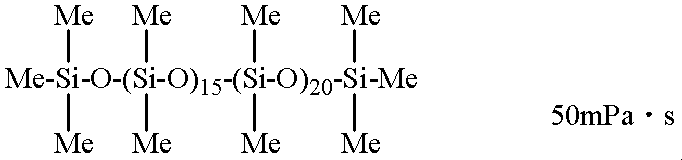
(A)ビニル基含有オルガノポリシロキサン:V−Sx
比表面積310m2/g、HN(Si(OMe)2)で表面処理されたもの
(C)アルコキシシラン
C−1 Si(OMe)4の部分加水分解物
C−2 γ−グリシドキシプロピルトリメトキシシラン
(D)加水分解触媒
D−1 Zr(ACAC)4
D−2 Zr(O−iPr)4
D−3 Zr(O−iPr)3(OCOC12H25)
D−4 Ti(O−iPr)4
D−5 Al(O−iPr)3
(E)ハイドロジェンポリシロキサン:H−Sx
1−エチニル−シクロヘキサノール/トルエン溶液(50質量%)
(G)白金触媒
白金の1,2−ジビニル−1,1,2,2−テトラメチル−ジシロキサンの錯体/トルエン溶液(Pt=0.5質量%)
(A) Vinyl group-containing organopolysiloxane: V-Sx
D-2 Zr (O-iPr) 4
D-3 Zr (O-iPr) 3 (OCOC 12 H 25 )
D-4 Ti (O-iPr) 4
D-5 Al (O-iPr) 3
(E) Hydrogen polysiloxane: H-Sx
(G) Platinum catalyst Platinum 1,2-divinyl-1,1,2,2-tetramethyl-disiloxane complex / toluene solution (Pt = 0.5 mass%)
本発明に従う組成の場合、難接着性材料に対しての良好な接着性を示すだけではなく、保存性、硬化後の物性変化が小さく、安定性に優れる材料が提供される。 In the case of the composition according to the present invention, a material that not only exhibits good adhesion to difficult-to-adhere materials but also exhibits little storage stability and changes in physical properties after curing and is excellent in stability.
Claims (5)
(A)下記平均組成式
R1 aR2 bSiO(4-a-b)/2
(式中、R1は脂肪族不飽和結合を含まない置換又は非置換の一価炭化水素基、R2はアルケニル基であり、aは0.96〜2.00、bは0.001〜0.5で、かつa+bが1.46〜2.1を満足する正数である。)
で示される、一分子中に珪素原子に結合したアルケニル基を少なくとも2個含有するオルガノポリシロキサン:100質量部、
(B)無機充填材:0.5〜400質量部、
(C)アルコキシシラン:0.1〜20質量部、
(D)チタン化合物、ジルコニウム化合物、アルミニウム化合物から選択される加水分解触媒:0.001〜10質量部、
(E)下記平均組成式
R3 cHdSiO(4-c-d)/2
(式中、R3は脂肪族不飽和結合を含まない置換又は非置換の一価炭化水素基であり、cは0.7〜2.1、dは0.005〜1.2で、かつc+dが0.8〜3.0を満足する正数である。)
で示されるオルガノハイドロジェンポリシロキサン:組成物中のアルケニル基に対するヒドロシリル基が0.4:1.0〜10.0:1.0となる量、
(F)必要量の硬化制御材、
(G)白金系金属化合物:組成物全量に対して金属元素含有量として1〜2,000ppm A manufacturing method of the following components (A) ~ (G) comprising a 1-component addition cure silicone rubber adhesive composition, as a first step, the component (A), (B), ( A state in which C) and (D) are essential, and some or all of the components (A) to (D), and if necessary, all or part of the components (E) and (F) do not contain the component (G) In a reduced pressure of 0.1 to 20 kPa in an environment of 0 ° C. to 200 ° C., and then, as a second step, the addition of component (G) is essential, and the remaining components are blended to add 0.1 to 20 kPa. A method for producing a one-component addition-curable silicone rubber adhesive composition comprising mixing in an environment of 0 ° C. to 60 ° C. under reduced pressure.
(A) The following average composition formula R 1 a R 2 b SiO (4-ab) / 2
Wherein R 1 is a substituted or unsubstituted monovalent hydrocarbon group not containing an aliphatic unsaturated bond, R 2 is an alkenyl group, a is 0.96 to 2.00, b is 0.001 to 0.5 and a + b is a positive number satisfying 1.46 to 2.1.)
An organopolysiloxane containing at least two alkenyl groups bonded to silicon atoms in one molecule represented by: 100 parts by mass
(B) Inorganic filler: 0.5 to 400 parts by mass,
(C) Alkoxysilane: 0.1 to 20 parts by mass,
(D) Hydrolysis catalyst selected from titanium compound, zirconium compound, and aluminum compound: 0.001 to 10 parts by mass,
(E) The following average composition formula R 3 c H d SiO (4-cd) / 2
Wherein R 3 is a substituted or unsubstituted monovalent hydrocarbon group not containing an aliphatic unsaturated bond, c is 0.7 to 2.1, d is 0.005 to 1.2, and c + d is a positive number satisfying 0.8 to 3.0.)
An amount of a hydrosilyl group with respect to an alkenyl group in the composition of 0.4: 1.0 to 10.0: 1.0,
(F) a necessary amount of curing control material,
(G) Platinum-based metal compound: 1 to 2,000 ppm in terms of metal element content with respect to the total amount of the composition
Priority Applications (3)
| Application Number | Priority Date | Filing Date | Title |
|---|---|---|---|
| JP2006348970A JP4367656B2 (en) | 2006-12-26 | 2006-12-26 | Method for producing addition-curable silicone rubber adhesive composition |
| EP07024801A EP1942169B1 (en) | 2006-12-26 | 2007-12-20 | Addition cure silicone rubber adhesive composition and making method |
| US12/003,366 US7825177B2 (en) | 2006-12-26 | 2007-12-21 | Addition cure silicone rubber adhesive composition and making method |
Applications Claiming Priority (1)
| Application Number | Priority Date | Filing Date | Title |
|---|---|---|---|
| JP2006348970A JP4367656B2 (en) | 2006-12-26 | 2006-12-26 | Method for producing addition-curable silicone rubber adhesive composition |
Publications (2)
| Publication Number | Publication Date |
|---|---|
| JP2008156545A JP2008156545A (en) | 2008-07-10 |
| JP4367656B2 true JP4367656B2 (en) | 2009-11-18 |
Family
ID=39200011
Family Applications (1)
| Application Number | Title | Priority Date | Filing Date |
|---|---|---|---|
| JP2006348970A Expired - Fee Related JP4367656B2 (en) | 2006-12-26 | 2006-12-26 | Method for producing addition-curable silicone rubber adhesive composition |
Country Status (3)
| Country | Link |
|---|---|
| US (1) | US7825177B2 (en) |
| EP (1) | EP1942169B1 (en) |
| JP (1) | JP4367656B2 (en) |
Families Citing this family (8)
| Publication number | Priority date | Publication date | Assignee | Title |
|---|---|---|---|---|
| JP5351415B2 (en) * | 2007-12-26 | 2013-11-27 | ウィンテックポリマー株式会社 | Polybutylene terephthalate resin composition |
| JP5459232B2 (en) * | 2010-01-19 | 2014-04-02 | 信越化学工業株式会社 | Addition-curing fluoropolyether adhesive composition |
| US11124602B2 (en) * | 2010-06-10 | 2021-09-21 | Polyplastics Co., Ltd. | Method for adhering resin molded articles |
| EP2452994A1 (en) * | 2010-11-12 | 2012-05-16 | Shin-Etsu Chemical Co., Ltd. | Addition curable silicone adhesive composition |
| CN102408869B (en) * | 2011-08-04 | 2013-07-24 | 绵阳惠利电子材料有限公司 | Halogen-free flame-retardant addition type organosilicon potting compound for electronic appliances |
| EP2794721A1 (en) * | 2011-12-20 | 2014-10-29 | 3M Innovative Properties Company | Dual condensation cure silicone |
| KR102131611B1 (en) | 2016-07-13 | 2020-08-06 | 다우 실리콘즈 코포레이션 | Formulations containing metal aprotic organosilane oxide compounds |
| WO2022071707A1 (en) * | 2020-09-29 | 2022-04-07 | 주식회사 엘지에너지솔루션 | Curable composition and two-liquid-type curable composition |
Family Cites Families (32)
| Publication number | Priority date | Publication date | Assignee | Title |
|---|---|---|---|---|
| US3814730A (en) | 1970-08-06 | 1974-06-04 | Gen Electric | Platinum complexes of unsaturated siloxanes and platinum containing organopolysiloxanes |
| US3715334A (en) | 1970-11-27 | 1973-02-06 | Gen Electric | Platinum-vinylsiloxanes |
| US3775452A (en) | 1971-04-28 | 1973-11-27 | Gen Electric | Platinum complexes of unsaturated siloxanes and platinum containing organopolysiloxanes |
| US3699072A (en) | 1971-06-24 | 1972-10-17 | Dow Corning | Silicone elastomer with unprimed adhesion |
| JPS528854B2 (en) | 1972-01-13 | 1977-03-11 | ||
| JPS5239751A (en) | 1975-09-26 | 1977-03-28 | Shin Etsu Chem Co Ltd | Curable organopolysiloxane compositions |
| NL7511482A (en) * | 1975-09-30 | 1977-04-01 | Philips Nv | GAS BINDING DEVICE; PROCEDURE FOR MANUFACTURING A COLOR TELEVISION PICTURE TUBE USING THIS GAS BINDING DEVICE AND THIS MANUFACTURED COLOR TELEVISION PICTURE TUBE. |
| US4077934A (en) | 1975-12-31 | 1978-03-07 | General Electric Company | Method of preparing compositions that comprise a polyphenylene ether resin and an alkenyl aromatic resin |
| US4138275A (en) * | 1976-08-10 | 1979-02-06 | Sumitomo Electric Industries, Ltd. | Method of manufacturing aluminum alloy for electric conductor |
| JPS5828340B2 (en) | 1976-08-10 | 1983-06-15 | 住友電気工業株式会社 | Aluminum alloy for conductive use |
| JPS62240361A (en) * | 1986-04-11 | 1987-10-21 | Toray Silicone Co Ltd | Curable organopolysiloxane composition |
| JP2508891B2 (en) * | 1990-05-29 | 1996-06-19 | 信越化学工業株式会社 | Silicone rubber composition and cured product thereof |
| US5399650A (en) * | 1993-08-17 | 1995-03-21 | Dow Corning Corporation | Adhesion promoting additives and low temperature curing organosiloxane compositions containing same |
| JPH08231939A (en) * | 1995-02-24 | 1996-09-10 | Toshiba Silicone Co Ltd | Adhesive polyorganosiloxane composition |
| JPH08311340A (en) * | 1995-05-15 | 1996-11-26 | Toray Dow Corning Silicone Co Ltd | Curable organopolysiloxane composition |
| JPH09324152A (en) * | 1996-06-06 | 1997-12-16 | Toray Dow Corning Silicone Co Ltd | Method for manufacturing an adhesive structure made of the same or different base materials |
| JPH108022A (en) * | 1996-06-25 | 1998-01-13 | Toray Dow Corning Silicone Co Ltd | Silicone-based adhesive for optical memory element, optical memory element and production of optical memory element |
| JPH11106734A (en) * | 1997-10-07 | 1999-04-20 | Toshiba Silicone Co Ltd | Adhesive polyorganosiloxane composition |
| DE10019599A1 (en) * | 2000-04-20 | 2001-10-31 | Wacker Chemie Gmbh | Self-adhesive addition-crosslinking silicone compositions |
| JP4162390B2 (en) * | 2001-01-17 | 2008-10-08 | 東レ・ダウコーニング株式会社 | Silicone rubber adhesive |
| JP2004359838A (en) * | 2003-06-05 | 2004-12-24 | Shin Etsu Polymer Co Ltd | Curable shaped silicone adhesive |
| JP2005060549A (en) * | 2003-08-13 | 2005-03-10 | Shin Etsu Polymer Co Ltd | Definite-form adhesive |
| JP4895247B2 (en) * | 2004-04-05 | 2012-03-14 | 旭化成ワッカーシリコーン株式会社 | Adhesive silicone rubber composition |
| JP4596151B2 (en) * | 2005-06-01 | 2010-12-08 | 信越化学工業株式会社 | Heat curable silicone rubber adhesive composition |
| JP4634866B2 (en) * | 2005-06-02 | 2011-02-16 | 信越化学工業株式会社 | Addition reaction curable silicone rubber adhesive |
| JP2007009189A (en) * | 2005-06-03 | 2007-01-18 | Shin Etsu Chem Co Ltd | Addition type silicone adhesive composition |
| JP4803350B2 (en) * | 2005-06-03 | 2011-10-26 | 信越化学工業株式会社 | Crimpable anisotropic conductive resin composition and method for connecting fine electrodes |
| JP4586981B2 (en) * | 2005-06-23 | 2010-11-24 | 信越化学工業株式会社 | Self-adhesive organopolysiloxane composition |
| JP2007031669A (en) * | 2005-07-29 | 2007-02-08 | Shin Etsu Polymer Co Ltd | Liquid adhesive |
| JP5042703B2 (en) * | 2006-05-10 | 2012-10-03 | 東レ・ダウコーニング株式会社 | Silicone rubber composition |
| JP2008031450A (en) * | 2006-06-27 | 2008-02-14 | Dow Corning Toray Co Ltd | Silicone rubber composition |
| JP2008074882A (en) * | 2006-09-19 | 2008-04-03 | Shin Etsu Chem Co Ltd | Two-component addition reaction curable adhesive for silicone rubber |
-
2006
- 2006-12-26 JP JP2006348970A patent/JP4367656B2/en not_active Expired - Fee Related
-
2007
- 2007-12-20 EP EP07024801A patent/EP1942169B1/en active Active
- 2007-12-21 US US12/003,366 patent/US7825177B2/en active Active
Also Published As
| Publication number | Publication date |
|---|---|
| EP1942169B1 (en) | 2011-07-27 |
| EP1942169A1 (en) | 2008-07-09 |
| US20080153956A1 (en) | 2008-06-26 |
| US7825177B2 (en) | 2010-11-02 |
| JP2008156545A (en) | 2008-07-10 |
Similar Documents
| Publication | Publication Date | Title |
|---|---|---|
| JP5609846B2 (en) | Addition-curing silicone adhesive composition | |
| KR101800341B1 (en) | Polysiloxane composition and cured product thereof | |
| JP4875251B2 (en) | Silicone gel composition | |
| KR20190075047A (en) | Curable organopolysiloxane compositions and protective or adhesive compositions for electrical and electronic components | |
| JP4835880B2 (en) | Method for producing liquid curable fluorosilicone composition | |
| JP6344333B2 (en) | Addition-curing silicone rubber composition | |
| EP1942169B1 (en) | Addition cure silicone rubber adhesive composition and making method | |
| JP2000351901A (en) | Liquid addition-curable silicone rubber composition | |
| JP5031436B2 (en) | Low moisture permeability polyorganosiloxane composition | |
| JP4634866B2 (en) | Addition reaction curable silicone rubber adhesive | |
| KR102750550B1 (en) | Adhesive polyorganosiloxane composition | |
| JP2021127373A (en) | One-component mirable silicone rubber composition and its cured product | |
| JP2009269968A (en) | Silicone adhesive | |
| JP4553562B2 (en) | Adhesive polyorganosiloxane composition | |
| JP2711621B2 (en) | Heat resistant silicone rubber composition | |
| JP4190460B2 (en) | Self-adhesive organopolysiloxane composition | |
| JP4596151B2 (en) | Heat curable silicone rubber adhesive composition | |
| JPH0632987A (en) | Silicone rubber composition with improved flowability and filler separation | |
| JP2009191155A (en) | Method for producing liquid silicone rubber base and method for producing addition curable liquid silicone rubber composition | |
| TWI642479B (en) | Resin composition containing platinum catalyst, thermosetting organic polysiloxane composition using the resin composition, and curing method thereof | |
| JP2015017198A (en) | Method for reducing modulus of cured silicone rubber, silicone rubber composition and cured product | |
| JP3918944B2 (en) | Addition-curing silicone composition | |
| KR20240032952A (en) | Thermally conductive silicone composition | |
| JP2007297598A (en) | Silicone rubber adhesive | |
| JP4761067B2 (en) | Airbag coating cloth |
Legal Events
| Date | Code | Title | Description |
|---|---|---|---|
| A621 | Written request for application examination |
Free format text: JAPANESE INTERMEDIATE CODE: A621 Effective date: 20081224 |
|
| A131 | Notification of reasons for refusal |
Free format text: JAPANESE INTERMEDIATE CODE: A131 Effective date: 20090520 |
|
| A521 | Request for written amendment filed |
Free format text: JAPANESE INTERMEDIATE CODE: A523 Effective date: 20090706 |
|
| TRDD | Decision of grant or rejection written | ||
| A01 | Written decision to grant a patent or to grant a registration (utility model) |
Free format text: JAPANESE INTERMEDIATE CODE: A01 Effective date: 20090805 |
|
| A01 | Written decision to grant a patent or to grant a registration (utility model) |
Free format text: JAPANESE INTERMEDIATE CODE: A01 |
|
| R150 | Certificate of patent or registration of utility model |
Ref document number: 4367656 Country of ref document: JP Free format text: JAPANESE INTERMEDIATE CODE: R150 Free format text: JAPANESE INTERMEDIATE CODE: R150 |
|
| A61 | First payment of annual fees (during grant procedure) |
Free format text: JAPANESE INTERMEDIATE CODE: A61 Effective date: 20090818 |
|
| FPAY | Renewal fee payment (event date is renewal date of database) |
Free format text: PAYMENT UNTIL: 20120904 Year of fee payment: 3 |
|
| FPAY | Renewal fee payment (event date is renewal date of database) |
Free format text: PAYMENT UNTIL: 20150904 Year of fee payment: 6 |
|
| LAPS | Cancellation because of no payment of annual fees |