JP4317455B2 - Compositions for infant formulas containing large amounts of alpha-lactalbumin - Google Patents
Compositions for infant formulas containing large amounts of alpha-lactalbumin Download PDFInfo
- Publication number
- JP4317455B2 JP4317455B2 JP2003555904A JP2003555904A JP4317455B2 JP 4317455 B2 JP4317455 B2 JP 4317455B2 JP 2003555904 A JP2003555904 A JP 2003555904A JP 2003555904 A JP2003555904 A JP 2003555904A JP 4317455 B2 JP4317455 B2 JP 4317455B2
- Authority
- JP
- Japan
- Prior art keywords
- protein
- alpha
- lactalbumin
- infant formula
- howay
- Prior art date
- Legal status (The legal status is an assumption and is not a legal conclusion. Google has not performed a legal analysis and makes no representation as to the accuracy of the status listed.)
- Expired - Fee Related
Links
Classifications
-
- A—HUMAN NECESSITIES
- A23—FOODS OR FOODSTUFFS; TREATMENT THEREOF, NOT COVERED BY OTHER CLASSES
- A23C—DAIRY PRODUCTS, e.g. MILK, BUTTER OR CHEESE; MILK OR CHEESE SUBSTITUTES; PREPARATION THEREOF
- A23C9/00—Milk preparations; Milk powder or milk powder preparations
- A23C9/15—Reconstituted or recombined milk products containing neither non-milk fat nor non-milk proteins
-
- A—HUMAN NECESSITIES
- A23—FOODS OR FOODSTUFFS; TREATMENT THEREOF, NOT COVERED BY OTHER CLASSES
- A23C—DAIRY PRODUCTS, e.g. MILK, BUTTER OR CHEESE; MILK OR CHEESE SUBSTITUTES; PREPARATION THEREOF
- A23C11/00—Milk substitutes, e.g. coffee whitener compositions
- A23C11/02—Milk substitutes, e.g. coffee whitener compositions containing at least one non-milk component as source of fats or proteins
- A23C11/04—Milk substitutes, e.g. coffee whitener compositions containing at least one non-milk component as source of fats or proteins containing non-milk fats but no non-milk proteins
-
- A—HUMAN NECESSITIES
- A23—FOODS OR FOODSTUFFS; TREATMENT THEREOF, NOT COVERED BY OTHER CLASSES
- A23C—DAIRY PRODUCTS, e.g. MILK, BUTTER OR CHEESE; MILK OR CHEESE SUBSTITUTES; PREPARATION THEREOF
- A23C9/00—Milk preparations; Milk powder or milk powder preparations
- A23C9/15—Reconstituted or recombined milk products containing neither non-milk fat nor non-milk proteins
- A23C9/1512—Reconstituted or recombined milk products containing neither non-milk fat nor non-milk proteins containing isolated milk or whey proteins, caseinates or cheese; Enrichment of milk products with milk proteins in isolated or concentrated form, e.g. ultrafiltration retentate
-
- A—HUMAN NECESSITIES
- A23—FOODS OR FOODSTUFFS; TREATMENT THEREOF, NOT COVERED BY OTHER CLASSES
- A23L—FOODS, FOODSTUFFS OR NON-ALCOHOLIC BEVERAGES, NOT OTHERWISE PROVIDED FOR; PREPARATION OR TREATMENT THEREOF
- A23L33/00—Modifying nutritive qualities of foods; Dietetic products; Preparation or treatment thereof
- A23L33/10—Modifying nutritive qualities of foods; Dietetic products; Preparation or treatment thereof using additives
- A23L33/17—Amino acids, peptides or proteins
- A23L33/19—Dairy proteins
-
- A—HUMAN NECESSITIES
- A23—FOODS OR FOODSTUFFS; TREATMENT THEREOF, NOT COVERED BY OTHER CLASSES
- A23L—FOODS, FOODSTUFFS OR NON-ALCOHOLIC BEVERAGES, NOT OTHERWISE PROVIDED FOR; PREPARATION OR TREATMENT THEREOF
- A23L33/00—Modifying nutritive qualities of foods; Dietetic products; Preparation or treatment thereof
- A23L33/40—Complete food formulations for specific consumer groups or specific purposes, e.g. infant formula
-
- Y—GENERAL TAGGING OF NEW TECHNOLOGICAL DEVELOPMENTS; GENERAL TAGGING OF CROSS-SECTIONAL TECHNOLOGIES SPANNING OVER SEVERAL SECTIONS OF THE IPC; TECHNICAL SUBJECTS COVERED BY FORMER USPC CROSS-REFERENCE ART COLLECTIONS [XRACs] AND DIGESTS
- Y10—TECHNICAL SUBJECTS COVERED BY FORMER USPC
- Y10S—TECHNICAL SUBJECTS COVERED BY FORMER USPC CROSS-REFERENCE ART COLLECTIONS [XRACs] AND DIGESTS
- Y10S426/00—Food or edible material: processes, compositions, and products
- Y10S426/801—Pediatric
Landscapes
- Life Sciences & Earth Sciences (AREA)
- Chemical & Material Sciences (AREA)
- Polymers & Plastics (AREA)
- Food Science & Technology (AREA)
- Engineering & Computer Science (AREA)
- Health & Medical Sciences (AREA)
- Nutrition Science (AREA)
- Mycology (AREA)
- Proteomics, Peptides & Aminoacids (AREA)
- Pediatric Medicine (AREA)
- Dairy Products (AREA)
- Coloring Foods And Improving Nutritive Qualities (AREA)
- Medicines That Contain Protein Lipid Enzymes And Other Medicines (AREA)
- Peptides Or Proteins (AREA)
Description
(技術分野)
本発明は幼児の寛容性の改善を示す幼児用処方の組成物に関する。詳細には、本発明は特定量のアルファ−ラクトアルブミンおよびベータ−ラクトグロブリンを含む修飾されたホウェイ蛋白濃縮物を含む幼児用処方の組成物に関する。
(Technical field)
The present invention relates to infant formula compositions that exhibit improved infant tolerance. Specifically, the present invention relates to infant formula compositions comprising a modified howy protein concentrate comprising specific amounts of alpha-lactalbumin and beta-lactoglobulin.
(背景技術)
人乳は生まれてから4ヶ月ないし6ヶ月の間新生児に栄養を与えるための好ましい手段である。母乳を与えることが適切でない、またはうまくいかない場合に、あるいは母親が母乳を与えないことを選択した場合に、人乳に代わる、または人乳を補足するための幼児用処方が開発されてきた。幼児用処方の組成物を改良する試みは、母乳の組成をより完全にまねることに焦点が当てられてきた。
幼児用処方に80年以上にわたって牛乳が用いられてきた。しかしながら、人乳と牛乳の蛋白系は、量および質の両方において実質的に異なっている。顕著な量的違いとして、人乳の全蛋白分(11g/L)が牛乳のそれ(33g/L)と比べて低いこと、およびホウェイ蛋白のカゼインに対する割合の違い(牛乳では18:82であり、人乳では60:40である)が挙げられる。
(Background technology)
Human milk is a preferred means for nourishing newborns for 4 to 6 months after birth. Infant formulas have been developed to replace or supplement human milk when breastfeeding is inappropriate or unsuccessful, or when a mother chooses not to breastfeed. Attempts to improve infant formula compositions have focused on more fully mimicking the composition of breast milk.
Milk has been used for infant formulas for over 80 years. However, the protein systems of human milk and cow are substantially different in both quantity and quality. Notable quantitative differences are that the total protein content of human milk (11 g / L) is lower than that of milk (33 g / L), and the difference in the ratio of howay protein to casein (18:82 for milk) In human milk, it is 60:40).
この分野における注目が、牛乳と人乳の間の、個々のホウェイ蛋白、具体的にはアルファ−ラクトアルブミンとベータ−ラクトグロブリンの量の、顕著な質的違いに焦点が当てられた。すべての哺乳動物の乳汁中に見られる蛋白である、アルファ−ラクトアルブミンは人乳の主たる蛋白である。ベータ−ラクトグロブリンは人乳には存在しない。ウシホウェイの蛋白分は約50%ないし55%のベータ−ラクトグロブリンおよび約18%のアルファ−ラクトアルブミンを含有する。ウシホウェイ中にあるベータ−ラクトグロブリンのアルファ−ラクトアルブミンに対する割合は2.5:1と4:1の範囲にある。さらには、牛乳中のベータ−ラクトグロブリンを除外または除去することで、アルファ−ラクトアルブミンの全量がウシホウェイ蛋白の18%から40%に増大することも知られている[de Wit, J. N.、"Nutritional and Functional Characteristics of Whey Proteins in Food Products", Journal of Dairy Science 81:597−608(1998)]。 Attention in this area has focused on significant qualitative differences in the amount of individual howay proteins, specifically alpha-lactalbumin and beta-lactoglobulin, between milk and human milk. Alpha-lactalbumin, a protein found in the milk of all mammals, is the main protein in human milk. Beta-lactoglobulin is not present in human milk. The bovine howay protein contains about 50% to 55% beta-lactoglobulin and about 18% alpha-lactalbumin. The ratio of beta-lactoglobulin to alpha-lactalbumin in bovine howay is in the range of 2.5: 1 and 4: 1. Furthermore, it is also known that the exclusion of or removal of beta-lactoglobulin in milk increases the total amount of alpha-lactalbumin from 18% to 40% of bovine howay protein [de Wit, JN, “Nutritional and Functional Characteristics of Whey Proteins in Food Products ", Journal of Dairy Science 81: 597-608 (1998)].
ベータ−ラクトグロブリンは、特に必須アミノ酸であるバリンおよびトレオニンに富んでいる。アルファ−ラクトアルブミンは、他の牛乳蛋白と比べて、特に必須アミノ酸であるトリプトファン、リジンおよびシスチンに富んでいる[Jarvenpaa, A. L., N. C. Raihaら、"Milk protein quantity and quality in the term infant. I. Metabolic responses and effects on growth", Pediatrics 70(2):214−20(1982)]。牛乳および人乳中の特定のホウェイ蛋白の量およびこれら蛋白のアミノ酸組成が異なる結果として、牛乳と人乳はそのアミノ酸特性にて実質的に異なる[Rudloff, S.およびC. Kunz、"Protein and nonprotein nitrogen components in human milk, bovine milk, and infant formula: quantitative and qualitative aspects in infant nutrition", J Pediatr Gastroenterol Nutr 24(3):328−44(1997)]。この違いは、特定のホウェイ蛋白の組成が修飾されていないような、ウシホウェイで調製されている幼児用処方では依然として存在することとなる。 Beta-lactoglobulin is particularly rich in the essential amino acids valine and threonine. Alpha-lactalbumin is particularly rich in essential amino acids tryptophan, lysine and cystine compared to other milk proteins [Jarvenpaa, AL, NC Raiha et al., “Milk protein quantity and quality in the term infant. I. Metabolic responses and effects on growth ", Pediatrics 70 (2): 214-20 (1982)]. Milk and human milk differ substantially in their amino acid properties as a result of differing amounts of certain howay proteins in milk and human milk and the amino acid composition of these proteins [Rudloff, S. and C. Kunz, “Protein and nonprotein nitrogen components in human milk, bovine milk, and infant formula: quantitative and qualitative aspects in infant nutrition ", J Pediatr Gastroenterol Nutr 24 (3): 328-44 (1997)]. This difference will still be present in infant formulas prepared with bovine howay, where the composition of a particular howay protein is not modified.
上記したように、牛乳を基材とする幼児用処方にてベータ−ラクトグロブリンを除外または除去すると、アルファ−ラクトアルブミンの含有率が増大する。かかる変化は、付随的に、必須アミノ酸であるシスチン、トリプトファン、チロシンおよびフェニルアラニンのレベルを増大させ、必須アミノ酸であるトレオニンのレベルを人乳のそれと極めて類似するレベルにまで減少させる。したがって、アミノ酸組成の改良は、幼児用処方の全蛋白分を減少させることとなる。 As noted above, excluding or removing beta-lactoglobulin in infant formulas based on milk increases the alpha-lactalbumin content. Such changes concomitantly increase the levels of the essential amino acids cystine, tryptophan, tyrosine and phenylalanine and reduce the level of the essential amino acid threonine to a level very similar to that of human milk. Thus, improving the amino acid composition will reduce the total protein content of the infant formula.
DeWit, de Wit, J. N.、"Nutritional and Functional Characteristics of Whey Proteins in Food Products", Journal of Dairy Science 81:597−608(1998)は、乳汁蛋白とアミノ酸組成の両方を微調整することに、具体的には、牛乳にアルファ−ラクトアルブミン、ベータ−カゼインおよびラクトフェリンを富ませ、特にそのアミノ酸組成について、最適な栄養素組成を得ることに焦点を当てたリサーチ活動を記載する。脱塩した牛乳パーミエート(permeate)中にベータ−ラクトグロブリンを用い尽くしたホウェイ蛋白、ベータ−カゼインおよびラクトフェリンを含む栄養素組成が提案されている。それはかかる調製物が現存する幼児用処方よりも人乳の蛋白組成に極めて近い蛋白組成を有することを前提とする。 DeWit, de Wit, JN, “Nutritional and Functional Characteristics of Whey Proteins in Food Products”, Journal of Dairy Science 81: 597-608 (1998), specifically tunes both milk protein and amino acid composition. Describes a research activity focused on obtaining an optimal nutrient composition, especially for its amino acid composition, enriched in milk with alpha-lactalbumin, beta-casein and lactoferrin. Nutrient compositions have been proposed that include howay protein, beta-casein and lactoferrin exhausted with beta-lactoglobulin in desalted milk permeate. It presupposes that such preparations have a protein composition that is much closer to that of human milk than existing infant formulas.
乳業技術は、幼児用処方を含め、食品に用いるために、ホウェイから実質的にすべてのベータ−ラクトグロブリンを選択的に除去するか、または実質的にベータ−ラクトグロブリン不含のアルファ−ラクトアルブミンに富むフラクションを単離する、ホウェイ蛋白の分別工程に焦点が当てられている。米国特許第5455331号は、脱脂せず、限外濾過に付したホウェイを用いてアルファラクトアルブミン分が高く、全沈殿性蛋白に基づいて5%未満のベータ−ラクトグロブリンを含む材料を生成する方法を記載する。この方法は、pH4.2にて、脱脂せず、限外濾過に付したチーズホウェイにて、アルファ−ラクトアルブミンを熱沈殿させることを含む。アルファ−ラクトアルブミンに富む沈殿物を上清し、洗浄し、中和し、限外濾過に付し、噴霧乾燥させてホウェイフラクションを得る。その中の蛋白は優勢的にアルファ−ラクトグロブリンであり、実質的にベータ−ラクトグロブリンを欠き、そのホウェイにて脂質含有成分を含む。米国特許第5420249号は脱脂肪ホウェイおよびカルシウム結合樹脂を用いて分離のためのホウェイならびに少なくとも60%のアルファ−ラクトアルブミンとしての蛋白および最大10%のベータ−ラクトグロブリンとしての蛋白を含むアルファ−ラクトアルブミンフラクションの調製を開示する。それらは13%のベータ−ラクトグロブリンとしての蛋白を含有するアルファ−ラクトアルブミンに富むフラクションを記載する。しかしながら、このフラクションは74%の蛋白をアルファ−ラクトアルブミンとして含有するが、ベータ−ラクトグロブリンのアルファ−ラクトアルブミンに対する割合は1:6である。他のアルファ−ラクトアルブミンに富むフラクションは、ベータ−ラクトグロブリンのアルファ−ラクトアルブミンに対する割合が1:4ないし1:7である。 Dairy technology selectively removes substantially all beta-lactoglobulin from howay for use in foods, including infant formulas, or alpha-lactalbumin substantially free of beta-lactoglobulin. The focus is on howy protein fractionation, which isolates rich fractions. U.S. Pat. No. 5,455,331 is a method for producing a material that is high in alpha-lactalbumin and uses less than 5% beta-lactoglobulin based on total precipitated protein using non-defatted howey subjected to ultrafiltration. Is described. This method involves heat precipitating alpha-lactalbumin in a cheese howe that has not been defatted and subjected to ultrafiltration at pH 4.2. The precipitate rich in alpha-lactalbumin is supernatant, washed, neutralized, subjected to ultrafiltration and spray dried to obtain the howy fraction. The protein therein is predominantly alpha-lactoglobulin, is substantially devoid of beta-lactoglobulin and contains a lipid-containing component in its way. U.S. Pat. No. 5,420,249 describes how-to for separation using defatted howay and calcium binding resin and alpha-lacto comprising at least 60% protein as alpha-lactalbumin and up to 10% protein as beta-lactoglobulin. The preparation of the albumin fraction is disclosed. They describe a fraction enriched in alpha-lactalbumin containing 13% protein as beta-lactoglobulin. However, this fraction contains 74% protein as alpha-lactalbumin, but the ratio of beta-lactoglobulin to alpha-lactalbumin is 1: 6. Other alpha-lactalbumin rich fractions have a ratio of beta-lactoglobulin to alpha-lactalbumin of 1: 4 to 1: 7.
米国特許第5436020号は、カゼイングリコマクロペプチドおよび脂肪を除去するのに限外濾過に付した分画されたホウェイと結合した非蛋白窒素源としての脱ラクトース化および脱イオン化ホウェイパーミエートからなる材料で製造されている、未処理の牛乳蛋白を欠く幼児用処方を記載する。米国特許第5169666号は、幼児養育用の「ヒト化」牛乳材料を製造するために、牛乳を処理し、アルファ−s−カゼインを除外または実質的に減少させ、ベータ−ラクトグロブリンレベルを蛋白の百分率として4%またはそれ以下にまで減少させることを記載する。 US Pat. No. 5,436,020 consists of casein glycomacropeptide and delactosylated and deionized howay permeate as a non-protein nitrogen source combined with fractionated howay subjected to ultrafiltration to remove fat Describe infant formulas that are made of ingredients and lack untreated milk protein. US Pat. No. 5,169,666 treats milk to exclude or substantially reduces alpha-s-casein and produces beta-lactoglobulin levels of protein to produce “humanized” milk material for infant feeding. The reduction to 4% or less as a percentage is stated.
(発明の要約)
本発明は、幼児が十分に我慢できる、幼児用処方の組成物に関する。本発明の幼児用処方組成物は、ホウェイフラクションの全蛋白の40%以下がアルファ−ラクトアルブミンであり、ホウェイフラクションの全蛋白の8%以上がベータ−ラクトグロブリンである;ただし、ホウェイフラクション中のアルファ−ラクトアルブミンの割合がベータ−ラクトグロブリンの割合よりも大きい、ホウェイフラクションを含む。
(Summary of the Invention)
The present invention relates to compositions for infant formulas that infants can tolerate well. In the infant formula composition of the present invention, 40% or less of the total protein in the howay fraction is alpha-lactalbumin, and 8% or more of the total protein in the howay fraction is beta-lactoglobulin; It includes a howy fraction in which the proportion of alpha-lactalbumin in the fraction is greater than the proportion of beta-lactoglobulin.
(発明の詳細な記載)
本発明はさらには、100キロカロリーを利用するに際して約1.0ないし約1.2グラムの蛋白を提供するのに十分な量の牛乳と、100キロカロリーを利用するに際して約1.0ないし約1.2グラムの蛋白を提供するのに十分な量のウシホウェイ材料とを含む、栄養学的に完全な幼児用処方であって、ウシホウェイ材料が全蛋白のアルファーラクトアルブミン分約28%ないし約40%およびベータ−ラクトグロブリン分約8%ないし約33%を含む、幼児用処方に関する。好ましくは、ホウェイ材料は全蛋白の約28%と約36%の間のアルファーラクトアルブミン分および約10%と約29%の間のベータ−ラクトアルブミン分を有する。この処方において、そのホウェイフラクションのアルファーラクトアルブミンの百分率は、そのホウェイフラクションのベータ−ラクトグロブリンの百分率によりも大きい。好ましくは、そのホウェイフラクションのベータ−ラクトグロブリン分は、そのホウェイフラクションのアルファーラクトアルブミンの百分率から7%を引いた百分率よりも大きくない。
本発明の特定量のアルファーラクトアルブミンおよびベータ−ラクトグロブリンの組成を有する修飾されたホウェイは、全窒素の約15%(百分率はw/wを基礎とする;以下、同じ)またはそれ以下の蛋白以外の窒素分;約12.5ないし約95%の全蛋白分;約15%以下の脂質分;および約4.5%以下の灰分を有することが好ましい。好ましくは、修飾されたホウェイの全蛋白分は約35%ないし約80%の間にあり、より好ましくは約73%ないし約77%の間にある。
(Detailed description of the invention)
The present invention further provides an amount of milk sufficient to provide about 1.0 to about 1.2 grams of protein when utilizing 100 kcal and about 1.0 to about 1. when utilizing 100 kcal. A nutritionally complete infant formula comprising a sufficient amount of bovine howay material to provide 2 grams of protein, wherein the bovine howay material has an alpha-lactalbumin content of about 28% to about 40% of total protein and It relates to infant formulas containing about 8% to about 33% beta-lactoglobulin. Preferably, the howay material has between about 28% and about 36% alpha-lactalbumin content and between about 10% and about 29% beta-lactalbumin content of the total protein. In this formulation, the percentage of alpha-lactalbumin in the howy fraction is also greater than the percentage of beta-lactoglobulin in the howy fraction. Preferably, the beta-lactoglobulin content of the howay fraction is not greater than the percentage of alpha-lactalbumin in the howay fraction minus 7%.
The modified howay having the composition of specific amounts of alpha-lactalbumin and beta-lactoglobulin of the present invention is about 15% of the total nitrogen (percentage is based on w / w; hereinafter the same) or less protein Preferably, it has a nitrogen content other than about 12.5 to about 95% total protein; about 15% or less lipid content; and about 4.5% or less ash. Preferably, the total protein content of the modified howay is between about 35% and about 80%, more preferably between about 73% and about 77%.
本発明の組成物にて用いられるウシホウェイ材料が、全蛋白100グラムに付き、グラム単位にて以下のアミノ酸分:アルギニン(3.1);シスチン(1.4);ヒスチジン(1.6);イソロイシン(1.0);ロイシン(5.3);リジン(3.9);メチオニン(0.3);フェニルアラニン(1.2);トレオニン(3.2);トリプトファン(1.5);チロシン(0.9);およびバリン(1.0)を最低量にて有する。したがって、本発明の幼児用処方はアミノ酸を付加的に含有する必要はない。
本発明の幼児用処方は、付加的に、当該分野にて知られている栄養学的に有益な成分、例えば、アラキドン酸およびドコサヘキサエン酸などの長鎖ポリ不飽和脂肪酸を提供する油と一緒に処方することができる。本発明の幼児用処方はさらに、ビタミン、ミネラル、セレニウム、天然カロチノイド、ヌクレオチド、タウリンおよび他の栄養物質と一緒に処方することもできる。
The bovine howay material used in the composition of the present invention has the following amino acid content per gram in 100 grams of total protein: arginine (3.1); cystine (1.4); histidine (1.6); Isoleucine (1.0); leucine (5.3); lysine (3.9); methionine (0.3); phenylalanine (1.2); threonine (3.2); tryptophan (1.5); (0.9); and valine (1.0) in the lowest amount. Accordingly, the infant formula of the present invention need not contain additional amino acids.
The infant formula of the present invention additionally comprises an oil that provides nutritionally beneficial ingredients known in the art, such as long chain polyunsaturated fatty acids such as arachidonic acid and docosahexaenoic acid. Can be prescribed. The infant formula of the present invention can also be formulated with vitamins, minerals, selenium, natural carotenoids, nucleotides, taurine and other nutritional substances.
かくして、一の具体例において、本発明は、100キロカロリーを利用するに際して2.0−2.4グラムの蛋白を含有する栄養学的に完全な幼児用処方の組成物であって、該蛋白が修飾されていない牛乳とホウェイフラクションからの実質的に等量の蛋白にて構成され、該ホウェイフラクションはアルファ−ラクトアルブミンに富んでいるところの、幼児用処方に関する。 Thus, in one embodiment, the present invention provides a nutritionally complete infant formula composition containing 2.0-2.4 grams of protein when utilizing 100 kilocalories, wherein the protein comprises It relates to infant formulas, composed of substantially equal amounts of protein from unmodified milk and howy fraction, which is rich in alpha-lactalbumin.
本発明の幼児用処方は、脱イオン水中に適量のアルファ−ラクトアルブミンに富むホウェイ蛋白濃縮物を、脱脂粉乳、ラクトース、植物油および脂溶性ビタミンと一緒にブレンドすることにより調製することができる。好ましくは、これらの材料を略240グラム/リットルの最終濃度を得るのに十分な量にて一緒にブレンドする。ついで、高温/短時間の低温殺菌に付す前に、無機塩を該混合物に加えてもよい。適当な無機塩として、塩化カルシウム、炭酸カルシウム、クエン酸ナトリウム、水酸化カリウム、炭酸水素カリウム、塩化マグネシウム、硫酸鉄、クエン酸カリウム、硫酸亜鉛、水酸化カルシウム、硫酸銅、硫酸マグネシウム、ヨウ化カリウム、亞セレン酸ナトリウム等が挙げられる。ついで、この混合物を均質にして冷却する。ついで、熱不安定なビタミンおよび微量栄養素を当該混合物に添加する。ついで、この混合物を約120ないし約135、好ましくは123グラム/リットル(約670キロカロリー/リットルに相当する)の最終全固体濃度にまで脱イオン水を用いて標準化する。その処方を一般的に超高温で滅菌処理してもよく、あるいは標準的なレトルト方法で滅菌処理に付してもよい。次に、この滅菌処理された材料を適当なパッケージに入れる。 The infant formula of the present invention can be prepared by blending a suitable amount of alpha-lactalbumin rich howay protein concentrate in deionized water together with skim milk powder, lactose, vegetable oils and fat-soluble vitamins. Preferably, these materials are blended together in an amount sufficient to obtain a final concentration of approximately 240 grams / liter. An inorganic salt may then be added to the mixture prior to high temperature / short time pasteurization. Suitable inorganic salts include calcium chloride, calcium carbonate, sodium citrate, potassium hydroxide, potassium bicarbonate, magnesium chloride, iron sulfate, potassium citrate, zinc sulfate, calcium hydroxide, copper sulfate, magnesium sulfate, potassium iodide And sodium selenate. The mixture is then homogenized and cooled. The heat labile vitamins and micronutrients are then added to the mixture. The mixture is then standardized with deionized water to a final total solids concentration of about 120 to about 135, preferably 123 grams / liter (corresponding to about 670 kilocalories / liter). The formulation may generally be sterilized at very high temperatures or may be subjected to sterilization by standard retort methods. The sterilized material is then placed in a suitable package.
製造および滅菌処理についての他の既知の方法を本発明の幼児用処方を調製するのに使用できることは当業者に明らかであろう。本発明の幼児用処方はまた、幼児に授乳する前に等容量の水で希釈する必要のある濃縮液体生成物として調製してもよい。さらには、かかる幼児用処方をスプレードライヤーにおけるように脱水させ、輸送の安定性および経済性の利点を付与する安定した幼児用処方粉末を作り出してもよい。かかる粉末は幼児に付与スル前に水で復元する必要がある。 It will be apparent to those skilled in the art that other known methods for manufacturing and sterilization can be used to prepare the infant formula of the present invention. The infant formula of the present invention may also be prepared as a concentrated liquid product that needs to be diluted with an equal volume of water before feeding the infant. Furthermore, such infant formulas may be dehydrated as in a spray dryer to create a stable infant formula powder that provides transportation stability and economic advantages. Such powders must be reconstituted with water before being applied to the infant.
本発明の幼児用処方は、幼児用処方におけるアミノ酸についての欧州連合[Directive91/321/EEC]基準に適合あるいは上回るように必須アミノ酸を付加的に添加する必要のないアミノ酸特性の組成を有するという点で有利である。このアミノ酸特性は全蛋白濃度を100キロカロリーを利用するに際して2.1グラムにまで減少させることができ、これは人乳の全蛋白濃度とより近い。もう一つ別の利点がU.S.Infant Formula Actの蛋白要件を上回る幼児用処方であるということである。さらなる利点は人乳にて見られるような平均量のアルファ−ラクトアルブミンを含有する幼児用処方であるということである。さらなる利点はアルファ−ラクトアルブミンを主たるホウェイ蛋白として含有する幼児用処方であるということである。もう一つ別のさらなる利点は長鎖オメガ−3およびオメガ−6ポリ不飽和脂肪酸を栄養学的に望ましいレベルで含有する幼児用処方であるということである。 The infant formula of the present invention has a composition with amino acid properties that do not require additional addition of essential amino acids to meet or exceed the European Union [Directive 91/321 / EEC] standards for amino acids in infant formulas. Is advantageous. This amino acid profile can reduce the total protein concentration to 2.1 grams when utilizing 100 kcal, which is closer to the total protein concentration of human milk. Another advantage is U.S. S. It is a prescription for infants that exceeds the protein requirements of Infant Formula Act. A further advantage is that the infant formula contains an average amount of alpha-lactalbumin as found in human milk. A further advantage is that it is an infant formula containing alpha-lactalbumin as the main howay protein. Another additional advantage is that it is an infant formula containing long chain omega-3 and omega-6 polyunsaturated fatty acids at nutritionally desirable levels.
牛乳は大部分の幼児用処方の基材である。全蛋白濃度が人乳のそれの3倍であるにも拘わらず、アルファ−ラクトアルブミンは人乳の半分にも満たない。人乳はベータ−ラクトグロブリンを全く含有しない。反対に、ベータ−ラクトグロブリンは牛乳にある最も豊富なホウェイ蛋白である(表1)。
単なる蛋白源として未修飾牛乳で製造した現行の幼児用処方は、15−16g/Lの蛋白を含有し、カゼイン−優勢であり、わずか0.5g/Lのアルファ−ラクトアルブミンを含有するにすぎない(表1)。蛋白組成について修飾されていないホウェイ蛋白で製造された当該幼児用処方は15g/Lの蛋白を含有する。脱ミネラル化されたホウェイはこれらの幼児用処方にある蛋白の半分を提供する。これらの幼児用処方は等容量の人乳にて略半分の、1.2g/Lのアルファ−ラクトアルブミンを含有する(表1)。
Milk is the base material for most infant formulas. Despite the total protein concentration being three times that of human milk, alpha-lactalbumin is less than half of human milk. Human milk does not contain any beta-lactoglobulin. Conversely, beta-lactoglobulin is the most abundant howay protein found in milk (Table 1).
Current infant formulas made with unmodified milk as a mere protein source contain 15-16 g / L protein, casein-dominant, and contain only 0.5 g / L alpha-lactalbumin. No (Table 1). The infant formula made with howay protein not modified for protein composition contains 15 g / L of protein. Demineralized howay provides half of the protein found in these infant formulas. These infant formulas contain 1.2 g / L of alpha-lactalbumin, approximately half of an equal volume of human milk (Table 1).
実施例1
アルファ−ラクトアルブミンについては富んでいるが、ベータ−ラクトグロブリンを有意なレベルにて含有するホウェイ蛋白濃縮物を、本発明の幼児用処方に用いるために調製した。当該濃縮物は以下の近似値ならびにミネラル組成およびホウェイ蛋白割合を有した。
Example 1
A howay protein concentrate, rich in alpha-lactalbumin, but containing significant levels of beta-lactoglobulin, was prepared for use in the infant formula of the present invention. The concentrate had the following approximate values as well as mineral composition and howy protein ratio.
ホウェイ蛋白フラクションのアルファ−ラクトアルブミンおよびベータ−ラクトグロブリンの割合を、2−メルカプトエタノール還元に付した後、移動相および溶媒として6MグアニジンHCLを用いるGPC(ゲル透過クロマトグラフィー)を用いて測定した。 The proportion of alpha-lactalbumin and beta-lactoglobulin in the howay protein fraction was measured using GPC (gel permeation chromatography) using 6M guanidine HCL as mobile phase and solvent after 2-mercaptoethanol reduction.
クロマトグラフィーカラムにプロゲルTSK G3000 SW XLを充填した。2つのカラムをSW XLのガードカラムと直列に並べた。グアニジン塩酸塩(573.18g)をHPLC等級の水(600mL)に溶かして移動相を調製した。バッファーストック(100mL)を加え、その溶液を加熱して攪拌し、完全に溶解させた。そのpHを50%水酸化ナトリウムでpH7.5に調整した。濾過した後、溶液を1リットルに希釈した。Na2HPO4(56.6g)、NaH2PO4(3.5g)および四酢酸エチレンジアミン(2.9g)をHPLC等級の水(1000mL)に溶かし、塩酸でpH7.5に調整してバッファーストックを調製した。 A chromatography column was packed with Progel TSK G3000 SW XL. Two columns were placed in series with the SW XL guard column. A mobile phase was prepared by dissolving guanidine hydrochloride (573.18 g) in HPLC grade water (600 mL). Buffer stock (100 mL) was added and the solution was heated and stirred to dissolve completely. The pH was adjusted to pH 7.5 with 50% sodium hydroxide. After filtration, the solution was diluted to 1 liter. A buffer stock was prepared by dissolving Na2HPO4 (56.6 g), NaH2PO4 (3.5 g) and tetraacetic acid ethylenediamine (2.9 g) in HPLC grade water (1000 mL) and adjusting to pH 7.5 with hydrochloric acid.
クロマトグラフィー条件は以下のとおりである:流速(0.5mL/分);作動時間(六〇分);注入容量(50マイクロリットル);温度(外界温度);および検出器(UV280nm)。 Chromatographic conditions are as follows: flow rate (0.5 mL / min); operating time (60 minutes); injection volume (50 microliters); temperature (ambient temperature); and detector (UV 280 nm).
10mLの容量フラスコ中にて10mgに相当する量の蛋白を秤量することでサンプルを調製した。移動相を一定容量まで加え、フラスコを十分に混合した。該溶液を20分間超音波処理に付した。約1mLの溶液を注入用バイアルに移し、10mLの2−メルカプトエタノールを加え、その溶液をボルテックス・ミキサー上で10秒間混合する。ついで、そのサンプルをHPLCシステムに注入した。 A sample was prepared by weighing an amount of protein corresponding to 10 mg in a 10 mL volumetric flask. The mobile phase was added to a constant volume and the flask was mixed well. The solution was sonicated for 20 minutes. About 1 mL of solution is transferred to an injection vial, 10 mL of 2-mercaptoethanol is added, and the solution is mixed on a vortex mixer for 10 seconds. The sample was then injected into the HPLC system.
約25mgのウシアルファ−ラクトアルブミンおよびベータ−ラクトグロブリンを別々に秤量し、それらを10mLの容量フラスコ中のHPLC等級の水に溶かすことで標体を調製した。1.0mLの各標体を10mLの容量フラスコにピペットで取り、移動相で一定容量に希釈することで較正基準を調製した。約1mLの較正基準溶液を注入用バイアルに移し、10mLの2−メルカプトエタノールを加え、その溶液をボルテックス・ミキサーで10秒間混合した。ついでその標準サンプルをHPLCシステムに注入した。 A target was prepared by weighing approximately 25 mg of bovine alpha-lactalbumin and beta-lactoglobulin separately and dissolving them in HPLC grade water in a 10 mL volumetric flask. Calibration standards were prepared by pipetting 1.0 mL of each specimen into a 10 mL volumetric flask and diluting to constant volume with mobile phase. Approximately 1 mL of calibration reference solution was transferred to an injection vial, 10 mL of 2-mercaptoethanol was added, and the solution was mixed with a vortex mixer for 10 seconds. The standard sample was then injected into the HPLC system.
実施例2
実施例1のホウェイ蛋白濃縮物を等量の蛋白を含有する一定量の脱脂粉乳と混合し、ホウェイ蛋白のカゼインに対する割合を60:40とした。アルファ−ラクトアルブミンがこの蛋白混合物にて優勢なホウェイ蛋白であることがわかった。
この蛋白混合物を用い、標準のホウェイをベースとする幼児用処方における蛋白分よりも蛋白分が低く、人乳に見られるそれと近似する、改良された幼児用処方を調製した。当該幼児用処方の蛋白分、ホウェイ蛋白分、アルファ−ラクトアルブミンレベルおよびベータ−ラクトグロブリンレベルを表3に示す。この幼児用処方におけるアルファ−ラクトアルブミンの量はベータ−ラクトグロブリンの量よりも多かった。該幼児用処方中のアルファ−ラクトアルブミンの量は人乳中のアルファ−ラクトアルブミンの量と本質的に同じであった。
Example 2
The howy protein concentrate of Example 1 was mixed with a certain amount of skim milk powder containing an equal amount of protein, and the ratio of howy protein to casein was 60:40. Alpha-lactalbumin was found to be the dominant howay protein in this protein mixture.
This protein mixture was used to prepare an improved infant formula that had a lower protein content than that of a standard howay-based infant formula and approximates that found in human milk. Table 3 shows the protein content, howy protein content, alpha-lactalbumin level and beta-lactoglobulin level of the infant formula. The amount of alpha-lactalbumin in this infant formula was greater than the amount of beta-lactoglobulin. The amount of alpha-lactalbumin in the infant formula was essentially the same as the amount of alpha-lactalbumin in human milk.
この蛋白混合物を配合したすぐ授乳することのできる4つのバッチの液体幼児用処方を以下の方法にて4000リットルの容量で製造した。
各バッチの脂肪ブレンドは、43.54kgの無作為に選択されたパームオレイン、35.2Lのオレイン酸含量の多いヒマワリ油またはサフラワー油、34.6Lのココナッツ油、28.1Lの大豆油、1.36kgの大豆レシチン、1.37kgの蒸留したモノグリセリド、その脂肪酸の38%をアラキドン酸として含有する1.19kgの油(ARASCO、Martek、コロンビア、メリーランド州)およびその脂肪酸の38%をドコサヘキサエン酸として含有する0.74kgの油(DHASCO、Martek、コロンビア、メリーランド州)を合することにより調製した。
ついで、脂溶性ビタミンのビタミンA(ビタミンAパルミチン酸塩および混合天然カロチノイド)、ビタミンD(コレカルシフェロール)、ビタミンE(dl−アルファ−トコフェロール酢酸塩)およびビタミンK(フィトナジオン)をこの脂肪ブレンドに分散させた。
Four batches of liquid infant formula ready for breastfeeding with this protein mixture were prepared in a volume of 4000 liters in the following manner.
Each batch of fat blend consists of 43.54 kg of randomly selected palm olein, 35.2 L of high oleic sunflower or safflower oil, 34.6 L of coconut oil, 28.1 L of soybean oil, 1.36 kg of soy lecithin, 1.37 kg of distilled monoglyceride, 1.19 kg of oil (ARASCO, Martek, Columbia, MD) containing 38% of its fatty acid as arachidonic acid and 38% of its fatty acid as docosahexaene Prepared by combining 0.74 kg of oil (DHHASCO, Martek, Columbia, MD) containing as acid.
The fat-soluble vitamins vitamin A (vitamin A palmitate and mixed natural carotenoids), vitamin D (cholecalciferol), vitamin E (dl-alpha-tocopherol acetate) and vitamin K (phytonadione) are then added to this fat blend. Dispersed.
改良された処方のバッチを製造するために、28kgの蛋白を得るのに十分な量の加熱した液体脱脂粉乳または粉状の脱脂粉乳を、熱水に溶かした723gのクエン酸ナトリウムおよび404gの炭酸水素カリウムが添加されている合成タンク中の加温した脱イオン水に加えた。脂肪ブレンドをこの合成タンクに秤量して入れた。主たる乾燥成分、ラクトースおよびホウェイ蛋白濃縮物を粉末漏斗エダクターを通して加えた。ホウェイ蛋白濃縮物の添加量はその蛋白分に応じて変わり、28kgの蛋白を得るのに十分であった。タウリン(221g)を熱水に溶かし、合成タンクに加えた。以下のミネラルを別々に熱水に溶かすかまたは分散させ、激しくかき混ぜながら合成タンクに加えた:炭酸カルシウム(679g);水酸化カルシウム(262g);水酸化カリウム(143g);塩化マグネシウム(507g);塩化カルシウム(292g);塩化カリウム(552g);硫酸鉄(151g);ラクトース中1%粉薬のヨウ化カリウム(31.6g);硫酸亜鉛の44.6%溶液(250g);硫酸銅の2.5%溶液(367g);硫酸マンガンの2.5%溶液(5.08g)および炭酸水素カリウム中の0.3%亞セレン酸ナトリウム(12.5g)。 To produce a batch of improved formulations, a quantity of heated liquid skim milk powder or powdered skim milk powder sufficient to obtain 28 kg of protein was dissolved in 723 g sodium citrate and 404 g carbonic acid dissolved in hot water. Added to warm deionized water in a synthesis tank to which potassium hydrogen was added. The fat blend was weighed into this synthesis tank. The main dry ingredients, lactose and howay protein concentrate were added through a powder funnel eductor. The amount of howy protein concentrate added varied with the protein content and was sufficient to obtain 28 kg of protein. Taurine (221 g) was dissolved in hot water and added to the synthesis tank. The following minerals were separately dissolved or dispersed in hot water and added to the synthesis tank with vigorous stirring: calcium carbonate (679 g); calcium hydroxide (262 g); potassium hydroxide (143 g); magnesium chloride (507 g); Calcium chloride (292 g); potassium chloride (552 g); iron sulfate (151 g); 1% powdered potassium iodide (31.6 g) in lactose; 44.6% solution of zinc sulfate (250 g); 5% solution (367 g); 2.5% solution of manganese sulfate (5.08 g) and 0.3% sodium selenate (12.5 g) in potassium bicarbonate.
混合物を96±2℃に加熱し、30秒間そのままとし、ついで66±2℃に冷却した。ついで、二段階式ホモジナイザーを用い、その混合物を第一段階は2500psigで、第二段階は500psigで均質化させた。ついで、その均質化された混合物をプレート熱交換機を用いて5−10℃に冷却した。 The mixture was heated to 96 ± 2 ° C. and left for 30 seconds, then cooled to 66 ± 2 ° C. A two-stage homogenizer was then used to homogenize the mixture at 2500 psig in the first stage and 500 psig in the second stage. The homogenized mixture was then cooled to 5-10 ° C. using a plate heat exchanger.
混合物のサンプルを脂肪分、pHおよび全固形分について分析した。必要に応じて適量の脱イオン水を添加し、80%の全希釈を達成し、バッチを混合した。全固形分およびpHを分析するためにサンプルを採取した。最終希釈のために必要とされる量の水を算定した。この希釈水の一部を用いてヌクレオチドおよび水溶性ビタミンを希釈し、それらを混合物に添加した。以下のヌクレオチドを加温した水に溶かし、混合物に添加した:シチジン5’一リン酸(63.7g);アデノシン5’一リン酸(18.6g);ウリジン5’一リン酸二ナトリウム塩(32.4g);イノシン5’一リン酸二ナトリウム塩(13.0g)およびグアノシン5’一リン酸二ナトリウム塩(11.2g)。 Samples of the mixture were analyzed for fat, pH and total solids. An appropriate amount of deionized water was added as needed to achieve a total dilution of 80% and the batch was mixed. Samples were taken for analysis of total solids and pH. The amount of water required for final dilution was calculated. A portion of this diluted water was used to dilute the nucleotides and water-soluble vitamins and add them to the mixture. The following nucleotides were dissolved in warm water and added to the mixture: cytidine 5 ′ monophosphate (63.7 g); adenosine 5 ′ monophosphate (18.6 g); uridine 5 ′ monophosphate disodium salt ( 32.4 g); inosine 5 ′ monophosphate disodium salt (13.0 g) and guanosine 5 ′ monophosphate disodium salt (11.2 g).
適宜処方した水溶性ビタミンのプレミックスを温水に溶かし、この溶液を混合物に加えた。コリンクロリド(251g)およびミオイノシトール(104g)を水に溶かし、混合物に加えた。アスコルビン酸(812g)を温水に溶かし、炭酸水素カリウム(462g)をゆっくりと添加してアスコルビン酸を中和した。ついで、アスコルビン酸塩中性溶液を混合物に添加した。その混合物を30分間かき混ぜた。この混合物を約123g/リットルの全固形分に標準化させた。
最初の均質化から24時間後、混合物を再び均質化させ、ストークUHT(超高圧)無菌処理システムを介して滅菌し、無菌状態で250mLのフレキシブルな容器に充填した。
An appropriately formulated premix of water-soluble vitamins was dissolved in warm water and this solution was added to the mixture. Choline chloride (251 g) and myo-inositol (104 g) were dissolved in water and added to the mixture. Ascorbic acid (812 g) was dissolved in warm water, and potassium bicarbonate (462 g) was slowly added to neutralize ascorbic acid. The neutral ascorbate solution was then added to the mixture. The mixture was agitated for 30 minutes. This mixture was standardized to a total solids of about 123 g / liter.
Twenty-four hours after the initial homogenization, the mixture was homogenized again, sterilized via a Stoke UHT (ultra-high pressure) aseptic processing system, and filled in a 250 mL flexible container under aseptic conditions.
対照となる処方
脱ミネラル化ホウェイ(典型的には、13.5%蛋白、85%ラクトース、脂肪1%および灰分1.5%未満)で製造した、すぐ授乳することのできる液体幼児用処方の対照となるバッチを、以下の方法にて、4000リットルの量にて製造した。30kgの蛋白を得るのに十分な量の加熱した液体脱脂粉乳を、熱水に溶かしたクエン酸ナトリウムおよびクエン酸カリウムが加えられている合成タンク中の加温した脱イオン水に添加した。脂溶性ビタミンに富む脂肪ブレンドをこの合成タンクに秤量して入れた。主たる乾燥成分、ラクトースおよび脱ミネラル化ホウェイを粉末漏斗エダクターを通して加えた。脱ミネラル化ホウェイの添加量はその蛋白分に応じて一定でなく、30kgの蛋白を得るのに十分であった。タウリンを熱水に溶かし、合成タンクに加えた。以下のミネラルを別々に熱水に溶かすかまたは分散させ、激しくかき混ぜながら合成タンクに加えた:炭酸水素カリウム、塩化カルシウム、塩化カリウム、塩化ナトリウム、クエン酸カルシウム、硫酸鉄、ヨウ化カリウム、硫酸亜鉛、硫酸銅、硫酸マンガンおよび亞セレン酸ナトリウム。
Control Formulation A ready-to-feed liquid infant formula made with a demineralized howay (typically less than 13.5% protein, 85% lactose, 1% fat and 1.5% ash) A control batch was produced in a volume of 4000 liters by the following method. An amount of heated liquid skim milk powder sufficient to obtain 30 kg of protein was added to warm deionized water in a synthesis tank to which sodium citrate and potassium citrate dissolved in hot water were added. A fat blend rich in fat-soluble vitamins was weighed into the synthesis tank. The main dry ingredients, lactose and demineralized howay were added through a powder funnel eductor. The amount of demineralized howay added was not constant depending on the protein content and was sufficient to obtain 30 kg of protein. Taurine was dissolved in hot water and added to the synthesis tank. The following minerals were separately dissolved or dispersed in hot water and added to the synthesis tank with vigorous stirring: potassium bicarbonate, calcium chloride, potassium chloride, sodium chloride, calcium citrate, iron sulfate, potassium iodide, zinc sulfate , Copper sulfate, manganese sulfate and sodium selenate.
対照となる処方を、上記した本発明の処方と同様の方法にて、加熱処理し、均質化してヌクレオチドおよび水溶性ビタミンのプレミックスを補足した。この対照となる処方混合物を再び均質化させ、ストークUHT(超高圧)無菌処理システムを介して滅菌し、250mLのフレキシブルな容器に充填した。 A control formulation was heat treated and homogenized in the same manner as the inventive formulation described above to supplement the nucleotide and water-soluble vitamin premix. This control formulation mixture was homogenized again, sterilized via a Stoke UHT (ultra-high pressure) sterilization system and filled into 250 mL flexible containers.
この実施例の2つの処方の主な成分は以下のとおりである:
2つの処方のミネラル成分は以下のとおりである:
2つの処方のビタミン成分は以下のとおりである:
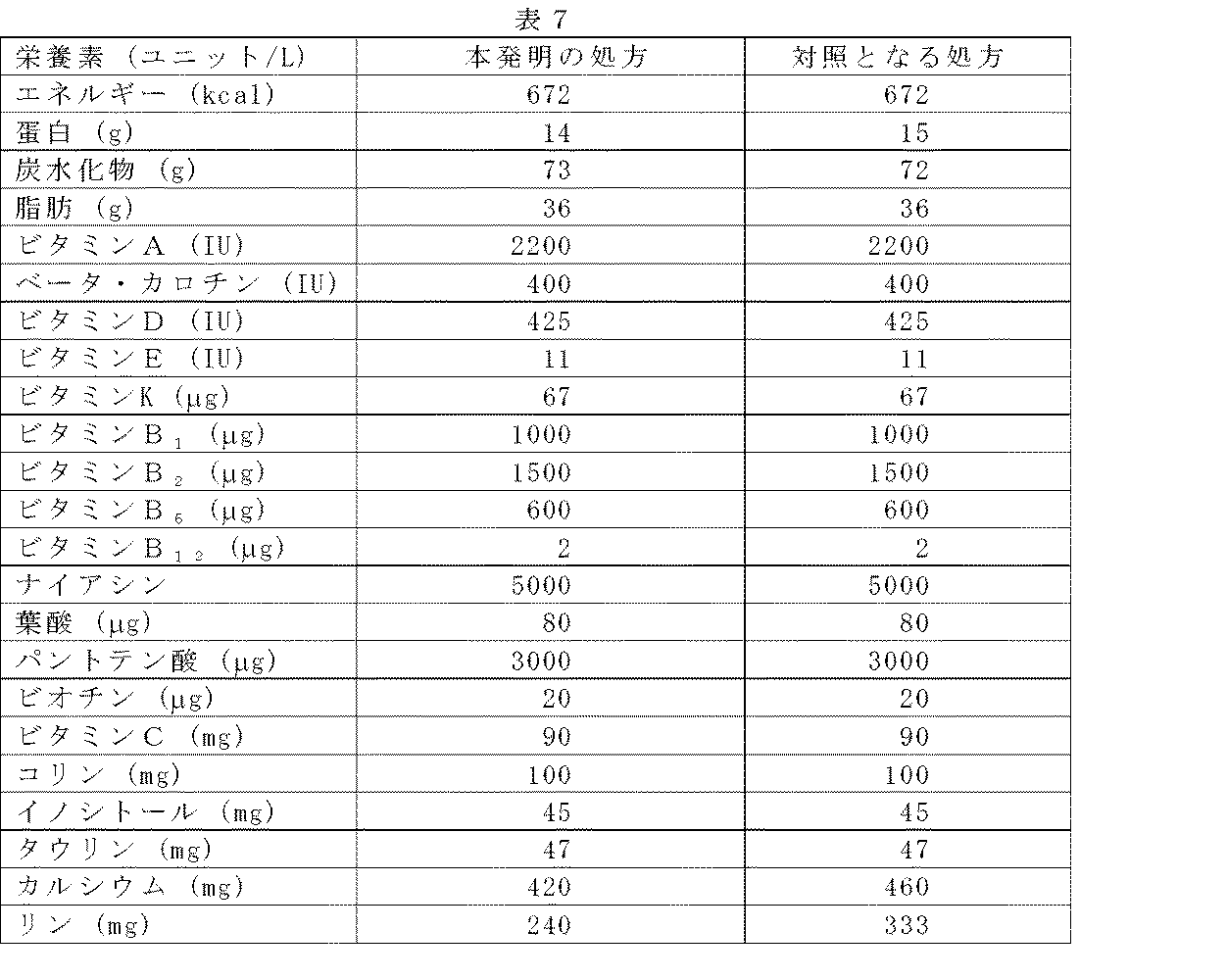
本発明の幼児用処方および対照となる処方の栄養素組成を表7に示す。
本発明の処方のカルシウムおよびリンのレベルは、標準処方よりも人乳に見られるレベルに近い。人乳は平均254mg/Lのカルシウムおよび139mg/Lのリンを含有する。 The calcium and phosphorus levels of the present formulation are closer to those found in human milk than the standard formulation. Human milk contains an average of 254 mg / L calcium and 139 mg / L phosphorus.
実施例3
幼児用処方の4つの個々のバッチを本発明に従って製造した。各バッチを標準的な高性能液体クロマトグラフィー操作によりアミノ酸組成について分析した。改良された処方の蛋白にて幼児に不可欠なアミノ酸の平均レベルを表8に示す。この処方は標準的なホウェイ処方よりも人乳のアミノ酸特性に近い特性を有する(表8)。この処方の蛋白源は、標準的なホウェイをベースとする処方よりも、トリプトファン、リジンおよびシスチンにて高く、トレオニンにて低い。
Example 3
Four individual batches of infant formulas were made according to the present invention. Each batch was analyzed for amino acid composition by standard high performance liquid chromatography procedures. Table 8 shows the average levels of amino acids essential for infants with the improved formulated protein. This formulation has properties that are closer to the amino acid properties of human milk than the standard howay formulation (Table 8). The protein source for this formulation is higher for tryptophan, lysine and cystine and lower for threonine than the standard howay-based formulation.
欧州連合(EU)は、その処方を比較しなければならない、特定の人乳アミノ酸組成物[ディレクティブ91/321/EEC]を提供する。EUはmg/100キロカロリーにおける容量を基礎としてアミノ酸組成がEU人乳値の100%でなければならないことを要件とする。mg/100キロカロリーをmg/Lに変換するのに用いる因子は676キロカロリー/Lであった。 The European Union (EU) provides specific human milk amino acid compositions [directive 91/321 / EEC] whose formulations must be compared. The EU requires that the amino acid composition should be 100% of the EU human milk value based on the capacity in mg / 100 kcal. The factor used to convert mg / 100 kcal to mg / L was 676 kcal / L.
本発明の処方は、人乳または現行のホウェイ−ベースの幼児用処方よりも、トリプトファン、必須芳香族アミノ酸を高レベルにて含有する。現行の幼児用処方を与えられた幼児は、トリプトファンを除いて、母乳で育った幼児に見られるレベルを超えた血漿中アミノ酸レベルを有することが多い。処方を与えられた幼児の血漿中トリプトファンレベルは母乳で育った幼児のそのレベルより有意に低いことがしばしばである(Fazzolari-Nesciら、"Tryptophan Fortification of Adapted Formula Increasing Plasma Tryptophan Concentrations to Levels Not Different from Those Found in Breast-Fed Infants," Journal of Ped. Gastro and Nut.、14:456−459(1992))。トリプトファンは神経伝達物質であるセロトニンの先駆体である(Fernstromら、"Brain Serotonin Content: Physiological Regulation by Plasma Neutral Amino Acids," Science、178:414−415(1972))。セロトニンの高いレベルは睡眠潜時の改善(速やかに入眠に至ること)と関連付けられる。幼児におけるトリプトファン補足は入眠までの時間を短くする(Yogmanら、"Dietal Sleep Patterns In Newborn Infants," New England Journal of Medicine、309(19):1147−9(1983))。 The formulations of the present invention contain tryptophan, an essential aromatic amino acid at a higher level than human milk or current howay-based infant formulas. Infants given current infant prescriptions, except for tryptophan, often have plasma amino acid levels that exceed those found in breast-fed infants. Plasma tryptophan levels in prescription-fed infants are often significantly lower than those in breast-fed infants (Fazzolari-Nesci et al., “Tryptophan Fortification of Adapted Formula Increasing Plasma Tryptophan Concentrations to Levels Not Different from Those Found in Breast-Fed Infants, "Journal of Ped. Gastro and Nut., 14: 456-459 (1992)). Tryptophan is a precursor of serotonin, a neurotransmitter (Fernstrom et al., “Brain Serotonin Content: Physiological Regulation by Plasma Neutral Amino Acids,” Science, 178: 414-415 (1972)). A high level of serotonin is associated with an improvement in sleep latency (rapid sleep onset). Tryptophan supplementation in infants shortens time to sleep (Yogman et al., “Dietal Sleep Patterns in Newborn Infants,” New England Journal of Medicine, 309 (19): 1147-9 (1983)).
トリプトファンはラージ中性アミノ酸(LNAA)と同じ輸送システムについて競い合う。かくして、比較的高濃度のLNAAがある場合、トリプトファンはあまり効果的には細胞を介して輸送されない。トリプトファンの腸を介する、さらには脳への最適な輸送を保証するために、比較的高割合のトリプトファン/LNAAが望ましい。現行の幼児用処方と比較して、本発明の処方は優れたトリプトファン/LNAA値を有する、すなわち、人乳の値に近い。 Tryptophan competes for the same transport system as large neutral amino acids (LNAA). Thus, in the presence of a relatively high concentration of LNAA, tryptophan is less effectively transported through the cell. A relatively high proportion of tryptophan / LNAA is desirable to ensure optimal transport of tryptophan through the intestine and even into the brain. Compared to current infant formulas, the formulas of the present invention have excellent tryptophan / LNAA values, i.e. close to those of human milk.
シスチンはグルタチオンの成分、重要な代謝機能を有するトリペプチドである。グルタチオンは酸化防止剤として不可欠であり、最適な免疫機能の確保においても必須である。本発明の処方は現行のホウェイ−およびカゼイン−優勢の処方と比べてシスチンレベルが高い。
本発明のアミノ酸組成は全蛋白レベルを人乳に近いレベルにまで減少させることができ、これはEUアミノ酸の要件に合致する。
Cystine is a component of glutathione, a tripeptide having an important metabolic function. Glutathione is indispensable as an antioxidant and indispensable for ensuring optimal immune function. The formulations of the present invention have higher cystine levels compared to current howay- and casein-dominated formulations.
The amino acid composition of the present invention can reduce total protein levels to levels close to human milk, which meets the requirements of EU amino acids.
実施例4
実施例2の改良された処方および対照となる処方を、予想される、多施設の、無作為の、制御され、色分けされた、並行なグループの外来患者の研究において、健康な満期産児にて評価した。幼児は2つの処方の一方を無作為に受け、12週間追跡した。
幼児は妊娠期間に適する体重および身長を有する健康な完全満期産児であった。身長に対する体重の割合は国立健康統計センタ(NCHS)により提供される成長曲線によれば年齢で10番と90番の百分順位の間にあった。
研究を行う幼児はわずか14日齢であった。体重と身長はまだ、NCHS成長曲線によれば年齢で10番と90番の百分順位の間にあった。幼児には専ら研究用の幼児用処方を与えた。
Example 4
The improved formulation of Example 2 and the control formulation were tested in healthy, full-term infants in a prospective, multicenter, random, controlled, color-coded, parallel group outpatient study. evaluated. The infant received one of the two prescriptions randomly and was followed for 12 weeks.
The infant was a healthy full-term infant with a weight and height suitable for pregnancy. The ratio of body weight to height was between the 10th and 90th percentiles by age according to the growth curve provided by the National Health Statistics Center (NCHS).
The infants studying were only 14 days old. Body weight and height were still between the 10th and 90th percentiles according to the NCHS growth curve. Infants were given a prescription for infants exclusively for research.
研究用処方の授乳をベースラインとなる外来の日に開始した。研究に参加した193人の幼児のうち、98人の幼児は本発明の幼児用処方を受け、95人の幼児は対照となる処方を受けた。5日以上連続して、または7日以上累積して研究用処方を授乳しない場合、人乳、離乳食または他の固形食を食する場合、あるいは該研究用プロトコルをコンプライアンスできない場合、幼児は処方の不寛容についての研究から抜けることができた。医師または両親は何時いかなる理由でも自由に幼児を離脱させることができた。 Breastfeeding for study prescriptions began on the outpatient baseline. Of the 193 infants participating in the study, 98 infants received the infant formula of the present invention and 95 infants received a control formula. If the infant does not breastfeed the study prescription for more than 5 consecutive days or cumulatively over 7 days, eats human milk, weaning food or other solid food, or fails to comply with the research protocol, I was able to get out of my research on intolerance. The doctor or parents were free to leave the infant at any time for any reason.
実験処方に帰属する98人の幼児のうち、72人(73.5%)は研究を修了した。対照となる処方に帰属する95人の幼児のうち、62人(65.3%)だけがその研究を修了した。実験群の8人の幼児(8.2%)および対照群の4人の幼児(4.2%)はプロトコルに違反したために当該研究を中止した。実験群の5人の幼児および対照群の4人の幼児が復帰しなかったため研究を打ち切った。実験群の残りの幼児、72人または85%あるいは対照群の62人または71%が該研究を修了した。有害事象のために該研究を中止した対照群の幼児(20/95または21%)は、改良された処方群における幼児(15/98または15.3%)よりも多かった。 Of the 98 infants attributed to the experimental prescription, 72 (73.5%) completed the study. Of the 95 infants belonging to the control prescription, only 62 (65.3%) completed the study. Eight infants (8.2%) in the experimental group and four infants (4.2%) in the control group discontinued the study because they violated the protocol. The study was terminated because 5 infants in the experimental group and 4 infants in the control group did not return. The remaining infants in the experimental group, 72 or 85%, or 62 or 71% in the control group completed the study. There were more infants in the control group (20/95 or 21%) who discontinued the study due to adverse events than in the improved prescription group (15/98 or 15.3%).
主たる効能の測定は、体重(g)、身長(cm)および頭囲(cm)の測定であり、それをベースライン測定の際、4週目、8週目および12週目に測定した。研究を行う3日前までに評価を行い、他の時点では±3日の範囲内で評価を行った。
日齢、身長および頭囲についてのベースライン値は2つの研究した群で同様であった。実験群および対照群について、各々、ベースラインの平均日齢は10.1日および10.5日であり、平均身長は51.5cmおよび51.3cmであり、平均頭囲は35.4cmおよび35.5cmであった。体重においては2つのベースラインでの研究した群の間で統計学的に有意な違いがあった(p=0.04)。実験群の幼児は対照群の幼児よりも平均してわずかに重かった(3536.4g対3458.5g)。
The primary efficacy measurements were body weight (g), height (cm) and head circumference (cm), which were measured at 4th, 8th and 12th weeks during baseline measurements. Evaluations were made 3 days prior to the study and at other time points within 3 days.
Baseline values for age, height and head circumference were similar in the two studied groups. For the experimental and control groups, the baseline mean ages are 10.1 and 10.5 days, the mean height is 51.5 cm and 51.3 cm, and the mean head circumference is 35.4 cm and 35 0.5 cm. There was a statistically significant difference in body weight between the groups studied at the two baselines (p = 0.04). The experimental group infants averaged slightly heavier than the control group infants (3536.4 g vs. 3458.5 g).
両方の処方は成長の促進に効果的であった。いずれの研究用処方を授乳した幼児も研究の間同程度に成長した。ベースラインから後で、いずれの成長の測定(体重、身長または頭囲)においても処方群の間で統計学的に有意な違いはなかった。身体計測データは、12週間に及ぶすべての測定において、幼児は平均で体重が約2700g増え、身長が10cm伸び、そして頭囲が5cm広がるという、有意な成長を示した。4週目、8週目または12週目で実験用処方および対照となる処方を受けた群の間で統計学的に有意な違いはなかった。ベースラインから12週目までの平均体重増についてのZ−スコアは対照群(+0.183)と比べて改良された処方群(+0.49)が高かった。この改良された処方群は対照群よりも研究以外の授乳が少なかった(各々、35.7%対42%)。 Both formulas were effective in promoting growth. Infants who fed any study prescription grew to the same extent during the study. After baseline, there were no statistically significant differences between the prescription groups in any growth measure (weight, height or head circumference). Anthropometric data showed significant growth, with an average weight gain of about 2700 grams for infants, 10 cm height and 5 cm head circumference for all measurements over 12 weeks. There were no statistically significant differences between the groups that received the experimental and control formulations at 4, 8, or 12 weeks. The Z-score for mean weight gain from baseline to week 12 was higher in the improved prescription group (+0.49) compared to the control group (+0.183). This improved prescription group had less non-study lactation than the control group (35.7% vs 42%, respectively).
研究用処方の有害事象、許容度および寛容性も、4週目、8週目および12週目の外来の際に、そして2週目、6週目および10週目の電話連絡により記録した。この時点の3日前後で評価を行った。寛容性データを面談により集めた。有害事象は、試験処方と必ずしも因果関係を有しなくとも、臨床試験にて試験品を投与した幼児に見られる都合の悪い医学的な出来事として定義された。有害事象は、それが研究用処方に関連すると考えられるかどうかに拘わらず、好ましくなく、意図しないいずれの兆候(異常な検査所見を含む)、徴候または研究処方の使用に伴う一時的な疾患とすることもできる。 Adverse events, tolerance, and tolerance of study prescriptions were also recorded during outpatients at 4, 8, and 12 and by telephone contact at 2, 6, and 10 weeks. Evaluation was made around 3 days after this point. Tolerability data was collected through interviews. Adverse events were defined as inconvenient medical events seen in infants who received the test article in clinical trials, even though they did not necessarily have a causal relationship with the study prescription. Adverse events are unfavorable, regardless of whether they are considered to be related to research prescriptions, unintended signs (including abnormal laboratory findings), signs or transient illnesses associated with the use of research prescriptions You can also
実験および対照群における半分に満たない幼児が処方と関連すると考えられる有害事象を有した(各々、42人[42.9%]および44人[46.3%])。すべての幼児で最も一般的な処方関連の有害事象は鼓腸(34人の幼児)、便秘(30人の幼児)および嘔吐(26人の幼児)であった。両群において、17人の幼児が処方関連の鼓腸を示した。対照群(11人)の幼児よりも実験群(19人)の幼児にて処方関連の便秘が生じることが多かった。処方関連の嘔吐が、実験用処方群では12人の幼児に、そして対照となる処方の群では14人の幼児に生じた。対照群においては実験群における2倍の幼児が処方関連の下痢を経験した(8対4)。 Less than half of the infants in the experimental and control groups had adverse events that were considered related to prescription (42 [42.9%] and 44 [46.3%], respectively). The most common prescription-related adverse events in all infants were flatulence (34 infants), constipation (30 infants) and vomiting (26 infants). In both groups, 17 infants showed prescription-related flatulence. Prescription-related constipation occurred more often in the experimental group (19) infants than in the control group (11) infants. Prescription-related vomiting occurred in 12 infants in the experimental prescription group and 14 infants in the control prescription group. In the control group, twice as many infants in the experimental group experienced prescription-related diarrhea (8 vs. 4).
本発明の処方群の幼児はいずれも呼吸器系の処方関連の有害事象を示さず、対照群のうちの3人の幼児がかかる事象を有した。全体として、2つの研究用処方の有害事象のプロフィールは類似するものであった。 None of the infants in the prescription group of the present invention showed respiratory prescribing-related adverse events, and three infants in the control group had such events. Overall, the adverse event profiles of the two study formulas were similar.
蛋白状態(血清アルブミン、血中尿素窒素(BUN)およびクレアチニン)はベースラインおよび12週目に測定される副次的安全評価項目であった。本発明の処方群は対照群(1.5グラム蛋白/100mL)よりも少量の蛋白(1.4グラム蛋白/100mL)を受けた。両方の研究群は12週の研究の終わりに血清アルブミンレベル(両群にて4.1mg/dL)により特定されるような類似する適当な蛋白状態を有した。同程度の成長および血清アルブミン状態は、全蛋白分が低いにも拘わらず、アルファ−ラクトアルブミンに富む処方からの適当な窒素栄養素の摂取を示す。研究終了の際には、実験群のBUNレベルは対照群のそれよりも低く(8.2mg/dL対9.3mg/dL)、このことは実験群が高品質蛋白源であり、過剰の蛋白を除去する必要の減少したことを示す。 Protein status (serum albumin, blood urea nitrogen (BUN) and creatinine) was a secondary safety endpoint measured at baseline and at 12 weeks. The prescription group of the present invention received a smaller amount of protein (1.4 gram protein / 100 mL) than the control group (1.5 gram protein / 100 mL). Both study groups had similar appropriate protein status as specified by serum albumin levels (4.1 mg / dL in both groups) at the end of the 12 week study. Similar growth and serum albumin status indicate adequate nitrogen nutrient intake from a formulation rich in alpha-lactalbumin despite low total protein content. At the end of the study, the BUN level in the experimental group was lower than that in the control group (8.2 mg / dL vs. 9.3 mg / dL), indicating that the experimental group was a high quality protein source and excess protein Indicates that the need to remove is reduced.
許容度および寛容性のデータを表10にて要約する。実験用および対照としての処方は共に許容されるものであり、研究のすべての時点で大部分の幼児により十分に寛容されるものであった。2週目の後のすべての時点で、許容度および寛容性は本発明の処方を受けた幼児にてわずかに優れたものであった。研究用処方の全体としての許容度および寛容性が満足のいくものである幼児の百分率が、改良された処方を受けた幼児の場合、2週目の90%から10週目および12週目の100%までの範囲にあり、対照となる処方を受けた幼児の場合、4週目の85.9%から10週目の98.4%までの範囲にある。許容できない割合は改良された処方群にて0−10%の範囲にあり(平均4.1%)、対照群で1.6−14.1%の範囲にある(平均7.0%)。このデータは改良された処方が蛋白栄養素を強化し、処方許容度を向上させることを示す。 Tolerance and tolerance data are summarized in Table 10. Both experimental and control formulations were acceptable and well tolerated by most infants at all time points in the study. At all time points after the second week, tolerance and tolerance were slightly superior in infants who received the prescription of the present invention. The percentage of infants who are satisfied with the overall tolerance and tolerance of the study prescription is 90% from 2 weeks to 10 and 12 weeks for infants receiving the improved prescription In the range of up to 100%, for infants receiving a control prescription, the range is from 85.9% at 4 weeks to 98.4% at 10 weeks. The unacceptable proportion is in the range of 0-10% in the improved formulation group (average 4.1%) and in the range of 1.6-14.1% in the control group (average 7.0%). This data shows that the improved formula enhances protein nutrients and improves formula acceptance.
本発明は、その精神および本質的な特性を逸脱することなく、別の具体的な様式にて具現化することができる。よって、本発明の範囲を示すものとして、明細書よりも別途添付した特許請求の範囲を参照すべきである。
The present invention may be embodied in other specific forms without departing from its spirit and essential characteristics. Therefore, reference should be made to the claims appended hereto rather than to the specification as indicating the scope of the invention.
Claims (11)
(a)全窒素の15%またはそれ以下の蛋白以外の窒素分;
(b)12.5%ないし95%の全蛋白分;
(c)15%またはそれ以下の脂肪分;および
(d)4.5%またはそれ以下の灰分
により特徴付けられるところの、請求項2記載の幼児用調製乳組成物。The bovine way material further comprises: (a) Nitrogen content other than 15% or less protein of total nitrogen;
(B) 12.5% to 95% total protein content;
The infant formula composition according to claim 2, characterized by (c) 15% or less fat; and (d) 4.5% or less ash.
(a)アルギニン(3.1);
(b)シスチン(1.4);
(c)ヒスチジン(1.6);
(d)イソロイシン(1.0);
(e)ロイシン(5.3);
(f)リジン(3.9);
(g)メチオニン(0.3);
(h)フェニルアラニン(1.2);
(i)トレオニン(3.2);
(j)トリプトファン(1.5);
(k)チロシン(0.9);および
(l)バリン(1.0)
によりさらに特徴付けられるところの、請求項2記載の幼児用調製乳組成物。The bovine howay material per 100 grams of total protein contains at least the following amino acids in grams:
(A) Arginine (3.1);
(B) cystine (1.4);
(C) histidine (1.6);
(D) isoleucine (1.0);
(E) leucine (5.3);
(F) lysine (3.9);
(G) methionine (0.3);
(H) phenylalanine (1.2);
(I) threonine (3.2);
(J) tryptophan (1.5);
(K) tyrosine (0.9); and (l) valine (1.0).
The infant formula composition of claim 2, further characterized by:
Applications Claiming Priority (2)
| Application Number | Priority Date | Filing Date | Title |
|---|---|---|---|
| US34325301P | 2001-12-21 | 2001-12-21 | |
| PCT/US2002/040811 WO2003055322A1 (en) | 2001-12-21 | 2002-12-18 | Infant formula compositions comprising increased amounts of alpha-lactalbumin |
Publications (2)
| Publication Number | Publication Date |
|---|---|
| JP2005514017A JP2005514017A (en) | 2005-05-19 |
| JP4317455B2 true JP4317455B2 (en) | 2009-08-19 |
Family
ID=23345331
Family Applications (1)
| Application Number | Title | Priority Date | Filing Date |
|---|---|---|---|
| JP2003555904A Expired - Fee Related JP4317455B2 (en) | 2001-12-21 | 2002-12-18 | Compositions for infant formulas containing large amounts of alpha-lactalbumin |
Country Status (28)
| Country | Link |
|---|---|
| US (1) | US6913778B2 (en) |
| EP (1) | EP1455585B1 (en) |
| JP (1) | JP4317455B2 (en) |
| KR (1) | KR100955408B1 (en) |
| CN (2) | CN100456936C (en) |
| AR (1) | AR037909A1 (en) |
| AT (1) | ATE439044T1 (en) |
| AU (1) | AU2002357354B2 (en) |
| BR (1) | BR0215198A (en) |
| CA (1) | CA2471423C (en) |
| CO (1) | CO5590862A2 (en) |
| CY (1) | CY1109503T1 (en) |
| DE (1) | DE60233346D1 (en) |
| DK (1) | DK1455585T3 (en) |
| EA (1) | EA007148B1 (en) |
| EC (1) | ECSP045154A (en) |
| ES (1) | ES2329667T3 (en) |
| IL (2) | IL162244A0 (en) |
| MX (1) | MXPA04005887A (en) |
| NO (1) | NO20043108L (en) |
| NZ (1) | NZ534041A (en) |
| PL (1) | PL371379A1 (en) |
| PT (1) | PT1455585E (en) |
| SG (1) | SG169897A1 (en) |
| TW (1) | TWI301052B (en) |
| UA (1) | UA81903C2 (en) |
| WO (1) | WO2003055322A1 (en) |
| ZA (1) | ZA200405777B (en) |
Families Citing this family (47)
| Publication number | Priority date | Publication date | Assignee | Title |
|---|---|---|---|---|
| US7651716B2 (en) * | 2001-12-21 | 2010-01-26 | Wyeth Llc | Methods for reducing adverse effects of feeding formula to infants |
| SG165994A1 (en) * | 2002-10-10 | 2010-11-29 | Wyeth Corp | Infant formula containing nucleotides |
| US7829126B2 (en) * | 2005-10-26 | 2010-11-09 | Abbott Laboratories | Infant formulas containing docosahexaenoic acid and lutein |
| US20080089981A1 (en) † | 2006-10-17 | 2008-04-17 | N.V. Nutricia | Ketogenic diet |
| EP1932437A1 (en) * | 2006-12-15 | 2008-06-18 | Nestec S.A. | Infant formula |
| NL1033521C2 (en) * | 2007-03-08 | 2008-09-09 | Friesland Brands Bv | Children's foods with optimized amino acid composition. |
| JP5322405B2 (en) * | 2007-06-07 | 2013-10-23 | 小林製薬株式会社 | Protein-containing composition |
| US8586122B2 (en) * | 2007-07-26 | 2013-11-19 | Loders Croklaan Usa Llc | Composition suitable for use in baking |
| US20110172305A1 (en) * | 2007-10-02 | 2011-07-14 | Ester Fride | Endocannabinoids for Enhancing Growth and Development in Infants |
| WO2009132950A1 (en) * | 2008-04-29 | 2009-11-05 | Unilever Nv | Process for the preparation of packaged heat-preserved aqueous drink comprising casein micelles and tryptophan-rich peptides, and product so obtained |
| ES2392921T3 (en) * | 2008-04-29 | 2012-12-17 | Dsm Ip Assets B.V. | Composition comprising carbohydrates and peptides comprising tryptophan |
| US8498729B2 (en) | 2008-08-29 | 2013-07-30 | Smp Logic Systems Llc | Manufacturing execution system for use in manufacturing baby formula |
| JP2013509171A (en) * | 2009-10-28 | 2013-03-14 | ヴァリオ・リミテッド | Whey protein product and preparation method thereof |
| CN101831415B (en) * | 2010-05-12 | 2012-05-30 | 江苏博立生物制品有限公司 | A method for improving the fermentation level of glucoamylase |
| WO2012077076A1 (en) * | 2010-12-08 | 2012-06-14 | Holt Patrick G | Treating or preventing sensitivity to milk allergens |
| WO2012091542A1 (en) * | 2010-12-28 | 2012-07-05 | N.V. Nutricia | Combination of components for the prevention and treatment of frailty |
| WO2012092084A1 (en) * | 2010-12-30 | 2012-07-05 | Abbott Laboratories | Improved tolerance in a low calorie infant formula |
| US20120171328A1 (en) * | 2011-01-05 | 2012-07-05 | Dattatreya Banavara | Composition comprising heat labile milk proteins and process for preparing same |
| AU2012215042B2 (en) | 2011-02-10 | 2016-01-14 | Société des Produits Nestlé S.A. | Modulation of growth of bifidobacteria using a combination of oligosaccharides found in human milk |
| FI123267B (en) * | 2011-02-18 | 2013-01-15 | Valio Oy | Cheese and cheese making |
| WO2012147075A1 (en) * | 2011-04-28 | 2012-11-01 | Shemen Industries Ltd | Vegetable based oil preparation for baked goods |
| MX389785B (en) | 2011-07-26 | 2025-03-18 | Nucitec Sa De Cv | NUTRITIONAL COMPOSITION FOR CHILDREN WITH REFLUX, COLIC AND/OR CONSTIPATION. |
| PH12014500790A1 (en) * | 2011-11-10 | 2014-05-12 | Socia©Ta© Des Produits Nestla© S A | Infant formula with high sn-2 palmitate and oligofructose |
| FI125332B (en) * | 2011-11-11 | 2015-08-31 | Valio Oy | Process for the preparation of a milk product |
| CN102630803A (en) * | 2012-05-15 | 2012-08-15 | 东北农业大学 | Humanized milk protein and preparation method thereof |
| MX2012010487A (en) * | 2012-09-11 | 2014-03-26 | Nucitec Sa De Cv | Composition of nutrients and bioactive substances which promote growth and reduce intolerance and side effects in premature infants. |
| MX2012010488A (en) * | 2012-09-11 | 2014-03-26 | Nucitec Sa De Cv | Infant formula for optimal growth, gastrointestinal protection and immunological protection of infants. |
| CN103027116A (en) * | 2012-12-04 | 2013-04-10 | 内蒙古伊利实业集团股份有限公司 | Sleep-conducive milk powder and preparation method thereof |
| WO2015154262A1 (en) * | 2014-04-09 | 2015-10-15 | Nestle (China) Ltd. | Gender specific synthetic nutritional compositions and nutritional systems comprising them. |
| CN106659227B (en) | 2014-05-19 | 2022-02-11 | N·V·努特里奇亚 | Formulated with optimized amino acid profile |
| US20170105445A1 (en) * | 2014-05-19 | 2017-04-20 | N.V. Nutricia | Enteral formulations for preterm infants comprising optimised phenylalanine intake levels |
| CN104012657B (en) * | 2014-05-21 | 2016-04-13 | 澳优乳业(中国)有限公司 | One seed amino acid breast milk baby formula milk powder and preparation method thereof |
| CN104522175A (en) * | 2014-12-29 | 2015-04-22 | 光明乳业股份有限公司 | Preparation and detecting method for muting sensitive infant formula milk powder |
| WO2017054109A1 (en) * | 2015-09-28 | 2017-04-06 | Nestec S.A. | Gender specific synthetic nutritional compositions and nutritional systems comprising them |
| US11122833B1 (en) * | 2016-02-26 | 2021-09-21 | Michelle Ann Toothman | Infant formulas having vitamin complexes with enhanced bioavailability |
| US10617700B1 (en) * | 2016-02-26 | 2020-04-14 | Michelle Ann Toothman | Vitamin supplement compositions with enhanced bioavailability |
| US10039805B1 (en) * | 2016-02-26 | 2018-08-07 | Michelle Ann Toothman | Infant formulas having vitamin complexes with enhanced bioavailability |
| US10039765B1 (en) * | 2016-02-26 | 2018-08-07 | Michelle Ann Toothman | Vitamin supplement compositions with enhanced bioavailability |
| EP3338841A1 (en) * | 2016-12-23 | 2018-06-27 | Ferdinand Haschke | Liquid human milk supplement |
| MX2019011388A (en) * | 2017-05-03 | 2019-10-30 | Nestle Sa | Whey protein extracts and their use as sphingomyelin source. |
| EP3709991A1 (en) * | 2017-11-13 | 2020-09-23 | Greg Hannon | Dietary product |
| US11197917B2 (en) * | 2017-12-01 | 2021-12-14 | ByHeart, Inc. | Formulations for nutritional support in subjects in need thereof |
| MX2021007131A (en) | 2018-12-21 | 2021-07-02 | Nestle Sa | NUTRITIONAL COMPOSITION TO INDUCE A SENSE OF SATIETY, A BETTER SLEEP AND/OR LIMIT NOCTURNAL AWAKENING IN INFANTS OR YOUNG CHILDREN. |
| PH12022550427A1 (en) | 2019-09-16 | 2022-12-19 | Nestle Sa | Whey-based nutritional compositions fortified with calcium |
| KR102536585B1 (en) * | 2020-08-04 | 2023-05-24 | 주식회사 엘지생활건강 | Liquid milk composition |
| WO2022177965A1 (en) * | 2021-02-16 | 2022-08-25 | Abbott Laboratories | Nutritional compositions comprising human milk oligosaccharides and bovine immunoglobulin |
| CN114568705B (en) * | 2022-03-22 | 2023-04-25 | 中国农业大学 | Protein oral liquid beneficial to zinc absorption and preparation method thereof |
Family Cites Families (10)
| Publication number | Priority date | Publication date | Assignee | Title |
|---|---|---|---|---|
| FR2459619B1 (en) * | 1979-06-26 | 1983-07-29 | Agronomique Inst Nat Rech | PROCESS FOR OBTAINING FROM LACTOSERUM, A PRODUCT ENRICHED IN ALPHA-LACTALBUMIN AND APPLICATIONS OF SAID PROCESS |
| CA1243887A (en) | 1984-07-03 | 1988-11-01 | Shuryo Nakai | REDUCING .beta.-LACTOGLOBULIN CONTENT IN WHEY PROTEIN CONCENTRATES FOR INFANT FORMULA USE |
| DE3885459T2 (en) * | 1987-05-14 | 1994-03-24 | Commw Scient Ind Res Org | Whey protein fractions. |
| GB8723651D0 (en) | 1987-10-08 | 1987-11-11 | Express Foods Group Ltd | Process for containing concentrates |
| US5436020A (en) * | 1990-02-19 | 1995-07-25 | Meiji Milk Products Company Limited | Method for producing a formulated milk for infants analogous to human milk |
| US5169666A (en) * | 1991-11-14 | 1992-12-08 | The United States Of America As Represented By The Secretary Of Agriculture | Preparation of simulated human milk protein by low temperature microfiltration |
| JP2622789B2 (en) * | 1992-02-18 | 1997-06-18 | 雪印乳業株式会社 | Method for producing a fraction having a high content of α-lactalbumin from whey and breast milk substitute or nutritional composition containing said fraction |
| DE69220374T2 (en) * | 1992-12-23 | 1998-01-15 | Campina Melkunie Bv | Process for the production of alpha-lactalbumin and beta-lactoglobulin from a whey protein product |
| US6312755B1 (en) * | 1999-07-16 | 2001-11-06 | Ampc | Whey treatment process for achieving high concentration of α-lactalbumin |
| WO2002028194A1 (en) | 2000-10-05 | 2002-04-11 | New Zealand Dairy Board | Process for recovering proteins from whey protein containing feedstocks |
-
2002
- 2002-12-13 US US10/318,977 patent/US6913778B2/en not_active Expired - Lifetime
- 2002-12-18 NZ NZ534041A patent/NZ534041A/en not_active IP Right Cessation
- 2002-12-18 BR BR0215198-7A patent/BR0215198A/en not_active Application Discontinuation
- 2002-12-18 JP JP2003555904A patent/JP4317455B2/en not_active Expired - Fee Related
- 2002-12-18 UA UA20040705922A patent/UA81903C2/en unknown
- 2002-12-18 PL PL02371379A patent/PL371379A1/en not_active IP Right Cessation
- 2002-12-18 AR ARP020104954A patent/AR037909A1/en active IP Right Grant
- 2002-12-18 KR KR1020047009722A patent/KR100955408B1/en not_active Expired - Fee Related
- 2002-12-18 EP EP02805966A patent/EP1455585B1/en not_active Expired - Lifetime
- 2002-12-18 DK DK02805966T patent/DK1455585T3/en active
- 2002-12-18 IL IL16224402A patent/IL162244A0/en unknown
- 2002-12-18 DE DE60233346T patent/DE60233346D1/en not_active Expired - Lifetime
- 2002-12-18 CN CNB028253116A patent/CN100456936C/en not_active Expired - Lifetime
- 2002-12-18 WO PCT/US2002/040811 patent/WO2003055322A1/en not_active Ceased
- 2002-12-18 PT PT02805966T patent/PT1455585E/en unknown
- 2002-12-18 MX MXPA04005887A patent/MXPA04005887A/en active IP Right Grant
- 2002-12-18 ES ES02805966T patent/ES2329667T3/en not_active Expired - Lifetime
- 2002-12-18 SG SG200603158-7A patent/SG169897A1/en unknown
- 2002-12-18 CN CN2008101863703A patent/CN101427802B/en not_active Expired - Lifetime
- 2002-12-18 AU AU2002357354A patent/AU2002357354B2/en not_active Expired
- 2002-12-18 CA CA2471423A patent/CA2471423C/en not_active Expired - Fee Related
- 2002-12-18 AT AT02805966T patent/ATE439044T1/en not_active IP Right Cessation
- 2002-12-18 EA EA200400849A patent/EA007148B1/en not_active IP Right Cessation
- 2002-12-19 TW TW091136637A patent/TWI301052B/en not_active IP Right Cessation
-
2004
- 2004-05-30 IL IL162244A patent/IL162244A/en not_active IP Right Cessation
- 2004-06-15 EC EC2004005154A patent/ECSP045154A/en unknown
- 2004-06-16 CO CO04056263A patent/CO5590862A2/en not_active Application Discontinuation
- 2004-07-20 ZA ZA200405777A patent/ZA200405777B/en unknown
- 2004-07-20 NO NO20043108A patent/NO20043108L/en unknown
-
2009
- 2009-10-21 CY CY20091101092T patent/CY1109503T1/en unknown
Also Published As
Similar Documents
| Publication | Publication Date | Title |
|---|---|---|
| CA2471423C (en) | Infant formula compositions comprising increased amounts of alpha-lactalbumin | |
| US20230248043A1 (en) | Nutritional composition | |
| US9889162B2 (en) | Prophylactic use for prevention of infections | |
| US9943097B2 (en) | Nutritional composition | |
| CA2584247A1 (en) | Compositions and methods of formulation for enteral formulas containing sialic acid | |
| Guo | Human milk biochemistry and infant formula manufacturing technology | |
| US7651716B2 (en) | Methods for reducing adverse effects of feeding formula to infants | |
| EP4057841B1 (en) | Use of alpha-lactalbumin enriched whey protein extract as a source of cholesterol and synthetic nutritional composition comprising an alpha-lactalbumin enriched whey protein extract | |
| JP2016506753A (en) | Food composition and use thereof | |
| HK1065925B (en) | Infant formula compositions comprising increased amounts of alpha-lactalbumin | |
| Lightdale et al. | Human milk: nutritional properties. | |
| HK40081708B (en) | Use of alpha-lactalbumin enriched whey protein extract as a source of cholesterol and synthetic nutritional composition comprising an alpha-lactalbumin enriched whey protein extract | |
| HK40081708A (en) | Use of alpha-lactalbumin enriched whey protein extract as a source of cholesterol and synthetic nutritional composition comprising an alpha-lactalbumin enriched whey protein extract |
Legal Events
| Date | Code | Title | Description |
|---|---|---|---|
| A621 | Written request for application examination |
Free format text: JAPANESE INTERMEDIATE CODE: A621 Effective date: 20051115 |
|
| A977 | Report on retrieval |
Free format text: JAPANESE INTERMEDIATE CODE: A971007 Effective date: 20081028 |
|
| A131 | Notification of reasons for refusal |
Free format text: JAPANESE INTERMEDIATE CODE: A131 Effective date: 20081111 |
|
| A601 | Written request for extension of time |
Free format text: JAPANESE INTERMEDIATE CODE: A601 Effective date: 20090210 |
|
| A602 | Written permission of extension of time |
Free format text: JAPANESE INTERMEDIATE CODE: A602 Effective date: 20090218 |
|
| A601 | Written request for extension of time |
Free format text: JAPANESE INTERMEDIATE CODE: A601 Effective date: 20090311 |
|
| A602 | Written permission of extension of time |
Free format text: JAPANESE INTERMEDIATE CODE: A602 Effective date: 20090318 |
|
| A521 | Request for written amendment filed |
Free format text: JAPANESE INTERMEDIATE CODE: A523 Effective date: 20090410 |
|
| TRDD | Decision of grant or rejection written | ||
| A01 | Written decision to grant a patent or to grant a registration (utility model) |
Free format text: JAPANESE INTERMEDIATE CODE: A01 Effective date: 20090507 |
|
| A01 | Written decision to grant a patent or to grant a registration (utility model) |
Free format text: JAPANESE INTERMEDIATE CODE: A01 |
|
| A61 | First payment of annual fees (during grant procedure) |
Free format text: JAPANESE INTERMEDIATE CODE: A61 Effective date: 20090522 |
|
| R150 | Certificate of patent or registration of utility model |
Free format text: JAPANESE INTERMEDIATE CODE: R150 |
|
| FPAY | Renewal fee payment (event date is renewal date of database) |
Free format text: PAYMENT UNTIL: 20120529 Year of fee payment: 3 |
|
| FPAY | Renewal fee payment (event date is renewal date of database) |
Free format text: PAYMENT UNTIL: 20120529 Year of fee payment: 3 |
|
| FPAY | Renewal fee payment (event date is renewal date of database) |
Free format text: PAYMENT UNTIL: 20130529 Year of fee payment: 4 |
|
| LAPS | Cancellation because of no payment of annual fees |