JP4265742B2 - Hydrogenation method of conjugated diene polymer - Google Patents
Hydrogenation method of conjugated diene polymer Download PDFInfo
- Publication number
- JP4265742B2 JP4265742B2 JP2003061597A JP2003061597A JP4265742B2 JP 4265742 B2 JP4265742 B2 JP 4265742B2 JP 2003061597 A JP2003061597 A JP 2003061597A JP 2003061597 A JP2003061597 A JP 2003061597A JP 4265742 B2 JP4265742 B2 JP 4265742B2
- Authority
- JP
- Japan
- Prior art keywords
- conjugated diene
- component
- hydrogenation
- group
- polymer
- Prior art date
- Legal status (The legal status is an assumption and is not a legal conclusion. Google has not performed a legal analysis and makes no representation as to the accuracy of the status listed.)
- Expired - Lifetime
Links
Landscapes
- Addition Polymer Or Copolymer, Post-Treatments, Or Chemical Modifications (AREA)
- Graft Or Block Polymers (AREA)
Description
【0001】
【発明の属する技術分野】
本発明は、有機アルカリ金属化合物を重合開始剤として重合した共役ジエン重合体を不活性有機溶媒中にて水素と接触させて共役ジエンの二重結合を水素添加する方法に関する。
【0002】
【従来の技術】
オレフィン性不飽和二重結合を含有する重合体は、不飽和二重結合が加硫等に有利に利用される反面、かかる二重結合は耐熱性、耐酸化性等の安定性に劣る欠点を有している。これらの安定性に劣る欠点は、重合体を水添して重合体鎖中の不飽和二重結合をなくすことにより著しく改善される。しかし、重合体を水添する場合には低分子化合物を水添する場合に比べて、反応系の粘度や重合体鎖の立体障害等の影響をうけて水添しにくくなる。また、変性基を含有しオレフィン性不飽和二重結合を含有する重合体は、変性基を有しないものよりも、水添効率が悪く、触媒添加量を増やしてもこの問題を解決できないことが判明している。さらに水添終了後、触媒を物理的に除去することが極めて難しく、実質上完全に分離することができない等の欠点がある。従って経済的に有利に重合体を水添するためには、脱灰の不要な程度の使用量で活性を示す高活性水添触媒、あるいは、極めてあらゆる変性基を含有する共重合体をも容易に水添できる触媒の開発が強く望まれている。また、アルカリ金属化合物の残存量が高いと水添された重合体の耐候変色性が悪化するなどの問題がある。
【0003】
本願出願人は既に特定のチタノセン化合物とアルキルリチウムを組み合わせて、オレフィン化合物を水添する方法(例えば、特許文献1および2参照。)、メタロセン化合物と有機アルミニウム、亜鉛、マグネシウムと組み合わせでオレフィン性不飽和(共)重合体を水添する方法(例えば、特許文献3および4参照。)、特定のチタノセン化合物とアルキルリチウムとの組合せでオレフィン性不飽和基含有リビングポリマーを水添させる方法(例えば、特許文献5および6参照。)等をすでに発明してきた。しかし、これらの方法は高活性なものの、水添触媒の取扱い方が難しく、長期貯蔵安定性にも難があった。またチタノセン化合物を低原子価に還元するために還元剤(有機金属)が必要であった。これら還元剤とチタノセンのモル比、接触条件により水添活性が大きく変わるため取り扱いにくい欠点があった。さらに上記の問題点を解決するために、助触媒としてアルカリ金属化合物を必要としない水添方法(例えば、特許文献7参照。)を発明したが、変性基を含有する共重合体に対しては、水添効率が減少するなどの問題点があった。
【0004】
さらに、チタノセン化合物とトリメチルアルミニウムのメタラサイクル化合物であるTebbe試薬とアルキルアルカリ金属化合物を組み合わせた反応物によるオレフィン性不飽和二重結合含有ポリマー中のオレフィン性二重結合を水添する方法(例えば、特許文献8参照。)が公知である。この方法では、高い水添活性を発現するためには、助触媒として多量のアルキルアルカリ金属化合物を必要とし、また触媒の活性が劣るので触媒使用量が多いなどの欠点がある。また、チタニウム化合物、還元性有機金属化合物およびオレフィン化合物を組み合わせることにより高い水素活性を発現する水添方法が公知だが、添加量も多いなどの欠点もある。(例えば、特許文献9参照。)
【0005】
【特許文献1】
特開昭61−33132号公報
【特許文献2】
特開平1−53851号公報
【特許文献3】
特開昭61−28507号公報
【特許文献4】
特開昭62−209103号公報
【特許文献5】
特開昭61−47706号公報
【特許文献6】
特開昭63−5402号公報
【特許文献7】
特開平11−71426号公報
【特許文献8】
米国特許5244980号明細書
【特許文献9】
特開平2−172537号公報
【0006】
【本発明が解決しようとする課題】
本発明は、有機アルカリ金属化合物を重合開始剤として重合した共役ジエン重合体を不活性有機溶媒中にて水素と接触させて共役ジエンの二重結合を水素添加する際に、水添触媒が安定で取り扱い易く、触媒使用量が極めて少なく、広い温度領域で、さらには変性基を含有する共重合体に対しても、再現性よく定量水添可能な、工業的に有利な方法を提供するものである。
【0007】
【課題を解決するための手段】
すなわち、本発明は、次のとおりである。
1.有機アルカリ金属化合物を重合開始剤として重合した共役ジエン重合体、またはビニル芳香族炭化水素と共役ジエンからなる共重合体に、失活剤を加えて失活せしめ、不活性炭化水素溶媒中にて水素と接触させて、共役ジエンの二重結合を水素添加する際に、下記式(1)で表されるメタロセン系触媒である(a)成分と共役ジエン系単量体およびアセチレン系単量体から選ばれる少なくとも1つの(b)成分との混合物を添加することを特徴とする共役ジエン系重合体の水素添加方法。
【0008】
【化1】
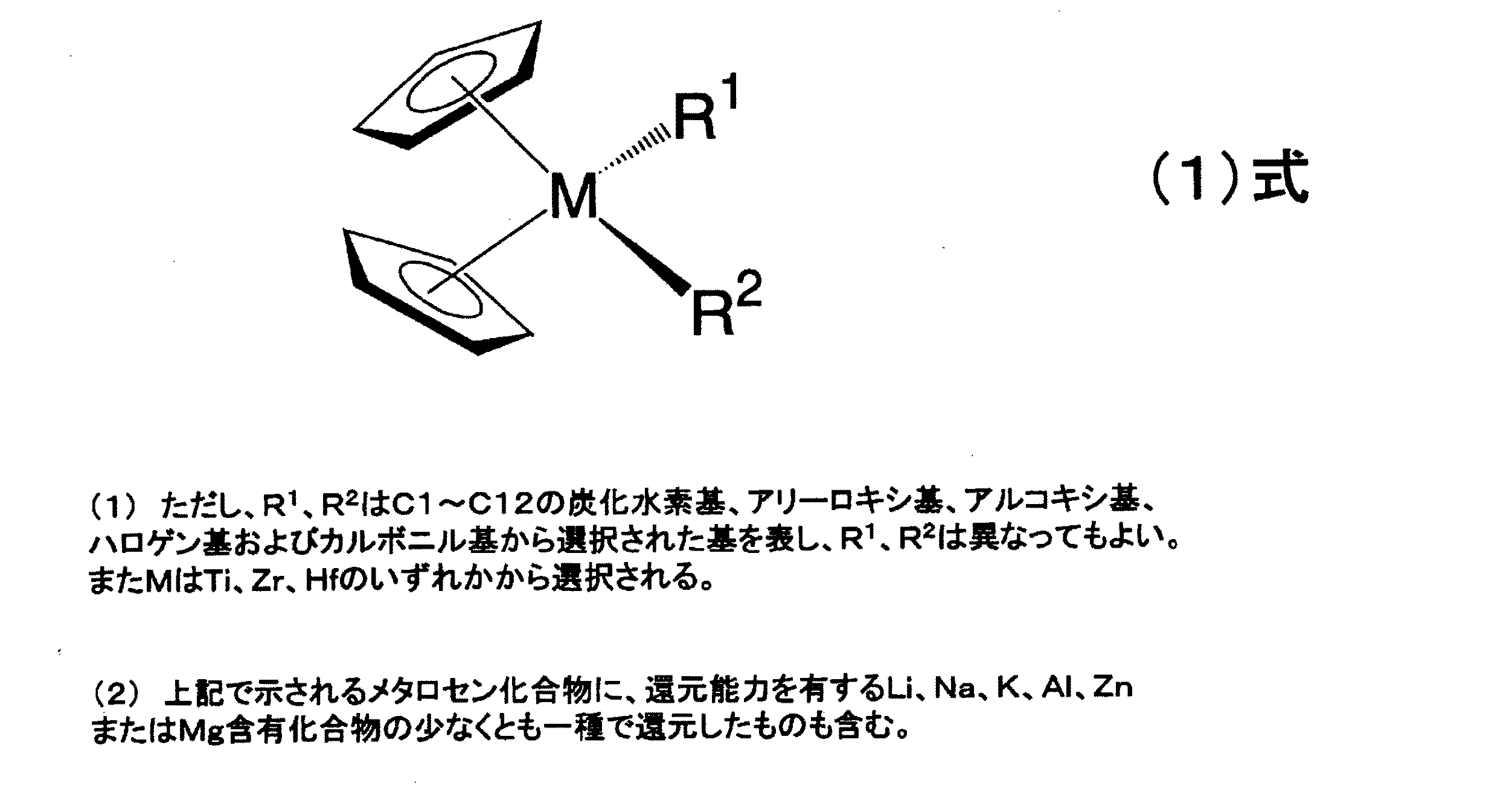
2.有機アルカリ金属化合物を重合開始剤として重合した共役ジエン重合体、またはビニル芳香族炭化水素と共役ジエンからなる共重合体に、失活剤を加えて失活せしめ、不活性炭化水素溶媒中にて水素と接触させて、共役ジエンの二重結合を水素添加する際に、下記式(1)で表されるメタロセン系触媒である(a)成分と有機リン化合物である(b)成分との混合物を2度以上に分けて添加することを特徴とする共役ジエン系重合体の水素添加方法。
【0010】
【化2】
3.ビニル芳香族炭化水素と共役ジエンからなる共重合体が、ビニル芳香族炭化水素を主体とするブロックおよび/または共役ジエンを主体とするブロックを少なくとも一つ有することを特徴とする上記1または2に記載の水素添加方法。
4.ビニル芳香族炭化水素と共役ジエンからなる共重合体が、ビニル芳香族炭化水素を主体とするブロックおよび共役ジエンを主体とするブロックをそれぞれ少なくとも一つ有することを特徴とする上記1または2に記載の水素添加方法。
5.(b)成分を、(a)成分1モルに対して0.5〜80モルの範囲で行うことを特徴とする上記1〜4のいずれかに記載の水素添加方法。
6.(b)成分を、(a)成分1モルに対して0.5モル以上、20モル未満の範囲で行うことを特徴とする上記1〜4のいずれかに記載の水素添加方法。
7.(a)成分として、チタノセンジハライド類とトリメチルアルミニウムの反応混合物を用いることを特徴とする上記1〜6のいずれかに記載の水素添加方法。
【0012】
8.(b)成分として、環状共役ジエン単量体を用いることを特徴とする上記1、3〜7のいずれかに記載の水素添加方法。
9.(b)成分として、シクロヘキサジエン、イソプレンおよびブタジエンから選ばれる少なくとも1成分を用いることを特徴とする上記1、3〜7のいずれかに記載の水素添加方法。
10.(b)成分として、トリフェニルホスフィンおよび/またはトリメチルホスフィンを用いることを特徴とする上記2〜7のいずれかに記載の水素添加方法。
11.(b)成分として、ジフェニルアセチレン、フェニルアセチレンおよびトリメチルシリルアセチレンから選ばれる少なくとも1成分を用いることを特徴とする上記1、3〜7のいずれかに記載の水素添加方法。
12.有機アルカリ金属化合物を重合開始剤として重合した共役ジエン重合体、またはビニル芳香族化合物と共役ジエンからなる共重合体に、カルボキシル基、水酸基、エポキシ基、アミノ基、アルコキシシラン基およびシラノール基から選ばれる官能基含有原子団が少なくとも1個結合している変性重合体であることを特徴とする上記1〜11のいずれかに記載の水素添加方法。
【0013】
本発明で重合開始剤として用いられる有機アルカリ金属化合物は、一般的に共役ジエン化合物に対しアニオン重合活性があることが知られている脂肪族炭化水素アルカリ金属化合物、芳香族炭化水素アルカリ金属化合物、有機アミノアルカリ金属化合物等が含まれ、アルカリ金属としてはリチウム、ナトリウム、カリウム等である。好適な有機アルカリ金属化合物としては、炭素数1から20の脂肪族および芳香族炭化水素リチウム化合物であり、1分子中に1個のリチウムを含む化合物、1分子中に複数のリチウムを含むジリチウム化合物、トリリチウム化合物、テトラリチウム化合物が含まれる。
【0014】
具体的にはn−プロピルリチウム、n−ブチルリチウム、sec−ブチルリチウム、tert−ブチルリチウム、n−ペンチルリチウム、n−ヘキシルリチウム、ベンジルリチウム、フェニルリチウム、トリルリチウム、ジイソプロペニルベンゼンとsec−ブチルリチウムの反応生成物、さらにジビニルベンゼンとsec−ブチルリチウムと少量の1,3−ブタジエンの反応生成物等があげられる。さらに、米国特許第5708092号明細書、英国特許第2241239号明細書、米国特許第5527753号明細書などに開示されている有機アルカリ金属化合物も使用することができる。
【0015】
本発明の共役ジエン系重合体は、共役ジエンのホモ重合体、2種以上の共役ジエンからなる共役ジエンの共重合体、また共役ジエンと共重合可能な他の単量体、例えばビニル芳香族化合物との共重合体であって、該重合体中に共役ジエンから由来するオレフィン二重結合を有する1,4−結合、1,2または3,4−結合を含むものである。共役ジエンとしては、炭素数4から20の炭素原子を有する共役ジエン、具体的には1,3−ブタジエン、イソプレン、2,3−ジメチル−1,3−ブタジエン、1,3−ペンタジエン、2−メチル−1,3−ペンタジエン、1,3−ヘキサジエン、4,5−ジエチル−1,3−オクタジエン、3−ブチル−1,3−オクタジエン等が挙げられる。
【0016】
工業的に有利に展開でき、物性の優れた弾性体を得る上からは、1,3−ブタジエン、イソプレンが好ましい。また、ビニル芳香族化合物としては、例えばスチレン、α−メチルスチレン、p−メチルスチレン、ジビニルベンゼン、1,1−ジフェニルエチレン、N,N−ジメチル−p−アミノエチルスチレン、N,N−ジエチル−p−アミノエチルスチレン等があげられ、好ましくはスチレン、α−メチルスチレンである。共役ジエンと共重合可能な他の単量体との共重合体は、ランダムまたはブロック共重合体である。
【0017】
本発明で使用する失活剤とは、有機アルカリ金属化合物の失活剤として作用する化合物であり、この場合共役ジエン重合体または共重合体を重合する際に用いた重合開始剤の有機アルカリ金属化合物を失活させる能力を有する化合物および(a)成分を合成する際に用いる有機アルミニウム化合物を失活させる能力を有する化合物である。
【0018】
失活剤としては、水酸基、カルボニル基、エステル基、エポキシ基等を有する化合物で有機金属化合物と反応してアルコキシ金属類を生成するもの、ハロゲン化合物のようにハロゲン化金属類を生成するものが好ましい。また、場合によりエステル化合物、多価エポキシ化合物、多価ハロゲン化合物は共役ジエン重合体などのアルカリ金属末端と反応してカップリングさせ分子量を増大させたり、分岐を生成させたりするのに利用される。失活剤の例としては、水や、メタノール、エタノール、n−プロパノール、n−ブタノール、sec−ブタノール、t−ブタノール、1−ペンタノール、2−ペンタノールなどのアルコール類が挙げられる。さらに、特開平11−71426号公報などに開示されている失活剤も使用することができる。
【0019】
本発明で用いられる不活性炭化水素溶媒としては、水素添加の際に反応に悪影響を与えないものである。本発明ではさらに、重合に引き続いて同じ不活性炭化水素溶媒中で水素添加が行われることが好ましい。好適な溶媒は、例えばn−ブタン、イソブタン、n−ペンタン、n−ヘキサン、n−ヘプタン、n−オクタンの如き脂肪族炭化水素類、シクロヘキサン、シクロヘプタン、メチルシクロヘプタンの如き脂環式炭化水素類、また、ベンゼン、トルエン、キシレン、エチルベンゼンの如き芳香族炭化水素も、選択された水添条件下で芳香族二重結合が水添されない時に限って使用することができる。
【0020】
本発明において、共役ジエン重合体を不活性有機溶媒中にて水素と接触させて共役ジエンの二重結合を水素添加する際に、(M−Z+Al−Ti)/Tiが−6を越え+2未満の範囲であることが望ましい。好ましくは−3以上+1以下の範囲である。なお、Mは系内に加えられた有機アルカリ金属化合物のモル量、Zは失活剤のモル量、Alは有機アルミニウム化合物のモル量、Tiは有機チタン化合物のモル量である。具体的には特開平11−71426号公報に開示されている方法が適応できる。
本発明の触媒成分(a)として例えば下記(2)式で示される有機金属化合物が挙げられる。
【0021】
【化3】
(但し、R1〜R10は水素、C1〜C12の炭化水素基またはC1〜C12のアルキルシリル基をあらわし、同一でも異なっていてもよい。Xはハロゲン原子またはメチル基をあらわす。)
【0023】
すなわちTebbe試薬またはTebbe試薬類似の構造を有するチタノセンジハライド化合物とトリメチルアルミニウムとのメタラサイクル化合物すなわちTebbe型錯体を含むものである。
また、触媒成分(a)は上記以外のメタロセン系化合物で、還元剤を必ずしも作用させなくてもよい。すなわち(a)成分は、例えばTi,Zr、Hfなどを含むメタロセン化合物単独であってもよい。
【0024】
上記(2)式の触媒成分(a)における、R1〜R10置換基の、C1〜C12の炭化水素基としては直鎖の炭化水素基、側鎖を有する炭化水素基、脂環式炭化水素基、芳香族炭化水素基が含まれ、またC1〜C12のアルキルシリル基としてはRR’R’’Si−または−SiRR’−(R、R’、R’’はそれぞれC1〜C12のアルキル基)であらわされ、R1〜R5の中でまたR6〜R10の中で環を形成している構造のものも含まれ、また、R1〜R5置換基のうち1個とR6〜R10置換基のうち1個とが互いに橋架けされた構造のものも含まれる。
【0025】
R1〜R10置換基の具体例としては、水素、メチル、エチル、プロピル、イソプロピル、n−ブチル、イソブチル、t−ブチル、sec−ブチル、n−ペンチル、イソペンチル、1−メチルブチル、2−メチルブチル,1,2−ジメチルプロピル,ネオペンチル、n−ヘキシル、イソヘキシル、1−メチルペンチル,2−メチルペンチル,3−メチルペンチル,1,1−ジメチルブチル,2,2−ジメチルブチル,3,3−ジメチルブチル,1,2−ジメチルブチル,1,3−ジメチルブチル,1,1−エチルメチルプロピル,1−エチルブチル、2−エチルブチル、シクロヘキシル、n−ヘプチル、イソヘプチル、などが挙げられる。さらに、特開平11−71426号公報などに開示された置換基なども用いることができる。
【0026】
また、環を形成または橋架けしているものとしてフルオレニル、インデニル、テトラヒドロインデニル、メチレン、エチレン、−C(CH3)2−、−C(C2H5)2−、−Si(CH3)2−、−Si(C2H5)2−等が挙げられる。これらは単独あるいは相互に組み合わせて用いることが出来るが、以上の例示に限定されない。またシクロペンタジエニル化合物の炭化水素基またはアルキルシリル基の置換数はいくつでもかまわないがシクロペンタジエニル化合物の置換数が0〜4のものが好適に用いられる。特に本発明で共役ジエン系重合体または、共役ジエンとビニル芳香族炭化水素との共重合体中の共役ジエン部の不飽和二重結合に対する水添活性が高く、かつ広い温度領域中で選択的に水添する望ましいものとしては、水素、及び炭化水素基がメチル、エチル、プロピル、イソプロピル、n−ブチル、イソブチル、t−ブチル、sec−ブチル、n−ペンチル、イソペンチル、1−メチルブチル、2−メチルブチルが挙げられる。
【0027】
また、1,2−ジメチルプロピル,ネオペンチル、n−ヘキシル、イソヘキシル、1−メチルペンチル,2−メチルペンチル,3−メチルペンチル,1,1−ジメチルブチル,2,2−ジメチルブチル,3,3−ジメチルブチル,1,2−ジメチルブチル,1,3−ジメチルブチル,1,1−エチルメチルプロピル,1−エチルブチル、2−エチルブチル、シクロヘキシル、n−ヘプチル、イソヘプチル、4−メチルヘキシル,3−メチルヘキシル,2−メチルヘキシル,1−メチルヘキシル,1,1−ジメチルペンチルが挙げられる。
【0028】
さらに活性上特に望ましいものは、水素、メチル、エチル、プロピル、イソプロピル、n−ブチル、イソブチル、t−ブチル、sec−ブチル、n−ペンチル、イソペンチル、1−メチルブチル、2−メチルブチル,1,2−ジメチルプロピル,ネオペンチル、n−ヘキシル、イソヘキシル、1−メチルペンチル,2−メチルペンチル,3−メチルペンチル,1,1−ジメチルブチル,2,2−ジメチルブチル,3,3−ジメチルブチル,1,2−ジメチルブチル,1,3−ジメチルブチル,1,1−エチルメチルプロピル,1−エチルブチル、2−エチルブチル、シクロヘキシル、n−ヘプチルなどを挙げることが出来る。
【0029】
上述した(a)成分の代表的な製法は、対応するチタノセンのジハライド化合物とトリメチルアルミニウムの反応から得られる。(a)成分は、反応混合物から単離して得られたものを用いても、反応混合物をそのまま用いても良いが、反応混合物をそのまま用いる方法が工業的に有利である。
本発明において(a)成分としてチタノセンジハライド類とトリメチルアルミニウムの反応混合物をそのまま用いることは、工業的に入手しやすい化合物を原料とするため工業的に有利な方法である。この場合は、(a)成分が、チタノセンジハライドのチタンをベースに収率が20%以上が好ましく、50%以上であることがさらに好ましい。
【0030】
本発明において(a)成分に共役ジエン系単量体、有機リン化合物およびアセチレン系単量体から選ばれる少なくとも1成分を添加する際、室温で数分程度混合し攪拌する程度で良く、また添加物が固体状のものについては、好ましくは溶液にし(a)成分と混合することが望まれる。つまりは、単に(a)成分と添加物を短時間に混合、攪拌するのみで十分であり、わずらわしい工程を含まずに水添効率を上げることに成功した。
本発明の(a)成分に添加する共役ジエン系単量体はイソプレン、ブタジエン、シクロヘキサジエン等が挙げられる。また、共役ジエン系単量体は鎖状であっても環状であってもどちらでも構わない。
【0031】
有機リン化合物に関しても、特に制限はなく置換基は任意に選ぶことができ、トリフェニルホスフィン、トリメチルホスフィン、トリシクロヘキシルホスフィンなどが挙げられる。ただし置換基は(a)成分の立体構造を考慮し、立体障害の小さいものを選択することが好ましい。また、有機リン化合物と(a)成分とを混合したものを触媒として水添反応に用いる際は、好ましくは3回以上、より好ましくは2回にわけて該触媒を添加することにより、有機リン化合物の添加効果が現れる。単に、有機リン化合物と(a)成分を反応または混合させたものでは水添率向上の効果は現れない。よって、従来(a)成分の追添のみでは現れなかった効果を、有機リン化合物を追添することにより効果を十分に発揮することができる。
【0032】
さらにアセチレン系単量体も置換基は任意に選ぶことができる。例えば、ジフェニルアセチレン、トリメチルシリルアセチレン、フェニルアセチレン等が挙げられる。ただし置換基は(a)成分の立体構造を考慮し、立体障害の小さいものを選択することが好ましい。
上記以外にも(b)成分として、環状であるシクロペンタジエン、シクロオクタジエン、シクロへプタジエン等が挙げられる。
【0033】
環状を有する化合物は、(a)成分との配位能力等を考慮すると、シクロヘキセン、シクロオクテンなどのモノエンでは効果はまったく期待できず、共役ジエン単量体であることが特に好ましい。これらは単独で用いても、組み合わせて用いても構わず同じ効果を有する。すなわち共役ジエン系単量体、有機リン化合物、アセチレン系単量体についても、単独でも組み合わせで用いても構わず、同じ効果を有する。
【0034】
本発明において、共役ジエン系重合体などとして重合体の少なくとも1つの重合体鎖中に、極性基含有原子団が結合した末端変性共役ジエン系重合体を使用することもできる。極性基含有原子団としては、例えば水酸基、カルボキシル基、カルボニル基、チオカルボニル基、酸ハロゲン化物基、酸無水物基、カルボン酸基、チオカルボン酸基、アルデヒド基、チオアルデヒド基、カルボン酸エステル基、アミド基、スルホン酸基、スルホン酸エステル基、リン酸基、リン酸エステル基、アミノ基、イミノ基、ニトリル基、ピリジル基、キノリン基、エポキシ基、チオエポキシ基、スルフィド基、イソシアネート基、イソチオシアネート基、ハロゲン化ケイ素基、アルコキシケイ素基、ハロゲン化スズ基、アルコキシスズ基、フェニルスズ基等から選ばれる極性基を少なくとも1種含有する原子団が挙げられる。極性基含有原子団は重合体鎖の末端に結合していてもよい。
【0035】
末端変性共役ジエン系重合体は、共役ジエン系重合体の重合終了時にこれらの極性基含有原子団を形成する化合物を反応させることにより得られる。極性基含有原子団を形成する化合物としては、具体的には、特公平4−39495号公報、特願2001−308863号公報および特願2002−229450号公報などに記載された末端変性処理剤を使用できる。
【0036】
開示された変性剤として特に好ましい変性剤は、β−(3,4−エポキシシクロヘキシル)エチル−メチルジイソプロペンオキシシラン、1,3−ジメチル−2−イミダゾリジノン、1,3−ジエチル−2−イミダゾリジノン、1,3−ジプロピル−2−イミダゾリジノン、1−メチル−3−エチル−2−イミダゾリジノン、1−メチル−3−プロピル−2−イミダゾリジノン、1−メチル−3−ブチル−2−イミダゾリジノン、1−メチル−3−(2−メトキシエチル)−2−イミダゾリジノン、1−メチル−3−(2−エトキシエチル)−2−イミダゾリジノン、1,3−ジ−(2−エトキシエチル)−2−イミダゾリジノン、などである。
【0037】
有機リチウム化合物を、重合触媒として得た共役ジエン系重合体のリビング末端に、上述した変性剤を反応させることにより、カルボキシル基、水酸基、エポキシ基、アミノ基、シラノール基、アルコキシシラン基から選ばれる官能基を少なくとも1個有する原子団が結合している変性剤の残基が結合している変性重合体が得られる。
変性重合体を得る他の方法として、リビング末端を有さない共重合体に有機リチウム化合物等の有機アルカリ金属化合物を反応(メタレーション反応)など、特開平11−71426号公報に開示された方法がある。
【0038】
本発明で使用する変性共役ジエン系共重合体としては、カルボキシル基、水酸基、エポキシ基、アミノ基、シラノール基、アルコキシシラン基から選ばれる官能基を少なくとも1個有する原子団が少なくとも1個結合している変性水添重合体が好ましい。
なお、本発明においては、重合体のリビング末端に変性剤を反応させる際に、一部変性されていない重合体が変性重合体に混在しても良い。変性重合体に混在する未変性の重合体の割合は、好ましくは70wt%以下、より好ましくは60wt%以下、更に好ましくは50wt%以下であることが推奨される。
【0039】
本発明において有機アルカリ金属化合物を重合開始剤として共役ジエンまたは共役ジエンと他の単量体を重合する際に、共役ジエンのビニル構造(1,2または3,4結合)を増やすために、3級アミノ化合物またはエーテル化合物を添加することができる。このうち特に3級アミノ化合物が好ましい。3級アミノ化合物としては、トリメチルアミンなど前述した化合物が挙げられる。またエーテル化合物としては、ジエチルエーテルなどの直鎖状エーテル化合物は水添に悪影響を及ぼし本発明の効果を阻害するため用いることができない。エーテル化合物としては、好適にはテトラヒドロフラン、2,5−ジメチルオキソラン、2,2,5,5−テトラメチルオキソラン、2,2−ビス(2−オキソラニル)プロパン等の環状エーテルである。
【0040】
本発明において有機アルカリ金属化合物を重合開始剤として共役ジエンまたは共役ジエンと他の単量体を重合する際にバッチ重合であっても連続重合であってもよい。
本発明の好ましい実施態様として、水添する前の重合体としては、共役ジエンを主体とする重合体ブロック(D)と、ビニル芳香族炭化水素を主体とする重合体ブロック(S)からなるブロック共重合体が好ましく、例えば下記の一般式で表されるような構造が挙げられる。
【0041】
(S−D)n、 S−(D−S)n、D−(S−D)n、
[(S−D)n]m−X、 [(D−S)n−D]m−X、
[(S−D)n−S]m−X
(ここで、nは1以上の整数、好ましくは1〜5の整数である。mは2以上の整数、好ましくは2〜11の整数である。Xはカップリング剤の残基又は多官能開始剤の残基を示す。カップリング剤としては四塩化ケイ素等の多価ハロゲン化有機ケイ素化合物、四塩化スズ等の多価ハロゲン化有機スズ化合物、エポキシ化大豆油、2・6官能のエポキシ基含有化合物、ポリハロゲン化炭化水素、カルボン酸エステル、ジビニルベンゼン等のポリビニル化合物、炭酸ジメチル等の炭酸ジアルキル類などが挙げられる。)
特に、(D−S)2型、(S−D−S)3型、(D−S−D−S)4型、(D−S−D−S−D)5型、(c)−(D−S)n型(ただし、cはカップリング剤残基、nは2から8の整数)単独またはこれらの混合物が好ましい。
【0042】
本発明の水添反応は、分子状水素を用いて行われ、より好ましくはガス状で共役ジエン系重合体溶液中に導入される。水添反応は、撹拌下で行われるのがより好ましく、導入された水素を十分迅速に被水添物と接触させることができる。水添反応はバッチ反応でも連続反応でもよい。
本発明の水添反応において、(a)成分の添加量は、共役ジエン系重合体100g当り0.001〜5ミリモルで十分である。この添加量範囲であれば、共役ジエン系重合体中の二重結合を十分に水添することが可能で、一方、共重合体中の芳香環の二重結合の水添は実質的に起こらないので極めて高い水添選択性が実現される。20ミリモルを越える量の添加においても水添反応は可能であるが、必要以上の触媒使用は不経済となり、水添反応後の触媒脱灰、除去が複雑となる等不利となる。また好ましい触媒添加量は、重合体100g当り0.002から1ミリモル、さらに好ましくは重合体100g当り0.005から0.2ミリモルである。
【0043】
(a)成分は、水添反応に先だって全量を加える事もできるし、2回またはそれ以上に分けて、一部を水添反応に先だって加え、残りを水添中に追添してもよい。また、水添中に追添する場合は連続的に加えてもよい。好ましい(a)成分の添加方法としては、水添開始前に全量に対して5〜99重量%を加え、最終の水添率の30%以上、95%以下の段階で残りの量を分割してまたは連続的に加える方法である。この場合、水添反応に先だって全量を加える場合に比べ、(a)成分の使用量を少なくすることができる。
【0044】
本発明の水添反応において(b)成分の添加量は、(a)成分1モルに対して0.5〜200モルの範囲で十分である。この添加量範囲であれば共役ジエン系重合体中の二重結合を十分に水添することが可能である。より好ましい添加量は、(a)成分1モルに対して0.5〜80モルの範囲であり、さらに好ましい添加量は、0.5モル以上、20モル未満の範囲であり、この範囲であれば十分な効果を発揮することができ、不溶物の除去等の問題など生ずることなく、水添反応を効率よく行うことができる。
【0045】
水添反応は一般的に0℃から200℃の温度範囲で実施される。水添速度と触媒量の関係から0℃以上が好ましく、副反応や分解反応を考慮すると、200℃未満が好ましい。より望ましい温度範囲は20℃から180℃である。
水添反応に使用される水素の圧力は0.1MPaから10MPaが好ましい。水添速度の観点から0.1MPa以上が好ましく、副反応の観点から10MPa以下が好ましい。より好ましい水添水素圧力は0.2から3MPaであるが、触媒添加量等との相関で最適水素圧力は選択され、実質的には前記好適触媒量が少量になるに従って、水素圧力は高圧側を選択して実施するのが好ましい。また、本発明の水添反応時間は通常数秒ないし50時間である。水添反応時間及び水添圧力は所望の水添率によって上記範囲内で適宜選択して実施される。
【0046】
本発明の方法により、共役ジエン重合体および共役ジエンとビニル芳香族炭化水素との共重合体中の二重結合は目的に合わせて任意の水添率を得ることができる。必要によりポリマー中の共役ジエン部の二重結合のうち95%以上、さらに98%以上の水添率も安定して得ることが可能である。なお、水添率の分析は、1H−NMR(核磁気共鳴装置)等で容易に測定できる。
任意の水添率、例えば、ポリマー中の共役ジエン部の二重結合のうち3〜95%の水添率で水添を止めることも可能である。その場合、水素の供給量をコントロールする方法、所望の水添率に達した時点で水添触媒を失活させる方法等によって可能である。
【0047】
本発明の方法により水添反応を行った重合体溶液からは、必要に応じて触媒残査を除去し、水添された重合体を溶液から分離することができる。分離の方法としては、例えば水添後の反応液に、アセトンまたはアルコール等の水添重合体に対する貧溶媒となる極性溶媒を加えて重合体を沈澱させて回収する方法、反応液を撹拌下、熱湯中に投入後溶媒と共に蒸留回収する方法、または直接反応液を加熱して溶媒を留去する方法などを挙げることができる。
【0048】
本発明の水添方法は、第一に、使用する水添触媒量がより少量であることを特徴とする。従って、水添触媒がそのまま重合体に残存しても、得られる水添重合体の物性に著しい影響を及ぼさず、かつ水添重合体の単離過程において触媒の大部分が分解、除去され重合体より除かれるので、触媒を脱灰したり除去したりするための特別な操作は必要としない。また有機アルカリ金属助触媒を用いないことも可能で、この際は、触媒組成最適化を行う必要がなく、再現性のよい反応を極めて簡単なプロセスで実施することができる。
【0049】
第二に、触媒の耐熱性が優れ、かつ比較的温度が低くても、水添速度が低下しにくい為に、広い温度領域でオレフィン化合物の水素化反応に高活性を示すことである。
第三に、(a)成分に添加する(b)成分の一つとして代表されるシクロヘキサジエンも、水添反応後は同時に自身も水添され、反応溶媒であるシクロヘキサンに変換されるため、不純物等を生じることなく、水添反応を効率よく行うことができる。
【0050】
第四に、(a)成分のみでは成し得なかった変性基を含有する共役ジエン系重合体中の共役ジエン部の二重結合のうち95%以上、さらに98%以上、必要により約100%の定量水添も、(b)成分の添加により可能となった。
本発明の方法で得られる共役ジエン系重合体の水添物は、水添熱可塑性エラストマーとして、ゴム状コンパウンドの原料ゴム、樹脂改質剤、粘接着剤等の用途で極めて重要である。
【0051】
【発明の実施の形態】
以下実施例により本発明を具体的に説明するが、本発明はこれらに限定されるものではない。
また以下の実施例において、重合体の特性や物性の測定は次のようにして行った。
A.共重合体の特性
1)スチレン含有量
水添前の共重合体を用い、紫外分光光度計(島津製作所製、UV−2450)を用いて測定した。
【0052】
2)ポリスチレンブロック含有量
水添前の共重合体を用いI.M.Kolthoff,etal.,J.Polymer.Sci.1,429(1946)に記載の四酸化オスミウム酸法で測定した。
3)水添前の共重合体のビニル結合量及び水素添加後の水添率(水素添加率)核磁気共鳴装置(BRUKER社製、DPX−400)を用いて測定した。
【0053】
4)変性率
シリカ系ゲルを充填剤としたGPCカラムに、変性した成分が吸着する特性を応用し、試料及び低分子量内部標準ポリスチレンを含む試料溶液に関して、市販の標準ポリスチレン系ゲル(昭和電工製:Shodex)のGPCと、市販の標準シリカ系カラムGPC(デュポン社製Zorbax)の両クロマトグラムを測定し、それらの差分よりシリカカラムへの吸着量を測定し変性率を求めた。
【0054】
【実施例】
本発明を実施例に基づいて説明する。
【0055】
【実施例1】
変性基を有する共役ジエン系重合体については、(特開平11−71426号公報)の情報に基づき合成した。n−ブチルリチウムを開始剤とし、反応器2基を使用して1,3ブタジエン(Bd)とスチレン(St)の連続重合を行った。1基目では、供給する全モノマー量の33重量%のBdと47重量%のStを、また2基目では、Stのみを(残りの20重量%)供給し、重合を完結した。得られたリビングポリマーに、変性剤として1,3−ジメチル−2−イミダゾリジノン(以下DMIと略す)を重合に使用したn−ブチルリチウムに対して等モル反応させて変性重合体(スチレン/ブタジエン・ランダム共重合体ブロック−スチレン・重合体ブロックの二型変性ポリマー。以後これをポリマー1と呼ぶ。)を得た。
【0056】
得られた変性重合体の変性率(全ポリマー末端モル数に対するDMIの付加率)は60%であった。次に得られた共重合体を触媒と1,3−シクロヘキサジエン、ジフェニルアセチレン、イソプレン、またはトリフェニルホスフィンの存在化で水素添加を行った。なお、以下の水素添加実験についても攪拌機およびジャケット付き5Lオートクレーブを用いて行った。
別に、チタノセンジクロリド0.70mmolとトリメチルアルミニウム1.40mmolのシクロヘキサン溶液を、室温で100時間攪拌することにより本発明に使用する触媒を合成した。
【0057】
さらに、上記で得た触媒を含むシクロヘキサン溶液0.70mmolと、1、3−シクロヘキサジエン10.5mmolのシクロヘキサン溶液を、室温で5分間攪拌した。得られた溶液を上記で合成したポリマー1の溶液に加え、水素を吹き込んで水素分圧1.0MPaで80℃で水添を行った。水添時間は26分で水添率は98%であった。なお、触媒のシクロヘキサン溶液と、1,3−シクロヘキサジエンのヘキサン溶液を事前に混合せず、順にポリマー溶液に添加して水添を行っても水添率は96%であった。なお、得られた変性水添ポリマーの変性率は45%であった。
【0058】
【実施例2】
実施例1で得た触媒を含むシクロヘキサン溶液0.70mmolと、ジフェニルアセチレン10.5mmolのシクロヘキサン溶液を、室温で5分間攪拌した。得られた溶液を実施例1で合成したポリマー1の溶液に加え、水素を吹き込んで水素分圧1.0MPaで80℃で水添を行った。水添時間は35分で水添率は86%であった。なお、触媒のシクロヘキサン溶液と、ジフェニルアセチレンのヘキサン溶液を事前に混合せず、順にポリマー溶液に添加して水添を行っても水添率は86%であった。得られた変性水添ポリマーの変性率は43%であった。
【0059】
【実施例3】
実施例1で得た触媒を含むシクロヘキサン溶液0.70mmolとイソプレンモノマー10.5mmolのシクロヘキサン溶液を、室温で5分間攪拌した。得られた溶液を実施例1で合成したポリマー1の溶液に加え、水素を吹き込んで水素分圧1.0MPaで80℃で水添を行った。水添時間は20分で水添率は90%であった。なお、触媒のシクロヘキサン溶液と、イソプレンのヘキサン溶液を事前に混合せず、順にポリマー溶液に添加して水添を行っても水添率は90%であった。
【0060】
【実施例4】
変性基を有する共役ジエン系重合体については、(特開平11−71426号公報)の情報に基づき合成した。n−ブチルリチウムを開始剤とし、反応器1基を使用して1,3ブタジエン(Bd)とスチレン(St)のバッチ重合を行った。ステップ1では供給する全モノマー量の13重量%のStを、ステップ2では供給する全モノマー量の75重量%のBdを、またステップ3では供給する全モノマー量の12重量%のStを供給し、重合を完結した。
【0061】
得られたリビングポリマーに、変性剤としてDMIを重合に使用したn−ブチルリチウムに対して等モル反応させて変性重合体(スチレン重合体ブロック−ブタジエン重合体ブロック−スチレン重合体ブロックの三型変性ブロックコポリマー。以後これをポリマー2と呼ぶ。)を得た。得られた変性重合体の変性率(全ポリマー末端モル数に対するDMIの付加率)は95%であった。実施例4〜5については、該変性重合体を水添実験に用いた。次に該変性共重合体を実施例1で得た触媒と、1,3−シクロヘキサジエン、またはトリフェニルホスフィンの存在化で水素添加を行った。なお、以下の水素添加実験についても攪拌機およびジャケット付き5Lオートクレーブを用いて行った。
【0062】
さらに、実施例1で得た触媒を含むシクロヘキサン溶液0.70mmolと1,3−シクロヘキサジエン10.5mmolのシクロヘキサン溶液を、室温で5分間攪拌した。得られた溶液を上記で合成したポリマー2の溶液に加え、水素を吹き込んで水素分圧1.0MPaで80℃で水添を行った。水添時間は16分で水添率は93%であった。なお、触媒のシクロヘキサン溶液と、1,3−シクロヘキサジエンのヘキサン溶液を事前に混合せず、順にポリマー溶液に添加して水添を行っても水添率は93%であった。
【0063】
【実施例5】
まず始めに、実施例1で得た触媒を含むシクロヘキサン溶液0.70mmolを実施例4で合成したポリマー2の溶液に加え、水素を吹き込んで水素分圧1.0MPaで80℃で水添を行った。水添時間は28分で水添率は45%であった。次に、実施例1で得た触媒を含むシクロヘキサン溶液0.70mmolとトリフェニルホスフィン0.70mmolのシクロヘキサン溶液を、室温で5分間攪拌した。得られた溶液を上記の水添率45%のポリマー溶液に追添し、水素を吹き込んで水素分圧1.0MPaで80℃で水添を行った。水添時間は20分(前記反応を合わせると48分)で水添率は45%から90%に上昇した。さらに、同条件で二度目の追添を行ったところ、水添率が最終的に96%まで上昇した。水添時間は4分(最終的には52分)であった。
【0064】
【比較例1】
実施例1で得た触媒を含むシクロヘキサン溶液0.70mmolを実施例1で合成したポリマー1の溶液に加え、水素を吹き込んで水素分圧1.0MPaで80℃で水添を行った。水添時間は36分で水添率は62%であった。
【0065】
【比較例2】
実施例1で得た触媒を含むシクロヘキサン溶液0.70mmolを実施例4で合成したポリマー2の溶液に加え、水素を吹き込んで水素分圧1.0MPaで80℃で水添を行った。水添時間は24分で水添率は45%であった。なお、触媒のシクロヘキサン溶液のみを追添しても、水添率は3〜6%の向上のみにとどまった。
【0066】
【比較例3】
実施例1で得た触媒を含むシクロヘキサン溶液0.70mmolとトリフェニルホスフィン0.7mmolのシクロヘキサン溶液を、室温で5分間攪拌した。得られた溶液を実施例4で合成したポリマー2の溶液に加え、水素を吹き込んで水素分圧1.0MPaで80℃で水添を行った。水添時間は30分で水添率は51%であった。この結果からトリフェニルホスフィンの添加に関しては、追添の効果が特にあることがわかった。
【0067】
【比較例4】
実施例1で得た触媒を含むシクロヘキサン溶液0.70mmolと、シクロヘキセン10.5mmolのシクロヘキサン溶液を、室温で5分間攪拌した。得られた溶液を実施例1で合成したポリマー1の溶液に加え、水素を吹き込んで水素分圧1.0MPaで80℃で水添を行った。水添時間は30分で水添率は68%であった。
【0068】
【表1】
【表2】
【発明の効果】
本発明は、有機アルカリ金属化合物を重合開始剤として重合した共役ジエン系重合体を、不活性有機溶媒中にて水素と接触させて共役ジエンの二重結合を水素添加する際に、水添触媒が安定で取り扱い易く、触媒使用量が極めて少なく、広い温度領域で、さらには変性基を含有する共重合体に対しても、再現性よく定量水添可能な、工業的に有利な方法を提供するものである。[0001]
BACKGROUND OF THE INVENTION
The present invention relates to a method in which a conjugated diene polymer obtained by polymerizing an organic alkali metal compound as a polymerization initiator is brought into contact with hydrogen in an inert organic solvent to hydrogenate a conjugated diene double bond.
[0002]
[Prior art]
A polymer containing an olefinically unsaturated double bond is advantageous in that the unsaturated double bond is advantageously used for vulcanization and the like, but such a double bond has a disadvantage of poor stability such as heat resistance and oxidation resistance. Have. These disadvantages of poor stability are significantly improved by hydrogenating the polymer to eliminate the unsaturated double bonds in the polymer chain. However, hydrogenation of a polymer is difficult to hydrogenate due to the influence of the viscosity of the reaction system, the steric hindrance of the polymer chain, etc., compared to the case of hydrogenating a low molecular weight compound. In addition, a polymer containing a modifying group and containing an olefinically unsaturated double bond has a lower hydrogenation efficiency than a polymer having no modifying group, and this problem cannot be solved even if the amount of catalyst added is increased. It turns out. Further, after the hydrogenation is completed, it is very difficult to physically remove the catalyst, and there is a drawback that it cannot be completely separated. Therefore, in order to hydrogenate the polymer in an economically advantageous manner, it is easy to use a highly active hydrogenation catalyst that exhibits activity at a use amount that does not require deashing, or a copolymer that contains a very wide variety of modifying groups. There is a strong demand for the development of catalysts that can be hydrogenated. Further, when the residual amount of the alkali metal compound is high, there is a problem that the weather discoloration resistance of the hydrogenated polymer is deteriorated.
[0003]
The applicant of the present application has already combined a specific titanocene compound with alkyllithium to hydrogenate an olefin compound (see, for example, Patent Documents 1 and 2), a combination of a metallocene compound with organoaluminum, zinc, and magnesium to prevent olefinic properties. A method of hydrogenating a saturated (co) polymer (see, for example, Patent Documents 3 and 4), a method of hydrogenating an olefinically unsaturated group-containing living polymer with a combination of a specific titanocene compound and an alkyl lithium (for example, Patent Documents 5 and 6) have already been invented. However, although these methods are highly active, it is difficult to handle the hydrogenation catalyst, and long-term storage stability is also difficult. Further, a reducing agent (organic metal) is required to reduce the titanocene compound to a low valence. Since the hydrogenation activity varies greatly depending on the molar ratio of the reducing agent and titanocene and the contact conditions, there is a drawback that it is difficult to handle. Furthermore, in order to solve the above problems, a hydrogenation method that does not require an alkali metal compound as a co-catalyst (for example, see Patent Document 7) has been invented. However, for a copolymer containing a modifying group, There were problems such as reduced hydrogenation efficiency.
[0004]
Further, a method of hydrogenating an olefinic double bond in a polymer containing an olefinically unsaturated double bond by a reaction product obtained by combining a Tebbe reagent which is a metallacycle compound of a titanocene compound and trimethylaluminum and an alkyl alkali metal compound (for example, Patent Document 8) is known. In this method, in order to develop a high hydrogenation activity, a large amount of an alkyl alkali metal compound is required as a co-catalyst, and the amount of catalyst used is large because the catalyst activity is inferior. Moreover, although a hydrogenation method that exhibits high hydrogen activity by combining a titanium compound, a reducing organometallic compound, and an olefin compound is known, there are also disadvantages such as a large amount of addition. (For example, refer to Patent Document 9.)
[0005]
[Patent Document 1]
JP 61-33132 A
[Patent Document 2]
JP-A-1-53851
[Patent Document 3]
JP-A-61-28507
[Patent Document 4]
JP-A-62-209103
[Patent Document 5]
JP-A-61-47706
[Patent Document 6]
JP 63-5402 A
[Patent Document 7]
Japanese Patent Laid-Open No. 11-71426
[Patent Document 8]
US Pat. No. 5,244,980
[Patent Document 9]
JP-A-2-172537
[0006]
[Problems to be solved by the present invention]
In the present invention, when a conjugated diene polymer obtained by polymerizing an organic alkali metal compound as a polymerization initiator is brought into contact with hydrogen in an inert organic solvent to hydrogenate the double bond of the conjugated diene, the hydrogenation catalyst is stable. An industrially advantageous method that is easy to handle, uses a very small amount of catalyst, is capable of quantitative hydrogenation with good reproducibility over a wide temperature range, and even for copolymers containing modified groups. It is.
[0007]
[Means for Solving the Problems]
That is, the present invention is as follows.
1. A conjugated diene polymer obtained by polymerizing an organic alkali metal compound as a polymerization initiator, or a copolymer composed of a vinyl aromatic hydrocarbon and a conjugated diene, is added with a quenching agent, and then deactivated in an inert hydrocarbon solvent. When the double bond of the conjugated diene is hydrogenated by contacting with hydrogen, the component (a) which is a metallocene catalyst represented by the following formula (1), the conjugated diene monomer and the acetylene monomer A method of hydrogenating a conjugated diene polymer, comprising adding a mixture with at least one component (b) selected from
[0008]
[Chemical 1]
2. A conjugated diene polymer obtained by polymerizing an organic alkali metal compound as a polymerization initiator, or a copolymer composed of a vinyl aromatic hydrocarbon and a conjugated diene, is added with a quenching agent, and then deactivated in an inert hydrocarbon solvent. A mixture of the component (a) which is a metallocene catalyst represented by the following formula (1) and the component (b) which is an organophosphorus compound when hydrogenating a double bond of a conjugated diene by contacting with hydrogen A method for hydrogenating a conjugated diene polymer, characterized by comprising adding in two or more portions.
[0010]
[Chemical formula 2]
3. 1 or 2 above, wherein the copolymer composed of vinyl aromatic hydrocarbon and conjugated diene has at least one block mainly composed of vinyl aromatic hydrocarbon and / or block mainly composed of conjugated diene. The hydrogenation method described.
4). 3. The copolymer according to 1 or 2 above, wherein the copolymer composed of vinyl aromatic hydrocarbon and conjugated diene has at least one block mainly composed of vinyl aromatic hydrocarbon and one block mainly composed of conjugated diene. Hydrogenation method.
5). (B) Component is performed in 0.5-80 mol with respect to 1 mol of (a) component, The hydrogenation method in any one of said 1-4 characterized by the above-mentioned.
6). (B) The hydrogenation method according to any one of (1) to (4) above, wherein the component is performed in a range of 0.5 mol or more and less than 20 mol with respect to 1 mol of the component (a).
7). (A) The hydrogenation method as described in any one of 1 to 6 above, wherein a reaction mixture of titanocene dihalides and trimethylaluminum is used as the component.
[0012]
8). (B) The hydrogenation method as described in any one of (1) to (3) above, wherein a cyclic conjugated diene monomer is used as the component.
9. (B) The hydrogenation method according to any one of (1) to (3), wherein at least one component selected from cyclohexadiene, isoprene and butadiene is used as the component.
10. (B) The hydrogenation method according to any one of 2 to 7 above, wherein triphenylphosphine and / or trimethylphosphine is used as the component.
11. (B) The hydrogenation method according to any one of (1) to (3), wherein at least one component selected from diphenylacetylene, phenylacetylene and trimethylsilylacetylene is used as the component.
12 A conjugated diene polymer obtained by polymerizing an organic alkali metal compound as a polymerization initiator, or a copolymer composed of a vinyl aromatic compound and a conjugated diene is selected from a carboxyl group, a hydroxyl group, an epoxy group, an amino group, an alkoxysilane group, and a silanol group. The hydrogenation method as described in any one of 1 to 11 above, which is a modified polymer in which at least one functional group-containing atomic group is bonded.
[0013]
The organic alkali metal compound used as a polymerization initiator in the present invention is generally an aliphatic hydrocarbon alkali metal compound, an aromatic hydrocarbon alkali metal compound known to have anionic polymerization activity with respect to a conjugated diene compound, Organic amino alkali metal compounds and the like are included, and alkali metals include lithium, sodium, potassium, and the like. Suitable organic alkali metal compounds are aliphatic and aromatic hydrocarbon lithium compounds having 1 to 20 carbon atoms, a compound containing one lithium in one molecule, and a dilithium compound containing a plurality of lithiums in one molecule , Trilithium compounds, and tetralithium compounds.
[0014]
Specifically, n-propyllithium, n-butyllithium, sec-butyllithium, tert-butyllithium, n-pentyllithium, n-hexyllithium, benzyllithium, phenyllithium, tolyllithium, diisopropenylbenzene and sec- A reaction product of butyllithium, a reaction product of divinylbenzene, sec-butyllithium, and a small amount of 1,3-butadiene can be used. Furthermore, organic alkali metal compounds disclosed in US Pat. No. 5,708,092, British Patent 2,241,239, US Pat. No. 5,527,753, and the like can also be used.
[0015]
The conjugated diene polymer of the present invention is a homopolymer of a conjugated diene, a copolymer of a conjugated diene composed of two or more conjugated dienes, and other monomers copolymerizable with the conjugated diene, such as vinyl aromatics. A copolymer with a compound, which contains a 1,4-bond, 1,2, or 3,4-bond having an olefin double bond derived from a conjugated diene. Conjugated dienes include conjugated dienes having 4 to 20 carbon atoms, specifically 1,3-butadiene, isoprene, 2,3-dimethyl-1,3-butadiene, 1,3-pentadiene, 2- Examples include methyl-1,3-pentadiene, 1,3-hexadiene, 4,5-diethyl-1,3-octadiene, and 3-butyl-1,3-octadiene.
[0016]
From the viewpoint of obtaining an elastic body that can be industrially advantageously developed and has excellent physical properties, 1,3-butadiene and isoprene are preferred. Examples of vinyl aromatic compounds include styrene, α-methylstyrene, p-methylstyrene, divinylbenzene, 1,1-diphenylethylene, N, N-dimethyl-p-aminoethylstyrene, N, N-diethyl- Examples thereof include p-aminoethylstyrene, and styrene and α-methylstyrene are preferable. Copolymers with other monomers copolymerizable with conjugated dienes are random or block copolymers.
[0017]
The deactivator used in the present invention is a compound that acts as a deactivator for the organic alkali metal compound. In this case, the polymerization initiator used in the polymerization of the conjugated diene polymer or copolymer is an organic alkali metal. It is a compound which has the capability to deactivate the compound which has the capability to deactivate a compound, and the organoaluminum compound used when synthesize | combining (a) component.
[0018]
As a quencher, a compound having a hydroxyl group, a carbonyl group, an ester group, an epoxy group, etc. that reacts with an organometallic compound to generate an alkoxy metal, or a halogen compound such as a halogen compound that generates a metal halide. preferable. Also, in some cases, ester compounds, polyvalent epoxy compounds, and polyvalent halogen compounds are used to react with alkali metal ends such as conjugated diene polymers to increase the molecular weight or generate branches. . Examples of the quencher include water and alcohols such as methanol, ethanol, n-propanol, n-butanol, sec-butanol, t-butanol, 1-pentanol and 2-pentanol. Further, a deactivator disclosed in JP-A No. 11-71426 can be used.
[0019]
The inert hydrocarbon solvent used in the present invention is one that does not adversely affect the reaction during hydrogenation. In the present invention, it is further preferable that hydrogenation is carried out in the same inert hydrocarbon solvent following the polymerization. Suitable solvents are aliphatic hydrocarbons such as n-butane, isobutane, n-pentane, n-hexane, n-heptane, n-octane, and alicyclic hydrocarbons such as cyclohexane, cycloheptane, methylcycloheptane. Aromatic hydrocarbons such as benzene, toluene, xylene, ethylbenzene can also be used only when the aromatic double bond is not hydrogenated under the selected hydrogenation conditions.
[0020]
In the present invention, when the conjugated diene polymer is brought into contact with hydrogen in an inert organic solvent to hydrogenate the double bond of the conjugated diene, (MZ + Al-Ti) / Ti exceeds -6 and less than +2. It is desirable to be in the range. Preferably it is the range of -3 or more and +1 or less. M is the molar amount of the organic alkali metal compound added to the system, Z is the molar amount of the quenching agent, Al is the molar amount of the organoaluminum compound, and Ti is the molar amount of the organic titanium compound. Specifically, the method disclosed in JP-A-11-71426 can be applied.
Examples of the catalyst component (a) of the present invention include organometallic compounds represented by the following formula (2).
[0021]
[Chemical 3]
(However, R1~ RTenRepresents hydrogen, a C1-C12 hydrocarbon group or a C1-C12 alkylsilyl group, which may be the same or different. X represents a halogen atom or a methyl group. )
[0023]
That is, it includes a metallacycle compound of a Tibene reagent or a titanocene dihalide compound having a structure similar to that of a Tube reagent and trimethylaluminum, that is, a Teve type complex.
The catalyst component (a) is a metallocene compound other than those described above, and the reducing agent does not necessarily have to act. That is, the component (a) may be a metallocene compound alone containing, for example, Ti, Zr, Hf and the like.
[0024]
R in the catalyst component (a) of the above formula (2)1~ RTenThe C1-C12 hydrocarbon group of the substituent includes a straight-chain hydrocarbon group, a hydrocarbon group having a side chain, an alicyclic hydrocarbon group, an aromatic hydrocarbon group, and a C1-C12 alkyl group. The silyl group is represented by RR′R ″ Si— or —SiRR′— (R, R ′, R ″ are each a C1-C12 alkyl group), and R1~ RFiveR again in6~ RTenIn which a ring is formed, and R1~ RFiveOne of the substituents and R6~ RTenA structure in which one of the substituents is bridged to each other is also included.
[0025]
R1~ RTenSpecific examples of the substituent include hydrogen, methyl, ethyl, propyl, isopropyl, n-butyl, isobutyl, t-butyl, sec-butyl, n-pentyl, isopentyl, 1-methylbutyl, 2-methylbutyl, 1,2- Dimethylpropyl, neopentyl, n-hexyl, isohexyl, 1-methylpentyl, 2-methylpentyl, 3-methylpentyl, 1,1-dimethylbutyl, 2,2-dimethylbutyl, 3,3-dimethylbutyl, 1,2 -Dimethylbutyl, 1,3-dimethylbutyl, 1,1-ethylmethylpropyl, 1-ethylbutyl, 2-ethylbutyl, cyclohexyl, n-heptyl, isoheptyl, and the like. Furthermore, the substituent etc. which were disclosed by Unexamined-Japanese-Patent No. 11-71426 etc. can be used.
[0026]
In addition, fluorenyl, indenyl, tetrahydroindenyl, methylene, ethylene, —C (CHThree)2-, -C (C2HFive)2-, -Si (CHThree)2-, -Si (C2HFive)2-Etc. are mentioned. These can be used alone or in combination with each other, but are not limited to the above examples. Any number of hydrocarbon groups or alkylsilyl groups may be substituted in the cyclopentadienyl compound, but those having a substitution number of 0 to 4 in the cyclopentadienyl compound are preferably used. In particular, in the present invention, the hydrogenation activity for unsaturated double bonds in the conjugated diene portion in the conjugated diene polymer or the copolymer of conjugated diene and vinyl aromatic hydrocarbon is high, and it is selective in a wide temperature range. Desirable hydrogenates of hydrogen and hydrocarbon groups are methyl, ethyl, propyl, isopropyl, n-butyl, isobutyl, t-butyl, sec-butyl, n-pentyl, isopentyl, 1-methylbutyl, 2- Methyl butyl is mentioned.
[0027]
1,2-dimethylpropyl, neopentyl, n-hexyl, isohexyl, 1-methylpentyl, 2-methylpentyl, 3-methylpentyl, 1,1-dimethylbutyl, 2,2-dimethylbutyl, 3,3- Dimethylbutyl, 1,2-dimethylbutyl, 1,3-dimethylbutyl, 1,1-ethylmethylpropyl, 1-ethylbutyl, 2-ethylbutyl, cyclohexyl, n-heptyl, isoheptyl, 4-methylhexyl, 3-methylhexyl , 2-methylhexyl, 1-methylhexyl, 1,1-dimethylpentyl.
[0028]
Further particularly desirable in terms of activity are hydrogen, methyl, ethyl, propyl, isopropyl, n-butyl, isobutyl, t-butyl, sec-butyl, n-pentyl, isopentyl, 1-methylbutyl, 2-methylbutyl, 1,2- Dimethylpropyl, neopentyl, n-hexyl, isohexyl, 1-methylpentyl, 2-methylpentyl, 3-methylpentyl, 1,1-dimethylbutyl, 2,2-dimethylbutyl, 3,3-dimethylbutyl, 1,2 -Dimethylbutyl, 1,3-dimethylbutyl, 1,1-ethylmethylpropyl, 1-ethylbutyl, 2-ethylbutyl, cyclohexyl, n-heptyl and the like can be mentioned.
[0029]
A typical production method of the component (a) described above is obtained from the reaction of the corresponding titanocene dihalide compound and trimethylaluminum. As the component (a), a component obtained by isolation from a reaction mixture may be used, or the reaction mixture may be used as it is, but a method using the reaction mixture as it is is industrially advantageous.
In the present invention, using the reaction mixture of titanocene dihalides and trimethylaluminum as the component (a) as it is is an industrially advantageous method because it uses a commercially available compound as a raw material. In this case, the yield of component (a) is preferably 20% or more, more preferably 50% or more, based on titanium of titanocene dihalide.
[0030]
In the present invention, when adding at least one component selected from a conjugated diene monomer, an organophosphorus compound and an acetylene monomer to the component (a), it is sufficient to mix and stir for several minutes at room temperature. When the product is in a solid form, it is desirable to make it into a solution and mix it with component (a). That is, it is sufficient to simply mix and stir the component (a) and the additive in a short time, and succeeded in increasing the hydrogenation efficiency without including troublesome steps.
Examples of the conjugated diene monomer added to the component (a) of the present invention include isoprene, butadiene, and cyclohexadiene. The conjugated diene monomer may be either a chain or a ring.
[0031]
There are no particular limitations on the organophosphorus compound, and the substituent can be arbitrarily selected, and examples thereof include triphenylphosphine, trimethylphosphine, and tricyclohexylphosphine. However, it is preferable to select a substituent having a small steric hindrance in consideration of the three-dimensional structure of the component (a). In addition, when a mixture of the organic phosphorus compound and the component (a) is used as a catalyst for the hydrogenation reaction, the catalyst is preferably added three times or more, more preferably twice, to add the organic phosphorus. The effect of compound addition appears. Simply by reacting or mixing the organophosphorus compound and the component (a), the effect of improving the hydrogenation rate does not appear. Therefore, the effect which did not appear only by the addition of the component (a) in the past can be sufficiently exhibited by adding the organic phosphorus compound.
[0032]
Further, the substituent of the acetylene monomer can be arbitrarily selected. For example, diphenylacetylene, trimethylsilylacetylene, phenylacetylene and the like can be mentioned. However, it is preferable to select a substituent having a small steric hindrance in consideration of the three-dimensional structure of the component (a).
In addition to the above, examples of the component (b) include cyclic cyclopentadiene, cyclooctadiene, cycloheptadiene, and the like.
[0033]
In consideration of the coordination ability with the component (a), the cyclic compound cannot be expected to be effective for monoenes such as cyclohexene and cyclooctene, and is preferably a conjugated diene monomer. These may be used alone or in combination and have the same effect. That is, a conjugated diene monomer, an organic phosphorus compound, and an acetylene monomer may be used alone or in combination, and have the same effect.
[0034]
In the present invention, a terminal-modified conjugated diene polymer in which a polar group-containing atomic group is bonded to at least one polymer chain of the polymer can also be used as a conjugated diene polymer. Examples of the polar group-containing atomic group include a hydroxyl group, a carboxyl group, a carbonyl group, a thiocarbonyl group, an acid halide group, an acid anhydride group, a carboxylic acid group, a thiocarboxylic acid group, an aldehyde group, a thioaldehyde group, and a carboxylic acid ester group. Amide group, sulfonic acid group, sulfonic acid ester group, phosphoric acid group, phosphoric acid ester group, amino group, imino group, nitrile group, pyridyl group, quinoline group, epoxy group, thioepoxy group, sulfide group, isocyanate group, iso Examples thereof include an atomic group containing at least one polar group selected from a thiocyanate group, a silicon halide group, an alkoxysilicon group, a halogenated tin group, an alkoxytin group, a phenyltin group and the like. The polar group-containing atomic group may be bonded to the end of the polymer chain.
[0035]
The terminal-modified conjugated diene polymer is obtained by reacting a compound that forms these polar group-containing atomic groups at the end of the polymerization of the conjugated diene polymer. Specific examples of the compound that forms the polar group-containing atomic group include terminal modification treatment agents described in Japanese Patent Publication No. 4-39495, Japanese Patent Application No. 2001-308863, Japanese Patent Application No. 2002-229450, and the like. Can be used.
[0036]
Particularly preferred modifiers for the disclosed modifiers are β- (3,4-epoxycyclohexyl) ethyl-methyldiisopropeneoxysilane, 1,3-dimethyl-2-imidazolidinone, 1,3-diethyl-2. -Imidazolidinone, 1,3-dipropyl-2-imidazolidinone, 1-methyl-3-ethyl-2-imidazolidinone, 1-methyl-3-propyl-2-imidazolidinone, 1-methyl-3 -Butyl-2-imidazolidinone, 1-methyl-3- (2-methoxyethyl) -2-imidazolidinone, 1-methyl-3- (2-ethoxyethyl) -2-imidazolidinone, 1,3 -Di- (2-ethoxyethyl) -2-imidazolidinone, and the like.
[0037]
An organic lithium compound is selected from a carboxyl group, a hydroxyl group, an epoxy group, an amino group, a silanol group, and an alkoxysilane group by reacting the above-mentioned modifier with the living terminal of a conjugated diene polymer obtained as a polymerization catalyst. A modified polymer in which the residue of the modifying agent to which an atomic group having at least one functional group is bonded is bonded.
As another method for obtaining a modified polymer, a method disclosed in JP-A-11-71426, such as a reaction (metalation reaction) of an organic alkali metal compound such as an organolithium compound with a copolymer having no living terminal There is.
[0038]
As the modified conjugated diene copolymer used in the present invention, at least one atomic group having at least one functional group selected from a carboxyl group, a hydroxyl group, an epoxy group, an amino group, a silanol group, and an alkoxysilane group is bonded. The modified hydrogenated polymer is preferred.
In the present invention, when the modifier is allowed to react with the living terminal of the polymer, a partially unmodified polymer may be mixed in the modified polymer. It is recommended that the ratio of the unmodified polymer mixed in the modified polymer is preferably 70 wt% or less, more preferably 60 wt% or less, and still more preferably 50 wt% or less.
[0039]
In the present invention, when an organic alkali metal compound is used as a polymerization initiator to polymerize a conjugated diene or a conjugated diene and another monomer, in order to increase the vinyl structure (1, 2 or 3, 4 bond) of the conjugated diene, 3 A secondary amino compound or an ether compound can be added. Of these, tertiary amino compounds are particularly preferred. Examples of the tertiary amino compound include the aforementioned compounds such as trimethylamine. As ether compounds, linear ether compounds such as diethyl ether cannot be used because they adversely affect hydrogenation and inhibit the effects of the present invention. The ether compound is preferably a cyclic ether such as tetrahydrofuran, 2,5-dimethyloxolane, 2,2,5,5-tetramethyloxolane, and 2,2-bis (2-oxolanyl) propane.
[0040]
In the present invention, when the conjugated diene or the conjugated diene and another monomer are polymerized using an organic alkali metal compound as a polymerization initiator, batch polymerization or continuous polymerization may be used.
As a preferred embodiment of the present invention, as a polymer before hydrogenation, a block comprising a polymer block (D) mainly composed of conjugated diene and a polymer block (S) mainly composed of vinyl aromatic hydrocarbon A copolymer is preferable, and examples thereof include a structure represented by the following general formula.
[0041]
(SD)n, S- (DS)n, D- (SD)n,
[(SD)n]m-X, [(DS)n−D]m-X,
[(SD)n-S]m-X
(Here, n is an integer of 1 or more, preferably an integer of 1 to 5. m is an integer of 2 or more, preferably an integer of 2 to 11. X is a residue of a coupling agent or a polyfunctional initiator. The coupling agent includes polyvalent halogenated organosilicon compounds such as silicon tetrachloride, polyhalogenated organotin compounds such as tin tetrachloride, epoxidized soybean oil, and 2-6 functional epoxy groups. Compound, polyhalogenated hydrocarbons, carboxylic acid esters, polyvinyl compounds such as divinylbenzene, and dialkyl carbonates such as dimethyl carbonate.)
In particular, (DS) 2 type, (SDS) 3 type, (DSSS) 4 type, (DSSDSD) 5 type, (c)- (DS) n type (where c is a coupling agent residue and n is an integer of 2 to 8) alone or a mixture thereof is preferable.
[0042]
The hydrogenation reaction of the present invention is carried out using molecular hydrogen, and is more preferably introduced in a gaseous state into a conjugated diene polymer solution. The hydrogenation reaction is more preferably performed under stirring, and the introduced hydrogen can be brought into contact with the hydrogenated product sufficiently quickly. The hydrogenation reaction may be a batch reaction or a continuous reaction.
In the hydrogenation reaction of the present invention, 0.001 to 5 mmol is sufficient for the amount of component (a) added per 100 g of conjugated diene polymer. Within this addition amount range, the double bond in the conjugated diene polymer can be sufficiently hydrogenated, while the hydrogenation of the double bond of the aromatic ring in the copolymer does not occur substantially. Therefore, extremely high hydrogenation selectivity is realized. Although hydrogenation reaction is possible even in an amount exceeding 20 millimoles, the use of an excessive amount of catalyst becomes uneconomical and disadvantageous in that catalyst deashing and removal after the hydrogenation reaction are complicated. Further, the preferable amount of catalyst added is 0.002 to 1 mmol per 100 g of polymer, more preferably 0.005 to 0.2 mmol per 100 g of polymer.
[0043]
The component (a) can be added in its entirety prior to the hydrogenation reaction, or it can be divided into two or more portions, a portion added prior to the hydrogenation reaction, and the remainder added during the hydrogenation reaction. . Moreover, when adding during hydrogenation, you may add continuously. As a preferred method for adding the component (a), 5 to 99% by weight is added to the total amount before starting the hydrogenation, and the remaining amount is divided at a stage of 30% to 95% of the final hydrogenation rate. Or continuously. In this case, the amount of component (a) used can be reduced as compared with the case where the total amount is added prior to the hydrogenation reaction.
[0044]
In the hydrogenation reaction of the present invention, the amount of component (b) added is sufficient in the range of 0.5 to 200 moles per mole of component (a). Within this addition amount range, the double bond in the conjugated diene polymer can be sufficiently hydrogenated. A more preferable addition amount is in the range of 0.5 to 80 mol with respect to 1 mol of the component (a), and an even more preferable addition amount is in the range of 0.5 mol or more and less than 20 mol. Thus, a sufficient effect can be exhibited, and the hydrogenation reaction can be performed efficiently without causing problems such as removal of insoluble matter.
[0045]
The hydrogenation reaction is generally carried out in the temperature range from 0 ° C to 200 ° C. From the relationship between the hydrogenation rate and the amount of catalyst, 0 ° C. or higher is preferable, and considering side reactions and decomposition reactions, less than 200 ° C. is preferable. A more desirable temperature range is 20 ° C to 180 ° C.
The hydrogen pressure used in the hydrogenation reaction is preferably 0.1 MPa to 10 MPa. From the viewpoint of hydrogenation rate, 0.1 MPa or more is preferable, and from the viewpoint of side reaction, 10 MPa or less is preferable. A more preferable hydrogenation hydrogen pressure is 0.2 to 3 MPa, but the optimum hydrogen pressure is selected in correlation with the amount of catalyst added and the like. Is preferably carried out. The hydrogenation reaction time of the present invention is usually several seconds to 50 hours. The hydrogenation reaction time and hydrogenation pressure are appropriately selected within the above range depending on the desired hydrogenation rate.
[0046]
By the method of the present invention, the double bond in the conjugated diene polymer and the copolymer of the conjugated diene and the vinyl aromatic hydrocarbon can obtain an arbitrary hydrogenation rate in accordance with the purpose. If necessary, it is possible to stably obtain a hydrogenation rate of 95% or more, and further 98% or more of the double bond of the conjugated diene part in the polymer. The analysis of hydrogenation rate is1It can be easily measured by H-NMR (nuclear magnetic resonance apparatus).
It is also possible to stop the hydrogenation at an arbitrary hydrogenation rate, for example, a hydrogenation rate of 3 to 95% of the double bond of the conjugated diene part in the polymer. In this case, it is possible to control the supply amount of hydrogen, or to deactivate the hydrogenation catalyst when a desired hydrogenation rate is reached.
[0047]
From the polymer solution subjected to the hydrogenation reaction according to the method of the present invention, the catalyst residue can be removed if necessary, and the hydrogenated polymer can be separated from the solution. Examples of the separation method include, for example, a method in which a polar solvent that is a poor solvent for a hydrogenated polymer such as acetone or alcohol is added to the reaction solution after hydrogenation to precipitate and recover the polymer, and the reaction solution is stirred. Examples thereof include a method of distilling and recovering together with a solvent after charging in hot water, or a method of directly distilling the solvent by heating the reaction solution.
[0048]
The hydrogenation method of the present invention is first characterized in that the amount of hydrogenation catalyst used is smaller. Therefore, even if the hydrogenated catalyst remains in the polymer as it is, it does not significantly affect the physical properties of the resulting hydrogenated polymer, and most of the catalyst is decomposed and removed during the hydrogenated polymer isolation process. Because it is removed from coalescence, no special operation is required to decalcify or remove the catalyst. It is also possible not to use an organic alkali metal promoter, and in this case, it is not necessary to optimize the catalyst composition, and a highly reproducible reaction can be carried out by a very simple process.
[0049]
Secondly, since the hydrogenation rate is difficult to decrease even if the catalyst has excellent heat resistance and the temperature is relatively low, it exhibits high activity in the hydrogenation reaction of olefin compounds in a wide temperature range.
Thirdly, cyclohexadiene represented as one of the components (b) to be added to the component (a) is also hydrogenated after the hydrogenation reaction and is converted into cyclohexane as a reaction solvent. Thus, the hydrogenation reaction can be performed efficiently without causing the above.
[0050]
Fourthly, 95% or more, more than 98% or more of the double bond of the conjugated diene part in the conjugated diene polymer in the conjugated diene polymer containing a modifying group that could not be formed only by the component (a), and about 100% if necessary. The quantitative hydrogenation of (b) was made possible by the addition of component (b).
The hydrogenated product of the conjugated diene polymer obtained by the method of the present invention is extremely important as a hydrogenated thermoplastic elastomer for applications such as rubber raw material rubber, resin modifiers, and adhesives.
[0051]
DETAILED DESCRIPTION OF THE INVENTION
EXAMPLES The present invention will be specifically described below with reference to examples, but the present invention is not limited to these examples.
In the following examples, the characteristics and physical properties of the polymer were measured as follows.
A. Copolymer properties
1) Styrene content
The copolymer before hydrogenation was used and measured using an ultraviolet spectrophotometer (manufactured by Shimadzu Corporation, UV-2450).
[0052]
2) Polystyrene block content
Using a copolymer before hydrogenation M.M. Kolthoff, et al. , J .; Polymer. Sci. 1, 429 (1946).
3) The amount of vinyl bonds of the copolymer before hydrogenation and the hydrogenation rate after hydrogenation (hydrogenation rate) were measured using a nuclear magnetic resonance apparatus (manufactured by BRUKER, DPX-400).
[0053]
4) Denaturation rate
Applying the property that the denatured component adsorbs to a GPC column with silica gel as a filler, the sample solution containing sample and low molecular weight internal standard polystyrene is a commercially available standard polystyrene gel (Showa Denko: Shodex) Both chromatograms of GPC and a commercially available standard silica-based column GPC (Zorbax manufactured by DuPont) were measured, and the amount of adsorption on the silica column was measured from the difference between them to determine the modification rate.
[0054]
【Example】
The present invention will be described based on examples.
[0055]
[Example 1]
The conjugated diene polymer having a modifying group was synthesized based on the information in JP-A-11-71426. 1,3-Butadiene (Bd) and styrene (St) were continuously polymerized using n-butyllithium as an initiator and two reactors. In the first group, 33% by weight of Bd and 47% by weight of St of the total amount of monomers to be fed were supplied, and in the second group, only St (the remaining 20% by weight) was fed to complete the polymerization. The resulting living polymer was subjected to equimolar reaction with n-butyllithium used for polymerization of 1,3-dimethyl-2-imidazolidinone (hereinafter abbreviated as DMI) as a modifier, to give a modified polymer (styrene / A butadiene-random copolymer block-styrene-polymer block type 2 modified polymer (hereinafter referred to as polymer 1) was obtained.
[0056]
The resulting modified polymer had a modification rate (addition rate of DMI with respect to the total number of moles of polymer terminals) of 60%. Next, the obtained copolymer was hydrogenated in the presence of a catalyst and 1,3-cyclohexadiene, diphenylacetylene, isoprene, or triphenylphosphine. The following hydrogenation experiment was also performed using a stirrer and a jacketed 5 L autoclave.
Separately, a catalyst used in the present invention was synthesized by stirring a cyclohexane solution of 0.70 mmol of titanocene dichloride and 1.40 mmol of trimethylaluminum at room temperature for 100 hours.
[0057]
Furthermore, a cyclohexane solution containing 0.70 mmol of the cyclohexane containing the catalyst obtained above and 10.5 mmol of 1,3-cyclohexadiene was stirred at room temperature for 5 minutes. The obtained solution was added to the polymer 1 solution synthesized above, and hydrogen was blown in, and hydrogenated at 80 ° C. under a hydrogen partial pressure of 1.0 MPa. The hydrogenation time was 26 minutes and the hydrogenation rate was 98%. Note that the hydrogenation rate was 96% even when the catalyst cyclohexane solution and the 1,3-cyclohexadiene hexane solution were not mixed in advance and added to the polymer solution in order and hydrogenated. The modification rate of the obtained modified hydrogenated polymer was 45%.
[0058]
[Example 2]
A cyclohexane solution containing 0.70 mmol of the cyclohexane solution containing the catalyst obtained in Example 1 and 10.5 mmol of diphenylacetylene was stirred at room temperature for 5 minutes. The obtained solution was added to the solution of polymer 1 synthesized in Example 1, hydrogen was blown into the solution, and hydrogenation was performed at 80 ° C. under a hydrogen partial pressure of 1.0 MPa. The hydrogenation time was 35 minutes and the hydrogenation rate was 86%. The hydrogenation rate was 86% even when the catalyst cyclohexane solution and the diphenylacetylene hexane solution were not mixed in advance and added to the polymer solution in order and hydrogenated. The modification rate of the obtained modified hydrogenated polymer was 43%.
[0059]
[Example 3]
A cyclohexane solution containing 0.70 mmol of the cyclohexane solution containing the catalyst obtained in Example 1 and 10.5 mmol of isoprene monomer was stirred at room temperature for 5 minutes. The obtained solution was added to the solution of polymer 1 synthesized in Example 1, hydrogen was blown into the solution, and hydrogenation was performed at 80 ° C. under a hydrogen partial pressure of 1.0 MPa. The hydrogenation time was 20 minutes and the hydrogenation rate was 90%. The hydrogenation rate was 90% even when the catalyst cyclohexane solution and the isoprene hexane solution were not mixed in advance and added to the polymer solution in order and hydrogenated.
[0060]
[Example 4]
The conjugated diene polymer having a modifying group was synthesized based on the information in JP-A-11-71426. Batch polymerization of 1,3 butadiene (Bd) and styrene (St) was performed using n-butyl lithium as an initiator and one reactor. In Step 1, 13% by weight of St of the total amount of monomer supplied is supplied, in Step 2, Bd of 75% by weight of the total amount of monomer supplied is supplied, and in Step 3, St of 12% by weight of the total amount of monomer supplied is supplied. The polymerization was completed.
[0061]
The resulting living polymer was reacted in an equimolar ratio with n-butyllithium used for polymerization with DMI as a modifier to modify polymer (styrene polymer block-butadiene polymer block-three-type modification of styrene polymer block). A block copolymer, hereinafter referred to as polymer 2, was obtained. The resulting modified polymer had a modification rate (DMI addition rate with respect to the total number of moles of polymer terminals) of 95%. For Examples 4-5, the modified polymer was used in hydrogenation experiments. Next, the modified copolymer was hydrogenated in the presence of the catalyst obtained in Example 1 and 1,3-cyclohexadiene or triphenylphosphine. The following hydrogenation experiment was also performed using a stirrer and a jacketed 5 L autoclave.
[0062]
Furthermore, a cyclohexane solution containing 0.70 mmol of the cyclohexane solution containing the catalyst obtained in Example 1 and 10.5 mmol of 1,3-cyclohexadiene was stirred at room temperature for 5 minutes. The obtained solution was added to the polymer 2 solution synthesized above, and hydrogen was blown in, and hydrogenation was performed at 80 ° C. under a hydrogen partial pressure of 1.0 MPa. The hydrogenation time was 16 minutes and the hydrogenation rate was 93%. The hydrogenation rate was 93% even when the catalyst cyclohexane solution and the 1,3-cyclohexadiene hexane solution were not mixed in advance and added to the polymer solution in order and hydrogenated.
[0063]
[Example 5]
First, 0.70 mmol of the cyclohexane solution containing the catalyst obtained in Example 1 was added to the solution of the polymer 2 synthesized in Example 4, and hydrogen was blown in and hydrogenated at 80 ° C. at a hydrogen partial pressure of 1.0 MPa. It was. The hydrogenation time was 28 minutes and the hydrogenation rate was 45%. Next, a cyclohexane solution containing 0.70 mmol of the cyclohexane solution containing the catalyst obtained in Example 1 and 0.70 mmol of triphenylphosphine was stirred at room temperature for 5 minutes. The obtained solution was added to the above polymer solution having a hydrogenation rate of 45%, hydrogen was blown into the solution, and hydrogenation was performed at 80 ° C. at a hydrogen partial pressure of 1.0 MPa. The hydrogenation time was 20 minutes (48 minutes when the above reactions were combined), and the hydrogenation rate increased from 45% to 90%. Furthermore, when a second addition was performed under the same conditions, the hydrogenation rate finally increased to 96%. The hydrogenation time was 4 minutes (finally 52 minutes).
[0064]
[Comparative Example 1]
0.70 mmol of the cyclohexane solution containing the catalyst obtained in Example 1 was added to the solution of the polymer 1 synthesized in Example 1, and hydrogen was blown in, and hydrogenation was performed at 80 ° C. with a hydrogen partial pressure of 1.0 MPa. The hydrogenation time was 36 minutes and the hydrogenation rate was 62%.
[0065]
[Comparative Example 2]
To the polymer 2 solution synthesized in Example 4, 0.70 mmol of the cyclohexane solution containing the catalyst obtained in Example 1 was added, and hydrogen was blown in, and hydrogenation was performed at 80 ° C. under a hydrogen partial pressure of 1.0 MPa. The hydrogenation time was 24 minutes and the hydrogenation rate was 45%. Even if only the cyclohexane solution of the catalyst was added, the hydrogenation rate was only improved by 3 to 6%.
[0066]
[Comparative Example 3]
A cyclohexane solution containing 0.70 mmol of a cyclohexane solution containing the catalyst obtained in Example 1 and 0.7 mmol of triphenylphosphine was stirred at room temperature for 5 minutes. The obtained solution was added to the polymer 2 solution synthesized in Example 4, and hydrogen was blown into the solution, followed by hydrogenation at 80 ° C. under a hydrogen partial pressure of 1.0 MPa. The hydrogenation time was 30 minutes and the hydrogenation rate was 51%. From this result, it was found that the addition effect of triphenylphosphine was particularly effective.
[0067]
[Comparative Example 4]
A cyclohexane solution containing 0.70 mmol of the cyclohexane containing the catalyst obtained in Example 1 and a cyclohexane solution of 10.5 mmol of cyclohexene were stirred at room temperature for 5 minutes. The obtained solution was added to the solution of polymer 1 synthesized in Example 1, hydrogen was blown into the solution, and hydrogenation was performed at 80 ° C. under a hydrogen partial pressure of 1.0 MPa. The hydrogenation time was 30 minutes and the hydrogenation rate was 68%.
[0068]
[Table 1]
[Table 2]
【The invention's effect】
The present invention provides a hydrogenation catalyst for hydrogenating a conjugated diene double bond by bringing a conjugated diene polymer obtained by polymerizing an organic alkali metal compound as a polymerization initiator into contact with hydrogen in an inert organic solvent. Provides an industrially advantageous method that can be quantitatively hydrogenated with good reproducibility over a wide temperature range and even for copolymers containing modifying groups. To do.
Claims (12)
Priority Applications (1)
| Application Number | Priority Date | Filing Date | Title |
|---|---|---|---|
| JP2003061597A JP4265742B2 (en) | 2003-03-07 | 2003-03-07 | Hydrogenation method of conjugated diene polymer |
Applications Claiming Priority (1)
| Application Number | Priority Date | Filing Date | Title |
|---|---|---|---|
| JP2003061597A JP4265742B2 (en) | 2003-03-07 | 2003-03-07 | Hydrogenation method of conjugated diene polymer |
Publications (2)
| Publication Number | Publication Date |
|---|---|
| JP2004269665A JP2004269665A (en) | 2004-09-30 |
| JP4265742B2 true JP4265742B2 (en) | 2009-05-20 |
Family
ID=33123775
Family Applications (1)
| Application Number | Title | Priority Date | Filing Date |
|---|---|---|---|
| JP2003061597A Expired - Lifetime JP4265742B2 (en) | 2003-03-07 | 2003-03-07 | Hydrogenation method of conjugated diene polymer |
Country Status (1)
| Country | Link |
|---|---|
| JP (1) | JP4265742B2 (en) |
Families Citing this family (8)
| Publication number | Priority date | Publication date | Assignee | Title |
|---|---|---|---|---|
| CN100354319C (en) * | 2004-12-03 | 2007-12-12 | 台橡股份有限公司 | Hydrogenation catalyst composition and method for hydrogenating conjugate diene polymer |
| EP2628759B1 (en) | 2010-10-13 | 2021-06-30 | Asahi Kasei Kabushiki Kaisha | Polyphenylene ether as well as resin composition and molding thereof |
| IN2015DN01779A (en) | 2012-09-21 | 2015-05-29 | Asahi Kasei Chemicals Corp | |
| US10144004B2 (en) * | 2012-10-24 | 2018-12-04 | Asahi Kasei Chemicals Corporation | Method for producing catalyst composition for hydrogenation and catalyst composition for hydrogenation |
| ES2716377T3 (en) * | 2014-06-27 | 2019-06-12 | Kuraray Co | Method for the production of a hydrogenated polymer |
| CA2962726C (en) * | 2014-09-29 | 2024-02-13 | Kuraray Co., Ltd. | Method for producing tebbe complex |
| ES2866041T3 (en) | 2015-11-27 | 2021-10-19 | Asahi Chemical Ind | Composition of catalyst for hydrogenation, process for preparing the same and process for preparing hydrogenated polymer |
| EP3972007B1 (en) | 2019-05-17 | 2024-06-12 | Asahi Kasei Kabushiki Kaisha | Wiring component |
-
2003
- 2003-03-07 JP JP2003061597A patent/JP4265742B2/en not_active Expired - Lifetime
Also Published As
| Publication number | Publication date |
|---|---|
| JP2004269665A (en) | 2004-09-30 |
Similar Documents
| Publication | Publication Date | Title |
|---|---|---|
| KR100348761B1 (en) | Method for the selective hydrogenation of the conjugated diene containing polymer | |
| EP1245591B1 (en) | Method for hydrogenation of diene polymers and copolymers | |
| JPS634841B2 (en) | ||
| JPH0153851B2 (en) | ||
| JPWO2008020476A1 (en) | Process for producing block copolymer and block copolymer or hydrogenated product thereof | |
| JPS635401B2 (en) | ||
| US7612148B2 (en) | Hydrogenation catalyst composition and method for hydrogenation of conjugated diene polymer | |
| US6881797B2 (en) | Process for hydrogenation of conjugated diene polymer | |
| KR100267080B1 (en) | Method for hydrogenation of conjugated diene polymer | |
| JP2004269665A (en) | Method for hydrogenating conjugated diene polymers | |
| US7186782B2 (en) | Hydrogenation catalyst composition and process for hydrogenation of conjugated diene polymer | |
| US9181356B2 (en) | Hydrogenation catalyst composition and hydrogenation method thereof | |
| JP3362110B2 (en) | Method for hydrogenating conjugated diene polymers | |
| US7700694B2 (en) | Catalyst composition and method for hydrogenating a polymer having a conjugated diene | |
| CN1911969B (en) | Process for the selective hydrogenation of unsaturated (co)polymers | |
| JPS635402B2 (en) | ||
| JP4651413B2 (en) | Process for producing block copolymer | |
| JP4285942B2 (en) | Process for producing partially hydrogenated butadiene polymer | |
| JP4716756B2 (en) | Method for producing random copolymer | |
| JP2629865B2 (en) | Hydrogenation of olefinically unsaturated polymers | |
| JP4921849B2 (en) | Method for hydrogenating conjugated diene polymers | |
| TWI225493B (en) | Catalyst composition for hydrogenation of conjugated diene based synthetic rubbers | |
| KR100295601B1 (en) | Process for selective hydrogenation of conjugated diene polymer | |
| KR100332465B1 (en) | Process for the hydrogenation of unsaturated polymer | |
| CN100354319C (en) | Hydrogenation catalyst composition and method for hydrogenating conjugate diene polymer |
Legal Events
| Date | Code | Title | Description |
|---|---|---|---|
| A621 | Written request for application examination |
Free format text: JAPANESE INTERMEDIATE CODE: A621 Effective date: 20060302 |
|
| A977 | Report on retrieval |
Free format text: JAPANESE INTERMEDIATE CODE: A971007 Effective date: 20080627 |
|
| A131 | Notification of reasons for refusal |
Free format text: JAPANESE INTERMEDIATE CODE: A131 Effective date: 20080701 |
|
| A521 | Request for written amendment filed |
Free format text: JAPANESE INTERMEDIATE CODE: A523 Effective date: 20080829 |
|
| RD03 | Notification of appointment of power of attorney |
Free format text: JAPANESE INTERMEDIATE CODE: A7423 Effective date: 20080829 |
|
| TRDD | Decision of grant or rejection written | ||
| A01 | Written decision to grant a patent or to grant a registration (utility model) |
Free format text: JAPANESE INTERMEDIATE CODE: A01 Effective date: 20090210 |
|
| A01 | Written decision to grant a patent or to grant a registration (utility model) |
Free format text: JAPANESE INTERMEDIATE CODE: A01 |
|
| A61 | First payment of annual fees (during grant procedure) |
Free format text: JAPANESE INTERMEDIATE CODE: A61 Effective date: 20090210 |
|
| R150 | Certificate of patent or registration of utility model |
Ref document number: 4265742 Country of ref document: JP Free format text: JAPANESE INTERMEDIATE CODE: R150 Free format text: JAPANESE INTERMEDIATE CODE: R150 |
|
| FPAY | Renewal fee payment (event date is renewal date of database) |
Free format text: PAYMENT UNTIL: 20120227 Year of fee payment: 3 |
|
| FPAY | Renewal fee payment (event date is renewal date of database) |
Free format text: PAYMENT UNTIL: 20120227 Year of fee payment: 3 |
|
| FPAY | Renewal fee payment (event date is renewal date of database) |
Free format text: PAYMENT UNTIL: 20130227 Year of fee payment: 4 |
|
| FPAY | Renewal fee payment (event date is renewal date of database) |
Free format text: PAYMENT UNTIL: 20140227 Year of fee payment: 5 |
|
| S111 | Request for change of ownership or part of ownership |
Free format text: JAPANESE INTERMEDIATE CODE: R313111 |
|
| R350 | Written notification of registration of transfer |
Free format text: JAPANESE INTERMEDIATE CODE: R350 |
|
| S531 | Written request for registration of change of domicile |
Free format text: JAPANESE INTERMEDIATE CODE: R313531 |
|
| R350 | Written notification of registration of transfer |
Free format text: JAPANESE INTERMEDIATE CODE: R350 |
|
| EXPY | Cancellation because of completion of term |