JP3973354B2 - Multi-directional input device - Google Patents
Multi-directional input device Download PDFInfo
- Publication number
- JP3973354B2 JP3973354B2 JP2000281741A JP2000281741A JP3973354B2 JP 3973354 B2 JP3973354 B2 JP 3973354B2 JP 2000281741 A JP2000281741 A JP 2000281741A JP 2000281741 A JP2000281741 A JP 2000281741A JP 3973354 B2 JP3973354 B2 JP 3973354B2
- Authority
- JP
- Japan
- Prior art keywords
- interlocking member
- input device
- side plate
- attached
- hole
- Prior art date
- Legal status (The legal status is an assumption and is not a legal conclusion. Google has not performed a legal analysis and makes no representation as to the accuracy of the status listed.)
- Expired - Fee Related
Links
- HCHKCACWOHOZIP-UHFFFAOYSA-N Zinc Chemical compound [Zn] HCHKCACWOHOZIP-UHFFFAOYSA-N 0.000 claims description 7
- 229920003002 synthetic resin Polymers 0.000 claims description 7
- 239000000057 synthetic resin Substances 0.000 claims description 7
- 239000011701 zinc Substances 0.000 claims description 7
- 229910052725 zinc Inorganic materials 0.000 claims description 7
- 238000010586 diagram Methods 0.000 description 14
- 239000002184 metal Substances 0.000 description 7
- 229910052751 metal Inorganic materials 0.000 description 7
- 239000000758 substrate Substances 0.000 description 5
- 238000000034 method Methods 0.000 description 4
- XEEYBQQBJWHFJM-UHFFFAOYSA-N Iron Chemical compound [Fe] XEEYBQQBJWHFJM-UHFFFAOYSA-N 0.000 description 2
- 238000005452 bending Methods 0.000 description 2
- 230000008878 coupling Effects 0.000 description 2
- 238000010168 coupling process Methods 0.000 description 2
- 238000005859 coupling reaction Methods 0.000 description 2
- 235000003976 Ruta Nutrition 0.000 description 1
- 240000005746 Ruta graveolens Species 0.000 description 1
- 101700004678 SLIT3 Proteins 0.000 description 1
- 102100027340 Slit homolog 2 protein Human genes 0.000 description 1
- 101710133576 Slit homolog 2 protein Proteins 0.000 description 1
- 102100027339 Slit homolog 3 protein Human genes 0.000 description 1
- 210000001217 buttock Anatomy 0.000 description 1
- 238000004512 die casting Methods 0.000 description 1
- 230000000694 effects Effects 0.000 description 1
- 238000003780 insertion Methods 0.000 description 1
- 230000037431 insertion Effects 0.000 description 1
- 229910052742 iron Inorganic materials 0.000 description 1
- 239000007769 metal material Substances 0.000 description 1
- 238000000465 moulding Methods 0.000 description 1
- 238000004080 punching Methods 0.000 description 1
- 235000005806 ruta Nutrition 0.000 description 1
Images

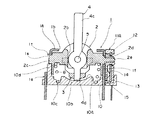
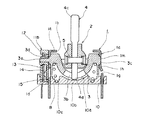
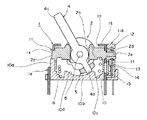
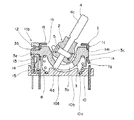









Landscapes
- Switches With Compound Operations (AREA)
Description
【0001】
【発明の属する技術分野】
本発明は、ゲーム機等に使用され、操作軸の操作により複数の電気部品を操作することができる多方向入力装置に関する。
【0002】
【従来の技術】
従来のジョイスティック型の多方向入力装置の構成を図28〜図30に基づいて説明すると、金属板が折り曲げられて形成された筺体31は、大きな孔31aを有する上面板31bと、この上面板31bの四方から折り曲げされて下方に延びる四つの側面板31c、31d、31e、31fと、この四つの側面板31c〜31fに設けられた孔31gとを有する。
【0003】
回転型の可変抵抗器からなる複数の電気部品32a、32bは、箱形のケース33と、このケース33の開放部に取り付けられ、抵抗体(図示せず)を設けた絶縁基板34と、この絶縁基板34に回転可能に取り付けられ、抵抗体上を摺動する摺動子(図示せず)を取り付けた回転体35とで構成されて、それぞれが単体の電気部品32a、32bとして形成されている。
そして、隣り合う側面板31d、31fにケース33を取り付けて、2個の電気部品32a、32bが互いに直角状態に取り付けられている。
【0004】
第1,第2連動部材36,37は、中央部にスリット36a、37aを有し、この第1,第2連動部材36、37は、互いに直交して十字状になるように配置され、第1連動部材36の両端部36b、36cは、互いに対向する側面板31d、31cの孔31gに挿入され、また、第2連動部材37の両端部37b、37cは、互いに対向する側面板31e、31fの孔31gに挿入されて、回動可能に取り付けられている。
【0005】
そして、第1、第2連動部材36、37が取り付けられた際、第1連動部材36の端部36bは一つの電気部品32aの回転体35と係合し、また、第2連動部材37の端部37cはもう一つの電気部品32bの回転体35と係合している。
そして、第1,第2連動部材36,37が同時、或いは単独に回転した時、回転体35も回転し、これによって、摺動子が抵抗体上を摺動して、抵抗値を可変し、電気部品32a、32bが操作されるようになっている。
【0006】
また、前記第1連動部材36は、打ち抜き加工、折り曲げ加工、絞り加工されたバネ性ある金属板で形成され、この第1連動部材36の筺体31への取付は、図28に示すように、矢印Z方向に第1連動部材36を撓ませた状態で、第1連動部材36を筺体31の下方から筺体31内に挿入して、両端部36b、36cを側面板31d、31cの孔31gに掛け止めするものである。
【0007】
また、前記第2連動部材37は、亜鉛ダイキャストの成型品からなり、この第2連動部材37の筺体31への取付は、図28に示すように、矢印Y方向に側面板31e、31fの下方を開いた状態で、第2連動部材37を筺体31の下方から筺体31内に挿入し、しかる後、開いた状態の側面板31e、31fを直立状態に戻して、両端部37b、37cを側面板31e、31fの孔31gに掛け止めするものである。
そして、この第1,第2連動部材36,37は、先ず、第2連動部材37よりも上方に位置する第1連動部材36が先に取り付けられ、しかる後、第1連動部材36よりも下方に位置する第2連動部材37の取付が行われるようになっている。
【0008】
孔38aを有する操作軸38は、第1,第2連動部材36,37のスリット36a、37aに挿通され、第2連動部材37に設けた孔37dと操作軸38の孔38aに挿通された止め棒39によって、第2連動部材37に回動可能に取り付けられると共に、操作軸38の上部は、孔31aから上方に突出して、先端部には摘み40が取り付けられている。
また、この操作軸38の組込は、操作軸38を第2連動部材37に取り付けた後、操作軸38が先に組み込まれた第1連動部材36のスリット36aと、上面板31bの孔31aに挿通され、このような状態で、第2連動部材37を組込することによって、操作軸38が組み立てられるようになっている。
【0009】
そして、操作軸38がスリット37aに沿って回動(傾倒)した時、操作軸38は、第1連動部材36を押圧して、第1連動部材36を回動して電気部品32aを操作し、また、操作軸38がスリット36aに沿って回動(傾倒)した時、操作軸38は、第2連動部材37を押圧して、第2連動部材37を回動して電気部品32bを操作し、更に、操作軸38が二つの孔31g間方向に回動(傾倒)した時、操作軸38は、第1、第2連動部材36、37を押圧して、第1、第2連動部材36、37を回動して電気部品32a、32bを同時に操作するようになっている。
【0010】
金属板からなる四角状の底板41は、筺体31の下方の開放部を塞ぐように、筺体31の下部に取り付けられている。
金属板を絞り加工等して形成された揺動部材42は、底壁42aを有する皿状部42bと、底壁42aの中央部に設けられた筒状部42cとを有する。
そして、揺動部材42は、底板41上に底壁42aを載置した状態で、筒状部42c内に、操作軸38の凸部38bが挿入されて取り付けられている。
【0011】
また、揺動部材42と操作軸38の鍔部38c間には、コイルバネ43を介在させ、このコイルバネ43によって、常時、操作軸38を上方に弾圧すると共に、揺動部材42を底板41に弾圧している。
この構成によって、揺動部材42は、コイルバネ43によって、常に水平状態を維持するようになっているため、揺動部材42の底壁42aが水平状態で底板41上に載置されている通常時は、操作軸38が未傾倒の直立状態となっている。 このような状態で、操作軸38を回動(傾倒)した時、揺動部材42が底壁41に対して傾いた状態となる。
【0012】
また、操作軸38の傾倒動作を解除すると、コイルバネ43によって、揺動部材42が水平状態に戻るようになると共に、この動作で、操作軸38も直立状態に戻されるようになっている。
即ち、揺動部材42とコイルバネ43によって、操作軸38の自動復帰を行わしめるための復帰手段が形成されている。
【0013】
このような構成を有する従来の多方向入力装置の動作を説明すると、先ず、摘み40を摘んで操作軸38を傾倒させると、操作軸38は止め棒39、或いは両端部37b、37cを支点として傾倒し、その結果、操作軸38が第1連動部材36,又は/及び第2連動部材37を押圧して、これを回転させる。
すると、第1,第2連動部材36,37がそれぞれ電気部品32a、32bの回転体35を回転させて、電気部品32a、32bを操作する。
【0014】
また、操作軸38の傾倒動作によって、揺動部材42が傾いた状態となり、次に、操作軸38への傾倒動作を解除すると、コイルバネ43によって、揺動部材42水平状態に戻るようになると共に、この動作で、操作軸38も直立状態の元の状態に戻される。
このようにして、従来の多方向入力装置の動作が行われるものである。
【0015】
【発明が解決しようとする課題】
従来の多方向入力装置において、バネ性ある金属板からなる第1連動部材36の筺体31への取付は、第1連動部材36を撓ませた状態で、筺体31内に挿入するため、その作業が面倒で、組立性が悪く、コスト高になるという問題がある。
また、第1連動部材36が金属板で形成されているため、厚さが薄く、このため、スリット36a内における操作軸38と第1連動部材36の対向面積が小さく、操作軸38と第1連動部材36との間の遊びが大きくなって、操作軸38の傾倒動作時に、直ちに第1連動部材36に傾倒動作が伝達できないという問題がある。
【0016】
また、亜鉛ダイキャストの成型品で形成された第2連動部材37の筺体31への取付は、側面板31e、31fを開いた状態で、第2連動部材37を筺体31内に挿入し、しかる後、開いた状態の側面板31e、31fを直立状態に戻すものであるため、その作業が面倒で、組立性が悪く、コスト高になるという問題がある。
また、第1連動部材36より後に組み込まれる第2連動部材37には、操作軸38が取り付けられているため、第2連動部材37の組込時、操作軸38を第1連動部材36のスリット36aと上面板31bの孔31aの双方に挿通せねばならず、その作業が面倒で、組立性が悪いという問題がある。
【0017】
そこで、本発明は、組立性が良好で、安価な多方向入力装置を提供することを目的とするものである。
【0018】
【課題を解決するための手段】
前記課題を解決するための第1の解決手段として、孔を設けた上面板、及びこの上面板の四方から下方に延びてロ字状をなした四つの側面板を有する筺体と、前記孔に挿通された操作軸と、互いに直交して配置された状態で、互いに対向する前記側面板間に回動可能に取り付けられた第1,第2連動部材と、前記側面板に取り付けられ、前記操作軸によって、前記第1,第2連動部材を介して操作可能な複数の電気部品とを備え、少なくとも一つの第1の前記側面板は、下方側に切り込み部を設けて形成された舌片部を有し、該舌片部の下端部が外方に折り曲げられて傾斜状になっており、前記切り込み部がU字状の孔で形成されて、前記舌片部の両側には一対の側板部が形成されると共に、前記舌片部の下方に位置した状態で、前記一対の側板部間を繋ぐ外方に突出する逃げ部を有する連結部が設けられ、前記舌片部に設けられた孔には、前記第1,或いは第2連動部材の少なくとも一端部が挿入されて、前記一端部が回動可能に保持されており、前記舌片部を設けた前記第1の側面板と対向する第2の前記側面板には、前記電気部品の一つが取り付けられ、前記第2の側面板に設けた孔には、前記第1,或いは第2連動部材の他端部が回動可能に保持され、該他端部から前記電気部品と係合する係合部が当該連動部材の回転軸方向に延びて設けられると共に、前記第1,或いは第2連動部材の前記一端部が前記筺体の下方から挿入されて前記舌片部の前記孔にスナップ結合され、前記筺体内に取り付けられる前記第1,或いは第2連動部材を回動可能に保持した構成とした。
【0021】
また、第2の解決手段として、前記第1連動部材は、互いに対向する第3,第4の前記側面板に回動可能に取り付けられると共に、前記第2連動部材は、前記第1,第2の側面板に回動可能に取り付けられ、前記第2連動部材が前記第1連動部材よりも下方に位置した状態で、前記第1,第2の側面板に取り付けられた構成とした。
【0022】
また、第3の解決手段として、前記第1連動部材の一端部を保持する前記第3の側面板には、下方が開放した切り欠き部を設け、この切り欠き部の上端には、前記切り欠き部の下方から挿入された前記第1連動部材の前記一端部の上部を当接させると共に、前記第1連動部材の前記一端部の下部が底板によって支持されて、前記第1連動部材の前記一端部が前記切り欠き部の前記上端と前記底板によって回動可能に保持された構成とした。
【0023】
また、第4の解決手段として、前記第3の側面板と対向する前記第4の側面板には、前記電気部品のもう一つが取り付けられ、前記第4の側面板に設けた孔には、前記第1連動部材の他端部が回動可能に保持された構成とした。
また、第5の解決手段として、前記第1連動部材には、前記操作軸が回転可能に取り付けられた構成とした。
また、第6の解決手段として、前記第1,第2連動部材が合成樹脂、或いは亜鉛ダイキャストの成型品で形成された構成とした。
【0024】
【発明の実施の形態】
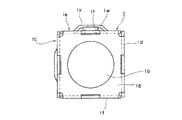
本発明の多方向入力装置の図面を説明すると、図1は本発明の多方向入力装置の平面図、図2は図1の2−2線における断面図、図3は図1の3−3線における断面図、図4は本発明の多方向入力装置に係り、動作を説明するための説明図、図5は本発明の多方向入力装置に係り、動作を説明するための説明図、図6は本発明の多方向入力装置に係る操作軸の平面図、図7は本発明の多方向入力装置に係る操作軸の右側面図である。
【0025】
また、図8は本発明の多方向入力装置に係る筺体の平面図、図9は本発明の多方向入力装置に係る筺体の正面図、図10は本発明の多方向入力装置に係る筺体の裏面図、図11は本発明の多方向入力装置に係る筺体の左側面図、図12は本発明の多方向入力装置に係る筺体の右側面図、図13は本発明の多方向入力装置に係る筺体の下面図である。
【0026】
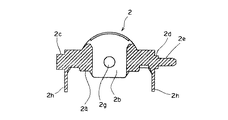
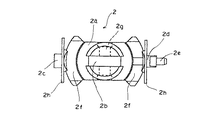
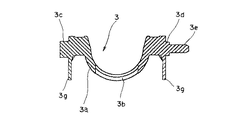
また、図14は本発明の多方向入力装置に係る第1連動部材の平面図、図15は図14の15−15線における断面図、図16は本発明の多方向入力装置に係る第1連動部材の下面図、図17は本発明の多方向入力装置に係る第2連動部材の平面図、図18は図17の18−18線における断面図、図19は本発明の多方向入力装置に係る第2連動部材の下面図、図20〜図23は本発明の多方向入力装置に係り、第1連動部材の組立を説明するための説明図、図24〜図27は本発明の多方向入力装置に係り、第2連動部材の組立を説明するための説明図である。
【0027】
まず、本発明の多方向入力装置は、図5に示すように、鉄板等からなる箱形の筺体1は、打ち抜き加工と折り曲げ加工されて形成され、特に図8〜図13に示すように、四角形の上面板1aと、この上面板1aの中央部に設けられた円形の孔1bと、上面板1aの四方から折り曲げされて下方に延びるロ字状をなした四つの第1〜第4の側面板1c、1d、1e、1fを有して、筺体1の内部が空洞になって形成されている。
【0028】
また、筺体1の第1の側面板1cは、図11に示すように、下方にU字状の孔からなる切り込み部1gを設けて形成された舌片部1hと、舌片部1hの両側に切り込み部1gを挟んで形成された一対の側板部1jと、舌片部1hの下方に位置した状態で、一対の側板部1jを繋ぐ連結部1kと、舌片部1hに設けられた円形の孔1mを有する。
更に、舌片部1hの下端部は、外方に折り曲げられて傾斜状になっていると共に、舌片部1hと対向する連結部1kは、台形状で外方に突出(膨出)した逃げ部1n(図13参照)が設けられて、この逃げ部1nによって、後述する第2連動部材3に対して、筺体1下方からの挿入を容易にしている。
また、第1の側面板1cと対向する第2の側面板1dは、図12に示すように、孔1mと対向する位置に設けられた円形の孔1pと、この孔1pの下方に設けられた三日月状の孔1qと、複数の取付孔1rとを有する。
【0029】
更に、第3の側面板1eは、図10に示すように、下方が開放した切り欠き部1sと、この切り欠き部1sの上端に設けられた半円筒状の受け部1tと、切り欠き部1sの両側に位置する一対の側板部1uと、一対の側板部1uの下方部同士を繋ぐ連結部1vとを有する。
そして、この連結部1vは、先の連結部1kと同様に、台形状で外方に突出(膨出)した逃げ部1w(図13参照)が設けられて、この逃げ部1wによって、後述する底板10に対して、筺体1下方からの挿入を容易にしていると共に、この逃げ部1wによって、切り欠き部1sの下方が開放状態となっている。
更に又、第3の側面板1eと対向する第4の側面板1fは、図9に示すように、切り欠き部1sと対向する位置に設けられた円形の孔1xと、この孔1xの下方に設けられた三日月状の孔1yと、複数の取付孔1zとを有する。
【0030】
前記筺体1の空洞内部には、第1、第2連動部材2、3が、十字状に直交して組み合わされて配設されている。
そして、合成樹脂、或いは亜鉛ダイキャストの成型品からなる第1連動部材2は、特に図14〜図16に示すように、中央部に位置する半円状の基部2aと、この基部2aの中央部に設けられたスリット2bと、基部2aの一端側に位置する一端部2cと、基部2aの他端側に位置する他端部2dと、この他端部2dから軸方向に延びる非円形の係合部2eと、基部2aの外周から円周方向に突出した一対の円弧状の鍔部2fと、スリット2bを横切って基部2aに設けられた孔2gと、コイルバネ8をガイドする受け部2hとを有する。
【0031】
そして、この第1連動部材2の両端部2c、2dには、筺体1に支承される軸部が形成されており、第1連動部材2は、一端部2cの上部が第3の側面板1eの切り欠き部1sの上端に当接し、他端部2dが第4の側面板1fの孔1xに嵌入、支承されて、筺体1に回動可能に取り付けられている。
なお、一端部2cの下部は、後述する底板10によって支持された構成となっている。
【0032】
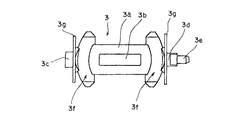
また、合成樹脂、或いは亜鉛ダイキャストの成型品からなる第2連動部材3は、特に図17〜図19に示すように、中央部に位置する弓状の基部3aと、この基部3aの中央部に設けられたスリット3bと、基部3aの一端側に位置する一端部3cと、基部3aの他端側に位置する他端部3dと、この他端部3dから軸方向に延びる非円形の係合部3eと、基部3aの外周から円周方向に突出した一対の円弧状の鍔部3fと、コイルバネ8をガイドする受け部3gとを有する。
【0033】
そして、この第2連動部材3の両端部3c、3dには、筺体1に支承される軸部が形成されており、第2連動部材3は、一端部3cが第1の側面板1cに設けられた舌片部1hの孔1mに嵌入、支承され、他端部3dが第2の側面板1dの孔1pに嵌入、支承されて、筺体1に回動可能に取り付けられている。
また、この第2連動部材3は、第1連動部材2よりも下方に位置した状態で、筺体1に取り付けられると共に、第1,第2連動部材2,3が筺体1に取り付けられた際、両者の鍔部2f、3fの下部は、面一となっている。
そして、この鍔部2f、3fの下部には、後述するコイルバネ8の上端部が当接するようになっている。
【0034】
金属材等からなる操作軸4は、図6、図7に示すように、平坦状の取付部4aと、この取付部4aの中心部に設けられた円形の孔4bと、取付部4aから前方に延びる円柱状の操作部4cと、取付部4aから後方に延びる円柱状の突起4dとを有する。
そして、この操作軸4は、突起4d側から第1連動部材2のスリット2bに挿入して、取付部4aをスリット2b内に位置させた状態で、円柱状の止め棒5を、第1連動部材2の孔2gと操作軸4の孔4bに挿通し、しかる後、止め棒5の先端部をカシメて、操作軸4を第1連動部材2に回動可能(傾倒可能)に取り付ける。
【0035】
また、第1連動部材2に傾倒可能に取り付けられた操作軸4は、操作部4cが上面板1aの孔1bから上方に突出すると共に、突起4dが第2連動部材3のスリット3bに挿通された状態となっている。
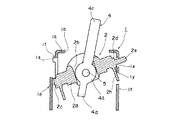
そして、操作軸4が図4に示すように、第1連動部材2のスリット2bに沿って回動(傾倒)した時、操作軸4は、突起4dで第2連動部材3を押圧して、第2連動部材3を回動させ、また、操作軸4が図5に示すように、第2連動部材3のスリット3bに沿って回動(傾倒)した時、操作軸4は、操作部4cで第1連動部材2を押圧して、第1連動部材2を回動するようになっている。
【0036】
次に、第1連動部材2の組立方法を図20〜図23に基づいて説明すると、先ず、第1連動部材2には、止め棒5によって、操作軸4を取り付ける。
次に、図20に示すように、筺体1の下方から筺体1内に第1連動部材2を挿入する。
この時、操作軸4の操作部4cが孔1bから突出するようにすると共に、他端部2d側から挿入して、係合部2eを第4の側面板1fの孔1xに係合させる。
【0037】
次に、図21に示すように、孔1xに係合した係合部2eを支点として、その反対側の一端部2c側を筺体1内に押し込む。
すると、第1連動部材2は、図22の状態を経て図23に示すように、一端部2cが切り欠き部1sの上端に位置する受け部1tに当接すると共に、他端部2dが孔1xに嵌合して、筺体1に対して水平状態に取り付けられる。
また、この組立途上の図21〜図23において、孔1yによって受け部2hが支障無くはめ合わされ、また、逃げ部1wによって下方が開放された切り欠き部1sに、一端部2cが支障無く、順次はめ合わされて、その組立が容易となっている。
また、側面板からの突出量が少なく、ほぼ面一の一端部2cを、係合部2eを組み込んだ後に、挿入するようにしているので、組立の作業性がよい。
【0038】
次に、第2連動部材3の組立方法を図24〜図27に基づいて説明すると、先ず、図24に示すように、筺体1の下方から筺体1内に第2連動部材3を挿入する。
この時、他端部3d側から挿入して、図25に示すように、係合部3eを第2の側面板1dの孔1pに係合させる。
次に、図26に示すように、孔1pに係合した係合部3eを支点として、その反対側の一端部3c側を筺体1内に押し込む。
【0039】
すると、舌片部1hの傾斜部に一端部3cがぶつかって、この舌片部1hを外方に撓ませた後、図27に示すように、一端部3cが第1の側面板1cの孔1mにスナップ結合すると共に、他端部3dが孔1pに嵌合して、筺体1に対して水平状態に取り付けられる。
また、この組立途上の図26,図27において、孔1qによって受け部3gが支障無くはめ合わされ、逃げ部1nによって舌片部1hの下方が開放されているため、一端部3cが支障無く、舌片部1hの下部にぶつかって、一端部3cのスナップ結合による組立が容易となっている。
更に、第2連動部材3の組立途上において、図25から図26に示す間の工程で、スリット3bに操作軸4の突起4dをはめ合わせると共に、下方に位置して取り付けられた第2連動部材3によって、上方に位置する第1連動部材2の落下を防止している。
なお、この際、側面板からの突出量が少なく、ほぼ面一の一端部3cを、係合部3eを組み込んだ後に、スナップ結合しているので、組立の作業性がよい。
【0040】
回転型の可変抵抗器からなる複数の電気部品11a、11bは、箱形のケース12と、このケース12に取り付けられ、抵抗体(図示せず)を設けた絶縁基板13と、この絶縁基板13に回転可能に取り付けられ、抵抗体上を摺動する摺動子14を取り付け、中心に非円形の孔を有する回転体15とで構成されている。そして、隣り合う第4,第2側面板1f、1dには、取付孔1z、1rにケース12を取り付けて、2個の電気部品11a、11bが互いに直角状態に取り付けられている。
そして、電気部品11a、11bが筺体1に取り付けられた際、電気部品11a、11bのそれぞれの回転体15の非円形の孔には、第1,第2連動部材2,3の係合部2e、3eが係合し、第1,第2連動部材2,3の回動動作によって回転体15を回転して、電気部品11a、11bを操作するようになっている。
なお、この電気部品11a、11bの取付は、連動部材2,3を筺体1に組み付けた後に行う。
【0041】
合成樹脂の成型品等からなる底板10は、球面状の凹部10aを有する突部10bと、凸部10bの外周部に設けられたコイルバネ8用の凹部からなる受け部10cと、直立して設けられた支持壁10dとを有する。
この底板10は、筺体1の下方の開放部を塞ぐように、筺体1の下部に取り付けられている。
そして、底板10が取り付けられた際、図2に示すように、支持壁10dの上端部が第1連動部材2の一端部2cの下部を挟持して、この支持壁10dと切り欠き部1sの上端とで、一端部2cを回動可能に支持している。
【0042】
また、第1,第2連動部材2,3の鍔部2f、3fと底板10の受け部10cとの間にコイルバネ8を介在させ、このコイルバネ8によって、常時、第1,第2連動部材2,3を上方に弾圧して、第1,第2連動部材2,3を常に水平状態を維持し、これによって、操作軸4が未傾倒の直立状態にしている。
このような状態で、図4に示すように、操作軸4を第1連動部材2のスリット2bに沿って回動(傾倒)した時、第2連動部材3の回動に伴って鍔部3fがコイルバネ8を押圧して、コイルバネ8を変形させ、また、図5に示すように、操作軸4を第2連動部材3のスリット3bに沿って回動(傾倒)した時、第1連動部材2の回動に伴って鍔部2fがコイルバネ8を押圧して、コイルバネ8を変形させるようになる。
なお、この際、受け部2h、3gによってコイルバネ8がガイドされているので、スムーズに変形させることができる。
【0043】
また、操作軸4の傾倒動作を解除すると、変形したコイルバネ8によって、第1,第2連動部材2,3が水平状態に戻るようになると共に、この動作で、操作軸4も直立状態に戻されるようになっている。
即ち、コイルバネ8によって、第1,第2連動部材2,3と操作軸4の自動復帰を行わしめるための復帰手段が形成されている。
【0044】
このような構成を有する本発明の多方向入力装置の動作を説明すると、先ず、操作軸4を傾倒させると、操作軸4は止め棒5、或いは一端部2cと他端部2dを支点として傾倒し、その結果、操作軸4が第1連動部材2,又は/及び第2連動部材3を押圧して、これを回転させる。
すると、第1,第2連動部材2,3がそれぞれ電気部品11a、11bの回転体15を回転させて、電気部品11a、11bを操作する。
【0045】
また、操作軸4の傾倒動作を解除すると、コイルバネ8によって、第1,第2連動部材2,3が水平状態に戻るようになると共に、この動作で、操作軸4も直立状態の元の状態に戻される。
このようにして、本発明の多方向入力装置の動作が行われるものである。
【0046】
なお、上記実施例では、筺体1を金属板で形成したもので説明したが、筺体1を合成樹脂の成型品で形成しても良い。
また、第2連動部材3の一端部3cがスナップ止めされるもので説明したが、第2連動部材3の両端部、又は/及び第1連動部材2の両端部をスナップ止めするようにしても良い。
また、本実施例においては、他端部2d、3dによって連動部材を第4,第2の側面板1f、1dに直接保持しているが、回転体15によってのみ保持する、即ち、間接的に側面板1f、1dに保持しても良い。
【0047】
【発明の効果】
本発明の多方向入力装置において、少なくとも一つの第1の側面板1cは、下方側に切り込み部1gを設けて形成された舌片部1hを有し、この舌片部1hに設けられた孔1mには、筺体1の下方から筺体1内に取り付けられる第1,或いは第2連動部材2,3の少なくとも一端部を挿入して、一端部を回動可能に保持したため、第1,或いは第2連動部材2,3は、舌片部1hの孔1mにスナップ止が可能となり、従来に比して、その組立が容易となり、安価なものを提供できる。
【0048】
また、舌片部1hを設けた第1の側面板1cと対向する第2の側面板1dには、電気部品の一つが取り付けられ、第2の側面板1dに設けた孔1pには、連動部材の他端部が回動可能に保持されると共に、連動部材の一端部が舌片部1hの孔1hにスナップ結合されたため、連動部材が舌片部1hの孔1mにスナップ止できて、従来に比して、その組立が容易となり、安価なものを提供できる。
【0049】
また、第1の側面板1cに設けられた切り込み部1gがU字状の孔で形成されて、舌片部1hの両側には一対の側板部1jが形成されると共に、舌片部1hの下方に位置した状態で、一対の側板部1j間を繋ぐ連結部1kが設けられたため、側面板1cの強度を高めることができて、精度の良いものが得られる。
【0050】
また、連結部1kには、外方に突出する逃げ部1nが設けられたため、逃げ部1nによって舌片部1hの下方が開放されて、連結部材の一端部が支障無く、舌片部1hの下部にぶつかって、一端部のスナップ結合による組立が容易となって、組立性の良好なものが得られる。
【0051】
また、第1連動部材2は、互いに対向する第3,第4の側面板1e、1fに回動可能に取り付けられると共に、第2連動部材3は、第1,第2の側面板1c、1dに回動可能に取り付けられ、第2連動部材3が第1連動部材2よりも下方に位置した状態で、第1,第2の側面板1c、1dに取り付けられたため、下方に位置して取り付けられた第2連動部材3によって、上方に位置する第1連動部材2の落下を防止し、このため、爾後の組立性が容易なものを提供できる。
【0052】
また、第1連動部材2の一端部2cを保持する第3の側面板1eには、下方が開放した切り欠き部1sを設け、この切り欠き部1sの上端には、切り欠き部1sの下方から挿入された第1連動部材2の一端部2cの上部を当接させると共に、第1連結部材2の一端部2cの下部が底板10によって支持されて、第1連動部材2の一端部2cが切り欠き部1sの上端と底板10によって回動可能に保持されたため、従来のように筺体を開く等の作業が無く、単に、第1連動部材2を筺体1の下方から挿入するだけでよく、組立性の良好なものが得られる。
【0053】
また、第3の側面板1eと対向する第4の側面板1fには、電気部品のもう一つが取り付けられ、第4の側面板1fに設けた孔1xには、第1連動部材2の他端部2dが回動可能に保持されたため、孔1x側を支点として一端部2c側を押し込むだけで組立でき、作業性の良いものが得られる。
【0054】
また、第1連動部材2には、操作軸4が回転可能に取り付けられたため、操作軸4は孔1bに挿通すれば良く、従って、従来に比して、組立性の良好なものが得られる。
【0055】
また、第1,第2連動部材2,3が合成樹脂、或いは亜鉛ダイキャストの成型品で形成されたため、第1,第2連動部材2,3の厚さを厚くでき、このため、スリット2b、3b内における操作軸4と第1、第2連動部材2,3の対向面積が大きく、操作軸4と第1、第2連動部材2,3との間の遊びが小さくなって、操作軸4の傾倒動作時に、直ちに第1、第2連動部材2,3に傾倒動作が伝達できて、精度の良いものが提供できる。
【図面の簡単な説明】
【図1】本発明の多方向入力装置の平面図。
【図2】図1の2−2線における断面図。
【図3】図1の3−3線における断面図。
【図4】本発明の多方向入力装置に係り、動作を説明するための説明図。
【図5】本発明の多方向入力装置に係り、動作を説明するための説明図。
【図6】本発明の多方向入力装置に係る操作軸の平面図。
【図7】本発明の多方向入力装置に係る操作軸の右側面図。
【図8】本発明の多方向入力装置に係る筺体の平面図。
【図9】本発明の多方向入力装置に係る筺体の正面図。
【図10】本発明の多方向入力装置に係る筺体の裏面図。
【図11】本発明の多方向入力装置に係る筺体の左側面図。
【図12】本発明の多方向入力装置に係る筺体の右側面図。
【図13】本発明の多方向入力装置に係る筺体の下面図。
【図14】本発明の多方向入力装置に係る第1連動部材の平面図。
【図15】図14の15−15線における断面図。
【図16】本発明の多方向入力装置に係る第1連動部材の下面図。
【図17】本発明の多方向入力装置に係る第2連動部材の平面図。
【図18】図17の18−18線における断面図。
【図19】本発明の多方向入力装置に係る第2連動部材の下面図。
【図20】本発明の多方向入力装置に係り、第1連動部材の組立を説明するための説明図。
【図21】本発明の多方向入力装置に係り、第1連動部材の組立を説明するための説明図。
【図22】本発明の多方向入力装置に係り、第1連動部材の組立を説明するための説明図。
【図23】本発明の多方向入力装置に係り、第1連動部材の組立を説明するための説明図。
【図24】本発明の多方向入力装置に係り、第2連動部材の組立を説明するための説明図。
【図25】本発明の多方向入力装置に係り、第2連動部材の組立を説明するための説明図。
【図26】本発明の多方向入力装置に係り、第2連動部材の組立を説明するための説明図。
【図27】本発明の多方向入力装置に係り、第2連動部材の組立を説明するための説明図。
【図28】従来の多方向入力装置の分解斜視図。
【図29】従来の多方向入力装置の要部の断面図。
【図30】従来の多方向入力装置に係り、操作軸を傾倒した状態を示す断面図。
【符号の説明】
1 筺体
1a 上面板
1b 孔
1c 第1の側面板
1d 第2の側面板
1e 第3の側面板
1f 第4の側面板
1g 切り込み部
1h 舌片部
1j 側板部
1k 連結部
1m 孔
1n 逃げ部
1p 孔
1q 孔
1r 取付孔
1s 切り欠き部
1t 受け部
1u 側板部
1v 連結部
1w 逃げ部
1x 孔
1y 孔
1z 取付孔
2 第1連動部材
2a 基部
2b スリット
2c 一端部
2d 他端部
2e 係合部
2f 鍔部
2g 孔
2h 受け部
3 第2連動部材
3a 基部
3b スリット
3c 一端部
3d 他端部
3e 係合部
3f 鍔部
3g 受け部
4 操作軸
4a 取付部
4b 孔
4c 操作部
4d 突起
5 止め棒
8 コイルバネ
10 底板
10a 凹部
10b 突部
10c 受け部
10d 支持壁
11a 電気部品
11b 電気部品
12 ケース
13 絶縁基板
14 摺動子
15 回転体[0001]
BACKGROUND OF THE INVENTION
The present invention relates to a multidirectional input device that is used in a game machine or the like and can operate a plurality of electric components by operating an operation shaft.
[0002]
[Prior art]
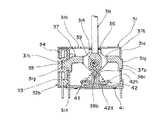
The structure of a conventional joystick-type multidirectional input device will be described with reference to FIGS. 28 to 30. A
[0003]
A plurality of
And the
[0004]
The first and second interlocking
[0005]
And when the 1st, 2nd interlocking
When the first and second interlocking
[0006]
Further, the first interlocking
[0007]
Further, the second interlocking
In the first and second interlocking
[0008]
The
In addition, the
[0009]
When the
[0010]
A
The
The swinging
[0011]
In addition, a
With this configuration, the swinging
[0012]
Further, when the tilting operation of the
That is, the swinging
[0013]
The operation of the conventional multi-directional input device having such a configuration will be described. First, when the
Then, the 1st, 2nd interlocking
[0014]
The swinging
In this way, the operation of the conventional multidirectional input device is performed.
[0015]
[Problems to be solved by the invention]
In the conventional multidirectional input device, the first interlocking
In addition, since the first interlocking
[0016]
The
In addition, since the
[0017]
Therefore, an object of the present invention is to provide an inexpensive multidirectional input device that is easy to assemble.
[0018]
[Means for Solving the Problems]
Solve the problem Ruta As a first means for solving the problem, an upper surface plate provided with a hole, a housing having four side plates extending downward from four sides of the upper surface plate and having a square shape, and an operating shaft inserted through the hole And the first and second interlocking members rotatably attached between the side plates facing each other in a state of being arranged orthogonal to each other, and attached to the side plates, and by the operating shaft, the first 1 and a plurality of electrical components operable via a second interlocking member, and at least one first side plate has a tongue piece formed by providing a cut portion on the lower side, A lower end portion of the tongue piece portion is bent outward to be inclined, the cut portion is formed by a U-shaped hole, and a pair of side plate portions are formed on both sides of the tongue piece portion. And a connecting portion having an outwardly projecting relief portion connecting the pair of side plate portions in a state of being positioned below the tongue piece portion, In the hole provided in the tongue piece, ,in front At least one end of the first or second interlocking member But Insert Been The one end But Holds pivotably One of the electrical components is attached to the second side plate facing the first side plate provided with the tongue piece, and the hole provided in the second side plate is The other end portion of the first or second interlocking member is rotatably held, and an engaging portion that engages with the electrical component extends from the other end portion in the direction of the rotation axis of the interlocking member. In addition, the first or second interlocking member is inserted into the hole of the tongue piece portion from one end of the first or second interlocking member from below the housing, and is attached to the first or second interlocking member. Holds the member pivotably The configuration was as follows.
[0021]
Also, Second The first interlocking member is rotatably attached to the third and fourth side plates facing each other, and the second interlocking member is attached to the first and second side plates. The second interlocking member is pivotally attached, and the second interlocking member is attached to the first and second side plates with the second interlocking member positioned below the first interlocking member.
[0022]
Also, Third As a means for solving this problem, the third side plate that holds one end of the first interlocking member is provided with a notch that opens downward, and the upper end of the notch is below the notch. The lower end of the one end part of the first interlocking member is supported by a bottom plate, and the one end part of the first interlocking member is It was set as the structure hold | maintained rotatably by the said upper end and said bottom plate of a notch part.
[0023]
Also, 4th As another means for solving the problem, another electric component is attached to the fourth side plate facing the third side plate, and the first interlocking is provided in a hole provided in the fourth side plate. The other end portion of the member was held rotatably.
Also, 5th As a solution to this, the operation shaft is rotatably attached to the first interlocking member.
Also, 6th As a means for solving this problem, the first and second interlocking members are formed of synthetic resin or zinc die cast.
[0024]
DETAILED DESCRIPTION OF THE INVENTION
FIG. 1 is a plan view of the multidirectional input device of the present invention, FIG. 2 is a cross-sectional view taken along line 2-2 of FIG. 1, and FIG. 3 is 3-3 of FIG. 4 is an explanatory diagram for explaining the operation of the multidirectional input device according to the present invention, and FIG. 5 is an explanatory diagram for explaining the operation of the multidirectional input device of the present invention. 6 is a plan view of the operation shaft according to the multidirectional input device of the present invention, and FIG. 7 is a right side view of the operation shaft according to the multidirectional input device of the present invention.
[0025]
8 is a plan view of the housing according to the multi-directional input device of the present invention, FIG. 9 is a front view of the housing according to the multi-directional input device of the present invention, and FIG. 10 is the front view of the housing according to the multi-directional input device of the present invention. 11 is a left side view of the housing according to the multidirectional input device of the present invention, FIG. 12 is a right side view of the housing according to the multidirectional input device of the present invention, and FIG. 13 is the multidirectional input device of the present invention. It is a bottom view of the housing which concerns.
[0026]
14 is a plan view of a first interlocking member according to the multidirectional input device of the present invention, FIG. 15 is a sectional view taken along line 15-15 of FIG. 14, and FIG. 16 is a first diagram of the multidirectional input device according to the present invention. FIG. 17 is a bottom view of the interlocking member, FIG. 17 is a plan view of the second interlocking member according to the multidirectional input device of the present invention, FIG. 18 is a cross-sectional view taken along line 18-18 of FIG. FIG. 20 to FIG. 23 relate to the multidirectional input device of the present invention, FIG. 20 to FIG. 23 are explanatory diagrams for explaining the assembly of the first interlock member, and FIG. 24 to FIG. It is explanatory drawing for demonstrating the assembly of a 2nd interlocking member in connection with a direction input device.
[0027]
First, as shown in FIG. 5, the multi-directional input device of the present invention is formed by punching and bending a box-shaped
[0028]
Further, as shown in FIG. 11, the first side plate 1c of the
Further, the lower end portion of the tongue piece 1h is bent outward and has an inclined shape, and the connecting portion 1k facing the tongue piece 1h is a trapezoidal relief that protrudes outward (swells). A portion 1n (see FIG. 13) is provided, and the escape portion 1n facilitates insertion from below the
Further, as shown in FIG. 12, the second side plate 1d facing the first side plate 1c is provided in a circular hole 1p provided at a position facing the hole 1m, and below the hole 1p. It has a crescent-shaped hole 1q and a plurality of mounting holes 1r.
[0029]
Further, as shown in FIG. 10, the third side face plate 1e includes a notch portion 1s opened at the bottom, a semi-cylindrical receiving portion 1t provided at the upper end of the notch portion 1s, and a notch portion. It has a pair of side plate parts 1u located on both sides of 1s and a connecting part 1v that connects the lower parts of the pair of side plate parts 1u.
And this connection part 1v is provided with the escape part 1w (refer FIG. 13) which protruded outward in the trapezoid shape similarly to the previous connection part 1k (refer FIG. 13), and mentions later by this escape part 1w. The
Furthermore, as shown in FIG. 9, the fourth side plate 1f facing the third side plate 1e includes a
[0030]
In the cavity of the
And the 1st interlocking
[0031]
And the shaft part supported by the
In addition, the lower part of the one
[0032]
Further, the
[0033]
And the shaft part supported by the
In addition, the
And the upper end part of the
[0034]
As shown in FIGS. 6 and 7, the
The
[0035]
Further, the
When the
[0036]
Next, a method for assembling the first interlocking
Next, as shown in FIG. 20, the first interlocking
At this time, the
[0037]
Next, as shown in FIG. 21, with the engaging
Then, as shown in FIG. 23 through the state of FIG. 22, the first interlocking
Further, in FIGS. 21 to 23 in the course of assembly, the receiving
Further, since the protruding amount from the side plate is small and the one
[0038]
Next, the assembly method of the
At this time, it inserts from the
Next, as shown in FIG. 26, with the engaging
[0039]
Then, after the one
Further, in FIGS. 26 and 27 in the course of the assembly, the receiving portion 3g is fitted without any trouble by the hole 1q, and the lower portion of the tongue piece 1h is opened by the escape portion 1n. It collides with the lower part of the one part 1h, and the assembly by the snap coupling | bonding of the one
Further, in the process of assembling the
At this time, the amount of protrusion from the side plate is small, and the substantially flush one
[0040]
A plurality of electrical components 11a and 11b made of a rotary variable resistor are a box-shaped
When the electrical components 11a and 11b are attached to the
The electrical components 11a and 11b are attached after the interlocking
[0041]
A
The
When the
[0042]
In addition, a
In this state, as shown in FIG. 4, when the
At this time, since the
[0043]
When the tilting operation of the
That is, a return means for automatically returning the first and
[0044]
The operation of the multi-directional input device of the present invention having such a configuration will be described. First, when the operating
Then, the 1st, 2nd interlocking
[0045]
When the tilting operation of the
In this way, the operation of the multidirectional input device of the present invention is performed.
[0046]
In addition, although the said Example demonstrated the
Moreover, although the one
In this embodiment, the interlocking member is directly held by the fourth and second side plates 1f and 1d by the
[0047]
【The invention's effect】
In the multidirectional input device of the present invention, at least one first side plate 1c has a tongue piece 1h formed by providing a cut portion 1g on the lower side, and a hole provided in the tongue piece 1h. In 1 m, at least one end of the first or second interlocking
[0048]
In addition, one of the electrical components is attached to the second side plate 1d facing the first side plate 1c provided with the tongue piece 1h, and interlocked with the hole 1p provided in the second side plate 1d. Since the other end of the member is rotatably held, and the one end of the interlocking member is snap-coupled to the hole 1h of the tongue piece 1h, the interlocking member can be snapped into the hole 1m of the tongue piece 1h. As compared with the prior art, the assembly becomes easier and an inexpensive one can be provided.
[0049]
In addition, a cut portion 1g provided in the first side plate 1c is formed by a U-shaped hole, a pair of side plate portions 1j are formed on both sides of the tongue piece 1h, and the tongue piece 1h Since the connecting portion 1k that connects the pair of side plate portions 1j is provided in a state of being positioned below, the strength of the side plate 1c can be increased, and a highly accurate one can be obtained.
[0050]
Further, since the connecting portion 1k is provided with a relief portion 1n that protrudes outward, the lower portion of the tongue piece 1h is opened by the relief portion 1n, and one end portion of the connecting member has no problem, and the tongue piece portion 1h When it hits the lower part, it is easy to assemble by snap coupling at one end, and a product with good assemblability can be obtained.
[0051]
The
[0052]
The third side plate 1e that holds the one
[0053]
Further, another electric component is attached to the fourth side plate 1f facing the third side plate 1e, and the
[0054]
Further, since the
[0055]
Further, since the first and
[Brief description of the drawings]
FIG. 1 is a plan view of a multidirectional input device of the present invention.
FIG. 2 is a cross-sectional view taken along line 2-2 of FIG.
3 is a cross-sectional view taken along line 3-3 in FIG.
FIG. 4 is an explanatory diagram for explaining the operation of the multidirectional input device of the present invention.
FIG. 5 is an explanatory diagram for explaining the operation of the multidirectional input device of the present invention.
FIG. 6 is a plan view of an operation shaft according to the multidirectional input device of the present invention.
FIG. 7 is a right side view of an operation shaft according to the multidirectional input device of the present invention.
FIG. 8 is a plan view of a housing according to the multidirectional input device of the present invention.
FIG. 9 is a front view of a housing according to the multidirectional input device of the present invention.
FIG. 10 is a rear view of the housing according to the multidirectional input device of the present invention.
FIG. 11 is a left side view of a housing according to the multidirectional input device of the present invention.
FIG. 12 is a right side view of a housing according to the multidirectional input device of the present invention.
FIG. 13 is a bottom view of a housing according to the multidirectional input device of the present invention.
FIG. 14 is a plan view of a first interlocking member according to the multidirectional input device of the present invention.
15 is a cross-sectional view taken along line 15-15 in FIG.
FIG. 16 is a bottom view of the first interlocking member according to the multidirectional input device of the present invention.
FIG. 17 is a plan view of a second interlocking member according to the multidirectional input device of the present invention.
18 is a cross-sectional view taken along line 18-18 in FIG.
FIG. 19 is a bottom view of a second interlocking member according to the multidirectional input device of the present invention.
FIG. 20 is an explanatory diagram for explaining the assembly of the first interlocking member according to the multidirectional input device of the present invention.
FIG. 21 is an explanatory diagram for explaining the assembly of the first interlocking member according to the multidirectional input device of the present invention.
FIG. 22 is an explanatory diagram for explaining the assembly of the first interlocking member according to the multidirectional input device of the present invention.
FIG. 23 is an explanatory diagram for explaining assembly of the first interlocking member according to the multidirectional input device of the present invention.
FIG. 24 is an explanatory diagram for explaining assembly of the second interlocking member according to the multidirectional input device of the present invention.
FIG. 25 is an explanatory diagram for explaining assembly of the second interlocking member according to the multidirectional input device of the present invention.
FIG. 26 is an explanatory diagram for explaining the assembly of the second interlocking member according to the multidirectional input device of the present invention.
FIG. 27 is an explanatory diagram for explaining the assembly of the second interlocking member according to the multidirectional input device of the present invention.
FIG. 28 is an exploded perspective view of a conventional multidirectional input device.
FIG. 29 is a cross-sectional view of a main part of a conventional multidirectional input device.
FIG. 30 is a cross-sectional view showing a state in which an operation shaft is tilted according to a conventional multidirectional input device.
[Explanation of symbols]
1 body
1a Top plate
1b hole
1c First side plate
1d second side plate
1e Third side plate
1f Fourth side plate
1g notch
1h Tongue piece
1j Side plate
1k connecting part
1m hole
1n relief
1p hole
1q hole
1r Mounting hole
1s cutout
1t receiving part
1u side plate
1v connecting part
1w escape part
1x hole
1y hole
1z Mounting hole
2 First interlocking member
2a base
2b slit
2c One end
2d other end
2e engagement part
2f buttock
2g hole
2h receiving part
3 Second interlocking member
3a base
3b slit
3c one end
3d other end
3e engagement part
3f Isobe
3g receiving part
4 Operation axis
4a Mounting part
4b hole
4c Operation part
4d protrusion
5 Stopper
8 Coil spring
10 Bottom plate
10a recess
10b Projection
10c receiving part
10d support wall
11a Electrical parts
11b Electrical parts
12 cases
13 Insulating substrate
14 Slider
15 Rotating body
Claims (6)
Priority Applications (1)
| Application Number | Priority Date | Filing Date | Title |
|---|---|---|---|
| JP2000281741A JP3973354B2 (en) | 2000-09-12 | 2000-09-12 | Multi-directional input device |
Applications Claiming Priority (1)
| Application Number | Priority Date | Filing Date | Title |
|---|---|---|---|
| JP2000281741A JP3973354B2 (en) | 2000-09-12 | 2000-09-12 | Multi-directional input device |
Publications (2)
| Publication Number | Publication Date |
|---|---|
| JP2002093286A JP2002093286A (en) | 2002-03-29 |
| JP3973354B2 true JP3973354B2 (en) | 2007-09-12 |
Family
ID=18766349
Family Applications (1)
| Application Number | Title | Priority Date | Filing Date |
|---|---|---|---|
| JP2000281741A Expired - Fee Related JP3973354B2 (en) | 2000-09-12 | 2000-09-12 | Multi-directional input device |
Country Status (1)
| Country | Link |
|---|---|
| JP (1) | JP3973354B2 (en) |
Families Citing this family (1)
| Publication number | Priority date | Publication date | Assignee | Title |
|---|---|---|---|---|
| WO2023171223A1 (en) | 2022-03-08 | 2023-09-14 | アルプスアルパイン株式会社 | Multi-directional input device |
-
2000
- 2000-09-12 JP JP2000281741A patent/JP3973354B2/en not_active Expired - Fee Related
Also Published As
| Publication number | Publication date |
|---|---|
| JP2002093286A (en) | 2002-03-29 |
Similar Documents
| Publication | Publication Date | Title |
|---|---|---|
| CN101286426B (en) | multi-directional input device | |
| JPH1153995A (en) | Multidirectional input device | |
| JP3698586B2 (en) | Multi-directional input device | |
| JP3698565B2 (en) | Multi-directional input device | |
| US6506984B2 (en) | Rotary switch having click mechanism | |
| JP3973354B2 (en) | Multi-directional input device | |
| JP3869996B2 (en) | Multi-directional input device | |
| JP5256070B2 (en) | Electronic component click mechanism, variable resistor | |
| JP2007311556A (en) | Rotary electrical component with push switch | |
| JP3884883B2 (en) | Multi-directional input device | |
| JP3746929B2 (en) | Multi-directional input device | |
| JP2928602B2 (en) | Circuit breaker for wiring | |
| JP3803524B2 (en) | Multi-directional input device | |
| JP3764837B2 (en) | Multi-directional input device | |
| JP3770768B2 (en) | Multi-directional input device | |
| JP2001022463A (en) | Multi-directional input device | |
| JP3746931B2 (en) | Multi-directional input device | |
| JP2004185925A (en) | Switch | |
| JP2000305650A (en) | Multidirectional input device | |
| JP2000305649A (en) | Multidirectional input device | |
| JP2004265687A (en) | Rotary type electrical component | |
| JP2002170464A (en) | Input device | |
| JP2000294413A (en) | Rotary electric part | |
| JPS5849603Y2 (en) | electrical parts housing | |
| JP3973343B2 (en) | Multi-directional input device |
Legal Events
| Date | Code | Title | Description |
|---|---|---|---|
| A977 | Report on retrieval |
Free format text: JAPANESE INTERMEDIATE CODE: A971007 Effective date: 20060925 |
|
| A131 | Notification of reasons for refusal |
Free format text: JAPANESE INTERMEDIATE CODE: A131 Effective date: 20061003 |
|
| A521 | Written amendment |
Free format text: JAPANESE INTERMEDIATE CODE: A523 Effective date: 20061128 |
|
| TRDD | Decision of grant or rejection written | ||
| A01 | Written decision to grant a patent or to grant a registration (utility model) |
Free format text: JAPANESE INTERMEDIATE CODE: A01 Effective date: 20070605 |
|
| A61 | First payment of annual fees (during grant procedure) |
Free format text: JAPANESE INTERMEDIATE CODE: A61 Effective date: 20070612 |
|
| FPAY | Renewal fee payment (event date is renewal date of database) |
Free format text: PAYMENT UNTIL: 20100622 Year of fee payment: 3 |
|
| FPAY | Renewal fee payment (event date is renewal date of database) |
Free format text: PAYMENT UNTIL: 20100622 Year of fee payment: 3 |
|
| FPAY | Renewal fee payment (event date is renewal date of database) |
Free format text: PAYMENT UNTIL: 20110622 Year of fee payment: 4 |
|
| LAPS | Cancellation because of no payment of annual fees |