JP3794271B2 - Decorative painting method - Google Patents
Decorative painting method Download PDFInfo
- Publication number
- JP3794271B2 JP3794271B2 JP2001028296A JP2001028296A JP3794271B2 JP 3794271 B2 JP3794271 B2 JP 3794271B2 JP 2001028296 A JP2001028296 A JP 2001028296A JP 2001028296 A JP2001028296 A JP 2001028296A JP 3794271 B2 JP3794271 B2 JP 3794271B2
- Authority
- JP
- Japan
- Prior art keywords
- coating
- decorative
- polymerization accelerator
- paint
- curing
- Prior art date
- Legal status (The legal status is an assumption and is not a legal conclusion. Google has not performed a legal analysis and makes no representation as to the accuracy of the status listed.)
- Expired - Fee Related
Links
- 238000000034 method Methods 0.000 title claims description 9
- 238000010422 painting Methods 0.000 title claims description 4
- 238000000576 coating method Methods 0.000 claims description 113
- 239000011248 coating agent Substances 0.000 claims description 101
- 239000003973 paint Substances 0.000 claims description 62
- 239000000463 material Substances 0.000 claims description 51
- 238000006116 polymerization reaction Methods 0.000 claims description 47
- 239000003999 initiator Substances 0.000 claims description 17
- 229920006337 unsaturated polyester resin Polymers 0.000 claims description 17
- 229910017052 cobalt Inorganic materials 0.000 claims description 12
- 239000010941 cobalt Substances 0.000 claims description 12
- GUTLYIVDDKVIGB-UHFFFAOYSA-N cobalt atom Chemical compound [Co] GUTLYIVDDKVIGB-UHFFFAOYSA-N 0.000 claims description 12
- 230000000694 effects Effects 0.000 claims description 10
- 230000001678 irradiating effect Effects 0.000 claims description 10
- 239000002245 particle Substances 0.000 claims description 10
- OYPRJOBELJOOCE-UHFFFAOYSA-N Calcium Chemical compound [Ca] OYPRJOBELJOOCE-UHFFFAOYSA-N 0.000 claims description 5
- 229910052788 barium Inorganic materials 0.000 claims description 5
- 229910052791 calcium Inorganic materials 0.000 claims description 5
- 239000011575 calcium Substances 0.000 claims description 5
- DSAJWYNOEDNPEQ-UHFFFAOYSA-N barium atom Chemical compound [Ba] DSAJWYNOEDNPEQ-UHFFFAOYSA-N 0.000 claims description 4
- 239000000758 substrate Substances 0.000 claims description 4
- 125000005287 vanadyl group Chemical group 0.000 claims description 4
- PWHULOQIROXLJO-UHFFFAOYSA-N Manganese Chemical compound [Mn] PWHULOQIROXLJO-UHFFFAOYSA-N 0.000 claims description 3
- HCHKCACWOHOZIP-UHFFFAOYSA-N Zinc Chemical compound [Zn] HCHKCACWOHOZIP-UHFFFAOYSA-N 0.000 claims description 3
- 229910052748 manganese Inorganic materials 0.000 claims description 3
- 239000011572 manganese Substances 0.000 claims description 3
- 229910052725 zinc Inorganic materials 0.000 claims description 3
- 239000011701 zinc Substances 0.000 claims description 3
- QCWXUUIWCKQGHC-UHFFFAOYSA-N Zirconium Chemical compound [Zr] QCWXUUIWCKQGHC-UHFFFAOYSA-N 0.000 claims description 2
- 229910052726 zirconium Inorganic materials 0.000 claims description 2
- 238000001723 curing Methods 0.000 description 39
- 239000010410 layer Substances 0.000 description 39
- 229910052751 metal Inorganic materials 0.000 description 20
- 239000002184 metal Substances 0.000 description 20
- GEMHFKXPOCTAIP-UHFFFAOYSA-N n,n-dimethyl-n'-phenylcarbamimidoyl chloride Chemical compound CN(C)C(Cl)=NC1=CC=CC=C1 GEMHFKXPOCTAIP-UHFFFAOYSA-N 0.000 description 18
- 238000006243 chemical reaction Methods 0.000 description 17
- JOYRKODLDBILNP-UHFFFAOYSA-N Ethyl urethane Chemical compound CCOC(N)=O JOYRKODLDBILNP-UHFFFAOYSA-N 0.000 description 16
- 238000011156 evaluation Methods 0.000 description 15
- XAGFODPZIPBFFR-UHFFFAOYSA-N aluminium Chemical compound [Al] XAGFODPZIPBFFR-UHFFFAOYSA-N 0.000 description 12
- 238000012360 testing method Methods 0.000 description 11
- 229910052782 aluminium Inorganic materials 0.000 description 9
- SGGOJYZMTYGPCH-UHFFFAOYSA-L manganese(2+);naphthalene-2-carboxylate Chemical compound [Mn+2].C1=CC=CC2=CC(C(=O)[O-])=CC=C21.C1=CC=CC2=CC(C(=O)[O-])=CC=C21 SGGOJYZMTYGPCH-UHFFFAOYSA-L 0.000 description 8
- 239000003505 polymerization initiator Substances 0.000 description 8
- SXNICUVVDOTUPD-UHFFFAOYSA-N CC1=CC(C)=CC(C)=C1C(=O)P(=O)C1=CC=CC=C1 Chemical compound CC1=CC(C)=CC(C)=C1C(=O)P(=O)C1=CC=CC=C1 SXNICUVVDOTUPD-UHFFFAOYSA-N 0.000 description 7
- 239000002928 artificial marble Substances 0.000 description 7
- 239000012956 1-hydroxycyclohexylphenyl-ketone Substances 0.000 description 6
- MQDJYUACMFCOFT-UHFFFAOYSA-N bis[2-(1-hydroxycyclohexyl)phenyl]methanone Chemical compound C=1C=CC=C(C(=O)C=2C(=CC=CC=2)C2(O)CCCCC2)C=1C1(O)CCCCC1 MQDJYUACMFCOFT-UHFFFAOYSA-N 0.000 description 6
- 238000005034 decoration Methods 0.000 description 6
- 238000003848 UV Light-Curing Methods 0.000 description 5
- ZCGHEBMEQXMRQL-UHFFFAOYSA-N benzyl 2-carbamoylpyrrolidine-1-carboxylate Chemical compound NC(=O)C1CCCN1C(=O)OCC1=CC=CC=C1 ZCGHEBMEQXMRQL-UHFFFAOYSA-N 0.000 description 5
- PCHJSUWPFVWCPO-UHFFFAOYSA-N gold Chemical compound [Au] PCHJSUWPFVWCPO-UHFFFAOYSA-N 0.000 description 5
- WFUGQJXVXHBTEM-UHFFFAOYSA-N 2-hydroperoxy-2-(2-hydroperoxybutan-2-ylperoxy)butane Chemical compound CCC(C)(OO)OOC(C)(CC)OO WFUGQJXVXHBTEM-UHFFFAOYSA-N 0.000 description 4
- 238000009500 colour coating Methods 0.000 description 4
- 230000000052 comparative effect Effects 0.000 description 4
- 238000002845 discoloration Methods 0.000 description 4
- 239000007921 spray Substances 0.000 description 4
- ZWEHNKRNPOVVGH-UHFFFAOYSA-N 2-Butanone Chemical compound CCC(C)=O ZWEHNKRNPOVVGH-UHFFFAOYSA-N 0.000 description 3
- PPBRXRYQALVLMV-UHFFFAOYSA-N Styrene Chemical compound C=CC1=CC=CC=C1 PPBRXRYQALVLMV-UHFFFAOYSA-N 0.000 description 3
- NBICYCZLCAMSBG-UHFFFAOYSA-L [Co+2].CCCCCC=CC([O-])=O.CCCCCC=CC([O-])=O Chemical compound [Co+2].CCCCCC=CC([O-])=O.CCCCCC=CC([O-])=O NBICYCZLCAMSBG-UHFFFAOYSA-L 0.000 description 3
- QVGXLLKOCUKJST-UHFFFAOYSA-N atomic oxygen Chemical compound [O] QVGXLLKOCUKJST-UHFFFAOYSA-N 0.000 description 3
- 239000011247 coating layer Substances 0.000 description 3
- 239000000428 dust Substances 0.000 description 3
- 239000011229 interlayer Substances 0.000 description 3
- 125000005608 naphthenic acid group Chemical group 0.000 description 3
- 229910052760 oxygen Inorganic materials 0.000 description 3
- 239000001301 oxygen Substances 0.000 description 3
- 239000000843 powder Substances 0.000 description 3
- 229920005989 resin Polymers 0.000 description 3
- 239000011347 resin Substances 0.000 description 3
- KWVGIHKZDCUPEU-UHFFFAOYSA-N 2,2-dimethoxy-2-phenylacetophenone Chemical compound C=1C=CC=CC=1C(OC)(OC)C(=O)C1=CC=CC=C1 KWVGIHKZDCUPEU-UHFFFAOYSA-N 0.000 description 2
- FRIBMENBGGCKPD-UHFFFAOYSA-N 3-(2,3-dimethoxyphenyl)prop-2-enal Chemical compound COC1=CC=CC(C=CC=O)=C1OC FRIBMENBGGCKPD-UHFFFAOYSA-N 0.000 description 2
- UFWIBTONFRDIAS-UHFFFAOYSA-N Naphthalene Chemical group C1=CC=CC2=CC=CC=C21 UFWIBTONFRDIAS-UHFFFAOYSA-N 0.000 description 2
- 239000002253 acid Substances 0.000 description 2
- GNEMDYVJKXMKCS-UHFFFAOYSA-N cobalt zirconium Chemical compound [Co].[Zr] GNEMDYVJKXMKCS-UHFFFAOYSA-N 0.000 description 2
- 238000001035 drying Methods 0.000 description 2
- 239000008187 granular material Substances 0.000 description 2
- QSHDDOUJBYECFT-UHFFFAOYSA-N mercury Chemical compound [Hg] QSHDDOUJBYECFT-UHFFFAOYSA-N 0.000 description 2
- 229910052753 mercury Inorganic materials 0.000 description 2
- 229920001296 polysiloxane Polymers 0.000 description 2
- HNNQYHFROJDYHQ-UHFFFAOYSA-N 3-(4-ethylcyclohexyl)propanoic acid 3-(3-ethylcyclopentyl)propanoic acid Chemical compound CCC1CCC(CCC(O)=O)C1.CCC1CCC(CCC(O)=O)CC1 HNNQYHFROJDYHQ-UHFFFAOYSA-N 0.000 description 1
- NIXOWILDQLNWCW-UHFFFAOYSA-M Acrylate Chemical compound [O-]C(=O)C=C NIXOWILDQLNWCW-UHFFFAOYSA-M 0.000 description 1
- 239000004925 Acrylic resin Substances 0.000 description 1
- 229910002012 Aerosil® Inorganic materials 0.000 description 1
- 244000137852 Petrea volubilis Species 0.000 description 1
- 239000004721 Polyphenylene oxide Substances 0.000 description 1
- VYPSYNLAJGMNEJ-UHFFFAOYSA-N Silicium dioxide Chemical compound O=[Si]=O VYPSYNLAJGMNEJ-UHFFFAOYSA-N 0.000 description 1
- HSSJULAPNNGXFW-UHFFFAOYSA-N [Co].[Zn] Chemical compound [Co].[Zn] HSSJULAPNNGXFW-UHFFFAOYSA-N 0.000 description 1
- 239000002518 antifoaming agent Substances 0.000 description 1
- 239000003795 chemical substances by application Substances 0.000 description 1
- MZZUATUOLXMCEY-UHFFFAOYSA-N cobalt manganese Chemical compound [Mn].[Co] MZZUATUOLXMCEY-UHFFFAOYSA-N 0.000 description 1
- 239000003086 colorant Substances 0.000 description 1
- 230000006378 damage Effects 0.000 description 1
- PODOEQVNFJSWIK-UHFFFAOYSA-N diphenylphosphoryl-(2,4,6-trimethoxyphenyl)methanone Chemical compound COC1=CC(OC)=CC(OC)=C1C(=O)P(=O)(C=1C=CC=CC=1)C1=CC=CC=C1 PODOEQVNFJSWIK-UHFFFAOYSA-N 0.000 description 1
- VFHVQBAGLAREND-UHFFFAOYSA-N diphenylphosphoryl-(2,4,6-trimethylphenyl)methanone Chemical compound CC1=CC(C)=CC(C)=C1C(=O)P(=O)(C=1C=CC=CC=1)C1=CC=CC=C1 VFHVQBAGLAREND-UHFFFAOYSA-N 0.000 description 1
- 235000013399 edible fruits Nutrition 0.000 description 1
- 230000007613 environmental effect Effects 0.000 description 1
- UHESRSKEBRADOO-UHFFFAOYSA-N ethyl carbamate;prop-2-enoic acid Chemical compound OC(=O)C=C.CCOC(N)=O UHESRSKEBRADOO-UHFFFAOYSA-N 0.000 description 1
- 238000001879 gelation Methods 0.000 description 1
- 238000010438 heat treatment Methods 0.000 description 1
- 230000001771 impaired effect Effects 0.000 description 1
- 239000000178 monomer Substances 0.000 description 1
- 238000000465 moulding Methods 0.000 description 1
- 239000011049 pearl Substances 0.000 description 1
- 230000000704 physical effect Effects 0.000 description 1
- 229920000728 polyester Polymers 0.000 description 1
- 229920000570 polyether Polymers 0.000 description 1
- KCTAWXVAICEBSD-UHFFFAOYSA-N prop-2-enoyloxy prop-2-eneperoxoate Chemical compound C=CC(=O)OOOC(=O)C=C KCTAWXVAICEBSD-UHFFFAOYSA-N 0.000 description 1
- WSFQLUVWDKCYSW-UHFFFAOYSA-M sodium;2-hydroxy-3-morpholin-4-ylpropane-1-sulfonate Chemical compound [Na+].[O-]S(=O)(=O)CC(O)CN1CCOCC1 WSFQLUVWDKCYSW-UHFFFAOYSA-M 0.000 description 1
- 239000000126 substance Substances 0.000 description 1
- CIHOLLKRGTVIJN-UHFFFAOYSA-N tert‐butyl hydroperoxide Chemical compound CC(C)(C)OO CIHOLLKRGTVIJN-UHFFFAOYSA-N 0.000 description 1
- 230000009974 thixotropic effect Effects 0.000 description 1
- 229920006305 unsaturated polyester Polymers 0.000 description 1
- 229910052720 vanadium Inorganic materials 0.000 description 1
- LEONUFNNVUYDNQ-UHFFFAOYSA-N vanadium atom Chemical compound [V] LEONUFNNVUYDNQ-UHFFFAOYSA-N 0.000 description 1
- 230000000007 visual effect Effects 0.000 description 1
Images
Landscapes
- Application Of Or Painting With Fluid Materials (AREA)
- Paints Or Removers (AREA)
Description
【0001】
【発明の属する技術分野】
本発明は、塗料の硬化時間が短く、塗装後に塗膜が変色することのない加飾塗装方法に関する。
【0002】
【従来の技術】
アルミ蒸着フィルムフレークや金箔などを加飾材料として含む加飾塗料には、不飽和ポリエステル樹脂がベース樹脂として用いられている。この不飽和ポリエステル樹脂の硬化では、重合開始剤と重合促進剤とを不飽和ポリエステル樹脂に添加して硬化させるレドックス硬化が行われる。
レドックス硬化では、重合開始剤として、メチルエチルケトンパーオキサイド、クメンヒドロパーオキサイドなどが用いられ、重合促進剤として、ナフテン酸コバルト、オクテン酸コバルトなどが用いられる。重合開始剤は重合促進剤から電子を受容して分解し、ラジカルを有する重合活性種となる。
【0003】
【発明が解決しようとする課題】
しかしながら、重合促進剤としてナフテン酸コバルトまたはオクテン酸コバルトを用いると、その熱安定性が低いために、塗膜を変色させてしまう。また、レドックス硬化は、重合開始剤が重合促進剤と接触しなければ硬化が進行しないため、樹脂の硬化に時間を要し、塗装作業時間が長いという問題があった。
そのため、重合促進剤を用いない方法も行われる。例えば、紫外線を照射することにより活性化する光重合開始剤を用いて硬化させる紫外線硬化が挙げられる。紫外線硬化に用いられる光重合開始剤としては、例えば、2,2−ジメトキシ−1,2−ジフェニルエタン−1−オン(商品名;イルガキュア651、チバスペシャリティケミカルズ社製)が挙げられる。
ところが、この紫外線硬化方法では、粉体、粒体などの形状をした加飾材料が紫外線硬化型塗料層に含まれていると、粉体、粒体などが遮蔽体となって紫外線が層全体に照射されないため、硬化しない部分が生じることがあった。
また、加飾材料を含んでいなくても、塗膜が200μm以上と厚い場合、塗膜の深層部まで紫外線が照射されないために、硬化しない部分が生じることがあった。
本発明は、上記事情を鑑みて行われたものであり、硬化時間が短く、塗膜の変色がなく、未硬化の部分を生じない加飾塗装方法を提供することを目的とする。
【0004】
【課題を解決するための手段】
本発明の加飾塗装方法は、基材の上に、平均粒径50μm以上の加飾材料を含むレドックス硬化型塗料を50〜300μmの厚さで塗布し、その上に透明な紫外線硬化型塗料を100〜600μmの厚さで塗布し、これに紫外線照射して硬化させるものである。
前記レドックス硬化型塗料は、不飽和ポリエステル樹脂と、コバルト・マンガン混合系重合促進剤、バナジル系重合促進剤、カルシウム系重合促進剤、バリウム系重合促進剤、コバルト・亜鉛混合系重合促進剤、コバルト・ジルコニウム混合系重合促進剤から選ばれる少なくとも一種の重合促進剤とを含むことが好ましい。
前記レドックス硬化型塗料は、光を照射することによって活性が発現する光重合開始剤を含むことができる。
前記紫外線硬化型塗料は、不飽和ポリエステル樹脂と、波長が360〜420nmの光を照射することによって活性が発現する光重合開始剤とを含むことが好ましい。
【0005】
【発明の実施の形態】
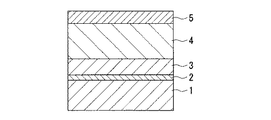
本発明の加飾塗装方法を図1を参照しながら説明する。
まず、基材1に、ウレタンシーラーなどを塗り、これを乾燥させて下塗り2とする。形成された下塗り2は、サンドペーパなどの研磨材で毛羽取りを行う。また、この後に、必要に応じてベース色塗装を行ってもよい。
基材1の材質、形状については特に制限はないが、化粧単板などの木質材料が好ましい。また、下塗り2を形成させる際の乾燥の条件にも特に制限はないが、一般的にはセッティングを30分した後、50℃で60分乾燥する。遠赤外線乾燥機を用いる場合には、セッティングを30分した後、遠赤外線を約10分間照射して乾燥する。
【0006】
次いで、この上にレドックス硬化型塗料を塗布した後、しばらくの間そのまま放置して、塗膜を硬化させて加飾層3を形成させる。また、レドックス硬化型塗料を塗布した後、短時間放置して、ゲル化したところで、次工程である紫外線硬化型塗料の塗布を行うこともできる。
このレドックス硬化型塗料は、不飽和ポリエステル樹脂と、加飾材料と、重合開始剤と、重合促進剤とを含んでいる。用いられる不飽和ポリエステル樹脂については特に制限はなく、公知のものが使用できる。また、不飽和ポリエステル樹脂にウレタンアクリレート、エポキシアクリレート、ポリエーテルアクリレート、ポリエステルアクリレート樹脂などを混合してもよい。
加飾材料は、平均粒径50μm以上のものである。加飾材料としては、平均粒径が50μm以上であって、不飽和ポリエステル樹脂の物性を著しく損なわなければ、特に制限はなく、アルミ蒸着フィルムフレーク、金箔、人工大理石、パール材、アルミ粉などの無機または有機鱗粉体などの装飾材料を用いることができる。
【0007】
重合開始剤についてはレドックス硬化が行うことができるものであれば特に制限はなく、メチルエチルケトンパーオキサイド、クメンヒドロパーオキサイド、t−ブチルハイドロパーオキサイドなど公知のものが使用できる。さらに、この重合開始剤とは別に光重合開始剤を含むことができる。このような光重合開始剤を併用することは、加飾層のレドックス硬化と紫外線硬化を同時に行う際には特に好ましいことである。さらに、波長が360〜420nmの光を照射することによって活性が発現する光重合開始剤を含むことにより、加飾層の深層部まで硬化させることができる。
また、重合促進剤については、コバルト・マンガン混合系重合促進剤、バナジル系重合促進剤、カルシウム系重合促進剤、バリウム系重合促進剤、コバルト・亜鉛混合系重合促進剤、コバルト・ジルコニウム混合系重合促進剤から選ばれる少なくとも一種の重合促進剤を含むことが好ましい。このような重合促進剤を用いることにより、塗膜の変色を小さくすることができる。
【0008】
また、レドックス硬化型塗料を塗布する方法については特に制限はなく、エアスプレーガン、ロールコータなどを用いることができる。
加飾塗料を塗布する厚さは、50〜300μmであり、好ましくは、100〜200μmである。
塗膜の硬化時間は、2〜120分間であることが好ましい。2分未満であると、脱泡していない場合があり、120分を超えると硬化が不十分となり、塗膜やせする場合がある。
【0009】
次いで、加飾層3の上に紫外線硬化型塗料を塗布する。
この紫外線硬化型塗料は、不飽和ポリエステル樹脂と、一般に紫外線硬化に用いられる光重合開始剤を含んでいる。さらに、波長360〜420nmの光を照射することによって活性を発現する光重合開始剤とを含んでいることが好ましい。また、紫外線硬化型塗料は加飾材料を含まない。
紫外線硬化型塗料に含まれる不飽和ポリエステル樹脂については、透明なものであれば特に制限はなく、公知のものが使用できる。不飽和ポリエステル樹脂に含まれる光重合開始剤は公知のものが使用できる。さらに、波長360〜420nmの光を照射することによって活性を発現する光重合開始剤についても公知のものが利用でき、例えば、2,4,6−トリメチルベンゾイルジフェニルフォスフィンオキシド(商品名;Lucirin TPO、BASF社製)が挙げられる。このような光重合開始剤を用いることにより、紫外線硬化クリヤ層の深層部まで硬化させるのが容易となる。
紫外線硬化型塗料を塗布する方法については特に制限はなく、エアスプレーガン、ロールコータなどを用いることができる。また、塗布する厚さは、100〜600μmであり、好ましくは100〜300μmである。
【0010】
この紫外線硬化型塗料の塗膜に波長360〜420nmの高波長紫外線光を照射して予備硬化する。この時の照射の条件は、照射強度が50mJ/cm2 以上であり、好ましくは、100〜300mJ/cm2 である。
その後、通常の高圧水銀ランプを用いて波長300〜390nmの紫外線光を照射して、最終硬化させて、紫外線硬化クリヤ層4を形成する。この時の照射の強度は、600〜1200mJ/cm2 であることが好ましい。
また、紫外線硬化型塗料の塗膜の上に、さらに紫外線硬化型塗料を塗布し、硬化させて、塗膜を形成させてもよい。
上記の方法は、レドックス硬化型塗料と紫外線硬化型塗料とを別々に硬化させる方法であるが、本発明においては、紫外線硬化型塗料を塗布した後、レドックス硬化型塗料と紫外線硬化型塗料とを同時に硬化させてもよい。その際、レドックス硬化型塗料に光重合開始剤を添加して、レドックス硬化と紫外線硬化とを同時に行うことができる。
【0011】
以上のようにして、加飾塗装を行うが、さらに必要に応じて、下記の塗装工程を行うことができる。
上記の塗装の表面をサンドペーパなどの研磨材により研削し、着色塗料により上塗り5を形成する。次いで、これを乾燥し、表面を研磨材により研削し、バフで研磨し、鏡面に仕上げ、塗装を完成させる。これらの工程においてはいずれも制限はなく、公知の方法により行われる。
【0012】
このように、基材の上に、平均粒径50μm以上の加飾材料を含むレドックス硬化型塗料を50〜300μmの厚さで塗布し、その上に透明な紫外線硬化型塗料を100〜600μmの厚さで塗布し、これに紫外線照射して硬化させることにより、レドックス硬化型塗料の塗膜厚さを薄くすることができる。その結果、重合促進剤としてナフテン酸コバルト、オクテン酸コバルトを用いても、塗膜全体の変色への影響を小さくすることができる。また、塗膜をレドックス硬化型塗料のみで形成させるのではなく、紫外線硬化型塗料と併用し、かつ紫外線硬化型塗料が塗装表面側にあり、加飾材料が下層のレドックス硬化型塗料に含まれるので、塗膜を厚くした場合でも、加飾材料が含まれる深層部を硬化させることができ、全体の塗膜を厚くすることもできる。
【0013】
【実施例】
(実施例1)
[ベース塗料A]
ノンワックスタイプ不飽和ポリエステルクリヤ樹脂にアエロジルを1.5重量%と、シリコン系フロー調整剤0.1重量%と、シリコン系消泡剤0.1重量%添加して、ベース塗料となる粘度1500mPa・s、揺変性2.5の不飽和ポリエステル樹脂クリヤ塗料を得た。
【0014】
[加飾塗料B]
上記のベース塗料A100gに、加飾材料としてアルミ蒸着フィルムフレーク1mm角を1g添加した。これに重合促進剤としてナフテン酸コバルト/ナフテン酸マンガン=1/10(金属換算;5重量%)1mlと、重合開始剤としてメチルエチルケトンパーオキサイド(活性酸素量;10.0重量%)2mlと、スチレンモノマーを10ml添加した。ゲルタイムは25分間とし、加飾塗料Bを得た。
【0015】
[紫外線硬化型塗料C]
上記ベース塗料A100gに、光重合開始剤として2,4,6−トリメチルベンゾイルフェニルフォスフィンオキシド2gと、スチレンモノマー10mlを添加して、紫外線硬化型塗料Cを得た。
【0016】
[加飾塗装]
塗装する素材として樺化粧材を成形してなる楽器ドラムの胴に、ウレタンシーラーを10μmの厚さで下塗りした。これを30分間セッティングした後、50℃、1時間乾燥し、#240サンドペーパーで毛羽取りを行った。
次いで、ウレタンメタリック塗料を20μmの厚さでベース色塗装し、室温で1時間セッティングした。
その後、加飾塗料Bを通常のエアスプレーガンで100μm程度塗布し、塗膜を少し放置し、ゲル化させて加飾層を形成した。続いて、その上層として紫外線硬化型塗料Cを100、200、300、400、500μmとなるように通常のスプレーガンで塗布した。そして、波長360〜420nmの高波長紫外線光を2分照射して予備硬化した後、通常の高圧水銀ランプを用いて波長300〜390nmの光を1000mJ/cm2 の強度で照射し、最終硬化させて紫外線硬化クリヤ層を形成した。
【0017】
上記のサンプルの一部を#800のサンドペーパーで研削し、さらにバフで研磨し、鏡面に仕上げた。
また、上記のサンプルの別の一部を#320のサンドペーパーで研削し、ウレタンクリヤ塗料に着色剤を添加したカラークリヤ塗膜を塗装し、さらにウレタンクリヤ塗料を2回塗布して層厚60μmのウレタン上塗り塗膜層を形成した。
【0018】
このように塗装したサンプルの、加飾層膜厚と、紫外線硬化クリヤ層膜厚と、上塗りの有無と、鏡面仕上げの有無とを表1に示す。
【0019】
【表1】
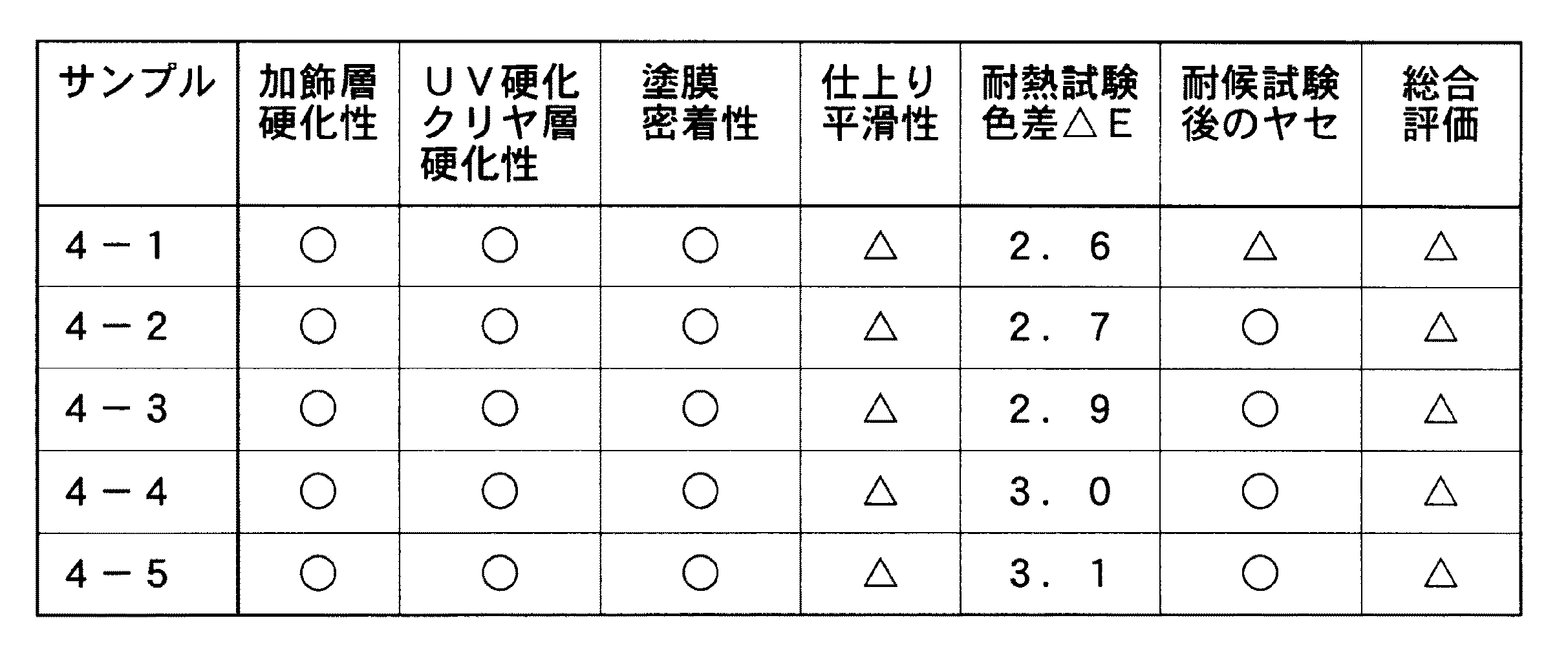
これらの塗装について、以下の評価を行った。評価結果を表2に示す。なお、表中、◎は「優良」であり、実用に特に推奨できるランクである。○は「良好」であり、一般の実用に適用できるランクである。△は「可」であり、実用には差し支えない程度のランクである。×は「不可」であり、実用には適用できないランクである。
[加飾層硬化性、紫外線硬化クリヤ層硬化性]
加飾層硬化性および紫外線硬化クリヤ層硬化性については、目視により実施可能かどうか評価した。
[塗膜密着性]
塗膜密着性については、ナイフ破壊により評価した。
[仕上り平滑性]
仕上り平滑性については、目視により評価した。
【0021】
[耐熱試験]
耐熱試験については、塗装の一部を切り出し、これを80℃のオーブン中で100時間放置し、加熱前を基準とした色差△Eを色差計を用いて測定することにより行った。
[耐侯試験]
耐侯試験については、塗装の一部を切り出し、これを環境試験機中で、温度35℃、湿度95%RHの条件を2日間、温度35℃、湿度20%RHの条件を5日間のサイクルを2回行って、サイクル終了後の塗装のヤセを目視により判定した。
【0022】
【表2】
(実施例2)
ベース色塗装をウレタンメタリックの代わりに黒色ウレタンにし、加飾塗料B中の重合促進剤には、ナフテン酸コバルト/ナフテン酸マンガン=1/10(金属換算;5重量%)1mlの代わりにナフテン酸コバルト/ナフテン酸ジルコニウム=1/10(金属換算;5重量%)1mlを用い、加飾材料としてアルミ蒸着フィルムフレークの代わりに1.5mm角の金箔を用いた以外は実施例1と同様に塗装した。これらの塗装条件を表3に、評価結果を表4に示す。
【0024】
【表3】
【表4】
(実施例3)
加飾材料には、アルミ蒸着フィルムフレークの代わりに平均粒径50μmのアルミニウム粉を用い、加飾塗料B中の重合促進剤には、ナフテン酸コバルト/ナフテン酸ジルコニウム=1/10(金属換算;5重量%)1mlの代わりにナフテン酸コバルト/ナフテン酸亜鉛=1/10(金属換算;5重量%)1mlを用いた以外は実施例1と同様に塗装した。これらの塗装条件を表5に、評価結果を表6に示す。
【0027】
【表5】
【表6】
(実施例4)
ベース色塗装をウレタンメタリック塗料の代わりにクリヤウレタンとし、加飾塗料B中の重合促進剤には、ナフテン酸コバルト/ナフテン酸ジルコニウム=1/10(金属換算;5重量%)1mlの代わりにナフテン酸バナジウム(金属換算;5重量%)1mlを用い、加飾材料にアルミ蒸着フィルムフレークの代わりに平均粒径0.3mmの人工大理石を用いた以外は実施例1と同様に塗装した。なお、人工大理石の添加量は20gとした。これらの塗装条件を表7に、評価結果を表8に示す。
【0030】
【表7】
【表8】
(実施例5)
ベース色塗装をウレタンメタリックの代わりに黒色ウレタンにし、加飾塗料B中の重合促進剤には、ナフテン酸コバルト/ナフテン酸マンガン=1/10(金属換算;5重量%)1mlの代わりにナフテン酸カルシウム(金属換算;5重量%)1mlを用い、加飾材料にはアルミ蒸着フィルムフレークの代わりに1.5mm角の金箔を用いた以外は実施例1と同様に塗装した。これらの塗装条件を表9に、評価結果を表10に示す。
【0033】
【表9】
【表10】
(実施例6)
加飾塗料B中の重合促進剤には、ナフテン酸コバルト/ナフテン酸マンガン=1/10(金属換算;5重量%)1mlの代わりにナフテン酸バリウム(金属換算;5重量%)1mlを用いた以外は実施例1と同様に塗装した。これらの塗装条件を表11に、評価結果を表12に示す。
【0036】
【表11】
【表12】
(実施例7)
ベース色塗装をウレタンメタリック塗料の代わりにクリヤウレタンとし、加飾塗料B中の重合促進剤にはナフテン酸コバルト/ナフテン酸ジルコニウム=1/10(金属換算;5重量%)1mlの代わりにナフテン酸コバルト(金属換算;5重量%)1mlを用い、加飾材料には、アルミ蒸着フィルムフレークの代わりに平均粒径0.3mmの人工大理石を用いた以外は実施例1と同様に塗装した。なお、人工大理石の添加量は20gとした。これらの塗装条件を表13に、評価結果を表14に示す。
【0039】
【表13】
【表14】
(実施例8)
加飾層は実施例1と同様に形成した。次に、紫外線硬化型塗料C中の光重合開始剤には、2,4,6−トリメチルベンゾイルフェニルフォスフィンオキシドを用いる代わりに、1−ヒドロキシシクロヘキシルフェニルケトンを用いてUV硬化クリヤ層を紫外線硬化させたものと、さらに1回〜2回、1−ヒドロキシシクロヘキシルフェニルケトンを含むUV硬化クリヤ層を塗布層ごとに光照射し硬化させ、塗膜の厚さを変えたもの形成した以外は実施例1と同様に塗装した。なお、層間は#320のサンドペーパで研削した。これらの塗装条件を表15に、評価結果を表16に示す。
【0042】
【表15】
【表16】
(実施例9)
加飾材料にアルミ蒸着フレークの代わりに1.5mm角の金箔を用い、加飾塗料B中のナフテン酸コバルト/ナフテン酸マンガン=1/10の代わりにナフテン酸コバルト(金属換算;5重量%)1mlを用い、紫外線硬化型塗料C中の光重合開始剤として2,4,6−トリメチルベンゾイルフェニルフォスフィンオキシドを用いる代わりに、1−ヒドロキシシクロヘキシルフェニルケトンを用いてUV硬化クリヤ層を硬化させた後、さらに1回または2回、1−ヒドロキシシクロヘキシルフェニルケトンを含むUV硬化クリヤ層を塗布硬化させ、塗膜の厚さを変えたものを形成した以外は実施例1と同様に塗装した。なお、層間は#320サンドペーパで研削した。これらの塗装条件を表17に、評価結果を表18に示す。
【0045】
【表17】
【表18】
(実施例10)
ベース色塗装をウレタンメタリック塗料の代わりにクリヤウレタンとし、加飾塗料B中の重合促進剤には、ナフテン酸コバルト/ナフテン酸ジルコニウム=1/10(金属換算;5重量%)1mlの代わりにナフテン酸コバルト(金属換算;5重量%)1mlを用い、加飾材料には、アルミ蒸着フィルムフレークの代わりに平均粒径0.3mmの人工大理石を用い、さらに加飾塗料Bに、2,4,6−トリメチルベンゾイルフェニルフォスフィンオキシド2gを追加し、加飾塗料BのUV硬化およびレドックス硬化を同時に行った以外は実施例1と同様に塗装した。なお、人工大理石の添加量は20gとした。これらの塗装条件を表19に、評価結果を表20に示す。
【0048】
【表19】
【表20】
(実施例11)
加飾塗料B中のナフテン酸コバルト/ナフテン酸マンガン=1/10の代わりにナフテン酸コバルト(金属換算;5重量%)1mlを用い、紫外線硬化型塗料C中に、1−ヒドロキシシクロヘキシルフェニルケトン2gを追加し、紫外線硬化クリヤ塗料には、2,4,6−トリメチルベンゾイルフェニルフォスフィンオキシドを用いる代わりに、1−ヒドロキシシクロヘキシルフェニルケトンを用いて硬化させた。さらに1回〜2回の紫外線硬化クリヤ塗料の重ね塗りを行ったものも用意した。なお、層間は#320サンドペーパで研削した。これらの塗装条件を表21に、評価結果を表22に示す。
【0051】
【表21】
【表22】
(比較例1)
硬化をレドックス硬化にするために、紫外線硬化型塗料C中の2,4,6−トリメチルベンゾイルフェニルフォスフィンオキシド2gの代わりにメチルエチルケトンパーオキサイド(活性酸素量;10.0重量%)2ml、ナフテン酸コバルト(金属換算;5重量%)1mlを用いて、レドックス硬化で行った以外は実施例1と同様に塗装した。これらの塗装条件を表23に、評価結果を表24に示す。
【0054】
【表23】
【表24】
(比較例2)
加飾材料にアルミ蒸着フレークの代わりにアルミニウム粉を用い、加飾塗料Bを紫外線硬化にするために、ナフテン酸コバルト/ナフテン酸マンガン=1/10(金属換算;5重量%)1mlおよびメチルエチルケトンパーオキサイド(活性酸素量;10.0重量%)2mlの代わりに、2,4,6−トリメチルベンゾイルフェニルフォスフィンオキシド2gを添加し、加飾塗料Bと紫外線硬化型塗料Cとを一括硬化させた以外は実施例1と同様に塗装した。これらの塗装条件を表25に、評価結果を表26に示す。
この例においては、加飾層の硬化性、塗膜密着性が悪かった。そのため、仕上り平滑性、耐熱試験後の色差△E、耐侯試験後のヤセについては測定ができなかった。
【0057】
【表25】
【表26】
(比較例3)
紫外線硬化型塗料C中の2,4,6−トリメチルベンゾイルフェニルフォスフィンオキシド2gを除いた以外は実施例1と同様に塗装した。これらの塗装条件を表27に、評価結果を表28に示す。
この例においては、紫外線硬化クリヤ層の硬化性が悪かった。そのため、仕上り平滑性、耐熱試験後の色差△E、耐侯試験後のヤセについては測定ができなかった。
【0060】
【表27】
【表28】
(比較例4)
加飾塗料B中のナフテン酸コバルト/ナフテン酸マンガン=1/10(金属換算;5重量%)1mlを除いた以外は実施例1と同様に塗装した。これらの塗装条件を表29に、評価結果を表30に示す。
この例においては、加飾層の硬化性が悪かった。また、紫外線硬化クリヤ層はリフティングした。そのため、仕上り平滑性、耐熱試験後の色差△E、耐侯試験後のヤセについては測定ができなかった。
なお、リフティングとは、複層塗膜を形成する際、下層塗膜が硬化しない状態で上層塗膜が硬化すると、上層塗膜の硬化収縮で上層塗膜が縮み、その結果として塗膜が盛り上がった形態を示す現象のことである。
【0063】
【表29】
【表30】
【発明の効果】
本発明の加飾塗装方法によれば、基材の上に、平均粒径50μm以上の加飾材料を含むレドックス硬化型塗料を50〜300μmの厚さで塗布し、その上に透明な紫外線硬化型塗料を100〜600μmの厚さで塗布し、これに紫外線照射して硬化させるものであるため、塗装の硬化時間を短くすることができ、硬化した後の塗膜の変色を小さくすることができる。また、加飾材料を含んでいても塗膜全体を硬化することができる。
前記加飾塗装方法では、レドックス硬化型塗料を塗布した後に硬化させて、その上に透明な紫外線硬化型塗料を塗布することにより、塗膜の密着性を高めることができる。
また、前記加飾塗装方法では、紫外線硬化型塗料を塗布した後、紫外線照射して硬化させると同時に、光重合開始剤を含むレドックス硬化型塗料を硬化することにより、レドックス硬化型塗料の硬化時間をさらに短縮させることができる。
【0066】
また、前記レドックス硬化型塗料は、不飽和ポリエステル樹脂と、コバルト・マンガン混合系重合促進剤、バナジル系重合促進剤、カルシウム系重合促進剤、バリウム系重合促進剤、コバルト・亜鉛混合系重合促進剤、コバルト・ジルコニウム混合系重合促進剤から選ばれる少なくとも一種の重合促進剤とを含むことにより、塗膜の変色をさらに小さくすることができる。
また、前記レドックス硬化型塗料は、光を照射することによって活性が発現する光重合開始剤を含むことにより、加飾層が厚くても、塗膜も硬化させることができる。
また、前記紫外線硬化型塗料は、不飽和ポリエステル樹脂と、波長が360〜420nmの光を照射することによって活性が発現する光重合開始剤とを含むことにより、紫外線硬化クリヤ層が厚くても、硬化時間を短縮できる。
【図面の簡単な説明】
【図1】 本発明における加飾塗装の層の一例を示す断面図である。
【符号の説明】
1 基材
2 下塗り
3 加飾層
4 紫外線硬化クリヤ層
5 上塗り[0001]
BACKGROUND OF THE INVENTION
The present invention relates to a decorative coating method in which the curing time of a paint is short and the coating film does not change color after painting.
[0002]
[Prior art]
Unsaturated polyester resins are used as base resins in decorative paints that include aluminum vapor deposited film flakes, gold foil, and the like as decorative materials. In the curing of the unsaturated polyester resin, redox curing is performed in which a polymerization initiator and a polymerization accelerator are added to the unsaturated polyester resin and cured.
In redox curing, methyl ethyl ketone peroxide, cumene hydroperoxide, or the like is used as a polymerization initiator, and cobalt naphthenate, cobalt octenoate, or the like is used as a polymerization accelerator. The polymerization initiator accepts electrons from the polymerization accelerator and decomposes to become a polymerization active species having a radical.
[0003]
[Problems to be solved by the invention]
However, when cobalt naphthenate or cobalt octenoate is used as a polymerization accelerator, the thermal stability is low, and the coating film is discolored. In addition, redox curing has a problem in that the curing does not proceed unless the polymerization initiator comes into contact with the polymerization accelerator, so that it takes time to cure the resin and the coating work time is long.
Therefore, a method not using a polymerization accelerator is also performed. For example, the ultraviolet curing which hardens | cures using the photoinitiator activated by irradiating an ultraviolet-ray is mentioned. Examples of the photopolymerization initiator used for ultraviolet curing include 2,2-dimethoxy-1,2-diphenylethane-1-one (trade name: Irgacure 651, manufactured by Ciba Specialty Chemicals).
However, in this ultraviolet curing method, if a decorative material in the form of powder, granules, etc. is contained in the ultraviolet curable coating layer, the powder, granules, etc. serve as a shield, and the ultraviolet rays are transmitted to the entire layer. In this case, a portion that does not harden may occur.
Moreover, even if it does not contain decorating material, when a coating film is as thick as 200 micrometers or more, since the ultraviolet-ray is not irradiated to the deep layer part of a coating film, the part which does not harden | cure might arise.
The present invention has been made in view of the above circumstances, and an object of the present invention is to provide a decorative coating method in which the curing time is short, the coating film is not discolored, and an uncured portion is not generated.
[0004]
[Means for Solving the Problems]
In the decorative coating method of the present invention, a redox curable paint containing a decorative material having an average particle size of 50 μm or more is applied on a substrate in a thickness of 50 to 300 μm , and a transparent ultraviolet curable paint is applied thereon. Is applied at a thickness of 100 to 600 μm , and this is cured by irradiating with ultraviolet rays.
The redox curable paint comprises an unsaturated polyester resin, a cobalt / manganese mixed polymerization accelerator, a vanadyl polymerization accelerator, a calcium polymerization accelerator, a barium polymerization accelerator, a cobalt / zinc mixed polymerization accelerator, cobalt -It is preferable to contain at least one polymerization accelerator selected from zirconium mixed polymerization accelerators.
The redox curable paint may include a photopolymerization initiator that exhibits activity when irradiated with light.
The ultraviolet curable coating material preferably contains an unsaturated polyester resin and a photopolymerization initiator that exhibits activity when irradiated with light having a wavelength of 360 to 420 nm.
[0005]
DETAILED DESCRIPTION OF THE INVENTION
The decorative coating method of the present invention will be described with reference to FIG.
First, a urethane sealer or the like is applied to the
Although there is no restriction | limiting in particular about the material and shape of the
[0006]
Subsequently, after applying a redox curable coating material on this, it is left as it is for a while, a coating film is hardened, and the decorating
This redox curable paint includes an unsaturated polyester resin, a decorating material, a polymerization initiator, and a polymerization accelerator. There is no restriction | limiting in particular about the unsaturated polyester resin used, A well-known thing can be used. Further, urethane acrylate, epoxy acrylate, polyether acrylate, polyester acrylate resin, or the like may be mixed with the unsaturated polyester resin.
The decorating material has an average particle size of 50 μm or more. There are no particular limitations on the decorative material as long as the average particle size is 50 μm or more and the physical properties of the unsaturated polyester resin are not significantly impaired, such as aluminum vapor deposited film flakes, gold foil, artificial marble, pearl material, aluminum powder, etc. Decorative materials such as inorganic or organic scale powder can be used.
[0007]
The polymerization initiator is not particularly limited as long as it can perform redox curing, and known ones such as methyl ethyl ketone peroxide, cumene hydroperoxide, t-butyl hydroperoxide can be used. Further, a photopolymerization initiator can be included separately from the polymerization initiator. Use of such a photopolymerization initiator in combination is particularly preferable when performing redox curing and ultraviolet curing of the decorative layer at the same time. Furthermore, it can be hardened to the deep layer part of a decoration layer by including the photoinitiator which activity develops by irradiating the light with a wavelength of 360-420 nm.
As for the polymerization accelerator, cobalt-manganese mixed polymerization accelerator, vanadyl polymerization accelerator, calcium-based polymerization accelerator, barium-based polymerization accelerator, cobalt-zinc mixed polymerization accelerator, cobalt-zirconium mixed polymerization. It is preferable to include at least one polymerization accelerator selected from accelerators. By using such a polymerization accelerator, discoloration of the coating film can be reduced.
[0008]
Moreover, there is no restriction | limiting in particular about the method of apply | coating a redox curable coating material, An air spray gun, a roll coater, etc. can be used.
The thickness of coating a decorative coating is 5 0~300Myuemu, good Mashiku is 100-200 [mu] m.
The curing time of the coating film is preferably 2 to 120 minutes. If it is less than 2 minutes, defoaming may not occur, and if it exceeds 120 minutes, curing may be insufficient and the coating film may be thin.
[0009]
Next, an ultraviolet curable paint is applied on the
This ultraviolet curable coating material contains an unsaturated polyester resin and a photopolymerization initiator generally used for ultraviolet curing. Further, it preferably contains a photopolymerization initiator that exhibits activity when irradiated with light having a wavelength of 360 to 420 nm. Further, the ultraviolet curable paint does not contain a decorative material.
The unsaturated polyester resin contained in the ultraviolet curable coating is not particularly limited as long as it is transparent, and known ones can be used. A well-known thing can be used for the photoinitiator contained in unsaturated polyester resin. Furthermore, known photopolymerization initiators that exhibit activity when irradiated with light having a wavelength of 360 to 420 nm can be used. For example, 2,4,6-trimethylbenzoyldiphenylphosphine oxide (trade name: Lucirin TPO) , Manufactured by BASF). By using such a photopolymerization initiator, it is easy to cure to the deep layer portion of the ultraviolet curing clear layer.
The method for applying the ultraviolet curable coating is not particularly limited, and an air spray gun, a roll coater, or the like can be used. Moreover, the thickness to apply | coat is 100-600 micrometers, Preferably it is 100-300 micrometers.
[0010]
The ultraviolet curable coating film is preliminarily cured by irradiating it with high wavelength ultraviolet light having a wavelength of 360 to 420 nm. Conditions of the irradiation at this time is the irradiation intensity 50 mJ / cm 2 or more, preferably 100~300mJ / cm 2.
Thereafter, ultraviolet light having a wavelength of 300 to 390 nm is irradiated using an ordinary high-pressure mercury lamp, and finally cured to form the ultraviolet-curing
Further, an ultraviolet curable coating material may be further applied on the coating film of the ultraviolet curable coating material and cured to form a coating film.
The above method is a method of separately curing the redox curable paint and the ultraviolet curable paint. In the present invention, after the ultraviolet curable paint is applied, the redox curable paint and the ultraviolet curable paint are combined. It may be cured at the same time. At that time, a photopolymerization initiator can be added to the redox curable coating material to perform redox curing and ultraviolet curing simultaneously.
[0011]
Although decorative coating is performed as described above, the following coating process can be performed as necessary.
The surface of the coating is ground with an abrasive such as sand paper, and the
[0012]
Thus, on the base material, a redox curable paint containing a decorative material having an average particle size of 50 μm or more is applied in a thickness of 50 to 300 μm , and a transparent ultraviolet curable paint is applied thereon to a thickness of 100 to 600 μm. The coating thickness of the redox curable coating material can be reduced by coating with a thickness and curing it by irradiating it with ultraviolet rays. As a result, even if cobalt naphthenate or cobalt octenoate is used as the polymerization accelerator, the influence on the discoloration of the entire coating film can be reduced. In addition, the coating film is not formed only by the redox curable paint, but is used in combination with the ultraviolet curable paint, the ultraviolet curable paint is on the coating surface side, and the decoration material is included in the lower redox curable paint. Therefore, even when the coating film is thickened, the deep layer portion containing the decorating material can be cured, and the entire coating film can be thickened.
[0013]
【Example】
(Example 1)
[Base paint A]
A non-wax type unsaturated polyester clear resin containing 1.5% by weight of Aerosil, 0.1% by weight of a silicone-based flow control agent and 0.1% by weight of a silicone-based antifoaming agent, and having a viscosity of 1500 mPa serving as a base paint An unsaturated polyester resin clear paint having a s, thixotropic property of 2.5 was obtained.
[0014]
[Decorative paint B]
1 g of aluminum vapor deposited
[0015]
[UV curable paint C]
2 g of 2,4,6-trimethylbenzoylphenylphosphine oxide as a photopolymerization initiator and 10 ml of styrene monomer were added to 100 g of the base paint A to obtain an ultraviolet curable paint C.
[0016]
[Decorative painting]
A urethane sealer was primed to a thickness of 10 μm on the body of a musical instrument drum formed by molding a dressing material as a material to be painted. This was set for 30 minutes, dried at 50 ° C. for 1 hour, and fluffed with # 240 sandpaper.
Then, a urethane metallic paint was coated with a base color with a thickness of 20 μm and set at room temperature for 1 hour.
Thereafter, the decorative paint B was applied to about 100 μm with a normal air spray gun, and the coating film was left to stand for gelation to form a decorative layer. Subsequently, an ultraviolet curable paint C was applied as an upper layer with a normal spray gun so as to be 100, 200, 300, 400, 500 μm. Then, after preliminarily curing by irradiating with a high wavelength ultraviolet light having a wavelength of 360 to 420 nm for 2 minutes, using a normal high pressure mercury lamp, irradiating light having a wavelength of 300 to 390 nm with an intensity of 1000 mJ / cm 2 and finally curing. As a result, an ultraviolet curing clear layer was formed.
[0017]
A part of the above sample was ground with # 800 sandpaper, further polished with a buff, and finished to a mirror surface.
Also, another part of the above sample was ground with # 320 sandpaper, and a color clear coating with a colorant added to the urethane clear paint was applied, and then the urethane clear paint was applied twice and the layer thickness was 60 μm. A urethane topcoat layer was formed.
[0018]
Table 1 shows the decorative layer thickness, the UV-cured clear layer thickness, the presence / absence of the top coating, and the presence / absence of the mirror finish of the sample thus coated.
[0019]
[Table 1]
These coatings were evaluated as follows. The evaluation results are shown in Table 2. In the table, “◎” is “excellent” and is a rank that can be particularly recommended for practical use. ○ is “good” and is a rank applicable to general practical use. Δ is “OK” and is a rank that does not interfere with practical use. X is “impossible” and is a rank that is not applicable to practical use.
[Decoration layer curability, UV curing clear layer curability]
The decorative layer curability and the ultraviolet curable clear layer curability were evaluated by visual observation.
[Coating film adhesion]
The coating film adhesion was evaluated by knife destruction.
[Finished smoothness]
The finished smoothness was evaluated visually.
[0021]
[Heat resistance test]
The heat resistance test was carried out by cutting out a part of the coating, leaving it in an oven at 80 ° C. for 100 hours, and measuring the color difference ΔE with reference to the color before heating using a color difference meter.
[Fruit resistance test]
For the weather resistance test, a part of the coating was cut out and cycled in an environmental testing machine for 2 days at a temperature of 35 ° C. and a humidity of 95% RH, and at a temperature of 35 ° C. and a humidity of 20% RH for 5 days. This was done twice, and the paint finish after the cycle was judged visually.
[0022]
[Table 2]
(Example 2)
The base color coating is changed to black urethane instead of urethane metallic, and the polymerization accelerator in the decorative paint B is naphthenic acid instead of 1 ml of cobalt naphthenate / manganese naphthenate = 1/10 (metal conversion: 5% by weight). Painted in the same manner as in Example 1 except that 1 ml of cobalt / zirconium naphthenate = 1/10 (metal conversion; 5% by weight) was used, and a 1.5 mm square gold foil was used instead of the aluminum vapor deposited film flakes as a decoration material. did. These coating conditions are shown in Table 3, and the evaluation results are shown in Table 4.
[0024]
[Table 3]
[Table 4]
(Example 3)
As the decorating material, aluminum powder having an average particle size of 50 μm is used instead of the aluminum vapor-deposited film flakes, and the polymerization accelerator in the decorating paint B is cobalt naphthenate / zirconium naphthenate = 1/10 (metal conversion; 5 wt%) Coating was carried out in the same manner as in Example 1 except that 1 ml of cobalt naphthenate / zinc naphthenate = 1/10 (metal conversion; 5 wt%) was used instead of 1 ml. These coating conditions are shown in Table 5, and the evaluation results are shown in Table 6.
[0027]
[Table 5]
[Table 6]
(Example 4)
The base color paint is clear urethane instead of urethane metallic paint, and the polymerization accelerator in the decorative paint B is naphthene instead of 1 ml of cobalt naphthenate / zirconium naphthenate = 1/10 (metal conversion: 5% by weight). The coating was performed in the same manner as in Example 1 except that 1 ml of vanadium acid (metal conversion; 5% by weight) was used, and artificial marble having an average particle diameter of 0.3 mm was used instead of the aluminum vapor deposited film flakes as the decorative material. The amount of artificial marble added was 20 g. These coating conditions are shown in Table 7, and the evaluation results are shown in Table 8.
[0030]
[Table 7]
[Table 8]
(Example 5)
The base color coating is changed to black urethane instead of urethane metallic, and the polymerization accelerator in the decorative paint B is naphthenic acid instead of 1 ml of cobalt naphthenate / manganese naphthenate = 1/10 (metal conversion: 5% by weight). The coating was carried out in the same manner as in Example 1 except that 1 ml of calcium (metal conversion: 5% by weight) was used, and a 1.5 mm square gold foil was used instead of the aluminum-deposited film flakes as a decorative material. These coating conditions are shown in Table 9, and the evaluation results are shown in Table 10.
[0033]
[Table 9]
[Table 10]
(Example 6)
As a polymerization accelerator in the decorative paint B, 1 ml of barium naphthenate (metal equivalent: 5% by weight) was used instead of 1 ml of cobalt naphthenate / manganese naphthenate = 1/10 (metal equivalent; 5% by weight). The coating was performed in the same manner as in Example 1. These coating conditions are shown in Table 11, and the evaluation results are shown in Table 12.
[0036]
[Table 11]
[Table 12]
(Example 7)
The base color coating is clear urethane instead of urethane metallic paint, and the polymerization accelerator in decorative paint B is naphthenic acid instead of 1 ml of cobalt naphthenate / zirconium naphthenate = 1/10 (metal conversion: 5% by weight). The coating was performed in the same manner as in Example 1 except that 1 ml of cobalt (metal conversion: 5% by weight) was used, and the decorative material was artificial marble having an average particle diameter of 0.3 mm instead of the aluminum vapor deposited film flakes. The amount of artificial marble added was 20 g. These coating conditions are shown in Table 13, and the evaluation results are shown in Table 14.
[0039]
[Table 13]
[Table 14]
(Example 8)
The decorative layer was formed in the same manner as in Example 1. Next, instead of using 2,4,6-trimethylbenzoylphenylphosphine oxide as the photopolymerization initiator in the UV curable coating C, the UV curable clear layer is UV cured using 1-hydroxycyclohexyl phenyl ketone. Except that the UV-cured clear layer containing 1-hydroxycyclohexyl phenyl ketone was further irradiated with light for each coating layer and changed the thickness of the coating film one to two times. Painted as in 1. The interlayer was ground with # 320 sandpaper. These coating conditions are shown in Table 15, and the evaluation results are shown in Table 16.
[0042]
[Table 15]
[Table 16]
Example 9
Instead of aluminum-deposited flakes, 1.5 mm square gold foil was used as the decoration material, and cobalt naphthenate in the decorative paint B instead of cobalt naphthenate / manganese naphthenate = 1/10 (metal conversion: 5% by weight) Instead of using 2,4,6-trimethylbenzoylphenylphosphine oxide as the photopolymerization initiator in UV curable paint C, 1 ml was used to cure the UV cured clear layer using 1-hydroxycyclohexyl phenyl ketone. Thereafter, coating was carried out in the same manner as in Example 1 except that a UV-curing clear layer containing 1-hydroxycyclohexyl phenyl ketone was applied and cured once or twice to form a coating film having a different thickness. The interlayer was ground with # 320 sandpaper. These coating conditions are shown in Table 17, and the evaluation results are shown in Table 18.
[0045]
[Table 17]
[Table 18]
(Example 10)
The base color paint is clear urethane instead of urethane metallic paint, and the polymerization accelerator in the decorative paint B is naphthene instead of 1 ml of cobalt naphthenate / zirconium naphthenate = 1/10 (metal conversion: 5% by weight). 1 ml of cobalt acid (metal conversion: 5% by weight) is used, and the decorative material is artificial marble having an average particle size of 0.3 mm instead of aluminum vapor deposited film flakes. The coating was performed in the same manner as in Example 1 except that 2 g of 6-trimethylbenzoylphenylphosphine oxide was added, and the UV curing and redox curing of the decorative coating B were simultaneously performed. The amount of artificial marble added was 20 g. These coating conditions are shown in Table 19, and the evaluation results are shown in Table 20.
[0048]
[Table 19]
[Table 20]
(Example 11)
Instead of cobalt naphthenate / manganese naphthenate = 1/10 in the decorative paint B, 1 ml of cobalt naphthenate (metal conversion; 5% by weight) is used, and 2 g of 1-hydroxycyclohexyl phenyl ketone in the UV curable paint C The UV-curing clear coating was cured with 1-hydroxycyclohexyl phenyl ketone instead of 2,4,6-trimethylbenzoylphenylphosphine oxide. Furthermore, what applied the overcoat of the ultraviolet curing clear coating once or twice was also prepared. The interlayer was ground with # 320 sandpaper. These coating conditions are shown in Table 21, and the evaluation results are shown in Table 22.
[0051]
[Table 21]
[Table 22]
(Comparative Example 1)
In order to change the curing to redox curing, 2 ml of methyl ethyl ketone peroxide (active oxygen amount: 10.0% by weight) instead of 2 g of 2,4,6-trimethylbenzoylphenylphosphine oxide in UV curable paint C, naphthenic acid The coating was performed in the same manner as in Example 1 except that 1 ml of cobalt (metal conversion; 5% by weight) was used for redox curing. These coating conditions are shown in Table 23, and the evaluation results are shown in Table 24.
[0054]
[Table 23]
[Table 24]
(Comparative Example 2)
In order to make the decorative paint B ultraviolet-cured by using aluminum powder instead of aluminum vapor-deposited flakes as a decorative material, 1 ml of cobalt naphthenate / manganese naphthenate = 1/10 (metal conversion: 5% by weight) and methyl ethyl ketone par Instead of 2 ml of oxide (active oxygen amount: 10.0% by weight), 2 g of 2,4,6-trimethylbenzoylphenylphosphine oxide was added, and the decorative paint B and the ultraviolet curable paint C were cured at once. The coating was performed in the same manner as in Example 1. These coating conditions are shown in Table 25, and the evaluation results are shown in Table 26.
In this example, the curability of the decorative layer and the coating film adhesion were poor. Therefore, it was not possible to measure the finished smoothness, the color difference ΔE after the heat resistance test, and the dust after the weather resistance test.
[0057]
[Table 25]
[Table 26]
(Comparative Example 3)
The coating was conducted in the same manner as in Example 1 except that 2 g of 2,4,6-trimethylbenzoylphenylphosphine oxide in the ultraviolet curable coating material C was removed. These coating conditions are shown in Table 27, and the evaluation results are shown in Table 28.
In this example, the curability of the UV curable clear layer was poor. Therefore, it was not possible to measure the finished smoothness, the color difference ΔE after the heat resistance test, and the dust after the weather resistance test.
[0060]
[Table 27]
[Table 28]
(Comparative Example 4)
Coating was carried out in the same manner as in Example 1 except that 1 ml of cobalt naphthenate / manganese naphthenate = 1/10 (metal conversion; 5% by weight) in the decorative paint B was removed. These coating conditions are shown in Table 29, and the evaluation results are shown in Table 30.
In this example, the curability of the decorative layer was poor. Moreover, the ultraviolet curing clear layer was lifted. Therefore, it was not possible to measure the finished smoothness, the color difference ΔE after the heat resistance test, and the dust after the weather resistance test.
Lifting means that when a multi-layer coating film is formed, if the upper layer coating film is cured without the lower layer coating film being cured, the upper layer coating film shrinks due to the curing shrinkage of the upper layer coating film, and as a result, the coating film rises. It is a phenomenon that shows a different form.
[0063]
[Table 29]
[Table 30]
【The invention's effect】
According to the decorative coating method of the present invention, a redox curable paint containing a decorative material having an average particle size of 50 μm or more is applied on a substrate in a thickness of 50 to 300 μm , and transparent UV curing is performed thereon. Since the coating material is applied with a thickness of 100 to 600 μm and cured by irradiating it with ultraviolet rays, the curing time of the coating can be shortened, and the discoloration of the coating film after curing can be reduced. it can. Moreover, even if it contains a decorating material, the whole coating film can be hardened.
In the decorative coating method, the adhesion of the coating film can be improved by applying a redox curable coating material and then curing it, and then applying a transparent ultraviolet curable coating material thereon.
In the decorative coating method, the curing time of the redox curable coating is obtained by curing the redox curable coating containing the photopolymerization initiator at the same time as applying the ultraviolet curable coating and then curing by ultraviolet irradiation. Can be further shortened.
[0066]
The redox curable coating material includes an unsaturated polyester resin, a cobalt / manganese mixed polymerization accelerator, a vanadyl polymerization accelerator, a calcium polymerization accelerator, a barium polymerization accelerator, and a cobalt / zinc mixed polymerization accelerator. By including at least one polymerization accelerator selected from cobalt-zirconium mixed polymerization accelerators, discoloration of the coating film can be further reduced.
Moreover, even if the decoration layer is thick, the said redox curable coating material can also harden a coating film by including the photoinitiator which an activity expresses by irradiating light.
In addition, the ultraviolet curable coating material includes an unsaturated polyester resin and a photopolymerization initiator that exhibits an activity when irradiated with light having a wavelength of 360 to 420 nm. Curing time can be shortened.
[Brief description of the drawings]
FIG. 1 is a cross-sectional view showing an example of a decorative coating layer in the present invention.
[Explanation of symbols]
DESCRIPTION OF
Claims (4)
Priority Applications (1)
| Application Number | Priority Date | Filing Date | Title |
|---|---|---|---|
| JP2001028296A JP3794271B2 (en) | 2001-02-05 | 2001-02-05 | Decorative painting method |
Applications Claiming Priority (1)
| Application Number | Priority Date | Filing Date | Title |
|---|---|---|---|
| JP2001028296A JP3794271B2 (en) | 2001-02-05 | 2001-02-05 | Decorative painting method |
Publications (2)
| Publication Number | Publication Date |
|---|---|
| JP2002224615A JP2002224615A (en) | 2002-08-13 |
| JP3794271B2 true JP3794271B2 (en) | 2006-07-05 |
Family
ID=18892818
Family Applications (1)
| Application Number | Title | Priority Date | Filing Date |
|---|---|---|---|
| JP2001028296A Expired - Fee Related JP3794271B2 (en) | 2001-02-05 | 2001-02-05 | Decorative painting method |
Country Status (1)
| Country | Link |
|---|---|
| JP (1) | JP3794271B2 (en) |
-
2001
- 2001-02-05 JP JP2001028296A patent/JP3794271B2/en not_active Expired - Fee Related
Also Published As
| Publication number | Publication date |
|---|---|
| JP2002224615A (en) | 2002-08-13 |
Similar Documents
| Publication | Publication Date | Title |
|---|---|---|
| CN106170279B (en) | Photocurable artificial nail composition | |
| CN1051294C (en) | Decorating method and products | |
| JP3282881B2 (en) | Method for producing overcoat lacquer coating | |
| KR100455546B1 (en) | Printed wooden flooring | |
| US6743466B2 (en) | Process for repairing coated substrate surfaces | |
| CA2629952A1 (en) | Radiation-curable coating compositions, composite and plastic materials coated with said compositions and methods for their preparation | |
| KR101426834B1 (en) | Method for coating a uv coating material on a board | |
| MXPA04001811A (en) | Dual cure coating composition and processes for using the same. | |
| TW200846088A (en) | Coating compositions, coatings formed therefrom and methods of making the same | |
| KR101446598B1 (en) | Method for coating a uv coating material on a board | |
| JP2023106512A (en) | Transfer sheet, decorative molding and method for manufacturing decorative molding | |
| JP2010501662A (en) | UV curable putty composition | |
| JP4601977B2 (en) | Method for curing coating film comprising photocurable coating composition, coating film formed by the method, and substrate coated with the coating film | |
| JP2002224615A (en) | Decorative painting method | |
| JP4231133B2 (en) | Inorganic ceramic decorative veneer | |
| JPH0419924B2 (en) | ||
| KR200282842Y1 (en) | Printed wooden flooring | |
| JPH0368475A (en) | Formation of coating film | |
| JP4469064B2 (en) | Method for producing component gradient composite material | |
| JPS59169851A (en) | Polyvinyl chloride dispersion paint precoated steel plate | |
| JPH047065A (en) | Method for applying photo-setting paint | |
| JPH10109064A (en) | Repair painting method | |
| JP3745453B2 (en) | Aqueous colored stain composition for porous member, UV curable coating composition, and coating method using the same | |
| JPS5849582B2 (en) | protective paint | |
| JP2001046962A (en) | How to repair the painted surface of the vehicle |
Legal Events
| Date | Code | Title | Description |
|---|---|---|---|
| A977 | Report on retrieval |
Free format text: JAPANESE INTERMEDIATE CODE: A971007 Effective date: 20050809 |
|
| A131 | Notification of reasons for refusal |
Free format text: JAPANESE INTERMEDIATE CODE: A131 Effective date: 20050816 |
|
| A521 | Written amendment |
Free format text: JAPANESE INTERMEDIATE CODE: A523 Effective date: 20051014 |
|
| TRDD | Decision of grant or rejection written | ||
| A01 | Written decision to grant a patent or to grant a registration (utility model) |
Free format text: JAPANESE INTERMEDIATE CODE: A01 Effective date: 20060322 |
|
| A61 | First payment of annual fees (during grant procedure) |
Free format text: JAPANESE INTERMEDIATE CODE: A61 Effective date: 20060404 |
|
| R150 | Certificate of patent or registration of utility model |
Free format text: JAPANESE INTERMEDIATE CODE: R150 |
|
| S531 | Written request for registration of change of domicile |
Free format text: JAPANESE INTERMEDIATE CODE: R313532 |
|
| R350 | Written notification of registration of transfer |
Free format text: JAPANESE INTERMEDIATE CODE: R350 |
|
| FPAY | Renewal fee payment (event date is renewal date of database) |
Free format text: PAYMENT UNTIL: 20090421 Year of fee payment: 3 |
|
| FPAY | Renewal fee payment (event date is renewal date of database) |
Free format text: PAYMENT UNTIL: 20100421 Year of fee payment: 4 |
|
| FPAY | Renewal fee payment (event date is renewal date of database) |
Free format text: PAYMENT UNTIL: 20110421 Year of fee payment: 5 |
|
| FPAY | Renewal fee payment (event date is renewal date of database) |
Free format text: PAYMENT UNTIL: 20120421 Year of fee payment: 6 |
|
| FPAY | Renewal fee payment (event date is renewal date of database) |
Free format text: PAYMENT UNTIL: 20130421 Year of fee payment: 7 |
|
| FPAY | Renewal fee payment (event date is renewal date of database) |
Free format text: PAYMENT UNTIL: 20140421 Year of fee payment: 8 |
|
| LAPS | Cancellation because of no payment of annual fees |