JP3772648B2 - Polypropylene resin composition - Google Patents
Polypropylene resin composition Download PDFInfo
- Publication number
- JP3772648B2 JP3772648B2 JP2000198924A JP2000198924A JP3772648B2 JP 3772648 B2 JP3772648 B2 JP 3772648B2 JP 2000198924 A JP2000198924 A JP 2000198924A JP 2000198924 A JP2000198924 A JP 2000198924A JP 3772648 B2 JP3772648 B2 JP 3772648B2
- Authority
- JP
- Japan
- Prior art keywords
- propylene
- resin composition
- polymerization
- polypropylene resin
- block copolymer
- Prior art date
- Legal status (The legal status is an assumption and is not a legal conclusion. Google has not performed a legal analysis and makes no representation as to the accuracy of the status listed.)
- Expired - Fee Related
Links
Classifications
-
- C—CHEMISTRY; METALLURGY
- C08—ORGANIC MACROMOLECULAR COMPOUNDS; THEIR PREPARATION OR CHEMICAL WORKING-UP; COMPOSITIONS BASED THEREON
- C08L—COMPOSITIONS OF MACROMOLECULAR COMPOUNDS
- C08L23/00—Compositions of homopolymers or copolymers of unsaturated aliphatic hydrocarbons having only one carbon-to-carbon double bond; Compositions of derivatives of such polymers
- C08L23/02—Compositions of homopolymers or copolymers of unsaturated aliphatic hydrocarbons having only one carbon-to-carbon double bond; Compositions of derivatives of such polymers not modified by chemical after-treatment
- C08L23/10—Homopolymers or copolymers of propene
-
- C—CHEMISTRY; METALLURGY
- C08—ORGANIC MACROMOLECULAR COMPOUNDS; THEIR PREPARATION OR CHEMICAL WORKING-UP; COMPOSITIONS BASED THEREON
- C08L—COMPOSITIONS OF MACROMOLECULAR COMPOUNDS
- C08L23/00—Compositions of homopolymers or copolymers of unsaturated aliphatic hydrocarbons having only one carbon-to-carbon double bond; Compositions of derivatives of such polymers
- C08L23/02—Compositions of homopolymers or copolymers of unsaturated aliphatic hydrocarbons having only one carbon-to-carbon double bond; Compositions of derivatives of such polymers not modified by chemical after-treatment
- C08L23/10—Homopolymers or copolymers of propene
- C08L23/12—Polypropene
-
- C—CHEMISTRY; METALLURGY
- C08—ORGANIC MACROMOLECULAR COMPOUNDS; THEIR PREPARATION OR CHEMICAL WORKING-UP; COMPOSITIONS BASED THEREON
- C08L—COMPOSITIONS OF MACROMOLECULAR COMPOUNDS
- C08L23/00—Compositions of homopolymers or copolymers of unsaturated aliphatic hydrocarbons having only one carbon-to-carbon double bond; Compositions of derivatives of such polymers
- C08L23/02—Compositions of homopolymers or copolymers of unsaturated aliphatic hydrocarbons having only one carbon-to-carbon double bond; Compositions of derivatives of such polymers not modified by chemical after-treatment
- C08L23/16—Ethylene-propylene or ethylene-propylene-diene copolymers
-
- C—CHEMISTRY; METALLURGY
- C08—ORGANIC MACROMOLECULAR COMPOUNDS; THEIR PREPARATION OR CHEMICAL WORKING-UP; COMPOSITIONS BASED THEREON
- C08L—COMPOSITIONS OF MACROMOLECULAR COMPOUNDS
- C08L53/00—Compositions of block copolymers containing at least one sequence of a polymer obtained by reactions only involving carbon-to-carbon unsaturated bonds; Compositions of derivatives of such polymers
Landscapes
- Chemical & Material Sciences (AREA)
- Health & Medical Sciences (AREA)
- Chemical Kinetics & Catalysis (AREA)
- Medicinal Chemistry (AREA)
- Polymers & Plastics (AREA)
- Organic Chemistry (AREA)
- Compositions Of Macromolecular Compounds (AREA)
- Manufacture Of Macromolecular Shaped Articles (AREA)
- Graft Or Block Polymers (AREA)
Description
【0001】
【発明の属する技術分野】
本発明は、プロピレン単独重合体と気相連続重合で製造されるプロピレン−エチレンブロック共重合体からなるポリプロピレン系樹脂組成物に関する。さらに詳細には、成形体にした場合、フローマークの発生が起こりにくい、即ち、ダイスウェルが高く、ブツの発生が少ない等の外観に優れるポリプロピレン系樹脂組成物に関する。また、本発明は、ポリプロピレン系樹脂組成物からなる成形体に関するものである。
【0002】
【従来の技術】
ポリプロピレン系樹脂組成物は、剛性や耐衝撃性等に優れる材料であり、自動車内外装材や電気部品箱体等の成形体として、広範な用途に利用されている。そのポリプロピレン系樹脂組成物の中でも、プロピレン−エチレンブロック共重合体からなるポリプロピレン系樹脂組成物、例えば、プロピレン−エチレンブロック共重合体とプロピレン単独重合体、または、異なる2種類以上のプロピレン−エチレンブロック共重合体からなるポリプロピレン系樹脂組成物が、剛性や耐衝撃性等に優れ、好適に使用されることは、従来から良く知られている。
【0003】
例えば、特開平7−157626号公報には、多段重合により得られるプロピレン−エチレンブロック共重合体とポリオレフイン系ゴムとを含む熱可塑性樹脂組成物が記載されている。プロピレン−エチレンブロック共重合体としては、プロピレン−エチレンランダム共重合相のエチレン含有量が5〜50重量%であり、その共重合相の極限粘度が4.0〜8.0dl/gであるプロピレン−エチレンブロック共重合体とエチレン含有量が50重量%を超え98重量%以下であり、極限粘度が2.0dl/g以上4.0dl/g未満であるプロピレン−エチレンブロック共重合体からなるものが用いられており、そして、極めて延性の大きい熱可塑性樹脂組成物が得られることが記載されている。
【0004】
特開平7−157627号公報には、多段重合により得られるプロピレン−エチレンブロック共重合体とポリオレフイン系ゴムとを含む熱可塑性樹脂組成物が記載されている。プロピレン−エチレンブロック共重合体としては、プロピレン−エチレンランダム共重合相の極限粘度が4.0〜8.0dl/gであるブロック共重合体と極限粘度が2.0dl/g以上4.0dl/g未満であるブロック共重合体(但し、プロピレン−エチレンランダム共重合相の極限粘度が4.0〜8.0dl/gであり、その共重合相のエチレン含有量が5〜50重量%であるプロピレン−エチレンブロック共重合体、および、極限粘度が2.0dl/g以上4.0dl/g未満であり、エチレン含有量が50重量%を超え98重量%以下であるプロピレン−エチレンブロック共重合体を除く)からなるものが用いられており、そして、極めて延性の大きい熱可塑性樹脂組成物が得られることが記載されている。
【0005】
また、特開平7−233305号公報には、ポリプロピレン、無機フイラー、炭素数が15〜20で構成される脂肪酸と亜鉛の金属石鹸からなる向上したメルトインデックスを有するポリプロピレン樹脂組成物が記載されている。ポリプロピレンとしては、プロピレンとエチレンの共重合部の[η]が2〜6dl/gである共重合部と7〜15dl/gである共重合部を含むブロック共重合体が記載され、好ましい態様としては、少なくとも2種類のブロック共重合体からなるものが記載されている。そして、衝撃強さ、剛性、耐熱性等の低下が実用上問題無く、流動性を改良し、薄肉化された成形品を製造するに適し、ペレット化による黄、ピンクヘの変色、金型の表面、射出成形品表面への浮き出し物が少ないポリプロピレン樹脂組成物が得られることが記載されている。
【0006】
ところで、近年、剛性や耐衝撃性等に優れることから好適に使用されるプロピレン−エチレンブロック共重合体は、製造工程が簡便であり、低価格で製造できる連続式の気相法により製造されるようになってきた。ところが、一般に、気相法で製造されるプロピレン−エチレンブロック共重合体は、そのプロピレン−エチレンランダム共重合部分の極限粘度を高く設定すると、ブツが発生し、成形体の外観が悪くなるという問題を有している。
【0007】
このような外観の問題を解決する方法として、例えば、特開平7−286075号公報には、連続重合法で製造された23℃n−デカン可溶成分含有量が0〜15重量%未満であり、かつこの23℃n−デカン可溶成分が、エチレンから誘導される構成単位を30〜60モル%の量で含有し、極限粘度[η]が3〜7dl/gであるプロピレン重合体とバッチ式溶媒重合法又は連続式溶媒重合法で製造された23℃n−デカン可溶成分含有量が15〜40重量%であり、かつこの23℃n−デカン可溶成分が、エチレンから誘導される構成単位を30〜60モル%の量で含有し、極限粘度[η]が5〜12dl/gであるプロピレンブロック共重合体からなるプロピレン重合体組成物が記載されており、剛性及び耐衝撃性に優れ、外観にブツを発生することなく成形物を形成することができるようなプロピレン重合体組成物が得られることが記載されている。
【0008】
しかし、成形体にした場合に、成形体の表面にフローマークが発生しにくい、即ち、ダイスウェルが高く、かつブツの発生も実用上問題がないほど、従来にも増して、外観特性にすぐれているポリプロピレン系樹脂組成物の開発が望まれている。また、工業的(工程の簡便さ)かつ経済的な観点から、連続式の気相重合法により製造されるプロピレン−エチレンブロック共重合体を用いて、上述のような優れた特性を有するポリプロピレン系樹脂組成物を開発することが期待されている。
【0009】
【発明が解決しようとする課題】
本発明の課題は、成形体にした場合、フローマークの発生が起こりにくい、即ち、ダイスウェルが高く、ブツの発生が少ない等の外観に優れるポリプロピレン系樹脂組成物を提供することにある。
また、本発明の課題は、上記ポリプロピレン系樹脂組成物からなる成形体を提供することにある。
【0010】
【課題を解決するための手段】
本発明者等は、かかる実状に鑑み、鋭意検討した結果、特定のプロピレン単独重合体と、特定の構造を有するプロピレン単独重合体部分及び特定の構造を有するプロピレン−エチレンランダム共重合体部分からなり気相連続重合で製造されるプロピレン−エチレンブロック共重合体とからなるポリプロピレン系樹脂組成物を用いることにより上記課題を解決できることを見出し、本発明を完成させるに至った。
【0011】
すなわち、本発明は、
極限粘度[η]Aが1.3dl/g以下であるプロピレン単独重合体(A)95〜50重量%と、極限粘度[η]B Pが1.4〜2.0dl/gであるプロピレン単独重合体部分及び極限粘度[η]B EPが4.0〜5.0dl/gであるプロピレン−エチレンランダム共重合体部分を有する気相連続重合で製造されるプロピレン−エチレンブロック共重合体(B)5〜50重量%からなり、JIS−K−6758に規定された方法に従って、測定温度は230℃で、荷重は2.16kgで測定したメルトフローレート(MFR)が5.0〜150g/10分であるポリプロピレン系樹脂組成物に係るものである。
以下、本発明について詳細に説明する。
【0012】
【発明の実施の形態】
本発明で用いられるプロピレン単独重合体(A)とは、プロピレンのみを重合させて得られる重合体である。また、必要に応じて、2種以上のプロピレン単独重合体を用いることもできる。
【0013】
本発明で用いられるプロピレン単独重合体(A)の極限粘度[η]Aは1.3dl/g以下であり、好ましくは0.7〜1.3dl/gである。極限粘度[η]Aが1.3dl/gを超えると、ポリオレフィン系樹脂組成物のメルトフローレート(MFR)が低下し、流動性が低下する場合がある。
【0014】
本発明で用いられるプロピレン単独重合体(A)の配合割合は、95〜50重量%であり、好ましくは90〜60重量%であり、さらに好ましくは85〜65重量%である。
【0015】
本発明で用いるプロピレン単独重合体(A)の配合割合が、50重量%未満である場合、ブツが多く発生したり、また、ポリプロピレン系樹脂組成物のMFRが低下し、流動性が低下することがある。95重量%を超えると、ダイスウェルが低くなりフローマークが発生しやすくなったり、また、耐衝撃性が低下することがある。
【0016】
本発明で用いられるプロピレン単独重合体(A)の13C−NMRにより計算されるアイソタクチックペンタッド分率は、剛性、耐熱性等の観点から、好ましくは0.95以上であり、さらに好ましくは0.97以上である。
【0017】
本発明で用いられるプロピレン単独重合体(A)の分子量分布(Q値)は、流動性と耐衝撃性及び剛性とのバランスの観点から好ましくは3〜6である。
【0018】
本発明で用いられるプロピレン単独重合体(A)の製造方法は、特に限定されるものではないが、例えば、(a)マグネシウム、チタン、ハロゲンおよび電子供与体を必須成分として含有する固体触媒成分、(b)有機アルミニウム化合物、および(c)電子供与体成分から形成される触媒系を用い、公知の重合方法を用いる製造方法が挙げられる。その代表的な例を以下に示す。
【0019】
(1)触媒系
(a)固体触媒成分
(a−1)チタン化合物
固体触媒成分(a)の合成に用いられるチタン化合物としては、例えば、一般式Ti(OR1)aX4-a(R1は炭素数が1〜20の炭化水素基を、Xはハロゲン原子を、aは0≦a≦4の数を表す。)で表されるチタン化合物が挙げられる。具体的には、四塩化チタン等のテトラハロゲン化チタン化合物、エトキシチタントリクロライド、ブトキシチタントリクロライド等のトリハロゲン化アルコキシチタン化合物、ジエトキシチタンジクロライド、ジブトキシチタンジクロライド等のジハロゲン化ジアルコキシチタン化合物、トリエトキシチタンクロライド、トリブトキシチタンクロライド等のモノハロゲン化トリアルコキシチタン化合物、テトラエトキシチタン、テトラブトキシチタン等のテトラアルコキシチタン化合物を挙げることができる。これらチタン化合物は、単独で用いても良いし、二種類以上を組み合わせて用いても良い。
【0020】
(a−2)Si−O結合を有する有機ケイ素化合物
固体触媒成分(a)の合成に用いられる有機ケイ素化合物としては、例えば、一般式R2 nSi(OR3)4-n(R2は炭素数1〜20の炭化水素基または水素原子を表し、R3は炭素数1〜20の炭化水素基を表す。また、nは0≦n<4の数を表す。)で表されるケイ素化合物が挙げられる。具体的には、テトラメトキシシラン、テトラエトキシシラン、テトラブトキシシラン等のテトラアルコキシシラン、メチルトリメトキシシラン、エチルトリメトキシシラン、ブチルトリメトキシシラン、イソブチルトリメトキシシラン、t−ブチルトリメトキシシラン、メチルトリエトキシシラン、エチルトリエトキシシラン、ブチルトリエトキシシラン、イソブチルトリエトキシシラン、t−ブチルトリエトキシシラン等のアルキルトリアルコキシシラン、ジメチルジメトキシシラン、ジエチルジメトキシシラン、ジブチルジメトキシシラン、ジイソブチルジメトキシシラン、ジ−t−ブチルジメトキシシラン、ブチルメチルジメトキシシラン、ブチルエチルジメトキシシラン、t−ブチルメチルジメトキシシラン、ジメチルジエトキシシラン、ジエチルジエトキシシラン、ジブチルジエトキシシラン、ジイソブチルジエトキシシラン、ジ−t−ブチルジエトキシシラン、ブチルメチルジエトキシシラン、ブチルエチルジエトキシシラン、t−ブチルメチルジエトキシシラン等のジアルキルジアルコキシシラン等が挙げられる。
【0021】
(a−3)エステル化合物
固体触媒成分(a)の合成に用いられるエステル化合物としては、例えば、モノおよび多価のカルボン酸エステルが用いられ、それらの例として脂肪族カルボン酸エステル、脂環式カルボン酸エステル、芳香族カルボン酸エステルが挙げられる。具体例としては、酢酸メチル、酢酸エチル、プロピオン酸メチル、プロピオン酸エチル、酪酸エチル、吉草酸エチル、アクリル酸メチル、アクリル酸エチル、メタクリル酸メチル、安息香酸エチル、安息香酸ブチル、トルイル酸メチル、トルイル酸エチル、アニス酸エチル、コハク酸ジエチル、コハク酸ジブチル、マロン酸ジエチル、マロン酸ジブチル、マレイン酸ジメチル、マレイン酸ジブチル、イタコン酸ジエチル、イタコン酸ジブチル、フタル酸ジエチル、フタル酸ジ−n−ブチル、フタル酸ジイソブチル等が挙げられる。好ましくはメタクリル酸エステル等の不飽和脂肪族カルボン酸エステルおよびマレイン酸エステル等のフタル酸エステルであり、さらに好ましくはフタル酸ジエステルである。
【0022】
(a−4)有機マグネシウム化合物
固体触媒成分(a)の合成に用いられるマグネシウム化合物としては、例えば、マグネシウム−炭素結合やマグネシウム−水素結合を持ち還元能を有するマグネシウム化合物、あるいは、還元能を有さないマグネシウム化合物等が挙げられる。還元能を有するマグネシウム化合物の具体例としては、ジメチルマグネシウム、ジエチルマグネシウム、ジブチルマグネシウム、ブチルエチルマグネシウム等のジアルキルマグネシウム化合物、ブチルマグネシウムクロライド等のアルキルマグネシウムハライド化合物、ブチルエトキシマグネシム等のアルキルアルコキシマグネシウム化合物、ブチルマグネシウムハイドライド等のアルキルマグネシウムハイドライド等が挙げられる。これらの還元能を有するマグネシウム化合物は、有機アルミニウム化合物との錯化合物の形態で用いてもよい。
一方、還元能を有さないマグネシウム化合物の具体例としては、マグネシウムジクロライド等のジハロゲン化マグネシウム化合物、メトキシマグネシウムクロライド、エトキシマグネシウムクロライド、ブトキシマグネシウムクロライド等のアルコキシマグネシウムハライド化合物、ジエトキシマグネシウム、ジブトキシマグネシウム等のジアルコキシマグネシウム化合物、ラウリル酸マグネシウム、ステアリン酸マグネシウム等のマグネシウムのカルボン酸塩等が挙げられる。これらの還元能を有さないマグネシウム化合物は、予め或いは固体触媒成分(a)の調製時に、還元能を有するマグネシウム化合物から公知の方法で合成したものであってもよい。
【0023】
(a−5)エーテル化合物
固体触媒成分(a)の合成に用いられるエーテル化合物としては、例えば、ジエチルエーテル、ジブチルエーテル、ジイソブチルエーテル、ジアミルエーテル、ジイソアミルエーテル、メチルブチルエーテル、メチルイソアミルエーテル、エチルイソブチルエーテル等のジアルキルエーテルが挙げられる。好ましくはジブチルエーテルと、ジイソアミルエーテルである。
【0024】
(a−6)有機酸ハライド化合物
固体触媒成分(a)の合成に用いられる有機酸ハライド化合物としては、モノおよび多価のカルボン酸ハライド等が挙げられ、例えば、脂肪族カルボン酸ハライド、脂環式カルボン酸ハライド、芳香族カルボン酸ハライド等が挙げられる。具体例としては、アセチルクロライド、プロピオン酸クロライド、酪酸クロライド、吉草酸クロライド、アクリル酸クロライド、メタクリル酸クロライド、塩化ベンゾイル、トルイル酸クロライド、アニス酸クロライド、コハク酸クロライド、マロン酸クロライド、マレイン酸クロライド、イタコン酸クロライド、フタル酸クロライド等を挙げることができる。好ましくは塩化ベンゾイル、トルイル酸クロライド、フタル酸クロライド等の芳香族カルボン酸クロライドであり、さらに好ましくはフタル酸クロライドである。
【0025】
固体触媒成分の合成
固体触媒成分(a)を製造する方法としては、例えば、下記の方法が挙げられる。
(1)液状のマグネシウム化合物、あるいはマグネシウム化合物および電子供与体からなる錯化合物を析出化剤と反応させたのち、チタン化合物、あるいはチタン化合物および電子供与体で処理する方法。
(2)固体のマグネシウム化合物、あるいは固体のマグネシウム化合物および電子供与体からなる錯化合物をチタン化合物、あるいはチタン化合物および電子供与体で処理する方法。
(3)液状のマグネシウム化合物と、液状チタン化合物とを、電子供与体の存在下で反応させて固体状のチタン複合体を析出させる方法。
(4)(1)、(2)あるいは(3)で得られた反応生成物をチタン化合物、あるいは電子供与体およびチタン化合物でさらに処理する方法。
(5)Si−O結合を有する有機ケイ素化合物の共存下アルコキシチタン化合物をグリニャール試薬等の有機マグネシウム化合物で還元して得られる固体生成物を、エステル化合物、エーテル化合物およびTiCl4で処理する方法。
(6)有機ケイ素化合物または有機ケイ素化合物およびエステル化合物の存在下、チタン化合物を有機マグネシウム化合物で還元して得られる固体生成物を、エーテル化合物と四塩化チタンの混合物、次いで有機酸ハライド化合物の順で加えて処理したのち、該処理固体をエーテル化合物と四塩化チタンの混合物もしくはエーテル化合物と四塩化チタンとエステル化合物の混合物で処理する方法。
(7)金属酸化物、ジヒドロカルビルマグネシウムおよびハロゲン含有アルコ−ルとの接触反応物をハロゲン化剤で処理した後あるいは処理せずに電子供与体およびチタン化合物と接触する方法。
(8)有機酸のマグネシウム塩、アルコキシマグネシウムなどのマグネシウム化合物をハロゲン化剤で処理した後あるいは処理せずに電子供与体およびチタン化合物と接触する方法。
(9)(1)〜(8)で得られる化合物を、ハロゲン、ハロゲン化合物または芳香族炭化水素のいずれかで処理する方法。
これらの固体触媒の合成方法のうち、好ましくは(1)〜(6)の方法であり、さらに好ましくは(6)の方法である。これらの合成反応は通常、全て窒素、アルゴン等の不活性気体雰囲気下で行われる。
【0026】
チタン化合物、有機ケイ素化合物およびエステル化合物は、適当な溶媒に溶解もしくは希釈して使用するのが好ましい。かかる溶媒としては、例えば、ヘキサン、ヘプタン、オクタン、デカン等の脂肪族炭化水素、トルエン、キシレン等の芳香族炭化水素、シクロへキサン、メチルシクロヘキサン、デカリン等の脂環式炭化水素、ジエチルエーテル、ジブチルエーテル、ジイソアミルエーテル、テトラヒドロフラン等のエーテル化合物等が挙げられる。
【0027】
有機マグネシウム化合物を用いる還元反応の温度は、通常−50〜70℃、好ましくは−30〜50℃、特に好ましくは−25〜35℃である。還元反応温度が高すぎると触媒活性が低下することがある。有機マグネシウム化合物の滴下時間は、特に制限はないが、通常30分〜12時間程度である。また、還元反応終了後、さらに20〜120℃の温度で後反応を行っても良い。
【0028】
また還元反応の際に、無機酸化物、有機ポリマー等の多孔質物質を共存させ、固体生成物を多孔質物質に含浸させることも可能である。かかる多孔質物質としては、細孔半径20〜200nmにおける細孔容積が0.3ml/g以上であり、平均粒径が5〜300μmであるものが好ましい。
【0029】
多孔質無機酸化物としては、SiO2、Al2O3、MgO、TiO2、ZrO2又はこれらの複合酸化物等が挙げられる。また、多孔質ポリマーとしては、ポリスチレン、スチレン−ジビニルベンゼン共重合体等のポリスチレン系多孔質ポリマー、ポリアクリル酸エチル、アクリル酸メチル−ジビニルベンゼン共重合体、ポリメタクリル酸メチル、メタクリル酸メチル−ジビニルベンゼン共重合体等のポリアクリル酸エステル系多孔質ポリマー、ポリエチレン、エチレン−アクリル酸メチル共重合体、ポリプロピレン等のポリオレフィン系多孔質ポリマーが挙げられる。これらの多孔質物質のうち、好ましくはSiO2、Al2O3、スチレン−ジビニルベンゼン共重合体である。
【0030】
(b)有機アルミニウム化合物
本発明のプロピレン系単独重合体(A)の製造に用いられる触媒系の有機アルミニウム化合物(b)は、少なくとも分子内に一個のAl−炭素結合を有するものであり、代表的なものを一般式で下記に示す。
R4 mAlY3-m
R5R6Al−O−AlR7R8
(R4〜R8は炭素数が1〜8個の炭化水素基を、Yはハロゲン原子、水素またはアルコキシ基を表す。R4〜R8はそれぞれ同一であっても異なっていてもよい。また、mは2≦m≦3で表される数である。)有機アルミニウム化合物の具体例としては、トリエチルアルミニウム、トリイソブチルアルミニウム等のトリアルキルアルミニウム、ジエチルアルミニウムハイドライド、ジイソブチルアルミニウムハイドライド等のジアルキルアルミニウムハイドライド、ジエチルアルミニウムクロライド、ジイソブチルアルミニウムクロライド等のジアルキルアルミニウムハライド、トリエチルアルミニウムとジエチルアルミニウムクロライドの混合物のようなトリアルキルアルミニウムとジアルキルアルミニウムハライドの混合物、テトラエチルジアルモキサン、テトラブチルジアルモキサン等のアルキルアルモキサン等が挙げられる。
【0031】
これらの有機アルミニウム化合物のうち、好ましくはトリアルキルアルミニウム、トリアルキルアルミニウムとジアルキルアルミニウムハライドの混合物、アルキルアルモキサンであり、さらに好ましくはトリエチルアルミニウム、トリイソブチルアルミニウム、トリエチルアルミニウムとジエチルアルミニウムクロライドの混合物、またはテトラエチルジアルモキサンが好ましい。
【0032】
(c)電子供与体成分
本発明のプロピレン系単独重合体(A)の製造に用いられる触媒系の電子供与体成分(c)としては、アルコール類、フェノール類、ケトン類、アルデヒド類、カルボン酸類、有機酸または無機酸のエステル類、エーテル類、酸アミド類、酸無水物類等の含酸素電子供与体、アンモニア類、アミン類、ニトリル類、イソシアネート類等の含窒素電子供与体等の一般的に使用されるものを挙げることができる。これらの電子供与体のうち好ましくは無機酸のエステル類およびエ−テル類である。
【0033】
無機酸のエステル類として好ましくは、一般式R9 nSi(OR10)4-n(式中、R9は炭素数1〜20の炭化水素基または水素原子、R10は炭素数1〜20の炭化水素基であり、R9、R10は、それぞれ同一分子内に異なった置換基を有していても良く、nは0≦n<4である)で表されるケイ素化合物である。具体例としては、テトラブトキシシラン、ブチルトリメトキシシラン、tert−ブチル−n−プロピルジメトキシシラン、 ジシクロペンチルジメトキシシラン、シクロヘキシルエチルジメトキシシラン等を挙げることができる。
【0034】
さらに、エーテル類として好ましくは、ジアルキルエーテル、一般式
【0035】
これらの電子供与体成分のうち一般式R15R16Si(OR17)2で表される有機ケイ素化合物が特に好ましく用いられる。ここで式中、R15はSiに隣接する炭素原子が2級もしくは3級である炭素数3〜20の炭化水素基であり、具体的には、イソプロピル基、sec−ブチル基、tert−ブチル基、tert−アミル基等の分岐鎖状アルキル基、シクロペンンチル基、シクロヘキシル基等のシクロアルキル基、シクロペンテニル基等のシクロアルケニル基、フェニル基、トリル基等のアリール基等が挙げられる。また式中、R16は炭素数1〜20の炭化水素基であり、具体的には、メチル基、エチル基、プロピル基、ブチル基、ペンチル基等の直鎖状アルキル基、イソプロピル基、sec−ブチル基、tert−ブチル基、tert−アミル基、等の分岐鎖状アルキル基、シクロペンンチル基、シクロヘキシル基等のシクロアルキル基、シクロペンテニル基等のシクロアルケニル基、フェニル基、トリル基等のアリール基等が挙げられる。さらに式中、R17は炭素数1〜20の炭化水素基であり、好ましくは炭素数1〜5の炭化水素基である。このような電子供与体成分として用いられる有機ケイ素化合物の具体例としては、tert−ブチル−n−プロピルジメトキシシラン、ジシクロペンチルジメトキシシラン、シクロヘキシルエチルジメトキシシラン等を挙げることができる。
【0036】
(2)重合方法
本発明で用いられるプロピレン系単独重合体(A)の製造方法としては、公知の重合方法を用いて、前述の固体触媒成分(a)、有機アルミニウム化合物(b)および電子供与体成分(c)からなる触媒系の存在下に、プロピレンを重合させる方法が挙げられる。
【0037】
重合方法としては、バルク重合、溶液重合、スラリー重合または気相重合が挙げられる。バルク重合とは、重合温度において液状のオレフィンを媒体として重合を行う方法であり、溶液重合もしくはスラリー重合とは、プロパン、ブタン、イソブタン、ペンタン、ヘキサン、ヘプタン、オクタン等の不活性炭化水素溶媒中で重合を行う方法であり、また、気相重合とは、気体状態の単量体を媒体として、その媒体中で気体状態の単量体を重合する方法である。これらの重合方法は、バッチ式、連続式のいずれでも可能であり、また、これらの重合方法を任意に組合せもよい。工業的かつ経済的な観点から、連続式の気相重合法が好ましい。
【0038】
有機アルミニウム化合物(b)の使用量は、固体触媒成分(a)に含まれるチタン原子1モル当たり1〜1000モルであり、好ましくは5〜600モルである。
【0039】
また、電子供与体成分(c)の使用量は、固体触媒成分(a)に含まれるチタン原子1モル当たり0.1〜2000モル、好ましくは0.3〜1000モル、さらに好ましくは0.5〜800モルであり、有機アルミニウム化合物(b)に含まれるアルミニウム原子1モル当たり0.001〜5モル、好ましくは0.005〜3モル、さらに好ましくは0.01〜1モルである。
【0040】
重合温度は、−30〜300℃で実施することができるが、好ましくは20〜180℃である。重合圧力は、特に制限は無いが、工業的かつ経済的な観点から、一般に、常圧〜10MPaであり、好ましくは0.2〜5MPaである。
【0041】
分子量調整剤としては、水素が好ましい。水素の供給量は本発明のポリプロピレン系樹脂組成物の用途によって適宜、決めることができる。
【0042】
各触媒成分を重合槽に供給する方法としては、チッソ、アルゴン等の不活性ガス中で水分の無い状態で供給する以外は、特に制限すべき条件はない。また、固体触媒成分(a)、有機アルミニウム化合物(b)および電子供与体成分(c)は、個別に供給しても良いし、いずれか二者、または、全てを予め接触させて供給しても良い。
【0043】
本発明に用いられるプロピレン系単独重合体(A)の製造において重合(本重合)の実施前に、以下に述べる予備重合を行っても良い。
予備重合の方法としては、公知の方法が挙げられ、例えば、固体触媒成分(a)および有機アルミニウム化合物(b)の存在下、少量のプロピレンを供給して溶媒を用いてスラリー状態で実施する方法が挙げられる。予備重合に用いられる溶媒としては、プロパン、ブタン、イソブタン、ペンタン、イソペンタン、ヘキサン、ヘプタン、オクタン、シクロヘキサン、ベンゼン、トルエンのような不活性炭化水素及び液状のプロピレンが挙げられ、これらを2種類以上混合して用いても良い。
【0044】
予備重合における有機アルミニウム化合物(b)の使用量は、固体触媒成分(a)に含まれるチタン原子1モル当たり0.5〜700モルであり、好ましくは0.8〜500モルであり、さらに好ましくは1〜200モルである。
【0045】
予備重合されるプロピレンの量は、固体触媒成分1g当たり0.01〜1000gであり、好ましくは0.05〜500gであり、さらに好ましくは0.1〜200gである。
【0046】
予備重合におけるスラリー濃度は、溶媒1L当たりに含まれる固体触媒成分(a)の重量にして、好ましくは1〜500g/Lであり、さらに好ましくは3〜300g/Lである。予備重合温度として、好ましくは−20〜100℃であり、さらに好ましくは0〜80℃である。また、予備重合中の気相部におけるプロピレンの分圧は、好ましくは0.001〜2.0MPaであり、さらに好ましくは0.01〜1.0MPaであるが、予備重合の圧力、温度において液状であるプロピレンについては、この限りではない。さらに、予備重合時間は、特に制限はないが、通常、2分から15時間が好適である。
【0047】
予備重合における固体触媒成分(a)、有機アルミニウム化合物(b)及びプロピレンの供給方法としては、固体触媒成分(a)と有機アルミニウム化合物(b)を接触させた後、プロピレンを供給する方法、または、固体触媒成分(a)とプロピレンを接触させた後、有機アルミニウム化合物(b)を供給する方法等が挙げられる。また、プロピレンの供給方法としては、重合槽内が所定の圧力になるように保持しながら順次プロピレンを供給する方法、または、所定のプロピレン量の全てを最初に供給する方法等が挙げられる。また、得られる予備重合体の分子量を調節するために水素等の連鎖移動剤を添加しても良い。
【0048】
さらに、予備重合において、必要に応じて電子供与体成分(c)を共存させても良い。その使用量は、固体触媒成分(a)に含まれるチタン原子1モル当たり0.01〜400モルであり、好ましくは0.02〜200モルであり、さらに好ましくは0.03〜100モルであり、有機アルミニウム化合物(b)に含まれるアルミニウム原子1モル当たり0.003〜5モルであり、好ましくは0.005〜3モルであり、さらに好ましくは0.01〜2モルである。
【0049】
予備重合に用いる電子供与体成分の供給方法は、特に制限はなく、固体触媒成分(a)及び有機アルミニウム化合物(b)と別個に供給しても良いし、予め接触させて供給しても良い。また、予備重合で使用されるプロピレンは、本重合で使用されるプロピレンと同一であっても良く、異なっていても良い。
【0050】
本発明で用いられるプロピレン−エチレンブロック共重合体(B)とは、プロピレン単独重合体部分(これを第1セグメントという。)とプロピレン−エチレンランダム共重合体部分(これを第2セグメントという。)とからなる気相連続重合で製造されるプロピレン−エチレンブロック共重合体である。
【0051】
第1セグメントであるプロピレン単独重合体部分の極限粘度[η]B Pは1.4〜2.0dl/gであり、好ましくは1.5〜1.9dl/gである。極限粘度[η]B Pが1.4dl/g未満の場合、ブツが多く発生することがあり、2.0dl/gを超えるとポリプロピレン系樹脂組成物のMFRが低下し、流動性が低下する場合がある。
【0052】
上記のブツとは、第2セグメントであるプロピレン−エチレンランダム共重合体部分の分散性が悪いために生じる、主にプロピレン−エチレンランダム共重合体成分からなる塊状物であり、その大きさは100〜数百μm程度のものである。ブツが多く存在する材料を使用して、射出成形等で成形品にした場合、その成形品表面の外観を損なうだけでなく耐衝撃性能等の機械物性にも悪影響を及ぼす。
【0053】
本発明で用いられるプロピレン−エチレンブロック共重合体(B)の第1セグメントであるプロピレン単独重合体部分の13C−NMRにより計算されるアイソタクチックペンタッド分率は、剛性、耐熱性等の観点から、好ましくは0.95以上であり、さらに好ましくは0.97以上である。
【0054】
本発明で用いられるプロピレン−エチレンブロック共重合体(B)の第2セグメントであるプロピレン−エチレンランダム共重合体部分の極限粘度[η] B EP は4.0〜5.0dl/gである。極限粘度[η]B EPが4.0dl/g未満の場合、ダイスウェルが不充分なためにフローマークも不充分であることがあり、15.0dl/gを超えるとブツが多く発生したり、ポリプロピレン系樹脂組成物のMFRが低下し、流動性が低下する場合がある。
【0055】
第2セグメントであるプロピレン−エチレンランダム共重合体中のエチレン含量[(C2’)EP]は、耐衝撃性の観点から、好ましくは20〜60重量%であり、さらに好ましくは23〜50重量%である。
【0056】
第2セグメントであるプロピレン−エチレンランダム共重合体部分と第1セグメントであるプロピレン単独重合体部分の割合は、成形品の耐衝撃性、剛性、耐熱性等の観点から、好ましくは第2セグメントであるプロピレン−エチレンランダム共重合体部分の割合が15〜60重量%であり、第1セグメントであるプロピレン単独重合体部分の割合が85〜40重量%である。
【0057】
本発明で用いられるプロピレン−エチレンブロック共重合体(B)の配合割合は、5〜50重量%であり、好ましくは10〜40重量%であり、さらに好ましくは12〜35重量%である。
【0058】
本発明で用いられるプロピレン−エチレンブロック共重合体(B)の配合割合が、5重量%未満である場合、ダイスウェルが不充分なためにフローマークも不充分であったり、また、耐衝撃性が低下することがある。50重量%を超えると、ブツが多く発生したり、また、ポリオレフィン系樹脂組成物のMFRが低下し、流動性が低下する場合がある。
【0059】
本発明で用いられるプロピレン−エチレンブロック共重合体(B)を製造するための気相連続重合とは、気体状態の単量体を媒体として、その媒体中で気体状態の単量体を重合し、連続的にプロピレン−エチレンブロック共重合体(B)を製造する方法である。その重合方法は、少なくとも2槽からなる重合槽を直列に配置し、第1の重合槽で第1セグメントであるプロピレン単独重合体部分を重合した後、第1の重合槽の生成物を次の重合槽に移し、次いでその重合槽で第2セグメントであるプロピレン−エチレンランダム共重合体部分を連続的に重合するものである。
【0060】
重合条件は、第一段階と第二段階以降のそれぞれにおいて同じでもよく、異なっていてもよいが、通常、重合温度は0〜200℃、好ましくは20〜90℃であり、重合圧力は常圧〜10MPaであり、好ましくは0.2〜5MPaである。また、分子量調整剤としては、水素が好適に用いられ、その水素供給量や第一段階と第二段階以降の重合における水素供給バランスは、本発明のポリプロピレン系樹脂組成物の物性や用途に応じて決められる。
【0061】
本発明で用いられるプロピレン−エチレンブロック共重合体(B)の製造に用いられる触媒系は、(a)マグネシウム、チタン、ハロゲンおよび電子供与体を必須成分として含有する固体触媒成分、(b)有機アルミニウム化合物、および(c)電子供与体成分から形成される触媒系であり、前述したプロピレン単独重合体(A)の重合に用いられる触媒系と同様のものが用いられる。
【0062】
本発明のポリプロピレン系樹脂組成物は、プロピレン単独重合体(A)とプロピレン−エチレンブロック共重合体(B)からなるものであり、そのポリプロピレン系樹脂組成物のJIS−K−6758に規定された方法に従って、測定温度は230℃で、荷重は2.16kgで測定したメルトフローレート(MFR)は5.0〜150g/10分であり、好ましくは10〜120g/10分である。本発明のポリプロピレン系樹脂組成物のメルトフローレート(MFR)が5.0〜150g/10分であれば大型成形品の成形が容易であるが、5.0g/10分未満の場合、成形性が悪化したり、良好なフローマークが得られないことがあり、150g/10分を超えると耐衝撃性が低下する場合がある。
【0063】
本発明のポリプロピレン系樹脂組成物の(株)東洋精機製作所製キャピログラフ1Bを使用して、測定温度:220℃、L/D:40、せん断速度:2.432×10 3 sec -1 で測定したダイスウェル(D.S.)は、好ましくは1.45以上であり、さらに好ましくは1.50以上である。ダイスウェル(D.S.)が1.45未満の場合、成形体表面のフローマークが不充分な場合がある。
【0064】
本発明のポリプロピレン系樹脂組成物の製造方法としては、一軸押出機、二軸押出機、バンバリーミキサー、熱ロールなどの混練機を用いる方法が挙げられる。例えば、以下に示す方法等が挙げられる。
(1)プロピレン単独重合体(A)とプロピレン−エチレンブロック共重合体(B)のそれぞれの重合パウダーを上記混練機を用いて混練する方法。
(2)プロピレン単独重合体(A)の重合パウダーとプロピレン−エチレンブロック共重合体(B)の重合パウダーをそれぞれ個別に一軸或は二軸押出機を用いて混練してペレットを製造し、その後、プロピレン単独重合体(A)のペレットとプロピレン−エチレンブロック共重合体(B)のペレットを一軸或は二軸押出機を用いて混練する方法。
(3)一軸或は二軸押出機を用いて予めペレット化されたプロピレン−エチレンブロック共重合体(B)を、プロピレン単独重合体(A)の重合パウダーをペレット化する工程において混練機に定量フィーダーを用いて添加し混練する方法。好ましくは、上記(2)又は(3)のように予め一軸或は二軸押出機を用いて混練されたプロピレン−エチレンブロック共重合体(B)のペレットを用いる方法である。
【0065】
また、必要に応じて、一軸或は二軸押出機のダイスにスクリーンパックを装着してもよい。装着するスクリーンパックとしては、好ましくは金属繊維焼結フィルターであり、例えば「機械設計(1981年3月号第25巻第3号第109〜113頁)」に記載されているものである。
混練温度は、通常、170〜250℃であり、好ましくは190〜230℃である。
【0066】
本発明のポリプロピレン系樹脂組成物には、その目的、効果を損なわない範囲で、各種添加剤を加えてもよい。添加剤としては、例えば、酸化防止剤、紫外線吸収剤、滑剤、顔料、帯電防止剤、銅害防止剤、難燃剤、中和剤、発泡剤、可塑剤、造核剤、気泡防止剤、架橋剤等が挙げられる。これらの添加剤の中でも、耐熱性、耐候性、耐酸化安定性を向上せしめるために、酸化防止剤や紫外線吸収剤を添加することが好ましい。また、ゴム成分、無機および有機の各種充填剤も本発明の目的、効果を損なわない範囲で添加できる。
これらの添加剤、ゴム成分及び充填剤等は、プロピレン単独重合体(A)、プロピレン−エチレンブロック共重合体(B)又はそれら両方に予め混合した後、ポリプロピレン系樹脂組成物としてもよく、或は、プロピレン単独重合体(A)とプロピレン−エチレンブロック共重合体(B)の混練段階において混合してもよい。
【0067】
本発明のポリプロピレン系樹脂組成物は、一般に公知の射出成形方法により射出成形体に成形することができる。特に、自動車用射出成形体として好適に使用され、例えば、ドアートリム、ピラー、インストルメンタルパネル及びバンパー等として好適に使用される。
【0068】
【実施例】
以下実施例により本発明を説明するが、これらは単なる例示であり、これら実施例に限定されるものではない。
実施例及び比較例で用いた重合体及び組成物の物性の測定方法について以下に示した。
【0069】
(1)極限粘度(単位:dl/g)
ウベローデ型粘度計を用いて濃度0.1、0.2および0.5g/dlの3点について還元粘度を測定した。極限粘度は、「高分子溶液、高分子実験学11」(1982年共立出版株式会社刊)第491頁に記載の計算方法すなわち、還元粘度を濃度に対しプロットし、濃度をゼロに外挿する外挿法によって求めた。テトラリンを溶媒として用いて、温度135℃で測定した。
【0070】
(1−1)プロピレン−エチレンブロック共重合体(B)の極限粘度
(1−1a)プロピレン単独重合体部分(第1セグメント)の極限粘度:[η]B Pプロピレン−エチレンブロック共重合体の第1セグメントであるプロピレン単独重合体部分の極限粘度:[η]B Pはその製造時に、第1工程であるプロピレン単独重合体の重合後に重合槽内よりプロピレン単独重合体を取り出し、取り出されたプロピレン単独重合体の[η]Pを測定して求めた。
【0071】
(1−1b)プロピレン−エチレンランダム共重合体部分(第2セグメント)の極限粘度:[η]B EP
プロピレン−エチレンブロック共重合体の第2セグメントであるプロピレン−エチレンランダム共重合体部分の極限粘度:[η]B EPは、プロピレン単独重合体部分の極限粘度:[η]Pとプロピレン−エチレンブロック共重合体全体の極限粘度:[η]Tをそれぞれ測定し、プロピレン−エチレンランダム共重合体部分のプロピレン−エチレンブロック共重合体全体に対する重量比率:Xを用いて次式から計算により求めた。(プロピレン−エチレンブロック共重合体全体に対する重量比率:Xは、下記(2)の測定方法により求めた。)
[η]EP=[η]T/X−(1/X−1)[η]P
[η]P:プロピレン単独重合体部分の極限粘度(dl/g)
[η]T:プロピレン−エチレンブロック共重合体全体の極限粘度(dl/g)
【0072】
(2)プロピレン−エチレンランダム共重合体部分のプロピレン−エチレンブロック共重合体全体に対する重量比率:X及びプロピレン−エチレンブロック共重合体中のプロピレン−エチレンランダム共重合体部分のエチレン含量:(C2')EP下記の条件で測定した13C−NMRスペクトルから、Kakugoらの報告(Macromolecules 1982,15,1150-1152)に基づいて求めた。
10mmΦの試験管中で約200mgのプロピレン−エチレンブロック共重合体を3mlのオルソジクロロベンゼンに均一に溶解させて試料を調整し、その試料の13C−NMRスペクトルを下記の条件下で測定した。
測定温度:135℃
パルス繰り返し時間:10秒
パルス幅:45°
積算回数:2500回
【0073】
(3)アイソタクチック・ペンタッド分率
アイソタクチック・ペンタッド分率とは、A.ZambelliらによってMacromolecules,6,925(1973)に発表されている方法、すなわち13C−NMRを使用して測定されるポリプロピレン分子鎖中のペンタッド単位でのアイソタクチック連鎖、換言すればプロピレンモノマー単位が5個連続してメソ結合した連鎖の中心にあるプロピレンモノマー単位の分率である。ただし、NMR吸収ピークの帰属に関しては、その後発刊されたMacromolecules,8,687(1975)に基づいて行った。
【0074】
具体的には13C−NMRスペクトルのメチル炭素領域の全吸収ピーク中のmmmmピークの面積分率としてアイソタクチック・ペンタッド分率を測定した。この方法により英国 NATIONAL PHYSICAL LABORATORYのNPL標準物質 CRM No.M19-14 Polypropylene PP/MWD/2のアイソタクチック・ペンタッド分率を測定したところ、0.944であった。
【0075】
(4)メルトフローレート(MFR)(単位:g/10分)
JIS−K−6758に規定された方法に従って、測定した。特に断りのない限り、測定温度は230℃で、荷重は2.16kgで測定した。
【0076】
(5)ダイスウェル(D.S.)
(株)東洋精機製作所製キャピログラフ1Bを使用して、下記条件で測定した。
測定温度:220℃
L/D:40
せん断速度:2.432×10³sec-1
【0077】
(6)ブツ数(個/10cm2)
Tダイ押し出し機を用いて、下記条件で加工したフィルムを画像解析装置を用いて、下記の方法に従って定量解析した。
フィルム加工条件
田辺プラスティック機械株式会社製 押し出し機V−20とフィルム引き取り装置で50mm幅、厚さ50ミクロンのフィルムを作成した。
定量解析方法
EPSON社製 スキャナーGT−9600でフィルムの画像(900dpi、8bit)をコンピューターに取り込み、その画像を旭エンジニアリング社製画像解析ソフト A像君 で2値化した。ブツは周辺より明るい部分として認識された。ブツの形状は不定形であるので、ブツと同じ面積となる円の直径をブツの大きさであるとして、フィルム10cm2当たりの直径200ミクロン以上のブツの数を求めた。
【0078】
実施例および比較例で用いた2種類の固体触媒成分I及びIIの合成方法を以下に示した。
(1)固体触媒成分I
(1−▲1▼)還元固体生成物の合成
攪拌機、滴下ロートを備えた500mlのフラスコをアルゴンで置換した後、ヘキサン290ml、テトラブトキシチタン9.3ml(9.3g、27ミリモル)、フタル酸ジイソブチル8.5ml(8.8g、32ミリモル)およびテトラエトキシシラン79.1ml(74.4g、357ミリモル)を投入し、均一溶液とした。次に、n−ブチルマグネシウムクロライドのジ−n−ブチルエーテル溶液(有機合成薬品社製、n−ブチルマグネシウムクロライド濃度2.1mmol/ml)199mlを、フラスコ内の温度を6℃に保ちながら、滴下ロートから5時間かけて徐々に滴下した。
滴下終了後、室温でさらに1時間攪拌した後室温で固液分離し、ヘキサン300mlで3回、トルエン300mlで3回洗浄を繰り返した後トルエン270mlを加えた。
固体生成物スラリーの一部をサンプリングし、組成分析を行ったところ固体生成物中にはチタン原子が1.8重量%、フタル酸エステルが0.5重量%、エトキシ基が30.7重量%、ブトキシ基が3.3重量%含有されていた。またスラリー濃度は、0.140g/mlであった。
【0079】
(1−▲2▼)固体触媒成分の合成
攪拌機、滴下ロート、温度計を備えた200mlのフラスコをアルゴンで置換したのち、上記(1−▲1▼)で得られた固体生成物を含むスラリーを84ml投入し、更に上澄み液を12.1mlを抜き取り、フタル酸ジイソブチル7.8ml(29ミリモル)を加え、95℃で30分反応を行った。反応後、固液分離し、トルエン59mlで2回洗浄を行った。
洗浄終了後、フラスコにトルエン15.3ml、フタル酸ジイソブチル0.66ml(2.5ミリモル)、ブチルエーテル1.2ml(6.9ミリモル)、および四塩化チタン23.4ml(0.213モル)を加え、95℃で3時間反応を行った。反応終了後、同温度で固液分離した後、同温度でトルエン59mlで2回洗浄を行った。次いで、トルエン12.0ml、ブチルエーテル1.2ml(6.9ミリモル)、および四塩化チタン11.7ml(0.106モル)を加え、95℃で1時間反応を行った。反応終了後、同温度で固液分離した後、同温度でトルエン59mlで3回洗浄を行ったのち、ヘキサン59mlで3回洗浄し、さらに減圧乾燥して固体触媒成分8.1gを得た。固体触媒成分中には、チタン原子が1.4重量%、フタル酸エステルが10.0重量%、エトキシ基が0.5重量%、ブトキシ基が0.1重量%含まれていた。また、固体触媒成分を実体顕微鏡で観察したところ、微粉の無い良好な粒子性状を有していた。この固体触媒成分を、以下固体触媒成分Iと呼ぶ。
【0080】
(2)固体触媒成分II
(2−▲1▼)還元固体生成物の合成
撹拌機、滴下ロートを備えた500mlのフラスコを窒素で置換した後、ヘキサン290ml、テトラブトキシチタン8.9ml(8.9g、26.1ミリモル)、フタル酸ジイソブチル3.1ml(3.3g、11.8ミリモル)およびテトラエトキシシラン87.4ml(81.6g、392ミリモル)を投入し、均一溶液とした。次に、n−ブチルマグネシウムクロライドのジ−n−ブチルエーテル溶液(有機合成薬品社製、n−ブチルマグネシウムクロライド濃度2.1mmol/ml)199mlを、フラスコ内の温度を6℃に保ちながら、滴下ロートから5時間かけて徐々に滴下した。滴下終了後、6℃でさらに1時間撹拌した後、室温でさらに1時間攪拌した。その後、固液分離し、トルエン260mlで3回洗浄を繰り返した後、トルエンを適量加え、スラリー濃度0.176g/mlとした。固体生成物スラリーの一部をサンプリングし、組成分析を行ったところ固体生成物中にはチタン原子が1.96重量%、フタル酸エステルが0.12重量%、エトキシ基が37.2重量%、ブトキシ基が2.8重量%含有されていた。
【0081】
(2−▲2▼)固体触媒成分の合成
撹拌機、滴下ロート、温度計を備えた100mlのフラスコを窒素で置換したのち、上記(2−▲2▼)で得られた固体生成物を含むスラリーを52ml投入し、上澄み液を25.5ml抜き出しブチルエーテル0.80ml(6.45ミリモル)と四塩化チタン16.0ml(0.146モル)の混合物を加え、ついで、フタル酸クロライド1.6ml(11.1ミリモル:0.20ml/1g固体生成物)を加え、115℃まで昇温しそのまま3時間攪拌した。反応終了後、同温度で固液分離した後、同温度でトルエン40mlで2回洗浄を行った。次いで、トルエン10.0ml、フタル酸ジイソブチル0.45ml(1.68ミリモル)、ブチルエーテル0.80ml(6.45ミリモル)、及び四塩化チタン8.0ml(0.073モル)の混合物を加え、115℃で1時間処理を行った。反応終了後、同温度で固液分離し、同温度でトルエン40mlで3回洗浄を行ったのち、ヘキサン40mlで3回洗浄し、さらに減圧乾燥して固体触媒成分7.36gを得た。固体触媒成分中には、チタン原子が2.18重量%、フタル酸エステルが11.37重量%、エトキシ基が0.3重量%、ブトキシ基が0.1重量%含まれていた。また、固体触媒成分を実体顕微鏡で観察したところ、微粉の無い良好な粒子性状を有していた。この固体触媒成分を、以下固体触媒成分IIと呼ぶ。
【0082】
プロピレン単独重合体(A)の重合
A−1の重合
(1)予備重合
攪拌機付きオートクレーブにおいて、充分に脱水、脱気処理したヘキサンにトリエチルアルミニウム(TEA)を25mmol/L、電子供与体成分としてシクロヘキシルエチルジメトキシシラン(以下CHEDMSと略す)をCHEDMS/TEA=0.1(mol/mol)、および固体触媒成分Iを最終的な固体触媒成分あたりの重合体量(以下PP/catと略す)が2.5(g/g)になるように投入し、低温を維持しながらプロピレンを連続的に供給して予備重合体スラリーを得た。得られた予備重合体スラリーを攪拌機付きオートクレーブに移送した後、十分に精製された液状ブタンを加えて10℃以下の温度に保持して保存した。
【0083】
(2)本重合
リアクター内温度90℃、リアクター内圧力1.8MPaにおいて、気相部のプロピレンを81体積%、および水素を7.7体積%に保持する条件下、(1)で作成した予備重合体スラリーを固体触媒成分としてTEAおよびCHEDMSを供給しながら連続気相重合を行った。各触媒成分は得られた重合体中の濃度として[TEA]=299ppm、[CHEDMS]=52ppm、PP/cat=16000(g/g)になるように供給した。平均滞留時間は3.3hrであった。得られたポリマーの分析結果を表1に示した。極限粘度[η]A Pは0.84dl/gであった。
【0084】
A−2の重合
本重合において温度を80℃とし、気相部のガス組成、触媒成分供給量を調整して、その他はA−1と同様の方法で表1に示す物性を有するA−2のパウダーを得た。得られたポリマーの分析結果を表1に示した。極限粘度[η]A Pは0.90dl/g、アイソタクチック・ペンタッド分率は0.97であった。
【0085】
A−3の重合
本重合において温度を80℃とし、気相部のガス組成、触媒成分供給量を調整して、その他はA−1と同様の方法で表1に示す物性を有するA−3のパウダーを得た。得られたポリマーの分析結果を表1に示した。極限粘度[η]A Pは0.89dl/gであった。
【0086】
A−4の重合
予備重合において固体触媒成分の種類をIIに、電子供与体成分の種類をt−ブチル−n−プロピルジメトキシシラン(以下、tBnPDMSと略す)に変更した以外はA−1と同様に行った。
本重合においてリアクター数を1槽から3槽に変更し、電子供与体成分の種類をtBnPDMSとし、温度を82℃とし、気相部のガス組成、触媒成分供給量を調整して、その他はA−1と同様の方法で表1に示す物性を有するA−4のパウダーを得た。得られたポリマーの分析結果を表1に示した。極限粘度[η]A Pは0.76dl/g、アイソタクチック・ペンタッド分率は0.99であった。
【0087】
A−5の重合
本重合において気相部のガス組成、触媒成分供給量を調整して、その他はA−1と同様の方法で表1に示す物性を有するA−5のパウダーを得た。得られたポリマーの分析結果を表1に示した。極限粘度[η]A Pは1.2dl/gであった。
【0088】
プロピレン−エチレンブロック共重合体(B)の重合
B−1の重合
(1)予備重合:A−1と同様に行った。
(2)本重合
2槽からなる重合槽を直列に配置し、プロピレン単独重合体部分(第1セグメント)成分の重合後、生成物を次の重合槽に移し、ついでその重合槽でプロピレン−エチレンランダム共重合体部分(第2セグメント)の重合を気相法で連続的に行った。
【0089】
前段1槽目において、リアクター内温度80℃、リアクター内圧力1.8MPaにおいて、気相部のプロピレンを93体積%、水素を1.0体積%に保持する条件下、(1)で作成した予備重合体スラリーを固体触媒成分としてTEAおよびCHEDMSを供給しながら連続気相重合を行った。各触媒成分は得られた重合体中の濃度として[TEA]=373ppm、[CHEDMS]=66ppm、PP/cat=28000(g/g)になるように供給した。平均滞留時間は4.2hrであった。得られたポリマーの極限粘度[η]B Pは1.5dl/gであった。後段2槽目においてはリアクター内温度65℃、リアクター内圧力1.4MPaにおいて、気相部のプロピレンを88.4体積%、エチレンを11.0体積%、水素を0.1体積%に保持する条件下で連続的に気相重合を行った。各触媒成分は得られた重合体中の濃度として[TEA]=270ppm、[CHEDMS]=48ppm、PP/cat=11000(g/g)になるように供給した。平均滞留時間は3.0hrであった。得られたポリマーの分析結果を表1に示した。得られたポリマー全体の極限粘度[η]B Tは2.43dl/gであり、EP含量は28重量%であり、EP中のエチレン含量は24重量%であった。したがってEP部の極限粘度[η]B EPは4.9dl/gであった。
【0090】
B−2の重合
本重合において気相部のガス組成、触媒成分供給量を調整して、その他はB−1と同様の方法で表1に示す物性を有するB−2のパウダーを得た。
【0091】
B−3の重合
本重合において気相部のガス組成、触媒成分供給量を調整して、その他はB−1と同様の方法で表1に示す物性を有するB−3のパウダーを得た。
【0092】
B−4の重合
本重合において気相部のガス組成、触媒成分供給量を調整して、その他はB−1と同様の方法で表1に示す物性を有するB−4のパウダーを得た。
【0093】
B−5の重合
予備重合において固体触媒成分の種類をIIとし触媒成分供給量を変更した以外はA−1と同様に行った。
本重合においてリアクター数を2槽から3槽に変更し、気相部のガス組成、触媒成分供給量を調整して、その他はB−1と同様の方法で表1に示す物性を有するB−5のパウダーを得た。
【0094】
B−6の重合
本重合においてリアクター数を2槽から3槽に変更し、気相部のガス組成、触媒成分供給量を調整して、その他はB−1と同様の方法で表1に示す物性を有するB−6のパウダーを得た。
【0095】
表1に示した[η]P、[η]EP、EP中のエチレン含量及びEP含量は、上述の重合により得られたプロピレン単独重合体(A−1〜A−5)とプロピレン−エチレンブロック共重合体(B−1〜B−6)のパウダーの分析値であり、、MFRは、Φ40mm単軸押し出し機(220℃、スクリーンパック:100メッシュ)を用いてパウダー100重量部に、安定剤としてステアリン酸カルシウム(日本油脂製)0.05重量部、3,9-ビス[2-{3-(3-t-ブチル-4-ヒドロキシ-5-メチルフェニル)プロピオニルオキシ}-1,1-ジメチルエチル]-2,4,8,10-テトラオキサスピロ[5.5]ウンデカン(スミライザーGA80、住友化学製)0.05重量部、ビス(2,4-ジ- t -ブチルフェニル)ペンタエリスリトールジフォスファイト(ウルトラノックスU626、GEスペシャリティーケミカルズ製)0.05重量部を添加し造粒したペレットのMFRであり、また、ブツ数(>200μm)は、Φ20mmTダイ押し出し機を用いて、前記ペレットを加工して得られたフィルムの10cm2当たりに観察される200μm以上の大きさを有するブツの数である。
【0096】
実施例−1
プロピレン単独重合体パウダー(A−1)70重量%、プロピレン−エチレンブロック共重合体ペレット(B−1)30重量%、安定剤としてステアリン酸カルシウム(日本油脂製)0.05重量%、3,9-ビス[2-{3-(3-t-ブチル-4-ヒドロキシ-5-メチルフェニル)プロピオニルオキシ}-1,1-ジメチルエチル]-2,4,8,10-テトラオキサスピロ[5.5]ウンデカン(スミライザーGA80、住友化学製)0.05重量%、ビス(2,4-ジ- t -ブチルフェニル)ペンタエリスリトールジフォスファイト(ウルトラノックスU626、GEスペシャリティーケミカルズ製)0.05重量%を添加しドライブレンドした後、Φ40mm単軸押し出し機(220℃、スクリーンパック:日本精線製金属繊維焼結フィルターNF13D)で造粒し、ポリプロピレン系樹脂組成物を得た。MFRは36g/10分、加工したフィルムのブツは少なく、220℃で、オリフィスのL/Dを40に、せん断速度を2.432×103sec-1にして測定したダイスウェル(D.S.)が1.80と高いものであった。
【0097】
実施例−2〜実施例−4
表2に各成分の配合割合と、実施例−1と同様にドライブレンド後、造粒して得られたポリプロピレン系樹脂組成物のMFR、ダイスウェル(D.S.)、フィルム10cm2当たりに観察される200μm以上の大きさを有するブツの数を評価した結果を示した。
【0098】
比較例−1〜比較例−5
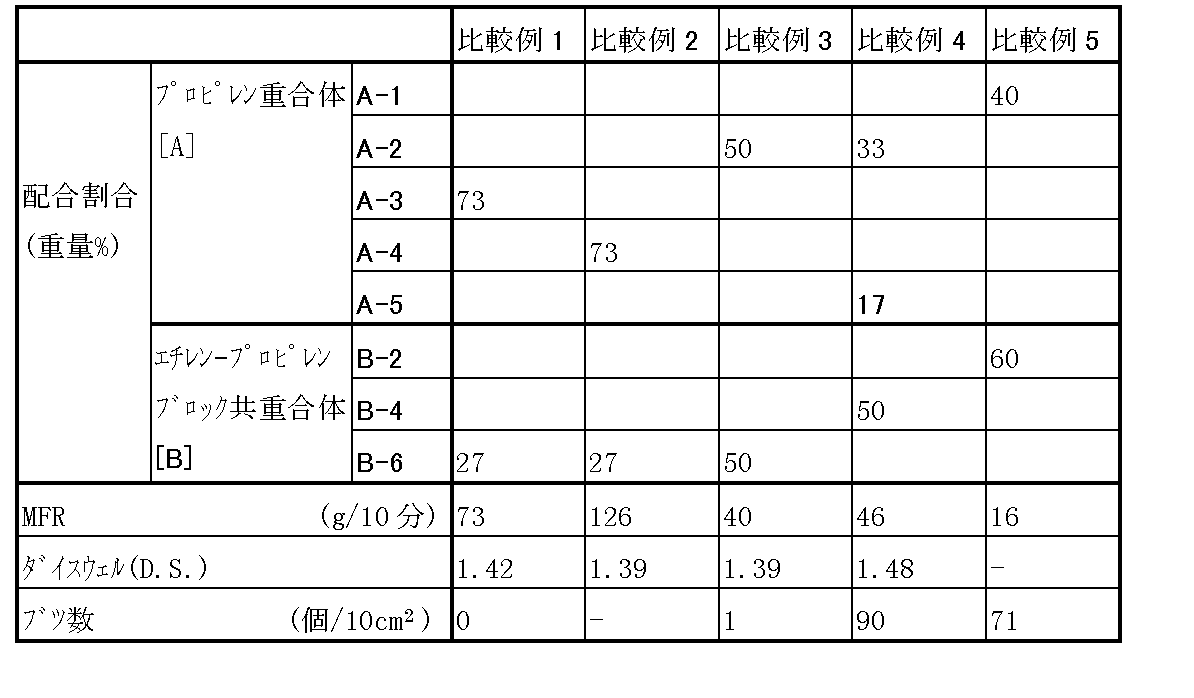
表3に各成分の配合割合と、実施例−1と同様にドライブレンド後、造粒して得られたポリプロピレン系樹脂組成物のMFR、ダイスウェル、フィルム10cm2当たりに観察される200μm以上の大きさを有するブツの数を評価した結果を示した。
【0099】
比較例−1〜比較例−3はプロピレン−エチレンブロック共重合体(B)のP部の極限粘度[η]B P及びEP部の極限粘度[η]B EPが本発明の要件を満足しないため、ダイスウェルが不充分であり、比較例−4はプロピレン−エチレンブロック共重合体(B)のP部の極限粘度[η]B Pが本発明の要件を満足しないため、ブツが多く、比較例−5はプロピレン単独重合体(A)とプロピレン−エチレンブロック共重合体(B)の配合割合が本発明の要件を満足しないため、ブツが多いことが分かる。
【0100】
【発明の効果】
本発明により、成形体にした場合、フローマークの発生が起こりにくい、即ち、ダイスウェルが高く、ブツの発生が少ない等の外観に優れるポリプロピレン系樹脂組成物を提供することができる。
【0101】
【表1】
分析結果
【表2】
実施例
【表3】
比較例
BACKGROUND OF THE INVENTION
The present invention relates to a polypropylene resin composition comprising a propylene homopolymer and a propylene-ethylene block copolymer produced by gas phase continuous polymerization. More specifically, the present invention relates to a polypropylene resin composition excellent in appearance such that when formed into a molded body, the occurrence of flow marks is difficult to occur, that is, the die swell is high and the occurrence of bumps is small. Moreover, this invention relates to the molded object which consists of a polypropylene resin composition.
[0002]
[Prior art]
Polypropylene-based resin compositions are materials that are excellent in rigidity, impact resistance, and the like, and are used in a wide range of applications as molded articles such as automobile interior / exterior materials and electrical component boxes. Among the polypropylene resin compositions, a polypropylene resin composition comprising a propylene-ethylene block copolymer, such as a propylene-ethylene block copolymer and a propylene homopolymer, or two or more different propylene-ethylene blocks. It has been well known that a polypropylene-based resin composition made of a copolymer is excellent in rigidity, impact resistance and the like and is suitably used.
[0003]
For example, JP-A-7-157626 describes a thermoplastic resin composition containing a propylene-ethylene block copolymer obtained by multistage polymerization and a polyolefin-based rubber. As propylene-ethylene block copolymer, propylene-ethylene random copolymer phase has an ethylene content of 5 to 50% by weight, and the intrinsic viscosity of the copolymer phase is 4.0 to 8.0 dl / g. -An ethylene block copolymer and a propylene-ethylene block copolymer having an ethylene content of more than 50% by weight and not more than 98% by weight and an intrinsic viscosity of 2.0 dl / g or more and less than 4.0 dl / g Is used, and it is described that a thermoplastic resin composition having extremely high ductility can be obtained.
[0004]
JP-A-7-157627 describes a thermoplastic resin composition containing a propylene-ethylene block copolymer obtained by multistage polymerization and a polyolefin-based rubber. The propylene-ethylene block copolymer includes a block copolymer having a propylene-ethylene random copolymer phase having an intrinsic viscosity of 4.0 to 8.0 dl / g and an intrinsic viscosity of 2.0 dl / g or more to 4.0 dl / g. a block copolymer that is less than g (provided that the intrinsic viscosity of the propylene-ethylene random copolymer phase is 4.0 to 8.0 dl / g, and the ethylene content of the copolymer phase is 5 to 50% by weight) Propylene-ethylene block copolymer, and propylene-ethylene block copolymer having an intrinsic viscosity of 2.0 dl / g or more and less than 4.0 dl / g and an ethylene content of more than 50% by weight and 98% by weight or less Are used, and it is described that a thermoplastic resin composition having extremely high ductility can be obtained.
[0005]
Japanese Patent Application Laid-Open No. 7-233305 describes a polypropylene resin composition having an improved melt index composed of polypropylene, an inorganic filler, a fatty acid composed of 15 to 20 carbon atoms, and a metal soap of zinc. . As a polypropylene, a block copolymer including a copolymer part having a copolymer part of propylene and ethylene [η] of 2 to 6 dl / g and a copolymer part of 7 to 15 dl / g is described as a preferred embodiment. Describes a composition comprising at least two types of block copolymers. Also, there is no practical problem in impact strength, rigidity, heat resistance, etc., it is suitable for manufacturing fluidized and thinned molded products, discoloration of yellow and pink due to pelletization, mold surface In addition, it is described that a polypropylene resin composition having a small amount of protrusion on the surface of an injection molded product can be obtained.
[0006]
By the way, in recent years, a propylene-ethylene block copolymer which is suitably used because it is excellent in rigidity, impact resistance and the like is manufactured by a continuous gas phase method which has a simple manufacturing process and can be manufactured at a low price. It has become like this. However, in general, the propylene-ethylene block copolymer produced by the gas phase method has a problem that if the intrinsic viscosity of the propylene-ethylene random copolymer portion is set high, the appearance of the molded product is deteriorated. have.
[0007]
As a method for solving such an appearance problem, for example, JP-A-7-286075 discloses that the content of a 23 ° C. n-decane soluble component produced by a continuous polymerization method is less than 0 to 15% by weight. And the 23 ° C. n-decane soluble component contains a constituent unit derived from ethylene in an amount of 30 to 60 mol%, and the intrinsic viscosity [η] is 3 to 7 dl / g and a batch The content of the 23 ° C. n-decane soluble component produced by the solvent polymerization method or the continuous solvent polymerization method is 15 to 40% by weight, and the 23 ° C. n-decane soluble component is derived from ethylene. A propylene polymer composition comprising a propylene block copolymer containing a structural unit in an amount of 30 to 60 mol% and having an intrinsic viscosity [η] of 5 to 12 dl / g is described, and is described in rigidity and impact resistance. Excellent appearance and appearance It is described that a propylene polymer composition capable of forming a molded product without being obtained is obtained.
[0008]
However, when formed into a molded body, the flow mark is hardly generated on the surface of the molded body, that is, the die swell is high and the occurrence of fluffing is not problematic in practice, so that the appearance characteristics are superior to the conventional one. Development of a polypropylene-based resin composition is desired. Also, from an industrial (simplification of process) and economical viewpoint, a polypropylene system having the above-mentioned excellent characteristics using a propylene-ethylene block copolymer produced by a continuous gas phase polymerization method. It is expected to develop a resin composition.
[0009]
[Problems to be solved by the invention]
An object of the present invention is to provide a polypropylene resin composition having an excellent appearance such that flow marks are less likely to occur when formed into a molded body, that is, die swell is high and fluff is less generated.
Moreover, the subject of this invention is providing the molded object which consists of the said polypropylene resin composition.
[0010]
[Means for Solving the Problems]
As a result of intensive studies in view of the actual situation, the present inventors, as a result, consisted of a specific propylene homopolymer, a propylene homopolymer portion having a specific structure, and a propylene-ethylene random copolymer portion having a specific structure. It has been found that the above-mentioned problems can be solved by using a polypropylene resin composition comprising a propylene-ethylene block copolymer produced by gas phase continuous polymerization, and the present invention has been completed.
[0011]
That is, the present invention
Intrinsic viscosity [η]AOf propylene homopolymer (A) having a viscosity of 1.3 dl / g or less and intrinsic viscosity [η]B PPropylene homopolymer portion having a viscosity of 1.4 to 2.0 dl / g and intrinsic viscosity [η]B EPConsisting of 5 to 50% by weight of propylene-ethylene block copolymer (B) produced by gas phase continuous polymerization having a propylene-ethylene random copolymer portion of 4.0 to 5.0 dl / g,According to the method defined in JIS-K-6758, the measurement temperature was 230 ° C. and the load was 2.16 kg.The present invention relates to a polypropylene resin composition having a melt flow rate (MFR) of 5.0 to 150 g / 10 min.
Hereinafter, the present invention will be described in detail.
[0012]
DETAILED DESCRIPTION OF THE INVENTION
The propylene homopolymer (A) used in the present invention is a polymer obtained by polymerizing only propylene. Moreover, 2 or more types of propylene homopolymers can also be used as needed.
[0013]
Intrinsic viscosity [η] of the propylene homopolymer (A) used in the present inventionAIs 1.3 dl / g or less, preferably 0.7 to 1.3 dl / g. Intrinsic viscosity [η]AIf it exceeds 1.3 dl / g, the melt flow rate (MFR) of the polyolefin resin composition may be lowered, and the fluidity may be lowered.
[0014]
The blending ratio of the propylene homopolymer (A) used in the present invention is 95 to 50% by weight, preferably 90 to 60% by weight, and more preferably 85 to 65% by weight.
[0015]
When the blending ratio of the propylene homopolymer (A) used in the present invention is less than 50% by weight, a large amount of bumps are generated, or the MFR of the polypropylene resin composition is lowered and the fluidity is lowered. There is. If it exceeds 95% by weight, the die swell becomes low and a flow mark tends to be generated, and the impact resistance may be lowered.
[0016]
Of the propylene homopolymer (A) used in the present invention13The isotactic pentad fraction calculated by C-NMR is preferably 0.95 or more, more preferably 0.97 or more, from the viewpoint of rigidity, heat resistance and the like.
[0017]
The molecular weight distribution (Q value) of the propylene homopolymer (A) used in the present invention is preferably 3 to 6 from the viewpoint of the balance between fluidity, impact resistance and rigidity.
[0018]
The production method of the propylene homopolymer (A) used in the present invention is not particularly limited. For example, (a) a solid catalyst component containing magnesium, titanium, halogen and an electron donor as essential components, Examples thereof include a production method using a known polymerization method using a catalyst system formed from (b) an organoaluminum compound and (c) an electron donor component. A typical example is shown below.
[0019]
(1) Catalyst system
(A) Solid catalyst component
(A-1) Titanium compound
As a titanium compound used for the synthesis of the solid catalyst component (a), for example, the general formula Ti (OR1)aX4-a(R1Represents a hydrocarbon group having 1 to 20 carbon atoms, X represents a halogen atom, and a represents a number of 0 ≦ a ≦ 4. ) Is represented by a titanium compound. Specifically, tetrahalogenated titanium compounds such as titanium tetrachloride, trihalogenated alkoxytitanium compounds such as ethoxytitanium trichloride and butoxytitanium trichloride, dihalogenated dialkoxytitanium such as diethoxytitanium dichloride and dibutoxytitanium dichloride. Examples thereof include monohalogenated trialkoxytitanium compounds such as compounds, triethoxytitanium chloride and tributoxytitanium chloride, and tetraalkoxytitanium compounds such as tetraethoxytitanium and tetrabutoxytitanium. These titanium compounds may be used alone or in combination of two or more.
[0020]
(A-2) Organosilicon compound having Si—O bond
Examples of the organosilicon compound used in the synthesis of the solid catalyst component (a) include, for example, the general formula R2 nSi (ORThree)4-n(R2Represents a hydrocarbon group having 1 to 20 carbon atoms or a hydrogen atom, RThreeRepresents a hydrocarbon group having 1 to 20 carbon atoms. N represents a number of 0 ≦ n <4. The silicon compound represented by this is mentioned. Specifically, tetraalkoxysilanes such as tetramethoxysilane, tetraethoxysilane, and tetrabutoxysilane, methyltrimethoxysilane, ethyltrimethoxysilane, butyltrimethoxysilane, isobutyltrimethoxysilane, t-butyltrimethoxysilane, methyl Alkyltrialkoxysilanes such as triethoxysilane, ethyltriethoxysilane, butyltriethoxysilane, isobutyltriethoxysilane, t-butyltriethoxysilane, dimethyldimethoxysilane, diethyldimethoxysilane, dibutyldimethoxysilane, diisobutyldimethoxysilane, di- t-butyldimethoxysilane, butylmethyldimethoxysilane, butylethyldimethoxysilane, t-butylmethyldimethoxysilane, dimethyldiethoxysilane Dialkyl dialkoxy such as dimethyl, diethyldiethoxysilane, dibutyldiethoxysilane, diisobutyldiethoxysilane, di-t-butyldiethoxysilane, butylmethyldiethoxysilane, butylethyldiethoxysilane, t-butylmethyldiethoxysilane Silane etc. are mentioned.
[0021]
(A-3) Ester compound
As the ester compound used for the synthesis of the solid catalyst component (a), for example, mono and polyvalent carboxylic acid esters are used, and examples thereof include aliphatic carboxylic acid esters, alicyclic carboxylic acid esters, and aromatic carboxylic acid esters. Examples include acid esters. Specific examples include methyl acetate, ethyl acetate, methyl propionate, ethyl propionate, ethyl butyrate, ethyl valerate, methyl acrylate, ethyl acrylate, methyl methacrylate, ethyl benzoate, butyl benzoate, methyl toluate, Ethyl toluate, ethyl anisate, diethyl succinate, dibutyl succinate, diethyl malonate, dibutyl malonate, dimethyl maleate, dibutyl maleate, diethyl itaconate, dibutyl itaconate, diethyl phthalate, di-n-phthalate Examples thereof include butyl and diisobutyl phthalate. Preferred are unsaturated aliphatic carboxylic acid esters such as methacrylic acid esters and phthalic acid esters such as maleic acid esters, and more preferred are phthalic acid diesters.
[0022]
(A-4) Organomagnesium compound
Examples of the magnesium compound used for the synthesis of the solid catalyst component (a) include a magnesium compound having a magnesium-carbon bond or a magnesium-hydrogen bond and having a reducing ability, or a magnesium compound having no reducing ability. . Specific examples of magnesium compounds having a reducing ability include dialkyl magnesium compounds such as dimethyl magnesium, diethyl magnesium, dibutyl magnesium and butyl ethyl magnesium, alkyl magnesium halide compounds such as butyl magnesium chloride, alkyl alkoxy magnesium compounds such as butyl ethoxy magnesium, Examples thereof include alkyl magnesium hydrides such as butyl magnesium hydride. These magnesium compounds having a reducing ability may be used in the form of a complex compound with an organoaluminum compound.
On the other hand, specific examples of magnesium compounds having no reducing ability include magnesium halide compounds such as magnesium dichloride, alkoxymagnesium halide compounds such as methoxymagnesium chloride, ethoxymagnesium chloride and butoxymagnesium chloride, diethoxymagnesium and dibutoxymagnesium. Dialkoxymagnesium compounds such as magnesium carboxylic acid salts such as magnesium laurate and magnesium stearate. These magnesium compounds not having a reducing ability may be synthesized in advance by a known method from a magnesium compound having a reducing ability at the time of preparing the solid catalyst component (a).
[0023]
(A-5) Ether compound
Examples of ether compounds used for the synthesis of the solid catalyst component (a) include dialkyl ethers such as diethyl ether, dibutyl ether, diisobutyl ether, diamyl ether, diisoamyl ether, methyl butyl ether, methyl isoamyl ether, and ethyl isobutyl ether. Can be mentioned. Dibutyl ether and diisoamyl ether are preferred.
[0024]
(A-6) Organic acid halide compound
Examples of the organic acid halide compound used for the synthesis of the solid catalyst component (a) include mono- and polyvalent carboxylic acid halides, and examples thereof include aliphatic carboxylic acid halides, alicyclic carboxylic acid halides, and aromatic carboxylic acids. Halide etc. are mentioned. Specific examples include acetyl chloride, propionic acid chloride, butyric acid chloride, valeric acid chloride, acrylic acid chloride, methacrylic acid chloride, benzoyl chloride, toluic acid chloride, anisic acid chloride, succinic acid chloride, malonic acid chloride, maleic acid chloride, Itaconic acid chloride, phthalic acid chloride and the like can be mentioned. Aromatic carboxylic acid chlorides such as benzoyl chloride, toluic acid chloride, and phthalic acid chloride are preferable, and phthalic acid chloride is more preferable.
[0025]
Synthesis of solid catalyst components
Examples of the method for producing the solid catalyst component (a) include the following methods.
(1) A method in which a liquid magnesium compound or a complex compound comprising a magnesium compound and an electron donor is reacted with a precipitating agent and then treated with a titanium compound, or a titanium compound and an electron donor.
(2) A method of treating a solid magnesium compound or a complex compound comprising a solid magnesium compound and an electron donor with a titanium compound or a titanium compound and an electron donor.
(3) A method in which a liquid magnesium compound and a liquid titanium compound are reacted in the presence of an electron donor to precipitate a solid titanium composite.
(4) A method in which the reaction product obtained in (1), (2) or (3) is further treated with a titanium compound, or an electron donor and a titanium compound.
(5) A solid product obtained by reducing an alkoxytitanium compound with an organomagnesium compound such as a Grignard reagent in the presence of an organosilicon compound having a Si—O bond is converted into an ester compound, an ether compound and TiCl.FourHow to handle with.
(6) A solid product obtained by reducing a titanium compound with an organomagnesium compound in the presence of an organosilicon compound or an organosilicon compound and an ester compound is converted into a mixture of an ether compound and titanium tetrachloride, and then an organic acid halide compound. And then treating the treated solid with a mixture of an ether compound and titanium tetrachloride or a mixture of an ether compound, titanium tetrachloride and an ester compound.
(7) A method of contacting a contact reaction product of a metal oxide, dihydrocarbylmagnesium and a halogen-containing alcohol with an electron donor and a titanium compound after or without treatment with a halogenating agent.
(8) A method in which a magnesium compound such as a magnesium salt of an organic acid or alkoxymagnesium is contacted with an electron donor and a titanium compound after or without treatment with a halogenating agent.
(9) A method of treating the compound obtained in (1) to (8) with any of halogen, a halogen compound, and an aromatic hydrocarbon.
Among these solid catalyst synthesis methods, the method (1) to (6) is preferred, and the method (6) is more preferred. All of these synthesis reactions are usually carried out in an inert gas atmosphere such as nitrogen or argon.
[0026]
The titanium compound, organosilicon compound and ester compound are preferably used after being dissolved or diluted in a suitable solvent. Examples of the solvent include aliphatic hydrocarbons such as hexane, heptane, octane, and decane, aromatic hydrocarbons such as toluene and xylene, alicyclic hydrocarbons such as cyclohexane, methylcyclohexane, and decalin, diethyl ether, And ether compounds such as dibutyl ether, diisoamyl ether, and tetrahydrofuran.
[0027]
The temperature of the reduction reaction using the organomagnesium compound is usually -50 to 70 ° C, preferably -30 to 50 ° C, particularly preferably -25 to 35 ° C. If the reduction reaction temperature is too high, the catalytic activity may decrease. The dropping time of the organomagnesium compound is not particularly limited, but is usually about 30 minutes to 12 hours. Further, after the reduction reaction, a post-reaction may be performed at a temperature of 20 to 120 ° C.
[0028]
In the reduction reaction, a porous substance such as an inorganic oxide or an organic polymer can be coexisted, and the porous product can be impregnated with the solid product. As such a porous substance, those having a pore volume at a pore radius of 20 to 200 nm of 0.3 ml / g or more and an average particle diameter of 5 to 300 μm are preferable.
[0029]
As the porous inorganic oxide, SiO2, Al2OThree, MgO, TiO2, ZrO2Or these complex oxides etc. are mentioned. The porous polymer includes polystyrene, polystyrene-based porous polymers such as styrene-divinylbenzene copolymer, polyethyl acrylate, methyl acrylate-divinylbenzene copolymer, polymethyl methacrylate, methyl methacrylate-divinyl. Polyacrylic acid ester type porous polymer such as benzene copolymer, polyolefin type porous polymer such as polyethylene, ethylene-methyl acrylate copolymer, polypropylene and the like can be mentioned. Of these porous materials, preferably SiO2, Al2OThree, A styrene-divinylbenzene copolymer.
[0030]
(B) Organoaluminum compound
The catalyst type organoaluminum compound (b) used for the production of the propylene homopolymer (A) of the present invention has at least one Al-carbon bond in the molecule, and a typical one is represented by the general formula. Is shown below.
RFour mAlY3-m
RFiveR6Al-O-AlR7R8
(RFour~ R8Represents a hydrocarbon group having 1 to 8 carbon atoms, and Y represents a halogen atom, hydrogen or an alkoxy group. RFour~ R8May be the same or different. M is a number represented by 2 ≦ m ≦ 3. ) Specific examples of organoaluminum compounds include trialkylaluminums such as triethylaluminum and triisobutylaluminum, dialkylaluminum hydrides such as diethylaluminum hydride and diisobutylaluminum hydride, dialkylaluminum halides such as diethylaluminum chloride and diisobutylaluminum chloride, and triethylaluminum. And a mixture of a trialkylaluminum and a dialkylaluminum halide such as a mixture of aluminum and diethylaluminum chloride, and an alkylalumoxane such as tetraethyldialumoxane and tetrabutyldialumoxane.
[0031]
Of these organoaluminum compounds, preferably trialkylaluminum, a mixture of trialkylaluminum and dialkylaluminum halide, alkylalumoxane, more preferably triethylaluminum, triisobutylaluminum, a mixture of triethylaluminum and diethylaluminum chloride, or Tetraethyl dialumoxane is preferred.
[0032]
(C) Electron donor component
Examples of the catalyst-type electron donor component (c) used in the production of the propylene homopolymer (A) of the present invention include alcohols, phenols, ketones, aldehydes, carboxylic acids, organic acids, and inorganic acids. Commonly used oxygen-containing electron donors such as esters, ethers, acid amides and acid anhydrides, and nitrogen-containing electron donors such as ammonia, amines, nitriles and isocyanates Can be mentioned. Of these electron donors, esters of inorganic acids and ethers are preferred.
[0033]
Preferably, the inorganic acid esters are represented by the general formula R9 nSi (ORTen)4-n(Wherein R9Is a hydrocarbon group having 1 to 20 carbon atoms or a hydrogen atom, RTenIs a hydrocarbon group having 1 to 20 carbon atoms, R9, RTenAre each a silicon compound represented by the following formula: n may have different substituents in the same molecule, and n is 0 ≦ n <4. Specific examples include tetrabutoxysilane, butyltrimethoxysilane, tert-butyl-n-propyldimethoxysilane, dicyclopentyldimethoxysilane, cyclohexylethyldimethoxysilane, and the like.
[0034]
Further, the ethers are preferably dialkyl ethers, general formula
[0035]
Of these electron donor components, the general formula R15R16Si (OR17)2An organosilicon compound represented by the formula is particularly preferably used. Where R15Is a hydrocarbon group having 3 to 20 carbon atoms in which the carbon atom adjacent to Si is secondary or tertiary, specifically, isopropyl group, sec-butyl group, tert-butyl group, tert-amyl group, etc. A branched alkyl group, a cycloalkyl group such as a cyclopentyl group and a cyclohexyl group, a cycloalkenyl group such as a cyclopentenyl group, an aryl group such as a phenyl group and a tolyl group. In the formula, R16Is a hydrocarbon group having 1 to 20 carbon atoms, specifically, a linear alkyl group such as methyl group, ethyl group, propyl group, butyl group, pentyl group, isopropyl group, sec-butyl group, tert- Examples thereof include branched alkyl groups such as butyl group and tert-amyl group, cycloalkyl groups such as cyclopentyl group and cyclohexyl group, cycloalkenyl groups such as cyclopentenyl group, and aryl groups such as phenyl group and tolyl group. Further, in the formula, R17Is a hydrocarbon group having 1 to 20 carbon atoms, preferably a hydrocarbon group having 1 to 5 carbon atoms. Specific examples of the organosilicon compound used as such an electron donor component include tert-butyl-n-propyldimethoxysilane, dicyclopentyldimethoxysilane, cyclohexylethyldimethoxysilane, and the like.
[0036]
(2) Polymerization method
As a method for producing the propylene homopolymer (A) used in the present invention, the above-mentioned solid catalyst component (a), organoaluminum compound (b) and electron donor component (c) are used by using a known polymerization method. A method of polymerizing propylene in the presence of a catalyst system consisting of
[0037]
Examples of the polymerization method include bulk polymerization, solution polymerization, slurry polymerization, and gas phase polymerization. Bulk polymerization is a method in which polymerization is performed using a liquid olefin as a medium at the polymerization temperature, and solution polymerization or slurry polymerization is in an inert hydrocarbon solvent such as propane, butane, isobutane, pentane, hexane, heptane, and octane. The gas phase polymerization is a method in which a gaseous monomer is used as a medium and the gaseous monomer is polymerized in the medium. These polymerization methods can be either batch type or continuous type, and these polymerization methods may be arbitrarily combined. From the industrial and economical viewpoint, a continuous gas phase polymerization method is preferred.
[0038]
The usage-amount of an organoaluminum compound (b) is 1-1000 mol with respect to 1 mol of titanium atoms contained in a solid catalyst component (a), Preferably it is 5-600 mol.
[0039]
The amount of the electron donor component (c) used is 0.1 to 2000 mol, preferably 0.3 to 1000 mol, more preferably 0.5, per 1 mol of titanium atom contained in the solid catalyst component (a). ˜800 mol, and 0.001 to 5 mol, preferably 0.005 to 3 mol, more preferably 0.01 to 1 mol, per mol of aluminum atom contained in the organoaluminum compound (b).
[0040]
Although superposition | polymerization temperature can be implemented at -30-300 degreeC, Preferably it is 20-180 degreeC. The polymerization pressure is not particularly limited, but is generally from normal pressure to 10 MPa, preferably from 0.2 to 5 MPa, from an industrial and economical viewpoint.
[0041]
As the molecular weight regulator, hydrogen is preferable. The supply amount of hydrogen can be appropriately determined depending on the use of the polypropylene resin composition of the present invention.
[0042]
The method for supplying each catalyst component to the polymerization tank is not particularly limited except that the catalyst components are supplied in an inert gas such as nitrogen and argon without any moisture. In addition, the solid catalyst component (a), the organoaluminum compound (b) and the electron donor component (c) may be supplied separately, or either two or all may be supplied in contact in advance. Also good.
[0043]
In the production of the propylene homopolymer (A) used in the present invention, the prepolymerization described below may be performed before the polymerization (main polymerization).
Examples of the prepolymerization method include known methods. For example, in the presence of the solid catalyst component (a) and the organoaluminum compound (b), a small amount of propylene is supplied and a slurry is used in a slurry state. Is mentioned. Examples of the solvent used for the prepolymerization include propane, butane, isobutane, pentane, isopentane, hexane, heptane, octane, cyclohexane, benzene, and toluene, and liquid propylene. You may mix and use.
[0044]
The amount of the organoaluminum compound (b) used in the prepolymerization is 0.5 to 700 mol, preferably 0.8 to 500 mol, more preferably, per mol of titanium atom contained in the solid catalyst component (a). Is 1 to 200 mol.
[0045]
The amount of propylene to be prepolymerized is 0.01 to 1000 g, preferably 0.05 to 500 g, more preferably 0.1 to 200 g, per 1 g of the solid catalyst component.
[0046]
The slurry concentration in the prepolymerization is preferably 1 to 500 g / L, more preferably 3 to 300 g / L in terms of the weight of the solid catalyst component (a) contained per liter of the solvent. The prepolymerization temperature is preferably -20 to 100 ° C, more preferably 0 to 80 ° C. Further, the partial pressure of propylene in the gas phase part during the prepolymerization is preferably 0.001 to 2.0 MPa, more preferably 0.01 to 1.0 MPa, but is liquid at the prepolymerization pressure and temperature. This is not the case for propylene. Further, the prepolymerization time is not particularly limited, but usually 2 minutes to 15 hours is preferable.
[0047]
As a method for supplying the solid catalyst component (a), the organoaluminum compound (b) and propylene in the prepolymerization, a method for supplying propylene after contacting the solid catalyst component (a) with the organoaluminum compound (b), or And a method of supplying the organoaluminum compound (b) after contacting the solid catalyst component (a) with propylene. Examples of the propylene supply method include a method of sequentially supplying propylene while keeping the inside of the polymerization tank at a predetermined pressure, or a method of supplying all the predetermined amount of propylene first. A chain transfer agent such as hydrogen may be added to adjust the molecular weight of the resulting prepolymer.
[0048]
Further, in the prepolymerization, an electron donor component (c) may coexist if necessary. The amount used is 0.01 to 400 mol, preferably 0.02 to 200 mol, more preferably 0.03 to 100 mol, per mol of titanium atom contained in the solid catalyst component (a). The amount is 0.003 to 5 moles, preferably 0.005 to 3 moles, more preferably 0.01 to 2 moles per mole of aluminum atoms contained in the organoaluminum compound (b).
[0049]
The method for supplying the electron donor component used for the prepolymerization is not particularly limited, and may be supplied separately from the solid catalyst component (a) and the organoaluminum compound (b), or may be supplied in contact with each other in advance. . Further, the propylene used in the prepolymerization may be the same as or different from the propylene used in the main polymerization.
[0050]
The propylene-ethylene block copolymer (B) used in the present invention is a propylene homopolymer portion (referred to as a first segment) and a propylene-ethylene random copolymer portion (referred to as a second segment). Is a propylene-ethylene block copolymer produced by vapor phase continuous polymerization.
[0051]
Intrinsic viscosity [η] of the first segment propylene homopolymer partB PIs 1.4 to 2.0 dl / g, preferably 1.5 to 1.9 dl / g. Intrinsic viscosity [η]B PIs less than 1.4 dl / g, there may be a lot of bumps, and if it exceeds 2.0 dl / g, the MFR of the polypropylene-based resin composition may decrease and the fluidity may decrease.
[0052]
The above-mentioned irregularity is a lump made mainly of a propylene-ethylene random copolymer component, which is generated due to poor dispersibility of the propylene-ethylene random copolymer portion which is the second segment, and its size is 100 ˜about several hundred μm. When a material having a large amount of material is used to form a molded product by injection molding or the like, it not only impairs the appearance of the surface of the molded product but also adversely affects mechanical properties such as impact resistance.
[0053]
Of the propylene homopolymer portion which is the first segment of the propylene-ethylene block copolymer (B) used in the present invention.13The isotactic pentad fraction calculated by C-NMR is preferably 0.95 or more, more preferably 0.97 or more, from the viewpoint of rigidity, heat resistance and the like.
[0054]
Of the propylene-ethylene random copolymer portion which is the second segment of the propylene-ethylene block copolymer (B) used in the present invention.Intrinsic viscosity [η] B EP Is 4.0 to 5.0 dl / g. Intrinsic viscosity [η]B EPIs less than 4.0 dl / g, the die swell is insufficient and the flow mark may be insufficient. If it exceeds 15.0 dl / g, a lot of flaws occur or the polypropylene resin composition MFR may decrease and fluidity may decrease.
[0055]
Ethylene content in the second segment, propylene-ethylene random copolymer [(C2 ')EP] Is preferably 20 to 60% by weight, more preferably 23 to 50% by weight, from the viewpoint of impact resistance.
[0056]
The proportion of the propylene-ethylene random copolymer portion as the second segment and the propylene homopolymer portion as the first segment is preferably the second segment from the viewpoint of impact resistance, rigidity, heat resistance, etc. of the molded product. The proportion of a certain propylene-ethylene random copolymer portion is 15 to 60% by weight, and the proportion of the propylene homopolymer portion which is the first segment is 85 to 40% by weight.
[0057]
The blending ratio of the propylene-ethylene block copolymer (B) used in the present invention is 5 to 50% by weight, preferably 10 to 40% by weight, and more preferably 12 to 35% by weight.
[0058]
When the blending ratio of the propylene-ethylene block copolymer (B) used in the present invention is less than 5% by weight, the flow mark is insufficient due to insufficient die swell, and impact resistance May decrease. If it exceeds 50% by weight, a lot of bumps may be generated, or the MFR of the polyolefin resin composition may be lowered and the fluidity may be lowered.
[0059]
The gas phase continuous polymerization for producing the propylene-ethylene block copolymer (B) used in the present invention is a method in which a gaseous monomer is used as a medium, and the gaseous monomer is polymerized in the medium. In this method, the propylene-ethylene block copolymer (B) is continuously produced. In the polymerization method, a polymerization tank composed of at least two tanks is arranged in series, and after propylene homopolymer portion which is the first segment is polymerized in the first polymerization tank, the product of the first polymerization tank is subjected to the following process. It moves to a polymerization tank, and then the propylene-ethylene random copolymer portion which is the second segment is continuously polymerized in the polymerization tank.
[0060]
The polymerization conditions may be the same or different in each of the first stage and the second stage and thereafter, but the polymerization temperature is usually 0 to 200 ° C., preferably 20 to 90 ° C., and the polymerization pressure is normal pressure. -10 MPa, preferably 0.2-5 MPa. As the molecular weight modifier, hydrogen is preferably used, and the hydrogen supply amount and the hydrogen supply balance in the first stage and the second and subsequent polymerizations depend on the physical properties and applications of the polypropylene resin composition of the present invention. Can be decided.
[0061]
The catalyst system used in the production of the propylene-ethylene block copolymer (B) used in the present invention includes (a) a solid catalyst component containing magnesium, titanium, halogen and an electron donor as essential components, and (b) an organic material. A catalyst system formed from an aluminum compound and (c) an electron donor component, which is the same as the catalyst system used for the polymerization of the propylene homopolymer (A) described above.
[0062]
The polypropylene resin composition of the present invention comprises a propylene homopolymer (A) and a propylene-ethylene block copolymer (B).According to the method defined in JIS-K-6758, the measurement temperature was 230 ° C. and the load was 2.16 kg.The melt flow rate (MFR) is 5.0 to 150 g / 10 minutes, preferably 10 to 120 g / 10 minutes. When the melt flow rate (MFR) of the polypropylene resin composition of the present invention is 5.0 to 150 g / 10 minutes, it is easy to mold a large molded product, but when it is less than 5.0 g / 10 minutes, the moldability is high. May deteriorate or a good flow mark may not be obtained, and if it exceeds 150 g / 10 min, impact resistance may be reduced.
[0063]
Of the polypropylene resin composition of the present inventionUsing Capillograph 1B manufactured by Toyo Seiki Seisakusho, measurement temperature: 220 ° C., L / D: 40, shear rate: 2.432 × 10 Three sec -1 Measured inThe die swell (DS) is preferably 1.45 or more, more preferably 1.50 or more. When the die swell (DS) is less than 1.45, the flow mark on the surface of the molded body may be insufficient.
[0064]
Examples of the method for producing the polypropylene resin composition of the present invention include a method using a kneading machine such as a single screw extruder, a twin screw extruder, a Banbury mixer, and a hot roll. For example, the method shown below etc. are mentioned.
(1) A method of kneading the respective polymer powders of the propylene homopolymer (A) and the propylene-ethylene block copolymer (B) using the kneader.
(2) Propylene homopolymer (A) polymer powder and propylene-ethylene block copolymer (B) polymer powder are individually kneaded using a single screw or twin screw extruder to produce pellets, and then A method of kneading the pellets of the propylene homopolymer (A) and the pellets of the propylene-ethylene block copolymer (B) using a single screw or twin screw extruder.
(3) Propylene-ethylene block copolymer (B) pelletized in advance using a single-screw or twin-screw extruder is quantified in a kneader in the step of pelletizing the propylene homopolymer (A) polymer powder. A method of adding and kneading using a feeder. Preferably, the method uses pellets of the propylene-ethylene block copolymer (B) kneaded in advance using a single or twin screw extruder as in (2) or (3) above.
[0065]
If necessary, a screen pack may be attached to a die of a single screw or twin screw extruder. The screen pack to be mounted is preferably a metal fiber sintered filter, for example, as described in “Machine Design (March 1981 Vol. 25, No. 3, 109-113)”.
The kneading temperature is usually 170 to 250 ° C, preferably 190 to 230 ° C.
[0066]
Various additives may be added to the polypropylene resin composition of the present invention as long as the purpose and effect thereof are not impaired. Additives include, for example, antioxidants, ultraviolet absorbers, lubricants, pigments, antistatic agents, copper damage inhibitors, flame retardants, neutralizers, foaming agents, plasticizers, nucleating agents, anti-bubble agents, and crosslinking Agents and the like. Among these additives, in order to improve heat resistance, weather resistance, and oxidation resistance stability, it is preferable to add an antioxidant or an ultraviolet absorber. Further, rubber components, various inorganic and organic fillers can also be added within the range not impairing the object and effects of the present invention.
These additives, rubber components, fillers, and the like may be mixed with the propylene homopolymer (A), the propylene-ethylene block copolymer (B), or both in advance, and then may be a polypropylene resin composition, or May be mixed in the kneading stage of the propylene homopolymer (A) and the propylene-ethylene block copolymer (B).
[0067]
The polypropylene resin composition of the present invention can be formed into an injection-molded body by a generally known injection molding method. In particular, it is suitably used as an injection-molded article for automobiles, and is suitably used as, for example, a door rim, a pillar, an instrument panel, and a bumper.
[0068]
【Example】
Hereinafter, the present invention will be described by way of examples. However, these are merely examples, and the present invention is not limited to these examples.
The methods for measuring the physical properties of the polymers and compositions used in Examples and Comparative Examples are shown below.
[0069]
(1) Intrinsic viscosity (unit: dl / g)
Using a Ubbelohde viscometer, reduced viscosities were measured at three concentrations of 0.1, 0.2 and 0.5 g / dl. The intrinsic viscosity is a calculation method described in “Polymer Solution, Polymer Experiments 11” (published by Kyoritsu Shuppan Co., Ltd.), page 491. That is, the reduced viscosity is plotted against the concentration, and the concentration is extrapolated to zero. Obtained by extrapolation. Measurement was performed at a temperature of 135 ° C. using tetralin as a solvent.
[0070]
(1-1) Intrinsic viscosity of propylene-ethylene block copolymer (B)
(1-1a) Intrinsic viscosity of propylene homopolymer part (first segment): [η]B PIntrinsic viscosity of the propylene homopolymer portion which is the first segment of the propylene-ethylene block copolymer: [η]B PIn the production, after the polymerization of the propylene homopolymer which is the first step, the propylene homopolymer is taken out from the polymerization tank, and [η] of the taken out propylene homopolymerPWas measured.
[0071]
(1-1b) Intrinsic viscosity of propylene-ethylene random copolymer portion (second segment): [η]B EP
Intrinsic viscosity of the propylene-ethylene random copolymer portion which is the second segment of the propylene-ethylene block copolymer: [η]B EPIs the intrinsic viscosity of the propylene homopolymer part: [η]PAnd intrinsic viscosity of propylene-ethylene block copolymer as a whole: [η]TWas measured, and the weight ratio: X of the propylene-ethylene random copolymer portion to the entire propylene-ethylene block copolymer was calculated from the following formula using X. (Weight ratio with respect to the entire propylene-ethylene block copolymer: X was determined by the following measurement method (2).)
[η]EP= [Η]T/ X- (1 / X-1) [η]P
[η]P: Intrinsic viscosity of the propylene homopolymer part (dl / g)
[η]T: Intrinsic viscosity of the entire propylene-ethylene block copolymer (dl / g)
[0072]
(2) Weight ratio of propylene-ethylene random copolymer portion to the entire propylene-ethylene block copolymer: X and ethylene content of propylene-ethylene random copolymer portion in propylene-ethylene block copolymer: (C2')EPMeasured under the following conditions13It calculated | required from the C-NMR spectrum based on the report (Macromolecules 1982, 15, 1150-1152) of Kakugo et al.
A sample was prepared by uniformly dissolving about 200 mg of propylene-ethylene block copolymer in 3 ml of orthodichlorobenzene in a 10 mmφ test tube.13C-NMR spectrum was measured under the following conditions.
Measurement temperature: 135 ° C
Pulse repetition time: 10 seconds
Pulse width: 45 °
Integration count: 2500 times
[0073]
(3) Isotactic pentad fraction
The isotactic pentad fraction is a method disclosed by A. Zambelli et al. In Macromolecules, 6,925 (1973), that is,13Isotactic chain of pentad units in a polypropylene molecular chain measured using C-NMR, in other words, the fraction of propylene monomer units at the center of a chain in which five propylene monomer units are continuously meso-bonded It is. However, the assignment of the NMR absorption peak was performed based on Macromolecules, 8, 687 (1975), which was subsequently published.
[0074]
In particular13The isotactic pentad fraction was measured as the area fraction of the mmmm peak in the total absorption peak in the methyl carbon region of the C-NMR spectrum. The isotactic pentad fraction of NPL standard substance CRM No.M19-14 Polypropylene PP / MWD / 2 of NATIONAL PHYSICAL LABORATORY of UK was measured by this method and found to be 0.944.
[0075]
(4) Melt flow rate (MFR) (unit: g / 10 minutes)
The measurement was performed according to the method defined in JIS-K-6758. Unless otherwise specified, the measurement temperature was 230 ° C. and the load was 2.16 kg.
[0076]
(5) Die Swell (DS)
Measurement was performed under the following conditions using a Capillograph 1B manufactured by Toyo Seiki Seisakusho.
Measurement temperature: 220 ° C
L / D: 40
Shear rate: 2.432 × 10Threesec-1
[0077]
(6) Number of items (pieces / 10cm2)
A film processed under the following conditions using a T-die extruder was quantitatively analyzed according to the following method using an image analyzer.
Film processing conditions
A film having a width of 50 mm and a thickness of 50 microns was prepared by using an extruder V-20 manufactured by Tanabe Plastic Machinery Co., Ltd. and a film take-up device.
Quantitative analysis method
An image of the film (900 dpi, 8 bits) was taken into a computer by a scanner GT-9600 manufactured by EPSON, and the image was binarized by image analysis software A image manufactured by Asahi Engineering. Buzz was recognized as a brighter part than the surrounding area. Since the shape of the irregularity is irregular, the diameter of a circle having the same area as the irregularity is assumed to be the size of the irregularity.2The number of bumps with a diameter of 200 microns or more was determined.
[0078]
The synthesis methods of the two types of solid catalyst components I and II used in the examples and comparative examples are shown below.
(1) Solid catalyst component I
(1- (1)) Synthesis of reduced solid product
After a 500 ml flask equipped with a stirrer and a dropping funnel was replaced with argon, 290 ml of hexane, 9.3 ml of tetrabutoxytitanium (9.3 g, 27 mmol), 8.5 ml of diisobutyl phthalate (8.8 g, 32 mmol) and 79.1 ml (74.4 g, 357 mmol) of tetraethoxysilane was added to make a homogeneous solution. Next, 199 ml of a di-n-butyl ether solution of n-butylmagnesium chloride (Organic Synthetic Chemical Co., Ltd., n-butylmagnesium chloride concentration 2.1 mmol / ml) was added to the dropping funnel while maintaining the temperature in the flask at 6 ° C. And then gradually dropped over 5 hours.
After completion of the dropwise addition, the mixture was further stirred at room temperature for 1 hour, and then solid-liquid separation was performed at room temperature. After washing with 300 ml of hexane three times with 300 ml of toluene, 270 ml of toluene was added.
A part of the solid product slurry was sampled and subjected to composition analysis. As a result, the solid product contained 1.8% by weight of titanium atoms, 0.5% by weight of phthalates, and 30.7% by weight of ethoxy groups. In addition, 3.3% by weight of a butoxy group was contained. The slurry concentration was 0.140 g / ml.
[0079]
(1- (2)) Synthesis of solid catalyst components
After replacing a 200 ml flask equipped with a stirrer, a dropping funnel and a thermometer with argon, 84 ml of the slurry containing the solid product obtained in the above (1- (1)) was added, and 12.1 ml of the supernatant was added. , 7.8 ml (29 mmol) of diisobutyl phthalate was added, and the reaction was carried out at 95 ° C. for 30 minutes. After the reaction, it was separated into solid and liquid and washed twice with 59 ml of toluene.
After completion of washing, 15.3 ml of toluene, 0.66 ml (2.5 mmol) of diisobutyl phthalate, 1.2 ml (6.9 mmol) of butyl ether, and 23.4 ml (0.213 mol) of titanium tetrachloride were added to the flask. The reaction was carried out at 95 ° C. for 3 hours. After completion of the reaction, the solid and liquid were separated at the same temperature, and then washed twice with 59 ml of toluene at the same temperature. Subsequently, 12.0 ml of toluene, 1.2 ml (6.9 mmol) of butyl ether and 11.7 ml (0.106 mol) of titanium tetrachloride were added, and the reaction was carried out at 95 ° C. for 1 hour. After completion of the reaction, solid-liquid separation was performed at the same temperature, followed by washing with 59 ml of toluene three times at the same temperature, followed by washing with 59 ml of hexane three times and further drying under reduced pressure to obtain 8.1 g of a solid catalyst component. The solid catalyst component contained 1.4% by weight of titanium atoms, 10.0% by weight of phthalates, 0.5% by weight of ethoxy groups, and 0.1% by weight of butoxy groups. Further, when the solid catalyst component was observed with a stereomicroscope, it had good particle properties without fine powder. This solid catalyst component is hereinafter referred to as solid catalyst component I.
[0080]
(2) Solid catalyst component II
(2- (1)) Synthesis of reduced solid product
A 500 ml flask equipped with a stirrer and a dropping funnel was replaced with nitrogen, 290 ml of hexane, 8.9 ml of tetrabutoxytitanium (8.9 g, 26.1 mmol), 3.1 ml of diisobutyl phthalate (3.3 g, 11 .8 mmol) and 87.4 ml (81.6 g, 392 mmol) of tetraethoxysilane were added to obtain a homogeneous solution. Next, 199 ml of a di-n-butyl ether solution of n-butylmagnesium chloride (Organic Synthetic Chemical Co., Ltd., n-butylmagnesium chloride concentration 2.1 mmol / ml) was added to the dropping funnel while maintaining the temperature in the flask at 6 ° C. And then gradually dropped over 5 hours. After completion of the dropwise addition, the mixture was further stirred at 6 ° C. for 1 hour, and further stirred at room temperature for 1 hour. Thereafter, solid-liquid separation was performed, and washing was repeated three times with 260 ml of toluene, and then an appropriate amount of toluene was added to obtain a slurry concentration of 0.176 g / ml. A part of the solid product slurry was sampled and subjected to composition analysis. As a result, the solid product contained 1.96% by weight of titanium atoms, 0.12% by weight of phthalates, and 37.2% by weight of ethoxy groups. And 2.8% by weight of butoxy groups.
[0081]
(2- (2)) Synthesis of solid catalyst components
After replacing a 100 ml flask equipped with a stirrer, a dropping funnel and a thermometer with nitrogen, 52 ml of the slurry containing the solid product obtained in the above (2- (2)) was charged, and 25.5 ml of the supernatant was added. A mixture of 0.80 ml (6.45 mmol) of butyl ether extracted and 16.0 ml (0.146 mol) of titanium tetrachloride was added, and then 1.6 ml (11.1 mmol: 0.20 ml / 1 g solid of phthalic acid chloride was formed. The mixture was heated to 115 ° C. and stirred for 3 hours. After completion of the reaction, the solid and liquid were separated at the same temperature, and then washed twice with 40 ml of toluene at the same temperature. Then a mixture of 10.0 ml toluene, 0.45 ml (1.68 mmol) diisobutyl phthalate, 0.80 ml (6.45 mmol) butyl ether and 8.0 ml (0.073 mol) titanium tetrachloride was added and 115 The treatment was performed at 0 ° C. for 1 hour. After completion of the reaction, solid-liquid separation was performed at the same temperature, followed by washing with 40 ml of toluene three times at the same temperature, followed by washing with 40 ml of hexane three times and further drying under reduced pressure to obtain 7.36 g of a solid catalyst component. The solid catalyst component contained 2.18 wt% titanium atom, 11.37 wt% phthalate ester, 0.3 wt% ethoxy group, and 0.1 wt% butoxy group. Further, when the solid catalyst component was observed with a stereomicroscope, it had good particle properties without fine powder. This solid catalyst component is hereinafter referred to as solid catalyst component II.
[0082]
Polymerization of propylene homopolymer (A)
A-1 polymerization
(1) Prepolymerization
In an autoclave with a stirrer, hexane that has been sufficiently dehydrated and degassed with 25 mmol / L of triethylaluminum (TEA) and cyclohexylethyldimethoxysilane (hereinafter abbreviated as CHEDMS) as an electron donor component is CHEDMS / TEA = 0.1 (mol) / Mol), and the solid catalyst component I was added so that the final polymer amount per solid catalyst component (hereinafter abbreviated as PP / cat) was 2.5 (g / g), while maintaining a low temperature. Propylene was continuously supplied to obtain a prepolymer slurry. The obtained prepolymer slurry was transferred to an autoclave equipped with a stirrer, and then sufficiently purified liquid butane was added thereto and kept at a temperature of 10 ° C. or lower for storage.
[0083]
(2) Main polymerization
The prepolymer slurry prepared in (1) is solid under the conditions of maintaining the reactor temperature at 90 ° C. and the reactor pressure at 1.8 MPa, and maintaining the propylene in the gas phase at 81 vol% and hydrogen at 7.7 vol%. Continuous gas phase polymerization was performed while supplying TEA and CHEDMS as catalyst components. Each catalyst component was supplied so that the concentration in the polymer obtained was [TEA] = 299 ppm, [CHEDMS] = 52 ppm, and PP / cat = 16000 (g / g). The average residence time was 3.3 hr. The analysis results of the obtained polymer are shown in Table 1. Intrinsic viscosity [η]A PWas 0.84 dl / g.
[0084]
Polymerization of A-2
In this polymerization, the temperature was set to 80 ° C., the gas composition in the gas phase part and the catalyst component supply amount were adjusted, and the others were obtained in the same manner as A-1 to obtain A-2 powder having the physical properties shown in Table 1. . The analysis results of the obtained polymer are shown in Table 1. Intrinsic viscosity [η]A PWas 0.90 dl / g, and the isotactic pentad fraction was 0.97.
[0085]
Polymerization of A-3
In this polymerization, the temperature was set to 80 ° C., the gas composition in the gas phase part and the catalyst component supply amount were adjusted, and the others were obtained in the same manner as A-1, and A-3 powder having the physical properties shown in Table 1 was obtained. . The analysis results of the obtained polymer are shown in Table 1. Intrinsic viscosity [η]A PWas 0.89 dl / g.
[0086]
Polymerization of A-4
The same procedure as A-1 was performed except that the type of the solid catalyst component was changed to II and the type of the electron donor component was changed to t-butyl-n-propyldimethoxysilane (hereinafter abbreviated as tBnPDMS) in the prepolymerization.
In the main polymerization, the number of reactors is changed from 1 to 3 tanks, the electron donor component type is tBnPDMS, the temperature is 82 ° C., the gas composition in the gas phase part, and the catalyst component supply amount are adjusted. The powder of A-4 which has the physical property shown in Table 1 by the method similar to -1 was obtained. The analysis results of the obtained polymer are shown in Table 1. Intrinsic viscosity [η]A PWas 0.76 dl / g, and the isotactic pentad fraction was 0.99.
[0087]
Polymerization of A-5
In the main polymerization, the gas composition of the gas phase part and the supply amount of the catalyst component were adjusted, and the others were obtained in the same manner as in A-1 to obtain A-5 powder having the physical properties shown in Table 1. The analysis results of the obtained polymer are shown in Table 1. Intrinsic viscosity [η]A PWas 1.2 dl / g.
[0088]
Polymerization of propylene-ethylene block copolymer (B)
Polymerization of B-1
(1) Prepolymerization: The same as in A-1.
(2) Main polymerization
Two polymerization tanks are arranged in series, and after polymerization of the propylene homopolymer part (first segment) component, the product is transferred to the next polymerization tank, and then the propylene-ethylene random copolymer part in the polymerization tank Polymerization of (second segment) was continuously performed by a gas phase method.
[0089]
In the first stage, at the reactor internal temperature of 80 ° C. and the reactor internal pressure of 1.8 MPa, the preliminary prepared in (1) under the condition that the propylene in the gas phase is maintained at 93% by volume and hydrogen at 1.0% by volume. Continuous gas phase polymerization was performed while supplying TEA and CHEDMS using the polymer slurry as a solid catalyst component. Each catalyst component was supplied so that the concentration in the obtained polymer was [TEA] = 373 ppm, [CHEDMS] = 66 ppm, and PP / cat = 28000 (g / g). The average residence time was 4.2 hr. Intrinsic viscosity [η] of the obtained polymerB PWas 1.5 dl / g. In the second tank of the second stage, at a reactor internal temperature of 65 ° C. and a reactor internal pressure of 1.4 MPa, the propylene in the gas phase is kept at 88.4% by volume, ethylene at 11.0% by volume, and hydrogen at 0.1% by volume. Gas phase polymerization was carried out continuously under the conditions. Each catalyst component was supplied so that the concentration in the polymer obtained was [TEA] = 270 ppm, [CHEDMS] = 48 ppm, and PP / cat = 11000 (g / g). The average residence time was 3.0 hr. The analysis results of the obtained polymer are shown in Table 1. Intrinsic viscosity of the whole polymer [η]B TWas 2.43 dl / g, the EP content was 28% by weight, and the ethylene content in the EP was 24% by weight. Therefore, the intrinsic viscosity of the EP part [η]B EPWas 4.9 dl / g.
[0090]
Polymerization of B-2
In this polymerization, the gas composition of the gas phase part and the supply amount of the catalyst component were adjusted, and the other powders B-2 having the physical properties shown in Table 1 were obtained in the same manner as B-1.
[0091]
Polymerization of B-3
In this polymerization, the gas composition of the gas phase part and the supply amount of the catalyst component were adjusted, and the other powders B-3 having the physical properties shown in Table 1 were obtained in the same manner as B-1.
[0092]
Polymerization of B-4
In this polymerization, the gas composition of the gas phase part and the supply amount of the catalyst component were adjusted, and the other powders B-4 having the physical properties shown in Table 1 were obtained in the same manner as B-1.
[0093]
Polymerization of B-5
The same procedure as A-1 was performed except that the type of the solid catalyst component was changed to II and the catalyst component supply amount was changed in the prepolymerization.
In the main polymerization, the number of reactors is changed from 2 tanks to 3 tanks, the gas composition in the gas phase part and the catalyst component supply amount are adjusted, and the others are the same as B-1 and have the physical properties shown in Table 1. 5 powders were obtained.
[0094]
Polymerization of B-6
In the main polymerization, the number of reactors is changed from 2 tanks to 3 tanks, the gas composition in the gas phase part and the catalyst component supply amount are adjusted, and the others are the same as B-1 and have the physical properties shown in Table 1. 6 powders were obtained.
[0095]
[Η] shown in Table 1P, [Η]EPThe ethylene content and EP content in EP are powders of propylene homopolymer (A-1 to A-5) and propylene-ethylene block copolymer (B-1 to B-6) obtained by the above-described polymerization. The MFR is Φ40 mm single screw extruder (220 ° C., screen pack: 100 mesh) using 100 parts by weight of powder, and 0.05 parts by weight of calcium stearate (manufactured by NOF Corporation) as a stabilizer. 3,9-bis [2- {3- (3-tert-butyl-4-hydroxy-5-methylphenyl) propionyloxy} -1,1-dimethylethyl] -2,4,8,10-tetraoxaspiro [5.5] Undecane (Sumilyzer GA80, manufactured by Sumitomo Chemical Co., Ltd.) 0.05 parts by weight, bis (2,4-di-t-butylphenyl) pentaerythritol diphosphite (Ultranox U626, manufactured by GE Specialty Chemicals) .05 a MFR of pellets was granulated by adding parts, also, hard spots number (> 200 [mu] m), using the Φ20mmT die extruder, 10 cm of the obtained film by processing the pellets2It is the number of bumps having a size of 200 μm or more observed per hit.
[0096]
Example-1
70% by weight of propylene homopolymer powder (A-1), 30% by weight of propylene-ethylene block copolymer pellets (B-1), 0.05% by weight of calcium stearate (manufactured by NOF Corporation) as a stabilizer, 3,9 -Bis [2- {3- (3-tert-butyl-4-hydroxy-5-methylphenyl) propionyloxy} -1,1-dimethylethyl] -2,4,8,10-tetraoxaspiro [5.5] Undecane (Sumilyzer GA80, manufactured by Sumitomo Chemical Co., Ltd.) 0.05% by weight, bis (2,4-di-t-butylphenyl) pentaerythritol diphosphite (Ultranox U626, manufactured by GE Specialty Chemicals) 0.05% by weight After adding and dry blending, granulation was performed with a Φ40 mm single screw extruder (220 ° C., screen pack: Nippon Seisen made metal fiber sintered filter NF13D) to obtain a polypropylene resin composition. . MFR is 36g / 10min, processed film is less fuzzy, 220 ° C, orifice L / D is 40, shear rate is 2.432 × 10Threesec-1The die swell (DS) measured in this way was as high as 1.80.
[0097]
Example-2 to Example-4
Table 2 shows the blending ratio of each component, and MFR, die swell (DS), and film 10 cm of the polypropylene resin composition obtained by granulation after dry blending as in Example-1.2The results of evaluating the number of bumps having a size of 200 μm or more observed per hit are shown.
[0098]
Comparative Example-1 to Comparative Example-5
In Table 3, the blending ratio of each component, and MFR, die swell, and film 10 cm of the polypropylene resin composition obtained by granulation after dry blending as in Example-1.2The results of evaluating the number of bumps having a size of 200 μm or more observed per hit are shown.
[0099]
Comparative Example-1 to Comparative Example-3 are the intrinsic viscosity [η] of the P part of the propylene-ethylene block copolymer (B).B PAnd EP section intrinsic viscosity [η]B EPDoes not satisfy the requirements of the present invention, the die swell is insufficient, and Comparative Example 4 is the intrinsic viscosity [η] of the P part of the propylene-ethylene block copolymer (B).B PHowever, since Comparative Example-5 does not satisfy the requirements of the present invention, the blending ratio of the propylene homopolymer (A) and the propylene-ethylene block copolymer (B) does not satisfy the requirements of the present invention. You can see that there are many things.
[0100]
【The invention's effect】
According to the present invention, when formed into a molded body, it is possible to provide a polypropylene resin composition excellent in appearance such that flow marks are hardly generated, that is, die swell is high and fluff is less generated.
[0101]
[Table 1]
result of analysis
[Table 2]
Example
[Table 3]
Comparative example
Claims (8)
Priority Applications (5)
| Application Number | Priority Date | Filing Date | Title |
|---|---|---|---|
| JP2000198924A JP3772648B2 (en) | 2000-06-30 | 2000-06-30 | Polypropylene resin composition |
| SG200103973A SG108259A1 (en) | 2000-06-30 | 2001-06-26 | Polypropylene resin composition |
| US09/891,248 US6472477B2 (en) | 2000-06-30 | 2001-06-27 | Polypropylene resin composition |
| KR1020010037282A KR100779884B1 (en) | 2000-06-30 | 2001-06-28 | Polypropylene resin composition |
| DE10131137A DE10131137A1 (en) | 2000-06-30 | 2001-06-28 | Polypropylene resin mass useful for motor vehicle construction, e.g. for door linings, pipes, instrument panels, rubber-covered front bumpers |
Applications Claiming Priority (1)
| Application Number | Priority Date | Filing Date | Title |
|---|---|---|---|
| JP2000198924A JP3772648B2 (en) | 2000-06-30 | 2000-06-30 | Polypropylene resin composition |
Publications (2)
| Publication Number | Publication Date |
|---|---|
| JP2002012719A JP2002012719A (en) | 2002-01-15 |
| JP3772648B2 true JP3772648B2 (en) | 2006-05-10 |
Family
ID=18697014
Family Applications (1)
| Application Number | Title | Priority Date | Filing Date |
|---|---|---|---|
| JP2000198924A Expired - Fee Related JP3772648B2 (en) | 2000-06-30 | 2000-06-30 | Polypropylene resin composition |
Country Status (5)
| Country | Link |
|---|---|
| US (1) | US6472477B2 (en) |
| JP (1) | JP3772648B2 (en) |
| KR (1) | KR100779884B1 (en) |
| DE (1) | DE10131137A1 (en) |
| SG (1) | SG108259A1 (en) |
Families Citing this family (28)
| Publication number | Priority date | Publication date | Assignee | Title |
|---|---|---|---|---|
| SG113461A1 (en) * | 2002-05-09 | 2005-08-29 | Sumitomo Chemical Co | Polypropylene resin composition and heat-shrinkable film obtained from the same |
| US7541402B2 (en) | 2002-10-15 | 2009-06-02 | Exxonmobil Chemical Patents Inc. | Blend functionalized polyolefin adhesive |
| US7700707B2 (en) | 2002-10-15 | 2010-04-20 | Exxonmobil Chemical Patents Inc. | Polyolefin adhesive compositions and articles made therefrom |
| US7550528B2 (en) | 2002-10-15 | 2009-06-23 | Exxonmobil Chemical Patents Inc. | Functionalized olefin polymers |
| WO2005108442A1 (en) | 2002-10-15 | 2005-11-17 | Exxonmobil Chemical Patents Inc. | Polyolefin adhesive compositions and articles made therefrom |
| US8293843B2 (en) * | 2004-04-13 | 2012-10-23 | Sumitomo Chemical Company, Limited | Process for producing propylene resin composition |
| JP4876376B2 (en) * | 2004-07-08 | 2012-02-15 | 住友化学株式会社 | Propylene-based block copolymer production method |
| US9187610B2 (en) * | 2004-10-27 | 2015-11-17 | Sumitomo Chemical Company, Limited | Polypropylene resin composition and foamed article produced therefrom |
| US20080319136A1 (en) * | 2005-08-30 | 2008-12-25 | Sumitomo Chemical Company, Limited | Propylene-Ethylene Block Copolymer and Molded Article Thereof |
| WO2007034915A1 (en) * | 2005-09-22 | 2007-03-29 | Japan Polypropylene Corporation | Propylene resin composition |
| JP5420817B2 (en) * | 2006-06-06 | 2014-02-19 | 日本ポリプロ株式会社 | Polypropylene-based resin granulated body, method for producing the same, and polypropylene-based resin composition |
| JP2009040998A (en) | 2007-07-18 | 2009-02-26 | Sumitomo Chemical Co Ltd | Polypropylene resin composition and molded body comprising the same |
| JP5602352B2 (en) | 2007-09-21 | 2014-10-08 | 住友化学株式会社 | Light stabilized polypropylene |
| WO2009082019A1 (en) | 2007-12-21 | 2009-07-02 | Sumitomo Chemical Company, Limited | Polypropylene resin composition and moldings |
| JP5666308B2 (en) * | 2008-10-31 | 2015-02-12 | 株式会社プライムポリマー | Polypropylene resin composition for foam molding and foam molded body using the same |
| BR112013015505B8 (en) | 2010-12-20 | 2020-04-22 | Braskem America Inc | impact polypropylene copolymer composition, and ,. loaded compound formulation |
| CN103214729A (en) | 2012-01-23 | 2013-07-24 | 住友化学株式会社 | Molded article comprising polypropylene resin composition |
| CN103374169B (en) | 2012-04-27 | 2018-01-30 | 住友化学株式会社 | Polyolefine resin composition and the moulding article comprising the polyolefine resin composition |
| US10696829B2 (en) * | 2013-12-20 | 2020-06-30 | Saudi Basic Industries Corporation | Heterophasic propylene copolymer |
| EP3083819B1 (en) | 2013-12-20 | 2019-01-30 | Saudi Basic Industries Corporation | Polyolefin composition |
| US10287431B2 (en) * | 2014-04-30 | 2019-05-14 | Exxonmobil Chemical Patents Inc. | Polypropylene compositions and methods to produce the same |
| KR101646437B1 (en) * | 2015-01-23 | 2016-08-05 | 한화토탈 주식회사 | Polypropylene resin composition with low gloss and reduced flow mark |
| WO2017144468A1 (en) | 2016-02-22 | 2017-08-31 | Sabic Global Technologies B.V. | Composition comprising heterophasic propylene copolymer |
| EP3597682B1 (en) | 2017-03-14 | 2023-09-27 | Sumitomo Chemical Company, Limited | Heterophasic propylene polymerization material and propylene-based resin composition |
| EP3636710B8 (en) * | 2018-10-08 | 2025-08-27 | Borealis GmbH | Foamable polypropylene composition |
| WO2020085185A1 (en) | 2018-10-23 | 2020-04-30 | 住友化学株式会社 | Propylene resin composition and shaped body comprising same |
| EP3722364B1 (en) * | 2019-04-12 | 2024-01-24 | Thai Polyethylene Co., Ltd. | High flow and high stiffness impact copolymer polypropylene |
| WO2023209989A1 (en) | 2022-04-28 | 2023-11-02 | Tomatec株式会社 | Vitreous fertilizer for plant cultivation |
Family Cites Families (10)
| Publication number | Priority date | Publication date | Assignee | Title |
|---|---|---|---|---|
| DE69120601T2 (en) * | 1990-05-14 | 1997-01-02 | Shell Oil Co | Polymer compositions |
| JPH07157627A (en) | 1993-12-03 | 1995-06-20 | Tonen Corp | Thermoplastic resin composition |
| JPH07157626A (en) | 1993-12-03 | 1995-06-20 | Tonen Corp | Thermoplastic resin composition |
| JPH07233305A (en) | 1993-12-27 | 1995-09-05 | Mitsui Toatsu Chem Inc | Polypropylene resin composition |
| KR950018227A (en) | 1993-12-27 | 1995-07-22 | 사토 아키오 | Polypropylene Resin Composition |
| JP3327495B2 (en) | 1994-04-20 | 2002-09-24 | 三井化学株式会社 | Propylene polymer composition |
| JP3352282B2 (en) * | 1995-04-27 | 2002-12-03 | 住友化学工業株式会社 | Thermoplastic resin composition and injection molded article thereof |
| JP3414548B2 (en) * | 1995-04-27 | 2003-06-09 | 住友化学工業株式会社 | Thermoplastic resin composition and injection molded article thereof |
| JPH10316722A (en) * | 1997-05-15 | 1998-12-02 | Sumitomo Chem Co Ltd | Method for producing graft copolymer rubber and polypropylene resin composition |
| TW400341B (en) * | 1997-05-22 | 2000-08-01 | Chisso Corp | Propyene polymer blends, processes of producing the same, and polypropylene resin compositions |
-
2000
- 2000-06-30 JP JP2000198924A patent/JP3772648B2/en not_active Expired - Fee Related
-
2001
- 2001-06-26 SG SG200103973A patent/SG108259A1/en unknown
- 2001-06-27 US US09/891,248 patent/US6472477B2/en not_active Expired - Fee Related
- 2001-06-28 KR KR1020010037282A patent/KR100779884B1/en not_active Expired - Fee Related
- 2001-06-28 DE DE10131137A patent/DE10131137A1/en not_active Withdrawn
Also Published As
| Publication number | Publication date |
|---|---|
| US6472477B2 (en) | 2002-10-29 |
| KR20020003287A (en) | 2002-01-12 |
| DE10131137A1 (en) | 2002-01-10 |
| US20020040105A1 (en) | 2002-04-04 |
| JP2002012719A (en) | 2002-01-15 |
| KR100779884B1 (en) | 2007-11-28 |
| SG108259A1 (en) | 2005-01-28 |
Similar Documents
| Publication | Publication Date | Title |
|---|---|---|
| JP3937696B2 (en) | Polypropylene resin composition | |
| JP2002012719A (en) | Polypropylene resin composition | |
| JP4982365B2 (en) | High transparency propylene copolymer composition | |
| KR100341656B1 (en) | Method for producing olefin polymer, catalyst for olefin polymerization and polypropylene for biaxially oriented film manufactured using this catalyst | |
| JP2950168B2 (en) | α-olefin polymerization catalyst and method for producing α-olefin polymer | |
| JP5642151B2 (en) | Polyolefin composition suitable for polyolefin masterbatch and injection molding | |
| CN105849179B (en) | heterophasic propylene copolymer | |
| KR100296264B1 (en) | Polypropylene composition, process for preparing the same, and polymerization catalyst therefor | |
| US4983561A (en) | Process for producing solid catalyst for use in polymerization of olefins | |
| JP3919826B2 (en) | Polypropylene composition and method for producing the same | |
| JPH0967416A (en) | Propylene-ethylene random copolymer, process for producing the same and film | |
| JP3385733B2 (en) | Propylene block copolymer composition | |
| CN100560644C (en) | Polyolefin composition with high balance of stiffness and impact strength | |
| CN103687905A (en) | Polyolefin composition | |
| CN102575074B (en) | Polyolefinic compositions | |
| JP4064048B2 (en) | Propylene polymer and film comprising the same | |
| KR100996844B1 (en) | Polypropylene Resin Prepared Using Catalyst for Olefin Polymerization | |
| EP3645625B1 (en) | High stiffness polypropylene impact copolymer | |
| JPH08295712A (en) | Continuous production method of high-rigidity propylene / ethylene block copolymer | |
| JP4239296B2 (en) | Polypropylene multilayer sheet and molded body | |
| JP2021066825A (en) | Polypropylene composition and molded article | |
| CN118829663A (en) | Catalyst for olefin polymerization, method for producing olefin polymer, and propylene homopolymer | |
| US20090234076A1 (en) | Propylene-based block copolymer particles | |
| JP7410666B2 (en) | injection molded body | |
| CN102471550B (en) | Polyolefinic compositions |
Legal Events
| Date | Code | Title | Description |
|---|---|---|---|
| A977 | Report on retrieval |
Free format text: JAPANESE INTERMEDIATE CODE: A971007 Effective date: 20050804 |
|
| A131 | Notification of reasons for refusal |
Free format text: JAPANESE INTERMEDIATE CODE: A131 Effective date: 20050809 |
|
| A521 | Request for written amendment filed |
Free format text: JAPANESE INTERMEDIATE CODE: A523 Effective date: 20051007 |
|
| A131 | Notification of reasons for refusal |
Free format text: JAPANESE INTERMEDIATE CODE: A131 Effective date: 20051115 |
|
| A521 | Request for written amendment filed |
Free format text: JAPANESE INTERMEDIATE CODE: A523 Effective date: 20051221 |
|
| TRDD | Decision of grant or rejection written | ||
| A01 | Written decision to grant a patent or to grant a registration (utility model) |
Free format text: JAPANESE INTERMEDIATE CODE: A01 Effective date: 20060124 |
|
| A61 | First payment of annual fees (during grant procedure) |
Free format text: JAPANESE INTERMEDIATE CODE: A61 Effective date: 20060206 |
|
| FPAY | Renewal fee payment (event date is renewal date of database) |
Free format text: PAYMENT UNTIL: 20090224 Year of fee payment: 3 |
|
| RD05 | Notification of revocation of power of attorney |
Free format text: JAPANESE INTERMEDIATE CODE: R3D05 |
|
| FPAY | Renewal fee payment (event date is renewal date of database) |
Free format text: PAYMENT UNTIL: 20090224 Year of fee payment: 3 |
|
| FPAY | Renewal fee payment (event date is renewal date of database) |
Free format text: PAYMENT UNTIL: 20100224 Year of fee payment: 4 |
|
| FPAY | Renewal fee payment (event date is renewal date of database) |
Free format text: PAYMENT UNTIL: 20100224 Year of fee payment: 4 |
|
| FPAY | Renewal fee payment (event date is renewal date of database) |
Free format text: PAYMENT UNTIL: 20110224 Year of fee payment: 5 |
|
| FPAY | Renewal fee payment (event date is renewal date of database) |
Free format text: PAYMENT UNTIL: 20120224 Year of fee payment: 6 |
|
| FPAY | Renewal fee payment (event date is renewal date of database) |
Free format text: PAYMENT UNTIL: 20120224 Year of fee payment: 6 |
|
| FPAY | Renewal fee payment (event date is renewal date of database) |
Free format text: PAYMENT UNTIL: 20130224 Year of fee payment: 7 |
|
| LAPS | Cancellation because of no payment of annual fees |