JP3666895B2 - Ink jet textile printing ink, textile printing method, equipment using such ink, and printed matter obtained - Google Patents
Ink jet textile printing ink, textile printing method, equipment using such ink, and printed matter obtained Download PDFInfo
- Publication number
- JP3666895B2 JP3666895B2 JP32694393A JP32694393A JP3666895B2 JP 3666895 B2 JP3666895 B2 JP 3666895B2 JP 32694393 A JP32694393 A JP 32694393A JP 32694393 A JP32694393 A JP 32694393A JP 3666895 B2 JP3666895 B2 JP 3666895B2
- Authority
- JP
- Japan
- Prior art keywords
- ink
- head
- recording
- parts
- jet
- Prior art date
- Legal status (The legal status is an assumption and is not a legal conclusion. Google has not performed a legal analysis and makes no representation as to the accuracy of the status listed.)
- Expired - Fee Related
Links
Images


Classifications
-
- D—TEXTILES; PAPER
- D06—TREATMENT OF TEXTILES OR THE LIKE; LAUNDERING; FLEXIBLE MATERIALS NOT OTHERWISE PROVIDED FOR
- D06P—DYEING OR PRINTING TEXTILES; DYEING LEATHER, FURS OR SOLID MACROMOLECULAR SUBSTANCES IN ANY FORM
- D06P3/00—Special processes of dyeing or printing textiles, or dyeing leather, furs, or solid macromolecular substances in any form, classified according to the material treated
- D06P3/02—Material containing basic nitrogen
- D06P3/04—Material containing basic nitrogen containing amide groups
- D06P3/10—Material containing basic nitrogen containing amide groups using reactive dyes
-
- D—TEXTILES; PAPER
- D06—TREATMENT OF TEXTILES OR THE LIKE; LAUNDERING; FLEXIBLE MATERIALS NOT OTHERWISE PROVIDED FOR
- D06P—DYEING OR PRINTING TEXTILES; DYEING LEATHER, FURS OR SOLID MACROMOLECULAR SUBSTANCES IN ANY FORM
- D06P1/00—General processes of dyeing or printing textiles, or general processes of dyeing leather, furs, or solid macromolecular substances in any form, classified according to the dyes, pigments, or auxiliary substances employed
- D06P1/44—General processes of dyeing or printing textiles, or general processes of dyeing leather, furs, or solid macromolecular substances in any form, classified according to the dyes, pigments, or auxiliary substances employed using insoluble pigments or auxiliary substances, e.g. binders
- D06P1/673—Inorganic compounds
- D06P1/67333—Salts or hydroxides
- D06P1/6735—Salts or hydroxides of alkaline or alkaline-earth metals with anions different from those provided for in D06P1/67341
- D06P1/67366—Phosphates or polyphosphates
-
- D—TEXTILES; PAPER
- D06—TREATMENT OF TEXTILES OR THE LIKE; LAUNDERING; FLEXIBLE MATERIALS NOT OTHERWISE PROVIDED FOR
- D06P—DYEING OR PRINTING TEXTILES; DYEING LEATHER, FURS OR SOLID MACROMOLECULAR SUBSTANCES IN ANY FORM
- D06P3/00—Special processes of dyeing or printing textiles, or dyeing leather, furs, or solid macromolecular substances in any form, classified according to the material treated
- D06P3/02—Material containing basic nitrogen
- D06P3/04—Material containing basic nitrogen containing amide groups
- D06P3/30—Material containing basic nitrogen containing amide groups furs feathers, dead hair, furskins, pelts
- D06P3/3091—Material containing basic nitrogen containing amide groups furs feathers, dead hair, furskins, pelts using reactive dyes
-
- D—TEXTILES; PAPER
- D06—TREATMENT OF TEXTILES OR THE LIKE; LAUNDERING; FLEXIBLE MATERIALS NOT OTHERWISE PROVIDED FOR
- D06P—DYEING OR PRINTING TEXTILES; DYEING LEATHER, FURS OR SOLID MACROMOLECULAR SUBSTANCES IN ANY FORM
- D06P5/00—Other features in dyeing or printing textiles, or dyeing leather, furs, or solid macromolecular substances in any form
- D06P5/30—Ink jet printing
Landscapes
- Engineering & Computer Science (AREA)
- Textile Engineering (AREA)
- Chemical & Material Sciences (AREA)
- Inorganic Chemistry (AREA)
- Ink Jet (AREA)
- Coloring (AREA)
- Inks, Pencil-Leads, Or Crayons (AREA)
- Ink Jet Recording Methods And Recording Media Thereof (AREA)
Description
【0001】
【産業上の利用分野】
本発明は、特に、反応染料で染色可能な主としてセルロース繊維及び/又はポリアミド繊維から構成される木綿、絹等の織布または不織布あるいはこれらの繊維と他の繊維からなる混紡織布あるいは混紡不織布の捺染に適したインクジェット捺染用インク、ならびにそのインクを用いたインクジェット捺染方法及び機器に関する。
【0002】
【従来の技術】
現在の捺染の主流は、スクリーン捺染、ローラー捺染であるが、これらの方式は、多品種少量生産には不向きであり、流行への迅速な対応も困難であることから最近では、無製版の電子捺染システムが要望されている。
【0003】
この要望に対してインクジェット記録による捺染方法が数多く提案されており各方面からの期待も大きくなっている。
【0004】
インクジェット捺染用インクには、
(1)洗浄を行なった後でも十分な濃度で発色していること、
(2)吐出のノズルを目詰りさせないこと、
(3)インクが布帛上で速やかに乾燥すること、
(4)布帛上で不規則なにじみが少ないこと、
(5)保存中に物性の変化や吐出特性の変化、固形分の析出がないこと、
(6)長時間にわたる耐久においても吐出特性に変化のないこと、特に熱エネルギーを利用した方式による捺染の場合に、発熱ヘッド上での断線や異物の沈着を生じないこと、
等の性能が要求される。これらの要件を満足させるために、従来から以下のような手段が提案されてきた。
【0005】
まず、上記(1)の要件に対しては、染料の濃度を十分高くする方法が一般的であり、これは特に、200pl以下の小液滴を用いる場合および吸収力の強い布帛に対する場合には必須の手法である。しかしながら、こうしたインクは、ノズル先端からのインク中の水分の蒸発の為に、増粘したり、固形分である染料が析出して上記(2)の問題を引き起こす。
【0006】
そこで(2)の要件に対してグリセリン等の多価アルコールを添加する等の手段がとられてきたが、それは染料濃度が5%を越えるような場合は有効ではなく、染料と溶剤の組み合わせが極めて特異的な場合を除いて、満足な結果は得られない。
【0007】
(3)の要件については、布帛の撥水度の影響が大きく、セルロース繊維及び/又はポリアミド繊維を主体とした布帛に対して水系インクを用いる場合は特に問題はない。
【0008】
(4)の要件に対しては、例えばタンニン(特開昭61−231289号公報)あるいはカルボン酸基含有ポリマー(特開昭62−283174号公報)のインクへの添加など数多くの提案がされているが、いずれもインクに基づく上記(1)および(2)の問題は避けられない。
【0009】
(5)および(6)の要件については、染料の構造に基づく場合もあれば、添加物によって改善される場合もあって、詳しい検討は行なわれていないのが現状である。
【0010】
更に、捺染分野においては様々な布帛に対しての染色が要望されているが、布帛毎に最適なインク組成は異なる。すなわち染料と布帛の染色機構がイオン結合であるか、共有結合であるか、単なる繊維内への拡散によるものかで用いる染料の種類から固着条件まで大きく異なるし、ポリエステルとセルロース系繊維では水系インクを用いる場合水に対する親和性がかなり異なるため添加剤を含めた液媒体全体の設計に工夫が必要である。従って対象とする布帛毎にインクに求められる技術課題が少しずつ、異なることから個別のインク設計が必要とされている。
【0011】
【発明が解決しようとする課題】
そして、以上挙げたような要件を単独で満足させる方法は、従来技術で見い出せても、これらの要件を同時に満足させる捺染インクは今迄のところ知られていない。
【0012】
従って、本発明の目的は、セルロース繊維および/またはポリアミド繊維を含む布帛上で、鮮明かつ高濃度の染色、短期および長期にわたる安定性、常温保存中の染色特性の安定性および熱エネルギーを使用することによってインクを吐出させる場合の信頼性の高い捺染という要件を同時に満足するインクを提供し、さらにそのインクを用いた捺染方法および機器を提供することにある。
【0013】
【課題を解決するための手段】
上記目的は、以下の本発明によって達成される。すなわち本発明は、5〜30重量%のビニルスルホン基および/またはモノクロルトリアジン基を有する反応染料ならびに水性液媒体を含むインクジェット捺染用インクであって、更に重合度3以上のポリリン酸イオンを含有し、また該液媒体中に少なくとも10〜2000ppmのリン酸イオン(PO4 3-)を含有していることを特徴とするインクジェット捺染用インク、かかるインクを用いる捺染方法、機器およびその方法によって得られた捺染物を提供する。
【0014】
本発明者らは、上記の性能要件全てを同時に満足させるべくインクの改良を行なった結果、ビニルスルホン基、モノクロルトリアジン基を有する反応染料を含むインク中に一定量のリン酸イオンを含有させることによって、セルロース繊維および/またはポリアミド繊維を含有する布帛に対して均染性、染着率等の発色特性が格段に改善され、しかも長時間にわたって安定した吐出特性が得られて、長期間保存したインクを用いても吐出特性、発色特性に何ら変化がないことを知見し、本発明に至った。
【0015】
これらの効果は熱エネルギーを利用したインクジェットヘッドを使用した場合、特に顕著であった。
【0016】
発色特性が改善された理由としては、一定量のリン酸イオンの存在によって水性液媒体中において染料間の相互作用が抑制され分子レベルでの染料の繊維に対する反応特性が飛躍的に向上したためと思われる。
【0017】
また吐出特性、発色特性の長期にわたる安定化はリン酸イオンによる緩衝効果と染料の凝集防止効果に基づくものと思われる。
【0018】
さらに熱エネルギーを利用したヘッドを用いた場合、本発明のインクは染料によるヘッドヒーター上への沈着物の堆積が抑制されることが確認された。
【0019】
本発明のインクに添加されるリン酸イオン濃度範囲は、10〜2000ppmであり、好ましくは20〜1500ppm、より好ましくは30〜1000ppmである。この濃度範囲内であれば、本発明のインクで用いられる染料を用いた系においては、通常懸念される目詰まり性の問題は捺染分野での使用においては対応可能である。具体的には塩類の形で添加され、好ましくはナトリウムまたはアンモニウム塩型が用いられる。
【0020】
リン酸イオン濃度が10ppm未満の場合は、発色性の改善効果が不十分であることは勿論、インクの吐出性劣化が起こる場合もある。さらに、熱エネルギーを利用したインクジェットヘッドを使用した場合、1×10⁸ パルス程度の駆動により、キャビテーションによるヒーター破壊が起こり得る。
【0021】
逆にリン酸イオン濃度が2000ppmを超える場合は、発色性の問題以外に、ノズル径がかなり大きい場合でも、インク組成によってはノズル先端付近でリン酸塩自身の析出による目詰まりを起こすことがあり、さらに、熱エネルギー利用のヘッドを使用した場合、ヘッドヒーター上に沈着物の堆積が起こって、発泡力の低下による不吐出が発生することがある。
【0022】
本発明に使用する染料は、ビニルスルホン基及び/又はモノクロルトリアジン基を有する反応染料であり、かかる反応基を持つ反応染料とリン酸イオンを共存させることにより上述したような効果が顕著となる。そのような相乗効果の理由は、反応性の強弱において上記の2反応基がバランス的に優れているためと思われる。例えば、反応性の強いジクロルトリアジン基では本発明の効果は得られないし、反応性の弱いトリクロロピリミジン基では効果が顕著ではない。染料の具体例としては、C.I.リアクティブイエロー2,15,37,42,76,95 C.I.リアクティブレッド21,22,24,31,33,45,58,111,112,114,180,218,226 C.I.リアクティブブルー15,19,21,38,49,72,77,176,203,220 C.I.リアクティブオレンジ5,12,13,35, C.I.リアクティブブラウン7,11,33,46 C.I.リアクティブグリーン8,19 C.I.リアクティブバイオレット2,6,22 C.I.リアクティブブラック5,8,31,39等で代表されるものが挙げられるが以上の染料に限定されるものではない。
【0023】
これらの染料は、インク中に1種以上含有され、色相の異なったものと併用することも可能であり、その使用量としては、一般的にはインク全量に対して合計で5〜30重量%、好ましくは5〜25重量%、より好ましくは5〜20重量%の範囲である。5重量%未満では発色濃度が不十分であり、一方、30重量%を越えるとインクの吐出適性が十分ではなくなる。
【0024】
本発明のインクの溶媒体の必須成分である水については、インク全量に対して30〜90重量%、好ましくは40〜90重量%、より好ましくは50〜85重量%の範囲である。
【0025】
以上が本発明のインクの必須成分であるが、インクの液媒体として一般的な有機溶剤も併用することができる。例えば、アセトン、ジアセトンアルコール等のケトン又はケトアルコール類;テトラヒドロフラン、ジオキサン等のエーテル類;ジエチレングリコール、トリエチレングリコール、テトラエチレングリコール、ジプロピレングリコール、トリプロピレングリコール、ポリエチレングリコール、ポリプロピレングリコール等のオキシエチレン又はオキシプロピレン付加重合体;エチレングリコール、プロピレングリコール、トリメチレングリコール、ブチレングリコール、ヘキシレングリコール等のアルキレン基が2〜6個の炭素原子を含むアルキレングリコール類;1,2,6−ヘキサントリオール等のトリオール類;チオジグリコール;グリセリン;エチレングリコールモノメチル(又はエチル)エーテル、ジエチレングリコールモノメチル(又はエチル)エーテル、トリエチレングリコールモノメチル(又はエチル)エーテル等の多価アルコールの低級アルキルエーテル類;トリエチレングリコールジメチル(又はエチル)エーテル、テトラエチレングリコールジメチル(又はエチル)エーテル等の多価アルコールの低級ジアルキルエーテル類;スルホラン、N−メチル−2−ピロリドン、1,3−ジメチル−2−イミダゾリジノン等が挙げられる。
【0026】
上記水溶性有機溶剤の含有量は、一般にはインクの全重量に対して重量%で3〜60%、好ましくは5〜50%の範囲である。
【0027】
上記の如き媒体を併用する場合は単独でも混合物としても使用できるが、好ましい液媒体組成は、溶剤としてチオジグリコール、重合度2〜4のオキシエチレンまたはオキシプロピレンの重合体及びそのモノまたはジアルキルエーテルを含有するものである。中でも、チオジグリコール単独もしくはジエチレングリコール、チオジグリコール混合系は特に良好なものである。
【0028】
上述してきた本発明のインクを用いれば本発明の前述した効果は十分得られるが、さらに、重合度が3以上のポリリン酸イオンを含有させることにより、前述の布帛に対して均染性、染着性などの発色特性を改善することはもとより、記録物の滲みを防止することができることが知見された。
【0029】
この理由としては、ポリリン酸イオンが、インクを布上に付着した後のスチーミング工程で染料のマイグレーションを防止するためであると推測される。
【0030】
かかるポリリン酸イオンの含有量は、インク全重量に対して、好ましくは10〜6000ppm、より好ましくは10〜4000ppmである。
【0031】
本発明のインクには、その他水性液媒体の構成成分として各種の分散剤;アニオンまたはノニオン形の界面活性剤;ポリビニルアルコール、水溶性樹脂等の粘度調整剤;ジエタノールアミン、トリエタノールアミン等の表面張力調整剤;蛍光増白剤;アルカリ金属イオンを含むpH調整剤、防カビ剤等を必要に応じて添加することもできる。
【0032】
本発明のインクは、セルロース繊維および/またはポリアミド繊維を50%以上含有する布帛、特に、アルカリ性物質を少なくとも含有するセルロース繊維および/またはポリアミド繊維を50%以上含有する布帛に使用するのが好ましい。その布帛の製造方法に特に制限はないが、特開昭63−168382号公報、特公平3−46589号公報等に記載の布帛を用いることができる。布帛を構成する繊維や糸の物理的特性としては、一般に繊維長が長く、糸や繊維の太さが細くかつ、より数が多いものが、本発明のインクには適している。
【0033】
例えば、セルロース繊維を主体とする布帛の場合は、平均繊維長が25〜60mm、平均繊維太さが0.6〜2.2d、平均より数が70〜150/cmの繊維から構成される布帛、ポリアミド繊維である絹繊維を主体として含有する布帛の場合は平均繊維太さ2.5〜3.5dで構成される平均糸太さ14〜147dの絹糸による布帛が好適である。
【0034】
本発明に使用する布帛は必要に応じて従来の前処理方法を併用することが出来る。特に、布帛に0.01〜5重量%のアルカリ性物質を含有させたもの、又は、水溶性金属塩、水溶性高分子、尿素、及びチオ尿素の群から選ばれる物質を、0.01〜20重量%含有させたものがより好ましい場合がある。
【0035】
本発明でいうアルカリ性物質とは、例えば、水酸化ナトリウム、水酸化カリウム等の水酸化アルカリ金属、モノ、ジ、トリエタノールアミン等のアミン類、炭酸ナトリウム、炭酸カリウム、重炭酸ナトリウム等の炭酸もしくは重炭酸アルカリ金属等が挙げられる。酢酸カルシウム、酢酸バリウム等の有機酸金属塩やアンモニア及びアンモニア化合物等がある。又、スチーミング及び乾熱下でアルカリ物質となるトリクロロ酢酸ナトリウム等も用い得る。特に好ましいアルカリ性物質としては、反応性染料の染色に用いられる炭酸ナトリウム及び重炭酸ナトリウムである。
【0036】
又、水溶性高分子の例としては、トウモロコシ、小麦等のデンプン物質、カルボキシメチルセルロース、メチルセルロース、ヒドロキシエチルセルロース等のセルロース系物質、アルギン酸ナトリウム、アラビヤゴム、ローカスイトビーンガム、トラガントガム、グアーガム、タマリンド種子等の多糖類、ゼラチン、カゼイン等の蛋白質物質、タンニン系物質、リグニン系物質等の天然水溶性高分子が挙げられる。
【0037】
又、合成高分子としては、例えば、ポリビニルアルコール系化合物、ポリエチレンオキサイド系化合物、アクリル酸系水溶性高分子、無水マレイン酸系水溶性高分子等が挙げられる。これらの中でも多糖類系高分子やセルロース系高分子が好ましい。
【0038】
水溶性金属塩類としては、例えば、アルカリ金属、アルカリ土類金属のハロゲン化物の様に、典型的なイオン結晶を作るものであって、pH4〜10である化合物が挙げられる。かかる化合物の代表的な例としては、例えば、アルカリ金属では、NaCl,N a 2 SO 4 ,KCl,CH3COONa等が挙げられ、又、アルカリ土類金属としては、CaCl2,MgCl2等が挙げられる。中でもNa,K,Caの塩類が好ましい。
【0039】
更に、捺染する際の布帛の水分含有量を調整することも好ましく、構成する繊維の公定水分率(セルロース繊維8.5%、絹繊維12%)の5〜100%増し、より好ましくは、6〜80%増しに調整した布帛が好適である。
【0040】
水分率の調整方法としては、純水又は、前記前処理剤の水溶液に浸せき後、ローラーで絞り、必要に応じて乾燥させる工程が一般的であるが限定されるものではない。
【0041】
水分率の計算は、次式により求める。
【0042】
【数1】
水分率(%)={(W−W′)/W″}×100
上式中、Wは乾燥前の試料の重量、W′は乾燥後の試料の重量、W″は水洗後、絶乾した布帛の重量を表す。
【0043】
上記のようにして調製したインクをかかる布帛にインクジェット記録方式で付与する。
【0044】
インクジェット記録方式は従来公知のいずれの方式でも良いが、例えば特開昭54−59936号公報記載のような、熱エネルギーを利用してインクをノズルから吐出させる方式が、本発明のインクには最も適しており、長時間の連続的記録においても、発熱ヘッドでの異物の沈着や断線が発生せず、発色性、均染性に優れた、安定した捺染が可能である。
【0045】
本発明のインクを用いてインクジェット捺染を行うのに好適な装置の一例として、記録ヘッドの室内のインクに記録信号に対応した熱エネルギーを与え、その熱エネルギーより液滴を発生させる装置が挙げられる。
【0046】
その装置の主要部であるヘッド構成例を図1、図2及び図3に示す。図1はインク吐出ヘッドの縦断面図であり、図2はその横断面図である。
【0047】
ヘッド13はインクを通す溝14を有するガラス、セラミックスまたはプラスチック板等と、感熱記録に用いられる発熱ヘッド15とを接着して得られる。発熱ヘッド15は酸化シリコン等で形成される保護膜16、アルミニウム電極17−1,17−2、ニクロム等で形成される発熱抵抗体層18、蓄熱層19、アルミナ等の放熱性のよい基板20よりなっている。
【0048】
インク21は吐出オリフィス(微細孔)22まで来ており、圧力Pによりメニスカス23を形成している。
【0049】
今、電極17−1,17−2に電気信号が加わると、発熱ヘッド15のnで示される領域が急激に発熱し、ここに接しているインクに気泡が発生し、その圧力でメニスカス23が突出してインクが吐出し、オリフィス22より記録小滴24となり、セルロース繊維/又はポリアミド繊維を含有する布帛25に向かって飛翔する。図3には図1に示すヘッドを多数並べたマルチヘッドの外観図を示す。このマルチヘッドはマルチ溝26を有するガラス板27と、図1に説明したものと同様な発熱ヘッド28を密着して製作されている。
【0050】
図4にこの図1〜3に示したインク吐出ヘッドを組み込んだインクジェット記録装置の一例を示す。図中、61はワイピング部材としてのブレードであり、その一端はブレード保持部材によって保持されて固定端となり、カンチレバーの形態をなす。ブレード61は記録ヘッドによる記録領域に隣接した位置に配設され、又、本例の場合、記録ヘッドの移動経路中に突出した形態で保持される。62はキャップであり、ブレード61に隣接するホームポジションに配設され、記録ヘッドの移動方向と垂直な方向に移動して吐出口面と当接し、キャッピングを行う構成を備える。更に63はブレード61に隣接して設けられる吸収体であり、ブレード61と同様、記録ヘッドの移動経路中に突出した形態で保持される。上記ブレード61、キャップ62、吸収体63によって吐出回復部64が構成され、ブレード61及び吸収体63によってインク吐出口面に付着した水分、塵埃等の除去が行われる。
【0051】
65は吐出エネルギー発生手段を有し、吐出口面に対向する布帛にインクを吐出して記録を行う記録ヘッド、66は記録ヘッド65を搭載してその移動を行う為のキャリッジである。キャリッジ66はガイド軸67と摺動可能に係合し、キャリッジ66の一部はモータ68によって駆動されるベルト69と接続している。これによりキャリッジ66はガイド軸67に沿った移動が可能となり、記録ヘッド65による記録領域及びその隣接した領域の移動が可能となる。
【0052】
51は布帛を挿入する為の給布部、52はモータ駆動の布送りローラである。これらの構成によって記録ヘッドの吐出口面と対向する位置へ布帛が給布され記録が進行するにつれて排布ローラ53を配した排布部へ排布される。
【0053】
上記構成において記録ヘッド65が記録終了等でホームポジションに戻る際、ヘッド回復部64のキャップ62は記録ヘッド65の移動経路から退避しているが、ブレード61は移動経路中に突出している。この結果、記録ヘッド65の吐出口面がワイピングされる。尚、キャップ62が記録ヘッド65の吐出面に当接してキャッピングを行う場合、キャップ62は記録ヘッドの移動経路中に突出する様に移動する。
【0054】
記録ヘッド65がホームポジションから記録開始位置へ移動する場合、キャップ62及びブレード61は上述したワイピング時と同一の位置にある。この結果、この移動においても記録ヘッド65の吐出口面はワイピングされる。
【0055】
上述の記録ヘッドのホームポジションへの移動は、記録終了時や吐出回復時ばかりでなく、記録ヘッドが記録の為に記録領域を移動する間に所定の時間間隔で行なわれ、この移動に伴って上記ワイピングが行われる。
【0056】
図5は、ヘッドにインク供給部材、例えばインクの入ったチューブを収容したインクカートリッジの一例を示す図である。ここで40は供給用インクの収容部、例えば、インク袋であり、その先端にはゴム製の栓42が設けられている。この栓42に針を挿入することにより、インク袋40中のインクをヘッドに供給可能ならしめる。44は廃インクを受容する吸収体である。インク収容部としては、インクとの接液面がポリオレフィン、特にポリエチレンで形成されているものが本発明のインクにとって好ましく、上記の部品が一体になったものにも好適に用いられる。
【0057】
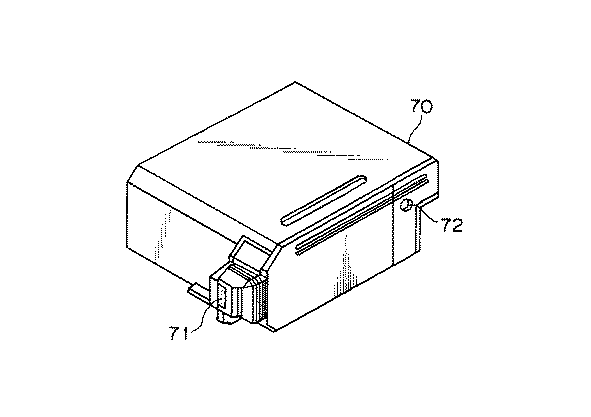
図6において、70は記録ユニットであって、この中にはインク収容部、例えばインク吸収体が収納されており、その中のインクが複数のオリフィスを有するヘッド部71からインク滴として吐出される構成になっている。インク吸収体の材料としては、ポリウレタンを用いることが本発明のインクにとって好ましい。72は記録ユニット内部を大気に連通させる為の連通口である。この記録ユニット70は、図4で示す記録ヘッドに代えて用いられるものであって、キャリッジ66に対し着脱自在になっている。
【0058】
本発明のインクを使用し、特に効果の高い捺染を行なうためには、吐出液滴が20〜200pl,インク打込量が4〜40nl/mm2 ,駆動周波数1.5KHz以上およびヘッド温度35〜60℃の条件が好ましい。
【0059】
以上の如くして本発明の捺染インクは、布帛上に付与されるが、この状態では単に付着しているに過ぎないので、引続き繊維への染料の反応定着及び未定着の染料の除去工程を施すのが好ましい。このような反応定着及び未反応の染料の除去方法は、従来公知の方法で良く、例えば、スチーミング法、HTスチーミング法、サーモフィックス法、あらかじめアルカリ処理した布帛を用いない場合は、アルカリパッドスチーム法、アルカリブロッチスチーム法、アルカリショック法、アルカリコールドフィックス法等による処理の後、洗浄する従来公知の方法に準じて行うことができる。中でも、スチーミング法、HTスチーミング法において本発明の効果が顕著である。
【0060】
なお、得られた捺染物は、必要に応じて、所望の大きさに切り離され、切り離された片は縫着、接着、溶着等、最終的な加工品を得るための工程が施され、ネクタイ、ハンカチ等の加工品を得ることができる。
【0061】
【実施例】
次に実施例および比較例を挙げて、本発明をさらに具体的に説明する。なお文中、「部」および「%」とあるのは全て重量基準である。
[ 実施例1及び参考例1 ]
(参考例1-1)
反応染料(C.I.Reactive Yellow 95) 10部
チオジグリコール 24部
ジエチレングリコール 11部
リン酸一ナトリウム 0.06部
水 54.9部
上記全成分を混合し、2時間攪拌した後、フロロポアフィルターFP-100(商品名、住友電工製)にて濾過し、インク(A)を得た。
【0062】
同様の手法で、下記の組成のインク(B)〜(F)を得た。
(参考例1-2)
インクB
反応染料(C.I.Reactive Red 226) 10部
チオジグリコール 15部
ジエチレングリコール 10部
テトラエチレングリコールジメチルエーテル 5部
リン酸二ナトリウム 0.08部
水 59.9部
(実施例1-1)
インクC
反応染料(C.I.Reactive Blue 15) 13部
チオジグリコール 23部
トリエチレングリコールモノブチルエーテル 6部
リン酸一ナトリウム 0.004部
トリポリリン酸ナトリウム 0.01部
水 58部
(参考例1-3)
インクD
反応染料(C.I.Reactive Brown 11) 2部
反応染料(C.I.Reactive Orange 12) 1.5部
反応染料(C.I.Reactive Black 39) 6.5部
チオジグリコール 23部
ジエチレングリコール 5部
ジプロピレングリコール 3部
リン酸一ナトリウム 0.12部
水 58.9部
(実施例1-2)
インクE
反応染料(C.I.Reactive Blue 49) 15部
チオジグリコール 16部
ジエチレングリコール 17部
リン酸一ナトリウム 0.03部
リン酸二ナトリウム 0.04部
トリポリリン酸ナトリウム 0.05部
水 51.9部
(参考例1-4)
インクF
反応染料(C.I.Reactive Red 218) 15部
チオジグリコール 16部
ジエチレングリコール 12部
トリプロピレングリコール 5部
リン酸一ナトリウム 0.05部
リン酸三ナトリウム 0.02部
水 51.9部
[ 実施例2、参考例2および比較例1 ]
実施例1-1〜1-2および参考例1 - 1〜1 - 4のインクA〜Fおよび下記の組成で実施例1と同様の手法で調製した比較用インクG〜Iを、熱エネルギーを利用したインクジェット記録装置であるカラーバブルジェットコピアPIXEL PRO(商品名、キヤノン製)用ヘッド(ノズル数256、飛翔液滴20〜40pl)に搭載して、10本のノズルで2×10⁸パルスの連続印字を行なったときの、ノズルの目詰まり、吐出液滴量、吐出速度の低下の有無などを調べた。
インクG
反応染料(C.I.Reactive Yellow 95) 10部
チオジグリコール 24部
ジエチレングリコール 11部
リン酸一ナトリウム 0.0008部
水 55部
インクH
反応染料(C.I.Reactive Yellow 95) 10部
チオジグリコール 24部
ジエチレングリコール 11部
リン酸一ナトリウム 0.26部
水 54.7部
インクI
反応染料(反応基がジクロルトリアジンの染料、
C.I.Reactive Yellow 1) 10部
チオジグリコール 24部
ジエチレングリコール 11部
リン酸一ナトリウム 0.06部
水 54.9部
また、同じヘッドで3分間連続して英数文字を印字した後印字を停止し、キャップをしない状態で7日間放置して、ノズルの先端付近での固形物の付着による目詰りを調べた(ヘッドはいづれも35〜60℃の範囲に昇温して使用した。)。また、インクA〜I 100ccをガラスビンに入れ、50℃に20日間保存し、インクの保存安定性を調べた。インクの性質および評価結果を表1に示す。
【0063】
また、インクA〜IをそれぞれカラーバブルジェットコピアPIXEL PRO(商品名、キヤノン製)に搭載し、予めアルカリ処理した綿100%の敷布(平地細布、エジプト綿100%、水分率15%)、及び絹100%の敷布(羽二重 8匁付、水分率18%)にプリントを行い、104℃で10分間の蒸熱処理による定着を行い、その後、中性洗剤で洗浄して、染色品の均染性について肉眼観察にて評価した。その結果を表2に示す(プリントは2×10cmのベタサンプルをインク打込量16nl/mm2 の条件で作成した。)。
【0064】
また、染着率は、本発明のリン酸イオンを含むインク(A〜F)を用いた場合より比較用インク(G〜I)を用いた方が劣っていた。
【0065】
【表1】
(100ppm=0.01%)
*2 10本のノズルで2×10⁸ パルスの連続印字を行ったときに、ノズルの目詰り、吐出液滴量や吐出速度の減少等がおこらなかったノズル数を測定し、下記の基準で評価
○:10本 △:6〜9本 ×:5本以下
*3 3分間連続印字後、キャップをしないで7日間放置した時のノズルの先端付近での固形物の付着による目詰りの状態を下記の基準で評価
○:目詰り無し
△:目詰りはあるが吸引により回復
×:吸引しても目詰りは回復しない
*4 インクを50℃に20日間保存した後、ガラスビン内に異物が発生するか否かを目視し、判定した。また保存インクを16nl/mm2 の打込量で印字発色させ、保存前のインクを用いた場合のプリント物の発色濃度と比較した。
【0066】
○:異物無し。発色濃度の差なし
△:異物発生小。発色濃度の低下小
×:異物発生大。発色濃度の低下大
【0067】
【表2】
【発明の効果】
以上説明したように本発明のインクによれば、被染色布帛をセルロース繊維及び/又はポリアミド繊維を主体として構成される布帛に対して、滲みがなく鮮明で、且つ、高濃度の染色物を得ることが可能となる。
【0069】
また、本発明のインクは、短期あるいは長期にわたって安定し、常温で保存しても染色特性に変化がない。
【0070】
更に、本発明のインク、捺染方法および機器により、長時間にわたってヘッドノズルにおける目詰り等の発生しない、吐出性能の信頼性が高いインクジェット印捺を行うことができる。特に、熱エネルギーによるインクの発泡現象によってインクを吐出させるタイプの記録においては、格段に良好である。
【図面の簡単な説明】
【図1】インク吐出ヘッドの縦断面図である。
【図2】図1のヘッドのA・B線横断面図である。
【図3】図1のヘッドをマルチ化したヘッドの外観斜視図である。
【図4】インクジェット記録装置の1例の斜視図である。
【図5】インクカートリッジの縦断面図である。
【図6】記録ユニットの斜視図である。
【符号の説明】
13 ヘッド
14 溝
15、28 発熱ヘッド
16 保護膜
17-1、17-2 アルミニウム電極
18 発熱抵抗体層
19 蓄熱層
20 基板
21 インク
22 吐出オリフィス(微細孔)
23 メニスカス
25 布帛
26 マルチ溝
27 ガラス板
40 インク収容部
42 栓 ( ゴム製 )
44、63 インク吸収体
51 給布部
52 布送りローラ
53 排布ローラ
61 記録ヘッドワイピング用ブレード
62 記録ヘッド用キャップ
64 ヘッド回復部
65 記録ヘッド
66 記録ヘッドキャリッジ
67 ガイド軸
68 モータ
69 ベルト
70 記録ユニット
71 記録ユニットヘッド部
72 大気連通口[0001]
[Industrial application fields]
The present invention particularly relates to a woven or non-woven fabric such as cotton and silk mainly composed of cellulose fibers and / or polyamide fibers that can be dyed with reactive dyes, or a mixed woven fabric or mixed non-woven fabric composed of these fibers and other fibers. The present invention relates to an ink for ink-jet textile printing suitable for textile printing, and an ink-jet textile printing method and apparatus using the ink.
[0002]
[Prior art]
The mainstream of current textile printing is screen printing and roller textile printing. However, these methods are unsuitable for high-mix low-volume production, and it is difficult to respond quickly to the fashion. There is a need for a textile printing system.
[0003]
In response to this demand, many textile printing methods using ink jet recording have been proposed, and expectations from various directions are also increasing.
[0004]
Ink for inkjet textile printing
(1) Even after washing, the color develops at a sufficient concentration.
(2) Do not clog the discharge nozzle,
(3) The ink is quickly dried on the fabric,
(4) Less irregular bleeding on the fabric,
(5) No change in physical properties, change in ejection characteristics, solid matter precipitation during storage,
(6) No change in ejection characteristics even during long-term durability, especially in the case of printing by a method using thermal energy, no disconnection or foreign matter deposition on the heating head,
Etc. are required. In order to satisfy these requirements, the following means have been conventionally proposed.
[0005]
First, for the requirement (1) above, a method of sufficiently increasing the concentration of the dye is generally used, particularly in the case of using a small droplet of 200 pl or less and in the case of a fabric having a strong absorbency. This is an essential method. However, such an ink causes a problem of the above (2) due to thickening due to evaporation of moisture in the ink from the nozzle tip or precipitation of a solid dye.
[0006]
Therefore, measures such as adding a polyhydric alcohol such as glycerin have been taken for the requirement (2), but this is not effective when the dye concentration exceeds 5%, and the combination of the dye and the solvent is not effective. Satisfactory results are not obtained except in very specific cases.
[0007]
Regarding the requirement (3), the influence of the water repellency of the fabric is large, and there is no particular problem when water-based ink is used for a fabric mainly composed of cellulose fibers and / or polyamide fibers.
[0008]
For the requirement (4), many proposals have been made, for example, addition of tannin (Japanese Patent Laid-Open No. 61-231289) or a carboxylic acid group-containing polymer (Japanese Patent Laid-Open No. 62-283174) to ink. However, both of the problems (1) and (2) based on ink are inevitable.
[0009]
Regarding the requirements of (5) and (6), there are cases where it is based on the structure of the dye, and there are cases where it is improved by an additive.
[0010]
Furthermore, in the field of textile printing, dyeing of various fabrics is desired, but the optimum ink composition differs for each fabric. That is, the dyeing mechanism of the dye and the fabric is ionic bond, covalent bond, or simply by diffusion into the fiber, and it varies greatly from the type of dye used to the fixing conditions. When using, the affinity for water is quite different, so it is necessary to devise the design of the entire liquid medium including additives. Accordingly, since the technical problems required for the ink are slightly different for each target fabric, individual ink design is required.
[0011]
[Problems to be solved by the invention]
A method for satisfying the above-described requirements independently can be found in the prior art, but no textile printing ink that satisfies these requirements has been known so far.
[0012]
The object of the present invention is therefore to use vivid and high density dyeing, short and long term stability, stability of dyeing properties during storage at room temperature and thermal energy on fabrics containing cellulose fibers and / or polyamide fibers. Accordingly, an object of the present invention is to provide an ink that simultaneously satisfies the requirement of highly reliable printing when ejecting ink, and to provide a printing method and apparatus using the ink.
[0013]
[Means for Solving the Problems]
The above object is achieved by the present invention described below. That is, the present invention is an ink for inkjet printing comprising 5 to 30% by weight of a reactive dye having a vinyl sulfone group and / or a monochlorotriazine group and an aqueous liquid medium,Furthermore, it contains polyphosphate ions with a degree of polymerization of 3 or more, andIn the liquid medium, at least 10 to 2000 ppm phosphate ion (POFour 3-)doingAn ink for ink-jet textile printing, a textile printing method using such an ink, an apparatus, and a printed matter obtained by the method are provided.
[0014]
As a result of improving the ink to satisfy all of the above performance requirements at the same time, the present inventors have included a certain amount of phosphate ion in the ink containing a reactive dye having a vinyl sulfone group and a monochlorotriazine group. The color development characteristics such as leveling and dyeing rate are remarkably improved with respect to the fabric containing cellulose fiber and / or polyamide fiber, and stable ejection characteristics can be obtained over a long period of time and stored for a long period of time. The inventors have found that there is no change in the ejection characteristics and the color development characteristics even when ink is used, and the present invention has been achieved.
[0015]
These effects are particularly remarkable when an ink jet head using thermal energy is used.
[0016]
The reason why the color development characteristics were improved is that the presence of a certain amount of phosphate ions suppressed the interaction between the dyes in the aqueous liquid medium and dramatically improved the reaction characteristics of the dyes to the fibers at the molecular level. It is.
[0017]
In addition, the long-term stabilization of the ejection characteristics and color development characteristics seems to be based on the buffering effect of phosphate ions and the anti-aggregation effect of the dye.
[0018]
Furthermore, when a head using thermal energy was used, it was confirmed that the ink of the present invention suppresses the deposition of deposits on the head heater due to the dye.
[0019]
The phosphate ion concentration range added to the ink of the present invention is 10 to 2000 ppm, preferably 20 to 1500 ppm, more preferably 30 to 1000 ppm. Within this concentration range, in the system using the dye used in the ink of the present invention, the problem of clogging which is usually a concern can be dealt with when used in the textile printing field. Specifically, it is added in the form of a salt, and a sodium or ammonium salt form is preferably used.
[0020]
When the phosphate ion concentration is less than 10 ppm, the effect of improving the color developability is not sufficient, and the ink dischargeability may be deteriorated. Furthermore, when an inkjet head using thermal energy is used, 1 × 10⁸ Due to driving at the pulse level, the heater can be destroyed by cavitation.
[0021]
Conversely, when the phosphate ion concentration exceeds 2000 ppm, clogging due to precipitation of phosphate itself near the nozzle tip may occur depending on the ink composition, even if the nozzle diameter is considerably large, in addition to the problem of color development. In addition, when a head using thermal energy is used, deposits may accumulate on the head heater, and non-ejection may occur due to a reduction in foaming power.
[0022]
The dye used in the present invention is a reactive dye having a vinyl sulfone group and / or a monochlorotriazine group, and the above-described effects become remarkable by the coexistence of the reactive dye having such a reactive group and a phosphate ion. The reason for such a synergistic effect seems to be because the above-mentioned two reactive groups are balanced in terms of reactivity. For example, the effect of the present invention cannot be obtained with a highly reactive dichlorotriazine group, and the effect is not significant with a less reactive trichloropyrimidine group. Specific examples of the dye include C.I. I. Reactive Yellow 2, 15, 37, 42, 76, 95 C.I. I.
[0023]
One or more of these dyes are contained in the ink and can be used in combination with those having different hues. The amount used is generally 5 to 30% by weight based on the total amount of the ink. , Preferably 5 to 25% by weight, more preferably 5 to 20% by weight. If it is less than 5% by weight, the color density is insufficient. On the other hand, if it exceeds 30% by weight, the ink ejection properties are not sufficient.
[0024]
Water, which is an essential component of the solvent body of the ink of the present invention, is 30 to 90% by weight, preferably 40 to 90% by weight, more preferably 50 to 85% by weight, based on the total amount of the ink.
[0025]
The above is an essential component of the ink of the present invention, and a general organic solvent can be used in combination as a liquid medium of the ink. For example, ketones or keto alcohols such as acetone and diacetone alcohol; ethers such as tetrahydrofuran and dioxane; oxyethylenes such as diethylene glycol, triethylene glycol, tetraethylene glycol, dipropylene glycol, tripropylene glycol, polyethylene glycol, and polypropylene glycol Or oxypropylene addition polymers; alkylene glycols containing 2 to 6 carbon atoms such as ethylene glycol, propylene glycol, trimethylene glycol, butylene glycol, hexylene glycol; 1,2,6-hexanetriol, etc. Thiodiglycol; glycerin; ethylene glycol monomethyl (or ethyl) ether, diethylene glycol monomethyl Lower alkyl ethers of polyhydric alcohols such as (or ethyl) ether and triethylene glycol monomethyl (or ethyl) ether; polyhydric alcohols such as triethylene glycol dimethyl (or ethyl) ether and tetraethylene glycol dimethyl (or ethyl) ether Lower dialkyl ethers; sulfolane, N-methyl-2-pyrrolidone, 1,3-dimethyl-2-imidazolidinone and the like.
[0026]
The content of the water-soluble organic solvent is generally 3 to 60%, preferably 5 to 50% by weight with respect to the total weight of the ink.
[0027]
When the above-mentioned media are used in combination, they can be used alone or as a mixture. Preferred liquid-medium compositions are thiodiglycol, a polymer of oxyethylene or oxypropylene having a polymerization degree of 2 to 4 as a solvent, and a mono- or dialkyl ether thereof. It contains. Of these, thiodiglycol alone or a mixture of diethylene glycol and thiodiglycol is particularly good.
[0028]
If the ink of the present invention described above is used, the above-described effects of the present invention can be sufficiently obtained. Furthermore, by containing a polyphosphate ion having a polymerization degree of 3 or more, the above-mentioned fabric can be leveled and dyed. It has been found that it is possible to prevent bleeding of recorded matter as well as improving color development characteristics such as wearability.
[0029]
This is presumed to be because polyphosphate ions prevent dye migration in the steaming process after the ink is deposited on the cloth.
[0030]
The content of such polyphosphate ions is preferably 10 to 6000 ppm, more preferably 10 to 4000 ppm, based on the total weight of the ink.
[0031]
In the ink of the present invention, various dispersants as components of the aqueous liquid medium; anionic or nonionic surfactants; viscosity modifiers such as polyvinyl alcohol and water-soluble resins; surface tensions such as diethanolamine and triethanolamine An adjuster; a fluorescent brightener; a pH adjuster containing an alkali metal ion, an antifungal agent and the like can be added as necessary.
[0032]
The ink of the present invention is preferably used for a fabric containing 50% or more of cellulose fibers and / or polyamide fibers, particularly a fabric containing 50% or more of cellulose fibers and / or polyamide fibers containing at least an alkaline substance. Although there is no restriction | limiting in particular in the manufacturing method of the fabric, The fabric as described in Unexamined-Japanese-Patent No. 63-168382, Japanese Patent Publication No. 3-46589 etc. can be used. As the physical characteristics of the fibers and yarns constituting the fabric, those having a generally long fiber length, a thin yarn or fiber thickness, and a larger number are suitable for the ink of the present invention.
[0033]
For example, in the case of a fabric mainly composed of cellulose fibers, a fabric composed of fibers having an average fiber length of 25 to 60 mm, an average fiber thickness of 0.6 to 2.2 d, and an average number of 70 to 150 / cm. In the case of a fabric mainly containing silk fibers which are polyamide fibers, a fabric made of silk yarn having an average yarn thickness of 14 to 147d and an average fiber thickness of 2.5 to 3.5d is preferable.
[0034]
The fabric used for this invention can use the conventional pre-processing method together as needed. In particular, a fabric containing 0.01 to 5% by weight of an alkaline substance, or a substance selected from the group consisting of a water-soluble metal salt, a water-soluble polymer, urea, and thiourea is used in an amount of 0.01 to 20 What is contained by weight% may be more preferable.
[0035]
Examples of the alkaline substance in the present invention include alkali metal hydroxides such as sodium hydroxide and potassium hydroxide, amines such as mono, di, and triethanolamine, carbonic acid such as sodium carbonate, potassium carbonate, and sodium bicarbonate, or Examples include alkali metal bicarbonate. There are organic acid metal salts such as calcium acetate and barium acetate, ammonia and ammonia compounds. Further, sodium trichloroacetate or the like that becomes an alkaline substance under steaming or dry heat may be used. Particularly preferred alkaline substances are sodium carbonate and sodium bicarbonate used for dyeing reactive dyes.
[0036]
Examples of water-soluble polymers include starch substances such as corn and wheat, cellulose substances such as carboxymethylcellulose, methylcellulose, and hydroxyethylcellulose, sodium alginate, arabic gum, locust bean gum, tragacanth gum, guar gum, tamarind seeds, etc. Examples thereof include protein substances such as polysaccharides, gelatin, and casein, and natural water-soluble polymers such as tannin substances and lignin substances.
[0037]
Examples of the synthetic polymer include polyvinyl alcohol compounds, polyethylene oxide compounds, acrylic acid water-soluble polymers, and maleic anhydride water-soluble polymers. Of these, polysaccharide polymers and cellulose polymers are preferred.
[0038]
Examples of the water-soluble metal salts include compounds that form typical ionic crystals and have a pH of 4 to 10, such as alkali metal and alkaline earth metal halides. Representative examples of such compounds include, for example, NaCl,N a 2 SO Four , KCl, CHThreeCOONa and the like can be mentioned, and alkaline earth metals include CaCl.2, MgCl2Etc. Of these, Na, K and Ca salts are preferred.
[0039]
Furthermore, it is also preferable to adjust the moisture content of the fabric at the time of printing, which is increased by 5 to 100% of the official moisture content of the constituent fibers (cellulose fiber 8.5%, silk fiber 12%), more preferably 6 A fabric adjusted to increase by -80% is preferable.
[0040]
As a method for adjusting the moisture content, a process of immersing in pure water or an aqueous solution of the pretreatment agent and then squeezing with a roller and drying as necessary is not limited.
[0041]
The moisture content is calculated by the following equation.
[0042]
[Expression 1]
Moisture content (%) = {(W−W ′) / W ″} × 100
In the above formula, W represents the weight of the sample before drying, W ′ represents the weight of the sample after drying, and W ″ represents the weight of the fabric that has been completely dried after washing with water.
[0043]
The ink prepared as described above is applied to such a fabric by an ink jet recording method.
[0044]
The ink jet recording method may be any conventionally known method. For example, Japanese Patent Application Laid-Open No. 54-59936 discloses a method in which ink is ejected from a nozzle by using thermal energy. Even in continuous recording over a long period of time, there is no deposit of foreign matter or disconnection at the heating head, and stable printing with excellent color development and leveling is possible.
[0045]
As an example of an apparatus suitable for inkjet printing using the ink of the present invention, there is an apparatus for applying thermal energy corresponding to a recording signal to ink in a recording head chamber and generating droplets from the thermal energy. .
[0046]
An example of a head configuration which is a main part of the apparatus is shown in FIGS. FIG. 1 is a longitudinal sectional view of the ink discharge head, and FIG. 2 is a transverse sectional view thereof.
[0047]
The
[0048]
The
[0049]
Now, when an electrical signal is applied to the electrodes 17-1 and 17-2, the region indicated by n of the
[0050]
FIG. 4 shows an example of an ink jet recording apparatus incorporating the ink discharge head shown in FIGS. In the figure,
[0051]
Reference numeral 65 denotes a recording head which has discharge energy generating means and discharges ink onto a cloth facing the discharge port surface, and 66 is a carriage for mounting and moving the recording head 65. The
[0052]
[0053]
In the above configuration, when the recording head 65 returns to the home position due to the end of recording or the like, the
[0054]
When the recording head 65 moves from the home position to the recording start position, the
[0055]
The above-described movement of the recording head to the home position is performed not only at the end of recording or at the time of ejection recovery, but also at a predetermined time interval while the recording head moves in the recording area for recording. The wiping is performed.
[0056]
FIG. 5 is a diagram illustrating an example of an ink cartridge in which an ink supply member, for example, a tube containing ink is accommodated in the head.
[0057]
In FIG. 6,
[0058]
In order to perform printing with particularly high effect using the ink of the present invention, the ejected droplets are 20 to 200 pl, and the ink ejection amount is 4 to 40 nl / mm.2 , A driving frequency of 1.5 KHz or more and a head temperature of 35-60 ° C. are preferable.
[0059]
As described above, the textile printing ink of the present invention is applied on the cloth, but in this state, it is merely attached, so that the process of reactive fixing of the dye to the fiber and the removal of the unfixed dye are continued. It is preferable to apply. Such reactive fixing and removal of unreacted dye may be a conventionally known method, for example, a steaming method, an HT steaming method, a thermofix method, or an alkali pad when a fabric subjected to alkali treatment in advance is not used. After the treatment by a steam method, an alkali blotch steam method, an alkali shock method, an alkali cold fix method, or the like, it can be carried out according to a conventionally known method of washing. Especially, the effect of this invention is remarkable in the steaming method and the HT steaming method.
[0060]
The obtained printed material is cut into a desired size as necessary, and the cut pieces are subjected to a process for obtaining a final processed product such as sewing, adhesion, welding, etc. Processed products such as handkerchiefs can be obtained.
[0061]
【Example】
Next, the present invention will be described more specifically with reference to examples and comparative examples. In the text, “parts” and “%” are all based on weight.
[ Example 1 and Reference Example 1 ]
(Reference example1-1)
Reactive dye (C.I.Reactive Yellow 95) 10 parts
Diethylene glycol 11 parts
Monosodium phosphate 0.06 parts
54.9 parts of water
All the above components were mixed and stirred for 2 hours, and then filtered through a fluoropore filter FP-100 (trade name, manufactured by Sumitomo Electric) to obtain ink (A).
[0062]
In the same manner, inks (B) to (F) having the following compositions were obtained.
(Reference example1-2)
Ink B
Reactive dye (C.I.Reactive Red 226) 10 parts
Diethylene glycol 10 parts
Tetraethylene glycol dimethyl ether 5 parts
0.08 parts disodium phosphate
59.9 parts of water
Example 11)
Ink C
Reactive dye (C.I.Reactive Blue 15) 13 parts
6 parts of triethylene glycol monobutyl ether
Monosodium phosphate 0.004 parts
0.01 parts of sodium tripolyphosphate
58 parts of water
(Reference example1-3)
Ink D
Reactive dye (C.I.Reactive Brown 11) 2 parts
Reactive dye (C.I.Reactive Orange 12) 1.5 parts
Reactive dye (C.I.Reactive Black 39) 6.5 parts
Diethylene glycol 5 parts
Dipropylene glycol 3 parts
Monosodium phosphate 0.12 parts
58.9 parts of water
Example 12)
Ink E
Reactive dye (C.I.Reactive Blue 49) 15 parts
17 parts of diethylene glycol
Monosodium phosphate 0.03 parts
Disodium phosphate 0.04 parts
Sodium tripolyphosphate 0.05 parts
51.9 parts of water
(Reference example1-4)
Ink F
Reactive dye (C.I.Reactive Red 218) 15 parts
Diethylene glycol 12 parts
5 parts of tripropylene glycol
Monosodium phosphate 0.05 parts
Trisodium phosphate 0.02 parts
51.9 parts of water
[ Example 2, Reference Example 2 and Comparative Example 1 ]
Examples 1-1 to 1-2 and Reference Example 1 - 1-1 - 4Ink A to F and Comparative Inks G to I prepared in the same manner as in Example 1 with the following composition were used as color bubble jet copier PIXEL PRO (trade name, manufactured by Canon Inc.) which is an ink jet recording apparatus using thermal energy. ) Head (256 nozzles, flying droplets 20-40pl), 10 nozzles 2 × 10⁸The nozzles were clogged, the amount of ejected liquid droplets, the presence or absence of a decrease in the ejection speed, etc. when continuous pulse printing was performed were examined.
Ink G
Reactive dye (C.I.Reactive Yellow 95) 10 parts
Diethylene glycol 11 parts
Monosodium phosphate 0.0008 parts
55 parts of water
Ink H
Reactive dye (C.I.Reactive Yellow 95) 10 parts
Diethylene glycol 11 parts
Monosodium phosphate 0.26 parts
54.7 parts of water
Ink I
Reactive dye (dye whose reactive group is dichlorotriazine,
C.I.Reactive Yellow 1) 10 parts
Diethylene glycol 11 parts
Monosodium phosphate 0.06 parts
54.9 parts of water
Also, after printing alphanumeric characters for 3 minutes continuously with the same head, printing was stopped and left for 7 days without a cap to check for clogging due to adhesion of solid matter near the tip of the nozzle ( All the heads were used in a temperature range of 35-60 ° C.). Further, 100 cc of inks A to I were put in a glass bottle and stored at 50 ° C. for 20 days, and the storage stability of the ink was examined. Ink properties and evaluation results are shown in Table 1.
[0063]
Also, each of inks A to I is mounted on a color bubble jet copier PIXEL PRO (trade name, manufactured by Canon), and pre-alkali treated 100% cotton bedcloth (flat fabric, Egyptian cotton 100%,
[0064]
The dyeing rate was inferior when the comparative inks (G to I) were used, compared to the case where the inks (A to F) containing phosphate ions of the present invention were used.
[0065]
[Table 1]
(100 ppm = 0.01%)
* 2 2 × 10 with 10 nozzles8 Measure the number of nozzles that were not clogged with nozzles, decrease the volume of ejected droplets, or decrease the ejection speed when performing continuous pulse printing, and evaluate according to the following criteria
○: 10 △: 6 to 9 ×: 5 or less
* 3 After the continuous printing for 3 minutes, the clogging condition due to the adhesion of solid matter near the nozzle tip when left without a cap for 7 days is evaluated according to the following criteria.
○: No clogging
Δ: Clogged but recovered by suction
×: Clogging does not recover even after suction
* 4 After the ink was stored at 50 ° C. for 20 days, it was judged by visual observation whether or not foreign matter was generated in the glass bottle. Storage ink is 16nl / mm2 The printed color was developed with the applied amount of and the color density of the printed matter was compared with the ink before storage.
[0066]
○: No foreign matter. No difference in color density
Δ: Small occurrence of foreign matter Small decrease in color density
X: Large generation of foreign matter. Large decrease in color density
[0067]
[Table 2]
【The invention's effect】
As described above, according to the ink of the present invention, the fabric to be dyed has a clear and high-density dyed product with no bleeding compared to a fabric mainly composed of cellulose fibers and / or polyamide fibers. It becomes possible.
[0069]
Further, the ink of the present invention is stable over a short period or a long period, and there is no change in dyeing characteristics even when stored at room temperature.
[0070]
Furthermore, the ink, the printing method, and the apparatus of the present invention can perform ink jet printing with high reliability in ejection performance that does not cause clogging in the head nozzle for a long time. In particular, this is much better in the type of recording in which ink is ejected by the ink bubbling phenomenon caused by thermal energy.
[Brief description of the drawings]
FIG. 1 is a longitudinal sectional view of an ink discharge head.
2 is a cross-sectional view of the head of FIG. 1 taken along line A and B. FIG.
3 is an external perspective view of a head in which the head of FIG.
FIG. 4 is a perspective view of an example of an ink jet recording apparatus.
FIG. 5 is a longitudinal sectional view of an ink cartridge.
FIG. 6 is a perspective view of a recording unit.
[Explanation of symbols]
13 head
14 groove
15,28 Heating head
16 Protective film
17-1, 17-2 Aluminum electrode
18 Heating resistor layer
19 Heat storage layer
20 substrate
21 ink
22 Discharge orifice (micro hole)
23 Meniscus
25 Fabric
26 Multi groove
27 Glass plate
40 Ink compartment
42 plug ( Rubber )
44, 63 Ink absorber
51 Supply section
52 Cloth feed roller
53 Dispensing roller
61 Recording head wiping blade
62 Cap for recording head
64 Head recovery unit
65 Recording head
66 Recording head carriage
67 Guide shaft
68 motor
69 belt
70 Recording unit
71 Recording unit head
72 Air communication port
Claims (14)
Priority Applications (5)
| Application Number | Priority Date | Filing Date | Title |
|---|---|---|---|
| JP32694393A JP3666895B2 (en) | 1993-01-13 | 1993-12-24 | Ink jet textile printing ink, textile printing method, equipment using such ink, and printed matter obtained |
| EP19930310613 EP0606777B2 (en) | 1993-01-13 | 1993-12-30 | Ink-jet textile printing ink, printing process and instrument making use of the same, and prints obtained |
| DE1993622247 DE69322247T3 (en) | 1993-01-13 | 1993-12-30 | Inkjet printing ink for printing on textiles, processes, printing device and prints obtained |
| KR1019940000400A KR0146665B1 (en) | 1993-01-13 | 1994-01-12 | Ink-jet textile printing ink, printing process and instrument making use of the same, and prints obtained |
| US08/589,329 US5584918A (en) | 1993-01-13 | 1996-01-22 | Ink-jet textile printing ink, printing process and instrument making use of the same, and prints obtained |
Applications Claiming Priority (3)
| Application Number | Priority Date | Filing Date | Title |
|---|---|---|---|
| JP5-4318 | 1993-01-13 | ||
| JP431893 | 1993-01-13 | ||
| JP32694393A JP3666895B2 (en) | 1993-01-13 | 1993-12-24 | Ink jet textile printing ink, textile printing method, equipment using such ink, and printed matter obtained |
Publications (2)
| Publication Number | Publication Date |
|---|---|
| JPH06264018A JPH06264018A (en) | 1994-09-20 |
| JP3666895B2 true JP3666895B2 (en) | 2005-06-29 |
Family
ID=26338067
Family Applications (1)
| Application Number | Title | Priority Date | Filing Date |
|---|---|---|---|
| JP32694393A Expired - Fee Related JP3666895B2 (en) | 1993-01-13 | 1993-12-24 | Ink jet textile printing ink, textile printing method, equipment using such ink, and printed matter obtained |
Country Status (5)
| Country | Link |
|---|---|
| US (1) | US5584918A (en) |
| EP (1) | EP0606777B2 (en) |
| JP (1) | JP3666895B2 (en) |
| KR (1) | KR0146665B1 (en) |
| DE (1) | DE69322247T3 (en) |
Families Citing this family (17)
| Publication number | Priority date | Publication date | Assignee | Title |
|---|---|---|---|---|
| JPH0825817A (en) * | 1994-07-14 | 1996-01-30 | Sony Corp | Recording material, manufacturing method thereof, recording method and recording apparatus |
| US5755861A (en) * | 1995-05-19 | 1998-05-26 | Brother Kogyo Kabushiki Kaisha | Ink composition, process for its preparation, and ink-jet recording process |
| JPH1018184A (en) * | 1996-05-02 | 1998-01-20 | Canon Inc | Ink-jet printing method and printed matter |
| US6200667B1 (en) * | 1997-03-24 | 2001-03-13 | Canon Kabushiki Kaisha | Cloth for textile printing, and textile printing process using the cloth and print obtained thereby |
| US5972084A (en) * | 1997-06-17 | 1999-10-26 | Ciba Specialty Chemicals Corporation | Process for printing textile fiber materials in accordance with the ink-jet printing process |
| US6007611A (en) * | 1997-06-17 | 1999-12-28 | Ciba Specialty Chemicals Corporation | Process for printing textile fibre materials in accordance with the ink-jet printing process |
| AU5859499A (en) * | 1998-09-16 | 2000-04-03 | Ciba Specialty Chemicals Holding Inc. | Method for printing fibrous textile materials according to the ink jet method |
| JP3582434B2 (en) | 1998-12-17 | 2004-10-27 | セイコーエプソン株式会社 | Ink composition for inkjet printing |
| DE10004954A1 (en) * | 2000-02-04 | 2001-08-16 | Dystar Textilfarben Gmbh & Co | Aqueous printing inks for use by the inkjet printing process, their production and their use on textile fiber materials |
| DE10135042A1 (en) * | 2001-07-11 | 2003-02-06 | Dystar Textilfarben Gmbh & Co | Aqueous ink formulations for the inkjet printing process |
| KR100641647B1 (en) * | 2003-03-25 | 2006-11-03 | 주식회사 잉크테크 | A pretreatment method of a fabric using an inkjet device and an inkjet printing method comprising the same. |
| US8556360B2 (en) | 2003-03-25 | 2013-10-15 | Intec Co., Ltd. | Textile printing method and apparatus applying inkjet printer |
| JP6115020B2 (en) * | 2012-04-10 | 2017-04-19 | コニカミノルタ株式会社 | Inkjet image forming method |
| JP6233579B2 (en) * | 2013-12-17 | 2017-11-22 | セイコーエプソン株式会社 | Ink composition for inkjet printing and printing method |
| JP6337636B2 (en) * | 2014-06-17 | 2018-06-06 | コニカミノルタ株式会社 | Image forming method |
| TWI548704B (en) * | 2015-05-08 | 2016-09-11 | 臺灣永光化學工業股份有限公司 | High fixation ink composition for Digital Textile printing application |
| CN108779356B (en) | 2016-03-16 | 2021-07-02 | 富士胶片株式会社 | ink |
Family Cites Families (14)
| Publication number | Priority date | Publication date | Assignee | Title |
|---|---|---|---|---|
| JPS5459936A (en) * | 1977-10-03 | 1979-05-15 | Canon Inc | Recording method and device therefor |
| JPS6034993B2 (en) * | 1980-05-06 | 1985-08-12 | キヤノン株式会社 | Recording liquid and its manufacturing method |
| EP0059782B1 (en) † | 1981-03-06 | 1986-05-21 | Ciba-Geigy Ag | Process for producing concentrated aqueous dyestuff preparations of anionic paper or wool dyes |
| JPS61231289A (en) * | 1985-04-05 | 1986-10-15 | 東レ株式会社 | Dyeing method |
| US4725849A (en) † | 1985-08-29 | 1988-02-16 | Canon Kabushiki Kaisha | Process for cloth printing by ink-jet system |
| US4849770A (en) * | 1985-12-13 | 1989-07-18 | Canon Kabushiki Kaisha | Ink for use in ink jet and ink jet printing method using the same |
| JPH0651858B2 (en) † | 1986-01-23 | 1994-07-06 | 三菱化成株式会社 | Ink for ink-jet printing and dyeing method |
| JPS62283174A (en) * | 1986-06-02 | 1987-12-09 | Toray Ind Inc | Ink composition for ink jet and dyeing method using said composition |
| JPS63168382A (en) * | 1986-12-29 | 1988-07-12 | Nagase Sangyo Kk | Ink jet dyeing method for cellulose fibrous structure |
| JPH0346589A (en) * | 1989-07-13 | 1991-02-27 | Mitsubishi Electric Corp | Distance measuring device |
| US5062892A (en) * | 1989-10-27 | 1991-11-05 | Hewlett-Packard Company | Ink additives for improved ink-jet performance |
| ATE215118T1 (en) * | 1990-09-29 | 2002-04-15 | Canon Kk | METHOD AND APPARATUS FOR INKJET RECORDING |
| GB9102037D0 (en) † | 1991-01-30 | 1991-03-13 | Ici Plc | Printing process & formulation |
| ATE136324T1 (en) † | 1992-03-06 | 1996-04-15 | Zeneca Ltd | INK COMPOSITIONS |
-
1993
- 1993-12-24 JP JP32694393A patent/JP3666895B2/en not_active Expired - Fee Related
- 1993-12-30 DE DE1993622247 patent/DE69322247T3/en not_active Expired - Lifetime
- 1993-12-30 EP EP19930310613 patent/EP0606777B2/en not_active Expired - Lifetime
-
1994
- 1994-01-12 KR KR1019940000400A patent/KR0146665B1/en not_active Expired - Fee Related
-
1996
- 1996-01-22 US US08/589,329 patent/US5584918A/en not_active Expired - Lifetime
Also Published As
| Publication number | Publication date |
|---|---|
| KR0146665B1 (en) | 1998-08-01 |
| EP0606777A2 (en) | 1994-07-20 |
| JPH06264018A (en) | 1994-09-20 |
| US5584918A (en) | 1996-12-17 |
| EP0606777B2 (en) | 2003-12-10 |
| DE69322247D1 (en) | 1999-01-07 |
| DE69322247T3 (en) | 2004-05-27 |
| KR940018219A (en) | 1994-08-16 |
| DE69322247T2 (en) | 1999-05-20 |
| EP0606777B1 (en) | 1998-11-25 |
| EP0606777A3 (en) | 1994-10-19 |
Similar Documents
| Publication | Publication Date | Title |
|---|---|---|
| JP3376002B2 (en) | Ink-jet printing ink, ink-jet printing method, recording unit, ink cartridge, ink-jet recording apparatus, printed fabric and processed product of fabric | |
| KR970001689B1 (en) | Ink-jet printing method and printed article | |
| JP3666895B2 (en) | Ink jet textile printing ink, textile printing method, equipment using such ink, and printed matter obtained | |
| KR960011719B1 (en) | Ink-jet textile printing ink and ink-jet textile printing process | |
| EP0553761B1 (en) | Cloth suitable for ink-jet textile printing and ink-jet textile printing method | |
| JPH05272078A (en) | Cloth for printing, ink jet printing method using the same and printed cloth | |
| JP3450372B2 (en) | Ink-jet printing ink, ink-jet printing method using such ink, and equipment | |
| JP3270598B2 (en) | Fabric for inkjet printing, inkjet printing method, and printed matter | |
| JP2895695B2 (en) | Fabric for inkjet printing, inkjet printing method and printed matter | |
| JP3241810B2 (en) | Printing method, color ink set, recording unit, ink cartridge, inkjet recording device, and printed matter | |
| JP3323549B2 (en) | Ink jet printing ink and ink jet printing method | |
| JP3107868B2 (en) | Ink jet printing ink and ink jet printing method | |
| JP3234643B2 (en) | Printing method and printed matter | |
| JPH05186727A (en) | Ink for ink jet printing, ink jet printing method, and machinery using the ink | |
| JPH0657650A (en) | Method for printing and printed material obtained from the same method | |
| JPH08127979A (en) | Ink-jet printing cloth, printing method, and printed material | |
| JPH10768A (en) | Inkjet printing method | |
| JP3053926B2 (en) | Inkjet printing method | |
| JP3604770B2 (en) | Ink jet printing ink and ink jet printing method | |
| JP3604769B2 (en) | Ink jet printing ink and ink jet printing method | |
| JPH05272077A (en) | INKJET PRINTING INK, INKJET PRINTING METHOD, AND DEVICE USING THE INK | |
| JPH0726180A (en) | Inkjet printing ink and inkjet printing method | |
| JP3450414B2 (en) | Ink-jet printing method and printed matter | |
| JP3053925B2 (en) | Inkjet printing method | |
| JPH07324285A (en) | INKJET PRINTING FABRIC, INKJET PRINTING METHOD, AND PRINTED PRODUCT |
Legal Events
| Date | Code | Title | Description |
|---|---|---|---|
| A61 | First payment of annual fees (during grant procedure) |
Free format text: JAPANESE INTERMEDIATE CODE: A61 Effective date: 20050405 |
|
| R150 | Certificate of patent or registration of utility model |
Free format text: JAPANESE INTERMEDIATE CODE: R150 |
|
| FPAY | Renewal fee payment (event date is renewal date of database) |
Free format text: PAYMENT UNTIL: 20090415 Year of fee payment: 4 |
|
| FPAY | Renewal fee payment (event date is renewal date of database) |
Free format text: PAYMENT UNTIL: 20090415 Year of fee payment: 4 |
|
| FPAY | Renewal fee payment (event date is renewal date of database) |
Free format text: PAYMENT UNTIL: 20100415 Year of fee payment: 5 |
|
| FPAY | Renewal fee payment (event date is renewal date of database) |
Free format text: PAYMENT UNTIL: 20110415 Year of fee payment: 6 |
|
| FPAY | Renewal fee payment (event date is renewal date of database) |
Free format text: PAYMENT UNTIL: 20130415 Year of fee payment: 8 |
|
| LAPS | Cancellation because of no payment of annual fees |