JP2025071663A - Method for producing 3-hydroxybenzoic acids - Google Patents
Method for producing 3-hydroxybenzoic acids Download PDFInfo
- Publication number
- JP2025071663A JP2025071663A JP2023182030A JP2023182030A JP2025071663A JP 2025071663 A JP2025071663 A JP 2025071663A JP 2023182030 A JP2023182030 A JP 2023182030A JP 2023182030 A JP2023182030 A JP 2023182030A JP 2025071663 A JP2025071663 A JP 2025071663A
- Authority
- JP
- Japan
- Prior art keywords
- amino acid
- acid sequence
- seq
- sequence shown
- polypeptide
- Prior art date
- Legal status (The legal status is an assumption and is not a legal conclusion. Google has not performed a legal analysis and makes no representation as to the accuracy of the status listed.)
- Pending
Links
Landscapes
- Preparation Of Compounds By Using Micro-Organisms (AREA)
- Micro-Organisms Or Cultivation Processes Thereof (AREA)
Abstract
Description
本発明はバイオマス資源を用いて3-ヒドロキシ安息香酸類を製造する方法に関する。 The present invention relates to a method for producing 3-hydroxybenzoic acids using biomass resources.
3-ヒドロキシ安息香酸は液晶素材の構成モノマーや農薬の中間体等として使用される工業的に有用な物質である。現在、3-ヒドロキシ安息香酸は安息香酸をスルホン化したのちアルカリ溶融する方法で製造されることが知られている。 3-Hydroxybenzoic acid is an industrially useful substance used as a constituent monomer of liquid crystal materials and as an intermediate for agricultural chemicals. Currently, it is known that 3-hydroxybenzoic acid can be produced by sulfonating benzoic acid and then fusing it with alkali.
一方、廃棄された化学素材を新たな化学品原料へと変換するケミカルリサイクルに関する技術が近年盛んに開発されている。中でもテレフタル酸はポリエチレンテレフタレートの構成モノマーなどとして大量に使用されることから、テレフタル酸を原料として3-ヒドロキシ安息香酸を得ることができれば、化学素材の再生可能性を高めることや、3-ヒドロキシ安息香酸の新たな供給方法を提供することにつながる。 Meanwhile, chemical recycling technologies that convert discarded chemical materials into new chemical raw materials have been actively developed in recent years. Terephthalic acid in particular is used in large quantities as a constituent monomer of polyethylene terephthalate, so if 3-hydroxybenzoic acid could be obtained from terephthalic acid as a raw material, it would increase the recyclability of chemical materials and provide a new method of supplying 3-hydroxybenzoic acid.
これまでに、テレフタル酸に対してヒドロキシラジカルが反応することで2-ヒドロキシテレフタル酸が生成することが知られている(非特許文献1)。このことから、2-ヒドロキシテレフタル酸の1位のカルボキシ基を選択的に脱炭酸することで3-ヒドロキシ安息香酸が得られると考えられるが、そのような反応はこれまでに報告されていない。 It has been known that 2-hydroxyterephthalic acid is produced by the reaction of terephthalic acid with a hydroxyl radical (Non-Patent Document 1). From this, it is thought that 3-hydroxybenzoic acid can be obtained by selectively decarboxylating the 1-carboxy group of 2-hydroxyterephthalic acid, but such a reaction has not been reported so far.
金属型デカルボキシラーゼは、亜鉛、マンガン、マグネシウム等の二価金属イオンを活性中心に持つ脱炭酸酵素で、オルト位に水酸基を有する安息香酸類に対して活性中心の金属イオンが錯形成することにより脱炭酸反応を触媒することが知られている(非特許文献2)。
しかしながら、斯かる金属型デカルボキシラーゼが2-ヒドロキシテレフタル酸を基質として、その選択的な脱炭酸反応を触媒することはこれまでに知られていない。
Metallo-decarboxylases are decarboxylases that have a divalent metal ion, such as zinc, manganese, or magnesium, in their active center, and are known to catalyze the decarboxylation reaction by forming a complex with benzoic acids having a hydroxyl group at the ortho position (Non-Patent Document 2).
However, it has not been known so far that such metallo-decarboxylases can catalyze the selective decarboxylation of 2-hydroxyterephthalic acid as a substrate.
本発明は、バイオマス資源を用いた3-ヒドロキシ安息香酸類の製造方法を提供することに関する。 The present invention relates to providing a method for producing 3-hydroxybenzoic acids using biomass resources.
本発明者らは、金属型デカルボキシラーゼ活性を有する特定のポリペプチドが2-ヒドロキシテレフタル酸に対して1位選択的な脱炭酸活性を示し、当該ポリペプチド又はこれを生産する微生物を用いることにより、効率よく3-ヒドロキシ安息香酸類が製造可能であることを見出した。 The present inventors have found that a specific polypeptide having metallo-decarboxylase activity exhibits selective decarboxylation activity at the 1-position of 2-hydroxyterephthalic acid, and that 3-hydroxybenzoic acids can be efficiently produced by using the polypeptide or a microorganism that produces the polypeptide.
本発明は以下に係るものである。
下記の一般式(1):
The present invention relates to the following.
The following general formula (1):

〔式中、R1及びR2は同一又は異なっていてもよく、水素原子、ヒドロキシ基、ハロゲン原子、炭素数1~4のアルキル基、炭素数1~4のアルコキシ基、アミノ基又はカルボキシ基を示す。〕
で表される2-ヒドロキシテレフタル酸類を、下記(A)~(E):
(A)配列番号2で示されるアミノ酸配列からなるポリペプチド、又は配列番号2で示されるアミノ酸配列と少なくとも90%の同一性を有するアミノ酸配列からなり、2-ヒドロキシテレフタル酸デカルボキシラーゼ活性を有するポリペプチド、
(B)配列番号4で示されるアミノ酸配列からなるポリペプチド、又は配列番号4で示されるアミノ酸配列と少なくとも90%の同一性を有するアミノ酸配列からなり、2-ヒドロキシテレフタル酸デカルボキシラーゼ活性を有するポリペプチド、
(C)配列番号6で示されるアミノ酸配列からなるポリペプチド、又は配列番号6で示されるアミノ酸配列と少なくとも90%の同一性を有するアミノ酸配列からなり、2-ヒドロキシテレフタル酸デカルボキシラーゼ活性を有するポリペプチド、
(D)配列番号8で示されるアミノ酸配列からなるポリペプチド、又は配列番号8で示されるアミノ酸配列と少なくとも90%の同一性を有するアミノ酸配列からなり、2-ヒドロキシテレフタル酸デカルボキシラーゼ活性を有するポリペプチド、
(E)配列番号10で示されるアミノ酸配列からなるポリペプチド、又は配列番号10で示されるアミノ酸配列と少なくとも90%の同一性を有するアミノ酸配列からなり、2-ヒドロキシテレフタル酸デカルボキシラーゼ活性を有するポリペプチド、
から選ばれるポリペプチド又はこれを生産する微生物と接触させる工程を含む、下記の一般式(2):
[In the formula, R 1 and R 2 may be the same or different and each represents a hydrogen atom, a hydroxyl group, a halogen atom, an alkyl group having 1 to 4 carbon atoms, an alkoxy group having 1 to 4 carbon atoms, an amino group, or a carboxy group.]
The 2-hydroxyterephthalic acids represented by the following (A) to (E):
(A) a polypeptide consisting of the amino acid sequence shown in SEQ ID NO: 2, or a polypeptide consisting of an amino acid sequence having at least 90% identity to the amino acid sequence shown in SEQ ID NO: 2, and having 2-hydroxyterephthalic acid decarboxylase activity;
(B) a polypeptide consisting of the amino acid sequence shown in SEQ ID NO: 4, or a polypeptide consisting of an amino acid sequence having at least 90% identity to the amino acid sequence shown in SEQ ID NO: 4, and having 2-hydroxyterephthalic acid decarboxylase activity;
(C) a polypeptide consisting of the amino acid sequence shown in SEQ ID NO: 6, or a polypeptide consisting of an amino acid sequence having at least 90% identity to the amino acid sequence shown in SEQ ID NO: 6, and having 2-hydroxyterephthalic acid decarboxylase activity;
(D) a polypeptide consisting of the amino acid sequence shown in SEQ ID NO: 8, or a polypeptide consisting of an amino acid sequence having at least 90% identity to the amino acid sequence shown in SEQ ID NO: 8, and having 2-hydroxyterephthalic acid decarboxylase activity;
(E) a polypeptide consisting of the amino acid sequence shown in SEQ ID NO: 10, or a polypeptide consisting of an amino acid sequence having at least 90% identity to the amino acid sequence shown in SEQ ID NO: 10, and having 2-hydroxyterephthalic acid decarboxylase activity;
or a microorganism producing the same,
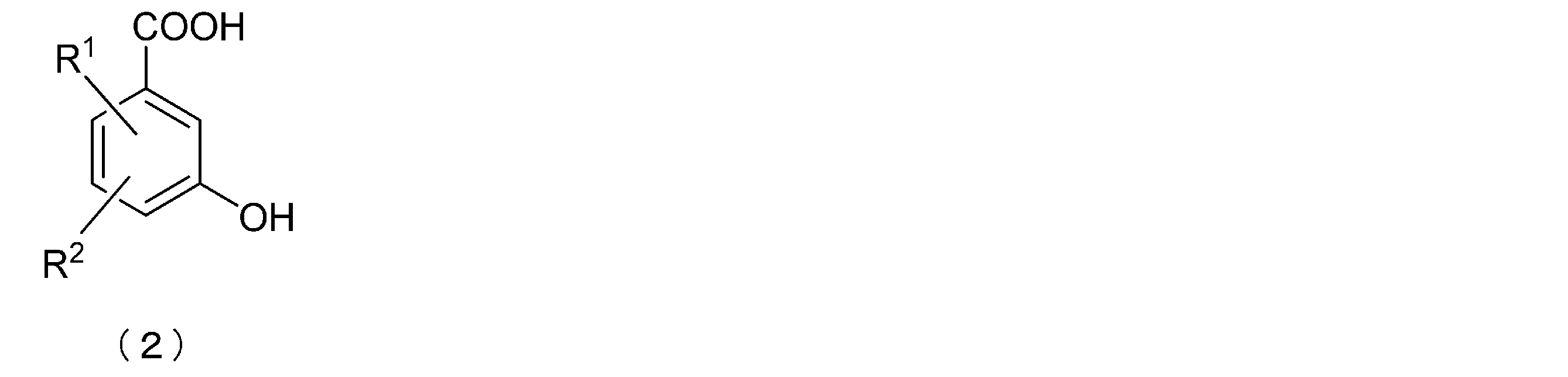
〔式中、R1及びR2は前記と同じものを示す。〕
で示される3-ヒドロキシ安息香酸類の製造方法。
(In the formula, R1 and R2 are the same as defined above.)
The present invention relates to a method for producing a 3-hydroxybenzoic acid represented by the following formula:
本発明の方法によれば、バイオマス資源を用いて3-ヒドロキシ安息香酸類を効率よく製造することができる。 The method of the present invention makes it possible to efficiently produce 3-hydroxybenzoic acids using biomass resources.
本発明において、アミノ酸配列又はヌクレオチド配列の同一性は、Lipman-Pearson法(Science,1985,227:1435-1441)によって計算される。具体的には、遺伝情報処理ソフトウェアGENETYX Ver.12のホモロジー解析(Search homology)プログラムを用いて、Unit size to compare(ktup)を2として解析を行うことにより算出される。 In the present invention, the identity of amino acid sequences or nucleotide sequences is calculated by the Lipman-Pearson method (Science, 1985, 227:1435-1441). Specifically, it is calculated by performing an analysis using the Search homology program of the genetic information processing software GENETYX Ver. 12 with a unit size to compare (ktup) of 2.
本発明において、アミノ酸配列及びヌクレオチド配列に関する「少なくとも90%の同一性」とは、90%以上、好ましくは95%以上、より好ましくは96%以上、さらに好ましくは97%以上、さらにより好ましくは98%以上、なお好ましくは99%以上の同一性をいう。 In the present invention, "at least 90% identity" with respect to amino acid sequences and nucleotide sequences means identity of 90% or more, preferably 95% or more, more preferably 96% or more, even more preferably 97% or more, even more preferably 98% or more, and even more preferably 99% or more.
本発明において、「1又は数個のアミノ酸が欠失、置換、付加、又は挿入されたアミノ酸配列」とは、1個以上20個以下、好ましくは1個以上15個以下、より好ましくは1個以上10個以下、より好ましくは1個以上8個以下、より好ましくは1個以上5個以下、さらにより好ましくは1個以上3個以下のアミノ酸が欠失、置換、付加、又は挿入されたアミノ酸配列をいう。また、「1又は数個のヌクレオチドが欠失、置換、付加、又は挿入されたヌクレオチド配列」とは、1個以上60個以下、好ましくは1個以上45個以下、より好ましくは1個以上30個以下、より好ましくは1個以上24個以下、より好ましくは1個以上15個以下、さらにより好ましくは1個以上9個以下のヌクレオチドが欠失、置換、付加、又は挿入されたヌクレオチド配列をいう。本発明において、アミノ酸又はヌクレオチドの「付加」には、配列の一末端及び両末端へのアミノ酸又はヌクレオチドの付加が含まれる。
斯かる欠失、置換、挿入、付加等の変異の導入は、例えば部位特異的な変異導入法等により、対象の塩基配列に変異を導入することにより実施できる。
In the present invention, "an amino acid sequence in which one or several amino acids are deleted, substituted, added, or inserted" refers to an amino acid sequence in which 1 to 20, preferably 1 to 15, more preferably 1 to 10, more preferably 1 to 8, more preferably 1 to 5, and even more preferably 1 to 3 amino acids are deleted, substituted, added, or inserted. In addition, "a nucleotide sequence in which one or several nucleotides are deleted, substituted, added, or inserted" refers to a nucleotide sequence in which 1 to 60, preferably 1 to 45, more preferably 1 to 30, more preferably 1 to 24, more preferably 1 to 15, and even more preferably 1 to 9 nucleotides are deleted, substituted, added, or inserted. In the present invention, "addition" of an amino acid or nucleotide includes addition of an amino acid or nucleotide to one end and both ends of a sequence.
Introduction of such mutations, such as deletion, substitution, insertion, and addition, can be carried out by introducing a mutation into the target nucleotide sequence, for example, by site-specific mutagenesis.
本発明において、遺伝子に関する「上流」及び「下流」とは、該遺伝子の転写方向の上流及び下流をいう。例えば、「プロモーターの下流に配置された遺伝子」とは、DNAセンス鎖においてプロモーターの3’側に該遺伝子が存在することを意味し、遺伝子の上流とは、DNAセンス鎖における該遺伝子の5’側の領域を意味する。 In the present invention, "upstream" and "downstream" in relation to a gene refer to the upstream and downstream in the transcription direction of the gene. For example, "a gene located downstream of a promoter" means that the gene is present on the 3' side of the promoter in the DNA sense strand, and "upstream of a gene" means the region on the 5' side of the gene in the DNA sense strand.
本発明において、プロモーター等の制御領域と遺伝子の「作動可能な連結」とは、遺伝子と制御領域とが、該遺伝子が該制御領域の制御の下で発現し得るように連結されていることをいう。遺伝子と制御領域との「作動可能な連結」の手順は当業者に周知である。 In the present invention, "operably linked" between a control region such as a promoter and a gene means that the gene and the control region are linked in such a way that the gene can be expressed under the control of the control region. The procedure for "operably linked" between a gene and a control region is well known to those skilled in the art.
本発明において、「外来遺伝子」とは、細胞に外部から導入された外因性の遺伝子である。外来遺伝子は、それが導入された細胞と同種の生物由来であっても、異種の生物由来(すなわち異種遺伝子)であってもよい。 In the present invention, a "foreign gene" refers to an exogenous gene that is introduced into a cell from the outside. A foreign gene may be derived from the same organism as the cell into which it is introduced, or from a different organism (i.e., a heterologous gene).
本発明の3-ヒドロキシ安息香酸類の製造方法は、下記の一般式(1): The method for producing 3-hydroxybenzoic acids of the present invention is represented by the following general formula (1):

〔式中、R1及びR2は同一又は異なっていてもよく、水素原子、ヒドロキシ基、ハロゲン原子、炭素数1~4のアルキル基、炭素数1~4のアルコキシ基、アミノ基又はカルボキシ基を示す。〕 [In the formula, R 1 and R 2 may be the same or different and each represents a hydrogen atom, a hydroxyl group, a halogen atom, an alkyl group having 1 to 4 carbon atoms, an alkoxy group having 1 to 4 carbon atoms, an amino group, or a carboxy group.]
で表される2-ヒドロキシテレフタル酸類を、下記(A)~(E):
(A)配列番号2で示されるアミノ酸配列からなるポリペプチド、又は配列番号2で示されるアミノ酸配列と少なくとも90%の同一性を有するアミノ酸配列からなり、2-ヒドロキシテレフタル酸デカルボキシラーゼ活性を有するポリペプチド、
(B)配列番号4で示されるアミノ酸配列からなるポリペプチド、又は配列番号4で示されるアミノ酸配列と少なくとも90%の同一性を有するアミノ酸配列からなり、2-ヒドロキシテレフタル酸デカルボキシラーゼ活性を有するポリペプチド、
(C)配列番号6で示されるアミノ酸配列からなるポリペプチド、又は配列番号6で示されるアミノ酸配列と少なくとも90%の同一性を有するアミノ酸配列からなり、2-ヒドロキシテレフタル酸デカルボキシラーゼ活性を有するポリペプチド、
(D)配列番号8で示されるアミノ酸配列からなるポリペプチド、又は配列番号8で示されるアミノ酸配列と少なくとも90%の同一性を有するアミノ酸配列からなり、2-ヒドロキシテレフタル酸デカルボキシラーゼ活性を有するポリペプチド、
(E)配列番号10で示されるアミノ酸配列からなるポリペプチド、又は配列番号10で示されるアミノ酸配列と少なくとも90%の同一性を有するアミノ酸配列からなり、2-ヒドロキシテレフタル酸デカルボキシラーゼ活性を有するポリペプチド、
から選ばれるポリペプチド又はこれを生産する微生物と接触させる工程を含む、下記の一般式(2):
The 2-hydroxyterephthalic acids represented by the following (A) to (E):
(A) a polypeptide consisting of the amino acid sequence shown in SEQ ID NO: 2, or a polypeptide consisting of an amino acid sequence having at least 90% identity to the amino acid sequence shown in SEQ ID NO: 2, and having 2-hydroxyterephthalic acid decarboxylase activity;
(B) a polypeptide consisting of the amino acid sequence shown in SEQ ID NO: 4, or a polypeptide consisting of an amino acid sequence having at least 90% identity to the amino acid sequence shown in SEQ ID NO: 4, and having 2-hydroxyterephthalic acid decarboxylase activity;
(C) a polypeptide consisting of the amino acid sequence shown in SEQ ID NO: 6, or a polypeptide consisting of an amino acid sequence having at least 90% identity to the amino acid sequence shown in SEQ ID NO: 6, and having 2-hydroxyterephthalic acid decarboxylase activity;
(D) a polypeptide consisting of the amino acid sequence shown in SEQ ID NO: 8, or a polypeptide consisting of an amino acid sequence having at least 90% identity to the amino acid sequence shown in SEQ ID NO: 8, and having 2-hydroxyterephthalic acid decarboxylase activity;
(E) a polypeptide consisting of the amino acid sequence shown in SEQ ID NO: 10, or a polypeptide consisting of an amino acid sequence having at least 90% identity to the amino acid sequence shown in SEQ ID NO: 10, and having 2-hydroxyterephthalic acid decarboxylase activity;
or a microorganism producing the same,

〔式中、R1及びR2は前記と同じものを示す。〕
で示される3-ヒドロキシ安息香酸類の製造法である。
(In the formula, R1 and R2 are the same as defined above.)
This is a method for producing 3-hydroxybenzoic acids represented by the following formula:
式(1)又は(2)において、R1、R2で示されるハロゲン原子としては、フッ素原子、塩素原子、臭素原子、ヨウ素原子が挙げられ、好ましくはフッ素原子、塩素原子、臭素原子であり、より好ましくはフッ素原子である。
炭素数1~4のアルキル基としては、好ましくはメチル基、エチル基、プロピル基、イソプロピル基、ブチル基、イソブチル基、tert-ブチル基等が挙げられ、より好ましくはメチル基、エチル基である。
炭素数1~4のアルコキシ基としては、好ましくはメトキシ基、エトキシ基、プロポキシ基、ブトキシ基等が挙げられ、より好ましくはメトキシ基である。
In formula (1) or (2), examples of the halogen atom represented by R 1 or R 2 include a fluorine atom, a chlorine atom, a bromine atom, and an iodine atom, of which a fluorine atom, a chlorine atom, or a bromine atom is preferred, and a fluorine atom is more preferred.
Preferred examples of the alkyl group having 1 to 4 carbon atoms include a methyl group, an ethyl group, a propyl group, an isopropyl group, a butyl group, an isobutyl group, and a tert-butyl group, and more preferred are a methyl group and an ethyl group.
Preferred examples of the alkoxy group having 1 to 4 carbon atoms include a methoxy group, an ethoxy group, a propoxy group, and a butoxy group, and more preferred is a methoxy group.
R1、R2はそれぞれ、水素原子、ヒドロキシ基、メトキシ基、フッ素原子又はメチル基であるのがより好ましく、R1及びR2が共に水素原子であるのがさらに好ましい。 It is more preferable that R 1 and R 2 each represent a hydrogen atom, a hydroxy group, a methoxy group, a fluorine atom or a methyl group, and it is even more preferable that R 1 and R 2 both represent a hydrogen atom.
原料として用いる2-ヒドロキシテレフタル酸類は、市販品を用いてもよく、また、例えば、水中でテレフタル酸とヒドロキシラジカルを共存させること等により製造することができる。ヒドロキシラジカルの生成方法は特に限定されず、例えば、水中にて酸化チタンに対して光照射を行う事(Ken-ichi Ishibashi et al., Electrochem. Commun. 2 2000, 207-210)等により生成することができる。 The 2-hydroxyterephthalic acids used as raw materials may be commercially available products, or may be produced, for example, by allowing terephthalic acid and hydroxyl radicals to coexist in water. There are no particular limitations on the method for producing hydroxyl radicals, and they can be produced, for example, by irradiating titanium oxide with light in water (Ken-ichi Ishibashi et al., Electrochem. Commun. 2 2000, 207-210).
上記(A)~(E)で示されるポリペプチド(「本発明のポリペプチド」と称す)は、2-ヒドロキシテレフタル酸に対して1位のカルボキシ基を選択的に脱炭酸する、2-ヒドロキシテレフタル酸デカルボキシラーゼ活性を有する。
(A)配列番号2で示されるアミノ酸配列からなるポリペプチドは、リゾビウム・エスピー(Rhizobium sp.)由来γ-レゾルシン酸デカルボキシラーゼとして知られているペプチドであり、
(B)配列番号4で示されるアミノ酸配列からなるポリペプチドは、ポラロモナス・エスピー(Polaromonas sp.)由来γ-レゾルシン酸デカルボキシラーゼとして知られているペプチドであり、
(C)配列番号6で示されるアミノ酸配列からなるポリペプチドは、クタネオトリコスポロン・モニリフォルメ(Cutaneotrichosporon moniliiforme)由来サリチル酸デカルボキシラーゼとして知られているペプチドであり、
(D)配列番号8で示されるアミノ酸配列からなるポリペプチドは、アスペルギルス・オリゼ(Aspergillus oryzae)由来2,3-ジヒドロキシ安息香酸デカルボキシラーゼとして知られているペプチドであり、
(E)配列番号10で示されるアミノ酸配列からなるポリペプチドは、スフィンゴモナス・パウシモビリス(Sphingomonas paucimobilis)由来5-カルボキシバニリン酸デカルボキシラーゼとして知られているペプチドのL34N変異体である。
なお、γ-レゾルシン酸デカルボキシラーゼ(EC4.1.1.103)はγ-レゾルシン酸のカルボキシル基を脱炭酸し、レゾルシノールを生成する反応を触媒する酵素であり、
サリチル酸デカルボキシラーゼ(EC4.1.1.91)はサリチル酸のカルボキシル基を脱炭酸し、フェノールを生成する反応を触媒する酵素であり、
2,3-ジヒドロキシ安息香酸デカルボキシラーゼ(EC4.1.1.46)は2,3-ジヒドロキシ安息香酸の1位のカルボキシル基を脱炭酸しカテコールを生成する反応を触媒する酵素であり、
5-カルボキシバニリン酸デカルボキシラーゼは、5-カルボキシバニリン酸の5位のカルボキシル基を脱炭酸しバニリン酸を生成する反応を触媒する酵素である(Applied and Environmental Microbiology Volume 68, Issue 9, 4407-4415)。
上記本発明のポリペプチドとしては、2-ヒドロキシテレフタル酸デカルボキシラーゼ活性の点から、(C)~(E)で示されるポリペプチドが好ましく、(C)で示されるポリペプチドがより好ましい。
The polypeptides represented by (A) to (E) above (referred to as "the polypeptides of the present invention") have 2-hydroxyterephthalic acid decarboxylase activity that selectively decarboxylates the 1-carboxy group of 2-hydroxyterephthalic acid.
(A) The polypeptide consisting of the amino acid sequence shown in SEQ ID NO: 2 is a peptide known as γ-resorcylic acid decarboxylase derived from Rhizobium sp.,
(B) The polypeptide consisting of the amino acid sequence shown in SEQ ID NO: 4 is a peptide known as γ-resorcylic acid decarboxylase derived from Polaromonas sp.,
(C) The polypeptide consisting of the amino acid sequence shown in SEQ ID NO:6 is a peptide known as salicylic acid decarboxylase derived from Cutaneotrichosporon moniliiforme;
(D) The polypeptide consisting of the amino acid sequence shown in SEQ ID NO: 8 is a peptide known as 2,3-dihydroxybenzoic acid decarboxylase derived from Aspergillus oryzae;
(E) The polypeptide consisting of the amino acid sequence shown in SEQ ID NO:10 is an L34N mutant of a peptide known as 5-carboxyvanillic acid decarboxylase derived from Sphingomonas paucimobilis.
In addition, γ-resorcylic acid decarboxylase (EC 4.1.1.103) is an enzyme that catalyzes a reaction in which the carboxyl group of γ-resorcylic acid is decarboxylated to produce resorcinol.
Salicylic acid decarboxylase (EC 4.1.1.91) is an enzyme that catalyzes the reaction of decarboxylating the carboxyl group of salicylic acid to produce phenol.
2,3-Dihydroxybenzoate decarboxylase (EC 4.1.1.46) is an enzyme that catalyzes the reaction of decarboxylating the 1-carboxyl group of 2,3-dihydroxybenzoic acid to produce catechol.
5-Carboxyvanillic acid decarboxylase is an enzyme that catalyzes the reaction of decarboxylating the carboxyl group at the 5-position of 5-carboxyvanillic acid to produce vanillic acid (Applied and Environmental Microbiology Volume 68, Issue 9, 4407-4415).
As the above-mentioned polypeptide of the present invention, from the viewpoint of 2-hydroxyterephthalic acid decarboxylase activity, the polypeptides represented by (C) to (E) are preferred, with the polypeptide represented by (C) being more preferred.
本発明のポリペプチドにおいて、配列番号2、4、6、8又は10で示されるアミノ酸配列との同一性は、好ましくは95%以上、より好ましくは96%以上、さらに好ましくは97%以上、さらにより好ましくは98%以上、なお好ましくは99%以上である。
配列番号2又は4で示されるアミノ酸配列と少なくとも90%の同一性を有するアミノ酸配列の例としては、配列番号2、4、6、8又は10で示されるアミノ酸配列に対して1又は数個のアミノ酸が欠失、置換、付加、又は挿入されたアミノ酸配列が挙げられる。
In the polypeptide of the present invention, the identity with the amino acid sequence shown in SEQ ID NO: 2, 4, 6, 8 or 10 is preferably 95% or more, more preferably 96% or more, even more preferably 97% or more, even more preferably 98% or more, and still more preferably 99% or more.
Examples of amino acid sequences having at least 90% identity with the amino acid sequence shown in SEQ ID NO: 2 or 4 include amino acid sequences in which one or several amino acids have been deleted, substituted, added, or inserted relative to the amino acid sequence shown in SEQ ID NO: 2, 4, 6, 8, or 10.
上記ポリペプチドのアミノ酸配列に対してアミノ酸の欠失、置換、付加、又は挿入等の変異を導入する方法としては、例えば、該アミノ酸配列をコードするヌクレオチド配列に対してヌクレオチドの欠失、置換、付加、又は挿入等の変異を導入する方法が挙げられる。ヌクレオチド配列への変異導入の手法としては、例えば、エチルメタンスルホネート、N-メチル-N-ニトロソグアニジン、亜硝酸等の化学的変異原又は紫外線、X線、ガンマ線、イオンビーム等の物理的変異原による突然変異誘発、部位特異的変異導入法、Dieffenbachら(Cold Spring Harbar Laboratory Press,New York,581-621,1995)に記載の方法、等が挙げられる。部位特異的変異導入の手法としては、Splicing overlap extension(SOE)PCR(Horton et al.,Gene 77,61-68,1989)を利用した方法、ODA法(Hashimoto-Gotoh et al.,Gene,152,271-276,1995)、Kunkel法(Kunkel,T.A.,Proc.Natl.Acad.Sci.USA,1985,82,488)等が挙げられる。あるいは、Site-Directed Mutagenesis System Mutan-SuperExpress Kmキット(タカラバイオ社)、Transformer(商標) Site-Directed Mutagenesisキット(Clonetech社)、KOD-Plus-Mutagenesis Kit(東洋紡社)等の市販の部位特異的変異導入用キットを利用することもできる。 Methods for introducing mutations such as deletion, substitution, addition, or insertion of amino acids into the amino acid sequence of the above polypeptide include, for example, methods for introducing mutations such as deletion, substitution, addition, or insertion of nucleotides into the nucleotide sequence encoding the amino acid sequence. Methods for introducing mutations into nucleotide sequences include, for example, mutagenesis using chemical mutagens such as ethyl methanesulfonate, N-methyl-N-nitrosoguanidine, and nitrous acid, or physical mutagens such as ultraviolet light, X-rays, gamma rays, and ion beams, site-specific mutagenesis, and the method described in Dieffenbach et al. (Cold Spring Harbor Laboratory Press, New York, 581-621, 1995), and the like. Examples of the site-specific mutagenesis technique include a method using splicing overlap extension (SOE) PCR (Horton et al., Gene 77, 61-68, 1989), the ODA method (Hashimoto-Gotoh et al., Gene, 152, 271-276, 1995), and the Kunkel method (Kunkel, T. A., Proc. Natl. Acad. Sci. USA, 1985, 82, 488). Alternatively, commercially available site-directed mutagenesis kits such as the Site-Directed Mutagenesis System Mutan-SuperExpress Km Kit (Takara Bio), the Transformer (trademark) Site-Directed Mutagenesis Kit (Clonetech), and the KOD-Plus-Mutagenesis Kit (Toyobo) can be used.
2-ヒドロキシテレフタル酸デカルボキシラーゼ活性は、後述する実施例に示すとおり、例えば2-ヒドロキシテレフタル酸を、本発明のポリペプチド又はこれを産生する微生物と接触させ、生成する3-ヒドロキシ安息香酸量をHPLC等により測定することによって決定することができる。 As shown in the Examples below, 2-hydroxyterephthalic acid decarboxylase activity can be determined, for example, by contacting 2-hydroxyterephthalic acid with the polypeptide of the present invention or a microorganism that produces the polypeptide, and measuring the amount of 3-hydroxybenzoic acid produced by HPLC or the like.
本発明のポリペプチドは、(A)~(E)から選ばれるポリペプチドをコードする遺伝子を導入した組換え微生物を培養することによって製造することができる。
(A)~(E)から選ばれるポリペプチドをコードする遺伝子としては、好適には下記(a)~(e)から選ばれるポリヌクレオチドが挙げられる。
The polypeptide of the present invention can be produced by culturing a recombinant microorganism into which a gene encoding a polypeptide selected from (A) to (E) has been introduced.
The gene encoding a polypeptide selected from (A) to (E) preferably includes a polynucleotide selected from the following (a) to (e):
(a)配列番号1で示されるヌクレオチド配列からなるポリヌクレオチド、配列番号1で示されるヌクレオチド配列と少なくとも90%の同一性を有するヌクレオチド配列からなり、2-ヒドロキシテレフタル酸デカルボキシラーゼ活性を有するポリペプチドをコードするポリヌクレオチド
(b)配列番号3で示されるヌクレオチド配列からなるポリヌクレオチド、配列番号3で示されるヌクレオチド配列と少なくとも90%の同一性を有するヌクレオチド配列からなり、2-ヒドロキシテレフタル酸デカルボキシラーゼ活性を有するポリペプチドをコードするポリヌクレオチド
(c)配列番号5で示されるヌクレオチド配列からなるポリヌクレオチド、配列番号5で示されるヌクレオチド配列と少なくとも90%の同一性を有するヌクレオチド配列からなり、2-ヒドロキシテレフタル酸デカルボキシラーゼ活性を有するポリペプチドをコードするポリヌクレオチド
(d)配列番号7で示されるヌクレオチド配列からなるポリヌクレオチド、配列番号7で示されるヌクレオチド配列と少なくとも90%の同一性を有するヌクレオチド配列からなり、2-ヒドロキシテレフタル酸デカルボキシラーゼ活性を有するポリペプチドをコードするポリヌクレオチド
(e)配列番号9で示されるヌクレオチド配列からなるポリヌクレオチド、配列番号9で示されるヌクレオチド配列と少なくとも90%の同一性を有するヌクレオチド配列からなり、2-ヒドロキシテレフタル酸デカルボキシラーゼ活性を有するポリペプチドをコードするポリヌクレオチド
ここで、(a)配列番号1で示されるヌクレオチド配列からなるポリヌクレオチドは、Rhizobium sp.由来γ-レゾルシン酸デカルボキシラーゼをコードする遺伝子として知られており、
ここで、(b)配列番号3で示されるヌクレオチド配列からなるポリヌクレオチドは、Polaromonas sp.由来γ-レゾルシン酸デカルボキシラーゼをコードする遺伝子として知られており、
ここで、(c)配列番号5で示されるヌクレオチド配列からなるポリヌクレオチドは、Cutaneotrichosporon moniliiforme由来サリチル酸デカルボキシラーゼをコードする遺伝子として知られており、
ここで、(d)配列番号7で示されるヌクレオチド配列からなるポリヌクレオチドは、Aspergillus oryzae由来2,3-ジヒドロキシ安息香酸デカルボキシラーゼをコードする遺伝子として知られており、
ここで、(e)配列番号9で示されるヌクレオチド配列からなるポリヌクレオチドは、Sphingomonas paucimobilis由来5-カルボキシバニリン酸デカルボキシラーゼとして知られているペプチドのL34N変異体をコードする遺伝子として知られている。
(a) a polynucleotide consisting of the nucleotide sequence shown in SEQ ID NO:1, a polynucleotide consisting of a nucleotide sequence having at least 90% identity with the nucleotide sequence shown in SEQ ID NO:1 and encoding a polypeptide having 2-hydroxyterephthalic acid decarboxylase activity; (b) a polynucleotide consisting of the nucleotide sequence shown in SEQ ID NO:3, a polynucleotide consisting of a nucleotide sequence having at least 90% identity with the nucleotide sequence shown in SEQ ID NO:3 and encoding a polypeptide having 2-hydroxyterephthalic acid decarboxylase activity; (c) a polynucleotide consisting of the nucleotide sequence shown in SEQ ID NO:5, a polynucleotide consisting of a nucleotide sequence having at least 90% identity with the nucleotide sequence shown in SEQ ID NO:5 and encoding a polypeptide having 2-hydroxyterephthalic acid decarboxylase activity; (d) a polynucleotide consisting of the nucleotide sequence shown in SEQ ID NO:7, a polynucleotide consisting of a nucleotide sequence having at least 90% identity with the nucleotide sequence shown in SEQ ID NO:7 and encoding a polypeptide having 2-hydroxyterephthalic acid decarboxylase activity. (e) a polynucleotide consisting of the nucleotide sequence shown in SEQ ID NO:9, and a polynucleotide consisting of a nucleotide sequence having at least 90% identity with the nucleotide sequence shown in SEQ ID NO:9 and encoding a polypeptide having 2-hydroxyterephthalic acid decarboxylase activity. Here, (a) the polynucleotide consisting of the nucleotide sequence shown in SEQ ID NO:1 is known as a gene encoding γ-resorcylic acid decarboxylase derived from Rhizobium sp.,
(b) the polynucleotide consisting of the nucleotide sequence shown in SEQ ID NO:3 is known as a gene encoding γ-resorcylic acid decarboxylase derived from Polaromonas sp.,
(c) the polynucleotide consisting of the nucleotide sequence shown in SEQ ID NO:5 is known as a gene encoding salicylic acid decarboxylase derived from Cutaneotrichosporon moniliiforme;
(d) the polynucleotide consisting of the nucleotide sequence shown in SEQ ID NO:7 is known as a gene encoding 2,3-dihydroxybenzoic acid decarboxylase derived from Aspergillus oryzae;
Here, (e) the polynucleotide consisting of the nucleotide sequence shown in SEQ ID NO:9 is known as a gene encoding the L34N mutant of a peptide known as Sphingomonas paucimobilis-derived 5-carboxyvanillic acid decarboxylase.
配列番号1、3、5,7又は9で示されるヌクレオチド配列と少なくとも90%の同一性を有するヌクレオチド配列の例としては、配列番号1、3、5,7又は9で示されるヌクレオチド配列に対して1又は数個のヌクレオチドが欠失、置換、付加、又は挿入されたヌクレオチド配列が挙げられる。ヌクレオチド配列にヌクレオチドの欠失、置換、付加、又は挿入等の変異を導入する方法は、上述したとおりである。上記ポリヌクレオチドは、1本鎖若しくは2本鎖の形態であり得、又はDNAであってもRNAであってもよい。該DNAは、cDNA、化学合成DNA等の人工DNAであり得る。
また当該ポリヌクレオチドは、オープンリーディングフレーム(ORF)に加えて、非翻訳領域(UTR)のヌクレオチド配列を含んでいてもよい。また当該ポリヌクレオチドは、本発明のポリペプチド産生用の形質転換体の種にあわせて、コドン至適化されていてもよい。各種生物が使用するコドンの情報は、Codon Usage Database([www.kazusa.or.jp/codon/])から入手可能である。
Examples of nucleotide sequences having at least 90% identity with the nucleotide sequence shown in SEQ ID NO: 1, 3, 5, 7 or 9 include nucleotide sequences in which one or several nucleotides are deleted, substituted, added or inserted relative to the nucleotide sequence shown in SEQ ID NO: 1, 3, 5, 7 or 9. Methods for introducing mutations such as deletion, substitution, addition or insertion of nucleotides into a nucleotide sequence are as described above. The polynucleotide may be in the form of a single strand or a double strand, or may be DNA or RNA. The DNA may be artificial DNA such as cDNA or chemically synthesized DNA.
The polynucleotide may contain a nucleotide sequence of an untranslated region (UTR) in addition to an open reading frame (ORF). The polynucleotide may be codon-optimized according to the species of the transformant for producing the polypeptide of the present invention. Information on codons used by various organisms is available from the Codon Usage Database ([www.kazusa.or.jp/codon/]).
斯かる(a)~(e)から選ばれるポリヌクレオチドを微生物に導入する手段としては、例えば、各ポリヌクレオチドを含有するベクター又はDNA断片を宿主微生物(親株)に導入することが挙げられる。
ここで、各ポリヌクレオチドを含有するベクターは発現ベクターであり、好ましくは該ポリヌクレオチドを宿主微生物に導入することができ、かつ宿主内で該ポリヌクレオチドを発現することができる発現ベクターである。また、該ベクターは、好ましくは当該ポリヌクレオチド、及びこれと作動可能に連結された制御領域を含む。該ベクターは、プラスミド等の染色体外で自立増殖及び複製可能なベクターであってもよく、又は染色体内に組込まれるベクターであってもよい。
ここで、「作動可能な連結」とは、遺伝子と制御領域とが、該遺伝子が該制御領域の制御の下で発現し得るように連結されていることをいう。遺伝子と制御領域との「作動可能な連結」の手順は当業者に周知である。
The polynucleotide selected from (a) to (e) can be introduced into a microorganism by, for example, introducing a vector or a DNA fragment containing the polynucleotide into a host microorganism (parent strain).
Here, the vector containing each polynucleotide is an expression vector, preferably an expression vector capable of introducing the polynucleotide into a host microorganism and expressing the polynucleotide in the host. The vector preferably contains the polynucleotide and a control region operably linked thereto. The vector may be an extrachromosomal vector capable of autonomously replicating and replicating, such as a plasmid, or may be a vector that is integrated into a chromosome.
Here, "operably linked" means that a gene and a regulatory region are linked in such a way that the gene can be expressed under the control of the regulatory region. The procedure for "operably linking" a gene and a regulatory region is well known to those skilled in the art.
具体的なベクターの例としては、例えば、pBluescript II SK(-)(Stratagene)、pUC18/19、pUC118/119等のpUC系ベクター(タカラバイオ)、pET系ベクター(タカラバイオ)、pGEX系ベクター(GEヘルスケア)、pCold系ベクター(タカラバイオ)、pHY300PLK(タカラバイオ)、pUB110(Mckenzie,T.et al.,1986,Plasmid 15(2):93-103)、pBR322(タカラバイオ)、pRS403(Stratagene)、pMW218/219(ニッポンジーン)、pRI909/910等のpRI系ベクター(タカラバイオ)、pBI系ベクター(クロンテック)、IN3系ベクター(インプランタイノベーションズ)、pPTR1/2(タカラバイオ)、pDJB2(D.J.Ballance et al.,Gene,36,321-331,1985)、pAB4-1(van Hartingsveldt W et al.,Mol Gen Genet,206,71-75,1987)、pLeu4(M.I.G.Roncero et al.,Gene,84,335-343,1989)、pPyr225(C.D.Skory et al.,Mol Genet Genomics,268,397-406,2002)、pFG1(Gruber,F.et al.,Curr Genet,18,447-451,1990)等が挙げられる。 Specific examples of vectors include pBluescript II SK(-) (Stratagene), pUC18/19, pUC118/119 and other pUC vectors (Takara Bio), pET vectors (Takara Bio), pGEX vectors (GE Healthcare), pCold vectors (Takara Bio), pHY300PLK (Takara Bio), and pUB110 (Mckenzie, T. et al., 1986, Plasmid 15(2):93-103), pBR322 (Takara Bio), pRS403 (Stratagene), pMW218/219 (Nippon Gene), pRI-based vectors such as pRI909/910 (Takara Bio), pBI-based vectors (Clontech), IN3-based vectors (Implanta Innovations), pPTR1/2 (Takara Bio), pDJB2 (D.J.Ballance et al., Gene,36,321-331,1985), pAB4-1 (van Hartingsveldt W et al., Mol Gen Genet,206,71-75,1987), pLeu4 (M.I.G.Roncero et al., al., Gene, 84, 335-343, 1989), pPyr225 (C.D.Skory et al., Mol Genet Genomics, 268, 397-406, 2002), pFG1 (Gruber, F. et al., Curr Genet, 18, 447-451, 1990), etc.
また、本発明の前記ポリヌクレオチドは、これを含むDNA断片として構築されていてもよい。該DNA断片としては、例えば、PCR増幅DNA断片及び制限酵素切断DNA断片が挙げられる。好ましくは、該DNA断片は、前記ポリヌクレオチド、及びこれと作動可能に連結された制御領域を含む発現カセットであり得る。 The polynucleotide of the present invention may be constructed as a DNA fragment containing the polynucleotide. Examples of the DNA fragment include a PCR-amplified DNA fragment and a restriction enzyme-cleaved DNA fragment. Preferably, the DNA fragment may be an expression cassette containing the polynucleotide and a control region operably linked thereto.
上記ベクター又はDNA断片に含まれる制御領域は、該ベクター又はDNA断片が導入された宿主細胞内で本発明のポリペプチドをコードするポリヌクレオチドを発現させるための配列であり、例えばプロモーターやターミネーター等の発現調節領域、複製開始点等が挙げられる。該制御領域の種類は、ベクター又はDNA断片を導入する宿主微生物の種類に応じて適宜選択することができる。必要に応じて、該ベクター又はDNA断片はさらに、抗生物質耐性遺伝子、アミノ酸合成関連遺伝子等の選択マーカー(例えば、アンピシリン、ネオマイシン、カナマイシン、クロラムフェニコールなどの薬剤の耐性遺伝子)を有していてもよい。 The control region contained in the vector or DNA fragment is a sequence for expressing a polynucleotide encoding the polypeptide of the present invention in a host cell into which the vector or DNA fragment has been introduced, and examples of such control regions include expression regulatory regions such as promoters and terminators, and replication origins. The type of control region can be appropriately selected depending on the type of host microorganism into which the vector or DNA fragment is introduced. If necessary, the vector or DNA fragment may further have a selection marker such as an antibiotic resistance gene or an amino acid synthesis-related gene (e.g., a drug resistance gene such as ampicillin, neomycin, kanamycin, or chloramphenicol).
本発明の前記ポリヌクレオチドと上記制御領域や、マーカー遺伝子配列との連結は、上述したSOE-PCR法などの方法によって行うことができる。ベクターへの遺伝子配列の導入手順は、当該分野で周知である。プロモーター領域、ターミネーター、分泌シグナル領域等の制御領域の種類は、特に限定されず、導入する宿主に応じて、通常使用されるプロモーターや分泌シグナル配列を適宜選択して用いることができる。 The polynucleotide of the present invention can be linked to the above-mentioned control region or marker gene sequence by a method such as the SOE-PCR method described above. The procedure for introducing a gene sequence into a vector is well known in the art. The types of control regions such as promoter regions, terminators, and secretion signal regions are not particularly limited, and promoters and secretion signal sequences that are commonly used can be appropriately selected and used depending on the host to be introduced.
該制御領域の好適な例としては、野生型に比較して発現を強化できる強制御領域、例えば公知の高発現プロモーターであるT7プロモーター、lacプロモーター、tacプロモーター、trpプロモーター等が例示されるが、これらに特に限定されない。 Suitable examples of the control region include strong control regions that can enhance expression compared to the wild type, such as well-known high expression promoters such as the T7 promoter, lac promoter, tac promoter, and trp promoter, but are not limited to these.
上記ベクター又はDNA断片に含まれる目的のポリヌクレオチド及び制御領域は、宿主の核に導入されてもよいが、宿主ゲノムに導入されてもよい。あるいは、上記ベクター又はDNA断片に含まれる目的のポリヌクレオチドを、宿主ゲノムに直接導入して、該ゲノム上の高発現プロモーターと作動可能に連結させてもよい。ポリヌクレオチドをゲノムに導入する手段としては、相同組換え法が挙げられる。 The target polynucleotide and control region contained in the vector or DNA fragment may be introduced into the host nucleus, or may be introduced into the host genome. Alternatively, the target polynucleotide contained in the vector or DNA fragment may be directly introduced into the host genome and operably linked to a high expression promoter on the genome. A method for introducing a polynucleotide into a genome includes homologous recombination.
上記宿主細胞へのベクター又はDNA断片の導入には、一般的な形質転換法、例えばエレクトロポレーション法、トランスフォーメーション法、トランスフェクション法、接合法、プロトプラスト法、パーティクル・ガン法、アグロバクテリウム法等を用いることができる。 To introduce a vector or DNA fragment into the host cell, a general transformation method such as electroporation, transformation, transfection, conjugation, protoplast, particle gun, or Agrobacterium can be used.
目的のベクター又はDNA断片が導入された組換え微生物は、選択マーカーを利用して選択することができる。例えば、選択マーカーが抗生物質耐性遺伝子である場合、該抗生物質添加培地で細胞を培養することで、目的のベクター又はDNA断片が導入された形質転換細胞を選択することができる。また例えば、選択マーカーがアミノ酸合成関連遺伝子である場合、該アミノ酸要求性の微生物株に遺伝子導入した後、該アミノ酸要求性の有無を指標に、目的のベクター又はDNA断片が導入された微生物株を選択することができる。あるいは、PCR等によって組換え株のDNA配列を調べることで目的のベクター又はDNA断片の導入を確認することもできる。 A recombinant microorganism into which a vector or DNA fragment of interest has been introduced can be selected using a selection marker. For example, if the selection marker is an antibiotic resistance gene, transformed cells into which a vector or DNA fragment of interest has been introduced can be selected by culturing the cells in a medium containing the antibiotic. For example, if the selection marker is an amino acid synthesis-related gene, the gene can be introduced into a microbial strain that requires the amino acid, and then the microbial strain into which the vector or DNA fragment of interest has been introduced can be selected using the presence or absence of the amino acid requirement as an indicator. Alternatively, the introduction of the vector or DNA fragment of interest can be confirmed by examining the DNA sequence of the recombinant strain by PCR or the like.
以上の手順で、宿主微生物株に、本発明の前記ポリヌクレオチドが導入された組換え微生物を作製することができる。当該組換え微生物は本発明の2-ヒドロキシテレフタル酸デカルボキシラーゼ生産能を有している。 By the above procedure, a recombinant microorganism can be produced in which the polynucleotide of the present invention is introduced into a host microbial strain. The recombinant microorganism has the ability to produce the 2-hydroxyterephthalate decarboxylase of the present invention.
宿主(親株)として用いる微生物は、真菌、酵母、放線菌、大腸菌、枯草菌等、いずれを用いてもよいが、大腸菌、酵母、放線菌が好ましい。放線菌としてはコリネ型細菌として定義されている一群の微生物(Bergey's Manual of Determinative Bacteriology、Vol. 8、599(1974))が好ましく、具体的には、コリネバクテリウム属菌、ブレビバクテリウム属菌、アースロバクター属菌、マイコバクテリウム属菌、ロドコッカス属菌、ストレプトマイセス属菌、マイクロコッカス属菌等が挙げられる。このうち、好ましくはコリネバクテリウム属菌(例えば、コリネバクテリウム グルタミカム(Corynebacterium glutamicum)、コリネバクテリウム エフィシェンス(Corynebacterium efficiens)、コリネバクテリウム アンモニアゲネス(Corynebacterium ammoniagenes)、コリネバクテリウム ハロトレランス(Corynebacterium halotolerance)、コリネバクテリウム アルカノリティカム(Corynebacterium alkanolyticum)、コリネバクテリウム クレナタム(Corynebacterium crenatum)、コリネバクテリウム クルジラクチス(Corynebacterium crudilactis)、コリネバクテリウム カルナエ(Corynebacterium callunae)等)であり、より好ましくはコリネバクテリウム グルタミカムである。 The microorganisms used as the host (parent strain) may be any of fungi, yeast, actinomycetes, Escherichia coli, Bacillus subtilis, etc., but Escherichia coli, yeast, and actinomycetes are preferred. As actinomycetes, a group of microorganisms defined as coryneform bacteria (Bergey's Manual of Determinative Bacteriology, Vol. 8, 599 (1974)) is preferred, and specific examples include bacteria of the genus Corynebacterium, Brevibacterium, Arthrobacter, Mycobacterium, Rhodococcus, Streptomyces, and Micrococcus. Among these, preferred are bacteria of the genus Corynebacterium (e.g., Corynebacterium glutamicum, Corynebacterium efficiens, Corynebacterium ammoniagenes, Corynebacterium halotolerance, Corynebacterium alkanolyticum, Corynebacterium crenatum, Corynebacterium crudilactis, Corynebacterium callunae, etc.), and more preferred is Corynebacterium glutamicum.
上記の組換え微生物を炭素源、窒素源、無機塩類等を含有する任意の培地で培養し、当該微生物中に本発明のポリペプチドを生成、蓄積させ、当該微生物から当該ポリペプチドを採取することにより本発明のポリペプチドを取得することができる。また、本発明のポリペプチドを細胞外に分泌するよう構築された組換え微生物を培養し、培養上清中に本発明のポリペプチドを生成、蓄積させ、当該培養上清から当該ポリペプチドを採取することにより本発明のポリペプチドを取得することもできる。 The polypeptide of the present invention can be obtained by culturing the above recombinant microorganism in any medium containing a carbon source, a nitrogen source, inorganic salts, etc., producing and accumulating the polypeptide of the present invention in the microorganism, and collecting the polypeptide from the microorganism. The polypeptide of the present invention can also be obtained by culturing a recombinant microorganism constructed to secrete the polypeptide of the present invention extracellularly, producing and accumulating the polypeptide of the present invention in the culture supernatant, and collecting the polypeptide from the culture supernatant.
本発明において、3-ヒドロキシ安息香酸類の製造は、2-ヒドロキシテレフタル酸類と本発明のポリペプチド又はこれを生産する上記の微生物と接触させることにより行われる。
ここで、本発明のポリペプチドを用いる場合、ポリペプチドは、当該ポリペプチドを産生する微生物を培養した培地成分等を含有したポリペプチド含有水性液体又はそれを乾燥したものでもよいが、これらを含有していない実質的にポリペプチド自体から構成されるものでもよい。ポリペプチドとしては、例えば、上述した組換え微生物を培養後、必要に応じて菌体を破壊した後、菌体を除去して製造されたポリペプチド含有水性液体を固定化したもの、若しくはポリペプチド含有水性液体を粉末化したものを使用できる。
固定化したポリペプチドとしては、ポリペプチドをシリカ、セライト、珪藻土、パーライト、ポリビニールアルコール、陰イオン交換樹脂、フェノール吸着樹脂、疎水性担体、陽イオン交換樹脂、キレート樹脂等の担体に固定化したものが挙げられる。粉末のポリペプチドは、ポリペプチド含有水性液体をスプレードライ、フリーズドライ、溶剤沈澱後の乾燥等の方法で乾燥、粉末化したものが挙げられる。
In the present invention, 3-hydroxybenzoic acids are produced by contacting 2-hydroxyterephthalic acids with the polypeptide of the present invention or the above-mentioned microorganism producing the polypeptide.
Here, when the polypeptide of the present invention is used, the polypeptide may be a polypeptide-containing aqueous liquid containing medium components and the like in which a microorganism producing the polypeptide is cultured, or a dried version thereof, or may be a liquid that does not contain these and is essentially composed of the polypeptide itself. For example, the polypeptide may be an immobilized polypeptide-containing aqueous liquid produced by culturing the above-mentioned recombinant microorganism, destroying the cells as necessary, and then removing the cells, or a powdered polypeptide-containing aqueous liquid.
Examples of immobilized polypeptides include those in which the polypeptide is immobilized on a carrier such as silica, celite, diatomaceous earth, perlite, polyvinyl alcohol, anion exchange resin, phenol adsorption resin, hydrophobic carrier, cation exchange resin, chelating resin, etc. Examples of powdered polypeptides include those obtained by drying and powdering a polypeptide-containing aqueous liquid by a method such as spray drying, freeze drying, or drying after solvent precipitation.
本発明のポリペプチドと2-ヒドロキシテレフタル酸類との接触条件は、特に制限されないが、通常20℃~50℃で、5分~72時間、好ましくは1時間~60時間、より好ましくは1時間~24時間、必要に応じ撹拌又は振とうしながら行うことができる。 The contact conditions between the polypeptide of the present invention and 2-hydroxyterephthalic acids are not particularly limited, but can usually be performed at 20°C to 50°C for 5 minutes to 72 hours, preferably 1 hour to 60 hours, more preferably 1 hour to 24 hours, with stirring or shaking as necessary.
微生物を用いる場合、2-ヒドロキシテレフタル酸類との接触は、2-ヒドロキシテレフタル酸類を添加した培地で上述した組換え微生物を培養することにより行うことができる。
組換え微生物を培養する培地は、炭素源、窒素源、無機塩類等を含有し、組換え微生物の培養を効率的に行うことができる培地であれば、天然培地、合成培地のいずれを用いてもよい。炭素源としては、例えば、グルコース等の糖類、グリセリン等のポリオール類、エタノール等のアルコール類、またはピルビン酸、コハク酸もしくはクエン酸等の有機酸類を使用することができる。また、窒素源としては、例えば、ペプトン、肉エキス、酵母エキス、カゼイン加水分解物、大豆粕アルカリ抽出物、メチルアミン等のアルキルアミン類、またはアンモニアもしくはその塩等を使用することができる。その他、リン酸塩、炭酸塩、硫酸塩、マグネシウム、カルシウム、カリウム、鉄、マンガン、亜鉛等の塩類、特定のアミノ酸、特定のビタミン、消泡剤等も必要に応じて使用してもよい。
When a microorganism is used, contact with 2-hydroxyterephthalic acids can be achieved by culturing the above-mentioned recombinant microorganism in a medium to which 2-hydroxyterephthalic acids have been added.
The medium for culturing the recombinant microorganism may be either a natural medium or a synthetic medium, as long as it contains a carbon source, a nitrogen source, inorganic salts, etc., and can efficiently culture the recombinant microorganism. Examples of the carbon source that can be used include sugars such as glucose, polyols such as glycerin, alcohols such as ethanol, and organic acids such as pyruvic acid, succinic acid, and citric acid. Examples of the nitrogen source that can be used include peptone, meat extract, yeast extract, casein hydrolysate, alkaline extract of soybean meal, alkylamines such as methylamine, and ammonia or a salt thereof. In addition, salts such as phosphates, carbonates, sulfates, magnesium, calcium, potassium, iron, manganese, and zinc, specific amino acids, specific vitamins, and antifoaming agents may also be used as necessary.
培養は、通常、10℃~40℃で、6時間~72時間、好ましくは9時間~60時間、より好ましくは12時間~48時間、必要に応じ撹拌または振とうしながら行うことができる。また、培養中は必要に応じてアンピシリンやカナマイシン等の抗生物質を培地に添加してもよい。 The culture can usually be carried out at 10°C to 40°C for 6 to 72 hours, preferably 9 to 60 hours, and more preferably 12 to 48 hours, with stirring or shaking as necessary. During the culture, antibiotics such as ampicillin or kanamycin may be added to the medium as necessary.
反応系からの3-ヒドロキシ安息香酸類の回収及び精製方法は特に制限されない。すなわち、周知のイオン交換樹脂法、沈澱法、晶析法、再結晶法、濃縮法その他の方法を組み合わせることにより実施できる。
例えば、組換え微生物を用いた製造においては、菌体を遠心分離等で除去した後、カチオン及びアニオン交換樹脂でイオン性の物質を除き、濃縮すれば3-ヒドロキシ安息香酸類を取得することができる。培養物中に蓄積された3-ヒドロキシ安息香酸類は、そのまま単離することなく用いてもよい。
The method for recovering and purifying 3-hydroxybenzoic acids from the reaction system is not particularly limited, and can be carried out by combining well-known methods such as ion exchange resin method, precipitation method, crystallization method, recrystallization method, concentration method, and others.
For example, in the case of production using a recombinant microorganism, 3-hydroxybenzoic acids can be obtained by removing the bacterial cells by centrifugation or the like, removing ionic substances with cation and anion exchange resins, and concentrating the mixture. The 3-hydroxybenzoic acids accumulated in the culture may be used as they are without isolation.
上述した実施形態に関し、本発明においては更に以下の態様が開示される。
<1>下記の一般式(1):
In relation to the above-described embodiment, the present invention further discloses the following aspects.
<1> The following general formula (1):

〔式中、R1及びR2は同一又は異なっていてもよく、水素原子、ヒドロキシ基、ハロゲン原子、炭素数1~4のアルキル基、炭素数1~4のアルコキシ基、アミノ基又はカルボキシ基を示す。〕
で表される2-ヒドロキシテレフタル酸類を、下記(A)~(E):
(A)配列番号2で示されるアミノ酸配列からなるポリペプチド、又は配列番号2で示されるアミノ酸配列と少なくとも90%、好ましくは95%以上、より好ましくは96%以上、さらに好ましくは97%以上、さらにより好ましくは98%以上、なお好ましくは99%以上の同一性を有するアミノ酸配列からなり、2-ヒドロキシテレフタル酸デカルボキシラーゼ活性を有するポリペプチド、
(B)配列番号4で示されるアミノ酸配列からなるポリペプチド、又は配列番号4で示されるアミノ酸配列と少なくとも90%、好ましくは95%以上、より好ましくは96%以上、さらに好ましくは97%以上、さらにより好ましくは98%以上、なお好ましくは99%以上の同一性を有するアミノ酸配列からなり、2-ヒドロキシテレフタル酸デカルボキシラーゼ活性を有するポリペプチド、
(C)配列番号6で示されるアミノ酸配列からなるポリペプチド、又は配列番号6で示されるアミノ酸配列と少なくとも90%、好ましくは95%以上、より好ましくは96%以上、さらに好ましくは97%以上、さらにより好ましくは98%以上、なお好ましくは99%以上の同一性を有するアミノ酸配列からなり、2-ヒドロキシテレフタル酸デカルボキシラーゼ活性を有するポリペプチド、
(D)配列番号8で示されるアミノ酸配列からなるポリペプチド、又は配列番号8で示されるアミノ酸配列と少なくとも90%、好ましくは95%以上、より好ましくは96%以上、さらに好ましくは97%以上、さらにより好ましくは98%以上、なお好ましくは99%以上の同一性を有するアミノ酸配列からなり、2-ヒドロキシテレフタル酸デカルボキシラーゼ活性を有するポリペプチド、
(E)配列番号10で示されるアミノ酸配列からなるポリペプチド、又は配列番号10で示されるアミノ酸配列と少なくとも90%、好ましくは95%以上、より好ましくは96%以上、さらに好ましくは97%以上、さらにより好ましくは98%以上、なお好ましくは99%以上の同一性を有するアミノ酸配列からなり、2-ヒドロキシテレフタル酸デカルボキシラーゼ活性を有するポリペプチド、
から選ばれるポリペプチド又はこれを生産する微生物と接触させる工程を含む、下記の一般式(2):
[In the formula, R 1 and R 2 may be the same or different and each represents a hydrogen atom, a hydroxyl group, a halogen atom, an alkyl group having 1 to 4 carbon atoms, an alkoxy group having 1 to 4 carbon atoms, an amino group, or a carboxy group.]
The 2-hydroxyterephthalic acids represented by the following (A) to (E):
(A) a polypeptide consisting of the amino acid sequence shown in SEQ ID NO: 2, or a polypeptide consisting of an amino acid sequence having at least 90%, preferably 95% or more, more preferably 96% or more, even more preferably 97% or more, still more preferably 98% or more, and still more preferably 99% or more identity to the amino acid sequence shown in SEQ ID NO: 2, and having 2-hydroxyterephthalic acid decarboxylase activity;
(B) a polypeptide consisting of the amino acid sequence shown in SEQ ID NO: 4, or a polypeptide consisting of an amino acid sequence having at least 90%, preferably 95% or more, more preferably 96% or more, even more preferably 97% or more, even more preferably 98% or more, and still more preferably 99% or more identity to the amino acid sequence shown in SEQ ID NO: 4, and having 2-hydroxyterephthalic acid decarboxylase activity;
(C) a polypeptide consisting of the amino acid sequence shown in SEQ ID NO: 6, or a polypeptide consisting of an amino acid sequence having at least 90%, preferably 95% or more, more preferably 96% or more, even more preferably 97% or more, still more preferably 98% or more, and still more preferably 99% or more identity to the amino acid sequence shown in SEQ ID NO: 6, and having 2-hydroxyterephthalic acid decarboxylase activity;
(D) a polypeptide consisting of the amino acid sequence shown in SEQ ID NO: 8, or a polypeptide consisting of an amino acid sequence having at least 90%, preferably 95% or more, more preferably 96% or more, even more preferably 97% or more, even more preferably 98% or more, and still more preferably 99% or more identity to the amino acid sequence shown in SEQ ID NO: 8, and having 2-hydroxyterephthalic acid decarboxylase activity;
(E) a polypeptide consisting of the amino acid sequence shown in SEQ ID NO: 10, or a polypeptide having an amino acid sequence having at least 90%, preferably 95% or more, more preferably 96% or more, even more preferably 97% or more, even more preferably 98% or more, and still more preferably 99% or more identity to the amino acid sequence shown in SEQ ID NO: 10, and having 2-hydroxyterephthalic acid decarboxylase activity;
or a microorganism producing the same,

〔式中、R1及びR2は前記と同じものを示す。〕
で示される3-ヒドロキシ安息香酸類の製造方法。
<2>前記(A)~(E)から選ばれるポリペプチドを生産する微生物が当該ポリペプチドをコードする遺伝子を導入した組換え微生物である、<1>の方法。
<3>(A)~(E)から選ばれるポリペプチドをコードする遺伝子が、好適には下記(a)~(e)から選ばれるポリヌクレオチドである、<2>の方法。
(a)配列番号1で示されるヌクレオチド配列からなるポリヌクレオチド、配列番号1で示されるヌクレオチド配列と少なくとも90%の同一性を有するヌクレオチド配列からなり、2-ヒドロキシテレフタル酸デカルボキシラーゼ活性を有するポリペプチドをコードするポリヌクレオチド
(b)配列番号3で示されるヌクレオチド配列からなるポリヌクレオチド、配列番号3で示されるヌクレオチド配列と少なくとも90%の同一性を有するヌクレオチド配列からなり、2-ヒドロキシテレフタル酸デカルボキシラーゼ活性を有するポリペプチドをコードするポリヌクレオチド
(c)配列番号5で示されるヌクレオチド配列からなるポリヌクレオチド、配列番号5で示されるヌクレオチド配列と少なくとも90%の同一性を有するヌクレオチド配列からなり、2-ヒドロキシテレフタル酸デカルボキシラーゼ活性を有するポリペプチドをコードするポリヌクレオチド
(d)配列番号7で示されるヌクレオチド配列からなるポリヌクレオチド、配列番号7で示されるヌクレオチド配列と少なくとも90%の同一性を有するヌクレオチド配列からなり、2-ヒドロキシテレフタル酸デカルボキシラーゼ活性を有するポリペプチドをコードするポリヌクレオチド
(e)配列番号9で示されるヌクレオチド配列からなるポリヌクレオチド、配列番号9で示されるヌクレオチド配列と少なくとも90%の同一性を有するヌクレオチド配列からなり、2-ヒドロキシテレフタル酸デカルボキシラーゼ活性を有するポリペプチドをコードするポリヌクレオチド
<4>微生物が大腸菌、酵母又はコリネ型細菌である、<1>~<3>のいずれかの方法。
<5>3-ヒドロキシ安息香酸類を回収する工程を含む、<1>~<4>のいずれかの方法。
<6>一般式(1)及び(2)において、R1及びR2がそれぞれ水素原子、ヒドロキシ基、メトキシ基、フッ素原子又はメチル基である、<1>~<5>のいずれかの方法。
<7>一般式(1)及び(2)において、R1及びR2が共に水素原子である、<1>~<6>のいずれかの方法。
(In the formula, R1 and R2 are the same as defined above.)
The present invention relates to a method for producing a 3-hydroxybenzoic acid represented by the following formula:
<2> The method according to <1>, wherein the microorganism producing the polypeptide selected from (A) to (E) is a recombinant microorganism into which a gene encoding the polypeptide has been introduced.
<3> The method according to <2>, wherein the gene encoding the polypeptide selected from (A) to (E) is preferably a polynucleotide selected from the following (a) to (e):
(a) a polynucleotide consisting of the nucleotide sequence shown in SEQ ID NO:1, a polynucleotide consisting of a nucleotide sequence having at least 90% identity with the nucleotide sequence shown in SEQ ID NO:1 and encoding a polypeptide having 2-hydroxyterephthalic acid decarboxylase activity; (b) a polynucleotide consisting of the nucleotide sequence shown in SEQ ID NO:3, a polynucleotide consisting of a nucleotide sequence having at least 90% identity with the nucleotide sequence shown in SEQ ID NO:3 and encoding a polypeptide having 2-hydroxyterephthalic acid decarboxylase activity; (c) a polynucleotide consisting of the nucleotide sequence shown in SEQ ID NO:5, a polynucleotide consisting of a nucleotide sequence having at least 90% identity with the nucleotide sequence shown in SEQ ID NO:5 and encoding a polypeptide having 2-hydroxyterephthalic acid decarboxylase activity; (d) a polynucleotide consisting of the nucleotide sequence shown in SEQ ID NO:7, a polynucleotide consisting of a nucleotide sequence having at least 90% identity with the nucleotide sequence shown in SEQ ID NO:7 and encoding a polypeptide having 2-hydroxyterephthalic acid decarboxylase activity. (e) a polynucleotide consisting of the nucleotide sequence shown in SEQ ID NO:9; or a polynucleotide consisting of a nucleotide sequence having at least 90% identity to the nucleotide sequence shown in SEQ ID NO:9 and encoding a polypeptide having 2-hydroxyterephthalic acid decarboxylase activity. <4> Any of the methods <1> to <3>, wherein the microorganism is Escherichia coli, yeast, or coryneform bacteria.
<5> The method according to any one of <1> to <4>, further comprising a step of recovering the 3-hydroxybenzoic acids.
<6> The method according to any one of <1> to <5>, wherein in the general formulae (1) and (2), R 1 and R 2 are each a hydrogen atom, a hydroxy group, a methoxy group, a fluorine atom, or a methyl group.
<7> The method according to any one of <1> to <6>, wherein, in formulae (1) and (2), R 1 and R 2 are both hydrogen atoms.
以下、実施例に基づき本発明をさらに詳細に説明するが、本発明はこれに限定されるものではない。 The present invention will be described in more detail below with reference to examples, but the present invention is not limited to these.
試験例1 3―ヒドロキシ安息香酸の生産
<酵素液の調製>
Rhizobium sp.由来γ-レゾルシン酸デカルボキシラーゼをコードする遺伝子(配列番号1)、Polaromonas sp.由来γ-レゾルシン酸デカルボキシラーゼをコードする遺伝子(配列番号3)、Cutaneotrichosporon moniliiforme由来サリチル酸デカルボキシラーゼをコードする遺伝子(配列番号5)、Aspergillus oryzae由来2,3-ジヒドロキシ安息香酸デカルボキシラーゼをコードする遺伝子(配列番号7)、及びSphingomonas paucimobilis由来5-カルボキシバニリン酸デカルボキシラーゼのL34N変異体をコードする遺伝子(配列番号9)を、それぞれ市販の大腸菌発現ベクターであるpET21a(+)のNdeI部位とBamHI部位の間に挿入することにより、酵素発現用プラスミドpET21a-RhDC、pET21a-PoDC、pET21a-CmDC、pET21a-AoDC及びpET21a-SpDCを得た。なお、これらの遺伝子(配列番号1,3,5,7,9)は大腸菌にコドン最適化した配列であり、人工合成したものを用いた。各プラスミドを用いてECOS competent cell BL21(DE3)(ニッポン・ジーン)を形質転換し、LBAmp寒天培地に塗布した後、37℃で終夜静置し、得られたコロニーを試験株とした。また、同様にpET21aベクターを形質転換して得られたコロニーを対照株とした。菌株をそれぞれOXTBAmp培地(1Lあたり:Overnight Express TB medium(メルク) 60g,グリセリン 10mL,アンピシリンナトリウム 50μg)8mLに接種し、30℃で24時間培養した。培養液を遠心分離して得られた菌体をBugbuster Protein Extraction Reagent(Merck)1mLで懸濁し30℃で15分間振盪した後、遠心分離により不溶分を除去したものを酵素液とした。
Test Example 1: Production of 3-hydroxybenzoic acid <Preparation of enzyme solution>
A gene encoding γ-resorcylic acid decarboxylase derived from Rhizobium sp. (SEQ ID NO: 1), a gene encoding γ-resorcylic acid decarboxylase derived from Polaromonas sp. The gene encoding γ-resorcylic acid decarboxylase derived from Aspergillus oryzae (SEQ ID NO: 3), the gene encoding salicylic acid decarboxylase derived from Cutaneotrichosporon moniliiforme (SEQ ID NO: 5), the gene encoding 2,3-dihydroxybenzoic acid decarboxylase derived from Aspergillus oryzae (SEQ ID NO: 7), and the gene encoding the L34N mutant of 5-carboxyvanillic acid decarboxylase derived from Sphingomonas paucimobilis (SEQ ID NO: 9) were inserted between the NdeI site and the BamHI site of a commercially available E. coli expression vector pET21a(+) to obtain enzyme expression plasmids pET21a-RhDC, pET21a-PoDC, pET21a-CmDC, pET21a-AoDC, and pET21a-SpDC. These genes (SEQ ID NOs: 1, 3, 5, 7, and 9) are sequences that have been codon-optimized for E. coli, and were artificially synthesized. ECOS competent cell BL21 (DE3) (Nippon Gene) was transformed with each plasmid, spread on LBAmp agar medium, and then left to stand overnight at 37°C, and the resulting colonies were used as test strains. Similarly, colonies obtained by transforming the pET21a vector were used as control strains. Each strain was inoculated into 8 mL of OXTBAmp medium (per 1 L: Overnight Express TB medium (Merck) 60 g, glycerin 10 mL, and sodium ampicillin 50 μg) and cultured at 30°C for 24 hours. The culture medium was centrifuged to obtain bacterial cells, which were then suspended in 1 mL of Bugbuster Protein Extraction Reagent (Merck) and shaken at 30° C. for 15 minutes. The insoluble matter was then removed by centrifugation to obtain an enzyme solution.
<3-ヒドロキシ安息香酸の生産>
上記で得られた酵素液160μLに2-ヒドロキシテレフタル酸(東京化成工業)の1M Tris-HClバッファー(pH7.5)溶液(10g/L)40μLを添加した後、30℃で24時間静置した。反応後の上清60μLを0.1(v/v)%リン酸水溶液240μLと混合し、アクロプレップ96フィルタープレート(0.2μm, WWPTFE膜、日本ポール)を用いて不溶物の除去を行い高速液体クロマトグラフィー(HPLC)に供した。HPLCの装置は、Chromaster(日立ハイテクサイエンス)を用いた。分析カラムには、L-カラム ODS(4.6mm I.D.×150mm、化学物質評価研究機構)を用い、溶離液Aを0.1M リン酸二水素カリウムの0.1(v/v)%リン酸溶液、溶離液Bを70(v/v)%メタノールとし、流速1.0mL/分、カラム温度40℃の条件にてグラジエント溶出を行なった。3-ヒドロキシ安息香酸の検出にはUV検出器(検出波長300nm)を用い、標準試料「3-ヒドロキシ安息香酸(販売元コードH0205、東京化成工業)」を用いて濃度検量線を作製し、濃度検量線に基づいて定量した。
表1に示す通り、Rhizobium sp.由来γ-レゾルシン酸デカルボキシラーゼ、Polaromonas sp.由来γ-レゾルシン酸デカルボキシラーゼ、Cutaneotrichosporon moniliiforme由来サリチル酸デカルボキシラーゼ、Aspergillus oryzae由来2,3-ジヒドロキシ安息香酸デカルボキシラーゼ、及びSphingomonas paucimobilis由来5-カルボキシバニリン酸デカルボキシラーゼのL34N変異体は、2-ヒドロキシテレフタル酸と接触させることにより、3-ヒドロキシ安息香酸を生成した。
<Production of 3-hydroxybenzoic acid>
To 160 μL of the enzyme solution obtained above, 40 μL of a solution (10 g/L) of 2-hydroxyterephthalic acid (Tokyo Chemical Industry) in 1 M Tris-HCl buffer (pH 7.5) was added, and the mixture was allowed to stand at 30° C. for 24 hours. 60 μL of the supernatant after the reaction was mixed with 240 μL of 0.1 (v/v)% phosphoric acid aqueous solution, and insoluble matter was removed using an AcroPrep 96 filter plate (0.2 μm, WWPTFE membrane, Nippon Pole), followed by subjecting the mixture to high performance liquid chromatography (HPLC). The HPLC device used was a Chromaster (Hitachi High-Tech Science). The analytical column used was an L-column ODS (4.6 mm ID x 150 mm, Chemicals Evaluation and Research Institute, Japan), and gradient elution was performed under conditions of a flow rate of 1.0 mL/min and a column temperature of 40°C, with eluent A being a 0.1 (v/v)% phosphoric acid solution of 0.1 M potassium dihydrogen phosphate and eluent B being 70 (v/v)% methanol. A UV detector (detection wavelength 300 nm) was used to detect 3-hydroxybenzoic acid, and a concentration calibration curve was prepared using the standard sample "3-hydroxybenzoic acid (seller code H0205, Tokyo Chemical Industry Co., Ltd.)" and quantification was performed based on the concentration calibration curve.
As shown in Table 1, the L34N mutant of γ-resorcylic acid decarboxylase derived from Rhizobium sp., γ-resorcylic acid decarboxylase derived from Polaromonas sp., salicylic acid decarboxylase derived from Cutaneotrichosporon moniliiforme, 2,3-dihydroxybenzoic acid decarboxylase derived from Aspergillus oryzae, and 5-carboxyvanillic acid decarboxylase derived from Sphingomonas paucimobilis produced 3-hydroxybenzoic acid when contacted with 2-hydroxyterephthalic acid.

Claims (6)

で表される2-ヒドロキシテレフタル酸類を、下記(A)~(E):
(A)配列番号2で示されるアミノ酸配列からなるポリペプチド、又は配列番号2で示されるアミノ酸配列と少なくとも90%の同一性を有するアミノ酸配列からなり、2-ヒドロキシテレフタル酸デカルボキシラーゼ活性を有するポリペプチド、
(B)配列番号4で示されるアミノ酸配列からなるポリペプチド、又は配列番号4で示されるアミノ酸配列と少なくとも90%の同一性を有するアミノ酸配列からなり、2-ヒドロキシテレフタル酸デカルボキシラーゼ活性を有するポリペプチド、
(C)配列番号6で示されるアミノ酸配列からなるポリペプチド、又は配列番号6で示されるアミノ酸配列と少なくとも90%の同一性を有するアミノ酸配列からなり、2-ヒドロキシテレフタル酸デカルボキシラーゼ活性を有するポリペプチド、
(D)配列番号8で示されるアミノ酸配列からなるポリペプチド、又は配列番号8で示されるアミノ酸配列と少なくとも90%の同一性を有するアミノ酸配列からなり、2-ヒドロキシテレフタル酸デカルボキシラーゼ活性を有するポリペプチド、
(E)配列番号10で示されるアミノ酸配列からなるポリペプチド、又は配列番号10で示されるアミノ酸配列と少なくとも90%の同一性を有するアミノ酸配列からなり、2-ヒドロキシテレフタル酸デカルボキシラーゼ活性を有するポリペプチド、
から選ばれるポリペプチド又はこれを生産する微生物と接触させる工程を含む、下記の一般式(2):

で示される3-ヒドロキシ安息香酸類の製造方法。 The following general formula (1):
The 2-hydroxyterephthalic acids represented by the following (A) to (E):
(A) a polypeptide consisting of the amino acid sequence shown in SEQ ID NO: 2, or a polypeptide consisting of an amino acid sequence having at least 90% identity to the amino acid sequence shown in SEQ ID NO: 2, and having 2-hydroxyterephthalic acid decarboxylase activity;
(B) a polypeptide consisting of the amino acid sequence shown in SEQ ID NO: 4, or a polypeptide consisting of an amino acid sequence having at least 90% identity to the amino acid sequence shown in SEQ ID NO: 4, and having 2-hydroxyterephthalic acid decarboxylase activity;
(C) a polypeptide consisting of the amino acid sequence shown in SEQ ID NO: 6, or a polypeptide consisting of an amino acid sequence having at least 90% identity to the amino acid sequence shown in SEQ ID NO: 6, and having 2-hydroxyterephthalic acid decarboxylase activity;
(D) a polypeptide consisting of the amino acid sequence shown in SEQ ID NO: 8, or a polypeptide consisting of an amino acid sequence having at least 90% identity to the amino acid sequence shown in SEQ ID NO: 8, and having 2-hydroxyterephthalic acid decarboxylase activity;
(E) a polypeptide consisting of the amino acid sequence shown in SEQ ID NO: 10, or a polypeptide consisting of an amino acid sequence having at least 90% identity to the amino acid sequence shown in SEQ ID NO: 10, and having 2-hydroxyterephthalic acid decarboxylase activity;
or a microorganism producing the same,
The present invention relates to a method for producing a 3-hydroxybenzoic acid represented by the following formula:
Priority Applications (1)
| Application Number | Priority Date | Filing Date | Title |
|---|---|---|---|
| JP2023182030A JP2025071663A (en) | 2023-10-23 | 2023-10-23 | Method for producing 3-hydroxybenzoic acids |
Applications Claiming Priority (1)
| Application Number | Priority Date | Filing Date | Title |
|---|---|---|---|
| JP2023182030A JP2025071663A (en) | 2023-10-23 | 2023-10-23 | Method for producing 3-hydroxybenzoic acids |
Publications (1)
| Publication Number | Publication Date |
|---|---|
| JP2025071663A true JP2025071663A (en) | 2025-05-08 |
Family
ID=95584817
Family Applications (1)
| Application Number | Title | Priority Date | Filing Date |
|---|---|---|---|
| JP2023182030A Pending JP2025071663A (en) | 2023-10-23 | 2023-10-23 | Method for producing 3-hydroxybenzoic acids |
Country Status (1)
| Country | Link |
|---|---|
| JP (1) | JP2025071663A (en) |
-
2023
- 2023-10-23 JP JP2023182030A patent/JP2025071663A/en active Pending
Similar Documents
| Publication | Publication Date | Title |
|---|---|---|
| JP7197313B2 (en) | Method for producing 3-hydroxy-4-aminobenzoic acids | |
| Feng et al. | Profligate biotin synthesis in α‐proteobacteria–a developing or degenerating regulatory system? | |
| JP7588969B2 (en) | Transformants capable of producing gallic acid | |
| CN115175994A (en) | Enhanced production of histidine, purine pathway metabolites and plasmid DNA | |
| EP3101130A1 (en) | Mutant glutamate-cysteine ligase and method for manufacturing gamma-glutamyl-valyl-glycine | |
| US11788109B2 (en) | Microorganism and method for producing gamma-glutamyl-valyl-glycine | |
| Sinha et al. | Biochemical characterization of pathogenic mutations in human mitochondrial methionyl-tRNA formyltransferase | |
| JP2025071663A (en) | Method for producing 3-hydroxybenzoic acids | |
| JP7502852B2 (en) | Polypeptide having 4-aminobenzoic acid hydroxylation activity and use thereof | |
| JP7531311B2 (en) | Gallic acid synthase | |
| JP2025071664A (en) | Method for producing 4-hydroxybenzoic acids | |
| US20220411831A1 (en) | Polypeptide Having 4-Aminobenzoic Acid Hydroxylation Activity and Use Thereof | |
| US20250197895A1 (en) | Method for producing methacrylic acid | |
| JP7753182B2 (en) | Polypeptide having 2-indolecarboxylic acid decarboxylation activity and use thereof | |
| Ambrus et al. | Periplasmic cold expression and one-step purification of human dihydrolipoamide dehydrogenase | |
| JP7488649B2 (en) | Polypeptide having 4-aminobenzoic acid hydroxylation activity and use thereof | |
| JP2024014569A (en) | Polypeptide having 4-aminobenzoic acid hydroxylation activity and its use | |
| JP2023074007A (en) | Production method for dihydroxyphenylalanine | |
| JP7223480B2 (en) | Polypeptide having 4-aminobenzoic acid hydroxylating activity and its use | |
| US20220380745A1 (en) | Recombinant mutant microorganism and method for producing cadaverine by using same microorganism | |
| JP2024104204A (en) | Method for producing 2,4-pyridinedicarboxylic acids | |
| JP7475866B2 (en) | Transformed cells capable of producing 2,5-pyridinedicarboxylic acids | |
| JP2023087682A (en) | new promoter | |
| JP7502858B2 (en) | Polypeptide having 4-aminobenzoic acid hydroxylation activity and use thereof | |
| WO2006003015A2 (en) | Improved enzymes |