JP2020531663A - Polyimide film for flexible display element substrate with excellent heat dissipation characteristics - Google Patents
Polyimide film for flexible display element substrate with excellent heat dissipation characteristics Download PDFInfo
- Publication number
- JP2020531663A JP2020531663A JP2020511988A JP2020511988A JP2020531663A JP 2020531663 A JP2020531663 A JP 2020531663A JP 2020511988 A JP2020511988 A JP 2020511988A JP 2020511988 A JP2020511988 A JP 2020511988A JP 2020531663 A JP2020531663 A JP 2020531663A
- Authority
- JP
- Japan
- Prior art keywords
- polyimide
- polyimide film
- tfmb
- ppda
- polyimide precursor
- Prior art date
- Legal status (The legal status is an assumption and is not a legal conclusion. Google has not performed a legal analysis and makes no representation as to the accuracy of the status listed.)
- Granted
Links
Images

Classifications
-
- C—CHEMISTRY; METALLURGY
- C08—ORGANIC MACROMOLECULAR COMPOUNDS; THEIR PREPARATION OR CHEMICAL WORKING-UP; COMPOSITIONS BASED THEREON
- C08G—MACROMOLECULAR COMPOUNDS OBTAINED OTHERWISE THAN BY REACTIONS ONLY INVOLVING UNSATURATED CARBON-TO-CARBON BONDS
- C08G73/00—Macromolecular compounds obtained by reactions forming a linkage containing nitrogen with or without oxygen or carbon in the main chain of the macromolecule, not provided for in groups C08G12/00 - C08G71/00
- C08G73/06—Polycondensates having nitrogen-containing heterocyclic rings in the main chain of the macromolecule
- C08G73/10—Polyimides; Polyester-imides; Polyamide-imides; Polyamide acids or similar polyimide precursors
- C08G73/1042—Copolyimides derived from at least two different tetracarboxylic compounds or two different diamino compounds
-
- C—CHEMISTRY; METALLURGY
- C08—ORGANIC MACROMOLECULAR COMPOUNDS; THEIR PREPARATION OR CHEMICAL WORKING-UP; COMPOSITIONS BASED THEREON
- C08J—WORKING-UP; GENERAL PROCESSES OF COMPOUNDING; AFTER-TREATMENT NOT COVERED BY SUBCLASSES C08B, C08C, C08F, C08G or C08H
- C08J5/00—Manufacture of articles or shaped materials containing macromolecular substances
- C08J5/18—Manufacture of films or sheets
-
- C—CHEMISTRY; METALLURGY
- C08—ORGANIC MACROMOLECULAR COMPOUNDS; THEIR PREPARATION OR CHEMICAL WORKING-UP; COMPOSITIONS BASED THEREON
- C08G—MACROMOLECULAR COMPOUNDS OBTAINED OTHERWISE THAN BY REACTIONS ONLY INVOLVING UNSATURATED CARBON-TO-CARBON BONDS
- C08G73/00—Macromolecular compounds obtained by reactions forming a linkage containing nitrogen with or without oxygen or carbon in the main chain of the macromolecule, not provided for in groups C08G12/00 - C08G71/00
- C08G73/06—Polycondensates having nitrogen-containing heterocyclic rings in the main chain of the macromolecule
- C08G73/10—Polyimides; Polyester-imides; Polyamide-imides; Polyamide acids or similar polyimide precursors
- C08G73/1003—Preparatory processes
- C08G73/1007—Preparatory processes from tetracarboxylic acids or derivatives and diamines
- C08G73/101—Preparatory processes from tetracarboxylic acids or derivatives and diamines containing chain terminating or branching agents
- C08G73/1014—Preparatory processes from tetracarboxylic acids or derivatives and diamines containing chain terminating or branching agents in the form of (mono)anhydrid
-
- C—CHEMISTRY; METALLURGY
- C08—ORGANIC MACROMOLECULAR COMPOUNDS; THEIR PREPARATION OR CHEMICAL WORKING-UP; COMPOSITIONS BASED THEREON
- C08G—MACROMOLECULAR COMPOUNDS OBTAINED OTHERWISE THAN BY REACTIONS ONLY INVOLVING UNSATURATED CARBON-TO-CARBON BONDS
- C08G73/00—Macromolecular compounds obtained by reactions forming a linkage containing nitrogen with or without oxygen or carbon in the main chain of the macromolecule, not provided for in groups C08G12/00 - C08G71/00
- C08G73/06—Polycondensates having nitrogen-containing heterocyclic rings in the main chain of the macromolecule
- C08G73/10—Polyimides; Polyester-imides; Polyamide-imides; Polyamide acids or similar polyimide precursors
- C08G73/1003—Preparatory processes
- C08G73/1007—Preparatory processes from tetracarboxylic acids or derivatives and diamines
- C08G73/1028—Preparatory processes from tetracarboxylic acids or derivatives and diamines characterised by the process itself, e.g. steps, continuous
-
- C—CHEMISTRY; METALLURGY
- C08—ORGANIC MACROMOLECULAR COMPOUNDS; THEIR PREPARATION OR CHEMICAL WORKING-UP; COMPOSITIONS BASED THEREON
- C08G—MACROMOLECULAR COMPOUNDS OBTAINED OTHERWISE THAN BY REACTIONS ONLY INVOLVING UNSATURATED CARBON-TO-CARBON BONDS
- C08G73/00—Macromolecular compounds obtained by reactions forming a linkage containing nitrogen with or without oxygen or carbon in the main chain of the macromolecule, not provided for in groups C08G12/00 - C08G71/00
- C08G73/06—Polycondensates having nitrogen-containing heterocyclic rings in the main chain of the macromolecule
- C08G73/10—Polyimides; Polyester-imides; Polyamide-imides; Polyamide acids or similar polyimide precursors
- C08G73/1039—Polyimides; Polyester-imides; Polyamide-imides; Polyamide acids or similar polyimide precursors comprising halogen-containing substituents
-
- C—CHEMISTRY; METALLURGY
- C08—ORGANIC MACROMOLECULAR COMPOUNDS; THEIR PREPARATION OR CHEMICAL WORKING-UP; COMPOSITIONS BASED THEREON
- C08G—MACROMOLECULAR COMPOUNDS OBTAINED OTHERWISE THAN BY REACTIONS ONLY INVOLVING UNSATURATED CARBON-TO-CARBON BONDS
- C08G73/00—Macromolecular compounds obtained by reactions forming a linkage containing nitrogen with or without oxygen or carbon in the main chain of the macromolecule, not provided for in groups C08G12/00 - C08G71/00
- C08G73/06—Polycondensates having nitrogen-containing heterocyclic rings in the main chain of the macromolecule
- C08G73/10—Polyimides; Polyester-imides; Polyamide-imides; Polyamide acids or similar polyimide precursors
- C08G73/1067—Wholly aromatic polyimides, i.e. having both tetracarboxylic and diamino moieties aromatically bound
-
- C—CHEMISTRY; METALLURGY
- C08—ORGANIC MACROMOLECULAR COMPOUNDS; THEIR PREPARATION OR CHEMICAL WORKING-UP; COMPOSITIONS BASED THEREON
- C08L—COMPOSITIONS OF MACROMOLECULAR COMPOUNDS
- C08L79/00—Compositions of macromolecular compounds obtained by reactions forming in the main chain of the macromolecule a linkage containing nitrogen with or without oxygen or carbon only, not provided for in groups C08L61/00 - C08L77/00
- C08L79/04—Polycondensates having nitrogen-containing heterocyclic rings in the main chain; Polyhydrazides; Polyamide acids or similar polyimide precursors
- C08L79/08—Polyimides; Polyester-imides; Polyamide-imides; Polyamide acids or similar polyimide precursors
-
- C—CHEMISTRY; METALLURGY
- C09—DYES; PAINTS; POLISHES; NATURAL RESINS; ADHESIVES; COMPOSITIONS NOT OTHERWISE PROVIDED FOR; APPLICATIONS OF MATERIALS NOT OTHERWISE PROVIDED FOR
- C09D—COATING COMPOSITIONS, e.g. PAINTS, VARNISHES OR LACQUERS; FILLING PASTES; CHEMICAL PAINT OR INK REMOVERS; INKS; CORRECTING FLUIDS; WOODSTAINS; PASTES OR SOLIDS FOR COLOURING OR PRINTING; USE OF MATERIALS THEREFOR
- C09D179/00—Coating compositions based on macromolecular compounds obtained by reactions forming in the main chain of the macromolecule a linkage containing nitrogen, with or without oxygen, or carbon only, not provided for in groups C09D161/00 - C09D177/00
- C09D179/04—Polycondensates having nitrogen-containing heterocyclic rings in the main chain; Polyhydrazides; Polyamide acids or similar polyimide precursors
- C09D179/08—Polyimides; Polyester-imides; Polyamide-imides; Polyamide acids or similar polyimide precursors
-
- H—ELECTRICITY
- H10—SEMICONDUCTOR DEVICES; ELECTRIC SOLID-STATE DEVICES NOT OTHERWISE PROVIDED FOR
- H10K—ORGANIC ELECTRIC SOLID-STATE DEVICES
- H10K59/00—Integrated devices, or assemblies of multiple devices, comprising at least one organic light-emitting element covered by group H10K50/00
- H10K59/10—OLED displays
- H10K59/12—Active-matrix OLED [AMOLED] displays
-
- H—ELECTRICITY
- H10—SEMICONDUCTOR DEVICES; ELECTRIC SOLID-STATE DEVICES NOT OTHERWISE PROVIDED FOR
- H10K—ORGANIC ELECTRIC SOLID-STATE DEVICES
- H10K77/00—Constructional details of devices covered by this subclass and not covered by groups H10K10/80, H10K30/80, H10K50/80 or H10K59/80
- H10K77/10—Substrates, e.g. flexible substrates
- H10K77/111—Flexible substrates
-
- C—CHEMISTRY; METALLURGY
- C08—ORGANIC MACROMOLECULAR COMPOUNDS; THEIR PREPARATION OR CHEMICAL WORKING-UP; COMPOSITIONS BASED THEREON
- C08J—WORKING-UP; GENERAL PROCESSES OF COMPOUNDING; AFTER-TREATMENT NOT COVERED BY SUBCLASSES C08B, C08C, C08F, C08G or C08H
- C08J2379/00—Characterised by the use of macromolecular compounds obtained by reactions forming in the main chain of the macromolecule a linkage containing nitrogen with or without oxygen, or carbon only, not provided for in groups C08J2361/00 - C08J2377/00
- C08J2379/04—Polycondensates having nitrogen-containing heterocyclic rings in the main chain; Polyhydrazides; Polyamide acids or similar polyimide precursors
- C08J2379/08—Polyimides; Polyester-imides; Polyamide-imides; Polyamide acids or similar polyimide precursors
-
- H—ELECTRICITY
- H10—SEMICONDUCTOR DEVICES; ELECTRIC SOLID-STATE DEVICES NOT OTHERWISE PROVIDED FOR
- H10K—ORGANIC ELECTRIC SOLID-STATE DEVICES
- H10K2102/00—Constructional details relating to the organic devices covered by this subclass
- H10K2102/301—Details of OLEDs
- H10K2102/311—Flexible OLED
-
- Y—GENERAL TAGGING OF NEW TECHNOLOGICAL DEVELOPMENTS; GENERAL TAGGING OF CROSS-SECTIONAL TECHNOLOGIES SPANNING OVER SEVERAL SECTIONS OF THE IPC; TECHNICAL SUBJECTS COVERED BY FORMER USPC CROSS-REFERENCE ART COLLECTIONS [XRACs] AND DIGESTS
- Y02—TECHNOLOGIES OR APPLICATIONS FOR MITIGATION OR ADAPTATION AGAINST CLIMATE CHANGE
- Y02E—REDUCTION OF GREENHOUSE GAS [GHG] EMISSIONS, RELATED TO ENERGY GENERATION, TRANSMISSION OR DISTRIBUTION
- Y02E10/00—Energy generation through renewable energy sources
- Y02E10/50—Photovoltaic [PV] energy
- Y02E10/549—Organic PV cells
Landscapes
- Chemical & Material Sciences (AREA)
- Chemical Kinetics & Catalysis (AREA)
- Organic Chemistry (AREA)
- Health & Medical Sciences (AREA)
- Medicinal Chemistry (AREA)
- Polymers & Plastics (AREA)
- Engineering & Computer Science (AREA)
- Manufacturing & Machinery (AREA)
- Materials Engineering (AREA)
- Life Sciences & Earth Sciences (AREA)
- Wood Science & Technology (AREA)
- Microelectronics & Electronic Packaging (AREA)
- Macromolecular Compounds Obtained By Forming Nitrogen-Containing Linkages In General (AREA)
- Manufacture Of Macromolecular Shaped Articles (AREA)
Abstract
本発明は、ジアミンであるp−PDAを酸二無水物であるs−BPDAに比べて、過量の比率で添加し、無水フタル酸(PA)を含む末端封止剤が添加された重合要素で重合されたポリイミドを提供することにより、350℃以上の温度でも耐熱性低下なしに正数のCTEを有するフレキシブルディスプレイ素子用基板を提供することができる。また、このような製造方法を通じて単純にジアミン過量の組成で製造されるポリイミドフィルムよりも高い透過度を有するポリイミドフィルムを製造することにより、ポリイミド基板上に素子を製作時に、アラインメントキーを通じるTFTデバイスをより容易に製作することができる。The present invention is a polymerization element in which p-PDA, which is a diamine, is added in an excessive ratio as compared with s-BPDA, which is an acid dianhydride, and an end-capping agent containing phthalic anhydride (PA) is added. By providing the polymerized polyimide, it is possible to provide a substrate for a flexible display element having a positive number of CTEs without a decrease in heat resistance even at a temperature of 350 ° C. or higher. Further, by producing a polyimide film having a higher transmittance than a polyimide film simply produced with an excess diamine composition through such a production method, a TFT device through which an alignment key is passed when an element is manufactured on a polyimide substrate. Can be manufactured more easily.
Description
本願は、2018年5月14日付の大韓民国特許出願10−2018−0054983号及び2018年12月18日付の大韓民国特許出願10−2018−0164186に基づいた優先権の利益を主張し、当該大韓民国特許出願の文献に開示されたあらゆる内容は、本明細書の一部として含まれる。 The present application claims the benefit of priority based on the Republic of Korea patent application No. 10-2018-0054983 dated May 14, 2018 and the Republic of Korea patent application 10-2018-0164186 dated December 18, 2018, and the Republic of Korea patent application. Any content disclosed in this document is included as part of this specification.
本発明は、放熱特性が改善されたフレキシブルディスプレイ素子基板用ポリイミドフィルム及びその製造方法に関する。 The present invention relates to a polyimide film for a flexible display device substrate having improved heat dissipation characteristics and a method for manufacturing the same.
ポリイミド(polyimide、PI)は、比較的結晶化度が低いか、ほぼ非晶質構造を有する高分子であって、合成が容易であり、薄膜フィルムを作ることができ、硬化のための架橋基が不要であるという長所だけではなく、透明性、剛直な鎖構造によって優れた耐熱性と耐化学性、優れた機械的物性、電気的特性及び寸法安定性を有している高分子材料であって、現在、自動車、航空宇宙分野、柔軟性回路基板、LCD用液晶配向膜、接着及びコーティング剤などの電気、電子材料として広く使われている。 Polyimide (PI) is a polymer with a relatively low crystallinity or a nearly amorphous structure, which is easy to synthesize, can form a thin film, and is a cross-linking group for curing. It is a polymer material that has excellent heat resistance and chemical resistance, excellent mechanical properties, electrical properties and dimensional stability due to its transparency and rigid chain structure, as well as the advantage of not requiring Currently, it is widely used as an electric and electronic material such as automobiles, aerospace fields, flexible circuit boards, liquid crystal alignment films for LCDs, adhesives and coating agents.
特に、ポリイミドは、高い熱安定性、機械的物性、耐化学性、そして、電気的特性を有している高性能高分子材料であって、フレキシブルディスプレイ用基板素材として関心が増大しつつあるが、ディスプレイ用途に使用するためには、透明ではなければならず、ディスプレイ製造のための熱処理工程で基板の残留応力による不良率を低めるために、350℃以上の温度で熱膨張係数が負数であってはならない問題がある。したがって、現在、ポリイミドの基本的な特性を保持しながら、光学的特性と熱履歴変化とを最小化するための研究が多く進められている。このようなフレキシブルディスプレイを具現するに当って、耐熱性に優れたポリイミドであるBPDA(3,3',4,4'−Biphenyltetracarboxylic dianhydride)−PDA(phenylene diamine)成分のポリイミドが主に用いられる。 In particular, polyimide is a high-performance polymer material having high thermal stability, mechanical properties, chemical resistance, and electrical properties, and interest is increasing as a substrate material for flexible displays. In order to use it for display applications, it must be transparent, and the coefficient of thermal expansion is negative at temperatures above 350 ° C in order to reduce the defective rate due to residual stress of the substrate in the heat treatment process for manufacturing displays. There is a problem that should not be done. Therefore, many studies are currently underway to minimize the optical properties and thermal history changes while retaining the basic properties of polyimide. In embodying such a flexible display, a polyimide having a BPDA (3,3', 4,4'-Biffeneyltercarboxylic dianhydride) -PDA (phenylene diamine) component, which is a polyimide having excellent heat resistance, is mainly used.
フレキシブルディスプレイは、自由なフォームファクタ(form factor)、軽くて薄い特性及び割れない特性のために、市場の需要が高まりつつある。フレキシブルディスプレイ素子、例えば、TFT素子は、硬化されたポリイミド基板上にバッファ層(buffer layer)、活性層(active layer)、ゲート絶縁膜(gate insulator)など多層の無機膜を成膜して製作される。 Flexible displays are in increasing demand in the market due to their free form factor, light and thin properties and unbreakable properties. A flexible display element, for example, a TFT element, is manufactured by forming a multilayer inorganic film such as a buffer layer, an active layer, and a gate insulator on a cured polyimide substrate. To.
ところが、最近、OLED方式のフレキシブルディスプレイ具現に使われるポリイミド基板は、ガラス基板に比べて、残像に脆弱であるというイシューがある。残像の原因は、電流駆動方式のOLEDディスプレイでスレショルド電圧(Vth)のシフト(shift)による電流変動であると推定される。本発明者らは、残像問題を解決するために研究中にVthのシフトがTFT駆動時に発生する熱によってさらに深まるということが分かった。 However, recently, there is an issue that the polyimide substrate used for embodying the OLED type flexible display is more vulnerable to afterimages than the glass substrate. It is presumed that the cause of the afterimage is the current fluctuation due to the shift of the threshold voltage ( Vth ) in the current-driven OLED display. The present inventors have found during research to solve the afterimage problem that the Vth shift is further deepened by the heat generated when the TFT is driven.
ポリイミド基板のようなプラスチック基板は、ガラス基板に比べて、低い熱拡散度及び熱伝導度の特性があるので、LTPS用TFT駆動において、発生する熱をガラス基板よりも容易に放熱することができない。したがって、OLEDを長時間使用する場合、TFT素子の長時間駆動による電磁場による基板材料の電気的ストレス(electric stress)が増加し、このような電気的ストレスは、TFT素子の温度を増加させる。結局、温度が増加したTFT素子では、一定ゲート電圧(gate voltage)で電流変動が発生して、残像(image sticking)特性の低下が発生する。 Since a plastic substrate such as a polyimide substrate has characteristics of low thermal diffusivity and thermal conductivity as compared with a glass substrate, the heat generated in the TFT drive for LTPS cannot be dissipated more easily than the glass substrate. .. Therefore, when the OLED is used for a long time, the electrical stress of the substrate material due to the electromagnetic field caused by the long-time driving of the TFT element increases, and such electrical stress increases the temperature of the TFT element. After all, in the TFT element whose temperature has increased, the current fluctuation occurs at a constant gate voltage (gate voltage), and the afterimage (image sticking) characteristic deteriorates.
したがって、プラスチック基板材料の放熱特性を改善させることにより、TFT素子から発生する熱発散(dissipation)を向上させ、素子で発生する熱によるVthシフトの変化を最小化させることができる。 Therefore, by improving the heat dissipation characteristics of the plastic substrate material, it is possible to improve the heat dissipation (dissipation) generated from the TFT element and minimize the change in Vth shift due to the heat generated by the element.
本発明は、前記問題を解決するために、放熱特性、すなわち、熱伝導度及び熱拡散度が向上して、Vthのシフトを緩和させることができるポリイミドフィルムを提供することである。 In order to solve the above problems, the present invention is to provide a polyimide film capable of improving heat dissipation characteristics, that is, thermal conductivity and thermal diffusivity, and mitigating the shift of Vth .
また、本発明は、前記ポリイミドフィルムを製造する方法を提供することである。 The present invention also provides a method for producing the polyimide film.
また、本発明は、前記ポリイミドフィルムを基板として含むフレキシブルディスプレイ素子を提供することである。 The present invention also provides a flexible display device containing the polyimide film as a substrate.
本発明は、前述した課題を解決するために、3,3',4,4'−ビフェニルカルボン酸二無水物(s−BPDA)と4,4'−パラフェニレンジアミン(pPDA)及び2,2'−ビス(トリフルオロメチル)ベンジジン(TFMB)とを重合成分として含み、フタル酸無水物で末端封止されているポリイミドで製造され、結晶化度が0.5以上であるポリイミドフィルムを提供する。 In order to solve the above-mentioned problems, the present invention presents 3,3', 4,4'-biphenylcarboxylic acid dianhydride (s-BPDA), 4,4'-paraphenylenediamine (pPDA) and 2,2. Provided is a polyimide film containing'-bis (trifluoromethyl) benzidine (TFMB) as a polymerization component, produced of a polyimide end-sealed with a phthalic anhydride, and having a crystallinity of 0.5 or more. ..
一実施例によれば、前記フィルムの熱拡散度が、0.07mm2/s以上であり得る。 According to one embodiment, the thermal diffusivity of the film can be 0.07 mm 2 / s or more.
一実施例によれば、前記フィルムの熱伝導度が、0.15W/m・K以上であり得る。 According to one embodiment, the thermal conductivity of the film can be 0.15 W / m · K or higher.
一実施例によれば、4,4'−パラフェニレンジアミン(pPDA)と2,2'−ビス(トリフルオロメチル)ベンジジン(TFMB)とのmol比は、90:10〜95:5であり得る。 According to one example, the mol ratio of 4,4'-paraphenylenediamine (pPDA) to 2,2'-bis (trifluoromethyl) benzidine (TFMB) can be 90:10 to 95: 5. ..
一実施例によれば、4,4'−パラフェニレンジアミン(pPDA)と2,2'−ビス(トリフルオロメチル)ベンジジン(TFMB)とのmol比の合計と3,3',4,4'−ビフェニルカルボン酸二無水物(s−BPDA)のmol比は、100:98.9〜100:98.75であり得る。 According to one example, the sum of the molar ratios of 4,4'-paraphenylenediamine (pPDA) and 2,2'-bis (trifluoromethyl) benzidine (TFMB) and 3,3', 4,4'. The mol ratio of -biphenylcarboxylic acid dianhydride (s-BPDA) can be 100: 98.9 to 100: 98.75.
一実施例によれば、前記フタル酸無水物が、4,4'−パラフェニレンジアミン(pPDA)と2,2'−ビス(トリフルオロメチル)ベンジジン(TFMB)との合計1molに対して0.02〜0.025mol比で反応するものである。 According to one example, the phthalic anhydride was 0.4'-paraphenylenediamine (pPDA) and 2,2'-bis (trifluoromethyl) benzidine (TFMB) for a total of 1 mol. It reacts at a ratio of 02 to 0.025 mol.
本発明は、また、重合溶媒に4,4'−パラフェニレンジアミン(pPDA)と2,2'−ビス(トリフルオロメチル)ベンジジン(TFMB)及び3,3',4,4'−ビフェニルカルボン酸二無水物(s−BPDA)とを含む重合成分及び末端封止剤として無水フタル酸(PA)を添加してポリイミド前駆体を製造する段階;前記ポリイミド前駆体及び有機溶媒を含むポリイミド前駆体溶液を製造する段階;前記ポリイミド前駆体溶液を基板上に塗布する段階;及び前記塗布されたポリイミド前駆体溶液を乾燥及び加熱する段階;を含むポリイミドフィルムの製造方法を提供する。 The present invention also uses 4,4'-paraphenylenediamine (pPDA), 2,2'-bis (trifluoromethyl) benzidine (TFMB) and 3,3', 4,4'-biphenylcarboxylic acid in the polymerization solvent. (2) A step of producing a polyimide precursor by adding a polymerization component containing an anhydride (s-BPDA) and phthalic anhydride (PA) as an end-capping agent; a polyimide precursor solution containing the polyimide precursor and an organic solvent. Provided is a method for producing a polyimide film, which comprises a step of applying the polyimide precursor solution onto a substrate; and a step of drying and heating the applied polyimide precursor solution.
一実施例によれば、前記ポリイミド前駆体溶液の乾燥及び加熱を通じる硬化工程において、最終硬化温度が450℃以上であり得る。 According to one embodiment, the final curing temperature can be 450 ° C. or higher in the curing step through drying and heating of the polyimide precursor solution.
本発明のさらに他の課題を解決するために、前記ポリイミドフィルムを含むフレキシブルディスプレイ素子を提供する。 In order to solve yet another problem of the present invention, a flexible display device including the polyimide film is provided.
本発明は、ジアミンとしてp−PDAとTFMBとを、酸二無水物としてs−BPDAを使用しながら、フタル酸無水物(PA)で末端を封止して製造され、結晶化度が0.5以上であるポリイミドを提供することにより、放熱特性が向上したフレキシブルディスプレイ素子用基板を提供することができる。また、本発明によるフィルムは、単純にジアミン過量の組成で製造されるポリイミドフィルムよりも高い結晶化度を有するポリイミドフィルムを製造することにより、素子で発生する熱によるVthシフトの変化を最小化させることができる。 The present invention is produced by sealing the ends with phthalic anhydride (PA) while using p-PDA and TFMB as diamines and s-BPDA as acid dianhydride, and the degree of crystallization is 0. By providing a polyimide having 5 or more, it is possible to provide a substrate for a flexible display element having improved heat dissipation characteristics. Further, the film according to the present invention minimizes the change in Vth shift due to heat generated in the element by simply producing a polyimide film having a higher degree of crystallinity than a polyimide film produced with an excess diamine composition. Can be made to.
本発明は、多様な変換を加え、さまざまな実施例を有することができるので、特定実施例を図面に例示し、詳細な説明で詳細に説明する。しかし、これは、本発明を特定の実施形態に対して限定しようとするものではなく、本発明の思想及び技術範囲に含まれる、あらゆる変換、均等物または代替物を含むものと理解しなければならない。本発明を説明するに当って、関連した公知技術についての具体的な説明が、本発明の要旨を不明にする恐れがあると判断される場合、その詳細な説明を省略する。 Since the present invention can be subjected to various transformations and have various examples, specific examples will be illustrated in the drawings and described in detail with detailed description. However, this is not intended to limit the invention to any particular embodiment and must be understood to include any transformation, equivalent or alternative within the ideas and technical scope of the invention. It doesn't become. In explaining the present invention, if it is determined that a specific description of the related known technology may obscure the gist of the present invention, the detailed description thereof will be omitted.
3,3',4,4'−ビフェニルカルボン酸二無水物(s−BPDA)と4,4'−パラフェニレンジアミン(pPDA)及び2,2'−ビス(トリフルオロメチル)ベンジジン(TFMB)とを重合成分として含み、フタル酸無水物で末端封止されているポリイミドで製造され、結晶化度が0.5以上であることを特徴とするフレキシブルディスプレイ素子基板用ポリイミドフィルムを提供する。 With 3,3', 4,4'-biphenylcarboxylic acid dianhydride (s-BPDA) and 4,4'-paraphenylenediamine (pPDA) and 2,2'-bis (trifluoromethyl) benzidine (TFMB) Provided is a polyimide film for a flexible display element substrate, which is produced of a polyimide which contains as a polymerization component and is terminally sealed with a phthalic anhydride, and has a crystallinity of 0.5 or more.
一般的に、ポリイミドを製造する過程において、ジアミンを過量で反応させて、ポリイミド前駆体溶液の粘度及び分子量の安定性を重点としてポリイミドフィルムの物性を改善しようとする努力をしたが、単純にジアミンが過量である組成では、ポリイミドフィルムの熱膨張係数が高温で負数を示すなどの熱安定性の問題が発生する。 Generally, in the process of producing polyimide, efforts were made to improve the physical properties of the polyimide film by reacting an excessive amount of diamine with an emphasis on the stability of the viscosity and molecular weight of the polyimide precursor solution, but simply diamine. If the composition is excessive, problems of thermal stability such as a negative coefficient of thermal expansion of the polyimide film at a high temperature occur.
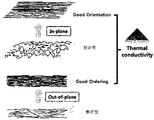
本発明者らは、プラスチックOLED基板材料として使われるポリイミド高分子鎖のオリエンテーション(orientation)またはオーダリング(ordering)を向上させるために研究した結果、BPDA−PDA−TFMB共重合体を主成分とするポリイミドが、インプレーン(in−plain)方向の高分子鎖のオリエンテーションを向上させ、また、末端封止剤(endcapper)であるフタル酸無水物を使用すれば、アウトオフプレーン(out of plain)で高分子鎖のオーダリングを向上させうるということを見つけた(図1参照)。このような結晶性の向上は、結局、基板材料として使用するポリイミドの熱拡散度及び熱伝導度を上昇させる原因となる。 As a result of research to improve the orientation or ordering of polyimide polymer chains used as a plastic OLED substrate material, the present inventors have conducted a polyimide containing a BPDA-PDA-TFMB copolymer as a main component. However, if the orientation of the polymer chains in the in-plane direction is improved, and if phthalic anhydride, which is an end copolymer, is used, the out-of-plane is high. We have found that it can improve the ordering of molecular chains (see FIG. 1). Such improvement in crystallinity eventually causes an increase in the thermal diffusivity and thermal conductivity of the polyimide used as the substrate material.
これにより、本発明は、放熱特性を向上させながらも、より改善された機械的特性を有するポリイミドを提供するために、BPDA−pPDA−TFMBの主鎖をフタル酸無水物(PA、phthalic anhydride)で末端封止(endcapping)させることにより、結晶性を0.5以上に向上させた。 Thereby, in the present invention, in order to provide a polyimide having improved mechanical properties while improving heat dissipation characteristics, the main chain of BPDA-pPDA-TFMB is phthalic anhydride (PA, phthalic anhydride). The crystallinity was improved to 0.5 or more by end-capping with.
ここで、'結晶性(Xcr)'は、'結晶化度'とも言い、GI−XRDを用いて、下記数式1で求めうる。
[数式1]
[Formula 1]
前記式において、Icは、結晶性ピークの下面積であり、Iaは、非結晶性ピークの下面積である。 In the above formula, I c is the lower area of the crystalline peak and I a is the lower area of the non-crystalline peak.
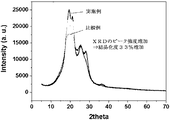
例えば、図2のようなXRDグラフで結晶性と非結晶性ピークとを求めるために、TOPAS version 4.2 programを使用した。TOPAS programを用いて8゜<2θ<35゜の範囲で結晶性ピーク(2θ≒18.4゜、21.3゜、25.5゜、28.1゜)を取って、それぞれの面積を求めて、これより結晶化度を計算することができる。 For example, the TOPAS version 4.2 program was used to determine the crystalline and non-crystalline peaks in an XRD graph as shown in FIG. Using the TOPAS program, take crystallinity peaks (2θ≈18.4 °, 21.3 °, 25.5 °, 28.1 °) in the range of 8 ° <2θ <35 °, and determine the area of each. Therefore, the crystallinity can be calculated from this.
また、本発明によるフィルムは、熱拡散度が0.07mm2/s以上、または0.08mm2/s以上または0.09mm2/s以上であり得る。熱拡散度は、常温でLFA 467 Hyperflashを使用して測定し、熱拡散度が高いほど放熱特性に優れていると言える。 The film according to the present invention, the thermal diffusivity may be 0.07 mm 2 / s or more, or 0.08 mm 2 / s or more, or 0.09 mm 2 / s or more. The degree of thermal diffusivity is measured at room temperature using LFA 467 Hyperflash, and it can be said that the higher the degree of thermal diffusivity, the better the heat dissipation characteristics.
また、本発明によるフィルムは、熱伝導度が0.2W/m・K以上であり得る。熱伝導度は、下記数式2で求め、熱伝導度が高いほど放熱特性に優れていると言える。
[数式2]
熱伝導度(k)=C×ρ×α
Further, the film according to the present invention may have a thermal conductivity of 0.2 W / m · K or more. The thermal conductivity is calculated by the following mathematical formula 2, and it can be said that the higher the thermal conductivity, the better the heat dissipation characteristics.
[Formula 2]
Thermal conductivity (k) = C × ρ × α
前記数式2において、C、ρ及びαは、ポリイミドフィルムの比熱(J/g・K)、密度(g/cm3)及び熱拡散度(mm2/sec)を示す。 In the above formula 2, C, ρ and α represent the specific heat (J / g · K), density (g / cm 3 ) and thermal diffusivity (mm 2 / sec) of the polyimide film.
一実施例によれば、4,4'−パラフェニレンジアミン(pPDA)と2,2'−ビス(トリフルオロメチル)ベンジジン(TFMB)とのmol比は、約95:5〜90:10であり、望ましくは、約95:5、さらに望ましくは、約90:10であり得る。 According to one example, the mol ratio of 4,4'-paraphenylenediamine (pPDA) to 2,2'-bis (trifluoromethyl) benzidine (TFMB) is about 95: 5 to 90:10. , Desirably about 95: 5, and even more preferably about 90:10.
また、4,4'−パラフェニレンジアミン(pPDA)と2,2'−ビス(トリフルオロメチル)ベンジジン(TFMB)とのmol比の合計と3,3',4,4'−ビフェニルカルボン酸二無水物(s−BPDA)のmol比は、約100:98.9〜100:98.75であり、望ましくは、約100:98.9、さらに望ましくは、約100:98.75であり得る。 In addition, the total mol ratio of 4,4'-paraphenylenediamine (pPDA) and 2,2'-bis (trifluoromethyl) benzidine (TFMB) and 3,3', 4,4'-biphenylcarboxylic acid diamine. The mol ratio of anhydride (s-BPDA) can be from about 100: 98.9 to 100: 98.75, preferably about 100: 98.9, and even more preferably about 100: 98.75. ..
一実施例によれば、前記フタル酸無水物が、4,4'−パラフェニレンジアミン(pPDA)と2,2'−ビス(トリフルオロメチル)ベンジジン(TFMB)との合計1molに対して0.02〜0.025、望ましくは、0.022〜0.025mol比で反応するものである。 According to one example, the phthalic anhydride was 0.4'-paraphenylenediamine (pPDA) and 2,2'-bis (trifluoromethyl) benzidine (TFMB) for a total of 1 mol. The reaction is carried out at a ratio of 02 to 0.025, preferably 0.022 to 0.025 mol.
前述したmol比の範囲でポリイミドの結晶性と放熱特性とが極大化される。 The crystallinity and heat dissipation characteristics of polyimide are maximized within the above-mentioned mol ratio range.
本発明は、また、重合溶媒に4,4'−パラフェニレンジアミン(pPDA)と2,2'−ビス(トリフルオロメチル)ベンジジン(TFMB)及び3,3',4,4'−ビフェニルカルボン酸二無水物(s−BPDA)とを含む重合成分及び末端封止剤として無水フタル酸(PA)を添加してポリイミド前駆体を製造する段階;前記ポリイミド前駆体及び有機溶媒を含むポリイミド前駆体溶液を製造する段階;前記ポリイミド前駆体溶液を基板上に塗布する段階;及び前記塗布されたポリイミド前駆体溶液を乾燥及び加熱する段階;を含むポリイミドフィルムの製造方法を提供する。 The present invention also uses 4,4'-paraphenylenediamine (pPDA), 2,2'-bis (trifluoromethyl) benzidine (TFMB) and 3,3', 4,4'-biphenylcarboxylic acid in the polymerization solvent. (2) A step of producing a polyimide precursor by adding a polymerization component containing an anhydride (s-BPDA) and phthalic anhydride (PA) as an end-capping agent; a polyimide precursor solution containing the polyimide precursor and an organic solvent. Provided is a method for producing a polyimide film, which comprises a step of applying the polyimide precursor solution onto a substrate; and a step of drying and heating the applied polyimide precursor solution.
一実施例によれば、前記ポリイミド前駆体溶液の乾燥及び加熱を通じる硬化工程において、最終硬化温度が450℃以上であり得る。 According to one embodiment, the final curing temperature can be 450 ° C. or higher in the curing step through drying and heating of the polyimide precursor solution.
本発明のさらに他の課題を解決するために、前記ポリイミドフィルムを含むフレキシブルディスプレイ素子を提供する。 In order to solve yet another problem of the present invention, a flexible display device including the polyimide film is provided.
一実施例によれば、前記3,3',4,4'−ビフェニルカルボン酸二無水物(s−BPDA)と、4,4'−パラフェニレンジアミン(pPDA)及び2,2'−ビス(トリフルオロメチル)ベンジジン(TFMB)と、を0.98:1〜0.99:1、望ましくは、0.9875:1〜0.9890:1のmol比で重合させることができる。 According to one example, the 3,3', 4,4'-biphenylcarboxylic acid dianhydride (s-BPDA), 4,4'-paraphenylenediamine (pPDA) and 2,2'-bis ( Trifluoromethyl) benzidine (TFMB) can be polymerized at a mol ratio of 0.98: 1 to 0.99: 1, preferably 0.9875: 1 to 0.9890: 1.
また、フタル酸無水物を追加して反応させることにより、耐熱性及び透過度を共に向上させ、前記無水フタル酸は、pPDA 1molに対して0.02〜0.025mol比、望ましくは、0.022〜0.025mol比で添加されて重合させることができる。 Further, by adding and reacting phthalic anhydride, both heat resistance and permeability are improved, and the phthalic anhydride has a ratio of 0.02 to 0.025 mol with respect to 1 mol of pPDA, preferably 0. It can be added at a ratio of 022 to 0.025 mol and polymerized.
前記末端封止剤を使用して、前記ジアミンとテトラカボン酸二無水物とから得られるポリイミドの末端を封止する方法としては、テトラカボン酸二無水物とジアミンとを反応させた後に、前記末端封止剤を添加して反応を続ける方法、ジアミンに末端封止剤を加えて反応させた後、テトラカボン酸二無水物を添加して、反応をさらに続ける方法、テトラカボン酸二無水物、ジアミン及び前記末端封止剤を同時に添加して反応させて製造する方法などがある。前記反応によって末端が封止されたポリイミド前駆体を重合することができる。 As a method of sealing the end of the polyimide obtained from the diamine and the tetracabonic dianhydride by using the terminal sealant, the terminal seal is performed after reacting the tetracabonic dianhydride with the diamine. A method of adding a stop agent and continuing the reaction, a method of adding a terminal capping agent to diamine to react and then adding tetracabonic dianhydride to continue the reaction, tetracabonic dianhydride, diamine and the above. There is a method of producing by adding an end sealant at the same time and reacting them. The polyimide precursor whose end is sealed can be polymerized by the reaction.
前記ポリイミド前駆体重合反応は、溶液重合など通常のポリイミド前駆体重合方法によって実施される。 The polyimide precursor polymerization reaction is carried out by a usual polyimide precursor polymerization method such as solution polymerization.
前記反応は、無水条件で実施され、前記重合反応時に、温度は、−75〜50℃、望ましくは、0〜40℃で実施される。ジアミンが有機溶媒に溶解された状態で酸二無水物を投入する方式で実施され、そのうち、ジアミン及び酸二無水物は重合溶媒でほぼ10〜30重量%の含量で含まれ、重合時間及び反応温度によって分子量が調節される。 The reaction is carried out under anhydrous conditions, and during the polymerization reaction, the temperature is −75 to 50 ° C., preferably 0 to 40 ° C. The method was carried out by adding an acid dianhydride in a state where the diamine was dissolved in an organic solvent. Among them, the diamine and the acid dianhydride were contained in the polymerization solvent in a content of about 10 to 30% by weight, and the polymerization time and reaction The molecular weight is regulated by temperature.
また、前記重合反応に使われる有機溶媒としては、具体的に、γ−ブチロラクトン、1,3−ジメチル−イミダゾリジノン、メチルエチルケトン、シクロヘキサノン、シクロペンタノン、4−ヒドロキシ−4−メチル−2−ペンタノンなどのケトン類;トルエン、キシレン、テトラメチルベンゼンなどの芳香族炭化水素類;エチレングリコールモノエチルエーテル、エチレングリコールモノメチルエーテル、エチレングリコールモノブチルエーテル、ジエチレングリコールモノエチルエーテル、ジエチレングリコールモノメチルエーテル、ジエチレングリコールモノブチルエーテル、プロピレングリコールモノメチルエーテル、プロピレングリコールモノエチルエーテル、ジプロピレングリコールジエチルエーテル、トリエチレングリコールモノエチルエーテルなどのグリコールエーテル類(セロソルブ);酢酸エチル、酢酸ブチル、エチレングリコールモノエチルエーテルアセテート、エチレングリコールモノブチルエーテルアセテート、ジエチレングリコールモノエチルエーテルアセテート、ジプロピレングリコールモノメチルエーテルアセテート、エタノール、プロパノール、エチレングリコール、プロピレングリコール、カルビトール、ジメチルアセトアミド(DMAc)、N,N−ジエチルアセトアミド、ジメチルホルムアミド(DMF)、ジエチルホルムアミド(DEF)、N,N−ジメチルアセトアミド(DMAc)、N−メチルピロリドン(NMP)、N−エチルピロリドン(NEP)、N−ビニルピロリドン、1,3−ジメチル−2−イミダゾリジノン、N,N−ジメチルメトキシアセトアミド、ジメチルスルホキシド、ピリジン、ジメチルスルホン、ヘキサメチルホスホルアミド、テトラメチルウレア、N−メチルカプロラクタム、テトラヒドロフラン、m−ジオキサン、P−ジオキサン、1,2−ジメトキシエタン、ビス(2−メトキシエチル)エーテル、1,2−ビス(2−メトキシエトキシ)エタン、ビス[2−(2−メトキシエトキシ)]エーテル、及びこれらの混合物からなる群から選択されるものが使われる。 Specific examples of the organic solvent used in the polymerization reaction include γ-butyrolactone, 1,3-dimethyl-imidazolidinone, methyl ethyl ketone, cyclohexanone, cyclopentanone, and 4-hydroxy-4-methyl-2-pentanone. Ketones such as; aromatic hydrocarbons such as toluene, xylene, tetramethylbenzene; ethylene glycol monoethyl ether, ethylene glycol monomethyl ether, ethylene glycol monobutyl ether, diethylene glycol monoethyl ether, diethylene glycol monomethyl ether, diethylene glycol monobutyl ether, propylene Glycol ethers (cellosolve) such as glycol monomethyl ether, propylene glycol monoethyl ether, dipropylene glycol diethyl ether, triethylene glycol monoethyl ether; ethyl acetate, butyl acetate, ethylene glycol monoethyl ether acetate, ethylene glycol monobutyl ether acetate, Diethylene glycol monoethyl ether acetate, dipropylene glycol monomethyl ether acetate, ethanol, propanol, ethylene glycol, propylene glycol, carbitol, dimethylacetamide (DMAc), N, N-diethylacetamide, dimethylformamide (DMF), diethylformamide (DEF) , N, N-dimethylacetamide (DMAc), N-methylpyrrolidone (NMP), N-ethylpyrrolidone (NEP), N-vinylpyrrolidone, 1,3-dimethyl-2-imidazolidinone, N, N-dimethylmethoxy Acetamide, dimethylsulfoxide, pyridine, dimethylsulfone, hexamethylphosphoramide, tetramethylurea, N-methylcaprolactam, tetrahydrofuran, m-dioxane, P-dioxane, 1,2-dimethoxyethane, bis (2-methoxyethyl) ether , 1,2-Bis (2-methoxyethoxy) ethane, bis [2- (2-methoxyethoxy)] ether, and mixtures thereof are selected from the group.
望ましくは、ジメチルスルホキシド、ジエチルスルホキシドなどのスルホキシド系溶媒;N,N−ジメチルホルムアミド、N,N−ジエチルホルムアミドなどのホルムアミド系溶媒;N,N−ジメチルアセトアミド、N,N−ジエチルアセトアミドなどのアセトアミド系溶媒;N−メチル−2−ピロリドン、N−ビニル−2−ピロリドンなどのピロリドン系溶媒を単独または混合物として利用できるが、これに限定されるものではない。また、キシレン、トルエンのような芳香族炭化水素をさらに含んで使用することができる。 Desirably, sulfoxide-based solvents such as dimethyl sulfoxide and diethyl sulfoxide; formamide-based solvents such as N, N-dimethylformamide and N, N-diethylformamide; acetamide-based solvents such as N, N-dimethylacetamide and N, N-diethylacetamide. Solvents: Pyrrolidone-based solvents such as N-methyl-2-pyrrolidone and N-vinyl-2-pyrrolidone can be used alone or as a mixture, but are not limited thereto. Further, aromatic hydrocarbons such as xylene and toluene can be further contained and used.
前記製造されたポリイミド前駆体を用いてポリイミドフィルムを製造する方法は、前記ポリイミド前駆体及び有機溶媒を含むポリイミド前駆体組成物を基板の一面に塗布し、イミド化及び硬化工程以後、基板から分離する段階を含む。 In the method of producing a polyimide film using the produced polyimide precursor, a polyimide precursor composition containing the polyimide precursor and an organic solvent is applied to one surface of a substrate, and separated from the substrate after an imidization and curing step. Including the stage to do.
具体的に、前記ポリイミド前駆体組成物は、有機溶媒中にポリイミド前駆体が溶解された溶液の形態であり、このような形態を有する場合、例えば、ポリイミド前駆体を有機溶媒中で合成した場合には、ポリイミド前駆体組成物は、重合後、得られるポリイミド前駆体溶液のそれ自体または同一溶液をさらに添加したものであっても良く、または、前記重合後、得られたポリイミド前駆体溶液を他の溶媒で希釈したものであっても良い。 Specifically, the polyimide precursor composition is in the form of a solution in which the polyimide precursor is dissolved in an organic solvent, and has such a form, for example, when the polyimide precursor is synthesized in an organic solvent. The polyimide precursor composition may be obtained by further adding itself or the same solution of the polyimide precursor solution obtained after the polymerization, or the polyimide precursor solution obtained after the polymerization. It may be diluted with another solvent.
前記ポリイミド前駆体組成物は、フィルム形成工程時の塗布性などの工程性を考慮して、適切な粘度を有させる量で固形分を含むことが望ましく、前記固形分は、ポリイミド前駆体組成物総重量に対して5〜20重量%に含まれうる。または、前記ポリイミド前駆体組成物が、400〜50,000cPの粘度を有するように調節することが望ましい。ポリイミド前駆体組成物の粘度が400cP未満であり、ポリイミド前駆体組成物の粘度が50,000cPを超過する場合、前記ポリイミド前駆体組成物を利用したディスプレイ基板の製造時に、流動性が低下して、コーティング時に均一に塗布にならないなどの製造工程上の問題点を引き起こし得る。 It is desirable that the polyimide precursor composition contains a solid content in an amount that gives an appropriate viscosity in consideration of processability such as coatability during the film forming step, and the solid content is the polyimide precursor composition. It can be contained in 5 to 20% by weight based on the total weight. Alternatively, it is desirable to adjust the polyimide precursor composition so that it has a viscosity of 400 to 50,000 cP. When the viscosity of the polyimide precursor composition is less than 400 cP and the viscosity of the polyimide precursor composition exceeds 50,000 cP, the fluidity is lowered during the production of the display substrate using the polyimide precursor composition. , It may cause problems in the manufacturing process such as not being applied uniformly at the time of coating.
次いで、前記で製造したポリイミド前駆体組成物を基板の一面に塗布し、80〜500℃の温度で熱イミド化及び硬化した後、基板から分離することにより、ポリイミドフィルムが製造可能である。 Next, the polyimide precursor composition produced above is applied to one surface of a substrate, thermally imidized and cured at a temperature of 80 to 500 ° C., and then separated from the substrate, whereby a polyimide film can be produced.
この際、前記基板としては、ガラス、金属基板またはプラスチック基板などが特に制限なしに使われ、そのうちでも、ポリイミド前駆体に対するイミド化及び硬化工程のうち、熱及び化学的安定性に優れ、別途の離型剤処理なしでも、硬化後、形成されたポリイミド系フィルムに対して損傷なしに容易に分離されるガラス基板が望ましい。 At this time, as the substrate, a glass, a metal substrate, a plastic substrate, or the like is used without particular limitation, and among them, among the imidization and curing steps for the polyimide precursor, the substrate is excellent in thermal and chemical stability, and is separately provided. It is desirable to use a glass substrate that can be easily separated from the formed polyimide film after curing without damage even without a release agent treatment.
また、前記塗布工程は、通常の塗布方法によって実施され、具体的には、スピンコーティング法、バーコーティング法、ロールコーティング法、エアナイフ法、グラビア法、リバースロール法、キスロール法、ドクターブレード法、スプレー法、浸漬法またはブラシ法などが用いられうる。そのうちでも、連続工程が可能であり、ポリイミドのイミド化率を増加させることができるキャスティング法によって実施されることがより望ましい。 Further, the coating step is carried out by a normal coating method, and specifically, a spin coating method, a bar coating method, a roll coating method, an air knife method, a gravure method, a reverse roll method, a kiss roll method, a doctor blade method, and a spray. A method, a dipping method, a brush method, etc. may be used. Among them, it is more desirable to carry out by a casting method capable of a continuous step and increasing the imidization rate of polyimide.
また、前記ポリイミド前駆体組成物は、最終的に製造されるポリイミドフィルムがディスプレイ基板用として適した厚さを有させる厚さの範囲で基板上に塗布されうる。 In addition, the polyimide precursor composition can be applied onto a substrate in a thickness range that allows the finally produced polyimide film to have a thickness suitable for a display substrate.
具体的には、10〜30μmの厚さにする量で塗布されうる。前記ポリイミド前駆体組成物塗布後、硬化工程に先立って、ポリイミド前駆体組成物内に存在する溶媒を除去するための乾燥工程が選択的にさらに実施される。 Specifically, it can be applied in an amount having a thickness of 10 to 30 μm. After the application of the polyimide precursor composition, a drying step for removing the solvent present in the polyimide precursor composition is selectively further carried out prior to the curing step.
前記乾燥工程は、通常の方法によって実施され、具体的に、140℃以下、あるいは80〜140℃の温度で実施される。乾燥工程の実施温度が80℃未満であれば、乾燥工程が長くなり、140℃を超過する場合、イミド化が急激に進行して、均一な厚さのポリイミドフィルムの形成が難しい。 The drying step is carried out by a usual method, and specifically, is carried out at a temperature of 140 ° C. or lower, or 80 to 140 ° C. If the temperature at which the drying step is carried out is less than 80 ° C., the drying step becomes long, and if it exceeds 140 ° C., imidization proceeds rapidly, making it difficult to form a polyimide film having a uniform thickness.
引き続き、前記硬化工程は、80〜500℃の温度での熱処理によって進行しうる。前記硬化工程は、前記温度範囲内で多様な温度での多段階加熱処理で進行することもできる。また、前記硬化工程時に、硬化時間は特に限定されず、一例として、30〜60分間実施される。 Subsequently, the curing step can proceed by heat treatment at a temperature of 80-500 ° C. The curing step can also proceed by a multi-step heat treatment at various temperatures within the temperature range. Further, during the curing step, the curing time is not particularly limited, and is carried out for 30 to 60 minutes as an example.
また、前記硬化工程後に、ポリイミドフィルム内のポリイミドのイミド化率を高めて、前述した物性的特徴を有するポリイミド系フィルムを形成するために、後続の熱処理工程が選択的にさらに実施することもできる。 Further, after the curing step, a subsequent heat treatment step can be selectively further carried out in order to increase the imidization rate of the polyimide in the polyimide film and form the polyimide-based film having the above-mentioned physical property characteristics. ..
前記後続の熱処理工程は、200℃以上、あるいは200〜500℃で1〜30分間実施されることが望ましい。また、前記後続の熱処理工程は、1回実施することもでき、または、2回以上多段階で実施することもできる。具体的には、200〜220℃での第1熱処理、300〜380℃での第2熱処理及び400〜500℃での第3熱処理を含む3段階で実施され、望ましくは、最終硬化温度が450℃以上である条件で30分以上2時間以下、望ましくは、30分以上1時間以下硬化させて製造可能である。 It is desirable that the subsequent heat treatment step be carried out at 200 ° C. or higher, or 200 to 500 ° C. for 1 to 30 minutes. Further, the subsequent heat treatment step may be carried out once, or may be carried out twice or more in multiple steps. Specifically, it is carried out in three stages including a first heat treatment at 200 to 220 ° C., a second heat treatment at 300 to 380 ° C., and a third heat treatment at 400 to 500 ° C., preferably having a final curing temperature of 450. It can be produced by curing under the condition of ° C. or higher for 30 minutes or more and 2 hours or less, preferably 30 minutes or more and 1 hour or less.
以後、基板上に形成されたポリイミドフィルムを通常の方法によって基板から剥離することにより、ポリイミドフィルムが製造可能である。 After that, the polyimide film can be produced by peeling the polyimide film formed on the substrate from the substrate by a usual method.
本発明によるポリイミドは、約360℃以上のガラス転移温度を有するものである。このように優れた耐熱性を有するために、前記ポリイミドを含むフィルムは、素子製造工程中に付加される高温の熱に対しても、優れた耐熱性及び機械的特性を保持することができる。 The polyimide according to the present invention has a glass transition temperature of about 360 ° C. or higher. In order to have such excellent heat resistance, the film containing the polyimide can maintain excellent heat resistance and mechanical properties even with respect to high-temperature heat applied during the device manufacturing process.
本発明によるポリイミドフィルムは、1%の質量減少を示す熱分解温度(Td 1%)が550℃以上であり得る。 The polyimide film according to the present invention can have a thermal decomposition temperature (Td 1%) showing a mass loss of 1% of 550 ° C. or higher.
また、本発明によるポリイミドフィルムは、機械的物性が非常に優れ、例えば、延伸率(Elongation)は、20%以上、望ましくは、25%以上であり、引張強度は、500MPa以上、望ましくは、520MPa以上、より望ましくは、530MPa以上であり、引張モジュラス(Tensile Modulus)は、10GPa以上であり得る。 Further, the polyimide film according to the present invention has very excellent mechanical properties, for example, the elongation is 20% or more, preferably 25% or more, and the tensile strength is 500 MPa or more, preferably 520 MPa. As described above, more preferably, it is 530 MPa or more, and the tensile modulus (Tensile Modulus) can be 10 GPa or more.
本発明は、フタル酸無水物(PA)を含む末端封止剤で末端が封止されたポリイミドフィルムを提供することにより、高温でも正数のCTE値を示して、高温工程上でnegative CTE(収縮発生)によって発生しうる問題を解決するだけではなく、高い透過度の特性を有するポリイミドフィルム、望ましくは、70%以上の透過度を有するポリイミドフィルムを提供し、前記ポリイミド基板上に素子を製作する場合、アラインメントキー(alignment key)を通じるTFTデバイスの製作がより容易になる。 The present invention provides a polyimide film whose ends are sealed with an end-sealing agent containing phthalic anhydride (PA), thereby exhibiting a positive CTE value even at high temperatures, and negative CTE (negative CTE) on a high-temperature process. Not only solving the problem that may occur due to shrinkage generation), but also providing a polyimide film having high transmittance characteristics, preferably a polyimide film having a transmittance of 70% or more, and manufacturing an element on the polyimide substrate. If this is the case, it will be easier to manufacture the polyimide device through the alignment key.
本発明によるポリイミドは、素子用基板、ディスプレイ用カバー基板、光学フィルム(optical film)、IC(integrated circuit)パッケージ、粘着フィルム(adhesive film)、多層FPC(flexible printed circuit)、テープ、タッチパネル、光ディスク用保護フィルムのような多様な分野に使われる。 The polyimide according to the present invention is used for element substrates, display cover substrates, optical films, IC (integrated circuit) packages, adhesive films, multilayer FPCs (flexible printed circuit boards), tapes, touch panels, and optical disks. Used in various fields such as protective films.
本発明は、前記ポリイミドフィルムを含むフレキシブルディスプレイ装置を提供する。例えば、前記ディスプレイ装置は、液晶表示装置(liquid crystal display device、LCD)、有機発光ダイオード(organic light emitting diode、OLED)などが挙げられ、特に、高温工程を必要とするLTPS(low temperature polycrystalline silicon)工程を使用するOLEDデバイスに適するが、これに限定されるものではない。 The present invention provides a flexible display device including the polyimide film. For example, the display device includes a liquid crystal display device (liquid crystal display device, LCD), an organic light emitting device, an organic light emitting diode (OLED), and the like, and in particular, a LTPS (low temperature radiation) radio that requires a high temperature process. Suitable for, but not limited to, OLED devices that use the process.
以下、当業者が容易に実施できるように、本発明の実施例について詳しく説明する。しかし、本発明は、さまざまな異なる形態として具現可能であり、ここで説明する実施例に限定されるものではない。 Hereinafter, examples of the present invention will be described in detail so that those skilled in the art can easily carry out the invention. However, the present invention can be embodied in a variety of different forms and is not limited to the examples described herein.
<実施例1>BPDA−pPDA−TFMB/PA(98.9:95:5:2.2)ポリイミド重合
窒素気流が流れる撹拌機内に有機溶媒NMP(N−メチル−2−ピロリドン)100gを満たした後、反応器の温度を25℃に保持した状態でパラフェニレンジアミン(p−PDA)5.731g(52.999mmol)と2,2'−ビス(トリフルオロメチル)ベンジジン(TFMB)0.893g(2.789mmol)とを溶解させた。前記p−PDAとTFMB溶液に3,3',4,4'−ビフェニルカルボン酸二無水物(s−BPDA)16.234g(55.175mmol)とNMP 56.96gとを同じ温度で添加して、一定時間溶解しながら撹拌した後、ポリアミド酸を重合した。以後、前記ポリアミド酸溶液に無水フタル酸(PA)0.182g(1.227mmol)を投入して、一定時間撹拌して、ポリイミド前駆体を製造した。
<Example 1> BPDA-pPDA-TFMB / PA (98.9: 95: 5: 2.2) Polyimide polymerization 100 g of organic solvent NMP (N-methyl-2-pyrrolidone) was filled in a stirrer through which a nitrogen stream flows. After that, with the temperature of the reactor maintained at 25 ° C., 5.731 g (52.999 mmol) of para-phenylenediamine (p-PDA) and 0.893 g of 2,2'-bis (trifluoromethyl) benzidine (TFMB) (TFMB). 2.789 mmol) and was dissolved. 16.234 g (55.175 mmol) of 3,3', 4,4'-biphenylcarboxylic acid dianhydride (s-BPDA) and 56.96 g of NMP were added to the p-PDA and TFMB solution at the same temperature. After stirring while dissolving for a certain period of time, the polyamic acid was polymerized. After that, 0.182 g (1.227 mmol) of phthalic anhydride (PA) was added to the polyamic acid solution, and the mixture was stirred for a certain period of time to produce a polyimide precursor.
前記反応から製造されたポリイミド前駆体溶液の固形分濃度を12.8重量%になるように、前記有機溶媒を添加して、ポリイミド前駆体溶液を製造した。 The organic solvent was added so that the solid content concentration of the polyimide precursor solution produced from the reaction was 12.8% by weight to produce a polyimide precursor solution.
前記ポリイミド前駆体溶液をガラス基板にスピンコーティングした。ポリイミド前駆体溶液が塗布されたガラス基板をオーブンに入れ、6℃/minの速度で加熱し、120℃で10分、460℃で55分を保持して硬化工程を進行した。硬化工程完了後に、ガラス基板を水に浸してガラス基板上に形成されたフィルムを取り外して、オーブンで100℃に乾燥して、厚さが10μmであるポリイミドフィルムを製造した。 The polyimide precursor solution was spin-coated on a glass substrate. The glass substrate coated with the polyimide precursor solution was placed in an oven, heated at a rate of 6 ° C./min, and held at 120 ° C. for 10 minutes and 460 ° C. for 55 minutes to proceed with the curing step. After the curing step was completed, the glass substrate was immersed in water to remove the film formed on the glass substrate, and dried in an oven at 100 ° C. to produce a polyimide film having a thickness of 10 μm.
<実施例2>BPDA−pPDA−TFMB/PA(98.75:95:5:2.5)ポリイミド重合
窒素気流が流れる撹拌機内に有機溶媒NMP(N−メチル−2−ピロリドン)100gを満たした後、反応器の温度を25℃に保持した状態でパラフェニレンジアミン(p−PDA)5.731g(52.999mmol)と2,2'−ビス(トリフルオロメチル)ベンジジン(TFMB)0.893g(2.789mmol)とを溶解させた。前記p−PDAとTFMB溶液に3,3',4,4'−ビフェニルカルボン酸二無水物(s−BPDA)16.209g(55.091mmol)とNMP 56.96gとを同じ温度で添加して、一定時間溶解しながら撹拌した後、ポリアミド酸を重合した。以後、前記ポリアミド酸溶液に無水フタル酸(PA)0.207g(1.395mmol)を投入して、一定時間撹拌して、ポリイミド前駆体を製造した。
<Example 2> BPDA-pPDA-TFMB / PA (98.75: 95: 5: 2.5) Polyimide polymerization 100 g of organic solvent NMP (N-methyl-2-pyrrolidone) was filled in a stirrer through which a nitrogen stream flows. After that, with the temperature of the reactor maintained at 25 ° C., 5.731 g (52.999 mmol) of para-phenylenediamine (p-PDA) and 0.893 g of 2,2'-bis (trifluoromethyl) benzidine (TFMB) (TFMB). 2.789 mmol) and was dissolved. 16.209 g (55.091 mmol) of 3,3', 4,4'-biphenylcarboxylic acid dianhydride (s-BPDA) and 56.96 g of NMP were added to the p-PDA and TFMB solution at the same temperature. After stirring while dissolving for a certain period of time, the polyamic acid was polymerized. After that, 0.207 g (1.395 mmol) of phthalic anhydride (PA) was added to the polyamic acid solution, and the mixture was stirred for a certain period of time to produce a polyimide precursor.
前記反応から製造されたポリイミド前駆体溶液の固形分濃度を12.8重量%になるように、前記有機溶媒を添加して、ポリイミド前駆体溶液を製造した。 The organic solvent was added so that the solid content concentration of the polyimide precursor solution produced from the reaction was 12.8% by weight to produce a polyimide precursor solution.
実施例1と同じ方法で厚さ10μmのポリイミドフィルムを製造した。 A polyimide film having a thickness of 10 μm was produced by the same method as in Example 1.
<実施例3>BPDA−pPDA−TFMB/PA(98.9:90:10:2.2)ポリイミド重合
窒素気流が流れる撹拌機内に有機溶媒NMP(N−メチル−2−ピロリドン)100gを満たした後、反応器の温度を25℃に保持した状態でパラフェニレンジアミン(p−PDA)5.294g(48.953mmol)と2,2'−ビス(トリフルオロメチル)ベンジジン(TFMB)1.742g(5.439mmol)とを溶解させた。前記p−PDAとTFMB溶液に3,3',4,4'−ビフェニルカルボン酸二無水物(s−BPDA)15.827g(53.794mmol)とNMP 56.96gとを同じ温度で添加して、一定時間溶解しながら撹拌した後、ポリアミド酸を重合した。以後、前記ポリアミド酸溶液に無水フタル酸(PA)0.177g(1.197mmol)を投入して、一定時間撹拌して、ポリイミド前駆体を製造した。
<Example 3> BPDA-pPDA-TFMB / PA (98.9: 90: 10: 2.2) Polyimide polymerization 100 g of organic solvent NMP (N-methyl-2-pyrrolidone) was filled in a stirrer through which a nitrogen stream flows. After that, while keeping the temperature of the reactor at 25 ° C., 5.294 g (48.953 mmol) of para-phenylenediamine (p-PDA) and 1.742 g of 2,2'-bis (trifluoromethyl) benzidine (TFMB) (TFMB). 5.439 mmol) and was dissolved. To the p-PDA and TFMB solution, 15.827 g (53.794 mmol) of 3,3', 4,4'-biphenylcarboxylic acid dianhydride (s-BPDA) and 56.96 g of NMP were added at the same temperature. After stirring while dissolving for a certain period of time, the polyamic acid was polymerized. After that, 0.177 g (1.197 mmol) of phthalic anhydride (PA) was added to the polyamic acid solution and stirred for a certain period of time to produce a polyimide precursor.
前記反応から製造されたポリイミド前駆体溶液の固形分濃度を12.8重量%になるように、前記有機溶媒を添加して、ポリイミド前駆体溶液を製造した。 The organic solvent was added so that the solid content concentration of the polyimide precursor solution produced from the reaction was 12.8% by weight to produce a polyimide precursor solution.
実施例1と同じ方法で厚さ10μmのポリイミドフィルムを製造した。 A polyimide film having a thickness of 10 μm was produced by the same method as in Example 1.
<実施例4>BPDA−pPDA−TFMB/PA(98.75:90:10:2.5)ポリイミド重合
窒素気流が流れる撹拌機内に有機溶媒NMP(N−メチル−2−ピロリドン)100gを満たした後、反応器の温度を25℃に保持した状態でパラフェニレンジアミン(p−PDA)5.294g(48.953mmol)と2,2'−ビス(トリフルオロメチル)ベンジジン(TFMB)1.742g(5.439mmol)とを溶解させた。前記p−PDAとTFMB溶液に3,3',4,4'−ビフェニルカルボン酸二無水物(s−BPDA)15.803g(53.712mmol)とNMP 56.96gとを同じ温度で添加して、一定時間溶解しながら撹拌した後、ポリアミド酸を重合した。以後、前記ポリアミド酸溶液に無水フタル酸(PA)0.201g(1.360mmol)を投入して、一定時間撹拌して、ポリイミド前駆体を製造した。
<Example 4> BPDA-pPDA-TFMB / PA (98.75: 90: 10: 2.5) Polyimide polymerization An organic solvent NMP (N-methyl-2-pyrrolidone) 100 g was filled in a stirrer through which a nitrogen stream flows. After that, while keeping the temperature of the reactor at 25 ° C., 5.294 g (48.953 mmol) of para-phenylenediamine (p-PDA) and 1.742 g of 2,2'-bis (trifluoromethyl) benzidine (TFMB) (TFMB). 5.439 mmol) and was dissolved. To the p-PDA and TFMB solution, 15.803 g (53.712 mmol) of 3,3', 4,4'-biphenylcarboxylic acid dianhydride (s-BPDA) and 56.96 g of NMP were added at the same temperature. After stirring while dissolving for a certain period of time, the polyamic acid was polymerized. After that, 0.201 g (1.360 mmol) of phthalic anhydride (PA) was added to the polyamic acid solution and stirred for a certain period of time to produce a polyimide precursor.
前記反応から製造されたポリイミド前駆体溶液の固形分濃度を12.8重量%になるように、前記有機溶媒を添加して、ポリイミド前駆体溶液を製造した。 The organic solvent was added so that the solid content concentration of the polyimide precursor solution produced from the reaction was 12.8% by weight to produce a polyimide precursor solution.
実施例1と同じ方法で厚さ10μmのポリイミドフィルムを製造した。 A polyimide film having a thickness of 10 μm was produced by the same method as in Example 1.
<比較例1>BPDA−pPDA(98.9:100)ポリイミド重合
窒素気流が流れる撹拌機内に有機溶媒NMP(N−メチル−2−ピロリドン)100gを満たした後、反応器の温度を25℃に保持した状態でパラフェニレンジアミン(p−PDA)6.243g(57.726mmol)を溶解させた。前記p−PDA溶液に3,3',4,4'−ビフェニルカルボン酸二無水物(s−BPDA)16.797g(57.091mmol)とNMP 56.96gとを同じ温度で添加して、一定時間溶解しながら撹拌した後、ポリイミド前駆体を製造した。
<Comparative Example 1> BPDA-pPDA (98.9: 100) Polyimide Polymerization After filling 100 g of the organic solvent NMP (N-methyl-2-pyrrolidone) in a stirrer through which a nitrogen stream flows, the temperature of the reactor is raised to 25 ° C. In the retained state, 6.243 g (57.726 mmol) of paraphenylenediamine (p-PDA) was dissolved. 16.797 g (57.091 mmol) of 3,3', 4,4'-biphenylcarboxylic acid dianhydride (s-BPDA) and 56.96 g of NMP were added to the p-PDA solution at the same temperature to make a constant amount. After stirring while dissolving for a time, a polyimide precursor was produced.
前記反応から製造されたポリイミド前駆体を固形分濃度を12.8重量%になるように、前記有機溶媒を添加して、ポリイミド前駆体溶液を製造した。 The organic solvent was added to the polyimide precursor produced from the reaction so that the solid content concentration was 12.8% by weight to produce a polyimide precursor solution.
実施例1と同じ方法で厚さ10μmのポリイミドフィルムを製造した。 A polyimide film having a thickness of 10 μm was produced by the same method as in Example 1.
<比較例2>BPDA−pPDA(98.75:100)ポリイミド重合
窒素気流が流れる撹拌機内に有機溶媒NMP(N−メチル−2−ピロリドン)100gを満たした後、反応器の温度を25℃に保持した状態でパラフェニレンジアミン(p−PDA)6.249g(57.790mmol)を溶解させた。前記p−PDA溶液に3,3',4,4'−ビフェニルカルボン酸二無水物(s−BPDA)16.791g(57.068mmol)とNMP 56.96gとを同じ温度で添加して、一定時間溶解しながら撹拌した後、ポリイミド前駆体を製造した。
<Comparative Example 2> BPDA-pPDA (98.75: 100) Polyimide Polymerization After filling 100 g of the organic solvent NMP (N-methyl-2-pyrrolidone) in a stirrer through which a nitrogen stream flows, the temperature of the reactor is raised to 25 ° C. 6.249 g (57.790 mmol) of paraphenylenediamine (p-PDA) was dissolved in the retained state. 16.791 g (57.068 mmol) of 3,3', 4,4'-biphenylcarboxylic acid dianhydride (s-BPDA) and 56.96 g of NMP were added to the p-PDA solution at the same temperature to maintain a constant value. After stirring while dissolving for a time, a polyimide precursor was produced.
前記反応から製造されたポリイミド前駆体を固形分濃度を12.8重量%になるように、前記有機溶媒を添加して、ポリイミド前駆体溶液を製造した。 The organic solvent was added to the polyimide precursor produced from the reaction so that the solid content concentration was 12.8% by weight to produce a polyimide precursor solution.
実施例1と同じ方法で厚さ10μmのポリイミドフィルムを製造した。 A polyimide film having a thickness of 10 μm was produced by the same method as in Example 1.
<比較例3>BPDA−pPDA−TFMB(98.9:95:5)ポリイミド重合
窒素気流が流れる撹拌機内に有機溶媒NMP(N−メチル−2−ピロリドン)100gを満たした後、反応器の温度を25℃に保持した状態でパラフェニレンジアミン(p−PDA)5.777g(53.421mmol)と2,2'−ビス(トリフルオロメチル)ベンジジン(TFMB)0.900g(2.812mmol)とを溶解させた。前記p−PDAとTFMB溶液に3,3',4,4'−ビフェニルカルボン酸二無水物(s−BPDA)16.363g(55.614mmol)とNMP 56.96gとを同じ温度で添加して、一定時間溶解しながら撹拌した後、ポリアミド酸を重合した。
<Comparative Example 3> BPDA-pPDA-TFMB (98.9: 95: 5) Polyimide Polymerization After filling 100 g of the organic solvent NMP (N-methyl-2-pyrrolidone) in a stirrer through which a nitrogen stream flows, the temperature of the reactor 5.777 g (53.421 mmol) of para-phenylenediamine (p-PDA) and 0.900 g (2.812 mmol) of 2,2'-bis (trifluoromethyl) benzidine (TFMB) while keeping the temperature at 25 ° C. It was dissolved. To the p-PDA and TFMB solution, 16.363 g (55.614 mmol) of 3,3', 4,4'-biphenylcarboxylic acid dianhydride (s-BPDA) and 56.96 g of NMP were added at the same temperature. After stirring while dissolving for a certain period of time, the polyamic acid was polymerized.
前記反応から製造されたポリイミド前駆体溶液の固形分濃度を12.8重量%になるように、前記有機溶媒を添加して、ポリイミド前駆体溶液を製造した。 The organic solvent was added so that the solid content concentration of the polyimide precursor solution produced from the reaction was 12.8% by weight to produce a polyimide precursor solution.
実施例1と同じ方法で厚さ10μmのポリイミドフィルムを製造した。 A polyimide film having a thickness of 10 μm was produced by the same method as in Example 1.
<比較例4>BPDA−pPDA−TFMB(98.9:90:10)ポリイミド重合
窒素気流が流れる撹拌機内に有機溶媒NMP(N−メチル−2−ピロリドン)100gを満たした後、反応器の温度を25℃に保持した状態でパラフェニレンジアミン(p−PDA)5.335g(49.332mmol)と2,2'−ビス(トリフルオロメチル)ベンジジン(TFMB)1.755g(5.481mmol)とを溶解させた。前記p−PDAとTFMB溶液に3,3',4,4'−ビフェニルカルボン酸二無水物(s−BPDA)15.950g(54.211mmol)とNMP 56.96gとを同じ温度で添加して、一定時間溶解しながら撹拌した後、ポリアミド酸を重合した。
<Comparative Example 4> BPDA-pPDA-TFMB (98.9: 90: 10) Polyimide Polymerization After filling 100 g of the organic solvent NMP (N-methyl-2-pyrrolidone) in a stirrer through which a nitrogen stream flows, the temperature of the reactor. 5.335 g (49.332 mmol) of para-phenylenediamine (p-PDA) and 1.755 g (5.481 mmol) of 2,2'-bis (trifluoromethyl) benzidine (TFMB) in a state where the temperature was maintained at 25 ° C. It was dissolved. To the p-PDA and TFMB solution, 15.950 g (54.211 mmol) of 3,3', 4,4'-biphenylcarboxylic acid dianhydride (s-BPDA) and 56.96 g of NMP were added at the same temperature. After stirring while dissolving for a certain period of time, the polyamic acid was polymerized.
前記反応から製造されたポリイミド前駆体溶液の固形分濃度を12.8重量%になるように、前記有機溶媒を添加して、ポリイミド前駆体溶液を製造した。 The organic solvent was added so that the solid content concentration of the polyimide precursor solution produced from the reaction was 12.8% by weight to produce a polyimide precursor solution.
実施例1と同じ方法で厚さ10μmのポリイミドフィルムを製造した。 A polyimide film having a thickness of 10 μm was produced by the same method as in Example 1.
<比較例5>BPDA−pPDA−TFMB(98.75:95:5)ポリイミド重合
窒素気流が流れる撹拌機内に有機溶媒NMP(N−メチル−2−ピロリドン)100gを満たした後、反応器の温度を25℃に保持した状態でパラフェニレンジアミン(p−PDA)5.783g(53.478mmol)と2,2'−ビス(トリフルオロメチル)ベンジジン(TFMB)0.901g(2.815mmol)とを溶解させた。前記p−PDAとTFMB溶液に3,3',4,4'−ビフェニルカルボン酸二無水物(s−BPDA)16.356g(55.589mmol)とNMP 56.96gとを同じ温度で添加して、一定時間溶解しながら撹拌した後、ポリアミド酸を重合した。
<Comparative Example 5> BPDA-pPDA-TFMB (98.75: 95: 5) Polyimide Polymerization After filling 100 g of the organic solvent NMP (N-methyl-2-pyrrolidone) in a stirrer through which a nitrogen stream flows, the temperature of the reactor 5.783 g (53.478 mmol) of para-phenylenediamine (p-PDA) and 0.901 g (2.815 mmol) of 2,2'-bis (trifluoromethyl) benzidine (TFMB) were added at 25 ° C. It was dissolved. To the p-PDA and TFMB solution, 16.356 g (55.589 mmol) of 3,3', 4,4'-biphenylcarboxylic acid dianhydride (s-BPDA) and 56.96 g of NMP were added at the same temperature. After stirring while dissolving for a certain period of time, the polyamic acid was polymerized.
前記反応から製造されたポリイミド前駆体溶液の固形分濃度を12.8重量%になるように、前記有機溶媒を添加して、ポリイミド前駆体溶液を製造した。 The organic solvent was added so that the solid content concentration of the polyimide precursor solution produced from the reaction was 12.8% by weight to produce a polyimide precursor solution.
実施例1と同じ方法で厚さ10μmのポリイミドフィルムを製造した。 A polyimide film having a thickness of 10 μm was produced by the same method as in Example 1.
<比較例6>BPDA−pPDA−TFMB(98.75:90:10)ポリイミド重合
窒素気流が流れる撹拌機内に有機溶媒NMP(N−メチル−2−ピロリドン)100gを満たした後、反応器の温度を25℃に保持した状態でパラフェニレンジアミン(p−PDA)5.340g(49.384mmol)と2,2'−ビス(トリフルオロメチル)ベンジジン(TFMB)1.757g(5.487mmol)とを溶解させた。前記p−PDAとTFMB溶液に3,3',4,4'−ビフェニルカルボン酸二無水物(s−BPDA)15.942g(54.185mmol)とNMP 56.96gとを同じ温度で添加して、一定時間溶解しながら撹拌した後、ポリアミド酸を重合した。
<Comparative Example 6> BPDA-pPDA-TFMB (98.75: 90:10) Polyimide Polymerization After filling 100 g of the organic solvent NMP (N-methyl-2-pyrrolidone) in a stirrer through which a nitrogen stream flows, the temperature of the reactor 5.340 g (49.384 mmol) of para-phenylenediamine (p-PDA) and 1.757 g (5.487 mmol) of 2,2'-bis (trifluoromethyl) benzidine (TFMB) while keeping the temperature at 25 ° C. It was dissolved. To the p-PDA and TFMB solution, 15.942 g (54.185 mmol) of 3,3', 4,4'-biphenylcarboxylic acid dianhydride (s-BPDA) and 56.96 g of NMP were added at the same temperature. After stirring while dissolving for a certain period of time, the polyamic acid was polymerized.
前記反応から製造されたポリイミド前駆体溶液の固形分濃度を12.8重量%になるように、前記有機溶媒を添加して、ポリイミド前駆体溶液を製造した。 The organic solvent was added so that the solid content concentration of the polyimide precursor solution produced from the reaction was 12.8% by weight to produce a polyimide precursor solution.
実施例1と同じ方法で厚さ10μmのポリイミドフィルムを製造した。 A polyimide film having a thickness of 10 μm was produced by the same method as in Example 1.
<比較例7>BPDA−pPDA−TFMB+KF−8010/PA(98.9:90:5:5:2.2)ポリイミド重合
窒素気流が流れる撹拌機内に有機溶媒NMP(N−メチル−2−ピロリドン)100gを満たした後、反応器の温度を25℃に保持した状態でパラフェニレンジアミン(p−PDA)5.226g(48.327mmol)と2,2'−ビス(トリフルオロメチル)ベンジジン(TFMB)0.860g(2.685mmol)、そして、ポリジメチルシロキサン(polydimethylsilioxane)でKF−8010(shin−Etsu silicone社)1.154g(2.685mmol)を溶解させた。前記p−PDA/TFMB/KF−8010溶液に3,3',4,4'−ビフェニルカルボン酸二無水物(s−BPDA)15.625g(53.106mmol)とNMP 56.96gとを同じ温度で添加して、一定時間溶解しながら撹拌した後、ポリアミド酸を重合した。
<Comparative Example 7> BPDA-pPDA-TFMB + KF-8010 / PA (98.9: 90: 5: 5: 2.2) Polyimide polymerization Organic solvent NMP (N-methyl-2-pyrrolidone) in a stirrer in which a nitrogen stream flows. After filling 100 g, 5.226 g (48.327 mmol) of para-phenylenediamine (p-PDA) and 2,2'-bis (trifluoromethyl) benzidine (TFMB) while maintaining the temperature of the reactor at 25 ° C. 0.860 g (2.685 mmol) and 1.154 g (2.685 mmol) of KF-8010 (shin-Etsu siliconone) were dissolved in polydimethylsiloxane (polyimide silicone). 15.625 g (53.106 mmol) of 3,3', 4,4'-biphenylcarboxylic acid dianhydride (s-BPDA) and 56.96 g of NMP in the p-PDA / TFMB / KF-8010 solution at the same temperature. After stirring for a certain period of time, the polyamic acid was polymerized.
前記反応から製造されたポリイミド前駆体溶液の固形分濃度を12.8重量%になるように、前記有機溶媒を添加して、ポリイミド前駆体溶液を製造した。 The organic solvent was added so that the solid content concentration of the polyimide precursor solution produced from the reaction was 12.8% by weight to produce a polyimide precursor solution.
実施例1と同じ方法で厚さ10μmのポリイミドフィルムを製造した。 A polyimide film having a thickness of 10 μm was produced by the same method as in Example 1.
<比較例8>BPDA−pPDA−ODA(98.9:95:5)ポリイミド重合
窒素気流が流れる撹拌機内に有機溶媒NMP(N−メチル−2−ピロリドン)100gを満たした後、反応器の温度を25℃に保持した状態でパラフェニレンジアミン(p−PDA)5.863g(54.215mmol)と4,4'−オキシジアニリン(ODA)0.571g(2.853mmol)とを溶解させた。前記p−PDAとODA溶液に3,3',4,4'−ビフェニルカルボン酸二無水物(s−BPDA)16.606g(56.440mmol)とNMP 56.96gとを同じ温度で添加して、一定時間溶解しながら撹拌した後、ポリアミド酸を重合した。
<Comparative Example 8> BPDA-pPDA-ODA (98.9: 95: 5) Polyimide Polymerization After filling 100 g of the organic solvent NMP (N-methyl-2-pyrrolidone) in a stirrer through which a nitrogen stream flows, the temperature of the reactor. 5.863 g (54.215 mmol) of para-phenylenediamine (p-PDA) and 0.571 g (2.853 mmol) of 4,4'-oxydianiline (ODA) were dissolved in a state where the temperature was maintained at 25 ° C. To the p-PDA and ODA solution, 16.606 g (56.440 mmol) of 3,3', 4,4'-biphenylcarboxylic acid dianhydride (s-BPDA) and 56.96 g of NMP were added at the same temperature. After stirring while dissolving for a certain period of time, the polyamic acid was polymerized.
前記反応から製造されたポリイミド前駆体溶液の固形分濃度を12.8重量%になるように、前記有機溶媒を添加して、ポリイミド前駆体溶液を製造した。 The organic solvent was added so that the solid content concentration of the polyimide precursor solution produced from the reaction was 12.8% by weight to produce a polyimide precursor solution.
実施例1と同じ方法で厚さ10μmのポリイミドフィルムを製造した。 A polyimide film having a thickness of 10 μm was produced by the same method as in Example 1.
<実験例1>
前記製造されたそれぞれのポリイミドフィルムに対して、下記のような方法で結晶性、熱伝導度、比熱、密度及び熱拡散度を測定して、表1に示した。
<Experimental example 1>
The crystallinity, thermal conductivity, specific heat, density and thermal diffusivity of each of the produced polyimide films were measured by the following methods and are shown in Table 1.
<結晶化度>
試料をサンプルホルダー(sample holder)に磁石を用いて固定させた後、サンプルステージ(sample stage)にマウンティン(mounting)した。アライメント(alignment)のために、z−>omega−>z alignを行った後、GIXRD(Grazing Incidence X−ray Diffraction)実験のために、入射角を固定させて(w=0.4゜)、detector scanを5゜≦2θ≦70゜の範囲内で行い、ステップサイズ(step size)0.04゜、time/stepは、2秒にした。
<Crystallinity>
The sample was fixed to a sample holder using a magnet, and then mounted on a sample stage. After performing z->omega-> z alignment for alignment, the angle of incidence was fixed (w = 0.4 °) for the GIXRD (Grazing Incidence X-ray Diffraction) experiment. The director experiment was performed within the range of 5 ° ≤ 2θ ≤ 70 °, the step size (step size) was 0.04 °, and the time / step was 2 seconds.
<熱伝導度>
熱伝導度は、下記数式2で求めた。
[数式2]
熱伝導度(k)=C×ρ×α
<Thermal conductivity>
The thermal conductivity was calculated by the following mathematical formula 2.
[Formula 2]
Thermal conductivity (k) = C × ρ × α
前記数式2において、C、ρ及びαは、ポリイミドフィルムの比熱(J/g・K)、密度(g/cm3)及び熱拡散度(mm2/sec)を示す。 In the above formula 2, C, ρ and α represent the specific heat (J / g · K), density (g / cm 3 ) and thermal diffusivity (mm 2 / sec) of the polyimide film.
<熱拡散度>
熱拡散度は、サンプルに対して常温でLFA 467 Hyperflashを用いて熱拡散度を測定した。標準試料ホルダーは、12.7mmの円形ホルダーを利用し、サンプルの前面で光吸収と裏面での熱放出を増大させるために黒鉛コーティングを行った。
<Heat diffusivity>
The degree of thermal diffusivity was measured with respect to the sample at room temperature using LFA 467 Hyperflash. The standard sample holder utilized a 12.7 mm circular holder and was graphite coated to increase light absorption and heat release on the front surface of the sample.
<比熱>
比熱は、DSC 203 F1 phoenixを用いてISO 11357−4とASTM E 1269規格によって分析した。
<Specific heat>
Specific heat was analyzed using DSC 203 F1 phoenix according to ISO 11357-4 and ASTM E 1269 standard.
<密度>
密度は、微細秤(MSA125P、Satorius)を使用して質量を測定し、体積は、それぞれの長さ測定方法を使用して決定した。
<Density>
Density was measured using a microscale (MSA125P, Sartorius) and volume was determined using each length measuring method.
再現性の比較のために、サンプル当たり10回反復実験を行った。 Repeated experiments were performed 10 times per sample for reproducibility comparison.
表1及び図2の結果に示されているように、本発明によるフィルムは、結晶化度が0.52に表われて、比較例のフィルムに比べて、33%以上増加した。また、熱伝導度は、表1及び図3の結果に示されているように、2.8倍以上増加した。 As shown in the results of Table 1 and FIG. 2, the film according to the present invention showed a crystallinity of 0.52, which was increased by 33% or more as compared with the film of the comparative example. In addition, the thermal conductivity increased by 2.8 times or more as shown in the results of Table 1 and FIG.
BPDA−pPDA−TFMB/PA骨格を有しながら、シロキサン繰り返し単位を有さず、0.5以上の結晶性を有する本発明によるフィルムは、放熱特性が非常に優れていることが分かる。 It can be seen that the film according to the present invention, which has a BPDA-pPDA-TFMB / PA skeleton, does not have a siloxane repeating unit, and has a crystallinity of 0.5 or more, has very excellent heat dissipation characteristics.
以上、本発明の内容の特定の部分を詳しく記述したところ、当業者において、このような具体的記述は、単に望ましい実施態様であり、これにより、本発明の範囲が制限されるものではないという点は明白である。したがって、本発明の実質的な範囲は、下記の特許請求の範囲とそれらの等価物とによって定義される。 As described above, when a specific part of the content of the present invention is described in detail, those skilled in the art say that such a specific description is merely a desirable embodiment, and the scope of the present invention is not limited by this. The point is clear. Therefore, the substantial scope of the present invention is defined by the following claims and their equivalents.
Claims (12)
フタル酸無水物で末端封止されているポリイミドで製造され、
結晶化度が0.5以上であるポリイミドフィルム。 With 3,3', 4,4'-biphenylcarboxylic acid dianhydride (s-BPDA) and 4,4'-paraphenylenediamine (pPDA) and 2,2'-bis (trifluoromethyl) benzidine (TFMB) As a polymerization component,
Manufactured from polyimide end-sealed with phthalic anhydride,
A polyimide film having a crystallinity of 0.5 or more.
前記ポリイミド前駆体及び有機溶媒を含むポリイミド前駆体溶液を製造する段階と、
前記ポリイミド前駆体溶液を基板上に塗布する段階と、
前記塗布されたポリイミド前駆体溶液を乾燥及び加熱する段階と、
を含むポリイミドフィルムの製造方法。 4,4'-paraphenylenediamine (pPDA), 2,2'-bis (trifluoromethyl) benzidine (TFMB) and 3,3', 4,4'-biphenylcarboxylic acid dianhydride (s-) in the polymerization solvent A step of producing a polyimide precursor by adding a polymerization component containing BPDA) and phthalic anhydride (PA) as an end-capping agent, and
The stage of producing a polyimide precursor solution containing the polyimide precursor and an organic solvent, and
The stage of applying the polyimide precursor solution on the substrate and
The steps of drying and heating the applied polyimide precursor solution, and
A method for producing a polyimide film containing.
最終硬化温度が450℃以上である請求項7から10のいずれか一項に記載のポリイミドフィルムの製造方法。 In the curing step through drying and heating of the polyimide precursor solution,
The method for producing a polyimide film according to any one of claims 7 to 10, wherein the final curing temperature is 450 ° C. or higher.
Applications Claiming Priority (5)
| Application Number | Priority Date | Filing Date | Title |
|---|---|---|---|
| KR10-2018-0054983 | 2018-05-14 | ||
| KR20180054983 | 2018-05-14 | ||
| KR10-2018-0164186 | 2018-12-18 | ||
| KR1020180164186A KR102333188B1 (en) | 2018-05-14 | 2018-12-18 | Polyimide film for flexible display device substrate having improved thermal dissipation |
| PCT/KR2019/000639 WO2019221364A1 (en) | 2018-05-14 | 2019-01-16 | Polyimide film for flexible display device substrate having excellent heat dissipation characteristics |
Publications (2)
| Publication Number | Publication Date |
|---|---|
| JP2020531663A true JP2020531663A (en) | 2020-11-05 |
| JP7167412B2 JP7167412B2 (en) | 2022-11-09 |
Family
ID=68731075
Family Applications (1)
| Application Number | Title | Priority Date | Filing Date |
|---|---|---|---|
| JP2020511988A Active JP7167412B2 (en) | 2018-05-14 | 2019-01-16 | Method for producing polyimide film |
Country Status (6)
| Country | Link |
|---|---|
| US (1) | US20200274084A1 (en) |
| EP (1) | EP3656805A4 (en) |
| JP (1) | JP7167412B2 (en) |
| KR (1) | KR102333188B1 (en) |
| CN (1) | CN111094411A (en) |
| TW (1) | TWI703178B (en) |
Cited By (2)
| Publication number | Priority date | Publication date | Assignee | Title |
|---|---|---|---|---|
| WO2023080158A1 (en) * | 2021-11-02 | 2023-05-11 | Ube株式会社 | Polyimide precursor composition, and production method therefor |
| WO2025079540A1 (en) * | 2023-10-12 | 2025-04-17 | Ube株式会社 | Polyimide precursor composition, polyimide film, multilayer object, and electronic device substrate including these |
Families Citing this family (2)
| Publication number | Priority date | Publication date | Assignee | Title |
|---|---|---|---|---|
| CN112500570B (en) * | 2021-02-04 | 2021-05-25 | 武汉柔显科技股份有限公司 | Flexible display device, polyamic acid varnish for display, and polyimide film |
| CN118325152B (en) * | 2024-06-13 | 2024-09-06 | 芜湖新航薄膜科技有限公司 | A thin film material with high barrier properties and preparation method thereof |
Citations (6)
| Publication number | Priority date | Publication date | Assignee | Title |
|---|---|---|---|---|
| US5310863A (en) * | 1993-01-08 | 1994-05-10 | International Business Machines Corporation | Polyimide materials with improved physico-chemical properties |
| US20040132900A1 (en) * | 2003-01-08 | 2004-07-08 | International Business Machines Corporation | Polyimide compositions and use thereof in ceramic product defect repair |
| JP2010215709A (en) * | 2009-03-13 | 2010-09-30 | Fuji Xerox Co Ltd | Polyamic acid composition, polyimide endless belt, fixing member and image forming apparatus |
| JP2013101741A (en) * | 2011-10-18 | 2013-05-23 | Dainippon Printing Co Ltd | Circuit board, substrate for suspension, suspension, suspension with element, and hard disk drive |
| US20180037700A1 (en) * | 2016-08-04 | 2018-02-08 | Tetramer Technologies, Llc | Copolymers Exhibiting Improved Thermo-Oxidative Stability |
| JP2020525595A (en) * | 2017-11-21 | 2020-08-27 | エルジー・ケム・リミテッド | Polyimide film for display substrate |
Family Cites Families (6)
| Publication number | Priority date | Publication date | Assignee | Title |
|---|---|---|---|---|
| KR20070017001A (en) * | 2005-08-03 | 2007-02-08 | 이 아이 듀폰 디 네모아 앤드 캄파니 | Low Color Polyimide Compositions Useful in the Optical Type Field and Related Methods and Compositions |
| JP5199950B2 (en) * | 2009-05-27 | 2013-05-15 | 日東電工株式会社 | Negative photosensitive material, photosensitive substrate using the same, and negative pattern forming method |
| JP5673546B2 (en) * | 2009-09-30 | 2015-02-18 | 大日本印刷株式会社 | Thermally conductive sealing member and electroluminescence element |
| JP5772601B2 (en) * | 2011-01-07 | 2015-09-02 | 東レ株式会社 | Polyamic acid resin composition and method for producing the same |
| KR101232587B1 (en) * | 2011-06-30 | 2013-02-12 | 에스케이씨코오롱피아이 주식회사 | Polyimde Film and Method for Preparing the Same |
| KR102079423B1 (en) * | 2016-10-31 | 2020-02-19 | 주식회사 엘지화학 | Composition for forming polyimide film and polyimide film prepared by using same |
-
2018
- 2018-12-18 KR KR1020180164186A patent/KR102333188B1/en active Active
-
2019
- 2019-01-16 US US16/649,311 patent/US20200274084A1/en not_active Abandoned
- 2019-01-16 CN CN201980004200.5A patent/CN111094411A/en active Pending
- 2019-01-16 EP EP19803845.7A patent/EP3656805A4/en not_active Withdrawn
- 2019-01-16 JP JP2020511988A patent/JP7167412B2/en active Active
- 2019-02-12 TW TW108104668A patent/TWI703178B/en active
Patent Citations (6)
| Publication number | Priority date | Publication date | Assignee | Title |
|---|---|---|---|---|
| US5310863A (en) * | 1993-01-08 | 1994-05-10 | International Business Machines Corporation | Polyimide materials with improved physico-chemical properties |
| US20040132900A1 (en) * | 2003-01-08 | 2004-07-08 | International Business Machines Corporation | Polyimide compositions and use thereof in ceramic product defect repair |
| JP2010215709A (en) * | 2009-03-13 | 2010-09-30 | Fuji Xerox Co Ltd | Polyamic acid composition, polyimide endless belt, fixing member and image forming apparatus |
| JP2013101741A (en) * | 2011-10-18 | 2013-05-23 | Dainippon Printing Co Ltd | Circuit board, substrate for suspension, suspension, suspension with element, and hard disk drive |
| US20180037700A1 (en) * | 2016-08-04 | 2018-02-08 | Tetramer Technologies, Llc | Copolymers Exhibiting Improved Thermo-Oxidative Stability |
| JP2020525595A (en) * | 2017-11-21 | 2020-08-27 | エルジー・ケム・リミテッド | Polyimide film for display substrate |
Cited By (4)
| Publication number | Priority date | Publication date | Assignee | Title |
|---|---|---|---|---|
| WO2023080158A1 (en) * | 2021-11-02 | 2023-05-11 | Ube株式会社 | Polyimide precursor composition, and production method therefor |
| JPWO2023080158A1 (en) * | 2021-11-02 | 2023-05-11 | ||
| JP7800557B2 (en) | 2021-11-02 | 2026-01-16 | Ube株式会社 | Polyimide precursor composition and method for producing the same |
| WO2025079540A1 (en) * | 2023-10-12 | 2025-04-17 | Ube株式会社 | Polyimide precursor composition, polyimide film, multilayer object, and electronic device substrate including these |
Also Published As
| Publication number | Publication date |
|---|---|
| TW201946949A (en) | 2019-12-16 |
| JP7167412B2 (en) | 2022-11-09 |
| EP3656805A4 (en) | 2020-11-18 |
| US20200274084A1 (en) | 2020-08-27 |
| CN111094411A (en) | 2020-05-01 |
| KR20190130464A (en) | 2019-11-22 |
| EP3656805A1 (en) | 2020-05-27 |
| KR102333188B1 (en) | 2021-11-30 |
| TWI703178B (en) | 2020-09-01 |
Similar Documents
| Publication | Publication Date | Title |
|---|---|---|
| JP7125017B2 (en) | Polyimide film, flexible substrate using the same, and flexible display including flexible substrate | |
| JP7167412B2 (en) | Method for producing polyimide film | |
| KR101907320B1 (en) | Polyimide film for flexible display device substrate | |
| JP6938837B2 (en) | Polyimide film for flexible display element substrate | |
| KR102188949B1 (en) | Polyimide precursor and polyimide film manufactured by using same | |
| EP3620483B1 (en) | Polyimide film having improved thermal conductivity and manufacturing method therefor | |
| KR20200021263A (en) | Polyimide precursor composition and polyimide film prepared using same | |
| JP7078316B2 (en) | Polyimide precursor composition, polyimide film and flexible device manufactured using it | |
| TW202221060A (en) | Polyimide polymer film, substrate for flexible display device, and flexible display device using the same | |
| KR102279081B1 (en) | Polyimide film and flexible device using same | |
| TWI809173B (en) | Polyimide precursor composition and method for preparing the same, polyimide film, and flexible device and process for preparing the same | |
| TWI750497B (en) | Polyimide film, flexible device using same and preparation process thereof | |
| KR20190071195A (en) | Polyimide film for flexible display device substrate |
Legal Events
| Date | Code | Title | Description |
|---|---|---|---|
| A621 | Written request for application examination |
Free format text: JAPANESE INTERMEDIATE CODE: A621 Effective date: 20200228 |
|
| A977 | Report on retrieval |
Free format text: JAPANESE INTERMEDIATE CODE: A971007 Effective date: 20210113 |
|
| A131 | Notification of reasons for refusal |
Free format text: JAPANESE INTERMEDIATE CODE: A131 Effective date: 20210302 |
|
| A521 | Request for written amendment filed |
Free format text: JAPANESE INTERMEDIATE CODE: A523 Effective date: 20210519 |
|
| A02 | Decision of refusal |
Free format text: JAPANESE INTERMEDIATE CODE: A02 Effective date: 20211102 |
|
| A521 | Request for written amendment filed |
Free format text: JAPANESE INTERMEDIATE CODE: A523 Effective date: 20220302 |
|
| C60 | Trial request (containing other claim documents, opposition documents) |
Free format text: JAPANESE INTERMEDIATE CODE: C60 Effective date: 20220302 |
|
| A911 | Transfer to examiner for re-examination before appeal (zenchi) |
Free format text: JAPANESE INTERMEDIATE CODE: A911 Effective date: 20220309 |
|
| C21 | Notice of transfer of a case for reconsideration by examiners before appeal proceedings |
Free format text: JAPANESE INTERMEDIATE CODE: C21 Effective date: 20220315 |
|
| A131 | Notification of reasons for refusal |
Free format text: JAPANESE INTERMEDIATE CODE: A131 Effective date: 20220607 |
|
| A521 | Request for written amendment filed |
Free format text: JAPANESE INTERMEDIATE CODE: A523 Effective date: 20220906 |
|
| TRDD | Decision of grant or rejection written | ||
| A01 | Written decision to grant a patent or to grant a registration (utility model) |
Free format text: JAPANESE INTERMEDIATE CODE: A01 Effective date: 20220927 |
|
| A61 | First payment of annual fees (during grant procedure) |
Free format text: JAPANESE INTERMEDIATE CODE: A61 Effective date: 20221007 |
|
| R150 | Certificate of patent or registration of utility model |
Ref document number: 7167412 Country of ref document: JP Free format text: JAPANESE INTERMEDIATE CODE: R150 |
|
| R250 | Receipt of annual fees |
Free format text: JAPANESE INTERMEDIATE CODE: R250 |