JP2017519082A - Process for the preparation of semi-crystalline semi-aromatic polyamide - Google Patents
Process for the preparation of semi-crystalline semi-aromatic polyamide Download PDFInfo
- Publication number
- JP2017519082A JP2017519082A JP2016573746A JP2016573746A JP2017519082A JP 2017519082 A JP2017519082 A JP 2017519082A JP 2016573746 A JP2016573746 A JP 2016573746A JP 2016573746 A JP2016573746 A JP 2016573746A JP 2017519082 A JP2017519082 A JP 2017519082A
- Authority
- JP
- Japan
- Prior art keywords
- polyamide
- semi
- temperature
- melt
- diamine
- Prior art date
- Legal status (The legal status is an assumption and is not a legal conclusion. Google has not performed a legal analysis and makes no representation as to the accuracy of the status listed.)
- Granted
Links
Images
Classifications
-
- C—CHEMISTRY; METALLURGY
- C08—ORGANIC MACROMOLECULAR COMPOUNDS; THEIR PREPARATION OR CHEMICAL WORKING-UP; COMPOSITIONS BASED THEREON
- C08G—MACROMOLECULAR COMPOUNDS OBTAINED OTHERWISE THAN BY REACTIONS ONLY INVOLVING UNSATURATED CARBON-TO-CARBON BONDS
- C08G81/00—Macromolecular compounds obtained by interreacting polymers in the absence of monomers, e.g. block polymers
- C08G81/02—Macromolecular compounds obtained by interreacting polymers in the absence of monomers, e.g. block polymers at least one of the polymers being obtained by reactions involving only carbon-to-carbon unsaturated bonds
- C08G81/024—Block or graft polymers containing sequences of polymers of C08C or C08F and of polymers of C08G
- C08G81/028—Block or graft polymers containing sequences of polymers of C08C or C08F and of polymers of C08G containing polyamide sequences
-
- B—PERFORMING OPERATIONS; TRANSPORTING
- B29—WORKING OF PLASTICS; WORKING OF SUBSTANCES IN A PLASTIC STATE IN GENERAL
- B29B—PREPARATION OR PRETREATMENT OF THE MATERIAL TO BE SHAPED; MAKING GRANULES OR PREFORMS; RECOVERY OF PLASTICS OR OTHER CONSTITUENTS OF WASTE MATERIAL CONTAINING PLASTICS
- B29B7/00—Mixing; Kneading
- B29B7/002—Methods
-
- B—PERFORMING OPERATIONS; TRANSPORTING
- B29—WORKING OF PLASTICS; WORKING OF SUBSTANCES IN A PLASTIC STATE IN GENERAL
- B29B—PREPARATION OR PRETREATMENT OF THE MATERIAL TO BE SHAPED; MAKING GRANULES OR PREFORMS; RECOVERY OF PLASTICS OR OTHER CONSTITUENTS OF WASTE MATERIAL CONTAINING PLASTICS
- B29B7/00—Mixing; Kneading
- B29B7/80—Component parts, details or accessories; Auxiliary operations
- B29B7/82—Heating or cooling
-
- B—PERFORMING OPERATIONS; TRANSPORTING
- B29—WORKING OF PLASTICS; WORKING OF SUBSTANCES IN A PLASTIC STATE IN GENERAL
- B29C—SHAPING OR JOINING OF PLASTICS; SHAPING OF MATERIAL IN A PLASTIC STATE, NOT OTHERWISE PROVIDED FOR; AFTER-TREATMENT OF THE SHAPED PRODUCTS, e.g. REPAIRING
- B29C45/00—Injection moulding, i.e. forcing the required volume of moulding material through a nozzle into a closed mould; Apparatus therefor
- B29C45/0001—Injection moulding, i.e. forcing the required volume of moulding material through a nozzle into a closed mould; Apparatus therefor characterised by the choice of material
-
- B—PERFORMING OPERATIONS; TRANSPORTING
- B29—WORKING OF PLASTICS; WORKING OF SUBSTANCES IN A PLASTIC STATE IN GENERAL
- B29C—SHAPING OR JOINING OF PLASTICS; SHAPING OF MATERIAL IN A PLASTIC STATE, NOT OTHERWISE PROVIDED FOR; AFTER-TREATMENT OF THE SHAPED PRODUCTS, e.g. REPAIRING
- B29C45/00—Injection moulding, i.e. forcing the required volume of moulding material through a nozzle into a closed mould; Apparatus therefor
- B29C45/17—Component parts, details or accessories; Auxiliary operations
- B29C45/72—Heating or cooling
-
- C—CHEMISTRY; METALLURGY
- C08—ORGANIC MACROMOLECULAR COMPOUNDS; THEIR PREPARATION OR CHEMICAL WORKING-UP; COMPOSITIONS BASED THEREON
- C08G—MACROMOLECULAR COMPOUNDS OBTAINED OTHERWISE THAN BY REACTIONS ONLY INVOLVING UNSATURATED CARBON-TO-CARBON BONDS
- C08G69/00—Macromolecular compounds obtained by reactions forming a carboxylic amide link in the main chain of the macromolecule
- C08G69/02—Polyamides derived from amino-carboxylic acids or from polyamines and polycarboxylic acids
- C08G69/26—Polyamides derived from amino-carboxylic acids or from polyamines and polycarboxylic acids derived from polyamines and polycarboxylic acids
- C08G69/265—Polyamides derived from amino-carboxylic acids or from polyamines and polycarboxylic acids derived from polyamines and polycarboxylic acids from at least two different diamines or at least two different dicarboxylic acids
-
- C—CHEMISTRY; METALLURGY
- C08—ORGANIC MACROMOLECULAR COMPOUNDS; THEIR PREPARATION OR CHEMICAL WORKING-UP; COMPOSITIONS BASED THEREON
- C08G—MACROMOLECULAR COMPOUNDS OBTAINED OTHERWISE THAN BY REACTIONS ONLY INVOLVING UNSATURATED CARBON-TO-CARBON BONDS
- C08G69/00—Macromolecular compounds obtained by reactions forming a carboxylic amide link in the main chain of the macromolecule
- C08G69/02—Polyamides derived from amino-carboxylic acids or from polyamines and polycarboxylic acids
- C08G69/26—Polyamides derived from amino-carboxylic acids or from polyamines and polycarboxylic acids derived from polyamines and polycarboxylic acids
- C08G69/28—Preparatory processes
-
- C—CHEMISTRY; METALLURGY
- C08—ORGANIC MACROMOLECULAR COMPOUNDS; THEIR PREPARATION OR CHEMICAL WORKING-UP; COMPOSITIONS BASED THEREON
- C08G—MACROMOLECULAR COMPOUNDS OBTAINED OTHERWISE THAN BY REACTIONS ONLY INVOLVING UNSATURATED CARBON-TO-CARBON BONDS
- C08G69/00—Macromolecular compounds obtained by reactions forming a carboxylic amide link in the main chain of the macromolecule
- C08G69/02—Polyamides derived from amino-carboxylic acids or from polyamines and polycarboxylic acids
- C08G69/26—Polyamides derived from amino-carboxylic acids or from polyamines and polycarboxylic acids derived from polyamines and polycarboxylic acids
- C08G69/28—Preparatory processes
- C08G69/30—Solid state polycondensation
-
- C—CHEMISTRY; METALLURGY
- C08—ORGANIC MACROMOLECULAR COMPOUNDS; THEIR PREPARATION OR CHEMICAL WORKING-UP; COMPOSITIONS BASED THEREON
- C08G—MACROMOLECULAR COMPOUNDS OBTAINED OTHERWISE THAN BY REACTIONS ONLY INVOLVING UNSATURATED CARBON-TO-CARBON BONDS
- C08G81/00—Macromolecular compounds obtained by interreacting polymers in the absence of monomers, e.g. block polymers
-
- C—CHEMISTRY; METALLURGY
- C08—ORGANIC MACROMOLECULAR COMPOUNDS; THEIR PREPARATION OR CHEMICAL WORKING-UP; COMPOSITIONS BASED THEREON
- C08K—Use of inorganic or non-macromolecular organic substances as compounding ingredients
- C08K3/00—Use of inorganic substances as compounding ingredients
- C08K3/40—Glass
-
- C—CHEMISTRY; METALLURGY
- C08—ORGANIC MACROMOLECULAR COMPOUNDS; THEIR PREPARATION OR CHEMICAL WORKING-UP; COMPOSITIONS BASED THEREON
- C08K—Use of inorganic or non-macromolecular organic substances as compounding ingredients
- C08K7/00—Use of ingredients characterised by shape
- C08K7/02—Fibres or whiskers
- C08K7/04—Fibres or whiskers inorganic
- C08K7/14—Glass
-
- C—CHEMISTRY; METALLURGY
- C08—ORGANIC MACROMOLECULAR COMPOUNDS; THEIR PREPARATION OR CHEMICAL WORKING-UP; COMPOSITIONS BASED THEREON
- C08L—COMPOSITIONS OF MACROMOLECULAR COMPOUNDS
- C08L77/00—Compositions of polyamides obtained by reactions forming a carboxylic amide link in the main chain; Compositions of derivatives of such polymers
-
- C—CHEMISTRY; METALLURGY
- C08—ORGANIC MACROMOLECULAR COMPOUNDS; THEIR PREPARATION OR CHEMICAL WORKING-UP; COMPOSITIONS BASED THEREON
- C08L—COMPOSITIONS OF MACROMOLECULAR COMPOUNDS
- C08L77/00—Compositions of polyamides obtained by reactions forming a carboxylic amide link in the main chain; Compositions of derivatives of such polymers
- C08L77/06—Polyamides derived from polyamines and polycarboxylic acids
-
- B—PERFORMING OPERATIONS; TRANSPORTING
- B29—WORKING OF PLASTICS; WORKING OF SUBSTANCES IN A PLASTIC STATE IN GENERAL
- B29K—INDEXING SCHEME ASSOCIATED WITH SUBCLASSES B29B, B29C OR B29D, RELATING TO MOULDING MATERIALS OR TO MATERIALS FOR MOULDS, REINFORCEMENTS, FILLERS OR PREFORMED PARTS, e.g. INSERTS
- B29K2077/00—Use of PA, i.e. polyamides, e.g. polyesteramides or derivatives thereof, as moulding material
- B29K2077/10—Aromatic polyamides [polyaramides] or derivatives thereof
-
- C—CHEMISTRY; METALLURGY
- C08—ORGANIC MACROMOLECULAR COMPOUNDS; THEIR PREPARATION OR CHEMICAL WORKING-UP; COMPOSITIONS BASED THEREON
- C08L—COMPOSITIONS OF MACROMOLECULAR COMPOUNDS
- C08L2205/00—Polymer mixtures characterised by other features
- C08L2205/02—Polymer mixtures characterised by other features containing two or more polymers of the same C08L -group
- C08L2205/025—Polymer mixtures characterised by other features containing two or more polymers of the same C08L -group containing two or more polymers of the same hierarchy C08L, and differing only in parameters such as density, comonomer content, molecular weight, structure
Landscapes
- Chemical & Material Sciences (AREA)
- Health & Medical Sciences (AREA)
- Chemical Kinetics & Catalysis (AREA)
- Medicinal Chemistry (AREA)
- Polymers & Plastics (AREA)
- Organic Chemistry (AREA)
- Engineering & Computer Science (AREA)
- Mechanical Engineering (AREA)
- Manufacturing & Machinery (AREA)
- Polyamides (AREA)
- Compositions Of Macromolecular Compounds (AREA)
- Processes Of Treating Macromolecular Substances (AREA)
Abstract
本発明は、融解温度(Tm−Co−PA)が少なくとも300℃である半結晶性半芳香族ポリアミドコポリマー(Co−PA)を調製するためのプロセスであって、(a)テレフタル酸を45〜50mol%と、ジアミンを47.5〜50mol%と、1種以上の他のアミン基含有成分および/または酸基含有成分を0〜5mol%とから誘導された繰り返し単位からなり、融解温度(Tm−A)が少なくとも310℃である第1半結晶性半芳香族ポリアミド(A)を調製するステップであって;mol%が、上記アミン基含有成分および/または酸基含有成分の総モル量に対する量であり;ポリアミド(A)が、テレフタル酸およびジアミンのジアミン−ジカルボン酸塩の直接固相重合を含むプロセスにより調製される、ステップと;(b)ガラス転移温度(Tg−B)がTm−A未満である非晶性ポリアミド、または融解温度(Tm−B)がTm−A未満である第2半結晶性ポリアミド、またはこの非晶性ポリアミドおよび第2半結晶性ポリアミドの組合せである、ポリアミド(B)を提供するステップと;(c)ポリアミド(A)およびポリアミド(B)を加熱および溶融混練し、それによって温度(T−melt)がTm−Aよりも高い混和性ポリマー溶融物を得るステップと;(d)この溶融物を溶融物の凝固温度未満の温度に冷却し、それによって固体半結晶性半芳香族ポリアミドコポリマーを得るステップと、を含むプロセスに関する。【選択図】なしThe present invention relates to a process for preparing a semi-crystalline semi-aromatic polyamide copolymer (Co-PA) having a melting temperature (Tm-Co-PA) of at least 300 ° C, comprising: It consists of repeating units derived from 50 mol%, 47.5 to 50 mol% of diamine, and 0 to 5 mol% of one or more other amine group-containing components and / or acid group-containing components, and the melting temperature (Tm -A) preparing a first semi-crystalline semi-aromatic polyamide (A) having a temperature of at least 310 ° C; mol% is based on the total molar amount of the amine group-containing component and / or acid group-containing component The polyamide (A) is prepared by a process comprising direct solid state polymerization of diamine-dicarboxylate of terephthalic acid and diamine; and (b) An amorphous polyamide having a glass transition temperature (Tg-B) less than Tm-A, or a second semi-crystalline polyamide having a melting temperature (Tm-B) less than Tm-A, or the amorphous polyamide and the first Providing a polyamide (B) which is a combination of two semi-crystalline polyamides; (c) heating and melt kneading the polyamide (A) and the polyamide (B) so that the temperature (T-melt) is Tm- Obtaining a miscible polymer melt higher than A; and (d) cooling the melt to a temperature below the solidification temperature of the melt, thereby obtaining a solid semi-crystalline semi-aromatic polyamide copolymer. Concerning the processes involved. [Selection figure] None
Description
本発明は、半結晶性半芳香族ポリアミドを調製するためのプロセス、より詳細には、融解温度が少なくとも300℃である半結晶性半芳香族ポリアミドコポリマーを調製するためのプロセスに関する。 The present invention relates to a process for preparing a semi-crystalline semi-aromatic polyamide, and more particularly to a process for preparing a semi-crystalline semi-aromatic polyamide copolymer having a melting temperature of at least 300 ° C.
半結晶性ポリアミドは一般に、任意的な水の存在下における溶融重合や溶液重合等の液相重合により調製される。非晶性ポリアミドは一般に溶融重合により製造される。この液相重合により得られたポリマーまたはそのプレポリマーは、溶液から単離されるかまたは溶融物を固化するために冷却される。この種の液相重合に続いて任意的な固相後縮合ステップを行うことによって、より分子量の高いポリアミドポリマーを得ることができる。さらに、ナイロン塩の直接固相重合(direct solid state polymerization)を含む固相重合プロセスは文献にも記載されている。本明細書における重合は、塩からポリマーに至るまでの重合過程全体を通して、出発物質である塩、中間生成物および最終生成物が固体状態のままであるように、または基本的にそのような状態にあり、したがって完全に液化することがないように実施される。直接固相法は脂肪族ポリアミドの生成により適していると報告されている。その理由は、ここで使用される脂肪族モノマーが従来法の処理条件において既に反応性が高いことと、この種の直接固相法に必要な反応温度が低いこととにある。書籍”Solid−state polymerization”by CD.Papaspyrides and S.N. Vouyiouka,Wiley,2009,page 167におけるR.Pfaenderや、CD.Papaspyridesおよび他の著者らが引用している刊行物によれば、固相法の反応速度は実使用に不十分なほど低く、対応する溶融法や溶媒法よりはるかに低い。 Semicrystalline polyamides are generally prepared by liquid phase polymerization such as melt polymerization or solution polymerization in the presence of optional water. Amorphous polyamide is generally produced by melt polymerization. The polymer obtained by this liquid phase polymerization or its prepolymer is isolated from solution or cooled to solidify the melt. A higher molecular weight polyamide polymer can be obtained by performing this type of liquid phase polymerization followed by an optional post-solid phase condensation step. Furthermore, solid state polymerization processes including direct solid state polymerization of nylon salts are also described in the literature. The polymerizations herein are such that the starting salt, intermediate product and final product remain in the solid state or essentially in such a state throughout the polymerization process from salt to polymer. Therefore, it is carried out so as not to be completely liquefied. The direct solid phase method has been reported to be more suitable for the production of aliphatic polyamides. The reason is that the aliphatic monomers used here are already highly reactive under the processing conditions of the conventional method and that the reaction temperature required for this type of direct solid phase process is low. Book “Solid-state polymerization” by CD. Papaspirides and S.M. N. R. Vouyouka, Wiley, 2009, page 167. Pfaender, CD. According to the publications cited by Papaspirides and other authors, the reaction rate of the solid phase method is insufficiently low for practical use and is much lower than the corresponding melting and solvent methods.
融解温度(Tm)の高い、例えばTmが280℃を超え、より具体的には300℃を超える半結晶性半芳香族ポリアミドコポリマー(本明細書においてはCo−PAと略記する)は、その高温特性により、多くの分野から関心が寄せられている。一般にこの種のポリアミドはジアミンおよびジカルボン酸から得られるコポリアミドである。本明細書におけるジカルボン酸はテレフタル酸等の芳香族ジカルボン酸であり、これを異なる脂肪族ジアミンの混合物と組み合わせて使用することができる。より一般的には、カルボン酸は異なるジカルボン酸の組合せを含み、例えば、テレフタル酸およびイソフタル酸の組合せまたはテレフタル酸およびアジピン酸の組合せや、テレフタル酸、アジピン酸およびイソフタル酸の組合せを含む場合さえある。ジアミンも同様に異なるジアミンの混合物を含むことができる。この種のポリアミドには、例えば、溶液重合、溶融重合または溶液重合の後に溶融重合を行い、それぞれに任意的な固相後縮合を組み合わせる多段プロセスが用いられる。テレフタル酸やイソフタル酸等の芳香族ジカルボン酸は、例えば、“The condensation Kinetics of Polyphthalamides:I.Diamines and Diacids of Dimethylesters”done by Malluche J.;Hellmann,G.P.;Hewel M.;Liedloff,H.J.;Polym.Eng.Sci.,2007,47,1589の研究により報告されているように、アジピン酸等の脂肪族ジカルボン酸と比較して反応性が非常に低いことが知られている。テレフタル酸をベースとする半結晶性半芳香族ポリアミドは融点がより高く、芳香族ジカルボン酸はより反応性が低いことから、一般により高い反応温度が必要とされており、そのために望ましくない副反応が起こる可能性がある。例えば、ジアミンが分子間縮合反応することによってより官能性の高い成分となり、これはポリアミドを分岐させ、ゲル化に至らせる可能性がある(Katsuaki,K.;Shinji,M.;Kobunshi Kagaku,1968,25,318;およびM.I.Kohan,Nylon Plastics Handbook,Hanser,1995,p 592〜593参照)。この種の副反応によるゲル化を防止する方法の1つが、連鎖停止剤として作用する単官能性カルボン酸またはアミンを添加することである。他方、1,4−ジアミノブタンや1,5−ジアミノペンタン等の短鎖ジアミンがアミンの分子内縮合による環化を起こして単官能性アミンになると、より分子量の高いポリアミドの構築が制限される。したがって、高融点半結晶性ポリアミドの調製は、それよりも融点が低い半芳香族ポリアミドや非晶性半芳香族ポリアミドよりも複雑であるかまたは問題が多い。さらに、反応時間が長くなると、脂肪族ポリアミドと比較して操業度が低下する。 A semi-crystalline semi-aromatic polyamide copolymer (abbreviated herein as Co-PA) having a high melting temperature (Tm), for example Tm above 280 ° C., more specifically above 300 ° C. Due to its characteristics, it has attracted interest from many fields. In general, this type of polyamide is a copolyamide obtained from a diamine and a dicarboxylic acid. The dicarboxylic acid herein is an aromatic dicarboxylic acid such as terephthalic acid, which can be used in combination with a mixture of different aliphatic diamines. More generally, the carboxylic acid includes a combination of different dicarboxylic acids, such as a combination of terephthalic acid and isophthalic acid or a combination of terephthalic acid and adipic acid, or even a combination of terephthalic acid, adipic acid and isophthalic acid. is there. The diamine can contain a mixture of different diamines as well. For this type of polyamide, for example, a multi-stage process is used in which melt polymerization is performed after solution polymerization, melt polymerization or solution polymerization, each of which is combined with optional solid phase post-condensation. Aromatic dicarboxylic acids such as terephthalic acid and isophthalic acid are described in, for example, “The conjugation Kinetics of Polyphthalamides: I. Diamines and Diacids of Dimethylesters” done by Malleche J. et al. Hellmann, G .; P. Hewel M .; Liedloff, H .; J. et al. Polym. Eng. Sci. , 2007, 47, 1589, it is known that the reactivity is very low as compared with aliphatic dicarboxylic acids such as adipic acid. Semi-crystalline semi-aromatic polyamides based on terephthalic acid have a higher melting point, and aromatic dicarboxylic acids are less reactive, so higher reaction temperatures are generally required, which is an undesirable side reaction. Can happen. For example, diamines become more functional components due to intermolecular condensation reactions, which can cause polyamides to branch and lead to gelation (Katsuki, K .; Shinji, M .; Kobunshi Kagaku, 1968). , 25, 318; and MI Kohan, Nylon Plastics Handbook, Hanser, 1995, p 592-593). One way to prevent gelation due to this type of side reaction is to add a monofunctional carboxylic acid or amine that acts as a chain terminator. On the other hand, when short-chain diamines such as 1,4-diaminobutane and 1,5-diaminopentane undergo cyclization by intramolecular condensation of amines to become monofunctional amines, the construction of polyamides with higher molecular weight is limited. . Therefore, the preparation of high melting point semicrystalline polyamides is more complicated or more problematic than semi-aromatic polyamides and amorphous semi-aromatic polyamides with lower melting points. Furthermore, when the reaction time is increased, the operation rate is reduced as compared with the aliphatic polyamide.
溶融重合を含まないプロセスによる高融点ポリアミドコポリマーの調製には他の問題もある。例えば、固相後縮合を組み合わせた溶液重合を含むプロセスにおいては、最初に塩溶液を調製し、溶液中で対応する高圧下に重合させてプレポリマーとしなればならない。次いで粉末形態のプレポリマーを得るために、プレポリマーを溶液から、例えばフラッシングにより単離する。一般にプレポリマーは、対応する高分子量のポリマーと比較してガラス転移温度および融解温度がはるかに低い。一般にコポリマーは対応するホモポリマーよりも既にガラス転移温度および融解温度が低いが、脂肪族ジカルボン酸および芳香族ジカルボン酸の組合せをベースとするコポリマーのプレポリマーにおいてはこの効果が一層顕著に表れる。フラッシングにより得られたプレポリマーには微量の水が残留しているため、融解温度はさらに抑えられる可能性がある。これらの要素が重なり、乾燥した自由流動性粉末の生成が妨げられる問題が助長され、粉末に粘着が生じる。その結果としてこのプレポリマー粉末の作業性が非常に悪くなる可能性がある。連続プロセスにおいてこのような方法でプレポリマー粉末を固相後縮合することは、この種の粉末が粘着および流動性の問題を呈するため、困難であり、実用性が低い。この種の粉末の固相後縮合は回分方式によりタンブルドライヤー内で実施することができるが、操業度が極めて低くなる上に、反応器への付着が関与するあらゆる種類の問題が発生する。固相後縮合を行う場合、高密度充填された反応塔内での連続プロセスが可能になるように、粉末を圧縮して顆粒状にすると好都合であろう。しかし本発明者らは、半芳香族ポリアミドコポリマーをこの方法で調製した場合、異なる二酸および/または異なるジアミンの混合物から誘導されたプレポリマーを同様に移動床反応器を用いる連続プロセスに適用すると、融解温度が低いことに起因して、顆粒状の粉末もやはり粘着の問題を呈することを確認している。 There are other problems in the preparation of high melting point polyamide copolymers by a process that does not involve melt polymerization. For example, in a process involving solution polymerization combined with solid phase post-condensation, a salt solution must first be prepared and polymerized in solution under a corresponding high pressure to form a prepolymer. The prepolymer is then isolated from the solution, for example by flashing, in order to obtain a prepolymer in powder form. In general, prepolymers have a much lower glass transition temperature and melting temperature compared to the corresponding high molecular weight polymers. In general, copolymers already have lower glass transition and melting temperatures than the corresponding homopolymers, but this effect is more pronounced in copolymer prepolymers based on a combination of aliphatic and aromatic dicarboxylic acids. Since a small amount of water remains in the prepolymer obtained by the flushing, the melting temperature may be further suppressed. Overlapping these factors promotes the problem of preventing the production of a dry free-flowing powder and causes the powder to stick. As a result, the workability of this prepolymer powder can be very poor. It is difficult and solid-state to condense a prepolymer powder in such a manner in a continuous process after solid phase post-condensation because this type of powder presents problems of adhesion and fluidity. This type of solid phase post-condensation of powders can be carried out in a tumble dryer by a batch system, but the operating rate is extremely low and all kinds of problems involving adhesion to the reactor occur. When performing solid phase post-condensation, it may be advantageous to compress the powder into granules so that a continuous process in a densely packed reaction column is possible. However, when the present inventors prepared semi-aromatic polyamide copolymers in this way, applying prepolymers derived from mixtures of different diacids and / or different diamines to a continuous process using a moving bed reactor as well. Due to the low melting temperature, it has been confirmed that the granular powder also exhibits the problem of adhesion.
直接固相重合による高融点ポリアミドコポリマーの調製においても同様の問題が認められている。異なる二酸および/または異なるジアミンの混合物から調製された塩の粉末を直接固相重合により重合する場合、やはりプレポリマーの融解温度が低いことに起因する粉末の粘着および反応器への付着を防ぐために、重合温度は低く維持すべきである。重合温度を低くすることにより、今度は芳香族ジカルボン酸の反応時間が非常に長くなる。この問題は、半結晶性ポリアミドコポリマーがイソフタル酸もしくは脂肪族ジカルボン酸を含むジカルボン酸、および/または3種以上の異なるジアミンの混合物を含むジアミン、特に長鎖脂肪族ジアミンを含むジアミンから誘導されたものである場合に特に顕著になる。 Similar problems have been observed in the preparation of high melting point polyamide copolymers by direct solid state polymerization. When salt powders prepared from mixtures of different diacids and / or different diamines are polymerized directly by solid phase polymerization, the powders are also prevented from sticking and adhering to the reactor due to the low melting temperature of the prepolymer. In order to prevent this, the polymerization temperature should be kept low. By lowering the polymerization temperature, the reaction time of the aromatic dicarboxylic acid becomes very long. This problem was derived from a diamine in which the semicrystalline polyamide copolymer contains a dicarboxylic acid containing isophthalic acid or an aliphatic dicarboxylic acid, and / or a mixture of three or more different diamines, in particular a long chain aliphatic diamine. It becomes particularly prominent when it is a thing.
本発明の目的は、融解温度が少なくとも300℃である半結晶性半芳香族ポリアミドコポリマー(Co−PA)を製造するための最適なプロセスを提供することにある。 The object of the present invention is to provide an optimal process for producing semi-crystalline semi-aromatic polyamide copolymers (Co-PA) having a melting temperature of at least 300 ° C.
この目的は請求項1に記載の本発明によるプロセスにより達成された。 This object has been achieved by the process according to the invention as defined in claim 1.
本発明によるプロセスの効果は、融解温度の高いコポリアミドが効率的な方法で得られ、全てのモノマーを合一した単一混合物から出発して対応するコポリアミドを調製するプロセスと比較して、粘着の問題が低減されるかまたは粘着が防止さえされ、副反応の発生が抑えられ、ゲル化のリスクが低減された高分子量コポリアミドを得ることができることにある。 The effect of the process according to the invention is that a copolyamide with a high melting temperature is obtained in an efficient manner, compared to the process of preparing a corresponding copolyamide starting from a single mixture that combines all the monomers, It is possible to obtain a high molecular weight copolyamide in which the problem of sticking is reduced or even sticking is prevented, the occurrence of side reactions is suppressed, and the risk of gelation is reduced.
ポリアミド(A)成分およびポリアミド(B)成分は比較的低い温度で製造され、上記ポリアミド(A)成分およびポリアミド(B)成分は、溶融混練ステップの際にごく短い時間だけ高温に曝される。例えポリアミド(A)の融解温度が結果として得られるCo−PAよりも高い場合であってさえも、その調製は直接固相プロセスにおいてCo−PAの融解温度よりも大幅に低い温度で実施され、そのため、副反応が起こる可能性が大幅に低減される。さらに、反応温度が低いにも拘わらず、この種のプロセスは比較的短い時間でさえ達成される。ポリアミド(A)の調製時に脂肪族ジカルボン酸が存在しないかまたは基本的に存在しないことにより、比較的高い反応温度(依然として塩の融解温度よりも低い)を用いることが可能になり、それと同時に、比較的高い反応速度および比較的短い時間での反応が達成される。ポリアミド(B)は、結果として得られるCo−PAよりも融解温度またはガラス転移温度が低く、したがって、任意の好適な重合法、例えば、溶融重合法もしくは溶液重合法またはこれらの組合せによって得ることも、あるいはより温和なプロセス条件で実施される直接固相重合法によって得ることさえできる。ポリアミド(A)の融解温度が高く、そのためにステップ(c)の溶融混練温度が高くなることにより、アミド交換の反応速度が比較的速くなると共に、必要な反応時間が比較的短くなる。結局、プロセス全体としても個々のステップにおいても副反応が低減されると共にゲル化のリスクが低減される。さらにこのプロセスは、異なるモノマーの組合せおよび異なるモノマー比の高融点コポリアミドの調製を高い自由度で行うことが可能である。成形品の機械特性および熱特性は、統合された1回のプロセスで対応するジアミンおよびジカルボン酸から調製されたコポリアミドにほぼ匹敵するかまたは上回る場合さえある。 The polyamide (A) component and the polyamide (B) component are produced at a relatively low temperature, and the polyamide (A) component and the polyamide (B) component are exposed to a high temperature for a very short time during the melt-kneading step. Even if the melting temperature of the polyamide (A) is higher than the resulting Co-PA, its preparation is carried out in a direct solid phase process at a temperature significantly lower than the melting temperature of Co-PA, As a result, the possibility of side reactions is greatly reduced. Furthermore, despite the low reaction temperature, this type of process is achieved even in a relatively short time. The absence or essentially the absence of aliphatic dicarboxylic acids during the preparation of the polyamide (A) makes it possible to use a relatively high reaction temperature (still below the melting temperature of the salt), while at the same time A relatively high reaction rate and a relatively short reaction time are achieved. Polyamide (B) has a lower melting or glass transition temperature than the resulting Co-PA and can therefore be obtained by any suitable polymerization method, such as a melt or solution polymerization method or a combination thereof. Or even by a direct solid state polymerization process carried out under milder process conditions. Since the melting temperature of the polyamide (A) is high and therefore the melt kneading temperature in step (c) is high, the reaction rate of the amide exchange becomes relatively fast and the required reaction time becomes relatively short. Eventually, side reactions are reduced and the risk of gelation is reduced as a whole process and at individual steps. In addition, this process allows the preparation of high melting point copolyamides with different monomer combinations and different monomer ratios with a high degree of freedom. The mechanical and thermal properties of the molded articles may be approximately comparable or even better than copolyamides prepared from the corresponding diamines and dicarboxylic acids in a single integrated process.
ポリアミドの溶融混練およびアミド交換による半芳香族コポリアミドの調製は国際公開第11069942A1号パンフレットに記載されている。ポリアミドの調製に関しては従来法しか述べられていない。ポリアミドの調製方法に関しては、直接固相重合に関しても、アミド交換の効果に関しても、その範囲に関しても一切言及されていない。 Preparation of semi-aromatic copolyamides by melt kneading and amide exchange of polyamide is described in WO11069942A1. Only conventional methods have been described for the preparation of polyamides. Regarding the preparation method of the polyamide, no mention is made regarding the direct solid phase polymerization, the effect of amide exchange, or the scope thereof.
本発明によるプロセスにおいては、より透明度の高い溶融物が生成することと、ポリアミド(A)の融解温度が低くなることとから、混和性ブレンド物の生成を認めることができる。コポリアミドの生成はアミド交換の結果と考えられ、半結晶性ポリアミドであるポリアミド(B)を使用した場合は、ポリアミド(B)の別個の融解温度が消失することによってコポリアミドの生成が確認される。さらにポリアミド(A)の融解温度は、コポリアミドの融解温度となるため、低下することになる。アミド交換の程度に応じて、コポリアミドは最初にブロックコポリマーとなり、さらにアミド交換が進むことよりランダム化したコポリアミドとなるかまたはランダム性の非常に高いコポリアミドにさえなる。Walia et al.,Polymer engineering and science,1999,39(12),2431には、初期ブレンド物から出発して単一種のブロックを有するブロックコポリマーから複数種のブロックを有するブロックコポリマーを経て完全にランダムなコポリマーとなる、アミド交換反応の結果として生成するコポリマーの構造の概略図が記載されている。ランダム化の程度は標準的な13C−NMR法により測定することができる(A.M.Aerdts,K.L.L.Eersels, and G.Groeninckx,Macromolecules 1996,1041:Transamidation in melt mixed aliphatic and aromatic polyamides 1参照)。本発明によるプロセスにより得ることができるCo−PAの融解温度(Tm−Co−PA)は、通常、Tm−Aよりも低い。例えば、配合ステップおよび/または射出成形ステップにおいてさらに溶融加工する際に、Co−PAを凝固点を超える温度に長時間維持すると、アミド交換をさらに進行させることができ、完全にランダム化するまでTm−Co−PAはさらに低下するであろう。 In the process according to the present invention, the formation of a miscible blend can be observed due to the formation of a more transparent melt and the lower melting temperature of the polyamide (A). The formation of copolyamide is considered to be the result of amide exchange. When polyamide (B), which is a semicrystalline polyamide, is used, the formation of copolyamide is confirmed by the disappearance of the separate melting temperature of polyamide (B). The Further, the melting temperature of the polyamide (A) becomes the melting temperature of the copolyamide, and thus decreases. Depending on the degree of amide exchange, the copolyamide initially becomes a block copolymer, and further becomes a randomized copolyamide or even a highly random copolyamide as the amide exchange proceeds. Wala et al. , Polymer engineering and science, 1999, 39 (12), 2431, starting from an initial blend, a block copolymer having a single type of block to a block copolymer having a plurality of types of blocks is converted into a completely random copolymer. A schematic diagram of the structure of the copolymer produced as a result of the transamidation reaction is described. The degree of randomization can be measured by standard 13C-NMR methods (AM Aerdts, KL Lerersels, and G. Groeninckx, Macromolecules 1996, 1041: Transamidation in melt mixed aliphatic and aromatographic. polyamides 1). The melting temperature of Co-PA obtainable by the process according to the invention (Tm-Co-PA) is usually lower than Tm-A. For example, during further melt processing in the compounding step and / or injection molding step, maintaining Co-PA at a temperature above the freezing point for an extended period of time can allow the amide exchange to proceed further until Tm− until fully randomized. Co-PA will be further reduced.
本発明によるプロセスに使用される半結晶性半芳香族ポリアミド(A)の融解温度Tm−Aは少なくとも310℃である。Tm−Aは、ポリアミド(A)が溶融加工可能なままである限り、310℃よりも大幅に高くすることができる。好適には、Tm−Aは310℃〜375℃の範囲となる。好ましくは、Tm−Aは少なくとも320℃、より好ましくは少なくとも325℃である。直接固相重合により調製されるポリアミド(A)は溶融安定性が良好である。場合によりある程度の粘度の増大が観測されるが、ゲル化は認められず、したがってTm−Aを大幅に高くすることが可能である。Tm−Aがより高いことの利点は、Tmがより高いCo−PAが得られること、またはポリアミド(A)により多量のポリアミド(B)を混合することができる、すなわちCo−PAの融解温度を少なくとも300℃に維持したままポリアミド(B)/ポリアミド(A)比を依然としてより高くすることができることにある。同じく好ましくは、Tm−Aは最高360℃、より好ましくは最高350℃である。Tm−Aがより低いことの利点は、より低い溶融加工温度に曝露しながら、ポリアミド(A)およびポリアミド(B)の両方を溶融加工できることにある。最も好ましくは、Tm−Aは330℃〜350℃の範囲にある。このことにより、Tm−Co−PAの上昇が最適化され、ポリアミド(B)が曝される高温が制限される。 The melting temperature Tm-A of the semicrystalline semiaromatic polyamide (A) used in the process according to the invention is at least 310 ° C. Tm-A can be significantly higher than 310 ° C. as long as the polyamide (A) remains melt processable. Preferably, Tm-A is in the range of 310 ° C to 375 ° C. Preferably, Tm-A is at least 320 ° C, more preferably at least 325 ° C. The polyamide (A) prepared by direct solid phase polymerization has good melt stability. In some cases, some increase in viscosity is observed, but no gelation is observed, and therefore Tm-A can be significantly increased. The advantage of a higher Tm-A is that a Co-PA with a higher Tm can be obtained, or that a larger amount of polyamide (B) can be mixed with the polyamide (A), that is, the melting temperature of Co-PA can be reduced. The polyamide (B) / polyamide (A) ratio can still be higher while maintaining at least 300 ° C. Also preferably, Tm-A is at most 360 ° C, more preferably at most 350 ° C. The advantage of lower Tm-A is that both polyamide (A) and polyamide (B) can be melt processed while exposed to lower melt processing temperatures. Most preferably, Tm-A is in the range of 330 ° C to 350 ° C. This optimizes the rise in Tm-Co-PA and limits the high temperature to which the polyamide (B) is exposed.
本明細書における融解温度という語は、ISO 11357−3(2011)に準拠する方法で、DSCにより1回目の加熱サイクルの走査速度を20℃/分として測定された吸熱融解ピークのピーク温度として求められる融解温度と理解される。 The term melting temperature in the present specification is a method in accordance with ISO 11357-3 (2011), and is obtained as a peak temperature of an endothermic melting peak measured by DSC at a scanning rate of the first heating cycle of 20 ° C./min. Understood as the melting temperature to be obtained.
本明細書におけるガラス転移温度という語は、ISO−11357−2(2013)に準拠する方法で、DSCにより昇温速度を20℃/分として測定された加熱曲線の、時間に関する一次微分のピーク温度として求められる温度と理解され、これは2回目の加熱サイクルの元の加熱曲線の変曲点に相当する。 The term glass transition temperature in the present specification is a method based on ISO-11357-2 (2013), and the peak temperature of the first derivative with respect to time of the heating curve measured by DSC at a heating rate of 20 ° C./min. This corresponds to the inflection point of the original heating curve of the second heating cycle.
半結晶性ポリアミドという語は、結晶相および非晶相を含み、したがって一部が結晶性かつ一部が非晶性であるポリアミドと理解される。結晶相の存在は、上述のDSC測定において融解ピークが存在することによって示され、非晶相の存在は、上述のDSC測定において変曲点が存在することによって示される。 The term semi-crystalline polyamide is understood as a polyamide comprising a crystalline phase and an amorphous phase and is therefore partly crystalline and partly amorphous. The presence of a crystalline phase is indicated by the presence of a melting peak in the DSC measurement described above, and the presence of an amorphous phase is indicated by the presence of an inflection point in the DSC measurement described above.
本明細書における非晶性ポリアミドとは、上述のDSC測定において1回目および2回目の加熱曲線に融解温度を示さないポリアミドと理解される。 The amorphous polyamide in the present specification is understood as a polyamide that does not show the melting temperature in the first and second heating curves in the above-mentioned DSC measurement.
ポリアミド溶融物の凝固点は冷却速度に依存し、通常の実験で測定することができる。 The freezing point of the polyamide melt depends on the cooling rate and can be measured by routine experimentation.
本明細書における半芳香族ポリアミドとは、芳香族基を含まない成分から誘導された繰り返し単位に隣接する芳香族基を含む成分から誘導された繰り返し単位を含むポリアミドと理解される。ポリアミド(A)は、ジカルボン酸およびジアミンから誘導された繰り返し単位を含む。ジカルボン酸成分は主としてテレフタル酸を含む。ジアミン成分は、好適には、脂肪族ジアミンを含むかまたは脂肪族ジアミンのみからなる場合さえある。 The semi-aromatic polyamide in the present specification is understood as a polyamide containing a repeating unit derived from a component containing an aromatic group adjacent to a repeating unit derived from a component not containing an aromatic group. Polyamide (A) contains repeating units derived from dicarboxylic acids and diamines. The dicarboxylic acid component mainly includes terephthalic acid. The diamine component preferably comprises an aliphatic diamine or even consists solely of an aliphatic diamine.
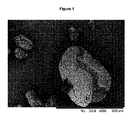
本発明によるプロセスにおいて、ポリアミド(A)は、ジアミン/ジカルボン酸塩の直接固相重合を含むプロセスステップにより調製される。この直接固相重合プロセス全体に亘り、反応している成分および生成物は固体状態に維持される。直接固相重合プロセスの少なくとも第1段階を行う間は、温度は塩の融解温度未満に維持される。一旦塩が完全にポリアミドポリマーに変換されたら、ポリマーをポリアミドの融解温度未満の温度でさらに固相後縮合することによってさらに分子量を増加させることができる。さらなる重合を含むこの種のプロセスは、プロセス全体を塩の融解温度未満で実施することもできる。その結果として、塩に含まれる反応体および結果として得られるポリマーは、重合全体を通して固体状態に維持される。ポリアミド(A)のポリマーは、本発明によるプロセスの溶融加工ステップ(c)に使用される前に溶液または融解相として存在することはなく、したがって、重合に使用したジアミン/ジカルボン酸塩粒子に類似した形状を有し、初期の形状(粒子外観等の特徴)を保っている。直接固相重合により調製されたポリアミド粒子の写真を図1に示す。 In the process according to the invention, the polyamide (A) is prepared by process steps involving direct solid state polymerization of diamine / dicarboxylate. Throughout this direct solid state polymerization process, the reacting components and products are maintained in a solid state. During at least the first stage of the direct solid state polymerization process, the temperature is maintained below the melting temperature of the salt. Once the salt is completely converted to a polyamide polymer, the molecular weight can be further increased by further solid phase postcondensation of the polymer at a temperature below the melting temperature of the polyamide. This type of process involving further polymerization can also be carried out below the melting temperature of the salt. As a result, the reactants contained in the salt and the resulting polymer remain in a solid state throughout the polymerization. The polymer of polyamide (A) does not exist as a solution or melt phase before being used in the melt processing step (c) of the process according to the invention and is therefore similar to the diamine / dicarboxylate particles used for the polymerization The initial shape (characteristics such as particle appearance) is maintained. A photograph of polyamide particles prepared by direct solid state polymerization is shown in FIG.
他の態様は、このような初期の形状を有する結晶性の高いポリアミド(A)であり、このことは、DSCにより測定される1回目の加熱サイクルの融解吸熱が高いことにより示される。好適には、ポリアミド(A)の融解吸熱(ΔHm)は少なくとも60J/g、例えば、70J/g〜150J/gまたは80〜135J/gである。 Another embodiment is a highly crystalline polyamide (A) having such an initial shape, which is indicated by a high melting endotherm as measured by DSC. Preferably, the melting endotherm (ΔHm) of the polyamide (A) is at least 60 J / g, such as 70 J / g to 150 J / g or 80 to 135 J / g.
ポリアミド(A)の調製に使用されるジアミン/テレフタル酸塩は、テレフタル酸およびジアミンの塩の調製に適した任意の方法により調製することができる。例えばこの塩を、テレフタル酸およびジアミンと、任意的なさらなる成分とを、水中に(最終的には加熱して)溶解することによって調製することができる。塩は、冷却によるかまたは非溶媒を加えることにより、最終的な冷却中または冷却後に析出する。 The diamine / terephthalate used in the preparation of polyamide (A) can be prepared by any method suitable for the preparation of terephthalic acid and diamine salts. For example, the salt can be prepared by dissolving terephthalic acid and diamine and optional additional ingredients in water (and ultimately by heating). The salt precipitates out during or after the final cooling, either by cooling or by adding a non-solvent.
本明細書における融解吸熱とは、ISO 11357−3(2011)に準拠する方法で、DSCにより走査速度を20℃/分として1回目の加熱サイクルにおいて測定された融解吸熱ピークに関し求められる吸熱と理解される。 The melting endotherm in the present specification is a method based on ISO 11357-3 (2011), and is understood as the endotherm required for the melting endothermic peak measured in the first heating cycle at a scanning speed of 20 ° C./min by DSC. Is done.
ポリアミド(B)のポリマーは、関与するポリアミドの種類に適した任意の従来の重合法により調製することができる。好適には、ポリアミド(B)は、溶融重合ステップまたは溶液重合ステップまたはこれらの組合せを含むプロセスに任意的な固相後縮合ステップを組み合わせることにより得られる。本明細書における反応体(単一種のジアミン/ジカルボン酸塩または複数種のジアミン/ジカルボン酸塩またはα,ω−アミノカルボン酸または対応するラクタムまたはこれらの任意の組合せのいずれか)は、溶媒中で調製するか、または溶媒に溶解させて調製するか、調製するか、または溶融物にすることができる。この種のプロセスを行う間に反応体はその原型を失い、結果として得られるポリマーの特徴は元の塩粒子の外観に似ていない。 The polymer of polyamide (B) can be prepared by any conventional polymerization method suitable for the type of polyamide involved. Preferably, the polyamide (B) is obtained by combining an optional solid phase post-condensation step with a process comprising a melt polymerization step or a solution polymerization step or a combination thereof. The reactants herein (either a single diamine / dicarboxylate or multiple diamine / dicarboxylate or α, ω-aminocarboxylic acid or the corresponding lactam or any combination thereof) are in a solvent. Or may be prepared by dissolving in a solvent, prepared, or made into a melt. During this type of process, the reactants lose their prototype, and the resulting polymer characteristics do not resemble the appearance of the original salt particles.
特定の実施形態において、ポリアミド(B)は、直接固相重合プロセスにより調製することにより得られる。この実施形態は、モノマーの組合せが個々に複雑に絡み合ったコポリアミドとなるか、または直接固相重合によるコポリアミドの調製ができないポリアミド(A)およびポリアミド(B)の組合せに特に有利に適用される。これは例えば、ポリアミド(B)が脂肪族成分のみからなる場合に該当し得る。脂肪族成分のみからなる塩、すなわち両方が脂肪族ジアミンおよび脂肪族ジカルボン酸である塩の融解温度は、通常、対応する脂肪族ジアミンおよび芳香族ジカルボン酸の塩(半芳香族塩)よりも大幅に低くなる。 In certain embodiments, the polyamide (B) is obtained by preparing it by a direct solid state polymerization process. This embodiment is particularly advantageously applied to combinations of polyamides (A) and polyamides (B) in which the monomer combinations result in individually intricately intertwined copolyamides or the copolyamides cannot be prepared by direct solid state polymerization. The This can be the case, for example, when the polyamide (B) consists solely of an aliphatic component. The melting temperature of a salt composed solely of an aliphatic component, ie, both an aliphatic diamine and an aliphatic dicarboxylic acid, is usually much greater than the corresponding aliphatic diamine and aromatic dicarboxylic acid salt (semi-aromatic salt). It becomes low.
ポリアミド(A)およびポリアミド(B)を、1回の直接固相プロセスで一緒に調製するのではなく、それぞれを別々の直接固相プロセスにより調製するこのようなプロセスの利点は、別々のポリアミドに異なる反応条件が適用できることにある。融点がより低い全脂肪族塩の場合は反応性がより高いので、より低い反応温度を適用することができるが、これらの塩は、通常、比較的融点の低い中間体であるプレポリマー生成物も生成する。より融点の高い、脂肪族ジアミンおよびテレフタル酸の半芳香族塩等の塩も、通常、より融解温度の高い中間体プレポリマーおよびポリマーを生成し、反応温度は全脂肪族塩の融解温度を十分に上回る温度とするとより有利であり、低融点の全脂肪族塩の非存在下においては、このようなより高い反応温度に、全体として比較的短い反応時間を組合せて適用することができ、したがって、粘着のリスクを低減しながら最適な加工条件を適用することが可能になる。コポリアミドが芳香族ジカルボン酸(例えば、テレフタル酸)のみと3種以上の異なるジアミンとを含む場合(特に、長鎖ジアミンを含む場合)も、ポリアミドAおよびポリアミドBを別々に調製すると有利である。その理由は、この場合も融点が比較的低い中間体プレポリマーが生成するので、直接固相重合時の粘着や付着を回避するために温度を余り高くしないことが必要となるためである。 The advantage of such a process, in which the polyamide (A) and the polyamide (B) are each prepared by a separate direct solid phase process, rather than being prepared together in a single direct solid phase process, is that Different reaction conditions can be applied. Lower reaction temperatures can be applied because all aliphatic salts with lower melting points are more reactive, but these salts are typically prepolymer products that are relatively low melting intermediates. Also generate. Higher melting point salts such as aliphatic diamines and semi-aromatic salts of terephthalic acid also usually produce intermediate prepolymers and polymers with higher melting temperatures, and the reaction temperature is sufficient to melt the melting temperature of all aliphatic salts. In the absence of a low melting point total aliphatic salt, a higher reaction temperature can be applied in combination with a relatively short reaction time as a whole, thus It is possible to apply optimum processing conditions while reducing the risk of sticking. It is also advantageous to prepare polyamide A and polyamide B separately if the copolyamide contains only an aromatic dicarboxylic acid (eg terephthalic acid) and three or more different diamines (especially if it contains a long chain diamine). . The reason is that an intermediate prepolymer having a relatively low melting point is generated in this case as well, so that it is necessary not to raise the temperature too much in order to avoid adhesion and adhesion during direct solid phase polymerization.
本発明によるプロセスにおいて、ポリアミド(A)およびポリアミド(B)は幅広いポリアミドから選択することができ、様々な比率で混合しても依然として融解温度が少なくとも300℃である半結晶性半芳香族コポリアミドが得られる。 In the process according to the invention, the polyamide (A) and the polyamide (B) can be selected from a wide range of polyamides and are semicrystalline semiaromatic copolyamides which still have a melting temperature of at least 300 ° C. when mixed in various proportions. Is obtained.
ポリアミド(A)は、ジカルボン酸成分およびジアミン成分を含み、
・テレフタル酸を45〜50mol%と、
・ジアミンを47.5〜50mol%と、
・1種以上の他のアミン基含有成分および/または酸基含有成分を0〜5mol%と
からなる成分から誘導された繰り返し単位からなり、mol%は、繰り返し単位に含まれる上記アミン基含有成分および/または酸基含有成分の総モル量を基準とする。本明細書においてテレフタル酸は酸基含有成分と理解され、本明細書においてジアミンはアミン基含有成分と理解される。
The polyamide (A) includes a dicarboxylic acid component and a diamine component,
-45-50 mol% terephthalic acid,
-47.5-50 mol% of diamine,
-It comprises a repeating unit derived from a component comprising 0 to 5 mol% of one or more other amine group-containing components and / or acid group-containing components, wherein mol% is the above-mentioned amine group-containing component contained in the repeating unit And / or based on the total molar amount of the acid group-containing component. In the present specification, terephthalic acid is understood as an acid group-containing component, and in this specification, diamine is understood as an amine group-containing component.
ポリアミド(A)は、テレフタル酸およびジアミンに隣接する1種以上の他のアミン基含有成分および/または酸基含有成分を含むことができる。 The polyamide (A) can contain one or more other amine group-containing components and / or acid group-containing components adjacent to terephthalic acid and diamine.
テレフタル酸に隣接して、少量の1種以上の他の芳香族ジカルボン酸(イソフタル酸、4,4−ジフェニレンジカルボン酸、ナフタレンジカルボン酸、これらの任意の組合せ等)を存在させることもできる。これらの量は、融解温度を大幅に上昇させることがないように、例えば、370℃を超えないように、および/または直接固相重合の妨げとならないように制限すべきである。この種の他のジカルボン酸の量は、好適には、ポリアミド(A)中のジカルボン酸の総モル量を基準として最大10mol%である。好ましくは、テレフタル酸含有量は、ポリアミド(A)中のジカルボン酸の総モル量を基準として95mol〜100%の範囲にあり、他の芳香族ジカルボン酸の量は0〜5mol%の範囲にある。最も好都合には、ポリアミド(A)は、唯一のジカルボン酸であるテレフタル酸をベースとする。 A small amount of one or more other aromatic dicarboxylic acids (isophthalic acid, 4,4-diphenylenedicarboxylic acid, naphthalenedicarboxylic acid, any combination thereof, etc.) can also be present adjacent to terephthalic acid. These amounts should be limited so as not to significantly increase the melting temperature, for example not to exceed 370 ° C., and / or do not interfere with direct solid state polymerization. The amount of other dicarboxylic acids of this type is preferably at most 10 mol% based on the total molar amount of dicarboxylic acids in the polyamide (A). Preferably, the terephthalic acid content is in the range of 95 mol to 100% based on the total molar amount of dicarboxylic acid in the polyamide (A), and the amount of other aromatic dicarboxylic acids is in the range of 0 to 5 mol%. . Most conveniently, the polyamide (A) is based on terephthalic acid, the only dicarboxylic acid.
他の成分は、ジアミンおよび芳香族ジカルボン酸以外の、アジピン酸、単官能性ジアミン成分、三または四官能性ジアミン成分、単官能性カルボン酸成分、三または四官能性カルボン酸成分、α,ω−アミノカルボン酸、これらの他の任意の組合せ等の1種以上の成分を含むこともできる。その量は、融解温度Tm−Aを大幅に低下させることがないように、例えば、310℃未満とし、および/または直接固相重合の妨げとならないように制限すべきである。好ましくは、この種の成分は、ポリアミドに含まれるアミン基含有成分および/または酸基含有成分の総モル量に対し最大2.5mol%の量で、より好ましくは0〜1mol%の範囲で使用される。 Other components include adipic acid, monofunctional diamine component, tri- or tetrafunctional diamine component, monofunctional carboxylic acid component, tri- or tetrafunctional carboxylic acid component, α, ω other than diamine and aromatic dicarboxylic acid -It may also contain one or more components such as aminocarboxylic acids, any other combination thereof. The amount should be limited so as not to significantly reduce the melting temperature Tm-A, for example, below 310 ° C. and / or not directly interfere with solid phase polymerization. Preferably, this type of component is used in an amount of at most 2.5 mol%, more preferably in the range of 0 to 1 mol%, based on the total molar amount of the amine group-containing component and / or acid group-containing component contained in the polyamide. Is done.
ポリアミド(A)に含まれるジアミン成分は、1種のジアミンのみからなるものであってもよいし、あるいは異なるジアミンの組合せ、例えば、2種または3種の異なるジアミンからなるものであってもよい。好適には、ジアミン成分は、C2〜C12ジアミン、すなわち2〜12個の炭素原子を有するジアミンから選択される1種以上のジアミンからなる。 The diamine component contained in the polyamide (A) may be composed of only one diamine, or may be composed of a combination of different diamines, for example, two or three different diamines. . Suitably, the diamine component consists of one or more diamines selected from C2 to C12 diamines, i.e. diamines having 2 to 12 carbon atoms.
好ましい実施形態において、ポリアミド(A)は、テレフタル酸および脂肪族C5〜C11ジアミンから選択される1種のジアミンから誘導されたホモポリアミドである。本明細書におけるホモポリアミドとは、基本的に1種のジカルボン酸(この場合はテレフタル酸)と、1種のジアミンと、最大1mol%の他の成分とから誘導された繰り返し単位からなるポリアミドと理解される。 In a preferred embodiment, the polyamide (A) is a homopolyamide derived from one diamine selected from terephthalic acid and an aliphatic C5-C11 diamine. The homopolyamide in the present specification is basically a polyamide composed of repeating units derived from one kind of dicarboxylic acid (in this case, terephthalic acid), one kind of diamine, and up to 1 mol% of other components. Understood.
好ましくは、ホモポリアミドは、PA 5T、PA 6T、PA 7T、PA 8T、PA 9TおよびPA 10Tから選択される。本明細書におけるC5〜C10ジアミンは直鎖ジアミンである。PA 4Tは高温で融解しないが分解するので適していない。PA 6Tは370℃を超える溶融加工温度が必要となることになるが、使用は可能である。その利点は、アミド交換が非常に速く進行すると考えられることにある。PA 6Tは、好適には、温度が370℃を超える溶融段階を短い滞留時間で行う溶融処理ステップが可能となるプロセス機器で使用される。PA 6Tを溶融させると溶融混合物が生成し、得られる溶融混合物の温度は、より低い温度、すなわちPA 6Tの融解温度未満であるが、依然として溶融物の結晶化温度よりも高い温度まで低下させることができ、それによって、速やかなアミド交換の利点を享受しながら、副反応の発生が制限される。 Preferably, the homopolyamide is selected from PA 5T, PA 6T, PA 7T, PA 8T, PA 9T and PA 10T. The C5-C10 diamine in this specification is a linear diamine. PA 4T is not suitable because it does not melt at high temperatures but decomposes. PA 6T will require a melt processing temperature above 370 ° C., but it can be used. The advantage is that the amide exchange is believed to proceed very quickly. PA 6T is preferably used in process equipment that allows a melt processing step in which the melting phase above 370 ° C. is performed with a short residence time. Melting PA 6T produces a molten mixture and the temperature of the resulting molten mixture is lowered to a lower temperature, ie, below the melting temperature of PA 6T, but still higher than the crystallization temperature of the melt. Thereby limiting the occurrence of side reactions while enjoying the benefits of rapid amide exchange.
より好ましくは、このホモポリアミドは、PA 7T、PA 8T、PA 9TおよびPA 10Tから選択される。これらのポリアミドは融解温度Tm−Aが310℃〜350℃の範囲にある。その利点は、これらのポリアミドは370℃前後またはそれを下回る温度で溶融加工できることにある。 More preferably, the homopolyamide is selected from PA 7T, PA 8T, PA 9T and PA 10T. These polyamides have a melting temperature Tm-A in the range of 310 ° C to 350 ° C. The advantage is that these polyamides can be melt processed at temperatures around 370 ° C. or below.
本明細書において上述および後述するポリアミドの命名には、ISO 1874−1:2010に準拠する名称体系を使用する。 The nomenclature conforming to ISO 1874-1: 2010 is used for the nomenclature of the polyamide described above and below in this specification.
他の好ましい実施形態において、ポリアミド(A)は、テレフタル酸と、脂肪族C2〜C12ジアミンから選択される少なくとも1種のジアミンを含む少なくとも2種のジアミンとから誘導されたコポリアミドである。より詳細には、このコポリアミドは、テレフタル酸と、脂肪族C2〜C12ジアミンから選択される少なくとも2種のジアミンと、最大1mol%の他の成分とから誘導された繰り返し単位から基本的になる。 In another preferred embodiment, the polyamide (A) is a copolyamide derived from terephthalic acid and at least two diamines including at least one diamine selected from aliphatic C2-C12 diamines. More particularly, this copolyamide consists essentially of repeating units derived from terephthalic acid, at least two diamines selected from aliphatic C2-C12 diamines and up to 1 mol% of other components. .
好ましくは、脂肪族C2〜C12ジアミンは直鎖ジアミンである。ポリアミド(A)に好適なコポリアミドとしては、例えば、PA 4T/6T、PA 4T/8T、PA 4T/10T、PA 6T/8TおよびPA 6T/10T、PA 8T/10Tならびにこれらの任意のコポリアミドが挙げられる。好適なコポリアミドの例が、PA 4T/6T/10Tである。 Preferably, the aliphatic C2-C12 diamine is a linear diamine. Suitable copolyamides for the polyamide (A) include, for example, PA 4T / 6T, PA 4T / 8T, PA 4T / 10T, PA 6T / 8T and PA 6T / 10T, PA 8T / 10T and any copolyamides thereof. Is mentioned. An example of a suitable copolyamide is PA 4T / 6T / 10T.
より好ましくは、少なくとも2種のジアミンは、直鎖脂肪族C2〜C6ジアミンから選択される少なくとも1種のジアミンを含み、さらに好ましくは、1,4−ブタンデジアミンおよび1,6−ヘキサメチレンジアミンから選択される少なくとも1種のジアミンである。 More preferably, the at least two diamines comprise at least one diamine selected from linear aliphatic C2-C6 diamines, more preferably 1,4-butanedediamine and 1,6-hexamethylenediamine. At least one diamine selected from:
より好都合には、ポリアミド(A)は、テレフタル酸(「T」と表記)および1,4−ブタンデジアミン(「4」と表記)または1,6−ヘキサメチレンジアミン(「6」と表記)をベースとするPA 4T/XTコポリアミドまたはPA 6T/XTコポリアミドであり、Xは、1,4−ブタンジアミン(C4ジアミン)、1,6−ヘキサメチレンジアミン(C6ジアミン)、1,8−オクタメチレンジアミン(C8ジアミン)もしくは1,10−デカンジアミン(C10ジアミン)またはこれらの任意の組合せから選択される他の直鎖脂肪族ジアミンである。ポリアミド(A)の融解温度Tm−Aは325〜350℃の範囲にある。その利点は、本発明によるプロセスにより調製した、結果として得られるコポリアミドの結晶化度が高く、かつガラス転移温度が高くなることにある。最も好ましいポリアミド(A)はPA 4T/XTコポリアミドである。その利点は、このコポリアミドが、ポリアミド(B)となる幅広い種類のポリアミド(他の半芳香族ポリアミド、特にPA XT(Xは少なくとも7個の炭素原子を有するジアミン、好ましくはC8ジアミン、C10ジアミンおよび/またはC12ジアミン)に加えて、脂肪族ポリアミド、特にC4〜C10ジアミンおよびアジピン酸から誘導された脂肪族ジアミンを含む)と高い混和性を示すことにある。 More conveniently, the polyamide (A) comprises terephthalic acid (designated “T”) and 1,4-butanedediamine (designated “4”) or 1,6-hexamethylenediamine (designated “6”). 4 based PA 4T / XT copolyamide or PA 6T / XT copolyamide, where X is 1,4-butanediamine (C4 diamine), 1,6-hexamethylenediamine (C6 diamine), 1,8- Other linear aliphatic diamines selected from octamethylene diamine (C8 diamine) or 1,10-decane diamine (C10 diamine) or any combination thereof. The melting temperature Tm-A of the polyamide (A) is in the range of 325 to 350 ° C. The advantage is that the resulting copolyamide prepared by the process according to the invention has a high crystallinity and a high glass transition temperature. The most preferred polyamide (A) is PA 4T / XT copolyamide. The advantage is that this copolyamide is a wide variety of polyamides (other semi-aromatic polyamides, in particular PA XT, where X is a diamine having at least 7 carbon atoms, preferably C8 diamine, C10 diamine). And / or C12 diamine) in addition to aliphatic polyamides, in particular including aliphatic diamines derived from C4 to C10 diamines and adipic acid).
ポリアミド(B)は、好適には、(B1)非晶性半芳香族ポリアミド、(B2)半結晶性半芳香族コポリアミド、(B3)半結晶性脂肪族ポリアミド、もしくは(B4)半結晶性半芳香族ホモポリアミド、またはこれらの任意の組合せを含む。 The polyamide (B) is preferably (B1) amorphous semi-aromatic polyamide, (B2) semi-crystalline semi-aromatic copolyamide, (B3) semi-crystalline aliphatic polyamide, or (B4) semi-crystalline. Including semi-aromatic homopolyamides, or any combination thereof.
(B2)は(B2a)脂肪族ジカルボン酸および芳香族ジカルボン酸から誘導された繰り返し単位を含む半結晶性半芳香族コポリアミド;または(B2b)テレフタル酸およびイソフタル酸から誘導された繰り返し単位を含む半結晶性半芳香族コポリアミド;または(B2c)これらのコポリアミドのいずれかとすることができる。 (B2) includes (B2a) a semi-crystalline semi-aromatic copolyamide containing repeating units derived from aliphatic and aromatic dicarboxylic acids; or (B2b) containing repeating units derived from terephthalic acid and isophthalic acid A semi-crystalline semi-aromatic copolyamide; or (B2c) any of these copolyamides.
ポリアミド(B)に好適なポリアミドとしては、例えば、PA 6I(例えば、LanxessからのDurethan T40)、PA 6I/6T、PA 6I/66、およびPA NDT/INDT(例えば、EvonikからTrogamid(登録商標)の名称で市販されているもの)、PA DT(Dは2−メチルペンタメチレンジアミン)、およびPA MACMI/12から選択される非晶性半芳香族ポリアミド(B1)ならびにこれらの任意のコポリアミドが挙げられる。 Suitable polyamides for polyamide (B) include, for example, PA 6I (eg, Durethan T40 from Lanxess), PA 6I / 6T, PA 6I / 66, and PA NDT / INDT (eg, Evonik to Trogamid®) A non-crystalline semi-aromatic polyamide (B1) selected from PA DT (D is 2-methylpentamethylenediamine), and PA MACMI / 12, and any of these copolyamides Can be mentioned.
好ましい一実施形態において、ポリアミド(B)は、非晶性PA 6I/6Tコポリアミド、より好ましくは、ガラス転移温度(Tg−B)が少なくとも130℃である非晶性PA 6I/6Tコポリアミドを含むかまたはこのポリアミドからなる場合さえある。その利点は、Tgが比較的高いCo−PAが得られることにある。 In one preferred embodiment, the polyamide (B) comprises an amorphous PA 6I / 6T copolyamide, more preferably an amorphous PA 6I / 6T copolyamide having a glass transition temperature (Tg-B) of at least 130 ° C. It may even contain or consist of this polyamide. The advantage is that Co-PA having a relatively high Tg can be obtained.
好適には、ポリアミド(B)は、テレフタル酸(Tで表す)およびイソフタル酸(Iで表す)、もしくはテレフタル酸およびアジピン酸(「6」で表す)、またはこれらの組合せをベースとし、場合により1種以上の他の成分から誘導された他の繰り返し単位(「Z」で表す)を含む、PA XT/YI、PA XT/YI/Z、PA XT/Y6もしくはPA XT/Y6/Zコポリアミド(XおよびYはジアミンを表す)またはこれらの任意のコポリアミドから選択される半結晶性半芳香族コポリアミド(B2)を含む。好ましくは、XおよびYの少なくとも1種は、1,4−ブタンジアミンおよび1,6−ヘキサメチレンジアミンから選択される。半結晶性半芳香族コポリアミドは、PA ΧT/YTコポリアミド(式中、XおよびYの一方は、1,4−ブタンジアミンおよび1,6−ヘキサメチレンジアミンから選択され、他方のジアミンは、分岐ジアミン、例えば、2−メチルペンタメチレンジアミンを含む)も含むことができる。好適には、半結晶性半芳香族コポリアミド(B2)は、PA 6/4T、PA 6/6T、PA 6/10T、PA 6/12T、PA 610/6T、PA 612/6T、PA 614/6T、PA 6/6T/6I、PA D6/66/6T、PA 6T/DT、PA 1010/10T、PA 1010/1210/10T/12T、PA 11/4T、PA 11/6T、PA 11/10T、PA 11/12T、PA 12/4T、PA 12/6T、PA 12/10T、PA 1212/12T、PA 66/6T、PA 6I/6T、PA 66/6I/6T、PA 6T/6I、PA 6T/66、PA 6T/46、PA 6T/6、PA 6T/6I/66、PA 6T/6I/46およびPA 6T/6I/6ならびにこれらの任意のコポリアミドから選択される。半結晶性半芳香族コポリアミドは、芳香族ジアミンおよび脂肪族ジカルボン酸から誘導されたPA MXD6等とすることもできる。 Preferably, the polyamide (B) is based on terephthalic acid (represented by T) and isophthalic acid (represented by I), or terephthalic acid and adipic acid (represented by “6”), or combinations thereof, optionally PA XT / YI, PA XT / YI / Z, PA XT / Y6 or PA XT / Y6 / Z copolyamide comprising other repeat units (denoted “Z”) derived from one or more other components (X and Y represent diamines) or semi-crystalline semi-aromatic copolyamides (B2) selected from any of these copolyamides. Preferably, at least one of X and Y is selected from 1,4-butanediamine and 1,6-hexamethylenediamine. The semicrystalline semiaromatic copolyamide is a PAPAT / YT copolyamide, wherein one of X and Y is selected from 1,4-butanediamine and 1,6-hexamethylenediamine, Branched diamines such as 2-methylpentamethylenediamine) may also be included. Preferably, the semi-crystalline semi-aromatic copolyamide (B2) is PA 6 / 4T, PA 6 / 6T, PA 6 / 10T, PA 6 / 12T, PA 610 / 6T, PA 612 / 6T, PA 614 / 6T, PA 6 / 6T / 6I, PA D6 / 66 / 6T, PA 6T / DT, PA 1010 / 10T, PA 1010/1210 / 10T / 12T, PA 11 / 4T, PA 11 / 6T, PA 11 / 10T, PA 11 / 12T, PA 12 / 4T, PA 12 / 6T, PA 12 / 10T, PA 1212 / 12T, PA 66 / 6T, PA 6I / 6T, PA 66 / 6I / 6T, PA 6T / 6I, PA 6T / 66, PA 6T / 46, PA 6T / 6, PA 6T / 6I / 66, PA 6T / 6I / 46 and PA 6T / 6I / 6 and any of these It is selected from copolyamides. The semicrystalline semiaromatic copolyamide can also be PA MXD6 derived from aromatic diamines and aliphatic dicarboxylic acids.
好ましい実施形態において、ポリアミド(B)は、融解温度(Tm−B)が250℃〜300℃の範囲にある半結晶性半芳香族コポリアミド(B2)を含むかまたはこのコポリアミド(B2)からなる場合さえある。 In a preferred embodiment, the polyamide (B) comprises or consists of a semicrystalline semiaromatic copolyamide (B2) having a melting temperature (Tm-B) in the range of 250 ° C. to 300 ° C. It can even be.
ポリアミド(B)に好適なポリアミドとしては、例えば、PA 6、PA 8、PA 10、PA 11、PA 12、PA 66、PA 610、PA 612、PA 1010、PA 46、PA 48、PA 410およびPA 412およびこれらの任意のコポリアミドから選択される半結晶性脂肪族ポリアミド(B3)が挙げられる。 Suitable polyamides for polyamide (B) include, for example, PA 6, PA 8, PA 10, PA 11, PA 12, PA 66, PA 610, PA 612, PA 1010, PA 46, PA 48, PA 410 and PA 410 412 and any semi-crystalline aliphatic polyamide (B3) selected from these copolyamides.
好適な半結晶性半芳香族ホモポリアミド(B4)としては、例えば、PA XT(Tはテレフタル酸を表し、Xは8〜16個の炭素原子を有するジアミンを表す)が挙げられる。好ましい実施形態において、PA XTは、PA 8T、PA 9T、PA 10T、PA 11TおよびPA12Tから選択される。 Suitable semi-crystalline semi-aromatic homopolyamide (B4) includes, for example, PA XT (T represents terephthalic acid and X represents a diamine having 8 to 16 carbon atoms). In a preferred embodiment, PA XT is selected from PA 8T, PA 9T, PA 10T, PA 11T and PA12T.
混和性がより低いかまたは混和性のないポリアミドの好適な組合せの例は、高芳香族ポリアミド、より具体的にはポリテレフタルアミドである。その例として、異なるジアミンを含むポリテレフタルアミド、例えば、PA 4T/6TとPA XTとの組合せ;およびPA 6TとPA XTとの組合せ(PA XTはPA 10TまたはPA 12Tのいずれか)が挙げられる。 Examples of suitable combinations of polyamides that are less miscible or immiscible are highly aromatic polyamides, more specifically polyterephthalamide. Examples include polyterephthalamides containing different diamines, for example, a combination of PA 4T / 6T and PA XT; and a combination of PA 6T and PA XT (PA XT is either PA 10T or PA 12T) .
さらなる好ましい実施形態において、ポリアミド(B)は、融解温度(Tm−B)が220℃〜300℃の範囲にある半結晶性脂肪族ポリアミドを含むかまたはこのポリアミドからなる場合さえある。より好ましくは、上記半結晶性脂肪族ポリアミドは、C/N比が4〜7の範囲にある脂肪族ポリアミドである。本明細書におけるC/N比とは、ポリアミド中の炭素原子(C)数および窒素原子(N)数の比と理解される。好適な例としては、PA 46、PA 6、PA 66およびPA 410ならびにこれらのコポリアミドが挙げられる。最も好ましくは、C/N比は5〜6の範囲にある。脂肪族ポリアミドは、好適には、PA 46、PA 6およびPA 66ならびにこれらのコポリアミドから選択される。同じくより好ましくは、Tm−Bは250℃〜300℃の範囲にある。 In a further preferred embodiment, the polyamide (B) may comprise or even consist of a semicrystalline aliphatic polyamide having a melting temperature (Tm-B) in the range of 220 ° C to 300 ° C. More preferably, the semicrystalline aliphatic polyamide is an aliphatic polyamide having a C / N ratio in the range of 4-7. The C / N ratio in the present specification is understood as the ratio of the number of carbon atoms (C) and the number of nitrogen atoms (N) in the polyamide. Suitable examples include PA 46, PA 6, PA 66 and PA 410 and their copolyamides. Most preferably, the C / N ratio is in the range of 5-6. The aliphatic polyamide is preferably selected from PA 46, PA 6 and PA 66 and their copolyamides. Also more preferably, Tm-B is in the range of 250 ° C to 300 ° C.
ポリアミド(A)およびポリアミド(B)の混合比は、融解温度が依然として少なくとも300℃となる半結晶性半芳香族コポリアミドが得られるのであれば幅広い範囲で変化させることができる。この範囲は使用されるポリアミドの種類に依存し、より具体的には、初期の融解温度(Tm−A)および(Tm−B)ならびにCo−PAの所望の融解温度に依存するであろう。好適には、ポリアミド(A)およびポリアミド(B)は、重量比A/Bが65/35〜99/1の範囲となるように混合される。 The mixing ratio of polyamide (A) and polyamide (B) can be varied within a wide range as long as a semicrystalline semiaromatic copolyamide having a melting temperature of at least 300 ° C. is obtained. This range will depend on the type of polyamide used, and more specifically will depend on the initial melting temperature (Tm-A) and (Tm-B) and the desired melting temperature of Co-PA. Preferably, the polyamide (A) and the polyamide (B) are mixed so that the weight ratio A / B is in the range of 65/35 to 99/1.
ポリアミド(A)およびポリアミド(B)の比(A/B比として表す)は、本明細書において重量比として表される。(Tm−A)が比較的高く、例えば350℃を超える場合は、ポリアミド(B)をより多量に混合することができる(これはA/B比がより低いことに相当する)。但し、通常、ポリアミド(A)の量は少なくとも50重量%となり、これはA/B比が少なくとも50/50であることに相当する。好ましくは、この比は少なくとも55/45である。 The ratio of polyamide (A) and polyamide (B) (expressed as A / B ratio) is expressed herein as a weight ratio. When (Tm-A) is relatively high, for example, higher than 350 ° C., the polyamide (B) can be mixed in a larger amount (this corresponds to a lower A / B ratio). However, the amount of polyamide (A) is usually at least 50% by weight, which corresponds to an A / B ratio of at least 50/50. Preferably this ratio is at least 55/45.
(Tm−A)が比較的低く、例えば、310℃〜325℃の範囲にある場合は、より少量のポリアミド(B)を混合することができる(これはA/Bがより低いことに相当する)。好ましくは、A/B比は少なくとも75/25である。 When (Tm-A) is relatively low, for example in the range of 310 ° C. to 325 ° C., a smaller amount of polyamide (B) can be mixed (this corresponds to a lower A / B). ). Preferably, the A / B ratio is at least 75/25.
好ましい実施形態において、Tm−AおよびTm−Bの差は少なくとも30℃、好ましくは少なくとも50℃である。融点がより低いポリアミド(B)を使用するか、または例えポリアミド(B)に非晶性ポリアミドを使用した場合でさえも、特にポリアミド(B)を最大25重量%の量で使用すれば、必ずしもTm−Co−PAがさらに低下するわけではないことが観測されている。したがって、一層低い温度で調製されたポリアミド(B)からCo−PAを調製しても、依然として融解温度が比較的高い融解温度を有するCo−PAを得ることが可能となる。 In a preferred embodiment, the difference between Tm-A and Tm-B is at least 30 ° C, preferably at least 50 ° C. Even if a lower melting point polyamide (B) is used, or even if an amorphous polyamide is used for the polyamide (B), it is not always necessary to use the polyamide (B) in an amount of up to 25% by weight. It has been observed that Tm-Co-PA is not further reduced. Therefore, even if Co-PA is prepared from polyamide (B) prepared at a lower temperature, it is possible to obtain Co-PA having a melting temperature that is still relatively high.
ポリアミド(B)をポリアミド(A)に1重量%以下の量で混合することも可能であるが、これは、結果として得られるCo−PAの融解温度および他の特性にほとんど影響しない。好適には、ポリアミド(B)は、これよりも多い最小限の量で混合され、例えばA/Bの重量比は最大95/5または最大90/10にさえなる。好ましくは、ポリアミド(B)およびポリアミド(A)は、結果として得られるCo−PAをさらに加工した後の融解温度(Tm−Co−PA)、すなわちCo−PAから作製された成形品の融解温度(Tm−Co−PA)がTm−Aよりも少なくとも5℃低く、より好ましくはTm−Aより少なくとも10℃低くなるように混合される。 It is possible to mix the polyamide (B) with the polyamide (A) in an amount of 1% by weight or less, but this has little effect on the melting temperature and other properties of the resulting Co-PA. Preferably, the polyamide (B) is mixed in a minimum amount greater than this, for example, the A / B weight ratio is up to 95/5 or even up to 90/10. Preferably, the polyamide (B) and the polyamide (A) have a melting temperature after further processing of the resulting Co-PA (Tm-Co-PA), i.e. a melting temperature of a molding made from Co-PA. (Tm—Co—PA) is mixed so that it is at least 5 ° C. lower than Tm-A, more preferably at least 10 ° C. lower than Tm-A.
ポリアミド(A)およびポリアミド(B)のポリアミドは、それぞれ分子量を幅広い範囲で変化させることができる。分子量および対応する粘度も互いに異なっていてもよい。 The polyamides of the polyamide (A) and the polyamide (B) can each vary the molecular weight within a wide range. The molecular weight and the corresponding viscosity may also be different from each other.
好適には、ポリアミド(A)の粘度数(VN)は50〜135ml/gの範囲にある。135ml/gよりも高いVNまたは50ml/gよりも低いVNを適用することもできる。好ましくは、VNは50〜120ml/gである。VNが少なくとも50ml/gであることは、押出機等の混合装置における溶融混練プロセスに好ましい。VNを最大120ml/gとすることは、このような高粘度を得るために必要な後縮合時間が限られるので、好都合に適用される。 Preferably, the polyamide (A) has a viscosity number (VN) in the range of 50 to 135 ml / g. VN higher than 135 ml / g or VN lower than 50 ml / g can also be applied. Preferably, VN is 50-120 ml / g. A VN of at least 50 ml / g is preferable for the melt-kneading process in a mixing apparatus such as an extruder. VN up to 120 ml / g is conveniently applied because the post-condensation time required to obtain such a high viscosity is limited.
本明細書におけるVNは、ISO 307第4版に従い96%硫酸中(0.005g/ml)、25℃で測定される。 VN herein is measured in 96% sulfuric acid (0.005 g / ml) at 25 ° C. according to ISO 307 4th edition.
好適には、ポリアミド(B)の粘度数(VN)は20〜300ml/gの範囲にある。20〜50ml/gの範囲にあるVNは、押出機等の混合装置における溶融混練プロセスに悪影響を与えることなくメルトフロー特性がより良好なコポリアミドを得るために有利に適用される。200〜300ml/gの範囲にあるVNは、より高い分子量およびより高い機械特性を有するコポリアミドを得るために有利に適用される。溶融混練はTm−Aを十分に上回る温度で実施されるので、このように高いVN値が溶融混練プロセスにおいて問題を起こすことはない。 Preferably, the polyamide (B) has a viscosity number (VN) in the range of 20 to 300 ml / g. VN in the range of 20 to 50 ml / g is advantageously applied to obtain a copolyamide with better melt flow characteristics without adversely affecting the melt-kneading process in a mixing apparatus such as an extruder. VN in the range of 200-300 ml / g is advantageously applied to obtain copolyamides with higher molecular weights and higher mechanical properties. Since melt kneading is performed at a temperature well above Tm-A, such a high VN value does not cause problems in the melt kneading process.
本発明によるプロセスに使用されるポリアミド(A)およびポリアミド(B)のVNの重量平均は、好適には50〜180ml/g、好ましくは60〜120ml/gの範囲にある。本発明によるプロセスにより得られるCo−PA生成物は、好適には、VNが60〜250の範囲、好ましくは70〜180ml/gの範囲にある。 The weight average VN of the polyamide (A) and the polyamide (B) used in the process according to the invention is suitably in the range from 50 to 180 ml / g, preferably from 60 to 120 ml / g. The Co-PA product obtained by the process according to the invention suitably has a VN in the range 60-250, preferably in the range 70-180 ml / g.
ポリアミド(A)は、100〜250meq/kgの量のCOOH基をと、20〜150meq/kgの量のNH2基とを含む末端基を有することができる。これらの末端基の量[NH2]および[CO2H]は、本明細書においては1H−NMRにより測定され、溶媒として97重量%硫酸が使用される。生成物を溶媒に溶解することにより5重量%溶液を調製した。測定にはクライオプローブ(Crio Probe)を備えるブルカー(Bruker)社製400MHz FT−NMRを使用し、1H−NMRスペクトルを得た。測定は室温で行った。定量化のために、1H−NMRスペクトルの総積分値に対するNH2末端基またはCO2H末端基に対応する積分値を1H NMRから求める。 The polyamide (A) can have end groups comprising COOH groups in an amount of 100 to 250 meq / kg and NH2 groups in an amount of 20 to 150 meq / kg. The amounts of these end groups [NH2] and [CO2H] are measured here by 1H-NMR and 97% by weight sulfuric acid is used as solvent. A 5 wt% solution was prepared by dissolving the product in a solvent. For the measurement, 400 MHz FT-NMR manufactured by Bruker equipped with a cryoprobe was used, and a 1H-NMR spectrum was obtained. The measurement was performed at room temperature. For quantification, the integrated value corresponding to the NH2 terminal group or CO2H terminal group with respect to the total integrated value of the 1H-NMR spectrum is determined from 1H NMR.
好ましい実施形態において、ポリアミド(A)のアミン基の量は少なくとも30meq/kgである。その利点は、アミド交換の速度がより速くなることにある。 In a preferred embodiment, the amount of amine groups in the polyamide (A) is at least 30 meq / kg. The advantage is that the rate of amide exchange is faster.
他の好ましい実施形態において、カルボキシル末端基の数およびアミン末端基の数の積の計算値は最大で10,000(meq/kg)2である。その利点は、結果として得られるCo−PAの粘度がより容易に制御されることにある。より好ましくは、上記COOH×NH2の積の計算値は5,000(meq/kg)2〜10,000(meq/kg)2の範囲にある。その利点は、アミド交換速度がより速くなると同時に、粘度数の増加が制限されることにある。 In another preferred embodiment, the calculated value of the product of the number of carboxyl end groups and the number of amine end groups is at most 10,000 (meq / kg) 2. The advantage is that the viscosity of the resulting Co-PA is more easily controlled. More preferably, the calculated value of the product of COOH × NH 2 is in the range of 5,000 (meq / kg) 2 to 10,000 (meq / kg) 2 . The advantage is that the increase in viscosity number is limited while the amide exchange rate is faster.
Co−PAを調製するためのプロセスは溶融混練ステップを含み、これはポリアミド(A)およびポリアミド(B)をそれぞれの融解温度であるTm−AおよびTm−Bを超える温度に、より好ましくは上記温度よりも少なくとも10℃高い温度に加熱することを必要とする。結果として得られるポリマー混合物は、上記2種の融解温度の高い方であるTm−Aを超える温度を有する場合もあるが、必ずしもそうである必要はない。ポリアミド(A)およびポリアミド(B)を別々に加熱して溶融させ、さらなる加熱を行うことなく混合すると、得られる混合物はポリアミド(A)の溶融物およびポリアミド(B)の溶融物の中間の温度に到達することになる。好適には、ポリアミドであるポリアミド(A)およびポリアミド(B)は加熱しながら混合され、それによって両方共Tm−Aを超える温度に加熱されるので、結果として得られるポリマー混合物はTm−Aを超える温度を有する。好ましくは、T−meltはTm−Aを少なくとも10℃上回る。結果として得られるポリマー混合物の融解温度がTm−Aを超えることの利点は、アミド交換がより速く進行することと、よりランダム化されたコポリアミドを得るのに十分なアミド交換に必要な時間が短縮されることとにある。 The process for preparing Co-PA includes a melt kneading step, which causes the polyamide (A) and the polyamide (B) to exceed their respective melting temperatures, Tm-A and Tm-B, more preferably above. It requires heating to a temperature at least 10 ° C. higher than the temperature. The resulting polymer mixture may have a temperature above Tm-A, which is the higher of the two melting temperatures, but this need not be the case. When polyamide (A) and polyamide (B) are separately heated and melted and mixed without further heating, the resulting mixture is at a temperature intermediate between the melt of polyamide (A) and the melt of polyamide (B). Will be reached. Preferably, the polyamides polyamide (A) and polyamide (B) are mixed with heating, whereby both are heated to a temperature above Tm-A, so that the resulting polymer mixture contains Tm-A. Have a temperature exceeding. Preferably, T-melt is at least 10 ° C. above Tm-A. The advantage of the melting temperature of the resulting polymer mixture exceeding Tm-A is that the amide exchange proceeds faster and the time required for amide exchange sufficient to obtain a more randomized copolyamide. It is to be shortened.
本発明によるプロセスを用いたCo−PAの調製は、熱可塑性ポリアミド成形用組成物を調製するための配合プロセスと組み合わせることができる。したがって、好ましい実施形態において、少なくとも1種の他の成分は、本発明によるプロセスのステップ(b)において添加される。好適には、1種以上の他の成分は、強化剤(ガラス繊維等)、難燃剤、安定化剤、加工助剤および熱可塑性ポリアミド成形用組成物に一般に使用される他の助剤から選択される。この種の配合プロセスの組合せにおいて使用される他の成分は、好ましくは、高い加工温度に耐えることができる成分から選択される。すなわち、この成分は分解すべきではなく、ポリアミドを劣化させないかまたは限られた程度にしか劣化させない成分である。他の成分を溶融混練の前または途中で添加すると、特に、固体成分、例えば、ガラス繊維、無機フィラーおよび無機難燃剤を添加する場合は、加工温度がさらに高くなる可能性がある。 The preparation of Co-PA using the process according to the invention can be combined with a compounding process for preparing a thermoplastic polyamide molding composition. Thus, in a preferred embodiment, at least one other component is added in step (b) of the process according to the invention. Preferably, the one or more other ingredients are selected from reinforcing agents (such as glass fibers), flame retardants, stabilizers, processing aids and other aids commonly used in thermoplastic polyamide molding compositions. Is done. The other ingredients used in this type of blending process combination are preferably selected from ingredients that can withstand high processing temperatures. That is, this component should not be decomposed and is a component that does not degrade the polyamide or only to a limited extent. When other components are added before or during melt kneading, particularly when solid components such as glass fiber, inorganic filler and inorganic flame retardant are added, the processing temperature may be further increased.
好ましい実施形態において、他の1種または複数種(使用する場合)の成分は、溶融混練ステップの後に添加される。その利点は、溶融混練ステップの最中に温度をより低く維持することができ、ポリアミドおよび/または他の成分が劣化するリスクが低減されることにある。 In a preferred embodiment, one or more other ingredients (if used) are added after the melt-kneading step. The advantage is that the temperature can be kept lower during the melt-kneading step and the risk of degradation of the polyamide and / or other components is reduced.
より好ましくは、最初にCo−Paを溶融混練により調製し、押出、冷却、造粒し、次いでさらなるステップにおいて1種以上の他の成分を配合する。したがって、本発明によるプロセスにより調製されるCo−PAは、熱可塑性ポリアミド成形用組成物を調製するための別個の配合ステップに使用することもできる。本明細書におけるステップ(iii)により得られるCo−PAは、Tm−Co−PAを超える温度に加熱され、少なくとも1種の他の成分と溶融混練した後、冷却される。 More preferably, Co-Pa is first prepared by melt kneading, extruded, cooled, granulated and then combined with one or more other components in a further step. Thus, the Co-PA prepared by the process according to the present invention can also be used in a separate compounding step to prepare a thermoplastic polyamide molding composition. The Co-PA obtained by step (iii) herein is heated to a temperature above Tm-Co-PA, melted and kneaded with at least one other component, and then cooled.
他の好ましい実施形態において、本発明によるプロセスは、固体半結晶性半芳香族ポリアミドコポリマー(Co−PA)またはCo−PAおよび少なくとも1種の他の成分を含む熱可塑性ポリアミド成形用組成物を加工するさらなるステップを含み、ここでCo−PAまたは成形用組成物はTm−Co−PAを超える温度に加熱され、金型に射出され、冷却され、金型から脱型され、それによってCo−PAを含む成形品が得られる。 In another preferred embodiment, the process according to the invention processes a solid semicrystalline semiaromatic polyamide copolymer (Co-PA) or a thermoplastic polyamide molding composition comprising Co-PA and at least one other component. Wherein the Co-PA or molding composition is heated to a temperature above the Tm-Co-PA, injected into the mold, cooled, and demolded, thereby removing the Co-PA. Is obtained.
これらのさらなるステップの利点は、アミド交換がさらに進行し、モノマー単位が鎖上に一層ランダムに分布したコポリマーが得られることにある。 The advantage of these additional steps is that the transamidation proceeds further, resulting in a copolymer in which the monomer units are more randomly distributed on the chain.
好ましくは、1または複数のさらなる加工ステップを行う間、Co−PAは融解温度Tm−Co−PAを超える温度に少なくとも2分間、より好ましくは少なくとも3分間維持される。 Preferably, during one or more further processing steps, the Co-PA is maintained at a temperature above the melting temperature Tm-Co-PA for at least 2 minutes, more preferably at least 3 minutes.
本発明による溶融混練によりCo−PAを調製するためのプロセスは、ポリアミドの溶融混練に適した任意の装置で実施することができる。溶融混練は、例えば、二軸押出機で実施することができる。 The process for preparing Co-PA by melt kneading according to the present invention can be carried out in any apparatus suitable for melt kneading of polyamide. Melt kneading can be carried out, for example, with a twin screw extruder.
押出機の滞留時間が長くなるほど、均一なブレンドが得られると共に、アミド交換を(例え完結しなくても)さらに進行させることができる。好適には、このプロセスは、溶融混合物の平均滞留時間が30秒間〜7.5分間、好ましくは60秒間〜5分間となるような混合装置で実施される。本明細書における平均滞留時間とは、溶融混練装置の有効自由空間の容積を、この自由空間を通じて輸送されるポリマー材料の1分間当たりの体積で除したものである。押出機の場合、この有効自由空間は、押出機バレルの容積から押出機バレル内のスクリューの体積を差し引いた値である。本明細書におけるポリマー材料の体積は、溶融混練装置から排出されるポリマー材料の重量を溶融混練装置から排出されるポリマー材料の密度で除した値である。本明細書に用いる密度および体積の値は20℃で測定した値である。 The longer the residence time of the extruder, the more uniform the blend is obtained and the amide exchange can proceed further (even if it is not complete). Suitably, the process is carried out in a mixing apparatus such that the average residence time of the molten mixture is between 30 seconds and 7.5 minutes, preferably between 60 seconds and 5 minutes. The average residence time in this specification is obtained by dividing the volume of the effective free space of the melt-kneading apparatus by the volume per minute of the polymer material transported through the free space. In the case of an extruder, this effective free space is the value obtained by subtracting the volume of the screw in the extruder barrel from the volume of the extruder barrel. The volume of the polymer material in this specification is a value obtained by dividing the weight of the polymer material discharged from the melt-kneading apparatus by the density of the polymer material discharged from the melt-kneading apparatus. The density and volume values used in this specification are values measured at 20 ° C.
このプロセスはまた、好適には、冷却ステップ後に得られるCo−PAの融解温度Tm−Co−PAがポリアミド(A)の融解温度Tm−Aよりも少なくとも2.5℃低くなるように、好ましくは少なくとも5℃低くなるように行われる。 This process is also preferably such that the melting temperature Tm-Co-PA of the Co-PA obtained after the cooling step is at least 2.5 ° C. lower than the melting temperature Tm-A of the polyamide (A). It is performed at least 5 ° C. lower.
Co−PAまたはCo−PAおよび少なくとも1種の他の成分を含む熱可塑性ポリアミド成形用組成物がTm−Co−PAを超える温度に加熱され、さらなるステップで加工されるプロセスステップは、熱可塑性ポリアミド成形用組成物を成形するのに適した任意の装置で実施することができる。加熱およびさらなる加工は、例えば二軸押出機で実施することができる。 A process step in which a thermoplastic polyamide molding composition comprising Co-PA or Co-PA and at least one other component is heated to a temperature above Tm-Co-PA and processed in a further step is a thermoplastic polyamide It can be carried out on any apparatus suitable for molding the molding composition. Heating and further processing can be performed, for example, in a twin screw extruder.
以下に示す実施例および比較実験により本発明をさらに例示する。 The invention is further illustrated by the following examples and comparative experiments.
[実験項]
[測定]
[機械特性]
機械特性(引張弾性率[MPa]、引張強さ[MPa]、破断伸び[%])をISO 527−1/2:2012に準拠する引張試験により23℃で測定した。乾燥した粒状物を金型で射出成形し、ISO 527 type 1Aに適合する試験片を形成した。
[Experimental section]
[Measurement]
[Mechanical properties]
Mechanical properties (tensile modulus [MPa], tensile strength [MPa], elongation at break [%]) were measured at 23 ° C. by a tensile test according to ISO 527-1 / 2: 2012. The dried granule was injection molded with a mold to form a test piece conforming to ISO 527 type 1A.
[DSCによるTmの測定(ISO−11357−3:2011に準拠)]
Mettler Toledo Star System(DSC)にて、昇温および降温速度を20℃/分とし、N2雰囲気中で融解温度Tmの測定を行った。測定用試料として予備乾燥させた粉末状のポリマー試料約5mgを使用した。溶融加工された材料の測定を行うために、押出された材料から平坦な薄片(質量約5mg)を切断した。予備乾燥は高真空、すなわち50mbar未満で、105℃で16時間行った。試料を0℃から融解温度よりも約30℃高い温度まで20℃/分で加熱し、即座に0℃まで20℃/分で冷却し、その後再び融解温度よりも約30℃高い温度まで20℃/分で加熱した。融解温度Tmとして、1回目の加熱サイクルの融解ピークのピーク値を求めた。
[Measurement of Tm by DSC (based on ISO-11357-3: 2011)]
The melting temperature Tm was measured in a N 2 atmosphere with a Mettler Toledo Star System (DSC) at a rate of temperature increase and temperature decrease of 20 ° C./min. About 5 mg of a powdered polymer sample that had been pre-dried was used as a measurement sample. Flat flakes (mass about 5 mg) were cut from the extruded material to make measurements of the melt processed material. The predrying was performed at 105 ° C. for 16 hours under high vacuum, ie less than 50 mbar. The sample was heated from 0 ° C. to about 30 ° C. above the melting temperature at 20 ° C./min, immediately cooled to 0 ° C. at 20 ° C./min, and then again 20 ° C. to about 30 ° C. above the melting temperature. / Min. As the melting temperature Tm, the peak value of the melting peak of the first heating cycle was determined.
[DSCによるTgの測定(ISO−11357−2(2013)に準拠)]
上に述べたTmのDSC測定によりガラス転移温度(Tg)の測定を行った。元の加熱曲線の時間に関する一次微分のピーク温度としてTgを求めた。これは2回目の加熱サイクルの元の熱曲線の変曲点に相当する。
[Measurement of Tg by DSC (Conforms to ISO-11357-2 (2013))]
The glass transition temperature (Tg) was measured by DSC measurement of Tm described above. Tg was determined as the peak temperature of the first derivative with respect to the time of the original heating curve. This corresponds to the inflection point of the original thermal curve of the second heating cycle.
[粘度数]
粘度数(VN)をISO 307第4版に準拠する方法で、96%硫酸中、ポリマー濃度を0.005g/mlとして25℃で測定した。
[Viscosity number]
The viscosity number (VN) was measured at 25 ° C. in 96% sulfuric acid at a polymer concentration of 0.005 g / ml by a method based on ISO 307 4th edition.
[COOH基およびNH2基の測定]
1H−NMRにて末端基の量[NH2]および[CO2H]を測定した。そのために97重量%硫酸を溶媒として使用した。生成物を溶媒に溶解することにより5重量%溶液を調製した。1H−NMRスペクトルを測定するために、クライオプローブを備えたブルカー社製400 MHz FT−NMRを使用した。測定は室温で行った。定量化のために、1H−NMRスペクトルの総積分値に対するNH2末端基またはCO2H末端基に対応する1H NMRの積分値を求めた。
[Measurement of COOH group and NH2 group]
The amount of end groups [NH2] and [CO2H] were measured by 1H-NMR. For this purpose, 97% by weight sulfuric acid was used as the solvent. A 5 wt% solution was prepared by dissolving the product in a solvent. In order to measure the 1H-NMR spectrum, 400 MHz FT-NMR manufactured by Bruker Corporation equipped with a cryoprobe was used. The measurement was performed at room temperature. For quantification, the integrated value of 1H NMR corresponding to the NH2 terminal group or CO2H terminal group with respect to the total integrated value of the 1H-NMR spectrum was determined.
[材料]
[出発モノマー]
テレフタル酸 工業用グレード(BP Amoco);水0.05重量%
1,4−ブタンジアミン 工業用グレード(DSM);水<0.5重量%
1,6−ヘキサメチレンジアミン 工業用グレード(Sigma Aldrich);水<0.5重量%
1,10−デカンジアミン 工業用グレード(Sigma Aldrich);純度97%
ガラス繊維 ポリアミド射出成形用組成物用標準グレードGF。
[material]
[Starting monomer]
Terephthalic acid Industrial grade (BP Amoco); Water 0.05% by weight
1,4-butanediamine industrial grade (DSM); water <0.5 wt%
1,6-hexamethylenediamine industrial grade (Sigma Aldrich); water <0.5% by weight
1,10-decanediamine industrial grade (Sigma Aldrich); purity 97%
Glass fiber Standard grade GF for polyamide injection molding composition.
[次に示すポリマー材料を実験に使用した(全てDSMから)。]
PA−1 PA 4T/6T/66コポリマー:融解温度325℃、VN80ml/g、水溶液重合、プレポリマー粉末のフラッシュ単離に続く粉末の固相後縮合を含む従来法により調製
PA−2 PA 6:融解温度220℃、VN130ml/g、溶融重合に続く固相後縮合を含む従来法により調製
PA−3 PA 410:融解温度245℃、VN150ml/g、水溶液重合に続く固相後縮合を含む従来法により調製
PA−4 PA 66:融解温度260℃、VN125ml/g、溶融重合に続く固相後縮合を含む従来法により調製
PA−5 PA 46:融解温度295℃、VN160ml/g、水溶液重合に続く固相後縮合を含む従来法により調製
PA−6 Novamid X21:PA 6I/6T、ガラス転移温度125℃の非晶性ポリアミド、溶融重合を含む従来法により調製
PA−7 PA 66:融解温度260℃、VN134ml/g、溶融重合に続く固相後縮合を含む従来法により調製
[The following polymeric materials were used in the experiment (all from DSM). ]
PA-1 PA 4T / 6T / 66 Copolymer: Prepared by conventional methods including melt temperature 325 ° C., VN 80 ml / g, aqueous solution polymerization, flash phase isolation of the prepolymer powder followed by solid phase post-condensation of the powder PA-2 PA 6: PA-3 PA 410: Melting temperature 245 ° C., VN 150 ml / g, VN 130 ml / g, VN 130 ml / g, conventional method including solid phase post-condensation following aqueous solution polymerization PA-4 PA 66: melting temperature 260 ° C., VN 125 ml / g, prepared by conventional methods including solid phase post-condensation following melt polymerization PA-5 PA 46: melting temperature 295 ° C., VN 160 ml / g, following aqueous polymerization PA-6 Novamid X21: PA 6I / 6T prepared by conventional methods including solid phase post-condensation, amorphous polya PA-7 PA 66: Melting temperature 260 ° C., VN 134 ml / g, prepared by conventional method including solid phase post-condensation following melt polymerization
[PA 6T/4Tの調製]
[a.塩の調製]
テレフタル酸(1225g)の混合物を、ロータリーエバポレーターを取り付けた、加熱されたジアミン添加容器を備えた10リットル容のバッフル付きフラスコに装入し、不活性窒素雰囲気に維持し、5rpmで回転させることにより混合した。回転フラスコの一部を水浴に浸して60℃に維持することにより中和熱を除去した。一定速度で回転させながら、酸に1,6−ヘキサメチレンジアミン(528g)および1,4−ブタンジアミン(286g)の60℃の液状混合物を4時間かけて滴下した。添加終了後、反応混合物を水バッチ温度を60℃としてさらに30分間回転させることにより撹拌した。実験終了後、自由流動性粉末形態にある塩を得た。この粉末の融解温度は280℃であった。
[Preparation of PA 6T / 4T]
[A. Preparation of salt]
By charging a mixture of terephthalic acid (1225 g) into a 10 liter baffled flask equipped with a rotary evaporator and equipped with a heated diamine addition vessel, maintained in an inert nitrogen atmosphere and rotated at 5 rpm Mixed. A portion of the rotary flask was immersed in a water bath and maintained at 60 ° C. to remove heat of neutralization. While rotating at a constant speed, a liquid mixture of 1,6-hexamethylenediamine (528 g) and 1,4-butanediamine (286 g) at 60 ° C. was dropped into the acid over 4 hours. After the addition was complete, the reaction mixture was stirred by rotating the water batch temperature at 60 ° C. for an additional 30 minutes. After the experiment, a salt in the form of a free flowing powder was obtained. The melting temperature of this powder was 280 ° C.
この方法を数回繰り返し、各バッチを混合することにより均質な粉末混合物を得た。 This process was repeated several times and a homogeneous powder mixture was obtained by mixing each batch.
[b.直接固相重合]
50リットル容のタンブルドライヤーに塩(10kg)を装入した。50mbarに真空引きし、窒素を充填することを5回繰り返すことにより不活性化した。10g/hで窒素置換を行った。次いで混合物を200℃で2時間、次いで250℃で10時間加熱し、それと同時に反応生成水をタンブルドライヤーから排出した。次いで窒素気流を停止し、60℃の1,6−ヘキサメチレンジアミン(130g)および1,4−ブタンジアミン(60g)を1時間かけて添加し、その間、温度を250℃に維持した。混合物をさらに2時間反応させた。次いで窒素気流を1kg N2/hで適用し、材料を室温に冷却した。VNが85ml/gであり、Tmが342℃である白色粉末8.5kgを得た。
[B. Direct solid state polymerization]
Salt (10 kg) was charged into a 50 liter tumble dryer. It was inactivated by evacuating to 50 mbar and filling with nitrogen 5 times. Nitrogen substitution was performed at 10 g / h. The mixture was then heated at 200 ° C. for 2 hours and then at 250 ° C. for 10 hours, while the reaction product water was discharged from the tumble dryer. The nitrogen stream was then stopped and 1,6-hexamethylenediamine (130 g) and 1,4-butanediamine (60 g) at 60 ° C. were added over 1 hour while maintaining the temperature at 250 ° C. The mixture was further reacted for 2 hours. A nitrogen stream was then applied at 1 kg N2 / h and the material was cooled to room temperature. A white powder of 8.5 kg having a VN of 85 ml / g and a Tm of 342 ° C. was obtained.
[配合]
[実施例I〜Vおよび比較実験A]
Berstorff ZE25/48 UTX(同方向回転二軸押出機)を350rpmで運転し、壁面温度を350℃に設定して溶融混練することにより、ガラス繊維で強化した組成物を調製した。ポリマー材料を全て押出機の供給口に供給し、下流でガラスを溶融物に供給した。この設定により、ダイヘッドから排出される溶融物の温度が約370℃となった。押出機内の溶融ポリマーの平均滞留時間は約30秒間とした。
[Combination]
[Examples I to V and Comparative Experiment A]
A Berstorff ZE25 / 48 UTX (same direction rotating twin screw extruder) was operated at 350 rpm, and the wall surface temperature was set to 350 ° C. to prepare a composition reinforced with glass fibers. All polymer material was fed to the feed port of the extruder and glass was fed downstream into the melt. With this setting, the temperature of the melt discharged from the die head became about 370 ° C. The average residence time of the molten polymer in the extruder was about 30 seconds.
[成形]
25mmスクリューを備えるEngel 110射出成形機を使用して試料を射出成形することにより527−1A試験片を得た。試料は全て溶融温度350℃で金型に射出成形されるように温度設定を選択した。各実験における組成および試験結果を表1に示す。
[Molding]
A 527-1A test piece was obtained by injection molding the sample using an Engel 110 injection molding machine equipped with a 25 mm screw. The temperature setting was selected so that all samples were injection molded into a mold at a melting temperature of 350 ° C. Table 1 shows the composition and test results in each experiment.
この結果から、溶融混練ステップにより生成した実施例I〜Vのコポリアミドの融解温度は出発物質であるPA 4T/6Tコポリアミド(Tm−A 342)よりも低く、成形後は一層低くなることが分かる(これは、このステップの最中にアミド交換が継続する可能性があるためである)。一方、ポリアミドBの融解温度は消失した。さらに、本発明によるプロセスにより調製された実施例I〜Vのコポリアミドは、比較実験Aに使用されたコポリアミド(実施例IIIと組成が類似しているが、従来法で調製)よりも機械特性に優れている。 From this result, the melting temperature of the copolyamides of Examples I to V produced by the melt-kneading step is lower than the PA 4T / 6T copolyamide (Tm-A 342) which is the starting material, and may be lower after molding. Obviously (this is because the transamidation may continue during this step). On the other hand, the melting temperature of polyamide B disappeared. In addition, the copolyamides of Examples I to V prepared by the process according to the present invention are more mechanical than the copolyamide used in Comparative Experiment A (similar in composition to Example III but prepared by conventional methods). Excellent characteristics.
[実施例VI]
Berstorff ZE25/48 UTX(同方向回転二軸押出機)を350rpmで運転し、壁面温度設定を360℃とし、PA 6T/4T(表2に記載した末端基および粘度数を有する)およびPA#7(VN 134ml/gのPA 66)を85/15の重量比で溶融混練することにより、未充填の未強化コポリアミドを調製した。両方のポリマー材料を押出機の供給口に供給した。この設定により、ダイヘッドから排出される溶融物の温度が約360℃となった。押出機内の溶融ポリマーの平均滞留時間を約120秒間とした。分析データおよび試験結果を表2に示す。
[Example VI]
Berstorff ZE25 / 48 UTX (co-rotating twin screw extruder) was operated at 350 rpm, wall temperature setting was 360 ° C., PA 6T / 4T (having end groups and viscosity numbers listed in Table 2) and PA # 7 An unfilled unreinforced copolyamide was prepared by melt kneading (VN 134 ml / g PA 66) at a weight ratio of 85/15. Both polymeric materials were fed to the feed port of the extruder. With this setting, the temperature of the melt discharged from the die head became about 360 ° C. The average residence time of the molten polymer in the extruder was about 120 seconds. The analytical data and test results are shown in Table 2.
[実施例VII〜X]
PA 66に異なるグレードのPA 6T/4Tを組み合わせたことを除いて実施例VIを繰り返した。異なるグレードのPA 6T/4Tは、重合時間および/または後添加ステップに添加するジアミンの量を変更し、上述の直接固相プロセスを用いて調製したものである。
[Examples VII to X]
Example VI was repeated except that PA 66 was combined with a different grade of PA 6T / 4T. Different grades of PA 6T / 4T were prepared using the direct solid phase process described above, varying the polymerization time and / or the amount of diamine added to the post-addition step.
実施例VI〜Xに関する分析データおよび試験結果を表2に示す。 The analytical data and test results for Examples VI-X are shown in Table 2.
表には記載していないが、本明細書においては、実施例VI〜Xにより得られる全てのポリアミドにおいて、ポリアミド66の融解温度は完全に消失したと言える。これらの全ての実施例において、融解温度は5℃を超えて降下したことが観測された。これらの結果を合わせると、アミド交換が起こったことを示唆していると考えられる。さらに、これらの全ての実施例において粘度数の増加が認められる。これは溶融混練を行う間に、アミド交換のみならず、ある程度の後縮合も起こっていると解釈される。観測された粘度の増加分は許容範囲にあると見なされる。粘度測定を行うためにコポリアミドの溶液を調製しなければならなかった。この溶液には視認できるゲル粒子が存在しなかったため問題なく実施することができた。上に示した結果はまた、実施例VIに示すようにアミン末端基含有量が低いと、粘度数の増加がより少ないのみならず、融解温度の降下もやや少ないことも示している。これらの結果は、アミン末端基の含有量が低いと後縮合がより少なく、それと同時にアミド交換の速度もより遅いことを示唆していると考えられる。アミン末端基の量がより多いと、粘度がさらに増大することに加えてTmの降下が幾分大きくなる。この粘度の増大は、カルボキシル末端基の数およびアミン末端基の数の積がより大きい場合に特に顕著に表れる。選択された実験設定においては、COOH×NH2の積が10,000(meq/kg)2を超える場合に粘度の増加分は20を優に上回る。アミン基の量が30meq/kgを超える場合、アミド交換速度は有利に増大し、一方、COOH×NH2が5,000(meq/kg)2〜10,000(meq/kg)2の範囲にある場合、粘度数の増加は制限される。 Although not described in the table, in this specification, it can be said that the melting temperature of the polyamide 66 disappeared completely in all the polyamides obtained in Examples VI to X. In all these examples, it was observed that the melting temperature dropped above 5 ° C. Together these results are thought to indicate that an amide exchange has occurred. Furthermore, an increase in viscosity number is observed in all these examples. This is interpreted that not only amide exchange but also some degree of post-condensation occurs during melt kneading. The observed increase in viscosity is considered acceptable. A solution of copolyamide had to be prepared for viscosity measurement. Since no visible gel particles were present in this solution, it could be carried out without any problems. The results shown above also show that lower amine end group content, as shown in Example VI, results not only in less increase in viscosity number, but also slightly lower in melting temperature. These results are thought to suggest that lower amine end group content results in less post-condensation and at the same time slower rate of amide exchange. A higher amount of amine end groups results in a somewhat greater drop in Tm in addition to a further increase in viscosity. This increase in viscosity is particularly noticeable when the product of the number of carboxyl end groups and the number of amine end groups is larger. In the selected experimental setting, the increase in viscosity is well over 20 when the product of COOH × NH 2 exceeds 10,000 (meq / kg) 2. When the amount of amine groups exceeds 30 meq / kg, the amide exchange rate is advantageously increased, while COOH × NH 2 is in the range of 5,000 (meq / kg) 2 to 10,000 (meq / kg) 2. In that case, the increase in viscosity number is limited.
[実施例XI:PA 6T/4T/66の調製および成形]
この実験のために混合装置ZE40R二軸押出機の滞留時間をより短くしたことを除いて実施例VIIIを繰り返した。PA 4T/6T(Tm=342℃、VN=83ml/g)をPA 66と85/15比で混合した(溶融混練ステップ)。溶融混練ステップの混練時間は30秒間とし、温度を360℃とした。この混練ステップにより得られたポリマーを、同じ二軸押出機で、GFを30%充填したコンパウンドと混合した(配合ステップ)。配合ステップにおいては、滞留時間を30秒間とした。最終的に測定された溶融物の温度は390℃であった。最終ステップとして、このコンパウンドを25mmの射出成型機で成形して引張試験片を得た(成形ステップ)。成形ステップにおける滞留時間を150秒間とし、温度を340℃とした。数種のステップを経た後のTmおよびVN特性に関し得られた結果を表3に示す。
Example XI: Preparation and molding of PA 6T / 4T / 66
For this experiment, Example VIII was repeated except that the residence time of the mixing device ZE40R twin screw extruder was made shorter. PA 4T / 6T (Tm = 342 ° C., VN = 83 ml / g) was mixed with PA 66 in an 85/15 ratio (melt kneading step). The kneading time in the melt-kneading step was 30 seconds, and the temperature was 360 ° C. The polymer obtained by this kneading step was mixed with a compound filled with 30% GF in the same twin-screw extruder (compounding step). In the blending step, the residence time was 30 seconds. The final measured melt temperature was 390 ° C. As a final step, this compound was molded by a 25 mm injection molding machine to obtain a tensile test piece (molding step). The residence time in the molding step was 150 seconds, and the temperature was 340 ° C. Table 3 shows the results obtained for the Tm and VN characteristics after several steps.
最終生成物の融解温度がより低くなっている。この結果は、本発明によるプロセスによって、ポリアミドを高温に過度に長時間曝したり触媒を使用することなく、アミド交換が進行し、コポリアミドが効率的に生成することを示している。 The melting temperature of the final product is lower. This result shows that the process according to the present invention allows the amide exchange to proceed and the copolyamide to be produced efficiently without exposing the polyamide to high temperatures for an excessively long time or using a catalyst.
[実施例XII:2種のポリテレフタレートからのターポリマーの調製]
[XII−a:直接固相重合によるPA 10Tの調製]
1,10−ジアミノデカン(207.67g、1.21mol)および脱塩水(5367g)の液状混合物を6リットル容の3ツ口フラスコに装入した。次いでテレフタル酸(196.33g、1.18mol)をゆっくりと10分間かけて撹拌しながら加えた。スラリーを加熱還流(±102℃)し、完全に透明な溶液を得た(溶液が透明でない場合は、採取した試料のpHが7を超えるまでジアミンを1グラムずつ加える)。次いで塩溶液を撹拌しながらフラスコを水/氷浴で4℃に冷却した。冷却を速やかに行うと結晶が細かくなる。析出した塩を濾取し、氷冷水200mlで冷却し、ブフナー漏斗上で濾過ケークに空気を通気しながら一夜乾燥させた。次いで塩をさらに60℃で8時間減圧乾燥(50mbar、絶対圧)させることにより塩(368g、収率92%)を微細な白色粉末形態で得た。
Example XII: Preparation of terpolymer from two polyterephthalates
[XII-a: Preparation of PA 10T by direct solid phase polymerization]
A liquid mixture of 1,10-diaminodecane (207.67 g, 1.21 mol) and demineralized water (5367 g) was charged into a 6 liter three-necked flask. Terephthalic acid (196.33 g, 1.18 mol) was then slowly added with stirring over 10 minutes. The slurry was heated to reflux (± 102 ° C.) to obtain a completely clear solution (if the solution is not clear, 1 gram of diamine is added until the pH of the collected sample exceeds 7). The flask was then cooled to 4 ° C. with a water / ice bath while stirring the salt solution. When the cooling is performed quickly, the crystals become finer. The precipitated salt was collected by filtration, cooled with 200 ml of ice-cold water, and dried overnight on the Buchner funnel with air flowing through the filter cake. The salt was then further dried under reduced pressure (50 mbar, absolute pressure) at 60 ° C. for 8 hours to give the salt (368 g, 92% yield) in the form of a fine white powder.
10T塩の重合を、螺旋状の撹拌装置、不活性ガス導入口ならびに反応器から排出される不活性ガスおよび凝縮ガスの排出口、反応器壁および反応器内容物の温度を測定するための温度計を備えた1リットル容の二重壁構造を有する電気加熱式金属製反応器で行った。この反応器に塩粉末を装入した。塩粉末を撹拌し、窒素ガス置換を5g/hで行い、反応器の内容物を不活性化した。プログラムされた温度プロファイルを適用して反応器壁を加熱することにより反応器内容物を加熱した。反応器内容物の粉末床内の温度を監視し、それと同時に窒素ガス置換を継続すると共に、反応器内容物を撹拌した。 The temperature for measuring the polymerization of 10T salt with a helical stirrer, inert gas inlet and inert and condensed gas outlets, reactor walls and reactor contents discharged from the reactor. This was carried out in an electrically heated metal reactor having a 1 liter double wall structure equipped with a meter. The reactor was charged with salt powder. The salt powder was stirred and replaced with nitrogen gas at 5 g / h to inactivate the reactor contents. The reactor contents were heated by applying a programmed temperature profile to heat the reactor walls. The temperature in the powder bed of the reactor contents was monitored and at the same time nitrogen gas replacement was continued and the reactor contents were stirred.
この10T塩を300g使用した。窒素ガス置換を開始し、室温で5g/hを維持した。反応器内容物を3時間不活性化した後、加熱プロファイルを開始した。反応器内容物を25から220℃まで2時間かけて加熱し、220℃で3時間維持し、5時間かけて235℃まで加熱し、235℃で5時間維持した。次いでデカンジアミン(10g)を添加し、温度をさらに235℃で2時間維持した。次いで反応器内容物を2時間かけて100℃未満に冷却し、自由流動性粉末を得た(収量260g、融点Tm316℃、VN95ml/g)。 300 g of this 10T salt was used. Nitrogen gas replacement was started and maintained at 5 g / h at room temperature. After the reactor contents were inactivated for 3 hours, the heating profile was started. The reactor contents were heated from 25 to 220 ° C. over 2 hours, maintained at 220 ° C. for 3 hours, heated to 235 ° C. over 5 hours and maintained at 235 ° C. for 5 hours. Decanediamine (10 g) was then added and the temperature was maintained at 235 ° C. for an additional 2 hours. The reactor contents were then cooled to <100 ° C. over 2 hours to give a free flowing powder (yield 260 g, melting point Tm 316 ° C., VN 95 ml / g).
[XII−b:PA 4T/6TおよびPA 10Tの配合]
PA 4T/6T(Tm=342℃)およびPA 10Tポリマーを70/30比で混合装置に装入した。ポリマーを350℃で60秒間混合した。混合ステップによりTmが335℃のコポリマーを得た。
[XII-b: Formulation of PA 4T / 6T and PA 10T]
PA 4T / 6T (Tm = 342 ° C.) and PA 10T polymer were charged to the mixer at a 70/30 ratio. The polymer was mixed at 350 ° C. for 60 seconds. The mixing step gave a copolymer with a Tm of 335 ° C.
[比較実験B:46/66/4T/6T塩の調製およびその直接固相重合による重合]
[B−1:46/66/4T/6T塩粒子の調製]
テレフタル酸粉末(2380g)およびアジピン酸粉末(385g)を、ガス導入口および冷却器に繋がるガス排出口を備えた15リットル容のプロシェアミキサーに装入した。50℃に維持したジャケット付き容器で1,4−ブタンジアミン(453g)および1,6−ヘキサンジアミン(1449g)の混合物を調製した。次亜リン酸ナトリウム一水和物(2.25g)を水(13g)に溶解し、ジアミン混合物に加えた。実験開始時にミキサーに固体酸を装入し、窒素置換により不活性化した。次いでジアミン混合物をミキサーに30ml/分の速度で添加し、それと同時に60RPMで撹拌を行った。アミン混合物を添加した後、ミキサーを100℃に加熱し、追加の水(90ml)を3分間で加えた。ジャケットを110℃に設定し、この系を40分間還流させた。次いでジャケットを150℃に設定し、水および過剰のアミンを全て蒸発させた。ミキサーを開放すると、塩粒子の混合物が含まれていた。
[Comparative Experiment B: Preparation of 46/66 / 4T / 6T salt and polymerization by direct solid phase polymerization]
[B-1: Preparation of 46/66 / 4T / 6T salt particles]
Terephthalic acid powder (2380 g) and adipic acid powder (385 g) were charged into a 15 liter proshear mixer equipped with a gas inlet and a gas outlet connected to the cooler. A mixture of 1,4-butanediamine (453 g) and 1,6-hexanediamine (1449 g) was prepared in a jacketed vessel maintained at 50 ° C. Sodium hypophosphite monohydrate (2.25 g) was dissolved in water (13 g) and added to the diamine mixture. At the start of the experiment, a solid acid was charged into the mixer and inactivated by nitrogen replacement. The diamine mixture was then added to the mixer at a rate of 30 ml / min while simultaneously stirring at 60 RPM. After the amine mixture was added, the mixer was heated to 100 ° C. and additional water (90 ml) was added over 3 minutes. The jacket was set at 110 ° C. and the system was refluxed for 40 minutes. The jacket was then set to 150 ° C. to evaporate all water and excess amine. When the mixer was opened, it contained a mixture of salt particles.
[B−2:直接固相重合]
上述の塩粒子のバッチを3つ回収して混合した。混合した塩(10kg)を直接固相重合に付し、上述のPA 6T/4Tを得るためのプロセスを適用した。塩粉末の温度を200℃から250℃に昇温する同じ壁面温度プロファイルを適用した。反応器内容物が6時間で225℃に到達したが、さらに加熱しても温度はさらに上昇しないことが分かった。この手順の最後に反応器内容物を冷却した。ドライヤーを開放すると、厚みのある綿毛状の粉末層が乾燥機壁面に固着していた。この粉末を分析するとポリマーへの変換が完結していないことが示された。この結果は粉末の粘着性および反応器壁面層への付着により熱伝達が阻害されることに起因する。この結果から、ここで適用したプロセスは、例えば、反応温度をより低くして加熱をよりゆっくりと行うように一部変更しなければ不都合であることが分かる。したがって、より長い反応時間が必要となる。
[B-2: Direct solid phase polymerization]
Three batches of the above salt particles were collected and mixed. The mixed salt (10 kg) was directly subjected to solid phase polymerization and the process for obtaining PA 6T / 4T described above was applied. The same wall temperature profile was applied to raise the temperature of the salt powder from 200 ° C to 250 ° C. The reactor contents reached 225 ° C. in 6 hours, but it was found that further heating did not raise the temperature further. At the end of this procedure, the reactor contents were cooled. When the dryer was opened, a thick fluffy powder layer adhered to the dryer wall. Analysis of this powder indicated that conversion to polymer was not complete. This result is due to the fact that heat transfer is hindered by the stickiness of the powder and the adhesion to the reactor wall layer. From this result, it can be seen that the process applied here is inconvenient unless the reaction temperature is lowered and the heating is performed more slowly, for example. Therefore, a longer reaction time is required.
[比較実験C:PA 6T/4T/46塩(モル比 74.5/10.0/15.5)およびペレット化された塩の調製。]
テトラメチレンジアミン(1271g)、ヘキサメチレンジアミン(3501g)、水(4870g)、次亜リン酸ナトリウム一水和物(6.6g)、アジピン酸(916g)およびテレフタル酸(5675g)の混合物を25リットル容のオートクレーブに装入し、91重量%の塩水溶液が得られるように22分間加熱した。この混合ステップの間、温度が176℃に上昇した。次いで温度を最初は212℃まで、次いで220℃まで段階的に昇温した。次いでさらに温度を220℃から226℃まで22分間かけて昇温することにより重合を行い、その間、圧力を1.4Mpaに上昇させた。次いでオートクレーブの内容物を不活性化した容器にフラッシュし、回転翼で破砕した。固体プレポリマー生成物をさらに窒素中で冷却した。
[Comparative Experiment C: Preparation of PA 6T / 4T / 46 salt (molar ratio 74.5 / 10.0 / 15.5) and pelleted salt. ]
25 liters of a mixture of tetramethylenediamine (1271 g), hexamethylenediamine (3501 g), water (4870 g), sodium hypophosphite monohydrate (6.6 g), adipic acid (916 g) and terephthalic acid (5675 g) The autoclave was charged and heated for 22 minutes to obtain a 91% by weight salt aqueous solution. During this mixing step, the temperature rose to 176 ° C. The temperature was then raised stepwise, first to 212 ° C and then to 220 ° C. Subsequently, the polymerization was carried out by further raising the temperature from 220 ° C. to 226 ° C. over 22 minutes, during which the pressure was raised to 1.4 Mpa. The contents of the autoclave were then flushed into an inactivated container and crushed with a rotating blade. The solid prepolymer product was further cooled in nitrogen.
プレポリマー粉末のペレットを製造するために、欧州特許出願公開第0254367号明細書に記載されているペレット化方法を適用した。プレポリマー(2kg)を水平なフラットダイと、2台の垂直なロール(mill stone)を有するヘッドとを備えた実験室用プレス機に供給した。ダイは直径3mm、長さ9mmとした。ペレットは全く得られず、装置は可塑化したプレポリマーで閉塞し、通路に詰まっていた。 In order to produce pellets of prepolymer powder, the pelletization method described in EP 0254367 was applied. The prepolymer (2 kg) was fed to a laboratory press equipped with a horizontal flat die and a head with two vertical rolls. The die had a diameter of 3 mm and a length of 9 mm. No pellets were obtained and the device was plugged with plasticized prepolymer and plugged into the passage.
このプレポリマーを高分子量生成物に変換するために、このプレポリマーを固相後縮合プロセスに付すことは可能である。しかしながら、実施上の理由から、粉末は大量生産に余り向いておらず、ペレットの方がより有利である(例えば、高温窒素を向流で流す充填移動床反応器に使用することができる)。しかしながら、上述のプレポリマーのペレット化に伴う問題は、このような経路で高分子量半芳香族ポリアミドを調製することによって防止できる。 In order to convert the prepolymer to a high molecular weight product, it is possible to subject the prepolymer to a solid phase post-condensation process. However, for practical reasons, powders are not well suited for mass production, and pellets are more advantageous (eg, can be used in packed moving bed reactors in which hot nitrogen is flowed countercurrently). However, the problems associated with the prepolymer pelleting described above can be prevented by preparing a high molecular weight semi-aromatic polyamide by such a route.
Claims (17)
(a)融解温度(Tm−A)が少なくとも310℃であり、
・テレフタル酸を45〜50mol%と、
・ジアミンを47.5〜50mol%と、
・1種以上の他のアミン基含有成分および/または酸基含有成分を0〜5mol%と
から誘導された繰り返し単位からなる第1半結晶性半芳香族ポリアミド(A)を調製するステップであって;mol%は前記アミン基含有成分および/または酸基含有成分の総モル量に対する量であり;ポリアミド(A)は、前記テレフタル酸および前記ジアミンのジアミン−ジカルボン酸塩の直接固相重合を含むプロセスにより調製される、ステップと、
(b)・Tm−Aより低いガラス転移温度(Tg−B)を有する非晶性ポリアミド、または
・Tm−Aより低い融解温度(Tm−B)を有する第2半結晶性ポリアミド、または
・前記非晶性ポリアミドおよび前記第2半結晶性ポリアミドの組合せ
であるポリアミド(B)を提供するステップと、
(c)ポリアミド(A)およびポリアミド(B)を加熱および溶融混練し、それによって、Tm−Aよりも高い温度(T−melt)を有する混和したポリマー溶融物を得るステップと、
(d)前記溶融物を前記溶融物の凝固温度未満の温度に冷却し、それによって固体半結晶性半芳香族ポリアミドコポリマーを得るステップと
を含み、
前記融解温度が、ISO 11357−3(2011)に準拠する方法で、DSCにより、1回目の加熱サイクルの走査速度を20℃/分として測定することにより求められた温度であり、前記ガラス転移温度が、ISO−11357−2(2013)に準拠する方法で、DSCにより、2回目の加熱サイクルの昇温速度を20℃/分として測定された温度である、プロセス。 A process for preparing a semi-crystalline semi-aromatic polyamide copolymer (Co-PA) having a melting temperature (Tm-Co-PA) of at least 300 ° C, comprising:
(A) the melting temperature (Tm-A) is at least 310 ° C,
-45-50 mol% terephthalic acid,
-47.5-50 mol% of diamine,
A step of preparing a first semi-crystalline semi-aromatic polyamide (A) comprising repeating units derived from 0 to 5 mol% of one or more other amine group-containing components and / or acid group-containing components. Mol% is an amount relative to the total molar amount of the amine group-containing component and / or the acid group-containing component; polyamide (A) is obtained by direct solid-phase polymerization of the terephthalic acid and the diamine-dicarboxylate of the diamine. A step prepared by a process comprising:
(B) an amorphous polyamide having a glass transition temperature (Tg-B) lower than Tm-A, or a second semi-crystalline polyamide having a melting temperature (Tm-B) lower than Tm-A, or Providing a polyamide (B) which is a combination of an amorphous polyamide and the second semi-crystalline polyamide;
(C) heating and melt kneading polyamide (A) and polyamide (B), thereby obtaining a blended polymer melt having a temperature (T-melt) higher than Tm-A;
(D) cooling the melt to a temperature below the solidification temperature of the melt, thereby obtaining a solid semi-crystalline semi-aromatic polyamide copolymer;
The melting temperature is a temperature determined by measuring the scanning speed of the first heating cycle at 20 ° C./min by DSC in a method based on ISO 11357-3 (2011), and the glass transition temperature. Is a process according to ISO-11357-2 (2013), which is a temperature measured by DSC at a heating rate of the second heating cycle of 20 ° C./min.
Applications Claiming Priority (1)
| Application Number | Priority Date | Filing Date | Title |
|---|---|---|---|
| PCT/EP2014/063584 WO2015197124A1 (en) | 2014-06-26 | 2014-06-26 | Process for the preparation of a semi-crystalline semi-aromatic polyamide |
Publications (2)
| Publication Number | Publication Date |
|---|---|
| JP2017519082A true JP2017519082A (en) | 2017-07-13 |
| JP6481181B2 JP6481181B2 (en) | 2019-03-13 |
Family
ID=54937321
Family Applications (1)
| Application Number | Title | Priority Date | Filing Date |
|---|---|---|---|
| JP2016573746A Active JP6481181B2 (en) | 2014-06-26 | 2014-06-26 | Process for the preparation of semi-crystalline semi-aromatic polyamide |
Country Status (8)
| Country | Link |
|---|---|
| US (1) | US10577500B2 (en) |
| EP (1) | EP3161039B1 (en) |
| JP (1) | JP6481181B2 (en) |
| KR (1) | KR102222160B1 (en) |
| CN (1) | CN106459423B (en) |
| MX (1) | MX372799B (en) |
| RU (1) | RU2645353C1 (en) |
| WO (1) | WO2015197124A1 (en) |
Cited By (6)
| Publication number | Priority date | Publication date | Assignee | Title |
|---|---|---|---|---|
| WO2020233497A1 (en) * | 2019-05-17 | 2020-11-26 | 成都肆零壹科技有限公司 | Method for preparing environmentally friendly polyamide resin |
| JP2020536134A (en) * | 2017-09-28 | 2020-12-10 | デュポン ポリマーズ インコーポレイテッド | Polymerization method |
| WO2021197216A1 (en) * | 2020-03-28 | 2021-10-07 | 成都肆零壹科技有限公司 | Continuous nylon polymerization method |
| JP2022552989A (en) * | 2019-10-15 | 2022-12-21 | ビーエーエスエフ ソシエタス・ヨーロピア | Mixtures of semi-aromatic polyamides and moldings with enhanced weld line strength |
| JP2023105490A (en) * | 2022-01-19 | 2023-07-31 | 旭化成株式会社 | Polyamides, polyamide compositions and molded articles |
| WO2026100649A1 (en) * | 2024-11-11 | 2026-05-15 | 旭化成株式会社 | Polyamide resin composition, molded article, molded article coating method, and article |
Families Citing this family (12)
| Publication number | Priority date | Publication date | Assignee | Title |
|---|---|---|---|---|
| KR102461047B1 (en) * | 2016-12-08 | 2022-10-28 | 디에스엠 아이피 어셋츠 비.브이. | Thermoplastic compositions, molded parts made therefrom, and their use in automotive and E&E applications |
| CN107057345A (en) * | 2017-01-20 | 2017-08-18 | 金发科技股份有限公司 | A kind of Semi-aromatic polyamide resin and preparation method thereof and the polyamide moulding composition being made from it |
| CN107057342A (en) * | 2017-01-20 | 2017-08-18 | 金发科技股份有限公司 | A kind of Semi-aromatic polyamide resin and preparation method thereof and the polyamide moulding composition being made from it |
| CN107057344A (en) * | 2017-01-20 | 2017-08-18 | 金发科技股份有限公司 | A kind of Semi-aromatic polyamide resin and preparation method thereof and the polyamide moulding composition being made from it |
| CN107057343A (en) * | 2017-01-20 | 2017-08-18 | 金发科技股份有限公司 | A kind of Semi-aromatic polyamide resin and preparation method thereof and the polyamide moulding composition being made from it |
| EP3502165A1 (en) * | 2017-12-22 | 2019-06-26 | Rhodia Operations | Process for preparing a copolyamide without encrustation in the autoclave |
| KR101958576B1 (en) * | 2017-12-27 | 2019-03-14 | 롯데첨단소재(주) | Polyamide resin composition and article comprising the same |
| SG11202105131TA (en) * | 2018-12-06 | 2021-06-29 | Basf Se | Polyamide composition |
| FR3092519B1 (en) * | 2019-02-13 | 2021-09-24 | Arkema France | SALIFIED MONOMER POWDER AND THEIR USE IN POWDER AGGLOMERATION PROCESSES |
| CN115943177B (en) * | 2020-09-14 | 2025-10-31 | 尤尼吉可株式会社 | Polyamide, molded article and film each comprising the same, and process for producing the polyamide |
| CN112473610B (en) * | 2020-10-31 | 2022-10-11 | 山东广垠新材料有限公司 | Process and apparatus for melt polymerization of semi-aromatic polyamides |
| CN117777435B (en) * | 2023-08-22 | 2024-10-25 | 上海北冈新材料有限公司 | Semi-aromatic copolyamide, semi-aromatic polyamide composition, and preparation method and application thereof |
Citations (2)
| Publication number | Priority date | Publication date | Assignee | Title |
|---|---|---|---|---|
| JP2013067705A (en) * | 2011-09-21 | 2013-04-18 | Unitika Ltd | Polyamide resin composition and molded product molded using the same |
| JP2014070202A (en) * | 2012-09-28 | 2014-04-21 | Unitika Ltd | Polyamide resin composition and molding consisting of the same |
Family Cites Families (12)
| Publication number | Priority date | Publication date | Assignee | Title |
|---|---|---|---|---|
| GB801733A (en) | 1955-12-24 | 1958-09-17 | Basf Ag | Improvements in the production of polyamides |
| US3839296A (en) * | 1972-05-22 | 1974-10-01 | Phillips Petroleum Co | Sequential preparation of tractable polyterephthalamides |
| NL1013215C2 (en) * | 1999-10-05 | 2001-04-06 | Dsm Nv | Copolyamide based on tetramethylene terephthalamide and hexamethylene terephthalamide. |
| JP4605861B2 (en) | 2000-07-06 | 2011-01-05 | コニンクリーケ デーエスエム ナムローゼ フェンノートシャップ | Thermoplastic resin composition |
| CA2386717A1 (en) | 2001-05-21 | 2002-11-21 | Kuraray Co., Ltd. | Polyamide composition |
| WO2011069942A1 (en) | 2009-12-08 | 2011-06-16 | Basf Se | Partially aromatic copolyamide molding compounds based on octamethylene diamine |
| WO2011069984A1 (en) * | 2009-12-09 | 2011-06-16 | Basf Se | Semi-aromatic, semi-crystalline copolyamides |
| KR101796967B1 (en) * | 2010-07-08 | 2017-11-13 | 미쯔비시 가스 케미칼 컴파니, 인코포레이티드 | Polyamide resin composition |
| US20120165448A1 (en) * | 2010-12-28 | 2012-06-28 | Cheil Industries Inc. | Polyamide Resin Composition |
| TWI563034B (en) | 2011-05-13 | 2016-12-21 | Dsm Ip Assets Bv | Flame retardant semi-aromatic polyamide composition and moulded products made therefrom |
| EP2431419A1 (en) | 2011-06-21 | 2012-03-21 | DSM IP Assets B.V. | Anti-yellowing polyamide composition |
| EP2610313B1 (en) | 2011-12-29 | 2017-05-31 | Lotte Advanced Materials Co., Ltd. | Polyamide resin composition having improved physical properties including thin-wall moldability |
-
2014
- 2014-06-26 RU RU2017102376A patent/RU2645353C1/en active
- 2014-06-26 EP EP14733187.0A patent/EP3161039B1/en active Active
- 2014-06-26 WO PCT/EP2014/063584 patent/WO2015197124A1/en not_active Ceased
- 2014-06-26 JP JP2016573746A patent/JP6481181B2/en active Active
- 2014-06-26 KR KR1020167035913A patent/KR102222160B1/en active Active
- 2014-06-26 CN CN201480080156.3A patent/CN106459423B/en active Active
- 2014-06-26 MX MX2016017017A patent/MX372799B/en active IP Right Grant
- 2014-06-26 US US15/321,406 patent/US10577500B2/en active Active
Patent Citations (2)
| Publication number | Priority date | Publication date | Assignee | Title |
|---|---|---|---|---|
| JP2013067705A (en) * | 2011-09-21 | 2013-04-18 | Unitika Ltd | Polyamide resin composition and molded product molded using the same |
| JP2014070202A (en) * | 2012-09-28 | 2014-04-21 | Unitika Ltd | Polyamide resin composition and molding consisting of the same |
Cited By (11)
| Publication number | Priority date | Publication date | Assignee | Title |
|---|---|---|---|---|
| JP2020536134A (en) * | 2017-09-28 | 2020-12-10 | デュポン ポリマーズ インコーポレイテッド | Polymerization method |
| JP2023090932A (en) * | 2017-09-28 | 2023-06-29 | デュポン ポリマーズ インコーポレイテッド | Polymerization method |
| JP7308818B2 (en) | 2017-09-28 | 2023-07-14 | デュポン ポリマーズ インコーポレイテッド | Polymerization method |
| WO2020233497A1 (en) * | 2019-05-17 | 2020-11-26 | 成都肆零壹科技有限公司 | Method for preparing environmentally friendly polyamide resin |
| US12331160B2 (en) | 2019-05-17 | 2025-06-17 | Chengdu 401 Technology Co., Ltd. | Method for preparing environmentally friendly polyamide resin |
| JP2022552989A (en) * | 2019-10-15 | 2022-12-21 | ビーエーエスエフ ソシエタス・ヨーロピア | Mixtures of semi-aromatic polyamides and moldings with enhanced weld line strength |
| WO2021197216A1 (en) * | 2020-03-28 | 2021-10-07 | 成都肆零壹科技有限公司 | Continuous nylon polymerization method |
| US12559591B2 (en) | 2020-03-28 | 2026-02-24 | Chengdu 401 Technology Co., Ltd. | Continuous polymerization method for nylon |
| JP2023105490A (en) * | 2022-01-19 | 2023-07-31 | 旭化成株式会社 | Polyamides, polyamide compositions and molded articles |
| JP7891342B2 (en) | 2022-01-19 | 2026-07-16 | 旭化成株式会社 | Polyamides, polyamide compositions, and molded articles |
| WO2026100649A1 (en) * | 2024-11-11 | 2026-05-15 | 旭化成株式会社 | Polyamide resin composition, molded article, molded article coating method, and article |
Also Published As
| Publication number | Publication date |
|---|---|
| US20170152382A1 (en) | 2017-06-01 |
| MX372799B (en) | 2020-07-03 |
| US10577500B2 (en) | 2020-03-03 |
| RU2645353C1 (en) | 2018-02-21 |
| EP3161039A1 (en) | 2017-05-03 |
| KR102222160B1 (en) | 2021-03-03 |
| KR20170026374A (en) | 2017-03-08 |
| EP3161039B1 (en) | 2024-10-09 |
| CN106459423B (en) | 2020-03-10 |
| WO2015197124A1 (en) | 2015-12-30 |
| MX2016017017A (en) | 2017-05-12 |
| CN106459423A (en) | 2017-02-22 |
| JP6481181B2 (en) | 2019-03-13 |
Similar Documents
| Publication | Publication Date | Title |
|---|---|---|
| JP6481181B2 (en) | Process for the preparation of semi-crystalline semi-aromatic polyamide | |
| JP5715415B2 (en) | Process for producing polyamide in an extruder | |
| JP6010153B2 (en) | Batch process for producing polyamides | |
| CN103635510B (en) | Branched polyamides with different blocks | |
| JP6159972B2 (en) | Branched polyamide | |
| CN111225940B (en) | aggregation method | |
| CN107849241A (en) | The polymer composition for preparing the method for polymer composition and can be obtained by methods described | |
| EP2035481A1 (en) | Manufacture of polyamides | |
| JP7037816B2 (en) | Method for Producing Copolymerized Semi-Aromatic Polyamide | |
| JPH0859825A (en) | Method for producing polyamide | |
| CN118076669A (en) | Process for the continuous batch production of polyamide | |
| TWI651369B (en) | Method for preparing semicrystalline semi-aromatic polyamine | |
| CN111225941A (en) | Polyamide copolymers, process for their preparation and moldings produced therefrom | |
| JPH04337323A (en) | Production of polyamide resin for blow molding | |
| KR20160086002A (en) | Method for preparing polyamide resin |
Legal Events
| Date | Code | Title | Description |
|---|---|---|---|
| A621 | Written request for application examination |
Free format text: JAPANESE INTERMEDIATE CODE: A621 Effective date: 20170612 |
|
| A977 | Report on retrieval |
Free format text: JAPANESE INTERMEDIATE CODE: A971007 Effective date: 20180313 |
|
| A131 | Notification of reasons for refusal |
Free format text: JAPANESE INTERMEDIATE CODE: A131 Effective date: 20180410 |
|
| A601 | Written request for extension of time |
Free format text: JAPANESE INTERMEDIATE CODE: A601 Effective date: 20180706 |
|
| A521 | Request for written amendment filed |
Free format text: JAPANESE INTERMEDIATE CODE: A523 Effective date: 20180817 |
|
| TRDD | Decision of grant or rejection written | ||
| A01 | Written decision to grant a patent or to grant a registration (utility model) |
Free format text: JAPANESE INTERMEDIATE CODE: A01 Effective date: 20190115 |
|
| A61 | First payment of annual fees (during grant procedure) |
Free format text: JAPANESE INTERMEDIATE CODE: A61 Effective date: 20190118 |
|
| R150 | Certificate of patent or registration of utility model |
Ref document number: 6481181 Country of ref document: JP Free format text: JAPANESE INTERMEDIATE CODE: R150 |
|
| R250 | Receipt of annual fees |
Free format text: JAPANESE INTERMEDIATE CODE: R250 |
|
| R250 | Receipt of annual fees |
Free format text: JAPANESE INTERMEDIATE CODE: R250 |
|
| R250 | Receipt of annual fees |
Free format text: JAPANESE INTERMEDIATE CODE: R250 |
|
| R250 | Receipt of annual fees |
Free format text: JAPANESE INTERMEDIATE CODE: R250 |
|
| S111 | Request for change of ownership or part of ownership |
Free format text: JAPANESE INTERMEDIATE CODE: R313113 |
|
| R360 | Written notification for declining of transfer of rights |
Free format text: JAPANESE INTERMEDIATE CODE: R360 |
|
| R360 | Written notification for declining of transfer of rights |
Free format text: JAPANESE INTERMEDIATE CODE: R360 |
|
| R371 | Transfer withdrawn |
Free format text: JAPANESE INTERMEDIATE CODE: R371 |
|
| S111 | Request for change of ownership or part of ownership |
Free format text: JAPANESE INTERMEDIATE CODE: R313113 |
|
| R350 | Written notification of registration of transfer |
Free format text: JAPANESE INTERMEDIATE CODE: R350 |
|
| R250 | Receipt of annual fees |
Free format text: JAPANESE INTERMEDIATE CODE: R250 |