JP2015114454A - Organic photoreceptor, image forming apparatus, and image forming method - Google Patents
Organic photoreceptor, image forming apparatus, and image forming method Download PDFInfo
- Publication number
- JP2015114454A JP2015114454A JP2013255809A JP2013255809A JP2015114454A JP 2015114454 A JP2015114454 A JP 2015114454A JP 2013255809 A JP2013255809 A JP 2013255809A JP 2013255809 A JP2013255809 A JP 2013255809A JP 2015114454 A JP2015114454 A JP 2015114454A
- Authority
- JP
- Japan
- Prior art keywords
- protective layer
- group
- image forming
- metal oxide
- photoreceptor
- Prior art date
- Legal status (The legal status is an assumption and is not a legal conclusion. Google has not performed a legal analysis and makes no representation as to the accuracy of the status listed.)
- Granted
Links
Images

Classifications
-
- G—PHYSICS
- G03—PHOTOGRAPHY; CINEMATOGRAPHY; ANALOGOUS TECHNIQUES USING WAVES OTHER THAN OPTICAL WAVES; ELECTROGRAPHY; HOLOGRAPHY
- G03G—ELECTROGRAPHY; ELECTROPHOTOGRAPHY; MAGNETOGRAPHY
- G03G5/00—Recording-members for original recording by exposure, e.g. to light, to heat or to electrons; Manufacture thereof; Selection of materials therefor
- G03G5/14—Inert intermediate or cover layers for charge-receiving layers
- G03G5/147—Cover layers
- G03G5/14704—Cover layers comprising inorganic material
-
- G—PHYSICS
- G03—PHOTOGRAPHY; CINEMATOGRAPHY; ANALOGOUS TECHNIQUES USING WAVES OTHER THAN OPTICAL WAVES; ELECTROGRAPHY; HOLOGRAPHY
- G03G—ELECTROGRAPHY; ELECTROPHOTOGRAPHY; MAGNETOGRAPHY
- G03G5/00—Recording-members for original recording by exposure, e.g. to light, to heat or to electrons; Manufacture thereof; Selection of materials therefor
- G03G5/14—Inert intermediate or cover layers for charge-receiving layers
- G03G5/147—Cover layers
- G03G5/14708—Cover layers comprising organic material
-
- G—PHYSICS
- G03—PHOTOGRAPHY; CINEMATOGRAPHY; ANALOGOUS TECHNIQUES USING WAVES OTHER THAN OPTICAL WAVES; ELECTROGRAPHY; HOLOGRAPHY
- G03G—ELECTROGRAPHY; ELECTROPHOTOGRAPHY; MAGNETOGRAPHY
- G03G5/00—Recording-members for original recording by exposure, e.g. to light, to heat or to electrons; Manufacture thereof; Selection of materials therefor
- G03G5/14—Inert intermediate or cover layers for charge-receiving layers
- G03G5/147—Cover layers
- G03G5/14708—Cover layers comprising organic material
- G03G5/14713—Macromolecular material
- G03G5/14747—Macromolecular material obtained otherwise than by reactions only involving carbon-to-carbon unsaturated bonds
- G03G5/1476—Other polycondensates comprising oxygen atoms in the main chain; Phenol resins
-
- G—PHYSICS
- G03—PHOTOGRAPHY; CINEMATOGRAPHY; ANALOGOUS TECHNIQUES USING WAVES OTHER THAN OPTICAL WAVES; ELECTROGRAPHY; HOLOGRAPHY
- G03G—ELECTROGRAPHY; ELECTROPHOTOGRAPHY; MAGNETOGRAPHY
- G03G5/00—Recording-members for original recording by exposure, e.g. to light, to heat or to electrons; Manufacture thereof; Selection of materials therefor
- G03G5/14—Inert intermediate or cover layers for charge-receiving layers
- G03G5/147—Cover layers
- G03G5/14708—Cover layers comprising organic material
- G03G5/14713—Macromolecular material
- G03G5/14791—Macromolecular compounds characterised by their structure, e.g. block polymers, reticulated polymers, or by their chemical properties, e.g. by molecular weight or acidity
Landscapes
- Physics & Mathematics (AREA)
- General Physics & Mathematics (AREA)
- Spectroscopy & Molecular Physics (AREA)
- Chemical & Material Sciences (AREA)
- Chemical Kinetics & Catalysis (AREA)
- Inorganic Chemistry (AREA)
- Photoreceptors In Electrophotography (AREA)
Abstract
Description
本発明は、電子写真方式の画像形成に用いられる有機感光体(以下、単に「感光体」ともいう。)およびこの有機感光体を備えた画像形成装置、並びに画像形成方法に関する。 The present invention relates to an organic photoreceptor (hereinafter, also simply referred to as “photoreceptor”) used for electrophotographic image formation, an image forming apparatus including the organic photoreceptor, and an image forming method.
有機感光体は、セレン系感光体、アモルファスシリコン感光体のような無機感光体に比して素材の選択範囲が広いこと、環境適性に優れていること、生産コストが低いことなどのメリットから、無機感光体に代わって主流となってきている。 Organic photoconductors have a wide selection range of materials compared to inorganic photoconductors such as selenium photoconductors and amorphous silicon photoconductors, are superior in environmental suitability, and have low production costs. It has become the mainstream replacing inorganic photoreceptors.
近年、高速化や高画質化が図られた画像形成装置に対応して、高耐久性を有する感光体が求められている。 In recent years, a photoconductor having high durability has been demanded corresponding to an image forming apparatus in which high speed and high image quality are achieved.
一般的に、感光体においては、ブレードなどのクリーニング手段などとの接触により、当該感光体の表面が摩耗するという問題がある。感光体の表面の摩耗を抑制するために、感光体の表面に保護層を設けることが知られている(例えば特許文献1参照)。 In general, a photoreceptor has a problem that the surface of the photoreceptor is worn by contact with a cleaning means such as a blade. In order to suppress wear on the surface of the photoreceptor, it is known to provide a protective layer on the surface of the photoreceptor (see, for example, Patent Document 1).
従来、耐摩耗性や耐傷性に優れる保護層としては、重合性化合物を重合させて得られる硬化樹脂中に、反応性有機基を有する表面処理剤によって表面処理された金属酸化物微粒子が含有されてなるものが知られている(例えば特許文献2参照)。
しかしながら、金属酸化物微粒子を含む硬化樹脂による保護層は、電界強度が小さいものとなり、ホール移動時に拡散が生じるため、ドット再現性が低下するという問題がある。また、金属酸化物微粒子を含む硬化樹脂による保護層は耐摩耗性に優れるので長寿命化が可能な半面、感光体の使用寿命の後半では、感光体表面に放電生成物が付着し、高温高湿環境下において表面抵抗が低下すること等により、転写メモリーの発生やドットの再現性の低下という問題がある。
Conventionally, a protective layer excellent in abrasion resistance and scratch resistance contains metal oxide fine particles surface-treated with a surface treatment agent having a reactive organic group in a cured resin obtained by polymerizing a polymerizable compound. (For example, refer to Patent Document 2).
However, a protective layer made of a cured resin containing metal oxide fine particles has a low electric field strength, and diffusion occurs when holes move, resulting in a problem that dot reproducibility is lowered. In addition, a protective layer made of a cured resin containing metal oxide fine particles has excellent wear resistance, so that the life can be extended. On the other hand, in the second half of the service life of the photoconductor, discharge products adhere to the surface of the photoconductor. There is a problem that transfer memory is generated and dot reproducibility is lowered due to a decrease in surface resistance in a wet environment.
転写メモリーの発生を抑制するため、保護層に電荷輸送物質を添加する方法が考えられる。しかしながら、電荷輸送物質の添加量を増量していくと、転写メモリーの発生の抑制の効果は大きくなるものの、ドットの再現性が低下するという問題が新たに生じる。また、電荷輸送物質の添加量を増量していくと、当該電荷輸送物質が可塑剤としての機能を発現してしまい、保護層が高い膜強度(耐傷性)を有さないものなるという問題が生じる。 In order to suppress the generation of the transfer memory, a method of adding a charge transport material to the protective layer can be considered. However, when the amount of the charge transport material added is increased, the effect of suppressing the generation of the transfer memory increases, but a new problem arises that the reproducibility of dots decreases. Further, when the amount of the charge transport material added is increased, the charge transport material exhibits a function as a plasticizer, and the protective layer does not have high film strength (scratch resistance). Arise.
本発明は、以上のような事情を考慮してなされたものであって、その目的は、長期間の使用にわたっても、耐傷性を有し、メモリー耐性およびドット再現性に優れる有機感光体およびこの有機感光体を備えた画像形成装置並びに画像形成方法を提供することにある。 The present invention has been made in consideration of the above circumstances, and an object of the present invention is to provide an organic photoreceptor having scratch resistance and excellent memory resistance and dot reproducibility over a long period of use. An object of the present invention is to provide an image forming apparatus and an image forming method provided with an organic photoreceptor.
本発明の有機感光体は、導電性支持体上に有機感光層が形成され、この有機感光層上に保護層が形成されてなる有機感光体において、
保護層が、下記一般式(2)で表わされるラジカル捕捉剤の存在下において重合性化合物を重合させて得られる硬化樹脂成分と、金属酸化物微粒子と、電荷輸送物質として下記一般式(1)で表わされる化合物とを含有し、
前記保護層中の前記金属酸化物微粒子の体積比率(体積%)をAとし、前記保護層中の前記一般式(1)で表される化合物の体積比率(体積%)をBとしたとき、下記関係式(1)および下記関係式(2)を満たすことを特徴とする。
関係式(1):80/A≦B≦160/A
関係式(2):12≦A≦25
In the organic photoreceptor of the present invention, an organic photosensitive layer is formed on a conductive support, and a protective layer is formed on the organic photosensitive layer.
The protective layer comprises a cured resin component obtained by polymerizing a polymerizable compound in the presence of a radical scavenger represented by the following general formula (2), metal oxide fine particles, and the following general formula (1) as a charge transport material. And a compound represented by
When the volume ratio (volume%) of the metal oxide fine particles in the protective layer is A, and the volume ratio (volume%) of the compound represented by the general formula (1) in the protective layer is B, The following relational expression (1) and the following relational expression (2) are satisfied.
Relational expression (1): 80 / A ≦ B ≦ 160 / A
Relational expression (2): 12 ≦ A ≦ 25
〔一般式(1)中、R1 ,R2 ,R3 およびR4 は、各々、水素原子、炭素数1〜7のアルキル基、炭素数1〜7のアルコキシ基を示す。k,lおよびnは、各々、1〜5の整数を示し、mは、1〜4の整数を示す。ただし、k,l,nまたはmが2以上である場合においては、複数存在するR1 ,R2 ,R3 またはR4 は、互いに同一のものであっても、異なるものであってもよい。〕 [In the general formula (1), R 1 , R 2 , R 3 and R 4 each represent a hydrogen atom, an alkyl group having 1 to 7 carbon atoms, or an alkoxy group having 1 to 7 carbon atoms. k, l and n each represent an integer of 1 to 5, and m represents an integer of 1 to 4. However, when k, l, n or m is 2 or more, a plurality of R 1 , R 2 , R 3 or R 4 may be the same as or different from each other. . ]
〔一般式(2)中、R5 およびR6 は、各々、炭素数1〜6のアルキル基を示し、R7 は、水素原子またはメチル基を示す。〕 [In General Formula (2), R 5 and R 6 each represent an alkyl group having 1 to 6 carbon atoms, and R 7 represents a hydrogen atom or a methyl group. ]
本発明の有機感光体においては、前記一般式(1)において、R1 およびR2 が、それぞれ水素原子またはメチル基であり、R3 が水素原子であり、R4 が炭素数1〜5のアルキル基であり、k,l,mおよびnがそれぞれ1であることが好ましい。 In the organic photoreceptor of the present invention, in the general formula (1), R 1 and R 2 are each a hydrogen atom or a methyl group, R 3 is a hydrogen atom, and R 4 has 1 to 5 carbon atoms. It is preferably an alkyl group, and k, l, m and n are each preferably 1.
本発明の画像形成装置は、有機感光体と、前記有機感光体の表面を帯電させる第1帯電手段と、当該有機感光体の表面に光を照射して静電潜像を形成する露光手段と、前記静電潜像をトナーにより現像してトナー像を形成する現像手段と、前記トナー像を転写材に転写する転写手段と、前記転写材にトナー像を転写した後に前記有機感光体の表面を帯電させる第2帯電手段と、前記有機感光体上の残留トナーを除去するクリーニング手段とを備え、
前記有機感光体が上記の有機感光体であることを特徴とする。
The image forming apparatus of the present invention includes an organic photoconductor, a first charging unit that charges the surface of the organic photoconductor, and an exposure unit that irradiates light on the surface of the organic photoconductor to form an electrostatic latent image. Developing means for developing the electrostatic latent image with toner to form a toner image; transfer means for transferring the toner image to a transfer material; and a surface of the organic photoreceptor after transferring the toner image to the transfer material A second charging means for charging the toner, and a cleaning means for removing residual toner on the organic photoreceptor,
The organic photoreceptor is the above-mentioned organic photoreceptor.
本発明の画像形成方法は、上記の画像形成装置を用いて画像形成を行うことを特徴とする。 The image forming method of the present invention is characterized in that image formation is performed using the above-described image forming apparatus.
本発明の有機感光体によれば、保護層が、一般式(2)で表わされるラジカル捕捉剤(以下、「特定のラジカル捕捉剤」ともいう。)の存在下において重合性化合物を重合させて得られる硬化樹脂成分と、金属酸化物微粒子と、電荷輸送物質として一般式(1)で表わされる化合物(以下、「特定の電荷輸送物質」ともいう。)とを含有し、当該金属酸化物微粒子と当該特定の電荷輸送物質との混合比率(体積比)が関係式(1)および関係式(2)を満たすことにより、長期間の使用にわたっても、耐傷性を有し、転写メモリーの発生を抑制すると共に、ドットの再現性に優れた画像を形成することができる。 According to the organophotoreceptor of the present invention, the protective layer polymerizes the polymerizable compound in the presence of the radical scavenger represented by the general formula (2) (hereinafter also referred to as “specific radical scavenger”). The resulting cured resin component, metal oxide fine particles, and a compound represented by the general formula (1) as a charge transport material (hereinafter also referred to as “specific charge transport material”), the metal oxide fine particles When the mixing ratio (volume ratio) of the specific charge transporting material satisfies the relational expression (1) and the relational expression (2), it has scratch resistance over a long period of use and can generate a transfer memory. In addition to the suppression, an image having excellent dot reproducibility can be formed.
本発明の画像形成装置によれば、上記有機感光体が備えられ、また、転写材にトナー像を転写した後に有機感光体の表面を帯電させる第2帯電手段を有することにより、長期間の使用にわたっても、転写メモリーの発生を確実に抑制すると共に、ドットの再現性に優れた画像を形成することができる。 According to the image forming apparatus of the present invention, the organic photoconductor is provided, and the second charging means for charging the surface of the organic photoconductor after the toner image is transferred to the transfer material is used for a long time. In addition, it is possible to reliably suppress the generation of the transfer memory and to form an image with excellent dot reproducibility.
本発明の画像形成方法によれば、上記画像形成装置を用いて画像形成が行われることにより、長期間の使用にわたっても、転写メモリーの発生を確実に抑制すると共に、ドットの再現性に優れた画像を形成することができる。 According to the image forming method of the present invention, since image formation is performed using the image forming apparatus, generation of a transfer memory is surely suppressed over a long period of use, and dot reproducibility is excellent. An image can be formed.
以下、本発明について詳細に説明する。 Hereinafter, the present invention will be described in detail.
〔有機感光体〕
本発明の感光体は、導電性支持体上に、電荷発生層および電荷輸送層よりなる有機感光層と、保護層とが順次積層された層構成を有するものである。また、本発明の感光体においては、導電性支持体と電荷発生層との間に中間層を有する構成とすることもできる。さらに、電荷発生物質および電荷輸送物質を含む単層の有機感光層としてもよい。
[Organic photoconductor]
The photoreceptor of the present invention has a layer structure in which an organic photosensitive layer comprising a charge generation layer and a charge transport layer and a protective layer are sequentially laminated on a conductive support. In the photoreceptor of the present invention, an intermediate layer may be provided between the conductive support and the charge generation layer. Further, it may be a single-layer organic photosensitive layer containing a charge generation material and a charge transport material.
本発明において、有機感光体とは電子写真感光体の構成に必要不可欠な電荷発生機能および電荷輸送機能の少なくとも一方の機能を有機化合物が有する電子写真感光体を意味し、公知の有機電荷発生物質または有機電荷輸送物質から構成された感光体、電荷発生機能と電荷輸送機能とを高分子錯体で構成した感光体など公知の有機感光体を含むものとする。 In the present invention, the organic photoreceptor means an electrophotographic photoreceptor in which an organic compound has at least one of a charge generation function and a charge transport function that are indispensable for the constitution of the electrophotographic photoreceptor, and is a known organic charge generation material. Alternatively, a known organic photoreceptor such as a photoreceptor composed of an organic charge transport material, a photoreceptor composed of a polymer complex with a charge generation function and a charge transport function is included.
〔保護層〕
本発明の感光体を構成する保護層は、有機感光層上に表面層として形成されるものである。この保護層は、特定のラジカル捕捉剤の存在下において重合性化合物を重合させて得られる硬化樹脂成分と、金属酸化物微粒子と、特定の電荷輸送物質とが含有されてなるものであり、当該金属酸化物微粒子と当該特定の電荷輸送物質との混合比率(体積比)が関係式(1)および関係式(2)を満たす。
[Protective layer]
The protective layer constituting the photoreceptor of the present invention is formed as a surface layer on the organic photosensitive layer. This protective layer contains a cured resin component obtained by polymerizing a polymerizable compound in the presence of a specific radical scavenger, metal oxide fine particles, and a specific charge transport material. The mixing ratio (volume ratio) between the metal oxide fine particles and the specific charge transport material satisfies the relational expression (1) and the relational expression (2).
以上のような保護層を有する本発明の感光体によれば、長期間の使用にわたっても、耐傷性を有し、転写メモリーの発生を抑制すると共に、ドットの再現性に優れた画像を形成することができる。このような効果が得られる理由を以下具体的に説明する。
従来、金属酸化物微粒子を含有する保護層は、保護層の電界強度が小さいものとなり、ホール移動時に拡散が生じるため、ドット再現性が低下していた。そして、電界強度が低下した保護層において電荷輸送物質の添加量を増量すると、ホールの拡散がさらに大きくなり、ドット再現性の低下が顕著となっていた。従って、要求される電界強度に応じた適正量の電荷輸送物質を添加する必要がある。また、電界強度は金属酸化物微粒子の添加量に依存し、増量すると電界強度が小さくなる傾向にある。すなわち、本発明において規定する関係式(1)および関係式(2)は、金属酸化物微粒子の適正量で決定される電界強度における電荷輸送物質の適正量を経験的に求めたものである。さらに、金属酸化物微粒子はフィラー効果により膜強度(耐傷性)を向上させる機能も有する。従って、本発明においては、金属酸化物微粒子および特定の電荷輸送物質の体積比率の関係を規定することにより、長期間の使用にわたっても、耐傷性を有し、メモリー耐性およびドット再現性に優れたものとなる。
また、金属酸化物微粒子を含有する保護層は、放電生成物等の付着により表面抵抗が小さくなるため、転写メモリーの発生やドット再現性が低下しやすく、感光体表面を常にリフレッシュすることが必要となる。硬化樹脂成分よりなる保護層表面をリフレッシュするためには、適度な膜強度(耐摩耗性)を有する保護層を形成する必要があり、これにより減耗量を制御することができる。また、線速やトナー外添剤等が異なる場合であっても、精度よく減耗量を制御することで、高画質および長寿命が達成できる。そこで、本発明においては、重合性化合物の重合反応において、特定のラジカル捕捉剤を用いることにより、架橋反応を効率よく停止できるので、重合体の架橋密度(硬化膜の膜強度)を制御することができ、精度よく減耗量を調整することができるものとなる。
According to the photoreceptor of the present invention having the protective layer as described above, the image has excellent scratch reproducibility and excellent dot reproducibility as well as long-term use. be able to. The reason why such an effect can be obtained will be specifically described below.
Conventionally, a protective layer containing metal oxide fine particles has a low electric field strength of the protective layer, and diffusion occurs at the time of hole movement, so that dot reproducibility is lowered. When the amount of the charge transport material added is increased in the protective layer in which the electric field strength is reduced, the hole diffusion is further increased and the dot reproducibility is significantly reduced. Therefore, it is necessary to add an appropriate amount of the charge transport material according to the required electric field strength. The electric field strength depends on the amount of metal oxide fine particles added, and the electric field strength tends to decrease as the amount increases. That is, the relational expressions (1) and (2) defined in the present invention are empirically obtained for the appropriate amount of the charge transport material at the electric field strength determined by the appropriate amount of the metal oxide fine particles. Further, the metal oxide fine particles have a function of improving the film strength (scratch resistance) by the filler effect. Therefore, in the present invention, by defining the relationship between the volume ratio of the metal oxide fine particles and the specific charge transport material, it has scratch resistance over a long period of use, and has excellent memory resistance and dot reproducibility. It will be a thing.
In addition, the protective layer containing metal oxide fine particles has a low surface resistance due to the adhesion of discharge products, etc., so transfer memory generation and dot reproducibility are likely to deteriorate, and the photoreceptor surface must be constantly refreshed. It becomes. In order to refresh the surface of the protective layer made of the cured resin component, it is necessary to form a protective layer having an appropriate film strength (abrasion resistance), whereby the amount of wear can be controlled. Even when the linear velocity, toner external additive, and the like are different, high image quality and long life can be achieved by controlling the amount of wear with high accuracy. Therefore, in the present invention, by using a specific radical scavenger in the polymerization reaction of the polymerizable compound, the crosslinking reaction can be stopped efficiently, so that the crosslinking density of the polymer (film strength of the cured film) is controlled. Therefore, the amount of wear can be adjusted with high accuracy.
(硬化樹脂成分)
保護層を構成する硬化樹脂成分は、特定のラジカル捕捉剤の存在下において、紫外線や電子線などの活性線の照射により、重合性化合物を重合させ、硬化されることにより得られるものである。重合性化合物としては、重合性官能基を2個以上有するモノマー(多官能重合性化合物)を用い、重合性官能基を1個有するモノマー(単官能重合性化合物)を併用することもできる。具体的には、重合性化合物としては、例えば、スチレン系モノマー、アクリル系モノマー、メタクリル系モノマー、ビニルトルエン系モノマー、酢酸ビニル系モノマー、N−ビニルピロリドン系モノマーなどが挙げられる。
(Curing resin component)
The cured resin component constituting the protective layer is obtained by polymerizing a polymerizable compound by irradiation with active rays such as ultraviolet rays and electron beams and curing in the presence of a specific radical scavenger. As the polymerizable compound, a monomer having two or more polymerizable functional groups (polyfunctional polymerizable compound) can be used in combination with a monomer having one polymerizable functional group (monofunctional polymerizable compound). Specifically, examples of the polymerizable compound include styrene monomers, acrylic monomers, methacrylic monomers, vinyl toluene monomers, vinyl acetate monomers, N-vinyl pyrrolidone monomers, and the like.
重合性化合物としては、少ない光量あるいは短い時間での硬化が可能であることから、アクリロイル基(CH2 =CHCO−)またはメタクリロイル基(CH2 =CCH3 CO−)を2個以上有するアクリル系モノマーまたはこれらのオリゴマーであることが特に好ましい。 As the polymerizable compound, an acrylic monomer having two or more acryloyl groups (CH 2 ═CHCO—) or methacryloyl groups (CH 2 ═CCH 3 CO—) can be cured with a small amount of light or in a short time. Or it is especially preferable that they are these oligomers.
本発明においては、重合性化合物は単独で用いても、混合して用いてもよい。また、これらの重合性化合物は、モノマーを用いてもよいが、オリゴマー化して用いてもよい。 In the present invention, the polymerizable compounds may be used alone or in combination. In addition, these polymerizable compounds may use monomers, but may be used after oligomerization.
以下、重合性化合物の具体例を示す。 Specific examples of the polymerizable compound are shown below.
ただし、上記の例示化合物(M1)〜(M14)を示す化学式において、Rはアクリロイル基(CH2 =CHCO−)を示し、R’はメタクリロイル基(CH2 =CCH3 CO−)を示す。 However, in the chemical formulas showing the exemplary compounds (M1) to (M14), R represents an acryloyl group (CH 2 ═CHCO—) and R ′ represents a methacryloyl group (CH 2 ═CCH 3 CO—).
重合性化合物としては、重合性官能基を3個以上有するモノマーを用いることが好ましい。また、重合性化合物としては、2種以上の化合物を併用してもよいが、この場合においても、重合性官能基を3個以上有するモノマーを50質量%以上の割合で用いることが好ましい。 As the polymerizable compound, it is preferable to use a monomer having three or more polymerizable functional groups. Further, as the polymerizable compound, two or more kinds of compounds may be used in combination, but also in this case, it is preferable to use a monomer having three or more polymerizable functional groups in a proportion of 50% by mass or more.
上記の重合性化合物は、特定のラジカル捕捉剤の存在下において重合されるものである。この特定のラジカル捕捉剤は、架橋結合の封止剤として機能する。すなわち、特定のラジカル捕捉剤は、その添加割合等によって架橋密度(硬化膜の膜強度)を調整することができる。従って、本発明においては、硬化樹脂成分が、特定のラジカル捕捉剤の存在下において重合性化合物を重合させて得られるものであることにより、保護層が適度な膜強度(耐摩耗性)を有するものとなり、ブレードなどのクリーニング手段によって感光体表面が適度に減耗されるものとなる。そのため、感光体表面に放電生成物などが付着しても、感光体表面が減耗されてリフレッシュされるので、メモリー耐性やドット再現性を維持することができる。 The polymerizable compound is polymerized in the presence of a specific radical scavenger. This particular radical scavenger functions as a cross-linking sealant. That is, the specific radical scavenger can adjust the crosslink density (film strength of the cured film) by the addition ratio and the like. Therefore, in the present invention, the cured resin component is obtained by polymerizing a polymerizable compound in the presence of a specific radical scavenger, so that the protective layer has an appropriate film strength (abrasion resistance). Therefore, the surface of the photoreceptor is moderately worn by a cleaning means such as a blade. Therefore, even if a discharge product or the like adheres to the surface of the photoconductor, the surface of the photoconductor is depleted and refreshed, so that memory resistance and dot reproducibility can be maintained.
特定のラジカル捕捉剤は、上記一般式(2)で表される化合物であり、上記一般式(2)中、R5 およびR6 は、各々、炭素数1〜6のアルキル基を示し、R7 は、水素原子またはメチル基を示す。R5 およびR6 は、捕捉したラジカルの安定性の観点から、tert−ブチル基、tert−ペンチル基であることが好ましい。また、R7 は、メチル基であることが好ましい。 The specific radical scavenger is a compound represented by the general formula (2). In the general formula (2), R 5 and R 6 each represent an alkyl group having 1 to 6 carbon atoms, and R 7 represents a hydrogen atom or a methyl group. R 5 and R 6 are preferably a tert-butyl group or a tert-pentyl group from the viewpoint of the stability of the trapped radical. R 7 is preferably a methyl group.
(金属酸化物微粒子)
保護層を構成する金属酸化物微粒子としては、例えば、シリカ(酸化ケイ素)、酸化マグネシウム、酸化亜鉛、酸化鉛、アルミナ(酸化アルミニウム)、酸化ジルコニウム、酸化錫、チタニア(酸化チタン)、酸化ニオブ、酸化モリブデン、酸化バナジウムなどを用いることができるが、なかでも、電気特性の観点から、酸化錫が好ましい。
(Metal oxide fine particles)
Examples of the metal oxide fine particles constituting the protective layer include silica (silicon oxide), magnesium oxide, zinc oxide, lead oxide, alumina (aluminum oxide), zirconium oxide, tin oxide, titania (titanium oxide), niobium oxide, Molybdenum oxide, vanadium oxide, and the like can be used, and among these, tin oxide is preferable from the viewpoint of electrical characteristics.
金属酸化物微粒子は、特に限定はなく、公知の製造方法で作製された粒子を用いることができる。 The metal oxide fine particles are not particularly limited, and particles produced by a known production method can be used.
金属酸化物微粒子の数平均一次粒径は、1〜300nmであることが好ましく、より好ましくは3〜100nmであり、さらに好ましくは5〜40nmである。 The number average primary particle size of the metal oxide fine particles is preferably 1 to 300 nm, more preferably 3 to 100 nm, and still more preferably 5 to 40 nm.
本発明において、金属酸化物微粒子の数平均一次粒径は、走査型電子顕微鏡(日本電子製)により10000倍の拡大写真を撮影し、ランダムに300個の粒子をスキャナーにより取り込んだ写真画像(凝集粒子は除いた)を自動画像処理解析装置「LUZEX AP(ソフトウエアバージョン Ver.1.32)」((株)ニレコ製)を使用して数平均一次粒径を算出した。 In the present invention, the number average primary particle size of the metal oxide fine particles is a photographic image obtained by taking a magnified photograph of 10,000 times with a scanning electron microscope (manufactured by JEOL Ltd.) and randomly capturing 300 particles with a scanner (aggregation). The number average primary particle size was calculated using an automatic image processing analyzer “LUZEX AP (software version Ver. 1.32)” (manufactured by Nireco Corporation).
金属酸化物微粒子は、反応性有機基を有する表面処理剤(以下、「反応性有機基含有表面処理剤」ともいう。)によって表面処理されたものであってもよい。具体的には、原料となる金属酸化物微粒子(以下、「未処理金属酸化物微粒子」ともいう。)が反応性有機基含有表面処理剤によって表面処理されることにより、未処理金属酸化物微粒子表面に反応性有機基が導入されたものである。
反応性有機基含有表面処理剤としては、金属酸化物微粒子の表面に存在するヒドロキシ基などと反応するものが好ましく、このような反応性有機基含有表面処理剤としては、例えば、シランカップリング剤、チタンカップリング剤などが挙げられる。
また、反応性有機基含有表面処理剤としては、ラジカル重合性反応基を有する表面処理剤が好ましい。ラジカル重合性反応基としては、例えば、ビニル基、アクリロイル基、メタクリロイル基などが挙げられる。このようなラジカル重合性反応基は、本発明に係る重合性化合物とも反応して強固な保護層を形成することができる。ラジカル重合性反応基を有する表面処理剤としては、ビニル基、アクリロイル基、メタクリロイル基などのラジカル重合性反応基を有するシランカップリング剤が好ましい。
The metal oxide fine particles may have been surface-treated with a surface treatment agent having a reactive organic group (hereinafter also referred to as “reactive organic group-containing surface treatment agent”). Specifically, raw metal oxide fine particles (hereinafter, also referred to as “untreated metal oxide fine particles”) are surface-treated with a reactive organic group-containing surface treatment agent, whereby untreated metal oxide fine particles. A reactive organic group is introduced on the surface.
The reactive organic group-containing surface treatment agent is preferably one that reacts with a hydroxy group or the like present on the surface of the metal oxide fine particles. Examples of such a reactive organic group-containing surface treatment agent include a silane coupling agent. And titanium coupling agents.
Moreover, as a reactive organic group containing surface treating agent, the surface treating agent which has a radically polymerizable reactive group is preferable. Examples of the radical polymerizable reactive group include a vinyl group, an acryloyl group, and a methacryloyl group. Such a radical polymerizable reactive group can react with the polymerizable compound according to the present invention to form a strong protective layer. As the surface treatment agent having a radical polymerizable reactive group, a silane coupling agent having a radical polymerizable reactive group such as a vinyl group, an acryloyl group, or a methacryloyl group is preferable.
以下、反応性有機基含有表面処理剤の具体例を以下に示す。 Specific examples of the reactive organic group-containing surface treatment agent are shown below.
S−1:CH2 =CHSi(CH3 )(OCH3 )2
S−2:CH2 =CHSi(OCH3 )3
S−3:CH2 =CHSiCl3
S−4:CH2 =CHCOO(CH2 )2 Si(CH3 )(OCH3 )2
S−5:CH2 =CHCOO(CH2 )2 Si(OCH3 )3
S−6:CH2 =CHCOO(CH2 )2 Si(OC2 H5 )(OCH3 )2
S−7:CH2 =CHCOO(CH2 )3 Si(OCH3 )3
S−8:CH2 =CHCOO(CH2 )2 Si(CH3 )Cl2
S−9:CH2 =CHCOO(CH2 )2 SiCl3
S−10:CH2 =CHCOO(CH2 )3 Si(CH3 )Cl2
S−11:CH2 =CHCOO(CH2 )3 SiCl3
S−12:CH2 =C(CH3 )COO(CH2 )2 Si(CH3 )(OCH3 )2
S−13:CH2 =C(CH3 )COO(CH2 )2 Si(OCH3 )3
S−14:CH2 =C(CH3 )COO(CH2 )3 Si(CH3 )(OCH3 )2
S−15:CH2 =C(CH3 )COO(CH2 )3 Si(OCH3 )3
S−16:CH2 =C(CH3 )COO(CH2 )2 Si(CH3 )Cl2
S−17:CH2 =C(CH3 )COO(CH2 )2 SiCl3
S−18:CH2 =C(CH3 )COO(CH2 )3 Si(CH3 )Cl2
S−19:CH2 =C(CH3 )COO(CH2 )3 SiCl3
S−20:CH2 =CHSi(C2 H5 )(OCH3 )2
S−21:CH2 =C(CH3 )Si(OCH3 )3
S−22:CH2 =C(CH3 )Si(OC2 H5 )3
S−23:CH2 =CHSi(OCH3 )3
S−24:CH2 =C(CH3 )Si(CH3 )(OCH3 )2
S−25:CH2 =CHSi(CH3 )Cl2
S−26:CH2 =CHCOOSi(OCH3 )3
S−27:CH2 =CHCOOSi(OC2 H5 )3
S−28:CH2 =C(CH3 )COOSi(OCH3 )3
S−29:CH2 =C(CH3 )COOSi(OC2 H5 )3
S−30:CH2 =C(CH3 )COO(CH2 )3 Si(OC2 H5 )3
S−31:CH2 =CHCOO(CH2 )2 Si(CH3 )2 (OCH3 )
S−32:CH2 =CHCOO(CH2 )2 Si(CH3 )(OCOCH3 )2
S−33:CH2 =CHCOO(CH2 )2 Si(CH3 )(ONHCH3 )2
S−34:CH2 =CHCOO(CH2 )2 Si(CH3 )(OC6 H5 )2
S−35:CH2 =CHCOO(CH2 )2 Si(C10H21)(OCH3 )2
S−36:CH2 =CHCOO(CH2 )2 Si(CH2 C6 H5 )(OCH3 )2
S-1: CH 2 = CHSi (CH 3) (OCH 3) 2
S-2: CH 2 = CHSi (OCH 3) 3
S-3: CH 2 = CHSiCl 3
S-4: CH 2 = CHCOO (CH 2) 2 Si (CH 3) (OCH 3) 2
S-5: CH 2 = CHCOO (CH 2) 2 Si (OCH 3) 3
S-6: CH 2 = CHCOO (CH 2) 2 Si (OC 2 H 5) (OCH 3) 2
S-7: CH 2 = CHCOO (CH 2) 3 Si (OCH 3) 3
S-8: CH 2 = CHCOO (CH 2) 2 Si (CH 3)
S-9: CH 2 = CHCOO (CH 2) 2 SiCl 3
S-10: CH 2 = CHCOO (CH 2) 3 Si (CH 3)
S-11: CH 2 = CHCOO (CH 2 ) 3 SiCl 3
S-12: CH 2 = C (CH 3) COO (CH 2) 2 Si (CH 3) (OCH 3) 2
S-13: CH 2 = C (CH 3) COO (CH 2) 2 Si (OCH 3) 3
S-14: CH 2 = C (CH 3) COO (CH 2) 3 Si (CH 3) (OCH 3) 2
S-15: CH 2 = C (CH 3) COO (CH 2) 3 Si (OCH 3) 3
S-16: CH 2 = C (CH 3) COO (CH 2) 2 Si (CH 3)
S-17: CH 2 = C (CH 3) COO (CH 2) 2 SiCl 3
S-18: CH 2 = C (CH 3) COO (CH 2) 3 Si (CH 3)
S-19: CH 2 = C (CH 3) COO (CH 2) 3 SiCl 3
S-20: CH 2 = CHSi (C 2 H 5) (OCH 3) 2
S-21: CH 2 = C (CH 3) Si (OCH 3) 3
S-22: CH 2 = C (CH 3) Si (OC 2 H 5) 3
S-23: CH 2 = CHSi (OCH 3) 3
S-24: CH 2 = C (CH 3) Si (CH 3) (OCH 3) 2
S-25: CH 2 = CHSi (CH 3)
S-26: CH 2 = CHCOOSi (OCH 3) 3
S-27: CH 2 = CHCOOSi (OC 2 H 5) 3
S-28: CH 2 = C (CH 3) COOSi (OCH 3) 3
S-29: CH 2 = C (CH 3) COOSi (OC 2 H 5) 3
S-30: CH 2 = C (CH 3) COO (CH 2) 3 Si (OC 2 H 5) 3
S-31: CH 2 = CHCOO (CH 2) 2 Si (CH 3) 2 (OCH 3)
S-32: CH 2 = CHCOO (CH 2) 2 Si (CH 3) (OCOCH 3) 2
S-33: CH 2 = CHCOO (CH 2) 2 Si (CH 3) (ONHCH 3) 2
S-34: CH 2 = CHCOO (CH 2) 2 Si (CH 3) (OC 6 H 5) 2
S-35: CH 2 = CHCOO (CH 2) 2 Si (C 10 H 21) (OCH 3) 2
S-36: CH 2 = CHCOO (CH 2) 2 Si (CH 2 C 6 H 5) (OCH 3) 2
また、反応性有機基含有表面処理剤としては、上記例示化合物(S−1)〜(S−36)に示すもの以外でも、ラジカル重合可能な反応性有機基を有するシラン化合物を用いてもよい。 Moreover, as a reactive organic group containing surface treating agent, you may use the silane compound which has a reactive organic group in which radical polymerization is possible other than what is shown to the said exemplary compound (S-1)-(S-36). .
反応性有機基含有表面処理剤は1種単独でまたは2種以上を混合して用いてもよい。 The reactive organic group-containing surface treatment agent may be used alone or in combination of two or more.
反応性有機基含有表面処理剤の使用量は、未処理金属酸化物微粒子100質量部に対して0.1〜200質量部であることが好ましく、より好ましくは7〜70質量部である。 It is preferable that the usage-amount of a reactive organic group containing surface treating agent is 0.1-200 mass parts with respect to 100 mass parts of untreated metal oxide fine particles, More preferably, it is 7-70 mass parts.
反応性有機基含有表面処理剤の未処理金属酸化物微粒子に対する処理方法としては、例えば、未処理金属酸化物微粒子と反応性有機基含有表面処理剤とを含むスラリー(固体粒子の懸濁液)を湿式解砕する方法が挙げられる。この方法により、未処理金属酸化物微粒子の再凝集を防止すると同時に未処理金属酸化物微粒子の表面処理が進行する。その後、溶媒を除去して粉体化する。 Examples of the treatment method for the untreated metal oxide fine particles of the reactive organic group-containing surface treatment agent include, for example, a slurry containing untreated metal oxide fine particles and a reactive organic group-containing surface treatment agent (suspension of solid particles). The method of wet crushing is mentioned. By this method, re-aggregation of the untreated metal oxide fine particles is prevented, and at the same time, the surface treatment of the untreated metal oxide fine particles proceeds. Thereafter, the solvent is removed to form powder.
表面処理装置としては、例えば湿式メディア分散型装置が挙げられる。この湿式メディア分散型装置は、容器内にメディアとしてビーズを充填し、さらに回転軸と垂直に取り付けられた撹拌ディスクを高速回転させることにより、未処理金属酸化物微粒子の凝集粒子を砕いて粉砕・分散する工程を有する装置であり、その構成としては、未処理金属酸化物微粒子に表面処理を行う際に未処理金属酸化物微粒子を十分に分散させ、かつ表面処理できる形式であれば限定されず、例えば、縦型・横型、連続式・回分式など、種々の様式が採用できる。具体的には、サンドミル、ウルトラビスコミル、パールミル、グレンミル、ダイノミル、アジテータミル、ダイナミックミルなどが使用できる。これらの分散型装置は、ボール、ビーズなどの粉砕媒体(メディア)を使用して衝撃圧壊、摩擦、せん断、ズリ応力などにより微粉砕、分散が行われる。 Examples of the surface treatment apparatus include a wet media dispersion type apparatus. In this wet media dispersion type device, beads are filled as a medium in a container, and agitation disk mounted perpendicular to the rotation axis is rotated at high speed to crush and pulverize agglomerated particles of untreated metal oxide fine particles. It is an apparatus having a step of dispersing, and the structure thereof is not limited as long as the untreated metal oxide fine particles are sufficiently dispersed and surface treated when performing surface treatment on the untreated metal oxide fine particles. For example, various types such as a vertical type, a horizontal type, a continuous type, and a batch type can be adopted. Specifically, a sand mill, ultra visco mill, pearl mill, glen mill, dyno mill, agitator mill, dynamic mill and the like can be used. These dispersion-type devices are finely pulverized and dispersed by impact crushing, friction, shearing, shear stress, etc., using a grinding medium (media) such as balls and beads.
湿式メディア分散型装置で用いるビーズとしては、ガラス、アルミナ、ジルコン、ジルコニア、スチール、フリント石などを原材料としたボールが使用可能であるが、特にジルコニア製やジルコン製のものが好ましい。また、ビーズの大きさとしては、通常、直径1〜2mm程度のものを使用するが、本発明においては0.1〜1.0mm程度のものを用いることが好ましい。 As beads used in the wet media dispersion type apparatus, balls made of glass, alumina, zircon, zirconia, steel, flint stone, etc. can be used, but those made of zirconia or zircon are particularly preferable. Further, as the size of the beads, those having a diameter of about 1 to 2 mm are usually used, but in the present invention, those having a diameter of about 0.1 to 1.0 mm are preferably used.
湿式メディア分散型装置に使用するディスクや容器内壁には、ステンレス製、ナイロン製、セラミック製など種々の素材のものが使用できるが、本発明では特にジルコニアまたはシリコンカーバイドといったセラミック製のディスクや容器内壁が好ましい。 Various materials such as stainless steel, nylon and ceramic can be used for the disk and container inner wall used in the wet media dispersion type apparatus. In the present invention, the disk and container inner wall made of ceramic such as zirconia or silicon carbide are particularly used. Is preferred.
(電荷輸送物質)
保護層を構成する特定の電荷輸送物質は、上記一般式(1)で表わされる化合物である。
上記一般式(1)で表わされる化合物は、保護層中の電荷キャリアを輸送する電荷輸送性を有するものであり、短波長領域での吸収を示さず、かつ、分子量も450以下(好ましくは、320以上420以下)のものが多く、保護層の硬化樹脂成分の空隙に入り込むことが可能である。このため、保護層の耐傷性を低下させることなく、電荷輸送層からのスムーズな電荷キャリアの注入を可能とし、かつ、転写メモリーの発生を起こすことなく、保護層表面に電荷を輸送することができる。
(Charge transport material)
The specific charge transport material constituting the protective layer is a compound represented by the general formula (1).
The compound represented by the general formula (1) has a charge transport property of transporting charge carriers in the protective layer, does not exhibit absorption in a short wavelength region, and has a molecular weight of 450 or less (preferably, 320 to 420), and can enter the voids of the cured resin component of the protective layer. Therefore, it is possible to smoothly inject charge carriers from the charge transport layer without reducing the scratch resistance of the protective layer, and to transport charges to the surface of the protective layer without causing the transfer memory. it can.
一般式(1)中、R1 ,R2 ,R3 およびR4 は、各々、水素原子、炭素数1〜7のアルキル基、炭素数1〜7のアルコキシ基を示し、k,lおよびnは1〜5の整数、mは1〜4の整数を示す。ただし、k,l,nまたはmが2以上である場合においては、複数存在するR1 ,R2 ,R3 またはR4 は、互いに同一のものであっても、異なるものであってもよい。 In the general formula (1), R 1 , R 2 , R 3 and R 4 each represent a hydrogen atom, an alkyl group having 1 to 7 carbon atoms, or an alkoxy group having 1 to 7 carbon atoms, and k, l and n Represents an integer of 1 to 5, and m represents an integer of 1 to 4. However, when k, l, n or m is 2 or more, a plurality of R 1 , R 2 , R 3 or R 4 may be the same as or different from each other. .
炭素数1〜7のアルキル基としては、メチル基、エチル基、プロピル基、イソプロピル基、n−ブチル基、イソブチル基、tert−ブチル基、n−ペンチル基、イソペンチル基、ネオペンチル基、n−へキシル基、3−メチルペンタン−2−イル基、3−メチルペンタン−3−イル基、4−メチルペンチル基、4−メチルペンタン−2−イル基、1,3−ジメチルブチル基、3,3−ジメチルブチル基、3,3−ジメチルブタン−2−イル基、n−ヘプチル基、1−メチルヘキシル基、3−メチルヘキシル基、4−メチルヘキシル基、5−メチルヘキシル基、1−エチルペンチル基、1−(n−プロピル)ブチル基、1,1−ジメチルペンチル基、1,4−ジメチルペンチル基、1,1−ジエチルプロピル基、1,3,3−トリメチルブチル基、1−エチル−2,2−ジメチルプロピル基などが挙げられる。このうち、炭素数1〜5のアルキル基がより好ましく、メチル基、エチル基、プロピル基、n−ブチル基、n−ペンチル基がさらに好ましい。 Examples of the alkyl group having 1 to 7 carbon atoms include methyl group, ethyl group, propyl group, isopropyl group, n-butyl group, isobutyl group, tert-butyl group, n-pentyl group, isopentyl group, neopentyl group, and n-to. Xyl group, 3-methylpentan-2-yl group, 3-methylpentan-3-yl group, 4-methylpentyl group, 4-methylpentan-2-yl group, 1,3-dimethylbutyl group, 3,3 -Dimethylbutyl group, 3,3-dimethylbutan-2-yl group, n-heptyl group, 1-methylhexyl group, 3-methylhexyl group, 4-methylhexyl group, 5-methylhexyl group, 1-ethylpentyl Group, 1- (n-propyl) butyl group, 1,1-dimethylpentyl group, 1,4-dimethylpentyl group, 1,1-diethylpropyl group, 1,3,3-trimethylbuty Groups, such as 1-ethyl-2,2-dimethyl propyl group. Among these, a C1-C5 alkyl group is more preferable, and a methyl group, an ethyl group, a propyl group, n-butyl group, and n-pentyl group are still more preferable.
炭素数1〜7のアルコキシ基としては、メトキシ基、エトキシ基n−プロポキシ基、イソプロポキシ基、n−ブトキシ基、イソブトキシ基、sec−ブトキシ基、tert−ブトキシ基、n−ペンチルオキシ基、イソペンチルオキシ基、ネオペンチルオキシ基、1,2−ジメチル−プロポキシ基、n−へキシルオキシ基、3−メチルペンタン−2−イルオキシ基、3−メチルペンタン−3−イルオキシ基、4−メチルペンチルオキシ基、4−メチルペンタン−2−イルオキシ基、1,3−ジメチルブチルオキシ基、3,3−ジメチルブチルオキシ基、3,3−ジメチルブタン−2−イルオキシ基、n−ヘプチルオキシ基、1−メチルヘキシルオキシ基、3−メチルヘキシルオキシ基、4−メチルヘキシルオキシ基、5−メチルヘキシルオキシ基、1−エチルペンチルオキシ基、1−(n−プロピル)ブチルオキシ基、1,1−ジメチルペンチルオキシ基、1,4−ジメチルペンチルオキシ基、1,1−ジエチルプロピルオキシ基、1,3,3−トリメチルブチルオキシ基、1−エチル−2,2−ジメチルプロピルオキシ基などが挙げられる。このうち、炭素数1〜2のアルコキシ基がより好ましく、メトキシ基がさらに好ましい。 Examples of the alkoxy group having 1 to 7 carbon atoms include methoxy, ethoxy, n-propoxy, isopropoxy, n-butoxy, isobutoxy, sec-butoxy, tert-butoxy, n-pentyloxy, Pentyloxy group, neopentyloxy group, 1,2-dimethyl-propoxy group, n-hexyloxy group, 3-methylpentan-2-yloxy group, 3-methylpentan-3-yloxy group, 4-methylpentyloxy group 4-methylpentan-2-yloxy group, 1,3-dimethylbutyloxy group, 3,3-dimethylbutyloxy group, 3,3-dimethylbutan-2-yloxy group, n-heptyloxy group, 1-methyl Hexyloxy group, 3-methylhexyloxy group, 4-methylhexyloxy group, 5-methylhexyloxy 1-ethylpentyloxy group, 1- (n-propyl) butyloxy group, 1,1-dimethylpentyloxy group, 1,4-dimethylpentyloxy group, 1,1-diethylpropyloxy group, 1,3,3 -A trimethylbutyloxy group, 1-ethyl-2,2-dimethylpropyloxy group, etc. are mentioned. Among these, a C1-C2 alkoxy group is more preferable, and a methoxy group is further more preferable.
特に、R1 、R2 、R3 およびR4 の少なくとも1つに、プロピル基、ブチル基、ペンチル基を有することが好ましい。 In particular, at least one of R 1 , R 2 , R 3 and R 4 preferably has a propyl group, a butyl group or a pentyl group.
また、特に、R1 およびR2 が、それぞれ水素原子またはメチル基であることがより好ましい。また、R3 が水素原子であり、R4 が炭素数1〜5のアルキル基であることがより好ましい。また、k、l、mおよびnがそれぞれ1であることがより好ましい。 In particular, R 1 and R 2 are more preferably a hydrogen atom or a methyl group, respectively. More preferably, R 3 is a hydrogen atom and R 4 is an alkyl group having 1 to 5 carbon atoms. More preferably, k, l, m and n are each 1.
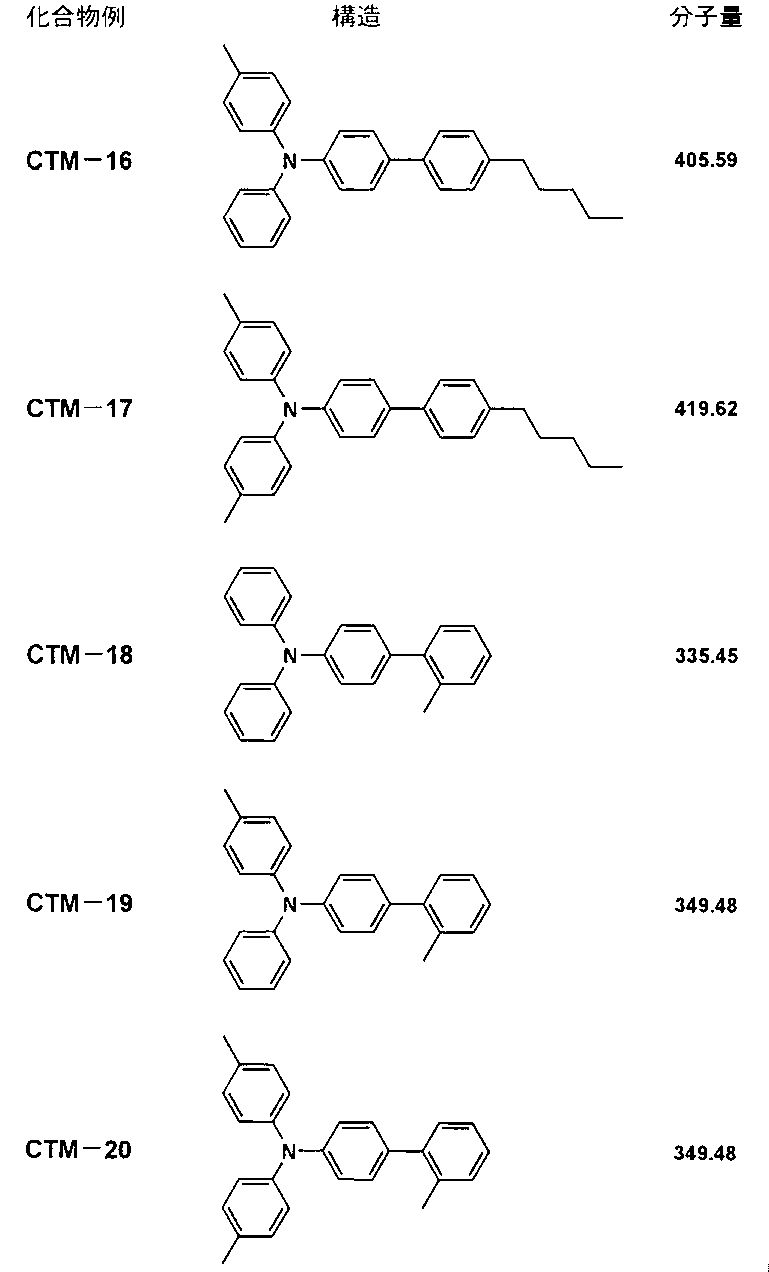
以下、上記一般式(1)で表わされる化合物の具体例を示す。 Specific examples of the compound represented by the general formula (1) are shown below.
ただし、上記例示化合物(CTM−9)〜(CTM−11)を示す化学式において、Meはメチル基を示す。 However, in the chemical formulas representing the exemplary compounds (CTM-9) to (CTM-11), Me represents a methyl group.
一般式(1)で表わされる化合物は、公知の合成方法、例えば、特開2006−143720号公報など開示されている方法で合成することができる。 The compound represented by the general formula (1) can be synthesized by a known synthesis method, for example, a method disclosed in JP-A-2006-143720.
本発明においては、保護層中の金属酸化物微粒子の体積比率(体積%)をAとし、保護層中の特定の電荷輸送物質の体積比率(体積%)をBとしたとき、下記関係式(1)および関係式(2)を満たす。
関係式(1):80/A≦B≦160/A
関係式(2):12≦A≦25
保護層において、金属酸化物微粒子および特定の電荷輸送物質の体積比率が上記関係式を満たすことにより、長期間の使用にわたっても、耐傷性を有し、転写メモリーの発生が抑制され、ドット再現性に優れた画像を形成することができる。具体的には、金属酸化物微粒子の体積比率Aが12体積%以上25体積%以下の範囲において、特定の電荷輸送物質の体積比率Bが80/A体積%以上であることにより、保護層の耐傷性を有しながら、転写メモリーの発生を抑制し、ドットの再現性を得ることができる。また、金属酸化物微粒子の体積比率Aが12体積%以上25体積%以下の範囲において、特定の電荷輸送物質の体積比率Bが160/A体積%以下であることにより、特定の電荷輸送物質が可塑剤としての機能を発現せず保護層の耐傷性を保持しながら、ドットの再現性を得ることができる。
In the present invention, when the volume ratio (volume%) of the metal oxide fine particles in the protective layer is A and the volume ratio (volume%) of the specific charge transport material in the protective layer is B, the following relational expression ( 1) and relational expression (2) are satisfied.
Relational expression (1): 80 / A ≦ B ≦ 160 / A
Relational expression (2): 12 ≦ A ≦ 25
In the protective layer, when the volume ratio of the metal oxide fine particles and the specific charge transport material satisfies the above relational expression, it has scratch resistance over a long period of use, suppresses the generation of transfer memory, and dot reproducibility. An excellent image can be formed. Specifically, when the volume ratio A of the metal oxide fine particles is in the range of 12 volume% or more and 25 volume% or less, the volume ratio B of the specific charge transport material is 80 / A volume% or more. While having scratch resistance, the occurrence of transfer memory can be suppressed and dot reproducibility can be obtained. In addition, when the volume ratio A of the metal oxide fine particles is in the range of 12 volume% or more and 25 volume% or less, the volume ratio B of the specific charge transport material is 160 / A volume% or less. Dot reproducibility can be obtained while maintaining the scratch resistance of the protective layer without exhibiting the function as a plasticizer.
本発明において、保護層中の金属酸化物微粒子の体積比率Aと、保護層中の特定の電荷輸送物質の体積比率Bとは、保護層の形成工程において、金属酸化物微粒子および電荷輸送物質の添加量(質量部)から換算することができる。例えば、有機物(電荷輸送物質など)の比重を1.1、金属酸化物微粒子として例えば酸化錫の比重を6.9、シリカの比重を2.2、酸化亜鉛の比重を5.6、アルミナの比重を4.0、酸化チタンの比重を4.0として換算することができる。 In the present invention, the volume ratio A of the metal oxide fine particles in the protective layer and the volume ratio B of the specific charge transporting material in the protective layer are the same as those of the metal oxide fine particles and the charge transporting material in the protective layer forming step. It can be converted from the amount added (parts by mass). For example, the specific gravity of an organic substance (such as a charge transport material) is 1.1, the specific gravity of tin oxide is 6.9, the specific gravity of silica is 2.2, the specific gravity of silica is 5.6, the specific gravity of zinc oxide is 5.6, The specific gravity can be converted to 4.0 and the specific gravity of titanium oxide can be converted to 4.0.
保護層には、硬化樹脂成分、金属酸化物微粒子および特定の電荷輸送物質の他に他の成分が含有されていてもよく、例えば各種の酸化防止剤を含有させることができ、各種の滑剤粒子を加えることもできる。例えば、フッ素原子含有樹脂粒子を加えることができる。フッ素原子含有樹脂粒子としては、四フッ化エチレン樹脂、三フッ化塩化エチレン樹脂、六フッ化塩化エチレンプロピレン樹脂、フッ化ビニル樹脂、フッ化ビニリデン樹脂、二フッ化二塩化エチレン樹脂、およびこれらの共重合体の中から1種あるいは2種以上を適宜選択することが好ましいが、特に四フッ化エチレン樹脂、フッ化ビニリデン樹脂が好ましい。 The protective layer may contain other components in addition to the cured resin component, the metal oxide fine particles, and the specific charge transport material. For example, various antioxidants can be contained, and various lubricant particles can be contained. Can also be added. For example, fluorine atom-containing resin particles can be added. Examples of the fluorine atom-containing resin particles include tetrafluoroethylene resin, trifluorinated ethylene chloride resin, hexafluoroethylene chloride propylene resin, vinyl fluoride resin, vinylidene fluoride resin, ethylene difluoride dichloride resin, and these One or two or more types are preferably selected from the copolymers, but tetrafluoroethylene resin and vinylidene fluoride resin are particularly preferable.
保護層の層厚は、0.2〜10μmであることが好ましく、より好ましくは0.5〜6μmである。 The thickness of the protective layer is preferably 0.2 to 10 μm, more preferably 0.5 to 6 μm.
以下、保護層以外の感光体の構成を記載する。 Hereinafter, the structure of the photoreceptor other than the protective layer will be described.
〔導電性支持体〕
本発明の感光体を構成する導電性支持体は、導電性を有するものであればよく、例えば、アルミニウム、銅、クロム、ニッケル、亜鉛およびステンレスなどの金属をドラムまたはシート状に成形したもの、アルミニウムや銅などの金属箔をプラスチックフィルムにラミネートしたもの、アルミニウム、酸化インジウム、酸化スズなどをプラスチックフィルムに蒸着したもの、導電性物質を単独またはバインダー樹脂と共に塗布して導電層を設けた金属、プラスチックフィルムおよび紙などが挙げられる。
[Conductive support]
The conductive support constituting the photoreceptor of the present invention may be any conductive support, for example, a metal such as aluminum, copper, chromium, nickel, zinc and stainless steel formed into a drum or sheet, A metal foil such as aluminum or copper laminated on a plastic film, a metal film deposited with aluminum, indium oxide, tin oxide or the like on a plastic film, a metal provided with a conductive layer by applying a conductive substance alone or with a binder resin, Examples include plastic film and paper.
〔中間層〕
本発明の感光体においては、導電性支持体と有機感光層の間にバリアー機能と接着機能を有する中間層を設けることもできる。種々の故障防止などを考慮すると、中間層を設けるのが好ましい。
[Middle layer]
In the photoreceptor of the present invention, an intermediate layer having a barrier function and an adhesive function can be provided between the conductive support and the organic photosensitive layer. In consideration of various failure prevention, it is preferable to provide an intermediate layer.
このような中間層は、例えば、バインダー樹脂(以下、「中間層用バインダー樹脂」ともいう。)および必要に応じて導電性粒子や金属酸化物粒子が含有されてなるものである。 Such an intermediate layer contains, for example, a binder resin (hereinafter also referred to as “binder resin for intermediate layer”) and, if necessary, conductive particles and metal oxide particles.
中間層用バインダー樹脂としては、例えば、カゼイン、ポリビニルアルコール、ニトロセルロース、エチレン−アクリル酸コポリマー、ポリアミド樹脂、ポリウレタン樹脂、ゼラチンなどが挙げられる。これらのなかでもアルコール可溶性のポリアミド樹脂が好ましい。 Examples of the intermediate layer binder resin include casein, polyvinyl alcohol, nitrocellulose, ethylene-acrylic acid copolymer, polyamide resin, polyurethane resin, and gelatin. Among these, alcohol-soluble polyamide resins are preferable.
中間層には、抵抗調整の目的で各種の導電性粒子や金属酸化物粒子を含有させることができる。例えば、アルミナ、酸化亜鉛、酸化チタン、酸化スズ、酸化アンチモン、酸化インジウム、酸化ビスマスなどの各種金属酸化物粒子を用いることができる。スズをドープした酸化インジウム、アンチモンをドープした酸化スズおよび酸化ジルコニウムなどの超微粒子を用いることができる。
このような金属酸化物粒子の数一次平均粒径は、0.3μm以下であることが好ましく、より好ましくは0.1μm以下である。
The intermediate layer can contain various conductive particles and metal oxide particles for the purpose of adjusting the resistance. For example, various metal oxide particles such as alumina, zinc oxide, titanium oxide, tin oxide, antimony oxide, indium oxide, and bismuth oxide can be used. Ultrafine particles such as indium oxide doped with tin, tin oxide doped with antimony, and zirconium oxide can be used.
The number primary average particle diameter of such metal oxide particles is preferably 0.3 μm or less, more preferably 0.1 μm or less.
これら金属酸化物粒子は1種単独でまたは2種以上を混合して用いてもよい。2種以上を混合した場合には、固溶体または融着の形をとってもよい。 These metal oxide particles may be used alone or in combination of two or more. When two or more kinds are mixed, it may take the form of a solid solution or fusion.
導電性粒子または金属酸化物粒子の含有割合は、バインダー樹脂100質量部に対して20〜400質量部であることが好ましく、より好ましくは50〜350質量部である。 The content ratio of the conductive particles or the metal oxide particles is preferably 20 to 400 parts by mass, more preferably 50 to 350 parts by mass with respect to 100 parts by mass of the binder resin.
中間層の層厚は、0.1〜15μmであることが好ましく、より好ましくは0.3〜10μmである。 The thickness of the intermediate layer is preferably 0.1 to 15 μm, more preferably 0.3 to 10 μm.
〔電荷発生層〕
本発明の感光体を構成する有機感光層における電荷発生層は、電荷発生物質およびバインダー樹脂(以下、「電荷発生層用バインダー樹脂」ともいう。)が含有されてなるものである。
(Charge generation layer)
The charge generation layer in the organic photosensitive layer constituting the photoreceptor of the present invention contains a charge generation material and a binder resin (hereinafter also referred to as “binder resin for charge generation layer”).
電荷発生物質としては、例えば、スーダンレッド、ダイアンブルーなどのアゾ原料、ピレンキノン、アントアントロンなどのキノン顔料、キノシアニン顔料、ペリレン顔料、インジゴおよびチオインジゴなどのインジゴ顔料、ピランスロン、ジフタロイルピレンなどの多環キノン顔料、フタロシアニン顔料などが挙げられるが、これらに限定されるものではない。これらのなかでも、多環キノン顔料、チタニルフタロシアニン顔料が好ましい。これらの電荷発生物質は1種単独でまたは2種以上を混合して用いてもよい。 Examples of charge generation materials include azo raw materials such as Sudan Red and Diane Blue, quinone pigments such as pyrenequinone and anthanthrone, quinocyanine pigments, perylene pigments, indigo pigments such as indigo and thioindigo, pyranthrone and diphthaloylpyrene. Examples thereof include, but are not limited to, ring quinone pigments and phthalocyanine pigments. Among these, polycyclic quinone pigments and titanyl phthalocyanine pigments are preferable. These charge generation materials may be used alone or in combination of two or more.
電荷発生層用バインダー樹脂としては、公知の樹脂を用いることができ、例えば、ポリスチレン樹脂、ポリエチレン樹脂、ポリプロピレン樹脂、アクリル樹脂、メタクリル樹脂、塩化ビニル樹脂、酢酸ビニル樹脂、ポリビニルブチラール樹脂、エポキシ樹脂、ポリウレタン樹脂、フェノール樹脂、ポリエステル樹脂、アルキッド樹脂、ポリカーボネート樹脂、シリコーン樹脂、メラミン樹脂、並びにこれらの樹脂の内2つ以上を含む共重合体樹脂(例えば、塩化ビニル−酢酸ビニル共重合体樹脂、塩化ビニル−酢酸ビニル−無水マレイン酸共重合体樹脂)、ポリ−ビニルカルバゾール樹脂などが挙げられるが、これらに限定されるものではない。これらのなかでも、ポリビニルブチラール樹脂が好ましい。 As the binder resin for the charge generation layer, known resins can be used. For example, polystyrene resin, polyethylene resin, polypropylene resin, acrylic resin, methacrylic resin, vinyl chloride resin, vinyl acetate resin, polyvinyl butyral resin, epoxy resin, Polyurethane resins, phenol resins, polyester resins, alkyd resins, polycarbonate resins, silicone resins, melamine resins, and copolymer resins containing two or more of these resins (eg, vinyl chloride-vinyl acetate copolymer resins, chlorides) Vinyl-vinyl acetate-maleic anhydride copolymer resin), poly-vinylcarbazole resin, and the like, but are not limited thereto. Among these, polyvinyl butyral resin is preferable.
電荷発生層中の電荷発生物質の含有割合は、電荷発生層用バインダー樹脂100質量部に対して1〜600質量部であることが好ましく、より好ましくは50〜500質量部である。 The content ratio of the charge generation material in the charge generation layer is preferably 1 to 600 parts by mass, more preferably 50 to 500 parts by mass with respect to 100 parts by mass of the binder resin for charge generation layer.
電荷発生層の層厚は、電荷発生物質の特性、電荷発生層用バインダー樹脂の特性、含有割合などにより異なるが、0.01〜5μmであることが好ましく、より好ましくは0.05〜3μmである。 The layer thickness of the charge generation layer varies depending on the characteristics of the charge generation material, the characteristics of the binder resin for the charge generation layer, the content ratio, etc., but is preferably 0.01 to 5 μm, more preferably 0.05 to 3 μm. is there.
〔電荷輸送層〕
本発明の感光体を構成する有機感光層における電荷輸送層は、電荷輸送物質およびバインダー樹脂(以下、「電荷輸送層用バインダー樹脂」ともいう。)が含有されてなるものである。
(Charge transport layer)
The charge transport layer in the organic photosensitive layer constituting the photoreceptor of the present invention contains a charge transport material and a binder resin (hereinafter also referred to as “binder resin for charge transport layer”).
電荷輸送層の電荷輸送物質としては、電荷(正孔)を輸送する物質として、例えば、トリフェニルアミン誘導体、ヒドラゾン化合物、スチリル化合物、ベンジジン化合物、ブタジエン化合物などが挙げられる。 Examples of the charge transport material for the charge transport layer include a triphenylamine derivative, a hydrazone compound, a styryl compound, a benzidine compound, and a butadiene compound as a material that transports charges (holes).
保護層の下層に形成される電荷輸送層には、移動度が高く、分子量が大きい電荷輸送物質を含有させることが好ましく、このような電荷輸送物質としては、上記一般式(1)で表わされる化合物とは異なるものが好ましく用いられる。 The charge transport layer formed under the protective layer preferably contains a charge transport material having a high mobility and a large molecular weight. Such a charge transport material is represented by the general formula (1). Those different from the compound are preferably used.
電荷輸送層用バインダー樹脂は、公知の樹脂を用いることができ、ポリカーボネート樹脂、ポリアクリレート樹脂、ポリエステル樹脂、ポリスチレン樹脂、スチレン−アクリルニトリル共重合体樹脂、ポリメタクリル酸エステル樹脂、スチレン−メタクリル酸エステル共重合体樹脂などが挙げられるが、ポリカーボネート樹脂が好ましい。さらにはBPA(ビスフェノールA)型、BPZ(ビスフェノールZ)型、ジメチルBPA型、BPA−ジメチルBPA共重合体型のポリカーボネート樹脂などが耐クラック、耐磨耗性、帯電特性の点で好ましい。 A known resin can be used as the binder resin for the charge transport layer. Polycarbonate resin, polyacrylate resin, polyester resin, polystyrene resin, styrene-acrylonitrile copolymer resin, polymethacrylic ester resin, styrene-methacrylic ester Examples of the resin include a copolymer resin, and a polycarbonate resin is preferable. Furthermore, BPA (bisphenol A) type, BPZ (bisphenol Z) type, dimethyl BPA type, BPA-dimethyl BPA copolymer type polycarbonate resin and the like are preferable in terms of crack resistance, wear resistance, and charging characteristics.
電荷輸送層中の電荷輸送物質の含有割合は、電荷輸送層用バインダー樹脂100質量部に対して10〜500質量部であることが好ましく、より好ましくは20〜250質量部である。 The content ratio of the charge transport material in the charge transport layer is preferably 10 to 500 parts by weight, more preferably 20 to 250 parts by weight with respect to 100 parts by weight of the charge transport layer binder resin.
電荷輸送層の層厚は、電荷輸送物質の特性、電荷輸送層用バインダー樹脂の特性および含有割合などによって異なるが、5〜40μmであることが好ましく、より好ましくは10〜30μmである。 The layer thickness of the charge transport layer varies depending on the characteristics of the charge transport material, the characteristics and the content ratio of the binder resin for the charge transport layer, but is preferably 5 to 40 μm, more preferably 10 to 30 μm.
電荷輸送層中には、酸化防止剤、電子導電剤、安定剤、シリコーンオイルなどを添加してもよい。酸化防止剤については特開2000−305291号公報、電子導電剤は特開昭50−137543号公報、同58−76483号公報などに開示されているものが好ましい。 In the charge transport layer, an antioxidant, an electronic conductive agent, a stabilizer, silicone oil, or the like may be added. As the antioxidant, those disclosed in JP-A No. 2000-305291 and as the electronic conductive agent are disclosed in JP-A Nos. 50-137543 and 58-76483.
〔有機感光体の製造方法〕
本発明の感光体の製造方法は、具体的には、下記工程を有する。
工程(1):導電性支持体の外周面に中間層形成用の塗布液を塗布し、乾燥することにより、中間層を形成する工程。
工程(2):導電性支持体上に形成された中間層の外周面に電荷発生層形成用の塗布液を塗布し、乾燥することにより電荷発生層を形成する工程。
工程(3):中間層上に形成された電荷発生層の外周面に電荷輸送層形成用の塗布液を塗布し、乾燥することにより電荷輸送層を形成する工程。
工程(4):電荷発生層上に形成された電荷輸送層の外周面に、保護層形成用の塗布液を塗布し、重合し、硬化させることにより保護層を形成する工程。
[Method for producing organic photoreceptor]
Specifically, the method for producing a photoreceptor of the present invention includes the following steps.
Process (1): The process of forming an intermediate | middle layer by apply | coating the coating liquid for intermediate | middle layer formation to the outer peripheral surface of an electroconductive support body, and drying.
Step (2): A step of forming a charge generation layer by applying a coating solution for forming a charge generation layer on the outer peripheral surface of an intermediate layer formed on a conductive support and drying it.
Step (3): A step of forming a charge transport layer by applying a coating liquid for forming a charge transport layer to the outer peripheral surface of the charge generation layer formed on the intermediate layer and drying.
Step (4): A step of forming a protective layer by applying a coating solution for forming a protective layer on the outer peripheral surface of the charge transport layer formed on the charge generation layer, polymerizing and curing.
〔工程(1):中間層の形成〕
中間層は、溶媒中に中間層用バインダー樹脂を溶解させて塗布液(以下、「中間層形成用塗布液」ともいう。)を調製し、必要に応じて導電性粒子や金属酸化物粒子を分散させた後、当該塗布液を導電性支持体上に一定の膜厚に塗布して塗膜を形成し、当該塗膜を乾燥することにより形成することができる。
中間層形成用塗布液の塗布方法としては、例えば、浸漬コーティング法、スプレーコーティング法、スピンナーコーティング法、ビードコーティング法、ブレードコーティング法、ビームコーティング法、スライドホッパー法、円形スライドホッパー法などの公知の方法が挙げられる。
塗膜の乾燥方法は、溶媒の種類、膜厚に応じて適宜選択することができるが、熱乾燥が好ましい。
[Step (1): Formation of intermediate layer]
The intermediate layer is prepared by dissolving the binder resin for the intermediate layer in a solvent to prepare a coating liquid (hereinafter also referred to as “intermediate layer forming coating liquid”), and if necessary, conductive particles and metal oxide particles. After the dispersion, the coating solution can be formed on the conductive support in a certain film thickness to form a coating film, and the coating film can be dried.
Examples of the coating method for the intermediate layer forming coating solution include known dip coating methods, spray coating methods, spinner coating methods, bead coating methods, blade coating methods, beam coating methods, slide hopper methods, circular slide hopper methods, and the like. A method is mentioned.
The method for drying the coating film can be appropriately selected according to the type of solvent and the film thickness, but thermal drying is preferred.
中間層の形成工程において使用する溶媒としては、導電性微粒子や金属酸化物微粒子を良好に分散し、中間層用バインダー樹脂、特にポリアミド樹脂を溶解するものが好ましい。具体的には、メタノール、エタノール、n−プロピルアルコール、イソプロピルアルコール、n−ブタノール、t−ブタノール、sec−ブタノールなどの炭素数1〜4のアルコール類が、ポリアミド樹脂の溶解性と塗布性能に優れ好ましい。また、保存性、粒子の分散性を向上するために、前記溶媒と併用でき、好ましい効果を得られる助溶媒としては、ベンジルアルコール、トルエン、メチレンクロライド、シクロヘキサノン、テトラヒドロフランなどが挙げられる。 The solvent used in the intermediate layer forming step is preferably a solvent in which conductive fine particles and metal oxide fine particles are well dispersed and the binder resin for the intermediate layer, particularly the polyamide resin, is dissolved. Specifically, alcohols having 1 to 4 carbon atoms such as methanol, ethanol, n-propyl alcohol, isopropyl alcohol, n-butanol, t-butanol, sec-butanol are excellent in solubility and coating performance of polyamide resin. preferable. In addition, examples of co-solvents that can be used in combination with the above-described solvent to improve storage stability and particle dispersibility and obtain a preferable effect include benzyl alcohol, toluene, methylene chloride, cyclohexanone, and tetrahydrofuran.
中間層形成用塗布液中の中間層用バインダー樹脂の濃度は、中間層の層厚や生産速度に合わせて適宜選択される。 The concentration of the binder resin for the intermediate layer in the coating liquid for forming the intermediate layer is appropriately selected according to the thickness of the intermediate layer and the production rate.
導電性粒子や金属酸化物粒子の分散手段としては、超音波分散機、ボールミル、サンドミル、ホモミキサーなどを使用することができるが、これらに限定されるものではない。 As a means for dispersing the conductive particles and metal oxide particles, an ultrasonic disperser, a ball mill, a sand mill, a homomixer, or the like can be used, but is not limited thereto.
〔工程(2):電荷発生層の形成〕
電荷発生層は、溶媒中に電荷発生層用バインダー樹脂を溶解させた溶液中に、電荷発生物質を分散して塗布液(以下、「電荷発生層形成用塗布液」ともいう。)を調製し、当該塗布液を中間層上に一定の膜厚に塗布して塗膜を形成し、当該塗膜を乾燥することにより形成することができる。
電荷発生層形成用塗布液の塗布方法としては、例えば、浸漬コーティング法、スプレーコーティング法、スピンナーコーティング法、ビードコーティング法、ブレードコーティング法、ビームコーティング法、スライドホッパー法、円形スライドホッパー法などの公知の方法が挙げられる。
塗膜の乾燥方法は、溶媒の種類、膜厚に応じて適宜選択することができるが、熱乾燥が好ましい。
[Step (2): Formation of Charge Generation Layer]
The charge generation layer is prepared by dispersing a charge generation material in a solution in which a charge generation layer binder resin is dissolved in a solvent to prepare a coating solution (hereinafter also referred to as “charge generation layer forming coating solution”). The coating solution can be formed on the intermediate layer by coating the intermediate layer with a certain film thickness to form a coating film and then drying the coating film.
As a coating method for the charge generation layer forming coating solution, for example, dip coating method, spray coating method, spinner coating method, bead coating method, blade coating method, beam coating method, slide hopper method, circular slide hopper method and the like are known. The method is mentioned.
The method for drying the coating film can be appropriately selected according to the type of solvent and the film thickness, but thermal drying is preferred.
電荷発生層の形成に用いられる溶媒としては、例えば、トルエン、キシレン、メチレンクロライド、1,2−ジクロロエタン、メチルエチルケトン、シクロヘキサン、酢酸エチル、酢酸t−ブチル、メタノール、エタノール、プロパノール、ブタノール、メチルセロソルブ、4−メトキシ−4−メチル−2−ペンタノン、エチルセロソルブ、テトラヒドロフラン、1−ジオキサン、1,3−ジオキソラン、ピリジン、ジエチルアミンなどが挙げられるが、これらに限定されるものではない。 Examples of the solvent used for forming the charge generation layer include toluene, xylene, methylene chloride, 1,2-dichloroethane, methyl ethyl ketone, cyclohexane, ethyl acetate, t-butyl acetate, methanol, ethanol, propanol, butanol, methyl cellosolve, Examples include, but are not limited to, 4-methoxy-4-methyl-2-pentanone, ethyl cellosolve, tetrahydrofuran, 1-dioxane, 1,3-dioxolane, pyridine, and diethylamine.
電荷発生物質の分散手段としては、例えば、超音波分散機、ボールミル、サンドミル、ホモミキサーなどが使用できるが、これらに限定されるものではない。 As a means for dispersing the charge generating substance, for example, an ultrasonic disperser, a ball mill, a sand mill, a homomixer, or the like can be used, but is not limited thereto.
〔工程(3):電荷輸送層の形成〕
電荷輸送層は、溶媒中に電荷輸送層用バインダー樹脂および電荷輸送物質を溶解させた塗布液(以下、「電荷輸送層形成用塗布液」ともいう。)を調製し、当該塗布液を電荷発生層上に一定の膜厚に塗布して塗膜を形成し、当該塗膜を乾燥することにより形成することができる。
電荷輸送層形成用塗布液の塗布方法としては、例えば、浸漬コーティング法、スプレーコーティング法、スピンナーコーティング法、ビードコーティング法、ブレードコーティング法、ビームコーティング法、スライドホッパー法、円形スライドホッパー法などの公知の方法が挙げられる。
塗膜の乾燥方法は、溶媒の種類、膜厚に応じて適宜選択することができるが、熱乾燥が好ましい。
[Step (3): Formation of Charge Transport Layer]
The charge transport layer is prepared by preparing a coating liquid in which a binder resin for a charge transport layer and a charge transport material are dissolved in a solvent (hereinafter, also referred to as “coating liquid for forming a charge transport layer”). It can form by apply | coating to a fixed film thickness on a layer, forming a coating film, and drying the said coating film.
As a coating method of the coating solution for forming the charge transport layer, for example, dip coating method, spray coating method, spinner coating method, bead coating method, blade coating method, beam coating method, slide hopper method, circular slide hopper method and the like are known. The method is mentioned.
The method for drying the coating film can be appropriately selected according to the type of solvent and the film thickness, but thermal drying is preferred.
電荷輸送層の形成に用いられる溶媒としては、例えば、トルエン、キシレン、メチレンクロライド、1,2−ジクロロエタン、メチルエチルケトン、シクロヘキサノン、酢酸エチル、酢酸ブチル、メタノール、エタノール、プロパノール、ブタノール、テトラヒドロフラン、1,4−ジオキサン、1,3−ジオキソラン、ピリジン、ジエチルアミンなどが挙げられるが、これらに限定されるものではない。 Examples of the solvent used for forming the charge transport layer include toluene, xylene, methylene chloride, 1,2-dichloroethane, methyl ethyl ketone, cyclohexanone, ethyl acetate, butyl acetate, methanol, ethanol, propanol, butanol, tetrahydrofuran, and 1,4. -Dioxane, 1,3-dioxolane, pyridine, diethylamine and the like are exemplified, but not limited thereto.
〔工程(4):保護層の形成〕
保護層は、重合性化合物、特定のラジカル捕捉剤、金属酸化物微粒子、特定の電荷輸送物質、重合開始剤および必要に応じて他の成分を公知の溶媒に添加して塗布液(以下、「保護層形成用塗布液」ともいう。)を調製し、この保護層形成用塗布液を工程(3)により形成された電荷輸送層の外周面に塗布して塗膜を形成し、この塗膜を乾燥し、紫外線や電子線などの活性線を照射することによって塗膜中の重合性化合物成分を重合させ、硬化されることにより保護層を形成することができる。
[Step (4): Formation of Protective Layer]
The protective layer is formed by adding a polymerizable compound, a specific radical scavenger, metal oxide fine particles, a specific charge transport material, a polymerization initiator, and other components as necessary to a known solvent to apply a coating solution (hereinafter, “ This is also referred to as “protective layer-forming coating solution”), and this protective layer-forming coating solution is applied to the outer peripheral surface of the charge transport layer formed in step (3) to form a coating film. The protective compound can be formed by drying and curing the polymerizable compound component in the coating film by irradiating active rays such as ultraviolet rays and electron beams, and curing.
保護層形成用塗布液においては、特定のラジカル捕捉剤は、硬化樹脂成分を形成するための全モノマー(重合性化合物)100質量部に対して1〜30質量部の割合で添加されることが好ましく、より好ましくは3〜20質量部である。
特定のラジカル捕捉剤の添加割合が、上記範囲内であることにより、形成される保護層が適度な膜強度を有するものとなり、ブレードなどのクリーニング手段によって感光体表面が適度に減耗されるものとなる。
In the coating liquid for forming the protective layer, the specific radical scavenger may be added at a ratio of 1 to 30 parts by mass with respect to 100 parts by mass of all monomers (polymerizable compound) for forming the cured resin component. Preferably, it is 3-20 mass parts.
When the addition ratio of the specific radical scavenger is within the above range, the formed protective layer has an appropriate film strength, and the surface of the photoreceptor is moderately worn by a cleaning means such as a blade. Become.
表面層形成用塗布液中に金属酸化物微粒子を分散する手段としては、超音波分散機、ボールミル、サンドミル、ホモミキサーなどを使用することができるが、これらに限定されるものではない。 As a means for dispersing the metal oxide fine particles in the surface layer forming coating solution, an ultrasonic disperser, a ball mill, a sand mill, a homomixer, or the like can be used, but is not limited thereto.
保護層の形成に用いられる溶媒としては、重合性化合物、金属酸化物微粒子、および特定の電荷輸送物質を溶解または分散させることができればいずれのものも使用でき、例えば、メタノール、エタノール、n−プロピルアルコール、イソプロピルアルコール、n−ブタノール、t−ブタノール、sec−ブタノール、ベンジルアルコール、トルエン、キシレン、メチレンクロライド、メチルエチルケトン、シクロヘキサン、酢酸エチル、酢酸ブチル、メチルセロソルブ、エチルセロソルブ、テトラヒドロフラン、1−ジオキサン、1,3−ジオキソラン、ピリジンおよびジエチルアミンなどが挙げられるが、これらに限定されるものではない。 As the solvent used for forming the protective layer, any solvent can be used as long as it can dissolve or disperse the polymerizable compound, the metal oxide fine particles, and the specific charge transporting material. For example, methanol, ethanol, n-propyl Alcohol, isopropyl alcohol, n-butanol, t-butanol, sec-butanol, benzyl alcohol, toluene, xylene, methylene chloride, methyl ethyl ketone, cyclohexane, ethyl acetate, butyl acetate, methyl cellosolve, ethyl cellosolve, tetrahydrofuran, 1-dioxane, 1 , 3-dioxolane, pyridine, diethylamine, and the like, but are not limited thereto.
保護層形成用塗布液の塗布方法としては、例えば、浸漬コーティング法、スプレーコーティング法、スピンナーコーティング法、ビードコーティング法、ブレードコーティング法、ビームコーティング法、スライドホッパー法、円形スライドホッパー法などの公知の方法が挙げられる。 As a coating method of the coating liquid for forming the protective layer, for example, known methods such as a dip coating method, a spray coating method, a spinner coating method, a bead coating method, a blade coating method, a beam coating method, a slide hopper method, and a circular slide hopper method. A method is mentioned.
保護層形成用塗布液は、円形スライドホッパー塗布装置を用いて塗布することが好ましい。
以下、円形スライドホッパー塗布装置を用いて保護層形成用塗布液を塗布する方法について具体的に説明する。
The coating liquid for forming the protective layer is preferably applied using a circular slide hopper coating apparatus.
Hereinafter, a method for applying the coating liquid for forming the protective layer using the circular slide hopper coating apparatus will be specifically described.
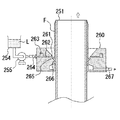
図1に示すように、円形スライドホッパー塗布装置は、円筒状の基材251と、その周囲を取り囲むように設けられた環状の塗布ヘッド260と、塗布液Lを貯留する貯留タンク254とから構成される。
As shown in FIG. 1, the circular slide hopper coating apparatus includes a
ここでいう基材251は、保護層形成用塗布液が塗布されるべき基材であり、例えば導電性支持体上に中間層および有機感光層が形成された状態のもの(保護層が形成されていないもの)である。
The
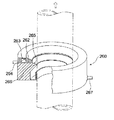
塗布ヘッド260には、基材251側に開口する塗布液流出口261を有する幅狭の塗布液分配スリット262が基材251の長手方向に垂直な方向に沿って環状の塗布ヘッド260の全周にわたって形成されている。この塗布液分配スリット262は、環状の塗布液分配室263に連通し、この塗布液分配室263は、貯留タンク254内の塗布液Lが圧送ポンプ255により供給管264を介して供給されるよう形成されている。
塗布液分配スリット262の塗布液流出口261の下側には、連続して下方に傾斜し基材251の外寸よりやや大なる寸法で終端をなすように形成されたスライド面265が形成されており、さらに、このスライド面265終端より下方に延びる唇状部(ビード;液溜まり部)266が形成されている。
The
On the lower side of the coating
このような円形スライドホッパー塗布装置においては、基材251を矢印方向に移動させる過程で、塗布液Lを塗布液分配スリット262から押し出し、スライド面265に沿って流下させると、スライド面265終端に至った塗布液Lは、そのスライド面265終端と、基材251の外周面との間にビードを形成した後、基材251表面に塗布されて塗布膜Fが形成され、過剰な塗布液Lは排出口267から排出される。
In such a circular slide hopper coating apparatus, when the coating liquid L is pushed out from the coating liquid distribution slit 262 and allowed to flow down along the
このような円形スライドホッパー塗布装置を用いる塗布方法では、スライド面終端と基材は、ある間隙(約2μm〜2mm)を持って配置されているため基材を傷つけることなく、また性質の異なる層を多層形成させる場合においても、既に塗布された層を損傷することなく塗布できる。さらに性質が異なり同一溶媒に溶解する層を多層形成させる際にも、浸漬コーティング方法と比べて溶媒中に存在する時間がはるかに短いので、下層成分が上層側へ殆ど溶出せず、塗布槽にも溶出することなく塗布できるので、例えば金属酸化物微粒子の分散性を劣化させずに塗布することができる。 In such a coating method using a circular slide hopper coating apparatus, the slide surface end and the base material are arranged with a certain gap (about 2 μm to 2 mm), so that the base material is not damaged and the layers have different properties. Even in the case of forming a multilayer, it can be applied without damaging the already applied layer. Furthermore, when multiple layers with different properties and dissolved in the same solvent are formed, the time in the solvent is much shorter compared to the dip coating method, so that the lower layer component hardly elutes to the upper layer side, so Since it can be applied without elution, for example, it can be applied without deteriorating the dispersibility of the metal oxide fine particles.
塗膜は、乾燥しないで硬化処理を行ってもよいが、自然乾燥または熱乾燥を行った後、硬化処理を行うことが好ましい。 The coating film may be cured without being dried, but it is preferable to perform the curing treatment after natural drying or heat drying.
乾燥の条件は、溶媒の種類、膜厚などのよって適宜選択できる。乾燥温度は、好ましくは室温〜180℃であり、特に好ましくは80〜140℃である。乾燥時間は、好ましくは1分間〜200分間であり、特に好ましくは5分間〜100分間である。 Drying conditions can be appropriately selected depending on the type of solvent, film thickness, and the like. The drying temperature is preferably room temperature to 180 ° C, particularly preferably 80 to 140 ° C. The drying time is preferably 1 minute to 200 minutes, and particularly preferably 5 minutes to 100 minutes.
重合性化合物を反応させる方法としては、電子線開裂で反応する方法、ラジカル重合開始剤を添加して、光、熱で反応する方法などが挙げられる。ラジカル重合開始剤は光重合開始剤、熱重合開始剤のいずれも使用することができる。また、光重合開始剤および熱重合開始剤を併用することもできる。 Examples of the method of reacting the polymerizable compound include a method of reacting by electron beam cleavage and a method of reacting with light and heat by adding a radical polymerization initiator. As the radical polymerization initiator, either a photopolymerization initiator or a thermal polymerization initiator can be used. A photopolymerization initiator and a thermal polymerization initiator can also be used in combination.
ラジカル重合開始剤としては、光重合開始剤が好ましく、中でも、アルキルフェノン系化合物、またはフォスフィンオキサイド系化合物が好ましい。特に、α−ヒドロキシアセトフェノン構造、または、アシルフォスフィンオキサイド構造を有する化合物が好ましい。 As the radical polymerization initiator, a photopolymerization initiator is preferable, and among them, an alkylphenone compound or a phosphine oxide compound is preferable. In particular, a compound having an α-hydroxyacetophenone structure or an acylphosphine oxide structure is preferable.
以下、光重合開始剤としてアシルフォスフィンオキサイド系化合物の具体例を示す。 Hereinafter, specific examples of acylphosphine oxide compounds as photopolymerization initiators are shown.
重合開始剤は1種単独でまたは2種以上を混合して用いてもよい。 The polymerization initiators may be used alone or in combination of two or more.
重合開始剤の添加割合は、硬化樹脂成分を形成するための全モノマー(重合性化合物)100質量部に対して0.1〜20質量部であることが好ましく、より好ましくは0.5〜10質量部である。 It is preferable that the addition ratio of a polymerization initiator is 0.1-20 mass parts with respect to 100 mass parts of all the monomers (polymerizable compound) for forming a cured resin component, More preferably, it is 0.5-10. Part by mass.
硬化樹脂成分は、硬化処理として塗膜に活性線を照射し、ラジカルを発生させて重合し、かつ分子間および分子内で架橋反応による架橋結合を形成して硬化することにより、生成される。活性線としては紫外線や電子線がより好ましく、紫外線が使用しやすく特に好ましい。 The cured resin component is produced by irradiating the coating film with actinic rays as a curing treatment, generating radicals and polymerizing, and forming a cross-linking bond by a cross-linking reaction between molecules and within the molecule and curing. The actinic rays are more preferably ultraviolet rays or electron beams, and ultraviolet rays are particularly preferred because they are easy to use.
紫外線光源としては、紫外線を発生する光源であれば制限なく使用できる。例えば、低圧水銀灯、中圧水銀灯、高圧水銀灯、超高圧水銀灯、カーボンアーク灯、メタルハライドランプ、キセノンランプ、フラッシュ(パルス)キセノンなどを用いることができる。
照射条件はそれぞれのランプによって異なるが、活性線の照射量は、通常5〜500mJ/cm2 、好ましくは5〜100mJ/cm2 である。
ランプの電力は、好ましくは0.1kW〜5kWであり、特に好ましくは、0.5kW〜3kWである。
As the ultraviolet light source, any light source that generates ultraviolet light can be used without limitation. For example, a low pressure mercury lamp, a medium pressure mercury lamp, a high pressure mercury lamp, an ultrahigh pressure mercury lamp, a carbon arc lamp, a metal halide lamp, a xenon lamp, a flash (pulse) xenon, or the like can be used.
Irradiation conditions vary depending on each lamp, but the irradiation amount of active rays is usually 5 to 500 mJ / cm 2 , preferably 5 to 100 mJ / cm 2 .
The power of the lamp is preferably 0.1 kW to 5 kW, particularly preferably 0.5 kW to 3 kW.
電子線源としては、電子線照射装置に格別の制限はなく、一般にはこのような電子線照射用の電子線加速機として、比較的安価で大出力が得られるカーテンビーム方式のものが有効に用いられる。電子線照射の際の加速電圧は、100〜300kVであることが好ましい。吸収線量は、0.5〜10Mradであることが好ましい。 As an electron beam source, there is no particular limitation on the electron beam irradiation apparatus, and generally, an electron beam accelerator for electron beam irradiation is a curtain beam type that is relatively inexpensive and can provide a large output. Used. The acceleration voltage during electron beam irradiation is preferably 100 to 300 kV. The absorbed dose is preferably 0.5 to 10 Mrad.
必要な活性線の照射量を得るための照射時間としては、0.1秒間〜10分間が好ましく、作業効率の観点から0.1秒間〜5分間がより好ましい。 The irradiation time for obtaining the necessary amount of active ray irradiation is preferably 0.1 second to 10 minutes, and more preferably 0.1 second to 5 minutes from the viewpoint of work efficiency.
保護層の形成の工程においては、活性線を照射する前後、および活性線を照射中に乾燥を行うことができ、乾燥を行うタイミングはこれらを組み合わせて適宜選択できる。 In the step of forming the protective layer, drying can be performed before and after irradiation with active rays and during irradiation with active rays, and the timing of drying can be appropriately selected by combining these.
以上のような感光体によれば、保護層が、特定のラジカル捕捉剤の存在下において重合性化合物を重合させて得られる硬化樹脂成分と、金属酸化物微粒子と、特定の電荷輸送物質とを含有し、当該金属酸化物微粒子と当該特定の電荷輸送物質との混合比率(体積比)が関係式(1)および関係式(2)を満たすことにより、長期間の使用にわたっても、耐傷性を有し、転写メモリーの発生を抑制すると共に、ドットの再現性に優れた画像を形成することができる。 According to the above photoreceptor, the protective layer comprises a cured resin component obtained by polymerizing a polymerizable compound in the presence of a specific radical scavenger, metal oxide fine particles, and a specific charge transport material. When the mixing ratio (volume ratio) of the metal oxide fine particles and the specific charge transporting material satisfies the relational expression (1) and the relational expression (2), the scratch resistance can be maintained over a long period of use. And can suppress the generation of a transfer memory and form an image having excellent dot reproducibility.
〔画像形成装置〕
本発明の画像形成装置は、有機感光体と、有機感光体の表面を帯電させる第1帯電手段と、当該有機感光体の表面に光を照射して静電潜像を形成する露光手段と、静電潜像をトナーにより現像してトナー像を形成する現像手段と、トナー像を転写材に転写する転写手段と、転写材にトナー像を転写した後に有機感光体の表面を帯電させる第2帯電手段と、有機感光体上の残留トナーを除去するクリーニング手段とを備え、有機感光体として本発明の有機感光体が用いられてなるものである。
[Image forming apparatus]
The image forming apparatus of the present invention includes an organic photoreceptor, a first charging unit that charges the surface of the organic photoreceptor, an exposure unit that irradiates light on the surface of the organic photoreceptor to form an electrostatic latent image, Developing means for developing the electrostatic latent image with toner to form a toner image; transfer means for transferring the toner image to the transfer material; and second charging the surface of the organic photoreceptor after the toner image is transferred to the transfer material. A charging means and a cleaning means for removing residual toner on the organic photoreceptor are provided, and the organic photoreceptor of the present invention is used as the organic photoreceptor.
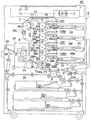
図3は、本発明の画像形成装置の一例における構成を示す説明用断面図である。
この画像形成装置は、タンデム型カラー画像形成装置と称せられるもので、4組の画像形成ユニット10Y、10M、10C、10Bkと、無端ベルト状中間転写体ユニット7と、給紙搬送手段21および定着手段24とからなる。画像形成装置の本体Aの上部には、原稿画像読み取り装置SCが配置されている。
FIG. 3 is a cross-sectional view illustrating the configuration of an example of the image forming apparatus of the present invention.
This image forming apparatus is called a tandem type color image forming apparatus, and includes four sets of
イエロー色の画像を形成する画像形成ユニット10Yは、ドラム状の感光体1Yの周囲に感光体1Yの回転方向に沿って順次配置された、第1帯電手段2Y、露光手段3Y、現像手段4Y、一次転写手段としての一次転写ローラ5Y、第2帯電手段9Yおよびクリーニング手段6Yを有する。マゼンタ色の画像を形成する画像形成ユニット10Mは、ドラム状の感光体1Mの周囲に感光体1Mの回転方向に沿って順次配置された、第1帯電手段2M、露光手段3M、現像手段4M、一次転写手段としての一次転写ローラ5M、第2帯電手段9Mおよびクリーニング手段6Mを有する。シアン色の画像を形成する画像形成ユニット10Cは、ドラム状の感光体1Cの周囲に感光体1Cの回転方向に沿って順次配置された、第1帯電手段2C、露光手段3C、現像手段4C、一次転写手段としての一次転写ローラ5C、第2帯電手段9Cおよびクリーニング手段6Cを有する。黒色画像を形成する画像形成ユニット10Bkは、ドラム状の感光体1Bkの周囲に感光体1Bkの回転方向に沿って順次配置された、第1帯電手段2Bk、露光手段3Bk、現像手段4Bk、一次転写手段としての一次転写ローラ5Bk、第2帯電手段9Bkおよびクリーニング手段6Bkを有する。本発明の画像形成装置は、感光体1Y、1M、1C、1Bkとして、上記の本発明の感光体を用いる。
An
前記画像形成ユニット10Y、10M、10C、10Bkは、感光体1Y、1M、1C、1Bkにそれぞれ形成するトナー像の色が異なるだけで、同じ構成であり、画像形成ユニット10Yを例にして詳細に説明する。
The
画像形成ユニット10Yは、像形成体である感光体1Yの周囲に、第1帯電手段2Y、露光手段3Y、現像手段4Y、一次転写ローラ5Y、第2帯電手段9Yおよびクリーニング手段6Yを配置し、感光体1Y上にイエロー(Y)のトナー像を形成するものである。また、本実施の形態においては、この画像形成ユニット10Yのうち、少なくとも感光体1Y、第1帯電手段2Y、現像手段4Y、第2帯電手段9Yおよびクリーニング手段6Yを一体化するように設けている。
The
第1帯電手段2Yは、感光体1Yに対して一様な電位を与える手段であって、本実施の形態においては、コロナ放電型の帯電器が用いられている。
The first charging unit 2Y is a unit that applies a uniform potential to the
露光手段3Yは、第1帯電手段2Yによって一様な電位を与えられた感光体1Y上に、画像信号(イエロー)に基づいて露光を行い、イエローの画像に対応する静電潜像を形成する手段であって、この露光手段3Yとしては、感光体1Yの軸方向にアレイ状に発光素子を配列したLEDと結像素子とから構成されるもの、あるいは、レーザー光学系などが用いられる。
The
現像手段4Yは、例えばマグネットを内蔵し現像剤を保持して回転する現像スリーブおよび感光体とこの現像スリーブとの間に直流および/または交流バイアス電圧を印加する電圧印加装置よりなるものである。 The developing means 4Y includes, for example, a developing sleeve that contains a magnet and rotates while holding the developer, and a voltage applying device that applies a DC and / or AC bias voltage between the photosensitive member and the developing sleeve.
一次転写ローラ5Yは、感光体1Y上に形成されたトナー像を無端ベルト状の中間転写体70に転写する手段である。一次転写ローラ5Yは、中間転写体70と当接して配置されている。
The primary transfer roller 5Y is means for transferring the toner image formed on the
第2帯電手段9Yは、中間転写体70にトナー像を転写した後に感光体1Yの表面を帯電(除電)させる除電手段である。本実施の形態においては、コロナ放電型の帯電器が用いられている。
本発明の画像形成装置によれば、本発明の有機感光体を備えることに加え、除電手段が設けられていることにより、転写メモリーの発生を確実に抑制することができる。
The second charging unit 9Y is a discharging unit that charges (discharges) the surface of the
According to the image forming apparatus of the present invention, in addition to the provision of the organic photoreceptor of the present invention, the provision of the charge eliminating means can reliably suppress the generation of the transfer memory.
クリーニング手段6Yは、クリーニングブレードと、このクリーニングブレードより上流側に設けられたブラシローラーとにより構成される。
The
具体的には、図4に示すように、クリーニング手段6は、先端が感光体1表面に当接するよう設けられたクリーニングブレード66Aと、このクリーニングブレードより上流側に設けられた、感光体1表面に接触するブラシローラー66Cとにより構成される。
Specifically, as shown in FIG. 4, the cleaning unit 6 includes a
クリーニングブレード66Aは、感光体1に付着した残留トナーを除去する機能と共に、感光体1表面を減耗する機能を有する。
The
クリーニングブレード66Aは、支持部材66Bによって支持されている。クリーニングブレード66Aの材質としては、ゴム弾性体が用いられ、その材料としてはウレタンゴム、シリコンゴム、フッ素ゴム、クロロピレンゴム、ブタジエンゴムなどが知られているが、これらのうち、ウレタンゴムは他のゴムに比して摩耗特性が優れている点で特に好ましい。
The
支持部材66Bは、板状の金属部材やプラスチック部材により構成されている。金属部材としては、ステンレス鋼板、アルミ板、制震鋼板等が挙げられる。
The
本発明において、感光体1表面に当接するクリーニングブレード66Aの先端部は、感光体1の回転方向と反対方向(カウンター方向)に向けて負荷をかけた状態で当接することが好ましい。図4に示すように、クリーニングブレード66Aの先端部は感光体1と当接するときに、当接面を形成することが好ましい。
In the present invention, it is preferable that the tip of the
クリーニングブレード66Aの感光体1への当接荷重P、当接角θの好ましい値としては、P=5〜40N/m、θ=5〜35°である。
Preferable values of the contact load P and contact angle θ of the
当接荷重Pはクリーニングブレード66Aをドラム状の感光体1に当接させたときの当接力P′の法線方向ベクトル値である。
また、当接角θは感光体1の当接点Aにおける接線Xと変形前のブレードとのなす角を表す。
The contact load P is a normal vector value of the contact force P ′ when the
Further, the contact angle θ represents an angle formed between the tangent line X at the contact point A of the photoreceptor 1 and the blade before deformation.
66Eは支持部材66Bを回転可能にする回転軸であり、66Gは荷重バネである。
66E is a rotation shaft that enables the
自由長Lは、6〜15mmであることが好ましい。
クリーニングブレード66Aの自由長Lとは、図4に示すように、支持部材66Bの端部Bの位置から変形前のクリーニングブレード66Aの先端点の長さをいう。
The free length L is preferably 6 to 15 mm.
As shown in FIG. 4, the free length L of the
クリーニングブレード66Aの厚さtは、0.5〜10mmであることが好ましい。
ここで、クリーニングブレード66Aの厚さtとは、図4に示すように、支持部材66Bの接着面に対して垂直な方向の長さをいう。
The thickness t of the
Here, the thickness t of the
ブラシローラー66Cは、感光体1に付着した残留トナーの除去、クリーニングブレード66Aで除去された残留トナーの回収機能と共に、感光体1表面を減耗する機能を有する。すなわち、ブラシローラー66Cは、感光体1表面と接触し、その接触部においては、感光体1と進行方向が同方向に回転し、感光体1上の残留トナーや紙粉を除去すると共に、クリーニングブレード66Aで除去された残留トナーを搬送し、搬送スクリュー66Jに回収する。そして、感光体1表面を削り取り、リフレッシュさせる。
The
ブラシローラー66Cに除去手段としてのフリッカ66Iを当接させることにより、感光体1からブラシローラー66Cに転移した残留トナーなどの除去物を除去することが好ましい。更にこのフリッカ66Iに付着したトナーをスクレーパ66Dで除去し、トナーを搬送スクリュー66Jに回収する。回収されたトナーは廃棄物として外部に取り出されるか、またはトナーリサイクル用のリサイクルパイプ(図示せず)を経由して現像器に搬送され再利用される。
It is preferable to remove a removed matter such as residual toner transferred from the photosensitive member 1 to the
フリッカ66Iは、ステンレス、アルミニウムなどの金属管が好ましく用いられる。
スクレーパ66Dは、リン青銅板、ポリエチレンテレフタレート板、ポリカーボネート板などの弾性板が用いられ、先端がフリッカ66Iの回転方向に対し鋭角を形成するカウンター方式で当接させることが好ましい。
As the flicker 66I, a metal tube such as stainless steel or aluminum is preferably used.
The
酸化防止剤の固形材料(酸化防止剤とステアリン酸亜鉛などとの固形剤量)66Kはブラシローラー66Cに荷重バネ66Sで押圧されて取り付けられており、ブラシローラー66Cは回転しながら、酸化防止剤の固形材料66Kを擦過して、感光体1表面に酸化防止剤を供給する。
An antioxidant solid material (solid agent amount of antioxidant and zinc stearate) 66K is attached to the
ブラシローラー66Cとしては、導電性または半導電性体のブラシローラーが用いられる。ブラシローラー66Cのブラシ構成素材は、任意のものを用いることができるが、疎水性で、かつ誘電率が高い繊維形成性高分子重合体を用いることが好ましい。このような高分子重合体としては、例えば、レーヨン、ナイロン、ポリカーボネート、ポリエステル、メタクリル酸樹脂、アクリル樹脂、ポリ塩化ビニル、ポリ塩化ビニリデン、ポリプロピレン、ポリスチレン、ポリビニルアセテート、スチレン−ブタジエン共重合体、塩化ビニリデン−アクリロニトリル共重合体、塩化ビニル−酢酸ビニル共重合体、塩化ビニル−酢酸ビニル−無水マレイン酸共重合体、シリコーン樹脂、シリコーン−アルキッド樹脂、フェノールホルムアルデヒド樹脂、スチレン−アルキッド樹脂、ポリビニルアセタール(例えばポリビニルブチラール)などが挙げられる。これらの樹脂は単独であるいは2種以上の混合物として用いることができる。特に、好ましくはレーヨン、ナイロン、ポリエステル、アクリル樹脂、ポリプロピレンである。
A conductive or semiconductive brush roller is used as the
ブラシローラー66Cは、導電性または反導電性のものを用いることもでき、構成素材にカーボンなどの低抵抗物質を含有させ、任意の比抵抗に調整したものを使用することができる。
As the
ブラシローラー66Cに用いるブラシ毛1本の太さは、5〜20デニールが好ましい。5デニール未満であると、十分な擦過力が無いため表面付着物を除去することができない。一方、20デニールより大きいと、ブラシが剛直になるため感光体1の表面を傷つける上に摩耗を進行させ、感光体1の寿命を低下させる。
「デニール」とは、ブラシローラー66Cを構成するブラシ毛(繊維)の長さ9000mの質量をg(グラム)単位で測定した数値である。
The thickness of one bristle used for the
“Denier” is a numerical value obtained by measuring a mass of 9000 m of the bristle (fiber) constituting the
ブラシローラー66Cのブラシ毛密度は、4.5×10² /cm2 〜2.0×10⁴ /cm2 (1平方センチあたりのブラシ毛数)である。
ブラシ毛密度が4.5×10² /cm2 未満であると、剛直度が低く擦過力が弱い上に、擦過にムラができ、付着物を均一に除去することができない。2.0×10⁴ /cm2 より大きいと、剛直になって擦過力が強くなるために感光体1を過度に摩耗させ、感度低下によるカブリや傷による黒スジなどの不良画像が発生する。
The brush hair density of the
When the brush bristle density is less than 4.5 × 10 2 / cm 2 , the rigidity is low and the rubbing force is weak, and the rubbing is uneven and the deposits cannot be removed uniformly. If it is larger than 2.0 × 10 4 / cm 2 , it becomes rigid and the rubbing force becomes strong, so that the photoreceptor 1 is excessively worn, and a defective image such as fogging due to sensitivity reduction or black streaks due to scratches is generated.
ブラシローラー66Cの感光体1に対する食い込み量は0.4〜1.5mmに設定されることが好ましい。
この食い込み量は、感光体1ドラムとブラシローラー66Cの相対運動によって発生するブラシローラー66Cにかかる負荷を意味する。この負荷は、感光体1ドラムから見れば、ブラシローラー66Cから受ける擦過力に相当し、その範囲を規定することは、感光体1が適度な力で擦過されることが必要であることを意味する。
また、食い込み量とは、ブラシローラー66Cを感光体1に当接させたとき、ブラシ毛が感光体1表面で曲がらずに、直線的に内部に進入したと仮定した時の内部への食い込み長さをいう。
The biting amount of the
This amount of biting means the load on the
Further, the amount of biting in is the length of biting into the interior when it is assumed that the brush bristles enter the interior linearly without bending on the surface of the photoreceptor 1 when the
ブラシローラー66Cに用いられるローラー部の芯材としては、主としてステンレス、アルミニウムなどの金属、紙、プラスチックなどが用いられるが、これらにより限定されるものではない。
As the core material of the roller portion used for the
ブラシローラー66Cは、その当接部分が感光体1の表面と同方向に移動するように回転するのが好ましい。当接部分が逆方向に移動すると、感光体1の表面に過剰なトナーが存在した場合に、ブラシローラー66Cにより除去されたトナーがこぼれて記録紙や装置を汚す場合がある。
感光体1とブラシローラー66Cとが、同方向に移動する場合に、両者の表面速度比は1対1.1〜1対2の範囲内の値であることが好ましい。
The
When the photoreceptor 1 and the
本発明の画像形成装置としては、上述の感光体と、現像手段、クリーニング手段などの構成要素をプロセスカートリッジ(画像形成ユニット)として一体に結合して構成し、この画像形成ユニットを装置本体に対して着脱自在に構成しても良い。また、帯電手段、露光手段、現像手段、転写手段、およびクリーニング手段の少なくとも1つを感光体とともに一体に支持してプロセスカートリッジ(画像形成ユニット)を形成し、装置本体に着脱自在の単一画像形成ユニットとし、装置本体のレールなどの案内手段を用いて着脱自在の構成としても良い。 The image forming apparatus of the present invention is configured by integrally combining the above-described photosensitive member, developing unit, cleaning unit and the like as a process cartridge (image forming unit), and this image forming unit is connected to the apparatus main body. It may be configured to be detachable. In addition, a process cartridge (image forming unit) is formed by integrally supporting at least one of a charging unit, an exposure unit, a developing unit, a transfer unit, and a cleaning unit together with a photosensitive member, and is detachably attached to the apparatus main body. It is good also as a formation unit and a structure which can be attached or detached using guide means, such as a rail of an apparatus main body.
無端ベルト状中間転写体ユニット7は、複数のローラ71、72、73、74により巻回され、回動可能に支持された半導電性エンドレスベルト状の第2の像担持体としての無端ベルト状の中間転写体70を有する。無端ベルト状中間転写体ユニット7には、中間転写体70上にトナーを除去するクリーニング手段6bが配置されている。
The endless belt-shaped intermediate
定着手段24は、例えば、内部に加熱源を備えた加熱ローラと、この加熱ローラに定着ニップ部が形成されるよう圧接された状態で設けられた加圧ローラとにより構成されてなる熱ローラ定着方式のものが挙げられる。
The fixing
このように構成された画像形成装置は、画像形成ユニット10Y、10M、10C、10Bkによりトナー像を形成する。具体的には、まず、第1帯電手段2Y、2M、2C、2Bkにより感光体1Y、1M、1C、1Bkの表面に放電して負に帯電させる。次いで、露光手段3Y、3M、3C、3Bkで、感光体1Y、1M、1C、1Bkの表面を画像信号に基づいて露光し、静電潜像を形成する。次いで、現像手段4Y、4M、4C、4Bkで、感光体1Y、1M、1C、1Bkの表面にトナーを付与して現像し、トナー像を形成する。
The image forming apparatus configured as described above forms a toner image by the
次いで、一次転写ローラ(一次転写手段)5Y、5M、5C、5Bkを、回動する中間転写体70と当接させる。それにより、感光体1Y、1M、1C、1Bk上にそれぞれ形成した各色のトナー像を、回動する中間転写体70上に逐次転写させて、カラー画像を転写する(一次転写する)。画像形成処理中、一次転写ローラ70Bkは、常時、感光体1Bkに当接する。一方、他の一次転写ローラ5Y、5M、5Cは、カラー画像形成時にのみ、それぞれ対応する感光体1Y、1M、1Cに当接する。
Next, primary transfer rollers (primary transfer means) 5Y, 5M, 5C, and 5Bk are brought into contact with the rotating intermediate transfer body 70. Accordingly, the toner images of the respective colors formed on the
そして、一次転写ローラ5Y、5M、5C、5Bkと中間転写体70とを分離させた後、感光体1Y、1M、1C、1Bkの表面を第2帯電手段9Y、9M、9C、9Bkによって除電する。その後、感光体1Y、1M、1C、1Bkの表面に残存したトナーを、クリーニング手段6Y、6M、6C、6Bkで除去する。そして、次の画像形成プロセスに備えて、帯電手段2Y、2M、2C、2Bkにより負に帯電させる。
Then, after separating the
一方、給紙カセット20内に収容された転写材P(例えば普通紙、透明シートなどの最終画像を担持する支持体)を、給紙手段21で給紙し、複数の中間ローラ22A、22B、22C、22D、レジストローラ23を経て二次転写ローラ(二次転写手段)5bに搬送する。そして、二次転写ローラ5bを回動する中間転写体70と当接させて、転写材P上にカラー画像を一括して転写する(二次転写する)。二次転写ローラ5bは、転写材P上に二次転写を行うときのみ、中間転写体70と当接する。その後、カラー画像が一括転写された転写材Pを、中間転写体70の曲率が高い部位で分離する。
On the other hand, a transfer material P (for example, a support for carrying a final image such as plain paper or a transparent sheet) housed in the
このようにしてカラー画像が一括して転写された転写材Pを、定着手段24で定着処理した後、排紙ローラ25で挟持して装置外の排紙トレイ26上に載置する。また、カラー画像が一括転写された転写材Pを中間転写体70から分離した後、クリーニング手段6bで中間転写体70上の残存トナーを除去する。
The transfer material P onto which the color images have been transferred in this way is fixed by the fixing
また、装置本体Aから筐体8を支持レール82L、82Rを介して引き出し可能にしてある。 Further, the housing 8 can be pulled out from the apparatus main body A through the support rails 82L and 82R.
筐体8は、画像形成ユニット10Y、10M、10C、10Bkと、無端ベルト状中間転写体ユニット7とから成る。
The housing 8 includes
なお、図3に示す画像形成装置では、カラーのレーザプリンタを示したが、モノクローのレーザプリンタやコピーにも同様に適用可能である。また、露光光源もレーザー以外の光源、例えばLED光源を用いてもよい。 In the image forming apparatus shown in FIG. 3, a color laser printer is shown. However, the present invention can be similarly applied to a monochrome laser printer and a copy. The exposure light source may also be a light source other than a laser, such as an LED light source.
上記のような画像形成装置によれば、耐傷性を有し、メモリー耐性やドット再現性に優れる感光体が備えられ、また、第2帯電手段(除電手段)が設けられていることにより、長期間の使用にわたっても、転写メモリーの発生を確実に抑制すると共に、ドットの再現性に優れた画像を形成することができる。 According to the image forming apparatus as described above, the photosensitive member having scratch resistance, excellent memory resistance and dot reproducibility is provided, and the second charging means (static elimination means) is provided. Over the period of use, it is possible to reliably suppress the generation of the transfer memory and form an image with excellent dot reproducibility.
〔トナー〕
本発明の画像形成装置において使用されるトナーとしては、特に限定されないが、結着樹脂および着色剤が含有されるトナー粒子よりなり、当該トナー粒子には、所望により離型剤などの他の成分が含有されていてもよい。
トナーを構成するトナー粒子は、高画質化を企図する観点からすれば、その体積平均粒径が2〜8μmであることが好ましい。
〔toner〕
The toner used in the image forming apparatus of the present invention is not particularly limited, and includes toner particles containing a binder resin and a colorant. The toner particles may include other components such as a release agent as desired. May be contained.
The toner particles constituting the toner preferably have a volume average particle diameter of 2 to 8 μm from the viewpoint of achieving high image quality.
上記のトナーを製造する方法としては、特に制約されないが、例えば、通常の粉砕法や、分散媒中で作成する湿式溶融球形化法や、懸濁重合、分散重合、乳化重合凝集法等の既知の重合法などが挙げられる。 The method for producing the toner is not particularly limited. For example, a known pulverization method, a wet melt spheronization method prepared in a dispersion medium, suspension polymerization, dispersion polymerization, emulsion polymerization aggregation method and the like are known. And the like.
また、トナー粒子には、外添剤として、平均粒径10〜300nm程度のシリカおよびチタニア等の無機微粒子、0.2〜3μm程度の研磨剤を適宜量、外部添加することができる。 In addition, an appropriate amount of inorganic fine particles such as silica and titania having an average particle diameter of about 10 to 300 nm and an abrasive of about 0.2 to 3 μm can be externally added to the toner particles as external additives.
トナーは、磁性または非磁性の一成分現像剤として使用することもできるが、キャリアと混合して二成分現像剤として使用してもよい。
トナーを二成分現像剤として使用する場合において、キャリアとしては、鉄などの強磁性金属、強磁性金属とアルミニウムおよび鉛などの合金、フェライトおよびマグネタイトなどの強磁性金属の化合物などの従来公知の材料からなる磁性粒子を用いることができ、特にフェライトが好ましい。
The toner can be used as a magnetic or nonmagnetic one-component developer, but may be mixed with a carrier and used as a two-component developer.
In the case where the toner is used as a two-component developer, the carrier may be a conventionally known material such as a ferromagnetic metal such as iron, an alloy such as ferromagnetic metal and aluminum and lead, and a compound of ferromagnetic metal such as ferrite and magnetite. In particular, ferrite is preferable.
〔画像形成方法〕
本発明の画像形成方法は、本発明の画像形成装置を用いて画像形成を行う。本発明の画像形成方法によれば、本発明の画像形成装置を用いて画像形成を行うことにより、長期間の使用にわたっても、転写メモリーの発生を確実に抑制すると共に、ドットの再現性に優れた画像を形成することができる。
(Image forming method)
The image forming method of the present invention forms an image using the image forming apparatus of the present invention. According to the image forming method of the present invention, by forming an image using the image forming apparatus of the present invention, it is possible to reliably suppress the generation of a transfer memory and to have excellent dot reproducibility over a long period of use. Images can be formed.
以下、実施例を挙げて本発明を詳細に説明するが、本発明は以下の実施例のみに限定されるものではない。なお、下記中「部」とは「質量部」を示す。 EXAMPLES Hereinafter, although an Example is given and this invention is demonstrated in detail, this invention is not limited only to a following example. In the following, “part” means “part by mass”.
〔感光体の作製例1〕
直径60mmの円筒形アルミニウム支持体の表面を切削加工し、表面を細かく粗面にした導電性支持体〔1〕を用意した。
[Photosensitive body preparation example 1]
The surface of a cylindrical aluminum support having a diameter of 60 mm was cut to prepare a conductive support [1] having a fine and rough surface.
(中間層の形成)
(1)表面処理済み金属酸化物粒子〔1〕の作製
数平均一次粒径が35nmのシリカ処理およびアルミナ処理済みのルチル型酸化チタン粒子「MT−500SA」(テイカ社製)500部と、メチルハイドロジェンポリシロキサン(MHPS)「KF−99」(信越化学工業社製)25部と、トルエン1500部とを混合撹拌した後、セラミックビーズミルによりミル滞留時間25分間で解砕処理を行い、得られたスラリーを撹拌しながら減圧下で徐々に昇温することにより溶媒を留去し、引き続き120℃で2時間保持してMHPSの焼き付けを行った。その後、粉砕と分級を行うことにより、表面処理済み金属酸化物粒子〔1〕を得た。
(Formation of intermediate layer)
(1) Preparation of surface-treated metal oxide particles [1] 500 parts of rutile-type titanium oxide particles “MT-500SA” (manufactured by Teika Co., Ltd.) treated with silica and alumina with a number average primary particle size of 35 nm, and methyl Obtained by mixing and stirring 25 parts of hydrogen polysiloxane (MHPS) “KF-99” (manufactured by Shin-Etsu Chemical Co., Ltd.) and 1500 parts of toluene, followed by crushing treatment using a ceramic bead mill with a mill residence time of 25 minutes. The slurry was gradually heated under reduced pressure while stirring the slurry to distill off the solvent, and then kept at 120 ° C. for 2 hours to perform MHPS baking. Thereafter, pulverization and classification were performed to obtain surface-treated metal oxide particles [1].
(2)表面処理済み金属酸化物粒子〔2〕の作製
数平均一次粒径が15nmのルチル型酸化チタン粒子「MT−150A」(テイカ社製)500部と、3−メタクリロキシプロピルトリメトキシシラン粒子「KBM−503」(信越化学工業社製)60部と、トルエン2000部とを混合撹拌した後、セラミックビーズミルによりミル滞留時間40分間で解砕処理を行い、得られたスラリーを撹拌しながら減圧下で徐々に昇温することにより溶媒を留去し、引き続き120℃で2時間保持して「KBM−503」の焼き付けを行った。その後、粉砕と分級を行うことにより、表面処理済み金属酸化物粒子〔2〕を得た。
(2) Preparation of surface-treated metal oxide particles [2] 500 parts of rutile titanium oxide particles “MT-150A” (manufactured by Teika) having a number average primary particle size of 15 nm, and 3-methacryloxypropyltrimethoxysilane After mixing and stirring 60 parts of particles “KBM-503” (manufactured by Shin-Etsu Chemical Co., Ltd.) and 2000 parts of toluene, the mixture was crushed by a ceramic bead mill with a mill residence time of 40 minutes, and the resulting slurry was stirred. By gradually raising the temperature under reduced pressure, the solvent was distilled off, and subsequently kept at 120 ° C. for 2 hours to perform “KBM-503” baking. Thereafter, pulverization and classification were performed to obtain surface-treated metal oxide particles [2].
(3)中間層の形成
バインダー樹脂として下記ポリアミド樹脂(N−1)100部を、エタノール/n−プロピルアルコール/テトラヒドロフラン(体積比60/20/20)の混合溶媒1700部に加えて撹拌混合して溶解させた。この溶液に、表面処理済み金属酸化物粒子〔1〕120部および表面処理済み金属酸化物粒子〔2〕160部添加し、セラミックビーズミルにより、ミル滞留時間3時間として分散させた。この溶液を一昼夜静置した後、濾過することにより、中間層形成用塗布液を調製した。濾過は、濾過フィルターとして、公称濾過精度が10μmのポリプロピレン製フィルター(ロキテクノ社製)を用い行った。得られた中間層形成用塗布液を、導電性支持体〔1〕を洗浄した後の外周に浸漬塗布法で塗布し、120℃で乾燥して、乾燥膜厚1.5μmの中間層〔1〕を形成した。
(3) Formation of
(電荷発生層の形成)
電荷発生物質:下記顔料(CG−1)20部、バインダー樹脂:ポリビニルブチラール樹脂「#6000−C」(電気化学工業社製)10部、溶媒:酢酸t−ブチル700部、溶媒:4−メトキシ−4−メチル−2−ペンタノン300部を混合し、サンドミルを用いて10時間分散し、電荷発生層形成用塗布液〔1〕を調製した。この電荷発生層形成塗布液〔1〕を中間層〔1〕上に浸漬コーティング法で塗布し、乾燥膜厚0.3μmの電荷発生層〔1〕を形成した。
(Formation of charge generation layer)
Charge generation material: 20 parts of the following pigment (CG-1), binder resin: 10 parts of polyvinyl butyral resin “# 6000-C” (manufactured by Denki Kagaku Kogyo), solvent: 700 parts of t-butyl acetate, solvent: 4-methoxy 300 parts of -4-methyl-2-pentanone was mixed and dispersed for 10 hours using a sand mill to prepare a coating solution [1] for forming a charge generation layer. This charge generation layer forming coating solution [1] was applied onto the intermediate layer [1] by a dip coating method to form a charge generation layer [1] having a dry film thickness of 0.3 μm.
<顔料(CG−1)の合成>
(1)無定形チタニルフタロシアニンの合成
1,3−ジイミノイソインドリン;29.2部をo−ジクロロベンゼン200部に分散し、チタニウムテトラ−n−ブトキシド;20.4部を加えて窒素雰囲気下に150〜160℃で5時間加熱した。放冷後、析出した結晶を濾過し、クロロホルムで洗浄、2%塩酸水溶液で洗浄、水洗メタノール洗浄して、乾燥後、26.2部(収率91%)の粗チタニルフタロシアニンを得た。
次いで、粗チタニルフタロシアニンを5℃以下において濃硫酸250部中で1時間撹拌して溶解し、これを20℃の水5000部に注いだ。析出した結晶をろ過し、充分に水洗してウエットペースト品225部を得た。
このウエットペースト品を冷凍庫にて凍結し、再度解凍した後、ろ過、乾燥して無定形チタニルフタロシアニン24.8部(収率86%)を得た。
<Synthesis of Pigment (CG-1)>
(1) Synthesis of amorphous titanyl phthalocyanine 1,3-diiminoisoindoline; 29.2 parts are dispersed in 200 parts of o-dichlorobenzene, and titanium tetra-n-butoxide; 20.4 parts are added under a nitrogen atmosphere. For 5 hours at 150-160 ° C. After allowing to cool, the precipitated crystals were filtered, washed with chloroform, washed with 2% aqueous hydrochloric acid, washed with water, washed with methanol, and dried to obtain 26.2 parts (yield 91%) of crude titanyl phthalocyanine.
Next, the crude titanyl phthalocyanine was dissolved by stirring for 1 hour in 250 parts of concentrated sulfuric acid at 5 ° C. or less, and this was poured into 5000 parts of water at 20 ° C. The precipitated crystals were filtered and sufficiently washed with water to obtain 225 parts of a wet paste product.
This wet paste product was frozen in a freezer, thawed again, filtered and dried to obtain 24.8 parts of amorphous titanyl phthalocyanine (yield 86%).
(2)(2R,3R)−2,3−ブタンジオール付加体チタニルフタロシアニン(CG−1)の合成
上記無定形チタニルフタロシアニン10.0部と(2R,3R)−2,3−ブタンジオール0.94部(0.6当量比)(当量比はチタニルフタロシアニンに対する当量比、以後同じ)をオルトクロロベンゼン(ODB)200部中に混合し60〜70℃で6.0時間加熱撹拌した。一夜放置後、該反応液にメタノールを加えて生じた結晶を濾過し、濾過後の結晶をメタノールで洗って((2R,3R)−2,3−ブタンジオール付加体チタニルフタロシアニンを含有する顔料)CG−1:10.3部を得た。顔料(CG−1)のX線回折スペクトルでは、8.3°、24.7°、25.1°、26.5°に明確なピークがある。マススペクトルにおいて576と648にピークがあり、IRスペクトルでは970cm-1付近のTi=O、630cm-1付近にO−Ti−Oの両吸収が現れる。また熱分析(TG)では390〜410℃に約7%の質量減少があることから、チタニルフタロシアニンと(2R,3R)−2,3−ブタンジオールの1:1付加体と非付加体(付加していない)チタニルフタロシアニンの混合物と推定される。
得られた顔料(CG−1)のBET比表面積を流動式比表面積自動測定装置(マイクロメトリックス・フローソープ型:島津製作所)で測定したところ、31.2m2 /gであった。
(2) Synthesis of (2R, 3R) -2,3-butanediol adduct titanyl phthalocyanine (CG-1) 10.0 parts of the above amorphous titanyl phthalocyanine and (2R, 3R) -2,3-butanediol 94 parts (0.6 equivalent ratio) (equivalent ratio is equivalent ratio to titanyl phthalocyanine, hereinafter the same) was mixed in 200 parts of orthochlorobenzene (ODB) and stirred at 60 to 70 ° C. for 6.0 hours. After standing overnight, methanol was added to the reaction solution, and the resulting crystals were filtered. The crystals after filtration were washed with methanol (a pigment containing (2R, 3R) -2,3-butanediol adduct titanyl phthalocyanine). CG-1: 10.3 parts were obtained. In the X-ray diffraction spectrum of the pigment (CG-1), there are clear peaks at 8.3 °, 24.7 °, 25.1 °, and 26.5 °. There is a peak in the 576 and 648 in the mass spectra, O-Ti-O both absorption appears Ti = O near 970 cm -1, around 630 cm -1 in the IR spectrum. In addition, since thermal analysis (TG) has a mass loss of about 7% at 390 to 410 ° C., a 1: 1 adduct and a non-adduct (addition) of titanyl phthalocyanine and (2R, 3R) -2,3-butanediol (Not) presumed to be a mixture of titanyl phthalocyanine.
It was 31.2 m < 2 > / g when the BET specific surface area of the obtained pigment (CG-1) was measured with the flow type specific surface area automatic measuring apparatus (Micrometrics flow soap type: Shimadzu Corporation).
(電荷輸送層の形成)
電荷輸送物質:下記化合物A225部、バインダー樹脂:ポリカーボネート樹脂「Z300」(三菱ガス化学社製)300部、酸化防止剤:「Irganox1010」(日本チバガイギー社製)6部、溶媒:THF(テトラヒドロフラン)1600部、溶媒:トルエン400部、シリコーンオイル「KF−50」(信越化学社製)1部を混合し、溶解して電荷輸送層形成用塗布液〔1〕を調製した。
この電荷輸送層形成用塗布液〔1〕を電荷発生層〔1〕の上に円形スライドホッパー塗布装置を用いて塗布し、乾燥膜厚20μmの電荷輸送層〔1〕を形成した。
(Formation of charge transport layer)
Charge transport material: 225 parts of the following compound A, binder resin: 300 parts of polycarbonate resin “Z300” (manufactured by Mitsubishi Gas Chemical), antioxidant: 6 parts of “Irganox 1010” (manufactured by Ciba Geigy Japan), solvent: THF (tetrahydrofuran) 1600 Part, solvent: 400 parts of toluene and 1 part of silicone oil “KF-50” (manufactured by Shin-Etsu Chemical Co., Ltd.) were mixed and dissolved to prepare a coating solution [1] for forming a charge transport layer.
The charge transport layer forming coating solution [1] was applied onto the charge generation layer [1] using a circular slide hopper coating apparatus to form a charge transport layer [1] having a dry film thickness of 20 μm.
(保護層の形成)
(1)金属酸化物微粒子の作製
未処理金属酸化物微粒子として下記酸化錫〔1〕を用い、表面処理剤として上記例示化合物(S−15)を用い、以下に示すように表面処理を行い、金属酸化物微粒子〔1〕を作製した。
酸化錫〔1〕は、CIKナノテック社製の数平均一次粒子径が20nmのものである。
(Formation of protective layer)
(1) Preparation of metal oxide fine particles The following tin oxide [1] is used as the untreated metal oxide fine particles, the above exemplified compound (S-15) is used as the surface treatment agent, and the surface treatment is performed as shown below. Metal oxide fine particles [1] were prepared.
Tin oxide [1] has a number average primary particle size of 20 nm manufactured by CIK Nanotech.
まず、酸化錫〔1〕100部、表面処理剤(例示化合物(S−15):CH2 =C(CH3 )COO(CH2 )3 Si(OCH3 )3 )30部、トルエン/イソプロピルアルコール=1/1(質量比)の混合溶媒300部の混合液を、ジルコニアビーズとともにサンドミルに入れ約40℃で、回転速度1500rpmで撹拌することにより表面処理を行った。さらに、上記処理混合物を取り出し、ヘンシェルミキサーに投入して回転速度1500rpmで15分間撹拌した後、120℃で3時間乾燥することによって表面処理を終了し、表面処理済み酸化錫微粒子〔1〕を作製した。 First, 100 parts of tin oxide [1], the surface treatment agent (Example Compound (S-15): CH 2 = C (CH 3) COO (CH 2) 3 Si (OCH 3) 3) 30 parts of toluene / isopropyl alcohol Surface treatment was performed by putting a mixed solution of 300 parts of a mixed solvent of 1/1 (mass ratio) into a sand mill together with zirconia beads at about 40 ° C. and stirring at a rotational speed of 1500 rpm. Further, the treated mixture is taken out, put into a Henschel mixer, stirred for 15 minutes at a rotational speed of 1500 rpm, and then dried at 120 ° C. for 3 hours to finish the surface treatment, thereby producing surface-treated tin oxide fine particles [1]. did.
(2)保護層の形成
金属酸化物微粒子:酸化錫微粒子〔1〕110部、重合性化合物:上記例示化合物(M1)100部、電荷輸送物質:上記例示化合物(CTM−13)15部、重合開始剤:上記例示化合物(P2)5部、ラジカル捕捉剤:「スミライザーGS(一般式(2)においてR5 がtert−ペンチル基、R6 がtert−ペンチル基、R7 がメチル基)」(住友化学工業社製)5部、溶媒:2−ブタノール320部、溶媒:テトラヒドロフラン80部を混合撹拌し、十分に溶解、分散し、保護層形成用塗布液〔3〕を調製した。この保護層形成用塗布液〔3〕を電荷輸送層〔1〕上に円形スライドホッパー塗布装置を用いて塗布して塗膜を形成し、メタルハライドランプを用いて紫外線を1分間照射して、乾燥膜厚3.0μmの保護層を形成し、感光体〔1〕を作製した。
(2) Formation of protective layer Metal oxide fine particles: Tin oxide fine particles [1] 110 parts, Polymerizable compound: 100 parts of the above exemplified compound (M1), Charge transport material: 15 parts of the above exemplified compound (CTM-13), polymerization Initiator: 5 parts of the above exemplified compound (P2), radical scavenger: “Smilizer GS (in the general formula (2), R 5 is a tert-pentyl group, R 6 is a tert-pentyl group, and R 7 is a methyl group)” ( 5 parts of Sumitomo Chemical Co., Ltd.), solvent: 320 parts of 2-butanol, and solvent: 80 parts of tetrahydrofuran were mixed and stirred, and sufficiently dissolved and dispersed to prepare a coating solution [3] for forming a protective layer. This protective layer-forming coating solution [3] is applied onto the charge transport layer [1] using a circular slide hopper coating device to form a coating film, and irradiated with ultraviolet rays for 1 minute using a metal halide lamp, followed by drying. A protective layer having a thickness of 3.0 μm was formed to prepare a photoreceptor [1].
〔感光体の作製例2〜15〕
感光体の作製例1における保護層の形成において、用いる重合性化合物、ラジカル捕捉剤、金属酸化物微粒子および電荷輸送物質の添加量を表1に従って変更したことの他は同様にして、感光体〔2〕〜〔15〕を作製した。
[Photoconductor Preparation Examples 2 to 15]
In the formation of the protective layer in Production Example 1 of the photoconductor, the photoconductor [a] was prepared in the same manner except that the addition amount of the polymerizable compound, radical scavenger, metal oxide fine particles and charge transport material used was changed according to Table 1. 2] to [15] were prepared.
以下、表2については、表1に示す各成分の添加量を体積部で示すものである。また、表2に、保護層中の金属酸化物微粒子の体積比率A(体積%)、および保護層中の電荷輸送物質の体積比率B(体積%)を示す。
なお、有機物の比重は1.1、金属酸化物微粒子(酸化錫)の比重は6.9で換算した。また、表2に示す値は、小数点以下を四捨五入している。
Hereinafter, with respect to Table 2, the addition amount of each component shown in Table 1 is shown by volume. Table 2 shows the volume ratio A (volume%) of the metal oxide fine particles in the protective layer and the volume ratio B (volume%) of the charge transport material in the protective layer.
The specific gravity of the organic substance was converted to 1.1, and the specific gravity of the metal oxide fine particles (tin oxide) was converted to 6.9. In addition, the values shown in Table 2 are rounded off to the nearest decimal point.
〔実施例1〜5および比較例1〜10〕
評価機として、基本的に図3に示す構成を有するコニカミノルタ社製「bizhub PRESS C8000」を用い、当該評価機に感光体〔1〕〜〔15〕をそれぞれ搭載して評価を行った。
画像比率6%の文字画像をA4横送りにおいて各300,000枚両面連続でプリントを行う耐久試験を実施した。耐久試験後に、感光体の画像特性の評価を行った。
[Examples 1 to 5 and Comparative Examples 1 to 10]
As the evaluation machine, “bizhub PRESS C8000” manufactured by Konica Minolta Co., Ltd. basically having the configuration shown in FIG. 3 was used, and evaluation was performed by mounting the photoreceptors [1] to [15] on the evaluation machine.
An endurance test was performed in which a character image with an image ratio of 6% was printed on both sides of 300,000 sheets continuously in A4 horizontal feed. After the durability test, the image characteristics of the photoconductor were evaluated.
(1)耐傷性
耐久試験後に、温度10℃、湿度20%RHの環境下で、内部搭載パターンNo.53/Dot1(規則性を有するドット上に形成された露光パターンの代表的なもの)をA3サイズの「PODグロスコート紙(100g/m2 )」(王子製紙社製)に濃度指示値100で印刷し、感光体表面傷によるハーフトーン画像上の白スジの発生状況を目視にて観察した。
−評価基準−
A:白スジ発生なし(OK)
B:軽微に白スジ発生(NG)
C:白スジ発生(NG)
(1) Scratch resistance After the durability test, the internal mounting pattern no. 53 / Dot 1 (representative exposure pattern formed on regular dots) on A3 size “POD gloss coated paper (100 g / m 2 )” (manufactured by Oji Paper Co., Ltd.) with a density indication value of 100 After printing, the occurrence of white streaks on the halftone image due to scratches on the surface of the photoreceptor was visually observed.
-Evaluation criteria-
A: No white streaking (OK)
B: Minor white streaks (NG)
C: White streak generation (NG)
(2)転写メモリー
耐久試験後に、温度30℃、湿度80%RHの環境下で、感光体1回転目にベタ画像、感光体2回転目にハーフトーン画像が存在する画像をA3サイズの「PODグロスコート紙(100g/m2 )」(王子製紙社製)に印刷し、2回転目のハーフトーン画像に1回転目のベタ画像パターンがメモリーとして現れるかを目視にて観察した。また、メモリーの評価は、「bizhub PRESS C8000」に搭載される第2帯電手段(除電手段)を作動させる場合と、作動させない場合とで行った。
−評価基準−
A:メモリー発生なし(OK)
B:軽微なメモリーが確認される(OK)
C:メモリーが確認される(NG)
D:はっきりしたメモリーが確認される(NG)
(2) Transfer memory After an endurance test, in an environment of a temperature of 30 ° C. and a humidity of 80% RH, an image having a solid image at the first rotation of the photoconductor and a halftone image at the second rotation of the photoconductor is displayed as an A3 size “POD”. It was printed on “Gloss Coated Paper (100 g / m 2 )” (manufactured by Oji Paper Co., Ltd.), and it was visually observed whether the solid image pattern of the first rotation appeared as a memory in the second halftone image. The evaluation of the memory was performed depending on whether or not the second charging means (static elimination means) mounted on the “bizhub PRESS C8000” was operated.
-Evaluation criteria-
A: No memory generated (OK)
B: Minor memory is confirmed (OK)
C: Memory is confirmed (NG)
D: Clear memory is confirmed (NG)
(3)ドット再現性
耐久試験後に、温度30℃、湿度80%RHの環境下で、内部搭載パターンNo.53/Dot1(規則性を有するドット上に形成された露光パターンの代表的なもの)をA3サイズの「PODグロスコート紙(100g/m2 )」(王子製紙社製)に濃度指示値100で印刷し、ドットの形成状態を目視にて拡大観察した。
−評価基準−
A:正常にドットが形成されている(OK)
B:ドットが細っている(NG)
C:ドットが形成されていない(NG)
(3) Dot reproducibility After the durability test, the internal mounting pattern no. 53 / Dot 1 (representative exposure pattern formed on regular dots) on A3 size “POD gloss coated paper (100 g / m 2 )” (manufactured by Oji Paper Co., Ltd.) with a density indication value of 100 Printing was performed, and the formation state of the dots was visually observed.
-Evaluation criteria-
A: Dots are formed normally (OK)
B: The dots are thin (NG)
C: No dot is formed (NG)
表3の結果より、本発明に係る実施例1〜5によれば、保護層が、特定のラジカル捕捉剤の存在下において重合性化合物を重合させて得られる硬化樹脂成分と、金属酸化物微粒子と、特定の電荷輸送物質とを含有し、当該金属酸化物微粒子と特定の電荷輸送物質との混合比率(体積比)が関係式(1)および関係式(2)を満たすことにより、長期間の使用にわたっても、耐傷性を有し、転写メモリーの発生を抑制すると共に、ドットの再現性に優れた画像を形成することができることが確認された。また、除電手段を作動させた場合の方が、転写メモリーの発生をより確実に抑制できることが確認された。
一方、比較例1〜3では、金属酸化物微粒子の体積比率Aが過小である(関係式(2)を満たさない)ため、保護層に十分な耐傷性が得られないことが確認された。
比較例4では、金属酸化物微粒子の体積比率Aが過大である(関係式(2)を満たさない)ため、ドット再現性が低下することが確認された。これは、過剰な量の金属酸化物微粒子により保護層の電界強度が低下したからであると考えられる。また、電荷輸送物質の体積比率Bが過小である(関係式(1)を満たさない)ため、転写メモリーの発生を確実に抑制できないことが確認された。
比較例5では、電荷輸送物質の体積比率Bが過小である(関係式(1)を満たさない)ため、転写メモリーの発生を確実に抑制できず、ドット再現性が低下することが確認された。
比較例6および7では、電荷輸送物質の体積比率Bが過大である(関係式(1)を満たさない)ため、ドット再現性が低下し、耐傷性が十分に得られないことが確認された。なお、比較例6および7では、電荷輸送物質の体積比率Bが過大であるため、電荷輸送物質が可塑剤としての機能を発現してしまい、保護層の膜強度が十分に得られず、耐傷性が低下したものと考えられる。
比較例8では、ラジカル捕捉剤が添加されていないため、ドット再現性が低下したことが確認された。比較例8では、ラジカル捕捉剤が添加されていないため、保護層が過度に耐摩耗性を有するものとなり、クリーニング手段によって適度に減耗されず、放電生成物などの付着により、ドット再現性が低下したものと考えられる。
比較例9では、電荷輸送物質の体積比率Bが過小である(関係式(1)を満たさない)ため、転写メモリーの発生を確実に抑制できず、ドット再現性が低下することが確認された。
比較例10では、電荷輸送物質の体積比率Bが過大である(関係式(1)を満たさない)ため、ドット再現性が低下し、耐傷性が十分に得られないことが確認された。
From the results of Table 3, according to Examples 1 to 5 according to the present invention, the protective layer is obtained by polymerizing a polymerizable compound in the presence of a specific radical scavenger, and metal oxide fine particles. And a specific charge transport material, and the mixing ratio (volume ratio) between the metal oxide fine particles and the specific charge transport material satisfies the relational expression (1) and the relational expression (2), It was confirmed that an image having excellent scratch reproducibility, dot transfer reproducibility and excellent dot reproducibility can be formed. Further, it was confirmed that the generation of the transfer memory can be more reliably suppressed when the static elimination means is operated.
On the other hand, in Comparative Examples 1 to 3, since the volume ratio A of the metal oxide fine particles was too small (does not satisfy the relational expression (2)), it was confirmed that sufficient scratch resistance could not be obtained in the protective layer.
In Comparative Example 4, since the volume ratio A of the metal oxide fine particles was excessive (does not satisfy the relational expression (2)), it was confirmed that the dot reproducibility was lowered. This is presumably because the electric field strength of the protective layer was lowered by an excessive amount of metal oxide fine particles. In addition, it was confirmed that the generation of the transfer memory cannot be reliably suppressed because the volume ratio B of the charge transport material is too small (does not satisfy the relational expression (1)).
In Comparative Example 5, since the volume ratio B of the charge transport material was too small (does not satisfy the relational expression (1)), it was confirmed that the generation of the transfer memory could not be reliably suppressed and the dot reproducibility was lowered. .
In Comparative Examples 6 and 7, since the volume ratio B of the charge transport material was excessive (does not satisfy the relational expression (1)), it was confirmed that the dot reproducibility was lowered and the scratch resistance was not sufficiently obtained. . In Comparative Examples 6 and 7, since the volume ratio B of the charge transport material is excessive, the charge transport material exhibits a function as a plasticizer, and the film strength of the protective layer cannot be sufficiently obtained, and the scratch resistance. It is thought that the nature decreased.
In Comparative Example 8, since the radical scavenger was not added, it was confirmed that the dot reproducibility was lowered. In Comparative Example 8, since the radical scavenger is not added, the protective layer has excessive wear resistance, and is not appropriately depleted by the cleaning means, and the dot reproducibility is reduced due to adhesion of discharge products and the like. It is thought that.
In Comparative Example 9, since the volume ratio B of the charge transport material was too small (does not satisfy the relational expression (1)), it was confirmed that the generation of the transfer memory could not be reliably suppressed and the dot reproducibility was lowered. .
In Comparative Example 10, since the volume ratio B of the charge transport material was excessive (does not satisfy the relational expression (1)), it was confirmed that the dot reproducibility was lowered and the scratch resistance was not sufficiently obtained.
1,1Y、1M、1C、1Bk 感光体
2Y、2M、2C、2Bk 第1帯電手段
3Y、3M、3C、3Bk 露光手段
4Y、4M、4C、4Bk 現像手段
5Y、5M、5C、5Bk 一次転写ローラ(一次転写手段)
5b 二次転写ローラ(二次転写手段)
6,6Y、6M、6C、6Bk クリーニング手段
6b クリーニング手段
7 無端ベルト状中間転写体ユニット
8 筐体
9Y、9M、9C、9Bk 第2帯電手段(除電手段)
10Y、10M、10C、10Bk 画像形成ユニット
21 給紙手段
20 給紙カセット
22A、22B、22C、22D 中間ローラ
23 レジストローラ
24 定着手段
25 排紙ローラ
26 排紙トレイ
66A クリーニングブレード
66B 支持部材
66C ブラシローラー
66D スクレーパ
66E 回転軸
66G 荷重バネ
66I フリッカ
66J 搬送スクリュー
66S バネ荷重
66K 固形材料
70 中間転写体
71、72、73、74 ローラ
82L、82R 支持レール
P 転写材
251 基材
254 貯留タンク
255 圧送ポンプ
260 塗布ヘッド
261 塗布液流出口
262 塗布液分配スリット
263 塗布液分配室
264 供給管
265 スライド面
266 唇状部
267 排出口
L 塗布液
F 塗布膜
1,1Y, 1M, 1C, 1Bk photoconductor 2Y, 2M, 2C, 2Bk First charging means 3Y, 3M, 3C, 3Bk Exposure means 4Y, 4M, 4C, 4Bk Developing means 5Y, 5M, 5C, 5Bk Primary transfer roller (Primary transfer means)
5b Secondary transfer roller (secondary transfer means)
6, 6Y, 6M, 6C, 6Bk Cleaning means 6b Cleaning means 7 Endless belt-shaped intermediate transfer body unit 8 Housing 9Y, 9M, 9C, 9Bk Second charging means (static elimination means)
10Y, 10M, 10C, 10Bk
Claims (4)
保護層が、下記一般式(2)で表わされるラジカル捕捉剤の存在下において重合性化合物を重合させて得られる硬化樹脂成分と、金属酸化物微粒子と、電荷輸送物質として下記一般式(1)で表わされる化合物とを含有し、
前記保護層中の前記金属酸化物微粒子の体積比率(体積%)をAとし、前記保護層中の前記一般式(1)で表される化合物の体積比率(体積%)をBとしたとき、下記関係式(1)および下記関係式(2)を満たすことを特徴とする有機感光体。
関係式(1):80/A≦B≦160/A
関係式(2):12≦A≦25
〔一般式(1)中、R1 ,R2 ,R3 およびR4 は、各々、水素原子、炭素数1〜7のアルキル基、炭素数1〜7のアルコキシ基を示す。k,lおよびnは、各々、1〜5の整数を示し、mは、1〜4の整数を示す。ただし、k,l,nまたはmが2以上である場合においては、複数存在するR1 ,R2 ,R3 またはR4 は、互いに同一のものであっても、異なるものであってもよい。〕
〔一般式(2)中、R5 およびR6 は、各々、炭素数1〜6のアルキル基を示し、R7 は、水素原子またはメチル基を示す。〕 In an organic photoreceptor in which an organic photosensitive layer is formed on a conductive support and a protective layer is formed on the organic photosensitive layer,
The protective layer comprises a cured resin component obtained by polymerizing a polymerizable compound in the presence of a radical scavenger represented by the following general formula (2), metal oxide fine particles, and the following general formula (1) as a charge transport material. And a compound represented by
When the volume ratio (volume%) of the metal oxide fine particles in the protective layer is A, and the volume ratio (volume%) of the compound represented by the general formula (1) in the protective layer is B, An organic photoreceptor satisfying the following relational expression (1) and the following relational expression (2).
Relational expression (1): 80 / A ≦ B ≦ 160 / A
Relational expression (2): 12 ≦ A ≦ 25
[In the general formula (1), R 1 , R 2 , R 3 and R 4 each represent a hydrogen atom, an alkyl group having 1 to 7 carbon atoms, or an alkoxy group having 1 to 7 carbon atoms. k, l and n each represent an integer of 1 to 5, and m represents an integer of 1 to 4. However, when k, l, n or m is 2 or more, a plurality of R 1 , R 2 , R 3 or R 4 may be the same as or different from each other. . ]
[In General Formula (2), R 5 and R 6 each represent an alkyl group having 1 to 6 carbon atoms, and R 7 represents a hydrogen atom or a methyl group. ]
前記有機感光体が請求項1または請求項2に記載の有機感光体であることを特徴とする画像形成装置。 An organic photosensitive member; a first charging unit that charges the surface of the organic photosensitive member; an exposure unit that irradiates light on the surface of the organic photosensitive member to form an electrostatic latent image; and Developing means for forming a toner image by developing, a transfer means for transferring the toner image to a transfer material, and a second charging means for charging the surface of the organic photoreceptor after transferring the toner image to the transfer material; Cleaning means for removing residual toner on the organic photoreceptor,
The image forming apparatus according to claim 1, wherein the organic photoreceptor is the organic photoreceptor according to claim 1.
Priority Applications (2)
| Application Number | Priority Date | Filing Date | Title |
|---|---|---|---|
| JP2013255809A JP5929882B2 (en) | 2013-12-11 | 2013-12-11 | Organic photoreceptor, image forming apparatus and image forming method |
| US14/541,678 US9417539B2 (en) | 2013-12-11 | 2014-11-14 | Organic photoreceptor, image forming apparatus, and image forming method |
Applications Claiming Priority (1)
| Application Number | Priority Date | Filing Date | Title |
|---|---|---|---|
| JP2013255809A JP5929882B2 (en) | 2013-12-11 | 2013-12-11 | Organic photoreceptor, image forming apparatus and image forming method |
Publications (2)
| Publication Number | Publication Date |
|---|---|
| JP2015114454A true JP2015114454A (en) | 2015-06-22 |
| JP5929882B2 JP5929882B2 (en) | 2016-06-08 |
Family
ID=53271054
Family Applications (1)
| Application Number | Title | Priority Date | Filing Date |
|---|---|---|---|
| JP2013255809A Expired - Fee Related JP5929882B2 (en) | 2013-12-11 | 2013-12-11 | Organic photoreceptor, image forming apparatus and image forming method |
Country Status (2)
| Country | Link |
|---|---|
| US (1) | US9417539B2 (en) |
| JP (1) | JP5929882B2 (en) |
Cited By (8)
| Publication number | Priority date | Publication date | Assignee | Title |
|---|---|---|---|---|
| JP2017058567A (en) * | 2015-09-18 | 2017-03-23 | コニカミノルタ株式会社 | Electrophotographic image forming apparatus |
| JP2017067973A (en) * | 2015-09-30 | 2017-04-06 | コニカミノルタ株式会社 | Electrophotographic photosensitive member and image forming apparatus |
| JP2017194641A (en) * | 2016-04-22 | 2017-10-26 | コニカミノルタ株式会社 | Electrophotographic image carrier and method for manufacturing the same |
| JP2018060061A (en) * | 2016-10-05 | 2018-04-12 | コニカミノルタ株式会社 | Electrophotographic photoreceptor and image forming apparatus |
| JP2019095701A (en) * | 2017-11-27 | 2019-06-20 | コニカミノルタ株式会社 | Electrophotographic image forming apparatus |
| JP2019113669A (en) * | 2017-12-22 | 2019-07-11 | コニカミノルタ株式会社 | Electrophotographic image forming apparatus |
| JP2019113668A (en) * | 2017-12-22 | 2019-07-11 | コニカミノルタ株式会社 | Electrophotographic image forming apparatus |
| JP2020201467A (en) * | 2019-06-13 | 2020-12-17 | キヤノン株式会社 | Electro-photographic photoreceptor, process cartridge, and electro-photographic apparatus |
Families Citing this family (1)
| Publication number | Priority date | Publication date | Assignee | Title |
|---|---|---|---|---|
| US10261430B2 (en) * | 2016-01-14 | 2019-04-16 | Samsung Electronics Co., Ltd. | Photoreceptor for electrophotography and image forming apparatus employing the same |
Citations (10)
| Publication number | Priority date | Publication date | Assignee | Title |
|---|---|---|---|---|
| JPH09106069A (en) * | 1995-10-13 | 1997-04-22 | Konica Corp | Photosensitive composition, lithographic original plate and image forming method |
| JP2003292531A (en) * | 2002-01-21 | 2003-10-15 | Kanegafuchi Chem Ind Co Ltd | Method for producing vinyl polymer, vinyl polymer and curable composition |
| JP2006011014A (en) * | 2004-06-25 | 2006-01-12 | Ricoh Co Ltd | Electrophotographic photosensitive member, image forming method using the same, image forming apparatus, and process cartridge for image forming apparatus |
| JP2006259481A (en) * | 2005-03-18 | 2006-09-28 | Konica Minolta Business Technologies Inc | Electrophotographic photoreceptor, and image forming apparatus and process cartridge using the same |
| US20100086328A1 (en) * | 2008-10-02 | 2010-04-08 | Konica Minolta Business Technologies, Inc. | Organic photoreceptor, manufacturing method of organic photoreceptor, image forming apparatus and process cartridge |
| JP2011175140A (en) * | 2010-02-25 | 2011-09-08 | Konica Minolta Business Technologies Inc | Image forming apparatus |
| JP2011175188A (en) * | 2010-02-25 | 2011-09-08 | Fuji Xerox Co Ltd | Electrophotographic photoreceptor, process cartridge, and image forming apparatus |
| JP2012042777A (en) * | 2010-08-20 | 2012-03-01 | Konica Minolta Business Technologies Inc | Electrophotographic image forming apparatus |
| JP2013061625A (en) * | 2011-08-24 | 2013-04-04 | Konica Minolta Business Technologies Inc | Organic photoreceptor, image forming apparatus, and image forming method |
| US20130316277A1 (en) * | 2012-05-24 | 2013-11-28 | Konica Minolta, Inc. | Organic photoreceptor |
Family Cites Families (4)
| Publication number | Priority date | Publication date | Assignee | Title |
|---|---|---|---|---|
| JP4885535B2 (en) * | 2005-12-26 | 2012-02-29 | 富士ゼロックス株式会社 | Electrophotographic photosensitive member, process cartridge, and image forming apparatus |
| JP2008046198A (en) | 2006-08-11 | 2008-02-28 | Konica Minolta Business Technologies Inc | Organic photoreceptor, and image forming apparatus and process cartridge using the organic photoreceptor |
| JP5365766B2 (en) | 2008-02-01 | 2013-12-11 | 株式会社リコー | Toner, developer, image forming method and image forming apparatus |
| US8404417B2 (en) | 2008-08-12 | 2013-03-26 | Konica Minolta Business Technologies, Inc. | Organic photoreceptor, image forming apparatus and process cartridge |
-
2013
- 2013-12-11 JP JP2013255809A patent/JP5929882B2/en not_active Expired - Fee Related
-
2014
- 2014-11-14 US US14/541,678 patent/US9417539B2/en active Active
Patent Citations (11)
| Publication number | Priority date | Publication date | Assignee | Title |
|---|---|---|---|---|
| JPH09106069A (en) * | 1995-10-13 | 1997-04-22 | Konica Corp | Photosensitive composition, lithographic original plate and image forming method |
| JP2003292531A (en) * | 2002-01-21 | 2003-10-15 | Kanegafuchi Chem Ind Co Ltd | Method for producing vinyl polymer, vinyl polymer and curable composition |
| JP2006011014A (en) * | 2004-06-25 | 2006-01-12 | Ricoh Co Ltd | Electrophotographic photosensitive member, image forming method using the same, image forming apparatus, and process cartridge for image forming apparatus |
| JP2006259481A (en) * | 2005-03-18 | 2006-09-28 | Konica Minolta Business Technologies Inc | Electrophotographic photoreceptor, and image forming apparatus and process cartridge using the same |
| US20100086328A1 (en) * | 2008-10-02 | 2010-04-08 | Konica Minolta Business Technologies, Inc. | Organic photoreceptor, manufacturing method of organic photoreceptor, image forming apparatus and process cartridge |
| JP2010107962A (en) * | 2008-10-02 | 2010-05-13 | Konica Minolta Business Technologies Inc | Organic photoreceptor, manufacturing method of organic photoreceptor, image forming apparatus and process cartridge |
| JP2011175140A (en) * | 2010-02-25 | 2011-09-08 | Konica Minolta Business Technologies Inc | Image forming apparatus |
| JP2011175188A (en) * | 2010-02-25 | 2011-09-08 | Fuji Xerox Co Ltd | Electrophotographic photoreceptor, process cartridge, and image forming apparatus |
| JP2012042777A (en) * | 2010-08-20 | 2012-03-01 | Konica Minolta Business Technologies Inc | Electrophotographic image forming apparatus |
| JP2013061625A (en) * | 2011-08-24 | 2013-04-04 | Konica Minolta Business Technologies Inc | Organic photoreceptor, image forming apparatus, and image forming method |
| US20130316277A1 (en) * | 2012-05-24 | 2013-11-28 | Konica Minolta, Inc. | Organic photoreceptor |
Cited By (10)
| Publication number | Priority date | Publication date | Assignee | Title |
|---|---|---|---|---|
| JP2017058567A (en) * | 2015-09-18 | 2017-03-23 | コニカミノルタ株式会社 | Electrophotographic image forming apparatus |
| US9910398B2 (en) | 2015-09-18 | 2018-03-06 | Konica Minolta, Inc. | Electrophotographic image forming apparatus containing organic photoreceptor, unit for supplying lubricant, and cleaning blade |
| JP2017067973A (en) * | 2015-09-30 | 2017-04-06 | コニカミノルタ株式会社 | Electrophotographic photosensitive member and image forming apparatus |
| JP2017194641A (en) * | 2016-04-22 | 2017-10-26 | コニカミノルタ株式会社 | Electrophotographic image carrier and method for manufacturing the same |
| JP2018060061A (en) * | 2016-10-05 | 2018-04-12 | コニカミノルタ株式会社 | Electrophotographic photoreceptor and image forming apparatus |
| JP2019095701A (en) * | 2017-11-27 | 2019-06-20 | コニカミノルタ株式会社 | Electrophotographic image forming apparatus |
| JP7020080B2 (en) | 2017-11-27 | 2022-02-16 | コニカミノルタ株式会社 | Electrophotographic image forming apparatus |
| JP2019113669A (en) * | 2017-12-22 | 2019-07-11 | コニカミノルタ株式会社 | Electrophotographic image forming apparatus |
| JP2019113668A (en) * | 2017-12-22 | 2019-07-11 | コニカミノルタ株式会社 | Electrophotographic image forming apparatus |
| JP2020201467A (en) * | 2019-06-13 | 2020-12-17 | キヤノン株式会社 | Electro-photographic photoreceptor, process cartridge, and electro-photographic apparatus |
Also Published As
| Publication number | Publication date |
|---|---|
| US9417539B2 (en) | 2016-08-16 |
| US20150160573A1 (en) | 2015-06-11 |
| JP5929882B2 (en) | 2016-06-08 |
Similar Documents
| Publication | Publication Date | Title |
|---|---|---|
| JP5929882B2 (en) | Organic photoreceptor, image forming apparatus and image forming method | |
| JP5664538B2 (en) | Electrophotographic photoreceptor | |
| JP6183026B2 (en) | Electrophotographic photoreceptor and image forming apparatus | |
| US9639010B2 (en) | Electrophotographic photoreceptor, manufacturing method of electrophotographic photoreceptor, image-forming apparatus and image-forming method | |
| JP6003796B2 (en) | Organic photoreceptor | |
| JP6398926B2 (en) | Electrophotographic photosensitive member, and image forming apparatus and image forming method using the same | |
| JP6060531B2 (en) | Organic photoconductor manufacturing method and image forming apparatus | |
| JP6093217B2 (en) | Electrophotographic photoreceptor and image forming apparatus | |
| JP6413999B2 (en) | Electrophotographic photosensitive member and image forming apparatus | |
| JP2015099244A (en) | Electrophotographic photoreceptor and image forming apparatus | |
| JP6146432B2 (en) | Electrophotographic photoreceptor | |
| JP5900451B2 (en) | Electrophotographic photoreceptor, image forming apparatus and image forming method | |
| JP5915396B2 (en) | Electrophotographic photosensitive member, electrophotographic image forming method, and electrophotographic image forming apparatus | |
| JP5968585B2 (en) | Method for producing electrophotographic photosensitive member | |
| JP5915633B2 (en) | Electrophotographic photosensitive member, method for producing the same, and image forming apparatus | |
| JP2016188950A (en) | Electrophotographic photoreceptor, image forming apparatus and image forming method | |
| JP6056306B2 (en) | Electrophotographic photosensitive member, and image forming apparatus and image forming method using the same | |
| JP6060706B2 (en) | Organic photoreceptor and image forming apparatus | |
| JP2018097278A (en) | Image forming apparatus and process cartridge | |
| JP2012078620A (en) | Electrophotographic photoreceptor | |
| JP5772217B2 (en) | Electrophotographic photoreceptor | |
| JP2011085621A (en) | Image forming apparatus | |
| JP6540149B2 (en) | Image forming device | |
| JP2018025707A (en) | Electrophotographic photoreceptor, electrophotographic image forming apparatus, and process cartridge | |
| JP7151492B2 (en) | Electrophotographic photoreceptor and method for producing electrophotographic photoreceptor |
Legal Events
| Date | Code | Title | Description |
|---|---|---|---|
| A621 | Written request for application examination |
Free format text: JAPANESE INTERMEDIATE CODE: A621 Effective date: 20150320 |
|
| A977 | Report on retrieval |
Free format text: JAPANESE INTERMEDIATE CODE: A971007 Effective date: 20151019 |
|
| A131 | Notification of reasons for refusal |
Free format text: JAPANESE INTERMEDIATE CODE: A131 Effective date: 20151027 |
|
| A521 | Request for written amendment filed |
Free format text: JAPANESE INTERMEDIATE CODE: A523 Effective date: 20151224 |
|
| TRDD | Decision of grant or rejection written | ||
| A01 | Written decision to grant a patent or to grant a registration (utility model) |
Free format text: JAPANESE INTERMEDIATE CODE: A01 Effective date: 20160405 |
|
| A61 | First payment of annual fees (during grant procedure) |
Free format text: JAPANESE INTERMEDIATE CODE: A61 Effective date: 20160418 |
|
| R150 | Certificate of patent or registration of utility model |
Ref document number: 5929882 Country of ref document: JP Free format text: JAPANESE INTERMEDIATE CODE: R150 |
|
| LAPS | Cancellation because of no payment of annual fees |