JP2015054792A - Method for producing carbon material and carbon material - Google Patents
Method for producing carbon material and carbon material Download PDFInfo
- Publication number
- JP2015054792A JP2015054792A JP2013188208A JP2013188208A JP2015054792A JP 2015054792 A JP2015054792 A JP 2015054792A JP 2013188208 A JP2013188208 A JP 2013188208A JP 2013188208 A JP2013188208 A JP 2013188208A JP 2015054792 A JP2015054792 A JP 2015054792A
- Authority
- JP
- Japan
- Prior art keywords
- ashless coal
- coal
- oxidized
- carbon material
- oxidation
- Prior art date
- Legal status (The legal status is an assumption and is not a legal conclusion. Google has not performed a legal analysis and makes no representation as to the accuracy of the status listed.)
- Granted
Links
Images

Classifications
-
- C—CHEMISTRY; METALLURGY
- C01—INORGANIC CHEMISTRY
- C01B—NON-METALLIC ELEMENTS; COMPOUNDS THEREOF; METALLOIDS OR COMPOUNDS THEREOF NOT COVERED BY SUBCLASS C01C
- C01B32/00—Carbon; Compounds thereof
- C01B32/25—Diamond
- C01B32/26—Preparation
-
- C—CHEMISTRY; METALLURGY
- C01—INORGANIC CHEMISTRY
- C01B—NON-METALLIC ELEMENTS; COMPOUNDS THEREOF; METALLOIDS OR COMPOUNDS THEREOF NOT COVERED BY SUBCLASS C01C
- C01B32/00—Carbon; Compounds thereof
- C01B32/05—Preparation or purification of carbon not covered by groups C01B32/15, C01B32/20, C01B32/25, C01B32/30
-
- C—CHEMISTRY; METALLURGY
- C10—PETROLEUM, GAS OR COKE INDUSTRIES; TECHNICAL GASES CONTAINING CARBON MONOXIDE; FUELS; LUBRICANTS; PEAT
- C10L—FUELS NOT OTHERWISE PROVIDED FOR; NATURAL GAS; SYNTHETIC NATURAL GAS OBTAINED BY PROCESSES NOT COVERED BY SUBCLASSES C10G OR C10K; LIQUIFIED PETROLEUM GAS; USE OF ADDITIVES TO FUELS OR FIRES; FIRE-LIGHTERS
- C10L5/00—Solid fuels
- C10L5/02—Solid fuels such as briquettes consisting mainly of carbonaceous materials of mineral or non-mineral origin
Landscapes
- Chemical & Material Sciences (AREA)
- Organic Chemistry (AREA)
- Inorganic Chemistry (AREA)
- Life Sciences & Earth Sciences (AREA)
- General Life Sciences & Earth Sciences (AREA)
- Geology (AREA)
- Carbon And Carbon Compounds (AREA)
Abstract
Description
本発明は炭素材料の製造方法に関し、詳細には構造部材、電気・電子材料、金属還元材などとして使用される高純度、且つ高密度を有する炭素材料の製造方法、および炭素材料に関するものである。 The present invention relates to a method for producing a carbon material, and more particularly to a method for producing a carbon material having a high purity and a high density used as a structural member, an electric / electronic material, a metal reducing material, and the like, and a carbon material. .
高密度炭素材料は、耐熱性や化学的安定性に優れ、しかも電気伝導性があるため、構造部材や電気・電子材料として広く利用されている。また、炭素は高温で多くの金属酸化物を還元する作用を示すので、チタンなどの精錬における金属還元剤としても使用される。 High-density carbon materials are widely used as structural members and electrical / electronic materials because of their excellent heat resistance and chemical stability and electrical conductivity. Further, since carbon exhibits an action of reducing many metal oxides at a high temperature, it is also used as a metal reducing agent in refining of titanium and the like.
高密度炭素材料の製造方法としては、コークスなどのように炭素含有率が高く、溶融することなく炭素化する骨材成分と、コールタールピッチなどのように熱可塑性があり、骨材同士を結合し、しかも炭素化するバインダー成分を混合、成形し、高温で加熱(炭素化)処理して炭素化する方法が知られている。この方法はバインダー成分の残存炭率が低いという問題があるため、一回の炭素化処理では空隙が存在し、炭素材料の密度が小さかった。そのため、炭素化処理後の炭素材料にバインダー成分を含浸させて再度炭素化処理することがおこなわれており、こうした工程を何度も繰り返しながら緻密化しなければならなかった。そのため、高密度炭素材料の製造工程が煩雑となり、また製造期間も長くなるため、生産性が悪く、高密度炭素材料は高価となっていた。 High-density carbon materials can be produced by combining carbon components with high carbon content such as coke and carbonizing without melting and thermoplastic materials such as coal tar pitch. In addition, there is known a method in which a binder component to be carbonized is mixed and molded, and heated (carbonized) at a high temperature for carbonization. Since this method has a problem that the residual carbon ratio of the binder component is low, voids exist in one carbonization treatment, and the density of the carbon material is small. Therefore, the carbon material after carbonization treatment is impregnated with a binder component and then carbonization treatment is performed again, and it has been necessary to densify the carbon material while repeating these steps many times. For this reason, the manufacturing process of the high-density carbon material becomes complicated, and the manufacturing period becomes long. Therefore, the productivity is poor and the high-density carbon material is expensive.
そこでバインダーを使用せずに高密度炭素材料を製造する方法として、自己焼結性を有する炭素原料を用いた高密度炭素材料が提案されている。自己焼結性とは、バインダー成分を添加しなくても、成形が可能で、それを加熱処理することによって、その形状を保ったまま炭素化するような性質である。 Therefore, as a method for producing a high-density carbon material without using a binder, a high-density carbon material using a carbon raw material having self-sintering properties has been proposed. Self-sintering is a property that allows molding without adding a binder component and carbonizes it while maintaining its shape by heat treatment.
自己焼結性を有する炭素原料の代表的な例として、メソカーボンマイクロビーズが知られている。 Mesocarbon microbeads are known as typical examples of carbon materials having self-sintering properties.
近年、各種用途における品質向上の観点から、炭素材料には炭素以外の不純物(いわゆる灰分)が少ないことが求められているが、従来の炭素原料は不純物含有量が多いため、高純度炭素材料を提供することが難しかった。 In recent years, from the viewpoint of quality improvement in various applications, carbon materials are required to have less impurities other than carbon (so-called ash), but since conventional carbon materials have a high impurity content, high-purity carbon materials are It was difficult to provide.
不純物含有量の少ない炭素原料として、実質的に灰分を含まない無灰炭を利用することが検討されている(例えば特許文献1)。もっとも無灰炭は熱流動性が高く、原料石炭の品位に関わらず200〜300℃で溶融する性質を有する。また400℃前後に加熱すると膨張する性質を有する。そのため無灰炭で成形した成形体を炭素化すると、高温加熱によって激しく発泡して膨張するため、炭素材料にはヒビ割れや欠けが生じたり、粉体化して成形体の形状を保持することができなかったり、また多孔質化して炭素材料の密度が低くなるという問題があった。 The use of ashless coal substantially free of ash as a carbon raw material having a small impurity content has been studied (for example, Patent Document 1). However, ashless coal has high heat fluidity and has a property of melting at 200 to 300 ° C. regardless of the quality of the raw coal. It also has the property of expanding when heated to around 400 ° C. For this reason, when carbonized compacts molded from ashless coal are expanded by vigorous foaming due to high-temperature heating, the carbon material may be cracked or chipped, or powdered to maintain the shape of the compact. There was a problem that the density of the carbon material was lowered due to the inability to make it porous.
このような問題に対して本発明者らは無灰炭の改質技術を提案している(特許文献2)。この技術では無灰炭を加熱して揮発分を所定の範囲に調整することで自己焼結性を高め、炭素化処理しても膨張することなく、またヒビ割れや欠け、粉化がなく、成形時の形状を保持した高純度炭素材料の提供を可能としている。 In response to such problems, the present inventors have proposed a ashless coal reforming technique (Patent Document 2). In this technology, the ashless coal is heated to adjust the volatile content to a predetermined range to improve self-sintering properties, and it does not expand even when carbonized, and there is no cracking, chipping or powdering. It is possible to provide a high-purity carbon material that retains its shape during molding.
上記特許文献2に記載された技術によって無灰炭を自己焼結性を有する炭素原料として使用することが可能となり、炭素材料の高純度化を達成できたが、密度については改善余地があった。すなわち、揮発分を低減させた無灰炭を使用した場合、炭素化(高温加熱)した際に水分等が蒸散して生じる炭化収縮に対する変形性が低く、そのため炭素材料には空隙が形成され、密度が低いという問題があった。 The technology described in the above-mentioned Patent Document 2 makes it possible to use ashless coal as a carbon raw material having self-sintering properties and achieve high purity of the carbon material, but there is room for improvement in density. . That is, when using ashless coal with reduced volatile content, the carbon material has low deformability against carbonization shrinkage caused by evaporation of moisture and the like when carbonized (heated at high temperature), so a void is formed in the carbon material, There was a problem that the density was low.
本発明は上記のような事情に着目してなされたものであって、その目的は、高純度かつ、高密度を有する炭素材料を製造する方法、および高純度、且つ高密度を有する炭素材料を提供することである。 The present invention has been made by paying attention to the above-described circumstances, and its object is to provide a method for producing a carbon material having high purity and high density, and a carbon material having high purity and high density. Is to provide.
上記課題を解決し得た本発明に係る炭素材料の製造方法は、無灰炭を酸化する酸化工程と、前記酸化工程で得られた酸化無灰炭と、酸化しない無灰炭とを混合して成形する成形工程と、前記成形工程で得られた成形体を炭素化する炭素化工程と、を含み、前記酸化工程で得られた前記酸化無灰炭の酸素増加率は、2.0〜10.0%であり、且つ前記成形工程での酸化無灰炭の混合割合は、酸化無灰炭と酸化しない無灰炭の合計100質量部に対して、60〜95質量部であることに要旨を有する。 The method for producing a carbon material according to the present invention that has solved the above problems comprises an oxidation step of oxidizing ashless coal, an oxidized ashless coal obtained in the oxidation step, and an ashless coal that is not oxidized. The oxygen increase rate of the oxidized ashless coal obtained in the oxidation step is from 2.0 to 2.0, and a carbonization step of carbonizing the molded body obtained in the molding step. It is 10.0%, and the mixing ratio of oxidized ashless coal in the molding step is 60 to 95 parts by mass with respect to 100 parts by mass in total of oxidized ashless coal and non-oxidized ashless coal. Has a gist.
本発明では、前記酸化が空気酸化であることや、前記酸化が150℃以上、発火点未満の温度でおこなわれることも好ましい実施態様である。 In the present invention, it is also a preferred embodiment that the oxidation is air oxidation or that the oxidation is performed at a temperature of 150 ° C. or higher and lower than the ignition point.
また本発明には、酸化された無灰炭(酸化無灰炭)と、酸化しない無灰炭とを混合して成形した成形体を炭素化した炭素材料であって、前記酸化無灰炭の酸素増加率は、2.0〜10.0%であり、且つ前記成形体での前記酸化無灰炭の割合は、前記酸化無灰炭と、前記酸化しない無灰炭の合計100質量部に対して、60〜95質量部であることに要旨を有する炭素材料も含まれる。 Further, the present invention is a carbon material obtained by carbonizing a molded body formed by mixing oxidized ashless coal (oxidized ashless coal) and non-oxidized ashless coal, the oxidized ashless coal The oxygen increase rate is 2.0 to 10.0%, and the ratio of the oxidized ashless coal in the molded body is 100 parts by mass in total of the oxidized ashless coal and the non-oxidized ashless coal. On the other hand, the carbon material which has a summary in being 60-95 mass parts is also contained.
本発明の製造方法によれば、高純度かつ、高密度を有する炭素材料を安価に製造できる。特に無灰炭に酸化処理を施して得られる酸化無灰炭を所定の条件で配合した炭素原料を用いることで、高純度かつ、高密度を有する炭素材料を提供できる。 According to the production method of the present invention, a carbon material having high purity and high density can be produced at low cost. In particular, a carbon material having high purity and high density can be provided by using a carbon raw material in which oxidized ashless coal obtained by subjecting ashless coal to oxidation treatment is blended under predetermined conditions.
本発明者らは無灰炭を炭素原料に使用して高純度かつ高密度な炭素材料を提供すべく鋭意研究を重ねた。まず、高純度化という観点からは無灰炭を炭素原料とすることが望ましいが、上記したように無灰炭は軟化溶融性や膨張性が高いため、無灰炭だけでは高純度で高密度な炭素材料を製造することはできない。また上記特許文献2のように無灰炭の揮発分を調整した場合、軟化溶融性や膨張性は改善されるものの、炭素化処理時に空隙ができてしまい十分な高密度化を達成できないという問題が生じる。 The present inventors have intensively studied to provide a high-purity and high-density carbon material using ashless coal as a carbon raw material. First, from the viewpoint of high purity, it is desirable to use ashless coal as a carbon raw material, but as mentioned above, ashless coal has high softening and melting properties and expandability, so ashless coal alone has high purity and high density. No carbon material can be produced. Moreover, when adjusting the volatile matter of ashless coal like the said patent document 2, although softening meltability and expansibility are improved, a space | gap is made at the time of carbonization processing and sufficient densification cannot be achieved. Occurs.
そこで本発明者らは無灰炭の軟化溶融性と膨張性を低減しつつ、炭素化処理時の空隙を抑制し、炭素材料の高密度化を達成できる炭素原料について検討した。 Therefore, the present inventors examined a carbon raw material that can achieve high densification of the carbon material by reducing voids during the carbonization treatment while reducing the softening meltability and expansibility of ashless coal.
その結果、無灰炭に酸化処理を施して得られる酸化無灰炭を主成分(骨材成分)とし、更にバインダー成分として酸化処理していない無灰炭(酸化しない無灰炭)を配合した混合炭素原料を用いることが有効であることを見出した。すなわち、無灰炭を酸化することで軟化溶融性と膨張性を改善できることがわかった。もっとも酸化無灰炭は自己焼結性に劣るため、酸化無灰炭のみで形成した成形体は非常に脆く、炭素化するとヒビ割れが進展して一部が崩壊して粉化してしまうという問題があった。 As a result, oxidized ashless coal obtained by subjecting ashless coal to oxidation treatment is the main component (aggregate component), and further, ashless coal that has not been oxidized (blended ashless coal) is blended as a binder component. It has been found that it is effective to use a mixed carbon raw material. In other words, it was found that softening meltability and expansibility can be improved by oxidizing ashless coal. However, since oxidized ashless coal is inferior in self-sintering properties, the molded body formed only from oxidized ashless coal is very brittle, and when it is carbonized, cracks develop and partly collapses and pulverizes. was there.
そこで酸化無灰炭粒子同士の結合を向上させるためのバインダーとなる添加材について検討した。従来からバインダーとして用いられていたピッチなどの添加材を配合した場合は、上記ヒビ割れや粉化といった問題は改善されるものの、炭化収縮率が酸化無灰炭よりも高く、また残存炭素率が低いため、炭素材料には空隙が残存し、またバインダー成分由来の灰分が混入して純度が低下するという問題があった。 Then, the additive used as the binder for improving the coupling | bonding between oxidation ashless coal particles was examined. When an additive such as pitch, which has been conventionally used as a binder, is blended, the above-mentioned problems such as cracking and pulverization are improved, but the carbonization shrinkage ratio is higher than that of oxidized ashless coal, and the residual carbon ratio is high. Since it is low, voids remain in the carbon material, and there is a problem that the ash content derived from the binder component is mixed and the purity is lowered.
本発明者らが更に添加材について検討した結果、酸化しない無灰炭、すなわち、酸化処理等の改質処理が施されていない製造ままの無灰炭(以下、「無改質無灰炭」ということがある)をバインダー成分として配合した場合、無改質無灰炭が軟化溶融して酸化無灰炭粒子を結合するバインダーとして機能し、上記ヒビ割れや粉化といった問題が改善され、成形体の形状を保持できることがわかった。特に無改質無灰炭の炭化収縮率は酸化無灰炭とほぼ同じであるため、炭化収縮による空隙の形成が抑制されて高密度化できる。 As a result of further examination of the additive by the present inventors, ashless coal that does not oxidize, that is, as-produced ashless coal that has not been subjected to modification treatment such as oxidation treatment (hereinafter referred to as “unmodified ashless coal”). When blended as a binder component, the unmodified ashless coal softens and melts to function as a binder that binds oxidized ashless coal particles, improving the above-mentioned problems such as cracking and pulverization, and molding It was found that the body shape can be maintained. In particular, since the carbonization shrinkage rate of unmodified ashless coal is almost the same as that of oxidized ashless coal, formation of voids due to carbonization shrinkage is suppressed, and the density can be increased.
以上の知見に基づき、炭素原料として酸化無灰炭を主成分とし、無改質無灰炭をバインダー成分として配合した混合原料炭を用いることで、高純度で高密度な炭素材料を提供できることを見出し、本発明に至った。 Based on the above knowledge, it is possible to provide a high-purity and high-density carbon material by using mixed raw coal containing oxidized ashless coal as a main component and unmodified ashless coal as a binder component. The headline, the present invention has been reached.
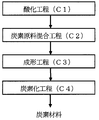
以下、本発明に係る炭素材料の製造方法について、図1、図2に示す工程図に基づいて説明する。 Hereinafter, the manufacturing method of the carbon material which concerns on this invention is demonstrated based on process drawing shown in FIG. 1, FIG.
まず、本発明の炭素材料の原料となる炭素原料について説明する。本発明では炭素原料として、無灰炭に酸化処理を施して得られる酸化無灰炭と、酸化しない無灰炭(無改質無灰炭)を配合した混合炭素原料を用いる。無灰炭とは石炭を815℃で加熱して灰化したときの残留無機物(ケイ酸、アルミナ、酸化鉄、石灰、マグネシア、アルカリ金属など)の灰分の濃度が極めて少ないものをいう。具体的には灰分濃度が5000ppm以下(質量基準)であり、好ましくは2000ppm以下であるものを無灰炭という。また無灰炭は、水分は皆無であり、原料石炭よりも高い熱流動性を示す。 First, the carbon raw material used as the raw material of the carbon material of this invention is demonstrated. In the present invention, a mixed carbon raw material in which oxidized ashless coal obtained by subjecting ashless coal to oxidation treatment and non-oxidized ashless coal (unmodified ashless coal) is used as the carbon raw material. Ashless coal refers to coal with extremely low ash concentration of residual inorganic substances (silicic acid, alumina, iron oxide, lime, magnesia, alkali metal, etc.) when coal is ashed by heating at 815 ° C. Specifically, an ash concentration of 5000 ppm or less (mass basis), preferably 2000 ppm or less, is referred to as ashless coal. In addition, ashless coal has no water and exhibits higher thermal fluidity than raw coal.
本発明ではこのような性質を有する既存の無灰炭を使用でき、その製造方法も特に限定されず、各種公知の製造方法を採用できる。例えば無灰炭は下記S1〜S3の工程(図1参照)を経て製造できるが、下記無灰炭の製造工程(S1〜S3)は適宜変更することができ、必要に応じて各種処理工程を付加してもよい。 In the present invention, existing ashless coal having such properties can be used, and the production method is not particularly limited, and various known production methods can be adopted. For example, ashless coal can be manufactured through the following steps S1 to S3 (see FIG. 1), but the following ashless coal manufacturing steps (S1 to S3) can be appropriately changed, and various processing steps can be performed as necessary. It may be added.
例えば無灰炭を製造するにあたり、前記各工程に悪影響を与えない範囲において、前記各工程の間あるいは前後に、例えば、原料石炭を粉砕する石炭粉砕工程や、ごみ等の不要物を除去する除去工程や、得られた無灰炭を乾燥させる乾燥工程等、他の工程を含めてもよい。 For example, in the production of ashless coal, for example, a coal crushing step for crushing raw coal, or removal to remove unnecessary materials such as dust, before or after each step within a range that does not adversely affect each step. Other processes such as a process and a drying process for drying the obtained ashless coal may be included.
<スラリー加熱工程:S1>
スラリー加熱工程(S1)は、石炭と芳香族溶剤とを混合してスラリーを調製し、加熱処理して石炭成分を芳香族溶剤に抽出する処理である。
原料となる石炭(以下、「原料石炭」ともいう)の種類は特に限定されない。経済性の観点からは、瀝青炭等の高品位炭を使用するよりも、軟化溶融性をほとんど持たない非微粘炭や、一般炭、低品位炭である褐炭、亜炭、亜瀝青炭等の劣質炭を使用することが好ましい。
<Slurry heating process: S1>
The slurry heating step (S1) is a process in which coal and an aromatic solvent are mixed to prepare a slurry, and heat treatment is performed to extract a coal component into the aromatic solvent.
The type of coal as a raw material (hereinafter also referred to as “raw coal”) is not particularly limited. From the economical point of view, non-thin coal with almost no softening and melting properties, or low quality coal such as brown coal, lignite, sub-bituminous coal, sub-bituminous coal, etc. Is preferably used.
芳香族溶剤としては、石炭を溶解する性質を有するものであれば特に限定されない。このような性質を有する芳香族溶剤としては、ベンゼン、トルエン、キシレン等の単環芳香族化合物や、ナフタレン、メチルナフタレン、ジメチルナフタレン、トリメチルナフタレン等の2環芳香族化合物等が例示される。また2環芳香族化合物には、その他脂肪族側鎖を有するナフタレン類、また、これにビフェニルや長鎖脂肪族側鎖を有するアルキルベンゼンが含まれる。本発明では非水素供与性溶剤である2環芳香族化合物が好ましい。 The aromatic solvent is not particularly limited as long as it has a property of dissolving coal. Examples of the aromatic solvent having such properties include monocyclic aromatic compounds such as benzene, toluene and xylene, and bicyclic aromatic compounds such as naphthalene, methylnaphthalene, dimethylnaphthalene and trimethylnaphthalene. The bicyclic aromatic compound includes other naphthalenes having an aliphatic side chain, and biphenyl and alkylbenzene having a long aliphatic side chain. In the present invention, a bicyclic aromatic compound which is a non-hydrogen donating solvent is preferable.
非水素供与性溶剤とは、主に石炭の炭素化生成物から精製した、2環芳香族を主とする溶剤である石炭誘導体である。非水素供与性溶剤が好ましい理由は、非水素供与性溶剤が加熱状態でも安定しており、石炭との親和性に優れているため、溶剤に抽出される石炭成分の割合(以下、「抽出率」ともいう)が高く、また、蒸留等の方法で容易に回収可能な溶剤であり、更に回収した溶剤を循環使用できるからである。 The non-hydrogen donating solvent is a coal derivative which is a solvent mainly composed of a bicyclic aromatic and purified mainly from a carbonization product of coal. The reason why the non-hydrogen-donating solvent is preferable is that the non-hydrogen-donating solvent is stable even in a heated state and has excellent affinity with coal. This is because it is a solvent that can be easily recovered by a method such as distillation, and the recovered solvent can be recycled.
なお、芳香族溶剤の沸点が低すぎると、加熱抽出の際、または後述する分離工程(S2)での必要圧力が高くなり、また芳香族溶剤を回収する工程で揮発による損失が増大し、芳香族溶剤の回収率が低下する。さらに、加熱抽出での抽出率も低下する。一方、芳香族溶剤の沸点が高すぎると、分離工程(S2)での液体成分、または、固体成分からの芳香族溶剤の分離が困難となり、溶剤の回収率が低下する。芳香族溶剤の沸点は180〜330℃のものが好ましい。 If the boiling point of the aromatic solvent is too low, the required pressure in the heat extraction or in the separation step (S2) described later increases, and loss due to volatilization increases in the step of recovering the aromatic solvent. The recovery rate of group solvents is reduced. Furthermore, the extraction rate in heat extraction is also reduced. On the other hand, if the boiling point of the aromatic solvent is too high, it becomes difficult to separate the aromatic solvent from the liquid component or the solid component in the separation step (S2), and the solvent recovery rate decreases. The boiling point of the aromatic solvent is preferably 180 to 330 ° C.
芳香族溶剤に対する石炭濃度は、特に限定されない。原料石炭の種類にもよるが、芳香族溶剤に対する石炭濃度が低いと、芳香族溶剤の量に対し、芳香族溶剤に抽出する石炭成分の割合が少なくなり、経済的ではない。一方、石炭濃度は高いほど好ましいが、高くなりすぎると、スラリーの粘度が高くなり、スラリーの移動や分離工程(S2)での液体成分と固体成分との分離が困難となりやすい。石炭濃度は、乾燥炭基準で10〜50質量%の範囲が好ましく、20〜35質量%の範囲がより好ましい。 The coal concentration with respect to the aromatic solvent is not particularly limited. Although depending on the type of raw material coal, if the coal concentration relative to the aromatic solvent is low, the proportion of the coal component extracted into the aromatic solvent is less than the amount of the aromatic solvent, which is not economical. On the other hand, the higher the coal concentration, the better. However, if the coal concentration is too high, the viscosity of the slurry becomes high, and it becomes difficult to move the slurry and separate the liquid component and the solid component in the separation step (S2). The coal concentration is preferably in the range of 10 to 50 mass%, more preferably in the range of 20 to 35 mass%, based on dry coal.
スラリーの加熱処理(加熱抽出)温度が低すぎると、石炭を構成する分子間の結合を十分に弱めることができず、原料石炭として劣質炭を使用した場合、後述する無灰炭取得工程(S3)で取得される無灰炭の再固化温度を高めることができない。一方、加熱処理温度が高すぎると、石炭の熱分解反応が非常に活発になり、生成した熱分解ラジカルの再結合が起こるため、抽出率が低下する。スラリー加熱温度は、好ましくは350℃以上、より好ましくは380℃以上、好ましくは420℃以下である。 If the temperature of the heat treatment (heat extraction) of the slurry is too low, the bonds between the molecules constituting the coal cannot be sufficiently weakened, and when inferior coal is used as the raw coal, an ashless coal acquisition step (S3 described later) The solidification temperature of ashless coal obtained in (1) cannot be increased. On the other hand, when the heat treatment temperature is too high, the pyrolysis reaction of coal becomes very active, and recombination of the generated pyrolysis radical occurs, so that the extraction rate decreases. The slurry heating temperature is preferably 350 ° C. or higher, more preferably 380 ° C. or higher, and preferably 420 ° C. or lower.
加熱時間(抽出時間)は、特に限定されないが、抽出時間が長くなると熱分解反応が進行しすぎて、ラジカル重合反応が進み、抽出率が低下する。例えば上記加熱温度であれば、好ましくは120分以下、より好ましくは60分以下、更に好ましくは30分以下であって、好ましくは0分超、好ましくは10分以上である。 The heating time (extraction time) is not particularly limited, but if the extraction time is long, the thermal decomposition reaction proceeds too much, the radical polymerization reaction proceeds, and the extraction rate decreases. For example, if it is the said heating temperature, Preferably it is 120 minutes or less, More preferably, it is 60 minutes or less, More preferably, it is 30 minutes or less, Preferably it is more than 0 minute, Preferably it is 10 minutes or more.
加熱抽出した後、熱分解反応を抑制するために370℃以下に冷却することが好ましい。また冷却する際の温度の下限は、300℃以上が好ましい。300℃未満まで冷却すると、芳香族溶剤の溶解力が低下して、一旦抽出された石炭成分の再析出が起き、無灰炭の収率が低下する。 After heat extraction, it is preferable to cool to 370 ° C. or lower in order to suppress the thermal decomposition reaction. Further, the lower limit of the temperature at the time of cooling is preferably 300 ° C. or higher. If it cools to less than 300 degreeC, the dissolving power of an aromatic solvent will fall, the reprecipitation of the coal component once extracted will occur, and the yield of ashless coal will fall.
加熱抽出は、非酸化性雰囲気でおこなうことが好ましい。具体的には、窒素などの不活性ガスの存在下でおこなうことが好ましい。加熱抽出の際、酸素に接触すると、発火する恐れがあるため危険であり、また、水素を用いた場合には、コストが高くなるためである。 Heat extraction is preferably performed in a non-oxidizing atmosphere. Specifically, it is preferably performed in the presence of an inert gas such as nitrogen. This is because contact with oxygen during heating extraction is dangerous because it may ignite, and the cost increases when hydrogen is used.
加熱抽出での圧力は、加熱抽出の際の温度や用いる芳香族溶剤の蒸気圧にもよるが、圧力が芳香族溶剤の蒸気圧より低い場合には、芳香族溶剤が揮発して液相に閉じ込められず、抽出できない。一方、圧力が高すぎると、機器のコスト、運転コストが高くなり、経済的ではない。好ましい圧力は概ね1.0〜2.0MPaである。 The pressure in the heat extraction depends on the temperature at the time of heat extraction and the vapor pressure of the aromatic solvent used, but when the pressure is lower than the vapor pressure of the aromatic solvent, the aromatic solvent volatilizes and enters the liquid phase. It is not trapped and cannot be extracted. On the other hand, if the pressure is too high, the cost of the equipment and the operating cost increase, which is not economical. A preferable pressure is approximately 1.0 to 2.0 MPa.
<分離工程(S2)>
分離工程(S2)は、スラリー加熱工程(S1)で加熱処理されたスラリーを、液体成分と固体成分とに分離する工程である。液体成分とは、芳香族溶剤に抽出された石炭成分を含む溶液である。固体成分とは、芳香族溶剤に不溶な灰分と不溶石炭を含むスラリーである。
<Separation step (S2)>
The separation step (S2) is a step of separating the slurry heat-treated in the slurry heating step (S1) into a liquid component and a solid component. The liquid component is a solution containing a coal component extracted into an aromatic solvent. The solid component is a slurry containing ash and insoluble coal insoluble in an aromatic solvent.
分離工程(S2)でスラリーを液体成分と固体成分とに分離する方法としては、特に限定されず、濾過法、遠心分離法、重力沈降法など公知の分離方法を採用できる。本発明では流体の連続操作が可能であり、低コストで大量の処理にも適している重力沈降法を用いることが好ましい。重力沈降法による場合、重力沈降槽の上部からは、芳香族溶剤に抽出された石炭成分を含む溶液である液体成分(以下、「上澄み液」ともいう)を、重力沈降槽の下部からは溶剤に不溶な灰分と石炭を含むスラリーである固体成分(以下、「固形分濃縮液」ともいう)を得ることができる。 The method for separating the slurry into a liquid component and a solid component in the separation step (S2) is not particularly limited, and a known separation method such as a filtration method, a centrifugal separation method, or a gravity sedimentation method can be employed. In the present invention, it is preferable to use a gravity sedimentation method that allows continuous operation of a fluid and is suitable for a large amount of processing at a low cost. In the case of the gravity sedimentation method, from the upper part of the gravity sedimentation tank, a liquid component (hereinafter also referred to as “supernatant liquid”) that is a solution containing coal components extracted into an aromatic solvent, and from the lower part of the gravity sedimentation tank, a solvent. It is possible to obtain a solid component (hereinafter also referred to as “solid content concentrate”) which is a slurry containing ash and coal insoluble in water.
そして、以下に説明するように、この上澄み液および固形分濃縮液から蒸留法等を用いて芳香族溶剤を分離・回収し、上澄み液からは灰分濃度が極めて低い無灰炭を得ることができる(無灰炭取得工程(S3))。 Then, as will be described below, an aromatic solvent is separated and recovered from the supernatant and the solid concentrate using a distillation method or the like, and ashless coal having an extremely low ash concentration can be obtained from the supernatant. (Ashless coal acquisition process (S3)).
<無灰炭取得工程(S3)>
無灰炭取得工程(S3)は、上澄み液から芳香族溶剤を分離して灰分濃度の極めて低い無灰炭を取得する工程である。
<Ashless coal acquisition process (S3)>
The ashless coal acquisition step (S3) is a step of separating the aromatic solvent from the supernatant to acquire ashless coal having an extremely low ash concentration.
上澄み液から芳香族溶剤を分離する方法は特に限定されず、一般的な蒸留法や蒸発法(スプレードライ法等)等を用いることができる。また分離して回収された芳香族溶剤は繰り返し使用することができる。芳香族溶剤の分離・回収により、上澄み液からは、無灰炭を得ることができる。 The method for separating the aromatic solvent from the supernatant is not particularly limited, and a general distillation method, evaporation method (spray drying method, etc.), and the like can be used. The aromatic solvent separated and recovered can be used repeatedly. Ash liquid can be obtained from the supernatant by separating and collecting the aromatic solvent.
<その他の工程>
必要に応じて、固形分濃縮液から芳香族溶剤を分離して灰分が濃縮された副生炭を製造してもよい(副生炭取得工程)。固形分濃縮液から芳香族溶剤を分離する方法は、前記した液体成分から無灰炭を取得する無灰炭取得工程(S3)と同様に、一般的な蒸留法や蒸発法を用いることができる。
<Other processes>
If necessary, by-product coal in which the ash is concentrated by separating the aromatic solvent from the solid concentrate may be produced (by-product coal acquisition step). The method for separating the aromatic solvent from the solid concentrate can use a general distillation method or evaporation method as in the ashless coal acquisition step (S3) for acquiring ashless coal from the liquid component. .
以下、本発明の炭素材料の製造方法を図2に基づいて説明する。炭素材料を製造するにあたり、各工程に悪影響を与えない範囲において、各工程の間あるいは前後に、例えば、各種原料などを粉砕する粉砕工程や、ごみ等の不要物を除去する除去工程や、得られた炭素材料に各種処理を施す工程等、他の工程を含めてもよい。 Hereafter, the manufacturing method of the carbon material of this invention is demonstrated based on FIG. In the production of carbon materials, within a range that does not adversely affect each process, for example, before or after each process, for example, a pulverization process for pulverizing various raw materials, a removal process for removing unnecessary substances such as dust, and the like. Other steps such as a step of performing various treatments on the obtained carbon material may be included.
<酸化工程:C1>
酸化工程(C1)は、無灰炭を酸化する工程であって、酸化無灰炭が得られる。なお、後記するように本発明では無改質無灰炭と、酸化工程で得られた酸化無灰炭とを混合して炭素原料(以下、「混合炭素原料」ということがある)としている。そのため、準備した無灰炭の一部を酸化工程(C1)で酸化して酸化無灰炭を製造し、残りの無改質無灰炭を使用して酸化無灰炭と混合してもよい。
<Oxidation step: C1>
An oxidation process (C1) is a process which oxidizes ashless coal, Comprising: Oxidized ashless coal is obtained. As will be described later, in the present invention, unmodified ashless coal and oxidized ashless coal obtained in the oxidation step are mixed to form a carbon raw material (hereinafter sometimes referred to as “mixed carbon raw material”). Therefore, a part of the prepared ashless coal may be oxidized in the oxidation step (C1) to produce oxidized ashless coal, and the remaining unmodified ashless coal may be mixed with oxidized ashless coal. .
無灰炭を酸化処理することで、後記する溶融や膨張を抑制でき、炭素材料の高密度化に寄与する。このような効果を得るためには、JIS M 8813(酸素含有率の算出方法)に基づいて酸化処理前後の無灰炭の酸素含有率を測定し、酸化無灰炭の酸素増加率(酸化無灰炭の酸素含有率−酸化前の無灰炭の酸素含有率)を2.0%以上、10.0%以下の範囲内にする必要がある。 By oxidizing the ashless coal, melting and expansion described later can be suppressed, contributing to higher density of the carbon material. In order to obtain such an effect, the oxygen content of the ashless coal before and after the oxidation treatment is measured based on JIS M 8813 (oxygen content calculation method), and the oxygen increase rate of the oxidized ashless coal (oxidation-free). It is necessary to set the oxygen content of ash coal—the oxygen content of ashless coal before oxidation) within the range of 2.0% or more and 10.0% or less.
酸化無灰炭の酸素増加率が2.0%を下回ると無灰炭が十分に改質されていないため、炭素化時に溶融や膨張が生じ、形状が変形したり、炭素材料が多孔質体となり、密度が低くなる。一方、酸化無灰炭の酸素増加率が10.0%を超えると炭素化した際の炭化収縮率が低下して酸化無灰炭と無改質無灰炭との炭化収縮率差が生じて、空隙が形成されて所望の高密度を達成できない。酸化無灰炭の酸素増加率は好ましくは4.0%以上、より好ましくは6.0%以上であって、好ましくは9.0%以下、より好ましくは8.5%以下である。 If the oxygen increase rate of oxidized ashless coal is less than 2.0%, the ashless coal is not sufficiently reformed, so melting or expansion occurs during carbonization, the shape is deformed, or the carbon material is porous. And the density is lowered. On the other hand, if the oxygen increase rate of oxidized ashless coal exceeds 10.0%, the carbonization shrinkage rate at the time of carbonization decreases, resulting in a difference in carbonization shrinkage rate between oxidized ashless coal and unmodified ashless coal. , Voids are formed and the desired high density cannot be achieved. The oxygen increase rate of the oxidized ashless coal is preferably 4.0% or more, more preferably 6.0% or more, preferably 9.0% or less, more preferably 8.5% or less.
無灰炭の酸化方法は特に制限されず、無灰炭の酸素増加率が所定の範囲となるように酸化すればよい。酸化方法として例えば酸素、オゾン、二酸化窒素、空気など酸化性雰囲気による酸化、好ましくは空気中の酸素を酸化剤とする空気酸化である。またコストの観点からは大気雰囲気による酸化がより好ましい。 The oxidation method of ashless coal is not particularly limited, and may be oxidized so that the oxygen increase rate of ashless coal falls within a predetermined range. As an oxidation method, for example, oxidation in an oxidizing atmosphere such as oxygen, ozone, nitrogen dioxide, and air, preferably air oxidation using oxygen in the air as an oxidizing agent. Further, from the viewpoint of cost, oxidation in an air atmosphere is more preferable.
酸化温度(酸化時に保持する温度)は、所望の酸素増加率が得られるように適宜調整すればよい。酸化温度が低いと無灰炭の酸化不足となり、上記改質効果が十分に発揮されないことがある。また酸化温度が低いと所望の酸素増加率の達成に要する時間が長くなり、生産性が悪化する。一方、酸化温度が高くなりすぎると酸化速度が速くなりすぎて、無灰炭の酸化度を制御することが難しくなる。酸化温度は好ましくは150℃以上、より好ましくは200℃以上であって、好ましくは無灰炭の発火点未満、より好ましくは350℃以下である。 What is necessary is just to adjust oxidation temperature (temperature hold | maintained at the time of oxidation) suitably so that a desired oxygen increase rate may be obtained. If the oxidation temperature is low, the ashless coal may be insufficiently oxidized, and the above-described reforming effect may not be sufficiently exhibited. On the other hand, when the oxidation temperature is low, the time required to achieve the desired oxygen increase rate becomes long, and the productivity deteriorates. On the other hand, if the oxidation temperature becomes too high, the oxidation rate becomes too fast, making it difficult to control the degree of oxidation of ashless coal. The oxidation temperature is preferably 150 ° C. or higher, more preferably 200 ° C. or higher, preferably less than the ignition point of ashless coal, more preferably 350 ° C. or lower.
酸化時間(所定の温度での保持時間)は、所望の酸素増加率が得られるように適宜調整すればよい。酸化時間が短いと無灰炭の酸化不足となることがある。一方、酸化時間が長いと無灰炭が過剰に酸化されてしまって、上記したように空隙が生じて密度が低下する原因となることがある。例えば上記温度範囲における好ましい酸化時間は0.5時間以上、より好ましくは1時間以上であって、好ましくは6時間以下、より好ましくは3時間以下である。酸化後は室温まで放冷すればよい。 The oxidation time (retention time at a predetermined temperature) may be appropriately adjusted so that a desired oxygen increase rate is obtained. If the oxidation time is short, the ashless coal may become insufficiently oxidized. On the other hand, if the oxidation time is long, the ashless coal is excessively oxidized, and voids are generated as described above, which may cause a decrease in density. For example, the preferred oxidation time in the above temperature range is 0.5 hours or more, more preferably 1 hour or more, preferably 6 hours or less, more preferably 3 hours or less. What is necessary is just to cool to room temperature after oxidation.
なお、酸化する無灰炭の粒径(円相当直径、以下、粒径について同じ)は特に限定されない。無灰炭の粒径が大きすぎると無灰炭内部が十分に酸化されず、炭素化した際に溶融等が生じるおそれがある。一方、無灰炭の粒径が小さすぎると取扱い性が悪化する。無灰炭の平均粒径は好ましくは3mm以下、より好ましくは1mm以下であって、好ましくは0.2mm以上、より好ましくは0.3mm以上である。また最大粒径も酸化促進の観点から、好ましくは3mm以下、より好ましくは1mm以下、更に好ましくは0.5mm以下である。 The particle size of the ashless coal to be oxidized (equivalent circle diameter, hereinafter the same for the particle size) is not particularly limited. If the particle size of the ashless coal is too large, the inside of the ashless coal is not sufficiently oxidized, and there is a risk of melting or the like when carbonized. On the other hand, if the particle size of ashless coal is too small, the handleability deteriorates. The average particle diameter of ashless coal is preferably 3 mm or less, more preferably 1 mm or less, preferably 0.2 mm or more, more preferably 0.3 mm or more. The maximum particle size is also preferably 3 mm or less, more preferably 1 mm or less, and still more preferably 0.5 mm or less from the viewpoint of promoting oxidation.
次に上記酸化工程で得られた無灰炭と、無改質無灰炭(すなわち、酸化しない無灰炭)とを混合し、所望の形状に成形して成形体を得る。以下では、無灰炭の混合(炭素原料混合工程:C2)と、成形(成形工程:C3)を夫々分けて説明するが、連続する一つの工程とみなしておこなうこともできる。 Next, ashless coal obtained in the oxidation step and unmodified ashless coal (that is, non-oxidized ashless coal) are mixed and molded into a desired shape to obtain a molded body. In the following, mixing of ashless coal (carbon raw material mixing step: C2) and molding (molding step: C3) will be described separately, but they can also be considered as one continuous step.
<炭素原料混合工程:C2>
炭素原料混合工程は、酸化工程(C1)で得られた酸化無灰炭と、無改質無灰炭とを混合して炭素原料(混合炭素原料)を取得する工程である。上記したように酸化無灰炭と無改質無灰炭とを配合することで、炭素化時の溶融や膨張が抑制されると共に炭素材料に空隙が形成されることを抑制できるため、炭素材料の高密度化に寄与する。
<Carbon raw material mixing step: C2>
The carbon raw material mixing step is a step of obtaining the carbon raw material (mixed carbon raw material) by mixing the oxidized ashless coal obtained in the oxidation step (C1) and the unmodified ashless coal. As described above, by blending oxidized ashless coal and unmodified ashless coal, it is possible to suppress melting and expansion during carbonization and suppress formation of voids in the carbon material. Contributes to higher density.
このような効果を得るためは混合炭素原料における酸化無灰炭の割合を、酸化無灰炭と無改質無灰炭の合計100質量部に対して、60〜95質量部とする必要がある。酸化無灰炭の混合割合が高くなって無改質無灰炭の割合が低くなると、無改質無灰炭のバインダー効果が十分に発揮されないため、脆くなり、炭素化した際にヒビ割れ等が進展して一部が崩れて粉化してしまい形状保持性に劣る。一方、無改質無灰炭の混合比率が高くなって酸化無灰炭の混合割合が低くなると、炭素化した際に無改質無灰炭の膨張によって、所望の形状の炭素材料が得られなくなる。酸化無灰炭の混合割合は好ましくは80〜90質量部である。 In order to obtain such an effect, the ratio of oxidized ashless coal in the mixed carbon raw material needs to be 60 to 95 parts by mass with respect to a total of 100 parts by mass of oxidized ashless coal and unmodified ashless coal. . If the mixing ratio of oxidized ashless coal becomes high and the ratio of unmodified ashless coal becomes low, the binder effect of unmodified ashless coal will not be fully exhibited, so it becomes brittle and cracks when carbonized etc. Progresses and partly collapses and pulverizes, resulting in poor shape retention. On the other hand, when the mixing ratio of unmodified ashless coal is increased and the mixing ratio of oxidized ashless coal is decreased, a carbon material having a desired shape is obtained due to expansion of the unmodified ashless coal when carbonized. Disappear. The mixing ratio of oxidized ashless coal is preferably 80 to 90 parts by mass.
なお、酸化無灰炭と混合する無改質無灰炭の平均粒径は特に限定されないが、平均粒径が大きすぎると成形体中での混合状態に不均一が生じて効果が十分に発揮されないことがある。一方、平均粒径が小さすぎると取扱い性が悪化することがある。無改質無灰炭の平均粒径は好ましくは1.0mm以下、より好ましくは0.5mm以下であって、好ましくは0.1mm以上、より好ましくは0.2mm以上である。また無改質無灰炭の最大粒径は、大きくなりすぎると成形体中での混合状態に不均一が生じることがあるため、好ましくは1.0mm以下、より好ましくは0.5mm以下である。 The average particle size of the unmodified ashless coal mixed with the oxidized ashless coal is not particularly limited, but if the average particle size is too large, the mixed state in the molded body will be uneven and the effect will be sufficiently exerted. It may not be done. On the other hand, if the average particle size is too small, the handleability may deteriorate. The average particle size of the unmodified ashless coal is preferably 1.0 mm or less, more preferably 0.5 mm or less, preferably 0.1 mm or more, more preferably 0.2 mm or more. Further, the maximum particle size of the unmodified ashless coal is preferably 1.0 mm or less, more preferably 0.5 mm or less, because if it becomes too large, the mixed state in the molded product may become uneven. .
また酸化無灰炭の平均粒径よりも無改質無灰炭の平均粒径を小さくすると、本発明の上記効果がより向上するため望ましい。 Moreover, it is desirable to make the average particle size of the unmodified ashless coal smaller than the average particle size of the oxidized ashless coal because the above-described effect of the present invention is further improved.
酸化無灰炭と無改質無灰炭との混合方法は、特に限定されず、均一な混合が得られる公知の方法を採用すればよく、例えばミキサー、ニーダー、単軸の混合機、二軸の混合機などを用いることができる。 The mixing method of the oxidized ashless coal and the unmodified ashless coal is not particularly limited, and a known method capable of obtaining uniform mixing may be adopted, for example, a mixer, a kneader, a single screw mixer, a twin screw Or the like can be used.
<成形工程:C3>
成形工程は、炭素原料混合工程(C2)で得られた混合炭素原料を所望の形状に成形して成形体を得る工程である。成形体とするための方法は特に限定されるものではなく、例えば、平ロールによるダブルロール(双ロール)型成形機や、アーモンド型ポケットを有するダブルロール型成形機を用いる方法の他、単軸プレスやローラータイプの成形機、押し出し成形機を用いる方法、金型によるプレス成形等、いずれの方法も採用できる。
<Molding process: C3>
The forming step is a step of obtaining a molded body by forming the mixed carbon raw material obtained in the carbon raw material mixing step (C2) into a desired shape. The method for forming the molded body is not particularly limited. For example, in addition to a method using a double roll (double roll) molding machine using a flat roll, a double roll molding machine having an almond pocket, a single axis Any method such as a press or roller type molding machine, a method using an extrusion molding machine, or press molding using a mold can be adopted.
混合炭素原料の成形は、室温前後で行なう冷間成形でもよいが、加熱しておこなう熱間成形が好ましい。酸化無灰炭と無改質無灰炭との混合炭素原料を用いて高温下で加圧成形すると、無改質炭が塑性変形して酸化無灰炭粒子間の空隙を充填し、より一層緻密化した成形体を得ることができる。そのため該緻密化した成形体を炭素化することで、より密度の高い炭素材料を得ることができる。一方、成形温度が高くなりすぎると無改質無灰炭が軟化膨張して高密度化を達成できないことがある。熱間成形温度(金型温度)は好ましくは100℃以上、より好ましくは200℃以上であって、好ましくは450℃以下、より好ましくは300℃以下である。成形圧力は特に限定されず、公知の条件を採用すればよい。例えば成形圧力は0.5〜3トン/cm2程度である。 The mixed carbon raw material may be formed by cold forming performed at around room temperature, but hot forming performed by heating is preferable. When pressure molding is performed at a high temperature using a mixed carbon raw material of oxidized ashless coal and unmodified ashless coal, the unmodified coal is plastically deformed to fill the voids between the oxidized ashless coal particles, and more A densified compact can be obtained. Therefore, a carbon material with higher density can be obtained by carbonizing the compacted compact. On the other hand, if the molding temperature becomes too high, the unmodified ashless coal may soften and expand, and the densification may not be achieved. The hot molding temperature (mold temperature) is preferably 100 ° C. or higher, more preferably 200 ° C. or higher, preferably 450 ° C. or lower, more preferably 300 ° C. or lower. The molding pressure is not particularly limited, and known conditions may be adopted. For example, the molding pressure is about 0.5 to 3 ton / cm 2 .
<炭素化工程:C4>
炭素化工程は、成形工程で得られた成形体を炭素化して炭素材料を取得する工程である。
<Carbonization process: C4>
A carbonization process is a process of carbonizing the molded object obtained at the formation process, and acquiring a carbon material.
成形体の炭素化は、非酸化性雰囲気下で加熱することによって行なう。具体的には、成形体を電気炉など任意の加熱装置へ装入し、内部を非酸化性ガスで置換した後、該装置内へ非酸化性ガスを吹き込みながら加熱する。加熱によって無改質無灰炭は軟化・溶融・再固化され、酸化無灰炭と共に炭化される。 Carbonization of the molded body is performed by heating in a non-oxidizing atmosphere. Specifically, the molded body is charged into an arbitrary heating apparatus such as an electric furnace, the inside is replaced with a non-oxidizing gas, and then heated while blowing the non-oxidizing gas into the apparatus. Unmodified ashless coal is softened, melted and resolidified by heating, and carbonized with oxidized ashless coal.
加熱条件は製品の要求特性により適宜設定すればよく、特に制限されないが、好ましくは500℃以上、より好ましくは700℃以上の温度で0.5〜10時間程度加熱することによって行なう。加熱温度までの昇温速度は特に限定されず、通常は0.01℃〜1℃/分程度の速度で昇温すればよい。加熱温度の上限は特に限定されず、設備などに応じて適宜決定すればよく、例えば好ましくは3000℃以下、より好ましくは2600℃以下でもよい。 The heating conditions may be appropriately set depending on the required characteristics of the product, and are not particularly limited, but are preferably performed by heating at a temperature of 500 ° C. or higher, more preferably 700 ° C. or higher for about 0.5 to 10 hours. The rate of temperature increase up to the heating temperature is not particularly limited, and the temperature may be normally increased at a rate of about 0.01 ° C. to 1 ° C./min. The upper limit of the heating temperature is not particularly limited, and may be determined as appropriate according to equipment and the like. For example, it may be preferably 3000 ° C. or less, more preferably 2600 ° C.
炭素化雰囲気は、石炭の酸化による劣化を防止するため、非酸化性ガス雰囲気とすることが望ましい。非酸化性ガスの種類は、炭素材料の酸化を抑えた状態で炭素化を進めるため、酸化性ガスを含まない限り格別の制限はないが、不活性ガスが好ましく、より好ましくは窒素ガスである。 The carbonization atmosphere is preferably a non-oxidizing gas atmosphere in order to prevent deterioration due to oxidation of coal. The type of non-oxidizing gas is not particularly limited as long as it contains no oxidizing gas in order to advance carbonization in a state in which the oxidation of the carbon material is suppressed, but an inert gas is preferable, and nitrogen gas is more preferable. .
このようにして得られた炭素材料は従来公知の炭素材料よりも高純度、且つ高密度である。具体的には灰分含有率が好ましくは5000ppm以下、より好ましくは3000ppm以下の高純度であり、密度は好ましくは1.50g/ml以上、より好ましくは1.60g/ml以上、更に好ましくは1.70g/ml以上の高密度である。また本発明の炭素材料にはヒビや割れがなく、また膨張、変形、粉化することなく炭素化する前の成形体の形状を保持している。 The carbon material thus obtained has a higher purity and higher density than conventionally known carbon materials. Specifically, the high ash content is preferably 5000 ppm or less, more preferably 3000 ppm or less, and the density is preferably 1.50 g / ml or more, more preferably 1.60 g / ml or more, and still more preferably 1. High density of 70 g / ml or more. Further, the carbon material of the present invention is free from cracks and cracks, and retains the shape of the molded body before carbonization without being expanded, deformed or pulverized.
上記所定の酸素増加率(2.0〜10.0%の範囲内)に酸化された酸化無灰炭と、酸化しない無灰炭とを上記所定の比率(酸化無灰炭と酸化しない無灰炭の合計100質量部に対して、酸化無灰炭60〜95質量部)で混合・成形された成形体を炭素化した本発明の炭素材料は、従来の炭素材料と比べて高純度、且つ高密度である。 Oxidized ashless coal oxidized to the predetermined oxygen increase rate (within a range of 2.0 to 10.0%) and non-oxidized ashless coal (the oxidized ashless coal not oxidized) The carbon material of the present invention obtained by carbonizing a molded body mixed and molded with oxidized ashless coal (60 to 95 parts by mass with respect to a total of 100 parts by mass of charcoal) has a higher purity than conventional carbon materials, and High density.
以下、実施例を挙げて本発明をより具体的に説明するが、本発明はもとより下記実施例によって制限を受けるものではなく、前・後記の趣旨に適合し得る範囲で適当に変更を加えて実施することも勿論可能であり、それらはいずれも本発明の技術的範囲に包含される。 EXAMPLES Hereinafter, the present invention will be described more specifically with reference to examples. However, the present invention is not limited by the following examples, but may be appropriately modified within a range that can meet the purpose described above and below. Of course, it is possible to implement them, and they are all included in the technical scope of the present invention.
(無灰炭の製造)
(スラリー加熱工程:S1)
原料石炭(瀝青炭)5kgに対し、4倍量(20kg)の芳香族溶剤(1−メチルナフタレン(新日鉄化学社製))を混合してスラリーを調製した。このスラリーを1.2MPaの窒素で加圧して、内容積30リットルのオートクレーブ中370℃、1時間の条件で加熱処理(加熱抽出)した。
(Manufacture of ashless coal)
(Slurry heating process: S1)
A slurry was prepared by mixing 4 kg (20 kg) of aromatic solvent (1-methylnaphthalene (manufactured by Nippon Steel Chemical Co., Ltd.)) with 5 kg of raw coal (bituminous coal). This slurry was pressurized with 1.2 MPa of nitrogen and heat-treated (heat extraction) in an autoclave with an internal volume of 30 liters at 370 ° C. for 1 hour.
(分離工程:S2)
得られたスラリーを同一温度、圧力を維持した重力沈降槽内で上澄み液と固形分濃縮液とに分離した。
(Separation step: S2)
The obtained slurry was separated into a supernatant and a solid concentrate in a gravity settling tank maintaining the same temperature and pressure.
(無灰炭取得工程:S3)
得られた上澄み液を更に濾過(目開き1μmのステンレスメッシュフィルター)して無灰炭溶液を得た。無灰炭溶液から蒸留法で芳香族溶剤を分離・回収して、無灰炭(炭素原料A1)を製造した。
(Ashless coal acquisition process: S3)
The obtained supernatant was further filtered (a stainless mesh filter having an opening of 1 μm) to obtain an ashless coal solution. The ashless coal (carbon raw material A1) was produced by separating and recovering the aromatic solvent from the ashless coal solution by distillation.
(灰分濃度の測定)
この無灰炭(炭素原料A1)について、JIS M 8812に定められた方法で灰分濃度を測定した。その結果、無灰炭の灰分濃度は0.07質量%(700ppm)であった。
(Measurement of ash concentration)
For this ashless coal (carbon raw material A1), the ash concentration was measured by the method defined in JIS M 8812. As a result, the ash content of the ashless coal was 0.07% by mass (700 ppm).
(炭素材料の製造)
無灰炭(炭素原料A1)を用いて試料No.1〜11の炭素材料を製造した。
(Manufacture of carbon materials)
Sample No. using ashless coal (carbon raw material A1). 1 to 11 carbon materials were produced.
(酸化工程:C1)
上記製造した無灰炭(炭素原料A1)の一部を目開き0.5mmの篩を通過するように粉砕した。粉砕した無灰炭を大気雰囲気下、表1に記載の所定の温度まで加熱し、同温度で所定の時間保持して無灰炭の酸化処理(表1中、「酸化条件」)を行った。酸化処理後、室温まで放冷して酸化無灰炭(炭素原料B)を製造した。なお、酸化処理の前後で無灰炭(室温)の酸素濃度をJIS M 8813に基づいて測定し、酸化無灰炭の酸素増加率を算出した。結果を表1に示す(表1中、「酸素増加率」)。
(Oxidation step: C1)
A part of the produced ashless coal (carbon raw material A1) was pulverized so as to pass through a sieve having an opening of 0.5 mm. The crushed ashless coal was heated to a predetermined temperature described in Table 1 in an air atmosphere, and maintained at the same temperature for a predetermined time to oxidize the ashless coal ("oxidation conditions" in Table 1). . After the oxidation treatment, the mixture was allowed to cool to room temperature to produce oxidized ashless coal (carbon raw material B). In addition, the oxygen concentration of ashless coal (room temperature) was measured based on JIS M 8813 before and after the oxidation treatment, and the oxygen increase rate of oxidized ashless coal was calculated. The results are shown in Table 1 (in Table 1, “Oxygen increase rate”).
(炭素原料混合工程:C2)
上記無灰炭(炭素原料A1)を目開き0.5mmの篩を通過するように粉砕した無灰炭(炭素原料A2)と、上記酸化無灰炭(炭素原料B)とを表1に示す所定の割合(表1中、「酸化無灰炭配合割合」)で混合して混合炭素原料(炭素原料C)を得た。なお、試料No.6は粉砕した無灰炭(炭素原料A2)のみを用いて他の試料と同様にして成形体を製造し、炭素化して炭素材料を製造した。
(Carbon raw material mixing step: C2)
Table 1 shows the ashless coal (carbon raw material A2) obtained by pulverizing the ashless coal (carbon raw material A1) so as to pass through a sieve having an opening of 0.5 mm, and the oxidized ashless coal (carbon raw material B). A mixed carbon raw material (carbon raw material C) was obtained by mixing at a predetermined ratio (“oxidized ashless coal blending ratio” in Table 1). Sample No. In No. 6, a compact was produced in the same manner as other samples using only crushed ashless coal (carbon raw material A2), and carbonized to produce a carbon material.
(成形工程:C3)
上記混合炭素原料を表1に記載の温度(表1中、「成形温度」)に保持した金型(直径30mmの円筒形キャビティ)に5gを充填し、3トン/cm2の圧力でプレス成形(保持時間1分)し、厚さ7.1mmの成形体を製造した。
(Molding process: C3)
5 g is filled in a mold (cylindrical cavity with a diameter of 30 mm) holding the mixed carbon raw material at the temperature shown in Table 1 (“Molding temperature” in Table 1), and press-molded at a pressure of 3 ton / cm 2. (Retention time 1 minute), and a molded body having a thickness of 7.1 mm was produced.
(炭素化工程:C4)
得られた成形体を、窒素雰囲気中0.5℃/分の速度で1000℃まで加熱し、該温度で5時間保持して炭素化し、炭素材料(試料No.1〜11)を製造した。
(Carbonization process: C4)
The obtained molded body was heated to 1000 ° C. at a rate of 0.5 ° C./min in a nitrogen atmosphere, and kept at the temperature for 5 hours for carbonization to produce a carbon material (Sample Nos. 1 to 11).
(評価方法)
(炭素材料の外観観察)
上記製造した各炭素材料について、その外観を目視観察し、評価した。具体的には、炭素材料に膨張、ヒビ割れや欠け、粉化が生じていないか観察した。また炭素材料の形状が、成形体の形状を保っているかを確認した。
(Evaluation method)
(Appearance observation of carbon material)
About each produced carbon material, the external appearance was observed visually and evaluated. Specifically, the carbon material was observed for expansion, cracking, chipping, and powdering. It was also confirmed whether the shape of the carbon material maintained the shape of the molded body.
(成形体、および炭素材料の密度)
成形体、および炭素材料の見掛け比重(密度)を測定した。その結果を表1に示す。本実施例では高密度化について従来例(試料No.6)よりも高ければ合格(可)と判断し、好ましくは炭素材料の密度が1.50g/ml以上の場合を良好(○)、更に好ましくは1.60g/ml以上である場合を優良(◎)と判断した。
(Molded body and carbon material density)
The apparent specific gravity (density) of the compact and the carbon material was measured. The results are shown in Table 1. In this example, if the density is higher than that of the conventional example (sample No. 6), the density is determined to be acceptable (preferable), and preferably the density of the carbon material is 1.50 g / ml or more (good). The case where it was preferably 1.60 g / ml or more was judged as excellent (().

表1に示すように本発明の所定の要件を満たす試料No.1、2、4、9〜11は、炭素材料の外観にヒビ割れや欠け、粉化がなく、また成形体の形状を保っていた。得られた炭素材料は、灰分濃度が5000ppm以下の高純度であり、且つ従来例よりも高密度であった。なお、試料No.9よりも成形温度を高くした試料No.1、2、4、10、11は、より高密度(1.60g/ml以上)であった。 As shown in Table 1, sample No. 1 satisfying the predetermined requirements of the present invention. In Nos. 1, 2, 4, and 9 to 11, the appearance of the carbon material was not cracked, chipped, or powdered, and the shape of the molded body was maintained. The obtained carbon material had a high purity with an ash concentration of 5000 ppm or less, and a higher density than the conventional example. Sample No. Sample No. 9 in which the molding temperature was higher than 9 1, 2, 4, 10, and 11 were denser (1.60 g / ml or more).
試料No.3は、酸化無灰炭の配合割合が高かった例である。この例は成形体の密度も低く、炭素化した際にヒビ割れが進展すると共に、一部が崩れて粉化してしまい成形体の形状を保持できなかった。なお、試料No.3は炭素材料の形状が崩壊していたため、密度の測定をおこなわなかった。 Sample No. 3 is an example in which the blending ratio of oxidized ashless coal was high. In this example, the density of the molded body was low, and cracking progressed when carbonized, and part of the molded body collapsed and pulverized, and the shape of the molded body could not be maintained. Sample No. In No. 3, the shape of the carbon material was collapsed, so the density was not measured.
試料No.5は、無改質無灰炭の配合割合が高かった例である。この例では、成形体を炭素化時に、成形体が発泡して膨張し、形状が変形してしまった。また炭素材料は多孔質となり、密度が低かった。 Sample No. 5 is an example in which the proportion of unmodified ashless coal was high. In this example, when the molded body was carbonized, the molded body foamed and expanded, and the shape was deformed. The carbon material was porous and had a low density.
試料No.6は、酸化無灰炭を配合しなかった例である(無改質無灰炭のみの例)。この例では、成形体を炭素化時に、成形体が激しく発泡して膨張し、形状が変形してしまった。また炭素材料は多孔質となり、密度が低かった。 Sample No. 6 is an example in which oxidized ashless coal was not blended (example of only unmodified ashless coal). In this example, when the molded body was carbonized, the molded body foamed vigorously and expanded, and the shape was deformed. The carbon material was porous and had a low density.
試料No.7は、酸化温度に対して酸化時間が短かったため、酸素増加率が低かった例である。この例では成形体を炭素化した際に、成形体が発泡して膨張し、形状が変形してしまった。また炭素材料は多孔質となり、密度が低かった。 Sample No. 7 is an example in which the oxygen increase rate was low because the oxidation time was short with respect to the oxidation temperature. In this example, when the molded body was carbonized, the molded body foamed and expanded, and the shape was deformed. The carbon material was porous and had a low density.
試料No.8は、酸素増加率が高かった例である。この例では炭素化時の炭化収縮によって空隙が生じ、炭素材料は多孔質となり、密度が低かった。 Sample No. 8 is an example in which the oxygen increase rate was high. In this example, voids were generated by carbonization shrinkage during carbonization, and the carbon material became porous and the density was low.
Claims (4)
前記酸化工程で得られた酸化無灰炭と、酸化しない無灰炭とを混合して成形する成形工程と、
前記成形工程で得られた成形体を炭素化する炭素化工程と、を含み、
前記酸化工程で得られた前記酸化無灰炭の酸素増加率は、2.0〜10.0%であり、且つ
前記成形工程での酸化無灰炭の混合割合は、酸化無灰炭と酸化しない無灰炭の合計100質量部に対して、60〜95質量部であることを特徴とする炭素材料の製造方法。 An oxidation process for oxidizing ashless coal;
A molding step of mixing and molding oxidized ashless coal obtained in the oxidation step and non-oxidized ashless coal;
A carbonization step for carbonizing the molded body obtained in the molding step,
The oxygen increase rate of the oxidized ashless coal obtained in the oxidation step is 2.0 to 10.0%, and the mixing ratio of the oxidized ashless coal in the molding step is oxidized ashless coal and oxidized The manufacturing method of the carbon material characterized by being 60-95 mass parts with respect to a total of 100 mass parts of ashless coal which does not do.
前記酸化された無灰炭の酸素増加率は、2.0〜10.0%であり、且つ
前記成形体での前記酸化された無灰炭の割合は、前記酸化された無灰炭と、前記酸化しない無灰炭の合計100質量部に対して、60〜95質量部であることを特徴とする炭素材料。 A carbon material obtained by carbonizing a molded body formed by mixing oxidized ashless coal and non-oxidized ashless coal,
The oxygen increase rate of the oxidized ashless coal is 2.0 to 10.0%, and the ratio of the oxidized ashless coal in the molded body is the oxidized ashless coal, 60 to 95 parts by mass with respect to a total of 100 parts by mass of the non-oxidized ashless coal.
Priority Applications (6)
| Application Number | Priority Date | Filing Date | Title |
|---|---|---|---|
| JP2013188208A JP5945257B2 (en) | 2013-09-11 | 2013-09-11 | Carbon material manufacturing method |
| CN201480049361.3A CN105531225B (en) | 2013-09-11 | 2014-09-09 | The manufacture method and carbon material of carbon material |
| CA2920605A CA2920605C (en) | 2013-09-11 | 2014-09-09 | Carbon material production method and carbon material |
| US14/913,914 US9751764B2 (en) | 2013-09-11 | 2014-09-09 | Carbon material production method and carbon material |
| RU2016113367A RU2628606C1 (en) | 2013-09-11 | 2014-09-09 | Method of manufacturing carbon material and carbon material |
| PCT/JP2014/073806 WO2015037583A1 (en) | 2013-09-11 | 2014-09-09 | Carbon material production method and carbon material |
Applications Claiming Priority (1)
| Application Number | Priority Date | Filing Date | Title |
|---|---|---|---|
| JP2013188208A JP5945257B2 (en) | 2013-09-11 | 2013-09-11 | Carbon material manufacturing method |
Publications (2)
| Publication Number | Publication Date |
|---|---|
| JP2015054792A true JP2015054792A (en) | 2015-03-23 |
| JP5945257B2 JP5945257B2 (en) | 2016-07-05 |
Family
ID=52665686
Family Applications (1)
| Application Number | Title | Priority Date | Filing Date |
|---|---|---|---|
| JP2013188208A Active JP5945257B2 (en) | 2013-09-11 | 2013-09-11 | Carbon material manufacturing method |
Country Status (6)
| Country | Link |
|---|---|
| US (1) | US9751764B2 (en) |
| JP (1) | JP5945257B2 (en) |
| CN (1) | CN105531225B (en) |
| CA (1) | CA2920605C (en) |
| RU (1) | RU2628606C1 (en) |
| WO (1) | WO2015037583A1 (en) |
Citations (3)
| Publication number | Priority date | Publication date | Assignee | Title |
|---|---|---|---|---|
| JP2009120464A (en) * | 2007-10-23 | 2009-06-04 | Kobe Steel Ltd | Method for producing carbon material |
| WO2011096405A1 (en) * | 2010-02-02 | 2011-08-11 | 株式会社神戸製鋼所 | Method for producing carbon positive pole |
| WO2013129607A1 (en) * | 2012-02-29 | 2013-09-06 | 株式会社神戸製鋼所 | Coal blend briquette and process for producing same, and coke and process for producing same |
Family Cites Families (9)
| Publication number | Priority date | Publication date | Assignee | Title |
|---|---|---|---|---|
| DE2749408A1 (en) * | 1977-11-04 | 1979-05-10 | Eschweiler Bergwerksverein | METHOD FOR MANUFACTURING MOLDED COOK |
| US4259083A (en) * | 1979-03-22 | 1981-03-31 | Alberta Research Council | Production of metallurgical coke from oxidized caking coal |
| JP3198305B2 (en) * | 1999-07-13 | 2001-08-13 | 東北大学長 | Ashless coal production method |
| RU2206394C1 (en) * | 2002-08-26 | 2003-06-20 | Институт угля и углехимии СО РАН | Method of preparing nanostructured carbon material |
| JP5241105B2 (en) * | 2007-01-16 | 2013-07-17 | 株式会社神戸製鋼所 | Coke manufacturing method and pig iron manufacturing method |
| JP5342794B2 (en) * | 2007-11-22 | 2013-11-13 | 株式会社神戸製鋼所 | Carbon material manufacturing method |
| JP5280072B2 (en) * | 2008-03-10 | 2013-09-04 | 株式会社神戸製鋼所 | Coke production method |
| JP5438277B2 (en) * | 2008-03-11 | 2014-03-12 | 株式会社神戸製鋼所 | Coke manufacturing method and pig iron manufacturing method |
| JP2012184125A (en) * | 2011-03-03 | 2012-09-27 | Kobe Steel Ltd | Method for producing carbon material |
-
2013
- 2013-09-11 JP JP2013188208A patent/JP5945257B2/en active Active
-
2014
- 2014-09-09 WO PCT/JP2014/073806 patent/WO2015037583A1/en not_active Ceased
- 2014-09-09 US US14/913,914 patent/US9751764B2/en not_active Expired - Fee Related
- 2014-09-09 RU RU2016113367A patent/RU2628606C1/en active
- 2014-09-09 CA CA2920605A patent/CA2920605C/en not_active Expired - Fee Related
- 2014-09-09 CN CN201480049361.3A patent/CN105531225B/en active Active
Patent Citations (3)
| Publication number | Priority date | Publication date | Assignee | Title |
|---|---|---|---|---|
| JP2009120464A (en) * | 2007-10-23 | 2009-06-04 | Kobe Steel Ltd | Method for producing carbon material |
| WO2011096405A1 (en) * | 2010-02-02 | 2011-08-11 | 株式会社神戸製鋼所 | Method for producing carbon positive pole |
| WO2013129607A1 (en) * | 2012-02-29 | 2013-09-06 | 株式会社神戸製鋼所 | Coal blend briquette and process for producing same, and coke and process for producing same |
Also Published As
| Publication number | Publication date |
|---|---|
| CA2920605A1 (en) | 2015-03-19 |
| CN105531225B (en) | 2017-07-07 |
| WO2015037583A1 (en) | 2015-03-19 |
| US20160200576A1 (en) | 2016-07-14 |
| JP5945257B2 (en) | 2016-07-05 |
| US9751764B2 (en) | 2017-09-05 |
| CA2920605C (en) | 2019-03-26 |
| CN105531225A (en) | 2016-04-27 |
| RU2628606C1 (en) | 2017-08-21 |
Similar Documents
| Publication | Publication Date | Title |
|---|---|---|
| JP6273166B2 (en) | Carbon material manufacturing method | |
| JP5342794B2 (en) | Carbon material manufacturing method | |
| JP2009215505A (en) | Method of manufacturing ashless coal | |
| JP5128351B2 (en) | Carbon material manufacturing method | |
| JP6571043B2 (en) | Carbon fiber manufacturing method, carbon fiber, and electrode for electric double layer capacitor | |
| JP5530292B2 (en) | Manufacturing method of coke for steel making | |
| JP2016179923A (en) | Manufacturing method of carbon material, and carbon material | |
| JP2011032371A (en) | Method for producing iron ore-containing coke | |
| JP6193191B2 (en) | Carbon material manufacturing method | |
| JP5945257B2 (en) | Carbon material manufacturing method | |
| JP7276771B2 (en) | Method for producing porous carbon and method for producing porous carbon molding | |
| JP6014012B2 (en) | Coke production method and coke | |
| JP6174004B2 (en) | Carbon material manufacturing method | |
| WO2018123371A1 (en) | Method for producing graphite | |
| JPH0151441B2 (en) | ||
| JPH0158125B2 (en) | ||
| JPH04283293A (en) | Method for producing coke for isotropic high-density carbon material | |
| JP5491795B2 (en) | Method for producing massive shaped body for iron making raw material and iron ore-containing coke | |
| JP2018039873A (en) | Method for producing coke for ironmaking, coke for ironmaking, and method for producing pig iron | |
| JPS58172212A (en) | Manufacture of isotropic carbonaceous material of high density |
Legal Events
| Date | Code | Title | Description |
|---|---|---|---|
| A621 | Written request for application examination |
Free format text: JAPANESE INTERMEDIATE CODE: A621 Effective date: 20150901 |
|
| A131 | Notification of reasons for refusal |
Free format text: JAPANESE INTERMEDIATE CODE: A131 Effective date: 20160315 |
|
| A521 | Request for written amendment filed |
Free format text: JAPANESE INTERMEDIATE CODE: A523 Effective date: 20160419 |
|
| TRDD | Decision of grant or rejection written | ||
| A01 | Written decision to grant a patent or to grant a registration (utility model) |
Free format text: JAPANESE INTERMEDIATE CODE: A01 Effective date: 20160524 |
|
| A61 | First payment of annual fees (during grant procedure) |
Free format text: JAPANESE INTERMEDIATE CODE: A61 Effective date: 20160527 |
|
| R150 | Certificate of patent or registration of utility model |
Ref document number: 5945257 Country of ref document: JP Free format text: JAPANESE INTERMEDIATE CODE: R150 |