JP2012144651A - Method for producing microfibrous cellulose - Google Patents
Method for producing microfibrous cellulose Download PDFInfo
- Publication number
- JP2012144651A JP2012144651A JP2011004443A JP2011004443A JP2012144651A JP 2012144651 A JP2012144651 A JP 2012144651A JP 2011004443 A JP2011004443 A JP 2011004443A JP 2011004443 A JP2011004443 A JP 2011004443A JP 2012144651 A JP2012144651 A JP 2012144651A
- Authority
- JP
- Japan
- Prior art keywords
- treatment
- cellulose
- fine fibrous
- fibrous cellulose
- conductivity
- Prior art date
- Legal status (The legal status is an assumption and is not a legal conclusion. Google has not performed a legal analysis and makes no representation as to the accuracy of the status listed.)
- Pending
Links
Landscapes
- Paper (AREA)
- Polysaccharides And Polysaccharide Derivatives (AREA)
Abstract
【課題】セルロース繊維を機械的に解繊することによって、繊維幅が1〜1000nmの微細繊維状セルロースを容易に得ることができる微細繊維状セルロースの製造方法を提供する。
【解決手段】木材チップを木粉化し、それを化学処理した後、微細化処理を経て最大繊維幅1000nm以下の微細繊維状セルロースを製造する方法において、微細化処理前後のセルロース懸濁液の電気導電率差を20μS/cm以上とすることにより、高収率で微細繊維状セルロースを得ることができる。
【選択図】なしDisclosed is a method for producing fine fibrous cellulose, in which fine fibrous cellulose having a fiber width of 1 to 1000 nm can be easily obtained by mechanically defibrating cellulose fibers.
In a method for producing a fine fibrous cellulose having a maximum fiber width of 1000 nm or less after finely treating a wood chip, chemically treating it, and then subjecting it to electrical treatment of the cellulose suspension before and after the refinement treatment By setting the conductivity difference to 20 μS / cm or more, fine fibrous cellulose can be obtained with high yield.
[Selection figure] None
Description
本発明は、化学処理した木粉を機械的に微細化処理することによって、繊維幅が1nm〜1000nmの微細繊維状セルロースを効率よく得ることができる微細繊維状セルロースの製造方法に関するものである。具体的には、機械的な微細化処理前後のセルロース懸濁液の導電率の差を特定値以上に制御することにより、高収率で微細繊維状セルロースを得る製造方法に関するものである。 The present invention relates to a method for producing fine fibrous cellulose, in which fine fibrous cellulose having a fiber width of 1 nm to 1000 nm can be efficiently obtained by mechanically refining chemically treated wood flour. Specifically, the present invention relates to a production method for obtaining fine fibrous cellulose in a high yield by controlling the difference in conductivity between cellulose suspensions before and after mechanical refinement to a specific value or more.
近年、物質をナノメートルサイズの大きさにすることによりバルクや分子レベルとは異なる物性を得ることを目的としたナノテクノロジーが注目されている。一方で、石油資源の代替および環境意識の高まりから再生産可能な天然繊維の応用にも注目が集まっている。
天然繊維の中でもセルロース繊維、とりわけ木材由来のセルロース繊維(パルプ)は主に紙製品として幅広く使用されている。紙に使用されるセルロース繊維の幅は10〜50μmのものがほとんどである。このようなセルロース繊維から得られる紙(シート)は不透明であり、不透明であるが故に印刷用紙として幅広く利用されている。一方、セルロース繊維をレファイナーやニーダー、サンドグラインダーなどで処理(叩解、粉砕)し、セルロース繊維を微細化(ミクロフィブリル化)すると透明紙(グラシン紙等)が得られる。しかし、この透明紙の透明性は半透明レベルであり、光の透過性は高分子フィルムに比べると低く、曇り度合い(ヘーズ値)も大きい。
In recent years, nanotechnology aimed at obtaining physical properties different from the bulk and molecular levels by making a material a nanometer size has attracted attention. On the other hand, attention is also focused on the application of natural fibers that can be regenerated due to the substitution of petroleum resources and the growing environmental awareness.
Among natural fibers, cellulose fibers, particularly wood-derived cellulose fibers (pulp) are widely used mainly as paper products. Most cellulose fibers used for paper have a width of 10 to 50 μm. Paper (sheet) obtained from such cellulose fibers is opaque and is widely used as printing paper because it is opaque. On the other hand, when the cellulose fiber is treated (beating, pulverizing) with a refiner, kneader, sand grinder or the like, and the cellulose fiber is refined (microfibril), a transparent paper (glassine paper or the like) is obtained. However, the transparency of the transparent paper is at a semi-transparent level, the light transmittance is lower than that of the polymer film, and the haze level (haze value) is large.
また、セルロース繊維は弾性率が高く、熱膨張率の低いセルロース結晶の集合体であり、セルロース繊維を高分子とコンポジット化することによって耐熱寸法安定性が向上するため、積層板などに利用されている。ただし、通常のセルロース繊維は結晶の集合体であり、筒状の空隙を有する繊維であるため寸法安定性には限界がある。
さらに、セルロース繊維を機械的に粉砕し、その繊維幅を50nm以下とした微細繊維状セルロースの水懸濁液は透明である。他方、微細繊維状セルロースシートは空隙を含むため白く乱反射し、不透明性が高くなるが、微細繊維状セルロースシートに高分子樹脂を含浸すると前記空隙が埋まるため、透明なシートが得られる。さらに、微細繊維状セルロースシートの繊維はセルロース結晶の集合体で、非常に剛直であり、また、繊維幅が小さいため、通常のセルロースシート(紙)に比べると同質量において繊維の本数が飛躍的に多くなる。そのため、高分子とコンポジット化すると高分子中で細い繊維がより均一かつ緻密に分散し、耐熱寸法安定性が飛躍的に向上する。また、繊維が細いため透明性が高い。このような特性を有する微細繊維状セルロースのコンポジットは、有機ELや液晶ディスプレイ用のフレキシブル透明基板(曲げたり折ったりすることのできる透明基板)として非常に大きな期待が寄せられている。
Cellulose fibers are aggregates of cellulose crystals with a high modulus of elasticity and a low coefficient of thermal expansion, and heat resistant dimensional stability is improved by compositing cellulose fibers with polymers. Yes. However, normal cellulosic fibers are aggregates of crystals, and are fibers having cylindrical voids, so that dimensional stability is limited.
Furthermore, the water suspension of the fine fibrous cellulose which pulverized the cellulose fiber mechanically and made the fiber width 50 nm or less is transparent. On the other hand, since the fine fibrous cellulose sheet contains voids, it is irregularly reflected white and becomes highly opaque. However, when the fine fibrous cellulose sheet is impregnated with a polymer resin, the voids are filled, so that a transparent sheet is obtained. Furthermore, the fibers of the fine fibrous cellulose sheet are an aggregate of cellulose crystals, very stiff, and because the fiber width is small, the number of fibers is dramatically increased at the same mass compared to ordinary cellulose sheets (paper). To be more. Therefore, when composited with a polymer, fine fibers are dispersed more uniformly and densely in the polymer, and the heat-resistant dimensional stability is dramatically improved. Moreover, since the fibers are thin, the transparency is high. A fine fibrous cellulose composite having such characteristics is expected to be very large as a flexible transparent substrate (a transparent substrate that can be bent or folded) for organic EL or liquid crystal displays.
ただし、微細繊維状セルロースを用いて高分子と複合化し、透明基板が得られても、実際のデバイス化工程では、数回の加熱(170〜240℃程度)処理が必須である。加熱処理をすると、微細繊維状セルロースに残留する微量のリグニン、ヘミセルロースあるいはセルロースの還元末端基あるいは抽出成分が反応することによって着色するという問題がある。前記着色を防止するため、予め微細繊維状セルロースを製造する工程で、原料中に残留する微量のリグニン、ヘミセルロース、セルロースの還元末端基あるいは抽出成分を限りなく除去するか、またはそれらの含有量が少ない原料を選ぶことが製造上求められている。 However, even if it is combined with a polymer using fine fibrous cellulose to obtain a transparent substrate, several heating (about 170 to 240 ° C.) treatment is essential in the actual device forming step. When the heat treatment is performed, there is a problem that a small amount of lignin remaining in the fine fibrous cellulose, hemicellulose, or a reducing end group of cellulose or a component extracted from the reaction causes coloration. In order to prevent the coloring, in the process of producing fine fibrous cellulose in advance, a trace amount of lignin remaining in the raw material, hemicellulose, reducing end groups or extraction components of cellulose are removed as much as possible, or their content is It is required in production to select a small amount of raw materials.
前記原料中に残留する微量のリグニン、ヘミセルロース、セルロースの還元末端基あるいは抽出成分を限りなく除去するにあたっては、セルロースは木材の中では層構造となっており、さらにリグニンやヘミセルロースといった成分と化学的に結合しているため、機械的な微細化処理のみでは、それらは除去できない。そのため、化学的あるいは生物学的処理と機械的微細化処理とを組合せた方法が一般に使用されている。
ところで、微細繊維状セルロースに関する微細化技術、樹脂との複合化技術については数多く開示されているが、工業的に微細化処理での収率(生産性)を高く維持しつつ製造する技術については、ほとんど開示されていないのが現状である。
When removing trace amounts of lignin, hemicellulose, reducing end groups of cellulose or extracted components in the raw material, cellulose has a layer structure in wood, and it is chemically combined with components such as lignin and hemicellulose. Therefore, they cannot be removed only by mechanical miniaturization. For this reason, a method in which a chemical or biological treatment and a mechanical miniaturization treatment are combined is generally used.
By the way, there are many disclosures about the finer fiber technology and the composite technology with resin, but about the technology to manufacture while maintaining high yield (productivity) in the industrialization process. However, there is almost no disclosure at present.
特許文献1〜6および非特許文献1〜2には、セルロースやパルプをリファイナーなどによる機械的な解繊処理や酸による加水分解などの化学処理、さらには、セルラーゼなどによる酵素処理をした後、高圧ホモジナイザーや二軸混練機などで微細化セルロースを製造する方法が開示されている。これらの方法によって微細化の程度にばらつきはあるものの微細繊維状セルロースは得られるが、工業化の際に重要となる微細化処理での収率に関しては、収率測定の方法も含めまったく開示されていない。 In Patent Documents 1 to 6 and Non-Patent Documents 1 and 2, after cellulose or pulp is subjected to chemical fibrillation treatment using a refiner or the like, chemical treatment such as hydrolysis with acid, and further enzyme treatment with cellulase or the like, A method for producing fine cellulose by a high-pressure homogenizer, a twin-screw kneader or the like is disclosed. Although fine fibrous cellulose can be obtained by these methods although the degree of refinement varies, the yield in the refinement process, which is important in industrialization, is completely disclosed including the method of yield measurement. Absent.
特許文献7には、N−オキシル化合物でセルロースの表面を酸化した後、濃度調製した懸濁液を回転刃ミキサーで微細化し、さらに遠心分離で浮遊物を除去することが開示されている。しかしながら、固形分濃度などの微細化の条件の記載はあるものの、微細化処理での収率に関しては、収率測定の方法も含めまったく開示されていない。 Patent Document 7 discloses that after the surface of cellulose is oxidized with an N-oxyl compound, a suspension whose concentration is adjusted is refined with a rotary blade mixer, and suspended matter is removed by centrifugation. However, although there is a description of the conditions for miniaturization such as the solid content concentration, the yield in the miniaturization process is not disclosed at all, including the method for yield measurement.
特許文献8には、木粉を原料として、それを脱脂し、亜塩素酸ナトリウムと酢酸で脱リグニンし、洗浄、脱ヘミセルロースした後、微細化して微細繊維状セルロースを製造する方法が提案されている。また微細化に関して、リグニンの一部を除去することが微細化の効率を上げるとの記載はあるものの、微細化処理の収率に関しては、収率測定の方法も含め、まったく開示されていない。 Patent Document 8 proposes a method in which wood flour is used as a raw material, degreased, delignified with sodium chlorite and acetic acid, washed, dehemicellulosed, and then refined to produce fine fibrous cellulose. Yes. In addition, regarding the miniaturization, although there is a description that removing part of lignin increases the efficiency of the miniaturization, the yield of the miniaturization treatment is not disclosed at all, including the method for measuring the yield.
一方、特許文献9には、木材チップを粉砕して木粉化した後、リグニン、ヘミセルロースおよび樹脂を化学的な方法で除去した後、ミキサーなどの機械的な処理で解繊・微細化した後、超音波を用いて微細セルロース繊維を得る方法が開示されている。この超音波処理後に遠心分離する際に、全体積における上澄み10%に含まれるセルロースが、遠心分離機にかけられる前の前記懸濁液のセルロースの濃度の50%以上である程度に微細化されていることをセルロース残存率と定義しており、言い換えれば、これは微細化処理の収率の測定方法である。しかしながら、この方法では遠心分離前と遠心分離後にサンプリングを行い、さらに濃度を算出するために、乾燥しなければならず、時間と手間がかかると言った問題がある。 On the other hand, in Patent Document 9, after pulverizing wood chips to make wood powder, lignin, hemicellulose and resin are removed by a chemical method, and then defibrated and refined by mechanical processing such as a mixer. A method for obtaining fine cellulose fibers using ultrasonic waves is disclosed. When centrifuging after this sonication, the cellulose contained in 10% of the supernatant in the entire volume is refined to some extent at 50% or more of the concentration of cellulose in the suspension before being subjected to the centrifuge. This is defined as the residual ratio of cellulose, in other words, this is a method for measuring the yield of the refinement treatment. However, this method has a problem that sampling is performed before and after centrifugation and drying is required to calculate the concentration, which takes time and labor.
本発明は、木粉を化学的処理後に、機械的処理により微細化し、繊維幅が1nm〜1000nmの微細繊維状セルロースを簡便に得る方法であって、前記微細繊維状セルロースの収率を高める方法を提供することを目的とする。 The present invention is a method for easily obtaining fine fibrous cellulose having a fiber width of 1 nm to 1000 nm by chemically refining wood flour by chemical treatment and increasing the yield of the fine fibrous cellulose. The purpose is to provide.
本発明者らは、木粉の化学的処理に引き続き、微細化処理を行う工程を種々検討した。その結果に基づき、微細化処理前後のセルロース懸濁液の導電率の差を特定値以上に制御することにより、繊維幅が1nm〜1000nmの微細繊維状セルロースを高収率で製造できることを見出し、発明を完成させた。 The inventors of the present invention have studied various processes for performing a fine treatment following the chemical treatment of wood flour. Based on the results, it was found that fine fibrous cellulose having a fiber width of 1 nm to 1000 nm can be produced in high yield by controlling the difference in conductivity of the cellulose suspension before and after the refinement treatment to a specific value or more. Completed the invention.
本発明は、以下の各発明を包含する。
(1)木材チップを粉砕処理により木粉化し、前記木粉を化学処理した後、引き続き機械的処理で微細化する微細繊維状セルロースの製造方法であって、微細化処理前後のセルロース懸濁液の導電率の差が20μS/cm以上とする微細繊維状セルロースの製造方法である。
The present invention includes the following inventions.
(1) A method for producing fine fibrous cellulose in which wood chips are pulverized by pulverization and chemically processed, followed by mechanical pulverization, and the cellulose suspension before and after the pulverization Is a method for producing fine fibrous cellulose in which the difference in electrical conductivity is 20 μS / cm or more.
(2)前記木粉の化学処理工程が、脱脂処理、脱リグニン処理、脱ヘミセルロース処理の順に処理する(1)に記載の微細繊維状セルロースの製造方法である。 (2) The method for producing fine fibrous cellulose according to (1), wherein the chemical treatment step of the wood flour is performed in the order of degreasing treatment, delignification treatment, and dehemicellulose treatment.
(3)前記脱リグニン工程において、過酢酸あるいは亜塩素酸ナトリウムと酢酸を用いるWise法から選択される少なくとも1種を用いる(1)または(2)に記載の微細繊維状セルロースの製造方法である。 (3) In the delignification step, at least one selected from the Wise method using peracetic acid or sodium chlorite and acetic acid is used (1) or (2). .
(4)前記機械的処理で、高速回転式解繊機あるいは高圧ホモジナイザーから選択される少なくとも一種類を使用する(1)〜(3)のいずれか1項に記載の微細繊維状セルロースの製造方法である。 (4) The method for producing fine fibrous cellulose according to any one of (1) to (3), wherein at least one selected from a high-speed rotary defibrator or a high-pressure homogenizer is used in the mechanical treatment. is there.
通常、微細化処理による収率の測定は、木粉を脱脂、脱リグニンおよび脱ヘミセルロース処理した後、高速回転式解繊機などで微細繊維化して、微細化されたセルロース懸濁液の濃度を測定し(X0)、さらに前記微細化されたセルロース懸濁液を遠心分離して、その上澄み液中の濃度(X1)から微細化セルロースの収率(X1/X0×100)を求めている。しかし、この方法では二度も液をサンプリングし、濃度を算出するためにサンプルを固化乾燥する手間がかかる。本発明者らは、遠心分離前後のサンプリング時に、懸濁液の導電率を測定したところ、驚くべきことに、その増分が前記の通常法で得られる微細化の収率と非常に高い相関性があることを見出した。
すなわち、微細化処理前後の導電率の差を特定値以上とすることで、高い収率で微細繊維状セルロースが得られることが見出し、本発明を完成させるに至った。
Usually, the measurement of the yield by refining treatment is to degrease, delignin, and dehemicellulose treatment of wood flour, and then fine fiberize with a high-speed rotary defibrator, etc., and measure the concentration of the refined cellulose suspension (X 0 ), and further centrifuging the refined cellulose suspension, and obtaining the yield (X 1 / X 0 × 100) of the refined cellulose from the concentration (X 1 ) in the supernatant. ing. However, in this method, it takes time to sample the liquid twice and solidify and dry the sample in order to calculate the concentration. The inventors measured the conductivity of the suspension during sampling before and after centrifugation, and surprisingly, the increment was very highly correlated with the yield of refinement obtained by the conventional method. Found that there is.
That is, it has been found that fine fibrous cellulose can be obtained in a high yield by setting the difference in conductivity before and after the refinement treatment to a specific value or more, and the present invention has been completed.
微細繊維化の収率と微細化処理前後のセルロース懸濁液の導電率に強い相関関係があると言うメカニズムについてはまだ完全には解明されてはいないが、本発明者らは以下のように考えている。本発明においては木粉を脱脂、脱リグニン、脱ヘミセルロース処理等の化学処理をすることにより、セルロースが酸化されており、化学的処理に引き続く機械的な微細化処理によりセルロースの表面積が飛躍的に増大し、それに伴ってカルボキシル基量も増大する。その結果、導電率が増大するものと考えている。すなわち、微細繊維状セルロースの化学構造の差が、セルロース懸濁液の導電率を規定するものと考えられる。 Although the mechanism that there is a strong correlation between the yield of microfibrosis and the conductivity of the cellulose suspension before and after the micronization treatment has not yet been fully elucidated, the present inventors have as follows. thinking. In the present invention, cellulose is oxidized by subjecting wood flour to chemical treatment such as degreasing, delignification, and dehemicellulose treatment, and the surface area of cellulose is dramatically increased by mechanical refining treatment following chemical treatment. Along with this, the amount of carboxyl groups also increases. As a result, the electrical conductivity is considered to increase. That is, it is considered that the difference in the chemical structure of fine fibrous cellulose defines the conductivity of the cellulose suspension.
以下、本発明について詳細に説明する。前記導電率の測定は、懸濁液の濃度は0.5質量%、温度20℃で、測定法は電極法と電磁誘導法とがあるが、電極法が好ましい。測定機としては4線式導電率/抵抗率計(横河電機社製「SC450G」)や卓上導電率計(堀場製作所製「DS−52」)のようなものがあるが、ハンディータイプのもの、例えば、エコノミーハンディ型導電率計(ニッコー・ハンセン社製「Eutech COND6+」)あるいはpH測定一体型ポータブル導電率計(Mettler−Toledo社製「セブンゴーデュオプロSG78−ELK」)などが簡便に使用できるので好ましいが、工場のプロセス制御に用いられるような大型の導電率測定器でも構わない。 Hereinafter, the present invention will be described in detail. The conductivity is measured at a suspension concentration of 0.5% by mass and a temperature of 20 ° C., and there are an electrode method and an electromagnetic induction method, and an electrode method is preferred. There are measuring instruments such as a 4-wire conductivity / resistivity meter (Yokogawa “SC450G”) and a tabletop conductivity meter (Horiba “DS-52”). For example, an economy handy conductivity meter (Nikko Hansen's "Euchech COND6 +") or pH measurement integrated portable conductivity meter (Mettler-Toledo's "Seven Go Duo Pro SG78-ELK") can be used easily. Although it is preferable, it is possible to use a large conductivity measuring instrument used for factory process control.
本発明においては、セルロース繊維を微細化するに当たり、繊維原料として植物由来のセルロース、動物由来のセルロース、バクテリア由来のセルロース等が挙げられ、より具体的には針葉樹パルプや広葉樹パルプ等の木材系製紙用パルプ、コットンリンターやコットンリント等の綿系パルプ、麻や麦わら、バガス等の非木材系パルプ、あるいはホヤや海草等から単離されるセルロースが挙げられるが、入手し易く、安価である木材系原料(木材チップ)を木粉化して好適に使用される。前記木粉としては針葉樹の木粉や広葉樹の木粉などが挙げられ、なかでも唐松、スプルース、ダグラスファーなどの針葉樹やユーカリなどの広葉樹が好ましい。特にユーカリの植林木由来の原料は、材の均一性が高いので好ましい実施態様である。 In the present invention, when the cellulose fiber is refined, examples of the fiber raw material include plant-derived cellulose, animal-derived cellulose, and bacterial-derived cellulose. More specifically, wood-based paper such as softwood pulp and hardwood pulp is used. Pulp, cotton pulp such as cotton linter and cotton lint, non-wood pulp such as hemp, straw, bagasse, etc., or cellulose isolated from sea squirts and seaweed, etc. The raw material (wood chips) is preferably used after being powdered into wood. Examples of the wood flour include coniferous wood flour and hardwood wood flour, among which coniferous wood such as Karamatsu, Spruce, and Douglas Fir, and broad-leaved wood such as Eucalyptus are preferred. In particular, a raw material derived from a plantation tree of eucalyptus is a preferred embodiment because of the high uniformity of the material.
本発明において使用可能である植林木由来のユーカリはグロブラス、グランディス、カマルドレンシス、ペリータ、サリグナ、ダニアイ、ナイテンス、カマルドレンシスとユーロフィラとのハイブリッド等から選択される少なくとも1種の材が挙げられる。 Eucalyptus derived from planted trees that can be used in the present invention includes at least one material selected from globulas, grandis, camaldrensis, perita, saligna, danai, nightens, a hybrid of camaldrensis and eurofila, and the like. It is done.
本発明において用いられる繊維原料としての木材チップは通常パルプ製造に用いられる、例えば針葉樹チップまたは広葉樹チップ(厚みが2mm〜8mm)を含水率が10%以下になるように天日干しあるいは強制的に乾燥機で乾燥させた後、粉砕処理工程でチップを粉砕し、木粉を製造する。ここで、チップの粒径分布には特に制限はないが、厚みは2mm〜8mmのものが木粉化し易いので、好適に使用される。チップの含水率が10%を超えると、最終の微細繊維状セルロースの結晶化度が大幅に低下するので、好ましくない。 Wood chips as fiber raw materials used in the present invention are usually used for pulp production, for example, softwood chips or hardwood chips (thickness 2 mm to 8 mm) are sun-dried or forcibly dried so that the moisture content is 10% or less. After drying with a machine, chips are pulverized in a pulverization process to produce wood flour. Here, although there is no restriction | limiting in particular in the particle size distribution of a chip | tip, since a thing with a thickness of 2-8 mm tends to be made into a wood powder, it is used suitably. If the moisture content of the chip exceeds 10%, the crystallinity of the final fine fibrous cellulose is greatly reduced, which is not preferable.
本発明における木粉製造においては、粗粉砕機にはシュレッダー、カッターミルなどのせん断式粉砕機、ジュークラッシャーやコーンクラッシャーなどの圧縮式粉砕機、インパクトクラッシャーなどの衝撃式粉砕機、あるいはロールミル、スタンプミル、エッジランナーミル、ロッドミルなどの中砕機の中から最終の用途やコストの点から適宜選択することができる。ここでは、特に粒径・形状を整える必要はなく、したがってスクリーンを用いることなく粉砕しても問題はない。 In the production of wood flour in the present invention, the coarse pulverizer includes a shearing pulverizer such as a shredder and a cutter mill, a compression pulverizer such as a juicer crusher and a cone crusher, an impact pulverizer such as an impact crusher, or a roll mill and a stamp. It can be selected as appropriate from the viewpoints of final use and cost from among milling machines such as mills, edge runner mills and rod mills. Here, it is not particularly necessary to adjust the particle size and shape, and therefore there is no problem even if pulverization is performed without using a screen.
粗粉砕後、分級することなく前記木粉を微粉砕処理するが、微粉砕処理には自生粉砕ミル、竪型ローラーミル、高速回転ミル、分級機内蔵型高速回転ミル、容器駆動媒体ミル、媒体攪拌式ミル、気流式粉砕機、圧密せん断ミルおよびコロイドミルなどがあるが、ジルコニウム製、アルミナ製、SUS製などのボールやロッドなどの媒体を用いて粉体化する衝撃方式が好ましい。 After coarse pulverization, the wood powder is finely pulverized without classification. For fine pulverization, self-pulverizing mill, vertical roller mill, high-speed rotary mill, high-speed rotary mill with built-in classifier, container drive medium mill, medium There are an agitating mill, an airflow pulverizer, a compaction shear mill, a colloid mill, and the like, but an impact system in which powder is formed using a medium such as a ball or a rod made of zirconium, alumina, SUS, or the like is preferable.
本発明において所望する微細繊維状セルロースを得るために、前記木粉を脱脂処理、脱リグニン処理、脱ヘミセルロース処理の順番に化学処理を行なう。 In order to obtain the desired fine fibrous cellulose in the present invention, the wood flour is subjected to chemical treatment in the order of degreasing treatment, delignification treatment, and dehemicellulose treatment.
本発明において前記脱脂処理では、炭酸ナトリウム等の炭酸塩、アルコール、アルコール−ベンゼンの1:2混合溶液であるアルベン、ベンゼン、脂肪酸のトリグリセリドを分解する酵素であるリパーゼなどを適宜用いることができ、常温で攪拌しながら、あるいは高温高圧で処理する方法等が挙げられるが、薬剤としては安価でかつ有機溶媒ではなく、さらに圧力容器を用いないで簡便に使用でき、しかも脱脂効率が高いという理由で炭酸ナトリウム法が好ましい。 In the degreasing treatment in the present invention, carbonate such as sodium carbonate, alcohol, alcohol, benzene which is a 1: 2 mixed solution, benzene, lipase which is an enzyme that decomposes fatty acid triglyceride, etc. can be used as appropriate. Although it is possible to use a method of stirring at room temperature or processing at high temperature and high pressure, the drug is inexpensive, not an organic solvent, and can be easily used without using a pressure vessel, and also has high degreasing efficiency. The sodium carbonate method is preferred.
脱リグニン処理の方法として過酢酸、過硫酸、過炭酸、過リン酸、次過塩素酸、過安息香酸、メタクロロ過安息香酸、過蟻酸、過プロピオン酸等の過酸法や亜塩素酸と酢酸を用いるWise法などが挙げられるが、本発明においては木材パルプの漂白にも使われ、扱い方が比較的容易な過酢酸あるいは亜塩素酸と酢酸を用いるWise法のいずれかを用いる方法が好ましい。(以下では前記過酢酸等の薬品類を脱リグニン剤と呼ぶことがある。) As a method of delignification treatment, peracetic acid such as peracetic acid, persulfuric acid, percarbonate, perphosphoric acid, hypoperchloric acid, perbenzoic acid, metachloroperbenzoic acid, performic acid, perpropionic acid, etc. or chlorous acid and acetic acid In the present invention, a method using any one of the Wise method using peracetic acid or chlorous acid and acetic acid, which is also used for bleaching wood pulp and is relatively easy to handle, is preferable. . (Hereinafter, chemicals such as peracetic acid may be referred to as delignifying agents.)
過酢酸は過酸化水素のアセチル化またはアセトアルデヒドの自動酸化により製造し得るが、前者の方法が好ましい。その製法には、過酸化水素と氷酢酸を硫酸酸性条件下で反応させて製造する方法あるいは過酸化水素と無水酢酸を反応させて製造する方法があり、前者は平衡過酢酸と呼ばれ、工業用過酢酸として市販されている。その組成の一例としては過酢酸42%、過酸化水素6%、酢酸37%、水14%、硫酸1%である。また、後者はin situ法とも呼ばれ、その組成の一例としては過酢酸23%、過酸化水素8%である。さらには、前記過酢酸を共沸混合蒸留により得られる蒸留過酢酸水溶液も好ましく用いられる。 Peracetic acid can be produced by acetylation of hydrogen peroxide or autooxidation of acetaldehyde, but the former method is preferred. The production method includes a method in which hydrogen peroxide and glacial acetic acid are reacted under sulfuric acid conditions or a method in which hydrogen peroxide and acetic anhydride are reacted. The former is called equilibrium peracetic acid, It is commercially available as peracetic acid. Examples of the composition are peracetic acid 42%, hydrogen peroxide 6%, acetic acid 37%, water 14%, and sulfuric acid 1%. The latter is also called an in situ method, and examples of its composition are 23% peracetic acid and 8% hydrogen peroxide. Further, a distilled peracetic acid aqueous solution obtained by azeotropic distillation of the peracetic acid is also preferably used.
過酢酸単独および亜塩素酸と酢酸を用いるWise法では、pHを4以下とするのが好ましい。脱脂された原料に対する前記脱リグニン剤の配合割合は50%〜500%が好ましく、さらには、90%〜250%が好ましい。脱リグニン処理時の温度は70℃〜99℃が好ましく、80℃〜98℃がさらに好ましい。温度が70℃未満であると脱リグニン反応の効率が低下し、色が着いた状態となり好ましくない。一方、99℃を超えると微細繊維化が困難となり、好ましくない。処理時間は、過酢酸では0.5〜2時間が好ましく、Wise法では4〜6時間が好ましい。 In the Wise method using peracetic acid alone or using chlorous acid and acetic acid, the pH is preferably 4 or less. The blending ratio of the delignification agent to the defatted raw material is preferably 50% to 500%, and more preferably 90% to 250%. The temperature during delignification treatment is preferably 70 ° C to 99 ° C, and more preferably 80 ° C to 98 ° C. When the temperature is lower than 70 ° C., the efficiency of the delignification reaction is lowered, and the color is not preferable. On the other hand, if it exceeds 99 ° C., it becomes difficult to make fine fibers, which is not preferable. The treatment time is preferably 0.5 to 2 hours for peracetic acid, and 4 to 6 hours for the Wise method.
本発明において前記脱ヘミセルロース化する方法としては、アルカリ金属の水酸化物の水溶液を用いて室温で一晩浸漬処理したり、前記水溶液中で攪拌しながら高温で短時間処理したり、前記水溶液中で攪拌しながら高温高圧下で処理する方法などが挙げられる。なかでも用いる薬品としては安価で、常温常圧で使用でき、しかも脱ヘミセルロース反応の効率が高いという理由で水酸化カリウムが最も好ましい。 In the present invention, as the method for dehemicellulose formation, an immersion treatment at room temperature overnight using an aqueous solution of an alkali metal hydroxide, a short time treatment at a high temperature while stirring in the aqueous solution, or in the aqueous solution And a method of treating under high temperature and high pressure while stirring. Among them, potassium hydroxide is most preferable because it is inexpensive, can be used at normal temperature and pressure, and has high efficiency in dehemicellulose reaction.
前記化学処理を終えた原料(以下パルプと略)から微細繊維状セルロースを得るための微細化の方法としては、高圧ホモジナイザーや高速回転型解繊機が好適に用いられる。高圧ホモジナイザー処理は加圧によって高速に加速されたパルプ懸濁液が急激な減圧により微細化するため、微細化の過程で懸濁液の粘度が急激に上昇して配管などが詰まったり、過剰な力で処理されるため、短繊維化され易いということがあるので注意深く処理条件を検討することが必要となる。また、高圧条件の圧力が低い場合や、高圧から低圧への圧力差が小さい場合には微細化効率が下がり、所望の繊維幅とするために繰り返し噴出回数が多く必要となるため好ましくない。さらに、パルプ懸濁液を噴出させる細孔の細孔直径が大き過ぎる場合にも、十分な微細化効果が得られず、この場合には、噴出処理を繰り返し行っても、所望の繊維幅のセルロース繊維が得られないおそれもある。パルプ懸濁液の噴出は、必要に応じて複数回繰り返すことにより、微細化の程度を上げて所望の繊維幅のセルロース繊維を得ることができる。この繰り返し回数(パス数)は、1回以上、好ましくは3回以上で、20回以下、好ましくは15回以下である。パス数が多い程、微細化の程度を上げることができるが、過度にパス数が多いとコスト高となるため好ましくない。 As a refinement method for obtaining fine fibrous cellulose from the raw material (hereinafter, abbreviated as pulp) after the chemical treatment, a high-pressure homogenizer or a high-speed rotation type defibrator is preferably used. In the high-pressure homogenizer treatment, the pulp suspension accelerated at high speed by pressurization is refined by rapid decompression, so that the viscosity of the suspension suddenly increases during the refinement process and the pipes are clogged or excessive. Since it is processed by force, it may be easy to shorten the fiber, so it is necessary to carefully examine the processing conditions. Further, when the pressure under high pressure conditions is low or when the pressure difference from high pressure to low pressure is small, the miniaturization efficiency is lowered, and it is not preferable because a large number of repeated ejections are required to obtain a desired fiber width. Furthermore, even when the pore diameter of the pores from which the pulp suspension is ejected is too large, a sufficient refinement effect cannot be obtained, and in this case, even if the ejection treatment is repeated, the desired fiber width is not obtained. There is also a possibility that cellulose fibers cannot be obtained. The ejection of the pulp suspension can be repeated a plurality of times as necessary, thereby increasing the degree of refinement and obtaining cellulose fibers having a desired fiber width. The number of repetitions (pass number) is 1 or more, preferably 3 or more, 20 or less, and preferably 15 or less. As the number of passes increases, the degree of miniaturization can be increased. However, an excessively large number of passes is not preferable because the cost increases.
かかる高圧ホモジナイザーの具体例としては、スギノマシン社製の「スターバースト」、イズミフードマシナリ社製の「高圧ホモゲナイザー」、Rannie社製の「ミニラボ8.3H型」に代表されるホモバルブ式の高圧ホモジナイザーやMicrofluidics社製の「マイクロフルイダイザー」、吉田機械興業社製の「ナノマイザー」、スギノマシン社製の「アルティマイザー」、白水化学社製の「ジーナスPY」、日本ビーイーイー社製の「DeBEE2000」等のチャンバー式の高圧ホモジナイザー等が挙げられる。 Specific examples of such a high-pressure homogenizer include a “Starburst” manufactured by Sugino Machine, a “High-Pressure Homogenizer” manufactured by Izumi Food Machinery, and a homovalve-type high-pressure homogenizer typified by “Minilab 8.3H type” manufactured by Rannie. "Microfluidizer" manufactured by Microfluidics, "Nanomizer" manufactured by Yoshida Kikai Kogyo Co., Ltd., "Ultimizer" manufactured by Sugino Machine, "Genus PY" manufactured by Shiramizu Chemical Co., Ltd., "DeBEE2000" manufactured by BB Japan And a chamber type high-pressure homogenizer.
一方、高速回転型解繊機を用いる場合、パルプ懸濁液を高速回転させながら狭い空隙を通すことにより高いせん断速度を発生させることができ、ブレンダー処理のように単に高速回転させる方式と比べて微細化処理を効果的に行うことができるため、最も好ましい実施態様である。高速回転型解繊機は回転体と固定部の間の空隙に処理対象となるパルプ繊維を通過させて分散するタイプのもの、一定方向に回転する内側回転体の外側を逆に回転する外側回転体とを有し、内側回転体と外側回転体の間の空隙に処理対象となるパルプ繊維を通過させて分散するタイプのものが一般的である。かかる高速回転型解繊機としては、例えばエム・テクニック社製の「クレアミックス」、プライミクス社製の「TKロボミクス」、「フィルミックス」、大平洋機工社製の「マイルダー」、「キャビトロン」、「シャープフローミル」等が挙げられる。 On the other hand, when a high-speed rotation type defibrator is used, a high shear rate can be generated by passing a narrow gap while rotating the pulp suspension at a high speed. This is the most preferable embodiment because the crystallization treatment can be performed effectively. The high-speed rotation type defibrator is a type that disperses the pulp fiber to be treated by passing it through the gap between the rotating body and the fixed part. In general, the pulp fiber to be treated is passed through and dispersed in the gap between the inner rotator and the outer rotator. Examples of such a high-speed rotation type defibrator include “Clairemix” manufactured by M Technique, “TK Robotics” and “Filmix” manufactured by Primics, “Milder”, “Cabitron”, “ Sharp flow mill ".
微細化処理で得られた微細繊維状セルロースの懸濁液の中には微細繊維状セルロースが束になったものや、微細化が不十分なセルロース繊維が残っており、これらを含んだ微細繊維状セルロースの懸濁液からは目的とする繊維幅が得られないので、通常、遠心分離装置で粗大繊維を分離することが行なわれる。その遠心分離機としては、各種の遠心分離機が使われるが、10,000G以上の遠心力がかかるものであれば特に機種は問うものではない。 In the suspension of fine fibrous cellulose obtained by the refinement treatment, a bundle of fine fibrous cellulose or cellulose fibers that are insufficiently refined remain, and the fine fibers containing these Since the desired fiber width cannot be obtained from the suspension of cellular cellulose, usually coarse fibers are separated by a centrifugal separator. Various types of centrifuges are used as the centrifuge, but any model can be used as long as a centrifugal force of 10,000 G or more is applied.
本発明により得られる微細繊維状セルロースは、通常製紙用途で用いるパルプ繊維よりもはるかに細いセルロース繊維あるいは棒状粒子である。微細繊維状セルロースは結晶部分を含むセルロース分子の集合体であり、その結晶構造はI型(平行鎖)である。微細繊維状セルロースの繊維幅は電子顕微鏡で観察して1nm〜1000nmが好ましく、より好ましくは2nm〜500nm、さらに好ましくは4nm〜100nmである。繊維の幅が1nm未満であると、セルロース分子として水に溶解しているため、微細繊維としての物性(強度や剛性、寸法安定性)が発現しなくなる。1000nmを超えると微細繊維とは言えず、通常のパルプに含まれる繊維にすぎないため、微細繊維としての物性(強度や剛性、寸法安定性)が得られない。微細繊維状セルロースに透明性が求められる用途であると、微細繊維の幅は50nm以下が好ましい。これらの微細繊維状セルロースから得られる複合材料は密度が高く、緻密な構造体となるために強度が高く、セルロース結晶に由来した高い弾性率が得られることに加え、可視光の散乱が少ないため高い透明性も得られる。 The fine fibrous cellulose obtained by the present invention is a cellulose fiber or rod-like particle that is much thinner than the pulp fiber usually used for papermaking. The fine fibrous cellulose is an aggregate of cellulose molecules including a crystal part, and its crystal structure is type I (parallel chain). The fiber width of the fine fibrous cellulose is preferably 1 nm to 1000 nm as observed with an electron microscope, more preferably 2 nm to 500 nm, still more preferably 4 nm to 100 nm. When the width of the fiber is less than 1 nm, since the cellulose molecule is dissolved in water, the physical properties (strength, rigidity, dimensional stability) as the fine fiber are not expressed. If it exceeds 1000 nm, it cannot be said that it is a fine fiber, and is merely a fiber contained in ordinary pulp, and physical properties (strength, rigidity, dimensional stability) as a fine fiber cannot be obtained. If the fine fibrous cellulose is used for transparency, the fine fiber width is preferably 50 nm or less. Composite materials obtained from these fine fibrous celluloses have high density and high density because they become dense structures, and in addition to obtaining high elastic modulus derived from cellulose crystals, there is little scattering of visible light High transparency is also obtained.
以下に本発明を更に詳しく説明するために実施例を挙げるが、いうまでもなく本発明はこれらに限定されるものではない。また、例中の部および%は特に断らない限り、それぞれ質量部および質量%を示す。 Examples are given below to explain the present invention in more detail, but it goes without saying that the present invention is not limited to these examples. Moreover, unless otherwise indicated, the part and% in an example show a mass part and mass%, respectively.
<実施例1>
〔チップの処理〕
パルプの製造に供するスプルース(カナダ産)をチップ厚み分級装置で、厚みが8mmパスで2mmオン分のチップに分級した後、天日でチップの含水率(水分量/水分量を含むチップ全量の割合)を約10%に調節し、木粉化の試料とした。
<Example 1>
[Chip processing]
Spruce (manufactured in Canada) used for pulp production is classified into 2 mm-on chips with a thickness of 8 mm by using a chip thickness classifier, and then the moisture content of the chips (water content / total amount of chips including moisture content) in the sun The ratio was adjusted to about 10% and used as a sample for wood dusting.
〔木粉化工程(粗粉砕と微粉砕)〕
前記チップを東洋油圧工業社製の粗粉砕機(型式TYM−600−350−WS)を用いて、粗粉砕した。それを分級することなく、粉砕機に槙野産業社製のDDミル(型式DD−3型)を用いて、平均粒径が100μmから250μm程度になるように、処理回数を変えて微粉砕した。
[Wood powdering process (coarse and fine)]
The chips were coarsely pulverized using a coarse pulverizer (model TYM-600-350-WS) manufactured by Toyo Hydraulic Industry Co., Ltd. Without classifying it, a DD mill (model DD-3 type) manufactured by Sugano Sangyo Co., Ltd. was used as a pulverizer, and the pulverization was performed by changing the number of treatments so that the average particle size was about 100 μm to 250 μm.
〔脱脂処理〕
前記木粉(BD15g)を2%炭酸ナトリウム水溶液中で攪拌しながら90℃で5時間処理した。処理後の原料は10倍量の蒸留水で洗浄し、ブフナーで脱水した後、蒸留水を加えて濃度を調整した。
[Degreasing]
The wood flour (BD 15 g) was treated at 90 ° C. for 5 hours with stirring in a 2% aqueous sodium carbonate solution. The treated raw material was washed with 10 times the amount of distilled water, dehydrated with a Buchner, and distilled water was added to adjust the concentration.
〔過酢酸による脱リグニン処理〕
無水酢酸と30%過酸化水素を液量として1:1に混合して調整し、これを脱脂処理後の木粉(BD15g)に対して過酸化水素当量で4.5%に相当する量を添加し、90℃で1時間処理した。処理後の木粉は10倍量の蒸留水で洗浄し、ブフナーで脱水した後、蒸留水を加えて濃度を調整した。
[Delignin treatment with peracetic acid]
Mix and adjust acetic anhydride and 30% hydrogen peroxide to 1: 1, and adjust the amount equivalent to 4.5% hydrogen peroxide equivalent to the degreased wood flour (BD15g). And treated at 90 ° C. for 1 hour. The treated wood flour was washed with 10 times the amount of distilled water, dehydrated with Buchner, and distilled water was added to adjust the concentration.
〔脱ヘミセルロース工程〕
スラリー状の脱リグニン処理した木粉(BD15g)に5%水酸化カリウム水溶液を用いて、室温で24時間浸漬し処理した。処理後は10倍量の蒸留水で洗浄し、ブフナーで脱水した。
[Dehemicellulose process]
The slurry-like delignified wood powder (BD 15 g) was immersed in a 5% aqueous potassium hydroxide solution at room temperature for 24 hours for treatment. After the treatment, it was washed with 10 times the amount of distilled water and dehydrated with a Buchner.
〔高速回転型離解機による微細化処理〕
前記の処理パルプを0.5%の水懸濁液とし、高速回転型解繊機(エムテクニック社製「クレアミックス」)にて21,500rpmで30分間処理し、微細化処理を行なった。
[Refining by high-speed rotary disintegrator]
The treated pulp was made into a 0.5% aqueous suspension, and treated at 21,500 rpm for 30 minutes with a high-speed rotary type defibrator (“CLEARMIX” manufactured by M Technique Co., Ltd.) to carry out a refinement treatment.
〔微細化処理工程での収率測定〕
前記の高速回転型離解機で微細化したセルロース懸濁液から一部の液をサンプリングし、まず、105℃の乾燥機で一夜乾燥固化して濃度を測定した。さらに、得られた微細繊維状セルロース懸濁液は遠心分離機(KOKUSAN社製「H−2000B」)を用いて約12,000Gで10分間処理して粗大繊維を除去し、上澄み液の一部を前記と同様に乾燥固化して濃度を測定し、以下のような計算から微細化処理での収率を求めた。
収率(%)=(遠心分離後の上澄み液の濃度)÷(微細化処理後のスラリー濃度)×100
[Measurement of yield in refinement process]
A part of the liquid was sampled from the cellulose suspension that had been refined by the high-speed rotary disaggregator, and was first dried and solidified overnight in a 105 ° C. dryer to measure the concentration. Furthermore, the obtained fine fibrous cellulose suspension was treated with about 12,000 G for 10 minutes using a centrifuge (“H-2000B” manufactured by KOKUSAN) to remove coarse fibers, and a part of the supernatant liquid Was dried and solidified in the same manner as described above, the concentration was measured, and the yield in the refinement treatment was determined from the following calculation.
Yield (%) = (Concentration of supernatant after centrifugation) ÷ (Slurry concentration after refinement) × 100
〔微細繊維状セルロース懸濁液の導電率の測定〕
微細化処理で得られた微細繊維状セルロース懸濁液(濃度0.5%)の導電率の測定には、エコノミーハンディ型導電率計(ニッコー・ハンセン社製「Eutech COND6+」)を使用して、20℃で、微細化処理前後のセルロース懸濁液にセンサー部分を直接浸して導電率を測定し、導電率差を求めた。
[Measurement of conductivity of fine fibrous cellulose suspension]
For the measurement of the electrical conductivity of the fine fibrous cellulose suspension (concentration 0.5%) obtained by the refining treatment, an economy handy conductivity meter (“Euchech COND6 +” manufactured by Nikko Hansen) was used. At 20 ° C., the sensor portion was directly immersed in the cellulose suspension before and after the refining treatment, and the conductivity was measured to obtain the difference in conductivity.
〔微細繊維状セルロース繊維幅の測定〕
遠心分離して得られた上澄み液中の微細繊維状セルロースを電子顕微鏡観察により以下のような方法で繊維幅の測定を行なった。濃度0.05〜0.1%の微細繊維状セルロースの水系懸濁液を調製し、前記懸濁液を親水化処理したカーボン膜被覆グリッド上にキャストしてTEM観察用試料とした。構成する繊維の幅に応じて5000倍、10000倍あるいは50000倍のいずれかの倍率で電子顕微鏡画像による観察を行なった。この際、得られた画像内に縦横任意の画像幅の軸を想定した場合に少なくとも軸に対し、20本以上の繊維が軸と交差するような試料および観察条件(倍率等)とした。この条件を満足する観察画像に対し、1枚の画像当たり縦横2本ずつの無作為な軸を引き、軸に交錯する繊維の繊維幅を目視で読み取っていった。こうして最低3枚の重なっていない表面部分の画像を電子顕微鏡で観察し、各々2つの軸の交錯する繊維の繊維幅の値を読み取った(最低20本×2×3=120本の繊維幅)。
前記で得た微細繊維状セルロースの導電率差、微細化処理工程での収率(前記濃度法による)、繊維幅を測定し、結果を表1に示す。
[Measurement of fine fibrous cellulose fiber width]
The fiber width of the fine fibrous cellulose in the supernatant obtained by centrifugation was measured by electron microscope observation as follows. An aqueous suspension of fine fibrous cellulose having a concentration of 0.05 to 0.1% was prepared, and the suspension was cast on a carbon film-coated grid subjected to a hydrophilic treatment to obtain a sample for TEM observation. Observation with an electron microscope image was performed at a magnification of 5000 times, 10000 times, or 50000 times depending on the width of the constituent fibers. At this time, the sample and the observation conditions (magnification, etc.) were set so that 20 or more fibers intersected the axis at least with respect to the axis when assuming an axis of arbitrary image width in the obtained image. With respect to an observation image that satisfies this condition, two vertical and horizontal axes were drawn per image, and the fiber width of the fibers intersecting with the axis was visually read. In this way, images of at least three non-overlapping surface portions were observed with an electron microscope, and the fiber width values of fibers intersecting each other with two axes were read (at least 20 × 2 × 3 = 120 fiber widths). .
The conductivity difference of the fine fibrous cellulose obtained above, the yield in the refinement treatment step (according to the concentration method) and the fiber width were measured, and the results are shown in Table 1.
<実施例2>
材種として前記スプルースを用い、脱リグニン工程では下記Wise法を用い、微細化処理では下記高圧ホモジナイザーを使用した以外は、実施例1と同様にして本発明の微細繊維状セルロースを得た。実施例1と同様にして、この微細繊維状セルロースの導電率差、微細化処理工程での収率(前記濃度法による)、繊維幅を測定し、結果を表1に示す。
<Example 2>
The fine fibrous cellulose of the present invention was obtained in the same manner as in Example 1 except that the above spruce was used as the material type, the following Wise method was used in the delignification process, and the following high-pressure homogenizer was used in the refinement process. In the same manner as in Example 1, the difference in conductivity of the fine fibrous cellulose, the yield in the refinement treatment step (according to the concentration method), and the fiber width were measured, and the results are shown in Table 1.
〔Wise法による脱リグニン処理〕
脱脂処理後の木粉を1.8Lの水に懸濁させ、攪拌しながら2.4mLの酢酸を加え、続いて12gの亜塩素酸ナトリウムを加え、80℃で1時間処理した。その時のpHは4.0であった。この操作を5回繰り返して反応させた後、原料は過酢酸処理後と同様に洗浄、濃度調整した。
[Delignin treatment by Wise method]
The degreased wood powder was suspended in 1.8 L of water, 2.4 mL of acetic acid was added with stirring, 12 g of sodium chlorite was added, and the mixture was treated at 80 ° C. for 1 hour. The pH at that time was 4.0. After this operation was repeated five times, the raw material was washed and adjusted in concentration in the same manner as after the peracetic acid treatment.
〔高圧ホモジナイザーによる微細化処理〕
前記の処理パルプを0.5%の水懸濁液とし、高圧ホモジナイザー(スギノマシーン社製の「スターバーストシステム」)で、噴出時の圧力を245MPaとし、懸濁液を噴出させる細孔の直径は200μmを使用し、繰り返し12回の処理を行なった。
[Refining by high-pressure homogenizer]
The treated pulp is made into a 0.5% aqueous suspension, and the diameter of the pores through which the suspension is ejected with a high-pressure homogenizer (“Starburst System” manufactured by Suginoma Machine Co., Ltd.) is 245 MPa. Used 200 μm, and the treatment was repeated 12 times.
<実施例3>
材種として樹齢8年の植林木ユーカリ(豪州産)を用いた以外は、実施例1と同様にして本発明の微細繊維状セルロースを得た。実施例1と同様にして、この微細繊維状セルロースの導電率差、微細化処理工程での収率(前記濃度法による)、繊維幅を測定し、結果を表1に示す。
<Example 3>
The fine fibrous cellulose of the present invention was obtained in the same manner as in Example 1 except that an afforested tree eucalyptus (Australia) having an age of 8 years was used as the material type. In the same manner as in Example 1, the difference in conductivity of the fine fibrous cellulose, the yield in the refinement treatment step (according to the concentration method), and the fiber width were measured, and the results are shown in Table 1.
<実施例4>
材種として前記ユーカリを用いた以外は、実施例2と同様にして本発明の微細繊維状セルロースを得た。実施例1と同様にして、この微細繊維状セルロースの導電率差、微細化処理工程での収率(前記濃度法による)、繊維幅を測定し、結果を表1に示す。
<Example 4>
A fine fibrous cellulose of the present invention was obtained in the same manner as in Example 2 except that the eucalyptus was used as the material type. In the same manner as in Example 1, the difference in conductivity of the fine fibrous cellulose, the yield in the refinement treatment step (according to the concentration method), and the fiber width were measured, and the results are shown in Table 1.
<実施例5>
材種としてスプルース(カナダ産)と樹齢8年の植林木ユーカリ(豪州産)を、それぞれ実施例1と同様にして木粉化し、その木粉を質量で50%ずつ混合した後、解繊化処理では高圧ホモジナイザーを使用した以外は、実施例1と同様にして本発明の微細繊維状セルロースを得た。実施例1と同様にして、この微細繊維状セルロースの導電率差、微細化処理工程での収率(前記濃度法による)、繊維幅を測定し、結果を表1に示す。
<Example 5>
Spruce (Canada) and 8-year-old afforested tree eucalyptus (Australia) were made into wood flour in the same manner as in Example 1, and the wood flour was mixed by 50% by mass and then defibrated. In the treatment, a fine fibrous cellulose of the present invention was obtained in the same manner as in Example 1 except that a high-pressure homogenizer was used. In the same manner as in Example 1, the difference in conductivity of the fine fibrous cellulose, the yield in the refinement treatment step (according to the concentration method), and the fiber width were measured, and the results are shown in Table 1.
<比較例1>
脱ヘミセルロース処理後のパルプを、さらに下記二酸化塩素漂白を行なった以外は実施例1と同様にして微細繊維状セルロースを得た。実施例1と同様にして、この微細繊維状セルロースの導電率差、微細化処理工程での収率(前記濃度法による)、繊維幅を測定し、結果を表1に示す。
<Comparative Example 1>
A fine fibrous cellulose was obtained in the same manner as in Example 1 except that the pulp after the dehemicellulose treatment was further bleached with the following chlorine dioxide. In the same manner as in Example 1, the difference in conductivity of the fine fibrous cellulose, the yield in the refinement treatment step (according to the concentration method), and the fiber width were measured, and the results are shown in Table 1.
〔二酸化塩素による漂白処理〕
脱ヘミセルロース処理された木粉(以下パルプ)を濃度15%に調製し、そこに二酸化塩素が2%(対絶乾原料)になるように二酸化塩素水を添加し、80℃で2時間保持し処理した。処理後は、10倍量の蒸留水で洗浄し、ブフナーで脱水した。
[Bleaching treatment with chlorine dioxide]
Prepare wood powder (hereinafter pulp) treated with dehemicellulose to a concentration of 15%, add chlorine dioxide water so that chlorine dioxide becomes 2% (relative to dry materials), and hold at 80 ° C. for 2 hours. Processed. After the treatment, it was washed with 10 times the amount of distilled water and dehydrated with a Buchner.
<比較例2>
脱ヘミセルロース処理後のパルプを、さらに、前記二酸化塩素漂白を行なった以外は、実施例2と同様にして微細繊維状セルロースを得た。実施例1と同様にして、この微細繊維状セルロースの導電率差、微細化処理工程での収率(前記濃度法による)、繊維幅を測定し、結果を表1に示す。
<Comparative example 2>
A fine fibrous cellulose was obtained in the same manner as in Example 2 except that the pulp after the dehemicellulose treatment was further bleached with chlorine dioxide. In the same manner as in Example 1, the difference in conductivity of the fine fibrous cellulose, the yield in the refinement treatment step (according to the concentration method), and the fiber width were measured, and the results are shown in Table 1.
<比較例3>
脱リグニン処理において、過酢酸の代わりに下記二酸化塩素を用いた以外は、実施例3と同様にして微細繊維状セルロースを得た。実施例1と同様にして、この微細繊維状セルロースの導電率差、微細化処理工程での収率(前記濃度法による)、繊維幅を測定し、結果を表1に示す。
<Comparative Example 3>
In the delignification treatment, fine fibrous cellulose was obtained in the same manner as in Example 3 except that the following chlorine dioxide was used instead of peracetic acid. In the same manner as in Example 1, the difference in conductivity of the fine fibrous cellulose, the yield in the refinement treatment step (according to the concentration method), and the fiber width were measured, and the results are shown in Table 1.
〔二酸化塩素による脱リグニン処理〕
脱脂処理後の木粉を濃度が15%に調製し、そこに二酸化塩素が5%(対絶乾原料)になるように二酸化塩素水を添加し、80℃で2時間保持し処理した。処理後は、10倍量の蒸留水で洗浄し、ブフナーで脱水した。
[Delignin treatment with chlorine dioxide]
The degreased wood flour was adjusted to a concentration of 15%, and chlorine dioxide water was added thereto so that the chlorine dioxide was 5% (vs. dry raw material), and the mixture was kept at 80 ° C. for 2 hours for treatment. After the treatment, it was washed with 10 times the amount of distilled water and dehydrated with a Buchner.
<比較例4>
脱リグニン処理において、Wise法に代わりに前記二酸化塩素を用いた以外は、実施例4と同様にして微細繊維状セルロースを得た。実施例1と同様にして、この微細繊維状セルロースの導電率差、微細化処理工程での収率(前記濃度法による)、繊維幅を測定し、結果を表1に示す。
<Comparative example 4>
In the delignification treatment, fine fibrous cellulose was obtained in the same manner as in Example 4 except that the chlorine dioxide was used instead of the Wise method. In the same manner as in Example 1, the difference in conductivity of the fine fibrous cellulose, the yield in the refinement treatment step (according to the concentration method), and the fiber width were measured, and the results are shown in Table 1.
<比較例5>
脱ヘミセルロース処理後のパルプの微細化処理で、高速回転型解繊機の代わりに下記ビーズミルを使用した以外は、実施例3と同様にして微細繊維状セルロースを得た。実施例1と同様にして、この微細繊維状セルロースの導電率差、微細化処理工程での収率(前記濃度法による)、繊維幅を測定し、結果を表1に示す。
<Comparative Example 5>
Fine fibrous cellulose was obtained in the same manner as in Example 3 except that the following bead mill was used in place of the high-speed rotation type defibrating machine in the pulp refining treatment after the dehemicellulose treatment. In the same manner as in Example 1, the difference in conductivity of the fine fibrous cellulose, the yield in the refinement treatment step (according to the concentration method), and the fiber width were measured, and the results are shown in Table 1.
〔ビーズミルによる微細化処理〕
直径1mm程度のセラミック製ビーズをパルプ濃度1%の懸濁液に入れ、中央化工機社製の試験研究用小型振動ミルを用いて2時間振動させた。
[Refining by bead mill]
Ceramic beads having a diameter of about 1 mm were placed in a suspension having a pulp concentration of 1%, and were vibrated for 2 hours using a small vibration mill for testing and research manufactured by Chuo Kakoki Co., Ltd.
<比較例6>
脱ヘミセルロース処理後のパルプの微細化処理で、高圧ホモジナイザーの代わりに超音波照射機を使用した以外は、実施例2と同様にして微細繊維状セルロースを得た。実施例1と同様にして、この微細繊維状セルロースの導電率差、微細化処理工程での収率(前記濃度法による)、繊維幅を測定し、結果を表1に示す。
<Comparative Example 6>
Fine fibrous cellulose was obtained in the same manner as in Example 2, except that an ultrasonic irradiator was used instead of the high-pressure homogenizer in the pulp refining treatment after the dehemicellulose treatment. In the same manner as in Example 1, the difference in conductivity of the fine fibrous cellulose, the yield in the refinement treatment step (according to the concentration method), and the fiber width were measured, and the results are shown in Table 1.
〔超音波による微細化処理〕
パルプ懸濁液の濃度が0.5%になるように水を加えて調製した後、SMT社製超音波ホモジナイザーUH−600S(周波数20kHz、実効出力密度22W/cm2)を用いて行なった。チタン合金製の36mmφのストレート型チップを用い、最適なチューニング位置で30分間超音波処理を行った。パルプ懸濁液は処理容器の外側から5℃の冷水で冷却し、また、マグネティックスターラーにて撹拌しながら処理を行った。
[Ultrasonic refinement]
After adding water so that the density | concentration of a pulp suspension liquid might be 0.5%, it performed using SMT ultrasonic homogenizer UH-600S (frequency 20kHz, effective output density 22W / cm < 2 >). Using a 36 mmφ straight tip made of titanium alloy, ultrasonic treatment was performed for 30 minutes at the optimum tuning position. The pulp suspension was cooled with cold water at 5 ° C. from the outside of the processing vessel, and the pulp suspension was treated with stirring with a magnetic stirrer.
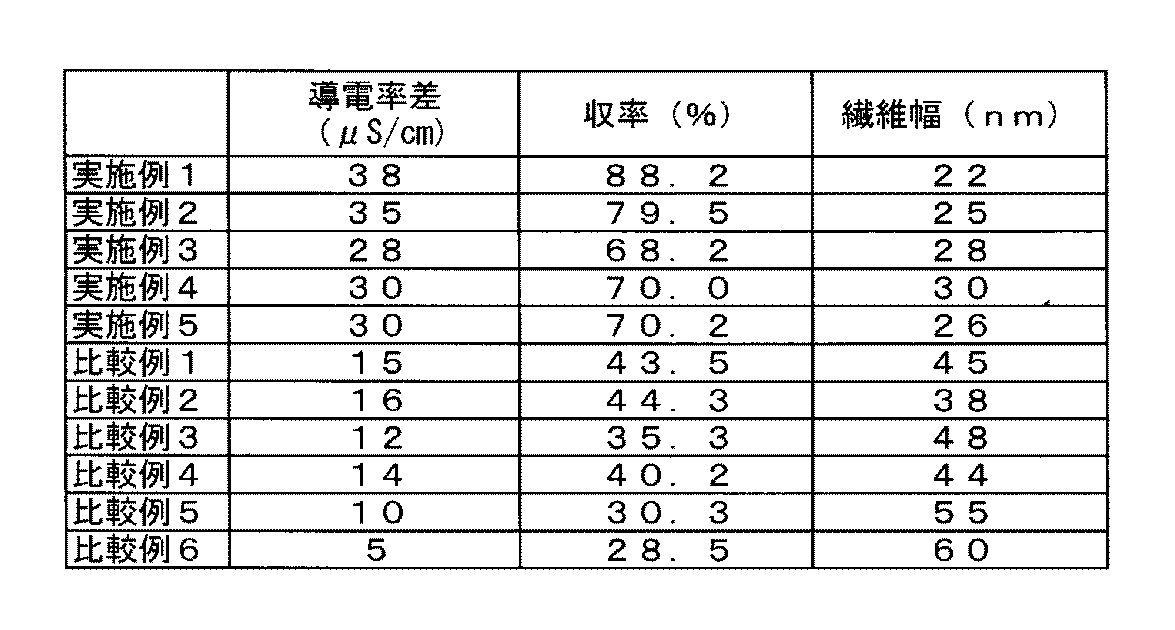
表1から明らかのように、微細化処理前後でのセルロース懸濁液の導電率差を20μS/cm以上に制御することで、微細化処理での収率を高収率とすることができることがわかる。 As is apparent from Table 1, the yield in the micronization process can be increased by controlling the difference in conductivity of the cellulose suspension before and after the micronization process to 20 μS / cm or more. Recognize.
本発明の製造方法によって、繊維幅が1nm〜1000nmの微細繊維状セルロースを収率高く得ることができる。さらに、本発明によって、微細化処理前後のセルロース懸濁液の導電率差を測定するだけで微細化処理工程での収率も予測できることから、工業化に際してのプロセスの制御もできる点でも有用である。 By the production method of the present invention, fine fibrous cellulose having a fiber width of 1 nm to 1000 nm can be obtained with high yield. Furthermore, according to the present invention, the yield in the refinement treatment step can be predicted simply by measuring the difference in conductivity between the cellulose suspensions before and after the refinement treatment, which is also useful in that the process during industrialization can be controlled. .
Claims (4)
Priority Applications (1)
| Application Number | Priority Date | Filing Date | Title |
|---|---|---|---|
| JP2011004443A JP2012144651A (en) | 2011-01-13 | 2011-01-13 | Method for producing microfibrous cellulose |
Applications Claiming Priority (1)
| Application Number | Priority Date | Filing Date | Title |
|---|---|---|---|
| JP2011004443A JP2012144651A (en) | 2011-01-13 | 2011-01-13 | Method for producing microfibrous cellulose |
Publications (1)
| Publication Number | Publication Date |
|---|---|
| JP2012144651A true JP2012144651A (en) | 2012-08-02 |
Family
ID=46788553
Family Applications (1)
| Application Number | Title | Priority Date | Filing Date |
|---|---|---|---|
| JP2011004443A Pending JP2012144651A (en) | 2011-01-13 | 2011-01-13 | Method for producing microfibrous cellulose |
Country Status (1)
| Country | Link |
|---|---|
| JP (1) | JP2012144651A (en) |
Cited By (4)
| Publication number | Priority date | Publication date | Assignee | Title |
|---|---|---|---|---|
| JP2014125691A (en) * | 2012-12-26 | 2014-07-07 | Oji Holdings Corp | Method of manufacturing fine cellulose fiber |
| JP2016014098A (en) * | 2014-07-01 | 2016-01-28 | 凸版印刷株式会社 | Manufacturing method of fine cellulose, fine cellulose, and compact using fine cellulose |
| WO2024057829A1 (en) * | 2022-09-15 | 2024-03-21 | 日本製紙株式会社 | Method for crushing cellulose-based polymer |
| US12163287B2 (en) | 2021-07-28 | 2024-12-10 | Asahi Kasei Kabushiki Kaisha | Fine cellulose fibers and production method therefor, nonwoven fabric, and fiber-reinforced resin and production method therefor |
-
2011
- 2011-01-13 JP JP2011004443A patent/JP2012144651A/en active Pending
Cited By (4)
| Publication number | Priority date | Publication date | Assignee | Title |
|---|---|---|---|---|
| JP2014125691A (en) * | 2012-12-26 | 2014-07-07 | Oji Holdings Corp | Method of manufacturing fine cellulose fiber |
| JP2016014098A (en) * | 2014-07-01 | 2016-01-28 | 凸版印刷株式会社 | Manufacturing method of fine cellulose, fine cellulose, and compact using fine cellulose |
| US12163287B2 (en) | 2021-07-28 | 2024-12-10 | Asahi Kasei Kabushiki Kaisha | Fine cellulose fibers and production method therefor, nonwoven fabric, and fiber-reinforced resin and production method therefor |
| WO2024057829A1 (en) * | 2022-09-15 | 2024-03-21 | 日本製紙株式会社 | Method for crushing cellulose-based polymer |
Similar Documents
| Publication | Publication Date | Title |
|---|---|---|
| JP5544747B2 (en) | Method for producing fine fibrous cellulose | |
| Zeng et al. | Cellulose nanofibrils manufactured by various methods with application as paper strength additives | |
| El Bakkari et al. | Preparation of cellulose nanofibers by TEMPO-oxidation of bleached chemi-thermomechanical pulp for cement applications | |
| RU2763550C2 (en) | Nanocellulose material obtained from tobacco | |
| AU2014353890B2 (en) | Nanocellulose | |
| EP2414435B1 (en) | Process for the production of nano-fibrillar cellulose gels | |
| JP2012036508A (en) | Manufacturing method for microfibrous cellulose | |
| EP3845706B1 (en) | Molded body of cellulose fiber and method of manufacturing same | |
| JP2012111849A (en) | Method for producing microfibrous cellulose, method for producing microfibrous cellulose sheet, and microfibrous cellulose composite | |
| JP2012012713A (en) | Method of producing microfibrous cellulose | |
| JP2011236398A (en) | Method of manufacturing fine fibrous cellulose | |
| JP2018009134A (en) | Cellulose nanofiber-containing dried body, method for producing the same, and method for producing cellulose nanofiber-containing dried body-dispersed liquid | |
| JP6783309B2 (en) | How to reduce overall energy consumption when producing nanocellulose | |
| Nader et al. | Lignin containing micro and nano-fibrillated cellulose obtained by steam explosion: Comparative study between different processes | |
| JP2012046848A (en) | Method for producing microfibrous cellulose | |
| Zhu et al. | Isolation and characterization of cellulose micro/nanofibrils from douglas fir | |
| Wang et al. | Morphology, structure and property of high consistency mechano-enzymatic fibrillated cellulose: Effect of treatment consistency of bamboo pulp fibers | |
| EP3390458B1 (en) | Bimodal cellulose composition | |
| JP2012144651A (en) | Method for producing microfibrous cellulose | |
| JP2013087132A (en) | Method for producing fine fibrous cellulose | |
| Norfarhana et al. | Innovative ionic liquid pretreatment followed by wet disk milling treatment provides enhanced properties of sugar palm nano-fibrillated cellulose | |
| Li et al. | Preparation of high yield lignin-containing cellulose nanofibrils from alkaline peroxide mechanical pulp by deep eutectic solvents pretreatment | |
| JP2011144273A (en) | Method for producing microfibrous cellulose | |
| JP2019214658A (en) | Cellulose acetate, cellulose acetate fiber, cellulose acetate composition, manufacturing method of cellulose acetate, and manufacturing method of cellulose acetate composition | |
| JP6098370B2 (en) | Composite material and manufacturing method thereof |