JP2012144643A - Rubber composition for tire and pneumatic tire - Google Patents
Rubber composition for tire and pneumatic tire Download PDFInfo
- Publication number
- JP2012144643A JP2012144643A JP2011004225A JP2011004225A JP2012144643A JP 2012144643 A JP2012144643 A JP 2012144643A JP 2011004225 A JP2011004225 A JP 2011004225A JP 2011004225 A JP2011004225 A JP 2011004225A JP 2012144643 A JP2012144643 A JP 2012144643A
- Authority
- JP
- Japan
- Prior art keywords
- tire
- rubber
- mass
- rubber composition
- parts
- Prior art date
- Legal status (The legal status is an assumption and is not a legal conclusion. Google has not performed a legal analysis and makes no representation as to the accuracy of the status listed.)
- Pending
Links
Landscapes
- Tires In General (AREA)
- Compositions Of Macromolecular Compounds (AREA)
Abstract
【課題】走行初期の適度な剛性を維持しつつダンピング性能を向上できるタイヤ用ゴム組成物、及び該タイヤ用ゴム組成物をタイヤの各部材(特に、サイドウォール)に用いた空気入りタイヤを提供する。
【解決手段】イソプレン系ゴムとブタジエンゴムを含むゴム成分と、軟化点が70〜170℃のクマロンインデン樹脂と、軟化点が70〜150℃のテルペン系樹脂とを含むタイヤ用ゴム組成物に関する。
【選択図】なしThe present invention provides a tire rubber composition capable of improving damping performance while maintaining an appropriate rigidity at the beginning of traveling, and a pneumatic tire using the tire rubber composition for each member (particularly, sidewall) of the tire. To do.
The present invention relates to a rubber composition for tires comprising a rubber component comprising isoprene-based rubber and butadiene rubber, a coumarone indene resin having a softening point of 70-170 ° C., and a terpene resin having a softening point of 70-150 ° C. .
[Selection figure] None
Description
本発明は、タイヤ用ゴム組成物、及びこれを用いた空気入りタイヤに関する。 The present invention relates to a rubber composition for a tire and a pneumatic tire using the same.
近年、乗用車や自動二輪車の高性能化に伴い、タイヤに対して高速で安全に走行できる性能が求められるようになっている。高性能の乗用車や自動二輪車に使用される高性能タイヤ、特にオフロードで使用されるタイヤ(例えば、モトクロス競技用タイヤ)には、高いダンピング性能(タイヤの振動の収まり易さ)を有することが求められる。 In recent years, along with the improvement in performance of passenger cars and motorcycles, the ability to travel safely at high speeds with respect to tires has been demanded. High-performance tires used in high-performance passenger cars and motorcycles, particularly tires used off-road (for example, motocross racing tires) may have high damping performance (ease of tire vibrations). Desired.
ダンピング性能を改善する方法としては、ビード部のビードコアから半径方向外方にのびるビードエーペックスゴムの動的弾性率を規制すること、トレッド部を減衰性能に優れるゴム層を用いて形成すること、カーカス層内側に内貼りされるゴムシートを所定の物性とすること等、種々の手法が提案されているが、サイドウォール部に対する更なる改善も求められている。 The damping performance can be improved by regulating the dynamic elastic modulus of the bead apex rubber extending radially outward from the bead core of the bead, forming the tread using a rubber layer with excellent damping performance, and carcass Various methods have been proposed, such as making the rubber sheet attached to the inner side of the layer have predetermined physical properties, but further improvements to the sidewall portions are also required.
一方、特許文献1には、クマロンインデン樹脂を配合したゴム組成物が開示されている。しかしながら、ここではサイドウォールへの適用については詳細に検討されていないし、また、走行初期の適度な剛性を維持しつつダンピング性能を向上する点については改善の余地がある。 On the other hand, Patent Document 1 discloses a rubber composition containing a coumarone indene resin. However, the application to the sidewall has not been studied in detail here, and there is room for improvement in terms of improving the damping performance while maintaining an appropriate rigidity in the initial stage of traveling.
本発明は、前記課題を解決し、走行初期の適度な剛性を維持しつつダンピング性能を向上できるタイヤ用ゴム組成物、及び該タイヤ用ゴム組成物をタイヤの各部材(特に、サイドウォール)に用いた空気入りタイヤを提供することを目的とする。 The present invention solves the above-described problems and can improve the damping performance while maintaining appropriate rigidity at the beginning of running, and the tire rubber composition for tire components (particularly, sidewalls). An object is to provide a used pneumatic tire.
本発明者らは、ダンピング性能を向上させるために、様々な樹脂を用いる試みを行った結果、クマロンインデン樹脂を用いることにより、ダンピング性能を向上できることを見出した。しかし、更なるダンピング性能の向上を目的としてクマロンインデン樹脂を増量すると、ゴム組成物の温度依存性が高くなり、低温での硬さが硬くなりすぎて、サイドウォールに必要とされる適切な剛性(柔らかさ)(特に、走行初期のタイヤが暖まっていない状態での剛性)を損なうという問題が新たに生じた。そこで、本発明者らは、鋭意検討を行った結果、テルペン系樹脂が他の樹脂よりも温度依存性が低いことを見出し、更に、特定のゴム成分と共に、特定の軟化点を有するクマロンインデン樹脂と、特定の軟化点を有するテルペン系樹脂とを併用することで、ダンピング性能を向上させつつ、低温での硬さが硬くなりすぎることを防止でき、走行初期の適度な剛性を維持しつつダンピング性能を向上できることを見出し、本発明を完成させた。
すなわち、本発明は、イソプレン系ゴムとブタジエンゴムを含むゴム成分と、軟化点が70〜170℃のクマロンインデン樹脂と、軟化点が70〜150℃のテルペン系樹脂とを含むタイヤ用ゴム組成物に関する。
As a result of attempts to use various resins in order to improve the damping performance, the present inventors have found that the damping performance can be improved by using a coumarone indene resin. However, if the amount of coumarone indene resin is increased for the purpose of further improving the damping performance, the temperature dependency of the rubber composition becomes high, the hardness at low temperature becomes too hard, and an appropriate amount required for the sidewall is required. There is a new problem that the rigidity (softness) (particularly, the rigidity when the tire at the initial stage of running is not warmed) is impaired. Thus, as a result of intensive studies, the present inventors have found that terpene resins have a lower temperature dependency than other resins, and further, a coumarone indene having a specific softening point together with a specific rubber component. By using a resin and a terpene resin having a specific softening point in combination, it is possible to prevent the hardness at low temperatures from becoming too hard while improving the damping performance, while maintaining an appropriate rigidity at the beginning of traveling. The inventors have found that the damping performance can be improved and have completed the present invention.
That is, the present invention relates to a rubber composition for tires comprising a rubber component containing isoprene-based rubber and butadiene rubber, a coumarone indene resin having a softening point of 70 to 170 ° C., and a terpene resin having a softening point of 70 to 150 ° C. Related to things.
上記タイヤ用ゴム組成物は、ゴム成分100質量部に対して、上記クマロンインデン樹脂を1〜20質量部、上記テルペン系樹脂を1〜20質量部含むことが好ましい。 The tire rubber composition preferably contains 1 to 20 parts by mass of the coumarone indene resin and 1 to 20 parts by mass of the terpene resin with respect to 100 parts by mass of the rubber component.
上記タイヤ用ゴム組成物は、ゴム成分100質量部に対して、カーボンブラックを20〜80質量部含むことが好ましい。 The tire rubber composition preferably includes 20 to 80 parts by mass of carbon black with respect to 100 parts by mass of the rubber component.
上記タイヤ用ゴム組成物は、サイドウォール用ゴム組成物として用いられることが好ましい。 The tire rubber composition is preferably used as a sidewall rubber composition.
本発明はまた、上記ゴム組成物を用いて作製した空気入りタイヤに関する。 The present invention also relates to a pneumatic tire produced using the rubber composition.
上記空気入りタイヤは、モトクロス競技用タイヤであることが好ましい。 The pneumatic tire is preferably a motocross competition tire.
本発明によれば、イソプレン系ゴムとブタジエンゴムを含むゴム成分と、特定の軟化点を有するクマロンインデン樹脂と、特定の軟化点を有するテルペン系樹脂とを含むタイヤ用ゴム組成物であるので、走行初期の適度な剛性を維持しつつダンピング性能を向上できる。該ゴム組成物をタイヤの各部材(特に、サイドウォール)に使用することにより、上記性能に優れた空気入りタイヤを提供することができる。 According to the present invention, the tire rubber composition includes a rubber component including isoprene-based rubber and butadiene rubber, a coumarone indene resin having a specific softening point, and a terpene-based resin having a specific softening point. The damping performance can be improved while maintaining an appropriate rigidity at the initial stage of running. By using the rubber composition for each member (particularly, sidewall) of the tire, a pneumatic tire having excellent performance can be provided.
本発明のタイヤ用ゴム組成物は、イソプレン系ゴムとブタジエンゴムを含むゴム成分と、特定の軟化点を有するクマロンインデン樹脂と、特定の軟化点を有するテルペン系樹脂とを含む。 The rubber composition for tires of the present invention includes a rubber component containing isoprene-based rubber and butadiene rubber, a coumarone indene resin having a specific softening point, and a terpene resin having a specific softening point.
イソプレン系ゴムとしては、天然ゴム(NR)、エポキシ化天然ゴム(ENR)、イソプレンゴム(IR)等が挙げられる。なかでも、走行初期の適度な剛性を維持しつつダンピング性能をより向上できるという理由から、NRが好ましい。 Examples of the isoprene-based rubber include natural rubber (NR), epoxidized natural rubber (ENR), and isoprene rubber (IR). Among these, NR is preferable because the damping performance can be further improved while maintaining appropriate rigidity at the beginning of traveling.
NRとしては特に限定されず、例えば、SIR20、RSS♯3、TSR20等、タイヤ工業において一般的なものを使用できる。 The NR is not particularly limited, and for example, those commonly used in the tire industry such as SIR20, RSS # 3, TSR20, and the like can be used.
ゴム成分100質量%中のイソプレン系ゴムの含有量は、好ましくは25質量%以上、より好ましくは35質量%以上である。25質量%未満であると、必要なゴム強度が得られないおそれがある。該イソプレン系ゴムの含有量は、好ましくは65質量%以下、より好ましくは55質量%以下である。65質量%を超えると、走行中に適切な剛性を得られないおそれがある。 The content of isoprene-based rubber in 100% by mass of the rubber component is preferably 25% by mass or more, more preferably 35% by mass or more. If it is less than 25% by mass, the required rubber strength may not be obtained. The content of the isoprene-based rubber is preferably 65% by mass or less, more preferably 55% by mass or less. When it exceeds 65% by mass, there is a possibility that appropriate rigidity cannot be obtained during traveling.
BRとしては特に限定されず、例えば、高シス含有量のBR、シンジオタクチックポリブタジエン結晶を含有するBRなどを使用できる。なかでも、シス含有量が95質量%以上のBRが好ましい。 The BR is not particularly limited. For example, BR having a high cis content, BR containing a syndiotactic polybutadiene crystal, and the like can be used. Among these, BR having a cis content of 95% by mass or more is preferable.
ゴム成分100質量%中のBRの含有量は、好ましくは35質量%以上、より好ましくは45質量%以上である。35質量%未満であると、走行中に適切な剛性を得られないおそれがある。該BRの含有量は、好ましくは75質量%以下、より好ましくは65質量%以下である。75質量%を超えると、十分な耐亀裂成長性が得られないおそれがある。 The content of BR in 100% by mass of the rubber component is preferably 35% by mass or more, more preferably 45% by mass or more. If it is less than 35% by mass, there is a possibility that appropriate rigidity cannot be obtained during traveling. The BR content is preferably 75% by mass or less, more preferably 65% by mass or less. If it exceeds 75% by mass, sufficient crack growth resistance may not be obtained.
イソプレン系ゴム、BR以外に本発明に使用されるゴム成分としては、例えば、スチレンブタジエンゴム(SBR)、エチレンプロピレンジエンゴム(EPDM)、スチレンイソプレンブタジエンゴム(SIBR)、クロロプレンゴム(CR)、アクリロニトリルブタジエンゴム(NBR)等のジエン系ゴムが挙げられる。ゴム成分は、単独で用いてもよく、2種以上を併用してもよい。 Examples of rubber components used in the present invention other than isoprene rubber and BR include styrene butadiene rubber (SBR), ethylene propylene diene rubber (EPDM), styrene isoprene butadiene rubber (SIBR), chloroprene rubber (CR), and acrylonitrile. Examples thereof include diene rubbers such as butadiene rubber (NBR). A rubber component may be used independently and may use 2 or more types together.
本発明では、それぞれ特定の軟化点を有するクマロンインデン樹脂及びテルペン系樹脂が使用される。これにより、走行初期の適度な剛性を維持しつつダンピング性能を向上できる。 In the present invention, a coumarone indene resin and a terpene resin each having a specific softening point are used. As a result, the damping performance can be improved while maintaining an appropriate rigidity at the beginning of traveling.
本発明で使用するクマロンインデン樹脂は、以下の軟化点を有するクマロンインデン樹脂である。ここで、クマロンインデン樹脂は、樹脂の骨格(主鎖)を構成するモノマー成分として、クマロン及びインデンを含む樹脂であり、クマロン、インデン以外に骨格に含まれるモノマー成分としては、スチレン、α−メチルスチレン、メチルインデン、ビニルトルエン等が挙げられる。 The coumarone indene resin used in the present invention is a coumarone indene resin having the following softening points. Here, the coumarone indene resin is a resin containing coumarone and indene as a monomer component constituting the skeleton (main chain) of the resin, and monomer components contained in the skeleton other than coumarone and indene include styrene, α- Examples include methylstyrene, methylindene, vinyltoluene and the like.
クマロンインデン樹脂の軟化点は、70℃以上、好ましくは90℃以上、より好ましくは110℃以上である。70℃未満であると、充分なダンピング性能の向上効果が得られないおそれがある。また、該軟化点は、170℃以下、好ましくは160℃以下である。170℃を超えると、混合工程において十分にクマロンインデン樹脂が分散せず、本発明の効果が好適に得られないおそれがある。
なお、クマロンインデン樹脂の軟化点は、JIS K 6220に規定される軟化点を環球式軟化点測定装置で測定し、球が降下した温度である。
The softening point of the coumarone indene resin is 70 ° C. or higher, preferably 90 ° C. or higher, more preferably 110 ° C. or higher. If it is less than 70 ° C., there is a possibility that a sufficient effect of improving the damping performance cannot be obtained. The softening point is 170 ° C. or lower, preferably 160 ° C. or lower. When it exceeds 170 ° C., the coumarone indene resin is not sufficiently dispersed in the mixing step, and the effects of the present invention may not be suitably obtained.
The softening point of the coumarone indene resin is a temperature at which the sphere descends when the softening point specified in JIS K 6220 is measured with a ring and ball softening point measuring device.
クマロンインデン樹脂の含有量は、ゴム成分100質量部に対して、好ましくは1質量部以上、より好ましくは2質量部以上である。1質量部未満では、充分なダンピング性能の向上効果が得られないおそれがある。また、該含有量は、好ましくは20質量部以下、より好ましくは8質量部以下、更に好ましくは6質量部以下である。20質量部を超えると、走行初期の適度な剛性が得られないおそれがある。 The content of the coumarone indene resin is preferably 1 part by mass or more, more preferably 2 parts by mass or more with respect to 100 parts by mass of the rubber component. If it is less than 1 part by mass, there is a possibility that a sufficient effect of improving the damping performance cannot be obtained. The content is preferably 20 parts by mass or less, more preferably 8 parts by mass or less, and still more preferably 6 parts by mass or less. If it exceeds 20 parts by mass, there is a possibility that an appropriate rigidity at the beginning of traveling cannot be obtained.
本発明で使用するテルペン系樹脂は、以下の軟化点を有するテルペン系樹脂である。ここで、テルペン系樹脂は、テルペン化合物をモノマーとして重合された樹脂を意味する。テルペン化合物は、一般にイソプレン(C5H8)の重合体で、モノテルペン(C10H16)、セスキテルペン(C15H24)、ジテルペン(C20H32)などに分類されるテルペンを基本骨格とする化合物であり、例えば、α−ピネン、β−ピネン、ジペンテン、リモネン、ミルセン、アロオシメン、オシメン、α−フェランドレン、α−テルピネン、γ−テルピネン、テルピノレン、1,8−シネオール、1,4−シネオール、α−テルピネオール、β−テルピネオール、γ−テルピネオールなどが挙げられる。 The terpene resin used in the present invention is a terpene resin having the following softening points. Here, the terpene resin means a resin polymerized using a terpene compound as a monomer. The terpene compound is generally a polymer of isoprene (C 5 H 8 ), and is basically a terpene classified into monoterpene (C 10 H 16 ), sesquiterpene (C 15 H 24 ), diterpene (C 20 H 32 ), and the like. A compound having a skeleton, for example, α-pinene, β-pinene, dipentene, limonene, myrcene, alloocimene, ocimene, α-ferrandrene, α-terpinene, γ-terpinene, terpinolene, 1,8-cineole, 1, 4-cineole, α-terpineol, β-terpineol, γ-terpineol and the like can be mentioned.
テルペン系樹脂としては、上述したテルペン化合物を原料とするα−ピネン樹脂、β−ピネン樹脂、リモネン樹脂、ジペンテン樹脂、β−ピネン/リモネン樹脂などのテルペン樹脂(ポリテルペン樹脂)の他、テルペン樹脂に水素添加処理した水素添加テルペン樹脂も挙げられる。 Examples of terpene resins include terpene resins (polyterpene resins) such as α-pinene resins, β-pinene resins, limonene resins, dipentene resins, β-pinene / limonene resins made from the above-mentioned terpene compounds. A hydrogenated terpene resin subjected to hydrogenation treatment may also be mentioned.
テルペン系樹脂としては、たとえばアリゾナケミカル社製のSylvares TRB115、Sylvares TR1115T、Sylvares TR90、Sylvares TR1135などの市販品を好適に用いることができる。 As the terpene-based resin, for example, commercially available products such as Sylvares TRB115, Sylvares TR1115T, Sylvares TR90, and Sylvares TR1135 manufactured by Arizona Chemical can be preferably used.
テルペン系樹脂の軟化点は、70℃以上、好ましくは80℃以上、より好ましくは100℃以上である。70℃未満であると、充分なダンピング性能の向上効果が得られないおそれがある。また、該軟化点は、150℃以下、好ましくは145℃以下である。150℃を超えると、混合工程において十分にテルペン系樹脂が分散せず、本発明の効果が好適に得られないおそれがある。
なお、テルペン系樹脂の軟化点は、JIS K 6220に規定される軟化点を環球式軟化点測定装置で測定し、球が降下した温度である。
The softening point of the terpene resin is 70 ° C. or higher, preferably 80 ° C. or higher, more preferably 100 ° C. or higher. If it is less than 70 ° C., there is a possibility that a sufficient effect of improving the damping performance cannot be obtained. The softening point is 150 ° C. or lower, preferably 145 ° C. or lower. If it exceeds 150 ° C., the terpene resin is not sufficiently dispersed in the mixing step, and the effects of the present invention may not be suitably obtained.
The softening point of the terpene resin is the temperature at which the sphere descends when the softening point specified in JIS K 6220 is measured with a ring and ball softening point measuring device.
テルペン系樹脂の含有量は、ゴム成分100質量部に対して、好ましくは1質量部以上、より好ましくは2質量部以上、更に好ましくは6質量部以上である。1質量部未満では、充分なダンピング性能の向上効果が得られないおそれがある。また、該含有量は、好ましくは20質量部以下、より好ましくは12質量部以下、更に好ましくは10質量部以下である。20質量部を超えると、走行初期の適度な剛性が得られないおそれがある。 The content of the terpene resin is preferably 1 part by mass or more, more preferably 2 parts by mass or more, and further preferably 6 parts by mass or more with respect to 100 parts by mass of the rubber component. If it is less than 1 part by mass, there is a possibility that a sufficient effect of improving the damping performance cannot be obtained. Moreover, this content becomes like this. Preferably it is 20 mass parts or less, More preferably, it is 12 mass parts or less, More preferably, it is 10 mass parts or less. If it exceeds 20 parts by mass, there is a possibility that an appropriate rigidity at the beginning of traveling cannot be obtained.
本発明のゴム組成物は、カーボンブラックを含むことが好ましい。これにより、走行初期の適度な剛性、ゴム強度をより好適に確保でき、より好適に走行初期の適度な剛性を維持しつつダンピング性能を向上できる。
カーボンブラックとしては、例えば、GPF、HAF、ISAF、SAFなどを用いることができる。
The rubber composition of the present invention preferably contains carbon black. As a result, it is possible to more appropriately ensure appropriate rigidity and rubber strength in the initial stage of travel, and it is possible to improve damping performance while maintaining appropriate rigidity in the initial stage of travel.
As carbon black, GPF, HAF, ISAF, SAF, etc. can be used, for example.
カーボンブラックのチッ素吸着比表面積(N2SA)は100m2/g以上が好ましく、120m2/g以上がより好ましい。また、カーボンブラックのN2SAは180m2/g以下が好ましく、160m2/g以下がより好ましい。N2SAが上記範囲内であると、走行初期の適度な剛性、ゴム強度をより好適に確保できる。
なお、カーボンブラックのチッ素吸着比表面積は、JIS K6217のA法によって求められる。
The nitrogen adsorption specific surface area (N 2 SA) of carbon black is preferably 100 m 2 / g or more, and more preferably 120 m 2 / g or more. Also, N 2 SA is preferably at most 180 m 2 / g of carbon black, 160 m 2 / g or less is more preferable. When N 2 SA is within the above range, appropriate rigidity and rubber strength at the initial stage of traveling can be more suitably ensured.
In addition, the nitrogen adsorption specific surface area of carbon black is calculated | required by A method of JISK6217.
カーボンブラックのジブチルフタレート吸油量(DBP)は、90ml/100g以上が好ましく、100ml/100g以上がより好ましい。また、カーボンブラックのDBPは、135ml/100g以下が好ましく、125ml/100g以下がより好ましい。DBPが上記範囲内であると、走行初期の適度な剛性、ゴム強度をより好適に確保できる。
なお、カーボンブラックのDBPは、JIS K6217−4の測定方法によって求められる。
The carbon black has a dibutyl phthalate oil absorption (DBP) of preferably 90 ml / 100 g or more, and more preferably 100 ml / 100 g or more. Further, the DBP of carbon black is preferably 135 ml / 100 g or less, and more preferably 125 ml / 100 g or less. When the DBP is within the above range, appropriate rigidity and rubber strength at the initial stage of traveling can be more suitably secured.
In addition, DBP of carbon black is calculated | required by the measuring method of JISK6217-4.
カーボンブラックを配合する場合、カーボンブラックの含有量は、ゴム成分100質量部に対して、好ましくは20質量部以上、より好ましくは30質量部以上、更に好ましくは40質量部以上である。20質量部未満では、走行初期の適度な剛性、ゴム強度が充分に得られないおそれがある。また、カーボンブラックの含有量は、ゴム成分100質量部に対して、好ましくは80質量部以下、より好ましくは7質量部以下である。80質量部を超えると、硬くなりすぎて走行初期の適度な剛性が得られない傾向がある。 When carbon black is blended, the carbon black content is preferably 20 parts by mass or more, more preferably 30 parts by mass or more, and still more preferably 40 parts by mass or more with respect to 100 parts by mass of the rubber component. If it is less than 20 parts by mass, there is a possibility that adequate rigidity and rubber strength at the beginning of running cannot be obtained sufficiently. Further, the content of carbon black is preferably 80 parts by mass or less, more preferably 7 parts by mass or less, with respect to 100 parts by mass of the rubber component. When it exceeds 80 parts by mass, it tends to be too hard to obtain appropriate rigidity at the beginning of traveling.
本発明のゴム組成物には、前記成分以外にも、ゴム組成物の製造に一般に使用される配合剤、例えば、シリカ等の充填剤、酸化亜鉛、ステアリン酸、各種老化防止剤、オイル等の軟化剤、ワックス、硫黄などの加硫剤、加硫促進剤などを適宜配合することができる。 In the rubber composition of the present invention, in addition to the above components, compounding agents generally used in the production of rubber compositions, for example, fillers such as silica, zinc oxide, stearic acid, various anti-aging agents, oils, etc. A softening agent, a vulcanizing agent such as wax and sulfur, a vulcanization accelerator, and the like can be appropriately blended.
本発明のゴム組成物の製造方法としては、公知の方法を用いることができ、例えば、前記各成分をオープンロール、バンバリーミキサー、密閉式混練機などのゴム混練装置を用いて混練し、その後加硫する方法等により製造できる。 As a method for producing the rubber composition of the present invention, known methods can be used. For example, the above components are kneaded using a rubber kneader such as an open roll, a Banbury mixer, a closed kneader, and then added. It can be manufactured by a method of sulfurating.
本発明のゴム組成物は、タイヤの各部材(特に、サイドウォール)に好適に使用できる。 The rubber composition of the present invention can be suitably used for tire members (particularly, sidewalls).
本発明の空気入りタイヤは、上記ゴム組成物を用いて通常の方法によって製造される。すなわち、必要に応じて各種添加剤を配合したゴム組成物を、未加硫の段階でタイヤの各部材(特に、サイドウォール)の形状に合わせて押し出し加工し、タイヤ成型機上にて通常の方法にて成形し、他のタイヤ部材とともに貼り合わせ、未加硫タイヤを形成した後、加硫機中で加熱加圧してタイヤを製造することができる。 The pneumatic tire of the present invention is produced by a usual method using the rubber composition. That is, a rubber composition containing various additives as necessary is extruded in accordance with the shape of each member (particularly, sidewall) of the tire at an unvulcanized stage, and is then used on a tire molding machine. After forming by a method and bonding together with other tire members to form an unvulcanized tire, the tire can be manufactured by heating and pressing in a vulcanizer.
本発明の空気入りタイヤは、高性能の乗用車や自動二輪車に使用される高性能タイヤ、特にオフロードで使用されるモトクロス競技用タイヤに好適に使用できる。 The pneumatic tire of the present invention can be suitably used for high-performance tires used for high-performance passenger cars and motorcycles, particularly motocross racing tires used off-road.
実施例に基づいて、本発明を具体的に説明するが、本発明はこれらのみに限定されるものではない。 The present invention will be specifically described based on examples, but the present invention is not limited to these examples.
以下、実施例及び比較例で使用した各種薬品について、まとめて説明する。
NR:RSS#3
BR:宇部興産(株)製のBR150B(シス含有量:97質量%)
カーボンブラック:キャボットジャパン(株)製のN550(N2SA:143m2/g、DBP:113ml/100g)
酸化亜鉛:ハクスイテック(株)製の酸化亜鉛3種(平均一次粒子系1.0μm)
ステアリン酸:日油(株)製のステアリン酸「椿」
オイル:出光興産(株)製のダイアナプロセスAH−24
老化防止剤:住友化学(株)製のアンチゲン6C(N−(1,3−ジメチルブチル)−N’−フェニル−p−フェニレンジアミン)
ワックス:大内新興化学工業(株)製のサンノックN
クマロンインデン樹脂(1):ルトガーケミカル社製のNOVARES C100(クマロンインデン樹脂、軟化点:100℃)
クマロンインデン樹脂(2):ルトガーケミカル社製NOVARES C150(クマロンインデン樹脂、軟化点:150℃)
テルペン系樹脂(1):アリゾナケミカル社製のSylvares TR90(テルペン系樹脂(ポリテルペン樹脂)、軟化点:90℃)
テルペン系樹脂(2):アリゾナケミカル社製のSylvares TR1135(テルペン系樹脂(ポリテルペン樹脂)、軟化点:135℃)
硫黄:軽井沢硫黄(株)製の粉末硫黄
加硫促進剤:大内新興化学工業(株)製のノクセラーCZ
Hereinafter, various chemicals used in Examples and Comparative Examples will be described together.
NR: RSS # 3
BR: BR150B manufactured by Ube Industries, Ltd. (cis content: 97% by mass)
Carbon black: N550 (N 2 SA: 143 m 2 / g, DBP: 113 ml / 100 g) manufactured by Cabot Japan
Zinc oxide: 3 types of zinc oxide (average primary particle system 1.0 μm) manufactured by Hakusuitec Co., Ltd.
Stearic acid: Stearic acid “椿” manufactured by NOF Corporation
Oil: Diana Process AH-24 manufactured by Idemitsu Kosan Co., Ltd.
Anti-aging agent: Antigen 6C (N- (1,3-dimethylbutyl) -N′-phenyl-p-phenylenediamine) manufactured by Sumitomo Chemical Co., Ltd.
Wax: Sunnock N manufactured by Ouchi Shinsei Chemical Industry Co., Ltd.
Coumarone indene resin (1): NOVARES C100 (Coumarone indene resin, softening point: 100 ° C.) manufactured by Rutger Chemical Co.
Coumarone indene resin (2): NOVARES C150 manufactured by Rutger Chemical Co. (Coumarone indene resin, softening point: 150 ° C.)
Terpene resin (1): Sylvares TR90 (terpene resin (polyterpene resin), softening point: 90 ° C.) manufactured by Arizona Chemical Co., Ltd.
Terpene resin (2): Sylvares TR1135 manufactured by Arizona Chemical Co. (terpene resin (polyterpene resin), softening point: 135 ° C.)
Sulfur: Powder sulfur vulcanization accelerator manufactured by Karuizawa Sulfur Co., Ltd .: Noxeller CZ manufactured by Ouchi Shinsei Chemical Co., Ltd.
実施例1〜6及び比較例1〜7
表1に示す配合処方にしたがい、1.7Lバンバリーミキサーを用いて、硫黄及び加硫促進剤以外の薬品を140℃で5分間混練した。次に、オープンロールを用いて、得られた混練り物に硫黄及び加硫促進剤を添加して90℃で3分間混練し、未加硫ゴム組成物を得た。未加硫ゴム組成物を170℃で12分間加硫することにより加硫ゴム組成物を得た。
次に、得られた未加硫ゴム組成物をタイヤ成型機上でサイドウォール形状に成形し、他のタイヤ部材と貼り合わせて未加硫タイヤを作製した。未加硫タイヤを150℃で30分間加硫することにより試験用モトクロス競技用タイヤを製造した。
Examples 1-6 and Comparative Examples 1-7
In accordance with the formulation shown in Table 1, chemicals other than sulfur and a vulcanization accelerator were kneaded at 140 ° C. for 5 minutes using a 1.7 L Banbury mixer. Next, using an open roll, sulfur and a vulcanization accelerator were added to the obtained kneaded product and kneaded at 90 ° C. for 3 minutes to obtain an unvulcanized rubber composition. A vulcanized rubber composition was obtained by vulcanizing the unvulcanized rubber composition at 170 ° C. for 12 minutes.
Next, the obtained unvulcanized rubber composition was molded into a sidewall shape on a tire molding machine, and bonded to another tire member to produce an unvulcanized tire. A test motocross tire was produced by vulcanizing the unvulcanized tire at 150 ° C. for 30 minutes.
得られた加硫ゴム組成物、試験用モトクロス競技用タイヤについて下記の評価を行った。結果を表1に示す。 The following evaluation was performed about the obtained vulcanized rubber composition and the test motocross racing tire. The results are shown in Table 1.
(粘弾性試験)
粘弾性スペクトロメーターVES((株)岩本製作所製)を用いて、温度30℃、初期歪10%、動歪2%、周波数10Hzの条件下で、各加硫ゴム組成物の複素弾性率E*を測定した。E*が大きいほど、硬いことを示す。
粘弾性スペクトロメーターVES((株)岩本製作所製)を用いて、温度70℃、初期歪10%、動歪2%、周波数10Hzの条件下で、各加硫ゴム組成物のtanδを測定した。tanδが大きいほどダンピング性能に優れることを示す。
(Viscoelasticity test)
Using a viscoelastic spectrometer VES (manufactured by Iwamoto Seisakusho Co., Ltd.), the complex elastic modulus E * of each vulcanized rubber composition under the conditions of a temperature of 30 ° C., an initial strain of 10%, a dynamic strain of 2%, and a frequency of 10 Hz . Was measured. It shows that it is so hard that E * is large.
Using a viscoelastic spectrometer VES (manufactured by Iwamoto Seisakusho Co., Ltd.), tan δ of each vulcanized rubber composition was measured under conditions of a temperature of 70 ° C., an initial strain of 10%, a dynamic strain of 2%, and a frequency of 10 Hz. A larger tan δ indicates better damping performance.
(実車評価)
モトクロス車両に試験用モトクロス競技用タイヤを装着し、1周約2kmのコースを8周走行して以下の基準により評価した。
ダンピング性能:比較例1のタイヤのダンピング性能のフィーリングを3点とし、5点満点で評価した。
走行初期の剛性感:比較例1のタイヤの走行初期(最初の4周)の剛性感のフィーリングを3点とし、5点満点で評価した。評価が高いほど、走行初期の適度な剛性が確保されていることを示す。
(Actual vehicle evaluation)
A test motocross racing tire was mounted on a motocross vehicle, and the lap was run for 8 laps on a course of about 2 km per lap and evaluated according to the following criteria.
Damping performance: The feeling of the damping performance of the tire of Comparative Example 1 was set to 3 points, and the evaluation was made on a 5-point scale.
Rigidity feeling at the beginning of running: The tire feeling of Comparative Example 1 was evaluated with a feeling of rigidity at the beginning of running (first 4 laps) as 3 points, with a maximum of 5 points. The higher the evaluation is, the more appropriate rigidity is ensured at the beginning of traveling.
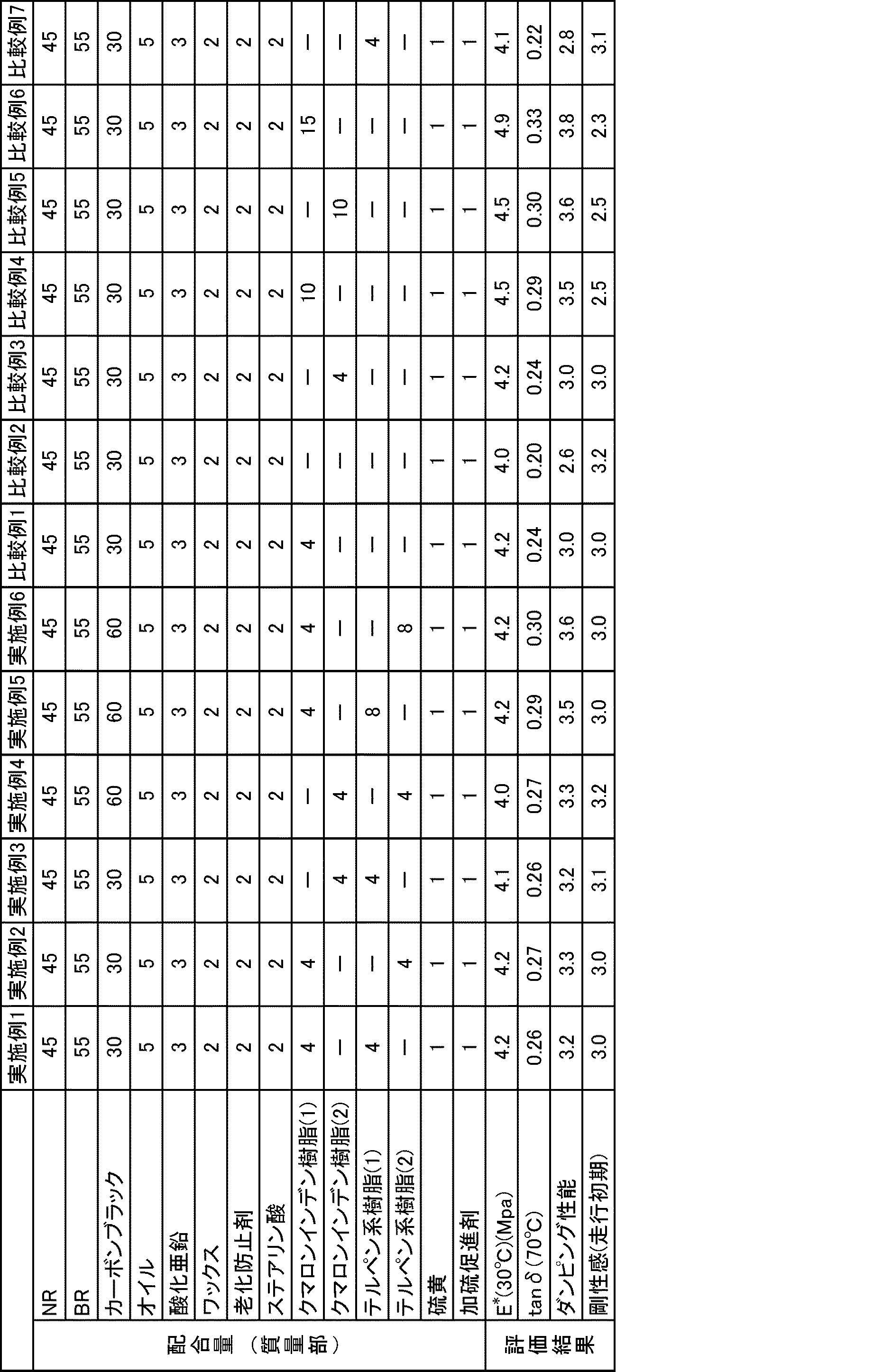
イソプレン系ゴムとブタジエンゴムを含むゴム成分と、特定の軟化点を有するクマロンインデン樹脂と、特定の軟化点を有するテルペン系樹脂とを含む実施例は、走行初期の適度な剛性を維持しつつダンピング性能を向上できた。 An embodiment including a rubber component including isoprene-based rubber and butadiene rubber, a coumarone indene resin having a specific softening point, and a terpene-based resin having a specific softening point maintains an appropriate rigidity at the beginning of traveling. Damping performance was improved.
Claims (6)
Priority Applications (1)
| Application Number | Priority Date | Filing Date | Title |
|---|---|---|---|
| JP2011004225A JP2012144643A (en) | 2011-01-12 | 2011-01-12 | Rubber composition for tire and pneumatic tire |
Applications Claiming Priority (1)
| Application Number | Priority Date | Filing Date | Title |
|---|---|---|---|
| JP2011004225A JP2012144643A (en) | 2011-01-12 | 2011-01-12 | Rubber composition for tire and pneumatic tire |
Publications (1)
| Publication Number | Publication Date |
|---|---|
| JP2012144643A true JP2012144643A (en) | 2012-08-02 |
Family
ID=46788546
Family Applications (1)
| Application Number | Title | Priority Date | Filing Date |
|---|---|---|---|
| JP2011004225A Pending JP2012144643A (en) | 2011-01-12 | 2011-01-12 | Rubber composition for tire and pneumatic tire |
Country Status (1)
| Country | Link |
|---|---|
| JP (1) | JP2012144643A (en) |
Cited By (6)
| Publication number | Priority date | Publication date | Assignee | Title |
|---|---|---|---|---|
| JP2014114415A (en) * | 2012-12-12 | 2014-06-26 | Sumitomo Rubber Ind Ltd | Rubber composition for side wall or basis tread, and pneumatic tire |
| JP2014214297A (en) * | 2013-04-30 | 2014-11-17 | 住友ゴム工業株式会社 | Rubber composition for tire and pneumatic tire |
| WO2016198178A1 (en) | 2015-06-12 | 2016-12-15 | Continental Reifen Deutschland Gmbh | Rubber mixture and vehicle tires |
| CN106905574A (en) * | 2015-10-06 | 2017-06-30 | 住友橡胶工业株式会社 | Rubber composition for tyre |
| JP2018083932A (en) * | 2016-11-16 | 2018-05-31 | 住友ゴム工業株式会社 | Rubber composition for tread and pneumatic tire |
| KR20240075014A (en) * | 2022-11-17 | 2024-05-29 | 엘지전자 주식회사 | Damping rubber composition, a manufacturing method thereof, and rubber product using the same |
-
2011
- 2011-01-12 JP JP2011004225A patent/JP2012144643A/en active Pending
Cited By (9)
| Publication number | Priority date | Publication date | Assignee | Title |
|---|---|---|---|---|
| JP2014114415A (en) * | 2012-12-12 | 2014-06-26 | Sumitomo Rubber Ind Ltd | Rubber composition for side wall or basis tread, and pneumatic tire |
| JP2014214297A (en) * | 2013-04-30 | 2014-11-17 | 住友ゴム工業株式会社 | Rubber composition for tire and pneumatic tire |
| WO2016198178A1 (en) | 2015-06-12 | 2016-12-15 | Continental Reifen Deutschland Gmbh | Rubber mixture and vehicle tires |
| DE102015210840A1 (en) | 2015-06-12 | 2016-12-15 | Continental Reifen Deutschland Gmbh | Rubber compound and vehicle tires |
| US10435541B2 (en) | 2015-06-12 | 2019-10-08 | Continental Reifen Deutschland Gmbh | Rubber mixture and vehicle tires |
| CN106905574A (en) * | 2015-10-06 | 2017-06-30 | 住友橡胶工业株式会社 | Rubber composition for tyre |
| JP2018083932A (en) * | 2016-11-16 | 2018-05-31 | 住友ゴム工業株式会社 | Rubber composition for tread and pneumatic tire |
| KR20240075014A (en) * | 2022-11-17 | 2024-05-29 | 엘지전자 주식회사 | Damping rubber composition, a manufacturing method thereof, and rubber product using the same |
| KR102724597B1 (en) * | 2022-11-17 | 2024-10-31 | 엘지전자 주식회사 | Damping rubber composition, a manufacturing method thereof, and rubber product using the same |
Similar Documents
| Publication | Publication Date | Title |
|---|---|---|
| JP4849176B2 (en) | Rubber composition for tire tread and pneumatic tire using the same | |
| EP4137331A1 (en) | Tire | |
| JP7670056B2 (en) | tire | |
| US10808107B2 (en) | Rubber composition for tire | |
| JP5499769B2 (en) | Rubber composition for tire tread and pneumatic tire using the same | |
| WO2014178431A1 (en) | Rubber composition for tire | |
| CN107108909A (en) | Vulcanize the preparation method of rubber composition, vulcanize rubber composition and use its studless tire | |
| JP2018188601A (en) | Rubber composition for studless tire | |
| WO2021220634A1 (en) | Tire | |
| JP2014095015A (en) | Rubber composition for side wall, wing, base tread, side wall packing, breaker cushion or tie gum and pneumatic tire | |
| EP4112330B1 (en) | Pneumatic tire | |
| JP7392356B2 (en) | tire | |
| JP2018100321A (en) | Rubber composition for studless tire and studless tire | |
| JP4672416B2 (en) | Pneumatic tire manufacturing method and pneumatic tire obtained by the manufacturing method | |
| JP5216386B2 (en) | Rubber composition and tire using the same | |
| CN110343295A (en) | Rubber composition for tire tread and tire | |
| JP2021188008A (en) | Rubber composition for tire | |
| JP2016183219A (en) | Rubber composition and tire | |
| EP3909787B1 (en) | Tire | |
| JP2023168930A (en) | tire | |
| JP2024007163A (en) | tire | |
| JP2013227387A (en) | Rubber composition for tire | |
| JP6504235B1 (en) | Pneumatic tire | |
| JP2017082121A (en) | Rubber composition for tire for heavy load | |
| JP2017082122A (en) | Rubber composition for tire for heavy load |