JP2012144451A - Algicidal/microbicidal agent and algicidal/microbicidal method - Google Patents
Algicidal/microbicidal agent and algicidal/microbicidal method Download PDFInfo
- Publication number
- JP2012144451A JP2012144451A JP2011002059A JP2011002059A JP2012144451A JP 2012144451 A JP2012144451 A JP 2012144451A JP 2011002059 A JP2011002059 A JP 2011002059A JP 2011002059 A JP2011002059 A JP 2011002059A JP 2012144451 A JP2012144451 A JP 2012144451A
- Authority
- JP
- Japan
- Prior art keywords
- chloro
- water
- algicidal
- dichloro
- formula
- Prior art date
- Legal status (The legal status is an assumption and is not a legal conclusion. Google has not performed a legal analysis and makes no representation as to the accuracy of the status listed.)
- Granted
Links
- 0 C*C*C(N(C)C)=O Chemical compound C*C*C(N(C)C)=O 0.000 description 2
Classifications
-
- A—HUMAN NECESSITIES
- A01—AGRICULTURE; FORESTRY; ANIMAL HUSBANDRY; HUNTING; TRAPPING; FISHING
- A01N—PRESERVATION OF BODIES OF HUMANS OR ANIMALS OR PLANTS OR PARTS THEREOF; BIOCIDES, e.g. AS DISINFECTANTS, AS PESTICIDES OR AS HERBICIDES; PEST REPELLANTS OR ATTRACTANTS; PLANT GROWTH REGULATORS
- A01N43/00—Biocides, pest repellants or attractants, or plant growth regulators containing heterocyclic compounds
- A01N43/34—Biocides, pest repellants or attractants, or plant growth regulators containing heterocyclic compounds having rings with one nitrogen atom as the only ring hetero atom
- A01N43/36—Biocides, pest repellants or attractants, or plant growth regulators containing heterocyclic compounds having rings with one nitrogen atom as the only ring hetero atom five-membered rings
-
- A—HUMAN NECESSITIES
- A01—AGRICULTURE; FORESTRY; ANIMAL HUSBANDRY; HUNTING; TRAPPING; FISHING
- A01N—PRESERVATION OF BODIES OF HUMANS OR ANIMALS OR PLANTS OR PARTS THEREOF; BIOCIDES, e.g. AS DISINFECTANTS, AS PESTICIDES OR AS HERBICIDES; PEST REPELLANTS OR ATTRACTANTS; PLANT GROWTH REGULATORS
- A01N25/00—Biocides, pest repellants or attractants, or plant growth regulators, characterised by their forms, or by their non-active ingredients or by their methods of application, e.g. seed treatment or sequential application; Substances for reducing the noxious effect of the active ingredients to organisms other than pests
- A01N25/02—Biocides, pest repellants or attractants, or plant growth regulators, characterised by their forms, or by their non-active ingredients or by their methods of application, e.g. seed treatment or sequential application; Substances for reducing the noxious effect of the active ingredients to organisms other than pests containing liquids as carriers, diluents or solvents
-
- A—HUMAN NECESSITIES
- A01—AGRICULTURE; FORESTRY; ANIMAL HUSBANDRY; HUNTING; TRAPPING; FISHING
- A01N—PRESERVATION OF BODIES OF HUMANS OR ANIMALS OR PLANTS OR PARTS THEREOF; BIOCIDES, e.g. AS DISINFECTANTS, AS PESTICIDES OR AS HERBICIDES; PEST REPELLANTS OR ATTRACTANTS; PLANT GROWTH REGULATORS
- A01N43/00—Biocides, pest repellants or attractants, or plant growth regulators containing heterocyclic compounds
- A01N43/34—Biocides, pest repellants or attractants, or plant growth regulators containing heterocyclic compounds having rings with one nitrogen atom as the only ring hetero atom
- A01N43/40—Biocides, pest repellants or attractants, or plant growth regulators containing heterocyclic compounds having rings with one nitrogen atom as the only ring hetero atom six-membered rings
-
- A—HUMAN NECESSITIES
- A01—AGRICULTURE; FORESTRY; ANIMAL HUSBANDRY; HUNTING; TRAPPING; FISHING
- A01N—PRESERVATION OF BODIES OF HUMANS OR ANIMALS OR PLANTS OR PARTS THEREOF; BIOCIDES, e.g. AS DISINFECTANTS, AS PESTICIDES OR AS HERBICIDES; PEST REPELLANTS OR ATTRACTANTS; PLANT GROWTH REGULATORS
- A01N43/00—Biocides, pest repellants or attractants, or plant growth regulators containing heterocyclic compounds
- A01N43/34—Biocides, pest repellants or attractants, or plant growth regulators containing heterocyclic compounds having rings with one nitrogen atom as the only ring hetero atom
- A01N43/46—Biocides, pest repellants or attractants, or plant growth regulators containing heterocyclic compounds having rings with one nitrogen atom as the only ring hetero atom rings with more than six members
-
- A—HUMAN NECESSITIES
- A01—AGRICULTURE; FORESTRY; ANIMAL HUSBANDRY; HUNTING; TRAPPING; FISHING
- A01N—PRESERVATION OF BODIES OF HUMANS OR ANIMALS OR PLANTS OR PARTS THEREOF; BIOCIDES, e.g. AS DISINFECTANTS, AS PESTICIDES OR AS HERBICIDES; PEST REPELLANTS OR ATTRACTANTS; PLANT GROWTH REGULATORS
- A01N43/00—Biocides, pest repellants or attractants, or plant growth regulators containing heterocyclic compounds
- A01N43/48—Biocides, pest repellants or attractants, or plant growth regulators containing heterocyclic compounds having rings with two nitrogen atoms as the only ring hetero atoms
- A01N43/50—1,3-Diazoles; Hydrogenated 1,3-diazoles
-
- A—HUMAN NECESSITIES
- A01—AGRICULTURE; FORESTRY; ANIMAL HUSBANDRY; HUNTING; TRAPPING; FISHING
- A01N—PRESERVATION OF BODIES OF HUMANS OR ANIMALS OR PLANTS OR PARTS THEREOF; BIOCIDES, e.g. AS DISINFECTANTS, AS PESTICIDES OR AS HERBICIDES; PEST REPELLANTS OR ATTRACTANTS; PLANT GROWTH REGULATORS
- A01N43/00—Biocides, pest repellants or attractants, or plant growth regulators containing heterocyclic compounds
- A01N43/48—Biocides, pest repellants or attractants, or plant growth regulators containing heterocyclic compounds having rings with two nitrogen atoms as the only ring hetero atoms
- A01N43/54—1,3-Diazines; Hydrogenated 1,3-diazines
-
- A—HUMAN NECESSITIES
- A01—AGRICULTURE; FORESTRY; ANIMAL HUSBANDRY; HUNTING; TRAPPING; FISHING
- A01N—PRESERVATION OF BODIES OF HUMANS OR ANIMALS OR PLANTS OR PARTS THEREOF; BIOCIDES, e.g. AS DISINFECTANTS, AS PESTICIDES OR AS HERBICIDES; PEST REPELLANTS OR ATTRACTANTS; PLANT GROWTH REGULATORS
- A01N59/00—Biocides, pest repellants or attractants, or plant growth regulators containing elements or inorganic compounds
-
- C—CHEMISTRY; METALLURGY
- C02—TREATMENT OF WATER, WASTE WATER, SEWAGE, OR SLUDGE
- C02F—TREATMENT OF WATER, WASTE WATER, SEWAGE, OR SLUDGE
- C02F1/00—Treatment of water, waste water, or sewage
- C02F1/50—Treatment of water, waste water, or sewage by addition or application of a germicide or by oligodynamic treatment
-
- C—CHEMISTRY; METALLURGY
- C02—TREATMENT OF WATER, WASTE WATER, SEWAGE, OR SLUDGE
- C02F—TREATMENT OF WATER, WASTE WATER, SEWAGE, OR SLUDGE
- C02F1/00—Treatment of water, waste water, or sewage
- C02F1/72—Treatment of water, waste water, or sewage by oxidation
- C02F1/76—Treatment of water, waste water, or sewage by oxidation with halogens or compounds of halogens
-
- Y—GENERAL TAGGING OF NEW TECHNOLOGICAL DEVELOPMENTS; GENERAL TAGGING OF CROSS-SECTIONAL TECHNOLOGIES SPANNING OVER SEVERAL SECTIONS OF THE IPC; TECHNICAL SUBJECTS COVERED BY FORMER USPC CROSS-REFERENCE ART COLLECTIONS [XRACs] AND DIGESTS
- Y02—TECHNOLOGIES OR APPLICATIONS FOR MITIGATION OR ADAPTATION AGAINST CLIMATE CHANGE
- Y02W—CLIMATE CHANGE MITIGATION TECHNOLOGIES RELATED TO WASTEWATER TREATMENT OR WASTE MANAGEMENT
- Y02W10/00—Technologies for wastewater treatment
- Y02W10/30—Wastewater or sewage treatment systems using renewable energies
- Y02W10/37—Wastewater or sewage treatment systems using renewable energies using solar energy
Landscapes
- Life Sciences & Earth Sciences (AREA)
- Engineering & Computer Science (AREA)
- Health & Medical Sciences (AREA)
- General Health & Medical Sciences (AREA)
- Wood Science & Technology (AREA)
- Plant Pathology (AREA)
- Dentistry (AREA)
- Pest Control & Pesticides (AREA)
- Agronomy & Crop Science (AREA)
- Zoology (AREA)
- Environmental Sciences (AREA)
- Chemical & Material Sciences (AREA)
- Environmental & Geological Engineering (AREA)
- Water Supply & Treatment (AREA)
- Hydrology & Water Resources (AREA)
- Organic Chemistry (AREA)
- Inorganic Chemistry (AREA)
- Toxicology (AREA)
- Agricultural Chemicals And Associated Chemicals (AREA)
Abstract
【課題】本発明の課題は、水への溶解性に優れる、低コストで取り扱い性に優れた殺藻剤及び殺藻・殺菌剤を提供することにある。
【解決手段】本発明は、N−クロロ−2−ピロリジノンを含有することを特徴とする殺藻剤、並びに、下記式(I)で表される環状のN−クロロ化合物又はN,N’−ジクロロ化合物から選ばれる1種以上を含有することを特徴とする殺藻・殺菌剤に関する。
【選択図】なしAn object of the present invention is to provide an algicidal agent and an algicidal / bactericidal agent having excellent solubility in water, low cost and excellent handleability.
The present invention provides an algicidal agent containing N-chloro-2-pyrrolidinone, a cyclic N-chloro compound represented by the following formula (I), or N, N′- The present invention relates to an algicidal / bactericidal agent characterized by containing at least one selected from dichloro compounds.
[Selection figure] None
Description
本発明は、殺藻・殺菌剤に関する。本発明の殺藻・殺菌剤は、これに限定されるものではないがクーリングタワー等の循環冷却水、各種工業用水や廃水、池、湖沼、貯水池放水路、噴水、建築物外壁などで太陽光があたり且つ大気と接する水系において発生する藻類及び一般細菌の生育及び増殖を抑制するために用いられる。 The present invention relates to an algicide / bactericidal agent. Although the algaecidal / bactericidal agent of the present invention is not limited to this, sunlight is emitted from circulating cooling water such as cooling towers, various industrial water and wastewater, ponds, lakes, reservoir spillways, fountains, building outer walls, etc. It is used to suppress the growth and proliferation of algae and general bacteria that are generated in water systems that are in contact with the atmosphere.
上記の水系や施設では、しばしば藻類の繁殖により、異臭の発生や外観の悪化などの他に、配管の詰まり、クーリングタワーの循環式冷却水系統においては熱交換効率の低下、散水板の閉塞などにより冷却塔が機能しなくなるなど様々な問題を引き起こす要因となっている。また、富栄養化の進んだ湖沼や用水池、内湾や入江のような閉鎖性の強い水系においては、しばしばアオコが大量発生し、これにより外観を損なうだけでなく、特異な臭気や、湖沼に生息する魚介類のへい死を招くなど甚大な被害をもたらす要因となっている。 In the water systems and facilities mentioned above, in addition to the generation of strange odors and deterioration in appearance due to the growth of algae, pipes are clogged. It causes various problems such as the cooling tower not functioning. In addition, in highly closed water systems such as eutrophied lakes and irrigation ponds, inner bays and bays, a large amount of blue sea bream is often generated, which not only impairs the appearance, but also causes unusual odors and lakes. It is a factor that causes enormous damage, such as causing the death of inhabited seafood.
このような藻類及び一般細菌の生育及び増殖を抑制するための薬剤として、殺藻剤としては、アメトリン、シメトリン、プロメトリン等のトリアジン系殺藻剤が効果の高さから用いられている{「農薬ハンドブック」(1998年版 社団法人 日本植物防疫協会 編)}。しかしこれらトリアジン系殺藻剤は、水に対する溶解性が低く、製剤化の際には多量の有機溶剤を配合する必要があり、水系に添加した際には製剤中の有機溶剤が一般細菌の栄養源となってしまうなどの問題があった。また、これらトリアジン系殺藻剤は毒性や発ガン性が指摘されるなど安全性の面でも課題を有している。一方、一般細菌の生育及び増殖を抑制するための殺菌剤としては、5−クロロ−2−メチル−4−イソチアゾリン−3−オンなどのイソチアゾロン系化合物や2−ブロモ−2−ニトロプロパン−1,3−ジオールに代表される有機臭素系化合物が用いられている(特許文献1および特許文献2)。しかし、イソチアゾロン系化合物は、毒性、皮膚刺激性、粘膜刺激性が強く取り扱い等が不便であり、有機臭素系化合物は、一般細菌に対する効果は比較的強いものの殺藻効果が弱いという欠点があった。このため、殺藻効果と殺菌効果の両効果を得るためには、少なくとも2種以上の成分を組み合わせる必要があり、製剤化の面では薬剤が高価となり、各成分を水系に別々に添加する場合でも、薬剤添加のためのポンプや薬液タンクなどの経費が必要になるなどの他に作業が繁雑となる課題を有している。 As drugs for suppressing the growth and proliferation of such algae and general bacteria, triazine-based algicides such as amethrin, simethrin, promethrin and the like are used because of their high efficacy as algicides. Handbook "(1998 edition, Japan Plant Protection Association)}. However, these triazine-based algicides have low solubility in water, and it is necessary to add a large amount of an organic solvent for formulation. When added to an aqueous system, the organic solvent in the formulation is a nutrient for general bacteria. There were problems such as becoming a source. In addition, these triazine-based algicides have problems in terms of safety such as toxicity and carcinogenicity. On the other hand, bactericides for suppressing the growth and proliferation of general bacteria include isothiazolone compounds such as 5-chloro-2-methyl-4-isothiazolin-3-one and 2-bromo-2-nitropropane-1, Organic bromine-based compounds represented by 3-diol are used (Patent Document 1 and Patent Document 2). However, isothiazolone compounds have strong toxicity, skin irritation and mucous membrane irritation and are inconvenient to handle, and organic bromine compounds have the disadvantage that they have a relatively strong effect on general bacteria but a weak algaecidal effect. . For this reason, in order to obtain both the algicidal effect and the bactericidal effect, it is necessary to combine at least two kinds of components, and in terms of formulation, the drug becomes expensive, and each component is added to the aqueous system separately. However, in addition to the expense of pumps and chemical tanks for adding chemicals, there is a problem that the work becomes complicated.
近年では、水の供給の逼迫、価格の上昇に伴い、水の循環再利用が進み、殺菌・殺藻剤の必要性が益々高まっている反面、経費削減を目的としてこれら薬剤の低コスト化も望まれている。このことを受けて、安価な次亜塩素酸ナトリウムなどの塩素系酸化剤、アゾール系化合物及びスルファミン酸若しくはその塩を含有する殺菌殺藻剤が報告されている(特許文献3)。しかし、この次亜塩素酸塩にスルファミン酸又はその塩を添加して形成されるN−クロロスルファミン酸若しくはN,N−ジクロロスルファミン酸又はこれらの塩は、結合型塩素であり、次亜塩素酸などの遊離塩素と比較するとその殺菌効果は劣ることが知られている。また、結合型塩素は、酸化力が遊離塩素に比べて低減されるものの、高濃度では系内配管・設備の腐食などの問題を引き起こす可能性が高い。一般に次亜塩素酸などハロゲン系酸化剤の殺藻効果は、前述のアメトリンなどのトリアジン系殺藻剤に比べて低く、結合型のN−クロロスルファミン酸なども同様である。このため、殺藻効果を得るためには高濃度の添加が必要となり、結果として系内配管・設備の腐食を引き起こす危険性が高まるなどの課題があった。このように、現在使用される薬剤は、水に対する溶解性、コスト、取り扱い性、安全性等の面において様々な欠点を有しており、必ずしも満足できるものではなかった。 In recent years, with the tightening of water supply and rising prices, the circulation and reuse of water has progressed and the need for bactericides and algicides has increased. On the other hand, the cost of these drugs has been reduced to reduce costs. It is desired. In response to this, a bactericidal algicidal agent containing an inexpensive chlorine-based oxidizing agent such as sodium hypochlorite, an azole-based compound, and sulfamic acid or a salt thereof has been reported (Patent Document 3). However, N-chlorosulfamic acid or N, N-dichlorosulfamic acid or a salt thereof formed by adding sulfamic acid or a salt thereof to this hypochlorite is bound chlorine, and hypochlorous acid. It is known that its bactericidal effect is inferior to free chlorine such as. Bonded chlorine is less likely to cause problems such as corrosion of piping and equipment in the system at high concentrations, although its oxidizing power is reduced compared to free chlorine. In general, the algicidal effect of halogen-based oxidizing agents such as hypochlorous acid is lower than that of the above-mentioned triazine-based algicidal agents such as amethrin, and the same is true for bound N-chlorosulfamic acid and the like. For this reason, in order to obtain the algicidal effect, a high concentration is required, and as a result, there is a problem that the risk of causing corrosion of piping and equipment in the system is increased. As described above, currently used drugs have various drawbacks in terms of solubility in water, cost, handleability, safety and the like, and are not always satisfactory.
なお、本発明の殺藻・殺菌剤成分の一つであるN−クロロ−2−ピロリジノンは、特許文献4にN−クロロ−5−メチル−2−オキサゾリジノンなどと併せて消毒・漂白剤としての報告があるが、殺藻効果についての記載はない。また、次亜塩素酸の安定化を目的にN−水素化合物類としてスルファミン酸やヒダントインなどと共に2−ピロリジノンを配合する方法が特許文献5や特許文献6に報告されているが、あくまでも2−ピロリジノンなどのN−水素化合物類は次亜塩素酸の安定化を目的として配合されており、本発明に示す結合型のN−クロロ化合物或いはN,N’−ジクロロ化合物としての評価はなされておらず、殺藻効果についての言及もない。さらに、特許文献7では、遊離ハロゲンとN−水素化合物類としてジメチルヒダントインを併用する微生物防除方法が報告されており、N−水素化合物類の一つとして2−ピロリジノンの記載はあるが、実施例としての評価はされておらず、殺藻効果についての言及もない。 Note that N-chloro-2-pyrrolidinone, which is one of the algicidal and bactericidal components of the present invention, is disclosed in Patent Document 4 as a disinfectant / bleaching agent in combination with N-chloro-5-methyl-2-oxazolidinone. There is a report, but there is no description about the algicidal effect. In addition, methods for blending 2-pyrrolidinone with sulfamic acid and hydantoin as N-hydrogen compounds for the purpose of stabilizing hypochlorous acid have been reported in Patent Document 5 and Patent Document 6, but 2-pyrrolidinone is only used. N-hydrogen compounds such as are formulated for the purpose of stabilizing hypochlorous acid, and have not been evaluated as a combined N-chloro compound or N, N′-dichloro compound shown in the present invention. There is no mention of the algaecidal effect. Further, Patent Document 7 reports a microorganism control method using dimethylhydantoin in combination with free halogen and N-hydrogen compounds, and 2-pyrrolidinone is described as one of N-hydrogen compounds. Has not been evaluated, and there is no mention of the algicidal effect.
本発明の課題は、水への溶解性に優れる、低コストで取り扱い性に優れた殺藻剤及び殺藻・殺菌剤を提供することにある。 An object of the present invention is to provide an algicidal agent and an algicidal / bactericidal agent that are excellent in solubility in water, low in cost, and excellent in handleability.
本発明の課題はまた、腐食が望まれない金属部材と接触している水系中において藻類及び/又は細菌類を防除するための方法を提供する。 The subject of the present invention also provides a method for controlling algae and / or bacteria in an aqueous system in contact with a metal member where corrosion is not desired.
本発明を概説すれば、本発明は、
(1)N−クロロ−2−ピロリジノンを含有することを特徴とする殺藻剤、
(2)水又は水と水溶性有機溶剤の混合溶液を更に含む、水溶性の液体製剤であることを特徴とする(1)記載の殺藻剤、
(3)式(I):
で表される環状のN−クロロ化合物又はN,N’−ジクロロ化合物(但し、N−クロロ−2−ピロリジノンを除く)から選ばれる1種以上を含有することを特徴とする殺藻・殺菌剤、
(4)式(I)で表される環状のN−クロロ化合物又はN,N’−ジクロロ化合物が、N−クロロ−2−ピペリドン、N−クロロ−ε−カプロラクタム、N−クロロ−ω−ヘプタラクタム、N−クロロ−2−イミダゾリジノン、N,N’−ジクロロ−2−イミダゾリジノン、N−クロロ−テトラヒドロ−2−ピリミジノン、及びN,N’−ジクロロ−テトラヒドロ−2−ピリミジノンから選ばれる1種以上であることを特徴とする(3)記載の殺藻・殺菌剤、
(5)水又は水と水溶性有機溶剤の混合溶液を更に含む、水溶性の液体製剤であることを特徴とする(3)又は(4)記載の殺藻・殺菌剤、
(6)腐食が望まれない金属部材と接触している水系中に、式(I):
(1) an algicidal agent containing N-chloro-2-pyrrolidinone,
(2) The algicidal agent according to (1), which is a water-soluble liquid preparation further comprising water or a mixed solution of water and a water-soluble organic solvent,
(3) Formula (I):
An algicidal / bactericidal agent characterized by containing one or more selected from cyclic N-chloro compounds or N, N′-dichloro compounds (excluding N-chloro-2-pyrrolidinone) ,
(4) The cyclic N-chloro compound or N, N′-dichloro compound represented by the formula (I) is N-chloro-2-piperidone, N-chloro-ε-caprolactam, N-chloro-ω-hepta. Selected from lactam, N-chloro-2-imidazolidinone, N, N′-dichloro-2-imidazolidinone, N-chloro-tetrahydro-2-pyrimidinone, and N, N′-dichloro-tetrahydro-2-pyrimidinone (1) The algae / bactericidal agent according to (3),
(5) The algicidal / bactericidal agent according to (3) or (4), which is a water-soluble liquid preparation further comprising water or a mixed solution of water and a water-soluble organic solvent,
(6) In an aqueous system in contact with a metal member where corrosion is not desired, the formula (I):
(式中のXはメチレン基、二級アミノ基又はN−クロロ基を表し、Rは炭素原子数が2〜5のアルキレン基を示す。但し、XがN−クロロ基のときRは炭素原子数が2〜3のアルキレン基である。)
で表される環状のN−クロロ化合物又はN,N’−ジクロロ化合物から選ばれる1種以上を含有する殺藻・殺菌剤を、残留塩素濃度(Cl2換算)として0.2〜10mg/Lとなるように添加する殺藻・殺菌方法、
(7)式(I)で表される環状のN−クロロ化合物又はN,N’−ジクロロ化合物が、N−クロロ−2−ピロリジノン、N−クロロ−2−ピペリドン、N−クロロ−ε−カプロラクタム、N−クロロ−ω−ヘプタラクタム、N−クロロ−2−イミダゾリジノン、N,N’−ジクロロ−2−イミダゾリジノン、N−クロロ−テトラヒドロ−2−ピリミジノン、及びN,N’−ジクロロ−テトラヒドロ−2−ピリミジノンから選ばれる1種以上であることを特徴とする(6)記載の殺藻・殺菌方法
に関する。
(In the formula, X represents a methylene group, a secondary amino group, or an N-chloro group, and R represents an alkylene group having 2 to 5 carbon atoms. However, when X is an N-chloro group, R represents a carbon atom. It is an alkylene group having 2 to 3 numbers.)
An algicidal / bactericidal agent containing one or more selected from cyclic N-chloro compounds or N, N′-dichloro compounds represented by the formula: 0.2 to 10 mg / L as the residual chlorine concentration (Cl 2 conversion) Algae killing method to be added to become
(7) The cyclic N-chloro compound or N, N′-dichloro compound represented by the formula (I) is N-chloro-2-pyrrolidinone, N-chloro-2-piperidone, N-chloro-ε-caprolactam N-chloro-ω-heptalactam, N-chloro-2-imidazolidinone, N, N′-dichloro-2-imidazolidinone, N-chloro-tetrahydro-2-pyrimidinone, and N, N′-dichloro -It is 1 or more types chosen from tetrahydro-2-pyrimidinone.
本発明者は、水への溶解性に優れ、優れた殺藻効果と殺菌効果とを発揮し、低コストで取り扱い性に優れた殺藻・殺菌剤組成物を鋭意研究した結果、水溶性の液体製剤として取り扱え、水への溶解性に優れ、水溶液中において安定で、有効塩素が結合型のN−クロロ又はN,N’−ジクロロ化合物でありながら、優れた殺藻効果と殺菌効果を示し、尚且つ腐食性の低い、取り扱い性に優れた殺藻・殺菌剤組成物を見出し、本発明に至った。 As a result of earnest research on an algicide / disinfectant composition that has excellent solubility in water, exhibits excellent algicidal and bactericidal effects, and is low in cost and easy to handle, It can be handled as a liquid formulation, has excellent solubility in water, is stable in aqueous solution, and exhibits excellent algicidal and bactericidal effects, even though effective chlorine is a combined N-chloro or N, N'-dichloro compound. Furthermore, the present inventors have found an algicidal / bactericidal composition having low corrosive properties and excellent handleability, and has reached the present invention.
本発明の式(I)で表される環状のN−クロロ化合物又はN,N’−ジクロロ化合物は、水への溶解性に優れ、高い殺藻効果と殺菌効果を示すことを見出した。 It has been found that the cyclic N-chloro compound or N, N′-dichloro compound represented by the formula (I) of the present invention is excellent in solubility in water and exhibits high algicidal and bactericidal effects.
また、式(I)で表される環状のN−クロロ化合物又はN,N’−ジクロロ化合物は、水に任意の割合で溶解するため、水溶液として取り扱うことができ、当水溶液は、長期に渡り有効塩素濃度を維持する安定な水溶液であることも見出した。 In addition, the cyclic N-chloro compound or N, N′-dichloro compound represented by the formula (I) can be handled as an aqueous solution because it dissolves in water at an arbitrary ratio. It has also been found that the aqueous solution is stable and maintains an effective chlorine concentration.
加えて、本発明の式(I)で表される環状のN−クロロ化合物又はN,N’−ジクロロ化合物は、対応するN−水素環状アミド化合物と次亜塩素酸ナトリウムなどの水中で次亜塩素酸を発生させる化合物との混合により安価に且つ簡単に安定な水溶液として調製出来ることも利点の一つである。 In addition, the cyclic N-chloro compound or N, N′-dichloro compound represented by the formula (I) of the present invention is hypothesized in the corresponding N-hydrogen cyclic amide compound and water such as sodium hypochlorite. Another advantage is that it can be prepared as a stable aqueous solution at a low cost by mixing with a compound that generates chloric acid.
さらには、本発明の式(I)で表される環状のN−クロロ化合物又はN,N’−ジクロロ化合物は、腐食性が極めて低く、高濃度での使用においても設備、配管を腐食してしまう危険性が低いことも利点である。 Furthermore, the cyclic N-chloro compound or N, N′-dichloro compound represented by the formula (I) of the present invention has extremely low corrosivity, and corrodes equipment and piping even when used at a high concentration. It is also an advantage that the risk of falling is low.
以下、本発明を具体的に説明する。 Hereinafter, the present invention will be specifically described.
本発明において式(I)で表される環状のN−クロロ化合物又はN,N’−ジクロロ化合物は、好ましくは、N−クロロ−2−ピロリジノン、N−クロロ−2−ピペリドン、N−クロロ−ε−カプロラクタム、N−クロロ−ω−ヘプタラクタム、N−クロロ−2−イミダゾリジノン、N,N’−ジクロロ−2−イミダゾリジノン、N−クロロ−テトラヒドロ−2−ピリミジノン、及びN,N’−ジクロロ−テトラヒドロ−2−ピリミジノンから選ばれる1種以上である。 In the present invention, the cyclic N-chloro compound or N, N′-dichloro compound represented by the formula (I) is preferably N-chloro-2-pyrrolidinone, N-chloro-2-piperidone, N-chloro- ε-caprolactam, N-chloro-ω-heptalactam, N-chloro-2-imidazolidinone, N, N′-dichloro-2-imidazolidinone, N-chloro-tetrahydro-2-pyrimidinone, and N, N One or more selected from '-dichloro-tetrahydro-2-pyrimidinone.
本発明において、「殺藻剤」及び「殺藻・殺菌剤」という用語は、それぞれ、所定の有効成分を少なくとも含み、他の成分が配合されていてもよい殺藻用の化合物又は組成物、並びに、殺藻及び/又は殺菌用の化合物又は組成物を指す。 In the present invention, the terms “algicidal agent” and “algicidal / bactericidal agent” each contain at least a predetermined active ingredient and may contain other ingredients, or an algaecidal compound or composition, In addition, it refers to a compound or composition for algicidal and / or sterilizing.
上記の他の成分としては、製剤化のための希釈剤、賦形剤等の媒体や、他の有効成分が挙げられる。他の成分は安定性を損なわない範囲内で公知の成分から選択することができる。 As said other component, media, such as a diluent for formulation, an excipient | filler, and another active ingredient are mentioned. Other components can be selected from known components as long as the stability is not impaired.
本発明の殺藻剤及び殺藻・殺菌剤は任意の形態に製剤化されたものであってよい。好ましい製剤化の形態として、本発明の式(I)で表される環状のN−クロロ化合物又はN,N’−ジクロロ化合物を、水あるいは水と水溶性有機溶剤の混合溶液に溶解して形成された、水溶性の液体製剤が挙げられる。水溶性有機溶剤としては、乳酸、蟻酸、酢酸、クエン酸等の有機酸類、アセトン等のケトン類、エタノール等のアルコール類、エチレングリコール等のグリコール類、ジエチレングリコールモノメチルエーテル等のグリコールエーテル類、ジエチルカーボネート等のエステル類、テトラヒドロフラン等のエーテル類、環状アミド類、ジメチルホルムアミド等の鎖状アミド類等が挙げられる。 The algicidal agent and algicidal / bactericidal agent of the present invention may be formulated in any form. As a preferred form of formulation, the cyclic N-chloro compound or N, N′-dichloro compound represented by the formula (I) of the present invention is dissolved in water or a mixed solution of water and a water-soluble organic solvent. And water-soluble liquid preparations. Examples of water-soluble organic solvents include organic acids such as lactic acid, formic acid, acetic acid and citric acid, ketones such as acetone, alcohols such as ethanol, glycols such as ethylene glycol, glycol ethers such as diethylene glycol monomethyl ether, diethyl carbonate And esters such as tetrahydrofuran, ethers such as tetrahydrofuran, cyclic amides, and chain amides such as dimethylformamide.
さらに、本発明の殺藻・殺菌剤へは、安定性を損なわない範囲内で、公知の殺菌有効成分を配合することが出来る。これらの具体例としては、2,2−ジブロモ−2−ニトロエタノールや2−ブロモ−2−ニトロプロパン−1,3−ジオールなどの有機ブロモニトロ系化合物、5−クロロ−2−メチル−4−イソチアゾリン−3−オンや2−メチル−4−イソチアゾリン−3−オンなどのイソチアゾロン系化合物、ジメチルジチオカーバメートなどのジチオカーバメート化合物、2−メルカプトベンゾチアゾールナトリウムなどのチアゾール系化合物、1,2−ビス(ブロモアセトキシ)−エタン、1,4−ビス−(ブロモアセトキシ)−2−ブテンやN−ブロモアセトアミドなどの有機ブロム酢酸エステル又はアミド類、塩化ジデシルジメチルアンモニウム、塩化ベンザルコニウム、ビス型ピリジニウム塩などの第四級アンモニウム塩などの殺菌剤成分や藻類防除剤成分が挙げられる。また、カチオン性界面活性剤、アニオン性界面活性剤、ノニオン性界面活性剤又は両性界面活性剤の配合も可能である。 Furthermore, a well-known sterilizing active ingredient can be mix | blended with the algicide / bactericidal agent of this invention in the range which does not impair stability. Specific examples thereof include organic bromonitro compounds such as 2,2-dibromo-2-nitroethanol and 2-bromo-2-nitropropane-1,3-diol, and 5-chloro-2-methyl-4-isothiazoline. Isothiazolone compounds such as 3-one and 2-methyl-4-isothiazolin-3-one, dithiocarbamate compounds such as dimethyldithiocarbamate, thiazole compounds such as sodium 2-mercaptobenzothiazole, 1,2-bis (bromo Acetoxy) -ethane, 1,4-bis- (bromoacetoxy) -2-butene, N-bromoacetamide and other organic bromoacetates or amides, didecyldimethylammonium chloride, benzalkonium chloride, bis-type pyridinium salts, etc. Bactericides such as quaternary ammonium salts and algae And the like control component. Further, a cationic surfactant, an anionic surfactant, a nonionic surfactant, or an amphoteric surfactant can also be blended.
クーリングタワーなどの工業用循環冷却水用途では、さらにアクリル酸やマレイン酸などを含む重合体や2−ホスホノブタン−1,2,4−トリカルボン酸などの有機ホスホン酸等のスケール抑制剤、亜鉛塩、重合リン酸塩、有機ホスホン酸、アゾール化合物、モリブテン酸塩などの腐食抑制剤の配合も可能である。 For industrial circulating cooling water applications such as cooling towers, polymers containing acrylic acid and maleic acid, scale inhibitors such as 2-phosphonobutane-1,2,4-tricarboxylic acid and other organic phosphonic acids, zinc salts, polymerization Corrosion inhibitors such as phosphates, organic phosphonic acids, azole compounds, and molybdates can also be added.
なお、本発明の殺藻・殺菌剤組成物及び次亜塩素酸の有効塩素濃度は、ジエチル−p−フェニレンジアンモニウム(DPD)比色法、DPD−硫酸アンモニウム鉄(II)滴定法(JIS K 0101)などの方法で測定でき、簡易な分析キットも市販されている。本発明での有効塩素濃度測定には、DPD−硫酸アンモニウム鉄(II)滴定法と平沼産業社製の有効塩素カウンタ CL−300(ヨウ素電量滴定法)を用いて行った。 In addition, the effective chlorine concentration of the algicidal / bactericidal composition of the present invention and hypochlorous acid is determined by diethyl-p-phenylenediammonium (DPD) colorimetric method, DPD-ammonium iron sulfate (II) titration method (JIS K 0101). ) Etc., and simple analysis kits are also commercially available. The effective chlorine concentration measurement in the present invention was performed using a DPD-ammonium iron (II) sulfate titration method and an effective chlorine counter CL-300 (iodine coulometric titration method) manufactured by Hiranuma Sangyo Co., Ltd.
本発明の殺藻・殺菌剤の該水系への添加量は、該水系の規模、対象とする水系の水質、汚染の程度、添加頻度等により異なるために一律に決められるものではないが、通常は該水系の水において残留塩素濃度として0.1〜50mg/Lとするのが望ましい。残留塩素濃度として0.1mg/Lより低い場合には、実質的に本発明の効果が期待できず、また50mg/Lより多い場合は、経済性の面で好ましくない。なお、ここでいう残留塩素濃度とは、水中に残留する全ての有効塩素濃度を意味する。 The amount of the algicidal / bactericidal agent of the present invention to be added to the aqueous system varies depending on the scale of the aqueous system, the quality of the target aqueous system, the degree of contamination, the frequency of addition, etc. Is preferably 0.1 to 50 mg / L as the residual chlorine concentration in the aqueous water. When the residual chlorine concentration is lower than 0.1 mg / L, the effect of the present invention cannot be expected substantially. When the residual chlorine concentration is higher than 50 mg / L, it is not preferable in terms of economy. The residual chlorine concentration here means all effective chlorine concentrations remaining in water.
本発明はまた、式(I)で表される上記の化合物を、水系中に添加し、該水系中での藻類及び/又は細菌類の生育及び/又は増殖を抑制する方法に関する。この方法は特に、腐食が望まれない金属部材と接触している水系における藻類及び/又は細菌類の防除に適した方法である。驚くべきことに、従来公知のN−クロロ化合物系殺藻・殺菌剤と比較して、本発明の殺藻・殺菌剤は高濃度でも鉄や銅への腐食性が低い。金属部材の腐食を抑制しつつ藻類及び/又は細菌類を防除するためには、式(I)で表される化合物を、残留塩素濃度(Cl2換算)として0.2〜10mg/L、より好ましくは2.5〜5.0mg/Lとなるように水系中に添加することが好ましい。腐食が望まれない金属部材としては、水系に接触する金属製の配管や設備が挙げられる。金属としては鉄、銅、ステンレス鋼等が挙げられる。残留塩素濃度(Cl2換算)は上述の有効塩素濃度の測定方法により測定することができる。 The present invention also relates to a method for inhibiting the growth and / or proliferation of algae and / or bacteria in the aqueous system by adding the above-mentioned compound represented by formula (I) into the aqueous system. This method is particularly suitable for the control of algae and / or bacteria in aqueous systems in contact with metal parts where corrosion is not desired. Surprisingly, as compared with the conventionally known N-chloro compound-based algicide / disinfectant, the algicide / disinfectant of the present invention is less corrosive to iron or copper even at a high concentration. In order to control algae and / or bacteria while suppressing corrosion of the metal member, the compound represented by the formula (I) is 0.2 to 10 mg / L as a residual chlorine concentration (Cl 2 conversion), Preferably, it is added to the aqueous system so as to be 2.5 to 5.0 mg / L. Examples of metal members that do not require corrosion include metal pipes and equipment that come into contact with water systems. Examples of the metal include iron, copper, and stainless steel. The residual chlorine concentration (in terms of Cl 2 ) can be measured by the above-described method for measuring effective chlorine concentration.
以下、本発明を実施例により具体的に説明するが、本発明はこれらに限定されるものではない。 Hereinafter, the present invention will be specifically described by way of examples, but the present invention is not limited thereto.
実施例1では、クロロホルム[試薬、関東化学(株)製] 100g に2−ピロリジノン[試薬、関東化学(株)製] 6.8g を加え、室温下、トリクロロイソシアヌル酸[試薬、東京化成工業(株)製] 9.3g を40分かけて投入した。生じた白色スラリーを6時間攪拌後に吸引濾過した。この濾液をロータリーエバポレーターで濃縮後に氷冷してN−クロロ−2−ピロリジノンの白色結晶 9.4g を得た(収率98.4%、物性を下記に示す)。 In Example 1, 6.8 g of 2-pyrrolidinone [reagent, manufactured by Kanto Chemical Co., Ltd.] 6.8 g was added to 100 g of chloroform [reagent, manufactured by Kanto Chemical Co., Ltd.] and trichloroisocyanuric acid [reagent, Tokyo Chemical Industry ( 9.3g] was added over 40 minutes. The resulting white slurry was filtered with suction after stirring for 6 hours. The filtrate was concentrated with a rotary evaporator and then ice-cooled to obtain 9.4 g of white crystals of N-chloro-2-pyrrolidinone (yield 98.4%, physical properties are shown below).
1H−NMR(CDCl3、δ):
2.28(m、4H)、4.21(t、2H)
IR(KBr、cm−1):
2968、1708、1385、1254、1135、820
1 H-NMR (CDCl 3 , δ):
2.28 (m, 4H), 4.21 (t, 2H)
IR (KBr, cm −1 ):
2968, 1708, 1385, 1254, 1135, 820
このN−クロロ−2−ピロリジノンの白色結晶9.4gに酢酸 4.6g 、水 86.0g を加えて、有効塩素濃度5.5%のN−クロロ−2−ピロリジノン水溶液 100gを調製した。なお、この水溶液は、DPD−硫酸アンモニウム鉄(II)滴定法において、塩素形態は結合型として検出された。 To 9.4 g of this white crystal of N-chloro-2-pyrrolidinone, 4.6 g of acetic acid and 86.0 g of water were added to prepare 100 g of an N-chloro-2-pyrrolidinone aqueous solution having an effective chlorine concentration of 5.5%. In this aqueous solution, the chlorine form was detected as a bound type in the DPD-ammonium iron (II) sulfate titration method.
実施例2では、2−ピペリドン[試薬、関東化学(株)製] 7.6gと水 42.8gとを混合し、酢酸[試薬、関東化学(株)製] 4.6gを加えた水溶液に有効塩素濃度12%の次亜塩素酸ナトリウム溶液[有効塩素濃度12%、やよい産業(株)製] 45.0gを添加して、有効塩素濃度 5.4%のN−クロロ−2−ピペリドン水溶液 100g を調製した。この水溶液は、DPD−硫酸アンモニウム鉄(II)滴定法において、塩素形態は結合型として検出された。 In Example 2, 7.6 g of 2-piperidone [reagent, manufactured by Kanto Chemical Co., Ltd.] and 42.8 g of water were mixed, and 4.6 g of acetic acid [reagent, manufactured by Kanto Chemical Co., Ltd.] was added to the aqueous solution. Sodium hypochlorite solution with an effective chlorine concentration of 12% [effective chlorine concentration of 12%, manufactured by Yayoi Sangyo Co., Ltd.] 45.0 g of N-chloro-2-piperidone aqueous solution with an effective chlorine concentration of 5.4% 100 g was prepared. In this aqueous solution, the chlorine form was detected as bound in the DPD-iron ammonium sulfate (II) titration method.
実施例3では、クロロホルム100g にε−カプロラクタム[試薬、関東化学(株)製] 7.9g を加え、氷冷下、トリクロロイソシアヌル酸 8.1g を90分かけて投入した。生じた白色スラリーを6時間攪拌後に吸引濾過し、濾液をロータリーエバポレーターで濃縮しN−クロロ−ε−カプロラクタムの微黄色透明のオイル 10.1g を得た(収率97.9%、物性を下記に示す)。 In Example 3, 7.9 g of ε-caprolactam [reagent, manufactured by Kanto Chemical Co., Ltd.] was added to 100 g of chloroform, and 8.1 g of trichloroisocyanuric acid was added over 90 minutes under ice cooling. The resulting white slurry was filtered with suction after stirring for 6 hours, and the filtrate was concentrated on a rotary evaporator to obtain 10.1 g of a slightly yellow transparent oil of N-chloro-ε-caprolactam (yield 97.9%, physical properties are shown below). To show).
1H−NMR(CDCl3、δ):
1.78(br.s、6H)、2.45(d、2H)、3.21(t、2H)
IR(NaCl、cm−1):
2933、2858、1672、1452、1191、980
1 H-NMR (CDCl 3 , δ):
1.78 (br.s, 6H), 2.45 (d, 2H), 3.21 (t, 2H)
IR (NaCl, cm −1 ):
2933, 2858, 1672, 1452, 1191, 980
このN−クロロ−ε−カプロラクタムの微黄色透明オイル10.1gにγ−ブチロラクトン[試薬、関東化学(株)製]10.0g 、酢酸 4.1g 、水 75.8g を加えて、有効塩素濃度4.7%のN−クロロ−ε−カプロラクタム水溶液 100g を調製した。この水溶液は、DPD−硫酸アンモニウム鉄(II)滴定法において、塩素形態は結合型として検出された。 10.0 g of γ-butyrolactone [reagent, manufactured by Kanto Chemical Co., Ltd.], 4.1 g of acetic acid, and 75.8 g of water are added to 10.1 g of this slightly yellow transparent oil of N-chloro-ε-caprolactam to obtain an effective chlorine concentration. A 4.7% aqueous solution of 4.7% N-chloro-ε-caprolactam was prepared. In this aqueous solution, the chlorine form was detected as bound in the DPD-iron ammonium sulfate (II) titration method.
実施例4では、実施例2の2−ピペリドンの代わりにω−ヘプタラクタム[試薬、東京化成工業(株)製]8.6g を水 31.8g に溶かし、γ−ブチロラクトン 10.0gを加えた以外は、実施例2と同様の操作を行い、有効塩素濃度5.4%のN−クロロ−ω−ヘプタラクタム水溶液100gを得た。この水溶液は、DPD−硫酸アンモニウム鉄(II)滴定法において、塩素形態は結合型として検出された。 In Example 4, 8.6 g of ω-heptalactam [reagent, manufactured by Tokyo Chemical Industry Co., Ltd.] was dissolved in 31.8 g of water instead of 2-piperidone of Example 2, and 10.0 g of γ-butyrolactone was added. Except for the above, the same operation as in Example 2 was performed to obtain 100 g of an aqueous N-chloro-ω-heptalactam solution having an effective chlorine concentration of 5.4%. In this aqueous solution, the chlorine form was detected as bound in the DPD-iron ammonium sulfate (II) titration method.
実施例5では、テトラヒドロ−2−ピリミジノン[試薬、東京化成工業(株)製] 5.0g にジクロロメタン[試薬、関東化学(株)製] 40.0g を加え、室温下、トリクロロイソシアヌル酸 8.5g を30分かけて投入した。生じた白色スラリーを8時間攪拌後に吸引濾過し、濾液をロータリーエバポレーターで濃縮後に氷冷してN,N’−ジクロロ−テトラヒドロ−2−ピリミジノンの白色結晶 8.1g を得た(収率96.2%、物性を下記に示す)。 In Example 5, 40.0 g of dichloromethane [reagent, manufactured by Kanto Chemical Co., Ltd.] 45.0 g was added to 5.0 g of tetrahydro-2-pyrimidinone [reagent, manufactured by Tokyo Chemical Industry Co., Ltd.], and trichloroisocyanuric acid 8. 5 g was charged over 30 minutes. The resulting white slurry was stirred and filtered for 8 hours, and the filtrate was concentrated with a rotary evaporator and then ice-cooled to obtain 8.1 g of white crystals of N, N′-dichloro-tetrahydro-2-pyrimidinone (yield 96. 2%, physical properties are shown below).
1H−NMR(CDCl3、δ):
1.98(m、4H)、2.98(t、2H)
IR(KBr、cm−1):
2966、2887、1697、1475、1277、1172
1 H-NMR (CDCl 3 , δ):
1.98 (m, 4H), 2.98 (t, 2H)
IR (KBr, cm −1 ):
2966, 2887, 1697, 1475, 1277, 1172
このN,N’−ジクロロ−テトラヒドロ−2−ピリミジノンの白色結晶8.1gにγ−ブチロラクトン20.0g 、酢酸 5.7g、水 66.2g を加えて、有効塩素濃度6.8%のN,N’−ジクロロ−テトラヒドロ−2−ピリミジノン水溶液 100g を調製した。この水溶液は、DPD−硫酸アンモニウム鉄(II)滴定法において、塩素形態は結合型として検出された。なお、実施例5で得られた結晶および水溶液の保管に当たっては、直射日光を避けるため遮光容器に保管した。 By adding 20.0 g of γ-butyrolactone, 5.7 g of acetic acid and 66.2 g of water to 8.1 g of white crystals of this N, N′-dichloro-tetrahydro-2-pyrimidinone, N, having an effective chlorine concentration of 6.8%, 100 g of an N′-dichloro-tetrahydro-2-pyrimidinone aqueous solution was prepared. In this aqueous solution, the chlorine form was detected as bound in the DPD-iron ammonium sulfate (II) titration method. In addition, when storing the crystals and the aqueous solution obtained in Example 5, they were stored in a light shielding container in order to avoid direct sunlight.
実施例6では、実施例5における塩素化剤のトリクロロイソシアヌル酸を3.9gに減らして同様の操作を行いN−クロロ−テトラヒドロ−2−ピリミジノンの白色結晶5.6gを得た(収率83.2%、物性を下記に示す)。 In Example 6, the same operation was performed by reducing the chlorinating agent trichloroisocyanuric acid in Example 5 to 3.9 g to obtain 5.6 g of white crystals of N-chloro-tetrahydro-2-pyrimidinone (yield 83). 2%, physical properties are shown below).
IR(KBr、cm−1):
3367、2887、1676、1490、1278、1172、724
IR (KBr, cm −1 ):
3367, 2887, 1676, 1490, 1278, 1172, 724
このN−クロロ−テトラヒドロ−2−ピリミジノンの白色結晶5.6gにγ−ブチロラクトン20.0g、水74.4gを加えて有効塩素濃度3.0%のN−クロロ−テトラヒドロ−2−ピリミジノン水溶液100gを調製した。この水溶液は、DPD−硫酸アンモニウム鉄(II)滴定法において、塩素形態は結合型として検出された。 To 5.6 g of this white crystal of N-chloro-tetrahydro-2-pyrimidinone, 20.0 g of γ-butyrolactone and 74.4 g of water were added, and 100 g of an aqueous N-chloro-tetrahydro-2-pyrimidinone solution having an effective chlorine concentration of 3.0%. Was prepared. In this aqueous solution, the chlorine form was detected as bound in the DPD-iron ammonium sulfate (II) titration method.
実施例7では、エチレン尿素[試薬、東京化成工業(株)製] 6.5gを酢酸エチル[試薬、関東化学(株)製]40gに分散して懸濁液とし、これに室温下、ジクロロジメチルヒダントイン15.5gを1時間かけて投入した。生じた白色スラリーを8時間攪拌後に濾過して濾液をロータリーエバポレーターで濃縮し、析出した白色結晶をろ過乾燥してN,N’−ジクロロ−2−イミダゾリジノン3.5gを得た(収率30.1%、物性を下記に示す)。 In Example 7, 6.5 g of ethylene urea [reagent, manufactured by Tokyo Chemical Industry Co., Ltd.] was dispersed in 40 g of ethyl acetate [reagent, manufactured by Kanto Chemical Co., Inc.] to form a suspension, and this was treated with dichloromethane at room temperature. Dimethylhydantoin 15.5g was added over 1 hour. The resulting white slurry was filtered after stirring for 8 hours, and the filtrate was concentrated with a rotary evaporator. The precipitated white crystals were filtered and dried to obtain 3.5 g of N, N′-dichloro-2-imidazolidinone (yield) 30.1%, physical properties are shown below).
IR(KBr、cm−1):
3230、1736、1715、1440、1380、1214、1054
IR (KBr, cm −1 ):
3230, 1736, 1715, 1440, 1380, 1214, 1054
このN,N’−ジクロロ−2−イミダゾリジノンの白色結晶3.5gにγ−ブチロラクトン20.0g、水76.5gを加えて有効塩素濃度3.2%のN,N’−ジクロロ−2−イミダゾリジノンの水溶液 100g を調製した。この水溶液は、DPD−硫酸アンモニウム鉄(II)滴定法において、塩素形態は結合型として検出された。 20.0 g of γ-butyrolactone and 76.5 g of water were added to 3.5 g of white crystals of N, N′-dichloro-2-imidazolidinone, and N, N′-dichloro-2 having an effective chlorine concentration of 3.2% was added. -100 g of an aqueous solution of imidazolidinone was prepared. In this aqueous solution, the chlorine form was detected as bound in the DPD-iron ammonium sulfate (II) titration method.
実施例1〜7の化合物の構造は次式の通りである:
比較例1では、水 11.9g、48重量%の水酸化ナトリウム水溶液15.6g、スルファミン酸 12.0g、有効塩素濃度12%の次亜塩素酸ナトリウム溶液 60.0g及びベンゾトリアゾール 0.5g を混合してN−クロロスルファミン酸及びN、N−ジクロロスルファミン酸を含有する殺藻・殺菌剤を調製した。この殺藻・殺菌剤の有効塩素濃度は7.2%であった。この水溶液は、DPD−硫酸アンモニウム鉄(II)滴定法において、塩素形態は結合型として検出された。 In Comparative Example 1, 11.9 g of water, 15.6 g of 48% by weight sodium hydroxide aqueous solution, 12.0 g of sulfamic acid, 60.0 g of sodium hypochlorite solution having an effective chlorine concentration of 12%, and 0.5 g of benzotriazole By mixing, an algicidal / bactericidal agent containing N-chlorosulfamic acid and N, N-dichlorosulfamic acid was prepared. The effective chlorine concentration of this algicide / bactericidal agent was 7.2%. In this aqueous solution, the chlorine form was detected as bound in the DPD-iron ammonium sulfate (II) titration method.
比較例2では、5,5−ジメチルヒダントイン[試薬、関東化学(株)製]13.2gを水36.8gとγ−ブチルラクトン20.0gに溶解し、有効塩素濃度12%の次亜塩素酸ナトリウム溶液30.0gを加えて1−クロロ−5,5−ジメチルヒダントインを調製した。この殺藻・殺菌剤の有効塩素濃度は、3.6%であった。この水溶液は、DPD−硫酸アンモニウム鉄(II)滴定法において、塩素形態は結合型として検出された。 In Comparative Example 2, 13.2 g of 5,5-dimethylhydantoin [reagent, manufactured by Kanto Chemical Co., Ltd.] was dissolved in 36.8 g of water and 20.0 g of γ-butyllactone, and hypochlorous acid having an effective chlorine concentration of 12%. 30.0 g of sodium acid solution was added to prepare 1-chloro-5,5-dimethylhydantoin. The effective chlorine concentration of this algicidal / bactericidal agent was 3.6%. In this aqueous solution, the chlorine form was detected as bound in the DPD-iron ammonium sulfate (II) titration method.
比較例3では、有効塩素濃度が12%の次亜塩素酸ナトリウム溶液のみを用いた。この溶液は、DPD−硫酸アンモニウム鉄(II)滴定法において、塩素形態は遊離型として検出された。 In Comparative Example 3, only a sodium hypochlorite solution having an effective chlorine concentration of 12% was used. In this solution, the chlorine form was detected as a free form in the DPD-iron (II) ammonium sulfate titration method.
試験例1 殺藻試験(緑藻と藍藻)
緑藻類としてChlorella vulgaris C−135(以下、クロレラという)を、藍藻類としてMicrocystis aeruginosa Lemmermann NIES−44(以下、ミクロキスティスという)を用いて、実施例及び比較例の殺藻・殺菌剤の殺藻効果を評価した。クロレラは、MDM培地による前培養液を吸光度O.D.420での値が0.5になるように蒸留水で希釈し、これにHEPES(N−2−ヒドロキシエチルピペラジン−N’−2−エタンスルホン酸)を50mMになるように投入して溶解させ、苛性ソーダにてpHを8.5に調整した。ミクロキスティスは、CB培地による前培養液を吸光度O.D.440での値が0.5になるように蒸留水で希釈し、Bicine(N,N−ビス(2−ヒドロキシエチル)グリシン)を100mMになるように投入して溶解させ、苛性ソーダにてpHを9.0に調整した。これらを試験液とし、各10mlをL字型試験管に分注し、光照射型振盪−恒温水槽に設置した。実施例及び比較例の殺藻・殺菌剤を有効塩素濃度として所定濃度になるようにそれぞれ添加し、30℃、10KLx(明:12h、暗:12h)の条件で振盪培養し、1日おきに目視観察し、3日間観察を行った。殺藻・殺菌剤の殺藻効果は表1に記載の判定基準にて評価し、試験結果を表2に示す。
Test example 1 Algae killing test (green algae and cyanobacteria)
Using the green alga Chlorella vulgaris C-135 (hereinafter referred to as chlorella) and the cyanobacteria Microcystis aeruginosa Lemmermann NIES-44 (hereinafter referred to as microkistis), the algicidal effect of the algicides and fungicides of Examples and Comparative Examples Evaluated. Chlorella uses a pre-cultured solution in MDM medium with an absorbance of O.D. D. Dilute with distilled water so that the value at 420 is 0.5, and add HEPES (N-2-hydroxyethylpiperazine-N'-2-ethanesulfonic acid) to 50 mM to dissolve it. The pH was adjusted to 8.5 with caustic soda. Microcystis uses a CB medium pre-cultured solution with an absorbance of O.D. D. Dilute with distilled water so that the value at 440 is 0.5, add Bicine (N, N-bis (2-hydroxyethyl) glycine) to 100 mM and dissolve, and adjust the pH with caustic soda. Adjusted to 9.0. These were used as test solutions, and 10 ml each was dispensed into L-shaped test tubes and placed in a light irradiation type shaking-constant water bath. The algicidal and bactericidal agents of Examples and Comparative Examples were respectively added so as to have a predetermined concentration as an effective chlorine concentration, and cultured under shaking at 30 ° C. and 10 KLx (light: 12 h, dark: 12 h) every other day. Visual observation was performed and observation was performed for 3 days. The algicidal effect of the algicidal / bactericidal agent is evaluated according to the criteria shown in Table 1, and the test results are shown in Table 2.
表2の結果より、緑藻類であるクロレラや藍藻類のミクロキスティスに対して本発明のN−クロロ化合物及びN,N’−ジクロロ化合物(実施例1〜7)は、他のN−クロロ化合物(比較例1、2)や遊離塩素(次亜塩素酸ナトリウム溶液、比較例3)と比較して、低濃度で高い殺藻効果を示した。特にアオコを構成する藍藻類であり、生物指標であるミクロキスティスに対して、本発明のN−クロロ及びN,N’−ジクロロ化合物が高い殺藻効果を示したことは非常に興味深い結果であった。 From the results shown in Table 2, the N-chloro compound and N, N′-dichloro compound (Examples 1 to 7) of the present invention were compared with other N-chloro compounds (Examples 1 to 7) against the green algae chlorella and cyanobacteria microkistis. Compared with Comparative Examples 1 and 2) and free chlorine (sodium hypochlorite solution, Comparative Example 3), it showed a high algicidal effect at a low concentration. In particular, it was a very interesting result that the N-chloro and N, N′-dichloro compounds of the present invention showed a high algicidal effect against microcystis, which is a cyanobacteria that constitutes the blue sea urchin and is a biological indicator. It was.
試験例2 殺菌力試験
試験水として、某病院空調用冷却塔の冷却水を用いた。冷却水の水質を表3に示す。
Test Example 2 As a sterilizing power test water, the cooling water of a cooling tower for Sakai Hospital air conditioning was used. Table 3 shows the quality of the cooling water.
この冷却水をL字型試験管に10mlずつ分注し、実施例及び比較例で調製した各殺藻・殺菌剤を有効塩素濃度として所定濃度となるように添加して効力評価を行った。試験条件は、30℃の恒温槽中で振盪培養し、薬剤添加1時間後及び6時間後の試験水中の一般細菌数を測定して行った。結果を表4に示す。表4中の薬剤添加量は有効塩素濃度で示した。 10 ml each of this cooling water was dispensed into an L-shaped test tube, and each algicidal / bactericidal agent prepared in Examples and Comparative Examples was added so as to have a predetermined concentration as an effective chlorine concentration to evaluate the efficacy. The test conditions were carried out by shaking culture in a constant temperature bath at 30 ° C., and measuring the number of general bacteria in the test water 1 hour and 6 hours after the addition of the drug. The results are shown in Table 4. The amount of drug added in Table 4 is shown as effective chlorine concentration.
表4の結果より、本発明のN−クロロ及びN,N’−ジクロロ化合物は、低濃度で非常に優れた殺菌効果を示した。比較例1に示すスルファミン酸のN−クロロ化合物は、その殺菌効果は非常に弱く、添加1時間後では、比較例3の遊離塩素である次亜塩素酸ナトリウムよりも弱い効果しか示さず、6時間後でも低濃度の添加では殆ど効果を示さない結果であった。また、比較例2の1−クロロ−5,5−ジメチルヒダントインも高濃度添加ではある程度の殺菌効果を示すが、その効果は本発明の殺藻・殺菌剤と比較すると低い効果しか示さなかった。このことからも、本発明のN−クロロ及びN,N’−ジクロロ化合物は、結合型のN−クロロ化合物でありながら、低濃度でも速やかに殺菌効果を発揮することが示された。 From the results in Table 4, the N-chloro and N, N′-dichloro compounds of the present invention showed a very excellent bactericidal effect at low concentrations. The N-chloro compound of sulfamic acid shown in Comparative Example 1 has a very weak bactericidal effect, and after 1 hour of addition, it shows only a weaker effect than sodium hypochlorite, which is the free chlorine of Comparative Example 3, 6 Even after the time, the addition of a low concentration showed almost no effect. Further, 1-chloro-5,5-dimethylhydantoin of Comparative Example 2 also showed a certain bactericidal effect when added at a high concentration, but the effect showed only a low effect as compared with the algicidal / bactericidal agent of the present invention. This also shows that the N-chloro and N, N′-dichloro compounds of the present invention exhibit a bactericidal effect quickly even at low concentrations, although they are bound N-chloro compounds.
試験例4 金属腐食性
蓋付きガラス製容器中にステンレス鋼SUS304(片面#400研磨仕上、2.5×15×50mm)、鉄(SS−400、2.3×15×30mm)及び銅(C122OP、2.0×20×50mm)の試験片を立て掛け、気相部と溶液浸積部とが形成できる位置にまで上水(静岡県磐田市市水)を所定量計り込み、実施例1及び3、比較例1及び3の殺藻・殺菌剤を有効塩素濃度として2.5mg/L及び5mg/Lとなるように添加し、30℃下で試験片の腐食の程度を観察した。試験液は1週間に一度交換し、8週間後に試験片を取り出し、腐食度(gmd;g/m2・day)を求め下表5のA〜Eの判定基準による評価結果と、外観観察にて薬剤未添加区(上水のみ)での腐食程度に対して各殺藻・殺菌剤の腐食の程度を下表6の判定基準により評価した。結果を組み合わせた記号にて表7に示した。
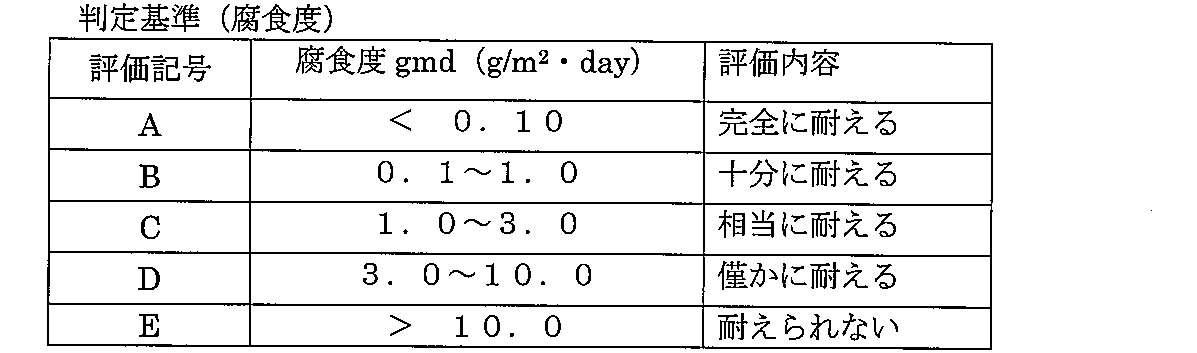
Test Example 4 Stainless steel SUS304 (single side # 400 polished finish, 2.5 × 15 × 50 mm), iron (SS-400, 2.3 × 15 × 30 mm) and copper (C122OP) in a glass container with a metal corrosive lid , 2.0 × 20 × 50 mm), a predetermined amount of clean water (Iwata City Shizuoka City water) is measured to a position where a gas phase portion and a solution immersion portion can be formed. 3. The algicidal and bactericidal agents of Comparative Examples 1 and 3 were added so that the effective chlorine concentration was 2.5 mg / L and 5 mg / L, and the degree of corrosion of the test piece was observed at 30 ° C. The test solution is changed once a week, and after 8 weeks, the test piece is taken out, and the degree of corrosion (gmd; g / m 2 · day) is obtained. The degree of corrosion of each algicide / bactericide was evaluated according to the criteria shown in Table 6 below with respect to the degree of corrosion in the non-agent-added section (only clean water). The results are shown in Table 7 in combination with symbols.
表7の結果より、本発明のN−クロロ及びN,N’−ジクロロ化合物は、比較例3の遊離塩素はもとより、比較例1のスルファミン酸のN−クロロ化合物と比較しても、鉄や銅への腐食性が低く、実用濃度では、上水(磐田市市水)での腐食程度と殆ど差がみられない結果であった。 From the results shown in Table 7, the N-chloro and N, N′-dichloro compounds of the present invention were found to be iron and iron as compared with the free chlorine of Comparative Example 3 as well as the N-chloro compound of sulfamic acid of Comparative Example 1. The corrosiveness to copper was low, and the practical concentration showed almost no difference from the degree of corrosion in tap water (Iwata city water).
Claims (7)
で表される環状のN−クロロ化合物又はN,N’−ジクロロ化合物(但し、N−クロロ−2−ピロリジノンを除く)から選ばれる1種以上を含有することを特徴とする殺藻・殺菌剤。 Formula (I):
An algicidal / bactericidal agent characterized by containing one or more selected from cyclic N-chloro compounds or N, N′-dichloro compounds (excluding N-chloro-2-pyrrolidinone) .
で表される環状のN−クロロ化合物又はN,N’−ジクロロ化合物から選ばれる1種以上を含有する殺藻・殺菌剤を、残留塩素濃度(Cl2換算)として0.2〜10mg/Lとなるように添加する殺藻・殺菌方法。 In an aqueous system in contact with a metal member where corrosion is not desired, the formula (I):
An algicidal / bactericidal agent containing one or more selected from cyclic N-chloro compounds or N, N′-dichloro compounds represented by the formula: 0.2 to 10 mg / L as the residual chlorine concentration (Cl 2 conversion) Algae killing and sterilization method to be added.
Priority Applications (5)
| Application Number | Priority Date | Filing Date | Title |
|---|---|---|---|
| JP2011002059A JP5643117B2 (en) | 2011-01-07 | 2011-01-07 | Algae killing agent and alga killing method |
| CN201180064265.2A CN103298340B (en) | 2011-01-07 | 2011-12-26 | Algicide-Fungicide and Algicide-Bactericide Method |
| KR20137016670A KR20130141624A (en) | 2011-01-07 | 2011-12-26 | Algicidal/microbicidal agent and algicidal/microbicidal method |
| PCT/JP2011/080039 WO2012093608A1 (en) | 2011-01-07 | 2011-12-26 | Algicidal/microbicidal agent and algicidal/microbicidal method |
| TW101100718A TW201309198A (en) | 2011-01-07 | 2012-01-06 | Algicidal/microbicidal agent and algicidal/microbicidal method |
Applications Claiming Priority (1)
| Application Number | Priority Date | Filing Date | Title |
|---|---|---|---|
| JP2011002059A JP5643117B2 (en) | 2011-01-07 | 2011-01-07 | Algae killing agent and alga killing method |
Publications (2)
| Publication Number | Publication Date |
|---|---|
| JP2012144451A true JP2012144451A (en) | 2012-08-02 |
| JP5643117B2 JP5643117B2 (en) | 2014-12-17 |
Family
ID=46457467
Family Applications (1)
| Application Number | Title | Priority Date | Filing Date |
|---|---|---|---|
| JP2011002059A Expired - Fee Related JP5643117B2 (en) | 2011-01-07 | 2011-01-07 | Algae killing agent and alga killing method |
Country Status (5)
| Country | Link |
|---|---|
| JP (1) | JP5643117B2 (en) |
| KR (1) | KR20130141624A (en) |
| CN (1) | CN103298340B (en) |
| TW (1) | TW201309198A (en) |
| WO (1) | WO2012093608A1 (en) |
Families Citing this family (1)
| Publication number | Priority date | Publication date | Assignee | Title |
|---|---|---|---|---|
| CN104336070A (en) * | 2014-10-20 | 2015-02-11 | 山东华亚环保科技有限公司 | Disinfection and algae killing agent for oil field water delivery |
Citations (1)
| Publication number | Priority date | Publication date | Assignee | Title |
|---|---|---|---|---|
| JPS62230770A (en) * | 1986-03-31 | 1987-10-09 | ピ−ピ−ジ− インダストリ−ズ インコ−ポレ−テツド | N, n'-dihalo-2-imidazolidinone |
Family Cites Families (9)
| Publication number | Priority date | Publication date | Assignee | Title |
|---|---|---|---|---|
| GB868876A (en) * | 1958-05-05 | 1961-05-25 | Montedison Spa | A method of preparing compounds containing the groupingí¬nclí¬coí¬nclí¬ in a ring |
| US3591601A (en) * | 1967-10-30 | 1971-07-06 | Dow Chemical Co | N-chloro or bromo-2-oxazolidinones |
| US3850920A (en) * | 1967-10-30 | 1974-11-26 | Dow Chemical Co | N-halo-3-morpholinone |
| US3749672A (en) * | 1971-04-19 | 1973-07-31 | Du Pont | Stabilized solutions of n-halo compounds |
| US4492619A (en) * | 1984-02-01 | 1985-01-08 | Phan Xuan T | Photochemical process for preparing alkoxy substituted compounds |
| JPS63101498A (en) * | 1986-10-17 | 1988-05-06 | ライオン株式会社 | bleach cleaning composition |
| US5565109B1 (en) * | 1994-10-14 | 1999-11-23 | Lonza Ag | Hydantoin-enhanced halogen efficacy in pulp and paper applications |
| JP4726329B2 (en) * | 2001-05-31 | 2011-07-20 | 伯東株式会社 | Microbial control agent |
| JP3916215B2 (en) * | 2002-03-11 | 2007-05-16 | ケイ・アイ化成株式会社 | Novel dibromonitro compounds and their uses |
-
2011
- 2011-01-07 JP JP2011002059A patent/JP5643117B2/en not_active Expired - Fee Related
- 2011-12-26 CN CN201180064265.2A patent/CN103298340B/en not_active Expired - Fee Related
- 2011-12-26 KR KR20137016670A patent/KR20130141624A/en not_active Withdrawn
- 2011-12-26 WO PCT/JP2011/080039 patent/WO2012093608A1/en not_active Ceased
-
2012
- 2012-01-06 TW TW101100718A patent/TW201309198A/en unknown
Patent Citations (1)
| Publication number | Priority date | Publication date | Assignee | Title |
|---|---|---|---|---|
| JPS62230770A (en) * | 1986-03-31 | 1987-10-09 | ピ−ピ−ジ− インダストリ−ズ インコ−ポレ−テツド | N, n'-dihalo-2-imidazolidinone |
Also Published As
| Publication number | Publication date |
|---|---|
| TW201309198A (en) | 2013-03-01 |
| WO2012093608A1 (en) | 2012-07-12 |
| KR20130141624A (en) | 2013-12-26 |
| CN103298340A (en) | 2013-09-11 |
| JP5643117B2 (en) | 2014-12-17 |
| CN103298340B (en) | 2016-03-30 |
Similar Documents
| Publication | Publication Date | Title |
|---|---|---|
| JP3072774B2 (en) | Compounds of N, N'-dihaloimidazolidin-4-ownes and N-haloimidazoline-4-ownes | |
| US5126057A (en) | Disinfecting with N,N'-dihaloimidazolidin-4-ones | |
| EP0239896B1 (en) | N,n'-dihalo-2-imidazolidinones | |
| EP2292096B1 (en) | Active bromine containing biocidal compositions and their preparation | |
| JP2003146817A (en) | Disinfecting algicide composition, aqueous disinfecting algicidal method, and method for producing disinfecting algicide composition | |
| JP5643117B2 (en) | Algae killing agent and alga killing method | |
| JP4733851B2 (en) | Amoeba disinfectant, amoeba control method and legionella eradication method | |
| JP3814085B2 (en) | Algae control agent and algae control method | |
| US6881418B2 (en) | Liquid deodorant killing microorganism and method of microorganism-killing deodorization | |
| JP7057091B2 (en) | Treatment method of open circulation cooling water system | |
| JP4475920B2 (en) | Microbial control agent and microorganism control method | |
| JPS60204704A (en) | Synergistic composition containing hydroxypropyl methane sulfonate and use | |
| US10793586B2 (en) | Quaternary ammonium etidronates | |
| JP4748773B2 (en) | Disinfectant algicide having ability to prevent discoloration and discoloration prevention method | |
| JP2000290112A (en) | Industrial antibacterial agent composition and antibacterial method using the same | |
| JP4297473B2 (en) | Antibacterial and algae agent and method | |
| US20250059074A1 (en) | Antimicrobial system and method | |
| JP2006232687A (en) | Biofilm formation inhibitor in circulating water system and method of inhibiting formation of biofilm | |
| JP5211274B2 (en) | Triazine preparation and aqueous preparation thereof | |
| JP2004182714A (en) | Hydantoin-containing composition and use thereof | |
| JP2002161007A (en) | Algicide | |
| JP2003089607A (en) | Bactericidal/bacteriostatic solution, bactericidal/ bacteriostatic method, deodorant solution and deodorizing method | |
| JP2006206608A (en) | Bactericidal algicidal composition | |
| JPH01135588A (en) | Method and agent for sterilizing treating | |
| JP2014101281A (en) | Algicide |
Legal Events
| Date | Code | Title | Description |
|---|---|---|---|
| A621 | Written request for application examination |
Free format text: JAPANESE INTERMEDIATE CODE: A621 Effective date: 20130718 |
|
| A131 | Notification of reasons for refusal |
Free format text: JAPANESE INTERMEDIATE CODE: A131 Effective date: 20140722 |
|
| A521 | Request for written amendment filed |
Free format text: JAPANESE INTERMEDIATE CODE: A523 Effective date: 20140919 |
|
| TRDD | Decision of grant or rejection written | ||
| A01 | Written decision to grant a patent or to grant a registration (utility model) |
Free format text: JAPANESE INTERMEDIATE CODE: A01 Effective date: 20141021 |
|
| A61 | First payment of annual fees (during grant procedure) |
Free format text: JAPANESE INTERMEDIATE CODE: A61 Effective date: 20141030 |
|
| R150 | Certificate of patent or registration of utility model |
Ref document number: 5643117 Country of ref document: JP Free format text: JAPANESE INTERMEDIATE CODE: R150 |
|
| R250 | Receipt of annual fees |
Free format text: JAPANESE INTERMEDIATE CODE: R250 |
|
| R250 | Receipt of annual fees |
Free format text: JAPANESE INTERMEDIATE CODE: R250 |
|
| R250 | Receipt of annual fees |
Free format text: JAPANESE INTERMEDIATE CODE: R250 |
|
| R250 | Receipt of annual fees |
Free format text: JAPANESE INTERMEDIATE CODE: R250 |
|
| R250 | Receipt of annual fees |
Free format text: JAPANESE INTERMEDIATE CODE: R250 |
|
| LAPS | Cancellation because of no payment of annual fees |