JP2012131663A - Brown glass produced from glass raw material containing molten slag - Google Patents
Brown glass produced from glass raw material containing molten slag Download PDFInfo
- Publication number
- JP2012131663A JP2012131663A JP2010284967A JP2010284967A JP2012131663A JP 2012131663 A JP2012131663 A JP 2012131663A JP 2010284967 A JP2010284967 A JP 2010284967A JP 2010284967 A JP2010284967 A JP 2010284967A JP 2012131663 A JP2012131663 A JP 2012131663A
- Authority
- JP
- Japan
- Prior art keywords
- glass
- molten slag
- raw material
- brown
- weight
- Prior art date
- Legal status (The legal status is an assumption and is not a legal conclusion. Google has not performed a legal analysis and makes no representation as to the accuracy of the status listed.)
- Pending
Links
Landscapes
- Glass Compositions (AREA)
Abstract
【課題】都市ゴミ焼却灰から製造された熔融スラグを19重量%以上含むガラス原料から製造される、素材安定性に優れ、一般的な工芸ガラスと共に使用する場合にもクラックを生じさせない褐色ガラスを提供する。
【解決手段】都市ゴミ焼却灰から製造された熔融スラグを、ガラス原料の全重量を基準にして19重量%〜50重量%の量で含むガラス原料から製造された褐色ガラスであって、好ましくは、線膨張係数α(室温〜300℃)が、(103±7)×10−7/℃の範囲内である。また、熔融スラグを元素分析することにより得られた各元素の重量パーセンテージに0.6をかけた値を、褐色ガラスに導入される熔融スラグ中の各元素由来の酸化物の重量パーセンテージと規定した場合に、褐色ガラスが酸化物換算による重量%表示で、SiO245〜60%;Na2O11.5〜12.5%;B2O31.2〜1.5%;K2O5.5〜8.0%;CaO5.0〜8.5%;Al2O32.0〜3.0%;Sb2O30.2〜0.4%;ZnO2.0〜3.0%;BaO2.0〜3.0%;F20.05〜0.15%;Li2O0.2〜0.4;Mg0.2〜0.4;Fe2O30.4〜0.8;TiO20.2〜0.5;を含む前記褐色ガラスも提供される。
【選択図】なし
A brown glass produced from a glass raw material containing 19% by weight or more of molten slag produced from municipal waste incineration ash has excellent material stability and does not cause cracks when used with general craft glass. provide.
A brown glass produced from a glass raw material containing molten slag produced from municipal waste incineration ash in an amount of 19 wt% to 50 wt% based on the total weight of the glass raw material, preferably The linear expansion coefficient α (room temperature to 300 ° C.) is in the range of (103 ± 7) × 10 −7 / ° C. Moreover, the value obtained by multiplying the weight percentage of each element obtained by elemental analysis of the molten slag by 0.6 was defined as the weight percentage of the oxide derived from each element in the molten slag introduced into the brown glass. If, in weight percentage brown glass by terms of oxides, SiO 2 45~60%; Na 2 O11.5~12.5%; B 2 O 3 1.2~1.5%; K 2 O5. 5~8.0%; CaO5.0~8.5%; Al 2 O 3 2.0~3.0%; Sb 2 O 3 0.2~0.4%; ZnO2.0~3.0% ; BaO2.0~3.0%; F 2 0.05~0.15% ; Li 2 O0.2~0.4; Mg0.2~0.4; Fe 2 O 3 0.4~0.8 Said brown glass comprising TiO 2 0.2-0.5;
[Selection figure] None
Description
本発明は都市ゴミ焼却灰から製造された熔融スラグを含むガラス原料から製造される褐色ガラスに関する。 The present invention relates to a brown glass produced from a glass raw material containing molten slag produced from municipal waste incineration ash.
近年においては、都市ゴミを焼却して生じる都市ゴミ焼却灰は、熔融処理されて熔融スラグが形成され、この熔融スラグは、得られた熔融スラグ自体の形状を利用して、埋戻材、アスファルト骨材、コンクリート骨材、建材などに使用されてきた。一方で、ゴミ焼却灰から製造された熔融スラグをガラス原料として使用し、様々な形状に加工されたガラス製品を製造する試みもなされているが、この技術は依然として進展していない。これは、たとえ熔融スラグの元素分析を行ったとしても、熔融スラグの組成の詳細まで特定するのは困難なので、所定の特性を有する着色ガラスを製造するために、ガラス原料をどのように選択するかが非常に困難であったことに起因している。 In recent years, municipal waste incineration ash generated by incineration of municipal waste is melted to form molten slag, and this molten slag is used as a backfill material, asphalt using the shape of the obtained molten slag itself. It has been used for aggregates, concrete aggregates and building materials. On the other hand, attempts have been made to produce glass products processed into various shapes using molten slag produced from refuse incineration ash as a glass raw material, but this technology has not been developed yet. This is because it is difficult to specify the details of the composition of the molten slag even if elemental analysis of the molten slag is performed, so how to select the glass raw material in order to produce a colored glass having predetermined characteristics This is because it was very difficult.
例えば、全重量を基準として20重量%を超える熔融スラグをガラス原料として使用すると、得られた着色ガラスから成形されたガラス製品にはクラックが発生する場合があった。また、このような割合で熔融スラグをガラス原料として使用する場合には、熔融スラグ中の成分が不明なので、得られた着色ガラスの膨張係数と、工芸用ガラスの一般的な線膨張係数α(室温〜300℃)=約103×10−7/℃とを合わせるのが困難であり、このため、熔融スラグを高い割合で含むガラス原料から得られた着色ガラスを、上記線膨張係数を有する透明の工芸用マザーガラスに内被せ、外被せすることなどにより得られたガラス製品にはクラックが発生する場合があり、その強度も不充分な場合があった。また、熔融スラグをガラス原料として使用して、上記特性を満足しつつ、特定の色、特に、褐色を有する着色ガラスを得るための技術も従来明らかにされていなかった。 For example, when molten slag exceeding 20% by weight based on the total weight is used as a glass raw material, cracks may occur in the glass product formed from the obtained colored glass. Moreover, when using molten slag as a glass raw material in such a ratio, since the components in the molten slag are unknown, the expansion coefficient of the obtained colored glass and the general linear expansion coefficient α ( Room temperature to 300 ° C.) = About 103 × 10 −7 / ° C., and for this reason, a colored glass obtained from a glass raw material containing a high proportion of molten slag is transparent with the above linear expansion coefficient. In some cases, cracks may occur in the glass product obtained by covering and covering the craft mother glass, and the strength thereof may be insufficient. In addition, a technique for obtaining a colored glass having a specific color, particularly brown, while satisfying the above characteristics by using molten slag as a glass raw material has not been clarified conventionally.
ゴミ焼却灰から製造された熔融スラグ自体の色に関しては、特許文献1に、廃棄物熔融による着色スラグの製造方法として、所定の製造方法を用いることにより、黄色、黄緑色、茶色、銀色などに着色されたスラグが得られることが記載されている。また、特許文献2には、熔融スラグに炭素および/またはガラス構成元素の窒化物もしくは炭化物を添加した後、不活性ガス雰囲気下で、加熱熔融させることを特徴とする灰熔融スラグの透明化方法が記載されている。しかし、これら文献の記載は、熔融スラグ自体の色に関するものであり、熔融スラグを含むガラス原料から製造される着色ガラスの色に関連するものではない。 Regarding the color of molten slag itself produced from refuse incineration ash, in Patent Document 1, as a method for producing colored slag by melting waste, a predetermined production method is used, so that yellow, yellow green, brown, silver, etc. It is described that colored slag is obtained. Further, Patent Document 2 discloses a method for clarifying ash-melt slag, characterized by adding carbon and / or nitrides or carbides of glass constituent elements to molten slag and then heating and melting in an inert gas atmosphere. Is described. However, the descriptions in these documents relate to the color of the molten slag itself, and do not relate to the color of the colored glass produced from the glass raw material containing the molten slag.
よって、本発明が解決しようとする課題は、都市ゴミ焼却灰から製造された熔融スラグを20重量%以上含むガラス原料から製造される、素材安定性に優れ、一般的な工芸ガラスと共に使用する場合にもクラックを生じさせず、強度に問題のない褐色ガラスを提供することである。 Therefore, the problem to be solved by the present invention is that the material is produced from a glass raw material containing 20% by weight or more of molten slag produced from municipal waste incineration ash, and is excellent in material stability and used with general craft glass. Furthermore, it is to provide a brown glass which does not cause cracks and has no problem in strength.
本発明の第1の形態は、都市ゴミ焼却灰から製造された熔融スラグを、ガラス原料の全重量を基準にして19重量%〜50重量%の量で含むガラス原料から製造された褐色ガラスである。
本発明の第2の形態は、線膨張係数α(室温〜300℃)が、(103±7)×10−7/℃である前記褐色ガラスである。
本発明の第3の形態は、熔融スラグを元素分析することにより得られた元素Si:Na:B:K:Ca:Al:Sb:Zn:Ba:F:Li:Mg:Fe:Tiの重量比を褐色ガラス中の熔融スラグ由来の物質SiO2:Na2O:B2O3:K2O:CaO:Al2O3:Sb2O3:ZnO:BaO:F2:Li2O:MgO:Fe2O3:TiO2の重量比と仮定し、さらに褐色ガラス中の熔融スラグ由来のこれらの物質の重量が、ガラス原料中の熔融スラグの60重量%であると仮定した場合に、褐色ガラスがSiO245〜60%;Na2O11.5〜12.5%;B2O31.2〜1.5%;K2O5.5〜8.0%;CaO5.0〜8.5%;Al2O32.0〜3.0%;Sb2O30.2〜0.4%;ZnO2.0〜3.0%;BaO2.0〜3.0%;F20.05〜0.15%;Li2O0.2〜0.4;MgO0.2〜0.4;Fe2O30.4〜0.8;TiO20.2〜0.5;を含む請求項1または2に記載の褐色ガラスである。
The first aspect of the present invention is a brown glass produced from a glass raw material containing molten slag produced from municipal waste incineration ash in an amount of 19 wt% to 50 wt% based on the total weight of the glass raw material. is there.
The second aspect of the present invention is the brown glass having a linear expansion coefficient α (room temperature to 300 ° C.) of (103 ± 7) × 10 −7 / ° C.
The third aspect of the present invention is the weight of element Si: Na: B: K: Ca: Al: Sb: Zn: Ba: F: Li: Mg: Fe: Ti obtained by elemental analysis of molten slag. Substance derived from molten slag in brown glass SiO 2 : Na 2 O: B 2 O 3 : K 2 O: CaO: Al 2 O 3 : Sb 2 O 3 : ZnO: BaO: F 2 : Li 2 O: Assuming a weight ratio of MgO: Fe 2 O 3 : TiO 2 and further assuming that the weight of these materials from the molten slag in the brown glass is 60% by weight of the molten slag in the glass raw material, brown glass SiO 2 45~60%; Na 2 O11.5~12.5 %; B 2 O 3 1.2~1.5%; K 2 O5.5~8.0%; CaO5.0~8 .5%; Al 2 O 3 2.0~3.0 %; Sb 2 O 3 0.2 0.4%; ZnO2.0~3.0%; BaO2.0~3.0% ; F 2 0.05~0.15%; Li 2 O0.2~0.4; MgO0.2~0. 4; a brown glass according to claim 1 or 2 including; Fe 2 O 3 0.4~0.8; TiO 2 0.2~0.5.
本発明は、都市ゴミ焼却灰から製造された熔融スラグをガラス原料の25重量%〜50重量%含むことができるので、従来法と比較して熔融スラグを多量に使用することが可能となり、廃棄物のより有効な利用を可能し、かつ原材料コストの低減も図れるという有利な効果を奏する。また、従来は褐色または茶色の物質として熔融スラグ自体しか得られておらず、一方でガラス素材としては薄緑色のものしか得られていなかったが、本発明は、様々に加工できるガラス素材として褐色のガラスを得ることができるという有利な効果を奏する。さらに、本発明は、線膨張係数α(室温〜300℃)が、(103±7)×10−7/℃の範囲内なので、同様の線膨張係数を有する他の着色および/または無色のガラス、例えば、いわゆる工芸用マザーガラスなどと組み合わせて、例えば、内被せ、外被せなどして、クラック発生のない、様々なガラス製品を提供できるという有利な効果を奏する。さらに、本発明の褐色ガラスは、成形などの加工の際の作業性にも優れているという有利な効果を奏する。また、本発明においては、組成の詳細が不明な熔融スラグであっても、熔融スラグを元素分析することにより得られた元素Si:Na:B:K:Ca:Al:Sb:Zn:Ba:F:Li:Mg:Fe:Tiの重量比を褐色ガラス中の熔融スラグ由来の物質SiO2:Na2O:B2O3:K2O:CaO:Al2O3:Sb2O3:ZnO:BaO:F2:Li2O:MgO:Fe2O3:TiO2の重量比と仮定し、さらに褐色ガラス中の熔融スラグ由来のこれらの物質の重量が、ガラス原料中の熔融スラグの60重量%であると仮定するという簡便な方法を用いることにより、上記所定の効果を奏する褐色ガラスを容易に製造できるという有利な効果も奏する。特にこの形態においては、他のガラスと線膨張係数を合わせる場合に、各酸化物の含有量を仮定できるので、かなり容易に線膨張係数の調整を行うことができるという利点がある。 Since the present invention can contain molten slag produced from municipal waste incineration ash in an amount of 25% to 50% by weight of the glass raw material, it becomes possible to use a large amount of molten slag as compared with the conventional method, and to discard it. This has the advantageous effect of enabling more effective use of materials and reducing the cost of raw materials. Further, conventionally, only molten slag itself has been obtained as a brown or brown substance, while on the other hand, only a light green material has been obtained as a glass material. There is an advantageous effect that the glass can be obtained. Furthermore, since the present invention has a linear expansion coefficient α (room temperature to 300 ° C.) in the range of (103 ± 7) × 10 −7 / ° C., other colored and / or colorless glass having a similar linear expansion coefficient. For example, in combination with so-called mother glass for crafts, for example, it is possible to provide various glass products that are free from cracks by being covered and covered. Furthermore, the brown glass of the present invention has an advantageous effect of being excellent in workability during processing such as molding. Moreover, in this invention, even if it is molten slag whose composition details are unknown, element Si: Na: B: K: Ca: Al: Sb: Zn: Ba: obtained by elemental analysis of molten slag F: Li: Mg: Fe: Ti weight ratio of material derived from molten slag in brown glass SiO 2 : Na 2 O: B 2 O 3 : K 2 O: CaO: Al 2 O 3 : Sb 2 O 3 : Assuming a weight ratio of ZnO: BaO: F 2 : Li 2 O: MgO: Fe 2 O 3 : TiO 2 , and the weight of these materials derived from the molten slag in the brown glass is that of the molten slag in the glass raw material. By using a simple method of assuming that the amount is 60% by weight, there is also an advantageous effect that brown glass having the predetermined effect can be easily manufactured. In particular, this embodiment has an advantage that the linear expansion coefficient can be adjusted fairly easily because the content of each oxide can be assumed when the linear expansion coefficient is matched with that of other glass.
本発明において、「都市ゴミ焼却灰から製造された熔融スラグ」とは、都市ゴミをゴミ焼却場において焼却して得られた焼却灰を高温で熔融させたものを水中で冷却、固化することにより製造された熔融スラグをいう。熔融スラグは、都市ゴミ焼却灰から製造されるのであるから、元になるゴミの相違、焼却および熔融スラグ製造施設の相違などによって、その組成は変動する。例えば、富山市の都市ゴミ焼却灰から製造された熔融スラグを蛍光X線法により元素分析すると、2009年のある時点で得られたものでは、測定可能であったものに関しては元素比(重量%)はSi=27.78;Na=1.1;K=2.67;Ca=46.91;Al=9.78;Zn=0.075;Ba=0.44;Mg=1.30;Fe=3.82;Ti=3.38であり、2010年のある時点で得られたものでは、測定可能であったものに関しては元素比(重量%)はSi=33.46;Na=2.53;K=2.4;Ca=39.33;Al=12.65;Zn=0.18;Ba=0.34;Mg=1.86;Fe=3.50;Ti=2.12であった(なお、これらの合計が100重量%とならないのは、その他の成分が存在しうるからである)。 In the present invention, “molten slag produced from municipal waste incineration ash” means that the incineration ash obtained by incineration of municipal waste at the garbage incineration plant is melted at high temperature in water and solidified. It refers to the manufactured molten slag. Since molten slag is produced from municipal waste incineration ash, the composition varies depending on differences in the original garbage, incineration and in the molten slag production facility. For example, when elemental analysis of molten slag produced from municipal waste incineration ash in Toyama City by the fluorescent X-ray method was conducted, it was possible to measure the element ratio (weight% ) Is Si = 27.78; Na = 1.1; K = 2.67; Ca = 46.91; Al = 9.78; Zn = 0.075; Ba = 0.44; Mg = 1.30; Fe = 3.82; Ti = 3.38, obtained at some point in 2010, the element ratio (wt%) for what was measurable was Si = 33.46; Na = 2 K = 2.4; Ca = 39.33; Al = 12.65; Zn = 0.18; Ba = 0.34; Mg = 1.86; Fe = 0.50; Ti = 2.12. (Note that the total of these components does not reach 100% by weight because other components exist. This is because may be).
本発明において、ガラス原料とは、本発明の褐色ガラスを製造するための原料であり、ゴミ焼却灰から製造された熔融スラグをガラス原料の全重量を基準にして、19重量%以上、20重量%以上、25重量%以上、30重量%以上、35重量%以上、40重量%以上、または45重量%以上含むことができる。また、ガラス原料は、ゴミ焼却灰から製造された熔融スラグをガラス原料の全重量を基準にして30重量%以下、35重量%以下、40重量%以下または50重量%以下含むことができる。ここで記載されたガラス原料中の熔融スラグの量の上限および下限は任意に組み合わせ可能である。好ましくは、ガラス原料は、ゴミ焼却灰から製造された熔融スラグをガラス原料の全重量を基準にして19重量%〜50重量%、25重量%〜50重量%、より好ましくは、30重量%〜50重量%、さらにより好ましくは、35重量%〜50重量%、さらにより好ましくは、35重量%〜40重量%含むことができる。 In the present invention, the glass raw material is a raw material for producing the brown glass of the present invention. The molten slag produced from the garbage incineration ash is 19% by weight or more and 20% by weight based on the total weight of the glass raw material. %, 25% by weight, 30% by weight, 35% by weight, 40% by weight, or 45% by weight or more. In addition, the glass raw material may contain 30% by weight, 35% by weight, 40% by weight or 50% by weight or less of molten slag produced from refuse incineration ash based on the total weight of the glass raw material. The upper limit and the lower limit of the amount of molten slag in the glass raw material described here can be arbitrarily combined. Preferably, the glass raw material is 19% to 50% by weight, 25% to 50% by weight, more preferably 30% to 50% by weight based on the total weight of the glass raw material. 50 wt%, even more preferably 35 wt% to 50 wt%, and even more preferably 35 wt% to 40 wt%.
ガラス原料は、熔融スラグに加えて、必須成分の1つとしてNO3 −も含む。NO3 −は酸化剤として機能し、熔融スラグに含まれる鉄と反応して、ガラス原料から製造されるガラスを褐色にすると考えられる。NO3 −の量は熔融スラグに含まれる鉄元素の量に応じて適宜選択されるものであり、NO3 −の量が少な過ぎると、ガラス原料中の酸化能力の不足によって褐色が発色しない。一方、NO3 −の量が過剰であると、膨張係数が大きくなりすぎるので好ましくない。例えば、後述されるような、熔融スラグを元素分析することにより得られた元素Si:Na:B:K:Ca:Al:Sb:Zn:Ba:F:Li:Mg:Fe:Tiの重量比を褐色ガラス中の熔融スラグ由来の物質SiO2:Na2O:B2O3:K2O:CaO:Al2O3:Sb2O3:ZnO:BaO:F2:Li2O:MgO:Fe2O3:TiO2の重量比と仮定し、さらに褐色ガラス中の熔融スラグ由来のこれらの物質の重量が、ガラス原料中の熔融スラグの60重量%であると仮定した場合に、最終的に得られた褐色ガラス中のFe2O3の重量に対するガラス原料中のNO3 −重量の割合(すなわち、原料中NO3 −重量/最終Fe2O3重量)は、好ましくは11.5〜14.0、より好ましくは、11.8〜13.5である。NO3 −は硝酸塩の形態でガラス原料中に含まれ、硝酸塩としては、NaNO3、またはKNO3が好ましく、価格の観点からNaNO3が最も好ましい。 In addition to the molten slag, the glass raw material also contains NO 3 − as one of the essential components. NO 3 − functions as an oxidant and is considered to react with iron contained in the molten slag to turn the glass produced from the glass raw material brown. The amount of NO 3 − is appropriately selected according to the amount of iron element contained in the molten slag. If the amount of NO 3 − is too small, the brown color does not develop due to the lack of oxidation ability in the glass raw material. On the other hand, an excessive amount of NO 3 − is not preferable because the expansion coefficient becomes too large. For example, as described later, the weight ratio of elements Si: Na: B: K: Ca: Al: Sb: Zn: Ba: F: Li: Mg: Fe: Ti obtained by elemental analysis of molten slag The material derived from molten slag in brown glass is SiO 2 : Na 2 O: B 2 O 3 : K 2 O: CaO: Al 2 O 3 : Sb 2 O 3 : ZnO: BaO: F 2 : Li 2 O: MgO Assuming a weight ratio of: Fe 2 O 3 : TiO 2 and assuming that the weight of these materials from the molten slag in the brown glass is 60% by weight of the molten slag in the glass raw material, the final to NO 3 in the glass material to the weight of Fe 2 O 3 resulting brown glass - weight ratio of (i.e., raw material NO 3 - weight / final Fe 2 O 3 by weight) is preferably 11.5 ~ 14.0, more preferred Is 11.8 to 13.5. NO 3 − is contained in the glass raw material in the form of nitrate. As the nitrate, NaNO 3 or KNO 3 is preferable, and NaNO 3 is most preferable from the viewpoint of price.
ガラス原料は、熔融スラグ、NO3 −の他に、主原料として、ケイ砂、スラグ、ソーダ灰、石灰石を含み、必要に応じて、融剤としての無水硼砂、化学的耐久性に関与する水酸化アルミニウム、融剤としておよび光沢に関与する炭酸カリウム、融剤として炭酸バリウム、亜鉛華、炭酸リチウム、酸化還元剤として酸化アンチモン、清澄剤としてクレオライトなどを含む。また、ガラス原料は、必要に応じて、酸化チタン、酸化セリウム、ベンガラなどの着色剤を含んでいても良い。さらに、ガラス原料は、本発明の効果の妨げにならない限りは、ガラスの製造において使用されうるこれら以外の任意の成分を含むことができる。ガラス原料中に含まれる各成分の量については、ガラス原料から製造される褐色ガラスが本発明の所定の特性を奏するように適宜選択される。 Water in addition to, as the main raw material, which comprises silica sand, slag, soda ash, limestone, if necessary, participates anhydrous as a flux borax, chemical durability - glass raw material, molten slag, NO 3 It contains aluminum oxide, potassium carbonate as a flux and luster, barium carbonate, zinc white, lithium carbonate as a flux, antimony oxide as a redox agent, creolite as a fining agent, and the like. Moreover, the glass raw material may contain coloring agents, such as titanium oxide, cerium oxide, and bengara, as needed. Furthermore, the glass raw material can contain arbitrary components other than these which can be used in manufacture of glass, unless it interferes with the effect of this invention. About the quantity of each component contained in a glass raw material, the brown glass manufactured from a glass raw material is suitably selected so that the predetermined | prescribed characteristic of this invention may be show | played.
本発明の褐色ガラスは、好ましくは、線膨張係数α(室温〜300℃)が、(103±7)×10−7/℃の範囲内であり、より好ましくは、(103±4)×10−7/℃の範囲内、さらにより好ましくは、(103±2)×10−7/℃の範囲内である。本発明における線膨張係数とは、本発明の褐色ガラスと線膨張係数が明らかとなっているガラスとを用いたバイメタルファイバー法で測定された、これらの線膨張係数の差に基づいて決定される。詳細は本明細書中の実施例に記載されている。 The brown glass of the present invention preferably has a linear expansion coefficient α (room temperature to 300 ° C.) in the range of (103 ± 7) × 10 −7 / ° C., more preferably (103 ± 4) × 10. Within the range of −7 / ° C., and more preferably within the range of (103 ± 2) × 10 −7 / ° C. The linear expansion coefficient in the present invention is determined based on the difference between these linear expansion coefficients measured by the bimetal fiber method using the brown glass of the present invention and the glass whose linear expansion coefficient is clear. . Details are described in the examples herein.
本発明の褐色ガラスにおける「褐色」とは、観察者が目視により褐色と認めることができる色が該当し、薄い褐色〜濃い褐色であってよく、黄色みがかった褐色、赤みがかった褐色なども該当する。 “Brown” in the brown glass of the present invention corresponds to a color that an observer can visually recognize as brown, and may be light brown to dark brown, including yellowish brown, reddish brown, etc. To do.
本発明のある実施形態においては、熔融スラグを元素分析することにより得られた元素Si:Na:B:K:Ca:Al:Sb:Zn:Ba:F:Li:Mg:Fe:Tiの重量比を褐色ガラス中の熔融スラグ由来の物質SiO2:Na2O:B2O3:K2O:CaO:Al2O3:Sb2O3:ZnO:BaO:F2:Li2O:MgO:Fe2O3:TiO2の重量比と仮定し、さらに褐色ガラス中の熔融スラグ由来のこれらの物質の重量が、ガラス原料中の熔融スラグの60重量%であると仮定した。熔融スラグの元素分析に使用される方法については、特に限定されないが、例えば、蛍光X線分析が挙げられる。本発明において、「熔融スラグを元素分析することにより得られた元素Si:Na:B:K:Ca:Al:Sb:Zn:Ba:F:Li:Mg:Fe:Tiの重量比を褐色ガラス中の熔融スラグ由来の物質SiO2:Na2O:B2O3:K2O:CaO:Al2O3:Sb2O3:ZnO:BaO:F2:Li2O:MgO:Fe2O3:TiO2の重量比と仮定し、さらに褐色ガラス中の熔融スラグ由来のこれらの物質の重量が、ガラス原料中の熔融スラグの60重量%であると仮定した」とは、例えば、元素分析によって、元素比(重量%)Si=33.46;Na=2.53;K=2.4;Ca=39.33;Al=12.65;Zn=0.18;Ba=0.34;Mg=1.86;Fe=3.50;Ti=2.12(重量パーセンテージの合計は98.37%)が得られた場合に、この合計98.37%が60重量%となるように、これら各元素の重量比に「0.61」をかけた値が、褐色ガラス中の熔融スラグ由来の物質SiO2:Na2O:B2O3:K2O:CaO:Al2O3:Sb2O3:ZnO:BaO:F2:Li2O:MgO:Fe2O3:TiO2の重量比となるものである。なお、上記規定において、熔融スラグ中に含まれる上記酸化物以外の成分は「その他」の成分として考えることとする。 In an embodiment of the present invention, the weight of element Si: Na: B: K: Ca: Al: Sb: Zn: Ba: F: Li: Mg: Fe: Ti obtained by elemental analysis of molten slag. Substance derived from molten slag in brown glass SiO 2 : Na 2 O: B 2 O 3 : K 2 O: CaO: Al 2 O 3 : Sb 2 O 3 : ZnO: BaO: F 2 : Li 2 O: The weight ratio of MgO: Fe 2 O 3 : TiO 2 was assumed, and the weight of these materials derived from the molten slag in the brown glass was assumed to be 60% by weight of the molten slag in the glass raw material. Although it does not specifically limit about the method used for elemental analysis of molten slag, For example, a fluorescent X ray analysis is mentioned. In the present invention, “element Si: Na: B: K: Ca: Al: Sb: Zn: Ba: F: Li: Mg: Fe: Ti weight ratio obtained by elemental analysis of molten slag is set to brown glass. molten slag from substances SiO 2 in: Na 2 O: B 2 O 3: K 2 O: CaO: Al 2 O 3: Sb 2 O 3: ZnO: BaO: F 2: Li 2 O: MgO: Fe 2 Assuming a weight ratio of O 3 : TiO 2 and assuming that the weight of these materials from the molten slag in the brown glass is 60% by weight of the molten slag in the glass raw material ” By analysis, element ratio (% by weight) Si = 33.46; Na = 2.53; K = 2.4; Ca = 39.33; Al = 12.65; Zn = 0.18; Ba = 0.34 Mg = 1.86; Fe = 0.50; Ti = 2. 2 (the sum of the weight percentages is 98.37%), a value obtained by multiplying the weight ratio of these elements by “0.61” so that the total 98.37% is 60% by weight. Is a material derived from molten slag in brown glass SiO 2 : Na 2 O: B 2 O 3 : K 2 O: CaO: Al 2 O 3 : Sb 2 O 3 : ZnO: BaO: F 2 : Li 2 O: The weight ratio is MgO: Fe 2 O 3 : TiO 2 . In the above regulations, components other than the oxides contained in the molten slag are considered as “other” components.
本発明のある実施形態においては、熔融スラグを元素分析することにより得られた元素Si:Na:B:K:Ca:Al:Sb:Zn:Ba:F:Li:Mg:Fe:Tiの重量比を褐色ガラス中の熔融スラグ由来の物質SiO2:Na2O:B2O3:K2O:CaO:Al2O3:Sb2O3:ZnO:BaO:F2:Li2O:MgO:Fe2O3:TiO2の重量比と仮定し、さらに褐色ガラス中の熔融スラグ由来のこれらの物質の重量が、ガラス原料中の熔融スラグの60重量%であると仮定した場合に、褐色ガラスがSiO245〜60%;Na2O11.5〜12.5%;B2O31.2〜1.5%;K2O5.5〜8.0%;CaO5.0〜8.5%;Al2O32.0〜3.0%;Sb2O30.2〜0.4%;ZnO2.0〜3.0%;BaO2.0〜3.0%;F20.05〜0.15%;Li2O0.2〜0.4;MgO0.2〜0.4;Fe2O30.4〜0.8;TiO20.2〜0.5;を含む。 In an embodiment of the present invention, the weight of element Si: Na: B: K: Ca: Al: Sb: Zn: Ba: F: Li: Mg: Fe: Ti obtained by elemental analysis of molten slag. Substance derived from molten slag in brown glass SiO 2 : Na 2 O: B 2 O 3 : K 2 O: CaO: Al 2 O 3 : Sb 2 O 3 : ZnO: BaO: F 2 : Li 2 O: Assuming a weight ratio of MgO: Fe 2 O 3 : TiO 2 and further assuming that the weight of these materials from the molten slag in the brown glass is 60% by weight of the molten slag in the glass raw material, brown glass SiO 2 45~60%; Na 2 O11.5~12.5 %; B 2 O 3 1.2~1.5%; K 2 O5.5~8.0%; CaO5.0~8 0.5%; Al 2 O 3 2.0-3.0%; Sb 2 O 3 0.2~0.4%; ZnO2.0~3.0%; BaO2.0~3.0 %; F 2 0.05~0.15%; Li 2 O0.2~0.4; MgO0 2 to 0.4; Fe 2 O 3 0.4 to 0.8; TiO 2 0.2 to 0.5.
ガラス原料から褐色ガラスを製造する方法としては、当該技術分野において周知の任意の方法を使用できる。例えば、ガラス原料をよく攪拌し、熔解炉のるつぼに投入し、標準的な熔融温度である1350℃〜1400℃で熔融し、本発明の褐色ガラスにされる。 As a method for producing brown glass from a glass raw material, any method known in the art can be used. For example, the glass raw material is stirred well, put into a crucible of a melting furnace, and melted at a standard melting temperature of 1350 ° C. to 1400 ° C. to obtain the brown glass of the present invention.
本発明の褐色ガラスは、同様の膨張係数を有する、無色および/または着色ガラス、例えば、工芸用マザーガラスなどと共に、例えば、内被せ、外被せでガラス製品に成形されうる。また、本発明の褐色ガラスは単味でもガラス製品に成形されうる。本発明の褐色ガラスから成形されるガラス製品の形状、種類は特に限定されるものではなく、例えば、皿、コップなどの容器、タイルなどの装飾用部品などが挙げられるがこれらに限定されるものではない。 The brown glass of the present invention can be formed into a glass product with, for example, an inner cover or an outer cover together with a colorless and / or colored glass having a similar expansion coefficient, such as a craft mother glass. The brown glass of the present invention can be formed into a glass product even if it is simple. The shape and type of the glass product molded from the brown glass of the present invention are not particularly limited, and examples include, but are not limited to, containers such as dishes and cups, and decorative parts such as tiles. is not.
以下の実施例1〜5において使用された熔融スラグは、富山市の都市ゴミ焼却灰から製造された熔融スラグであり、蛍光X線元素分析を行った結果、熔融スラグ中の元素は、検出されたものとして以下の重量%であった:Si=33.46;Na=2.53;K=2.4;Ca=39.33;Al=12.65;Zn=0.18;Ba=0.34;Mg=1.86;Fe=3.50;Ti=2.12。この熔融スラグについては、上記各元素の存在割合(重量%)に0.61をかけて得られた値を、それぞれの以下の酸化物の存在割合とした:SiO2=20.08;Na2O=1.52;K2O=1.44;CaO=23.60;Al2O3=7.59;ZnO=0.11;BaO=0.20;MgO=1.12;Fe2O3=2.10;TiO2=1.27。表1に示されたガラス中の成分となるように、上記熔融スラグに加えて、サラワク珪砂、ソーダ灰、無水硼砂、石灰石、水酸化アルミニウム、硝酸ナトリウム、炭酸カリウム、炭酸バリウム、亜鉛華(酸化亜鉛)、炭酸リチウム、酸化アンチモン、クレオライトがガラス原料として使用された。 The molten slag used in the following Examples 1 to 5 is a molten slag produced from municipal waste incineration ash in Toyama City. As a result of fluorescent X-ray elemental analysis, elements in the molten slag were detected. The following weight percentages were: Si = 33.46; Na = 2.53; K = 2.4; Ca = 39.33; Al = 12.65; Zn = 0.18; Ba = 0. .34; Mg = 1.86; Fe = 3.50; Ti = 2.12. For this molten slag, the value obtained by multiplying the abundance ratio (% by weight) of each of the above elements by 0.61 was defined as the abundance ratio of each of the following oxides: SiO 2 = 20.08; Na 2 O = 1.52; K 2 O = 1.44; CaO = 23.60; Al 2 O 3 = 7.59; ZnO = 0.11; BaO = 0.20; MgO = 1.12; Fe 2 O 3 = 2.10; TiO 2 = 1.27. In addition to the above-mentioned molten slag, in addition to the above-mentioned molten slag, in order to become the components in Table 1, Sarawak quartz sand, soda ash, anhydrous borax, limestone, aluminum hydroxide, sodium nitrate, potassium carbonate, barium carbonate, zinc white (oxidized) Zinc), lithium carbonate, antimony oxide, and creoleite were used as glass raw materials.
上記ガラス原料は充分に混合された後に、熔解炉のるつぼに投入され、1350℃で約8〜10時間熔融されて水飴状のガラス物質を得て、単味、ロッド、またはブロック用塊(5cm×4cm×1.5〜2cm)、標準透明工芸用ガラス(線膨張係数α=103×10−7/℃)に上記着色ガラスを内被せおよび外被せしたもの、2〜3mmのガラス棒を作成した。これらは徐冷窯にいれられて徐歪され、得られた成型品について、破損の有無、色調、泡、脈理、ぶつなどを目視で観察した。さらに、ガラス片を作成する間の作業性について、作業者の主観的判断による評価を行った。線膨張係数の差は、標準透明工芸ガラスと、得られた着色ガラスとの間の線膨張係数の差をバイメタルファイバー法で測定した。すなわち、それぞれのガラスについて、長さ15cm程度、直径2〜3mmのガラス棒を作成し、標準透明ガラス棒と着色ガラス棒とを棒の中央部分で加熱熔着させて、ガラス棒の両端を引っ張って0.3mm程度のファイバーを形成した。このファイバーの両端を切断し、線膨張係数の差があった場合には線膨張係数の大きい方が内側に湾曲するので、その源の部分が300mmになるようにセクションペーパー上におく。そして、弦の中央から湾曲したファイバーまでの距離をhmm、ファイバーの径(2本融着)をφmmとすると、Δα=(h×φ)×10−7/0.62/℃で表される。 After the glass raw material is sufficiently mixed, it is put into a crucible of a melting furnace and melted at 1350 ° C. for about 8 to 10 hours to obtain a water tank-like glass material, and a simple, rod or block lump (5 cm × 4cm × 1.5-2cm), standard transparent craft glass (linear expansion coefficient α = 103 × 10 −7 / ° C.) with the above-mentioned colored glass covered and covered, and a 2-3 mm glass rod is prepared did. These were put into a slow cooling kiln and gradually strained, and the obtained molded product was visually observed for the presence or absence of damage, color tone, foam, striae, and bumps. Furthermore, the workability during the creation of the glass pieces was evaluated based on the subjective judgment of the worker. The difference in linear expansion coefficient was measured by the bimetal fiber method for the difference in linear expansion coefficient between the standard transparent craft glass and the obtained colored glass. That is, for each glass, a glass rod having a length of about 15 cm and a diameter of 2 to 3 mm is prepared, and a standard transparent glass rod and a colored glass rod are heated and welded at the central portion of the rod, and both ends of the glass rod are pulled. A fiber of about 0.3 mm was formed. When both ends of this fiber are cut and there is a difference in the linear expansion coefficient, the one with the larger linear expansion coefficient is curved inward, so that the source portion is placed on the section paper so that it is 300 mm. Then, if the distance from the center of the string to the curved fiber is hmm and the diameter of the fiber (two fused) is φmm, Δα = (h × φ) × 10 −7 /0.62/° C. .
実施例1〜実施例5の結果は以下の表1に示される。表1から明らかなように、熔融スラグを20〜30重量%含むガラス原料から褐色ガラスが製造され、この褐色ガラスからの成型品には泡、脈理、ぶつなどの不都合がなく、これらの褐色ガラスは作業性も良好であった。また、標準透明工芸用ガラスに内被せまたは外被せした成型品には破損が生じなかったので、これらの褐色ガラスはα=103×10−7/℃と同等の線膨張係数を有しているものと考えられた。 The results of Examples 1 to 5 are shown in Table 1 below. As is apparent from Table 1, brown glass is produced from a glass raw material containing 20 to 30% by weight of molten slag, and the molded product from this brown glass has no inconveniences such as bubbles, striae and bumps. The glass also had good workability. In addition, since no damage occurred in the molded product covered or covered with the standard transparent craft glass, these brown glasses have a linear expansion coefficient equivalent to α = 103 × 10 −7 / ° C. It was considered a thing.
以下の実施例および比較例1においては、富山市の都市ゴミ焼却灰から製造された熔融スラグが使用された。使用された熔融スラグ自体については元素分析は行わなかったが、この熔融スラグに含まれる各元素の酸化物の組成を仮定するために、過去に行った2つの別の熔融スラグについての蛍光X線分析値の平均値を採用した。この平均値は重量%で、Si=20.8;Na=1.9;K=1.61;Ca=20.7;Al=11.7;Zn=0;Ba=0;Mg=1.18;Fe=0.71;Ti=0.825(合計59.4%)であった。この熔融スラグについては、上記各元素の存在割合(重量%)を、そのまま、着色ガラス中の熔融スラグ由来の酸化物の存在割合:SiO2=20.8;Na2O=1.9;K2O=1.61;CaO=20.7;Al2O3=11.7;ZnO=0;BaO=0;MgO=1.18;Fe2O3=0.71;TiO2=0.825とした。
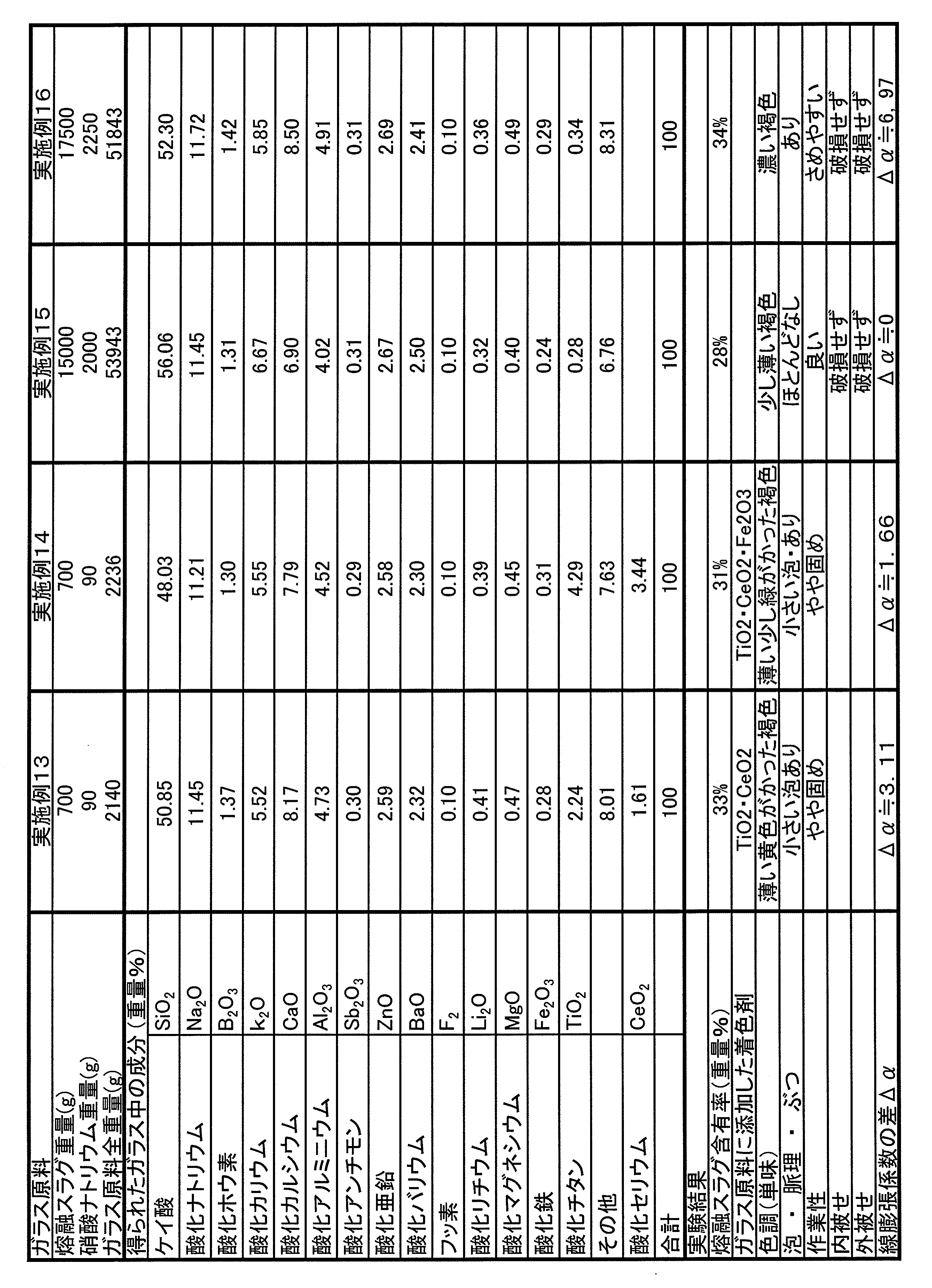
実施例13〜17においては、表中に示されるように、ガラス原料に着色剤として、酸化セリウム、酸化チタン、ベンガラが使用された。
実験方法は、上記実施例1〜5と同じであった。結果は以下の表2および表3に示される。
In the following Examples and Comparative Example 1, molten slag produced from municipal waste incineration ash in Toyama City was used. Although elemental analysis was not performed on the used molten slag itself, in order to assume the composition of oxides of each element contained in the molten slag, fluorescent X-rays of two other molten slags used in the past were used. The average of analysis values was adopted. The average value is% by weight, Si = 20.8; Na = 1.9; K = 1.61; Ca = 20.7; Al = 11.7; Zn = 0; Ba = 0; Mg = 1. 18; Fe = 0.71; Ti = 0.825 (total 59.4%). About this molten slag, the abundance ratio (% by weight) of each of the above elements is the same as the abundance ratio of the oxide derived from the molten slag in the colored glass: SiO 2 = 20.8; Na 2 O = 1.9; K 2 O = 1.61; CaO = 20.7 ; Al 2 O 3 = 11.7; ZnO = 0; BaO = 0; MgO = 1.18; Fe 2 O 3 = 0.71; TiO 2 = 0. 825.
In Examples 13 to 17, as shown in the table, cerium oxide, titanium oxide, and bengara were used as the colorant in the glass raw material.
The experimental method was the same as in Examples 1-5 above. The results are shown in Table 2 and Table 3 below.
実施例6〜16に示されるように、本願発明の所定の効果を奏する褐色ガラスが得られた。比較例1において着色ガラスの色が黄緑色となったのは、硝酸ナトリウムの量が少なかったためと考えられる。上記実施例において、作業性の項目で、「固くなりやすい」、「やや固め」と記載されているが、これらの場合であっても作業性に問題はない。実施例9〜実施例16に示されるように、本発明の褐色ガラスは線膨張係数α=(103±7)×10−7/℃を有しうる。また、実施例13〜14においては、ガラス原料に着色剤が使用された場合であっても、得られる褐色ガラスは本願発明の効果を奏していた。 As shown in Examples 6 to 16, brown glass having the predetermined effect of the present invention was obtained. In Comparative Example 1, the color of the colored glass became yellowish green because the amount of sodium nitrate was small. In the above-described embodiment, “easy to harden” and “slightly hard” are described in the workability items, but there is no problem in workability even in these cases. As shown in Examples 9 to 16, the brown glass of the present invention may have a linear expansion coefficient α = (103 ± 7) × 10 −7 / ° C. Moreover, in Examples 13-14, even if it is a case where a coloring agent is used for a glass raw material, the obtained brown glass had the effect of this invention.
本発明の褐色ガラスは、他のガラス材料と組み合わせてまたは単独で工芸用ガラス材料として使用されうる。また、本発明の褐色ガラスは、皿、コップなどの容器、タイルなどの装飾用部品など様々な物品に使用可能である。 The brown glass of the present invention can be used as a craft glass material in combination with other glass materials or alone. The brown glass of the present invention can be used for various articles such as dishes such as dishes and cups, and decorative parts such as tiles.
Claims (3)
Priority Applications (1)
| Application Number | Priority Date | Filing Date | Title |
|---|---|---|---|
| JP2010284967A JP2012131663A (en) | 2010-12-21 | 2010-12-21 | Brown glass produced from glass raw material containing molten slag |
Applications Claiming Priority (1)
| Application Number | Priority Date | Filing Date | Title |
|---|---|---|---|
| JP2010284967A JP2012131663A (en) | 2010-12-21 | 2010-12-21 | Brown glass produced from glass raw material containing molten slag |
Publications (1)
| Publication Number | Publication Date |
|---|---|
| JP2012131663A true JP2012131663A (en) | 2012-07-12 |
Family
ID=46647724
Family Applications (1)
| Application Number | Title | Priority Date | Filing Date |
|---|---|---|---|
| JP2010284967A Pending JP2012131663A (en) | 2010-12-21 | 2010-12-21 | Brown glass produced from glass raw material containing molten slag |
Country Status (1)
| Country | Link |
|---|---|
| JP (1) | JP2012131663A (en) |
Cited By (3)
| Publication number | Priority date | Publication date | Assignee | Title |
|---|---|---|---|---|
| CN107601858A (en) * | 2017-07-26 | 2018-01-19 | 金玛瑙香水(明光)有限公司 | A kind of Brown Glass Brown glass bottles and jars only that can improve cool environment |
| CN116062987A (en) * | 2023-01-10 | 2023-05-05 | 吉林建龙钢铁有限责任公司 | Method for preparing slag glass from blast furnace slag |
| KR20250041219A (en) * | 2023-09-18 | 2025-03-25 | 키스코홀딩스주식회사 | Glass using the steelmaking slag and manufacturing method of the glass |
-
2010
- 2010-12-21 JP JP2010284967A patent/JP2012131663A/en active Pending
Cited By (4)
| Publication number | Priority date | Publication date | Assignee | Title |
|---|---|---|---|---|
| CN107601858A (en) * | 2017-07-26 | 2018-01-19 | 金玛瑙香水(明光)有限公司 | A kind of Brown Glass Brown glass bottles and jars only that can improve cool environment |
| CN116062987A (en) * | 2023-01-10 | 2023-05-05 | 吉林建龙钢铁有限责任公司 | Method for preparing slag glass from blast furnace slag |
| KR20250041219A (en) * | 2023-09-18 | 2025-03-25 | 키스코홀딩스주식회사 | Glass using the steelmaking slag and manufacturing method of the glass |
| KR102789833B1 (en) | 2023-09-18 | 2025-04-03 | 한국세라믹기술원 | Glass using the steelmaking slag and manufacturing method of the glass |
Similar Documents
| Publication | Publication Date | Title |
|---|---|---|
| TWI377184B (en) | ||
| JP2010509180A5 (en) | ||
| TW201420538A (en) | Glass and chemically strengthened glass | |
| CN101759368B (en) | Green glass-ceramic plate made from lead-zinc smelting slag and manufacturing method thereof | |
| JP5158916B2 (en) | Rock wool, manufacturing method thereof, and inorganic fiber felt | |
| JP4101889B2 (en) | Blue glass composition | |
| JP2009096662A (en) | Glass composition | |
| CN104583143B (en) | White glass container and manufacturing method of white glass container | |
| JP2002060247A (en) | Iron-based enamel glaze and method for producing iron-based enamel product using the same | |
| Carmona et al. | Islamic glasses from Al-Andalus. Characterisation of materials from a Murcian workshop (12th century AD, Spain) | |
| CN101638293A (en) | High-performance glass frit block for producing glass microfiber and preparation method thereof | |
| WO2007106274A2 (en) | Method of making glass including use of boron oxide for reducing glass refiting time | |
| JP2007091555A (en) | Filter glass for cutting near-infrared ray | |
| JPWO2015170759A1 (en) | Heat-absorbing glass plate and manufacturing method thereof | |
| JP4630190B2 (en) | High zirconia refractories | |
| JP2015110491A (en) | Method for producing glass melt and method for producing glass article | |
| JP2015164888A (en) | Near-infrared absorption / high contrast glass lens | |
| Verità et al. | Scientific investigation of a Venetian polychrome goblet of the 16th century | |
| EP1007486A1 (en) | Spectral modifiers for glass compositions | |
| CN103395985B (en) | An amber aluminosilicate glass | |
| JP2011140436A (en) | Basalt fiber material | |
| JPH06191874A (en) | Rose-pink borosilicate glass, production thereof and article produced from said glass | |
| JP6589860B2 (en) | Heat-absorbing glass plate and manufacturing method thereof | |
| JP2014224033A (en) | Fluidity improvement type cement clinker | |
| JP2019085323A (en) | Greenish-yellow glass and greenish-yellow glass container |