JP2012106948A - Compound having branched oxaalkyl chain and use of the same - Google Patents
Compound having branched oxaalkyl chain and use of the same Download PDFInfo
- Publication number
- JP2012106948A JP2012106948A JP2010256887A JP2010256887A JP2012106948A JP 2012106948 A JP2012106948 A JP 2012106948A JP 2010256887 A JP2010256887 A JP 2010256887A JP 2010256887 A JP2010256887 A JP 2010256887A JP 2012106948 A JP2012106948 A JP 2012106948A
- Authority
- JP
- Japan
- Prior art keywords
- compound
- chain
- oxaalkyl
- synthesis example
- abbreviation
- Prior art date
- Legal status (The legal status is an assumption and is not a legal conclusion. Google has not performed a legal analysis and makes no representation as to the accuracy of the status listed.)
- Granted
Links
Images

Landscapes
- Organic Low-Molecular-Weight Compounds And Preparation Thereof (AREA)
- Lubricants (AREA)
Abstract
【課題】直鎖アルキル鎖を有している化合物または直鎖オキサアルキル鎖を有している化合物の融点またはガラス転移点を低下させ、且つ動粘度等を含む粘度も低下させることができる手段を提供し、その手段によって得られた化合物および当該化合物の利用を提供する。
【解決手段】本発明に係る化合物は、分子中に、少なくとも1つの側鎖を有しているオキサアルキル鎖を有している。
【選択図】図1Kind Code: A1 A method for reducing the melting point or glass transition point of a compound having a linear alkyl chain or a compound having a linear oxaalkyl chain and also reducing the viscosity including kinematic viscosity. Provided are compounds obtained by the means and use of the compounds.
The compound according to the present invention has an oxaalkyl chain having at least one side chain in the molecule.
[Selection] Figure 1
Description
本発明は、分岐オキサアルキル鎖を有している化合物およびその利用に関するものである。 The present invention relates to a compound having a branched oxaalkyl chain and use thereof.
直鎖アルキル鎖を有している化合物は、例えば、潤滑剤、可塑剤、界面活性剤、液晶分子、エラストマー、合成樹脂、粘着剤等として用いられている。 The compound having a linear alkyl chain is used as, for example, a lubricant, a plasticizer, a surfactant, a liquid crystal molecule, an elastomer, a synthetic resin, an adhesive, and the like.
直鎖アルキル鎖を有している化合物の融点や柔軟性等を変化させる方法としては、直鎖アルキル鎖の鎖長を変化させる方法、直鎖アルキル鎖にメチル基等の側鎖や不飽和結合を導入する方法、異鎖長のアルキル鎖を混合する方法等が知られている。上記「直鎖アルキル鎖の鎖長を変化させる方法」は、分子量の低下によって融点が低下する一般的な経験則を応用したものであり、上記「直鎖アルキル鎖にメチル基等の側鎖や不飽和結合を導入する方法」は、バルキーな基等を導入した結果として分子の密な充填状態が形成され難くなることによって融点が低下する一般的な経験則を応用したものであり、上記「異鎖長のアルキル鎖を混合する方法」は、異なる化合物を混合することによって凝固点が降下する一般的な経験則を応用したものである。 As a method of changing the melting point or flexibility of a compound having a linear alkyl chain, a method of changing the chain length of the linear alkyl chain, a side chain such as a methyl group or an unsaturated bond to the linear alkyl chain There are known a method of introducing an alkyl chain, a method of mixing alkyl chains having different chain lengths, and the like. The above-mentioned “method for changing the chain length of a linear alkyl chain” applies a general rule of thumb in which the melting point decreases due to a decrease in molecular weight. The `` method for introducing an unsaturated bond '' is an application of a general rule of thumb in which the melting point decreases due to the difficulty of forming a dense packing state of molecules as a result of introducing a bulky group or the like. The “method of mixing alkyl chains having different chain lengths” applies a general rule of thumb in which the freezing point is lowered by mixing different compounds.
また、特許文献1には、直鎖アルキル鎖を有している化合物の直鎖アルキル鎖に酸素原子を導入し、オキサアルキル鎖に改変することによって、液体状態では直鎖アルキル鎖を有する化合物または組成物と類似の物性を有しつつ、且つ、融点の低下または消失、ガラス転移点の低下、結晶/液晶転移温度の低下、起泡性の抑制、流動点の低下等、物性の大幅な改質を行うことが可能となることが開示されている。
直鎖アルキル鎖を有している化合物の融点またはガラス転移点を低下させることに加えて、動粘度等を含む粘性を低下させることが求められる場合がある。例えば、直鎖アルキル鎖を有している化合物を自動車、家電、工業用機械等の潤滑剤として用いる場合は、当該機器の低燃費化・低消費電力化のために粘度を低下させることに加えて、寒冷地等への更なる仕様拡大の点からも上記化合物の融点またはガラス転移点を低下させることが求められる。また、直鎖アルキル鎖を有している化合物を可塑剤、界面活性剤、液晶分子、エラストマー、合成樹脂、粘着剤等として用いる場合は、取り扱い性を向上させるために、上記化合物の融点またはガラス転移点を低下させることに加えて、粘度を低下させることが求められる。 In addition to lowering the melting point or glass transition point of a compound having a linear alkyl chain, it may be required to lower the viscosity including kinematic viscosity. For example, when a compound having a linear alkyl chain is used as a lubricant for automobiles, home appliances, industrial machinery, etc., in addition to lowering the viscosity in order to reduce fuel consumption and power consumption of the equipment. Therefore, it is also required to lower the melting point or glass transition point of the above compound from the viewpoint of further expansion of specifications to cold districts. When a compound having a linear alkyl chain is used as a plasticizer, a surfactant, a liquid crystal molecule, an elastomer, a synthetic resin, an adhesive, etc., the melting point of the above compound or glass In addition to lowering the transition point, it is required to lower the viscosity.
しかし、上記従来技術では、直鎖アルキル鎖を有している化合物の融点またはガラス転移点を低下させるために、側鎖や不飽和結合を直鎖アルキル鎖に導入するので、化合物の分子量が大きくなり、その結果、化合物の粘度は高くなる。さらに、直鎖アルキル鎖に側鎖を導入する方法では、柔軟性の温度依存性を大きくする(粘度指数が低下する)という問題もある。 However, in the above prior art, in order to reduce the melting point or glass transition point of a compound having a linear alkyl chain, side chains and unsaturated bonds are introduced into the linear alkyl chain, so that the molecular weight of the compound is large. As a result, the viscosity of the compound increases. Furthermore, the method of introducing a side chain into a linear alkyl chain also has a problem of increasing the temperature dependence of flexibility (decreasing the viscosity index).
本発明は、上記の問題点に鑑みてなされたものであり、その目的は、直鎖アルキル鎖を有している化合物または直鎖オキサアルキル鎖を有している化合物の融点またはガラス転移点を低下させ、且つ動粘度等を含む粘度も低下させることができる手段を提供し、その手段によって得られた化合物および当該化合物の利用を提供することにある。 The present invention has been made in view of the above problems, and its purpose is to determine the melting point or glass transition point of a compound having a linear alkyl chain or a compound having a linear oxaalkyl chain. An object of the present invention is to provide a means capable of reducing the viscosity including kinematic viscosity and the like, and to provide a compound obtained by the means and use of the compound.
本発明者らは、特許文献1に記載の方法をさらに改良すべく、直鎖オキサアルキル鎖を有する化合物の直鎖オキサアルキル鎖に側鎖を導入したところ、驚くべきことに、化合物の融点またはガラス転移点をさらに低下させることができるだけでなく、動粘度を顕著に低下させることができるという予期し得ない効果を奏することを見出した。さらに、この方法では、直鎖オキサアルキル鎖に側鎖を導入するにもかかわらず、化合物の粘度指数を低下させることがなかった。このような知見は、本発明者らが初めて見出したものである。本発明は、かかる新規知見に基づいて完成されたものである。
In order to further improve the method described in
すなわち、本発明に係る化合物は、分子中に、少なくとも1つの側鎖を有しているオキサアルキル鎖を有していることを特徴としている。 That is, the compound according to the present invention is characterized by having an oxaalkyl chain having at least one side chain in the molecule.
また、本発明に係る化合物は、下記一般式(1)で表される構造単位を、分子中に少なくとも1以上有しているオキサアルキル鎖を有していることを特徴としている: The compound according to the present invention is characterized by having an oxaalkyl chain having at least one structural unit represented by the following general formula (1) in the molecule:

(一般式(1)中、mは1以上の整数であり、nは0以上の整数であり、YおよびZは (In general formula (1), m is an integer of 1 or more, n is an integer of 0 or more, and Y and Z are
(R1〜R4は、それぞれ独立して水素原子または置換基である。)
であり、R1〜R4のうち少なくとも1つは、置換基である。)。
(R 1 to R 4 are each independently a hydrogen atom or a substituent.)
And at least one of R 1 to R 4 is a substituent. ).
本発明に係る化合物では、上記側鎖は、アルキル基、オキサアルキル基、ハロゲン基およびシリコーン基からなる群から選択されてもよい。 In the compound according to the present invention, the side chain may be selected from the group consisting of an alkyl group, an oxaalkyl group, a halogen group, and a silicone group.
本発明に係る化合物では、上記置換基は、アルキル基、オキサアルキル基、ハロゲン基およびシリコーン基からなる群から選択されてもよい。 In the compound according to the present invention, the substituent may be selected from the group consisting of an alkyl group, an oxaalkyl group, a halogen group, and a silicone group.
本発明に係る化合物では、上記オキサアルキル鎖は、分子中に、少なくとも1つのエステル結合をさらに有していることが好ましい。 In the compound according to the present invention, the oxaalkyl chain preferably further has at least one ester bond in the molecule.
本発明に係る潤滑剤は、上述した化合物を含有していることを特徴としている。 The lubricant according to the present invention is characterized by containing the above-described compound.
本発明に係る化合物は、分子中に、少なくとも1つの側鎖を有しているオキサアルキル鎖を有しているので、かかる化合物は、同じ分子量の直鎖アルキル鎖を有する化合物または直鎖オキサアルキル鎖を有する化合物と比較して、低融点または低ガラス転移点で、且つ低動粘度である。このため、本発明に係る化合物または当該化合物を含有している組成物は、例えば、潤滑剤、可塑剤、界面活性剤、液晶分子、エラストマー、合成樹脂、粘着剤等として好適に用いることができる。 Since the compound according to the present invention has an oxaalkyl chain having at least one side chain in the molecule, such a compound is a compound having a linear alkyl chain having the same molecular weight or a linear oxaalkyl chain. Compared with a compound having a chain, it has a low melting point or a low glass transition point and a low kinematic viscosity. For this reason, the compound which concerns on this invention or the composition containing the said compound can be used suitably as a lubricant, a plasticizer, surfactant, a liquid crystal molecule, an elastomer, a synthetic resin, an adhesive etc., for example. .
以下、本発明の実施の形態について、詳細に説明する。ただし、本発明はこれに限定されるものではなく、記述した範囲内で種々の変形を加えた態様で実施できるものである。また、本明細書中に記載された学術文献および特許文献の全てが、本明細書中において参考として援用される。なお、本明細書において特記しない限り、数値範囲を表す「A〜B」は、「A以上、B以下」を意味する。 Hereinafter, embodiments of the present invention will be described in detail. However, the present invention is not limited to this, and can be implemented in a mode in which various modifications are made within the described range. Moreover, all the academic literatures and patent literatures described in this specification are incorporated herein by reference. Unless otherwise specified in this specification, “A to B” indicating a numerical range means “A or more and B or less”.
以下、本発明を、(1)本発明に係る化合物、(2)本発明に係る化合物の製造方法、(3)本発明に係る化合物の利用、(4)融点またはガラス転移点および動粘度低下方法の順に説明する。 Hereinafter, the present invention includes (1) a compound according to the present invention, (2) a method for producing the compound according to the present invention, (3) use of the compound according to the present invention, (4) a melting point or a glass transition point and a decrease in kinematic viscosity. The method will be described in order.
(1)本発明に係る化合物
本発明に係る化合物(以下、「本発明の化合物」ともいう。)は、分子中に、少なくとも1つの側鎖を有しているオキサアルキル鎖を有している化合物である。
(1) Compound According to the Present Invention The compound according to the present invention (hereinafter also referred to as “the compound of the present invention”) has an oxaalkyl chain having at least one side chain in the molecule. A compound.
ここで、上記「側鎖」とは、鎖式化合物の分子構造において、炭素原子だけの鎖を考えた場合に、最も長い炭素原子の連鎖(主鎖)から枝分かれしている枝の部分をいう。つまり、本明細書においては、上記「オキサアルキル鎖」の炭素原子の連鎖を「主鎖」とした場合に、当該「主鎖」から枝分かれしている枝の部分が「側鎖」に相当する。このため、本明細書では、上記「分子中に、少なくとも1つの側鎖を有しているオキサアルキル鎖」を「分岐オキサアルキル鎖」と称する。また、本明細書において、単に「オキサアルキル鎖」と称する場合は、側鎖を有していない「直鎖オキサアルキル鎖」を意図し、単に「アルキル鎖」と称する場合は、側鎖を有していない「直鎖アルキル鎖」を意図している。 Here, the above-mentioned “side chain” refers to a branch portion branched from the longest chain of carbon atoms (main chain) in the molecular structure of the chain compound when a chain of only carbon atoms is considered. . That is, in the present specification, when the chain of carbon atoms of the “oxaalkyl chain” is a “main chain”, the branch portion branched from the “main chain” corresponds to the “side chain”. . Therefore, in the present specification, the “oxaalkyl chain having at least one side chain in the molecule” is referred to as a “branched oxaalkyl chain”. Further, in this specification, the term “oxaalkyl chain” is intended to mean a “straight chain oxaalkyl chain” having no side chain, and the term “alkyl chain” is simply referred to as having a side chain. It is intended to be a “linear alkyl chain”.
また、上記「オキサアルキル鎖」とは、1以上の酸素原子を有している直鎖アルキル鎖をいう。言い換えれば、上記「オキサアルキル鎖」は、直鎖アルキル鎖が有しているアルキレン基(−(CH2)−)のうち1以上が、 The “oxaalkyl chain” refers to a linear alkyl chain having one or more oxygen atoms. In other words, the “oxaalkyl chain” includes one or more of the alkylene groups (— (CH 2 ) —) that the linear alkyl chain has,
で置換された直鎖アルキル鎖をいう。つまり、上記「オキサアルキル鎖」においては、酸素原子は、エーテル結合(−O−)によって炭素原子に結合している。このため、本明細書では、エーテル結合によってオキサアルキル鎖の炭素原子に結合している酸素原子を、特に「エーテル酸素原子」と称する場合がある。 Refers to a linear alkyl chain substituted with That is, in the above “oxaalkyl chain”, the oxygen atom is bonded to the carbon atom by an ether bond (—O—). For this reason, in this specification, an oxygen atom bonded to a carbon atom of an oxaalkyl chain by an ether bond may be particularly referred to as an “ether oxygen atom”.
従って、上記「分子中に、少なくとも1つの側鎖を有しているオキサアルキル鎖」は、「下記一般式(1)で表される構造単位を、分子中に少なくとも1以上有しているオキサアルキル鎖: Therefore, the above “oxaalkyl chain having at least one side chain in the molecule” means “an oxaalkyl chain having at least one structural unit represented by the following general formula (1) in the molecule”. Alkyl chain:
(一般式(1)中、mは1以上の整数であり、nは0以上の整数であり、YおよびZは (In general formula (1), m is an integer of 1 or more, n is an integer of 0 or more, and Y and Z are
(R1〜R4は、それぞれ独立して水素原子または置換基である。)
であり、R1〜R4のうち少なくとも1つは、置換基である。)」とも言換え可能である。
(R 1 to R 4 are each independently a hydrogen atom or a substituent.)
And at least one of R 1 to R 4 is a substituent. ) ".
なお、上記「置換基」は、上述した「側鎖」に対応している。このため、本明細書における「側鎖」についての説明は、「置換基」についての説明として読み替えることができる。 The “substituent” corresponds to the “side chain” described above. Therefore, the description of “side chain” in this specification can be read as the description of “substituent”.
本発明に係る化合物は、分岐オキサアルキル鎖を有している化合物であれば特に限定されるものではなく、低分子化合物であってもよいし高分子化合物であってもよい。また、分岐オキサアルキル鎖を主鎖に有するものであってもよいし、側鎖に有するものであってもよい。 The compound according to the present invention is not particularly limited as long as it is a compound having a branched oxaalkyl chain, and may be a low molecular compound or a high molecular compound. Moreover, you may have a branched oxaalkyl chain in a principal chain, and you may have in a side chain.
本発明に係る化合物では、上記「オキサアルキル鎖」が有しているアルキレン基(−(CH2)−)の総数が、7以上135以下であれば特に限定されるものではないが、より好ましくは7以上40以下であり、さらに好ましくは9以上30以下であり、特に好ましくは9以上24以下である。 In the compound according to the present invention, the total number of alkylene groups (— (CH 2 ) —) possessed by the “oxaalkyl chain” is not particularly limited as long as it is 7 or more and 135 or less. Is 7 or more and 40 or less, more preferably 9 or more and 30 or less, and particularly preferably 9 or more and 24 or less.
また、上記「オキサアルキル鎖」を、例えば、下記一般式(2)
H−(CH2)a−O−(CH2)b−O−(CH2)c−H … (2)
(一般式(1)中、a〜cはそれぞれ独立して1以上の整数である。)
で表す場合、エーテル酸素原子(−O−)で区切られるアルキレン基の数、すなわち、上記一般式(2)における整数a〜cは、目的に応じて適宜設定することができ、それぞれ独立して偶数であっても奇数であってもよい。
In addition, the “oxaalkyl chain” may be represented by, for example, the following general formula (2)
H- (CH 2) a -O- ( CH 2) b -O- (CH 2) c -H ... (2)
(In general formula (1), a to c are each independently an integer of 1 or more.)
, The number of alkylene groups delimited by an ether oxygen atom (—O—), that is, the integers a to c in the general formula (2) can be appropriately set according to the purpose, and each independently. It may be an even number or an odd number.
特に、上記一般式(2)における整数a〜cがすべて偶数であれば、得られる化合物の生分解性が向上するため、環境への負荷を低減することができる。これに対して、上記一般式(2)における整数a〜cのうち、少なくとも1つが奇数であれば、整数a〜cがすべて偶数である場合と比較して、得られる化合物の融点またはガラス転移点をより低下させることができる。この理由を以下に説明する。 In particular, if the integers a to c in the general formula (2) are all even numbers, the biodegradability of the resulting compound is improved, so that the burden on the environment can be reduced. On the other hand, if at least one of the integers a to c in the general formula (2) is an odd number, the melting point or glass transition of the obtained compound is compared with the case where the integers a to c are all even numbers. The point can be further reduced. The reason for this will be described below.
平面(鎖骨格のコンフォメーションが全トランスをとる場合)オキサアルキル鎖の形状を長方形(矩形)に近似した場合、分子軸に平行する2長辺を考えると、分子骨格はジグザグ形状であるためエーテル酸素原子はどちらかの長辺部に位置することになる。2個のエーテル酸素原子に挟まれたアルキレン基の数が偶数の場合、この2個の酸素原子は別々の長辺に位置することになる。これに対して、2個のエーテル酸素原子に挟まれたアルキレン基の数が奇数の場合には、この2個の酸素原子は同一辺上に位置する。つまり、アルキレン基の偶奇性により平面オキサアルキル鎖上の酸素原子の分子軸に対する対称性が交互に入れ替わることになり、これによりオキサアルキル鎖が集合した場合、オキサアルキル鎖間に生じるエーテル酸素原子間静電反発の効果に偶奇性が発現することになる。このため、2個のエーテル酸素原子に挟まれたアルキレン基の数が偶数の場合には、酸素原子が別々の長辺上にあるので、分子集合体により形成されるラメラ面に対してオキサアルキル鎖軸を傾斜させることによって、上記酸素原子間静電反発を回避させることができる。これに対して、同一長辺上に酸素原子が位置する場合、つまり2個のエーテル酸素原子に挟まれたアルキレン基の数が奇数の場合には、分子集合体により形成されるラメラ面に対してオキサアルキル鎖軸を傾斜させることによって、酸素原子間静電反発を回避させることが不可能となる(分子軸を傾けても分子間の酸素原子間距離を離すことによる利得が相殺されてしまうため。)。そのために集合体の安定性が低下し、結果として融点が偶数の場合に比較して低くなると考えられる。 Planar (when the conformation of the chain skeleton takes all trans) When the shape of the oxaalkyl chain is approximated to a rectangle (rectangle), considering the two long sides parallel to the molecular axis, the molecular skeleton is a zigzag shape. Oxygen atoms are located on either long side. When the number of alkylene groups sandwiched between two ether oxygen atoms is an even number, the two oxygen atoms are located on separate long sides. On the other hand, when the number of alkylene groups sandwiched between two ether oxygen atoms is an odd number, the two oxygen atoms are located on the same side. In other words, due to the even-oddity of the alkylene group, the symmetry of the oxygen atom on the planar oxaalkyl chain with respect to the molecular axis is alternately switched, so that when the oxaalkyl chain is assembled, between the ether oxygen atoms generated between the oxaalkyl chains Even-oddity appears in the effect of electrostatic repulsion. For this reason, when the number of alkylene groups sandwiched between two ether oxygen atoms is an even number, the oxygen atoms are on separate long sides. By tilting the chain axis, the electrostatic repulsion between the oxygen atoms can be avoided. On the other hand, when oxygen atoms are located on the same long side, that is, when the number of alkylene groups sandwiched between two ether oxygen atoms is an odd number, the lamellar surface formed by the molecular assembly is By tilting the oxaalkyl chain axis, it becomes impossible to avoid electrostatic repulsion between oxygen atoms (even if the molecular axis is tilted, the gain due to separating the interatomic oxygen atom distance is offset) For.). For this reason, the stability of the aggregate is lowered, and as a result, the melting point is considered to be lower than when the melting point is an even number.
また、上記一般式(2)で表されるオキサアルキル鎖において、両端のアルキレン基に挟まれる「−O−(CH2)b−O−」部分は、当該オキサアルキル鎖の中心に位置していることがより好ましい。これにより、オキサアルキル鎖は、安定な平面ジグザグ構造をとりやすいため、本発明により好適に用いることができる。例えば、特開2008−31149号公報には、(CH2)i−O−[(CH2)2−O]4−(CH2)12−iで表されるオキサアルキル鎖において、iを変化させたオキサアルキル鎖を赤外線吸収およびDSC(示差走査熱量計)を用いて解析し、その結果、両端のアルキレン基の長さの比i/lが例えば0.35〜2.7の範囲で非常に好適であることが開示されている。 In the oxaalkyl chain represented by the general formula (2), the “—O— (CH 2 ) b —O—” moiety sandwiched between the alkylene groups at both ends is located at the center of the oxaalkyl chain. More preferably. Thereby, since an oxaalkyl chain tends to take a stable planar zigzag structure, it can be used suitably by this invention. For example, Japanese Patent Laid-Open No. 2008-31149 discloses that i is changed in an oxaalkyl chain represented by (CH 2 ) i —O — [(CH 2 ) 2 —O] 4 — (CH 2 ) 12 -i. The oxaalkyl chain thus obtained was analyzed using infrared absorption and DSC (differential scanning calorimeter). As a result, the ratio i / l of the lengths of alkylene groups at both ends was, for example, in the range of 0.35 to 2.7. It is disclosed that it is suitable for.
また、本発明に係る化合物では、上記「オキサアルキル鎖」におけるエーテル結合の好ましい数はオキサアルキル鎖長に依存する。このため、オキサアルキル鎖におけるエーテル結合の数が1の場合は、「アルキレン基の数/エーテル結合の数」の比が、8以上であることが好ましく、オキサアルキル鎖におけるエーテル結合の数が2以上の場合は、「アルキレン基の数/エーテル結合の数」の比が、5以上であることが好ましい。「アルキレン基の数/エーテル結合の数」の比が上記範囲であれば、オキサアルキル鎖のコンフォメーションが変化することがないため、化合物の融点またはガラス転移点および動粘度を低下させることができる。また、アルキレン基の数/エーテル結合の数の比がなるべく小さい値であれば、化合物の融点またはガラス転移点および動粘度を低下させる効果が高いため好ましい。 In the compound according to the present invention, the preferred number of ether bonds in the “oxaalkyl chain” depends on the oxaalkyl chain length. Therefore, when the number of ether bonds in the oxaalkyl chain is 1, the ratio of “the number of alkylene groups / the number of ether bonds” is preferably 8 or more, and the number of ether bonds in the oxaalkyl chain is 2 In the above case, the ratio of “the number of alkylene groups / the number of ether bonds” is preferably 5 or more. If the ratio of “the number of alkylene groups / the number of ether bonds” is within the above range, the conformation of the oxaalkyl chain does not change, so that the melting point or glass transition point and kinematic viscosity of the compound can be lowered. . Moreover, it is preferable that the ratio of the number of alkylene groups / the number of ether bonds is as small as possible because the effect of lowering the melting point or glass transition point and kinematic viscosity of the compound is high.
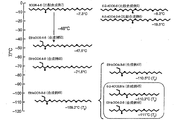
図2は、直鎖アルキル鎖を有する化合物に、エーテル結合、エステル結合または側鎖を導入することによる融点またはガラス転移点低下効果の概略を示す図である。図2において、黒色の丸は酸素原子を表している。 FIG. 2 is a diagram showing an outline of the melting point or glass transition point lowering effect by introducing an ether bond, an ester bond or a side chain into a compound having a linear alkyl chain. In FIG. 2, black circles represent oxygen atoms.
図2に示すように、直鎖アルキル鎖に1以上のエーテル結合を導入することによって、化合物の融点またはガラス転移点を低下させることができる。さらに、導入するエーテル結合の数を増やすと、化合物の融点またはガラス転移点をより低下させることができる。 As shown in FIG. 2, the melting point or glass transition point of the compound can be lowered by introducing one or more ether bonds into the linear alkyl chain. Furthermore, when the number of ether bonds introduced is increased, the melting point or glass transition point of the compound can be further lowered.
また、図2に示すように、オキサアルキル鎖に1以上のエステル結合を導入することによって、化合物の融点またはガラス転移点を低下させることができ、さらに側鎖を導入することによって、化合物の融点またはガラス転移点をさらに低下させることができる。 In addition, as shown in FIG. 2, the melting point of the compound or the glass transition point can be lowered by introducing one or more ester bonds into the oxaalkyl chain, and the melting point of the compound can be decreased by introducing a side chain. Alternatively, the glass transition point can be further reduced.
よって、本発明に係る化合物では、上記オキサアルキル鎖は、分子中に、少なくとも1つのエステル結合をさらに有していることが好ましい。すなわち、本発明に係る化合物では、上記オキサアルキル鎖は、分子中に、少なくとも1つの下記一般式(2)で表される構造単位をさらに有していることが好ましい。 Therefore, in the compound according to the present invention, the oxaalkyl chain preferably further has at least one ester bond in the molecule. That is, in the compound according to the present invention, the oxaalkyl chain preferably further includes at least one structural unit represented by the following general formula (2) in the molecule.
上記「オキサアルキル鎖」におけるエステル結合の数が多いほど、融点またはガラス転移点低下効果や結晶化阻害効果が高くなるが、その一方で、エステル結合の数が多すぎると粘度が上昇してしまうという側面を有する。このため、上記「オキサアルキル鎖」におけるエステル結合の数は、目的に応じて好ましい数を適宜設定すればよい。例えば、本発明に係る化合物を潤滑剤として用いる場合には、金属表面との馴染み性を考慮して、オキサアルキル鎖におけるエステル結合の数が1〜4個であることが好ましく、1〜3個であることがより好ましい。 The greater the number of ester bonds in the “oxaalkyl chain”, the higher the melting point or glass transition point lowering effect and the crystallization inhibiting effect. On the other hand, when the number of ester bonds is too large, the viscosity increases. It has the side. For this reason, what is necessary is just to set suitably the number of the ester bond in said "oxaalkyl chain" according to the objective suitably. For example, when the compound according to the present invention is used as a lubricant, the number of ester bonds in the oxaalkyl chain is preferably 1 to 4 in consideration of compatibility with the metal surface, and 1 to 3 It is more preferable that
図3は、エステル結合を有する直鎖オキサアルキル鎖を有する化合物に、エーテル結合または側鎖を導入することによる融点またはガラス転移点低下効果の概略を示す図である。図3において、「Tg」は、「ガラス転移点」を示している。また、黒色の丸は酸素原子を表している。図3に示すように、直鎖アルキル鎖にエステル結合を導入したオキサアルキル鎖において、エーテル結合をさらに導入すると、エーテル結合の数の増加に応じて化合物の融点またはガラス転移点を低下させることができる。また、エステル結合を導入したオキサアルキル鎖において、側鎖を導入することによって、化合物の融点またはガラス転移点をさらに低下させることができる。 FIG. 3 is a diagram showing an outline of the melting point or glass transition point lowering effect by introducing an ether bond or a side chain into a compound having a linear oxaalkyl chain having an ester bond. In FIG. 3, “T g ” indicates a “glass transition point”. Black circles represent oxygen atoms. As shown in FIG. 3, when an ether bond is further introduced into an oxaalkyl chain in which an ester bond is introduced into a linear alkyl chain, the melting point or glass transition point of the compound may be lowered according to an increase in the number of ether bonds. it can. In addition, by introducing a side chain in an oxaalkyl chain into which an ester bond has been introduced, the melting point or glass transition point of the compound can be further lowered.
なお、上記「オキサアルキル鎖」において、エステル結合が導入されている位置は特に限定されない。 In the “oxaalkyl chain”, the position where the ester bond is introduced is not particularly limited.
オキサアルキル鎖が有している上記「側鎖」の種類は特に限定されるものではなく、分子間相互作用があまり強くなく、嵩張った構造を持つ置換基であれば、化合物の融点またはガラス転移点および動粘度を低下させることができる。このような置換基は、例えば、アルキル基、オキサアルキル基、ハロゲン基およびシリコーン基からなる群から選択することができる。 The kind of the above-mentioned “side chain” possessed by the oxaalkyl chain is not particularly limited, and the melting point of the compound or the glass is not particularly limited as long as the substituent has a bulky structure and does not have a strong intermolecular interaction. The transition point and kinematic viscosity can be reduced. Such substituents can be selected, for example, from the group consisting of alkyl groups, oxaalkyl groups, halogen groups, and silicone groups.
上記「アルキル基」としては、例えば、メチル基、エチル基、n−プロピル基、イソプロピル基等を挙げることができるが、本発明はこれに限定されない。上記「アルキル基」が、空間的・立体的に嵩張ったいびつな構造であるほど分子の充填に不利であるため、本発明に係る化合物の融点またはガラス転移点および動粘度を低下させる効果が高くなる。このため、「側鎖」としての上記「アルキル基」が直鎖構造である場合は、上記「アルキル基」の炭素数が4以下であることが好ましい。これに対して、「側鎖」としての上記「アルキル基」が分岐構造を有する場合は、炭素数が10程度であっても、融点またはガラス転移点低下や結晶化阻害効果が得られる場合がある。 Examples of the “alkyl group” include a methyl group, an ethyl group, an n-propyl group, and an isopropyl group, but the present invention is not limited thereto. Since the above-mentioned “alkyl group” has a spatially and sterically bulky distorted structure, which is more disadvantageous for molecular packing, it has the effect of lowering the melting point or glass transition point and kinematic viscosity of the compound according to the present invention. Get higher. For this reason, when the “alkyl group” as the “side chain” has a linear structure, the “alkyl group” preferably has 4 or less carbon atoms. On the other hand, when the “alkyl group” as the “side chain” has a branched structure, the melting point or the glass transition point may be lowered or the crystallization inhibiting effect may be obtained even if the carbon number is about 10. is there.
また、本明細書において、上記「オキサアルキル基」は、1以上の酸素原子を有しているアルキル基をいう。言い換えれば、上記「オキサアルキル基」は、アルキル基が有しているアルキレン基のうち1以上が、 In the present specification, the “oxaalkyl group” refers to an alkyl group having one or more oxygen atoms. In other words, the “oxaalkyl group” includes one or more of the alkylene groups that the alkyl group has,
で置換されたアルキル基をいう。つまり、上記「オキサアルキル基」においては、酸素原子は、エーテル結合によって炭素原子に結合している。 An alkyl group substituted with. That is, in the above “oxaalkyl group”, the oxygen atom is bonded to the carbon atom by an ether bond.
上記「オキサアルキル基」については、上述した「オキサアルキル基」についての説明を、「オキサアルキル基」についての説明として読み替えることができる。 Regarding the “oxaalkyl group”, the description of the “oxaalkyl group” described above can be read as the description of the “oxaalkyl group”.
ハロゲン基による分子の充填阻害効果は、共有結合半径の大きなものほど高く、I>Br>Cl>Fとなる。これに対して、炭素−ハロゲン結合の安定性は、逆にI<Br<Cl<Fとなる。従って、上記「ハロゲン基」としては、通常は、フッ素基(F基)または塩素基(Cl基)が好ましいが、遮光環境下やマイルドな使用環境下では、臭素基(Br基)も有効である。 The effect of inhibiting the packing of molecules by the halogen group is higher as the covalent bond radius is larger, and I> Br> Cl> F. On the other hand, the stability of the carbon-halogen bond is conversely I <Br <Cl <F. Accordingly, the “halogen group” is usually preferably a fluorine group (F group) or a chlorine group (Cl group), but a bromine group (Br group) is also effective in a light-shielding environment or a mild use environment. is there.
上記「シリコーン基」は、シロキサン結合の繰返し(−(Si−O)n−;nは1以上の整数である。)を主鎖とし、側鎖としてアルキル基、アリール基等を有する重合体からなる置換基を指す。具体的には、下記一般式(3)で表される置換基を指す。 The “silicone group” is a polymer having a main chain of repeating siloxane bonds (— (Si—O) n —; n is an integer of 1 or more) and an alkyl group, an aryl group or the like as a side chain. A substituent. Specifically, it refers to a substituent represented by the following general formula (3).
(一般式(3)中、Rはアルキル基またはアリール基であり、Rは、同一でも異なっていてもよく、nは1以上の整数である。)。 (In general formula (3), R is an alkyl group or an aryl group, R may be the same or different, and n is an integer of 1 or more.)
上記「シリコーン基」としては、かさばった構造を有するものが立体的な充填阻害効果が高いため好ましい。このようなシリコーン基としては、トリメチルシリル基(上記一般式(3)中、n=0であり、Rがメチル基)、tert-ブチルジメチルシリル基(上記一般式(3)中、n=0であり、Rがtert-ブチル基およびメチル基)を挙げることができる。 As the above-mentioned “silicone group”, those having a bulky structure are preferable because they have a high steric filling inhibition effect. Examples of such a silicone group include a trimethylsilyl group (in the general formula (3), n = 0, R is a methyl group), and a tert-butyldimethylsilyl group (in the general formula (3), n = 0. And R is a tert-butyl group and a methyl group).
本発明に係る化合物では、上記「側鎖」の数は特に限定されないが、2以上4以下であれば、化合物の融点またはガラス転移点をより低下させることができるため好ましい。 In the compound according to the present invention, the number of the “side chains” is not particularly limited, but it is preferably 2 or more and 4 or less because the melting point or glass transition point of the compound can be further lowered.
2以上の側鎖が導入されている場合は、導入されている側鎖の全てが同一種類の側鎖であってもよく、2種類以上の側鎖が組み合わせられて導入されていてもよい。 When two or more side chains are introduced, all of the introduced side chains may be the same type of side chains, or two or more types of side chains may be introduced in combination.
なお、上記「オキサアルキル鎖」において、側鎖が導入されている位置は特に限定されない。 In the “oxaalkyl chain”, the position where the side chain is introduced is not particularly limited.
(2)本発明に係る化合物の製造方法
本発明に係る化合物の製造方法は特に限定されるものではなく、従来公知の方法を用いて好適に製造することができる。
(2) Method for Producing Compound According to the Present Invention The method for producing the compound according to the present invention is not particularly limited, and can be suitably produced using a conventionally known method.
以下に、上記化合物の製造方法の一例を示すが、上記化合物の製造方法はこれに限定されるものではない。なお、本明細書では、オキサアルキル鎖として、例えば、「H(CH2)6−O−(CH2)2−O−(CH2)4−」を、「6−2−4−」と省略して記載する場合がある。 Although an example of the manufacturing method of the said compound is shown below, the manufacturing method of the said compound is not limited to this. In this specification, for example, “H (CH 2 ) 6 —O— (CH 2 ) 2 —O— (CH 2 ) 4 —” is replaced with “6-2-4-” as the oxaalkyl chain. Sometimes omitted.
例えば、分岐オキサアルキルエーテルは、(オキサ)アルカンジオール HOROHと、R’Cl(またはR’Br)等のハロゲン化オキサアルカンとを、水酸化ナトリウム水溶液中で、相間移動触媒(例えば、硫酸水素テトラブチルアンモニウム:TBAH(tetrabutylammonium hydrogensulfate))存在下で反応させることによって合成することができる(なお、上記Rおよび上記R’は、分岐アルキル鎖、直鎖アルキル鎖、分岐オキサアルキル鎖または直鎖オキサアルキル鎖であり、上記Rおよび上記R’の少なくとも一方は、分岐オキサアルキル鎖または直鎖オキサアルキル鎖である。)。 For example, a branched oxaalkyl ether is obtained by using (oxa) alkanediol HOROH and a halogenated oxaalkane such as R′Cl (or R′Br) in a sodium hydroxide aqueous solution in a phase transfer catalyst (for example, tetrahydrogensulfate). It can be synthesized by reacting in the presence of butylammonium: TBAH (tetrabutylammonium hydrogensulfate) (wherein R and R ′ are a branched alkyl chain, a linear alkyl chain, a branched oxaalkyl chain, or a linear oxaalkyl) And at least one of R and R ′ is a branched oxaalkyl chain or a linear oxaalkyl chain.
具体的には、例えば、分岐対称ジオキサアルキルエーテルであるH(CH2)6−O−(CH2)2−O−(CH2)4−O−CH2C(CH3)2CH2−O−(CH2)4−O−(CH2)2−O−(CH2)6H(略称:PrMe2(O4−2−6)2)は、以下の反応式(1)に示すように、(オキサ)アルカンジオールとしての2,2−ジメチルプロパンジオール(化学式:HOCH2C(CH3)2CH2OH、略称:PrMe2(OH)2)と、ハロゲン化オキサアルカンとしての6−2−4Cl(PrMe2(OH)2に対して大過剰)とを、50%NaOH水溶液中でTBAH共存下で加熱反応させることによって合成することができる。
Specifically, for example, branched symmetrical di oxaalkyl ether H (CH 2) 6 -O- ( CH 2) 2 -O- (CH 2) 4 -O-CH 2 C (CH 3) 2
また、分岐オキサアルキルエステルは、(オキサ)アルカンジオール HOROHと、オキサアルカン酸R’COOHとを、触媒量の濃硫酸共存下で減圧脱水縮合させることによって合成することができる(なお、上記Rおよび上記R’は、分岐アルキル鎖、直鎖アルキル鎖、分岐オキサアルキル鎖または直鎖オキサアルキル鎖であり、上記Rおよび上記R’の少なくとも一方は、分岐オキサアルキル鎖または直鎖オキサアルキル鎖である。)。 The branched oxaalkyl ester can be synthesized by subjecting (oxa) alkanediol HOROH and oxaalkanoic acid R′COOH to dehydration condensation under reduced pressure in the presence of a catalytic amount of concentrated sulfuric acid (wherein R and R ′ is a branched alkyl chain, a linear alkyl chain, a branched oxaalkyl chain or a linear oxaalkyl chain, and at least one of R and R ′ is a branched oxaalkyl chain or a linear oxaalkyl chain. .)
具体的には、例えば、分岐対称オキサアルキルジエステルであるH(CH2)6−O−(CH2)2−O−(CH2)3−CO−O−CH2C(CH3)2CH2−O−CO−(CH2)3−O−(CH2)2−O−(CH2)6H(略称:(6−2−4OO)2PrMe2)は、以下の反応式(2)に示すように、(オキサ)アルカンジオールとしての2,2−ジメチルプロパンジオール(化学式:HOCH2C(CH3)2CH2OH、略称PrMe2(OH)2)と、オキサアルカン酸としてのH(CH2)6−O−(CH2)2−O−(CH2)3−COOH(略称:6−2−4OOH)とを、触媒量の濃硫酸共存下で減圧脱水縮合させることによって合成することができる。 Specifically, for example, a branched symmetrical oxaalkyl diester H (CH 2) 6 -O- ( CH 2) 2 -O- (CH 2) 3 -CO-O-CH 2 C (CH 3) 2 CH 2 -O-CO- (CH 2) 3 -O- (CH 2) 2 -O- (CH 2) 6 H ( abbreviation: (6-2-4OO) 2 PrMe 2), the following reaction formula (2 ), 2,2-dimethylpropanediol (chemical formula: HOCH 2 C (CH 3 ) 2 CH 2 OH, abbreviated PrMe 2 (OH) 2 ) as (oxa) alkanediol and oxaalkanoic acid as H (CH 2 ) 6 —O— (CH 2 ) 2 —O— (CH 2 ) 3 —COOH (abbreviation: 6-2-4OOH) is subjected to dehydration condensation under reduced pressure in the presence of a catalytic amount of concentrated sulfuric acid. Can be synthesized.
また、例えば、分岐非対称オキサアルキルモノエステルであるH(CH2)4−CH(C2H5)−CO−O−(CH2)4−O−(CH2)2−O−(CH2)6H(略称:EtHxOO4−2−6)は、以下の反応式(3)に示すように、オキサアルカノール(略称:6−2−4OH)と、(オキサ)アルカン酸としての2エチルヘキサン酸(化学式:H(CH2)4−CH(C2H5)−COOH、略称EtHxOOH)とを、触媒量の濃硫酸共存下で減圧脱水縮合させることによって合成することができる。 Further, for example, a branched asymmetric oxaalkyl monoester H (CH 2) 4 -CH ( C 2 H 5) -CO-O- (CH 2) 4 -O- (CH 2) 2 -O- (CH 2 6 H (abbreviation: EtHxOO4-2-6) is composed of oxaalkanol (abbreviation: 6-2-4OH) and 2-ethylhexanoic acid as (oxa) alkanoic acid as shown in the following reaction formula (3): (Chemical formula: H (CH 2 ) 4 —CH (C 2 H 5 ) —COOH, abbreviated EtHxOOH) can be synthesized by dehydration condensation under reduced pressure in the presence of a catalytic amount of concentrated sulfuric acid.
なお、上記ハロゲン化オキサアルカン、上記オキサアルカノール、および上記オキサアルカン酸の製造方法は特に限定されるものではなく、従来公知の方法を用いて好適に製造することができる。 In addition, the manufacturing method of the said halogenated oxaalkane, the said oxaalkanol, and the said oxaalkanoic acid is not specifically limited, It can manufacture suitably using a conventionally well-known method.
例えば、ハロゲン化オキサアルカンの一例である、クロロオキサアルカン(化学式:H(CH2)6−O−(CH2)2−O−(CH2)4Cl、略称:6−2−4Cl)は、以下の反応式(4)に示すように、エチレングリコールモノヘキシルエーテル(化学式:H(CH2)6−O−(CH2)2OH、略称:6−2OH)と、1,4−ジクロロブタン(Cl(CH2)4Cl)(6−2OHに対して過剰)とを、50%NaOH水溶液中でTBAH共存下で加熱反応させることによって合成することができる。 For example, chlorooxaalkane (chemical formula: H (CH 2 ) 6 —O— (CH 2 ) 2 —O— (CH 2 ) 4 Cl, abbreviated name: 6-2-4Cl), which is an example of a halogenated oxaalkane, is As shown in the following reaction formula (4), ethylene glycol monohexyl ether (chemical formula: H (CH 2 ) 6 —O— (CH 2 ) 2 OH, abbreviation: 6-2OH) and 1,4-dichloro Butane (Cl (CH 2 ) 4 Cl) (excess with respect to 6-2OH) can be synthesized by heating in a 50% NaOH aqueous solution in the presence of TBAH.
また、オキサアルカノールの一例である、H(CH2)6−O−(CH2)2−O−(CH2)4OH(略称:6−2−4OH)は、以下の反応式(5)に示すように、6−2OHを、当量のピリジン中で塩化チオニル(SOCl2)と反応させることにより、H(CH2)6−O−(CH2)2Cl(略称:6−2Cl)を合成し、 Further, H (CH 2 ) 6 —O— (CH 2 ) 2 —O— (CH 2 ) 4 OH (abbreviation: 6-2-4OH), which is an example of an oxaalkanol, is represented by the following reaction formula (5). By reacting 6-2OH with thionyl chloride (SOCl 2 ) in an equivalent amount of pyridine, H (CH 2 ) 6 —O— (CH 2 ) 2 Cl (abbreviation: 6-2Cl) is obtained. Synthesize,
次いで、以下の反応式(6)に示すように、6−2Clと、1,4−ブタンジオールHO((CH2)4OH)(6−2Clに対して過剰)とを、50%NaOH水溶液中で相間移動触媒としてのTBAH共存下で加熱反応させることによって合成することができる。 Next, as shown in the following reaction formula (6), 6-2Cl and 1,4-butanediol HO ((CH 2 ) 4 OH) (excess relative to 6-2Cl) are mixed with 50% NaOH aqueous solution. It can be synthesized by heating in the presence of TBAH as a phase transfer catalyst.
また、オキサアルカン酸の一例である、H(CH2)6−O−(CH2)2−O−(CH2)3−COOH(略称:6−2−4OOH)は、以下の反応式(7)に示すように、ジエチレングリコールモノヘキシルエーテル(化学式:H(CH2)6−O−(CH2)2−O−(CH2)2OH、略称:6−2−2OH)を、三臭化リン(PBr3)と反応させることにより、H(CH2)6−O−(CH2)2−O−(CH2)2Br(略称:6−2−2Br)を合成し、 In addition, H (CH 2 ) 6 —O— (CH 2 ) 2 —O— (CH 2 ) 3 —COOH (abbreviation: 6-2-4OOH), which is an example of oxaalkanoic acid, has the following reaction formula ( 7) diethylene glycol monohexyl ether (chemical formula: H (CH 2 ) 6 —O— (CH 2 ) 2 —O— (CH 2 ) 2 OH, abbreviation: 6-2-2OH), H (CH 2 ) 6 —O— (CH 2 ) 2 —O— (CH 2 ) 2 Br (abbreviation: 6-2-2Br) was synthesized by reacting with phosphorus fluoride (PBr 3 ),
次いで、以下の反応式(8)に示すように、マロン酸ジエチルナトリウム((H(CH2)2OCO)2CHNa)と、6−2−2Brとを反応させることにより、マロン酸ジエチルオキサアルキルエーテル((H(CH2)2OCO)2CHO(CH2)2O(CH2)2O(CH2)6H)を合成し、 Next, as shown in the following reaction formula (8), diethyl oxaalkyl malonate is reacted with diethyl sodium malonate ((H (CH 2 ) 2 OCO) 2 CHNa) and 6-2-2Br. Ether ((H (CH 2 ) 2 OCO) 2 CHO (CH 2 ) 2 O (CH 2 ) 2 O (CH 2 ) 6 H) was synthesized,
次いで、以下の反応式(9)に示すように、マロン酸ジエチルオキサアルキルエーテルを濃アルカリ水溶液中で加水分解することにより合成することができる。 Next, as shown in the following reaction formula (9), it can be synthesized by hydrolyzing malonic acid diethyl oxaalkyl ether in a concentrated alkaline aqueous solution.
上記方法により製造された化合物は、従来公知の方法によって、例えば、99.5%以上の高純度に精製することができる。 The compound produced by the above method can be purified to a high purity of, for example, 99.5% or more by a conventionally known method.
(3)本発明に係る化合物の利用
本発明に係る化合物は、同じ分子量の直鎖アルキル鎖を有する化合物または直鎖オキサアルキル鎖を有する化合物と比較して、低融点または低ガラス転移点で、且つ低動粘度であるので、本発明に係る化合物または当該化合物を含有している組成物は、例えば、潤滑剤、可塑剤、界面活性剤、液晶分子、エラストマー、合成樹脂、粘着剤等として好適に用いることができる。なお、上記「本発明に係る化合物」については、上記「(1)本発明に係る化合物」の項で説明したとおりであるので、ここでは説明は省略する。
(3) Utilization of the compound according to the present invention The compound according to the present invention has a low melting point or a low glass transition point compared to a compound having a linear alkyl chain having the same molecular weight or a compound having a linear oxaalkyl chain, And since it has a low kinematic viscosity, the compound according to the present invention or a composition containing the compound is suitable as, for example, a lubricant, a plasticizer, a surfactant, a liquid crystal molecule, an elastomer, a synthetic resin, an adhesive, and the like. Can be used. The above-mentioned “compound according to the present invention” is as described in the section “(1) Compound according to the present invention”, and the description thereof is omitted here.
本発明に係る組成物は、本発明に係る化合物を含有していれば、同じ分子量の直鎖アルキル鎖を有する化合物または直鎖オキサアルキル鎖を有する化合物を含有している組成物と比較して、低融点または低ガラス転移点で、且つ低動粘度の組成物となり得る。このため、当該組成物における本発明に係る化合物の含有量は特に限定されるものではないが、実用的な観点でいえば、上記組成物の総重量に対して、本発明に係る化合物の含有量が、20重量%以上であることが好ましく、50重量%以上であることがより好ましい。本発明に係る組成物において、本発明に係る化合物が上記範囲となるように含有されていれば、当該組成物は、同じ分子量の直鎖アルキル鎖を有する化合物または直鎖オキサアルキル鎖を有する化合物を含有している組成物と比較して、より低融点または低ガラス転移点で、且つ低動粘度の組成物となり得る。 If the composition according to the present invention contains the compound according to the present invention, the composition according to the present invention is compared with a composition containing a compound having a linear alkyl chain of the same molecular weight or a compound having a linear oxaalkyl chain. A composition having a low melting point or a low glass transition point and a low kinematic viscosity can be obtained. Therefore, the content of the compound according to the present invention in the composition is not particularly limited, but from a practical viewpoint, the content of the compound according to the present invention is based on the total weight of the composition. The amount is preferably 20% by weight or more, and more preferably 50% by weight or more. In the composition according to the present invention, if the compound according to the present invention is contained within the above range, the composition is a compound having a linear alkyl chain having the same molecular weight or a compound having a linear oxaalkyl chain. Compared with a composition containing, a composition having a lower melting point or a low glass transition point and a low kinematic viscosity can be obtained.
本発明に係る組成物は、本発明に係る化合物の1種類を単独で含有していてもよいし、複数の種類を組み合わせて含有していてもよい。 The composition according to the present invention may contain one type of the compound according to the present invention alone, or may contain a plurality of types in combination.
以下に、潤滑剤について説明する。 The lubricant will be described below.
(i)本発明に係る潤滑剤
本発明に係る潤滑剤は、本発明に係る化合物を含有していれば、本発明に係る化合物を含有していない以外は同じ組成の潤滑剤と比較して、低融点または低ガラス転移点で、且つ低動粘度の組成物となり得る。このため、潤滑剤における本発明に係る化合物の含有量は特に限定されるものではないが、実用的な観点でいえば、潤滑剤の総重量に対して、20重量%以上であることが好ましく、50重量%以上であることがより好ましい。
(I) Lubricant according to the present invention If the lubricant according to the present invention contains the compound according to the present invention, it is compared with a lubricant having the same composition except that it does not contain the compound according to the present invention. A composition having a low melting point or a low glass transition point and a low kinematic viscosity can be obtained. Therefore, the content of the compound according to the present invention in the lubricant is not particularly limited, but from a practical viewpoint, it is preferably 20% by weight or more based on the total weight of the lubricant. 50% by weight or more is more preferable.
なお、本明細書において、上記「潤滑剤」は、摩擦面を潤滑し、機械効率の向上を計るために用いる物質全般を指している。このため、上記「潤滑剤」は、常温で液体であるものだけに限定されず、常温で固体または半固体物等を排除するものではない。 In the present specification, the above-mentioned “lubricant” refers to all materials used for lubricating the friction surface and improving the mechanical efficiency. For this reason, the “lubricant” is not limited to those that are liquid at room temperature, and does not exclude solids or semi-solids at room temperature.
本発明に係る潤滑剤は、本発明に係る化合物の1種類を単独で含有していてもよいし、本発明に係る化合物の複数の種類を組み合わせて含有していてもよい。 The lubricant according to the present invention may contain one kind of the compound according to the present invention alone, or may contain a plurality of kinds of the compounds according to the present invention in combination.
本発明に係る化合物は、同じ分子量の直鎖アルキル鎖を有する化合物または直鎖オキサアルキル鎖を有する化合物と比較して、低融点または低ガラス転移点で、低動粘度であるので、本発明に係る潤滑剤は、同じ分子量の直鎖アルキル鎖を有する化合物または直鎖オキサアルキル鎖を有する化合物を含有している潤滑剤と比較して、低融点または低ガラス転移点で、且つ低動粘度の潤滑剤となり得る。本発明に係る潤滑剤は、ブレーキ油、有機溶剤、有機熱媒体等としても用いられ得る。 The compound according to the present invention has a low melting point or a low glass transition point and a low kinematic viscosity as compared with a compound having a linear alkyl chain having the same molecular weight or a compound having a linear oxaalkyl chain. Such a lubricant has a low melting point or a low glass transition point and a low kinematic viscosity as compared with a lubricant containing a compound having a linear alkyl chain of the same molecular weight or a compound having a linear oxaalkyl chain. Can be a lubricant. The lubricant according to the present invention can also be used as a brake oil, an organic solvent, an organic heat medium or the like.
なお、本発明に係る潤滑剤が融点を有している場合は、融点が、−40℃以下であることが好ましく、−50℃以下であることがより好ましい。また、ガラス転移点を有している場合は、ガラス転移点が、−80℃以下であることが好ましく、−100℃以下であることがより好ましい。 In addition, when the lubricant concerning this invention has melting | fusing point, it is preferable that melting | fusing point is -40 degrees C or less, and it is more preferable that it is -50 degrees C or less. Moreover, when it has a glass transition point, it is preferable that a glass transition point is -80 degrees C or less, and it is more preferable that it is -100 degrees C or less.
また、本発明に係る潤滑剤は、40℃における動粘度が、50mm2/s以下であり、且つ100℃における動粘度が、6mm2/s以上であることが好ましく、40℃における動粘度が、15mm2/s以下であり、且つ100℃における動粘度が、2mm2/s以上であることがより好ましい。 In addition, the lubricant according to the present invention has a kinematic viscosity at 40 ° C. of 50 mm 2 / s or less and a kinematic viscosity at 100 ° C. of 6 mm 2 / s or more, and the kinematic viscosity at 40 ° C. 15 mm 2 / s or less, and the kinematic viscosity at 100 ° C. is more preferably 2 mm 2 / s or more.
本発明に係る潤滑剤の融点またはガラス転移点および動粘度が上記範囲であれば、かかる潤滑剤を用いた自動車、家電、工業用機械等をより低燃費化または低消費電力化することができるため好ましい。後述する実施例に示した合成例47、49および50の化合物は、融点またはガラス転移点および動粘度が上記範囲であるので、潤滑剤として好適に利用することができる。 If the melting point or glass transition point and kinematic viscosity of the lubricant according to the present invention are in the above ranges, it is possible to further reduce fuel consumption or power consumption of automobiles, home appliances, industrial machines, and the like using such a lubricant. Therefore, it is preferable. Since the compounds of Synthesis Examples 47, 49, and 50 shown in Examples described later have melting points, glass transition points, and kinematic viscosities within the above ranges, they can be suitably used as lubricants.
なお、潤滑剤の「融点」、「ガラス転移点」および「動粘度」は、従来公知の方法によって測定することができる。「融点」および「ガラス転移点」は、例えば、後述する実施例に示しているように、DSC(島津社製、DSC−50)を用いて測定することができる。また、「動粘度」は、例えば、後述する実施例に示しているように、40℃における動粘度および100℃における動粘度を、JIS K 2283に準じ、キャノン−フェンスケ粘度計を用いて測定することができる。 The “melting point”, “glass transition point” and “kinematic viscosity” of the lubricant can be measured by a conventionally known method. The “melting point” and “glass transition point” can be measured using DSC (manufactured by Shimadzu Corp., DSC-50), for example, as shown in Examples described later. The “kinematic viscosity” is measured, for example, using a Canon-Fenske viscometer according to JIS K 2283, as shown in the examples described later. be able to.
(ii)本発明に係る潤滑剤の製造方法
本発明に係る潤滑剤は、潤滑剤の本発明の化合物を基油として配合することによって製造することができる。
(Ii) Method for Producing Lubricant According to the Present Invention The lubricant according to the present invention can be produced by blending the compound of the present invention as a base oil.
潤滑剤の製造方法では、潤滑剤の総重量に対して、本発明に係る化合物が20重量%以上となるように配合することが好ましく、50重量%以上となるように配合することがより好ましい。本発明に係る化合物を、含有量が上記範囲となるように潤滑剤に配合することによって、低融点または低ガラス転移点で、且つ低動粘度の潤滑剤を製造することができる。 In the method for producing a lubricant, the compound according to the present invention is preferably blended so as to be 20% by weight or more, more preferably 50% by weight or more based on the total weight of the lubricant. . By blending the compound according to the present invention in a lubricant so that the content is in the above range, a lubricant having a low melting point or a low glass transition point and a low kinematic viscosity can be produced.
また、本発明に係る潤滑剤の製造方法では、本発明に係る化合物の1種類を単独で配合していてもよいし、本発明に係る化合物の複数の種類を組み合わせて配合していてもよいが、本発明に係る化合物の複数の種類を組み合わせて配合することにより、潤滑剤の物性を連続的に制御することができる。さらに、本発明に係る化合物の複数の種類を組み合わせて配合する場合、同族体の混合状態は理想混合に近いと考えられるので、物性の予測および設計を行う上で有利である。 In the method for producing a lubricant according to the present invention, one type of the compound according to the present invention may be blended alone, or a plurality of types of the compound according to the present invention may be blended in combination. However, the physical properties of the lubricant can be continuously controlled by combining a plurality of types of the compounds according to the present invention. Further, when a plurality of types of the compounds according to the present invention are combined and blended, the mixed state of homologues is considered to be close to ideal mixing, which is advantageous in predicting and designing physical properties.
(4)融点またはガラス転移点および動粘度低下方法
本発明に係る化合物は、直鎖アルキル鎖を有する化合物および/または直鎖オキサアルキル鎖を有する化合物を含有している組成物(以下、「改質対象組成物」と称する)と混合することによって、当該改質対象組成物の融点またはガラス転移点、および動粘度を顕著に低下させることができる。従って、本発明に係る化合物は、「融点またはガラス転移点および動粘度低下剤」と読み替えることもできる。なお、本明細書において、上記「融点またはガラス転移点および動粘度低下剤」とは、「融点またはガラス転移点および動粘度を低下させるための組成物」を意図している。なお、本明細書では、融点を低下させるだけでなく、融点を消失させることも含めて、「融点を低下させる」と表現している。
(4) Melting point or glass transition point and kinematic viscosity lowering method The compound according to the present invention comprises a composition containing a compound having a linear alkyl chain and / or a compound having a linear oxaalkyl chain (hereinafter referred to as “modified”). The melting point or glass transition point and kinematic viscosity of the composition to be modified can be significantly reduced. Therefore, the compound according to the present invention can be read as “melting point or glass transition point and kinematic viscosity reducing agent”. In the present specification, the above-mentioned “melting point or glass transition point and kinematic viscosity reducing agent” intends “a composition for reducing the melting point or glass transition point and kinematic viscosity”. In the present specification, not only lowering the melting point but also reducing the melting point is expressed as “lowering the melting point”.
上記「改質対象組成物」としては、直鎖アルキル鎖を有する化合物および/または直鎖オキサアルキル鎖を有する化合物を含有している組成物であれば特に限定されない。このような「改質対象組成物」としては、例えば、潤滑剤、可塑剤、界面活性剤、液晶分子、エラストマー、合成樹脂、粘着剤等を挙げることができる。 The “reformation target composition” is not particularly limited as long as it is a composition containing a compound having a linear alkyl chain and / or a compound having a linear oxaalkyl chain. Examples of such a “composition to be modified” include a lubricant, a plasticizer, a surfactant, a liquid crystal molecule, an elastomer, a synthetic resin, and an adhesive.
本発明に係る方法(「融点またはガラス転移点および動粘度低下方法」ともいう)は、上記改質対象組成物の融点またはガラス転移点および動粘度を低下させるために、本発明に係る化合物と、改質対象組成物とを混合する工程を含んでいればよい。 The method according to the present invention (also referred to as “melting point or glass transition point and kinematic viscosity lowering method”) is used to reduce the melting point or glass transition point and kinematic viscosity of the composition to be modified with the compound according to the present invention. It is only necessary to include a step of mixing the composition to be modified.
発明に係る化合物と、改質対象組成物とを混合する割合は特に限定されないが、改質対象組成物の総重量に対して、本発明に係る化合物が20重量%以上となるように混合することが好ましく、50重量%以上となるように混合することがより好ましい。本発明に係る化合物の含有量が上記範囲となるように改質対象組成物と混合することによって、改質対象組成物の融点またはガラス転移点および動粘度を効果的に低下させることができる。 The ratio of mixing the compound according to the invention and the composition to be modified is not particularly limited, but is mixed so that the compound according to the present invention is 20% by weight or more based on the total weight of the composition to be modified. It is preferable that mixing is performed so that the amount becomes 50% by weight or more. By mixing with the composition to be modified such that the content of the compound according to the present invention is in the above range, the melting point or glass transition point and kinematic viscosity of the composition to be modified can be effectively reduced.
なお、発明に係る化合物と混合した後の改質対象組成物の融点またはガラス転移点が、発明に係る化合物と混合する前の改質対象組成物の融点またはガラス転移点よりも低下していれば、改質対象組成物の融点またはガラス転移点が低下したと判断することができる。また、発明に係る化合物と混合した後の改質対象組成物の動粘度が、発明に係る化合物と混合する前の改質対象組成物の動粘度よりも低下していれば、改質対象組成物の動粘度が低下したと判断することができる。なお、改質対象組成物の「融点」、「ガラス転移点」および「動粘度」の測定方法については、上記「(3)本発明に係る化合物の利用」の項で説明したとおりであるので、ここでは説明は省略する。 The melting point or glass transition point of the composition to be modified after mixing with the compound according to the invention may be lower than the melting point or glass transition point of the composition to be modified before mixing with the compound according to the invention. For example, it can be determined that the melting point or glass transition point of the composition to be modified has decreased. Further, if the kinematic viscosity of the composition to be modified after mixing with the compound according to the invention is lower than the kinematic viscosity of the composition to be modified before mixing with the compound according to the invention, the composition to be modified It can be determined that the kinematic viscosity of the product has decreased. The method for measuring the “melting point”, “glass transition point” and “kinematic viscosity” of the composition to be modified is as described in the above section “(3) Use of the compound according to the present invention”. The description is omitted here.
本発明に係る方法では、改質対象組成物に対して、本発明に係る化合物の1種類を単独で混合していてもよいし、本発明に係る化合物の複数の種類を組み合わせて混合してもよいが、本発明に係る化合物の複数の種類を組み合わせて混合することにより、改質対象組成物の物性を連続的に制御することができる。さらに、本発明に係る化合物の複数の種類を組み合わせて混合する場合、同族体の混合状態は理想混合に近いと考えられるので、改質対象組成物の物性の予測および設計を行う上で有利である。 In the method according to the present invention, one type of the compound according to the present invention may be singly mixed with the composition to be modified, or a plurality of types of the compound according to the present invention may be combined and mixed. However, the physical properties of the composition to be modified can be continuously controlled by combining and mixing a plurality of types of the compounds according to the present invention. Furthermore, when mixing a plurality of types of compounds according to the present invention in combination, it is considered that the mixed state of homologues is close to ideal mixing, which is advantageous in predicting and designing physical properties of the composition to be modified. is there.
なお、これは一般的にベース化合物に、この化合物よりも低融点化合物を混合することによる融点の低下で説明できる。混合する化合物同士に特殊な結合が偶然生じない場合はほぼ成り立つ。共融混合物や固溶体を作る混合物の一般的な特徴である。 In general, this can be explained by a decrease in melting point by mixing a base compound with a compound having a lower melting point than this compound. This is almost true if there is no accidental special bond between the compounds to be mixed. It is a general feature of eutectic mixtures and mixtures that form solid solutions.
本発明は上述した各実施形態に限定されるものではなく、請求項に示した範囲で種々の変更が可能であり、異なる実施形態にそれぞれ開示された技術的手段を適宜組み合わせて得られる実施形態についても本発明の技術的範囲に含まれる。 The present invention is not limited to the above-described embodiments, and various modifications are possible within the scope shown in the claims, and embodiments obtained by appropriately combining technical means disclosed in different embodiments. Is also included in the technical scope of the present invention.
以下、本発明を実施例により具体的に説明するが、本発明は実施例によって限定されるものではない。 EXAMPLES Hereinafter, although an Example demonstrates this invention concretely, this invention is not limited by an Example.
本実施例における化合物名の表記方法を説明する。オキサアルキル鎖として、例えば、「H(CH2)6−O−(CH2)2−O−(CH2)4−」を、「6−2−4−」と省略して記載する。記載方法は、メチレン基(−CH2−)nおよびエーテル結合(−O−)を、それぞれ、数字とハイフン(−)とに省略して記載し、式中の数字は、メチレン基(−CH2−)の数nを示している。また、末端基の記載がないものは、末端が水素原子であることを示している。 The notation method of the compound name in a present Example is demonstrated. As the oxaalkyl chain, for example, “H (CH 2 ) 6 —O— (CH 2 ) 2 —O— (CH 2 ) 4 —” is abbreviated as “6-2-4-”. In the description method, a methylene group (—CH 2 —) n and an ether bond (—O—) are respectively abbreviated to a number and a hyphen (—), and the number in the formula is a methylene group (—CH 2). The number n of 2- ) is shown. Moreover, what has no description of a terminal group has shown that the terminal is a hydrogen atom.
また、分岐アルキル鎖の場合は、−CH2−CH(CH3)−CH2−;−CH2−C(CH3)2−CH2−;−CH2−C(C2H5)2−CH2−;−CH2−C(C2H5)(CH2−)−CH2−;H(CH2)4−CH(C2H5)−C−を、それぞれ、−PrMe−;−PrMe2−;−PrEt2−;−PrEt−;EtHx−と省略して記載する。 In the case of a branched alkyl chain, —CH 2 —CH (CH 3 ) —CH 2 —; —CH 2 —C (CH 3 ) 2 —CH 2 —; —CH 2 —C (C 2 H 5 ) 2 -CH 2 -; - CH 2 -C (C 2 H 5) (CH 2 -) - CH 2 -; H (CH 2) 4 -CH (C 2 H 5) -C- and each, -PrMe- -PrMe2-; -PrEt2-; -PrEt-; EtHx-.
〔実施例1〕
合成例を以下に示す。
[Example 1]
A synthesis example is shown below.
[原料系]
<モノオキサアルカノール>
〔合成例1:H−(CH2)6−O−(CH2)3−OH(略称:6−3OH)の製造〕
H−(CH2)6−Cl(174.8g)と、HO−(CH2)3−OH(430.2g)とを、50%水酸化ナトリウム水溶液(136.5g)中で、TBAH(23.4g)存在下、85℃、21時間反応させることにより、H−(CH2)6−O−(CH2)3−OHを製造した。
[Raw materials]
<Monooxaalkanol>
[Synthesis Example 1: Production of H— (CH 2 ) 6 —O— (CH 2 ) 3 —OH (abbreviation: 6-3OH)]
H— (CH 2 ) 6 —Cl (174.8 g) and HO— (CH 2 ) 3 —OH (430.2 g) were added to 50% aqueous sodium hydroxide (136.5 g) in TBAH (23 0.4 g) H- (CH 2 ) 6 —O— (CH 2 ) 3 —OH was produced by reacting in the presence at 85 ° C. for 21 hours.
〔合成例2:H−(CH2)6−O−(CH2)4−OH(略称:6−4OH)の製造〕
H−(CH2)6−Cl(166g)と、HO−(CH2)4−OH(381.3g)とを、50%水酸化ナトリウム水溶液(127.0g)中で、TBAH(46.8g)存在下、80℃、22時間反応させることにより、H−(CH2)6−O−(CH2)4−OHを製造した。
[Synthesis Example 2: Production of H— (CH 2 ) 6 —O— (CH 2 ) 4 —OH (abbreviation: 6-4OH)]
H— (CH 2 ) 6 —Cl (166 g) and HO— (CH 2 ) 4 —OH (381.3 g) were mixed with TBAH (46.8 g) in a 50% aqueous sodium hydroxide solution (127.0 g). H- (CH 2 ) 6 —O— (CH 2 ) 4 —OH was produced by reacting in the presence at 80 ° C. for 22 hours.
<クロロモノオキサアルカン>
〔合成例3:H−(CH2)4−O−(CH2)2−Cl(略称:4−2Cl)の製造〕
窒素気流下で、H−(CH2)4−O−(CH2)2−OH(177.3g)と、ピリジン(177.8g)との溶液に塩化チオニル(267.8g)を滴下し、80℃で3時間反応させることにより、H−(CH2)4−O−(CH2)2−Cl(4−2Cl)を製造した。
<Chloromonooxaalkane>
[Synthesis Example 3: Production of H— (CH 2 ) 4 —O— (CH 2 ) 2 —Cl (abbreviation: 4-2Cl)]
Under a nitrogen stream, thionyl chloride (267.8 g) was added dropwise to a solution of H— (CH 2 ) 4 —O— (CH 2 ) 2 —OH (177.3 g) and pyridine (177.8 g). By reacting at 80 ° C. for 3 hours, H— (CH 2 ) 4 —O— (CH 2 ) 2 —Cl (4-2Cl) was produced.
〔合成例4:H−(CH2)6−O−(CH2)2−Cl(略称:6−2Cl)の製造〕
窒素気流下で、H−(CH2)6−O−(CH2)2−OH(198.9g)と、ピリジン(157.5g)との溶液に塩化チオニル(222.8g)を滴下し、80℃で2時間反応させることにより、H−(CH2)6−O−(CH2)2−Clを製造した。
[Synthesis Example 4: Production of H— (CH 2 ) 6 —O— (CH 2 ) 2 —Cl (abbreviation: 6-2Cl)]
Under a nitrogen stream, thionyl chloride (222.8 g) was added dropwise to a solution of H— (CH 2 ) 6 —O— (CH 2 ) 2 —OH (198.9 g) and pyridine (157.5 g), By reacting at 80 ° C. for 2 hours, H— (CH 2 ) 6 —O— (CH 2 ) 2 —Cl was produced.
〔合成例5:H−(CH2)6−O−(CH2)3−Cl(略称:6−3Cl)の製造〕
窒素気流下で、合成例1で得られたH−(CH2)6−O−(CH2)3−OH(167.2g)と、ピリジン(115.5g)との溶液に塩化チオニル(173.7g)を滴下し、80℃で2時間反応させることにより、H−(CH2)6−O−(CH2)3−Clを製造した。
Synthesis Example 5: H- (CH 2) 6 -O- (CH 2) 3 -Cl ( abbreviation: 6-3Cl) production of]
Under a nitrogen stream, thionyl chloride (173) was added to a solution of H— (CH 2 ) 6 —O— (CH 2 ) 3 —OH (167.2 g) obtained in Synthesis Example 1 and pyridine (115.5 g). 0.7 g) was added dropwise and reacted at 80 ° C. for 2 hours to produce H— (CH 2 ) 6 —O— (CH 2 ) 3 —Cl.
〔合成例6:H−(CH2)6−O−(CH2)4−Cl(略称:6−4Cl)の製造〕
H−(CH2)6−O−H(124.2g)と、Cl−(CH2)4−Cl(465.7g)とを、50%水酸化ナトリウム水溶液(119.1g)中で、TBAH(43.3g)存在下、82℃、22時間反応させることにより、H−(CH2)6−O−(CH2)4−Clを製造した。
[Synthesis Example 6: Production of H— (CH 2 ) 6 —O— (CH 2 ) 4 —Cl (abbreviation: 6-4Cl)]
H— (CH 2 ) 6 —O—H (124.2 g) and Cl— (CH 2 ) 4 —Cl (465.7 g) were mixed with TBAH in 50% aqueous sodium hydroxide solution (119.1 g). In the presence of (43.3 g), the reaction was carried out at 82 ° C. for 22 hours to produce H— (CH 2 ) 6 —O— (CH 2 ) 4 —Cl.
〔合成例7:H−(CH2)6−O−(CH2)6−Cl(略称:6−6Cl)の製造〕
H−(CH2)6−OH(74.5g)と、Cl−(CH2)6−Cl(460.2g)とを、50%水酸化ナトリウム水溶液(69.8g)中で、TBAH(22.8g)存在下、85℃、24時間反応させることにより、H−(CH2)6−O−(CH2)6−Clを製造した。
Synthesis Example 7: H- (CH 2) 6 -O- (CH 2) 6 -Cl ( abbreviation: 6-6Cl) production of]
H— (CH 2 ) 6 —OH (74.5 g) and Cl— (CH 2 ) 6 —Cl (460.2 g) were mixed with 50% aqueous sodium hydroxide (69.8 g) in TBAH (22 .8G) presence, 85 ° C., by reaction for 24 hours, H- (CH 2) 6 -O- (CH 2) was produced 6 -Cl.
〔合成例8:H−(CH2)8−O−(CH2)4−Cl(略称:8−4Cl)の製造〕
H−(CH2)8−OH(100.3g)と、Cl−(CH2)4−Cl(170.7g)とを、50%水酸化ナトリウム水溶液(78.2g)中で、TBAH(52.7g)存在下、85℃、24時間反応させることにより、H−(CH2)8−O−(CH2)4−Clを製造した。
[Synthesis Example 8: Production of H— (CH 2 ) 8 —O— (CH 2 ) 4 —Cl (abbreviation: 8-4Cl)]
H— (CH 2 ) 8 —OH (100.3 g) and Cl— (CH 2 ) 4 —Cl (170.7 g) were mixed with 50% aqueous sodium hydroxide (78.2 g) in TBAH (52 .7G) presence, 85 ° C., by reaction for 24 hours, H- (CH 2) 8 -O- ( was CH 2) to produce a 4 -Cl.
<ジオキサアルカノール>
〔合成例9:H−(CH2)4−O−(CH2)2−O−(CH2)4−OH(略称:4−2−4OH)の製造〕
合成例3で得られたH−(CH2)4−O−(CH2)2−Cl(略称:4−2Cl、116.0g)と、HO−(CH2)4−OH(305.8g)とを、50%水酸化ナトリウム水溶液(85.2g)中で、TBAH(24.7g)存在下、80℃、23時間反応させることにより、H−(CH2)4−O−(CH2)2−O−(CH2)4−OHを製造した。
<Dioxaalkanol>
Synthesis Example 9: H- (CH 2) 4 -O- (CH 2) 2 -O- (CH 2) 4 -OH ( abbreviation: 4-2-4OH) production of]
H— (CH 2 ) 4 —O— (CH 2 ) 2 —Cl (abbreviation: 4-2Cl, 116.0 g) obtained in Synthesis Example 3 and HO— (CH 2 ) 4 —OH (305.8 g) ) In a 50% aqueous sodium hydroxide solution (85.2 g) in the presence of TBAH (24.7 g) at 80 ° C. for 23 hours, to give H— (CH 2 ) 4 —O— (CH 2 ) 2 -O- (CH 2 ) 4 -OH was prepared.
〔合成例10:H−(CH2)6−O−(CH2)2−O−(CH2)6−OH(略称:6−2−6OH)の製造〕
合成例4で得られたH−(CH2)6−O−(CH2)2−Cl(略称:6−2Cl、172g)と、HO−(CH2)6−OH(372.4g)とを、50%水酸化ナトリウム水溶液(102.9g)中で、TBAH(36.5g)存在下、84℃、22時間反応させることにより、H−(CH2)6−O−(CH2)2−O−(CH2)6−OHを製造した。
Synthesis Example 10: H- (CH 2) 6 -O- (CH 2) 2 -O- (CH 2) 6 -OH ( abbreviation: 6-2-6OH) production of]
H— (CH 2 ) 6 —O— (CH 2 ) 2 —Cl (abbreviation: 6-2Cl, 172 g) obtained in Synthesis Example 4 and HO— (CH 2 ) 6 —OH (372.4 g) Is reacted in a 50% aqueous sodium hydroxide solution (102.9 g) in the presence of TBAH (36.5 g) at 84 ° C. for 22 hours to give H— (CH 2 ) 6 —O— (CH 2 ) 2. —O— (CH 2 ) 6 —OH was prepared.
〔合成例11:H−(CH2)6−O−(CH2)3−O−(CH2)4−OH(6−3−4OH)の製造〕
合成例5で得られたH−(CH2)6−O−(CH2)3−Cl(略称:6−3Cl、66.5g)と、HO(CH2)4OH(100.6g)とを、50%水酸化ナトリウム水溶液(35.7g)中で、TBAH(6.3g)存在下、90℃、24時間反応させることにより、H−(CH2)6−O−(CH2)3−O−(CH2)4−OHを製造した。
Synthesis Example 11 Production of H— (CH 2 ) 6 —O— (CH 2 ) 3 —O— (CH 2 ) 4 —OH (6-3-4OH)
H— (CH 2 ) 6 —O— (CH 2 ) 3 —Cl (abbreviation: 6-3Cl, 66.5 g) obtained in Synthesis Example 5 and HO (CH 2 ) 4 OH (100.6 g) Is reacted in a 50% aqueous solution of sodium hydroxide (35.7 g) in the presence of TBAH (6.3 g) at 90 ° C. for 24 hours to give H— (CH 2 ) 6 —O— (CH 2 ) 3. —O— (CH 2 ) 4 —OH was prepared.
〔合成例12:H−(CH2)6−O−(CH2)3−O−(CH2)6−OH(略称:6−3−6OH)の製造〕
合成例5で得られたH−(CH2)6−O−(CH2)3−Cl(略称:6−3Cl、67.4g)と、HO−(CH2)6−OH(98g)とを、50%水酸化ナトリウム水溶液(27.2g)中で、TBAH(7.5g)存在下、83℃、24時間反応させることにより、H−(CH2)6−O−(CH2)3−O−(CH2)6−OHを製造した。
[Synthesis Example 12: Production of H— (CH 2 ) 6 —O— (CH 2 ) 3 —O— (CH 2 ) 6 —OH (abbreviation: 6-3-6OH)]
H— (CH 2 ) 6 —O— (CH 2 ) 3 —Cl (abbreviation: 6-3Cl, 67.4 g) obtained in Synthesis Example 5 and HO— (CH 2 ) 6 —OH (98 g) Is reacted in a 50% aqueous sodium hydroxide solution (27.2 g) in the presence of TBAH (7.5 g) at 83 ° C. for 24 hours to give H— (CH 2 ) 6 —O— (CH 2 ) 3. —O— (CH 2 ) 6 —OH was prepared.
〔合成例13:H−(CH2)6−O−(CH2)4−O−(CH2)6−OH(6−4−6OH)の製造〕
合成例6で得られたH−(CH2)6−O−(CH2)4−Cl(略称:6−4Cl、51.2g)と、HO−(CH2)6−OH(92.6g)とを、50%水酸化ナトリウム水溶液(24.9g)中で、TBAH(9.9g)存在下、80℃、21時間反応させることにより、H−(CH2)6−O−(CH2)4−O−(CH2)6−OHを製造した。
Synthesis Example 13 Production of H— (CH 2 ) 6 —O— (CH 2 ) 4 —O— (CH 2 ) 6 —OH (6-4-6OH)
Obtained in Synthesis Example 6 H- (CH 2) 6 -O- (CH 2) 4 -Cl ( abbreviation: 6-4Cl, 51.2g) and, HO- (CH 2) 6 -OH (92.6g ) In a 50% aqueous sodium hydroxide solution (24.9 g) in the presence of TBAH (9.9 g) at 80 ° C. for 21 hours, to give H— (CH 2 ) 6 —O— (CH 2 ) 4 -O- (CH 2) was produced 6 -OH.
〔合成例14:H−(CH2)8−O−(CH2)4−O−(CH2)4−OH(略称:8−4−4OH)の製造〕
合成例8で得られたH−(CH2)8−O−(CH2)4−Cl(略称:8−4Cl、47.2g)と、HO(CH2)4OH(65.4g)とを、50%水酸化ナトリウム水溶液(24.5g)中で、TBAH(4.2g)存在下、90℃、24時間反応させることにより、H−(CH2)8−O−(CH2)4−O−(CH2)4−OHを製造した。
Synthesis Example 14 Production of H— (CH 2 ) 8 —O— (CH 2 ) 4 —O— (CH 2 ) 4 —OH (abbreviation: 8-4-4OH)
H— (CH 2 ) 8 —O— (CH 2 ) 4 —Cl (abbreviation: 8-4Cl, 47.2 g) obtained in Synthesis Example 8 and HO (CH 2 ) 4 OH (65.4 g) Is reacted in a 50% aqueous solution of sodium hydroxide (24.5 g) in the presence of TBAH (4.2 g) at 90 ° C. for 24 hours to give H— (CH 2 ) 8 —O— (CH 2 ) 4. —O— (CH 2 ) 4 —OH was prepared.
<クロロジオキサアルカン>
〔合成例15:H−(CH2)6−O−(CH2)2−O−(CH2)4−Cl(略称:6−2−4Cl)の製造〕
H−(CH2)6−O−(CH2)2−O−H(183.1g)と、Cl−(CH2)4−Cl(563.3g)とを、50%水酸化ナトリウム水溶液(124.2g)中で、TBAH(21.1g)存在下、90℃、24時間反応させることにより、H−(CH2)6−O−(CH2)2−O−(CH2)4−Clを製造した。
<Chlorodioxaalkane>
Synthesis Example 15: H- (CH 2) 6 -O- (CH 2) 2 -O- (CH 2) 4 -Cl ( abbreviation: 6-2-4Cl) production of]
H— (CH 2 ) 6 —O— (CH 2 ) 2 —O—H (183.1 g) and Cl— (CH 2 ) 4 —Cl (563.3 g) were mixed with 50% aqueous sodium hydroxide solution ( In 124.2 g) in the presence of TBAH (21.1 g) at 90 ° C. for 24 hours, whereby H— (CH 2 ) 6 —O— (CH 2 ) 2 —O— (CH 2 ) 4 — Cl was produced.
〔合成例16:H−(CH2)6−O−(CH2)2−O−(CH2)6−Cl(略称:6−2−6Cl)の製造〕
H−(CH2)6−O−(CH2)2−O−H(157.9g)と、Cl−(CH2)6−Cl(353.2g)とを、50%水酸化ナトリウム水溶液(106.2g)中で、TBAH(25.5g)存在下、82℃、18時間反応させることにより、H−(CH2)6−O−(CH2)2−O−(CH2)6−Clを製造した。
Synthesis Example 16 Production of H— (CH 2 ) 6 —O— (CH 2 ) 2 —O— (CH 2 ) 6 —Cl (abbreviation: 6-2-6Cl)
H— (CH 2 ) 6 —O— (CH 2 ) 2 —O—H (157.9 g) and Cl— (CH 2 ) 6 —Cl (353.2 g) were mixed with 50% aqueous sodium hydroxide solution ( In 106.2 g) in the presence of TBAH (25.5 g) at 82 ° C. for 18 hours to produce H— (CH 2 ) 6 —O— (CH 2 ) 2 —O— (CH 2 ) 6 —. Cl was produced.
〔合成例17:H−(CH2)6−O−(CH2)3−O−(CH2)4−Cl(略称:6−3−4Cl)の製造〕
H−(CH2)6−O−(CH2)3−O−H(51.9g)と、Cl−(CH2)4−Cl(159.4g)とを、50%水酸化ナトリウム水溶液(32.8g)中で、TBAH(5.6g)存在下、90℃、23時間反応させることにより、H−(CH2)6−O−(CH2)3−O−(CH2)4−Clを製造した。
Synthesis Example 17 Production of H— (CH 2 ) 6 —O— (CH 2 ) 3 —O— (CH 2 ) 4 —Cl (abbreviation: 6-3-4Cl)
H— (CH 2 ) 6 —O— (CH 2 ) 3 —O—H (51.9 g) and Cl— (CH 2 ) 4 —Cl (159.4 g) were mixed with 50% aqueous sodium hydroxide ( 32.8 g) in the presence of TBAH (5.6 g) at 90 ° C. for 23 hours, thereby causing H— (CH 2 ) 6 —O— (CH 2 ) 3 —O— (CH 2 ) 4 —. Cl was produced.
<ブロモオキサアルカン(オキサアルカン酸原料)>
〔合成例18:H−(CH2)6−O−(CH2)2−Br(略称:6−2Br)の製造〕
窒素気流下で、H−(CH2)6−O−(CH2)2−O−H(49.2g)にPBr3(30.9g)を滴下し、120℃で2時間反応させることにより、H−(CH2)6−O−(CH2)2−Brを製造した。
<Bromooxaalkane (Oxaalkanoic acid raw material)>
[Synthesis Example 18: Production of H— (CH 2 ) 6 —O— (CH 2 ) 2 —Br (abbreviation: 6-2Br)]
Under a nitrogen stream, PBr 3 (30.9 g) was dropped into H— (CH 2 ) 6 —O— (CH 2 ) 2 —O—H (49.2 g) and reacted at 120 ° C. for 2 hours. , H- (CH 2) 6 -O- (CH 2) was prepared 2 -Br.
〔合成例19:H−(CH2)6−O−(CH2)4−Br(略称:6−4Br)の製造〕
窒素気流下で、H−(CH2)6−O−(CH2)2−O−H(107g)にPBr3(60.4g)を滴下し、120℃で2時間反応させることにより、H−(CH2)6−O−(CH2)4−Brを製造した。
[Synthesis Example 19: Production of H— (CH 2 ) 6 —O— (CH 2 ) 4 —Br (abbreviation: 6-4Br)]
Under a nitrogen stream, PBr 3 (60.4 g) was added dropwise to H— (CH 2 ) 6 —O— (CH 2 ) 2 —O—H (107 g) and reacted at 120 ° C. for 2 hours. - and (CH 2) 6 -O- (CH 2) to produce a 4 -Br.
〔合成例20:H−(CH2)6−O−(CH2)2−O−(CH2)2−Br(略称:6−2−2Br)の製造〕
窒素気流下で、H−(CH2)6−O−(CH2)2−O−(CH2)2−O−H(57.7g)にPBr3(37.1g)を滴下し、120℃で2時間反応させることにより、H−(CH2)6−O−(CH2)2−O−(CH2)2−Brを製造した。
Synthesis Example 20: H- (CH 2) 6 -O- (CH 2) 2 -O- (CH 2) 2 -Br ( abbreviation: 6-2-2Br) production of]
Under a nitrogen stream, PBr 3 (37.1 g) was added dropwise to H— (CH 2 ) 6 —O— (CH 2 ) 2 —O— (CH 2 ) 2 —O—H (57.7 g). by reacting for 2 hours at ° C., H- and (CH 2) 6 -O- (CH 2) 2 -O- (CH 2) to produce a 2 -Br.
<オキサアルカン酸(マロン酸エステル合成)>
〔合成例21:H−(CH2)6−O−(CH2)5−CO−O−H(略称:6−6OOH)の製造〕
窒素気流下で、99%エタノール(235.4g)と、Na(16.3g)とを反応させ、更にマロン酸ジエチル(125.6g)を反応させ、40℃で、合成例19で得られたH−(CH2)6−O−(CH2)4−Br(略称:6−4Br)(144.7g)を滴下し、50℃で24時間反応させた。
<Oxaalkanoic acid (malonic ester synthesis)>
[Synthesis Example 21: Production of H— (CH 2 ) 6 —O— (CH 2 ) 5 —CO—O—H (abbreviation: 6-6OOH)]
Under a nitrogen stream, 99% ethanol (235.4 g) and Na (16.3 g) were reacted, and diethyl malonate (125.6 g) was further reacted, which was obtained in Synthesis Example 19 at 40 ° C. H— (CH 2 ) 6 —O— (CH 2 ) 4 —Br (abbreviation: 6-4Br) (144.7 g) was added dropwise and reacted at 50 ° C. for 24 hours.
得られたマロン酸ジエチルオキサアルキルエーテル((H−(CH2)2−O−CO)2−CH−O−(CH2)4−O−(CH2)6−H)(108.5g)を、50%水酸化カリウム(72.3g)により100℃で2時間加水分解させることにより、H−(CH2)6−O−(CH2)5−CO−O−Hを製造した。 The resulting malonic acid diethyl oxaalkyl ether ((H— (CH 2 ) 2 —O—CO) 2 —CH—O— (CH 2 ) 4 —O— (CH 2 ) 6 —H) (108.5 g) Was hydrolyzed with 50% potassium hydroxide (72.3 g) at 100 ° C. for 2 hours to produce H— (CH 2 ) 6 —O— (CH 2 ) 5 —CO—O—H.
〔合成例22:H−(CH2)6−O−(CH2)2−O−(CH2)3−CO−O−H(略称:6−2−4OOH)の製造〕
窒素気流下で、99%エタノール(138g)と、Na(10.5g)とを反応させ、更にマロン酸ジエチル(75.2g)を反応させ、40℃で、合成例20で得られたH−(CH2)6−O−(CH2)2−O−(CH2)2−Br(略称:6−2−2Br、105.5g)を滴下し、50℃で21時間反応させた。
Synthesis Example 22: H- (CH 2) 6 -O- (CH 2) 2 -O- (CH 2) 3 -CO-O-H ( abbreviation: 6-2-4OOH) production of]
Under a nitrogen stream, 99% ethanol (138 g) and Na (10.5 g) were reacted, and diethyl malonate (75.2 g) was further reacted, and the H − obtained in Synthesis Example 20 was obtained at 40 ° C. (CH 2 ) 6 —O— (CH 2 ) 2 —O— (CH 2 ) 2 —Br (abbreviation: 6-2-2Br, 105.5 g) was added dropwise and reacted at 50 ° C. for 21 hours.
得られたマロン酸ジエチルオキサアルキルエーテル((H−(CH2)2−O−CO)2−CH−O−(CH2)2−O−(CH2)2−O−(CH2)6−H)(123.2g)を、50%水酸化カリウム(66.7g)により100℃で2時間加水分解させることにより、H−(CH2)6−O−(CH2)2−O−(CH2)3−CO−O−Hを製造した。 The resulting malonic acid diethyl oxaalkyl ether ((H— (CH 2 ) 2 —O—CO) 2 —CH—O— (CH 2 ) 2 —O— (CH 2 ) 2 —O— (CH 2 ) 6 -H) (123.2 g) was hydrolyzed with 50% potassium hydroxide (66.7 g) at 100 ° C. for 2 hours to give H— (CH 2 ) 6 —O— (CH 2 ) 2 —O—. (CH 2 ) 3 —CO—O—H was produced.
<側鎖オキサアルコール>
〔合成例23:H−(CH2)6−O−CH2−C(CH3)2−CH2−O−H(略称:6−PrMe2OH)の製造〕
H−(CH2)6−Cl(32.9g)と、H−O−CH2−C(CH3)2−CH2−O−H(105.3g)とを、50%水酸化ナトリウム水溶液(28g)中で、TBAH(8.6g)存在下、90℃、24時間反応させることにより、H−(CH2)6−O−CH2−C(CH3)2−CH2−O−H(略称:6−PrMe2OH)を製造した。
<Side chain oxa alcohol>
Synthesis Example 23: H- (CH 2) 6 -O-CH 2 -C (CH 3) 2 -CH 2 -O-H ( abbreviation: 6-PrMe2OH) production of]
H— (CH 2 ) 6 —Cl (32.9 g) and H—O—CH 2 —C (CH 3 ) 2 —CH 2 —O—H (105.3 g) were mixed with 50% aqueous sodium hydroxide solution. (28 g) in the presence of TBAH (8.6 g) at 90 ° C. for 24 hours, thereby causing H— (CH 2 ) 6 —O—CH 2 —C (CH 3 ) 2 —CH 2 —O—. H (abbreviation: 6-PrMe 2 OH) was produced.
〔合成例24:H−(CH2)12−O−CH2−C(CH3)2−CH2−O−H(略称:12−PrMe2OH)の製造〕
H−(CH2)12−Br(100.6g)と、H−O−CH2−C(CH3)2−CH2−O−H(160g)とを、50%水酸化ナトリウム水溶液(41.9g)中で、TBAH(14.1g)存在下、90℃、13時間反応させることにより、H−(CH2)12−O−CH2−C(CH3)2−CH2−O−H(略称:12−PrMe2OH)を製造した。
[Synthesis Example 24: Production of H— (CH 2 ) 12 —O—CH 2 —C (CH 3 ) 2 —CH 2 —O—H (abbreviation: 12-PrMe 2 OH)]
H— (CH 2 ) 12 —Br (100.6 g) and H—O—CH 2 —C (CH 3 ) 2 —CH 2 —O—H (160 g) were mixed with 50% aqueous sodium hydroxide solution (41 9 g) in the presence of TBAH (14.1 g) at 90 ° C. for 13 hours, thereby causing H— (CH 2 ) 12 —O—CH 2 —C (CH 3 ) 2 —CH 2 —O—. H (abbreviation: 12-PrMe 2 OH) was manufactured.
[生成物系(エーテル・エステル)]
<直鎖対称ジエーテル>
〔比較合成例1:H−(CH2)12−O−(CH2)3−O−(CH2)12−H(略称:3(O12)2)の製造〕
H−(CH2)12−Cl(76.7g)と、H−O−(CH2)3−O−H(9.3g)とを、50%水酸化ナトリウム水溶液(30.8g)、TBAH(8.4g)存在下、90℃、48時間反応させることにより、H−(CH2)12−O−(CH2)3−O−(CH2)12−Hを製造した。
[Product system (ether ester)]
<Linear symmetric diether>
Comparative Synthesis Example 1: H- (CH 2) 12 -O- (CH 2) 3 -O- (CH 2) 12 -H ( abbreviation: 3 (O12) 2) preparation of]
H— (CH 2 ) 12 —Cl (76.7 g), H—O— (CH 2 ) 3 —O—H (9.3 g), 50% aqueous sodium hydroxide solution (30.8 g), TBAH (8.4 g) was allowed to react at 90 ° C. for 48 hours to produce H— (CH 2 ) 12 —O— (CH 2 ) 3 —O— (CH 2 ) 12 —H.
〔比較合成例2:H−(CH2)8−O−(CH2)4−O−(CH2)3−O−(CH2)4−O−(CH2)8−H(略称3(O4−8)2):の製造〕
合成例8で得られたH−(CH2)8−O−(CH2)4−Cl(略称:8−4Cl、74.8g)と、H−O−(CH2)3−O−H(11.3g)とを、50%水酸化ナトリウム水溶液(30.8g)、TBAH(7.7g)存在下、90℃、24時間反応させた後、50%水酸化ナトリウム水溶液を少量添加し、さらに24.5時間反応させることにより、H−(CH2)8−O−(CH2)4−O−(CH2)3−O−(CH2)4−O−(CH2)8−Hを製造した。
[Comparative Synthesis Example 2: H— (CH 2 ) 8 —O— (CH 2 ) 4 —O— (CH 2 ) 3 —O— (CH 2 ) 4 —O— (CH 2 ) 8 —H (abbreviation 3) (O4-8) 2 ): Production]
H— (CH 2 ) 8 —O— (CH 2 ) 4 —Cl (abbreviation: 8-4Cl, 74.8 g) obtained in Synthesis Example 8 and H—O— (CH 2 ) 3 —O—H (11.3 g) was reacted in the presence of 50% aqueous sodium hydroxide (30.8 g) and TBAH (7.7 g) at 90 ° C. for 24 hours, and then a small amount of 50% aqueous sodium hydroxide was added. By further reacting for 24.5 hours, H— (CH 2 ) 8 —O— (CH 2 ) 4 —O— (CH 2 ) 3 —O— (CH 2 ) 4 —O— (CH 2 ) 8 — H was produced.
〔比較合成例3:H−(CH2)6−O−(CH2)6−O−(CH2)3−O−(CH2)6−O−(CH2)6−H(略称:3(O6−6)2)の製造〕
合成例7で得られたH−(CH2)6−O−(CH2)6−Cl(略称:6−6Cl、81.6g)と、H−O−(CH2)3−O−H(9.2g)とを、50%水酸化ナトリウム水溶液(34.0g)、TBAH(7.8g)存在下、90℃、24時間反応させた後、50%水酸化ナトリウム水溶液を少量添加し、さらに24.5時間反応させることにより、H−(CH2)6−O−(CH2)6−O−(CH2)3−O−(CH2)6−O−(CH2)6−Hを製造した。
[Comparative Synthesis Example 3: H— (CH 2 ) 6 —O— (CH 2 ) 6 —O— (CH 2 ) 3 —O— (CH 2 ) 6 —O— (CH 2 ) 6 —H (abbreviation: 3 (O6-6) 2 )]
H— (CH 2 ) 6 —O— (CH 2 ) 6 —Cl (abbreviation: 6-6Cl, 81.6 g) obtained in Synthesis Example 7 and H—O— (CH 2 ) 3 —O—H (9.2 g) in the presence of 50% aqueous sodium hydroxide (34.0 g) and TBAH (7.8 g) at 90 ° C. for 24 hours, and then added a small amount of 50% aqueous sodium hydroxide, By further reacting for 24.5 hours, H— (CH 2 ) 6 —O— (CH 2 ) 6 —O— (CH 2 ) 3 —O— (CH 2 ) 6 —O— (CH 2 ) 6 — H was produced.
〔比較合成例4:H−(CH2)6−O−(CH2)2−O−(CH2)4−O−(CH2)3−O−(CH2)4−O−(CH2)2−O−(CH2)6−H(略称:3(O4−2−6)2)の製造〕
合成例15で得られたH−(CH2)6−O−(CH2)2−O−(CH2)4−Cl(略称:6−2−4Cl、47.0g)と、H−O−(CH2)3−O−H(6.0g)とを、50%水酸化ナトリウム水溶液(22.1g)、TBAH(5.1g)存在下、90℃、24時間反応させた後、50%水酸化ナトリウム水溶液を少量添加し、さらに24時間反応させることによりH−(CH2)6−O−(CH2)2−O−(CH2)4−O−(CH2)3−O−(CH2)4−O−(CH2)2−O−(CH2)6−Hを製造した。
[Comparative Synthesis Example 4: H— (CH 2 ) 6 —O— (CH 2 ) 2 —O— (CH 2 ) 4 —O— (CH 2 ) 3 —O— (CH 2 ) 4 —O— (CH 2 ) Production of 2- O— (CH 2 ) 6 —H (abbreviation: 3 (O4-2-6) 2 )]
H— (CH 2 ) 6 —O— (CH 2 ) 2 —O— (CH 2 ) 4 —Cl (abbreviation: 6-2-4Cl, 47.0 g) obtained in Synthesis Example 15 and H—O — (CH 2 ) 3 —O—H (6.0 g) was reacted in the presence of 50% aqueous sodium hydroxide (22.1 g) and TBAH (5.1 g) at 90 ° C. for 24 hours. A small amount of an aqueous solution of sodium hydroxide was added, and the mixture was further reacted for 24 hours, whereby H— (CH 2 ) 6 —O— (CH 2 ) 2 —O— (CH 2 ) 4 —O— (CH 2 ) 3 —O. - (CH 2) 4 -O- ( CH 2) 2 -O- (CH 2) was produced 6 -H.
〔比較合成例5:H−(CH2)6−O−(CH2)2−O−(CH2)6−O−(CH2)3−O−(CH2)6−O−(CH2)2−O−(CH2)6−H(略称:3(O6−2−6)2)の製造〕
合成例16で得られたH−(CH2)6−O−(CH2)2−O−(CH2)6−Cl(43.7g)と、H−O−(CH2)3−O−H(4.1g)とを、50%水酸化ナトリウム水溶液(16g)、ジエチレングリコールジメチルエーテル(8.3g)中で、TBAH(3.8g)存在下、90℃、48時間反応させることにより、H−(CH2)6−O−(CH2)2−O−(CH2)6−O−(CH2)3−O−(CH2)6−O−(CH2)2−O−(CH2)6−Hを製造した。
[Comparative Synthesis Example 5: H— (CH 2 ) 6 —O— (CH 2 ) 2 —O— (CH 2 ) 6 —O— (CH 2 ) 3 —O— (CH 2 ) 6 —O— (CH 2 ) Production of 2- O— (CH 2 ) 6 —H (abbreviation: 3 (O6-2-6) 2 )]
H— (CH 2 ) 6 —O— (CH 2 ) 2 —O— (CH 2 ) 6 —Cl (43.7 g) obtained in Synthesis Example 16 and H—O— (CH 2 ) 3 —O -H (4.1 g) is reacted in a 50% aqueous sodium hydroxide solution (16 g) and diethylene glycol dimethyl ether (8.3 g) in the presence of TBAH (3.8 g) at 90 ° C. for 48 hours. - (CH 2) 6 -O- ( CH 2) 2 -O- (CH 2) 6 -O- (CH 2) 3 -O- (CH 2) 6 -O- (CH 2) 2 -O- ( CH 2) to produce a 6 -H.
<直鎖対称モノエステル>
〔比較合成例6:H−(CH2)6−O−(CH2)2−O−(CH2)3−CO−O−(CH2)4−O−(CH2)2−O−(CH2)6−H(略称:6−2−4OO4−2−6)の製造〕
合成例22で得られたH−(CH2)6−O−(CH2)2−O−(CH2)3−CO−O−H(7.7g)と、H−(CH2)6−O−(CH2)2−O−(CH2)4−O−H(6.8g)とを、酸触媒H2SO4(0.16ml)と共に、80℃、4時間減圧下で反応させることにより、H−(CH2)6−O−(CH2)2−O−(CH2)3−CO−O−(CH2)4−O−(CH2)2−O−(CH2)6−Hを製造した。
<Linear symmetrical monoester>
[Comparative Synthesis Example 6: H— (CH 2 ) 6 —O— (CH 2 ) 2 —O— (CH 2 ) 3 —CO—O— (CH 2 ) 4 —O— (CH 2 ) 2 —O— Production of (CH 2 ) 6 -H (abbreviation: 6-2-4OO4-2-6)]
H— (CH 2 ) 6 —O— (CH 2 ) 2 —O— (CH 2 ) 3 —CO—O—H (7.7 g) obtained in Synthesis Example 22 and H— (CH 2 ) 6 —O— (CH 2 ) 2 —O— (CH 2 ) 4 —O—H (6.8 g) was reacted with an acid catalyst H 2 SO 4 (0.16 ml) at 80 ° C. under reduced pressure for 4 hours. H— (CH 2 ) 6 —O— (CH 2 ) 2 —O— (CH 2 ) 3 —CO—O— (CH 2 ) 4 —O— (CH 2 ) 2 —O— (CH 2 ) 6- H was produced.
<直鎖非対称モノエステル>
〔比較合成例7:H−(CH2)7−CO−O−(CH2)6−O−(CH2)4−O−(CH2)6−H(略称:8OO6−4−6)の製造〕
H−(CH2)7−CO−O−H(3.8g)と、H−(CH2)6−O−(CH2)4−O−(CH2)6−O−H(5.3g)とを、酸触媒H2SO4(0.1ml)と共に、80℃、4時間減圧下で反応させることにより、H−(CH2)7−CO−O−(CH2)6−O−(CH2)4−O−(CH2)6−Hを製造した。
<Linear asymmetric monoester>
[Comparative Synthesis Example 7: H— (CH 2 ) 7 —CO—O— (CH 2 ) 6 —O— (CH 2 ) 4 —O— (CH 2 ) 6 —H (abbreviation: 8OO 6-4-6) Manufacturing of〕
H— (CH 2 ) 7 —CO—O—H (3.8 g) and H— (CH 2 ) 6 —O— (CH 2 ) 4 —O— (CH 2 ) 6 —O—H (5. 3 g) together with an acid catalyst H 2 SO 4 (0.1 ml) at 80 ° C. for 4 hours under reduced pressure to produce H— (CH 2 ) 7 —CO—O— (CH 2 ) 6 —O. - (CH 2) 4 -O- ( CH 2) was produced 6 -H.
〔比較合成例8:H−(CH2)6−O−(CH2)2−O−(CH2)3−CO−O−(CH2)12−H(略称:6−2−4OO12)の製造〕
合成例22で得られたH−(CH2)6−O−(CH2)2−O−(CH2)3−CO−O−H(7.6g)と、H−(CH2)12−O−H(8.4g)とを、酸触媒H2SO4(0.18ml)と共に、80℃、4時間減圧下で反応させることにより、H−(CH2)6−O−(CH2)2−O−(CH2)3−CO−O−(CH2)12−Hを製造した。
[Comparative Synthesis Example 8: H— (CH 2 ) 6 —O— (CH 2 ) 2 —O— (CH 2 ) 3 —CO—O— (CH 2 ) 12 —H (abbreviation: 6-2-4OO12) Manufacturing of〕
H— (CH 2 ) 6 —O— (CH 2 ) 2 —O— (CH 2 ) 3 —CO—O—H (7.6 g) obtained in Synthesis Example 22 and H— (CH 2 ) 12 By reacting —O—H (8.4 g) with an acid catalyst H 2 SO 4 (0.18 ml) at 80 ° C. under reduced pressure for 4 hours, H— (CH 2 ) 6 —O— (CH 2) 2 -O- (CH 2) 3 -CO-O- (CH 2) were produced 12 -H.
〔比較合成例9:H−(CH2)6−O−(CH2)2−O−(CH2)3−CO−O−(CH2)6−O−(CH2)6−H(略称:6−2−4OO6−6)の製造〕
合成例22で得られたH−(CH2)6−O−(CH2)2−O−(CH2)3−CO−O−H(8.9g)と、H−(CH2)6−O−(CH2)6−O−H(6.3g)とを、酸触媒H2SO4(0.16ml)と共に、80℃、4時間減圧下で反応させることにより、H−(CH2)6−O−(CH2)2−O−(CH2)3−CO−O−(CH2)6−O−(CH2)6−Hを製造した。
[Comparative Synthesis Example 9: H— (CH 2 ) 6 —O— (CH 2 ) 2 —O— (CH 2 ) 3 —CO—O— (CH 2 ) 6 —O— (CH 2 ) 6 —H ( Abbreviation: Production of 6-2-4OO6-6)]
H— (CH 2 ) 6 —O— (CH 2 ) 2 —O— (CH 2 ) 3 —CO—O—H (8.9 g) obtained in Synthesis Example 22 and H— (CH 2 ) 6 By reacting —O— (CH 2 ) 6 —O—H (6.3 g) with an acid catalyst H 2 SO 4 (0.16 ml) at 80 ° C. under reduced pressure for 4 hours, H— (CH 2 ) 6- O— (CH 2 ) 2 —O— (CH 2 ) 3 —CO—O— (CH 2 ) 6 —O— (CH 2 ) 6 —H was prepared.
<分岐対称ジエーテル>
〔合成例25:H−(CH2)12−O−CH2−CH(CH3)−CH2−O−(CH2)12−H(略称:PrMe(O12)2)の製造〕
H−(CH2)12−Cl(44.8g)と、H−O−CH2−CH(CH3)−CH2−O−H(6.3g)とを、50%水酸化ナトリウム水溶液(12.8g)中で、TBAH(1.9g)存在下、85℃、51時間反応させることにより、H−(CH2)12−O−CH2−CH(CH3)−CH2−O−(CH2)12−Hを製造した。
<Branch symmetric diether>
Synthesis Example 25 Production of H— (CH 2 ) 12 —O—CH 2 —CH (CH 3 ) —CH 2 —O— (CH 2 ) 12 —H (abbreviation: PrMe (O12) 2 )
H— (CH 2 ) 12 —Cl (44.8 g) and H—O—CH 2 —CH (CH 3 ) —CH 2 —O—H (6.3 g) were mixed with 50% aqueous sodium hydroxide solution ( In 12.8 g) in the presence of TBAH (1.9 g) at 85 ° C. for 51 hours to produce H— (CH 2 ) 12 —O—CH 2 —CH (CH 3 ) —CH 2 —O—. and (CH 2) to produce a 12 -H.
〔合成例26:H−(CH2)8−O−(CH2)4−O−CH2−CH(CH3)−CH2−O−(CH2)4−O−(CH2)8−H(略称:PrMe(O4−8)2)の製造〕
合成例8で得られたH−(CH2)8−O−(CH2)4−Cl(48.9g)と、H−O−CH2−CH(CH3)−CH2−O−H(6.0g)とを、50%水酸化ナトリウム水溶液(12.4g)中で、TBAH(1.6g)存在下、85℃、48時間反応させることにより、H−(CH2)8−O−(CH2)4−O−CH2−CH(CH3)−CH2−O−(CH2)4−O−(CH2)8−Hを製造した。
[Synthesis Example 26: H— (CH 2 ) 8 —O— (CH 2 ) 4 —O—CH 2 —CH (CH 3 ) —CH 2 —O— (CH 2 ) 4 —O— (CH 2 ) 8 Production of —H (abbreviation: PrMe (O4-8) 2 )]
H— (CH 2 ) 8 —O— (CH 2 ) 4 —Cl (48.9 g) obtained in Synthesis Example 8 and H—O—CH 2 —CH (CH 3 ) —CH 2 —O—H (6.0 g) in a 50% aqueous solution of sodium hydroxide (12.4 g) in the presence of TBAH (1.6 g) at 85 ° C. for 48 hours to give H— (CH 2 ) 8 —O. - (CH 2) 4 -O- CH 2 -CH (CH 3) -CH 2 -O- (CH 2) 4 -O- (CH 2) was prepared 8 -H.
〔合成例27:H−(CH2)6−O−(CH2)6−O−CH2−CH(CH3)−CH2−O−(CH2)6−O−(CH2)6−H(略称:PrMe(O6−6)2)の製造〕
合成例7で得られたH−(CH2)6−O−(CH2)6−Cl(49.5g)と、H−O−CH2−CH(CH3)−CH2−O−H(5.7g)とを、50%水酸化ナトリウム水溶液(11.9g)中で、TBAH(1.9g)存在下、85℃、48時間反応させることにより、H−(CH2)6−O−(CH2)6−O−CH2−CH(CH3)−CH2−O−(CH2)6−O−(CH2)6−Hを製造した。
[Synthesis Example 27: H— (CH 2 ) 6 —O— (CH 2 ) 6 —O—CH 2 —CH (CH 3 ) —CH 2 —O— (CH 2 ) 6 —O— (CH 2 ) 6 Production of —H (abbreviation: PrMe (O6-6) 2 )]
H— (CH 2 ) 6 —O— (CH 2 ) 6 —Cl (49.5 g) obtained in Synthesis Example 7 and H—O—CH 2 —CH (CH 3 ) —CH 2 —O—H (5.7 g) in a 50% aqueous solution of sodium hydroxide (11.9 g) in the presence of TBAH (1.9 g) at 85 ° C. for 48 hours to give H— (CH 2 ) 6 —O. — (CH 2 ) 6 —O—CH 2 —CH (CH 3 ) —CH 2 —O— (CH 2 ) 6 —O— (CH 2 ) 6 —H was prepared.
〔合成例28:H−(CH2)6−O−(CH2)2−O−(CH2)4−O−CH2−CH(CH3)−CH2−O−(CH2)4−O−(CH2)2−O−(CH2)6−H(略称:PrMe(O4−2−6)2)の製造〕
合成例15で得られたH−(CH2)6−O−(CH2)2−O−(CH2)4−Cl(50g)と、H−O−CH2−CH(CH3)−CH2−O−H(5.2g)とを、50%水酸化ナトリウム水溶液(14.9g)中で、TBAH(4.2g)存在下、90℃、48時間反応させることにより、H−(CH2)6−O−(CH2)2−O−(CH2)4−O−CH2−CH(CH3)−CH2−O−(CH2)4−O−(CH2)2−O−(CH2)6−Hを製造した。
[Synthesis Example 28: H— (CH 2 ) 6 —O— (CH 2 ) 2 —O— (CH 2 ) 4 —O—CH 2 —CH (CH 3 ) —CH 2 —O— (CH 2 ) 4 Production of —O— (CH 2 ) 2 —O— (CH 2 ) 6 —H (abbreviation: PrMe (O4-2-6) 2 )]
H— (CH 2 ) 6 —O— (CH 2 ) 2 —O— (CH 2 ) 4 —Cl (50 g) obtained in Synthesis Example 15 and H—O—CH 2 —CH (CH 3 ) — By reacting CH 2 —O—H (5.2 g) in 50% aqueous sodium hydroxide solution (14.9 g) in the presence of TBAH (4.2 g) at 90 ° C. for 48 hours, H— ( CH 2) 6 -O- (CH 2 ) 2 -O- (CH 2) 4 -O-CH 2 -CH (CH 3) -CH 2 -O- (CH 2) 4 -O- (CH 2) 2 —O— (CH 2 ) 6 —H was prepared.
〔合成例29:H−(CH2)6−O−(CH2)2−O−(CH2)6−O−CH2−CH(CH3)−CH2−O−(CH2)6−O−(CH2)2−O−(CH2)6−H(略称:PrMe(O6−2−6)2)の製造〕
合成例16で得られたH−(CH2)6−O−(CH2)2−O−(CH2)6−Cl(41.9g)と、H−O−CH2−CH(CH3)−CH2−O−H(6.5g)とを、50%水酸化ナトリウム水溶液(10.2g)中で、TBAH(1.4g)存在下、85℃、47時間反応させることにより、H−(CH2)6−O−(CH2)2−O−(CH2)6−O−CH2−CH(CH3)−CH2−O−(CH2)6−O−(CH2)2−O−(CH2)6−Hを製造した。
[Synthesis Example 29: H— (CH 2 ) 6 —O— (CH 2 ) 2 —O— (CH 2 ) 6 —O—CH 2 —CH (CH 3 ) —CH 2 —O— (CH 2 ) 6 Production of —O— (CH 2 ) 2 —O— (CH 2 ) 6 —H (abbreviation: PrMe (O6-2-6) 2 )]
H— (CH 2 ) 6 —O— (CH 2 ) 2 —O— (CH 2 ) 6 —Cl (41.9 g) obtained in Synthesis Example 16 and H—O—CH 2 —CH (CH 3) ) —CH 2 —O—H (6.5 g) in a 50% aqueous sodium hydroxide solution (10.2 g) in the presence of TBAH (1.4 g) at 85 ° C. for 47 hours, - (CH 2) 6 -O- ( CH 2) 2 -O- (CH 2) 6 -O-CH 2 -CH (CH 3) -CH 2 -O- (CH 2) 6 -O- (CH 2 ) 2 -O- (CH 2 ) 6 -H was produced.
〔合成例30:H−(CH2)12−O−CH2−C(CH3)2−CH2−O−(CH2)12−H(略称:PrMe2(O12)2)の製造〕
H−(CH2)12−Cl(32.5g)と、H−O−CH2−C(CH3)2−CH2−O−H(5.3g)とを、50%水酸化ナトリウム水溶液(22.5g)およびジエチレングリコールジメチルエーテル(17.3g)中で、TBAH(1.9g)存在下、80℃、24時間反応させることにより、H−(CH2)12−O−CH2−C(CH3)2−CH2−O−(CH2)12−Hを製造した。
Synthesis Example 30: H- (CH 2) 12 -O-CH 2 -C (CH 3) 2 -CH 2 -O- (CH 2) 12 -H ( abbreviation: PrMe2 (O12) 2) preparation of]
H— (CH 2 ) 12 —Cl (32.5 g) and H—O—CH 2 —C (CH 3 ) 2 —CH 2 —O—H (5.3 g) were mixed with 50% aqueous sodium hydroxide solution. (22.5 g) and diethylene glycol dimethyl ether (17.3 g) in the presence of TBAH (1.9 g) at 80 ° C. for 24 hours to give H— (CH 2 ) 12 —O—CH 2 —C ( CH 3) 2 -CH 2 -O- ( CH 2) were produced 12 -H.
〔合成例31:H−(CH2)8−O−(CH2)4−O−CH2−C(CH3)2−CH2−O−(CH2)4−O−(CH2)8−H(略称:PrMe2(O4−8)2)の製造〕
合成例8で得られたH−(CH2)8−O−(CH2)4−Cl(67.2g)と、H−O−CH2−C(CH3)2−CH2−O−H(10.4g)とを、50%水酸化ナトリウム水溶液(30.5g)およびジエチレングリコールジメチルエーテル(9.9g)中で、TBAH(7.1g)存在下、90℃で24時間反応させた後50%水酸化ナトリウム水溶液を少量添加し、さらに24時間反応させることにより、H−(CH2)8−O−(CH2)4−O−CH2−C(CH3)2−CH2−O−(CH2)4−O−(CH2)8−Hを製造した。
[Synthesis Example 31: H— (CH 2 ) 8 —O— (CH 2 ) 4 —O—CH 2 —C (CH 3 ) 2 —CH 2 —O— (CH 2 ) 4 —O— (CH 2 ) Production of 8- H (abbreviation: PrMe2 (O4-8) 2 )]
H— (CH 2 ) 8 —O— (CH 2 ) 4 —Cl (67.2 g) obtained in Synthesis Example 8 and H—O—CH 2 —C (CH 3 ) 2 —CH 2 —O— H (10.4 g) was reacted in a 50% aqueous sodium hydroxide solution (30.5 g) and diethylene glycol dimethyl ether (9.9 g) in the presence of TBAH (7.1 g) at 90 ° C. for 24 hours. A small amount of an aqueous solution of sodium hydroxide was added, and the mixture was further reacted for 24 hours, whereby H— (CH 2 ) 8 —O— (CH 2 ) 4 —O—CH 2 —C (CH 3 ) 2 —CH 2 —O. — (CH 2 ) 4 —O— (CH 2 ) 8 —H was prepared.
〔合成例32:H−(CH2)6−O−(CH2)6−O−CH2−C(CH3)2−CH2−O−(CH2)6−O−(CH2)6−H(略称:PrMe2(O6−6)2)の製造〕
合成例7で得られたH−(CH2)6−O−(CH2)6−Cl(79.5g)と、H−O−CH2−C(CH3)2−CH2−O−H(10.5g)とを、50%水酸化ナトリウム水溶液(24.4g)およびジエチレングリコールジメチルエーテル(11.7g)中で、TBAH(7.0g)存在下、90℃で5時間反応させた後50%水酸化ナトリウム水溶液を少量添加し、さらに16時間反応後に50%水酸化ナトリウム水溶液を少量添加し、引き続き13時間反応させることにより、H−(CH2)6−O−(CH2)6−O−CH2−C(CH3)2−CH2−O−(CH2)6−O−(CH2)6−Hを製造した。
[Synthesis Example 32: H— (CH 2 ) 6 —O— (CH 2 ) 6 —O—CH 2 —C (CH 3 ) 2 —CH 2 —O— (CH 2 ) 6 —O— (CH 2 ) Production of 6- H (abbreviation: PrMe2 (O6-6) 2 )]
H— (CH 2 ) 6 —O— (CH 2 ) 6 —Cl (79.5 g) obtained in Synthesis Example 7 and H—O—CH 2 —C (CH 3 ) 2 —CH 2 —O— H (10.5 g) was reacted in a 50% aqueous sodium hydroxide solution (24.4 g) and diethylene glycol dimethyl ether (11.7 g) in the presence of TBAH (7.0 g) at 90 ° C. for 5 hours. A small amount of aqueous sodium hydroxide solution was added, and after a further 16 hours of reaction, a small amount of 50% aqueous sodium hydroxide solution was added, followed by reaction for 13 hours, whereby H— (CH 2 ) 6 —O— (CH 2 ) 6 — O—CH 2 —C (CH 3 ) 2 —CH 2 —O— (CH 2 ) 6 —O— (CH 2 ) 6 —H was prepared.
〔合成例33:H−(CH2)4−O−(CH2)2−O−(CH2)4−O−CH2−C(CH3)2−CH2−O−(CH2)4−O−(CH2)2−O−(CH2)4−H(略称:PrMe2(O4−2−4)2)の製造〕
H−(CH2)4−O−(CH2)2−O−(CH2)4−Cl(21.0g)と、H−O−CH2−C(CH3)2−CH2−O−H(3.5g)とを、50%水酸化ナトリウム水溶液(8.0g)およびジエチレングリコールジメチルエーテル(6.4g)中で、TBAH(1.2g)存在下、80℃で24時間反応させることにより、H−(CH2)4−O−(CH2)2−O−(CH2)4−O−CH2−C(CH3)2−CH2−O−(CH2)4−O−(CH2)2−O−(CH2)4−Hを製造した。
[Synthesis Example 33: H— (CH 2 ) 4 —O— (CH 2 ) 2 —O— (CH 2 ) 4 —O—CH 2 —C (CH 3 ) 2 —CH 2 —O— (CH 2 ) 4 -O- (CH 2) 2 -O- (CH 2) 4 -H ( abbreviation: PrMe2 (O4-2-4) 2) preparation of]
H— (CH 2 ) 4 —O— (CH 2 ) 2 —O— (CH 2 ) 4 —Cl (21.0 g) and H—O—CH 2 —C (CH 3 ) 2 —CH 2 —O -H (3.5 g) in a 50% aqueous sodium hydroxide solution (8.0 g) and diethylene glycol dimethyl ether (6.4 g) in the presence of TBAH (1.2 g) at 80 ° C. for 24 hours. , H- (CH 2) 4 -O- (CH 2) 2 -O- (CH 2) 4 -O-CH 2 -C (CH 3) 2 -CH 2 -O- (CH 2) 4 -O- and (CH 2) 2 -O- (CH 2) to produce a 4 -H.
〔合成例34:H−(CH2)6−O−(CH2)2−O−(CH2)4−O−CH2−C(CH3)2−CH2−O−(CH2)4−O−(CH2)2−O−(CH2)6−H(略称:PrMe2(O4−2−6)2)の製造〕
合成例15で得られたH−(CH2)6−O−(CH2)2−O−(CH2)4−Cl(122.1g)と、H−O−CH2−C(CH3)2−CH2−O−H(19.9g)とを、50%水酸化ナトリウム水溶液(47.5g)、ジエチレングリコールジメチルエーテル(26.2g)中で、TBAH(13.9g)存在下、90℃、50時間反応させることにより、H−(CH2)6−O−(CH2)2−O−(CH2)4−O−CH2−C(CH3)2−CH2−O−(CH2)4−O−(CH2)2−O−(CH2)6−Hを製造した。
[Synthesis Example 34: H— (CH 2 ) 6 —O— (CH 2 ) 2 —O— (CH 2 ) 4 —O—CH 2 —C (CH 3 ) 2 —CH 2 —O— (CH 2 ) 4 -O- (CH 2) 2 -O- (CH 2) 6 -H ( abbreviation: PrMe2 (O4-2-6) 2) preparation of]
H— (CH 2 ) 6 —O— (CH 2 ) 2 —O— (CH 2 ) 4 —Cl (122.1 g) obtained in Synthesis Example 15 and H—O—CH 2 —C (CH 3 ) 2- CH 2 —O—H (19.9 g) in a 50% aqueous sodium hydroxide solution (47.5 g) and diethylene glycol dimethyl ether (26.2 g) at 90 ° C. in the presence of TBAH (13.9 g). , by reacting 50 hours, H- (CH 2) 6 -O- (CH 2) 2 -O- (CH 2) 4 -O-CH 2 -C (CH 3) 2 -CH 2 -O- ( CH 2) 4 -O- (CH 2 ) 2 -O- (CH 2) was produced 6 -H.
〔合成例35:H−(CH2)6−O−(CH2)3−O−(CH2)4−O−CH2−C(CH3)2−CH2−O−(CH2)4−O−(CH2)3−O−(CH2)6−H(略称:PrMe2(O4−3−6)2)の製造〕
合成例17で得られたH−(CH2)6−O−(CH2)3−O−(CH2)4−Cl(99%24g)と、H−O−CH2−C(CH3)2−CH2−O−H(3.3g)とを、50%水酸化ナトリウム水溶液(7.8g)、ジエチレングリコールジメチルエーテル(5.8g)中で、TBAH(2g)存在下、90℃、48時間反応させることにより、H−(CH2)6−O−(CH2)3−O−(CH2)4−O−CH2−C(CH3)2−CH2−O−(CH2)4−O−(CH2)3−O−(CH2)6−Hを製造した。
[Synthesis Example 35: H— (CH 2 ) 6 —O— (CH 2 ) 3 —O— (CH 2 ) 4 —O—CH 2 —C (CH 3 ) 2 —CH 2 —O— (CH 2 ) 4- O— (CH 2 ) 3 —O— (CH 2 ) 6 —H (abbreviation: PrMe2 (O4-3-6) 2 )]
H— (CH 2 ) 6 —O— (CH 2 ) 3 —O— (CH 2 ) 4 —Cl (99% 24 g) obtained in Synthesis Example 17 and H—O—CH 2 —C (CH 3 ) 2- CH 2 —O—H (3.3 g) in 50% aqueous sodium hydroxide (7.8 g) and diethylene glycol dimethyl ether (5.8 g) in the presence of TBAH (2 g) at 90 ° C., 48 by the time the reaction, H- (CH 2) 6 -O- (CH 2) 3 -O- (CH 2) 4 -O-CH 2 -C (CH 3) 2 -CH 2 -O- (CH 2 ) 4 -O- (CH 2) 3 -O- (CH 2) was produced 6 -H.
〔合成例36:H−(CH2)6−O−(CH2)2−O−(CH2)6−O−CH2−C(CH3)2−CH2−O−(CH2)6−O−(CH2)2−O−(CH2)6−H(略称:PrMe2(O6−2−6)2)の製造〕
合成例16で得られたH−(CH2)6−O−(CH2)2−O−(CH2)6−Cl(101.0g)と、H−O−CH2−C(CH3)2−CH2−O−H(12.5g)とを、50%水酸化ナトリウム水溶液(36.2g)およびジエチレングリコールジメチルエーテル(18.4g)中で、TBAH(8.5g)存在下、90℃で24時間反応させた後50%水酸化ナトリウム水溶液を少量添加し、さらに24時間反応させることにより、H−(CH2)6−O−(CH2)2−O−(CH2)6−O−CH2−C(CH3)2−CH2−O−(CH2)6−O−(CH2)2−O−(CH2)6−Hを製造した。
[Synthesis Example 36: H— (CH 2 ) 6 —O— (CH 2 ) 2 —O— (CH 2 ) 6 —O—CH 2 —C (CH 3 ) 2 —CH 2 —O— (CH 2 ) 6- O— (CH 2 ) 2 —O— (CH 2 ) 6 —H (abbreviation: PrMe2 (O6-2-6) 2 )]
H— (CH 2 ) 6 —O— (CH 2 ) 2 —O— (CH 2 ) 6 —Cl (101.0 g) obtained in Synthesis Example 16 and H—O—CH 2 —C (CH 3) ) 2- CH 2 —O—H (12.5 g) in 50% aqueous sodium hydroxide (36.2 g) and diethylene glycol dimethyl ether (18.4 g) in the presence of TBAH (8.5 g) at 90 ° C. After a reaction for 24 hours, a small amount of 50% aqueous sodium hydroxide solution was added, and the reaction was further continued for 24 hours, so that H- (CH 2 ) 6 -O- (CH 2 ) 2 -O- (CH 2 ) 6- O—CH 2 —C (CH 3 ) 2 —CH 2 —O— (CH 2 ) 6 —O— (CH 2 ) 2 —O— (CH 2 ) 6 —H was prepared.
〔合成例37:H−(CH2)6−O−(CH2)3−O−(CH2)6−O−CH2−C(CH3)2−CH2−O−(CH2)6−O−(CH2)3−O−(CH2)6−H(略称:PrMe2(O6−3−6)2)の製造〕
H−(CH2)6−O−(CH2)3−O−(CH2)6−Cl(85%、48g)と、H−O−CH2−C(CH3)2−CH2−O−H(5.3g)とを、50%水酸化ナトリウム水溶液(11.3g)、ジエチレングリコールジメチルエーテル(7.2g)中で、TBAH(3.6g)存在下、90℃、48時間反応させることにより、H−(CH2)6−O−(CH2)3−O−(CH2)6−O−CH2−C(CH3)2−CH2−O−(CH2)6−O−(CH2)3−O−(CH2)6−Hを製造した。
[Synthesis Example 37: H— (CH 2 ) 6 —O— (CH 2 ) 3 —O— (CH 2 ) 6 —O—CH 2 —C (CH 3 ) 2 —CH 2 —O— (CH 2 ) 6- O— (CH 2 ) 3 —O— (CH 2 ) 6 —H (abbreviation: PrMe2 (O6-3-6) 2 )]
H— (CH 2 ) 6 —O— (CH 2 ) 3 —O— (CH 2 ) 6 —Cl (85%, 48 g) and H—O—CH 2 —C (CH 3 ) 2 —CH 2 — OH (5.3 g) is reacted in a 50% aqueous sodium hydroxide solution (11.3 g) and diethylene glycol dimethyl ether (7.2 g) in the presence of TBAH (3.6 g) at 90 ° C. for 48 hours. by, H- (CH 2) 6 -O- (CH 2) 3 -O- (CH 2) 6 -O-CH 2 -C (CH 3) 2 -CH 2 -O- (CH 2) 6 -O - and (CH 2) 3 -O- (CH 2) to produce a 6 -H.
〔合成例38:H−(CH2)6−O−(CH2)2−O−(CH2)4−O−CH2−C(C2H5)2−CH2−O−(CH2)4−O−(CH2)2−O−(CH2)6−H(略称:PrEt2(O4−2−6)2)の製造〕
合成例15で得られたH−(CH2)6−O−(CH2)2−O−(CH2)4−Cl(93%、42.3g)と、H−O−CH2−C(C2H5)2−CH2−O−H(7.3g)とを、50%水酸化ナトリウム水溶液(14.2g)、ジエチレングリコールジメチルエーテル(9.7g)中で、TBAH(3.8g)存在下、90℃、48時間反応させることにより、H−(CH2)6−O−(CH2)2−O−(CH2)4−O−CH2−C(C2H5)2−CH2−O−(CH2)4−O−(CH2)2−O−(CH2)6−Hを製造した。
[Synthesis Example 38: H— (CH 2 ) 6 —O— (CH 2 ) 2 —O— (CH 2 ) 4 —O—CH 2 —C (C 2 H 5 ) 2 —CH 2 —O— (CH 2) 4 -O- (CH 2) 2 -O- (CH 2) 6 -H ( abbreviation: PrEt2 (O4-2-6) preparation of 2)]
H— (CH 2 ) 6 —O— (CH 2 ) 2 —O— (CH 2 ) 4 —Cl (93%, 42.3 g) obtained in Synthesis Example 15 and H—O—CH 2 —
<分岐非対称モノエーテル>
〔合成例39:H−(CH2)14−O−CH2−CH(C2H5)−(CH2)4−H(略称:EtHxO14)の製造〕
H−(CH2)14−Cl(13.6g)と、H−(CH2)4−CH(C2H5)−CH2−O−H(7.5g)とを、50%水酸化ナトリウム水溶液(6.5g)中で、TBAH(0.9g)存在下、90℃、24時間反応させることにより、H−(CH2)14−O−CH2−CH(C2H5)−(CH2)4−Hを製造した。
<Branched asymmetric monoether>
Synthesis Example 39: H- (CH 2) 14 -O-CH 2 -CH (C 2 H 5) - (CH 2) 4 -H ( abbreviation: EtHxO14) production of]
H— (CH 2 ) 14 —Cl (13.6 g) and H— (CH 2 ) 4 —CH (C 2 H 5 ) —CH 2 —O—H (7.5 g) were subjected to 50% hydroxylation. By reacting in an aqueous sodium solution (6.5 g) in the presence of TBAH (0.9 g) at 90 ° C. for 24 hours, H— (CH 2 ) 14 —O—CH 2 —CH (C 2 H 5 ) — and (CH 2) to produce a 4 -H.
〔合成例40:H−(CH2)8−O−(CH2)4−O−CH2−CH(C2H5)−(CH2)4−H(略称:EtHxO4−8)の製造〕
合成例8で得られたH−(CH2)8−O−(CH2)4−Cl(11.4g)と、H−(CH2)4−CH(C2H5)−CH2−O−H(6.5g)とを、50%水酸化ナトリウム水溶液(5.2g)中で、TBAH(0.9g)存在下、90℃、24時間反応させることにより、H−(CH2)8−O−(CH2)4−O−CH2−CH(C2H5)−(CH2)4−Hを製造した。
[Synthesis Example 40: Production of H— (CH 2 ) 8 —O— (CH 2 ) 4 —O—CH 2 —CH (C 2 H 5 ) — (CH 2 ) 4 —H (abbreviation: EtHxO 4-8) ]
H— (CH 2 ) 8 —O— (CH 2 ) 4 —Cl (11.4 g) obtained in Synthesis Example 8 and H— (CH 2 ) 4 —CH (C 2 H 5 ) —CH 2 — By reacting O—H (6.5 g) in 50% aqueous sodium hydroxide solution (5.2 g) in the presence of TBAH (0.9 g) at 90 ° C. for 24 hours, H— (CH 2 ) 8 -O- (CH 2) 4 -O -CH 2 -CH (C 2 H 5) - (CH 2) was produced 4 -H.
〔合成例41:H−(CH2)6−O−(CH2)2−O−(CH2)4−O−CH2−CH(C2H5)−(CH2)4−H(略称:EtHxO4−2−6)の製造〕
合成例15で得られたH−(CH2)6−O−(CH2)2−O−(CH2)4−Cl(97%、13.3g)と、H−(CH2)4−CH(C2H5)−CH2−O−H(8.1g)とを、50%水酸化ナトリウム水溶液(6.1g)中で、TBAH(1.7g)存在下、90℃、24時間反応させることにより、H−(CH2)6−O−(CH2)2−O−(CH2)4−O−CH2−CH(C2H5)−(CH2)4−Hを製造した。
[Synthesis Example 41: H— (CH 2 ) 6 —O— (CH 2 ) 2 —O— (CH 2 ) 4 —O—CH 2 —CH (C 2 H 5 ) — (CH 2 ) 4 —H ( Abbreviation: Production of EtHxO4-2-6)
H— (CH 2 ) 6 —O— (CH 2 ) 2 —O— (CH 2 ) 4 —Cl (97%, 13.3 g) obtained in Synthesis Example 15 and H— (CH 2 ) 4 — CH (C 2 H 5 ) —CH 2 —O—H (8.1 g) in a 50% aqueous sodium hydroxide solution (6.1 g) in the presence of TBAH (1.7 g) at 90 ° C. for 24 hours. By reacting, H— (CH 2 ) 6 —O— (CH 2 ) 2 —O— (CH 2 ) 4 —O—CH 2 —CH (C 2 H 5 ) — (CH 2 ) 4 —H Manufactured.
<分岐非対称モノエステル>
〔合成例42:H−(CH2)6−O−(CH2)2−O−(CH2)3−CO−O−CH2−C(CH3)2−CH2−O−(CH2)6−H(略称:6−2−4OOPrMe2O6)の製造〕
合成例23で得られたH−(CH2)6−O−CH2−C(CH3)2−CH2−O−H(6−3Me2OH)(6.2g)と、合成例22で得られたH−(CH2)6−O−(CH2)2−O−(CH2)3−CO−O−H(10.8g)とを、酸触媒H2SO4(0.18ml)と共に、80℃、4時間減圧下で反応させることにより、H−(CH2)6−O−(CH2)2−O−(CH2)3−CO−O−CH2−C(CH3)2−CH2−O−(CH2)6−Hを製造した。
<Branched asymmetric monoester>
[Synthesis Example 42: H— (CH 2 ) 6 —O— (CH 2 ) 2 —O— (CH 2 ) 3 —CO—O—CH 2 —C (CH 3 ) 2 —CH 2 —O— (CH 2 ) Production of 6- H (abbreviation: 6-2-4OOPrMe2O6)]
H— (CH 2 ) 6 —O—CH 2 —C (CH 3 ) 2 —CH 2 —O—H (6-3Me 2 OH) (6.2 g) obtained in Synthesis Example 23 and Synthesis Example 22 H— (CH 2 ) 6 —O— (CH 2 ) 2 —O— (CH 2 ) 3 —CO—O—H (10.8 g) obtained in 1 above was used as an acid catalyst H 2 SO 4 (0. 18 ml) at 80 ° C. for 4 hours under reduced pressure to give H— (CH 2 ) 6 —O— (CH 2 ) 2 —O— (CH 2 ) 3 —CO—O—CH 2 —C ( CH 3) 2 -CH 2 -O- ( CH 2) was produced 6 -H.
〔合成例43:H−(CH2)11−CO−O−CH2−C(CH3)2−CH2−O−(CH2)12−H(略称:12OOPrMe2O12)の製造〕
合成例24で得られたH−(CH2)12−O−CH2−C(CH3)2−CH2−O−H(略称:12−3Me2OH、6.5g)と、H−(CH2)11−CO−O−H(6.0g)とを、酸触媒H2SO4(0.13ml)と共に、80℃、2時間減圧下で反応させることにより、H−(CH2)11−CO−O−CH2−C(CH3)2−CH2−O−(CH2)12−Hを製造した。
Synthesis Example 43: H- (CH 2) 11 -CO-O-CH 2 -C (CH 3) 2 -CH 2 -O- (CH 2) 12 -H ( abbreviation: 12OOPrMe2O12) production of]
H— (CH 2 ) 12 —O—CH 2 —C (CH 3 ) 2 —CH 2 —O—H (abbreviation: 12-3Me 2 OH, 6.5 g) obtained in Synthesis Example 24; By reacting (CH 2 ) 11 —CO—O—H (6.0 g) with an acid catalyst H 2 SO 4 (0.13 ml) at 80 ° C. under reduced pressure for 2 hours, H— (CH 2 ) 11 —CO—O—CH 2 —C (CH 3 ) 2 —CH 2 —O— (CH 2 ) 12 —H was prepared.
〔合成例44:H−(CH2)6−O−(CH2)2−O−(CH2)3−CO−O−CH2−C(CH3)2−CH2−O−(CH2)12−H(略称:6−2−4OOPrMe2O12)の製造〕
合成例22で得られたH−(CH2)6−O−(CH2)2−O−(CH2)3−CO−O−H(7.6g)と、H−(CH2)12−O−CH2−CH(CH3)2−CH2−O−H(6.4g)とを、酸触媒H2SO4(0.13ml)と共に、80℃、7時間減圧下で反応させることにより、H−(CH2)6−O−(CH2)2−O−(CH2)3−CO−O−CH2−CH(CH3)2−CH2−O−OC−(CH2)11−Hを製造した。
[Synthesis Example 44: H— (CH 2 ) 6 —O— (CH 2 ) 2 —O— (CH 2 ) 3 —CO—O—CH 2 —C (CH 3 ) 2 —CH 2 —O— (CH 2 ) Production of 12- H (abbreviation: 6-2-4OOPrMe2O12)]
H— (CH 2 ) 6 —O— (CH 2 ) 2 —O— (CH 2 ) 3 —CO—O—H (7.6 g) obtained in Synthesis Example 22 and H— (CH 2 ) 12 —O—CH 2 —CH (CH 3 ) 2 —CH 2 —O—H (6.4 g) is reacted with the acid catalyst H 2 SO 4 (0.13 ml) at 80 ° C. for 7 hours under reduced pressure. by, H- (CH 2) 6 -O- (CH 2) 2 -O- (CH 2) 3 -CO-O-CH 2 -CH (CH 3) 2 -CH 2 -O-OC- (CH 2 ) 11- H was produced.
〔合成例45:H−(CH2)6−O(CH2)2−O−(CH2)3−CO−O−CH2−CH(C2H5)−(CH2)4−H(略称:6−2−4OOEtHx)の製造〕
H−(CH2)4−CH(C2H5)−CH2−O−H(7.8g)と、合成例22で得られたH−(CH2)6−O(CH2)2−O−(CH2)3−CO−O−H(9.8g)とを、酸触媒H2SO4(0.16ml)と共に、80℃、2時間減圧下で反応させることにより、H−(CH2)6−O(CH2)2−O−(CH2)3−CO−O−CH2−CH(C2H5)−(CH2)4−Hを製造した。
[Synthesis Example 45: H— (CH 2 ) 6 —O (CH 2 ) 2 —O— (CH 2 ) 3 —CO—O—CH 2 —CH (C 2 H 5 ) — (CH 2 ) 4 —H (Production of Abbreviation: 6-2-4OOEtHx)
H— (CH 2 ) 4 —CH (C 2 H 5 ) —CH 2 —O—H (7.8 g) and H— (CH 2 ) 6 —O (CH 2 ) 2 obtained in Synthesis Example 22 By reacting —O— (CH 2 ) 3 —CO—O—H (9.8 g) with an acid catalyst H 2 SO 4 (0.16 ml) at 80 ° C. under reduced pressure for 2 hours, H— (CH 2) 6 -O (CH 2) 2 -O- (CH 2) 3 -CO-O-CH 2 -CH (C 2 H 5) - it was (CH 2) to produce a 4 -H.
〔合成例46:H−(CH2)4−CH(C2H5)−CO−O−(CH2)4−O−(CH2)2−O−(CH2)6−H(略称:EtHxOO4−2−6)の製造〕
H−(CH2)6−O−(CH2)2−O−(CH2)4−O−H(90%、6.9g)と、H−(CH2)4−CH(C2H5)−CO−O−H(5.2g)とを、酸触媒H2SO4(0.16ml)と共に、80℃、4時間減圧下で反応させることにより、H−(CH2)4−CH(C2H5)−CO−O−(CH2)4−O−(CH2)2−O−(CH2)6−Hを製造した。
[Synthesis Example 46: H— (CH 2 ) 4 —CH (C 2 H 5 ) —CO—O— (CH 2 ) 4 —O— (CH 2 ) 2 —O— (CH 2 ) 6 —H (abbreviation : Production of EtHxOO4-2-6)
H— (CH 2 ) 6 —O— (CH 2 ) 2 —O— (CH 2 ) 4 —O—H (90%, 6.9 g) and H— (CH 2 ) 4 —CH (C 2 H) 5 ) By reacting —CO—O—H (5.2 g) with an acid catalyst H 2 SO 4 (0.16 ml) at 80 ° C. under reduced pressure for 4 hours, H— (CH 2 ) 4 — CH (C 2 H 5) -CO -O- (CH 2) 4 -O- (CH 2) 2 -O- (CH 2) was produced 6 -H.
〔合成例47:H−(CH2)4−CH(C2H5)−CO−O−(CH2)4−O−(CH2)3−O−(CH2)6−H(略称:EtHxOO4−3−6)の製造〕
合成例11で得られたH−(CH2)6−O−(CH2)3−O−(CH2)4−OH(12.6g)と、H(CH2)4CH(C2H5)COOH(7.4g)とを、酸触媒H2SO4(0.3ml)と共に、80℃、4時間減圧下で反応させることにより、H−(CH2)4−CH(C2H5)−CO−O−(CH2)4−O−(CH2)3−O−(CH2)6−Hを製造した。
[Synthesis Example 47: H— (CH 2 ) 4 —CH (C 2 H 5 ) —CO—O— (CH 2 ) 4 —O— (CH 2 ) 3 —O— (CH 2 ) 6 —H (abbreviation) : Production of EtHxOO4-3-6)
H— (CH 2 ) 6 —O— (CH 2 ) 3 —O— (CH 2 ) 4 —OH (12.6 g) obtained in Synthesis Example 11 and H (CH 2 ) 4 CH (C 2 H) 5 ) HOH (CH 2 ) 4 —CH (C 2 H) is reacted with COOH (7.4 g) together with acid catalyst H 2 SO 4 (0.3 ml) at 80 ° C. under reduced pressure for 4 hours. 5 ) —CO—O— (CH 2 ) 4 —O— (CH 2 ) 3 —O— (CH 2 ) 6 —H was prepared.
〔合成例48:H−(CH2)4−CH(C2H5)−CO−O−(CH2)4−O−(CH2)4−O−(CH2)8−H(略称:EtHxOO4−4−8)の製造〕
合成例14で得られたH−(CH2)8−O−(CH2)4−O−(CH2)4−OH(8g)と、H(CH2)4CH(C2H5)COOH(4.4g)とを、酸触媒H2SO4(0.2ml)と共に、80℃、4時間減圧下で反応させることにより、H−(CH2)4−CH(C2H5)−CO−O−(CH2)4−O−(CH2)4−O−(CH2)8−Hを製造した。
Synthesis Example 48: H- (CH 2) 4 -CH (C 2 H 5) -CO-O- (CH 2) 4 -O- (CH 2) 4 -O- (CH 2) 8 -H ( abbreviation : Production of EtHxOO4-4-8)
H— (CH 2 ) 8 —O— (CH 2 ) 4 —O— (CH 2 ) 4 —OH (8 g) obtained in Synthesis Example 14 and H (CH 2 ) 4 CH (C 2 H 5 ) By reacting COOH (4.4 g) with an acid catalyst H 2 SO 4 (0.2 ml) at 80 ° C. under reduced pressure for 4 hours, H— (CH 2 ) 4 —CH (C 2 H 5 ) -CO-O- (CH 2) 4 -O- (CH 2) 4 -O- (CH 2) was prepared 8 -H.
〔合成例49:H−(CH2)4−CH(C2H5)−CO−O−(CH2)6−O−(CH2)3−O−(CH2)6−H(略称:EtHxOO6−3−6)の製造〕
合成例12で得られたH−(CH2)6−O−(CH2)3−O−(CH2)6−OH(15.3g)と、H(CH2)4CH(C2H5)COOH(7.8g)とを、酸触媒H2SO4(0.3ml)と共に、80℃、6時間30分減圧下で反応させることにより、H−(CH2)4−CH(C2H5)−CO−O−(CH2)6−O−(CH2)3−O−(CH2)6−Hを製造した。
[Synthesis Example 49: H— (CH 2 ) 4 —CH (C 2 H 5 ) —CO—O— (CH 2 ) 6 —O— (CH 2 ) 3 —O— (CH 2 ) 6 —H (abbreviation : Production of EtHxOO6-3-6)
H— (CH 2 ) 6 —O— (CH 2 ) 3 —O— (CH 2 ) 6 —OH (15.3 g) obtained in Synthesis Example 12 and H (CH 2 ) 4 CH (C 2 H) 5 ) By reacting COOH (7.8 g) with an acid catalyst H 2 SO 4 (0.3 ml) under reduced pressure at 80 ° C. for 6 hours and 30 minutes, H— (CH 2 ) 4 —CH (C 2 H 5) -CO-O- (was CH 2) 6 -O- (CH 2 ) 3 -O- (CH 2) to produce a 6 -H.
〔合成例50:H−(CH2)4−CH(C2H5)−CO−O−(CH2)6−O−(CH2)4−O−(CH2)6−H(略称:EtHxOO6−4−6)の製造〕
合成例13で得られたH−(CH2)6−O−(CH2)4−O−(CH2)6−OH(略称:6−4−6OH、13.6g)と、H−(CH2)4−CH(C2H5)−COOH(8.2g)とを、酸触媒H2SO4(0.2ml)と共に、減圧下80℃、4時間減圧下で反応させることにより、H−(CH2)4−CH(C2H5)−CO−O−(CH2)6−O−(CH2)4−O−(CH2)6−Hを製造した。
[Synthesis Example 50: H— (CH 2 ) 4 —CH (C 2 H 5 ) —CO—O— (CH 2 ) 6 —O— (CH 2 ) 4 —O— (CH 2 ) 6 —H (abbreviation : Production of EtHxOO6-4-6)
H— (CH 2 ) 6 —O— (CH 2 ) 4 —O— (CH 2 ) 6 —OH (abbreviation: 6-4-6OH, 13.6 g) obtained in Synthesis Example 13 and H— ( By reacting CH 2 ) 4 —CH (C 2 H 5 ) —COOH (8.2 g) with acid catalyst H 2 SO 4 (0.2 ml) under reduced pressure at 80 ° C. for 4 hours under reduced pressure, H- and (CH 2) 4 -CH (C 2 H 5) -CO-O- (CH 2) 6 -O- (CH 2) 4 -O- (CH 2) to produce a 6 -H.
<分岐対称ジエステル>
〔合成例51:H−(CH2)11−CO−O−CH2−C(CH3)2−CH2−O−CO−(CH2)11−H(略称:(12OO)2PrMe2)の製造〕
H−(CH2)11−CO−O−H(7.6g)と、H−O−CH2−CH(CH3)2−CH2−O−H(8.4g)とを、酸触媒H2SO4(0.18ml)と共に、80℃、4時間減圧下で反応させることにより、H−(CH2)11−CO−O−CH2−C(CH3)2−CH2−O−CO−(CH2)11−Hを製造した。
<Branch symmetrical diester>
Synthesis Example 51: H- (CH 2) 11 -CO-O-CH 2 -C (CH 3) 2 -CH 2 -O-CO- (CH 2) 11 -H ( abbreviation: (12OO) 2 PrMe2) Manufacturing of〕
H— (CH 2 ) 11 —CO—O—H (7.6 g) and H—O—CH 2 —CH (CH 3 ) 2 —CH 2 —O—H (8.4 g) were combined with an acid catalyst. By reacting with H 2 SO 4 (0.18 ml) under reduced pressure at 80 ° C. for 4 hours, H— (CH 2 ) 11 —CO—O—CH 2 —C (CH 3 ) 2 —CH 2 —O -CO- and (CH 2) to produce a 11 -H.
〔合成例52:H−(CH2)6−O−(CH2)5−CO−O−CH2−C(CH3)2−CH2−O−CO−(CH2)5−O−(CH2)6−H(略称:(6−6OO)2PrMe2)の製造〕
合成例21で得られたH−(CH2)6−O−(CH2)5−CO−O−H(8.7g)と、H−O−CH2−CH(CH3)2−CH2−O−H(1.7g)とを、酸触媒H2SO4(0.2ml)と共に、80℃、4時間減圧下で反応させることにより、H−(CH2)6−O−(CH2)5−CO−O−CH2−C(CH3)2−CH2−O−CO−(CH2)5−O−(CH2)6−Hを製造した。
[Synthesis Example 52: H— (CH 2 ) 6 —O— (CH 2 ) 5 —CO—O—CH 2 —C (CH 3 ) 2 —CH 2 —O—CO— (CH 2 ) 5 —O— Production of (CH 2 ) 6 -H (abbreviation: (6-6OO) 2 PrMe2)]
H— (CH 2 ) 6 —O— (CH 2 ) 5 —CO—O—H (8.7 g) obtained in Synthesis Example 21 and H—O—CH 2 —CH (CH 3 ) 2 —CH By reacting 2- O—H (1.7 g) with an acid catalyst H 2 SO 4 (0.2 ml) at 80 ° C. under reduced pressure for 4 hours, H— (CH 2 ) 6 —O— ( CH 2) 5 -CO-O- CH 2 -C (CH 3) 2 -CH 2 -O-CO- (CH 2) 5 -O- (CH 2) was produced 6 -H.
〔合成例53:H−(CH2)6−O−(CH2)2−O−(CH2)3−CO−O−CH2−CH(CH3)2−CH2−O−OC−(CH2)3−O−(CH2)2−O−(CH2)6−H(略称:(6−2−4OO)2PrMe2)の製造〕
合成例22で得られたH−(CH2)6−O−(CH2)2−O−(CH2)3−CO−O−H(10g)と、H−O−CH2−CH(CH3)2−CH2−O−H(1.5g)とを、酸触媒H2SO4(0.08ml)と共に、80℃、4時間減圧下で反応させることにより、H−(CH2)6−O−(CH2)2−O−(CH2)3−CO−O−CH2−CH(CH3)2−CH2−O−OC−(CH2)3−O−(CH2)2−O−(CH2)6−Hを製造した。
[Synthesis Example 53: H— (CH 2 ) 6 —O— (CH 2 ) 2 —O— (CH 2 ) 3 —CO—O—CH 2 —CH (CH 3 ) 2 —CH 2 —O—OC— (CH 2) 3 -O- (CH 2) 2 -O- (CH 2) 6 -H ( abbreviation: (6-2-4OO) 2 PrMe2) production of]
H— (CH 2 ) 6 —O— (CH 2 ) 2 —O— (CH 2 ) 3 —CO—O—H (10 g) obtained in Synthesis Example 22 and H—O—CH 2 —CH ( By reacting CH 3 ) 2 —CH 2 —O—H (1.5 g) with an acid catalyst H 2 SO 4 (0.08 ml) at 80 ° C. under reduced pressure for 4 hours, H— (CH 2 ) 6 -O- (CH 2) 2 -O- (CH 2) 3 -CO-O-CH 2 -CH (CH 3) 2 -CH 2 -O-OC- (CH 2) 3 -O- (CH 2) 2 -O- (CH 2) was produced 6 -H.
<分岐トリエステル>
〔合成例54:H−(CH2)6−O−(CH2)2−O−(CH2)3−CO−O−CH2−C(−CH2−O−OC−(CH2)3−O−(CH2)2−O−(CH2)6−H)2−(CH2)2−H(略称:(6−2−4OO)3PrEt)の製造〕
合成例22で得られたH−(CH2)6−O−(CH2)2−O−(CH2)3−CO−O−H(14.8g)と、トリメチロールプロパン(1.5g)とを、酸触媒H2SO4(0.33ml)と共に、80℃、4時間減圧下で反応させることにより、H−(CH2)6−O−(CH2)2−O−(CH2)3−CO−O−CH2−C(−CH2−O−OC−(CH2)3−O−(CH2)2−O−(CH2)6−H)2−(CH2)2−Hを製造した。
<Branched triester>
[Synthesis Example 54: H— (CH 2 ) 6 —O— (CH 2 ) 2 —O— (CH 2 ) 3 —CO—O—CH 2 —C (—CH 2 —O—OC— (CH 2 ) 3- O— (CH 2 ) 2 —O— (CH 2 ) 6 —H) 2 — (CH 2 ) 2 —H (abbreviation: (6-2-4OO) 3 PrEt)]
H— (CH 2 ) 6 —O— (CH 2 ) 2 —O— (CH 2 ) 3 —CO—O—H (14.8 g) obtained in Synthesis Example 22 and trimethylolpropane (1.5 g) ) With an acid catalyst H 2 SO 4 (0.33 ml) at 80 ° C. under reduced pressure for 4 hours, thereby producing H— (CH 2 ) 6 —O— (CH 2 ) 2 —O— (CH 2) 3 -CO-O-CH 2 -C (-CH 2 -O-OC- (CH 2) 3 -O- (CH 2) 2 -O- (CH 2) 6 -H) 2 - (CH 2 2 ) -H was produced.
得られた化合物は、赤外スペクトル、ガスクロマトグラフィーなどにより同定した。 The obtained compound was identified by infrared spectrum, gas chromatography and the like.
(物性の測定)
得られた化合物の融点およびガラス転移点は、DSC(島津社製、DSC−50)を用いて測定した。
(Measurement of physical properties)
The melting point and glass transition point of the obtained compound were measured using DSC (Shimadzu, DSC-50).
結果を表1および2に示す。 The results are shown in Tables 1 and 2.
表1および2中に示した「融点低下(℃)」の欄は、対象化合物の融点と比較対照化合物の融点とを比較し、比較対照化合物の融点に対して、対象化合物の融点がどの程度低下したかを示している。具体的には、例えば、比較合成例2の化合物であれば、対象化合物としての比較合成例2の化合物の融点から、比較対照化合物としての比較合成例1の化合物(3(O12)2)の融点を減じた値を示している。なお、融点の代わりに、対象化合物のガラス転移点と比較対照の化合物の融点とを比較した場合は、「融点低下(℃)」の欄に括弧書きで数値を記入した。 The column of “melting point decrease (° C.)” shown in Tables 1 and 2 compares the melting point of the target compound with the melting point of the comparative control compound, and what is the melting point of the target compound relative to the melting point of the comparative control compound? Indicates whether it has declined. Specifically, for example, in the case of the compound of Comparative Synthesis Example 2, from the melting point of the compound of Comparative Synthesis Example 2 as the target compound, the compound of Comparative Synthesis Example 1 (3 (O12) 2 ) as the comparative control compound The value obtained by subtracting the melting point is shown. When the glass transition point of the target compound was compared with the melting point of the comparative compound instead of the melting point, a numerical value was written in parentheses in the “melting point decrease (° C.)” column.
表1および2に示したように、分岐ジエーテル系オキサアルキル化合物である合成例25〜38の化合物は、直鎖ジエーテル系オキサアルキル化合物である比較合成例1の化合物と比較して、融点またはガラス転移点が顕著に低下していた。この結果は、直鎖ジエーテル系オキサアルキル化合物に側鎖を導入することによって、融点またはガラス転移点を顕著に低下させることができることを示している。 As shown in Tables 1 and 2, the compounds of Synthesis Examples 25 to 38, which are branched diether-based oxaalkyl compounds, have a melting point or glass as compared with the compound of Comparative Synthesis Example 1 that is a linear diether-based oxaalkyl compound. The transition point was significantly lowered. This result shows that the melting point or the glass transition point can be remarkably lowered by introducing a side chain into the linear diether-based oxaalkyl compound.
また、分岐モノエステル系オキサアルキル化合物である合成例45〜50の化合物は、直鎖モノエステル系オキサアルキル化合物である比較合成例7の化合物と比較して、融点またはガラス転移点が顕著に低下していた。この結果は、直鎖モノエステル系オキサアルキル化合物に側鎖を導入することによって、融点またはガラス転移点を顕著に低下させることができることを示している。 In addition, the compounds of Synthesis Examples 45 to 50, which are branched monoester oxaalkyl compounds, have a significantly lower melting point or glass transition point than the compound of Comparative Synthesis Example 7 which is a linear monoester oxaalkyl compound. Was. This result shows that the melting point or the glass transition point can be remarkably lowered by introducing a side chain into the linear monoester oxaalkyl compound.
また、分岐モノエーテル系オキサアルキル化合物の中でも、オキサアルキル鎖中にエーテル酸素原子を2つ有している合成例40、およびオキサアルキル鎖中にエーテル酸素原子を3つ有している合成例41の化合物は、オキサアルキル鎖中にエーテル酸素原子を1つ有している合成例39の化合物と比較して、融点が顕著に低下していた。さらに、合成例41の化合物は、合成例40の化合物と比較して、融点が顕著に低下していた。 Among the branched monoether-based oxaalkyl compounds, Synthesis Example 40 having two ether oxygen atoms in the oxaalkyl chain and Synthesis Example 41 having three ether oxygen atoms in the oxaalkyl chain Compared with the compound of the synthesis example 39 which has one ether oxygen atom in the oxaalkyl chain, melting | fusing point of this compound markedly fell. In addition, the melting point of the compound of Synthesis Example 41 was significantly lower than that of the compound of Synthesis Example 40.
同様に、分岐ジエステル系オキサアルキル化合物の中でも、オキサアルキル鎖中にエーテル酸素原子を2つ有している合成例52、およびオキサアルキル鎖中にエーテル酸素原子を4つ有している合成例53の化合物は、オキサアルキル鎖中にエーテル酸素原子を有していない合成例51の化合物と比較して、ガラス転移点が顕著に低下していた。さらに、合成例53の化合物は、合成例52の化合物と比較して、ガラス転移点が顕著に低下していた。 Similarly, among branched diester oxaalkyl compounds, Synthesis Example 52 having two ether oxygen atoms in the oxaalkyl chain and Synthesis Example 53 having four ether oxygen atoms in the oxaalkyl chain Compared with the compound of the synthesis example 51 which does not have an ether oxygen atom in an oxaalkyl chain, the compound of this has notably reduced the glass transition point. Further, the compound of Synthesis Example 53 had a significantly reduced glass transition point as compared with the compound of Synthesis Example 52.
同様に、分岐モノエステル系オキサアルキル化合物の中でも、オキサアルキル鎖中にエーテル酸素原子を3つ有している合成例42および合成例44の化合物は、オキサアルキル鎖中にエーテル酸素原子を1つ有している合成例43の化合物と比較して、融点が顕著に低下していた。 Similarly, among the branched monoester oxaalkyl compounds, the compounds of Synthesis Example 42 and Synthesis Example 44 having three ether oxygen atoms in the oxaalkyl chain have one ether oxygen atom in the oxaalkyl chain. Compared with the compound of the synthesis example 43 which has, melting | fusing point fell significantly.
これらの結果は、オキサアルキル鎖中のエーテル酸素原子の数を増加させると、融点を顕著に低下させることができることを示している。 These results indicate that increasing the number of ether oxygen atoms in the oxaalkyl chain can significantly reduce the melting point.
また、オキサアルキル鎖中にエーテル酸素原子を3つ有している分岐モノエステル系オキサアルキル化合物の中でも、合成例42の化合物は、合成例44の化合物と比較して、ガラス転移点が顕著に低下していた。この結果は、オキサアルキル鎖の鎖長を長くすると、融点またはガラス転移点を顕著に低下させることができることを示している。 Further, among the branched monoester oxaalkyl compounds having three ether oxygen atoms in the oxaalkyl chain, the compound of Synthesis Example 42 has a remarkable glass transition point compared to the compound of Synthesis Example 44. It was falling. This result indicates that the melting point or the glass transition point can be remarkably lowered by increasing the chain length of the oxaalkyl chain.
また、分岐ジエーテル系オキサアルキル化合物の中でも、側鎖としてのメチル基が2つ導入されている合成例30の化合物は、オキサアルキル鎖が同じであるが、側鎖としてのメチル基が1つ導入されている点で異なる合成例25の化合物と比較して、融点が顕著に低下していた。同様に、側鎖としてのメチル基が2つ導入されている合成例30〜32、34、36の化合物は、オキサアルキル鎖が同じであるが、側鎖としてのメチル基が1つ導入されている点で異なる合成例25〜29の化合物とそれぞれ比較して、融点またはガラス転移点が顕著に低下していた。この結果は、オキサアルキル鎖が同じである場合は、導入する側鎖の数を増加させると、融点またはガラス転移点を顕著に低下させることができることを示している。 Further, among the branched diether oxaalkyl compounds, the compound of Synthesis Example 30 in which two methyl groups as side chains are introduced has the same oxaalkyl chain, but one methyl group as a side chain is introduced. Compared with the compound of Synthesis Example 25, which is different from that described above, the melting point was significantly reduced. Similarly, the compounds of Synthesis Examples 30 to 32, 34, and 36 in which two methyl groups as side chains are introduced have the same oxaalkyl chain, but one methyl group as a side chain is introduced. In comparison with the compounds of Synthesis Examples 25 to 29, which differed in that the melting point or the glass transition point was remarkably lowered. This result indicates that when the oxaalkyl chain is the same, the melting point or the glass transition point can be remarkably lowered by increasing the number of side chains to be introduced.
さらに、側鎖としてのエチル基が2つ導入されている合成例38の化合物は、オキサアルキル鎖および側鎖の数が同じであるが、側鎖がメチル基である点で異なる合成例34の化合物と比較して、ガラス転移点が顕著に低下していた。この結果は、オキサアルキル鎖および側鎖の数が同じである場合は、導入する側鎖の炭素原子数を増加させると、融点またはガラス転移点を顕著に低下させることができることを示している。 Further, the compound of Synthesis Example 38 in which two ethyl groups as side chains are introduced has the same number of oxaalkyl chains and side chains, but differs from Synthesis Example 34 in that the side chains are methyl groups. Compared with the compound, the glass transition point was significantly lowered. This result shows that when the number of oxaalkyl chains and side chains is the same, increasing the number of carbon atoms in the introduced side chain can significantly lower the melting point or glass transition point.
〔実施例2〕
実施例1で合成した化合物を代表して、合成例47、49および50の化合物の物性を測定した。
[Example 2]
As a representative of the compound synthesized in Example 1, physical properties of the compounds of Synthesis Examples 47, 49 and 50 were measured.
物性を測定した合成例47、49および50の化合物の構造を、図1に示した。 The structures of the compounds of Synthesis Examples 47, 49, and 50 whose physical properties were measured are shown in FIG.
(物性の測定)
化合物の融点およびガラス転移点は、DSC(島津社製、DSC−50)を用いて測定した。
(Measurement of physical properties)
The melting point and glass transition point of the compound were measured using DSC (manufactured by Shimadzu Corporation, DSC-50).
40℃動粘度および100℃動粘度は、JIS K 2283に準じ、キャノン−フェンスケ粘度計を用いて測定した。 The 40 ° C. kinematic viscosity and the 100 ° C. kinematic viscosity were measured using a Canon-Fenske viscometer according to JIS K 2283.
絶対粘度は、平板回転式トルク計(TAインスツルメント社製、ARES−RDAW/FCO)を用いて測定した。 The absolute viscosity was measured using a flat plate torque meter (ARES-RDAW / FCO, manufactured by TA Instruments).
粘度指数は、JIS K 2283に準じて測定した。 The viscosity index was measured according to JIS K 2283.
融点、ガラス転移点、動粘度、絶対粘度、および粘度指数の比較対照として、従来公知の潤滑剤であるDOS(ジオクチルセバケート、豊国製油株式会社製)およびEDE(2−エチルへキシルオキシカルボニルプロピルエーテル、株式会社MORESCO製)を用いた。 As comparative controls of melting point, glass transition point, kinematic viscosity, absolute viscosity, and viscosity index, DOS (dioctyl sebacate, manufactured by Toyokuni Seiyaku Co., Ltd.) and EDE (2-ethylhexyloxycarbonylpropyl) are conventionally known lubricants. Ether, manufactured by MORESCO Corporation) was used.
結果を表3に示す。 The results are shown in Table 3.
合成例47、49および50の化合物は、DOSまたはEDEと比較して、動粘度が顕著に低下していた。この結果は、合成例47、49および50の化合物が、DOSまたはEDEと比較して、非常に高い流動性を有していることを示している。また、合成例47、49および50の化合物は、高い粘度指数を有していた。特に、サンプルAおよびCでは、DOSまたはEDEと比較して、粘度指数に明確な向上が認められた。 In the compounds of Synthesis Examples 47, 49, and 50, the kinematic viscosity was significantly reduced as compared with DOS or EDE. This result indicates that the compounds of Synthesis Examples 47, 49, and 50 have very high fluidity compared to DOS or EDE. Further, the compounds of Synthesis Examples 47, 49 and 50 had a high viscosity index. In particular, Samples A and C showed a clear improvement in viscosity index compared to DOS or EDE.
また、オキサアルキル鎖の分子中に含まれているメチレン基(−CH2−)の数が、奇数個である合成例47および49の化合物は、メチレン基の数が偶数個である合成例50の化合物と比較して、ガラス転移点がより低下することが明らかになった。 In addition, the compounds of Synthesis Examples 47 and 49 in which the number of methylene groups (—CH 2 —) contained in the molecule of the oxaalkyl chain is an odd number are those of Synthesis Example 50 in which the number of methylene groups is an even number. It was revealed that the glass transition point was further lowered as compared with the above compound.
図4は、合成例47、49および50の化合物の絶対粘度を測定した結果を表す図である。絶対粘度の比較対象として、DOSおよびEDEを用いた。 FIG. 4 is a graph showing the results of measuring the absolute viscosity of the compounds of Synthesis Examples 47, 49 and 50. DOS and EDE were used as comparison targets for absolute viscosity.
図4に示すように、合成例47、49および50の化合物は、いずれも、DOSまたはEDEと比較し、優れた低温流動性を有していることが確認できた。 As shown in FIG. 4, it was confirmed that all of the compounds of Synthesis Examples 47, 49, and 50 had excellent low-temperature fluidity as compared with DOS or EDE.
本発明によれば、潤滑剤の融点またはガラス転移点および動粘度を低下させることができる。動粘度が低い潤滑剤は、自動車、家電、工業用機械等のさらなる低燃費化、低消費電力化をもたらすことが期待される。このため、本発明は、潤滑剤を利用する機械産業、電子部品産業等の広範な産業において利用可能性がある。 According to the present invention, the melting point or glass transition point and kinematic viscosity of a lubricant can be reduced. A lubricant having a low kinematic viscosity is expected to bring about further reduction in fuel consumption and power consumption in automobiles, home appliances, industrial machines and the like. For this reason, the present invention can be used in a wide range of industries such as a machine industry and an electronic component industry that use a lubricant.
Claims (6)
であり、R1〜R4のうち少なくとも1つは、置換基である。)。 A compound having an oxaalkyl chain having at least one structural unit represented by the following general formula (1) in the molecule:
And at least one of R 1 to R 4 is a substituent. ).
Priority Applications (1)
| Application Number | Priority Date | Filing Date | Title |
|---|---|---|---|
| JP2010256887A JP5760218B2 (en) | 2010-11-17 | 2010-11-17 | Compound having branched oxaalkyl chain and use thereof |
Applications Claiming Priority (1)
| Application Number | Priority Date | Filing Date | Title |
|---|---|---|---|
| JP2010256887A JP5760218B2 (en) | 2010-11-17 | 2010-11-17 | Compound having branched oxaalkyl chain and use thereof |
Publications (2)
| Publication Number | Publication Date |
|---|---|
| JP2012106948A true JP2012106948A (en) | 2012-06-07 |
| JP5760218B2 JP5760218B2 (en) | 2015-08-05 |
Family
ID=46493005
Family Applications (1)
| Application Number | Title | Priority Date | Filing Date |
|---|---|---|---|
| JP2010256887A Expired - Fee Related JP5760218B2 (en) | 2010-11-17 | 2010-11-17 | Compound having branched oxaalkyl chain and use thereof |
Country Status (1)
| Country | Link |
|---|---|
| JP (1) | JP5760218B2 (en) |
Cited By (9)
| Publication number | Priority date | Publication date | Assignee | Title |
|---|---|---|---|---|
| JP2013082900A (en) * | 2011-09-30 | 2013-05-09 | Balbis:Kk | Bearing lubricant composition |
| WO2015040937A1 (en) * | 2013-09-20 | 2015-03-26 | 株式会社Moresco | Ether-containing monoester compound and use thereof |
| JP2015057453A (en) * | 2012-12-27 | 2015-03-26 | 出光興産株式会社 | Dialkyl ether |
| JP2015199934A (en) * | 2014-03-31 | 2015-11-12 | ウシオケミックス株式会社 | Lubricant compound and lubricant composition containing the same |
| JP2016074816A (en) * | 2014-10-06 | 2016-05-12 | 株式会社バルビス | Lubricating base oil and lubricating oil composition |
| WO2017175522A1 (en) * | 2016-04-05 | 2017-10-12 | 株式会社Moresco | Oxa acid compound |
| JP2018062632A (en) * | 2016-10-14 | 2018-04-19 | 国立大学法人広島大学 | Base oil for lubricating oil and lubricating oil |
| JP2019056080A (en) * | 2017-09-22 | 2019-04-11 | 日本電産株式会社 | Lubricant for fluid hydrodynamic bearing, fluid hydrodynamic bearing and spindle motor |
| CN113563598A (en) * | 2021-08-04 | 2021-10-29 | 宁波锋成先进能源材料研究院有限公司 | Amphiphilic hyperbranched polymer and preparation method and application thereof |
Citations (16)
| Publication number | Priority date | Publication date | Assignee | Title |
|---|---|---|---|---|
| US2599803A (en) * | 1948-11-01 | 1952-06-10 | Shell Dev | Lubricating composition |
| US2936856A (en) * | 1957-02-01 | 1960-05-17 | Pure Oil Co | 2-ethylhexyl 6-(2-ethylhexoxy) hexanoate |
| JPH08311472A (en) * | 1996-06-17 | 1996-11-26 | Nippon Oil Co Ltd | Refrigeration oil for non-chlorinated chlorofluorocarbon refrigerant |
| JPH0987223A (en) * | 1995-05-17 | 1997-03-31 | Kao Corp | Novel ether compound and method for producing the same |
| JPH09255616A (en) * | 1996-03-26 | 1997-09-30 | Kao Corp | Method for producing ethercarboxylic acid derivative |
| JPH09316017A (en) * | 1996-05-23 | 1997-12-09 | Kao Corp | Method for producing ether compound |
| JPH10109951A (en) * | 1996-10-03 | 1998-04-28 | Kao Corp | Method for producing ether compound |
| JPH10251181A (en) * | 1997-03-11 | 1998-09-22 | Kao Corp | Method for producing ether compound |
| JP2001107066A (en) * | 1999-10-08 | 2001-04-17 | New Japan Chem Co Ltd | Lubricating oil for refrigerator |
| JP2004203889A (en) * | 1994-05-20 | 2004-07-22 | Minnesota Mining & Mfg Co <3M> | ω-Hydrofluoroalkyl ethers, carboxylic acids and derivatives thereof as precursors, and methods for their production and use |
| JP2007056276A (en) * | 2006-12-04 | 2007-03-08 | Idemitsu Kosan Co Ltd | Lubricating base oil |
| JP2010053052A (en) * | 2008-08-26 | 2010-03-11 | Fujifilm Corp | Method for producing polyvalent ester compound |
| JP2010150228A (en) * | 2008-03-28 | 2010-07-08 | Fujifilm Corp | Compound |
| WO2010085545A1 (en) * | 2009-01-26 | 2010-07-29 | Chemtura Corporation | Production of polyol ester lubricants for refrigeration systems |
| JP2010254678A (en) * | 2009-03-30 | 2010-11-11 | Fujifilm Corp | Liquid composition containing perfluorochloroether solvent |
| JP2012056873A (en) * | 2010-09-08 | 2012-03-22 | Moresco Corp | Dibasic acid ester compound and lubricant base oil composition including the same |
-
2010
- 2010-11-17 JP JP2010256887A patent/JP5760218B2/en not_active Expired - Fee Related
Patent Citations (16)
| Publication number | Priority date | Publication date | Assignee | Title |
|---|---|---|---|---|
| US2599803A (en) * | 1948-11-01 | 1952-06-10 | Shell Dev | Lubricating composition |
| US2936856A (en) * | 1957-02-01 | 1960-05-17 | Pure Oil Co | 2-ethylhexyl 6-(2-ethylhexoxy) hexanoate |
| JP2004203889A (en) * | 1994-05-20 | 2004-07-22 | Minnesota Mining & Mfg Co <3M> | ω-Hydrofluoroalkyl ethers, carboxylic acids and derivatives thereof as precursors, and methods for their production and use |
| JPH0987223A (en) * | 1995-05-17 | 1997-03-31 | Kao Corp | Novel ether compound and method for producing the same |
| JPH09255616A (en) * | 1996-03-26 | 1997-09-30 | Kao Corp | Method for producing ethercarboxylic acid derivative |
| JPH09316017A (en) * | 1996-05-23 | 1997-12-09 | Kao Corp | Method for producing ether compound |
| JPH08311472A (en) * | 1996-06-17 | 1996-11-26 | Nippon Oil Co Ltd | Refrigeration oil for non-chlorinated chlorofluorocarbon refrigerant |
| JPH10109951A (en) * | 1996-10-03 | 1998-04-28 | Kao Corp | Method for producing ether compound |
| JPH10251181A (en) * | 1997-03-11 | 1998-09-22 | Kao Corp | Method for producing ether compound |
| JP2001107066A (en) * | 1999-10-08 | 2001-04-17 | New Japan Chem Co Ltd | Lubricating oil for refrigerator |
| JP2007056276A (en) * | 2006-12-04 | 2007-03-08 | Idemitsu Kosan Co Ltd | Lubricating base oil |
| JP2010150228A (en) * | 2008-03-28 | 2010-07-08 | Fujifilm Corp | Compound |
| JP2010053052A (en) * | 2008-08-26 | 2010-03-11 | Fujifilm Corp | Method for producing polyvalent ester compound |
| WO2010085545A1 (en) * | 2009-01-26 | 2010-07-29 | Chemtura Corporation | Production of polyol ester lubricants for refrigeration systems |
| JP2010254678A (en) * | 2009-03-30 | 2010-11-11 | Fujifilm Corp | Liquid composition containing perfluorochloroether solvent |
| JP2012056873A (en) * | 2010-09-08 | 2012-03-22 | Moresco Corp | Dibasic acid ester compound and lubricant base oil composition including the same |
Non-Patent Citations (1)
| Title |
|---|
| "Study of the reaction of methyl methacrylate with C5-10 aliphatic alcohols", AZERBAIDZHANSKII KHIMICHESKII ZHURNAL, JPN6014030118, 1983, pages 65 - 8, ISSN: 0002883820 * |
Cited By (18)
| Publication number | Priority date | Publication date | Assignee | Title |
|---|---|---|---|---|
| JP2013082900A (en) * | 2011-09-30 | 2013-05-09 | Balbis:Kk | Bearing lubricant composition |
| US9365789B2 (en) | 2012-12-27 | 2016-06-14 | Idemitsu Kosan Co., Ltd. | Dialkyl ether, and lubricant base oil and lubricating oil composition containing the same |
| JP2015057453A (en) * | 2012-12-27 | 2015-03-26 | 出光興産株式会社 | Dialkyl ether |
| JP5994133B2 (en) * | 2013-09-20 | 2016-09-21 | 株式会社Moresco | Ether-containing monoester compounds and use thereof |
| JP2016216498A (en) * | 2013-09-20 | 2016-12-22 | 株式会社Moresco | Ether-containing monoester compound and use thereof |
| US10077229B2 (en) | 2013-09-20 | 2018-09-18 | Moresco Corporation | Ether-containing monoester compound and use thereof |
| CN105579431B (en) * | 2013-09-20 | 2018-05-04 | 株式会社Moresco | Monoester Compound Containing Ether and Its Utilization |
| CN105579431A (en) * | 2013-09-20 | 2016-05-11 | 株式会社Moresco | Ether-containing monoester compound and use thereof |
| WO2015040937A1 (en) * | 2013-09-20 | 2015-03-26 | 株式会社Moresco | Ether-containing monoester compound and use thereof |
| JP2016130316A (en) * | 2014-03-31 | 2016-07-21 | ウシオケミックス株式会社 | Lubricating compound and lubricant composition containing the same |
| JP2015199934A (en) * | 2014-03-31 | 2015-11-12 | ウシオケミックス株式会社 | Lubricant compound and lubricant composition containing the same |
| JP2016074816A (en) * | 2014-10-06 | 2016-05-12 | 株式会社バルビス | Lubricating base oil and lubricating oil composition |
| WO2017175522A1 (en) * | 2016-04-05 | 2017-10-12 | 株式会社Moresco | Oxa acid compound |
| JPWO2017175522A1 (en) * | 2016-04-05 | 2019-02-14 | 株式会社Moresco | Oxaic acid compound |
| US11021430B2 (en) | 2016-04-05 | 2021-06-01 | Moresco Corporation | Oxa acid compound |
| JP2018062632A (en) * | 2016-10-14 | 2018-04-19 | 国立大学法人広島大学 | Base oil for lubricating oil and lubricating oil |
| JP2019056080A (en) * | 2017-09-22 | 2019-04-11 | 日本電産株式会社 | Lubricant for fluid hydrodynamic bearing, fluid hydrodynamic bearing and spindle motor |
| CN113563598A (en) * | 2021-08-04 | 2021-10-29 | 宁波锋成先进能源材料研究院有限公司 | Amphiphilic hyperbranched polymer and preparation method and application thereof |
Also Published As
| Publication number | Publication date |
|---|---|
| JP5760218B2 (en) | 2015-08-05 |
Similar Documents
| Publication | Publication Date | Title |
|---|---|---|
| JP5760218B2 (en) | Compound having branched oxaalkyl chain and use thereof | |
| CN104145009B (en) | Working fluid composition for refrigerating machine | |
| CN104169405B (en) | Working fluid composition for refrigerating machine | |
| JP4510420B2 (en) | Liquid crystalline polyester resin | |
| CN101945984B (en) | Lubricating oil composition for refrigerator | |
| CN104160005A (en) | Working fluid composition for refrigerator | |
| CN103620003A (en) | Lubricating oil composition for compression refrigerator | |
| CN102712862B (en) | Polyolester lubricants for refrigeration systems | |
| KR20110090924A (en) | Lubricants for Refrigeration Systems | |
| WO1996006839A1 (en) | Synthetic lubricating oil | |
| CN103620004A (en) | Lubricating oil composition for compression refrigerator | |
| JPWO2015125940A1 (en) | Fullerene derivative, fluororesin composition and lubricant | |
| WO1990015122A1 (en) | Refrigerant composition | |
| CN108138067A (en) | Refrigerating machine oil, composition for refrigerating machine, refrigerating machine and selection method of refrigerating machine oil | |
| JP2015199934A (en) | Lubricant compound and lubricant composition containing the same | |
| JP5223087B2 (en) | Method for producing foam suppressor and plasticizer, and foam suppressor and plasticizer | |
| WO2009142085A1 (en) | Fluorine-containing polyether compound and method for producing the same | |
| CN110088252A (en) | Lubricating oil base oil, lubricating oil composition containing the lubricating oil base oil, and production method thereof | |
| JP2025004192A (en) | Compound | |
| WO2017188151A1 (en) | Refrigerator oil and composition for refrigerator | |
| JPH04314797A (en) | Ester composition | |
| JP2020128516A (en) | Grease base oil, and grease composition comprising the grease base oil | |
| JP2009173780A (en) | Manufacturing method of curable fluorine-containing polyether composition | |
| JP2010242027A (en) | Curable fluorine-containing polyether composition | |
| JP7802642B2 (en) | Compound, rust inhibitor, and lubricant composition |
Legal Events
| Date | Code | Title | Description |
|---|---|---|---|
| A621 | Written request for application examination |
Free format text: JAPANESE INTERMEDIATE CODE: A621 Effective date: 20130620 |
|
| A521 | Request for written amendment filed |
Free format text: JAPANESE INTERMEDIATE CODE: A821 Effective date: 20130620 |
|
| A131 | Notification of reasons for refusal |
Free format text: JAPANESE INTERMEDIATE CODE: A131 Effective date: 20140826 |
|
| A131 | Notification of reasons for refusal |
Free format text: JAPANESE INTERMEDIATE CODE: A131 Effective date: 20150203 |
|
| A521 | Request for written amendment filed |
Free format text: JAPANESE INTERMEDIATE CODE: A523 Effective date: 20150324 |
|
| TRDD | Decision of grant or rejection written | ||
| A01 | Written decision to grant a patent or to grant a registration (utility model) |
Free format text: JAPANESE INTERMEDIATE CODE: A01 Effective date: 20150414 |
|
| A61 | First payment of annual fees (during grant procedure) |
Free format text: JAPANESE INTERMEDIATE CODE: A61 Effective date: 20150430 |
|
| R150 | Certificate of patent or registration of utility model |
Ref document number: 5760218 Country of ref document: JP Free format text: JAPANESE INTERMEDIATE CODE: R150 |
|
| R250 | Receipt of annual fees |
Free format text: JAPANESE INTERMEDIATE CODE: R250 |
|
| R250 | Receipt of annual fees |
Free format text: JAPANESE INTERMEDIATE CODE: R250 |
|
| R250 | Receipt of annual fees |
Free format text: JAPANESE INTERMEDIATE CODE: R250 |
|
| LAPS | Cancellation because of no payment of annual fees |