JP2010143950A - Polycarbonate resin composition and electrophotographic photoreceptor obtained by using the same - Google Patents
Polycarbonate resin composition and electrophotographic photoreceptor obtained by using the same Download PDFInfo
- Publication number
- JP2010143950A JP2010143950A JP2008319208A JP2008319208A JP2010143950A JP 2010143950 A JP2010143950 A JP 2010143950A JP 2008319208 A JP2008319208 A JP 2008319208A JP 2008319208 A JP2008319208 A JP 2008319208A JP 2010143950 A JP2010143950 A JP 2010143950A
- Authority
- JP
- Japan
- Prior art keywords
- group
- polycarbonate resin
- resin composition
- silicone
- general formula
- Prior art date
- Legal status (The legal status is an assumption and is not a legal conclusion. Google has not performed a legal analysis and makes no representation as to the accuracy of the status listed.)
- Pending
Links
Landscapes
- Photoreceptors In Electrophotography (AREA)
- Compositions Of Macromolecular Compounds (AREA)
Abstract
Description
本発明は、特定のシリコーン・アクリル共重合体を含むポリカーボネート樹脂組成物、及びそれを感光層用バインダー樹脂に用いた電子写真感光体に関するものである。 The present invention relates to a polycarbonate resin composition containing a specific silicone / acrylic copolymer and an electrophotographic photoreceptor using the polycarbonate resin composition as a binder resin for a photosensitive layer.
ポリカーボネート樹脂は、透明性、光学特性及び機械的強度に優れたエンジニアリングプラスチックとして様々な分野に使用されている。特に特殊な仕様例として、複写機、レーザービームプリンタ(以下、LBPと略称)、ファックス等に使用されている電子写真感光体の感光層用バインダー樹脂としての応用が挙げられる。 Polycarbonate resins are used in various fields as engineering plastics having excellent transparency, optical properties, and mechanical strength. As a special specification example, there is an application as a binder resin for a photosensitive layer of an electrophotographic photosensitive member used in a copying machine, a laser beam printer (hereinafter abbreviated as LBP), a fax machine or the like.
現在は、感光層として電荷発生層と電荷輸送層を有する積層型電子写真感光体が主流であり、アルミニウムやステンレス鋼製の円筒またはアルミ蒸着ポリエステル製の円筒やベルトなどの金属基材上に、ポリカーボネート樹脂と電荷発生剤や電荷輸送剤を溶かした溶液を、湿式成形することで作成される。 Currently, a multilayer electrophotographic photosensitive member having a charge generation layer and a charge transport layer as a photosensitive layer is the mainstream, on a metal substrate such as a cylinder made of aluminum or stainless steel or a cylinder or belt made of aluminum-deposited polyester, It is created by wet-molding a solution in which a polycarbonate resin and a charge generator or charge transport agent are dissolved.
上記積層型電子写真感光体において最外層の電荷輸送層は、トナー、紙、帯電ローラー、クリーニングブレードなどに接触するため、特に耐摩耗性が要求される。従来、耐摩耗性を向上させる手段としてシリコーン共重合アクリル樹脂を添加剤として加える手法が報告されている(特許文献1参照)。 In the laminated electrophotographic photosensitive member, the outermost charge transport layer is in contact with toner, paper, a charging roller, a cleaning blade, and the like, and therefore particularly requires wear resistance. Conventionally, a technique of adding a silicone copolymer acrylic resin as an additive as a means for improving wear resistance has been reported (see Patent Document 1).
しかしながら、これらのシリコーン共重合アクリル樹脂は、特に非ハロゲン系溶媒中でポリカーボネート樹脂と相溶性が悪く、添加量によっては塗工溶液が白濁したり、電荷輸送層自体が白濁したりする場合があった。さらに耐摩耗性についても、使用開始初期にしか発揮されないなど、改善の余地があった。 However, these silicone copolymerized acrylic resins have poor compatibility with polycarbonate resins, particularly in non-halogen solvents, and depending on the amount added, the coating solution may become cloudy or the charge transport layer itself may become cloudy. It was. Furthermore, there was room for improvement in terms of wear resistance, such as being only exhibited at the beginning of use.
本発明の課題は、上記従来技術の問題点を解決し、耐摩耗性に優れたポリカーボネート樹脂材料を提供すること、及びそれを感光層用バインダー樹脂に用い、耐摩耗性及びその持続性が格段に改善された電子写真感光体を提供することである。 An object of the present invention is to solve the above-mentioned problems of the prior art, to provide a polycarbonate resin material having excellent wear resistance, and to use it as a binder resin for a photosensitive layer. And to provide an improved electrophotographic photoreceptor.
本発明者らは、上記課題を解決すべく鋭意検討を重ねた結果、驚くべき事に感光層用バインダー樹脂として、水酸基残基を有する特定のシリコーン・アクリル共重合体を少量添加したポリカーボネート樹脂組成物を用いた電子写真感光体は、従来のバインダー樹脂を用いた電子写真感光体に比べ、耐摩耗性が向上するとともに、さらに耐摩耗性能が長時間持続する効果があることを見いだし、本発明を完成するに至った。 As a result of intensive studies to solve the above problems, the present inventors have surprisingly found that a polycarbonate resin composition in which a small amount of a specific silicone-acrylic copolymer having a hydroxyl group residue is added as a binder resin for a photosensitive layer. It has been found that an electrophotographic photosensitive member using an object has an effect of improving wear resistance as compared with an electrophotographic photosensitive member using a conventional binder resin, and further has an effect of maintaining wear resistance performance for a long time. It came to complete.
すなわち、本発明は、以下に示すポリカーボネート樹脂組成物およびそれを用いた電子写真感光体に関するものである。 That is, the present invention relates to the following polycarbonate resin composition and an electrophotographic photosensitive member using the same.
1)ポリカーボネート樹脂と、ラジカル重合性基を有するシリコーンモノマーと(メタ)アクリル系モノマーとの共重合体であって且つ水酸基を0.2〜10重量%含むシリコーン・アクリル共重合体とを含有する、ポリカーボネート樹脂組成物。
1) A polycarbonate resin, a copolymer of a silicone monomer having a radical polymerizable group and a (meth) acrylic monomer, and containing a silicone / acrylic copolymer containing 0.2 to 10% by weight of a hydroxyl group Polycarbonate resin composition.
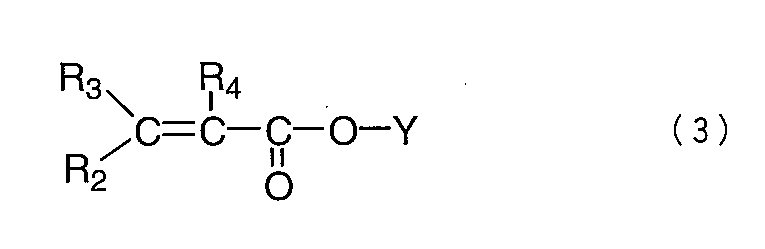
2)前記シリコーン・アクリル共重合体が、下記一般式(1)で表されるオルガノポリシロキサン化合物と、下記一般式(3)で表される(メタ)アクリル系モノマーとの共重合体であることを特徴とする、1)記載のポリカーボネート樹脂組成物。 2) The silicone-acrylic copolymer is a copolymer of an organopolysiloxane compound represented by the following general formula (1) and a (meth) acrylic monomer represented by the following general formula (3). 1) The polycarbonate resin composition according to 1).
(上記一般式(1)中、R1は炭素数1〜10のアルキル基を表す。Xは下記一般式(2)で表される基から選ばれる基を表す。nは2〜1000の整数を表す。) (In the general formula (1), R 1 represents an alkyl group having 1 to 10 carbon atoms. X represents a group selected from groups represented by the following general formula (2). N is an integer of 2 to 1000. Represents.)
(上記一般式(2)中、mは1〜3の整数を表す。) (In the general formula (2), m represents an integer of 1 to 3.)
(上記一般式(3)中、R2〜R4は水素原子又は炭素数1〜10のアルキル基を表す。Yは水素原子、炭素数1〜20のアルキル基、炭素数4〜20の環状アルキル基、炭素数1〜20のヒドロキシアルキル基、炭素数2〜5のアルケニル基、及びグリシジル基からなる群から選ばれる基を表す。ただし、使用する一般式(3)で表される(メタ)アクリル系モノマー全体の中に、Yに少なくとも炭素数1〜20のヒドロキシアルキル基を有するモノマーを含む。) (In the general formula (3), R 2 to R 4 represent a hydrogen atom or an alkyl group having 1 to 10 carbon atoms. Y represents a hydrogen atom, an alkyl group having 1 to 20 carbon atoms, or a cyclic group having 4 to 20 carbon atoms. A group selected from the group consisting of an alkyl group, a hydroxyalkyl group having 1 to 20 carbon atoms, an alkenyl group having 2 to 5 carbon atoms, and a glycidyl group, provided that it is represented by the general formula (3) used (meta ) The whole acrylic monomer includes a monomer having a hydroxyalkyl group having at least 1 to 20 carbon atoms in Y.)
3)前記オルガノポリシロキサン化合物が、下記一般式(4)で表されるラジカル重合性シリコーンマクロモノマーである、2)記載のポリカーボネート樹脂組成物。 3) The polycarbonate resin composition according to 2), wherein the organopolysiloxane compound is a radical polymerizable silicone macromonomer represented by the following general formula (4).
(上記一般式(4)中、R5は水素原子又はメチル基、R6は酸素原子により中断されても良い炭素原子数1〜12の2価の炭化水素基、R7はメチル基又はトリメチルシロキシ基、R8は炭素原子数1〜4の1価の炭化水素基をそれぞれ表す。aは2〜1000の整数、bは1〜3の整数をそれぞれ表す。) (In the general formula (4), R 5 is a hydrogen atom or a methyl group, R 6 is a divalent hydrocarbon group having 1 to 12 carbon atoms which may be interrupted by an oxygen atom, and R 7 is a methyl group or trimethyl. siloxy group, R 8 is an integer of .a is 2 to 1000 respectively representing a monovalent hydrocarbon group having 1 to 4 carbon atoms, b represents an integer of 1 to 3, respectively.)
4)前記一般式(3)で表される(メタ)アクリル系モノマーが、メタクリル酸メチル、アクリル酸メチル、メタクリル酸ブチル、アクリル酸ブチル、メタクリル酸―2−エチルヘキシル、アクリル酸−2−エチルヘキシル、メタクリル酸−2−ヒドロキシエチル、アクリル酸−2−ヒドロキシエチル、メタクリル酸グリシジル、及びアクリル酸グリシジルからなる群から選択されるモノマーであることを特徴とする、2)又は3)記載のポリカーボネート樹脂組成物。 4) The (meth) acrylic monomer represented by the general formula (3) is methyl methacrylate, methyl acrylate, butyl methacrylate, butyl acrylate, -2-ethylhexyl methacrylate, 2-ethylhexyl acrylate, The polycarbonate resin composition according to 2) or 3), which is a monomer selected from the group consisting of 2-hydroxyethyl methacrylate, 2-hydroxyethyl acrylate, glycidyl methacrylate, and glycidyl acrylate. object.
5)前記一般式(3)で表される(メタ)アクリル系モノマーが、少なくともメタクリル酸−2−ヒドロキシエチル及びアクリル酸−2−ヒドロキシエチルからなる群から選択される1種以上のモノマーを含むことを特徴とする、請求項2〜4のいずれかに記載のポリカーボネート樹脂組成物。 5) The (meth) acrylic monomer represented by the general formula (3) contains at least one monomer selected from the group consisting of at least 2-hydroxyethyl methacrylate and 2-hydroxyethyl acrylate. The polycarbonate resin composition according to any one of claims 2 to 4, wherein
6)前記シリコーン・アクリル共重合体の重量平均分子量が、ゲルパーミエーションクロマトグラフィーのポリスチレン換算で2万〜10万である、1)〜5)のいずれかに記載のポリカーボネート樹脂組成物。 6) The polycarbonate resin composition according to any one of 1) to 5), wherein the silicone-acrylic copolymer has a weight average molecular weight of 20,000 to 100,000 in terms of polystyrene by gel permeation chromatography.
7)前記シリコーン・アクリル共重合体がポリカーボネート樹脂全量に対し0.05〜2重量%含有されていることを特徴とする、1)〜6)のいずれかに記載のポリカーボネート樹脂組成物。 7) The polycarbonate resin composition according to any one of 1) to 6), wherein the silicone-acrylic copolymer is contained in an amount of 0.05 to 2% by weight based on the total amount of the polycarbonate resin.
8)前記ポリカーボネート樹脂が、ビス(4−ヒドロキシフェニル)メタン、1,1−ビス(4−ヒドロキシフェニル)エタン、2,2−ビス(4−ヒドロキシフェニル)プロパン、1,1−ビス(4−ヒドロキシフェニル)シクロヘキサン、1,1−ビス(4−ヒドロキシ−3−メチルフェニル)シクロヘキサン、2,2−ビス(4−ヒドロキシ−3−メチルフェニル)プロパン、1,1−ビス(4−ヒドロキシフェニル)−1−フェニルエタン、及び1,1’−ビフェニル−4,4’−ジオールからなる群から選択されるビスフェノール類から誘導されたものである、1)〜7)のいずれかに記載のポリカーボネート樹脂組成物。 8) The polycarbonate resin is bis (4-hydroxyphenyl) methane, 1,1-bis (4-hydroxyphenyl) ethane, 2,2-bis (4-hydroxyphenyl) propane, 1,1-bis (4- Hydroxyphenyl) cyclohexane, 1,1-bis (4-hydroxy-3-methylphenyl) cyclohexane, 2,2-bis (4-hydroxy-3-methylphenyl) propane, 1,1-bis (4-hydroxyphenyl) The polycarbonate resin according to any one of 1) to 7), which is derived from bisphenols selected from the group consisting of -1-phenylethane and 1,1′-biphenyl-4,4′-diol. Composition.
9)前記ポリカーボネート樹脂の極限粘度が0.3〜2dl/gである、1)〜8)のいずれかに記載のポリカーボネート樹脂組成物。
10)導電性基体上に感光層を有する電子写真感光体において、該感光層のバインダー樹脂として1)〜9)のいずれかに記載のポリカーボネート樹脂組成物を用いることを特徴とする、電子写真感光体。
11)前記感光層が電荷発生層と電荷輸送層とを含む積層型感光層であって、前記ポリカーボネート樹脂組成物が該電荷輸送層に使用されることを特徴とする、10)記載の電子写真感光体。
9) The polycarbonate resin composition according to any one of 1) to 8), wherein the polycarbonate resin has an intrinsic viscosity of 0.3 to 2 dl / g.
10) An electrophotographic photosensitive member having a photosensitive layer on a conductive substrate, wherein the polycarbonate resin composition according to any one of 1) to 9) is used as a binder resin for the photosensitive layer. body.
11) The electrophotographic film according to 10), wherein the photosensitive layer is a laminated photosensitive layer comprising a charge generation layer and a charge transport layer, and the polycarbonate resin composition is used for the charge transport layer. Photoconductor.
本発明のシリコーン・アクリル共重合体を含有するポリカーボネート樹脂組成物は、成形物の摩擦係数が低く耐摩耗性に優れるため、電子写真感光体の感光層用バインダー樹脂として使用した場合、電子写真感光体の耐久性を向上させ、長寿命の電子写真感光体を提供することができる。 Since the polycarbonate resin composition containing the silicone-acrylic copolymer of the present invention has a low coefficient of friction and excellent wear resistance, the electrophotographic photosensitive member when used as a binder resin for a photosensitive layer of an electrophotographic photosensitive member. The durability of the body can be improved and a long-life electrophotographic photosensitive member can be provided.
本発明のポリカーボネート樹脂組成物は、ポリカーボネート樹脂を主体とし、これにシリコーン・アクリル共重合体が少量配合されたものである。 The polycarbonate resin composition of the present invention comprises a polycarbonate resin as a main component and a small amount of a silicone / acrylic copolymer blended therein.
1.シリコーン・アクリル共重合体
本発明で用いられるシリコーン・アクリル共重合体は、ラジカル重合性基を有するシリコーンモノマーと(メタ)アクリル系モノマーとの共重合体であって所定量の水酸基を含むものである。
1. Silicone / acrylic copolymer The silicone / acrylic copolymer used in the present invention is a copolymer of a silicone monomer having a radical polymerizable group and a (meth) acrylic monomer, and contains a predetermined amount of hydroxyl groups.
(1)水酸基
本発明のシリコーン・アクリル共重合体に含まれる水酸基は、該共重合体全量に対し0.2〜10重量%、好ましくは0.5〜3重量%である。シリコーン・アクリル共重合体に含まれる水酸基の量が少なすぎるとポリカーボネートとの相溶性が低下し、多すぎると本発明の電子写真感光体の摩擦係数が大きくなる。シリコーン・アクリル共重合体に水酸基を導入する方法としては、共重合体製造時に水酸基を有するモノマーを用いることが好ましい。
(1) Hydroxyl group The hydroxyl group contained in the silicone-acrylic copolymer of the present invention is 0.2 to 10% by weight, preferably 0.5 to 3% by weight, based on the total amount of the copolymer. If the amount of the hydroxyl group contained in the silicone / acrylic copolymer is too small, the compatibility with the polycarbonate is lowered, and if it is too large, the friction coefficient of the electrophotographic photoreceptor of the present invention is increased. As a method for introducing a hydroxyl group into the silicone / acrylic copolymer, it is preferable to use a monomer having a hydroxyl group during the production of the copolymer.
(2)ラジカル重合性基を有するシリコーンモノマー
本発明で用いられるラジカル重合性基を有するシリコーンモノマーは、ラジカル重合性基(不飽和炭化水素基)を有するオルガノシロキサン化合物であれば特に制限されないが、好ましくは下記一般式(1)で表されるオルガノポリシロキサン化合物が挙げられる。
(2) Silicone monomer having radical polymerizable group The silicone monomer having a radical polymerizable group used in the present invention is not particularly limited as long as it is an organosiloxane compound having a radical polymerizable group (unsaturated hydrocarbon group). An organopolysiloxane compound represented by the following general formula (1) is preferable.
上記一般式(1)中、R1は炭素数1〜10のアルキル基を表し、好ましくは炭素数1〜4のアルキル基を表す。R1の具体例としては、メチル基、エチル基、n−ブチル基等が挙げられる。nは2〜1000、好ましくは3〜200の整数を表す。 In the general formula (1), R 1 represents an alkyl group having 1 to 10 carbon atoms, preferably an alkyl group having 1 to 4 carbon atoms. Specific examples of R 1 include a methyl group, an ethyl group, and an n-butyl group. n represents an integer of 2 to 1000, preferably 3 to 200.
上記一般式(1)中、Xは下記一般式(2)で表される基から選ばれる基を表す。ここで一般式(2)中、mは1〜3の整数を表す。 In the general formula (1), X represents a group selected from the group represented by the following general formula (2). Here, in general formula (2), m represents an integer of 1 to 3.
前記オルガノポリシロキサン化合物の好ましい例としては、下記一般式(4)で表されるラジカル重合性シリコーンマクロモノマーが挙げられる。 A preferred example of the organopolysiloxane compound is a radical polymerizable silicone macromonomer represented by the following general formula (4).
上記一般式(4)中、R5は水素原子又はメチル基である。R6は酸素原子により中断されても良い炭素原子数1〜12、より好ましくは炭素数1〜3の2価の炭化水素基を表し、さらに好ましくはエチレン基、プロピレン基である。R7はメチル基又はトリメチルシロキシ基である。R8は炭素原子数1〜4の1価の炭化水素基を表し、具体的にはメチル基、n−ブチル基を表す。aは2〜1000、より好ましくは3〜200の整数を表す。bは1〜3の整数を表す。 In the general formula (4), R 5 is a hydrogen atom or a methyl group. R 6 represents a divalent hydrocarbon group having 1 to 12 carbon atoms, more preferably 1 to 3 carbon atoms, which may be interrupted by an oxygen atom, and more preferably an ethylene group or a propylene group. R 7 is a methyl group or a trimethylsiloxy group. R 8 represents a monovalent hydrocarbon group having 1 to 4 carbon atoms, and specifically represents a methyl group or an n-butyl group. a represents an integer of 2 to 1000, more preferably 3 to 200. b represents an integer of 1 to 3.
ラジカル重合性基を有するシリコーンモノマーとして、上記一般式(1)で表されるオルガノポリシロキサン化合物を用いた場合、側鎖にオルガノポリシロキサン基を有するシリコーングラフトアクリル樹脂が得られる。
本発明のシリコーン・アクリル共重合体としては、かかるシリコーングラフトアクリル樹脂以外にも、主鎖にオルガノシロキサン基が導入されたものを用いることもできる。このような主鎖にオルガノシロキサン基を導入するために用いられるシリコーンモノマーとしては、両末端にメタクリル基やビニル基を有する変性シリコーン等が挙げられる。
When the organopolysiloxane compound represented by the general formula (1) is used as the silicone monomer having a radical polymerizable group, a silicone graft acrylic resin having an organopolysiloxane group in the side chain is obtained.
As the silicone-acrylic copolymer of the present invention, in addition to the silicone-grafted acrylic resin, those having an organosiloxane group introduced into the main chain can also be used. Examples of the silicone monomer used for introducing an organosiloxane group into such a main chain include modified silicones having a methacryl group or a vinyl group at both ends.
(3)(メタ)アクリル系モノマー
本発明で用いられる(メタ)アクリル系モノマーは、(メタ)アクリル基を有する化合物であれば特に制限されないが、好ましくは下記一般式(3)で表されるものである。
(3) (Meth) acrylic monomer The (meth) acrylic monomer used in the present invention is not particularly limited as long as it is a compound having a (meth) acrylic group, but is preferably represented by the following general formula (3). Is.
上記一般式(3)中、R2〜R4は水素原子又は炭素数1〜10のアルキル基を表し、好ましくは水素原子又は炭素数1〜4のアルキル基、より好ましくは水素原子、メチル基、エチル基、又はプロピル基を表す。 In the general formula (3), R 2 to R 4 represent a hydrogen atom or an alkyl group having 1 to 10 carbon atoms, preferably a hydrogen atom or an alkyl group having 1 to 4 carbon atoms, more preferably a hydrogen atom or a methyl group. Represents an ethyl group or a propyl group.
上記一般式(3)中、Yは水素原子、炭素数1〜20のアルキル基、炭素数4〜20の環状アルキル基、炭素数1〜20のヒドロキシアルキル基、炭素数2〜5のアルケニル基、及びグリシジル基からなる群から選ばれる基を表す。 In said general formula (3), Y is a hydrogen atom, a C1-C20 alkyl group, a C4-C20 cyclic alkyl group, a C1-C20 hydroxyalkyl group, a C2-C5 alkenyl group. And a group selected from the group consisting of glycidyl groups.
炭素数1〜20のアルキル基としては、好ましくは炭素数1〜7のアルキル基であり、より好ましくはメチル基、エチル基、n―ブチル基等が挙げられる。炭素数4〜20の環状アルキル基としては、好ましくは炭素数6〜12の環状アルキル基であり、より好ましくはシクロヘキシル基、シクロドデシル基等が挙げられる。 As a C1-C20 alkyl group, Preferably it is a C1-C7 alkyl group, More preferably, a methyl group, an ethyl group, n-butyl group etc. are mentioned. As a C4-C20 cyclic alkyl group, Preferably it is a C6-C12 cyclic alkyl group, More preferably, a cyclohexyl group, a cyclododecyl group, etc. are mentioned.
炭素数1〜20のヒドロキシアルキル基としては、好ましくは炭素数1〜10のヒドロキシアルキル基であり、より好ましくはヒドロキシメチル基、ヒドロキシエチル基等が挙げられる。炭素数2〜5のアルケニル基としては、好ましくはビニル基、メタクリル基等が挙げられる。 As a C1-C20 hydroxyalkyl group, Preferably it is a C1-C10 hydroxyalkyl group, More preferably, a hydroxymethyl group, a hydroxyethyl group, etc. are mentioned. Preferred examples of the alkenyl group having 2 to 5 carbon atoms include a vinyl group and a methacryl group.
ただし本発明においては、シリコーン・アクリル共重合体に使用される一般式(3)で表される(メタ)アクリル系モノマー全体の中に、少なくともYに炭素数1〜20のヒドロキシアルキル基を有するモノマーを含むことが好ましい。これにより、所定量の水酸基を含むシリコーン・アクリル共重合体を得ることができる。 However, in the present invention, the entire (meth) acrylic monomer represented by the general formula (3) used for the silicone / acrylic copolymer has at least Y a hydroxyalkyl group having 1 to 20 carbon atoms. It is preferable to include a monomer. Thereby, a silicone-acrylic copolymer containing a predetermined amount of hydroxyl groups can be obtained.
本発明で使用される(メタ)アクリル系モノマーの具体例としては、メタクリル酸、メタクリル酸メチル、メタクリル酸エチル、メタクリル酸プロピル、メタクリル酸ブチル、メタクリル酸シクロヘキシル、メタクリル酸フェニル、メタクリル酸ベンジル、メタクリル酸2−エチルヘキシル、メタクリル酸2−ヒドロキシエチル、メタクリル酸グリシジル、メタクリル酸ジメチルアミノエチル、メタクリル酸ジエチルアミノエチル、アクリル酸、アクリル酸メチル、アクリル酸エチル、アクリル酸プロピル、アクリル酸ブチル、アクリル酸シクロヘキシル、アクリル酸フェニル、アクリル酸ベンジル、アクリル酸2−エチルヘキシル、アクリル酸2−ヒドロキシエチル、アクリル酸グリシジル、アクリル酸ジメチルアミノエチル、アクリル酸ジエチルアミノエチル等が例示される。 Specific examples of the (meth) acrylic monomer used in the present invention include methacrylic acid, methyl methacrylate, ethyl methacrylate, propyl methacrylate, butyl methacrylate, cyclohexyl methacrylate, phenyl methacrylate, benzyl methacrylate, methacrylic acid. 2-ethylhexyl acid, 2-hydroxyethyl methacrylate, glycidyl methacrylate, dimethylaminoethyl methacrylate, diethylaminoethyl methacrylate, acrylic acid, methyl acrylate, ethyl acrylate, propyl acrylate, butyl acrylate, cyclohexyl acrylate, Phenyl acrylate, benzyl acrylate, 2-ethylhexyl acrylate, 2-hydroxyethyl acrylate, glycidyl acrylate, dimethylaminoethyl acrylate, acrylic acid Ethylamino ethyl and the like.
これらのうち、より好ましい(メタ)アクリル系モノマーとしては、メタクリル酸メチル、アクリル酸メチル、メタクリル酸ブチル、アクリル酸ブチル、メタクリル酸―2−エチルヘキシル、アクリル酸−2−エチルヘキシル、メタクリル酸−2−ヒドロキシエチル、アクリル酸−2−ヒドロキシエチル、メタクリル酸グリシジル、及びアクリル酸グリシジルからなる群から選択されるモノマーが挙げられる。 Among these, more preferable (meth) acrylic monomers include methyl methacrylate, methyl acrylate, butyl methacrylate, butyl acrylate, methacrylic acid-2-ethylhexyl, acrylate-2-ethylhexyl, methacrylic acid-2- Examples include monomers selected from the group consisting of hydroxyethyl, 2-hydroxyethyl acrylate, glycidyl methacrylate, and glycidyl acrylate.
さらに、前記(メタ)アクリル系モノマーのうちYに炭素数1〜20のヒドロキシアルキル基を有するモノマーとして、少なくともメタクリル酸−2−ヒドロキシエチル及びアクリル酸−2−ヒドロキシエチルからなる群から選択される1種以上のモノマーを使用することが好ましい。これにより、所定量の水酸基をシリコーン・アクリル共重合体に導入することができる。 Further, among the (meth) acrylic monomers, the monomer having a hydroxyalkyl group having 1 to 20 carbon atoms in Y is selected from the group consisting of at least 2-hydroxyethyl methacrylate and 2-hydroxyethyl acrylate. It is preferred to use one or more monomers. Thereby, a predetermined amount of hydroxyl groups can be introduced into the silicone / acrylic copolymer.
本発明のシリコーン・アクリル共重合体に使用される(メタ)アクリル系モノマー全量に対するYに炭素数1〜20のヒドロキシアルキル基を有するモノマーの割合は特に限定されず、結果として本発明のシリコーン・アクリル共重合体に含まれる水酸基が該共重合体全量に対し0.2〜10重量%の範囲となるように、適宜調整することができるが、好ましくは使用される(メタ)アクリル系モノマー全量に対し、1〜50重量%、より好ましくは5〜30重量%である。 The ratio of the monomer having a hydroxyalkyl group having 1 to 20 carbon atoms in Y relative to the total amount of the (meth) acrylic monomer used in the silicone / acrylic copolymer of the present invention is not particularly limited. Although it can adjust suitably so that the hydroxyl group contained in an acrylic copolymer may be the range of 0.2 to 10 weight% with respect to this copolymer whole quantity, Preferably (meth) acrylic-type monomer whole amount used The content is 1 to 50% by weight, more preferably 5 to 30% by weight.
(4)その他のモノマー
本発明で用いられるシリコーン・アクリル共重合体には、上記ポリオルガノシロキサン化合物と(メタ)アクリル系モノマー以外に、他のビニル系モノマーが少量含まれていても良い。
(4) Other monomers The silicone / acrylic copolymer used in the present invention may contain a small amount of other vinyl monomers in addition to the polyorganosiloxane compound and the (meth) acrylic monomer.
他のビニル系モノマーとしては、エチレングリコールジメタクリレート、1,3−ブチレングリコールジメタクリレート、トリメチルロールプロパントリメタクリレート、ペンタエリスリトールテトラメタクリレート、エチレングリコールジメタクリレート、1,3−ブチレングリコールジアクリレート、トリメチロールプロパントリアクリレート、ペンタエリスリトールテトラアクリレート等の多官能性(メタ)アクリレート、スチレン、α−メチルスチレン、アクリロニトリル、メタアクリロニトリル、無水マレイン酸、フェニルマレイミド、シクロヘキシルマレイミド等が例示される。 Other vinyl monomers include ethylene glycol dimethacrylate, 1,3-butylene glycol dimethacrylate, trimethylolpropane trimethacrylate, pentaerythritol tetramethacrylate, ethylene glycol dimethacrylate, 1,3-butylene glycol diacrylate, and trimethylolpropane. Examples thereof include polyfunctional (meth) acrylates such as triacrylate and pentaerythritol tetraacrylate, styrene, α-methylstyrene, acrylonitrile, methacrylonitrile, maleic anhydride, phenylmaleimide, cyclohexylmaleimide and the like.
かかる他のモノマーの、シリコーン・アクリル共重合体に用いるモノマー全量に対する割合は、本発明の効果を損なわない範囲であれば特に制限されないが、好ましくは1〜
90重量%である。
The ratio of such other monomers to the total amount of monomers used in the silicone / acrylic copolymer is not particularly limited as long as it does not impair the effects of the present invention.
90% by weight.
(5)シリコーン・アクリル共重合体
上述したラジカル重合性基を有するシリコーンモノマーと(メタ)アクリル系モノマーとからなる本発明のシリコーン・アクリル共重合体として、好ましくは上記一般式(1)で表されるオルガノポリシロキサン化合物と、上記一般式(3)で表される(メタ)アクリル系モノマーとからなるシリコーングラフトアクリル樹脂が挙げられる。
(5) Silicone / acrylic copolymer The silicone / acrylic copolymer of the present invention comprising the above-mentioned silicone monomer having a radical polymerizable group and a (meth) acrylic monomer is preferably represented by the general formula (1). And a silicone graft acrylic resin comprising an organopolysiloxane compound to be prepared and a (meth) acrylic monomer represented by the general formula (3).
シリコーン・アクリル共重合体に用いるモノマー全量に対するシリコーンモノマーの割合は、好ましくは1〜50重量%、より好ましくは2〜20重量%である。また、(メタ)アクリル系モノマーの割合は、好ましくは50〜99重量%、より好ましくは80〜98重量%である。また、シリコーンモノマーと(メタ)アクリル系モノマーの相互の比率としては、好ましくはシリコーンモノマー:(メタ)アクリル系モノマー=1:99〜50:50である。シリコーンモノマーの割合が少なすぎると耐摩耗性が低下し、多すぎるとポリカーボネートとの相溶性が低下する場合がある。 The ratio of the silicone monomer to the total amount of monomers used in the silicone / acrylic copolymer is preferably 1 to 50% by weight, more preferably 2 to 20% by weight. The proportion of the (meth) acrylic monomer is preferably 50 to 99% by weight, more preferably 80 to 98% by weight. Moreover, as a mutual ratio of a silicone monomer and a (meth) acrylic-type monomer, Preferably it is silicone monomer: (meth) acrylic-type monomer = 1: 99-50: 50. When the proportion of the silicone monomer is too small, the wear resistance is lowered, and when it is too much, the compatibility with the polycarbonate may be lowered.
また、前記シリコーン・アクリル共重合体の重量平均分子量は、ゲルパーミエーションクロマトグラフィー(以下、「GPC」と略)のポリスチレン換算で2万〜10万、好ましくは2万〜7万である。シリコーン・アクリル共重合体の平均分子量が低すぎると本発明の電子写真感光体表面から摩擦により脱落しやすく、高すぎるとポリカーボネートとの相溶性が低下する場合がある。 The silicone-acrylic copolymer has a weight average molecular weight of 20,000 to 100,000, preferably 20,000 to 70,000 in terms of polystyrene of gel permeation chromatography (hereinafter abbreviated as “GPC”). If the average molecular weight of the silicone / acrylic copolymer is too low, it will easily fall off from the surface of the electrophotographic photosensitive member of the present invention by friction, and if it is too high, the compatibility with the polycarbonate may decrease.
(5)シリコーン・アクリル共重合体の製造方法
本発明のシリコーン・アクリル共重合体の製造方法は公知の方法、例えば溶剤中に、ラジカル重合性基を有するシリコーンモノマー、(メタ)アクリルモノマー及びラジカル重合開始剤を加温下に同時に滴下するなどの方法を採用することができる。
(5) Production Method of Silicone / Acrylic Copolymer A production method of the silicone / acrylic copolymer of the present invention is a known method, for example, a silicone monomer having a radical polymerizable group, (meth) acrylic monomer and radical in a solvent. A method such as dropping the polymerization initiator simultaneously while heating can be employed.
ラジカル重合開始剤としては、アゾビスイソブチロニトリル等のアゾ化合物、ベンゾイルパーオキサイド、ラウロイルパーオキサイド、tert−ブチルヒドロパーオキサイド、ジクミルパーオキサイド等の有機過酸化物、過硫酸カリウム等の無機過酸化物、およびこれら過酸化物と硫酸第一鉄とを組み合わせたレドックス系触媒等が挙げられる。また、使用する溶剤としては、トルエン、キシレン等の芳香族溶剤、メチルエチルケトン、メチルイソブチルケトン等のケトン系溶媒、メタノール、エタノール、イソプロピルアルコール等のアルコール系溶媒等が挙げられる。 Examples of radical polymerization initiators include azo compounds such as azobisisobutyronitrile, organic peroxides such as benzoyl peroxide, lauroyl peroxide, tert-butyl hydroperoxide, and dicumyl peroxide, and inorganic substances such as potassium persulfate. Examples thereof include peroxides and redox catalysts obtained by combining these peroxides with ferrous sulfate. Examples of the solvent used include aromatic solvents such as toluene and xylene, ketone solvents such as methyl ethyl ketone and methyl isobutyl ketone, and alcohol solvents such as methanol, ethanol and isopropyl alcohol.
好ましい反応条件としては、反応温度(滴下温度)は使用する溶剤により異なるが50〜120℃、滴下後の熟成時間は1〜10時間であるが、これらに限定されず、公知の方法を採用することができる。 As preferable reaction conditions, although the reaction temperature (dropping temperature) varies depending on the solvent used, it is 50 to 120 ° C., and the aging time after dropping is 1 to 10 hours, but is not limited thereto, and a known method is adopted. be able to.
2.ポリカーボネート樹脂
本発明のポリカーボネート樹脂組成物に使用されるポリカーボネート樹脂は、例えばビスフェノールAと炭酸エステル形成化合物からポリカーボネートを製造する際に用いられている公知の方法、例えばビスフェノール類とホスゲンとの直接反応(ホスゲン法)、あるいはビスフェノール類とビスアリールカーボネートとのエステル交換反応(エステル交換法)などの方法を採用することができる。
2. Polycarbonate resin The polycarbonate resin used in the polycarbonate resin composition of the present invention is a known method used in the production of polycarbonate from bisphenol A and a carbonate ester-forming compound, for example, a direct reaction between bisphenols and phosgene ( A phosgene method) or a transesterification reaction (transesterification method) between a bisphenol and a bisaryl carbonate can be employed.
ポリカーボネート樹脂の製造に使用される原料ビスフェノールとしては、具体的には1,1’−ビフェニル−4,4’−ジオール、ビス(4−ヒドロキシフェニル)メタン、ビス(4−ヒドロキシフェニル)エーテル、ビス(4−ヒドロキシフェニル)スルホキシド、ビス(4−ヒドロキシフェニル)スルファイド、ビス(4−ヒドロキシフェニル)ケトン、1,1−ビス(4−ヒドロキシフェニル)エタン、2,2−ビス(4−ヒドロキシフェニル)プロパン(ビスフェノ−ルA;BPA)、2,2−ビス(4−ヒドロキシフェニル)ブタン、2,2−ビス(4−ヒドロキシ−3−t−ブチルフェニル)プロパン、2,2−ビス(4−ヒドロキシ−3−メチルフェニル)プロパン、1,1−ビス(4−ヒドロキシフェニル)シクロペンタン、1,1−ビス(4−ヒドロキシフェニル)シクロヘキサン(ビスフェノ−ルZ;BPZ)、1,1−ビス(4−ヒドロキシ−3−メチルフェニル)シクロヘキサン、1,1−ビス(4−ヒドロキシフェニル)−3,3,5−トリメチルシクロヘキサン、1,1−ビス(4−ヒドロキシフェニル)シクロドデカン、2,2−ビス(4−ヒドロキシ−3−アリルフェニル)プロパン、2,2−ビス(4−ヒドロキシフェニル)ヘキサフルオロプロパン、1,1−ビス(4−ヒドロキシフェニル)−1−フェニルエタン、ビス(4−ヒドロキシフェニル)ジフェニルメタン、9,9−ビス(4−ヒドロキシフェニル)フルオレン、9,9−ビス(4−ヒドロキシ−3−メチルフェニル)フルオレン、4,4’−[1,4−フェニレンビス(1−メチルエチリデン)]ビスフェノール、4,4’−[1,3−フェニレンビス(1−メチルエチリデン)]ビスフェノール、4,4’−ブチリデンビス(3−メチル−6−t−ブチチルフェノール)、α,ω−ビス[3−(o−ヒドロキシフェニル)プロピル]ポリジメチルジフェニルランダム共重合シロキサン、α,ω−ビス[3−(o−ヒドロキシフェニル)プロピル]ポリジメチルシロキサンなどが例示される。これらは、2種類以上併用して用いてもよい。また、これらの中でもビス(4−ヒドロキシフェニル)メタン、1,1−ビス(4−ヒドロキシフェニル)エタン、2,2−ビス(4−ヒドロキシフェニル)プロパン、1,1−ビス(4−ヒドロキシフェニル)シクロヘキサン、1,1−ビス(4−ヒドロキシ−3−メチルフェニル)シクロヘキサン、2,2−ビス(4−ヒドロキシ−3−メチルフェニル)プロパン、1,1−ビス(4−ヒドロキシフェニル)−1−フェニルエタン、1,1’−ビフェニル−4,4’−ジオールから選ばれることが好ましく、特に2,2−ビス(4−ヒドロキシフェニル)プロパン、1,1−ビス(4−ヒドロキシフェニル)シクロヘキサン、ビス(4−ヒドロキシフェニル)メタンから選ばれることが好ましい。 Specific examples of the raw material bisphenol used in the production of the polycarbonate resin include 1,1′-biphenyl-4,4′-diol, bis (4-hydroxyphenyl) methane, bis (4-hydroxyphenyl) ether, and bis (4-hydroxyphenyl) sulfoxide, bis (4-hydroxyphenyl) sulfide, bis (4-hydroxyphenyl) ketone, 1,1-bis (4-hydroxyphenyl) ethane, 2,2-bis (4-hydroxyphenyl) Propane (bisphenol A; BPA), 2,2-bis (4-hydroxyphenyl) butane, 2,2-bis (4-hydroxy-3-tert-butylphenyl) propane, 2,2-bis (4- Hydroxy-3-methylphenyl) propane, 1,1-bis (4-hydroxyphenyl) cyclopentane 1,1-bis (4-hydroxyphenyl) cyclohexane (bisphenol Z; BPZ), 1,1-bis (4-hydroxy-3-methylphenyl) cyclohexane, 1,1-bis (4-hydroxyphenyl)- 3,3,5-trimethylcyclohexane, 1,1-bis (4-hydroxyphenyl) cyclododecane, 2,2-bis (4-hydroxy-3-allylphenyl) propane, 2,2-bis (4-hydroxyphenyl) ) Hexafluoropropane, 1,1-bis (4-hydroxyphenyl) -1-phenylethane, bis (4-hydroxyphenyl) diphenylmethane, 9,9-bis (4-hydroxyphenyl) fluorene, 9,9-bis ( 4-hydroxy-3-methylphenyl) fluorene, 4,4 ′-[1,4-phenylenebis (1-mes Ruethylidene)] bisphenol, 4,4 ′-[1,3-phenylenebis (1-methylethylidene)] bisphenol, 4,4′-butylidenebis (3-methyl-6-t-butyrylphenol), α, ω- Examples thereof include bis [3- (o-hydroxyphenyl) propyl] polydimethyldiphenyl random copolymer siloxane and α, ω-bis [3- (o-hydroxyphenyl) propyl] polydimethylsiloxane. Two or more of these may be used in combination. Among these, bis (4-hydroxyphenyl) methane, 1,1-bis (4-hydroxyphenyl) ethane, 2,2-bis (4-hydroxyphenyl) propane, 1,1-bis (4-hydroxyphenyl) ) Cyclohexane, 1,1-bis (4-hydroxy-3-methylphenyl) cyclohexane, 2,2-bis (4-hydroxy-3-methylphenyl) propane, 1,1-bis (4-hydroxyphenyl) -1 -Phenylethane, preferably selected from 1,1'-biphenyl-4,4'-diol, especially 2,2-bis (4-hydroxyphenyl) propane, 1,1-bis (4-hydroxyphenyl) cyclohexane And bis (4-hydroxyphenyl) methane.
一方、炭酸エステル形成性化合物としては、例えばホスゲン、トリホスゲンや、ジフェニルカーボネート、ジ−p−トリルカーボネート、フェニル−p−トリルカーボネート、ジ−p−クロロフェニルカーボネート、ジナフチルカーボネートなどのビスアリルカーボネートが挙げられる。これらの化合物は2種類以上併用して使用することも可能である。 On the other hand, examples of the carbonate-forming compound include phosgene, triphosgene, and bisallyl carbonate such as diphenyl carbonate, di-p-tolyl carbonate, phenyl-p-tolyl carbonate, di-p-chlorophenyl carbonate, and dinaphthyl carbonate. It is done. Two or more of these compounds can be used in combination.
ホスゲン法においては、通常酸結合剤および溶媒の存在下において、前記ビスフェノール類とホスゲンを反応させる。酸結合剤としては、例えばピリジンや、水酸化ナトリウム、水酸化カリウムなどのアルカリ金属の水酸化物などが用いられ、また溶媒としては、例えば塩化メチレン、クロロホルムなどが用いられる。さらに、縮重合反応を促進するために、トリエチルアミンのような第三級アミン触媒やベンジルトリエチルアンモニウムクロライド等の4級アンモニウム塩が用いられる。さらに、フェノール、p−t−ブチルフェノール、p−クミルフェノール、長鎖アルキル置換フェノール等一官能基化合物を分子量調節剤として加えることが好ましい。また、所望に応じ亜硫酸ナトリウム、ハイドロサルファイトなどの酸化防止剤や、フロログルシン、イサチンビスフェノール、トリスフェノールエタンなど分岐化剤を小量添加してもよい。反応は通常0〜150℃、好ましくは5〜40℃の範囲とするのが適当である。反応時間は反応温度によって左右されるが、通常0.5分〜10時間、好ましくは1分〜2時間である。また、反応中は、反応系のpHを10以上に保持することが望ましい。 In the phosgene method, the bisphenols and phosgene are usually reacted in the presence of an acid binder and a solvent. Examples of the acid binder include pyridine and alkali metal hydroxides such as sodium hydroxide and potassium hydroxide, and examples of the solvent include methylene chloride and chloroform. Further, a tertiary amine catalyst such as triethylamine or a quaternary ammonium salt such as benzyltriethylammonium chloride is used to promote the condensation polymerization reaction. Furthermore, it is preferable to add a monofunctional compound such as phenol, pt-butylphenol, p-cumylphenol, and long-chain alkyl-substituted phenol as a molecular weight regulator. If desired, small amounts of antioxidants such as sodium sulfite and hydrosulfite, and branching agents such as phloroglucin, isatin bisphenol and trisphenol ethane may be added. The reaction is usually in the range of 0 to 150 ° C, preferably 5 to 40 ° C. While the reaction time depends on the reaction temperature, it is generally 0.5 min-10 hr, preferably 1 min-2 hr. Further, during the reaction, it is desirable to maintain the pH of the reaction system at 10 or more.
一方、エステル交換法においては、前記ビスフェノール類とビスアリールカーボネートとを混合し、減圧下で高温において反応させる。反応は通常150〜350℃、好ましくは200〜300℃の範囲の温度において行われ、また減圧度は最終で好ましくは133Pa以下にして、エステル交換反応により生成した該ビスアリールカーボネートから由来するフェノール類を系外へ留去させる。反応時間は反応温度や減圧度などによって左右されるが、通常1〜24時間程度である。反応は窒素やアルゴンなどの不活性ガス雰囲気下で行うことが好ましく。また、所望に応じ、分子量調節剤、酸化防止剤や分岐化剤を添加して反応を行ってもよい。 On the other hand, in the transesterification method, the bisphenols and bisaryl carbonate are mixed and reacted at a high temperature under reduced pressure. The reaction is usually carried out at a temperature in the range of 150 to 350 ° C., preferably 200 to 300 ° C., and the degree of vacuum is preferably at most 133 Pa or less, and the phenols derived from the bisaryl carbonate produced by the transesterification reaction Is distilled out of the system. The reaction time depends on the reaction temperature and the degree of reduced pressure, but is usually about 1 to 24 hours. The reaction is preferably carried out in an inert gas atmosphere such as nitrogen or argon. Moreover, you may react by adding a molecular weight regulator, antioxidant, and a branching agent as needed.
本発明のポリカーボネート樹脂組成物は、公知の成形方法、押出成形、圧縮成形、射出成形、ブロー成形、湿式成形等で成形可能である。本発明のポリカーボネート樹脂組成物を成形材料として用いる場合は、機械的強度と成形の容易さから、ポリカーボネート樹脂の極限粘度が0.3〜2dl/gの範囲であることが好ましい。極限粘度が0.3dl/g未満では成形品の強度が十分でなく、2dl/gを超えると成形が困難になる。
極限粘度は、塩化メチレンを溶媒とする濃度0.5g/dlの溶液の20℃におけるハギンズ定数0.45として、ウベローデ粘度計で測定可能で、Mark-Houwink-Sakurada式により、極限粘度=1.23×10-4(分子量)0.830を用いて粘度分子量を計算することができる。
The polycarbonate resin composition of the present invention can be molded by a known molding method, extrusion molding, compression molding, injection molding, blow molding, wet molding or the like. When the polycarbonate resin composition of the present invention is used as a molding material, the intrinsic viscosity of the polycarbonate resin is preferably in the range of 0.3 to 2 dl / g because of mechanical strength and ease of molding. If the intrinsic viscosity is less than 0.3 dl / g, the strength of the molded product is not sufficient, and if it exceeds 2 dl / g, molding becomes difficult.
The intrinsic viscosity can be measured with an Ubbelohde viscometer as a Huggins constant of 0.45 at 20 ° C. in a 0.5 g / dl solution containing methylene chloride as a solvent, and the intrinsic viscosity = 1. The viscosity molecular weight can be calculated using 23 × 10 −4 (molecular weight) 0.830 .
3.ポリカーボネート樹脂組成物
本発明のポリカーボネート樹脂組成物は、上述した本発明のポリカーボネート樹脂とシリコーン・アクリル共重合体とを含んでなるものである。
本発明のポリカーボネート樹脂組成物が耐摩耗性を良好に保持する範囲として、前記シリコーン・アクリル共重合体をポリカーボネート樹脂全量に対して、0.05〜2重量%含むことが好ましく、さらには0.1〜1重量%含むことが好ましい。0.05重量%未満では耐摩耗性が十分でなく、2重量%を超えると相溶性が悪くなり、相分離による耐摩耗性の低下や白濁が強くなる場合がある。
3. Polycarbonate resin composition The polycarbonate resin composition of the present invention comprises the above-described polycarbonate resin of the present invention and a silicone-acrylic copolymer.
The polycarbonate resin composition of the present invention preferably contains 0.05 to 2% by weight of the silicone / acrylic copolymer based on the total amount of the polycarbonate resin as a range in which the abrasion resistance is well maintained. It is preferable to contain 1-1 weight%. If it is less than 0.05% by weight, the wear resistance is not sufficient, and if it exceeds 2% by weight, the compatibility is deteriorated, and the wear resistance may be lowered due to phase separation or the cloudiness may be increased.
本発明のポリカーボネート樹脂組成物には、その効果を保持する範囲で、他の合成樹脂、例えばポリメチルメタクリレート、ポリスチレン、ポリ塩化ビニル等のビニル重合体、及びその共重合体、ポリカーボネート、ポリエステル、ポリスルフォン、フェノキシ樹脂、エポキシ樹脂、シリコーン樹脂等の各種の熱可塑性樹脂や熱硬化性樹脂を任意にブレンドすることが可能である。その場合、配合される他の合成樹脂の割合は本発明の効果を損なわない範囲であれば特に制限されないが、好ましくは本発明のポリカーボネート樹脂組成物全量に対し1〜50重量%である。
また、本発明のポリカーボネート樹脂組成物には、各種紫外線吸収剤、酸化防止剤、離型剤、滑剤、着色剤等を所望に応じて添加することも可能である。
In the polycarbonate resin composition of the present invention, other synthetic resins, for example, vinyl polymers such as polymethyl methacrylate, polystyrene, polyvinyl chloride, and copolymers thereof, polycarbonate, polyester, Various thermoplastic resins and thermosetting resins such as sulfone, phenoxy resin, epoxy resin and silicone resin can be arbitrarily blended. In that case, the ratio of the other synthetic resin to be blended is not particularly limited as long as the effect of the present invention is not impaired, but is preferably 1 to 50% by weight with respect to the total amount of the polycarbonate resin composition of the present invention.
Moreover, various ultraviolet absorbers, antioxidants, mold release agents, lubricants, colorants and the like can be added to the polycarbonate resin composition of the present invention as desired.
4.電子写真感光体
本発明のポリカーボネート樹脂組成物は、電子写真感光体のバインダー樹脂として好適に使用することができる。
4). Electrophotographic Photoreceptor The polycarbonate resin composition of the present invention can be suitably used as a binder resin for an electrophotographic photoreceptor.
本発明の電子写真感光体は導電性支持体上に単一層の感光層を有するものでも、機能分離した積層型のものにも使用可能であるが、電荷輸送物質を保持するバインダー樹脂の特性が十分発揮しやすい積層型の電子写真感光体の電荷輸送層に用いることが好ましい。 The electrophotographic photosensitive member of the present invention can be used as a single layer photosensitive layer on a conductive support or a layered type having a functional separation, but the characteristics of the binder resin holding the charge transporting material are the same. It is preferable to use it for the charge transport layer of a multi-layer electrophotographic photosensitive member that can be sufficiently exerted.
本発明の導電性支持体とは、アルミニウム、ステンレス鋼、ニッケル等の金属材料や、又、表面にアルミニウム、パラジウム、酸化スズ、酸化亜鉛、酸化インジウム等の導電性層を設けたポリエステルフィルム、フェノール樹脂、紙等が使用される。 The conductive support of the present invention is a polyester film, a phenolic material provided with a conductive material such as aluminum, palladium, tin oxide, zinc oxide, or indium oxide on a metal material such as aluminum, stainless steel, or nickel. Resin, paper, etc. are used.
本発明の電荷発生層は公知の方法により、導電性支持体上に形成される。電荷発生物質としては、例えば、アゾキシベンゼン系、ジスアゾ系、トリスアゾ系、ベンズイミダゾール系、多環式キノリン系、インジゴイド系、キナクリドン系、フタロシアニン系、ペリレン系、メチン系等の有機顔料が使用できる。これらの電荷発生物質は、その微粒子をポリビニルブチラール樹脂、ポリビニルホルマール樹脂、シリコーン樹脂、ポリアミド樹脂、ポリエステル樹脂、ポリスチレン樹脂、ポリカーボネート樹脂、ポリビニルアセテート樹脂、ポリウレタン樹脂、フェノキシ樹脂、エポキシ樹脂、各種セルロース等のバインダー樹脂に分散させた形で使用される。 The charge generation layer of the present invention is formed on a conductive support by a known method. As the charge generation material, for example, organic pigments such as azoxybenzene, disazo, trisazo, benzimidazole, polycyclic quinoline, indigoid, quinacridone, phthalocyanine, perylene, and methine can be used. . These charge generation materials are made of fine particles such as polyvinyl butyral resin, polyvinyl formal resin, silicone resin, polyamide resin, polyester resin, polystyrene resin, polycarbonate resin, polyvinyl acetate resin, polyurethane resin, phenoxy resin, epoxy resin, and various celluloses. Used in a form dispersed in a binder resin.
本発明の電荷輸送層は、電荷発生層上に公知の方法を用いて、本発明のポリカーボネート樹脂組成物に、電荷輸送物質を分散させる事により形成される。電荷輸送物質としては、例えば、ポリテトラシアノエチレン;2,4,7−トリニトロ−9−フルオレノン等のフルオレノン系化合物;ジニトロアントラセン等のニトロ化合物;無水コハク酸;無水マレイン酸;ジブロモ無水マレイン酸;トリフェニルメタン系化合物;2,5−ジ(4−ジメチルアミノフェニル)−1,3,4−オキサジアゾール等のオキサジアゾール系化合物;9−(4−ジエチルアミノスチリル)アントラセン等のスチリル系化合物;ポリ−N−ビニルカルバゾール等のカルバゾール系化合物;1−フェニル−3−(p−ジメチルアミノフェニル)ピラゾリン等のピラゾリン系化合物;4,4’,4’’−トリス(N,N−ジフェニルアミノ)トリフェニルアミン、N,N’−ビス(3−メチルフェニル)―N,N’−ビス(フェニル)ベンジジン等のアミン誘導体;1,1−ビス(4−ジエチルアミノフェニル)−4,4−ジフェニル−1,3−ブタジエン等の共役不飽和化合物;4−(N,N−ジエチルアミノ)ベンズアルデヒド−N,N−ジフェニルヒドラゾン等のヒドラゾン系化合物;インドール系化合物、オキサゾール系化合物、イソオキサゾール系化合物、チアゾール系化合物、チアジアゾール系化合物、イミダゾール系化合物、ピラゾール系化合物、ピラゾリン系化合物、トリアゾール系化合物等の含窒素環式化合物;縮合多環式化合物等が挙げられる。上記電荷輸送物質は単独で使用しても、複数種併用しても良い。 The charge transport layer of the present invention is formed by dispersing a charge transport material in the polycarbonate resin composition of the present invention using a known method on the charge generation layer. Examples of the charge transport material include polytetracyanoethylene; fluorenone compounds such as 2,4,7-trinitro-9-fluorenone; nitro compounds such as dinitroanthracene; succinic anhydride; maleic anhydride; dibromomaleic anhydride; Triphenylmethane compounds; oxadiazole compounds such as 2,5-di (4-dimethylaminophenyl) -1,3,4-oxadiazole; styryl compounds such as 9- (4-diethylaminostyryl) anthracene Carbazole compounds such as poly-N-vinylcarbazole; pyrazoline compounds such as 1-phenyl-3- (p-dimethylaminophenyl) pyrazoline; 4,4 ′, 4 ″ -tris (N, N-diphenylamino); ) Triphenylamine, N, N'-bis (3-methylphenyl) -N, N'- Amine derivatives such as s (phenyl) benzidine; conjugated unsaturated compounds such as 1,1-bis (4-diethylaminophenyl) -4,4-diphenyl-1,3-butadiene; 4- (N, N-diethylamino) benzaldehyde Hydrazone compounds such as -N, N-diphenylhydrazone; indole compounds, oxazole compounds, isoxazole compounds, thiazole compounds, thiadiazole compounds, imidazole compounds, pyrazole compounds, pyrazoline compounds, triazole compounds, etc. A nitrogen-containing cyclic compound; a condensed polycyclic compound, and the like. The above charge transport materials may be used alone or in combination.
本発明のポリカーボネート樹脂組成物を用いて、電荷輸送物質等と混合した後、溶液流延法、キャスト法、スプレー法、浸漬塗布法(ディップ法)等の公知湿式成形で電子写真感光体を形成することが可能である。湿式成形で成形された電子写真感光体が十分な膜強度を得るためにはポリカーボネート樹脂が極限粘度0.3〜2dl/g、とくに0.4〜1.5dl/gであることが好ましい。 Using the polycarbonate resin composition of the present invention, after mixing with a charge transport material, etc., an electrophotographic photoreceptor is formed by known wet molding such as solution casting, casting, spraying, dip coating (dip method), etc. Is possible. In order for the electrophotographic photosensitive member formed by wet molding to obtain a sufficient film strength, the polycarbonate resin preferably has an intrinsic viscosity of 0.3 to 2 dl / g, particularly 0.4 to 1.5 dl / g.
前記湿式成形に使用される溶媒としては、ジクロロメタン、クロロホルム、モノクロロベンゼン、1,1,1−トリクロロエタン、モノクロロエタン、四塩化炭素等のハロゲン系有機溶媒、トルエン、キシレン等の芳香族炭化水素、アセトン、メチルエチルケトン、シクロヘキサノン、イソホロン等のケトン類、テトラヒドロフラン、1,4−ジオキサン、エチレングリコールジエチルエーテル、エチルセロソルブ等のエーテル類、酢酸メチル、酢酸エチル等のエステル類その他ジメチルホルムアミド、ジメチルスルホキシド、ジエチルホルムアミド等の非ハロゲン系有機溶媒が挙げられる。
本発明では、これらの溶媒を単独または2種以上を併用して使用することが可能である。溶媒に本ポリカーボネート樹脂組成物を溶解して、電荷輸送層を形成する際は、1〜30重量%の範囲樹脂溶液を作成して用いることが好ましい。
Solvents used in the wet molding include dichloromethane, chloroform, monochlorobenzene, 1,1,1-trichloroethane, monochloroethane, halogenated organic solvents such as carbon tetrachloride, aromatic hydrocarbons such as toluene and xylene, acetone , Ketones such as methyl ethyl ketone, cyclohexanone and isophorone, ethers such as tetrahydrofuran, 1,4-dioxane, ethylene glycol diethyl ether and ethyl cellosolve, esters such as methyl acetate and ethyl acetate, and other dimethylformamide, dimethylsulfoxide, diethylformamide, etc. Non-halogen organic solvents are mentioned.
In the present invention, these solvents can be used alone or in combination of two or more. When the polycarbonate resin composition is dissolved in a solvent to form a charge transport layer, it is preferable to prepare and use a resin solution having a range of 1 to 30% by weight.
電荷輸送物質とポリカーボネート樹脂組成物との混合比は、10:1〜1:10の範囲内が好ましい。この電荷輸送層の厚さは、2〜100μm、好ましくは5〜40μmが好適である。 The mixing ratio of the charge transport material and the polycarbonate resin composition is preferably in the range of 10: 1 to 1:10. The thickness of the charge transport layer is 2 to 100 μm, preferably 5 to 40 μm.
以下に、本発明を実施例によってさらに詳述するが、本発明はこれによって限定されるものではない。また、特に断らない限り、以下に記す「%」は「重量%」を意味する。 EXAMPLES The present invention will be described in further detail below with reference to examples, but the present invention is not limited thereto. Unless otherwise specified, “%” described below means “% by weight”.
なお、以下の実施例において、シリコーンマクロモノマー以外の(メタ)アクリルモノマーは和光純薬株式会社製の試薬を使用した。また、合成例1〜6で得られたシリコーン・アクリル共重合体の重量平均分子量はゲルパーミエーションクロマトグラフィー(東ソー株式会社製、商品名「HLC−8220GPC」を使用してTHF溶媒、RI検出器にて測定)で求めた。また、合成例1−1〜1−6で得られたシリコーン・アクリル共重合体のシロキサン量は、用いたラジカル重合性シリコーンマクロモノマー量から算出、合成例1−1〜1−3のOH量はJIS−K−0070記載の水酸基価測定方法による水酸基価測定と、105℃、3時間加熱後の残存樹脂分量とから算出、合成例1−4〜1−6のOH量は使用したモノマーからの計算値とした。 In the following examples, reagents manufactured by Wako Pure Chemical Industries, Ltd. were used as (meth) acrylic monomers other than the silicone macromonomer. The weight average molecular weights of the silicone / acrylic copolymers obtained in Synthesis Examples 1 to 6 were measured by gel permeation chromatography (trade name “HLC-8220GPC” manufactured by Tosoh Corporation, THF solvent, RI detector). Measured in the above). Moreover, the siloxane amount of the silicone-acrylic copolymer obtained in Synthesis Examples 1-1 to 1-6 was calculated from the amount of the radical polymerizable silicone macromonomer used, and the OH amount of Synthesis Examples 1-1 to 1-3. Is calculated from the hydroxyl value measurement by the hydroxyl value measurement method described in JIS-K-0070 and the amount of residual resin after heating at 105 ° C. for 3 hours. The OH amounts in Synthesis Examples 1-4 to 1-6 are determined from the monomers used. Was calculated.
<シリコーン・アクリル共重合体の合成>
(合成例1−1;シリコーン・アクリル共重合体SA−1の合成)
攪拌機、冷却器及び温度計を備えたガラス製の1リットルフラスコに、トルエン600gを仕込み、窒素ガスを通しながら80〜90℃の温度で、下式(5)で表されるラジカル重合性シリコーンマクロモノマー60g、メチルメタクリレート240g、ブチルメタクリレート60g、2−ヒドロキシエチルメタクリレート40g、2,2’−アゾビスイソブチロニトリル5gの混合液を2時間かけて滴下した。
<Synthesis of silicone / acrylic copolymer>
(Synthesis Example 1-1; Synthesis of Silicone / Acrylic Copolymer SA-1)
A radically polymerizable silicone macro expressed by the following formula (5) at a temperature of 80 to 90 ° C. while adding 600 g of toluene to a glass 1 liter flask equipped with a stirrer, a cooler and a thermometer, and passing nitrogen gas. A mixed solution of 60 g of monomer, 240 g of methyl methacrylate, 60 g of butyl methacrylate, 40 g of 2-hydroxyethyl methacrylate, and 5 g of 2,2′-azobisisobutyronitrile was dropped over 2 hours.
更に、80〜90℃の温度で5時間重合反応を行った後、室温まで冷却し、樹脂分40質量%(樹脂中のシロキサン;15質量%、OH量;1.3%)のトルエン溶液(SA−1)を得た。溶液を105℃で乾燥し得られた透明固体のGPCによるポリスチレン換算重量平均分子量は約30,000であった。 Furthermore, after performing a polymerization reaction at a temperature of 80 to 90 ° C. for 5 hours, the reaction solution was cooled to room temperature, and a toluene solution (resin content: 40% by mass (siloxane in resin: 15% by mass, OH amount: 1.3%)) SA-1) was obtained. The polystyrene equivalent weight average molecular weight by GPC of the transparent solid obtained by drying the solution at 105 ° C. was about 30,000.
(合成例1−2;シリコーン・アクリル共重合体SA−2の合成)
合成例1−1で使用したラジカル重合性シリコーンマクロモノマーを20g、メチルメタクリレートを240g、ブチルメタクリレートを60g、2−ヒドロキシエチルメタクリレートを80g使用した他は、合成例1−1と全く同様にして、樹脂分40質量%(樹脂中のシロキサン;5質量%、OH量;2.6%)のトルエン溶液(SA−2)を得た。溶液を105℃で乾燥し得られた透明固体のGPCによるポリスチレン換算重量平均分子量は約61,000であった。
(Synthesis Example 1-2; Synthesis of Silicone / Acrylic Copolymer SA-2)
Except for using 20 g of the radical polymerizable silicone macromonomer used in Synthesis Example 1-1, 240 g of methyl methacrylate, 60 g of butyl methacrylate, and 80 g of 2-hydroxyethyl methacrylate, the same as in Synthesis Example 1-1, A toluene solution (SA-2) having a resin content of 40% by mass (siloxane in the resin; 5% by mass, OH amount; 2.6%) was obtained. The weight average molecular weight in terms of polystyrene by GPC of the transparent solid obtained by drying the solution at 105 ° C. was about 61,000.
(合成例1−3;シリコーン・アクリル共重合体SA−3の合成)
合成例1−1で使用したラジカル重合性シリコーンマクロモノマーを、下記式(6)で示される化合物に代え且つ120g使用すると共に、メチルメタクリレートを220g、ブチルメタクリレートを40g、2−ヒドロキシエチルメタクリレートを20g使用した他は、合成例1−1と全く同様にして、樹脂分40質量%(樹脂中のシロキサン;30質量%、OH量;0.65%)のトルエン溶液(SA−3)を得た。溶液を105℃で乾燥し得られた透明固体のGPCによるポリスチレン換算重量平均分子量は約25,000であった。
(Synthesis Example 1-3; Synthesis of Silicone / Acrylic Copolymer SA-3)
The radical polymerizable silicone macromonomer used in Synthesis Example 1-1 was replaced with 120 g of the compound represented by the following formula (6) and 120 g was used. Methyl methacrylate was 220 g, butyl methacrylate was 40 g, and 2-hydroxyethyl methacrylate was 20 g. Except for the use, a toluene solution (SA-3) having a resin content of 40% by mass (siloxane in the resin; 30% by mass, OH amount; 0.65%) was obtained in the same manner as in Synthesis Example 1-1. . The weight average molecular weight in terms of polystyrene by GPC of the transparent solid obtained by drying the solution at 105 ° C. was about 25,000.
(合成例1−4;シリコーン・アクリル共重合体SA−4の合成)
合成例1−1で使用したトルエンの代わりにイソプロピルアルコール(IPA)を600g、ラジカル重合性シリコーンマクロモノマーを60g、メチルメタクリレートを80g、アクリル酸を80g、N,N−ジメチルアクリルアミドを180g使用した他は、合成例1−1と全く同様にして、樹脂分40質量%(樹脂中のシロキサン;15質量%、OH量;0%)のIPA溶液(SA−4)を得た。溶液を105℃で乾燥し得られた透明固体のGPCによるポリスチレン換算重量平均分子量は約42,000であった。
(Synthesis Example 1-4; Synthesis of Silicone / Acrylic Copolymer SA-4)
Other than using 600 g of isopropyl alcohol (IPA), 60 g of radical polymerizable silicone macromonomer, 80 g of methyl methacrylate, 80 g of acrylic acid and 180 g of N, N-dimethylacrylamide instead of toluene used in Synthesis Example 1-1 In the same manner as in Synthesis Example 1-1, an IPA solution (SA-4) having a resin content of 40% by mass (siloxane in the resin: 15% by mass, OH amount: 0%) was obtained. The weight average molecular weight in terms of polystyrene by GPC of the transparent solid obtained by drying the solution at 105 ° C. was about 42,000.
(合成例1−5;シリコーン・アクリル共重合体SA−5の合成)
合成例1−1で使用したトルエンの代わりにメチルエチルケトンを600g、ラジカル重合性シリコーンマクロモノマーを80g、メチルメタクリレートを270g、メチルアクリレートを40g使用した他は、合成例1−1と全く同様にして、樹脂分40質量%(樹脂中のシロキサン;20質量%、OH量;0%)のメチルエチルケトン溶液(SA−5)を得た。溶液を105℃で乾燥し得られた透明固体のGPCによるポリスチレン換算重量平均分子量は約45,000であった。
(Synthesis Example 1-5; Synthesis of Silicone / Acrylic Copolymer SA-5)
Except that 600 g of methyl ethyl ketone, 80 g of radical polymerizable silicone macromonomer, 270 g of methyl methacrylate, and 40 g of methyl acrylate were used instead of toluene used in Synthesis Example 1-1, exactly the same as Synthesis Example 1-1, A methyl ethyl ketone solution (SA-5) having a resin content of 40% by mass (siloxane in the resin; 20% by mass, OH amount; 0%) was obtained. The weight average molecular weight in terms of polystyrene measured by GPC of the transparent solid obtained by drying the solution at 105 ° C. was about 45,000.
(合成例1−6;シリコーン・アクリル共重合体SA−6の合成)
攪拌機、冷却器及び温度計を備えたガラス製の1リットルフラスコに、トルエン600gおよび合成例1−1で使用したラジカル重合性シリコーンマクロモノマー200gを仕込み、窒素ガスを通しながら、80〜90℃の温度で2,2’−アゾビスイソブチロニトリル2.5gを滴下した後3時間攪拌し、メチルメタクリレート140g、ブチルメタクリレート30g、2−エチルヘキシルアクリレート30g、2,2’−アゾビスイソブチロニトリル2.5gの混合液を2時間かけて滴下した。
更に、80〜90℃の温度で5時間重合反応を行った後、室温まで冷却し樹脂分40質量%(樹脂中のシロキサン;50質量%、OH量;0%)のトルエン溶液(SA−6)を得た。溶液を105℃で乾燥し得られた透明固体のGPCによるポリスチレン換算重量平均分子量は約55,000であった。
(Synthesis Example 1-6; Synthesis of Silicone / Acrylic Copolymer SA-6)
A glass 1 liter flask equipped with a stirrer, a cooler and a thermometer was charged with 600 g of toluene and 200 g of the radical polymerizable silicone macromonomer used in Synthesis Example 1-1. 2.5 g of 2,2′-azobisisobutyronitrile was added dropwise at a temperature, followed by stirring for 3 hours. Methyl methacrylate 140 g, butyl methacrylate 30 g, 2-ethylhexyl acrylate 30 g, 2,2′-azobisisobutyronitrile 2.5 g of the mixture was added dropwise over 2 hours.
Furthermore, after performing the polymerization reaction at a temperature of 80 to 90 ° C. for 5 hours, the reaction solution was cooled to room temperature and a toluene solution (SA-6 having a resin content of 40% by mass (siloxane in the resin; ) The weight average molecular weight in terms of polystyrene by GPC of the transparent solid obtained by drying the solution at 105 ° C. was about 55,000.
<ポリカーボネート樹脂の合成>
(合成例2−1;ポリカーボネート樹脂PC−1の合成)
5w/w%の水酸化ナトリウム水溶液1100mlに1,1−ビス(4−ヒドロキシフェニル)シクロヘキサン(以下「BPZ」と略称:田岡化学工業株式会社製)107.2g(0.40mol)とハイドロサルファイト0.1gを溶解した。これにメチレンクロライド500mlを加えて撹拌しつつ、15℃に保ちながら、ついでホスゲン60gを60分で吹き込んだ。
ホスゲン吹き込み終了後、分子量調節剤としてp−t−ブチルフェノール(以下「PTBP」と略称:大日本インキ化学工業株式会社製)1.67gを加え激しく撹拌して、反応液を乳化させ、乳化後、0.4mlのトリエチルアミンを加え、20〜25℃にて約1時間撹拌し、重合させた。
<Synthesis of polycarbonate resin>
(Synthesis Example 2-1; Synthesis of Polycarbonate Resin PC-1)
1100 ml of 5 w / w% sodium hydroxide aqueous solution, 107.2 g (0.40 mol) of 1,1-bis (4-hydroxyphenyl) cyclohexane (hereinafter abbreviated as “BPZ”: manufactured by Taoka Chemical Co., Ltd.) and hydrosulfite 0.1 g was dissolved. To this, 500 ml of methylene chloride was added and stirred, while maintaining at 15 ° C., 60 g of phosgene was blown in over 60 minutes.
After completion of the phosgene blowing, 1.67 g of pt-butylphenol (hereinafter abbreviated as “PTBP”: Dainippon Ink & Chemicals, Inc.) as a molecular weight regulator was added and stirred vigorously to emulsify the reaction solution. 0.4 ml of triethylamine was added, and the mixture was stirred at 20 to 25 ° C. for about 1 hour for polymerization.
重合終了後、反応液を水相と有機相に分離し、有機相をリン酸で中和し、先液(水相)の導電率が10μS/cm以下になるまで水洗を繰り返した。得られた重合体溶液を、45℃に保った温水に滴下し、溶媒を蒸発除去して白色粉末状沈殿物を得た。得られた沈殿物を濾過し、110℃、24時間乾燥して、重合体粉末を得た。
この重合体の塩化メチレンを溶媒とする濃度0.5g/dlの溶液の20℃におけるハギンズ定数0.45の極限粘度は0.47dl/gであった。得られた重合体を赤外線吸収スペクトルにより分析した結果、1770cm-1付近の位置にカルボニル基による吸収、1240cm-1付近の位置にエーテル結合による吸収が認められ、カーボネート結合を有するポリカーボネート樹脂(以下、PC−1と略称)であることが確認された。
After completion of the polymerization, the reaction solution was separated into an aqueous phase and an organic phase, the organic phase was neutralized with phosphoric acid, and washing with water was repeated until the conductivity of the previous solution (aqueous phase) became 10 μS / cm or less. The obtained polymer solution was dropped into warm water maintained at 45 ° C., and the solvent was removed by evaporation to obtain a white powdery precipitate. The obtained precipitate was filtered and dried at 110 ° C. for 24 hours to obtain a polymer powder.
The intrinsic viscosity of the solution having a concentration of 0.5 g / dl using methylene chloride as a solvent at 20 ° C. and a Haggins constant of 0.45 was 0.47 dl / g. The results obtained polymer was analyzed by infrared absorption spectrum, absorption by carbonyl group at the position in the vicinity of 1770 cm -1, observed absorption by ether bond position near 1240 cm -1, the polycarbonate resin having a carbonate bond (hereinafter, (Abbreviated as PC-1).
(合成例2−2;ポリカーボネート樹脂PC−2の合成)
BPZの代わりに、1,1−ビス(4−ヒドロキシフェニル)エタン(以下「BPE」と略称:本州化学工業株式会社製)85.6g(0.40mol)を用いた以外は合成例2−1と同様に重合を行って、ポリカーボネート(極限粘度0.50dl/g:以下、PC−2と略称)を得た。
(Synthesis Example 2-2; Synthesis of Polycarbonate Resin PC-2)
Synthesis Example 2-1 except that 15.6-g (0.40 mol) of 1,1-bis (4-hydroxyphenyl) ethane (hereinafter abbreviated as “BPE”: manufactured by Honshu Chemical Industry Co., Ltd.) was used instead of BPZ. Polymerization was conducted in the same manner as above to obtain a polycarbonate (intrinsic viscosity 0.50 dl / g: hereinafter abbreviated as PC-2).
(合成例2−3;ポリカーボネート樹脂PC−3の合成)
BPZの代わりに、1,1−ビス(4−ヒドロキシ−3−メチルフェニル)シクロヘキサン(以下「DMBPZ」と略称:本州化学工業株式会社製)59.2g(0.20mol)と2,2−ビス(4−ヒドロキシフェニル)プロパン(以下「BPA」と略称:三井化学株式会社製)45.6g(0.20mol)を用いた以外は合成例2−1と同様に重合を行って、ポリカーボネート(極限粘度0.48dl/g:以下、PC−3と略称)を得た。
(Synthesis Example 2-3; Synthesis of polycarbonate resin PC-3)
Instead of BPZ, 59.2 g (0.20 mol) of 1,1-bis (4-hydroxy-3-methylphenyl) cyclohexane (hereinafter abbreviated as “DMBPZ”: manufactured by Honshu Chemical Industry Co., Ltd.) and 2,2-bis Polymerization was carried out in the same manner as in Synthesis Example 2-1 except that 45.6 g (0.20 mol) of (4-hydroxyphenyl) propane (hereinafter abbreviated as “BPA”, manufactured by Mitsui Chemicals, Inc.) was used, and polycarbonate (extreme) Viscosity 0.48 dl / g: hereinafter abbreviated as PC-3).
(合成例2−4;ポリカーボネート樹脂PC−4の合成)
BPZの代わりに、ビス(4−ヒドロキシフェニル)メタン(以下「BPF」と略称:本州化学工業株式会社製)40g(0.20mol)とBPA45.6g(0.20mol)を用いた以外は合成例2−1と同様に重合を行って、ポリカーボネート(極限粘度0.50dl/g:以下、PC−4と略称)を得た。
(Synthesis Example 2-4; Synthesis of Polycarbonate Resin PC-4)
Synthesis example except that 40 g (0.20 mol) of bis (4-hydroxyphenyl) methane (hereinafter abbreviated as “BPF”: manufactured by Honshu Chemical Industry Co., Ltd.) and 45.6 g (0.20 mol) of BPA were used instead of BPZ. Polymerization was carried out in the same manner as in 2-1, to obtain a polycarbonate (intrinsic viscosity 0.50 dl / g: hereinafter abbreviated as PC-4).
(合成例2−5;ポリカーボネート樹脂PC−5の合成)
BPZの代わりに、1,1’−ビフェニル−4,4’−ジオール(以下「BP」と略称:本州化学工業株式会社製)37.2g(0.20mol)とBPA45.6g(0.20mol)を用いた以外は合成例2−1と同様に重合を行って、ポリカーボネート(極限粘度0.52dl/g:以下、PC−5と略称)を得た。
(Synthesis Example 2-5; Synthesis of Polycarbonate Resin PC-5)
Instead of BPZ, 1,1′-biphenyl-4,4′-diol (hereinafter abbreviated as “BP”: manufactured by Honshu Chemical Industry Co., Ltd.) 37.2 g (0.20 mol) and BPA 45.6 g (0.20 mol) Polymerization was carried out in the same manner as in Synthesis Example 2-1 except that was used to obtain a polycarbonate (intrinsic viscosity 0.52 dl / g: hereinafter abbreviated as PC-5).
(合成例2−6;ポリカーボネート樹脂PC−6の合成)
BPZの代わりに、2,2−ビス(4−ヒドロキシ−3−メチルフェニル)プロパン(以下「BPC」と略称:本州化学工業株式会社製)51.2g(0.20mol)とBPA45.6g(0.20mol)を用いた以外は合成例2−1と同様に重合を行って、ポリカーボネート(極限粘度0.50dl/g:以下、PC−6と略称)を得た。
(Synthesis Example 2-6; Synthesis of Polycarbonate Resin PC-6)
Instead of BPZ, 51.2 g (0.20 mol) of 2,2-bis (4-hydroxy-3-methylphenyl) propane (hereinafter abbreviated as “BPC”: manufactured by Honshu Chemical Industry Co., Ltd.) and 45.6 g of BPA (0 Polymerization was carried out in the same manner as in Synthesis Example 2-1 except that 20 mol) was used to obtain a polycarbonate (intrinsic viscosity 0.50 dl / g: hereinafter abbreviated as PC-6).
(合成例2−7;ポリカーボネート樹脂PC−7の合成)
BPZの代わりに、BPC20.5g(0.08mol)、1,1−ビス(4−ヒドロキシフェニル)−1−フェニルエタン(以下「BPAP」と略称:本州化学工業株式会社製)11.6g(0.04mol)、BPA63.8g(0.28mol)、を用いた以外は合成例2−1と同様に重合を行って、ポリカーボネート(極限粘度0.50dl/g:以下、PC−7と略称)を得た。
(Synthesis Example 2-7; Synthesis of Polycarbonate Resin PC-7)
Instead of BPZ, BPC 20.5 g (0.08 mol), 1,1-bis (4-hydroxyphenyl) -1-phenylethane (hereinafter abbreviated as “BPAP”: manufactured by Honshu Chemical Industry Co., Ltd.) 11.6 g (0 0.04 mol) and 63.8 g (0.28 mol) of BPA, and polymerization was carried out in the same manner as in Synthesis Example 2-1, to obtain a polycarbonate (intrinsic viscosity 0.50 dl / g: hereinafter abbreviated as PC-7). Obtained.
(合成例2−8;ポリカーボネート樹脂PC−8の合成)
PTBPを0.82gに変更した以外は、合成例2−1と同様に重合を行って、ポリカーボネート(極限粘度0.74dl/g:以下、PC−8と略称)を得た。
(Synthesis Example 2-8; Synthesis of Polycarbonate Resin PC-8)
Except having changed PTBP into 0.82g, it superposed | polymerized similarly to the synthesis example 2-1, and obtained the polycarbonate (Intrinsic viscosity 0.74dl / g: Hereafter, it abbreviates as PC-8.).
<実施例1>
N,N’−ビス(3−メチルフェニル)―N,N’−ビス(フェニル)ベンジジン(以下「TPD型CT剤」と略す:SYNTEC社製)65gをテトラヒドロフラン360gに溶解した溶液に、PC−1ポリカーボネート樹脂70gにSA−1を0.21g添加した樹脂組成物を溶解し、電荷輸送剤塗工液を作成した。得られた樹脂溶液の白濁の有無を目視で観察した。
<Example 1>
To a solution of 65 g of N, N′-bis (3-methylphenyl) -N, N′-bis (phenyl) benzidine (hereinafter abbreviated as “TPD type CT agent”: manufactured by SYNTEC) in 360 g of tetrahydrofuran, A resin composition obtained by adding 0.21 g of SA-1 to 70 g of 1 polycarbonate resin was dissolved to prepare a charge transfer agent coating solution. The obtained resin solution was visually observed for the presence or absence of cloudiness.
次に、電荷輸送剤塗工液をガラス板上に、5×15cmのキャストフィルムを作成し、風乾後100℃、8時間乾燥し、厚さ約20μmのフィルム成形物を得た。得られたフィルム成形物の静摩擦係数を新東科学株式会社製ミューズ94iIIで測定、評価した。さらに、そのフィルム成形物に対して、市販のウレタンゴム製感光体クリーニングブレード(バンドー化学株式会社製)の小片(30mm×20mm×2mm)を100g荷重で、500回往復、10mm/秒の速度で摩擦摩耗試験機(新東科学工業株式会社製HHS2000)で摩擦試験を行ったあと、表面の静摩擦係数を同様に測定、評価した。 Next, a 5 × 15 cm cast film was prepared from the charge transfer agent coating solution on a glass plate, air-dried and then dried at 100 ° C. for 8 hours to obtain a film molded product having a thickness of about 20 μm. The static friction coefficient of the obtained film molding was measured and evaluated with Muse 94iII manufactured by Shinto Kagaku Co., Ltd. Furthermore, a small piece (30 mm × 20 mm × 2 mm) of a commercially available urethane rubber photoconductor cleaning blade (manufactured by Bando Chemical Co., Ltd.) is reciprocated 500 times with a speed of 10 mm / sec. After conducting a friction test with a friction and wear tester (HHS2000 manufactured by Shinto Kagaku Kogyo Co., Ltd.), the surface static friction coefficient was measured and evaluated in the same manner.
次に、あらかじめテトラヒドロフランで電荷輸送層を除去した市販LBP感光体(セイコーエプソン株式会社製LPA3ETC4)に、前記電荷輸送剤塗工液を浸漬法で塗布し、風乾後100℃、8時間乾燥し、厚さ約25μmの電荷輸送層を設けて、積層型電子写真感光体(以下「OPC」と略称)を作製した。 Next, the charge transport agent coating solution was applied by a dipping method to a commercially available LBP photoreceptor (LPA3ETC4 manufactured by Seiko Epson Corporation) from which the charge transport layer had been removed in advance, and dried at 100 ° C. for 8 hours after air drying. A charge transport layer having a thickness of about 25 μm was provided to produce a laminated electrophotographic photoreceptor (hereinafter abbreviated as “OPC”).
作成したOPCの重量をあらかじめ測定し、市販LBP(LBP−8400;セイコーエプソン株式会社製)に装着し、OA用再生紙(LBP−190R−A4B;十千万(株)製)を用いて、全面黒印刷にて2枚連続印刷し、初期画質評価として2枚目の黒色印刷部の濃淡や白抜けの有無を目視にて確認した。さらに5000枚全面黒印刷後のOPC重量を測定し、OPC摩耗量を推定した。
これらの各種評価結果を表1に示す。
The weight of the created OPC was measured in advance, mounted on a commercially available LBP (LBP-8400; manufactured by Seiko Epson Corporation), and using OA recycled paper (LBP-190R-A4B; manufactured by 100,000,000), Two sheets were continuously printed by full-color black printing, and the initial image quality evaluation was visually confirmed for the presence or absence of shading or white spots in the second black printed portion. Further, the OPC weight after 5000 black printing on the entire surface was measured to estimate the amount of OPC wear.
These various evaluation results are shown in Table 1.
<実施例2>
SA−1の代わりに、SA−2を用いた以外は、実施例1と同様にキャストフィルムとOPCを作成し、物性を測定した。結果を表1に示す。
<Example 2>
A cast film and OPC were prepared in the same manner as in Example 1 except that SA-2 was used instead of SA-1, and the physical properties were measured. The results are shown in Table 1.
<実施例3>
SA−1の代わりに、SA−3を用いた以外は、実施例1と同様にキャストフィルムとOPCを作成し、物性を測定した。結果を表1に示す。
<Example 3>
A cast film and OPC were prepared in the same manner as in Example 1 except that SA-3 was used instead of SA-1, and the physical properties were measured. The results are shown in Table 1.
<実施例4>
PC−1の代わりに、PC−2を用いた以外は、実施例1と同様にキャストフィルムとOPCを作成し、物性を測定した。結果を表1に示す。
<Example 4>
A cast film and OPC were prepared in the same manner as in Example 1 except that PC-2 was used instead of PC-1, and the physical properties were measured. The results are shown in Table 1.
<実施例5>
PC−1の代わりに、PC−3を用いた以外は、実施例1と同様にキャストフィルムとOPCを作成し、物性を測定した。結果を表1に示す。
<Example 5>
A cast film and OPC were prepared in the same manner as in Example 1 except that PC-3 was used instead of PC-1, and the physical properties were measured. The results are shown in Table 1.
<実施例6>
PC−1の代わりに、PC−4を用いた以外は、実施例1と同様にキャストフィルムとOPCを作成し、物性を測定した。結果を表1に示す。
<Example 6>
A cast film and OPC were prepared in the same manner as in Example 1 except that PC-4 was used instead of PC-1, and the physical properties were measured. The results are shown in Table 1.
<実施例7>
PC−1の代わりに、PC−5を用いた以外は、実施例1と同様にキャストフィルムとOPCを作成し、物性を測定した。結果を表1に示す。
<Example 7>
A cast film and OPC were prepared in the same manner as in Example 1 except that PC-5 was used instead of PC-1, and the physical properties were measured. The results are shown in Table 1.
<実施例8>
PC−1の代わりに、PC−6を用いた以外は、実施例1と同様にキャストフィルムとOPCを作成し、物性を測定した。結果を表1に示す。
<Example 8>
A cast film and OPC were prepared in the same manner as in Example 1 except that PC-6 was used instead of PC-1, and the physical properties were measured. The results are shown in Table 1.
<実施例9>
PC−1を、PC−7に変更し、SA−1を0.64g用いた以外は、実施例1と同様にキャストフィルムとOPCを作成し、物性を測定した。結果を表1に示す。
<Example 9>
A cast film and OPC were prepared in the same manner as in Example 1 except that PC-1 was changed to PC-7 and 0.64 g of SA-1 was used, and physical properties were measured. The results are shown in Table 1.
<実施例10>
PC−1を、PC−8に変更し、SA−1を0.09g用いた以外は、実施例1と同様にキャストフィルムとOPCを作成し、物性を測定した。結果を表1に示す。
<Example 10>
A cast film and OPC were prepared in the same manner as in Example 1 except that PC-1 was changed to PC-8 and 0.09 g of SA-1 was used, and physical properties were measured. The results are shown in Table 1.
<比較例1>
SA−1を用いなかった以外は、実施例1と同様にキャストフィルムとOPCを作成し、物性を測定した。結果を表1に示す。
<Comparative Example 1>
A cast film and OPC were prepared in the same manner as in Example 1 except that SA-1 was not used, and the physical properties were measured. The results are shown in Table 1.
<比較例2>
SA−1を0.03gに用いた以外は、実施例1と同様にキャストフィルムとOPCを作成し、物性を測定した。結果を表1に示す。
<Comparative example 2>
A cast film and OPC were prepared in the same manner as in Example 1 except that SA-1 was used in 0.03 g, and the physical properties were measured. The results are shown in Table 1.
<比較例3>
SA−1を1.79gに用いた以外は、実施例1と同様にキャストフィルムとOPCを作成し、物性を測定した。結果を表1に示す。
<Comparative Example 3>
A cast film and OPC were prepared in the same manner as in Example 1 except that SA-1 was used for 1.79 g, and the physical properties were measured. The results are shown in Table 1.
<比較例4>
SA−1をSA−4に変更した以外は、実施例1と同様にキャストフィルムとOPCを作成し、物性を測定した。結果を表1に示す。
<Comparative example 4>
A cast film and OPC were prepared in the same manner as in Example 1 except that SA-1 was changed to SA-4, and physical properties were measured. The results are shown in Table 1.
<比較例5>
SA−1をSA−5に変更した以外は、実施例1と同様にキャストフィルムとOPCを作成し、物性を測定した。結果を表1に示す。
<Comparative Example 5>
A cast film and OPC were prepared in the same manner as in Example 1 except that SA-1 was changed to SA-5, and physical properties were measured. The results are shown in Table 1.
<比較例6>
SA−1をSA−6に変更した以外は、実施例1と同様にキャストフィルムとOPCを作成し、物性を測定した。結果を表1に示す。
<Comparative Example 6>
A cast film and OPC were prepared in the same manner as in Example 1 except that SA-1 was changed to SA-6, and physical properties were measured. The results are shown in Table 1.
<評価方法>
上記実施例及び比較例において、各種物性の評価方法は以下の通りである。
1)溶液相溶性:各溶媒に、シリコーン・アクリル共重合体とポリカーボネート樹脂を溶解した溶液の濁り具合を50ccのガラスフラスコで目視にて判定した。
○:白濁発生せず。
△:わずかに白濁が認められるが、透過光は確認出来る。
×:白濁強。透過光確認出来ず。
<Evaluation method>
In the above Examples and Comparative Examples, the evaluation methods of various physical properties are as follows.
1) Solution compatibility: The turbidity of a solution obtained by dissolving a silicone / acrylic copolymer and a polycarbonate resin in each solvent was visually determined with a 50 cc glass flask.
○: No cloudiness occurs.
Δ: Slight cloudiness is observed, but transmitted light can be confirmed.
X: Strong cloudiness. The transmitted light cannot be confirmed.
2)初期摩擦係数:電荷輸送剤塗工液のキャストフィルムおよび感光体表面の静摩擦係数を新東科学株式会社製ミューズ94iIIで測定、評価した。 2) Initial friction coefficient: The static friction coefficient of the cast film of the charge transfer agent coating solution and the surface of the photosensitive member was measured and evaluated with Muse 94iII manufactured by Shinto Kagaku Co., Ltd.
3)ブレード摩擦後摩擦係数:ポリカーボネート樹脂組成物のキャストフィルムおよび感光体表面を、市販のウレタンゴム製感光体クリーニングブレード(バンドー化学株式会社製)の小片(30mm×20mm×2mm)を100g荷重で、500回往復、10mm/秒の速度で摩擦摩耗試験機(新東科学工業株式会社製HHS2000)で摩擦試験を行ったあと、表面の静摩擦係数を新東科学株式会社製ミューズ94iIIで測定、評価した。 3) Friction coefficient after blade friction: The cast film of the polycarbonate resin composition and the surface of the photosensitive member were loaded with a small piece (30 mm × 20 mm × 2 mm) of a commercially available urethane rubber photosensitive member cleaning blade (manufactured by Bando Chemical Co., Ltd.) at a load of 100 g. After performing a friction test with a frictional wear tester (HHS2000 manufactured by Shinto Kagaku Kogyo Co., Ltd.) at a speed of 500 reciprocations and 10 mm / sec, the surface static friction coefficient was measured and evaluated with a muse 94iII manufactured by Shinto Kagaku Co., Ltd. did.
4)感光体耐摩耗性評価:市販の感光体ドラムの表面を溶解し、市販の電荷輸送剤を含んだ本発明の実施例の樹脂組成物で新たに感光体ドラムを作成し、市販のレーザービームプリンタに装着後、A4再生紙5002枚全面黒印刷後の感光体摩耗量を測定した。 4) Photoreceptor abrasion resistance evaluation: The surface of a commercially available photoreceptor drum was dissolved, and a photoreceptor drum was newly prepared from the resin composition of the example of the present invention containing a commercially available charge transfer agent. After mounting on the beam printer, the amount of photoconductor wear after 5002 A4 recycled paper was printed on the entire surface was measured.
5)初期画質評価:市販の感光体ドラムの表面を溶解し、市販の電荷輸送剤を含んだ本発明の実施例の樹脂組成物で新たに感光体ドラムを作成し、市販のレーザービームプリンタに装着後、A4再生紙全面黒印刷連続2枚印刷後の、2枚目の黒色印刷部の濃淡や白抜けの有無を目視にて確認した。
○:濃淡、白抜け確認出来ず。
×:濃淡、白抜け発生。
5) Evaluation of initial image quality: The surface of a commercially available photosensitive drum is dissolved, and a photosensitive drum is newly made from the resin composition of the embodiment of the present invention containing a commercially available charge transfer agent. After mounting, the A4 recycled paper was printed on the entire surface, and after black printing, the second black printed portion was visually checked for the presence or absence of light and shade.
○: Light and shade cannot be confirmed.
X: Light and shade, white spots occur.
本発明のシリコーン・アクリル共重合体を含有するポリカーボネート樹脂組成物は、成形物の摩擦係数が低く耐摩耗性に優れるため、電子写真感光体の感光層用バインダー樹脂として使用した場合、電子写真感光体の耐久性を向上させ、長寿命の電子写真感光体を提供することができる。 Since the polycarbonate resin composition containing the silicone-acrylic copolymer of the present invention has a low coefficient of friction and excellent wear resistance, the electrophotographic photosensitive member when used as a binder resin for a photosensitive layer of an electrophotographic photosensitive member. The durability of the body can be improved and a long-life electrophotographic photosensitive member can be provided.
Claims (11)
Priority Applications (1)
| Application Number | Priority Date | Filing Date | Title |
|---|---|---|---|
| JP2008319208A JP2010143950A (en) | 2008-12-16 | 2008-12-16 | Polycarbonate resin composition and electrophotographic photoreceptor obtained by using the same |
Applications Claiming Priority (1)
| Application Number | Priority Date | Filing Date | Title |
|---|---|---|---|
| JP2008319208A JP2010143950A (en) | 2008-12-16 | 2008-12-16 | Polycarbonate resin composition and electrophotographic photoreceptor obtained by using the same |
Publications (1)
| Publication Number | Publication Date |
|---|---|
| JP2010143950A true JP2010143950A (en) | 2010-07-01 |
Family
ID=42564703
Family Applications (1)
| Application Number | Title | Priority Date | Filing Date |
|---|---|---|---|
| JP2008319208A Pending JP2010143950A (en) | 2008-12-16 | 2008-12-16 | Polycarbonate resin composition and electrophotographic photoreceptor obtained by using the same |
Country Status (1)
| Country | Link |
|---|---|
| JP (1) | JP2010143950A (en) |
Cited By (5)
| Publication number | Priority date | Publication date | Assignee | Title |
|---|---|---|---|---|
| JP2014137561A (en) * | 2013-01-18 | 2014-07-28 | Canon Inc | Electrophotographic photoreceptor, process cartridge and electrophotographic apparatus |
| JP2014137560A (en) * | 2013-01-18 | 2014-07-28 | Canon Inc | Method for manufacturing electrophotographic photoreceptor, process cartridge and electrophotographic apparatus |
| KR102517820B1 (en) * | 2022-09-19 | 2023-04-06 | 주식회사 프리즘머트리얼스 | Toner for High-Speed Laser Printer |
| WO2024043270A1 (en) | 2022-08-24 | 2024-02-29 | 三菱瓦斯化学株式会社 | Polycarbonate resin, resin solution, and film |
| KR20240065473A (en) * | 2022-10-30 | 2024-05-14 | 주식회사 프리즘머트리얼스 | Toner for High-Speed Laser Printer |
-
2008
- 2008-12-16 JP JP2008319208A patent/JP2010143950A/en active Pending
Cited By (7)
| Publication number | Priority date | Publication date | Assignee | Title |
|---|---|---|---|---|
| JP2014137561A (en) * | 2013-01-18 | 2014-07-28 | Canon Inc | Electrophotographic photoreceptor, process cartridge and electrophotographic apparatus |
| JP2014137560A (en) * | 2013-01-18 | 2014-07-28 | Canon Inc | Method for manufacturing electrophotographic photoreceptor, process cartridge and electrophotographic apparatus |
| WO2024043270A1 (en) | 2022-08-24 | 2024-02-29 | 三菱瓦斯化学株式会社 | Polycarbonate resin, resin solution, and film |
| KR20250049257A (en) | 2022-08-24 | 2025-04-11 | 미츠비시 가스 가가쿠 가부시키가이샤 | Polycarbonate resins, resin solutions and films |
| KR102517820B1 (en) * | 2022-09-19 | 2023-04-06 | 주식회사 프리즘머트리얼스 | Toner for High-Speed Laser Printer |
| KR20240065473A (en) * | 2022-10-30 | 2024-05-14 | 주식회사 프리즘머트리얼스 | Toner for High-Speed Laser Printer |
| KR102743723B1 (en) * | 2022-10-30 | 2024-12-18 | 주식회사 프리즘머트리얼스 | Toner for High-Speed Laser Printer |
Similar Documents
| Publication | Publication Date | Title |
|---|---|---|
| JP5262517B2 (en) | Resin composition for electrophotographic photosensitive member and electrophotographic photosensitive member using the same | |
| JP5009642B2 (en) | Polycarbonate resin, method for producing the same, and electrophotographic photosensitive member using the same | |
| JP5170391B2 (en) | Binder resin for the photosensitive layer of electrophotographic photoreceptors. | |
| US8207288B2 (en) | Polycarbonate polymer, coating liquid, and electrophotographic photosensitive body | |
| JP5802742B2 (en) | Electrophotographic photoreceptor and resin composition | |
| US7888455B2 (en) | Polycarbonate copolymer, method for producing the same, molded body, optical material, and electrophotographic photosensitive body | |
| EP0896975B1 (en) | Polycarbonate, and molding and electrophotographic photoreceptor prepared therefrom | |
| JP2010143950A (en) | Polycarbonate resin composition and electrophotographic photoreceptor obtained by using the same | |
| JPWO2008018467A1 (en) | Electrophotographic photoreceptor | |
| KR101371266B1 (en) | Polycarbonate resin and electrophotographic photosensitive body using same | |
| JP5014390B2 (en) | Polycarbonate copolymer, molded body, optical material, and electrophotographic photoreceptor | |
| JPWO2008016161A1 (en) | Polycarbonate resin and electrophotographic photoreceptor using the same | |
| JP5680886B2 (en) | Polycarbonate copolymer, coating solution using the same, and electrophotographic photosensitive member | |
| JP4447388B2 (en) | Aromatic polycarbonate resin, method for producing the same, electrophotographic photosensitive member, image forming method and apparatus, and process cartridge for image forming apparatus | |
| JP3730634B2 (en) | Electrophotographic photoreceptor | |
| JP4626760B2 (en) | Electrophotographic photoreceptor | |
| WO2021201225A1 (en) | Polycarbonate copolymer, coating solution, electrophotographic photoreceptor, method for producing polycarbonate copolymer, and electrical equipment | |
| JP6372240B2 (en) | Electrophotographic photoreceptor | |
| JPH03273255A (en) | Electrophotographic sensitive body |