JP2007238564A - Carotenoid-collagen peptide condensate - Google Patents
Carotenoid-collagen peptide condensate Download PDFInfo
- Publication number
- JP2007238564A JP2007238564A JP2006066564A JP2006066564A JP2007238564A JP 2007238564 A JP2007238564 A JP 2007238564A JP 2006066564 A JP2006066564 A JP 2006066564A JP 2006066564 A JP2006066564 A JP 2006066564A JP 2007238564 A JP2007238564 A JP 2007238564A
- Authority
- JP
- Japan
- Prior art keywords
- general formula
- carotenoid
- formula
- collagen peptide
- group
- Prior art date
- Legal status (The legal status is an assumption and is not a legal conclusion. Google has not performed a legal analysis and makes no representation as to the accuracy of the status listed.)
- Pending
Links
- 0 **C(CCC(N*)=O)=O Chemical compound **C(CCC(N*)=O)=O 0.000 description 2
Landscapes
- Cosmetics (AREA)
- Indole Compounds (AREA)
- Organic Low-Molecular-Weight Compounds And Preparation Thereof (AREA)
- Peptides Or Proteins (AREA)
Abstract
Description
本発明は外用に適した組成物に関し、更に詳細には、カロチノイド-コラーゲンペプチド縮合体を有効成分として含有する化粧品、外用医薬品等外用に適する組成物に関する。 The present invention relates to a composition suitable for external use, and more particularly to a composition suitable for external use such as cosmetics, external medicines and the like containing a carotenoid-collagen peptide condensate as an active ingredient.
従来より、乳液、クリーム、化粧水、パック、分散液、洗浄料等の化粧品や、軟膏剤、クリーム剤、外用液剤等の外用医薬品には、これらに所定の薬効を付与することを目的として薬効成分が加えられている。カロチノイドは細胞賦活性や抗酸化性に優れ、これらに広く用いられている。 Conventionally, for the purpose of imparting a predetermined medicinal effect to cosmetics such as emulsions, creams, lotions, packs, dispersions, cleaning agents, and external medicines such as ointments, creams, and external liquids. Ingredients are added. Carotenoids are excellent in cell activation and antioxidant properties, and are widely used in these.
しかしながら、カロチノイドを配合した化粧品、外用医薬品等の外用に適する組成物(以下、「外用剤」ということがある)では、カロチノイドが製剤中で変質するなどして所期の薬効が得られない場合が多く、また、カロチノイドは親水性に欠けるため製剤の安定性に問題があり、その改善が望まれていた。 However, when a carotenoid-containing composition suitable for external use such as cosmetics and external medicines (hereinafter sometimes referred to as “external preparations”), the carotenoid is altered in the preparation and the desired efficacy cannot be obtained. In addition, since carotenoids lack hydrophilicity, there is a problem in the stability of the preparation, and improvement thereof has been desired.
本発明者らは、外用剤に配合されるカロチノイドの効果を向上させるべく鋭意検討を行った結果、カロチノイド−コラーゲンペプチド縮合体が、カロチノイドが本来有する作用を維持しつつ、かつ、高い安定性を有することを見出し、本発明を完成した。 As a result of intensive studies to improve the effects of carotenoids blended in external preparations, the present inventors have found that the carotenoid-collagen peptide condensate maintains the original action of carotenoids and has high stability. The present invention was completed.
すなわち、本発明は、下記一般式(1)で表されるカロチノイド−コラーゲンペプチド縮合体を提供するものである。
一般式(1)
That is, the present invention provides a carotenoid-collagen peptide condensate represented by the following general formula (1).
General formula (1)
式中、Calはカロチノイド残基を表し、Colはコラーゲンペプチド鎖を表す。 In the formula, Cal represents a carotenoid residue, and Col represents a collagen peptide chain.
本発明によれば、皮膚外用剤などに有用な安定性、特に空気酸化と光照射への安定性に優れたカロチノイド誘導体を提供できる。さらには、該カロチノイド誘導体により、皮膚への安全性に優れ、抗酸化性能に優れ、且つ、製剤注で安定な皮膚用外用剤を提供できる。 ADVANTAGE OF THE INVENTION According to this invention, the carotenoid derivative excellent in stability useful for skin external preparations etc., especially the stability to air oxidation and light irradiation can be provided. Furthermore, the carotenoid derivative can provide an external preparation for skin that is excellent in safety to the skin, excellent in antioxidation performance, and stable with a pharmaceutical preparation.
本発明において有用なカロチノイドは、水酸基を有するカロチノイドであり、複数の水酸基を有する場合、その水酸基は置換されていなくても、置換されていてもよい。このようなカロチノイドとしては、アスタキサンチン、カプサンチン、フコキサンチン、ヘテロキサンチン、ロロキサンチン、ルテオキサンチン、リコフィル、リコキサンチン、ネオクロム、ネオキサンチン、ロドピン、ロドピナール、ロドピノール、ロドビブリン、トロリキサンチン、キサントフィル、ゼアキサンチンが挙げられる。 The carotenoid useful in the present invention is a carotenoid having a hydroxyl group, and when it has a plurality of hydroxyl groups, the hydroxyl group may be unsubstituted or substituted. Examples of such carotenoids include astaxanthin, capsanthin, fucoxanthin, heteroxanthine, loloxanthine, lutexanthine, lycofil, lycoxanthin, neochrome, neoxanthine, rhodopine, rhodopinal, rhodopinol, rhodobiline, trolixanthine, xanthophyll, zeaxanthin. .
本発明においてはアスタキサンチン類が特に好ましい。本発明に用いられるアスタキサンチン類は、既に酸化防止効果、抗炎症効果(特開平2−49091号)、皮膚老化防止効果(特開平5−155736号)、美白効果(日本香粧品科学会第19回学術大会講演
要旨集、p.66,1994年)を有することが知られたものである。
In the present invention, astaxanthins are particularly preferred. The astaxanthins used in the present invention are already antioxidant, anti-inflammatory (JP-A-2-49091), anti-skin aging (JP-A-5155757), whitening effect (Japan Cosmetic Science Society 19th). It is known to have a collection of lectures at academic conventions, p. 66, 1994).
このアスタキサンチン類は、化学合成品でも、オキアミ、サケ、マス、福寿草、赤色酵母等の天然物から抽出されたものでもよく、それらの天然抽出物から種々の方法で精製されたものでもよい。 These astaxanthins may be chemically synthesized products, extracted from natural products such as krill, salmon, trout, fukujukusa, and red yeast, or may be purified from these natural extracts by various methods.
すなわち、ヘマトコッカス藻に抽出溶媒を加え抽出し、この抽出液を濾別して得られるアスタキサンチン類抽出エキスや、この抽出エキスから更に抽出溶媒を留去し、必要に応じて水素添加や加水分解等の化学反応を行った後、分子蒸留、あるいはカラムクロマトグラフィーや高速液体クロマトグラフィー(HPLC)等の手段を用いて脱臭、精製を行った精製アスタキサンチン類を用いることができる。 That is, an extraction solvent is added to and extracted from Haematococcus algae, and the astaxanthin extract obtained by filtering this extract, and the extraction solvent is further distilled off from this extract, and hydrogenation, hydrolysis, etc. are performed as necessary. After the chemical reaction, purified astaxanthins that have been deodorized and purified using means such as molecular distillation or column chromatography or high performance liquid chromatography (HPLC) can be used.
上記抽出溶媒としては、アセトン、エーテル、クロロホルム及びアルコール(エタノール、メタノール等)等の有機溶媒を用いることができ、また、これらの混合溶液を用いることもできる。あるいは、超臨界状態の二酸化炭素を用いてもよい。 As said extraction solvent, organic solvents, such as acetone, ether, chloroform, alcohol (ethanol, methanol, etc.), can also be used, and these mixed solutions can also be used. Alternatively, supercritical carbon dioxide may be used.
本明細書において、「アスタキサンチン類」とは、アスタキサンチンおよびその誘導体の両者を包含するものである。 In the present specification, “astaxanthin” includes both astaxanthin and its derivatives.
アスタキサンチンは、下記一般式(8)で示されるカロチノイドである。
一般式(8)
Astaxanthin is a carotenoid represented by the following general formula (8).
General formula (8)
式中、R1は、水素原子、アシル基、燐酸エステル基またはグルコシド基を表す。該アシル基、燐酸エステル基およびグルコシド基は、置換基を有していてもよい。 In the formula, R 1 represents a hydrogen atom, an acyl group, a phosphate group or a glucoside group. The acyl group, phosphate group and glucoside group may have a substituent.
以下、一般式(8)においてエステル基を有する場合、本明細書において、アスタキサンチンエステルと言う。アスタキサンチンエステルとしては、例えば、グリシン、アラニン等のアミノ酸エステル類、酢酸エステル、クエン酸エステル等のカルボン酸エステル及びその塩類、リン酸エステル、グルコシド等の配糖体類、またはエイコサペンタエン酸やドコサヘキサエン酸等の高度不飽和脂肪酸、オレイン酸やリノール酸等の不飽和脂肪酸またはパルミチン酸やステアリン酸等の飽和脂肪酸から選択される脂肪酸エステル類等から選択されるモノエステル体及び同種または異種のジエステル体等が挙げられる。これらの誘導体のうち、脂肪酸酸エステル類が望ましく、オレイン酸やパルミチン酸のような炭素数12以上の不飽和脂肪酸エステルが特に望ましい。 Hereinafter, when it has an ester group in General formula (8), it is called an astaxanthin ester in this specification. Astaxanthin esters include, for example, amino acid esters such as glycine and alanine, carboxylic acid esters such as acetate ester and citrate ester and salts thereof, glycosides such as phosphate ester and glucoside, or eicosapentaenoic acid and docosahexaenoic acid. Monoesters selected from polyunsaturated fatty acids such as unsaturated fatty acids such as oleic acid and linoleic acid, and fatty acid esters selected from saturated fatty acids such as palmitic acid and stearic acid, and the same or different diesters Is mentioned. Of these derivatives, fatty acid esters are desirable, and unsaturated fatty acid esters having 12 or more carbon atoms such as oleic acid and palmitic acid are particularly desirable.
本発明において有用なコラーゲンペプチドは、特に限定されず何れのものも使用することができる。コラーゲン自体でも人工的に変性させたものでもよく、天然由来抽出コラーゲンでも、また、それに化学処理や酵素処理をして得られたコラーゲンペプチドであってもよく、遺伝子組み換えコラーゲンでもよい。
分子量は600から50万が好ましく、1000から15万がさらに好ましい。
天然由来の多重鎖コラーゲンペプチドでも、それが解けた単鎖コラーゲンペプチドでもよい。一般にゼラチンと呼ばれるコラーゲン由来ペプチドを利用してもよい。天然コラーゲンの原料として、魚類、牛やブタなどの哺乳類、鯛などの魚類、クロレラなどの藻類などが知られているが、特に限定されることは無い。これらコラーゲンペプチドについては、コラーゲン実験法(永井裕、藤本大三郎/編、講談社)及びコラーゲン(藤本大三郎/著、共立出版)を参照出来る。
The collagen peptide useful in the present invention is not particularly limited, and any one can be used. Collagen itself or artificially modified collagen may be used, naturally derived collagen, or a collagen peptide obtained by subjecting it to chemical treatment or enzyme treatment, or genetically modified collagen.
The molecular weight is preferably 600 to 500,000, more preferably 1000 to 150,000.
It may be a naturally derived multi-chain collagen peptide or a single-chain collagen peptide from which it has been dissolved. A collagen-derived peptide generally called gelatin may be used. Known raw materials for natural collagen include fish, mammals such as cattle and pigs, fish such as salmon, and algae such as chlorella, but are not particularly limited. For these collagen peptides, collagen experiment methods (Hiroshi Nagai, Daisaburo Fujimoto / Edition, Kodansha) and collagen (Daisaburo Fujimoto / Author, Kyoritsu Shuppan) can be referred to.
本発明のカロチノイド−コラーゲンペプチド縮合体は、下記一般式(1)で表されるも
のである。
一般式(1)
The carotenoid-collagen peptide condensate of the present invention is represented by the following general formula (1).
General formula (1)
式中、Calはカロチノイド残基を表し、Colはコラーゲンペプチド鎖を表す。 In the formula, Cal represents a carotenoid residue, and Col represents a collagen peptide chain.
前記一般式(1)で表されるカロチノイド−コラーゲンペプチド縮合体としては、下記一般式(2)で表されるアスタキサンチン−コラーゲンペプチド縮合体が好ましい。
一般式(2)
The carotenoid-collagen peptide condensate represented by the general formula (1) is preferably an astaxanthin-collagen peptide condensate represented by the following general formula (2).
General formula (2)
式中、R1は、水素原子、アシル基、燐酸エステル基またはグルコシド基を表し、Colはコラーゲンペプチド鎖を表す。 In the formula, R 1 represents a hydrogen atom, an acyl group, a phosphate ester group or a glucoside group, and Col represents a collagen peptide chain.
尚、カロチノイド残基とは、本発明において有用な、水酸基を有するカロチノイドにおいて、縮合反応に用いられる水酸基を除いた基を言う。 The carotenoid residue refers to a group that is useful in the present invention except a hydroxyl group used in a condensation reaction in a carotenoid having a hydroxyl group.
前記一般式(1)で表されるカロチノイド−コラーゲンペプチド縮合体は、下記合成ルートによって製造することができる。下記合成ルートにおいて、Calはカロチノイド残基を表し、Colはコラーゲンペプチド鎖を表す。 The carotenoid-collagen peptide condensate represented by the general formula (1) can be produced by the following synthesis route. In the following synthetic route, Cal represents a carotenoid residue, and Col represents a collagen peptide chain.
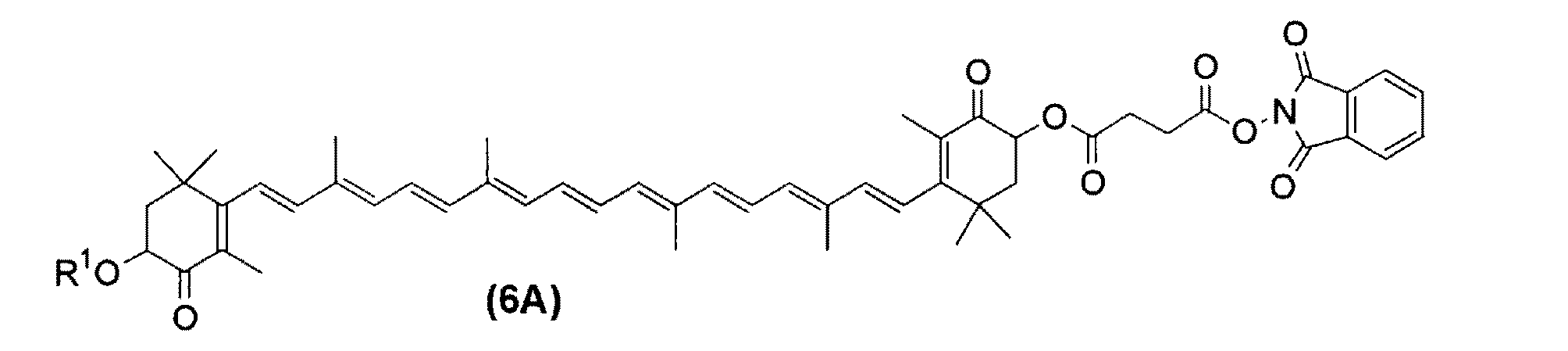
まず、水酸基を有するカロチノイド(7)と、無水コハク酸とを縮合してカロチノイドエステルカルボン酸化合物(3)とする。この化合物(3)とN−ヒドロキシフタルイミドとを縮合させてカロチノイドエステル−フタルイミド化合物(4)を得る。さらにこの化合物(4)とコラーゲンペプチドとを反応させてカロチノイド−コラーゲンペプチド縮合体(1)を得ることができる。 First, the carotenoid (7) having a hydroxyl group and succinic anhydride are condensed to obtain a carotenoid ester carboxylic acid compound (3). This compound (3) and N-hydroxyphthalimide are condensed to obtain a carotenoid ester-phthalimide compound (4). Further, this carotenoid-collagen peptide condensate (1) can be obtained by reacting this compound (4) with a collagen peptide.
本発明の製造方法に関し、さらに詳細に説明する。
カロチノイド(7)と無水コハク酸との縮合では、両者を有機溶剤中で縮合させる。その際、塩基を用いても用いなくてもよいが、塩基を用いることが好ましい。この塩基としては有機塩基でも無機塩基でもよい。有機塩基としては、ピリジン、メチルピリジン、ジメチルピリジン、トリメチルピリジンなどのピリジン類やイミダゾールなどのアゾール類、トリエチルアミンやトリブチルアミンのようなトリアルキルアミン類が好ましく、無機塩基としては、炭酸ナトリウムや炭酸水素ナトリウム、炭酸カリウムなどの炭酸塩が好ましい。
The production method of the present invention will be described in more detail.
In the condensation of carotenoid (7) and succinic anhydride, both are condensed in an organic solvent. At that time, a base may or may not be used, but a base is preferably used. This base may be an organic base or an inorganic base. As the organic base, pyridines such as pyridine, methylpyridine, dimethylpyridine, and trimethylpyridine, azoles such as imidazole, and trialkylamines such as triethylamine and tributylamine are preferable. As the inorganic base, sodium carbonate and hydrogen carbonate are preferable. Carbonates such as sodium and potassium carbonate are preferred.
カロチノイド(7)と無水コハク酸との縮合に用いられる有機溶媒としては、ジメチルスルホキシド(DMSO)やアルコール類などの無水コハク酸と反応する溶媒を除けば特に限定は無いが、塩化メチレンなどの有機塩素溶媒、酢酸エステル、アセトニトリル、エーテル、テトラヒドロフラン(THF)、ジメチルホルムアミド(DMF)、ジメチルアセトアミド(DMAc)、N−メチルピロリドン、N,N−ジメチルイミダゾリジノンが好ましい。 The organic solvent used for the condensation of carotenoid (7) and succinic anhydride is not particularly limited, except for solvents that react with succinic anhydride such as dimethyl sulfoxide (DMSO) and alcohols, but organic solvents such as methylene chloride. Chlorine solvent, acetate ester, acetonitrile, ether, tetrahydrofuran (THF), dimethylformamide (DMF), dimethylacetamide (DMAc), N-methylpyrrolidone, N, N-dimethylimidazolidinone are preferred.
カロチノイド(7)と無水コハク酸との縮合における反応温度は20℃から70℃が好ましく、20℃から50℃がさらに好ましい。 The reaction temperature in the condensation of carotenoid (7) and succinic anhydride is preferably 20 ° C to 70 ° C, more preferably 20 ° C to 50 ° C.
カロチノイド(7)と無水コハク酸のモル比は1倍から5倍が好ましく、1倍から2倍が好ましく、1.05倍から1.2倍が特に好ましい。 The molar ratio of carotenoid (7) to succinic anhydride is preferably 1 to 5 times, preferably 1 to 2 times, and particularly preferably 1.05 to 1.2 times.
カロチノイドエステルカルボン酸化合物(3)とN−ヒドロキシフタルイミドとの縮合においては、カルボン酸とN−ヒドロキシフタルイミドの縮合法として既知の方法を用いることができる。すなわち、カルボジイミドなどの脱水縮合剤を用いる方法や、カルボン酸を塩化チオニルやオキシ塩化リンなどの塩素化剤を用いていったん三塩化物に変えた後、塩基存在下、N−ヒドロキシフタルイミドと反応させる方法等を用いることができる。それらの中では、カルボジイミドを用いる方法が特に好ましい。 In the condensation of the carotenoid ester carboxylic acid compound (3) and N-hydroxyphthalimide, a known method can be used as a condensation method of carboxylic acid and N-hydroxyphthalimide. That is, a method using a dehydration condensing agent such as carbodiimide, or a carboxylic acid is changed to trichloride once using a chlorinating agent such as thionyl chloride or phosphorus oxychloride, and then reacted with N-hydroxyphthalimide in the presence of a base. A method or the like can be used. Among them, a method using carbodiimide is particularly preferable.
カロチノイドエステルカルボン酸化合物(3)とN−ヒドロキシフタルイミドとの縮合に用いられる溶媒は、カルボジイミドを用いる場合は、エーテル、THF、アセトニトリル、酢酸エチル、DMF、DMAc、N−メチルピロリドン、N,N−ジメチルイミダゾリジノンが好ましい。 When the carbodiimide is used, the solvent used for the condensation of the carotenoid ester carboxylic acid compound (3) and N-hydroxyphthalimide is ether, THF, acetonitrile, ethyl acetate, DMF, DMAc, N-methylpyrrolidone, N, N- Dimethylimidazolidinone is preferred.
カロチノイドエステルカルボン酸化合物(3)とN−ヒドロキシフタルイミドとの縮合における反応温度は、カルボジイミドを用いる場合は、20℃から70℃が好ましく、20℃から50℃がさらに好ましい。 When carbodiimide is used, the reaction temperature in the condensation of the carotenoid ester carboxylic acid compound (3) and N-hydroxyphthalimide is preferably 20 ° C. to 70 ° C., more preferably 20 ° C. to 50 ° C.
カロチノイドエステルカルボン酸化合物(3)とN−ヒドロキシフタルイミドのモル比は1倍から5倍が好ましく、1倍から2倍が好ましく、1.05倍から1.2倍が特に好ましい。 The molar ratio of the carotenoid ester carboxylic acid compound (3) and N-hydroxyphthalimide is preferably 1 to 5 times, preferably 1 to 2 times, and particularly preferably 1.05 to 1.2 times.
カロチノイドエステルカルボン酸化合物(3)とN−ヒドロキシフタルイミドとの縮合に用いられるカルボジイミドは、ジシクロヘキシルカルボジイミド(DCC)が特に好ましく、その量は、モル比で、カロチノイドエステルカルボン酸化合物(3)に対して、1倍から2倍が好ましく、1.05倍から1.2倍が特に好ましい。 The carbodiimide used for the condensation of the carotenoid ester carboxylic acid compound (3) and N-hydroxyphthalimide is particularly preferably dicyclohexylcarbodiimide (DCC), and the amount thereof is in a molar ratio with respect to the carotenoid ester carboxylic acid compound (3). 1 to 2 times is preferable, and 1.05 to 1.2 times is particularly preferable.
カロチノイドエステル−フタルイミド化合物(4)とコラーゲンペプチドとの縮合では、カロチノイドエステル−フタルイミド化合物(4)を非水溶性の溶剤に、コラーゲンペプチドを水に溶解し、二層系で反応させる方法や、カロチノイドエステル−フタルイミド化合物(4)をDMFなどの水溶性の溶剤に溶解し、コラーゲンペプチドの水溶液と混合して単層系で反応させる方法のいずれも用いることができるが、単層系の反応が好ましい。このとき用いられる溶剤はDMF、DMAc、N−メチルピロリドン、N,N−ジメチルイミダゾリジノンが特に好ましい。 In the condensation of the carotenoid ester-phthalimide compound (4) and the collagen peptide, a method in which the carotenoid ester-phthalimide compound (4) is dissolved in a water-insoluble solvent and the collagen peptide is dissolved in water and reacted in a two-layer system. Any method in which the ester-phthalimide compound (4) is dissolved in a water-soluble solvent such as DMF, mixed with an aqueous solution of collagen peptide and reacted in a monolayer system can be used, but a monolayer reaction is preferred. . The solvent used at this time is particularly preferably DMF, DMAc, N-methylpyrrolidone, or N, N-dimethylimidazolidinone.
カロチノイドエステル−フタルイミド化合物(4)とコラーゲンペプチドとの縮合における温度は、単層系の場合、25℃から95℃が好ましく、30℃から70℃がさらに好ましく、40℃から60℃がもっとも好ましい。 In the case of a monolayer system, the temperature in the condensation of the carotenoid ester-phthalimide compound (4) and the collagen peptide is preferably 25 ° C to 95 ° C, more preferably 30 ° C to 70 ° C, and most preferably 40 ° C to 60 ° C.
カロチノイドエステル−フタルイミド化合物(4)とコラーゲンペプチドの比はコラーゲンペプチド中のリジン比に依存する。カロチノイドエステル−フタルイミド化合物(4)はコラーゲンペプチド中のリジン残基に対し、0.1から5当量が好ましく、0.2から3当量がさらに好ましく、0.2から2当量が特に好ましい。 The ratio of the carotenoid ester-phthalimide compound (4) to the collagen peptide depends on the lysine ratio in the collagen peptide. The carotenoid ester-phthalimide compound (4) is preferably from 0.1 to 5 equivalents, more preferably from 0.2 to 3 equivalents, particularly preferably from 0.2 to 2 equivalents, based on the lysine residue in the collagen peptide.
前記一般式(2)で表されるアスタキサンチン−コラーゲンペプチド縮合体は、下記合成ルートによって製造することができる。下記合成ルートにおいて、R1は、水素原子、アシル基、燐酸エステル基またはグルコシド基を表し、Colはコラーゲンペプチド鎖を表す。 The astaxanthin-collagen peptide condensate represented by the general formula (2) can be produced by the following synthesis route. In the following synthetic route, R 1 represents a hydrogen atom, an acyl group, a phosphate group or a glucoside group, and Col represents a collagen peptide chain.
まず、水酸基を有するアスタキサンチン(8)と、無水コハク酸とを縮合してアスタキサンチンエステルカルボン酸化合物(5)とする。この化合物(5)とN−ヒドロキシフタルイミドとを縮合させてカロチノイドエステル−フタルイミド化合物(6)を得る。さらにこの化合物(6)とコラーゲンペプチドとを反応させてカロチノイド−コラーゲンペプチド縮合体(2)を得ることができる。 First, astaxanthin (8) having a hydroxyl group and succinic anhydride are condensed to obtain an astaxanthin ester carboxylic acid compound (5). This compound (5) and N-hydroxyphthalimide are condensed to obtain a carotenoid ester-phthalimide compound (6). Further, the carotenoid-collagen peptide condensate (2) can be obtained by reacting this compound (6) with a collagen peptide.
カロチノイド−コラーゲンペプチド縮合体(2)の製造方法の詳細は、前記カロチノイド−コラーゲンペプチド縮合体(1)の製造方法と同様であり、各縮合反応における好ましい縮合法、有機溶媒、反応温度、等も同様である。 The details of the production method of the carotenoid-collagen peptide condensate (2) are the same as the production method of the carotenoid-collagen peptide condensate (1), and preferred condensation methods, organic solvents, reaction temperatures, etc. in each condensation reaction It is the same.
次に実施例を挙げて本発明を更に詳細に説明するが、本発明はこれらになんら制限されるものではない。 EXAMPLES Next, although an Example is given and this invention is demonstrated still in detail, this invention is not restrict | limited to these at all.
参考例1:アスタキサンチンの精製
(1)前吸着
ヘマトコッカス抽出物(武田紙器製 79g)を酢酸エチル800mLに溶解させ、シリカゲル(和光純薬 C-200 165g)を添加し減圧濃縮した。濃縮後は窒素でブローした。
Reference Example 1: Purification of astaxanthin (1) Pre-adsorption Hematococcus extract (79 g made by Takeda Kaiki Co., Ltd.) was dissolved in 800 mL of ethyl acetate, silica gel (Wako Pure Chemical C-200 165 g) was added, and the mixture was concentrated under reduced pressure. After concentration, it was blown with nitrogen.
(2)カラム充填
シリカゲル(和光純薬 C-200 2342g 3900mL)をヘキサン/酢酸エチル9:1で懸濁し、太さ16cm 長さ60cmのカラムに充填した。
(2) Column packing Silica gel (Wako Pure Chemicals C-200 2342 g 3900 mL) was suspended in hexane / ethyl acetate 9: 1 and packed in a column 16 cm thick and 60 cm long.
(3)展開
カラムの上部に展開溶媒を張り、前吸着させたシリカゲルを添加した。ヘキサン/酢酸エチル=9:1の溶離液を12L流した。ついで、ヘキサン/酢酸エチル=5:1の溶離液を6L流した。さらにヘキサン/酢酸エチル=5:1の溶離液を7L流した。
展開液をTLCで分析し、モノエステル分画部を減圧溜去しモノエステル体14gを得た。このモノエステル体はカルボン酸部が炭素数18の不飽和脂肪酸の混合物(R1=C17H29-33CO)であった。
(3) Development The development solvent was spread on the upper part of the column, and preadsorbed silica gel was added. 12 L of an eluent of hexane / ethyl acetate = 9: 1 was flowed. Subsequently, 6 L of an eluent of hexane / ethyl acetate = 5: 1 was flowed. Further, 7 L of an eluent of hexane / ethyl acetate = 5: 1 was passed.
The developing solution was analyzed by TLC, and the monoester fraction was distilled off under reduced pressure to obtain 14 g of a monoester. This monoester was a mixture of unsaturated fatty acids having a carboxylic acid part of 18 carbon atoms (R 1 = C 17 H 29-33 CO).
実施例1:アスタキサンチンエステルカルボン酸化合物(5A : R1=C17H31CO)の合成
アスタキサンチンモノエステル(8A : R1=C17H31CO)3.0g(3.5mmol)と無水コハク酸0.41g(4.1mmol)を塩化メチレン20mlに溶解しトリエチルアミン0.42g(4.1mmol)を添加し室温で16時間反応させた。反応液に1モル/L HCl 10mlを添加し分液しさらに水で有機層を洗浄した。有機層を硫酸ナトリウムで乾燥した後で濃縮し、3.1g(収率 93%)でアスタキサンチンエステルカルボン酸化合物(5A)を得た。
(1HNMR(CDCl3 6.1-6.7(14H,m), 5.5-5.6(2H,m), 5.3-5.4(4H,m),1.99(12H,s), 1.90(6H,s), 1.33(6H,s), 1.23(6H,s). MS m/z =990.7(R1=C17H33), 988.7(R1=C17H31) . mp 72℃分解
Example 1 Synthesis of Astaxanthin Ester Carboxylic Acid Compound (5A: R 1 = C 17 H 31 CO) Astaxanthin Monoester (8A: R 1 = C 17 H 31 CO) 3.0 g (3.5 mmol) and succinic anhydride 0.41 g (4.1 mmol) was dissolved in 20 ml of methylene chloride, 0.42 g (4.1 mmol) of triethylamine was added, and the mixture was reacted at room temperature for 16 hours. To the reaction solution was added 10 ml of 1 mol / L HCl, and the mixture was separated, and the organic layer was washed with water. The organic layer was dried over sodium sulfate and concentrated to obtain astaxanthin ester carboxylic acid compound (5A) in 3.1 g (yield 93%).
( 1 HNMR (CDCl 3 6.1-6.7 (14H, m), 5.5-5.6 (2H, m), 5.3-5.4 (4H, m), 1.99 (12H, s), 1.90 (6H, s), 1.33 (6H , s), 1.23 (6H, s). MS m / z = 990.7 (R 1 = C 17 H 33 ), 988.7 (R 1 = C 17 H 31 ) .mp 72 ° C decomposition
実施例2:アスタキサンチンエステル−フタルイミド化合物(6A : R1=C17H31CO)の合成
アスタキサンチンエステルカルボン酸化合物(5A)2.8g(2.9mmol)とN−ヒドロキシフタルイミド0.57g(3.5mmol)をTHF 20mlに溶解し、DCC 0.72g(3.5mmol)
を添加し室温で16時間反応させた。析出したジシクロヘキシル尿素(DCU)を濾別し、DCUをTHFで洗浄した。有機層を濃縮し、アスタキサンチンエステル−フタルイミド化合物(6A : R1=C17H31CO)濃縮物3.1gを得た。
(1HNMR(CDCl3 6.1-6.7(14H,m), 5.5-5.6(2H,m), 5.3-5.4(4H,m),2.02(12H,s), 1.90(6H,s), 1.32(6H,s), 1.22(6H,s). MS m/z =1015.6(R1=C17H33), 1013.6(R1=C17H31) . mp 46℃ 分解
得られた濃縮物はこのまま次の反応に用いた。
Example 2: Synthesis of astaxanthin ester-phthalimide compound (6A: R 1 = C 17 H 31 CO) Astaxanthin ester carboxylic acid compound (5A) 2.8 g (2.9 mmol) and N-hydroxyphthalimide 0.57 g (3.5 mmol) Dissolve in 20ml, DCC 0.72g (3.5mmol)
Was added and allowed to react at room temperature for 16 hours. The precipitated dicyclohexylurea (DCU) was filtered off and the DCU was washed with THF. The organic layer was concentrated to obtain 3.1 g of an astaxanthin ester-phthalimide compound (6A: R 1 = C 17 H 31 CO) concentrate.
( 1 HNMR (CDCl 3 6.1-6.7 (14H, m), 5.5-5.6 (2H, m), 5.3-5.4 (4H, m), 2.02 (12H, s), 1.90 (6H, s), 1.32 (6H , s), 1.22 (6H, s). MS m / z = 1015.6 (R 1 = C 17 H 33 ), 1013.6 (R 1 = C 17 H 31 ). mp 46 ° C Decomposition Used for the reaction.
実施例3:アスタキサンチン-コラーゲンペプチド縮合体(2A : R1=C17H31CO)の合成
実施例3で得られたアスタキサンチンエステル−フタルイミド化合物(6A)濃縮物3.1gをDMAc 20gで溶解した。コラーゲンペプチド(ニッピ製 FCP-A 平均分子量:1万、Lys比率2.6%)15gをDMAcと水に50℃で溶解させた。このコラーゲンペプチド溶液に、窒素気流下で上記アスタキサンチンエステル−フタルイミド化合物(6A)のDMAc溶液を添加し、60℃で5時間反応させた。さらに室温で16時間反応させた。反応液をアセトニトリルに添加し窒素気流下で室温で終夜撹拌した。析出したアスタキサンチン-コラーゲンペプチド縮合体(2A : R1=C17H31CO)を濾取し、30℃で減圧乾燥した。収量9.8g。スペクトル分析から、アスタキサンチン部の重量比は25%であった。1HNMR CDCl3 6.1-6.7の積分を14Hとして、計算値から求めた。
Example 3 Synthesis of Astaxanthin-Collagen Peptide Condensate (2A: R 1 = C 17 H 31 CO) 3.1 g of the astaxanthin ester-phthalimide compound (6A) concentrate obtained in Example 3 was dissolved in 20 g of DMAc. 15 g of collagen peptide (Nippi FCP-A average molecular weight 10,000, Lys ratio 2.6%) was dissolved in DMAc and water at 50 ° C. To this collagen peptide solution, the DMAc solution of the astaxanthin ester-phthalimide compound (6A) was added under a nitrogen stream, and reacted at 60 ° C. for 5 hours. The reaction was further continued at room temperature for 16 hours. The reaction solution was added to acetonitrile and stirred overnight at room temperature under a nitrogen stream. The precipitated astaxanthin-collagen peptide condensate (2A: R 1 = C 17 H 31 CO) was collected by filtration and dried under reduced pressure at 30 ° C. Yield 9.8g. From the spectral analysis, the weight ratio of the astaxanthin part was 25%. The integration of 1 HNMR CDCl 3 6.1-6.7 was 14H, and was calculated from the calculated value.
実施例4:アスタキサンチン−コラーゲンペプチド縮合体(2A)の固体分散液
前記で得られたアスタキサンチン−コラーゲンペプチド縮合体(2A)を下記(1)の方法により分散固体とした。
(1) 蒸留水21.4gおよびリン脂質コポリマー界面活性剤(日本油脂 Lipidure-PMB)の溶液2.65gとを60mlネジブタ瓶に入れた。アスタキサンチン−コラーゲンペプチド縮合体(2A)1.0gをこの溶液に添加した。酸化ジルコニウム(ZrO)のビーズ40ml(2mm径)を添加し、ふたをしっかりしめたのちミルに置き回転数4800r.p.m.にて粒子サイズ1μm以下の化合物の微粉体分散物を得た。
Example 4: Solid dispersion of astaxanthin-collagen peptide condensate (2A) The astaxanthin-collagen peptide condensate (2A) obtained above was made into a dispersed solid by the method of (1) below.
(1) 21.4 g of distilled water and 2.65 g of a solution of a phospholipid copolymer surfactant (Nippon Yushi Lipidure-PMB) were placed in a 60 ml screw pig bottle. 1.0 g of astaxanthin-collagen peptide condensate (2A) was added to this solution. Zirconium oxide (ZrO) beads (40 ml, 2 mm diameter) were added, the lid was firmly fixed, and then placed in a mill to obtain a fine powder dispersion of a compound having a particle size of 1 μm or less at a rotational speed of 4800 rpm.
試料液の調整
上記のようにして調製した微粉体分散物を、表1に示す重量濃度になるように蒸留水で希釈して試料液を調製した。
Preparation of sample solution The fine powder dispersion prepared as described above was diluted with distilled water so as to have a weight concentration shown in Table 1 to prepare a sample solution.
比較例1
蒸留水21.3gおよびリン脂質コポリマー界面活性剤(日本油脂 Lipidure-PMB)の溶液2.65gとを60mlネジブタ瓶に入れた。前記参考例によって精製したアスタキサンチンモノエステル0.10gとTHF 1mlの溶液をこの溶液に添加した。酸化ジルコニウム(ZrO)のビーズ40ml(2mm径)を添加し、ふたをしっかりしめたのちミルに置き回転数4800r.p.m.にて分散液を得た。
Comparative Example 1
21.3 g of distilled water and 2.65 g of a solution of phospholipid copolymer surfactant (Nippon Yushi Lipidure-PMB) were placed in a 60 ml screw pig bottle. A solution of 0.10 g of astaxanthin monoester purified by the above reference example and 1 ml of THF was added to this solution. Zirconium oxide (ZrO) beads (40 ml, 2 mm diameter) were added, the lid was firmly fixed, and then placed on a mill to obtain a dispersion at a rotational speed of 4800 rpm.
試料液の調整
上記のようにして調製した分散液を、表1に示す重量濃度になるように蒸留水で希釈して比較試料液とした。
Preparation of Sample Solution The dispersion prepared as described above was diluted with distilled water so as to have a weight concentration shown in Table 1, and used as a comparative sample solution.
〔分散物の評価〕
{空気酸化に対する安定性}
評価用の試料は、50mlのナス型フラスコに試料15ml入れて25℃、空気雰囲気下攪拌して試験を行った。評価は、窒素雰囲気下の470nmの吸収(アスタキサンチンの吸収極大)を100として空気雰囲気下の残存率を算出した。結果を表1に示す。
[Evaluation of dispersion]
{Stability against air oxidation}
The sample for evaluation was tested by placing 15 ml of sample in a 50 ml eggplant type flask and stirring in an air atmosphere at 25 ° C. In the evaluation, the residual ratio in the air atmosphere was calculated by setting the absorption at 470 nm under nitrogen atmosphere (absorption maximum of astaxanthin) to 100. The results are shown in Table 1.
{光照射に対する安定性}
メリーゴーランド型キセノン退色試験機を用いて、光照射実験を行った。キセノン光原は、500Wのランプを使用した。評価用の試料は、4面透明な蓋付の10mm石英セルに試料3ml入れて25℃、無攪拌で試験を行った。評価は、光照射なしの470nmの吸収(アスタキサンチンの吸収極大)を100として光照射後の残存率を算出した。結果を表1に示す。
{Stability against light irradiation}
A light irradiation experiment was conducted using a merry-go-round type xenon fading tester. The xenon photogen used a 500 W lamp. The sample for evaluation was placed in a 10 mm quartz cell with a four-sided transparent lid, and the test was conducted at 25 ° C. without stirring. In the evaluation, the residual ratio after light irradiation was calculated with the absorption at 470 nm without light irradiation (absorption maximum of astaxanthin) being 100. The results are shown in Table 1.
表1に示したように、本発明のアスタキサンチン−コラーゲンペプチド縮合体は、比較例のアスタキサンチンより高い安定性を示した。 As shown in Table 1, the astaxanthin-collagen peptide condensate of the present invention showed higher stability than the astaxanthin of the comparative example.
実施例5:抗酸化活性[スーパーオキサイド除去活性]
実施例4で得られた試料を下記測定方法によりスーパーオキサイド除去活性を測定した。すなわち、0.05M炭酸ナトリウム緩衝液(pH10.2)2.4mlに基質溶液[3.0mM キサンチン(0.05M炭酸ナトリウム緩衝液に溶解)]0.1ml、3.0mM EDTA 0.1ml、0.15%(W/V)ウシ血清アルブミン0.1ml、0.75mM ニトロブル−テトラゾリウム 0.1ml及び各被験試料0.1mlを混合し、25℃で10分間放置した。次いで、酵素溶液[キサンチンオキシダーゼ溶液(精製水にて約0.04units/ml希釈)]0.1mlを加えて反応を開始し、25℃で20分間インキュベートした後、6mM CaCl2 0.1mlを加えて反応を停止した。次いで560nmにおける吸光度(A)を測定した。
Example 5: Antioxidant activity [superoxide removal activity]
The sample obtained in Example 4 was measured for superoxide removal activity by the following measurement method. That is, the substrate solution [3.0 mM xanthine (dissolved in 0.05 M sodium carbonate buffer)] in 0.1 ml of 0.05 M sodium carbonate buffer (pH 10.2), 0.1 ml, 3.0 mM EDTA, 0.1 ml 0.1 ml of 0.15% (W / V) bovine serum albumin, 0.1 ml of 0.75 mM nitrobull-tetrazolium and 0.1 ml of each test sample were mixed and left at 25 ° C. for 10 minutes. Next, 0.1 ml of enzyme solution [xanthine oxidase solution (diluted with about 0.04 units / ml in purified water)] was added to start the reaction. After incubation at 25 ° C. for 20 minutes, 0.1 ml of 6 mM CaCl 2 was added. The reaction was stopped. Next, the absorbance (A) at 560 nm was measured.
対照には被験試料のかわりに蒸留水を加えた試料の吸光度(B)、また各試料のブランクには、6mM CaCl2 0.1mlを加えて反応停止後に、キサンチンオキシダーゼ0.1mlを添加した試料の吸光度(C)を測定し、次式より、スーパーオキサイド除去率を算出した。その結果を表2に示す。 Absorbance (B) of the sample in which distilled water was added instead of the test sample as a control, and 0.1 ml of xanthine oxidase after addition of 0.1 ml of 6 mM CaCl 2 to the blank of each sample after stopping the reaction The superoxide removal rate was calculated from the following formula. The results are shown in Table 2.
除去率=((B−(A−C))/B)×100
A:試料の酵素反応による吸光度
B:対照の酵素反応による吸光度
C:試料の無酵素反応による吸光度
Removal rate = ((B− (A−C)) / B) × 100
A: Absorbance due to enzyme reaction of sample B: Absorbance due to enzyme reaction of control C: Absorbance due to enzyme-free reaction of sample
表2に示したように本発明のアスタキサンチン-コラーゲンペプチド縮合体はアスタキサンチンモノエステルと同等以上の抗酸化活性を示した。さらに、抗酸化性が知られているビタミンC、ビタミンEとの併用により、特に低濃度領域で抗酸化性が強くなることが示された。 As shown in Table 2, the astaxanthin-collagen peptide condensate of the present invention showed an antioxidant activity equal to or higher than that of astaxanthin monoester. Furthermore, it was shown that the combination of vitamin C and vitamin E, which are known to have antioxidant properties, increases the antioxidant properties especially in the low concentration range.
このことは、本発明のアスタキサンチン−コラーゲンペプチド縮合体は活性酸素除去剤を併用することにより、皮膚中での活性酸素生成に起因する過酸化脂質の生成、炎症、黒化、老化に対し、極めて高い予防効果を有することを示すものと言える。 This is because the astaxanthin-collagen peptide condensate of the present invention is extremely effective against the formation of lipid peroxide, inflammation, blackening, and aging caused by the generation of active oxygen in the skin by using an active oxygen scavenger in combination. It can be said that it has a high preventive effect.
実施例6:アスタキサンチンステアリン酸エステル(R1=C17H35)
アスタキサンチン(和光純薬、生化学用)0.60g(1.0mmol)とステアリン酸塩化物(アルドリッチ)0.33g(1.1mmol)をアセトニトリル10mlに溶解し、4℃で、トリエチルアミ
ン1mlを加えた。その後、22℃に温度を上げ、その温度で、4時間攪拌した。反応液を40mlの水に投じ、20mlの酢酸エチルで3回抽出した。酢酸エチル抽出液を1規定塩酸液で洗浄し、飽和重曹水と飽和食塩水で洗浄した。酢酸エチル溶液を無水硫酸ナトリウムで乾燥後、溶媒溜去し、シリカゲル(和光純薬 C-200) 40gを用い、ヘキサン/酢酸エチルで溶出させ精製した。収量0.32g(融点79-83℃)。
実施例1〜5と同様にして、固体分散液を得た後、同様の評価を行ったところ、同様の結果が得られた。
Example 6: Astaxanthin stearate (R 1 = C 17 H 35 )
Astaxanthin (Wako Pure Chemicals, Biochemical) 0.60 g (1.0 mmol) and stearic acid chloride (Aldrich) 0.33 g (1.1 mmol) were dissolved in 10 ml of acetonitrile, and 1 ml of triethylamine was added at 4 ° C. Thereafter, the temperature was raised to 22 ° C., and the mixture was stirred at that temperature for 4 hours. The reaction solution was poured into 40 ml of water and extracted three times with 20 ml of ethyl acetate. The ethyl acetate extract was washed with 1N hydrochloric acid solution, and washed with saturated aqueous sodium hydrogen carbonate and saturated brine. The ethyl acetate solution was dried over anhydrous sodium sulfate, the solvent was distilled off, and purification was performed using 40 g of silica gel (Wako Pure Chemicals C-200) eluting with hexane / ethyl acetate. Yield 0.32 g (melting point 79-83 ° C.).
When the same evaluation was performed after obtaining a solid dispersion in the same manner as in Examples 1 to 5, similar results were obtained.
実施例7:アスタキサンチン酢酸エステル
実施例6のステアリン酸塩化物を酢酸塩化物に変えた以外は同様にして酢酸エステル(R1=CH3、融点141℃分解)を合成した。
実施例1〜5と同様にして、固体分散液を得た後、同様の評価を行ったところ、同様の結果が得られた。
Example 7: Astaxanthin acetate An acetate (R 1 = CH 3 , decomposition at 141 ° C. decomposition) was synthesized in the same manner except that the stearic acid chloride of Example 6 was changed to acetic chloride.
When the same evaluation was performed after obtaining a solid dispersion in the same manner as in Examples 1 to 5, similar results were obtained.
Claims (12)
一般式(1)
General formula (1)
一般式(2)
General formula (2)
一般式(3)
General formula (3)
一般式(4)
General formula (4)
一般式(5)
General formula (5)
一般式(6)
General formula (6)
一般式(7)
一般式(3)
General formula (7)
General formula (3)
一般式(3)
一般式(4)
General formula (3)
General formula (4)
一般式(8)
一般式(5)
General formula (8)
General formula (5)
一般式(5)
一般式(6)
General formula (5)
General formula (6)
一般式(4)
一般式(1)
General formula (4)
General formula (1)
一般式(6)
一般式(2)
General formula (6)
General formula (2)
Priority Applications (1)
| Application Number | Priority Date | Filing Date | Title |
|---|---|---|---|
| JP2006066564A JP2007238564A (en) | 2006-03-10 | 2006-03-10 | Carotenoid-collagen peptide condensate |
Applications Claiming Priority (1)
| Application Number | Priority Date | Filing Date | Title |
|---|---|---|---|
| JP2006066564A JP2007238564A (en) | 2006-03-10 | 2006-03-10 | Carotenoid-collagen peptide condensate |
Publications (1)
| Publication Number | Publication Date |
|---|---|
| JP2007238564A true JP2007238564A (en) | 2007-09-20 |
Family
ID=38584440
Family Applications (1)
| Application Number | Title | Priority Date | Filing Date |
|---|---|---|---|
| JP2006066564A Pending JP2007238564A (en) | 2006-03-10 | 2006-03-10 | Carotenoid-collagen peptide condensate |
Country Status (1)
| Country | Link |
|---|---|
| JP (1) | JP2007238564A (en) |
Cited By (3)
| Publication number | Priority date | Publication date | Assignee | Title |
|---|---|---|---|---|
| US10125104B2 (en) | 2014-05-20 | 2018-11-13 | Asta Pharmaceuticals Co., Ltd. | Carotenoid derivative, pharmaceutically acceptable salt thereof, or pharmaceutically acceptable ester or amide thereof |
| CN109689610A (en) * | 2016-09-16 | 2019-04-26 | 巴斯夫欧洲公司 | The method for preparing 12 '-apocarotenal esters of the structural unit as carotenoid |
| WO2023273206A1 (en) * | 2021-07-01 | 2023-01-05 | 海南三元星生物科技股份有限公司 | Astaxanthin-collagen peptide oral liquid and preparation method therefor |
-
2006
- 2006-03-10 JP JP2006066564A patent/JP2007238564A/en active Pending
Cited By (3)
| Publication number | Priority date | Publication date | Assignee | Title |
|---|---|---|---|---|
| US10125104B2 (en) | 2014-05-20 | 2018-11-13 | Asta Pharmaceuticals Co., Ltd. | Carotenoid derivative, pharmaceutically acceptable salt thereof, or pharmaceutically acceptable ester or amide thereof |
| CN109689610A (en) * | 2016-09-16 | 2019-04-26 | 巴斯夫欧洲公司 | The method for preparing 12 '-apocarotenal esters of the structural unit as carotenoid |
| WO2023273206A1 (en) * | 2021-07-01 | 2023-01-05 | 海南三元星生物科技股份有限公司 | Astaxanthin-collagen peptide oral liquid and preparation method therefor |
Similar Documents
| Publication | Publication Date | Title |
|---|---|---|
| US4039559A (en) | Aliphatic carboxylic acid esters of Vitamin E and process for preparation thereof | |
| DE69532760T2 (en) | AGENTS FOR THE ADMINISTRATION OF ANTIGENS | |
| EP0703954B1 (en) | Polyphenol derivative compositions and preparation thereof | |
| RU2137755C1 (en) | Conjugates: therapeutic compound-fatty acid | |
| JPWO1997014705A1 (en) | High-purity tocopherol phosphate esters, their manufacturing method, their analytical method, and cosmetics | |
| TW200522978A (en) | Tocopherol-modified therapeutic drug compounds | |
| EP0587499B1 (en) | Benzopyran compounds, process for their preparation and their use as cell protectors | |
| CN1906149A (en) | Higher fullerenes useful as radical scavengers | |
| PL196944B1 (en) | Method of preparing delta-9-tetrahydrocannabinol esters | |
| CA2502568A1 (en) | Novel trans-lutein enriched xanthophyll ester concentrate and a process for its preparation | |
| JP4168170B2 (en) | Arbutin ester compound and method for producing the same | |
| ES2670776T3 (en) | Manufacturing methods of 15-hydroxy fatty acid derivatives | |
| JP4759413B2 (en) | Topical skin preparation | |
| JP2003146963A (en) | 2- (3,4-dihydroxyphenyl) ethyl-substituted carbonic acid derivatives and their use | |
| FR2510583A1 (en) | NOVEL DERIVATIVES OF URSODESOXYCHOLIC ACID, PROCESS FOR THEIR PREPARATION AND THERAPEUTIC USE THEREOF | |
| JP2002332210A (en) | Extraction fraction from archaea for use in cosmetics | |
| JP2004523525A (en) | Retinol derivative and method for producing the same | |
| JPS6159638B2 (en) | ||
| US11718576B2 (en) | Compositions and methods comprising resveratrol | |
| JP2000239245A (en) | Hydroxymandelic acid amide of phenolamine | |
| JP3878095B2 (en) | Skin preparation for sunburn prevention | |
| CN118561728A (en) | Retinol derivative and preparation method and application thereof | |
| EP1587508A1 (en) | Therapeutic use of acylglycerols and the nitrogen- and sulphur-containing analogues thereof | |
| KR20140077515A (en) | Conjugate of vitamin C with vitamin E and antioxidant comprising the same | |
| EP0504017A1 (en) | Benzopyran derivatives, process for their preparation and pharmaceutical compositions containing them |
Legal Events
| Date | Code | Title | Description |
|---|---|---|---|
| RD04 | Notification of resignation of power of attorney |
Free format text: JAPANESE INTERMEDIATE CODE: A7424 Effective date: 20071109 |
|
| RD04 | Notification of resignation of power of attorney |
Free format text: JAPANESE INTERMEDIATE CODE: A7424 Effective date: 20071116 |
|
| RD04 | Notification of resignation of power of attorney |
Free format text: JAPANESE INTERMEDIATE CODE: A7424 Effective date: 20071126 |