JP2005298939A - Stainless steel plate with excellent corrosion resistance and electrical conductivity - Google Patents
Stainless steel plate with excellent corrosion resistance and electrical conductivity Download PDFInfo
- Publication number
- JP2005298939A JP2005298939A JP2004119794A JP2004119794A JP2005298939A JP 2005298939 A JP2005298939 A JP 2005298939A JP 2004119794 A JP2004119794 A JP 2004119794A JP 2004119794 A JP2004119794 A JP 2004119794A JP 2005298939 A JP2005298939 A JP 2005298939A
- Authority
- JP
- Japan
- Prior art keywords
- mass
- stainless steel
- oxide film
- corrosion resistance
- less
- Prior art date
- Legal status (The legal status is an assumption and is not a legal conclusion. Google has not performed a legal analysis and makes no representation as to the accuracy of the status listed.)
- Pending
Links
Images
Classifications
-
- Y—GENERAL TAGGING OF NEW TECHNOLOGICAL DEVELOPMENTS; GENERAL TAGGING OF CROSS-SECTIONAL TECHNOLOGIES SPANNING OVER SEVERAL SECTIONS OF THE IPC; TECHNICAL SUBJECTS COVERED BY FORMER USPC CROSS-REFERENCE ART COLLECTIONS [XRACs] AND DIGESTS
- Y02—TECHNOLOGIES OR APPLICATIONS FOR MITIGATION OR ADAPTATION AGAINST CLIMATE CHANGE
- Y02E—REDUCTION OF GREENHOUSE GAS [GHG] EMISSIONS, RELATED TO ENERGY GENERATION, TRANSMISSION OR DISTRIBUTION
- Y02E60/00—Enabling technologies; Technologies with a potential or indirect contribution to GHG emissions mitigation
- Y02E60/30—Hydrogen technology
- Y02E60/50—Fuel cells
Landscapes
- Fuel Cell (AREA)
Abstract
【課題】接触抵抗が小さく、発電効率が優れ、かつ耐食性が高い固体高分子型燃料電池セパレータ用ステンレス鋼板を提供する
【解決手段】Cを0.03質量%以下、Nを0.03質量%以下、但し、CおよびNの合計C+N:0.03質量%以下、Crを11〜45質量%、Moを5.0質量%以下、Siを0.01〜1質量%、Mnを0.01〜1質量%、残りFe、不純物を含有するフェライト系ステンレス鋼板であって、鋼板の表面の酸化物皮膜中に、少なくともMo、W、Pからなる群から選んだ一種又は二種以上が含有され、酸化物皮膜中のクロム、鉄、Mo、Ni、W、Pの含有合計量に対して、Mo(6価)、W(6価)、P(5価)の含有合計量が、0.5質量%以上20質量%以下の範囲内であり、酸化物皮膜の厚さが平均値として1ナノメートル以上20ナノメートル以下であることを特徴とする耐食性および電気伝導性に優れるフェライト系ステンレス鋼板。
【選択図】図1
To provide a stainless steel plate for a polymer electrolyte fuel cell separator having low contact resistance, excellent power generation efficiency, and high corrosion resistance. SOLUTION: C is 0.03% by mass or less and N is 0.03% by mass. In the following, however, the sum of C and N C + N: 0.03 mass% or less, Cr is 11 to 45 mass%, Mo is 5.0 mass% or less, Si is 0.01 to 1 mass%, and Mn is 0.01. A ferritic stainless steel sheet containing ˜1% by mass, the remaining Fe, and impurities, wherein the oxide film on the surface of the steel sheet contains at least one or more selected from the group consisting of Mo, W, and P The total content of Mo (hexavalent), W (hexavalent), and P (pentavalent) is 0.00 with respect to the total content of chromium, iron, Mo, Ni, W, and P in the oxide film. It is within the range of 5 mass% or more and 20 mass% or less, and the average thickness of the oxide film is 1 nm. Ferritic stainless steel sheet excellent in corrosion resistance and electrical conductivity, characterized in that it is 20 nm or less than Torr.
[Selection] Figure 1
Description
本発明は、耐食性および電気伝導性に優れるステンレス鋼板、特に、燃料電池用部品(例えば固体高分子型燃料電池セパレータ)に使用されるステンレス鋼板に関するものである。 The present invention relates to a stainless steel plate excellent in corrosion resistance and electrical conductivity, and more particularly to a stainless steel plate used for a fuel cell component (for example, a polymer electrolyte fuel cell separator).
近年、地球環境保全の観点から、発電効率に優れ、CO2を排出しない燃料電池の開発が進められている。この燃料電池は、H2とO2から電気化学反応により電気を発生させるものであって、各種の燃料電池が開発されている。燃料電池は、使用される電解質の種類によって分類され、リン酸型、溶融炭酸塩型、固体電解質型、アルカリ型および固体高分子型などがある。 In recent years, from the viewpoint of global environmental conservation, development of fuel cells that are excellent in power generation efficiency and do not emit CO 2 has been promoted. This fuel cell generates electricity from H 2 and O 2 by an electrochemical reaction, and various fuel cells have been developed. Fuel cells are classified according to the type of electrolyte used, and include phosphoric acid type, molten carbonate type, solid electrolyte type, alkaline type and solid polymer type.
上記の燃料電池の中で、固体高分子型燃料電池は、他の燃料電池等に比べて、
(a)運転温度が80℃程度であり、格段に低い温度で運転できる、(b)電池本体の軽量化、小型化が可能である、(c)短時間で立上げができる等の特徴を有している。このため、固体高分子型燃料電池は、電気自動車の搭載用電源、家庭用あるいは業務用の定置型電源、携帯用の小型発電機として利用すべく、今日もっとも注目されている燃料電池である。
Among the above fuel cells, the polymer electrolyte fuel cell is compared with other fuel cells,
(A) The operating temperature is about 80 ° C., and it can be operated at a much lower temperature. (B) The battery body can be reduced in weight and size. (C) It can be started up in a short time. Have. For this reason, the polymer electrolyte fuel cell is the fuel cell that is attracting the most attention today for use as a power source for mounting an electric vehicle, a stationary power source for home use or business use, and a small portable generator.
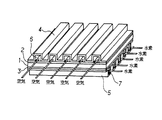
固体高分子型燃料電池は、高分子膜を介してH2とO2から電気を取り出す原理によるものであり、その構造は、サンドイッチのような構造を有しており、図1に示すようにガス拡散層2,3(例えばカーボンペーパ等)およびセパレータ4,5によって膜−電極接合体1を挟み込み、これを単一の構成要素 (いわゆる単セル) とし、セパレータ4と5の間に起電力を生じさせるものである。
なお、膜−電極接合体1は、MEA (すなわち Membrane-Electrode Assembly)と呼ばれており、高分子膜とその膜の表裏面に白金系触媒を担持したカーボンブラック等の電極材料を一体化したものであり、厚さは数10〜数100μmである。ガス拡散層2,3は膜−電極接合体1と一体化される場合も多い。
The polymer electrolyte fuel cell is based on the principle of extracting electricity from H 2 and O 2 through a polymer membrane, and has a sandwich-like structure, as shown in FIG. The membrane-
The membrane-
固体高分子形燃料電池を上記した用途に適用する場合は、このような単セルを直列に数十から数百個つないで燃料電池スタックを構成して使用している。
セパレータ4,5には、単セル間を隔てる隔壁としての役割に加えて、発生した電子を運ぶ導電体、O2(すなわち空気)とH2が流れる空気流路、水素流路、生成した水やガスを排出する排出路としての機能が求められる。さらに、固体高分子形燃料電池を実用に供するためには、耐久性や電気伝導性に優れたセパレータ4,5を使用する必要がある。
In the case where the polymer electrolyte fuel cell is applied to the above-described use, a fuel cell stack is formed by connecting several tens to several hundreds of such single cells in series.
The
耐久性に関しては、電気自動車の搭載用電源として使用される場合は、約5,000時間と想定されている。あるいは家庭用の定置型電源などとして使用される場合は、約40,000時間と想定されている。したがってセパレータ4,5には、長時間の発電に耐えられる耐食性等の特性が要求される。
また電気伝導性に関しては、セパレータ4,5とガス拡散層2,3との接触抵抗は極力低いことが望まれる。その理由は、セパレータ4,5とガス拡散層2,3との接触抵抗が増大すると、固体高分子型燃料電池の発電特性が低下するからである。つまり、接触抵抗が小さいほど、セパレータとして優れている。
As for durability, when used as a power source for mounting an electric vehicle, it is assumed that it is about 5,000 hours. Or when it is used as a stationary power source for home use, it is assumed that it is about 40,000 hours. Therefore, the
In terms of electrical conductivity, it is desirable that the contact resistance between the
現在までに、セパレータ4,5としてグラファイトを用いた固体高分子型燃料電池が実用化されている。このグラファイトからなるセパレータ4,5は、接触抵抗が比較的低く、しかも腐食しないという利点がある。しかしながら衝撃により破損しやすく、コンパクト化が困難で、しかも空気流路6、水素流路7を形成するための加工コストが高いという欠点がある。グラファイトからなるセパレータ4,5が有するこれらの欠点は、固体高分子型燃料電池の普及を妨げる原因になっている。
To date, polymer electrolyte fuel cells using graphite as
そこで、セパレータ4,5の素材として、グラファイトに替えて金属素材を適用する試みがなされている。特に、耐食性向上の観点から、ステンレス鋼を素材としたセパレータ4,5の実用化に向けて、種々の検討がなされている。
例えば、特開平8−180883号公報には、不動態皮膜を形成しやすい金属をセパレータとして用いる技術が開示されている。しかし、不動態皮膜の形成は、接触抵抗の上昇を招くことになり、発電効率の劣化につながる。このため、これらの金属素材は、カーボン素材にくらべて接触抵抗が高く、また、耐食性が劣るなどの改善すべき問題点が指摘されていた。
Therefore, an attempt is made to apply a metal material instead of graphite as a material for the
For example, Japanese Patent Application Laid-Open No. 8-180883 discloses a technique using a metal that easily forms a passive film as a separator. However, the formation of a passive film leads to an increase in contact resistance, leading to deterioration in power generation efficiency. For this reason, it has been pointed out that these metal materials have problems to be improved such as higher contact resistance and inferior corrosion resistance than carbon materials.
また、特開平10−228914号公報には、SUS304などの金属セパレータの表面に、金めっきを施すことにより、接触抵抗を低減し、高出力を確保する技術が開示されている。しかし、薄い金めっきでは、ピンホールの発生防止が困難であり、逆に厚い金めっきはコストの問題が残っている。
また、特開2000−277133号公報には、フェライト系ステンレス鋼基材に、カーボン粉末を分散付着させて、電気伝導性を改善したセパレータを得る方法が開示されている。しかしながら、カーボン粉末を用いた場合も、表面処理には相応のコストがかかることから、依然としてコストの問題が残っている。また、表面処理を施したセパレータは、組立時にキズ等が入った場合、耐食性が著しく低下するという問題点も指摘されている。
Japanese Patent Laid-Open No. 10-228914 discloses a technique for reducing contact resistance and ensuring high output by applying gold plating to the surface of a metal separator such as SUS304. However, with thin gold plating, it is difficult to prevent the occurrence of pinholes. Conversely, thick gold plating still has a problem of cost.
Japanese Patent Application Laid-Open No. 2000-277133 discloses a method of obtaining a separator having improved electrical conductivity by dispersing and adhering carbon powder to a ferritic stainless steel substrate. However, even when carbon powder is used, there is still a cost problem because the surface treatment requires a corresponding cost. Further, it has been pointed out that the separator subjected to the surface treatment has a problem that the corrosion resistance is remarkably lowered when scratches or the like are caused during assembly.
さらに、ステンレス鋼に表面処理を施さずに、そのままセパレータに適用しようとする試みがなされている。例えば、特開2000−239806号公報や特開2000−294255号公報には、Cu,Niを積極的に添加したうえで、S,P,N等の不純物元素を低減し、かつC+N≦0.03質量%、10.5質量%≦Cr+3×Mo≦43質量%を満足するセパレータ用フェライト系ステンレス鋼が開示されている。特開2000−265248号公報や特開2000−265248号公報には、Cu,Niを0.2質量%以下に制限して金属イオンの溶出を抑えたうえで、S,P,N等の不純物元素を低減し、かつC+N≦0.03質量%、10.5質量%≦Cr+3×Mo≦43質量%を満足するセパレータ用フェライト系ステンレス鋼が開示されている。 Furthermore, an attempt has been made to apply it to a separator as it is without subjecting stainless steel to a surface treatment. For example, in JP 2000-239806 A and JP 2000-294255 A, Cu, Ni are positively added, impurity elements such as S, P, and N are reduced, and C + N ≦ 0.03 mass. %, 10.5% by mass ≦ Cr + 3 × Mo ≦ 43% by mass, a ferritic stainless steel for a separator is disclosed. In JP 2000-265248 A and JP 2000-265248 A, Cu and Ni are limited to 0.2% by mass or less to suppress elution of metal ions, and impurity elements such as S, P, and N are added. A ferritic stainless steel for a separator that is reduced and satisfies C + N ≦ 0.03% by mass and 10.5% by mass ≦ Cr + 3 × Mo ≦ 43% by mass is disclosed.
ただし、これらの発明は、いずれも鋼の組成成分を所定の範囲に規定して、不動態皮膜を強固にすることにより、表面処理を施さず、そのまま使用しても溶出金属イオンによる電極担持触媒の触媒能の劣化を低減し、腐食生成物による電極との接触抵抗の増加を抑制しようとする思想に基づいている。しかしながら、ステンレス鋼の耐食性を確保している不動態皮膜の状態はステンレス鋼板の仕上げ等によって大きく異なることが知られており、燃料電池環境での耐久性を確保するためには、母材組成を規定したのみでは不十分である。
本発明は、従来の技術が抱えている上記問題点に鑑み、耐食性が良好であると共に、接触抵抗が低い(すなわち電気伝導性に優れる)固体高分子型燃料電池セパレータ用ステンレス鋼板を提供することを目的とする。
すなわち本発明は、素材となるステンレス鋼の組成のみならず、表面に存在する酸化物皮膜の組成および厚さを所定の範囲に規定することにより、接触抵抗が小さく、発電効率が優れ、かつ耐食性が高い固体高分子型燃料電池セパレータ用ステンレス鋼板を提供することを目的とする。
The present invention provides a stainless steel plate for a polymer electrolyte fuel cell separator that has good corrosion resistance and low contact resistance (that is, excellent electrical conductivity) in view of the above-described problems of conventional techniques. With the goal.
That is, the present invention defines not only the composition of stainless steel as a raw material but also the composition and thickness of the oxide film existing on the surface within a predetermined range, thereby reducing contact resistance, excellent power generation efficiency, and corrosion resistance. An object of the present invention is to provide a stainless steel plate for a solid polymer type fuel cell separator having a high value.
本発明者は、上述した従来技術の問題点を解決すべく鋭意研究を重ねた。その結果、ステンレス鋼板の耐食性および電気伝導性をともに向上させるためには、ステンレス鋼板の表面に形成される酸化物皮膜中の含有元素およびその含有量、さらにはそれらの元素と酸素原子との結合状態を制御すると共に、酸化物皮膜の厚さを制御することが重要であることが判明した。 The present inventor has intensively studied to solve the above-mentioned problems of the prior art. As a result, in order to improve both the corrosion resistance and electrical conductivity of the stainless steel sheet, the elements contained in the oxide film formed on the surface of the stainless steel sheet and the content thereof, and further the bonding between these elements and oxygen atoms It has been found that it is important to control the state and the thickness of the oxide film.
即ち、クロム(Cr)を11〜45質量%含有するオーステナイト系およびフェライト系ステンレス鋼板の表面の酸化物皮膜中に、少なくともモリブデン(Mo)、タングステン(W)、リン(P)からなる群から選んだ一種又は二種以上の元素が含有され、前記酸化物皮膜中に含有されるクロム、鉄、Mo、Ni、W、Pの含有合計量に対して、6価モリブデン、6価タングステン、5価リンの含有合計量が、0.5質量%以上20質量%以下の範囲内であるとき、耐食性が向上することが判明した。更に、酸化物皮膜の厚さが平均値として1ナノメートル以上20ナノメートル以下であるとき、電気伝導性が向上することが判明した。 That is, the oxide film on the surface of the austenitic and ferritic stainless steel sheet containing 11 to 45 mass% of chromium (Cr) is selected from the group consisting of at least molybdenum (Mo), tungsten (W), and phosphorus (P). One or more elements are contained, and hexavalent molybdenum, hexavalent tungsten, pentavalent with respect to the total content of chromium, iron, Mo, Ni, W, and P contained in the oxide film. It has been found that the corrosion resistance is improved when the total phosphorus content is in the range of 0.5% by mass or more and 20% by mass or less. Furthermore, it has been found that the electrical conductivity is improved when the thickness of the oxide film is 1 nanometer or more and 20 nanometers or less as an average value.
この発明は、上記研究結果に基づいてなされたものであって、この発明の耐食性および電気伝導性に優れるフェライト系ステンレス鋼板の第1の態様は、Cを0.03質量%以下、Nを0.03質量%以下、但し、CおよびNの合計C+N:0.03質量%以下、クロム(Cr)を11〜45質量%、Moを5.0質量%以下、Siを0.01〜1質量%、Mnを0.01〜1質量%含有し、残部がFeおよび不可避的不純物からなる組成を有するフェライト系ステンレス鋼板であって、前記ステンレス鋼板の表面の酸化物皮膜中に、少なくともモリブデン(Mo)、タングステン(W)、リン(P)からなる群から選んだ一種又は二種以上の元素が含有され、前記酸化物皮膜中に含有されるクロム、鉄、Mo、Ni、W、Pの含有合計量に対して、6価モリブデン(Mo(VI))、6価タングステン(W(VI))、5価リン(P(V))の含有合計量が、0.5質量%以上20質量%以下の範囲内であり、前記酸化物皮膜の厚さが平均値として1ナノメートル以上20ナノメートル以下であることを特徴とする耐食性および電気伝導性に優れるフェライト系ステンレス鋼板である。 The present invention has been made based on the above research results. The first aspect of the ferritic stainless steel sheet having excellent corrosion resistance and electrical conductivity according to the present invention is such that C is 0.03% by mass or less and N is 0. 0.03 mass% or less, provided that the total of C and N is C + N: 0.03 mass% or less, chromium (Cr) is 11 to 45 mass%, Mo is 5.0 mass% or less, and Si is 0.01 to 1 mass. %, Mn 0.01 to 1% by mass, the balance being a ferritic stainless steel plate having a composition consisting of Fe and inevitable impurities, and at least molybdenum (Mo ), Tungsten (W), phosphorus (P), one or more elements selected from the group consisting of chromium, iron, Mo, Ni, W, P contained in the oxide film Hexavalent molybdenum with respect to the total amount (Mo (VI)), hexavalent tungsten (W (VI)), and pentavalent phosphorus (P (V)) in a total content of 0.5% by mass to 20% by mass, It is a ferritic stainless steel sheet excellent in corrosion resistance and electrical conductivity, characterized in that the average thickness of the oxide film is from 1 nanometer to 20 nanometers.
この発明の耐食性および電気伝導性に優れるフェライト系ステンレス鋼板の第2の態様は、前記フェライト系ステンレス鋼板が、TiまたはNbを0.01〜0.5質量%、但し、TiおよびNbの合計が0.01〜0.5質量%、更に含んでいることを特徴とする、耐食性および電気伝導性に優れるフェライト系ステンレス鋼板である。 According to a second aspect of the ferritic stainless steel plate having excellent corrosion resistance and electrical conductivity according to the present invention, the ferritic stainless steel plate contains 0.01 to 0.5% by mass of Ti or Nb, provided that the total of Ti and Nb is A ferritic stainless steel sheet excellent in corrosion resistance and electrical conductivity, characterized by further containing 0.01 to 0.5% by mass.
この発明の耐食性および電気伝導性に優れるフェライト系ステンレス鋼板の第3の態様は、前記酸化物皮膜中に含有されるクロムの含有量が、前記酸化物皮膜中に含有されるクロム、鉄、Mo、Ni、W、Pの合計含有量に対して、20質量%以上95質量%以下であることを特徴とする、耐食性および電気伝導性に優れるフェライト系ステンレス鋼板である。 According to a third aspect of the ferritic stainless steel sheet having excellent corrosion resistance and electrical conductivity according to the present invention, the chromium content contained in the oxide film includes chromium, iron, and Mo contained in the oxide film. , A ferritic stainless steel sheet excellent in corrosion resistance and electrical conductivity, characterized by being 20 mass% or more and 95 mass% or less with respect to the total content of Ni, W and P.
この発明の耐食性および電気伝導性に優れるフェライト系ステンレス鋼板の第4の態様は、前記酸化物皮膜中に含有されている、クロム、鉄、Mo、Ni、W、Pの合計含有量に対するモリブデン(Mo)、タングステン(W)、リン(P)の少なくとも1つの含有量が、前記ステンレス鋼板の各々の成分組成の1.5倍を上回っており、さらにモリブデン(Mo)、タングステン(W)、リン(P)の一種以上の総量中、6価モリブデン(Mo(VI))、6価タングステン(W(VI))、5価リン(P(V))の一種以上が30質量%以上であることを特徴とする、耐食性および電気伝導性に優れるフェライト系ステンレス鋼板である。 According to a fourth aspect of the ferritic stainless steel sheet having excellent corrosion resistance and electrical conductivity according to the present invention, molybdenum is contained in the oxide film with respect to the total content of chromium, iron, Mo, Ni, W and P ( The content of at least one of Mo), tungsten (W), and phosphorus (P) exceeds 1.5 times the respective component composition of the stainless steel plate, and further, molybdenum (Mo), tungsten (W), phosphorus One or more of hexavalent molybdenum (Mo (VI)), hexavalent tungsten (W (VI)), and pentavalent phosphorus (P (V)) in the total amount of one or more of (P) is 30% by mass or more. A ferritic stainless steel sheet excellent in corrosion resistance and electrical conductivity.
この発明の耐食性および電気伝導性に優れるフェライト系ステンレス鋼板の第5の態様は、前記ステンレス鋼板が燃料電池用部品に使用されるステンレス鋼板である、耐食性および電気伝導性に優れるフェライト系ステンレス鋼板である。 A fifth aspect of the ferritic stainless steel plate excellent in corrosion resistance and electrical conductivity of the present invention is a ferritic stainless steel plate excellent in corrosion resistance and electrical conductivity, wherein the stainless steel plate is a stainless steel plate used for a fuel cell component. is there.
この発明の耐食性および電気伝導性に優れるオーステナイト系ステンレス鋼板の第1の態様は、Cを0.03質量%以下、Nを0.4質量%以下、クロム(Cr)を11〜30質量%、Moを8.0質量%以下、Niを6〜40質量%、Siを0.01〜1.5質量%、Mnを0.01〜2.5質量%含有し、残部がFeおよび不可避的不純物からなる組成を有するオーステナイト系ステンレス鋼板であって、前記ステンレス鋼板の表面の酸化物皮膜中に、少なくともモリブデン(Mo)、タングステン(W)、リン(P)からなる群から選んだ一種又は二種以上の元素が含有され、前記酸化物皮膜中に含有されるクロム、鉄、Mo、Ni、W、Pの含有合計量に対して、6価モリブデン(Mo(VI))、6価タングステン(W(VI))、5価リン(P(V))の含有合計量が、0.5質量%以上20質量%以下の範囲内であり、前記酸化物皮膜の厚さが平均値として1ナノメートル以上20ナノメートル以下であることを特徴とする耐食性および電気伝導性に優れるオーステナイト系ステンレス鋼板である。 In the first aspect of the austenitic stainless steel sheet excellent in corrosion resistance and electrical conductivity of the present invention, C is 0.03% by mass or less, N is 0.4% by mass or less, and chromium (Cr) is 11 to 30% by mass, 8.0% by mass or less of Mo, 6-40% by mass of Ni, 0.01-1.5% by mass of Si, 0.01-2.5% by mass of Mn, the balance being Fe and inevitable impurities An austenitic stainless steel plate having a composition comprising: one or two selected from the group consisting of at least molybdenum (Mo), tungsten (W), and phosphorus (P) in the oxide film on the surface of the stainless steel plate The above elements are contained, and the total content of chromium, iron, Mo, Ni, W, and P contained in the oxide film is hexavalent molybdenum (Mo (VI)), hexavalent tungsten (W (VI)) The total content of pentavalent phosphorus (P (V)) is 0.5. An austenitic stainless steel sheet excellent in corrosion resistance and electrical conductivity, wherein the average thickness of the oxide film is in the range of not less than 20% and not more than 20% by mass. is there.
この発明の耐食性および電気伝導性に優れるオーステナイト系ステンレス鋼板の第2の態様は、前記酸化物皮膜中に含有されるクロムの含有量が、前記酸化物皮膜中に含有されるクロム、鉄、Mo、Ni、W、Pの合計含有量に対して、20質量%以上95質量%以下であることを特徴とする、耐食性および電気伝導性に優れるオーステナイト系ステンレス鋼板である。 According to a second aspect of the austenitic stainless steel sheet having excellent corrosion resistance and electrical conductivity according to the present invention, the chromium content contained in the oxide film is such that chromium, iron, Mo contained in the oxide film. An austenitic stainless steel sheet excellent in corrosion resistance and electrical conductivity, characterized by being 20% by mass or more and 95% by mass or less with respect to the total content of Ni, W and P.
この発明の耐食性および電気伝導性に優れるオーステナイト系ステンレス鋼板の第3の態様は、前記酸化物皮膜中に含有されている、クロム、鉄、Mo、Ni、W、Pの合計含有量に対するモリブデン(Mo)、タングステン(W)、リン(P)の少なくとも1つの含有量が、前記ステンレス鋼板の各々の成分組成の1.5倍を上回っており、さらにモリブデン(Mo)、タングステン(W)、リン(P)の一種以上の総量中、6価モリブデン(Mo(VI))、6価タングステン(W(VI))、5価リン(P(V))の一種以上が30質量%以上であることを特徴とする、耐食性および電気伝導性に優れるオーステナイト系ステンレス鋼板である。 The third aspect of the austenitic stainless steel sheet having excellent corrosion resistance and electrical conductivity according to the present invention is molybdenum (based on the total content of chromium, iron, Mo, Ni, W, and P contained in the oxide film). The content of at least one of Mo), tungsten (W), and phosphorus (P) exceeds 1.5 times the respective component composition of the stainless steel plate, and further, molybdenum (Mo), tungsten (W), phosphorus One or more of hexavalent molybdenum (Mo (VI)), hexavalent tungsten (W (VI)), and pentavalent phosphorus (P (V)) in the total amount of one or more of (P) is 30% by mass or more. Is an austenitic stainless steel sheet excellent in corrosion resistance and electrical conductivity.
この発明の耐食性および電気伝導性に優れるオーステナイト系ステンレス鋼板の第4の態様は、前記ステンレス鋼板が燃料電池用部品に使用されるステンレス鋼板である、耐食性および電気伝導性に優れるオーステナイト系ステンレス鋼板である。 A fourth aspect of the austenitic stainless steel plate excellent in corrosion resistance and electrical conductivity of the present invention is an austenitic stainless steel plate excellent in corrosion resistance and electrical conductivity, wherein the stainless steel plate is a stainless steel plate used for a fuel cell component. is there.
本発明によれば、接触抵抗値が低く、かつ耐食性に優れた固体高分子型燃料電池セパレータ用ステンレス鋼板が得られる。したがって、従来から耐久性の問題から高価なグラファイト製セパレータを使用していた固体高分子型燃料電池に、安価なステンレス鋼製セパレータを提供することが可能となった。 According to the present invention, a stainless steel plate for a polymer electrolyte fuel cell separator having a low contact resistance and excellent corrosion resistance can be obtained. Therefore, it has become possible to provide an inexpensive stainless steel separator for a polymer electrolyte fuel cell that has conventionally used an expensive graphite separator due to durability problems.
以下、本発明の耐食性および電気伝導性に優れるステンレス鋼板の実施の形態について詳しく説明する。
先ず、発明者が考察した、ステンレス鋼板において、耐食性および電気伝導性を共に向上するために必要な要件について説明する。
Hereinafter, embodiments of a stainless steel plate excellent in corrosion resistance and electrical conductivity of the present invention will be described in detail.
First, the requirements necessary for improving both the corrosion resistance and the electrical conductivity of the stainless steel plate considered by the inventors will be described.
ステンレス鋼板の腐食は多くの場合、塩化物イオンのような陰イオンが母材に作用し発生することが知られている。従って、酸化物皮膜の陰イオン遮蔽性を高めることができれば、耐食性を向上することができる。このためには次の特性を利用する。即ち、6価モリブデン、6価タングステン、5価リンは、いずれも複数個の酸素と結合して負に荷電しやすい特性を有するため、これらを含む酸化物皮膜は塩化物イオンのような陰イオンの透過を抑制する作用がある。 It is known that corrosion of stainless steel plates is often caused by anions such as chloride ions acting on the base material. Therefore, if the anion shielding property of the oxide film can be improved, the corrosion resistance can be improved. For this purpose, the following characteristics are used. That is, hexavalent molybdenum, hexavalent tungsten, and pentavalent phosphorus all have a characteristic of being easily charged negatively by combining with a plurality of oxygen, and therefore the oxide film containing them is an anion such as chloride ion. Has the effect of suppressing permeation.
更に、ステンレス鋼板表面の酸化物皮膜を緻密かつ厚くすることにより耐食性を向上することができるが、一方電気伝導性は低下する。従って、酸化物皮膜の成分および厚さ分布が所定の範囲内になるように適切に設計すれば、耐食性と電気伝導性の双方を所望の良好な状態にすることができる。
即ち、ステンレス鋼板の不動態皮膜などの表面酸化物皮膜の厚さは非常に薄いため、これまで酸化物皮膜の組成および厚さ分布を定量して、耐食性、電気伝導性と直接関連付けることは困難であった。しかし、ナノサイズを直視することを可能にした高分解能の電子顕微鏡技術、試料作製技術、および、原子の結合状態を放射光を用いて解析する技術を利用すれば、耐食性と電気伝導性を共に向上させる酸化物皮膜の組成および厚さ分布の設計が可能になる。
Furthermore, the corrosion resistance can be improved by increasing the thickness and thickness of the oxide film on the surface of the stainless steel plate, but the electrical conductivity is lowered. Accordingly, if the oxide film component and thickness distribution are appropriately designed so as to be within a predetermined range, both the corrosion resistance and the electrical conductivity can be in a desired good state.
In other words, the thickness of the surface oxide film such as the passive film of stainless steel sheet is very thin, so far it has been difficult to quantify the composition and thickness distribution of the oxide film and directly relate it to corrosion resistance and electrical conductivity. Met. However, if high-resolution electron microscope technology, sample preparation technology, and technology for analyzing the bonding state of atoms using synchrotron radiation that enable direct observation of nanosize, both corrosion resistance and electrical conductivity are achieved. It is possible to design the oxide film composition and thickness distribution to be improved.
上述した考察にもとづいて、本発明の耐食性および電気伝導性に優れるステンレス鋼板は、下記の特徴を備えている。
この発明の耐食性および電気伝導性に優れるフェライト系ステンレス鋼板は、Cを0.03質量%以下、Nを0.03質量%以下、但し、CおよびNの合計C+N:0.03質量%以下、クロム(Cr)を11〜45質量%、Moを5.0質量%以下、Siを0.01〜1質量%、Mnを0.01〜1質量%含有し、残部がFeおよび不可避的不純物からなる組成を有するフェライト系ステンレス鋼板である。
この発明の耐食性および電気伝導性に優れるオーステナイト系ステンレス鋼板は、Cを0.03質量%以下、Nを0.4質量%以下、クロム(Cr)を11〜30質量%、Moを8.0質量%以下、Niを6〜40質量%、Siを0.01〜1.5質量%、Mnを0.01〜2.5質量%含有し、残部がFeおよび不可避的不純物からなる組成を有するオーステナイト系ステンレス鋼板である。
本発明に係るセパレータ用フェライト系およびオーステナイト系ステンレス鋼の成分の限定理由を説明する。
Based on the above consideration, the stainless steel plate excellent in corrosion resistance and electrical conductivity of the present invention has the following characteristics.
The ferritic stainless steel sheet having excellent corrosion resistance and electrical conductivity according to the present invention has a C of 0.03% by mass or less and N of 0.03% by mass or less, provided that the total of C and N C + N: 0.03% by mass or less, It contains 11 to 45% by mass of chromium (Cr), 5.0% by mass or less of Mo, 0.01 to 1% by mass of Si, 0.01 to 1% by mass of Mn, and the balance is Fe and inevitable impurities. This is a ferritic stainless steel sheet having the composition:
The austenitic stainless steel sheet having excellent corrosion resistance and electrical conductivity according to the present invention has a C content of 0.03% by mass or less, N of 0.4% by mass or less, chromium (Cr) of 11-30% by mass, and Mo of 8.0%. Less than mass%, Ni is 6 to 40 mass%, Si is 0.01 to 1.5 mass%, Mn is 0.01 to 2.5 mass%, and the balance is composed of Fe and inevitable impurities. An austenitic stainless steel sheet .
The reasons for limiting the components of the ferritic and austenitic stainless steels for separators according to the present invention will be described.
この発明のステンレス鋼において、クロム(Cr)を11〜45質量%の範囲で含有する。クロム(Cr)は、ステンレス鋼板の耐食性を確保するために必要な元素であり、クロム(Cr)含有量が11質量%未満では、酸化物皮膜の耐食性を強化しても、セパレータとして長期の使用に耐えられない。一方、クロム(Cr)量が45質量%を超えると、σ相の析出によって靱性が低下する。また、Crが30質量%を超えると、安定してオーステナイト相を得るのが困難である。したがって、フェライト系ステンレス鋼ではクロム(Cr)含有量の上限を45質量%とする。クロム(Cr)含有量は、好ましくは、15〜40質量%である。耐食性を高める観点から、更に好ましくは、22〜33質量%である。オーステナイト系ステンレス鋼の場合は、クロム(Cr)含有量の上限を30質量%とする。更に好ましくは、22〜30質量%である。 The stainless steel of this invention contains chromium (Cr) in the range of 11 to 45 mass%. Chromium (Cr) is an element necessary to ensure the corrosion resistance of the stainless steel sheet. When the chromium (Cr) content is less than 11% by mass, the separator can be used for a long time even if the corrosion resistance of the oxide film is enhanced. I can't stand it. On the other hand, if the amount of chromium (Cr) exceeds 45% by mass, the toughness decreases due to precipitation of the σ phase. Moreover, when Cr exceeds 30 mass%, it is difficult to stably obtain an austenite phase. Therefore, in ferritic stainless steel, the upper limit of the chromium (Cr) content is 45% by mass. The chromium (Cr) content is preferably 15 to 40% by mass. From the viewpoint of enhancing the corrosion resistance, it is more preferably 22 to 33% by mass. In the case of austenitic stainless steel, the upper limit of the chromium (Cr) content is 30% by mass. More preferably, it is 22-30 mass%.
なお、本発明のステンレス鋼に存在する炭素(C)および窒素(N)は、次の通り限定される。
即ち、C:0.03質量%以下、N:0.4質量%以下
The carbon (C) and nitrogen (N) present in the stainless steel of the present invention are limited as follows.
That is, C: 0.03% by mass or less, N: 0.4% by mass or less
その理由は次の通りである。
フェライト系ステンレス鋼では、CおよびNが増加すると延性が低下し、セパレータへの加工が困難となる。また、CおよびNは、ともに鋼中のCrと反応し、粒界にCr炭窒化物として析出するので、耐食性の低下をもたらす。したがってC、Nは、いずれも含有量が小さいほど好ましく、C:0.03質量%以下、N:0.03質量%以下、C+N:0.03質量%以下であれば、延性、耐食性を著しく低下させることはない。また、C含有量とN含有量の合計C+Nが0.03質量%を超えると、セパレータをプレス加工する際に生じる割れが著しく増加する。したがってC+Nは、0.03質量%以下とする。好ましくは、C:0.015質量%以下、N:0.015質量%以下、C+N:0.02質量%以下である。
オーステナイト系ステンレス鋼においても、耐食性確保のためC:0.03質量%以下とする。一方 Nは、局部腐食を抑制するのに有効な元素であるため、積極的に添加することもできる。しかし、0.4質量%を超えて添加すると、ステンレス鋼の溶製段階でNを添加するために長時間を要するので生産性の低下を招くとともに、鋼板の成形性が低下する。したがってNを添加する場合は、0.4 質量%以下が好ましい。ただし、0.01〜0.3質量%が一層好ましい。
The reason is as follows.
In ferritic stainless steel, if C and N increase, the ductility decreases and it becomes difficult to process the separator. C and N both react with Cr in the steel and precipitate as Cr carbonitrides at the grain boundaries, resulting in a decrease in corrosion resistance. Therefore, the smaller the content of C and N, the better. If C: 0.03% by mass or less, N: 0.03% by mass or less, and C + N: 0.03% by mass or less, ductility and corrosion resistance are not significantly reduced. On the other hand, if the total C + N of the C content and the N content exceeds 0.03% by mass, cracks generated when the separator is pressed are remarkably increased. Therefore, C + N is 0.03% by mass or less. Preferably, C: 0.015 mass% or less, N: 0.015 mass% or less, and C + N: 0.02 mass% or less.
Also in austenitic stainless steel, C: 0.03% by mass or less is required to ensure corrosion resistance. On the other hand, N is an element effective in suppressing local corrosion, so it can be added positively. However, if added over 0.4% by mass, it takes a long time to add N in the melting stage of stainless steel, leading to a decrease in productivity and a decrease in the formability of the steel sheet. Therefore, when adding N, 0.4 mass% or less is preferable. However, 0.01-0.3 mass% is still more preferable.
更に、本発明のステンレス鋼に存在するMoの含有量は、8.0質量%以下に限定される。
Moは、ステンレス鋼の耐隙間腐食性を改善するのに有効な元素である。また、モリブデン(Mo)は、更に、酸化物皮膜中のモリブデン、タングステン、リンの含有量の制御を容易にする機能を備えている。しかし、Mo量が増加するとステンレス鋼が著しく脆化して生産が困難になる。したがって、Mo含有量はフェライト系ステンレス鋼では5.0 質量%以下、オーステナイトステンレス鋼では8.0質量%以下とした。フェライト系ステンレス鋼の場合、好ましくは 0.5〜4.0 質量%である。オーステナイトステンレス鋼の場合、好ましくは0.5〜5.0質量%である。
Furthermore, the content of Mo present in the stainless steel of the present invention is limited to 8.0% by mass or less.
Mo is an element effective for improving the crevice corrosion resistance of stainless steel. Molybdenum (Mo) further has a function of facilitating control of the contents of molybdenum, tungsten, and phosphorus in the oxide film. However, when the amount of Mo increases, stainless steel becomes extremely brittle and production becomes difficult. Therefore, the Mo content is 5.0% by mass or less for ferritic stainless steel and 8.0% by mass or less for austenitic stainless steel. In the case of ferritic stainless steel, it is preferably 0.5 to 4.0% by mass. In the case of austenitic stainless steel, it is preferably 0.5 to 5.0% by mass.
更に、本発明のステンレス鋼に存在するNiの含有量は、40質量%以下に限定される。
Niはオーステナイト相を安定化させる元素であり、オーステナイト系ステンレス鋼に添加される。本発明では、前述したとおり、フェライト相安定化元素であるCrに加え、MoやSi等のフェライト相安定化元素、MnやN等のオーステナイト相安定化元素を含有している。したがって、これらの元素の添加量に応じて、Ni含有量を調整することが好ましい。本発明においてオーステナイト相を得るためには、6質量%以上添加する必要がある。一方、Ni量が40%を超えると、Niを過剰に消費することによってコストの上昇を招く。したがって、Ni量は、40質量%以下とした。
なお、フェライト系ステンレス鋼においても、靭性向上および耐食性向上の目的でNiを1質量%以下を添加しても良い。
Furthermore, the content of Ni present in the stainless steel of the present invention is limited to 40% by mass or less.
Ni is an element that stabilizes the austenitic phase and is added to austenitic stainless steel. As described above, the present invention contains a ferrite phase stabilizing element such as Mo and Si, and an austenite phase stabilizing element such as Mn and N in addition to Cr as a ferrite phase stabilizing element. Therefore, it is preferable to adjust the Ni content according to the addition amount of these elements. In order to obtain the austenite phase in the present invention, it is necessary to add 6% by mass or more. On the other hand, when the amount of Ni exceeds 40%, excessive consumption of Ni causes an increase in cost. Therefore, the Ni content is set to 40% by mass or less.
In ferritic stainless steel, Ni may be added in an amount of 1% by mass or less for the purpose of improving toughness and corrosion resistance.
更に、本発明のステンレス鋼に存在するケイ素(Si)の含有量は、0.01〜1.5質量%の範囲に限定される。
Siは、脱酸のために有効な元素であり、ステンレス鋼の溶製段階で添加される。この効果を得るためには、0.01質量%以上添加する必要がある。しかし、過度に含有させるとステンレス鋼板が硬質化し、延性が低下するので、フェライト系ステンレス鋼では1質量%を、オーステナイト系ステンレス鋼では1.5質量%を上限とする。フェライト系ステンレス鋼の場合、好ましくは、0.01〜0.6質量%である。一方オーステナイト系ステンレス鋼の場合、好ましくは、0.01〜1.0質量%である。
Furthermore, the content of silicon (Si) present in the stainless steel of the present invention is limited to a range of 0.01 to 1.5 mass%.
Si is an effective element for deoxidation, and is added at the melting stage of stainless steel. In order to acquire this effect, it is necessary to add 0.01 mass% or more. However, if it is excessively contained, the stainless steel plate becomes hard and ductility is lowered, so the upper limit is 1% by mass for ferritic stainless steel and 1.5% by mass for austenitic stainless steel. In the case of ferritic stainless steel, it is preferably 0.01 to 0.6% by mass. On the other hand, in the case of austenitic stainless steel, it is preferably 0.01 to 1.0% by mass.
更に、本発明のステンレス鋼に存在するMnの含有量は、0.01〜2.5質量%の範囲に限定される。
Mnは、不可避に混入したS と結合し、ステンレス鋼に固溶したS を低減する効果を有するので、S の粒界偏析を抑制し、熱間圧延時の割れを防止するのに有効な元素である。Mn含有量が0.01質量%以上、2.5質量%以下であれば、この効果を発揮する。また、Mnはオーステナイト相を安定化する働きを有している。したがって、フェライト系ステンレス鋼では1.0質量%を上限とする。さらに好ましくは、0.01 〜0.8 質量%である。一方オーステナイト系ステンレス鋼では、0.01〜2.0質量%が好ましい。
Furthermore, the content of Mn present in the stainless steel of the present invention is limited to a range of 0.01 to 2.5% by mass.
Mn combines with inevitably mixed S and has the effect of reducing S dissolved in stainless steel, so it is an element effective in suppressing grain boundary segregation of S and preventing cracking during hot rolling. It is. This effect is exhibited when the Mn content is 0.01% by mass or more and 2.5% by mass or less. Further, Mn has a function of stabilizing the austenite phase. Therefore, the upper limit is 1.0 mass% for ferritic stainless steel. More preferably, it is 0.01-0.8 mass%. On the other hand, in the austenitic stainless steel, 0.01 to 2.0 mass% is preferable.
更に、本発明のステンレス鋼は、チタン(Ti)、および/または、ニオブ(Nb)を含有してもよい。その場合のTiまたはNbの含有量は、0.01〜0.5質量%の範囲内である。TiおよびNbを含有するときには、Ti+Nb:0.01〜0.5質量%の範囲内である。 Furthermore, the stainless steel of the present invention may contain titanium (Ti) and / or niobium (Nb). In that case, the content of Ti or Nb is in the range of 0.01 to 0.5 mass%. When Ti and Nb are contained, Ti + Nb is in the range of 0.01 to 0.5% by mass.
TiおよびNbは、ステンレス鋼中のC,Nを炭窒化物として固定し、プレス成形性を改善するのに有効な元素である。プレス成形性に劣る、フェライト系ステンレス鋼に添加すると有効である。C含有量とN含有量が上述した範囲を満足し、TiまたはNbを添加する場合は、Ti含有量が0.01質量%以上またはNb含有量が0.01質量%以上でその効果が発揮される。またTiおよびNbを添加する場合は、TiおよびNbを合計0.01質量%以上含有すると、その効果が発揮される。一方、TiまたはNbを添加する場合に、Ti含有量が0.5質量%またはNb含有量が0.5質量%を超えると、その効果は飽和する。またTiおよびNbを添加する場合は、TiおよびNbが合計0.5質量%を超えると、その効果は飽和する。したがって、TiまたはNbを添加する場合は、Tiを0.01〜0.5質量%またはNbを0.01〜0.5質量%含有させ、TiおよびNbを添加する場合は、TiおよびNbを合計0.01〜0.5質量%含有させる。
なお、オーステナイト系ステンレス鋼においても、耐食性向上の目的で、上記の範囲のTiおよびNbを添加してもよい。
Ti and Nb are effective elements for fixing C and N in stainless steel as carbonitrides and improving press formability. It is effective when added to ferritic stainless steel, which is inferior in press formability. When the C content and the N content satisfy the above-mentioned ranges and Ti or Nb is added, the effect is exhibited when the Ti content is 0.01% by mass or more or the Nb content is 0.01% by mass or more. Is done. Moreover, when adding Ti and Nb, the effect will be exhibited if Ti and Nb are contained in total 0.01 mass% or more. On the other hand, when Ti or Nb is added, if the Ti content exceeds 0.5% by mass or the Nb content exceeds 0.5% by mass, the effect is saturated. Moreover, when adding Ti and Nb, the effect will be saturated if Ti and Nb exceed 0.5 mass% in total. Therefore, when Ti or Nb is added, 0.01 to 0.5 mass% of Ti or 0.01 to 0.5 mass% of Nb is contained. When Ti and Nb are added, Ti and Nb are added. A total of 0.01 to 0.5% by mass is contained.
In the austenitic stainless steel, Ti and Nb in the above range may be added for the purpose of improving the corrosion resistance.
本発明では、ステンレス鋼板の熱間加工性を向上するために上述した元素の他に、カルシウム(Ca)、マグネシウム(Mg)、REM(すなわち希土類元素)をそれぞれ0.1質量%以下を添加しても良い。さらに、酸性環境中での耐食性向上を目的に、Cuを4.0質量%以下添加してもよい。 In the present invention, in order to improve the hot workability of the stainless steel plate, 0.1% by mass or less of calcium (Ca), magnesium (Mg), and REM (that is, rare earth elements) is added in addition to the elements described above. May be. Furthermore, 4.0 mass% or less of Cu may be added for the purpose of improving the corrosion resistance in an acidic environment.
この発明のステンレス鋼板は表面に酸化物皮膜を備えている。酸化物皮膜中には、少なくともモリブデン(Mo)、タングステン(W)、リン(P)からなる群から選んだ一種又は二種以上の元素が含有されている。 The stainless steel plate of the present invention has an oxide film on the surface. The oxide film contains at least one element selected from the group consisting of molybdenum (Mo), tungsten (W), and phosphorus (P).
モリブデン、タングステン、リンは、いずれも複数個の酸素と結合して負に荷電する酸化物を形成しやすいため、酸化物皮膜中で塩化物イオンのような陰イオンの透過を妨害する作用が期待される。すなわち、これらの3種の原子は各々、6価モリブデン、6価タングステン、5価リンとして複数個の酸素原子と結合して負に荷電しやすく、これら負電荷の作用により、同種イオンである塩化物イオンなど陰イオンの酸化物皮膜中の移動度を低下させることにより耐食性向上が発現することが発明者によって確認されている。 Molybdenum, tungsten, and phosphorus are all likely to form negatively charged oxides by combining with multiple oxygens, so they are expected to interfere with the transmission of negative ions such as chloride ions in the oxide film. Is done. That is, these three kinds of atoms are each easily bonded to a plurality of oxygen atoms as hexavalent molybdenum, hexavalent tungsten, and pentavalent phosphorus, and are easily negatively charged. It has been confirmed by the inventor that the corrosion resistance is improved by reducing the mobility of anions such as product ions in the oxide film.
そこで、本発明では、酸化物皮膜中のモリブデン、タングステン、リンの元素の原子価比率を耐食性向上のため限定している。すなわち前記酸化物皮膜中に含有されるクロム、鉄、Mo、Ni、W、Pの含有合計量に対して、6価モリブデン、6価タングステン、5価リンの含有合計量が、0.5質量%以上20質量%以下の範囲内である場合、セパレーターとして十分な耐食性向上が認められた。0.5質量%未満の場合には、耐食性向上は認められるが、顕著は効果ではなく、また、20%を超える場合には、工業的に皮膜組成を均一化させることが難しい。なお、耐食性向上の安定した効果を得るには、好ましくは、3質量%以上20質量%以下である。さらに好ましくは、5質量%以上18質量%以下である。 Therefore, in the present invention, the valence ratio of molybdenum, tungsten, and phosphorus elements in the oxide film is limited to improve corrosion resistance. That is, the total content of hexavalent molybdenum, hexavalent tungsten, and pentavalent phosphorus is 0.5 mass with respect to the total content of chromium, iron, Mo, Ni, W, and P contained in the oxide film. When the content is in the range of not less than 20% and not more than 20% by mass, sufficient corrosion resistance as a separator was observed. If the amount is less than 0.5% by mass, the corrosion resistance is improved, but the effect is not remarkable, and if it exceeds 20%, it is difficult to make the film composition industrially uniform. In addition, in order to acquire the stable effect of a corrosion-resistant improvement, Preferably it is 3 to 20 mass%. More preferably, it is 5 mass% or more and 18 mass% or less.
更に、詳細に説明する。ステンレス鋼板の母材中にモリブデン、タングステン、リンの一種以上が含まれる場合、それらの一部が酸化を受け酸化物皮膜中に存在していることは、XPSなどの分析手法により確認されている。しかしながら酸化物皮膜中のモリブデン等の濃度は、外的作用のない場合においては、母材組成に依存することが一般的である。 Furthermore, it demonstrates in detail. When one or more of molybdenum, tungsten, and phosphorus are contained in the base material of the stainless steel plate, it is confirmed by analytical techniques such as XPS that some of them are oxidized and present in the oxide film. . However, the concentration of molybdenum or the like in the oxide film generally depends on the base material composition when there is no external action.
本発明は、母材組成に依存して形成する酸化物皮膜と異なる成分濃度の酸化物皮膜を有するステンレス鋼板に関わるもので、特にモリブデン、タングステン、リンの一種以上の濃度に関し、酸化物皮膜中のこれらの濃度が、母材組成濃度の1.5倍を上回っていることに特徴がある。Mo含有ステンレス鋼板の酸化物皮膜にはMoが含まれるが、例えば硝酸中で不動態化処理しても、その濃度は母材組成濃度の1.5倍程度が上限であり、本発明ではさらにMoを濃化させて、耐食性を向上させることができる。この特徴により、耐食性に優れる燃料電池セパレータ用ステンレス鋼板を得ることができる。なお、好ましくは2.0倍越えである。 The present invention relates to a stainless steel sheet having an oxide film having a component concentration different from that of the oxide film formed depending on the composition of the base material, and particularly relates to one or more concentrations of molybdenum, tungsten, and phosphorus. These concentrations are characterized by exceeding 1.5 times the base material composition concentration. Mo is contained in the oxide film of the Mo-containing stainless steel sheet. For example, even if the passivation treatment is performed in nitric acid, the concentration is limited to about 1.5 times the base material composition concentration. Mo can be concentrated to improve the corrosion resistance. Due to this feature, a stainless steel plate for a fuel cell separator having excellent corrosion resistance can be obtained. In addition, Preferably it exceeds 2.0 times.
また、このとき、前記酸化物皮膜に含まれるモリブデン(Mo)、タングステン(W)、リン(P)の一種以上の総量中、6価モリブデン(Mo(VI))、6価タングステン(W(VI))、5価リン(P(V))の一種以上が30質量%以上であれば、上述した多価陰イオンの作用により、耐食性向上が向上する。なお好ましくは50質量%以上である。 At this time, among the total amount of one or more of molybdenum (Mo), tungsten (W), and phosphorus (P) contained in the oxide film, hexavalent molybdenum (Mo (VI)), hexavalent tungsten (W (VI) )) If one or more of the pentavalent phosphorus (P (V)) is 30% by mass or more, the corrosion resistance is improved by the action of the polyvalent anion described above. In addition, Preferably it is 50 mass% or more.
この発明のステンレス鋼板の表面の酸化物皮膜の厚さは、平均値として1ナノメートル以上10ナノメートル以下である。電気伝導性を良好にするためには、酸化物皮膜の組成と共に厚さ制御が必要である。セパレーターとして重要な機能である電気伝導度を確保するためには、厚い酸化物皮膜が表面に存在すると、接触抵抗が低下することから、機能を発揮できる酸化物皮膜の厚さは10ナノメートル(nm)以下である。一方、酸化物皮膜は耐食性維持に不可欠なものであり、あまりにも薄い場合には所望の耐食性を得ることができない。従って、酸化物皮膜の厚さは1ナノメートル以上である。 The thickness of the oxide film on the surface of the stainless steel plate of this invention is 1 nanometer or more and 10 nanometers or less as an average value. In order to improve the electrical conductivity, it is necessary to control the thickness together with the composition of the oxide film. In order to ensure electrical conductivity, which is an important function as a separator, when a thick oxide film is present on the surface, the contact resistance is lowered. Therefore, the thickness of the oxide film that can function is 10 nanometers ( nm) or less. On the other hand, the oxide film is indispensable for maintaining the corrosion resistance. If the oxide film is too thin, the desired corrosion resistance cannot be obtained. Therefore, the thickness of the oxide film is 1 nanometer or more.
なお、耐食性と電気伝導性を共に向上するために、酸化物皮膜の厚さは、好ましくは、1nm以上7nm以下である。酸化物皮膜の厚さは、さらに好ましくは、1nm以上5nm以下である。厚さ10ナノメートル以下の酸化物皮膜の面積が全面積の10%以上存在し平均値として1ナノメートル以上20ナノメートル以下であることにより、電気伝導性向上が認められた。このうち、厚さ6ナノメートル以下の酸化物皮膜の面積が全面積の20%以上存在することにより電気伝導性向上は顕著であった。 In addition, in order to improve both corrosion resistance and electrical conductivity, the thickness of the oxide film is preferably 1 nm or more and 7 nm or less. The thickness of the oxide film is more preferably 1 nm or more and 5 nm or less. When the area of the oxide film having a thickness of 10 nanometers or less is 10% or more of the total area and the average value is 1 nanometer or more and 20 nanometers or less, an improvement in electrical conductivity was observed. Among these, the improvement in electrical conductivity was remarkable when the area of the oxide film having a thickness of 6 nanometers or less was 20% or more of the total area.
この発明のステンレス鋼板において、上述した酸化物皮膜中のクロムの含有量が、酸化物皮膜中に含有されるクロムおよび鉄の合計含有量に対して、20質量%以上95質量%以下である。
酸化物皮膜の耐食性を向上させ、かつ接触抵抗値を低くするためには、酸化物皮膜のCr含有量を高くすることが好ましい。酸化物皮膜中のクロムの含有量が、酸化物皮膜中に含有されるクロムおよび鉄の合計含有量に対して、20質量%以上のとき、孔食電位の向上、即ち耐食性の向上がはかられた。一方、本願における実験において酸化物皮膜中に濃化させることができたCr濃度は95%までであった。
In the stainless steel plate of the present invention, the chromium content in the above-described oxide film is 20% by mass or more and 95% by mass or less with respect to the total content of chromium and iron contained in the oxide film.
In order to improve the corrosion resistance of the oxide film and reduce the contact resistance value, it is preferable to increase the Cr content of the oxide film. When the content of chromium in the oxide film is 20% by mass or more with respect to the total content of chromium and iron contained in the oxide film, the pitting potential is improved, that is, the corrosion resistance is improved. It was. On the other hand, the Cr concentration that could be concentrated in the oxide film in the experiment in the present application was up to 95%.
この発明における酸化物皮膜の形成処理方法は、例えば、次の何れか1つに従って行う。
(1)上述したこの発明のステンレス鋼板を、硝酸とモリブデン酸ナトリウムを主成分とする水溶液中でステンレス鋼板を負極にして、2A/dm2電流密度で5秒間電解処理をした後、この発明のステンレス鋼板が不動態を示す電位範囲で定電位処理をして、ステンレス鋼板表面に酸化物皮膜を形成する。
(2)上述したこの発明のステンレス鋼板を、硝酸とタングステン酸ナトリウムを主成分とする水溶液中でステンレス鋼板を負極にして、2A/dm2電流密度で5秒間電解処理をした後、この発明のステンレス鋼板が不動態を示す電位範囲で定電位処理をして、ステンレス鋼板表面に酸化物皮膜を形成する。
The oxide film formation treatment method in the present invention is performed, for example, according to any one of the following.
(1) The above-described stainless steel plate of the present invention was subjected to electrolytic treatment for 5 seconds at a current density of 2 A / dm 2 with the stainless steel plate as a negative electrode in an aqueous solution mainly composed of nitric acid and sodium molybdate. A constant potential treatment is performed in a potential range where the stainless steel plate is passive, and an oxide film is formed on the stainless steel plate surface.
(2) The above-described stainless steel plate of the present invention was subjected to electrolytic treatment for 5 seconds at a current density of 2 A / dm 2 with the stainless steel plate as a negative electrode in an aqueous solution mainly composed of nitric acid and sodium tungstate. A constant potential treatment is performed in a potential range where the stainless steel plate is passive, and an oxide film is formed on the stainless steel plate surface.
(3)上述したこの発明のステンレス鋼板を、硝酸とリン酸ナトリウムを主成分とする水溶液中でステンレス鋼板を負極にして、2A/dm2電流密度で5秒間電解処理をした後、この発明のステンレス鋼板が不動態を示す電位範囲で定電位処理をして、ステンレス鋼板表面に酸化物皮膜を形成する。 (3) The above-described stainless steel plate of the present invention was subjected to electrolytic treatment for 5 seconds at a current density of 2 A / dm 2 with the stainless steel plate as a negative electrode in an aqueous solution mainly composed of nitric acid and sodium phosphate. A constant potential treatment is performed in a potential range where the stainless steel plate is passive, and an oxide film is formed on the stainless steel plate surface.
この発明の耐食性および電気伝導性に優れるステンレス鋼板を実施例によって更に詳細に説明する。 The stainless steel plate having excellent corrosion resistance and electrical conductivity according to the present invention will be described in more detail with reference to examples.
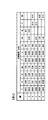
実施例1
表1に示す組成を持つ板厚0.3mmの冷延ステンレス鋼板(鋼番号1〜6、200mm×200mm)にプレス加工を施して、所定の形状を有するセパレータとした。その後、各鋼番号毎に一部のセパレータに、酸化物皮膜形成処理を施した。ここで、酸化物皮膜形成処理を行う際には、A1:硝酸を20質量%含む溶液(60℃、1時間)、B1:硝酸を10質量%とモリブデン酸ナトリウムを3質量%含む溶液(常温、5秒)、B2:硝酸を10質量%とモリブデン酸ナトリウムを3質量%含む溶液(常温、15秒)、B3:硝酸を10質量%とモリブデン酸ナトリウムを5質量%含む溶液(50℃、15秒)、B4:硝酸を10質量%とモリブデン酸ナトリウムを7質量%含む溶液(50℃、30秒)、C1:硝酸を10質量%とリン酸ナトリウムを3質量%含む溶液(常温、5秒)、D1:硝酸を10質量%とタングステン酸ナトリウムを3質量%含む溶液(常温、5秒)を用いた。E1:硝酸を10質量%とモリブデン酸ナトリウムを3質量%含む溶液(50℃、15秒)、E2:硝酸を10質量%とモリブデン酸ナトリウムを3質量%とリン酸を3質量%含む溶液(50℃、15秒)。なお、これらの処理を行わず、表面を研磨した素材も同様に実験し、その条件をA0とした。
Example 1
A cold-rolled stainless steel sheet having a composition shown in Table 1 and having a thickness of 0.3 mm (
また酸化物皮膜形成処理を行わなかった場合にはプレス加工後に、酸化物皮膜形成処理を行った場合にはプレス加工後さらに酸化物皮膜形成処理を施した後に、酸化物皮膜中のCr含有量、Mo含有量、P含有量、W含有量をXPSによって測定し、酸化物皮膜の厚さをAESによって測定した。 If the oxide film formation treatment is not performed, after the press processing, if the oxide film formation treatment is performed, after the press processing, after further oxide film formation treatment, Cr content in the oxide film , Mo content, P content and W content were measured by XPS, and the thickness of the oxide film was measured by AES.
XPS測定は、Fe、Cr、Mo、P、W、Niについてそれぞれ2pあるいは3d、4fのピークの測定を行った。測定にはAlKαのモノクロX線源を用い、測定後各ピークを金属状態と各酸化状態に分離した。そののち金属状態以外の信号が表層酸化物からの信号として、相対感度係数法を用いて各元素の定量を行い、皮膜内の組成を算出した。このとき、Mo、P、Wについては酸化状態の異なるピークに分離して、各々のピークに分けた定量値を算出した。例えば、Moの場合3dピークを測定して、metal−Mo、Mo(IV)、Mo(VI)のピークに分離した。このMo(IV)、Mo(VI)の和を用いて皮膜中のMo濃度を算出し、Mo(VI)は高酸化数状態の比率計算に用いた。
また皮膜厚さについては、Arスパッタリングを用いたAESの深さ方向分析により求めた。このとき表層酸化皮膜のスパッタ速度を正確に得ることは困難なため、ここではFeのスパッタ速度を基準として厚さを算出した。
こうして酸化物皮膜形成処理を行ったセパレータと行わなかったセパレータを用いて、それぞれ発電特性を調査した。発電特性の評価のために、高分子膜と電極、さらにガス拡散層2、3も一体化された有効面積50cm2の膜−電極接合体1(エレクトロケム社製 FC50−MEA)を用いて、図1に示す形状の単セルを作成した。単セルの空気流路6と水素流路7は、いずれも高さ1mm、幅2mmの矩形とし、全体で17列配置した。カソード側には空気を、アノード側には超高純度水素 (純度99.9999体積%) を、各々80±1℃に保持したバブラにより加湿した後供給して、電流密度 0.4A/cm2の出力電圧を測定した。
In XPS measurement, peaks of 2p, 3d, and 4f were measured for Fe, Cr, Mo, P, W, and Ni, respectively. For measurement, an AlKα monochromatic X-ray source was used, and after the measurement, each peak was separated into a metallic state and an oxidized state. After that, signals other than the metal state were determined as signals from the surface oxide, and each element was quantified using the relative sensitivity coefficient method to calculate the composition in the film. At this time, Mo, P, and W were separated into peaks having different oxidation states, and quantitative values divided into the respective peaks were calculated. For example, in the case of Mo, the 3d peak was measured and separated into peaks of metal-Mo, Mo (IV), and Mo (VI). The sum of Mo (IV) and Mo (VI) was used to calculate the Mo concentration in the film, and Mo (VI) was used for calculating the ratio of the high oxidation number state.
The film thickness was determined by analysis of the depth direction of AES using Ar sputtering. At this time, since it is difficult to accurately obtain the sputtering rate of the surface oxide film, the thickness was calculated based on the sputtering rate of Fe.
Thus, the power generation characteristic was investigated using the separator which performed the oxide film formation process, and the separator which was not performed, respectively. For evaluation of power generation characteristics, a membrane-electrode assembly 1 (FC50-MEA manufactured by Electrochem Co., Ltd.) having an effective area of 50 cm 2 in which a polymer membrane and an electrode, and further
また、同様の条件で2000時間にわたって連続して稼動させて、出力電圧の経時変化を測定した。この単セルの発電試験の期間中は、単セル本体の温度は80±1℃に保持した。また膜−電極接合体1は、試験片を変えるたびに新品に取り替えた。
Moreover, it was continuously operated over 2000 hours under the same conditions, and the change with time of the output voltage was measured. During the power generation test of the single cell, the temperature of the single cell body was maintained at 80 ± 1 ° C. The membrane-
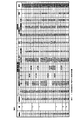
その結果を表2に示す。表2中における( )内比率%は、モリブデン(Mo)、タングステン(W)、リン(P)の総量に対する、6価モリブデン(Mo(VI))、6価タングステン(W(VI))、5価リン(P(V))の合計の割合を示す。酸化物皮膜中にMo、W、Pを何れも含有しない鋼番号1および鋼番号3を、処理条件A1で処理した場合(実験No.1、実験No.11)は、何れも、2000時間経過後の出力電圧、および、耐食性に劣っていた。19質量%以上のCrと約2質量%のMoを含有する鋼番号5および鋼番号6では、処理条件A1(実験No.25、27)でもMoが酸化物皮膜中に濃化しており、2000時間後に出力電圧または耐食性において若干性能は劣化するが、許容できる範囲であった。更に、酸化物皮膜中にMoを2.3質量%含有する鋼番号2、処理条件A1(実験No.7)は、酸化物皮膜の厚さが3.2nmであるけれども、Mo(VI)+W(VI)+P(V)の合計が0.4質量%であり、2000時間経過後の出力電圧、および、耐食性に劣っていた。同様に、酸化物皮膜中にMoを0.4質量%含有する鋼番号4、処理条件A0(実験No.21)及び酸化物皮膜中にMoを1.2質量%含有する鋼番号4、処理条件A1(実験No.22)もMo(VI)+W(VI)+P(V)の合計が0.3質量%以下であり、2000時間経過後の出力電圧、および、耐食性に劣っていた。これらの実験No.7,21,22の試料においてはモリブデン(Mo)、タングステン(W)、リン(P)の総量中、6価モリブデン(Mo(VI)、6価タングステン(W(VI)、5価リン(P(V))の合計が30質量%未満であった。
更に、酸化物皮膜中にWを15.0質量%含有する鋼番号3、処理条件D2(実験No.18)は、酸化物皮膜の厚さが21.3nmと、20nmを超えており、耐食性に優れているものの、初期の出力電圧が0.28Vと劣っていた。
The results are shown in Table 2. The percentages in parentheses in Table 2 are hexavalent molybdenum (Mo (VI)), hexavalent tungsten (W (VI)), 5 relative to the total amount of molybdenum (Mo), tungsten (W), and phosphorus (P). The ratio of total phosphorus (P (V)) is shown. In the case where Steel No. 1 and Steel No. 3 containing none of Mo, W, and P in the oxide film were treated under the treatment condition A1 (Experiment No. 1, Experiment No. 11), 2000 hours had elapsed. It was inferior to the later output voltage and corrosion resistance. In Steel No. 5 and Steel No. 6 containing 19% by mass or more of Cr and about 2% by mass of Mo, Mo was concentrated in the oxide film under the treatment condition A1 (Experiment No. 25 and 27). Although the performance slightly deteriorated in output voltage or corrosion resistance after time, it was in an acceptable range. Further, Steel No. 2 containing 2.3% by mass of Mo in the oxide film and treatment condition A1 (Experiment No. 7) had Mo (VI) + W even though the thickness of the oxide film was 3.2 nm. The total of (VI) + P (V) was 0.4 mass%, and the output voltage after 2000 hours and the corrosion resistance were inferior. Similarly, steel No. 4 containing 0.4% by mass of Mo in the oxide film, treatment condition A0 (Experiment No. 21), Steel No. 4 containing 1.2% by mass of Mo in the oxide film, treatment In condition A1 (Experiment No. 22), the total of Mo (VI) + W (VI) + P (V) was 0.3% by mass or less, and the output voltage after 2000 hours and the corrosion resistance were inferior. These experiment Nos. In the samples of 21, 21 and 22, hexavalent molybdenum (Mo (VI), hexavalent tungsten (W (VI), pentavalent phosphorus (P) in the total amount of molybdenum (Mo), tungsten (W) and phosphorus (P)). The total of (V)) was less than 30% by mass.
Further, Steel No. 3 containing 15.0% by mass of W in the oxide film and treatment condition D2 (Experiment No. 18) had an oxide film thickness of 21.3 nm, exceeding 20 nm, and corrosion resistance. However, the initial output voltage was inferior at 0.28V.
その他の鋼番号1、処理条件B1、B2、C1、D1(実験No.3〜6)、鋼番号2、処理条件B1、C1、D1(実験No.8〜10)、鋼番号3、処理条件B1〜B4、C1、D1(実験No.12〜17)、E1、E2(実験No.19,20)、鋼番号4、処理条件B2、E1(実験No.23,24)、鋼番号5、処理条件A1、B2(実験No.26)、鋼番号6、処理条件A1、B2(実験No.28)は、何れも初期の出力電圧および2000時間経過後の出力電圧が0.58Vを上回り、耐食性も優れていた。即ち、金めっきを施したセパレータやグラファイト板のセパレータと同等の出力電圧が得られた。
その中でも、特に、酸化物皮膜中にMoを5.1質量%含有し、酸化物皮膜の厚さが3.1nmである鋼番号3、処理条件B2(実験No.13)、酸化物皮膜中にMoを10.7質量%含有し、酸化物皮膜の厚さが3.9nmである鋼番号3、処理条件B3(実験No.14)、酸化物皮膜中にMoを15.5質量%含有し、酸化物皮膜の厚さが4.2nmである鋼番号3、処理条件B4(実験No.15)、酸化物皮膜中にMoを5.3質量%含有し、酸化物皮膜の厚さが3.2nmである鋼番号4、処理条件B2(実験No.23)、酸化物皮膜中にMoを5.8質量%含有し、酸化物皮膜の厚さが4.9nmである鋼番号5、処理条件B2(実験No.26)、酸化物皮膜中にMoを7.5質量%含有し、酸化物皮膜の厚さが3.4nmである鋼番号6、処理条件B2(実験No.28)は、何れも初期の出力電圧および2000時間経過後の出力電圧が0.63V以上であり、耐食性も非常に優れていた。なお、この初期の出力電圧および2000時間経過後の出力電圧が0.63V以上かつ耐食性も非常に優れていた例においては、モリブデン(Mo)、タングステン(W)、リン(P)の総量中、6価モリブデン(Mo(VI)、6価タングステン(W(VI)、5価リン(P(V))の合計は50質量%以上であり、またモリブデン、タングステン、リンのいずれかが、酸化物皮膜中のこれらの濃度が、母材組成濃度の2.0倍を上回っていた。
Among them, in particular,
なお、酸化物皮膜中にMo、W、Pをすべて含有する例(Mo:7.1、W:8.2、P:3.9、Mo+W+P:19.2、膜厚:16nm)として鋼番号3、処理条件E2(実験No.20)を示しているが、初期の出力電圧および2000時間経過後の出力電圧、および、耐食性に優れていた。更に、酸化物皮膜中にMo、W、Pの2つを含有する例として、鋼中Moが0.1%以下の鋼番号3では、Mo:4.8、W:6.5、Mo+W:11.3、膜厚:8.0nmの処理条件E1(実験No.19)を、鋼中にMoを2%以上含む鋼番号2では、Mo:2.8、P:1.7、Mo+P:4.5、膜厚:4.6nmの処理条件C1(実験No.9),及びMo:2.8、W:3.7、Mo+W:6.5、膜厚:5.5nmの処理条件D1(実験No.10)を、鋼中にMoを0.4%含む鋼番号4では、Mo:3.1、W:4.7、Mo+W:7.8、膜厚:5.7nmの処理条件E1(実験No.24)示しているが、初期の出力電圧および2000時間経過後の出力電圧、および、耐食性に優れていた。
In addition, steel number as an example (Mo: 7.1, W: 8.2, P: 3.9, Mo + W + P: 19.2, film thickness: 16 nm) containing all of Mo, W, and P in the
上述したところから明らかなように、この発明による酸化物皮膜を備えたステンレス鋼板は、電気伝導性および耐食性に優れていることがわかる。 As is apparent from the above description, it can be seen that the stainless steel plate provided with the oxide film according to the present invention is excellent in electrical conductivity and corrosion resistance.
この発明によると、接触抵抗が小さく、発電効率が優れ、かつ耐食性が高い固体高分子型燃料電池セパレータ用ステンレス鋼板を提供することができ、産業上利用価値が高い。 According to the present invention, it is possible to provide a stainless steel plate for a polymer electrolyte fuel cell separator having low contact resistance, excellent power generation efficiency, and high corrosion resistance, and has high industrial utility value.
1.膜−電極接合体
2、3.ガス拡散層
4、5.セパレータ
6.空気流路
7.水素流路
1. 2. Membrane-
Claims (9)
The austenitic stainless steel plate excellent in corrosion resistance and electrical conductivity according to any one of claims 6 to 8, wherein the stainless steel plate is a stainless steel plate used for a fuel cell component.
Priority Applications (1)
| Application Number | Priority Date | Filing Date | Title |
|---|---|---|---|
| JP2004119794A JP2005298939A (en) | 2004-04-15 | 2004-04-15 | Stainless steel plate with excellent corrosion resistance and electrical conductivity |
Applications Claiming Priority (1)
| Application Number | Priority Date | Filing Date | Title |
|---|---|---|---|
| JP2004119794A JP2005298939A (en) | 2004-04-15 | 2004-04-15 | Stainless steel plate with excellent corrosion resistance and electrical conductivity |
Publications (1)
| Publication Number | Publication Date |
|---|---|
| JP2005298939A true JP2005298939A (en) | 2005-10-27 |
Family
ID=35330845
Family Applications (1)
| Application Number | Title | Priority Date | Filing Date |
|---|---|---|---|
| JP2004119794A Pending JP2005298939A (en) | 2004-04-15 | 2004-04-15 | Stainless steel plate with excellent corrosion resistance and electrical conductivity |
Country Status (1)
| Country | Link |
|---|---|
| JP (1) | JP2005298939A (en) |
Cited By (10)
| Publication number | Priority date | Publication date | Assignee | Title |
|---|---|---|---|---|
| JP2007254795A (en) * | 2006-03-22 | 2007-10-04 | Jfe Steel Kk | Stainless steel suitable for polymer electrolyte fuel cell and its separator |
| JP2008047381A (en) * | 2006-08-14 | 2008-02-28 | Toyo Seikan Kaisha Ltd | Stainless steel member for fuel cell |
| JP2009007627A (en) * | 2007-06-28 | 2009-01-15 | Jfe Steel Kk | Austenitic stainless steel for polymer electrolyte fuel cell separator and polymer electrolyte fuel cell using the same |
| JP2009167486A (en) * | 2008-01-18 | 2009-07-30 | Nisshin Steel Co Ltd | Ferritic stainless steel for battery component member |
| JP2009542907A (en) * | 2006-06-28 | 2009-12-03 | ハイドロジェン・テクノロジーズ・アーエス | Use of austenitic stainless steel and electrolytic cells made from such steel |
| KR101047417B1 (en) * | 2008-06-16 | 2011-07-08 | 한양대학교 산학협력단 | Fuel cell separator and its manufacturing method |
| KR101570583B1 (en) | 2013-12-24 | 2015-11-19 | 주식회사 포스코 | Austenite stainless for fuel cell |
| KR20220057830A (en) * | 2020-10-30 | 2022-05-09 | (주)유니버셜트렌드센터 | Kitchen scissors |
| WO2024071142A1 (en) * | 2022-09-27 | 2024-04-04 | 学校法人東京理科大学 | Corrosion-resistant stainless steel and method of manufacturing coorosion-resistant stainless steel |
| JP2024520115A (en) * | 2021-06-10 | 2024-05-21 | ポステック・リサーチ・アンド・ビジネス・ディヴェロップメント・ファウンデイション | Polymer electrolyte membrane fuel cell including tungsten oxide coated components and method of manufacture thereof |
-
2004
- 2004-04-15 JP JP2004119794A patent/JP2005298939A/en active Pending
Cited By (12)
| Publication number | Priority date | Publication date | Assignee | Title |
|---|---|---|---|---|
| JP2007254795A (en) * | 2006-03-22 | 2007-10-04 | Jfe Steel Kk | Stainless steel suitable for polymer electrolyte fuel cell and its separator |
| JP2009542907A (en) * | 2006-06-28 | 2009-12-03 | ハイドロジェン・テクノロジーズ・アーエス | Use of austenitic stainless steel and electrolytic cells made from such steel |
| JP2008047381A (en) * | 2006-08-14 | 2008-02-28 | Toyo Seikan Kaisha Ltd | Stainless steel member for fuel cell |
| JP2009007627A (en) * | 2007-06-28 | 2009-01-15 | Jfe Steel Kk | Austenitic stainless steel for polymer electrolyte fuel cell separator and polymer electrolyte fuel cell using the same |
| JP2009167486A (en) * | 2008-01-18 | 2009-07-30 | Nisshin Steel Co Ltd | Ferritic stainless steel for battery component member |
| KR101047417B1 (en) * | 2008-06-16 | 2011-07-08 | 한양대학교 산학협력단 | Fuel cell separator and its manufacturing method |
| KR101570583B1 (en) | 2013-12-24 | 2015-11-19 | 주식회사 포스코 | Austenite stainless for fuel cell |
| KR20220057830A (en) * | 2020-10-30 | 2022-05-09 | (주)유니버셜트렌드센터 | Kitchen scissors |
| KR102520477B1 (en) | 2020-10-30 | 2023-06-08 | (주)유니버셜트렌드센터 | Kitchen scissors |
| JP2024520115A (en) * | 2021-06-10 | 2024-05-21 | ポステック・リサーチ・アンド・ビジネス・ディヴェロップメント・ファウンデイション | Polymer electrolyte membrane fuel cell including tungsten oxide coated components and method of manufacture thereof |
| JP7756946B2 (en) | 2021-06-10 | 2025-10-21 | ポステック・リサーチ・アンド・ビジネス・ディヴェロップメント・ファウンデイション | Polymer electrolyte membrane fuel cell including tungsten oxide coated components and method of manufacturing same |
| WO2024071142A1 (en) * | 2022-09-27 | 2024-04-04 | 学校法人東京理科大学 | Corrosion-resistant stainless steel and method of manufacturing coorosion-resistant stainless steel |
Similar Documents
| Publication | Publication Date | Title |
|---|---|---|
| KR101418323B1 (en) | Metal plate for use as solid polymer fuel cell separator | |
| EP1726674B1 (en) | Metal material for current-carrying member, separator for fuel cell utilizing the same and fuel cell including the same | |
| EP2458038B1 (en) | Stainless steel for fuel cell having excellent corrosion resistance and method for producing same | |
| KR101231462B1 (en) | Stainless steel for fuel cell separators which has excellent electrical conductivity and ductility, and process for production thereof | |
| JP4496750B2 (en) | Stainless steel for polymer electrolyte fuel cell separator and polymer electrolyte fuel cell using the stainless steel | |
| TWI474539B (en) | Stainless steel for fuel cell separator | |
| CN103717772B (en) | Fuel cell separator plate rustless steel | |
| WO2019082591A1 (en) | Method for producing stainless steel plate for fuel cell separator | |
| US8900379B2 (en) | Stainless steel for solid polymer fuel cell separator and solid polymer typefuel cell using the stainless steel | |
| JP6414369B1 (en) | Base material stainless steel plate for steel plate for fuel cell separator and method for producing the same | |
| JP4930222B2 (en) | Austenitic stainless steel for polymer electrolyte fuel cell separator and polymer electrolyte fuel cell using the same | |
| JP3922154B2 (en) | Stainless steel for polymer electrolyte fuel cell separator, method for producing the same, and polymer electrolyte fuel cell | |
| JP2005166276A (en) | Stainless steel for polymer electrolyte fuel cell separator, polymer electrolyte fuel cell separator and polymer electrolyte fuel cell using the same | |
| JP2004269969A (en) | Separator for polymer electrolyte fuel cell and method for producing the same | |
| JP5560533B2 (en) | Stainless steel for polymer electrolyte fuel cell separator and polymer electrolyte fuel cell using the same | |
| JP2005089800A (en) | Stainless steel for polymer electrolyte fuel cell separator and polymer electrolyte fuel cell using the same | |
| JP5375191B2 (en) | Stainless steel and polymer electrolyte fuel cell for polymer electrolyte fuel cell separator with low ion elution | |
| JP2008303436A (en) | Ferritic stainless steel for polymer electrolyte fuel cell separator and polymer electrolyte fuel cell using the same | |
| JP2007254795A (en) | Stainless steel suitable for polymer electrolyte fuel cell and its separator | |
| JP2020506499A (en) | Stainless steel for polymer fuel cell separator having excellent contact resistance and method for producing the same | |
| JP2022096547A (en) | Austenitic stainless steel sheet for fuel cell separator and production method thereof | |
| WO2021019849A1 (en) | Austenitic stainless steel sheet for fuel cell separator substrate | |
| US20220393188A1 (en) | Method for manufacturing stainless steel for polymer fuel cell separator | |
| JP2006233281A (en) | Stainless steel for current-carrying electrical parts excellent in electrical conductivity and corrosion resistance and method for producing the same |