JP2005298909A - Slab with few surface cracks - Google Patents
Slab with few surface cracks Download PDFInfo
- Publication number
- JP2005298909A JP2005298909A JP2004117474A JP2004117474A JP2005298909A JP 2005298909 A JP2005298909 A JP 2005298909A JP 2004117474 A JP2004117474 A JP 2004117474A JP 2004117474 A JP2004117474 A JP 2004117474A JP 2005298909 A JP2005298909 A JP 2005298909A
- Authority
- JP
- Japan
- Prior art keywords
- slab
- mass
- cracks
- cracking
- continuous casting
- Prior art date
- Legal status (The legal status is an assumption and is not a legal conclusion. Google has not performed a legal analysis and makes no representation as to the accuracy of the status listed.)
- Pending
Links
Images

Landscapes
- Continuous Casting (AREA)
Abstract
【課題】 鋼を連続鋳造で製造する際に、鋳片の表面割れ、特に粒界割れを防止することが可能な、表面割れの少ない鋳片を提供すること。
【解決手段】 規定量のC、Mn、Si、S、N、Oを含有し、かつ、AlやNb、Ti、V、Nの少なくとも1種以上を含む炭素鋼を連続鋳造で製造する場合に、粒界割れが生じない鋳片として、P:0.05〜0.5質量%かつCeまたはLaのうち1種以上を0.005〜0.5質量%含むことを特徴とする表面割れの発生しにくい鋳片。
【選択図】 図1PROBLEM TO BE SOLVED: To provide a slab with less surface cracking capable of preventing surface cracks of the slab, particularly intergranular cracks, when producing steel by continuous casting.
When producing a carbon steel containing a specified amount of C, Mn, Si, S, N, O and containing at least one of Al, Nb, Ti, V, N by continuous casting. As a slab that does not cause grain boundary cracking, P: 0.05 to 0.5% by mass and one or more of Ce or La containing 0.005 to 0.5% by mass Slab that is difficult to generate.
[Selection] Figure 1
Description
本発明は、連続鋳造で製造した鋳片の表面割れを防止する技術に係わるものである。鋼の製造においては、成分調整した溶鋼を固める際に、一般に連続鋳造法が用いられているが、溶鋼に表面割れの発生しやすい成分が含まれていると、連続鋳造の際に鋳片の表面で割れが発生する。特に、鋳片の幅方向端部近くで発生する割れは、γ粒界に沿った割れであり、開口部が狭いために発見が困難で、かつ割れが深いために圧延後に欠陥として残りやすい。
本発明は、このような鋳片の表面割れ、特に粒界に沿って発生する割れ(粒界割れ)を防止する技術に属するものである。
The present invention relates to a technique for preventing surface cracks in a slab produced by continuous casting. In the production of steel, the continuous casting method is generally used to solidify the molten steel whose components have been adjusted, but if the molten steel contains components that are prone to surface cracks, Cracks occur on the surface. In particular, cracks that occur near the edge of the slab in the width direction are cracks along the γ grain boundary, are difficult to find because the opening is narrow, and are prone to remain as defects after rolling because the crack is deep.
The present invention belongs to a technique for preventing such surface cracks of a slab, particularly cracks that occur along grain boundaries (grain boundary cracks).
従来の技術としては、粒界割れが発生しやすい成分を制限することが開示されている。例えば、特許文献1では、含Nb、V鋼でNを0.005%以下に制御することが示されている。更に、特許文献2では、N、Nb、Ti含有量に関して、特定の関係式を満たすようにして割れを防止することが提示されておる。しかしながら、NやNb、Tiは定められた材質を得るためには不可欠な元素であり、鋼の用途によっては、成分を制約する方法がとれない場合がある。
As a conventional technique, it has been disclosed to limit components that easily cause grain boundary cracking. For example,
また、粒界割れを防止する方法として、連続鋳造での冷却方法を規定することが開示されている。例えば、特許文献3では、鋳片表層部を特定温度で複数回繰り返して冷却して割れを防止することが示されている。更に、特許文献4では、CやMn、P含有量が特定の範囲に入る鋼に対して冷却速度を規定したり、鋳片表層部の温度が900℃以上で矯正点を通過させることで割れを防止する方法が挙げられている。特許文献5では、連続鋳造の垂直部領域、曲げ部領域において、鋳片の両コーナー部の表面温度を夫々750〜900℃、800℃以上となるよう冷却して割れを防止することが提示されている。しかしながら、繰り返し冷却の場合は、連続鋳造の速度を制限するために生産性が問題となる場合があり、鋳片の温度を高めにする方法では鋳片内部の割れが発生しやすくなるという問題がある。 Further, it is disclosed that a cooling method in continuous casting is defined as a method for preventing grain boundary cracking. For example, Patent Document 3 discloses that a slab surface layer portion is repeatedly cooled at a specific temperature to prevent cracking. Furthermore, in Patent Document 4, the cooling rate is regulated for steel in which the C, Mn, and P contents are in a specific range, or cracks are caused by passing the correction point when the temperature of the slab surface layer is 900 ° C. or higher. The method of preventing is mentioned. In Patent Document 5, it is proposed to prevent cracks by cooling the surface temperature of both corners of the slab to 750 to 900 ° C. and 800 ° C. or more in the vertical part region and the bent part region of continuous casting, respectively. ing. However, in the case of repeated cooling, productivity may be a problem because the speed of continuous casting is limited, and the method of increasing the temperature of the slab tends to cause cracks inside the slab. is there.
一方、粒界割れを防止する他の方法として、特許文献6には、冷却過程で特定条件の塑性歪を加えてオーステナイト粒度を微細化させる方法が示されている。この場合には、圧下のためのロールやショットブラスト装置が新たに必要となる。
以上のように、粒界割れを防止するための方法として発明された従来の方法では全て、問題点や制約が生じる。
As described above, all the conventional methods invented as methods for preventing grain boundary cracking have problems and limitations.
鋼を連続鋳造で製造する際に、鋳片の表面割れ、特に粒界割れを防止しようとした場合、従来の方法では、割れやすい成分の規制や冷却方法の変更、歪の付与といった方法が提案されていたが、それぞれ、鋼の用途によっては成分制約が出来ない、連続鋳造の生産性が低下する、鋳片内部の割れが発生しやすくなる、圧下のためのロールやショットブラスト装置が新たに必要となるといった問題がある。
本発明では、この解決法として、従来の技術の方法とは異なる方法で鋳片の組織を細かくし、粒界割れを防止する方法を提供するものである。
When steel is manufactured by continuous casting, when trying to prevent surface cracks of the slab, especially intergranular cracking, the conventional methods propose methods such as regulation of components that are susceptible to cracking, changing the cooling method, and imparting strain. However, depending on the application of the steel, it is not possible to constrain the components, the productivity of continuous casting is reduced, cracks inside the slab are likely to occur, and rolls and shot blasting devices for reduction are newly added. There is a problem that it is necessary.
In the present invention, as a solution to this problem, a method is provided in which the structure of the slab is made fine by a method different from the method of the prior art to prevent intergranular cracking.
上記目的を達成するために、本発明は以下の構成を特徴とする。
(1)C:0.001〜1.5質量%、Mn:0.01〜3.0質量%、Si:0.005〜4.0質量%、S:0.001〜0.05質量%、N:0.0020〜0.02質量%、酸素:0.0005〜0.0050質量%、Al:0.006〜0.1質量%を含み、かつ、Nb:0.004〜0.1質量%、Ti:0.004〜0.1質量%、V:0.01〜0.1質量%の一種または二種以上、その他必要に応じてNi、Cu、Cr、Mo、B、Zr、Mg、Caの一種または二種以上を1.0質量%以下含み、残部鉄および不可避的不純物からなる炭素鋼で、P:0.05〜0.5質量%、CeおよびLaの一種または二種を0.005〜0.5質量%含有することを特徴とする表面割れの少ない鋳片。
(2)鋳片表層から5mm〜35mm範囲のγ粒径の平均値が、下記の範囲にあることを特徴とする前記(1)に記載の表面割れの少ない鋳片。
d≦3
ここでd(mm)は、γ結晶粒の円相当径の平均値を表す。
(3)鋳片厚みが70mm未満の場合には、表層から5mm部分を除いた範囲のγ粒径の平均値が、下記の範囲にあることを特徴とする前記(1)に記載の表面割れの少ない鋳片。
d≦3
ここでd(mm)は、γ結晶粒の円相当径の平均値を表す。
In order to achieve the above object, the present invention is characterized by the following configurations.
(1) C: 0.001 to 1.5 mass%, Mn: 0.01 to 3.0 mass%, Si: 0.005 to 4.0 mass%, S: 0.001 to 0.05 mass% N: 0.0020 to 0.02 mass%, oxygen: 0.0005 to 0.0050 mass%, Al: 0.006 to 0.1 mass%, and Nb: 0.004 to 0.1 % By mass, Ti: 0.004 to 0.1% by mass, V: 0.01 to 0.1% by mass, or two or more, if necessary, Ni, Cu, Cr, Mo, B, Zr, Carbon steel containing 1.0% by mass or less of Mg, Ca, or two or more types, the balance being iron and inevitable impurities, P: 0.05 to 0.5% by mass, one or two types of Ce and La A slab containing few 0.005 to 0.5% by mass of surface cracks.
(2) The slab with less surface cracking as described in (1) above, wherein the average value of the γ particle diameter in the range of 5 mm to 35 mm from the slab surface layer is in the following range.
d ≦ 3
Here, d (mm) represents an average value of equivalent circle diameters of γ crystal grains.
(3) When the slab thickness is less than 70 mm, the average value of the γ particle diameter in the range excluding the 5 mm portion from the surface layer is in the following range, and the surface crack as described in (1) above Slab with less
d ≦ 3
Here, d (mm) represents an average value of equivalent circle diameters of γ crystal grains.
本発明により、鋼の用途によっては成分制約が出来ない、連続鋳造の生産性が低下する、鋳片内部の割れが発生しやすくなる、圧下のためのロールやショットブラスト装置が新たに必要になるといった問題を生じることなく、粒界割れを防止することが可能となる。 According to the present invention, depending on the application of steel, the component restriction cannot be performed, the productivity of continuous casting is reduced, cracks in the slab are likely to be generated, and a roll for rolling and a shot blasting device are newly required. It is possible to prevent grain boundary cracking without causing such problems.
本発明者は、粒界割れがγ結晶粒の大きさに依存することに着目して、粒界割れを防止するためにγ結晶粒を微細にすることを考え、その手段としてCeやLa、Pを適量加える方法を着想するに至った。 The present inventor considered that the grain boundary cracking depends on the size of the γ crystal grain, and considered making the γ crystal grain fine in order to prevent the grain boundary cracking. The inventor came up with a method of adding an appropriate amount of P.
以下に本発明の詳細を記す。
γ結晶粒を微細にすると粒界割れが発生しにくくなるという知見は従来から存在する(例えば、前記特許文献6)。γ結晶粒を微細にする方法として、従来から凝固する前の溶鋼に接種材を添加して、その接種材を核として微細な凝固組織を生成させ、そこから微細なγ結晶粒を生成させる方法や炭素や窒素と化合しやすい元素を添加して微細な析出物を生成させ、γ結晶粒の成長を抑制する方法、または析出物の代わりに、脱酸元素の添加により微細な酸化物を作る方法がある。しかしながら、一般に広く製造されている低炭素鋼では、折角凝固組織を微細にしても、δ相からγ相に変態する際に結晶粒が大きくなってしまうことが多い。
Details of the present invention will be described below.
The knowledge that grain boundary cracking is less likely to occur when the γ crystal grains are made fine has existed (for example, Patent Document 6). As a method of making γ crystal grains fine, a method of adding an inoculum to molten steel before solidification and generating a fine solidified structure using the inoculum as a core and generating fine γ grains from the inoculum A method that suppresses the growth of γ crystal grains by adding elements that are easily combined with carbon, nitrogen, or nitrogen, or that forms fine oxides by adding deoxidizing elements instead of precipitates. There is a way. However, in the case of low carbon steel that is generally widely produced, even if the corner solidification structure is made fine, the crystal grains often become large when transformed from the δ phase to the γ phase.
本発明では、γ結晶粒を微細にする方法として、Ce、La、Pの添加を考えた。CeやLaはPと結合して非常に微細な析出物を作ることは発明者の別の研究ですでに見い出している。これらの元素は凝固の際に偏析しやすいので、δ/γ変態後でもγ結晶粒界に効率良く析出物を作ることが出来る。また濃度が高くなると融点が低くなるので、δ/γ変態後でも、γ結晶粒のまわりに液相が存在して、γ結晶粒の成長を抑制する可能性が期待できた。 In the present invention, addition of Ce, La, and P was considered as a method for making the γ crystal grains fine. It has already been found in another study by the inventors that Ce and La combine with P to form very fine precipitates. Since these elements are easily segregated during solidification, precipitates can be efficiently formed at the γ grain boundary even after the δ / γ transformation. Further, since the melting point was lowered as the concentration was increased, a liquid phase was present around the γ crystal grains even after the δ / γ transformation, and the possibility of suppressing the growth of the γ crystal grains was expected.
そこで、実験室での実験で、表1に示した組成の鋼にCe、La、Pの濃度を変化させたものを溶製し、そこから切り出した試験片を高温引っ張り試験機で引っ張ることにより、脆化の程度を評価した。連続鋳造での温度履歴をシミュレーションするために、室温から昇温して一旦試料を溶融させてから700〜900度の所定温度に保持し、引っ張りを行った。引っ張り後、破断した試料断面収縮率を絞り値として測定した。 Therefore, in a laboratory experiment, a steel having the composition shown in Table 1 with different concentrations of Ce, La, and P was melted, and a test piece cut out from the steel was pulled with a high-temperature tensile testing machine. The degree of embrittlement was evaluated. In order to simulate the temperature history in continuous casting, the sample was heated from room temperature and once melted, and then held at a predetermined temperature of 700 to 900 degrees and pulled. After pulling, the sample cross-sectional shrinkage rate after the break was measured as a drawing value.
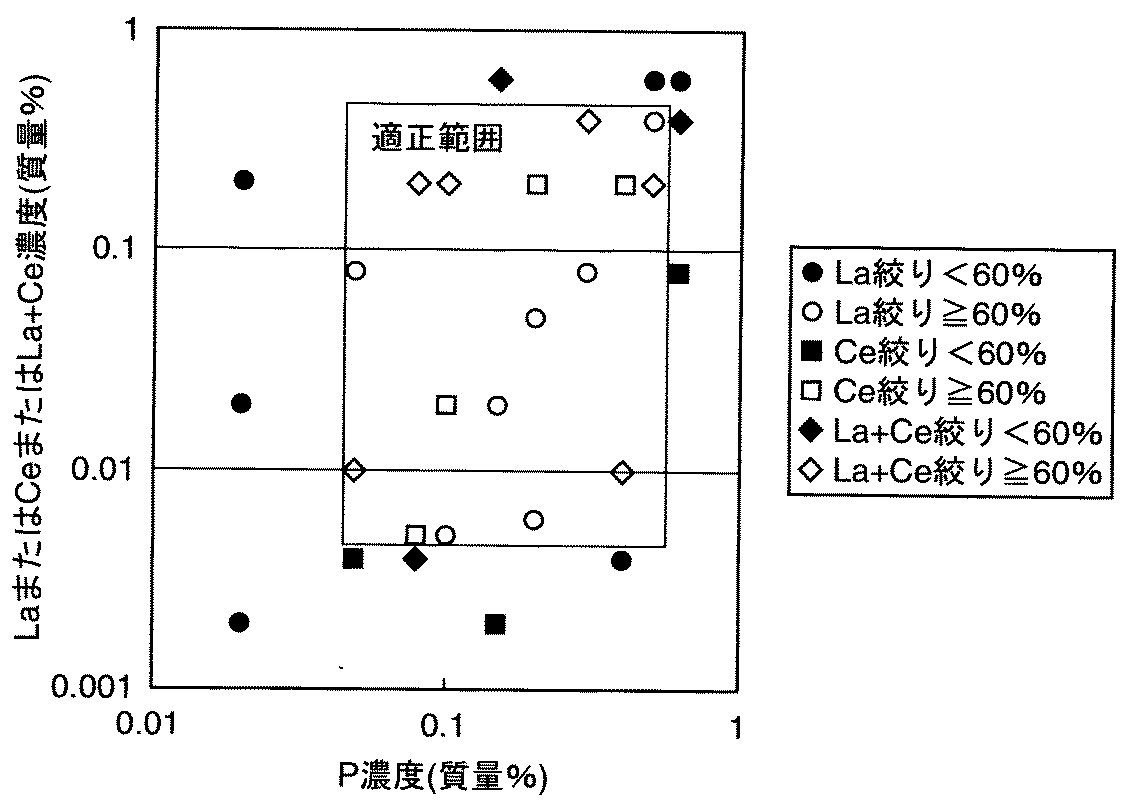
試験結果を図1に示す。引っ張り試験は粒界脆化が生じやすい700℃〜900℃の温度で行ったが、ここでは一番脆化が激しい800℃での絞り値を示した。図1より、CeまたはLa濃度が0.01質量%以上かつP濃度が0.05質量%以上で、絞り値が60%以上になっている。本実験での絞り値が60%以上になると実際の連続鋳造プロセスでは粒界割れが生じないので、これよりCe、La、P濃度が所定の値以上であると粒界割れを防止できることが求められた。また、図1には、CeとLaを同時に添加した場合のデータも示すが、この場合でもCe+La濃度が0.005質量%以上でかつP濃度が0.05質量%以上の場合に絞り値が60%以上となっている。従って、CeとLaを同時に添加した場合も粒界割れに対して効果が有ることが判った。 The test results are shown in FIG. The tensile test was performed at a temperature of 700 ° C. to 900 ° C. at which grain boundary embrittlement is likely to occur. Here, the drawing value at 800 ° C. at which the embrittlement was most severe was shown. As shown in FIG. 1, the Ce or La concentration is 0.01% by mass or more, the P concentration is 0.05% by mass or more, and the aperture value is 60% or more. When the drawing value in this experiment is 60% or more, grain boundary cracking does not occur in the actual continuous casting process. Therefore, it is required that the grain boundary cracking can be prevented when the Ce, La, and P concentrations are not less than a predetermined value. It was. FIG. 1 also shows data when Ce and La are added at the same time. Even in this case, when the Ce + La concentration is 0.005 mass% or more and the P concentration is 0.05 mass% or more, the aperture value is 60% or more. Therefore, it has been found that the addition of Ce and La simultaneously has an effect on the grain boundary cracking.
これらの引っ張り試験後の試料の組織を観察すると明らかにγ結晶粒径が小さくなっており、また、γ結晶粒界には微細な析出物が多数観察された。このことから、当初予想していた通り、CeやLaがPと化合して生成した析出物がγ結晶粒の成長を抑制し、γ結晶粒が微細になり、その結果、絞り値が向上したことが判る。 Observing the structure of the sample after these tensile tests, the γ crystal grain size was clearly reduced, and many fine precipitates were observed at the γ crystal grain boundary. From this, as initially expected, the precipitate formed by combining Ce and La with P suppressed the growth of γ crystal grains, and the γ crystal grains became finer, resulting in an improvement in aperture value. I understand that.
次に、発明の条件を規定した理由とこの発明の具体的な適用法について説明する。Cは鋼の強度を持たす為に不可欠の元素であるが、加工性を得る為に最近では非常に低いものも製造されている。この観点から下限を0.001質量%とし、上限は一般に使われている鋼の最大炭素量として1.5質量%とした。また、Mnも強度を得るために必要でありその効果を出すために下限を0.01質量%とし、上限は特殊用途で使用される場合の最大値3質量%とした。Siは用途によっては不要の場合もあるが、不可避的に混入するためその下限を0.005質量%とし、上限は特殊用途で用いられる4.0質量%とした。Sは製品特性に害をなす場合が多く極力低位とすることが望ましいが、不可避的に混入するため下限値0.001質量%が現実的である。また、上限は連続鋳造時の割れを防ぐために0.05質量%とした。酸素は非金属介在物生成の原因となるため、極力低いほうが望ましいが、下限は不可避的に混入する0.001質量%とし、上限は介在物があまり多くなると製品欠陥の原因となるので、0.050質量%とした。 Next, the reason for defining the conditions of the invention and the specific application method of the invention will be described. C is an indispensable element for imparting the strength of steel, but recently a very low element has been produced in order to obtain workability. From this point of view, the lower limit is set to 0.001% by mass, and the upper limit is set to 1.5% by mass as the maximum carbon amount of generally used steel. Further, Mn is also necessary for obtaining strength, and in order to exert its effect, the lower limit is set to 0.01% by mass, and the upper limit is set to 3% by mass when used for special purposes. Although Si may be unnecessary depending on the application, since it is inevitably mixed, the lower limit is set to 0.005 mass%, and the upper limit is set to 4.0 mass% used for special applications. S often harms product characteristics and is preferably as low as possible. However, since it is unavoidably mixed, a lower limit of 0.001% by mass is practical. The upper limit was set to 0.05% by mass in order to prevent cracking during continuous casting. Since oxygen causes generation of non-metallic inclusions, it is desirable that the oxygen content be as low as possible. 0.050 mass%.
Al、Ti、Nb、Vは本発明に関係する元素である。Alは脱酸の目的で、Ti、Nb、Vは材料の強度や靭性を上げるために用いられているが、Nと化合して析出物を生成し、これがγ粒界割れの原因となる、これらの濃度が少なければ、割れは発生しないので、本発明の用いる必要はない。従って、下限は本発明を用いなくても脆化を生じさせない濃度で規定した。また、上限は、本発明の効果が出なくなる濃度として規定した。これより、それぞれ次に濃度範囲となる。Al:0.006〜0.1質量%、Ti:0.004〜0.1質量%、Nb:0.004〜0.1質量%、V:0.01〜0.1質量%。また、Nは上記の元素と化合して割れの原因となる析出物を作るので、同様に、下限は本発明を用いないでも脆化を生じさせない濃度として、上限は本発明の効果が出る限界の濃度として規定した。N:0.0020〜0.02質量%。 Al, Ti, Nb, and V are elements related to the present invention. Al is used for deoxidation, and Ti, Nb, and V are used to increase the strength and toughness of the material, but combine with N to generate precipitates, which cause γ grain boundary cracking. If these concentrations are small, cracks do not occur, and it is not necessary to use the present invention. Therefore, the lower limit is defined by a concentration that does not cause embrittlement even if the present invention is not used. The upper limit is defined as the concentration at which the effect of the present invention is not exhibited. Thus, the next density range is obtained. Al: 0.006 to 0.1 mass%, Ti: 0.004 to 0.1 mass%, Nb: 0.004 to 0.1 mass%, V: 0.01 to 0.1 mass%. Further, since N combines with the above elements to form precipitates that cause cracking, similarly, the lower limit is a concentration that does not cause embrittlement even if the present invention is not used, and the upper limit is the limit at which the effect of the present invention is exerted. Defined as the concentration of. N: 0.0020 to 0.02 mass%.
Ce、La、Pは本発明の重要な元素である。CeやLaはPと化合して微細な析出物を作ることにより、γ粒界に析出してその成長を抑制し、γ粒径を微細にすることで割れを防止する働きを持つ。下限は本発明を効果が出る量として、また上限は、析出物が非常に多くなってそれ自体が割れの発生の原因になる限界の濃度として、それぞれ以下のように規定した。Ce:0.01〜0.5質量%、La:0.01〜0.5質量%、P:0.05〜0.5質量%。また、CeとLaは原子量も隣同士で近く、性質も似ているので、CeとLaを同時に添加した場合でも、その合計が上記の、CeまたはLa単独の濃度の範囲に有れば、本発明の効果が得られる。その他、鋼の用途に応じてNi、Cu、Cr、Mo、B、Zr、Mg、Caの一種または二種以上を1.0質量%以下含んでも構わない。 Ce, La, and P are important elements of the present invention. Ce and La combine with P to form fine precipitates, thereby precipitating at the γ grain boundaries and suppressing the growth, and reducing the γ grain size to prevent cracking. The lower limit was defined as the amount of the effect of the present invention, and the upper limit was defined as the limit concentration that caused the occurrence of cracks due to excessive precipitation, as follows. Ce: 0.01-0.5 mass%, La: 0.01-0.5 mass%, P: 0.05-0.5 mass%. Further, Ce and La are close to each other in atomic weight and have similar properties. Therefore, even when Ce and La are added at the same time, if the sum is within the above-described concentration range of Ce or La alone, The effects of the invention can be obtained. In addition, it may contain 1.0% by mass or less of one or more of Ni, Cu, Cr, Mo, B, Zr, Mg, and Ca depending on the use of steel.
以上述べた成分の範囲に入っていれば、本発明の目的を達成できるが、更に鋳片の組織が前記の成分条件に加えて下記の条件を満たしていれば、割れ発生を非常に少なくする事が出来る。すなわち、鋳片表層から5mm〜35mm範囲のγ粒径の平均値が、円相当径で3mm以下であれば、操業条件が変動しても(例えば、他の目的のために冷却水量を多くする必要が生じて、表面割れが発生し易い状況となっても)割れは生じない。この条件は以下のようにして決定した。 The object of the present invention can be achieved if it falls within the range of the components described above. However, if the structure of the slab satisfies the following conditions in addition to the above-described component conditions, the occurrence of cracks is greatly reduced. I can do it. That is, if the average value of the γ particle diameter in the range of 5 mm to 35 mm from the slab surface layer is 3 mm or less in the equivalent circle diameter, even if the operating conditions fluctuate (for example, the amount of cooling water is increased for other purposes) Even if a need arises and surface cracking is likely to occur, cracking does not occur. This condition was determined as follows.
γ粒径に関しては、ラボ実験の結果と実鋳片では、冷却の条件が異なるために、ラボ実験で得た結果から定めることは出来ない。そこで、実機での製造結果から求めた。すなわち、γ粒が微細になる効果が出た、表2に示す鋼種を垂直曲げ型連鋳機で鋳造した。鋳片サイズは、幅1800mm一定で厚みは280mmである。割れやすい状況を故意に作るために、冷却水量を増加させ、鋳造速度を大きく変化させた。冷却水量は、鋳片kgあたり2.0l(比水量:2.0l/kg))となるよう設定した。鋳造速度は短時間の間に0.8から1.5まで大きく変化させた。γ粒径を更に細かくする手段としては、鋳型内を電磁力で攪拌させ、更にタンディッシュ内の溶鋼温度を平均で当該鋼種の液相線温度との差で10度以内になるようにした。 The γ particle size cannot be determined from the results obtained in the laboratory experiment because the cooling conditions differ between the result of the laboratory experiment and the actual slab. Therefore, it was obtained from the production results with the actual machine. That is, the steel types shown in Table 2 that had the effect of making the γ grains fine were cast with a vertical bending type continuous casting machine. The slab size is a constant width of 1800 mm and a thickness of 280 mm. In order to intentionally create a fragile situation, the amount of cooling water was increased and the casting speed was greatly changed. The amount of cooling water was set to 2.0 l (specific water amount: 2.0 l / kg)) per kg of slab. The casting speed was greatly changed from 0.8 to 1.5 in a short time. As a means for further reducing the γ grain size, the inside of the mold was stirred by electromagnetic force, and the temperature of the molten steel in the tundish was averaged within 10 degrees as the difference from the liquidus temperature of the steel type.
ここで、平均γ粒径とは、実鋳片の法線面でかつ鋳造方向と直角な面(通常C断面と呼称)について腐食し、顕出した個々のγ結晶粒で表層から5mm〜35mmの範囲にあるものの大きさを円相当径として測定し、その平均値を求めたものである。なお、実鋳片は幅が大きいので、全幅にわたって測定することは困難である。そこで、図2に示すように、鋳片幅中心部を起点に左右200mmピッチで基準線を設け、個々の基準線を中心に左右10mm分について測定し、すべての測定データを平均化した。ただし、両端から300mm分は端部からの凝固の影響があるので、省いた。なお、鋳片表層から5mm〜35mmの範囲としたのは、鋳片の割れは表層のγ結晶粒の大きさに支配されるが、鋳片の極表層は凹凸があったり、薄いチル晶が見られたりして、γ粒径を定量的に測定することが難しいからである。 Here, the average γ grain size refers to a surface normal to the actual slab and perpendicular to the casting direction (usually referred to as the C cross section), and 5 to 35 mm from the surface layer by individual γ crystal grains that are revealed. The size of those in the range is measured as the equivalent circle diameter, and the average value is obtained. In addition, since the actual slab has a large width, it is difficult to measure over the entire width. Therefore, as shown in FIG. 2, reference lines were provided at a pitch of 200 mm on the left and right starting from the center of the slab width, and measurements were made for 10 mm on the left and right with the individual reference lines as the center, and all measurement data were averaged. However, 300 mm from both ends was omitted because of the influence of coagulation from the end. The range of 5 mm to 35 mm from the slab surface layer is that the crack of the slab is governed by the size of the γ crystal grains of the surface layer, but the extreme surface layer of the slab has irregularities or a thin chill crystal. This is because it is difficult to quantitatively measure the γ particle size.
結果を表3に示す。表より、CeとPが適正量であり、更に電磁攪拌と溶鋼温度低下によって、鋳片の平均γ粒径を3mm以下となるようにした場合は、冷却水量や鋳造速度を大きく変化させても、割れが生じなかった。一方、電磁攪拌と溶鋼温度低下をせず、鋳片の平均γ粒径が3mm以下にならなかったものについては、非常に小さいながら割れが生じた。すなわち、CeとPが適正量である場合、通常の操業条件では、前述したように割れ防止の効果が出せる(表3においても効果が得られた)が、冷却水量や鋳造速度を大きく変化させるという極端な条件下では、微小な割れが生じる場合もあり得る。この結果より、γ粒径3mm以下という条件を決定した。 The results are shown in Table 3. From the table, Ce and P are proper amounts, and when the average γ grain size of the slab is made 3 mm or less by electromagnetic stirring and molten steel temperature drop, even if the cooling water amount and casting speed are greatly changed No cracking occurred. On the other hand, cracks occurred in the case where the average γ grain size of the slab did not become 3 mm or less without electromagnetic stirring and molten steel temperature reduction, although it was very small. That is, when Ce and P are proper amounts, the effect of preventing cracking can be obtained as described above under normal operating conditions (the effect was also obtained in Table 3), but the amount of cooling water and casting speed are greatly changed. Under such extreme conditions, minute cracks may occur. From this result, the condition that the γ particle size was 3 mm or less was determined.
なお、本発明の効果は、連鋳機の形式や鋳片厚みや鋳造速度が変わっても、発現が可能である。従って、鋳片厚みが200〜360mmである現行タイプの連鋳機以外に、鋳片厚みが40〜150mm程度の比較的薄い鋳片を製造する高速連鋳機にも適用が可能である。ただし、鋳片厚みが70mm未満の場合には、鋳片表層5mm〜35mmの範囲がとれないので、その場合には、表層から5mm部分を除いた範囲のγ粒径の平均値を用いても構わない。 The effect of the present invention can be manifested even if the type of caster, the slab thickness and the casting speed are changed. Therefore, the present invention can be applied to a high-speed continuous casting machine for producing a relatively thin slab having a slab thickness of about 40 to 150 mm in addition to the current type continuous casting machine having a slab thickness of 200 to 360 mm. However, if the slab thickness is less than 70 mm, the range of 5 mm to 35 mm of the slab surface layer cannot be taken. In that case, even if the average value of the γ particle size in the range excluding the 5 mm portion from the surface layer is used. I do not care.
表4に示す成分の炭素鋼を下記の製造条件で連続鋳造し、得られた鋳片の割れを調査した。割れの調査方法としては、下記の評価方法に示すように、鋳片上面と下面にスカーフ溶削を2mm〜10mm行い、表面を目視観察した。更に鋳片からサンプルを切り出し、断面の割れの状態をカラーチェックで調査した。なお、発明D、G、Jについては、600Aで電磁攪拌を印加し、溶鋼温度も低めにした。
[製造条件]
(1)製造プロセス:転炉→RH→連続鋳造
(2)連続鋳造 :垂直曲げ型連鋳機(垂直部3m、曲げ半径7.5m、スラブ連鋳機)
鋳片サイズ:幅1800mm一定、厚み280mm
[割れおよびγ粒径の評価方法]
(1)目視:連続鋳造した鋳片の上面と下面にスカーフ溶削を2〜4mm行い、割れが目視で見られた場合を×、見られない場合を○とする。
(2)カラーチェック:鋼片からサンプルを切り出し、鋳造方向と垂直な、鋼片厚み方向の面を研磨してカラーチェックを行い、割れが見られた場合を×、見られない場合を○とする。
(3)γ粒径の測定
鋳片の法線面でかつ鋳造方向と直角な面(通常C断面と呼称)について、ピクリン酸飽和溶液で腐食し、顕出した個々のγ結晶粒で表層から5mm〜35mmの範囲にあるものの大きさを円相当径として測定し、その平均値を求めた。鋳片幅中心部を起点に左右200mmピッチで基準線を設け、個々の基準線を中心に左右10mm分について測定し、すべての測定データを平均化した。ただし、両端から300mm分は端部からの凝固の影響があるので、省いた。
Carbon steels having the components shown in Table 4 were continuously cast under the following production conditions, and cracks of the obtained cast pieces were investigated. As a crack investigation method, as shown in the following evaluation method, scarf cutting was performed on the upper surface and the lower surface of the slab from 2 mm to 10 mm, and the surface was visually observed. Further, a sample was cut out from the slab, and the state of the cross-sectional crack was examined by color check. In addition, about invention D, G, and J, electromagnetic stirring was applied at 600 A and the molten steel temperature was also made low.
[Production conditions]
(1) Manufacturing process: Converter → RH → Continuous casting (2) Continuous casting: Vertical bending type continuous casting machine (vertical part 3m, bending radius 7.5m, slab continuous casting machine)
Slab size: constant width 1800mm, thickness 280mm
[Evaluation method of crack and γ particle size]
(1) Visual inspection: Carry out scarf cutting on the upper and lower surfaces of continuously cast slabs 2 to 4 mm, and mark “X” when cracks are seen visually, and “◯” when cracks are not seen.
(2) Color check: A sample is cut out from a steel slab, the surface in the thickness direction of the steel slab perpendicular to the casting direction is polished and color check is performed. To do.
(3) Measurement of γ grain size The surface normal to the slab and perpendicular to the casting direction (usually referred to as the C section) is corroded with a saturated solution of picric acid, and individual γ crystal grains revealed from the surface layer. The size of those in the range of 5 mm to 35 mm was measured as the equivalent circle diameter, and the average value was obtained. Reference lines were provided at a pitch of 200 mm on the left and right starting from the center of the slab width, and measurements were made for 10 mm on the left and right with the individual reference lines as the center, and all measurement data were averaged. However, 300 mm from both ends was omitted because of the influence of coagulation from the end.
結果を表5に示す。表より、本発明の場合の条件を満たす場合(発明A〜J)には、目視観察およびカラーチェックとも割れは検出されなかった。特に、γ粒径が3mm以下の場合には、比水量を上げて強冷却させたり、鋳造速度を変化させて割れを発生しやすい条件を作ったりしても割れは発生しなかった。一方、比較A〜Jのいずれの比較例においても、成分が本発明条件を満たさないために、割れが発生した。すなわち、比較Aでは、Ce、La、Pのいずれの成分も本発明を満たさないために、比較B、比較CではPが満たさないために、比較DではCeが満たさないために、比較E、比較JではLaが満たさないために、比較FではPが、比較GではLaが、比較HではLaが本発明条件よりも多いために、比較IではCeとLaの合計が本発明を満たさないために、鋳片の目視やカラーチェック検査で割れが観察された。 The results are shown in Table 5. From the table, when the conditions of the present invention were satisfied (Inventions A to J), no cracks were detected in both visual observation and color check. In particular, when the γ particle size was 3 mm or less, cracks did not occur even when the specific water amount was increased to effect strong cooling, or the casting speed was changed to create conditions that would likely cause cracks. On the other hand, in any of Comparative Examples A to J, cracks occurred because the components did not satisfy the conditions of the present invention. That is, in comparison A, since none of the components of Ce, La, and P satisfy the present invention, comparison B and comparison C do not satisfy P, and comparison D does not satisfy Ce, so comparison E, In comparison J, La is not satisfied. Therefore, in comparison F, La is greater in the comparison G than in the present invention. In comparison I, the sum of Ce and La does not satisfy the present invention. Therefore, cracks were observed by visual inspection and color check inspection of the slab.
表4に示す成分の炭素鋼の一部を下記に示す製造条件で連続鋳造し、得られた鋳片の割れを調査した。割れの調査方法としては、鋳片上面と下面にスカーフ溶削を2mm〜5mm行い、表面を目視観察した。更に鋳片からサンプルを切り出し、断面の割れの状態をカラーチェックで調査した。ただし、γ粒径の測定に関しては、鋳片厚みが50mmと薄いので、表層から5mm部分を除いた範囲のγ粒径の平均値を用いた。
[製造条件2]
(1)製造プロセス:転炉→RH→連続鋳造
(2)連続鋳造 :垂直曲げ型試験連鋳機、
鋳片サイズ:幅1100mm一定、厚み50mm
電磁攪拌:600A
A part of the carbon steel having the components shown in Table 4 was continuously cast under the production conditions shown below, and cracks of the resulting slab were investigated. As a method for investigating cracks, scarf cutting was performed on the upper and lower surfaces of the slab from 2 mm to 5 mm, and the surface was visually observed. Furthermore, a sample was cut out from the slab, and the state of cracks in the cross section was investigated by color check. However, regarding the measurement of the γ particle size, since the slab thickness was as thin as 50 mm, the average value of the γ particle size in the range excluding the 5 mm portion from the surface layer was used.
[Production conditions 2]
(1) Manufacturing process: Converter → RH → Continuous casting (2) Continuous casting: Vertical bending die test continuous casting machine,
Slab size: width 1100mm constant, thickness 50mm
Electromagnetic stirring: 600A
結果を表6に示す。表より、本発明の場合の条件を満たす場合(発明B、D、F)には、目視観察およびカラーチェックとも割れは検出されなかった。特に、γ粒径が3mm以下の場合には、比水量を上げて強冷却させたり、鋳造速度を変化させて割れを発生しやすい条件を作ったりしても割れは発生しなかった。一方、比較B、D、Fのいずれの比較例においても、成分が本発明条件を満たさないために、割れが発生した。すなわち、比較BではPが本発明を満たさないために、比較DではCeが満たさないために、比較FではPが本発明条件よりも多いために、鋳片の目視やカラーチェック検査で割れが観察された。 The results are shown in Table 6. From the table, when the conditions of the present invention were satisfied (Inventions B, D, and F), no crack was detected in both visual observation and color check. In particular, when the γ particle size was 3 mm or less, cracks did not occur even when the specific water amount was increased to effect strong cooling, or the casting speed was changed to create conditions that would likely cause cracks. On the other hand, in any of Comparative Examples B, D, and F, cracks occurred because the components did not satisfy the conditions of the present invention. That is, in Comparative B, P does not satisfy the present invention, and in Comparative D, Ce does not satisfy, and in Comparative F, P is larger than the present invention condition. Observed.
Claims (3)
Mn:0.01〜3.0質量%
Si:0.005〜4.0質量%
S:0.001〜0.05質量%
N:0.0020〜0.02質量%
O:0.0005〜0.0050質量%
Al:0.006〜0.1質量%を含み、
かつ、Nb:0.004〜0.1質量%、Ti:0.004〜0.1質量%、V:0.01〜0.1質量%の一種または二種以上、その他必要に応じてNi、Cu、Cr、Mo、B、Zr、Mg、Caの一種または二種以上を1.0質量%以下含み、残部鉄および不可避的不純物からなる炭素鋼で、P:0.05〜0.5質量%、CeおよびLaの一種または二種を0.005〜0.5質量%含有することを特徴とする表面割れの少ない鋳片。 C: 0.001 to 1.5 mass%
Mn: 0.01 to 3.0% by mass
Si: 0.005-4.0 mass%
S: 0.001 to 0.05 mass%
N: 0.0020 to 0.02 mass%
O: 0.0005-0.0050 mass%
Al: 0.006 to 0.1% by mass,
And Nb: 0.004 to 0.1% by mass, Ti: 0.004 to 0.1% by mass, V: 0.01 to 0.1% by mass, or two or more, Ni as required , Cu, Cr, Mo, B, Zr, Mg, a carbon steel containing 1.0% by mass or less of one or more of Ca, the balance iron and unavoidable impurities, P: 0.05 to 0.5 A slab with less surface cracking, containing 0.005 to 0.5% by mass of one or two of mass%, Ce and La.
d≦3
ここでd(mm)は、γ結晶粒の円相当径の平均値を表す。 The slab with less surface cracking according to claim 1, wherein an average value of γ particle diameters in a range of 5 mm to 35 mm from the slab surface layer is in the following range.
d ≦ 3
Here, d (mm) represents an average value of the equivalent circle diameter of the γ crystal grains.
d≦3
ここでd(mm)は、γ結晶粒の円相当径の平均値を表す。 The slab with less surface cracks according to claim 1, wherein when the slab thickness is less than 70 mm, the average value of the γ grain size in the range excluding the 5 mm portion from the surface layer is in the following range .
d ≦ 3
Here, d (mm) represents an average value of the equivalent circle diameter of the γ crystal grains.
Priority Applications (1)
| Application Number | Priority Date | Filing Date | Title |
|---|---|---|---|
| JP2004117474A JP2005298909A (en) | 2004-04-13 | 2004-04-13 | Slab with few surface cracks |
Applications Claiming Priority (1)
| Application Number | Priority Date | Filing Date | Title |
|---|---|---|---|
| JP2004117474A JP2005298909A (en) | 2004-04-13 | 2004-04-13 | Slab with few surface cracks |
Publications (1)
| Publication Number | Publication Date |
|---|---|
| JP2005298909A true JP2005298909A (en) | 2005-10-27 |
Family
ID=35330819
Family Applications (1)
| Application Number | Title | Priority Date | Filing Date |
|---|---|---|---|
| JP2004117474A Pending JP2005298909A (en) | 2004-04-13 | 2004-04-13 | Slab with few surface cracks |
Country Status (1)
| Country | Link |
|---|---|
| JP (1) | JP2005298909A (en) |
Cited By (17)
| Publication number | Priority date | Publication date | Assignee | Title |
|---|---|---|---|---|
| JP2007181861A (en) * | 2006-01-06 | 2007-07-19 | Sumitomo Metal Ind Ltd | Continuous casting slab |
| RU2318061C1 (en) * | 2006-05-02 | 2008-02-27 | Юлия Алексеевна Щепочкина | Steel |
| WO2008025096A1 (en) * | 2006-09-01 | 2008-03-06 | Nucor Corporation | Thin cast strip with controlled manganese and low oxygen levels and method for making same |
| JP2010189712A (en) * | 2009-02-18 | 2010-09-02 | Sumitomo Metal Ind Ltd | Continuously cast slab of steel for b-containing high strength thick steel plate, and method for producing the same |
| CN104878283A (en) * | 2015-05-12 | 2015-09-02 | 含山县兴达球墨铸铁厂 | Wear-resisting nodular cast iron material for hydraulic wrench piston and preparation method of wear-resisting nodular cast iron material |
| JP2015182110A (en) * | 2014-03-25 | 2015-10-22 | 新日鐵住金株式会社 | Continuous cast slab for thick steel plate |
| US20160032432A1 (en) * | 2013-03-28 | 2016-02-04 | Baoshan Iron & Steel Co., Ltd. | High-performance low-alloy wear-resistant steel and method of manufacturing the same |
| CN104087834B (en) * | 2014-07-05 | 2016-05-04 | 宝鸡石油钢管有限责任公司 | A kind of expansion pipe steel of resistance to trench etching and welding expansion sleeve preparation method |
| JP2016084518A (en) * | 2014-10-28 | 2016-05-19 | 新日鐵住金株式会社 | Carbon steel cast piece and manufacturing method of carbon steel cast piece |
| CN105803338A (en) * | 2016-05-18 | 2016-07-27 | 安徽合矿机械股份有限公司 | High-strength steel plate material used for automobile loading part |
| CN106048453A (en) * | 2016-07-16 | 2016-10-26 | 柳州科尔特锻造机械有限公司 | Low-carbon alloy steel for automobile |
| CN106521321A (en) * | 2016-11-29 | 2017-03-22 | 安徽省宁国市宁沪钢球有限公司 | High-toughness wear resisting ball and preparation method thereof |
| CN106756619A (en) * | 2016-11-29 | 2017-05-31 | 安徽省宁国市宁沪钢球有限公司 | A kind of high-toughness high-strength abrasion-proof steel ball and preparation method thereof |
| WO2019010661A1 (en) * | 2017-07-13 | 2019-01-17 | 田圣林 | High toughness and high strength corrosion resistant spring |
| WO2019169549A1 (en) * | 2018-03-06 | 2019-09-12 | 高海艇 | Cast steel micro-alloyed with rare earth |
| CN113755758A (en) * | 2021-09-03 | 2021-12-07 | 本钢板材股份有限公司 | A kind of 8mm thick hot stamping steel prepared by adding cerium microalloy and its hot stamping process |
| CN114505461A (en) * | 2022-01-07 | 2022-05-17 | 吉林建龙钢铁有限责任公司 | Method for improving corner cracks and intermediate cracks of plate blank |
Citations (6)
| Publication number | Priority date | Publication date | Assignee | Title |
|---|---|---|---|---|
| JPS4961015A (en) * | 1972-10-17 | 1974-06-13 | ||
| JPS5514173A (en) * | 1978-07-19 | 1980-01-31 | Nippon Steel Corp | Surface crack preventing method of steel cast billet containing nb and v |
| JPS61257456A (en) * | 1985-05-07 | 1986-11-14 | Kobe Steel Ltd | High toughness and high phosphorus type weather resistant steel having superior weldability and giving welded joint of superior performance |
| JPH07118796A (en) * | 1993-10-19 | 1995-05-09 | Kawasaki Steel Corp | High-strength cold-rolled steel sheet with excellent plating and deep drawability |
| JPH08309404A (en) * | 1995-05-15 | 1996-11-26 | Nippon Steel Corp | Surface crack prevention method during hot width reduction rolling of continuous casting slab |
| JP2002327239A (en) * | 2001-05-07 | 2002-11-15 | Nippon Steel Corp | Slab for thin steel sheet without inclusion defect and method for producing the same |
-
2004
- 2004-04-13 JP JP2004117474A patent/JP2005298909A/en active Pending
Patent Citations (6)
| Publication number | Priority date | Publication date | Assignee | Title |
|---|---|---|---|---|
| JPS4961015A (en) * | 1972-10-17 | 1974-06-13 | ||
| JPS5514173A (en) * | 1978-07-19 | 1980-01-31 | Nippon Steel Corp | Surface crack preventing method of steel cast billet containing nb and v |
| JPS61257456A (en) * | 1985-05-07 | 1986-11-14 | Kobe Steel Ltd | High toughness and high phosphorus type weather resistant steel having superior weldability and giving welded joint of superior performance |
| JPH07118796A (en) * | 1993-10-19 | 1995-05-09 | Kawasaki Steel Corp | High-strength cold-rolled steel sheet with excellent plating and deep drawability |
| JPH08309404A (en) * | 1995-05-15 | 1996-11-26 | Nippon Steel Corp | Surface crack prevention method during hot width reduction rolling of continuous casting slab |
| JP2002327239A (en) * | 2001-05-07 | 2002-11-15 | Nippon Steel Corp | Slab for thin steel sheet without inclusion defect and method for producing the same |
Non-Patent Citations (2)
| Title |
|---|
| NAOTSUGU YOSHIDA、他2名: "Refinement of Columnar γGrain by Phosphorus in Continuously Cast 0.1 mass% Carbon Steel", 材料とプロセス, vol. 15, no. 4, JPN6009015530, 1 September 2002 (2002-09-01), JP, pages 897, ISSN: 0001293716 * |
| OSAMU UMEZAWA、他3名: "Continuously Cast 0.1 mass pct. C Steels with High Phosphorus:Microstructural Design and Control", 材料とプロセス, vol. 14, no. 5, JPN6009015531, 1 September 2001 (2001-09-01), JP, pages 1141 - 1142, ISSN: 0001293717 * |
Cited By (22)
| Publication number | Priority date | Publication date | Assignee | Title |
|---|---|---|---|---|
| US7690417B2 (en) | 2001-09-14 | 2010-04-06 | Nucor Corporation | Thin cast strip with controlled manganese and low oxygen levels and method for making same |
| JP2007181861A (en) * | 2006-01-06 | 2007-07-19 | Sumitomo Metal Ind Ltd | Continuous casting slab |
| RU2318061C1 (en) * | 2006-05-02 | 2008-02-27 | Юлия Алексеевна Щепочкина | Steel |
| WO2008025096A1 (en) * | 2006-09-01 | 2008-03-06 | Nucor Corporation | Thin cast strip with controlled manganese and low oxygen levels and method for making same |
| AU2007291888B2 (en) * | 2006-09-01 | 2012-09-06 | Nucor Corporation | Thin cast strip with controlled manganese and low oxygen levels and method for making same |
| JP2010189712A (en) * | 2009-02-18 | 2010-09-02 | Sumitomo Metal Ind Ltd | Continuously cast slab of steel for b-containing high strength thick steel plate, and method for producing the same |
| US10745785B2 (en) * | 2013-03-28 | 2020-08-18 | Baoshan Iron & Steel Co., Ltd. | High-performance low-alloy wear-resistant steel plate and method of manufacturing the same |
| US20160032432A1 (en) * | 2013-03-28 | 2016-02-04 | Baoshan Iron & Steel Co., Ltd. | High-performance low-alloy wear-resistant steel and method of manufacturing the same |
| JP2015182110A (en) * | 2014-03-25 | 2015-10-22 | 新日鐵住金株式会社 | Continuous cast slab for thick steel plate |
| CN104087834B (en) * | 2014-07-05 | 2016-05-04 | 宝鸡石油钢管有限责任公司 | A kind of expansion pipe steel of resistance to trench etching and welding expansion sleeve preparation method |
| JP2016084518A (en) * | 2014-10-28 | 2016-05-19 | 新日鐵住金株式会社 | Carbon steel cast piece and manufacturing method of carbon steel cast piece |
| CN104878283A (en) * | 2015-05-12 | 2015-09-02 | 含山县兴达球墨铸铁厂 | Wear-resisting nodular cast iron material for hydraulic wrench piston and preparation method of wear-resisting nodular cast iron material |
| CN105803338A (en) * | 2016-05-18 | 2016-07-27 | 安徽合矿机械股份有限公司 | High-strength steel plate material used for automobile loading part |
| CN106048453A (en) * | 2016-07-16 | 2016-10-26 | 柳州科尔特锻造机械有限公司 | Low-carbon alloy steel for automobile |
| CN106521321A (en) * | 2016-11-29 | 2017-03-22 | 安徽省宁国市宁沪钢球有限公司 | High-toughness wear resisting ball and preparation method thereof |
| CN106756619A (en) * | 2016-11-29 | 2017-05-31 | 安徽省宁国市宁沪钢球有限公司 | A kind of high-toughness high-strength abrasion-proof steel ball and preparation method thereof |
| WO2019010661A1 (en) * | 2017-07-13 | 2019-01-17 | 田圣林 | High toughness and high strength corrosion resistant spring |
| WO2019169549A1 (en) * | 2018-03-06 | 2019-09-12 | 高海艇 | Cast steel micro-alloyed with rare earth |
| CN113755758A (en) * | 2021-09-03 | 2021-12-07 | 本钢板材股份有限公司 | A kind of 8mm thick hot stamping steel prepared by adding cerium microalloy and its hot stamping process |
| CN113755758B (en) * | 2021-09-03 | 2023-02-03 | 本钢板材股份有限公司 | A 8mm thick hot stamping steel prepared by adding cerium microalloy and its hot stamping process |
| CN114505461A (en) * | 2022-01-07 | 2022-05-17 | 吉林建龙钢铁有限责任公司 | Method for improving corner cracks and intermediate cracks of plate blank |
| CN114505461B (en) * | 2022-01-07 | 2024-11-22 | 吉林建龙钢铁有限责任公司 | A method for improving corner cracks and middle cracks of slab |
Similar Documents
| Publication | Publication Date | Title |
|---|---|---|
| JP7408347B2 (en) | High Ni alloy and method for producing high Ni alloy | |
| CN107107173B (en) | Economical diphase stainless steel and its manufacturing method | |
| JP6787238B2 (en) | Manufacturing method of steel for machine structure | |
| CN100366776C (en) | High-strength, high-toughness high-carbon steel wire rod and method for producing same | |
| JP6951060B2 (en) | Manufacturing method of slabs | |
| JP4325497B2 (en) | Continuous casting method of low carbon sulfur free cutting steel | |
| JP4725437B2 (en) | Continuous cast slab for thick steel plate, method for producing the same, and thick steel plate | |
| JP6359783B1 (en) | Austenitic stainless steel sheet and manufacturing method thereof | |
| JP2006206967A (en) | Continuous casting method of free-cutting steel for machine structure | |
| US20120121454A1 (en) | Low-carbon resulfurized free-machining steel excellent in machinability | |
| JP6111892B2 (en) | Continuous casting method and continuous casting slab | |
| JP5712726B2 (en) | Continuous casting method and continuous casting slab | |
| JP5801647B2 (en) | High N content stainless steel having excellent surface resistance and method for producing the same | |
| KR102327499B1 (en) | Ferritic stainless steel with excellent gripping resistance | |
| JP5206239B2 (en) | Continuous casting method of high N content duplex stainless steel | |
| WO2017183720A1 (en) | Thick steel plate | |
| JP2003147492A (en) | Ti-containing Fe-Cr-Ni steel excellent in surface properties and casting method thereof | |
| JP3110733B1 (en) | Maraging steel sheet excellent in fatigue characteristics and method for producing the same | |
| EP3006137A1 (en) | STEEL IN WHICH Cu-Sn COEXIST, AND METHOD FOR MANUFACTURING SAME | |
| TW202132588A (en) | Ferritic stainless steel | |
| JP6303737B2 (en) | Continuous casting method for steel pipe slabs | |
| JP6747032B2 (en) | Thick steel plate | |
| JP3186614B2 (en) | Continuous casting method of Ni-containing steel | |
| US20240240286A1 (en) | Ni-Cr-Mo ALLOY FOR WELDED TUBE HAVING SUPERIOR WORKABILITY AND CORROSION RESISTANCE | |
| JP4596312B2 (en) | Outer layer material for rolling roll excellent in wear resistance and heat crack resistance and rolling roll using the same |
Legal Events
| Date | Code | Title | Description |
|---|---|---|---|
| A621 | Written request for application examination |
Free format text: JAPANESE INTERMEDIATE CODE: A621 Effective date: 20060906 |
|
| A977 | Report on retrieval |
Free format text: JAPANESE INTERMEDIATE CODE: A971007 Effective date: 20090331 |
|
| A131 | Notification of reasons for refusal |
Free format text: JAPANESE INTERMEDIATE CODE: A131 Effective date: 20090414 |
|
| A02 | Decision of refusal |
Free format text: JAPANESE INTERMEDIATE CODE: A02 Effective date: 20090811 |