JP2005298899A - Pretreatment method for electroless plating on resin molded body - Google Patents
Pretreatment method for electroless plating on resin molded body Download PDFInfo
- Publication number
- JP2005298899A JP2005298899A JP2004116892A JP2004116892A JP2005298899A JP 2005298899 A JP2005298899 A JP 2005298899A JP 2004116892 A JP2004116892 A JP 2004116892A JP 2004116892 A JP2004116892 A JP 2004116892A JP 2005298899 A JP2005298899 A JP 2005298899A
- Authority
- JP
- Japan
- Prior art keywords
- acid
- aqueous solution
- resin
- molded body
- electroless plating
- Prior art date
- Legal status (The legal status is an assumption and is not a legal conclusion. Google has not performed a legal analysis and makes no representation as to the accuracy of the status listed.)
- Pending
Links
- 229920005989 resin Polymers 0.000 title claims abstract description 70
- 239000011347 resin Substances 0.000 title claims abstract description 70
- 238000007772 electroless plating Methods 0.000 title claims abstract description 35
- 238000002203 pretreatment Methods 0.000 title claims abstract description 10
- 238000000034 method Methods 0.000 claims abstract description 57
- 239000007864 aqueous solution Substances 0.000 claims abstract description 42
- 150000007522 mineralic acids Chemical class 0.000 claims abstract description 21
- PPBRXRYQALVLMV-UHFFFAOYSA-N Styrene Chemical compound C=CC1=CC=CC=C1 PPBRXRYQALVLMV-UHFFFAOYSA-N 0.000 claims description 34
- 239000007788 liquid Substances 0.000 claims description 18
- VEXZGXHMUGYJMC-UHFFFAOYSA-N Hydrochloric acid Chemical compound Cl VEXZGXHMUGYJMC-UHFFFAOYSA-N 0.000 claims description 14
- QAOWNCQODCNURD-UHFFFAOYSA-N Sulfuric acid Chemical compound OS(O)(=O)=O QAOWNCQODCNURD-UHFFFAOYSA-N 0.000 claims description 12
- 229920002647 polyamide Polymers 0.000 claims description 12
- 239000003054 catalyst Substances 0.000 claims description 9
- NBIIXXVUZAFLBC-UHFFFAOYSA-N Phosphoric acid Chemical compound OP(O)(O)=O NBIIXXVUZAFLBC-UHFFFAOYSA-N 0.000 claims description 8
- 238000009713 electroplating Methods 0.000 claims description 8
- MHAJPDPJQMAIIY-UHFFFAOYSA-N Hydrogen peroxide Chemical compound OO MHAJPDPJQMAIIY-UHFFFAOYSA-N 0.000 claims description 6
- 229910019142 PO4 Inorganic materials 0.000 claims description 6
- KGBXLFKZBHKPEV-UHFFFAOYSA-N boric acid Chemical compound OB(O)O KGBXLFKZBHKPEV-UHFFFAOYSA-N 0.000 claims description 6
- 239000004327 boric acid Substances 0.000 claims description 6
- VLTRZXGMWDSKGL-UHFFFAOYSA-N perchloric acid Chemical compound OCl(=O)(=O)=O VLTRZXGMWDSKGL-UHFFFAOYSA-N 0.000 claims description 6
- 239000010452 phosphate Substances 0.000 claims description 5
- BVKZGUZCCUSVTD-UHFFFAOYSA-L Carbonate Chemical compound [O-]C([O-])=O BVKZGUZCCUSVTD-UHFFFAOYSA-L 0.000 claims description 4
- BPQQTUXANYXVAA-UHFFFAOYSA-N Orthosilicate Chemical compound [O-][Si]([O-])([O-])[O-] BPQQTUXANYXVAA-UHFFFAOYSA-N 0.000 claims description 4
- 229910000147 aluminium phosphate Inorganic materials 0.000 claims description 4
- XLYOFNOQVPJJNP-UHFFFAOYSA-M hydroxide Chemical compound [OH-] XLYOFNOQVPJJNP-UHFFFAOYSA-M 0.000 claims description 4
- NBIIXXVUZAFLBC-UHFFFAOYSA-K phosphate Chemical compound [O-]P([O-])([O-])=O NBIIXXVUZAFLBC-UHFFFAOYSA-K 0.000 claims description 4
- GRYLNZFGIOXLOG-UHFFFAOYSA-N Nitric acid Chemical compound O[N+]([O-])=O GRYLNZFGIOXLOG-UHFFFAOYSA-N 0.000 claims description 3
- IOVCWXUNBOPUCH-UHFFFAOYSA-N Nitrous acid Chemical compound ON=O IOVCWXUNBOPUCH-UHFFFAOYSA-N 0.000 claims description 3
- LSNNMFCWUKXFEE-UHFFFAOYSA-N Sulfurous acid Chemical compound OS(O)=O LSNNMFCWUKXFEE-UHFFFAOYSA-N 0.000 claims description 3
- BVKZGUZCCUSVTD-UHFFFAOYSA-N carbonic acid Chemical compound OC(O)=O BVKZGUZCCUSVTD-UHFFFAOYSA-N 0.000 claims description 3
- OMBRFUXPXNIUCZ-UHFFFAOYSA-N dioxidonitrogen(1+) Chemical compound O=[N+]=O OMBRFUXPXNIUCZ-UHFFFAOYSA-N 0.000 claims description 3
- 229910017604 nitric acid Inorganic materials 0.000 claims description 3
- ISIJQEHRDSCQIU-UHFFFAOYSA-N tert-butyl 2,7-diazaspiro[4.5]decane-7-carboxylate Chemical compound C1N(C(=O)OC(C)(C)C)CCCC11CNCC1 ISIJQEHRDSCQIU-UHFFFAOYSA-N 0.000 claims description 3
- 239000012670 alkaline solution Substances 0.000 claims description 2
- 238000007747 plating Methods 0.000 abstract description 37
- 239000000243 solution Substances 0.000 abstract description 18
- 238000005530 etching Methods 0.000 abstract description 11
- 229920006122 polyamide resin Polymers 0.000 abstract description 8
- KRVSOGSZCMJSLX-UHFFFAOYSA-L chromic acid Substances O[Cr](O)(=O)=O KRVSOGSZCMJSLX-UHFFFAOYSA-L 0.000 abstract description 6
- AWJWCTOOIBYHON-UHFFFAOYSA-N furo[3,4-b]pyrazine-5,7-dione Chemical compound C1=CN=C2C(=O)OC(=O)C2=N1 AWJWCTOOIBYHON-UHFFFAOYSA-N 0.000 abstract description 6
- 239000002253 acid Substances 0.000 abstract description 5
- 229910001385 heavy metal Inorganic materials 0.000 abstract description 5
- 229920001890 Novodur Polymers 0.000 abstract description 3
- 238000000151 deposition Methods 0.000 abstract 1
- PXHVJJICTQNCMI-UHFFFAOYSA-N Nickel Chemical compound [Ni] PXHVJJICTQNCMI-UHFFFAOYSA-N 0.000 description 18
- 229920001577 copolymer Polymers 0.000 description 14
- -1 polyhexamethylene Polymers 0.000 description 14
- 229920006111 poly(hexamethylene terephthalamide) Polymers 0.000 description 12
- 239000000178 monomer Substances 0.000 description 11
- 125000003178 carboxy group Chemical group [H]OC(*)=O 0.000 description 10
- 150000001875 compounds Chemical class 0.000 description 10
- 229910052759 nickel Inorganic materials 0.000 description 9
- 229920002554 vinyl polymer Polymers 0.000 description 8
- 239000004677 Nylon Substances 0.000 description 7
- 239000000203 mixture Substances 0.000 description 7
- 229920001778 nylon Polymers 0.000 description 7
- HEMHJVSKTPXQMS-UHFFFAOYSA-M Sodium hydroxide Chemical compound [OH-].[Na+] HEMHJVSKTPXQMS-UHFFFAOYSA-M 0.000 description 6
- 229920000122 acrylonitrile butadiene styrene Polymers 0.000 description 5
- 235000021317 phosphate Nutrition 0.000 description 5
- 229920002292 Nylon 6 Polymers 0.000 description 4
- KDLHZDBZIXYQEI-UHFFFAOYSA-N Palladium Chemical compound [Pd] KDLHZDBZIXYQEI-UHFFFAOYSA-N 0.000 description 4
- 239000011259 mixed solution Substances 0.000 description 4
- 238000012360 testing method Methods 0.000 description 4
- TXUICONDJPYNPY-UHFFFAOYSA-N (1,10,13-trimethyl-3-oxo-4,5,6,7,8,9,11,12,14,15,16,17-dodecahydrocyclopenta[a]phenanthren-17-yl) heptanoate Chemical compound C1CC2CC(=O)C=C(C)C2(C)C2C1C1CCC(OC(=O)CCCCCC)C1(C)CC2 TXUICONDJPYNPY-UHFFFAOYSA-N 0.000 description 3
- RYGMFSIKBFXOCR-UHFFFAOYSA-N Copper Chemical compound [Cu] RYGMFSIKBFXOCR-UHFFFAOYSA-N 0.000 description 3
- KWYUFKZDYYNOTN-UHFFFAOYSA-M Potassium hydroxide Chemical compound [OH-].[K+] KWYUFKZDYYNOTN-UHFFFAOYSA-M 0.000 description 3
- 229910021626 Tin(II) chloride Inorganic materials 0.000 description 3
- 230000002411 adverse Effects 0.000 description 3
- KRKNYBCHXYNGOX-UHFFFAOYSA-N citric acid Chemical compound OC(=O)CC(O)(C(O)=O)CC(O)=O KRKNYBCHXYNGOX-UHFFFAOYSA-N 0.000 description 3
- 229910052802 copper Inorganic materials 0.000 description 3
- 239000010949 copper Substances 0.000 description 3
- KPVWDKBJLIDKEP-UHFFFAOYSA-L dihydroxy(dioxo)chromium;sulfuric acid Chemical compound OS(O)(=O)=O.O[Cr](O)(=O)=O KPVWDKBJLIDKEP-UHFFFAOYSA-L 0.000 description 3
- PIBWKRNGBLPSSY-UHFFFAOYSA-L palladium(II) chloride Chemical compound Cl[Pd]Cl PIBWKRNGBLPSSY-UHFFFAOYSA-L 0.000 description 3
- 229920000642 polymer Polymers 0.000 description 3
- 238000012545 processing Methods 0.000 description 3
- 239000002994 raw material Substances 0.000 description 3
- 239000001119 stannous chloride Substances 0.000 description 3
- 235000011150 stannous chloride Nutrition 0.000 description 3
- XLYOFNOQVPJJNP-UHFFFAOYSA-N water Substances O XLYOFNOQVPJJNP-UHFFFAOYSA-N 0.000 description 3
- NLHHRLWOUZZQLW-UHFFFAOYSA-N Acrylonitrile Chemical compound C=CC#N NLHHRLWOUZZQLW-UHFFFAOYSA-N 0.000 description 2
- GVNWZKBFMFUVNX-UHFFFAOYSA-N Adipamide Chemical compound NC(=O)CCCCC(N)=O GVNWZKBFMFUVNX-UHFFFAOYSA-N 0.000 description 2
- NLXLAEXVIDQMFP-UHFFFAOYSA-N Ammonia chloride Chemical compound [NH4+].[Cl-] NLXLAEXVIDQMFP-UHFFFAOYSA-N 0.000 description 2
- KAKZBPTYRLMSJV-UHFFFAOYSA-N Butadiene Chemical compound C=CC=C KAKZBPTYRLMSJV-UHFFFAOYSA-N 0.000 description 2
- VTYYLEPIZMXCLO-UHFFFAOYSA-L Calcium carbonate Chemical compound [Ca+2].[O-]C([O-])=O VTYYLEPIZMXCLO-UHFFFAOYSA-L 0.000 description 2
- RRHGJUQNOFWUDK-UHFFFAOYSA-N Isoprene Chemical compound CC(=C)C=C RRHGJUQNOFWUDK-UHFFFAOYSA-N 0.000 description 2
- 229920000571 Nylon 11 Polymers 0.000 description 2
- 229920000299 Nylon 12 Polymers 0.000 description 2
- 229920002302 Nylon 6,6 Polymers 0.000 description 2
- CDBYLPFSWZWCQE-UHFFFAOYSA-L Sodium Carbonate Chemical compound [Na+].[Na+].[O-]C([O-])=O CDBYLPFSWZWCQE-UHFFFAOYSA-L 0.000 description 2
- KKEYFWRCBNTPAC-UHFFFAOYSA-N Terephthalic acid Chemical compound OC(=O)C1=CC=C(C(O)=O)C=C1 KKEYFWRCBNTPAC-UHFFFAOYSA-N 0.000 description 2
- 230000003213 activating effect Effects 0.000 description 2
- JOPOVCBBYLSVDA-UHFFFAOYSA-N chromium(6+) Chemical compound [Cr+6] JOPOVCBBYLSVDA-UHFFFAOYSA-N 0.000 description 2
- 230000008021 deposition Effects 0.000 description 2
- 150000004985 diamines Chemical class 0.000 description 2
- 230000000694 effects Effects 0.000 description 2
- 229920001971 elastomer Polymers 0.000 description 2
- 239000011888 foil Substances 0.000 description 2
- 229920000578 graft copolymer Polymers 0.000 description 2
- 229920005669 high impact polystyrene Polymers 0.000 description 2
- 239000004797 high-impact polystyrene Substances 0.000 description 2
- 238000007654 immersion Methods 0.000 description 2
- 238000000465 moulding Methods 0.000 description 2
- 229910052763 palladium Inorganic materials 0.000 description 2
- 229920006123 polyhexamethylene isophthalamide Polymers 0.000 description 2
- 230000000379 polymerizing effect Effects 0.000 description 2
- BWHMMNNQKKPAPP-UHFFFAOYSA-L potassium carbonate Chemical compound [K+].[K+].[O-]C([O-])=O BWHMMNNQKKPAPP-UHFFFAOYSA-L 0.000 description 2
- 230000001235 sensitizing effect Effects 0.000 description 2
- 238000005507 spraying Methods 0.000 description 2
- 150000003440 styrenes Chemical class 0.000 description 2
- LWIHDJKSTIGBAC-UHFFFAOYSA-K tripotassium phosphate Chemical compound [K+].[K+].[K+].[O-]P([O-])([O-])=O LWIHDJKSTIGBAC-UHFFFAOYSA-K 0.000 description 2
- 239000002351 wastewater Substances 0.000 description 2
- SMZOUWXMTYCWNB-UHFFFAOYSA-N 2-(2-methoxy-5-methylphenyl)ethanamine Chemical compound COC1=CC=C(C)C=C1CCN SMZOUWXMTYCWNB-UHFFFAOYSA-N 0.000 description 1
- NIXOWILDQLNWCW-UHFFFAOYSA-N 2-Propenoic acid Natural products OC(=O)C=C NIXOWILDQLNWCW-UHFFFAOYSA-N 0.000 description 1
- KWSLGOVYXMQPPX-UHFFFAOYSA-N 5-[3-(trifluoromethyl)phenyl]-2h-tetrazole Chemical compound FC(F)(F)C1=CC=CC(C2=NNN=N2)=C1 KWSLGOVYXMQPPX-UHFFFAOYSA-N 0.000 description 1
- 239000004953 Aliphatic polyamide Substances 0.000 description 1
- ATRRKUHOCOJYRX-UHFFFAOYSA-N Ammonium bicarbonate Chemical compound [NH4+].OC([O-])=O ATRRKUHOCOJYRX-UHFFFAOYSA-N 0.000 description 1
- 239000004254 Ammonium phosphate Substances 0.000 description 1
- KXDHJXZQYSOELW-UHFFFAOYSA-N Carbamic acid Chemical compound NC(O)=O KXDHJXZQYSOELW-UHFFFAOYSA-N 0.000 description 1
- 229910000531 Co alloy Inorganic materials 0.000 description 1
- JHWNWJKBPDFINM-UHFFFAOYSA-N Laurolactam Chemical compound O=C1CCCCCCCCCCCN1 JHWNWJKBPDFINM-UHFFFAOYSA-N 0.000 description 1
- OFOBLEOULBTSOW-UHFFFAOYSA-N Malonic acid Chemical compound OC(=O)CC(O)=O OFOBLEOULBTSOW-UHFFFAOYSA-N 0.000 description 1
- CERQOIWHTDAKMF-UHFFFAOYSA-N Methacrylic acid Chemical compound CC(=C)C(O)=O CERQOIWHTDAKMF-UHFFFAOYSA-N 0.000 description 1
- 229920003189 Nylon 4,6 Polymers 0.000 description 1
- 229920000007 Nylon MXD6 Polymers 0.000 description 1
- OAICVXFJPJFONN-UHFFFAOYSA-N Phosphorus Chemical compound [P] OAICVXFJPJFONN-UHFFFAOYSA-N 0.000 description 1
- 239000004952 Polyamide Substances 0.000 description 1
- 239000004793 Polystyrene Substances 0.000 description 1
- KJTLSVCANCCWHF-UHFFFAOYSA-N Ruthenium Chemical compound [Ru] KJTLSVCANCCWHF-UHFFFAOYSA-N 0.000 description 1
- BQCADISMDOOEFD-UHFFFAOYSA-N Silver Chemical compound [Ag] BQCADISMDOOEFD-UHFFFAOYSA-N 0.000 description 1
- 239000004115 Sodium Silicate Substances 0.000 description 1
- UIIMBOGNXHQVGW-DEQYMQKBSA-M Sodium bicarbonate-14C Chemical compound [Na+].O[14C]([O-])=O UIIMBOGNXHQVGW-DEQYMQKBSA-M 0.000 description 1
- YSMRWXYRXBRSND-UHFFFAOYSA-N TOTP Chemical compound CC1=CC=CC=C1OP(=O)(OC=1C(=CC=CC=1)C)OC1=CC=CC=C1C YSMRWXYRXBRSND-UHFFFAOYSA-N 0.000 description 1
- QXZUUHYBWMWJHK-UHFFFAOYSA-N [Co].[Ni] Chemical compound [Co].[Ni] QXZUUHYBWMWJHK-UHFFFAOYSA-N 0.000 description 1
- XECAHXYUAAWDEL-UHFFFAOYSA-N acrylonitrile butadiene styrene Chemical compound C=CC=C.C=CC#N.C=CC1=CC=CC=C1 XECAHXYUAAWDEL-UHFFFAOYSA-N 0.000 description 1
- 239000004676 acrylonitrile butadiene styrene Substances 0.000 description 1
- 229920001893 acrylonitrile styrene Polymers 0.000 description 1
- 230000004913 activation Effects 0.000 description 1
- 239000002390 adhesive tape Substances 0.000 description 1
- 229920003231 aliphatic polyamide Polymers 0.000 description 1
- 239000003513 alkali Substances 0.000 description 1
- 239000001099 ammonium carbonate Substances 0.000 description 1
- 235000012501 ammonium carbonate Nutrition 0.000 description 1
- 235000019270 ammonium chloride Nutrition 0.000 description 1
- LFVGISIMTYGQHF-UHFFFAOYSA-N ammonium dihydrogen phosphate Chemical compound [NH4+].OP(O)([O-])=O LFVGISIMTYGQHF-UHFFFAOYSA-N 0.000 description 1
- 229910000387 ammonium dihydrogen phosphate Inorganic materials 0.000 description 1
- 229910000148 ammonium phosphate Inorganic materials 0.000 description 1
- 235000019289 ammonium phosphates Nutrition 0.000 description 1
- 229910000019 calcium carbonate Inorganic materials 0.000 description 1
- 235000010216 calcium carbonate Nutrition 0.000 description 1
- AXCZMVOFGPJBDE-UHFFFAOYSA-L calcium dihydroxide Chemical compound [OH-].[OH-].[Ca+2] AXCZMVOFGPJBDE-UHFFFAOYSA-L 0.000 description 1
- 239000000920 calcium hydroxide Substances 0.000 description 1
- 229910001861 calcium hydroxide Inorganic materials 0.000 description 1
- 239000001506 calcium phosphate Substances 0.000 description 1
- 229910000389 calcium phosphate Inorganic materials 0.000 description 1
- 235000011010 calcium phosphates Nutrition 0.000 description 1
- 150000004649 carbonic acid derivatives Chemical class 0.000 description 1
- 229910001430 chromium ion Inorganic materials 0.000 description 1
- 229940117975 chromium trioxide Drugs 0.000 description 1
- WGLPBDUCMAPZCE-UHFFFAOYSA-N chromium trioxide Inorganic materials O=[Cr](=O)=O WGLPBDUCMAPZCE-UHFFFAOYSA-N 0.000 description 1
- GAMDZJFZMJECOS-UHFFFAOYSA-N chromium(6+);oxygen(2-) Chemical compound [O-2].[O-2].[O-2].[Cr+6] GAMDZJFZMJECOS-UHFFFAOYSA-N 0.000 description 1
- 229910017052 cobalt Inorganic materials 0.000 description 1
- 239000010941 cobalt Substances 0.000 description 1
- GUTLYIVDDKVIGB-UHFFFAOYSA-N cobalt atom Chemical compound [Co] GUTLYIVDDKVIGB-UHFFFAOYSA-N 0.000 description 1
- 230000000052 comparative effect Effects 0.000 description 1
- 238000007796 conventional method Methods 0.000 description 1
- 229910000365 copper sulfate Inorganic materials 0.000 description 1
- ARUVKPQLZAKDPS-UHFFFAOYSA-L copper(II) sulfate Chemical compound [Cu+2].[O-][S+2]([O-])([O-])[O-] ARUVKPQLZAKDPS-UHFFFAOYSA-L 0.000 description 1
- 238000005238 degreasing Methods 0.000 description 1
- MNNHAPBLZZVQHP-UHFFFAOYSA-N diammonium hydrogen phosphate Chemical compound [NH4+].[NH4+].OP([O-])([O-])=O MNNHAPBLZZVQHP-UHFFFAOYSA-N 0.000 description 1
- 150000001991 dicarboxylic acids Chemical class 0.000 description 1
- 238000007598 dipping method Methods 0.000 description 1
- 230000007613 environmental effect Effects 0.000 description 1
- 238000003912 environmental pollution Methods 0.000 description 1
- PCHJSUWPFVWCPO-UHFFFAOYSA-N gold Chemical compound [Au] PCHJSUWPFVWCPO-UHFFFAOYSA-N 0.000 description 1
- 229910052737 gold Inorganic materials 0.000 description 1
- 239000010931 gold Substances 0.000 description 1
- 150000004679 hydroxides Chemical class 0.000 description 1
- 238000001746 injection moulding Methods 0.000 description 1
- 229910000398 iron phosphate Inorganic materials 0.000 description 1
- WBJZTOZJJYAKHQ-UHFFFAOYSA-K iron(3+) phosphate Chemical compound [Fe+3].[O-]P([O-])([O-])=O WBJZTOZJJYAKHQ-UHFFFAOYSA-K 0.000 description 1
- GVALZJMUIHGIMD-UHFFFAOYSA-H magnesium phosphate Chemical compound [Mg+2].[Mg+2].[Mg+2].[O-]P([O-])([O-])=O.[O-]P([O-])([O-])=O GVALZJMUIHGIMD-UHFFFAOYSA-H 0.000 description 1
- 239000004137 magnesium phosphate Substances 0.000 description 1
- 229910000157 magnesium phosphate Inorganic materials 0.000 description 1
- 229960002261 magnesium phosphate Drugs 0.000 description 1
- 235000010994 magnesium phosphates Nutrition 0.000 description 1
- 235000019837 monoammonium phosphate Nutrition 0.000 description 1
- ZETYUTMSJWMKNQ-UHFFFAOYSA-N n,n',n'-trimethylhexane-1,6-diamine Chemical compound CNCCCCCCN(C)C ZETYUTMSJWMKNQ-UHFFFAOYSA-N 0.000 description 1
- LGQLOGILCSXPEA-UHFFFAOYSA-L nickel sulfate Chemical compound [Ni+2].[O-]S([O-])(=O)=O LGQLOGILCSXPEA-UHFFFAOYSA-L 0.000 description 1
- 229910000363 nickel(II) sulfate Inorganic materials 0.000 description 1
- 150000002940 palladium Chemical class 0.000 description 1
- 150000003013 phosphoric acid derivatives Chemical class 0.000 description 1
- 239000011574 phosphorus Substances 0.000 description 1
- 229910052698 phosphorus Inorganic materials 0.000 description 1
- 235000014786 phosphorus Nutrition 0.000 description 1
- 229920006139 poly(hexamethylene adipamide-co-hexamethylene terephthalamide) Polymers 0.000 description 1
- 229920006140 poly(hexamethylene isophthalamide)-co-poly(hexamethylene adipamide) Polymers 0.000 description 1
- 229920002223 polystyrene Polymers 0.000 description 1
- 229920005990 polystyrene resin Polymers 0.000 description 1
- 229910000027 potassium carbonate Inorganic materials 0.000 description 1
- 235000011181 potassium carbonates Nutrition 0.000 description 1
- 229910000160 potassium phosphate Inorganic materials 0.000 description 1
- 235000011009 potassium phosphates Nutrition 0.000 description 1
- 230000001376 precipitating effect Effects 0.000 description 1
- 238000001556 precipitation Methods 0.000 description 1
- 238000003672 processing method Methods 0.000 description 1
- SCUZVMOVTVSBLE-UHFFFAOYSA-N prop-2-enenitrile;styrene Chemical compound C=CC#N.C=CC1=CC=CC=C1 SCUZVMOVTVSBLE-UHFFFAOYSA-N 0.000 description 1
- 238000011160 research Methods 0.000 description 1
- 238000007142 ring opening reaction Methods 0.000 description 1
- 238000007788 roughening Methods 0.000 description 1
- 229910052707 ruthenium Inorganic materials 0.000 description 1
- 150000004760 silicates Chemical class 0.000 description 1
- 229910052709 silver Inorganic materials 0.000 description 1
- 239000004332 silver Substances 0.000 description 1
- 229910000029 sodium carbonate Inorganic materials 0.000 description 1
- 235000017550 sodium carbonate Nutrition 0.000 description 1
- 229910001379 sodium hypophosphite Inorganic materials 0.000 description 1
- 239000001488 sodium phosphate Substances 0.000 description 1
- 229910000162 sodium phosphate Inorganic materials 0.000 description 1
- 235000011008 sodium phosphates Nutrition 0.000 description 1
- NTHWMYGWWRZVTN-UHFFFAOYSA-N sodium silicate Chemical compound [Na+].[Na+].[O-][Si]([O-])=O NTHWMYGWWRZVTN-UHFFFAOYSA-N 0.000 description 1
- 229910052911 sodium silicate Inorganic materials 0.000 description 1
- 229920003048 styrene butadiene rubber Polymers 0.000 description 1
- 239000000758 substrate Substances 0.000 description 1
- 231100000331 toxic Toxicity 0.000 description 1
- 230000002588 toxic effect Effects 0.000 description 1
- QORWJWZARLRLPR-UHFFFAOYSA-H tricalcium bis(phosphate) Chemical compound [Ca+2].[Ca+2].[Ca+2].[O-]P([O-])([O-])=O.[O-]P([O-])([O-])=O QORWJWZARLRLPR-UHFFFAOYSA-H 0.000 description 1
- XZZNDPSIHUTMOC-UHFFFAOYSA-N triphenyl phosphate Chemical compound C=1C=CC=CC=1OP(OC=1C=CC=CC=1)(=O)OC1=CC=CC=C1 XZZNDPSIHUTMOC-UHFFFAOYSA-N 0.000 description 1
- RYFMWSXOAZQYPI-UHFFFAOYSA-K trisodium phosphate Chemical compound [Na+].[Na+].[Na+].[O-]P([O-])([O-])=O RYFMWSXOAZQYPI-UHFFFAOYSA-K 0.000 description 1
- 125000000391 vinyl group Chemical group [H]C([*])=C([H])[H] 0.000 description 1
- 238000004065 wastewater treatment Methods 0.000 description 1
Landscapes
- Chemically Coating (AREA)
Abstract
Description
本発明は、樹脂成形体に対する無電解めっき用前処理方法及び無電解めっき方法に関する。 The present invention relates to an electroless plating pretreatment method and an electroless plating method for a resin molded body.
近年、自動車を軽量化する目的等から、自動車部品として樹脂成形体が使用されている。この様な目的では、ABS樹脂、ポリアミド樹脂等の樹脂成形体が用いられており、該樹脂成形体には、高級感や美観を付与するため、銅、ニッケル等のめっきが施されることが多い。 In recent years, resin molded bodies have been used as automobile parts for the purpose of reducing the weight of automobiles. For such purposes, resin molded bodies such as ABS resin and polyamide resin are used, and the resin molded body may be plated with copper, nickel, etc. in order to give a high-class feeling and aesthetic appearance. Many.
従来、ABS樹脂等の成形体にめっきを施す場合、樹脂成形体とめっき層との密着強度を高めるために、脱脂工程の後に樹脂成形体を粗面化するエッチング処理が行われている。エッチング処理方法としては、三酸化クロムと硫酸の混合液からなるクロム酸混液を用い、65〜70℃程度の浴中に10〜15分程度浸漬する方法が代表的な方法である(例えば、下記非特許文献1参照)。 Conventionally, when plating is performed on a molded body such as an ABS resin, an etching process for roughening the resin molded body is performed after the degreasing step in order to increase the adhesion strength between the resin molded body and the plating layer. As the etching method, a typical method is a method in which a chromic acid mixed solution composed of a mixed solution of chromium trioxide and sulfuric acid is used and immersed in a bath at about 65 to 70 ° C. for about 10 to 15 minutes (for example, the following) Non-patent document 1).
しかしながら、この様な従来の処理方法では、有毒な6価クロムを用いるために作業環境が悪く、しかも、廃水を安全に処理するために、6価クロムを3価クロムイオンに還元した後、中和沈殿させる処理を行うことが必要であり、非常に煩雑な処理が要求される。 However, in such a conventional treatment method, since the toxic hexavalent chromium is used, the working environment is bad, and in order to safely treat the wastewater, after reducing the hexavalent chromium to the trivalent chromium ion, It is necessary to perform a precipitating treatment, and a very complicated treatment is required.
このため、現場での作業時の安全性や廃水による環境への影響を考慮すると、クロム酸を使用したエッチング処理を行わないことが望ましいが、その場合には、ABS樹脂等からなる樹脂成形体に対してめっき層の密着強度を十分に高めることは困難である。
本発明は、上記した従来技術の現状に鑑みてなされたものであり、その主な目的は、自自動車部品等として使用し得る十分な性能を有する樹脂成形体に対して、クロム酸などの重金属を含む酸によるエッチング処理を行うことなく、高い密着性を有するめっき皮膜を形成可能な方法を提供することである。 The present invention has been made in view of the current state of the prior art described above, and its main object is to form a heavy metal such as chromic acid for a resin molded body having sufficient performance that can be used as a part of an automobile or the like. It is providing the method of forming the plating film which has high adhesiveness, without performing the etching process by the acid containing this.
本発明者は、上記した目的を達成すべく鋭意研究を重ねてきた。その結果、ポリアミド系樹脂とスチレン系樹脂を樹脂成分とする成形体に対して、pH8以上のアルカリ性水溶液による前処理と無機酸を含有する水溶液による前処理を順次行うことによって、重金属を含む酸によるエッチング処理を行うことなく、密着性に優れた無電解めっき皮膜を形成することが可能となることを見出し、ここに本発明を完成するに至った。 The present inventor has intensively studied to achieve the above-described object. As a result, a molded body containing a polyamide-based resin and a styrene-based resin as resin components is subjected to a pretreatment with an alkaline aqueous solution having a pH of 8 or more and a pretreatment with an aqueous solution containing an inorganic acid, thereby sequentially using an acid containing heavy metal It has been found that an electroless plating film having excellent adhesion can be formed without performing an etching treatment, and the present invention has been completed here.
即ち、本発明は、下記の樹脂成形体の無電解めっき用前処理方法及び無電解めっき方法を提供するものである。
1. ポリアミド系樹脂及びスチレン系樹脂を含む樹脂成分から形成された樹脂成形体を、pH8以上のアルカリ性水溶液に接触させた後、無機酸を含有する水溶液に接触させることを特徴とする樹脂成形体に対する無電解めっき用前処理方法。
2. アルカリ性水溶液が、リン酸塩、ケイ酸塩、水酸化物及び炭酸塩からなる群から選ばれた少なくとも一種の成分を10〜200g/l含有する水溶液であり、無機酸を含有する水溶液が、硫酸、塩酸、硝酸、リン酸、ホウ酸、炭酸、亜硫酸、亜硝酸、亜リン酸、亜ホウ酸、過酸化水素、過塩素酸及び過酸化窒素からなる群から選択された少なくとも一種の成分を5〜500g/l含有する水溶液である上記項1に記載の方法。
3. 液温40〜80℃程度のアルカリ性水溶液中に被めっき物を3〜8分間浸漬した後、液温20〜50℃程度の無機酸を含有する水溶液中に被めっき物を1〜3分間浸漬することを特徴とする上記項1又は2に記載の方法。
4. 上記項1〜3のいずれかの方法によって樹脂成形体に対して前処理を行った後、無電解めっき用触媒を付与し、次いで、無電解めっき処理を行うことを特徴とする、樹脂成形体に対する無電解めっき方法。
以下、本発明について、具体的に説明する。
That is, the present invention provides the following pre-treatment method and electroless plating method for electroless plating of a resin molded body.
1. A resin molded body formed from a resin component containing a polyamide-based resin and a styrene-based resin is brought into contact with an aqueous alkaline solution having a pH of 8 or more, and then contacted with an aqueous solution containing an inorganic acid. Pretreatment method for electrolytic plating.
2. The alkaline aqueous solution is an aqueous solution containing 10 to 200 g / l of at least one component selected from the group consisting of phosphate, silicate, hydroxide and carbonate, and the aqueous solution containing an inorganic acid is sulfuric acid. At least one component selected from the group consisting of hydrochloric acid, nitric acid, phosphoric acid, boric acid, carbonic acid, sulfurous acid, nitrous acid, phosphorous acid, boric acid, hydrogen peroxide, perchloric acid and nitrogen peroxide Item 2. The method according to Item 1, which is an aqueous solution containing ˜500 g / l.
3. After immersing the object to be plated in an alkaline aqueous solution having a liquid temperature of about 40 to 80 ° C. for 3 to 8 minutes, the object to be plated is immersed in an aqueous solution containing an inorganic acid having a liquid temperature of about 20 to 50 ° C. for 1 to 3 minutes. Item 3. The method according to Item 1 or 2 above.
4). A resin molded body characterized by pretreating a resin molded body by any one of the above items 1 to 3, and then applying a catalyst for electroless plating and then performing an electroless plating process. Electroless plating method for.
Hereinafter, the present invention will be specifically described.
樹脂成形体
無電解めっきの対象となる樹脂成形体は、ポリアミド系樹脂とスチレン系樹脂を含む樹脂成分を用いて得られる成形体である。この様な特定の樹脂成分からなる樹脂成形体は、自動車部品等として使用するための十分な機械的特性を有するものであって、本発明の前処理方法を適用することによって、優れた外観を有し、且つ高い密着強度を有する無電解めっき皮膜を形成することができる。
Resin molded body A resin molded body to be subjected to electroless plating is a molded body obtained by using a resin component containing a polyamide-based resin and a styrene-based resin. A resin molded body made of such a specific resin component has sufficient mechanical properties for use as an automobile part or the like, and has an excellent appearance by applying the pretreatment method of the present invention. An electroless plating film having high adhesion strength can be formed.
ポリアミド系樹脂としては、特に限定的ではなく、公知のポリアミド系樹脂を用いることができる。 The polyamide-based resin is not particularly limited, and a known polyamide-based resin can be used.
例えば、ジアミンとジカルボン酸とから形成されるポリアミド樹脂、これらの原料を共重合して得られる共重合体等を用いることができる。このようなポリアミド樹脂の具体例としては、ナイロン66、ポリヘキサメチレンセバカミド(ナイロン6・10)、ポリヘキサメチレンドデカナミド(ナイロン6・12)、ポリドデカメチレンドデカナミド(ナイロン1212)、ポリメタキシリレンアジパミド(ナイロンMXD6)、ポリテトラメチレンアジパミド(ナイロン46)等の各種ポリアミド樹脂を挙げることができる。これらの単量体成分を用いて得られる共重合体として、ナイロン6/66、6T成分が50モル%以下であるナイロン66/6T(6T:ポリヘキサメチレンテレフタラミド)、6I成分が50モル%以下であるナイロン66/6I(6I:ポリヘキサメチレンイソフタラミド)、ナイロン6T/6I/66、ナイロン6T/6I/610等を挙げることができる。 For example, a polyamide resin formed from diamine and dicarboxylic acid, a copolymer obtained by copolymerizing these raw materials, and the like can be used. Specific examples of such polyamide resin include nylon 66, polyhexamethylene sebamide (nylon 6 · 10), polyhexamethylene dodecanamide (nylon 6 · 12), polydodecamethylene dodecanamide (nylon 1212). And various polyamide resins such as polymetaxylylene adipamide (nylon MXD6) and polytetramethylene adipamide (nylon 46). As a copolymer obtained by using these monomer components, nylon 6/666, nylon 66 / 6T (6T: polyhexamethylene terephthalamide) in which 6T component is 50 mol% or less, 6I component is 50 mol % Nylon 66 / 6I (6I: polyhexamethylene isophthalamide), nylon 6T / 6I / 66, nylon 6T / 6I / 610 and the like.
更に、ポリヘキサメチレンテレフタルアミド(ナイロン6T)、ポリヘキサメチレンイソフタルアミド(ナイロン6I)、ポリ(2−メチルペンタメチレン)テレフタルアミド(ナイロンM5T)、ポリ(2−メチルペンタメチレン)イソフタルアミド(ナイロンM5I)等や、ナイロン6T/6I、ナイロン6T/M5T等の共重合体を用いることもできる。そのほかアモルファスナイロンのような共重合ナイロンを用いても良い。アモルファスナイロンとしてはテレフタル酸とトリメチルヘキサメチレンジアミンの重縮合物等を挙げることができる。 Further, polyhexamethylene terephthalamide (nylon 6T), polyhexamethylene isophthalamide (nylon 6I), poly (2-methylpentamethylene) terephthalamide (nylon M5T), poly (2-methylpentamethylene) isophthalamide (nylon M5I) Etc.), and copolymers such as nylon 6T / 6I and nylon 6T / M5T can also be used. In addition, copolymer nylon such as amorphous nylon may be used. Examples of amorphous nylon include polycondensates of terephthalic acid and trimethylhexamethylenediamine.
更に、環状ラクタムの開環重合物、アミノカルボン酸の重縮合物、これらの成分を用いた共重合体等も用いることができる。具体的には、ナイロン6、ポリ−ω−ウンデカナミド(ナイロン11)、ポリ−ω−ドデカナミド(ナイロン12)等の脂肪族ポリアミド樹脂を用いることができる。これらの原料を用いた共重合体やこれらの原料と、ジアミン、ジカルボン酸とからなるポリアミドとの共重合体:例えば、ナイロン6T/6、ナイロン6T/11、ナイロン6T/12、ナイロン6T/6I/12、ナイロン6T/6I/610/12等も用いることができる。
更に、上記した各種ポリアミド樹脂の混合物も用いることができる。
Furthermore, a ring-opening polymer of cyclic lactam, a polycondensate of aminocarboxylic acid, a copolymer using these components, and the like can also be used. Specifically, aliphatic polyamide resins such as nylon 6, poly-ω-undecanamide (nylon 11), and poly-ω-dodecanamide (nylon 12) can be used. Copolymers using these raw materials and copolymers of these raw materials and polyamides composed of diamines and dicarboxylic acids: for example, nylon 6T / 6, nylon 6T / 11, nylon 6T / 12, nylon 6T / 6I / 12, nylon 6T / 6I / 610/12, etc. can also be used.
Furthermore, a mixture of the various polyamide resins described above can also be used.
スチレン系樹脂としては、スチレン;α置換、核置換スチレン等のスチレン誘導体等を単量体成分とする重合体を挙げることができる。また、これら単量体を主成分として、これらと、アクリロニトリル、アクリル酸、メタクリル酸等のビニル化合物;ブタジエン、イソプレン等の共役ジエン化合物等の他の単量体とから構成される共重合体もスチレン系樹脂として用いることができる。 Examples of the styrenic resin include polymers having a monomer component such as styrene; styrene derivatives such as α-substituted and nucleus-substituted styrene. Also, copolymers comprising these monomers as main components and these and other monomers such as vinyl compounds such as acrylonitrile, acrylic acid and methacrylic acid; conjugated diene compounds such as butadiene and isoprene It can be used as a styrene resin.
スチレン系樹脂の具体例としては、ポリスチレン、耐衝撃性ポリスチレン(HIPS)樹脂、アクリロニトリル−ブタジエン−スチレン共重合体(ABS)樹脂、アクリロニトリル−スチレン共重合体(AS樹脂)、スチレン−メタクリレート共重合体(MS樹脂)、スチレン−ブタジエン共重合体(SBS樹脂)等を挙げることができる。 Specific examples of the styrene resin include polystyrene, high impact polystyrene (HIPS) resin, acrylonitrile-butadiene-styrene copolymer (ABS) resin, acrylonitrile-styrene copolymer (AS resin), and styrene-methacrylate copolymer. (MS resin), styrene-butadiene copolymer (SBS resin), and the like.
また、ポリスチレン系樹脂として、ポリアミド系樹脂との相溶性をあげるためにカルボキシル基含有不飽和化合物が共重合されているスチレン系共重合体を用いても良い。カルボキシル基含有不飽和化合物が共重合されているスチレン系共重合体は、ゴム質重合体の存在下に、カルボキシル基含有不飽和化合物及び必要に応じてこれらと共重合可能な他の単量体を重合してなる共重合体である。 Further, as the polystyrene resin, a styrene copolymer in which a carboxyl group-containing unsaturated compound is copolymerized may be used in order to increase the compatibility with the polyamide resin. The styrene-based copolymer in which the carboxyl group-containing unsaturated compound is copolymerized in the presence of the rubber-like polymer, the carboxyl group-containing unsaturated compound and, if necessary, other monomers copolymerizable therewith Is a copolymer obtained by polymerizing
この成分を具体的に例示すると、1)カルボキシル基含有不飽和化合物を共重合したゴム質重合体の存在下に、芳香族ビニルモノマーを必須成分とする単量体あるいは芳香族ビニルとカルボキシル基含有不飽和化合物とを必須成分とする単量体を重合して得られたグラフト重合体、2)ゴム質重合体の存在下に、芳香族ビニルとカルボキシル基含有不飽和化合物とを必須成分とする単量体を共重合して得られたグラフト共重合体、3)カルボキシル基含有不飽和化合物が共重合されていないゴム強化スチレン系樹脂と、カルボキシル基含有不飽和化合物と芳香族ビニルとを必須成分とする単量体の共重合体との混合物、4)上記1),2)とカルボキシル基含有不飽和化合物と芳香族ビニルとを必須とする共重合体との混合物、5)上記1)、2)、3)、4)と芳香族ビニルを必須成分とする共重合体との混合物等がある。 Specific examples of this component include: 1) a monomer containing an aromatic vinyl monomer as an essential component in the presence of a rubbery polymer copolymerized with a carboxyl group-containing unsaturated compound, or an aromatic vinyl and carboxyl group-containing component. Graft polymer obtained by polymerizing a monomer having an unsaturated compound as an essential component, and 2) an aromatic vinyl and a carboxyl group-containing unsaturated compound as essential components in the presence of a rubbery polymer. Graft copolymer obtained by copolymerizing monomers, 3) Essential rubber-reinforced styrene resin that is not copolymerized with carboxyl group-containing unsaturated compound, carboxyl group-containing unsaturated compound, and aromatic vinyl A mixture of monomers as a component, 4) a mixture of the above 1), 2), a copolymer containing a carboxyl group-containing unsaturated compound and an aromatic vinyl, 5) the above 1) , 2), 3), 4) and aromatic vinyl The mixtures and the like of the copolymer as an essential component.
上記1)〜5)において、芳香族ビニルとしてはスチレンが好ましく、また芳香族ビニルと共重合する単量体としてはアクリロニトリルが好ましい。カルボキシル基含有不飽和化合物は、スチレン系樹脂中、好ましくは0.1〜8質量%程度であり、より好ましくは0.2〜7質量%程度である。 In the above 1) to 5), styrene is preferable as the aromatic vinyl, and acrylonitrile is preferable as the monomer copolymerized with the aromatic vinyl. The carboxyl group-containing unsaturated compound is preferably about 0.1 to 8% by mass, more preferably about 0.2 to 7% by mass in the styrene-based resin.
ポリアミド系樹脂とスチレン系樹脂を含む樹脂成分を用いて得られる樹脂成形体では、樹脂成形体中のポリアミド系樹脂の含有量は、好ましくは90〜10質量%程度、より好ましくは80〜20質量%程度、更に好ましくは70〜30質量%程度であり、スチレン系樹脂の含有量は、好ましくは10〜90質量%程度、より好ましくは20〜80質量%程度、更に好ましくは30〜70質量%程度である。 In a resin molded body obtained using a resin component containing a polyamide-based resin and a styrene-based resin, the content of the polyamide-based resin in the resin molded body is preferably about 90 to 10% by mass, more preferably 80 to 20% by mass. %, More preferably about 70 to 30% by mass, and the content of the styrenic resin is preferably about 10 to 90% by mass, more preferably about 20 to 80% by mass, and still more preferably 30 to 70% by mass. Degree.
本発明の処理対象とする樹脂成形体は、上記したポリアミド系樹脂とスチレン系樹脂を含む樹脂成分を用いて得られるものであれば良い。該成形体を得るための成形方法については、特に限定されず、射出成形などの公知の方法に従って得られたものを用いることができる。成形体の形状などについても特に限定はなく、用途に応じて適宜選択することができる。特に、本発明の処理対象とする樹脂成形体は、バンパー、エンブレム、ホイルキャップ、内装部品、外装部品等の自動車部品用途として好適に用いることができる。 The resin molded body to be treated in the present invention may be any one obtained by using a resin component containing the above-described polyamide-based resin and styrene-based resin. The molding method for obtaining the molded body is not particularly limited, and a molding method obtained by a known method such as injection molding can be used. There is no limitation in particular also about the shape of a molded object, etc., It can select suitably according to a use. In particular, the resin molded product to be treated according to the present invention can be suitably used for automobile parts such as bumpers, emblems, foil caps, interior parts, exterior parts and the like.
前処理方法
本発明の前処理方法では、まず、被めっき物である樹脂成形体をpH8程度以上、好ましくはpH10程度以上のアルカリ性水溶液に接触させる。具体的な方法については、特に限定はなく、被めっき物の表面をアルカリ性水溶液に十分接触させることができる方法であれば良い。例えば、アルカリ性水溶液を被めっき物に噴霧する方法等も適用可能であるが、通常は、アルカリ性水溶液中に被めっき物を浸漬する方法によれば、効率の良い処理が可能である。
Pretreatment method In the pretreatment method of the present invention, first, a resin molded body as an object to be plated is brought into contact with an alkaline aqueous solution having a pH of about 8 or more, preferably about 10 or more. There is no particular limitation on the specific method, and any method can be used as long as the surface of the object to be plated can be sufficiently brought into contact with the alkaline aqueous solution. For example, a method of spraying an alkaline aqueous solution onto the object to be plated can be applied, but usually an efficient treatment is possible by a method of immersing the object to be plated in an alkaline aqueous solution.
アルカリ性水溶液としては、具体的には、リン酸塩、ケイ酸塩、水酸化物、炭酸塩等を含有する水溶液を用いることができる。これらの成分は、一種単独又は二種以上混合して用いることができる。特に、良好な密着性を有するめっき皮膜を形成できる点から、リン酸塩を含有する水溶液が好ましい。 Specifically, as the alkaline aqueous solution, an aqueous solution containing phosphate, silicate, hydroxide, carbonate, or the like can be used. These components can be used singly or in combination of two or more. In particular, an aqueous solution containing a phosphate is preferable because a plating film having good adhesion can be formed.
リン酸塩、ケイ酸塩、水酸化物及び炭酸塩からなる群から選ばれた少なくとも一種の成分の濃度は、10〜200g/l程度であることが好ましく、50〜100g/l程度であることがより好ましい。これらの成分の濃度が高くなりすぎると、無電解めっきの析出性の悪影響を及ぼす場合があり、一方濃度が低すぎると十分な密着強度が得られないので好ましくない。 The concentration of at least one component selected from the group consisting of phosphates, silicates, hydroxides and carbonates is preferably about 10 to 200 g / l, and about 50 to 100 g / l. Is more preferable. If the concentration of these components becomes too high, the deposition properties of electroless plating may be adversely affected. On the other hand, if the concentration is too low, sufficient adhesion strength cannot be obtained, which is not preferable.
リン酸の具体例としては、リン酸アンモニウム、リン酸エステル、リン酸カリウム、リン酸カルシウム、リン酸鉄、リン酸トリクレシル、リン酸トリフェニル、リン酸ナトリウム、リン酸二水素アンモニウム、リン酸マグネシウム、リン酸マグネシウムアンモニウム等を挙げることができ、ケイ酸塩の具体例としては、ケイ酸ナトリウム等を挙げることができ、水酸化物の具体例としては、水酸化カリウム、水酸化カルシウム、水酸化ナトリウム等を挙げることができ、炭酸塩の具体例としては、炭酸アンモニウム、炭酸カリウム、炭酸カルシウム、炭酸ナトリウム、炭酸水素ナトリウム等を挙げることができる。 Specific examples of phosphoric acid include ammonium phosphate, phosphate ester, potassium phosphate, calcium phosphate, iron phosphate, tricresyl phosphate, triphenyl phosphate, sodium phosphate, ammonium dihydrogen phosphate, magnesium phosphate, phosphorus Examples of the silicate include sodium silicate, and specific examples of the hydroxide include potassium hydroxide, calcium hydroxide, sodium hydroxide, and the like. Specific examples of the carbonate include ammonium carbonate, potassium carbonate, calcium carbonate, sodium carbonate, sodium bicarbonate, and the like.
アルカリ性水溶液による処理の条件については、特に限定的ではないが、浸漬による処理を行う場合には、液温40〜80℃程度のアルカリ性水溶液中に被めっき物を3〜8分間程度浸漬することが好ましい。処理液温度が低すぎる場合や、処理時間が短すぎる場合には、無電解めっき皮膜の十分な密着強度が得られないので好ましくない。 The conditions for the treatment with the alkaline aqueous solution are not particularly limited. However, when the treatment by immersion is performed, the object to be plated may be immersed in an alkaline aqueous solution having a liquid temperature of about 40 to 80 ° C. for about 3 to 8 minutes. preferable. When the treatment liquid temperature is too low or the treatment time is too short, it is not preferable because sufficient adhesion strength of the electroless plating film cannot be obtained.
本発明では、上記した方法で被めっき物をアルカリ性水溶液に接触させた後、無機酸を含有する水溶液に接触させる。この場合の処理方法についても特に限定はなく、被めっき物の表面を無機酸を含有する水溶液に十分に接触させることができる方法であれば良い。例えば、噴霧などの方法も適用可能であるが、通常は、無機酸を含有する水溶液中に被めっき物を浸漬する方法によれば、効率の良い処理が可能である。 In this invention, after making a to-be-plated object contact alkaline aqueous solution with an above-described method, it is made to contact the aqueous solution containing an inorganic acid. There is no particular limitation on the treatment method in this case, and any method can be used as long as the surface of the object to be plated can be sufficiently brought into contact with an aqueous solution containing an inorganic acid. For example, a method such as spraying can also be applied, but usually an efficient treatment is possible by a method of immersing an object to be plated in an aqueous solution containing an inorganic acid.
無機酸としては、例えば、硫酸、塩酸、硝酸、リン酸、ホウ酸、炭酸、亜硫酸、亜硝酸、亜リン酸、亜ホウ酸、過酸化水素、過塩素酸、過酸化窒素等を用いることができる。これらの無機酸は、一種単独又は二種以上混合して用いることができる。これらの内で、特に、塩酸が好ましい。 Examples of inorganic acids that can be used include sulfuric acid, hydrochloric acid, nitric acid, phosphoric acid, boric acid, carbonic acid, sulfurous acid, nitrous acid, phosphorous acid, boric acid, hydrogen peroxide, perchloric acid, and nitrogen peroxide. it can. These inorganic acids can be used singly or in combination of two or more. Of these, hydrochloric acid is particularly preferable.
無機酸の濃度は、特に限定的ではないが、通常、5〜500g/l程度とすることが好ましく、50〜150g/l程度とすることがより好ましい。無機酸の濃度が低すぎると十分な効果を得ることができず、一方、無機酸の濃度が高すぎると無電解めっきの析出性に悪影響を及ぼすことがあるので好ましくない。 Although the density | concentration of an inorganic acid is not specifically limited, Usually, it is preferable to set it as about 5-500 g / l, and it is more preferable to set it as about 50-150 g / l. If the concentration of the inorganic acid is too low, a sufficient effect cannot be obtained. On the other hand, if the concentration of the inorganic acid is too high, the precipitation of electroless plating may be adversely affected.
無機酸を含有する水溶液による処理条件については、特に限定的ではないが、浸漬による処理を行う場合には、液温20〜50℃程度の処理液中に被めっき物を1〜3分間程度浸漬することが好ましい。 The treatment conditions with the aqueous solution containing the inorganic acid are not particularly limited, but when the treatment by dipping is performed, the object to be plated is dipped in the treatment solution at a liquid temperature of about 20 to 50 ° C. for about 1 to 3 minutes. It is preferable to do.
処理液温度が低すぎる場合や処理時間が短すぎる場合には、無電解めっき皮膜の十分な密着強度が得られないので好ましくない。一方、処理温度が高すぎる場合や、処理時間が長過ぎると、無電解めっきの析出性に悪影響を与える場合があるので好ましくない。 When the treatment liquid temperature is too low or the treatment time is too short, it is not preferable because sufficient adhesion strength of the electroless plating film cannot be obtained. On the other hand, if the treatment temperature is too high, or if the treatment time is too long, the deposition properties of electroless plating may be adversely affected.
めっき方法
上記した方法で前処理を行った後、常法に従って無電解めっき用触媒を付与して、無電解めっき処理を行う。
Plating method After pre-treatment by the above-described method, an electroless plating treatment is performed by applying an electroless plating catalyst according to a conventional method.
(1)触媒付与方法:
無電解めっき用触媒の付与方法については、特に限定はなく、パラジウム、銀、ルテニウム等の無電解めっき用触媒を公知の方法に従って付与すればよい。パラジウム触媒の付与方法としては、例えば、いわゆる、センシタイジング−アクチべーティング法、キャタライジング法などと称される方法が代表的な方法である。
(1) Catalyst application method:
The method for applying the electroless plating catalyst is not particularly limited, and a catalyst for electroless plating such as palladium, silver, or ruthenium may be applied according to a known method. As a method for applying the palladium catalyst, for example, a so-called sensitizing-activating method, a catalyzing method, or the like is a typical method.
これらの方法の内で、センシタイジング−アクチべーティング法は、塩化第一錫と塩酸を含む水溶液で感受性化処理(センジタイジング)を行った後、塩化パラジウム等のパラジウム塩を含む水溶液を用いて活性化(アクチベーティング)する方法である。また、キャタライジング法は、塩化パラジウムと塩化第一錫を含む混合コロイド溶液によって被めっき物を触媒化処理(キャタライジング)した後、硫酸水溶液、塩酸水溶液等を用いて活性化する方法である。これらの方法の具体的な処理方法、処理条件等については、公知の方法に従えばよい。 Among these methods, the sensitizing-activating method is a method of sensitizing with an aqueous solution containing stannous chloride and hydrochloric acid (sensitizing), and then an aqueous solution containing a palladium salt such as palladium chloride. It is a method of activating (activating) using. The catalyzing method is a method in which an object to be plated is catalyzed (catalyzed) with a mixed colloidal solution containing palladium chloride and stannous chloride, and then activated using an aqueous sulfuric acid solution, an aqueous hydrochloric acid solution, or the like. About the concrete processing method of these methods, processing conditions, etc., what is necessary is just to follow a well-known method.
(2)めっき方法:
無電解めっき液としては、公知の自己触媒型無電解めっき液をいずれも用いることができる。この様な無電解めっき液としては、無電解ニッケルめっき液、無電解銅めっき液、無電解コバルトめっき液、無電解ニッケル−コバルト合金めっき液、無電解金めっき液等を例示できる。
(2) Plating method:
As the electroless plating solution, any known self-catalyzed electroless plating solution can be used. Examples of such an electroless plating solution include an electroless nickel plating solution, an electroless copper plating solution, an electroless cobalt plating solution, an electroless nickel-cobalt alloy plating solution, and an electroless gold plating solution.
無電解めっきの条件についても、公知の方法と同様とすればよい。また、必要に応じて、無電解めっき皮膜を二層以上形成しても良い。 The conditions for the electroless plating may be the same as the known method. Further, if necessary, two or more electroless plating films may be formed.
更に、無電解めっき後、電気めっきを行っても良い。この場合、無電解めっきの後、必要に応じて、酸、アルカリ等の水溶液によって活性化処理を行い、その後、電気めっきを行えばよい。電気めっき液の種類についても特に限定はなく、公知の電気めっき液から目的に応じて適宜選択すればよい。 Furthermore, electroplating may be performed after electroless plating. In this case, after electroless plating, if necessary, activation treatment may be performed with an aqueous solution of acid, alkali, etc., and then electroplating may be performed. The type of electroplating solution is not particularly limited, and may be appropriately selected from known electroplating solutions according to the purpose.
上記した方法によってめっき皮膜を形成した樹脂成形体では、めっき皮膜の密着強度が高く、更に、無機酸によるエッチング処理を行っていないために、外観も良好である。 In the resin molded body in which the plating film is formed by the above-described method, the adhesion strength of the plating film is high, and furthermore, the appearance is good because the etching treatment with an inorganic acid is not performed.
本発明方法によって前処理を行った後めっき皮膜を形成した樹脂成形体は、その使用目的に応じて、めっき層の種類、膜厚などを適宜選択することによって、各種用途に適用することができる。特に、バンパー、エンブレム、ホイルキャップ、内装部品、外装部品等の自動車用部品として好適に用いることができる。 The resin molded body on which the plating film is formed after the pretreatment by the method of the present invention can be applied to various uses by appropriately selecting the kind of the plating layer, the film thickness, etc. according to the purpose of use. . In particular, it can be suitably used as automotive parts such as bumpers, emblems, foil caps, interior parts and exterior parts.
本発明方法によれば、下記の様な顕著な効果が奏される。
(1)クロム酸などの有害性の高い処理液を用いること無く、比較的安全性の高い処理液を用いて前処理を行うことによって、高い密着性を有するめっき皮膜を形成することができる。
(2)ポリアミド系樹脂とスチレン系樹脂を含有する特定の樹脂成分からなる成形体は、機械的強度等に優れたものであり、自動車部品等の用途に使用するための十分な性能を有するものである。
(3)樹脂表面がほとんどエッチングされていないために、めっき皮膜を形成した成形体は、外観が良好である。
(4)クロム酸などの有害性の高い重金属成分を含む処理液を用いないので、廃水処理が容易であり、重金属による環境汚染がなく、作業環境も良好である。
According to the method of the present invention, the following remarkable effects can be obtained.
(1) A plating film having high adhesion can be formed by performing pretreatment using a relatively safe treatment liquid without using a highly harmful treatment liquid such as chromic acid.
(2) A molded body made of a specific resin component containing a polyamide-based resin and a styrene-based resin is excellent in mechanical strength and has sufficient performance for use in applications such as automobile parts. It is.
(3) Since the resin surface is hardly etched, the molded body on which the plating film is formed has a good appearance.
(4) Since a treatment liquid containing a highly harmful heavy metal component such as chromic acid is not used, wastewater treatment is easy, there is no environmental pollution due to heavy metals, and the working environment is good.
以下、実施例を挙げて本発明を更に詳細に説明する。 Hereinafter, the present invention will be described in more detail with reference to examples.
実施例1〜13
ポリアミド系樹脂60質量%及びスチレン系樹脂40質量%からなる樹脂成分から得られた成形体(表面積1dm2)を被めっき物として、下記の方法によってめっき処理を行った。
Examples 1-13
A molded body (surface area 1 dm 2 ) obtained from a resin component consisting of 60% by mass of polyamide-based resin and 40% by mass of styrene-based resin was used as an object to be plated, and plating was performed by the following method.
まず、下記表1に示す各組成のアルカリ性水溶液(液温55℃)を処理液として用い、処理液中に被めっき物を5分間浸漬した。次いで、被めっき物を水洗した後、下記表1に示す各組成の無機酸水溶液(浴温20℃)中に被めっき物を浸漬した。浸漬時間は、下記表1に示す通りである。 First, the alkaline aqueous solution (liquid temperature 55 degreeC) of each composition shown in following Table 1 was used as a processing liquid, and the to-be-plated object was immersed in the processing liquid for 5 minutes. Next, the object to be plated was washed with water, and then the object to be plated was immersed in an inorganic acid aqueous solution (bath temperature 20 ° C.) having each composition shown in Table 1 below. The immersion time is as shown in Table 1 below.
次いで、塩化パラジウム3g/l、塩化第一錫20g/l、及び35%塩酸150g/lを含有する液温30℃の触媒溶液に被めっき物を3分間浸漬した。その後、水洗を行い、98%硫酸を120g/l含有する水溶液(液温40℃)中に3分間浸漬した。次いで、水洗を行い、水酸化ナトリウムを10g/l含有する水溶液(液温40℃)中に被めっき物を2分間浸漬した。 Next, the object to be plated was immersed in a catalyst solution having a liquid temperature of 30 ° C. containing 3 g / l of palladium chloride, 20 g / l of stannous chloride and 150 g / l of 35% hydrochloric acid for 3 minutes. Thereafter, it was washed with water and immersed in an aqueous solution containing 120 g / l of 98% sulfuric acid (liquid temperature 40 ° C.) for 3 minutes. Next, the substrate was washed with water, and the object to be plated was immersed in an aqueous solution containing 10 g / l of sodium hydroxide (liquid temperature 40 ° C.) for 2 minutes.
その後、硫酸ニッケル10g/l、次亜リン酸ナトリウム10g/l、クエン酸20g/l及び塩化アンモニウム5g/lを含有する無電解ニッケルめっき液中に液温40℃で10分間浸漬して、無電解ニッケルめっき皮膜を形成した。 After that, it was immersed in an electroless nickel plating solution containing 10 g / l of nickel sulfate, 10 g / l of sodium hypophosphite, 20 g / l of citric acid and 5 g / l of ammonium chloride for 10 minutes at a liquid temperature of 40 ° C. An electrolytic nickel plating film was formed.
一方、比較例1〜7として、実施例と同じ被めっき物に対して、アルカリ性水溶液と無機酸水溶液による前処理に代えて、下記表2に示すクロム酸―硫酸混液を用いてエッチング処理を行った。その後、実施例1と同様にして、無電解めっき用触媒を付与し、無電解ニッケルめっき皮膜を形成した。 On the other hand, as Comparative Examples 1 to 7, an etching process was performed on the same object to be plated as in the example using a chromic acid-sulfuric acid mixture shown in Table 2 below instead of pretreatment with an alkaline aqueous solution and an inorganic acid aqueous solution. It was. Thereafter, in the same manner as in Example 1, an electroless plating catalyst was applied to form an electroless nickel plating film.
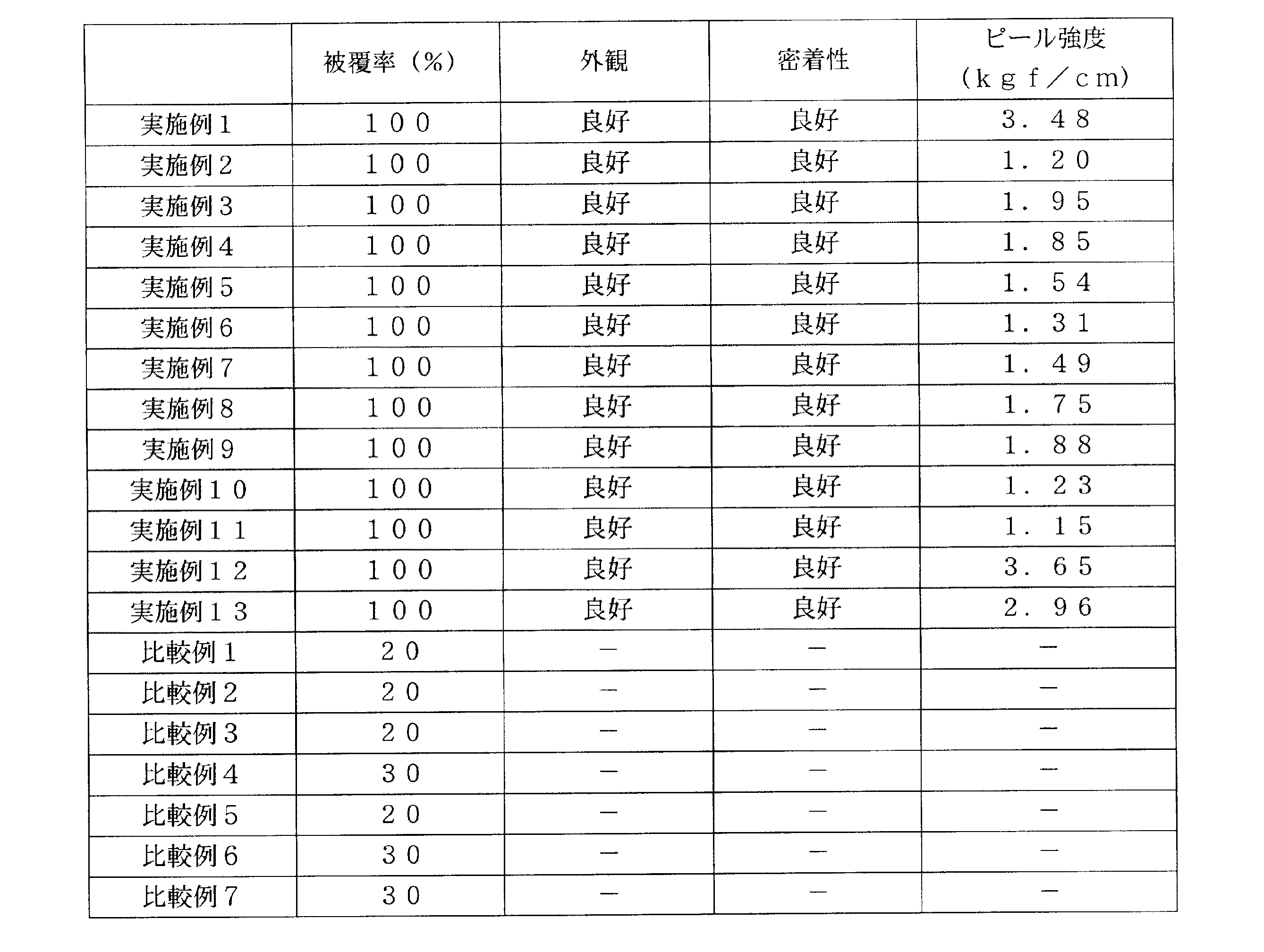
(1)被覆率:
被めっき物表面の無電解ニッケルめっき皮膜が形成された面積の割合を被覆率とする。試験片の全面が被覆された場合を被覆率100%とする。
(2)外観:
めっき皮膜の外観を目視で評価した。
(3)密着性試験:
めっき皮膜の表面に粘着テープを貼り付けた後、テープをめっき面に対して垂直に引っ張った場合のめっき皮膜の剥離の有無を調べた。
更に、無電解めっき皮膜を形成した試験片について、硫酸銅めっき浴を用いて、電流密度3A/dm2、温度25℃で電気めっき処理を120分間を行い、銅めっき皮膜を形成した。この様にして得られた試料について、80℃で120分間乾燥させ、室温になるまで放置した後、めっき皮膜に10mm幅の切り目を入れ、引張り試験器((株)島津製作所製、オートグラフSD−100−C)を用いて、樹脂に対して垂直にめっき皮膜を引張り、ピール強度を測定した。
(1) Coverage:
The ratio of the area where the electroless nickel plating film is formed on the surface of the object is defined as the coverage. The coverage is 100% when the entire surface of the test piece is covered.
(2) Appearance:
The appearance of the plating film was visually evaluated.
(3) Adhesion test:
After sticking an adhesive tape on the surface of the plating film, the presence or absence of peeling of the plating film when the tape was pulled perpendicular to the plating surface was examined.
Further, the test piece on which the electroless plating film was formed was subjected to electroplating treatment for 120 minutes at a current density of 3 A / dm 2 and a temperature of 25 ° C. using a copper sulfate plating bath to form a copper plating film. The sample thus obtained was dried at 80 ° C. for 120 minutes and left to reach room temperature, and then a 10 mm wide cut was made in the plating film, and a tensile tester (manufactured by Shimadzu Corporation, Autograph SD). −100-C), the plating film was pulled perpendicular to the resin, and the peel strength was measured.
以上の試験結果を下記表3に示す。 The above test results are shown in Table 3 below.
これに対して、クロム酸―硫酸混液を用いてエッチング処理を行って得られた試料については、エッチング条件を各種変化させても、めっき皮膜の被覆率が非常に低く良好な無電解めっき皮膜を形成することができなかった。従って、ポリアミド系樹脂及びスチレン系樹脂を含む樹脂成分から形成された成形体への無電解めっきの前処理としては、クロム酸―硫酸混液を用いたエッチング処理は不適切であると判断できた。
In contrast, for samples obtained by etching using a chromic acid-sulfuric acid mixed solution, a good electroless plating film with a very low plating film coverage was obtained even when the etching conditions were changed in various ways. Could not be formed. Therefore, it was judged that the etching treatment using the chromic acid-sulfuric acid mixed solution was inappropriate as the pretreatment of the electroless plating on the molded body formed from the resin component containing the polyamide resin and the styrene resin.
Claims (4)
A pre-treated resin molded body according to any one of claims 1 to 3, a catalyst for electroless plating is applied, and then an electroless plating process is performed. Electroless plating method for.
Priority Applications (1)
| Application Number | Priority Date | Filing Date | Title |
|---|---|---|---|
| JP2004116892A JP2005298899A (en) | 2004-04-12 | 2004-04-12 | Pretreatment method for electroless plating on resin molded body |
Applications Claiming Priority (1)
| Application Number | Priority Date | Filing Date | Title |
|---|---|---|---|
| JP2004116892A JP2005298899A (en) | 2004-04-12 | 2004-04-12 | Pretreatment method for electroless plating on resin molded body |
Publications (1)
| Publication Number | Publication Date |
|---|---|
| JP2005298899A true JP2005298899A (en) | 2005-10-27 |
Family
ID=35330811
Family Applications (1)
| Application Number | Title | Priority Date | Filing Date |
|---|---|---|---|
| JP2004116892A Pending JP2005298899A (en) | 2004-04-12 | 2004-04-12 | Pretreatment method for electroless plating on resin molded body |
Country Status (1)
| Country | Link |
|---|---|
| JP (1) | JP2005298899A (en) |
Cited By (2)
| Publication number | Priority date | Publication date | Assignee | Title |
|---|---|---|---|---|
| JP2007243033A (en) * | 2006-03-10 | 2007-09-20 | Seiko Epson Corp | Wiring board manufacturing method |
| WO2010061605A1 (en) * | 2008-11-27 | 2010-06-03 | ユーエムジー・エービーエス株式会社 | Resin composition for plating use and resin plated product |
-
2004
- 2004-04-12 JP JP2004116892A patent/JP2005298899A/en active Pending
Cited By (3)
| Publication number | Priority date | Publication date | Assignee | Title |
|---|---|---|---|---|
| JP2007243033A (en) * | 2006-03-10 | 2007-09-20 | Seiko Epson Corp | Wiring board manufacturing method |
| WO2010061605A1 (en) * | 2008-11-27 | 2010-06-03 | ユーエムジー・エービーエス株式会社 | Resin composition for plating use and resin plated product |
| KR101324997B1 (en) | 2008-11-27 | 2013-11-04 | 유엠지 에이비에스 가부시키가이샤 | Resin composition for plating use and resin plated product |
Similar Documents
| Publication | Publication Date | Title |
|---|---|---|
| EP2009142B1 (en) | Composition for etching treatment of resin molded article | |
| JPWO2008143190A1 (en) | Pretreatment method of electroless plating for resin molding, plating method for resin molding, and pretreatment agent | |
| TWI404475B (en) | Selective deposition of metal on plastic substrates | |
| JP2010121143A (en) | Post-processing agent of etching for resin-formed body, post-processing method using the same, and plating method for resin-formed body | |
| JP4786708B2 (en) | Surface modification liquid for plastic and method for metallizing plastic surface using the same | |
| TWI224120B (en) | Process for manufacturing plated resin molded article | |
| JP4617445B2 (en) | Plating method for resin molding | |
| JP5552269B2 (en) | Electroless plating method | |
| JP4030754B2 (en) | Plating resin molding | |
| WO2007069769A1 (en) | Plated resin molding | |
| JP4619625B2 (en) | Manufacturing method of plated resin molding | |
| JP4593036B2 (en) | Plating resin molding | |
| JP4801362B2 (en) | Manufacturing method of plated resin molding | |
| JP2005232338A (en) | Plated resin molding | |
| JP2001011643A (en) | Plating method for nonconductor | |
| CN101107388B (en) | Method for producing plated resin formed article | |
| US12540404B2 (en) | Method for improving adhesion between metallization layers and ozone-etched plastics | |
| JP2006028552A (en) | Plating resin molding | |
| JP7160306B2 (en) | Electroless plating pretreatment composition, electroless plating pretreatment method, electroless plating method | |
| JP2006152337A (en) | Composition for etching resin molding | |
| JPH0220708B2 (en) | ||
| JP2006152041A (en) | Molded resin article having plated layer | |
| HK1125418B (en) | Composition for etching treatment of resin molded article |
Legal Events
| Date | Code | Title | Description |
|---|---|---|---|
| A621 | Written request for application examination |
Free format text: JAPANESE INTERMEDIATE CODE: A621 Effective date: 20070214 |
|
| A977 | Report on retrieval |
Free format text: JAPANESE INTERMEDIATE CODE: A971007 Effective date: 20070723 |
|
| A131 | Notification of reasons for refusal |
Effective date: 20090812 Free format text: JAPANESE INTERMEDIATE CODE: A131 |
|
| A02 | Decision of refusal |
Effective date: 20100106 Free format text: JAPANESE INTERMEDIATE CODE: A02 |