JP2005298870A - Method for recovering metal indium by electrowinning - Google Patents
Method for recovering metal indium by electrowinning Download PDFInfo
- Publication number
- JP2005298870A JP2005298870A JP2004114180A JP2004114180A JP2005298870A JP 2005298870 A JP2005298870 A JP 2005298870A JP 2004114180 A JP2004114180 A JP 2004114180A JP 2004114180 A JP2004114180 A JP 2004114180A JP 2005298870 A JP2005298870 A JP 2005298870A
- Authority
- JP
- Japan
- Prior art keywords
- indium
- aqueous solution
- acid
- acidic
- cathode
- Prior art date
- Legal status (The legal status is an assumption and is not a legal conclusion. Google has not performed a legal analysis and makes no representation as to the accuracy of the status listed.)
- Granted
Links
- 229910052738 indium Inorganic materials 0.000 title claims abstract description 108
- APFVFJFRJDLVQX-UHFFFAOYSA-N indium atom Chemical compound [In] APFVFJFRJDLVQX-UHFFFAOYSA-N 0.000 title claims abstract description 101
- 229910052751 metal Inorganic materials 0.000 title claims abstract description 83
- 239000002184 metal Substances 0.000 title claims abstract description 83
- 238000000034 method Methods 0.000 title claims abstract description 83
- 238000005363 electrowinning Methods 0.000 title claims abstract description 47
- QAOWNCQODCNURD-UHFFFAOYSA-N Sulfuric acid Chemical compound OS(O)(=O)=O QAOWNCQODCNURD-UHFFFAOYSA-N 0.000 claims abstract description 84
- 239000007864 aqueous solution Substances 0.000 claims abstract description 79
- ROOXNKNUYICQNP-UHFFFAOYSA-N ammonium persulfate Chemical class [NH4+].[NH4+].[O-]S(=O)(=O)OOS([O-])(=O)=O ROOXNKNUYICQNP-UHFFFAOYSA-N 0.000 claims abstract description 76
- 230000002378 acidificating effect Effects 0.000 claims abstract description 45
- 238000005868 electrolysis reaction Methods 0.000 claims abstract description 43
- 239000003792 electrolyte Substances 0.000 claims abstract description 33
- LSNNMFCWUKXFEE-UHFFFAOYSA-N Sulfurous acid Chemical compound OS(O)=O LSNNMFCWUKXFEE-UHFFFAOYSA-N 0.000 claims abstract description 32
- 229910001449 indium ion Inorganic materials 0.000 claims abstract description 30
- 239000012528 membrane Substances 0.000 claims abstract description 26
- 238000005341 cation exchange Methods 0.000 claims abstract description 25
- 238000011084 recovery Methods 0.000 claims abstract description 10
- 150000003839 salts Chemical class 0.000 claims abstract description 6
- 229910001870 ammonium persulfate Inorganic materials 0.000 claims description 37
- 239000008151 electrolyte solution Substances 0.000 claims description 36
- -1 alkali metal salt Chemical class 0.000 claims description 34
- BFNBIHQBYMNNAN-UHFFFAOYSA-N ammonium sulfate Chemical compound N.N.OS(O)(=O)=O BFNBIHQBYMNNAN-UHFFFAOYSA-N 0.000 claims description 18
- 229910052921 ammonium sulfate Inorganic materials 0.000 claims description 18
- 235000011130 ammonium sulphate Nutrition 0.000 claims description 18
- AJAXZLXLXZWIIE-UHFFFAOYSA-N indium;hydrochloride Chemical compound Cl.[In] AJAXZLXLXZWIIE-UHFFFAOYSA-N 0.000 claims description 18
- 150000003863 ammonium salts Chemical class 0.000 claims description 17
- GEHJYWRUCIMESM-UHFFFAOYSA-L sodium sulfite Chemical compound [Na+].[Na+].[O-]S([O-])=O GEHJYWRUCIMESM-UHFFFAOYSA-L 0.000 claims description 17
- 229910052783 alkali metal Inorganic materials 0.000 claims description 15
- PMZURENOXWZQFD-UHFFFAOYSA-L Sodium Sulfate Chemical compound [Na+].[Na+].[O-]S([O-])(=O)=O PMZURENOXWZQFD-UHFFFAOYSA-L 0.000 claims description 13
- 229910052938 sodium sulfate Inorganic materials 0.000 claims description 10
- 235000011152 sodium sulphate Nutrition 0.000 claims description 10
- 235000019395 ammonium persulphate Nutrition 0.000 claims description 9
- JRKICGRDRMAZLK-UHFFFAOYSA-N peroxydisulfuric acid Chemical compound OS(=O)(=O)OOS(O)(=O)=O JRKICGRDRMAZLK-UHFFFAOYSA-N 0.000 claims description 9
- 235000010265 sodium sulphite Nutrition 0.000 claims description 8
- PQUCIEFHOVEZAU-UHFFFAOYSA-N Diammonium sulfite Chemical compound [NH4+].[NH4+].[O-]S([O-])=O PQUCIEFHOVEZAU-UHFFFAOYSA-N 0.000 claims description 5
- 238000005070 sampling Methods 0.000 claims description 5
- 229910000337 indium(III) sulfate Inorganic materials 0.000 claims description 3
- RODAKIFYLYKDTD-UHFFFAOYSA-N indium;sulfuric acid Chemical compound [In].OS(O)(=O)=O RODAKIFYLYKDTD-UHFFFAOYSA-N 0.000 claims description 2
- XGCKLPDYTQRDTR-UHFFFAOYSA-H indium(iii) sulfate Chemical compound [In+3].[In+3].[O-]S([O-])(=O)=O.[O-]S([O-])(=O)=O.[O-]S([O-])(=O)=O XGCKLPDYTQRDTR-UHFFFAOYSA-H 0.000 claims 1
- 239000000243 solution Substances 0.000 abstract description 51
- 238000004519 manufacturing process Methods 0.000 abstract description 14
- 238000005260 corrosion Methods 0.000 abstract description 6
- 230000007797 corrosion Effects 0.000 abstract description 6
- 239000000126 substance Substances 0.000 abstract description 6
- 239000000460 chlorine Substances 0.000 abstract description 4
- ZAMOUSCENKQFHK-UHFFFAOYSA-N Chlorine atom Chemical compound [Cl] ZAMOUSCENKQFHK-UHFFFAOYSA-N 0.000 abstract description 3
- 229910052801 chlorine Inorganic materials 0.000 abstract description 3
- 239000002253 acid Substances 0.000 abstract 1
- 125000005385 peroxodisulfate group Chemical group 0.000 abstract 1
- 230000008719 thickening Effects 0.000 abstract 1
- VEXZGXHMUGYJMC-UHFFFAOYSA-N Hydrochloric acid Chemical compound Cl VEXZGXHMUGYJMC-UHFFFAOYSA-N 0.000 description 20
- 229910021645 metal ion Inorganic materials 0.000 description 16
- 238000003860 storage Methods 0.000 description 16
- 238000006243 chemical reaction Methods 0.000 description 13
- 229910000510 noble metal Inorganic materials 0.000 description 11
- 238000002425 crystallisation Methods 0.000 description 10
- 230000008025 crystallization Effects 0.000 description 10
- 150000002500 ions Chemical class 0.000 description 10
- KZBUYRJDOAKODT-UHFFFAOYSA-N Chlorine Chemical compound ClCl KZBUYRJDOAKODT-UHFFFAOYSA-N 0.000 description 9
- QAOWNCQODCNURD-UHFFFAOYSA-L Sulfate Chemical compound [O-]S([O-])(=O)=O QAOWNCQODCNURD-UHFFFAOYSA-L 0.000 description 8
- 239000000203 mixture Substances 0.000 description 8
- BASFCYQUMIYNBI-UHFFFAOYSA-N platinum Chemical compound [Pt] BASFCYQUMIYNBI-UHFFFAOYSA-N 0.000 description 8
- 239000000047 product Substances 0.000 description 8
- 239000011701 zinc Substances 0.000 description 8
- 239000007788 liquid Substances 0.000 description 7
- 239000012452 mother liquor Substances 0.000 description 7
- 239000002994 raw material Substances 0.000 description 7
- CHQMHPLRPQMAMX-UHFFFAOYSA-L sodium persulfate Chemical compound [Na+].[Na+].[O-]S(=O)(=O)OOS([O-])(=O)=O CHQMHPLRPQMAMX-UHFFFAOYSA-L 0.000 description 7
- MYMOFIZGZYHOMD-UHFFFAOYSA-N Dioxygen Chemical compound O=O MYMOFIZGZYHOMD-UHFFFAOYSA-N 0.000 description 6
- QVGXLLKOCUKJST-UHFFFAOYSA-N atomic oxygen Chemical compound [O] QVGXLLKOCUKJST-UHFFFAOYSA-N 0.000 description 6
- 229910001882 dioxygen Inorganic materials 0.000 description 6
- 239000001301 oxygen Substances 0.000 description 6
- 229910052760 oxygen Inorganic materials 0.000 description 6
- 229940001482 sodium sulfite Drugs 0.000 description 6
- 229920003934 Aciplex® Polymers 0.000 description 5
- 229910052782 aluminium Inorganic materials 0.000 description 5
- XAGFODPZIPBFFR-UHFFFAOYSA-N aluminium Chemical compound [Al] XAGFODPZIPBFFR-UHFFFAOYSA-N 0.000 description 5
- 150000001768 cations Chemical class 0.000 description 5
- 238000004090 dissolution Methods 0.000 description 5
- 239000007789 gas Substances 0.000 description 5
- 239000012535 impurity Substances 0.000 description 5
- UCKMPCXJQFINFW-UHFFFAOYSA-N Sulphide Chemical compound [S-2] UCKMPCXJQFINFW-UHFFFAOYSA-N 0.000 description 4
- 238000004070 electrodeposition Methods 0.000 description 4
- 238000000605 extraction Methods 0.000 description 4
- 238000005342 ion exchange Methods 0.000 description 4
- 238000007254 oxidation reaction Methods 0.000 description 4
- JRKICGRDRMAZLK-UHFFFAOYSA-L peroxydisulfate Chemical compound [O-]S(=O)(=O)OOS([O-])(=O)=O JRKICGRDRMAZLK-UHFFFAOYSA-L 0.000 description 4
- 229910052697 platinum Inorganic materials 0.000 description 4
- 238000000746 purification Methods 0.000 description 4
- 229910052725 zinc Inorganic materials 0.000 description 4
- HCHKCACWOHOZIP-UHFFFAOYSA-N Zinc Chemical compound [Zn] HCHKCACWOHOZIP-UHFFFAOYSA-N 0.000 description 3
- QCWXUUIWCKQGHC-UHFFFAOYSA-N Zirconium Chemical compound [Zr] QCWXUUIWCKQGHC-UHFFFAOYSA-N 0.000 description 3
- 239000004063 acid-resistant material Substances 0.000 description 3
- 239000003513 alkali Substances 0.000 description 3
- SOIFLUNRINLCBN-UHFFFAOYSA-N ammonium thiocyanate Chemical compound [NH4+].[S-]C#N SOIFLUNRINLCBN-UHFFFAOYSA-N 0.000 description 3
- 150000001875 compounds Chemical class 0.000 description 3
- 230000007423 decrease Effects 0.000 description 3
- 150000002739 metals Chemical class 0.000 description 3
- NLKNQRATVPKPDG-UHFFFAOYSA-M potassium iodide Chemical compound [K+].[I-] NLKNQRATVPKPDG-UHFFFAOYSA-M 0.000 description 3
- XLYOFNOQVPJJNP-UHFFFAOYSA-N water Substances O XLYOFNOQVPJJNP-UHFFFAOYSA-N 0.000 description 3
- 229910052726 zirconium Inorganic materials 0.000 description 3
- QGZKDVFQNNGYKY-UHFFFAOYSA-N Ammonia Chemical compound N QGZKDVFQNNGYKY-UHFFFAOYSA-N 0.000 description 2
- UFHFLCQGNIYNRP-UHFFFAOYSA-N Hydrogen Chemical compound [H][H] UFHFLCQGNIYNRP-UHFFFAOYSA-N 0.000 description 2
- 239000004372 Polyvinyl alcohol Substances 0.000 description 2
- 239000000654 additive Substances 0.000 description 2
- 230000000996 additive effect Effects 0.000 description 2
- 239000010953 base metal Substances 0.000 description 2
- 238000005266 casting Methods 0.000 description 2
- 238000005119 centrifugation Methods 0.000 description 2
- 238000007796 conventional method Methods 0.000 description 2
- 239000013078 crystal Substances 0.000 description 2
- 238000001035 drying Methods 0.000 description 2
- 238000002848 electrochemical method Methods 0.000 description 2
- 239000007772 electrode material Substances 0.000 description 2
- 239000000463 material Substances 0.000 description 2
- 239000003595 mist Substances 0.000 description 2
- 239000002245 particle Substances 0.000 description 2
- 150000002978 peroxides Chemical class 0.000 description 2
- 229920002451 polyvinyl alcohol Polymers 0.000 description 2
- OTYBMLCTZGSZBG-UHFFFAOYSA-L potassium sulfate Chemical compound [K+].[K+].[O-]S([O-])(=O)=O OTYBMLCTZGSZBG-UHFFFAOYSA-L 0.000 description 2
- 229910052939 potassium sulfate Inorganic materials 0.000 description 2
- BHZRJJOHZFYXTO-UHFFFAOYSA-L potassium sulfite Chemical compound [K+].[K+].[O-]S([O-])=O BHZRJJOHZFYXTO-UHFFFAOYSA-L 0.000 description 2
- 235000011151 potassium sulphates Nutrition 0.000 description 2
- 235000019252 potassium sulphite Nutrition 0.000 description 2
- 239000010970 precious metal Substances 0.000 description 2
- 239000002244 precipitate Substances 0.000 description 2
- 229910001220 stainless steel Inorganic materials 0.000 description 2
- 239000010935 stainless steel Substances 0.000 description 2
- 238000003756 stirring Methods 0.000 description 2
- 238000006467 substitution reaction Methods 0.000 description 2
- NWUYHJFMYQTDRP-UHFFFAOYSA-N 1,2-bis(ethenyl)benzene;1-ethenyl-2-ethylbenzene;styrene Chemical compound C=CC1=CC=CC=C1.CCC1=CC=CC=C1C=C.C=CC1=CC=CC=C1C=C NWUYHJFMYQTDRP-UHFFFAOYSA-N 0.000 description 1
- LCPVQAHEFVXVKT-UHFFFAOYSA-N 2-(2,4-difluorophenoxy)pyridin-3-amine Chemical compound NC1=CC=CN=C1OC1=CC=C(F)C=C1F LCPVQAHEFVXVKT-UHFFFAOYSA-N 0.000 description 1
- WWILHZQYNPQALT-UHFFFAOYSA-N 2-methyl-2-morpholin-4-ylpropanal Chemical compound O=CC(C)(C)N1CCOCC1 WWILHZQYNPQALT-UHFFFAOYSA-N 0.000 description 1
- QGZKDVFQNNGYKY-UHFFFAOYSA-O Ammonium Chemical compound [NH4+] QGZKDVFQNNGYKY-UHFFFAOYSA-O 0.000 description 1
- VEXZGXHMUGYJMC-UHFFFAOYSA-M Chloride anion Chemical compound [Cl-] VEXZGXHMUGYJMC-UHFFFAOYSA-M 0.000 description 1
- XFXPMWWXUTWYJX-UHFFFAOYSA-N Cyanide Chemical compound N#[C-] XFXPMWWXUTWYJX-UHFFFAOYSA-N 0.000 description 1
- KRHYYFGTRYWZRS-UHFFFAOYSA-M Fluoride anion Chemical compound [F-] KRHYYFGTRYWZRS-UHFFFAOYSA-M 0.000 description 1
- 229920002472 Starch Polymers 0.000 description 1
- ZMZDMBWJUHKJPS-UHFFFAOYSA-M Thiocyanate anion Chemical compound [S-]C#N ZMZDMBWJUHKJPS-UHFFFAOYSA-M 0.000 description 1
- BZHJMEDXRYGGRV-UHFFFAOYSA-N Vinyl chloride Chemical compound ClC=C BZHJMEDXRYGGRV-UHFFFAOYSA-N 0.000 description 1
- 229910001361 White metal Inorganic materials 0.000 description 1
- PTFCDOFLOPIGGS-UHFFFAOYSA-N Zinc dication Chemical compound [Zn+2] PTFCDOFLOPIGGS-UHFFFAOYSA-N 0.000 description 1
- 230000002411 adverse Effects 0.000 description 1
- 229910001413 alkali metal ion Inorganic materials 0.000 description 1
- 229910021529 ammonia Inorganic materials 0.000 description 1
- 229940101006 anhydrous sodium sulfite Drugs 0.000 description 1
- 150000001450 anions Chemical class 0.000 description 1
- 238000007743 anodising Methods 0.000 description 1
- 239000003518 caustics Substances 0.000 description 1
- 239000013522 chelant Substances 0.000 description 1
- 239000003795 chemical substances by application Substances 0.000 description 1
- 238000005352 clarification Methods 0.000 description 1
- 230000006835 compression Effects 0.000 description 1
- 238000007906 compression Methods 0.000 description 1
- 238000011109 contamination Methods 0.000 description 1
- 238000001816 cooling Methods 0.000 description 1
- 239000000498 cooling water Substances 0.000 description 1
- 229910052802 copper Inorganic materials 0.000 description 1
- 238000000354 decomposition reaction Methods 0.000 description 1
- 230000003247 decreasing effect Effects 0.000 description 1
- 230000018044 dehydration Effects 0.000 description 1
- 238000006297 dehydration reaction Methods 0.000 description 1
- 238000000151 deposition Methods 0.000 description 1
- 230000008021 deposition Effects 0.000 description 1
- 238000010586 diagram Methods 0.000 description 1
- 230000000694 effects Effects 0.000 description 1
- 238000002474 experimental method Methods 0.000 description 1
- 239000000706 filtrate Substances 0.000 description 1
- 238000001914 filtration Methods 0.000 description 1
- 238000010438 heat treatment Methods 0.000 description 1
- 239000001257 hydrogen Substances 0.000 description 1
- 229910052739 hydrogen Inorganic materials 0.000 description 1
- ZMZDMBWJUHKJPS-UHFFFAOYSA-N hydrogen thiocyanate Natural products SC#N ZMZDMBWJUHKJPS-UHFFFAOYSA-N 0.000 description 1
- RJMMFJHMVBOLGY-UHFFFAOYSA-N indium(3+) Chemical compound [In+3] RJMMFJHMVBOLGY-UHFFFAOYSA-N 0.000 description 1
- 238000009776 industrial production Methods 0.000 description 1
- 239000003456 ion exchange resin Substances 0.000 description 1
- 229920003303 ion-exchange polymer Polymers 0.000 description 1
- 229910052742 iron Inorganic materials 0.000 description 1
- IQPQWNKOIGAROB-UHFFFAOYSA-N isocyanate Chemical compound [N-]=C=O IQPQWNKOIGAROB-UHFFFAOYSA-N 0.000 description 1
- QTWZICCBKBYHDM-UHFFFAOYSA-N leucomethylene blue Chemical compound C1=C(N(C)C)C=C2SC3=CC(N(C)C)=CC=C3NC2=C1 QTWZICCBKBYHDM-UHFFFAOYSA-N 0.000 description 1
- 238000002844 melting Methods 0.000 description 1
- 230000008018 melting Effects 0.000 description 1
- 150000004706 metal oxides Chemical class 0.000 description 1
- 239000007800 oxidant agent Substances 0.000 description 1
- 230000003647 oxidation Effects 0.000 description 1
- 238000001556 precipitation Methods 0.000 description 1
- 238000002360 preparation method Methods 0.000 description 1
- 239000012264 purified product Substances 0.000 description 1
- 238000007670 refining Methods 0.000 description 1
- 239000011347 resin Substances 0.000 description 1
- 229920005989 resin Polymers 0.000 description 1
- 239000012266 salt solution Substances 0.000 description 1
- 238000007790 scraping Methods 0.000 description 1
- 238000000926 separation method Methods 0.000 description 1
- 238000007086 side reaction Methods 0.000 description 1
- 239000004590 silicone sealant Substances 0.000 description 1
- 229910001415 sodium ion Inorganic materials 0.000 description 1
- 239000002904 solvent Substances 0.000 description 1
- 235000019698 starch Nutrition 0.000 description 1
- 239000008107 starch Substances 0.000 description 1
- 238000005987 sulfurization reaction Methods 0.000 description 1
- 239000000725 suspension Substances 0.000 description 1
- 238000005406 washing Methods 0.000 description 1
- 239000010969 white metal Substances 0.000 description 1
Images
Classifications
-
- Y—GENERAL TAGGING OF NEW TECHNOLOGICAL DEVELOPMENTS; GENERAL TAGGING OF CROSS-SECTIONAL TECHNOLOGIES SPANNING OVER SEVERAL SECTIONS OF THE IPC; TECHNICAL SUBJECTS COVERED BY FORMER USPC CROSS-REFERENCE ART COLLECTIONS [XRACs] AND DIGESTS
- Y02—TECHNOLOGIES OR APPLICATIONS FOR MITIGATION OR ADAPTATION AGAINST CLIMATE CHANGE
- Y02P—CLIMATE CHANGE MITIGATION TECHNOLOGIES IN THE PRODUCTION OR PROCESSING OF GOODS
- Y02P10/00—Technologies related to metal processing
- Y02P10/20—Recycling
Landscapes
- Electrolytic Production Of Non-Metals, Compounds, Apparatuses Therefor (AREA)
- Electrolytic Production Of Metals (AREA)
Abstract
Description
本発明は、電解採取による金属インジウムの回収方法に関する。特に、本発明は、電解採取により、陰極室に仕込んだインジウムイオンを含有する溶液から金属インジウムを回収する方法に関する。本発明は、金属インジウムを回収するとともに、陽極酸化反応を利用して陽極室に仕込んだ特定の化合物の溶液から同時に有用な化合物を併産する方法をも包括している。 The present invention relates to a method for recovering metallic indium by electrowinning. In particular, the present invention relates to a method for recovering metallic indium from a solution containing indium ions charged into a cathode chamber by electrowinning. The present invention also includes a method for recovering indium metal and simultaneously producing a useful compound from a solution of a specific compound charged in the anode chamber by using an anodic oxidation reaction.
金属インジウムの湿式の工業的な生産は、通常、金属インジウムの無機酸塩水溶液を経て行われている。その際、金属インジウムの無機酸塩水溶液から金属インジウムを得るためには、亜鉛板、アルミニウム板などを使用した置換処理(以下、セメンテーションということがある)を行うことにより、金属インジウムを亜鉛板、アルミニウム板などの表面上に水を含んだ軟らかい状態、通称スポンジインジウムとして析出させ、圧搾脱水、熔融、鋳造などを経て、金属インジウムとすることが最も一般的に行われている。 The wet industrial production of metallic indium is usually carried out via an inorganic acid salt aqueous solution of metallic indium. At that time, in order to obtain metal indium from an inorganic acid salt aqueous solution of metal indium, a substitution process using a zinc plate, an aluminum plate, or the like (hereinafter sometimes referred to as cementation) is performed, so that the metal indium is converted into a zinc plate. It is most commonly performed to form metallic indium through a soft state containing water on the surface of an aluminum plate or the like, commonly deposited as sponge indium, and after compression dehydration, melting, casting and the like.
このセメンテーションにおいては、置換処理(セメンテーション)用金属、即ち亜鉛、アルミニウムなどより標準電極電位(E0/V)が高いインジウム無機酸塩水溶液中の金属イオンMn2+、 Ga3+ 、Fe2+、Cd2+、(In3+) 、Tl+ 、Co2+、Ni2+、Mo3+、Sn2+、Pb2+、Sn4+、Bi3+、Cu2+、Cu+ 、Fe3+、Hg2+、Ag+ 、Pd2+などは、原則的に金属インジウムとともに析出してしまう。 In this cementation, metal ions Mn 2+ , Ga 3+ , Fe in an aqueous solution of indium inorganic acid salt having a higher standard electrode potential (E 0 / V) than metals for substitution treatment (cementation) such as zinc and aluminum. 2+ , Cd 2+ , (In 3+ ), Tl + , Co 2+ , Ni 2+ , Mo 3+ , Sn 2+ , Pb 2+ , Sn 4+ , Bi 3+ , Cu 2+ , Cu + , Fe 3+ , Hg 2+ , Ag + , Pd 2+, etc., in principle, precipitate together with metallic indium.
そのため、夾雑金属含有率の低い金属インジウムを得るためには、亜鉛によるセメンテーションの前に、これらのMn2+、Ga3+、Fe2+、Cd2+、Tl+ 、Co2+、Ni2+、Mo3+、Sn2+、Pb2+、Sn4+、Bi3+、Cu2+、Cu+ 、Fe3+、Hg2+、Ag+ 、Pd2+などをインジウム無機酸塩水溶液中から除去しておかなくてはならない。 Therefore, in order to obtain metallic indium with a low content of impurities, these Mn 2+ , Ga 3+ , Fe 2+ , Cd 2+ , Tl + , Co 2+ , Ni before cementation with zinc 2+ , Mo 3+ , Sn 2+ , Pb 2+ , Sn 4+ , Bi 3+ , Cu 2+ , Cu + , Fe 3+ , Hg 2+ , Ag + , Pd 2+ etc. It must be removed from the aqueous solution.
また、アルミニウムによるセメンテーションの前には、これらに加えてZn2+も除去しておかなければならない。 In addition to these, Zn 2+ must also be removed before cementation with aluminum.
この要求に対応するために、キレート型のイオン交換樹脂を使用してFe、Zn、Cuなどの金属イオンを除去する方法が提案されている(例えば、特許文献1参照)。しかし、その除去率は低いため、この方法は、4N(99.99%)程度の高純度金属インジウムを製造するのに適していない。 In order to meet this demand, a method of removing metal ions such as Fe, Zn, Cu using a chelate ion exchange resin has been proposed (for example, see Patent Document 1). However, since the removal rate is low, this method is not suitable for producing high-purity metallic indium of about 4N (99.99%).
これに対して、インジウム無機酸塩水溶液中から金属インジウムを電解採取する方法では、標準電極電位が金属インジウムよりも低い金属イオン(以下、卑な金属イオンということがある)Al3+、Zn2+、Mn2+、Ga3+、Fe2+、Fe3+及びCd2+は、電解で析出しないので、あらかじめ原料のインジウム無機酸塩水溶液中から除去しておく必要がない。 In contrast, in the method of electrolytically collecting metal indium from an aqueous solution of indium inorganic acid salt, metal ions whose standard electrode potential is lower than metal indium (hereinafter sometimes referred to as base metal ions) Al 3+ , Zn 2 Since + , Mn 2+ , Ga 3+ , Fe 2+ , Fe 3+ and Cd 2+ do not precipitate by electrolysis, it is not necessary to remove them beforehand from the raw material indium inorganic acid salt aqueous solution.
このような理由でインジウム無機酸塩水溶液中から金属インジウムを得る方法として、セメンテーション法に代わって、例えば、電解採取法が注目されている(例えば、特許文献2参照)。 For this reason, for example, an electrolytic collection method has attracted attention as a method for obtaining metallic indium from an indium inorganic acid salt aqueous solution instead of the cementation method (see, for example, Patent Document 2).
この電解採取法においては、インジウム無機酸塩水溶液中の標準電極電位が金属インジウムよりも高い金属イオン(以下、貴な金属イオンということがある)は、金属インジウムとともに析出する。そのため、これらの貴な金属イオンの濃度が目的とする金属インジウムの純度に対応するものである場合には、該インジウム無機酸塩水溶液をただちに電解採取に付することが行われている。 In this electrowinning method, metal ions whose standard electrode potential in the indium inorganic acid salt aqueous solution is higher than that of metal indium (hereinafter sometimes referred to as noble metal ions) are precipitated together with metal indium. For this reason, when the concentration of these noble metal ions corresponds to the purity of the target metal indium, the aqueous solution of indium inorganic acid salt is immediately subjected to electrowinning.
一方、それらの貴な金属イオンの濃度が目的とする金属インジウムの純度に合致しない場合(目的とする金属インジウムが高純度である場合を含む)には、該インジウム無機酸塩水溶液を電解採取に付する前に、硫化その他の公知の化学的精製法によってそれらの貴な金属イオンの濃度の低減を図ることが行われている。 On the other hand, when the concentration of these noble metal ions does not match the purity of the target metal indium (including the case where the target metal indium is highly pure), the indium inorganic acid salt aqueous solution is used for electrowinning. Prior to application, the concentration of these noble metal ions is reduced by sulfurization or other known chemical purification methods.
他方、電解採取法に特有の短所を除く提案も行われている。例えば、従来のインジウム塩酸塩水溶液からなる電解液中に陰極及び陽極を挿入して電解を行う方法においては、次式に従って塩素ガスが発生し、機器及び環境に悪影響を及ぼすという欠点がある。
2Cl- = Cl2 + 2e-
On the other hand, proposals have been made to eliminate disadvantages peculiar to the electrolytic collection method. For example, in the conventional method of performing electrolysis by inserting a cathode and an anode into an electrolytic solution made of an indium hydrochloride aqueous solution, chlorine gas is generated according to the following formula, which has a drawback of adversely affecting equipment and the environment.
2Cl - = Cl 2 + 2e -
前記欠点を解消する方法として、前記特許文献2に記載の発明では、以下の方法が採用られている。 As a method for eliminating the above-mentioned drawbacks, the following method is employed in the invention described in Patent Document 2.
1.陽イオン交換膜を陰極室と陽極室との間に配置することにより、電解室を陰極室と陽極室とに分離する。
2.陰極電解液としてインジウム塩酸塩水溶液を陰極室に満たし、陽極電解液として硫酸を陽極に満たす。
3.陰極室の塩素イオン及び陽極室の硫酸イオンは、いずれも、陽イオン交換膜に遮られるため、他方の電解室に移動することができない。
4.陽イオン交換膜は、1価の陽イオンを透過させるが、多価の陽イオンを透過させないので、3価のインジウムカチオンは、陽極室に移動することができない。
5.その結果、電解反応は、次のように進行する(例えば、非特許文献1参照)。
1. By disposing the cation exchange membrane between the cathode chamber and the anode chamber, the electrolysis chamber is separated into the cathode chamber and the anode chamber.
2. The cathode chamber is filled with an aqueous solution of indium hydrochloride as the cathode electrolyte, and the anode is filled with sulfuric acid as the anode electrolyte.
3. Since both the chloride ion in the cathode chamber and the sulfate ion in the anode chamber are blocked by the cation exchange membrane, they cannot move to the other electrolysis chamber.
4). Although the cation exchange membrane transmits monovalent cations but does not transmit polyvalent cations, the trivalent indium cation cannot move to the anode chamber.
5). As a result, the electrolytic reaction proceeds as follows (see, for example, Non-Patent Document 1).
(アノード反応) 3/2H2O − 3e - = 3/4O2↑ + 3H +
(カソード反応) In3+ + 3e - = In
(全反応) In3+ + 3/2H2O = In + 3/4O2 ↑+ 3H +
(Anode reaction) 3 / 2H 2 O − 3e − = 3 / 4O 2 ↑ + 3H +
(Cathode reaction) In 3+ + 3e - = In
(All reactions) In 3+ + 3 / 2H 2 O = In + 3 / 4O 2 ↑ + 3H +
このように、前記電解では、塩素ガスが発生せず、酸素ガスが発生する。しかし、この方法には、第1の問題点として、陽極室に硫酸溶液を使用するため、発生する酸素ガスが硫酸ミストを同伴しており、その完全な吸収及び除害が困難なため、設備全体の腐食対策が必要であるという欠点がある。つまり、従来のインジウム塩酸溶液セメンテーション法よりも却って設備の腐食対策が重要となる。 Thus, in the electrolysis, chlorine gas is not generated, but oxygen gas is generated. However, in this method, as a first problem, since a sulfuric acid solution is used in the anode chamber, the generated oxygen gas is accompanied by sulfuric acid mist, and it is difficult to completely absorb and remove the oxygen gas. There is a drawback that the whole corrosion countermeasure is necessary. That is, the countermeasure against corrosion of the equipment is more important than the conventional indium hydrochloric acid solution cementation method.
また、第2の問題点として、従来の方法では、陰極側で以下に説明するように水素ガスが発生するが、貴重な化合物を生成させることができない。 As a second problem, in the conventional method, hydrogen gas is generated on the cathode side as described below, but a valuable compound cannot be generated.
なお、例えば、過硫酸アンモニウムの一般的な製造方法としては、陽極側で硫酸及び硫酸アンモニウムを含有した水溶液を用い、即ち、硫酸水素アンモニウム水溶液を原料とした電解製法が知られている(例えば、特許文献3参照)。この方法では、生成した過硫酸アンモニウムを真空晶析・遠心分離などにより、濃縮・分離・乾燥することにより、製品化されている。 For example, as a general production method of ammonium persulfate, an electrolytic production method using an aqueous solution containing sulfuric acid and ammonium sulfate on the anode side, that is, an ammonium hydrogen sulfate aqueous solution as a raw material is known (for example, Patent Documents). 3). In this method, the produced ammonium persulfate is commercialized by concentrating, separating, and drying by vacuum crystallization, centrifugation, or the like.
また、例えば、プロトン、アルカリ金属イオン又はアンモニウムイオンを伴った硫酸イオンの水溶液を隔膜電解槽中で陽極酸化することによって過硫酸アルカリ塩又はアンモニウム塩の製造方法が提案されている(例えば、特許文献4参照)。 In addition, for example, a method for producing an alkali persulfate or ammonium salt by anodizing an aqueous solution of sulfate ions accompanied by protons, alkali metal ions or ammonium ions in a diaphragm electrolytic cell has been proposed (for example, Patent Documents). 4).
しかしながら、これらの過硫酸塩を製造する方法では、いずれも、陰極においては水素が発生するか又は生成するのみであり、陰極側を有効に活用して高価な金属である金属インジウムを製造することについては、まったく触れられていない。 However, in any of these methods for producing persulfate, hydrogen is generated or only generated at the cathode, and metal indium, which is an expensive metal, is produced by effectively utilizing the cathode side. Is not mentioned at all.
その他の過硫酸アルカリ塩やアンモニウム塩の製造方法が知られているが(例えば、特許文献5及び特許文献6参照)、これらの文献では、いずれも、前記のとおり、陰極及び陽極の双方において有価物を製造する方法については触れられていない。 Other methods for producing alkali persulfate and ammonium salts are known (see, for example, Patent Document 5 and Patent Document 6). In these documents, as described above, both are valuable in both the cathode and the anode. There is no mention of how to make things.
本発明者らは、前記第1の問題点に対応するために、陽極室の電解液(以下、陽極液又は陽極電解液と言うことがある)として、硫酸溶液に代えて硫酸ナトリウム又は硫酸アンモニウムの水溶液に代表される硫酸塩などの水溶液を使用することによって、硫酸溶液に比べて取扱いなどに安全で電極の腐食性が少なく、かつ硫酸ミストによる作業環境の汚染も少ない電解採取による金属インジウムの回収方法を見出し、前記第1の問題点を解決し、第1段階を完成した。かくして、本発明においては、「硫酸溶液」ではなく、「硫酸塩などの水溶液」を用いるので取扱いが容易であり、従来の塩酸インジウムセメンテーション系システムの腐食対策に関する工場設備の全面変更を必要としない。 In order to cope with the first problem, the present inventors have used sodium sulfate or ammonium sulfate as an electrolyte solution in the anode chamber (hereinafter sometimes referred to as an anolyte or an anolyte). By using an aqueous solution such as sulfate represented by an aqueous solution, recovery of metal indium by electrowinning is safer to handle than the sulfuric acid solution, less corrosive to the electrode, and less polluting the working environment by sulfuric acid mist. A method was found, the first problem was solved, and the first stage was completed. Thus, in the present invention, since the “sulfuric acid solution” is used instead of the “sulfuric acid solution”, handling is easy, and it is necessary to completely change the factory equipment related to the corrosion countermeasures of the conventional indium hydrochloride cementation system. do not do.
本発明者らは、更に検討の結果、前記第2の問題点、つまり本発明の電解採取による金属インジウムの回収方法における陽極側において、有価物質の併産製造に寄与できるという従来にないまったく新規な知見を見出すに至った。 As a result of further studies, the present inventors have found that the second problem, that is, the novel method that can contribute to the co-production of valuable materials on the anode side in the method for recovering metallic indium by electrowinning according to the present invention, is completely new. I came to find a new knowledge.
その最初の例は、陽極電解液として、例えば、亜硫酸ナトリウム又は酸性亜硫酸ナトリウムを用い、電解後に陽極液中に有価物質の硫酸ナトリウムを併産製造する技術である。これが本発明の第2段階である。 The first example is a technique in which sodium sulfite or acidic sodium sulfite is used as the anolyte, and valuable sodium sulfate is produced in the anolyte after electrolysis. This is the second stage of the present invention.
更に、本発明者らは、鋭意この研究の発展に努めた結果、この電解採取を終了した硫酸アンモニウム陽極液は、ヨウ化カリ澱粉紙を紫変させ、更にロイコメチレンブルーの無色液を青色に発色させることができることに着目するに至った。 Furthermore, as a result of diligent efforts to develop this research, the inventors of the present invention, the ammonium sulfate anolyte which has finished this electrowinning, turns the potassium iodide starch paper into purple and further develops a colorless leucomethylene blue solution into blue. I came to focus on being able to do it.
この着目を基に、硫酸アンモニウム水溶液を使用した電解終了後の陽極液には酸化剤として有用な価値ある過硫酸アンモニウムの生成が確認され、過硫酸アンモニウムの併産が可能であることを実験によって確認し、本発明の完成に至った。つまり、陽極側で例えば、硫酸ナトリウム又は硫酸アンモニウムを電解液中に存在させ、陽極液中にペルオキシ二硫酸ナトリウム又はペルオキシ二硫酸アンモニウムを生成せしめ、該陽極液の濃縮、好ましくは真空濃縮することによってペルオキシ二硫酸ナトリウム又はペルオキシ二硫酸アンモニウムを析出せしめ、濾過により取得し、濾液を陽極電解液として循環させる金属インジウムとペルオキシ二硫酸ナトリウム又ペルオキシ二硫酸アンモニウムとの併産製造方法に到達した。これが本発明の第3段階であり、まさに画期的なプロセスを確立することができたのである。 Based on this focus, the anolyte after completion of electrolysis using an aqueous ammonium sulfate solution was confirmed to produce ammonium persulfate useful as an oxidizing agent, and confirmed by experiments that ammonium persulfate can be co-produced. The present invention has been completed. That is, on the anode side, for example, sodium sulfate or ammonium sulfate is present in the electrolytic solution, sodium peroxydisulfate or ammonium peroxydisulfate is formed in the anolyte, and the anolyte is concentrated, preferably vacuum concentrated, to form peroxydioxide. Sodium sulfate or ammonium peroxydisulfate was deposited, obtained by filtration, and the combined production method of metal indium and sodium peroxydisulfate or ammonium peroxydisulfate was obtained by circulating the filtrate as an anolyte. This is the third stage of the present invention, and a very innovative process has been established.
本発明の第1は、インジウムイオンを含有する水溶液から金属インジウムを電解採取により回収する方法において、不溶性電極を配置した陽極室の電解液を硫酸、酸性硫酸、亜硫酸若しくは酸性亜硫酸のアルカリ金属塩又はアンモニウム塩の水溶液とし、陰極室の電解液(以下、陰極液又は陰極電解液と言うことがある)をインジウムイオンを含有する水溶液とし、前記陰極室と前記陽極室との間に陽イオン交換膜を存在させて電解を行い、陰極に金属インジウムを得ることを特徴とする電解採取による金属インジウムの回収方法である。 A first aspect of the present invention is a method for recovering metallic indium from an aqueous solution containing indium ions by electrowinning, wherein an electrolytic solution in an anode chamber in which an insoluble electrode is disposed is sulfuric acid, acidic sulfuric acid, sulfurous acid, an alkali metal salt of acidic sulfurous acid, or An aqueous solution of an ammonium salt, an electrolyte solution in the cathode chamber (hereinafter sometimes referred to as a catholyte or a cathode electrolyte solution) is an aqueous solution containing indium ions, and a cation exchange membrane between the cathode chamber and the anode chamber Is a method for recovering metal indium by electrowinning, wherein electrolysis is performed in the presence of metal to obtain metal indium at the cathode.
また、本発明の第2は、インジウムイオンを含有する水溶液から金属インジウムを電解採取により回収する方法において、不溶性電極を配置した陽極室の電解液を硫酸、酸性硫酸、亜硫酸若しくは酸性亜硫酸のアンモニウム塩の水溶液とし、陰極室の電解液をインジウムイオンを含有する水溶液とし、前記陰極室と前記陽極室との間に陽イオン交換膜を存在させて電解を行い、陰極に金属インジウムを得るとともに陽極液中にペルオキシ二硫酸のアンモニウム塩を生成させ、該陽極液の濃縮によってこれを得ることを特徴とする電解採取による金属インジウムの回収方法である。 According to a second aspect of the present invention, in the method of recovering metallic indium from an aqueous solution containing indium ions by electrowinning, the electrolytic solution in the anode chamber in which the insoluble electrode is disposed is sulfuric acid, acidic sulfuric acid, sulfurous acid, or an ammonium salt of acidic sulfurous acid. The cathode chamber electrolyte is an aqueous solution containing indium ions, a cation exchange membrane is present between the cathode chamber and the anode chamber, and electrolysis is performed to obtain metal indium at the cathode and the anolyte A method for recovering indium metal by electrowinning, characterized in that an ammonium salt of peroxydisulfuric acid is produced therein and obtained by concentrating the anolyte.
更にまた、本発明の第3は、インジウムイオンを含有する水溶液から金属インジウムを電解採取により回収する方法において、不溶性電極を配置した陽極室の電解液を硫酸、酸性硫酸、亜硫酸若しくは酸性亜硫酸のアルカリ金属塩の水溶液とし、陰極室の電解液をインジウムイオンを含有する水溶液とし、前記陰極室と前記陽極室との間に陽イオン交換膜を存在させて電解を行い、陰極に金属インジウムを得るとともに陽極液中にペルオキシ二硫酸のアルカリ金属塩を生成させ、該陽極液の濃縮によってこれを得ることを特徴とする電解採取による金属インジウムの回収方法である。 Furthermore, a third aspect of the present invention is a method for recovering metallic indium from an aqueous solution containing indium ions by electrowinning, wherein the electrolytic solution in the anode chamber in which the insoluble electrode is disposed is treated with sulfuric acid, acidic sulfuric acid, sulfurous acid or acidic sulfurous acid alkali. An aqueous solution of a metal salt, an electrolytic solution in the cathode chamber is an aqueous solution containing indium ions, and electrolysis is performed in the presence of a cation exchange membrane between the cathode chamber and the anode chamber to obtain metal indium at the cathode. An alkali metal salt of peroxydisulfuric acid is produced in an anolyte and is obtained by concentrating the anolyte.
電気化学的方法による硫酸イオン又は酸性硫酸イオンからの過硫酸イオンの生成は次の式で表される。
2HSO4 - −2e- → S2O8 2-+2H+ E0 =2.057V
2SO4 2- −2e- → S2O8 2- E0 =1.939V
Production of persulfate ions from sulfate ions or acidic sulfate ions by an electrochemical method is expressed by the following formula.
2HSO 4 - -2e- → S 2 O 8 2- + 2H + E 0 = 2.057V
2SO 4 2- −2e- → S 2 O 8 2- E 0 = 1.939V
よって、上記の金属インジウムと過硫酸アンモニウム(ペルオキシ二硫酸アンモニウム)との同時製造法の電解反応式は、下記のとおりであると考えられる。 Therefore, it is thought that the electrolytic reaction formula of the simultaneous manufacturing method of said metal indium and ammonium persulfate (ammonium peroxydisulfate) is as follows.
1.陽極電解液として酸性硫酸アンモニウム水溶液を使用する場合
(アノード反応) 6HSO4 - +6NH4 + − 6e - = 3(NH4)2S2O8+6H+
(カソード反応) 2In3+ +6e- = 2In
(全体の反応) 2In3+ +6NH4 + + 6HSO4 - = 2In +3(NH4)2S2O8 +6H+
1. When using an acidic aqueous solution of ammonium sulfate as anolyte (anode reaction) 6HSO 4 - + 6NH 4 + - 6e - = 3 (NH 4) 2 S 2 O 8 + 6H +
(Cathode reaction) 2In 3+ + 6e - = 2In
(Overall reaction) 2In 3+ + 6NH 4 + + 6HSO 4 − = 2In +3 (NH 4 ) 2 S 2 O 8 + 6H +
2.陽極電解液として硫酸アンモニウム水溶液を使用する場合
6(NH4)2SO4 → 12NH4 2 -+6SO4 2-
2. When using ammonium sulfate aqueous solution as anolyte
6 (NH 4) 2 SO 4 → 12NH 4 2 - + 6SO 4 2-
硫酸アンモニウムを使用すると上記のカチオン及びアニオンが発生するので、電解反応式は、下記のようになる。
(アノード反応) 6SO4 2-+ 12NH4 + −6e- = 3(NH4)2S2O8+6NH4 +
(カソード反応) 2In3+ +6e- = 2In
(全体の反応) 2In3+ +6NH4 + + 6SO4 2- = 2In + 3(NH4)2S2O8
When ammonium sulfate is used, the above cation and anion are generated, so the electrolytic reaction formula is as follows.
(Anode reaction) 6SO 4 2− + 12NH 4 + −6e − = 3 (NH 4 ) 2 S 2 O 8 + 6NH 4 +
(Cathode reaction) 2In 3+ + 6e - = 2In
(Overall reaction) 2In 3+ + 6NH 4 + + 6SO 4 2- = 2In + 3 (NH 4 ) 2 S 2 O 8
本発明の電解採取による金属インジウムの回収方法によれば、陰極液(電解液)と陽極液(電解液)との間に陽イオン交換膜を存在させて電解を行うという構成が採られているので、塩素ガスの発生を伴わずに電解採取することができ、また、陽極液(電解液)として硫酸、酸性硫酸、亜硫酸若しくは酸性亜硫酸のアルカリ金属塩又はアンモニウム塩の水溶液からなる陽極液を用いるという構成が採られているので、例えば、特許文献2(特開平8-60264 号公報)に記載の硫酸溶液を陽極液(電解液)として用いる方法と比べて、取扱い時などにおいて安全で、かつ電極の腐食などが少ないという優れた特有の効果があり、更に、本発明の回収方法においては、当初の目的とする金属インジウムとともに、例えば、ペルオキシ二硫酸ナトリウム塩、ペルオキシ二硫酸アンモニウム塩などの価値ある化学品との併産することができるので、その工業的利用価値は計り知れないものがある。 According to the method for recovering metallic indium by electrowinning according to the present invention, a configuration is adopted in which electrolysis is performed in the presence of a cation exchange membrane between the catholyte (electrolyte) and the anolyte (electrolyte). Therefore, the electrolytic collection can be performed without generation of chlorine gas, and an anolyte composed of an aqueous solution of sulfuric acid, acidic sulfuric acid, sulfurous acid, an alkali metal salt of acidic sulfurous acid or an ammonium salt is used as the anolyte (electrolytic solution). Therefore, for example, compared with a method using a sulfuric acid solution described in Patent Document 2 (JP-A-8-60264) as an anolyte (electrolyte), it is safer in handling and the like. There is an excellent characteristic effect that there is little corrosion of the electrode, and, in addition, in the recovery method of the present invention, for example, sodium peroxydisulfate, together with the original metal indium, , It is possible to co-production of a valuable chemical, such as ammonium peroxydisulfate salts, its industrial utility value is immeasurable.
本発明は、インジウムイオンを含有する水溶液から金属インジウムを電解採取により、回収する方法において、不溶性電極を配置した陽極室の電解液を硫酸、酸性硫酸、亜硫酸もしくは酸性亜硫酸のアルカリ金属塩又はアンモニウム塩の水溶液とし、陰極室の電解液をインジウムイオンを含有する水溶液とし、前記陰極室と前記陽極室との間に陽イオン交換膜を存在させて電解を行うことを特徴とする。 The present invention relates to a method for recovering metallic indium from an aqueous solution containing indium ions by electrowinning, in which an electrolytic solution in an anode chamber in which an insoluble electrode is disposed is sulfuric acid, acidic sulfuric acid, sulfurous acid, or an alkali metal salt or ammonium salt of acidic sulfurous acid. And an electrolytic solution in the cathode chamber is an aqueous solution containing indium ions, and electrolysis is performed in the presence of a cation exchange membrane between the cathode chamber and the anode chamber.
本発明の方法において、インジウムイオンを含有する水溶液の好適な例としては、インジウム塩酸水溶液、インジウム硫酸水溶液などが挙げられ、殊にインジウム塩酸水溶液が本発明で好ましく用いられる。該水溶液としては、特に限定されないが、例えば、水溶液系の標準電極電位が金属インジウムよりも高い金属イオン及び/又は金属インジウムよりも低い金属イオンをともに含有する酸性の水溶液が用いられる。 In the method of the present invention, preferred examples of the aqueous solution containing indium ions include an indium hydrochloric acid aqueous solution and an indium sulfuric acid aqueous solution. In particular, an indium hydrochloric acid aqueous solution is preferably used in the present invention. Although it does not specifically limit as this aqueous solution, For example, the acidic aqueous solution which contains both the metal ion whose standard electrode potential of aqueous solution system is higher than metal indium and / or metal ion lower than metal indium is used.
ここで、水溶液系の標準電極電位とは、主に、(社)電気化学協会「電気化学便覧」第4版、丸善(株)、平成5年4月30日、71〜74頁に掲載されているE0/Vをいう。 Here, the standard electrode potential of the aqueous solution is mainly published in the Electrochemical Association "Electrochemical Handbook" 4th edition, Maruzen Co., Ltd., April 30, 1993, pages 71-74. Say E 0 / V.
具体的には、標準電極電位(E0/V)が金属インジウムよりも高い金属イオンを含む溶液とは、つまり金属インジウムよりも貴な金属イオン、例えば、Tl+ 、Co2+、Ni2+、Mo3+、Sn2+、Pb2+、Sn4+、Bi3+、Cu2+、Cu+ 、Fe3+、Hg2+、Ag+ 、Pd2+などを含む溶液を意味し、また、標準電極電位(E0/V)が金属インジウムよりも低い金属イオン含む溶液とは、つまり金属インジウムより卑な金属イオン、例えば、Al3+、Zn2+、Mn2+、Ga3+、Fe2+、Cd2+などを含む溶液が挙げられる。 Specifically, a solution containing a metal ion whose standard electrode potential (E 0 / V) is higher than that of metal indium, that is, a metal ion more precious than metal indium, for example, Tl + , Co 2+ , Ni 2+ , Mo 3+ , Sn 2+ , Pb 2+ , Sn 4+ , Bi 3+ , Cu 2+ , Cu + , Fe 3+ , Hg 2+ , Ag + , Pd 2+, etc. In addition, a solution containing metal ions whose standard electrode potential (E 0 / V) is lower than that of metal indium, that is, metal ions that are baser than metal indium, such as Al 3+ , Zn 2+ , Mn 2+ , Ga 3+ , Fe 2+ , Cd 2+ and the like.
但し、金属インジウムよりも標準電極電位が低い(通称よりも卑な)金属イオンAl3+、Zn2+、Mn2+、Ga3+、Fe2+、Cd2+は、電解で析出することがないので、予め、原料のインジウム無機酸塩水溶液中から除去しておく必要がない。 However, metal ions Al 3+ , Zn 2+ , Mn 2+ , Ga 3+ , Fe 2+ , and Cd 2+ , which have a lower standard electrode potential than metal indium (basic than common names), must be deposited by electrolysis. Therefore, it is not necessary to remove from the raw material indium inorganic acid salt aqueous solution in advance.
これに対して、金属インジウムよりも標準電極電位の高い(通称よりも貴な)金属イオンは、金属インジウムとともに析出する。そのため、それらの貴な金属イオンの濃度が目的とする金属インジウムの純度に対応するものである場合には、該インジウム無機酸塩水溶液をただちに電解採取に付することができる。 On the other hand, metal ions having a higher standard electrode potential than metal indium (noble than common names) are deposited together with metal indium. Therefore, when the concentration of these noble metal ions corresponds to the purity of the target metal indium, the indium inorganic acid salt aqueous solution can be immediately subjected to electrowinning.
一方、それらの貴な金属イオンの濃度が目的とする金属インジウムの純度に合致しない場合(目的とする金属インジウムが高純度である場合を含む)には、該インジウム無機酸塩水溶液を電解採取に付する前に、例えば、塩酸溶解、硫化物処理、及び/又はイオン交換処理、セメンテーションなどの化学的精製法、その他の公知の種々の方法でそれらの貴な金属イオンの濃度の低減が図られる。 On the other hand, when the concentration of these noble metal ions does not match the purity of the target metal indium (including the case where the target metal indium is highly pure), the indium inorganic acid salt aqueous solution is used for electrowinning. Before applying, for example, hydrochloric acid dissolution, sulfide treatment, and / or ion exchange treatment, chemical purification methods such as cementation, and various other known methods can reduce the concentration of these noble metal ions. It is done.
また、4N(99.99%)以上、即ち、夾雑金属の合計量が100ppm以下の高純度金属インジウムを得るためには、化学的精製法、その他の公知の種々の方法により、これらの金属インジウムよりも貴な金属イオンを溶液中でその合計量が通常、20mg/L以下とすることが必要である。 In addition, in order to obtain high-purity metallic indium of 4N (99.99%) or more, that is, the total amount of contaminating metals is 100 ppm or less, the chemical refining method and other known various methods can be used rather than these metallic indiums. It is necessary that the total amount of noble metal ions in the solution is usually 20 mg / L or less.
原料溶液のインジウム濃度が200g/Lである場合には、電解採取においては、金属インジウムよりも貴な金属は液中に溶解したまま除去されることがなく、金属として析出するので、採取された金属インジウム中では溶液中の濃度のmg/Lの約5倍の数値のppm を示す。従って、溶液中のより貴な金属イオンの合計濃度は少なくとも20mg/L以下でなくてはならないことが予測される。特定のより貴な金属の含有量を所定の値以下にするためにも、同様の予測をすることができる。 In the case where the indium concentration of the raw material solution is 200 g / L, in the case of electrolytic collection, the noble metal rather than metal indium is not removed while dissolved in the solution, but is collected as a metal, and thus collected. In indium metal, it indicates ppm, which is about 5 times the mg / L concentration in the solution. Therefore, it is expected that the total concentration of more noble metal ions in the solution should be at least 20 mg / L or less. A similar prediction can be made to keep the content of a particular noble metal below a predetermined value.
なお、化学的精製法の代わりに、本発明の電解採取による金属インジウムの回収方法を予め浄液目的で低電流において実施し、金属インジウムの一部を貴な金属の含有率の高い粗金属として回収し、貴な金属イオンをできるだけ除去した後に、インジウムイオンを含有する水溶液を調製し、再び本発明の電解採取による金属インジウムの回収方法を実施することもできる。この方法は、極めて効率的であり、工業的に有利である。 In place of the chemical purification method, the method for recovering metal indium by electrowinning according to the present invention is performed in advance at a low current for the purpose of liquid purification, and a part of the metal indium is a crude metal having a high precious metal content. After collecting and removing precious metal ions as much as possible, an aqueous solution containing indium ions can be prepared, and the method for recovering metal indium by electrowinning according to the present invention can be performed again. This method is very efficient and industrially advantageous.
また、本発明の電解採取による金属インジウムの回収方法において、塩酸溶液中のインジウムイオンの濃度は、特に制限されるものではないが、あまりにも低いと電流効率が低くなるので、電解の開始の際には、通常、100 〜200g/Lである。 In addition, in the method for recovering metallic indium by electrowinning according to the present invention, the concentration of indium ions in the hydrochloric acid solution is not particularly limited, but if it is too low, the current efficiency will be low, so the electrolysis will start. Is usually 100 to 200 g / L.
本発明の電解採取による金属インジウムの回収方法に用いられる陽イオン交換膜としては、特に限定されない。好適な陽イオン交換膜の具体例としては、旭化成(株)製、商品名:ACIPLEX K−501、K−192、旭硝子(株)製、商品名:セレミオンCMVなどが挙げられる。 The cation exchange membrane used in the method for recovering metallic indium by electrowinning according to the present invention is not particularly limited. Specific examples of suitable cation exchange membranes include Asahi Kasei Co., Ltd., trade names: ACIPLEX K-501, K-192, Asahi Glass Co., Ltd., trade name: Ceremonon CMV, and the like.
また、本発明にいう硫酸、酸性硫酸、亜硫酸若しくは酸性亜硫酸のアルカリ金属塩又はアンモニウム塩の水溶液は、具体的には、硫酸ナトリウム、硫酸カリウム、酸性硫酸ナトリウム、酸性硫酸カリウム、亜硫酸ナトリウム、亜硫酸カリウム、酸性亜硫酸ナトリウム、酸性亜硫酸カリウム、硫酸アンモニウム、亜硫酸アンモニウム、酸性硫酸アンモニウム、酸性亜硫酸アンモニウムなどの水溶液が挙げられる。中でも硫酸ナトリウム(無水芒硝)、酸性硫酸ナトリウム、亜硫酸ナトリウム、酸性亜硫酸ナトリウムは安価でもあるので、好ましく、更に有価物の併産などの目的においては、硫酸アンモニウム及び亜硫酸アンモニウムが好ましい。 Moreover, the aqueous solution of sulfuric acid, acidic sulfuric acid, sulfurous acid, or an alkali metal salt or ammonium salt of acidic sulfurous acid according to the present invention is specifically sodium sulfate, potassium sulfate, acidic sodium sulfate, acidic potassium sulfate, sodium sulfite, potassium sulfite. And aqueous solutions of acidic sodium sulfite, acidic potassium sulfite, ammonium sulfate, ammonium sulfite, acidic ammonium sulfate, acidic ammonium sulfite and the like. Among these, sodium sulfate (anhydrous sodium sulfate), acidic sodium sulfate, sodium sulfite, and acidic sodium sulfite are preferable because they are inexpensive, and ammonium sulfate and ammonium sulfite are preferable for the purpose of co-production of valuable resources.
本発明の電解採取による金属インジウムの回収方法は、塩酸と陽極の直接接触を避け、陽極での塩素発生反応を防止するため陽極液に硫酸、酸性硫酸、亜硫酸若しくは酸性亜硫酸のアルカリ金属塩又はアンモニウム塩の水溶液を使用することを特徴とする。 In the method of recovering metallic indium by electrowinning according to the present invention, sulfuric acid, acidic sulfuric acid, sulfurous acid, an alkali metal salt of acidic sulfurous acid, or ammonium is used as the anolyte to avoid direct contact between hydrochloric acid and the anode and to prevent chlorine generation reaction at the anode. It is characterized by using an aqueous salt solution.
また、場合により、電解電圧を低下させるためには、陽極液の硫酸、酸性硫酸、亜硫酸若しくは酸性亜硫酸のアルカリ金属塩又はアンモニウム塩の水溶液の濃度は、20〜180g/Lであることが好ましい。 In some cases, in order to reduce the electrolysis voltage, the concentration of the anolyte sulfuric acid, acidic sulfuric acid, sulfurous acid, or an aqueous solution of an alkali metal salt or ammonium salt of acidic sulfurous acid is preferably 20 to 180 g / L.
更に、本発明の電解採取による金属インジウムの回収方法において、陽極として使用する不溶性電極は、例えば、硫酸塩若しくは亜硫酸塩の水溶液に溶解しないものであって、白金属酸化物をコーティングした電極、白金電極など酸化耐蝕性に優れたものを使用することが好ましい。好適な不溶性電極の具体例としては、ペルメレック電極(株)製、商品名:DSC Y-1211 などが挙げられる。 Furthermore, in the method for recovering metallic indium by electrowinning according to the present invention, the insoluble electrode used as the anode is, for example, an electrode that does not dissolve in an aqueous solution of sulfate or sulfite and that is coated with a white metal oxide, platinum It is preferable to use an electrode having excellent oxidation corrosion resistance, such as an electrode. Specific examples of suitable insoluble electrodes include those manufactured by Permelec Electrode Co., Ltd., trade name: DSC Y-1211.
だだし、陽極液中に過硫酸塩を生成させることを目的とする場合には、酸素の無駄な発生を避けて酸化反応の効率を高めるために、酸素過電圧が高い白金板を電極とすることが好ましい。 However, for the purpose of generating persulfate in the anolyte, a platinum plate with a high oxygen overvoltage should be used as an electrode in order to avoid unnecessary generation of oxygen and increase the efficiency of the oxidation reaction. Is preferred.
本発明の金属インジウムの電解採取において用いられる陰極としては、ジルコニウム板、ステンレス鋼(SUS) 板、インジウム種板などが挙げられる。 Examples of the cathode used in the electrowinning of metallic indium of the present invention include a zirconium plate, a stainless steel (SUS) plate, an indium seed plate, and the like.
これらの陰極の電極材料として、最も一般的には、ステンレス鋼(SUS) 板、例えば、SUS-316Lなどが挙げられる。しかし、SUS-316Lでは、腐食に基づく夾雑金属の混入を完全に防止することができない。そのため、更に高純度の製品を目的とするときには、電極材料として、ジルコニウム又は高純度インジウムが好ましい。 The most commonly used electrode material for these cathodes is a stainless steel (SUS) plate such as SUS-316L. However, with SUS-316L, it is not possible to completely prevent contamination by contaminated metals. Therefore, when a higher purity product is intended, zirconium or high purity indium is preferable as the electrode material.
更に、電解槽が大型化するのを避け、操業を容易にするために、陰極液は、濃度チェック及び陰極室の液の補充も兼ねて、電解槽外に設けられた陰極電解液貯槽との間で循環させ、陽極液は電解槽外に設けられた陽極電解液貯槽、減圧濃縮装置、陽極電解液補充成分調整装置などを経て循環させる。 Furthermore, in order to avoid an increase in the size of the electrolytic cell and facilitate the operation, the catholyte is used as a cathode electrolyte storage tank provided outside the electrolytic cell for both concentration check and replenishment of the cathode chamber. The anolyte is circulated through an anolyte storage tank, a vacuum concentration device, an anolyte replenishment component adjusting device, etc. provided outside the electrolyzer.
本発明の電解採取法で陽極室に使用される例えば、硫酸塩又は亜硫酸塩の水溶液から酸素が発生する。硫酸塩又は亜硫酸塩の水溶液中に酸素ガスが気泡として滞留すると、陽極液と陽極との接触面積が低下し、アノード側の電流密度が上昇し、更に槽電圧が高まる。したがって、この酸素ガスの抜き取りを促進すると槽電圧が低下するので好ましい。 For example, oxygen is generated from an aqueous solution of sulfate or sulfite used in the anode chamber in the electrolytic collection method of the present invention. When oxygen gas stays in the aqueous solution of sulfate or sulfite as bubbles, the contact area between the anolyte and the anode decreases, the current density on the anode side increases, and the cell voltage further increases. Therefore, it is preferable to promote the extraction of the oxygen gas because the cell voltage decreases.
陰極電解液貯槽内の電解液は、電解の終点ではインジウムイオンの濃度が低くなるように設定されている。その際の電解液は、電解尾液として電解装置圏外にもたらす。電解尾液は、主に金属インジウムよりも卑な金属イオンとともに金属インジウムをもかなりの量を含有しているので、有効に利用する必要がある。 The electrolyte solution in the cathode electrolyte storage tank is set so that the concentration of indium ions is low at the end point of electrolysis. The electrolytic solution at that time is brought out of the electrolysis apparatus area as an electrolytic tail solution. Since the electrolytic tail solution contains a considerable amount of metal indium together with metal ions that are mainly lower than metal indium, it is necessary to use it effectively.
その方法としては、陰極電解液、即ち、濃厚なインジウム塩酸溶液の調製工程、例えば、金属インジウム含有スクラップの溶解工程、又は金属インジウムの溶媒抽出に続く塩酸水溶液への逆抽出液に添加することができる。しかし、電解尾液には、金属インジウムよりも卑な金属イオンを多量に含有しているので、この方策には採用の限度がある。 The method may include adding a catholyte, that is, a concentrated indium hydrochloric acid solution preparation step, for example, a metal indium-containing scrap dissolution step, or a back extraction solution into an aqueous hydrochloric acid solution following extraction of metal indium with a solvent. it can. However, the electrolytic tail solution contains a larger amount of base metal ions than metal indium, and this measure has a limit to adoption.
そのため、電解尾液はセメンテーションなどの方法で一旦、粗製金属インジウムとして回収し、苛性アルカリとともに溶融して夾雑金属をスカムなどとして除去するか、又は再度、溶解した後、溶液の精製を行う必要がある。 Therefore, the electrolytic tail solution must be recovered as crude metallic indium by a method such as cementation and then melted together with caustic to remove contaminated metal as scum, etc., or dissolved again and then the solution must be purified. There is.
従って、電解尾液中の金属インジウムがゼロになるまで電解採取を行うことが望まれる。しかし、それが、10g/L 以下となるまで電解を続けると電流効率の大きな低下を伴い電力の無駄に繋がることになる。 Therefore, it is desirable to perform electrolytic collection until the metal indium in the electrolytic tail solution becomes zero. However, if electrolysis is continued until it reaches 10 g / L or less, current efficiency is greatly reduced, leading to wasted power.
このような事情によって前記したように、塩酸溶液中のインジウムイオンの濃度は、特に制限されるものではないが、1%以下では電流効率が低くなるので、電解の開始にあたっては、通常、100 〜200g/Lが用いられる。 As described above due to such circumstances, the concentration of indium ions in the hydrochloric acid solution is not particularly limited, but current efficiency is low at 1% or less. 200g / L is used.
即ち、電解採取の初期では、塩酸溶液中のインジウムイオンの濃度は、100g/L以上、好ましくは200g/L以上とし、終点では10g/L 程度とすることが好ましい。 That is, at the initial stage of electrowinning, the concentration of indium ions in the hydrochloric acid solution is 100 g / L or more, preferably 200 g / L or more, and preferably about 10 g / L at the end point.
本発明の方法を実施するにあたっては、電着状態が悪化し、電着面に金属インジウムが突起状に析出すると、これが陽イオン交換膜を突き破り、液組成の異なる陰極液(電解液)と陽極液が混ざり、塩素ガスが発生する。そのため、円滑な電着状態を保つように電流密度、添加剤の種類・量、陽極・陰極室の寸法、陰極液の循環などの電解条件を適切に設定することが重要である。 In carrying out the method of the present invention, when the electrodeposition state deteriorates and indium metal deposits on the electrodeposition surface, this breaks through the cation exchange membrane, and the catholyte (electrolyte) and anode having different liquid compositions Liquid mixes and generates chlorine gas. Therefore, it is important to appropriately set electrolysis conditions such as current density, additive type and amount, anode / cathode chamber dimensions, and catholyte circulation so as to maintain a smooth electrodeposition state.
例えば、電流密度を500 〜1000A/m2とし、添加剤としてニカワ又はPVA(ポリビニルアルコール)を陰極液に対して100 〜1000ppm で添加し、陰極液を十分に攪拌しながら電解採取を行うと円滑な電着を行うことができることが見出された。 For example, if the current density is 500 to 1000 A / m 2 , Nika or PVA (polyvinyl alcohol) as an additive is added at 100 to 1000 ppm with respect to the catholyte, and electrocatalysis is performed while the catholyte is sufficiently stirred, It has been found that accurate electrodeposition can be performed.
また、本発明の特徴とする有価物である過酸化物の併産においては、電解液に電流効率向上剤(分極剤)として、必要量のチオシアン酸塩、シアン化物、シアン酸塩、フッ化物などを添加することが好ましい。 In addition, in the concurrent production of peroxide, which is a valuable material that characterizes the present invention, the required amount of thiocyanate, cyanide, cyanate, fluoride as a current efficiency improver (polarizing agent) in the electrolyte Etc. are preferably added.
本発明の第2段階の有価物の併産、つまり過酸化物の分離・取得方法は、特に制限的ではないが、例えば、以下の方法で有利に行なわれる。 The method of co-production of valuables in the second stage of the present invention, that is, the method for separating and obtaining the peroxide is not particularly limited, but is advantageously performed by the following method, for example.
すなわち、陽極液を真空濃縮してペルオキシ二硫酸のアンモニウム塩又はアルカリ金属塩を析出させて濾過・取得する。あるいは、ペルオキシ二硫酸のアンモニウム塩又はアルカリ金属塩の水溶液をそのまま製品とすることもできる。 That is, the anolyte is vacuum concentrated to precipitate peroxydisulfuric acid ammonium salt or alkali metal salt, which is filtered and obtained. Alternatively, an aqueous solution of ammonium salt or alkali metal salt of peroxydisulfuric acid can be used as a product as it is.
通常、陽極液を陽極室から外部に取り出し、減圧下で濃縮し、ペルオキシ二硫酸のアンモニウム塩又はアルカリ金属塩を析出させて濾過・取得するとともに、そのペルオキシ二硫酸のアンモニウム塩若しくはアルカリ金属塩に対応する量の硫酸、酸性硫酸、亜硫酸又は酸性亜硫酸のアンモニウム塩又はアルカリ金属塩の水溶液及び陰極側でのインジウムイオンの金属としての析出による陽イオンを補うために、陽イオン交換膜を通過して陰極側に移動したアンモニウムイオン又はプロトンを追加(補充)し、陽極室に循環させる方法が採用される。 Usually, the anolyte is taken out from the anode chamber, concentrated under reduced pressure, and the ammonium salt or alkali metal salt of peroxydisulfuric acid is precipitated and filtered and obtained. Pass through a cation exchange membrane to compensate for the cation by the corresponding amount of sulfuric acid, acidic sulfuric acid, aqueous solution of sulfuric acid or ammonium salt or alkaline metal salt of acidic sulfite and the deposition of indium ions as metal on the cathode side. A method is adopted in which ammonium ions or protons moved to the cathode side are added (supplemented) and circulated to the anode chamber.
また、前記のとおり、陽極液から、例えば、ペルオキシ二硫酸アンモニウム塩を析出により分離するには、好ましくは濃縮晶析槽が用いられる。かかる濃縮晶析槽は、減圧下で使用することができれば特に制限がなく、攪拌機を備えたものであってもよい。好ましくは、ダブルプロペラ型などの清澄ゾーンを持つ晶析槽が好ましい。このような晶析槽を用いることにより、陽極原料の一部となる晶析母液を抜き出すことが容易となる。晶析槽内の温度は、15〜60℃、好ましくは20〜35℃である。これ以下の温度では、共存する硫酸アンモニウムの析出が起こりやすくなり、過硫酸アンモニウムの結晶純度が低下する。また、これ以上の温度では、過硫酸アンモニウムの分解量が多くなり、結果的に低収率となる。晶析槽における滞留時間は、要求する過硫酸アンモニウムの粒径に左右されるが、一般的には、1〜10時間の範囲内で選択される。要求する過硫酸アンモニウムの粒径が小さい場合には、これ以下の時間でも実施することは可能である。 Further, as described above, a concentrated crystallization tank is preferably used to separate, for example, ammonium peroxydisulfate from the anolyte by precipitation. Such a concentrated crystallization tank is not particularly limited as long as it can be used under reduced pressure, and may be equipped with a stirrer. A crystallization tank having a clarification zone such as a double propeller type is preferred. By using such a crystallization tank, it becomes easy to extract the crystallization mother liquor that becomes a part of the anode raw material. The temperature in the crystallization tank is 15 to 60 ° C, preferably 20 to 35 ° C. Below this temperature, the coexistence of ammonium sulfate tends to occur, and the crystal purity of ammonium persulfate decreases. Further, at a temperature higher than this, the decomposition amount of ammonium persulfate increases, resulting in a low yield. The residence time in the crystallization tank depends on the required particle size of ammonium persulfate, but is generally selected within the range of 1 to 10 hours. When the required particle diameter of ammonium persulfate is small, it is possible to carry out the treatment even for a time shorter than this.
過硫酸ナトリウムは、過硫酸アンモニウムと類似の方法で製造することができる。ただし、その処方は、ナトリウムイオンだけでなく、アンモニウムイオンも共存させて反応させた後、過硫酸アンモニウムを分離するなどのより複雑な処方を採用する必要があるのに対して、現状では需要量が少ないので、大量に生産される過硫酸アンモニウムを経て生産する方が現在の技術水準では経済的であるので、詳細な記載は省略する。 Sodium persulfate can be produced in a similar manner to ammonium persulfate. However, it is necessary to adopt a more complicated prescription such as separation of ammonium persulfate after reacting not only sodium ions but also ammonium ions in the coexistence of the prescription. Since it is less, it is more economical in the current state of the art to produce it through ammonium persulfate that is produced in large quantities, so detailed description is omitted.
次に、本発明を図面に基づいて更に詳細に説明するが、本発明はかかる実施例のみに限定されるものではない。 Next, the present invention will be described in more detail with reference to the drawings. However, the present invention is not limited to only the embodiments.
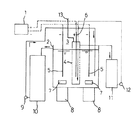
図1は、目的物を金属インジウムのみとする電解採取法に使用する装置の一実施例を示す。図1中、1は陽極(不溶性電極)6と陰極5に電気的に接続された定電流装置、2は耐酸性の材質で作られた電解採取槽、3は陽イオン交換膜4で仕切られた耐酸性の材質で作られた陰極室、4は陽イオン交換膜、5は陰極、6は陽極(不溶性電極)、7及び8は電解液を攪拌できる回転子7とマグネットスターラー8、9は高濃度インジウム塩酸溶液の循環貯槽10より電解採取槽2に循環するポンプ、10は高濃度インジウム塩酸溶液循環貯槽、11は電解液貯蔵槽、12は電解液貯蔵槽11より電解採取槽2に循環するポンプ、13は陰極室からの排気管(陽極発生ガス出口)である。
FIG. 1 shows an embodiment of an apparatus used for an electrowinning method in which the object is only metallic indium. In FIG. 1, 1 is a constant current device electrically connected to an anode (insoluble electrode) 6 and a cathode 5, 2 is an electrolytic collection tank made of an acid-resistant material, and 3 is partitioned by a cation exchange membrane 4. The cathode chamber made of an acid-resistant material, 4 is a cation exchange membrane, 5 is a cathode, 6 is an anode (insoluble electrode), 7 and 8 are a rotor 7 and a
図1は、目的物を金属インジウムのみとする電解採取法に使用する装置の基本構成である。 FIG. 1 shows a basic configuration of an apparatus used for an electrowinning method in which a target object is only metallic indium.
具体的な電解操作としては、電解採取に供される高濃度インジウム塩酸溶液は、その循環貯槽10から循環ポンプ9により電解採取槽2に供給循環される。
As a specific electrolysis operation, a high-concentration indium hydrochloric acid solution used for electrowinning is supplied and circulated from the circulation storage tank 10 to the electrowinning tank 2 by a
一方、電解液はその電解液貯蔵槽11から循環ポンプ12により、電解採取槽2内に配置された陰極室3に供給循環される。
On the other hand, the electrolytic solution is supplied and circulated from the electrolytic
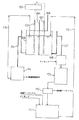
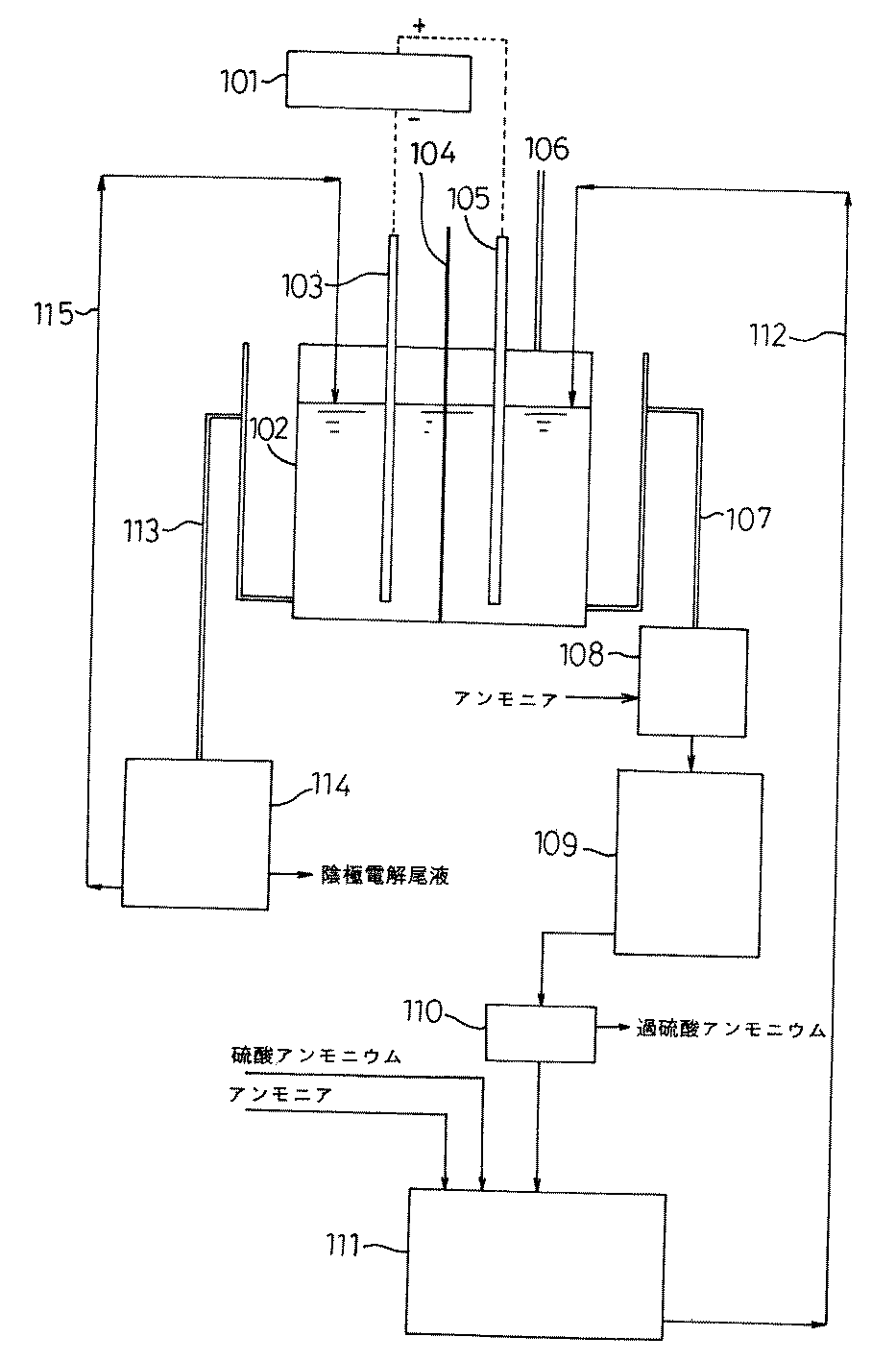
図2は、本発明の金属インジウムと過硫酸アンモニウムを併産する電気化学的方法に使用する装置の一実施例を示す図である。 FIG. 2 is a diagram showing an embodiment of an apparatus used in an electrochemical method for producing both metal indium and ammonium persulfate according to the present invention.
図2は、陰極に金属インジウムを電解採取するとともに、陽極液中にペルオキシ二硫酸アンモニウム(過硫酸アンモニウム)を生成させ、該陽極液を陽極室から取り出して冷却し、ペルオキシ二硫酸アンモニウムを析出させて濾過・取得した後、得られたペルオキシ二硫酸アンモニウムに対応する量の硫酸アンモニウムなどを補給した後、該溶液を陽極室に戻す方法を模式的に示したものである。 FIG. 2 shows the electrowinning of metallic indium at the cathode and the production of ammonium peroxydisulfate (ammonium persulfate) in the anolyte. The anolyte is removed from the anode chamber and cooled, and ammonium peroxydisulfate is deposited and filtered. FIG. 2 schematically shows a method of returning the solution to the anode chamber after the acquisition, after replenishing an amount of ammonium sulfate corresponding to the obtained ammonium peroxydisulfate.
陽極としては、目的物を金属インジウムのみとする電解採取では酸素を定量的に発生させるのに対して、この場合は酸素の発生は極力抑制して、酸化反応を増進する必要上、不溶性電極の中でも酸素過電圧の高い白金板を用いることが好ましい。 As an anode, oxygen is quantitatively generated by electrowinning with a target of only metallic indium. In this case, the generation of oxygen must be suppressed as much as possible to promote the oxidation reaction. Among them, it is preferable to use a platinum plate having a high oxygen overvoltage.
図2中、101 は定電流装置、102 は中央に設けた陽イオン交換膜で陽極室と陰極室に区画された耐酸性の材質で作られた電解採取槽、103 は陰極、104 は陽イオン交換膜、105 は陽極、106 は陽極発生ガス出口、107 は陽極電解液溢流管、108 は陽極電解液貯槽、109 は陽極電解液減圧濃縮装置、110 は過硫酸アンモニウム取得用遠心分離器、111 は過硫酸アンモニウム母液調整槽、112 は陽極電解液補充仕込み管、113 は陰極電解液液面調整・循環ライン、114 は陰極電解液貯槽、115 は陰極電解液戻りラインである。 In FIG. 2, 101 is a constant current device, 102 is an electrolytic collection tank made of an acid-resistant material divided into an anode chamber and a cathode chamber by a cation exchange membrane provided in the center, 103 is a cathode, and 104 is a cation. Exchange membrane, 105 is anode, 106 is anode generating gas outlet, 107 is anode electrolyte overflow tube, 108 is anode electrolyte reservoir, 109 is anode electrolyte vacuum concentrator, 110 is ammonium persulfate acquisition centrifuge, 111 Is an ammonium persulfate mother liquor adjustment tank, 112 is an anolyte replenishment charging tube, 113 is a catholyte liquid level adjustment / circulation line, 114 is a catholyte storage tank, and 115 is a catholyte return line.
図1及び図2において、電解採取槽2又は102 (陰極室)に供給循環され電解液は、例えば図1に示されるような回転子7とマグネットスターラー8により攪拌されながら、定電流装置1から陰極室3に設置した陽極(不溶性電極)6と電解採取槽内に設置した陰極5に一定時間通電して電解を行う。電解により、陰極5に析出する金属インジウムの取り出しは、通電を一時停止して、陰極ごと引き上げ、水中に掻き落とし、水洗、乾燥して回収することができる。 1 and 2, the electrolytic solution supplied and circulated to the electrolytic collection tank 2 or 102 (cathode chamber) is stirred from a rotor 7 and a magnetic stirrer 8 as shown in FIG. The anode (insoluble electrode) 6 installed in the cathode chamber 3 and the cathode 5 installed in the electrolytic collection tank are energized for a certain period of time for electrolysis. The extraction of the metal indium deposited on the cathode 5 by electrolysis can be recovered by temporarily stopping energization, pulling up the entire cathode, scraping it into water, washing with water and drying.
一方、図1では陰極室3内では、電解により陽極(不溶性電極)液中では定量的に、副反応生成する気泡として発生する酸素ガスは陰極室の天板孔より排気管(陽極発生ガス出口)13を経て外部環境に放出され、図2では陽極発生ガス出口106 から外部環境に放出される。 On the other hand, in FIG. 1, in the cathode chamber 3, oxygen gas generated as bubbles generated by side reaction quantitatively in the anode (insoluble electrode) solution by electrolysis is discharged from the top hole of the cathode chamber through the exhaust pipe (anode generating gas outlet). ) Through 13 and released into the external environment, and in FIG.
実施例1(目的物を金属インジウムのみとする電解採取法−1)
塩酸溶解、硫化物処理及びイオン交換処理など公知の方法により不純物を除去したインジウム塩酸溶液は、表1に示す組成であった。
Example 1 (
The indium hydrochloric acid solution from which impurities were removed by a known method such as hydrochloric acid dissolution, sulfide treatment and ion exchange treatment had the composition shown in Table 1.
この液4.25L を電解液(陰極液)として図1の装置を用いて電解採取を行った。ここで、陽極液として無水芒硝10%水溶液0.6Lを使用し、陽イオン交換膜として旭化成(株)製、商品名:ACIPLEX K-501を陰極室の両面に取り付け、陽極としてペルメレック電極(株)製、商品名:DSC Y-1211 を用い、また陰極にはSUS-316Lを使用した。 Electrolysis was performed using 4.25 L of this solution as an electrolyte (catholyte) using the apparatus shown in FIG. Here, 0.6 L of 10% anhydrous sodium sulfate aqueous solution is used as the anolyte, Asahi Kasei Co., Ltd. as the cation exchange membrane, product name: ACIPLEX K-501 is attached to both sides of the cathode chamber, and Permerek Electrode is used as the anode. Product name: DSC Y-1211 was used, and SUS-316L was used for the cathode.
なお、電解条件は、液温17〜34℃、電流密度820A/m2 、電圧4.0 〜7.0V、8時間電解を行い、陰極析出金属89.2g を得た(電流効率95.2%)。取得した電解採取金属の組成は、表1に示すとおりであった。 The electrolysis was conducted at a liquid temperature of 17 to 34 ° C., a current density of 820 A / m 2 , a voltage of 4.0 to 7.0 V, and electrolysis for 8 hours to obtain 89.2 g of cathode-deposited metal (current efficiency 95.2%). The composition of the obtained electrowinning metal was as shown in Table 1.
実施例2(目的物を金属インジウムのみとする電解採取法−2)
塩酸溶解、硫化物処理及びイオン交換処理など公知の方法により不純物を除去したインジウム塩酸溶液は、表2に示す組成であった。
Example 2 (Electrolytic sampling method-2 in which the object is only metallic indium)
The indium hydrochloric acid solution from which impurities were removed by a known method such as hydrochloric acid dissolution, sulfide treatment and ion exchange treatment had the composition shown in Table 2.
この液40L を電解液(陰極液)として図1の装置を用いて、電解採取を行った。ここで、陽極液として無水芒硝10%水溶液1Lを使用し、陽イオン交換膜として旭化成(株)製、商品名:ACIPLEX K-501を陰極室の両面に取り付け、陽極6としてペルメレック電極(株)製、商品名:DSC Y-1211 を用い、また陰極5には、最初SUS-316Lを使用し、低電流の160A/m2 で48時間電解した。この間の陰極金属析出量は311.7gであり、電流効率は91.8%であった。 Electrolysis was performed using 40 L of this solution as an electrolyte (catholyte) using the apparatus of FIG. Here, 1L of 10% anhydrous sodium sulfate aqueous solution is used as the anolyte, Asahi Kasei Co., Ltd. as the cation exchange membrane, product name: ACIPLEX K-501 is attached to both sides of the cathode chamber, and Permerek Electrode is used as the anode 6 Product name: DSC Y-1211 was used, and the cathode 5 was initially made of SUS-316L and electrolyzed at 160 A / m 2 with a low current for 48 hours. During this time, the amount of cathode metal deposited was 311.7 g, and the current efficiency was 91.8%.
この金属は、金属インジウムよりも貴イオンである不純物のPbを38ppm 含み、電解液中のPb不純物を低電流での電解で優先減少させたことになる。 This metal contains 38 ppm of Pb, which is a noble ion, rather than metal indium, and the Pb impurity in the electrolytic solution is preferentially reduced by electrolysis at a low current.
次に、陰極5をジルコニウムに付け替えて電流密度480A/m2 で56時間電解を行い、電解採取金属2265.8g を得た。この間の電流効率は、94.46 %であった。 Next, the cathode 5 was replaced with zirconium, and electrolysis was performed at a current density of 480 A / m 2 for 56 hours to obtain 2265.8 g of electrowinning metal. The current efficiency during this period was 94.46%.
その後、更に同条件で電解を8時間継続し、電解採取金属184.0gを得た。この間の電流効率は、電解液中のインジウムイオンの濃度が希薄となってきたため、53.7%に低下した。なお、電解終了時(液)のインジウムイオンの濃度は、13g/L であった。取得した電解採取金属の組成は表2に示すとおりであった。 Thereafter, electrolysis was further continued under the same conditions for 8 hours to obtain 184.0 g of electrowinning metal. The current efficiency during this period decreased to 53.7% because the concentration of indium ions in the electrolyte solution became dilute. The concentration of indium ions at the end of electrolysis (liquid) was 13 g / L. The composition of the obtained electrowinning metal was as shown in Table 2.
実施例3(目的物を金属インジウムのみとする電解採取法−3)
塩酸溶解、硫化物処理及びイオン交換処理などの公知の方法により、不純物を除去したインジウム塩酸溶液は、表3に示す組成を有していた。
Example 3 (Electrolytic sampling method 3 in which the object is only metallic indium)
The indium hydrochloric acid solution from which impurities were removed by a known method such as hydrochloric acid dissolution, sulfide treatment and ion exchange treatment had the composition shown in Table 3.
この液4.6Lを電解液(陰極液)として図1の装置を用いて電解採取を行った。ここで、陽極液として無水亜硫酸ナトリウム0.5 モル溶液0.6Lを使用し、陽イオン交換膜4として旭化成(株)製、商品名:ACIPLEX K-501 を陰極室3の両面に取り付け、陽極6としてペルメレック電極(株)製、商品名:DSC Y-1211 を用い、また陰極5にはSUS-316Lを使用した。 Electrolysis was performed using 4.6 L of this solution as an electrolyte (catholyte) using the apparatus of FIG. Here, 0.6 L of anhydrous sodium sulfite 0.5 mol solution is used as the anolyte, Asahi Kasei Co., Ltd., product name: ACIPLEX K-501 is attached to both sides of the cathode chamber 3 as the cation exchange membrane 4, and Permelec as the anode 6 Product name: DSC Y-1211 manufactured by Electrode Co., Ltd. was used, and SUS-316L was used for the cathode 5.
なお、電解条件は、液温21〜39℃、電流密度820A/m2 、電圧4.0 〜7.5Vで6時間電解を行い、陰極析出金属65.5g を得た(電流効率93.24 %)。取得した電解採取金属の組成は、表3に示すとおりであった。 Electrolysis was carried out at a liquid temperature of 21 to 39 ° C., a current density of 820 A / m 2 , and a voltage of 4.0 to 7.5 V for 6 hours to obtain 65.5 g of cathode-deposited metal (current efficiency: 93.24%). The composition of the obtained electrowinning metal was as shown in Table 3.
実施例4(陰極に金属インジウムを電解析出させるとともに、陽極電解液中で過硫酸アンモニウムを併産する電解採取法−1)
図2に示す装置を用いた。電解採取槽102 は、塩化ビニル樹脂製の深さ100mm 、幅100mm 、長さ200mm で長手方向の中央にシリコーンシーラントで固定した陽イオン交換膜104 〔旭化成(株)製、商品名:ACIPLEX K-501 〕で陰極室と陽極室に区切った。
Example 4 (
The apparatus shown in FIG. 2 was used. The
陰極103 として、高さ100mm 、幅70mm、厚さ2mm のSUS-316L板を使用し、高さ70mmまで電解液に浸漬した。陽極105 として、高さ100mm 、幅70mm、厚さ1mm の白金板を使用し、高さ70mmまで電解液に浸漬した。
As the
電極の両面がほぼ有効であると考えて、有効電解面積は、いずれも70mm×70mm×2=9800mm2(=0.98dm2) であるものとした。両電解槽中の電解液の量は、いずれも、80mm×80mm×50mm=320mLである。陰極室には、表4に示す組成のインジウム塩酸溶液320mL を満たした。 Considering that both sides of the electrode are almost effective, the effective electrolytic area is 70 mm × 70 mm × 2 = 9800 mm 2 (= 0.98 dm 2 ). The amount of the electrolytic solution in both electrolytic cells is 80 mm × 80 mm × 50 mm = 320 mL. The cathode chamber was filled with 320 mL of an indium hydrochloric acid solution having the composition shown in Table 4.
電解に際しては、陰極電解液貯槽114 に前記インジウム塩酸溶液920mL を満たし、陰極電解液液面調整・循環ライン113 及び陰極電解液戻りライン115 を用いて陰極室に供給・循環させた。陽極室には、過硫酸アンモニウム33容量%、硫酸アンモニウム10容量%、硫酸1容量%及びチオシアン酸アンモニウム0.04容量%の溶液を満たした。
In electrolysis, the cathode
電解に際しては、過硫酸アンモニウム母液調整槽111 において、過硫酸アンモニウム8.0 容量%、硫酸アンモニウム(分子量:132.14)34容量%、硫酸1容量%、チオシアン酸アンモニウム0.04容量%の溶液を調製し、陽極電解液補充仕込み管112 を通じて、陽極室に622mL/hrの速度で供給した。
For electrolysis, in ammonium persulfate mother
両電解室には、冷却管(図示せず)を挿入して冷却水を循環させて電解中を通じて、両方の電解液の液温をいずれも25〜35℃に保った。 In both electrolytic chambers, cooling pipes (not shown) were inserted to circulate cooling water, and the temperature of both electrolytic solutions was kept at 25 to 35 ° C. throughout the electrolysis.
電極間には、定電流装置101 を使用して、電流密度45A/dm2 となるように電流を44A に設定して電流を通じた。電圧は4.8 〜6.0Vを示した。
Between the electrodes, a constant
3時間電解を行ったところ、陰極板上に金属インジウムが析出したので、これを陰極板から加熱によって溶融後、鋳造し、表4に示す分析値を有する金属インジウムインゴット160gを得た。原料溶液からの取得率は92.2%であり、電流効率は85%であった。 When electrolysis was performed for 3 hours, metal indium was deposited on the cathode plate, and this was melted by heating from the cathode plate and then cast to obtain 160 g of a metal indium ingot having the analytical values shown in Table 4. The acquisition rate from the raw material solution was 92.2%, and the current efficiency was 85%.
これ以上電解を続けると、電解液中のインジウムイオンの濃度が希薄に過ぎるため、電流効率が甚だしく低下する。そのため、電解は上記の段階で留めた。 If electrolysis is further continued, the concentration of indium ions in the electrolytic solution is too dilute, so that the current efficiency is significantly reduced. Therefore, the electrolysis was stopped at the above stage.
電解尾液中には約17g の金属インジウムが溶解しているので、アルミニウムセメンテーションで回収した。 Since about 17 g of metal indium was dissolved in the electrolytic tail solution, it was recovered by aluminum cementation.
陽極室からは過硫酸アンモニウム33±0.3 容量%、硫酸アンモニウム10±0.2 容量%、硫酸1容量%及びチオシアン酸アンモニウム0.04容量%の溶液が620 ±10mL/hr の速度で陽極電解液溢流管104 を通じて流出した。
From the anode chamber, a solution of 33 ± 0.3% by volume ammonium persulfate, 10 ± 0.2% by volume ammonium sulfate, 1% by volume sulfuric acid and 0.04% by volume ammonium thiocyanate flows out through the anode
この液を3時間に亘って、陽極電解液貯槽108 に集め、少量のアンモニアでpH 6.5〜7.5 に調整した後、陽極電解液減圧濃縮装置109 に仕込み、過硫酸アンモニウムの種結晶を添加し、2660Pa(約20Torr, 30℃)で濃縮晶析を行った。母液のサンプルの密度測定によって濃縮の終点を定めた。この晶析懸濁液を過硫酸アンモニウム取得用遠心分離器110 を用いて遠心分離を行った後、乾燥して過硫酸アンモニウム460gを得た。電流効率は82%であった。
This solution is collected in the anode
遠心分離で生じた母液は過硫酸アンモニウム母液調整槽111 において、引き続いて行う電解の陽極電解液の原料とした。
The mother liquor produced by the centrifugation was used as a raw material for the subsequent anodic electrolyte in the ammonium persulfate mother
塩素ガス:実施例1〜4中に定期的に電解槽上の塩素ガス濃度の測定を塩素ガス検知管を用いて行ったところ、いずれの場合も塩素ガスを検知することはなく、塩素ガス発生を防止できることが確認された。 Chlorine gas: In Examples 1 to 4, the chlorine gas concentration on the electrolytic cell was periodically measured using a chlorine gas detector tube. In any case, chlorine gas was not detected, and chlorine gas was generated. It was confirmed that this can be prevented.
以上説明したように本発明によれば、現状の塩酸系システムの全面変更を必要とすることなく、塩素の発生を防止しつつ、例えば、インジウムイオンを含有する水溶液から金属インジウムを高電流効率で直接電解採取することができ、アノードの鋳造工程が省略され、省エネルギーと生産量増大が可能となった。また、電解採取された金属インジウムの品位は従来の電解精製品と同等の高品位のものであり、更に過硫酸アンモニウムの併酸が可能となるなど、その工業的利用価値は、計り知れないものがある。 As described above, according to the present invention, for example, metal indium can be obtained from an aqueous solution containing indium ions with high current efficiency while preventing the generation of chlorine without requiring the entire change of the existing hydrochloric acid system. Direct electrowinning can be performed, the anode casting process is omitted, and energy saving and production increase are possible. In addition, the quality of electro-collected metal indium is as high as that of conventional electrolytically purified products, and it is possible to co-acidize ammonium persulfate. Its industrial utility value is immeasurable. is there.
1 定電流装置
2 電解採取槽
3 陰極室
4 陽イオン交換膜
5 陰極
6 陽極(不溶性電極)
7 攪拌回転子
8 マグネットスターラー
9 循環ポンプ
10 高濃度インジウム塩酸溶液循環貯槽
11 電解液貯蔵槽
12 循環ポンプ
13 排気管(陽極発生ガス出口)
101 定電流装置
102 電解採取槽
103 陰極
104 陽イオン交換膜
105 陽極
106 陽極発生ガス出口
107 陽極電解液溢流管
108 陽極電解液貯槽
109 陽極電解液減圧濃縮装置
110 過硫酸アンモニウム取得用遠心分離器
111 過硫酸アンモニウム母液調整槽
112 陽極電解液補充仕込み管
113 陰極電解液液面調整・循環ライン
114 陰極電解液貯槽
115 陰極電解液戻りライン
DESCRIPTION OF
7 Stirring rotor 8
10 High concentration indium hydrochloric acid solution circulation storage tank
11 Electrolyte storage tank
12 Circulation pump
13 Exhaust pipe (anode generation gas outlet)
101 constant current device
102 Electrolytic collection tank
103 cathode
104 Cation exchange membrane
105 anode
106 Anode generation gas outlet
107 Anode electrolyte overflow tube
108 Anode electrolyte storage tank
109 Anode electrolyte vacuum concentrator
110 Centrifuge for ammonium persulfate acquisition
111 Ammonium persulfate mother liquor adjustment tank
112 Anode electrolyte refilling tube
113 Catholyte level adjustment and circulation line
114 Catholyte storage tank
115 Catholyte return line
Claims (11)
Priority Applications (1)
| Application Number | Priority Date | Filing Date | Title |
|---|---|---|---|
| JP2004114180A JP4515804B2 (en) | 2004-04-08 | 2004-04-08 | Method for recovering metallic indium by electrowinning |
Applications Claiming Priority (1)
| Application Number | Priority Date | Filing Date | Title |
|---|---|---|---|
| JP2004114180A JP4515804B2 (en) | 2004-04-08 | 2004-04-08 | Method for recovering metallic indium by electrowinning |
Publications (2)
| Publication Number | Publication Date |
|---|---|
| JP2005298870A true JP2005298870A (en) | 2005-10-27 |
| JP4515804B2 JP4515804B2 (en) | 2010-08-04 |
Family
ID=35330783
Family Applications (1)
| Application Number | Title | Priority Date | Filing Date |
|---|---|---|---|
| JP2004114180A Expired - Fee Related JP4515804B2 (en) | 2004-04-08 | 2004-04-08 | Method for recovering metallic indium by electrowinning |
Country Status (1)
| Country | Link |
|---|---|
| JP (1) | JP4515804B2 (en) |
Cited By (10)
| Publication number | Priority date | Publication date | Assignee | Title |
|---|---|---|---|---|
| JP2010007133A (en) * | 2008-06-27 | 2010-01-14 | Daiso Co Ltd | Method and device for producing metal indium |
| RU2490375C2 (en) * | 2012-07-09 | 2013-08-20 | Борис Николаевич Дьяков | Electrolysis unit for extraction of indium from indium-containing molten metal in form of condensate from vacuum furnace |
| JP2014040639A (en) * | 2012-08-23 | 2014-03-06 | Sumitomo Electric Ind Ltd | Method for manufacturing a metal |
| KR20160027085A (en) * | 2013-09-27 | 2016-03-09 | 제이엑스 킨조쿠 가부시키가이샤 | HIGHLY PURE In AND MANUFACTURING METHOD THEREFOR |
| JP2018016834A (en) * | 2016-07-26 | 2018-02-01 | 住友電気工業株式会社 | Electrolyte, electrolyte for electrolysis cell, and electrolysis cell system |
| US10358698B2 (en) | 2009-12-28 | 2019-07-23 | Nippon Steel Corporation | Heat resistant titanium alloy material for exhaust system part use excellent in oxidation resistance, method of production of heat resistant titanium alloy material for exhaust system part use excellent in oxidation resistance, and exhaust system |
| JP2020158862A (en) * | 2019-03-28 | 2020-10-01 | 東レ株式会社 | Production method of ammonium persulfate |
| CN113789522A (en) * | 2021-10-27 | 2021-12-14 | 湖北理工学院 | Preparation method of high-purity indium sulfate by combination of electrolysis and replacement |
| CN114808042A (en) * | 2022-06-07 | 2022-07-29 | 赵坤 | Cation membrane continuous electrolysis device and use method thereof |
| CN119221042A (en) * | 2024-11-29 | 2024-12-31 | 扬州新达再生资源科技有限公司 | A device and method for purifying zinc powder from zinc-containing slag |
Citations (4)
| Publication number | Priority date | Publication date | Assignee | Title |
|---|---|---|---|---|
| JPS5534700A (en) * | 1978-08-30 | 1980-03-11 | Air Liquide | Production of peroxy bisulphte alkali metal or ammonium salt |
| JPH0860264A (en) * | 1994-08-19 | 1996-03-05 | Nikko Kinzoku Kk | Method for recovering indium by electrolytic sampling |
| WO2002088429A1 (en) * | 1999-11-11 | 2002-11-07 | Eilenburger Elektrolyse- Und Umwelttechnik Gmbh | Method for simultaneous electrochemical production of sodium dithionite and sodium peroxodisulfate |
| JP2003247090A (en) * | 2002-02-25 | 2003-09-05 | Asahi Denka Kogyo Kk | Method for producing peroxydisulfate |
-
2004
- 2004-04-08 JP JP2004114180A patent/JP4515804B2/en not_active Expired - Fee Related
Patent Citations (4)
| Publication number | Priority date | Publication date | Assignee | Title |
|---|---|---|---|---|
| JPS5534700A (en) * | 1978-08-30 | 1980-03-11 | Air Liquide | Production of peroxy bisulphte alkali metal or ammonium salt |
| JPH0860264A (en) * | 1994-08-19 | 1996-03-05 | Nikko Kinzoku Kk | Method for recovering indium by electrolytic sampling |
| WO2002088429A1 (en) * | 1999-11-11 | 2002-11-07 | Eilenburger Elektrolyse- Und Umwelttechnik Gmbh | Method for simultaneous electrochemical production of sodium dithionite and sodium peroxodisulfate |
| JP2003247090A (en) * | 2002-02-25 | 2003-09-05 | Asahi Denka Kogyo Kk | Method for producing peroxydisulfate |
Cited By (15)
| Publication number | Priority date | Publication date | Assignee | Title |
|---|---|---|---|---|
| JP2010007133A (en) * | 2008-06-27 | 2010-01-14 | Daiso Co Ltd | Method and device for producing metal indium |
| US10358698B2 (en) | 2009-12-28 | 2019-07-23 | Nippon Steel Corporation | Heat resistant titanium alloy material for exhaust system part use excellent in oxidation resistance, method of production of heat resistant titanium alloy material for exhaust system part use excellent in oxidation resistance, and exhaust system |
| RU2490375C2 (en) * | 2012-07-09 | 2013-08-20 | Борис Николаевич Дьяков | Electrolysis unit for extraction of indium from indium-containing molten metal in form of condensate from vacuum furnace |
| JP2014040639A (en) * | 2012-08-23 | 2014-03-06 | Sumitomo Electric Ind Ltd | Method for manufacturing a metal |
| KR20160027085A (en) * | 2013-09-27 | 2016-03-09 | 제이엑스 킨조쿠 가부시키가이샤 | HIGHLY PURE In AND MANUFACTURING METHOD THEREFOR |
| KR101696161B1 (en) | 2013-09-27 | 2017-01-13 | 제이엑스금속주식회사 | HIGHLY PURE In AND MANUFACTURING METHOD THEREFOR |
| WO2018020788A1 (en) * | 2016-07-26 | 2018-02-01 | 住友電気工業株式会社 | Electrolyte, electrolyte for electrolyzer, and electrolyzer system |
| CN109477230A (en) * | 2016-07-26 | 2019-03-15 | 住友电气工业株式会社 | Electrolytes, Electrolytes for Electrolyzers and Electrolyzer Systems |
| JP2018016834A (en) * | 2016-07-26 | 2018-02-01 | 住友電気工業株式会社 | Electrolyte, electrolyte for electrolysis cell, and electrolysis cell system |
| CN109477230B (en) * | 2016-07-26 | 2021-03-30 | 住友电气工业株式会社 | Electrolyte, electrolyte for electrolytic cell, and electrolytic cell system |
| JP2020158862A (en) * | 2019-03-28 | 2020-10-01 | 東レ株式会社 | Production method of ammonium persulfate |
| JP7163841B2 (en) | 2019-03-28 | 2022-11-01 | 東レ株式会社 | Method for producing ammonium persulfate |
| CN113789522A (en) * | 2021-10-27 | 2021-12-14 | 湖北理工学院 | Preparation method of high-purity indium sulfate by combination of electrolysis and replacement |
| CN114808042A (en) * | 2022-06-07 | 2022-07-29 | 赵坤 | Cation membrane continuous electrolysis device and use method thereof |
| CN119221042A (en) * | 2024-11-29 | 2024-12-31 | 扬州新达再生资源科技有限公司 | A device and method for purifying zinc powder from zinc-containing slag |
Also Published As
| Publication number | Publication date |
|---|---|
| JP4515804B2 (en) | 2010-08-04 |
Similar Documents
| Publication | Publication Date | Title |
|---|---|---|
| JP3089595B2 (en) | Recovery of indium by electrowinning | |
| JP2014501850A (en) | Electrical recovery of gold and silver from thiosulfate solutions | |
| JPH0382720A (en) | Method for recovering indium | |
| JP5250683B2 (en) | Recovery method of valuable metals from Pb-free waste solder | |
| JP4515804B2 (en) | Method for recovering metallic indium by electrowinning | |
| CN102677062B (en) | Method for electrolyzing and regenerating alkaline etching liquid | |
| CN110857470B (en) | Regeneration and circulation method of ferric trichloride etching solution | |
| JP7122315B2 (en) | Electrode, method for producing same, and method for producing regenerated electrode | |
| CN104531991B (en) | A kind of Treating Low-grade Copper Ores Bioleaching liquid processing method | |
| KR100425662B1 (en) | Basic Cobaltous Carbonates, Process for Preparing the Same and Their Use | |
| CA1064856A (en) | Purification of nickel electrolyte by electrolytic oxidation | |
| US4073705A (en) | Method for treating used or exhausted photographic fixing solution | |
| JP5344278B2 (en) | Indium metal production method and apparatus | |
| CN102534659A (en) | Method for improving current efficiency of high purity zinc obtained by zinc chloride electrolysis | |
| JP4501726B2 (en) | Electrowinning of iron from acidic chloride aqueous solution | |
| JP4787951B2 (en) | Method for electrolytic purification of silver | |
| JP6543516B2 (en) | Lead electrolyte recycling method | |
| RU2361967C1 (en) | Method of compacted nickel electro-extraction | |
| JP3805411B2 (en) | Improved electrowinning method for zinc. | |
| JP4182302B2 (en) | Method for producing potassium persulfate | |
| TW201527599A (en) | High purity cobalt chloride and manufacturing method therefor | |
| RU2830268C1 (en) | Method of extracting zinc metal from solid metallurgical wastes | |
| JP3651872B2 (en) | Method for removing sulfate and chlorate radicals in brine | |
| CN119040910A (en) | Method and device for preparing high-purity lithium hydroxide from low-purity lithium chloride | |
| US3014850A (en) | Recovery of high purity copper from copper scrap |
Legal Events
| Date | Code | Title | Description |
|---|---|---|---|
| A621 | Written request for application examination |
Free format text: JAPANESE INTERMEDIATE CODE: A621 Effective date: 20070118 |
|
| A977 | Report on retrieval |
Free format text: JAPANESE INTERMEDIATE CODE: A971007 Effective date: 20090924 |
|
| A131 | Notification of reasons for refusal |
Free format text: JAPANESE INTERMEDIATE CODE: A131 Effective date: 20100128 |
|
| A521 | Request for written amendment filed |
Free format text: JAPANESE INTERMEDIATE CODE: A523 Effective date: 20100219 |
|
| TRDD | Decision of grant or rejection written | ||
| A01 | Written decision to grant a patent or to grant a registration (utility model) |
Free format text: JAPANESE INTERMEDIATE CODE: A01 Effective date: 20100506 |
|
| A01 | Written decision to grant a patent or to grant a registration (utility model) |
Free format text: JAPANESE INTERMEDIATE CODE: A01 |
|
| A61 | First payment of annual fees (during grant procedure) |
Free format text: JAPANESE INTERMEDIATE CODE: A61 Effective date: 20100513 |
|
| R150 | Certificate of patent or registration of utility model |
Ref document number: 4515804 Country of ref document: JP Free format text: JAPANESE INTERMEDIATE CODE: R150 Free format text: JAPANESE INTERMEDIATE CODE: R150 |
|
| FPAY | Renewal fee payment (event date is renewal date of database) |
Free format text: PAYMENT UNTIL: 20130521 Year of fee payment: 3 |
|
| FPAY | Renewal fee payment (event date is renewal date of database) |
Free format text: PAYMENT UNTIL: 20140521 Year of fee payment: 4 |
|
| R250 | Receipt of annual fees |
Free format text: JAPANESE INTERMEDIATE CODE: R250 |
|
| R250 | Receipt of annual fees |
Free format text: JAPANESE INTERMEDIATE CODE: R250 |
|
| R250 | Receipt of annual fees |
Free format text: JAPANESE INTERMEDIATE CODE: R250 |
|
| R250 | Receipt of annual fees |
Free format text: JAPANESE INTERMEDIATE CODE: R250 |
|
| R250 | Receipt of annual fees |
Free format text: JAPANESE INTERMEDIATE CODE: R250 |
|
| R250 | Receipt of annual fees |
Free format text: JAPANESE INTERMEDIATE CODE: R250 |
|
| R250 | Receipt of annual fees |
Free format text: JAPANESE INTERMEDIATE CODE: R250 |
|
| R250 | Receipt of annual fees |
Free format text: JAPANESE INTERMEDIATE CODE: R250 |
|
| LAPS | Cancellation because of no payment of annual fees |