JP2005298829A - Antioxidants and how to use them - Google Patents
Antioxidants and how to use them Download PDFInfo
- Publication number
- JP2005298829A JP2005298829A JP2005134445A JP2005134445A JP2005298829A JP 2005298829 A JP2005298829 A JP 2005298829A JP 2005134445 A JP2005134445 A JP 2005134445A JP 2005134445 A JP2005134445 A JP 2005134445A JP 2005298829 A JP2005298829 A JP 2005298829A
- Authority
- JP
- Japan
- Prior art keywords
- ghetto
- antioxidant
- plant
- extract
- dried
- Prior art date
- Legal status (The legal status is an assumption and is not a legal conclusion. Google has not performed a legal analysis and makes no representation as to the accuracy of the status listed.)
- Pending
Links
- 239000003963 antioxidant agent Substances 0.000 title claims abstract description 83
- 230000003078 antioxidant effect Effects 0.000 claims abstract description 78
- 239000007788 liquid Substances 0.000 claims abstract description 33
- 235000011389 fruit/vegetable juice Nutrition 0.000 claims abstract description 22
- 239000000843 powder Substances 0.000 claims abstract description 20
- 235000013305 food Nutrition 0.000 claims abstract description 16
- 238000000034 method Methods 0.000 claims abstract description 12
- 235000013373 food additive Nutrition 0.000 claims abstract description 9
- 239000002778 food additive Substances 0.000 claims abstract description 9
- 239000002904 solvent Substances 0.000 claims description 19
- 235000006708 antioxidants Nutrition 0.000 abstract description 71
- 239000002781 deodorant agent Substances 0.000 abstract description 33
- 239000000126 substance Substances 0.000 abstract description 7
- 230000002411 adverse Effects 0.000 abstract description 3
- 230000000694 effects Effects 0.000 abstract description 3
- 230000004075 alteration Effects 0.000 abstract description 2
- 238000004332 deodorization Methods 0.000 abstract description 2
- 230000003064 anti-oxidating effect Effects 0.000 abstract 1
- 241000196324 Embryophyta Species 0.000 description 59
- XLYOFNOQVPJJNP-UHFFFAOYSA-N water Substances O XLYOFNOQVPJJNP-UHFFFAOYSA-N 0.000 description 19
- 238000001035 drying Methods 0.000 description 18
- 238000004519 manufacturing process Methods 0.000 description 15
- 239000002994 raw material Substances 0.000 description 14
- 239000003153 chemical reaction reagent Substances 0.000 description 13
- 238000012360 testing method Methods 0.000 description 12
- 230000001877 deodorizing effect Effects 0.000 description 11
- LFQSCWFLJHTTHZ-UHFFFAOYSA-N Ethanol Chemical compound CCO LFQSCWFLJHTTHZ-UHFFFAOYSA-N 0.000 description 10
- 239000000243 solution Substances 0.000 description 10
- OKKJLVBELUTLKV-UHFFFAOYSA-N Methanol Chemical compound OC OKKJLVBELUTLKV-UHFFFAOYSA-N 0.000 description 9
- 238000005259 measurement Methods 0.000 description 9
- 238000010998 test method Methods 0.000 description 9
- LSDPWZHWYPCBBB-UHFFFAOYSA-N Methanethiol Chemical compound SC LSDPWZHWYPCBBB-UHFFFAOYSA-N 0.000 description 8
- 238000002835 absorbance Methods 0.000 description 8
- 238000010298 pulverizing process Methods 0.000 description 8
- 235000019645 odor Nutrition 0.000 description 7
- CSCPPACGZOOCGX-UHFFFAOYSA-N Acetone Chemical compound CC(C)=O CSCPPACGZOOCGX-UHFFFAOYSA-N 0.000 description 6
- 238000000605 extraction Methods 0.000 description 6
- 238000001914 filtration Methods 0.000 description 6
- GETQZCLCWQTVFV-UHFFFAOYSA-N trimethylamine Chemical compound CN(C)C GETQZCLCWQTVFV-UHFFFAOYSA-N 0.000 description 6
- 238000000227 grinding Methods 0.000 description 5
- HEDRZPFGACZZDS-UHFFFAOYSA-N Chloroform Chemical compound ClC(Cl)Cl HEDRZPFGACZZDS-UHFFFAOYSA-N 0.000 description 4
- OYHQOLUKZRVURQ-HZJYTTRNSA-N Linoleic acid Chemical compound CCCCC\C=C/C\C=C/CCCCCCCC(O)=O OYHQOLUKZRVURQ-HZJYTTRNSA-N 0.000 description 4
- 230000007423 decrease Effects 0.000 description 4
- HHEAADYXPMHMCT-UHFFFAOYSA-N dpph Chemical compound [O-][N+](=O)C1=CC([N+](=O)[O-])=CC([N+]([O-])=O)=C1[N]N(C=1C=CC=CC=1)C1=CC=CC=C1 HHEAADYXPMHMCT-UHFFFAOYSA-N 0.000 description 4
- OYHQOLUKZRVURQ-IXWMQOLASA-N linoleic acid Natural products CCCCC\C=C/C\C=C\CCCCCCCC(O)=O OYHQOLUKZRVURQ-IXWMQOLASA-N 0.000 description 4
- 235000020778 linoleic acid Nutrition 0.000 description 4
- 244000269722 Thea sinensis Species 0.000 description 3
- 239000011648 beta-carotene Substances 0.000 description 3
- 229960002747 betacarotene Drugs 0.000 description 3
- 238000006243 chemical reaction Methods 0.000 description 3
- 239000000796 flavoring agent Substances 0.000 description 3
- 239000007789 gas Substances 0.000 description 3
- 239000000203 mixture Substances 0.000 description 3
- 239000008363 phosphate buffer Substances 0.000 description 3
- 238000003825 pressing Methods 0.000 description 3
- 239000007787 solid Substances 0.000 description 3
- 238000009777 vacuum freeze-drying Methods 0.000 description 3
- GVJHHUAWPYXKBD-UHFFFAOYSA-N (±)-α-Tocopherol Chemical compound OC1=C(C)C(C)=C2OC(CCCC(C)CCCC(C)CCCC(C)C)(C)CCC2=C1C GVJHHUAWPYXKBD-UHFFFAOYSA-N 0.000 description 2
- CIWBSHSKHKDKBQ-JLAZNSOCSA-N Ascorbic acid Chemical compound OC[C@H](O)[C@H]1OC(=O)C(O)=C1O CIWBSHSKHKDKBQ-JLAZNSOCSA-N 0.000 description 2
- UHOVQNZJYSORNB-UHFFFAOYSA-N Benzene Chemical compound C1=CC=CC=C1 UHOVQNZJYSORNB-UHFFFAOYSA-N 0.000 description 2
- 206010006326 Breath odour Diseases 0.000 description 2
- 241000234299 Zingiberaceae Species 0.000 description 2
- OENHQHLEOONYIE-UKMVMLAPSA-N all-trans beta-carotene Natural products CC=1CCCC(C)(C)C=1/C=C/C(/C)=C/C=C/C(/C)=C/C=C/C=C(C)C=CC=C(C)C=CC1=C(C)CCCC1(C)C OENHQHLEOONYIE-UKMVMLAPSA-N 0.000 description 2
- 230000000844 anti-bacterial effect Effects 0.000 description 2
- TUPZEYHYWIEDIH-WAIFQNFQSA-N beta-carotene Natural products CC(=C/C=C/C=C(C)/C=C/C=C(C)/C=C/C1=C(C)CCCC1(C)C)C=CC=C(/C)C=CC2=CCCCC2(C)C TUPZEYHYWIEDIH-WAIFQNFQSA-N 0.000 description 2
- 235000013734 beta-carotene Nutrition 0.000 description 2
- 230000008859 change Effects 0.000 description 2
- 230000003247 decreasing effect Effects 0.000 description 2
- 238000011161 development Methods 0.000 description 2
- 235000019634 flavors Nutrition 0.000 description 2
- 238000004108 freeze drying Methods 0.000 description 2
- 239000011521 glass Substances 0.000 description 2
- 235000009569 green tea Nutrition 0.000 description 2
- 238000010438 heat treatment Methods 0.000 description 2
- 238000007602 hot air drying Methods 0.000 description 2
- 239000012535 impurity Substances 0.000 description 2
- 238000000691 measurement method Methods 0.000 description 2
- 239000002245 particle Substances 0.000 description 2
- 230000009467 reduction Effects 0.000 description 2
- 229930003231 vitamin Natural products 0.000 description 2
- 239000011782 vitamin Substances 0.000 description 2
- 229940088594 vitamin Drugs 0.000 description 2
- 235000013343 vitamin Nutrition 0.000 description 2
- OENHQHLEOONYIE-JLTXGRSLSA-N β-Carotene Chemical compound CC=1CCCC(C)(C)C=1\C=C\C(\C)=C\C=C\C(\C)=C\C=C\C=C(/C)\C=C\C=C(/C)\C=C\C1=C(C)CCCC1(C)C OENHQHLEOONYIE-JLTXGRSLSA-N 0.000 description 2
- QKNYBSVHEMOAJP-UHFFFAOYSA-N 2-amino-2-(hydroxymethyl)propane-1,3-diol;hydron;chloride Chemical compound Cl.OCC(N)(CO)CO QKNYBSVHEMOAJP-UHFFFAOYSA-N 0.000 description 1
- 241000251468 Actinopterygii Species 0.000 description 1
- IJGRMHOSHXDMSA-UHFFFAOYSA-N Atomic nitrogen Chemical compound N#N IJGRMHOSHXDMSA-UHFFFAOYSA-N 0.000 description 1
- 208000035985 Body Odor Diseases 0.000 description 1
- 240000007124 Brassica oleracea Species 0.000 description 1
- 235000003899 Brassica oleracea var acephala Nutrition 0.000 description 1
- 235000011301 Brassica oleracea var capitata Nutrition 0.000 description 1
- 235000001169 Brassica oleracea var oleracea Nutrition 0.000 description 1
- ZCPLUMKAOHBHPL-UKLSCZHBSA-N C(Cl)(Cl)Cl.CC1(C)CCCC(C)=C1\C=C\C(\C)=C\C=C\C(\C)=C\C=C\C=C(/C)\C=C\C=C(/C)\C=C\C1=C(C)CCCC1(C)C Chemical compound C(Cl)(Cl)Cl.CC1(C)CCCC(C)=C1\C=C\C(\C)=C\C=C\C(\C)=C\C=C\C=C(/C)\C=C\C=C(/C)\C=C\C1=C(C)CCCC1(C)C ZCPLUMKAOHBHPL-UKLSCZHBSA-N 0.000 description 1
- 241000252210 Cyprinidae Species 0.000 description 1
- ZZZCUOFIHGPKAK-UHFFFAOYSA-N D-erythro-ascorbic acid Natural products OCC1OC(=O)C(O)=C1O ZZZCUOFIHGPKAK-UHFFFAOYSA-N 0.000 description 1
- 240000009088 Fragaria x ananassa Species 0.000 description 1
- 241000131091 Lucanus cervus Species 0.000 description 1
- 241000282376 Panthera tigris Species 0.000 description 1
- YXFVVABEGXRONW-UHFFFAOYSA-N Toluene Natural products CC1=CC=CC=C1 YXFVVABEGXRONW-UHFFFAOYSA-N 0.000 description 1
- 229930003268 Vitamin C Natural products 0.000 description 1
- 229930003427 Vitamin E Natural products 0.000 description 1
- 241000234314 Zingiber Species 0.000 description 1
- 235000006886 Zingiber officinale Nutrition 0.000 description 1
- ZIALXKMBHWELGF-UHFFFAOYSA-N [Na].[Cu] Chemical compound [Na].[Cu] ZIALXKMBHWELGF-UHFFFAOYSA-N 0.000 description 1
- 230000009471 action Effects 0.000 description 1
- 238000004458 analytical method Methods 0.000 description 1
- 230000000843 anti-fungal effect Effects 0.000 description 1
- 229940121375 antifungal agent Drugs 0.000 description 1
- 239000000872 buffer Substances 0.000 description 1
- 239000002775 capsule Substances 0.000 description 1
- 239000000969 carrier Substances 0.000 description 1
- 238000007865 diluting Methods 0.000 description 1
- 229910001873 dinitrogen Inorganic materials 0.000 description 1
- 239000012153 distilled water Substances 0.000 description 1
- 238000011156 evaluation Methods 0.000 description 1
- 239000003205 fragrance Substances 0.000 description 1
- WIGCFUFOHFEKBI-UHFFFAOYSA-N gamma-tocopherol Natural products CC(C)CCCC(C)CCCC(C)CCCC1CCC2C(C)C(O)C(C)C(C)C2O1 WIGCFUFOHFEKBI-UHFFFAOYSA-N 0.000 description 1
- 238000004817 gas chromatography Methods 0.000 description 1
- 235000008397 ginger Nutrition 0.000 description 1
- 241000411851 herbal medicine Species 0.000 description 1
- 235000008216 herbs Nutrition 0.000 description 1
- 239000000077 insect repellent Substances 0.000 description 1
- 239000000463 material Substances 0.000 description 1
- 235000013372 meat Nutrition 0.000 description 1
- 210000000214 mouth Anatomy 0.000 description 1
- 239000007800 oxidant agent Substances 0.000 description 1
- 230000003647 oxidation Effects 0.000 description 1
- 238000007254 oxidation reaction Methods 0.000 description 1
- 238000004806 packaging method and process Methods 0.000 description 1
- 239000000546 pharmaceutical excipient Substances 0.000 description 1
- 229920000136 polysorbate Polymers 0.000 description 1
- 230000008569 process Effects 0.000 description 1
- 238000011160 research Methods 0.000 description 1
- 230000001953 sensory effect Effects 0.000 description 1
- 235000021012 strawberries Nutrition 0.000 description 1
- 235000013616 tea Nutrition 0.000 description 1
- 239000012085 test solution Substances 0.000 description 1
- 235000019154 vitamin C Nutrition 0.000 description 1
- 239000011718 vitamin C Substances 0.000 description 1
- 235000019165 vitamin E Nutrition 0.000 description 1
- 229940046009 vitamin E Drugs 0.000 description 1
- 239000011709 vitamin E Substances 0.000 description 1
- 230000004580 weight loss Effects 0.000 description 1
Images



Landscapes
- Food Preservation Except Freezing, Refrigeration, And Drying (AREA)
- General Preparation And Processing Of Foods (AREA)
- Anti-Oxidant Or Stabilizer Compositions (AREA)
Abstract
【課題】植物を主原料とし、食品の悪臭や変質防止等に有効で、且つ人体や自然環境等に悪影響を及ぼすことのない消臭剤及び抗酸化剤に関し、ゲットウ類植物に優れた消臭効果や抗酸化力のあることを知見し、化学品を使用しないで、かつ安価に製造可能であることを確認し、これを実現すべく以下のとおりの解決手段を講じたものである。
【解決手段】ゲットウ類植物の乾燥した粉末、ゲットウ類植物の搾汁液の乾燥物又は抽出液の乾燥物から製造した粉末状抗酸化剤、液状抗酸化剤又は抽出液を含む抗酸化剤を、食品や食品添加物として用いることを特徴とする抗酸化剤の使用方法である。
【選択図】 図4 The present invention relates to a deodorant and an antioxidant that are effective for preventing malodors and alteration of foods and that do not adversely affect the human body and natural environment, and have excellent deodorization for ghetto plants. We have found out that it has an effect and anti-oxidation power, confirmed that it can be manufactured at low cost without using chemicals, and have taken the following solutions to achieve this.
An anti-oxidant comprising a dry powder of a ghetto plant, a dry product of a squeezed juice of a ghetto plant or a dry product of an extract, a liquid antioxidant or an extract. It is a method of using an antioxidant characterized by being used as a food or food additive.
[Selection] Figure 4
Description
本発明は、植物を主原料とする消臭剤および抗酸化剤に関し、特に、食品の悪臭や変質防止等に有効で、且つ人体や自然環境等に悪影響を及ぼすことのない消臭剤及び抗酸化剤に関する。 The present invention relates to a deodorant and an antioxidant mainly made from plants, and in particular, a deodorant and an anti-oxidant that are effective in preventing bad odors and alteration of foods and do not adversely affect the human body and natural environment. It relates to oxidizing agents.
昨今は、人々の生活が向上するに伴い、これまで気にならなかった食品中の異臭、体臭、口臭及び生活環境等の生活臭に敏感になってきている。係る状況において、消臭剤や抗酸化剤を使用する機会も多くなりつつあり、これに応えるべく従来から種々の消臭剤や抗酸化剤が開発されている。 In recent years, as people's lives have improved, they have become sensitive to daily odors such as off-flavors, body odors, bad breath, and living environments in foods that have not been noticed. In such a situation, there are increasing opportunities to use deodorants and antioxidants, and various deodorizers and antioxidants have been developed so far in order to respond to this.
そして、この消臭剤や抗酸化剤の開発傾向として、人体や環境に配慮した安全性の高い製品を開発する傾向にあり、例えば、緑茶、ハーブ類、生薬類等から得られた消臭剤が存する。また抗酸化剤についても、やはり人体や環境に配慮した安全性の高い製品が求められ、その代表的なものとして天然系のビタミンEやビタミンC等が抗酸化剤として利用されている。 And as a development trend of this deodorant and antioxidant, there is a tendency to develop a highly safe product considering the human body and the environment. For example, a deodorant obtained from green tea, herbs, herbal medicines, etc. Exist. As for antioxidants, products with high safety in consideration of the human body and the environment are also required, and typical examples thereof include natural vitamin E and vitamin C as antioxidants.
しかしながら、前記に挙げた従来の緑茶等を主成分とする消臭剤は、原料自体が高価で値段的に高いことから普及しておらず、実質的には合成化学成分を主成分とする消臭剤が手軽に利用されているのが現状である。 However, the above-mentioned conventional deodorants mainly composed of green tea or the like are not widespread because the raw materials themselves are expensive and expensive, and the deodorants are essentially composed of synthetic chemical components. At present, odorants are easily used.
また、天然系のビタミン類を利用した抗酸化剤においては、抗酸化力の点では優れているが、これの抽出等には技術的な知識や面倒な抽出工程を経なければならず、簡単に且つ手軽に抗酸化剤として利用される天然系ビタミン類を得ることができなかった。 In addition, antioxidants using natural vitamins are excellent in terms of antioxidant power, but this requires simple technical knowledge and a complicated extraction process. In addition, natural vitamins that are easily used as antioxidants could not be obtained.
ところで、ゲットウ類植物は、インドが主な原産地で、東アジアを中心に生育する熱帯や亜熱帯性のショウガ科の植物である。日本では南西諸島に多く見られ、沖縄県では、これの葉で餅を包んだり、食品などに香りを付けたりして用いられている。 By the way, the ghetto plant is a tropical or subtropical ginger family plant that mainly grows in East Asia. In Japan, it is often found in the Nansei Islands, and in Okinawa Prefecture, it is used by wrapping strawberries with leaves or adding flavor to foods.
このゲットウ類植物には、ゲットウ、タイリンゲットウ、フイリゲットウ、セイタカフイリゲットウ、ハナショウガ、クマタケラン、チクリンカ等10数種類もあり、一部は栽培されているものもあるが、一般的に原野に自生している。 There are more than 10 types of this ghetto plant such as ghetto, tiger ring ghetto, phyllet ghetto, stag beetle, hana ginger, kumatake kelan, chiklinka, and some are cultivated, but are generally native to the wild .
このゲットウ類植物は、沖縄県では古くから上記のように食品を包んだり、香り付けをしたりして親しまれている植物である。ところが、このゲットウ類植物の効能は、最近まで学問的に解明されていなかったが、最近の研究例で、その香り成分に優れた抗菌力のあることが解明され、この抗菌力に着目して防黴、防虫性に優れた紙製品等の開発も行われている。 This ghetto plant is a plant that has long been loved in Okinawa Prefecture by wrapping food and adding flavor as described above. However, the effectiveness of this ghetto plant has not been elucidated academically until recently, but recent research examples have revealed that the scent component has excellent antibacterial activity. Development of paper products with excellent antifungal and insect repellent properties is also underway.
ところで、本発明者は、このゲットウ類植物について、鋭意研究していたところ、このゲットウ類植物に上記の抗菌作用のほかに優れた消臭効果や抗酸化力があることを知見したものである。 By the way, the present inventor has been diligently researching about this ghetto plant, and has found that this ghetto plant has an excellent deodorizing effect and anti-oxidant power in addition to the antibacterial action described above. .
本発明者は、上記のとおり、ゲットウ類植物に優れた消臭効果や抗酸化力のあることを知見したので、これで上記の問題点が一挙に解決されるものであると確信し、これを実現すべく以下のとおりの解決手段を講じたものである。 Since the present inventor has found that the ghetto plants have an excellent deodorizing effect and antioxidant power as described above, it is convinced that the above problems can be solved all at once. In order to achieve this, the following solutions were taken.
請求項1は、少なくとも、ゲットウ類植物30の乾燥した粉末を含む粉末状抗酸化剤Dであって、ゲットウ類植物1を乾燥する手段は、炭化しないように乾燥すればいずれの方法でも良い。例えば天日乾燥後、凍結乾燥させても良い。乾燥及び粉末化手段は通常利用されている手段で良い。
Claim 1 is a powdered antioxidant D containing at least a dried powder of the
上記で用いるシッウガ科に属するゲットウ類植物1の種類は、10数種類もあるが、ここで言うゲットウ類植物1とは、これらの種類を全部を含み、これらを単独で利用しても良く、また混合して利用しても良い。特に、タイリンゲットウとゲットウが好ましい。 There are as many as 10 types of ghetto plants 1 belonging to the family Cyprinidae used above, but the ghetto plant 1 referred to here includes all of these types, and these may be used alone, You may mix and utilize. In particular, Tyling ghetto and ghetto are preferred.
請求項2は、少なくとも、ゲットウ類植物の搾汁液の乾燥物又は抽出液の乾燥物から得た粉末を含むことを特徴とする粉末抗酸化剤であって、搾汁液を得る手段は、通常利用されている圧搾機等でも良く、或いはミキサーにかけてこれから絞り汁を得るようにしても良い。ゲットウ茎部などの搾汁液を例えば真空凍結乾燥などの手法で乾燥させて、搾汁液乾燥物を得ることができる。また、ゲットウの葉部や茎部、根茎部を乾燥した後、水などの溶媒で抽出した抽出液を乾燥させて、抽出液乾燥物を得ることができる。
請求項3は、少なくとも、ゲットウ類植物40を圧搾した搾汁液42を含む液状抗酸化剤Eであって、圧搾手段は上記と同様な圧搾機やミキサー等で良い。また、搾汁液42を使用目的に応じて使用し易いように乾燥粉末化して利用しても良い。
The third aspect of the present invention is a liquid antioxidant E including at least a squeezed
請求項4は、少なくとも、ゲットウ類植物50を溶媒54で抽出した抽出液56を含む抗酸化剤Fであって、溶媒54としては請求項3に記載の溶媒が利用される。これを利用する場合は、使用目的に応じて粉末化しても良く、液体状にしても良い。また、溶媒としては、水、メタノール、エタノール及びアセトン等が利用される。
Claim 4 is an antioxidant F including at least an
請求項5は、請求項1ないし請求項4のような、ゲットウ類植物から製造した粉末状抗酸化剤、液状抗酸化剤又は抽出液を含む抗酸化剤を用いてなることを特徴とする食品又は食品添加物である。 Claim 5 is a food product comprising a powdered antioxidant, a liquid antioxidant, or an antioxidant containing an extract produced from a ghetto plant as in claims 1 to 4. Or a food additive.
請求項6は、請求項1ないし請求項4のような、ゲットウ類植物から製造した粉末状抗酸化剤、液状抗酸化剤又は抽出液を含む抗酸化剤を、食品や食品添加物として用いることを特徴とする抗酸化剤の使用方法である。 Claim 6 uses, as a food or a food additive, a powdered antioxidant produced from a ghetto plant, a liquid antioxidant or an antioxidant containing an extract as in claims 1 to 4. This is a method for using an antioxidant.
請求項1のように、ゲットウ類植物30を乾燥手段31で乾燥し、これを粉砕手段32で粉末化することにより、粉末状抗酸化剤Dは得られる。乾燥及び粉末化手段に通常利用されている手段で良い。ゲットウ類植物全体を水等で洗浄し、この根茎部、茎部及び葉部からなるゲットウ類植物を適宜長さに切断し、これを乾燥手段で乾燥し、その後粉砕手段にかけて粉末化して粉末状抗酸化剤は得られる。この粉末の粒度は、使用目的に応じて適宜の大きさに設定すれば良い。
As in claim 1, the powdered antioxidant D is obtained by drying the
請求項2のように、ゲットウ茎部などの搾汁液を例えば真空凍結乾燥などの手法で乾燥させて、搾汁液乾燥物を得ることができ、ゲットウの葉部や茎部、根茎部を乾燥した後、水などの溶媒で抽出した抽出液を乾燥させて、抽出液乾燥物を得ることができる。これらの搾汁液乾燥物や抽出液乾燥物から得た粉末状の抗酸化剤である。
As in
請求項3のように、ゲットウ類植物40を圧搾手段41で圧搾し、これの搾汁液42を濾過手段43等で濾過することにより、液状抗酸化剤Eは得られる。圧搾手段42は上記と同様な圧搾機やミキサー等で良い。また、この搾汁液42を乾燥して粉末化して利用しても良い。
As in claim 3, the liquid antioxidant E is obtained by squeezing the
請求項4のように、ゲットウ類植物50の乾燥粉末物53を、溶媒54で抽出することにより、抗酸化剤Fは得られる。この溶媒54としては請求項3と同様な水、メタノール、エタノール及びアセトン等が用いられる。
As described in claim 4, the antioxidant F can be obtained by extracting the
請求項5のように、請求項1ないし請求項4のような、ゲットウ類植物から製造した粉末状抗酸化剤、液状抗酸化剤又は抽出液を含む抗酸化剤を用いてなることを特徴とする食品又は食品添加物を実現できる。 As in claim 5, characterized in that it comprises a powdered antioxidant produced from a ghetto plant, a liquid antioxidant, or an antioxidant containing an extract as in claims 1 to 4. Food or food additive can be realized.
請求項6のように、請求項1ないし請求項4のような、ゲットウ類植物から製造した粉末状抗酸化剤、液状抗酸化剤又は抽出液を含む抗酸化剤を、食品や食品添加物として用いることを特徴とする抗酸化剤の使用方法が実現できる。 As in claim 6, a powdered antioxidant produced from a ghetto plant, a liquid antioxidant or an antioxidant containing an extract as in claims 1 to 4 is used as a food or food additive. The use method of the antioxidant characterized by using can be implement | achieved.
請求項5、6のように、請求項1ないし請求項4のような、ゲットウ類植物から製造した粉末状抗酸化剤、液状抗酸化剤又は抽出液を含む抗酸化剤を、食品や食品添加物として利用することにより、抗酸化作用による食品の日持ちの向上が図られ、同時に食品中の悪臭等の異臭成分を消臭することができるものである。 As in claims 5 and 6, a powdered antioxidant produced from a ghetto plant, a liquid antioxidant or an antioxidant containing an extract as in claims 1 to 4 is added to a food or food additive. By using it as a product, it is possible to improve the shelf life of the food by the antioxidant action, and at the same time, it is possible to deodorize malodorous components such as malodor in the food.
次に本発明に係る消臭材及び抗酸化剤の製造過程及び試験結果を説明しつつ、本発明を更に詳述する。 Next, the present invention will be described in more detail while explaining the production process and test results of the deodorant material and antioxidant according to the present invention.
ショウガ科に属するゲットウ類植物は、既述のように10数種類もあり、本発明に利用するゲットウ類植物は、これらの植物であれば良い。例えば沖縄県南大東島や北大東島に自生或いは栽培されているタイリンゲットウ、または沖縄県本島や鹿児島県等に自生或いは栽培されているゲットウが代表的なもので、この二種類のゲットウ類植物は手軽に手に入れることができるので、以下にこれらの植物を利用して本発明に係る消臭剤及び抗酸化剤の製造過程を説明する。 There are as many as ten kinds of ghetto plants belonging to the ginger family as described above, and the ghetto plants used in the present invention may be any of these plants. For example, Tingling ghetto native to or grown in Minami Daito Island or Kita Daito Island in Okinawa Prefecture, or ghetto grown in or grown in Okinawa Main Island or Kagoshima Prefecture, etc. are typical. The process for producing the deodorant and antioxidant according to the present invention will be described below using these plants.
タイリンゲットウを茎部を物理的に圧搾して搾汁液を得ると、この搾汁液は茎部重量の約60%にも達し、これを乾燥すると約1%の固形分が得られる。また、ゲットウからは茎部重量の約30%の搾汁液が得られ、これを乾燥すると約0・5%の固形分が得られる。 When squeezing a tyringo to physically squeeze the stem, the squeezed liquid reaches about 60% of the weight of the stalk, and when dried, a solid content of about 1% is obtained. Further, squeezed liquid of about 30% of the stem weight is obtained from the ghetto, and when this is dried, a solid content of about 0.5% is obtained.
本発明は、このようなゲットウ類植物を乾燥して粉末化したり、或いは上記のような搾汁液、固形分等の形態にすることにより、使用目的等に応じて使用し易いような形態とすることができる。以下に本発明の基本的な製造過程を図面に従って詳述する。 In the present invention, such a ghetto plant is dried and pulverized, or is made into a form that is easy to use according to the purpose of use, etc. be able to. The basic manufacturing process of the present invention will be described in detail below with reference to the drawings.
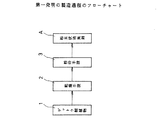
図1は本発明の第一発明の製造過程を説明するフローチャートを示し、1は原料であるゲットウ類植物である。 FIG. 1 shows a flow chart for explaining the production process of the first invention of the present invention, wherein 1 is a ghetto plant as a raw material.
採取したゲットウ類植物1全体を水洗等した後、このゲットウ類植物1を、葉部、茎部及び根茎部ごと適宜大きさ或いは適宜長さに切断し、これを乾燥手段2で乾燥する。乾燥手段2とては、熱風乾燥でも真空凍結乾燥でも良い。切断状態で乾燥されたゲットウ類植物1を粉砕手段3に投入し、これでゲットウ類植物1を粉末化し、粉末状消臭剤Aを得る。 After the whole collected ghetto plant 1 is washed with water, etc., the ghetto plant 1 is cut into a size or a length as appropriate along with the leaf, stem and rhizome, and dried by the drying means 2. The drying means 2 may be hot air drying or vacuum freeze drying. The ghetto plants 1 dried in the cut state are put into the pulverizing means 3, and the ghetto plants 1 are pulverized to obtain a powdery deodorant A.
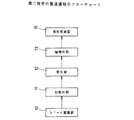
図2は、第二発明の製造過程を説明するフローチャートを示し、10は原料であるゲットウ類植物である。このゲットウ類植物10を上記のように水洗等した後、圧搾手段11で圧搾し、圧搾汁即ち搾汁液12を得る。この搾汁液12を濾過手段13を利用して絞り粕等の不純物を除去し、これにより液状消臭剤Bは得られる。
FIG. 2 shows a flow chart for explaining the production process of the second invention, wherein 10 is a ghetto plant as a raw material. After this
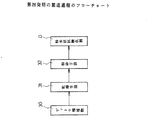
図3は、第三発明の製造過程を説明するフローチャートを示し、20は原料であるゲットウ類植物である。このゲットウ類植物20を上記のように水洗等した後、乾燥手段21で乾燥し、ついで粉砕手段22で粉末化して乾燥粉末物23を得る。この乾燥粉末物23に溶媒24を混合し、これを抽出手段25を利用して抽出し、次いで濾過手段26で濾過して抽出液27を得、これを消臭剤Cとして利用する。
FIG. 3 shows a flowchart for explaining the production process of the third invention, wherein 20 is a ghetto plant as a raw material. After the
上記で利用する溶媒24の具体的な物質として、水、メタノール、エタノール、アセトン等の通常利用している溶媒で良い。例えば水を溶媒として利用する場合は、乾燥粉末物23を80℃の水で3時間加熱して抽出液27を得るようにしても良い。
As a specific substance of the solvent 24 used above, a commonly used solvent such as water, methanol, ethanol, acetone or the like may be used. For example, when water is used as the solvent, the
水を溶媒とする抽出液23の抽出条件は、上記に限定されるものではなく、温度を10℃乃至100℃の範囲とし、これに応じて加熱時間を調整すること勿論であり、また水以外の他の溶媒を利用する場合もその温度や時間を適宜設定して抽出すれば良い。
The extraction condition of the
図4は、第四発明の製造過程を説明するフローチャートを示し、30は原料であるゲットウ類植物である。採取したゲットウ類植物30の根茎を水洗等した後、このゲットウ類植物30を適宜大きさ或いは適宜長さに切断して乾燥手段31で乾燥する。乾燥手段31としては、熱風乾燥でも冷凍乾燥でも良い。切断状態で乾燥されたゲットウ類植物30を粉砕手段32に投入し、これでゲットウ類植物30粉末化し、粉末状抗酸化剤Dを得る。
FIG. 4 shows a flowchart for explaining the production process of the fourth invention, wherein 30 is a ghetto plant as a raw material. After the rhizome of the collected
図5は、第五発明の製造過程を説明するフローチャートを示し、40は原料であるゲットウ類植物である。このゲットウ類植物40を上記のように水洗等した後、圧搾手段41で圧搾し、圧搾汁即ち搾汁液42を得る。この搾汁液42を濾過手段43を利用して絞り粕等の不純物を除去し、これにより液状消臭剤Eが得られる。
FIG. 5 shows a flowchart for explaining the production process of the fifth invention, wherein 40 is a ghetto plant as a raw material. After the
図6は、第六発明の製造過程を説明するフローチヤートを示し、50は原料であるゲットウ類植物である。このゲットウ類植物50を上記のように水洗等した後、乾燥手段51で乾燥し、ついで粉砕手段52で粉末化して乾燥粉末物53を得る。この乾燥粉末物53に溶媒54を混合し、これを抽出手段55を利用して抽出し、次いで濾過手段56で濾過して抽出液57を得、これを抗酸化剤Fとして利用する。
FIG. 6 shows a flow chart for explaining the production process of the sixth invention, and 50 is a ghetto plant as a raw material. After the
ところで、以上の実施例では、消臭剤および抗酸化剤を粉末化或いは液状化して得るようにし、粉末の粒度や液体の粘性について触れなかったが、これは使用目的等に応じて適宜変更すれば良い。また、上記の消臭剤や抗酸化剤を種々の形態、例えば賦形剤や担体等と組み合わせて粉末、顆粒錠剤、カプセル剤、ペースト溶剤等の形態で利用するようにしても良い。 By the way, in the above examples, the deodorant and the antioxidant are obtained by pulverization or liquefaction, and the particle size of the powder and the viscosity of the liquid are not mentioned, but this may be changed as appropriate according to the purpose of use. It ’s fine. Further, the above deodorant and antioxidant may be used in various forms such as powders, granular tablets, capsules, paste solvents and the like in combination with excipients and carriers.
次に、上記の製造過程で得られた消臭剤や抗酸化剤の試験結果について詳述する。尚、以下の説明では、上記の消臭剤や抗酸化剤を、試料として利用し易いように粉末又は液状化等したものを用いて説明する。また、原料であるゲットウ類植物としてタイリンゲットウとゲットウを利用し、これらを根茎部、茎部、葉部からそれぞれ生成した消臭剤及び抗酸化剤を利用した。 Next, the test results of the deodorant and antioxidant obtained in the above production process will be described in detail. In the following description, the deodorant and the antioxidant described above will be described using powder or liquefied so that they can be easily used as a sample. In addition, Tyring's ghetto and ghetto were used as the raw ghetto plants, and deodorants and antioxidants produced from the rhizome part, stem part and leaf part were used.
実施例1
(試験方法)
本発明に係る消臭剤の評価を、腐敗肉臭、口臭の主成分、キャベツの腐敗臭等として知られているメチルメルカプタンの除去率で示した。
Example 1
(Test method)
The evaluation of the deodorant according to the present invention was shown by the removal rate of methyl mercaptan known as rotting meat odor, main component of bad breath, cabbage rot odor and the like.
試薬としては、悪臭分析用標準試薬であるメチルメルカプタン/ベンゼン溶液(1μg/μl)をエタノール10μg/mlで希釈した後、測定直後に水で2μg/mlになるようにした溶液を使用した。
As a reagent, a methyl mercaptan / benzene solution (1 μg / μl), which is a standard reagent for malodor analysis, was diluted with
試料としては、タイリンゲットウ及びゲットウを採取し、茎部を圧搾して搾汁液を得、これを真空凍結乾燥したものを用い、これを30mg、10mg、5mgの3段階についてメチルメルカプタンの除去率を測定した。 As samples, we collected Tyring's ghetto and ghetto, squeezed the stem part to obtain the juice, and used it after freeze-drying this, and using this, the removal rate of methyl mercaptan was divided into three stages of 30 mg, 10 mg and 5 mg. It was measured.
(測定方法)
消臭力の測定は、試薬1mlを内容量30mlのガラス製密閉容器に取り、燐酸緩衝液(pH7.5)1mlに本発明に係る上記試料(30mg、10mg、5mg)をそれぞれ加え、直ちに37℃に保温した。5分後、シリンジでヘッドスペースガス300μlを取り、これに含まれるメチルメルカプタン量をガスクロマトグラフイーで測定し、この測定結果を表1に示した。
(Measuring method)
The deodorizing power was measured by taking 1 ml of a reagent in a glass sealed container with an internal volume of 30 ml, adding the above-mentioned sample (30 mg, 10 mg, 5 mg) according to the present invention to 1 ml of a phosphate buffer (pH 7.5), and immediately Incubated at 0 ° C. After 5 minutes, 300 μl of the headspace gas was taken with a syringe, the amount of methyl mercaptan contained therein was measured by gas chromatography, and the measurement results are shown in Table 1.
対照は試料を加えずに同条件で測定した値を用いた。対照の測定値から各試料の測定値をそれぞれ差し引き、減量分を消臭率即ち悪臭除去率として、百分率で表示した。尚、比較検討するため、現在、口腔用消臭剤として利用されている試薬銅クロロフイリン酸ナトリウム(以下SCCと言う。)の除去率も測定した。 As a control, a value measured under the same conditions without adding a sample was used. The measured value of each sample was subtracted from the measured value of the control, and the weight loss was displayed as a percentage as the deodorization rate, that is, the malodor removal rate. For comparison, the removal rate of the reagent copper sodium chlorophyllate (hereinafter referred to as SCC) currently used as a deodorant for oral cavity was also measured.
(試験結果)
表1に示すように、各ゲットウ搾汁液の乾燥物からなる消臭剤には、いずれも消臭効果が顕著に認められ、特にタイリンゲットウから得られた消臭剤においては、1mlの試薬に対し、5mgの試料でも消臭力を有し、試料の量を増加するに従って除去率も向上し、30mgの試料で52%の除去率を示した。SCCと比較しても、タイリンゲットウの除去率は、30mgでSCCの約64%の消臭力を保持していることが判明した。また、官能試験においても、各ゲットウ搾汁液の固形物を加えると、悪臭が弱くなることが確認された。
(Test results)
As shown in Table 1, the deodorant consisting of the dried product of each ghetto squeezed liquid has a remarkable deodorant effect. On the other hand, the 5 mg sample also had a deodorizing power, and the removal rate improved as the amount of the sample was increased, and the removal rate of 52% was shown with the 30 mg sample. Even when compared with SCC, it was found that the removal rate of Tyringu was maintained at about 30% with a deodorizing power of about 64% of SCC. Moreover, also in the sensory test, when the solid substance of each ghetto squeezed liquid was added, it was confirmed that a bad odor becomes weak.
実施例2
(試験方法)
試料として0.5mlのタイリンゲットウ及びゲットウの各搾汁液を使用し、その他の試験方法及び除去率の測定は上記の実施例1に準じた。試験結果を表2で示した。
Example 2
(Test method)
As the sample, 0.5 ml of each squeezed solution of Tyringu ghetto and ghetto was used, and other test methods and measurement of the removal rate were in accordance with Example 1 above. The test results are shown in Table 2.
(試験結果)
表2に示すように、各試料には消臭力があることが判明した。ゲットウは39%を示したが、タイリンゲットウは55%ものかなり高い除去率を示した。
(Test results)
As shown in Table 2, each sample was found to have a deodorizing power. Ghetto showed 39%, but Tyling ghetto showed a removal rate as high as 55%.
実施例3
(試験方法)
試料として、タイリンゲットウの葉部、茎部、根茎部をそれぞれ乾燥した後、これらを80度の水で3時間加熱して得た抽出液を、各真空凍結乾燥し、これらから40mg、10mg、4mgづつ取って試料とし、この各試料について実施例1の試薬を利用して除去率を測定した。測定方法は上記実施例1に準じ、測定結果を表3に示した。
Example 3
(Test method)
As a sample, dried leaves, stems, and rhizomes of tyringu, respectively, and then heated with 80 ° C. for 3 hours, each extract was freeze-dried, and 40 mg, 10 mg, Each 4 mg sample was taken as a sample, and the removal rate of each sample was measured using the reagent of Example 1. The measurement method was in accordance with Example 1 above, and the measurement results are shown in Table 3.
(試験結果)
表3に示すように、抽出液乾燥物の各部位には消臭力があることが確認された。4mgでも各部位(葉部、茎部、根茎部)には25%以上の悪臭除去率を示し、40mgの茎部においては、65%もの高い除去率を示した。因みにSCCと比較しても遜色のない除去率があることが確認された。
(Test results)
As shown in Table 3, it was confirmed that each part of the extract extract had deodorizing power. Even at 4 mg, a bad odor removal rate of 25% or more was shown in each part (leaf, stem, rhizome), and a removal rate as high as 65% was shown in the 40 mg stem. Incidentally, it was confirmed that there was a comparable removal rate compared to SCC.
実施例4
(試験方法)
魚の腐敗臭の主成分として知られている悪臭トリメチルアミンに対して、タンリンゲットウ及びゲットウの消臭力を測定した。
Example 4
(Test method)
The deodorizing power of tangling ghetto and ghetto was measured against malodorous trimethylamine, which is known as the main component of fish rotten odor.
試薬として、悪臭測定用標準試薬であるトリメチルアミン溶液(1μg/μlエタノール 和光純薬製)を用いた。 A trimethylamine solution (1 μg / μl ethanol manufactured by Wako Pure Chemical Industries, Ltd.), which is a standard reagent for malodor measurement, was used as a reagent.
試料として、タイリンゲットウ及びゲットウの各搾汁液乾燥物30mg、10mgを用いた。 As samples, 30 mg and 10 mg of dried squeezed liquids of Tyling ghetto and ghetto were used.
(測定方法)
上記の各試料に、0・2mlの試薬と燐酸緩衝液(pH7.5)1mlを加え、これを内容量30mlガラス製密閉容器に入れ、37℃で保温した。5分後直ちにガス検知管でヘッドスペースガスのトリメチルアミン量を測定した。消臭力の表示は、対照の試薬の測定値から試料の測定値を差し引き、その減少分を百分率で表し、これを表4で示めした。
(Measuring method)
To each of the above samples, 0.2 ml of a reagent and 1 ml of a phosphate buffer (pH 7.5) were added, and this was placed in a sealed container made of 30 ml glass and kept at 37 ° C. Immediately after 5 minutes, the amount of trimethylamine in the headspace gas was measured with a gas detector tube. The deodorizing power was displayed by subtracting the measured value of the sample from the measured value of the control reagent and expressing the decrease in percentage, which is shown in Table 4.
(試験結果)
表4に示すように、タイリンゲットウ、ゲットウのいずれにも高い消臭力があることが確認された。30mgの各試料では80%の除去率を示し、10mgでも各試料は50%以上の除去率を示した。
(Test results)
As shown in Table 4, it was confirmed that both Tyring's ghetto and ghetto have high deodorizing power. Each sample of 30 mg showed an 80% removal rate, and each sample showed a removal rate of 50% or more even at 10 mg.
実施例5
(試験方法)
タイリンゲットウの葉部、茎部、根茎部を乾燥し、80℃の水で抽出した抽出液を乾燥した乾燥物30mg、10mgを取ってこれを試料とし、実施例4のトリメチルアミン試薬に対する除去率を、実施例4の測定方法に準じて測定し、その測定結果を表5に示した。
Example 5
(Test method)
Dry leaves, stems and rhizomes of Tyringu tou, extract 30 mg and 10 mg of dried extract extracted from water at 80 ° C. The measurement was performed according to the measurement method of Example 4, and the measurement results are shown in Table 5.
(試験結果)
表5に示すように、タイリンゲットウの葉部、茎部及び根茎部の各部位ともかなり高い数値の除去率を示し、いずれの部位も10mgの少ない試料を使用しても50%以上の除去率を示した。30mgでは各部位とも70%前後の高い除去率があることを確認した。
(Test results)
As shown in Table 5, each of the leaves, stems, and rhizomes of the Tyringo has a fairly high removal rate, and the removal rate of 50% or more is obtained even when a small amount of 10 mg is used for any part. showed that. At 30 mg, it was confirmed that each site had a high removal rate of around 70%.
実施例6
(試験方法)
タイリンゲットウ茎部、ゲットウ茎部の搾汁液乾燥物の抗酸化力について測定した。
Example 6
(Test method)
The antioxidant power of the dried squeezed juice of the tyringe stalk and ghetto stalk was measured.
試薬として、1.1ーdephenylー2ーpicrylhydrazyl(DPPH)の反応試薬を使用した。このDPPH反応試薬は、抗酸化性を有する成分が存すると、その抗酸化力に応じて吸光度の値が低下する。この反応試薬の組成については表6で示した。 As a reagent, a reaction reagent of 1.1-defenyl-2-picrylhydrazyl (DPPH) was used. In the DPPH reaction reagent, when an antioxidant component is present, the absorbance value is lowered according to the antioxidant power. The composition of this reaction reagent is shown in Table 6.
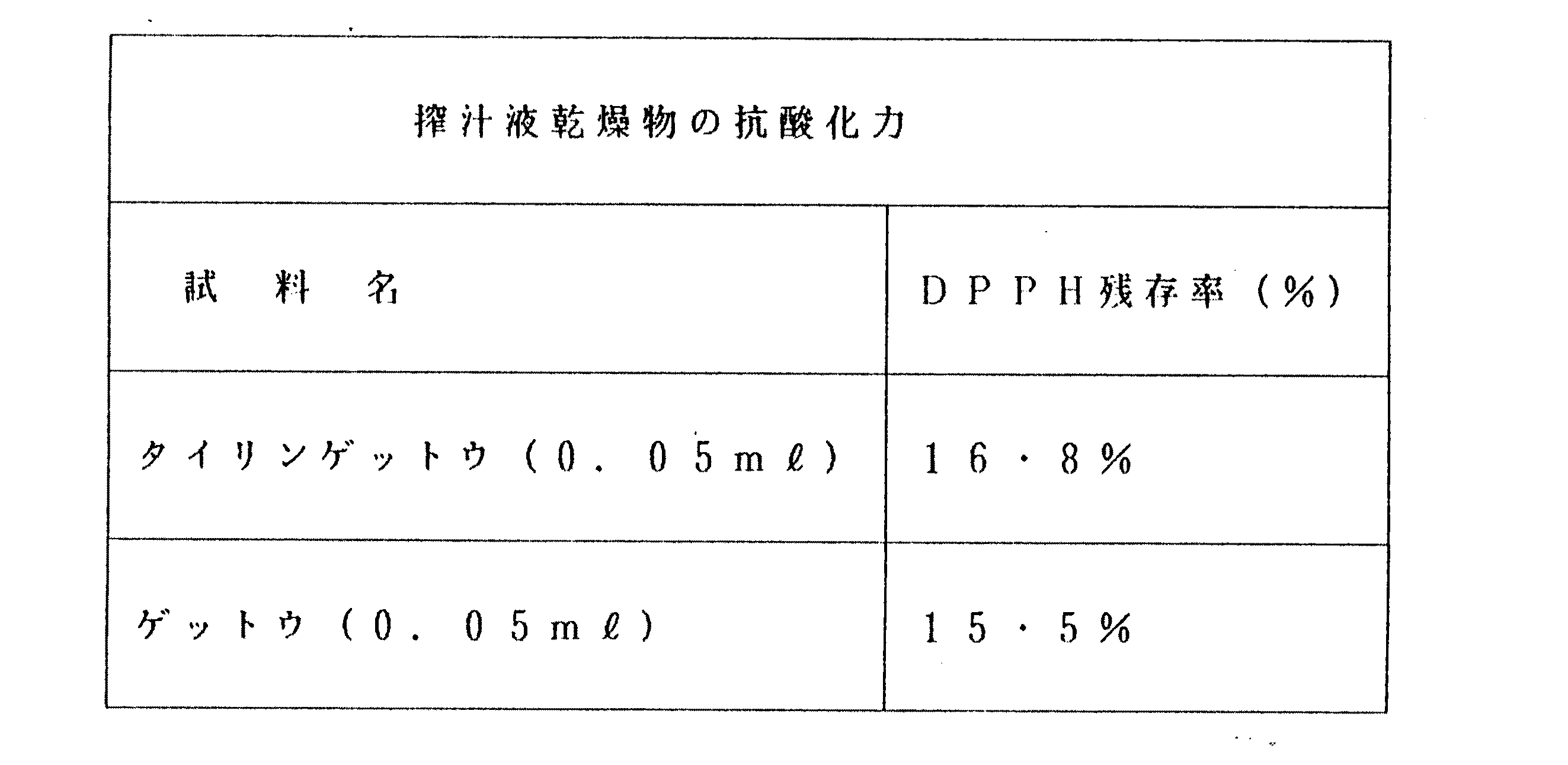
試料としては、タイリンゲットウ及びゲットウの各茎部の搾汁液の乾燥物を利用し、これを1%になるように水で希釈した希釈溶液を用いた。 As a sample, a dried product obtained by diluting Tyling ghetto and the squeezed liquid of each stalk of ghetto with water to 1% was used.
(測定方法)
試料0.05mlに試薬を正確に30秒間反応させた後、波長517nmの吸光度を測定する方法で行った。尚、対照は試料の代わりに0.05モルTrisーHCL緩衝液を使用した。抗酸化力は、対照の吸光度に対する試料の吸光度の割合をDPPH残存率として表示し、測定結果を表7に示した。
(Measuring method)
The sample was reacted with 0.05 ml of the sample for exactly 30 seconds, and then the absorbance at a wavelength of 517 nm was measured. As a control, 0.05 molar Tris-HCL buffer was used instead of the sample. For the antioxidant power, the ratio of the absorbance of the sample to the absorbance of the control was displayed as the DPPH residual rate, and the measurement results are shown in Table 7.
(試験結果)
表7に示すように、いずれの試料もDPPHの残存率は急激に減少しており、残存率から換算してタイリンゲットウは83.2%を、またゲットウは84.5%ものかなり高い減少量が認められ、本発明に係る搾汁液乾燥物に強力な抗酸化力が認められた。
(Test results)
As shown in Table 7, the residual rate of DPPH in all the samples decreased sharply. In terms of the residual rate, the amount of reduction was 83.2% for Tyringu ghetto and 84.5% for ghetto. And a strong antioxidant power was observed in the dried juice extract according to the present invention.
実施例7
(試料および試験方法)
試料はタイリンゲットウ、ゲットウの茎部搾汁液の乾燥物を使用した。比較のために現在食品等に使用されている合成の酸化防止剤3-t-Buty1-4-hydroxyanisole(BHA)の抗酸化性を測定した。
Example 7
(Sample and test method)
The sample used was a dry product of Tyling ghetto and stalk juice of ghetto. For comparison, the antioxidant property of a synthetic antioxidant 3-t-Buty1-4-hydroxyanisole (BHA) currently used in foods and the like was measured.
抗酸化性の測定は、リノール酸の酸化物があるとβ−カロチンが退色する性質を利用した方法で行った。すなわち200mlの三角フラスコに0.1 %β−カロチンのクロロホルム溶液0.5mlと10%リノール酸クロロホルム溶液0.5mlを加え、20%ツイーン40溶液を加え、充分混合した後、窒素ガスを吹き付けてクロロホルムを揮散させ、100mlの蒸留水を加えてリノール酸−β−カロチン溶液を調整した。
Antioxidant property was measured by a method utilizing the property that β-carotene fades when linoleic acid oxide is present. That is, add 0.5 ml of 0.1% β-carotene chloroform solution and 0.5 ml of 10% linoleic acid chloroform solution to a 200 ml Erlenmeyer flask, add 20
この溶液45mlに4mlの0.2 モルりん酸緩衡液( pH6.8 ) を加え、静かに拡はんして試験管に4.9mlずつ分注し、100 μlの被検液を添加し、ただちに50℃の恒温槽に移し、0 〜60分間のOD470 の吸光度の変化を測定して抗酸化性を表示した。 To 45 ml of this solution, add 4 ml of 0.2 molar phosphate buffer (pH 6.8), spread gently, dispense 4.9 ml each into a test tube, add 100 μl of the test solution, and immediately add 50 ml. It was transferred to a constant temperature bath at 0 ° C., and the change in absorbance at OD470 from 0 to 60 minutes was measured to display the antioxidant property.
(試料および試験方法)
図7の結果から分かるように、対照のリノール酸(−△−)は、時間の経過にしたがって酸化物が増えβ−カロチンが退色し、吸光度の値が急激に低下するが、ゲットウ、タイリンゲットウ茎の乾燥物を添加した場合は抗酸化性を有するため、その吸光度はほとんど変化しないか、または緩やかな低下を示した。
(Sample and test method)
As can be seen from the results shown in FIG. 7, the control linoleic acid (-Δ-) increases in oxide as the time passes and discolors β-carotene, and the absorbance value decreases rapidly. When the dried stalk was added, it had antioxidant properties, and its absorbance hardly changed or showed a gradual decrease.
ゲットウ(−●−)とタイリンゲットウ(−■−)の茎汁乾燥物を比較すると、1%濃度では加熱開始時の初期吸光度と比較してほとんど変化せず、両ゲットウのいづれもリノール酸の酸化を100 %抑制した。低濃度の0.2 %では、同じ濃度でもタイリンゲットウ(−○−)の低下速度が遅いことから、ゲットウ(−□−)よりタイリンゲットウが強い抗酸化力を示すことが分かる。 Comparing the dried sap of ghetto (-●-) and Tyling ghetto (-■-), 1% concentration showed little change compared to the initial absorbance at the start of heating, and both ghettos were made of linoleic acid. Oxidation was suppressed 100%. At a low concentration of 0.2%, the rate of decrease of Tyring's ghetto (-o-) is slow even at the same concentration, indicating that Tyring 'ghetto shows stronger antioxidant power than ghetto (-□-).
また、酸化防止剤BHA(−◇−)と比較すると濃度1mg/100mlのBHAは、0.2 %ゲットウとほぼ同じような低下傾向を示すことから、0.2 %ゲットウ茎汁乾燥物は1mg/100mlのBHAと同等の抗酸化力を有しており、また0.2 %タイリンゲットウ茎汁乾燥物はBHAよりも低下率が低いことからBHAよりも抗酸化力が強いことが分かる。 In addition, compared with the antioxidant BHA (-◇-), BHA at a concentration of 1 mg / 100 ml shows a decreasing tendency almost the same as 0.2% ghetto, so 0.2% ghetto stalk juice is 1 mg / 100 ml of BHA. In addition, it can be seen that 0.2% Tyringut stalk juice has a lower reduction rate than BHA and thus has a stronger antioxidant power than BHA.
以上の試験結果等でも明らかのように、本発明によれば、ゲットウ類植物を粉末化或いは液状化して消臭剤及び抗酸化剤を得るようにしたため、ゲットウ類植物の有効成分を利用して消臭力及び抗酸化力に優れた消臭剤及び抗酸化剤を得ることができる。 As is clear from the above test results and the like, according to the present invention, the ghetto plants were pulverized or liquefied to obtain a deodorant and an antioxidant. A deodorant and an antioxidant excellent in deodorizing power and antioxidant power can be obtained.
しかも、ゲットウ類植物を原料として利用して消臭剤及び抗酸化剤を得るようにしたため、従来のような高価なお茶を利用することなく、コスト的にも安価な消臭剤や抗酸化剤を得ることができる等価格的にも有利である。 Moreover, since deodorants and antioxidants are obtained using ghetto plants as raw materials, deodorizers and antioxidants that are inexpensive in terms of cost without using expensive tea as in the past are used. It is also advantageous in terms of cost.
特に、本発明に係る消臭剤及び抗酸化剤を、既述のように昔から食べ物の包装に利用されていたゲットウ類植物で得ているため、合成化学成分を一切使用しない消臭剤や抗酸化剤の提供を可能とし、人体や自然環境に悪影響を及ぼすことのない消臭剤及び抗酸化剤を提供することができ、真に有用である。 In particular, since the deodorant and antioxidant according to the present invention are obtained from ghetto plants that have been used for food packaging from the past as described above, deodorants that do not use any synthetic chemical components, It is possible to provide an antioxidant, and it is possible to provide a deodorant and an antioxidant that do not adversely affect the human body and the natural environment.
また、本発明によれば、合成化学成分を主成分とする消臭剤等と違い、その使用量に気を使う必要がないため、手軽に使用することができる等その効果は顕著である。 In addition, according to the present invention, unlike a deodorant having a synthetic chemical component as a main component, it is not necessary to pay attention to the amount used, so that the effect is remarkable such that it can be used easily.
1 原料であるゲットウ類植物
2 乾燥手段
3 粉砕手段
10 原料であるゲットウ類植物
11 圧搾手段
12 搾汁液
20 原料であるゲットウ類植物
21 乾燥手段
22 粉砕手段
23 乾燥粉末物
24 溶媒
25 抽出手段
26 抽出液
30 原料であるゲットウ類植物
31 乾燥手段
32 粉砕手段
40 原料であるゲットウ類植物
41 圧搾手段
42 搾汁液
50 原料であるゲットウ類植物
51 乾燥手段
52 粉砕手段
54 溶媒
55 抽出手段
56 抽出液
A 粉末状消臭剤
B 液状消臭剤
C 消臭剤
D 粉末状抗酸化剤
E 液状抗酸化剤
F 抗酸化剤
DESCRIPTION OF SYMBOLS 1 Ghetto plant which is
Claims (6)
Priority Applications (1)
| Application Number | Priority Date | Filing Date | Title |
|---|---|---|---|
| JP2005134445A JP2005298829A (en) | 2005-05-02 | 2005-05-02 | Antioxidants and how to use them |
Applications Claiming Priority (1)
| Application Number | Priority Date | Filing Date | Title |
|---|---|---|---|
| JP2005134445A JP2005298829A (en) | 2005-05-02 | 2005-05-02 | Antioxidants and how to use them |
Related Parent Applications (1)
| Application Number | Title | Priority Date | Filing Date |
|---|---|---|---|
| JP17937595A Division JP3732257B2 (en) | 1995-06-21 | 1995-06-21 | Deodorant and deodorizing method |
Publications (1)
| Publication Number | Publication Date |
|---|---|
| JP2005298829A true JP2005298829A (en) | 2005-10-27 |
Family
ID=35330745
Family Applications (1)
| Application Number | Title | Priority Date | Filing Date |
|---|---|---|---|
| JP2005134445A Pending JP2005298829A (en) | 2005-05-02 | 2005-05-02 | Antioxidants and how to use them |
Country Status (1)
| Country | Link |
|---|---|
| JP (1) | JP2005298829A (en) |
-
2005
- 2005-05-02 JP JP2005134445A patent/JP2005298829A/en active Pending
Similar Documents
| Publication | Publication Date | Title |
|---|---|---|
| Louli et al. | Recovery of phenolic antioxidants from wine industry by-products | |
| Hegazy et al. | Antioxidant activities of orange peel extracts | |
| Yan et al. | Comparison of total phenolic contents and antioxidant activities of turmeric leaf, pandan leaf and torch ginger flower | |
| Schwarz et al. | Investigation of plant extracts for the protection of processed foods against lipid oxidation. Comparison of antioxidant assays based on radical scavenging, lipid oxidation and analysis of the principal antioxidant compounds | |
| JP5719113B2 (en) | Deodorant and deodorant composition using the same | |
| JPH10212221A (en) | Deodorant composition | |
| Sivarajan et al. | Kinetic modeling of spice extraction from S. aromaticum and C. cassia | |
| JP5597641B2 (en) | Antioxidant cosmetic composition containing smoked peony, jade bamboo or lily extract | |
| CN105396164A (en) | Plant deodorization combination and preparation method thereof | |
| JP2005080543A (en) | Method for producing cyclodextrin clathrate material comprising fat-soluble ginger component | |
| CN105614947A (en) | Filter stick additive and application thereof | |
| Ngan et al. | Chemical compositions and stability of Vietnamese Homalomena occulta essential oil under the influence of storage conditions | |
| JP3511057B2 (en) | Deodorants | |
| JP4336272B2 (en) | Tobacco odor deodorant, food and drink containing the same, deodorant composition, production method and use thereof | |
| JPS641145B2 (en) | ||
| JP3732257B2 (en) | Deodorant and deodorizing method | |
| KR101427319B1 (en) | Deodorant of Kimchi Comprising Chamomile Extract, And Preparation Method of Odor Reduced Kimchi | |
| JP2005298829A (en) | Antioxidants and how to use them | |
| JP2007056181A (en) | Functional olive oil, process for its production and use thereof | |
| JPH0816048B2 (en) | Oral composition | |
| JPH11290438A (en) | Deodorant composition | |
| Minh et al. | Technical parameters influencing to production of Polyscias fruticosa tea | |
| JP4556072B2 (en) | Deodorant composition and deodorant | |
| JP3665899B2 (en) | Deodorant made from Dokudami family | |
| JPH09164189A (en) | Deodorants |
Legal Events
| Date | Code | Title | Description |
|---|---|---|---|
| A977 | Report on retrieval |
Free format text: JAPANESE INTERMEDIATE CODE: A971007 Effective date: 20070919 |
|
| A131 | Notification of reasons for refusal |
Free format text: JAPANESE INTERMEDIATE CODE: A131 Effective date: 20071204 |
|
| A02 | Decision of refusal |
Free format text: JAPANESE INTERMEDIATE CODE: A02 Effective date: 20080401 |