JP2005298733A - Liquid crystal composition and liquid crystal display element - Google Patents
Liquid crystal composition and liquid crystal display element Download PDFInfo
- Publication number
- JP2005298733A JP2005298733A JP2004119143A JP2004119143A JP2005298733A JP 2005298733 A JP2005298733 A JP 2005298733A JP 2004119143 A JP2004119143 A JP 2004119143A JP 2004119143 A JP2004119143 A JP 2004119143A JP 2005298733 A JP2005298733 A JP 2005298733A
- Authority
- JP
- Japan
- Prior art keywords
- liquid crystal
- formula
- compound
- compound represented
- component
- Prior art date
- Legal status (The legal status is an assumption and is not a legal conclusion. Google has not performed a legal analysis and makes no representation as to the accuracy of the status listed.)
- Pending
Links
Classifications
-
- C—CHEMISTRY; METALLURGY
- C09—DYES; PAINTS; POLISHES; NATURAL RESINS; ADHESIVES; COMPOSITIONS NOT OTHERWISE PROVIDED FOR; APPLICATIONS OF MATERIALS NOT OTHERWISE PROVIDED FOR
- C09K—MATERIALS FOR MISCELLANEOUS APPLICATIONS, NOT PROVIDED FOR ELSEWHERE
- C09K19/00—Liquid crystal materials
- C09K19/04—Liquid crystal materials characterised by the chemical structure of the liquid crystal components, e.g. by a specific unit
- C09K19/42—Mixtures of liquid crystal compounds covered by two or more of the preceding groups C09K19/06 - C09K19/40
-
- C—CHEMISTRY; METALLURGY
- C09—DYES; PAINTS; POLISHES; NATURAL RESINS; ADHESIVES; COMPOSITIONS NOT OTHERWISE PROVIDED FOR; APPLICATIONS OF MATERIALS NOT OTHERWISE PROVIDED FOR
- C09K—MATERIALS FOR MISCELLANEOUS APPLICATIONS, NOT PROVIDED FOR ELSEWHERE
- C09K19/00—Liquid crystal materials
- C09K19/04—Liquid crystal materials characterised by the chemical structure of the liquid crystal components, e.g. by a specific unit
- C09K19/06—Non-steroidal liquid crystal compounds
- C09K19/08—Non-steroidal liquid crystal compounds containing at least two non-condensed rings
- C09K19/10—Non-steroidal liquid crystal compounds containing at least two non-condensed rings containing at least two benzene rings
- C09K19/20—Non-steroidal liquid crystal compounds containing at least two non-condensed rings containing at least two benzene rings linked by a chain containing carbon and oxygen atoms as chain links, e.g. esters or ethers
-
- C—CHEMISTRY; METALLURGY
- C09—DYES; PAINTS; POLISHES; NATURAL RESINS; ADHESIVES; COMPOSITIONS NOT OTHERWISE PROVIDED FOR; APPLICATIONS OF MATERIALS NOT OTHERWISE PROVIDED FOR
- C09K—MATERIALS FOR MISCELLANEOUS APPLICATIONS, NOT PROVIDED FOR ELSEWHERE
- C09K19/00—Liquid crystal materials
- C09K19/04—Liquid crystal materials characterised by the chemical structure of the liquid crystal components, e.g. by a specific unit
- C09K19/06—Non-steroidal liquid crystal compounds
- C09K19/08—Non-steroidal liquid crystal compounds containing at least two non-condensed rings
- C09K19/30—Non-steroidal liquid crystal compounds containing at least two non-condensed rings containing saturated or unsaturated non-aromatic rings, e.g. cyclohexane rings
- C09K19/3001—Cyclohexane rings
-
- C—CHEMISTRY; METALLURGY
- C09—DYES; PAINTS; POLISHES; NATURAL RESINS; ADHESIVES; COMPOSITIONS NOT OTHERWISE PROVIDED FOR; APPLICATIONS OF MATERIALS NOT OTHERWISE PROVIDED FOR
- C09K—MATERIALS FOR MISCELLANEOUS APPLICATIONS, NOT PROVIDED FOR ELSEWHERE
- C09K19/00—Liquid crystal materials
- C09K19/04—Liquid crystal materials characterised by the chemical structure of the liquid crystal components, e.g. by a specific unit
- C09K19/06—Non-steroidal liquid crystal compounds
- C09K19/08—Non-steroidal liquid crystal compounds containing at least two non-condensed rings
- C09K19/30—Non-steroidal liquid crystal compounds containing at least two non-condensed rings containing saturated or unsaturated non-aromatic rings, e.g. cyclohexane rings
- C09K19/3001—Cyclohexane rings
- C09K19/3066—Cyclohexane rings in which the rings are linked by a chain containing carbon and oxygen atoms, e.g. esters or ethers
-
- C—CHEMISTRY; METALLURGY
- C09—DYES; PAINTS; POLISHES; NATURAL RESINS; ADHESIVES; COMPOSITIONS NOT OTHERWISE PROVIDED FOR; APPLICATIONS OF MATERIALS NOT OTHERWISE PROVIDED FOR
- C09K—MATERIALS FOR MISCELLANEOUS APPLICATIONS, NOT PROVIDED FOR ELSEWHERE
- C09K19/00—Liquid crystal materials
- C09K19/04—Liquid crystal materials characterised by the chemical structure of the liquid crystal components, e.g. by a specific unit
- C09K19/06—Non-steroidal liquid crystal compounds
- C09K19/08—Non-steroidal liquid crystal compounds containing at least two non-condensed rings
- C09K19/30—Non-steroidal liquid crystal compounds containing at least two non-condensed rings containing saturated or unsaturated non-aromatic rings, e.g. cyclohexane rings
- C09K19/3001—Cyclohexane rings
- C09K19/3066—Cyclohexane rings in which the rings are linked by a chain containing carbon and oxygen atoms, e.g. esters or ethers
- C09K19/3068—Cyclohexane rings in which the rings are linked by a chain containing carbon and oxygen atoms, e.g. esters or ethers chain containing -COO- or -OCO- groups
-
- C—CHEMISTRY; METALLURGY
- C09—DYES; PAINTS; POLISHES; NATURAL RESINS; ADHESIVES; COMPOSITIONS NOT OTHERWISE PROVIDED FOR; APPLICATIONS OF MATERIALS NOT OTHERWISE PROVIDED FOR
- C09K—MATERIALS FOR MISCELLANEOUS APPLICATIONS, NOT PROVIDED FOR ELSEWHERE
- C09K19/00—Liquid crystal materials
- C09K19/04—Liquid crystal materials characterised by the chemical structure of the liquid crystal components, e.g. by a specific unit
- C09K19/0403—Liquid crystal materials characterised by the chemical structure of the liquid crystal components, e.g. by a specific unit the structure containing one or more specific, optionally substituted ring or ring systems
- C09K2019/0407—Liquid crystal materials characterised by the chemical structure of the liquid crystal components, e.g. by a specific unit the structure containing one or more specific, optionally substituted ring or ring systems containing a carbocyclic ring, e.g. dicyano-benzene, chlorofluoro-benzene or cyclohexanone
-
- C—CHEMISTRY; METALLURGY
- C09—DYES; PAINTS; POLISHES; NATURAL RESINS; ADHESIVES; COMPOSITIONS NOT OTHERWISE PROVIDED FOR; APPLICATIONS OF MATERIALS NOT OTHERWISE PROVIDED FOR
- C09K—MATERIALS FOR MISCELLANEOUS APPLICATIONS, NOT PROVIDED FOR ELSEWHERE
- C09K19/00—Liquid crystal materials
- C09K19/04—Liquid crystal materials characterised by the chemical structure of the liquid crystal components, e.g. by a specific unit
- C09K2019/0444—Liquid crystal materials characterised by the chemical structure of the liquid crystal components, e.g. by a specific unit characterized by a linking chain between rings or ring systems, a bridging chain between extensive mesogenic moieties or an end chain group
-
- C—CHEMISTRY; METALLURGY
- C09—DYES; PAINTS; POLISHES; NATURAL RESINS; ADHESIVES; COMPOSITIONS NOT OTHERWISE PROVIDED FOR; APPLICATIONS OF MATERIALS NOT OTHERWISE PROVIDED FOR
- C09K—MATERIALS FOR MISCELLANEOUS APPLICATIONS, NOT PROVIDED FOR ELSEWHERE
- C09K19/00—Liquid crystal materials
- C09K19/04—Liquid crystal materials characterised by the chemical structure of the liquid crystal components, e.g. by a specific unit
- C09K19/06—Non-steroidal liquid crystal compounds
- C09K19/08—Non-steroidal liquid crystal compounds containing at least two non-condensed rings
- C09K19/30—Non-steroidal liquid crystal compounds containing at least two non-condensed rings containing saturated or unsaturated non-aromatic rings, e.g. cyclohexane rings
- C09K19/3001—Cyclohexane rings
- C09K19/3003—Compounds containing at least two rings in which the different rings are directly linked (covalent bond)
- C09K2019/3004—Cy-Cy
-
- C—CHEMISTRY; METALLURGY
- C09—DYES; PAINTS; POLISHES; NATURAL RESINS; ADHESIVES; COMPOSITIONS NOT OTHERWISE PROVIDED FOR; APPLICATIONS OF MATERIALS NOT OTHERWISE PROVIDED FOR
- C09K—MATERIALS FOR MISCELLANEOUS APPLICATIONS, NOT PROVIDED FOR ELSEWHERE
- C09K19/00—Liquid crystal materials
- C09K19/04—Liquid crystal materials characterised by the chemical structure of the liquid crystal components, e.g. by a specific unit
- C09K19/06—Non-steroidal liquid crystal compounds
- C09K19/08—Non-steroidal liquid crystal compounds containing at least two non-condensed rings
- C09K19/30—Non-steroidal liquid crystal compounds containing at least two non-condensed rings containing saturated or unsaturated non-aromatic rings, e.g. cyclohexane rings
- C09K19/3001—Cyclohexane rings
- C09K19/3003—Compounds containing at least two rings in which the different rings are directly linked (covalent bond)
- C09K2019/3009—Cy-Ph
-
- C—CHEMISTRY; METALLURGY
- C09—DYES; PAINTS; POLISHES; NATURAL RESINS; ADHESIVES; COMPOSITIONS NOT OTHERWISE PROVIDED FOR; APPLICATIONS OF MATERIALS NOT OTHERWISE PROVIDED FOR
- C09K—MATERIALS FOR MISCELLANEOUS APPLICATIONS, NOT PROVIDED FOR ELSEWHERE
- C09K19/00—Liquid crystal materials
- C09K19/04—Liquid crystal materials characterised by the chemical structure of the liquid crystal components, e.g. by a specific unit
- C09K19/06—Non-steroidal liquid crystal compounds
- C09K19/08—Non-steroidal liquid crystal compounds containing at least two non-condensed rings
- C09K19/30—Non-steroidal liquid crystal compounds containing at least two non-condensed rings containing saturated or unsaturated non-aromatic rings, e.g. cyclohexane rings
- C09K19/3001—Cyclohexane rings
- C09K19/3003—Compounds containing at least two rings in which the different rings are directly linked (covalent bond)
- C09K2019/301—Cy-Cy-Ph
-
- C—CHEMISTRY; METALLURGY
- C09—DYES; PAINTS; POLISHES; NATURAL RESINS; ADHESIVES; COMPOSITIONS NOT OTHERWISE PROVIDED FOR; APPLICATIONS OF MATERIALS NOT OTHERWISE PROVIDED FOR
- C09K—MATERIALS FOR MISCELLANEOUS APPLICATIONS, NOT PROVIDED FOR ELSEWHERE
- C09K19/00—Liquid crystal materials
- C09K19/04—Liquid crystal materials characterised by the chemical structure of the liquid crystal components, e.g. by a specific unit
- C09K19/06—Non-steroidal liquid crystal compounds
- C09K19/08—Non-steroidal liquid crystal compounds containing at least two non-condensed rings
- C09K19/30—Non-steroidal liquid crystal compounds containing at least two non-condensed rings containing saturated or unsaturated non-aromatic rings, e.g. cyclohexane rings
- C09K19/3001—Cyclohexane rings
- C09K19/3003—Compounds containing at least two rings in which the different rings are directly linked (covalent bond)
- C09K2019/3016—Cy-Ph-Ph
-
- C—CHEMISTRY; METALLURGY
- C09—DYES; PAINTS; POLISHES; NATURAL RESINS; ADHESIVES; COMPOSITIONS NOT OTHERWISE PROVIDED FOR; APPLICATIONS OF MATERIALS NOT OTHERWISE PROVIDED FOR
- C09K—MATERIALS FOR MISCELLANEOUS APPLICATIONS, NOT PROVIDED FOR ELSEWHERE
- C09K19/00—Liquid crystal materials
- C09K19/04—Liquid crystal materials characterised by the chemical structure of the liquid crystal components, e.g. by a specific unit
- C09K19/06—Non-steroidal liquid crystal compounds
- C09K19/08—Non-steroidal liquid crystal compounds containing at least two non-condensed rings
- C09K19/30—Non-steroidal liquid crystal compounds containing at least two non-condensed rings containing saturated or unsaturated non-aromatic rings, e.g. cyclohexane rings
- C09K19/3001—Cyclohexane rings
- C09K19/3003—Compounds containing at least two rings in which the different rings are directly linked (covalent bond)
- C09K2019/3021—Cy-Ph-Ph-Cy
-
- C—CHEMISTRY; METALLURGY
- C09—DYES; PAINTS; POLISHES; NATURAL RESINS; ADHESIVES; COMPOSITIONS NOT OTHERWISE PROVIDED FOR; APPLICATIONS OF MATERIALS NOT OTHERWISE PROVIDED FOR
- C09K—MATERIALS FOR MISCELLANEOUS APPLICATIONS, NOT PROVIDED FOR ELSEWHERE
- C09K19/00—Liquid crystal materials
- C09K19/04—Liquid crystal materials characterised by the chemical structure of the liquid crystal components, e.g. by a specific unit
- C09K19/06—Non-steroidal liquid crystal compounds
- C09K19/08—Non-steroidal liquid crystal compounds containing at least two non-condensed rings
- C09K19/30—Non-steroidal liquid crystal compounds containing at least two non-condensed rings containing saturated or unsaturated non-aromatic rings, e.g. cyclohexane rings
- C09K19/3001—Cyclohexane rings
- C09K19/3003—Compounds containing at least two rings in which the different rings are directly linked (covalent bond)
- C09K2019/3025—Cy-Ph-Ph-Ph
-
- C—CHEMISTRY; METALLURGY
- C09—DYES; PAINTS; POLISHES; NATURAL RESINS; ADHESIVES; COMPOSITIONS NOT OTHERWISE PROVIDED FOR; APPLICATIONS OF MATERIALS NOT OTHERWISE PROVIDED FOR
- C09K—MATERIALS FOR MISCELLANEOUS APPLICATIONS, NOT PROVIDED FOR ELSEWHERE
- C09K2323/00—Functional layers of liquid crystal optical display excluding electroactive liquid crystal layer characterised by chemical composition
Landscapes
- Chemical & Material Sciences (AREA)
- Crystallography & Structural Chemistry (AREA)
- Engineering & Computer Science (AREA)
- Materials Engineering (AREA)
- Organic Chemistry (AREA)
- Liquid Crystal Substances (AREA)
Abstract
【課題】ネマチック相の広い温度範囲、小さな粘度、適切な光学異方性、負に大きな誘電率異方性、大きな比抵抗などの特性において、複数の特性を充足する液晶組成物などを提供する。
【解決手段】好ましくは誘電率異方性が−1.5以下であり、特定式で表される化合物群から選択された少なくとも2つの式で表される少なくとも2つの化合物からなる第一成分を液晶組成物の全重量に基づいて20〜75重量%の範囲で含有し、好ましくは誘電率異方性が−1.5から1.5であり、特定式で表される化合物群から選択された少なくとも1つの化合物かならる第二成分を液晶組成物の全重量に基づいて25〜75重量%の範囲で含有し、そして負の誘電率異方性を有する液晶組成物。
【選択図】 なしDisclosed is a liquid crystal composition that satisfies a plurality of characteristics in a wide temperature range of a nematic phase, a small viscosity, an appropriate optical anisotropy, a negative large dielectric anisotropy, a large specific resistance, and the like. .
Preferably, a first component comprising at least two compounds represented by at least two formulas selected from the group of compounds represented by the specific formula having a dielectric anisotropy of −1.5 or less. It is contained in the range of 20 to 75% by weight based on the total weight of the liquid crystal composition, and preferably has a dielectric anisotropy of −1.5 to 1.5 and is selected from the group of compounds represented by the specific formula A liquid crystal composition comprising a second component comprising at least one compound in a range of 25 to 75% by weight based on the total weight of the liquid crystal composition and having a negative dielectric anisotropy.
[Selection figure] None
Description
本発明は、主としてAM(active matrix)素子に適する液晶組成物およびこの組成物を含有するAM素子に関する。 The present invention relates to a liquid crystal composition suitable mainly for an AM (active matrix) device and an AM device containing the composition.
液晶表示素子において、液晶の動作モードに基づいた分類は、PC(phase change)、TN(twisted nematic)、STN(super twisted nematic)、OCB(optically compensated bend)、IPS(in-plane switching)、VA(vertical alignment)などである。素子の駆動方式に基づいた分類は、PM(passive matrix)とAM(active matrix)である。PMはスタティック(static)とマルチプレックス(multiplex)などに分類され、AMはTFT(thin film transistor)、MIM(metal insulator metal)などに分類される。TFTの分類は非晶質シリコン(amorphous silicon)、多結晶シリコン(polycrystal silicon)、および連続粒界結晶シリコン(continuous grain silicon)である。多結晶シリコンは製造工程によって高温型と低温型とに分類される。光源に基づいた分類は、自然光を利用する反射型、バックライトを利用する透過型、そして自然光とバックライトの両方を利用する半透過型である。 In the liquid crystal display element, classification based on the operation mode of the liquid crystal includes PC (phase change), TN (twisted nematic), STN (super twisted nematic), OCB (optically compensated bend), IPS (in-plane switching), VA. (Vertical alignment). The classification based on the element driving method is PM (passive matrix) and AM (active matrix). PM is classified into static and multiplex, and AM is classified into thin film transistor (TFT), metal insulator metal (MIM), and the like. TFTs are classified into amorphous silicon, polycrystal silicon, and continuous grain silicon. Polycrystalline silicon is classified into a high temperature type and a low temperature type according to the manufacturing process. The classification based on the light source includes a reflection type using natural light, a transmission type using backlight, and a semi-transmission type using both natural light and backlight.
これらの素子は適切な特性を有する液晶組成物を含有する。良好な一般的特性を有するAM素子を得るには組成物の一般的特性を向上させる。2つの一般的特性における関連を下記の表1にまとめる。組成物の一般的特性を市販されているAM素子に基づいてさらに説明する。ネマチック相の温度範囲は、素子の使用できる温度範囲に関連する。ネマチック相の好ましい上限温度は70℃以上であり、そしてネマチック相の好ましい下限温度は−20℃以下である。組成物の粘度は素子の応答時間に関連する。素子で動画を表示するためには短い応答時間が好ましい。したがって、組成物における小さな粘度が好ましい。低い温度における小さな粘度はより好ましい。 These devices contain a liquid crystal composition having appropriate characteristics. In order to obtain an AM device having good general characteristics, the general characteristics of the composition are improved. The relationships in the two general characteristics are summarized in Table 1 below. The general characteristics of the composition will be further described based on a commercially available AM device. The temperature range of the nematic phase is related to the temperature range in which the device can be used. The preferable upper limit temperature of the nematic phase is 70 ° C. or higher, and the preferable lower limit temperature of the nematic phase is −20 ° C. or lower. The viscosity of the composition is related to the response time of the device. A short response time is preferred for displaying moving images on the device. Therefore, a small viscosity in the composition is preferred. Small viscosities at low temperatures are more preferred.
組成物の光学異方性は、素子のコントラスト比に関連する。VAモード、IPSモードなどを有する素子は電気的に制御された複屈折(electrically controlled birefringence)を利用する。そこで、VAモード、IPSモードなどを有する素子におけるコントラスト比を最大にするために、組成物の光学異方性(Δn)と素子のセルギャップ(d)との積(Δn・d)を一定の値に設計する。この値の例は0.30〜0.35μm(VAモード)または0.20〜0.30μm(IPSモード)である。セルギャップ(d)は通常3〜6μmであるので、組成物における光学異方性は主に0.05〜0.11の範囲である。組成物の大きな誘電率異方性は素子の小さな駆動電圧に寄与する。したがって、大きな誘電率異方性が好ましい。組成物における大きな比抵抗は、素子における大きな電圧保持率と大きなコントラスト比に寄与する。したがって、初期に大きな比抵抗を有する組成物が好ましい。長時間使用したあとでも大きな比抵抗を有する組成物が好ましい。 The optical anisotropy of the composition is related to the contrast ratio of the device. An element having a VA mode, an IPS mode, or the like uses electrically controlled birefringence. Therefore, in order to maximize the contrast ratio in an element having a VA mode, an IPS mode, etc., the product (Δn · d) of the optical anisotropy (Δn) of the composition and the cell gap (d) of the element is constant. Design to value. Examples of this value are 0.30 to 0.35 μm (VA mode) or 0.20 to 0.30 μm (IPS mode). Since the cell gap (d) is usually 3 to 6 μm, the optical anisotropy in the composition is mainly in the range of 0.05 to 0.11. The large dielectric anisotropy of the composition contributes to a small driving voltage of the device. Therefore, a large dielectric anisotropy is preferable. A large specific resistance in the composition contributes to a large voltage holding ratio and a large contrast ratio in the device. Therefore, a composition having a large specific resistance in the initial stage is preferable. A composition having a large specific resistance even after being used for a long time is preferable.
TNモードなどを有するAM素子においては正の誘電率異方性を有する組成物が用いられる。一方、VAモードなどを有するAM素子においては負の誘電率異方性を有する組成物が用いられる。IPSモードなどを有するAM素子においては正または負の誘電率異方性を有する組成物が用いられる。負の誘電率異方性を有する組成物は、負の誘電率異方性を有する液晶性化合物を含有する。この化合物は、その分子の短軸方向にフッ素のような極性基を有する。この化合物は、例えば2,3−ジフルオロ−1,4−フェニレンを有する。負の誘電率異方性を有する組成物の例は次の文献に記載されている。 In an AM device having a TN mode or the like, a composition having a positive dielectric anisotropy is used. On the other hand, a composition having negative dielectric anisotropy is used for an AM device having a VA mode or the like. In an AM device having an IPS mode or the like, a composition having a positive or negative dielectric anisotropy is used. The composition having negative dielectric anisotropy contains a liquid crystalline compound having negative dielectric anisotropy. This compound has a polar group such as fluorine in the minor axis direction of the molecule. This compound has, for example, 2,3-difluoro-1,4-phenylene. Examples of compositions having negative dielectric anisotropy are described in the following literature.
本発明の目的は、ネマチック相の広い温度範囲、小さな粘度、適切な光学異方性、負に大きな誘電率異方性、大きな比抵抗などの特性において、複数の特性を充足する液晶組成物を提供することにある。この目的は複数の特性に関して適切なバランスを有する液晶組成物を提供することでもある。この目的は、この組成物を含有し、そして大きな電圧保持率を有する液晶表示素子を提供することでもある。この目的は、小さな粘度、0.05〜0.11の光学異方性、−6.5〜−2.0の誘電率異方性などの特性を有する組成物を含有し、そしてVAモード、IPSモードなどに適したAM素子を提供することでもある。 An object of the present invention is to provide a liquid crystal composition satisfying a plurality of characteristics in a wide temperature range of a nematic phase, a small viscosity, an appropriate optical anisotropy, a negative large dielectric anisotropy, a large specific resistance, and the like. It is to provide. This object is also to provide a liquid crystal composition having an appropriate balance regarding a plurality of characteristics. The object is also to provide a liquid crystal display element containing this composition and having a large voltage holding ratio. This purpose contains a composition having properties such as small viscosity, 0.05 to 0.11 optical anisotropy, -6.5 to -2.0 dielectric anisotropy, and the VA mode, Another object is to provide an AM device suitable for the IPS mode.
本発明は下記の項などである。
1. 第一成分として式(1−1)〜(1−6)で表される化合物の群から選択された少なくとも2つの式で表される少なくとも2つの化合物を液晶組成物の全重量に基づいて20〜75重量%の範囲で含有し、第二成分として式(2−1)〜(2−3)で表される化合物の群から選択された少なくとも1つの化合物を液晶組成物の全重量に基づいて25〜75重量%の範囲で含有し、そして負の誘電率異方性を有する液晶組成物。
1. Based on the total weight of the liquid crystal composition, at least two compounds represented by at least two compounds selected from the group of compounds represented by formulas (1-1) to (1-6) are used as the first component. Based on the total weight of the liquid crystal composition, at least one compound selected from the group consisting of compounds represented by formulas (2-1) to (2-3) is contained in the range of ˜75% by weight And a liquid crystal composition having a negative dielectric anisotropy.
2. X1が−CF2Hであり、そしてX2がフッ素である項1記載の液晶組成物。
3. 第一成分として式(1−1)〜(1−6)の群から選択された少なくとも2つの式のうちの1つが式(1−2)、(1−4)、(1−5)、または(1−6)である項1または2に記載の液晶組成物。
2. X 1 is -CF 2 H, and X 2 is the liquid crystal composition of claim 1 wherein the fluorine.
3. One of at least two formulas selected from the group of formulas (1-1) to (1-6) as the first component is formula (1-2), (1-4), (1-5), Item 3. The liquid crystal composition according to item 1 or 2, which is (1-6).
4. 第一成分が式(1−2)、(1−4)、(1−5)、または(1−6)の群から選択された少なくとも2つの式で表される少なくとも2つの化合物である請求項1〜3のいずれか1項に記載の液晶組成物。
5. 第一成分が式(1−4)で表される少なくとも1つの化合物および式(1−6)で表される少なくとも1つの化合物である項1または2に記載の液晶化合物。
4). The first component is at least two compounds represented by at least two formulas selected from the group of formula (1-2), (1-4), (1-5), or (1-6) Item 4. The liquid crystal composition according to any one of items 1 to 3.
5). Item 3. The liquid crystal compound according to item 1 or 2, wherein the first component is at least one compound represented by formula (1-4) and at least one compound represented by formula (1-6).
6. 第一成分が式(1−2)で表される少なくとも1つの化合物および式(1−4)で表される少なくとも1つの化合物である項1または2に記載の液晶化合物。
7. 第一成分が式(1−2)で表される少なくとも1つの化合物、式(1−4)で表される少なくとも1つの化合物および式(1−5)で表される少なくとも1つの化合物である項1または2に記載の液晶化合物。
6). Item 3. The liquid crystal compound according to item 1 or 2, wherein the first component is at least one compound represented by formula (1-2) and at least one compound represented by formula (1-4).
7). The first component is at least one compound represented by formula (1-2), at least one compound represented by formula (1-4), and at least one compound represented by formula (1-5) Item 3. The liquid crystal compound according to item 1 or 2.
8. 第一成分が式(1−2)で表される少なくとも1つの化合物、式(1−4)で表される少なくとも1つの化合物および式(1−6)で表される少なくとも1つの化合物である項1または2に記載の液晶化合物。
9. 第一成分が式(1−2)で表される少なくとも1つの化合物および式(1−5)で表される少なくとも1つの化合物である項1または2に記載の液晶化合物。
10. 第一成分が式(1−2)で表される少なくとも1つの化合物および式(1−6)で表される少なくとも1つの化合物である項1または2に記載の液晶化合物。
8). The first component is at least one compound represented by formula (1-2), at least one compound represented by formula (1-4), and at least one compound represented by formula (1-6) Item 3. The liquid crystal compound according to item 1 or 2.
9. Item 3. The liquid crystal compound according to item 1 or 2, wherein the first component is at least one compound represented by formula (1-2) and at least one compound represented by formula (1-5).
10. Item 3. The liquid crystal compound according to item 1 or 2, wherein the first component is at least one compound represented by formula (1-2) and at least one compound represented by formula (1-6).
11. 第一成分が式(1−3)で表される少なくとも1つの化合物および式(1−5)で表される少なくとも1つの化合物である項1または2に記載の液晶化合物。
12. 第一成分が式(1−3)で表される少なくとも1つの化合物および式(1−6)で表される少なくとも1つの化合物である項1または2に記載の液晶化合物。
13. 第一成分が式(1−4)で表される少なくとも1つの化合物および式(1−5)で表される少なくとも1つの化合物である項1または2に記載の液晶化合物。
11. Item 3. The liquid crystal compound according to item 1 or 2, wherein the first component is at least one compound represented by formula (1-3) and at least one compound represented by formula (1-5).
12 Item 3. The liquid crystal compound according to item 1 or 2, wherein the first component is at least one compound represented by formula (1-3) and at least one compound represented by formula (1-6).
13. Item 3. The liquid crystal compound according to item 1 or 2, wherein the first component is at least one compound represented by formula (1-4) and at least one compound represented by formula (1-5).
14. 第一成分が式(1−3)で表される少なくとも1つの化合物および式(1−4)で表される少なくとも1つの化合物である項1または2に記載の液晶化合物。
15. 第一成分が式(1−3)で表される少なくとも1つの化合物、式(1−4)で表される少なくとも1つの化合物および式(1−5)で表される少なくとも1つの化合物である項1または2に記載の液晶化合物。
16. 第一成分が式(1−3)で表される少なくとも1つの化合物、式(1−4)で表される少なくとも1つの化合物および式(1−6)で表される少なくとも1つの化合物である項1または2に記載の液晶化合物。
14 Item 3. The liquid crystal compound according to item 1 or 2, wherein the first component is at least one compound represented by formula (1-3) and at least one compound represented by formula (1-4).
15. The first component is at least one compound represented by formula (1-3), at least one compound represented by formula (1-4), and at least one compound represented by formula (1-5). Item 3. The liquid crystal compound according to item 1 or 2.
16. The first component is at least one compound represented by formula (1-3), at least one compound represented by formula (1-4), and at least one compound represented by formula (1-6) Item 3. The liquid crystal compound according to item 1 or 2.
17. 第二成分が、式(2−1−1)、(2−1−2)、(2−1−3)、(2−1−4)、(2−2−1)、(2−2−2)、(2−2−3)、(2−2−4)、(2−2−5)、(2−2−6)、(2−3−1)、(2−3−2)、(2−3−3)、および(2−3−4)で表される化合物の群から選択された少なくとも1つの化合物である項1〜16のいずれか1項に記載の液晶組成物。
18. 第二成分が、項16記載の式(2−1−1)、(2−1−2)、(2−2−1)、(2−2−4)、(2−3−1)、および(2−3−4)で表される化合物の群から選択された少なくとも1つの化合物である項17に記載の液晶組成物。
19. 液晶組成物の誘電率異方性の値が−6.5〜−2.0の範囲である項1〜18のいずれか1項に記載の液晶組成物。
18. The second component is the formula (2-1-1), (2-1-2), (2-2-1), (2-2-4), (2-3-1), Item 18. The liquid crystal composition according to item 17, which is at least one compound selected from the group of compounds represented by (2-3-4):
19. Item 19. The liquid crystal composition according to any one of items 1 to 18, wherein a value of dielectric anisotropy of the liquid crystal composition is in a range of −6.5 to −2.0.
20. 項1〜19のいずれか1項に記載の液晶組成物を含有する液晶表示素子。
21. 液晶表示素子がVAモードまたはIPSモードを有し、そしてアクティブマトリックスで駆動される項20に記載の液晶表示素子。
22. 項1〜19のいずれか1項記載の液晶組成物を、VAモードまたはIPSモードを有し、そしてアクティブマトリックスで駆動される液晶表示素子に使用する方法。
20. Item 20. A liquid crystal display device comprising the liquid crystal composition according to any one of items 1 to 19.
21. Item 21. The liquid crystal display device according to item 20, wherein the liquid crystal display device has a VA mode or an IPS mode and is driven by an active matrix.
22. Item 20. A method of using the liquid crystal composition according to any one of items 1 to 19 for a liquid crystal display element having a VA mode or an IPS mode and driven by an active matrix.
本発明の組成物は、ネマチック相の広い温度範囲、小さな粘度、適切な光学異方性、負に大きな誘電率異方性、大きな比抵抗などの特性において、複数の特性を充足する。この組成物は複数の特性に関して適切なバランスを有する。本発明の素子は、この組成物を含有し、そして大きな電圧保持率を有する。この素子は、小さな粘度、0.05〜0.11の光学異方性、−6.5〜−2.0の誘電率異方性などの特性を有する組成物を含有するので、VAモード、IPSモードなどを有するAM素子に適する。 The composition of the present invention satisfies a plurality of characteristics in a wide temperature range of a nematic phase, a small viscosity, an appropriate optical anisotropy, a large negative dielectric anisotropy and a large specific resistance. The composition has an appropriate balance for multiple properties. The device of the present invention contains this composition and has a large voltage holding ratio. This element contains a composition having characteristics such as a small viscosity, an optical anisotropy of 0.05 to 0.11 and a dielectric anisotropy of −6.5 to −2.0. Suitable for an AM device having an IPS mode or the like.
この明細書における用語の使い方は次のとおりである。本発明の液晶組成物または本発明の液晶表示素子をそれぞれ「組成物」または「素子」と略すことがある。液晶表示素子は液晶表示パネルおよび液晶表示モジュールの総称である。アクティブマトリックスで駆動される素子をAM素子と略すことがある。TNモードを有する素子をTN素子と略すことがある。他のモードを有する素子も同様に略すことがある。液晶組成物は液晶性化合物を含有する。この液晶性化合物は、ネマチック相、スメクチック相などの液晶相を有する化合物および液晶相を有さないが組成物の成分として有用な化合物の総称である。式(1)で表わされる化合物の群から選択された少なくとも1つの化合物を「化合物(1)」と略すことがある。他の式に関する化合物も同様に略すことがある。 Terms used in this specification are as follows. The liquid crystal composition of the present invention or the liquid crystal display device of the present invention may be abbreviated as “composition” or “device”, respectively. A liquid crystal display element is a general term for a liquid crystal display panel and a liquid crystal display module. An element driven by an active matrix may be abbreviated as an AM element. An element having a TN mode may be abbreviated as a TN element. Similarly, elements having other modes may be omitted. The liquid crystal composition contains a liquid crystal compound. This liquid crystal compound is a general term for compounds having a liquid crystal phase such as a nematic phase and a smectic phase, and compounds having no liquid crystal phase but useful as components of the composition. At least one compound selected from the group of compounds represented by formula (1) may be abbreviated as “compound (1)”. Compounds with other formulas may be abbreviated as well.
ネマチック相の上限温度を「上限温度」と略すことがある。ネマチック相の下限温度を「下限温度」と略すことがある。「比抵抗が大きい」は、組成物が初期に大きな比抵抗を有し、そして長時間使用したあとでも組成物が大きな比抵抗を有することを意味する。「電圧保持率が大きい」は、素子が初期に大きな電圧保持率を有し、そして長時間使用したあとでも素子が大きな電圧保持率を有することを意味する。光学異方性などの特性を説明するときは、実施例に記載した方法で測定した値を用いる。組成物における成分の割合(百分率)は、組成物の全重量に基づいた重量百分率(重量%)である。 The upper limit temperature of the nematic phase may be abbreviated as “upper limit temperature”. The lower limit temperature of the nematic phase may be abbreviated as “lower limit temperature”. “High specific resistance” means that the composition initially has a large specific resistance, and the composition has a large specific resistance even after long-term use. “Large voltage holding ratio” means that the element initially has a large voltage holding ratio, and the element has a large voltage holding ratio even after long-term use. When describing characteristics such as optical anisotropy, values measured by the methods described in the examples are used. The proportion (percentage) of the components in the composition is a weight percentage (% by weight) based on the total weight of the composition.
本発明の組成物を次の順で説明する。第一に、組成物における成分の構成を説明する。第二に、成分である化合物の主要な特性、および化合物が組成物に及ぼす主要な効果を説明する。第三に、成分である化合物の好ましい割合およびその理由を説明する。第四に、成分である化合物の好ましい形態を説明する。第五に、成分である化合物の具体的な例を示す。第六に、成分である化合物の合成法を説明する。 The composition of the present invention will be described in the following order. First, the composition of the components in the composition will be described. Second, the main characteristics of the component compound and the main effect of the compound on the composition will be explained. Third, a preferred ratio of the component compounds and the reason thereof will be described. Fourth, a preferred form of the component compound will be described. Fifth, specific examples of compounds as components are shown. Sixth, a method for synthesizing the component compounds will be described.
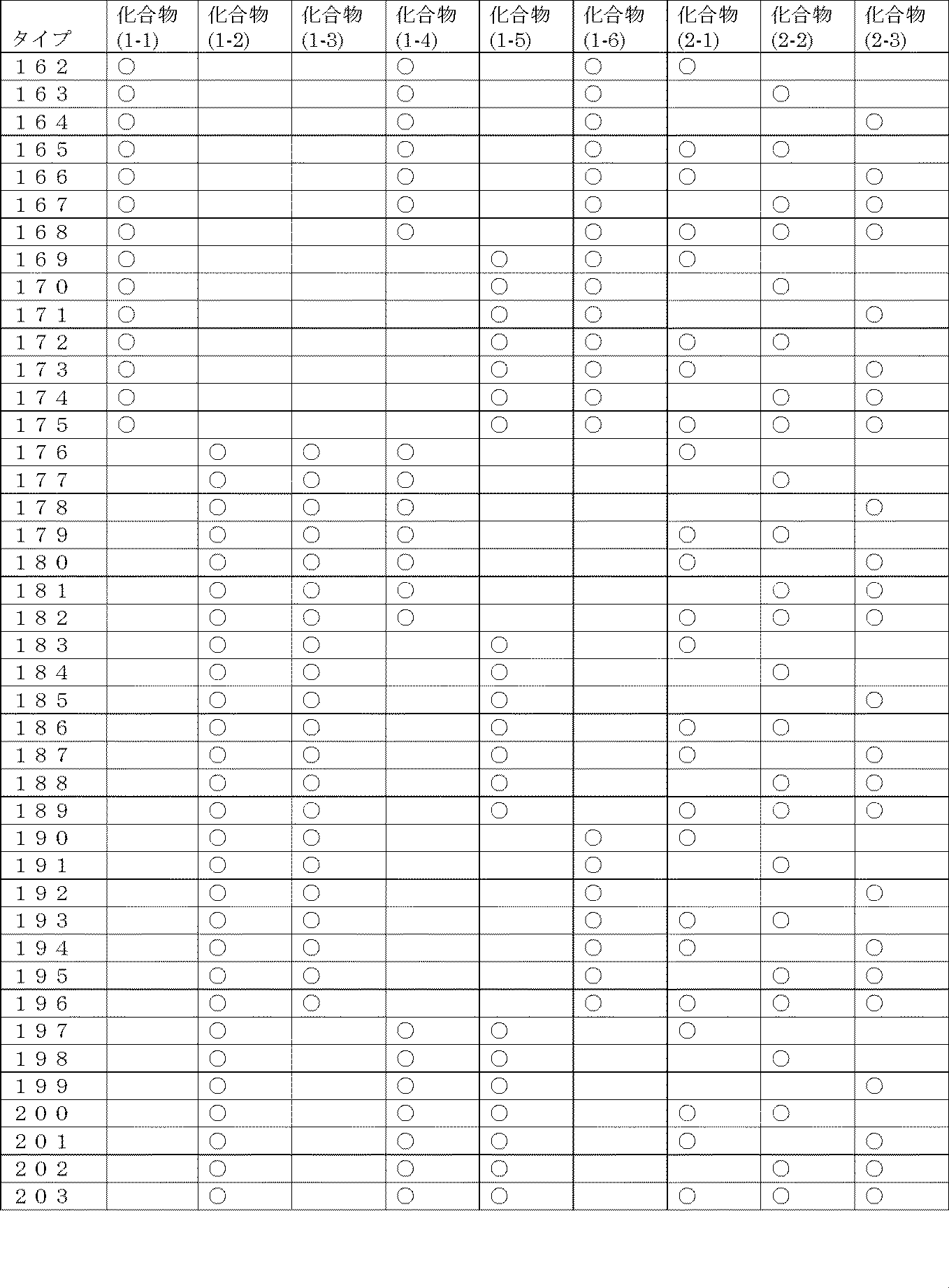
第一に、組成物における成分の構成を説明する。化合物(1−1)〜(1−6)および化合物(2−1)〜(2−3)の組み合わせは399通りである。これをタイプ1〜タイプ399に分類して表2〜表11にまとめる。表2〜表11においてマル印は該当する化合物が成分であることを意味する。空欄は該当する化合物が成分でないことを意味する。例えば、タイプ1は化合物(1−1)、化合物(1−2)および化合物(2−1)が組成物に含有される成分であることを意味する。 First, the composition of the components in the composition will be described. There are 399 combinations of the compounds (1-1) to (1-6) and the compounds (2-1) to (2-3). These are classified into Type 1 to Type 399 and summarized in Tables 2 to 11. In Tables 2 to 11, a circle mark means that the corresponding compound is a component. A blank means that the corresponding compound is not a component. For example, type 1 means that compound (1-1), compound (1-2), and compound (2-1) are components contained in the composition.
表2.化合物の組み合わせ例(1)
表3.化合物の組み合わせ例(2)
表4.化合物の組み合わせ例(3)
表5.化合物の組み合わせ例(4)
表6.化合物の組み合わせ例(5)
表7.化合物の組み合わせ例(6)
表8.化合物の組み合わせ例(7)
表9.化合物の組み合わせ例(8)
表10.化合物の組み合わせ例(9)
表11.化合物の組み合わせ例(10)
第一成分は式(1−1)〜(1−6)の群から選択された少なくとも2つの式で表される少なくとも2つの化合物である。少なくとも2つの式の例は、式(1−2)および(1−4)、式(1−2)、(1−4)および(1−5)、式(1−2)、(1−4)、(1−5)、および(1−6)などである。式(1−2)で表される化合物は、単一の化合物であってもよいし、または複数の化合物であってもよい。この規則は他の式で表される化合物にも適用される。2つの式で表される少なくとも2つの化合物の好ましい組み合わせは、化合物(1−4)および(1−6)、化合物(1−2)および(1−4)、化合物(1−2)および(1−5)、化合物(1−2)および(1−6)、化合物(1−3)および(1−5)、化合物(1−3)および(1−6)、化合物(1−4)および(1−5)、化合物(1−3)および(1−4)などである。3つの式で表される少なくとも3つの化合物の好ましい組み合わせは、化合物(1−2)、(1−4)および(1−5)、化合物(1−2)、(1−4)および(1−6)、化合物(1−3)、(1−4)および(1−5)、化合物(1−3)、(1−4)および(1−6)などである。小さな粘度の観点からより好ましい組み合わせは、化合物(1−4)および(1−6)、化合物(1−2)および(1−4)、化合物(1−2)、(1−4)および(1−5)、化合物(1−2)、(1−4)、および(1−6)などである。 The first component is at least two compounds represented by at least two formulas selected from the group of formulas (1-1) to (1-6). Examples of at least two formulas are formulas (1-2) and (1-4), formulas (1-2), (1-4) and (1-5), formulas (1-2), (1- 4), (1-5), and (1-6). The compound represented by Formula (1-2) may be a single compound or a plurality of compounds. This rule also applies to compounds represented by other formulas. Preferred combinations of at least two compounds represented by the two formulas include compounds (1-4) and (1-6), compounds (1-2) and (1-4), compounds (1-2) and ( 1-5), compounds (1-2) and (1-6), compounds (1-3) and (1-5), compounds (1-3) and (1-6), compound (1-4) And (1-5), compounds (1-3) and (1-4), and the like. Preferred combinations of at least three compounds represented by the three formulas are compounds (1-2), (1-4) and (1-5), compounds (1-2), (1-4) and (1 -6), compounds (1-3), (1-4) and (1-5), compounds (1-3), (1-4) and (1-6). More preferable combinations from the viewpoint of small viscosity include the compounds (1-4) and (1-6), the compounds (1-2) and (1-4), the compounds (1-2), (1-4) and ( 1-5), compounds (1-2), (1-4), and (1-6).
本発明の組成物は組成物Aと組成物Bに分類される。組成物Aはその他の化合物をさらに含有してもよい。「その他の化合物」は液晶性化合物、添加物、不純物などである。この液晶性化合物は化合物(1−1)〜(1−6)および化合物(2−1)〜(2−3)とは異なる。この液晶性化合物は、特性を調整する目的で組成物に混合される。この添加物は光学活性な化合物、色素、紫外線吸収剤、酸化防止剤などである。液晶のらせん構造を誘起してねじれ角を与える目的で光学活性な化合物が組成物に混合される。GH(guest host)モードを有する素子に適合させるために色素が組成物に混合される。不純物は化合物の合成や組成物の調製のような工程において混入した化合物などである。 The composition of the present invention is classified into Composition A and Composition B. Composition A may further contain other compounds. “Other compounds” are liquid crystal compounds, additives, impurities, and the like. This liquid crystal compound is different from the compounds (1-1) to (1-6) and the compounds (2-1) to (2-3). This liquid crystalline compound is mixed with the composition for the purpose of adjusting the characteristics. This additive includes an optically active compound, a dye, an ultraviolet absorber, an antioxidant, and the like. An optically active compound is mixed with the composition for the purpose of inducing a helical structure of liquid crystal to give a twist angle. A dye is mixed with the composition in order to be compatible with a device having a guest host (GH) mode. Impurities include compounds mixed in processes such as compound synthesis and composition preparation.
組成物Bは、実質的に化合物(1−1)〜(1−6)および化合物(2−1)〜(2−3)から選択された化合物のみからなる。「実質的に」は、これらの化合物とは異なる液晶性化合物を組成物Bが含有しないことを意味する。「実質的に」は、添加物、不純物などを組成物Bがさらに含有してもよいこと意味する。組成物Bは組成物Aに比較して成分の数が少ない。組成物Bはコストの観点から組成物Aよりも好ましい。その他の液晶性化合物を混合することによって物性をさらに調整できるので、組成物Aは組成物Bよりも好ましい。 Composition B consists essentially of compounds selected from compounds (1-1) to (1-6) and compounds (2-1) to (2-3). “Substantially” means that the composition B does not contain a liquid crystal compound different from these compounds. “Substantially” means that the composition B may further contain additives, impurities, and the like. Composition B has fewer components than composition A. The composition B is more preferable than the composition A from the viewpoint of cost. Since the physical properties can be further adjusted by mixing other liquid crystal compounds, the composition A is preferable to the composition B.
紫外線吸収剤の例は、ベンゾフェノン、ベンゾエート、トリアゾールなどである。ベンゾフェノンの例は、2−ヒドロキシ−4−オクトキシベンゾフェノンなどである。ベンゾエートの例は、2,4−ジ−tert−ブチルフェニル−3,5−ジ−tert−ブチル−4−ヒドロキシベンゾエートなどである。トリアゾールの例は、2−(2−ヒドロキシ−5−メチルフェニル)ベンゾトリアゾール、2−[2−ヒドロキシ−3−(3,4,5,6−テトラヒドロキシフタルイミド−メチル)−5−メチルフェニル]ベンゾトリアゾール、2−(3−tert−ブチル−2−ヒドロキシ−5−メチルフェニル)−5−クロロベンゾトリアゾールなどである。 Examples of UV absorbers are benzophenone, benzoate, triazole and the like. Examples of benzophenone include 2-hydroxy-4-octoxybenzophenone. Examples of benzoates include 2,4-di-tert-butylphenyl-3,5-di-tert-butyl-4-hydroxybenzoate. Examples of triazoles are 2- (2-hydroxy-5-methylphenyl) benzotriazole, 2- [2-hydroxy-3- (3,4,5,6-tetrahydroxyphthalimido-methyl) -5-methylphenyl] And benzotriazole, 2- (3-tert-butyl-2-hydroxy-5-methylphenyl) -5-chlorobenzotriazole.
酸化防止剤の例は、フェノール、有機硫黄化合物などである。フェノールの例は、3,5−ジ−tert−ブチル−4−ヒドロキシトルエン、2,2’−メチレンビス(6−tert−ブチル−4−メチルフェノール)、4,4’−ブチリデンビス(6−tert−ブチル−3−メチルフェノール)、2,6−ジ−tert−ブチル−4−(2−オクタデシルオキシカルボニル)エチルフェノール、ペンタエリスリトールテトラキス[3−(3,5−ジ−tert−ブチル−4−ヒドロキシフェニル)プロピオネート]などである。有機硫黄化合物の例は、ジラウリル−3,3’−チオプロピオネート、ジミリスチル−3,3’−チオプロピオネート、ジステアリル−3,3’−チオプロピオネート、ペンタエリスリトールテトラキス(3−ラウリルチオプロピオネート)、2−メルカプトベンズイミダゾールなどである。 Examples of the antioxidant include phenol and organic sulfur compounds. Examples of phenol are 3,5-di-tert-butyl-4-hydroxytoluene, 2,2′-methylenebis (6-tert-butyl-4-methylphenol), 4,4′-butylidenebis (6-tert- Butyl-3-methylphenol), 2,6-di-tert-butyl-4- (2-octadecyloxycarbonyl) ethylphenol, pentaerythritol tetrakis [3- (3,5-di-tert-butyl-4-hydroxy Phenyl) propionate] and the like. Examples of organic sulfur compounds are dilauryl-3,3′-thiopropionate, dimyristyl-3,3′-thiopropionate, distearyl-3,3′-thiopropionate, pentaerythritol tetrakis (3- Lauryl thiopropionate), 2-mercaptobenzimidazole and the like.
紫外線吸収剤または酸化防止剤のような添加物は目的を達するためには多い量が好ましい。しかし、多過ぎる量の添加物は組成物の一般的特性には好ましくない。組成物を加熱したとき、多い量の酸化防止剤は比抵抗の低下を防止できる。しかし、多過ぎる量の酸化防止剤は組成物の上限温度を下げることがある。好ましい紫外線吸収剤または酸化防止剤の割合は、組成物の全重量に基づいて例えば10ppm〜500ppmである。好ましい割合は30〜300ppmである。さらに好ましい割合は40〜200ppmである。 Additives such as UV absorbers or antioxidants are preferred in large amounts to achieve their purpose. However, too much of the additive is undesirable for the general properties of the composition. When the composition is heated, a large amount of antioxidant can prevent a decrease in specific resistance. However, an excessive amount of antioxidant may lower the maximum temperature of the composition. A preferred proportion of UV absorber or antioxidant is, for example, from 10 ppm to 500 ppm based on the total weight of the composition. A preferred ratio is 30 to 300 ppm. A more desirable ratio is 40 to 200 ppm.
第二に、成分である化合物の主要な特性、および化合物が組成物に及ぼす主要な効果を説明する。化合物の主要な特性を表12にまとめる。表12の記号において、Lは大きいまたは高い、Mは中程度の、そしてSは小さいまたは低いを意味する。0は誘電率異方性がほぼゼロである(または極めて小さい)ことを意味する。L、MおよびSの記号は、これらの化合物における相対的な評価である。 Second, the main characteristics of the component compound and the main effect of the compound on the composition will be explained. The main properties of the compounds are summarized in Table 12. In the symbols in Table 12, L means large or high, M means moderate, and S means small or low. 0 means that the dielectric anisotropy is almost zero (or very small). The symbols L, M and S are relative ratings in these compounds.
表12.化合物の特性
誘電率異方性が−1.5以下である化合物が第一成分には好ましい。誘電率異方性が−1.5から1.5である化合物が第二成分には好ましい。 A compound having a dielectric anisotropy of −1.5 or less is preferable for the first component. A compound having a dielectric anisotropy of −1.5 to 1.5 is preferable for the second component.
第三に、成分の好ましい割合およびその理由を説明する。第一成分の好ましい割合は、誘電率異方性を負に大きくするために、またはしきい値電圧を下げるために20%以上であり、そして下限温度を下げるために75%以下である。さらに好ましい割合は30〜70%である。第二成分の好ましい割合は、粘度を小さくするために25%以上であり、そして誘電率異方性を負に大きくするために、またはしきい値電圧を下げるために75%以下である。さらに好ましい割合は35%〜65%である。 Third, the preferred ratio of the components and the reason thereof will be described. A desirable ratio of the first component is approximately 20% or more for increasing the dielectric anisotropy negatively or decreasing the threshold voltage, and is approximately 75% or less for decreasing the minimum temperature. A more desirable ratio is 30 to 70%. A desirable ratio of the second component is 25% or more for decreasing the viscosity, and 75% or less for increasing the dielectric anisotropy negatively or decreasing the threshold voltage. A more desirable ratio is from 35% to 65%.
第四に、成分である化合物の好ましい形態を説明する。成分である化合物の化学式において、R1の記号を複数の化合物に用いた。これらの化合物において、任意の2つのR1の意味は同一であってもよいし、または異なってもよい。例えば、化合物(1−1)のR1がアルキルであり、化合物(1−2)のR1がアルケニルであるケースがある。このルールは、R2、A1、A2、A3、またはZ1の記号についても適用する。 Fourth, a preferred form of the component compound will be described. In the chemical formula of the component compound, the symbol R 1 is used for a plurality of compounds. In these compounds, the meanings of any two R 1 may be the same or different. For example, there is a case where R 1 of the compound (1-1) is alkyl and R 1 of the compound (1-2) is alkenyl. This rule also applies to the symbols R 2 , A 1 , A 2 , A 3 , or Z 1 .
好ましいR1は炭素数1〜10のアルキルまたは炭素数2〜10のアルケニルである。より好ましいR1は炭素数1〜7のアルキルまたは炭素数2〜7のアルケニルである。好ましいR2は炭素数1〜10のアルキル、炭素数2〜10のアルケニルまたは炭素数1〜10のアルコキシである。より好ましいR2は炭素数1〜7のアルキル、炭素数2〜7のアルケニルまたは炭素数1〜7のアルコキシである。 Preferred R 1 is alkyl having 1 to 10 carbons or alkenyl having 2 to 10 carbons. More preferable R 1 is alkyl having 1 to 7 carbons or alkenyl having 2 to 7 carbons. Preferred R 2 is alkyl having 1 to 10 carbons, alkenyl having 2 to 10 carbons or alkoxy having 1 to 10 carbons. More preferable R 2 is alkyl having 1 to 7 carbons, alkenyl having 2 to 7 carbons or alkoxy having 1 to 7 carbons.
好ましいアルキルは、メチル、エチル、プロピル、ブチル、ペンチル、ヘキシル、ヘプチル、またはオクチルである。さらに好ましいアルキルは、エチル、プロピル、ブチル、ペンチル、またはヘプチルである。 Preferred alkyl is methyl, ethyl, propyl, butyl, pentyl, hexyl, heptyl, or octyl. More preferred alkyl is ethyl, propyl, butyl, pentyl, or heptyl.
好ましいアルケニルは、ビニル、1−プロペニル、2−プロペニル、1−ブテニル、2−ブテニル、3−ブテニル、1−ペンテニル、2−ペンテニル、3−ペンテニル、4−ペンテニル、1−ヘキセニル、2−ヘキセニル、3−ヘキセニル、4−ヘキセニル、または5−ヘキセニルである。さらに好ましいアルケニルは、ビニル、1−プロペニル、3−ブテニル、または3−ペンテニルである。これらのアルケニルにおける−CH=CH−の好ましい立体配置は、二重結合の位置に依存する。1−プロペニル、1−ブテニル、1−ペンテニル、1−ヘキセニル、3−ペンテニル、3−ヘキセニルのようなアルケニルにおいてはトランスが好ましい。2−ブテニル、2−ペンテニル、2−ヘキセニルのようなアルケニルにおいてはシスが好ましい。 Preferred alkenyl is vinyl, 1-propenyl, 2-propenyl, 1-butenyl, 2-butenyl, 3-butenyl, 1-pentenyl, 2-pentenyl, 3-pentenyl, 4-pentenyl, 1-hexenyl, 2-hexenyl, 3-hexenyl, 4-hexenyl, or 5-hexenyl. More preferred alkenyl is vinyl, 1-propenyl, 3-butenyl, or 3-pentenyl. The preferred configuration of —CH═CH— in these alkenyls depends on the position of the double bond. Trans is preferable in alkenyl such as 1-propenyl, 1-butenyl, 1-pentenyl, 1-hexenyl, 3-pentenyl and 3-hexenyl. Cis is preferable in alkenyl such as 2-butenyl, 2-pentenyl and 2-hexenyl.
好ましいアルコキシは、メトキシ、エトキシ、プロポキシ、ブトキシ、ペンチルオキシ、ヘキシルオキシ、またはヘプチルオキシである。さらに好ましいアルコキシは、メトキシまたはエトキシである。 Preferred alkoxy is methoxy, ethoxy, propoxy, butoxy, pentyloxy, hexyloxy, or heptyloxy. More preferred alkoxy is methoxy or ethoxy.
成分である化合物において、1,4−シクロヘキシレンに関する立体配置は、シスよりもトランスが好ましい。A1またはA3に関する「任意の水素がフッ素で置き換えられた1,4−フェニレン」は、2−フルオロ−1,4−フェニレン、2,5−ジフルオロ−1,4−フェニレン、2,6−ジフルオロ−1,4−フェニレン、2,3,5−トリフルオロ−1,4−フェニレン、または2,3,5,6−テトラ−1,4−フェニレンである。好ましいA1またはA3は1,4−フェニレン、2−フルオロ−1,4−フェニレン、2,5−ジフルオロ−1,4−フェニレン、または、2,6−ジフルオロ−1,4−フェニレンである。さらに好ましいA1またはA3は、1,4−フェニレンまたは2−フルオロ−1,4−フェニレンである。2−フルオロ−1,4−フェニレンは3−フルオロ−1、4−フェニレンと同一であるので、後者は例示しなかった。この規則は、2,5−ジフルオロ−1,4−フェニレンと3,6−ジフルオロ−1,4−フェニレンとの関係などにも適用される。 In the compound as a component, trans is preferable to cis for the configuration of 1,4-cyclohexylene. “1,4-phenylene in which any hydrogen is replaced by fluorine” for A 1 or A 3 is 2-fluoro-1,4-phenylene, 2,5-difluoro-1,4-phenylene, 2,6- Difluoro-1,4-phenylene, 2,3,5-trifluoro-1,4-phenylene, or 2,3,5,6-tetra-1,4-phenylene. Preferred A 1 or A 3 is 1,4-phenylene, 2-fluoro-1,4-phenylene, 2,5-difluoro-1,4-phenylene, or 2,6-difluoro-1,4-phenylene. . Further preferred A 1 or A 3 is 1,4-phenylene or 2-fluoro-1,4-phenylene. Since 2-fluoro-1,4-phenylene is the same as 3-fluoro-1,4-phenylene, the latter was not exemplified. This rule also applies to the relationship between 2,5-difluoro-1,4-phenylene and 3,6-difluoro-1,4-phenylene.
第五に、成分である化合物の具体的な例を示す。好ましい化合物(1−2)は、化合物(1−2−1)および(1−2−2)である。好ましい化合物(1−2)は、化合物(1−2−1)である。好ましい化合物(2−1)は、化合物(2−1−1)〜(2−1−4)である。好ましい化合物(2−2)は、化合物(2−2−1)〜(2−2−6)である。好ましい化合物(2−3)は、化合物(2−3−1)〜(2−3−4)である。より好ましい化合物(2−1)〜(2−3)は、化合物(2−1−1)、(2−1−2)、(2−2−1)、(2−2−4)、(2−3−1)、および(2−3−4)である。これらの化合物において、R1およびR2の記号を複数の化合物に用いた。任意の2つの化合物において、R1の意味は同一であってもよいし、または異なってもよい。この規則はすでに記載した。 Fifth, specific examples of compounds as components are shown. Preferred compounds (1-2) are compounds (1-2-1) and (1-2-2). Desirable compound (1-2) is compound (1-2-1). Preferred compounds (2-1) are compounds (2-1-1) to (2-1-4). Desirable compounds (2-2) are compounds (2-2-1) to (2-2-6). Preferred compounds (2-3) are compounds (2-3-1) to (2-3-4). More preferred compounds (2-1) to (2-3) are the compounds (2-1-1), (2-1-2), (2-2-1), (2-2-4), ( 2-3-1) and (2-3-4). In these compounds, the symbols R 1 and R 2 were used for a plurality of compounds. In any two compounds, the meanings of R 1 may be the same or different. This rule has already been described.
R1はアルキルまたはアルケニルである。好ましいR1は炭素数1〜10のアルキルまたは炭素数2〜10のアルケニルである。R2はアルキル、アルケニル、またはアルコキシである。好ましいR2は炭素数1〜10のアルキル、炭素数2〜10のアルケニルまたは炭素数1〜10のアルコキシである。好ましいアルキル、アルケニル、またはアルコキシ、およびさらに好ましいアルキル、アルケニル、またはアルコキシはすでに記載したとおりである。これらアルケニルにおいて、−CH=CH−の好ましい立体配置は、すでに記載したとおりである。これらの好ましい化合物において1,4−シクロヘキシレンに関する立体配置はシスよりもトランスが好ましい。 R 1 is alkyl or alkenyl. Preferred R 1 is alkyl having 1 to 10 carbons or alkenyl having 2 to 10 carbons. R 2 is alkyl, alkenyl, or alkoxy. Preferred R 2 is alkyl having 1 to 10 carbons, alkenyl having 2 to 10 carbons or alkoxy having 1 to 10 carbons. Preferred alkyl, alkenyl or alkoxy and more preferred alkyl, alkenyl or alkoxy are as already described. In these alkenyls, the preferred configuration of —CH═CH— is as described above. In these preferable compounds, the configuration of 1,4-cyclohexylene is preferably trans rather than cis.
第六に、成分である化合物の合成法を説明する。これらの化合物は既知の方法によって合成できる。合成法を例示する。化合物(1−4−1)は、特開平9−278698号公報または特開2003−2858号公報に記載された方法を修飾することによって合成する。化合物(2−1−1)は、特開昭59−70624号公報または特開昭60−16940号公報に記載された方法によって合成する。 Sixth, a method for synthesizing the component compounds will be described. These compounds can be synthesized by known methods. The synthesis method is illustrated. Compound (1-4-1) is synthesized by modifying the method described in JP-A-9-278698 or JP-A-2003-2858. Compound (2-1-1) is synthesized by the method described in JP-A-59-70624 or JP-A-60-16940.
合成法を記載しなかった化合物は、オーガニック・シンセシス(Organic Synthesis, John Wiley & Sons, Inc)、オーガニック・リアクション(Organic Reactions, John Wiley & Sons, Inc)、コンプリヘンシブ・オーガニック・シンセシス(Comprehensive Organic Synthesis, Pergamon Press)、新実験化学講座(丸善)などの成書に記載された方法によって合成できる。組成物は、このようにして得た化合物から公知の方法によって調製される。例えば、成分である化合物を混合し、加熱によって互いに溶解させる。 Compounds that have not been described as synthetic methods are Organic Synthesis (John Wiley & Sons, Inc), Organic Reactions (John Wiley & Sons, Inc), Comprehensive Organic Synthesis (Comprehensive Organic) Synthesis, Pergamon Press) and new experimental chemistry course (Maruzen). The composition is prepared from the compound thus obtained by known methods. For example, the component compounds are mixed and dissolved in each other by heating.
本発明の組成物は、主として0.05〜0.11の光学異方性および−6.5〜−2.0の誘電率異方性を有する。好ましい誘電率異方性は、−5.0〜−2.5の範囲である。成分である化合物の割合を制御することによって、またはその他の化合物を混合することによって、0.05〜0.18の光学異方性を有する組成物、さらには0.05〜0.20の光学異方性を有する組成物を調製してもよい。したがって、この組成物はVAモード、IPSモードなどを有するAM素子に適する。この組成物はVAモードを有するAM素子に特に適する。 The composition of the present invention mainly has an optical anisotropy of 0.05 to 0.11 and a dielectric anisotropy of −6.5 to −2.0. A preferable dielectric anisotropy is in the range of −5.0 to −2.5. A composition having an optical anisotropy of 0.05 to 0.18, or an optical of 0.05 to 0.20 by controlling the ratio of the component compounds or by mixing other compounds A composition having anisotropy may be prepared. Therefore, this composition is suitable for an AM device having a VA mode, an IPS mode, and the like. This composition is particularly suitable for an AM device having a VA mode.
TNモードなどを有する素子における電場の方向は、液晶層に対して垂直である。一方、VAモード、IPSモードなどを有する素子における電場の方向は、液晶層に平行である。VAモードを有する素子の構造は、K. Ohmuro, S. Kataoka, T. Sasaki and Y. Koike, SID '97 Digest of Technical Papers, 28, 845 (1997)に報告されている。IPSモードを有する素子の構造は、国際公開91/10936号(US5576867)に報告されている。本発明の組成物は、これらの素子にも適する。 The direction of the electric field in the element having the TN mode or the like is perpendicular to the liquid crystal layer. On the other hand, the direction of the electric field in an element having a VA mode, an IPS mode, or the like is parallel to the liquid crystal layer. The structure of the element having the VA mode is reported in K. Ohmuro, S. Kataoka, T. Sasaki and Y. Koike, SID '97 Digest of Technical Papers, 28, 845 (1997). The structure of an element having an IPS mode is reported in International Publication No. 91/10936 (US Pat. No. 5,576,867). The composition of the present invention is also suitable for these devices.
この組成物はAM素子だけでなくPM素子にも使用することが可能である。この組成物は、PC、TN、STN、OCBなどのモードを有する素子に使用できる。これらの素子が反射型、透過型または半透過型であってもよい。この組成物はマイクロカプセル化して作製したNCAP(nematic curvilinear aligned phase)素子や、PN(polymer network)素子のような、組成物中に三次元の網目状高分子を形成させたPD(polymer dispersed)素子などにも使用できる。
(実施例)
This composition can be used not only for AM devices but also for PM devices. This composition can be used for devices having modes such as PC, TN, STN, and OCB. These elements may be reflective, transmissive, or transflective. This composition is a PD (polymer dispersed) in which a three-dimensional network polymer is formed in the composition, such as a nematic curvilinear aligned phase (NCAP) element produced by microencapsulation or a polymer network (PN) element. It can also be used for devices.
(Example)
実施例により本発明を詳細に説明する。本発明は下記の実施例によって限定されない。実施例における化合物は、下記の表13の定義に基づいて記号により表した。表13において、1,4−シクロヘキシレンに関する立体配置はトランスである。実施例において記号の後にあるかっこ内の番号は好ましい化合物の番号に対応する、(−)の記号はその他の化合物を意味する。化合物の割合(百分率)は、組成物の全重量に基づいた重量百分率(重量%)である。最後に、組成物の特性値をまとめる。 The present invention will be described in detail by examples. The present invention is not limited by the following examples. The compounds in Examples were represented by symbols based on the definitions in Table 13 below. In Table 13, the configuration regarding 1,4-cyclohexylene is trans. In the examples, the number in parentheses after the symbol corresponds to the number of the preferred compound, and the symbol (−) means the other compound. The proportion (percentage) of the compound is a weight percentage (% by weight) based on the total weight of the composition. Finally, the characteristic values of the composition are summarized.
表13.記号を用いた化合物の表記方法
R−(A1)−Z1−……−Zn−(An)−X
特性値の測定は下記の方法にしたがった。それらの多くは、日本電子機械工業会規格(Standard of Electric Industries Association of Japan)EIAJ・ED−2521Aに記載された方法、またはこれを修飾した方法である。 The characteristic values were measured according to the following method. Many of them are the method described in the Standard of Electric Industries Association of Japan EIAJ ED-2521A or a modified method thereof.
ネマチック相の上限温度(NI;℃):偏光顕微鏡を備えた融点測定装置のホットプレートに試料を置き、1℃/分の速度で加熱した。試料の一部がネマチック相から等方性液体に変化したときの温度を測定した。ネマチック相の上限温度を「上限温度」と略すことがある。 Maximum temperature of nematic phase (NI; ° C.): A sample was placed on a hot plate of a melting point measuring apparatus equipped with a polarizing microscope and heated at a rate of 1 ° C./min. The temperature was measured when a part of the sample changed from a nematic phase to an isotropic liquid. The upper limit temperature of the nematic phase may be abbreviated as “upper limit temperature”.
ネマチック相の下限温度(TC;℃):ネマチック相を有する試料を0℃、−10℃、−20℃、−30℃、および−40℃のフリーザー中に10日間保管したあと、液晶相を観察した。例えば、試料が−20℃ではネマチック相のままであり、−30℃では結晶またはスメクチック相に変化したとき、TCを<−20℃と記載した。ネマチック相の下限温度を「下限温度」と略すことがある。 Minimum temperature of nematic phase (T C ; ° C.): A sample having a nematic phase was stored in a freezer at 0 ° C., −10 ° C., −20 ° C., −30 ° C., and −40 ° C. Observed. For example, when the sample remained in the nematic phase at −20 ° C. and changed to a crystalline or smectic phase at −30 ° C., the TC was described as <−20 ° C. The lower limit temperature of the nematic phase may be abbreviated as “lower limit temperature”.
光学異方性(屈折率異方性;Δn;25℃で測定):測定は、波長589nmの光を用い、接眼鏡に偏光板を取り付けたアッベ屈折計により行なった。主プリズムの表面を一方向にラビング(rubbing)したあと、試料を主プリズムに滴下した。屈折率n‖は偏光の方向がラビングの方向と平行であるときに測定した。屈折率n⊥は偏光の方向がラビングの方向と垂直であるときに測定した。光学異方性の値は、Δn=n‖−n⊥、の式から計算した。試料が組成物のときはこの方法によって光学異方性を測定した。試料が化合物のときは、化合物を適切な組成物に混合したあと光学異方性を測定した。化合物の光学異方性は外挿値である。 Optical anisotropy (refractive index anisotropy; Δn; measured at 25 ° C.): Measurement was performed with an Abbe refractometer using a light having a wavelength of 589 nm and a polarizing plate attached to an eyepiece. After rubbing the surface of the main prism in one direction, the sample was dropped on the main prism. The refractive index n‖ was measured when the polarization direction was parallel to the rubbing direction. The refractive index n⊥ was measured when the polarization direction was perpendicular to the rubbing direction. The value of optical anisotropy was calculated from the equation: Δn = n∥−n⊥. When the sample was a composition, the optical anisotropy was measured by this method. When the sample was a compound, the optical anisotropy was measured after mixing the compound with an appropriate composition. The optical anisotropy of the compound is an extrapolated value.
誘電率異方性(Δε;25℃で測定):2枚のガラス基板の間隔(セルギャップ)が20μmであるVA素子に試料を入れた。このVA素子に0.5ボルトを印加して、液晶分子の長軸方向における誘電率(ε‖)を測定した。2枚のガラス基板の間隔が9μmであるTN素子に試料を入れた。このTN素子に0.5ボルトを印加して、液晶分子の短軸方向における誘電率(ε⊥)を測定した。誘電率異方性の値は、Δε=ε‖−ε⊥の式から計算した。負の誘電率異方性を有する組成物をこの方法によって測定した。試料が化合物のときは、化合物を適切な組成物に混合したあと誘電率異方性を測定した。化合物の誘電率異方性は外挿値である。 Dielectric anisotropy (Δε; measured at 25 ° C.): A sample was placed in a VA device in which the distance between two glass substrates (cell gap) was 20 μm. 0.5 volt was applied to the VA element, and the dielectric constant (ε‖) in the major axis direction of the liquid crystal molecules was measured. A sample was put in a TN device in which the distance between two glass substrates was 9 μm. 0.5 volt was applied to this TN device, and the dielectric constant (ε⊥) in the minor axis direction of the liquid crystal molecules was measured. The value of dielectric anisotropy was calculated from the equation: Δε = ε∥−ε⊥. A composition having negative dielectric anisotropy was measured by this method. When the sample was a compound, the dielectric anisotropy was measured after mixing the compound with an appropriate composition. The dielectric anisotropy of the compound is an extrapolated value.
回転粘度(γ1;25℃で測定;mPa・s):測定はM. Imai et al., Molecular Crystals and Liquid Crystals, Vol. 259, 37 (1995)に記載された方法に従った。オクタデシルトリエトキシシランから調製した配向膜を有し、そして2枚のガラス基板の間隔(セルギャップ)が20μmであるVA素子に試料を入れた。VA素子に39ボルトから50ボルトの範囲で1ボルト毎に段階的に印加した。0.2秒の無印加のあと、ただ1つの矩形波(矩形パルス;0.2秒)と無印加(2秒)の条件で印加を繰り返した。この印加によって発生した過渡電流(transient current)のピーク電流(peak current)とピーク時間(peak time)を測定した。これらの測定値とM. Imaiらの論文、40頁の計算式(8)とから回転粘度の値を得た。試料が組成物のときはこの方法によって回転粘度を測定した。試料が化合物のときは、化合物を適切な組成物に混合したあと回転粘度を測定した。化合物の回転粘度は外挿値である。 Rotational viscosity (γ1; measured at 25 ° C .; mPa · s): Measurement was according to the method described in M. Imai et al., Molecular Crystals and Liquid Crystals, Vol. 259, 37 (1995). A sample was put in a VA device having an alignment film prepared from octadecyltriethoxysilane and having a distance (cell gap) between two glass substrates of 20 μm. The voltage was applied to the VA element step by step in the range of 39 to 50 volts. After no application for 0.2 seconds, the application was repeated under the condition of only one rectangular wave (rectangular pulse; 0.2 seconds) and no application (2 seconds). The peak current and peak time of the transient current generated by this application were measured. The value of rotational viscosity was obtained from these measured values and the paper by M. Imai et al., Formula (8) on page 40. When the sample was a composition, the rotational viscosity was measured by this method. When the sample was a compound, the rotational viscosity was measured after mixing the compound with an appropriate composition. The rotational viscosity of the compound is an extrapolated value.
電圧保持率(VHR;25℃と100℃で測定;%):ポリイミド配向膜を有し、そして2枚のガラス基板の間隔(セルギャップ)が6μmであるTN素子に試料を入れた。25℃のTN素子に印加した電圧の波形を陰極線オシロスコープで観測し、単位周期において電圧曲線と横軸との間の面積を求めた。TN素子を取り除いたあと印加した電圧の波形から同様にして面積を求めた。2つの面積の値を比較して電圧保持率を算出した。このようにして得られた値をVHR−1で表した。次に、このTN素子を100℃、250時間加熱した。25℃に戻したあと、同様な方法で電圧保持率を測定した。加熱後に得られた値をVHR−2と表した。この加熱テストは、素子を長時間使用するテストの代わりに行った。 Voltage holding ratio (VHR; measured at 25 ° C. and 100 ° C .;%): A sample was put in a TN device having a polyimide alignment film and a distance (cell gap) between two glass substrates of 6 μm. The waveform of the voltage applied to the TN device at 25 ° C. was observed with a cathode ray oscilloscope, and the area between the voltage curve and the horizontal axis in a unit cycle was obtained. The area was similarly determined from the waveform of the voltage applied after removing the TN element. The voltage holding ratio was calculated by comparing the values of the two areas. The value thus obtained was expressed as VHR-1. Next, this TN device was heated at 100 ° C. for 250 hours. After returning to 25 ° C., the voltage holding ratio was measured by the same method. The value obtained after heating was represented as VHR-2. This heating test was performed in place of the test in which the device was used for a long time.
5−HB(2F,3CF2H)−O2 (1−1−1) 12%
3−HH1OB(2CF2H,3F)−O2 (1−2−1) 11%
3−HH1OB(2F,3CF2H)−O2 (1−2−2) 11%
5−HH−V (2−1−1) 25%
3−HB−O2 (2−1−2) 7%
5−HB−O2 (2−1−2) 7%
V−HHB−1 (2−2−1) 18%
1V−HHEBH−4 (2−3−1) 2%
3−HHEBH−4 (2−3−1) 2%
5−HBB(3F)B−3 (2−3−4) 3%
5−HBB(3F)B−V (2−3−4) 2%
NI=85.8℃;Tc<−20℃;Δn=0.083;Δε=−2.3;γ1=150mPa・s;VHR−1=99.5%.
5-HB (2F, 3CF 2 H) -O2 (1-1-1) 12%
3-HH1OB (2CF 2 H, 3F) -O2 (1-2-1) 11%
3-HH1OB (2F, 3CF 2 H) -O2 (1-2-2) 11%
5-HH-V (2-1-1) 25%
3-HB-O2 (2-1-2) 7%
5-HB-O2 (2-1-2) 7%
V-HHB-1 (2-2-1) 18%
1V-HHEBH-4 (2-3-1) 2%
3-HHEBH-4 (2-3-1) 2%
5-HBB (3F) B-3 (2-3-4) 3%
5-HBB (3F) BV (2-3-4) 2%
NI = 85.8 ° C .; Tc <−20 ° C .; Δn = 0.083; Δε = −2.3; γ1 = 150 mPa · s; VHR-1 = 99.5%.
3−HH1OB(2CF2H,3F)−O2 (1−2−1) 11%
5−HH1OB(2CF2H,3F)−O2 (1−2−1) 11%
3−HBOCF22B(2F,3F)−O2 (1−4−1) 10%
5−HBOCF22B(2F,3F)−O2 (1−4−1) 10%
5−HH−V (2−1−1) 25%
3−HB−O2 (2−1−2) 10%
5−HB−O2 (2−1−2) 9%
3−HHB−1 (2−2−1) 4%
3−HHB(2F)−O2 (2−2−2) 5%
3−HHB(3F)−O2 (2−2−3) 5%
NI=88.3℃;Tc<−20℃;Δn=0.083;Δε=−2.6;γ1=140mPa・s;VHR−1=99.5%.
3-HH1OB (2CF 2 H, 3F) -O2 (1-2-1) 11%
5-HH1OB (2CF 2 H, 3F) -O2 (1-2-1) 11%
3-HBOCF 2 2B (2F, 3F) -O 2 (1-4-1) 10%
5-HBOCF 2 2B (2F, 3F) -O 2 (1-4-1) 10%
5-HH-V (2-1-1) 25%
3-HB-O2 (2-1-2) 10%
5-HB-O2 (2-1-2) 9%
3-HHB-1 (2-2-1) 4%
3-HHB (2F) -O2 (2-2-2) 5%
3-HHB (3F) -O2 (2-2-3) 5%
NI = 88.3 ° C .; Tc <−20 ° C .; Δn = 0.083; Δε = −2.6; γ1 = 140 mPa · s; VHR-1 = 99.5%.
3−HB(2F,3CF2H)−O2 (1−1−1) 9%
5−HB(2F,3CF2H)−O2 (1−1−1) 10%
3−HH1OB(2CF2H,3F)−O2 (1−2−1) 11%
1V−HH1OB(2F,3CF2H)−1 (1−2−2) 11%
5−HH−V (2−1−1) 25%
5−HB−O2 (2−1−2) 7%
V−HHB−1 (2−2−1) 20%
5−HBBH−V1 (2−3−2) 2%
5−HB(3F)BH−3 (2−3−3) 4%
1V2−HB(3F)BH−3 (2−3−3) 1%
NI=78.8℃;Tc<−20℃;Δn=0.079;Δε=−2.7;γ1=152mPa・s;VHR−1=99.4%.
3-HB (2F, 3CF 2 H) -O2 (1-1-1) 9%
5-HB (2F, 3CF 2 H) -O2 (1-1-1) 10%
3-HH1OB (2CF 2 H, 3F) -O2 (1-2-1) 11%
1V-HH1OB (2F, 3CF 2 H) -1 (1-2-2) 11%
5-HH-V (2-1-1) 25%
5-HB-O2 (2-1-2) 7%
V-HHB-1 (2-2-1) 20%
5-HBBH-V1 (2-3-2) 2%
5-HB (3F) BH-3 (2-3-3) 4%
1V2-HB (3F) BH-3 (2-3-3) 1%
NI = 78.8 ° C .; Tc <−20 ° C .; Δn = 0.079; Δε = −2.7; γ1 = 152 mPa · s; VHR-1 = 99.4%.
3−HB(2F,3CF2H)−O2 (1−1−1) 10%
3−HH1OB(2CF2H,3F)−O2 (1−2−1) 11%
5−HH1OB(2CF2H,3F)−O2 (1−2−1) 11%
3−HBOCF22B(2F,3F)−O2 (1−4−1) 10%
5−HBOCF22B(2F,3F)−O2 (1−4−1) 10%
3−HH−4 (2−1−1) 10%
2−HH−5 (2−1−1) 9%
5−HB−O2 (2−1−2) 9%
3−HBB(2F)−O2 (2−2−5) 10%
3−HBB(3F)−O2 (2−2−6) 10%
NI=90.6℃;Tc<−20℃;Δn=0.102;Δε=−3.3;γ1=235mPa・s;VHR−1=99.6%.
3-HB (2F, 3CF 2 H) -O2 (1-1-1) 10%
3-HH1OB (2CF 2 H, 3F) -O2 (1-2-1) 11%
5-HH1OB (2CF 2 H, 3F) -O2 (1-2-1) 11%
3-HBOCF 2 2B (2F, 3F) -O 2 (1-4-1) 10%
5-HBOCF 2 2B (2F, 3F) -O 2 (1-4-1) 10%
3-HH-4 (2-1-1) 10%
2-HH-5 (2-1-1) 9%
5-HB-O2 (2-1-2) 9%
3-HBB (2F) -O2 (2-2-5) 10%
3-HBB (3F) -O2 (2-2-6) 10%
NI = 90.6 ° C .; Tc <−20 ° C .; Δn = 0.102; Δε = −3.3; γ1 = 235 mPa · s; VHR-1 = 99.6%.
3−HB(2F,3CF2H)−O2 (1−1−1) 9%
3−HHB(2F,3CF2H)−O2 (1−3−1) 11%
5−HHB(2F,3CF2H)−O2 (1−3−1) 11%
3−HBOCF22B(2F,3F)−O2 (1−4−1) 10%
5−HBOCF22B(2F,3F)−O2 (1−4−1) 10%
5−HH−V (2−1−1) 22%
5−HB(2F)−O2 (2−1−3) 7%
3−HB(3F)−O2 (2−1−4) 2%
V−HHB−1 (2−2−1) 16%
3−HBB−1 (2−2−4) 2%
NI=80.9℃;Tc<−20℃;Δn=0.083;Δε=−2.8;γ1=180mPa・s;VHR−1=99.5%.
3-HB (2F, 3CF 2 H) -O2 (1-1-1) 9%
3-HHB (2F, 3CF 2 H) -O2 (1-3-1) 11%
5-HHB (2F, 3CF 2 H) -O2 (1-3-1) 11%
3-HBOCF 2 2B (2F, 3F) -O 2 (1-4-1) 10%
5-HBOCF 2 2B (2F, 3F) -O 2 (1-4-1) 10%
5-HH-V (2-1-1) 22%
5-HB (2F) -O2 (2-1-3) 7%
3-HB (3F) -O2 (2-1-4) 2%
V-HHB-1 (2-2-1) 16%
3-HBB-1 (2-2-4) 2%
NI = 80.9 ° C .; Tc <−20 ° C .; Δn = 0.083; Δε = −2.8; γ1 = 180 mPa · s; VHR-1 = 99.5%.
3−HB(2F,3CF2H)−O2 (1−1−1) 9%
3−HHB(2F,3CF2H)−O2 (1−3−1) 11%
5−HHB(2F,3CF2H)−O2 (1−3−1) 11%
3−HBOCF22B(2F,3F)−O2 (1−4−1) 15%
5−HBOCF22B(2F,3F)−O2 (1−4−1) 15%
5−HH−V (2−1−1) 30%
V−HHB−1 (2−2−1) 9%
NI=81.0℃;Tc<−20℃;Δn=0.080;Δε=−3.2;γ1=180mPa・s;VHR−1=99.4%.
(比較例1)
3-HB (2F, 3CF 2 H) -O2 (1-1-1) 9%
3-HHB (2F, 3CF 2 H) -O2 (1-3-1) 11%
5-HHB (2F, 3CF 2 H) -O2 (1-3-1) 11%
3-HBOCF 2 2B (2F, 3F) -O 2 (1-4-1) 15%
5-HBOCF 2 2B (2F, 3F) -O 2 (1-4-1) 15%
5-HH-V (2-1-1) 30%
V-HHB-1 (2-2-1) 9%
NI = 81.0 ° C .; Tc <−20 ° C .; Δn = 0.080; Δε = −3.2; γ1 = 180 mPa · s; VHR-1 = 99.4%.
(Comparative Example 1)
3−HH−4 (2−1−1) 10%
3−HH−5 (2−1−1) 10%
5−HB−3 (2−1−2) 8%
3−HB−O1 (2−1−2) 6%
3−HB(2F,3F)−O4 (−) 15%
5−HB(2F,3F)−O4 (−) 13%
2−HHB(2F,3F)−1 (−) 9%
3−HHB(2F,3F)−1 (−) 9%
3−HHB(2F,3F)−O2 (−) 10%
5−HHB(2F,3F)−O2 (−) 10%
NI=68.0℃;Δε=−2.7;VHR−1=99.6.
(比較例2)
3-HH-4 (2-1-1) 10%
3-HH-5 (2-1-1) 10%
5-HB-3 (2-1-2) 8%
3-HB-O1 (2-1-2) 6%
3-HB (2F, 3F) -O4 (-) 15%
5-HB (2F, 3F) -O4 (-) 13%
2-HHB (2F, 3F) -1 (-) 9%
3-HHB (2F, 3F) -1 (-) 9%
3-HHB (2F, 3F) -O2 (-) 10%
5-HHB (2F, 3F) -O2 (-) 10%
NI = 68.0 ° C .; Δε = −2.7; VHR-1 = 99.6.
(Comparative Example 2)
3−HH−4 (2−1−1) 10%
3−HH−5 (2−1−1) 10%
5−HB−3 (2−1−2) 8%
3−HB−O1 (2−1−2) 6%
3−HB(2F,3F)−O4 (−) 15%
5−HB(2F,3F)−O2 (−) 13%
2−HHB(2F,3F)−1 (−) 9%
3−HHB(2F,3F)−1 (−) 9%
3−HHB(2F,3F)−O2 (−) 10%
5−HHB(2F,3F)−O2 (−) 10%
NI=70.5℃;Δε=−2.8;VHR−1=99.6%.
3-HH-4 (2-1-1) 10%
3-HH-5 (2-1-1) 10%
5-HB-3 (2-1-2) 8%
3-HB-O1 (2-1-2) 6%
3-HB (2F, 3F) -O4 (-) 15%
5-HB (2F, 3F) -O2 (-) 13%
2-HHB (2F, 3F) -1 (-) 9%
3-HHB (2F, 3F) -1 (-) 9%
3-HHB (2F, 3F) -O2 (-) 10%
5-HHB (2F, 3F) -O2 (-) 10%
NI = 70.5 ° C .; Δε = −2.8; VHR-1 = 99.6%.
3−HH1OB(2CF2H,3F)−O2 (1−2−1) 14%
5−HH1OB(2CF2H,3F)−O2 (1−2−1) 14%
3−HBOCF22B(2F,3F)−1 (1−4−1) 9%
5−HBOCF22B(2F,3F)−1 (1−4−1) 9%
3−HBOCF22B(2F,3F)−O2 (1−4−1) 10%
5−HBOCF22B(2F,3F)−O2 (1−4−1) 10%
3−HH−4 (2−1−1) 10%
3−HH−5 (2−1−1) 10%
5−HB−3 (2−1−2) 8%
3−HB−O1 (2−1−2) 6%
NI=76.8℃;Δε=−4.0;VHR−1=99.6%.
3-HH1OB (2CF 2 H, 3F) -O2 (1-2-1) 14%
5-HH1OB (2CF 2 H, 3F) -O2 (1-2-1) 14%
3-HBOCF 2 2B (2F, 3F) -1 (1-4-1) 9%
5-HBOCF 2 2B (2F, 3F) -1 (1-4-1) 9%
3-HBOCF 2 2B (2F, 3F) -O 2 (1-4-1) 10%
5-HBOCF 2 2B (2F, 3F) -O 2 (1-4-1) 10%
3-HH-4 (2-1-1) 10%
3-HH-5 (2-1-1) 10%
5-HB-3 (2-1-2) 8%
3-HB-O1 (2-1-2) 6%
NI = 76.8 ° C .; Δε = −4.0; VHR-1 = 99.6%.
比較例1,2の組成物と比較すると、この実施例7の組成物は同程度のVHR−1、より高い上限温度、そして負により大きな誘電率異方性を有する。 Compared to the compositions of Comparative Examples 1 and 2, the composition of Example 7 has comparable VHR-1, higher maximum temperature, and negative greater dielectric anisotropy.
3−HB(2F,3CF2H)−1 (1−1−1) 5%
3−HH1OB(2CF2H,3F)−1 (1−2−1) 2%
V−HH1OB(2CF2H,3F)−O2 (1−2−1) 10%
5−HH1OB(2CF2H,3F)−O2 (1−2−1) 10%
V−HBOCF22B(2F,3F)−1 (1−4−1) 4%
3−HBOCF22B(2F,3F)−O2 (1−4−1) 8%
5−HBOCF22B(2F,3F)−O2 (1−4−1) 8%
1V−H2EB(2F,3F)−1 (1−5−1) 2%
5−H2EB(2F,3F)−O2 (1−5−1) 2%
3−HH−4 (2−1−1) 10%
2−HH−5 (2−1−1) 10%
3−HB−O2 (2−1−2) 9%
3−HB−OV (2−1−2) 1%
V−HHB−1 (2−2−1) 19%
NI=86.9℃;Tc<−20℃;Δn=0.090;Δε=−3.3;γ1=160mPa・s;VHR−1=99.5%.
3-HB (2F, 3CF 2 H) -1 (1-1-1) 5%
3-HH1OB (2CF 2 H, 3F) -1 (1-2-1) 2%
V-HH1OB (2CF 2 H, 3F) -O2 (1-2-1) 10%
5-HH1OB (2CF 2 H, 3F) -O2 (1-2-1) 10%
V-HBOCF 2 2B (2F, 3F) -1 (1-4-1) 4%
3-HBOCF 2 2B (2F, 3F) -O 2 (1-4-1) 8%
5-HBOCF 2 2B (2F, 3F) -O 2 (1-4-1) 8%
1V-H2EB (2F, 3F) -1 (1-5-1) 2%
5-H2EB (2F, 3F) -O2 (1-5-1) 2%
3-HH-4 (2-1-1) 10%
2-HH-5 (2-1-1) 10%
3-HB-O2 (2-1-2) 9%
3-HB-OV (2-1-2) 1%
V-HHB-1 (2-2-1) 19%
NI = 86.9 ° C .; Tc <−20 ° C .; Δn = 0.090; Δε = −3.3; γ1 = 160 mPa · s; VHR-1 = 99.5%.
1V−HB(2F,3CF2H)−O2 (1−1−1) 9%
V−HHB(2F,3CF2H)−1 (1−3−1) 4%
3−HHB(2F,3CF2H)−O2 (1−3−1) 7%
5−HHB(2F,3CF2H)−O2 (1−3−1) 11%
3−HBOCF22B(2F,3F)−O2 (1−4−1) 15%
5−HBOCF22B(2F,3F)−O2 (1−4−1) 15%
3−HH−O1 (2−1−1) 10%
5−HH−V (2−1−1) 20%
3−HHB−1 (2−2−1) 3%
3−HHB−3 (2−2−1) 4%
3−HHB−O1 (2−2−1) 2%
NI=83.9℃;Tc<−20℃;Δn=0.081;Δε=−3.2;γ1=188mPa・s;VHR−1=99.4%.
1V-HB (2F, 3CF 2 H) -O2 (1-1-1) 9%
V-HHB (2F, 3CF 2 H) -1 (1-3-1) 4%
3-HHB (2F, 3CF 2 H) -O2 (1-3-1) 7%
5-HHB (2F, 3CF 2 H) -O2 (1-3-1) 11%
3-HBOCF 2 2B (2F, 3F) -O 2 (1-4-1) 15%
5-HBOCF 2 2B (2F, 3F) -O 2 (1-4-1) 15%
3-HH-O1 (2-1-1) 10%
5-HH-V (2-1-1) 20%
3-HHB-1 (2-2-1) 3%
3-HHB-3 (2-2-1) 4%
3-HHB-O1 (2-2-1) 2%
NI = 83.9 ° C .; Tc <−20 ° C .; Δn = 0.081; Δε = −3.2; γ1 = 188 mPa · s; VHR-1 = 99.4%.
3−HB(2F,3CF2H)−O2 (1−1−1) 4%
2−HH1O(2CF2H,3F)−O2 (1−2−1) 10%
3−HH1O(2CF2H,3F)−O2 (1−2−1) 10%
3−HBOCF22B(2F,3F)−O2 (1−4−1) 10%
4−HBOCF22B(2F,3F)−O2 (1−4−1) 10%
5−HBOCF22B(2F,3F)−O2 (1−4−1) 10%
5−HH−V (2−1−1) 22%
3−HH−V1 (2−1−1) 6%
V1−HB(2F)−1 (2−1−3) 5%
1V−HB(3F)−2 (2−1−4) 5%
1V−HHB(2F)−1 (2−2−2) 3%
V−HHB(3F)−V (2−2−3) 5%
NI=79.1℃;Tc<−20℃;Δn=0.085;Δε=−4.0;γ1=140mPa・s;VHR−1=99.6%.
3-HB (2F, 3CF 2 H) -O2 (1-1-1) 4%
2-HH1O (2CF 2 H, 3F) -O2 (1-2-1) 10%
3-HH1O (2CF 2 H, 3F) -O2 (1-2-1) 10%
3-HBOCF 2 2B (2F, 3F) -O 2 (1-4-1) 10%
4-HBOCF 2 2B (2F, 3F) -O 2 (1-4-1) 10%
5-HBOCF 2 2B (2F, 3F) -O 2 (1-4-1) 10%
5-HH-V (2-1-1) 22%
3-HH-V1 (2-1-1) 6%
V1-HB (2F) -1 (2-1-3) 5%
1V-HB (3F) -2 (2-1-4) 5%
1V-HHB (2F) -1 (2-2-2) 3%
V-HHB (3F) -V (2-2-3) 5%
NI = 79.1 ° C .; Tc <−20 ° C .; Δn = 0.085; Δε = −4.0; γ1 = 140 mPa · s; VHR-1 = 99.6%.
3−HB(2F,3CF2H)−O2 (1−1−1) 9%
3−HHB(2F,3CF2H)−O2 (1−3−1) 6%
5−HHB(2F,3CF2H)−O2 (1−3−1) 6%
2−HBOCF22B(2F,3F)−O2 (1−4−1) 9%
3−HBOCF22B(2F,3F)−O2 (1−4−1) 11%
4−HBOCF22B(2F,3F)−O2 (1−4−1) 11%
5−HBOCF22B(2F,3F)−O2 (1−4−1) 11%
5−HH−V (2−1−1) 22%
3−HB−O2 (2−1−2) 5%
3−HBB−OV (2−2−4) 2%
V−HBB(2F)−2 (2−2−5) 4%
1V−HBB(3F)−1 (2−2−6) 4%
NI=79.0℃;Tc<−20℃;Δn=0.094;Δε=−3.2;γ1=175mPa・s;VHR−1=99.5%.
3-HB (2F, 3CF 2 H) -O2 (1-1-1) 9%
3-HHB (2F, 3CF 2 H) -O2 (1-3-1) 6%
5-HHB (2F, 3CF 2 H) -O2 (1-3-1) 6%
2-HBOCF 2 2B (2F, 3F) -O 2 (1-4-1) 9%
3-HBOCF 2 2B (2F, 3F) -O 2 (1-4-1) 11%
4-HBOCF 2 2B (2F, 3F) -O 2 (1-4-1) 11%
5-HBOCF 2 2B (2F, 3F) -O 2 (1-4-1) 11%
5-HH-V (2-1-1) 22%
3-HB-O2 (2-1-2) 5%
3-HBB-OV (2-2-4) 2%
V-HBB (2F) -2 (2-2-5) 4%
1V-HBB (3F) -1 (2-2-6) 4%
NI = 79.0 ° C .; Tc <−20 ° C .; Δn = 0.094; Δε = −3.2; γ1 = 175 mPa · s; VHR-1 = 99.5%.
実施例11の組成物に、紫外線吸収剤として100ppmの2−(2−ヒドロキシ−5−メチルフェニル)ベンゾトリアゾールを添加し、そして酸化防止剤として100ppmの3,5−ジ−tert−ブチル−4−ヒドロキシトルエンを添加した。得られた組成物の特性は次のとおりである。NI=79.0℃;Tc<−20℃;Δn=0.094;Δε=−3.2;VHR−1=99.5%. To the composition of Example 11 is added 100 ppm 2- (2-hydroxy-5-methylphenyl) benzotriazole as a UV absorber and 100 ppm 3,5-di-tert-butyl-4 as an antioxidant. -Hydroxytoluene was added. The characteristics of the obtained composition are as follows. NI = 79.0 ° C .; Tc <−20 ° C .; Δn = 0.094; Δε = −3.2; VHR-1 = 99.5%.
3−HH1O(2CF2H,3F)−O2 (1−2−1) 10%
5−HH1O(2CF2H,3F)−O2 (1−2−1) 10%
3−HBOCF22B(2F,3F)−O2 (1−4−1) 15%
5−HBOCF22B(2F,3F)−O2 (1−4−1) 15%
3−BOCF22B(2F,3F)−O2 (1−6−1) 8%
5−HH−V (2−1−1) 30%
3−HB−O2 (2−1−2) 4%
V−HHB−1 (2−2−1) 8%
NI=79.9℃;Tc<−20℃;Δn=0.079;Δε=−3.2;γ1=161mPa・s;VHR−1=99.6%.
3-HH1O (2CF 2 H, 3F) -O2 (1-2-1) 10%
5-HH1O (2CF 2 H, 3F) -O2 (1-2-1) 10%
3-HBOCF 2 2B (2F, 3F) -O 2 (1-4-1) 15%
5-HBOCF 2 2B (2F, 3F) -O 2 (1-4-1) 15%
3-BOCF 2 2B (2F, 3F) -O 2 (1-6-1) 8%
5-HH-V (2-1-1) 30%
3-HB-O2 (2-1-2) 4%
V-HHB-1 (2-2-1) 8%
NI = 79.9 ° C .; Tc <−20 ° C .; Δn = 0.079; Δε = −3.2; γ1 = 161 mPa · s; VHR-1 = 99.6%.
3−HB(2F,3CF2H)−O2 (1−1−1) 9%
3−HHB(2F,3CF2H)−O2 (1−3−1) 11%
5−HHB(2F,3CF2H)−O2 (1−3−1) 11%
3−HBOCF22B(2F,3F)−O2 (1−4−1) 10%
5−HBOCF22B(2F,3F)−O2 (1−4−1) 10%
5−HH−V (2−1−1) 15%
5−HB(2F)−O2 (2−1−3) 7%
3−HB(2F)−O2 (2−1−4) 2%
V−HHB−1 (2−2−1) 16%
3−HBB−1 (2−2−4) 2%
1O1−HH−3 (−) 7%
NI=80.3℃;Tc<−20℃;Δn=0.083;Δε=−2.7;γ1=187mPa・s;VHR−1=99.4%。
3-HB (2F, 3CF 2 H) -O2 (1-1-1) 9%
3-HHB (2F, 3CF 2 H) -O2 (1-3-1) 11%
5-HHB (2F, 3CF 2 H) -O2 (1-3-1) 11%
3-HBOCF 2 2B (2F, 3F) -O 2 (1-4-1) 10%
5-HBOCF 2 2B (2F, 3F) -O 2 (1-4-1) 10%
5-HH-V (2-1-1) 15%
5-HB (2F) -O2 (2-1-3) 7%
3-HB (2F) -O2 (2-1-4) 2%
V-HHB-1 (2-2-1) 16%
3-HBB-1 (2-2-4) 2%
1O1-HH-3 (-) 7%
NI = 80.3 ° C .; Tc <−20 ° C .; Δn = 0.083; Δε = −2.7; γ1 = 187 mPa · s; VHR-1 = 99.4%.
Claims (22)
Priority Applications (2)
| Application Number | Priority Date | Filing Date | Title |
|---|---|---|---|
| JP2004119143A JP2005298733A (en) | 2004-04-14 | 2004-04-14 | Liquid crystal composition and liquid crystal display element |
| US11/107,338 US7306831B1 (en) | 2004-04-14 | 2005-04-14 | Liquid crystal composition and liquid crystal display element |
Applications Claiming Priority (1)
| Application Number | Priority Date | Filing Date | Title |
|---|---|---|---|
| JP2004119143A JP2005298733A (en) | 2004-04-14 | 2004-04-14 | Liquid crystal composition and liquid crystal display element |
Publications (1)
| Publication Number | Publication Date |
|---|---|
| JP2005298733A true JP2005298733A (en) | 2005-10-27 |
Family
ID=35330665
Family Applications (1)
| Application Number | Title | Priority Date | Filing Date |
|---|---|---|---|
| JP2004119143A Pending JP2005298733A (en) | 2004-04-14 | 2004-04-14 | Liquid crystal composition and liquid crystal display element |
Country Status (2)
| Country | Link |
|---|---|
| US (1) | US7306831B1 (en) |
| JP (1) | JP2005298733A (en) |
Cited By (9)
| Publication number | Priority date | Publication date | Assignee | Title |
|---|---|---|---|---|
| WO2007077872A1 (en) | 2006-01-06 | 2007-07-12 | Chisso Corporation | Liquid crystal composition and liquid crystal display element |
| WO2007129810A1 (en) * | 2006-05-08 | 2007-11-15 | Gwangju Institute Of Science And Technology | Synthesis of vinylphenylpyridine and living anionic polymerization |
| EP1958999A1 (en) * | 2007-02-13 | 2008-08-20 | MERCK PATENT GmbH | Liquid crystalline medium |
| WO2008138643A1 (en) * | 2007-05-16 | 2008-11-20 | Merck Patent Gmbh | Liquid- crystalline medium |
| KR20160098975A (en) * | 2015-02-10 | 2016-08-19 | 메르크 파텐트 게엠베하 | Liquid crystal medium |
| JP2017517606A (en) * | 2014-05-27 | 2017-06-29 | メルク パテント ゲゼルシャフト ミット ベシュレンクテル ハフツングMerck Patent Gesellschaft mit beschraenkter Haftung | Liquid crystal media |
| CN109486499A (en) * | 2017-09-11 | 2019-03-19 | 捷恩智株式会社 | Liquid crystal compounds, liquid-crystal composition and the liquid crystal display element that dielectric anisotropy with fluorine xenyl is negative |
| WO2019116901A1 (en) * | 2017-12-11 | 2019-06-20 | Dic株式会社 | Liquid crystal display element |
| WO2019116902A1 (en) * | 2017-12-11 | 2019-06-20 | Dic株式会社 | Liquid crystal display element |
Families Citing this family (9)
| Publication number | Priority date | Publication date | Assignee | Title |
|---|---|---|---|---|
| JP5145711B2 (en) * | 2004-04-01 | 2013-02-20 | Jnc株式会社 | Benzene derivative, liquid crystal composition, and liquid crystal display device |
| JP4876408B2 (en) * | 2005-03-01 | 2012-02-15 | Jnc株式会社 | Liquid crystal composition and liquid crystal display element |
| JP4972888B2 (en) * | 2005-07-13 | 2012-07-11 | Jnc株式会社 | Liquid crystal composition and liquid crystal display element |
| US7595100B2 (en) * | 2006-06-29 | 2009-09-29 | Chisso Corporation | Liquid crystal composition and liquid crystal display device |
| CN105567251B (en) * | 2016-01-13 | 2018-07-31 | 石家庄诚志永华显示材料有限公司 | Liquid-crystal composition |
| KR102580896B1 (en) * | 2016-11-23 | 2023-09-21 | 주식회사 동진쎄미켐 | Polymerizable compound and liquid crystal composition comprising the same |
| WO2018097630A1 (en) * | 2016-11-23 | 2018-05-31 | 주식회사 동진쎄미켐 | Polymerizable compound and liquid crystal composition comprising same |
| JP2020512424A (en) * | 2016-12-09 | 2020-04-23 | メルク パテント ゲゼルシャフト ミット ベシュレンクテル ハフツングMerck Patent Gesellschaft mit beschraenkter Haftung | Liquid crystal medium |
| CN116004252B (en) * | 2023-02-15 | 2025-02-18 | 重庆汉朗精工科技有限公司 | Liquid crystal composition with negative dielectric anisotropy and application thereof |
Family Cites Families (7)
| Publication number | Priority date | Publication date | Assignee | Title |
|---|---|---|---|---|
| DE4027981A1 (en) | 1990-09-04 | 1992-04-30 | Merck Patent Gmbh | MATRIX liquid-crystal display |
| JP3646399B2 (en) | 1996-04-10 | 2005-05-11 | チッソ株式会社 | Liquid crystal compound having fluorine-substituted bond group, liquid crystal composition, and liquid crystal display device |
| DE19803112A1 (en) | 1997-03-14 | 1998-09-17 | Merck Patent Gmbh | Electro-optical liquid crystal display |
| JP3800051B2 (en) | 2000-08-10 | 2006-07-19 | チッソ株式会社 | Liquid crystalline compound, liquid crystal composition and liquid crystal display element having difluoropropyleneoxy group as bonding group |
| EP1179522B1 (en) | 2000-08-10 | 2005-12-07 | Chisso Corporation | Liquid crystalline compound having a difluoropropyleneoxy group as bonding group, liquid crystal composition and liquid crystal display element |
| JP2004035698A (en) | 2002-07-02 | 2004-02-05 | Chisso Corp | Liquid crystal composition and liquid crystal display device |
| US7291368B2 (en) * | 2004-04-09 | 2007-11-06 | Chisso Corporation | Liquid crystal composition and liquid crystal display device |
-
2004
- 2004-04-14 JP JP2004119143A patent/JP2005298733A/en active Pending
-
2005
- 2005-04-14 US US11/107,338 patent/US7306831B1/en not_active Expired - Lifetime
Cited By (20)
| Publication number | Priority date | Publication date | Assignee | Title |
|---|---|---|---|---|
| JPWO2007077872A1 (en) * | 2006-01-06 | 2009-06-11 | チッソ株式会社 | Liquid crystal composition and liquid crystal display element |
| WO2007077872A1 (en) | 2006-01-06 | 2007-07-12 | Chisso Corporation | Liquid crystal composition and liquid crystal display element |
| US7767110B2 (en) | 2006-01-06 | 2010-08-03 | Chisso Corporation | Liquid crystal composition and liquid crystal display device |
| WO2007129810A1 (en) * | 2006-05-08 | 2007-11-15 | Gwangju Institute Of Science And Technology | Synthesis of vinylphenylpyridine and living anionic polymerization |
| US8110642B2 (en) | 2006-05-08 | 2012-02-07 | Gwangju Institute Of Science And Technology | Synthesis of vinylphenylpyridine and living anionic polymerization |
| JP2013177594A (en) * | 2007-02-13 | 2013-09-09 | Merck Patent Gmbh | Liquid crystal medium |
| JP2008208365A (en) * | 2007-02-13 | 2008-09-11 | Merck Patent Gmbh | Liquid crystal media |
| US8361568B2 (en) * | 2007-02-13 | 2013-01-29 | Merck Patent Gmbh | Liquid-crystalline medium |
| US8475889B2 (en) | 2007-02-13 | 2013-07-02 | Merck Patent Gmbh | Liquid-crystalline medium |
| EP1958999A1 (en) * | 2007-02-13 | 2008-08-20 | MERCK PATENT GmbH | Liquid crystalline medium |
| WO2008138643A1 (en) * | 2007-05-16 | 2008-11-20 | Merck Patent Gmbh | Liquid- crystalline medium |
| JP2017517606A (en) * | 2014-05-27 | 2017-06-29 | メルク パテント ゲゼルシャフト ミット ベシュレンクテル ハフツングMerck Patent Gesellschaft mit beschraenkter Haftung | Liquid crystal media |
| KR20160098975A (en) * | 2015-02-10 | 2016-08-19 | 메르크 파텐트 게엠베하 | Liquid crystal medium |
| KR102539268B1 (en) | 2015-02-10 | 2023-06-07 | 메르크 파텐트 게엠베하 | Liquid crystal medium |
| CN109486499A (en) * | 2017-09-11 | 2019-03-19 | 捷恩智株式会社 | Liquid crystal compounds, liquid-crystal composition and the liquid crystal display element that dielectric anisotropy with fluorine xenyl is negative |
| JP2019048780A (en) * | 2017-09-11 | 2019-03-28 | Jnc株式会社 | LIQUID CRYSTALLINE COMPOUND HAVING FLUOROPHOLYBIFER, A DIFFERENTIAL DISTANCE AISOTROPY, LIQUID CRYSTAL COMPOSITION, AND LIQUID CRYSTAL DISPLAY DEVICE |
| US10533136B2 (en) | 2017-09-11 | 2020-01-14 | Jnc Corporation | Liquid crystalline compound having fluorobiphenyl group and negative dielectric anisotropy, liquid crystal composition, and liquid crystal display element |
| WO2019116901A1 (en) * | 2017-12-11 | 2019-06-20 | Dic株式会社 | Liquid crystal display element |
| WO2019116902A1 (en) * | 2017-12-11 | 2019-06-20 | Dic株式会社 | Liquid crystal display element |
| CN111315846A (en) * | 2017-12-11 | 2020-06-19 | Dic株式会社 | Liquid crystal display element |
Also Published As
| Publication number | Publication date |
|---|---|
| US7306831B1 (en) | 2007-12-11 |
Similar Documents
| Publication | Publication Date | Title |
|---|---|---|
| JP5206667B2 (en) | Liquid crystal composition and liquid crystal display element | |
| JP5472233B2 (en) | Liquid crystal composition and liquid crystal display element | |
| JP5391528B2 (en) | Liquid crystal composition and liquid crystal display element | |
| JP5245828B2 (en) | Liquid crystal composition and liquid crystal display element | |
| JP5206666B2 (en) | Liquid crystal composition and liquid crystal display element | |
| JP5051358B2 (en) | Liquid crystal composition and liquid crystal display element | |
| CN101356251A (en) | Liquid crystal composition and liquid crystal display element | |
| US7306831B1 (en) | Liquid crystal composition and liquid crystal display element | |
| TWI835934B (en) | Liquid crystal compositions and their uses, and liquid crystal display elements | |
| JP4857552B2 (en) | Liquid crystal composition and liquid crystal display element | |
| WO2010047206A1 (en) | Liquid crystal composition and liquid crystal display element | |
| JP2004035698A (en) | Liquid crystal composition and liquid crystal display device | |
| JP5428246B2 (en) | Liquid crystal composition and liquid crystal display element | |
| US6921560B2 (en) | Liquid crystal composition and liquid crystal display element | |
| JP4876408B2 (en) | Liquid crystal composition and liquid crystal display element | |
| JP5352969B2 (en) | Liquid crystal composition and liquid crystal display element | |
| JP4915516B2 (en) | Liquid crystal composition and liquid crystal display element | |
| JP4962031B2 (en) | Liquid crystal composition and liquid crystal display element | |
| JP2005320511A (en) | Liquid crystal composition and liquid crystal display element | |
| JP2005298734A (en) | Liquid crystal composition and liquid crystal display element | |
| JP4972889B2 (en) | Liquid crystal composition and liquid crystal display element | |
| JP4876569B2 (en) | Liquid crystal composition and liquid crystal display element | |
| JP4876402B2 (en) | Liquid crystal composition and liquid crystal display element | |
| JP5761021B2 (en) | Liquid crystal composition and liquid crystal display element | |
| JP4972888B2 (en) | Liquid crystal composition and liquid crystal display element |