JP2005298645A - Epoxy resin molding material for sealing and electronic part device - Google Patents
Epoxy resin molding material for sealing and electronic part device Download PDFInfo
- Publication number
- JP2005298645A JP2005298645A JP2004115637A JP2004115637A JP2005298645A JP 2005298645 A JP2005298645 A JP 2005298645A JP 2004115637 A JP2004115637 A JP 2004115637A JP 2004115637 A JP2004115637 A JP 2004115637A JP 2005298645 A JP2005298645 A JP 2005298645A
- Authority
- JP
- Japan
- Prior art keywords
- epoxy resin
- molding material
- general formula
- sealing
- resin molding
- Prior art date
- Legal status (The legal status is an assumption and is not a legal conclusion. Google has not performed a legal analysis and makes no representation as to the accuracy of the status listed.)
- Pending
Links
Landscapes
- Compositions Of Macromolecular Compounds (AREA)
- Epoxy Resins (AREA)
Abstract
Description
本発明は、封止用エポキシ樹脂成形材料、及びこの封止用エポキシ樹脂成形材料で封止した素子を備えた電子部品装置に関する。 The present invention relates to an epoxy resin molding material for sealing, and an electronic component device including an element sealed with the epoxy resin molding material for sealing.
従来から、トランジスタ、IC、LSI等の電子部品装置の素子封止の分野では生産性、コスト等の面から樹脂封止が主流となり、エポキシ樹脂成形材料が広く用いられている。この理由としては、エポキシ樹脂が電気特性、耐湿性、耐熱性、機械特性、インサート品との接着性などの諸特性にバランスがとれているためである。 Conventionally, in the field of element sealing of electronic component devices such as transistors, ICs, and LSIs, resin sealing has been the mainstream in terms of productivity and cost, and epoxy resin molding materials have been widely used. This is because epoxy resins are balanced in various properties such as electrical properties, moisture resistance, heat resistance, mechanical properties, and adhesiveness with inserts.
近年は、自動車分野においても電子機器化が進んでいる。自動車用途の電子機器には、耐熱性、耐冷熱サイクル性等において、パーソナルコンピュータ、家電等のいわゆる民生用途より、一段と厳しい信頼性が求められることが多い。
電子機器の耐熱性を高める一般的な手法としては、パッケージのガラス転移点を高める手法が挙げられ、耐冷熱サイクル性を高める手法としては、半導体内部部材と封止用エポキシ樹脂成形材料の熱膨張係数を近づける等の手法が挙げられる。
封止用エポキシ樹脂成形材料には、従来よりデカブロムをはじめとするハロゲン化樹脂やアンチモン化合物が難燃剤として用いられていたが、近年、環境保護の観点からこれらの化合物に量規制の動きがあり、ノンハロゲン化(ノンブロム化)及びノンアンチモン化の要求が出てきている。また、プラスチック封止ICの高温放置特性にブロム化合物が悪影響を及ぼすことが知られており、この観点からもブロム化樹脂量の低減が望まれている。
ブロム化樹脂や酸化アンチモンを用いずに難燃化を達成する手法の一つとしては、有機リン系化合物を添加する方法(例えば、特許文献1参照。)、金属水酸化物を添加する方法(例えば、特許文献2参照。)等の提案がなされているが、それぞれガラス転移点の低下を招く、成形性に悪影響を及ぼす等の問題を解決できていない。金属水酸化物を用いた封止用エポキシ樹脂成形材料の成形性改善に対しては、特許文献3等の報告があるが、その効果は必ずしも充分ではない。
General techniques for increasing the heat resistance of electronic equipment include a technique for increasing the glass transition point of the package, and techniques for improving the thermal cycle resistance include thermal expansion of the semiconductor internal member and the epoxy resin molding material for sealing. A technique such as bringing the coefficients closer is mentioned.
In epoxy resin molding materials for sealing, halogenated resins such as decabromo and antimony compounds have been used as flame retardants in the past, but in recent years there has been a movement to regulate the amount of these compounds from the viewpoint of environmental protection. There is a demand for non-halogenation (non-bromo) and non-antimony. In addition, it is known that a bromo compound has an adverse effect on the high temperature storage characteristics of a plastic encapsulated IC. From this viewpoint, reduction of the amount of bromo resin is desired.
As one of methods for achieving flame retardancy without using brominated resin or antimony oxide, a method of adding an organophosphorus compound (for example, see Patent Document 1), a method of adding a metal hydroxide ( For example, Patent Document 2) has been proposed, but problems such as a decrease in glass transition point and an adverse effect on formability have not been solved. Although there are reports of Patent Document 3 and the like for improving the moldability of an epoxy resin molding material for sealing using a metal hydroxide, the effect is not always sufficient.
ブロム化樹脂や酸化アンチモンを用いない封止用エポキシ樹脂成形材料において、耐冷熱サイクル性を高める為に封止用エポキシ樹脂成形材料の線膨張係数と半導体内部部材とのそれを近づけようとすると、特に銅リードフレームを使用したパッケージでの難燃性確保が困難となる。一方、難燃性確保の為に有機リン系化合物、金属水酸化物等の難燃剤を用いると、ガラス転移点の低下を招く、成形性に悪影響を及ぼす等の問題を抱える。 In an epoxy resin molding material for sealing that does not use brominated resin or antimony oxide, when trying to bring the coefficient of linear expansion of the epoxy resin molding material for sealing close to that of the semiconductor internal member in order to increase the thermal cycle resistance, In particular, it is difficult to ensure flame retardancy in a package using a copper lead frame. On the other hand, when flame retardants such as organophosphorus compounds and metal hydroxides are used to ensure flame retardancy, there are problems such as lowering the glass transition point and adversely affecting moldability.
本発明はかかる状況に鑑みなされたもので、ハロゲン化樹脂やアンチモン化合物を用いることなく高い難燃性を実現し、耐熱性や耐冷熱サイクル性等の信頼性に優れ、連続成形性やパッケージ外観等にも優れる封止用エポキシ樹脂成形材料、及びこれにより封止した素子を備えた電子部品装置を提供しようとするものである。 The present invention has been made in view of such a situation, and realizes high flame retardancy without using a halogenated resin or an antimony compound, and is excellent in reliability such as heat resistance and heat cycle resistance, continuous moldability and package appearance. It is an object of the present invention to provide an epoxy resin molding material for sealing that is superior to the above, and an electronic component device including an element sealed thereby.
本発明者らは上記の課題を解決するために鋭意検討を重ねた結果、封止用エポキシ樹脂成形材料に、特定の構造を有するエポキシ樹脂、特定の構造を有する硬化剤、及び特定の構造を有するエポキシ樹脂と予め混合された特定の離型剤を用いることにより上記の目的を達成しうることを見い出し、本発明を完成するに至った。 As a result of intensive studies to solve the above problems, the present inventors have determined that an epoxy resin molding material for sealing has an epoxy resin having a specific structure, a curing agent having a specific structure, and a specific structure. It has been found that the above-described object can be achieved by using a specific release agent premixed with the epoxy resin having the present invention, and the present invention has been completed.
本発明は
(1)(A)ヒドロキシナフタレン及びジヒドロキシナフタレンの少なくとも一方からなる2量体をグリシジルエーテル化して得られるエポキシ樹脂を含有するエポキシ樹脂、(B)下記一般式(I)で表される化合物を含有する硬化剤、(C)離型剤として下記一般式(II)で表されるエポキシ樹脂及び酸化型ポリオレフィンを予備混合した混合物、及び(D)無機充填剤、を必須成分とし、ハロゲン系難燃剤及びアンチモン系難燃剤の含有量がいずれも成形材料全体の0.1重量%以下である封止用エポキシ樹脂成形材料、
(2)ハロゲン系難燃剤及びアンチモン系難燃剤を含まない前記(1)に記載の封止用エポキシ樹脂成形材料、
(3)(D)無機充填剤量が成形材料全体の70重量%以上90重量%未満である前記(1)又は(2)に記載の封止用エポキシ樹脂成形材料、
(4)さらに、(E)α−オレフィンと無水マレイン酸及び無水マレイン酸誘導体の少なくとも一方との共重合物を1種又は2種以上含む前記(1)〜(3)のいずれかに記載の封止用エポキシ樹脂成形材料、
(5)前記(C)成分の一般式(II)で表されるエポキシ樹脂及び酸化型ポリオレフィンと、前記(E)成分とが予備混合されている前記(4)に記載の封止用エポキシ樹脂成形材料、
(6)(E)成分が下記一般式(III)で表される化合物である前記(4)又は(5)に記載の封止用エポキシ樹脂成形材料、
(7)前記(1)〜(6)のいずれかに記載の封止用エポキシ樹脂成形材料により封止された素子を備えた電子部品装置、
に関する。
The present invention is (1) (A) an epoxy resin containing an epoxy resin obtained by glycidyl etherification of a dimer comprising at least one of hydroxynaphthalene and dihydroxynaphthalene, and represented by the following general formula (I) A curing agent containing a compound, (C) a mixture obtained by premixing an epoxy resin represented by the following general formula (II) and an oxidized polyolefin as a mold release agent, and (D) an inorganic filler are essential components, and halogen Epoxy resin molding material for sealing, wherein the content of the flame retardant and the antimony flame retardant are both 0.1% by weight or less of the whole molding material,
(2) The epoxy resin molding material for sealing according to the above (1), which does not contain a halogen flame retardant and an antimony flame retardant,
(3) (D) The epoxy resin molding material for sealing according to (1) or (2), wherein the amount of the inorganic filler is 70% by weight or more and less than 90% by weight of the entire molding material,
(4) The method according to any one of (1) to (3), further comprising (E) one or more copolymers of an α-olefin and at least one of maleic anhydride and a maleic anhydride derivative. Epoxy resin molding material for sealing,
(5) The epoxy resin for sealing according to (4), wherein the epoxy resin and oxidized polyolefin represented by the general formula (II) of the component (C) and the component (E) are premixed. Molding material,
(6) The epoxy resin molding material for sealing according to the above (4) or (5), wherein the component (E) is a compound represented by the following general formula (III):
(7) An electronic component device including an element sealed with the sealing epoxy resin molding material according to any one of (1) to (6),
About.
本発明になる封止用エポキシ樹脂成形材料は、耐熱性、耐冷熱サイクル性等の信頼性、難燃性、パッケージ汚れを含む成形性に優れ、この封止用エポキシ樹脂成形材料を用いてIC、LSI等の電子部品を封止すれば、耐熱衝撃性、パッケージ反り性等に優れた電子部品装置を得ることができ、その工業的価値は大である。 The epoxy resin molding material for sealing according to the present invention is excellent in reliability such as heat resistance and cold cycle resistance, flame retardancy, and moldability including package dirt. Using this epoxy resin molding material for sealing, If an electronic component such as LSI is sealed, an electronic component device having excellent thermal shock resistance, package warpage, and the like can be obtained, and its industrial value is great.
本発明では、高いガラス転移点と高い難燃性の両立を実現する為に、(A)エポキシ樹脂にヒドロキシナフタレン及びジヒドロキシナフタレンの少なくとも一方からなる2量体をグリシジルエーテル化して得られるエポキシ樹脂を単独又は二種以上併用して含有することが必要である。高いガラス転移点を実現する為には、ヒドロキシナフタレン及びジヒドロキシナフタレンの2量体をグリシジルエーテル化して得られる3官能のエポキシ樹脂を用いることが好ましく、ジヒドロキシナフタレンの2量体をグリシジルエーテル化して得られる4官能のエポキシ樹脂を用いることがより好ましく、これらの混合物を用いても良い。ジヒドロキシナフタレンの2量体をグリシジルエーテル化して得られるエポキシ樹脂を主成分とするエポキシ樹脂としては、市販品としてEXA−4701(大日本インキ化学工業株式会社製商品名)等が入手可能である。
本発明の効果を充分得る為には、前記エポキシ樹脂を(A)成分全体の40重量%以上とすることが好ましく、50重量%以上とすることがより好ましく、60重量%以上とすることが特に好ましい。40重量%未満だと、高いガラス転移点と高い難燃性の両立が困難となる傾向がある。
In the present invention, in order to realize both a high glass transition point and high flame retardancy, an epoxy resin obtained by glycidyl etherification of a dimer composed of at least one of hydroxynaphthalene and dihydroxynaphthalene to (A) an epoxy resin is provided. It is necessary to contain alone or in combination of two or more. In order to realize a high glass transition point, it is preferable to use a trifunctional epoxy resin obtained by glycidyl etherification of a dimer of hydroxynaphthalene and dihydroxynaphthalene, and obtained by glycidyl etherification of a dihydroxynaphthalene dimer. It is more preferable to use a tetrafunctional epoxy resin, and a mixture thereof may be used. As an epoxy resin mainly composed of an epoxy resin obtained by glycidyl etherification of a dihydroxynaphthalene dimer, EXA-4701 (trade name, manufactured by Dainippon Ink & Chemicals, Inc.) and the like are available as commercial products.
In order to sufficiently obtain the effects of the present invention, the epoxy resin is preferably 40% by weight or more, more preferably 50% by weight or more, and more preferably 60% by weight or more of the total component (A). Particularly preferred. If it is less than 40% by weight, it tends to be difficult to achieve both high glass transition point and high flame retardancy.
本発明では、(A)成分として、前記必須のエポキシ樹脂の他に封止用エポキシ樹脂成形材料に一般に使用されているエポキシ樹脂を特に制限なく併用することが可能である。併用可能な樹脂として、例えばフェノールノボラック型エポキシ樹脂、オルソクレゾールノボラック型エポキシ樹脂をはじめとするフェノール、クレゾール、キシレノール、レゾルシン、カテコール、ビスフェノールA、ビスフェノールF等のフェノール類及び/又はα−ナフトール、β−ナフトール、ジヒドロキシナフタレン等のナフトール類とホルムアルデヒド、アセトアルデヒド、プロピオンアルデヒド、ベンズアルデヒド、サリチルアルデヒド等のアルデヒド基を有する化合物とを酸性触媒下で縮合又は共縮合させて得られるノボラック樹脂をエポキシ化したもの、ビスフェノールA、ビスフェノールF、ビスフェノールS、ビスフェノールA/D等のジグリシジルエーテル、アルキル置換又は非置換のビフェノールのジグリシジルエーテルであるビフェニル型エポキシ樹脂、フェノール類及び/又はナフトール類とジメトキシパラキシレン又はビス(メトキシメチル)ビフェニルから合成されるフェノール・アラルキル樹脂のエポキシ化物、スチルベン型エポキシ樹脂、ハイドロキノン型エポキシ樹脂、フタル酸、ダイマー酸等の多塩基酸とエピクロルヒドリンの反応により得られるグリシジルエステル型エポキシ樹脂、ジアミノジフェニルメタン、イソシアヌル酸等のポリアミンとエピクロルヒドリンの反応により得られるグリシジルアミン型エポキシ樹脂、シクロペンタジエンとフェノール類の共縮合樹脂のエポキシ化物であるジシクロペンタジエン型エポキシ樹脂、ナフタレン環を有するエポキシ樹脂、トリフェノールメタン型エポキシ樹脂、トリメチロールプロパン型エポキシ樹脂、テルペン変性エポキシ樹脂、オレフィン結合を過酢酸等の過酸で酸化して得られる線状脂肪族エポキシ樹脂、脂環族エポキシ樹脂、及びこれらのエポキシ樹脂をシリコーン、アクリロニトリル、ブタジエン、イソプレン系ゴム、ポリアミド系樹脂等により変性したエポキシ樹脂などが挙げられる。 In the present invention, as the component (A), in addition to the essential epoxy resin, an epoxy resin generally used for an epoxy resin molding material for sealing can be used in combination without any particular limitation. Examples of resins that can be used in combination include phenols such as phenol novolac type epoxy resins, orthocresol novolac type epoxy resins, phenols such as cresol, xylenol, resorcin, catechol, bisphenol A, bisphenol F, and / or α-naphthol, β An epoxidized novolak resin obtained by condensation or cocondensation of naphthols such as naphthol and dihydroxynaphthalene and a compound having an aldehyde group such as formaldehyde, acetaldehyde, propionaldehyde, benzaldehyde, and salicylaldehyde under an acidic catalyst; Diglycidyl ethers such as bisphenol A, bisphenol F, bisphenol S, bisphenol A / D, and diglycidyl ethers of alkyl-substituted or unsubstituted biphenols Biphenyl type epoxy resin, phenol and / or naphthol and epoxidized phenol / aralkyl resin synthesized from dimethoxyparaxylene or bis (methoxymethyl) biphenyl, stilbene type epoxy resin, hydroquinone type epoxy resin, phthalic acid Glycidyl ester type epoxy resin obtained by reaction of polybasic acid such as dimer acid and epichlorohydrin, glycidylamine type epoxy resin obtained by reaction of polyamine such as diaminodiphenylmethane and isocyanuric acid and epichlorohydrin, co-condensation of cyclopentadiene and phenols Dicyclopentadiene type epoxy resin that is epoxidized resin, epoxy resin having naphthalene ring, triphenolmethane type epoxy resin, trimethylol propylene Type epoxy resin, terpene modified epoxy resin, linear aliphatic epoxy resin obtained by oxidizing olefin bond with peracid such as peracetic acid, alicyclic epoxy resin, and these epoxy resins as silicone, acrylonitrile, butadiene, isoprene An epoxy resin modified with a rubber, a polyamide resin or the like.
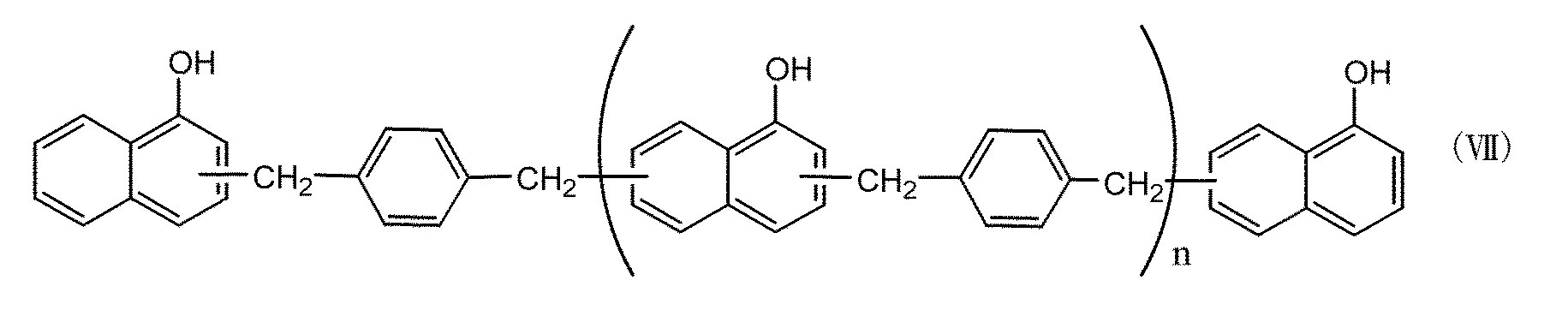
本発明の(B)硬化剤には、特に難燃性の点から、下記一般式(I)で表される化合物を単独又は二種以上併用して含有することが必要である。
上記一般式(I)で表される化合物としては、一般式(IV)で表されるフェノール・アラルキル樹脂、一般式(V)で表されるビフェニル・アラルキル樹脂、一般式(VI)、一般式(VII)で表されるナフトール・アラルキル樹脂等を挙げることができ、難燃性の点からは一般式(V)で表されるビフェニル・アラルキル樹脂を単独又は併用して用いることが好ましく、(B)成分全体の40重量%以上とすることがより好ましく、50重量%以上とすることが特に好ましい。
Examples of the compound represented by the general formula (I) include a phenol / aralkyl resin represented by the general formula (IV), a biphenyl / aralkyl resin represented by the general formula (V), a general formula (VI), and a general formula The naphthol aralkyl resin represented by (VII) can be mentioned, and from the viewpoint of flame retardancy, it is preferable to use the biphenyl aralkyl resin represented by the general formula (V) alone or in combination. It is more preferable to set it as 40 weight% or more of the whole B) component, and it is especially preferable to set it as 50 weight% or more.
上記一般式(IV)で示されるフェノール・アラルキル樹脂としては、市販品として三井化学株式会社製商品名XLCが挙げられ、上記一般式(V)で示されるビフェニル・アラルキル樹脂としては、市販品として明和化成株式会社製商品名MEH−7851が挙げられる。又、上記一般式(VI)で示されるナフトール・アラルキル樹脂としては、市販品として新日鐵化学株式会社製商品名SN−170が挙げられ、上記一般式(VII)で示されるナフトール・アラルキル樹脂としては、市販品として新日鐵化学株式会社製商品名SN−475が挙げられる。また、上記一般式(IV)〜(VII)で示される化合物中の、ベンゼン環及びナフタレン環上の水素原子のいずれかを炭化水素基で置換した化合物も一般式(I)で表される化合物に含まれる。 As a phenol aralkyl resin represented by the general formula (IV), a trade name XLC manufactured by Mitsui Chemicals, Inc. may be mentioned as a commercially available product. As a biphenyl aralkyl resin represented by the general formula (V), Meiwa Kasei Co., Ltd. product name MEH-7851 is mentioned. Moreover, as a naphthol aralkyl resin shown by the said general formula (VI), Nippon Steel Chemical Co., Ltd. brand name SN-170 is mentioned as a commercial item, The naphthol aralkyl resin shown by the said general formula (VII) is mentioned. As a commercial item, Nippon Steel Chemical Co., Ltd. product name SN-475 is mentioned. In addition, a compound in which any one of the hydrogen atoms on the benzene ring and naphthalene ring in the compounds represented by the general formulas (IV) to (VII) is substituted with a hydrocarbon group is also represented by the general formula (I). include.
本発明では、(B)成分として、一般式(I)で表される硬化剤の他に、封止用エポキシ樹脂成形材料に一般に使用されている硬化剤を特に制限なく併用することができる。併用可能な硬化剤として、例えばフェノール、クレゾール、レゾルシン、カテコール、ビスフェノールA、ビスフェノールF、フェニルフェノール、アミノフェノール等のフェノール類及び/又はα−ナフトール、β−ナフトール、ジヒドロキシナフタレン等のナフトール類とホルムアルデヒド、ベンズアルデヒド、サリチルアルデヒド等のアルデヒド基を有する化合物とを酸性触媒下で縮合又は共縮合させて得られるノボラック型フェノール樹脂、フェノール類及び/又はナフトール類とシクロペンタジエンから共重合により合成される、ジシクロペンタジエン型フェノールノボラック樹脂、ナフトールノボラック樹脂等のジシクロペンタジエン型フェノール樹脂、テルペン変性フェノール樹脂、トリフェノールメタン型フェノール樹脂等が挙げられる。 In the present invention, as the component (B), in addition to the curing agent represented by the general formula (I), a curing agent generally used in an epoxy resin molding material for sealing can be used in combination without any particular limitation. Examples of curing agents that can be used in combination include phenols such as phenol, cresol, resorcin, catechol, bisphenol A, bisphenol F, phenylphenol, aminophenol, and / or naphthols such as α-naphthol, β-naphthol, dihydroxynaphthalene, and formaldehyde. , Synthesized by copolymerization from a novolac-type phenolic resin, phenols and / or naphthols, and cyclopentadiene obtained by condensation or cocondensation with a compound having an aldehyde group such as benzaldehyde and salicylaldehyde under an acidic catalyst. Dicyclopentadiene type phenolic resin such as cyclopentadiene type phenol novolak resin, naphthol novolak resin, terpene modified phenolic resin, triphenolmethane type phenolic resin, etc. Can be mentioned.
(A)成分のエポキシ樹脂と(B)成分の硬化剤との当量比、すなわち、エポキシ樹脂中のエポキシ基数/硬化剤中の水酸基数の比は、特に制限はないが、それぞれの未反応分を少なく抑えるために0.5〜2の範囲に設定されることが好ましく、0.6〜1.5がより好ましい。成形性や信頼性に優れる封止用エポキシ樹脂成形材料を得るためには0.8〜1.2の範囲に設定されることがさらに好ましい。 The equivalent ratio of the (A) component epoxy resin and the (B) component curing agent, that is, the ratio of the number of epoxy groups in the epoxy resin / the number of hydroxyl groups in the curing agent is not particularly limited. Is preferably set in the range of 0.5 to 2, more preferably 0.6 to 1.5. In order to obtain an epoxy resin molding material for sealing which is excellent in moldability and reliability, it is more preferable to set in the range of 0.8 to 1.2.
本発明の(C)成分、一般式(II)で表されるエポキシ樹脂及び酸化型ポリオレフィンを予備混合して得られる混合物は、離型剤として働くものである。
本発明では、特に難燃性、予備混合後の流動性の点から、上記一般式(II)で表されるエポキシ樹脂を用いることが必要である。一般式(II)で表されるエポキシ樹脂としては、一般式(II)中、R1、R2が水素である、YL‐7172(ジャパンエポキシレジン株式会社製商品名)が市販品として入手可能である。
The mixture obtained by premixing the (C) component of the present invention, the epoxy resin represented by the general formula (II) and the oxidized polyolefin acts as a release agent.
In the present invention, it is necessary to use an epoxy resin represented by the above general formula (II) particularly from the viewpoint of flame retardancy and fluidity after premixing. As the epoxy resin represented by the general formula (II), YL-7172 (trade name, manufactured by Japan Epoxy Resin Co., Ltd.) in which R 1 and R 2 are hydrogen in the general formula (II) is available as a commercial product. It is.
本発明の(C)成分の酸化型ポリオレフィンは、(C)成分が離型剤として働く為の主成分である。本発明の効果を得る為には(C)成分のポリオレフィンが酸化型であることが必要で、これは、酸化型ポリオレフィンの有するカルボキシル基と(C)成分中のエポキシ樹脂とが反応することで(C)成分中でのポリオレフィンの分散が促進される為である。ポリオレフィンの酸価は5〜50mgKOH/gであることが好ましく、10〜40mgKOH/gであることがより好ましく、15〜30mgKOH/gであることが特に好ましい。酸価が5mgKOH/g未満ではエポキシ樹脂との反応が不十分となって分散不具合の可能性が生じ、酸価が50mgKOH/gを超えるとエポキシ樹脂との親和性が高くなって離型効果が不十分となる可能性が生じる。なお、本発明においてポリオレフィンとは、エチレン重合体、プロピレン重合体、エチレン/プロピレン共重合体等を主成分とした化合物である。 The oxidized polyolefin of the component (C) of the present invention is a main component for the component (C) to function as a release agent. In order to obtain the effect of the present invention, it is necessary that the polyolefin of component (C) is an oxidized type, and this is because the carboxyl group of the oxidized polyolefin reacts with the epoxy resin in component (C). This is because the dispersion of the polyolefin in the component (C) is promoted. The acid value of the polyolefin is preferably 5 to 50 mgKOH / g, more preferably 10 to 40 mgKOH / g, and particularly preferably 15 to 30 mgKOH / g. When the acid value is less than 5 mgKOH / g, the reaction with the epoxy resin is insufficient, and there is a possibility of dispersion failure. When the acid value exceeds 50 mgKOH / g, the affinity with the epoxy resin is increased and the mold release effect is obtained The possibility of becoming insufficient arises. In the present invention, the polyolefin is a compound mainly composed of an ethylene polymer, a propylene polymer, an ethylene / propylene copolymer and the like.
(C)成分のポリオレフィンは又、150℃におけるICI粘度が2.0Pa・s以下であることが好ましく、1.0Pa・s以下であることがより好ましい。2.0Pa・sを超えると、封止用エポキシ樹脂成形材料の流動性に悪影響を与えたり、ベース樹脂との流動性の相異が大きくなったりして、樹脂流動起因によるパッケージ汚れを誘発する傾向がある。ここで、ICI粘度とは、ICIコーンプレート回転粘度計での測定値をいう。 The (C) component polyolefin also preferably has an ICI viscosity at 150 ° C. of 2.0 Pa · s or less, more preferably 1.0 Pa · s or less. If it exceeds 2.0 Pa · s, the fluidity of the epoxy resin molding material for sealing will be adversely affected, or the difference in fluidity with the base resin will increase, causing package contamination due to resin flow. Tend. Here, the ICI viscosity refers to a value measured with an ICI cone plate rotational viscometer.
本発明における(C)成分は、一般式(II)で表されるエポキシ樹脂と酸化型ポリオレフィンとを予備混合することが必要である。エポキシ樹脂と酸化型ポリオレフィンとの重量比率は50/1〜1/5程度とすることが好ましく、20/1〜1/3程度とすることがより好ましく、10/1〜1/2程度とすることが特に好ましい。予備混合の条件としては、50〜200℃/0.5〜8時間程度とすることが好ましく、100〜180℃/1〜6時間程度とすることがより好ましく、150〜170℃/2〜4時間程度とすることが特に好ましい。予備混合の具体的方法としては、例えば、エポキシ樹脂と酸化型ポリオレフィンとを重量比で2/1に混合後、170℃で4時間ほど攪拌混合する等の方法を挙げることが可能である。 In the present invention, the component (C) needs to be premixed with the epoxy resin represented by the general formula (II) and the oxidized polyolefin. The weight ratio of the epoxy resin to the oxidized polyolefin is preferably about 50/1 to 1/5, more preferably about 20/1 to 1/3, and more preferably about 10/1 to 1/2. It is particularly preferred. The premixing condition is preferably about 50 to 200 ° C./0.5 to 8 hours, more preferably about 100 to 180 ° C./1 to 6 hours, and 150 to 170 ° C./2-4. It is particularly preferable to set the time to about. Specific examples of the premixing method include a method in which an epoxy resin and an oxidized polyolefin are mixed at a weight ratio of 2/1 and then stirred and mixed at 170 ° C. for about 4 hours.
(C)成分の配合量は、酸化型ポリオレフィンの含有量が成形材料全体の0.03〜5重量%程度となることが好ましく、0.05〜3重量%程度となることがより好ましく、0.1〜2重量%となることが特に好ましい。0.03重量%未満だと金型離型性の効果が、5重量%を超えるとパッケージ汚れに対する効果が、それぞれ不充分となる可能性がある。 The blending amount of the component (C) is preferably such that the content of the oxidized polyolefin is about 0.03 to 5% by weight, more preferably about 0.05 to 3% by weight of the whole molding material. It is particularly preferable that the amount is 0.1 to 2% by weight. If the amount is less than 0.03% by weight, the mold releasability may be insufficient, and if the amount exceeds 5% by weight, the effect on package contamination may be insufficient.
本発明では又、吸湿性、線膨張係数低減、熱伝導性向上及び強度向上等の為に、(D)無機充填剤を配合することが必要である。無機充填剤としては、例えば、溶融シリカ、結晶シリカ、アルミナ、ジルコン、珪酸カルシウム、炭酸カルシウム、チタン酸カリウム、炭化珪素、窒化珪素、窒化アルミ、窒化ホウ素、ベリリア、ジルコニア、ジルコン、フォステライト、ステアタイト、スピネル、ムライト、チタニア等の粉体、又はこれらを球形化したビーズ、ガラス繊維などが挙げられ、これらは単独で用いても2種以上を併用して用いてもよい。流動性、線膨張係数低減の観点からは、結晶シリカ、溶融シリカを用いることが好ましく、溶融シリカを用いることがより好ましく、球状溶融シリカを用いることが特に好ましい。さらに、本発明の効果を失わない範囲で、難燃効果のある水酸化アルミニウム、水酸化マグネシウム等の金属水酸化物系無機充填剤を添加してもよい。
無機充填剤の配合量は、特に銅リードフレームパッケージでの耐冷熱サイクル性の点から、組成物全体の70重量%以上、90重量%未満とすることが好ましく、70〜88重量%とすることがより好ましく、75〜85重量%とすることが特に好ましい。(D)成分が70重量%未満でも90重量%以上でも、ともに封止用エポキシ樹脂成形材料とリードフレームとの線膨張係数のミスマッチが顕著となる傾向があり、耐冷熱サイクル性に不利となる。
In the present invention, it is also necessary to blend (D) an inorganic filler for hygroscopicity, reduction of linear expansion coefficient, improvement of thermal conductivity and improvement of strength. Examples of the inorganic filler include fused silica, crystalline silica, alumina, zircon, calcium silicate, calcium carbonate, potassium titanate, silicon carbide, silicon nitride, aluminum nitride, boron nitride, beryllia, zirconia, zircon, fosterite, steer. Examples thereof include powders such as tight, spinel, mullite, and titania, or beads formed by spheroidizing these, and glass fibers. These may be used alone or in combination of two or more. From the viewpoint of reducing fluidity and linear expansion coefficient, it is preferable to use crystalline silica or fused silica, more preferably fused silica, and particularly preferably spherical fused silica. Furthermore, you may add metal hydroxide type inorganic fillers, such as aluminum hydroxide and magnesium hydroxide which have a flame-retardant effect, in the range which does not lose the effect of this invention.
The blending amount of the inorganic filler is preferably 70% by weight or more and less than 90% by weight, and preferably 70 to 88% by weight, particularly from the viewpoint of thermal cycle resistance in a copper lead frame package. Is more preferable, and it is especially preferable to set it as 75 to 85 weight%. Even if the component (D) is less than 70% by weight or 90% by weight or more, there is a tendency that the mismatch of the linear expansion coefficient between the epoxy resin molding material for sealing and the lead frame tends to be remarkable, which is disadvantageous for the thermal cycle resistance. .
本発明の効果の1つである良好な成形性は、本発明の(C)成分によりその効果を得ることができるが、さらに(E)成分、α−オレフィンと無水マレイン酸及び無水マレイン酸誘導体の少なくとも一方との共重合物を1種又は2種以上添加することにより、特にパッケージ汚れ防止により一層の効果を得ることが可能となる。(E)成分は主として、(A)成分のエポキシ樹脂及び(C)成分中のエポキシ樹脂と酸化型ポリオレフィンとの分散剤として働くものである。
本発明における(E)成分に用いられるα−オレフィンとしては、特に制限はないが、例えば、1−ペンテン、1−ヘキセン、1−ヘプテン、1−オクテン、1−ノネン、1−デセン、1−ウンデセン、1−ドデセン、1−トリデセン、1−テトラデセン、1−ペンタデセン、1−ヘキサデセン、1−ヘプタデセン、1−オクタデセン、1−ノナデセン、1−エイコセン、1−ドコセン、1−トリコセン、1−テトラコセン、1−ペンタコセン、1−ヘキサコセン、1−ヘプタコセン等の直鎖型α−オレフィン、3−メチル−1−ブテン、3,4−ジメチル−ペンテン、3−メチル−1−ノネン、3,4−ジメチル−オクテン、3−エチル−1−ドデセン、4−メチル−5−エチル−1−オクタデセン、3,4,5−トリエチル−1−1−エイコセン等の分岐型α−オレフィンなどが挙げられ、これらを単独で用いても2種以上を組み合わせて用いてもよい。また、無水マレイン酸の他、無水マレイン酸誘導体としては、メチルマレイン酸無水物、ジメチルマレイン酸無水物等、下記一般式(VIII)で表される化合物を挙げることができ、やはり単独で用いても2種以上を組み合わせても良い。
The α-olefin used for the component (E) in the present invention is not particularly limited. For example, 1-pentene, 1-hexene, 1-heptene, 1-octene, 1-nonene, 1-decene, 1-pentene, Undecene, 1-dodecene, 1-tridecene, 1-tetradecene, 1-pentadecene, 1-hexadecene, 1-heptadecene, 1-octadecene, 1-nonadecene, 1-eicosene, 1-docosene, 1-tricosene, 1-tetracocene, Linear α-olefins such as 1-pentacocene, 1-hexacocene, 1-heptacene, 3-methyl-1-butene, 3,4-dimethyl-pentene, 3-methyl-1-nonene, 3,4-dimethyl- Octene, 3-ethyl-1-dodecene, 4-methyl-5-ethyl-1-octadecene, 3,4,5-triethyl-1--1-e Examples include branched α-olefins such as kosene, and these may be used alone or in combination of two or more. In addition to maleic anhydride, maleic anhydride derivatives may include compounds represented by the following general formula (VIII) such as methylmaleic anhydride, dimethylmaleic anhydride, and the like. Also, two or more kinds may be combined.
α−オレフィンと無水マレイン酸及びその誘導体の少なくとも一方(以下、「無水マレイン酸類」という。)との共重合物は、特に制限はないが、例えば、下記一般式(IX)で示される化合物、下記一般式(X)で示される化合物等が挙げられ、市販品としては、1−エイコセン、1−ドコセン及び1−テトラコセンを原料として用いたニッサンエレクトールD121(日本油脂株式会社製商品名)が入手可能である。
本発明の効果を得る為には、炭素数が10〜40のα‐オレフィンと無水マレイン酸類との共重合体を用いることが好ましく、炭素数が15〜30のα‐オレフィンと無水マレイン酸類との共重合体を用いることがより好ましく、炭素数が18〜25のα‐オレフィンと無水マレイン酸類との共重合体を用いることが特に好ましい。また、α‐オレフィンと無水マレイン酸類との重合比率(例えば上記一般式(IX)及び(X)のm)は、α‐オレフィン/無水マレイン酸類=1/5〜5/1(m=0.2〜5) が好ましく、1/3〜3/1(m=0.33〜3)がより好ましく、1/2〜2/1(m=0.5〜2)が特に好ましい。ほぼ等モル程度の1/1(m=1)前後がさらに好ましい。α‐オレフィンの炭素数が10未満、又はα‐オレフィンと無水マレイン酸類の重合比率が 1/5より小さいと親水性が強くなり過ぎ、(C)成分の酸化型ポリオレフィン系離型剤との相溶性が劣り、α‐オレフィンの炭素数が40を超える、又はα‐オレフィン/無水マレイン酸類の比率が5/1より大きいと疎水性が強くなり過ぎ、(A)成分や(C)成分のエポキシ樹脂との相溶性が劣る、という傾向がある。(E)成分の分子量は金型・パッケージ汚れ防止及び成形性の観点から、70,000以下であることが好ましく、10,000〜50,000がより好ましく、20,000〜40,000がさらに好ましい。ここで、(E)成分の分子量とは常温GPCにより測定された重量平均分子量を指す。
常温GPCによる重量平均分子量の測定方法は以下のとおりである。
溶媒:THF(テトラヒドロフラン)、温度:室温、標準物質:ポリスチレン
測定器:島津製作所製LC−6C
カラム:shodex KF‐802.5+KF‐804+KF‐806
流量:1.0ml/分(試料濃度 約0.2wt/vol%)
注入量:200μl
In order to obtain the effect of the present invention, it is preferable to use a copolymer of an α-olefin having 10 to 40 carbon atoms and maleic anhydrides, and an α-olefin having 15 to 30 carbon atoms and maleic anhydrides can be used. More preferably, a copolymer of an α-olefin having 18 to 25 carbon atoms and maleic anhydride is particularly preferably used. The polymerization ratio of α-olefin to maleic anhydride (for example, m in the above general formulas (IX) and (X)) is α-olefin / maleic anhydride = 1/5 to 5/1 (m = 0.0). 2-5) is preferable, 1/3 to 3/1 (m = 0.33 to 3) is more preferable, and 1/2 to 2/1 (m = 0.5 to 2) is particularly preferable. More preferably, about 1/1 (m = 1), which is approximately equimolar. If the α-olefin has less than 10 carbon atoms, or if the polymerization ratio of the α-olefin and maleic anhydride is less than 1/5, the hydrophilicity becomes too strong, and the phase with the (C) oxidized polyolefin release agent If the α-olefin has more than 40 carbon atoms or the α-olefin / maleic anhydride ratio is greater than 5/1, the hydrophobicity becomes too strong, and the (A) component and (C) component epoxy There is a tendency that the compatibility with the resin is poor. The molecular weight of the component (E) is preferably 70,000 or less, more preferably 10,000 to 50,000, and more preferably 20,000 to 40,000 from the viewpoint of mold / package contamination prevention and moldability. preferable. Here, the molecular weight of (E) component refers to the weight average molecular weight measured by normal temperature GPC.
The measuring method of the weight average molecular weight by normal temperature GPC is as follows.
Solvent: THF (tetrahydrofuran), temperature: room temperature, standard material: polystyrene measuring instrument: LC-6C manufactured by Shimadzu Corporation
Column: shodex KF-802.5 + KF-804 + KF-806
Flow rate: 1.0 ml / min (sample concentration about 0.2 wt / vol%)
Injection volume: 200 μl
α−オレフィンと無水マレイン酸類との共重合物の製造方法としては、特に制限はなく、原材料を反応させる等の一般的な共重合方法を用いることができる。反応には、α−オレフィンと無水マレイン酸類が溶解可能な有機溶剤等を用いてもよい。有機溶剤としては特に制限はないが、トルエンが好ましく、アルコール系溶剤、エーテル系溶剤、アミン系溶剤等も使用できる。反応温度は、使用する有機溶剤の種類によっても異なるが、反応性、生産性の観点から、50〜200℃とすることが好ましく、80〜120℃がより好ましい。反応時間は、共重合物が得られれば特に制限はないが、生産性の観点から1〜30時間とするのが好ましく、より好ましくは2〜15時間、さらに好ましくは4〜10時間である。反応終了後、必要に応じて、加熱減圧下等で未反応成分、溶剤等を除去することができる。その条件は、温度を100〜220℃、より好ましくは120〜180℃、圧力を13.3×10³Pa以下、より好ましくは8×10³Pa以下、時間を0.5〜10時間とすることが好ましい。また、反応には、必要に応じてアミン系触媒、酸触媒等の反応触媒を加えてもよい。反応系のpHは、1〜10程度とするのが好ましい。 There is no restriction | limiting in particular as a manufacturing method of the copolymer of (alpha) -olefin and maleic anhydrides, General copolymerization methods, such as making a raw material react, can be used. For the reaction, an organic solvent or the like in which the α-olefin and maleic anhydride can be dissolved may be used. Although there is no restriction | limiting in particular as an organic solvent, Toluene is preferable and an alcohol solvent, an ether solvent, an amine solvent, etc. can also be used. Although reaction temperature changes also with the kind of organic solvent to be used, it is preferable to set it as 50-200 degreeC from a reactive and productivity viewpoint, and 80-120 degreeC is more preferable. The reaction time is not particularly limited as long as a copolymer can be obtained, but it is preferably 1 to 30 hours, more preferably 2 to 15 hours, and further preferably 4 to 10 hours from the viewpoint of productivity. After completion of the reaction, unreacted components, solvents and the like can be removed as necessary under heating and reduced pressure. The condition is that the temperature is 100 to 220 ° C., more preferably 120 to 180 ° C., the pressure is 13.3 × 10 3 Pa or less, more preferably 8 × 10 3 Pa or less, and the time is 0.5 to 10 hours. It is preferable. Moreover, you may add reaction catalysts, such as an amine catalyst and an acid catalyst, to reaction. The pH of the reaction system is preferably about 1 to 10.
(E)成分のα−オレフィンと無水マレイン酸類との共重合物として、一般式(III)で表される化合物を用いるとより一層効果的である。一般式(III)のp〜s、及びそれらの構成比は、(C)成分の酸化型ポリオレフィンに応じて決定されることが好ましい。
上記一般式(III)で表される化合物は、一般式(III)に記載した通りの単量体の順番に限定されず、また、ブロック共重合物に限定もされない。また、R1は一般式(III)中の二つの炭素原子のどちらと結合していても良いし、R2は式中の二つの酸素原子のどちらと結合していても良い。
一般式(III)で表される化合物の構造は酸化型ポリオレフィンに応じて適宜選択されることが望ましいが、R1が炭素数10〜40のアルキル基、R2〜R4が炭素数5〜30のアルキル基であることが好ましく、R1が炭素数15〜30のアルキル基、R2〜R4が炭素数8〜25のアルキル基であることがより好ましく、R1が炭素数18〜25のアルキル基、R2〜R4が炭素数10〜20のアルキル基であることが特に好ましい。R5〜R10は水素原子又は炭化水素基を表し、R5〜R10のうち少なくとも1つが水素原子であることが好ましく、全てが水素原子であることがより好ましい。一般式(III)で表される化合物として、構造の異なる2種以上の化合物を用いても構わない。
As the (E) component α-olefin and maleic anhydride, a compound represented by the general formula (III) is more effective. It is preferable that p to s of the general formula (III) and the constituent ratio thereof are determined according to the oxidized polyolefin of the component (C).
The compound represented by the general formula (III) is not limited to the order of the monomers as described in the general formula (III), and is not limited to the block copolymer. R 1 may be bonded to any of the two carbon atoms in the general formula (III), and R 2 may be bonded to any of the two oxygen atoms in the formula.
The structure of the compound represented by the general formula (III) is preferably selected as appropriate according to the oxidized polyolefin, but R 1 is an alkyl group having 10 to 40 carbon atoms, and R 2 to R 4 are 5 to 5 carbon atoms. It is preferably an alkyl group having 30 carbon atoms, more preferably R 1 is an alkyl group having 15 to 30 carbon atoms, R 2 to R 4 are alkyl groups having 8 to 25 carbon atoms, and R 1 is 18 to carbon atoms. It is particularly preferable that 25 alkyl groups and R 2 to R 4 are alkyl groups having 10 to 20 carbon atoms. R 5 to R 10 represent a hydrogen atom or a hydrocarbon group, and at least one of R 5 to R 10 is preferably a hydrogen atom, and more preferably all are hydrogen atoms. Two or more compounds having different structures may be used as the compound represented by the general formula (III).
一般式(III)で表される化合物の構造の選択の仕方として、例えば以下のような例を挙げることが可能である。すなわち、酸化型ポリオレフィンの重量平均分子量が7000未満である場合には、一般式(III)のうち、q>(r+s)、かつ1/3<p/(q+r+s)<3/1である化合物を用いることが好ましく、r又はsのどちらか一方が0、かつ1/2<p/(q+r+s)<2/1である化合物を用いることがより好ましく、r=s=0、かつp/(q+r+s)が1前後であることが特に好ましい。一方、酸化型ポリオレフィンの重量平均分子量が7000以上である場合には、一般式(III)でq≦(r+s)、かつ1/2<p/(q+r+s)<2/1である化合物を用いることが好ましく、q=s=0、かつp/(q+r+s)が1前後である化合物を用いることがより好ましい。
また、酸化型ポリオレフィンの重量平均分子量が7000以上の場合には、q=s=0、かつp/(q+r+s)が1前後である化合物と、r=s=0、かつp/(q+r+s)が1前後である化合物を併用して用いることも効果的である。これら2種類の化合物を併用する場合、両者を合わせたqと(r+s)との比率は、5:1〜1:5が好ましく、3:1〜1:3が更に好ましく、2:1〜1:2が特に好ましい。なお、酸化型ポリオレフィンの重量平均分子量は高温GPC(溶媒:ジクロロベンゼン、温度:140℃、標準物質:ポリスチレン)による測定値であり、本発明での測定方法は以下のとおりである。
測定器:Waters社製高温GPC
カラム:ポリマーラボラトリーズ社製商品名PLgel MIXED‐B
10μm(7.5mm×300mm)×2本
流量:1.0ml/分(試料濃度:0.3wt/vol%)
注入量:100μl
Examples of the method for selecting the structure of the compound represented by the general formula (III) include the following examples. That is, when the weight average molecular weight of the oxidized polyolefin is less than 7000, in the general formula (III), a compound satisfying q> (r + s) and 1/3 <p / (q + r + s) <3/1 It is preferable to use a compound in which either r or s is 0 and 1/2 <p / (q + r + s) <2/1, and r = s = 0 and p / (q + r + s ) Is particularly preferably around 1. On the other hand, if the weight average molecular weight of the oxidized polyolefin is 7000 or more, use a compound in which q ≦ (r + s) and 1/2 <p / (q + r + s) <2/1 in the general formula (III). It is more preferable to use a compound in which q = s = 0 and p / (q + r + s) is about 1.
When the weight average molecular weight of the oxidized polyolefin is 7000 or more, a compound in which q = s = 0 and p / (q + r + s) is about 1, and r = s = 0 and p / (q + r + s) is It is also effective to use a compound of about 1 in combination. When these two types of compounds are used in combination, the ratio of q and (r + s), which is a combination of both, is preferably 5: 1 to 1: 5, more preferably 3: 1 to 1: 3, and 2: 1 to 1. : 2 is particularly preferable. The weight average molecular weight of the oxidized polyolefin is a value measured by high temperature GPC (solvent: dichlorobenzene, temperature: 140 ° C., standard material: polystyrene), and the measuring method in the present invention is as follows.
Measuring instrument: High temperature GPC manufactured by Waters
Column: Product name PLgel MIXED-B manufactured by Polymer Laboratories
10 μm (7.5 mm × 300 mm) × 2 flow rate: 1.0 ml / min (sample concentration: 0.3 wt / vol%)
Injection volume: 100 μl
一般式(III)で表される化合物を製造する方法には、特に制限はないが、例えば、予めα−オレフィンと無水マレイン酸との共重合物を作製し、次いで一価のアルコールでエステル化する方法が挙げられる。α−オレフィンと無水マレイン酸との共重合物を一価のアルコールでエステル化する方法としては、特に制限はなく、共重合物に一価アルコールを付加反応させる等の一般的手法を挙げることができる。
前記エステル化に用いられる一価のアルコールとしては、特に制限はないが、例えば、アミルアルコール、イソアミルアルコール、ヘキシルアルコール、ヘプチルアルコール、オクチルアルコール、カプリルアルコール、ノニルアルコール、デシルアルコール、ウンデシルアルコール、ラウリルアルコール、トリデシルアルコール、ミリスチルアルコール、ペンタデシルアルコール、セチルアルコール、ヘプタデシルアルコール、ステアリルアルコール、ノナデシルアルコール、エイコシルアルコール等の直鎖型又は分岐型の脂肪族飽和アルコール、ヘキセノール、2−ヘキセン−1−オール、1−ヘキセン−3−オール、ペンテノール、2−メチル−1ペンテノール等の直鎖型又は分岐型の脂肪族不飽和アルコール、シクロペンタノール、シクロヘキサノール等の脂環式アルコール、ベンジルアルコール、シンナミルアルコール等の芳香族アルコール、フルフリルアルコール等の複素環式アルコールなどが挙げられ、これらを単独で用いても2種以上を組み合わせて用いてもよい。
The method for producing the compound represented by the general formula (III) is not particularly limited. For example, a copolymer of α-olefin and maleic anhydride is prepared in advance and then esterified with a monohydric alcohol. The method of doing is mentioned. The method for esterifying a copolymer of an α-olefin and maleic anhydride with a monohydric alcohol is not particularly limited, and examples thereof include general methods such as addition reaction of a monohydric alcohol to the copolymer. it can.
The monohydric alcohol used for the esterification is not particularly limited, and examples thereof include amyl alcohol, isoamyl alcohol, hexyl alcohol, heptyl alcohol, octyl alcohol, capryl alcohol, nonyl alcohol, decyl alcohol, undecyl alcohol, and lauryl. Linear or branched aliphatic saturated alcohols such as alcohol, tridecyl alcohol, myristyl alcohol, pentadecyl alcohol, cetyl alcohol, heptadecyl alcohol, stearyl alcohol, nonadecyl alcohol, eicosyl alcohol, hexenol, 2-hexene- Linear or branched aliphatic unsaturated alcohols such as 1-ol, 1-hexen-3-ol, pentenol, 2-methyl-1-pentenol, cyclopentanol, Examples include alicyclic alcohols such as clohexanol, aromatic alcohols such as benzyl alcohol and cinnamyl alcohol, and heterocyclic alcohols such as furfuryl alcohol. These may be used alone or in combination of two or more. Also good.
本発明では、(C)成分の一般式(II)で表されるエポキシ樹脂及び酸化型ポリオレフィンに(E)成分を加え、予め予備混合を行うとより一層効果的である。(E)成分の配合量は、(C)成分中の酸化型ポリオレフィン(以下、(C1)とする。)に対し、(C1)/(E)=10/1〜1/3重量比程度が好ましく、5/1〜1/2重量比程度がより好ましく、3/1〜1/1重量比程度が特に好ましい。2種以上の(E)成分を用いる場合には、その合計量と(C1)との添加比率が前記範囲となることが好ましい。
予備混合の条件は、一般式(II)のエポキシ樹脂と酸化型ポリオレフィンを150〜170℃で2〜4時間攪拌混合後に(E)成分を添加し、さらに10分〜3時間程度の攪拌混合を行う等の例を挙げることができる。
In the present invention, it is more effective to add the component (E) to the epoxy resin represented by the general formula (II) of the component (C) and the oxidized polyolefin and perform preliminary mixing in advance. The amount of component (E) is about (C1) / (E) = 10/1 to 1/3 weight ratio with respect to the oxidized polyolefin (hereinafter referred to as (C1)) in component (C). Preferably, about 5/1 to 1/2 weight ratio is more preferable, and about 3/1 to 1/1 weight ratio is particularly preferable. When using 2 or more types of (E) component, it is preferable that the addition ratio of the total amount and (C1) becomes the said range.
The premixing condition is that the epoxy resin of the general formula (II) and the oxidized polyolefin are stirred and mixed at 150 to 170 ° C. for 2 to 4 hours, and then the component (E) is added, and further stirred and mixed for about 10 minutes to 3 hours. Examples such as performing can be given.
本発明には、(A)〜(E)成分以外にも、封止用エポキシ樹脂成形材料において通常使用される硬化促進剤を、特に制限なく用いることができる。硬化促進剤の例を挙げれば、例えば、1,8−ジアザ−ビシクロ(5,4,0)ウンデセン−7、1,5−ジアザ−ビシクロ(4,3,0)ノネン、5、6−ジブチルアミノ−1,8−ジアザ−ビシクロ(5,4,0)ウンデセン−7等のシクロアミジン化合物及びこれらの化合物に無水マレイン酸、1,4−ベンゾキノン、2,5−トルキノン、1,4−ナフトキノン、2,3−ジメチルベンゾキノン、2,6−ジメチルベンゾキノン、2,3−ジメトキシ−5−メチル−1,4−ベンゾキノン、2,3−ジメトキシ−1,4−ベンゾキノン、フェニル−1,4−ベンゾキノン等のキノン化合物、ジアゾフェニルメタン、フェノール樹脂等のπ結合をもつ化合物を付加してなる分子内分極を有する化合物、ベンジルジメチルアミン、トリエタノールアミン、ジメチルアミノエタノール、トリス(ジメチルアミノメチル)フェノール等の3級アミン化合物及びこれらの誘導体、2−メチルイミダゾール、2−フェニルイミダゾール、2−フェニル−4−メチルイミダゾール等のイミダゾール化合物及びこれらの誘導体、トリブチルホスフィン、メチルジフェニルホスフィン、トリフェニルホスフィン、トリス(4−メチルフェニル)ホスフィン、ジフェニルホスフィン、フェニルホスフィン等の有機ホスフィン、及びこれらの有機ホスフィンに無水マレイン酸、上記キノン化合物、ジアゾフェニルメタン、フェノール樹脂等のπ結合をもつ化合物を付加してなる分子内分極を有する化合物等の有機リン化合物、テトラフェニルホスホニウムテトラフェニルボレート、トリフェニルホスフィンテトラフェニルボレート、2−エチル−4−メチルイミダゾールテトラフェニルボレート、N−メチルモルホリンテトラフェニルボレート等のテトラフェニルボロン塩及びこれらの誘導体などが挙げられ、これらを単独で用いても2種以上を組み合わせて用いてもよい。中でも成形性の観点から、有機リン化合物が好ましく、有機ホスフィン及び有機ホスフィンとキノン化合物との付加物がより好ましく、トリフェニルホスフィン、及び、トリフェニルホスフィン、トリス(4−メチルフェニル)ホスフィン、トリス(4−メトキシフェニル)ホスフィン等の第三ホスフィンとp−ベンゾキノン、1,4−ナフトキノン等のキノン化合物との付加物がさらに好ましい。 In the present invention, in addition to the components (A) to (E), a curing accelerator usually used in an epoxy resin molding material for sealing can be used without particular limitation. Examples of curing accelerators include, for example, 1,8-diaza-bicyclo (5,4,0) undecene-7, 1,5-diaza-bicyclo (4,3,0) nonene, 5,6-dibutyl. Cycloamidine compounds such as amino-1,8-diaza-bicyclo (5,4,0) undecene-7 and these compounds, maleic anhydride, 1,4-benzoquinone, 2,5-toluquinone, 1,4-naphthoquinone 2,3-dimethylbenzoquinone, 2,6-dimethylbenzoquinone, 2,3-dimethoxy-5-methyl-1,4-benzoquinone, 2,3-dimethoxy-1,4-benzoquinone, phenyl-1,4-benzoquinone Quinone compounds such as diazophenylmethane, phenolic resins and other compounds having an intramolecular polarization formed by adding a compound having a π bond, such as benzyldimethylamine, trie Tertiary amine compounds such as noramine, dimethylaminoethanol, tris (dimethylaminomethyl) phenol and their derivatives, imidazole compounds such as 2-methylimidazole, 2-phenylimidazole and 2-phenyl-4-methylimidazole and their derivatives , Tributylphosphine, methyldiphenylphosphine, triphenylphosphine, tris (4-methylphenyl) phosphine, diphenylphosphine, phenylphosphine, and other organic phosphines, and maleic anhydride, quinone compounds, diazophenylmethane, phenol Organic phosphorus compounds such as compounds with intramolecular polarization formed by adding compounds with π bonds such as resins, tetraphenylphosphonium tetraphenylborate, triphenylphosphine And tetraphenylboron salts such as tin tetraphenyl borate, 2-ethyl-4-methylimidazole tetraphenyl borate, N-methylmorpholine tetraphenyl borate, and derivatives thereof, and two or more of these may be used alone. May be used in combination. Among these, from the viewpoint of moldability, an organic phosphorus compound is preferable, an organic phosphine and an adduct of an organic phosphine and a quinone compound are more preferable, and triphenylphosphine, triphenylphosphine, tris (4-methylphenyl) phosphine, tris ( More preferred are adducts of tertiary phosphines such as 4-methoxyphenyl) phosphine and quinone compounds such as p-benzoquinone and 1,4-naphthoquinone.
硬化促進剤の配合量は、硬化促進効果が達成される量であれば特に制限されるものではないが、エポキシ樹脂(A)に対して0.1〜10重量%が好ましく、より好ましくは1〜5重量%である。0.1重量%未満では短時間での硬化性に劣る傾向があり、10重量%を超えると硬化速度が速すぎて未充填等により良好な成形品を得ることが困難になる傾向がある。 The blending amount of the curing accelerator is not particularly limited as long as the curing acceleration effect is achieved, but is preferably 0.1 to 10% by weight, more preferably 1 with respect to the epoxy resin (A). ~ 5% by weight. If it is less than 0.1% by weight, the curability in a short time tends to be inferior. If it exceeds 10% by weight, the curing rate tends to be too fast, and it tends to be difficult to obtain a good molded product due to unfilling or the like.
本発明の封止用エポキシ樹脂成形材料には、成形時の金型からの円滑な離型性を確保する為に、ステアリン酸、モンタン酸等の高級脂肪酸系ワックス、ステアリン酸エステル、モンタン酸エステル等の高級脂肪酸エステル系ワックス等、封止用エポキシ樹脂成形材料に用いられる従来公知の離型剤を(C)成分や(E)成分以外に併用することができる。 The sealing epoxy resin molding material of the present invention includes a higher fatty acid wax such as stearic acid and montanic acid, stearic acid ester, and montanic acid ester in order to ensure smooth releasability from the mold during molding. Conventionally known release agents used for the epoxy resin molding material for sealing, such as higher fatty acid ester waxes, etc. can be used in combination with the component (C) and component (E).
本発明の封止用エポキシ樹脂成形材料には、IC等の半導体素子の耐湿性、高温放置特性を向上させる観点から陰イオン交換体を添加することもできる。陰イオン交換体としては特に制限はなく、従来公知のものを用いることができるが、例えば、ハイドロタルサイトや、アンチモン、ビスマス、ジルコニウム、チタン、スズ、マグネシウム、アルミニウムから選ばれる元素の含水酸化物等が挙げられ、これらを単独で又は2種以上を組み合わせて用いることができる。中でも、下記一般式(XI)で示されるハイドロタルサイト及びビスマスの含水酸化物が好ましい。
(化13)
Mg1−XAlX(OH)2(CO3)X/2・mH2O ……(XI)
(0<X≦0.5、mは正の整数)
陰イオン交換体の配合量は、ハロゲンイオン等のイオン性不純物を捕捉できる十分な量であれば特に制限はないが、(A)成分のエポキシ樹脂に対して0.1〜30重量%が好ましく、1〜10重量%がより好ましく、2〜5重量%がさらに好ましい。配合量が0.1重量%未満ではイオン性不純物の捕捉が不十分になる傾向があり、30重量%を超えた場合それ以下に比べて効果に大差がないため経済的に不利である。
An anion exchanger can be added to the sealing epoxy resin molding material of the present invention from the viewpoint of improving the moisture resistance and high temperature storage characteristics of a semiconductor element such as an IC. The anion exchanger is not particularly limited and conventionally known anion exchangers can be used. For example, hydrotalcite, hydrous oxide of an element selected from antimony, bismuth, zirconium, titanium, tin, magnesium, and aluminum These can be used, and these can be used alone or in combination of two or more. Among these, hydrotalcite and bismuth hydrous oxide represented by the following general formula (XI) are preferable.
(Chemical Formula 13)
Mg 1-X Al X (OH) 2 (CO 3 ) X / 2 · mH 2 O (XI)
(0 <X ≦ 0.5, m is a positive integer)
The amount of the anion exchanger is not particularly limited as long as it is sufficient to capture ionic impurities such as halogen ions, but is preferably 0.1 to 30% by weight with respect to the epoxy resin of component (A). 1-10 weight% is more preferable, and 2-5 weight% is further more preferable. If the blending amount is less than 0.1% by weight, trapping of ionic impurities tends to be insufficient, and if it exceeds 30% by weight, there is no significant difference in the effect compared to the amount less than that, which is economically disadvantageous.
本発明の封止用エポキシ樹脂成形材料には、樹脂成分と無機充填剤との接着性を高めるために、必要に応じて、エポキシシラン、メルカプトシラン、アミノシラン、アルキルシラン、ウレイドシラン、ビニルシラン等の各種シラン系化合物、チタン系化合物、アルミニウムキレート類、アルミニウム/ジルコニウム系化合物等の公知のカップリング剤を添加することができる。これらは単独で用いても、2種以上を併用して用いても構わない。
上記カップリング剤の配合量は、無機充填剤に対して0.05〜5重量%であることが好ましく、0.1〜2.5重量%がより好ましい。0.05重量%未満では耐湿性が低下する傾向があり、5重量%を超えるとパッケージの成形性が低下する傾向がある。
In the epoxy resin molding material for sealing of the present invention, epoxy silane, mercapto silane, amino silane, alkyl silane, ureido silane, vinyl silane, etc. are used as necessary to enhance the adhesion between the resin component and the inorganic filler. Various known coupling agents such as various silane compounds, titanium compounds, aluminum chelates, and aluminum / zirconium compounds can be added. These may be used alone or in combination of two or more.
The blending amount of the coupling agent is preferably 0.05 to 5% by weight and more preferably 0.1 to 2.5% by weight with respect to the inorganic filler. If it is less than 0.05% by weight, the moisture resistance tends to decrease, and if it exceeds 5% by weight, the moldability of the package tends to decrease.
本発明の成形材料においては、臭素化エポキシ樹脂等のハロゲン系難燃剤の含有量、三酸化アンチモン、四酸化アンチモン、五酸化アンチモン等のアンチモン系難燃剤の含有量は、いずれも成形材料全体の0.1重量%以下である必要がある。ハロゲン系難燃剤及びアンチモン系難燃剤のいずれも含まないことが好ましい。
さらに、本発明の封止用エポキシ樹脂成形材料には、本発明の効果を損なわない範囲で、カーボンブラック、有機染料、有機顔料、酸化チタン、鉛丹、ベンガラ等の着色剤、イミダゾール、トリアゾール、テトラゾール、トリアジン等及びこれらの誘導体、アントラニル酸、没食子酸、マロン酸、リンゴ酸、マレイン酸、アミノフェノール、キノリン等及びこれらの誘導体、脂肪族酸アミド化合物、ジチオカルバミン酸塩、チアジアゾール誘導体等の接着促進剤などを必要に応じて配合することができる。
In the molding material of the present invention, the content of halogenated flame retardants such as brominated epoxy resins, the content of antimony flame retardants such as antimony trioxide, antimony tetroxide, and antimony pentoxide are all in the entire molding material. It should be 0.1% by weight or less. It is preferable that neither a halogen flame retardant nor an antimony flame retardant is contained.
Furthermore, in the epoxy resin molding material for sealing of the present invention, the colorant such as carbon black, organic dye, organic pigment, titanium oxide, red lead, bengara, imidazole, triazole, as long as the effects of the present invention are not impaired. Adhesion promotion of tetrazole, triazine, etc. and their derivatives, anthranilic acid, gallic acid, malonic acid, malic acid, maleic acid, aminophenol, quinoline, etc. and their derivatives, aliphatic acid amide compounds, dithiocarbamates, thiadiazole derivatives, etc. An agent etc. can be mix | blended as needed.
本発明の封止用エポキシ樹脂成形材料は、各種原材料を均一に分散混合できるのであれば、いかなる手法を用いても調製できるが、一般的な手法として、所定の配合量の原材料をミキサー等によって十分混合した後、ミキシングロール、ニーダ、押出機等によって溶融混練した後、冷却、粉砕する方法を挙げることができる。成形条件に合うような寸法及び重量でタブレット化すると使いやすい。
また、本発明の封止用エポキシ樹脂成形材料は、各種有機溶剤に溶かして液状封止用エポキシ樹脂成形材料として使用することもでき、この液状封止用エポキシ樹脂成形材料を板又はフィルム上に薄く塗布し、樹脂の硬化反応が余り進まないような条件で有機溶剤を飛散させることによって得られるシートあるいはフィルム状の封止用エポキシ樹脂成形材料として使用することもできる。
The epoxy resin molding material for sealing of the present invention can be prepared by any method as long as various raw materials can be uniformly dispersed and mixed. However, as a general method, a raw material having a predetermined blending amount is mixed with a mixer or the like. A method of sufficiently cooling and pulverizing after mixing and melting and kneading with a mixing roll, a kneader, an extruder or the like can be mentioned. It is easy to use if it is tableted with dimensions and weight that match the molding conditions.
Moreover, the epoxy resin molding material for sealing of the present invention can be dissolved in various organic solvents and used as a liquid epoxy resin molding material for liquid sealing. This liquid epoxy resin molding material for liquid sealing can be used on a plate or a film. It can also be used as an epoxy resin molding material for sealing in the form of a sheet or film obtained by coating thinly and scattering the organic solvent under conditions that do not allow the resin curing reaction to proceed so much.
本発明で得られる封止用エポキシ樹脂成形材料により素子を封止して得られる電子部品装置としては、リードフレーム、配線済みのテープキャリア、配線板、ガラス、シリコンウエハ等の支持部材に、半導体チップ、トランジスタ、ダイオード、サイリスタ等の能動素子、コンデンサ、抵抗体、コイル等の受動素子等の素子を搭載し、必要な部分を本発明の封止用エポキシ樹脂成形材料で封止した、電子部品装置などが挙げられる。このような電子部品装置としては、例えば、リードフレーム上に半導体素子を固定し、ボンディングパッド等の素子の端子部とリード部をワイヤボンディングやバンプで接続した後、本発明の封止用エポキシ樹脂成形材料を用いてトランスファ成形などにより封止してなる、DIP(Dual Inline Package)、PLCC(Plastic Leaded Chip Carrier)、QFP(Quad Flat Package)、SOP(Small Outline Package)、SOJ(Small Outline J-lead package)、TSOP(Thin Small Outline Package)、TQFP(Thin Quad Flat Package)等の一般的な樹脂封止型IC、テープキャリアにバンプで接続した半導体チップを、本発明の封止用エポキシ樹脂成形材料で封止したTCP(Tape Carrier Package)、配線板やガラス上に形成した配線に、ワイヤボンディング、フリップチップボンディング、はんだ等で接続した半導体チップ、トランジスタ、ダイオード、サイリスタ等の能動素子及び/又はコンデンサ、抵抗体、コイル等の受動素子を、本発明の封止用エポキシ樹脂成形材料で封止したCOB(Chip On Board)モジュール、ハイブリッドIC、マルチチップモジュール、配線板接続用の端子を形成した有機基板に素子を搭載し、バンプまたはワイヤボンディングにより素子と有機基板に形成された配線を接続した後、本発明の封止用エポキシ樹脂成形材料で素子を封止したBGA(Ball Grid Array)、CSP(Chip Size Package)などが挙げられる。また、プリント回路板にも本発明の封止用エポキシ樹脂成形材料は有効に使用できる。 As an electronic component device obtained by sealing an element with the sealing epoxy resin molding material obtained in the present invention, a lead frame, a wired tape carrier, a wiring board, glass, a silicon wafer, a support member such as a semiconductor Electronic components equipped with active elements such as chips, transistors, diodes, thyristors, etc., and passive elements such as capacitors, resistors, coils, etc., and the necessary parts are sealed with the sealing epoxy resin molding material of the present invention Examples thereof include devices. As such an electronic component device, for example, a semiconductor element is fixed on a lead frame, and a terminal portion and a lead portion of an element such as a bonding pad are connected by wire bonding or bump, and then the epoxy resin for sealing of the present invention is used. DIP (Dual Inline Package), PLCC (Plastic Leaded Chip Carrier), QFP (Quad Flat Package), SOP (Small Outline Package), SOJ (Small Outline J-) General resin-encapsulated ICs such as lead package (TSP), TSOP (Thin Small Outline Package), and TQFP (Thin Quad Flat Package), and semiconductor chips connected to the tape carrier by bumps are molded with epoxy resin for sealing. TCP (Tape Carrier Package) sealed with material, wire bonding, flip chip bonding to wiring formed on wiring boards and glass COB (Chip On) in which active elements such as semiconductor chips, transistors, diodes, thyristors and / or passive elements such as capacitors, resistors, coils, etc., which are connected by solder or the like, are sealed with the sealing epoxy resin molding material of the present invention. Board) module, hybrid IC, multi-chip module, an element mounted on an organic substrate on which a wiring board connection terminal is formed, and after connecting the element and the wiring formed on the organic substrate by bump or wire bonding, Examples thereof include BGA (Ball Grid Array) and CSP (Chip Size Package) in which the element is sealed with an epoxy resin molding material for sealing. Moreover, the epoxy resin molding material for sealing of the present invention can also be used effectively for printed circuit boards.
本発明の封止用エポキシ樹脂成形材料を用いて素子を封止する方法としては、低圧トランスファ成形法が最も一般的であるが、インジェクション成形法、圧縮成形法等を用いてもよい。封止用エポキシ樹脂成形材料が常温で液状又はペースト状の場合は、ディスペンス方式、注型方式、印刷方式等が挙げられる。
また、素子を直接樹脂封止する一般的な封止方法ばかりではなく、素子に直接電子部品封止用エポキシ樹脂成形材料が接触しない形態である中空パッケージの方式もあり、中空パッケージ用の封止用エポキシ樹脂成形材料としても好適に使用できる。
As a method for sealing an element using the epoxy resin molding material for sealing of the present invention, a low-pressure transfer molding method is the most common, but an injection molding method, a compression molding method, or the like may be used. When the sealing epoxy resin molding material is liquid or pasty at normal temperature, a dispensing method, a casting method, a printing method, and the like can be given.
Also, not only a general sealing method for directly sealing an element with a resin, but also a hollow package system in which an epoxy resin molding material for sealing an electronic component is not in direct contact with the element, sealing for a hollow package Also suitable for use as an epoxy resin molding material.
実施例1〜6、及び比較例1〜8
(A)成分のエポキシ樹脂として、ジヒドロキシナフタレン2量体のエポキシ化物を主成分とするエポキシ樹脂(エポキシ樹脂1、エポキシ当量168、軟化点70℃、大日本インキ化学工業株式会社製商品名EXA−4701)、
(A)成分の比較エポキシ樹脂としてエポキシ当量170、軟化点60℃のトリフェノールメタン型エポキシ樹脂(比較エポキシ樹脂1、ジャパンエポキシレジン株式会社製商品名エピコート1032H60)、
エポキシ当量196、融点106℃のビフェニル型エポキシ樹脂(比較エポキシ樹脂2、ジャパンエポキシレジン株式会社製商品名エピコートYX−4000H)を用意した。
(B)成分の硬化剤として水酸基当量200、軟化点65℃のビフェニル・アラルキル型フェノール樹脂(硬化剤1、明和化成株式会社製商品名MEH-7851)、
水酸基当量185、軟化点67℃のβ−ナフトール・アラルキル樹脂(硬化剤2、新日鐵化学株式会社製商品名SN−170L)、
(B)成分の比較硬化剤として水酸基当量103、軟化点83℃のトリフェニルメタン型フェノール樹脂(比較硬化剤1、明和化成株式会社製商品名MEH−7500)を用意した。
(C)成分として、一般式(II)で表されるエポキシ樹脂(エポキシ当量180、融点106℃、150℃のICI粘度0.01Pa・s、ジャパンエポキシレジン株式会社製商品名YL-7172)、及び150℃のICI粘度が0.05Pa・s、重量平均分子量が5000の酸化型ポリエチレン(三井化学株式会社製商品名ハイワックス4202E)を2/1の重量比率で予備混合した離型剤1、
上記YL−7172及びハイワックス4202E、並びに(E)成分として一般式(III)でr=s=0、p/q=1/1、R5、R6が水素原子、R1が炭素数18、20、22の飽和炭化水素基の混合物である化合物(日本油脂株式会社製商品名ニッサンエレクトールD121)を4/2/1の比率で予備混合した離型剤2、
上記YL‐7172、及び150℃のICI粘度が0.5Pa・s、重量平均分子量が7000の酸化型ポリエチレン(大日化学株式会社製商品名PE‐A)、並びに(E)成分として一般式(III)でq=s=0、p/r=1/1、R7、R8が水素原子、R1が炭素数18、20、22の飽和炭化水素基、R2が炭素数12の飽和炭化水素基である化合物を4/2/1で予備混合した離型剤3、
(C)成分の比較離型剤として上記ビフェニル型エポキシ樹脂エピコートYX−4000H、及び上記酸化型ポリエチレンハイワックス4202E、並びに(E)成分の上記ニッサンエレクトールD121を4/2/1で予備混合した比較離型剤1、を用意した。
(D)無機充填剤として平均粒径17.5μm、比表面積3.8m2/gの球状溶融シリカ、硬化促進剤としてトリフェニルホスフィンとp−ベンゾキノンとの付加物、カップリング剤としてγ−グリシドキシプロピルトリメトキシシラン(エポキシシラン)、着色剤としてカーボンブラック(三菱化学株式会社製商品名MA−100)を用意した。
これらを、それぞれ表1及び表2に示す重量部で配合し、混練温度80℃、混練時間10分の条件でロール混練を行い、実施例及び比較例の封止用エポキシ樹脂成形材料を作製した。なお、(C)成分の離型剤1はYL‐7172と酸化型ポリオレフィンを170℃/4時間の攪拌混合を行うことで、離型剤2、離型剤3及び比較離型剤1は、YL−7172又はYX‐4000Hと酸化型ポリオレフィンを170℃/4時間の攪拌混合を行った後(E)成分を添加、さらに170℃/15分間の攪拌混合を行うことにより得た。
Examples 1-6 and Comparative Examples 1-8
As an epoxy resin of component (A), an epoxy resin mainly composed of an epoxidized product of dihydroxynaphthalene dimer (epoxy resin 1, epoxy equivalent 168, softening point 70 ° C., trade name EXA- manufactured by Dainippon Ink & Chemicals, Inc. 4701),
(A) As a comparative epoxy resin of the component, an epoxy equivalent of 170 and a triphenolmethane type epoxy resin having a softening point of 60 ° C. (Comparative epoxy resin 1, trade name Epicoat 1032H60 manufactured by Japan Epoxy Resin Co., Ltd.),
A biphenyl type epoxy resin having an epoxy equivalent of 196 and a melting point of 106 ° C. (Comparative Epoxy Resin 2, trade name “Epicoat YX-4000H” manufactured by Japan Epoxy Resin Co., Ltd.) was prepared.
(B) Biphenyl aralkyl type phenol resin having a hydroxyl equivalent of 200 and a softening point of 65 ° C. as a curing agent for the component (curing agent 1, trade name MEH-7851 manufactured by Meiwa Kasei Co., Ltd.),
Β-naphthol aralkyl resin having a hydroxyl group equivalent of 185 and a softening point of 67 ° C. (curing agent 2, trade name SN-170L manufactured by Nippon Steel Chemical Co., Ltd.),
As a comparative curing agent for component (B), a triphenylmethane type phenol resin (comparative curing agent 1, Meiwa Kasei Co., Ltd., trade name MEH-7500) having a hydroxyl group equivalent of 103 and a softening point of 83 ° C. was prepared.
As the component (C), an epoxy resin represented by the general formula (II) (epoxy equivalent 180, melting point 106 ° C., ICI viscosity 0.01 Pa · s at 150 ° C., trade name YL-7172 manufactured by Japan Epoxy Resin Co., Ltd.), And a release agent 1 obtained by premixing an oxidized polyethylene (trade name “High Wax 4202E” manufactured by Mitsui Chemicals, Inc.) having an ICI viscosity of 0.05 Pa · s and a weight average molecular weight of 5000 at 150 ° C. in a weight ratio of 2/1.
The YL-7172 and HI-WAX 4202E, and (E) r = s = 0 in the general formula (III) as component, p / q = 1/1 , R 5, R 6 is a hydrogen atom, R 1 is 18 carbon atoms , 20, 22 a release agent 2 obtained by premixing a compound (trade name Nissan Electol D121 manufactured by NOF Corporation) at a ratio of 4/2/1, which is a mixture of saturated hydrocarbon groups.
YL-7172, oxidized polyethylene having an ICI viscosity at 150 ° C. of 0.5 Pa · s and a weight average molecular weight of 7000 (trade name PE-A manufactured by Dainichi Chemical Co., Ltd.), and a general formula (E) III), q = s = 0, p / r = 1/1, R 7 and R 8 are hydrogen atoms, R 1 is a saturated hydrocarbon group having 18, 20, and 22 carbon atoms, and R 2 is saturated with 12 carbon atoms. Release agent 3 in which a compound which is a hydrocarbon group is premixed at 4/2/1,
As a comparative mold release agent for component (C), the biphenyl type epoxy resin Epicoat YX-4000H, the oxidized polyethylene high wax 4202E, and the component (E) Nissan Electol D121 were premixed at 4/2/1. Comparative release agent 1 was prepared.
(D) Spherical fused silica having an average particle size of 17.5 μm and a specific surface area of 3.8 m 2 / g as an inorganic filler, an adduct of triphenylphosphine and p-benzoquinone as a curing accelerator, and γ-glycol as a coupling agent Sidoxypropyltrimethoxysilane (epoxysilane) and carbon black (trade name MA-100, manufactured by Mitsubishi Chemical Corporation) were prepared as a colorant.
These were blended in parts by weight shown in Table 1 and Table 2, respectively, and roll kneading was carried out under conditions of a kneading temperature of 80 ° C. and a kneading time of 10 minutes to produce epoxy resin molding materials for sealing of Examples and Comparative Examples. . In addition, the release agent 1 of the component (C) is obtained by stirring and mixing YL-7172 and oxidized polyolefin at 170 ° C. for 4 hours, so that the release agent 2, the release agent 3 and the comparative release agent 1 are YL-7172 or YX-4000H and oxidized polyolefin were mixed by stirring at 170 ° C. for 4 hours, component (E) was added, and the mixture was further stirred and mixed at 170 ° C. for 15 minutes.
作製した実施例及び比較例の封止用エポキシ樹脂成形材料を、次の各試験により評価した。評価結果を表3及び表4に示す。
なお、封止用エポキシ樹脂成形材料の成形は、特に明記しないものはトランスファ成形機により、金型温度180℃、成形圧力6.9MPa、硬化時間90秒の条件で行った。また、後硬化は175℃で6時間行った。
(1)耐熱性
SOP-28p(42Alloy リードフレーム)にTEG-ML1020チップ(Line/Space=20μm/20μm領域2ヶ所:1.90×4.20mm、Line/Space=10μm/10μm領域2ヶ所:1.90×4.20mm)を搭載し、リードフレームとチップとをφ20μmの金線により接続した。その後、作製した成形材料による封止を行い、後硬化の後、195℃環境中に1000時間放置した。各成形材料による作製パッケージN=10のうち、放置後の電気導通の有無を測定し、計4配線のうち、1配線でも導通不具合のあるパッケージをNGパッケージとしてカウントした。
(2)耐冷熱サイクル性
QFP1420×2.0mmt(EFTEC-64Tリードフレーム/フラットアイランド)にシリコンチップ(8×10mm/窒化珪素保護膜)を搭載した。ダイボンド材には日立化成工業(株)社製EN-4065Dを用いた。ダイボンド材の硬化条件は210℃/2分とした。成形材料による封止を行い、後硬化させた後、パッケージを液体窒素(−196℃)とシリコーンオイル(150℃)とに各2分間づつ交互に浸す形での冷熱サイクル試験を行った。50サイクル後のパッケージを株式会社日立製作所製SATを用いて観察し、チップ剥離、リードフレーム剥離、パッケージクラックの有無を判定した。各成形材料による作製パッケージN=10のうち、剥離やクラック等の不具合の発生したパッケージをNGパッケージとしてカウントした。
(3)燃焼性
94UL規格に従い、試験厚み1/8inchでの試験を行い、燃焼性の判定を行った。
(4)パッケージ汚れ、カル・パッケージ付着の有無(LQFP)
封止用エポキシ樹脂成形材料をTOWAプレス(藤和精機株式会社製Yシリーズ、LQFP144p用 パッケージ厚み1.4mm)を用いて、180℃、6.9MPa、60秒の条件で300ショットの連続成形を行い、50ショット毎にサンプリングした成形品を目視により観察することで、パッケージ汚れの有無と程度を確認した。併せて、連続成形時のカル付着、パッケージ付着の有無を確認した。パッケージ汚れについては、上記のように300ショットからサンプリングしたパッケージを観察し、ゲート口からの汚れの広がりの有無と程度から、次の5段階に評価した。
◎:汚れなし
○:汚れの広がりがパッケージ表面の10面積%以下
△:汚れの広がりがパッケージ表面の10面積%超〜20面積%以下
×:汚れの広がりがパッケージ表面の20面積%超〜50面積%以下
××:汚れの広がりがパッケージ表面の50面積%超
The produced epoxy resin molding materials for sealing of Examples and Comparative Examples were evaluated by the following tests. The evaluation results are shown in Tables 3 and 4.
The epoxy resin molding material for sealing was molded by a transfer molding machine under conditions of a mold temperature of 180 ° C., a molding pressure of 6.9 MPa, and a curing time of 90 seconds, unless otherwise specified. Further, post-curing was performed at 175 ° C. for 6 hours.
(1) Heat resistance SOP-28p (42Alloy lead frame) with TEG-ML1020 chip (Line / Space = 20 μm / 20 μm area in two places: 1.90 × 4.20 mm, Line / Space = 10 μm / 10 μm area in two places: 1 .90 × 4.20 mm), and the lead frame and the chip were connected by a gold wire of φ20 μm. Then, sealing with the produced molding material was performed, and after post-curing, it was left in an environment of 195 ° C. for 1000 hours. Of the manufactured packages N = 10 made of each molding material, the presence or absence of electrical continuity after being left was measured, and among the total of 4 wirings, the package having continuity failure even with one wiring was counted as an NG package.
(2) Cold and heat cycle resistance A silicon chip (8 × 10 mm / silicon nitride protective film) was mounted on QFP1420 × 2.0 mmt (EFTEC-64T lead frame / flat island). EN-4065D manufactured by Hitachi Chemical Co., Ltd. was used as the die bond material. The curing condition of the die bond material was 210 ° C./2 minutes. After sealing with a molding material and post-curing, a thermal cycle test was conducted in which the package was alternately immersed in liquid nitrogen (-196 ° C.) and silicone oil (150 ° C.) for 2 minutes each. The package after 50 cycles was observed using SAT manufactured by Hitachi, Ltd., and the presence or absence of chip peeling, lead frame peeling, or package cracking was determined. Of the production packages N = 10 made of each molding material, packages in which defects such as peeling and cracks occurred were counted as NG packages.
(3) Flammability According to the 94 UL standard, a test with a test thickness of 1/8 inch was performed to determine flammability.
(4) Package contamination, presence / absence of cull / package attachment (LQFP)
Using a TOWA press (Y series manufactured by Towa Seiki Co., Ltd., package thickness 1.4 mm for LQFP144p), 300 shots are continuously molded under conditions of 180 ° C, 6.9 MPa, 60 seconds. By visually observing the molded product sampled every 50 shots, the presence or absence and degree of package contamination were confirmed. At the same time, the presence or absence of cull adhesion and package adhesion during continuous molding was confirmed. As for package contamination, the package sampled from 300 shots as described above was observed, and the following five levels were evaluated based on the presence / absence and extent of contamination spread from the gate opening.
◎: No dirt ○: Spread of dirt is 10 area% or less of package surface Δ: Spread of dirt is more than 10 area% to 20 area% or less of package surface ×: Spread of dirt is more than 20 area% of package surface to 50 Area% or less XX: Spread of dirt exceeds 50 area% of package surface
本発明における(A)成分としてエポキシ樹脂1を含まない比較例1〜4、(B)成分として硬化剤1、2をともに含まない比較例5、6はいずれも難燃性に劣る。(C)成分として、一般式(II)より外れるエポキシ樹脂を用いた予備混合物を添加した比較例7も、やはり難燃性に劣る。また、(C)成分として酸化型ポリオレフィンを単独で用いた比較例8は、耐熱性、耐冷熱サイクル性等の信頼性に加え、パッケージ汚れ等の成形性に劣る。
これに対し、本発明における(A)〜(D)成分をすべて含有した実施例1〜6は、耐熱性、耐冷熱サイクル性等の信頼性、難燃性、成形性に優れ、(E)成分を含む実施例2〜6はパッケージ汚れを含む成形性に特に優れることがわかる。
The comparative examples 1-4 which do not contain the epoxy resin 1 as (A) component in this invention, and the comparative examples 5 and 6 which do not contain the hardening | curing agents 1 and 2 as (B) component are all inferior in a flame retardance. Comparative Example 7 to which a premix using an epoxy resin deviating from the general formula (II) is added as the component (C) is also inferior in flame retardancy. Further, Comparative Example 8 using the oxidized polyolefin alone as the component (C) is inferior in moldability such as package dirt in addition to reliability such as heat resistance and heat cycle resistance.
On the other hand, Examples 1 to 6 containing all the components (A) to (D) in the present invention are excellent in reliability such as heat resistance and cold cycle resistance, flame retardancy, and moldability, and (E) It turns out that Examples 2-6 containing a component are especially excellent in the moldability containing package dirt.
Claims (7)
Priority Applications (1)
| Application Number | Priority Date | Filing Date | Title |
|---|---|---|---|
| JP2004115637A JP2005298645A (en) | 2004-04-09 | 2004-04-09 | Epoxy resin molding material for sealing and electronic part device |
Applications Claiming Priority (1)
| Application Number | Priority Date | Filing Date | Title |
|---|---|---|---|
| JP2004115637A JP2005298645A (en) | 2004-04-09 | 2004-04-09 | Epoxy resin molding material for sealing and electronic part device |
Publications (1)
| Publication Number | Publication Date |
|---|---|
| JP2005298645A true JP2005298645A (en) | 2005-10-27 |
Family
ID=35330582
Family Applications (1)
| Application Number | Title | Priority Date | Filing Date |
|---|---|---|---|
| JP2004115637A Pending JP2005298645A (en) | 2004-04-09 | 2004-04-09 | Epoxy resin molding material for sealing and electronic part device |
Country Status (1)
| Country | Link |
|---|---|
| JP (1) | JP2005298645A (en) |
Cited By (1)
| Publication number | Priority date | Publication date | Assignee | Title |
|---|---|---|---|---|
| WO2024157853A1 (en) * | 2023-01-24 | 2024-08-02 | パナソニックIpマネジメント株式会社 | Epoxy resin composition for sealing semiconductor and semiconductor device |
-
2004
- 2004-04-09 JP JP2004115637A patent/JP2005298645A/en active Pending
Cited By (1)
| Publication number | Priority date | Publication date | Assignee | Title |
|---|---|---|---|---|
| WO2024157853A1 (en) * | 2023-01-24 | 2024-08-02 | パナソニックIpマネジメント株式会社 | Epoxy resin composition for sealing semiconductor and semiconductor device |
Similar Documents
| Publication | Publication Date | Title |
|---|---|---|
| JP4010176B2 (en) | Epoxy resin molding material for sealing and electronic component device | |
| JP2001131393A (en) | Epoxy resin molding material for sealing and electronic part device | |
| JP3975386B2 (en) | Epoxy resin molding material for sealing and electronic component device | |
| JP2001279057A (en) | Encapsulant composition and electronic component device | |
| JP2004175842A (en) | Epoxy resin molding compound for sealing and electronic component device | |
| JP5176075B2 (en) | Epoxy resin molding material for sealing and electronic component device provided with element sealed using the same | |
| JP3840989B2 (en) | Epoxy resin composition for sealing and electronic component device | |
| JP2006028264A (en) | Epoxy resin molding material for sealing and electronic component device | |
| JP4792768B2 (en) | Epoxy resin composition for sealing and electronic component device | |
| WO2018181384A1 (en) | Epoxy resin composition, curable resin composition and electronic component device | |
| JP6277611B2 (en) | Epoxy resin molding material for device sealing and electronic component device | |
| JP2007023273A (en) | Epoxy resin molding compound for sealing use and electronic component device | |
| JP2006002040A (en) | Epoxy resin molding material for encapsulation and electronic component device | |
| JP2005325159A (en) | Sealing epoxy resin molding material and electronic component device | |
| JP2006077096A (en) | Epoxy resin-molding material for sealing and electronic part device | |
| JP5309415B2 (en) | Epoxy resin molding material for sealing and electronic component device | |
| JP2005298647A (en) | Epoxy resin molding material for sealing and electronic part device | |
| JP2005350500A (en) | Epoxy resin molding material for sealing and electronic part apparatus | |
| JP2006104416A (en) | Epoxy resin molding material for sealing and electronic part device | |
| JP2018104603A (en) | Curable resin composition and electronic component device | |
| JP2005298645A (en) | Epoxy resin molding material for sealing and electronic part device | |
| JP2006182913A (en) | Sealing epoxy resin molding material and electronic component device | |
| JP2006016525A (en) | Epoxy resin molding material for sealing and electronic component device | |
| JP2010018668A (en) | Epoxy resin composition and electronic component apparatus using the same | |
| JP2006104415A (en) | Epoxy resin molding material for sealing and electronic part device |