JP2005298543A - Pressure-sensitive adhesive sheet - Google Patents
Pressure-sensitive adhesive sheet Download PDFInfo
- Publication number
- JP2005298543A JP2005298543A JP2004112055A JP2004112055A JP2005298543A JP 2005298543 A JP2005298543 A JP 2005298543A JP 2004112055 A JP2004112055 A JP 2004112055A JP 2004112055 A JP2004112055 A JP 2004112055A JP 2005298543 A JP2005298543 A JP 2005298543A
- Authority
- JP
- Japan
- Prior art keywords
- pressure
- sensitive adhesive
- sheet
- adhesive sheet
- film
- Prior art date
- Legal status (The legal status is an assumption and is not a legal conclusion. Google has not performed a legal analysis and makes no representation as to the accuracy of the status listed.)
- Pending
Links
- 239000004820 Pressure-sensitive adhesive Substances 0.000 title claims abstract description 76
- 239000010410 layer Substances 0.000 claims abstract description 37
- 238000007650 screen-printing Methods 0.000 claims abstract description 4
- 238000007641 inkjet printing Methods 0.000 claims abstract description 3
- 238000007645 offset printing Methods 0.000 claims abstract description 3
- 238000004519 manufacturing process Methods 0.000 claims abstract 2
- 239000000853 adhesive Substances 0.000 claims description 32
- 230000001070 adhesive effect Effects 0.000 claims description 32
- 238000007639 printing Methods 0.000 claims description 12
- 239000012790 adhesive layer Substances 0.000 claims description 8
- 239000002313 adhesive film Substances 0.000 claims description 7
- 238000007646 gravure printing Methods 0.000 claims description 3
- 239000012528 membrane Substances 0.000 claims 1
- 239000000463 material Substances 0.000 abstract description 13
- 239000000758 substrate Substances 0.000 abstract description 5
- 238000000034 method Methods 0.000 description 16
- 239000011248 coating agent Substances 0.000 description 9
- 238000000576 coating method Methods 0.000 description 9
- 238000001035 drying Methods 0.000 description 9
- 239000000976 ink Substances 0.000 description 9
- 239000011347 resin Substances 0.000 description 7
- 229920005989 resin Polymers 0.000 description 7
- 229920000915 polyvinyl chloride Polymers 0.000 description 6
- 239000004800 polyvinyl chloride Substances 0.000 description 6
- 229910000831 Steel Inorganic materials 0.000 description 5
- 239000003522 acrylic cement Substances 0.000 description 5
- 239000010959 steel Substances 0.000 description 5
- 239000004925 Acrylic resin Substances 0.000 description 4
- 229920000178 Acrylic resin Polymers 0.000 description 4
- XLYOFNOQVPJJNP-UHFFFAOYSA-N water Substances O XLYOFNOQVPJJNP-UHFFFAOYSA-N 0.000 description 4
- 230000000052 comparative effect Effects 0.000 description 3
- 230000000694 effects Effects 0.000 description 2
- 238000004049 embossing Methods 0.000 description 2
- 239000003822 epoxy resin Substances 0.000 description 2
- LNEPOXFFQSENCJ-UHFFFAOYSA-N haloperidol Chemical compound C1CC(O)(C=2C=CC(Cl)=CC=2)CCN1CCCC(=O)C1=CC=C(F)C=C1 LNEPOXFFQSENCJ-UHFFFAOYSA-N 0.000 description 2
- 239000000049 pigment Substances 0.000 description 2
- 229920000647 polyepoxide Polymers 0.000 description 2
- 229920001225 polyester resin Polymers 0.000 description 2
- 239000004645 polyester resin Substances 0.000 description 2
- -1 polyethylene Polymers 0.000 description 2
- 238000005507 spraying Methods 0.000 description 2
- 150000003505 terpenes Chemical class 0.000 description 2
- 235000007586 terpenes Nutrition 0.000 description 2
- 229920002803 thermoplastic polyurethane Polymers 0.000 description 2
- 125000000391 vinyl group Chemical group [H]C([*])=C([H])[H] 0.000 description 2
- 229920002554 vinyl polymer Polymers 0.000 description 2
- 239000004606 Fillers/Extenders Substances 0.000 description 1
- 239000004698 Polyethylene Substances 0.000 description 1
- 239000004743 Polypropylene Substances 0.000 description 1
- XUIMIQQOPSSXEZ-UHFFFAOYSA-N Silicon Chemical compound [Si] XUIMIQQOPSSXEZ-UHFFFAOYSA-N 0.000 description 1
- BQCADISMDOOEFD-UHFFFAOYSA-N Silver Chemical compound [Ag] BQCADISMDOOEFD-UHFFFAOYSA-N 0.000 description 1
- 230000005856 abnormality Effects 0.000 description 1
- NIXOWILDQLNWCW-UHFFFAOYSA-N acrylic acid group Chemical group C(C=C)(=O)O NIXOWILDQLNWCW-UHFFFAOYSA-N 0.000 description 1
- 230000000740 bleeding effect Effects 0.000 description 1
- DQXBYHZEEUGOBF-UHFFFAOYSA-N but-3-enoic acid;ethene Chemical compound C=C.OC(=O)CC=C DQXBYHZEEUGOBF-UHFFFAOYSA-N 0.000 description 1
- QHIWVLPBUQWDMQ-UHFFFAOYSA-N butyl prop-2-enoate;methyl 2-methylprop-2-enoate;prop-2-enoic acid Chemical compound OC(=O)C=C.COC(=O)C(C)=C.CCCCOC(=O)C=C QHIWVLPBUQWDMQ-UHFFFAOYSA-N 0.000 description 1
- 125000002091 cationic group Chemical group 0.000 description 1
- 239000003795 chemical substances by application Substances 0.000 description 1
- 239000010960 cold rolled steel Substances 0.000 description 1
- 150000001875 compounds Chemical class 0.000 description 1
- 230000000994 depressogenic effect Effects 0.000 description 1
- 229910003460 diamond Inorganic materials 0.000 description 1
- 239000010432 diamond Substances 0.000 description 1
- 229920001971 elastomer Polymers 0.000 description 1
- 238000004070 electrodeposition Methods 0.000 description 1
- 239000005038 ethylene vinyl acetate Substances 0.000 description 1
- 238000001125 extrusion Methods 0.000 description 1
- 230000001771 impaired effect Effects 0.000 description 1
- 239000003921 oil Substances 0.000 description 1
- 239000003973 paint Substances 0.000 description 1
- 238000011056 performance test Methods 0.000 description 1
- 229920003023 plastic Polymers 0.000 description 1
- 239000004033 plastic Substances 0.000 description 1
- 239000002985 plastic film Substances 0.000 description 1
- 229920001200 poly(ethylene-vinyl acetate) Polymers 0.000 description 1
- 229920006122 polyamide resin Polymers 0.000 description 1
- 229920000728 polyester Polymers 0.000 description 1
- 229920000573 polyethylene Polymers 0.000 description 1
- 229920005672 polyolefin resin Polymers 0.000 description 1
- 229920001155 polypropylene Polymers 0.000 description 1
- 229920001296 polysiloxane Polymers 0.000 description 1
- 229920002635 polyurethane Polymers 0.000 description 1
- 239000004814 polyurethane Substances 0.000 description 1
- 239000005060 rubber Substances 0.000 description 1
- 239000010703 silicon Substances 0.000 description 1
- 229910052710 silicon Inorganic materials 0.000 description 1
- 229910052709 silver Inorganic materials 0.000 description 1
- 239000004332 silver Substances 0.000 description 1
- 229920003002 synthetic resin Polymers 0.000 description 1
- 239000000057 synthetic resin Substances 0.000 description 1
- 238000010998 test method Methods 0.000 description 1
Images
Landscapes
- Laminated Bodies (AREA)
- Adhesive Tapes (AREA)
- Adhesives Or Adhesive Processes (AREA)
Abstract
Description
本発明は易貼付け性粘着シートに関するものであり、さらに詳しくは、粘着シートを素材に貼付ける際のシート下の気泡の発生がなく、貼付け後のシートの外観を損なうことのない意匠性に優れた粘着シートに関するものである。 The present invention relates to an easily sticky pressure-sensitive adhesive sheet, and more specifically, there is no generation of bubbles under the sheet when sticking the pressure-sensitive adhesive sheet to a material, and excellent design that does not impair the appearance of the sheet after sticking. The present invention relates to an adhesive sheet.
粘着シートを素材に貼付ける際、シートの下の空気がうまく抜けず気泡として残るという問題があり、各種の改良がなされている。 When sticking an adhesive sheet on a material, there is a problem that air under the sheet does not escape well and remains as bubbles, and various improvements have been made.
その1つの方法は、粘着剤層に散点状に粘着剤の小凸部を配置するものである(例えば、特許文献1等参照。)。この方法では大きな気泡の発生をかなり抑えることができるが、小さな気泡は依然残りやすいという問題がある。 One method is to arrange small convex portions of the pressure-sensitive adhesive on the pressure-sensitive adhesive layer (see, for example, Patent Document 1). Although this method can considerably suppress the generation of large bubbles, there is a problem that small bubbles still remain.
他の方法として粘着剤層に、空気の抜ける溝を作るという方法が開示されている(例えば、特許文献2等参照。)。この方法では通常微細な溝を掘ったエンボスロールを離形紙に押し当てて線状の凸部を形成し、これを粘着シートの離形紙として用いることにより、離形紙を剥がしたあとの粘着剤層に溝が形成されることで利用される。この方法では大きな気泡だけでなく小さな気泡も抑えることができ、気泡発生の問題は解決するのであるが、粘着剤層の表面に微細ではあるが溝があるために、その部分で粘着シートがわずかに窪み、貼り付けられた粘着シートの外観が低下するという問題がある。近年、エンボスロール上にレーザー光線の利用などで極めて微細な溝を細かいピッチで掘ることが可能となったが、粘着剤層に極めて微細な溝が形成された粘着シートを貼り付けた場合においても、耐水性試験等の促進試験を行うと溝跡がシートの上から目立つようになり、完全な解決には至っていない。 As another method, a method of forming a groove through which air is released in the pressure-sensitive adhesive layer is disclosed (for example, see Patent Document 2). In this method, embossing rolls with fine grooves are usually pressed against the release paper to form linear protrusions, and this is used as the release paper for the adhesive sheet. It is used by forming grooves in the pressure-sensitive adhesive layer. In this method, not only large bubbles but also small bubbles can be suppressed, and the problem of bubble generation is solved. There is a problem that the appearance of the pressure-sensitive adhesive sheet that is depressed and stuck is deteriorated. In recent years, it has become possible to dig extremely fine grooves with a fine pitch on the embossing roll by using a laser beam, etc., but even when sticking an adhesive sheet with extremely fine grooves formed on the adhesive layer, When an accelerated test such as a water resistance test is performed, groove marks become conspicuous from the top of the sheet, and a complete solution has not been achieved.
本発明は、貼付ける際にシートの下の空気がうまく抜けて気泡が残らず、かつシートの外観を損なうことのない粘着シートを提供することである。 An object of the present invention is to provide a pressure-sensitive adhesive sheet in which air under the sheet is easily escaped and bubbles do not remain when it is applied, and the appearance of the sheet is not impaired.
本発明者らは、上記課題を解決するため鋭意検討を行った結果、粘着剤層の表面に粘着性を有しない膜を網目状に形成することにより、粘着シートを貼り付ける際のシートの下の空気がスムーズに抜けるだけでなく、該粘着シートを貼り付けた後のシートの外観が平坦で優れていることを見出し、本発明を完成するに至った。 As a result of intensive studies to solve the above problems, the inventors of the present invention have formed a non-adhesive film on the surface of the pressure-sensitive adhesive layer in a mesh shape, so that As a result, not only did the air escape smoothly, but the appearance of the sheet after applying the adhesive sheet was found to be flat and excellent, and the present invention was completed.
かくして本発明は、基材シート、粘着剤及び離形紙が順次積層されてなる粘着シートであって、該粘着剤層の該離形紙と接する側の面に粘着性を有しない膜が網目状に形成されてなることを特徴とする粘着シートに関する。 Thus, the present invention is a pressure-sensitive adhesive sheet in which a base sheet, a pressure-sensitive adhesive and a release paper are sequentially laminated, and a film having no adhesiveness is formed on the surface of the pressure-sensitive adhesive layer on the side in contact with the release paper. It is related with the adhesive sheet characterized by being formed in a shape.
本発明の粘着シートは、離形紙を剥した後の粘着剤層の上に粘着性を有しない膜が網目状に形成されているものであり、素材に粘着シートを貼付ける際、シートの下の空気がスムーズに抜けるため気泡が残らないだけでなく、従来の粘着剤層に空気抜きの溝を有する粘着シートに比較して貼付け後のシート面の平滑性に格段に優れており、且つ貼付け作業性にも優れていることから、自動車のドアサッシなど形状が複雑でシートの下に気泡が残存しやすい構造の素材に対して特に有用なものである。 The pressure-sensitive adhesive sheet of the present invention is a film in which a non-sticky film is formed on the pressure-sensitive adhesive layer after peeling off the release paper, and when the pressure-sensitive adhesive sheet is attached to a material, Not only does the air underneath escape smoothly, but air bubbles are not left behind, and the smoothness of the sheet surface after application is much better than that of conventional adhesive sheets with air vents in the adhesive layer. Since it is excellent in workability, it is particularly useful for a material having a complicated shape such as an automobile door sash and a structure in which bubbles are likely to remain under the seat.
本発明の粘着シートは基材シート、粘着剤及び離形紙が順次積層されてなるものであって、該粘着剤層の該離形紙と接する側の面に粘着性を有しない膜が網目状に形成されているものである。 The pressure-sensitive adhesive sheet of the present invention comprises a substrate sheet, a pressure-sensitive adhesive and a release paper, which are sequentially laminated, and a non-sticky film is formed on the surface of the pressure-sensitive adhesive layer in contact with the release paper. It is formed in a shape.
基材シートは紙又はプラスチックのシートである。プラスチックの材質としてはポリエチレン、ポリプロピレン、ポリエステル、ポリ塩化ビニル、ポリウレタン等が挙げられる。シートの厚さは通常1〜500μm程度であり、本発明の効果が特に大きいのは25〜200μm程度である。 The base sheet is a paper or plastic sheet. Examples of the plastic material include polyethylene, polypropylene, polyester, polyvinyl chloride, and polyurethane. The thickness of the sheet is usually about 1 to 500 μm, and the effect of the present invention is particularly great about 25 to 200 μm.
本発明に用いられる粘着剤としては感圧粘着剤が適している。感圧粘着剤としては、例えばアクリル系、エチレン酢酸ビニル系、ゴム系等通常粘着剤として用いられているものを特に制限なく使用することができる。 A pressure sensitive adhesive is suitable as the adhesive used in the present invention. As the pressure-sensitive adhesive, those usually used as an adhesive such as acrylic, ethylene vinyl acetate, and rubber can be used without particular limitation.
粘着剤層の厚さとしては、通常5〜50μm、好ましくは10〜40μm程度である。 The thickness of the pressure-sensitive adhesive layer is usually 5 to 50 μm, preferably about 10 to 40 μm.
本発明に用いられる離形紙は、上記粘着剤層に接して設けられるものであり、離形紙の材質としては、通常天然紙が用いられるが、合成樹脂製シートであってもよい。離形紙には粘着剤層と接する側の面にシリコーンなどの剥離剤を塗布したものが好ましい。 The release paper used in the present invention is provided in contact with the pressure-sensitive adhesive layer, and natural paper is usually used as the material of the release paper, but it may be a synthetic resin sheet. The release paper preferably has a release agent such as silicone applied to the surface on the side in contact with the pressure-sensitive adhesive layer.
本発明の粘着シートの特徴は、上記粘着剤層と離形紙の間に粘着性を有しない膜が網目状に形成されていることにある。該膜の成分は、連続膜を形成することのでき、常温では粘着性をほとんど示さないか全く示さないものであれば特に限定されるものでなく、通常インキや塗料などに用いられる有機樹脂を好適に用いることができる。好ましい有機樹脂としては、例えば、エポキシ系樹脂、ポリエステル系樹脂、ウレタン系樹脂、テルペン系樹脂、アクリル系樹脂、ポリオレフィン系樹脂、ポリアマイド系樹脂、シリコン含有樹脂などを挙げることができ、これらの樹脂を変性した樹脂や水添した樹脂などを用いてもよく、また、2種以上の樹脂を混合して用いてもよい。中でも特にアクリル系樹脂、エポキシ系樹脂、ポリエステル系樹脂、ウレタン系樹脂及びテルペン系樹脂が好ましい。また、粘着性の弱いゴム系化合物を用いてもよい。膜の粘着性を調整するため、体質顔料などの顔料を添加してもよく、また、膜に色をつけることも可能である。 The feature of the pressure-sensitive adhesive sheet of the present invention is that a film having no adhesiveness is formed in a mesh shape between the pressure-sensitive adhesive layer and the release paper. The components of the film are not particularly limited as long as they can form a continuous film and show little or no tackiness at room temperature, and are not limited to organic resins commonly used in inks and paints. It can be used suitably. Preferred organic resins include, for example, epoxy resins, polyester resins, urethane resins, terpene resins, acrylic resins, polyolefin resins, polyamide resins, silicon-containing resins, and the like. A modified resin, a hydrogenated resin, or the like may be used, or two or more kinds of resins may be mixed and used. Of these, acrylic resins, epoxy resins, polyester resins, urethane resins and terpene resins are particularly preferable. Moreover, you may use a rubber-type compound with weak adhesiveness. In order to adjust the adhesiveness of the film, pigments such as extender pigments may be added, and the film can be colored.
粘着性を有しない膜を粘着剤層上に網目状に形成する方法としては、例えば
(イ)基材シート上に粘着剤を塗布して乾燥させた後、該粘着剤表面に平圧法、円圧法、輪転法、吹付け法などで直接膜成分を印刷する方法。
(ロ)剥離紙上に膜成分を平圧法、円圧法、輪転法、吹付け法などで印刷した後、粘着剤を塗布された基材に剥離紙を貼付ける方法。
などがある。
Examples of the method for forming a non-adhesive film in a mesh form on the adhesive layer include, for example, (a) applying a pressure-sensitive adhesive on a substrate sheet and drying it, and then applying a flat pressure method or a circle to the pressure-sensitive adhesive surface. A method of printing film components directly by pressure, rotary, spraying, etc.
(B) A method in which a film component is printed on a release paper by a flat pressure method, a circular pressure method, a rotary method, a spraying method, and the like, and then the release paper is pasted on a substrate coated with an adhesive.
and so on.
具体的な印刷方法としては、例えばグラビア印刷、スクリーン印刷、オフセット印刷、インクジェット印刷などが挙げられる。 Specific examples of the printing method include gravure printing, screen printing, offset printing, and ink jet printing.
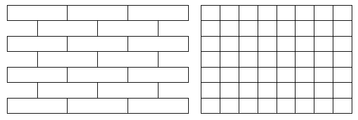
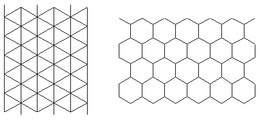
網目の形状は特に限定されるものではなく、ランダムな形状の網目であってもよいが、例えば、三角、四角、ひし形、六角等の形状の目をもつ規則正しい網目模様であることが、均一な性能を得る上では好ましい。好ましい網目模様の例を図1及び図2に示すが、中でも四角形の目をもつ格子状模様が、製造性の面で適している。また、網目模様は、必ずしもシートの長さ方向や幅方向に平行に形成される必要はなく、空気の押し出し効果を考えた場合、四角形、ひし形等の格子の線が長さ方向に対して30〜60度程度の角度を持って形成されている方が好ましい。 The shape of the mesh is not particularly limited, and may be a random mesh, but for example, a regular mesh pattern having a triangular, square, diamond, hexagonal, etc. It is preferable in obtaining performance. Examples of preferable mesh patterns are shown in FIGS. 1 and 2, and a lattice pattern having square eyes is particularly suitable in terms of manufacturability. Further, the mesh pattern is not necessarily formed in parallel with the length direction or the width direction of the sheet. In consideration of the air extrusion effect, a grid line such as a quadrangle or a rhombus has 30 lines in the length direction. It is preferable to form with an angle of about ~ 60 degrees.
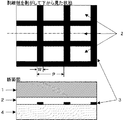
格子状模様の網目を有する本発明の粘着シートの構造を代表例として図3に示す。 FIG. 3 shows a structure of the pressure-sensitive adhesive sheet of the present invention having a lattice-like mesh as a representative example.
網目の大きさは、模様の平均ピッチとして50〜5000μm、好ましくは200〜2000μm、特に好ましくは300〜1000μmの範囲内が適している。模様のピッチは、図3におけるPに相当する。また、図3におけるWに相当する網目を形成する線の幅は1〜1000μm、好ましくは2〜200μm、特に好ましくは5〜100μmの範囲内であることが適している。 The mesh size is suitable in the range of 50 to 5000 μm, preferably 200 to 2000 μm, particularly preferably 300 to 1000 μm as the average pitch of the pattern. The pitch of the pattern corresponds to P in FIG. Further, the width of the line forming the mesh corresponding to W in FIG. 3 is suitably in the range of 1 to 1000 μm, preferably 2 to 200 μm, particularly preferably 5 to 100 μm.
ピッチの幅は、狭過ぎると有効粘着剤面積が小さくなってシートが剥離しやすくなり、広過ぎると空気の抜けが悪くなる。一方、網目を形成する線の幅は狭過ぎると空気の抜けが悪くなり、広過ぎると有効粘着剤面積が小さくなってシートが剥離しやすくなる。 If the pitch width is too narrow, the effective pressure-sensitive adhesive area becomes small and the sheet is easily peeled off. On the other hand, if the width of the line forming the mesh is too narrow, air escape is poor, and if it is too wide, the effective pressure-sensitive adhesive area becomes small and the sheet is easily peeled off.
従って、粘着性を有しない膜を印刷する前の粘着剤層の全表面積に対して、粘着性を有しない膜の面積が1〜50%、特に5〜45%の範囲内になるように調整することが空気の抜け性と素材との密着性の観点から適している。 Therefore, the area of the non-adhesive film is adjusted to be in the range of 1 to 50%, particularly 5 to 45% with respect to the total surface area of the adhesive layer before printing the non-adhesive film. It is suitable from the viewpoint of air escape and adhesion to the material.
粘着剤層上に粘着性を有しない膜を印刷により網目状に形成させた場合、通常該印刷膜は粘着剤層の上に盛り上がる形で形成されるが、粘着剤と離形紙が貼り合わされた時点で網目状に印刷された膜は抑えつけられて、通常該印刷膜は粘着剤層に埋め込まれて図3の断面図のようになる。従って、離形紙を剥がした後の粘着剤側の面は平坦となるため、基材に貼り付けた後の粘着シートの表面は極めて平坦となり、網目模様の全く見えない意匠性に優れたものとなる。 When a non-sticky film is formed on the pressure-sensitive adhesive layer by printing, the printed film is usually formed so as to rise on the pressure-sensitive adhesive layer, but the pressure-sensitive adhesive and release paper are bonded together. At this point, the mesh-printed film is suppressed, and the printed film is usually embedded in the adhesive layer as shown in the cross-sectional view of FIG. Therefore, since the surface on the adhesive side after peeling the release paper becomes flat, the surface of the pressure-sensitive adhesive sheet after being attached to the substrate is extremely flat, and has an excellent design that does not show a net pattern at all It becomes.
なお、本発明の粘着シートは、粘着剤層に空気の抜ける微細な溝を持つ粘着シートに比較すると空気の抜けは遅いため一時的に気泡がシートの下に残ることはあるが、溝と異なり空気の抜け道が塞がれてしまう可能性が少ないため、経時での空気の抜け性に優れるという特長を持つ。 Note that the pressure-sensitive adhesive sheet of the present invention may temporarily leave bubbles under the sheet because the air escape is slow compared to a pressure-sensitive adhesive sheet having fine grooves that allow air to escape from the pressure-sensitive adhesive layer. Since there is little possibility that the passage of air will be blocked, it has the feature of excellent air removal over time.
また、本発明の粘着シートは、剥離紙の柔軟性、粘着剤の粘度、粘着性を有しない膜の弾力性などを適度に調整することにより、粘着性を有しない膜が粘着剤層に完全に埋め込まれてしまわないようにすることも可能である。そのような粘着シートを用いた場合には、粘着剤層の上に粘着性を有しない膜が存在するため、粘着シートを貼るための被着体である素材上に粘着シートが触れただけでは容易に粘着シートが貼り付いてしまうことを防ぐことができ、貼付け作業性が大幅に向上する。粘着剤はシートの上からローラーなどで抑えることにより流動して基材に接するようになることから、粘着シートは気泡のない意匠性に優れた状態で基材に貼り付けられる。 In addition, the pressure-sensitive adhesive sheet of the present invention can be obtained by properly adjusting the flexibility of the release paper, the viscosity of the pressure-sensitive adhesive, the elasticity of the non-sticky film, etc. It is also possible not to be embedded in the. When such an adhesive sheet is used, there is a non-adhesive film on the adhesive layer, so that the adhesive sheet only touches the material that is the adherend for attaching the adhesive sheet. It is possible to prevent the adhesive sheet from sticking easily, and the pasting workability is greatly improved. Since the pressure-sensitive adhesive flows and comes into contact with the base material by being suppressed from above the sheet with a roller or the like, the pressure-sensitive adhesive sheet is attached to the base material in a state of excellent design without air bubbles.
本発明の粘着シートは、通常粘着シートとして用いられる用途に特に問題なく使用することができるが、上記のように貼付け作業性に極めて優れていることから、形状が複雑でシートの下に気泡が残存しやすい構造の素材に対して特に有用であり、自動車等の車体やドアサッシなどの被覆に好適である。 The pressure-sensitive adhesive sheet of the present invention can be used without any particular problem for applications that are usually used as pressure-sensitive adhesive sheets. However, as described above, it is extremely excellent in pasting workability, so that the shape is complicated and bubbles are formed under the sheet. It is particularly useful for a material having a structure that tends to remain, and is suitable for covering a vehicle body such as an automobile or a door sash.
以下、実施例及び比較例を挙げて、本発明をより具体的に説明する。なお、以下、「部」及び「%」はいずれも重量基準によるものとする。 Hereinafter, the present invention will be described more specifically with reference to examples and comparative examples. Hereinafter, both “parts” and “%” are based on weight.
粘着シートの作成
実施例1
離形紙に印刷インキ「VK240−A」(商品名、帝国インキ製造社製、ビニル系インキ)を用いてスクリーン印刷法により図3に示すような正方形の格子模様を印刷した後、雰囲気温度60℃で20分間の乾燥を行った。印刷層の乾燥膜厚は約2μm、格子のピッチ(図3におけるP)は1000μm、格子の線の幅(図3におけるW)は100μmであり、印刷層の面積としては、粘着剤層全体の面積の19%である。
Example 1 for creating an adhesive sheet
A square lattice pattern as shown in FIG. 3 is printed on the release paper using a screen printing method using a printing ink “VK240-A” (trade name, Teikoku Ink Manufacturing Co., Ltd., vinyl-based ink), and then an atmospheric temperature of 60 Drying was performed at 20 ° C. for 20 minutes. The dry thickness of the printed layer is about 2 μm, the pitch of the lattice (P in FIG. 3) is 1000 μm, the width of the lattice line (W in FIG. 3) is 100 μm, and the area of the printed layer is as follows. 19% of the area.
厚さ100μmの光沢のある黒色塩ビフィルム(リケンテクノス社製)の片面に粘着剤「S−3403」(商品名、東亞合成社製、アクリル系粘着剤)を乾燥膜厚で30μmとなるように塗布し、雰囲気温度80℃で20分間の乾燥を行った。次いで該フィルムを上記格子模様が印刷された剥離紙の上に印刷面と粘着剤層が接するようにして、ロール温度90℃及びライン速度2m/分の条件でラミネートし、粘着シートA1を得た。 An adhesive “S-3403” (trade name, manufactured by Toagosei Co., Ltd., acrylic adhesive) is applied to one side of a glossy black PVC film (manufactured by Riken Technos) with a thickness of 100 μm so that the dry film thickness is 30 μm. Then, drying was performed at an atmospheric temperature of 80 ° C. for 20 minutes. Next, the film was laminated on the release paper on which the lattice pattern was printed so that the printing surface and the pressure-sensitive adhesive layer were in contact with each other under the conditions of a roll temperature of 90 ° C. and a line speed of 2 m / min to obtain a pressure-sensitive adhesive sheet A1. .
実施例2
実施例1において、印刷する格子模様の格子のピッチ(図3におけるP)を長手方向1000μm及び幅方向400μmの長方形の形状とし、格子の線の幅(図3におけるW)を30μmにする以外は実施例1と同様にして粘着シートA2を得た。印刷層の面積としては、粘着剤層全体の面積の10%である。
Example 2
In Example 1, except that the grid pitch (P in FIG. 3) of the grid pattern to be printed is a rectangular shape of 1000 μm in the longitudinal direction and 400 μm in the width direction, and the width of the grid line (W in FIG. 3) is 30 μm. In the same manner as in Example 1, an adhesive sheet A2 was obtained. The area of the printing layer is 10% of the entire area of the pressure-sensitive adhesive layer.
実施例3
実施例1において、印刷する格子模様の格子のピッチ(図3におけるP)を400μm及び格子の線の幅(図3におけるW)を100μmにする以外は実施例1と同様にして粘着シートA3を得た。印刷層の面積としては、粘着剤層全体の面積の44%である。
Example 3
In Example 1, the pressure-sensitive adhesive sheet A3 was prepared in the same manner as in Example 1 except that the grid pitch (P in FIG. 3) to be printed was 400 μm and the width of the grid line (W in FIG. 3) was 100 μm. Obtained. The area of the print layer is 44% of the total area of the pressure-sensitive adhesive layer.
実施例4
実施例1において、印刷する格子模様の格子のピッチ(図3におけるP)を500μm及び格子の線の幅(図3におけるW)を30μmにする以外は実施例1と同様にして粘着シートA4を得た。印刷層の面積としては、粘着剤層全体の面積の12%である。
Example 4
In Example 1, the pressure-sensitive adhesive sheet A4 was prepared in the same manner as in Example 1 except that the grid pitch (P in FIG. 3) to be printed was 500 μm and the width of the grid line (W in FIG. 3) was 30 μm. Obtained. The area of the printing layer is 12% of the entire area of the pressure-sensitive adhesive layer.
実施例5
離形紙に印刷インキ「V−12」(商品名、大日精化社製、ビニル系インキ)を用いてグラビア印刷法により図3に示すような正方形の格子模様を印刷した後、雰囲気温度60℃で5秒間の乾燥を行った。印刷層の乾燥膜厚は約1μm、格子のピッチ(図3におけるP)は1000μm及び格子の線の幅(図3におけるW)は250μmであった。
Example 5
After printing a square lattice pattern as shown in FIG. 3 by gravure printing method using a printing ink “V-12” (trade name, manufactured by Dainichi Seika Co., Ltd., vinyl ink) on a release paper, an atmospheric temperature of 60 Drying was performed at 5 ° C. for 5 seconds. The dry thickness of the printed layer was about 1 μm, the pitch of the grid (P in FIG. 3) was 1000 μm, and the width of the grid line (W in FIG. 3) was 250 μm.
厚さ100μmの光沢のある黒色塩ビフィルム(リケンテクノス社製)の片面に粘着剤「S−3403」(商品名、東亞合成社製、アクリル系粘着剤)を乾燥膜厚で30μmとなるように塗布し、雰囲気温度80℃で20分間の乾燥を行った。次いで該フィルムを上記格子模様が印刷された剥離紙の上に印刷面と粘着剤層が接するようにして、ロール温度90℃及びライン速度2m/分の条件でラミネートし、粘着シートA5を得た。印刷層の面積としては、粘着剤層全体の面積の44%である。 The adhesive “S-3403” (trade name, manufactured by Toagosei Co., Ltd., acrylic adhesive) is applied on one side of a glossy black PVC film (manufactured by Riken Technos) with a thickness of 100 μm so that the dry film thickness is 30 μm. Then, drying was performed at an atmospheric temperature of 80 ° C. for 20 minutes. Next, the film was laminated on the release paper on which the lattice pattern was printed so that the printing surface and the pressure-sensitive adhesive layer were in contact with each other under the conditions of a roll temperature of 90 ° C. and a line speed of 2 m / min to obtain a pressure-sensitive adhesive sheet A5. . The area of the print layer is 44% of the total area of the pressure-sensitive adhesive layer.
実施例6
厚さ100μmの光沢のある黒色塩ビフィルム(リケンテクノス社製)の片面に粘着剤「S−3403」(商品名、東亞合成社製、アクリル系粘着剤)を乾燥膜厚で30μmとなるように塗布し、雰囲気温度80℃で20分間の乾燥を行った。次いで該フィルム上に油性インキ「5003カラーインク」(商品名、マーケム社製)を用いてインクジェットプリンター(ミマキエンジニアリング社製)により図3に示すような正方形の格子模様を印刷した後、雰囲気温度60℃で20分間の乾燥を行った。印刷層の乾燥膜厚は約3μm、格子のピッチ(図3におけるP)は1000μm及び格子の線の幅(図3におけるW)は300μmであった。印刷層の面積としては、粘着剤層全体の面積の44%である。
Example 6
An adhesive “S-3403” (trade name, manufactured by Toagosei Co., Ltd., acrylic adhesive) is applied to one side of a glossy black PVC film (manufactured by Riken Technos) with a thickness of 100 μm so as to have a dry film thickness of 30 μm. Then, drying was performed at an atmospheric temperature of 80 ° C. for 20 minutes. Next, a square lattice pattern as shown in FIG. 3 was printed on the film by an ink jet printer (Mimaki Engineering Co., Ltd.) using an oil-based ink “5003 Color Ink” (trade name, manufactured by Markem Co., Ltd.). Drying was performed at 20 ° C. for 20 minutes. The dry thickness of the printed layer was about 3 μm, the pitch of the grid (P in FIG. 3) was 1000 μm, and the width of the grid lines (W in FIG. 3) was 300 μm. The area of the print layer is 44% of the total area of the pressure-sensitive adhesive layer.
上記粘着剤層を有するフィルム上に剥離紙を室温にてラミネートし、粘着シートA6を得た。 Release paper was laminated on the film having the pressure-sensitive adhesive layer at room temperature to obtain pressure-sensitive adhesive sheet A6.
比較例1
厚さ100μmの光沢のある黒色塩ビフィルム(リケンテクノス社製)の片面に粘着剤S−3403(商品名、東亞合成社製、アクリル系粘着剤)を乾燥膜厚で30μmとなるように塗布し、雰囲気温度80℃で10分間の乾燥を行った。次いで該フィルムを平滑な剥離紙(リケンテクノス社製)の上に粘着剤層が接するようにして、ロール温度90℃、ロール圧力3kg/cm2及びライン速度2mm/分の条件でラミネートし、粘着シートB1を得た。
Comparative Example 1
The adhesive S-3403 (trade name, manufactured by Toagosei Co., Ltd., acrylic adhesive) was applied to one side of a glossy black PVC film (manufactured by Riken Technos Co., Ltd.) having a thickness of 100 μm so as to have a dry film thickness of 30 μm. Drying was performed at an ambient temperature of 80 ° C. for 10 minutes. Next, the film is laminated under conditions of a roll temperature of 90 ° C., a roll pressure of 3 kg / cm 2 and a line speed of 2 mm / min so that the pressure-sensitive adhesive layer is in contact with smooth release paper (manufactured by Riken Technos), and a pressure-sensitive adhesive sheet B1 was obtained.
比較例2
厚さ100μmの光沢のある黒色塩ビフィルム(リケンテクノス社製)の片面に粘着剤「S−3403」(商品名、東亞合成社製、アクリル系粘着剤)を乾燥膜厚で30μmとなるように塗布し、雰囲気温度80℃で20分間の乾燥を行った。次いで該フィルムを格子模様が凸状に形成された剥離紙(日栄化工社製)に凸部と粘着剤が接するようにして、ロール温度90℃及びライン速度30m/分の条件でラミネートし、粘着シートB2を得た。格子模様は、格子のピッチが500μm及び格子の線の幅が30μmであり、凸部の面積としては、粘着剤層全体の面積の12%である。また、凸部の高さは20μmあり、剥離紙を取り除くと、剥離紙の格子状の凸部によって、粘着剤層の表面に格子状の溝(ピッチ500μm、幅30μm及び深さ20μm)が形成されるものである。
Comparative Example 2
An adhesive “S-3403” (trade name, manufactured by Toagosei Co., Ltd., acrylic adhesive) is applied to one side of a glossy black PVC film (manufactured by Riken Technos) with a thickness of 100 μm so as to have a dry film thickness of 30 μm. Then, drying was performed at an atmospheric temperature of 80 ° C. for 20 minutes. Next, the film was laminated under the conditions of a roll temperature of 90 ° C. and a line speed of 30 m / min so that the convex part and the adhesive were in contact with a release paper (manufactured by Nichiei Kako Co., Ltd.) having a convex lattice pattern. Sheet B2 was obtained. The lattice pattern has a lattice pitch of 500 μm and a lattice line width of 30 μm, and the area of the convex portion is 12% of the total area of the pressure-sensitive adhesive layer. The height of the convex part is 20 μm, and when the release paper is removed, a grid-like groove (pitch 500 μm, width 30 μm and depth 20 μm) is formed on the surface of the adhesive layer by the grid-like convex part of the release paper. It is what is done.
性能試験
上記で得られた各粘着シートについて、接着力、空気抜け性及び耐水性を下記試験方法に基いて評価した。なお、下記試験に用いた塗装鋼板は、自動車用塗装鋼板であり、冷延鋼板上にカチオン電着塗膜、中塗り塗膜、上塗りベース塗膜(シルバー色)及び上塗りクリヤ塗膜が順次形成されてなるものであり、該上塗りクリヤ塗膜は上塗りクリヤ塗料「マジクロンK−1200TW」(商品名、関西ペイント社製、アクリル樹脂系)によるアクリル樹脂系クリヤ塗膜である。得られた結果を後記表1に示す。
Performance test About each adhesive sheet obtained above, adhesive force, air bleeding property, and water resistance were evaluated based on the following test method. The coated steel sheet used in the following test is a coated steel sheet for automobiles, and a cationic electrodeposition coating film, intermediate coating film, top coating base coating film (silver color), and top coating clear coating film are sequentially formed on the cold-rolled steel sheet. The overcoat clear coating film is an acrylic resin type clear coating film with a top coat clear coating “Magicron K-1200TW” (trade name, manufactured by Kansai Paint Co., Ltd., acrylic resin type). The obtained results are shown in Table 1 below.
接着力
10mm×100mmに切断した粘着シートから剥離紙を剥がし、平滑な塗装鋼板に貼付けロールを用いて貼付け圧力2kgで1往復させる条件で貼り付け、室温に24時間放置した後、シートを被着体から剥がすための力を「オートグラフAG−1」(商品名、島津製作所社製)を用いて剥離角度180°、引っ張り速度200mm/分及び温度23℃の試験条件で測定した。
Adhesive strength Peel off the release paper from the adhesive sheet cut to 10 mm x 100 mm, apply it to a smooth coated steel plate using an application roll under a reciprocating pressure of 2 kg, leave it at room temperature for 24 hours, and then attach the sheet The force for peeling off the body was measured using “Autograph AG-1” (trade name, manufactured by Shimadzu Corporation) under the test conditions of a peeling angle of 180 °, a pulling speed of 200 mm / min, and a temperature of 23 ° C.
空気抜け性
粘着シートを、予め直径15mm及び深さ1mmの窪みを付けた塗装鋼板に貼付けロールを用いて貼付け圧力2kgで1往復させる条件で貼り付け、室温に24時間放置した後、指先にて窪みの空気を押し出し、空気の残存状態を目視で下記基準により評価した。
○:空気の残存がほとんど認められない。
×:空気の残存が明らかに認められる。
Air release Adhesive sheet is applied to a coated steel plate with a diameter of 15 mm and a depth of 1 mm in advance using an application roll under the condition of one reciprocation with an application pressure of 2 kg, left at room temperature for 24 hours, and then with a fingertip. The air in the depression was extruded and the remaining state of the air was visually evaluated according to the following criteria.
○: Almost no air remains.
X: Remaining air is clearly recognized.
耐水性
10mm×100mmに切断した粘着シートから剥離紙を剥がし、平滑な塗装鋼板に貼付けロールを用いて貼付け圧力2kgで1往復させる条件で貼り付け、室温に24時間放置した後、該粘着シートを貼り付けた試験板を40℃の温水に168時間浸漬して取り出し、水気を拭き取った後、シート面の外観を目視で下記基準により評価した。
○:シート面は平滑で特に異常は認められない。
×:シート面に格子状の模様が認められる。
Water resistance Peel off the release paper from the adhesive sheet cut to 10 mm x 100 mm, apply it to a smooth coated steel plate using an application roll under the condition of reciprocating once with an application pressure of 2 kg, and leave it at room temperature for 24 hours. The attached test plate was immersed in warm water at 40 ° C. for 168 hours, taken out, wiped off moisture, and then the appearance of the sheet surface was visually evaluated according to the following criteria.
○: The sheet surface is smooth and no abnormality is observed.
X: A lattice-like pattern is recognized on the sheet surface.
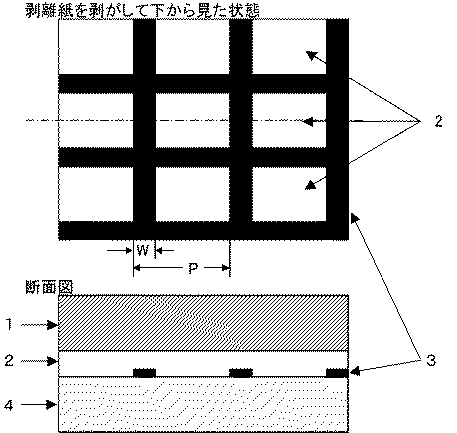
1 基材シート
2 粘着剤
3 粘着性を示さない膜
4 離形紙
DESCRIPTION OF SYMBOLS 1
Claims (5)
The release composition is printed with gravure printing, screen printing, offset printing or ink jet printing to form a non-adhesive film so as to form a mesh pattern, dried, and then released. The method for producing a pressure-sensitive adhesive sheet according to any one of claims 1 to 4, wherein a base sheet having a paper pattern and a pressure-sensitive adhesive layer is laminated so that the printing surface is in contact with the pressure-sensitive adhesive.
Priority Applications (1)
| Application Number | Priority Date | Filing Date | Title |
|---|---|---|---|
| JP2004112055A JP2005298543A (en) | 2004-04-06 | 2004-04-06 | Pressure-sensitive adhesive sheet |
Applications Claiming Priority (1)
| Application Number | Priority Date | Filing Date | Title |
|---|---|---|---|
| JP2004112055A JP2005298543A (en) | 2004-04-06 | 2004-04-06 | Pressure-sensitive adhesive sheet |
Publications (1)
| Publication Number | Publication Date |
|---|---|
| JP2005298543A true JP2005298543A (en) | 2005-10-27 |
Family
ID=35330493
Family Applications (1)
| Application Number | Title | Priority Date | Filing Date |
|---|---|---|---|
| JP2004112055A Pending JP2005298543A (en) | 2004-04-06 | 2004-04-06 | Pressure-sensitive adhesive sheet |
Country Status (1)
| Country | Link |
|---|---|
| JP (1) | JP2005298543A (en) |
Cited By (12)
| Publication number | Priority date | Publication date | Assignee | Title |
|---|---|---|---|---|
| JP2007046028A (en) * | 2005-08-08 | 2007-02-22 | Yoshihiro Suzuki | Pressure-sensitive adhesive sheet, double-sided tape and release paper |
| JP2008055850A (en) * | 2006-09-01 | 2008-03-13 | Dainippon Printing Co Ltd | Laminated body and container using the same |
| JP2008095057A (en) * | 2006-10-10 | 2008-04-24 | Yoshihiro Suzuki | Functional pressure-sensitive adhesive film and printed release sheet |
| WO2016084948A1 (en) * | 2014-11-28 | 2016-06-02 | 日東電工株式会社 | Adhesive sheet |
| WO2016084947A1 (en) * | 2014-11-28 | 2016-06-02 | 日東電工株式会社 | Adhesive sheet |
| WO2016084946A1 (en) * | 2014-11-28 | 2016-06-02 | 日東電工株式会社 | Adhesive sheet for portable electronic devices |
| JP2016108532A (en) * | 2014-11-28 | 2016-06-20 | 日東電工株式会社 | Adhesive sheet for portable electronic apparatus |
| JP2017200968A (en) * | 2016-05-02 | 2017-11-09 | 日東電工株式会社 | Adhesive sheet with release liner |
| JP2018083870A (en) * | 2016-11-21 | 2018-05-31 | 日東電工株式会社 | Adhesive sheet |
| WO2018221336A1 (en) * | 2017-05-31 | 2018-12-06 | 日東電工株式会社 | Adhesive sheet |
| JP2019172938A (en) * | 2018-03-29 | 2019-10-10 | リンテック株式会社 | Manufacturing method of pressure sensitive adhesive sheet |
| JP2022021538A (en) * | 2020-07-22 | 2022-02-03 | ミラクル工業株式会社 | Adhesive sheet and its manufacturing method |
Citations (2)
| Publication number | Priority date | Publication date | Assignee | Title |
|---|---|---|---|---|
| JP2000044903A (en) * | 1998-08-03 | 2000-02-15 | Toyo Ink Mfg Co Ltd | Adhesive sheet, method for producing the same, and method for adjusting the adhesive strength |
| JP2000160117A (en) * | 1998-09-21 | 2000-06-13 | Toyo Ink Mfg Co Ltd | Double-sided adhesive sheet, method for producing the same, and method for adjusting the adhesive strength |
-
2004
- 2004-04-06 JP JP2004112055A patent/JP2005298543A/en active Pending
Patent Citations (2)
| Publication number | Priority date | Publication date | Assignee | Title |
|---|---|---|---|---|
| JP2000044903A (en) * | 1998-08-03 | 2000-02-15 | Toyo Ink Mfg Co Ltd | Adhesive sheet, method for producing the same, and method for adjusting the adhesive strength |
| JP2000160117A (en) * | 1998-09-21 | 2000-06-13 | Toyo Ink Mfg Co Ltd | Double-sided adhesive sheet, method for producing the same, and method for adjusting the adhesive strength |
Cited By (31)
| Publication number | Priority date | Publication date | Assignee | Title |
|---|---|---|---|---|
| JP2007046028A (en) * | 2005-08-08 | 2007-02-22 | Yoshihiro Suzuki | Pressure-sensitive adhesive sheet, double-sided tape and release paper |
| JP2008055850A (en) * | 2006-09-01 | 2008-03-13 | Dainippon Printing Co Ltd | Laminated body and container using the same |
| JP2008095057A (en) * | 2006-10-10 | 2008-04-24 | Yoshihiro Suzuki | Functional pressure-sensitive adhesive film and printed release sheet |
| KR20170092541A (en) * | 2014-11-28 | 2017-08-11 | 닛토덴코 가부시키가이샤 | Adhesive sheet |
| CN107001871B (en) * | 2014-11-28 | 2020-11-10 | 日东电工株式会社 | Adhesive sheet |
| WO2016084946A1 (en) * | 2014-11-28 | 2016-06-02 | 日東電工株式会社 | Adhesive sheet for portable electronic devices |
| JP2016108532A (en) * | 2014-11-28 | 2016-06-20 | 日東電工株式会社 | Adhesive sheet for portable electronic apparatus |
| JP2016108534A (en) * | 2014-11-28 | 2016-06-20 | 日東電工株式会社 | Adhesive sheet |
| JP2016108533A (en) * | 2014-11-28 | 2016-06-20 | 日東電工株式会社 | Adhesive sheet |
| CN107001870A (en) * | 2014-11-28 | 2017-08-01 | 日东电工株式会社 | Adhesive sheets for portable electronic devices |
| CN107001869A (en) * | 2014-11-28 | 2017-08-01 | 日东电工株式会社 | adhesive sheet |
| CN107001871A (en) * | 2014-11-28 | 2017-08-01 | 日东电工株式会社 | adhesive sheet |
| KR20170088833A (en) * | 2014-11-28 | 2017-08-02 | 닛토덴코 가부시키가이샤 | Adhesive sheet for portable electronic devices |
| KR20170090411A (en) * | 2014-11-28 | 2017-08-07 | 닛토덴코 가부시키가이샤 | Adhesive sheet |
| WO2016084948A1 (en) * | 2014-11-28 | 2016-06-02 | 日東電工株式会社 | Adhesive sheet |
| KR102506413B1 (en) * | 2014-11-28 | 2023-03-07 | 닛토덴코 가부시키가이샤 | Adhesive sheet |
| KR102506412B1 (en) * | 2014-11-28 | 2023-03-07 | 닛토덴코 가부시키가이샤 | Adhesive sheet for portable electronic devices |
| KR102463777B1 (en) * | 2014-11-28 | 2022-11-07 | 닛토덴코 가부시키가이샤 | Adhesive sheet |
| CN107001870B (en) * | 2014-11-28 | 2021-07-06 | 日东电工株式会社 | Adhesive Sheets for Portable Electronic Devices |
| WO2016084947A1 (en) * | 2014-11-28 | 2016-06-02 | 日東電工株式会社 | Adhesive sheet |
| US10596792B2 (en) | 2014-11-28 | 2020-03-24 | Nitto Denko Corporation | Pressure-sensitive adhesive sheet for mobile electronics |
| US11104826B2 (en) | 2016-05-02 | 2021-08-31 | Nitto Denko Corporation | Release-linered pressure-sensitive adhesive sheet |
| WO2017191734A1 (en) * | 2016-05-02 | 2017-11-09 | 日東電工株式会社 | Adhesive sheet with release liner |
| JP2017200968A (en) * | 2016-05-02 | 2017-11-09 | 日東電工株式会社 | Adhesive sheet with release liner |
| JP2018083870A (en) * | 2016-11-21 | 2018-05-31 | 日東電工株式会社 | Adhesive sheet |
| JP2018203836A (en) * | 2017-05-31 | 2018-12-27 | 日東電工株式会社 | Adhesive sheet |
| WO2018221336A1 (en) * | 2017-05-31 | 2018-12-06 | 日東電工株式会社 | Adhesive sheet |
| US11267998B2 (en) | 2017-05-31 | 2022-03-08 | Nitto Denko Corporation | Pressure-sensitive adhesive sheet |
| JP7075727B2 (en) | 2017-05-31 | 2022-05-26 | 日東電工株式会社 | Adhesive sheet |
| JP2019172938A (en) * | 2018-03-29 | 2019-10-10 | リンテック株式会社 | Manufacturing method of pressure sensitive adhesive sheet |
| JP2022021538A (en) * | 2020-07-22 | 2022-02-03 | ミラクル工業株式会社 | Adhesive sheet and its manufacturing method |
Similar Documents
| Publication | Publication Date | Title |
|---|---|---|
| JP5570110B2 (en) | Transparent adhesive layer | |
| WO2009048176A1 (en) | Pressure-sensitive adhesive sheet and process for producing the same | |
| JP2891256B1 (en) | Transfer substrate and transfer seal | |
| US20030098906A1 (en) | Ink jet transfer printing process | |
| WO2004092293A1 (en) | Adherent converted sheet | |
| JP2751137B2 (en) | Tattoo transfer seal | |
| JP2010248430A (en) | Pressure-sensitive adhesive sheet | |
| JPWO2006022335A1 (en) | Decorative material | |
| JP2004038119A (en) | Method for printing and manufacturing poster backed with micro-suction cup | |
| JP4423742B2 (en) | Decorative sheet with adhesive | |
| JP4841107B2 (en) | Adhesive processing sheet | |
| JP3059175U (en) | Double-sided adhesive body with adhesive body formed by printing | |
| JP3018714U (en) | Weak adhesive film | |
| JPH07224254A (en) | Adhesive sheet | |
| JP5307961B2 (en) | Adhesive sheet | |
| JP4234297B2 (en) | Transfer decoration method and decorative transfer film used for it | |
| JP2009143978A (en) | Removable pressure-sensitive adhesive sheet for printing and method for producing the same | |
| JP4721963B2 (en) | Potting decoration manufacturing method | |
| JP4520098B2 (en) | Adhesive sheet and method for producing adhesive sheet | |
| CN201351152Y (en) | Printable and repeatedly-adhesive-tearable adhesive material | |
| CN215102969U (en) | Adhesive film | |
| JP4682266B2 (en) | Backed advertising poster sheet | |
| JP2009012227A (en) | Decorative sheet manufacturing method and decorative sheet | |
| JP2022056836A (en) | How to apply the decorative sheet | |
| JP2001252995A (en) | Adhesive sticker for inkjet image and method of manufacturing the same |
Legal Events
| Date | Code | Title | Description |
|---|---|---|---|
| A621 | Written request for application examination |
Free format text: JAPANESE INTERMEDIATE CODE: A621 Effective date: 20070327 |
|
| A977 | Report on retrieval |
Free format text: JAPANESE INTERMEDIATE CODE: A971007 Effective date: 20100512 |
|
| A131 | Notification of reasons for refusal |
Free format text: JAPANESE INTERMEDIATE CODE: A131 Effective date: 20100525 |
|
| A02 | Decision of refusal |
Free format text: JAPANESE INTERMEDIATE CODE: A02 Effective date: 20101005 |